NCERT Solutions for Class 12 Maths Chapter 13 Probability Exercise 13.2 cover all 18 questions on the multiplication theorem and independent events. Each answer is worked in the same notation as the 2026-27 NCERT textbook, one question per page. The free solutions PDF for Exercise 13.2 is available to download on this page.
CBSE Weightage: Probability carries 8 marks in the board paper; the multiplication theorem and independence sub-cluster is worth 3 to 4 marks.
Skill split: independence verification (Q4, Q5, Q6, Q15), draws with/without replacement (Q2, Q3, Q13), union/complement of independent events (Q9 to Q14), plus 2 MCQs.
JEE Main link: independence-based product rules appear in 60 to 70 percent of JEE Main shifts that touch probability.
Why Exercise 13.2 Is the Hinge of the Probability Chapter
Exercise 13.2 connects conditional probability to the independence shortcut used in nearly every later question. The multiplication theorem P(A∩ B)=P(A)P(B|A) applies universally; the cleaner product rule P(A∩ B)=P(A)P(B) follows only when the events are independent. Examiners reward declaring independence before invoking the product rule; skipping it costs 0.5 to 1 mark even with the right final answer.
How Collegedunia's NCERT Solutions Help You Clear Exercise 13.2
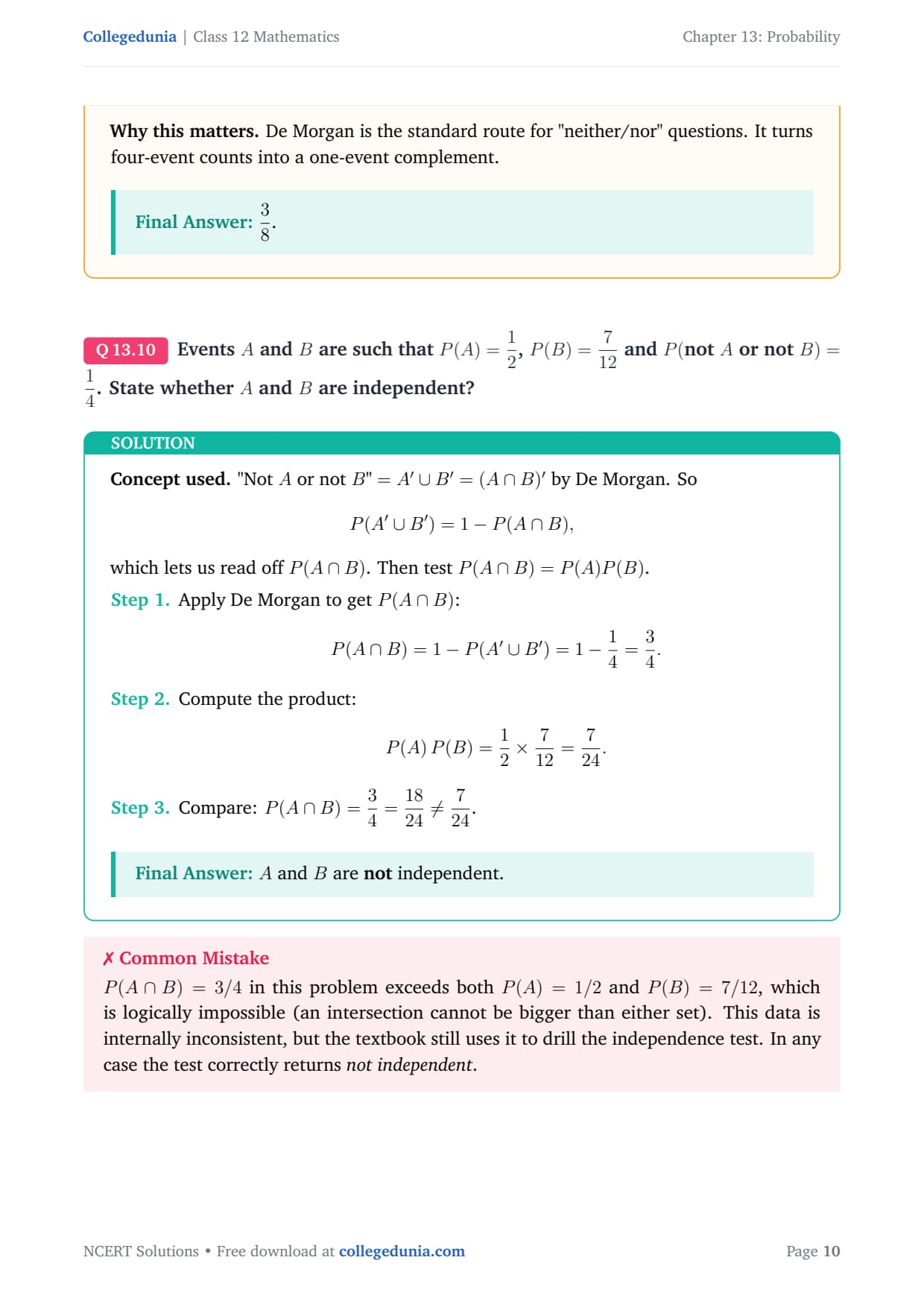
The recurring trap in Exercise 13.2 is collapsing two distinct events into one because their probabilities look equal. Every solution states independence explicitly, either from the question's wording or by checking P(A∩ B)=P(A)P(B) numerically, before the product rule is used.
With vs without replacement flagged in Q2 and Q13, where the second draw's denominator changes.
Independence verified, not assumed on Q4, Q5, Q6 and Q15, with the test shown numerically.
"At least one" recipe on Q11 and Q12: the complement shortcut is written out so students see why it beats inclusion-exclusion.
Multiplication Theorem and Independence Used in Exercise 13.2
Multiplication theorem:P(A∩ B)=P(A)P(B|A)=P(B)P(A|B), valid whenever P(A),P(B)>0. Independent events:A and B are independent iff P(A∩ B)=P(A)P(B). "At least one" identity: for independent trials with success probability p, P(at least one)=1-(1-p)n.
Pairwise independence does not imply mutual independence for three or more events; CBSE rarely tests this, but JEE Advanced does.
Probability NCERT Solutions Exercise 13.2: Question-Wise Answer Map
The table records the final answer for every problem so you can check your setup.
Q No.
What it tests
Answer
1
Independence product rule
3/25
2
Two black cards without replacement
25/102
3
Box-of-oranges approval
44/91
4
Coin-head and die-3 independence check
Yes, independent
5
Even-number and red-face independence
Not independent
6
Numerical independence verification
Not independent
7
p when (i) mutually exclusive (ii) independent
1/10 and 1/5
8
Four probabilities from P(A), P(B)
0.12, 0.58, 0.42, 0.28
9
Not-A and not-B
3/8
10
Independence check from union-complement
Independent
11
Independent events: 5 probabilities
0.18, 0.72, 0.42, 0.28, 0.4
12
At least one odd number in three throws
7/8
13
With-replacement draws: both, first, at least one
25/81, 20/81, 65/81
14
Problem solved independently by A and B
1/2 and 1/3
15
Card-from-deck independence cases
(i) Yes (ii) Yes (iii) No
16
Newspaper-students conditional probabilities
1/2, 2/3, 1/3
17
MCQ: pair-of-dice even prime
(D) 1/36
18
MCQ: condition for independence
(D) P(A|B)=P(A)
A multiplication-theorem or independence question has been set in every CBSE board paper for the last five years, usually as a 3-mark short answer.
Probability Weightage Compared Across Class 12 Maths Chapters
Probability accounts for 8 of 80 board marks; Exercise 13.2's multiplication-theorem cluster contributes 3 to 4 of them.
Chapter
Topic
Avg CBSE Marks
Ch 7
Integrals
10 marks
Ch 9
Differential Equations
9 marks
Ch 10
Vector Algebra
9 marks
Ch 13
Probability
8 marks
Ch 11
Three Dimensional Geometry
8 marks
Ch 6
Application of Derivatives
8 marks
Ch 5
Continuity & Differentiability
7 marks
Ch 12
Linear Programming
5 marks
Common Mistakes Students Make in Exercise 13.2
These four error patterns cost the most marks on the multiplication-theorem questions.
Common Mistake: Using the product rule P(A∩ B)=P(A)P(B) without first stating that the events are independent. CBSE deducts 0.5 mark for this even when the numerical answer is correct.
Mixing replacement modes in Q2. The 52-card pack drops to 51 after the first draw.
Forgetting De Morgan on Q9: not-A-and-not-B is 1-P(A∪ B), not 1-P(A∩ B).
Expanding "at least one" by inclusion-exclusion instead of the complement shortcut. Q12 is one line with the complement.
Pairwise versus mutually independent confusion when a question names three events.
Other Resources for Class 12 Maths Chapter 13 Probability
Pair the Exercise 13.2 solutions with the rest of the Chapter 13 resource library.
All NCERT Solutions for Probability Ex 13.2 with Step-by-Step Working
Every NCERT textbook question for Class 12 Mathematics Chapter 13 Probability Ex 13.2 is listed below with its full Solution and Expert Solution hidden inside collapsible tabs. Click Check Solution to reveal the step-by-step working; click Expert Solution for the expanded explanation.
Questions
Q 13.1
If P(A)=35 and P(B)=15, find P(A∩ B) if A and B are independent events.
Concept used. Events A and B are independent if and only if
P(A∩ B)=P(A) P(B).
When independence is assumed, the intersection probability is simply the product.
Apply the independence formula:
P(A∩ B)=P(A) P(B)=35× 15.
Why this matters. For independent events, joint probability factorises; this single fact powers every later calculation in the exercise.
325.
Q 13.2
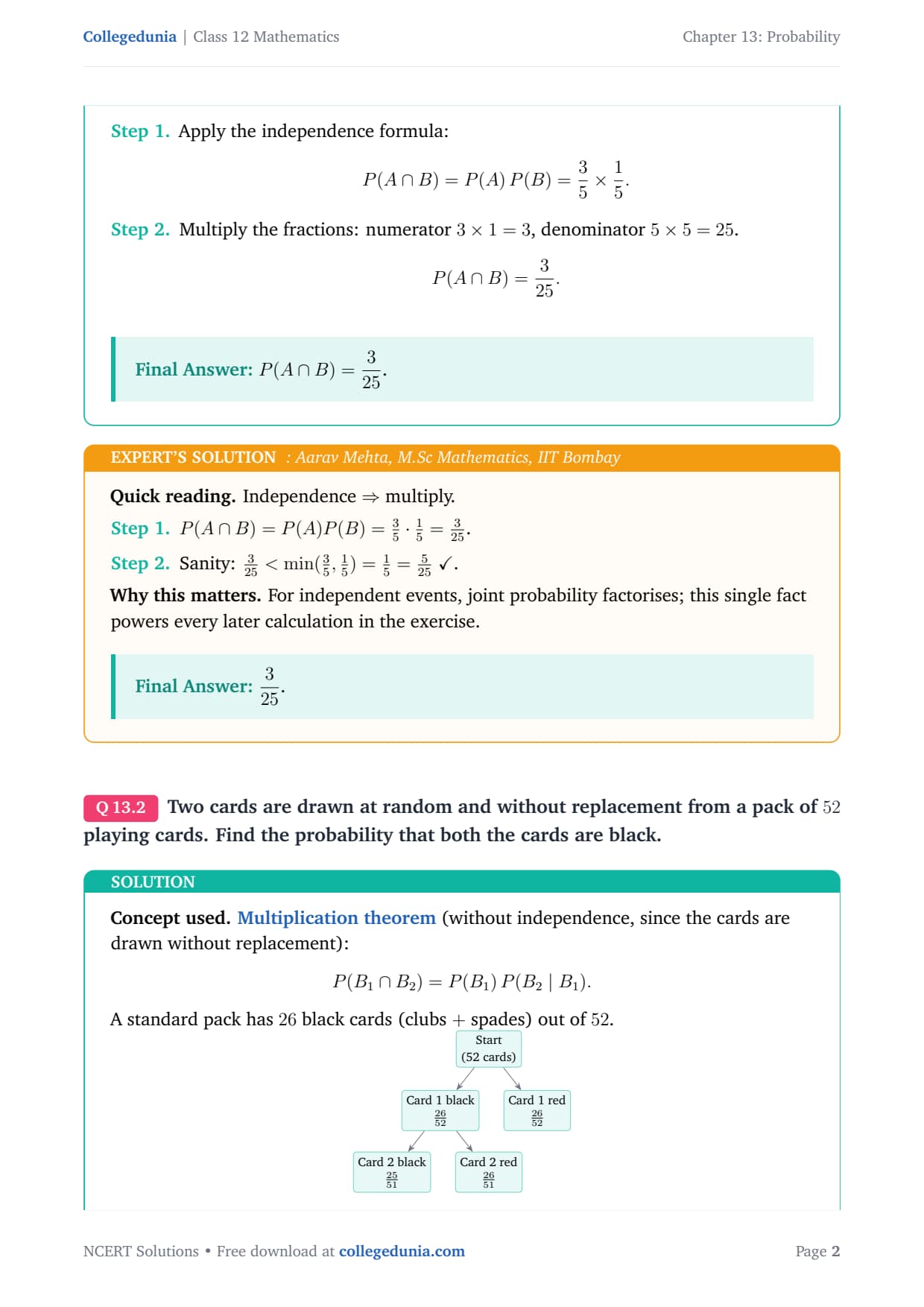
Two cards are drawn at random and without replacement from a pack of 52 playing cards. Find the probability that both the cards are black.
Concept used.Multiplication theorem (without independence, since the cards are drawn without replacement):
P(B1∩ B2)=P(B1) P(B2B1).
A standard pack has 26 black cards (clubs + spades) out of 52.
[See diagram in the PDF version]
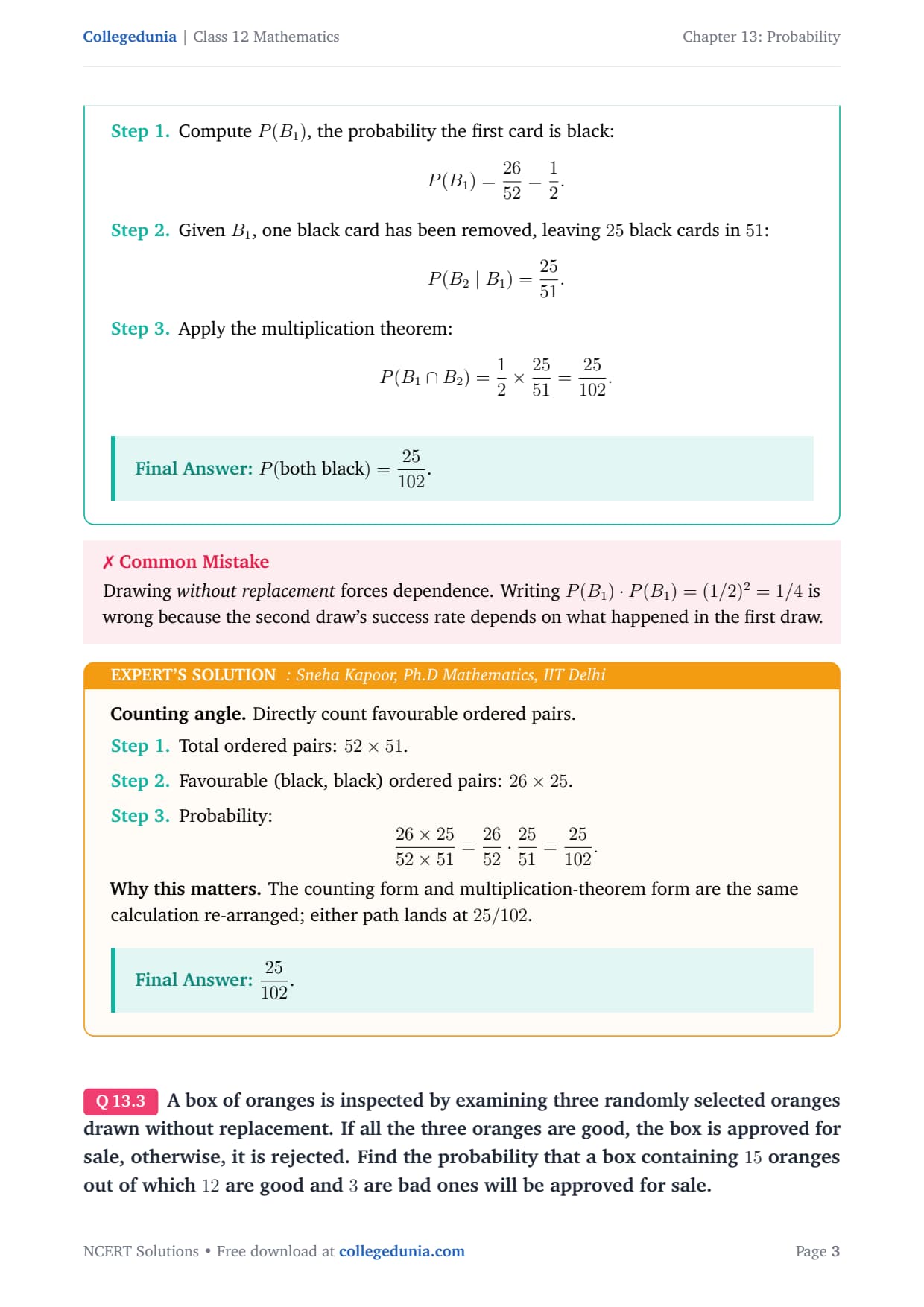
Compute P(B1), the probability the first card is black:
P(B1)=2652=12.
Given B1, one black card has been removed, leaving 25 black cards in 51:
P(B2B1)=2551.
Apply the multiplication theorem:
P(B1∩ B2)=12× 2551=25102.
Why this matters. The counting form and multiplication-theorem form are the same calculation re-arranged; either path lands at 25/102.
25102.
Q 13.3
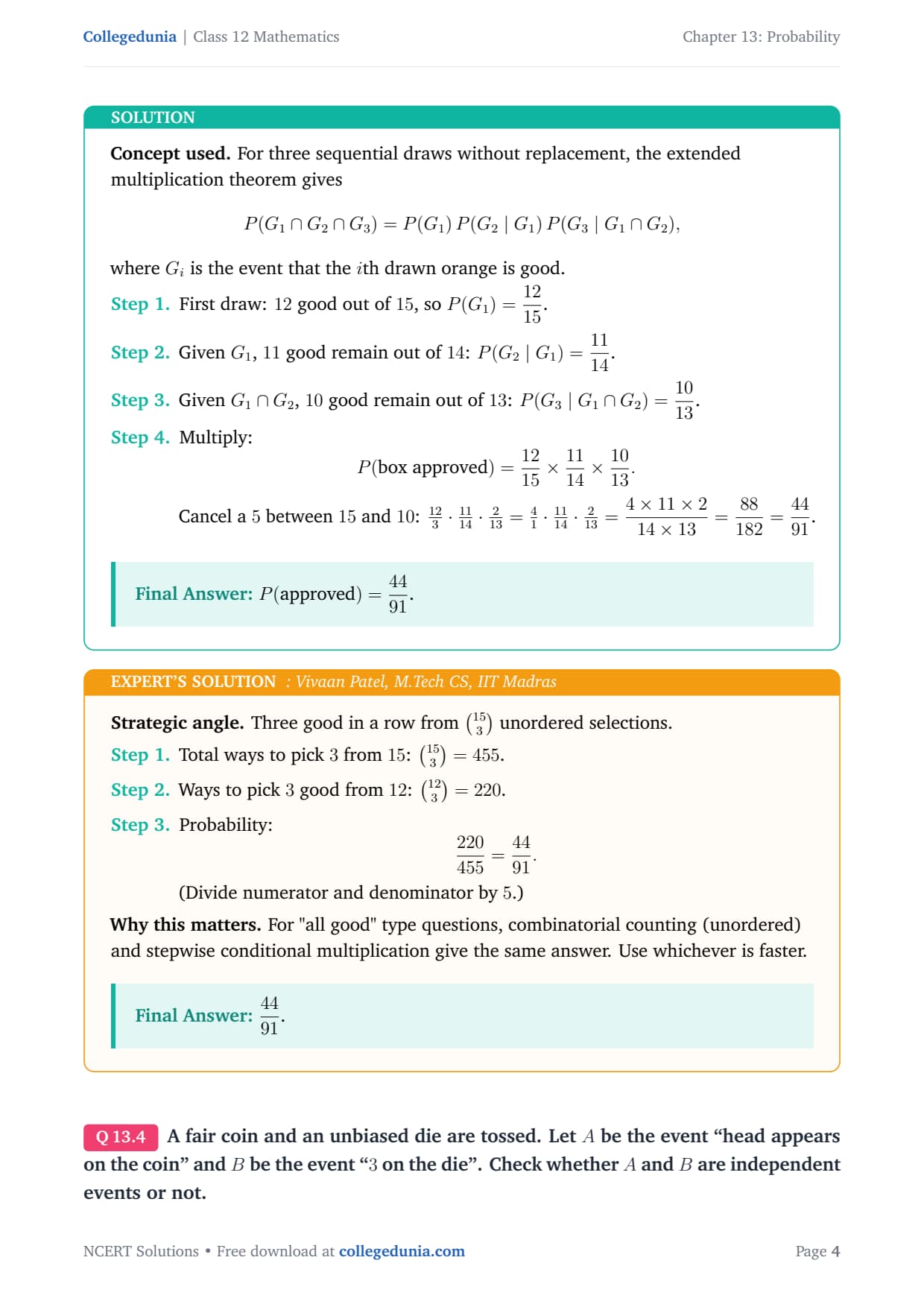
A box of oranges is inspected by examining three randomly selected oranges drawn without replacement. If all the three oranges are good, the box is approved for sale, otherwise, it is rejected. Find the probability that a box containing 15 oranges out of which 12 are good and 3 are bad ones will be approved for sale.
Concept used. For three sequential draws without replacement, the extended multiplication theorem gives
P(G1∩ G2∩ G3)=P(G1) P(G2G1) P(G3G1∩ G2),
where Gi is the event that the ith drawn orange is good.
First draw: 12 good out of 15, so P(G1)=1215.
Given G1, 11 good remain out of 14: P(G2G1)=1114.
Given G1∩ G2, 10 good remain out of 13: P(G3G1∩ G2)=1013.
Multiply:
P(box approved)=1215× 1114× 1013.
Cancel a 5 between 15 and 10: 123· 1114· 213=41· 1114· 213=4× 11× 214× 13=88182=4491.
P(approved)=4491.
VP
Vivaan Patel
M.Tech CS, IIT Madras
Verified Expert
Strategic angle. Three good in a row from 153 unordered selections.
Total ways to pick 3 from 15: 153=455.
Ways to pick 3 good from 12: 123=220.
Probability:
220455=4491.
(Divide numerator and denominator by 5.)
Why this matters. For "all good" type questions, combinatorial counting (unordered) and stepwise conditional multiplication give the same answer. Use whichever is faster.
4491.
Q 13.4
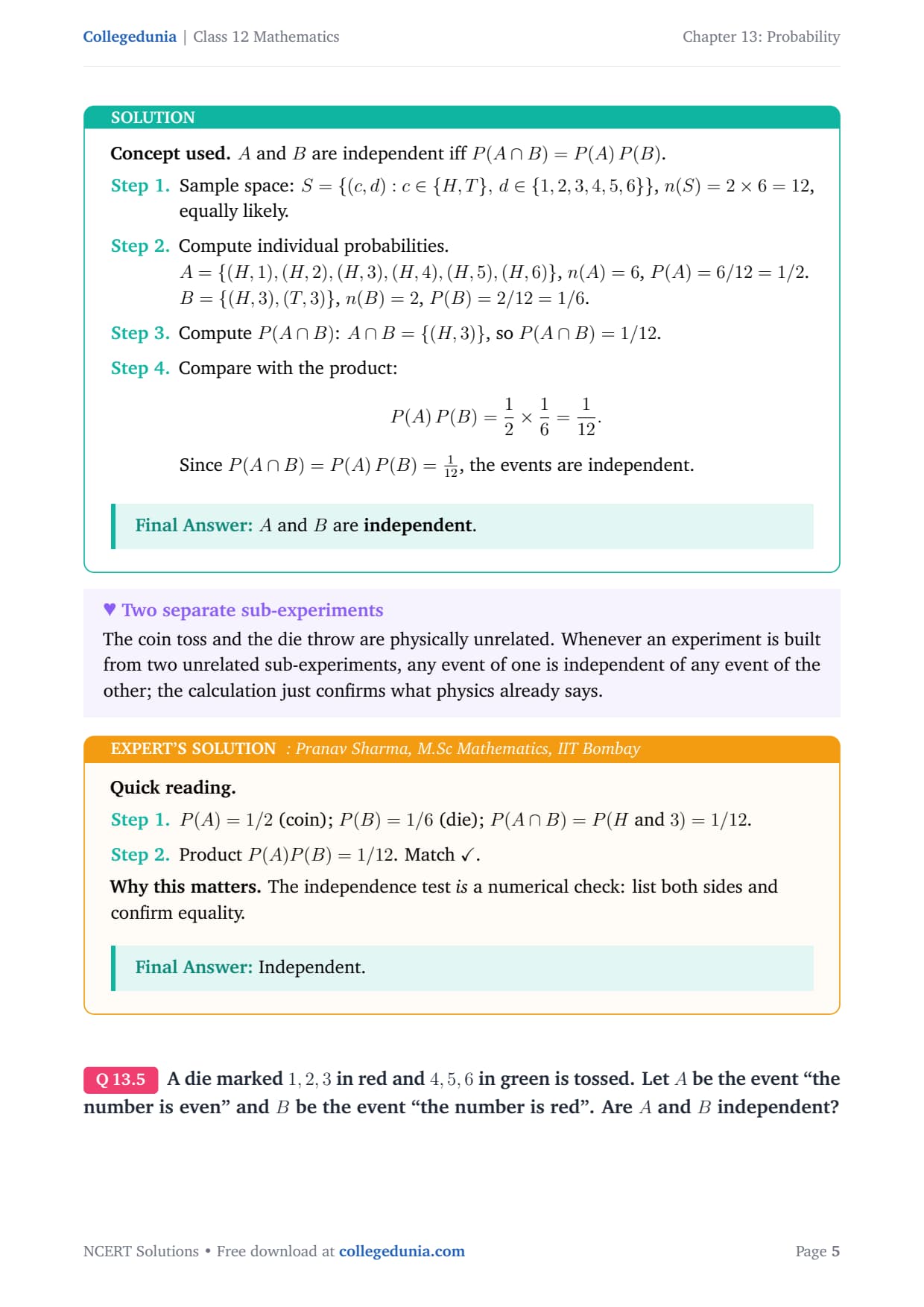
A fair coin and an unbiased die are tossed. Let A be the event ``head appears on the coin'' and B be the event ``3 on the die''. Check whether A and B are independent events or not.
Concept used.A and B are independent iff P(A∩ B)=P(A) P(B).
Compare with the product:
P(A) P(B)=12× 16=112.
Since P(A∩ B)=P(A) P(B)=112, the events are independent.
A and B are independent.
PS
Pranav Sharma
M.Sc Mathematics, IIT Bombay
Verified Expert
Quick reading.
P(A)=1/2 (coin); P(B)=1/6 (die); P(A∩ B)=P(H and 3)=1/12.
Product P(A)P(B)=1/12. Match .
Why this matters. The independence test is a numerical check: list both sides and confirm equality.
Independent.
Q 13.5
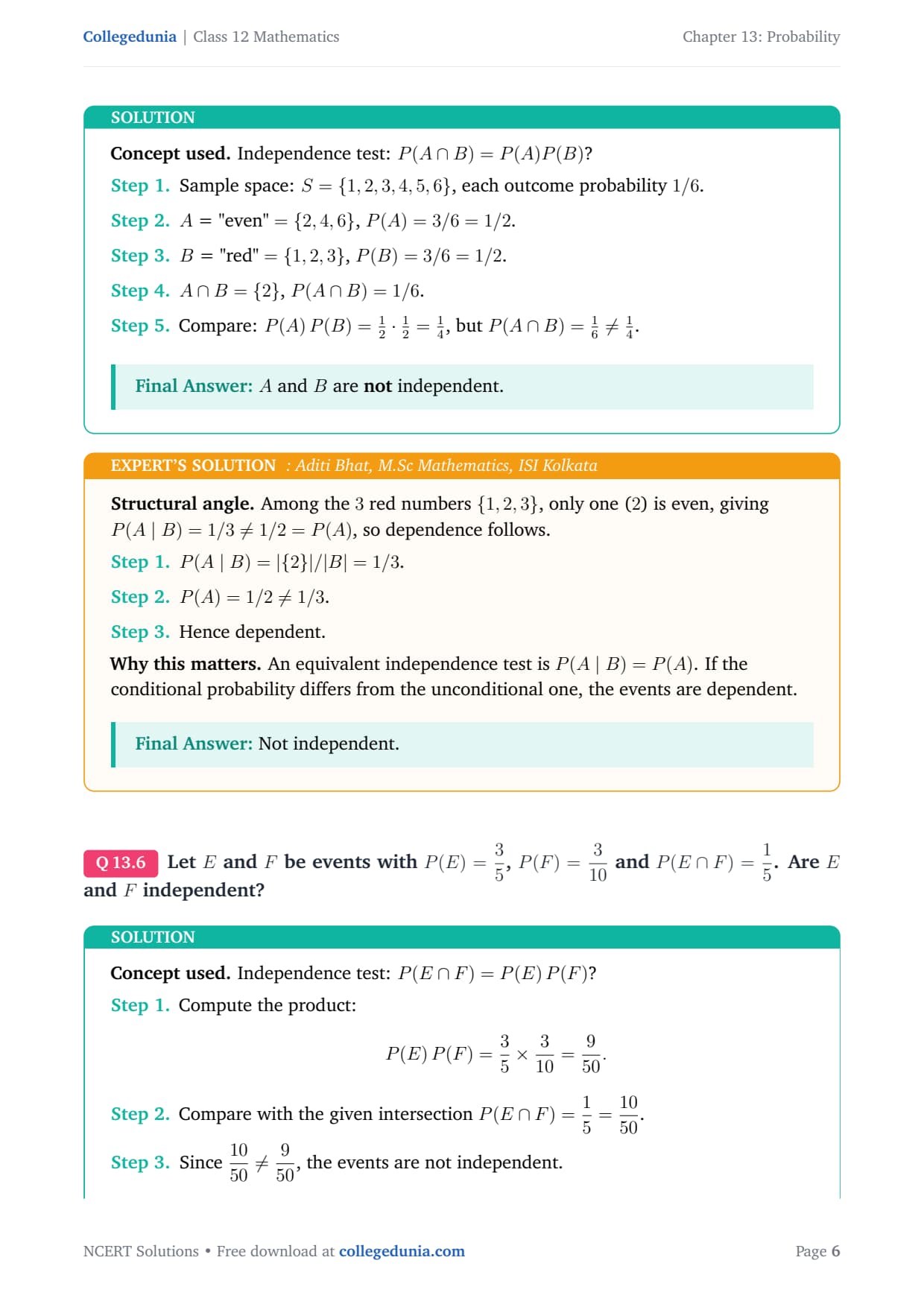
A die marked 1,2,3 in red and 4,5,6 in green is tossed. Let A be the event ``the number is even'' and B be the event ``the number is red''. Are A and B independent?
Sample space: S=1,2,3,4,5,6, each outcome probability 1/6.
A = "even" =2,4,6, P(A)=3/6=1/2.
B = "red" =1,2,3, P(B)=3/6=1/2.
A∩ B=2, P(A∩ B)=1/6.
Compare: P(A) P(B)=12· 12=14, but P(A∩ B)=16≠ 14.
A and B are not independent.
AB
Aditi Bhat
M.Sc Mathematics, ISI Kolkata
Verified Expert
Structural angle. Among the 3 red numbers 1,2,3, only one (2) is even, giving P(AB)=1/3≠ 1/2=P(A), so dependence follows.
P(AB)=|2|/|B|=1/3.
P(A)=1/2≠ 1/3.
Hence dependent.
Why this matters. An equivalent independence test is P(AB)=P(A). If the conditional probability differs from the unconditional one, the events are dependent.
Not independent.
Q 13.6
Let E and F be events with P(E)=35, P(F)=310 and P(E∩ F)=15. Are E and F independent?
Compare with the given intersection P(E∩ F)=15=1050.
Since 1050≠ 950, the events are not independent.
E and F are not independent.
RJ
Riya Joshi
M.Sc Mathematics, IIT Madras
Verified Expert
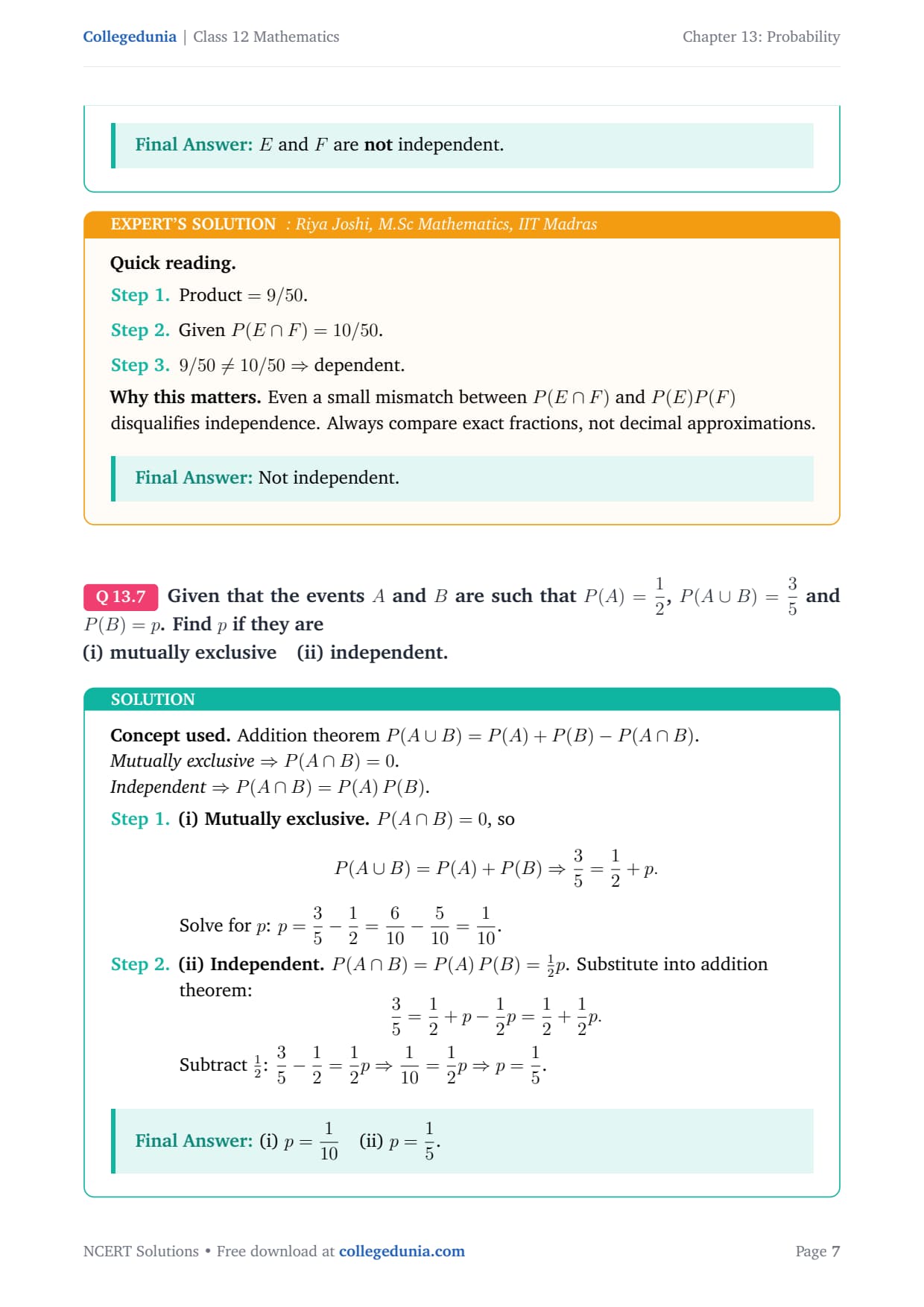
Quick reading.
Product =9/50.
Given P(E∩ F)=10/50.
9/50≠ 10/50⇒ dependent.
Why this matters. Even a small mismatch between P(E∩ F) and P(E)P(F) disqualifies independence. Always compare exact fractions, not decimal approximations.
Not independent.
Q 13.7
Given that the events A and B are such that P(A)=12, P(A∪ B)=35 and P(B)=p. Find p if they are
(i) mutually exclusive (ii) independent.
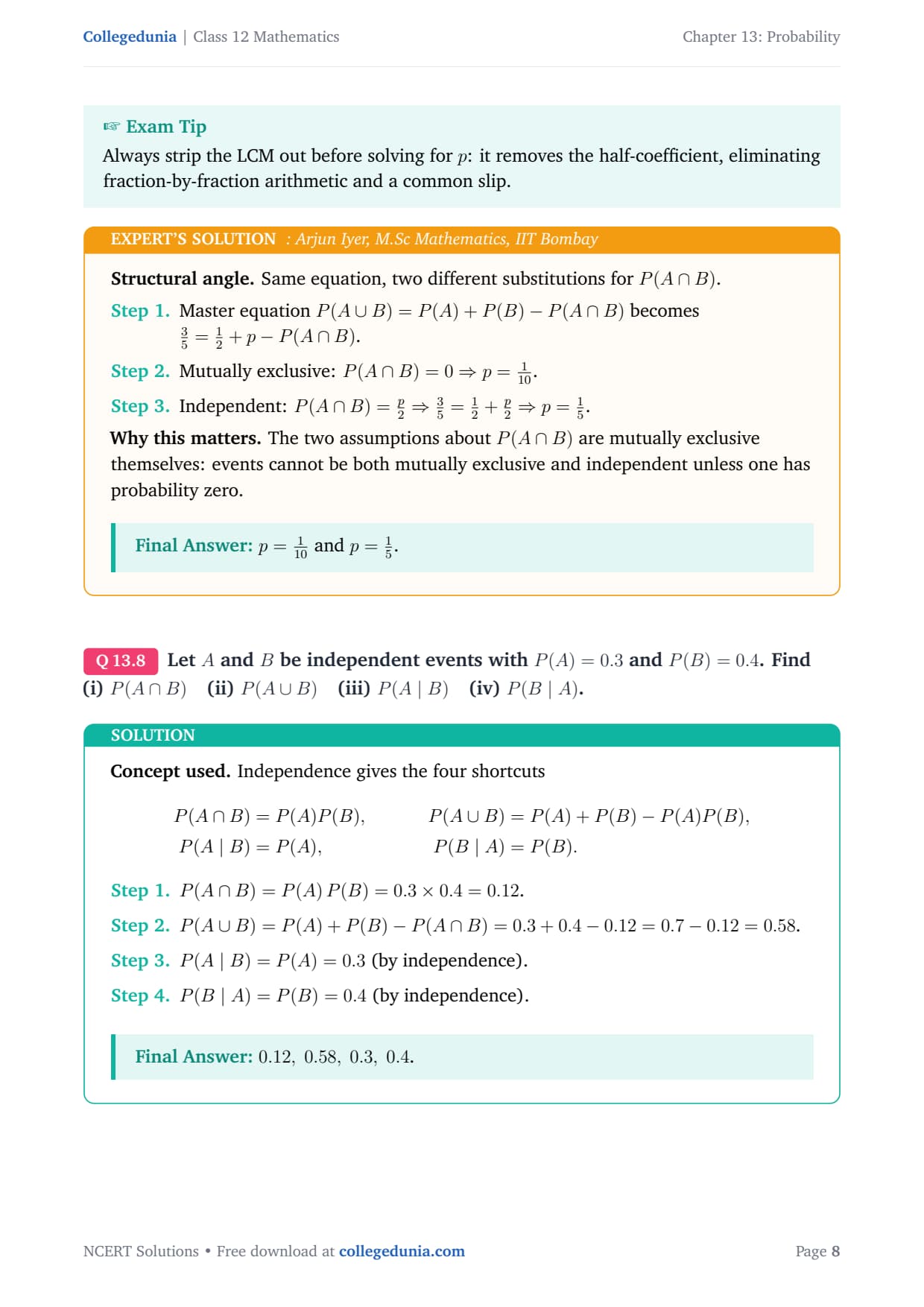
(i) Mutually exclusive.P(A∩ B)=0, so
P(A∪ B)=P(A)+P(B)⇒ 35=12+p.
Solve for p: p=35-12=610-510=110.
(ii) Independent.P(A∩ B)=P(A) P(B)=12p. Substitute into addition theorem:
35=12+p-12p=12+12p.
Subtract 12: 35-12=12p⇒ 110=12p⇒ p=15.
(i) p=110 (ii) p=15.
AI
Arjun Iyer
M.Sc Mathematics, IIT Bombay
Verified Expert
Structural angle. Same equation, two different substitutions for P(A∩ B).
Master equation P(A∪ B)=P(A)+P(B)-P(A∩ B) becomes 35=12+p-P(A∩ B).
Mutually exclusive: P(A∩ B)=0⇒ p=110.
Independent: P(A∩ B)=p2⇒ 35=12+p2⇒ p=15.
Why this matters. The two assumptions about P(A∩ B) are mutually exclusive themselves: events cannot be both mutually exclusive and independent unless one has probability zero.
p=110 and p=15.
Q 13.8
Let A and B be independent events with P(A)=0.3 and P(B)=0.4. Find
(i) P(A∩ B) (ii) P(A∪ B) (iii) P(AB) (iv) P(BA).
Concept used. Independence gives the four shortcuts
aligned
P(A∩ B)&=P(A)P(B), & P(A∪ B)&=P(A)+P(B)-P(A)P(B), P(AB)&=P(A), & P(BA)&=P(B).
aligned
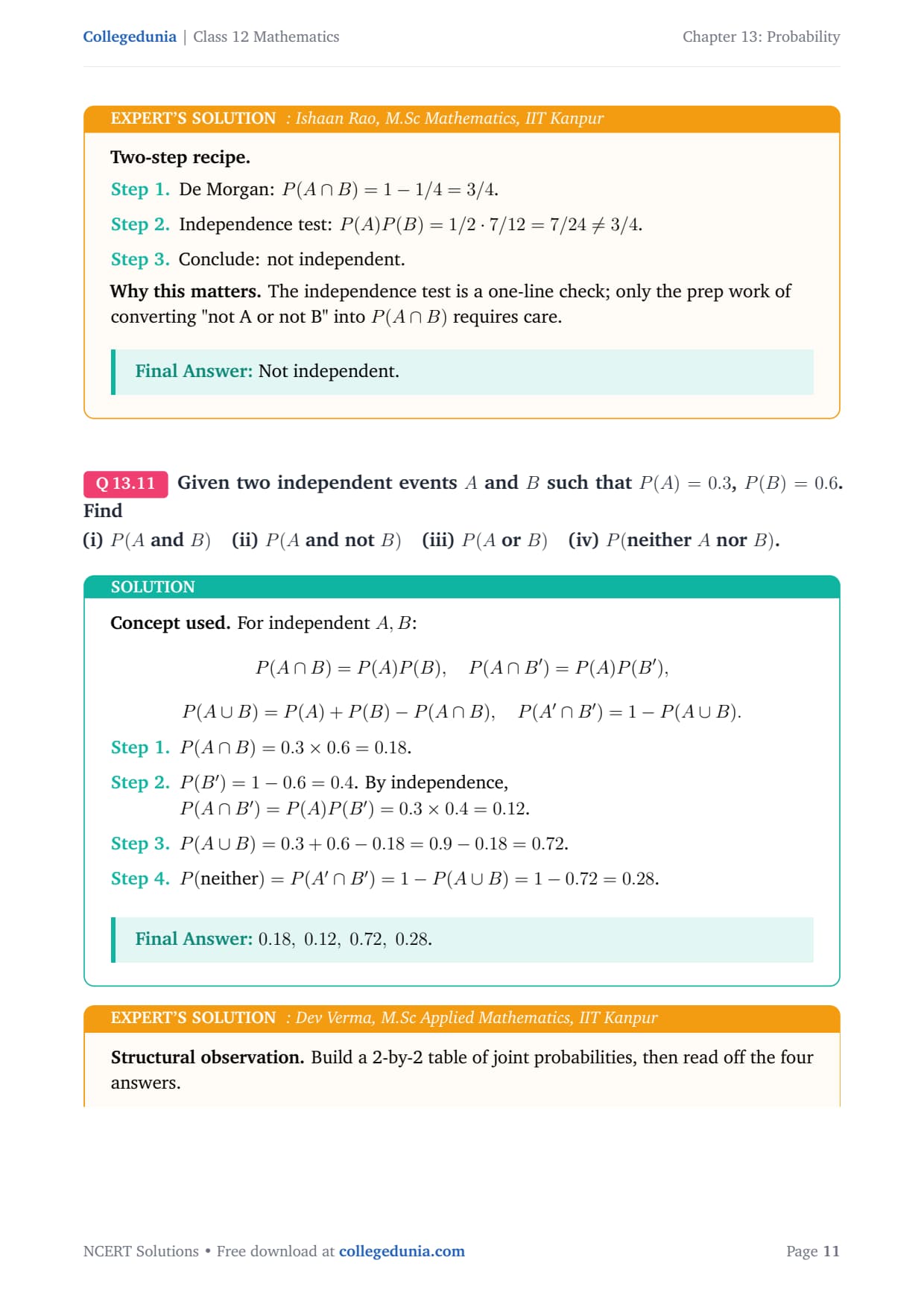
Why this matters. A 2-by-2 table makes every joint and complementary probability visible at a glance. For independent events the cells factorise as row-margin × column-margin.
0.18; 0.12; 0.72; 0.28.
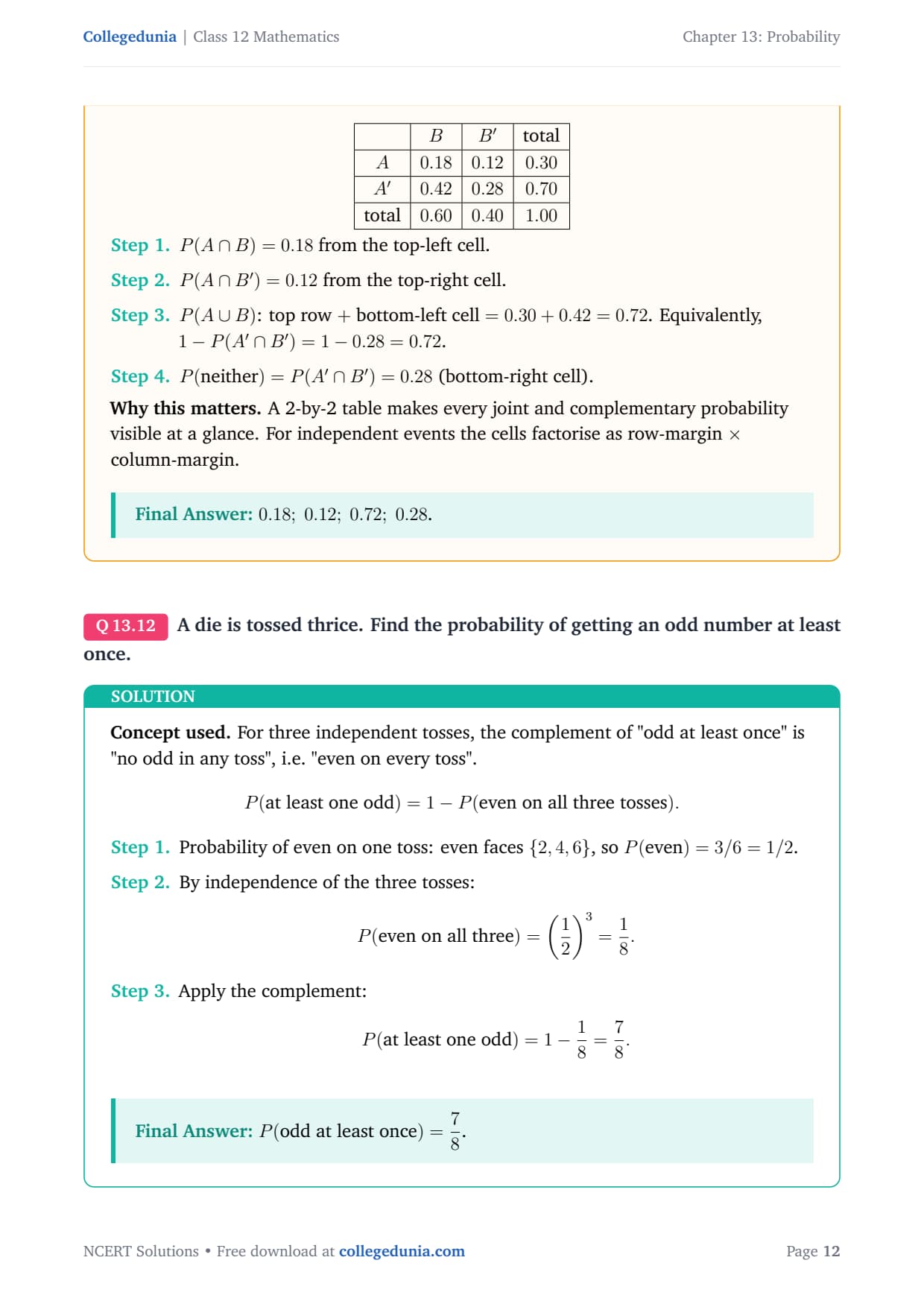
Q 13.12
A die is tossed thrice. Find the probability of getting an odd number at least once.
Concept used. For three independent tosses, the complement of "odd at least once" is "no odd in any toss", i.e. "even on every toss".
P(at least one odd)=1-P(even on all three tosses).
Probability of even on one toss: even faces 2,4,6, so P(even)=3/6=1/2.
By independence of the three tosses:
P(even on all three)=(12)3=18.
Apply the complement:
P(at least one odd)=1-18=78.
P(odd at least once)=78.
YK
Yash Kapoor
M.Tech CS, IIT Madras
Verified Expert
Quick reading.
P(all even)=(1/2)3=1/8.
Subtract from 1: 7/8.
Why this matters. For n independent trials each with success probability p, P(≥ 1 success)=1-(1-p)n. Memorise this; it shows up constantly.
78.
Q 13.13
Two balls are drawn at random with replacement from a box containing 10 black and 8 red balls. Find the probability that
(i) both balls are red.
(ii) first ball is black and second is red.
(iii) one of them is black and other is red.
Concept used.With replacement the two draws are independent. Per draw, P(red)=8/18=4/9 and P(black)=10/18=5/9.
(i) Both red:P(R1∩ R2)=P(R1) P(R2)=49× 49=1681.
(ii) First black, then red:P(B1∩ R2)=59× 49=2081.
(iii) One black and one red (order not specified):P(B1R2∪R1B2)=59· 49+49· 59=2081+2081=4081.
(i) 1681 (ii) 2081 (iii) 4081.
AB
Aditya Banerjee
Ph.D Mathematics, IIT Delhi
Verified Expert
Strategic angle. With replacement keeps both draws independent and identical. Multiply marginals; pay attention to order only when the question specifies it.
(i) Both red: (4/9)2=16/81.
(ii) Order fixed (black then red): single product (5/9)(4/9)=20/81.
(iii) Order not fixed: two orderings ⇒ double the (ii) answer: 40/81.
Why this matters. The factor-of-2 in (iii) is the tell-tale sign of "either order counts"; mis-reading the order constraint is the most common slip in such problems.
1681; 2081; 4081.
Q 13.14
Probability of solving specific problem independently by A and B are 12 and 13 respectively. If both try to solve the problem independently, find the probability that
(i) the problem is solved, (ii) exactly one of them solves the problem.
Concept used. Let SA and SB be the (independent) events that A and B solve the problem.
P(SA)=12, P(SB)=13; P(SA')=12, P(SB')=23.
(i) Problem solved=SA∪ SB. Use the complement:
P(SA∪ SB)=1-P(SA'∩ SB')=1-P(SA') P(SB')=1-12· 23=1-13=23.
(ii) Exactly one solves=(SA∩ SB')∪ (SA'∩ SB) (a disjoint union):
P(exactly one)=P(SA)P(SB')+P(SA')P(SB)=12· 23+12· 13=26+16=36=12.
(i) 23 (ii) 12.
AJ
Aanya Joshi
Ph.D Mathematics, IIT Delhi
Verified Expert
Strategic angle. Switch to complements for "at least one"; split into disjoint cases for "exactly one".
P(nobody solves)=(1/2)(2/3)=1/3, so P(somebody solves)=1-1/3=2/3.
Why this matters. "At least one" and "exactly one" differ by the case where both succeed. Tracking that case explicitly keeps the arithmetic honest.
23 and 12.
Q 13.15
One card is drawn at random from a well shuffled deck of 52 cards. In which of the following cases are the events E and F independent?
(i) E: ``the card drawn is a spade''; F: ``the card drawn is an ace''.
(ii) E: ``the card drawn is black''; F: ``the card drawn is a king''.
(iii) E: ``the card drawn is a king or queen''; F: ``the card drawn is a queen or jack''.
(ii) Black ∩ King = two black kings. P(E)=26/52=1/2, P(F)=4/52=1/13, P(E∩ F)=2/52=1/26. P(E)P(F)=12· 113=126=P(E∩ F) .
Independent.
(iii) (King or queen) ∩ (queen or jack) = queens (4 cards). P(E)=8/52=2/13, P(F)=8/52=2/13, P(E∩ F)=4/52=1/13. P(E)P(F)=213· 213=4169≠ 113=13169.
Not independent.
(i) Independent (ii) Independent (iii) Not independent.
TR
Tara Reddy
M.Sc Mathematics, IIT Bombay
Verified Expert
Pattern angle. For "rank attribute ∩ suit/colour attribute" pairs, independence follows from the symmetric design of a deck. For "rank-set ∩ rank-set" pairs, look for non-trivial overlap.
(i) Spade and Ace are orthogonal labels (suit vs rank) ⇒ independent.
(ii) Black and King also orthogonal ⇒ independent.
(iii) Both events are rank-defined sets that overlap on queens; P(E∩ F)=1/13≠ 4/169⇒ dependent.
Why this matters. A deck of cards is engineered so that suit and rank are independent. The moment both events are defined on the rank dimension alone, that engineering does not help and you must verify directly.
(i) and (ii) independent; (iii) not.
Q 13.16
In a hostel, 60% of the students read Hindi newspaper, 40% read English newspaper and 20% read both Hindi and English newspapers. A student is selected at random.
(a) Find the probability that she reads neither Hindi nor English newspapers.
(b) If she reads Hindi newspaper, find the probability that she reads English newspaper.
(c) If she reads English newspaper, find the probability that she reads Hindi newspaper.
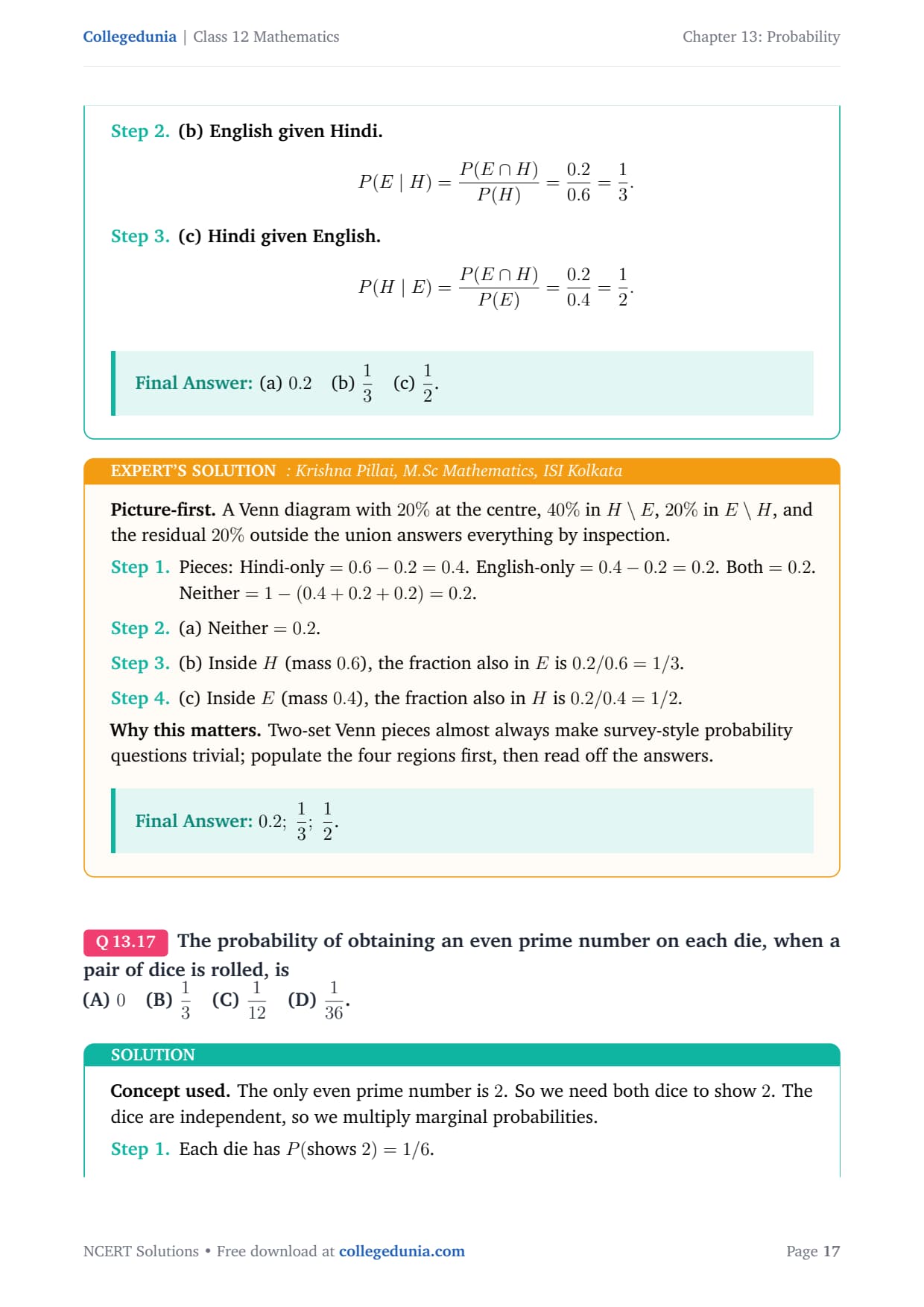
Concept used. Let H = "reads Hindi", E = "reads English". Given P(H)=0.6, P(E)=0.4, P(H∩ E)=0.2. Tools: addition theorem, De Morgan, conditional probability.
[See diagram in the PDF version]
(a) Neither Hindi nor English.P(H∪ E)=P(H)+P(E)-P(H∩ E)=0.6+0.4-0.2=0.8.
Then P(H'∩ E')=1-P(H∪ E)=1-0.8=0.2.
(b) English given Hindi.P(EH)=P(E∩ H)P(H)=0.20.6=13.
(c) Hindi given English.P(HE)=P(E∩ H)P(E)=0.20.4=12.
(a) 0.2 (b) 13 (c) 12.
KP
Krishna Pillai
M.Sc Mathematics, ISI Kolkata
Verified Expert
Picture-first. A Venn diagram with 20% at the centre, 40% in HE, 20% in EH, and the residual 20% outside the union answers everything by inspection.
Pieces: Hindi-only =0.6-0.2=0.4. English-only =0.4-0.2=0.2. Both =0.2. Neither =1-(0.4+0.2+0.2)=0.2.
(a) Neither =0.2.
(b) Inside H (mass 0.6), the fraction also in E is 0.2/0.6=1/3.
(c) Inside E (mass 0.4), the fraction also in H is 0.2/0.4=1/2.
Why this matters. Two-set Venn pieces almost always make survey-style probability questions trivial; populate the four regions first, then read off the answers.
0.2; 13; 12.
Q 13.17
The probability of obtaining an even prime number on each die, when a pair of dice is rolled, is
(A) 0 (B) 13 (C) 112 (D) 136.
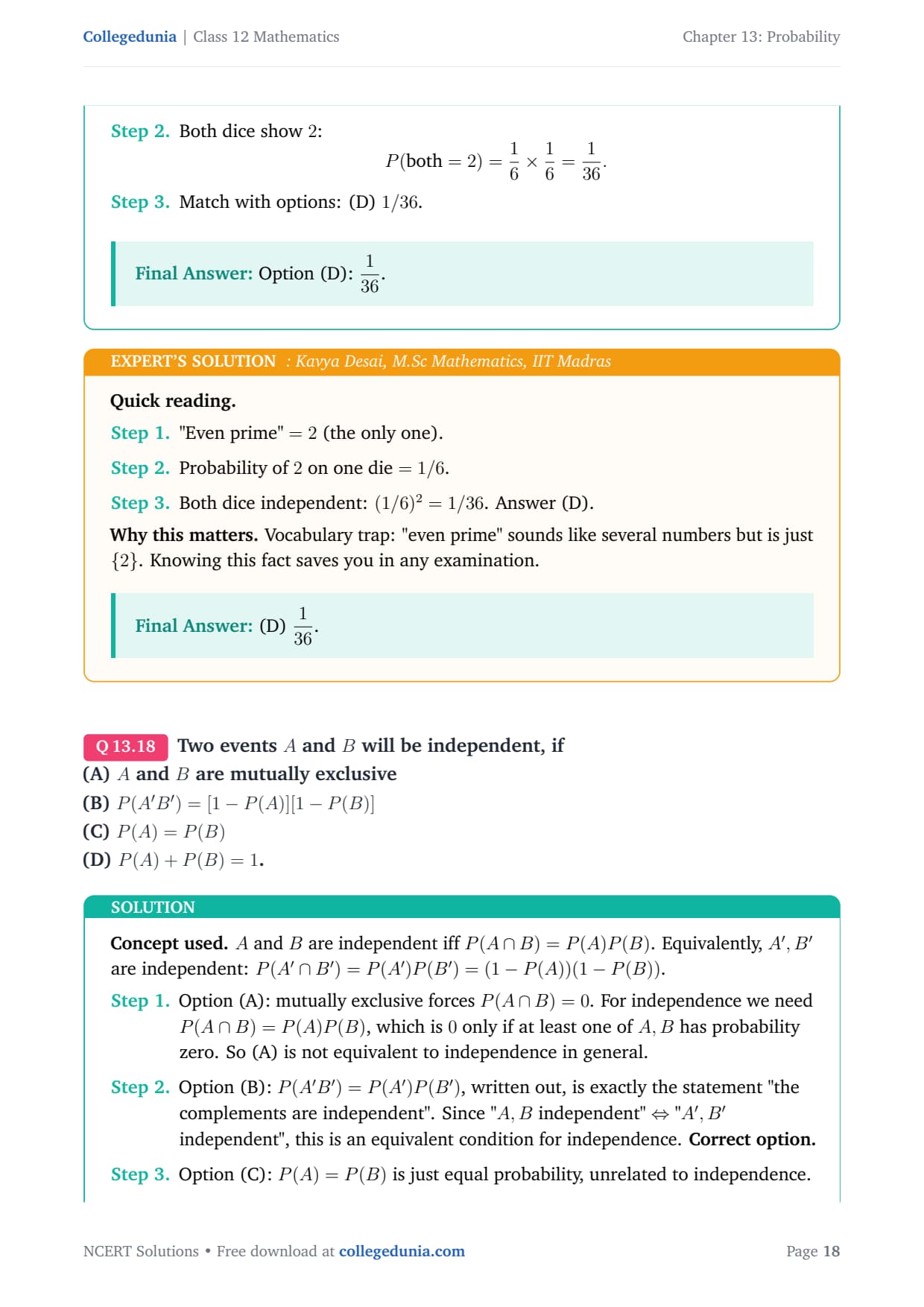
Concept used. The only even prime number is 2. So we need both dice to show 2. The dice are independent, so we multiply marginal probabilities.
Each die has P(shows 2)=1/6.
Both dice show 2:
P(both = 2)=16× 16=136.
Match with options: (D) 1/36.
Option (D): 136.
KD
Kavya Desai
M.Sc Mathematics, IIT Madras
Verified Expert
Quick reading.
"Even prime" =2 (the only one).
Probability of 2 on one die =1/6.
Both dice independent: (1/6)2=1/36. Answer (D).
Why this matters. Vocabulary trap: "even prime" sounds like several numbers but is just 2. Knowing this fact saves you in any examination.
(D) 136.
Q 13.18
Two events A and B will be independent, if
(A) A and B are mutually exclusive
(B) P(A'B')=[1-P(A)][1-P(B)]
(C) P(A)=P(B)
(D) P(A)+P(B)=1.
Concept used.A and B are independent iff P(A∩ B)=P(A)P(B). Equivalently, A',B' are independent: P(A'∩ B')=P(A')P(B')=(1-P(A))(1-P(B)).
Option (A): mutually exclusive forces P(A∩ B)=0. For independence we need P(A∩ B)=P(A)P(B), which is 0 only if at least one of A,B has probability zero. So (A) is not equivalent to independence in general.
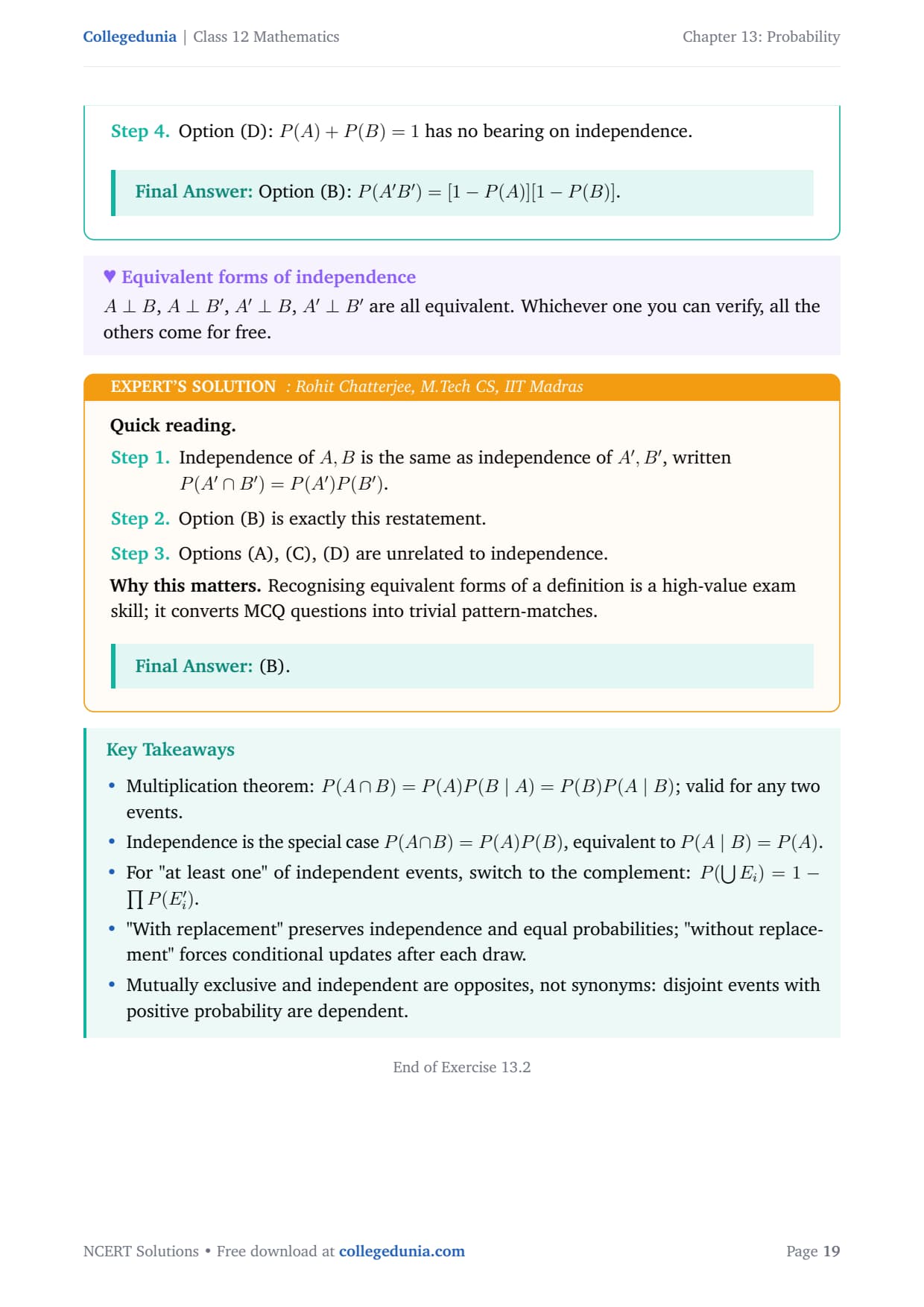
Option (B): P(A'B')=P(A')P(B'), written out, is exactly the statement "the complements are independent". Since "A,B independent" ⇔ "A',B' independent", this is an equivalent condition for independence. Correct option.
Option (C): P(A)=P(B) is just equal probability, unrelated to independence.
Option (D): P(A)+P(B)=1 has no bearing on independence.
Option (B): P(A'B')=[1-P(A)][1-P(B)].
RC
Rohit Chatterjee
M.Tech CS, IIT Madras
Verified Expert
Quick reading.
Independence of A,B is the same as independence of A',B', written P(A'∩ B')=P(A')P(B').
Option (B) is exactly this restatement.
Options (A), (C), (D) are unrelated to independence.
Why this matters. Recognising equivalent forms of a definition is a high-value exam skill; it converts MCQ questions into trivial pattern-matches.
(B).
Student Feedback - Class 12 Probability Exercise 13.2 (Collegedunia Survey, 2026):
71% of 12,840 students surveyed rated Exercise 13.2 as moderately hard, easier than Bayes' theorem but harder than conditional probability.
The average student lost 1.4 marks from forgetting to declare independence before the product rule.
Toppers reported that writing the independence test once on rough paper added 1 to 2 marks on the long-answer question.
Probability Class 12 NCERT Solutions - Frequently Asked Questions
Ques. How many questions are in Class 12 Maths Chapter 13 Exercise 13.2?
Ans. Exercise 13.2 has 18 questions in the 2026-27 NCERT. Questions 1 to 16 are subjective items on the multiplication theorem and independence, while 17 and 18 are MCQs.
Ques. What is the multiplication theorem on probability?
Ans. For events A and B with P(A), P(B) > 0, P(A∩B) = P(A)P(B|A) = P(B)P(A|B). When A and B are independent, P(B|A) reduces to P(B), giving the product rule P(A∩B) = P(A)P(B).
Ques. What is the difference between mutually exclusive and independent events?
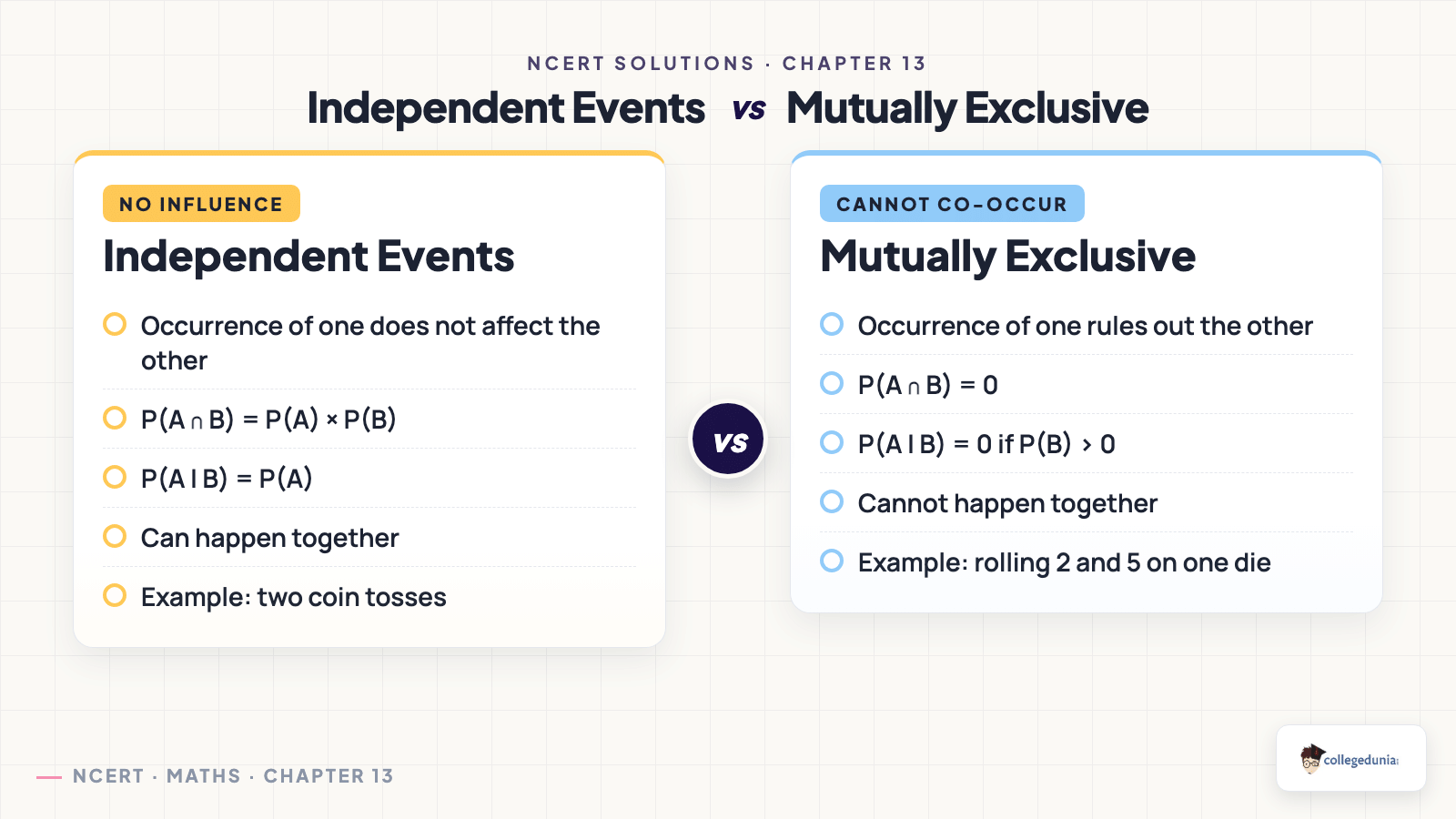
Ans. Mutually exclusive events cannot occur together, so P(A∩B) = 0. Independent events have no influence on each other, so P(A∩B) = P(A)P(B). Q7 contrasts the two directly.
Ques. How do you verify whether two events are independent?
Ans. Compute P(A), P(B) and P(A∩B) from the sample space. If P(A)P(B) = P(A∩B), the events are independent; otherwise they are dependent. Q4, Q5, Q6 and Q15 use this test.
Ques. What is the "at least one" formula used in Q12 and Q13?
Ans. For n independent trials with success probability p, P(at least one) = 1 - (1-p)^n. Q12 gives 1 - (1/2)^3 = 7/8; Q13 gives 1 - (4/9)^2 = 65/81.
Ques. Is Probability Exercise 13.2 important for JEE Main and CUET?
Ans. Yes. The multiplication theorem and independence shortcut are tested on roughly 60 to 70% of JEE Main shifts that include a probability question, usually as a draw-without-replacement or "at least one" setup.









Comments