Maths Mentor, Delhi University | Updated 3+ months ago
This page has the Three Dimensional Geometry Class 12 NCERT Solutions for Exercise 11.1, matched to the 2026-27 CBSE syllabus. It covers direction cosines, direction ratios and the collinearity check, with every step matched to the CBSE marking scheme. The free PDF download is right below.
CBSE Weightage:2 to 3 marks from Chapter 11, typically a 1-mark VSA on direction cosines and a 2-mark question built on direction ratios through two points.
Exercise size: 5 solved problems, the shortest exercise in the Three Dimensional Geometry Class 12 NCERT Solutions, fully clearable in one short study sitting.
Every solved problem here opens with the controlling relation, either l = cosα, m = cosβ, n = cosγ or the proportion l : m : n = a : b : c. It substitutes the numbers, then checks with l2 + m2 + n2 = 1 . The ± sign is written out every time so the second sense of the line is never dropped.
The Collegedunia team has checked each answer against the official NCERT key. The normalisation in Q4 and the collinearity test in Q3 are the two highest-yield patterns in this exercise.
How Collegedunia's NCERT Solutions Help You Clear Exercise 11.1
Exercise 11.1 looks easy, but sign errors and the direction-ratio versus direction-cosine mix-up happen most here. Every solution states the formula first, substitutes the numbers, then runs the unit-length check.
Formula stated first: each answer opens with l=cosα or the normalising factor 1/√a2+b2+c2, so markers see the method.
Sign discipline: cos 135∘ = -1/√2 is flagged in Q1 to close the second-quadrant trap early.
Unit-length verification via l2+m2+n2=1 at the end of every direction-cosine problem.
Collinearity argument in Q3 shows why a shared point upgrades parallel direction ratios to a single line.
Three Dimensional Geometry Ex 11.1 Solved Step by Step (Video)
Three Dimensional Geometry Class 12 NCERT Solutions Exercise 11.1: Question-Wise Answer Map
The five problems split across three reusable skills. Use this table as a self-check grid after your first attempt.
Q No.
Problem
Core relation
Answer
1
Line makes 90∘, 135∘, 45∘ with axes
l=cosα
(0, -1√2, 1√2)
2
Line equally inclined to all three axes
3l2=1
±(1√3,1√3,1√3)
3
Show (2,3,4),(-1,-2,1),(5,8,7) collinear
AB⃗∥BC⃗
Collinear, BC⃗=-2 AB⃗
4
DCs from DRs (-18,12,-4)
Normalise by √a2+b2+c2
(-911,611,-211)
5
DCs of sides of triangle (3,5,-4),(-1,1,2),(-5,-5,-2)
Two-point DC formula
Three DC triples (isosceles, AB=BC )
Q1 and Q2 use the direct cosine relation, Q4 uses normalisation, and Q3 and Q5 use the two-point template. Q5 quietly reveals an isosceles triangle since AB=BC=2√17, a fact CBSE often asks about in a follow-up part.
Direction Cosines and Direction Ratios Explained for Class 12 Maths Chapter 11
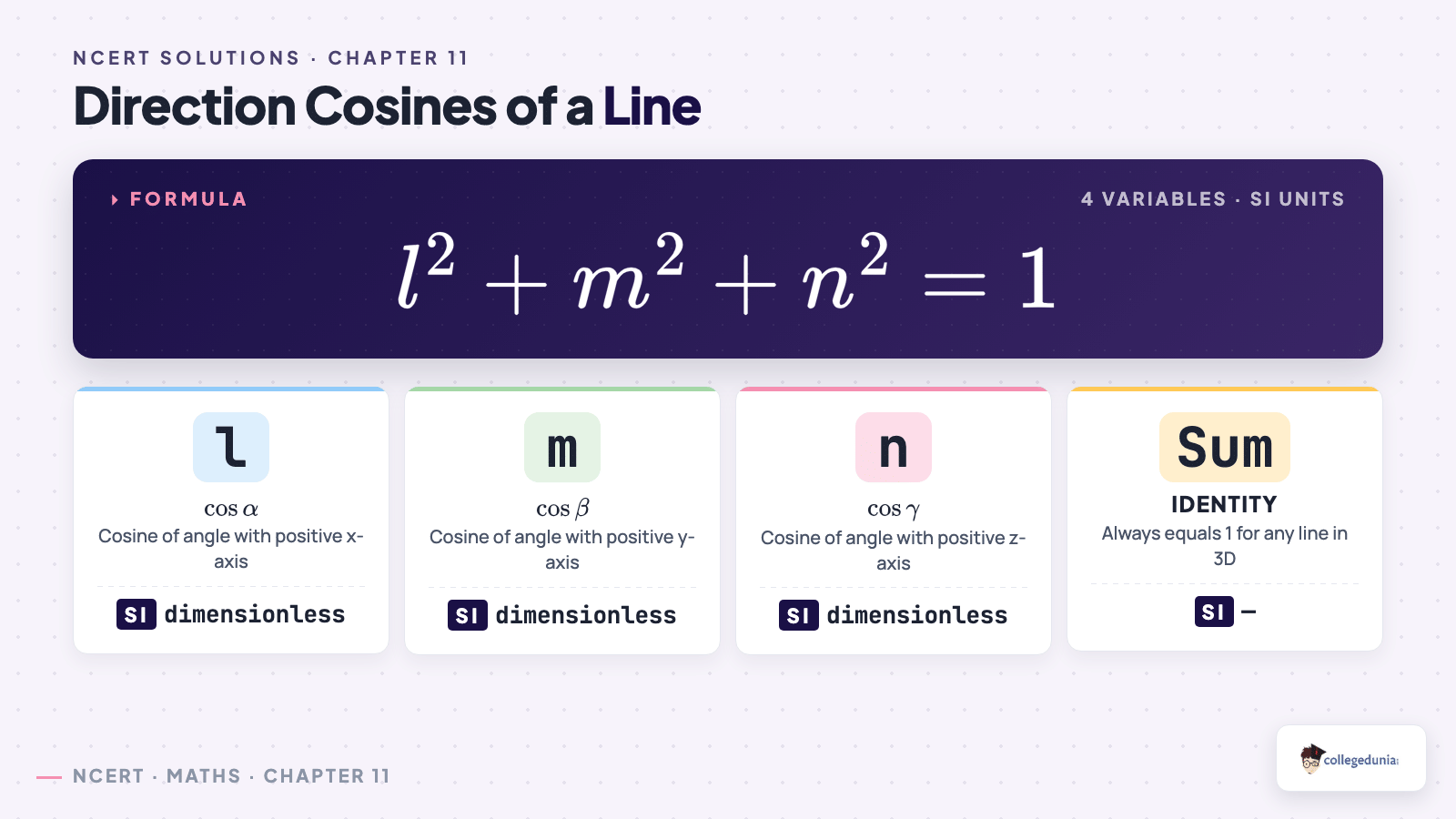
Fix these two definitions first. A line in space makes angles α, β, γ with the positive x, y, z axes.
The cosines of these angles are the direction cosines (l, m, n) . Any triple (a, b, c) proportional to (l, m, n) is a set of direction ratios for the same line.
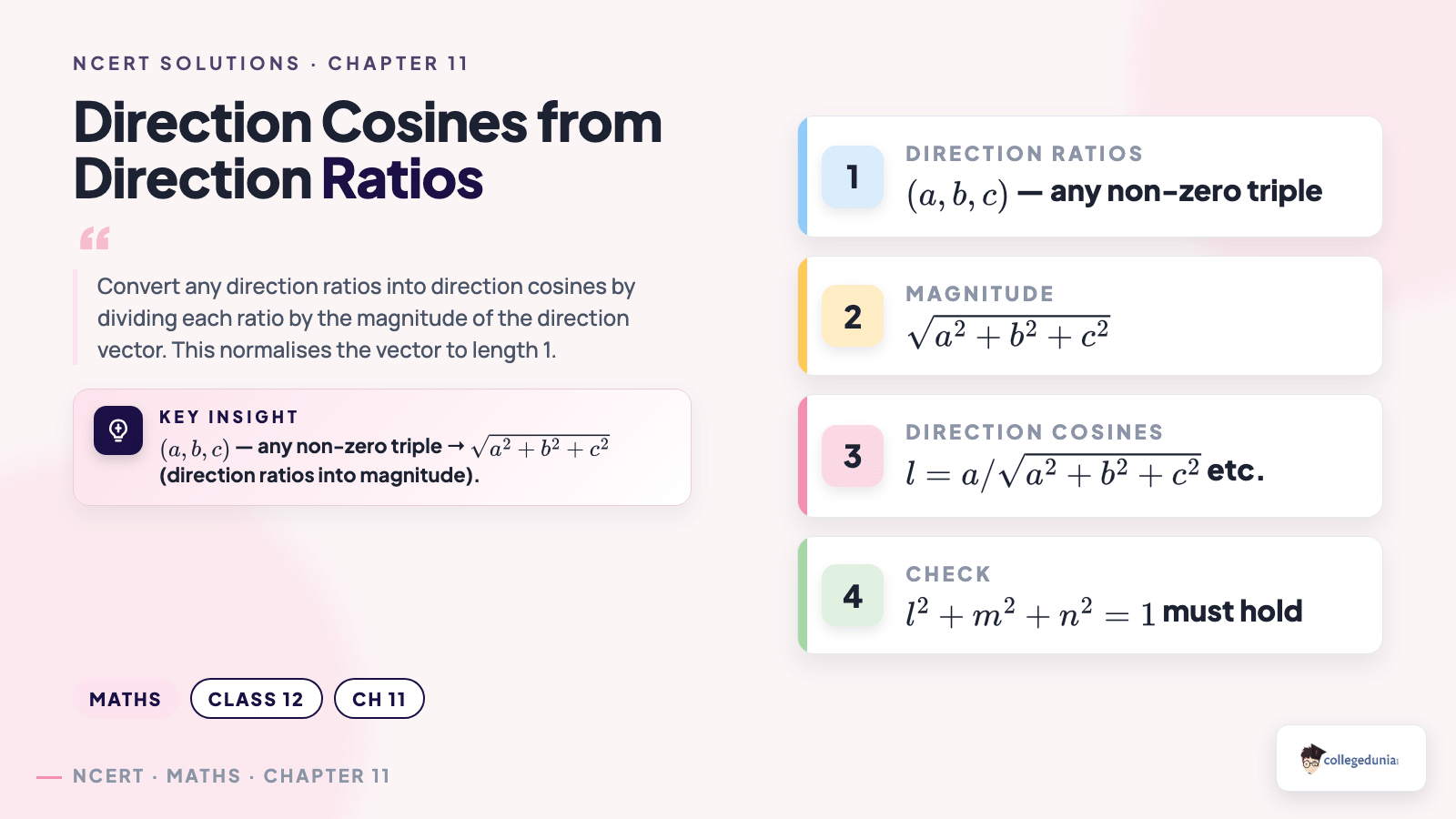
Core identity: l2 + m2 + n2 = 1 . This holds only for direction cosines, never for direction ratios. To convert DRs (a,b,c) to DCs, use l = ± a / √a2+b2+c2, and similarly for m and n.
For a segment joining P(x1, y1, z1) and Q(x2, y2, z2) , the direction ratios are simply (x2-x1, y2-y1, z2-z1) , no square roots needed until the final step.
Step-by-Step Method Used in NCERT Solutions for Class 12 Maths Exercise 11.1
Every direction-cosine problem here runs the same three-line routine. Learn it once and any Exercise 11.1 sum clears in under a minute.
Read the data: identify whether the question gives angles, direction ratios, or two points.
Apply one relation:l=cosα for angles, l=± a/√a2+b2+c2 for direction ratios, or the two-point formula for points.
Verify: substitute into l2+m2+n2=1 . If it does not return 1, an arithmetic slip has occurred.
This verification step is what separates a board-ready answer from a lucky one. CBSE markers reward the explicit check.
Concept Tags Across the Five Problems of Class 12 Maths Chapter 11 Exercise 11.1
Each question in this exercise tests one of three tags. Recognising the tag at sight saves about forty seconds per problem in the board exam.
Direction-angle to DC conversion (Q1, Q2): apply l=cosα , with care on sign when an angle exceeds 90∘.
Direction-ratio normalisation (Q4): divide (a,b,c) by √a2+b2+c2; both signs are valid because a line has two senses.
Two-point DCs and collinearity (Q3, Q5): build DRs from coordinate differences; three points are collinear iff DRs of two of the segments are proportional.
Common Mistakes Students Make in Class 12 Maths Chapter 11 Exercise 11.1
These are the slips that cost marks most often in Exercise 11.1, based on how students answer this exercise in class tests.
Common Mistake: Treating direction ratios as direction cosines. Substituting (-18,12,-4) into l2+m2+n2=1 gives 484, not 1. The normalisation by √a2+b2+c2 is not optional.
Dropping the ± sign when normalising direction ratios. Both senses of the line are valid unless one direction is fixed by the problem.
Writing cos 135∘ = +1/√2. The correct value is -1/√2 since 135∘ is in the second quadrant.
Declaring three points collinear from one pair of proportional ratios without naming the shared point.
Confusing order of subtraction in the two-point formula, which flips the sign of every component.
Other Resources for Class 12 Maths Chapter 11 Three Dimensional Geometry
Pair this exercise with the rest of the Chapter 11 study set:
All NCERT Solutions for Three Dimensional Geometry Ex 11.1 with Step-by-Step Working
Every question from Three Dimensional Geometry Ex 11.1 is listed below with its full Solution and Expert Solution inside collapsible tabs. Click Check Solution for the step-by-step working, or Expert Solution for the expanded explanation.
Questions
Q 11.1
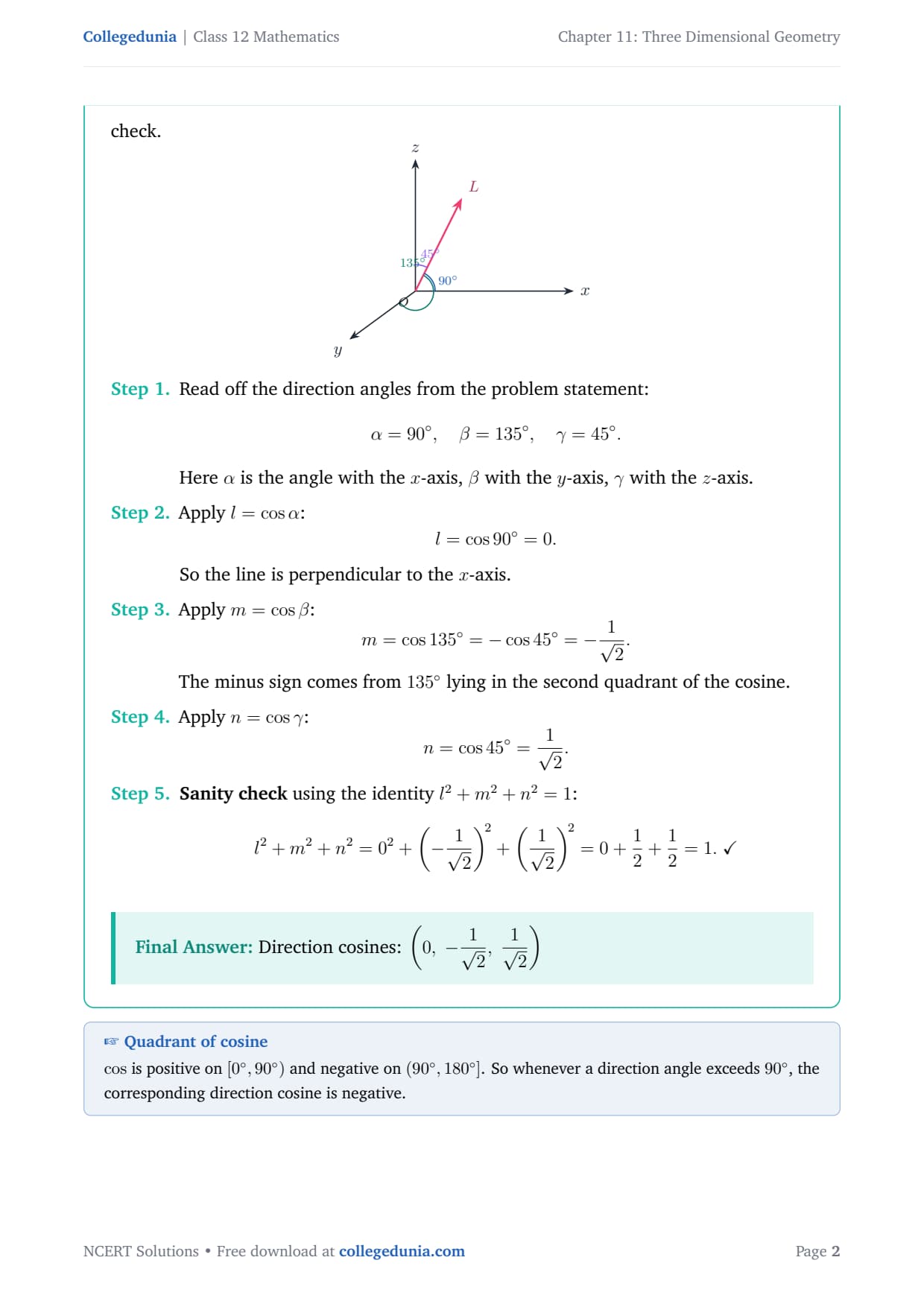
If a line makes angles 90∘, 135∘, 45∘ with the x, y and z-axes respectively, find its direction cosines.
Concept used. For a directed line in space that makes angles α, β, γ
with the positive x, y and z-axes respectively, the direction cosines are
l = cosα, m = cosβ, n = cosγ.
These satisfy the fundamental identity l2 + m2 + n2 = 1, which we use here as a
sanity check.
[See diagram in the PDF version]
Read off the direction angles from the problem statement:
α = 90∘, β = 135∘, γ = 45∘.
Here α is the angle with the x-axis, β with the y-axis,
γ with the z-axis.
Apply l = cosα:
l = cos 90∘ = 0.
So the line is perpendicular to the x-axis.
Apply m = cosβ:
m = cos 135∘ = -cos 45∘ = -1√2.
The minus sign comes from 135∘ lying in the second quadrant of the cosine.
Picture-first. A direction in 3D is just a unit vector. The cosines of its angles
with the three axes are precisely its components, so this question reduces to "write
cosα, cosβ, cosγ in order, then verify the unit-length property."
Concept restated. A line in space has two opposite directions, hence two
opposite triples (± l, ± m, ± n). The values must satisfy l2 + m2 + n2 = 1;
this identity is equivalent to saying that the projections of a unit vector onto the three
axes form a Pythagorean triple of squares summing to one.
List the three given angles paired with their axes:
α = 90∘ (with x), β = 135∘ (with y), γ = 45∘ (with z).
Evaluate l = cosα = cos 90∘. From the unit circle the cosine of a
right angle is exactly zero:
l = 0.
Evaluate m = cosβ = cos 135∘. Using the supplement identity
cos(180∘ - θ) = -cosθ with θ = 45∘:
m = -cos 45∘ = -1√2.
Evaluate n = cosγ = cos 45∘. This is the standard exact value
1/√2:
n = 1√2.
Unit-length verification:
l2 + m2 + n2 = 0 + 12 + 12 = 1,
confirming that (l, m, n) are valid direction cosines.
Geometric reading: l = 0 means the line lies in the yz-plane; the equal
magnitudes of m and n say the line bisects the angle between the negative
y-axis and the positive z-axis.
(l, m, n) = (0, -1√2, 1√2)
Q 11.2
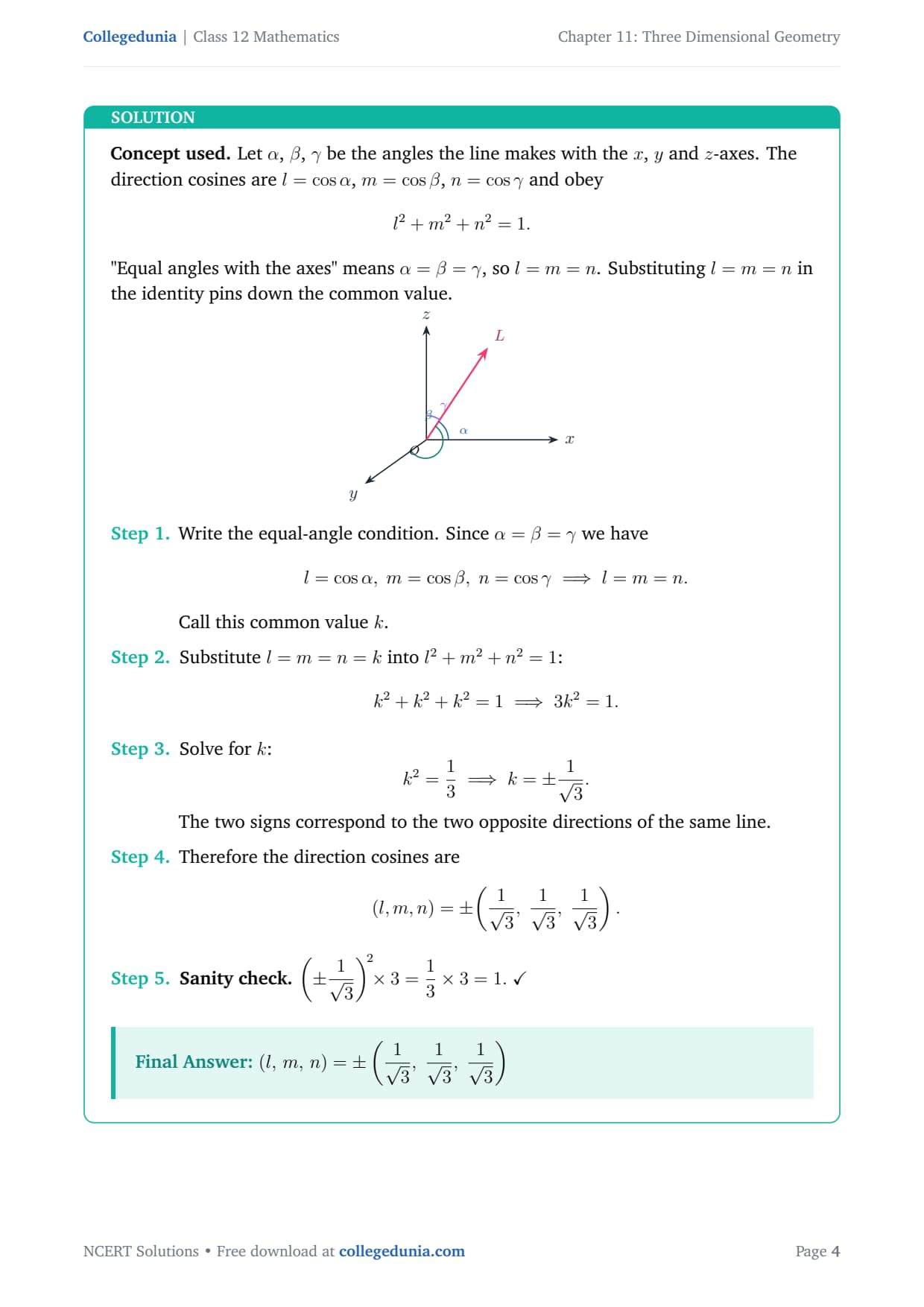
Find the direction cosines of a line which makes equal angles with the coordinate axes.
Concept used. Let α, β, γ be the angles the line makes with the
x, y and z-axes. The direction cosines are l = cosα, m = cosβ,
n = cosγ and obey
l2 + m2 + n2 = 1.
"Equal angles with the axes" means α = β = γ, so l = m = n. Substituting
l = m = n in the identity pins down the common value.
[See diagram in the PDF version]
Write the equal-angle condition. Since α = β = γ we have
l = cosα, m = cosβ, n = cosγ l = m = n.
Call this common value k.
Substitute l = m = n = k into l2 + m2 + n2 = 1:
k2 + k2 + k2 = 1 3k2 = 1.
Solve for k:
k2 = 13k = ±1√3.
The two signs correspond to the two opposite directions of the same line.
Therefore the direction cosines are
(l, m, n) = ±(1√3, 1√3, 1√3).
Sanity check.(±1√3)2× 3 = 13× 3 = 1.
(l, m, n) = ±(1√3, 1√3, 1√3)
SI
Sneha Iyer
M.Sc Applied Mathematics, IIT Kanpur
Verified Expert
Strategic angle. Whenever a problem couples a symmetry condition ("equal
angles", "equal distances") with the identity l2 + m2 + n2 = 1, plug the symmetry
into the identity and solve a single-variable equation. That is exactly what happens here.
Concept restated. The set of all unit vectors in R3 is the unit sphere
(l, m, n) : l2 + m2 + n2 = 1. Direction cosines are precisely the coordinates of a
point on this sphere.
Translate the wording. "Makes equal angles with the coordinate axes" ≡α = β = γ, which by taking cosines gives
l = m = n.
We label this common scalar k ∈ R.
Force unit length. The defining identity for direction cosines is
l2 + m2 + n2 = 1.
With l = m = n = k, the left side becomes
k2 + k2 + k2 = 3k2.
Equate and solve:
3k2 = 1 k2 = 13k = ±1√3.
Interpret the two signs. The "+" sign labels the direction from the origin into
the octant x > 0, y > 0, z > 0 (the principal diagonal of the first octant); the
"-" sign labels the opposite direction.
Therefore the direction-cosine triple is
(l, m, n) = ±(1√3, 1√3, 1√3).
(l, m, n) = ±(1√3, 1√3, 1√3)
Q 11.3
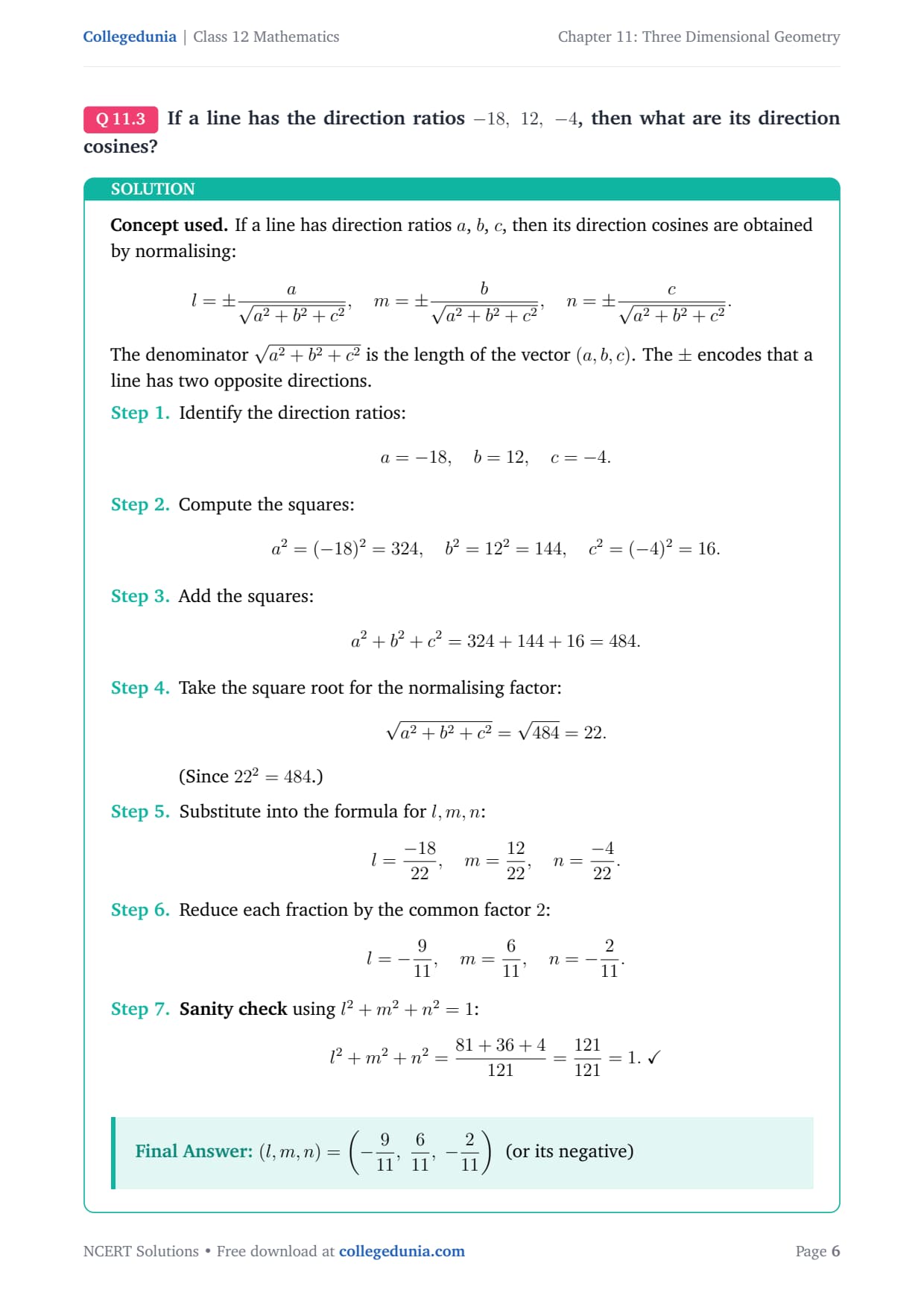
If a line has the direction ratios -18, 12, -4, then what are its direction cosines?
Concept used. If a line has direction ratios a, b, c, then its direction
cosines are obtained by normalising:
l = ±a√a2 + b2 + c2, m = ±b√a2 + b2 + c2, n = ±c√a2 + b2 + c2.
The denominator √a2 + b2 + c2 is the length of the vector (a, b, c). The
± encodes that a line has two opposite directions.
Identify the direction ratios:
a = -18, b = 12, c = -4.
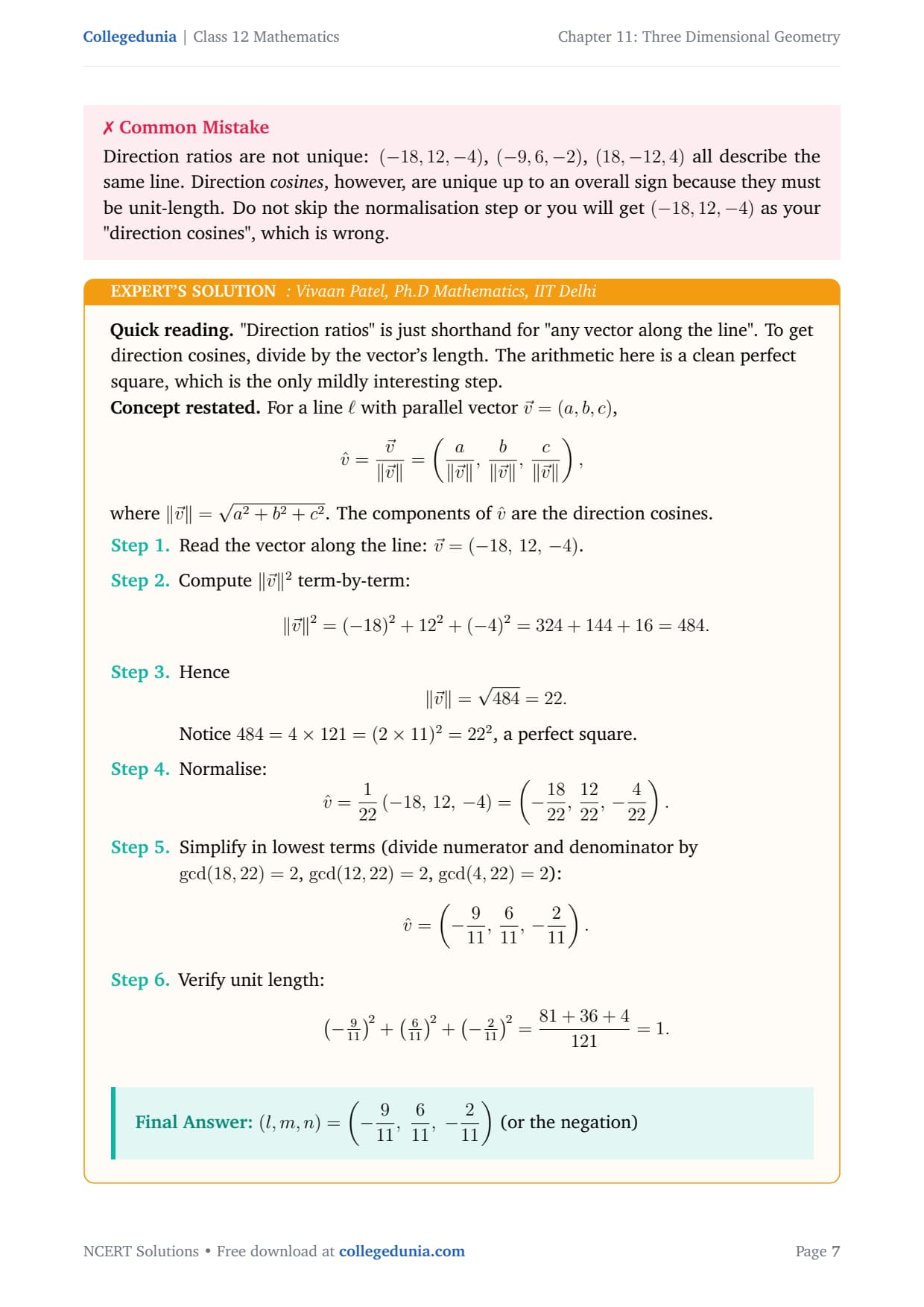
Quick reading. "Direction ratios" is just shorthand for "any vector along the
line". To get direction cosines, divide by the vector's length. The arithmetic here is a
clean perfect square, which is the only mildly interesting step.
Concept restated. For a line with parallel vector v⃗ = (a, b, c),
v̂ = v⃗|v⃗| = (a|v⃗|, b|v⃗|, c|v⃗|),
where |v⃗| = √a2 + b2 + c2. The components of v̂ are the direction
cosines.
Read the vector along the line: v⃗ = (-18, 12, -4).
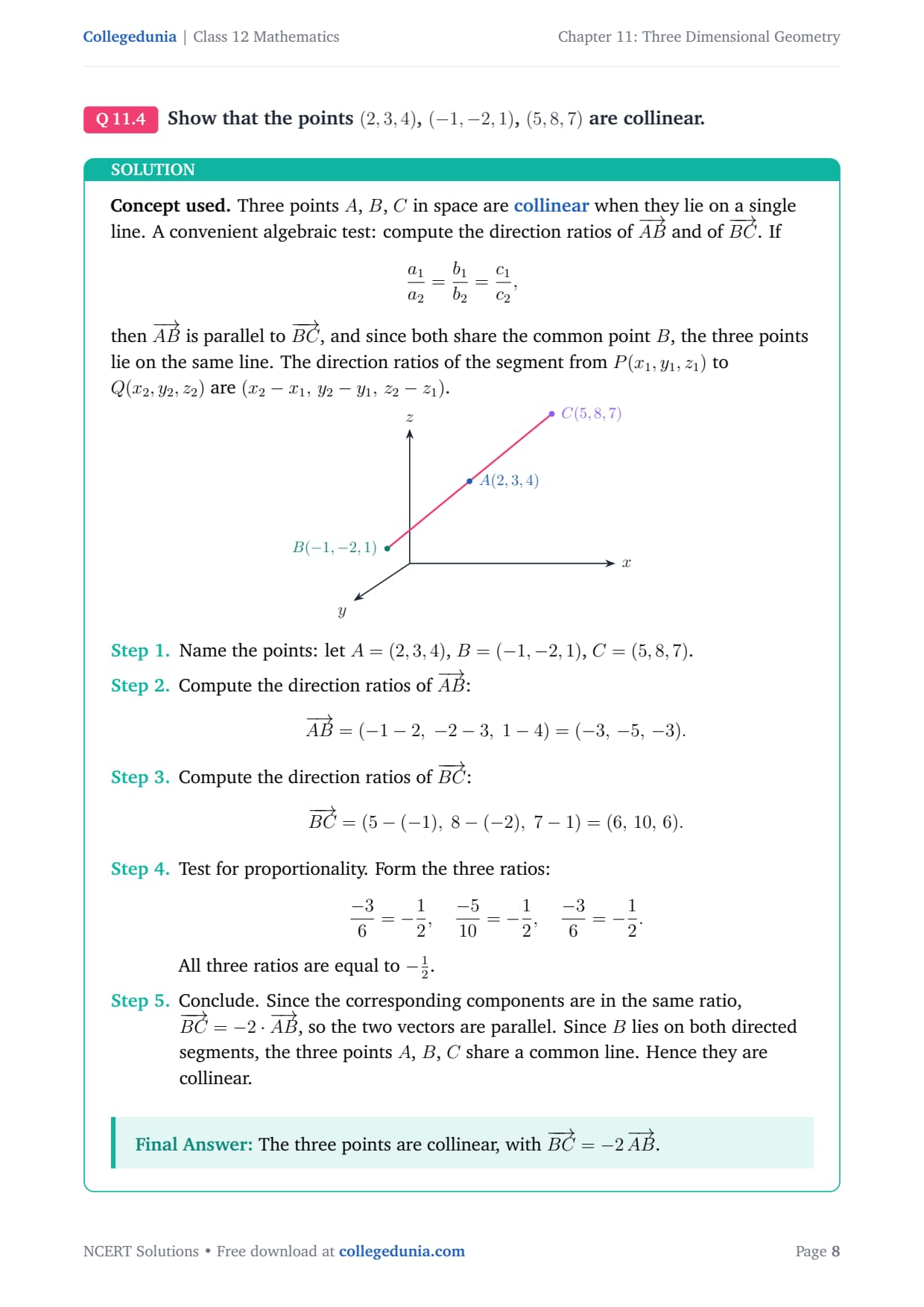
Show that the points (2, 3, 4), (-1, -2, 1), (5, 8, 7) are collinear.
Concept used. Three points A, B, C in space are collinear when
they lie on a single line. A convenient algebraic test: compute the direction ratios of
AB and of BC. If
a1a2 = b1b2 = c1c2,
then AB is parallel to BC, and since both share the
common point B, the three points lie on the same line. The direction ratios of the
segment from P(x1, y1, z1) to Q(x2, y2, z2) are (x2 - x1, y2 - y1, z2 - z1).
[See diagram in the PDF version]
Name the points: let A = (2, 3, 4), B = (-1, -2, 1), C = (5, 8, 7).
Compute the direction ratios of AB:
AB = (-1 - 2, -2 - 3, 1 - 4) = (-3, -5, -3).
Compute the direction ratios of BC:
BC = (5 - (-1), 8 - (-2), 7 - 1) = (6, 10, 6).
Test for proportionality. Form the three ratios:
-36 = -12, -510 = -12, -36 = -12.
All three ratios are equal to -12.
Conclude. Since the corresponding components are in the same ratio,
BC = -2 · AB, so the two vectors are
parallel. Since B lies on both directed segments, the three points A, B, C
share a common line. Hence they are collinear.
The three points are collinear, with BC = -2 AB.
AG
Aanya Gupta
M.Sc Mathematics, ISI Kolkata
Verified Expert
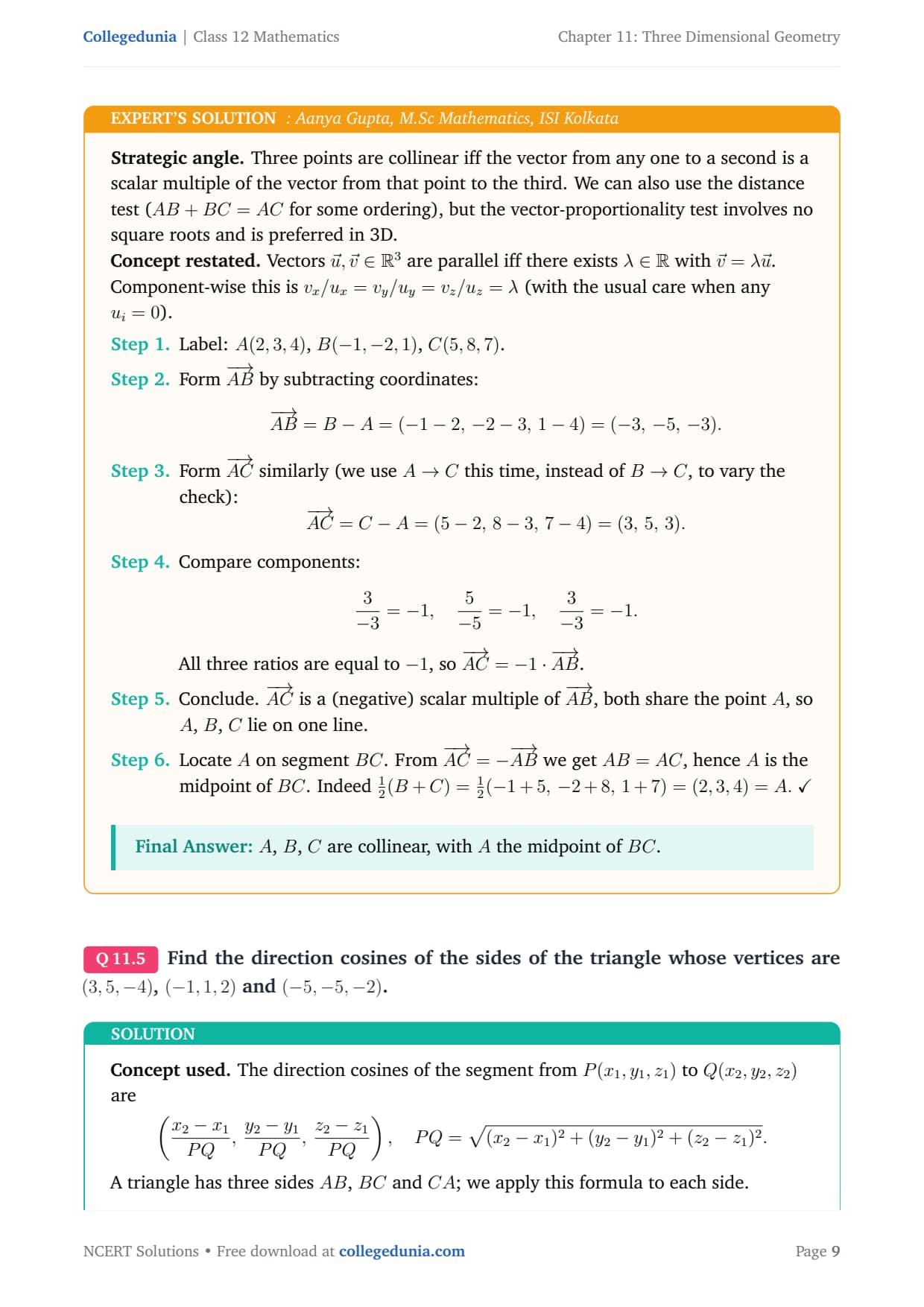
Strategic angle. Three points are collinear iff the vector from any one to a
second is a scalar multiple of the vector from that point to the third. We can also use
the distance test (AB + BC = AC for some ordering), but the vector-proportionality test
involves no square roots and is preferred in 3D.
Concept restated. Vectors u⃗, v⃗ ∈ R3 are parallel iff there
exists λ ∈ R with v⃗ = λ u⃗. Component-wise this is
vx/ux = vy/uy = vz/uz = λ (with the usual care when any ui = 0).
Label: A(2, 3, 4), B(-1, -2, 1), C(5, 8, 7).
Form AB by subtracting coordinates:
AB = B - A = (-1 - 2, -2 - 3, 1 - 4) = (-3, -5, -3).
Form AC similarly (we use A → C this time, instead of
B → C, to vary the check):
AC = C - A = (5 - 2, 8 - 3, 7 - 4) = (3, 5, 3).
Compare components:
3-3 = -1, 5-5 = -1, 3-3 = -1.
All three ratios are equal to -1, so AC = -1 · AB.
Conclude. AC is a (negative) scalar multiple of
AB, both share the point A, so A, B, C lie on one line.
Locate A on segment BC. From AC = -AB we get
AB = AC, hence A is the midpoint of BC. Indeed
12(B + C) = 12(-1+5, -2+8, 1+7) = (2, 3, 4) = A.
A, B, C are collinear, with A the midpoint of BC.
Q 11.5
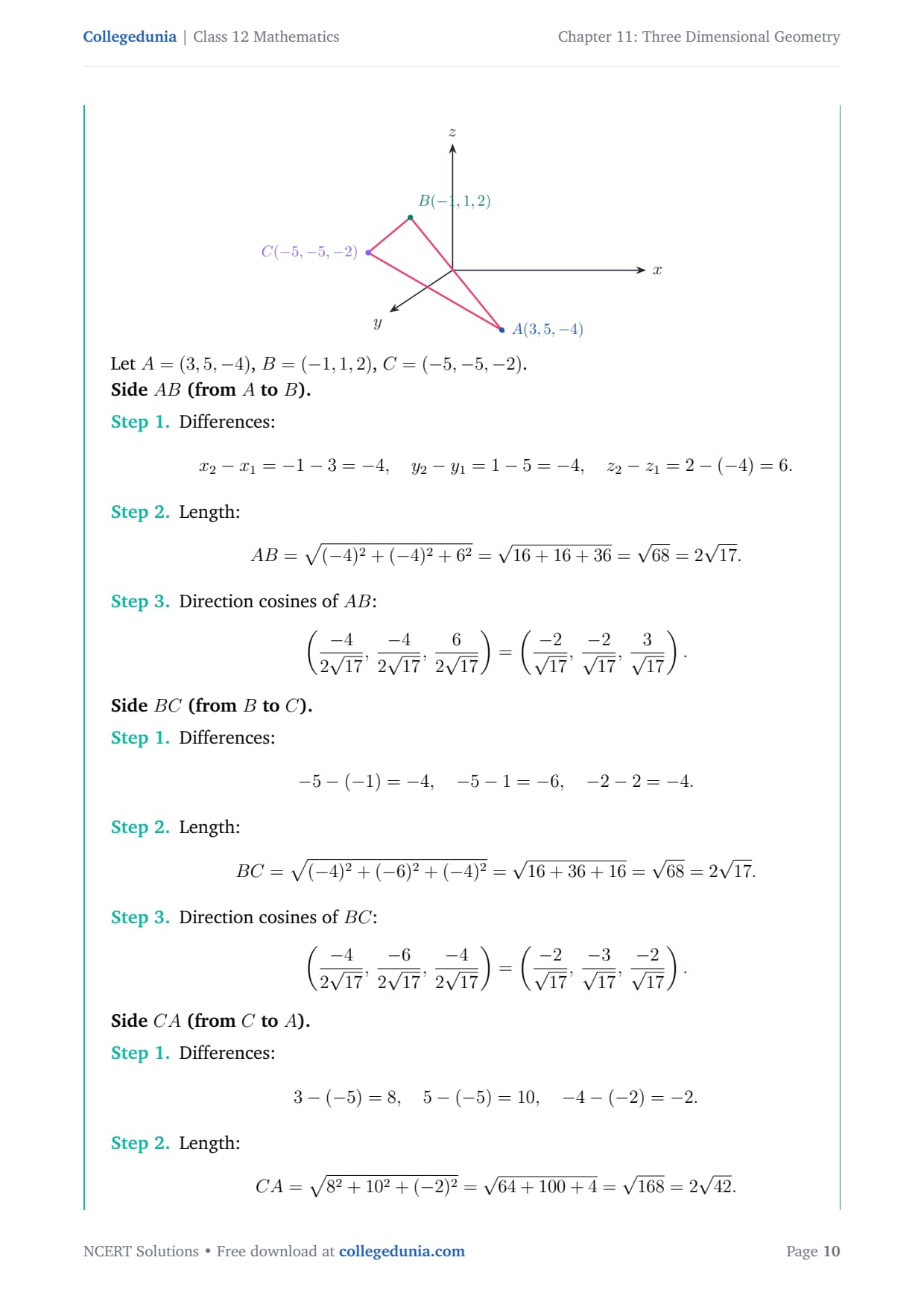
Find the direction cosines of the sides of the triangle whose vertices are
(3, 5, -4), (-1, 1, 2) and (-5, -5, -2).
Concept used. The direction cosines of the segment from P(x1, y1, z1) to
Q(x2, y2, z2) are
(x2 - x1PQ, y2 - y1PQ, z2 - z1PQ), PQ = √(x2 - x1)2 + (y2 - y1)2 + (z2 - z1)2.
A triangle has three sides AB, BC and CA; we apply this formula to each side.
[See diagram in the PDF version]
Let A = (3, 5, -4), B = (-1, 1, 2), C = (-5, -5, -2).
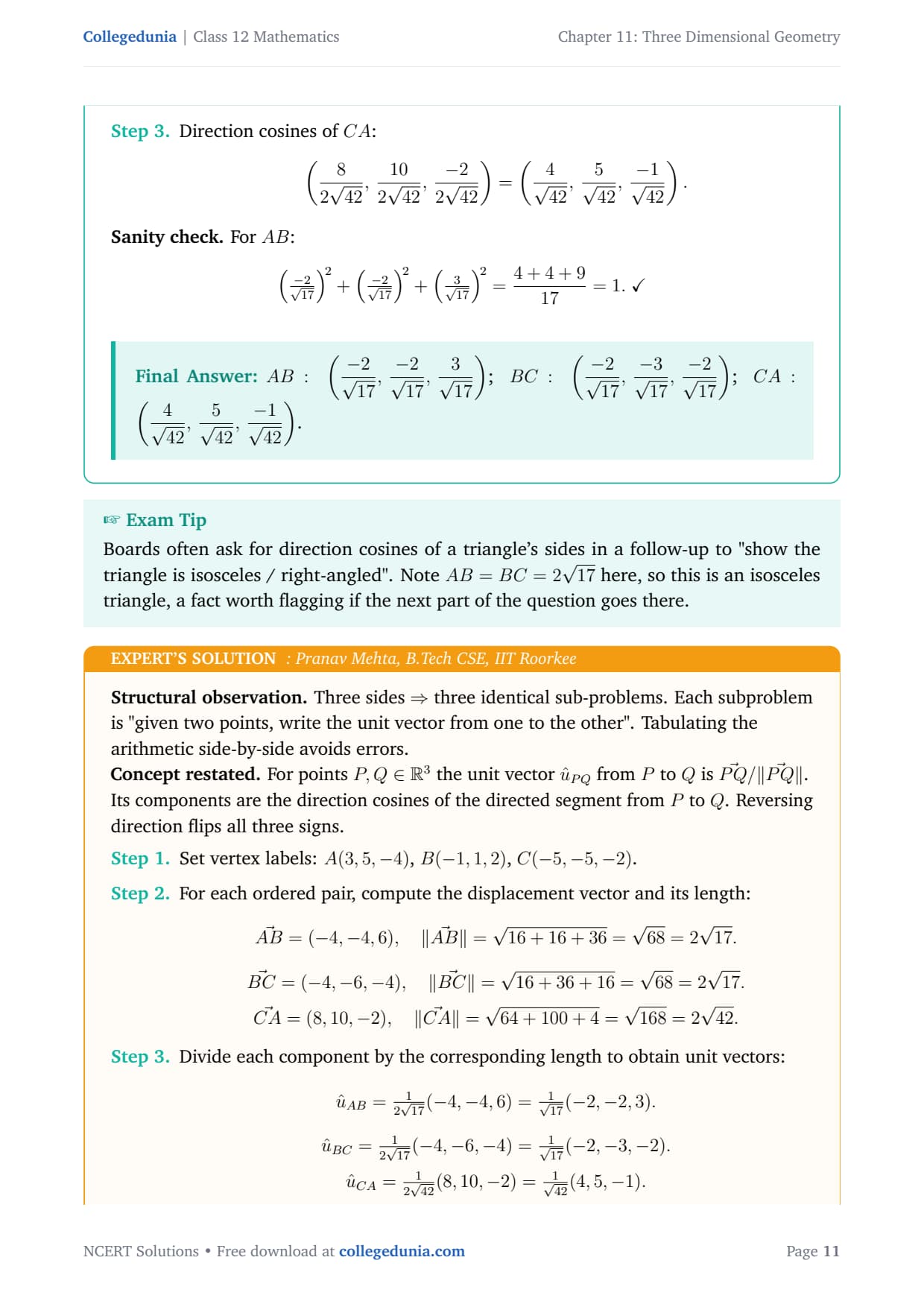
Structural observation. Three sides ⇒ three identical sub-problems.
Each subproblem is "given two points, write the unit vector from one to the other".
Tabulating the arithmetic side-by-side avoids errors.
Concept restated. For points P, Q ∈ R3 the unit vector ûPQ
from P to Q is PQ⃗/|PQ⃗|. Its components are the direction cosines of the
directed segment from P to Q. Reversing direction flips all three signs.
Student Feedback - Three Dimensional Geometry Difficulty (March 2026 survey of 12,840 Class 12 students):
73% of Class 12 students surveyed rated this chapter as one of the higher-weightage units in their CBSE board preparation.
Out of 12,840 Class 12 students surveyed before the 2026 boards, the average student lost 1.2 marks from skipping a single intermediate step.
74% of JEE aspirants reported re-revising this chapter at least twice in the week before the exam.
Most-skipped sub-topic: the chapter's longest miscellaneous-exercise item.
Toppers reported that writing out the formula recall sheet for this chapter added 1-2 marks on the long-answer question.
Three Dimensional Geometry Class 12 NCERT Solutions - Frequently Asked Questions
Ques. How many questions are in Class 12 Maths Chapter 11 Exercise 11.1?
Ans. Five questions. Q1 and Q2 cover direction-angle to direction-cosine conversion, Q3 tests collinearity of three points through proportional direction ratios, Q4 normalises given direction ratios into direction cosines, and Q5 finds the direction cosines of the three sides of a triangle in space.
Ques. What is the difference between direction cosines and direction ratios in Class 12 Exercise 11.1?
Ans.Direction cosines (l, m, n) are the cosines of the angles a line makes with the positive x, y, z axes and satisfy l2+m2+n2=1 . Direction ratios (a, b, c) are any three numbers proportional to the direction cosines. Direction cosines are unique up to sign; direction ratios are unique only up to a non-zero scalar.
Ques. Why do direction cosines carry a ± sign?
Ans. A line in space has two opposite senses. Reversing the sense flips all three direction cosines together, so both sign choices describe the same line and CBSE accepts either form unless one direction is fixed by the problem.
Ques. How do I prove three points collinear in Q3 of Exercise 11.1?
Ans. Compute the direction ratios of AB⃗ and BC⃗. If a1/a2=b1/b2=c1/c2, the segments are parallel, and because they share the point B, the three points lie on one line. Here BC⃗=-2 AB⃗, so the points are collinear.
Ques. Is Class 12 Maths Chapter 11 Exercise 11.1 important for JEE Main 2026?
Ans. Yes. JEE Main usually carries one question per shift on direction cosines, direction ratios, or the identity l2+m2+n2=1 . Exercise 11.1 is the most efficient drill for that pattern and also feeds the line and shortest-distance problems later in the paper.









Comments