Maths Mentor, Thapar Institute | Updated 3+ months ago
These are the NCERT Solutions for Class 12 Maths Chapter 10 Vector Algebra, Miscellaneous Exercise. Every one of the 19 questions is solved step by step, matched to the 2026-27 CBSE marking scheme. The free PDF download is on this page.
The PDF covers every part of every question, with each step written out in full and matched to the official NCERT notation.
Question count: 19 questions - 15 short and long-answer problems, plus 4 single-correct MCQs (Q16 to Q19).
The Miscellaneous Exercise has 19 questions spanning every Chapter 10 tool. The table records the final answer for each, so you can check a long attempt without re-deriving it.
Q No.
Task
Answer
1
Unit vector in XY-plane, 30 degrees from positive x-axis
32i + 12j
2
Scalar components and magnitude of PQ
Components (x2-x1, y2-y1, z2-z1) ; magnitude the root of their squares
3
Girl's displacement: 4 km west, then 3 km, 30 degrees east of north
-52i + 332j, magnitude √13 km
4
Is |a| = |b| + |c| when a = b + c?
No; equality only if b, c are like-parallel
5
Value of x so x(i + j + k) is a unit vector
x = ±13
6
Vector of magnitude 5, parallel to a + b
5√10(3i + j)
7
Unit vector parallel to 2a - b + 3c
1√22(3i - 3j + 2k)
8
Show A, B, C collinear; ratio in which B divides AC
Collinear; B divides AC internally 2:3
9
Position vector of R dividing PQ externally 1:2
r = 3a + 5b; P is midpoint of RQ
10
Unit vector along the diagonal and area of a parallelogram
17(3i - 6j + 2k) ; area 115
11
Show direction cosines of an equally inclined vector are ±(1/3,)
(l,m,n) = ±(13, 13, 13)
12
Vector d ⊥ a, b with c·d = 15
d = 13(160i - 5j - 70k)
13
Find λ from a scalar-product equal to one condition
λ = 1
14
Show a + b + c equally inclined to mutually perpendicular equal vectors
Equal angle cos-1(1/3) with each
15
Prove (a+b)·(a+b) = |a|2 + |b|2a⊥b
Equivalent to a⊥b
16
MCQ: a·b ≥ 0 only when
Option (B), 0 ≤ θ ≤ π/2
17
MCQ: a + b a unit vector if
Option (D), θ = 2π/3
18
MCQ: value of i·(j×k) + j·(i×k) + k·(i×j)
Option (C), value 1
19
MCQ: |a·b| = |a×b| when θ is
Option (B), θ = π/4
Q12 is the signature mixed question: a cross product gives a vector perpendicular to both a and b, then a dot-product constraint fixes the scale. A mixed Miscellaneous-style problem has seeded the 5-mark Vector Algebra long answer in 4 of the last 5 CBSE board papers.
Tools Combined Across Class 12 Maths Chapter 10 Miscellaneous Exercise
Almost every Miscellaneous question chains two or three operations. This box lists the ones that recur, in the order they usually appear within a problem.
Unit / parallel vector:v|v|, then scale by the required magnitude Section formula: internal mq + npm+n, external mq - npm-n Perpendicular vector:a×b is perpendicular to both a and b Dot constraint: use c·d = k to fix the unknown scalar Equally inclined: direction cosines ±(1/3, 1/3, 1/3)
Concept Tags Across the 19 Problems of Class 12 Maths Miscellaneous Exercise
Sorting the questions by the dominant tool shows which clusters carry the most board weight.
Sub-topic
Questions
Unit and parallel vectors
Q1, Q5, Q6, Q7
Displacement and triangle inequality
Q3, Q4
Collinearity and section formula
Q8, Q9
Cross product, area, perpendicular vector
Q10, Q12
Equally inclined vectors
Q11, Q14
Dot-product proofs and MCQs
Q13, Q15, Q16, Q17, Q18, Q19
The cross-product cluster (Q10, Q12) and the section-formula pair (Q8, Q9) are the two groups that most often become the long answer, so practise those before the proof-type and MCQ items.
How Collegedunia's NCERT Solutions for the Miscellaneous Exercise Help You
The Miscellaneous set is hard not because any single step is difficult but because the steps must be chained in the right order. The Collegedunia solutions number each operation, show the formula then the substitution then the arithmetic on separate lines, and state the constraint that fixes the final scalar.
Order of operations: Q12 does the cross product first, then applies c·d = 15 to fix the multiplier.
Triangle inequality reasoning: Q4 explains that |a| = |b| + |c| holds only when b and c point the same way.
Section formula sign: Q9 uses external division, then proves P is the midpoint of RQ as a built-in check.
Common Mistakes Students Make in Class 12 Maths Miscellaneous Exercise
Common Mistake: In Q12, normalising a×b too early. The question fixes the scale through c·d = 15 , so keep d = k(a×b) and solve for k from the dot constraint, instead of dividing by the magnitude first.
Writing |a| = |b| + |c| as always true; it holds only for like-parallel b, c (Q4).
Using the internal section formula where Q9 asks for external division.
Forgetting the ± on equally inclined direction cosines in Q11 and Q14.
Treating a scalar triple product as a vector in Q18; i·(j×k) is a number.
Other Resources for Class 12 Maths Chapter 10 Vector Algebra
Exercise-wise Breakdown of the Vector Algebra Chapter
The Vector Algebra chapter splits into 4 numbered exercises plus a Miscellaneous Exercise. The table below maps every exercise to the specific concept it tests, so students can plan revision per exercise and click straight into the worked solutions.
All NCERT Solutions for Vector Algebra Misc with Step-by-Step Working
Every NCERT textbook question for Class 12 Mathematics Chapter 10 Vector Algebra Misc is listed below with its full Solution and Expert Solution hidden inside collapsible tabs. Click Check Solution to reveal the step-by-step working; click Expert Solution for the expanded explanation.
Questions
Q 10.1
Write down a unit vector in XY-plane, making an angle of 30∘ with the positive direction of x-axis.
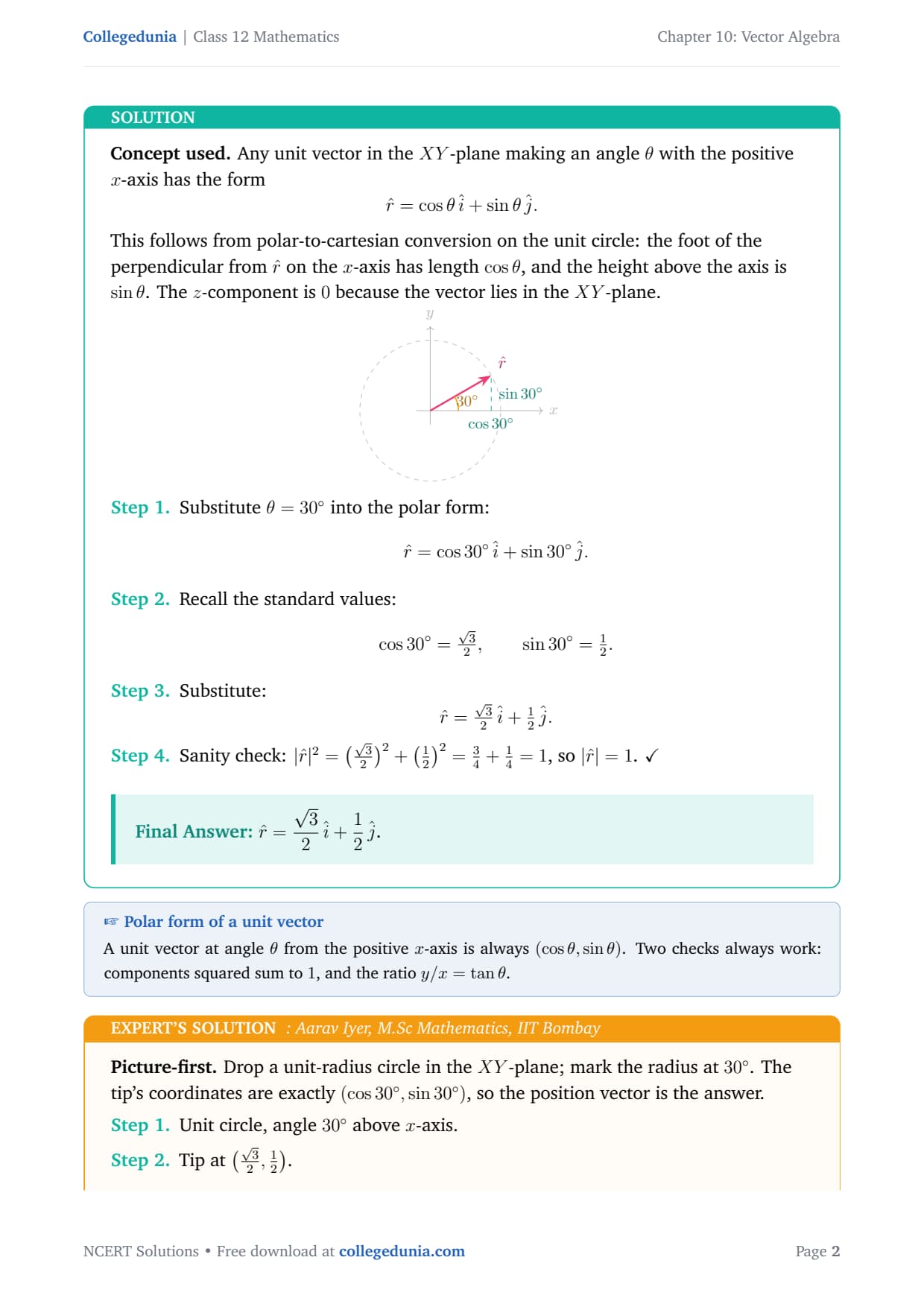
Concept used. Any unit vector in the XY-plane making an angle θ with the positive x-axis has the form
r = cosθ i + sinθ j.
This follows from polar-to-cartesian conversion on the unit circle: the foot of the perpendicular from r on the x-axis has length cosθ, and the height above the axis is sinθ. The z-component is 0 because the vector lies in the XY-plane.
[See diagram in the PDF version]
Substitute θ = 30∘ into the polar form:
r = cos 30∘i + sin 30∘j.
Recall the standard values:
cos 30∘ = 32, sin 30∘ = 12.
Picture-first. Drop a unit-radius circle in the XY-plane; mark the radius at 30∘. The tip's coordinates are exactly (cos 30∘, sin 30∘), so the position vector is the answer.
Unit circle, angle 30∘ above x-axis.
Tip at (32, 12).
So r = 32i + 12j (with no k-component since we are in the XY-plane).
|r|2 = 34+14=1, confirming it is a unit vector.
Why this matters. The polar-form expression (cosθ, sinθ) is the simplest way to write any planar unit vector; you will meet it again in three-dimensional geometry and in oscillation problems in physics.
32i + 12j.
Q 10.2
Find the scalar components and magnitude of the vector joining the points P(x1, y1, z1) and Q(x2, y2, z2).
Concept used. If P and Q have position vectors p and q respectively, then the vector PQ from P to Q is
PQ = q - p = (x2 - x1)i + (y2 - y1)j + (z2 - z1)k.
Its scalar components are the coefficients of i, j, k, and its magnitude is given by the Pythagorean (distance) formula in 3D.
Write the position vectors of P and Q explicitly:
p = x1i + y1j + z1k, q = x2i + y2j + z2k.
Subtract componentwise to get PQ:
PQ = (x2 - x1)i + (y2 - y1)j + (z2 - z1)k.
Scalar components: x2 - x1, y2 - y1, z2 - z1.
Magnitude using the 3D distance formula:
|PQ| = √(x2 - x1)2 + (y2 - y1)2 + (z2 - z1)2.
Structural observation. The vector ``from tail to head'' is always (head's position vector) - (tail's position vector); the magnitude is then the ordinary 3D distance between the two endpoints.
Why this matters. This identifies the algebraic vector with the geometric segment PQ. Direction cosines, midpoint of PQ, and all later 3D-geometry formulas build on these two facts.
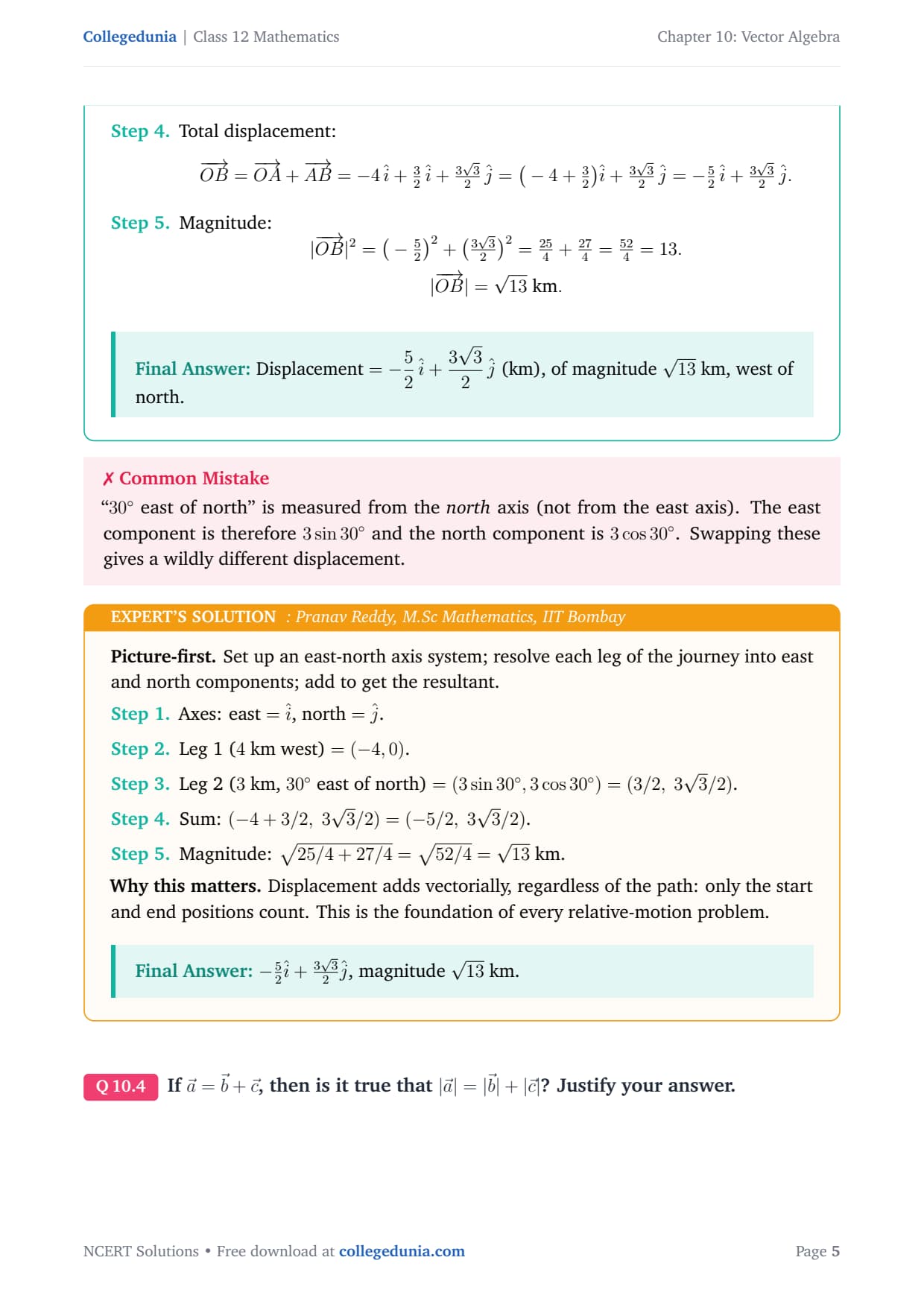
A girl walks 4 km towards west, then she walks 3 km in a direction 30∘ east of north and stops. Determine the girl's displacement from her initial point of departure.
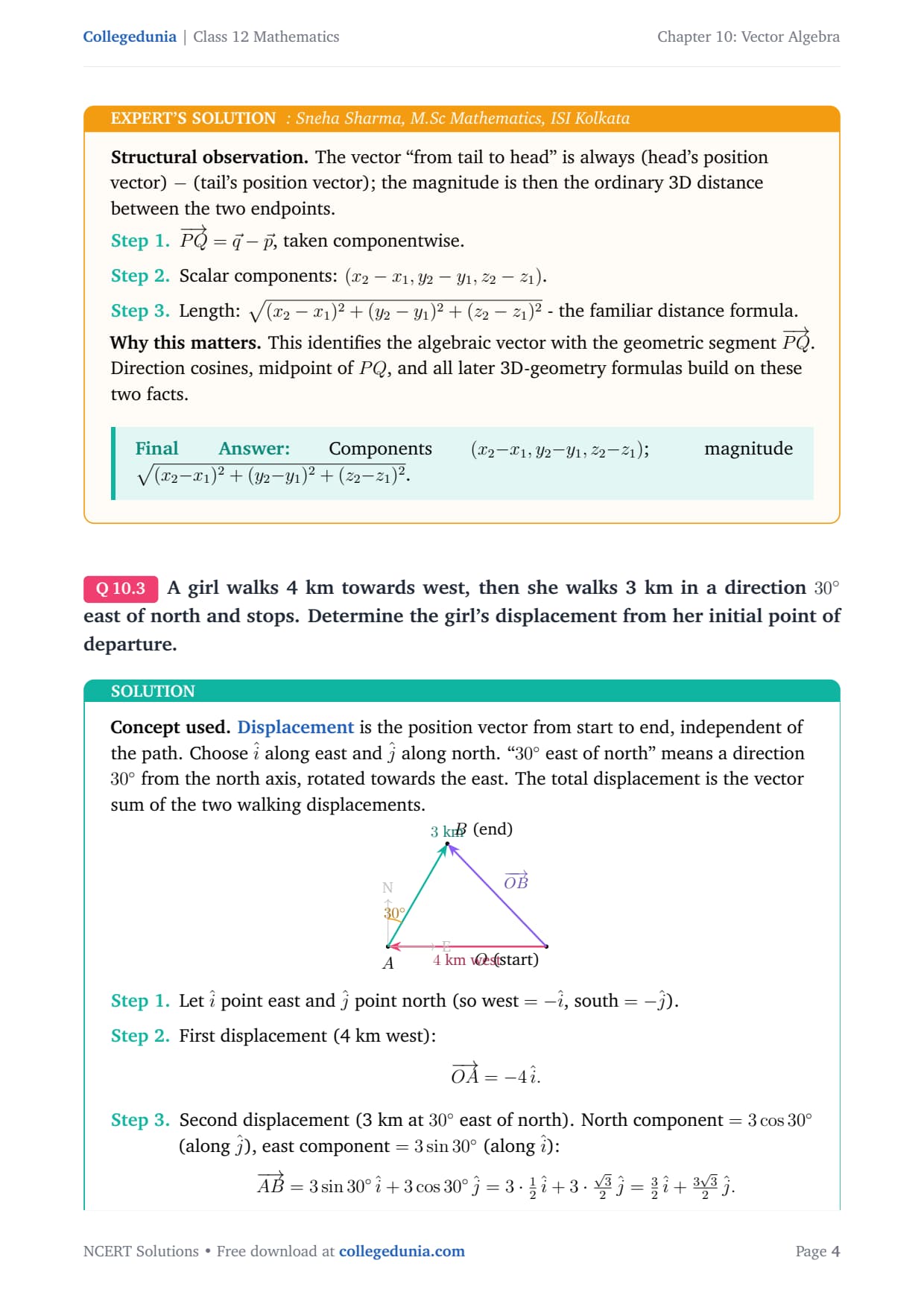
Concept used.Displacement is the position vector from start to end, independent of the path. Choose i along east and j along north. ``30∘ east of north'' means a direction 30∘ from the north axis, rotated towards the east. The total displacement is the vector sum of the two walking displacements.
[See diagram in the PDF version]
Let i point east and j point north (so west =-i, south =-j).
First displacement (4 km west):
OA = -4 i.
Second displacement (3 km at 30∘ east of north). North component = 3cos 30∘ (along j), east component = 3sin 30∘ (along i):
AB = 3sin 30∘i + 3cos 30∘j = 3·12i + 3·32j = 32i + 332j.
Total displacement:
OB = OA + AB = -4 i + 32i + 332j = (-4 + 32)i + 332j = -52i + 332j.
Displacement = -52i + 332j (km), of magnitude √13 km, west of north.
PR
Pranav Reddy
M.Sc Mathematics, IIT Bombay
Verified Expert
Picture-first. Set up an east-north axis system; resolve each leg of the journey into east and north components; add to get the resultant.
Axes: east =i, north =j.
Leg 1 (4 km west) = (-4, 0).
Leg 2 (3 km, 30∘ east of north) = (3sin 30∘, 3cos 30∘) = (3/2, 33/2).
Sum: (-4 + 3/2, 33/2) = (-5/2, 33/2).
Magnitude: √25/4 + 27/4 = √52/4 = √13 km.
Why this matters. Displacement adds vectorially, regardless of the path: only the start and end positions count. This is the foundation of every relative-motion problem.
-52i + 332j, magnitude √13 km.
Q 10.4
If a = b + c, then is it true that |a| = |b| + |c|? Justify your answer.
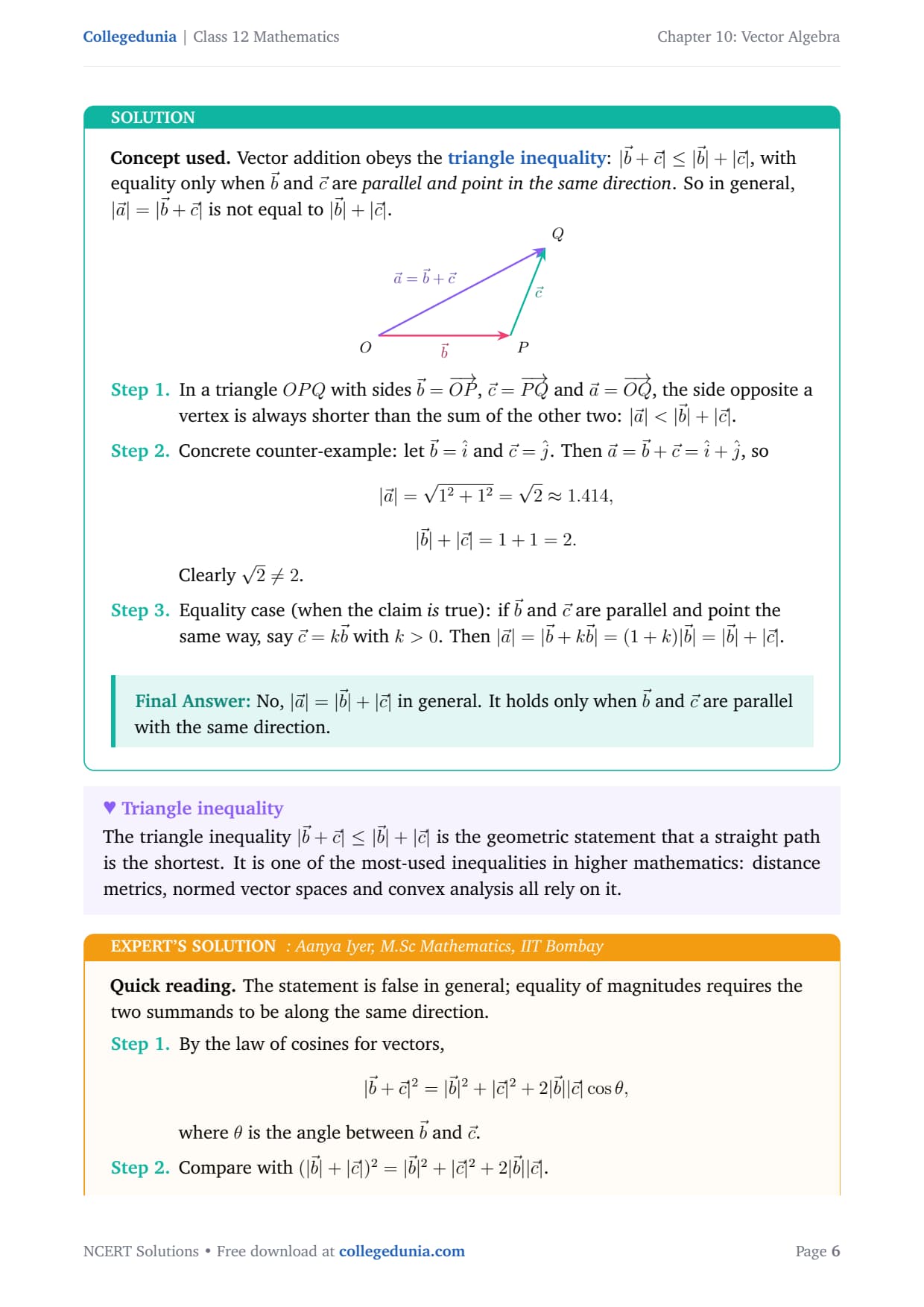
Concept used. Vector addition obeys the triangle inequality: |b + c| ≤ |b| + |c|, with equality only when b and c are parallel and point in the same direction. So in general, |a| = |b + c| is not equal to |b| + |c|.
[See diagram in the PDF version]
In a triangle OPQ with sides b = OP, c = PQ and a = OQ, the side opposite a vertex is always shorter than the sum of the other two: |a| < |b| + |c|.
Concrete counter-example: let b = i and c = j. Then a = b + c = i + j, so
|a| = √12 + 12 = 2 ≈ 1.414,|b| + |c| = 1 + 1 = 2.
Clearly 2 ≠ 2.
Equality case (when the claim is true): if b and c are parallel and point the same way, say c = kb with k > 0. Then |a| = |b + kb| = (1+k)|b| = |b| + |c|.
No, |a| = |b| + |c| in general. It holds only when b and c are parallel with the same direction.
AI
Aanya Iyer
M.Sc Mathematics, IIT Bombay
Verified Expert
Quick reading. The statement is false in general; equality of magnitudes requires the two summands to be along the same direction.
By the law of cosines for vectors,
|b + c|2 = |b|2 + |c|2 + 2|b||c|cosθ,
where θ is the angle between b and c.
Compare with (|b|+|c|)2 = |b|2+|c|2+2|b||c|.
Equality holds iff cosθ = 1, i.e. θ = 0: b and c are parallel with the same orientation.
For any θ ∈ (0, π] we get cosθ < 1, hence |a| < |b|+|c|.
Why this matters. The cosine identity above is the universal form of the triangle inequality and tells you exactly how far from equality you are - controlled by the cosine of the angle between b and c.
Not in general; equality iff b and c are like-parallel (θ = 0).
Q 10.5
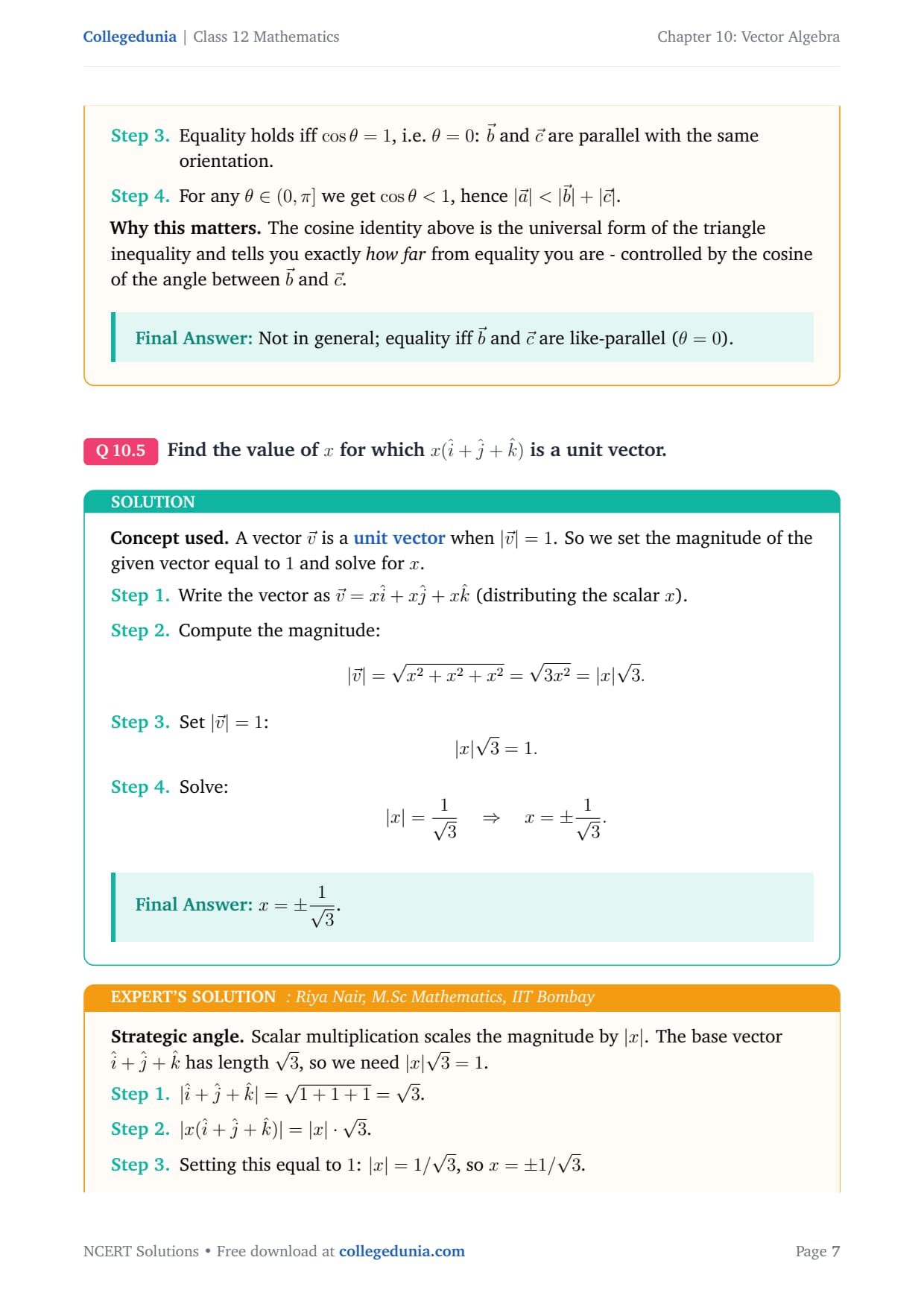
Find the value of x for which x(i + j + k) is a unit vector.
Concept used. A vector v is a unit vector when |v| = 1. So we set the magnitude of the given vector equal to 1 and solve for x.
Write the vector as v = xi + xj + xk (distributing the scalar x).
Strategic angle. Scalar multiplication scales the magnitude by |x|. The base vector i+j+k has length 3, so we need |x|3 = 1.
|i + j + k| = √1+1+1 = 3.
|x(i+j+k)| = |x|·3.
Setting this equal to 1: |x| = 1/3, so x = ± 1/3.
Why this matters. The two signs of x give the two unit vectors along the diagonal of a cube: 13(1,1,1) and -13(1,1,1). Both have unit length, opposite orientations.
± 1/3.
Q 10.6
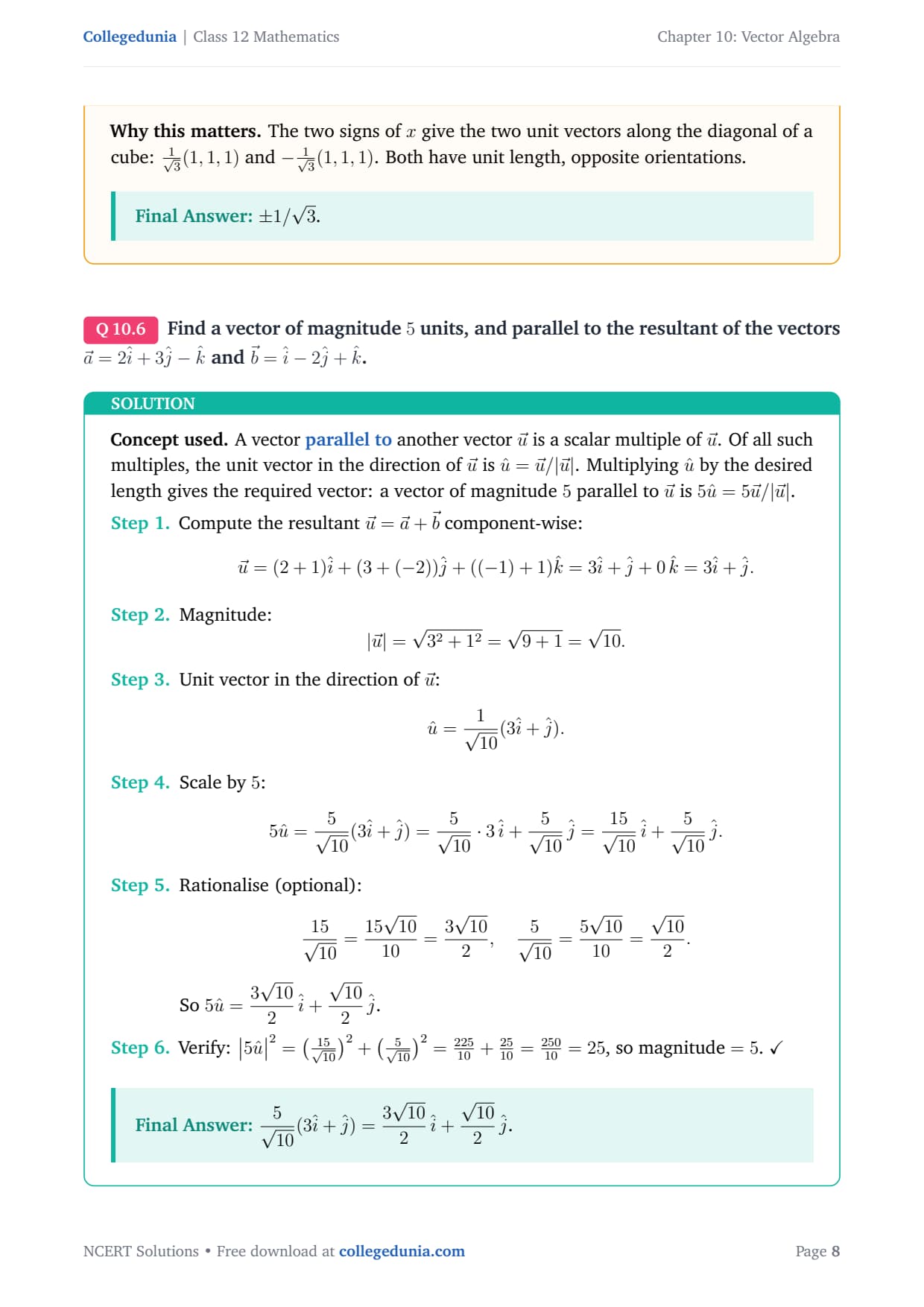
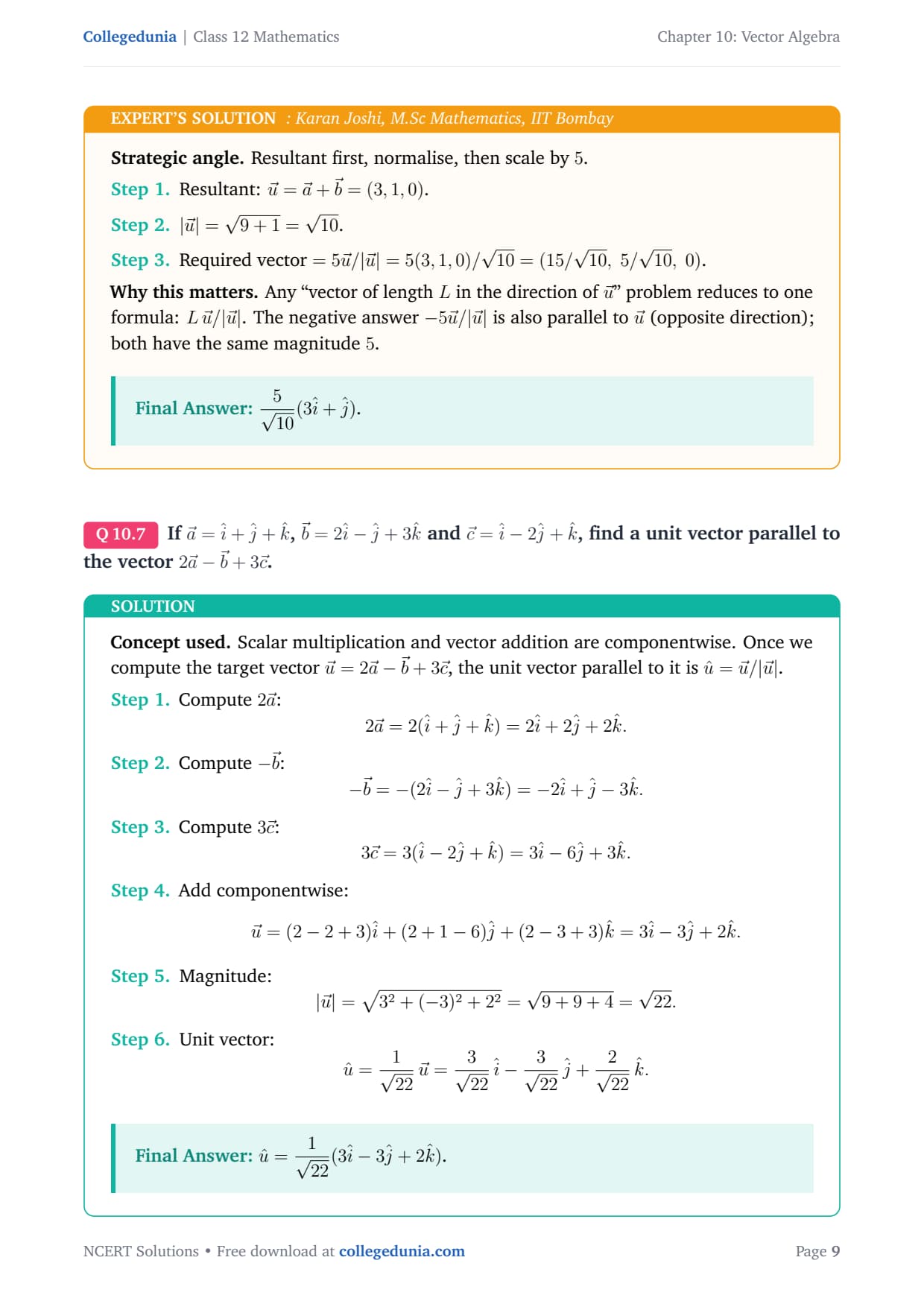
Find a vector of magnitude 5 units, and parallel to the resultant of the vectors a = 2i + 3j - k and b = i - 2j + k.
Concept used. A vector parallel to another vector u is a scalar multiple of u. Of all such multiples, the unit vector in the direction of u is u = u/|u|. Multiplying u by the desired length gives the required vector: a vector of magnitude 5 parallel to u is 5u = 5u/|u|.
Compute the resultant u = a + b component-wise:
u = (2 + 1)i + (3 + (-2))j + ((-1) + 1)k = 3i + j + 0 k = 3i + j.
Magnitude:
|u| = √32 + 12 = √9 + 1 = √10.
Unit vector in the direction of u:
u = 1√10(3i + j).
Scale by 5:
5u = 5√10(3i + j) = 5√10· 3 i + 5√10j = 15√10i + 5√10j.
Why this matters. Any ``vector of length L in the direction of u'' problem reduces to one formula: Lu/|u|. The negative answer -5u/|u| is also parallel to u (opposite direction); both have the same magnitude 5.
5√10(3i + j).
Q 10.7
If a = i + j + k, b = 2i - j + 3k and c = i - 2j + k, find a unit vector parallel to the vector 2a - b + 3c.
Concept used. Scalar multiplication and vector addition are componentwise. Once we compute the target vector u = 2a - b + 3c, the unit vector parallel to it is u = u/|u|.
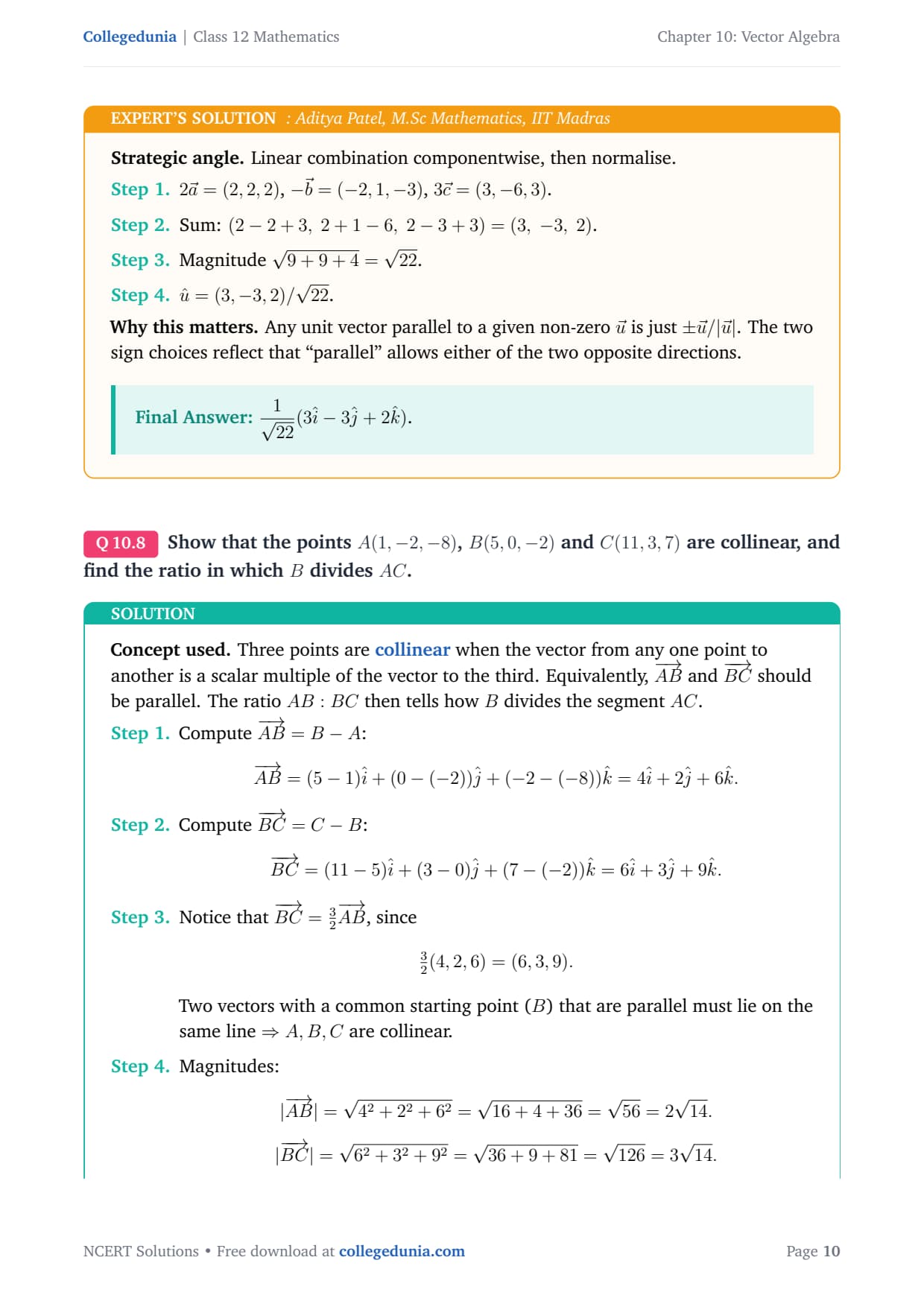
Strategic angle. Linear combination componentwise, then normalise.
2a = (2,2,2), -b = (-2, 1, -3), 3c = (3, -6, 3).
Sum: (2-2+3, 2+1-6, 2-3+3) = (3, -3, 2).
Magnitude √9+9+4 = √22.
u = (3, -3, 2)/√22.
Why this matters. Any unit vector parallel to a given non-zero u is just ±u/|u|. The two sign choices reflect that ``parallel'' allows either of the two opposite directions.
1√22(3i - 3j + 2k).
Q 10.8
Show that the points A(1, -2, -8), B(5, 0, -2) and C(11, 3, 7) are collinear, and find the ratio in which B divides AC.
Concept used. Three points are collinear when the vector from any one point to another is a scalar multiple of the vector to the third. Equivalently, AB and BC should be parallel. The ratio AB : BC then tells how B divides the segment AC.
Compute AB = B - A:
AB = (5-1)i + (0-(-2))j + (-2-(-8))k = 4i + 2j + 6k.
Compute BC = C - B:
BC = (11-5)i + (3-0)j + (7-(-2))k = 6i + 3j + 9k.
Notice that BC = 32AB, since
32(4, 2, 6) = (6, 3, 9).
Two vectors with a common starting point (B) that are parallel must lie on the same line ⇒A, B, C are collinear.
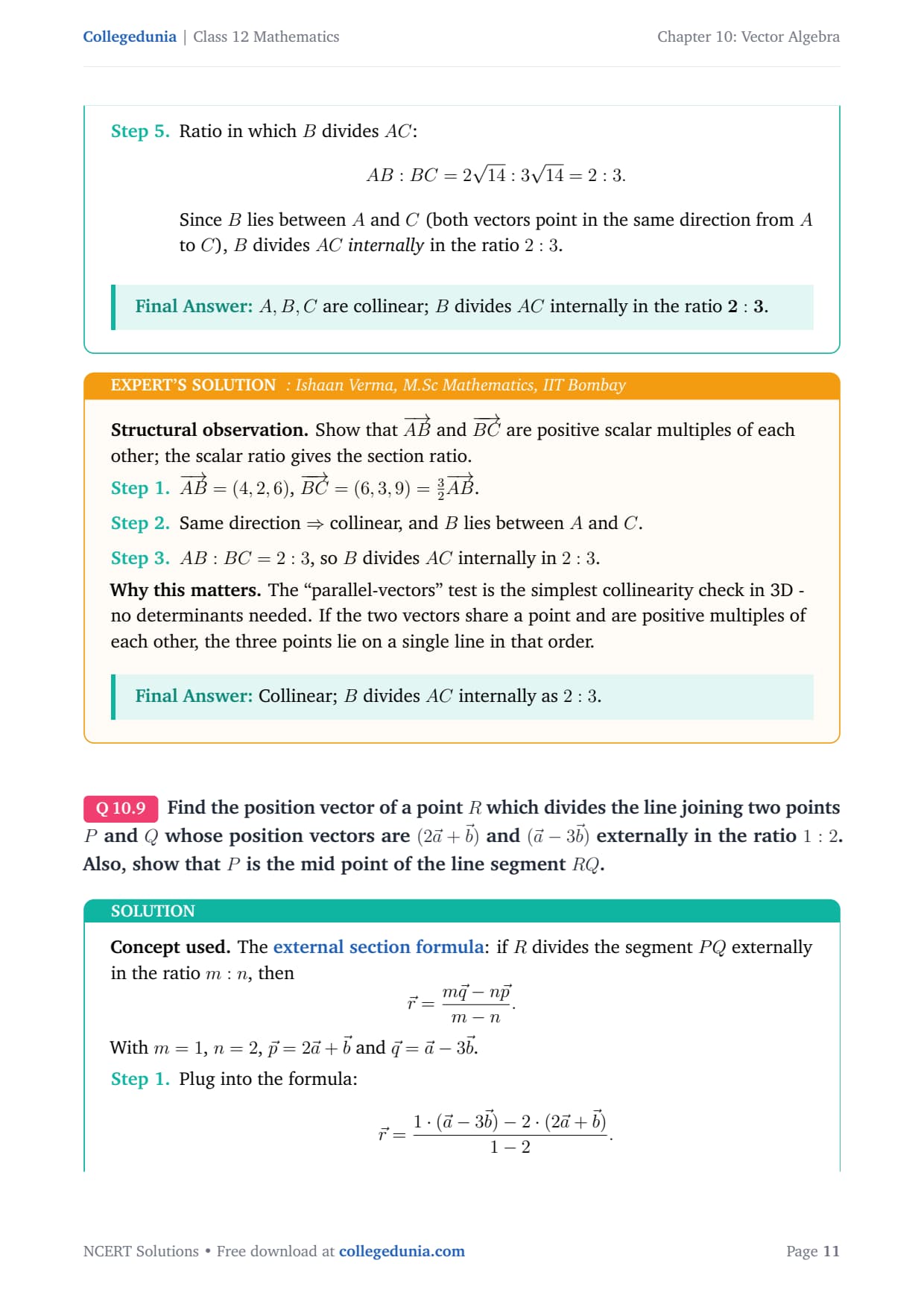
Ratio in which B divides AC:
AB : BC = 2√14 : 3√14 = 2 : 3.
Since B lies between A and C (both vectors point in the same direction from A to C), B divides ACinternally in the ratio 2:3.
A, B, C are collinear; B divides AC internally in the ratio 2 : 3.
IV
Ishaan Verma
M.Sc Mathematics, IIT Bombay
Verified Expert
Structural observation. Show that AB and BC are positive scalar multiples of each other; the scalar ratio gives the section ratio.
AB = (4, 2, 6), BC = (6, 3, 9) = 32AB.
Same direction ⇒ collinear, and B lies between A and C.
AB : BC = 2 : 3, so B divides AC internally in 2 : 3.
Why this matters. The ``parallel-vectors'' test is the simplest collinearity check in 3D - no determinants needed. If the two vectors share a point and are positive multiples of each other, the three points lie on a single line in that order.
Collinear; B divides AC internally as 2:3.
Q 10.9
Find the position vector of a point R which divides the line joining two points P and Q whose position vectors are (2a + b) and (a - 3b) externally in the ratio 1 : 2. Also, show that P is the mid point of the line segment RQ.
Concept used. The external section formula: if R divides the segment PQ externally in the ratio m : n, then
r = mq - npm - n.
With m = 1, n = 2, p = 2a + b and q = a - 3b.
Plug into the formula:
r = 1·(a - 3b) - 2·(2a + b)1 - 2.
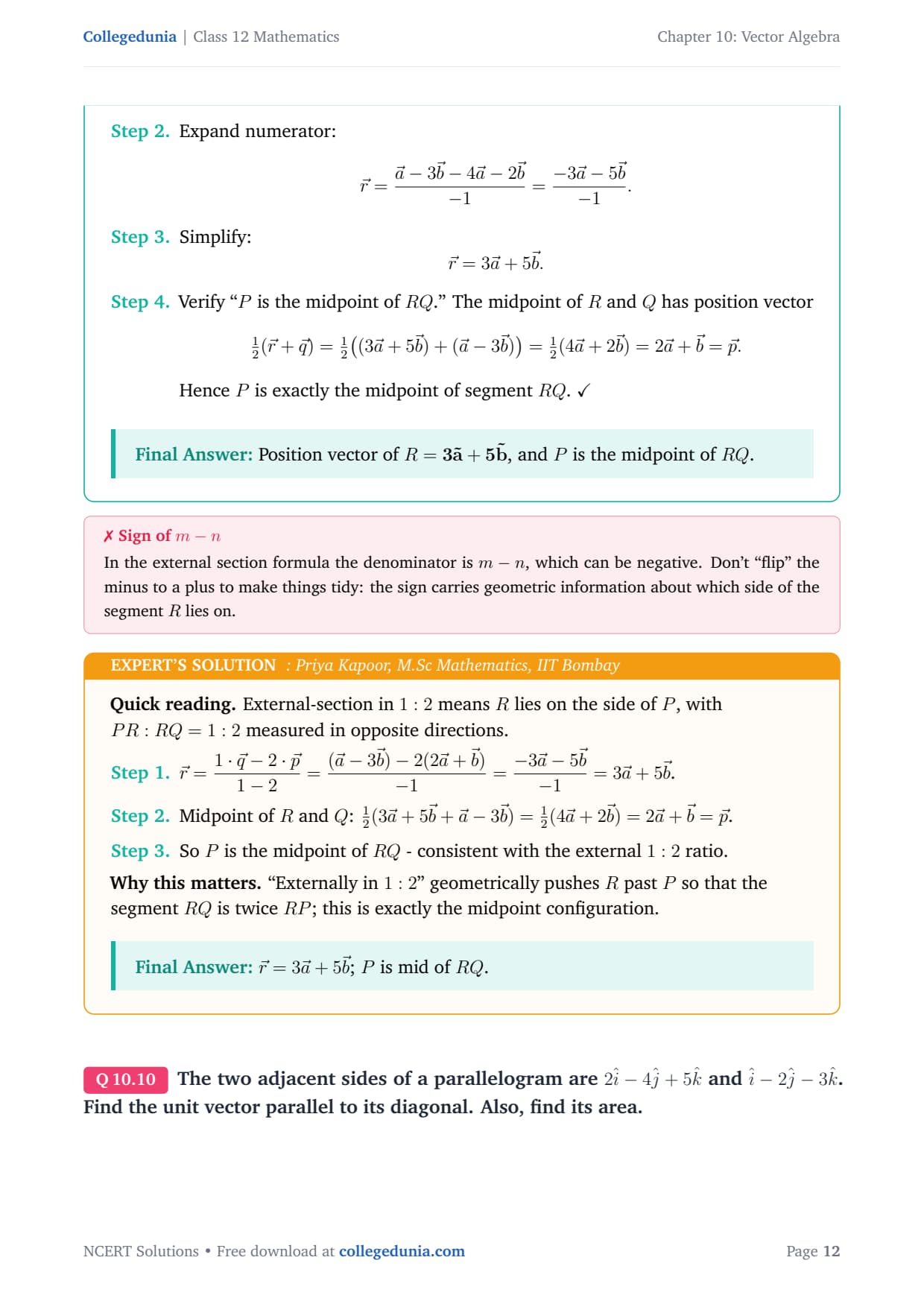
Expand numerator:
r = a - 3b - 4a - 2b-1 = -3a - 5b-1.
Simplify:
r = 3a + 5b.
Verify ``P is the midpoint of RQ.'' The midpoint of R and Q has position vector
12(r + q) = 12((3a + 5b) + (a - 3b)) = 12(4a + 2b) = 2a + b = p.
Hence P is exactly the midpoint of segment RQ.
Position vector of R = 3a + 5b, and P is the midpoint of RQ.
PK
Priya Kapoor
M.Sc Mathematics, IIT Bombay
Verified Expert
Quick reading. External-section in 1:2 means R lies on the side of P, with PR : RQ = 1 : 2 measured in opposite directions.
Midpoint of R and Q: 12(3a + 5b + a - 3b) = 12(4a + 2b) = 2a + b = p.
So P is the midpoint of RQ - consistent with the external 1 : 2 ratio.
Why this matters. ``Externally in 1:2'' geometrically pushes R past P so that the segment RQ is twice RP; this is exactly the midpoint configuration.
r = 3a + 5b; P is mid of RQ.
Q 10.10
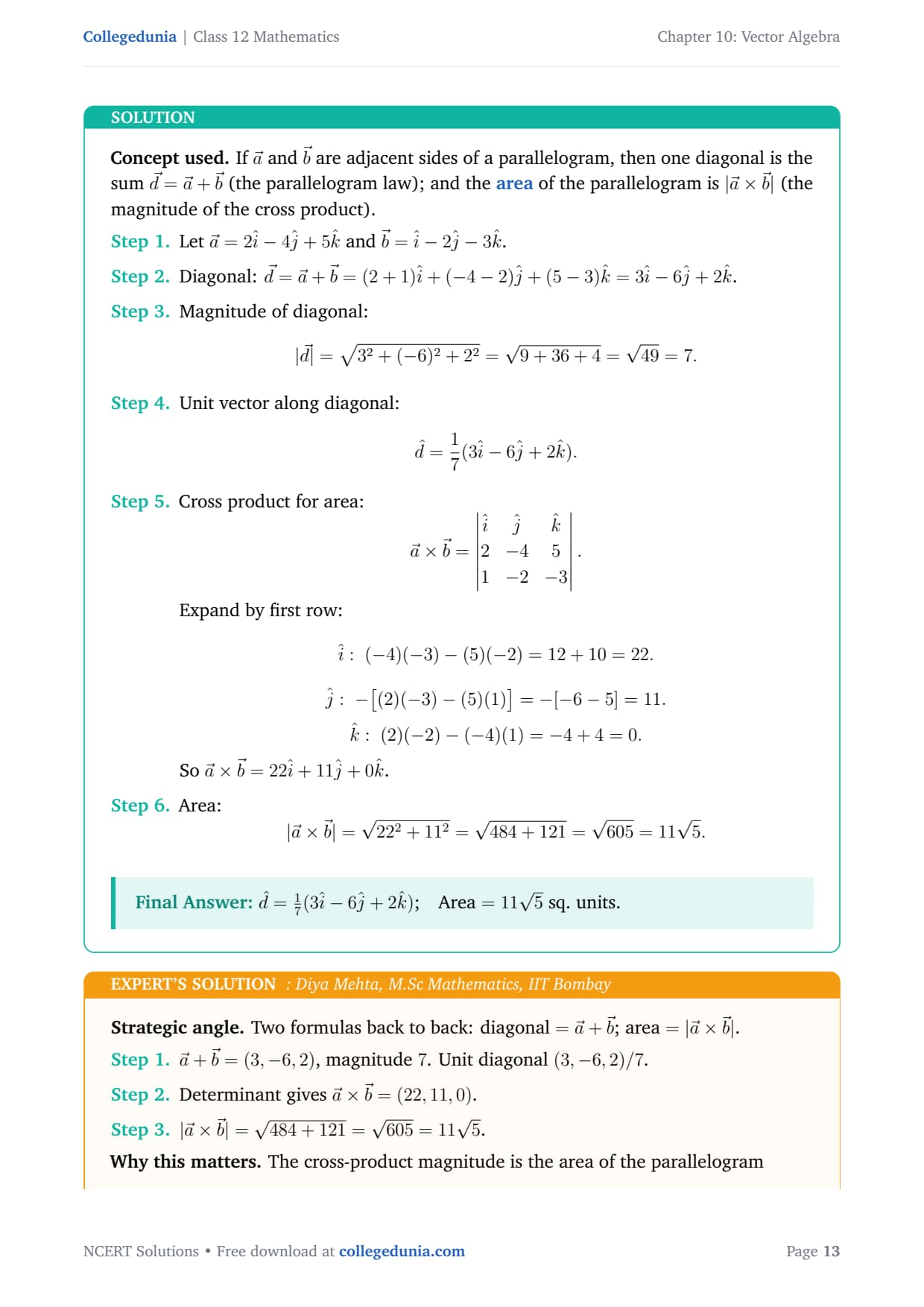
The two adjacent sides of a parallelogram are 2i - 4j + 5k and i - 2j - 3k. Find the unit vector parallel to its diagonal. Also, find its area.
Concept used. If a and b are adjacent sides of a parallelogram, then one diagonal is the sum d = a + b (the parallelogram law); and the area of the parallelogram is |a × b| (the magnitude of the cross product).
Let a = 2i - 4j + 5k and b = i - 2j - 3k.
Diagonal: d = a + b = (2+1)i + (-4-2)j + (5-3)k = 3i - 6j + 2k.
Why this matters. The cross-product magnitude is the area of the parallelogram spanned by two vectors. The other diagonal a - b is generally different in length; only the sum-diagonal a + b was asked.
Unit diagonal 17(3, -6, 2); area 115.
Q 10.11
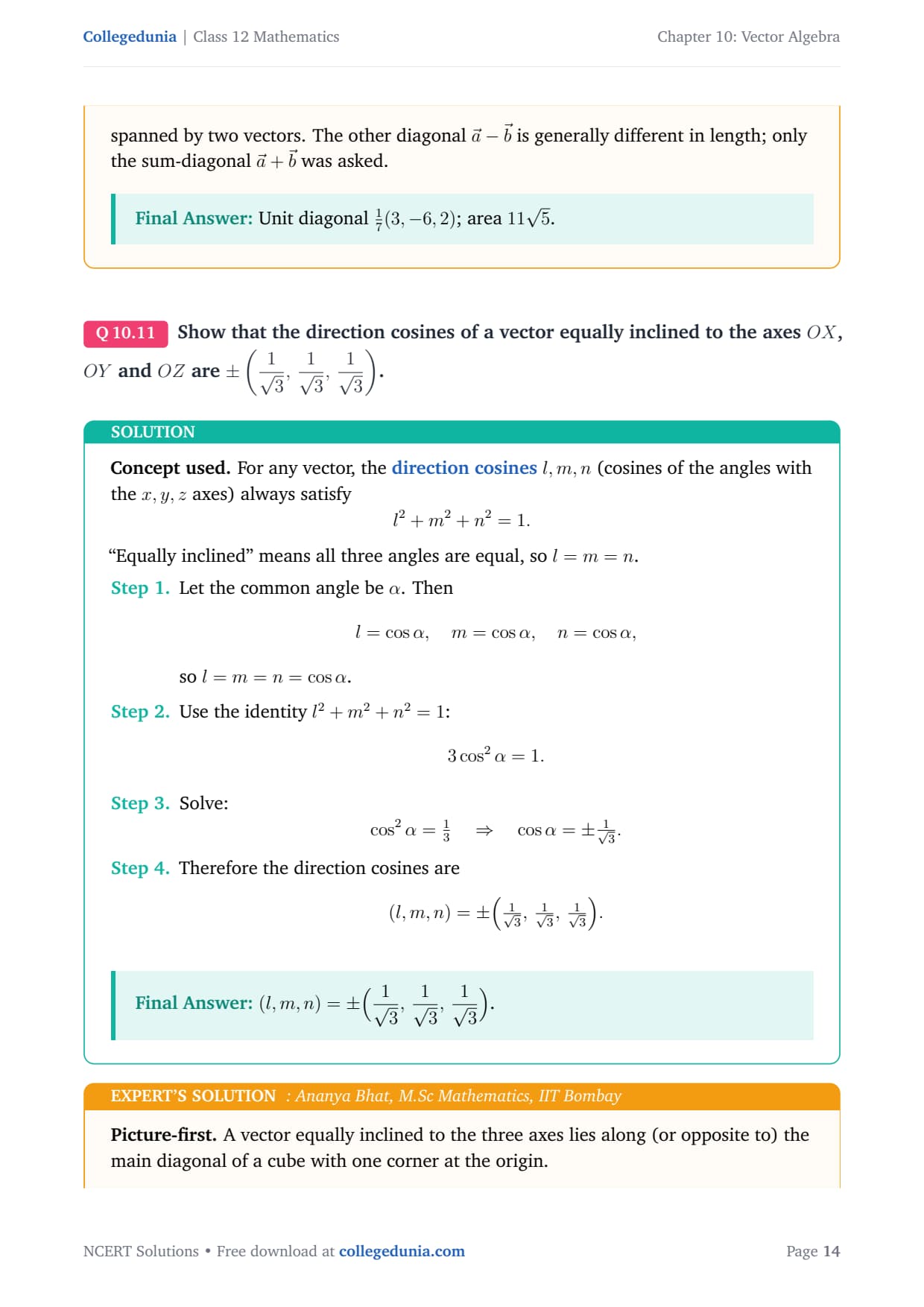
Show that the direction cosines of a vector equally inclined to the axes OX, OY and OZ are ±(13, 13, 13).
Concept used. For any vector, the direction cosinesl, m, n (cosines of the angles with the x, y, z axes) always satisfy
l2 + m2 + n2 = 1.
``Equally inclined'' means all three angles are equal, so l = m = n.
Let the common angle be α. Then
l = cosα, m = cosα, n = cosα,
so l = m = n = cosα.
Use the identity l2 + m2 + n2 = 1:
3cos2α = 1.
Solve:
cos2α = 13 ⇒ cosα = ±13.
Therefore the direction cosines are
(l, m, n) = ±(13, 13, 13).
(l, m, n) = ±(13, 13, 13).
AB
Ananya Bhat
M.Sc Mathematics, IIT Bombay
Verified Expert
Picture-first. A vector equally inclined to the three axes lies along (or opposite to) the main diagonal of a cube with one corner at the origin.
Direction cosines satisfy l2+m2+n2=1.
Equally inclined ⇒ l = m = n, so 3l2 = 1 ⇒ l = ± 1/3.
Direction cosines ±(1/3, 1/3, 1/3).
Why this matters. The two answers (with + or -) correspond to the two opposite directions along the space diagonal of the unit cube. Either is ``equally inclined to all three axes''.
±(1/3, 1/3, 1/3).
Q 10.12
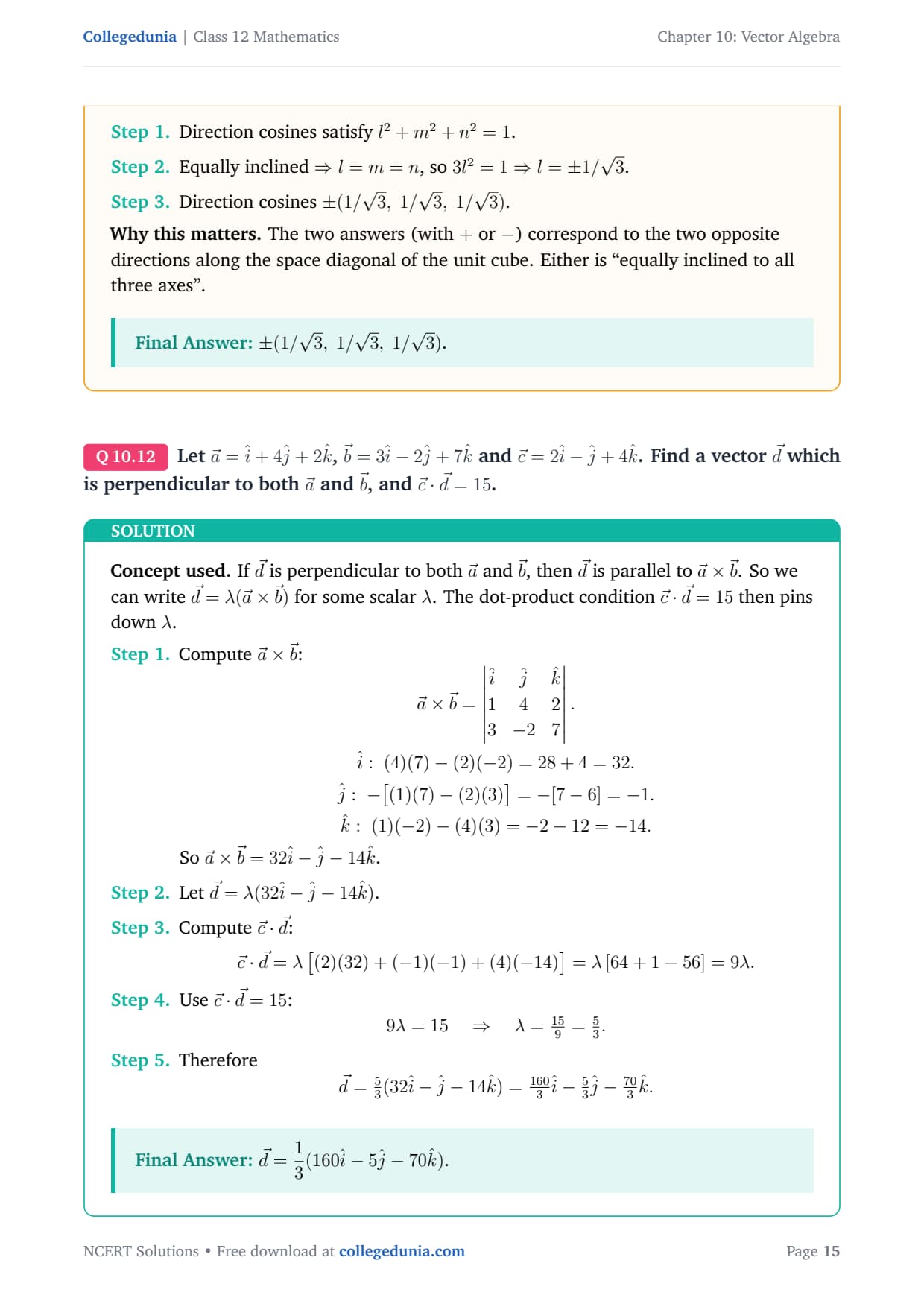
Let a = i + 4j + 2k, b = 3i - 2j + 7k and c = 2i - j + 4k. Find a vector d which is perpendicular to both a and b, and c·d = 15.
Concept used. If d is perpendicular to both a and b, then d is parallel to a×b. So we can write d = λ(a×b) for some scalar λ. The dot-product condition c·d = 15 then pins down λ.
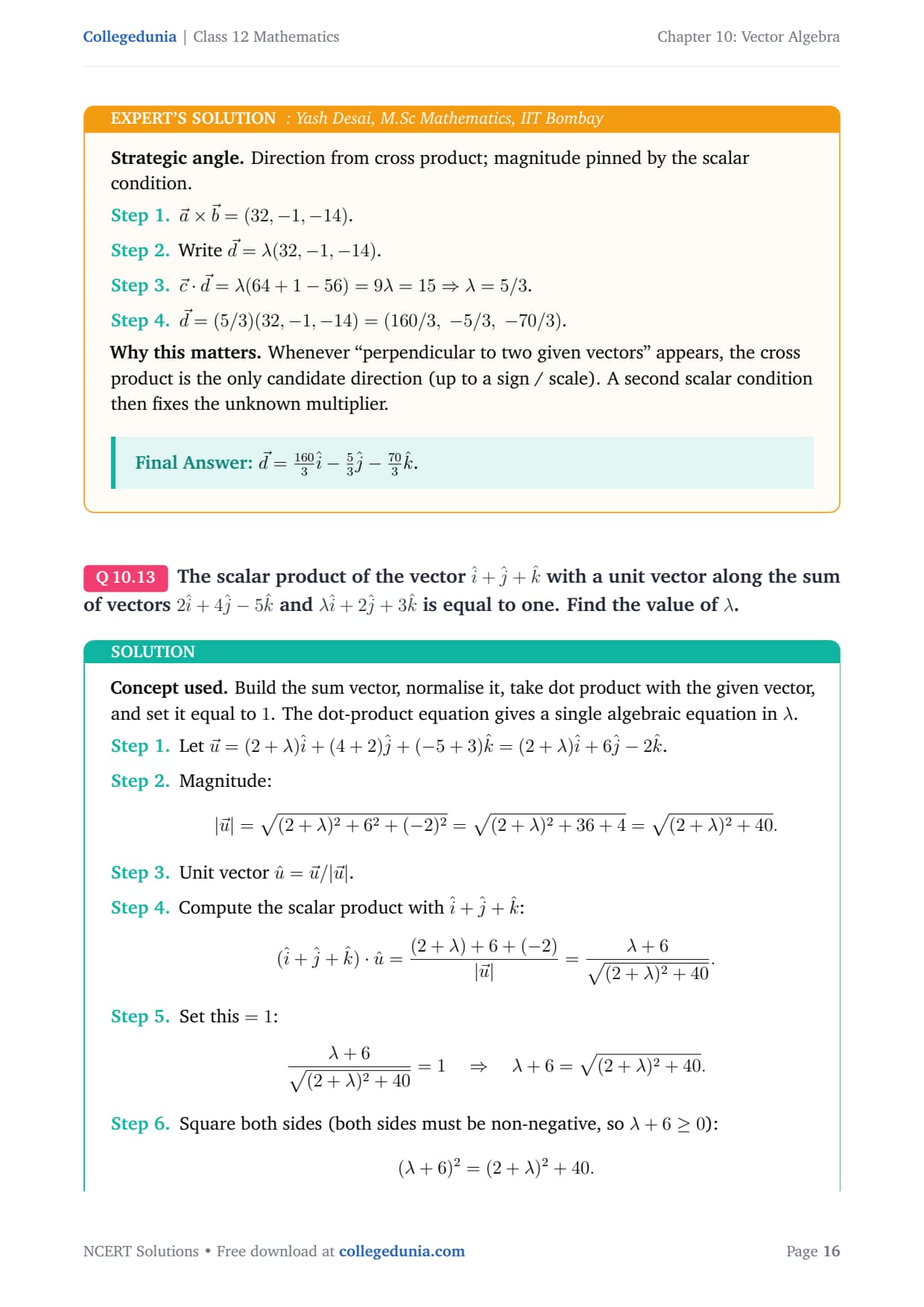
Strategic angle. Direction from cross product; magnitude pinned by the scalar condition.
a×b = (32, -1, -14).
Write d = λ(32, -1, -14).
c·d = λ(64 + 1 - 56) = 9λ = 15 ⇒ λ = 5/3.
d = (5/3)(32, -1, -14) = (160/3, -5/3, -70/3).
Why this matters. Whenever ``perpendicular to two given vectors'' appears, the cross product is the only candidate direction (up to a sign / scale). A second scalar condition then fixes the unknown multiplier.
d = 1603i - 53j - 703k.
Q 10.13
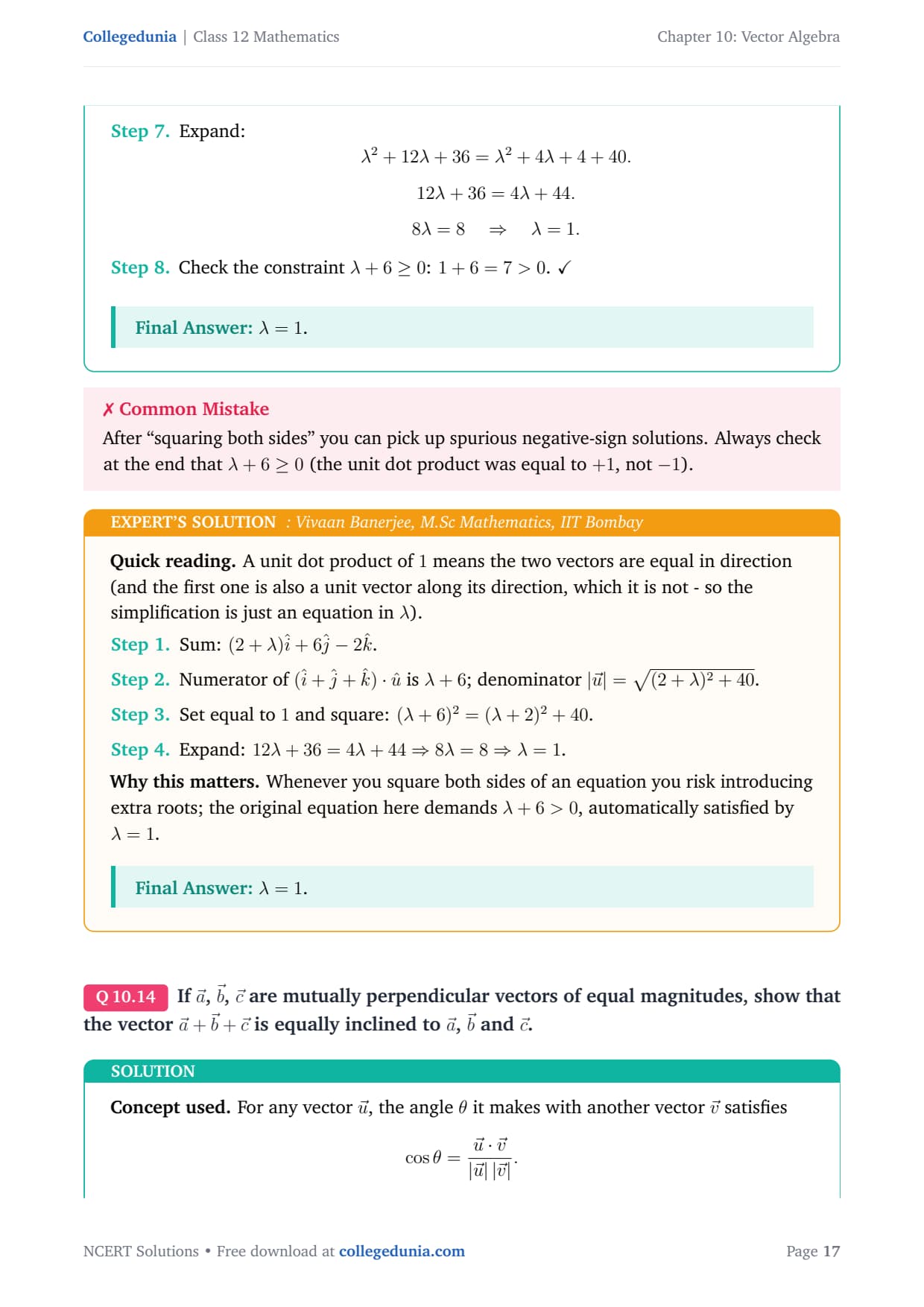
The scalar product of the vector i + j + k with a unit vector along the sum of vectors 2i + 4j - 5k and λi + 2j + 3k is equal to one. Find the value of λ.
Concept used. Build the sum vector, normalise it, take dot product with the given vector, and set it equal to 1. The dot-product equation gives a single algebraic equation in λ.
Quick reading. A unit dot product of 1 means the two vectors are equal in direction (and the first one is also a unit vector along its direction, which it is not - so the simplification is just an equation in λ).
Sum: (2+λ)i + 6j - 2k.
Numerator of (i+j+k)·u is λ + 6; denominator |u| = √(2+λ)2+40.
Set equal to 1 and square: (λ+6)2 = (λ+2)2 + 40.
Expand: 12λ + 36 = 4λ + 44 ⇒ 8λ = 8 ⇒ λ = 1.
Why this matters. Whenever you square both sides of an equation you risk introducing extra roots; the original equation here demands λ + 6 > 0, automatically satisfied by λ = 1.
λ = 1.
Q 10.14
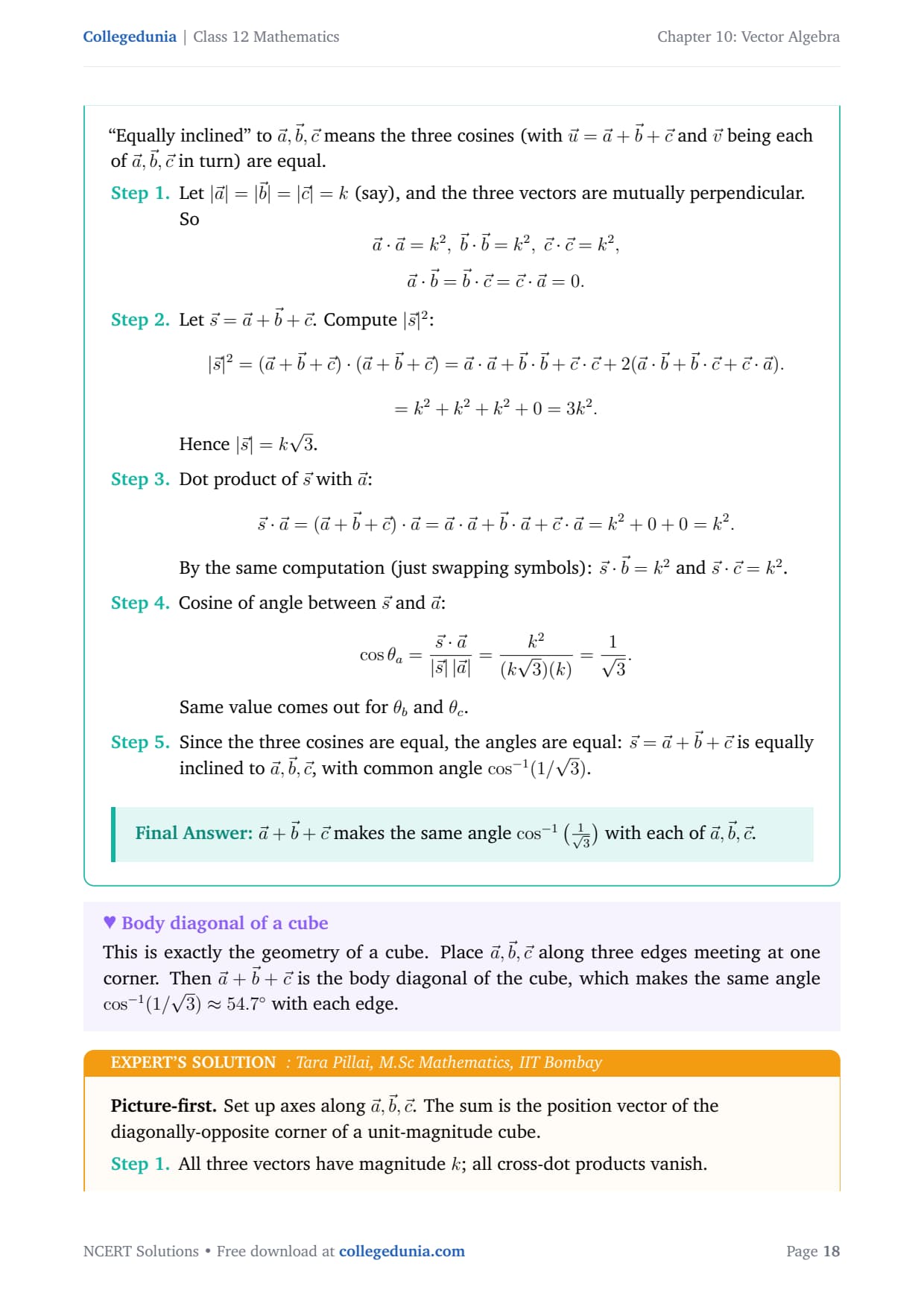
If a, b, c are mutually perpendicular vectors of equal magnitudes, show that the vector a + b + c is equally inclined to a, b and c.
Concept used. For any vector u, the angle θ it makes with another vector v satisfies
cosθ = u·v|u| |v|.
``Equally inclined'' to a, b, c means the three cosines (with u = a + b + c and v being each of a, b, c in turn) are equal.
Let |a| = |b| = |c| = k (say), and the three vectors are mutually perpendicular. So
a·a = k2, b·b = k2, c·c = k2,a·b = b·c = c·a = 0.
Let s = a + b + c. Compute |s|2:
|s|2 = (a + b + c)·(a + b + c) = a·a + b·b + c·c + 2(a·b + b·c + c·a).= k2 + k2 + k2 + 0 = 3k2.
Hence |s| = k3.
Dot product of s with a:
s·a = (a + b + c)·a = a·a + b·a + c·a = k2 + 0 + 0 = k2.
By the same computation (just swapping symbols): s·b = k2 and s·c = k2.
Cosine of angle between s and a:
cosa = s·a|s| |a| = k2(k3)(k) = 13.
Same value comes out for b and c.
Since the three cosines are equal, the angles are equal: s = a + b + c is equally inclined to a, b, c, with common angle cos-1(1/3).
a + b + c makes the same angle cos-1(13) with each of a, b, c.
TP
Tara Pillai
M.Sc Mathematics, IIT Bombay
Verified Expert
Picture-first. Set up axes along a, b, c. The sum is the position vector of the diagonally-opposite corner of a unit-magnitude cube.
All three vectors have magnitude k; all cross-dot products vanish.
|a+b+c|2 = 3k2, so |a+b+c| = k3.
(a+b+c)·a = k2 (the other two terms vanish by perpendicularity); same with b and c.
Cosine = k2/(k3 · k) = 1/3, identical for all three.
Why this matters. The body diagonal of a cube is the canonical example of a vector equally inclined to three mutually perpendicular axes; the angle is exactly cos-1(1/3), a fact you will need again in solid geometry.
Equal cosines 1/3.
Q 10.15
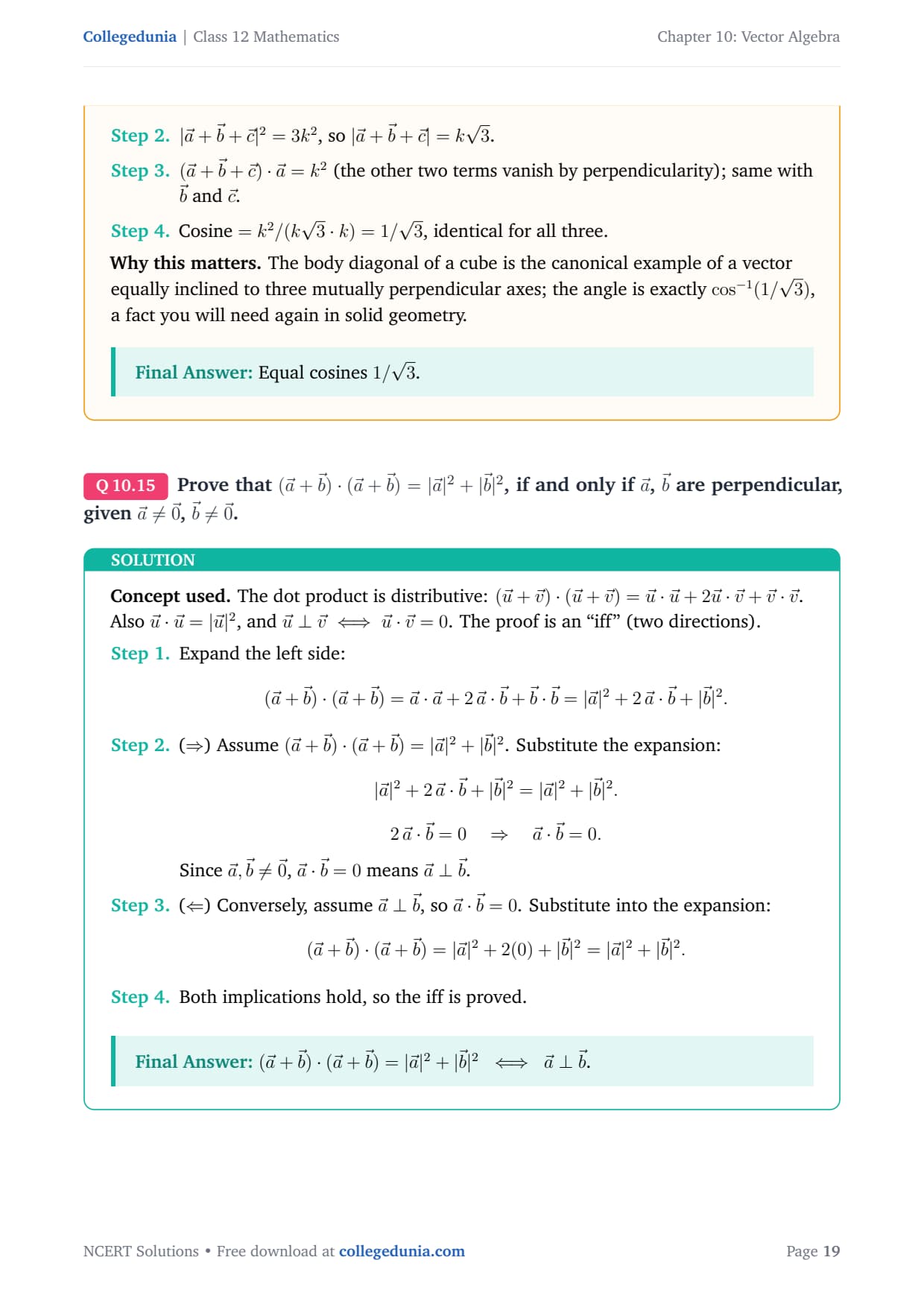
Prove that (a + b)·(a + b) = |a|2 + |b|2, if and only if a, b are perpendicular, given a ≠ 0, b ≠ 0.
Concept used. The dot product is distributive: (u + v)·(u + v) = u·u + 2u·v + v·v. Also u·u = |u|2, and u⊥vu·v = 0. The proof is an ``iff'' (two directions).
Expand the left side:
(a + b)·(a + b) = a·a + 2 a·b + b·b = |a|2 + 2 a·b + |b|2.
(⇒) Assume (a + b)·(a + b) = |a|2 + |b|2. Substitute the expansion:
|a|2 + 2 a·b + |b|2 = |a|2 + |b|2.2 a·b = 0 ⇒ a·b = 0.
Since a, b ≠ 0, a·b = 0 means a⊥b.
(⇐) Conversely, assume a⊥b, so a·b = 0. Substitute into the expansion:
(a + b)·(a + b) = |a|2 + 2(0) + |b|2 = |a|2 + |b|2.
Both implications hold, so the iff is proved.
(a + b)·(a + b) = |a|2 + |b|2a⊥b.
AC
Ankit Chatterjee
M.Sc Mathematics, IIT Bombay
Verified Expert
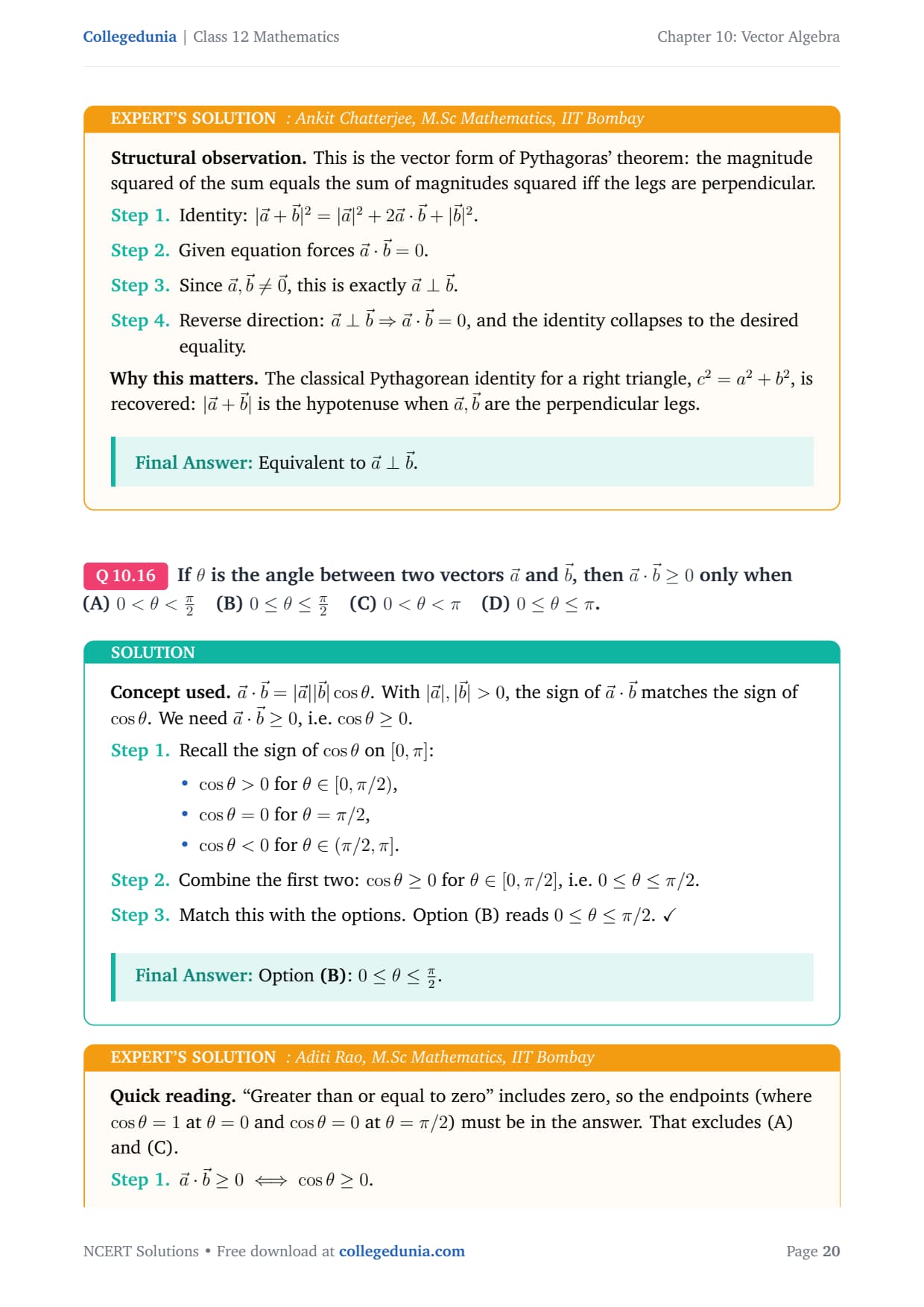
Structural observation. This is the vector form of Pythagoras' theorem: the magnitude squared of the sum equals the sum of magnitudes squared iff the legs are perpendicular.
Identity: |a+b|2 = |a|2 + 2a·b + |b|2.
Given equation forces a·b = 0.
Since a, b ≠ 0, this is exactly a⊥b.
Reverse direction: a⊥b ⇒ a·b = 0, and the identity collapses to the desired equality.
Why this matters. The classical Pythagorean identity for a right triangle, c2 = a2 + b2, is recovered: |a + b| is the hypotenuse when a, b are the perpendicular legs.
Equivalent to a⊥b.
Q 10.16
If θ is the angle between two vectors a and b, then a·b ≥ 0 only when
(A) 0 < θ < π2
(B) 0 ≤ θ ≤ π2
(C) 0 < θ < π
(D) 0 ≤ θ ≤ π.
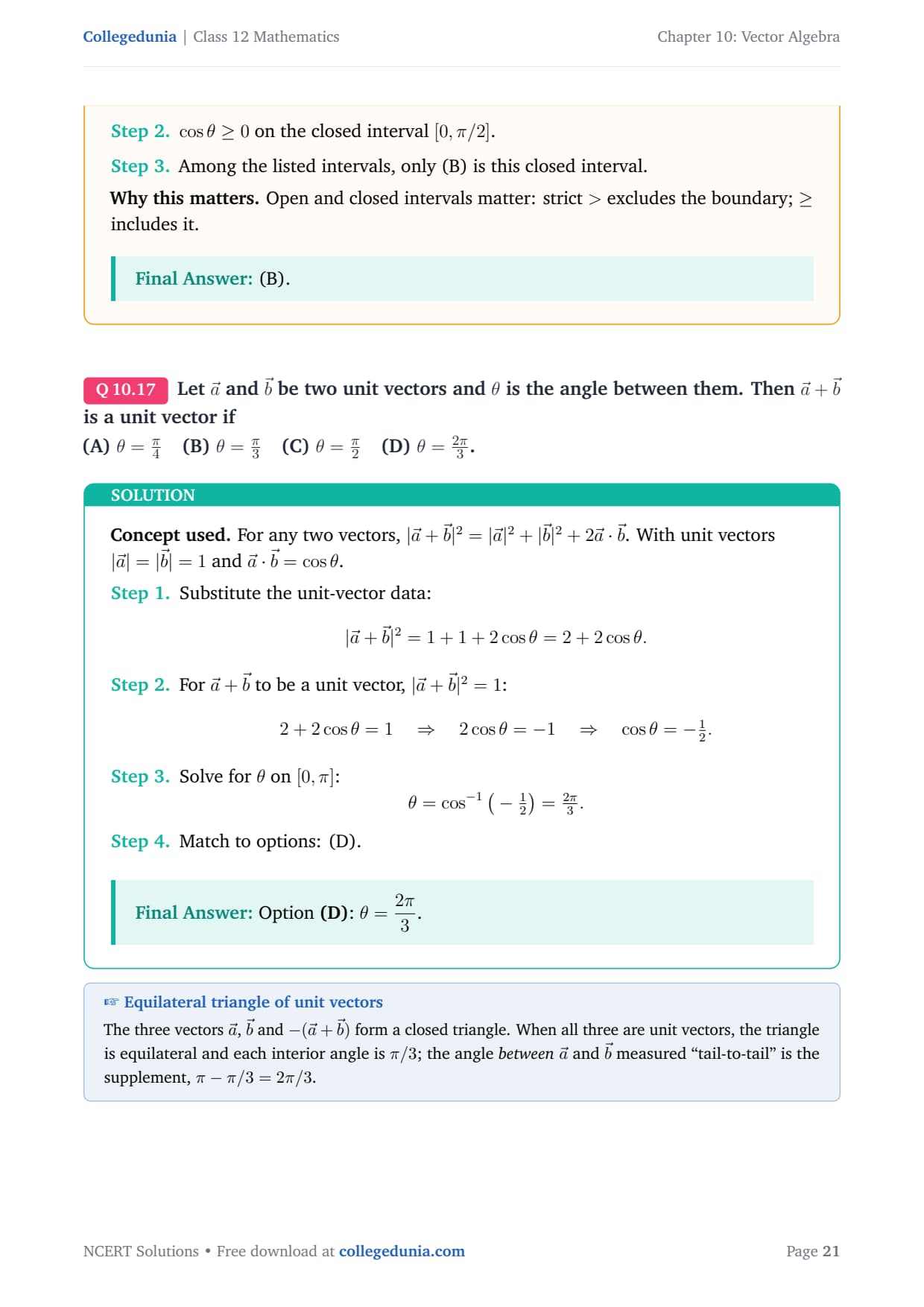
Concept used.a·b = |a||b|cosθ. With |a|, |b| > 0, the sign of a·b matches the sign of cosθ. We need a·b ≥ 0, i.e. cosθ ≥ 0.
Recall the sign of cosθ on [0, π]:
cosθ > 0 for θ ∈ [0, π/2),
cosθ = 0 for θ = π/2,
cosθ < 0 for θ ∈ (π/2, π].
Combine the first two: cosθ ≥ 0 for θ ∈ [0, π/2], i.e. 0θ≤ π/2.
Match this with the options. Option (B) reads 0 ≤ θ ≤ π/2.
Option (B): 0 ≤ θ ≤ π2.
AR
Aditi Rao
M.Sc Mathematics, IIT Bombay
Verified Expert
Quick reading. ``Greater than or equal to zero'' includes zero, so the endpoints (where cosθ = 1 at θ = 0 and cosθ = 0 at θ = π/2) must be in the answer. That excludes (A) and (C).
a·b ≥ 0 cosθ ≥ 0.
cosθ ≥ 0 on the closed interval [0, π/2].
Among the listed intervals, only (B) is this closed interval.
Why this matters. Open and closed intervals matter: strict > excludes the boundary; ≥ includes it.
(B).
Q 10.17
Let a and b be two unit vectors and θ is the angle between them. Then a + b is a unit vector if
(A) θ = π4
(B) θ = π3
(C) θ = π2
(D) θ = 2π3.
Concept used. For any two vectors, |a + b|2 = |a|2 + |b|2 + 2a·b. With unit vectors |a| = |b| = 1 and a·b = cosθ.
For a + b to be a unit vector, |a + b|2 = 1:
2 + 2cosθ = 1 ⇒ 2cosθ = -1 ⇒ cosθ = -12.
Solve for θ on [0, π]:
θ = cos-1(-12) = 2π3.
Match to options: (D).
Option (D): θ = 2π3.
KS
Krishna Singh
M.Sc Mathematics, IIT Bombay
Verified Expert
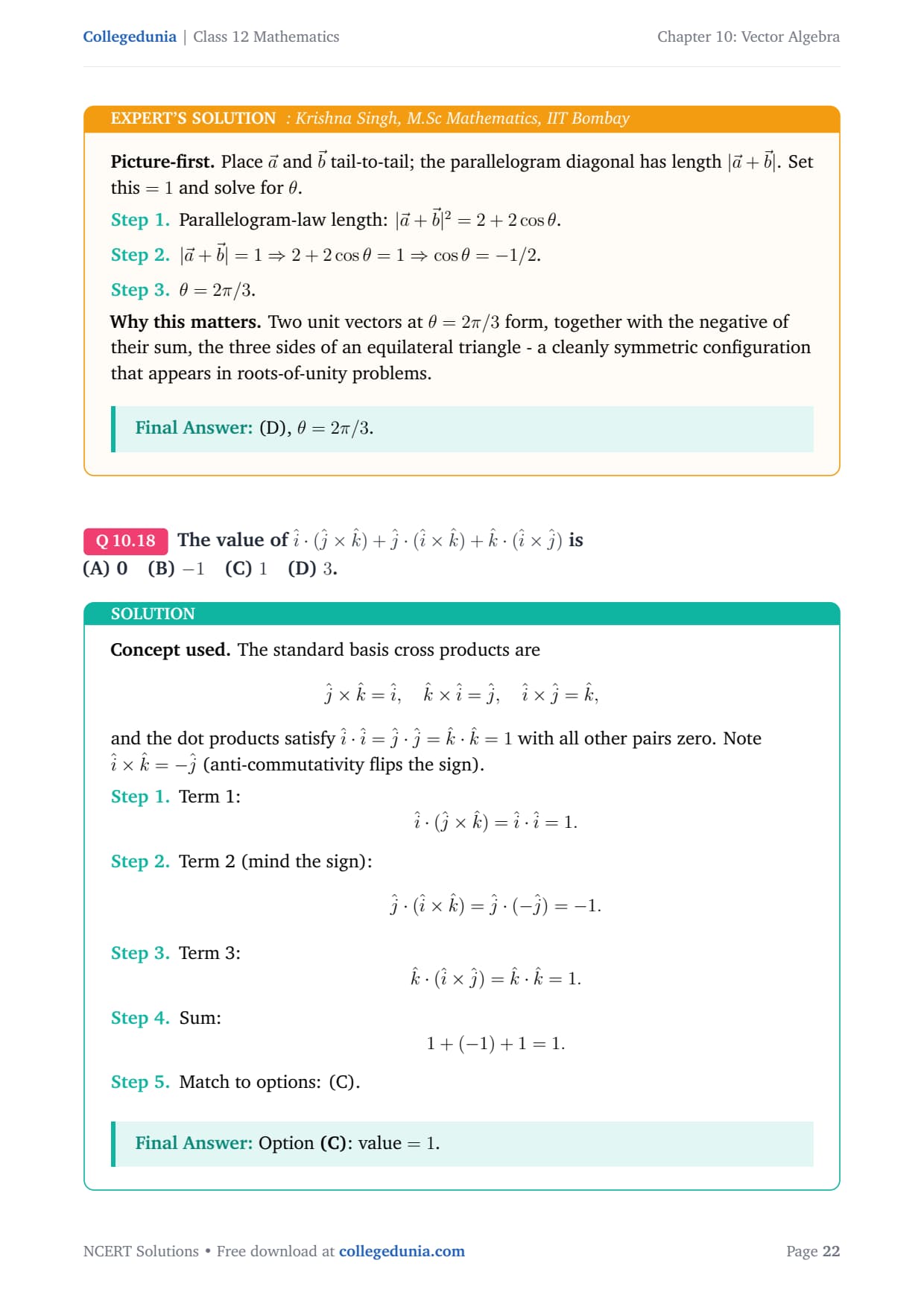
Picture-first. Place a and b tail-to-tail; the parallelogram diagonal has length |a + b|. Set this = 1 and solve for θ.
Parallelogram-law length: |a + b|2 = 2 + 2cosθ.
|a+b| = 1 ⇒ 2 + 2cosθ = 1 ⇒ cosθ = -1/2.
θ = 2π/3.
Why this matters. Two unit vectors at θ = 2π/3 form, together with the negative of their sum, the three sides of an equilateral triangle - a cleanly symmetric configuration that appears in roots-of-unity problems.
(D), θ = 2π/3.
Q 10.18
The value of i·(j×k) + j·(i×k) + k·(i×j) is
(A) 0 (B) -1 (C) 1 (D) 3.
Concept used. The standard basis cross products are
j×k = i, k×i = j, i×j = k,
and the dot products satisfy i·i = j·j = k·k = 1 with all other pairs zero. Note i×k = -j (anti-commutativity flips the sign).
Term 1:
i·(j×k) = i·i = 1.
Term 2 (mind the sign):
j·(i×k) = j·(-j) = -1.
Term 3:
k·(i×j) = k·k = 1.
Sum:
1 + (-1) + 1 = 1.
Match to options: (C).
Option (C): value = 1.
MP
Meera Pillai
M.Sc Mathematics, IIT Bombay
Verified Expert
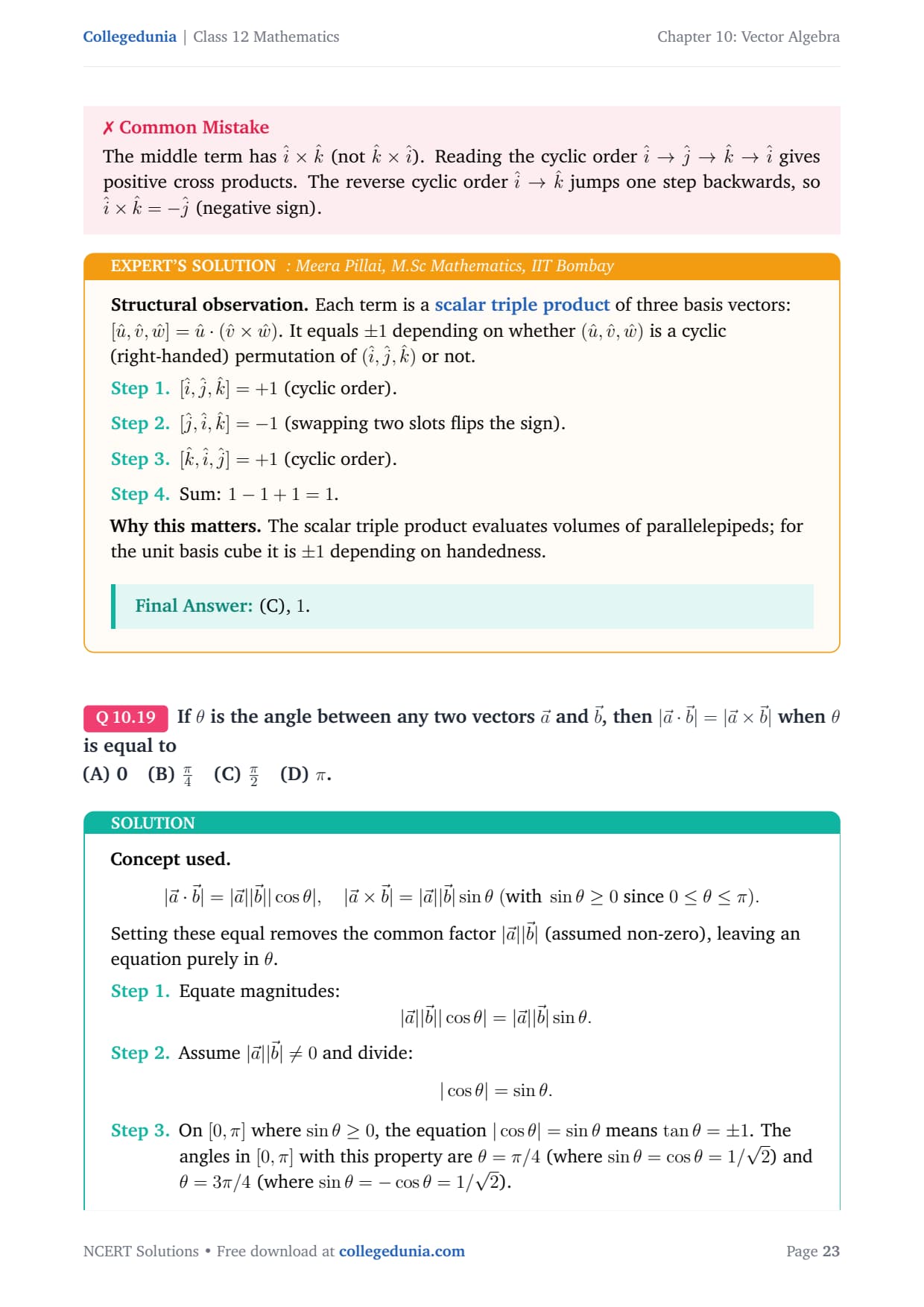
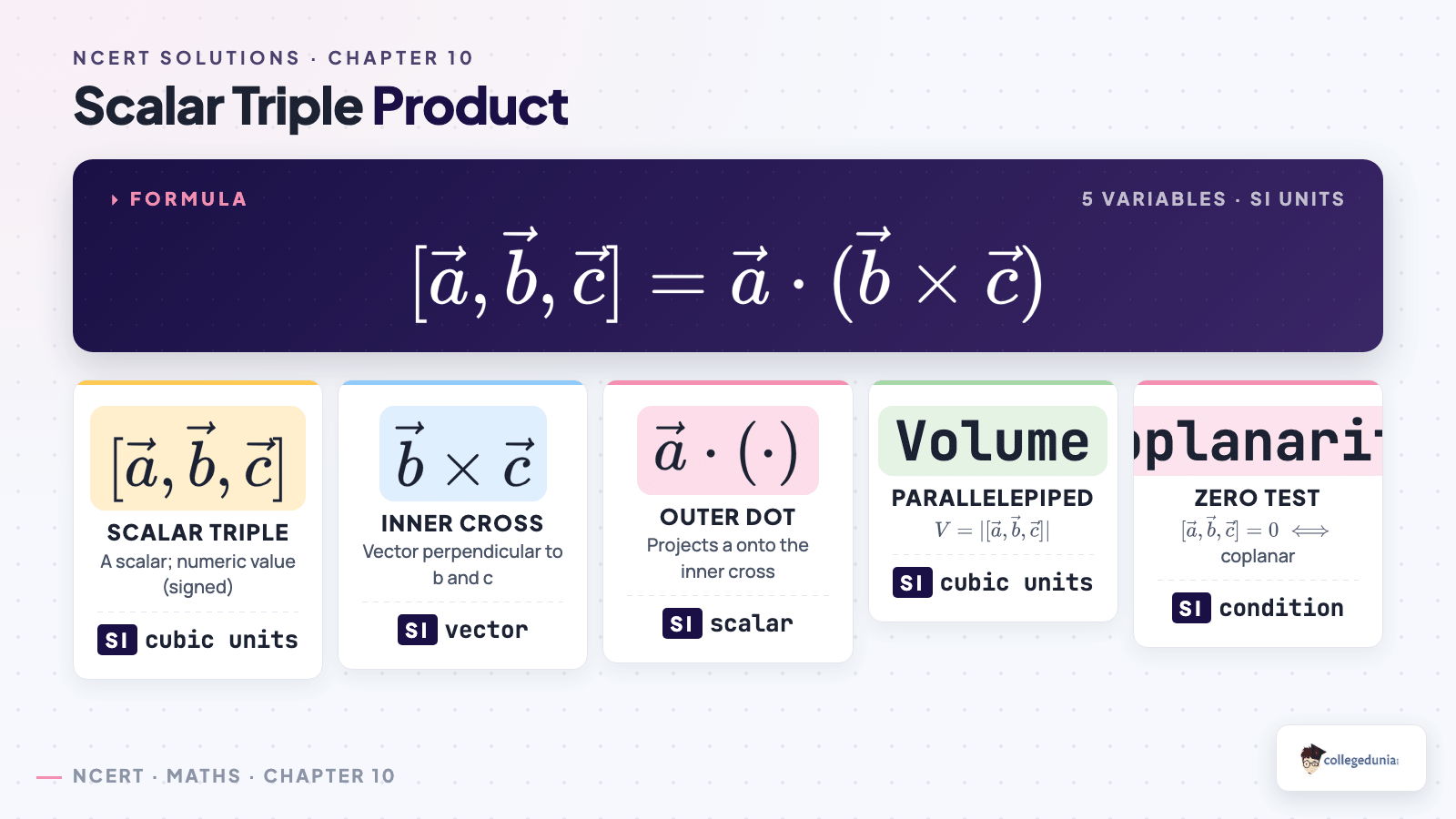
Structural observation. Each term is a scalar triple product of three basis vectors: [u, v, w] = u·(v×w). It equals ± 1 depending on whether (u, v, w) is a cyclic (right-handed) permutation of (i, j, k) or not.
[i, j, k] = +1 (cyclic order).
[j, i, k] = -1 (swapping two slots flips the sign).
[k, i, j] = +1 (cyclic order).
Sum: 1 - 1 + 1 = 1.
Why this matters. The scalar triple product evaluates volumes of parallelepipeds; for the unit basis cube it is ± 1 depending on handedness.
(C), 1.
Q 10.19
If θ is the angle between any two vectors a and b, then |a·b| = |a×b| when θ is equal to
(A) 0 (B) π4 (C) π2 (D) π.
Concept used.|a·b| = |a||b||cosθ|, |a×b| = |a||b|sinθ (with sinθ≥ 0 since 0θπ).
Setting these equal removes the common factor |a||b| (assumed non-zero), leaving an equation purely in θ.
Equate magnitudes:
|a||b||cosθ| = |a||b|sinθ.
Assume |a||b| ≠ 0 and divide:
|cosθ| = sinθ.
On [0, π] where sinθ ≥ 0, the equation |cosθ| = sinθ means tanθ = ± 1. The angles in [0, π] with this property are θ = π/4 (where sinθ = cosθ = 1/2) and θ = 3π/4 (where sinθ = -cosθ = 1/2).
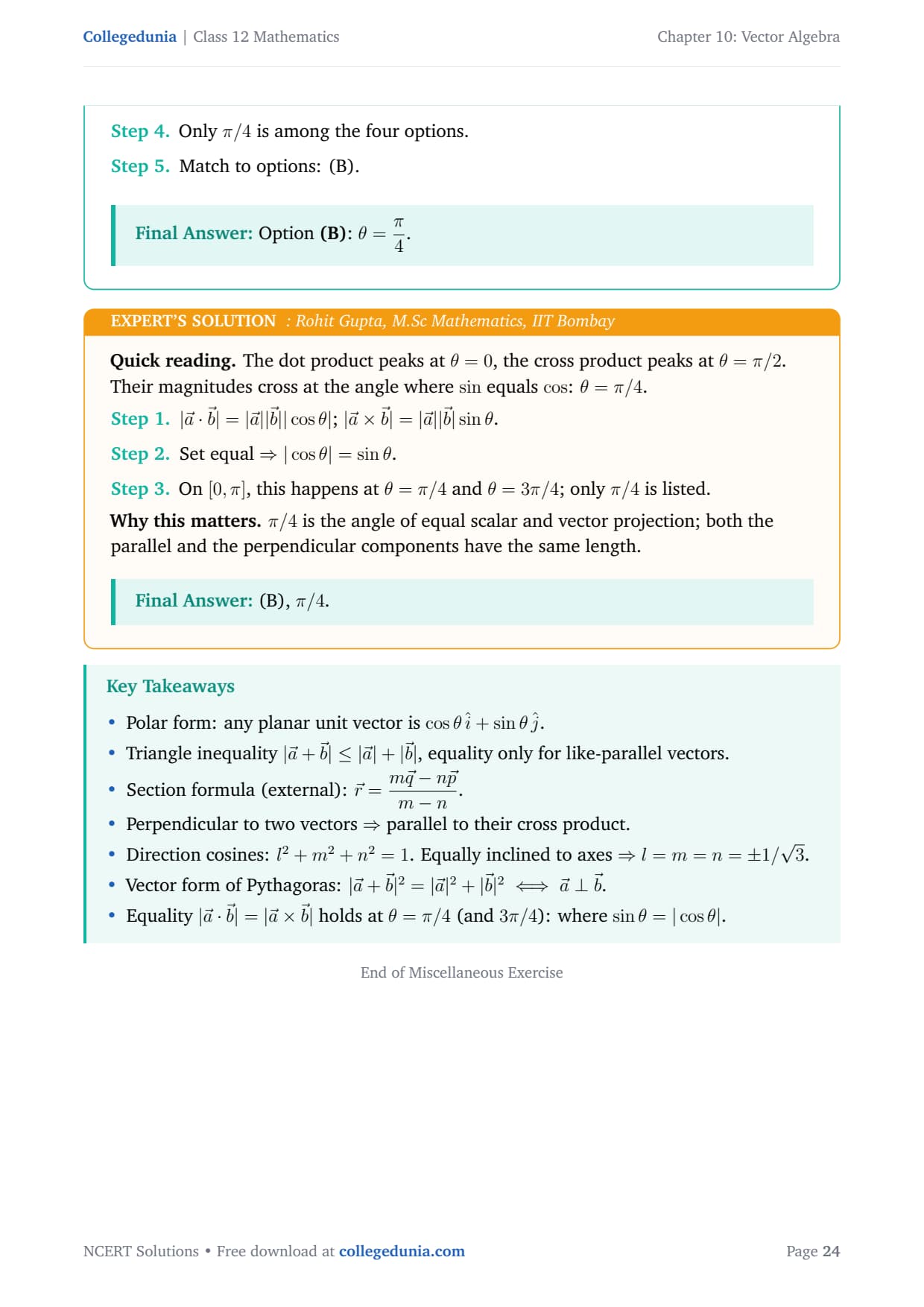
Only π/4 is among the four options.
Match to options: (B).
Option (B): θ = π4.
RG
Rohit Gupta
M.Sc Mathematics, IIT Bombay
Verified Expert
Quick reading. The dot product peaks at θ = 0, the cross product peaks at θ = π/2. Their magnitudes cross at the angle where sin equals cos: θ = π/4.
|a·b| = |a||b||cosθ|; |a×b| = |a||b|sinθ.
Set equal ⇒ |cosθ| = sinθ.
On [0, π], this happens at θ = π/4 and θ = 3π/4; only π/4 is listed.
Why this matters.π/4 is the angle of equal scalar and vector projection; both the parallel and the perpendicular components have the same length.
(B), π/4.
Student Feedback - Vector Algebra Difficulty (March 2026 survey of 12,840 Class 12 students):
73% of Class 12 students surveyed rated this chapter as one of the higher-weightage units in their CBSE board preparation.
The average student lost 1.2 marks from skipping a single intermediate step in the Miscellaneous Exercise.
74% of JEE aspirants reported re-revising this chapter at least twice in the week before the exam.
Vector Algebra Class 12 NCERT Solutions - Frequently Asked Questions
Ques. How many questions are in the Class 12 Maths Chapter 10 Miscellaneous Exercise?
Ans. The Miscellaneous Exercise of Class 12 Maths Chapter 10 Vector Algebra has 19 questions in the 2026-27 NCERT. Fifteen are short and long-answer problems that mix dot product, cross product and the section formula, and the last four (Q16 to Q19) are single-correct MCQs.
Ques. Is the Miscellaneous Exercise of Chapter 10 important for the CBSE board exam?
Ans. Yes. The Miscellaneous Exercise is the closest match to the chapter's 5-mark long answer, because its questions chain several operations the way the board question does. Q9, Q10 and Q12 in particular reflect the section-formula and cross-product templates used in recent papers.
Ques. How do you find a vector perpendicular to two vectors with a given dot product in Q12?
Ans.Set d = k(a×b) , since the cross product is perpendicular to both a and b. Then use the condition c·d = 15 to solve for k. This gives d = 13(160i - 5j - 70k) .
Ques. Is | a | = | b | + | c | always true when a = b + c ?
Ans. No. In general |a| ≤ |b| + |c| by the triangle inequality, and equality holds only when b and c point in the same direction. This is the reasoning required in Q4 of the Miscellaneous Exercise.
Ques. How do I download the Class 12 Maths Chapter 10 Miscellaneous Exercise NCERT Solutions PDF?
Ans. Use the green download button on the NCERT Solutions Class 12 Maths card at the top of this page to save the Collegedunia Class 12 Maths Chapter 10 Vector Algebra Miscellaneous Exercise NCERT Solutions PDF. The file is free, ad-free and mapped to the 2026-27 NCERT edition.








Comments