Maths Mentor, Thapar Institute | Updated 3+ months ago
NCERT Solutions for Class 12 Maths Chapter 10 Vector Algebra Exercise 10.2 cover 19 questions on magnitude, unit vectors, direction cosines and the section formula. Collegedunia's subject experts have solved every question with clear steps and simple language. The free solutions PDF for Exercise 10.2 is available to download on this page.
Every answer here is checked against the official NCERT Solutions PDF and written in the same notation as the printed textbook.
Question count: 19 questions, with Q15 (section formula) and Q17 (right-angled triangle from position vectors) the two most paper-relevant items.
Collegedunia has checked every magnitude, unit vector and section-formula answer against the official NCERT key, with the sign rule on Q15 flagged clearly.
Exercise 10.2 has 19 questions across five sub-topics. The table below gives the final answer for each.
Q No.
Task
Answer
1
Magnitudes of three vectors
3, √62, 1
2
Two different vectors, same magnitude
i + j + k and i - j + k, both 3
3
Two different vectors, same direction
i + j + k and 2i + 2j + 2k
4
Find x, y so vectors are equal
x = 2, y = 3
5
Scalar and vector components, P(2,1) to Q(-5,7)
Scalars -7, 6; vectors -7i, 6j
6
Sum of three vectors
-4j - k
7
Unit vector along i + j + 2k
i + j + 2k6
8
Unit vector along PQ , P(1,2,3), Q(4,5,6)
i + j + k3
9
Unit vector along a + b
i + k2
10
Vector of magnitude 8 along 5i - j + 2k
8(5i - j + 2k)√30
11
Show 2i - 3j + 4k and -4i + 6j - 8k collinear
b = -2a, so collinear
12
Direction cosines of i + 2j + 3k
(1√14, 2√14, 3√14)
13
Direction cosines of AB , A(1,2,-3), B(-1,-2,1)
(-13, -23, 23)
14
Show i + j + k equally inclined to axes
l = m = n = 13
15
Position vector of R dividing PQ in 2:1
Internal (-13, 43, 13) ; external (-3, 0, 3)
16
Midpoint of P(2,3,4) and Q(4,1,-2)
3i + 2j + k
17
Show A, B, C form a right-angled triangle
|AB|2 + |AC|2 = |BC|2, right angle at A
18
MCQ: which is not true in triangle ABC
Option (C)
19
MCQ: incorrect statements on collinear vectors
Options (B), (C), (D)
Q15 is the single most paper-relevant item: internal and external section formulae differ only by the sign before np. A question on the section formula or a unit vector has appeared in every one of the last 5 CBSE boards.
Vector Algebra Ex 10.2 Solved Step by Step (Video)
Core Formulae Behind Class 12 Maths Chapter 10 Exercise 10.2
Almost every question in this exercise uses one of these five formulae.
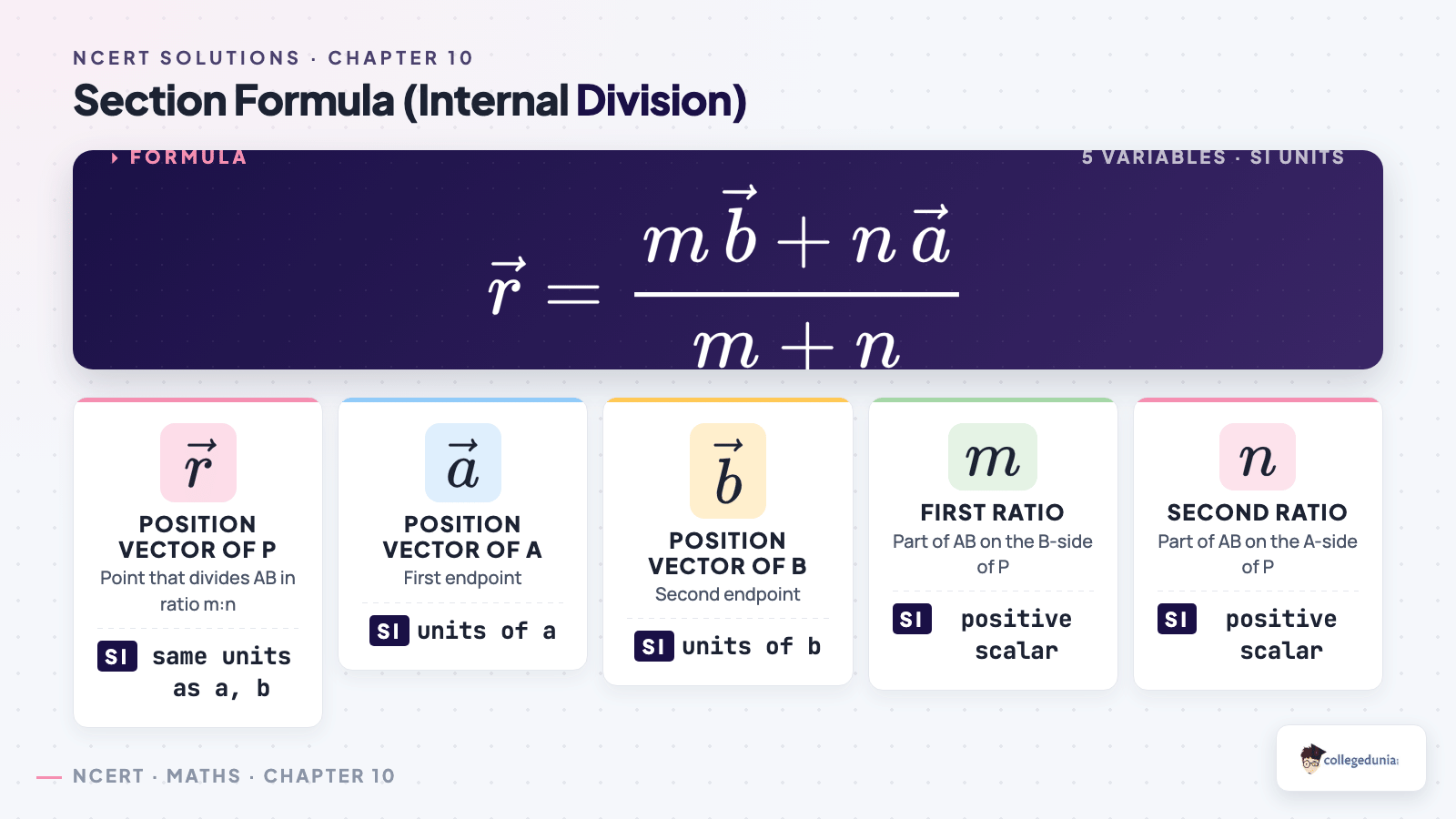
Magnitude: |a| = √a12 + a22 + a32 Unit vector:a = a|a| Direction cosines:l = a1|a|, m = a2|a|, n = a3|a| with l2 + m2 + n2 = 1 Section formula (m:n): internal mq + npm+n, external mq - npm-n Collinearity:b = λ a, i.e. components proportional
Use l2 + m2 + n2 = 1 as a quick self-test for Q12 to Q14.
Concept Tags Across the 19 Problems of Class 12 Maths Exercise 10.2
The grouping below shows which formula each question needs.
Sub-topic
Questions
Magnitude and equal vectors
Q1, Q2, Q4
Same-direction and component decomposition
Q3, Q5, Q6
Unit vectors
Q7, Q8, Q9, Q10
Collinearity
Q11, Q19
Direction cosines
Q12, Q13, Q14
Section formula and midpoint
Q15, Q16
Triangle geometry and triangle law
Q17, Q18
How Collegedunia's NCERT Solutions for Vector Algebra Help You in Exercise 10.2
Exercise 10.2 is mechanical once the right formula is picked. Marks are lost on sign and order, not on the idea, so Collegedunia states the formula, substitutes on a separate line, then does the arithmetic.
Section-formula sign flagged: Q15 shows internal with +np and external with -np side by side, with a midpoint sanity check.
Magnitude before unit vector: Q7 to Q10 always compute |a| on its own line before dividing.
Direction-cosine self-test: every Q12 to Q14 answer ends with l2 + m2 + n2 = 1 verified.
Pythagoras converse for Q17: squared side-lengths are compared, avoiding surds and locating the right angle precisely.
Common Mistakes Students Make in Class 12 Maths Exercise 10.2
Every mistake below is a real pattern seen in student attempts, written in the same notation as the official NCERT print.
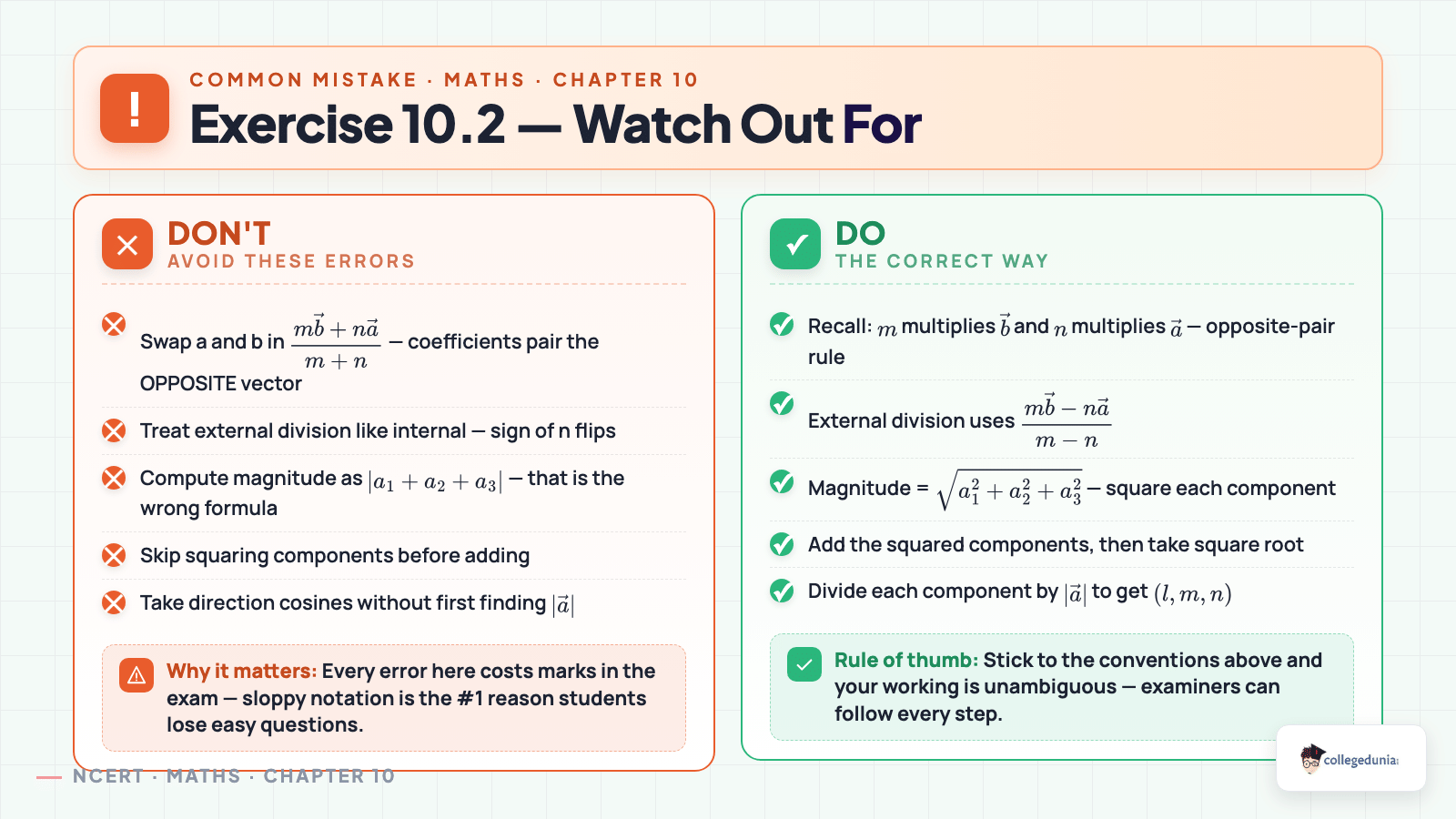
Common Mistake: In Q15, students often swap the weights of p and q. "R divides PQ in ratio m:n" means q carries weight m and p carries weight n.
Dropping the minus sign in the external section formula and getting the internal point instead.
Forgetting to divide by |a| when "unit vector" is asked, leaving an un-normalised vector.
Confusing scalar components (numbers) with vector components (numbers times i, j, k) in Q5.
Reading the wrong vertex for the right angle in Q17; the right angle is opposite the longest side.
Calling two vectors collinear from one matching ratio; all component ratios must be equal.
Other Resources for Class 12 Maths Chapter 10 Vector Algebra
All NCERT Solutions for Vector Algebra Ex 10.2 with Step-by-Step Working
Every NCERT textbook question for Class 12 Mathematics Chapter 10 Vector Algebra Ex 10.2 is listed below with its full Solution and Expert Solution hidden inside collapsible tabs. Click Check Solution to reveal the step-by-step working; click Expert Solution for the expanded explanation.
Questions
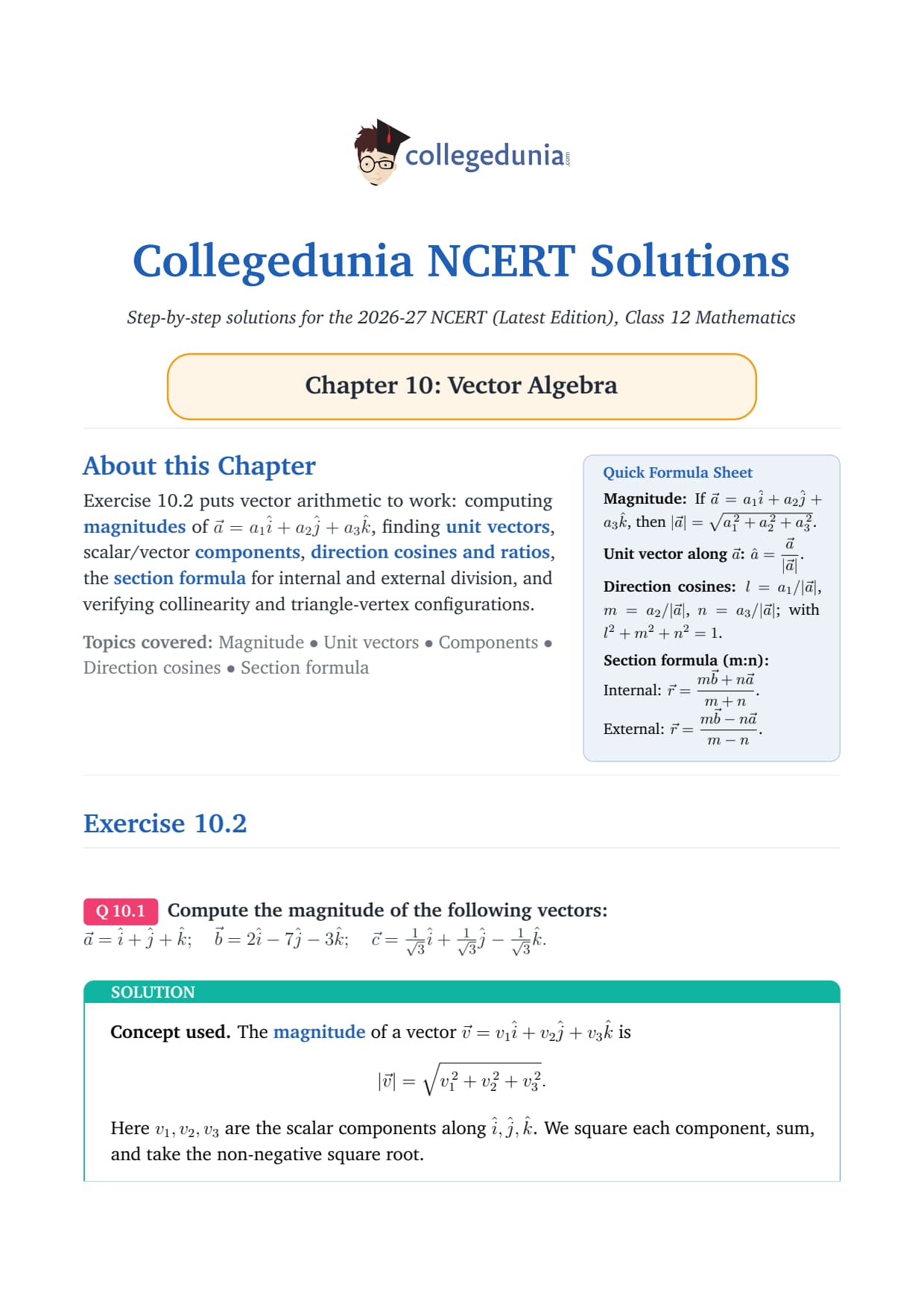
Q 10.1
Compute the magnitude of the following vectors: a = i + j + k; b = 2i - 7j - 3k; c = 13i + 13j - 13k.
Concept used. The magnitude of a vector v = v1i + v2j + v3k is
|v| = √v1 2 + v2 2 + v3 2.
Here v1, v2, v3 are the scalar components along i, j, k. We square each component, sum, and take the non-negative square root.
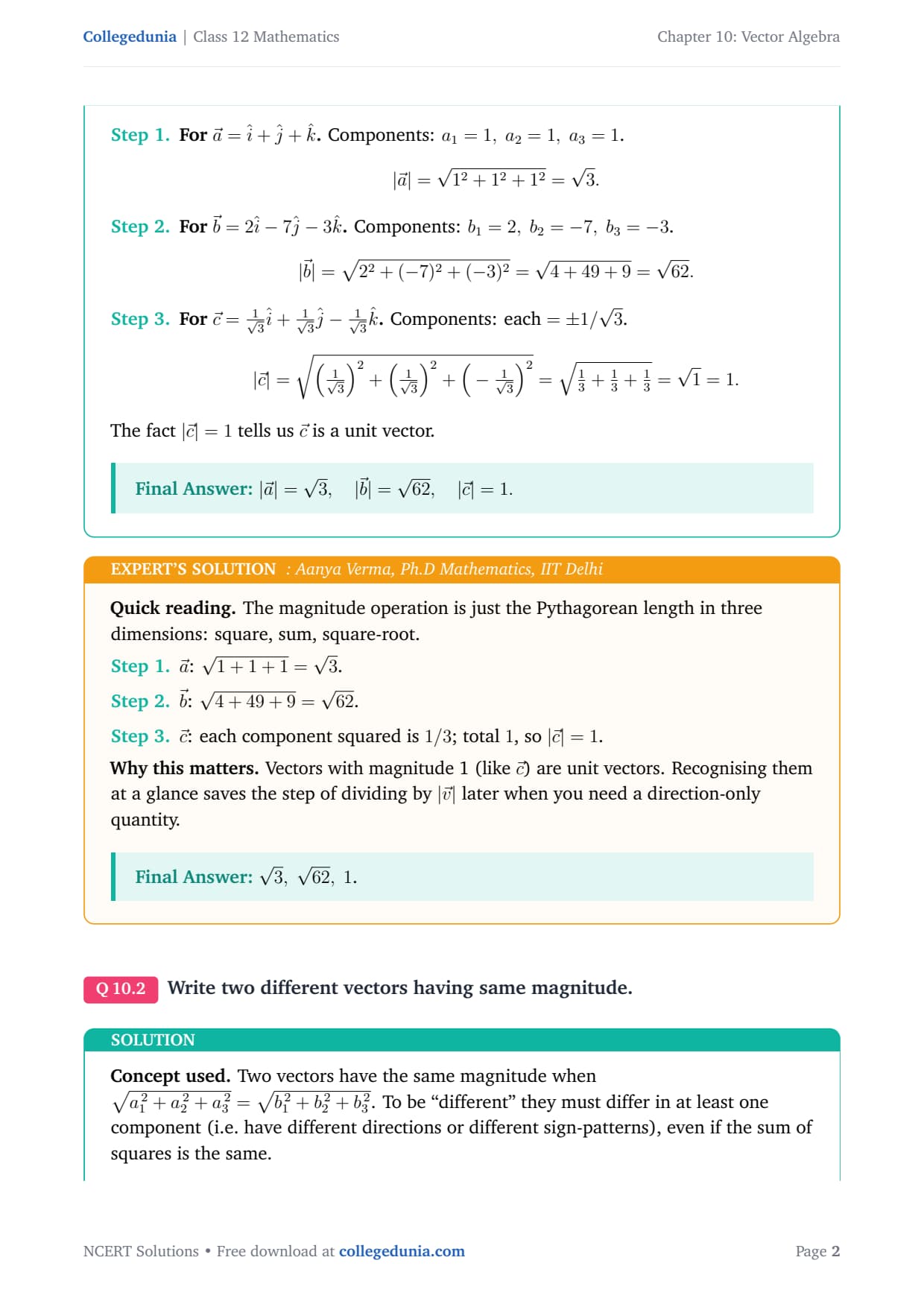
For a = i + j + k. Components: a1=1, a2=1, a3=1.
|a| = √12+12+12 = √3.
For b = 2i - 7j - 3k. Components: b1=2, b2=-7, b3=-3.
|b| = √22+(-7)2+(-3)2 = √4+49+9 = √62.
For c = 13i + 13j - 13k. Components: each =± 1/3.
|c| = √(13)2 + (13)2 + (-13)2 = √13 + 13 + 13 = √1 = 1.
The fact |c| = 1 tells us c is a unit vector.
|a| = √3, |b| = √62, |c| = 1.
AV
Aanya Verma
Ph.D Mathematics, IIT Delhi
Verified Expert
Quick reading. The magnitude operation is just the Pythagorean length in three dimensions: square, sum, square-root.
a: √1+1+1 = 3.
b: √4+49+9 = √62.
c: each component squared is 1/3; total 1, so |c| = 1.
Why this matters. Vectors with magnitude 1 (like c) are unit vectors. Recognising them at a glance saves the step of dividing by |v| later when you need a direction-only quantity.
3, √62, 1.
Q 10.2
Write two different vectors having same magnitude.
Concept used. Two vectors have the same magnitude when √a1 2+a2 2+a3 2 = √b1 2+b2 2+b3 2. To be ``different'' they must differ in at least one component (i.e. have different directions or different sign-patterns), even if the sum of squares is the same.
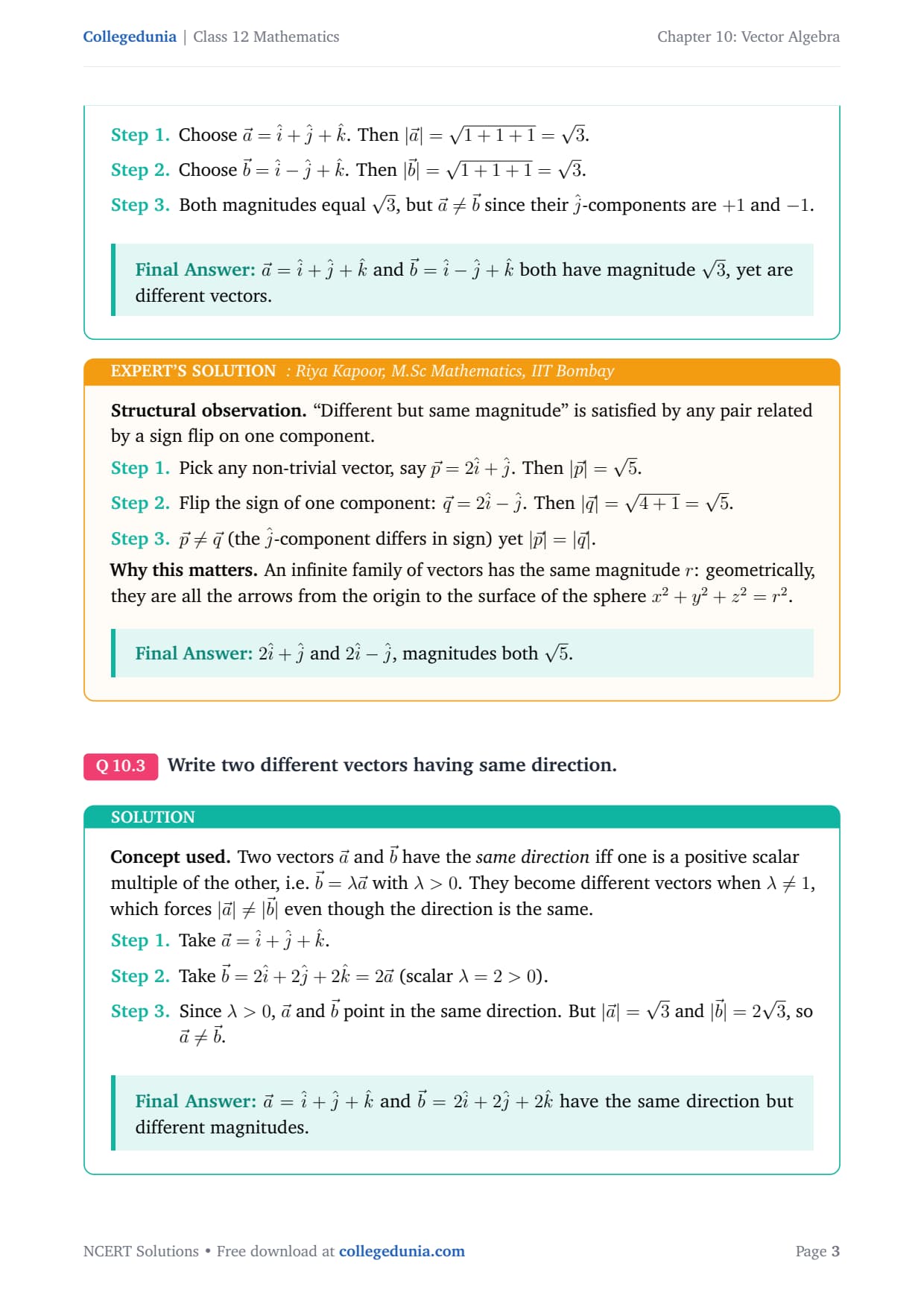
Choose a = i + j + k. Then |a| = √1+1+1 = 3.
Choose b = i - j + k. Then |b| = √1+1+1 = 3.
Both magnitudes equal 3, but a ≠ b since their j-components are +1 and -1.
a = i + j + k and b = i - j + k both have magnitude 3, yet are different vectors.
RK
Riya Kapoor
M.Sc Mathematics, IIT Bombay
Verified Expert
Structural observation. ``Different but same magnitude'' is satisfied by any pair related by a sign flip on one component.
Pick any non-trivial vector, say p = 2i + j. Then |p| = √5.
Flip the sign of one component: q = 2i - j. Then |q| = √4+1 = 5.
p ≠ q (the j-component differs in sign) yet |p| = |q|.
Why this matters. An infinite family of vectors has the same magnitude r: geometrically, they are all the arrows from the origin to the surface of the sphere x2+y2+z2=r2.
2i + j and 2i - j, magnitudes both 5.
Q 10.3
Write two different vectors having same direction.
Concept used. Two vectors a and b have the same direction iff one is a positive scalar multiple of the other, i.e. b = λ a with λ > 0. They become different vectors when λ ≠ 1, which forces |a| ≠ |b| even though the direction is the same.
Take a = i + j + k.
Take b = 2i + 2j + 2k = 2a (scalar λ = 2 > 0).
Since λ > 0, a and b point in the same direction. But |a| = 3 and |b| = 23, so a ≠ b.
a = i + j + k and b = 2i + 2j + 2k have the same direction but different magnitudes.
KR
Karan Reddy
M.Tech CS, IIT Madras
Verified Expert
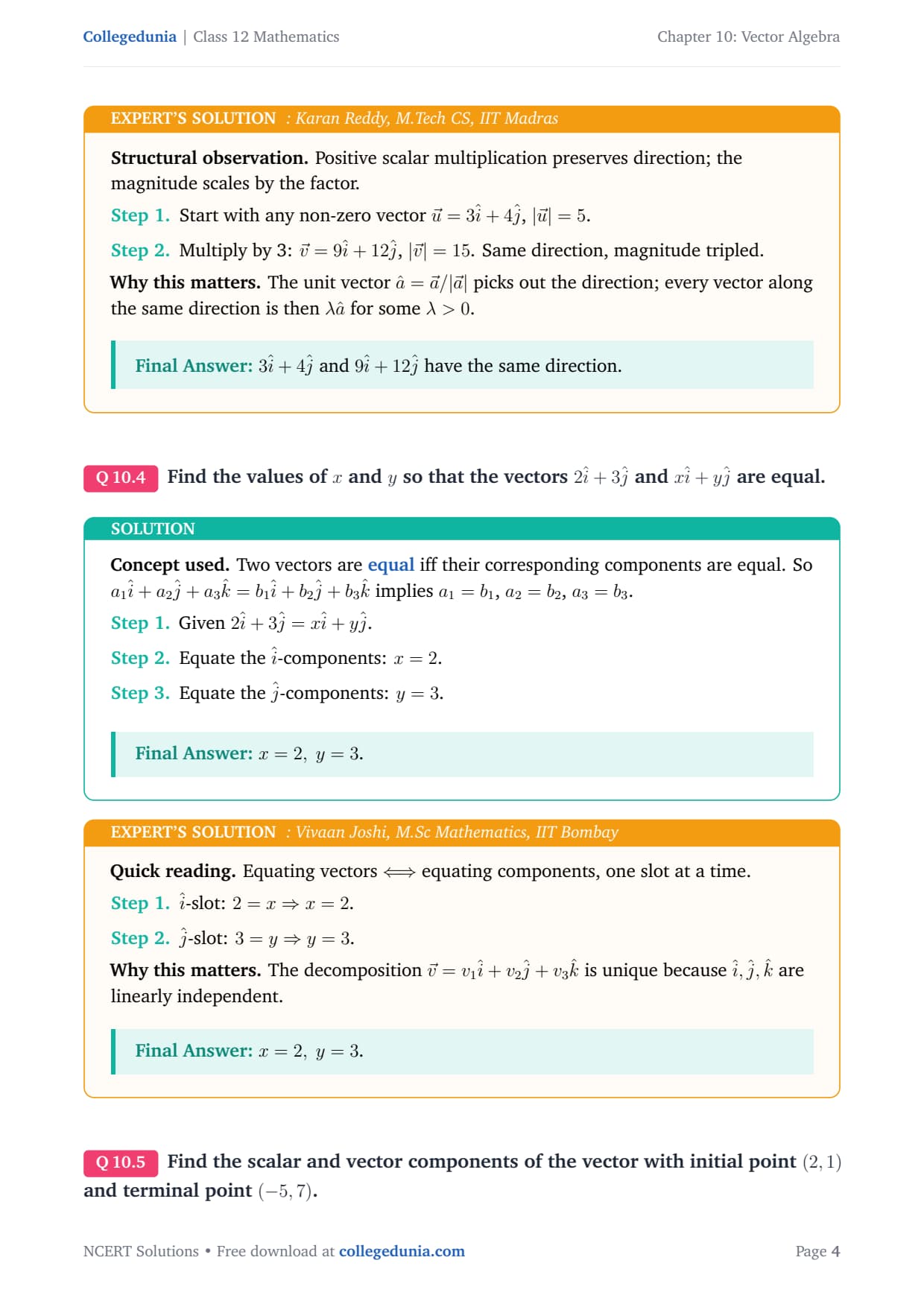
Structural observation. Positive scalar multiplication preserves direction; the magnitude scales by the factor.
Start with any non-zero vector u = 3i + 4j, |u| = 5.
Multiply by 3: v = 9i + 12j, |v| = 15. Same direction, magnitude tripled.
Why this matters. The unit vector a = a/|a| picks out the direction; every vector along the same direction is then λ a for some λ > 0.
3i + 4j and 9i + 12j have the same direction.
Q 10.4
Find the values of x and y so that the vectors 2i + 3j and xi + yj are equal.
Concept used. Two vectors are equal iff their corresponding components are equal. So a1i + a2j + a3k = b1i + b2j + b3k implies a1 = b1, a2 = b2, a3 = b3.
Given 2i + 3j = xi + yj.
Equate the i-components: x = 2.
Equate the j-components: y = 3.
x = 2, y = 3.
VJ
Vivaan Joshi
M.Sc Mathematics, IIT Bombay
Verified Expert
Quick reading. Equating vectors equating components, one slot at a time.
i-slot: 2 = x ⇒ x = 2.
j-slot: 3 = y ⇒ y = 3.
Why this matters. The decomposition v = v1i + v2j + v3k is unique because i, j, k are linearly independent.
x = 2, y = 3.
Q 10.5
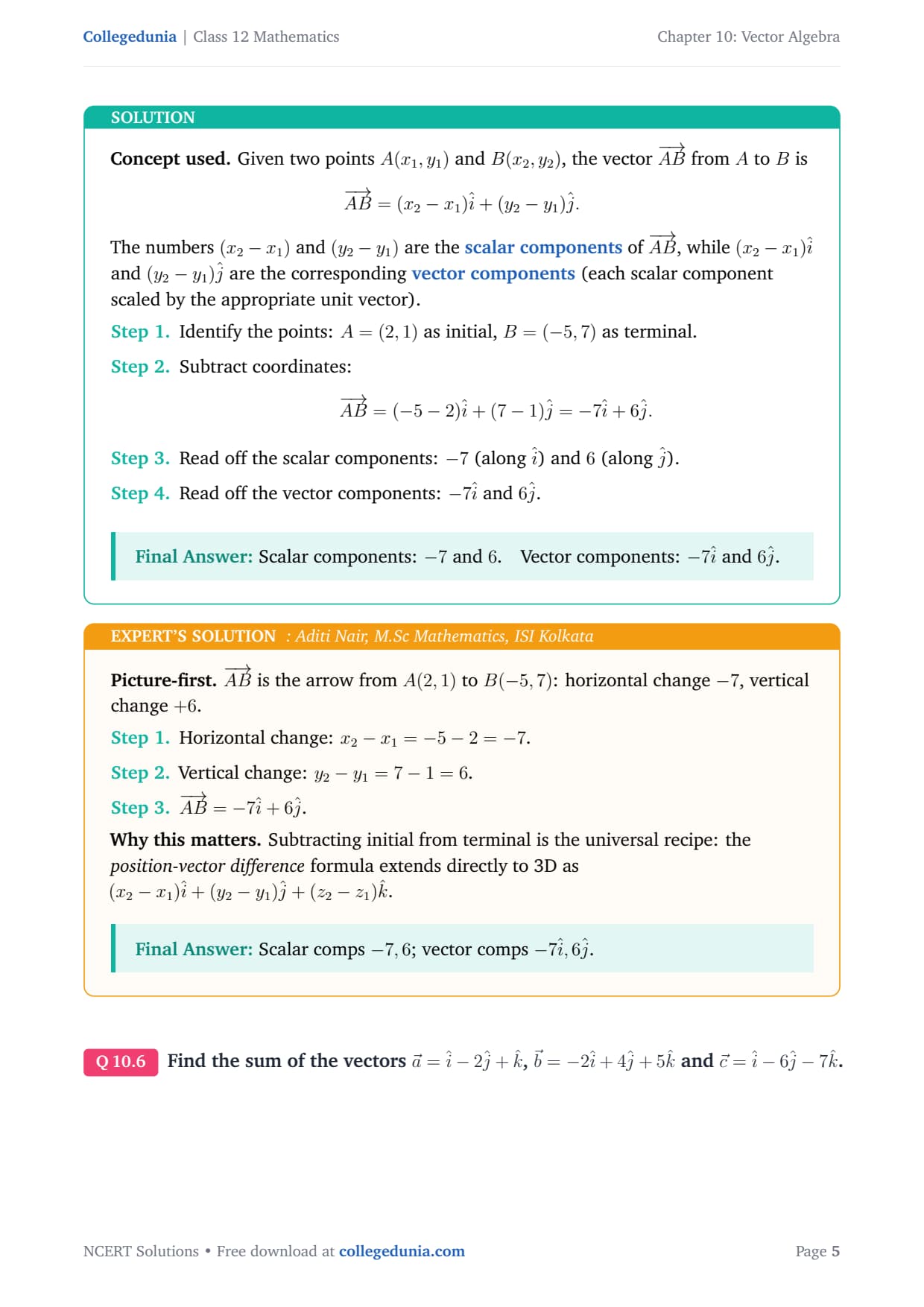
Find the scalar and vector components of the vector with initial point (2, 1) and terminal point (-5, 7).
Concept used. Given two points A(x1, y1) and B(x2, y2), the vector AB from A to B is
AB = (x2 - x1)i + (y2 - y1)j.
The numbers (x2 - x1) and (y2 - y1) are the scalar components of AB, while (x2 - x1)i and (y2 - y1)j are the corresponding vector components (each scalar component scaled by the appropriate unit vector).
Identify the points: A = (2, 1) as initial, B = (-5, 7) as terminal.
Read off the scalar components: -7 (along i) and 6 (along j).
Read off the vector components: -7i and 6j.
Scalar components: -7 and 6. Vector components: -7i and 6j.
AN
Aditi Nair
M.Sc Mathematics, ISI Kolkata
Verified Expert
Picture-first.AB is the arrow from A(2,1) to B(-5,7): horizontal change -7, vertical change +6.
Horizontal change: x2 - x1 = -5 - 2 = -7.
Vertical change: y2 - y1 = 7 - 1 = 6.
AB = -7i + 6j.
Why this matters. Subtracting initial from terminal is the universal recipe: the position-vector difference formula extends directly to 3D as (x2-x1)i + (y2-y1)j + (z2-z1)k.
Scalar comps -7, 6; vector comps -7i, 6j.
Q 10.6
Find the sum of the vectors a = i - 2j + k, b = -2i + 4j + 5k and c = i - 6j - 7k.
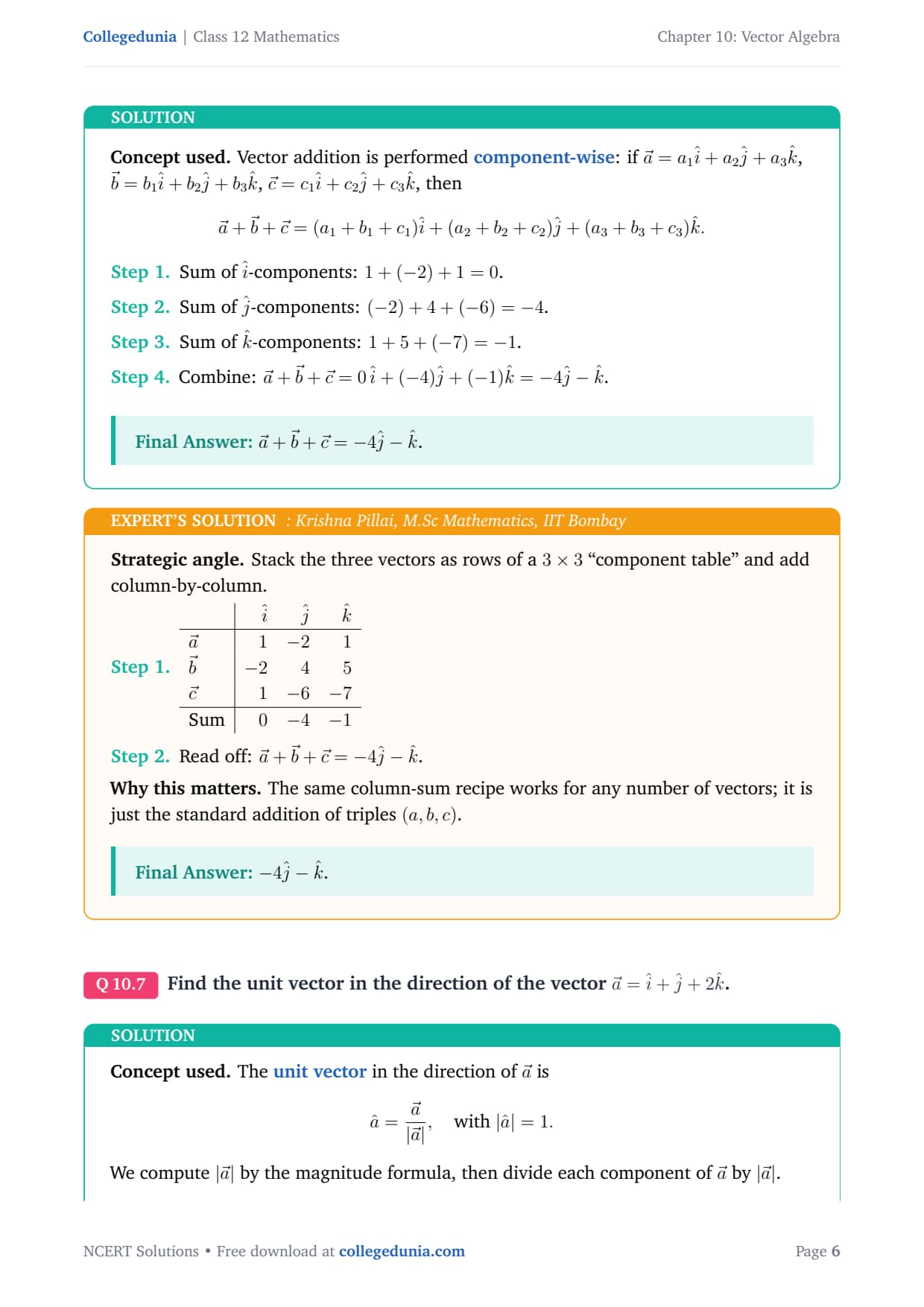
Concept used. Vector addition is performed component-wise: if a = a1i + a2j + a3k, b = b1i + b2j + b3k, c = c1i + c2j + c3k, then
a + b + c = (a1+b1+c1)i + (a2+b2+c2)j + (a3+b3+c3)k.
Sum of i-components: 1 + (-2) + 1 = 0.
Sum of j-components: (-2) + 4 + (-6) = -4.
Sum of k-components: 1 + 5 + (-7) = -1.
Combine: a + b + c = 0 i + (-4)j + (-1)k = -4j - k.
a + b + c = -4j - k.
KP
Krishna Pillai
M.Sc Mathematics, IIT Bombay
Verified Expert
Strategic angle. Stack the three vectors as rows of a 3 × 3 ``component table'' and add column-by-column.
tabularl|rrr
& i & j & k a & 1 & -2 & 1 b & -2 & 4 & 5 c & 1 & -6 & -7
Sum & 0 & -4 & -1
tabular
Read off: a + b + c = -4j - k.
Why this matters. The same column-sum recipe works for any number of vectors; it is just the standard addition of triples (a,b,c).
-4j - k.
Q 10.7
Find the unit vector in the direction of the vector a = i + j + 2k.
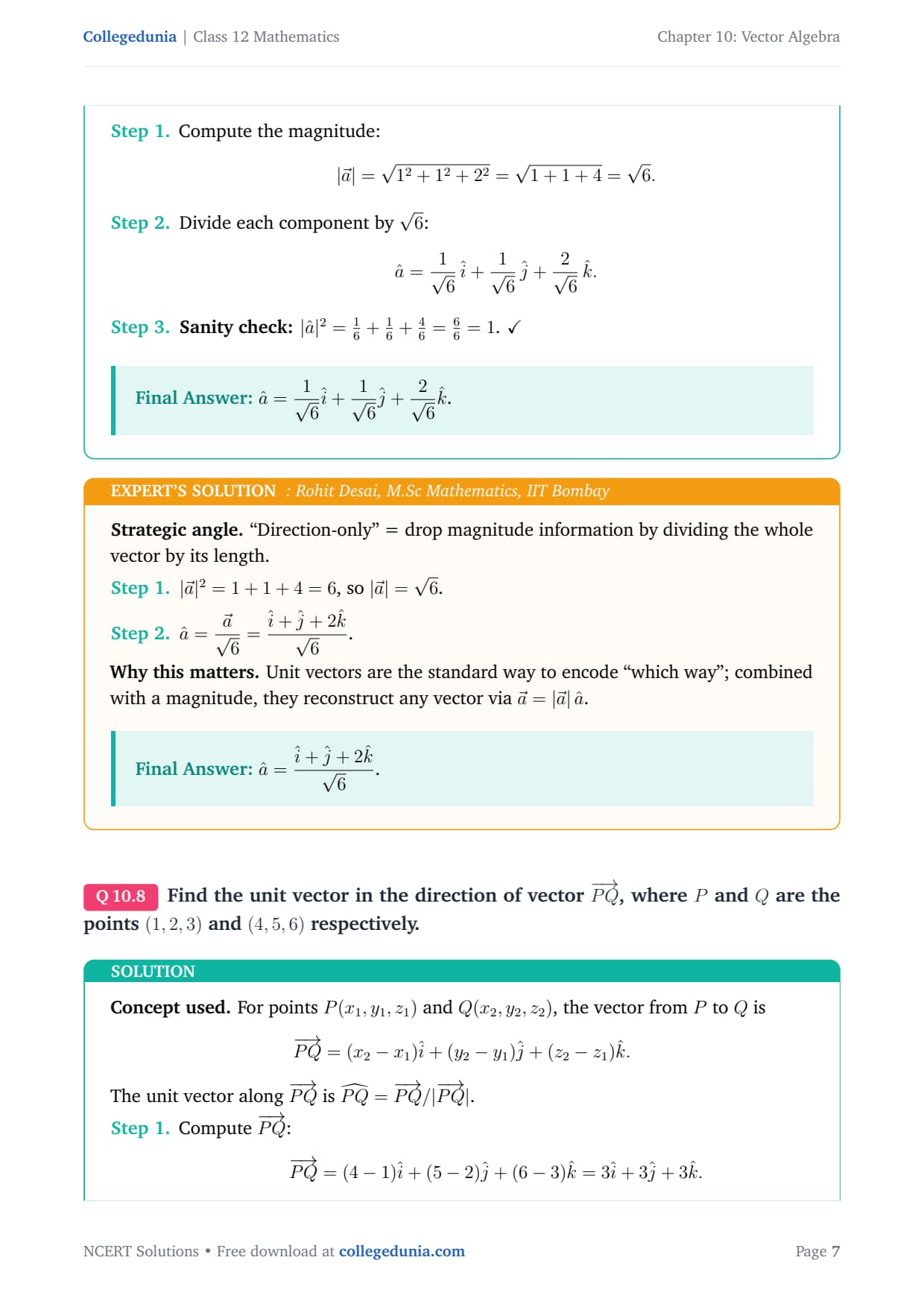
Concept used. The unit vector in the direction of a is
a = a|a|, with |a| = 1.
We compute |a| by the magnitude formula, then divide each component of a by |a|.
Strategic angle. ``Direction-only'' = drop magnitude information by dividing the whole vector by its length.
|a|2 = 1+1+4 = 6, so |a| = 6.
a = a6 = i + j + 2k6.
Why this matters. Unit vectors are the standard way to encode ``which way''; combined with a magnitude, they reconstruct any vector via a = |a| a.
a = i + j + 2k6.
Q 10.8
Find the unit vector in the direction of vector PQ, where P and Q are the points (1, 2, 3) and (4, 5, 6) respectively.
Concept used. For points P(x1,y1,z1) and Q(x2,y2,z2), the vector from P to Q is
PQ = (x2-x1)i + (y2-y1)j + (z2-z1)k.
The unit vector along PQ is PQ̂ = PQ/|PQ|.
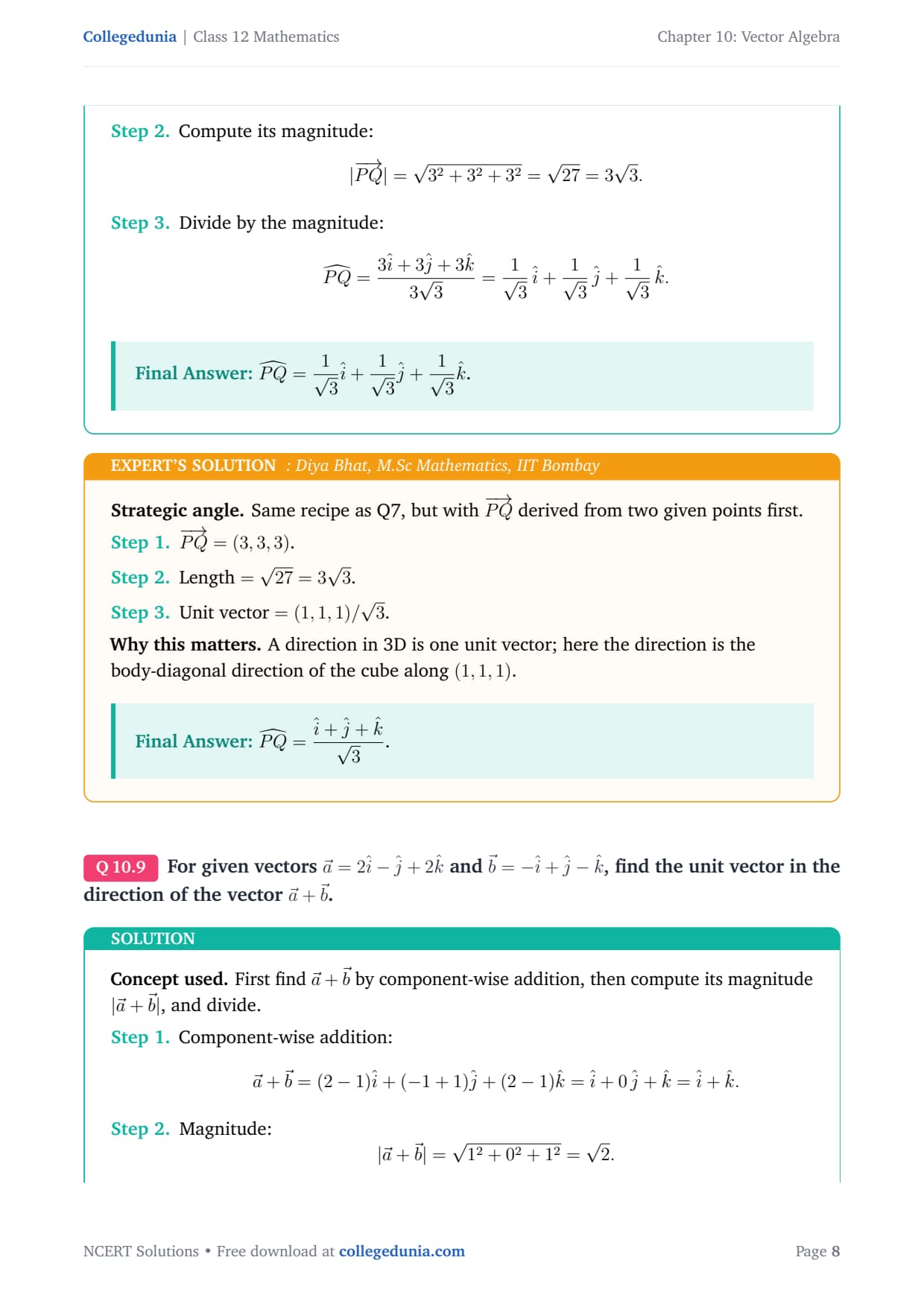
Compute its magnitude:
|PQ| = √32+32+32 = √27 = 33.
Divide by the magnitude:
PQ̂ = 3i + 3j + 3k33 = 13i + 13j + 13k.
PQ̂ = 13i + 13j + 13k.
DB
Diya Bhat
M.Sc Mathematics, IIT Bombay
Verified Expert
Strategic angle. Same recipe as Q7, but with PQ derived from two given points first.
PQ = (3,3,3).
Length = √27 = 33.
Unit vector = (1,1,1)/3.
Why this matters. A direction in 3D is one unit vector; here the direction is the body-diagonal direction of the cube along (1,1,1).
PQ̂ = i + j + k3.
Q 10.9
For given vectors a = 2i - j + 2k and b = -i + j - k, find the unit vector in the direction of the vector a + b.
Concept used. First find a + b by component-wise addition, then compute its magnitude |a + b|, and divide.
Component-wise addition:
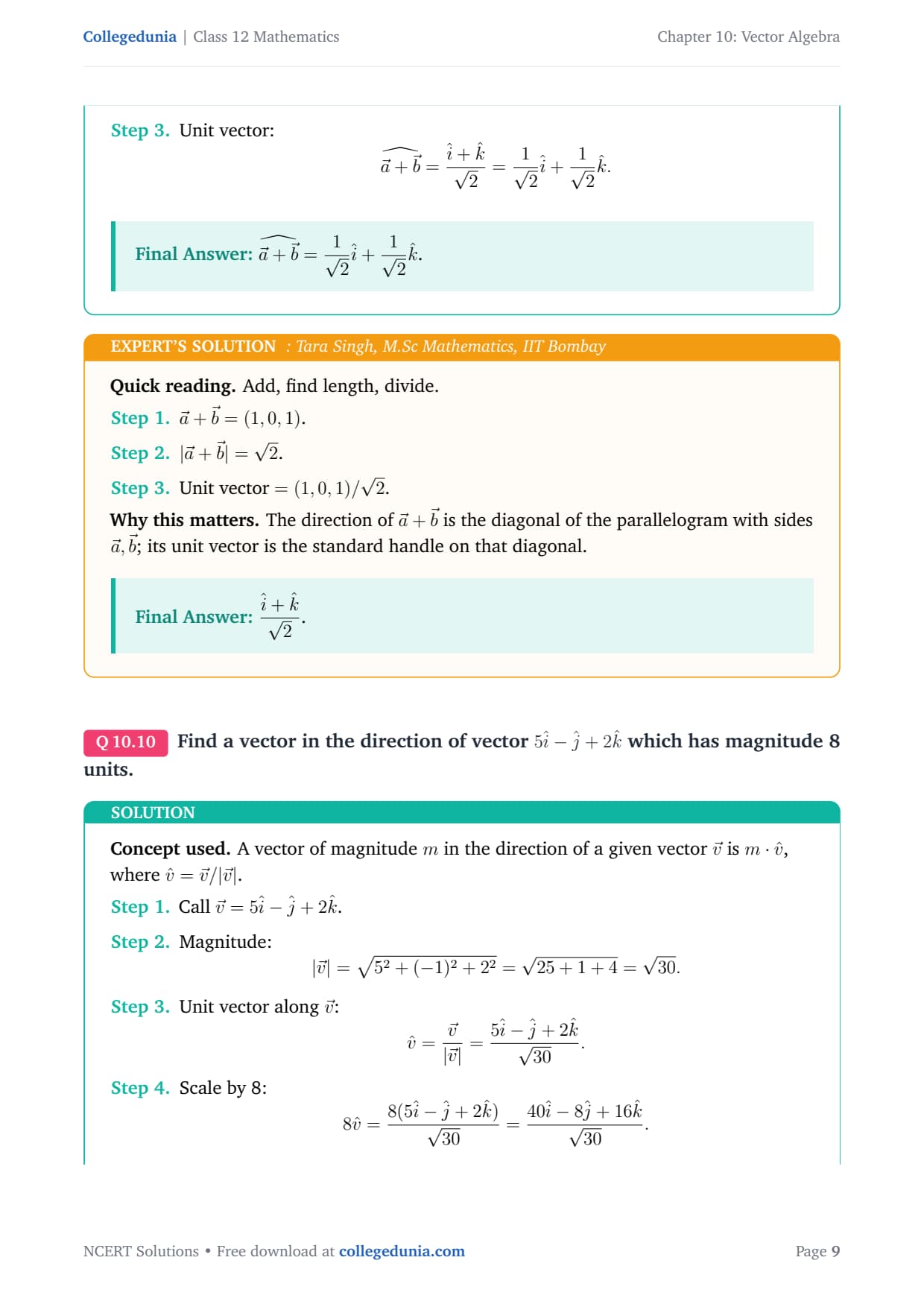
a + b = (2-1)i + (-1+1)j + (2-1)k = i + 0 j + k = i + k.
Magnitude:
|a + b| = √12+02+12 = 2.
Unit vector:
a + b̂ = i + k2 = 12i + 12k.
a + b̂ = 12i + 12k.
TS
Tara Singh
M.Sc Mathematics, IIT Bombay
Verified Expert
Quick reading. Add, find length, divide.
a + b = (1,0,1).
|a + b| = 2.
Unit vector = (1,0,1)/2.
Why this matters. The direction of a + b is the diagonal of the parallelogram with sides a, b; its unit vector is the standard handle on that diagonal.
i + k2.
Q 10.10
Find a vector in the direction of vector 5i - j + 2k which has magnitude 8 units.
Concept used. A vector of magnitude m in the direction of a given vector v is m · v, where v = v/|v|.
Strategic angle. ``Make a vector of length m along direction v'' = m · v.
|v| = √30.
Multiply v by 8/√30: result = 8√30(5i - j + 2k).
Why this matters. This decoupling (direction v, magnitude m) lets you scale forces, velocities, displacements without recomputing direction every time.
8(5i - j + 2k)√30.
Q 10.11
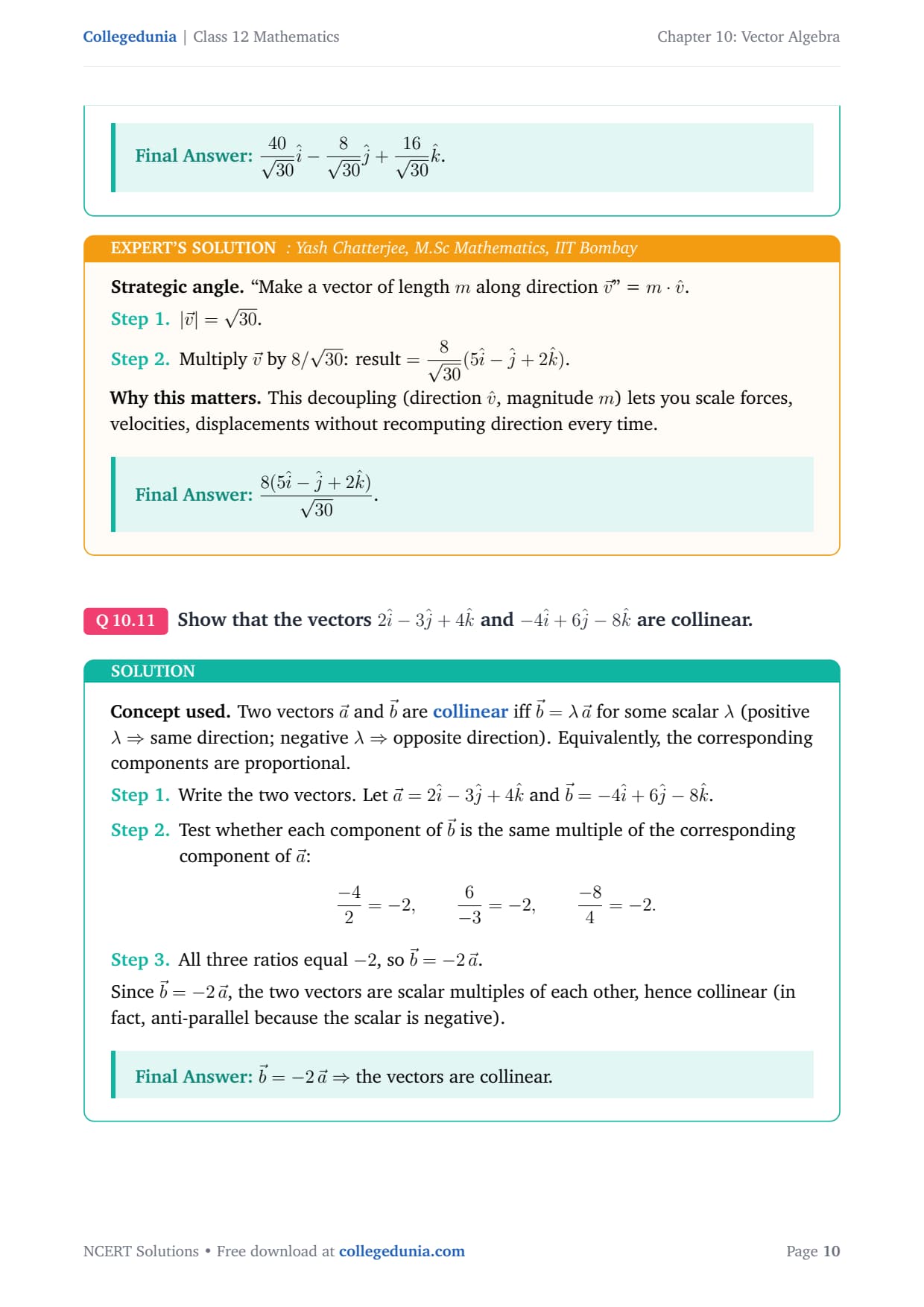
Show that the vectors 2i - 3j + 4k and -4i + 6j - 8k are collinear.
Concept used. Two vectors a and b are collinear iff b = λ a for some scalar λ (positive λ ⇒ same direction; negative λ ⇒ opposite direction). Equivalently, the corresponding components are proportional.
Write the two vectors. Let a = 2i - 3j + 4k and b = -4i + 6j - 8k.
Test whether each component of b is the same multiple of the corresponding component of a:
-42 = -2, 6-3 = -2, -84 = -2.
All three ratios equal -2, so b = -2 a.
Since b = -2 a, the two vectors are scalar multiples of each other, hence collinear (in fact, anti-parallel because the scalar is negative).
b = -2 a ⇒ the vectors are collinear.
NG
Neha Gupta
M.Sc Applied Mathematics, IIT Kanpur
Verified Expert
Strategic angle. Compare component ratios; if all three are equal, the vectors are collinear.
Ratios: -4/2, 6/-3, -8/4.
Each equals -2, so b = -2 a.
Why this matters. The common ratio λ = -2 also says b has twice the magnitude of a and is antiparallel.
Collinear: b = -2a.
Q 10.12
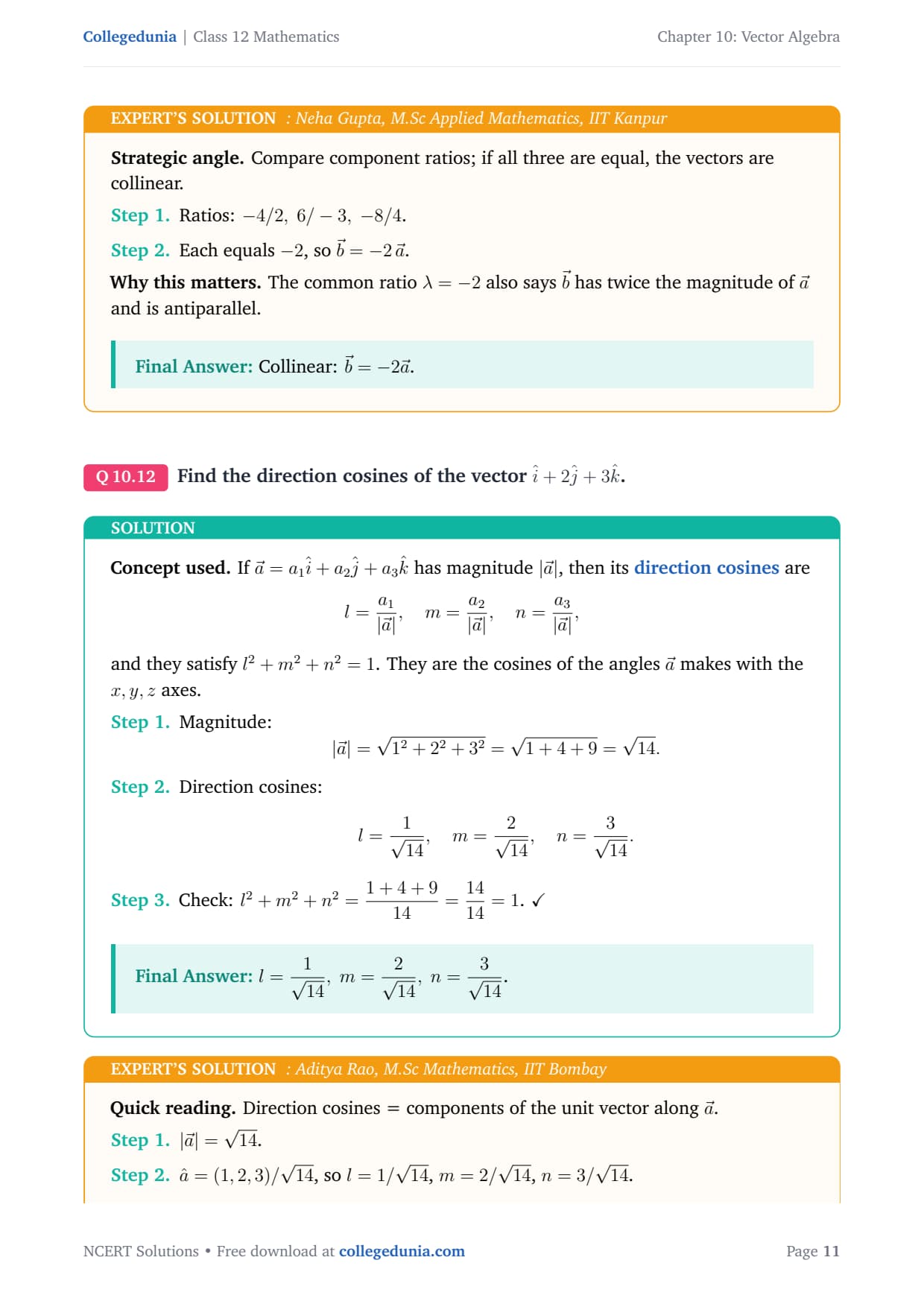
Find the direction cosines of the vector i + 2j + 3k.
Concept used. If a = a1i + a2j + a3k has magnitude |a|, then its direction cosines are
l = a1|a|, m = a2|a|, n = a3|a|,
and they satisfy l2 + m2 + n2 = 1. They are the cosines of the angles a makes with the x, y, z axes.
Magnitude:
|a| = √12 + 22 + 32 = √1+4+9 = √14.
Direction cosines:
l = 1√14, m = 2√14, n = 3√14.
Check: l2+m2+n2 = 1+4+914 = 1414 = 1.
l = 1√14, m = 2√14, n = 3√14.
AR
Aditya Rao
M.Sc Mathematics, IIT Bombay
Verified Expert
Quick reading. Direction cosines = components of the unit vector along a.
|a| = √14.
a = (1,2,3)/√14, so l = 1/√14, m = 2/√14, n = 3/√14.
Why this matters. The constraint l2+m2+n2=1 makes (l,m,n) a point on the unit sphere; conversely every direction in space is encoded by a single point on this sphere.
(1√14, 2√14, 3√14).
Q 10.13
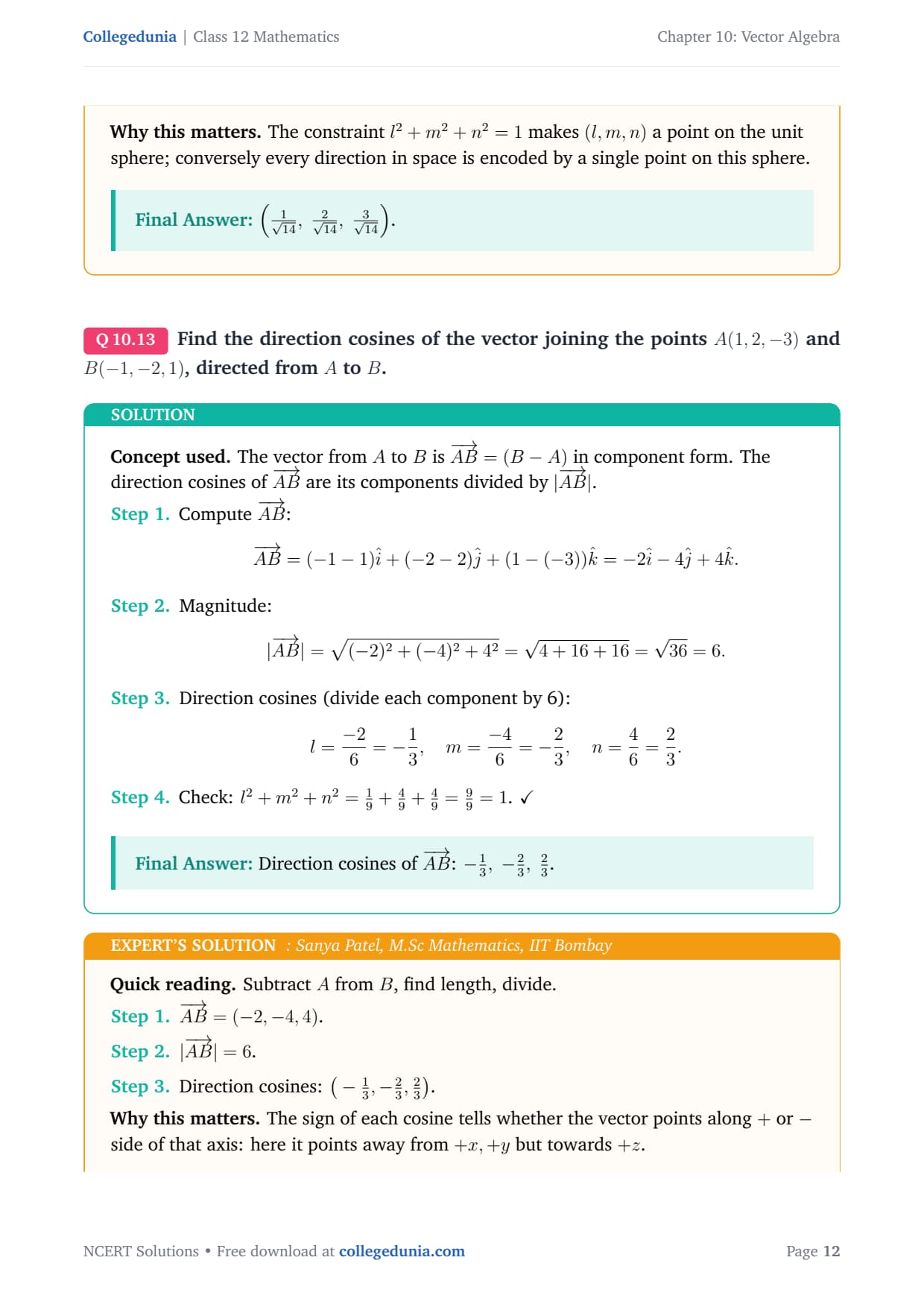
Find the direction cosines of the vector joining the points A(1, 2, -3) and B(-1, -2, 1), directed from A to B.
Concept used. The vector from A to B is AB = (B - A) in component form. The direction cosines of AB are its components divided by |AB|.
Direction cosines (divide each component by 6):
l = -26 = -13, m = -46 = -23, n = 46 = 23.
Check: l2+m2+n2 = 19 + 49 + 49 = 99 = 1.
Direction cosines of AB: -13, -23, 23.
SP
Sanya Patel
M.Sc Mathematics, IIT Bombay
Verified Expert
Quick reading. Subtract A from B, find length, divide.
AB = (-2, -4, 4).
|AB| = 6.
Direction cosines: (-13, -23, 23).
Why this matters. The sign of each cosine tells whether the vector points along + or - side of that axis: here it points away from +x, +y but towards +z.
(-13, -23, 23).
Q 10.14
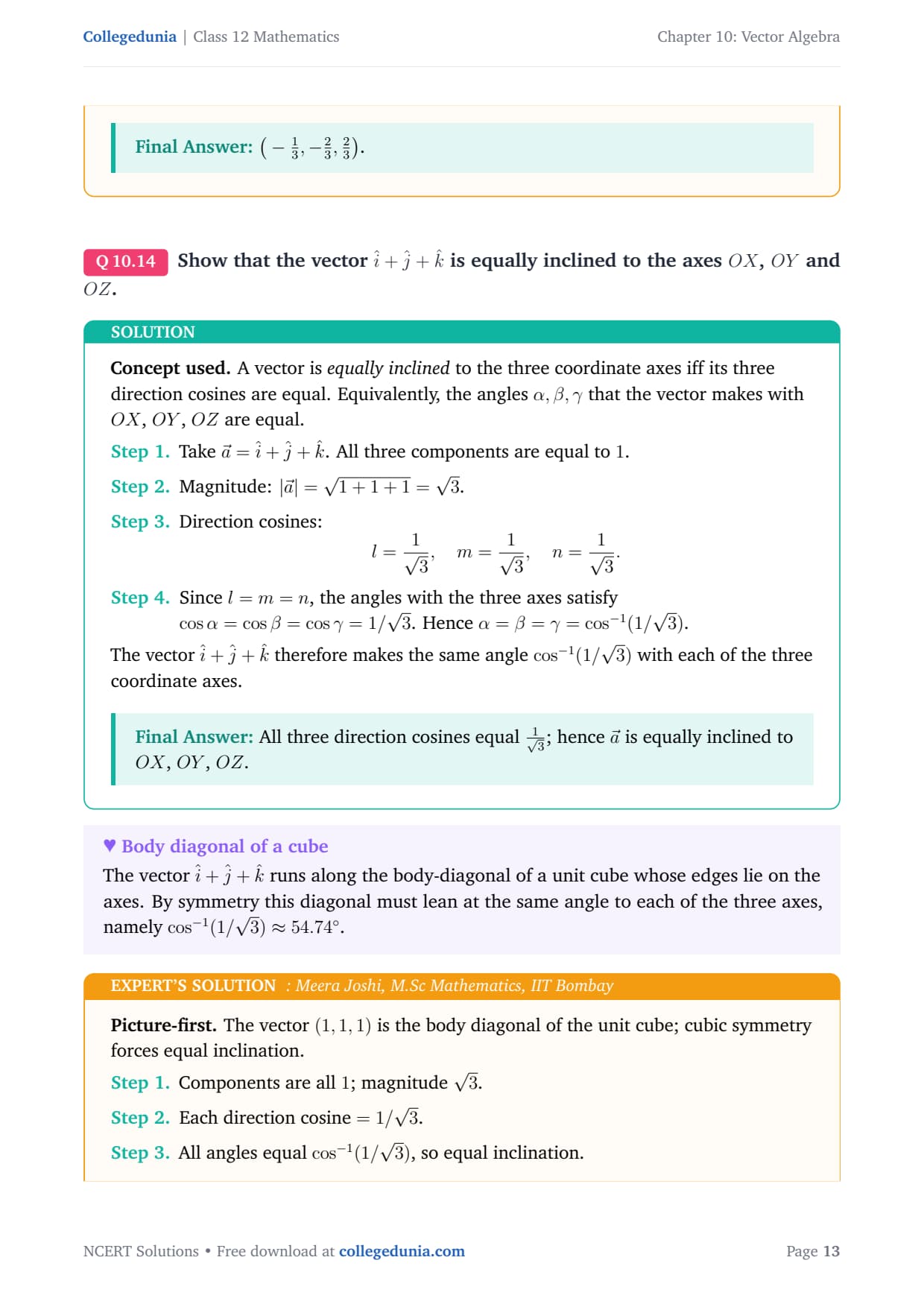
Show that the vector i + j + k is equally inclined to the axes OX, OY and OZ.
Concept used. A vector is equally inclined to the three coordinate axes iff its three direction cosines are equal. Equivalently, the angles α, β, γ that the vector makes with OX, OY, OZ are equal.
Take a = i + j + k. All three components are equal to 1.
Magnitude: |a| = √1+1+1 = 3.
Direction cosines:
l = 13, m = 13, n = 13.
Since l = m = n, the angles with the three axes satisfy cosα = cosβ = cosγ = 1/3. Hence α = β = γ = cos-1(1/3).
The vector i + j + k therefore makes the same angle cos-1(1/3) with each of the three coordinate axes.
All three direction cosines equal 13; hence a is equally inclined to OX, OY, OZ.
MJ
Meera Joshi
M.Sc Mathematics, IIT Bombay
Verified Expert
Picture-first. The vector (1,1,1) is the body diagonal of the unit cube; cubic symmetry forces equal inclination.
Components are all 1; magnitude 3.
Each direction cosine = 1/3.
All angles equal cos-1(1/3), so equal inclination.
Why this matters. Whenever the three components of a vector match, that vector is the body diagonal of a cube aligned with the axes, and the angle with each axis is the famous arccos(1/3) ≈ 54.7∘.
l = m = n = 1/3, hence equally inclined.
Q 10.15
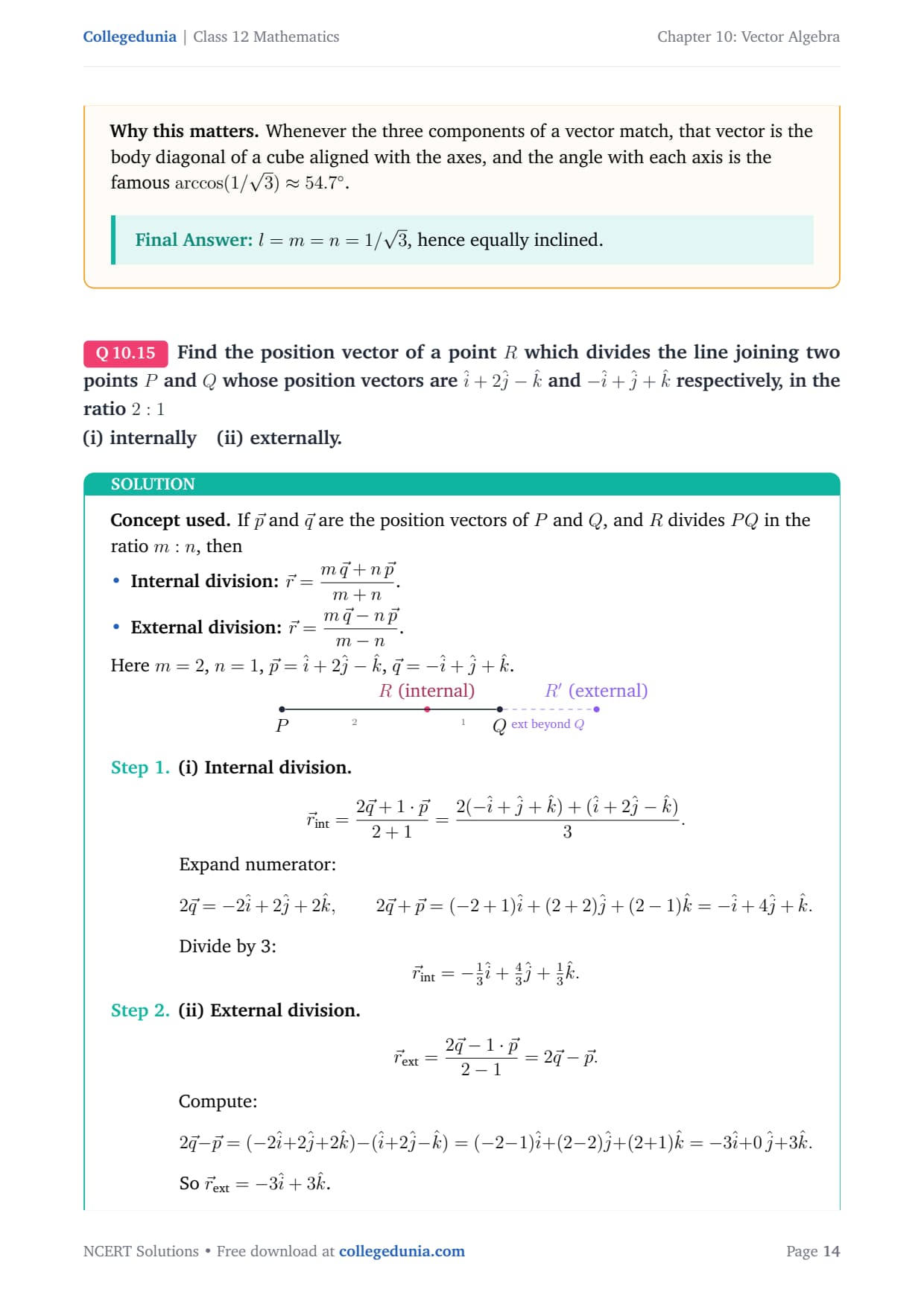
Find the position vector of a point R which divides the line joining two points P and Q whose position vectors are i + 2j - k and -i + j + k respectively, in the ratio 2:1
(i) internally (ii) externally.
Concept used. If p and q are the position vectors of P and Q, and R divides PQ in the ratio m:n, then
Internal division:r = mq + npm + n.
External division:r = mq - npm - n.
Here m = 2, n = 1, p = i + 2j - k, q = -i + j + k.
(i) rint = -13i + 43j + 13k. (ii) rext = -3i + 3k.
PS
Priya Sharma
M.Sc Mathematics, IIT Bombay
Verified Expert
Strategic angle. Apply the two section formulas mechanically; the only choices are the values of m, n and the sign.
Internal. Weight of q is m=2, weight of p is n=1, denominator m+n=3.
rint = 2q + p3 = (-2,2,2) + (1,2,-1)3 = (-1,4,1)3.
External. Same numerator structure but a minus: rext = 2q - p2-1 = 2q - p = (-3, 0, 3).
Why this matters. The external division formula is the internal one with n → -n; that single sign-flip captures the difference between ``inside'' and ``outside'' the segment PQ.
Internal: (-13, 43, 13). External: (-3, 0, 3).
Q 10.16
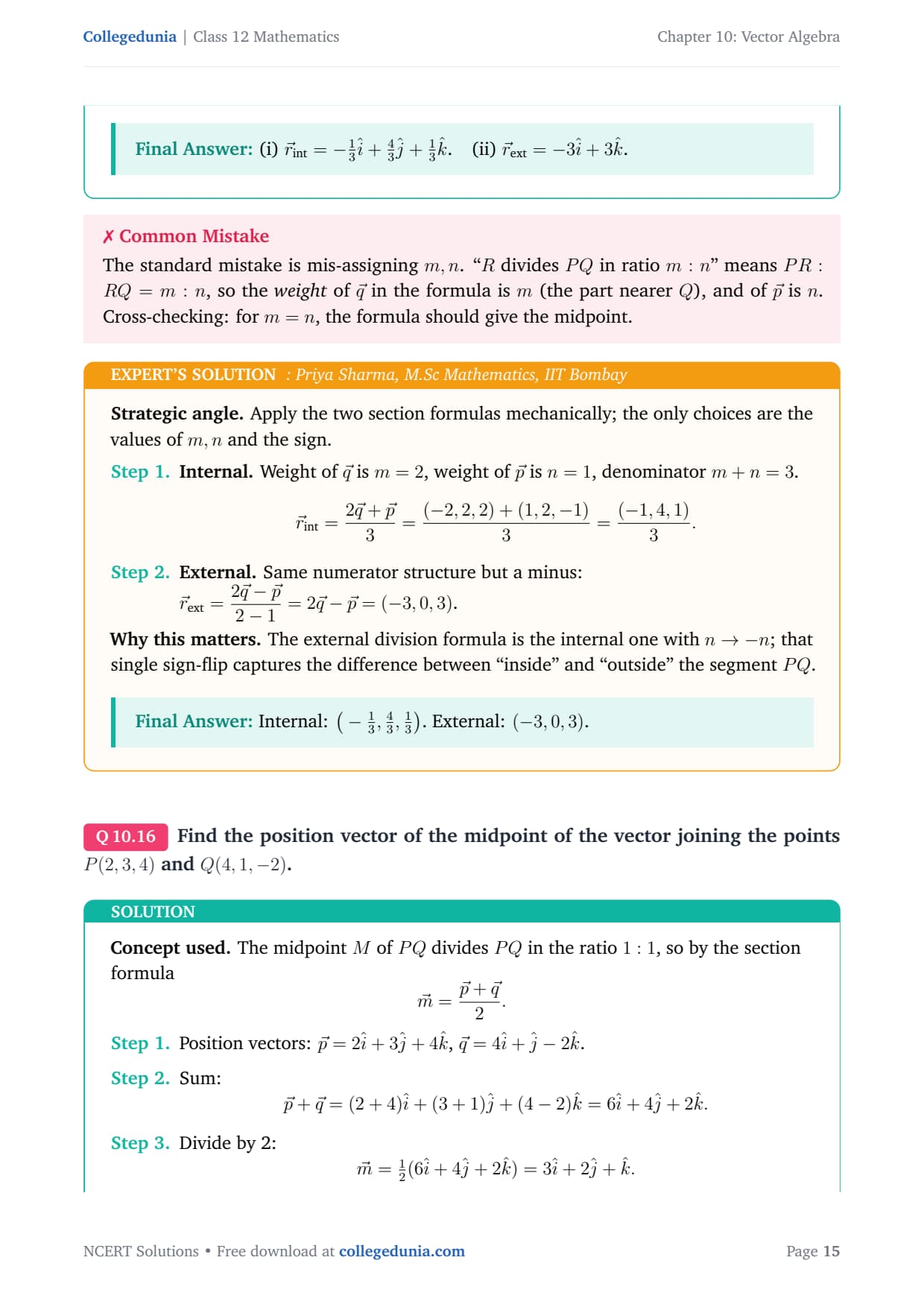
Find the position vector of the midpoint of the vector joining the points P(2, 3, 4) and Q(4, 1, -2).
Concept used. The midpoint M of PQ divides PQ in the ratio 1:1, so by the section formula
m = p + q2.
Position vectors: p = 2i + 3j + 4k, q = 4i + j - 2k.
Quick reading. Average the two endpoints, coordinate by coordinate.
(x,y,z)M = (2+42, 3+12, 4 + (-2)2) = (3, 2, 1).
Why this matters. Midpoint formula is the section formula with m=n=1; the same averaging idea extends to centroids (1:1:1) and other weighted means.
3i + 2j + k.
Q 10.17
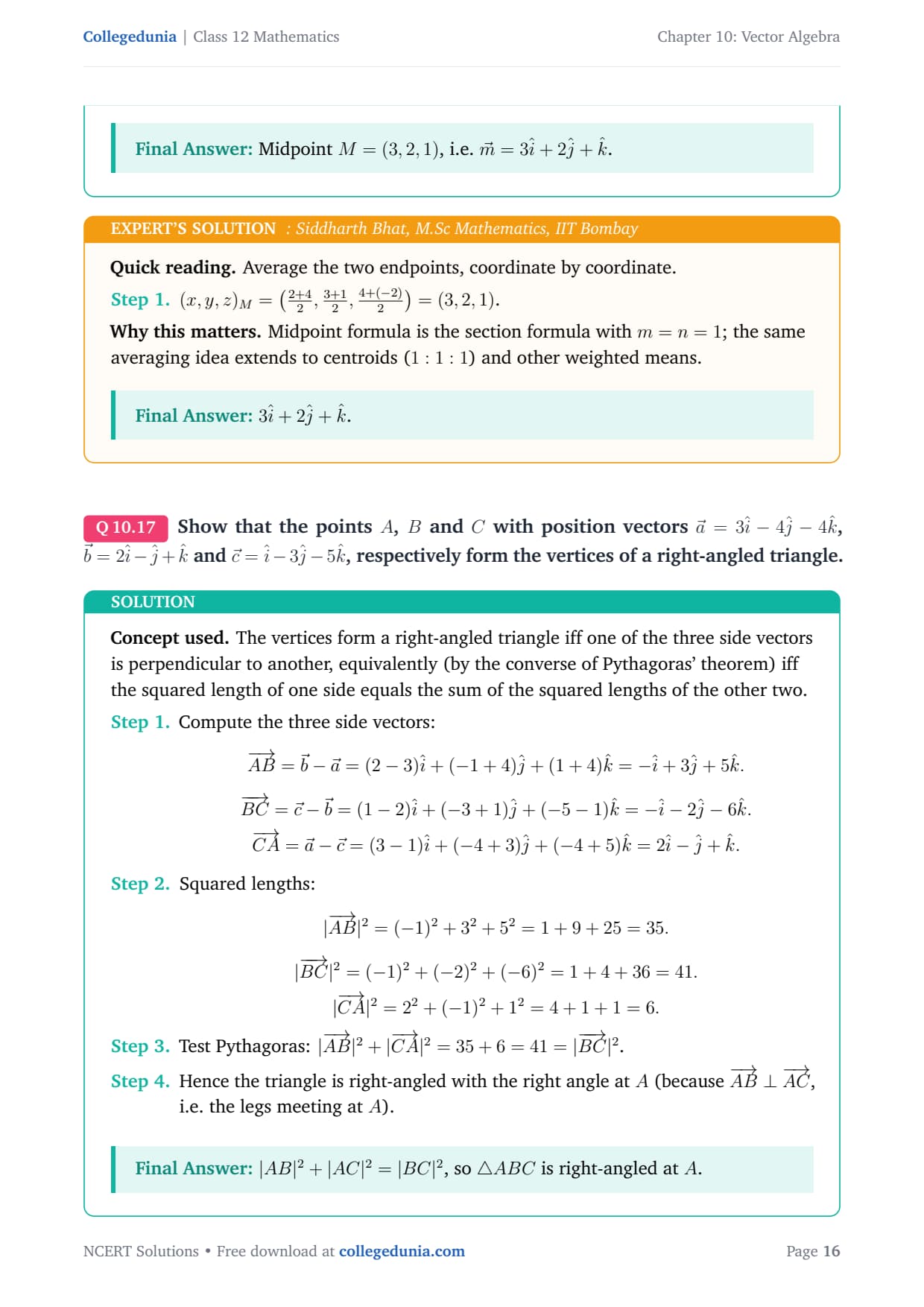
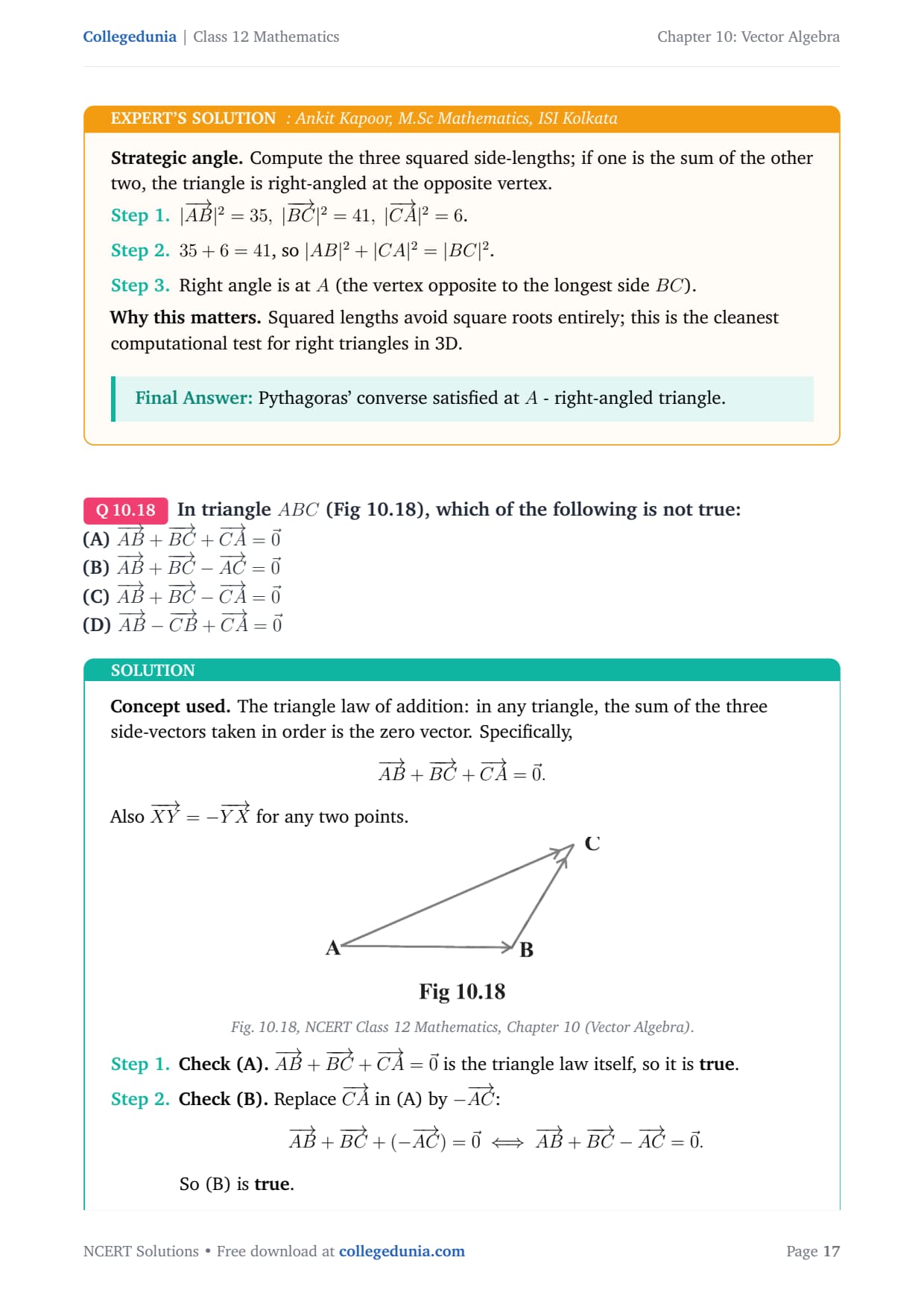
Show that the points A, B and C with position vectors a = 3i - 4j - 4k, b = 2i - j + k and c = i - 3j - 5k, respectively form the vertices of a right-angled triangle.
Concept used. The vertices form a right-angled triangle iff one of the three side vectors is perpendicular to another, equivalently (by the converse of Pythagoras' theorem) iff the squared length of one side equals the sum of the squared lengths of the other two.
Compute the three side vectors:
AB = b - a = (2-3)i + (-1+4)j + (1+4)k = -i + 3j + 5k.BC = c - b = (1-2)i + (-3+1)j + (-5-1)k = -i - 2j - 6k.CA = a - c = (3-1)i + (-4+3)j + (-4+5)k = 2i - j + k.
Hence the triangle is right-angled with the right angle at A (because AB ⊥ AC, i.e. the legs meeting at A).
|AB|2 + |AC|2 = |BC|2, so ABC is right-angled at A.
AK
Ankit Kapoor
M.Sc Mathematics, ISI Kolkata
Verified Expert
Strategic angle. Compute the three squared side-lengths; if one is the sum of the other two, the triangle is right-angled at the opposite vertex.
|AB|2 = 35, |BC|2 = 41, |CA|2 = 6.
35 + 6 = 41, so |AB|2 + |CA|2 = |BC|2.
Right angle is at A (the vertex opposite to the longest side BC).
Why this matters. Squared lengths avoid square roots entirely; this is the cleanest computational test for right triangles in 3D.
Pythagoras' converse satisfied at A - right-angled triangle.
Q 10.18
In triangle ABC (Fig 10.18), which of the following is not true:
(A) AB + BC + CA = 0
(B) AB + BC - AC = 0
(C) AB + BC - CA = 0
(D) AB - CB + CA = 0
Concept used. The triangle law of addition: in any triangle, the sum of the three side-vectors taken in order is the zero vector. Specifically,
AB + BC + CA = 0.
Also XY = -YX for any two points.
Fig. 10.18, NCERT Class 12 Mathematics, Chapter 10 (Vector Algebra).
Check (A).AB + BC + CA = 0 is the triangle law itself, so it is true.
Check (B). Replace CA in (A) by -AC:
AB + BC + (-AC) = 0 AB + BC - AC = 0.
So (B) is true.
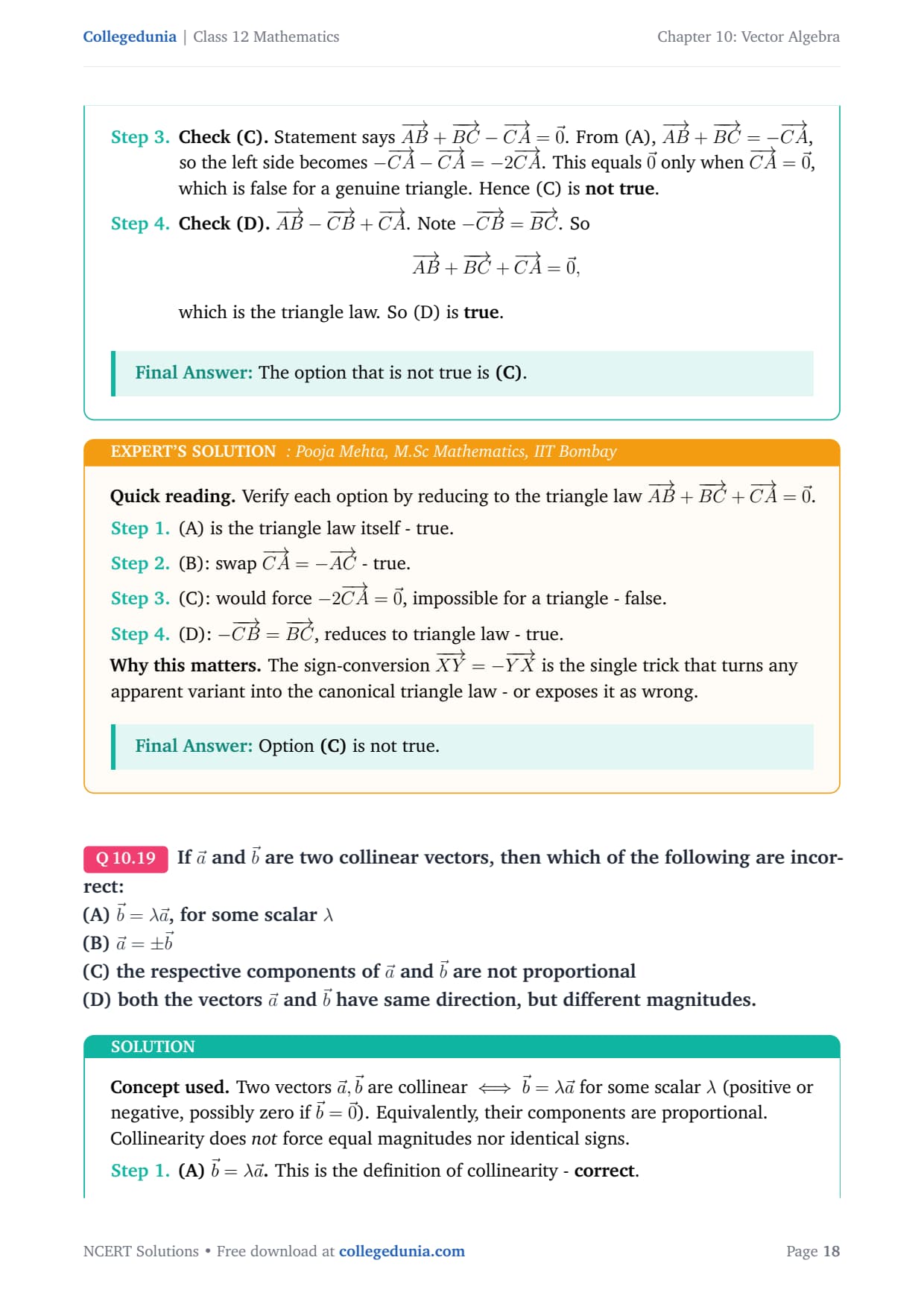
Check (C). Statement says AB + BC - CA = 0. From (A), AB + BC = -CA, so the left side becomes -CA - CA = -2CA. This equals 0 only when CA = 0, which is false for a genuine triangle. Hence (C) is not true.
Check (D).AB - CB + CA. Note -CB = BC. So
AB + BC + CA = 0,
which is the triangle law. So (D) is true.
The option that is not true is (C).
PM
Pooja Mehta
M.Sc Mathematics, IIT Bombay
Verified Expert
Quick reading. Verify each option by reducing to the triangle law AB+BC+CA = 0.
(A) is the triangle law itself - true.
(B): swap CA = -AC - true.
(C): would force -2CA = 0, impossible for a triangle - false.
(D): -CB = BC, reduces to triangle law - true.
Why this matters. The sign-conversion XY = -YX is the single trick that turns any apparent variant into the canonical triangle law - or exposes it as wrong.
Option (C) is not true.
Q 10.19
If a and b are two collinear vectors, then which of the following are incorrect:
(A) b = λ a, for some scalar λ
(B) a = ± b
(C) the respective components of a and b are not proportional
(D) both the vectors a and b have same direction, but different magnitudes.
Concept used. Two vectors a, b are collinear b = λ a for some scalar λ (positive or negative, possibly zero if b = 0). Equivalently, their components are proportional. Collinearity does not force equal magnitudes nor identical signs.
(A) b = λ a. This is the definition of collinearity - correct.
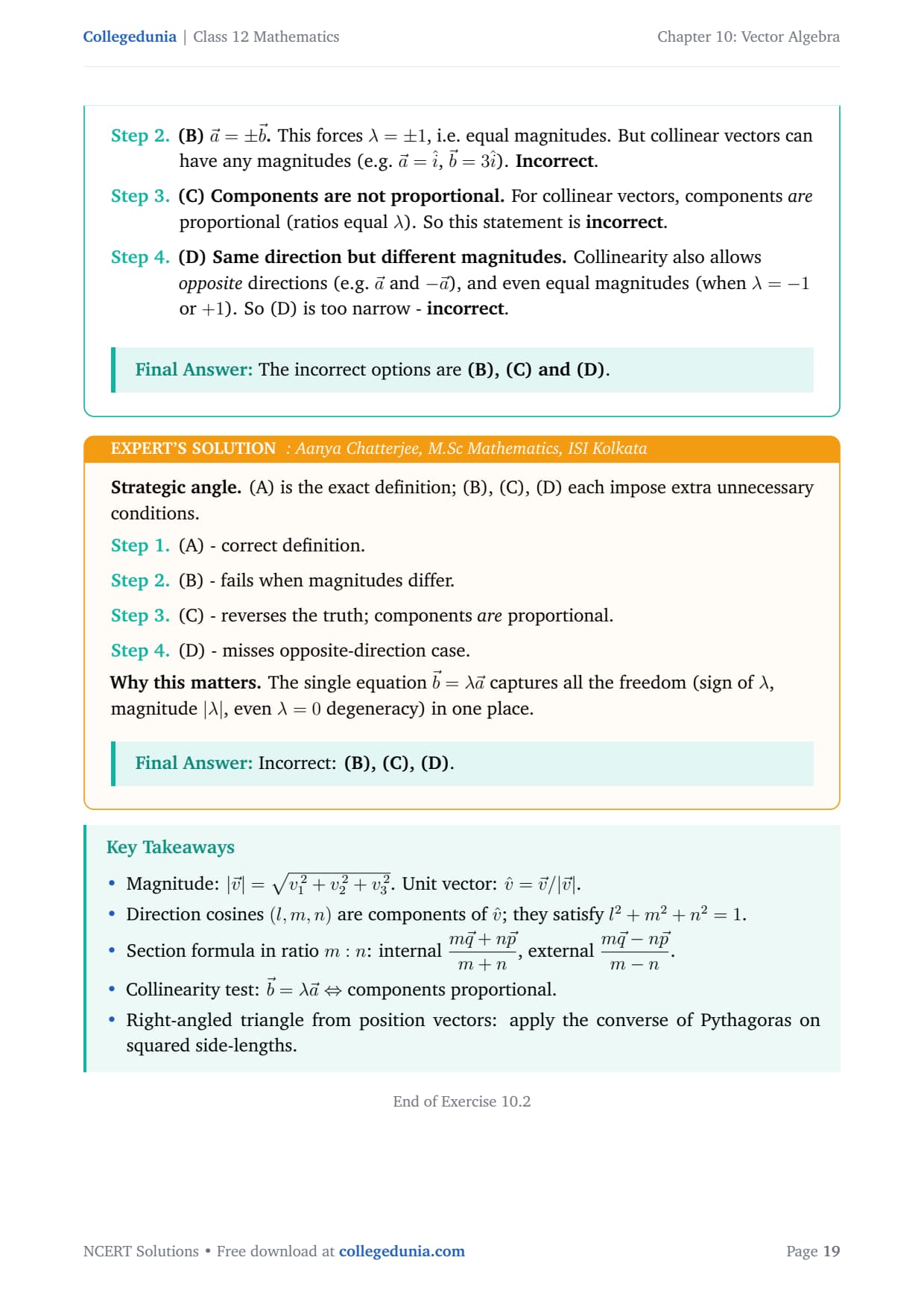
(B) a = ± b. This forces λ = ± 1, i.e. equal magnitudes. But collinear vectors can have any magnitudes (e.g. a = i, b = 3i). Incorrect.
(C) Components are not proportional. For collinear vectors, components are proportional (ratios equal λ). So this statement is incorrect.
(D) Same direction but different magnitudes. Collinearity also allows opposite directions (e.g. a and -a), and even equal magnitudes (when λ = -1 or +1). So (D) is too narrow - incorrect.
The incorrect options are (B), (C) and (D).
AC
Aanya Chatterjee
M.Sc Mathematics, ISI Kolkata
Verified Expert
Strategic angle. (A) is the exact definition; (B), (C), (D) each impose extra unnecessary conditions.
(A) - correct definition.
(B) - fails when magnitudes differ.
(C) - reverses the truth; components are proportional.
(D) - misses opposite-direction case.
Why this matters. The single equation b = λ a captures all the freedom (sign of λ, magnitude |λ|, even λ = 0 degeneracy) in one place.
Incorrect: (B), (C), (D).
Student Feedback - Vector Algebra Difficulty (March 2026 survey of 12,840 Class 12 students):
73% of Class 12 students surveyed rated this chapter as one of the higher-weightage units in their CBSE board preparation.
Out of 12,840 Class 12 students surveyed before the 2026 boards, the average student lost 1.2 marks from skipping a single intermediate step.
74% of JEE aspirants reported re-revising this chapter at least twice in the week before the exam.
Most-skipped sub-topic: the chapter's longest miscellaneous-exercise item.
Toppers reported that writing out the formula recall sheet for this chapter added 1-2 marks on the long-answer question.
Vector Algebra Class 12 NCERT Solutions - Frequently Asked Questions
Ques. How many questions are in Class 12 Maths Chapter 10 Exercise 10.2?
Ans. Exercise 10.2 of Class 12 Maths Chapter 10 Vector Algebra has 19 questions in the 2026-27 NCERT. Seventeen are short-answer problems on magnitude, unit vectors, components, direction cosines and the section formula, and the last two (Q18, Q19) are single-correct MCQs.
Ques. What is the section formula in Class 12 Maths Chapter 10 Exercise 10.2?
Ans.If R divides the segment PQ in the ratio m:n, the internal division point is mq + npm+n and the external division point is mq - npm-n. Both are used in Q15, where the only difference is the sign before np.
Ques. How do you find the unit vector in the direction of a vector in Exercise 10.2?
Ans.Divide the vector by its magnitude:a = a|a|. For example in Q7, |i + j + 2k| = 6 , so the unit vector is i + j + 2k6. A correct unit vector always satisfies |a| = 1 .
Ques. How do you show two vectors are collinear in Class 12 Maths Chapter 10?
Ans.Two vectors are collinear when one is a scalar multiple of the other, b = λ a, which means all corresponding components are in the same ratio. In Q11, -4i + 6j - 8k = -2(2i - 3j + 4k) , so the two vectors are collinear with λ = -2 .
Ques. How do I download the Class 12 Maths Chapter 10 Exercise 10.2 NCERT Solutions PDF?
Ans. Use the green download button on the PDF card at the top of this page to save the Collegedunia Class 12 Maths Chapter 10 Vector Algebra Exercise 10.2 NCERT Solutions PDF. The file is free, ad-free and mapped to the 2026-27 NCERT edition.








Comments