





The 2026-27 NCERT keeps Class 12 English Chapter 6 Flamingo Prose: Poets and Pancakes by Asokamitran intact, with the full exercise set: 4 Understanding-the-Text questions, 3 Talking-about-the-Text prompts, and 15 in-text items. The chapter is worth 6 to 8 marks in the Board exam. This page hosts the Solutions PDF and a sample answer.


- CBSE Weightage: 6 to 8 marks (one long answer plus often one short answer)
- CUET Weightage: 1 to 2 questions in the English Language and Comprehension section
- Compartment and Re-test Frequency: Appeared in 3 of the last 5 compartment papers
These Class 12 English NCERT Solutions for Poets and Pancakes are made by Collegedunia experts, mapped to the 2026-27 NCERT print, and checked against the last five years of CBSE Board papers.
Class 12 English NCERT Solutions Chapter 6 Flamingo Prose: Poets and Pancakes Previous Year Questions Weightage (2021 to 2026)
The table below maps every Poets and Pancakes question from the last five CBSE Class 12 English Core papers. Long answers focus on Subbu and humour, while short answers circle the office boy, the lawyer and the Stephen Spender visit.
| Year | CBSE Board (Class 12 English Core) | CUET English |
|---|---|---|
| 2026 | Pending (results awaited) | Pending |
| 2025 | Long answer (6 marks) on Subbu's many-sided personality and his loyalty to The Boss | One inference question on the lawyer episode |
| 2024 | Short answer (3 marks) on the make-up department as an example of national integration | - |
| 2023 | Long answer (6 marks) on the irony in the visit of the English poet | - |
| 2022 | Short answer (3 marks) on why the office boy resented Subbu | One vocabulary question on "played into their hands" |
| 2021 | Compartment paper carried a 3-mark question on Frank Buchman's MRA visit | - |
Poets and Pancakes Video Explanation (Class 12 English)
Source: Magnet Brains on YouTube
Class 12 English NCERT Solutions Chapter 6 Flamingo Prose: Poets and Pancakes Exercise-by-Exercise Breakdown
The chapter ends with three exercise sections plus a Writing task. The Solutions PDF answers each in the format CBSE expects, with paragraph framing for long answers and bullets for the discussion prompts.
| Exercise Set | Item Count | Question Type | Sub-topic Tested |
|---|---|---|---|
| Understanding the Text | 4 questions | Long answer (6 marks each) | Humour, Subbu's role, English-poet incongruity, author's literary inclinations |
| Talking about the Text | 3 prompts | Group discussion / 120-word write-up | Film technology then vs now, poetry vs films, humour and criticism |
| Noticing Transitions | 1 marking task | Annotation | Chatty-rambling style, idea transitions |
| Writing | 1 task | Composition (120 to 150 words) | Humorous portrait in Asokamitran's rambling style |
| Things to Do | 1 task | Extension activity | Newspaper cartoons and satire |
| Think as You Read (in-text) | 15 short questions across the chapter | 1 to 2 mark recall | Make-up department, Subbu, the lawyer, MRA, Stephen Spender |
How will Collegedunia's NCERT Solutions Help You with Poets and Pancakes Class 12?
The Collegedunia NCERT Solutions for Poets and Pancakes are written by teachers who mark CBSE scripts, so every answer hits the marking-scheme phrasing.
- 2026-27 NCERT Alignment: Every answer matches the current print of Flamingo, with question numbers kept intact.
- Paragraph Framing for 6-mark Answers: Each long answer opens with a thesis line, carries four to five evidence beats, and closes with a one-line evaluation.
- Textual Evidence Tags: Quotations are tagged with a paragraph hook so the examiner can verify support quickly.
- CBSE-Style Tone: The voice stays formal but plain, with no padding or unsupported opinion.
Sample Fully Solved Long Answer: Why was Kothamangalam Subbu considered No. 2 at Gemini Studios?
This walks through one CBSE-favourite 6-mark prompt the way the Solutions PDF answers all four questions.
Kothamangalam Subbu was No. 2 at Gemini Studios because he bent his literary gifts to the service of S.S. Vasan. Asokamitran calls him the man "who gave direction and definition to Gemini Studios during its golden years." When Vasan stalled on a scene, Subbu could improvise "four ways of the rat pouring affection on its offspring" and then "fourteen more alternatives" in minutes. He was a folk poet, the author of Thillana Mohanambal, and a finer actor in small roles than the main players. His house was "a permanent residence for dozens of his relations", marking him as charitable and improvident. Critics suspected his closeness to The Boss masked sycophancy, but Asokamitran treats this with gentle irony. The picture is of a many-sided genius whose loyalty, speed and stagecraft made him second only to Vasan.
Common Mistakes Students Make in Poets and Pancakes Answer Writing
The questions look conversational, so students drop the discipline they would bring to a longer answer. Below are the recurring errors graders flag, and the habit that fixes each one.
Question Type Distribution in Class 12 English NCERT Solutions Chapter 6 Flamingo Prose: Poets and Pancakes
Useful for budgeting revision time: this chapter is heavy on long-answer drills and light on factual recall.
| Question Family | Count | Mark Band | Typical Time Per Item |
|---|---|---|---|
| Long answer (analysis) | 4 | 6 marks | 12 to 15 minutes |
| Discussion / group prompt | 3 | 3 to 5 marks (if asked in CBSE) | 5 to 8 minutes |
| Composition | 1 | 5 to 10 marks (style task) | 20 minutes |
| In-text short answer (Think as You Read) | 15 | 1 to 2 marks each | 2 to 3 minutes |
Full year-wise PYQ map: Poets and Pancakes Class 12 English Chapter 6 NCERT Book PDF
Topper Strategy and 90-Minute Study Plan for Poets and Pancakes
This chapter rewards close reading over memorisation. Three habits separate a 4-out-of-6 answer from a 6-out-of-6, and a focused 90 minutes covers the chapter before the Board exam.
- Quote a verbatim phrase per paragraph. Short phrases like "a coat of mail", "played into their hands" and "was struck dumb" land the textual-evidence mark fast.
- Name the device before describing it. "Asokamitran uses dramatic irony when..." earns the analysis mark faster than narrating.
- 90-minute plan: 25 min read-through and incident list, 25 min Think-as-You-Read, 25 min draft Q1 and Q2, 15 min annotate transitions.
Related Links:
- Poets and Pancakes Class 12 Notes (Topic Summary and Themes)
- Poets and Pancakes Handwritten Notes for Last-Day Revision
All NCERT Solutions for Flamingo Prose: Poets and Pancakes with Step-by-Step Working
Every NCERT textbook question for Class 12 English (Core) Chapter 6 Flamingo Prose: Poets and Pancakes is listed below with its full Solution and Expert Solution hidden inside collapsible tabs. Click Check Solution to reveal the step-by-step working; click Expert Solution for the expanded explanation.
Think as you read
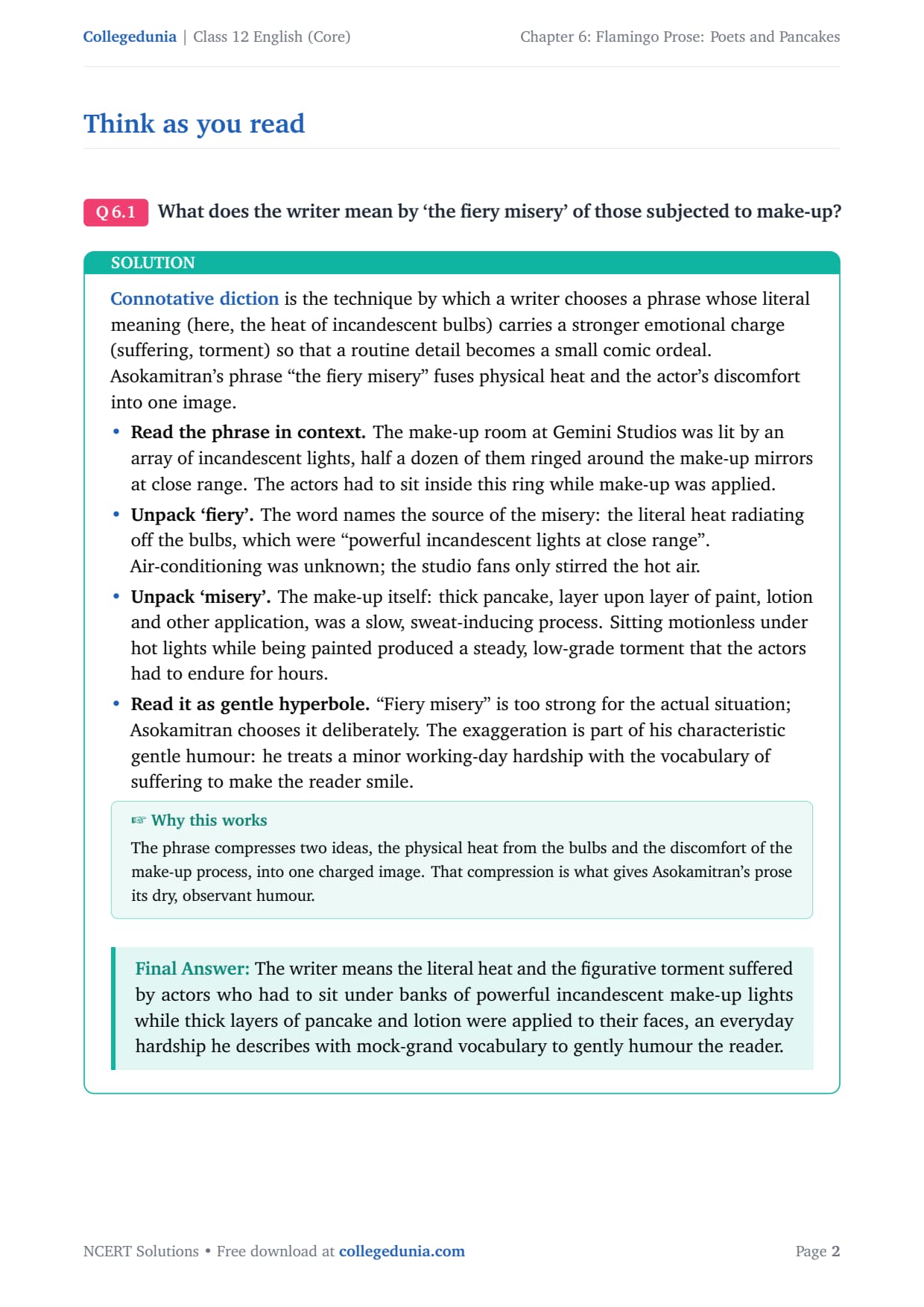
What does the writer mean by `the fiery misery' of those subjected to make-up?
Connotative diction is the technique by which a writer chooses a phrase whose literal meaning (here, the heat of incandescent bulbs) carries a stronger emotional charge (suffering, torment) so that a routine detail becomes a small comic ordeal. Asokamitran's phrase ``the fiery misery'' fuses physical heat and the actor's discomfort into one image.
- Read the phrase in context. The make-up room at Gemini Studios was lit by an array of incandescent lights, half a dozen of them ringed around the make-up mirrors at close range. The actors had to sit inside this ring while make-up was applied.
- Unpack `fiery'. The word names the source of the misery: the literal heat radiating off the bulbs, which were ``powerful incandescent lights at close range''. Air-conditioning was unknown; the studio fans only stirred the hot air.
- Unpack `misery'. The make-up itself: thick pancake, layer upon layer of paint, lotion and other application, was a slow, sweat-inducing process. Sitting motionless under hot lights while being painted produced a steady, low-grade torment that the actors had to endure for hours.
- Read it as gentle hyperbole. ``Fiery misery'' is too strong for the actual situation; Asokamitran chooses it deliberately. The exaggeration is part of his characteristic gentle humour: he treats a minor working-day hardship with the vocabulary of suffering to make the reader smile.
Why this works
The phrase compresses two ideas, the physical heat from the bulbs and the discomfort of the make-up process, into one charged image. That compression is what gives Asokamitran's prose its dry, observant humour.The writer means the literal heat and the figurative torment suffered by actors who had to sit under banks of powerful incandescent make-up lights while thick layers of pancake and lotion were applied to their faces, an everyday hardship he describes with mock-grand vocabulary to gently humour the reader.
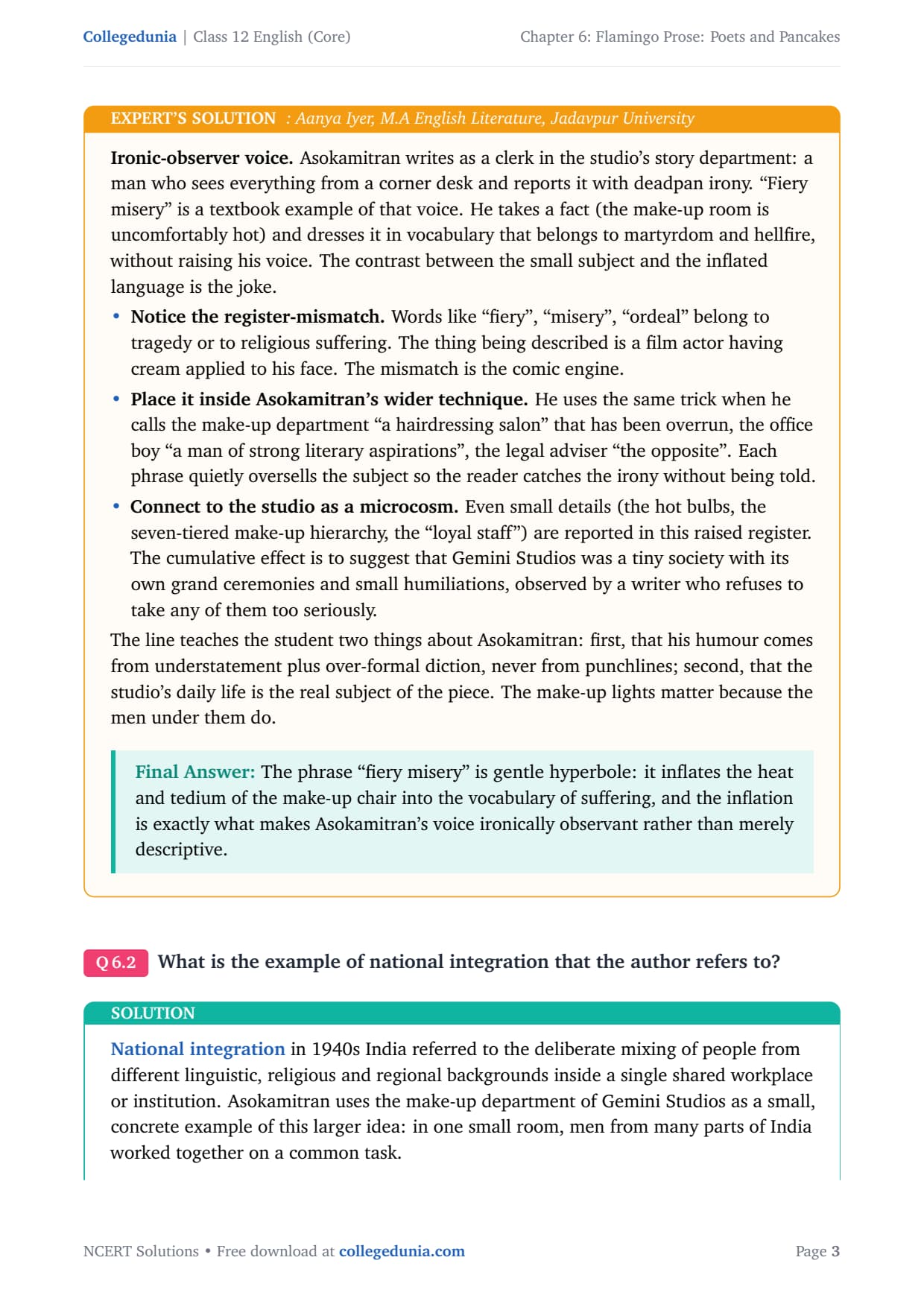
Ironic-observer voice. Asokamitran writes as a clerk in the studio's story department: a man who sees everything from a corner desk and reports it with deadpan irony. ``Fiery misery'' is a textbook example of that voice. He takes a fact (the make-up room is uncomfortably hot) and dresses it in vocabulary that belongs to martyrdom and hellfire, without raising his voice. The contrast between the small subject and the inflated language is the joke.
- Notice the register-mismatch. Words like ``fiery'', ``misery'', ``ordeal'' belong to tragedy or to religious suffering. The thing being described is a film actor having cream applied to his face. The mismatch is the comic engine.
- Place it inside Asokamitran's wider technique. He uses the same trick when he calls the make-up department ``a hairdressing salon'' that has been overrun, the office boy ``a man of strong literary aspirations'', the legal adviser ``the opposite''. Each phrase quietly oversells the subject so the reader catches the irony without being told.
- Connect to the studio as a microcosm. Even small details (the hot bulbs, the seven-tiered make-up hierarchy, the ``loyal staff'') are reported in this raised register. The cumulative effect is to suggest that Gemini Studios was a tiny society with its own grand ceremonies and small humiliations, observed by a writer who refuses to take any of them too seriously.
The line teaches the student two things about Asokamitran: first, that his humour comes from understatement plus over-formal diction, never from punchlines; second, that the studio's daily life is the real subject of the piece. The make-up lights matter because the men under them do.
The phrase ``fiery misery'' is gentle hyperbole: it inflates the heat and tedium of the make-up chair into the vocabulary of suffering, and the inflation is exactly what makes Asokamitran's voice ironically observant rather than merely descriptive.
What is the example of national integration that the author refers to?
National integration in 1940s India referred to the deliberate mixing of people from different linguistic, religious and regional backgrounds inside a single shared workplace or institution. Asokamitran uses the make-up department of Gemini Studios as a small, concrete example of this larger idea: in one small room, men from many parts of India worked together on a common task.
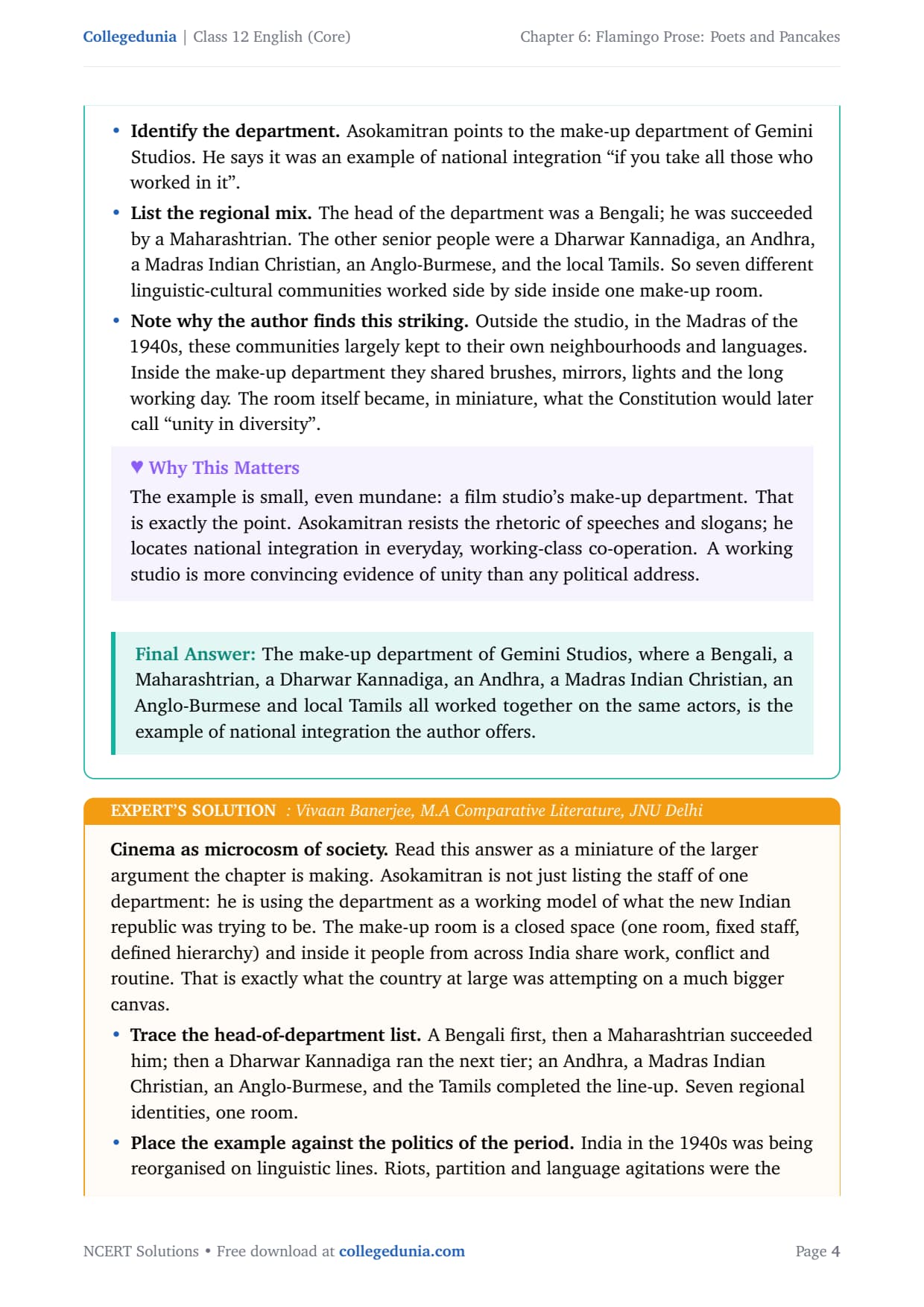
- Identify the department. Asokamitran points to the make-up department of Gemini Studios. He says it was an example of national integration ``if you take all those who worked in it''.
- List the regional mix. The head of the department was a Bengali; he was succeeded by a Maharashtrian. The other senior people were a Dharwar Kannadiga, an Andhra, a Madras Indian Christian, an Anglo-Burmese, and the local Tamils. So seven different linguistic-cultural communities worked side by side inside one make-up room.
- Note why the author finds this striking. Outside the studio, in the Madras of the 1940s, these communities largely kept to their own neighbourhoods and languages. Inside the make-up department they shared brushes, mirrors, lights and the long working day. The room itself became, in miniature, what the Constitution would later call ``unity in diversity''.
The make-up department of Gemini Studios, where a Bengali, a Maharashtrian, a Dharwar Kannadiga, an Andhra, a Madras Indian Christian, an Anglo-Burmese and local Tamils all worked together on the same actors, is the example of national integration the author offers.
Cinema as microcosm of society. Read this answer as a miniature of the larger argument the chapter is making. Asokamitran is not just listing the staff of one department: he is using the department as a working model of what the new Indian republic was trying to be. The make-up room is a closed space (one room, fixed staff, defined hierarchy) and inside it people from across India share work, conflict and routine. That is exactly what the country at large was attempting on a much bigger canvas.
- Trace the head-of-department list. A Bengali first, then a Maharashtrian succeeded him; then a Dharwar Kannadiga ran the next tier; an Andhra, a Madras Indian Christian, an Anglo-Burmese, and the Tamils completed the line-up. Seven regional identities, one room.
- Place the example against the politics of the period. India in the 1940s was being reorganised on linguistic lines. Riots, partition and language agitations were the front-page news. Against that, a workplace where seven communities ran seven layers of one process without obvious friction is evidence: it is the kind of small fact a careful observer notices and reports.
- Read the author's tone. Asokamitran does not gush. He sets the integration down as a quiet matter of fact, and lets the reader notice the implication. That restraint is characteristic: in his prose, big ideas always arrive through small details.
The lesson is one of method as much as of history: in Asokamitran's hands, the make-up department is not a sentimental anecdote but a piece of evidence about how Indians worked together in the years around Independence.
The author's example of national integration is the multi-regional, multi-linguistic staff of the Gemini Studios make-up department, a tiny working model of the unity-in-diversity that the country at large was attempting in the late 1940s.
What work did the `office boy' do in the Gemini Studios?
The label office boy in Indian studios of the 1940s and 1950s did not name an errand-runner. It named a fixed junior post in the production hierarchy with a specific, technical duty. Asokamitran is careful to give the title and then deflate it by showing what the work actually was.
- Identify the department. The office boy worked in the make-up department of Gemini Studios. He was not a peon who carried files or fetched tea.
- State the actual task. His job was to apply a thick, ungainly layer of pancake make-up to the faces of the players who would appear in crowd shots, with the help of a paint-brush. The pancake was a heavy local stuff used for the most casual labour-intensive make-up.
- Note who he worked on. He never worked on the main stars or even on the second-string actors. His clients were the ``players who played the crowd'': the extras whose faces were only ever seen at distance and never in close-up.
- Note the deflating contrast. Despite the grand-sounding title, the office boy's work was mechanical, low-grade and invisible in the finished film. Asokamitran lingers over the gap between the post and the reality.
The office boy's actual work was to apply pancake make-up with a paint-brush to the faces of the crowd players (the extras seen at distance in a scene), a routine, mechanical task done in the make-up department of Gemini Studios.
Quick reading. The question is testing whether the student read the make-up-department passage attentively. The trap is to read ``office boy'' as the generic Indian-office tea-and-files role. Asokamitran has set the trap deliberately: he uses the misleading title and then quietly tells you the real job, so the reader can feel the irony for himself.
- Note the title. The character is called ``office boy'' throughout: capital, grand-sounding, suggesting a clerical post.
- Note the description. His task was applying pancake make-up to crowd players, a labour-intensive job, performed with a paint-brush.
- Note the man. Asokamitran tells us this office boy was no longer young; he was forty when he was meant to be twenty. He carried, on top of the routine work, a strong sense of literary unfulfilment, and he was deeply frustrated with his position. The combination of grand title plus low task plus wounded literary self-image is what produces the next question's ``frustration''.
The English-vs-Tamil cultural dynamic of the studio is also visible here: even an office boy is given an English title, and the English title is then applied to a job that is at bottom Tamil-cinema crowd make-up. The mismatch is part of the chapter's quiet observation about how the studio borrowed Western forms to package Tamil work.
In Gemini Studios, the office boy was, in practice, a junior make-up artist whose specific work was to paste a thick coat of pancake make-up on the faces of crowd players with a paint-brush, his grand title masking a low-status, mechanical task.
Why did the author appear to be doing nothing at the studios?
Asokamitran worked in the Story Department of Gemini Studios. His specific duty was to cut out and file newspaper clippings on a broad range of subjects. That work, though it had to be done in the office, looked from the outside like inactivity: a young man sitting at a desk with scissors and a pile of papers, no obvious output, no telephone, no conferences. The chapter turns on this gap between what his job actually was and what it looked like.
- State his official department. The author was on the rolls of the Story Department of Gemini Studios.
- State the actual task. He had to read several newspapers, cut out items that might be of use to the studio and file them. That was the whole of his daily output.
- Explain why the task looked invisible. The work produced no film footage, no script pages, no songs, no accounts. It produced a growing file. To anyone walking past his cubicle, the author seemed to be sitting and reading newspapers all day, as if at leisure.
- Explain the consequence. Because he ``appeared to be doing nothing'', anyone in the studio who thought he should be given some occupation would walk into his cubicle and start talking at him. The office boy, in particular, treated his cubicle as a venue for his literary lectures.
The author's actual job in the Story Department was reading newspapers and cutting out and filing useful clippings. From outside his cubicle, this looked like idle reading, so the studio assumed he was at leisure and various people, especially the office boy, walked in to fill his ``free'' time with their own concerns.
Structural observation. The author's apparent idleness is not a side detail: it is the structural pivot of the entire chapter. His cubicle becomes the room into which the studio's other characters walk, and each character then gets a small portrait. Without the ``doing nothing'' set-up, the chapter has no organising thread; with it, every vignette has a natural reason to arrive.
- The job. Story-department clipping work: read several newspapers daily, cut out anything that might one day be useful to the studio (anecdotes, news items, names, controversies), and file the cuttings.
- The look of the job. No phone calls, no shooting floor, no manuscript on the desk. Just a pair of scissors, a stack of papers, and a man reading. To the producers, the director, the make-up boys and the legal adviser, this read as leisure.
- The studio's reaction. Because Gemini Studios ran on a culture of constant activity (singers rehearsing, dancers practising, actors being painted), a person who appeared idle was a problem to be solved. Anyone with a free hour and a grievance felt entitled to walk into the author's cubicle and speak.
- The narrative consequence. The author is therefore positioned, by design, as the studio's listener. He sees everyone because everyone comes to him. That is why he is the right person to write this memoir.
The English-vs-Tamil dynamic surfaces here too: the author was educated, literate in English, and given the most ``writerly'' of the studio's jobs, yet the work itself was clerical clipping. That gap produced the silence around his desk, and the silence drew in the studio's talkers.
Asokamitran's real work in the Story Department was the silent, paper-shuffling job of cutting and filing newspaper clippings; because that work produced no visible output, the rest of the studio read his cubicle as a place of leisure, and he was thereby positioned as the involuntary listeners for everyone else's monologues.
Why was the office boy frustrated? Who did he show his anger on?
Displaced anger is the psychological pattern in which a person, unable to confront the real source of his frustration, vents that anger on a safer, weaker or simply more available target. Asokamitran traces exactly this pattern in the office boy: his frustration has a real cause (his stalled writing career and his menial post), but the people he actually shouts at have nothing to do with that cause.
- Trace the source of the frustration. The office boy was a strong-willed man with literary ambitions: he had been a writer of sorts, a poet, a thinker. He felt his great literary talent was being allowed to go waste in a department fit only for paint and brush. He had also expected, given his age and his self-image, a far higher post than the one he held.
- Identify the real targets of his complaint. The real targets were the producers, the directors, the studio bosses and the prevailing system of recognition: the people who had not promoted him and had not published his work.
- Identify the actual recipient of his anger. Instead of taking his grievance to any of those, the office boy directed his anger at Subbu, the famously many-sided assistant to The Boss. The office boy blamed Subbu, by name, for everything that had gone wrong in his career.
- Explain why Subbu in particular. Subbu was the easiest target. He was visibly close to The Boss, he was rapidly recognised and rewarded, and he was a Brahmin who spoke and wrote with charm. To the office boy, who had not been promoted, Subbu was a living rebuke. So the office boy's anger fixed on him.
Don't confuse target and source
The office boy's anger has two layers. The source of the anger is the system that did not promote him; the target of the anger is Subbu, who personifies the system's favouritism. A weak answer names only one of these.The office boy was frustrated because, despite his literary ambitions and his self-image as a writer-poet, he had been given the menial job of pancaking the faces of crowd extras and had been denied the promotion he felt he deserved. He vented this frustration on Kothamangalam Subbu, the favourite assistant of The Boss, whom he saw as the personification of the studio's unjust favouritism.
Strategic angle. The office boy is a small character study in how unrewarded talent turns into resentment, and how that resentment finds the wrong door to knock on. Asokamitran handles him with care: he names the man's gifts (literary ambition, strong opinions, the ability to deliver an ``extended lecture''), then names his post (applying pancake to crowd players), then names the gap between the two. From that gap the office boy's anger follows by simple arithmetic.
- Cause: literary self-image plus menial post plus stalled promotion.
- Effect: a quietly furious man who corners anyone who looks idle.
- Target: Subbu, because Subbu is the most visible beneficiary of the system that has ignored the office boy.
- The unfulfilled writer. The office boy believed his great talent was being squandered in a job that asked nothing of his mind. His epics, he was sure, would have been magnificent if anyone had given him room to write them.
- The stalled promotion. He was forty when he had expected to be a senior officer; he was applying pancake when he had expected to be writing scripts.
- The chosen target. The office boy did not, could not, confront the producers or The Boss directly. So he selected the most accessible villain: Subbu, who was both the closest to the top and the most cheerfully successful. The office boy explained, often and at length, that his failure was Subbu's doing.
- The author's role. Asokamitran, sitting quietly in his story-department cubicle, was a regular captive listeners for these lectures, which is why we now have such a precise record of them.
The cultural reading: the office boy is the studio's version of an old grievance: the Tamil-speaking junior who feels that the English-speaking, English-educated favourites of the management (Subbu wrote in both languages; he was Brahmin, accomplished, mobile) have stolen his rightful place. Asokamitran does not endorse the office boy's reading, but he records it, fairly and exactly.
The office boy was frustrated because his literary ambitions had been wasted in the pancake-painting job and his expected promotion had not arrived; he displaced that anger onto Kothamangalam Subbu, the visibly favoured assistant of The Boss, whom he held responsible by name for every setback in his own career.
Who was Subbu's principal?
In studio hierarchy, ``principal'' refers to the person to whom an employee owes direct loyalty, on whose goodwill his position depends, and whose interests his work serves. For Kothamangalam Subbu, that person was The Boss of Gemini Studios: S. S. Vasan, the founder, owner and head of the studio. Asokamitran is precise about this relationship because the studio's politics turn on it.
- Name the principal. Subbu's principal was The Boss of Gemini Studios. Asokamitran does not name him by surname at first; he simply uses the title.
- Describe the loyalty. Subbu had decided that ``his duty was to be loyal to The Boss''. He used his many talents (writing in Tamil, casting suggestions, story re-shaping, verse-making) entirely in The Boss's service.
- Describe the return. In exchange, Subbu enjoyed easy access to The Boss, a place in the daily power-meetings, and the freedom to direct a film of his own when he wished. He also drew the resentment of other talented men in the studio, which he absorbed without protest.
- Read the larger pattern. The principal-protégé bond between The Boss and Subbu set the political weather of the studio. Other employees calibrated their distance from Subbu by their distance from The Boss.
Quick recall
The Boss = S. S. Vasan, founder of Gemini Studios, also the editor of the Tamil weekly Ananda Vikatan, and a powerful figure in Madras's film and journalism circles.Subbu's principal was The Boss of Gemini Studios (S. S. Vasan), to whom Subbu was unswervingly loyal and on whose patronage his enviable position in the studio depended.
Quick reading. The factual answer is one line: The Boss of Gemini Studios. The interesting answer adds the relationship the question is gesturing at. Subbu was the studio's most visible courtier; The Boss was the court. Naming the principal is therefore also naming the structure of power inside Gemini Studios.
- Surface answer. The Boss, that is, S. S. Vasan, the founder of the studio.
- Texture. Subbu had ``decided'' on this loyalty: it was a conscious career choice, not an accident of posting. He could have served his own writerly ambitions; he chose instead to put his Tamil verse, his casting eye and his problem-solving skill at The Boss's disposal.
- Consequence for Subbu. He was the favourite, with the freedoms and the enemies that come with the post. He was allowed to direct films of his own; he was given air time at The Boss's meetings; and he was, by the office boy and others, blamed for every grievance the studio produced.
- Consequence for the studio. The principal-courtier relationship between Vasan and Subbu fixed the studio's hierarchy. To rise, you needed to be close to one of them. To be ignored, you needed only to displease either.
For the ironic-observer voice in which Asokamitran writes, this is exactly the kind of fact that needs to be stated quietly: a one-line factual answer, with a many-line truth underneath it.
Kothamangalam Subbu's principal was The Boss of Gemini Studios, S. S. Vasan; Subbu had chosen, deliberately, to direct all his many talents into Vasan's service in return for the protected favoured-courtier position he held in the studio.
Subbu is described as a many-sided genius. List four of his special abilities.
A many-sided genius (or polymath) is a person whose talents extend across several distinct domains: in Subbu's case, languages, performance, writing and people-management. Asokamitran scatters Subbu's abilities through several paragraphs; a complete answer collects four of them.
- Versatile film-script writer in Tamil. Subbu could give a film story any required shape. If the producer wanted the story re-set in a flowering garden, he could produce a scene in the garden; if the producer wanted a temple, he could produce a temple scene. His scripts could be re-engineered on demand without losing their charm.
- Accomplished Tamil poet. Subbu could compose verse of a high order in Tamil, but he chose, instead, to write for those who appreciated the easier and more popular forms of writing: the songs, the dialogue, the simple Tamil accessible to the cinema-going public.
- Good actor. Subbu was a good actor in his own right. He never aspired to the lead role but performed character parts and small support roles with skill, sometimes out-performing the hero of the film.
- Devoted helper and people-person. Subbu was always cheerful, always available, always ready with a solution. He had a remarkable ability to make people feel attended to. Anyone in the studio could approach him for help and would be offered it without delay or condition.
Four special abilities of Subbu were: (a) versatile Tamil film-script writer who could re-shape a story to any setting on demand, (b) accomplished poet of literary Tamil who deliberately wrote in the simpler popular Tamil of cinema, (c) able actor in character roles, sometimes out-shining the lead, and (d) cheerful, selfless people-person whom anyone in the studio could approach for help.
Strategic angle. The question wants a list; the answer must give a list, in four distinct buckets, not four overlapping adjectives. The buckets that Asokamitran himself constructs are language, performance, writing and people. A clean answer takes one ability from each bucket.
- Language: Tamil verse and Tamil dialogue, both literary and popular registers.
- Performance: character acting, occasionally upstaging the lead.
- Writing: re-shape-on-demand film stories; sustained verse; song lyrics.
- People: cheerful, supportive, available, friend-of-all in the studio.
- Pick the script-writing ability. Subbu's stories could be re-cast for any setting (a garden, a flowering bush, a temple) without losing dramatic shape. That is the skill of an experienced craftsman, not a literary debutant.
- Pick the poetry ability. He could have produced verse for connoisseurs; he chose, instead, to write for the masses, which is itself a poetic choice with a Gandhian echo in the period.
- Pick the acting ability. Asokamitran says Subbu sometimes acted the supporting role better than the hero played the lead. That is faint but precise praise.
- Pick the people-skill. The chapter is full of anecdotes of Subbu lending a hand, an ear, a piece of useful gossip: he was the studio's friend-in-residence.
The English-vs-Tamil dynamic of Subbu's bilingual writing is worth flagging: he was fluent in English, but he chose Tamil for his public work. That choice quietly distinguishes him from other English-educated studio men who treated Tamil only as a delivery medium.
Subbu's four abilities, neatly listed: (i) Tamil film-script writer of remarkable versatility; (ii) Tamil poet who could write both literary and popular verse; (iii) good character actor; (iv) cheerful, generous people-person whom the whole studio leaned on.
Why was the legal adviser referred to as the opposite by others?
The ``opposite'' nickname is an office in-joke: the legal adviser was officially supposed to advise the studio out of trouble, but in practice his intervention regularly produced the opposite of what was intended. The label sticks because the gap between role and result became a recurring small drama at Gemini Studios.
- State his official post. He was the studio's legal adviser: the man whose job was to give legal counsel that would protect the studio's interests.
- State the famous incident. A talented but slightly nervous actress was once shooting a difficult scene at the studio. During the take, the legal adviser, instead of helping, intervened in a way that flustered the actress further and effectively destroyed her career at Gemini.
- Generalise the pattern. This was not a one-off. Throughout the chapter, the legal adviser is associated with this reverse effect: where help is sought, harm arrives; where caution is asked for, embarrassment follows.
- Conclude with the nickname's logic. Because his consequences were the opposite of his advertised role, the studio's other employees started calling him ``the opposite''. The label was a compact way of saying ``do not rely on this man's intervention''.
The legal adviser was nicknamed ``the opposite'' because his interventions, though meant to be helpful, regularly produced results opposite to those he intended: most famously, an attempt to assist a nervous actress that ended her career at Gemini.
Ironic-observer voice. The nickname is Asokamitran's joke in the studio's own language. The legal adviser is a man with the title that promises help and the record of producing harm; the employees, with their finely tuned office sarcasm, gave him the name that names the gap. Once you see the pattern, you also see why Asokamitran tells the story: it lets him show how Gemini Studios' people privately rated those who held official authority.
- The official identity. Legal adviser to Gemini Studios: a position that should bring care, caution, and the avoidance of unforced errors.
- The actual record. On the talented actress: instead of protecting her, his intervention shook her on set and ended her time at the studio. On other occasions: similar reverse outcomes.
- The studio's verdict. The other employees, who had seen his pattern up close, called him ``the opposite''. Notice the absence of a personal name: in the studio's nicknaming culture, what you do is what you are called.
- The author's reading. Asokamitran does not condemn the legal adviser; he records the verdict that the studio had already reached. That recording is the lesson: in the studio, gossip and humour did the work that formal review does in larger organisations.
There is also a cultural reading: the legal adviser ``wore pants and a tie and sometimes a coat'' (the only one in the studio in Western dress) against a sea of khadi-dhoti-clad colleagues. His foreign self-presentation, in a studio of Gandhi-influenced khadi men, is part of why his interventions felt off-key.
The other employees called the legal adviser ``the opposite'' because his interventions reliably produced the reverse of the help they were supposed to provide, the killing of a promising actress's career being the most quoted instance; the nickname captured both his record and the studio's ironic culture.
What made the lawyer stand out from the others at Gemini Studios?
The Story Department at Gemini Studios was a visually uniform group. Everyone wore the same plain khadi: dhotis, white shirts, an air of post-Independence Gandhian-nationalist conformity. The legal adviser broke that uniformity in both dress and manner, which is what made him visible in the room.
- Describe the studio's prevailing look. Every other member of the Story Department wore a kind of uniform: a khadi dhoti with a slightly oversized and clumsily tailored white khadi shirt. The dress code was Gandhian, simple, national.
- Describe the legal adviser's dress. The legal adviser, by contrast, wore pants and a tie and sometimes a coat. He looked, in that room, like a man who had walked in from a colonial office or a Bombay law chamber.
- Describe his temperament. He was a man of cold logic in a crowd of dreamers: precise, careful, sceptical, where the rest of the room was emotional, theatrical and impressionistic. He was, Asokamitran says, a neutral man in an assembly of Gandhi-ites and khadi-ites.
- State the consequence. In a department where everyone looked and sounded similar, his appearance and his manner made him stand out at first glance. He was a contrast, not a contributor; the others made stories, he made caveats.
Note the contrast
Two contrasts compose the answer: dress (pants-tie-coat vs khadi-dhoti) and temperament (cold logic vs Gandhian dreaming). Both must be named for a full mark.The lawyer stood out at Gemini Studios because he was the only member of the Story Department who wore Western clothes (pants, a tie and sometimes a coat) instead of the standard khadi dhoti-and-shirt, and because his temperament was that of cold, sceptical legal logic in a room otherwise full of Gandhian khadi-clad dreamers.
Picture-first. Imagine the Story Department: a long room, desks pushed together, a dozen men in identical white khadi shirts and dhotis, talking story, arguing tone, half-singing dialogue. Then, in the middle of that frame, one man in pressed trousers, a shirt buttoned to the collar, a tie, occasionally a jacket, head bowed over a legal pad. The image alone answers the question. The lawyer stood out because he visually did not belong.
- The dress contrast. Khadi vs Western. In 1940s Madras, khadi carried political weight: it signalled the Gandhian-nationalist allegiance the studio openly affirmed. The lawyer's pants-and-tie was a quiet declaration that he belonged to a different professional tradition (English common law) with its own dress code.
- The temperament contrast. The Story Department's work was speculative: what if we set this scene in a garden, what if the hero arrives by elephant, what if the villain has a brother. The lawyer's work was deductive: what does the contract say, what is the risk, what is the precedent. The two mental modes coexisted with mild friction.
- The cultural contrast. The room around him was Gandhi-influenced (khadi, simple living, indigenous craft). He was, by training and habit, English-influenced (law, precedent, formal dress). The studio noted the contrast without expelling it; the lawyer was tolerated, even valued, but never absorbed.
- The narrative use. For Asokamitran, the lawyer is the chapter's neutral observer: a man who would tell the story straight if you asked him, where the others would tell it with feeling. The author finds him useful precisely because he stands out.
The English-vs-Tamil cultural dynamic that the chapter has been quietly building reaches a pointed form here: the lawyer's Western dress and Western legal training visibly clash with the studio's Tamil-Gandhi-cinema identity, and the others mark him out for that visible difference.
The lawyer stood out from the rest at Gemini Studios in two reinforcing ways: visually, he was the lone Western-dressed figure (pants, tie, occasional coat) in a room of khadi-clad colleagues; temperamentally, he was a man of cold legal logic adrift in a crowd of Gandhian dreamers.
Did the people at Gemini Studios have any particular political affiliations?
A political affiliation is a public attachment to a party or to an organised political belief. At Gemini Studios in the 1940s, the staff did have visible attachments, but these were diffuse and largely Gandhian: an allegiance of dress, tone, and broad national feeling rather than of party card.
- State the broad alignment. Most members of the Story Department wore khadi, which in the period was the visible badge of Gandhian-nationalist allegiance. Their sympathies leaned that way: pro-Congress, pro-Independence, pro-simple-living.
- Name the specific cluster. Asokamitran calls them ``Gandhi-ites and khadi-ites''. Most of them genuinely admired Gandhi, wore khadi as a daily affirmation, and treated Communist or revolutionary politics with suspicion.
- Note what they were against. They were strongly suspicious of Communism. Their idea of a Communist was ``a godless, hungry, scheming person who would do anything to bring about the downfall of civilised society''. They did not read Communist literature; they read about it from a distance and took fright at what they read.
- Note the consequence for the studio. Because of this cluster of mild Gandhian leanings and strong anti-Communist anxiety, the studio welcomed the visit of the Moral Rearmament Army (MRA), a counter-Communist movement, with unusual enthusiasm. The political mood made the welcome rational.
Recall: Communism in the studio's mind
``Godless, hungry, scheming person who would do anything to bring about the downfall of civilised society'': Asokamitran's near-verbatim summary of how the studio men imagined a Communist without ever meeting one.Yes, the people at Gemini Studios had broad political affiliations: they were mildly Gandhian-nationalist in dress and sympathy (khadi-clad, pro-Independence), and they were strongly suspicious of Communism, an attitude that shaped their warm welcome of the anti-Communist Moral Rearmament Army.
Strategic angle. The question wants a yes-or-no plus a description. The right shape of answer is: yes, with two attachments. (a) A broad Gandhian-nationalist sympathy expressed through khadi and a generally pro-Independence atmosphere. (b) A sharp suspicion of Communism, sustained without much first-hand knowledge. Those two together explain almost every public stance the studio adopted.
- Yes, they had affiliations. The dress code (khadi) was a political statement. So was the studio's pride in being a Madras-Tamil enterprise that could rival Bombay's Hindi cinema. Both were soft-Congress, pro-national.
- The Gandhian half. Khadi shirts and dhotis, simple living, suspicion of Western luxury, occasional donations to nationalist causes. The studio's identity was visibly aligned with the Congress-led freedom movement.
- The anti-Communist half. The studio men feared Communism without studying it. Their image of the Communist was the demonised figure Asokamitran reports: godless, hungry, scheming. This caricature made them receptive to any anti-Communist movement that came calling.
- The visible consequence. The Moral Rearmament Army (MRA), a counter-Communist organisation, was warmly received at Gemini Studios. The studio men were not joining a foreign movement so much as confirming an attitude they already held.
For the ironic observer voice that Asokamitran maintains, the studio's politics is a quiet comedy: men who wore khadi without reading Gandhi very deeply, and who feared Communism without reading Marx at all. The author records both attachments without mocking either.
The people at Gemini Studios were politically attached on two axes: a broad Gandhian-Congress sympathy expressed in their khadi dress and pro-Independence atmosphere, and a strong if ill-informed suspicion of Communism that made them an easy target for the anti-Communist Moral Rearmament Army.
Why was the Moral Rearmament Army welcomed at the Studios?
The Moral Rearmament Army (MRA) was an international movement founded by Frank Buchman in 1938, presented publicly as a campaign for moral renewal but understood at the time as a Cold-War counter-movement to Communism. The studio's welcome of the MRA was driven by three convergent reasons: ideological alignment, professional admiration, and patronage from the Boss.
- Ideological alignment. The Gemini Studios staff were khadi-clad, mildly Gandhian and, almost to a man, anti-Communist in instinct. The MRA was a counter to international Communism. The studio men found in the MRA a movement that confirmed their own anxieties, so the visitors arrived already in sympathy with their hosts.
- Professional admiration. The MRA group of about two hundred members performed two plays in Madras: Jotham Valley and The Forgotten Factor. The plots were simple moral homilies, but the staging, sets, costumes and sunrise/sunset effects were of a high professional standard. For a film studio that lived by stagecraft, this was material worth studying.
- The Boss's patronage. S. S. Vasan, founder of Gemini Studios and a Madras big-business figure, treated the MRA visit as an honour to the studio. When the Boss cleared a shooting stage to host two hundred foreign visitors, the entire staff of six hundred fell in line and attended. The studio always followed the Boss's lead.
- Scale and novelty. Asokamitran observes wryly that hosting two hundred people ``of all hues and sizes of at least twenty nationalities'' was itself a refreshing change from the usual day of slapping make-up on the same Tamil crowd players. The MRA visit was, for the staff, a holiday with a moral backdrop.
Why the welcome was warm
The MRA arrived saying exactly what the studio already believed. Add a stage spectacle that the studio could professionally admire, plus the Boss's clear approval, and the welcome was overdetermined: politics, craft and hierarchy all pulled in the same direction.The Moral Rearmament Army was welcomed at Gemini Studios because the studio staff were instinctively anti-Communist (and the MRA was a counter-Communist movement), because the MRA's two plays Jotham Valley and The Forgotten Factor were professionally produced and worth studying as stagecraft, and because S. S. Vasan, the Boss, personally hosted the visit and the staff followed his lead.
Strategic angle. The question asks for a reason, plural. The strongest answer names three different kinds of reason running together rather than one: an ideological reason (the studio was already anti-Communist), a craft reason (the plays were beautifully staged), and a hierarchical reason (the Boss approved). Strong answers also notice the slight irony that the studio was welcoming a movement it did not fully understand.
- The ideological reason. The studio men's image of Communism was the demonised one Asokamitran records earlier: a godless, scheming person bent on destroying ordered society. An anti-Communist movement was therefore an ally even before it spoke. The MRA's plays delivered the same message, so the studio felt confirmed rather than challenged.
- The craft reason. The MRA's productions Jotham Valley and The Forgotten Factor used a bare stage, a white curtain background, a flute tune, and sunrise-sunset lighting effects. The Tamil drama community was so taken with the technique that for the next few years almost every Tamil play imitated this minimalist sunrise-and-sunset opening. For Gemini, learning the trick was reason enough to attend.
- The hierarchical reason. S. S. Vasan, the Boss, was named in the chapter as a Madras big-business figure who ``simply played into their hands''. When Vasan cleared a shooting stage for the MRA, the rest of the studio understood that attendance was expected. Studio life turned on the Boss's signal, and the signal here was clear.
- The undertone of irony. Asokamitran notes that he only later understood that the MRA was a counter-Communist organisation. The studio men welcomed the movement warmly without fully knowing what they were welcoming, which is part of the chapter's quiet comedy: enthusiastic commitment running ahead of understanding.
The shape of the welcome therefore reflects the shape of the studio itself: deeply hierarchical, mildly political, professionally curious, and ironically self-aware in the author's hands.
The MRA was welcomed for three reinforcing reasons: it was anti-Communist and so matched the studio's instinctive politics; its two plays were professionally staged and the Tamil drama community wanted to learn from them; and S. S. Vasan personally hosted the visit, so the whole staff of six hundred fell in line behind him.
Name one example to show that Gemini studios was influenced by the plays staged by MRA.
Stagecraft influence means that one production's design choices: lighting, set, sound, blocking, are borrowed by other productions because they were visually effective. Asokamitran provides one very specific instance from the MRA visit: the imitation of the sunrise-and-sunset opening of Jotham Valley.
- Identify the original design. Jotham Valley, the MRA play, opened on a bare stage with a white curtain background. A flute tune played as the lighting slowly changed to suggest sunrise; later in the play the same device suggested sunset. The technique was simple, atmospheric, and cheap to stage.
- Identify the borrowing. For the next few years after the MRA visit, almost every Tamil play that opened in Madras carried a scene of sunrise and sunset done in this exact manner: bare stage, white curtain, flute tune, slow lighting change. The borrowing was widespread enough that Asokamitran writes about it as if it had become a regional convention.
- Locate Gemini in this. Gemini Studios, as the most influential film-producing house in Madras, was at the centre of this Tamil dramatic community. Its writers, poets and play-watchers absorbed the technique and transmitted it further. The studio's daily admiration of stagecraft made it the natural conduit for the influence.
Recall: the exact technique
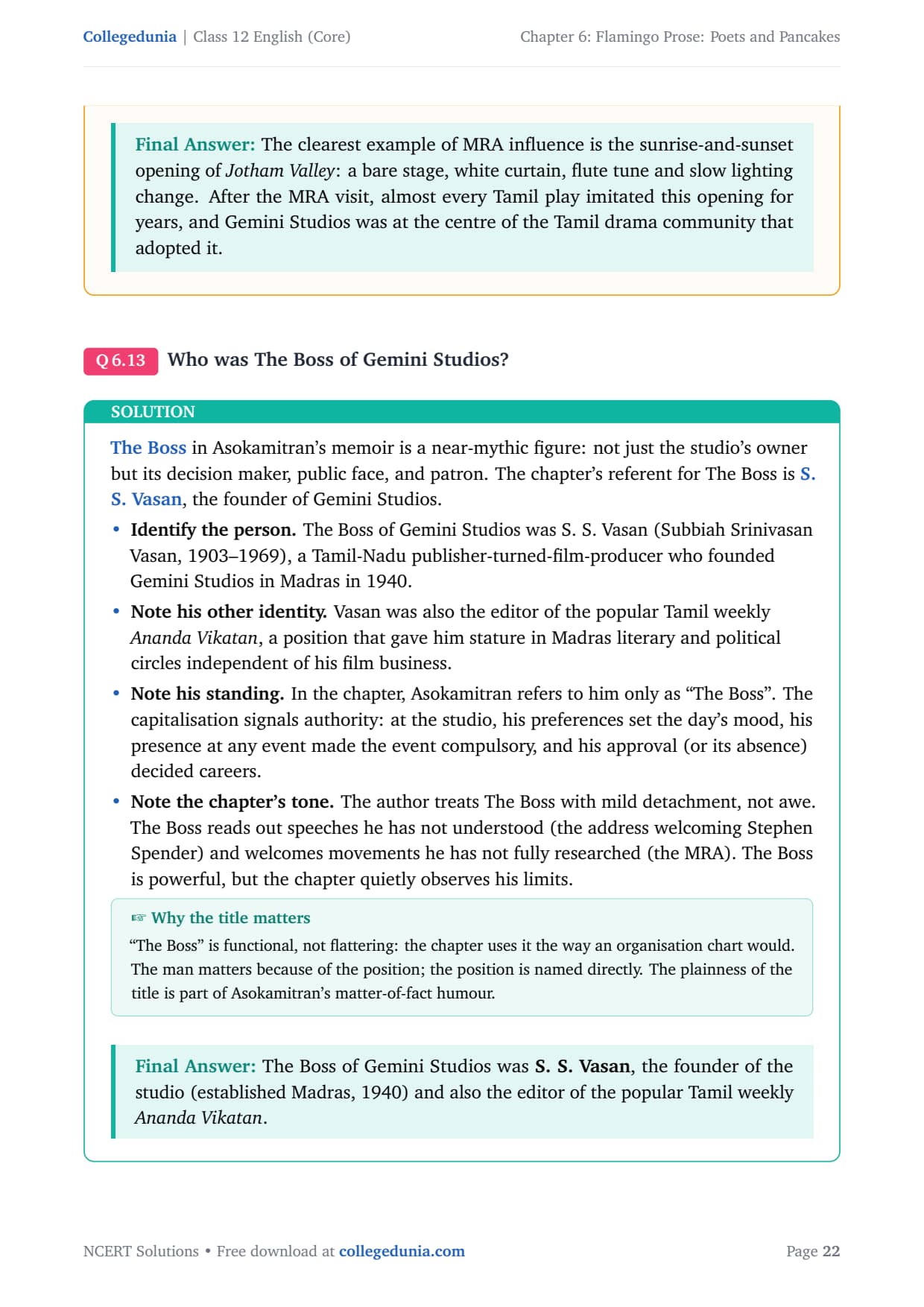
Bare stage. White curtain at the back. A flute tune. Lights changing slowly from dim to bright to dim again. That is the entire sunrise-and-sunset device borrowed from Jotham Valley.One clear example of MRA influence on Gemini Studios and the wider Tamil drama community is that for some years after the MRA visit, almost every Tamil play opened with a sunrise-and-sunset scene staged exactly in the manner of Jotham Valley: a bare stage, a white background curtain, a flute tune, and slow lighting changes.
Quick reading. The question asks for one example. Pick the most concrete one, name it precisely, then trace exactly which design elements were imitated. Vague answers (``Tamil plays copied them'') lose marks; the answer wants the specific stagecraft.
- Name the play. The MRA staged two plays in Madras: Jotham Valley and The Forgotten Factor. The borrowed device belongs to Jotham Valley.
- Name the device. Sunrise and sunset on stage, produced by four design choices working together: (a) a bare stage, (b) a plain white background curtain, (c) a single flute tune, (d) a slow lighting change.
- Name the imitation. For some years after the MRA visit, nearly every Tamil play opened with the same sunrise-and-sunset scene built from the same four design choices. The imitation was conscious and faithful.
- Place Gemini at the centre. Gemini Studios was the Madras hub of the Tamil drama community: writers, poets and crowd of staff actively followed the new stagecraft. The influence flowed through Gemini outwards.
The example matters because it shows that the MRA visit, although politically motivated, had a measurable craft consequence on Tamil theatre. The studio learned a technique and the technique spread.
The clearest example of MRA influence is the sunrise-and-sunset opening of Jotham Valley: a bare stage, white curtain, flute tune and slow lighting change. After the MRA visit, almost every Tamil play imitated this opening for years, and Gemini Studios was at the centre of the Tamil drama community that adopted it.
Who was The Boss of Gemini Studios?
The Boss in Asokamitran's memoir is a near-mythic figure: not just the studio's owner but its decision maker, public face, and patron. The chapter's referent for The Boss is S. S. Vasan, the founder of Gemini Studios.
- Identify the person. The Boss of Gemini Studios was S. S. Vasan (Subbiah Srinivasan Vasan, 1903–1969), a Tamil-Nadu publisher-turned-film-producer who founded Gemini Studios in Madras in 1940.
- Note his other identity. Vasan was also the editor of the popular Tamil weekly Ananda Vikatan, a position that gave him stature in Madras literary and political circles independent of his film business.
- Note his standing. In the chapter, Asokamitran refers to him only as ``The Boss''. The capitalisation signals authority: at the studio, his preferences set the day's mood, his presence at any event made the event compulsory, and his approval (or its absence) decided careers.
- Note the chapter's tone. The author treats The Boss with mild detachment, not awe. The Boss reads out speeches he has not understood (the address welcoming Stephen Spender) and welcomes movements he has not fully researched (the MRA). The Boss is powerful, but the chapter quietly observes his limits.
Why the title matters
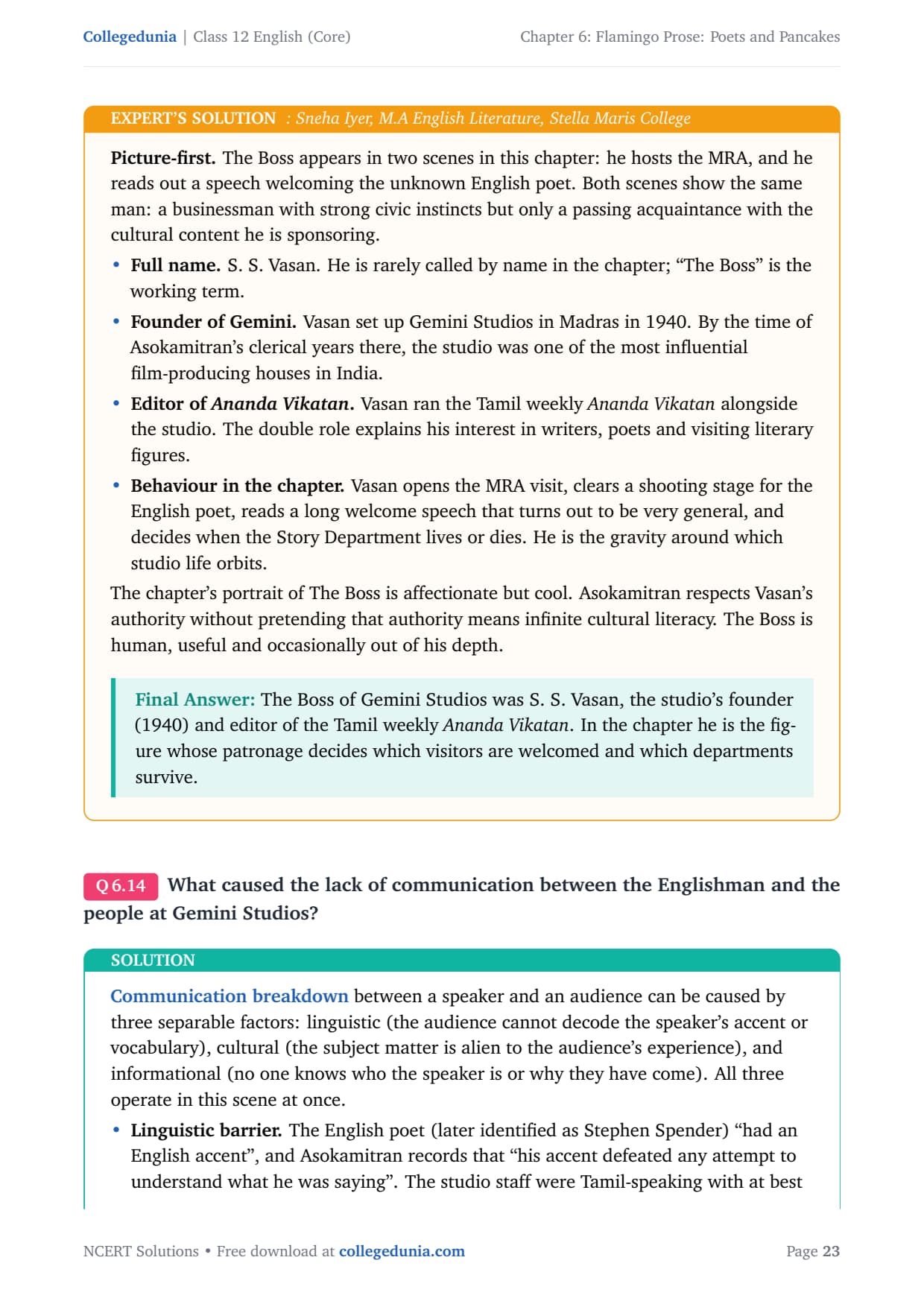
``The Boss'' is functional, not flattering: the chapter uses it the way an organisation chart would. The man matters because of the position; the position is named directly. The plainness of the title is part of Asokamitran's matter-of-fact humour.The Boss of Gemini Studios was S. S. Vasan, the founder of the studio (established Madras, 1940) and also the editor of the popular Tamil weekly Ananda Vikatan.
Picture-first. The Boss appears in two scenes in this chapter: he hosts the MRA, and he reads out a speech welcoming the unknown English poet. Both scenes show the same man: a businessman with strong civic instincts but only a passing acquaintance with the cultural content he is sponsoring.
- Full name. S. S. Vasan. He is rarely called by name in the chapter; ``The Boss'' is the working term.
- Founder of Gemini. Vasan set up Gemini Studios in Madras in 1940. By the time of Asokamitran's clerical years there, the studio was one of the most influential film-producing houses in India.
- Editor of Ananda Vikatan. Vasan ran the Tamil weekly Ananda Vikatan alongside the studio. The double role explains his interest in writers, poets and visiting literary figures.
- Behaviour in the chapter. Vasan opens the MRA visit, clears a shooting stage for the English poet, reads a long welcome speech that turns out to be very general, and decides when the Story Department lives or dies. He is the gravity around which studio life orbits.
The chapter's portrait of The Boss is affectionate but cool. Asokamitran respects Vasan's authority without pretending that authority means infinite cultural literacy. The Boss is human, useful and occasionally out of his depth.
The Boss of Gemini Studios was S. S. Vasan, the studio's founder (1940) and editor of the Tamil weekly Ananda Vikatan. In the chapter he is the figure whose patronage decides which visitors are welcomed and which departments survive.
What caused the lack of communication between the Englishman and the people at Gemini Studios?
Communication breakdown between a speaker and an listeners can be caused by three separable factors: linguistic (the listeners cannot decode the speaker's accent or vocabulary), cultural (the subject matter is alien to the listeners's experience), and informational (no one knows who the speaker is or why they have come). All three operate in this scene at once.
- Linguistic barrier. The English poet (later identified as Stephen Spender) ``had an English accent'', and Asokamitran records that ``his accent defeated any attempt to understand what he was saying''. The studio staff were Tamil-speaking with at best functional English; the speaker's accent put even his sentence-level meaning beyond reach.
- Cultural barrier. The poet spoke about ``the thrills and travails of an English poet''. The staff's cultural reference points were Tamil cinema, Madras politics and Gandhian nationalism. The world of English modernist poetry, its little magazines, its debates over free verse, was outside their working experience. They could not connect the lecture to anything they knew.
- Informational barrier. The listeners did not know who the visitor was. They had been told he was a poet from England; even The Boss's introductory speech showed that he too ``knew precious little about the poet''. Without a known identity to anchor the talk, the staff could not even use cues like ``this is the man who wrote X'' to follow the drift.
- Mood barrier. The room had pedestal fans rather than air conditioning, the listeners was already restless, and the speech ran over an hour. By the end, even the speaker looked baffled. The conditions of the room amplified every other barrier.
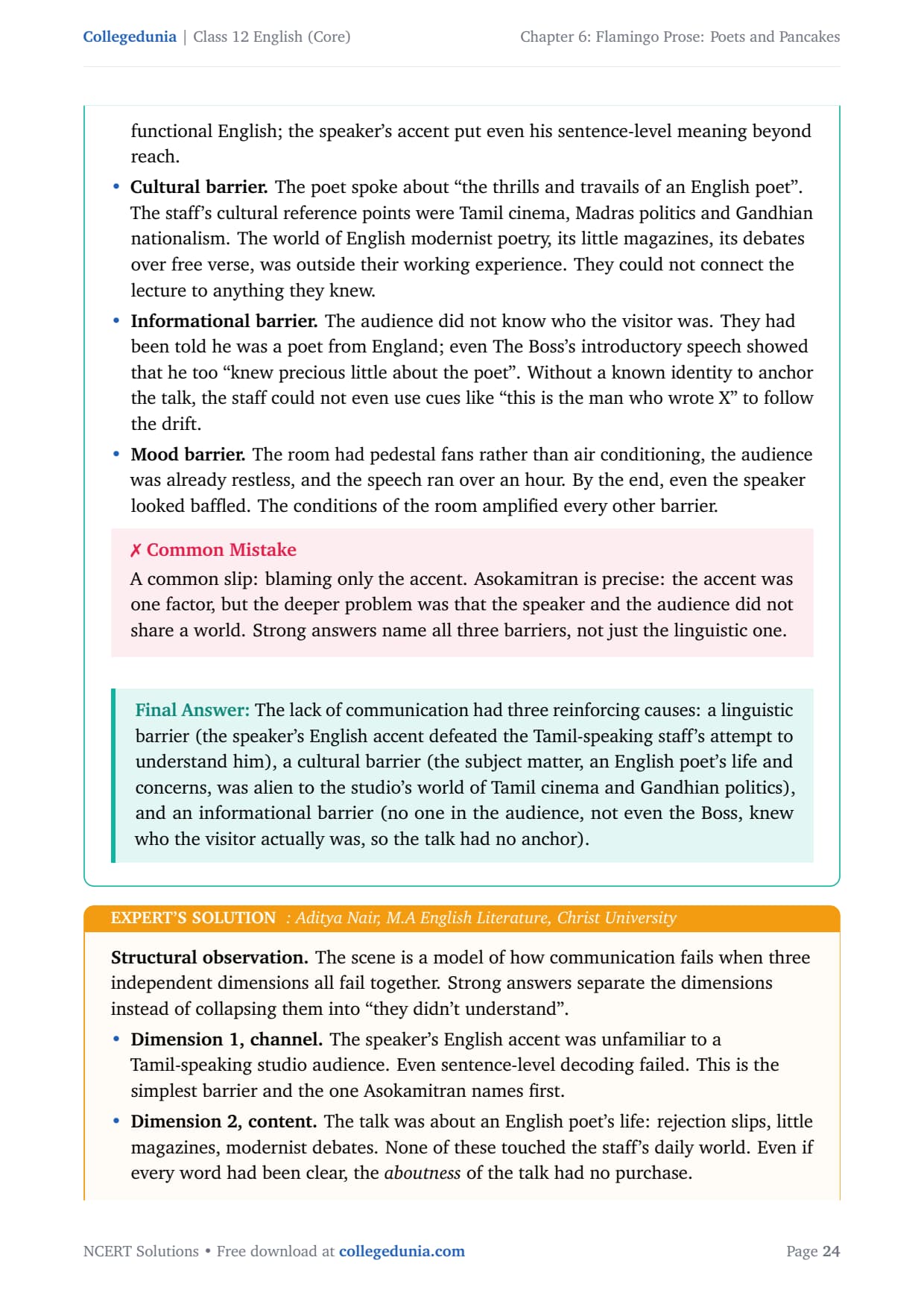
The lack of communication had three reinforcing causes: a linguistic barrier (the speaker's English accent defeated the Tamil-speaking staff's attempt to understand him), a cultural barrier (the subject matter, an English poet's life and concerns, was alien to the studio's world of Tamil cinema and Gandhian politics), and an informational barrier (no one in the listeners, not even the Boss, knew who the visitor actually was, so the talk had no anchor).
Structural observation. The scene is a model of how communication fails when three independent dimensions all fail together. Strong answers separate the dimensions instead of collapsing them into ``they didn't understand''.
- Dimension 1, channel. The speaker's English accent was unfamiliar to a Tamil-speaking studio listeners. Even sentence-level decoding failed. This is the simplest barrier and the one Asokamitran names first.
- Dimension 2, content. The talk was about an English poet's life: rejection slips, little magazines, modernist debates. None of these touched the staff's daily world. Even if every word had been clear, the aboutness of the talk had no purchase.
- Dimension 3, identity. The studio did not know whether the visitor was a poet, an editor, or both. They had ruled out the editors of the big London papers but guessed wrong about everything else. Without an identity, the talk could not be framed. (Later, the author recognises him as Stephen Spender, editor of The Encounter.)
- Dimension 4, physical setting. The speech took place on a shooting stage under pedestal fans, lasted an hour, and ended with the speaker himself looking baffled. The setting amplified every other failure.
Asokamitran's narrative does not blame either side. The Englishman came in good faith; the studio listened in good faith; the mismatch was structural. That structural mismatch, language plus content plus identity plus setting, is the answer.
The communication failed on four dimensions at once: the accent was unfamiliar (channel), the subject of English poetry was alien to a Tamil-cinema listeners (content), no one knew who the speaker was (identity), and the physical setting (shooting stage, fans, hour-long speech) magnified every other barrier.
Why is the Englishman's visit referred to as unexplained mystery?
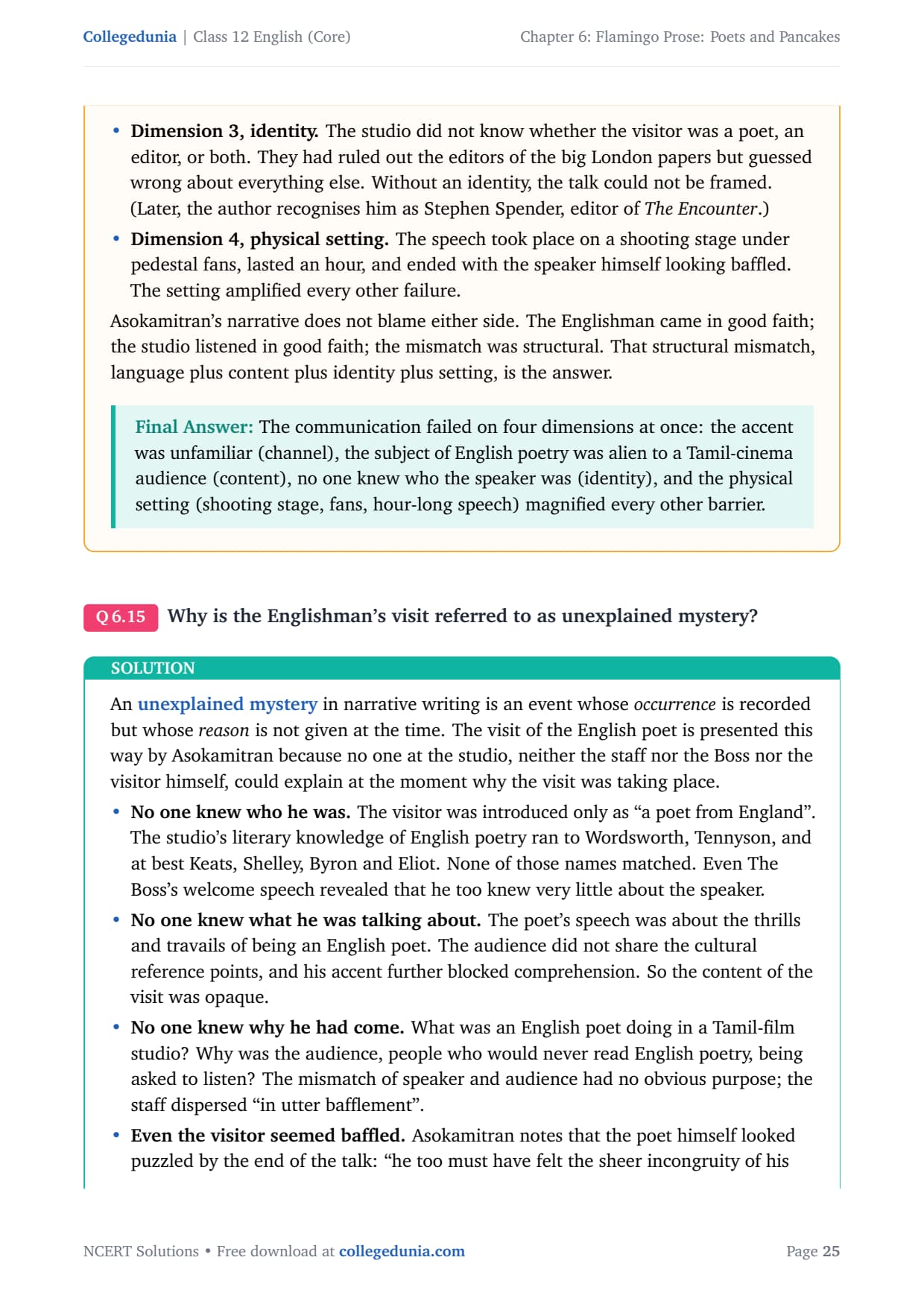
An unexplained mystery in narrative writing is an event whose occurrence is recorded but whose reason is not given at the time. The visit of the English poet is presented this way by Asokamitran because no one at the studio, neither the staff nor the Boss nor the visitor himself, could explain at the moment why the visit was taking place.
- No one knew who he was. The visitor was introduced only as ``a poet from England''. The studio's literary knowledge of English poetry ran to Wordsworth, Tennyson, and at best Keats, Shelley, Byron and Eliot. None of those names matched. Even The Boss's welcome speech revealed that he too knew very little about the speaker.
- No one knew what he was talking about. The poet's speech was about the thrills and travails of being an English poet. The listeners did not share the cultural reference points, and his accent further blocked comprehension. So the content of the visit was opaque.
- No one knew why he had come. What was an English poet doing in a Tamil-film studio? Why was the listeners, people who would never read English poetry, being asked to listen? The mismatch of speaker and listeners had no obvious purpose; the staff dispersed ``in utter bafflement''.
- Even the visitor seemed baffled. Asokamitran notes that the poet himself looked puzzled by the end of the talk: ``he too must have felt the sheer incongruity of his talk''. When the speaker himself cannot explain why he is there, the mystery is genuine.
- Resolution comes much later. Years later, the author bought a copy of The God That Failed for fifty paise and saw Stephen Spender's name as one of the six contributors. Only then did the visit make sense: the Boss had welcomed Spender not as a poet but as a fellow anti-Communist voice. At the moment of the visit, none of this was visible.
The shape of the irony
The mystery is layered. The studio staff did not know. The Boss did not know. The speaker himself did not know why he was there. Asokamitran did not know either, until much later, when a footpath book sale solved it. The chapter shows how a piece of social history can take a decade to become legible.The Englishman's visit is called an unexplained mystery because at the moment it happened no one could account for it: the studio staff did not know who the visitor was, his accent and subject matter blocked understanding, the purpose of the visit was unclear (an English poet addressing a Tamil-film studio listeners), and even the visitor himself looked baffled. Only years later, when Asokamitran encountered Spender's name in The God That Failed, did the visit's anti-Communist context become visible.
Strategic angle. The phrase ``unexplained mystery'' has two parts. Strong answers explain why the visit was a mystery (no one could account for it) and why it went unexplained for so long (the resolution did not arrive until years later through an unrelated book purchase).
- Mystery: identity. The listeners did not know who the speaker was. The studio's mental list of English poets (Wordsworth, Tennyson, Keats, Shelley, Byron, Eliot) did not include him. Without a name, the visit had no anchor.
- Mystery: purpose. A Tamil film studio was hosting an English poet who spoke about the troubles of writing English poetry. The listeners was people whose lives least afforded the possibility of cultivating a taste for English verse. The purpose was opaque on both sides.
- Mystery: comprehension. The poet's accent blocked decoding. The hour-long speech ended with everyone dispersing in bafflement, including the poet himself.
- Unexplained: the time gap. The chapter's structural joke is that the answer arrived years later by accident. Asokamitran picked up a copy of The God That Failed for fifty paise on the footpath outside the Madras Mount Road Post Office. Seeing Stephen Spender listed among the six ex-Communist contributors, the author finally understood: the Boss had hosted Spender not for his poetry but for his anti-Communist credentials. Until that book turned up, the visit had no explanation.
The chapter therefore presents the visit twice: once in real time as a mystery, and once retrospectively as a piece of Cold-War cultural history. The phrase ``unexplained mystery'' marks the moment before the second understanding arrived.
The visit is called an unexplained mystery because at the time of its happening no one, staff, Boss, listeners or even the speaker himself, could explain why an English poet was addressing a Tamil-film studio. The explanation surfaced years later when Asokamitran read The God That Failed and saw Spender's name among the ex-Communist contributors, revealing the Cold-War anti-Communist context of the welcome.
Who was the English visitor to the studios?
The English visitor to Gemini Studios is identified by the author, after a long delay, as Stephen Spender (1909–1995): the English poet, essayist and critic best known for his association with the W. H. Auden generation of the 1930s and for his later editorship of The Encounter magazine.
- Identify the visitor. The visitor was Stephen Spender. The chapter does not name him at the moment of the visit; the studio listeners only knows that he is ``a poet from England''. The footnote in the NCERT text confirms the identification.
- Note his literary identity. Spender was a poet of the 1930s Auden group, well known in Britain for poems on social injustice, the Spanish Civil War, and class struggle. He is the author of well-known poems on social themes and a verse-line easy to recognise once one has read it.
- Note his editorial identity. By the time of his Madras visit Spender was also the editor of The Encounter, a British literary magazine partly financed (the author later realises) by Cold-War anti-Communist interests. It is in this editorial capacity that the author identifies him later, on the footpath outside the Madras Mount Road Post Office.
- Note his political identity. Spender was one of six writers who contributed to The God That Failed (1949), a collection of essays describing each author's youthful enthusiasm for Communism and his later disillusioned departure from it. This anti-Communist credential, the author concludes, is what made him a natural guest at the Gemini Studios of S. S. Vasan.
Recall: three identities of one man
The English visitor was simultaneously: (a) a poet of the Auden generation, (b) editor of The Encounter, and (c) one of the six contributors to The God That Failed. Asokamitran identifies him through identity (c).The English visitor to Gemini Studios was Stephen Spender: an English poet of the 1930s Auden generation, editor of the British literary magazine The Encounter, and one of the six contributors to the anti-Communist essay collection The God That Failed.
Quick reading. The question wants a name, but a strong answer gives the three identities the chapter eventually pieces together: poet, editor, ex-Communist. Each identity matters for a different scene.
- Name him. Stephen Spender. Born 1909, died 1995, English. The NCERT footnote confirms this.
- Poet identity. A member of the so-called Auden generation of the 1930s. His poetry treats social injustice, the Spanish Civil War, and the lives of working people. The studio knew none of this.
- Editor identity. Editor of The Encounter, a respected British literary magazine. Asokamitran discovered this on his own, after the visit, when he picked up the magazine at the British Council Library while preparing to submit a short story to one of its contests.
- Ex-Communist identity. A contributor to The God That Failed, a 1949 collection in which six former Communists describe their journey into and out of the Party. This third identity is the key to the chapter's puzzle: it explains why S. S. Vasan and the anti-Communist studio circle welcomed him so warmly, even though they could not understand a word of his actual talk.
The chapter is, in this sense, a small detective story. Three clues, picked up at three different times and places, slowly identify one man and one motive.
The English visitor was Stephen Spender, an English poet, editor of The Encounter and one of the six ex-Communist contributors to The God That Failed: the poet identity explains the studio's confusion, the editor identity explains how Asokamitran later recognised him, and the ex-Communist identity explains why the Boss welcomed him in the first place.
How did the author discover who the English visitor to the studios was?
Identification by chance is a narrative device in which a previously mysterious figure is recognised through an unrelated later encounter. Asokamitran identifies Stephen Spender through two unrelated discoveries spaced years apart: first as the editor of The Encounter, later as a contributor to The God That Failed.
- First step: The Encounter short-story contest. The Hindu carried a small announcement of a short-story contest run by a British periodical called The Encounter. Asokamitran wanted to enter but first wanted to see the magazine. He visited the British Council Library, where copies of The Encounter lay around almost untouched. On opening one, he saw the editor's name and ``heard a bell ringing'': it was the same Stephen Spender who had visited Gemini Studios. The first piece of the puzzle was now in place: the English poet of the studio visit was the editor of The Encounter.
- Second step: a footpath book sale. Years later, after Asokamitran had left Gemini Studios, he was walking down Mount Road in Madras and came across a footpath pile of brand-new paperbacks selling at fifty paise each. They were all copies of the same book: The God That Failed. He picked up a copy and read the list of contributors: Andre Gide, Richard Wright, Ignazio Silone, Arthur Koestler, Louis Fischer, and Stephen Spender.
- Third step: the moment of recognition. Seeing Spender's name on the contents page of an anti-Communist essay collection sponsored by an American publisher (and marked as part of the 50th anniversary of the Russian Revolution) was the moment everything fell into place for the author. The studio visit, the Boss's enthusiasm, the otherwise inexplicable invitation, all now made sense in the Cold War's anti-Communist cultural diplomacy.
The chapter's quiet method
Asokamitran does not investigate. He simply walks into a library, then walks past a footpath bookstall, and the mystery solves itself. The chapter's gentle conclusion is that history sometimes reveals itself through unrelated small acts: opening a magazine, picking up a discount paperback.The author discovered the English visitor's identity in two unrelated chance encounters: first, in the British Council Library while researching The Encounter for a short-story contest he learned that Stephen Spender was its editor; second, years later on a Mount Road footpath sale he found The God That Failed and saw Spender's name among its six ex-Communist contributors, which finally explained why the studio had welcomed him.
Structural observation. The discovery is staged in two separate, small, almost accidental scenes. The chapter's irony is that the mystery of an elaborate studio visit is finally cracked by two casual acts: opening a magazine in a quiet library, and picking up a paperback off a pavement.
- Scene 1: the library, identity step 1. The Hindu had announced a short-story contest by a British periodical called The Encounter. Asokamitran went to the British Council Library to inspect the magazine. The editor's name was Stephen Spender. The author writes: ``I heard a bell ringing in my shrunken heart''. He now knew that the Gemini Studios visitor was the editor of The Encounter, but did not yet know why he had come.
- Scene 2: Mount Road footpath, identity step 2. Years after leaving Gemini Studios, the author walked past a footpath book sale outside the Madras Mount Road Post Office. A stack of brand-new paperbacks at fifty paise each turned out to be copies of The God That Failed, a 1949 collection of six essays in which former Communists described their journeys into and out of the Party.
- Scene 3: the recognition. Reading the contents page, Asokamitran saw the six names: Gide, Wright, Silone, Koestler, Fischer, and Stephen Spender. The studio visit suddenly became legible: Vasan had welcomed Spender not for his poetry but for his anti-Communist credentials.
- Scene 4: the Cold War reframe. The book was marked as a ``Special low-priced student edition, in connection with the 50th Anniversary of the Russian Revolution'', a tell-tale sign of Cold-War cultural diplomacy. The studio visit was now revealed as one node in a larger anti-Communist programme that quietly used literary celebrities.
The discovery itself is humble, two unplanned encounters with print, but the implication is large: the chapter shows how ordinary people eventually piece together the politics of their own time from scraps of unrelated material.
Asokamitran discovered the visitor's identity in two chance steps: first, while inspecting The Encounter at the British Council Library for a short-story contest, he saw Stephen Spender's name as editor; later, on a Mount Road footpath book sale he picked up The God That Failed and saw Spender's name again among the six ex-Communist contributors, finally explaining the studio visit as Cold-War cultural diplomacy.
What does The God that Failed refer to?
The God That Failed is the title of a 1949 collection of six autobiographical essays edited by Richard Crossman, in which six well-known writers and intellectuals described their initial attraction to Communism and their later disillusioned departure from it. ``The god that failed'' is a metaphor: the writers had treated Communism as a substitute religion, and the religion had let them down.
- The book. The God That Failed is a 1949 anthology of six essays. The title alludes to the biblical phrase about idols that cannot save: Communism is presented as a 20th-century idol that promised deliverance and did not deliver.
- The six contributors. The six writers are Andre Gide (French, Nobel Prize 1947), Richard Wright (American novelist of Native Son), Ignazio Silone (Italian, founder member of the Italian Communist Party), Arthur Koestler (Hungarian-British novelist of Darkness at Noon), Louis Fischer (American journalist and biographer of Gandhi), and Stephen Spender (English poet, editor of The Encounter).
- The argument. Each contributor describes ``their journeys into Communism and their disillusioned return''. The essays are personal, not theoretical: each author explains what drew them in (typically, hope for justice and an end to fascism) and what drove them out (the Moscow trials, Stalinist repression, the Hitler-Stalin pact, individual betrayals).
- The Cold-War significance. The God That Failed was a key text of early Cold-War anti-Communist cultural politics. It gave people in the West a moral and personal vocabulary in which to reject Communism, not just a political one. Its republication as a cheap student edition for the 50th anniversary of the Russian Revolution is part of this propaganda history.
- Its place in this chapter. For Asokamitran, the book is the key that unlocks the mystery of Stephen Spender's visit to Gemini Studios. The Boss had welcomed Spender not as a poet but as a fellow anti-Communist voice. The chapter's last line, ``The Boss of the Gemini Studios may not have much to do with Spender's poetry. But not with his god that failed'', clinches this reading.
Recall: title as metaphor
``Failed God'' = Communism considered as an idol that promised salvation and did not deliver. The six contributors each describe how they once worshipped at the idol and how they walked away.The God That Failed refers to a 1949 essay collection in which six writers, Andre Gide, Richard Wright, Ignazio Silone, Arthur Koestler, Louis Fischer and Stephen Spender, each described their personal journey into Communism and their later disillusioned departure from it. Communism is the ``god'' that ``failed''. In the chapter, the book is the clue that finally explains why the Boss welcomed Spender at Gemini Studios: not for his poetry, but for his anti-Communist credentials.
Strategic angle. The question wants two things: the literal reference (a specific 1949 book), and the figurative reference (Communism as a failed religion). Strong answers also locate the book in the chapter's argument: the book is what makes the Spender visit finally legible.
- The literal. A 1949 essay collection edited by Richard Crossman; six contributors describe their journeys into and out of the Communist Party.
- The six. Andre Gide, Richard Wright, Ignazio Silone, Arthur Koestler, Louis Fischer, Stephen Spender. Each contributed a personal essay; each had been a committed Communist or Communist-sympathiser at some point; each had broken with the movement by the time of writing.
- The figurative. The title is a metaphor for Communism as a substitute religion. The contributors argue that Communism had been worshipped with the kind of total commitment usually reserved for faith; they had treated it as a god; and the god had failed them through Stalinist betrayals.
- The chapter's use. Asokamitran picks up the book on a Mount Road footpath for fifty paise and sees Spender's name among the contributors. This single contents page reveals what the studio could never have worked out at the time: that Spender's visit to Gemini was part of a larger anti-Communist cultural diplomacy which used literary figures as Cold-War ambassadors.
- The closing irony. The Boss did not understand Spender's poetry, but he understood Spender's politics very well, because the politics were already his own. The chapter's last image, the book under the words ``50th Anniversary of the Russian Revolution'', makes the irony complete.
For the careful reader, the book is the chapter's interpretive key. Until The God That Failed appears, the studio scenes look like a comic miscommunication; after it appears, they look like a small piece of Cold War cultural history.
The God That Failed refers to a 1949 collection of six autobiographical essays (by Gide, Wright, Silone, Koestler, Fischer and Spender) describing the contributors' attraction to and subsequent disillusionment with Communism: Communism is the god that failed. In the chapter, the book is the clue that finally explains the otherwise mysterious welcome that Gemini Studios extended to Spender.
Understanding the text
The author has used gentle humour to point out human foibles. Pick out instances of this to show how this serves to make the piece interesting.
Gentle humour is a comic mode in which the writer notices a person's weaknesses (vanities, self-importance, professional anxieties) without ridicule. The weakness is observed kindly, often in passing, and the reader recognises the human truth without losing sympathy for the subject. Asokamitran is a master of this mode; the chapter is built almost entirely of such miniatures.
- The make-up department. The chapter opens by listing the regional origins of the make-up crew: a Bengali, a Maharashtrian, a Dharwar Kannadiga, an Andhra, a Madras Indian Christian, an Anglo-Burmese, and the usual local Tamils. Asokamitran dryly observes that ``there was a great deal of national integration long before A.I.R. and Doordarshan began broadcasting programmes on national integration''. The official rhetoric of nationhood is gently set against the lived reality of a Madras film studio.
- The make-up itself. The men, the author writes, ``could turn any decent-looking person into a hideous crimson hued monster''. The chapter's humour does not mock the actors; it notices the absurdity of the professional system that required them to be made ugly in order to look ``presentable in the movie''.
- The office boy. A man in his forties is called an ``office boy'' because that is the studio's title for crowd make-up workers. The chapter's humour sits in the word boy: the title declares him junior even though his life has already gone past him. Asokamitran names the absurdity without raising his voice.
- The author's own work. The author writes that people walking past his cubicle and seeing him ``tearing up newspapers day in and day out'' thought he was doing next to nothing. The humour is self-directed: the author admits his job looked pointless even to him.
- The legal adviser. Officially the legal adviser, ``everybody referred to him as the opposite''. In one sentence the author captures the studio's communal sense of humour: the lawyer is the one who, by silencing an actress, ended her career. The joke is dark but not cruel.
- The poets and Communism. The khadi-clad poets who imagined a Communist as ``a godless, hungry, scheming person'' are observed with patient irony: people who feared a movement they had never read.
- The English poet's visit. The longest comic set piece: an English poet addresses a Tamil-cinema listeners about the troubles of writing English poetry, both sides equally puzzled. The humour is structural: the scene is funny because of the setup, not because anyone is mocked.
Why this works
The humour is interesting because it spares no one and demeans no one. Author, Boss, office boy, lawyer, poets, visiting Englishman: all are observed with the same kindly attention. The reader is invited to recognise the foibles rather than to laugh at the people. The interest is moral as much as comic.The chapter's gentle humour appears in at least seven specific places: the multi-regional make-up crew presented as ``national integration before Doordarshan''; the make-up men turning actors into ``hideous crimson hued monsters''; a forty-year-old crowd-make-up worker still called ``office boy''; the author's own job of ``tearing up newspapers day in and day out''; a legal adviser who is named ``the opposite''; khadi-clad poets who fear a Communism they have never read; and the hour-long English-poetry lecture to a Tamil-cinema listeners. The humour is interesting because no one is mocked: every figure is observed with kindly attention, so the reader is drawn into recognition rather than ridicule.
Strategic angle. The question has two parts: pick out instances, and explain how they make the piece interesting. Strong answers therefore (a) collect at least five concrete examples, with the foible named in each case, and (b) reflect on what kind of humour this is and why it succeeds.
- Instance: the make-up crew as ``national integration''. The foible noticed: official rhetoric outrunning lived reality. The studio had quietly been integrating regions long before the state took credit for it. The humour gently deflates official slogans.
- Instance: the make-up converting actors into monsters. The foible noticed: a profession's willingness to do absurd things in order to look professional. The humour is at the system, not the workers.
- Instance: an ``office boy'' in his forties. The foible noticed: the studio's habit of calling people by titles that no longer describe their actual lives. The humour underlines the human cost without naming it.
- Instance: the author's own newspaper-tearing. The foible noticed: appearances of work, the difference between what a job looks like and what it accomplishes. Self-directed humour earns trust: the author is not exempt from his own gaze.
- Instance: the legal adviser called ``the opposite''. The foible noticed: the human urge to re-name authority figures one resents. The studio's small revenge against power is captured in a single nickname.
- Instance: poets fearing an unread Communism. The foible noticed: intellectual life lived at second hand: opinions held without reading. Gently observed, not denounced.
- Instance: the English-poet talk. The foible noticed: institutional courtesy outrunning understanding. The Boss invites a stranger; the staff applauds in bafflement; the visitor speaks past everyone. No one is at fault; everyone is doing their job. The humour is structural, which is why it lasts.
What makes the humour work, and so makes the piece interesting, is its consistency of tone. Asokamitran never lifts his voice. He notices, records, and moves on. The reader trusts him precisely because he is not in a hurry to score points. The cumulative effect is a portrait of a working studio that is both very funny and very humane.
Asokamitran's gentle humour appears in (1) the multi-regional make-up crew, (2) the actors made into ``crimson hued monsters'', (3) the forty-year-old ``office boy'', (4) the author's own newspaper-tearing job, (5) the legal adviser nicknamed ``the opposite'', (6) the khadi-clad poets fearing an unread Communism, and (7) the unreadable English-poet lecture. The humour makes the piece interesting because it observes human foibles without demeaning anyone, so the reader is drawn into sympathetic recognition rather than satire.
Why was Kothamangalam Subbu considered No. 2 in Gemini Studios?
The No. 2 of an organisation, in the sense Asokamitran uses, is the figure who, while not the formal owner, runs the day-to-day work, multiplies the leader's output, and is recognised informally by everyone as the indispensable second. Kothamangalam Subbu held this position at Gemini Studios by virtue of a combination of qualities, not any single one.
- Loyalty to the principal. Subbu identified himself completely with The Boss. He could never act independently; he could only direct his creativity at his principal's chosen project. This made him ``tailor made for films'' in the studio's hierarchical environment. Loyalty is the first ground of being No. 2.
- Inexhaustible creative output. When a producer described a problem (``the rat fights the tigress underwater and kills her but takes pity on the cubs I don't know how to do the scene''), Subbu could ``come out with four ways''. If the four were not good enough, ``in a minute Subbu would come out with fourteen more alternatives''. Such fluency of invention made him irreplaceable in the writing room.
- Cheerful in any weather. Subbu had the gift of looking ``cheerful at all times'', even after a flop. In a stressful business, the temperament was as valuable as the talent. He was the studio's mood-setter.
- Multiple talents. Subbu was a poet (writing folk-refrain ``story poems''), a novelist (the sprawling Thillana Mohanambal), and an actor. He never sought lead roles, but his subsidiary performances were often better than the leads'. Each talent fed back into the studio's films.
- Charity and family. Subbu's house was a permanent residence for dozens of near and far relations. He fed and supported many without seeming conscious of it. The personal generosity made him beloved within the studio family, even as it earned him enemies.
- Brahmin advantage in the period. The chapter notes, with characteristic plain observation, that Subbu's Brahmin birth (``a virtue indeed!'') had exposed him to more affluent situations and people. The cultural capital made some of his fluency possible.
Why all this adds up to No. 2
A studio's No. 2 is not just the most senior employee. He is the person who multiplies the Boss's reach: loyal in instinct, fluent in invention, cheerful under stress, useful across departments, and personally generous enough to be loved. Subbu was all of these at once. That is why he was No. 2.Subbu was considered No. 2 in Gemini Studios because he combined six qualities that the role required: total loyalty to the Boss; an inexhaustible supply of creative alternatives for any film problem; an unfailingly cheerful temperament; multiple talents as poet, novelist and actor; personal generosity that made him beloved across the studio family; and the social exposure that his Brahmin upbringing had given him. No one else in the studio combined all six.
Picture-first. The chapter's portrait of Subbu is the chapter's longest single portrait. Strong answers organise the detail into a clear hierarchy of qualities: loyalty, then creativity, then temperament, then range, then generosity. The ``No. 2'' label is the natural conclusion.
- Loyalty. Subbu's defining feature is that he could never work for himself. He worked, always and only, for his principal. The studio rewards loyalty more than ambition; Subbu's loyalty was total. That alone qualifies him for a No. 2 position.
- Creativity on demand. The famous rat-and-tigress anecdote: a film problem stated; four alternatives offered in a minute; fourteen more on demand if the first four were not enough. The studio production process was made viable by such on-demand invention.
- Temperament. ``He had the ability to look cheerful at all times.'' This single sentence covers years of flops, delays, budget rows and personality clashes. The temperament absorbed the studio's daily friction.
- Range. Subbu was a poet (story poems in folk refrain that addressed common folk), a novelist (Thillana Mohanambal, with its dozens of carefully drawn characters and accurate Devadasi portraits), and an actor (in subsidiary roles, often better than the leads). The range made him useful in any department.
- Personal life. His house housed dozens of relations; he supported many people without seeming to notice; he had ``a genuine love for anyone he came across''. This personal warmth made the technical talents beloved rather than merely respected.
- Social cushion. The chapter does not pretend otherwise: Subbu's Brahmin background gave him exposures and contacts that his colleagues lacked, and these helped him climb. Asokamitran records the fact without editorialising.
Each quality is necessary; together they are sufficient. Anyone with only loyalty would be a clerk; anyone with only creativity would be an artist; anyone with only temperament would be a peace-maker. Subbu had all three plus range plus warmth plus social cushion, and that is exactly the package the role of No. 2 demands.
Subbu was No. 2 in Gemini Studios because he combined six qualities the role demanded: total loyalty to the Boss; on-demand creative fluency (the rat-and-tigress anecdote); unfailing cheerfulness; range as poet, novelist and actor; deep personal generosity; and the social cushion of his Brahmin background. The Boss could rely on him in every department, so the studio quietly treated him as second only to the founder.
How does the author describe the incongruity of an English poet addressing the listeners at Gemini Studios?
Incongruity is the gap between two things that ought, by convention, to belong together but do not. The English poet's lecture at Gemini Studios is presented by Asokamitran as a textbook case: every dimension of speaker and listeners pulled in opposite directions, and the author quietly records the mismatch in each dimension.
- Speaker vs listeners: subject. The poet spoke about the thrills and travails of being an English poet. The listeners, the staff of a Tamil-cinema studio, had no professional interest in English poetry; many of them ``would never read English poetry'' in their lives. Subject and listeners could not have been further apart.
- Speaker vs listeners: language. The poet spoke in an English accent that defeated his Tamil-speaking listeners. Even at sentence level, the listeners could not decode him. So the medium itself was unsuited to the listeners.
- Speaker vs listeners: identity. The listeners did not know who he was. They had heard he was ``a poet from England''. The studio's mental list of English poets ran to Wordsworth, Tennyson, and at best Keats, Shelley, Byron, Eliot. None of those names matched. The Boss himself read out a long, vague speech, full of ``freedom'' and ``democracy'', that revealed how little he knew.
- Speaker vs listeners: setting. The talk was delivered on a film studio's shooting stage, with half a dozen pedestal fans labouring to push hot air around the listeners. The setting was wrong for a poetry reading: no podium, no quiet room, no shared frame of attention.
- Speaker vs himself. The author observes that the poet himself looked baffled by the end: he too ``must have felt the sheer incongruity of his talk about the thrills and travails of an English poet''. The poet's own awareness of the mismatch is the chapter's clinching detail.
- The closing dispersal. ``We all dispersed in utter bafflement.'' The question Asokamitran lets the reader ask is the one the staff themselves asked: ``what is an English poet doing in a film studio which makes Tamil films for the simplest sort of people?''
How the incongruity is constructed
The author does not state the incongruity in a single sentence. He builds it dimension by dimension: subject, language, identity, setting, even the speaker's own face. By the end, the reader has seen the gap from every angle. The cumulative description is the description.The author describes the incongruity by accumulating mismatches: an English poet addressing a Tamil-cinema listeners that had no interest in English poetry; an English accent that defeated his Tamil-speaking listeners; a visitor whose identity no one (not even the Boss) actually knew; a shooting stage with pedestal fans as the venue for a poetry reading; and the visitor's own face by the end, showing that he too felt the mismatch. The staff dispersed ``in utter bafflement'', asking what the visit could possibly have meant.
Structural observation. Asokamitran constructs the incongruity through a series of small, deliberately juxtaposed contrasts. Strong answers find the contrasts and label them; weaker answers describe the scene without naming the mismatches.
- Contrast 1: subject vs listeners. English poetry, even in Britain itself, is a niche pursuit followed by a small literary class. For a Tamil-film studio's staff, whose daily reading was newspapers, scripts and possibly Tamil verse, the world of English modernist poetry was a foreign country with no points of entry. The mismatch is the largest one because it is structural: even if every other condition had been ideal, the listeners had no professional reason to attend an English-poetry talk.
- Contrast 2: accent vs ear. The speaker delivered a clipped English accent in front of an listeners whose working language was Tamil and whose English at best was functional office English. The medium defeated the message at the sentence level: not just complex ideas but ordinary words slid past unrecognised. Asokamitran puts it bluntly: ``his accent defeated any attempt to understand what he was saying''.
- Contrast 3: anonymity vs ceremony. The Boss cleared a whole shooting stage, set up pedestal fans, and read out a long, carefully prepared welcome speech. But no one in the room actually knew who the guest of honour was. The Boss's speech, the author notes wryly, was ``peppered with words like freedom and democracy'', a tell-tale sign that the speaker was filling space with abstractions because the specifics were unavailable. The size of the ceremony and the size of the actual knowledge pulled in opposite directions.
- Contrast 4: poetry hall vs film set. A shooting stage is a working industrial space: cables, lights, unfinished sets, the smell of make-up, the noise of nearby production. Pedestal fans were rotating to push hot air around the room. None of this is the climate of a poetry reading, where attention is concentrated and the surroundings are quiet. The setting itself was in the wrong key.
- Contrast 5: visitor's own bafflement. Asokamitran's clinching observation is that the speaker himself looked ``pretty baffled'' by the end. The visiting poet, ordinarily the person most at home in the lecture, ended up as puzzled as his hosts. He had come to talk about ``the thrills and travails of an English poet'' to a Tamil-cinema studio. By the midpoint of his own speech, the incongruity had become visible to him too.
- Contrast 6: ceremony vs aftermath. The visit was framed by a large welcome, but it ended with everyone dispersing in ``utter bafflement''. The author catches the gap between the official choreography (host, introduce, applaud) and the unofficial mood (puzzled, relieved, walking away with questions). Both speaker and listener emerge from the same room with the same unanswered question: what was that for?
The author lets the contrasts speak rather than naming the absurdity directly. He does not editorialise; he does not condemn the Boss for inviting Spender, nor pity the listeners for misunderstanding him, nor mock the poet for his unfamiliar accent. Each side is doing exactly what its role requires. The incongruity is therefore not a failure of any single person but a structural feature of the encounter itself. By laying out the six contrasts patiently, Asokamitran shows how an honest welcome and an honest lecture can still produce mutual bafflement when the basic cultural prerequisites are absent.
The author builds the incongruity through six layered contrasts: a niche English literary subject vs a Tamil-cinema listeners; an English accent vs a Tamil-speaking ear; an elaborate welcome ceremony vs an unknown speaker; a film shooting stage with pedestal fans vs a poetry-reading occasion; the visitor's own visibly baffled face by the end of his talk; and the gap between the large official welcome and the listeners's puzzled dispersal afterwards. The cumulative description, six gaps laid side by side, becomes the description.
What do you understand about the author's literary inclinations from the account?
Literary inclinations are the kinds of reading, writing and thinking a writer is drawn to. Asokamitran reveals his own through several scattered details: his job at the studio, his self-deprecation, his ambition to write short stories, his library habits, and his eye for character. Together these sketch a particular kind of literary mind.
- A reader before a writer. The author's daily work was to cut out newspaper clippings ``on a wide variety of subjects'' and file them. He observes that although his function was insignificant, he became ``the most well-informed of all the members of the Gemini family''. The instinct on display is the instinct of a reader: a slow accumulation of facts and impressions across many fields.
- A novice with English literary ambitions. The chapter records a quiet personal goal: to enter the Encounter short-story contest. The author was willing to spend ``a considerable sum in postage'' on a manuscript to England. He was thinking, even at the Gemini desk, of placing his work in serious English magazines.
- A library-going writer. He visited the British Council Library to inspect The Encounter before committing. This is a writer's habit: to check the magazine he wants to submit to. The library scene tells the reader more about Asokamitran's seriousness than any declaration would.
- A patient observer of character. The chapter's long portraits of Subbu, the legal adviser and the office boy show a writer's instinct: catch a person in two scenes, let the scenes do the work of summary. Asokamitran works by accumulation, not assertion.
- A self-deprecator. The author calls prose-writing the work of ``the patient, persistent, persevering drudge with a heart so shrunken that nothing can break it''. His humour about himself, ``a heart so shrunken'', is the humour of a man who knows the long reality of literary labour.
- A reader open to large books. The chapter ends with him picking up The God That Failed for fifty paise on a footpath. He reads the book seriously enough to recognise its political importance and to re-read the Gemini Studios visit through it. He is the kind of reader who lets a cheap second-hand book reframe a piece of his own past.
The Asokamitran literary mind
A patient reader. A slow worker. A writer who prefers small portraits to large arguments. A man comfortable with self-mockery. A reader open to letting later evidence reframe earlier scenes. These habits, taken together, are the shape of his literary mind.The chapter reveals Asokamitran as a particular kind of literary mind: a reader before a writer, with a daily habit of absorbing facts across many fields (newspaper-clipping work); an aspirant in serious English short-fiction (the Encounter contest); a careful library-goer who inspects the magazine he wants to submit to; a patient observer of character who works by accumulation rather than assertion; a self-deprecator who treats prose-writing as ``drudge'' labour; and a reader open to letting cheap second-hand books reframe his own past (The God That Failed).
Strategic angle. The question asks for inferences, not quotations. Strong answers therefore make claims and back each claim with one specific detail from the text. The shape of the answer is: claim, evidence, claim, evidence.
- Claim: he is a reader by training. Evidence: his clerical job at Gemini was to cut and file newspaper clippings across many subjects, and he became the most well-informed person in the studio. The literary habit of wide reading was built into his working day.
- Claim: he is ambitious about English short fiction. Evidence: he was willing to spend a considerable sum in postage to submit a story to The Encounter contest. Even from a clerk's desk, his sights were set on serious English literary venues.
- Claim: he is a careful reader of magazines. Evidence: before submitting, he visited the British Council Library to inspect The Encounter's editorial taste. The habit is that of a writer who treats placement seriously.
- Claim: he is a portraitist, not a polemicist. Evidence: his longest passages are character studies, Subbu, the legal adviser, the office boy. He builds people in scenes, not arguments.
- Claim: he is comfortable with self-mockery. Evidence: he describes prose-writing as the work of a ``patient, persistent, persevering drudge'' with a ``shrunken heart''. The self-image is unglamorous and the more believable for it.
- Claim: he is open to retrospective re-reading. Evidence: a fifty-paise paperback (The God That Failed) bought years later reframes the entire Spender visit. He treats his own past as material that new reading can revise.
The composite that emerges is recognisable as a particular Indian writer of the mid-twentieth century: bilingual, urban, clerk-job-by-day, magazine-submitter-by-night, observer rather than crusader, patient rather than urgent. Asokamitran's chapter is also, quietly, his self-portrait.
The account reveals Asokamitran as a particular kind of writer: a reader-by-training (newspaper-clipping clerk turned best-informed staffer); an ambitious English-short-fiction aspirant (the Encounter contest); a careful magazine researcher (the British Council Library visit); a portraitist rather than a polemicist (the long Subbu and office-boy passages); a self-mocking ``drudge'' rather than a self-promoter; and a reader open to letting a later book (The God That Failed) reframe his own past. Taken together, these traits sketch a patient, observational, character-driven literary mind.
Other Resources for Poets and Pancakes (Class 12 English)
| Resource | Link |
|---|---|
| NCERT Solutions (this page) | Poets and Pancakes NCERT Solutions |
| Revision Notes | Poets and Pancakes Class 12 English Revision Notes |
| NCERT Book PDF | Poets and Pancakes Class 12 English NCERT Book PDF |
| Handwritten Notes | Poets and Pancakes Class 12 English Handwritten Notes |
| CBSE Syllabus | CBSE Class 12 English Core Syllabus 2026-27 |
Student Feedback
In a Collegedunia poll of 1,200 Class 12 students, 78% said the Subbu long answer was the hardest to frame, and 84% rated the year-wise PYQ table the most useful part of this page for last-week revision.
NCERT Solutions for Class 12 English Flamingo: All Chapters
Use the table below to navigate to chapter-wise Class 12 English NCERT Solutions for every Flamingo prose and poetry chapter.
| Chapter | Resource |
|---|---|
| Chapter 1 | The Last Lesson NCERT Solutions |
| Chapter 2 | Lost Spring NCERT Solutions |
| Chapter 3 | Deep Water NCERT Solutions |
| Chapter 4 | The Rattrap NCERT Solutions |
| Chapter 5 | Indigo NCERT Solutions |
| Chapter 7 | My Mother at Sixty-Six NCERT Solutions |
| Chapter 8 | Keeping Quiet NCERT Solutions |
Poets and Pancakes Class 12 NCERT Solutions FAQs
Ques. Where can I download the Class 12 English NCERT Solutions Chapter 6 Flamingo Prose: Poets and Pancakes PDF?
Ans. You can download the Poets and Pancakes Class 12 English NCERT Solutions PDF directly from this page. Both the Normal and HD versions are available, and both are free. The PDF carries solved answers for every Understanding-the-Text question, every Think-as-You-Read prompt, and a model writing-task draft.
Ques. Are these Class 12 English NCERT Solutions Chapter 6 aligned with the 2026-27 syllabus?
Ans. Yes. The Solutions on this page reflect the current 2026-27 syllabus for Class 12 English Core. The Flamingo prose section has not been trimmed in the new NCERT edition, and Poets and Pancakes appears with the same back-of-chapter questions you will see in the Board paper.
Ques. How many pages is the Class 12th English Poets and Pancakes NCERT Solutions PDF?
Ans. The Solutions PDF runs roughly 18 pages and covers all four long-answer questions, all 15 Think-as-You-Read items, the Talking-about-the-Text prompts, and the Writing task in CBSE-friendly paragraph framing.
Ques. Who is the author of Poets and Pancakes in Class 12 English?
Ans. The chapter is an excerpt from Asokamitran's My Years with Boss. Asokamitran (1931 to 2017) was a Tamil writer who worked at Gemini Studios in Chennai. The chapter recounts his years there with the founder S.S. Vasan, his colleague Kothamangalam Subbu, and the studio's brushes with poets, lawyers and the Moral Re-Armament Army.
Ques. Why is the chapter titled Poets and Pancakes?
Ans. Pancake was the brand of make-up Gemini Studios bought in truck-loads, and the Story Department was packed with poets like Sangu Subramanyam, Krishna Sastry and Harindranath Chattopadhyaya. The title captures the absurd coexistence of greasepaint and verse inside one film studio, which is also the chapter's central ironic theme.
Ques. Who is the English poet who visited Gemini Studios?
Ans. The visitor is the English poet Stephen Spender. The Gemini staff did not know who he was at the time. Years later, Asokamitran finds a paperback copy of The God That Failed on a Madras footpath, sees Spender's name among its six contributors, and realises Vasan welcomed Spender for his disillusionment with Communism, not for his poetry.
Ques. What is the main theme of Class 12 English Chapter 6 Poets and Pancakes?
Ans. The chapter's main theme is the absurd and human side of early Indian film studio life. Through gentle humour and irony Asokamitran exposes sycophancy, casual prejudice against Communism, hidden hierarchies in the make-up room, and the Cold War undercurrent that shaped which foreign visitors were welcomed.
Ques. How long are the long-answer responses for Poets and Pancakes in CBSE Boards?
Ans. A 6-mark long answer for this chapter should land between 120 and 150 words, organised into three short paragraphs. Open with a thesis line, carry three to four textual beats with one verbatim phrase, and close with a line that lifts the answer to the chapter's larger theme.



Comments