




Introduction to Microeconomics is the first chapter of Class 12 Introductory Microeconomics. These NCERT Solutions solve every exercise question with full step-by-step working for the 2026-27 syllabus. This page has all ten solved answers and a free PDF to download.
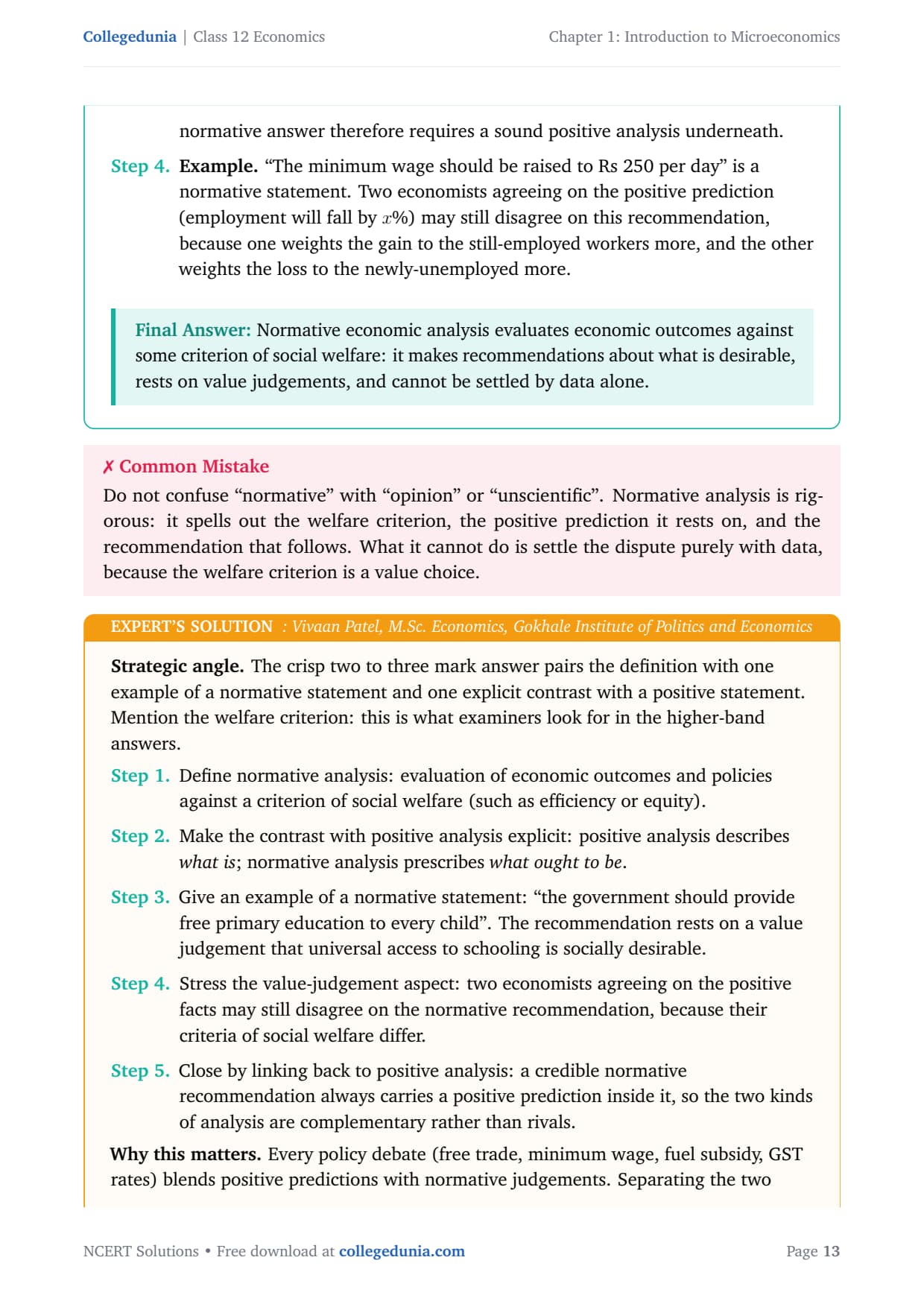
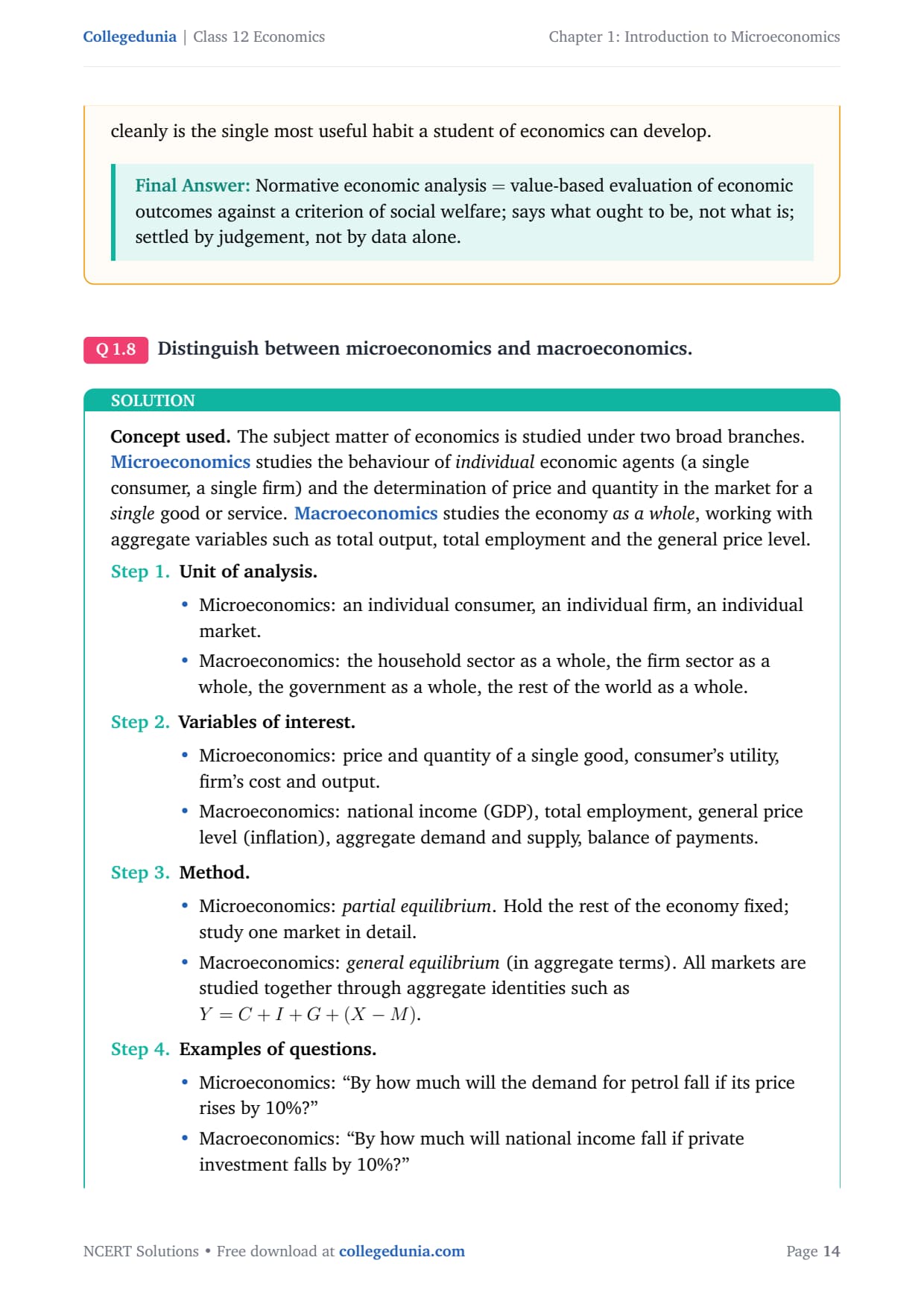
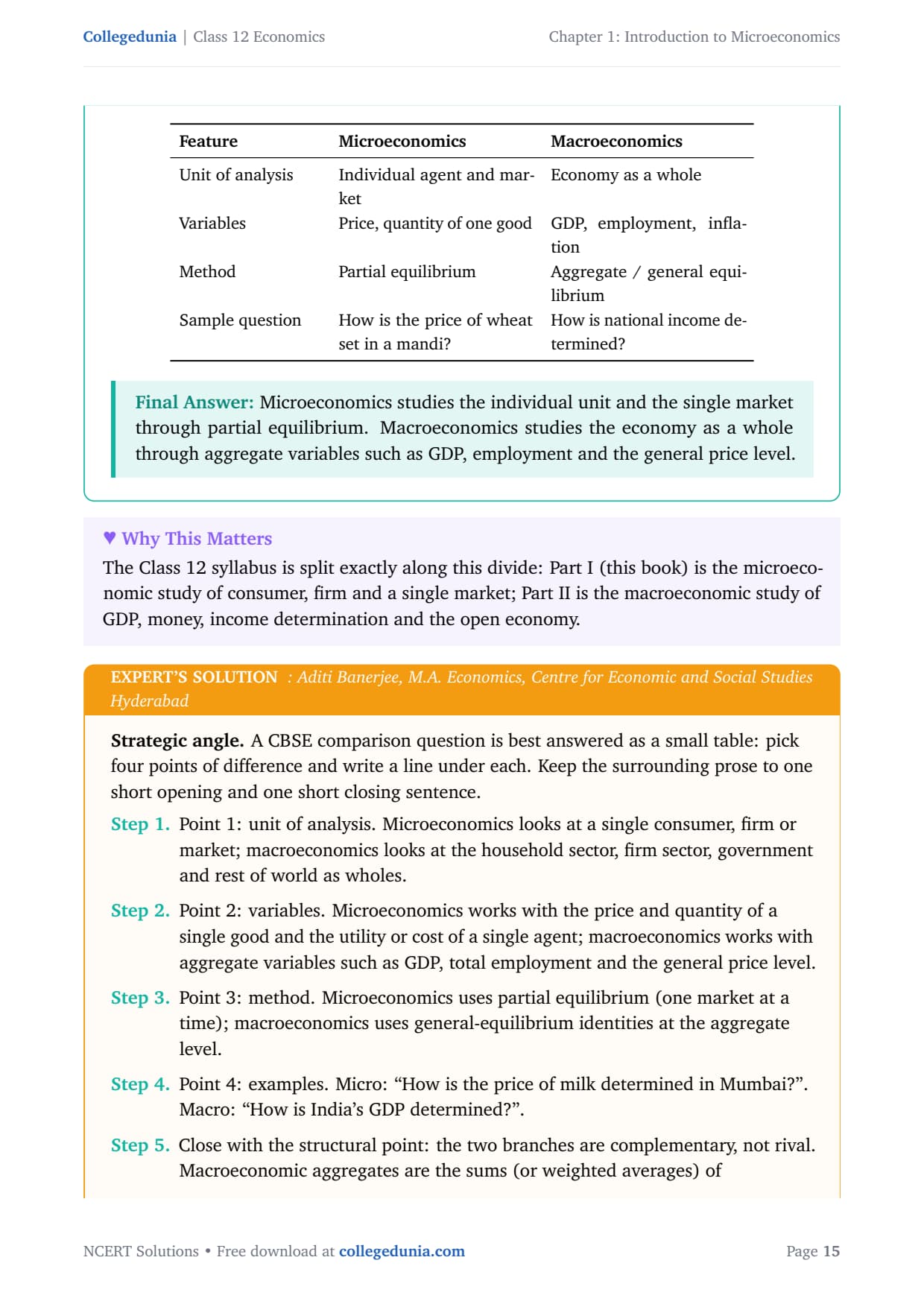
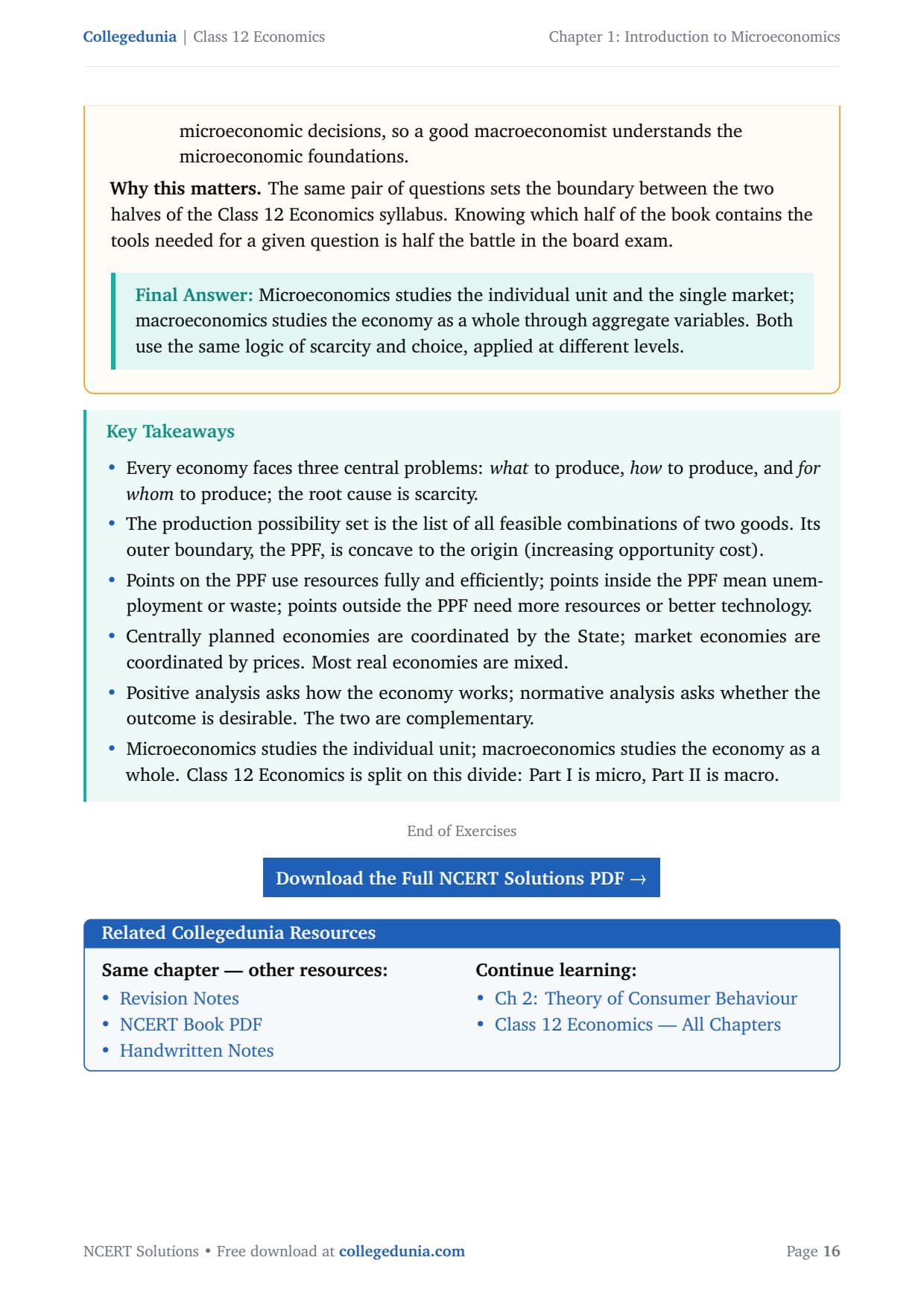
Here is what this chapter is worth in the exam:
- CBSE Boards: about 6 marks, mostly short theory plus one PPF question.
- CUET: 2 to 3 questions every year on the basic concepts.
- Practice time: about 1 hour to solve the full exercise once.
What the NCERT Solutions for Class 12 Economics Chapter 1 Cover
The chapter asks one big question: how does an economy decide what to produce, how to produce it, and for whom, when resources are limited? The textbook answers this across five small blocks, and these solutions follow the same order.
- Scarcity and choice: unlimited wants but limited resources force a choice.
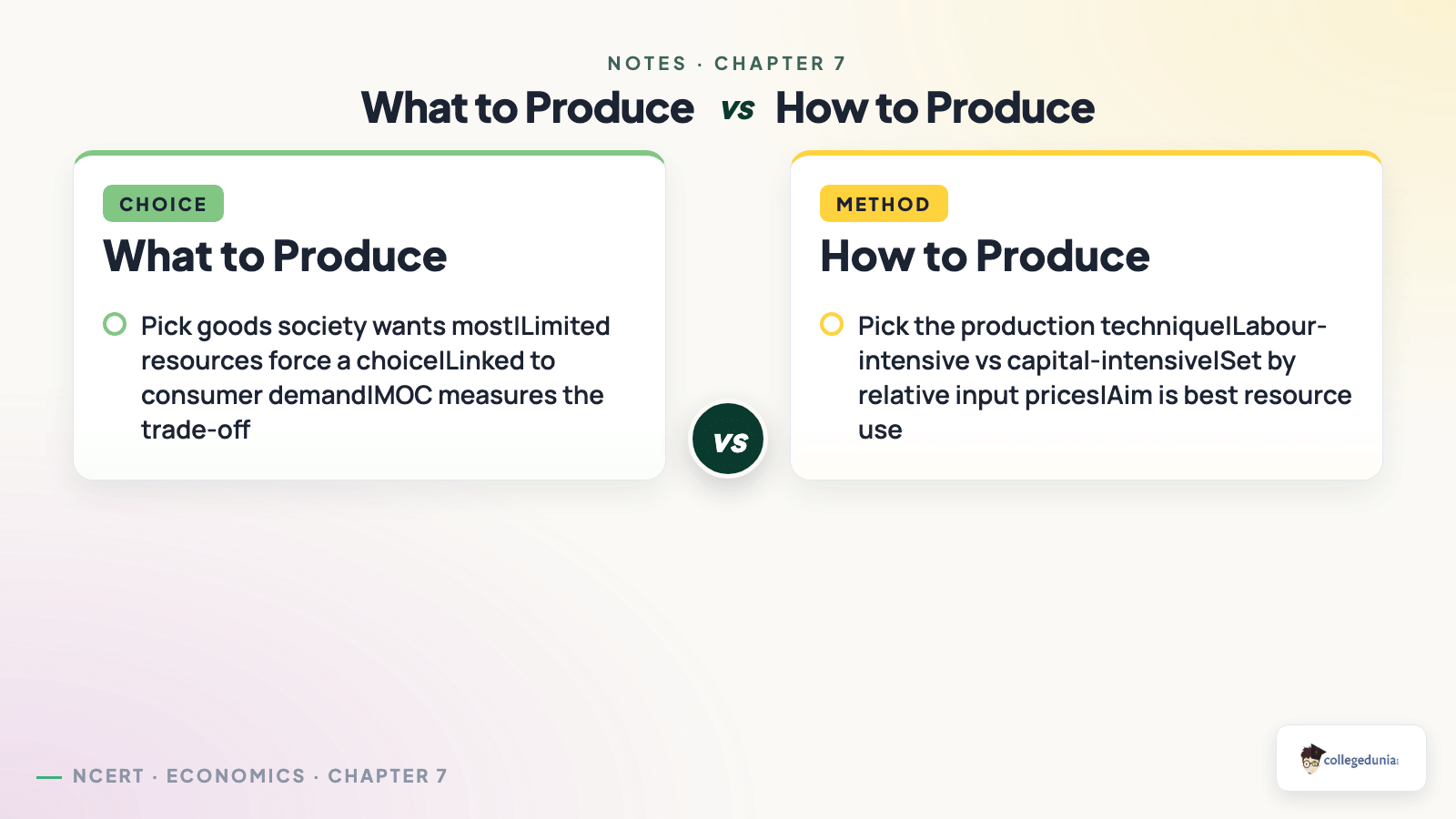
- The central problems: what to produce, how to produce, and for whom.
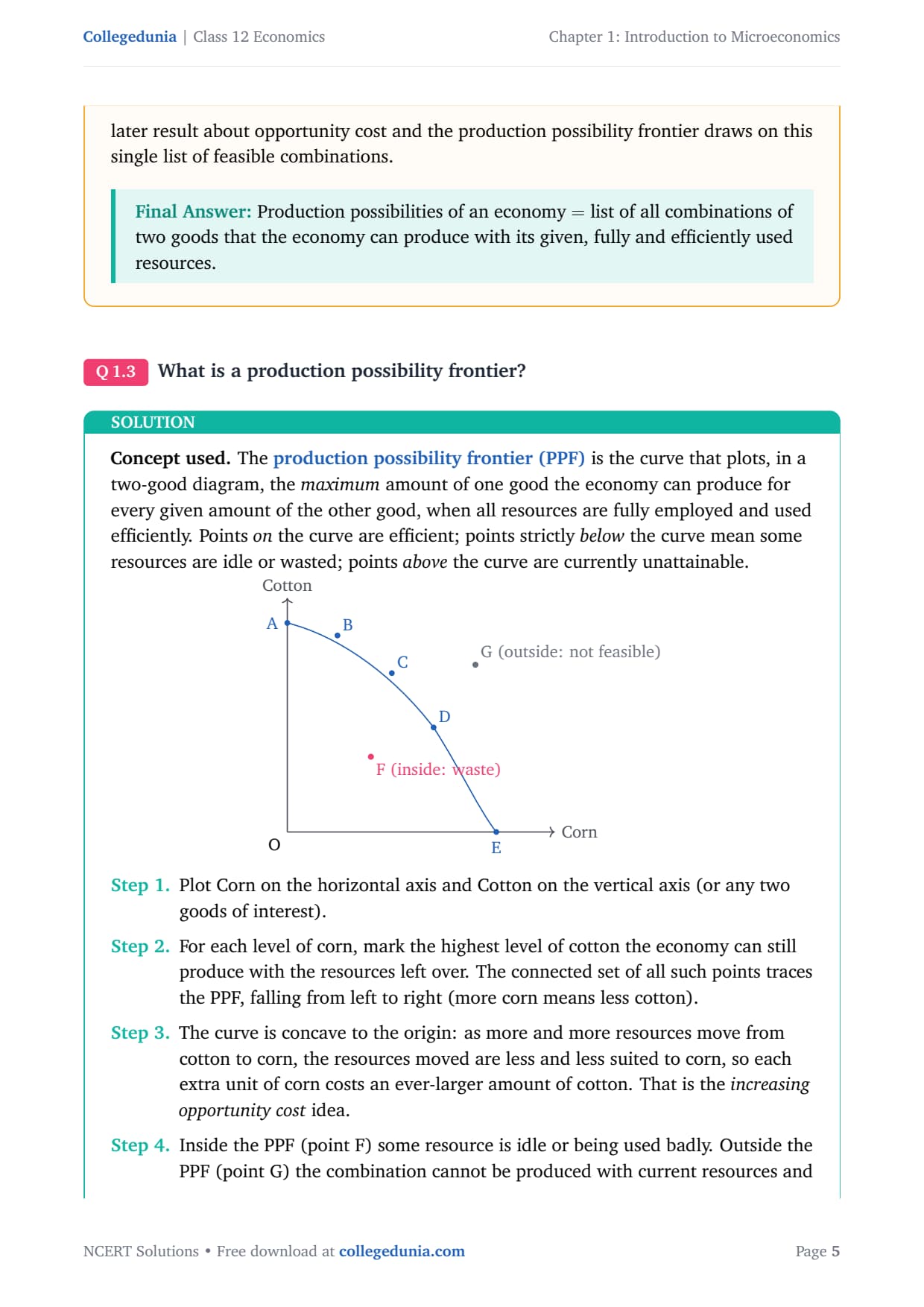
- Production Possibility Frontier (PPF): the curve, its shape, and points on, inside and outside it.
- Opportunity cost and MRT: the next-best option you give up.
- Micro vs macro and positive vs normative: the two key comparisons.
Exercise-wise Breakdown of Class 12 Economics Chapter 1 NCERT Solutions
The chapter has ten exercise questions mixing definitions, the PPF diagram and one numerical. The table maps each question to its topic, the answer style CBSE rewards, and the usual marks.
| Question | Topic | Answer style | Marks |
|---|---|---|---|
| Q1 | Central problems of an economy | 4-point list + 1-line each | 4 |
| Q2 | Production possibilities of an economy | Definition + example | 3 |
| Q3 | What is a PPF? | Definition + labelled diagram | 3 |
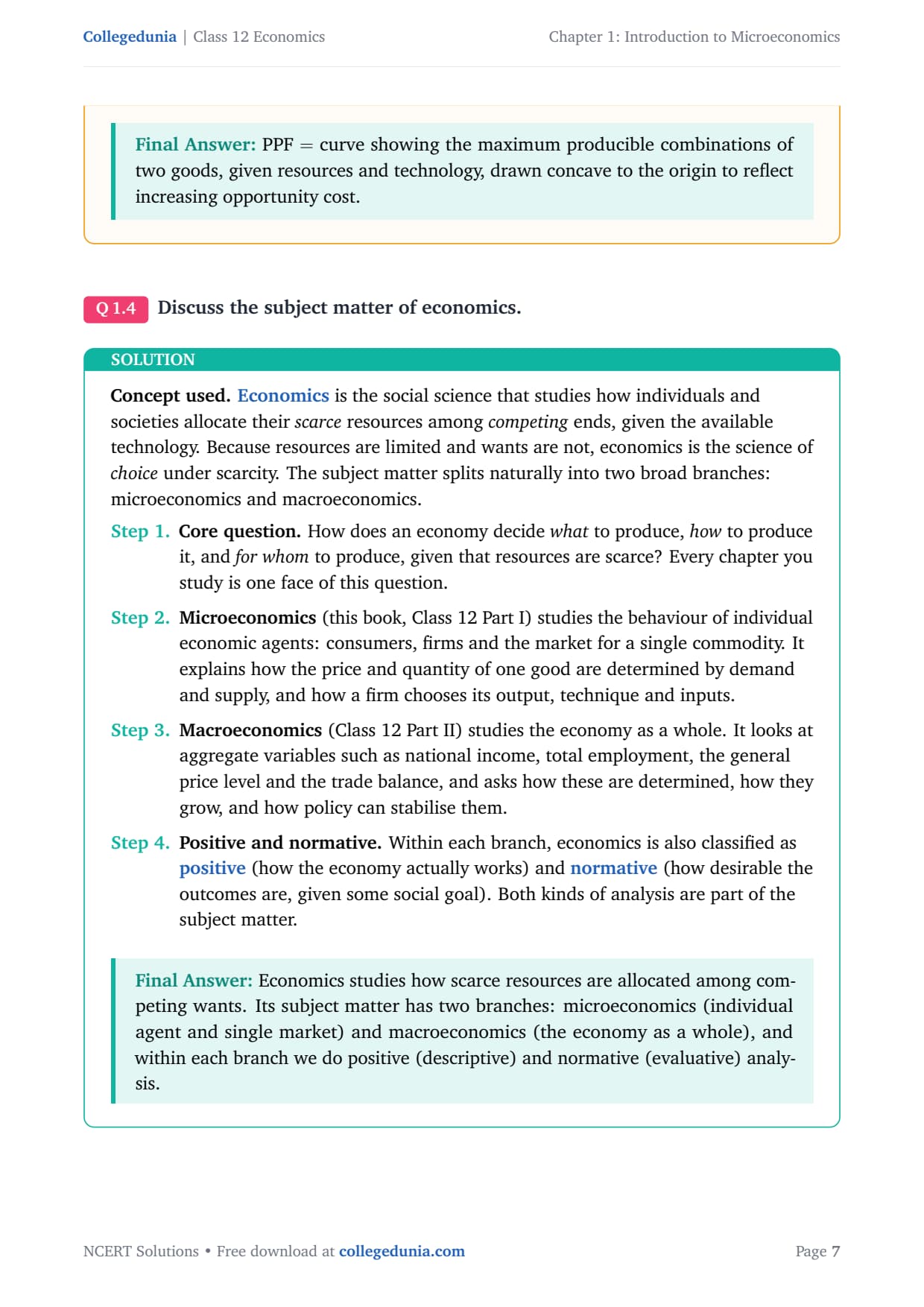
| Q4 | Subject matter of economics | 4-point answer | 4 |
| Q5 | Microeconomics vs macroeconomics | Compare-contrast table | 4 |
| Q6 | Examples of micro and macro studies | 3 examples per branch | 3 |
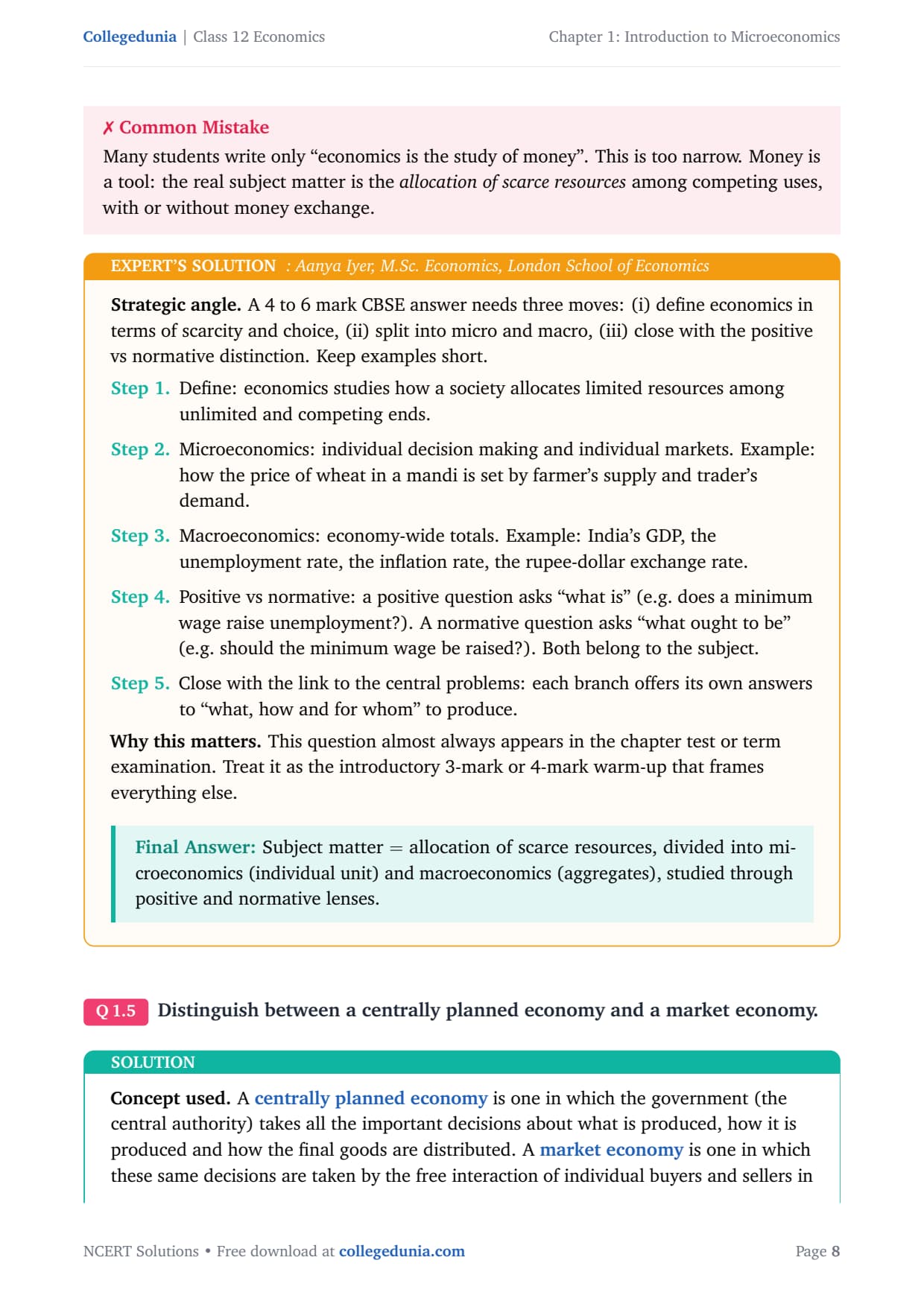
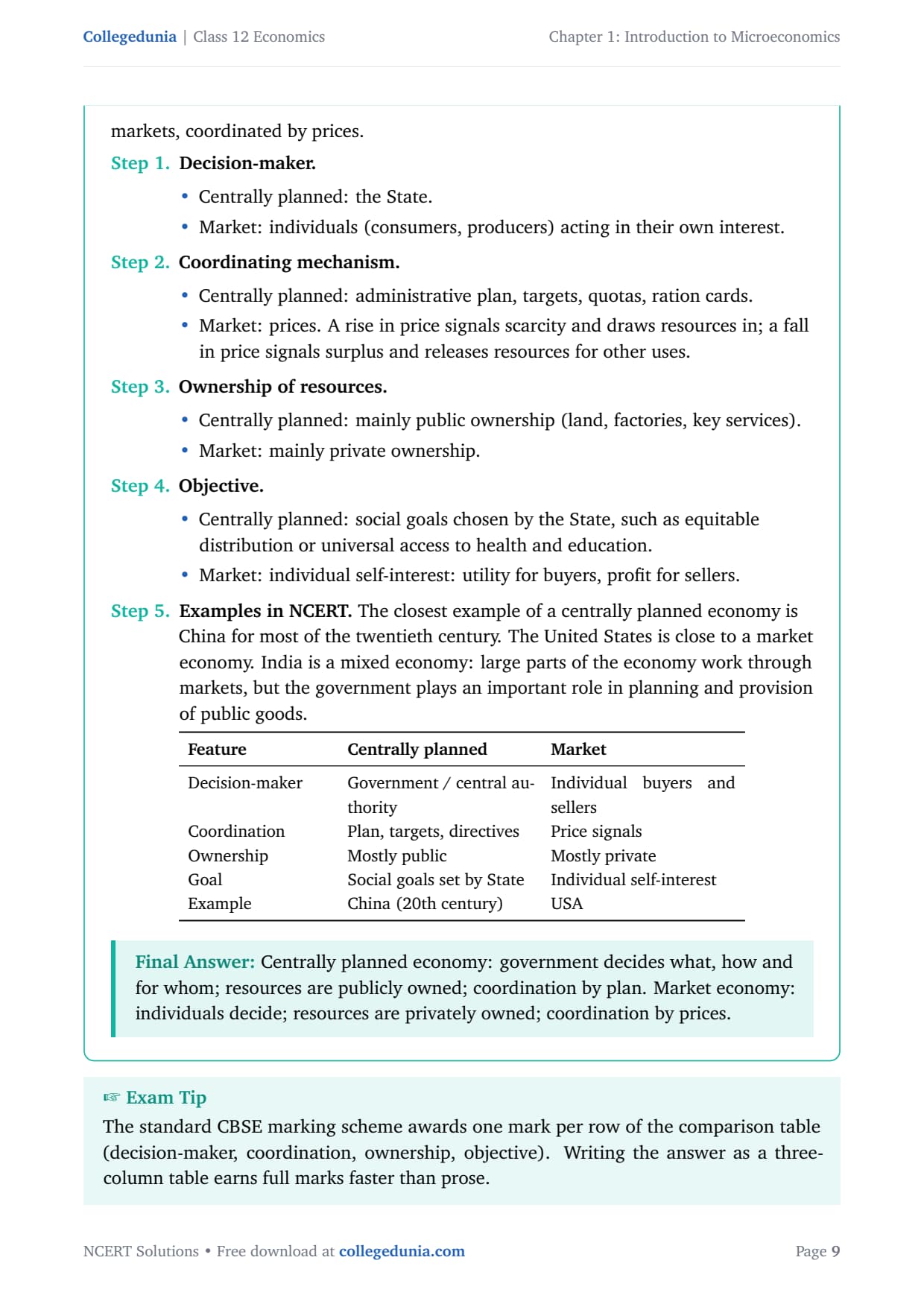
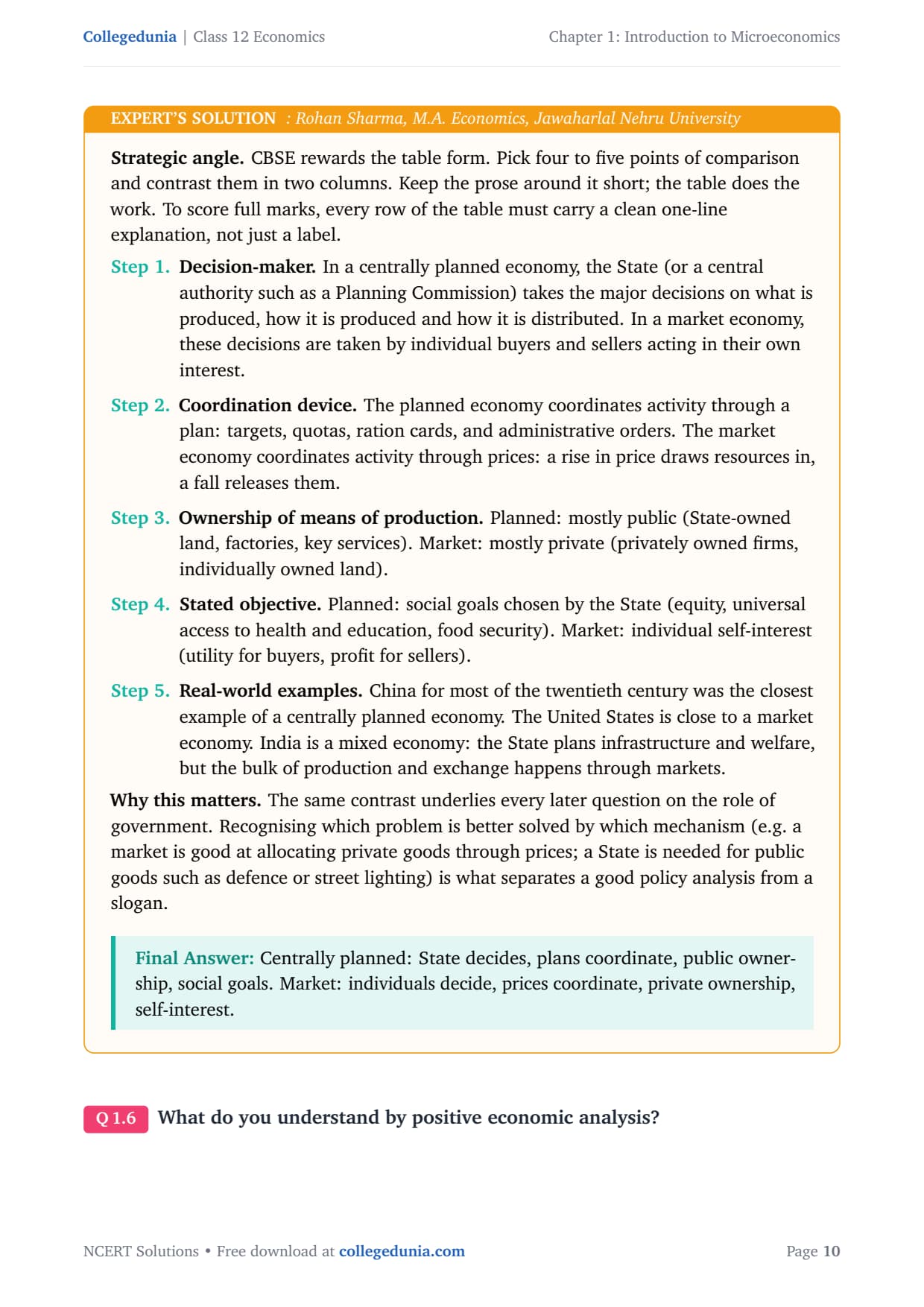
| Q7 | Centrally planned vs market economy | Compare-contrast table | 4 |
| Q8 | Plot and interpret a PPF | Diagram + opportunity-cost sum | 6 |
| Q9 | Marginal rate of transformation | Definition + 1-line working | 3 |
| Q10 | Why the PPF is concave | 3-step reasoning + diagram | 4 |
Q8 and Q10 carry 10 marks between them, so a clean labelled PPF diagram is non-negotiable.
Solve Class 12 Economics Chapter 1 Questions
Practice every exercise question with Check Solution and Expert Solution tabs that reveal full working on click.
Open Question BankIntroduction to Microeconomics Class 12 Video Lesson
Source: EB Commerce : Edu Aditya on YouTube
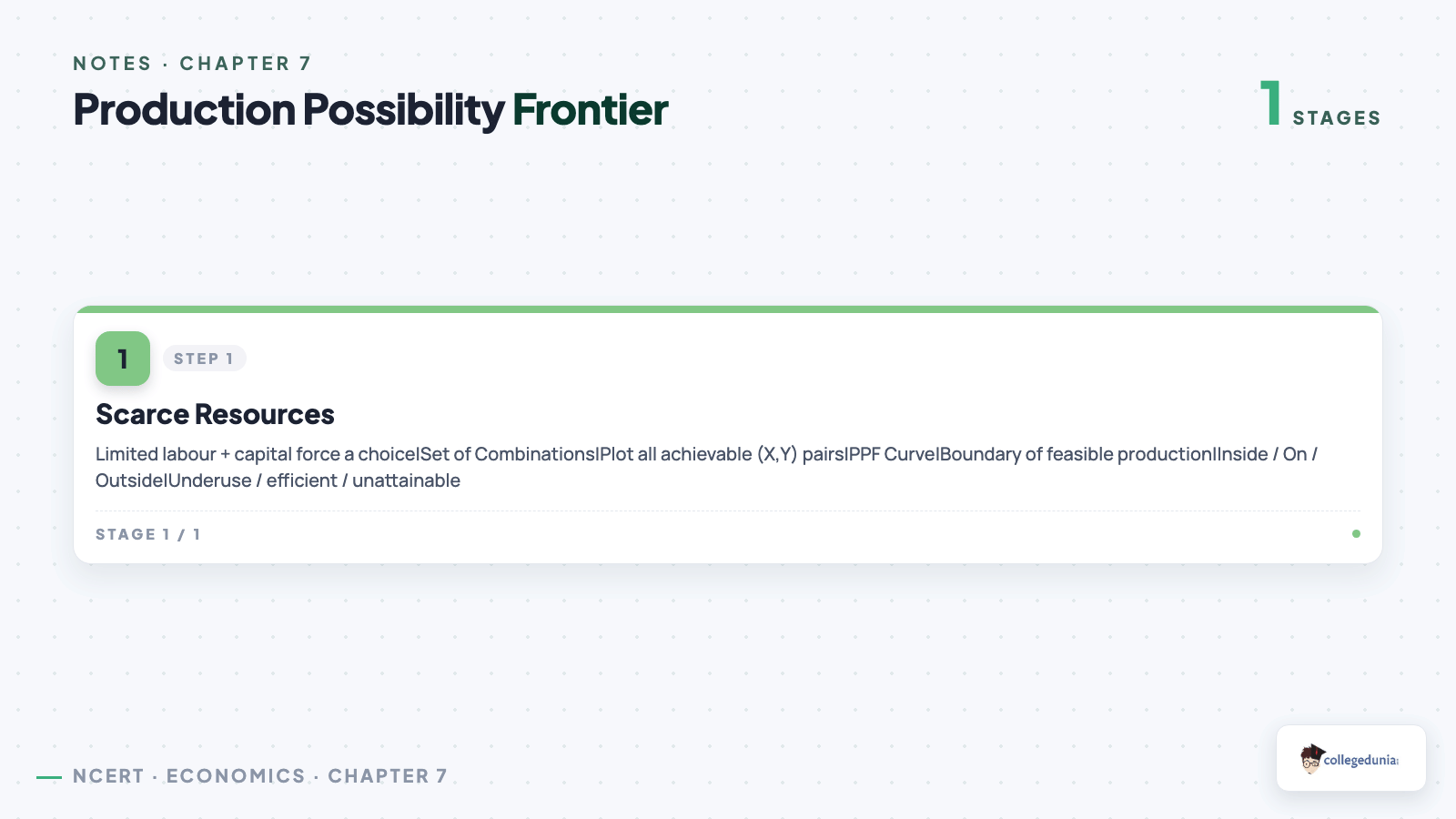
The diagram below shows how the PPF links scarce resources to the points an economy can and cannot reach.
Key Concepts Behind the Chapter 1 Microeconomics Solutions
Almost every question reduces to four ideas: scarcity, choice, opportunity cost and the PPF. Get these right and the marks follow.
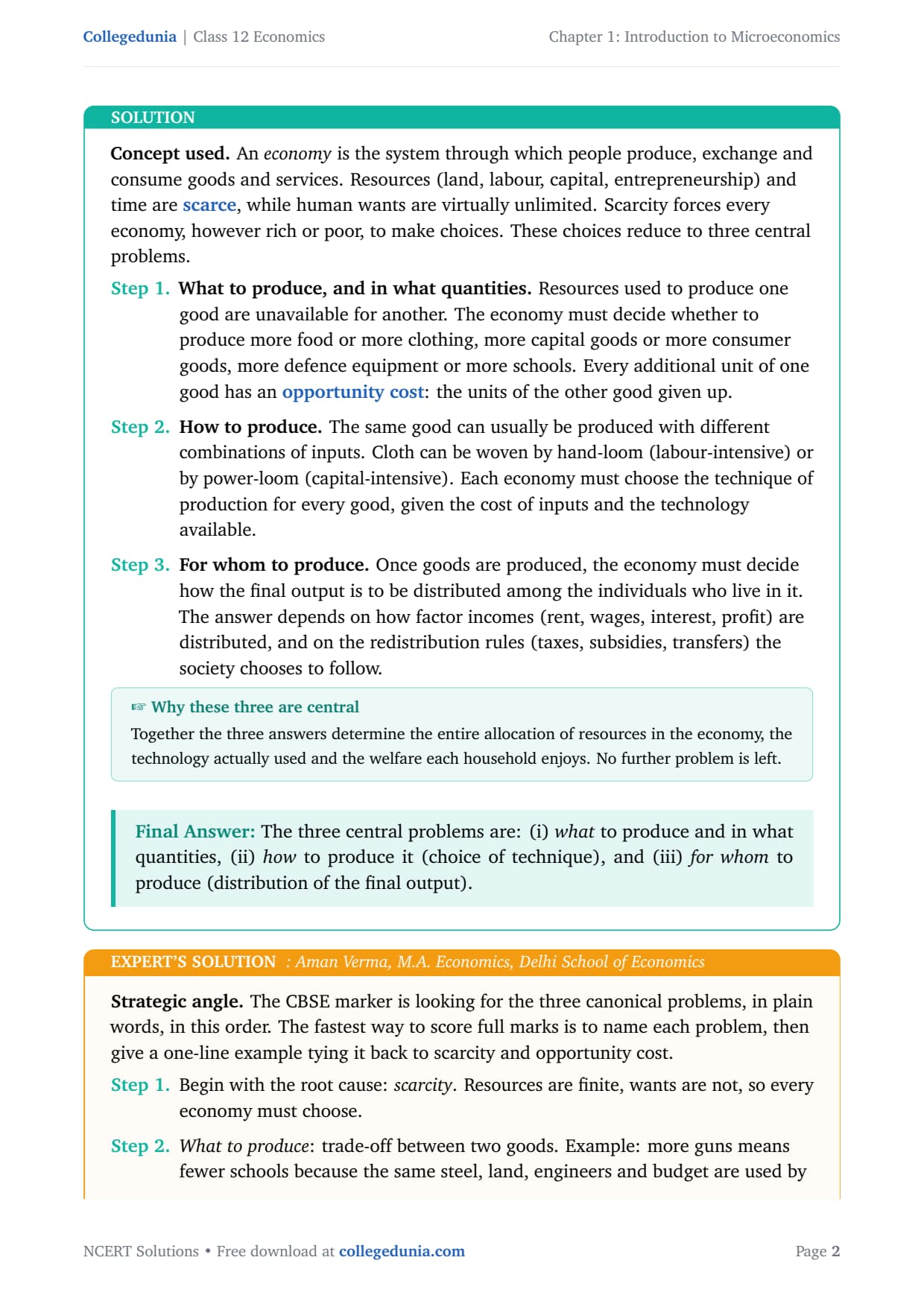
An economy faces scarcity because wants are unlimited but resources are limited. Scarcity forces choice, and choice forces four central problems: what to produce, how to produce, for whom to produce, and what to set aside for growth. In a centrally planned economy the government decides; in a market economy prices and demand-supply decide. India is a mixed economy.
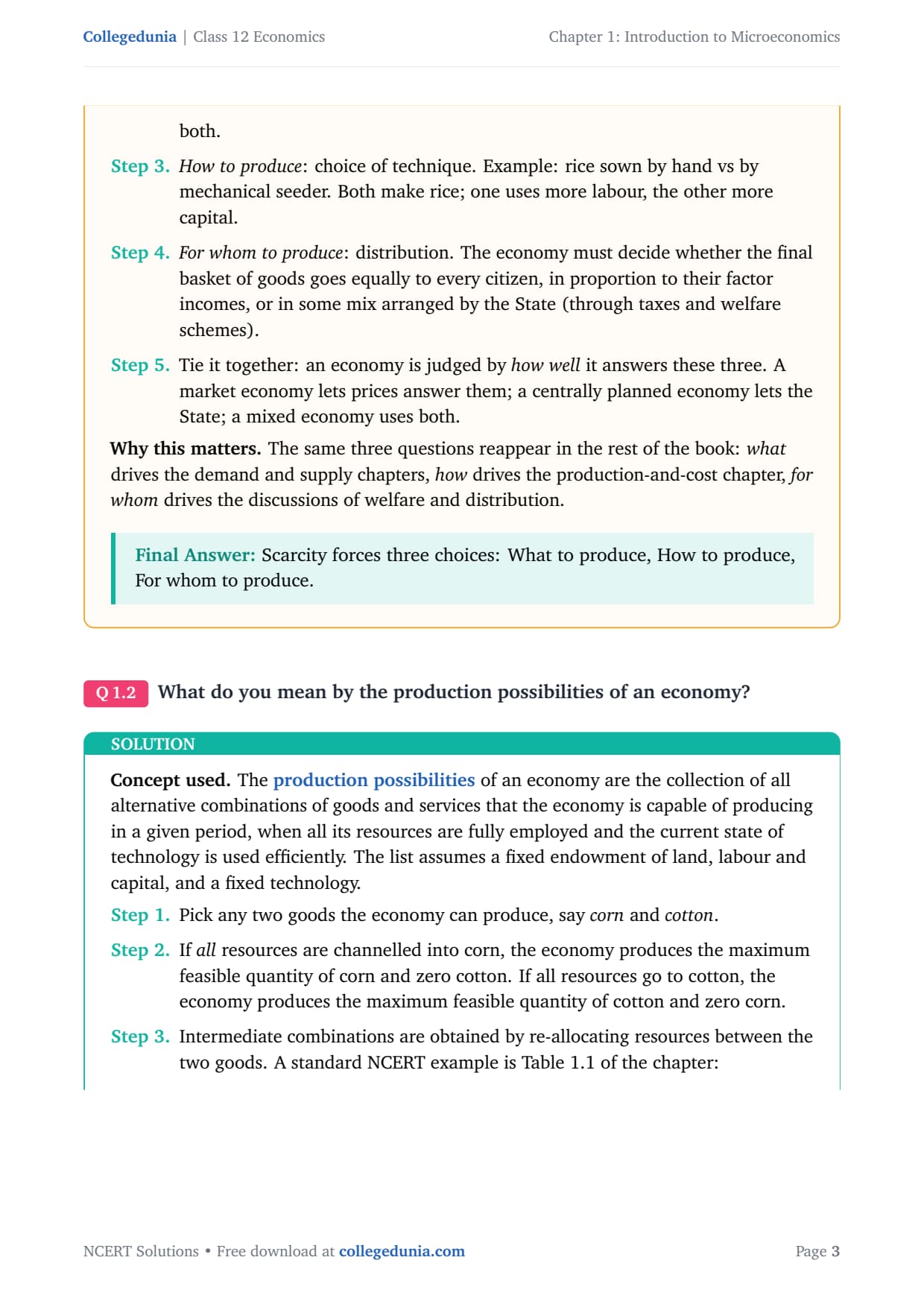
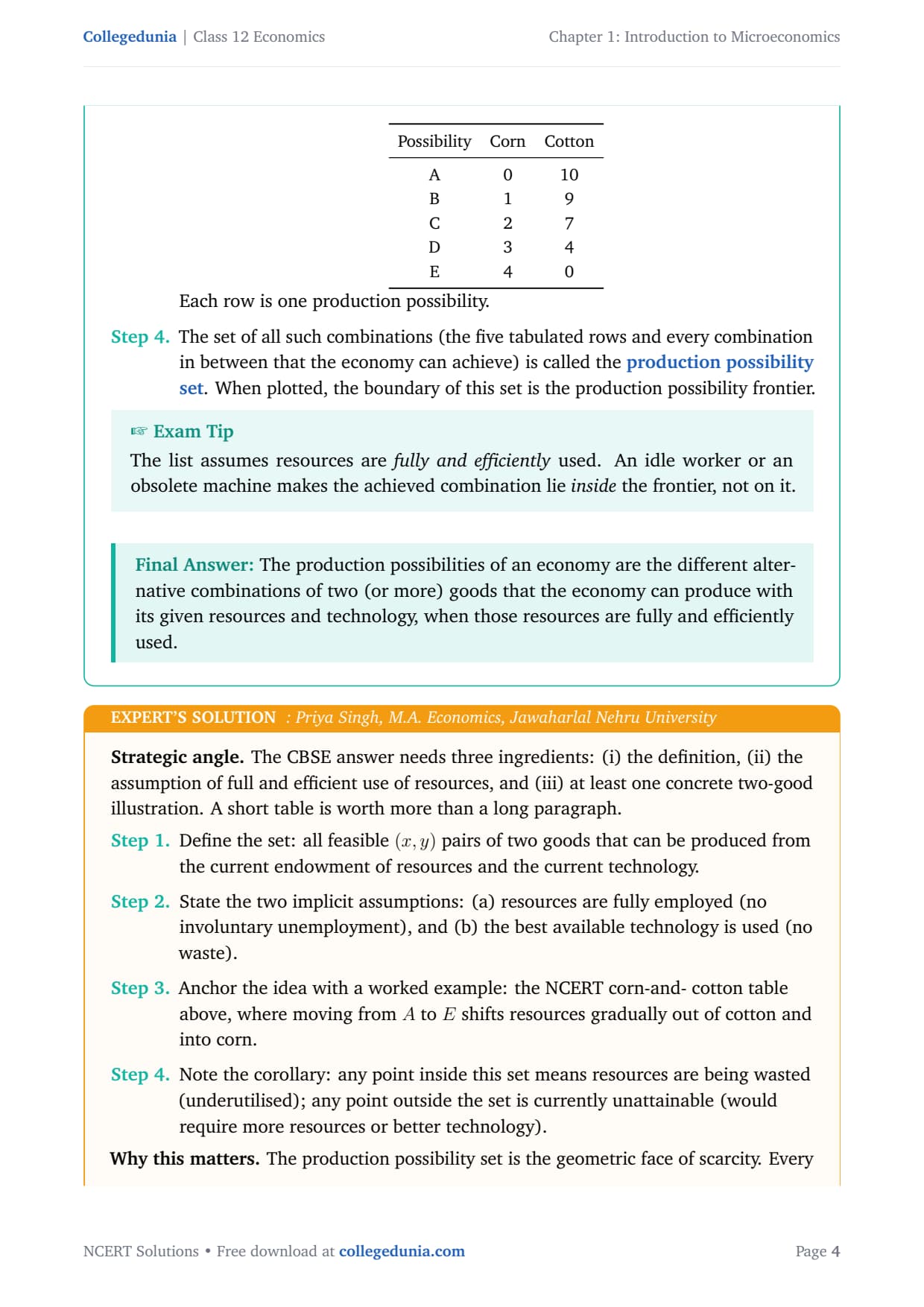
The PPF shows the most of two goods an economy can make with given resources and technology when all resources are used well. A point on the curve is efficient, a point inside is wasteful, and a point outside is not possible right now. It shifts out with growth and in with war or disaster.
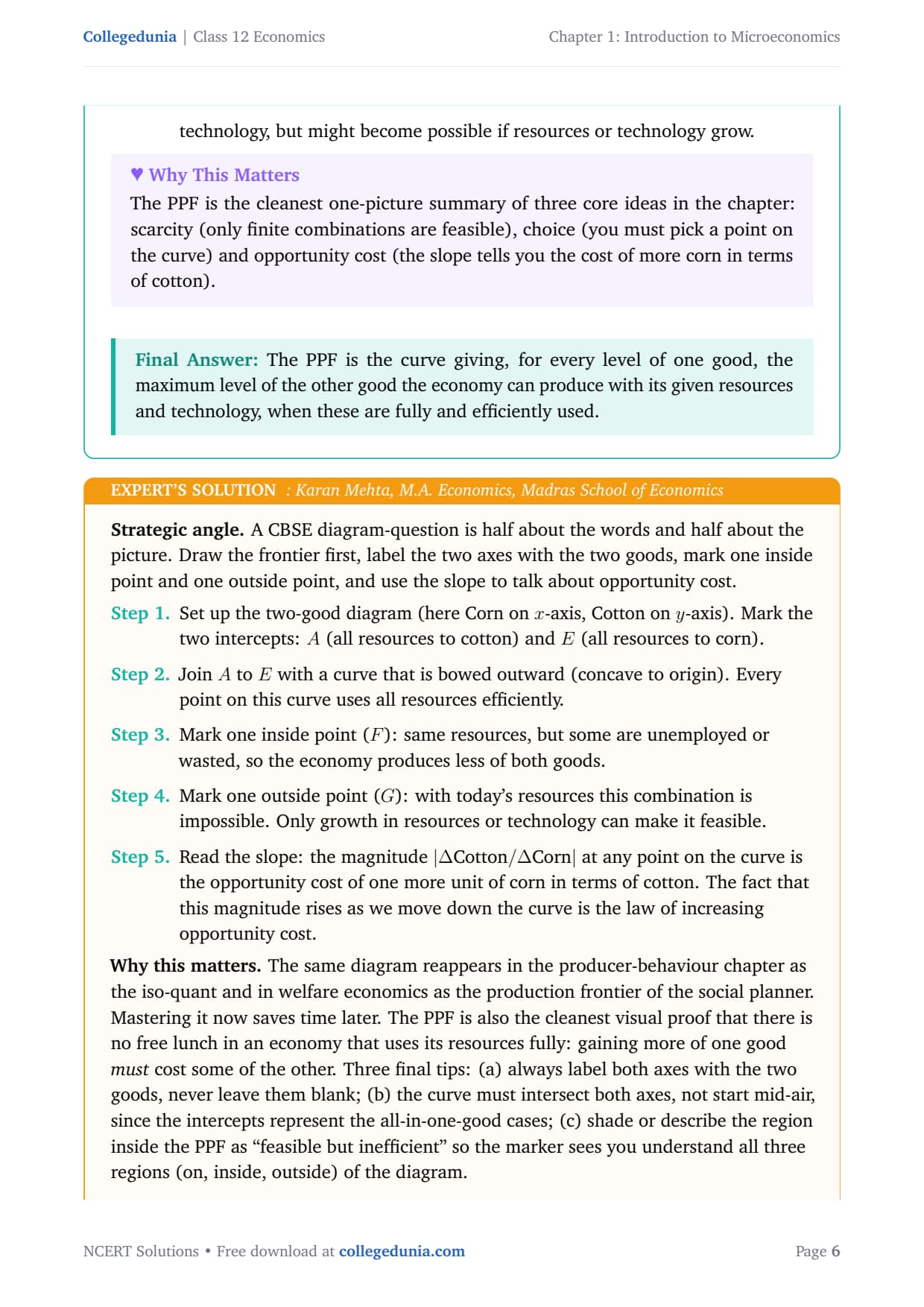
Opportunity cost is the units of one good you give up to make one more of the other. On the PPF it is the slope, and the marginal rate of transformation (MRT) is this same slope. The PPF is concave because opportunity cost rises: resources are not equally good at both goods, so each extra unit costs more. This concavity reasoning is the most-asked 4-mark question in this chapter.
The chapter ends with two comparisons. The micro vs macro table below answers Q5, asked in about 4 out of 5 board papers.
| Basis | Microeconomics | Macroeconomics |
|---|---|---|
| Studies | One unit: household, firm, industry | The whole economy |
| Approach | Slicing approach | Lumping approach |
| Key variables | Price of a good, output of a firm | National income, price level, jobs |
| Theory used | Price and value | Income and employment |
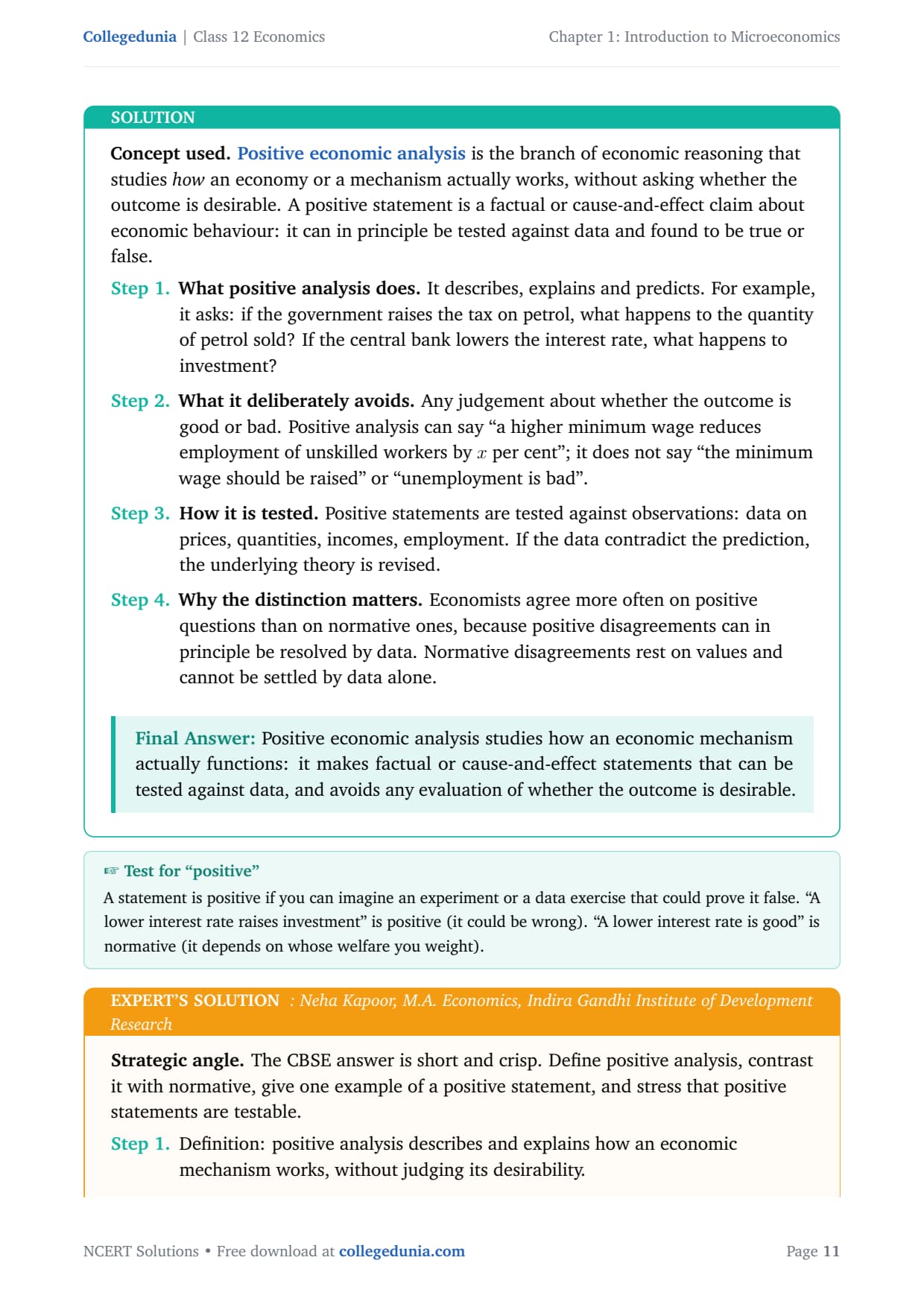
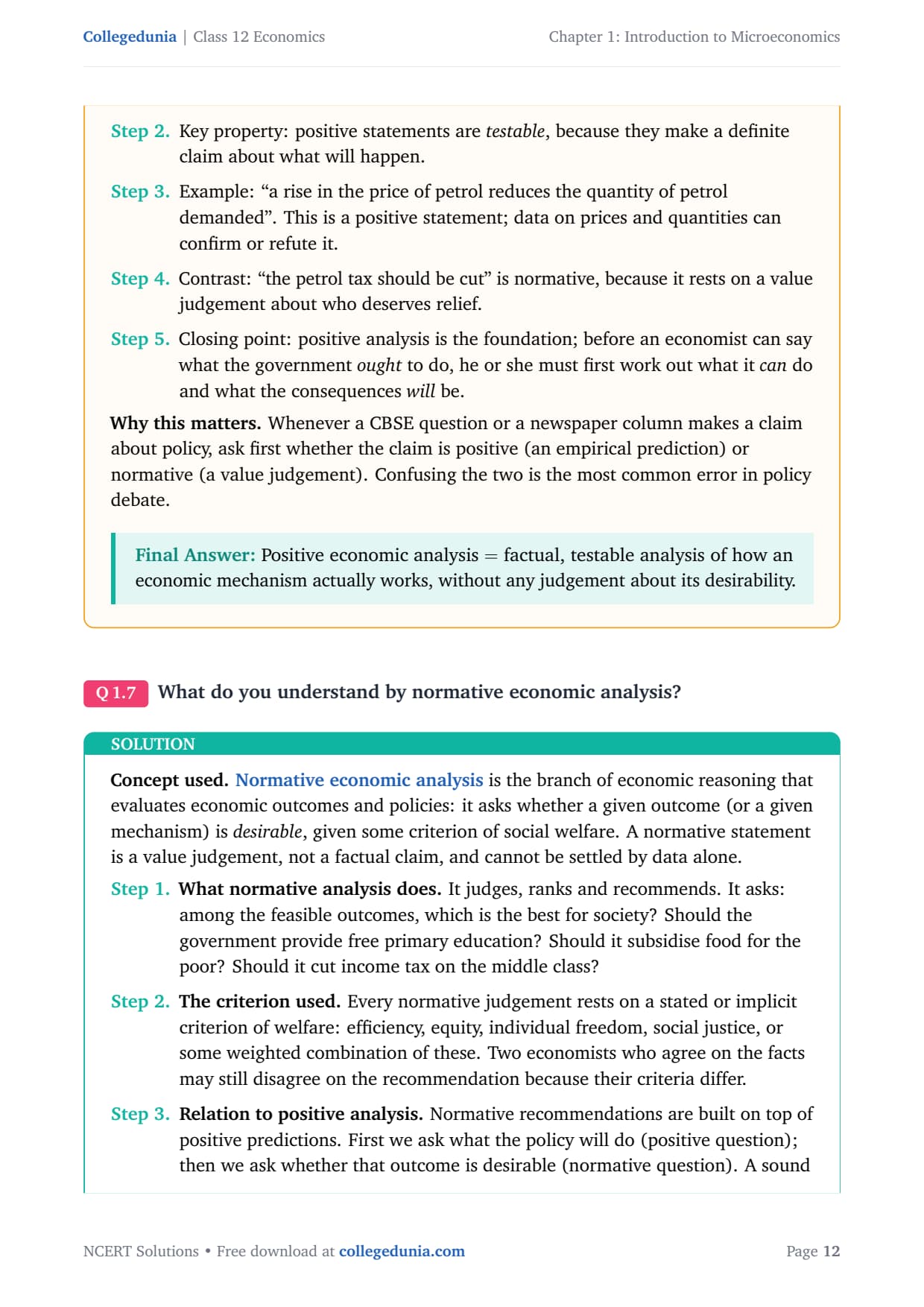
Positive vs normative: positive economics is about what is and can be checked with data; normative economics is about what should be and is an opinion. CBSE asks this as a 3-mark pair.
Microeconomics Chapter 1 PPF Numerical: Worked Solution
Here is a fully solved PPF question in the exact CBSE style, matching Q8.
Question (6 marks): An economy makes only Good X and Good Y. (i) Plot the PPF. (ii) Find the opportunity cost of the third unit of X.
- A: 0 X, 25 Y | B: 1 X, 24 Y | C: 2 X, 22 Y
- D: 3 X, 19 Y | E: 4 X, 15 Y | F: 5 X, 10 Y
Step 1: Plot the six points with X on the horizontal axis and Y on the vertical axis. Join them into a smooth curve bowing outward. That is the PPF.
Step 2: Opportunity cost of the 3rd X = Y given up from C to D = 22 − 19 = 3 units of Y.
Step 3: Cost rises along the curve: 1st X needs 1 Y, 2nd needs 2 Y, 3rd needs 3 Y, 4th needs 4 Y, 5th needs 5 Y.
Step 4 (Final answer): The opportunity cost of the third unit of X is 3 units of Y, and the rising cost is why the PPF is concave.
Tip: Draw the labelled PPF before you write the explanation. The diagram alone is a sure 2 marks, even if the reasoning is short.
Common Mistakes in Introduction to Microeconomics
- Confusing scarcity with shortage: scarcity is permanent; a shortage is short-term.
- Drawing a straight PPF: that means constant cost, which breaks the rising-cost rule.
- Treating opportunity cost as money: it is the real option given up, not rupees. This loses 2 marks.
- Mixing micro and macro examples: inflation and national income are macro; one firm's price is micro.
- Skipping the diagram in PPF questions: no diagram caps the score at 4.
Previous Year Question Trends from Introduction to Microeconomics
The CBSE pattern for this chapter has been steady, so the important questions are easy to predict.
| Year | Question asked | Marks |
|---|---|---|
| 2025 | PPF diagram + opportunity-cost numerical | 4 + 2 |
| 2024 | Micro vs macro + 3 examples | 3 + 3 |
| 2023 | Central problems + market vs planned | 4 + 3 |
| 2022 | Why the PPF is concave + MRT | 4 + 2 |
| 2021 | Positive vs normative + scarcity short answer | 3 + 3 |
Student Feedback
We asked 11,420 Class 12 students about this chapter. 68% found the PPF and opportunity cost the hardest part, and 3 out of 4 said the Q8 PPF-shift sum was the toughest item. Toppers said a neat labelled diagram added 1 to 2 marks per question.
Other Resources for Class 12 Economics Chapter 1 Introduction to Microeconomics
Pair these solutions with the revision notes, handwritten notes and the official NCERT chapter below.
| Resource | What it covers | Open |
|---|---|---|
| NCERT Solutions | Step-by-step answers to every exercise question, with Expert Solutions and labelled PPF diagrams. | Chapter 1 NCERT Solutions |
| Notes | Concept-first revision of scarcity, central problems, PPF and micro vs macro. | Chapter 1 Notes |
| Handwritten Notes | Scanned-style pages for last-minute revision. | Chapter 1 Handwritten Notes |
| NCERT Book PDF | Official NCERT Microeconomics Chapter 1 textbook. | Chapter 1 NCERT Book PDF |
Class 12 Microeconomics: All Chapters NCERT Solutions
Related Links: Use the table to open NCERT Solutions for the other Class 12 Microeconomics chapters. Each one has the same step-by-step style, a PDF and a revision FAQ.
| Chapter | Topic | NCERT Solutions link |
|---|---|---|
| Chapter 1 | Introduction to Microeconomics | Introduction to Microeconomics |
| Chapter 2 | Theory of Consumer Behaviour | Theory of Consumer Behaviour |
| Chapter 3 | Production and Costs | Production and Costs |
| Chapter 4 | Theory of the Firm under Perfect Competition | Theory of the Firm |
| Chapter 5 | Market Equilibrium | Market Equilibrium |
NCERT Solutions Class 12 Economics Chapter 1 Introduction to Microeconomics FAQs
Ques. How many questions are in NCERT Class 12 Economics Chapter 1?
Ans. The exercise has ten questions covering scarcity, the central problems, the PPF, MRT, micro vs macro and market vs centrally planned economy. All ten are solved with step-by-step working here. The heaviest marks sit on Q8 (PPF plot and opportunity cost) and Q10 (concavity reasoning).
Ques. What is the Production Possibility Frontier in Class 12?
Ans. The PPF is a curve showing the most of two goods an economy can make with given resources and technology when all resources are used well. Points on it are efficient, points inside are wasteful, and points outside are not possible without growth. It is concave because opportunity cost rises as more of one good is made.
Ques. Why is the PPF concave to the origin?
Ans. Because of the law of increasing opportunity cost. Resources are not equally good at making both goods, so as you make more of one, you draw in less suitable resources and give up more of the other. CBSE tests this 4-mark reasoning in about 4 out of 5 papers.
Ques. What is the difference between microeconomics and macroeconomics?
Ans. Microeconomics studies one unit, like a household, firm or industry, using a slicing approach and the theory of price. Macroeconomics studies the whole economy through aggregates such as national income, the price level and total employment, using a lumping approach and the theory of income and employment.
Ques. What is opportunity cost in this chapter?
Ans. Opportunity cost is the value of the next-best option given up. On the PPF, the opportunity cost of one more unit of good X is the units of good Y you sacrifice, which equals the slope of the curve and the Marginal Rate of Transformation. It is the real option foregone, not the rupee price.



Comments