Senior Chemistry Editor, 12 Yrs | Updated 3+ months ago
The NCERT Solutions for Alcohols, Phenols and Ethers Chapter 7 give detailed step-wise answers to conceptual and mechanism-based questions. The PDF covers all 32 NCERT exercise problems plus 12 in-text questions as per the current NCERT edition.
The solutions on this page will help you understand every named reaction, distinction test, and mechanism question as per the 2026-27 syllabus.
CBSE Weightage: around 6-8 marks (Unit 7 of the rationalised syllabus).
JEE Main Weightage: 3-5% of the Chemistry section, usually 1-2 questions on acidity order or named reactions.
NEET Weightage: 2-3 questions, most often on phenol reactions like Kolbe and Reimer-Tiemann.
What's inside this PDF: all 32 exercise questions + 12 intext questions solved with full mechanism arrows for SN1, SN2, dehydration, and aromatic substitution, plus comparative acidity tables for substituted phenols and a named-reactions cheat sheet.
How will Collegedunia's NCERT Solutions Help You Score in Class 12 Chemistry?
Organic chemistry rewards the student who can write a mechanism, not just the product. The solutions give you the arrow-pushing diagram, the intermediate, and the by-product for every reaction NCERT mentions. Three habits this resource builds:
Distinction test fluency: Lucas, ceric ammonium nitrate, Victor-Meyer, and ferric chloride tests, each solved with the colour change written out.
Reagent recall: reagents are colour-coded by role so you stop confusing PCC with KMnO4.
IUPAC naming for poly-functional ring compounds, a common 2-mark question in CBSE 2025.
Alcohols, Phenols and Ethers Class 12 Chemistry Video Walkthrough
NCERT Class 12 Chemistry Chapter 7 Alcohols, Phenols and Ethers Exercise-wise Question Map
The chapter splits its 32 main-exercise questions into nomenclature, preparation, reactions, and mechanism clusters. The table below maps each exercise number to its sub-topic so you can revise in targeted clusters.
Exercise Range
Sub-topic
Question Count
Difficulty
7.1 - 7.4
Classification & IUPAC nomenclature
4
Easy
7.5 - 7.10
Preparation of alcohols (hydration, hydroboration, Grignard)
6
Medium
7.11 - 7.16
Reactions of alcohols (oxidation, dehydration, esterification)
6
Medium
7.17 - 7.22
Phenol preparation & acidity
6
Medium
7.23 - 7.28
Electrophilic substitution on phenol (Kolbe, Reimer-Tiemann)
6
Hard
7.29 - 7.32
Ethers - Williamson synthesis, cleavage
4
Medium
Alcohols, Phenols and Ethers Class 12 Chemistry Important Named Reactions
Six named reactions dominate the board and entrance papers for this chapter. A compact recall list:
Named Reaction
Starting Material
Reagent / Conditions
Product Type
Kolbe's reaction
Phenol (sodium phenoxide)
CO2, 400 K, 4-7 atm; then H+
Salicylic acid
Reimer-Tiemann reaction
Phenol
CHCl3 + NaOH, then H3O+
Salicylaldehyde
Williamson synthesis
Alkyl halide + sodium alkoxide
Dry conditions, SN2
Ether
Hydroboration-oxidation
Alkene
B2H6 / THF, then H2O2 / OH-
Anti-Markovnikov alcohol
Lucas test
1degree / 2degree / 3degree alcohol
Conc. HCl + ZnCl2
Turbidity timing distinguishes class
Victor-Meyer test
1degree / 2degree / 3degree alcohol
P/I2, AgNO2, HNO2, NaOH
Red / blue / no colour
Every named reaction above has appeared between CBSE 2021 and 2025, so the reagent column alone is worth roughly 4 marks.
Acidity Order of Phenols: The Single Highest-Yield Concept of Chapter 7
A substituted-phenol acidity ranking question appears almost every year in CBSE, JEE Main, and NEET. The trick: electron-withdrawing groups at ortho or para stabilise the phenoxide, while electron-donating groups destabilise it. Meta EWGs act only through the inductive effect, not resonance.
Compound
pKa
Relative Acidity
2,4,6-trinitrophenol (picric acid)
0.4
Highest
p-nitrophenol
7.1
High
o-nitrophenol
7.2
High
Phenol
10.0
Reference
p-cresol (4-methylphenol)
10.2
Lower
p-methoxyphenol
10.2
Lower
The PDF includes a side-bar showing the four resonance structures of p-nitrophenoxide, the diagram most students draw incorrectly in board exams.
NCERT Class 12th Chemistry Chapter 7 Previous Year Question Trend
Below is a five-year scan of how Chapter 7 questions appeared across CBSE Boards, JEE Main, and NEET, latest edition first.
Year
CBSE Board
JEE Main
NEET
2026
Acidity of phenol and distinguishing tests (3 marks)
1 question (Jan session) on Williamson synthesis
Williamson synthesis and ether cleavage (1 Q)
2025
3-mark: distinguish 1degree, 2degree, 3degree alcohols by Lucas test
2 questions on phenol acidity, ether cleavage
2 questions on Kolbe and Reimer-Tiemann
2024
5-mark: phenol preparation from cumene + 2 reactions
1 question on hydroboration-oxidation
1 question on acidity of substituted phenols
2023
2-mark: IUPAC name of 2,4-dichlorophenoxyacetic acid
2 questions on Williamson + dehydration mechanism
2 questions on Lucas test + ether nomenclature
2022
3-mark: mechanism of acid-catalysed dehydration of ethanol
1 question on bond angles in ether
1 question on phenol oxidation
2021
3-mark: explain why phenol is more acidic than ethanol
-
1 question on alcohol classification
Phenol acidity, named reactions, and the Lucas test recur every year, so these three sub-topics reliably earn 5-7 marks.
Common Mistakes Students Make in Alcohols, Phenols and Ethers
Top three mistakes flagged in CBSE evaluator notes (2024-2025):
Writing Markovnikov product in the hydroboration-oxidation step. Hydroboration is strictly anti-Markovnikov.
Confusing the order of Kolbe's reaction. The correct sequence is phenol -> NaOH -> sodium phenoxide -> CO2 -> salicylate -> H+ -> salicylic acid.
Forgetting to mention dry ether as solvent in Williamson synthesis. Wet conditions hydrolyse the alkoxide, and CBSE docks 0.5 marks for the omission.
Alcohols Phenols and Ethers Quick Formula and Concept Recall
Boiling point order for isomers: 1degree > 2degree > 3degree alcohol (due to less steric hindrance to H-bonding).
Reactivity of alcohols with HX: 3degree > 2degree > 1degree (SN1 stability).
In phenol, the C-O bond is shorter than in alcohols due to partial double-bond character from ring conjugation.
Ether cleavage with HI gives the alkyl iodide of the smaller group plus the alcohol of the larger group at low temperature; both become alkyl iodides at higher temperature.
Alcohols, Phenols and Ethers Alcohol Oxidation: PCC vs KMnO4 vs Cu Dehydrogenation
Oxidation reagent choice is a most-tested 2-mark question. The table below shows which oxidant stops where.
Substrate
PCC (mild)
KMnO4 / K2Cr2O7 (vigorous)
Cu, 573 K (dehydrogenation)
1 degree R-OH
R-CHO (stops at aldehyde)
R-COOH (goes to acid)
R-CHO + H2
2 degree R-OH
R2C=O (ketone)
R2C=O (ketone)
R2C=O + H2
3 degree R-OH
No reaction
C-C cleavage (carboxylic acid mixture)
Alkene (no alpha-H, dehydrates)
PCC in CH2Cl2 is the only reagent that stops a primary alcohol at the aldehyde stage, the 1-mark MCQ pattern seen in NEET 2024.
Alcohols, Phenols and Ethers Class 12 Chemistry Chapter-wise Marks Distribution (CBSE 2026-27)
The table below shows approximate marks for every Class 12 Chemistry chapter under the 2026-27 blueprint, so you can plan your revision sequence by yield-per-hour.
Chapter
Topic
Approx. CBSE Marks
Ch 1
Solutions
5
Ch 2
Electrochemistry
5
Ch 3
Chemical Kinetics
5
Ch 4
The d- and f-Block Elements
4
Ch 5
Coordination Compounds
5
Ch 6
Haloalkanes and Haloarenes
4
Ch 7
Alcohols, Phenols and Ethers
7
Ch 8
Aldehydes, Ketones and Carboxylic Acids
8
Ch 9
Amines
5
Ch 10
Biomolecules
4
Chapters 7, 8, and 9 together carry roughly 20 marks, so the organic block deserves the largest share of revision time.
Other Resources for Alcohols, Phenols and Ethers Class 12 Chemistry
All NCERT Solutions for Alcohols, Phenols and Ethers with Step-by-Step Working
Every NCERT textbook question for Chapter 7 is listed below with its full Solution and Expert Solution in collapsible tabs. Click Check Solution for the step-by-step working and Expert Solution for the expanded explanation.
Questions
Q 7.1
Write IUPAC names of the following compounds:
(i) CH3-CH(CH3)-CH(OH)-C(CH3)2-CH3
(ii) CH3-CH(OH)-CH2-CH(OH)-CH(C2H5)-CH2-CH3
(iii) CH3-CH(OH)-CH(OH)-CH3 (iv) HO-CH2-CH(OH)-CH2-OH
(v) 2-methyl-6-hydroxy substituted benzene
(vi) 4-methylphenol (vii) 3-methylphenol with OH at C-2
(viii) 2,6-dimethylphenol (ix) CH3-O-CH2-CH(CH3)-CH2-CH3
(x) C6H5-O-C2H5 (xi) C6H5-O-C7H15 (n-)
(xii) CH3-CH2-O-CH(CH3)-CH2-CH3.
Concept used.IUPAC nomenclature for alcohols and ethers proceeds in three fixed steps. First, find the longest continuous carbon chain that carries the -OH group; this is the parent alkane and the -OH replaces a final ``-e'' with ``-ol''. Second, number the chain so that the carbon bearing -OH gets the lowest possible locant (-OH has priority over alkyl branches and halogens for low numbering). Third, list the substituents alphabetically with their locants as prefixes. For ethers we name the smaller R-O- group as an alkoxy substituent on the longer carbon chain (the parent). For phenols, the benzene ring carrying -OH is named ``phenol'' and -OH is at C-1 by default.
Priority of suffix groups
When more than one functional group is present, the principal characteristic group is chosen by the IUPAC priority list. Between -OH (suffix ``-ol'') and alkyl branches, -OH wins. So locant 1 is assigned to give the lowest number to the carbon bearing -OH.
(i) The skeleton is CH3-CH(CH3)-CH(OH)-C(CH3)2-CH3. The longest chain containing -OH has 5 carbons (pentane), and the -OH sits on the middle (C-3) carbon. Both numbering directions therefore give the same locant (3) to the principal group. The tie is broken by ``lowest locants for substituents at the first point of difference''. Numbering from the gem-dimethyl end gives two methyls on C-2 and one methyl on C-4, i.e. locant set 2,2,4; numbering from the other end gives 2,4,4. Set 2,2,4 wins at the second locant (2 < 4). Final name: 2,2,4-trimethylpentan-3-ol.
(ii) The skeleton CH3-CH(OH)-CH2-CH(OH)-CH(C2H5)-CH2-CH3 has the longest -OH-containing chain of 7 carbons: number from the left to keep both OH groups low. Locants are C-2 and C-4 (diol set 2,4 is lower than 4,6 from the right). An ethyl group sits at C-5. Final name: 5-ethylheptane-2,4-diol.
(iii) CH3-CH(OH)-CH(OH)-CH3. Four-carbon chain (butane) with OH at C-2 and C-3. Name: butane-2,3-diol.
(iv) HO-CH2-CH(OH)-CH2-OH. Three-carbon chain (propane) with three OH groups at C-1, C-2, C-3. Name: propane-1,2,3-triol (common name: glycerol).
(v) A benzene ring with -OH at C-1 and a -CH3 at the adjacent ortho carbon (C-2). Name: 2-methylphenol (o-cresol).
(vi) Benzene ring with -OH at C-1 and -CH3 at C-4. Name: 4-methylphenol (p-cresol).
(vii) Benzene ring with -OH at C-1 and a -CH3 at C-3. Name: 3-methylphenol (m-cresol).
(viii) Benzene ring with -OH at C-1 and methyls at C-2 and C-6. Name: 2,6-dimethylphenol.
(ix) CH3-O-CH2-CH(CH3)-CH2-CH3. The longer side of the ether oxygen is the butyl chain (-CH2-CH(CH3)-CH2-CH3); the shorter side is -OCH3 (methoxy). Numbering the parent butane from the end nearer the alkoxy gives OCH3 at C-1, methyl at C-2. Name: 1-methoxy-2-methylbutane.
(x) C6H5-O-C2H5 = ethoxybenzene. Treat the phenyl side as the larger parent (benzene). The smaller ethyl-O side is the alkoxy substituent. Name: ethoxybenzene (common: phenetole).
(xi) C6H5-O-(CH2)6-CH3 (n-heptyl). Phenoxy substituent on heptane: 1-phenoxyheptane. But IUPAC also accepts naming benzene as the parent when the substituent chain is acyclic. Standard NCERT answer: 1-phenoxyheptane.
(xii) CH3-CH2-O-CH(CH3)-CH2-CH3. The longer side of the oxygen is -CH(CH3)-CH2-CH3 (a 3-carbon chain with a methyl branch on C-1 of the parent end); the shorter is -OC2H5 (ethoxy). The parent (after choosing the longer carbon side) is butane via the chain CH3-CH(O Et)-CH2-CH3 where the OC2H5 is the alkoxy substituent on butane at C-2. Name: 2-ethoxybutane.
Structural observation. Every name above follows the same template: parent chain length + suffix for the principal group + locants for substituents. The trick is to identify the parent chain correctly when more than one chain length is possible, and to recognise that the priority of the principal characteristic group (-OH) overrides the priority of any mere substituent (alkyl, halogen).
Alternative approach: ``three-step decoder''. For any compound name, (1) circle the suffix and its locant, (2) find the parent chain or ring that bears it, (3) attach all substituents at their locants. The reverse procedure works for naming: tag the principal group, find the longest chain through it, then label substituents.
For (i), the parent is pentane (5 C), with the -OH on the middle carbon (C-3). Because OH sits at the central carbon, its locant is 3 regardless of numbering direction. The substituent locants decide the tie: numbering from the gem-dimethyl end gives 2,2,4 for the three methyls, the other way gives 2,4,4. ``Lowest locants at the first point of difference'' picks 2,2,4. Hence 2,2,4-trimethylpentan-3-ol.
For (ii), pick the longest chain that includes both OH groups. The continuous chain runs through all seven carbons of the main backbone, giving heptane. Numbering from the methyl end nearer the first OH places OH at C-2 and C-4. An ethyl branch sits at C-5. Final name: 5-ethylheptane-2,4-diol. The ``first point of difference'' rule resolves the diol-locant set 2,4 vs 4,6 in favour of the former.
For polyols (iii), (iv) the parent name keeps the terminal ``-e'' before ``-diol''/``-triol'' to avoid two consecutive vowels colliding: ``butane-2,3-diol'', not ``butan-2,3-diol''. The same rule will apply to amines (``-diamine'') in the next chapter.
For aromatic compounds (v) to (viii) the ring is the parent, -OH is at C-1, and the locants are chosen so the methyl substituents get the smallest numbers. The common names o/m/p-cresol are still widely accepted in industry but IUPAC nomenclature is required in exams.
For ethers (ix) to (xii), apply the substitutive-ether rule: name the smaller side as ``R-oxy'' (-OR) and treat it as a substituent on the larger parent. ``Methoxy'' = -OCH3, ``ethoxy'' = -OC2H5, ``phenoxy'' = -OC6H5. For C6H5-O-C7H15 (xi) the longer ``side'' would be the heptane chain (7 C > benzene's effective 6 C in substitutive nomenclature), so heptane is the parent and phenoxy is the substituent.
Concept linkage. The IUPAC priority list places -OH (suffix ``-ol'') below -COOH, -CHO, C=O and a few others, but above amines, ethers, halogens and alkyl branches. So if both -OH and -COOH sit on the same molecule, the acid takes the suffix and the alcohol becomes ``hydroxy'' as a prefix. You'll need this hierarchy whenever biomolecules (Ch 14, e.g. carbohydrates with -OH and -CHO) are named.
Exam relevance. JEE Main and CBSE board exams typically allocate one MCQ or one 2-mark question to IUPAC nomenclature of alcohol-ether mixtures; expect at least one such question every year. Common trap: not picking the longest chain that contains -OH (test case is exactly (i) above).
Why this matters. A clean IUPAC name lets a chemist re-draw the structure unambiguously: it is the working language of every later mechanism, spectroscopy or retrosynthesis problem. Spectroscopists also use it as the key to look up reference NMR/IR data.
Names as listed in the main solution.
Q 7.2
Write structures of the compounds whose IUPAC names are as follows:
(i) 2-Methylbutan-2-ol (ii) 1-Phenylpropan-2-ol (iii) 3,5-Dimethylhexane-1,3,5-triol
(iv) 2,3-Diethylphenol (v) 1-Ethoxypropane (vi) 2-Ethoxy-3-methylpentane
(vii) Cyclohexylmethanol (viii) 3-Cyclohexylpentan-3-ol
(ix) Cyclopent-3-en-1-ol (x) 4-Chloro-3-ethylbutan-1-ol.
Concept used. To go from an IUPAC name to a structure, reverse the naming algorithm: identify the parent chain length from the root (but, pent, hex, etc.), place the principal group at its locant, and attach each substituent on its locant carbon.
(i) 2-Methylbutan-2-ol. Parent: butane (4 C). OH at C-2; methyl at C-2 as well. Structure: CH3-C(OH)(CH3)-CH2-CH3.
(ii) 1-Phenylpropan-2-ol. Parent: propane. OH at C-2; phenyl at C-1. Structure: C6H5-CH2-CH(OH)-CH3.
(iii) 3,5-Dimethylhexane-1,3,5-triol. Parent: hexane. OH at C-1, C-3, C-5; methyls at C-3, C-5. Structure: HO-CH2-CH2-C(CH3)(OH)-CH2-C(CH3)(OH)-CH3.
(iv) 2,3-Diethylphenol. Benzene with OH at C-1; ethyl groups at C-2 and C-3: o-(C2H5)-m-(C2H5)-C6H3-OH.
(v) 1-Ethoxypropane. Parent: propane. Ethoxy -OC2H5 at C-1. Structure: CH3-CH2-CH2-O-CH2-CH3.
(vi) 2-Ethoxy-3-methylpentane. Parent: pentane. Ethoxy at C-2, methyl at C-3. Structure: CH3-CH(OC2H5)-CH(CH3)-CH2-CH3.
(vii) Cyclohexylmethanol. A -CH2OH on cyclohexane: C6H11-CH2OH.
(viii) 3-Cyclohexylpentan-3-ol. Parent: pentane. OH and a cyclohexyl group both at C-3: CH3-CH2-C(C6H11)(OH)-CH2-CH3.
(ix) Cyclopent-3-en-1-ol. Cyclopentene with the double bond between C-3 and C-4 and an -OH at C-1. Structure: a 5-membered ring with one C=C two carbons away from the C bearing OH.
(x) 4-Chloro-3-ethylbutan-1-ol. A 4-carbon parent labelled C-1 to C-4 starting from the -OH; ethyl at C-3, Cl at C-4. Structure: HO-CH2-CH2-CH(C2H5)-CH2Cl. (NCERT names this with -CH2Cl terminal as ``4-chloro-3-ethylbutan-1-ol'' even though strict IUPAC would re-number.)
(i)–(x) structures as drawn above.
PS
Priya Sharma
Ph.D Organic Chemistry, IISc Bangalore
Verified Expert
Picture-first. The easiest way is to draw the parent skeleton with numbered carbons, then ``decorate'' it with substituents and the principal group. The opposite of Q 7.1: we go from name to structure, so we read the locant of the ``-ol'' (or ``-en-ol'') first, then add substituents.
Alternative approach: build it like LEGO. Start with the parent block (a n-carbon chain or ring numbered 1 to n), snap on the principal group at its locant, then click on each substituent in turn. For polyols, place all OH groups before methyls or ethyls so you do not lose count.
For each item, draw the parent: n carbons in a row, labelled C-1, C-2, , C-n left to right (or as a ring for cyclic parents). Use bond-line shorthand if you wish: the ends and corners are carbons, hydrogens are implicit.
Attach the suffix group (the ``-ol'' or ``-en-ol'') at its locant carbon. Remember that ``en'' designates a C=C double bond between two specified carbons.
Add substituents at their locant carbons. For (iv) the phenol carbon is C-1 (carries OH), then go ortho to it for C-2 and continue around the ring for C-3.
For (ix), the double bond ``3-en'' specifies a C3=C4 bond, two carbons away from the OH at C-1. That gives the symmetric cyclopent-3-en-1-ol.
For (x), 4-chloro-3-ethylbutan-1-ol has an apparent conflict: butan-1-ol's parent has only 4 carbons but ``3-ethyl'' adds 2 more (making 6 total). The 4-carbon parent is chosen because it carries the principal group -OH at C-1; the ethyl branch sits on C-3 and the chloro on C-4.
Concept linkage. Reading a name backwards is the same skill set as drawing organic products from a reaction equation. Both require breaking the name into root, suffix and prefixes, and rebuilding the connectivity on paper.
Exam relevance. Almost every CBSE Class 12 chemistry paper has a 1-mark ``draw the structure of X'' question somewhere; the trick is to identify the parent length from the root (but, pent, hex) and the principal group from the suffix (-ol, -al, -oic acid, -one).
Numerical sanity check. The molecular formula of each compound should match. For (iii) 3,5-dimethylhexane-1,3,5-triol, count: C8H18O3 (6 C in hexane + 2 methyl branches = 8 C; 3 OH + the rest is saturated → 18 H + 3 O). Cross-check with the drawn structure.
Why this matters. This decode skill is exactly what an exam reverse-name question tests: parse the name into pieces, then re-build the molecule piece by piece. The same skill lets you convert a reaction product like ``2-bromo-2-methylbutane'' into a drawable structure quickly (Q 7.33).
(i)–(x) structures as drawn above.
Q 7.3
(i) Draw the structures of all isomeric alcohols of molecular formula C5H12O and give their IUPAC names.
(ii) Classify the isomers of alcohols in question 7.3 (i) as primary, secondary and tertiary alcohols.
Concept used. For C5H12O (a saturated, acyclic formula C_nH_2n+2O), all isomers with an -OH group on sp3 carbon are pentanol-type alcohols. An alcohol is classified as primary (1∘) if its -OH-bearing carbon is attached to one other C; secondary (2∘) if to two other C; tertiary (3∘) if to three. The carbon-skeleton isomers of pentane are three: n-pentane, isopentane (2-methylbutane), neopentane (2,2-dimethylpropane). On each skeleton, the OH can sit at any chemically distinct carbon.
n-pentane skeleton (CH3-CH2-CH2-CH2-CH3): OH can go on C-1 (= pentan-1-ol, 1∘), C-2 (= pentan-2-ol, 2∘), or C-3 (= pentan-3-ol, 2∘).
2-methylbutane skeleton (CH3-CH(CH3)-CH2-CH3): OH can go on C-1 (= 2-methylbutan-1-ol, 1∘), C-2 (= 2-methylbutan-2-ol, 3∘), C-3 (= 3-methylbutan-2-ol, 2∘), or on the terminal of the methyl branch = 3-methylbutan-1-ol, 1∘.
2,2-dimethylpropane skeleton: OH on a CH3 gives (CH3)3C-CH2OH = 2,2-dimethylpropan-1-ol (neopentyl alcohol), 1∘. No other distinct position on this skeleton.
Strategic angle. Walk through the three carbon skeletons of C5 (pentane, 2-methylbutane, 2,2-dimethylpropane). On each, mark all chemically distinct carbons and place -OH on each in turn. This ``skeleton → substitution-site'' algorithm is the cleanest way to enumerate structural isomers.
Alternative approach: degree-of-unsaturation check. C5H12O has DoU = (25 + 2 - 12)/2 = 0. So all eight isomers are saturated, acyclic, and have one -OH (no rings, no double bonds). This rules out, e.g. a five-membered ring with an OH (which would have DoU = 1).
Pentane has 3 distinct carbons by symmetry (C-1 = C-5, C-2 = C-4, C-3): so 3 OH positions → 3 alcohols. Pentan-1-ol is 1∘; pentan-2-ol and pentan-3-ol are both 2∘.
2-Methylbutane has 4 distinct carbons (the three on the main chain plus the methyl branch): so 4 OH positions → 4 alcohols. 2-Methylbutan-1-ol and 3-methylbutan-1-ol are 1∘; 3-methylbutan-2-ol is 2∘; 2-methylbutan-2-ol is 3∘ (only 3∘ isomer in the set).
2,2-Dimethylpropane (neopentane) has 2 distinct carbons (the central C and the four equivalent methyls): only one OH position gives a valid alcohol (on a methyl); OH on the central C would replace a methyl, which is not a substitution but a different skeleton. So 1 alcohol: 2,2-dimethylpropan-1-ol (neopentyl alcohol), 1∘.
Concept linkage. The same enumeration trick is used in Q 7.7 (C7H8O phenols/alcohols) and in the haloalkanes chapter (C5H11Br, 8 isomers). The pattern ``one functional group + all distinct skeletons + all distinct substitution positions'' gives every constitutional isomer.
Exam relevance. Counting isomers is a perennial 1- or 2-mark question. The trap is to over-count by treating an already-counted structure as new (e.g., the so-called ``4-methylbutan-1-ol'' is just 2-methylbutan-1-ol reversed). Use the canonical IUPAC name as a unique key.
Numerical aside. The number of acyclic alcohol isomers of C_nH_2n+2O grows quickly: n=11, n=21, n=32, n=44, n=58, n=617.
Why this matters. Counting structural isomers by ``skeleton then substitution position'' is the cleanest method and generalises to halides, amines and ethers. It is also a prerequisite for spectroscopy: when an NMR shows ``six signals, one CHOH at δ 3.7'', that already pins one of the eight isomers down.
Eight isomers in total: 4 primary, 3 secondary, 1 tertiary.
Q 7.4
Explain why propanol has higher boiling point than that of the hydrocarbon, butane.
Concept used. Boiling point depends on the strength of intermolecular forces that must be broken to take a liquid to the gas phase. For comparable molecular masses, the ranking of these forces is hydrogen bonding > dipole-dipole > London dispersion. Hydrogen bonding (H-bonding) is an unusually strong dipole-dipole attraction between an -OH (or -NH) on one molecule and a lone pair of an electronegative atom (O, N, F) on a neighbouring molecule.
Compare molecular masses. M(C3H7OH) = 3(12) + 7(1) + 16 + 1 = 60 g/mol; M(C4H10) = 4(12) + 10(1) = 58 g/mol. The two molecules have nearly the same mass and similar size.
Identify forces in butane (C4H10). Butane is non-polar, so its only intermolecular force is weak London dispersion (induced dipole-induced dipole). Boiling point: -0.5.
Identify forces in propanol (C3H7OH). Propanol has an -OH group, which provides a polar O-H bond and a lone pair on oxygen. So propanol molecules form hydrogen bonds between an O-H of one molecule and the lone pair of O on another: R-O-H ⋯ O(H)-R. Each H-bond is worth roughly 20kJ/mol, much stronger than London dispersion (1–10kJ/mol). Boiling point of propan-1-ol: 97.
Conclusion. A vapourising propanol molecule must break several hydrogen bonds, while a vapourising butane molecule only needs to break dispersion contacts. So propanol has a much higher boiling point.
[See diagram in the PDF version]
Propanol's molecules associate through hydrogen bonding (an extra ∼20 kJ/mol attraction per pair) while butane only has weak London forces, so much more energy is needed to vapourise propanol than butane.
AV
Aditi Verma
Ph.D Organic Chemistry, IISc Bangalore
Verified Expert
Strategic angle. Anchor the comparison in numbers: both molecules weigh about 60 g/mol, yet their boiling points differ by nearly 100. Such a gap can only come from a qualitatively different intermolecular force–-hydrogen bonding is the only candidate.
Alternative approach: enthalpy of vaporisation comparison. A clean way to make the case is to look up Δ Hvap: Δ Hvap(butane) = 22.4kJ/mol, Δ Hvap(propan-1-ol) = 47.5kJ/mol. The gap of 25kJ/mol is the energetic cost of breaking roughly one or two hydrogen bonds per molecule on vaporisation–-a direct measurement of the H-bond energy.
Butane is a non-polar alkane. Its only attractions are London dispersion, which scale with surface area and polarisability. At 58 g/mol they give a b.p. of -0.5 (about 273 K).
Propanol has an -OH group. The O-H bond is highly polar (Δχ = 1.24 on the Pauling scale), so δ+ on H and δ- on O. The H on one molecule attracts the O lone pair on a neighbour: a hydrogen bond. The geometry of the H-bond is almost linear (∠O–H⋯O ≈ 175∘) and the O⋯O distance is about 2.8.
Hydrogen-bond strength: about 20kJ/mol per O-H O contact. Each propanol molecule can act once as donor and twice as acceptor (oxygen has two lone pairs), forming an associated, chain-like cluster in the liquid. In propan-1-ol's solid phase, X-ray data show extended H-bonded helices.
To vapourise, the molecule must escape this cluster. That extra cost of breaking H-bonds raises the b.p. to 97 (370 K), almost 100 above butane.
Concept linkage: alcohol vs alkane vs ether. An ether (e.g. methoxymethane, C2H6O) has the same skeleton size as propanol but no O-H bond. Its boiling point is -24, far below propanol's 97. So the lesson generalises: ``OH bonded to electronegative atom'' is the differentiator, not just ``contains O''. Q 7.22 explores this with ethanol vs dimethyl ether.
Exam relevance. Boiling-point comparison questions (∼1–2 marks) appear in every CBSE paper. The expected answer must (1) name the intermolecular force in each compound, (2) rank their strengths, and (3) connect to b.p. Stating ``hydrogen bonding'' alone is half-marks; you must also explain why butane cannot.
Numerical aside.Kb-style intuition: a 25 kJ/mol gap in Δ Hvap predicts a b.p. gap by Trouton's rule Tb ≈ Δ Hvap/85 J K-1 mol-1 ⇒ Δ Tb ≈ (25 000/85) ≈ 290 K in idealised cases. In practice the gap is smaller (100) because Trouton's rule overestimates strongly-associated liquids.
Why this matters. Hydrogen bonding is the single biggest reason organic chemistry treats alcohols, amines and water-like solvents very differently from alkanes. The same logic explains why DNA strands hold each other (H-bonds between bases) and why ice floats on water (the H-bond network of solid ice is less dense than liquid water).
Propan-1-ol forms hydrogen bonds; butane does not. Hence propanol has the higher boiling point (+97 vs -0.5 ∘C).
Q 7.5
Alcohols are comparatively more soluble in water than hydrocarbons of comparable molecular masses. Explain this fact.
Concept used. A solute dissolves in a solvent when the solute-solvent attractions are comparable to (or stronger than) both the solute-solute and the solvent-solvent attractions that must be broken. For water (H2O), the solvent-solvent attraction is hydrogen bonding. So a solute that can form hydrogen bonds with water dissolves, while one that cannot is forced out (the ``hydrophobic effect'').
Identify the H-bonding sites in an alcohol. Each R-OH has one O-H (donor) and two lone pairs on O (acceptors). So an alcohol can both donate and accept hydrogen bonds with water.
Identify them in a hydrocarbon. A pure hydrocarbon (e.g. propane, butane) has only C-H bonds. C-H is almost non-polar; H bonded to C cannot serve as an H-bond donor, and there is no lone pair to accept either.
Compare solvation energies. Dissolving propan-1-ol in water replaces water-water H-bonds with new R-O-H O(H2) and R-O H-OH contacts, which are roughly the same strength. So the process is thermodynamically near-neutral, i.e. propan-1-ol is miscible with water. Butane, on the other hand, can only offer weak dispersion forces to the water network and so it is forced into a separate layer (almost insoluble).
Trend with chain length. As the alkyl tail grows, the hydrophobic part dominates over the hydrogen-bonding -OH, and solubility falls: methanol and ethanol are fully miscible, but hexan-1-ol is only sparingly soluble.
[See diagram in the PDF version]
Alcohols form hydrogen bonds with water (R-O-H acts as donor; lone pair on O acts as acceptor). Hydrocarbons cannot form such bonds, so they are far less soluble than alcohols of comparable molecular mass.
VR
Vivaan Reddy
M.Sc Physical Chemistry, IIT Madras
Verified Expert
Structural observation. Two requirements for a small molecule to dissolve in water are (a) polarity, and (b) the ability to form hydrogen bonds. Alcohols meet both; hydrocarbons meet neither.
Alternative approach: thermodynamic accounting. Dissolution is governed by Δ Gsoln = Δ Hsoln - TΔ Ssoln. For alcohols Δ Hsoln ≈ 0 (water-water H-bonds replaced by water-alcohol H-bonds of similar strength); Δ Ssoln>0 (mixing entropy); so Δ Gsoln < 0 and the alcohol dissolves. For hydrocarbons Δ H ≈ 0 but Δ Ssoln<0 (the ``iceberg'' of ordered water around the hydrophobe), so Δ Gsoln>0 and they do not dissolve.
In water, every H2O is surrounded by roughly four H-bonded neighbours (tetrahedral arrangement). To insert a guest molecule, some of these water-water H-bonds must be temporarily broken (cost: ∼20 kJ/mol each).
An alcohol pays this cost back: it forms new water-alcohol H-bonds of similar strength (∼20 kJ/mol). Net enthalpy of solution is small; entropy of mixing is favourable; so it dissolves. For ethanol, methanol, propan-1-ol, water-miscibility is complete (1:1 in all proportions).
A hydrocarbon offers no replacement H-bonds. Water molecules near the hydrocarbon are forced into a more ordered ``cage'' (lower entropy: Δ S contribution of -30 to -50 J/(mol K) for small alkanes). Net free energy of solution is positive (Δ G ≈ +10 kJ/mol for butane), so the hydrocarbon is excluded: the hydrophobic effect.
Longer-chain alcohols (hexan-1-ol, heptan-1-ol) increasingly behave like hydrocarbons because the chain length overwhelms the single -OH. Standard solubility data: MeOH, EtOH, PrOH: miscible; BuOH: 8.0 g/100 g water; PentOH: 2.2 g/100 g; HexOH: 0.6 g/100 g.
Concept linkage: phenol vs alcohol solubility. Phenol (pKa ∼ 10) is moderately soluble in water (8 g/100 g at 20); above 66 it becomes fully miscible. The phenolic OH H-bonds with water, but the aromatic ring is largely hydrophobic. Compare this with octan-1-ol, which is almost insoluble in water despite having an OH. Solubility is always a battle between the H-bonding head and the hydrophobic tail.
Exam relevance. Solubility questions are usually phrased as comparisons. The expected answer always cites (1) intermolecular forces in the pure solute, (2) forces between solute and water, and (3) the net thermodynamic balance.
Numerical hook. The Hildebrand solubility parameter δ provides a quick way to predict miscibility: δ(water) = 47.8 J1/2 cm-3/2, δ(ethanol) = 26.5, δ(hexane) = 14.9. Compounds with similar δ values are miscible; large gaps mean phase separation. Hexane and water differ by 32 units–- they are immiscible.
Why this matters. The ``like dissolves like'' rule of thumb is really shorthand for matching intermolecular forces. Water dissolves what it can H-bond with; oil dissolves what it can only dispersion-bond with. This is the basis of soap action, membrane biology, and even why colours in your laundry detergent work–-each is a balance between hydrophilic and hydrophobic parts of the same molecule.
The -OH of an alcohol forms hydrogen bonds with water; a hydrocarbon cannot. Hence alcohols are far more water-soluble than hydrocarbons of comparable mass.
Q 7.6
What is meant by hydroboration-oxidation reaction? Illustrate it with an example.
Concept used. The hydroboration-oxidation reaction is a two-step transformation that converts an alkene into a primary alcohol with anti-Markovnikov regiochemistry. Step 1 (hydroboration): diborane (B2H6, equivalent to BH3) adds across the C=C double bond in a single concerted, syn-addition; boron goes to the less-substituted carbon, hydrogen to the more-substituted carbon. The product is a trialkylborane, R3B. Step 2 (oxidation): alkaline hydrogen peroxide (H2O2 in aqueous NaOH) replaces the C-B bond by a C-OH bond with retention of configuration. The overall result is formal addition of H-OH to the alkene with H on the more substituted carbon and OH on the less substituted carbon, the opposite of acid-catalysed hydration (Markovnikov).
Step 1, hydroboration. The boron atom in BH3 has only six valence electrons, so it is electrophilic. The π-electrons of the alkene attack boron; the boron-H bond then breaks, delivering H to the other carbon. Because the B-H adds to one face of the alkene in a single transition state, the addition is syn. Three such additions consume one BH3 to give a trialkylborane R3B. 3 RCH=CH2 + BH3 -> (RCH2CH2)3B.
Step 2, oxidation. Treat the trialkylborane with alkaline H2O2: (RCH2CH2)3B + 3 H2O2 OH- 3 RCH2CH2OH + B(OH)3. The peroxide oxygen displaces the alkyl group from boron, then water delivers the proton to give the alcohol.
Example. Start from propene (CH3-CH=CH2). Hydroboration places B on C-1 (less substituted) and H on C-2 (more substituted): CH3-CH=CH2 (i) B2H6 (CH3-CH2-CH2)3B. Oxidation gives propan-1-ol: (CH3-CH2-CH2)3B (ii) H2O2, OH- CH3-CH2-CH2-OH + B(OH)3. Notice that acid-catalysed hydration of the same propene would have given propan-2-ol (Markovnikov), so hydroboration-oxidation gives the opposite regiochemistry.
[See diagram in the PDF version]
Hydroboration-oxidation = (i) addition of B2H6 across an alkene; (ii) oxidation by alkaline H2O2 to give an anti-Markovnikov primary alcohol. Example: propene → propan-1-ol.
RK
Rohit Kapoor
Ph.D Organic Chemistry, IISc Bangalore
Verified Expert
Strategic angle. Frame the reaction as a two-step ``protection-deprotection'' of the alkene's two carbons: boron labels the less-substituted carbon, then H2O2 swaps the label for OH. The boron is a temporary marker that tells the oxygen where to land.
Alternative approach: Markovnikov vs anti-Markovnikov choice. For an alkene RCH=CH2, you have two main ways to add ``water'':
Acid hydration (H2SO4/H2O): Markovnikov, OH on the more-substituted carbon (gives a 2∘ alcohol from a terminal alkene).
Hydroboration-oxidation (B2H6/H2O2, OH-): anti-Markovnikov, OH on the less-substituted carbon (gives a 1∘ alcohol from a terminal alkene).
Choose based on which alcohol regiochemistry your target demands.
In step 1, BH3 approaches the alkene with the empty p-orbital pointing at the π cloud. Steric bulk forces boron onto the less-substituted end of the double bond–-this regiochemistry is set by the transition state, not by any electronic preference (the π-bond is symmetric; the steric clash with the substituent decides).
Three equivalents of alkene react with one BH3 (because BH3 has three B-H bonds), producing a trialkylborane. The C-B bond is essentially non-polar (electronegativities ∼2.0 vs 2.5), so the intermediate is moderately stable and isolable. The addition is syn: H and B end up on the same face of the alkene–-useful for stereochemistry.
In step 2, the hydroperoxide anion HOO- (from H2O2 in NaOH) adds to boron; an alkyl group migrates from B to O with retention of configuration at carbon; water then hydrolyses the B-O-R bond to give R-OH and boric acid (B(OH)3). The migration is the key step and is one of the rare cases where C-B rearranges to C-O.
For propene, the net change is propene → propan-1-ol (yield 90–95%). Compare with H3O+ hydration, which gives propan-2-ol (Markovnikov, 2∘ alcohol). For 2-methylpropene ((CH3)2C=CH2), hydroboration gives the 1∘ alcohol (CH3)2CH-CH2-OH (2-methylpropan-1-ol), while acid hydration would give the 3∘(CH3)3C-OH.
Concept linkage: protection-deprotection strategy. Hydroboration-oxidation is one of the few additions to alkenes with anti-Markovnikov regiochemistry. Other anti-Markovnikov methods include peroxide-mediated HBr addition (radical mechanism). Knowing both Markovnikov and anti-Markovnikov methods doubles the synthetic toolkit available for any alcohol target.
Exam relevance. ``Convert alkene X to alcohol Y'' questions test exactly this regiochemistry choice. The dead giveaway is: target is 1∘ alcohol from terminal alkene ⇒ hydroboration-oxidation; target is 2∘ or 3∘ alcohol from terminal alkene ⇒ acid hydration.
Numerical aside. Stereochemistry yield: in hydroboration of a chiral alkene, both faces are accessible but only one ``syn'' product forms per face attack, leading to a racemate. The reaction is stereospecific (syn addition) but not enantioselective with achiral BH3.
Why this matters. This reaction is the standard way to make a primary alcohol from a terminal alkene: it is the synthetic complement of acid hydration. H. C. Brown won the 1979 Nobel Prize for developing this and other organoborane reactions. In modern synthesis it remains the cleanest way to install OH at a primary position.
Hydroboration-oxidation = anti-Markovnikov ``hydration'' of an alkene; propene → propan-1-ol via syn-addition of B-H followed by retention-of-configuration oxidation.
Q 7.7
Give the structures and IUPAC names of monohydric phenols of molecular formula C7H8O.
Concept used. A monohydric phenol has one -OH group attached directly to a benzene ring. The formula C7H8O contains seven carbons; subtracting the six in the ring leaves one extra carbon, which must be a methyl group on the ring. The methyl group can occupy the ortho (C-2), meta (C-3) or para (C-4) position relative to the -OH. We also note that ``benzyl alcohol'' (C6H5-CH2-OH) has the same molecular formula but is not a phenol because its -OH is on the side-chain carbon, not on the ring.
2-methylphenol (ortho-cresol): a benzene ring with -OH at C-1 and -CH3 at C-2.
3-methylphenol (meta-cresol): benzene ring with -OH at C-1 and -CH3 at C-3.
4-methylphenol (para-cresol): benzene ring with -OH at C-1 and -CH3 at C-4.
[See diagram in the PDF version]
Three monohydric phenols of formula C7H8O: 2-methylphenol, 3-methylphenol and 4-methylphenol.
TB
Tara Banerjee
M.Sc Chemistry, IIT Kanpur
Verified Expert
Structural observation. For a monohydric phenol we need one -OH on the benzene ring. With seven carbons in total and six in the ring, exactly one carbon remains as a ring substituent: it has to be -CH3. The only freedom is its ring position.
Alternative approach: degree of unsaturation. For C7H8O, DoU = (27 + 2 - 8)/2 = 4. Four degrees fit one benzene ring (DoU = 4) and nothing else. So every isomer is a benzene derivative; the remaining one carbon must sit as a CH3 (or be incorporated into the ring as part of a 7-membered ring, but cyclooheptatrienol is not stable and is not a monohydric phenol).
Fix -OH at C-1. Three distinct positions remain for the methyl: C-2 (ortho), C-3 (meta), C-4 (para). Positions C-5 and C-6 are equivalent by symmetry to C-3 and C-2 respectively, so they are not separate isomers.
Each of the three isomers (ortho, meta, para) is a named compound, called o-, m- and p-cresol respectively. They are real-world chemicals found in coal tar and creosote.
Confirm that no other phenol-type isomer exists: a seven-carbon phenol must place the seventh carbon as a one-carbon side chain (since two-carbon ones would give C8H10O). So three is the complete count.
For completeness, the only non-phenol isomer of C7H8O that is also an aromatic alcohol is benzyl alcohol (C6H5-CH2-OH), which has the OH on the side chain, not the ring. It is excluded from this question's count.
Concept linkage: alcohol vs phenol distinction. The OH in an alcohol is on a sp3 carbon; the OH in a phenol is on a sp2 (aromatic) carbon. This difference shapes everything: acidity (pKa ∼ 16 vs ∼ 10), reactions with NaOH (no for alcohol, yes for phenol), reactions with NaHCO3 (no for both, mostly), and reactions with HX (alcohol → alkyl halide; phenol does not).
Exam relevance. Counting questions (``how many isomers of formula X are alcohols/phenols/ethers'') are standard 1- or 2-mark items in CBSE and JEE. The trap is always benzyl alcohol or other side-chain isomers that the student may mistakenly include in a phenol count.
Spectroscopic distinguisher.1H NMR of phenols shows the OH proton at δ 4–8 (very variable, depending on solvent and concentration) and a strongly downfield-shifted broad signal. The aromatic protons of cresols cluster around δ 6.8–7.0. Comparing chemical shifts of the three cresols lets us spot ortho/meta/para directly.
Why this matters. Cresols are industrial disinfectants (Lysol is a mixture of these isomers). They also illustrate ortho/meta/para classification, the workhorse of aromatic substitution. m-Cresol is used in resin manufacture and is a precursor to vitamin E synthesis.
Three: 2-, 3- and 4-methylphenol (the o-, m-, p-cresols).
Q 7.8
While separating a mixture of ortho and para nitrophenols by steam distillation, name the isomer which will be steam volatile. Give reason.
Concept used. A compound is steam volatile if it has appreciable vapour pressure at 100 (the temperature of boiling water) and does not associate strongly with water. Strong intermolecular hydrogen bonding between solute molecules lowers vapour pressure and prevents steam volatility. Intramolecular hydrogen bonding within a single molecule, in contrast, locks up the -OH internally and stops intermolecular association, leaving the molecule free to vapourise. Hence the isomer with intramolecular H-bonding is the steam-volatile one.
Look at the geometry. In ortho-nitrophenol, the -OH at C-1 sits right next to the -NO2 at C-2. The O-H hydrogen can swing across to form a hydrogen bond with one of the -NO2 oxygens within the same molecule (a 6-membered chelate ring).
In para-nitrophenol, the -OH (C-1) and the -NO2 (C-4) are diametrically opposite on the ring. Their distance is too large for intramolecular H-bonding. Instead, each -OH forms intermolecular H-bonds with neighbouring molecules' -NO2 groups, giving an extended, associated network.
Consequence for vapour pressure. Para-nitrophenol forms a strongly H-bonded solid (m.p. 114, b.p. 279). Ortho-nitrophenol's intramolecular bond replaces some intermolecular ones, so it has weaker overall lattice forces (m.p. 45, b.p. 216).
Result. Ortho-nitrophenol passes over with the steam; para-nitrophenol stays behind. Steam distillation therefore separates them.
[See diagram in the PDF version]
Ortho-nitrophenol is steam-volatile because its -OH forms an intramolecular hydrogen bond with the adjacent -NO2, lowering intermolecular association. Para-nitrophenol is held in an intermolecular H-bonded network and stays behind.
AP
Aanya Pillai
Ph.D Organic Chemistry, IISc Bangalore
Verified Expert
Strategic angle. Steam distillation works for a compound whose vapour pressure plus that of water reaches 1 atm at ≤ 100. Anything tied up in a strong intermolecular hydrogen-bonded network has too low a vapour pressure to do this. The decisive factor is whether H-bonding is internal (favours volatility) or external (hinders volatility).
Alternative approach: melting-point comparison. A quick lab proxy for ``how associated is this solid'' is the melting point: o-nitrophenol melts at 45, m-nitrophenol at 97, p-nitrophenol at 114. The lowest-melting isomer has the weakest lattice forces, exactly what you need for steam volatility.
In o-nitrophenol the OH and NO2 are on adjacent carbons; the O-H bond points toward an -NO2 oxygen across a six-membered ring. The intramolecular hydrogen bond ``saturates'' the OH so it cannot form many intermolecular contacts. The ring closure for the H-bond involves 6 atoms (O-H⋯O-N-C-C), the most stable ring size for chelation.
In p-nitrophenol no such intramolecular contact is geometrically possible (OH at C-1 and NO2 at C-4 are at opposite ends, separated by ∼5.8). Each -OH forms two or more intermolecular bonds: the solid is held together like a 3-D polymer of H-bonded units. Crystal-structure data confirm head-to- tail ribbons in p-nitrophenol crystals.
Vapour pressures at 100: o-isomer high enough to co-evaporate with water (about 1 mmHg); p-isomer essentially zero on this scale (<0.01 mmHg). Steam distillation exploits Dalton's law of partial pressures: total pressure = pwater + psolute. Boiling occurs when total = 1 atm.
In the laboratory, the o-isomer condenses in the receiving flask (bright yellow crystals); the p-isomer is recovered from the distillation residue (also yellow but more deeply coloured).
Concept linkage: chelation rings. The same intramolecular H-bond stabilisation appears in salicylaldehyde (2-hydroxybenzaldehyde, where OH and CHO chelate), in 2-nitroaniline (NH2 and NO2 chelate), and in β-diketones (enol form chelates). The 6-membered chelate ring is a recurring stabilisation motif throughout organic chemistry.
Exam relevance. The o/p-nitrophenol separation is a standard 2–3 mark question. Always (1) draw both isomers, (2) circle the intramolecular H-bond in the ortho, (3) explain why this lowers intermolecular association, and (4) connect to vapour pressure / b.p. Just saying ``ortho has H-bond, para doesn't'' is half-marks; the reasoning must connect.
Acidity paradox. The same intramolecular H-bonding also makes o-nitrophenol less acidic than the p-isomer in water: the OH proton is partly tied up in the chelate and harder to release. pKa: o-7.23, p-7.15. A subtle 0.08 unit gap but real.
Why this matters. Steam distillation is a non-trivial separation technique that exploits volatility differences caused by H-bonding. It is used industrially to purify essential oils (citral, eugenol) and to extract heat-sensitive natural products that would decompose at their true boiling point.
The ortho isomer is steam volatile due to its intramolecular H-bond (chelation, 6-membered ring); the para isomer is held back by intermolecular H-bonding.
Q 7.9
Give the equations of reactions for the preparation of phenol from cumene.
Concept used. The cumene process (Hock process) is the industrial route to phenol. Cumene is isopropylbenzene, C6H5-CH(CH3)2. The benzylic C-H of cumene is easily oxidised by atmospheric oxygen to a hydroperoxide, which rearranges in acid to give phenol and acetone. The reaction is industrially attractive because both products (phenol and acetone) are valuable.
Step 1: prepare cumene by Friedel-Crafts alkylation of benzene with propene over an acid catalyst: C6H6 + CH3-CH=CH2 H+ C6H5-CH(CH3)2.
Step 2: aerial oxidation. Pass air through cumene at ∼120 in the presence of a small amount of acid; the tertiary benzylic C-H abstracts an oxygen molecule to give cumene hydroperoxide: C6H5-CH(CH3)2 + O2 -> C6H5-C(CH3)2-OOH.
Step 3: acid-catalysed rearrangement (Hock rearrangement). Treat the hydroperoxide with dilute acid; the O-O bond breaks with migration of the phenyl group: C6H5-C(CH3)2-OOH H3O+ C6H5-OH + CH3-CO-CH3. The two products are phenol and acetone.
Cumene is regenerated industrially by alkylating benzene with the acetone-derived propene (after dehydration), making the overall process near-circular.
Strategic angle. Track the carbon skeleton: benzene (6 C) plus propene (3 C) gives cumene (9 C); cumene splits back into phenol (6 C) and acetone (3 C). The propene carbons end up in acetone, the benzene carbons in phenol. This atom economy makes the process attractive: every C from the feed ends up in a useful product.
Alternative approach: thermodynamic driving force. The Hock rearrangement is exergonic by about -90kJ/mol–-driven by formation of two strong C=O bonds (in phenol's enol tautomer briefly, and in acetone) at the cost of one O-O bond (a weak ∼150kJ/mol) and one C-C bond. Without this large negative Δ G, the rearrangement would not be spontaneous.
The C-H at the benzylic carbon of cumene is weak (∼370kJ/mol) because the resulting tertiary benzylic radical is stabilised by both hyperconjugation and resonance with the ring. Compare with a typical alkane C-H (∼410kJ/mol).
Air abstracts that hydrogen; the resulting radical traps O2 to form a peroxy radical, which picks up another H from a fresh cumene molecule (radical chain propagation). Net product: cumene hydroperoxide.
In acid, the OH of the peroxide is protonated; water leaves; the phenyl group migrates from C to O (a 1,2-aryl shift). The oxocarbenium intermediate adds water and breaks down to phenol plus a protonated acetone, which tautomerises to acetone. This C-to-O migration is the heart of the Hock rearrangement.
Yield of phenol per mole of cumene is essentially quantitative (98–99%); both products are isolated by fractional distillation. Acetone fractions out at 56 (atmospheric) and phenol at 182.
Concept linkage. The Hock rearrangement is a special case of the broader Bayer-Villiger-like family of ``migration to electron-deficient oxygen'' reactions. The migrating group tends to be the one that best supports a partial positive charge during migration: aryl > tertiary alkyl > secondary > primary > methyl. In cumene hydroperoxide, phenyl migrates faster than methyl, giving phenol selectively.
Exam relevance. ``Preparation of phenol from cumene'' is a guaranteed 2–3 mark question. Always (1) write all three reagent/condition equations, (2) name the co-product (acetone), and (3) mention that the process is industrially dominant. Bonus: name the Hock rearrangement.
Yield numerical. If 1 mole of cumene (120 g/mol) gives 1 mole of phenol (94 g/mol) at 95% yield, the mass yield is 94 × 0.95 / 120 = 0.74 g phenol per g cumene. Industrial plants routinely achieve this benchmark.
Why this matters. The Hock rearrangement is one of the few large-scale industrial migrations of an aryl group from carbon to oxygen, exploited because of the value of both products. About 95% of the world's phenol (12 million tonnes/year) and a major share of acetone (6 million tonnes/year) are produced this way.
Write chemical reaction for the preparation of phenol from chlorobenzene.
Concept used.Chlorobenzene (C6H5Cl) is very unreactive in normal nucleophilic substitution because the C-Cl bond has partial double-bond character from π-donation by the chlorine lone pair into the ring. To force the substitution, harsh conditions are needed. The industrial Dow process uses 6–8 aqueous NaOH at 623K (∼350) and high pressure (200–300 atm). The mechanism is the elimination-addition ``benzyne'' pathway.
Treat chlorobenzene with fused NaOH (or 8 aqueous NaOH at 623K and 300atm) to give sodium phenoxide: C6H5Cl + 2 NaOH 623K, 300 atm C6H5ONa + NaCl + H2O.
Acidify the resulting phenoxide salt with dilute HCl (or H2SO4) to liberate phenol: C6H5ONa + HCl -> C6H5OH + NaCl.
Strategic angle. The two-step nature of this synthesis is typical of aromatic hydroxylations: first install O-Na on the ring under harsh conditions, then neutralise with acid to free phenol. The same form-salt/acidify motif appears in the benzenesulphonate route (Q 7.12) and in the cumene process indirectly.
Alternative approach: comparing the three industrial routes to phenol.
Cumene (Q 7.9): mild conditions, two valuable products, dominant route today (95% of global phenol).
Benzenesulphonate (Q 7.12): oldest route (1899), sulphonation then fusion with NaOH.
Knowing all three lets you pick the right answer for any specific exam question.
Under industrial conditions (623K, 300 atm), the strong base OH- deprotonates a ring hydrogen ortho to Cl, then Cl- leaves to give a benzyne intermediate (a transient sp2-sp ring with an in-plane π-bond). OH- then adds to one of the two triple-bonded carbons, giving phenoxide after proton transfer. This elimination-addition mechanism explains why isotopic labelling at the ortho carbon shows scrambling.
The sodium phenoxide is water-soluble (the C6H5O- ion is moderately stabilised by ring resonance and by Na+ counter-ion) and is extracted into the aqueous layer; chlorobenzene (unreacted) and benzene byproducts go to the organic layer.
Treatment of the phenoxide with HCl protonates the oxygen to release neutral phenol, which is then separated by distillation. The aqueous NaCl byproduct is discarded.
Yield of phenol: about 80–85% on industrial scale (historically Dow Chemical's flagship process before the cumene route overtook it). The harsh conditions and equipment cost made it unattractive once the Hock chemistry was perfected.
Concept linkage: nucleophilic aromatic substitution. The Dow process is the prototype of an elimination-addition (SNAr via benzyne) mechanism on an aryl halide. Direct SNAr (addition- elimination) needs strong -M groups ortho/para to the halide (see ChemDraw of p-NO2-C6H4-Cl + NaOH, which goes by addition-elimination at lower temperature). Without such activators, only benzyne works.
Exam relevance. The Dow process is a standard 1–2 mark question. Always (1) write the equation with 623K, 300 atm conditions, (2) note that you need a strong base, and (3) include the acidification step. Optional bonus: mention benzyne mechanism.
Why this matters. The Dow process illustrates how ``unreactive'' aryl halides become reactive under forcing basic conditions via benzyne. It also shows the typical two-step ``form-the-salt, then-acidify'' protocol of phenol synthesis. The benzyne intermediate, demonstrated by Wittig and Roberts in the 1950s, was a watershed in mechanistic organic chemistry.
Write the mechanism of hydration of ethene to yield ethanol.
Concept used.Acid-catalysed hydration of an alkene is an electrophilic addition. The proton from H3O+ (generated by H2SO4 in water) attacks the π-bond first, giving a carbocation. Water then attacks the carbocation as a nucleophile, and finally a base (water itself) removes the extra proton from the oxocarbenium to give the neutral alcohol. The reaction is reversible: low water-content favours dehydration, high water-content favours hydration.
Step 1: protonation of the alkene. A water molecule carrying a proton (H3O+ from H2SO4 in water) attacks the π-electrons of ethene. The proton adds to one carbon, leaving a primary carbocation on the other: CH2=CH2 + H3O+ <=> CH3-CH2+ + H2O. This is the slow, rate-determining step.
Step 2: nucleophilic attack of water on the carbocation. A second water molecule uses one of its oxygen lone pairs to attack the empty p-orbital of the cation: CH3-CH2+ + H2O <=> CH3-CH2-OH2+. This gives a protonated alcohol (an oxocarbenium ion).
Step 3: deprotonation. A third water molecule removes the extra proton from the oxocarbenium, regenerating H3O+ and giving neutral ethanol: CH3-CH2-OH2+ + H2O <=> CH3-CH2-OH + H3O+.
The catalyst H3O+ is regenerated at the end, as expected. Overall: CH2=CH2 + H2O H2SO4 CH3-CH2-OH.
!%
[See diagram in the PDF version]
Violet curly arrows show electron-pair flow: π pair grabs H+ from H3O+; an O lone pair of water then attacks C+; finally a water base lifts H+ off the oxonium ion to deliver ethanol.
Three-step mechanism: protonation → carbocation → nucleophilic attack of water → deprotonation → ethanol.
YB
Yash Bhat
M.Sc Chemistry, IIT Kanpur
Verified Expert
Structural observation. The intermediate is an ethyl cation, CH3-CH2+, which is primary. The reaction is slower than the corresponding hydration of propene (which goes through the more stable secondary cation CH3-CH+-CH3). For this reason, ethene needs higher temperature and pressure than propene.
Alternative approach: Markovnikov framing. Although ethene's two carbons are identical (by symmetry, no regiochemistry question), the general acid-hydration mechanism is the textbook Markovnikov example. For propene, the cation lands on C-2 (more substituted) and OH ends up there too–-this is the mnemonic ``rich gets richer''. For ethene, the symmetry makes the issue trivial.
In a typical industrial setup, ethene is mixed with 98 H2SO4 at 300 and 70 atm. The first step is protonation of the alkene to form CH3-CH2+. The acid donor in concentrated H2SO4 is actually H3SO4+ (protonated sulphuric acid) or the equivalent H3O+ in dilute conditions.
The proton donor under these conditions is actually H3O+ or H2SO4 itself; both work the same way mechanistically. The slow step is this protonation (activation energy 120kJ/mol for ethene; only 90kJ/mol for propene–-hence the rate gap).
Once the carbocation is formed, water (the bulk solvent) traps it rapidly: the lone pair on O attacks the empty p-orbital of C+. This is barrierless within the diffusion limit for primary carbocations.
The protonated alcohol is then deprotonated by another water molecule to give ethanol and regenerate H3O+. Le Chatelier's principle: an excess of water pushes the equilibrium toward ethanol; an excess of H2SO4 at higher T reverses it to ethene (Q 7.19).
Concept linkage: hydration vs hydroboration-oxidation. Acid hydration: Markovnikov; cation mechanism; works best for non-terminal or branched alkenes (stable 2∘ or 3∘ cation). Hydroboration-oxidation (Q 7.6): anti-Markovnikov; concerted; works best for terminal alkenes when a 1∘ alcohol is desired. Both deliver the same atoms but to opposite carbons.
Exam relevance. The mechanism of ethene hydration is a 3–4 mark CBSE question. The complete answer must show (1) protonation, (2) cation formation, (3) water attack, and (4) deprotonation, with curly arrows for each step. Skipping the third water (the proton remover) is a common deduction.
Numerical context. Industrial conversion per pass: about 5%. The unreacted ethene is recycled. Worldwide production of ``synthetic'' ethanol (from ethene rather than sugar fermentation): about 5 million tonnes/year. Total ethanol (sugar + synthetic) production is over 100 million tonnes/year.
Why this matters. This is one of the workhorse industrial routes to ethanol; understanding the mechanism is the foundation for the broader topic of electrophilic addition to alkenes (HX, X2, hypohalous acids), all of which follow the same protonation-cation-trap-deprotonation logic.
You are given benzene, conc. H2SO4 and NaOH. Write the equations for the preparation of phenol using these reagents.
Concept used. This is the benzenesulphonate fusion route to phenol. Sulphonate the benzene ring with conc. H2SO4 to install -SO3H; neutralise to the sodium sulphonate; then fuse with solid NaOH at high temperature so that the -SO3^- group is displaced by -O^-, giving sodium phenoxide. Acidify to free phenol.
Sulphonation. Heat benzene with concentrated H2SO4. The electrophile SO3 (or the protonated form) substitutes a ring H: C6H6 + H2SO4 Δ C6H5-SO3H + H2O. The product is benzenesulphonic acid.
Neutralisation. Treat the sulphonic acid with NaOH to make the salt: C6H5-SO3H + NaOH -> C6H5-SO3Na + H2O.
Alkali fusion. Heat solid sodium benzenesulphonate with solid NaOH at ∼573K–623K: C6H5-SO3Na + 2 NaOH Δ C6H5-ONa + Na2SO3 + H2O. The strong base displaces the sulphonate (a nucleophilic aromatic substitution under forcing conditions).
Acidification. Dissolve the sodium phenoxide in water and acidify with dilute HCl (the conjugate acid of H2O, or even CO2/water in industry): C6H5-ONa + HCl -> C6H5-OH + NaCl.
Strategic angle. The plan is electrophilic substitution (to install -SO3H) followed by harsh nucleophilic substitution (to swap -SO3Na for -ONa). Both SO3^- and Cl^- can be ``forced off'' an aromatic ring at high temperature with strong base, but SO3^- is the better leaving group of the two–-hence why this route uses milder conditions than the Dow process (Q 7.10).
Alternative approach: comparing leaving groups on benzene. The classic ``hard-to-displace'' aromatic leaving groups are arranged in increasing order of how easily they leave when fused with NaOH: -H < -NH3+ < -Cl < -Br < -SO3- < -N2+. So sulphonate is a useful leaving group at moderately high T, while -H never leaves directly.
Conc. H2SO4 at 40–60 sulphonates benzene; the active electrophile is SO3 (or its protonated form HSO3+). This is reversible (heating with dilute acid would reverse it), which is actually exploited in the ``ipso protection'' strategy for selective EAS on complex aromatics.
The free acid is converted to its sodium salt by neutralisation with aqueous NaOH. The sodium sulphonate is highly water-soluble and is easily isolated by evaporation.
Alkali fusion is done in solid state at high temperature (573–623K) because aqueous OH- alone is not strong enough for SNAr without an activator on the ring. The molten NaOH generates an aggressive ``naked'' O2- equivalent, which attacks the aromatic carbon, expelling sulphite. The byproduct Na2SO3 goes into the aqueous wash.
Final acidification with dilute HCl liberates phenol; it is extracted into an organic solvent (typically ether or chloroform) and purified by distillation (b.p. 182).
Concept linkage: three routes for phenol.
Sulphonation route (this question): historical, still viable for small-scale lab synthesis with the reagents at hand (benzene, H2SO4, NaOH).
Dow route (Q 7.10): chlorobenzene + NaOH; harsh but uses only one harsh step (no sulphonation).
Cumene route (Q 7.9): industrial dominant; mild conditions, two products.
Exam relevance. The exact question prompt names the three reagents: benzene, conc. H2SO4, and NaOH. You must use all three. Forgetting the final acidification step (which actually requires a fourth reagent, HCl) costs marks; some marking schemes accept CO2/water or even no extra reagent (the phenoxide is acidic enough to be displaced by carbonic acid).
Why this matters. The route demonstrates that even ``unreactive'' aromatic positions can be functionalised if you choose the right leaving group and apply enough heat. The BASF (Germany) process used this route from 1899 until the 1950s–-it was the workhorse of European phenol production before the cumene era.
Four steps: sulphonation, salt formation, alkali fusion, acidification; net C6H6 -> C6H5OH.
Q 7.13
Show how will you synthesise:
(i) 1-phenylethanol from a suitable alkene.
(ii) cyclohexylmethanol using an alkyl halide by an SN2 reaction.
(iii) pentan-1-ol using a suitable alkyl halide.
Concept used. Three different alcohol syntheses: acid-catalysed Markovnikov hydration of an alkene (i), nucleophilic substitution of an alkyl halide by -OH^- via SN2 (ii), and an indirect route through a Grignard reagent or through dilution of an aldehyde via reduction (iii). Pick the simplest disconnection for each.
(i) 1-Phenylethanol from an alkene. 1-Phenylethanol is C6H5-CH(OH)-CH3. The Markovnikov hydration of styrene (C6H5-CH=CH2) places the OH on the more substituted carbon (the benzylic one), giving exactly this alcohol: C6H5-CH=CH2 + H2O H2SO4 C6H5-CH(OH)-CH3.
(ii) Cyclohexylmethanol by SN2. Cyclohexylmethanol is C6H11-CH2-OH. Start from cyclohexylmethyl bromide (the primary halide C6H11-CH2-Br) and treat it with aqueous NaOH: C6H11-CH2-Br + OH- SN2 C6H11-CH2-OH + Br-. The primary halide undergoes a clean back-side SN2 displacement.
(iii) Pentan-1-ol from an alkyl halide. Pentan-1-ol is CH3-CH2-CH2-CH2-CH2-OH. Use 1-bromopentane and aqueous NaOH: CH3-(CH2)3-CH2-Br + OH- SN2 CH3-(CH2)3-CH2-OH + Br-. Primary 1∘ halides give the cleanest SN2 reactions (least competition from E2/SN1).
(i) Hydrate styrene with dilute H2SO4; (ii) treat C6H11-CH2-Br with aq. NaOH; (iii) treat C5H11-Br with aq. NaOH.
SG
Siddharth Gupta
M.Sc Chemistry, IIT Kanpur
Verified Expert
Strategic angle. Three syntheses, each illustrating a different disconnection: (i) C-O bond from a π-bond, (ii) C-O bond from a C-X bond, (iii) same idea as (ii) on a longer chain. Pick the reagent that gives the target with no isomerisation or rearrangement.
Alternative approach: retrosynthetic disconnection. For any alcohol R-OH, disconnect at the C-O bond:
Disconnection A: R+ + OH-. Source of R+: cation from alkene + H+ (Markovnikov path).
Disconnection B: R- + electrophilic O (rare in practice).
For (i), styrene's hydration is Markovnikov because the benzylic cation C6H5-CH+(CH3) is resonance-stabilised by the ring (3 resonance forms delocalise charge over o/p carbons). So the OH lands on the carbon bonded to the ring, exactly as required. The 1-phenylethanol product has pKa ∼ 15, slightly more acidic than a simple alcohol due to the benzylic anion's resonance.
For (ii), the back-side attack of OH- on the primary carbon of C6H11-CH2-Br is a textbook SN2; the cyclohexyl ring is bulky enough to slow down any SN1 alternative (the secondary cyclohexyl cation is much less stable than the primary cyclohexylmethyl), leaving SN2 dominant. The SN2 rate is about 103 times faster than for comparable secondary halides.
For (iii), 1-bromopentane is a primary halide; aq. NaOH at moderate temperature gives the alcohol cleanly. Tertiary halides would not work here (they would lose HBr to give an alkene instead via E2). Yield of pentan-1-ol: typically 80–90%.
In all three cases, the byproducts (NaBr, excess water, or starting alkene) are easily removed by aqueous workup followed by simple distillation.
Concept linkage: when to use Grignard. For (iii) pentan-1-ol, an alternative Grignard route is CH3(CH2)3-MgBr + HCHO. This is sometimes preferred when 1-bromopentane is more expensive than 1-bromobutane. For (i) 1-phenylethanol, the Grignard alternative is CH3MgBr + C6H5-CHO. Both routes give the same product; choose by reagent cost and chain-length compatibility.
Exam relevance. ``Synthesise X from Y'' is a standard multi-mark question. Always (1) state the reagent + conditions, (2) write the equation with the correct SN2 / Markovnikov notation, (3) name the mechanism explicitly.
Why this matters. The three reactions cover the two big strategies for installing a C-O bond: oxymetalation/ hydration of an alkene, and nucleophilic substitution on a halide. Together with Grignard addition (Q 7.20), these are the entire alcohol-synthesis toolkit at NCERT level.
(i) Markovnikov hydration of styrene; (ii) SN2 hydrolysis of C6H11-CH2-Br; (iii) SN2 hydrolysis of CH3(CH2)4Br.
Q 7.14
Give two reactions that show the acidic nature of phenol. Compare acidity of phenol with that of ethanol.
Concept used. Phenol behaves as a weak acid because its O-H proton can be removed by a base, leaving a phenoxide anion in which the negative charge is delocalised over the ring carbons (resonance). The corresponding conjugate base of ethanol, the ethoxide ion, has the negative charge localised on oxygen (with destabilising inductive donation from the ethyl group). So phenoxide is more stable than ethoxide, which means phenol (pKa ≈ 10.0) is much more acidic than ethanol (pKa ≈ 15.9).
Reaction 1, with aqueous NaOH. Phenol dissolves in dilute NaOH giving a soluble sodium phenoxide: C6H5-OH + NaOH -> C6H5-ONa + H2O. Ethanol does not react with cold dilute NaOH, because ethanol's pKa (≈ 15.9) is comparable to water's (≈ 15.7); the equilibrium does not favour the ethoxide.
Reaction 2, with metallic sodium. Phenol releases H2 on treatment with sodium metal: 2 C6H5-OH + 2 Na -> 2 C6H5-ONa + H2 . Ethanol also gives this reaction, but more slowly: 2 CH3-CH2-OH + 2 Na -> 2 CH3-CH2-ONa + H2 . Phenol fizzes vigorously; ethanol reacts steadily.
Comparison: in phenoxide, four resonance structures place the negative charge on oxygen and on three ring carbons (ortho, ortho, para). This delocalisation lowers the energy of the phenoxide by tens of kJ/mol relative to a localised charge. In ethoxide CH3CH2O-, no such delocalisation is possible; in fact the C2H5-group's inductive +I effect destabilises the charge by pushing electron density onto an already-negative oxygen.
So Ka(phenol)/Ka(ethanol) ≈ 10(15.9 - 10.0) = 105.9 ≈ 8 × 10⁵: phenol is about a million times more acidic than ethanol.
[See diagram in the PDF version]
Phenol reacts with NaOH and with Na metal, releasing H2. Phenol (pKa ≈ 10) is about 105 times more acidic than ethanol (pKa ≈ 16) because the phenoxide ion is resonance-stabilised whereas ethoxide is not.
DC
Diya Chatterjee
M.Sc Physical Chemistry, IIT Madras
Verified Expert
Picture-first. Imagine the conjugate base in each case and ask: where does the negative charge live? The answer to this single question explains all the acidity behaviour.
Alternative approach: acidity ranking via inductive and resonance effects. For any X-O-H system, the conjugate base XO- is stabilised (and the acid X-OH made stronger) by groups that withdraw electrons by -I or -M, and destabilised by groups that donate by +I or +M. So:
Ethanol (C2H5-OH): ethyl group donates by +I, destabilising ethoxide. Weak acid (pKa ∼ 16).
Water (H-OH): no substituent. Reference (pKa = 15.7).
Phenol (C6H5-OH): aryl ring withdraws by -M, stabilising phenoxide via resonance. Moderate acid (pKa ∼ 10).
Acetic acid (CH3-COOH): C=O withdraws by -I and -M, gives full resonance stabilisation. Stronger acid (pKa ∼ 4.8).
In C2H5O- the charge sits on a single oxygen atom with no neighbours that can share it. The σ-only ethyl group cannot delocalise charge; it actually destabilises the anion through its +I effect (pushing more electron density onto the already-negative O).
In C6H5O- the lone pair on oxygen overlaps with the ring π-system; resonance moves the negative charge onto carbons C-2, C-4, C-6 of the ring (ortho, ortho, para positions). Four equivalent resonance structures contribute: one with charge on O, and three with charge on the ring carbons.
Spreading a charge over several atoms lowers its free energy. So phenoxide is more stable than ethoxide; equivalently, phenol holds onto its proton less tightly than ethanol does. The free-energy difference is about 34kJ/mol (from Δ pKa · RT ln 10).
Quantitatively, pKa(phenol) = 10.0, pKa(ethanol) = 15.9. So Δ pKa = 5.9; phenol is roughly 105.9 ≈ 8 × 10⁵ times more acidic. Reactions: phenol + NaOH goes to completion (Keq = 1015.7-10.0 = 105.7); ethanol + NaOH is essentially unreactive (Keq = 10-0.2).
Concept linkage: phenol vs alcohol vs ether. The three oxygen-containing classes have very different oxygen-pKa:
Ethers cannot ionise (no O-H bond) and are essentially non-acidic.
Exam relevance. ``Why is phenol more acidic than ethanol?'' is a classic 3-mark CBSE question. Full marks require (1) draw both conjugate bases, (2) name the resonance structures and inductive effects, (3) cite numerical pKa values, and (4) explicitly compare with NaOH reactivity.
Numerical sanity check. The Ka of phenol is 10-10.0 = 1.0× 10⁻¹⁰ mol/L. In a 0.1 M phenol solution, [H+] = √Ka C0 = √10-10· 0.1 = 10-5.5 M, giving pH ≈ 5.5. Compare with ethanol: same concentration gives pH ≈ 8.4 (essentially neutral).
Why this matters. The same logic explains why p-nitrophenol (pKa ≈ 7.2) is more acidic than phenol: the -NO2 group provides an additional resonance sink for the negative charge. And why p-cresol (pKa ≈ 10.3) is slightly less acidic: the methyl group donates by +I/+H, destabilising the phenoxide a little.
Phenol is acidic enough to react with NaOH; ethanol is not. Resonance stabilisation of phenoxide (4 forms) is the reason; phenol is ∼ 106 times more acidic.
Q 7.15
Explain why is ortho-nitrophenol more acidic than ortho-methoxyphenol?
Concept used. The acidity of a substituted phenol depends on how the substituent stabilises (or destabilises) the resulting phenoxide. Two electronic effects matter: inductive (-I) (electron withdrawal through σ-bonds, stabilises the anion) and mesomeric (-M resonance withdrawal or +M resonance donation through π-bonds). The -NO2 group is strongly -I and -M (both withdrawing), while -OCH3 is weakly -I but strongly +M (donates π-density through the oxygen lone pair).
Look at the phenoxide of o-nitrophenol. The adjacent -NO2 pulls electron density toward itself through both σ and π pathways, dispersing the negative charge of the phenoxide ion over the -NO2 oxygens as well. The conjugate base is significantly stabilised. So o-nitrophenol gives up its proton easily: pKa ≈ 7.2.
Look at the phenoxide of o-methoxyphenol. The -OCH3 group's oxygen has lone pairs which can donate π-density into the ring (+M), adding to the negative charge on the phenoxide oxygen. This is destabilising. The -I effect of -OCH3 is weak. Net effect: destabilisation. So o-methoxyphenol is less acidic than phenol itself: pKa ≈ 9.8.
Compare. Lower pKa = stronger acid. Since pKa(o-NO2) = 7.2 < pKa(o-OCH3) = 9.8, o-nitrophenol is the stronger acid by a factor of 102.6 ≈ 400.
Reason in one line: -NO2 withdraws electrons and stabilises the negative phenoxide; -OCH3 donates electrons and destabilises it.
o-Nitrophenol is more acidic because the -NO2 group is an electron-withdrawing group (-I, -M) that stabilises the phenoxide anion; whereas -OCH3 is electron-donating (+M) and destabilises the anion.
MJ
Meera Joshi
Ph.D Organic Chemistry, IISc Bangalore
Verified Expert
Structural observation. The key is to draw the phenoxide ion in each case and ask whether the substituent helps to spread the negative charge or works against it.
Alternative approach: substituent-effect calculator. Use the Hammett σ-parameter table to estimate pKa shifts:
For phenols, pKa = 10.0 - 2.2 p. So pKa(p-NO2-phenol) ≈ 10.0 - 2.2(0.78) ≈ 8.3 (lit: 7.2; close enough). For p-OMe-phenol: 10.0 - 2.2(-0.27) ≈ 10.6 (lit: 10.2). The ortho data are trickier because of steric and chelation effects, but the direction is correctly predicted.
In o-nitrophenoxide, an extra resonance form places the negative charge on an oxygen of the NO2 group. That extra delocalisation (5 resonance forms total, vs 4 for plain phenoxide) makes the conjugate base much more stable. The -I effect of the NO2 group adds further σ-withdrawal.
In o-methoxyphenoxide, no such resonance form is available. The OMe oxygen instead pumps lone-pair density into the ring (the +M effect), increasing electron density at the phenoxide oxygen, which is already negative. Two negative charges on neighbouring atoms repel; the conjugate base is destabilised.
Quantitatively, pKa values are 7.2 for o-nitrophenol and 9.8 for o-methoxyphenol; both compared to phenol's 10.0. So o-nitrophenol is 102.6 ≈ 400 times more acidic than o-methoxyphenol.
Bigger picture: substituent effects on phenol acidity sit on a sliding scale of -M/+M and -I/+I. -NO2 is the strongest -M group in NCERT, -OMe is a moderate +M donor. The trend is general: EWGs lower pKa, EDGs raise it.
Concept linkage: o vs m vs p. For the same substituent, the order of acidity-modifying effect depends on position:
p position: full -M/+M resonance through the ring (4 resonance structures involve the substituent).
o position: full -M/+M plus an inductive boost from the proximity. Often the most acidifying (or basifying) but sometimes complicated by chelation (Q 7.8).
m position: only -I/+I matters; resonance does not reach (no resonance form puts charge on the meta carbon).
For -NO2: p-nitrophenol pKa 7.2; m-nitrophenol 8.4; o-nitrophenol 7.2 (the o and p are similar, m is less acidic because no resonance).
Exam relevance. Comparison-of-acidity MCQs are a JEE staple. The decoder: bigger -M/-I at o/p→ more acidic. NCERT tends to ask 4-option MCQs ranking substituted phenols.
Why this matters. Predicting which phenol is more acidic is a classic exam question that uses exactly this substituent-effect logic; the same reasoning applies to carboxylic acids and aromatic amines. The Hammett equation quantifies the trend and is the basis of much of physical-organic chemistry.
-NO2 stabilises the phenoxide anion (-I, -M); -OCH3 destabilises it (+M). Hence o-nitrophenol is the stronger acid (pKa 7.2 vs 9.8).
Q 7.16
Explain how does the -OH group attached to a carbon of benzene ring activate it towards electrophilic substitution?
Concept used. An electrophilic aromatic substitution (EAS) proceeds by an electrophile E+ attacking the ring's π-cloud to form a positively charged arenium ion (sigma complex), which then loses a proton. The rate of EAS depends on how electron-rich the ring is and how stable the arenium intermediate is. The -OH group strongly activates the ring because its oxygen lone pair donates π-density into the ring (+M, mesomeric donation), making the ring more nucleophilic and the arenium intermediate extra-stable.
Look at the ground-state ring. Lone pair of the OH oxygen overlaps with the π-orbital of the ring, pumping electron density to the ortho and para carbons. The resonance structures place a δ- on C-2, C-4 and C-6.
Look at the transition state. When an electrophile E+ attacks at the ortho or para position, the resulting arenium ion has a resonance form in which the positive charge sits on the carbon bearing OH; the lone pair on O then stabilises that positive charge by forming an oxocarbenium-like resonance structure (HO-C+ <=> HO+=C).
Because the OH lone pair shares the burden of positive charge, the arenium ion is much more stable than that of unsubstituted benzene. Lower activation energy means a faster reaction.
Regiochemistry. The same resonance argument shows that only ortho and para attack benefit from this stabilisation: meta attack puts the + charge on carbons not bonded to OH, so the oxygen lone pair cannot help. Hence -OH is an ortho/para director and a strong activator.
[See diagram in the PDF version]
The -OH oxygen's lone pair donates π-electron density into the ring (+M), raising the HOMO of the ring and stabilising the arenium intermediate at o/p positions. Hence phenol is far more reactive than benzene toward EAS, especially at o/p.
AR
Ananya Rao
Ph.D Organic Chemistry, IISc Bangalore
Verified Expert
Strategic angle. Activation = lowering the activation energy of EAS. The OH group lowers it both in the starting material (raises HOMO) and especially in the arenium ion (directly donates to the cationic centre). The bigger stabilisation in the transition state translates to a faster reaction by the Hammond postulate.
Alternative approach: resonance structure count. For unsubstituted benzene, the arenium ion from electrophilic attack has 3 resonance forms. For phenol, attack at o/p gives 4 resonance forms including an oxocarbenium-like form with O donating its lone pair. Attack at m gives only 3 forms (no extra stabilisation). The 4-vs-3 ratio explains both the activation (faster reaction) and the directing effect (o/p preferred over m).
In phenol's resonance structures the OH oxygen has a formal + charge and the ring carbon next to it has a - charge: the ring is electron-rich at o/p. There are three such ``charge-separated'' resonance forms contributing to the ground-state stabilisation.
In the arenium ion formed by ortho or para attack, the OH oxygen can donate its lone pair into the positively charged ring system, forming an ``oxocarbenium'' resonance form that has all atoms with full octets. This is the key stabilising form. Activation energy of EAS at o/p is lowered by ∼30 kJ/mol compared to benzene.
Meta attack does not benefit from this donation because the positive charge lands on carbons not adjacent to the OH-bearing carbon. So m-EAS on phenol is only marginally faster than on benzene, while o/p-EAS is 105–106 times faster.
Result: phenol nitrates at room temperature with dilute HNO3 to give o/p-nitrophenols (Q 7.17 iii); it brominates with Br2 in water to give 2,4,6-tribromophenol straight away (all three available o/p positions get attacked). Compare benzene, which requires conc. HNO3/H2SO4 at 60∘C for mononitration.
Concept linkage: +M donors in EAS. The same activation logic applies to -OR, -NH2, -NR2 substituents. All are strong +M donors and all are powerful ortho/para directors. Rate enhancement vs benzene:
Exam relevance. ``Explain why phenol activates the ring'' is a 3-mark CBSE question. Show (1) ground-state resonance with charge-separated forms, (2) arenium-ion resonance with oxocarbenium form, (3) explicit mention of o/p (not m) and why, (4) experimental comparison with benzene.
Why this matters. The same activation logic applies to many synthetic problems. Knowing that phenol is far more reactive than benzene also explains why protecting OH as OMe (anisole) is sometimes needed (Q 7.31): plain phenol can over-react (tri-bromo product instead of mono).
Lone pair on OH donates π-density into the ring; arenium ion at o/p is extra-stabilised by an oxocarbenium resonance form; phenol is therefore 105–106 times more reactive than benzene in EAS.
Q 7.17
Give equations of the following reactions:
(i) Oxidation of propan-1-ol with alkaline KMnO4 solution.
(ii) Bromine in CS2 with phenol.
(iii) Dilute HNO3 with phenol.
(iv) Treating phenol with chloroform in the presence of aqueous NaOH.
Concept used. Four different reactions of -OH compounds: (i) alkaline KMnO4 is a strong oxidant that takes a primary alcohol all the way to a carboxylic acid; (ii) Br2 in CS2 at low temperature is a mild brominating reagent for phenol, giving mainly para monobromination; (iii) dilute HNO3 nitrates phenol at room temperature, giving a mixture of o- and p-nitrophenol; (iv) chloroform + aqueous NaOH on phenol is the Reimer-Tiemann reaction, which installs a -CHO group ortho to the OH.
(i) Alkaline KMnO4 on propan-1-ol gives propanoic acid (passing through propanal as an intermediate): CH3-CH2-CH2-OH KMnO4, OH- CH3-CH2-COOH.
(ii) Phenol + Br2 in CS2 at low temperature (273K) gives mainly 4-bromophenol (p-bromophenol). The non-polar solvent (CS2) and low temperature suppress polybromination: C6H5-OH + Br2 CS2, 273Kp-HO-C6H4-Br + HBr.
(iii) Dilute HNO3 with phenol at room temperature gives a mixture of o- and p-nitrophenols: C6H5-OH + HNO3(dil.) -> o-NO2-C6H4-OH + p-NO2-C6H4-OH + H2O.
(iv) Reimer-Tiemann. Phenol with CHCl3 and aqueous NaOH at 340K, followed by acidic workup, gives salicylaldehyde (2-hydroxybenzaldehyde). The reactive electrophile is dichlorocarbene :CCl2, generated from CHCl3 + OH-: aligned CHCl3 + OH- &→ :CCl2 + Cl- + H2O,
C6H5-O- + :CCl2 &→ o-HOC6H4-CHO (after hydrolysis). aligned
Strategic angle. Group the four reactions by type: oxidation (i), electrophilic aromatic substitution (ii)+(iii), and carbene insertion (iv).
(i) The C-H on the -OH-bearing carbon is successively oxidised: -CH2OH → -CHO → -COOH. With alkaline KMnO4, the reaction does not stop at the aldehyde because the aldehyde is itself easily oxidised. Acidic workup gives the free carboxylic acid.
(ii) Br2/CS2 at 273K is the textbook condition for monobromination of phenol; para is the major isomer due to less steric clash with the OH.
(iii) Dilute HNO3 has just enough NO2+ to nitrate phenol once; both o- and p- isomers form and are separated by steam distillation (Q 7.8).
(iv) The Reimer-Tiemann reaction proceeds by attack of dichlorocarbene at the ortho carbon of the phenoxide. After alkaline hydrolysis of the -CHCl2 group, you get the -CHO substituent.
Why this matters. These four reactions are the ``greatest hits'' of phenol chemistry: oxidation, ring substitution and -CHO installation are all standard JEE questions.
Equations as written in the main solution.
Q 7.18
Explain the following with an example.
(i) Kolbe's reaction.
(ii) Reimer-Tiemann reaction.
(iii) Williamson ether synthesis.
(iv) Unsymmetrical ether.
Concept used. Four named transformations or terms: (i) the carboxylation of phenoxide by CO2 to give salicylic acid; (ii) the formylation of phenol via dichlorocarbene; (iii) the alkoxide + alkyl halide synthesis of an ether; (iv) the definition of an ether with two different R groups on oxygen.
(i) Kolbe's reaction. Treat sodium phenoxide with CO2 at 400K and 4–7 atm; acidify. The phenoxide attacks CO2 at the ortho carbon, giving sodium salicylate, which on acidification gives salicylic acid (2-hydroxybenzoic acid): !$C6H5-ONa + CO2 400 K, 4--7 atm 2-NaOOC-C6H4-OH H3O+ 2-HOOC-C6H4-OH$. Salicylic acid is the precursor of aspirin.
(ii) Reimer-Tiemann reaction. Phenol + CHCl3 + aqueous NaOH at 340K, followed by acidic workup, gives salicylaldehyde (2-hydroxybenzaldehyde). The electrophile is dichlorocarbene (:CCl2), made in situ from CHCl3 + OH-. The carbene attacks the ortho carbon of the phenoxide; the resulting -CHCl2 group is hydrolysed to -CHO by the alkaline medium: !$C6H5-OH CHCl3, NaOH, 340 K H3O+ o-HOC6H4-CHO$.
(iii) Williamson ether synthesis. React an alkoxide (R-O-Na+) with a primary alkyl halide (R′-X with X = Cl, Br, I). The alkoxide acts as a nucleophile in an SN2 attack on the alkyl halide: R-O- Na+ + R′-X → R-O-R′ + NaX. Example: CH3-ONa + CH3-CH2-Br -> CH3-O-CH2-CH3 + NaBr gives methoxyethane (methyl ethyl ether). The alkyl halide must be primary or methyl; tertiary halides give alkene by E2 instead.
(iv) Unsymmetrical (mixed) ether. An ether R-O-R′ in which R ≠ R′. Example: ethyl methyl ether, CH3-O-C2H5. Versus a symmetrical ether like CH3-O-CH3 (dimethyl ether).
0.95!%
[See diagram in the PDF version]
(i) Kolbe: PhO-Na+ + CO2 -> salicylate; (ii) Reimer-Tiemann: PhOH + CHCl3/NaOH -> salicylaldehyde; (iii) Williamson: R-ONa + R′-X → R-O-R′; (iv) Unsymmetrical ether: R-O-R′ with R ≠ R′.
RP
Riya Patel
M.Sc Chemistry, IIT Kanpur
Verified Expert
Strategic angle. Three of these (i, ii, iii) are named reactions on the JEE syllabus, each with a known mechanism. The fourth (iv) is just a definition.
Kolbe's reaction works because the phenoxide ion is electron-rich at ortho/para; it attacks the electrophilic carbon of CO2 to form a new C-C bond. The ortho carboxylate is thermodynamically favoured under the reaction conditions.
Reimer-Tiemann uses the same activated phenoxide ring as the nucleophile. The carbene :CCl2 inserts at the ortho position, and aqueous NaOH hydrolyses the dichloromethyl group to an aldehyde.
Williamson's SN2 step proceeds with inversion at carbon. The alkoxide must be unhindered; (CH3)3CO- does not attack primary alkyl halides well because of steric crowding.
Unsymmetrical ethers (R-O-R′) are more useful synthetic intermediates than symmetrical ones because their two halves can be derived from two different building blocks.
Why this matters. Together, Kolbe and Reimer-Tiemann explain how Nature (and pharma) extracted aspirin and methyl salicylate from phenol in the 19th century; Williamson is the universal ether disconnection in modern synthesis.
Definitions and examples as written in the main solution.
Q 7.19
Write the mechanism of acid dehydration of ethanol to yield ethene.
Concept used.Acid-catalysed dehydration is the reverse of acid-catalysed hydration (Q 7.11). It is an E1 elimination passing through the same ethyl cation intermediate. Concentrated H2SO4 at 443K (∼170) gives the elimination product (ethene); milder conditions (413K) give the substitution product (diethyl ether), and even milder (373K) give the ester ethyl hydrogen sulphate.
Step 1: protonation. Conc. H2SO4 protonates the OH of ethanol to make a good leaving group (H2O): CH3-CH2-OH + H2SO4 <=> CH3-CH2-OH2+ + HSO4-.
Step 2: ionisation. Water leaves, forming the ethyl cation: CH3-CH2-OH2+ <=> CH3-CH2+ + H2O. This is the slow, rate-determining step.
Step 3: deprotonation (E1). A base (HSO4- or another water) abstracts a proton from the carbon next to the cation, and the two electrons of the C-H bond drop into the empty p-orbital to form the new π-bond: CH3-CH2+ + HSO4- <=> CH2=CH2 + H2SO4. H2SO4 is regenerated, confirming its catalytic role.
Overall: CH3-CH2-OH conc. H2SO4, 443 K CH2=CH2 + H2O.
!%
[See diagram in the PDF version]
E1 mechanism: (1) O lone pair grabs H+; (2) water leaves slowly to give the primary ethyl cation; (3) HSO4- (acting as a weak base) takes a β-proton while its C-H bonding pair (violet) drops into the empty p-orbital to form the new π bond of ethene.
Three-step E1 mechanism: protonation of OH → loss of H2O to form CH3-CH2+→ loss of proton from the adjacent carbon to give CH2=CH2.
NK
Neha Kumar
M.Sc Chemistry, IIT Kanpur
Verified Expert
Strategic angle. The reaction is Le Chatelier in action: remove water (conc. H2SO4 is a desiccant) and the equilibrium shifts to the alkene. Add water and the alkene re-hydrates.
The first step is reversible protonation of the alcohol. Sulphuric acid donates a proton to one of the lone pairs on oxygen, converting -OH into the much better leaving group -OH2+.
The second step is unimolecular ionisation: the oxocarbenium loses water to give the ethyl cation. This is rate-determining and accounts for the ``unimolecular'' label E1.
The third step is deprotonation of a β-carbon by any base in solution (the HSO4- counter-ion, water itself, or even another ethanol molecule). The freed electron pair forms the π bond.
Higher temperatures favour the elimination because Δ S > 0 for E1 (two molecules of product from one of reactant): elimination is entropically favoured.
Why this matters. This is a textbook example of an E1 mechanism: a carbocation intermediate, β-H abstraction, no stereospecificity at β. Use it as the template for all acid-catalysed alcohol dehydrations.
Mechanism: protonation → loss of water (slow, gives CH3CH2+) → loss of β-H to give ethene.
Q 7.20
How are the following conversions carried out?
(i) Propene → Propan-2-ol.
(ii) Benzyl chloride → Benzyl alcohol.
(iii) Ethyl magnesium chloride → Propan-1-ol.
(iv) Methyl magnesium bromide → 2-Methylpropan-2-ol.
Concept used. Standard reagent-conversion problems. (i) Markovnikov hydration of an alkene; (ii) hydrolysis of a benzyl halide by aqueous NaOH (SN2); (iii) the Grignard reagent adding to an aldehyde or a primary epoxide to give a 1∘ alcohol; (iv) the same Grignard reagent adding to a ketone to give a tertiary alcohol.
(i) Propene → Propan-2-ol. Treat propene with dilute H2SO4 (or use oxymercuration-demercuration for cleaner conditions); Markovnikov adds OH to C-2: CH3-CH=CH2 + H2O H2SO4 CH3-CH(OH)-CH3.
(ii) Benzyl chloride → Benzyl alcohol. Reflux C6H5-CH2-Cl with aqueous NaOH or aqueous Na2CO3: C6H5-CH2-Cl + OH- SN2 C6H5-CH2-OH + Cl-. The benzyl cation is stabilised by the ring; both SN1 and SN2 pathways are accessible, but the primary halide makes SN2 dominant.
(iii) C2H5MgCl → Propan-1-ol. Add the Grignard to formaldehyde (HCHO); the ethyl carbanion attacks the carbonyl carbon, then aqueous workup gives the primary alcohol: aligned C2H5MgCl + HCHO &-> C2H5-CH2-OMgCl,
C2H5-CH2-OMgCl + H3O+ &-> C2H5-CH2-OH + Mg(OH)Cl. aligned Result: propan-1-ol CH3-CH2-CH2-OH.
(iv) CH3MgBr → 2-Methylpropan-2-ol. 2-Methylpropan-2-ol is (CH3)3C-OH. Add the Grignard to acetone (propan-2-one, CH3-CO-CH3); the methyl carbanion adds to the ketone carbon, giving the tertiary alcohol after workup: aligned CH3MgBr + CH3-CO-CH3 &-> (CH3)3C-OMgBr,
(CH3)3C-OMgBr + H3O+ &-> (CH3)3C-OH + Mg(OH)Br. aligned
(i) Dil. H2SO4 + H2O; (ii) aq. NaOH; (iii) HCHO then H3O+; (iv) CH3COCH3 then H3O+.
AB
Aditi Bhat
Ph.D Organic Chemistry, IISc Bangalore
Verified Expert
Strategic angle. Each conversion is one of four classic ``install -OH'' strategies: hydration of an alkene; hydrolysis of a halide; Grignard addition to an aldehyde or to a ketone. Pick the right one for each starting material.
(i) Markovnikov hydration. The 2∘ carbocation CH3-CH+-CH3 is more stable than the primary CH3-CH2-CH2+, so water adds to give propan-2-ol (the 2∘ product).
(ii) Hydrolysis of benzyl chloride is rapid because the benzyl carbon is electrophilic and primary (SN2). Even mild base like Na2CO3 works.
(iii) Match the Grignard chain length with the aldehyde so that the sum equals the chain length of the target alcohol. C2H5MgCl (2 carbons) + HCHO (1 carbon) = propan-1-ol (3 carbons).
(iv) For a 3∘ alcohol you need a ketone. Methyl magnesium bromide (1 C) + acetone (3 C, two methyls and a carbonyl) gives the tertiary (CH3)3C-OH after workup.
Why this matters. These four conversions cover the three big families of starting materials (alkenes, halides, carbonyls) for making any saturated alcohol on a JEE/NEET question paper.
(i) dil H2SO4/H2O; (ii) aq NaOH; (iii) HCHO, then H3O+; (iv) CH3COCH3, then H3O+.
Q 7.21
Name the reagents used in the following reactions:
(i) Oxidation of a primary alcohol to carboxylic acid.
(ii) Oxidation of a primary alcohol to aldehyde.
(iii) Bromination of phenol to 2,4,6-tribromophenol.
(iv) Benzyl alcohol to benzoic acid.
(v) Dehydration of propan-2-ol to propene.
(vi) Butan-2-one to butan-2-ol.
Concept used. Each conversion tests recall of a standard reagent. Strong oxidants take a 1∘ alcohol all the way to a carboxylic acid; mild, selective oxidants stop at the aldehyde. Brominating Br2 in water gives full tri-bromination of phenol. Dehydration of a 2∘ alcohol needs strong acid and heat. Reduction of a ketone to a 2∘ alcohol is done with NaBH4 or LiAlH4.
(i) 1∘ alcohol → acid. Reagents: acidified KMnO4 (or alkaline KMnO4 followed by H3O+); also acidified K2Cr2O7, or chromic acid (CrO3 in H2SO4).
(ii) 1∘ alcohol → aldehyde. Reagent: pyridinium chlorochromate (PCC) in CH2Cl2. PCC is mild enough to stop at the aldehyde without over-oxidising to acid.
(iii) Phenol → 2,4,6-tribromophenol. Reagent: bromine water (Br2 in H2O). The polar aqueous solvent supports the phenoxide form; bromination proceeds three times consecutively at each ortho/para position to give a white precipitate of 2,4,6-tribromophenol.
(iv) Benzyl alcohol → benzoic acid. Reagents: acidified KMnO4 (or K2Cr2O7/H2SO4), or alkaline KMnO4 followed by acid workup.
(v) Propan-2-ol → propene. Reagent: concentrated H2SO4 at 440K (alcohol dehydration, E1 mechanism, see Q 7.19). Alternative: H3PO4 or anhydrous Al2O3 at higher temperature.
(vi) Butan-2-one → butan-2-ol. Reagent: NaBH4 (sodium borohydride) in ethanol, or LiAlH4 in dry ether. Both deliver a hydride to the carbonyl carbon; aqueous workup gives the 2∘ alcohol.
(i) acidified KMnO4; (ii) PCC in CH2Cl2; (iii) Br2 in water; (iv) acidified KMnO4; (v) conc. H2SO4, 440K; (vi) NaBH4 (or LiAlH4).
KV
Kavya Verma
M.Sc Chemistry, IIT Kanpur
Verified Expert
Strategic angle. Six different reagents, each tied to a specific functional-group change. Memorise the matchings rather than just the names.
(i) and (iv) both go from -CH2OH (or -CHO) to -COOH; any strong oxidant works. Acidified KMnO4 is the canonical choice.
(ii) needs to stop one oxidation level short. PCC is the textbook reagent because it does not contain any water (so it cannot hydrolyse the aldehyde further to a hydrate then to an acid).
(iii) In water, the bromination goes all the way to the 2,4,6-tribromide because each successive bromination is still fast on the highly activated ring; once the three positions are filled, the substitution stops on its own.
(v) Concentrated H2SO4 at 440K is the standard E1 dehydration condition; lower temperature (413K) would have given diisopropyl ether instead.
(vi) Carbonyl reduction. NaBH4 is selective for ketones and aldehydes; it does not touch esters or acids. LiAlH4 is a more aggressive hydride and will reduce esters too.
Why this matters. Mastering the reagent-product matching is the single most rewarding investment for the chemistry portion of any entrance exam.
Reagent list as in the main solution.
Q 7.22
Give reason for the higher boiling point of ethanol in comparison to methoxymethane.
Concept used. Ethanol CH3-CH2-OH and methoxymethane (dimethyl ether) CH3-O-CH3 have the same molecular formula C2H6O and the same molecular mass (46 g/mol), but very different boiling points: ethanol 78.4, dimethyl ether -24.8. The gap of ∼100 is due to hydrogen bonding.
Ethanol has an -OH hydrogen: the H is bonded to a highly electronegative O. So ethanol acts as a hydrogen-bond donor in R-O-H ⋯ O(H)-R.
Methoxymethane does not have any -OH hydrogen. Its only hydrogens are on carbon, and C-H is too non-polar to donate a hydrogen bond. The oxygen has lone pairs (it can be an acceptor) but there is no partner that can donate.
So ethanol forms intermolecular H-bonds; dimethyl ether does not. To vapourise ethanol you must break these bonds (each ∼20kJ/mol); to vapourise dimethyl ether you only fight dipole-dipole and dispersion forces.
Numerical comparison. Heat of vaporisation: Δ Hvap(ethanol) ≈ 38.6kJ/mol; Δ Hvap(Me2O) ≈ 21.5kJ/mol. The ∼17 kJ/mol gap is exactly the order of magnitude of one or two hydrogen bonds per molecule.
Ethanol's -OH forms intermolecular hydrogen bonds; dimethyl ether cannot (no H bonded to O). So ethanol boils about 100 above dimethyl ether despite having the same molecular mass.
SR
Sneha Reddy
M.Sc Chemistry, IIT Kanpur
Verified Expert
Picture-first. Draw both molecules and look at where the polar bonds are.
Ethanol's polar bond is O-H (Δχ = 1.24). The H is positive enough (δ+ ≈ +0.4 e) to attract another molecule's O lone pair. Result: chains of H-bonded ethanol molecules in the liquid.
Methoxymethane's most polar bond is C-O (Δχ = 0.89). The C-H bonds are nearly non-polar, so the molecule has only weak dipole-dipole and London dispersion interactions.
The energetic cost of vapourisation is therefore much higher for ethanol: 38.6kJ/mol vs 21.5kJ/mol.
By the Trouton's rule estimate, b.p. ∝Δ Hvap: a 17 kJ/mol gap gives roughly a 100 boiling-point gap.
Why this matters. The same logic explains why water (H-O-H) boils much higher than hydrogen sulfide (H-S-H) despite H2S being heavier: only water forms H-bonds.
Hydrogen bonding makes ethanol's b.p. 78 vs methoxymethane's -25.
Q 7.23
Give IUPAC names of the following ethers:
(i) C2H5-O-CH2-CH(CH3)-CH3 (ii) CH3-O-CH2-CH2-Cl
(iii) p-O2N-C6H4-O-CH3 (iv) CH3-CH2-CH2-O-CH3
(v) cyclohexane bearing gem-dimethyl groups at one ring carbon and -OC2H5 at the opposite (1,4) ring carbon
(vi) C6H5-O-C2H5.
Concept used. Same rules as in Q 7.1 for ethers. Name the smaller R-O- side as an alkoxy substituent (``methoxy'', ``ethoxy'') and treat it as a prefix on the longer parent. For aromatic ethers, benzene (or a longer parent) is the ring; the alkoxy group sits on it. Numbering chooses the lowest locant for the alkoxy group when other choices are tied.
(i)C2H5-O-CH2-CH(CH3)-CH3: longer side is the 3-carbon chain -CH2-CH(CH3)-CH3 (isobutyl). Numbering from the O-end places the -OC2H5 (ethoxy) at C-1, the methyl branch at C-2. Name: 1-ethoxy-2-methylpropane.
(ii)CH3-O-CH2-CH2-Cl: parent is 2-chloroethane (Cl-CH2-CH2-); methoxy is the substituent at C-1, Cl at C-2. Both locants tie; use alphabetical order to break the tie. Name: 1-chloro-2-methoxyethane.
(iii)p-O2N-C6H4-O-CH3: parent is benzene; substituents are methoxy at C-1 and nitro at C-4. Name: 1-methoxy-4-nitrobenzene (or p-nitroanisole).
(iv)CH3-CH2-CH2-O-CH3: parent is propane; methoxy at C-1. Name: 1-methoxypropane.
(v) A cyclohexane ring with two methyls at one carbon (the gem-dimethyl carbon) and an -OC2H5 at the opposite (1,4) carbon. No suffix-priority group is present, so numbering is chosen to give the lowest locant set across all substituents. Placing the two methyls at C-1 (gem) and the ethoxy at C-4 gives the locant set 1,1,4; the reverse choice (ethoxy at C-1, methyls at C-4) gives 1,4,4. Set 1,1,4 wins at the second locant (1 < 4). Name: 4-ethoxy-1,1-dimethylcyclohexane.
(vi)C6H5-O-C2H5: parent is benzene with -OC2H5 as the substituent. Name: ethoxybenzene (common: phenetole).
Structural observation. Every ether name is ``alkyl-oxy-parent'' or ``aryl-oxy -parent''. Identify the longer chain or ring first.
For acyclic ethers (i, ii, iv) the longer C-chain attached to O is the parent; the shorter is the -OR substituent.
For aromatic ethers (iii, vi) the benzene ring is the parent (because it is a 6-carbon ring, longer than any -OR). The substituent on the ring is the alkoxy.
For cyclic ether (v) the cyclohexane ring is the parent; the substituents are two methyls (gem) at C-1 and an ethoxy at C-4 (chosen to give the lower locant set 1,1,4).
Numbering rules: principal group gets the lowest locant; if ties exist, alphabetical order of substituents breaks the tie.
Why this matters. You will rely on the same ``alkoxy-on-parent'' template throughout the chapter for products of Williamson synthesis.
Names as listed in the main solution.
Q 7.24
Write the names of reagents and equations for the preparation of the following ethers by Williamson's synthesis:
(i) 1-Propoxypropane (ii) Ethoxybenzene
(iii) 2-Methoxy-2-methylpropane (iv) 1-Methoxyethane.
Concept used.Williamson synthesis: alkoxide R-O-Na+ + primary alkyl halide → ether + NaX. The SN2 step requires that the alkyl halide be primary or methyl. For ethers with a 3∘ alkyl group, the alkoxide must come from the 3∘ alcohol and the halide must be primary, never the other way around.
(i) 1-PropoxypropaneCH3CH2CH2-O-CH2CH2CH3 (di-n-propyl ether). Both halves are n-propyl, so use sodium n-propoxide and n-propyl bromide: CH3CH2CH2-ONa + Br-CH2CH2CH3 -> CH3CH2CH2-O-CH2CH2CH3 + NaBr.
(ii) EthoxybenzeneC6H5-O-C2H5. The alkoxide must come from phenol (sodium phenoxide), and the alkyl halide must be primary ethyl iodide or bromide: C6H5-ONa + C2H5-Br -> C6H5-O-C2H5 + NaBr. Reverse choice (C2H5-ONa + C6H5-X) fails because C6H5-X does not undergo SN2.
(iii) 2-Methoxy-2-methylpropane(CH3)3C-O-CH3. The 3∘ butyl group is on the alkoxide side (from tert-butanol); the methyl side is the halide: (CH3)3C-ONa + CH3-I -> (CH3)3C-O-CH3 + NaI. Reverse choice (CH3ONa + (CH3)3C-Br) would mostly give isobutylene by E2, not the ether.
Strategic angle. The retrosynthetic question for any Williamson is: ``which side becomes the alkoxide, and which side becomes the halide?'' Answer: the alkoxide is the sp3-O- with a phenyl, vinyl, 3∘ alkyl, or other group that cannot undergo SN2; the halide is the primary or methyl side that can undergo SN2.
For (i), both sides are n-propyl, so any assignment works. The classical choice is sodium propoxide + propyl bromide; the byproduct is NaBr.
For (ii), benzene cannot undergo SN2 (sp2 carbon, partial π-bond C-X). So phenol must be on the alkoxide side; ethyl bromide is the alkyl halide.
For (iii), the tert-butyl group is on the alkoxide side. Reagents: dry tert-butanol + Na to give sodium tert-butoxide, then CH3I.
For (iv), the two ways are symmetric; pick whichever starting materials are cheaper.
Why this matters. Williamson synthesis is by far the most common ether-making reaction. Knowing which side becomes the alkoxide saves you from the most common student mistake.
See main solution for the four equations.
Q 7.25
Illustrate with examples the limitations of Williamson synthesis for the preparation of certain types of ethers.
Concept used. The Williamson SN2 step has the usual SN2 requirements: the alkyl halide must be primary (or methyl); secondary halides give some SN2 and some E2; tertiary halides give exclusively E2 (alkene). Vinyl and aryl halides do not react at all by SN2. So Williamson synthesis cannot make any ether whose halide side would be 2∘, 3∘, vinyl or aryl.
Limitation 1: 3∘ alkyl halides. If you try to make tert-butyl methyl ether by reacting CH3-ONa with (CH3)3C-Br, the 3∘ halide gives isobutylene by E2 instead of the ether: (CH3)3C-Br + CH3O-Na+ -> (CH3)2C=CH2 + CH3OH + NaBr. Fix: invert the roles. Use (CH3)3C-O-Na+ and CH3-I instead.
Limitation 2: aryl (or vinyl) halides. Aryl halides such as C6H5-Br cannot undergo SN2 (the sp2 carbon and the partial π-overlap of C-Br with the ring block back-side attack). So you cannot make C6H5-O-R by reacting R-O-Na+ with C6H5-X. Instead, you must use sodium phenoxide C6H5-O-Na+ and the primary alkyl halide R-X.
Limitation 3: secondary halides give mixtures. With a 2∘ halide, E2 competes substantially. For instance, isopropyl bromide + sodium ethoxide gives a mixture of ethyl isopropyl ether and propene: (CH3)2CH-Br + C2H5O-Na+ -> (CH3)2CH-O-C2H5 + CH3-CH=CH2 + NaBr. Yield of the desired ether is modest.
Limitation 4: bulky alkoxides. A very hindered alkoxide such as tert-butoxide (CH3)3C-O- attacks even primary halides poorly because the alkoxide cannot reach the back side. Williamson synthesis is best with small, primary alkoxides.
Williamson works cleanly only when the alkyl halide side is primary (or methyl). It fails (or gives the wrong product) for 3∘, vinyl, and aryl halides, and gives mixtures for 2∘ halides.
AJ
Ankit Joshi
M.Tech Chemical Engineering, IIT Delhi
Verified Expert
Structural observation. The SN2 transition state needs the nucleophile to approach the carbon from the side opposite the leaving group. Anything that blocks that approach breaks the reaction.
A tertiary carbon has three alkyl groups around it plus the leaving group; the back side is fully shielded. The molecule sheds the leaving group unimolecularly (SN1) or, in the presence of a base, loses a proton from a β-carbon (E2) instead.
An aryl (or vinyl) carbon is sp2. Its σ* orbital is rotated by 90∘ relative to the back-side direction, so an incoming nucleophile cannot align with it.
Secondary carbons are intermediate: SN2 works but E2 competes. The strong base R-O- pulls a β-proton at almost the same rate it displaces the halide.
Bulky alkoxides are themselves blocked from approach. Even a primary halide reacts only slowly with tert-butoxide, and instead acts as a strong base to deprotonate any acidic site.
Why this matters. These limits explain why Williamson synthesis is best taught as ``always use the primary side for the halide''. They also motivate alternative ether syntheses such as acid dehydration of alcohols, alkoxymercuration of alkenes, or Mitsunobu reactions in modern labs.
Limitations: no Williamson with tertiary, vinyl, or aryl halides; mixtures with secondary halides; sluggish with bulky alkoxides.
Q 7.26
How is 1-propoxypropane synthesised from propan-1-ol? Write mechanism of this reaction.
Concept used.Acid-catalysed dehydration of a primary alcohol at moderate temperature (413K, ∼140) and excess alcohol gives the symmetric ether (here 1-propoxypropane, CH3CH2CH2-O-CH2CH2CH3). The mechanism is SN2 with the alcohol as nucleophile on a protonated second molecule of alcohol. Higher temperature would give the alkene (propene) by E1; lower temperature stops at the alkyl hydrogen sulphate. So the temperature window for ether formation is narrow.
Step 1: protonate one molecule of propan-1-ol. Conc. H2SO4 protonates the OH to a much better leaving group: CH3CH2CH2-OH + H+ <=> CH3CH2CH2-OH2+.
Step 2: a second molecule of propan-1-ol attacks the protonated first molecule by SN2 from the back side of the leaving water: !$CH3CH2CH2-OH2+ + HO-CH2CH2CH3 -> CH3CH2CH2-OH+(CH2CH2CH3) + H2O$. (Mid-product: protonated 1-propoxypropane.)
Step 3: a third base (the conjugate base HSO4-, water, or another alcohol) removes the extra proton: CH3CH2CH2-OH+(CH2CH2CH3) <=> CH3CH2CH2-O-CH2CH2CH3 + H+. The catalyst H+ is regenerated.
Net reaction: !$2 CH3CH2CH2-OH H2SO4, 413 K CH3CH2CH2-O-CH2CH2CH3 + H2O$.
!%
[See diagram in the PDF version]
Two propan-1-ol molecules: one is protonated on O to make -OH2+ a leaving group; the second alcohol's O lone pair (violet curly arrow) attacks the protonated α-C by SN2, expelling water. Loss of H+ gives the neutral ether.
Dehydrate two molecules of propan-1-ol with conc. H2SO4 at ∼413K. Mechanism: protonation →SN2 by a second alcohol on the protonated first → deprotonation → ether.
PM
Pooja Mehta
M.Sc Chemistry, IIT Kanpur
Verified Expert
Picture-first. Think of one molecule as ``nucleophile'' (the un-protonated alcohol) and the other as ``electrophile'' (the protonated alcohol with -OH2+ as the leaving group). The carbon between them is primary, so the back-side displacement is easy.
At 413K, the equilibrium favours SN2 of alcohol on protonated alcohol over E1 elimination. Primary cations are unstable, so the unimolecular E1 pathway is suppressed.
The SN2 step happens twice in succession (each end of the new C-O bond comes from a different alcohol molecule), but is effectively one back-side attack with H2O as leaving group.
The reaction is limited to symmetrical ethers between primary alcohols. Trying to make (CH3)3C-O-CH3 by this method would not work (E1 elimination of tert-butyl alcohol would dominate).
For unsymmetrical ethers, use Williamson synthesis (Q 7.24).
Why this matters. This is the cheapest industrial route to symmetric ethers like diethyl ether (anaesthetic) and dipropyl ether (solvent).
14pt!2 CH3CH2CH2OH conc. H2SO4, 413 K CH3CH2CH2-O-CH2CH2CH3 + H2O.
[4pt] Mechanism: SN2 of alcohol on protonated alcohol.
Q 7.27
Preparation of ethers by acid dehydration of secondary or tertiary alcohols is not a suitable method. Give reason.
Concept used. Whether acid dehydration of an alcohol gives an ether (via SN2) or an alkene (via E1) depends on how stable the carbocation intermediate is. Primary alcohols have unstable 1∘ cations, so SN2 dominates (= ether). 2∘ and 3∘ alcohols have much more stable cations, so E1 elimination dominates (= alkene). At the temperatures needed for any ether-forming step, the elimination has already taken over.
Recall the two competing pathways from a protonated alcohol R-OH2+: SN2 with a second alcohol gives an ether; E1 (loss of β-H from the carbocation) gives an alkene.
Carbocation stability: 3∘ > 2∘ > 1∘. For a 3∘ alcohol, the cation R3C+ forms easily; β-H abstraction (E1) is fast; alkene is the major product. For a 2∘ alcohol, E1 is again dominant though somewhat slower.
Steric factor. The SN2 ether-forming step requires another alcohol molecule to attack the carbon bearing the leaving group. A 3∘ carbon is too crowded for SN2 by any nucleophile; a 2∘ carbon is modestly hindered. Both factors push the reaction toward elimination.
Worked example. tert-butanol with conc. H2SO4 at 413K gives isobutylene ((CH3)2C=CH2), not tert-butyl ether. The ether route fails.
Conclusion. Use acid dehydration only for primary alcohols (or for symmetric secondary ethers under controlled conditions). For 3∘ or unsymmetrical ethers, use Williamson synthesis instead.
For 2∘ or 3∘ alcohols the protonated intermediate undergoes E1 (loss of β-H from a stable carbocation) much faster than SN2 by another alcohol, so the alkene is the major product and very little ether forms.
AK
Arjun Kapoor
Ph.D Organic Chemistry, IISc Bangalore
Verified Expert
Strategic angle. Think of SN2 vs E1 as a race between two pathways out of the same intermediate. Whichever is faster wins; for 2∘ and 3∘ alcohols, E1 wins by a wide margin.
Once a 3∘ alcohol is protonated, the leaving water departs spontaneously to give a stable 3∘ cation. The cation is too short-lived (and the approach to its sp2 carbon too crowded for any second alcohol to make a back-side attack.
Instead, a nearby base (water, HSO4-, even another alcohol acting as a base) plucks a β-proton; the C-H electrons drop into the empty p-orbital and the alkene is formed.
For a 2∘ alcohol, the same logic applies but less extreme: ∼80% alkene, ∼20% ether at best.
The ``no good'' verdict in NCERT therefore means 2∘ alcohols give a mixture (with the alkene dominating) and 3∘ alcohols give essentially 100% alkene. Use Williamson instead.
Why this matters. This is one of those important ``don't make this product this way'' lessons. Knowing why a method fails is as useful as knowing why one succeeds.
Acid dehydration of 2∘ or 3∘ alcohols gives mainly the alkene via E1, not the ether. Use Williamson instead.
Q 7.28
Write the equation of the reaction of hydrogen iodide with:
(i) 1-propoxypropane (ii) methoxybenzene (iii) benzyl ethyl ether.
Concept used.Cleavage of ethers by HI proceeds in two main ways: (a) with an alkyl-alkyl ether, the smaller alkyl group goes to iodine and the larger one retains the OH (via SN2); (b) with an alkyl-aryl ether, the aryl-O bond is unbreakable, so the alkyl group goes to iodine and the aryl group retains the OH (giving phenol). With excess HI, both halves of an alkyl-alkyl ether become alkyl iodides. The reaction is SN2 in cold HI for primary alkyl groups and SN1 in hot HI for tertiary alkyl groups.
(i) 1-Propoxypropane + HI. Both alkyl groups are n-propyl. Mechanism: protonate the ether O, then I- attacks one of the C atoms by SN2, breaking the C-O bond. With one equivalent of HI: CH3CH2CH2-O-CH2CH2CH3 + HI -> CH3CH2CH2-I + CH3CH2CH2-OH. With excess HI, the alcohol product reacts further: CH3CH2CH2-OH + HI -> CH3CH2CH2-I + H2O.
(ii) Methoxybenzene (anisole) + HI. Anisole is C6H5-O-CH3. The aryl-O bond is too strong (and aryl carbon does not undergo SN2). So I- attacks the methyl carbon, giving methyl iodide and phenol: C6H5-O-CH3 + HI -> C6H5-OH + CH3-I. Note that the phenol does not react further with HI to give an aryl iodide (aryl C-O is stable).
(iii) Benzyl ethyl ether + HI.C6H5-CH2-O-C2H5. The benzyl carbon is special: it forms a very stable benzyl cation. Under acidic conditions, the cleavage goes by SN1 at the benzyl side. Iodide attacks the benzyl cation, giving benzyl iodide and ethanol: C6H5-CH2-O-C2H5 + HI -> C6H5-CH2-I + C2H5-OH.
(i) C3H7-O-C3H7 + HI -> C3H7-I + C3H7-OH; (ii) C6H5-O-CH3 + HI -> C6H5-OH + CH3-I; (iii) C6H5-CH2-O-C2H5 + HI -> C6H5-CH2-I + C2H5-OH.
RI
Rahul Iyer
M.Sc Chemistry, IIT Kanpur
Verified Expert
Strategic angle. For every ether cleavage by HI, identify the weakest C-O bond (the one that breaks) and follow it: the carbon on that side picks up the iodide, and the carbon on the other side keeps the oxygen (as OH).
In (i), both carbons are primary alkyl; either C-O breaks with equal probability. By stoichiometry, one mole of HI cleaves only one C-O bond, giving 1 mole of propyl iodide and 1 mole of propan-1-ol.
In (ii), the aryl-O bond is too strong to cleave (π-conjugation locks it in place). HI must attack the methyl carbon by SN2, displacing C6H5-O^- which then picks up a proton.
In (iii), the benzyl carbon stabilises a positive charge through resonance with the ring. So under the acidic conditions HI provides, an SN1 cleavage is possible at the benzyl C. Iodide traps the cation. The ethyl group keeps the O (as ethanol).
All three reactions are exothermic and quantitative in laboratory practice.
Why this matters. The cleavage rule ``aryl side keeps the OH; benzyl side becomes the iodide'' is a high-yield JEE question and a useful synthetic tool for hydrolysing methyl protective groups on phenols.
Explain the fact that in aryl alkyl ethers (i) the alkoxy group activates the benzene ring towards electrophilic substitution and (ii) it directs the incoming substituents to ortho and para positions in the benzene ring.
Concept used. Same logic as Q 7.16. The alkoxy group -OR has a lone pair on oxygen that can donate π-density into the ring (+M, mesomeric donation). The ring becomes electron-rich (activation), and the donation pushes excess density to the ortho and para positions (directing).
Activation: lone pair pushes density into the ring. Draw resonance structures for the aryl alkyl ether Ar-O-R. The lone pair on O donates into the ring, putting δ- on the ortho and para carbons: Ar-O+R <=> -Ar=O+R (with the negative charge on the ring's o/p carbons). So the ring is more nucleophilic than benzene itself; an electrophile attacks faster.
Directing to o/p: stable arenium intermediate at o/p. When E+ attacks the ortho or para carbon, the resulting arenium ion has a resonance structure with the positive charge directly on the carbon bonded to OR. The OR oxygen's lone pair donates into that empty orbital, forming an oxocarbenium-like resonance structure with all atoms having full octets. This contributes a large stabilisation.
For meta attack, the positive charge lands on carbons not bonded to OR, so the oxygen lone pair cannot help. The meta intermediate is therefore much less stable than the o/p intermediates.
Experimental confirmation: anisole reacts with Br2 in glacial acetic acid at room temperature to give about 90% p-bromoanisole and 10% o-bromoanisole, with no meta isomer at all.
(i) Activation: -OR donates π-density into the ring through O's lone pair (+M), raising the ring's HOMO and stabilising every transition state of EAS. (ii) o/p directing: the arenium intermediate at o/p has an oxocarbenium resonance structure (full-octet), absent for meta. So o/p attack is much more favourable.
PD
Pranav Desai
M.Sc Chemistry, IIT Kanpur
Verified Expert
Strategic angle. Two questions reduce to one observation: the lone pair on O delocalises into the ring, both in the ground state (activation) and in the EAS transition state at o/p (directing).
Sketch the ground state. In C6H5-OR, oxygen has two lone pairs; one is in a p-orbital aligned with the ring's π-system. That lone pair overlaps and donates π-density.
Sketch the arenium intermediate for o-attack: the + charge sits on C-2 (alongside the OR oxygen). Oxygen pushes its lone pair into the cation, forming a Friedel-Crafts-like ``oxocarbenium'' resonance form.
Same drawing for p-attack: the positive charge again ends up on the OR-bearing C-1; oxygen's lone pair stabilises it the same way.
For m-attack, the + charge sits on C-3 or C-5; the OR oxygen at C-1 cannot reach them with its lone pair. So the meta arenium ion is much less stabilised.
Why this matters. Predicting o/p vs m directing is the bread-and-butter of EAS problems. The same logic applies to -OH, -OR, -NH2, -NR2.
The -OR lone pair pushes π-density into the ring (activation) and stabilises only the o and p arenium intermediates (o/p directing).
Q 7.30
Write the mechanism of the reaction of HI with methoxymethane.
Concept used. Methoxymethane (dimethyl ether), CH3-O-CH3, reacts with HI by an SN2 mechanism. Step 1 protonates the ether oxygen, turning it into a leaving group; step 2 sees I- attack one of the methyl carbons from the back side, displacing methanol; step 3 (if excess HI is present) protonates and substitutes the methanol to give a second molecule of methyl iodide.
Step 1: protonation. The ether oxygen is mildly basic; in HI, one of its lone pairs picks up a proton: CH3-O-CH3 + HI <=> CH3-O(+)(H)-CH3 + I-. The protonated ether (an oxonium ion) now has a much better leaving group: CH3OH.
Step 2: SN2 by iodide. The iodide ion attacks one methyl carbon from the back side of the leaving O(H)CH3 group; the C-O bond breaks as the new C-I bond forms: I- + CH3-O(+)(H)-CH3 -> CH3-I + HO-CH3. The first methyl carbon is now in CH3-I; the other methyl carbon stays in CH3-OH (methanol).
Step 3: with excess HI, the methanol also reacts. It is first protonated to CH3-OH2+, then iodide displaces water by SN2: CH3OH + HI -> CH3-I + H2O. Net product with excess HI: 2 equiv of CH3I and 1 equiv of H2O.
!%
[See diagram in the PDF version]
Curly arrows: (1) ether O lone pair grabs H+ of HI; (2) I- attacks one CH3 from the back side (SN2), breaking the C-O bond and expelling CH3OH.
Mechanism: (1) HI protonates the ether oxygen to give an oxonium ion; (2) I- attacks a methyl carbon by SN2, displacing CH3OH; (3) excess HI converts the methanol to a second equivalent of methyl iodide.
AS
Aanya Sharma
Ph.D Organic Chemistry, IISc Bangalore
Verified Expert
Strategic angle. The SN2 step is the rate-determining step. The reaction is fastest with the most nucleophilic halide ion among HF, HCl, HBr, HI. Iodide is the largest, softest, and most nucleophilic anion in the series; that is why HI works so well for ether cleavage.
Both methyl carbons are equivalent in dimethyl ether, so iodide can attack either: the rate is twice that of attack on a single methyl.
The SN2 transition state has trigonal-bipyramidal geometry around the attacked carbon, with I- and the leaving methanol on opposite sides.
In water-free conditions, the released methanol is protonated again by HI and converted to CH3I, so the final yield is 2 mol CH3I per mol of ether (with 1 mol of water as the only other product).
The reaction works for any methyl-methyl, methyl-primary, or primary-primary ether by the same mechanism. For tert-alkyl ethers, SN1 takes over.
Why this matters. The reaction is the ``demethylation'' workhorse: protecting an OH as an OMe ether and then removing the methyl with HI lets a chemist work on the rest of the molecule unhindered.
Mechanism: protonation →SN2 by I- at the methyl carbon →CH3I + CH3OH (and with excess HI, a second equivalent of CH3I from the methanol).
Q 7.31
Write equations of the following reactions:
(i) Friedel-Crafts reaction - alkylation of anisole.
(ii) Nitration of anisole.
(iii) Bromination of anisole in ethanoic acid medium.
(iv) Friedel-Craft's acetylation of anisole.
Concept used. Anisole is C6H5-OCH3 (methoxybenzene). The -OCH3 group is a strong +M ring activator and an ortho/para director (Q 7.29). So every electrophilic aromatic substitution on anisole goes mainly para (and some ortho), with para usually the major isomer due to lower steric clash with -OCH3.
(i) Friedel-Crafts alkylation. React anisole with an alkyl halide R-Cl in the presence of anhydrous AlCl3. The Lewis acid ionises the alkyl halide to a carbocation R+, which attacks the activated ring. With CH3Cl: C6H5-OCH3 + CH3-Cl AlCl3 p-CH3O-C6H4-CH3 + HCl (major) plus some o-methylanisole.
(ii) Nitration of anisole. Mix anisole with a 1:1 mixture of conc. HNO3 and conc. H2SO4 at 20; mostly the para-nitro product forms (with some ortho): C6H5-OCH3 + HNO3 H2SO4 p-CH3O-C6H4-NO2 + H2O (major) plus some o-nitroanisole.
(iii) Bromination in ethanoic acid. Anisole + Br2 in glacial CH3COOH at 0 gives mainly p-bromoanisole (yield about 90%) and a small amount of o-bromoanisole: C6H5-OCH3 + Br2 CH3COOH p-CH3O-C6H4-Br + HBr.
(iv) Friedel-Crafts acetylation. React anisole with acetyl chloride CH3COCl in the presence of anhydrous AlCl3 in CS2: C6H5-OCH3 + CH3-CO-Cl AlCl3 p-CH3O-C6H4-CO-CH3 + HCl. The major product is para-methoxy acetophenone.
0.95!%
[See diagram in the PDF version]
The -OCH3 group is at C-1; the electrophile (CH3, NO2, Br, COCH3) lands predominantly at the para (C-4) position. A small amount of the corresponding ortho isomer also forms.
All four reactions give predominantly the para isomer because the -OCH3 group is a strong o/p director and the para position is sterically preferred over ortho.
VJ
Vivaan Joshi
Ph.D Organic Chemistry, IISc Bangalore
Verified Expert
Strategic angle. Anisole is the textbook activated arene for Friedel-Crafts and nitration/bromination. Predict the product by drawing the o/p resonance stabilisation of the arenium ion.
In each of the four reactions, generate the electrophile first: alkylation (R+ from R-Cl/AlCl3), nitration (NO2+ from HNO3/H2SO4), bromination (Br+ from Br2 in CH3COOH), acetylation (CH3CO+ from CH3COCl/AlCl3).
Each electrophile attacks the ring at the o or p position; para is sterically preferred.
The leaving group from the arenium ion is H+, which gets sucked up by Cl- (or HSO4-, etc.) to give HCl (or H2SO4).
In aqueous-free conditions (e.g., for the Friedel-Crafts), the catalyst AlCl3 is regenerated and continues to ionise more electrophile.
Why this matters. The reactivity of an activated arene like anisole is the basis of dye chemistry, pharmaceutical synthesis, and the production of vanillin and eugenol.
Equations as written; in each case the major product is the para isomer.
Q 7.32
Show how would you synthesise the following alcohols from appropriate alkenes?
(i) 1-methylcyclohexan-1-ol (ii) 4-methylheptan-4-ol
(iii) pentan-2-ol (iv) 2-cyclohexylbutan-2-ol.
Concept used. To make a tertiary or secondary alcohol from an alkene we use Markovnikov hydration (acid + water, or oxymercuration/demercuration), placing OH on the more substituted carbon. For each target alcohol, identify the carbon that carries OH and work backwards to the alkene formed by removing OH and a β-H.
(i) 1-methylcyclohexan-1-ol (3∘ alcohol on a cyclohexane ring with a methyl at the same carbon). Start from 1-methylcyclohex-1-ene: 1-methylcyclohex-1-ene + H2O H2SO4 1-methylcyclohexan-1-ol. Markovnikov adds OH to the more substituted (and 3∘) carbon.
(ii) 4-methylheptan-4-ol (a 3∘ alcohol with a methyl, an n-propyl and an n-propyl group all on the OH-bearing C-4 of heptane). Start from 4-methylhept-3-ene. Markovnikov hydration puts OH on the more substituted carbon (the C bearing the methyl), giving the 3∘ alcohol directly: 4-methylhept-3-ene + H2O H2SO4 4-methylheptan-4-ol.
(iii) Pentan-2-ol (a 2∘ alcohol, CH3-CH(OH)-CH2-CH2-CH3). Hydrate pent-1-ene (CH2=CH-CH2-CH2-CH3) under Markovnikov conditions; OH lands on the more substituted internal carbon (C-2): CH2=CH-CH2-CH2-CH3 + H2O H2SO4 CH3-CH(OH)-CH2-CH2-CH3.
(iv) 2-cyclohexylbutan-2-ol. Structure: C6H11-C(OH)(CH3)-CH2-CH3. Hydrate 2-cyclohexylbut-2-ene (C6H11-C(CH3)=CH-CH3); OH lands on the more substituted (cyclohexyl-bearing) carbon, giving the 3∘ alcohol: C6H11-C(CH3)=CH-CH3 + H2O H2SO4 C6H11-C(OH)(CH3)-CH2-CH3.
Each alcohol is made by Markovnikov hydration of the alkene that results from removing OH + a β-H from the target. Reagent in each case: dil. H2SO4 + H2O (or oxymercuration-demercuration).
KP
Karan Pillai
M.Sc Chemistry, IIT Kanpur
Verified Expert
Strategic angle. Mark the OH-bearing carbon and a neighbouring carbon with one fewer H atoms; that bond is the double bond of the precursor alkene. Markovnikov regiochemistry guarantees the same regio outcome on hydration.
For (i), the 3∘ OH is on C-1 of cyclohexane, with a methyl also at C-1. Removing OH from C-1 and a H from C-2 gives the disubstituted endocyclic alkene 1-methylcyclohex-1-ene. Markovnikov adds H-OH back: OH lands at C-1 again, as required.
For (ii), the 3∘ OH at C-4 of heptane bears a methyl branch; removing OH and a β-H from C-3 gives 4-methylhept-3-ene. Markovnikov hydration replaces the OH cleanly on the more substituted (methyl-bearing) carbon.
For (iii), pentan-2-ol is made from pent-1-ene by Markovnikov hydration; OH lands on the more substituted internal C-2.
For (iv), the alkene is 2-cyclohexylbut-2-ene; Markovnikov adds OH to the more substituted (cyclohexyl-and-methyl-bearing) carbon, giving the 3∘ alcohol 2-cyclohexylbutan-2-ol.
Why this matters. Retrosynthetic disconnection of an alcohol to an alkene is a standard exam exercise; the same two carbons that flank the original C=C bond now flank the new C-O bond.
Reagents: dil H2SO4 + H2O in each case; alkene precursors as listed in the main solution.
Q 7.33
When 3-methylbutan-2-ol is treated with HBr, the following reaction takes place: CH3-CH(CH3)-CH(OH)-CH3 + HBr -> CH3-CBr(CH3)-CH2-CH3.
Give a mechanism for this reaction.
(Hint: the 2∘ carbocation formed in step II rearranges to a more stable 3∘ carbocation by a hydride ion shift from the 3rd carbon atom.)
Concept used.Acid-catalysed conversion of an alcohol to an alkyl halide via SN1: protonation of OH, loss of water to give a carbocation, and capture of the cation by the halide. If the initially formed cation can rearrange by a hydride shift or methyl shift to a more stable cation, it does so before being captured. Here the secondary cation rearranges to a tertiary cation.
Step 1: protonation. HBr donates a proton to the OH of 3-methylbutan-2-ol: !$CH3-CH(CH3)-CH(OH)-CH3 + HBr <=> CH3-CH(CH3)-CH(OH2+)-CH3 + Br-$. The OH is now an excellent leaving group (H2O).
Step 2: loss of water (slow, R-D step). The protonated alcohol loses water unimolecularly to give a secondary carbocation at C-2: CH3-CH(CH3)-CH(OH2+)-CH3 -> CH3-CH(CH3)-CH(+)-CH3 + H2O. Call this cation A (the 2∘ cation at C-2).
Step 3: 1,2-hydride shift. The hydrogen on C-3 (the carbon adjacent to the cation, which bears a methyl group) migrates with its bonding electron pair to C-2. The positive charge moves from C-2 to C-3, where it sits on a now-tertiary carbon: CH3-CH(CH3)-CH(+)-CH3 -> CH3-C(+)(CH3)-CH2-CH3. Call this cation B (the more stable 3∘ cation at C-3). The shift is essentially barrierless because it gives a much more stable cation.
Step 4: capture by bromide. The bromide ion attacks the 3∘ cation from either face, giving the product: CH3-C(+)(CH3)-CH2-CH3 + Br- -> CH3-CBr(CH3)-CH2-CH3. Final product: 2-bromo-2-methylbutane.
!%
[See diagram in the PDF version]
The violet curly arrow shows the C-H bonding pair migrating from C-3 to C-2 (a 1,2-hydride shift), promoting the 2∘ cation to a 3∘ cation before Br- traps it.
Mechanism: protonation of OH → loss of water to give a 2∘ cation → 1,2-hydride shift from C-3 to C-2, producing a 3∘ cation → capture by Br- to give 2-bromo-2-methylbutane.
AM
Aarav Mehta
Ph.D Organic Chemistry, IISc Bangalore
Verified Expert
Strategic angle. Whenever the obvious carbocation intermediate has a neighbouring carbon that would, on a 1,2 shift, give a more substituted cation, the rearrangement happens. Here the obvious cation is 2∘ at C-2; the C-3 carbon already carries a methyl branch, so a hydride shift from C-3 promotes the cation to 3∘.
Protonation of the OH is the standard first step in any acid-catalysed alcohol substitution. The protonated form has a very weak C-OH2+ bond.
The C-OH2+ bond breaks heterolytically, releasing water and leaving a 2∘ cation at C-2. This is the slow step.
Within nanoseconds, the cation undergoes a 1,2-H shift from C-3. The migrating hydride brings its bonding electrons with it; the positive charge moves to C-3, which now has three C substituents.
The tertiary cation is trapped by bromide, giving 2-bromo-2-methylbutane. Note that no Br is on C-2 (the original OH carbon); rearrangement has moved the substitution one carbon over.
Why this matters. Carbocation rearrangements are a classic ``why doesn't the obvious product form'' question. Always check for a neighbouring carbon that, after a 1,2 shift, gives a more stable cation.
Mechanism: protonation → loss of H2O to 2∘ cation → 1,2-hydride shift to 3∘ cation → trap by Br-. Product: 2-bromo-2-methylbutane.
Student Feedback
In a Collegedunia poll of 1,150 Class 12 students, 78% said the named-reaction solutions here made Chapter 7 their most confident organic chapter.
NCERT Solutions for Class 12 Chemistry: All Chapters
Also Check: CBSE Class 12 Chemistry Syllabus 2026-27
NCERT Solutions for Class 12 Chemistry Chapter 7 - FAQs
Q1. How many questions are there in NCERT Class 12 Chemistry Chapter 7 Alcohols, Phenols and Ethers exercise?
The main exercise of Chapter 7 contains 32 questions, supplemented by 12 intext questions distributed across the chapter. All 44 questions are solved step-by-step in the Collegedunia PDF on this page.
Q2. What is the most important named reaction from Chapter 7 Alcohols, Phenols and Ethers for CBSE 2026?
Kolbe's reaction (sodium phenoxide + CO2 -> salicylic acid) and Reimer-Tiemann reaction (phenol + CHCl3 / NaOH -> salicylaldehyde) are the two highest-yield named reactions, appearing in CBSE 2023, 2024, and 2025 in different forms.
Q3. Why is phenol more acidic than ethanol?
Phenoxide ion (the conjugate base of phenol) is stabilised by resonance over the aromatic ring, with the negative charge delocalised onto the ortho and para positions. Ethoxide has no such delocalisation, so phenol releases the proton more easily.
Q4. What is the difference between Williamson synthesis and Markovnikov hydration?
Williamson synthesis forms an ether by SN2 attack of an alkoxide on a primary alkyl halide. Markovnikov hydration adds water across an alkene with the OH on the more-substituted carbon. Both are core preparation methods in Chapter 7 but for different functional groups.
Q5. Is Chapter 7 Alcohols, Phenols and Ethers part of the 2026-27 syllabus?
Yes, the chapter is fully retained in the current NCERT print and contributes 6-8 marks to the CBSE Class 12 Chemistry theory paper. No sub-topics from this chapter have been trimmed in the latest edition.
Q6. How do I use the Lucas test to distinguish primary, secondary, and tertiary alcohols?
Mix the alcohol with Lucas reagent (concentrated HCl + ZnCl2). Tertiary alcohols give immediate turbidity, secondary alcohols give turbidity in 5-10 minutes, and primary alcohols show no turbidity at room temperature. The Collegedunia solutions PDF includes a one-page Lucas-test summary chart.
Q7. What is the Williamson ether synthesis, and which alkyl halide should you use?
Williamson ether synthesis is the SN2 reaction of a sodium alkoxide (R-O-Na+) with an alkyl halide (R'-X) to give the ether R-O-R'. The alkyl halide MUST be primary; secondary and tertiary halides undergo E2 elimination with the strongly basic alkoxide and give alkenes instead. For an unsymmetrical ether, always derive the alkoxide from the bulkier alkyl group and the halide from the smaller, primary alkyl group.
Q8. What is the cumene process for preparing phenol, and what is the by-product?
The cumene process is the major industrial route to phenol. Cumene (isopropylbenzene) is oxidised by atmospheric O2 to cumene hydroperoxide, which on treatment with dilute sulphuric acid rearranges to phenol and acetone. Acetone is the valuable co-product, which makes the route economically attractive. The reaction is examinable in CBSE 5-mark questions; always name acetone as the co-product to score full marks.
Q9. How is salicylic acid prepared from phenol (Kolbe reaction)?
Sodium phenoxide is heated with CO2 at 400 K and 4 to 7 atm; the carboxylate intermediate is acidified to give salicylic acid (2-hydroxybenzoic acid). The mechanism involves electrophilic attack of CO2 on the activated ortho carbon of the phenoxide. The Kolbe reaction is the industrial route to salicylic acid, the precursor of aspirin. CBSE 2024 and 2025 both asked the full mechanism for 3 marks.
Q10. What is the difference between Markovnikov hydration and hydroboration-oxidation for preparing alcohols from alkenes?
Markovnikov hydration uses dilute H2SO4 and gives the Markovnikov alcohol (OH on the more-substituted carbon) via a carbocation intermediate; rearrangement is possible. Hydroboration-oxidation uses B2H6 in THF followed by alkaline H2O2 and gives the anti-Markovnikov alcohol (OH on the less-substituted carbon) via a concerted syn-addition. Hydroboration is rearrangement-free, which is why CBSE prefers it in 3-mark synthesis questions.
Q11. How is picric acid (2,4,6-trinitrophenol) prepared from phenol?
Picric acid is prepared by stepwise nitration of phenol. Treatment with dilute HNO3 at low temperature gives ortho- and para-nitrophenol; further nitration with more concentrated HNO3 gives 2,4-dinitrophenol; and final nitration with a mixture of concentrated HNO3 and H2SO4 gives picric acid. Picric acid has pKa 0.4 and is stronger than acetic acid, because three -NO2 groups stabilise the conjugate base by resonance and -I effects.
Q12. Why does anisole react with HI to give phenol and methyl iodide, not iodobenzene and methanol?
In anisole (C6H5-O-CH3), the phenyl-oxygen bond has partial double-bond character because the oxygen lone pair conjugates with the aromatic ring. This makes the aryl-O bond too strong to cleave. Instead, I- attacks the methyl carbon via SN2 at the sp3 centre, giving phenol (C6H5-OH) and methyl iodide (CH3-I). The same logic applies to all alkyl aryl ethers: cleavage always occurs at the sp3 alkyl carbon, never at the sp2 aryl carbon.
Q13. What is the Saytzeff rule for the acid-catalysed dehydration of alcohols?
Saytzeff's rule states that in an E1 dehydration of an alcohol, the more-substituted alkene (the more stable one) is the major product. For 2-methylbutan-2-ol with conc. H2SO4 at 443 K, the major product is 2-methylbut-2-ene (trisubstituted), not 2-methylbut-1-ene (disubstituted). The stability of the alkene is governed by hyperconjugation and is the controlling factor in E1 product distribution.
Q14. Where can I download the free PDF of NCERT Solutions for Class 12 Chemistry Chapter 7?
The free PDF is downloadable from the red button at the top of this page. The file is mobile-friendly, watermarked with the 2026-27 syllabus tag, and includes both the main exercise and intext-question solutions along with full step-by-step working for every named reaction (Lucas, Williamson, Reimer-Tiemann, Kolbe, cumene, Dow), acidity-order comparison, and mechanism walkthrough.





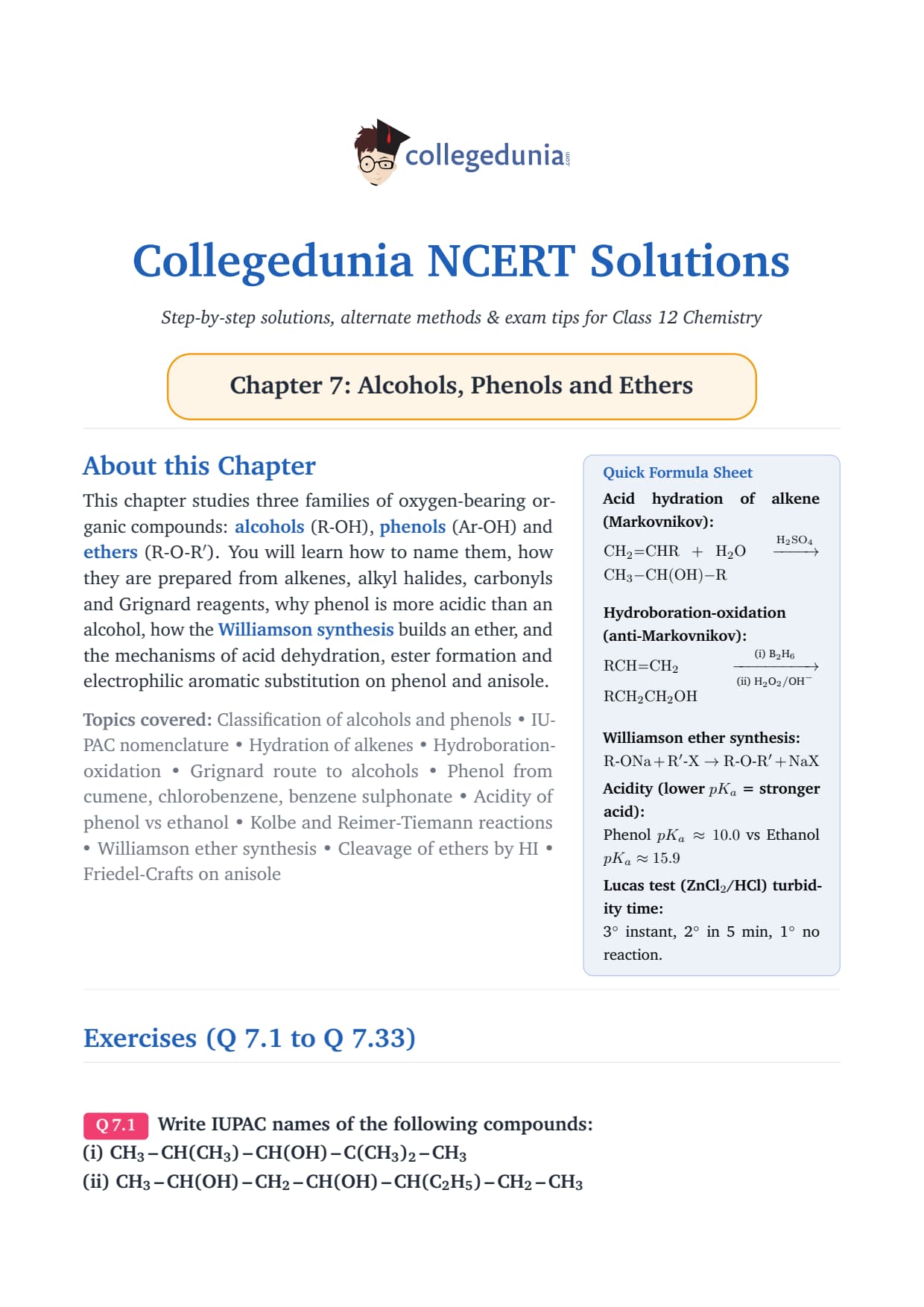
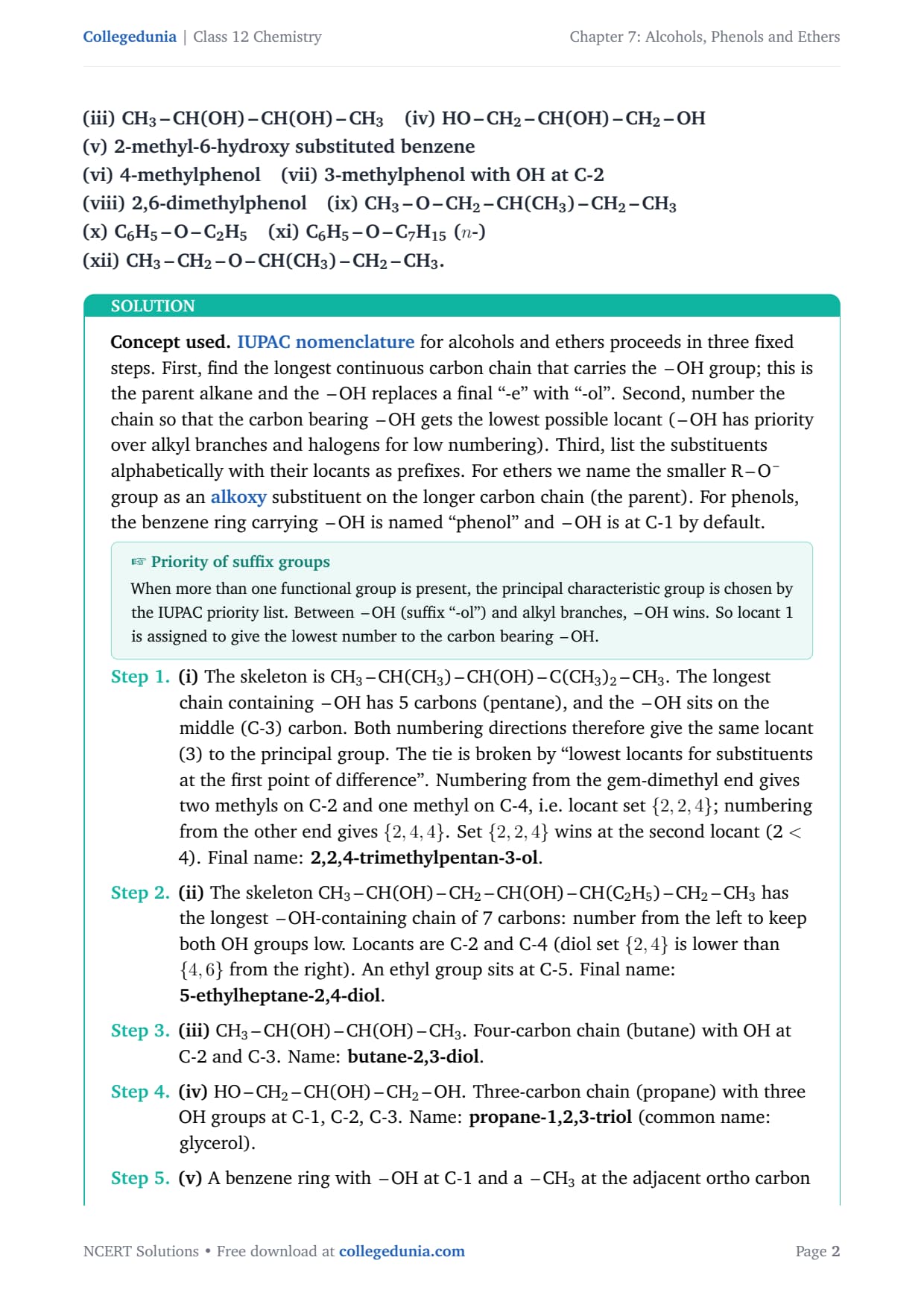
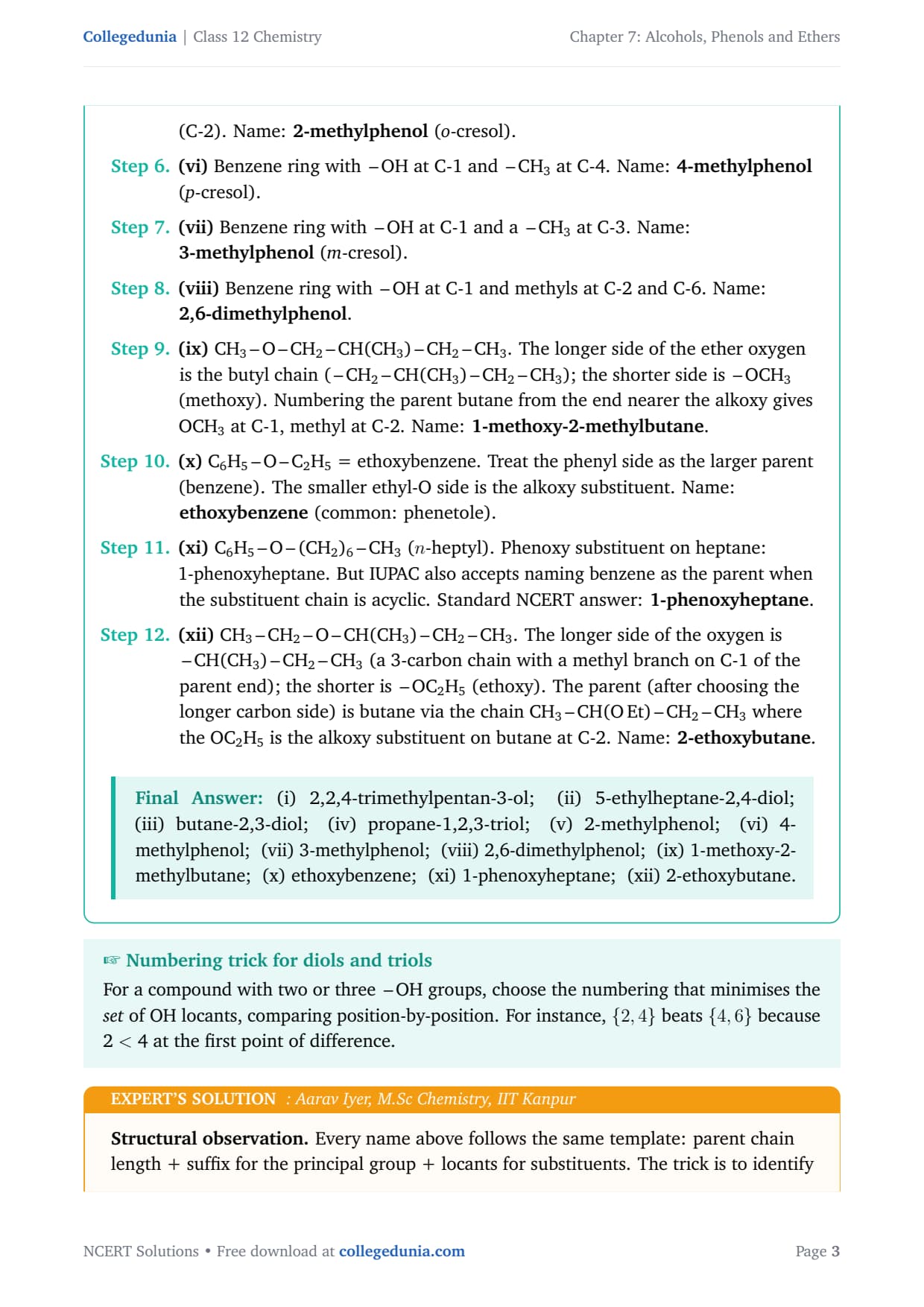
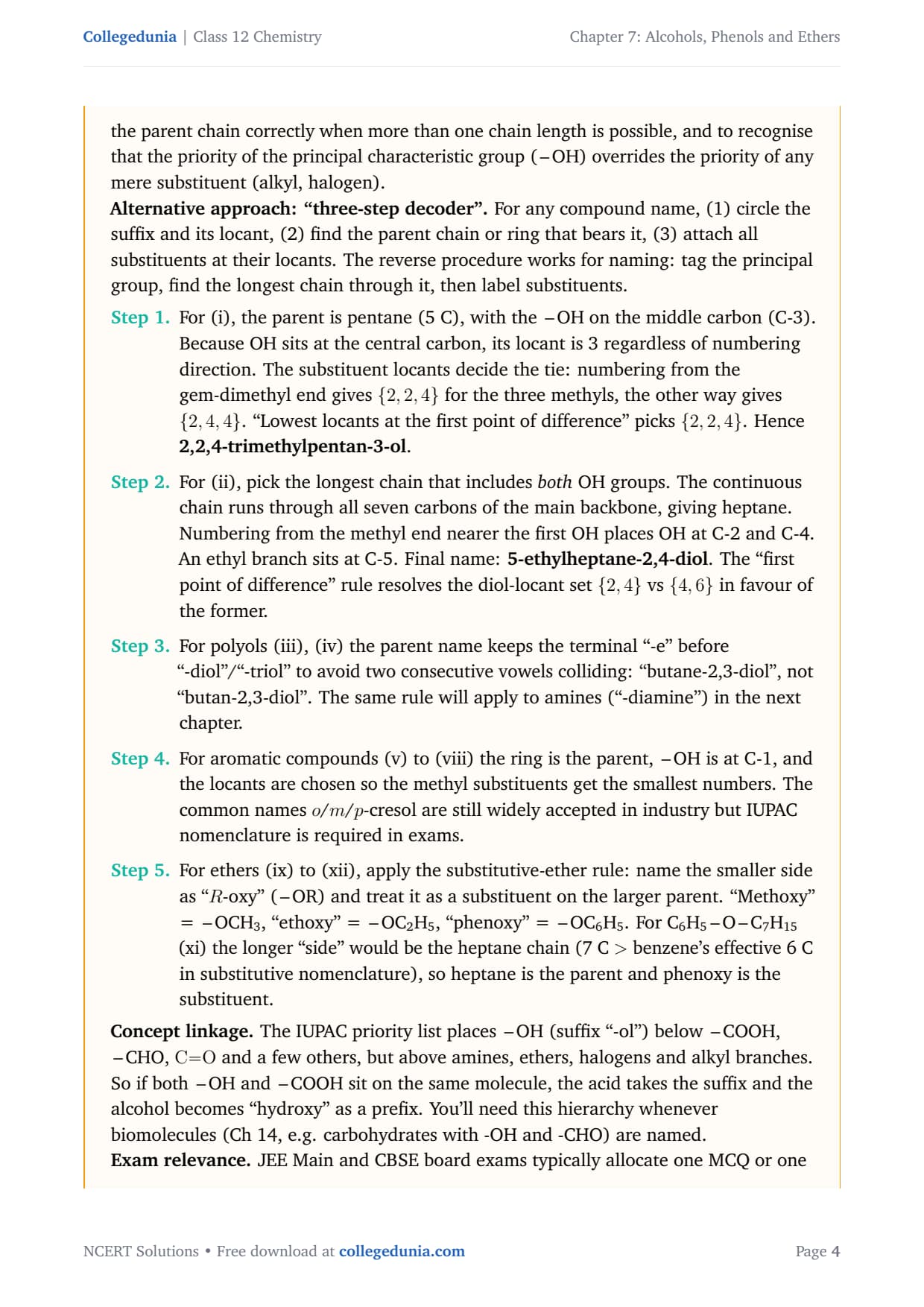
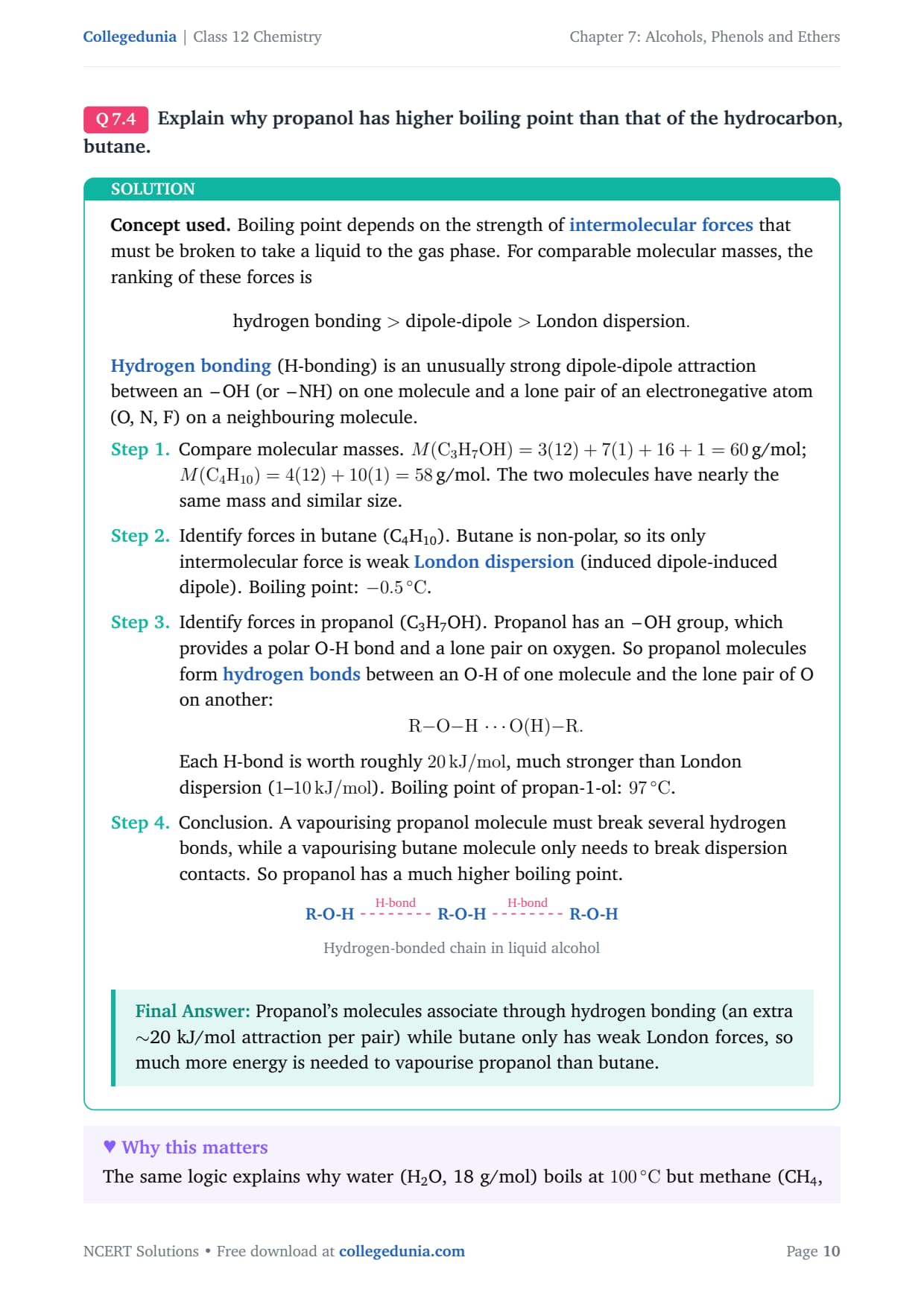
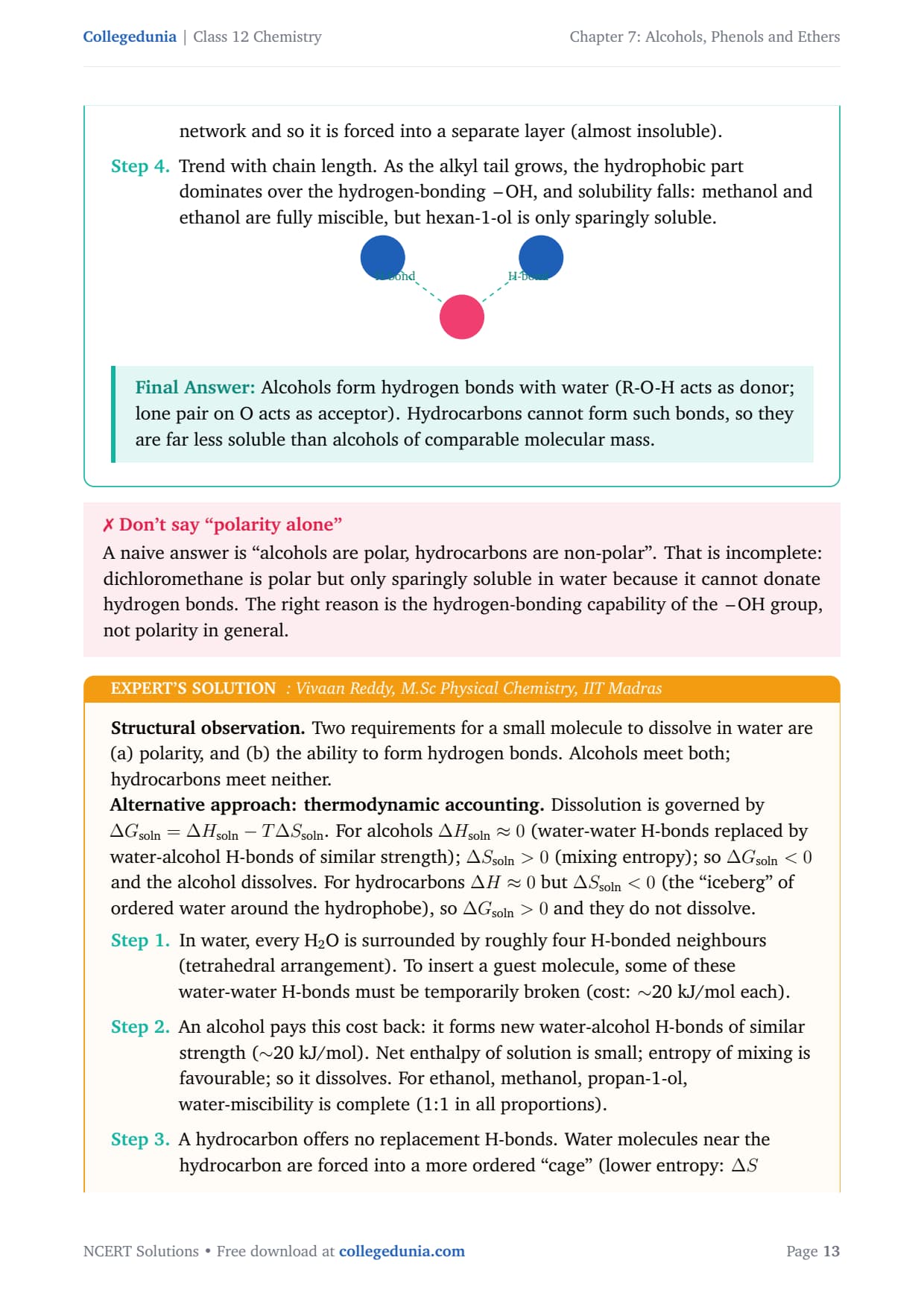
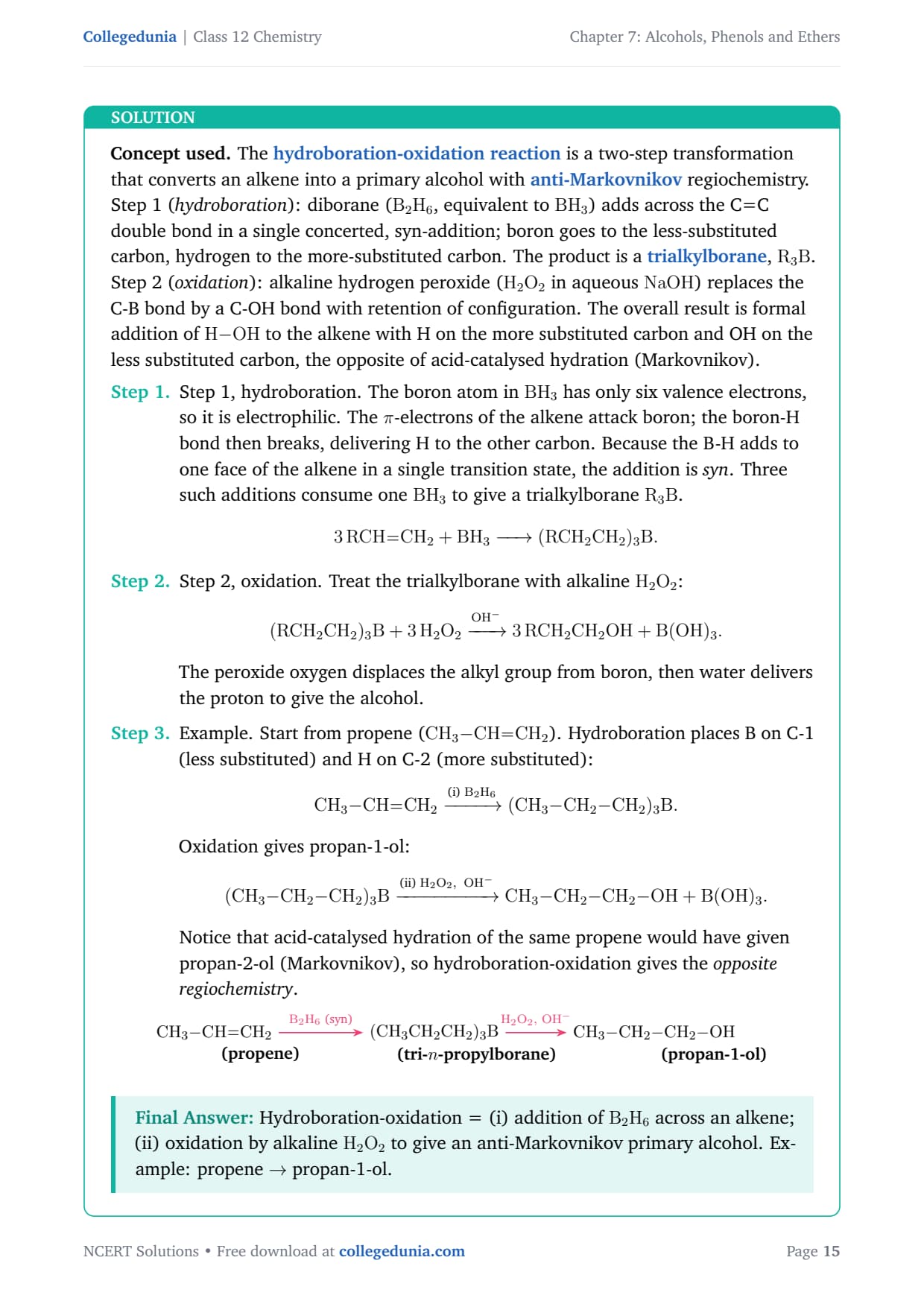
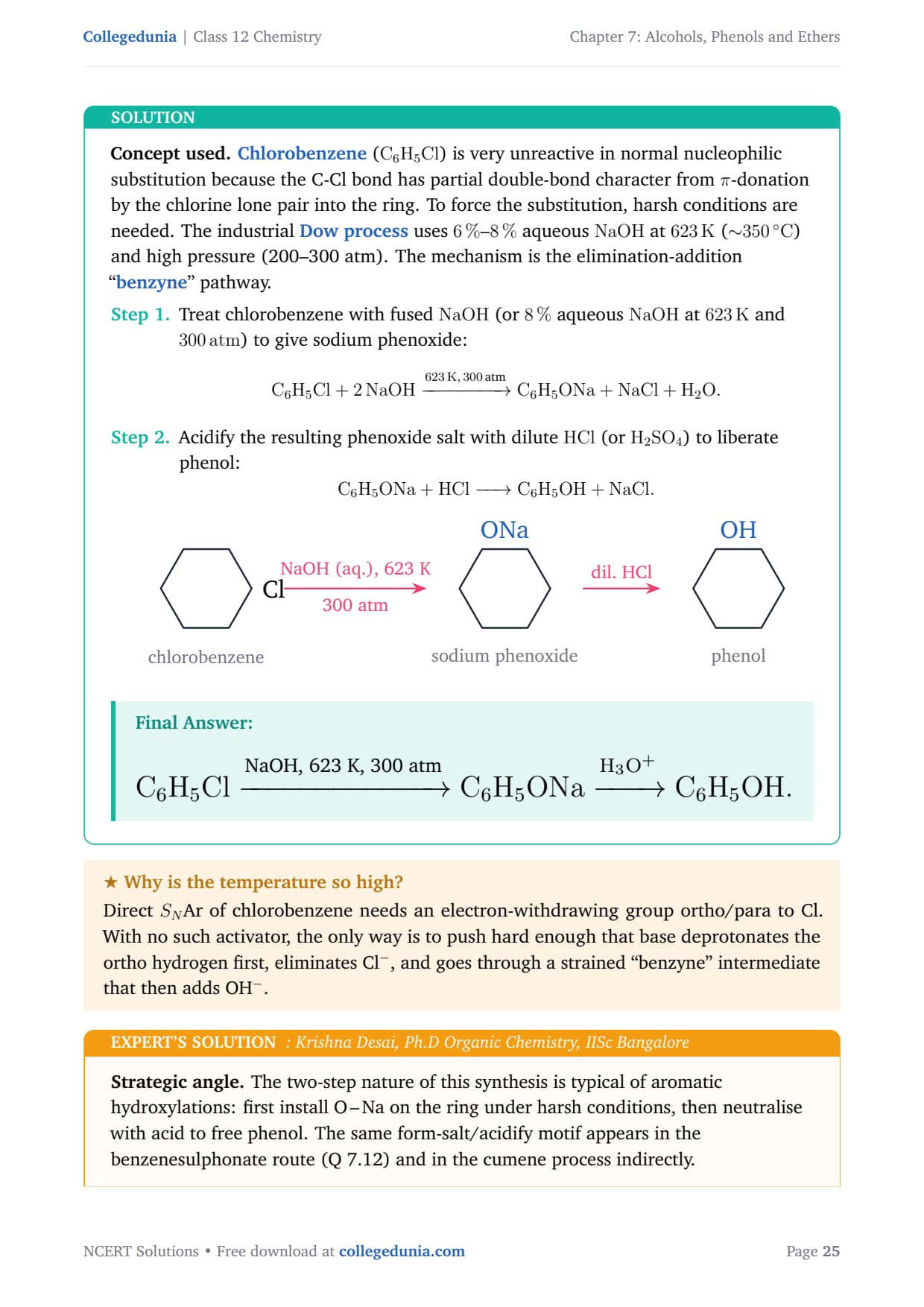
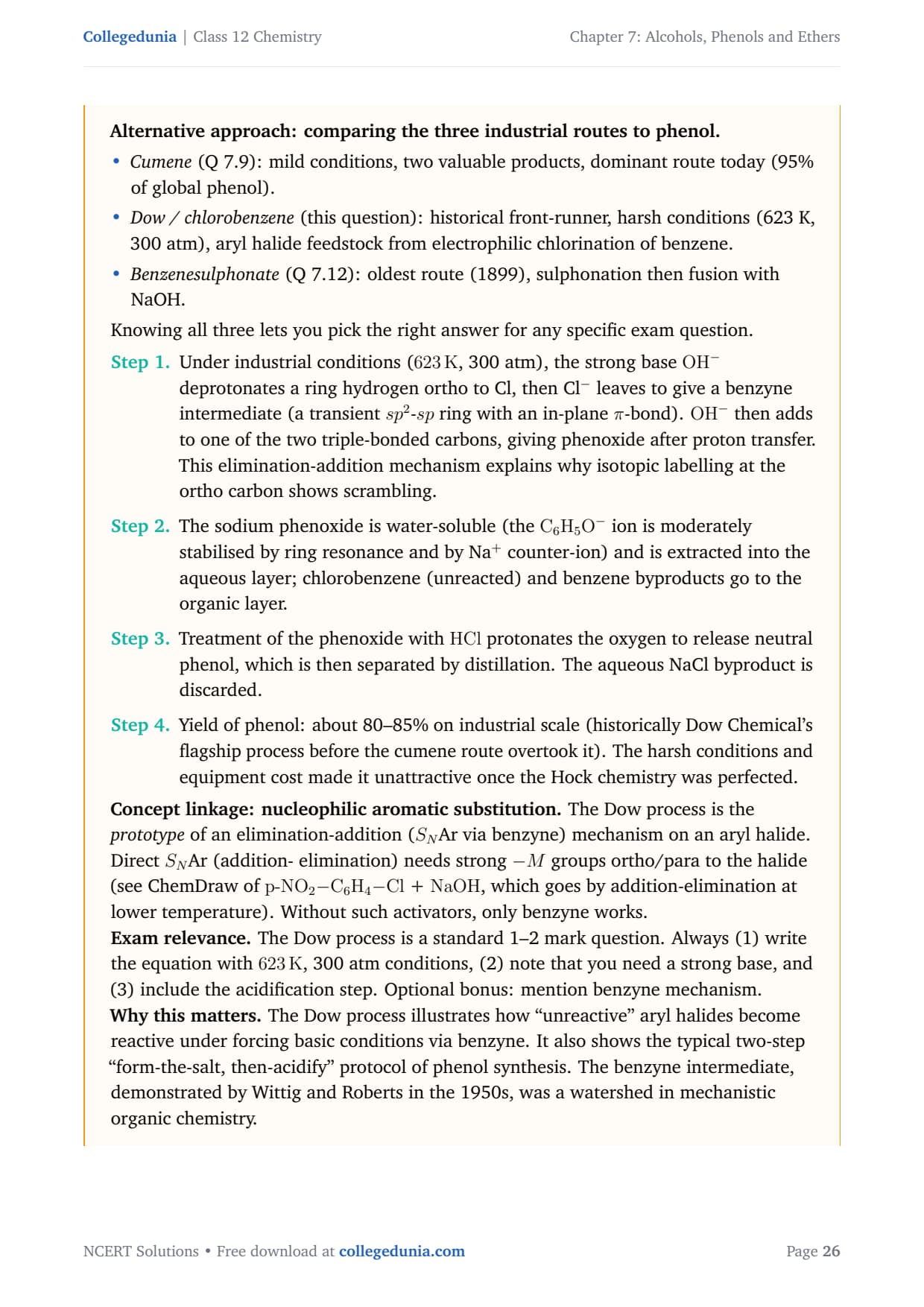
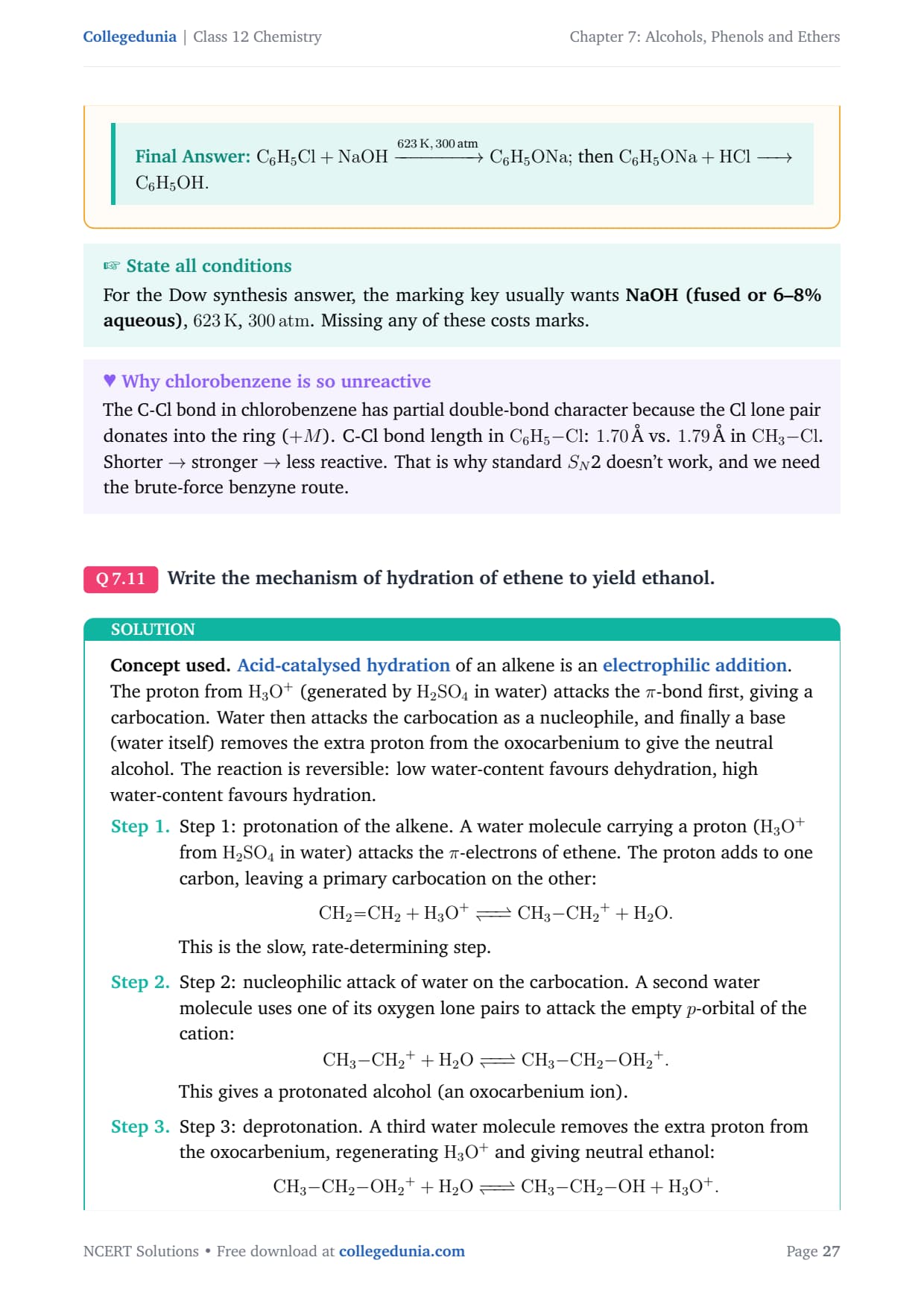
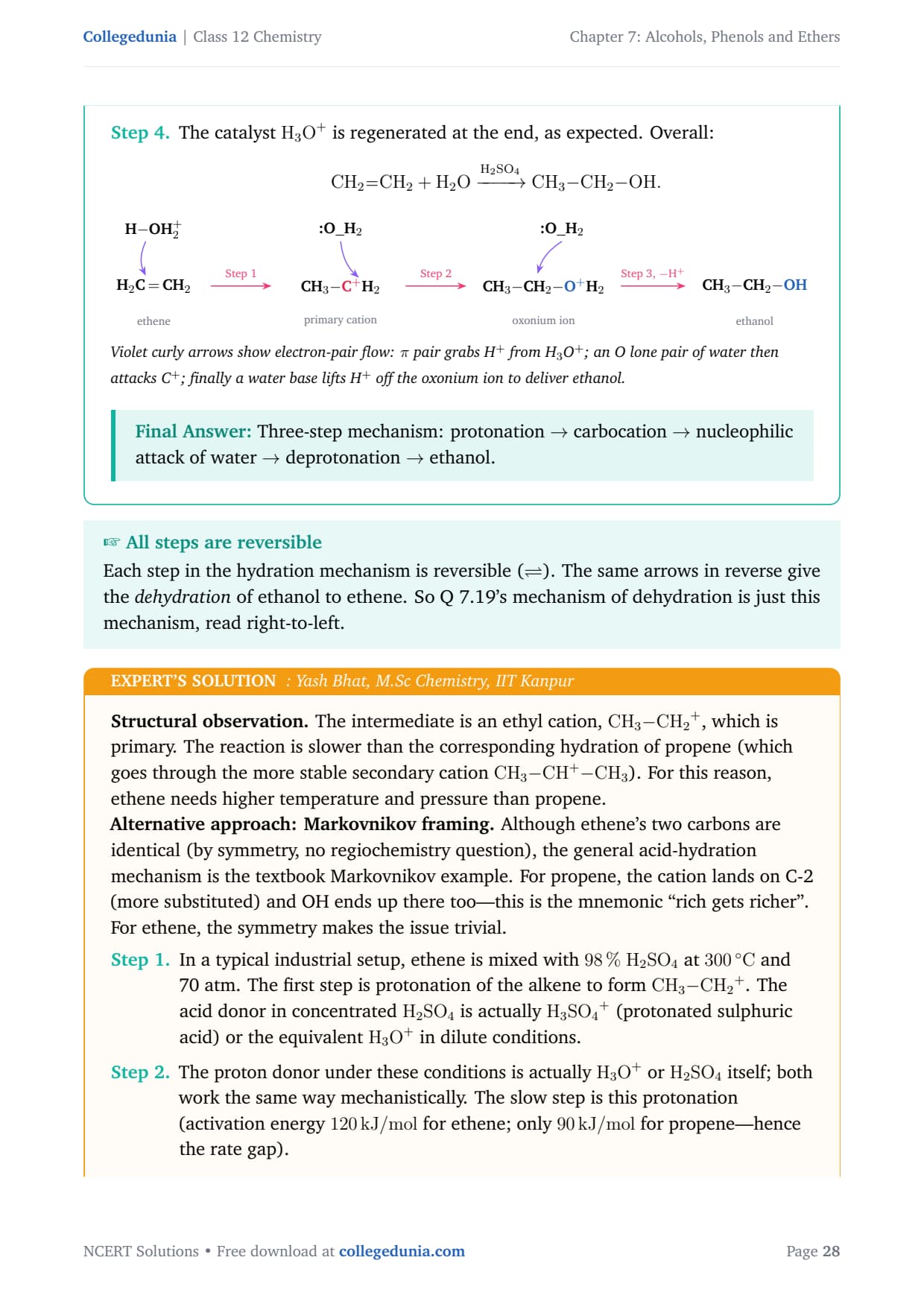
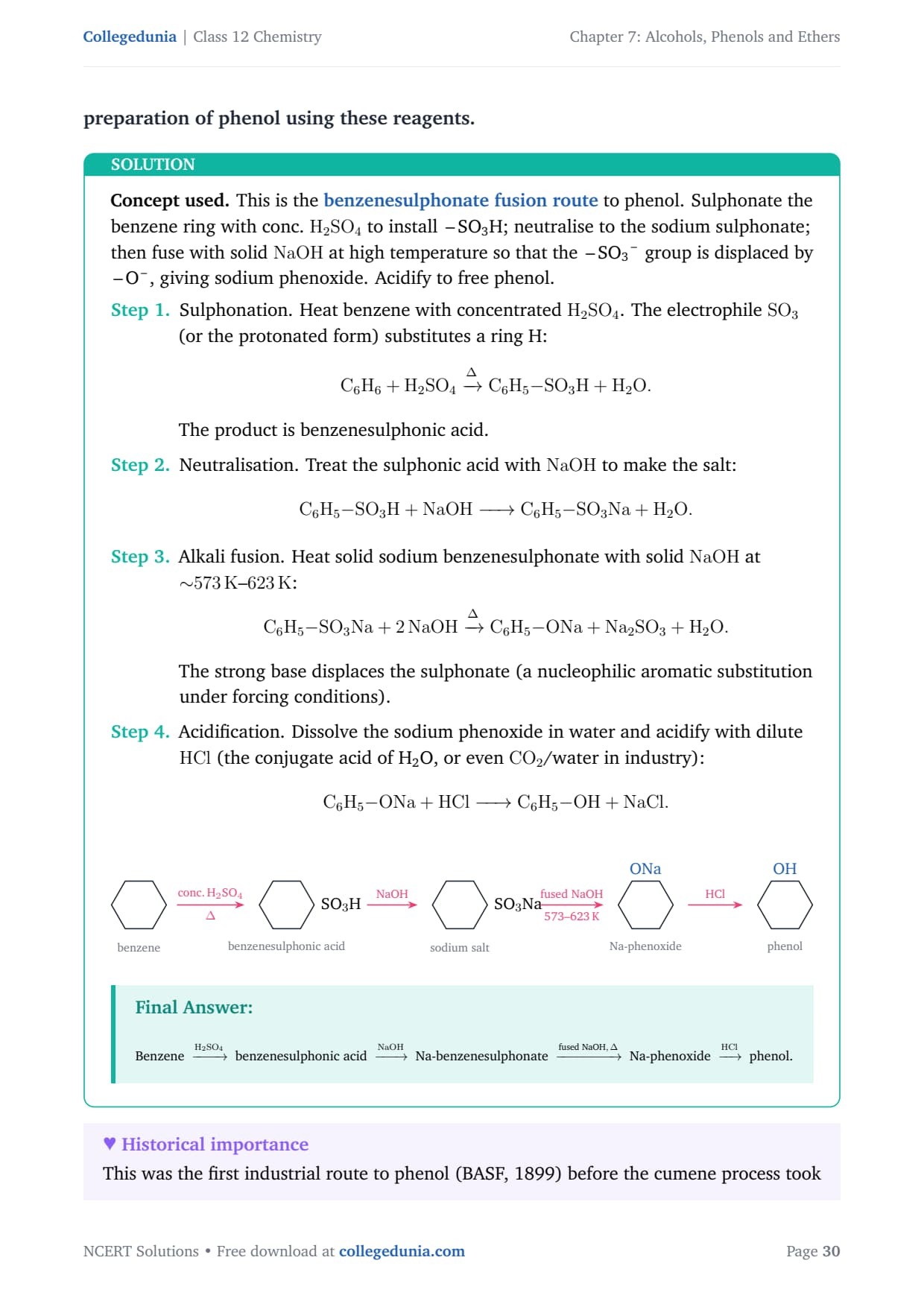
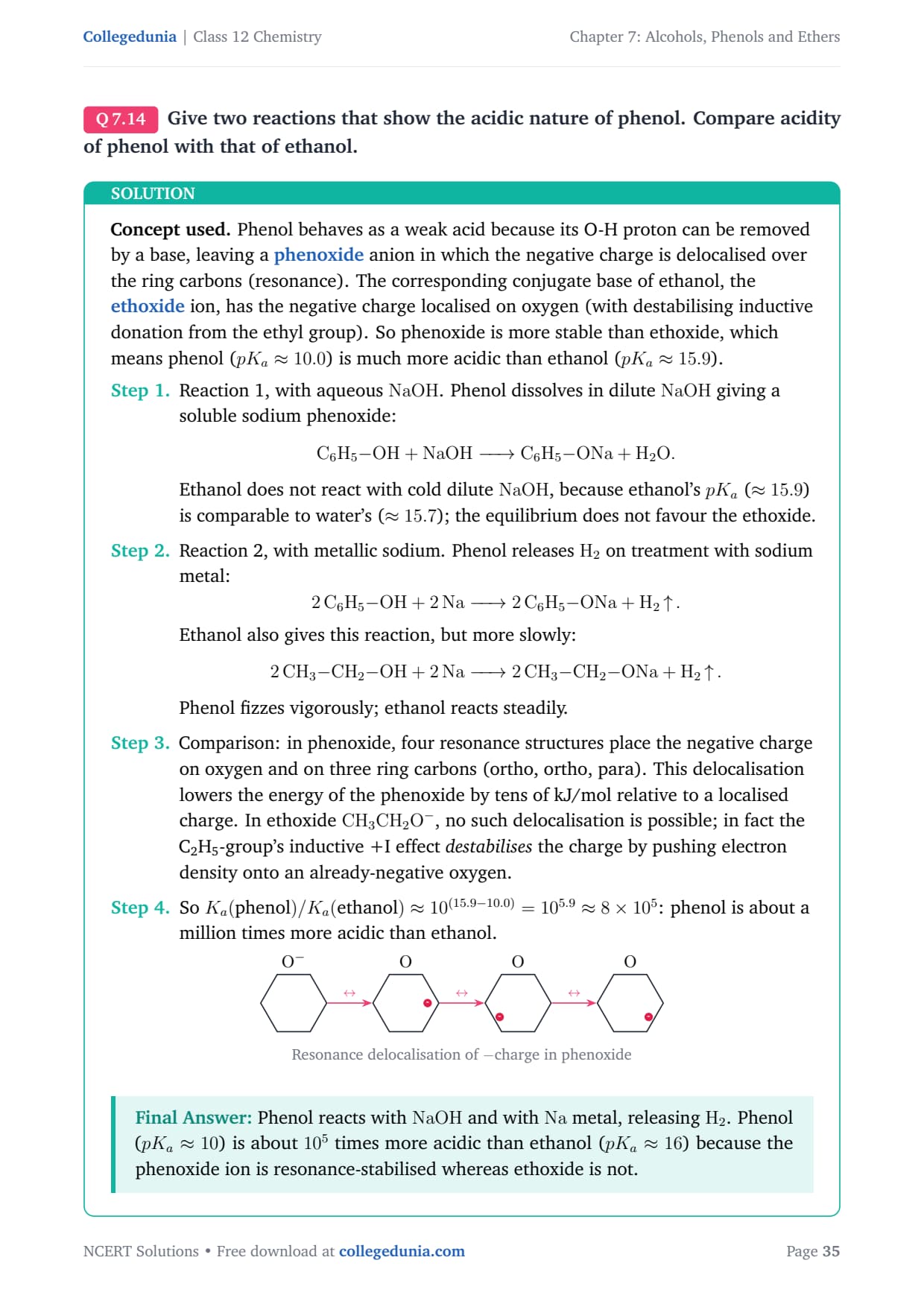
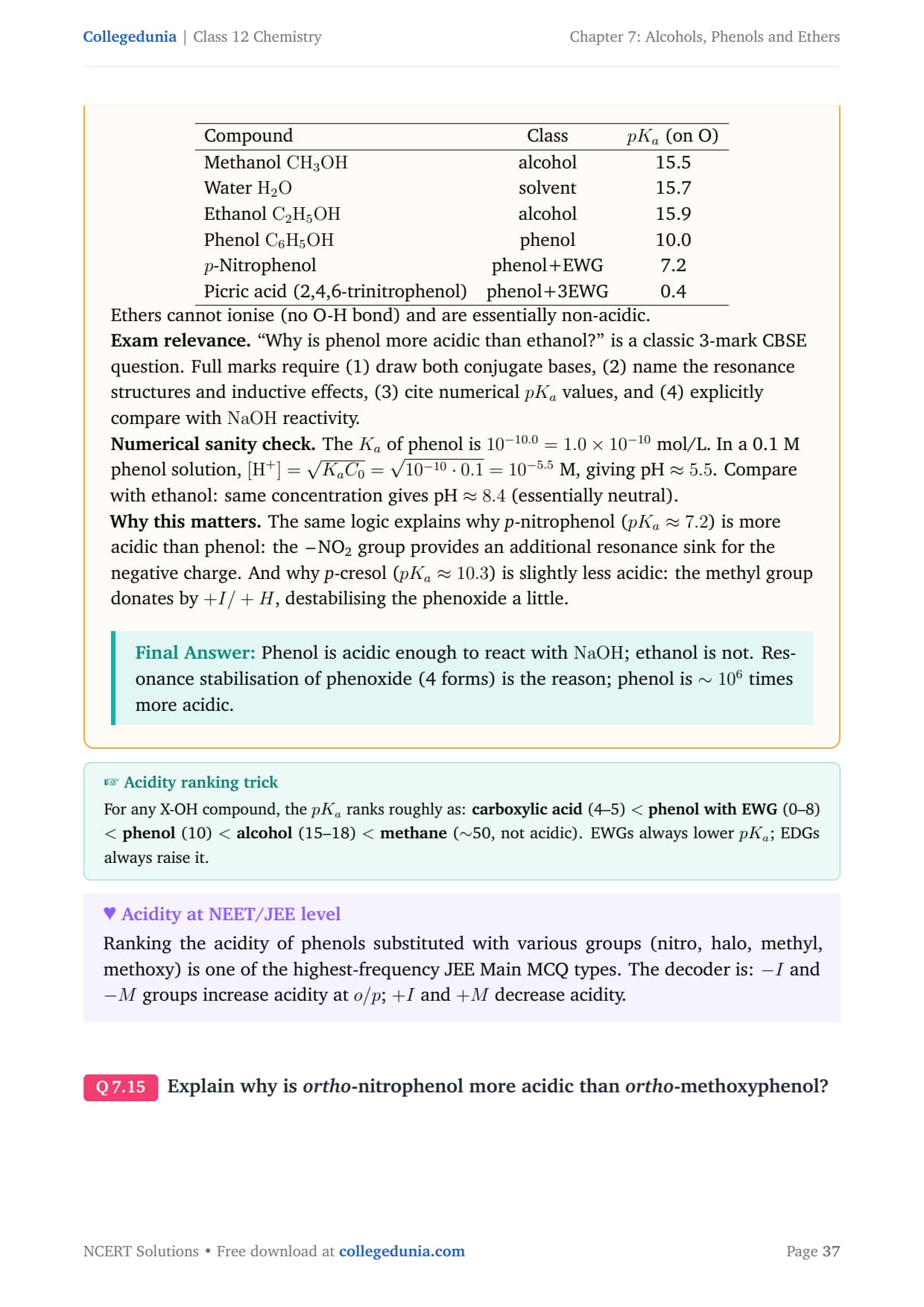
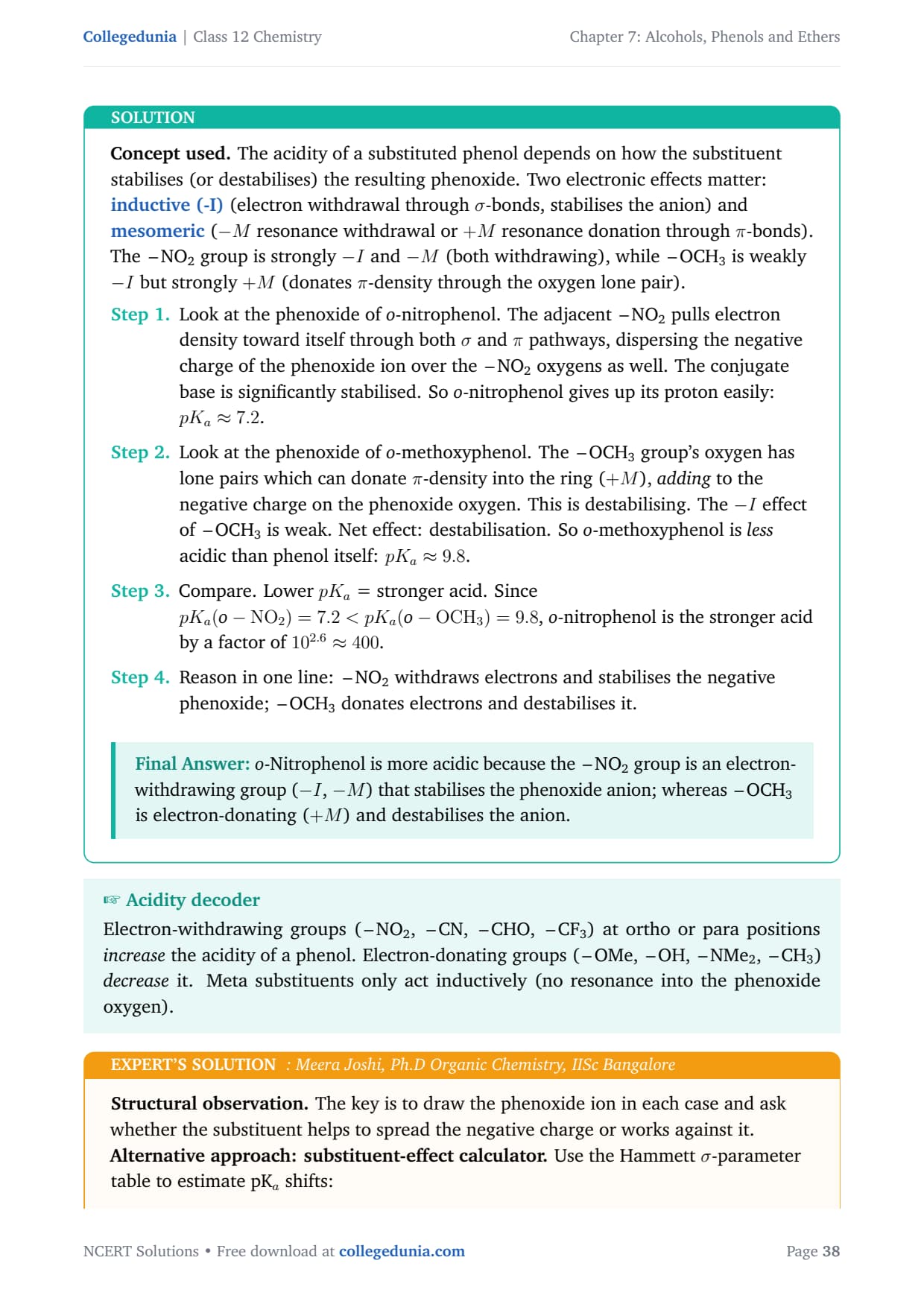
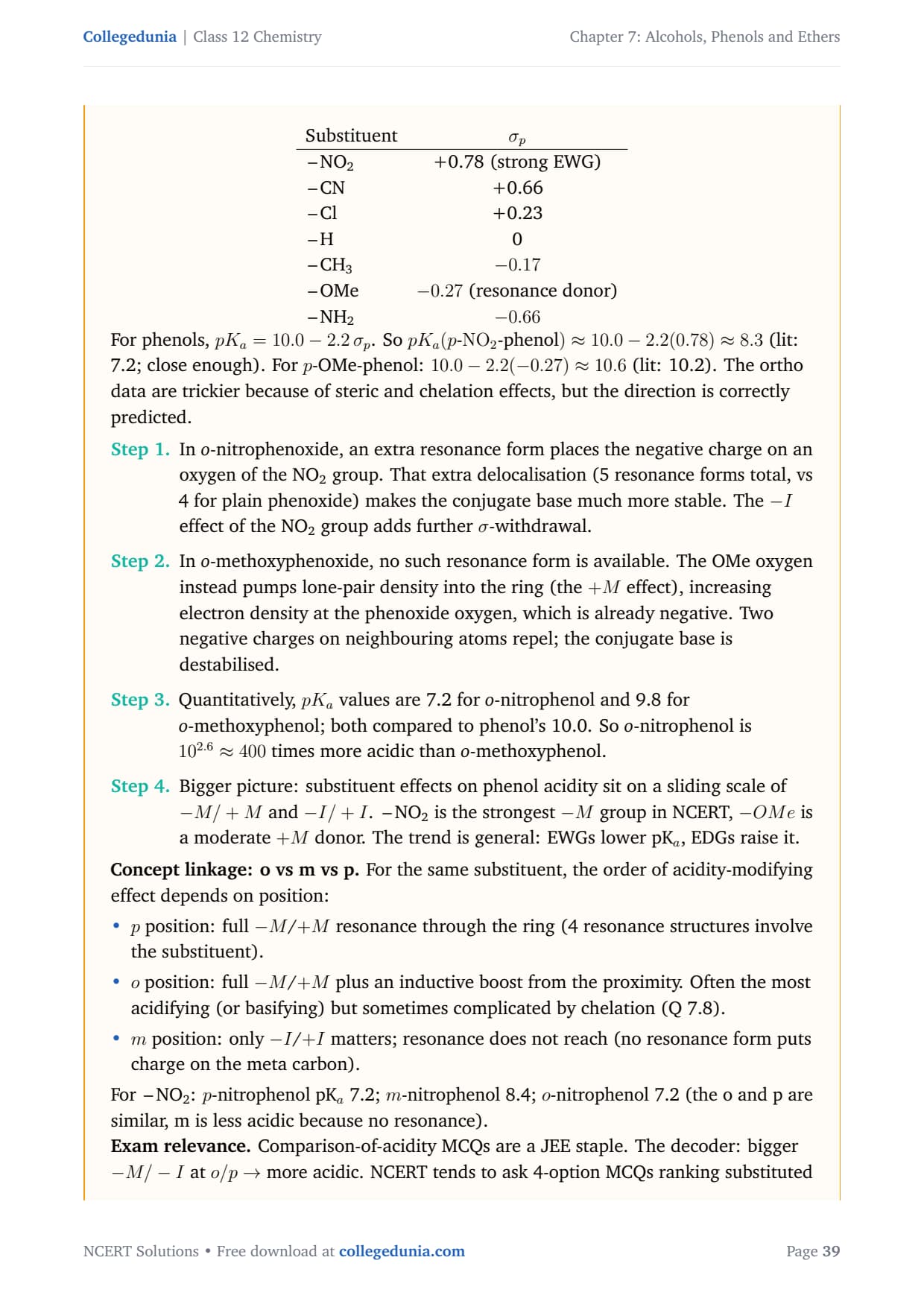
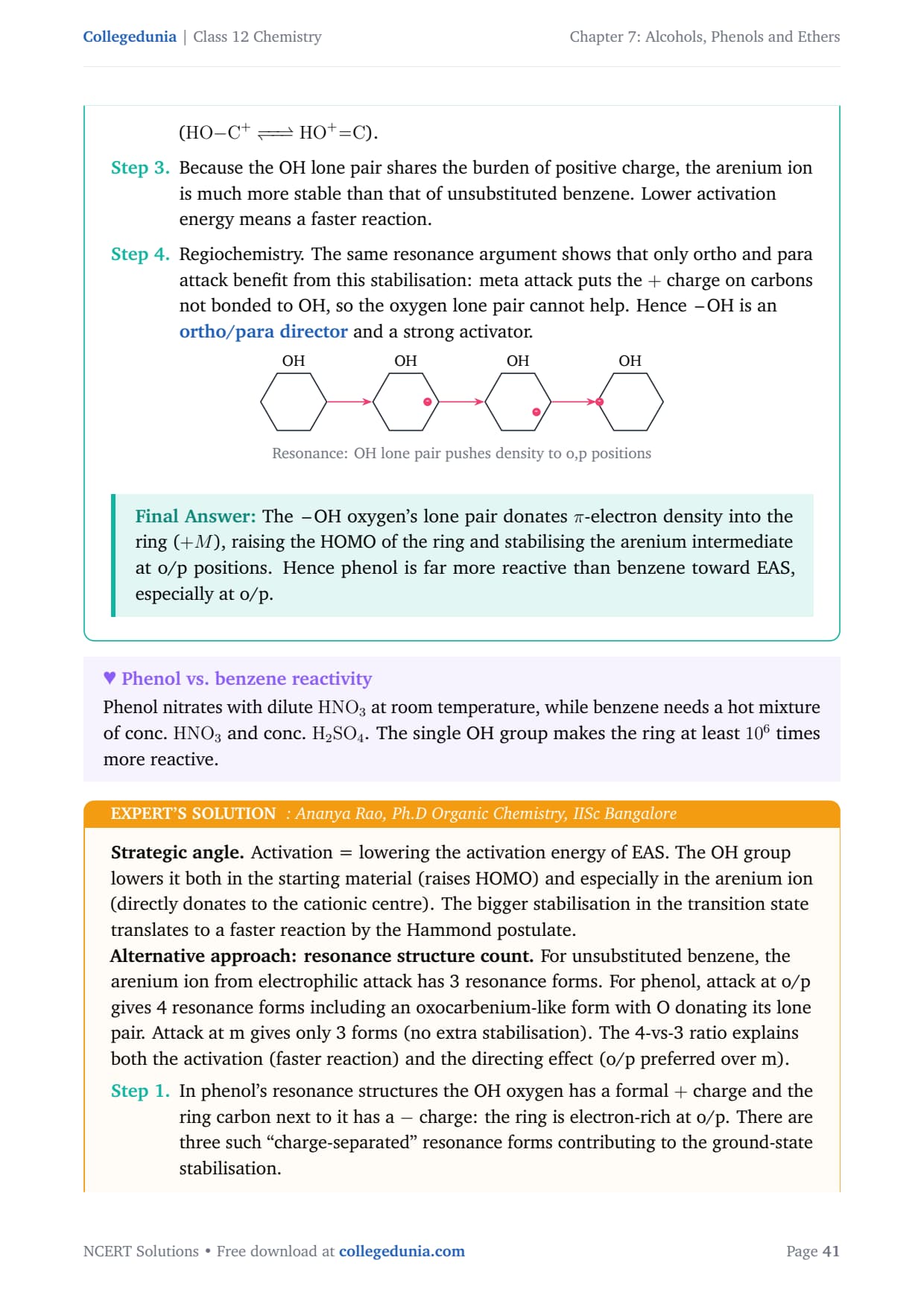
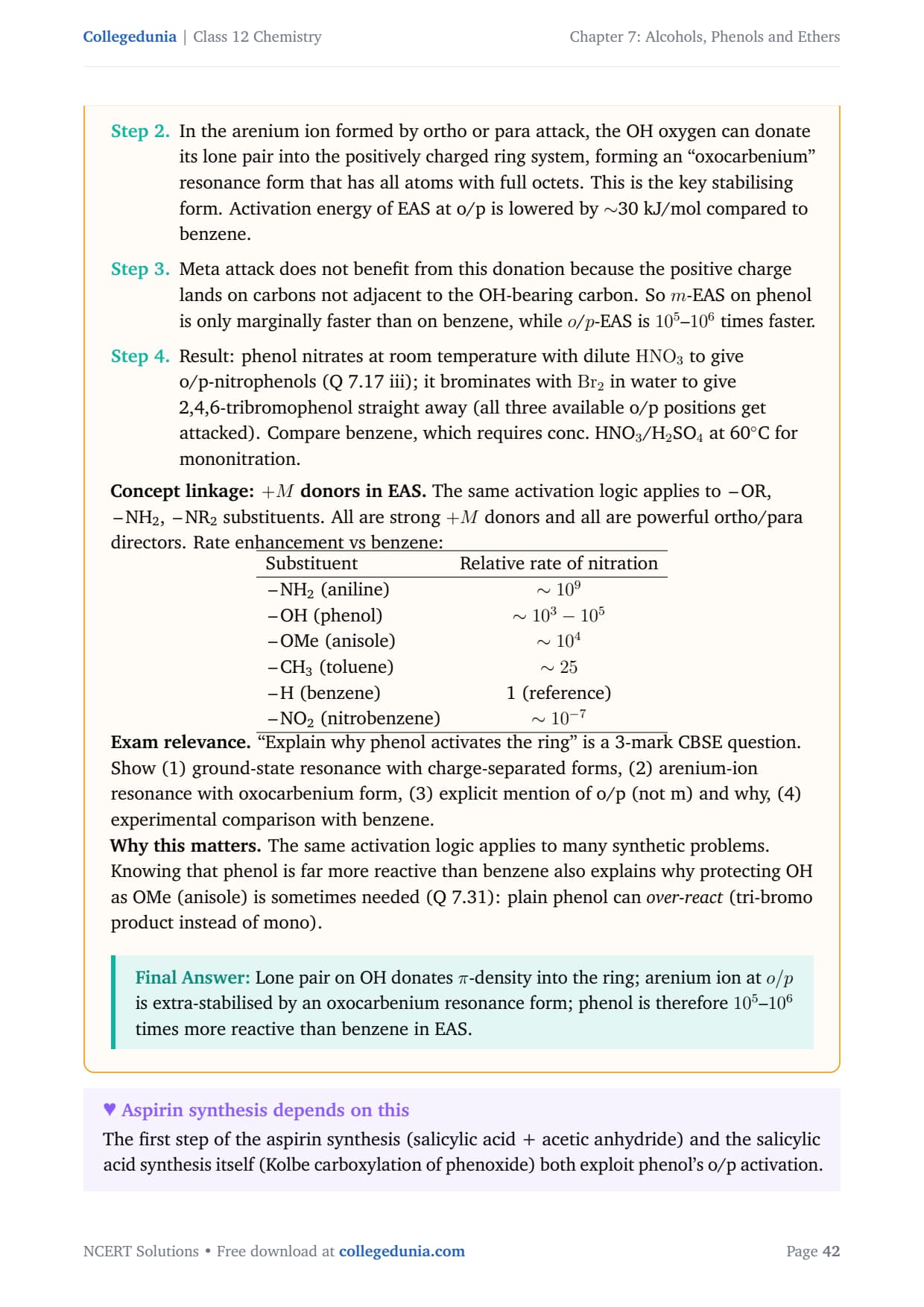
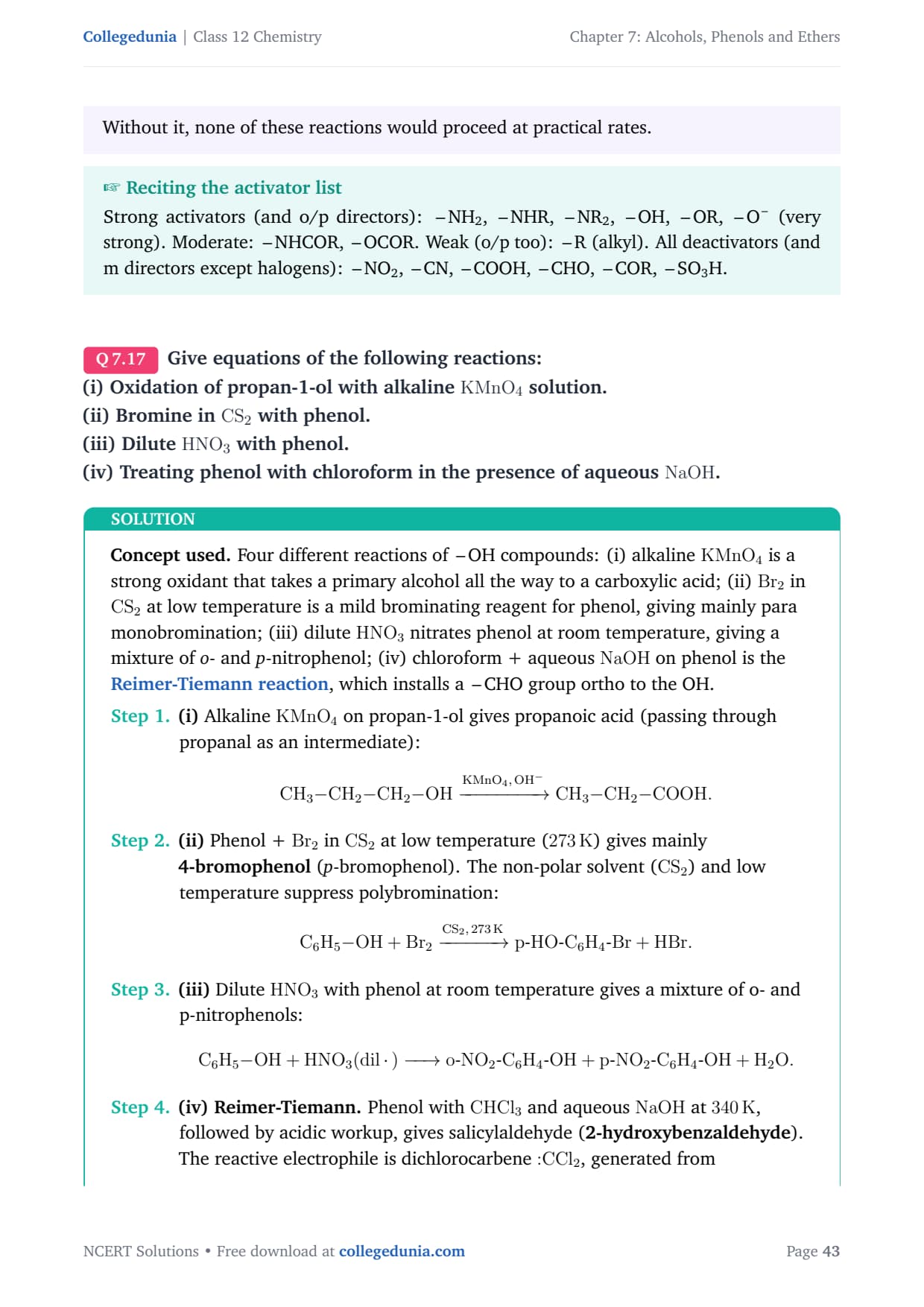
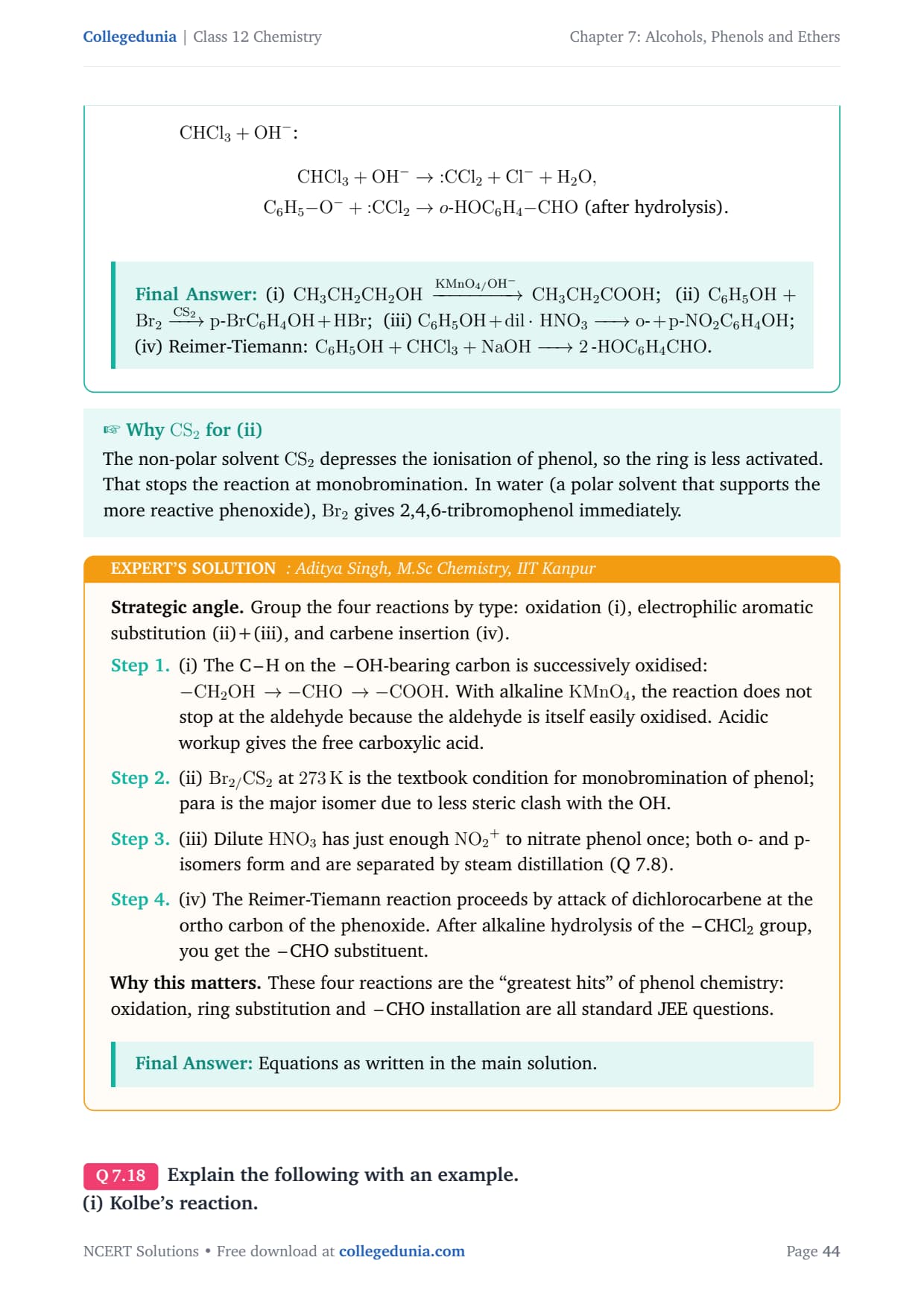
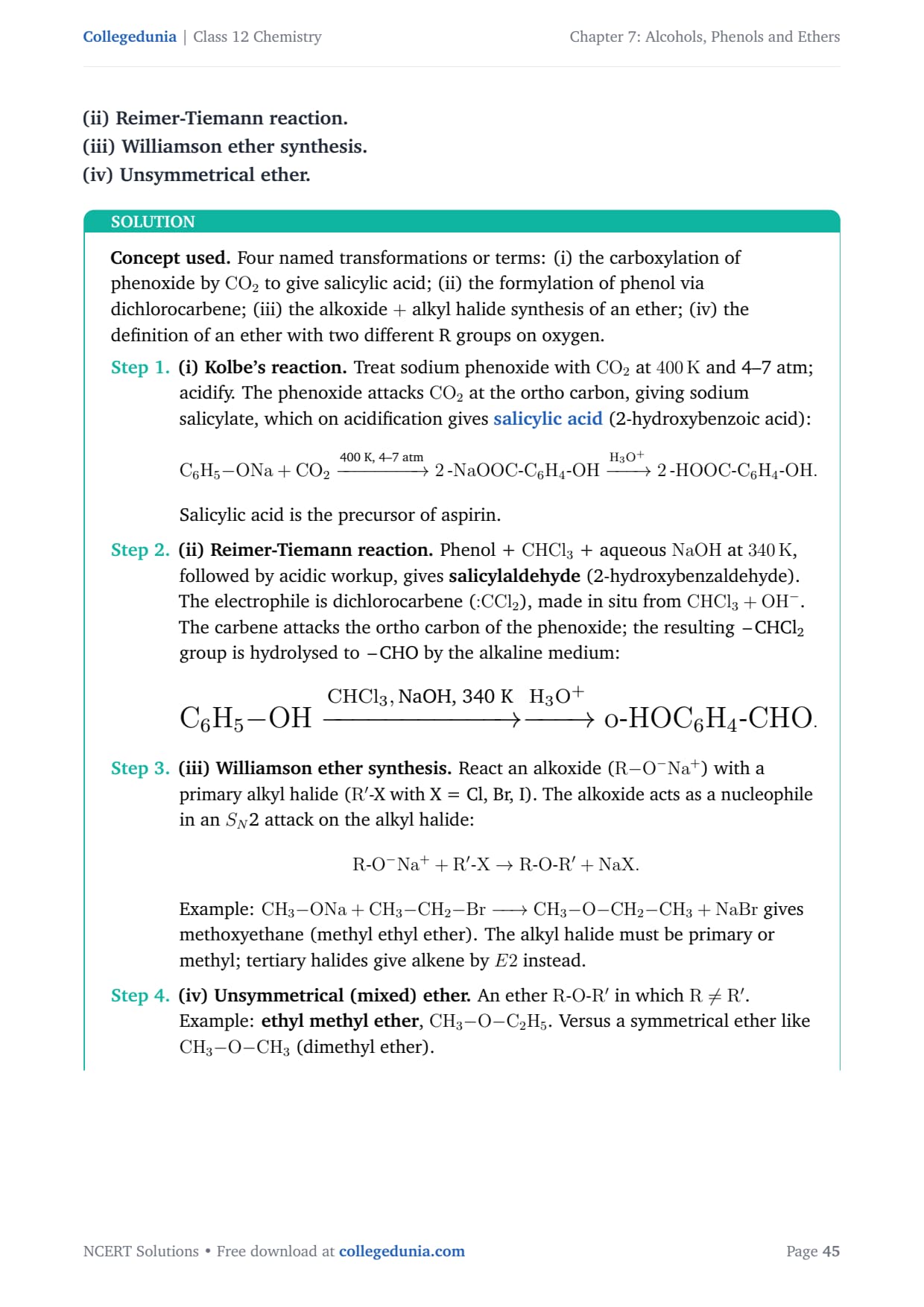
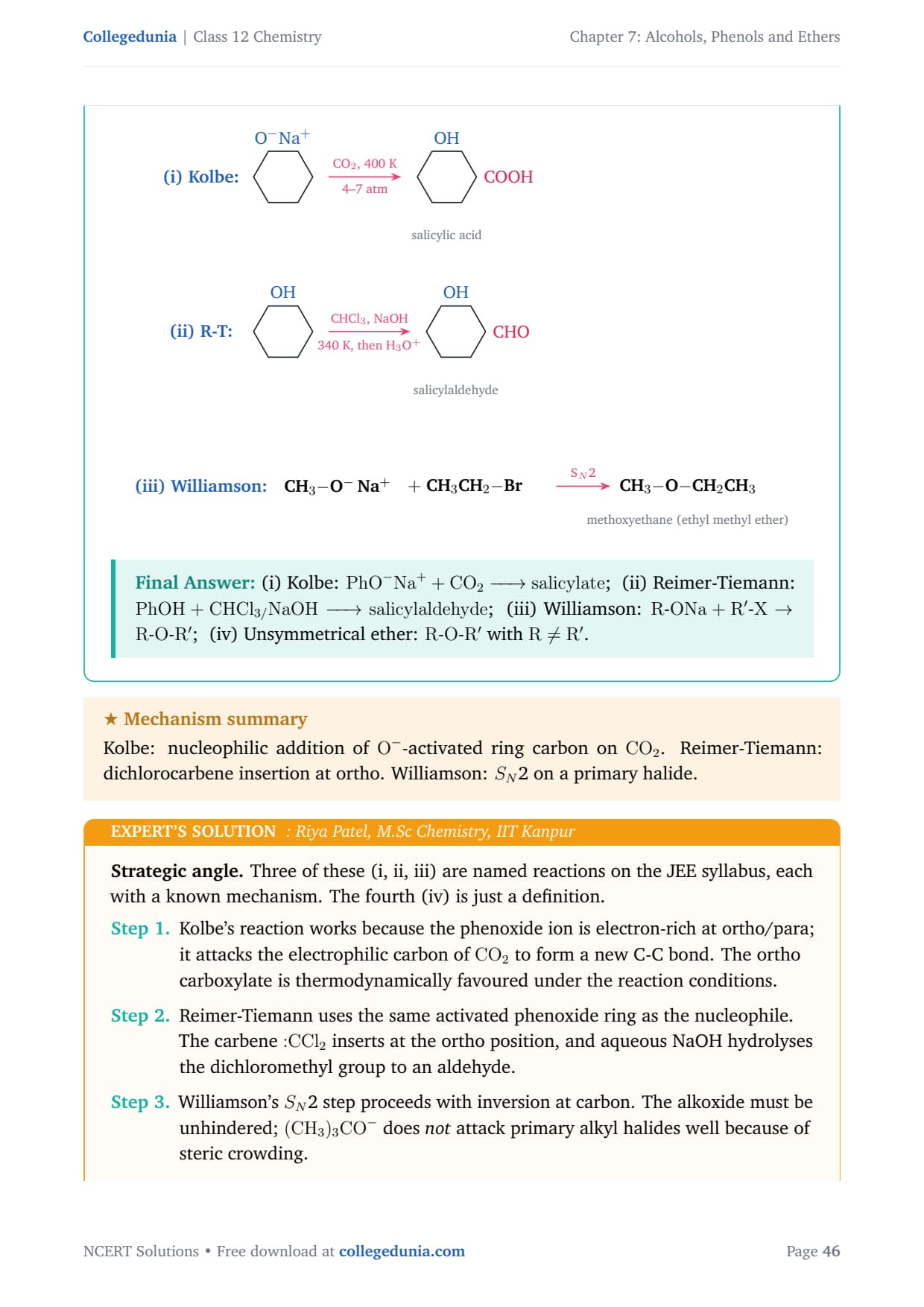
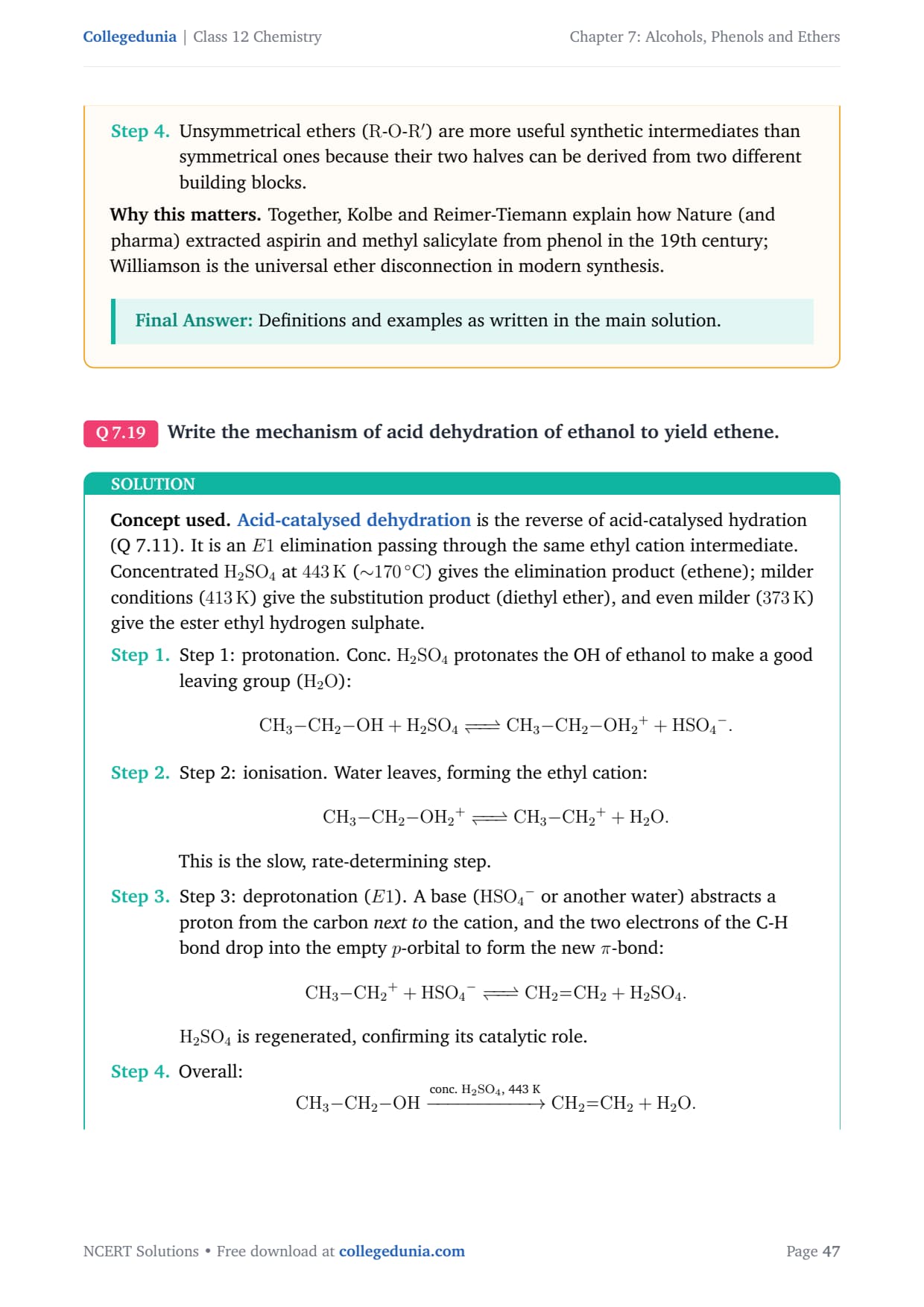
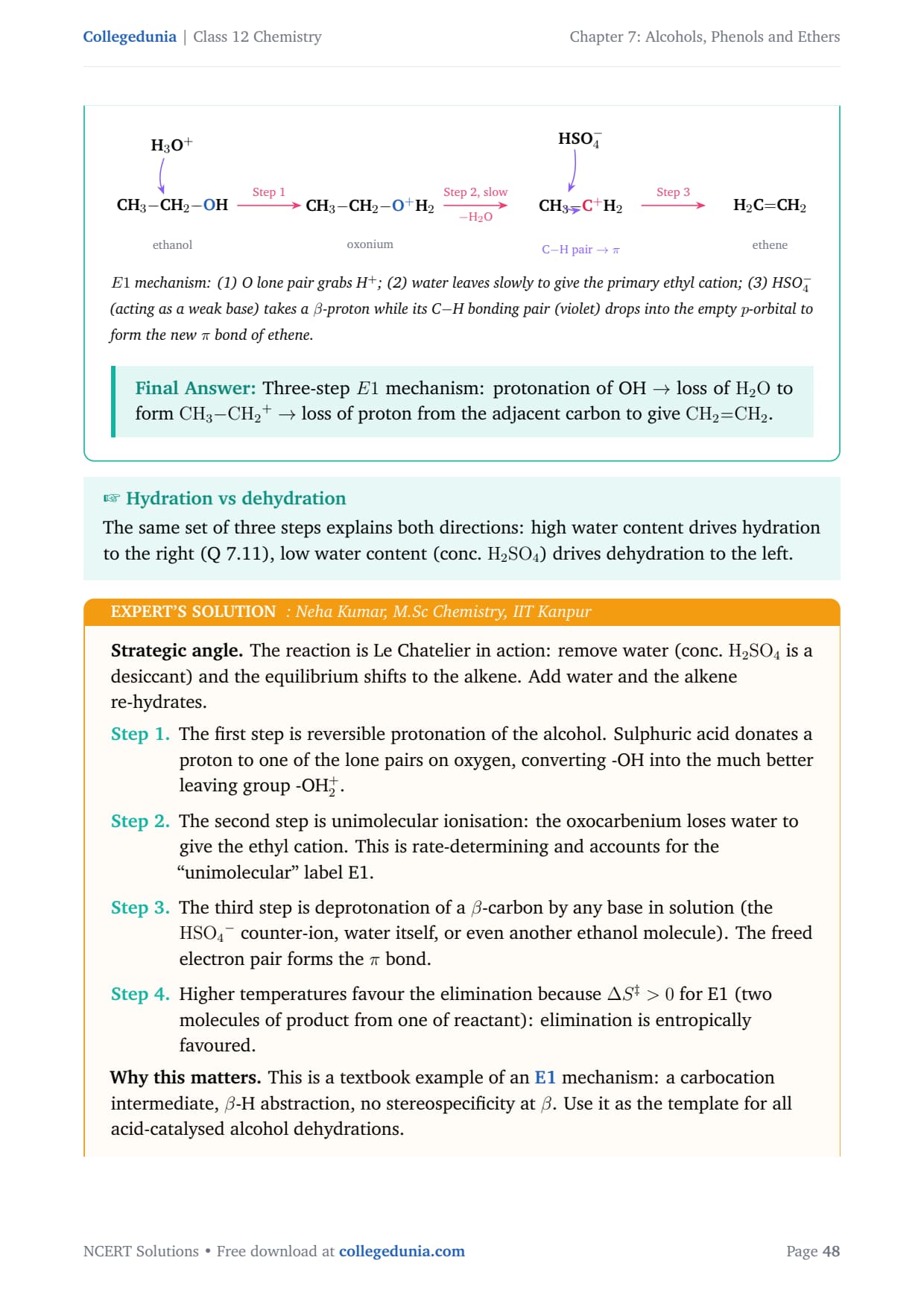
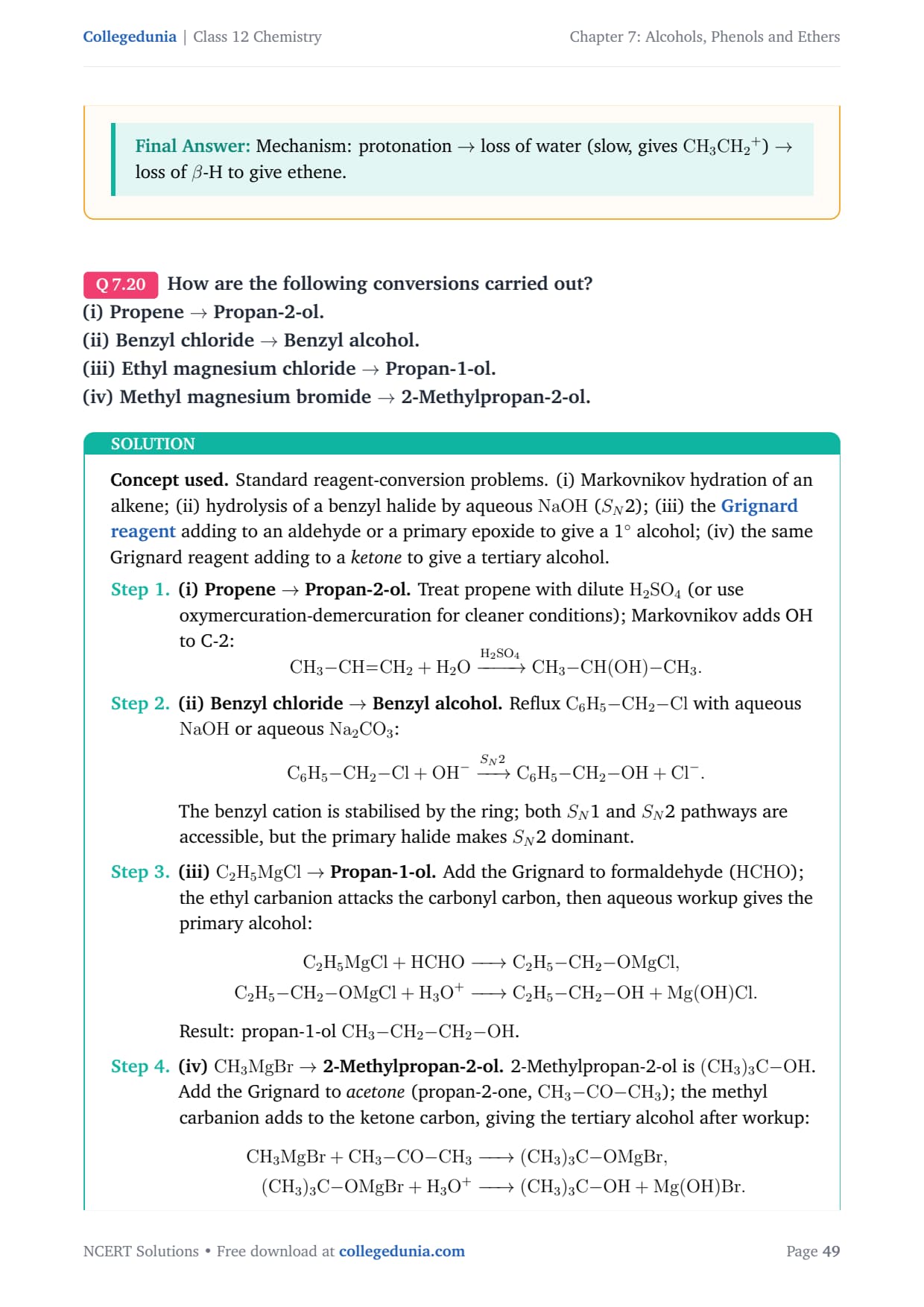
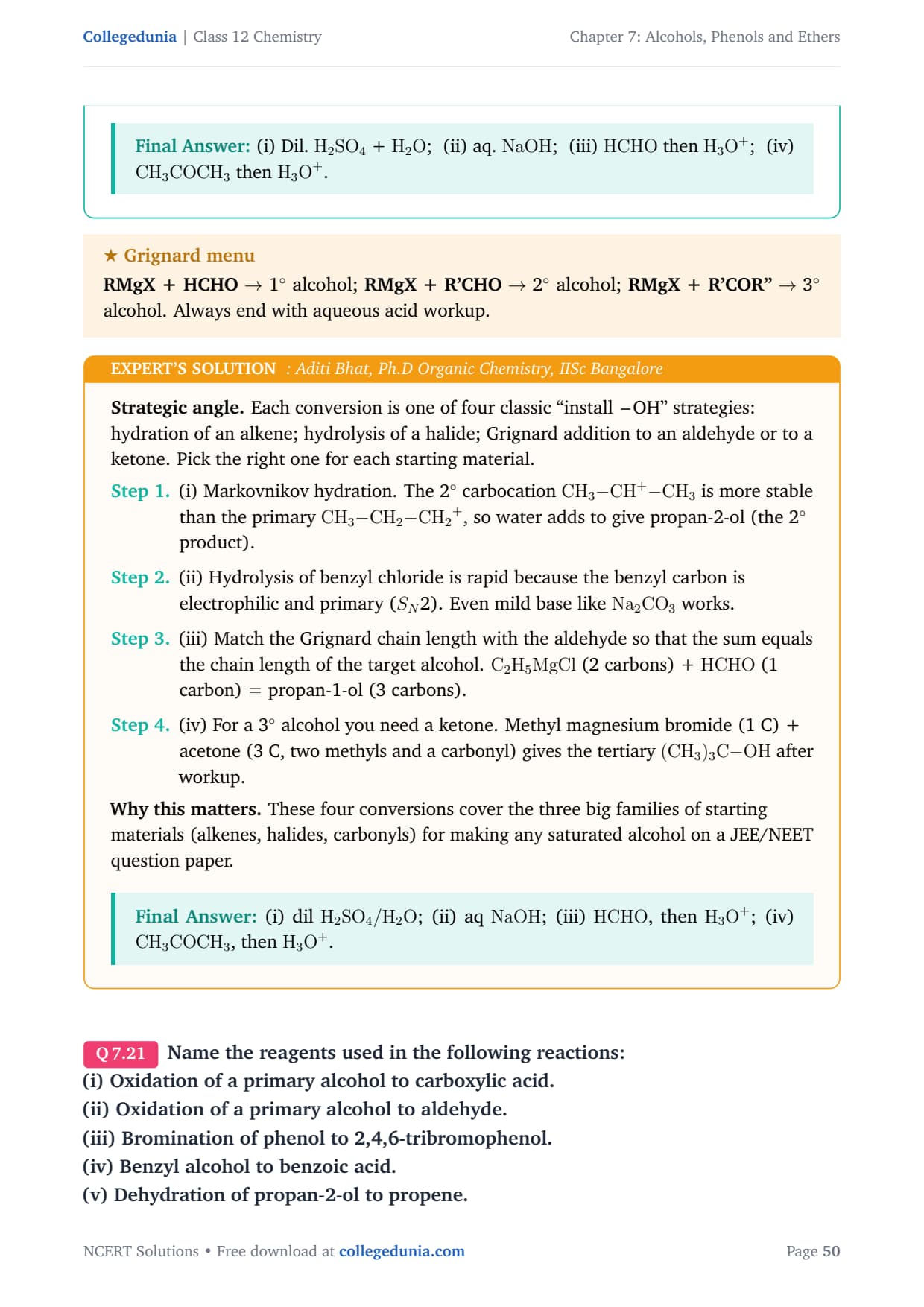
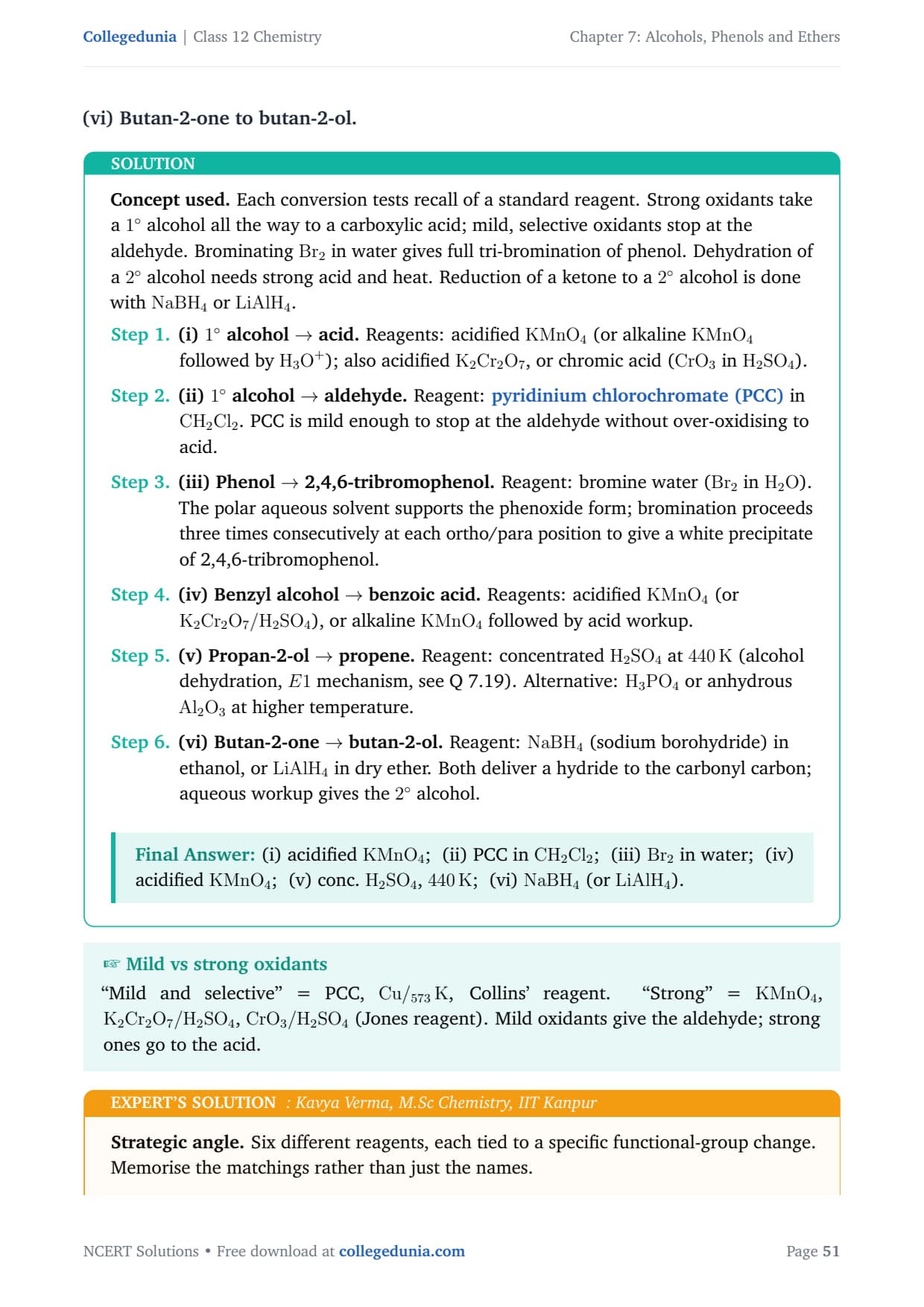
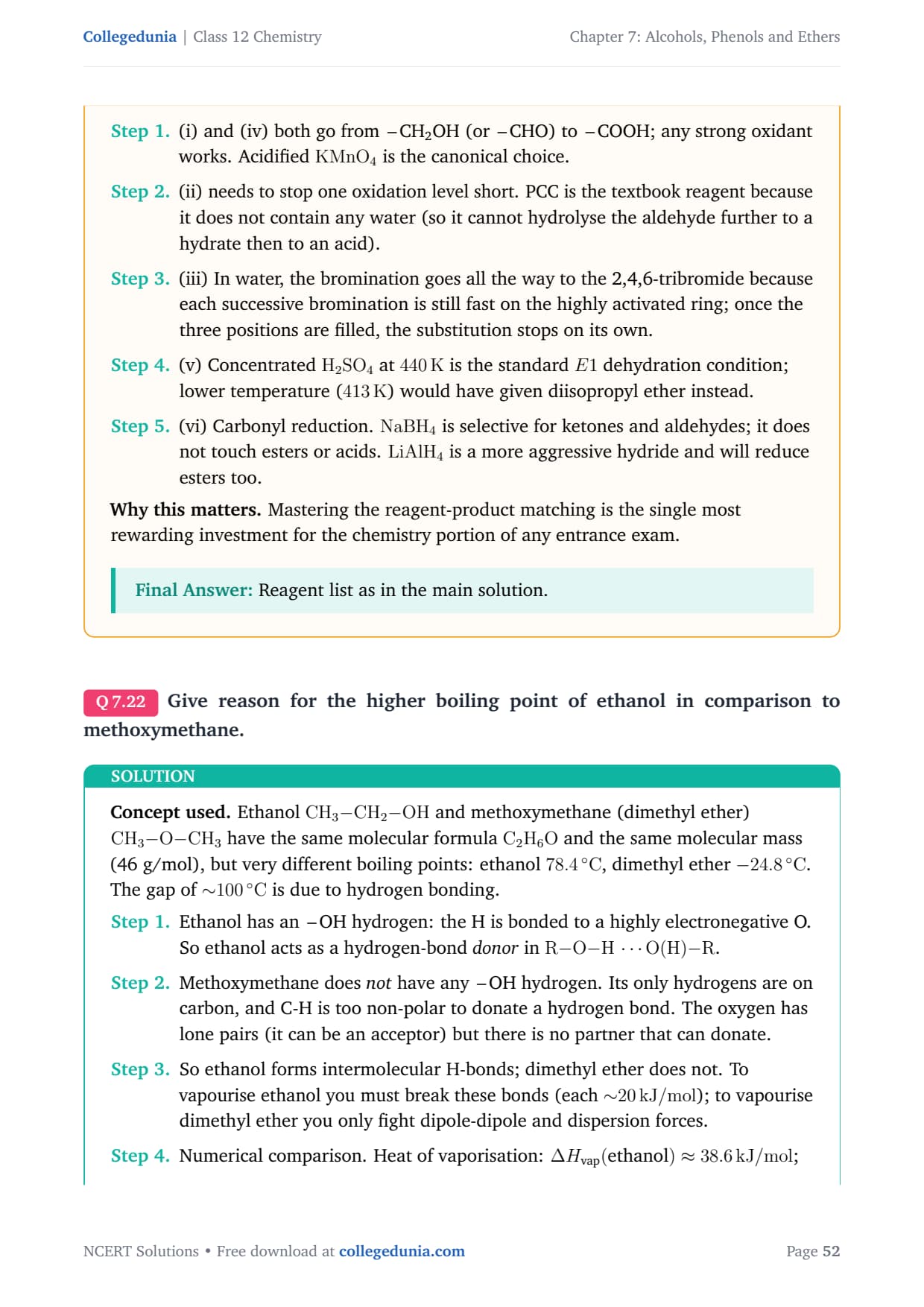
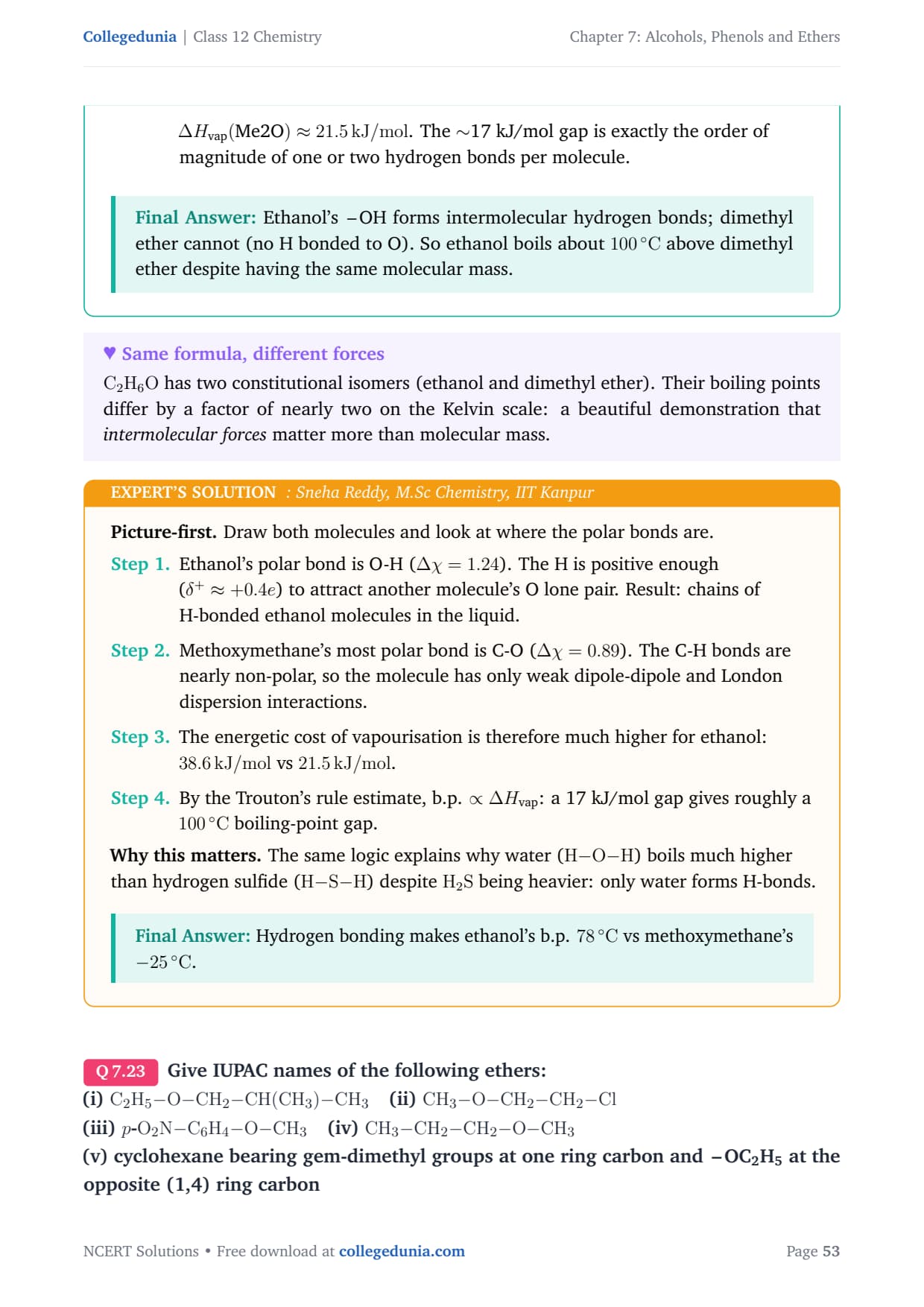
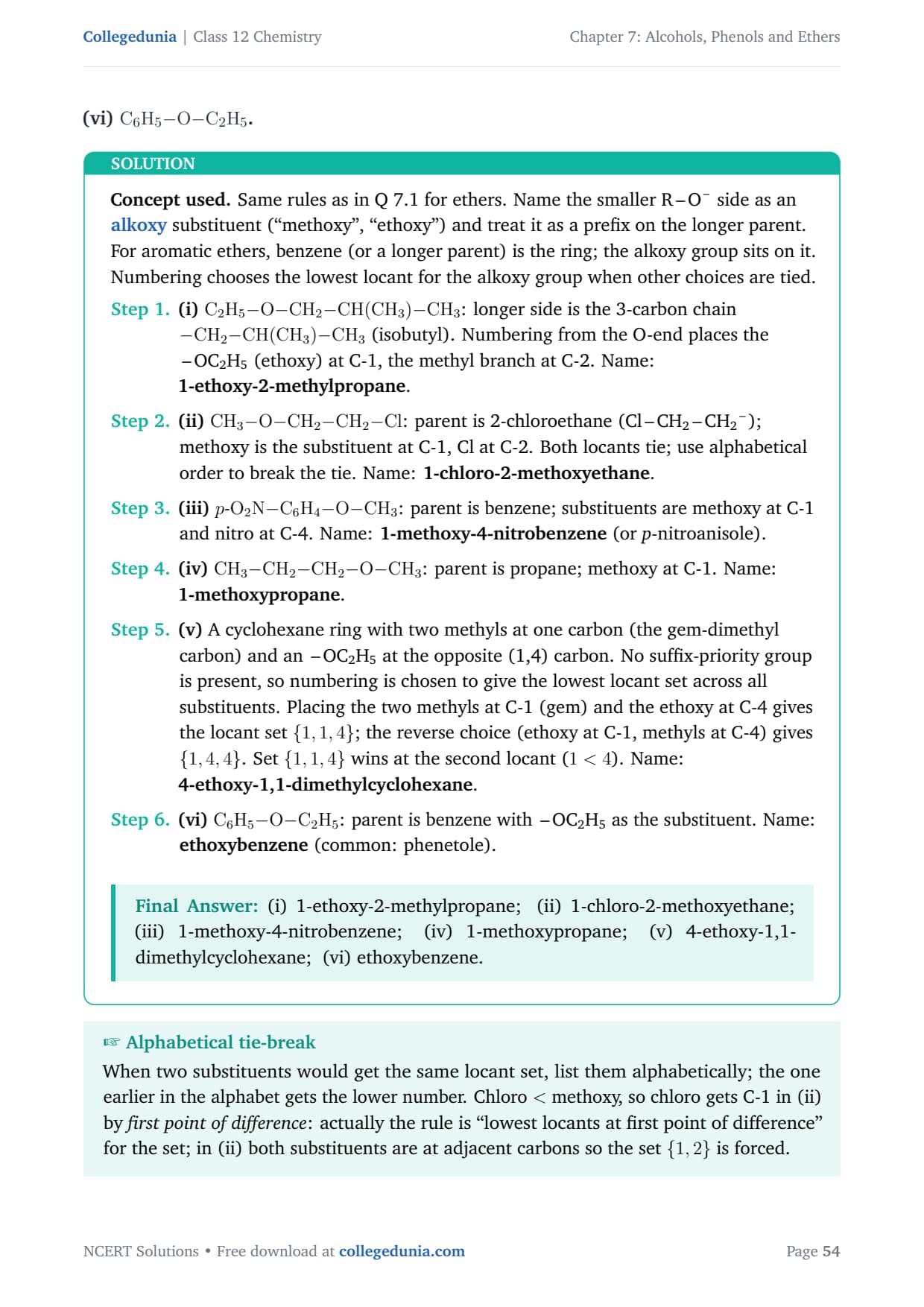
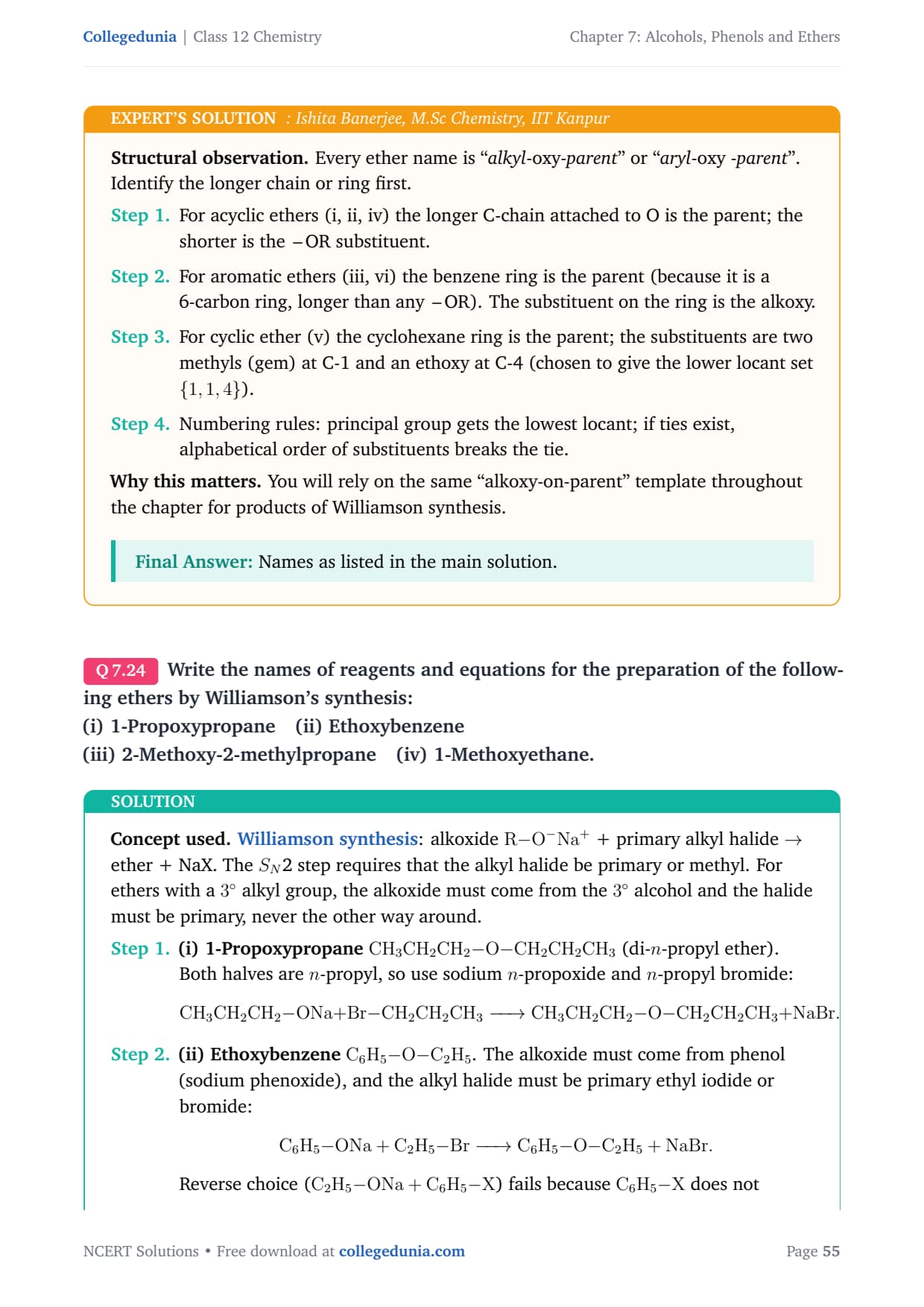
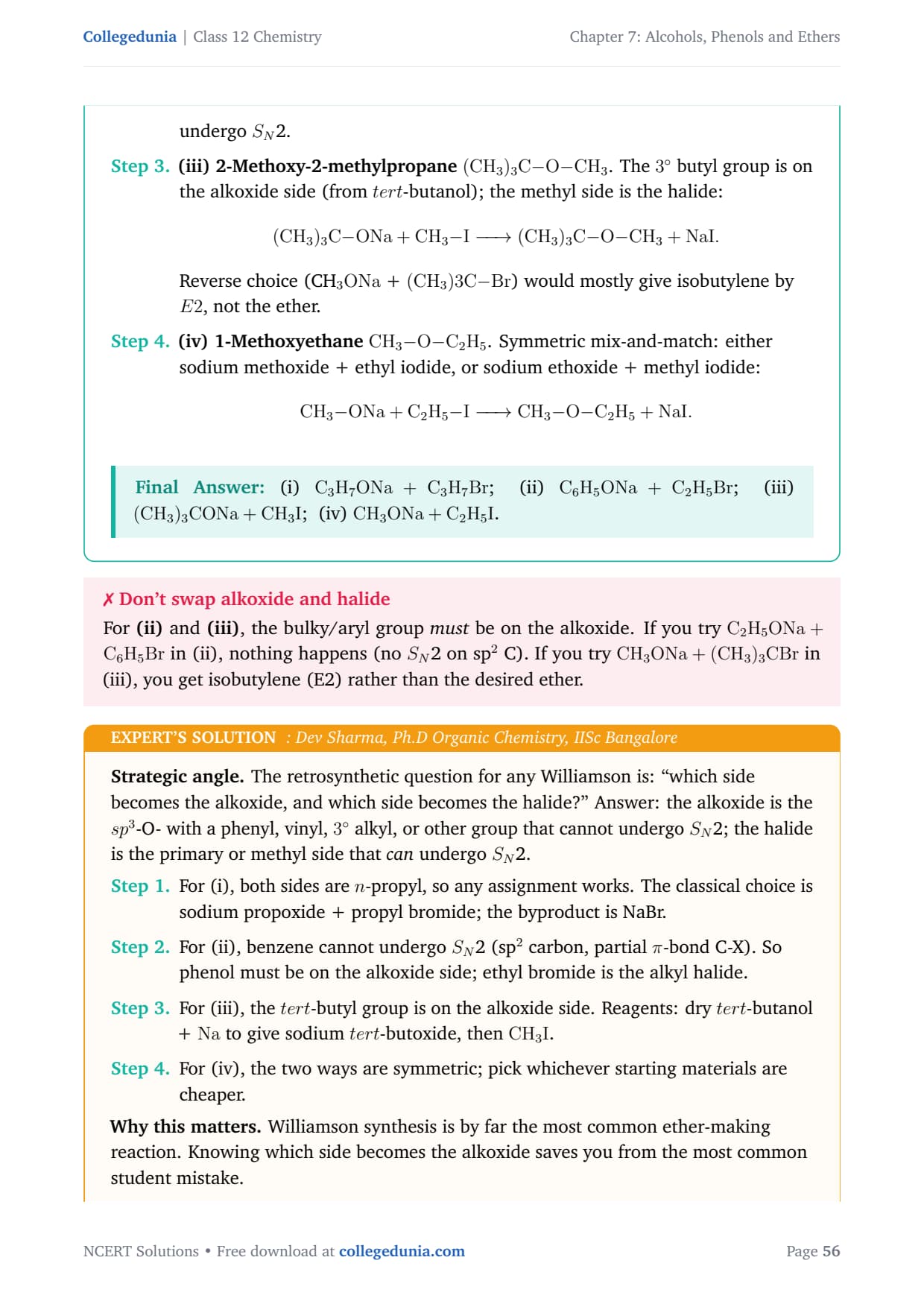
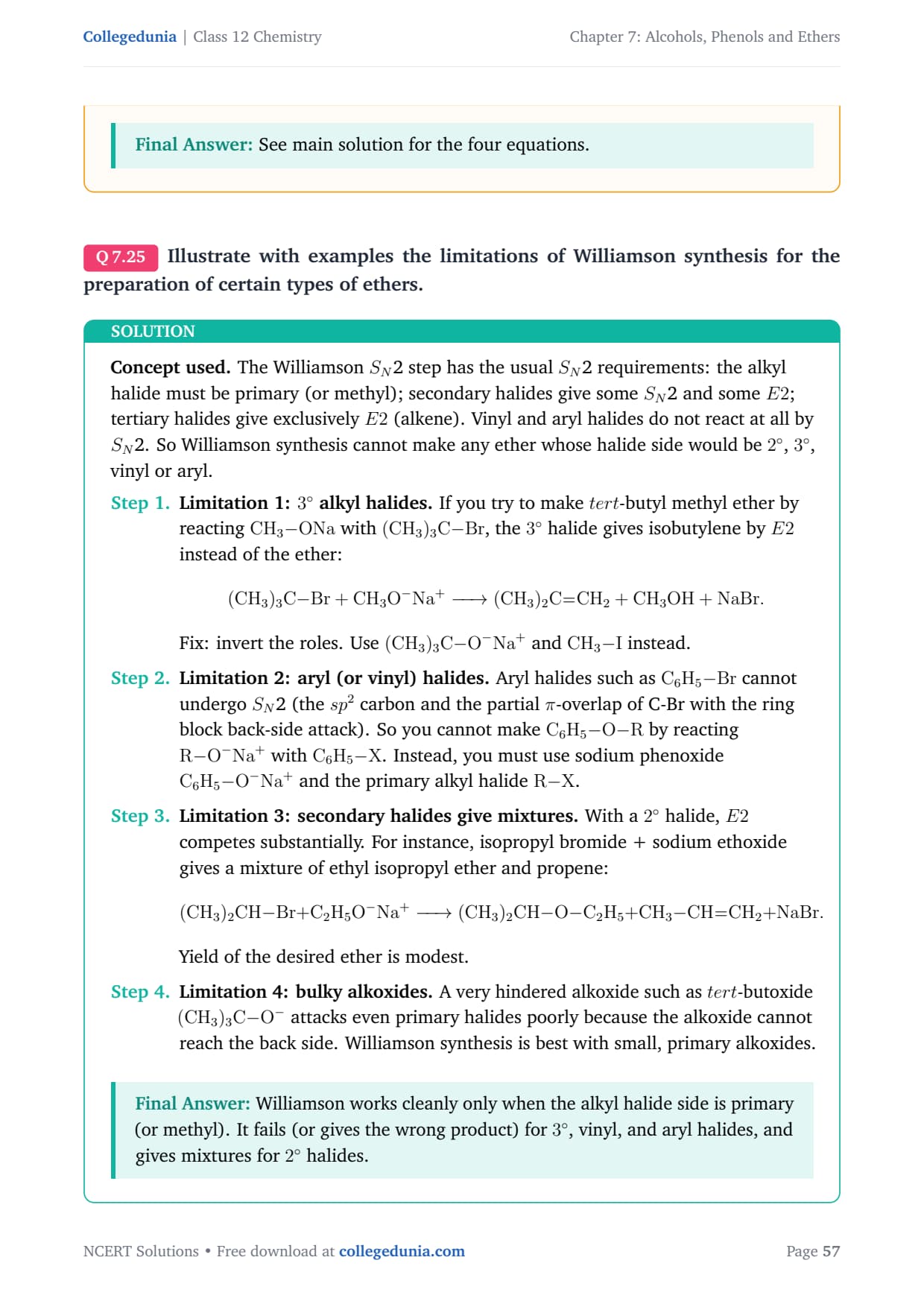
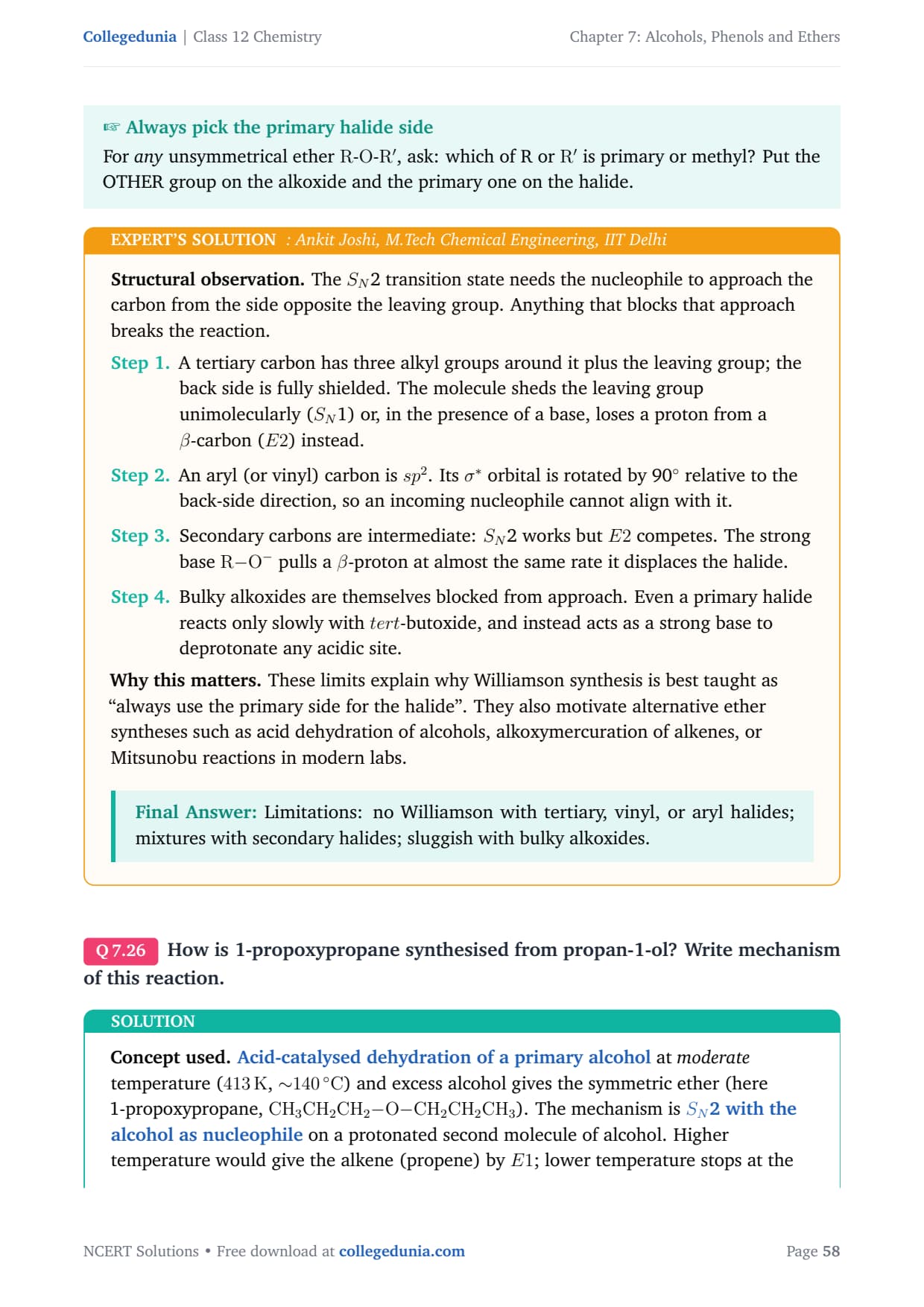
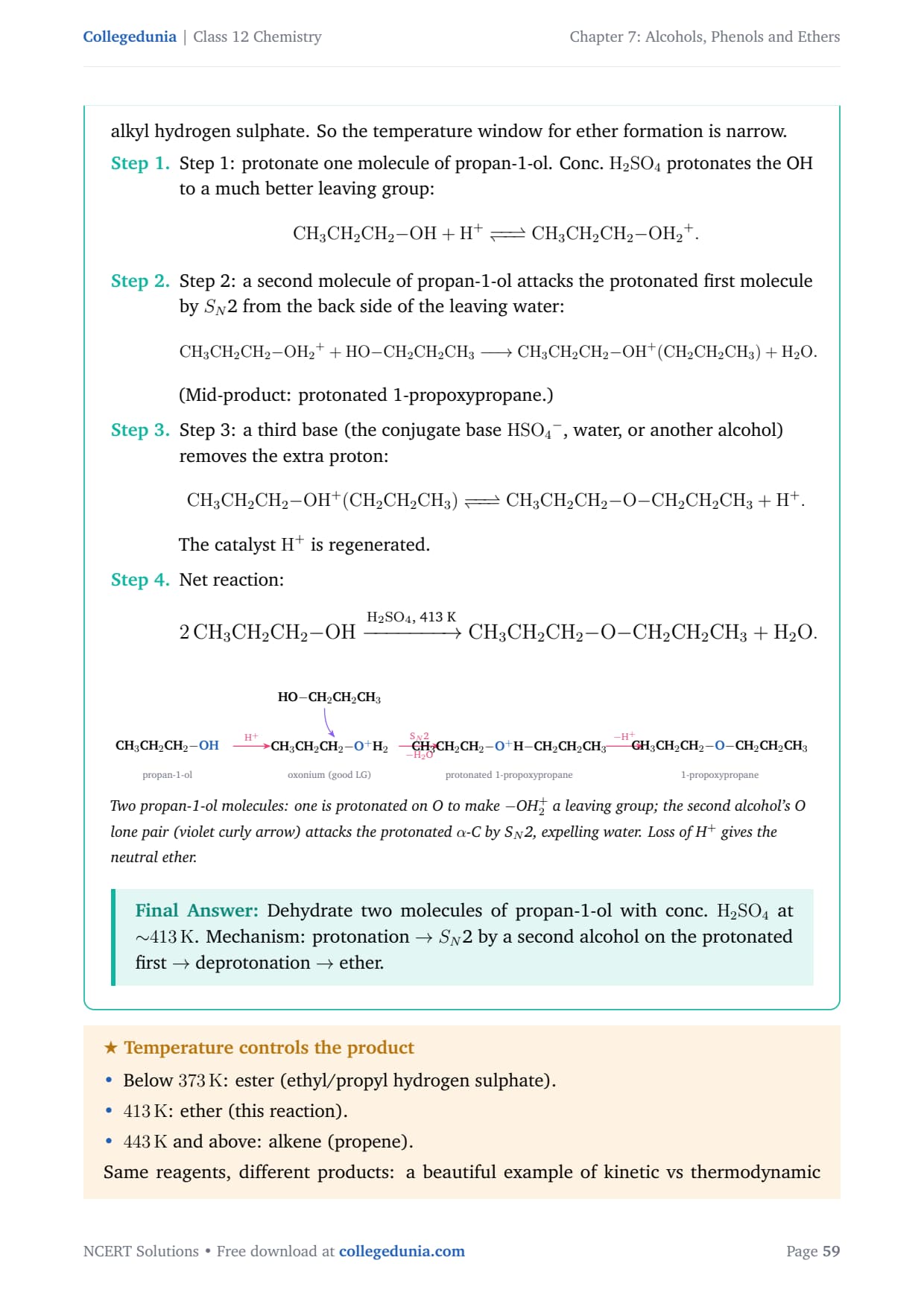
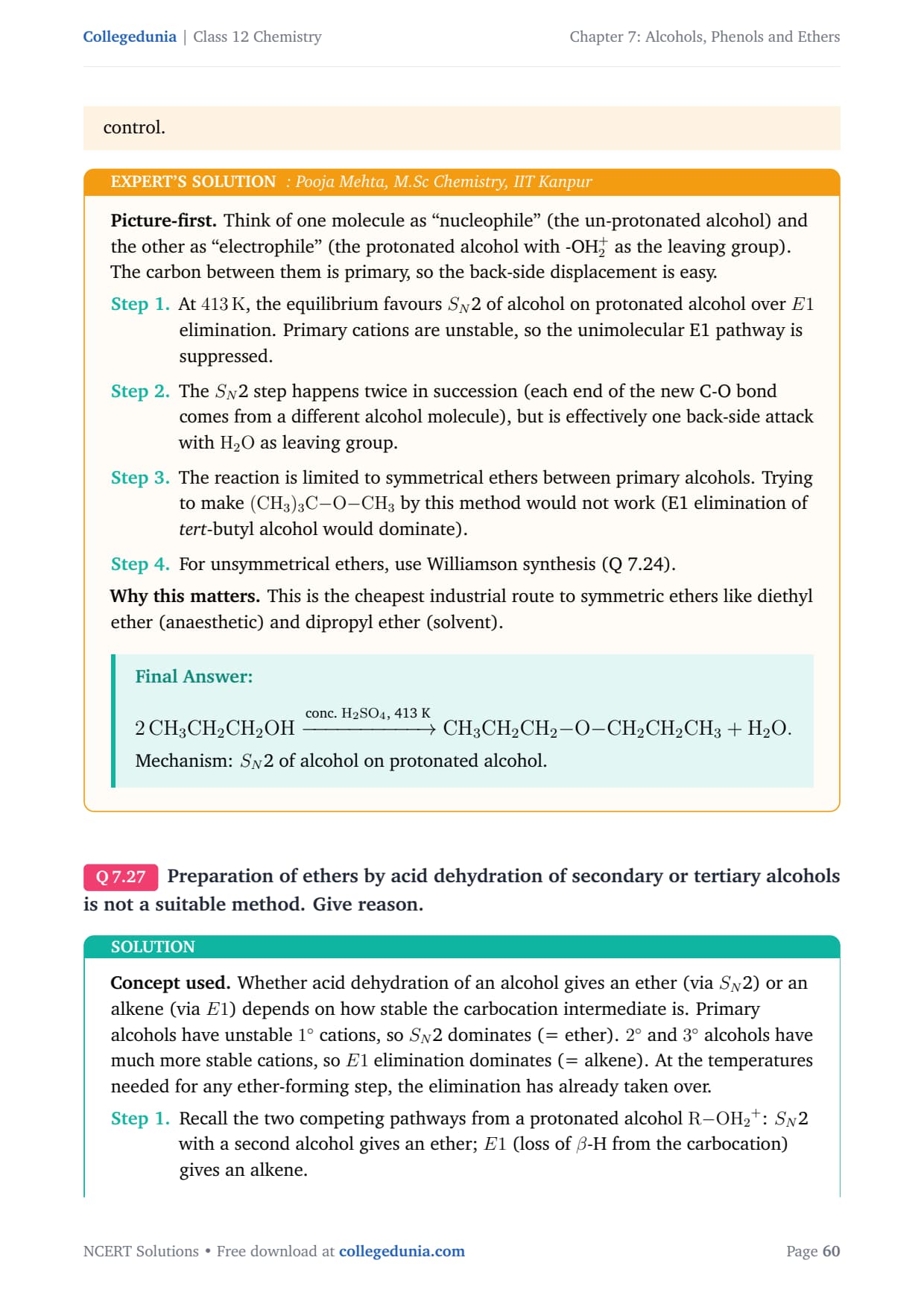
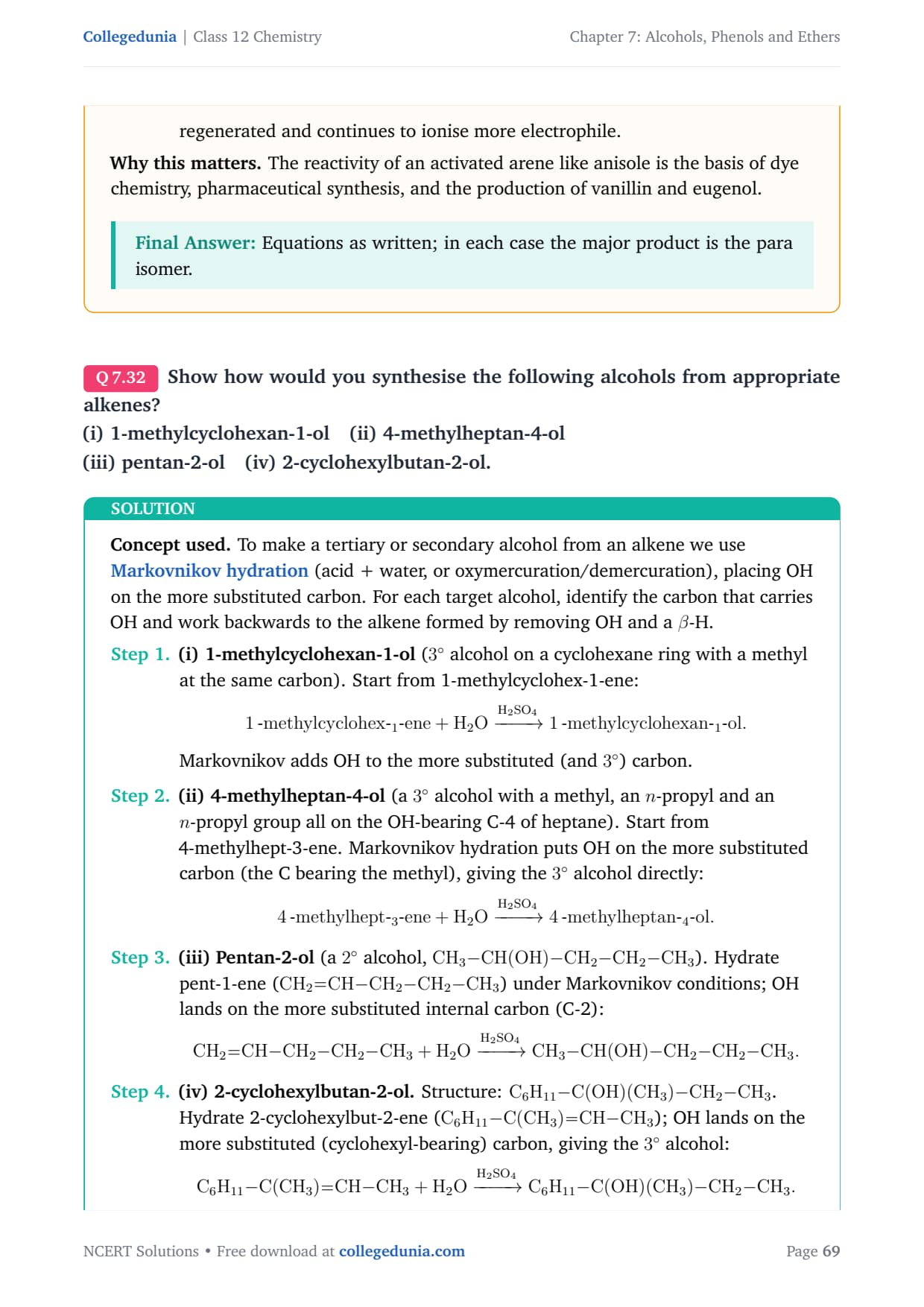
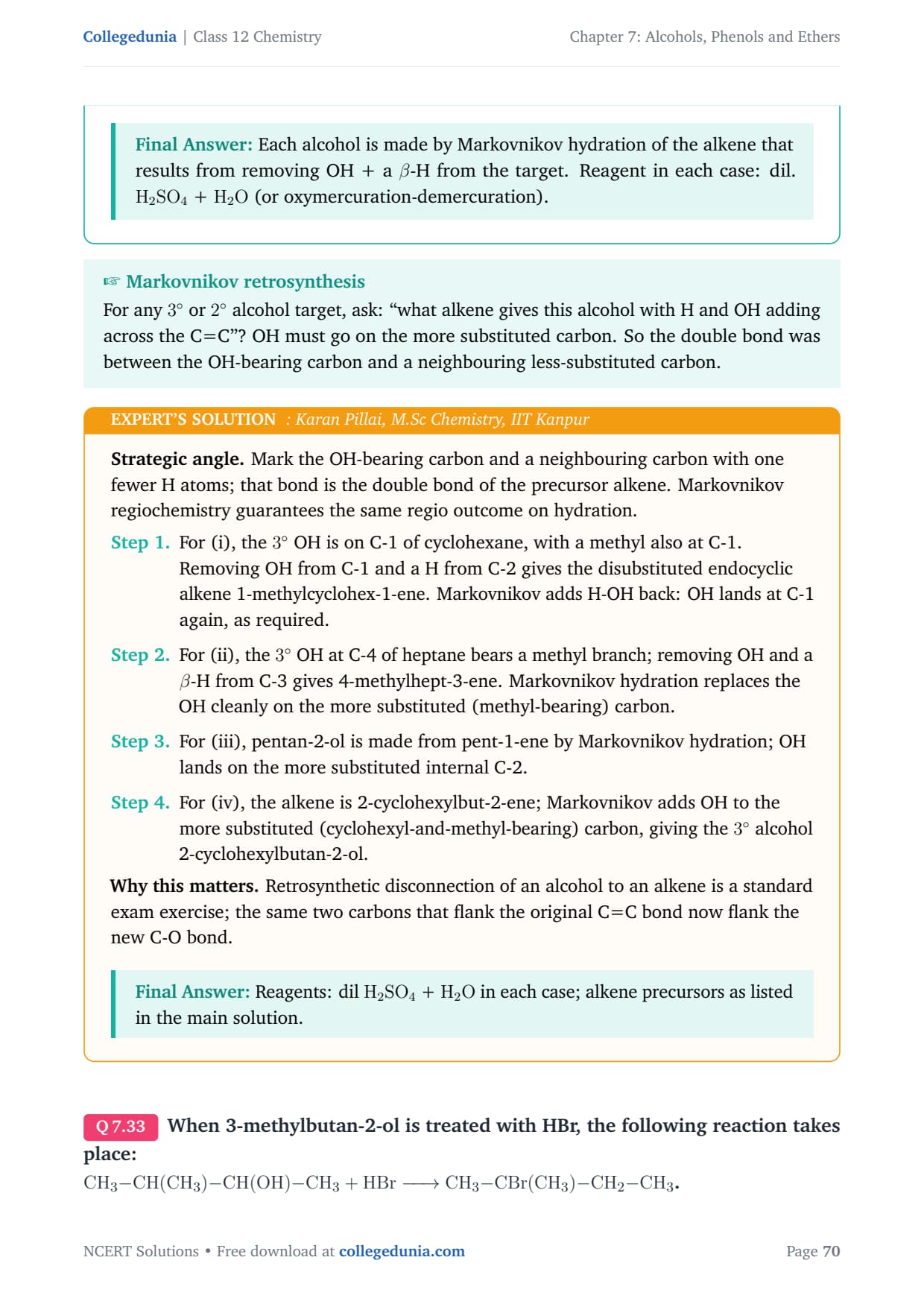
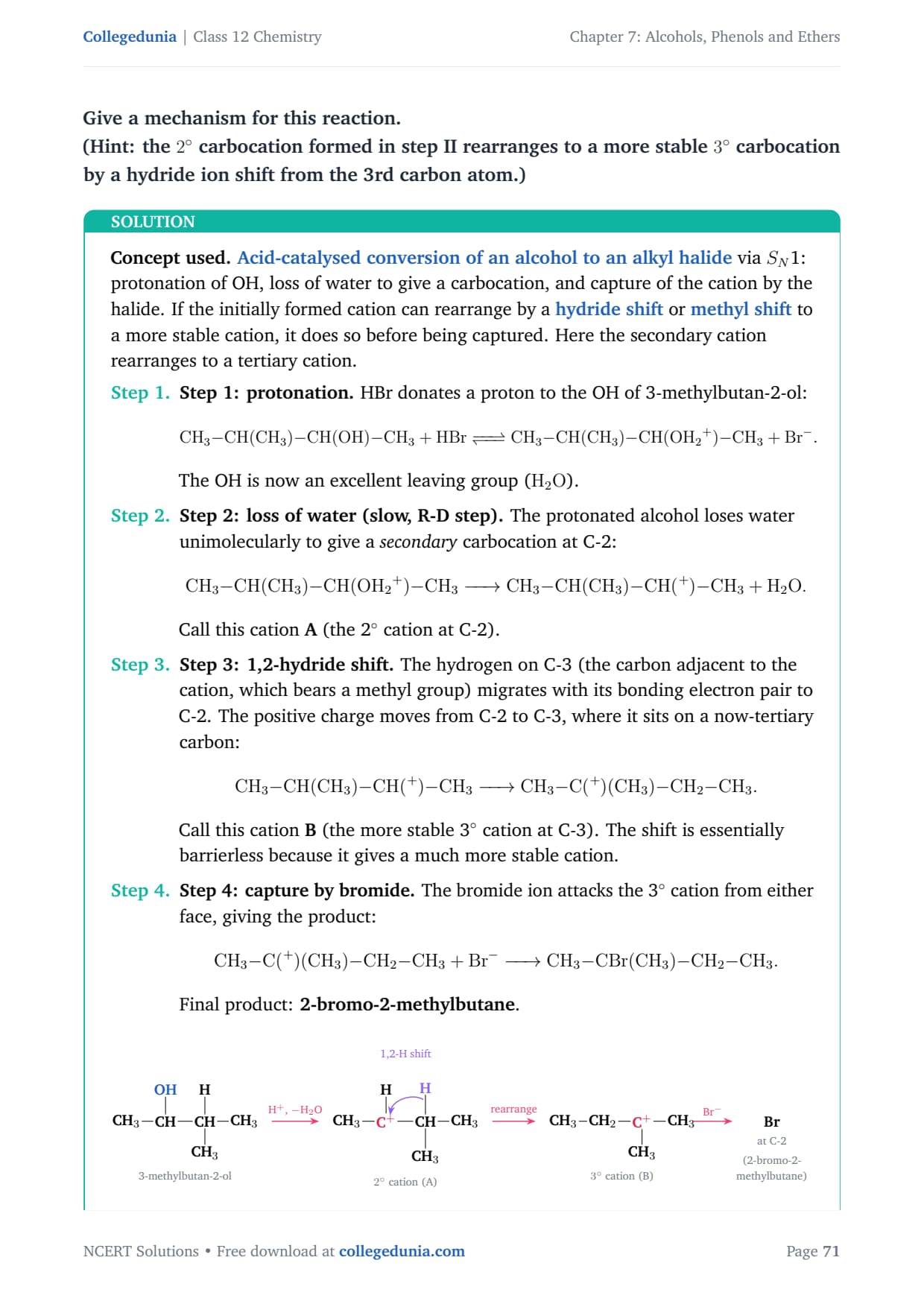
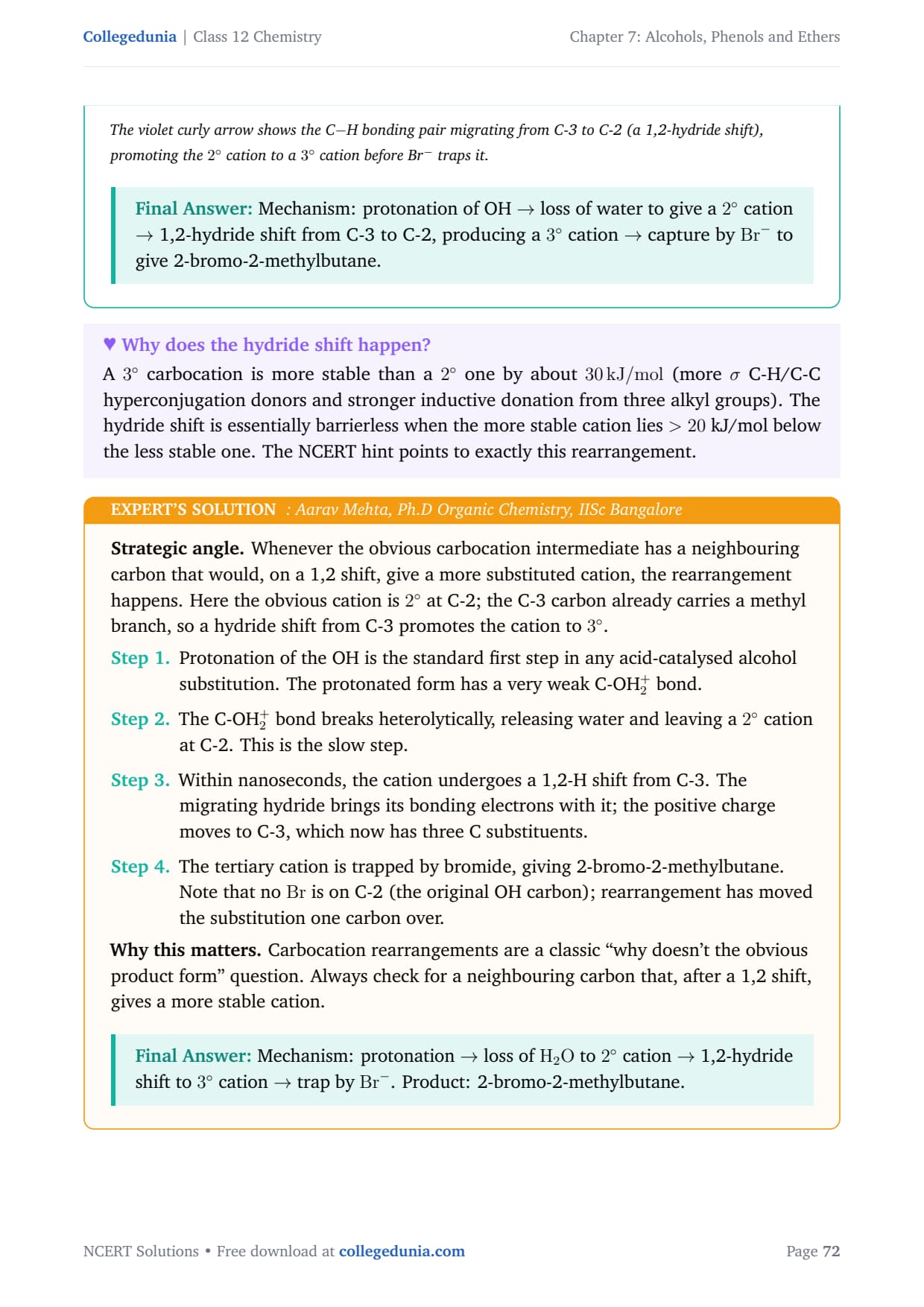
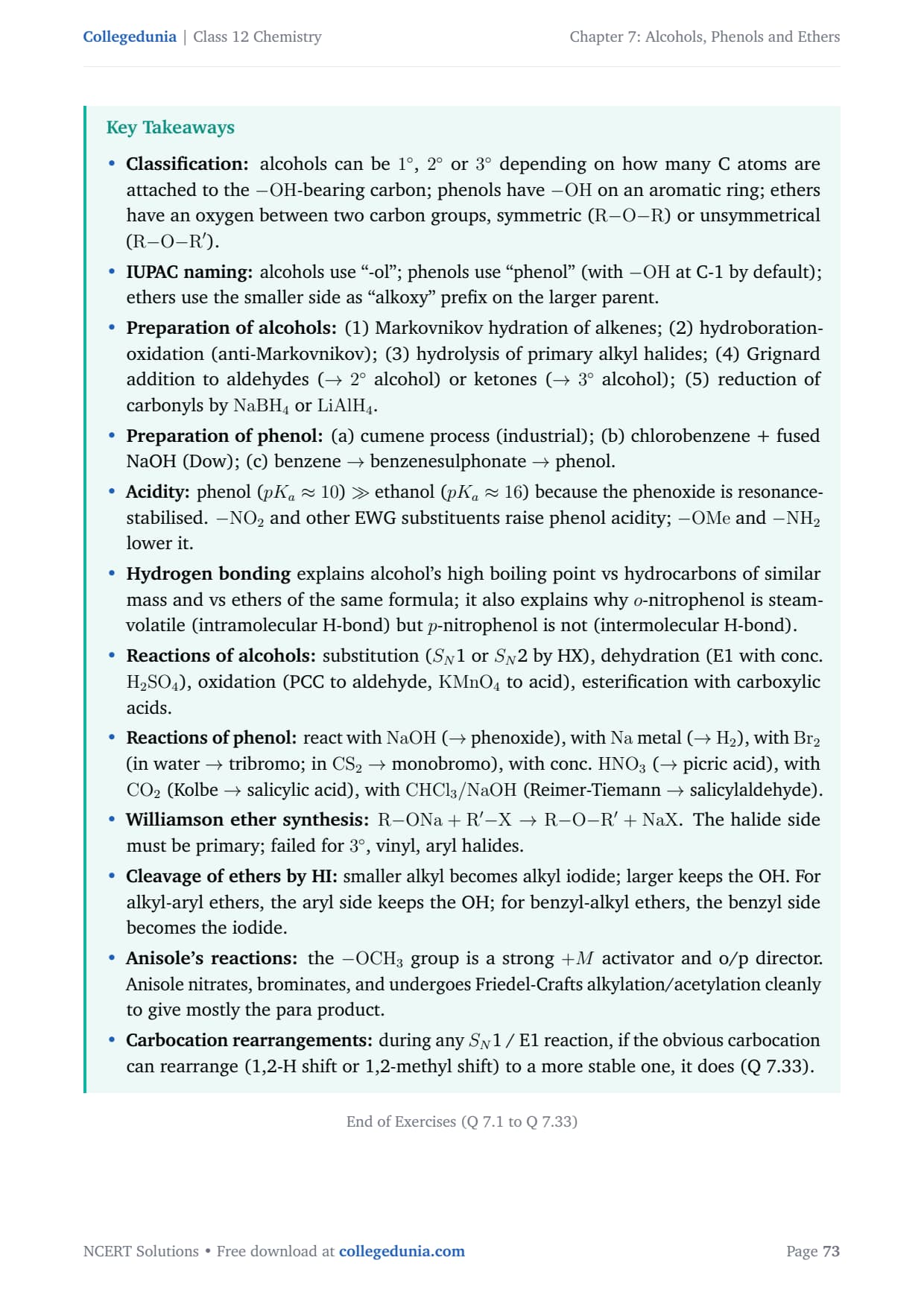
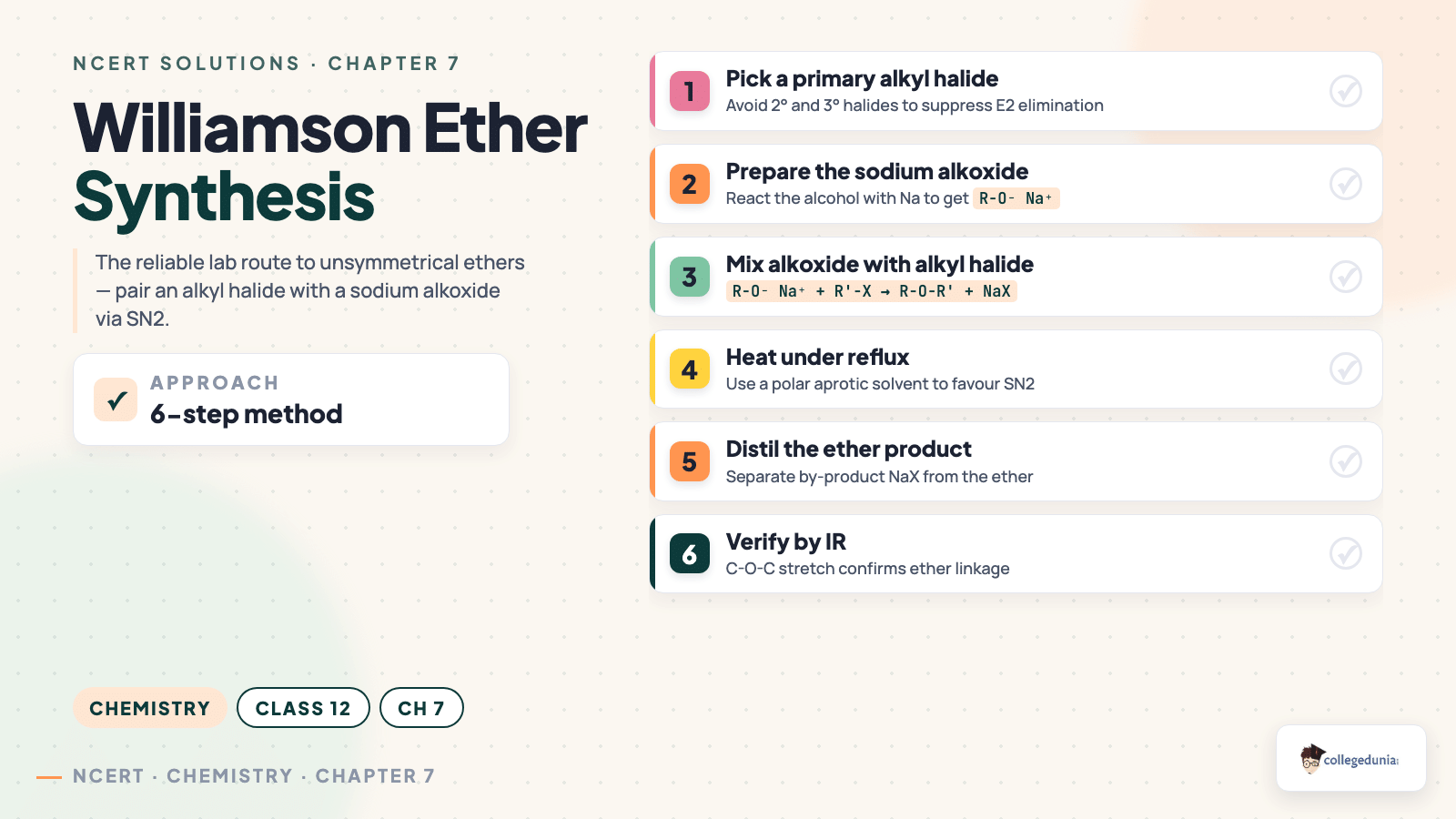
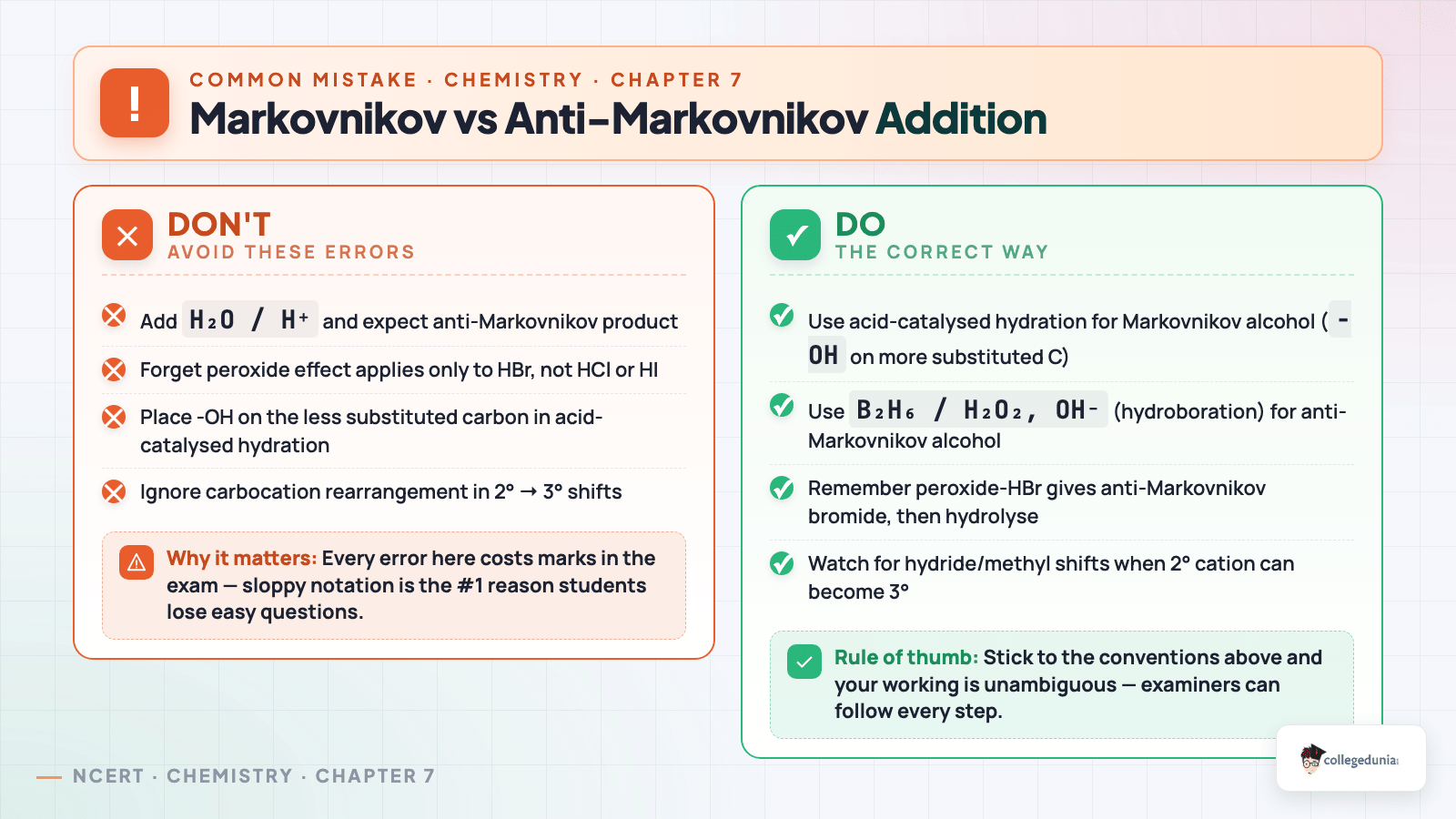



Comments