




This page gives you a free PDF of chapterwise Previous Year Questions for CBSE Class 10 Science Chapter 1, Chemical Reactions and Equations. The PDF has 157 questions worth 328 marks across 38 pages, pulled from real CBSE board papers set between 2005 and 2026. Every question is tagged with its year and set code, so you always know exactly which paper it came from.
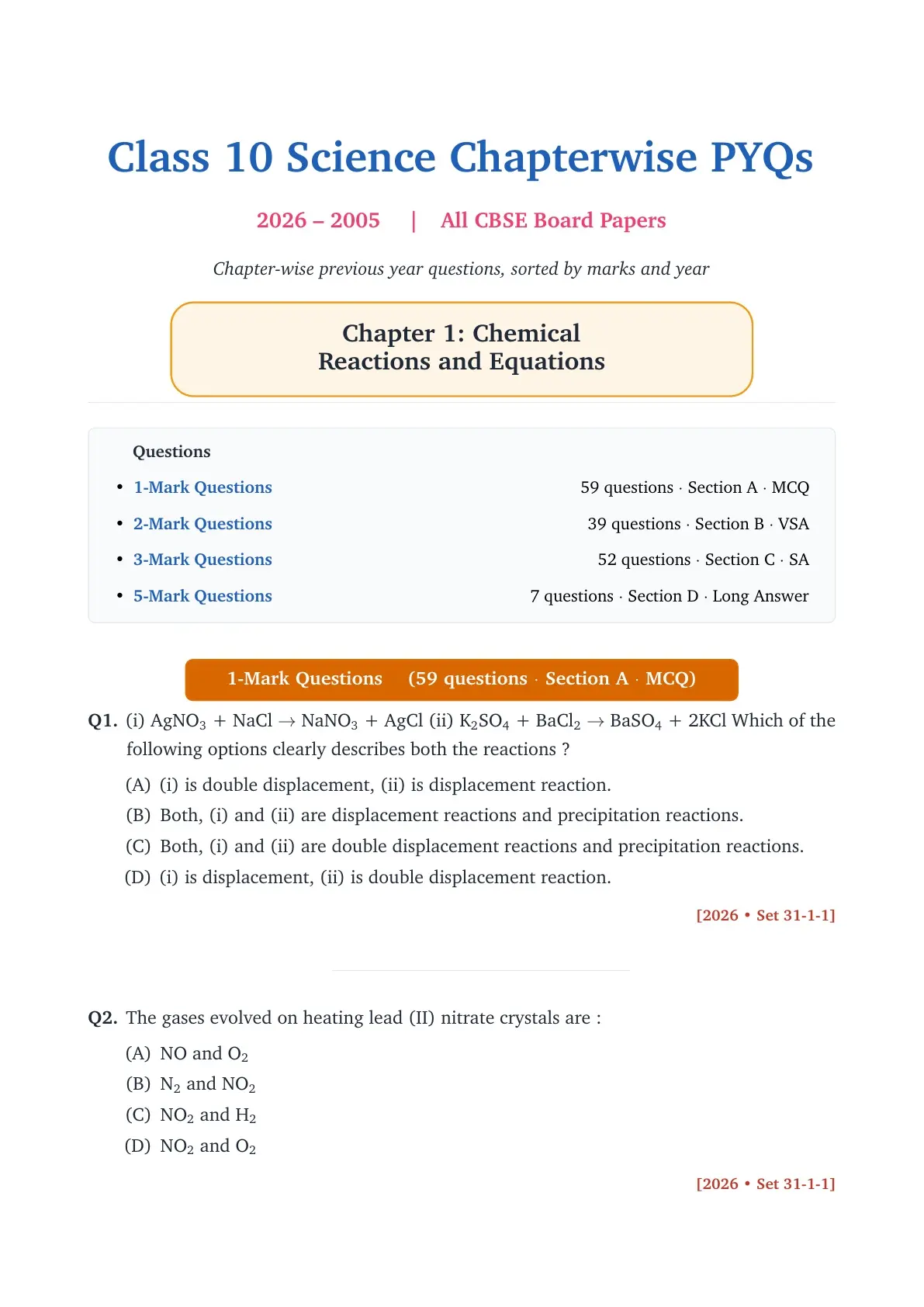
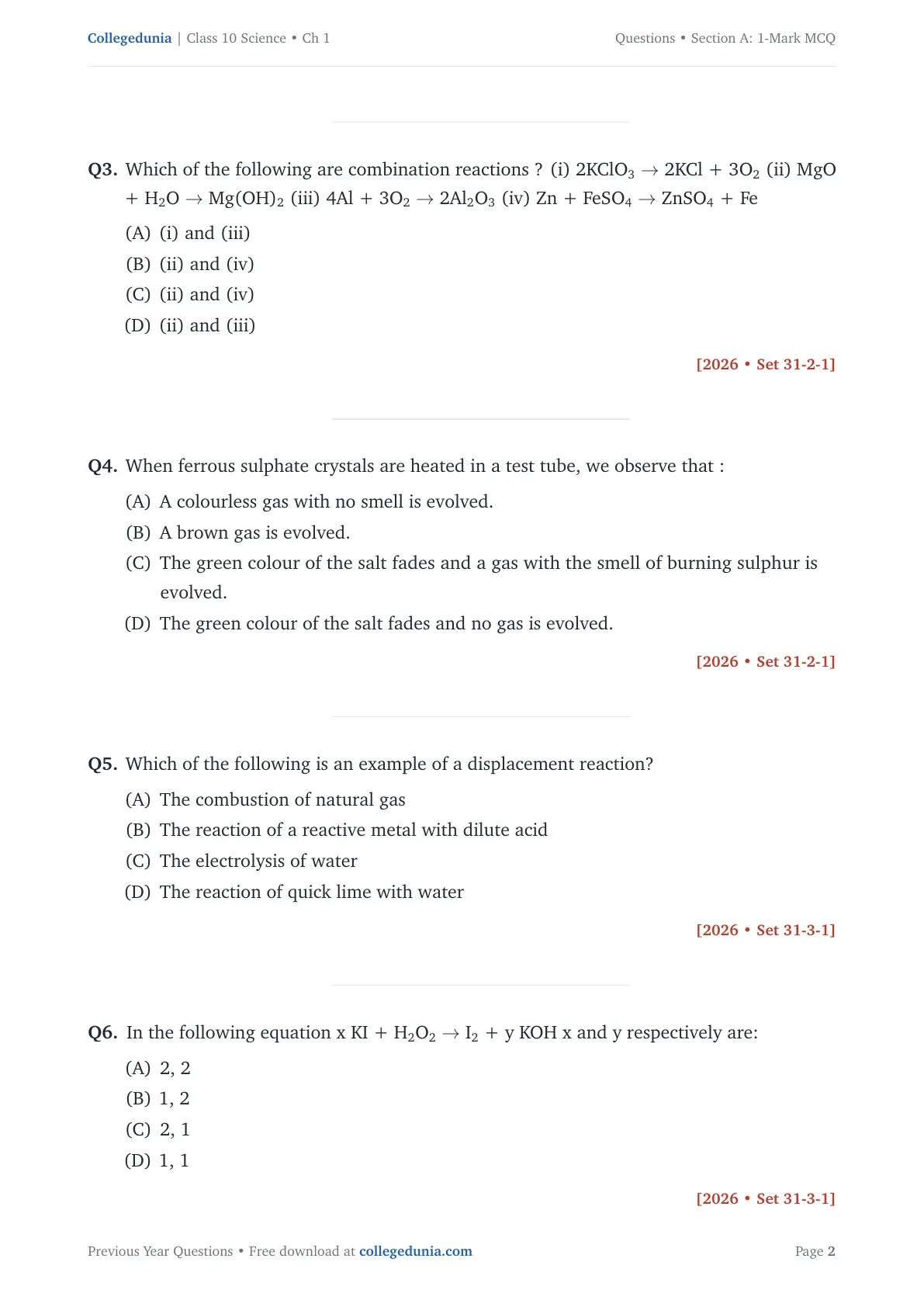
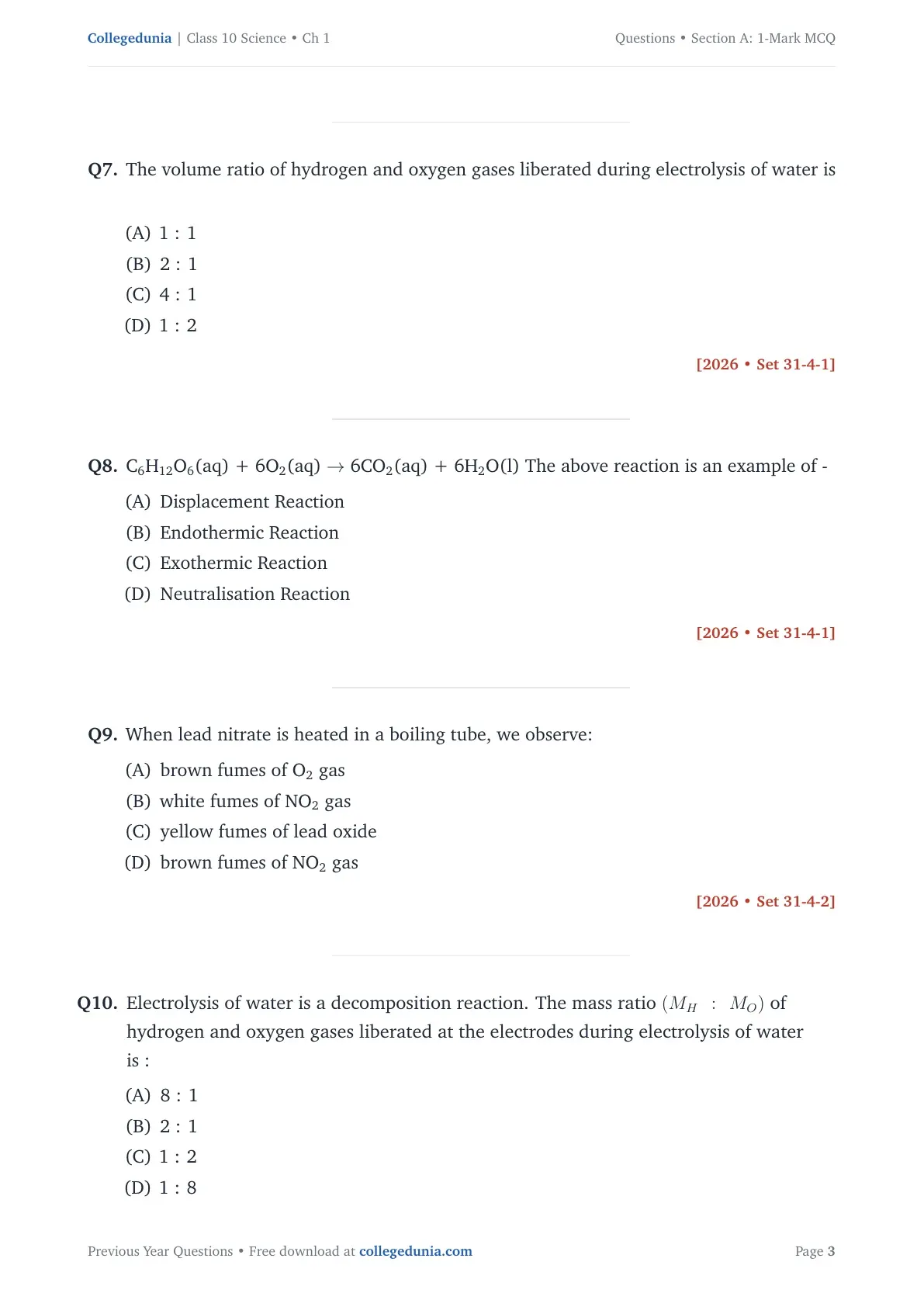
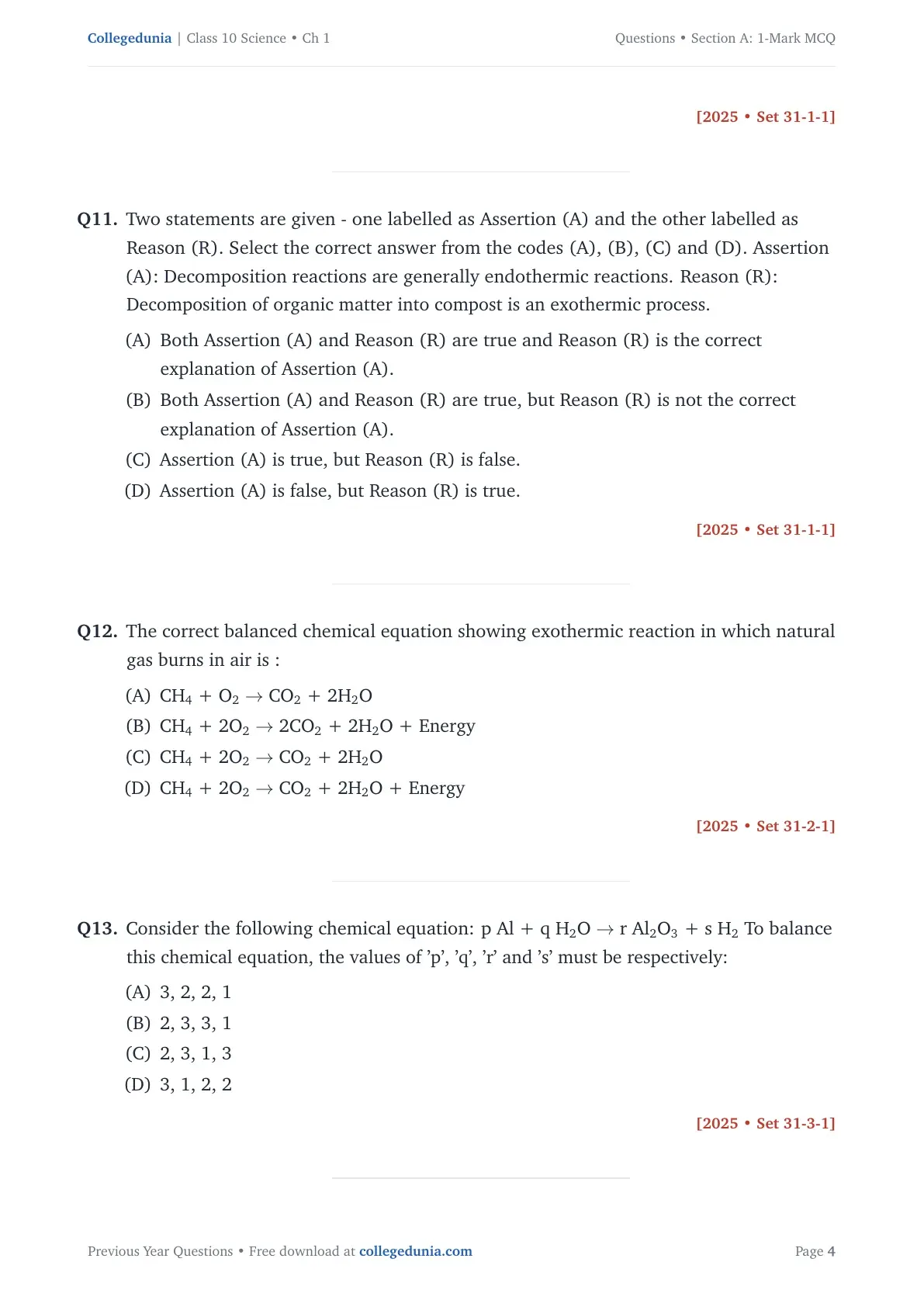
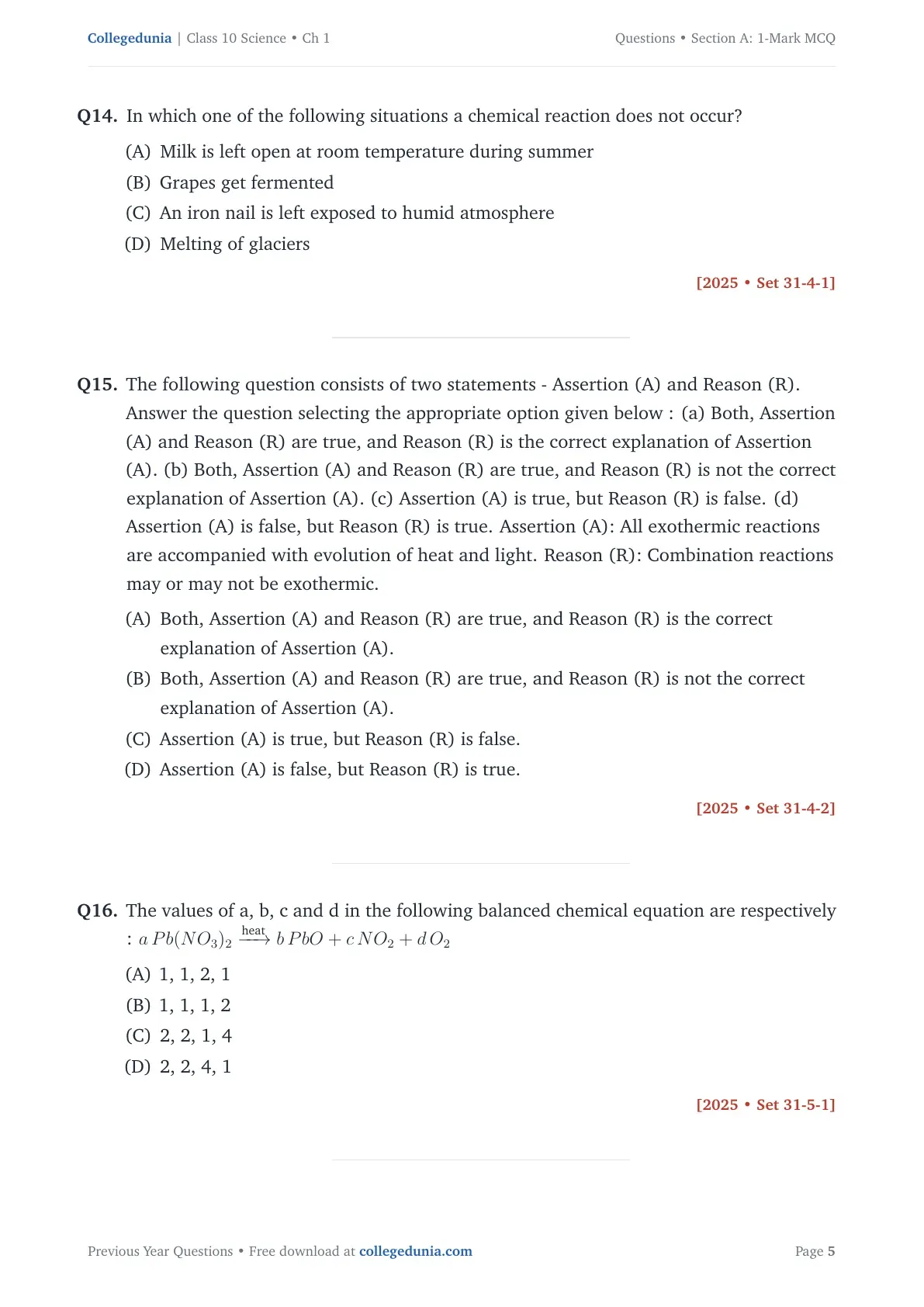
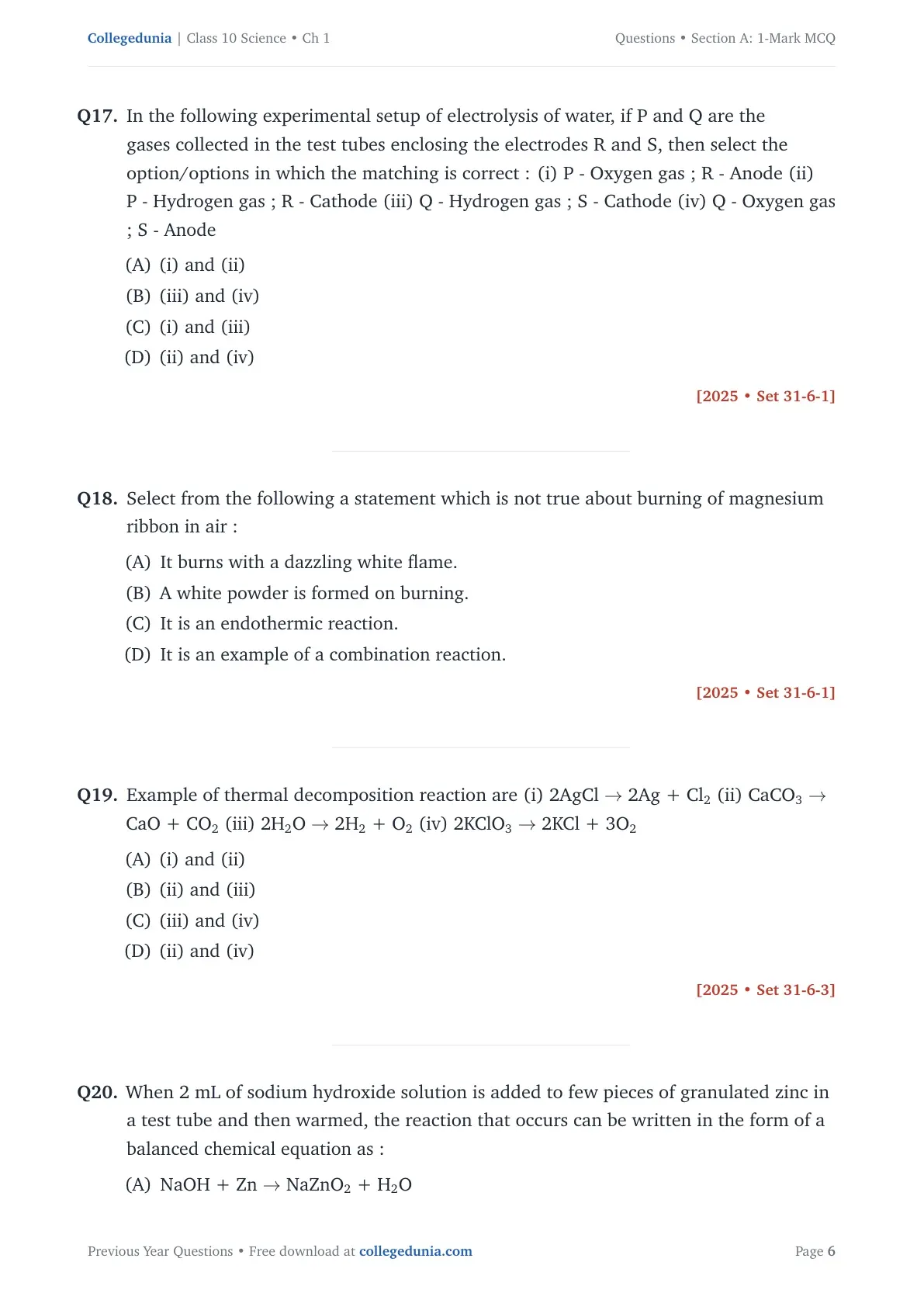
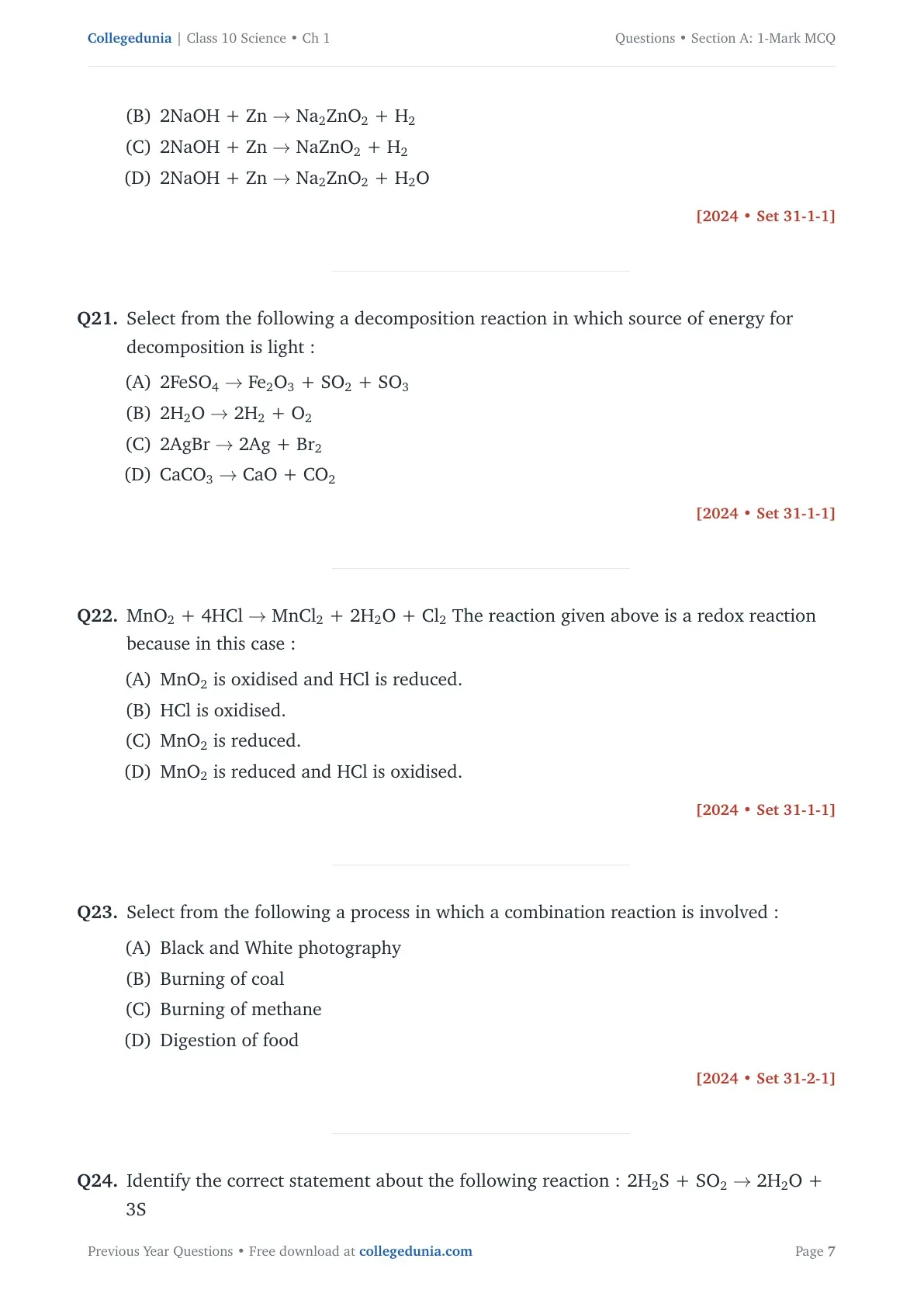
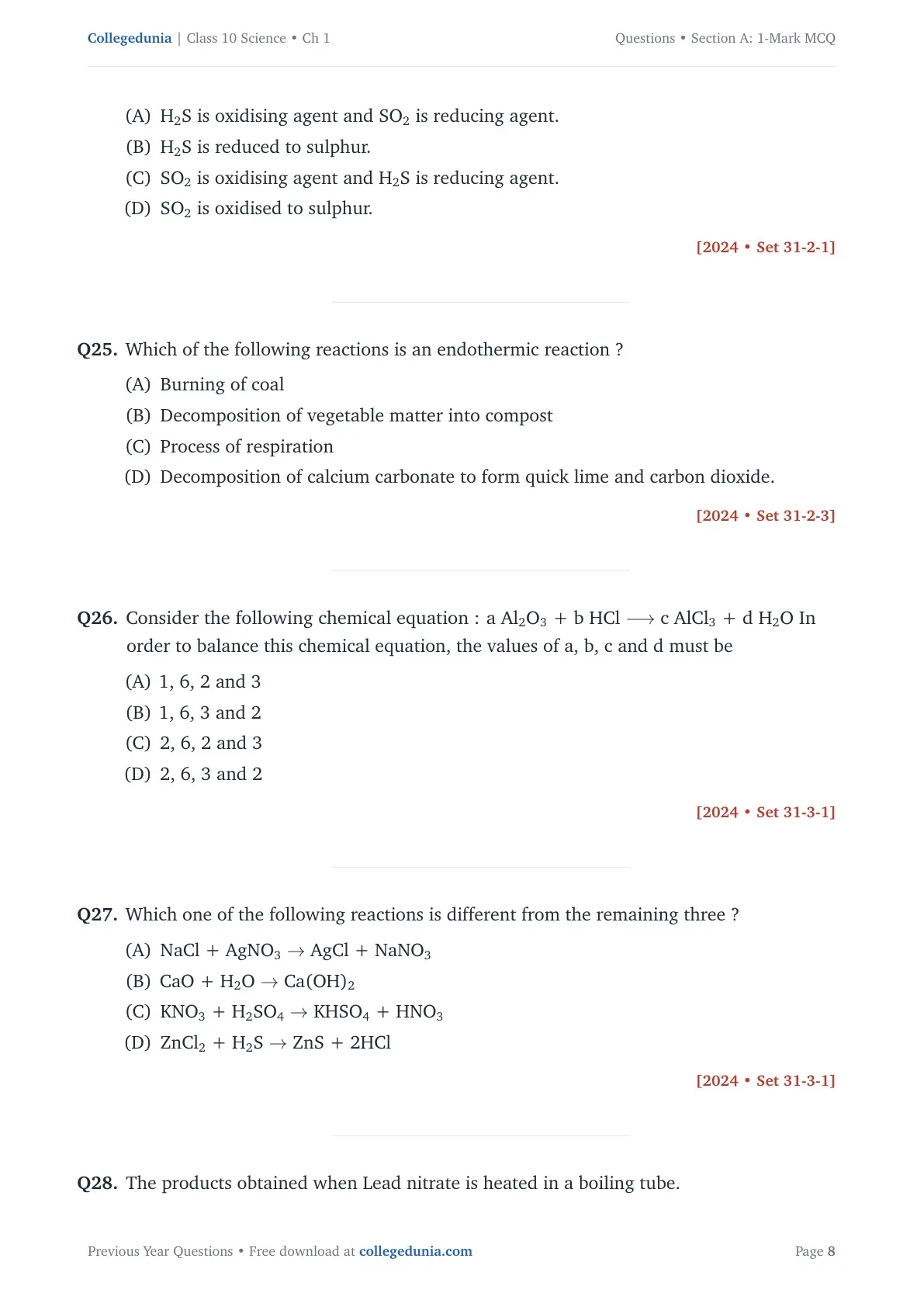
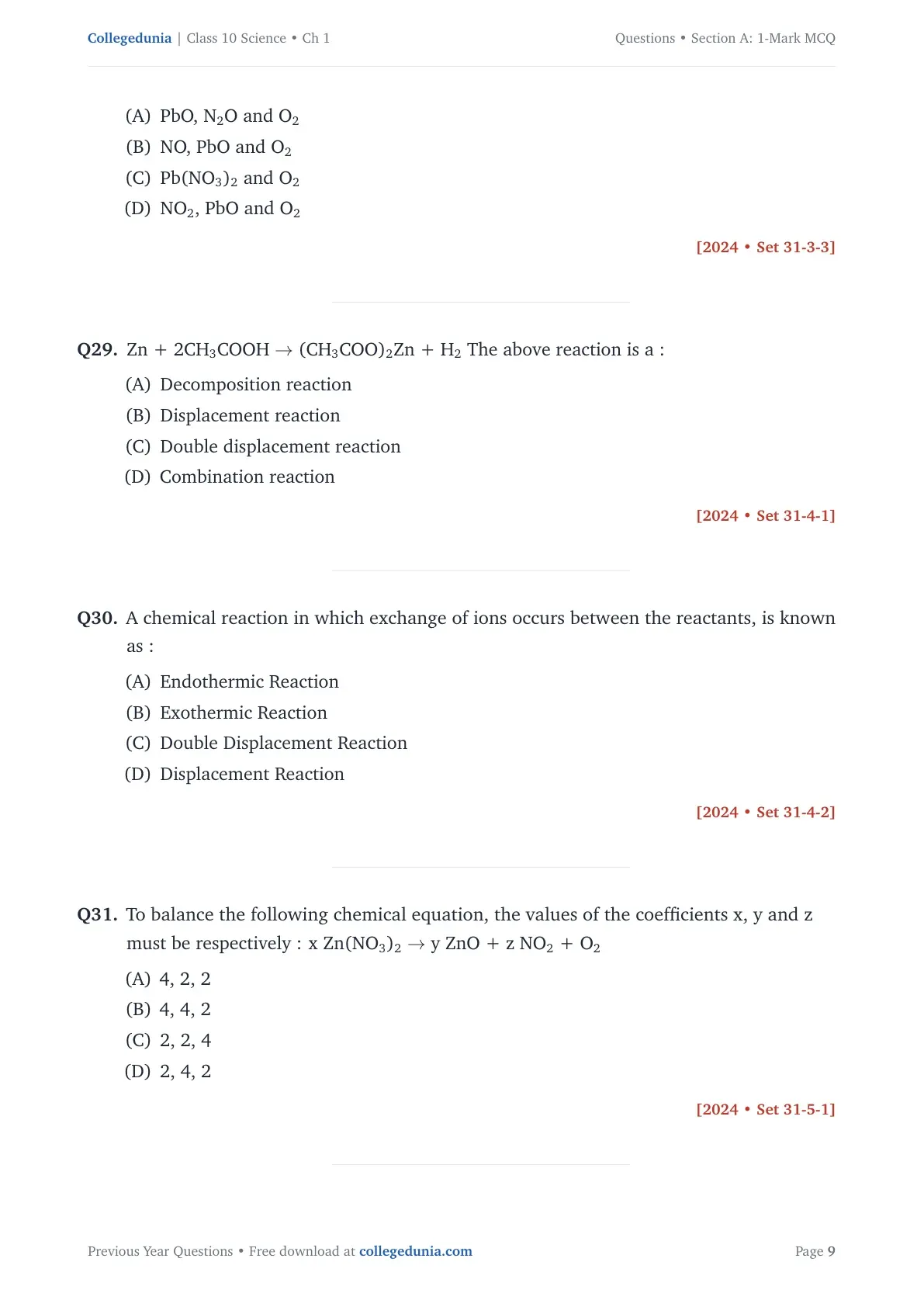
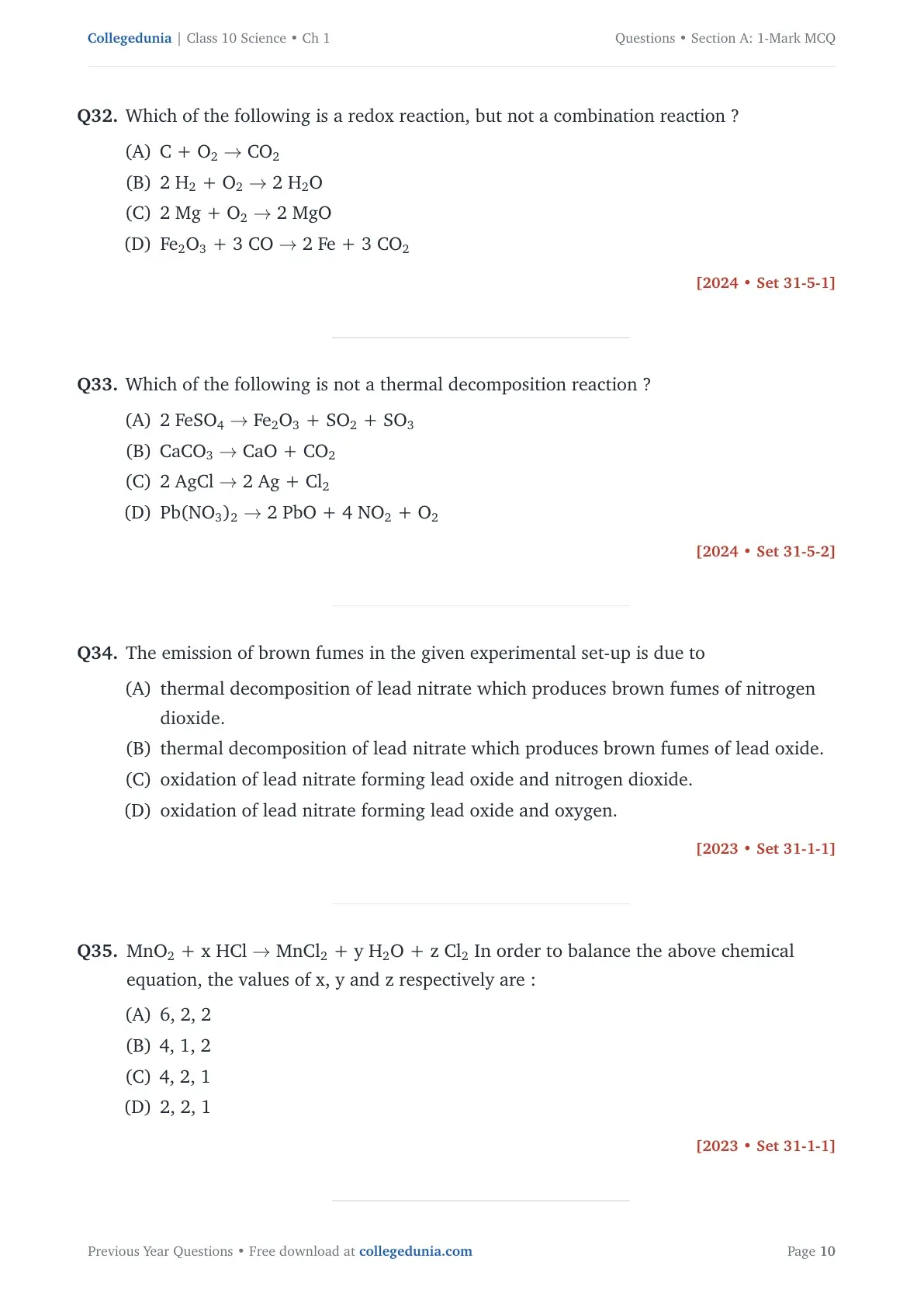
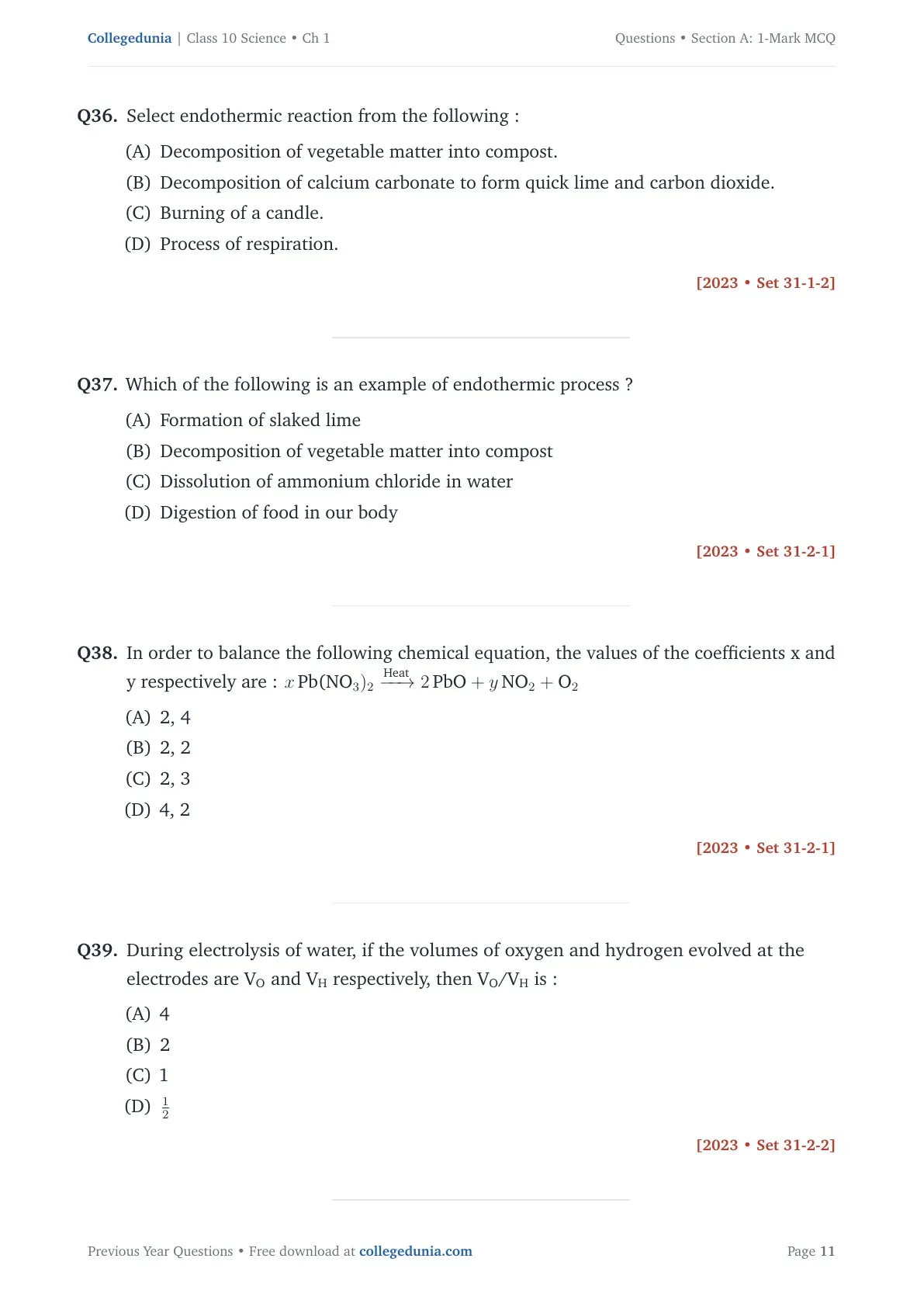
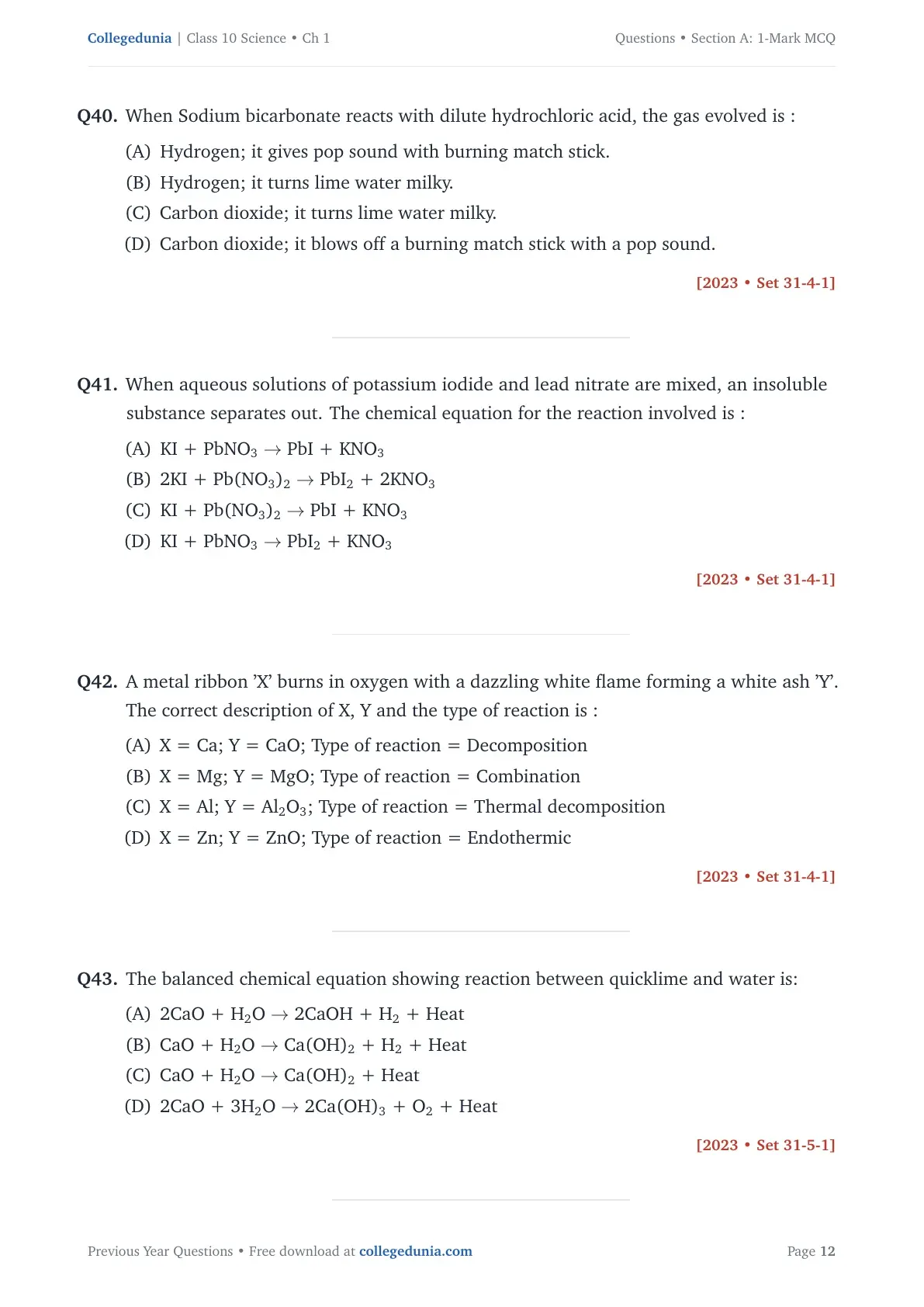
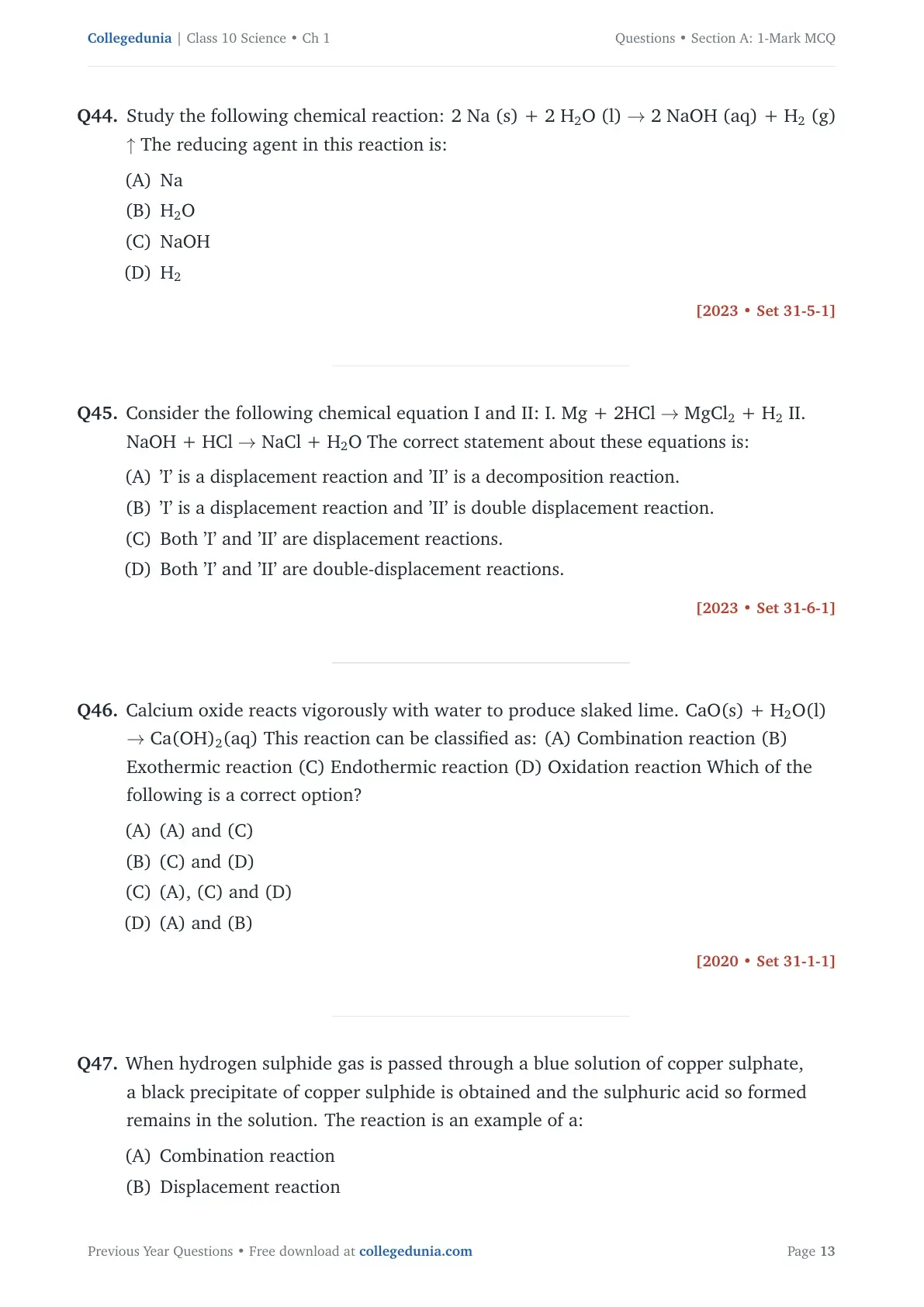
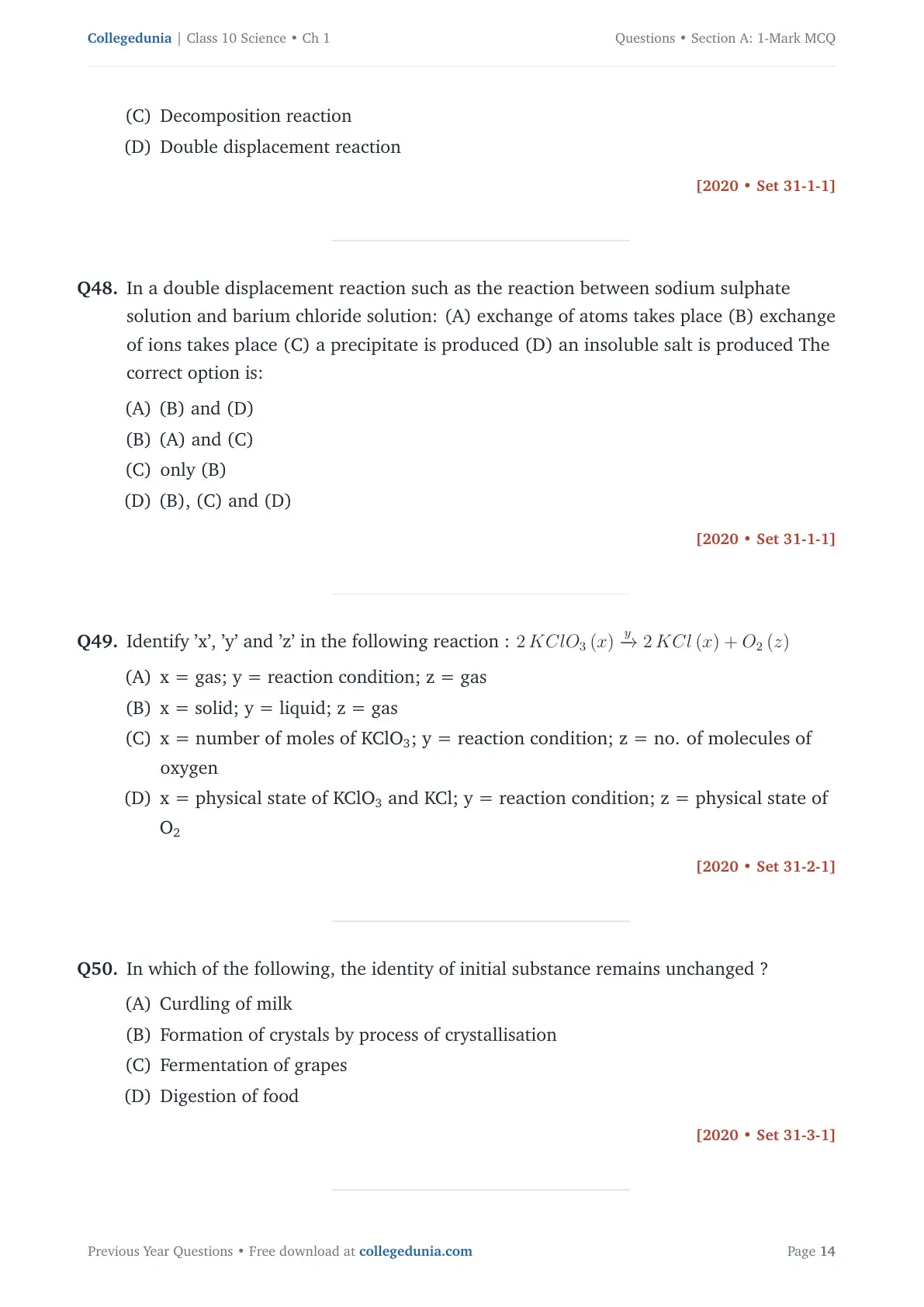
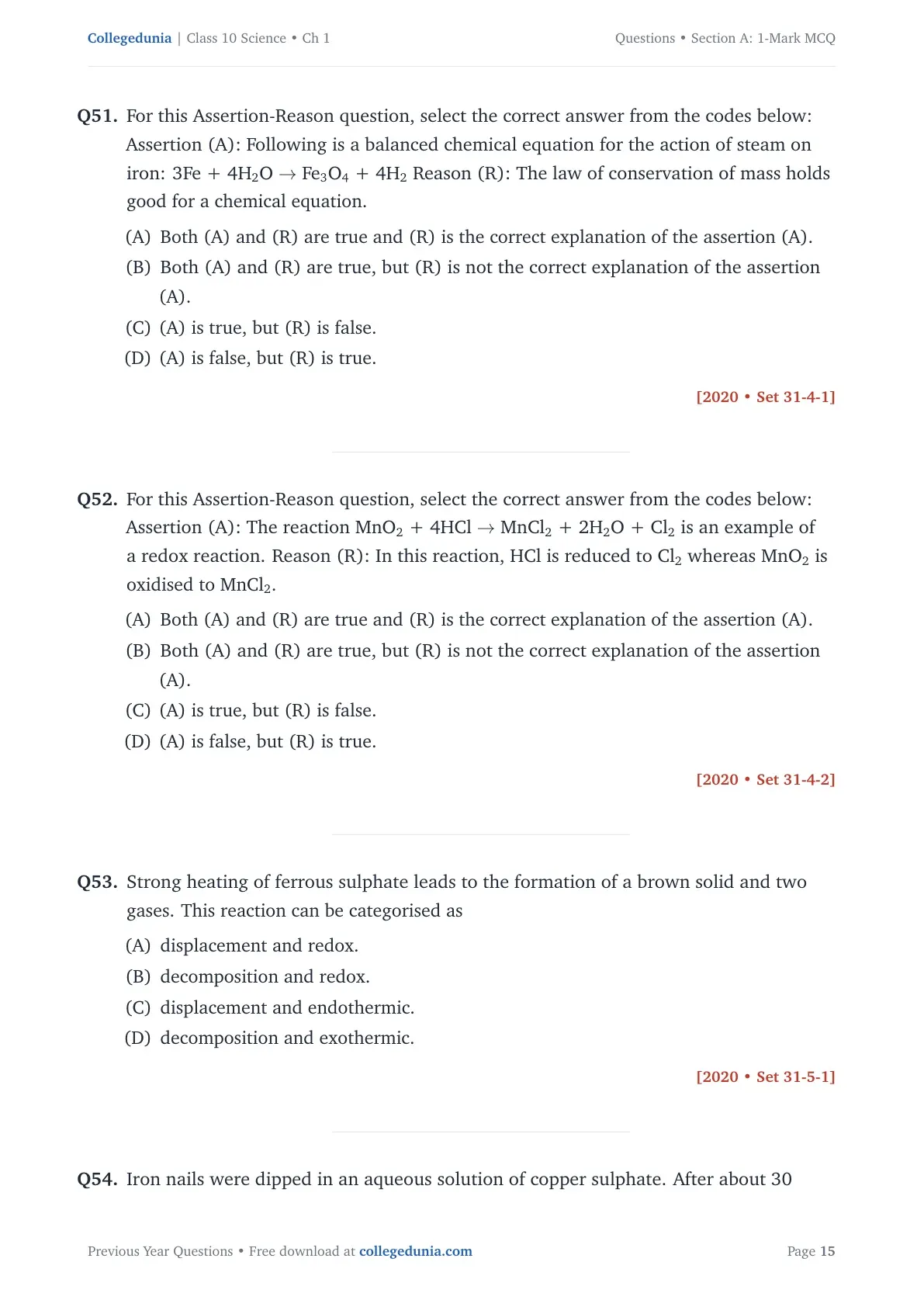
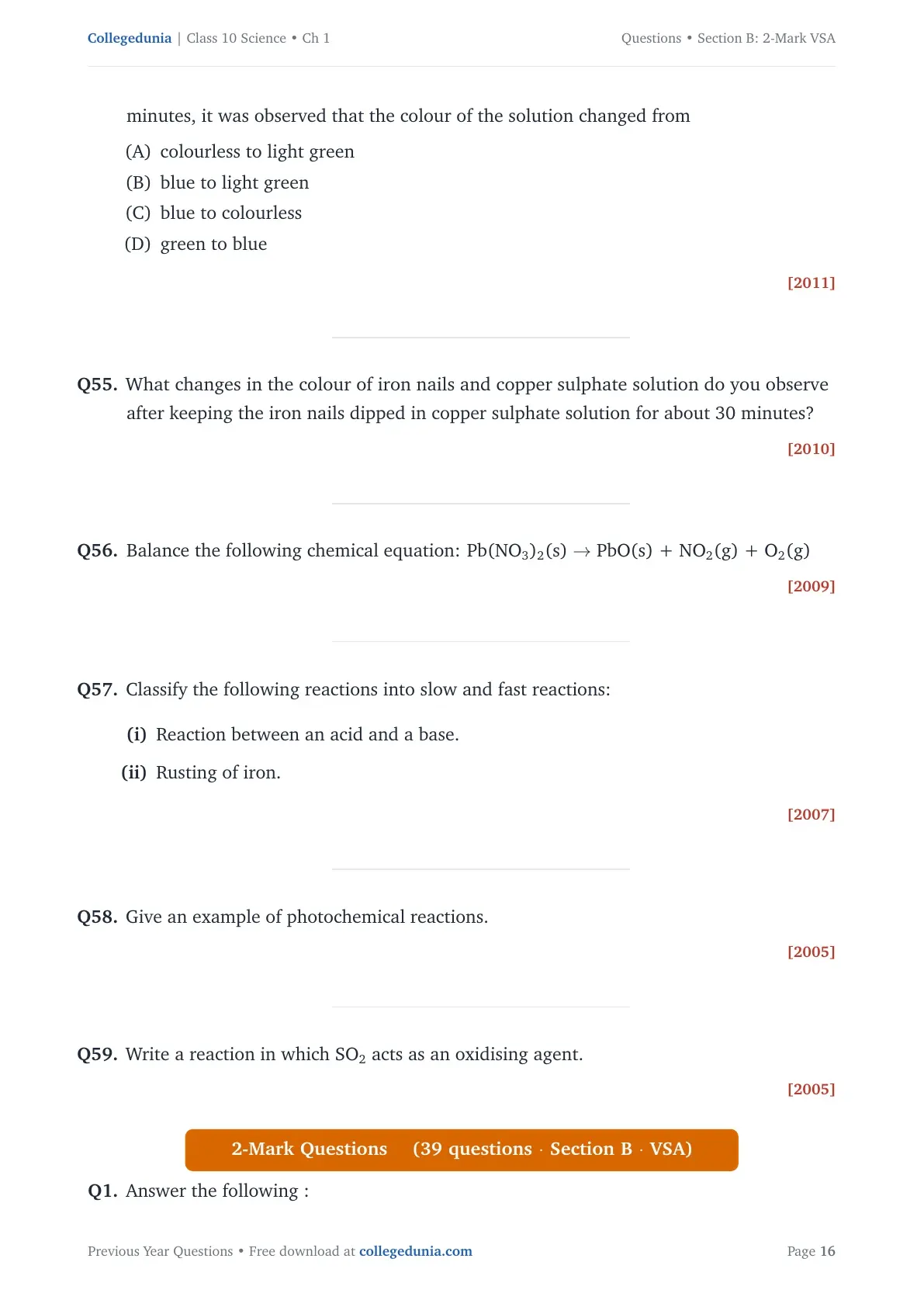
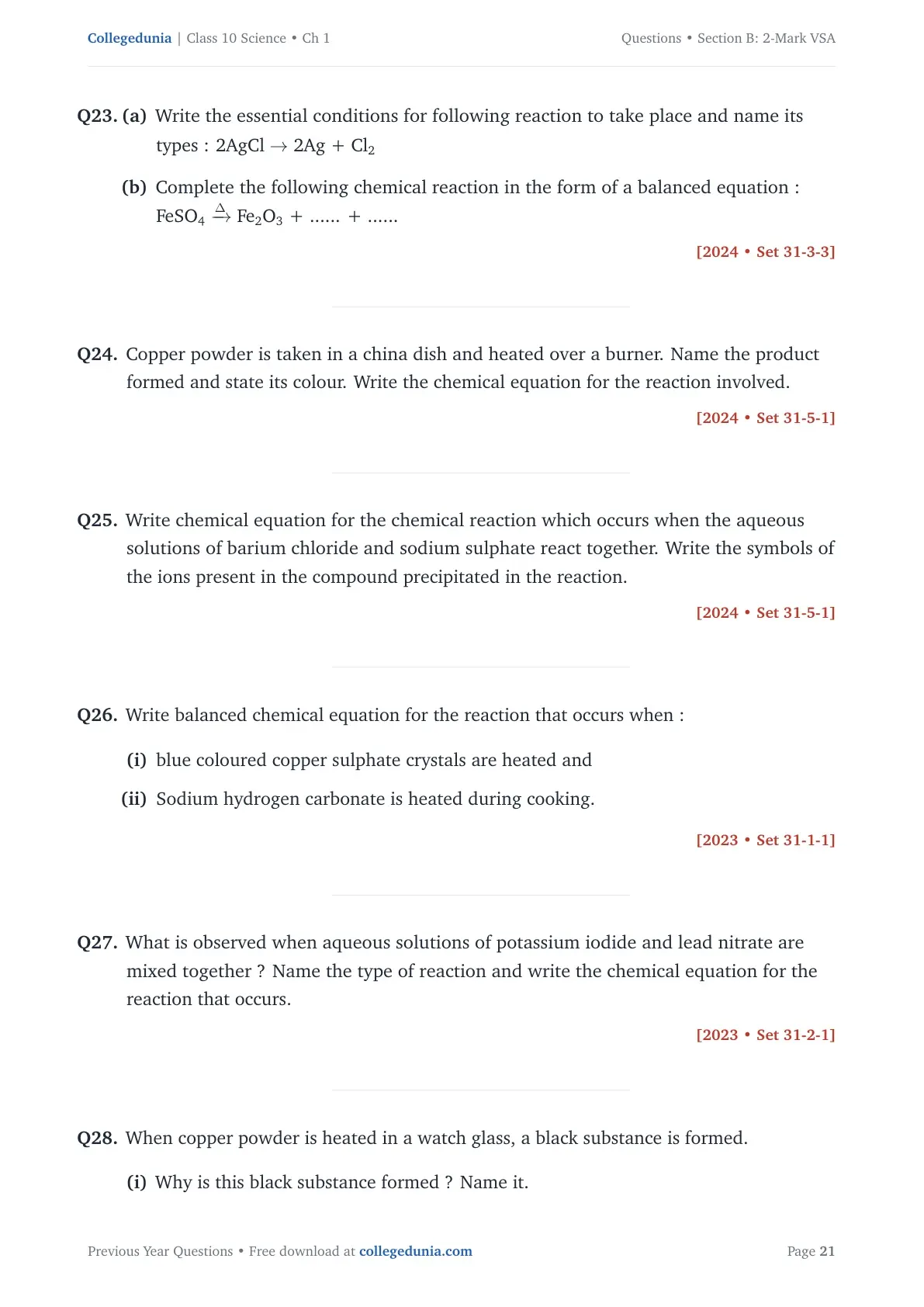
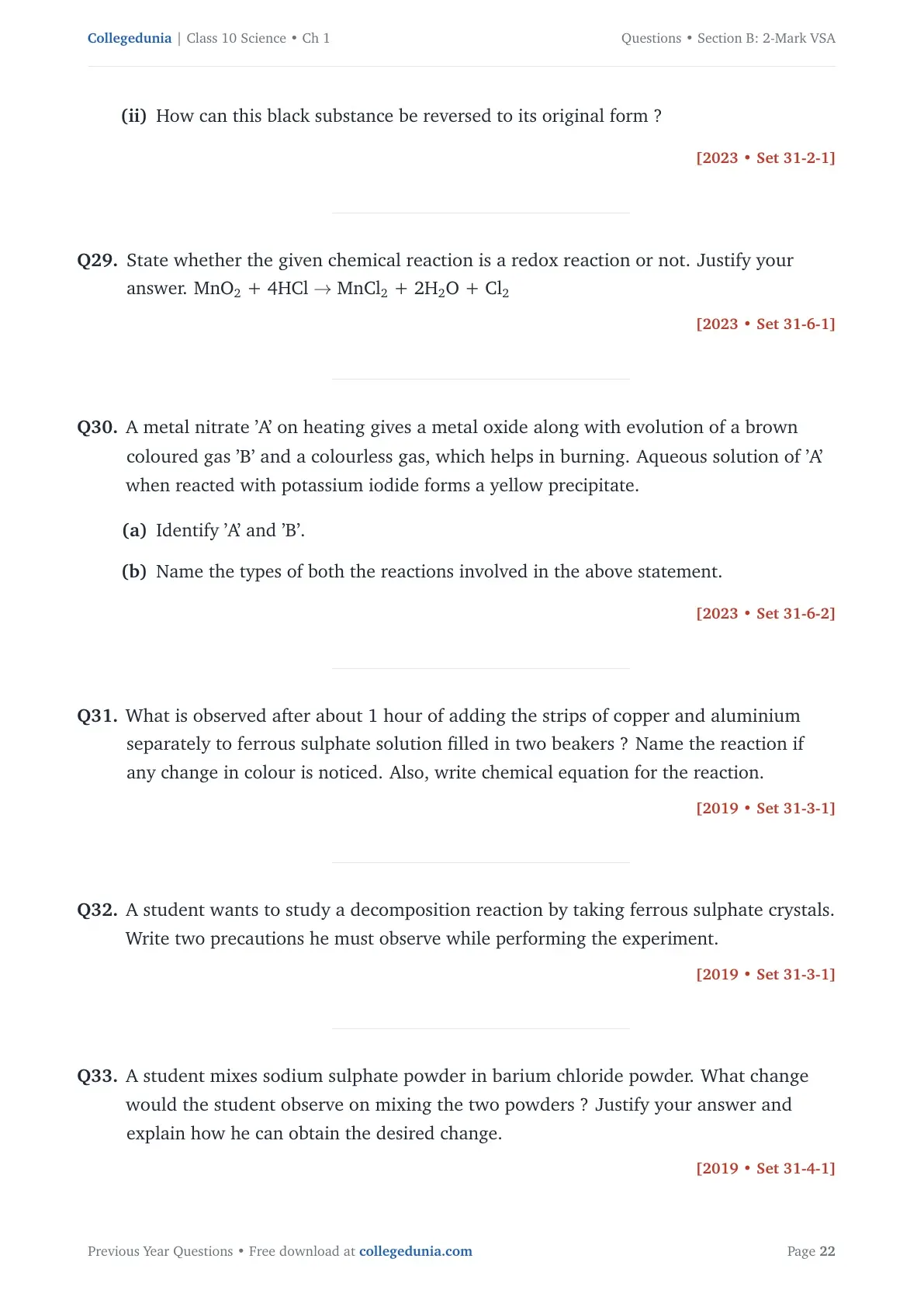
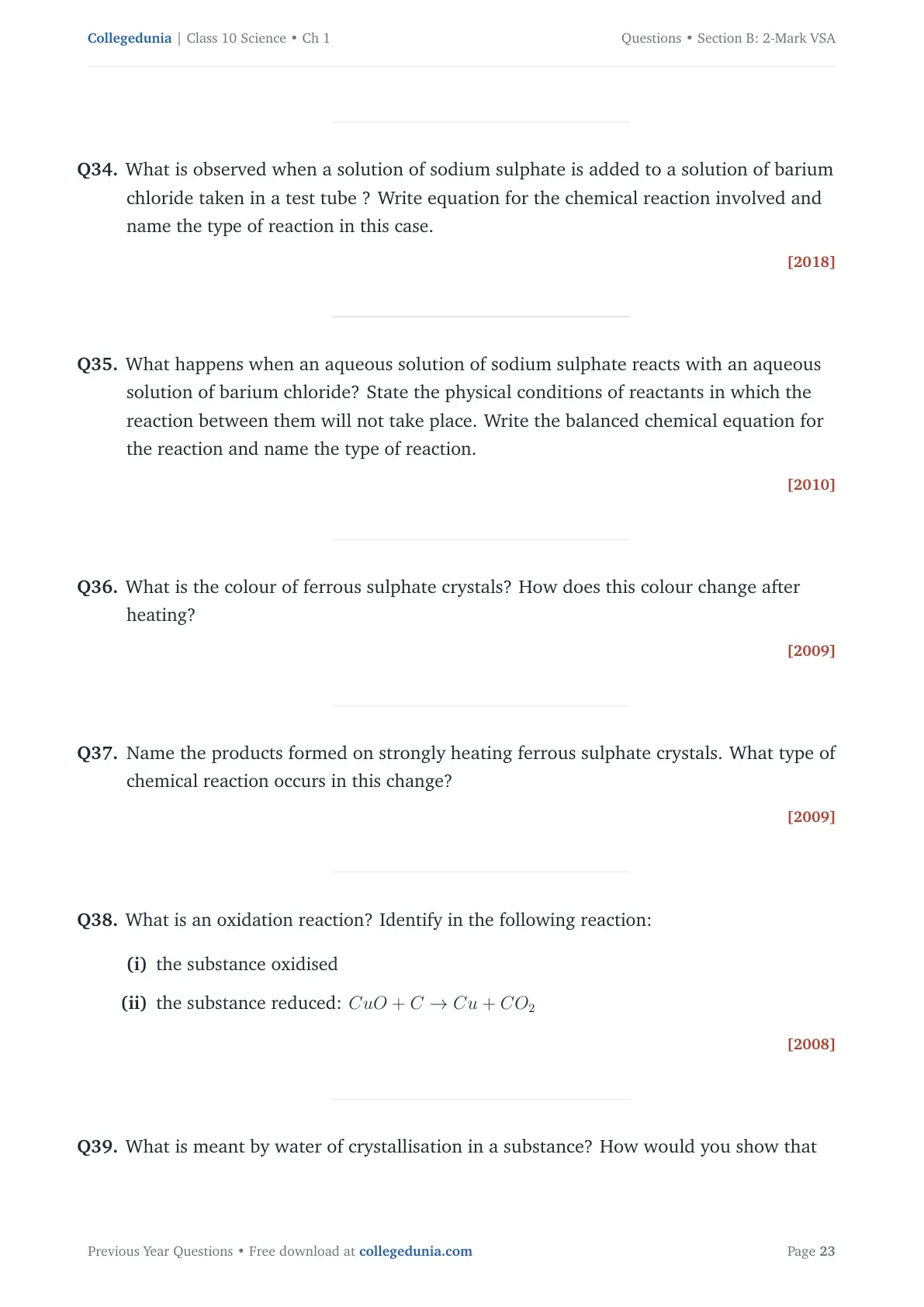
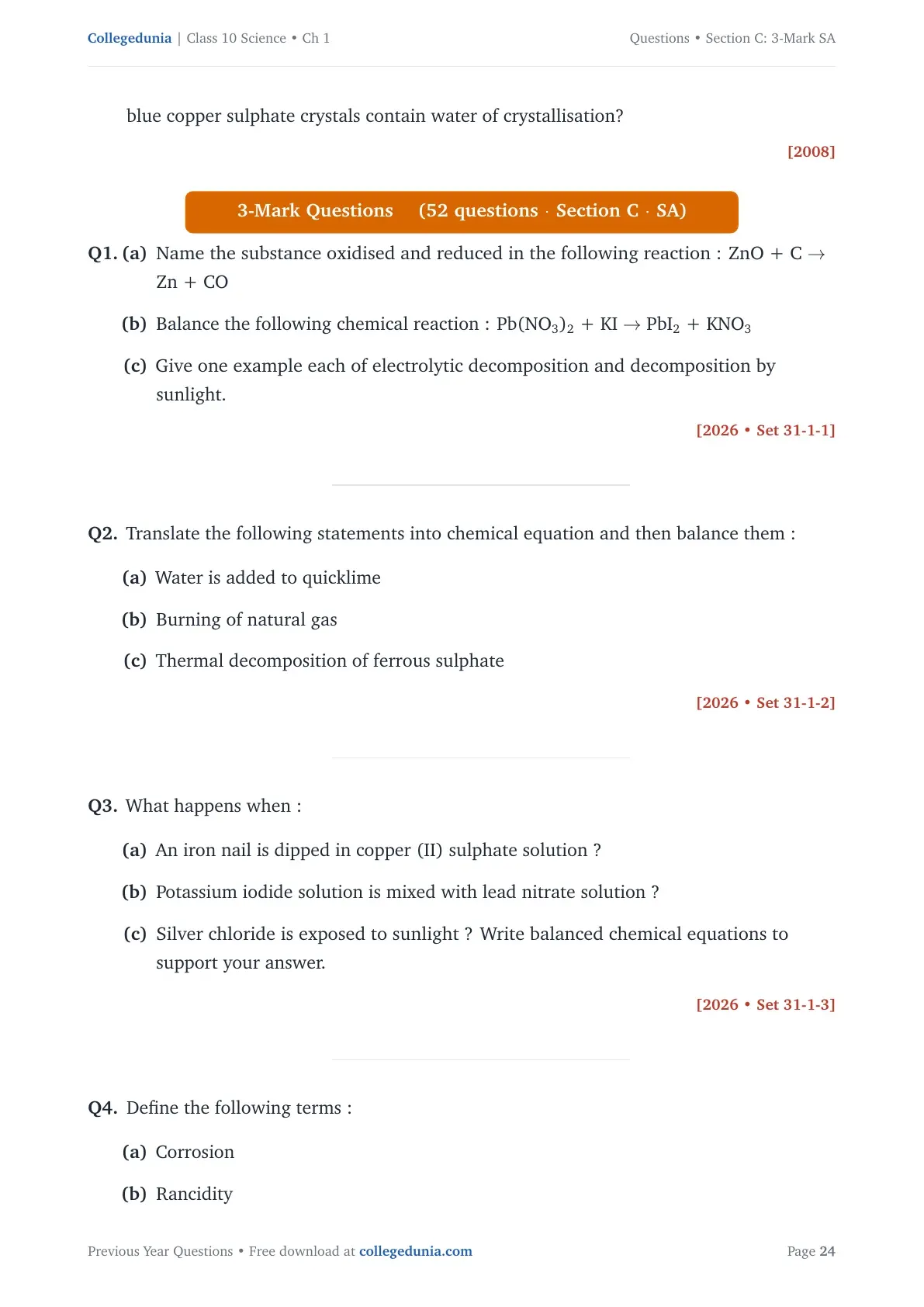
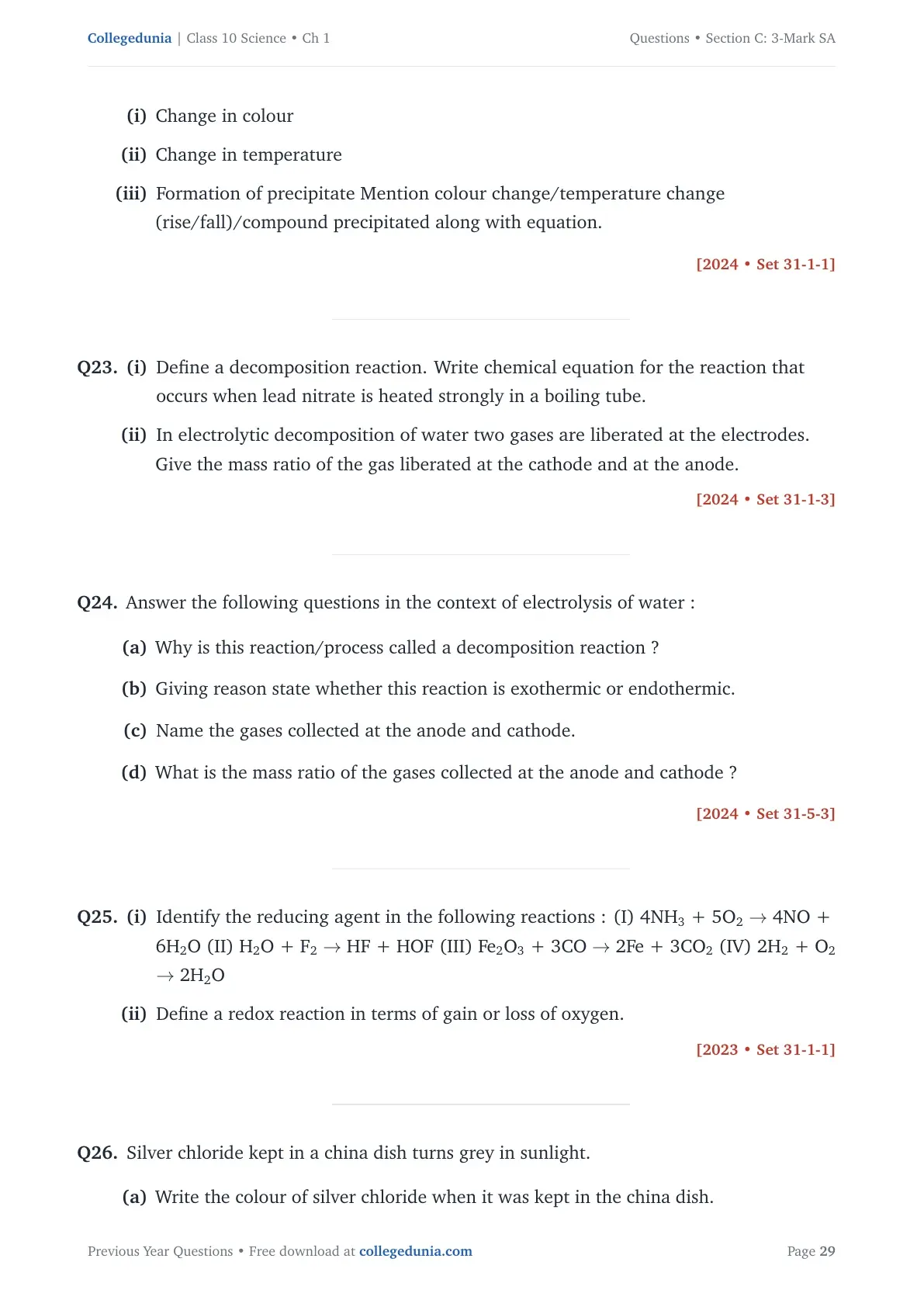
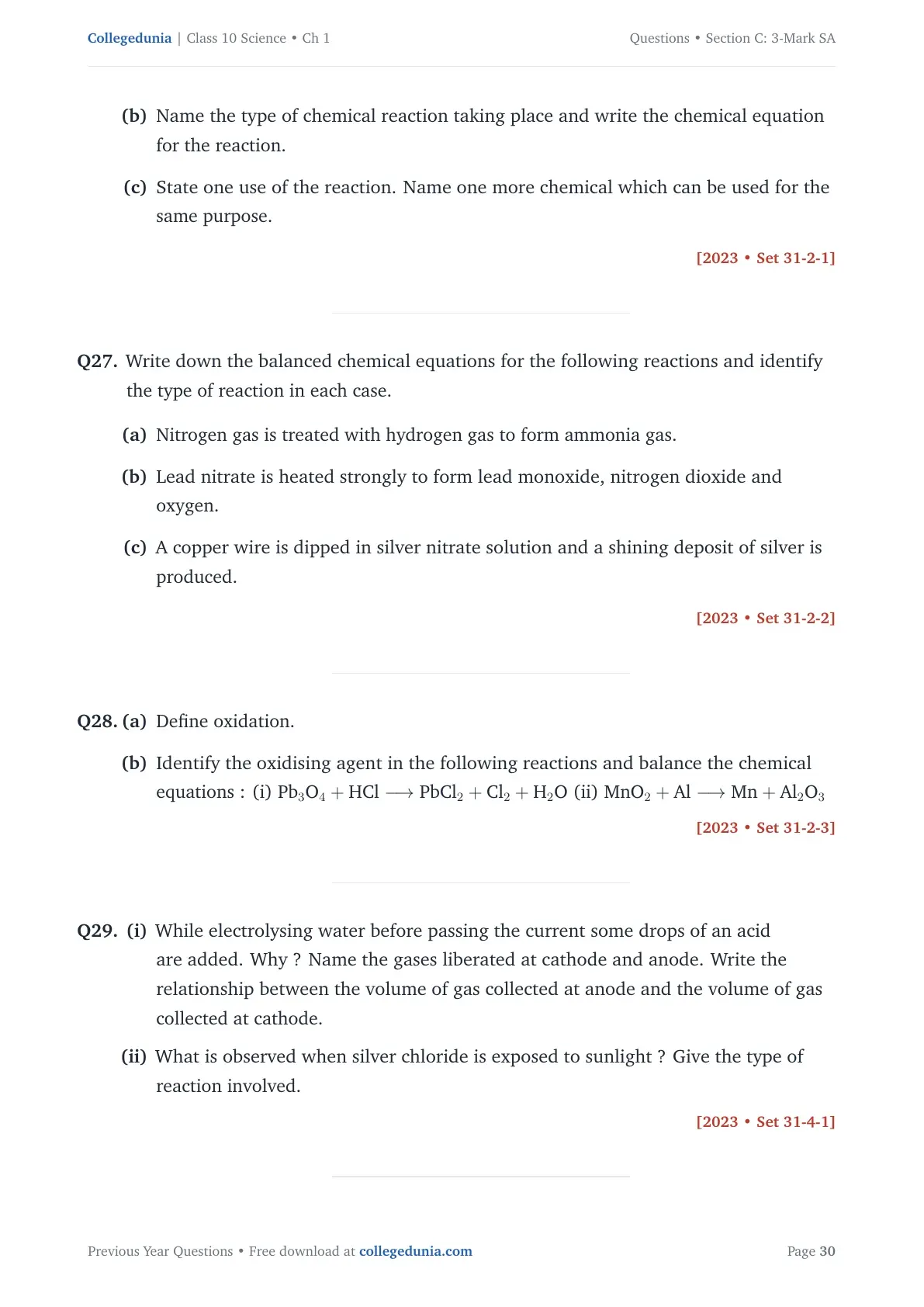
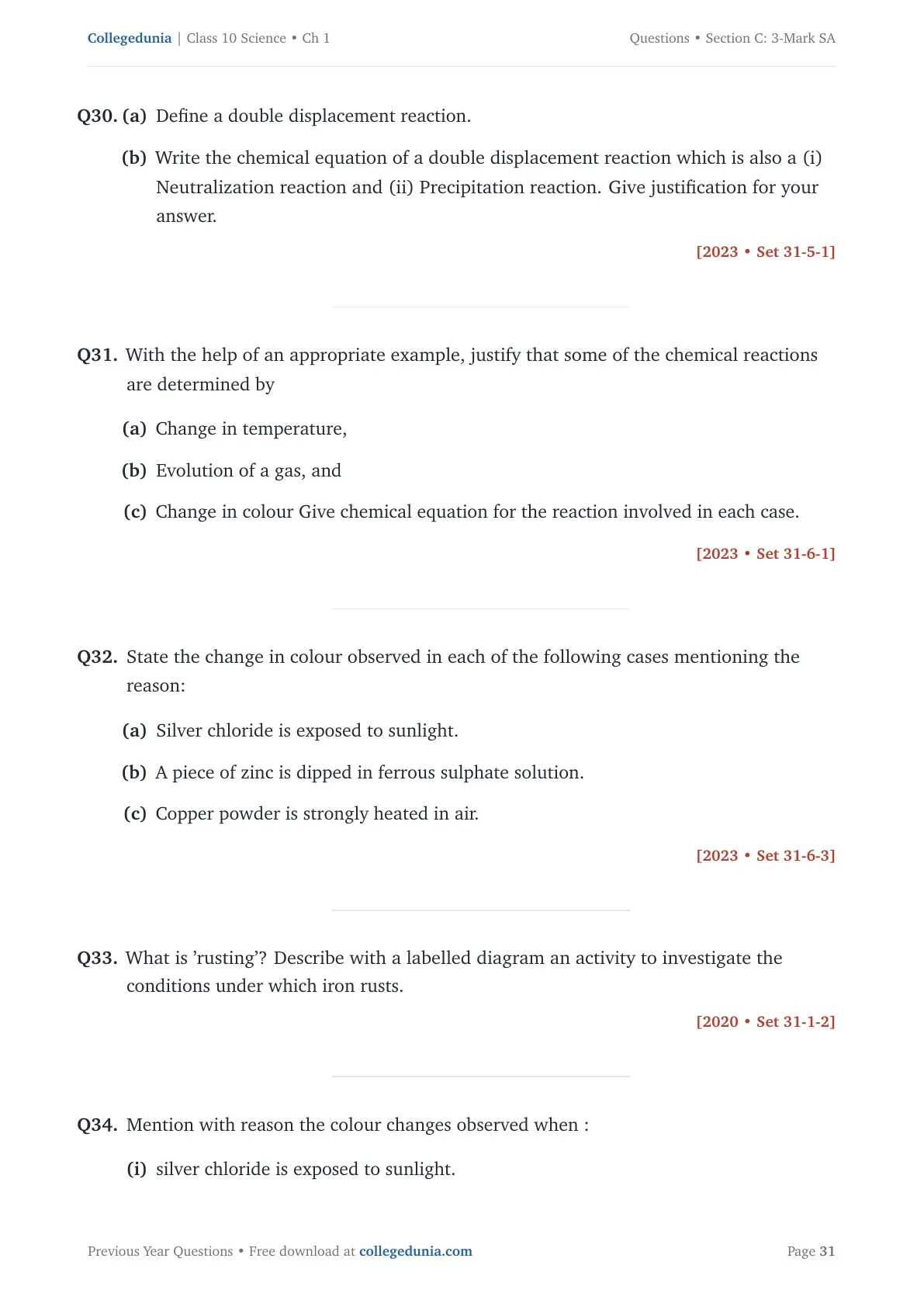
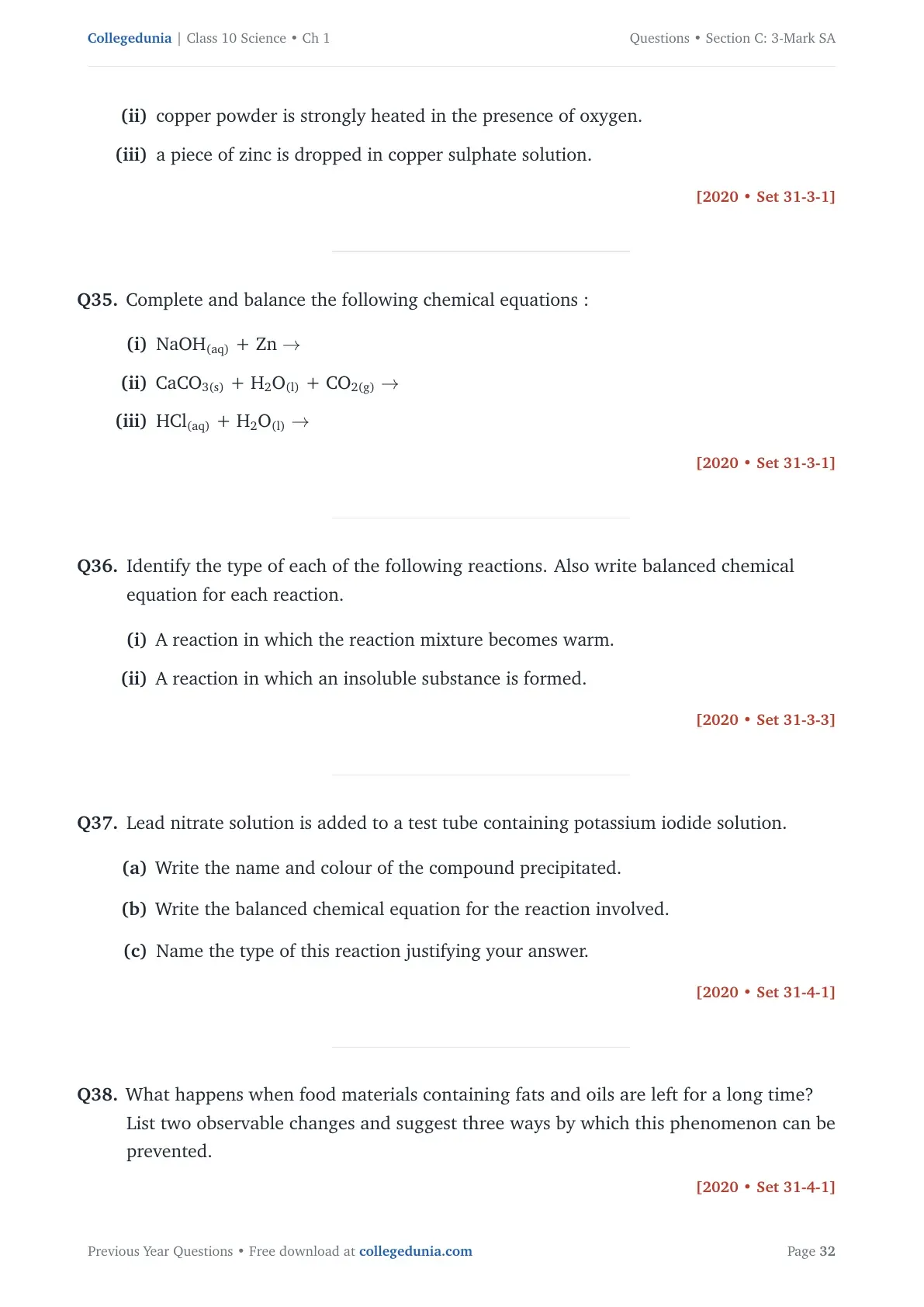
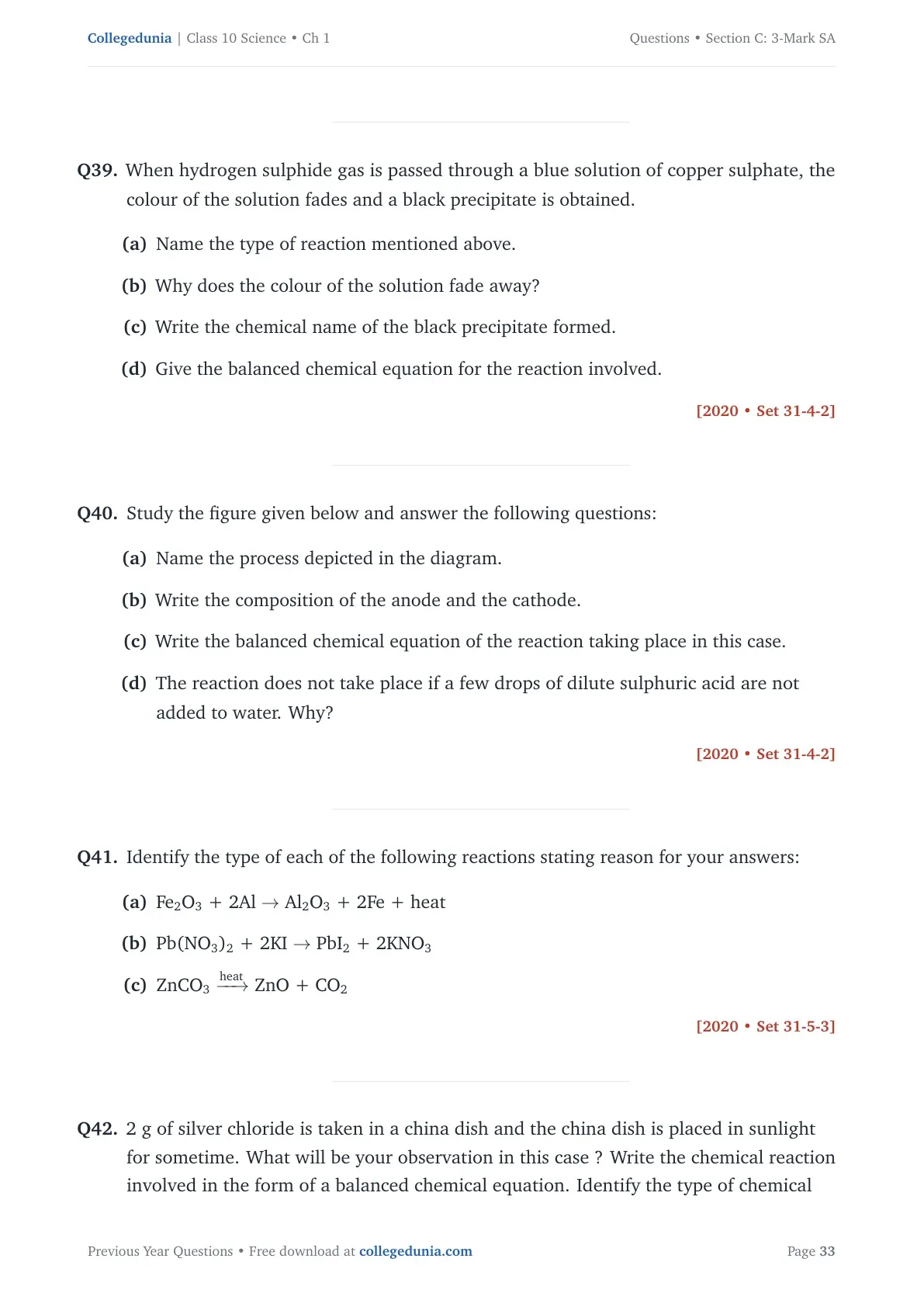
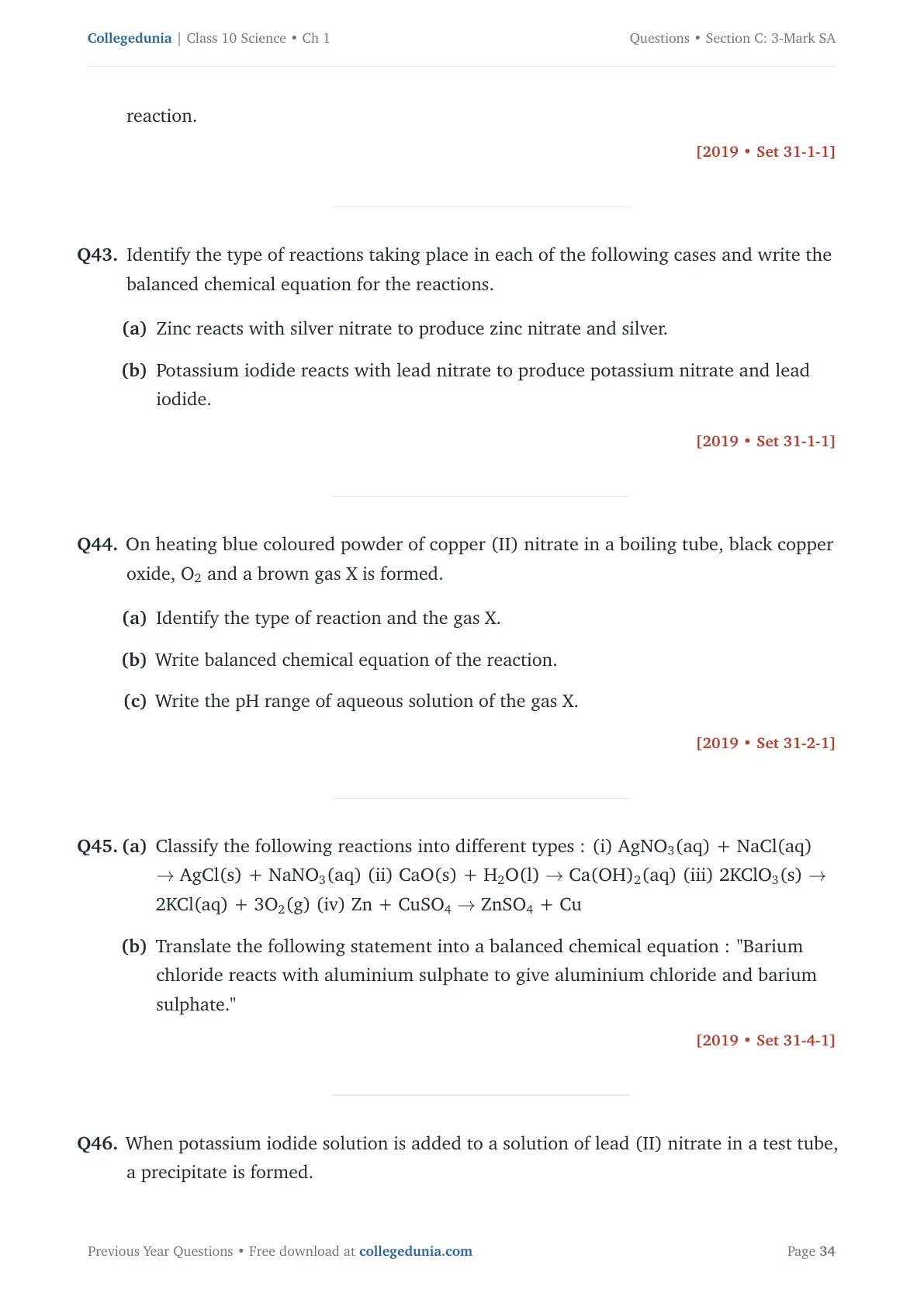
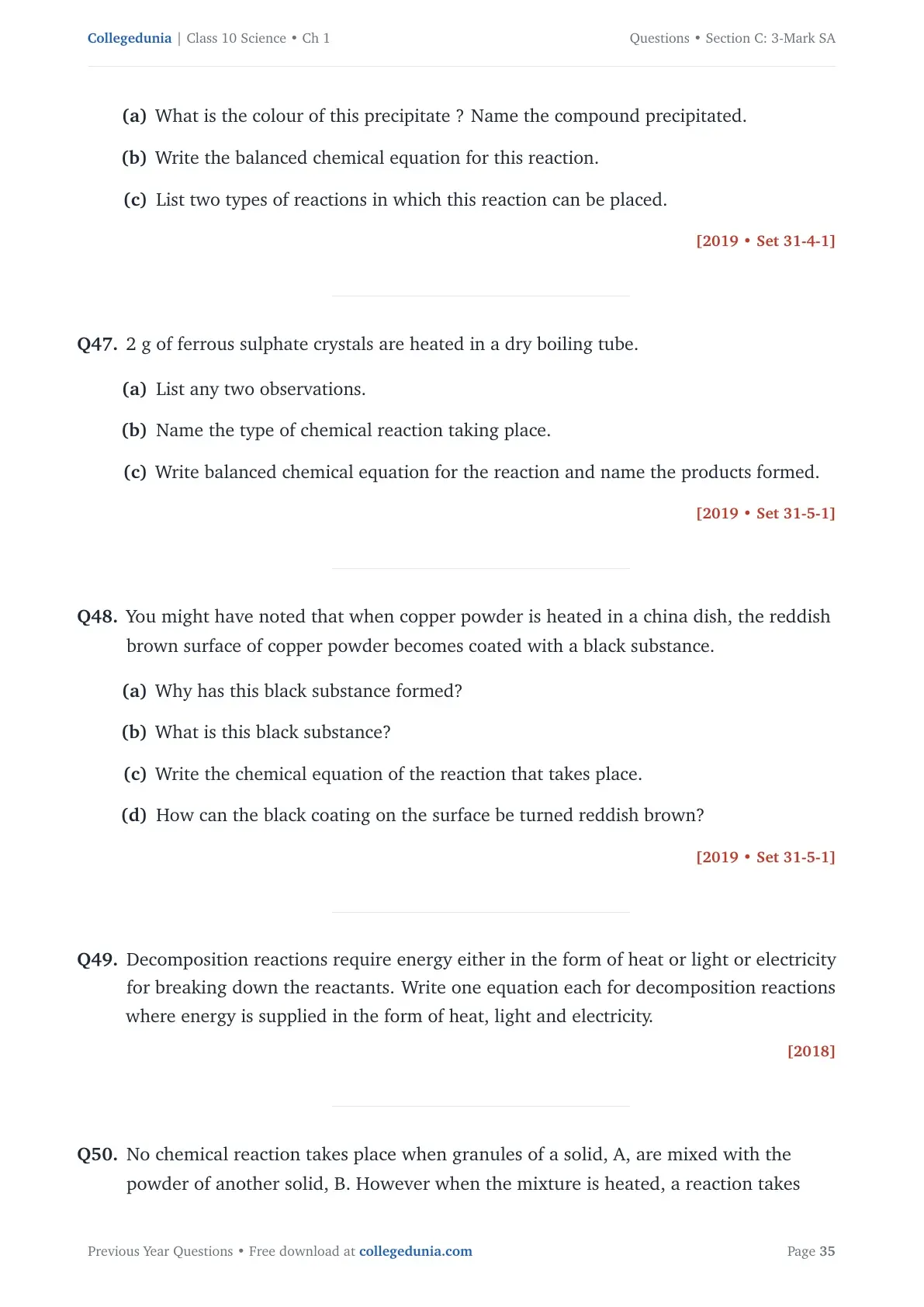
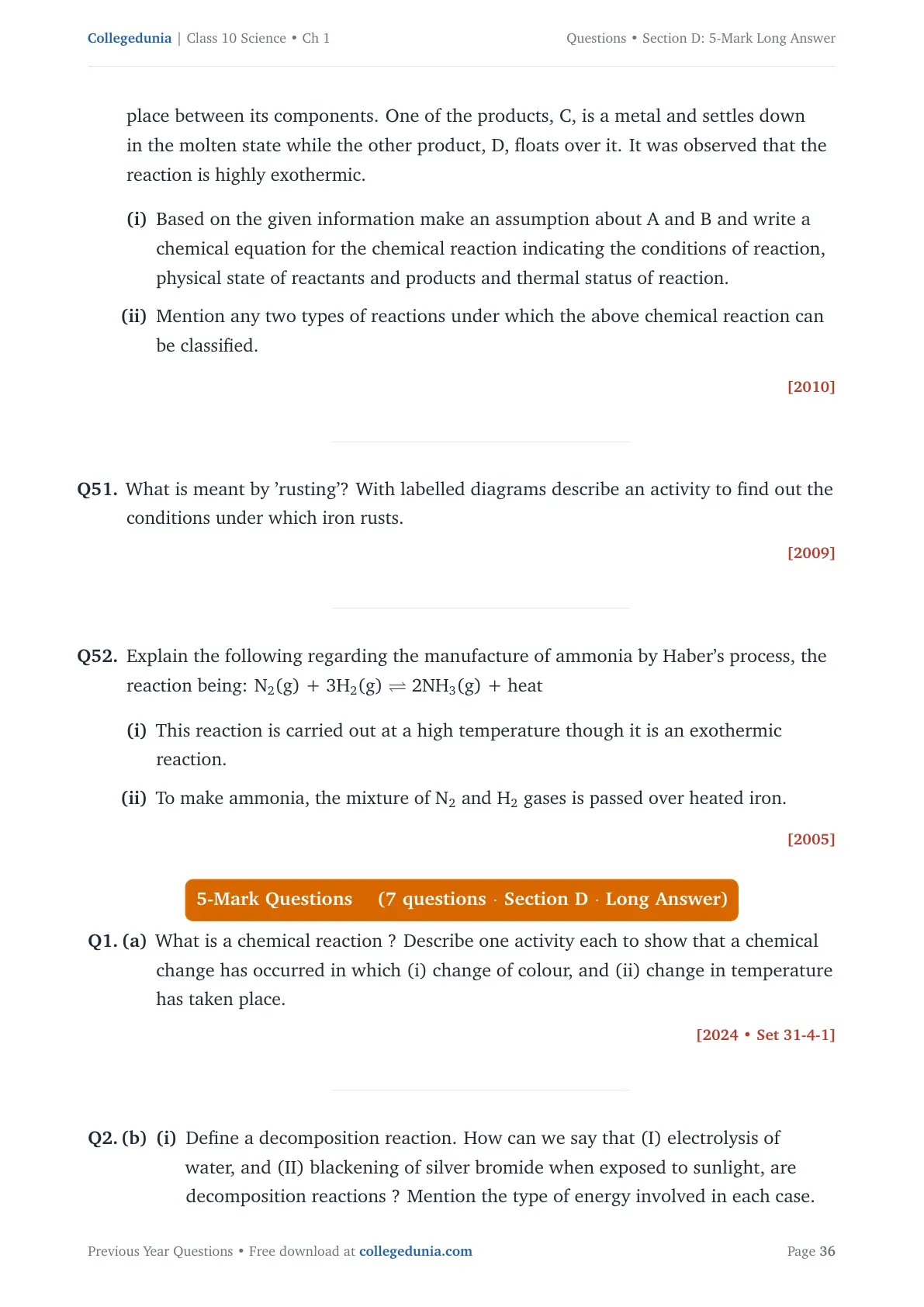
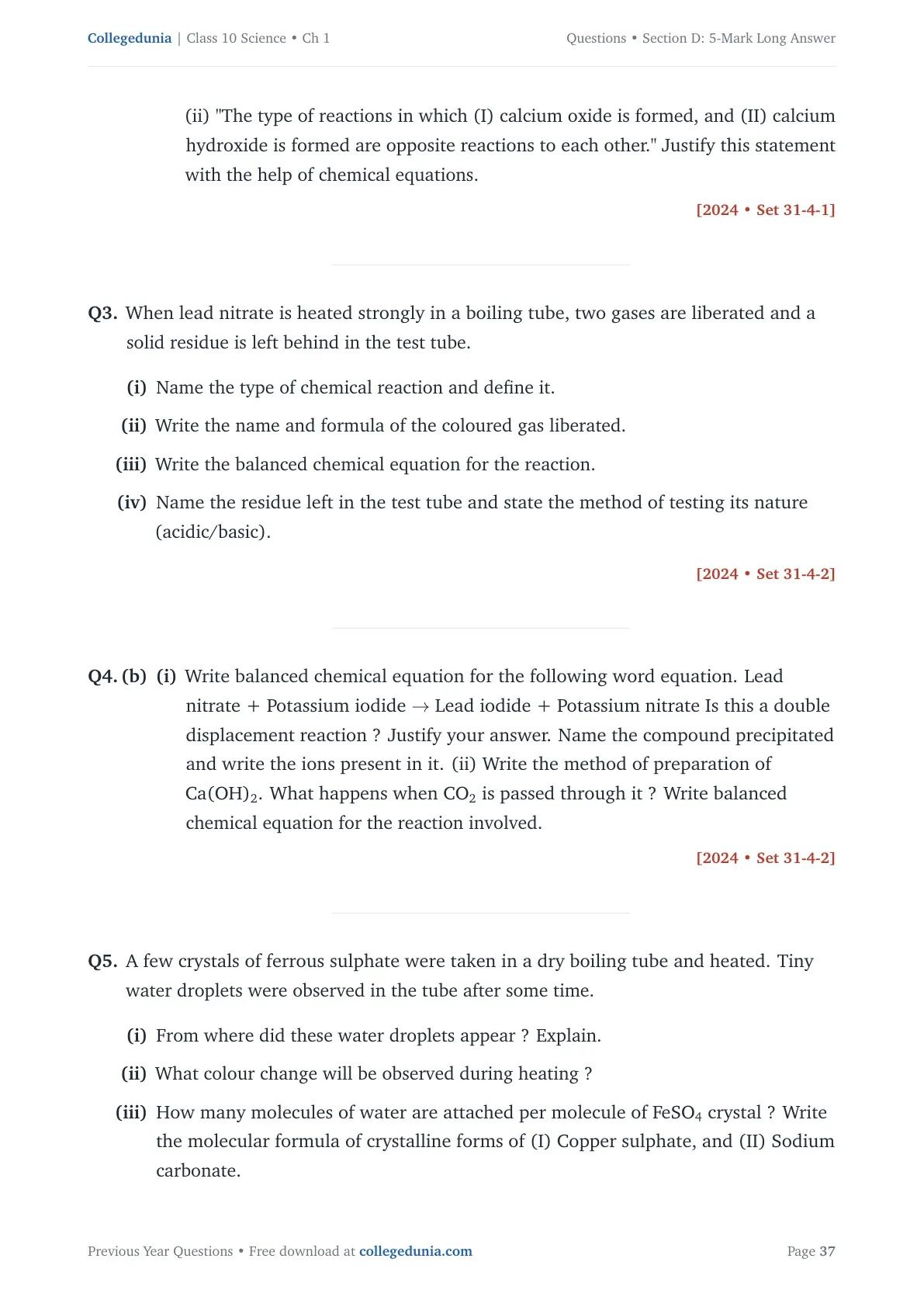
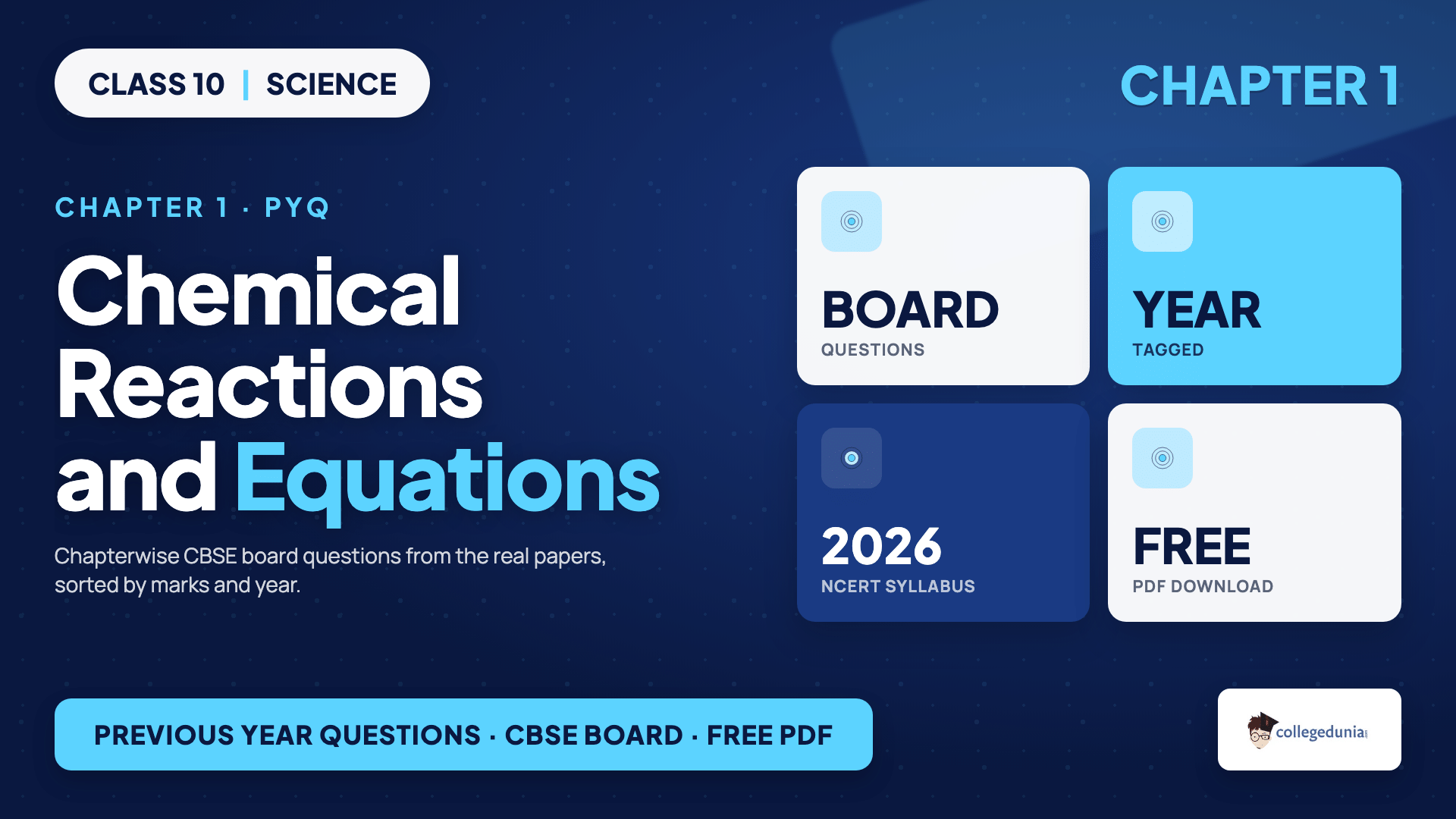
- 157 questions across 19 different CBSE set codes, spanning board papers from 2005 to 2026.
- Marks split across four sections: 1 mark MCQs, 2 mark very short answers, 3 mark short answers, and 5 mark long answers.
- Every question is labelled with its year and set code, for example 2026, Set 31-1-1, so you can trace it back to the original paper.
Every question in this PDF is copied word for word from an official CBSE Class 10 Science board paper and checked against the NCERT Science textbook for accuracy.
What the PDF Contains
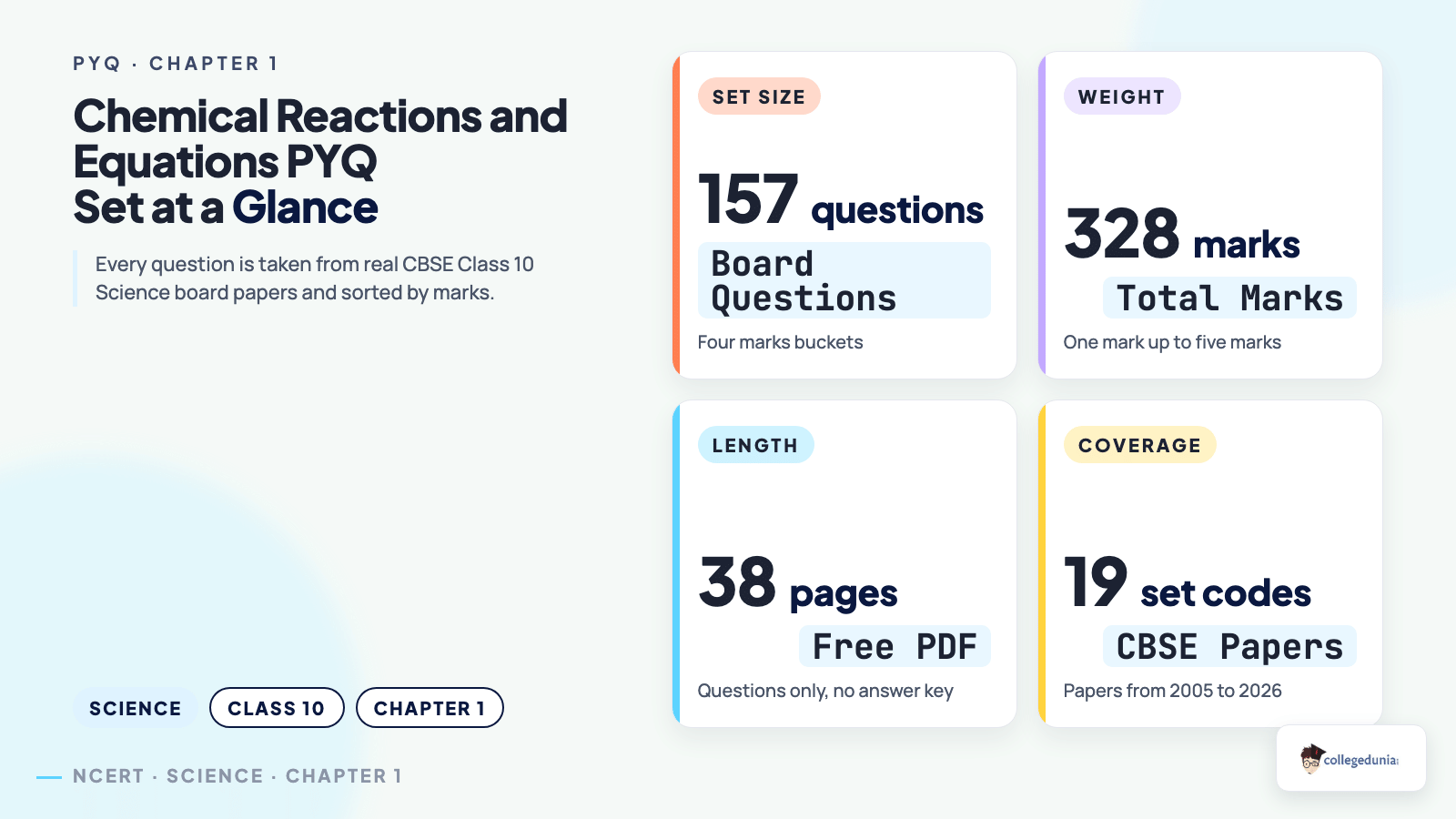
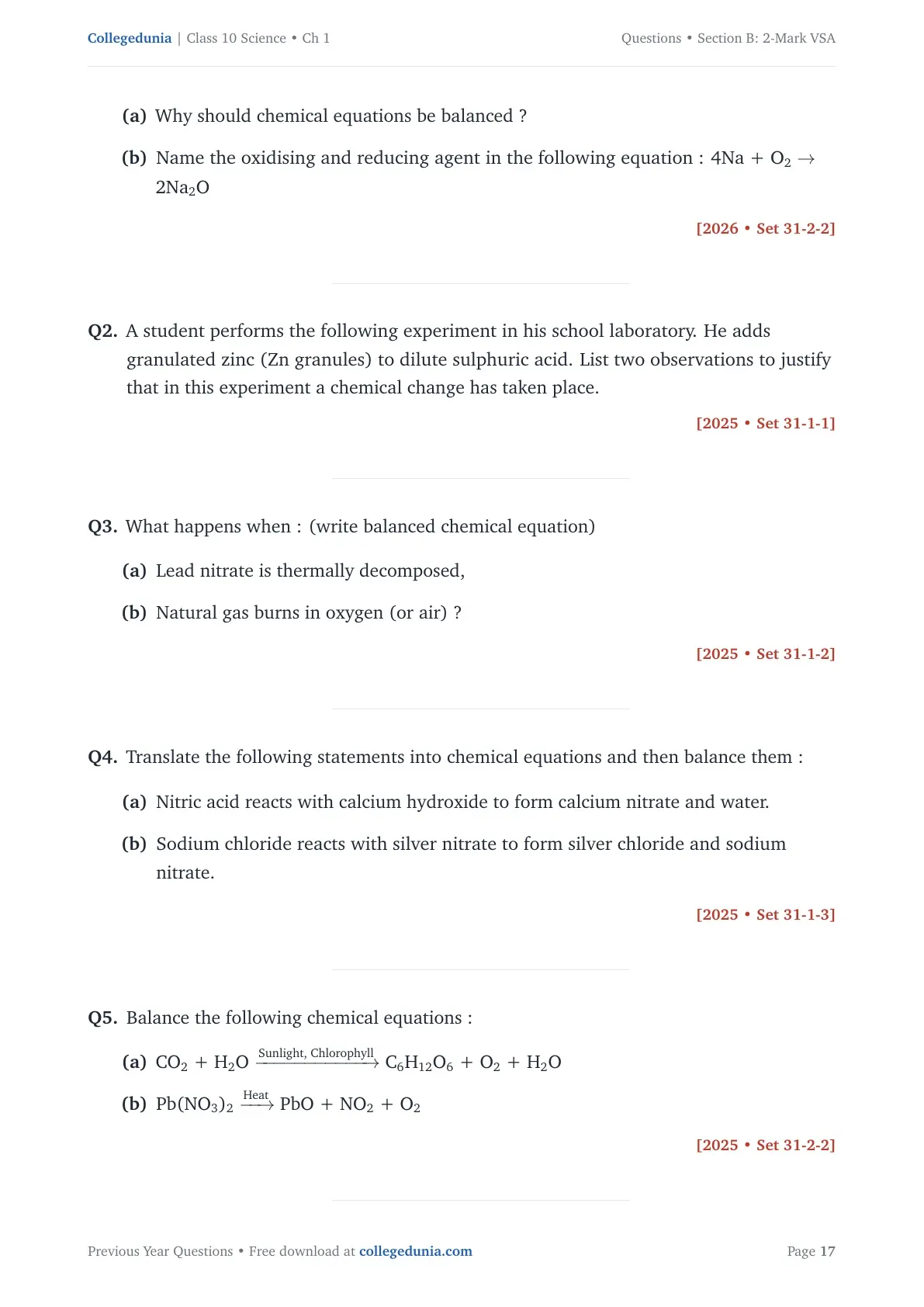
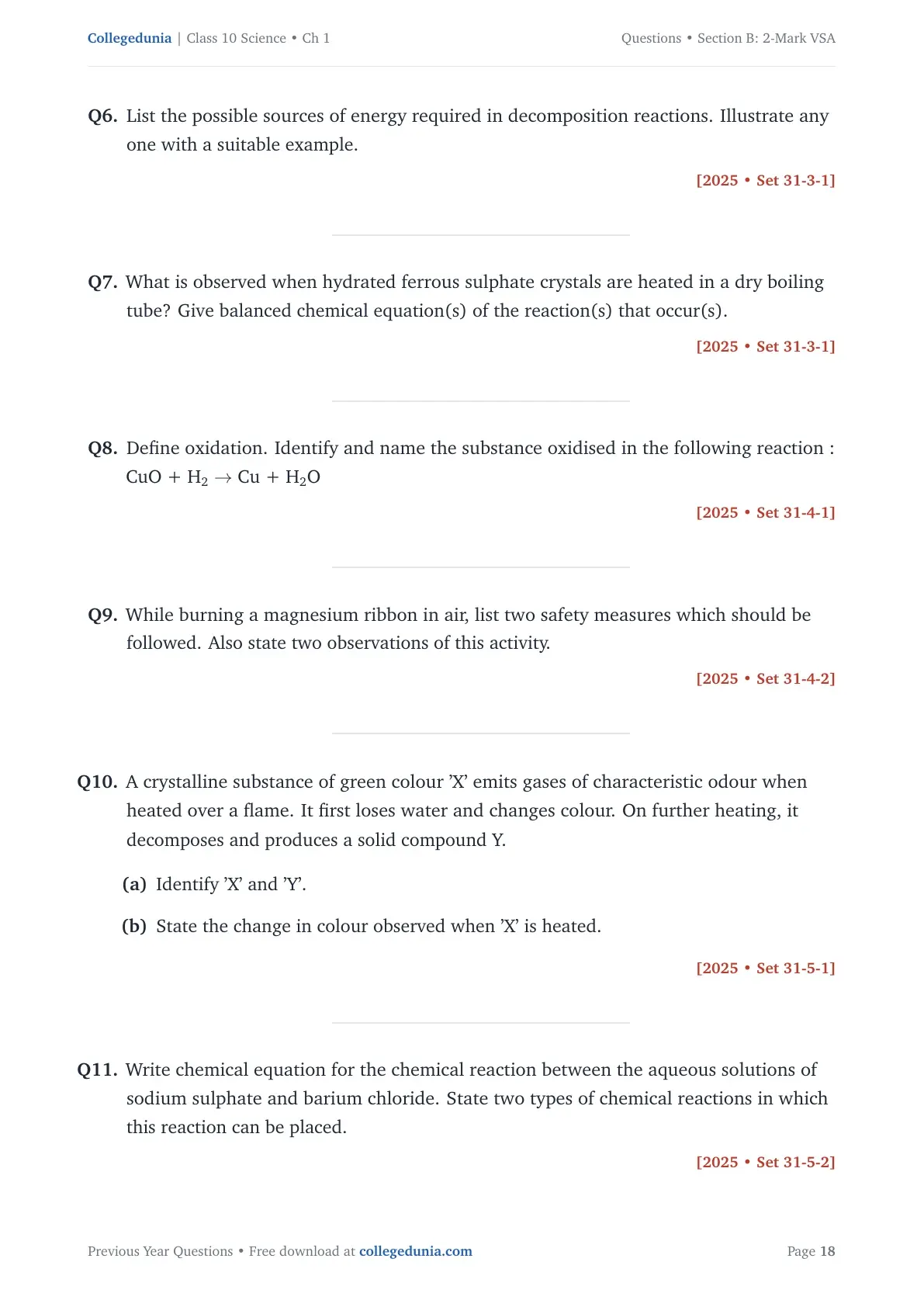
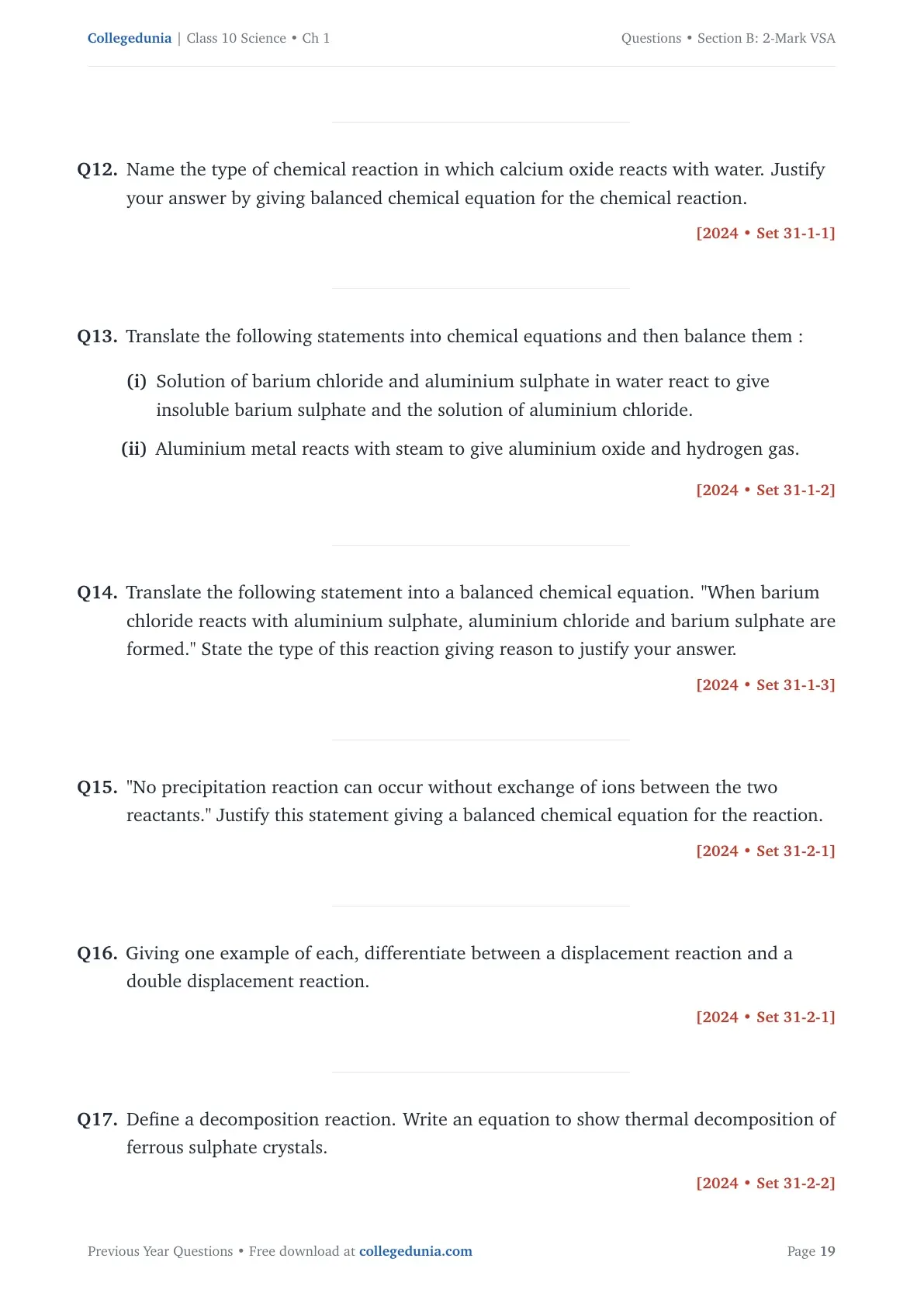
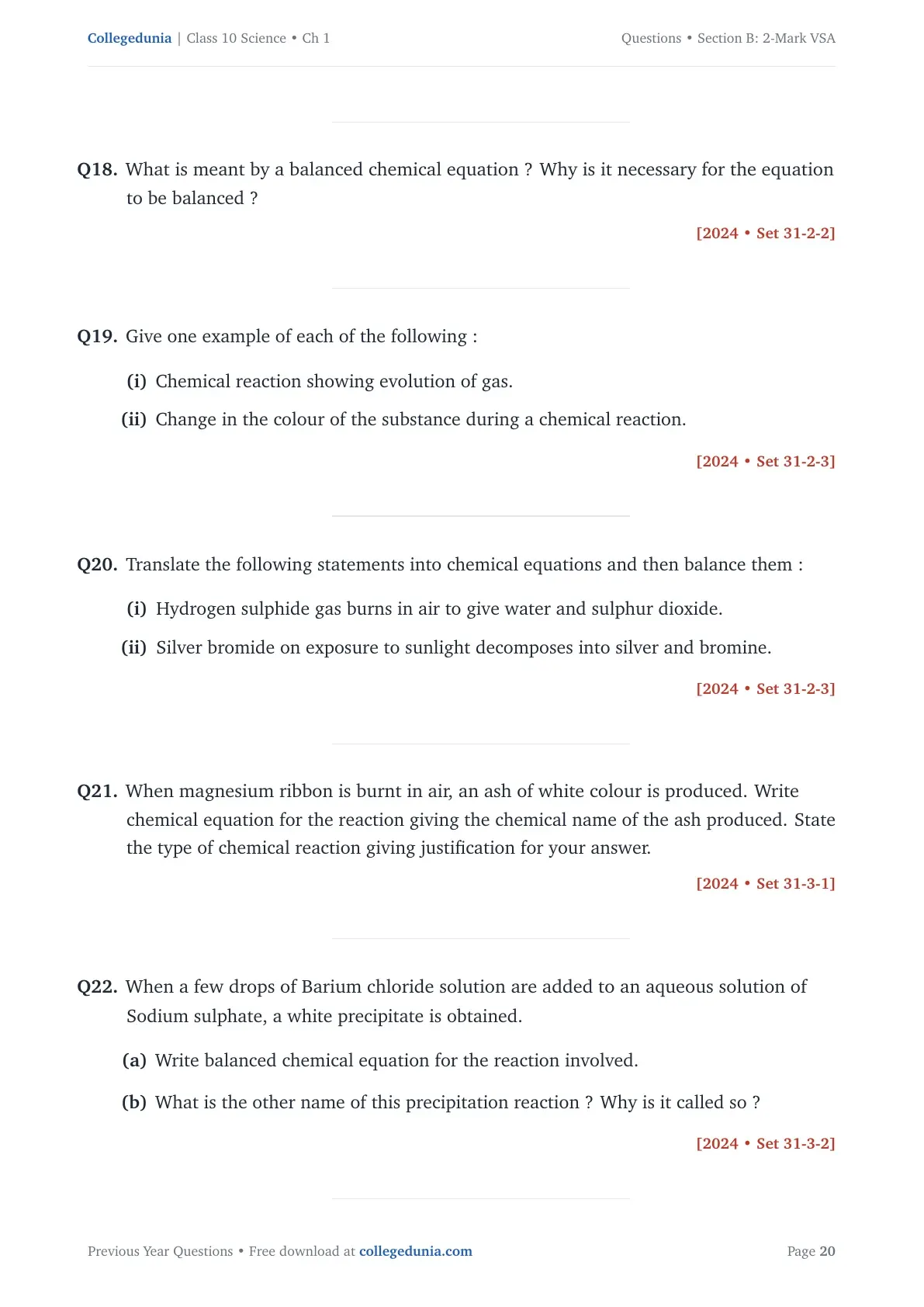
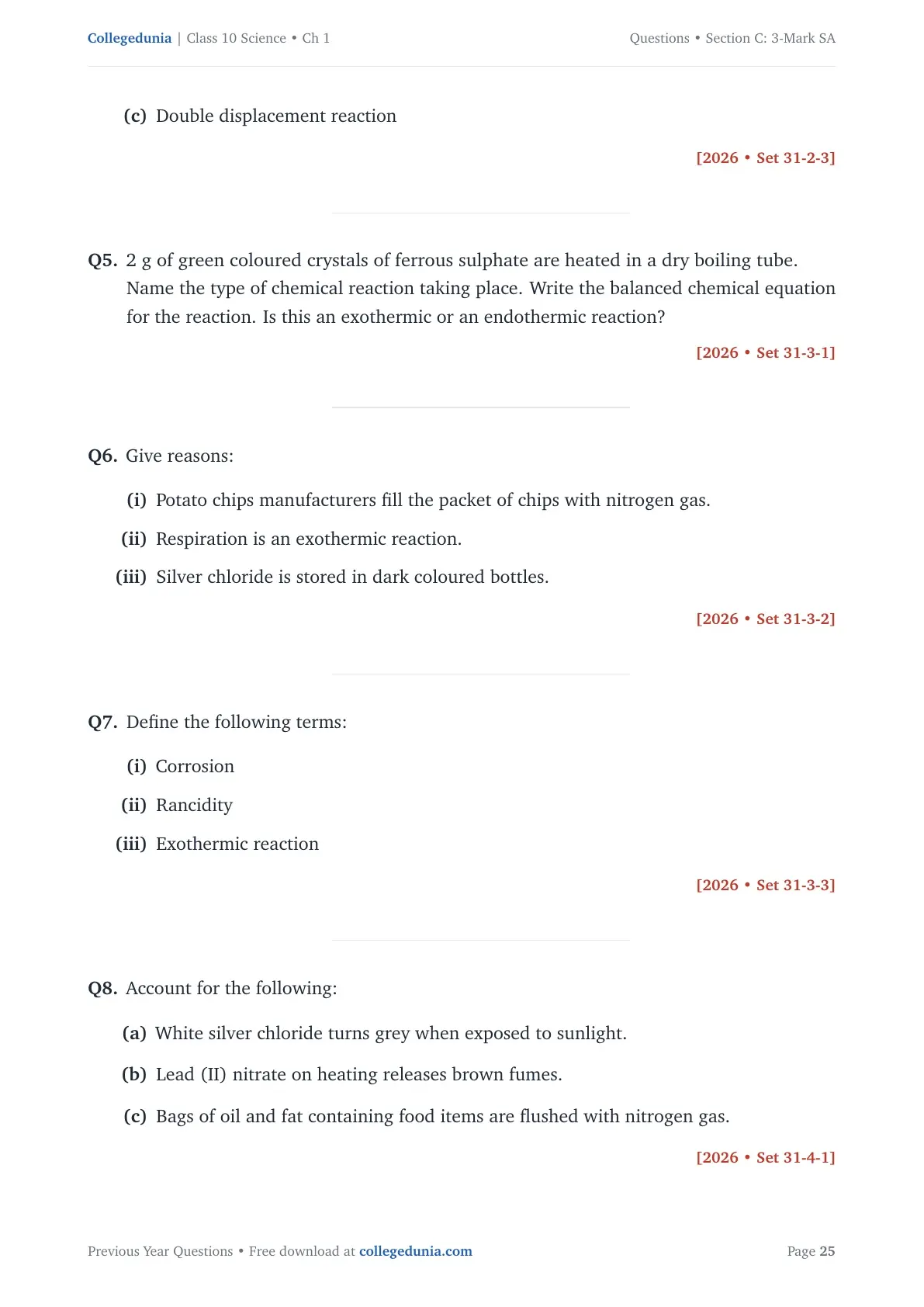
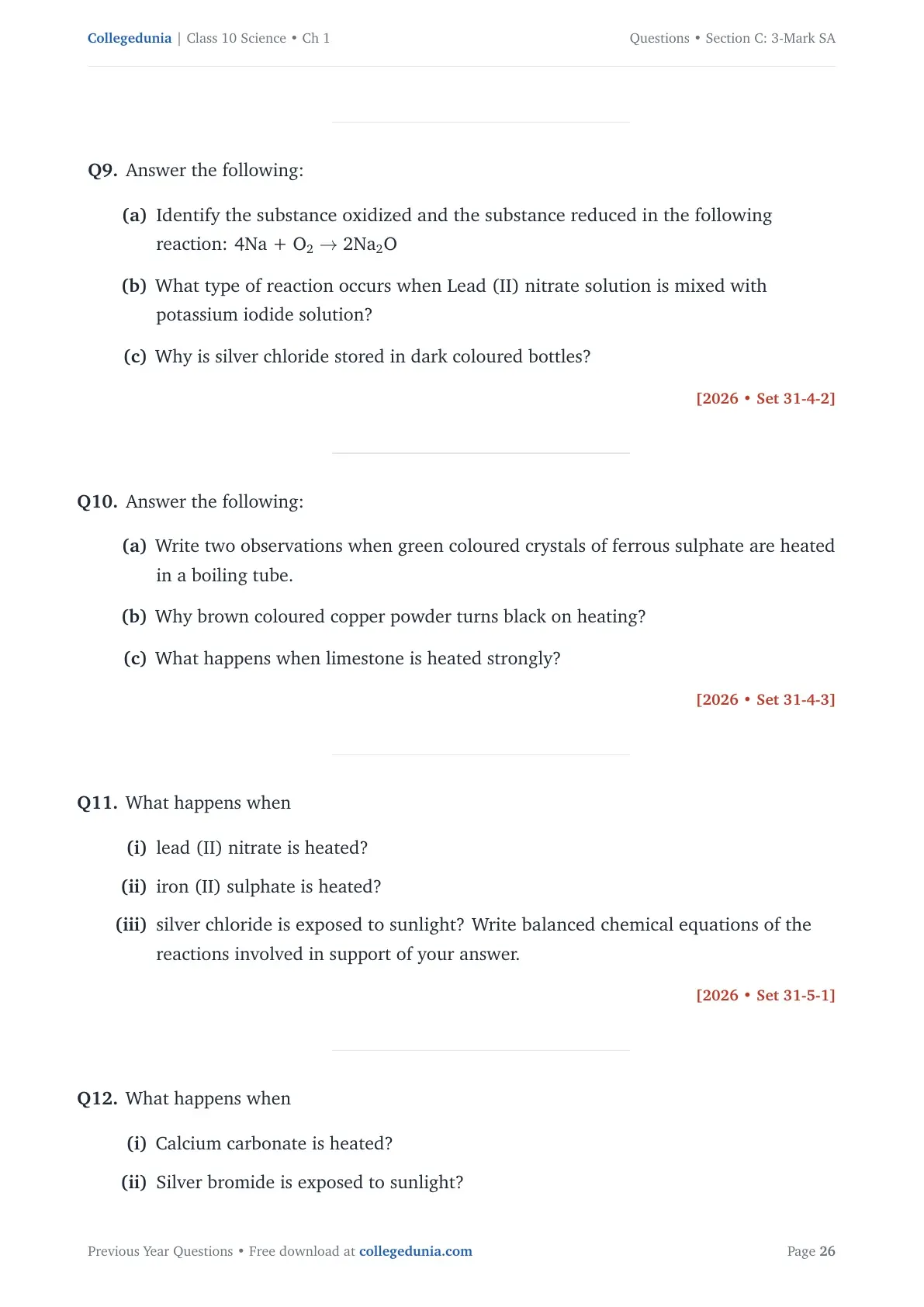
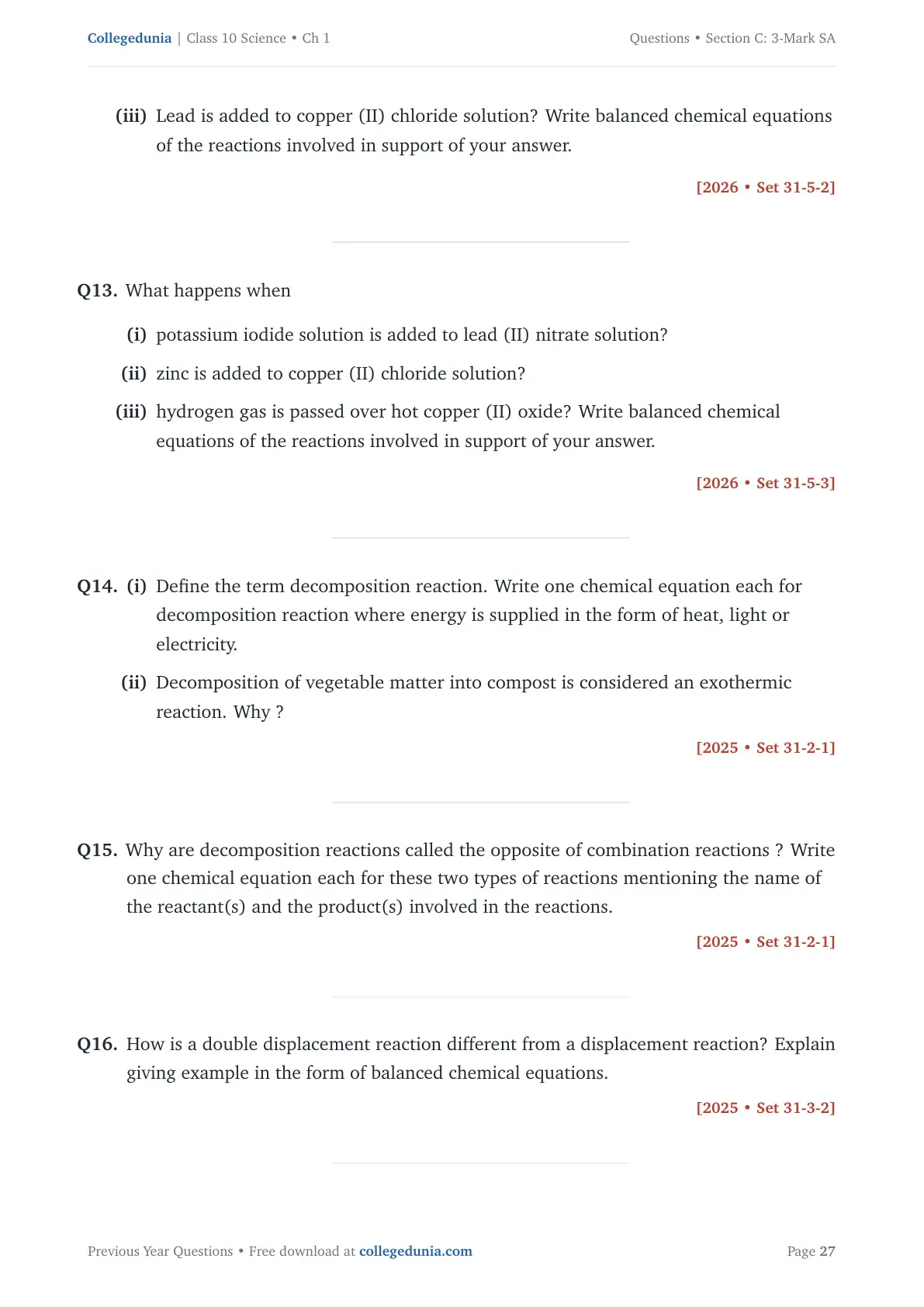
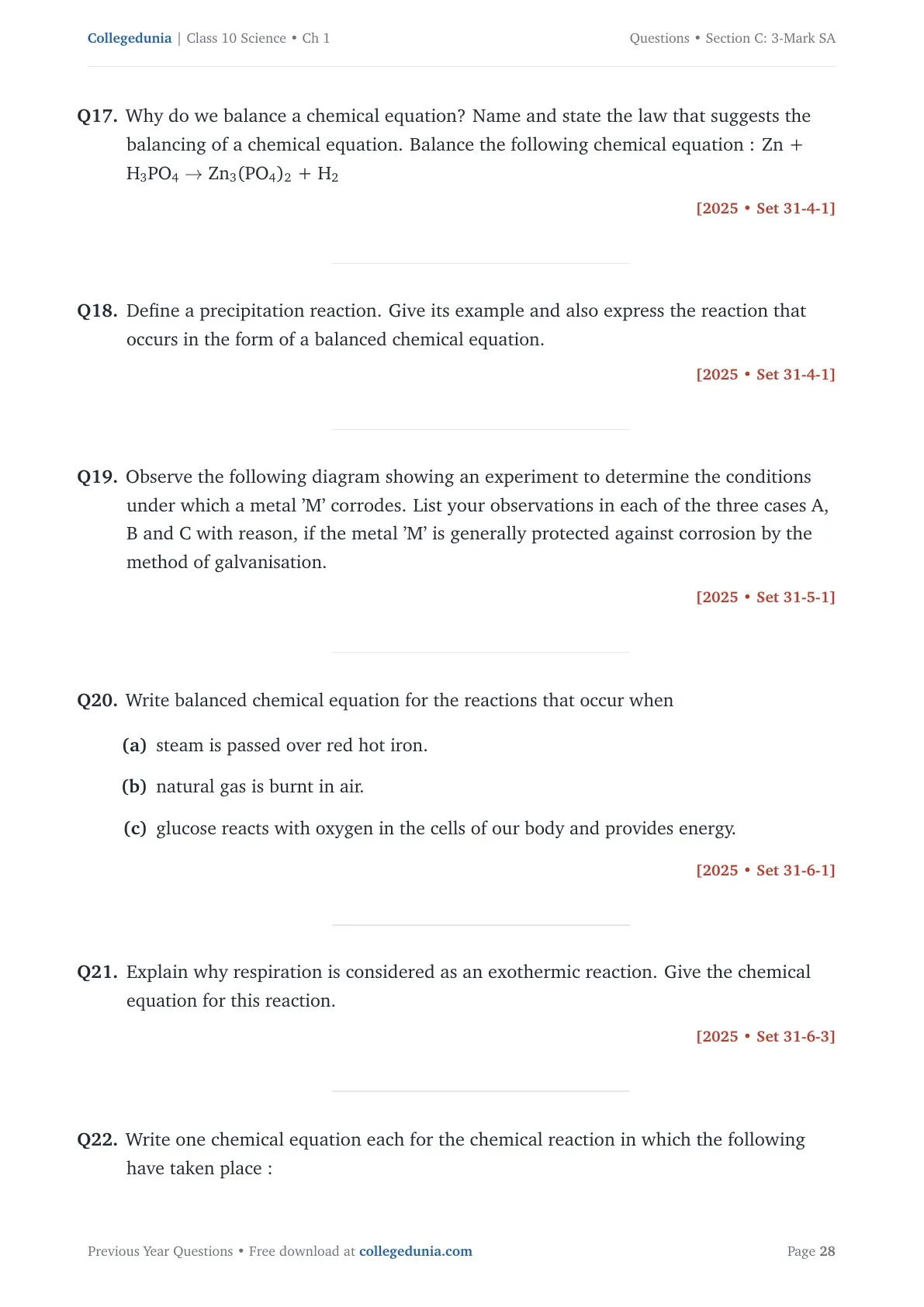
This PDF is a chapterwise question bank for Chemical Reactions and Equations. It has 157 questions worth 328 marks, spread over 38 pages. Every question comes from an actual CBSE Class 10 Science board paper set between 2005 and 2026, across 19 different set codes. There is no answer key, no model answer, and no marking scheme in this file. It is meant to be used as a question only practice set, so you can attempt each question on your own before checking your answer elsewhere.
Marks Wise Split of Questions
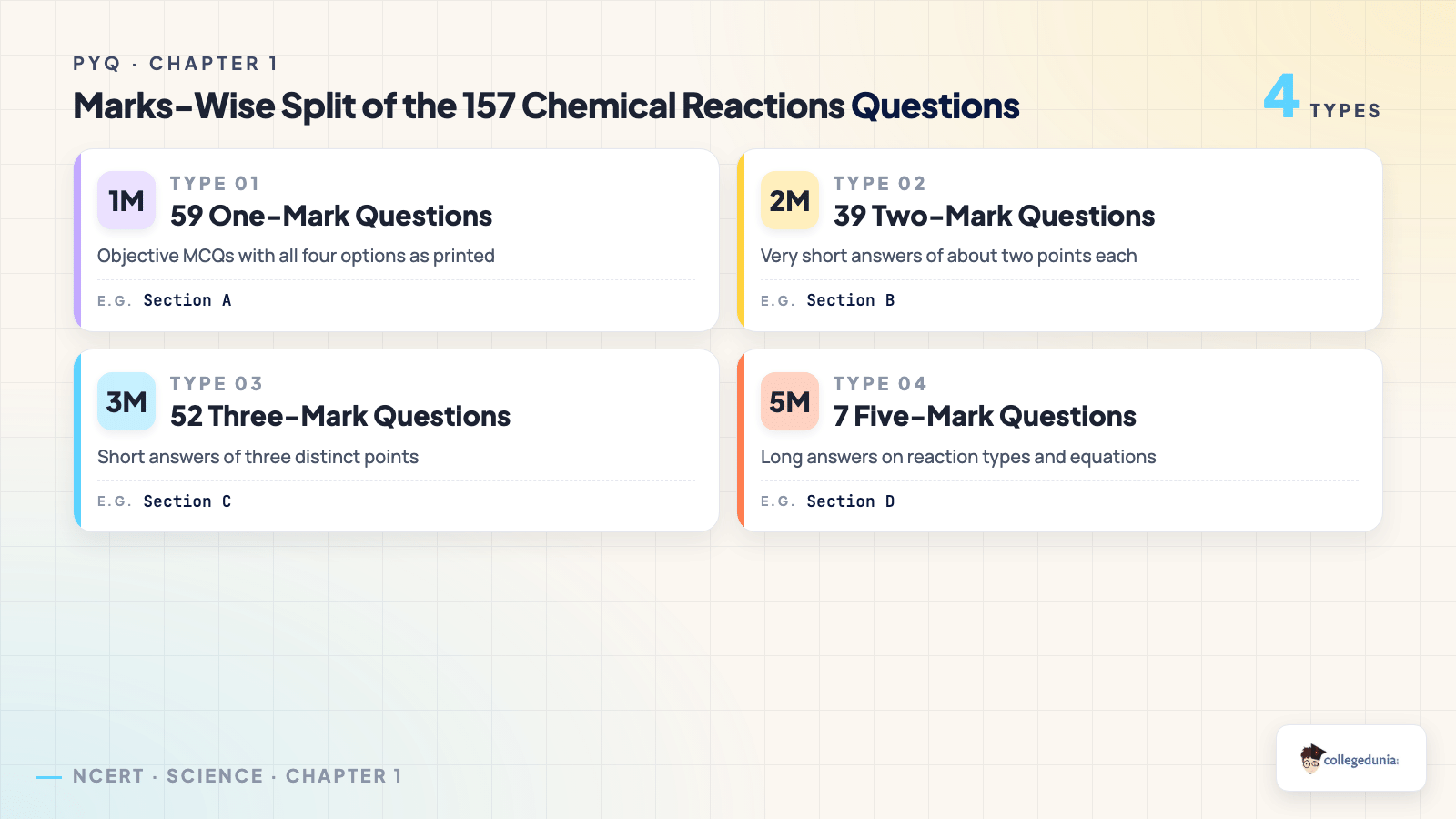
The 157 questions are spread across four sections, matching the CBSE board paper pattern.
| Marks per Question | Section | Question Type | Number of Questions | Total Marks |
|---|---|---|---|---|
| 1 mark | Section A | MCQ | 59 | 59 |
| 2 marks | Section B | Very Short Answer | 39 | 78 |
| 3 marks | Section C | Short Answer | 52 | 156 |
| 5 marks | Section D | Long Answer | 7 | 35 |
| Total | 157 | 328 | ||
Years and CBSE Set Codes Covered
The questions in this PDF come from CBSE Class 10 Science board papers dated between 2005 and 2026, drawn from 19 different set codes. Each question is tagged with its year and set code right next to it, for example 2026, Set 31-1-1. This lets you see exactly how a topic has been asked over the years, and whether the phrasing or difficulty has changed.
Topics the Papers Keep Asking About
Across 19 years of board papers, a small set of topics from this chapter comes up again and again.
- Writing and balancing chemical equations
- Combination reactions
- Decomposition reactions
- Displacement reactions
- Double displacement reactions
- Oxidation and reduction
- Redox reactions
- Corrosion
- Rancidity
Balancing equations and identifying the reaction type show up in almost every paper, so these are worth extra practice.
Why Previous Year Questions Matter for This Chapter
Chemical Reactions and Equations is a scoring chapter, but only if you can write and balance equations quickly under exam pressure. Practicing questions that have actually appeared in board papers shows you the real range of how CBSE frames a question, from a one line MCQ to a five mark question that asks you to identify a reaction type and then balance the equation for it. Working through 19 years of papers also shows you which small mistakes examiners keep penalising, so you can avoid them.
How to Attempt Balancing and Equation Questions in the Exam
- Read the question fully and note whether it asks only for a balanced equation, or also for the reaction type.
- Write the skeletal equation first, with correct chemical formulas on both sides.
- Count the atoms of each element on the reactant and product sides separately.
- Balance one element at a time, starting with the element that appears in the fewest compounds.
- Adjust coefficients, never subscripts, to balance the equation.
- Recheck the atom count on both sides once you think it is balanced.
- Add state symbols, solid, liquid, gas, or aqueous, only if the question specifically asks for them.
- For questions on reaction type, name the reaction and give one line of reasoning based on what happens to the reactants.
Common Mistakes Students Make in This Chapter
These are the errors that show up most often in answer sheets for this chapter.
- Balancing an equation by changing subscripts instead of coefficients.
- Mixing up combination and decomposition reactions when both involve heat.
- Forgetting to mention that oxidation and reduction happen together in a redox reaction.
- Confusing corrosion with rancidity, or giving examples of one when asked about the other.
- Skipping state symbols when a question specifically asks for a complete balanced equation.
Student Feedback on This PYQ Set
We asked a group of Class 10 Science students who used this PDF to prepare for their board exam how it helped them.
- 74% said the 3 mark short answer questions on reaction types were the most useful to practice.
- 61% said seeing the year and set code next to each question helped them judge how often a topic repeats.
- 82% said working through questions without an answer key forced them to check their own balancing before moving on.
Source: Collegedunia student feedback poll, 2026, 210 respondents.
How This PYQ Set Pairs With Other Chapter 1 Resources
Use this PYQ PDF alongside the other Chapter 1 resources on Collegedunia for a complete revision cycle.
| Resource | Link |
|---|---|
| NCERT Solutions for Chapter 1 | View Solutions |
| NCERT Notes for Chapter 1 | View Notes |
| Handwritten Notes for Chapter 1 | View Handwritten Notes |
| NCERT Book PDF for Chapter 1 | View Book PDF |
All Class 10 Science Chapterwise PYQ PDFs
| Chapter |
|---|
| Chapter 1 Chemical Reactions and Equations, This page |
| Chapter 2 Acids, Bases and Salts Class 10 Science PYQ |
| Chapter 3 Metals and Non-metals Class 10 Science PYQ |
| Chapter 4 Carbon and its Compounds Class 10 Science PYQ |
Frequently Asked Questions
Frequently Asked Questions
Ques. How many questions are in this Class 10 Science Chapter 1 PYQ PDF?
Ans. The PDF has 157 questions worth 328 marks in total, spread across 38 pages.
Ques. Which years and CBSE set codes does this PDF cover?
Ans. The questions are taken from CBSE Class 10 Science board papers dated between 2005 and 2026, across 19 different set codes.
Ques. Does this PDF include answers or a marking scheme?
Ans. No. This is a questions only PDF. It does not include an answer key, model answers, or a marking scheme.
Ques. Are there 4 mark case study questions in this chapter?
Ans. No. This chapter has no 4 mark case study bucket in the years covered. The marks are split across 1, 2, 3, and 5 mark questions only.
Ques. How are the questions distributed by marks?
Ans. There are 59 questions of 1 mark, 39 of 2 marks, 52 of 3 marks, and 7 of 5 marks.
Ques. Is this PDF free to download?
Ans. Yes, this chapterwise PYQ PDF for Chemical Reactions and Equations is free to download.
Ques. Which topics from this chapter are asked most often?
Ans. Balancing chemical equations, combination and decomposition reactions, displacement and double displacement reactions, redox reactions, corrosion, and rancidity are the topics that repeat most across the papers.
Ques. How is each question labelled in the PDF?
Ans. Every question carries its year and set code beside it, for example 2026, Set 31-1-1, so you know exactly which board paper it came from.



Comments