Economics Mentor, Shaheed Bhagat Singh College | Updated 3+ months ago
Controlling is the chapter where students lose marks by treating it as separate from planning. These NCERT Solutions for Class 12 Business Studies Chapter 8 answer every question on the controlling process, its link with planning and its limitations, for the 2026-27 CBSE syllabus.
CBSE Weightage: 6 to 8 marks (Unit 1, Principles and Functions of Management)
Sections Covered: 5 Very Short Answer, 4 Short Answer, 6 Long Answer NCERT exercise questions
The ncert solutions are designed for a Class 12 student covering the chapter for the first time, and for board-exam candidates revising in the last week before the paper. Every concept is presented clearly with definitions, the deviation formula, and one-line takeaways. Mnemonics, quick tips, common-mistake call-outs and case-study spotters (management by exception, critical point control) are placed at the precise points where students typically slip.
Controlling Class 12 NCERT Solutions: Topic Map
Section
What is Covered
Why It Matters in the Exam
1. Meaning of Controlling
Ensuring actual conforms to planned
1 to 3-mark definition
2. Importance of Controlling
Six points: goals, standards, resources, motivation, discipline, coordination
3 to 6-mark; favourite long answer
3. Limitations of Controlling
Four points: quantitative gap, external factors, resistance, cost
3 to 4-mark "name any one" or "explain four"
4. Planning and Controlling
Inseparable twins; planning is prescriptive (sets standards), controlling is evaluative (feeds back)
5 to 6-mark long answer; high frequency
5. Five-Step Controlling Process
Set $\to$ Measure $\to$ Compare $\to$ Analyse $\to$ Correct
6-mark process question; most-asked
6. Critical Point Control (Step 4)
Focus on key result areas (KRAs)
3-mark principle
7. Management by Exception (Step 4)
Peter Drucker; ignore small deviations, report only significant ones
3 to 4-mark case-study answer (Bhanu Prasad)
8. Techniques (Traditional)
Observation, statistical reports, BEP, budgetary control
4-mark "explain any four"
9. Techniques (Modern)
ROI, ratio analysis, responsibility accounting, audit, PERT/CPM, MIS
What the Class 12 Business Studies Chapter 8 NCERT Solutions PDF Contains
Question-wise step-by-step answers to all 15 NCERT exercise questions (5 Very Short Answer, 4 Short Answer, 6 Long Answer).
Concept Used block at the start of every long-answer solution naming the rule, definition or model being applied.
Boxed Final Answer at the end of every solution for last-minute revision.
Diagrams for the five-step controlling process and the planning-controlling feedback loop.
Deviation formula ($\text{Deviation} = \text{Actual} - \text{Standard}$) and the BEP / ROI formulas in their proper context.
Case-study mapping from spotter words to answer (e.g. "10 unit shortfall by one worker" $\Rightarrow$ management by exception; "control everything" $\Rightarrow$ critical point control).
Cross-links to Notes, Handwritten Notes and the NCERT Book PDF for the same chapter.
Exam Anchor: In Chapter 8, the must-know diagram is the five-step controlling process (Set $\to$ Measure $\to$ Compare $\to$ Analyse $\to$ Correct). The must-know phrase is "planning and controlling are inseparable twins" (planning is prescriptive, controlling is evaluative). The must-name principles, both inside Step 4, are Critical Point Control (focus on KRAs) and Peter Drucker's Management by Exception (ignore the small, report only the significant).
Continue Learning: Class 12 Business Studies Chapters
All NCERT Solutions for Controlling with Step-by-Step Working
Every NCERT textbook question for Class 12 Business Studies Chapter 8 Controlling is listed below with its full Solution and Expert Solution hidden inside collapsible tabs. Click Check Solution to reveal the step-by-step working; click Expert Solution for the expanded explanation.
Very Short Answer Type Questions
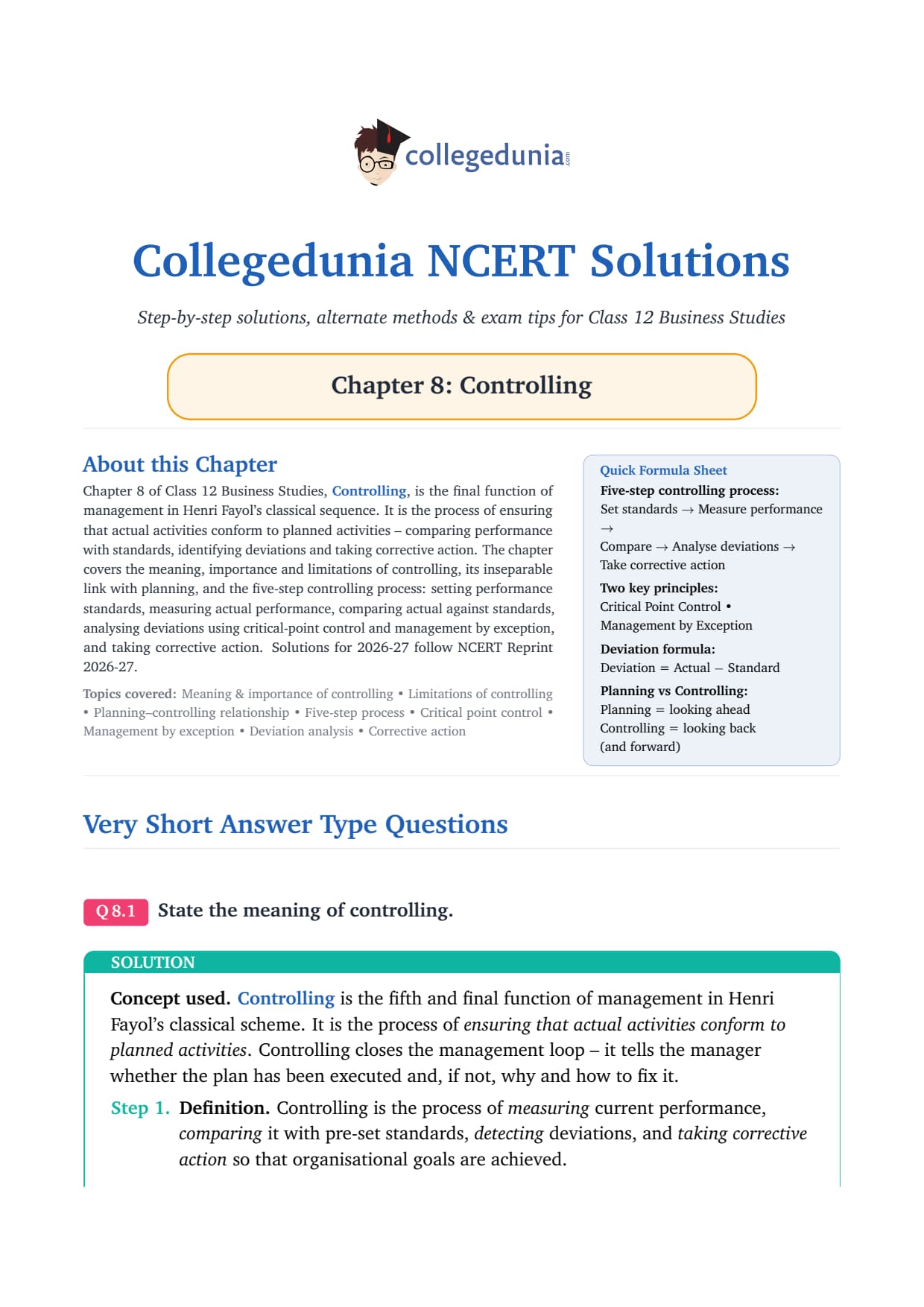
Q 8.1
State the meaning of controlling.
Concept used.Controlling is the fifth and final function of management in
Henri Fayol's classical scheme. It is the process of ensuring that actual activities
conform to planned activities. Controlling closes the management loop – it tells the manager
whether the plan has been executed and, if not, why and how to fix it.
Definition. Controlling is the process of measuring current performance,
comparing it with pre-set standards, detecting deviations, and taking
corrective action so that organisational goals are achieved.
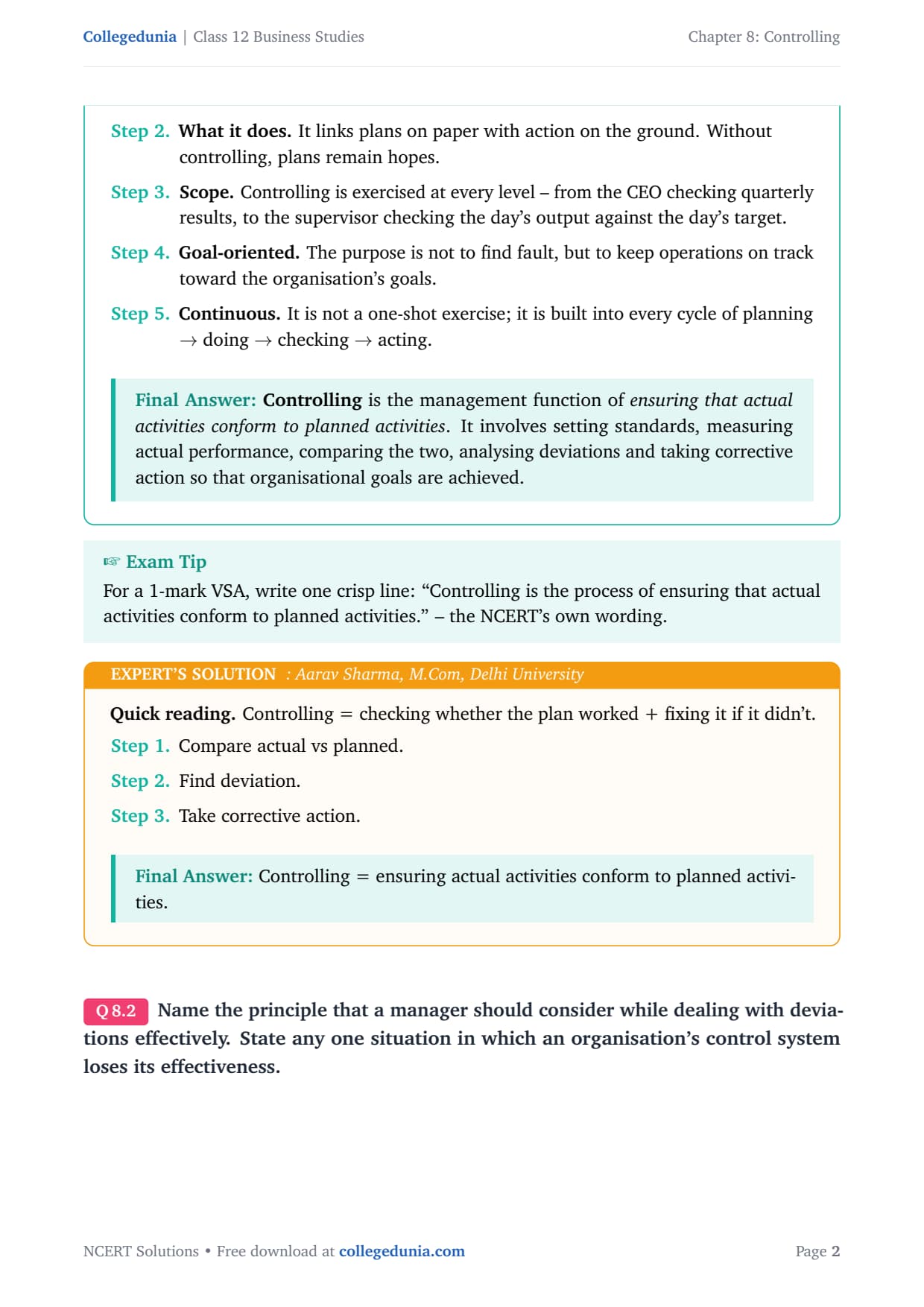
What it does. It links plans on paper with action on the ground. Without
controlling, plans remain hopes.
Scope. Controlling is exercised at every level – from the CEO checking quarterly
results, to the supervisor checking the day's output against the day's target.
Goal-oriented. The purpose is not to find fault, but to keep operations on track
toward the organisation's goals.
Continuous. It is not a one-shot exercise; it is built into every cycle of
planning \(\to\) doing \(\to\) checking \(\to\) acting.
Controlling is the management function of ensuring that actual
activities conform to planned activities. It involves setting standards, measuring actual
performance, comparing the two, analysing deviations and taking corrective action so that
organisational goals are achieved.
AS
Aarav Sharma
M.Com, Delhi University
Verified Expert
Quick reading. Controlling = checking whether the plan worked + fixing it if it didn't.
Compare actual vs planned.
Find deviation.
Take corrective action.
Controlling = ensuring actual activities conform to planned activities.
Q 8.2
Name the principle that a manager should consider while dealing with deviations
effectively. State any one situation in which an organisation's control system loses its
effectiveness.
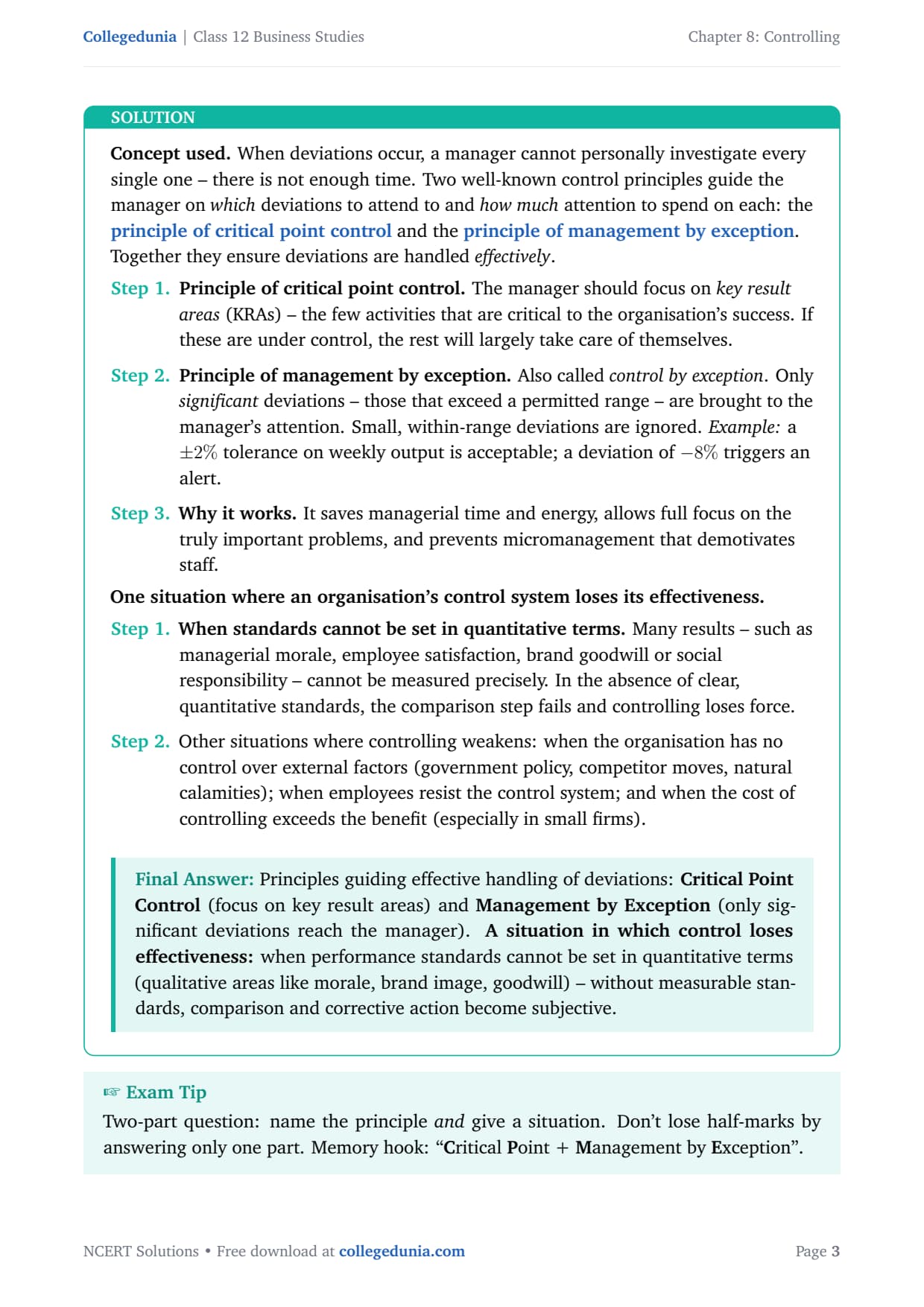
Concept used. When deviations occur, a manager cannot personally investigate every
single one – there is not enough time. Two well-known control principles guide the manager on
which deviations to attend to and how much attention to spend on each: the
principle of critical point control and the principle of management by
exception. Together they ensure deviations are handled effectively.
Principle of critical point control. The manager should focus on
key result areas (KRAs) – the few activities that are critical to the
organisation's success. If these are under control, the rest will largely take care of
themselves.
Principle of management by exception. Also called control by exception.
Only significant deviations – those that exceed a permitted range – are brought
to the manager's attention. Small, within-range deviations are ignored.
Example: a \(\pm 2\%\) tolerance on weekly output is acceptable; a deviation of
\(-8\%\) triggers an alert.
Why it works. It saves managerial time and energy, allows full focus on the
truly important problems, and prevents micromanagement that demotivates staff.
One situation where an organisation's control system loses its effectiveness.
When standards cannot be set in quantitative terms. Many results – such as
managerial morale, employee satisfaction, brand goodwill or social responsibility –
cannot be measured precisely. In the absence of clear, quantitative standards, the
comparison step fails and controlling loses force.
Other situations where controlling weakens: when the organisation has no control over
external factors (government policy, competitor moves, natural calamities); when
employees resist the control system; and when the cost of controlling exceeds the
benefit (especially in small firms).
Principles guiding effective handling of deviations: Critical Point Control
(focus on key result areas) and Management by Exception (only significant deviations
reach the manager). A situation in which control loses effectiveness: when performance
standards cannot be set in quantitative terms (qualitative areas like morale, brand image,
goodwill) – without measurable standards, comparison and corrective action become subjective.
PI
Priya Iyer
M.Com, Christ University Bangalore
Verified Expert
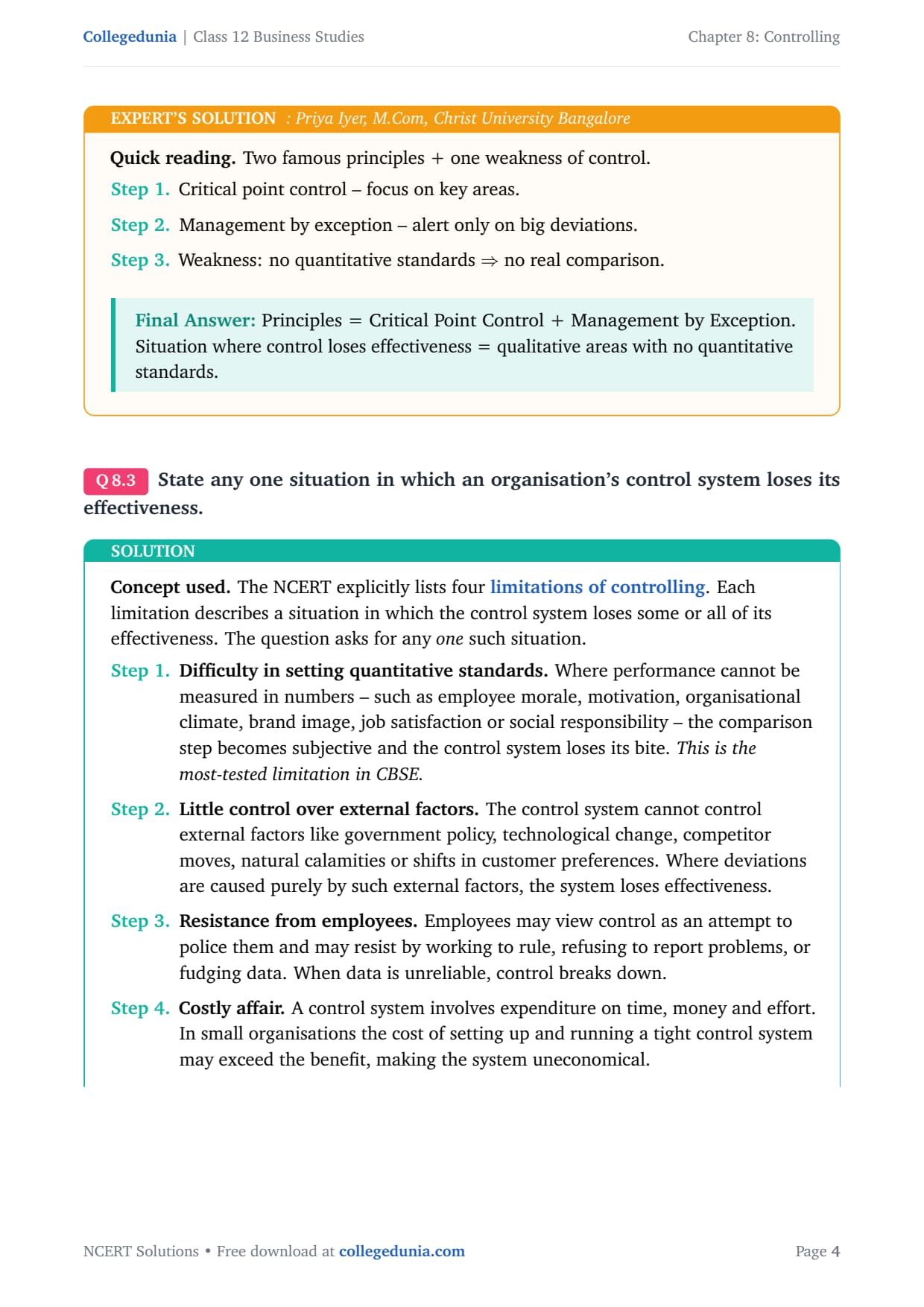
Quick reading. Two famous principles + one weakness of control.
Critical point control – focus on key areas.
Management by exception – alert only on big deviations.
Weakness: no quantitative standards \(\Rightarrow\) no real comparison.
Principles = Critical Point Control + Management by Exception. Situation where control
loses effectiveness = qualitative areas with no quantitative standards.
Q 8.3
State any one situation in which an organisation's control system loses its
effectiveness.
Concept used. The NCERT explicitly lists four limitations of controlling.
Each limitation describes a situation in which the control system loses some or all of its
effectiveness. The question asks for any one such situation.
Difficulty in setting quantitative standards. Where performance cannot be
measured in numbers – such as employee morale, motivation, organisational climate,
brand image, job satisfaction or social responsibility – the comparison step becomes
subjective and the control system loses its bite. This is the most-tested
limitation in CBSE.
Little control over external factors. The control system cannot control
external factors like government policy, technological change, competitor moves,
natural calamities or shifts in customer preferences. Where deviations are caused
purely by such external factors, the system loses effectiveness.
Resistance from employees. Employees may view control as an attempt to police
them and may resist by working to rule, refusing to report problems, or fudging data.
When data is unreliable, control breaks down.
Costly affair. A control system involves expenditure on time, money and effort.
In small organisations the cost of setting up and running a tight control system may
exceed the benefit, making the system uneconomical.
One situation where an organisation's control system loses its effectiveness:
when performance standards cannot be set in quantitative terms – for qualitative
areas like employee morale, brand image or organisational climate, the manager has no
measurable yardstick, the comparison step becomes subjective, and the entire control exercise
loses force.
VM
Vivaan Mehta
M.Com, Symbiosis Pune
Verified Expert
Quick reading. Four NCERT limitations – pick any one.
Qualitative areas: no quantitative standard.
External factors beyond control.
Employee resistance.
Cost \(>\) benefit (small firms).
No quantitative standards \(\Rightarrow\) control becomes subjective and loses
effectiveness.
Q 8.4
Give any two standards that can be used by a company to evaluate the performance of
its Finance & Accounting department.
Concept used.Performance standards are the criteria against which actual
performance is compared. They must be: (i) specific (defined precisely), (ii)
measurable (preferably quantitative), and (iii) relevant (linked to the
department's purpose). For a Finance & Accounting department, the standards must reflect the
twin responsibilities of that department – managing money and producing reliable
financial information.
Standard 1 – Cost reduction percentage. The department's job includes
controlling expenditure. A standard like ``reduce operating cost by 5% over the
previous year'' measures whether the department is making the firm leaner.
Standard 2 – Accuracy of financial reports. Measured as ``zero material
misstatements in the audited accounts'' or ``no more than 1 error per 1,000
entries''. This standard captures the department's job of producing reliable
information.
Other valid standards (for context).
Time taken to close monthly accounts (e.g., 5 working days).
Number of days within which all receivables are collected (debtor turnover).
Compliance: zero penalties from tax authorities.
Return on Investment (ROI) achieved by the department's deployed funds.
Variance from budgeted figures (e.g., \(\pm 3\%\) allowed).
Two standards a company can use to evaluate its Finance & Accounting department:
(i) Cost reduction percentage – e.g., reduce operating cost by 5% over the previous
year; and (ii) Accuracy of financial reports – e.g., zero material misstatements /
fewer than 1 error per 1,000 entries. (Other acceptable: time taken to close monthly
accounts, ROI achieved, variance from budget.)
AK
Aanya Kapoor
M.Com, BHU Varanasi
Verified Expert
Quick reading. Two standards, both measurable, both linked to the finance function.
Cost reduction % over previous year.
Accuracy of reports / errors per 1,000 entries.
Cost reduction % + accuracy of financial reports.
Q 8.5
Which term is used to indicate the difference between standard performance and actual
performance?
Concept used. In the third step of the controlling process – comparison – the
manager places actual performance side-by-side with the pre-set standard. Any gap between the
two is called a deviation.
Definition. A deviation is the gap between the standard set and the
actual performance achieved. Formally:
\[
\text{Deviation} = \text{Actual Performance} - \text{Standard Performance}.
\]
Types.
Positive deviation – actual exceeds standard. Often welcome, but still
worth analysing (Was the standard too soft? Can it be revised upward?).
Negative deviation – actual falls short of standard. Triggers
corrective action.
What happens next. If the deviation lies within the permitted tolerance, no
action is taken (management by exception). If it crosses the tolerance, the
manager investigates the cause, designs a remedy, and implements it.
The term used for the difference between standard performance and actual performance
is Deviation. Mathematically, Deviation \(=\) Actual Performance \(-\) Standard
Performance. Positive deviations exceed the standard; negative deviations fall short.
KJ
Karan Joshi
M.Com, BHU Varanasi
Verified Expert
Quick reading. Actual \(-\) Standard \(=\) Deviation.
Positive = exceeds.
Negative = falls short.
Within tolerance \(\Rightarrow\) ignore (MbE).
Deviation.
Short Answer Type Questions
Q 8.6
`Planning is looking ahead and controlling is looking back.' Comment.
Concept used. The statement is partly true but incomplete. Planning and
controlling are NCERT's inseparable twins of management. The popular saying captures
only the directions of their gaze, not the truth that each one feeds into the other in both
directions.
Truth in the statement.
Planning is looking ahead. It is a forward-looking exercise – the manager
decides today what should be done tomorrow. Planning sets the goals and the
roadmap to reach them.
Controlling is looking back. The manager evaluates yesterday's actual
performance against yesterday's standard. The comparison step is a
post-mortem of what has already happened.
Why the statement is incomplete. Controlling is not only looking back. By
revealing why the deviation occurred, controlling also looks forward:
The findings of controlling feed into the next round of planning –
tighter budgets, better targets, revised methods.
Controlling helps the manager forecast future deviations and prevent them by
tweaking inputs in time.
Two-way dependence.
Planning \(\to\) Controlling: Planning provides the standards against
which controlling is exercised. Without planning, controlling has nothing
to measure against.
Controlling \(\to\) Planning: Controlling produces information about
deviations that becomes the input for the next planning cycle. Without
controlling, the best-laid plan may go astray.
Diagram (planning–controlling feedback loop).
[See diagram in the PDF version]
The statement is partly true. Planning is forward-looking and controlling
starts by looking back at actual performance – so the visual metaphor is correct.
However, controlling also looks forward because its findings (deviation reports, root
causes) feed into the next planning cycle. Planning and controlling are
inseparable twins: planning provides the standards for controlling, and controlling
feeds information back into planning.
AS
Aarav Sharma
M.Com, Delhi University
Verified Expert
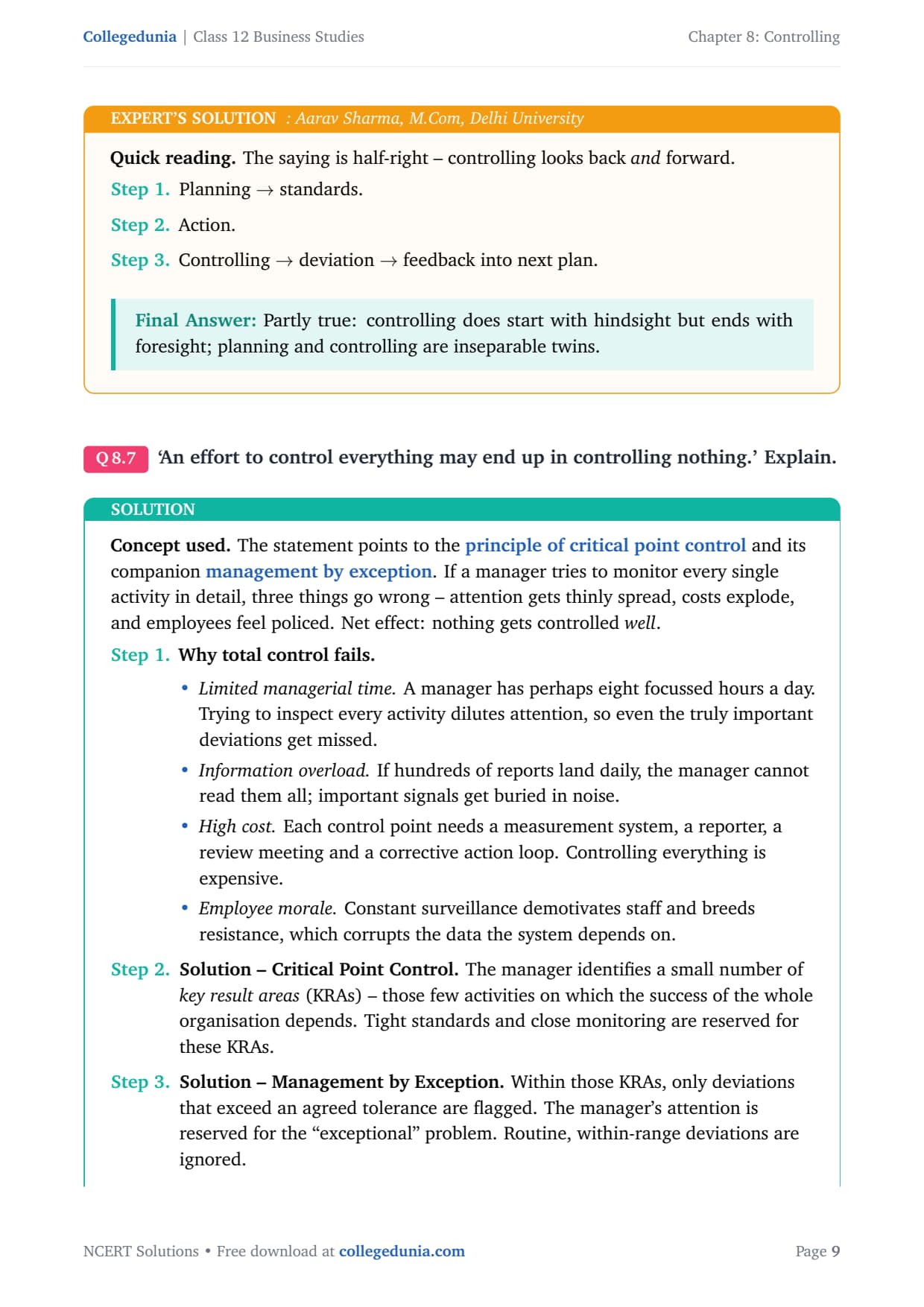
Quick reading. The saying is half-right – controlling looks back and forward.
Planning \(\to\) standards.
Action.
Controlling \(\to\) deviation \(\to\) feedback into next plan.
Partly true: controlling does start with hindsight but ends with foresight; planning
and controlling are inseparable twins.
Q 8.7
`An effort to control everything may end up in controlling nothing.' Explain.
Concept used. The statement points to the principle of critical point control
and its companion management by exception. If a manager tries to monitor every single
activity in detail, three things go wrong – attention gets thinly spread, costs explode, and
employees feel policed. Net effect: nothing gets controlled well.
Why total control fails.
Limited managerial time. A manager has perhaps eight focussed hours a
day. Trying to inspect every activity dilutes attention, so even the truly
important deviations get missed.
Information overload. If hundreds of reports land daily, the manager
cannot read them all; important signals get buried in noise.
High cost. Each control point needs a measurement system, a reporter, a
review meeting and a corrective action loop. Controlling everything is
expensive.
Employee morale. Constant surveillance demotivates staff and breeds
resistance, which corrupts the data the system depends on.
Solution – Critical Point Control. The manager identifies a small number of
key result areas (KRAs) – those few activities on which the success of the
whole organisation depends. Tight standards and close monitoring are reserved for
these KRAs.
Solution – Management by Exception. Within those KRAs, only deviations that
exceed an agreed tolerance are flagged. The manager's attention is reserved for the
``exceptional'' problem. Routine, within-range deviations are ignored.
Net effect. By concentrating effort on the few activities that truly matter,
the manager actually controls more, not less.
The statement is true. Trying to monitor everything dilutes managerial
attention, raises costs and demotivates staff – so nothing ends up being controlled well. The
remedy is Critical Point Control (focus on key result areas) plus Management
by Exception (alert the manager only on significant deviations). Together they let the manager
control the few activities that matter much better than trying to control everything.
PI
Priya Iyer
M.Com, Christ University Bangalore
Verified Expert
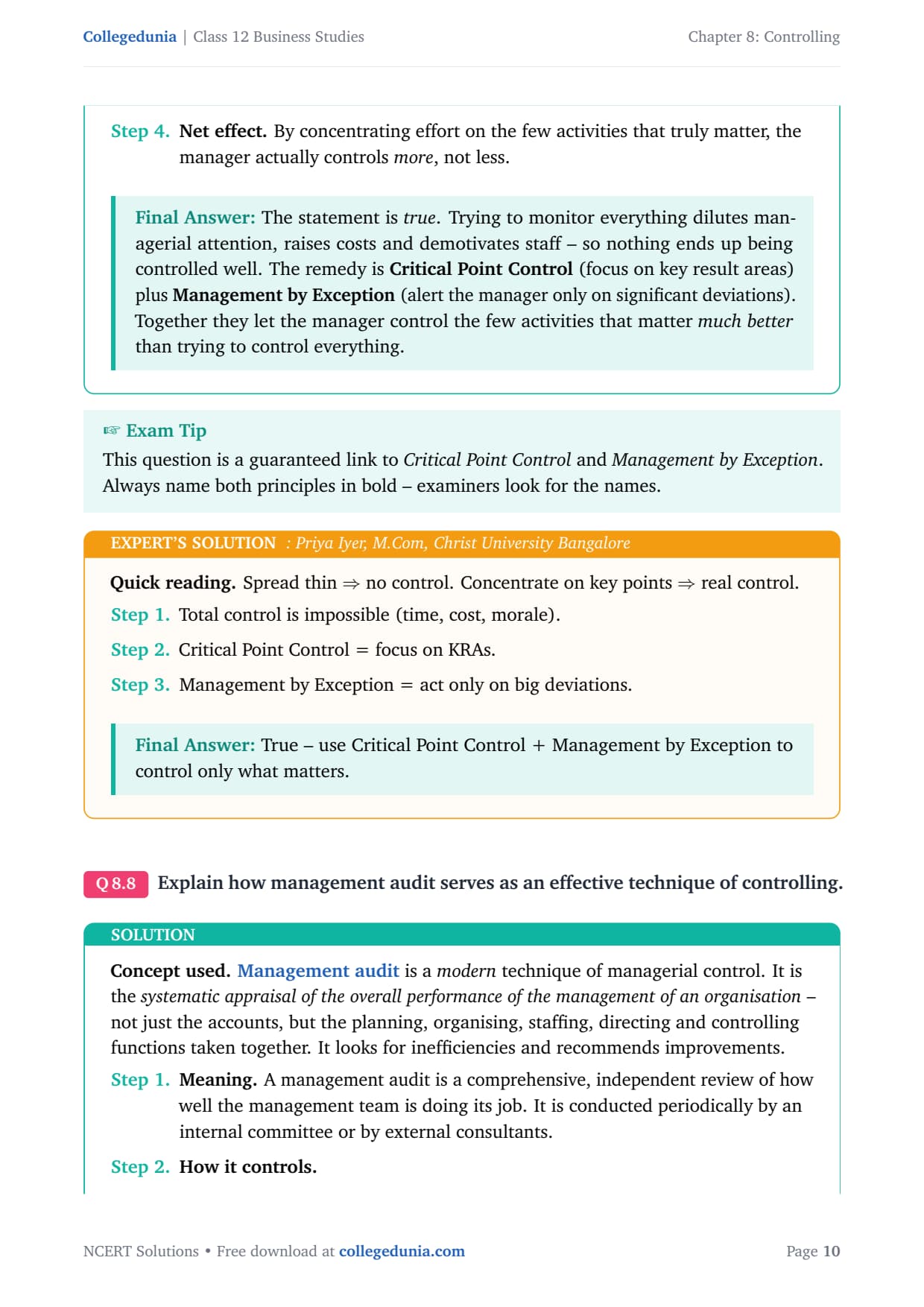
Quick reading. Spread thin \(\Rightarrow\) no control. Concentrate on key points
\(\Rightarrow\) real control.
Total control is impossible (time, cost, morale).
Critical Point Control = focus on KRAs.
Management by Exception = act only on big deviations.
True – use Critical Point Control + Management by Exception to control only what
matters.
Q 8.8
Explain how management audit serves as an effective technique of controlling.
Concept used.Management audit is a modern technique of managerial
control. It is the systematic appraisal of the overall performance of the management of
an organisation – not just the accounts, but the planning, organising, staffing, directing
and controlling functions taken together. It looks for inefficiencies and recommends
improvements.
Meaning. A management audit is a comprehensive, independent review of how well
the management team is doing its job. It is conducted periodically by an internal
committee or by external consultants.
How it controls.
Identifies deficiencies in current managerial performance – weak
planning, slow decision-making, poor coordination, ineffective directing.
Improves coordination by exposing inter-departmental gaps and
duplications.
Ensures continuous self-improvement – recommendations from each audit
set fresh standards for the next period.
Updates managerial policies in line with changing environments.
Helps managers achieve maximum efficiency by benchmarking against the
best practices in similar industries.
Why it is effective.
Covers all management functions, not just finance.
Periodic and forward-looking – audit findings feed into the next plan.
Independent – conducted by people not involved in day-to-day operations, so
bias is minimised.
Limitation. Standards for managerial performance are hard to define precisely,
so a management audit can be more qualitative than quantitative. It works best when
combined with traditional financial controls.
Management audit is a modern controlling technique. It is a systematic,
independent appraisal of the overall performance of the management – planning,
organising, staffing, directing and controlling. It identifies deficiencies, improves
coordination, updates policies, and benchmarks performance against industry best practice.
Because it covers all managerial functions and feeds findings back into the next
planning cycle, it is an effective forward-looking control technique.
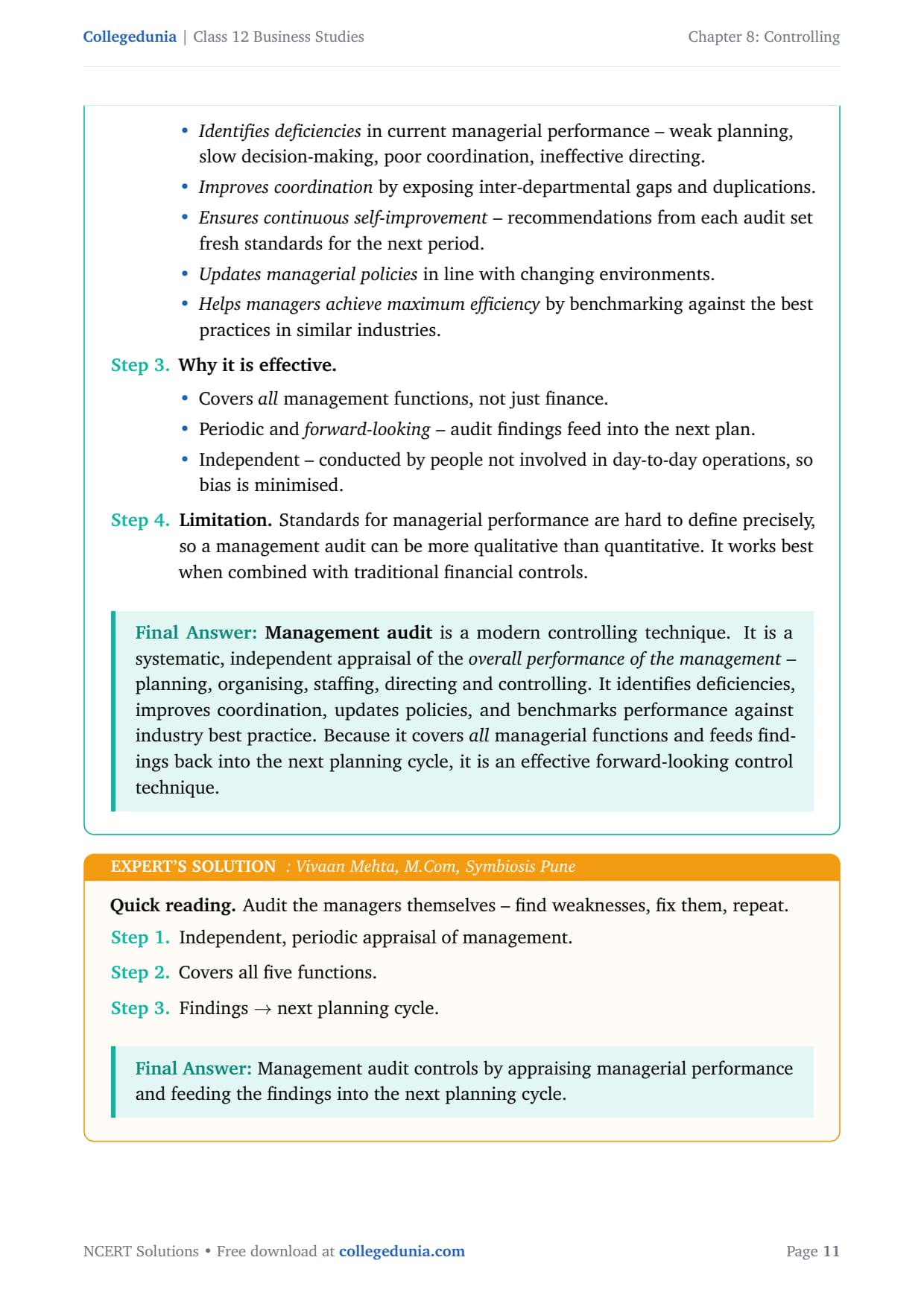
Management audit controls by appraising managerial performance and feeding the
findings into the next planning cycle.
Q 8.9
Mr. Arfaaz had been heading the production department of Writewell Products Ltd., a
firm manufacturing stationary items. The firm secured an export order that had to be completed
on a priority basis and production targets were defined for all the employees. One of the
workers, Mr. Bhanu Prasad, fell short of his daily production target by 10 units for two days
consecutively. Mr. Arfaaz approached Ms. Vasundhara, the CEO of the Company, to file a
complaint against Mr. Bhanu Prasad and requested her to terminate his services. Explain the
principle of management control that Ms. Vasundhara should consider while taking her decision.
(Hint: Management by exception).
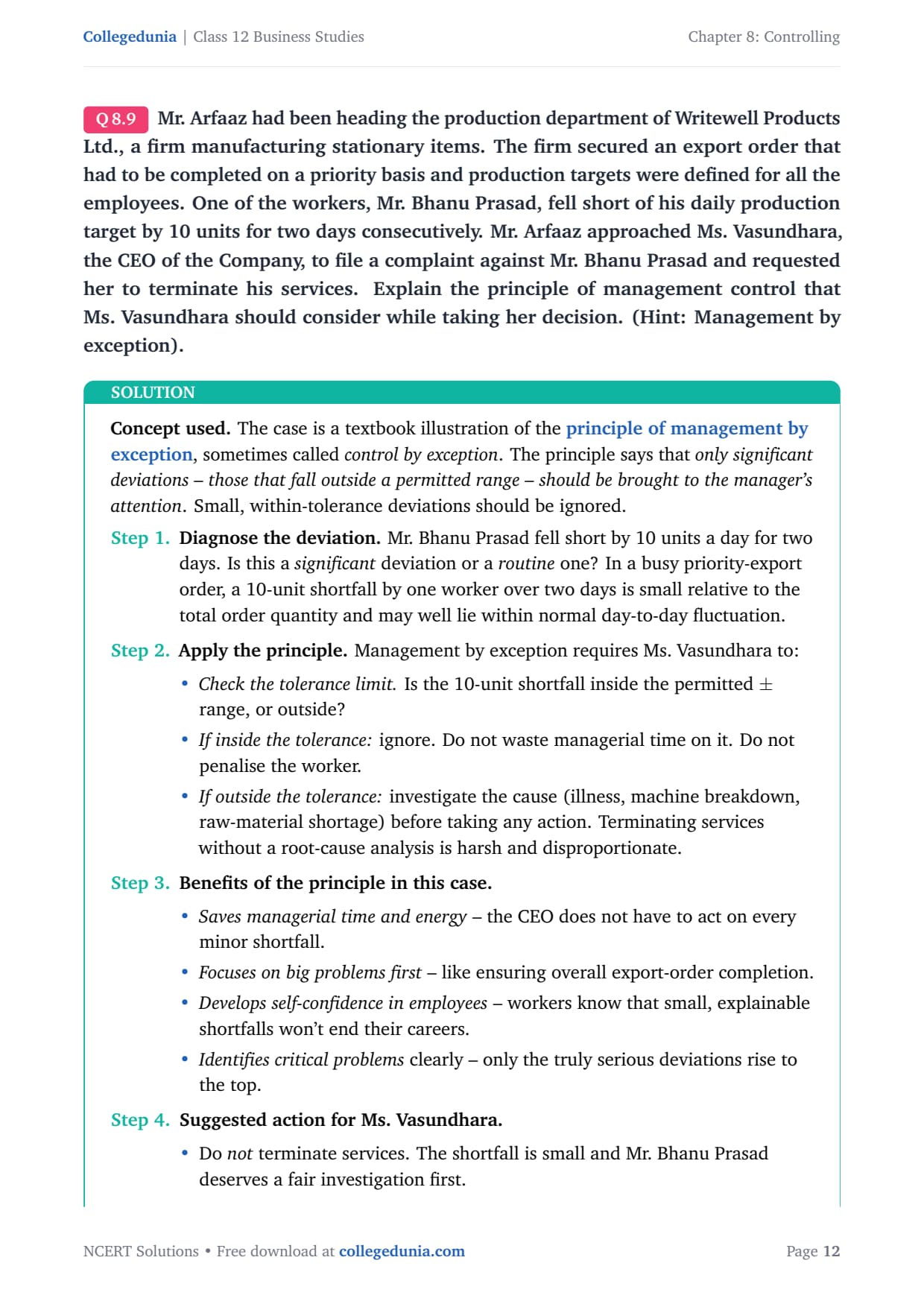
Concept used. The case is a textbook illustration of the principle of
management by exception, sometimes called control by exception. The principle says that
only significant deviations – those that fall outside a permitted range – should be
brought to the manager's attention. Small, within-tolerance deviations should be ignored.
Diagnose the deviation. Mr. Bhanu Prasad fell short by 10 units a day for
two days. Is this a significant deviation or a routine one? In a busy
priority-export order, a 10-unit shortfall by one worker over two days is small
relative to the total order quantity and may well lie within normal day-to-day
fluctuation.
Apply the principle. Management by exception requires Ms. Vasundhara to:
Check the tolerance limit. Is the 10-unit shortfall inside the permitted
\(\pm\) range, or outside?
If inside the tolerance: ignore. Do not waste managerial time on it. Do
not penalise the worker.
If outside the tolerance: investigate the cause (illness, machine
breakdown, raw-material shortage) before taking any action. Terminating
services without a root-cause analysis is harsh and disproportionate.
Benefits of the principle in this case.
Saves managerial time and energy – the CEO does not have to act on
every minor shortfall.
Focuses on big problems first – like ensuring overall export-order
completion.
Develops self-confidence in employees – workers know that small,
explainable shortfalls won't end their careers.
Identifies critical problems clearly – only the truly serious
deviations rise to the top.
Suggested action for Ms. Vasundhara.
Do not terminate services. The shortfall is small and Mr. Bhanu Prasad
deserves a fair investigation first.
Ask the supervisor to check why the worker is short – machine, material,
training or personal issue.
Address the root cause; impose mild corrective action only if the worker is
wilfully under-performing.
Ms. Vasundhara should apply the Principle of Management by Exception.
This principle says that a manager should focus only on significant deviations that
fall outside the permitted tolerance range; routine, small shortfalls (like Mr. Bhanu Prasad's
10-unit gap over two days) should not be escalated to the CEO and certainly should not lead to
termination. She should refuse to act on the complaint, ask the supervisor to investigate the
root cause, and reserve her own attention for the truly critical deviations that threaten the
overall export order.
AK
Aanya Kapoor
M.Com, BHU Varanasi
Verified Expert
Quick reading. Small deviation by one worker \(\ne\) CEO problem. Apply MbE.
Define management by exception.
Apply: 10 units in 2 days is small; let the supervisor handle it.
Reject the termination request; investigate first.
Management by Exception – ignore small deviations, focus on the big ones; do not
terminate; investigate first.
Long Answer Type Questions
Q 8.10
Explain the various steps involved in the process of control.
Concept used. The controlling process as laid out in NCERT is a
five-step cycle that operationalises the definition of controlling – ``ensuring that
actual activities conform to planned activities''. Each step has a specific input and output,
and the steps must be done in sequence. The findings of Step 5 also feed back into the next
planning cycle, making the process iterative.
Step 1: Setting performance standards. Standards are the criteria against
which actual performance will be measured. Good standards are:
Specific – precisely defined.
Measurable – expressed in quantitative terms wherever possible
(units, rupees, hours, percentage).
Achievable – challenging but realistic.
Time-bound – linked to a deadline.
Some areas (morale, brand image) need qualitative standards. Standards are derived
from the planning function.
Step 2: Measurement of actual performance. Actual performance is captured in
the same units as the standard. Methods include:
Personal observation (factory floor, shop visit).
Sample checking (every \(n\)th unit).
Statistical reports (daily, weekly, monthly).
Ratio analysis, ROI, break-even analysis.
Performance reports from subordinates.
Measurement must be reliable, timely and economical.
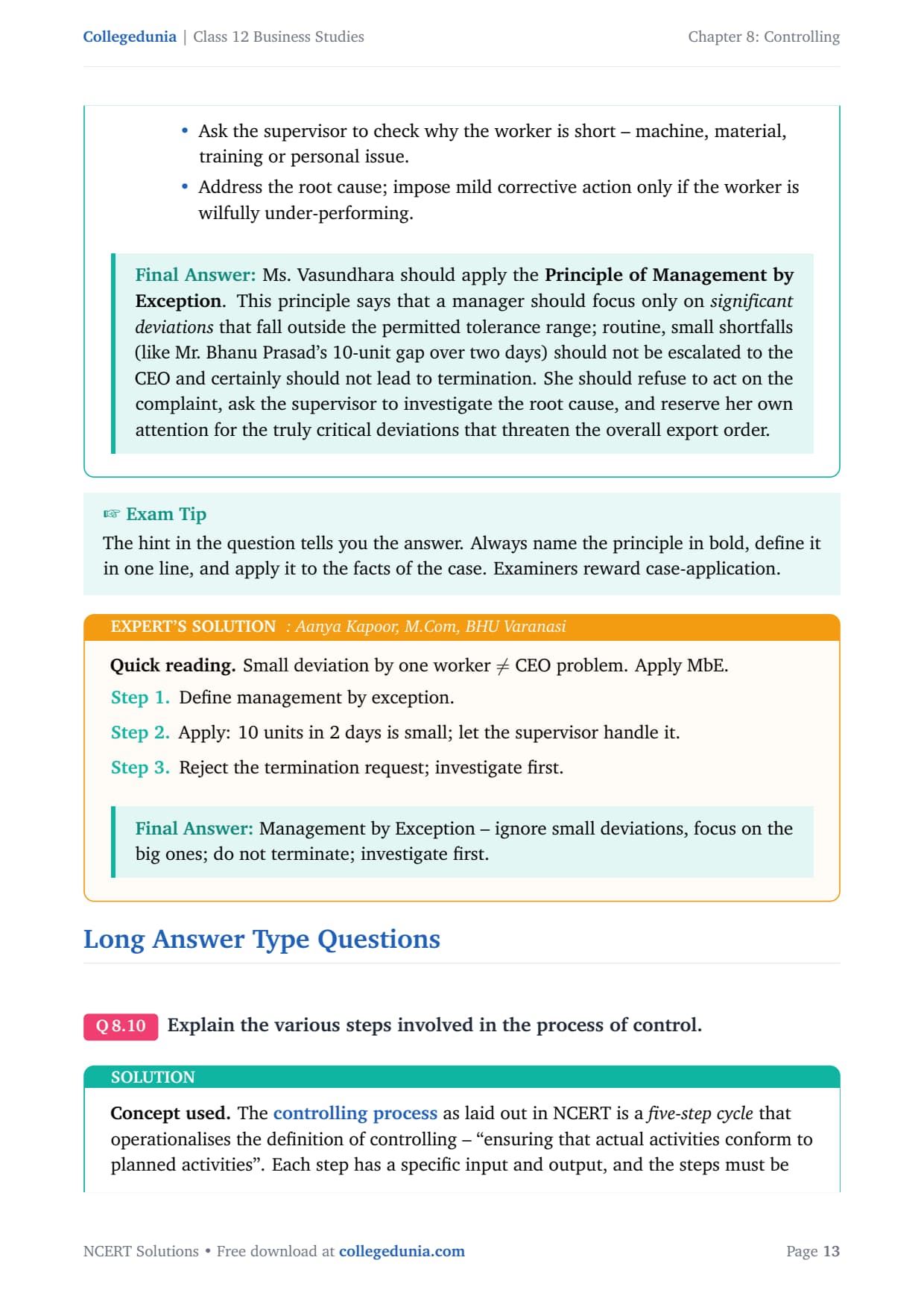
Step 3: Comparing actual performance with standards. The actual figure is
placed side-by-side with the standard. The gap is the deviation:
\[ \text{Deviation} = \text{Actual} - \text{Standard}. \]
Deviations may be positive (actual exceeds standard) or negative (actual falls
short). The comparison must be in the same unit and over the same period.
Step 4: Analysing deviations. Not every deviation needs attention. Two
principles guide the analysis:
Critical Point Control – focus on key result areas (KRAs).
Management by Exception – escalate only deviations outside the
tolerance range.
For deviations that do require attention, the manager investigates the cause:
defective material, machine breakdown, lack of training, faulty standard, external
disruption, employee de-motivation, etc.
Step 5: Taking corrective action. The final step. If the deviation is within
the acceptable range, no action is needed. If it goes beyond the acceptable range –
especially in important areas – the manager designs and implements a remedy and
verifies that it has restored performance:
Replace faulty material; repair the machine.
Re-train employees; redeploy supervisors; assign extra workers or sanction
overtime for projects running behind schedule.
Tighten the schedule; revise the budget.
If the deviation cannot be corrected through managerial action, the
standard itself may have to be revised.
Lessons from corrective action feed back into the next planning cycle,
closing the planning \(\to\) controlling loop.
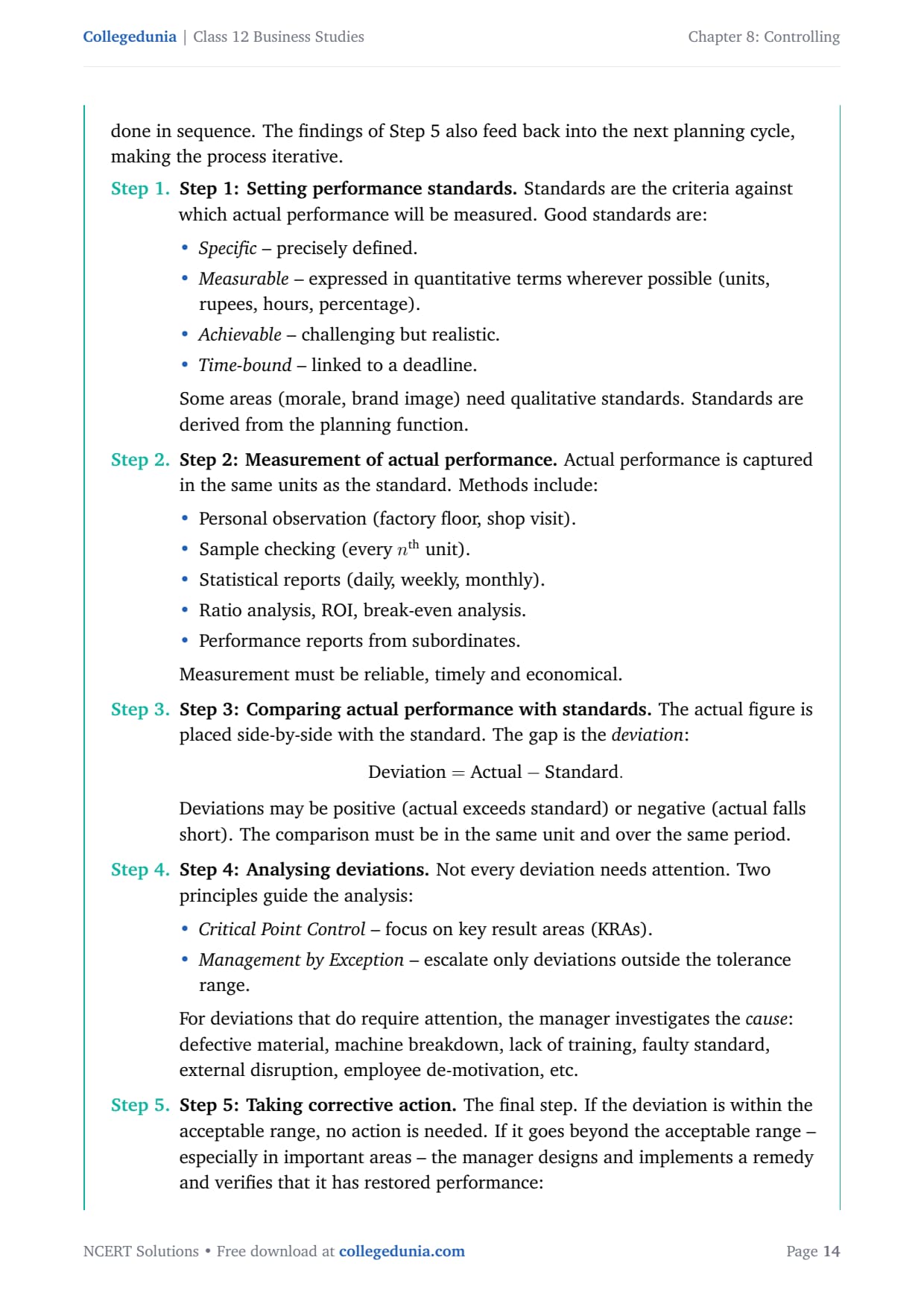
Diagram (five-step controlling process).
[See diagram in the PDF version]
The controlling process is a five-step cycle: (1) Set performance standards
\(\to\) (2) Measure actual performance \(\to\) (3) Compare actual with standards (deviation
\(=\) actual \(-\) standard) \(\to\) (4) Analyse deviations (critical point control + management by
exception) \(\to\) (5) Take corrective action. The findings of Step 5 also feed back into the
next planning cycle, making the process a continuous loop.
KJ
Karan Joshi
M.Com, BHU Varanasi
Verified Expert
Quick reading. Standards \(\to\) Measure \(\to\) Compare \(\to\) Analyse \(\to\) Correct
(then feed back into the next plan).
Standards from the plan.
Measure actuals.
Compare; find deviation.
Apply CPC + MbE.
Fix root cause; feed lessons back into the next plan.
Five-step loop: Set \(\to\) Measure \(\to\) Compare \(\to\) Analyse \(\to\) Correct (feeds
back into next plan).
Q 8.11
Explain the techniques of managerial control.
Concept used.Techniques of managerial control are the specific tools that
managers use inside the five-step controlling process. NCERT divides them into two groups:
traditional techniques (in use for many decades) and modern techniques (newer,
more analytical tools).
Traditional Techniques.
Personal observation. The manager visits the shop floor or office and
sees performance directly. Slow and subjective but irreplaceable for catching
things data misses.
Statistical reports. Numerical summaries – averages, percentages,
ratios, trends, graphs – of performance for review.
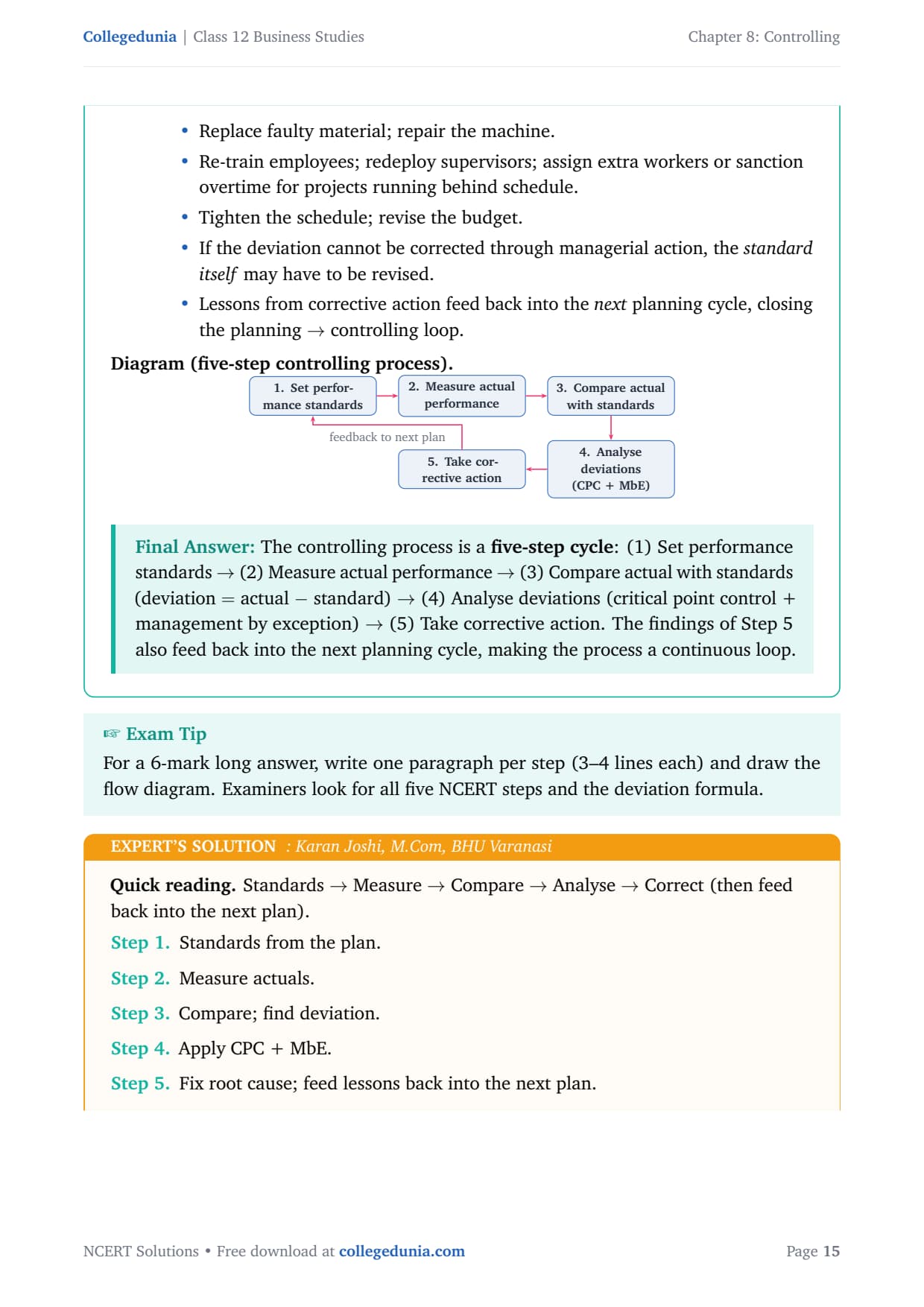
Breakeven analysis. A cost-volume-profit technique that shows the level
of sales at which total cost equals total revenue. Helps the manager judge
whether the firm is operating safely above the break-even point.
\[ \text{BEP (units)} = \frac{\text{Fixed Cost}}{\text{Contribution per unit}}.\]
Budgetary control. Quantitative plans for the coming period (sales
budget, production budget, cash budget, master budget) are prepared in
advance. Actual is then compared against the budget, and variances are
investigated.
Modern Techniques.
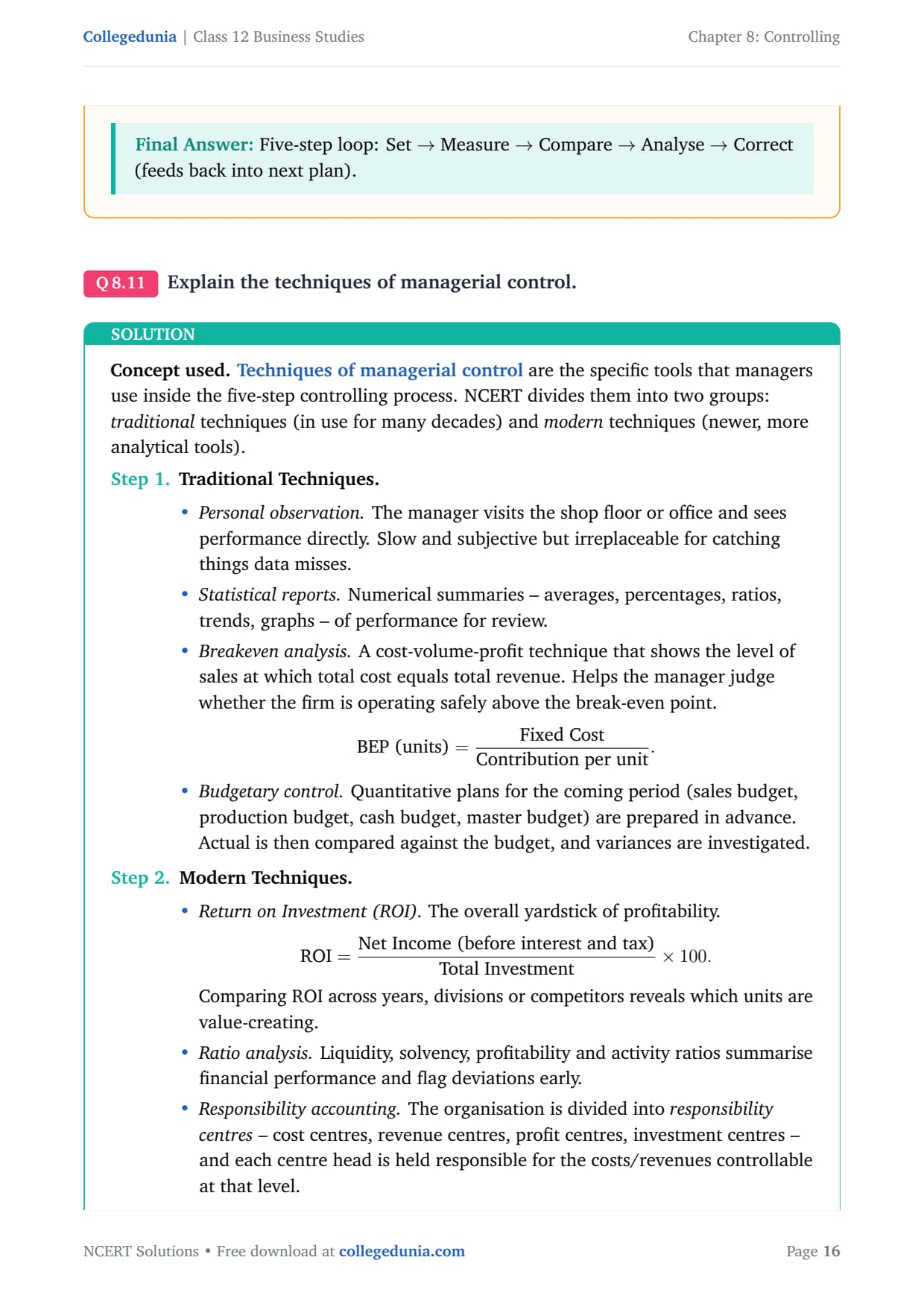
Return on Investment (ROI). The overall yardstick of profitability.
\[ \text{ROI} = \frac{\text{Net Income (before interest and tax)}}{\text{Total Investment}} \times 100. \]
Comparing ROI across years, divisions or competitors reveals which units are
value-creating.
Ratio analysis. Liquidity, solvency, profitability and activity ratios
summarise financial performance and flag deviations early.
Responsibility accounting. The organisation is divided into
responsibility centres – cost centres, revenue centres, profit
centres, investment centres – and each centre head is held responsible for
the costs/revenues controllable at that level.
Management audit. Systematic appraisal of the overall performance of
management itself (see previous question for detail).
PERT and CPM. Network techniques used in project management to plan,
schedule and control time and cost. PERT = Programme Evaluation & Review
Technique (probabilistic); CPM = Critical Path Method (deterministic). Both
identify the critical path – the longest chain of dependent activities
that determines project duration.
Management Information System (MIS). A computer-based system that
provides managers with timely, accurate, relevant information for
decision-making and control.
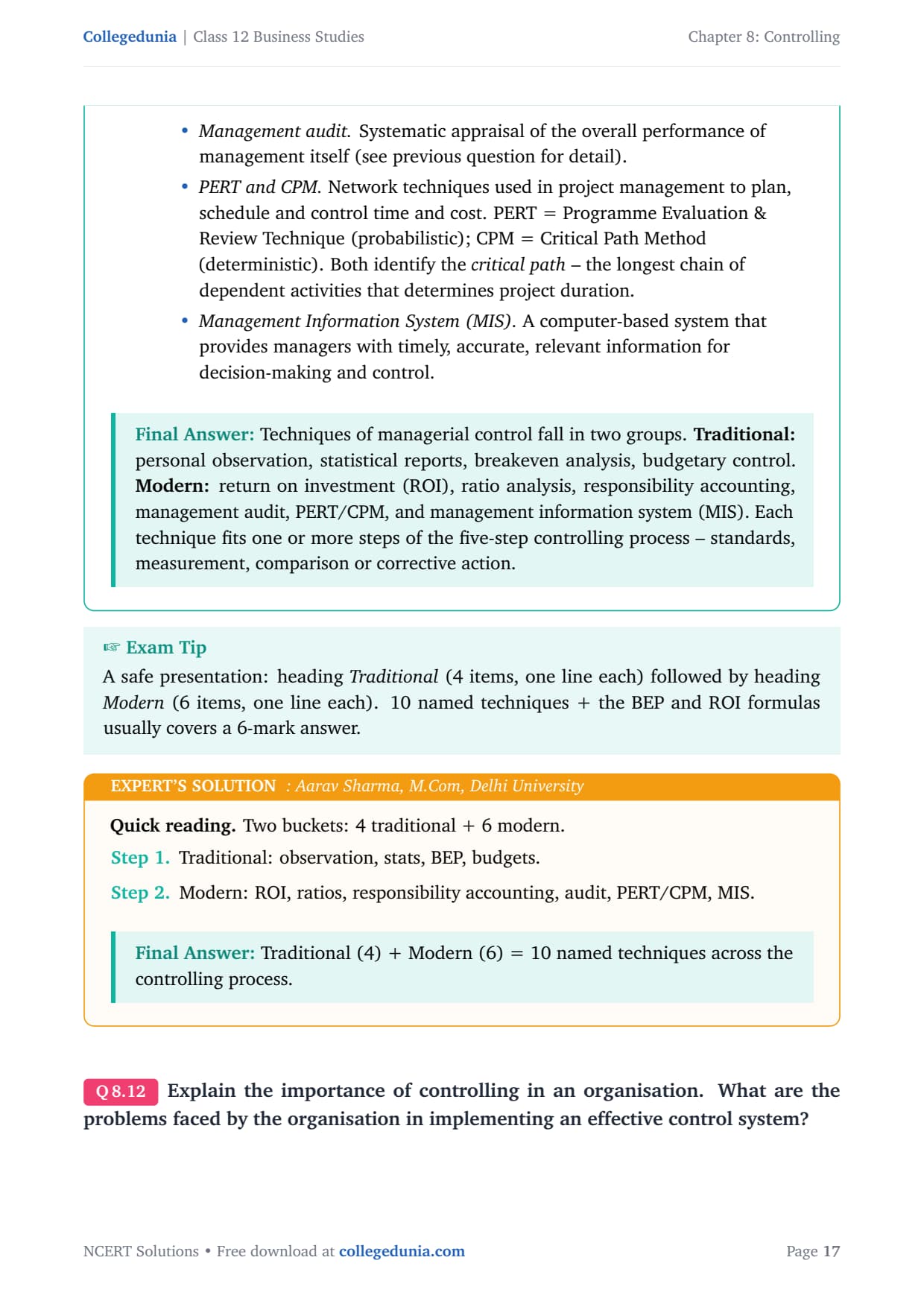
Techniques of managerial control fall in two groups. Traditional: personal
observation, statistical reports, breakeven analysis, budgetary control. Modern:
return on investment (ROI), ratio analysis, responsibility accounting, management audit,
PERT/CPM, and management information system (MIS). Each technique fits one or more steps of
the five-step controlling process – standards, measurement, comparison or corrective action.
AS
Aarav Sharma
M.Com, Delhi University
Verified Expert
Quick reading. Two buckets: 4 traditional + 6 modern.
Traditional (4) + Modern (6) = 10 named techniques across the controlling process.
Q 8.12
Explain the importance of controlling in an organisation. What are the problems faced
by the organisation in implementing an effective control system?
Concept used. The question has two parts: the importance of controlling (its
benefits) and the limitations / problems (its weaknesses). NCERT lists five points of
importance and four limitations.
Importance of Controlling.
Accomplishing organisational goals. Controlling measures progress
against goals and triggers corrective action when progress falls short –
directly ensuring that goals are achieved.
Judging accuracy of standards. A good control system also tells the
manager whether the standards themselves are realistic. Standards consistently
exceeded or missed are revised.
Making efficient use of resources. By comparing actual usage against
planned usage, controlling helps reduce waste of materials, time, money and
effort.
Improving employee motivation. A fair control system that recognises
good performance and provides feedback motivates employees. They know what is
expected, how they are being measured and where they stand.
Ensuring order and discipline. Controlling creates an atmosphere of
discipline by holding everyone accountable to clear standards.
Facilitating coordination in action. Each department's performance is
checked against the master plan; deviations in one are corrected so they do
not throw the others out of sync.
Problems / Limitations of Controlling.
Difficulty in setting quantitative standards. For areas like morale,
brand image or social responsibility, precise standards cannot be set and the
control system loses its bite.
Little control over external factors. The control system cannot govern
government policy, technological change, competitor moves or natural
calamities. Deviations from these external causes are hard to correct.
Resistance from employees. Employees may resent being constantly
measured, fudge data, or work to rule – making the data the system depends on
unreliable.
Costly affair. The control system needs measurement, reporting, review
and corrective infrastructure. In small organisations the cost may exceed the
benefit.
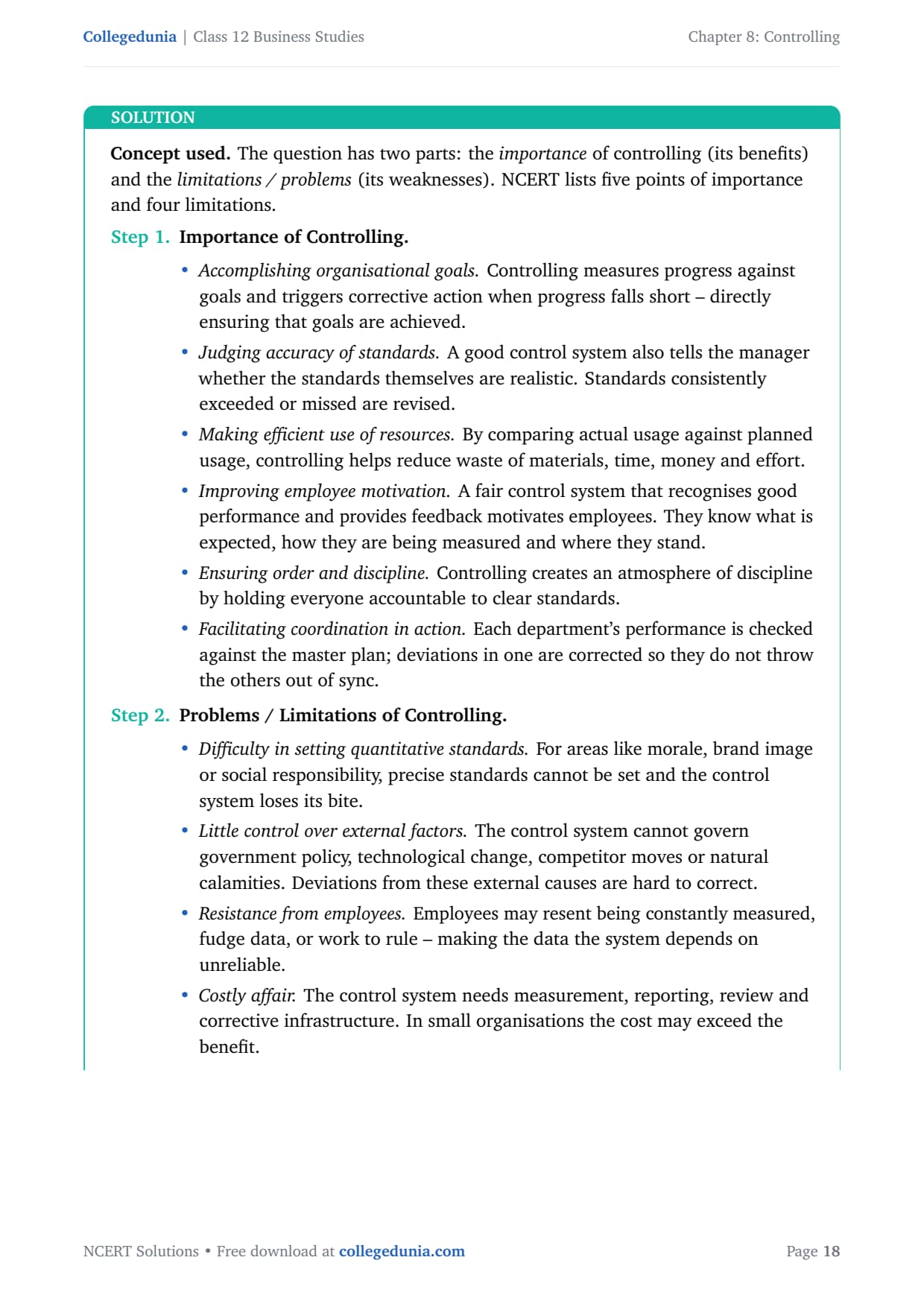
Importance of controlling: (1) accomplishes goals, (2) judges accuracy of
standards, (3) ensures efficient use of resources, (4) improves employee motivation, (5)
ensures order and discipline, (6) facilitates coordination. Problems/limitations:
(1) difficulty in setting quantitative standards, (2) little control over external factors,
(3) employee resistance, (4) costly affair. A well-designed control system maximises the
benefits while mitigating the limitations through clear, fair, cost-effective measurement.
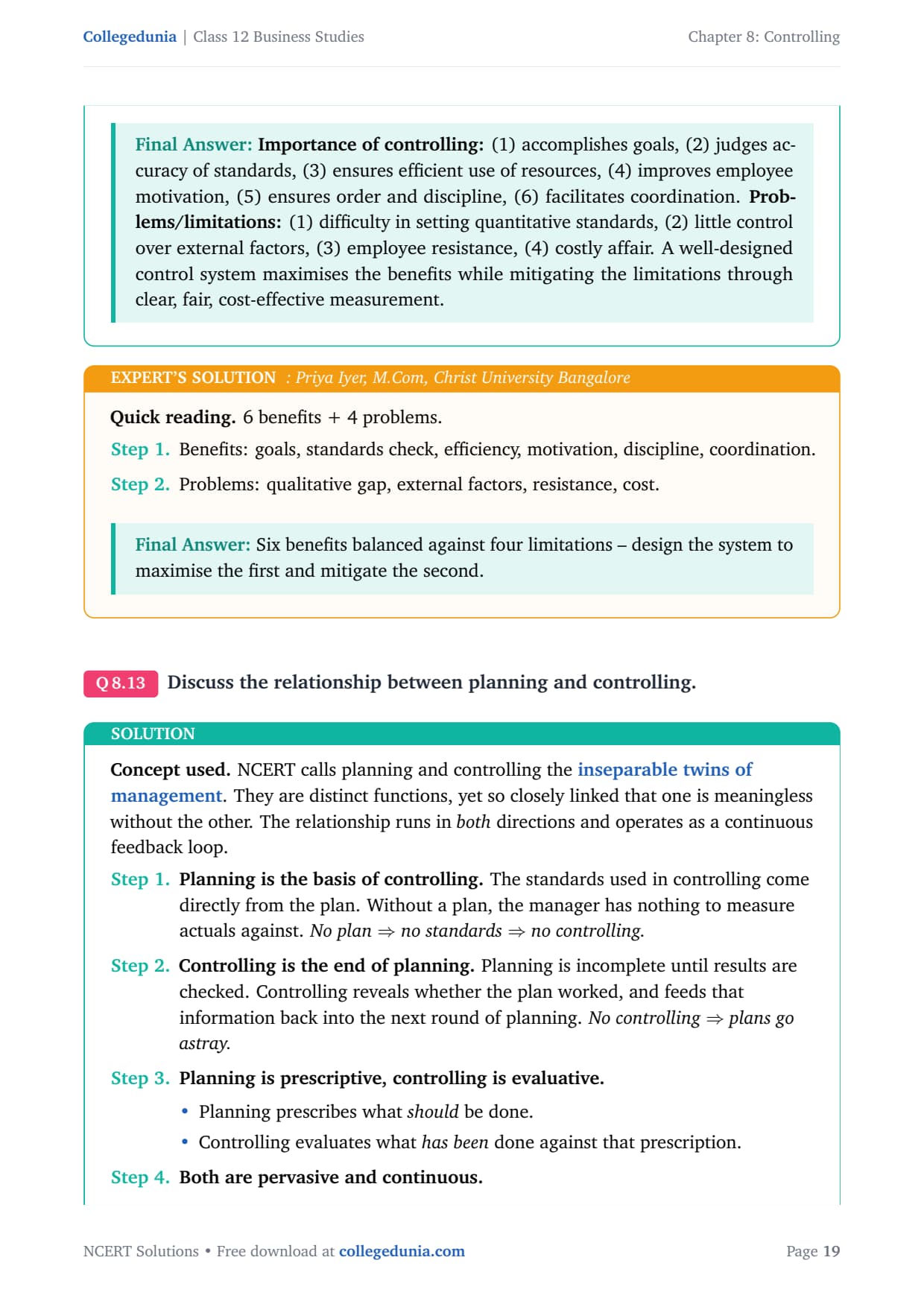
Six benefits balanced against four limitations – design the system to maximise the
first and mitigate the second.
Q 8.13
Discuss the relationship between planning and controlling.
Concept used. NCERT calls planning and controlling the inseparable twins of
management. They are distinct functions, yet so closely linked that one is meaningless without
the other. The relationship runs in both directions and operates as a continuous
feedback loop.
Planning is the basis of controlling. The standards used in controlling
come directly from the plan. Without a plan, the manager has nothing to measure
actuals against. No plan \(\Rightarrow\) no standards \(\Rightarrow\) no
controlling.
Controlling is the end of planning. Planning is incomplete until results are
checked. Controlling reveals whether the plan worked, and feeds that information back
into the next round of planning. No controlling \(\Rightarrow\) plans go astray.
Planning is prescriptive, controlling is evaluative.
Planning prescribes what should be done.
Controlling evaluates what has been done against that prescription.
Both are pervasive and continuous.
Planning happens at every level (CEO long-term plan, department annual plan,
supervisor daily plan).
Controlling also happens at every level (CEO reviews quarterly results,
department head weekly, supervisor daily).
Both functions are continuous – each cycle of action triggers fresh planning
and fresh controlling.
Planning is forward-looking, controlling is both backward and forward
looking. Planning forecasts future activities. Controlling starts by looking back at
what happened, but ends by looking forward – its findings feed into the next
plan.
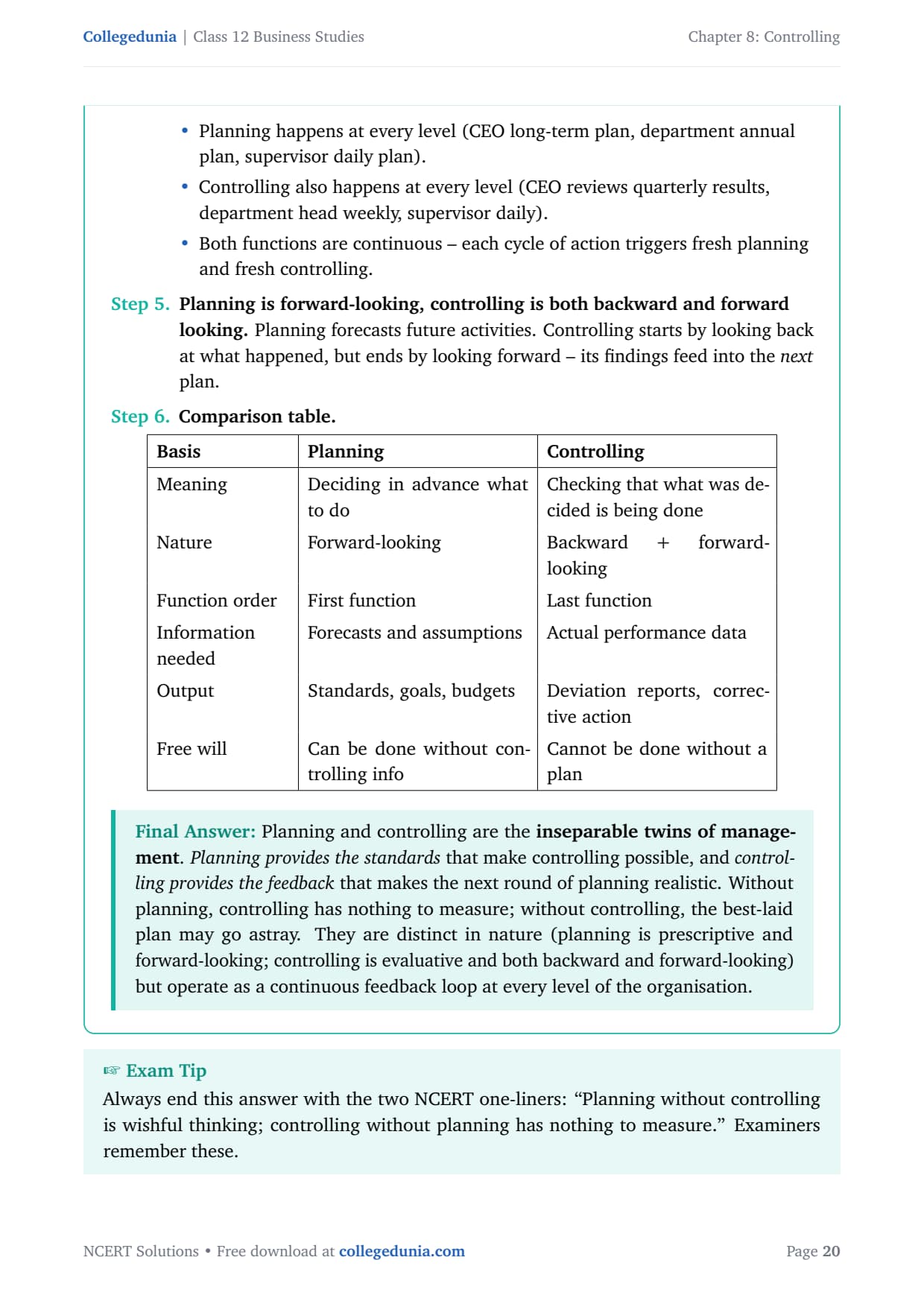
Comparison table.
1.25
tabular|p3cm|p5cm|p5cm|
Basis & Planning & Controlling
Meaning & Deciding in advance what to do & Checking that what was decided is being done
Nature & Forward-looking & Backward + forward-looking
Function order & First function & Last function
Information needed & Forecasts and assumptions & Actual performance data
Output & Standards, goals, budgets & Deviation reports, corrective action
Free will & Can be done without controlling info & Cannot be done without a plan
tabular
Planning and controlling are the inseparable twins of management. Planning
provides the standards that make controlling possible, and controlling provides the
feedback that makes the next round of planning realistic. Without planning, controlling has
nothing to measure; without controlling, the best-laid plan may go astray. They are distinct in
nature (planning is prescriptive and forward-looking; controlling is evaluative and both
backward and forward-looking) but operate as a continuous feedback loop at every level of the
organisation.
VM
Vivaan Mehta
M.Com, Symbiosis Pune
Verified Expert
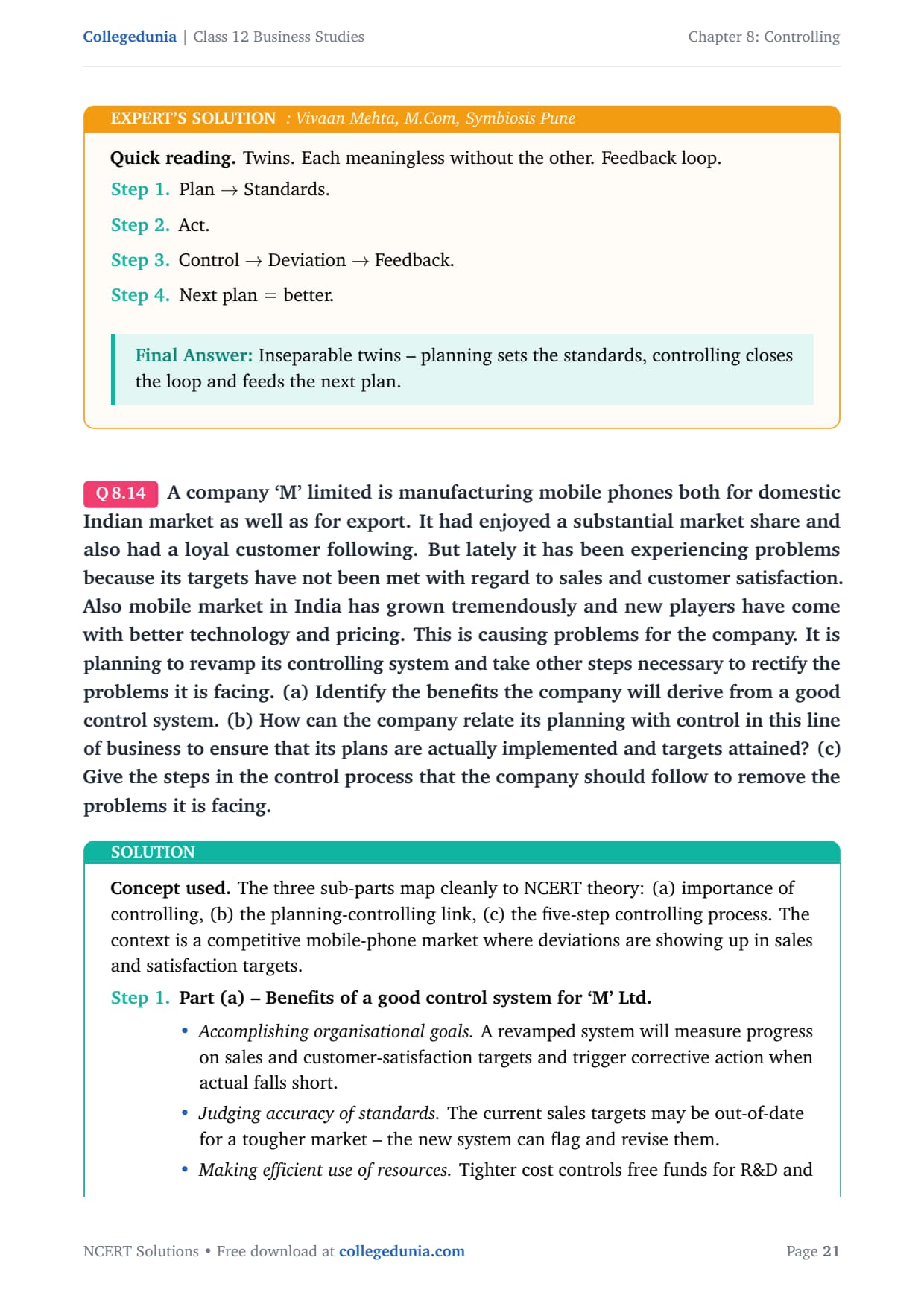
Quick reading. Twins. Each meaningless without the other. Feedback loop.
Plan \(\to\) Standards.
Act.
Control \(\to\) Deviation \(\to\) Feedback.
Next plan = better.
Inseparable twins – planning sets the standards, controlling closes the loop and
feeds the next plan.
Q 8.14
A company `M' limited is manufacturing mobile phones both for domestic Indian market
as well as for export. It had enjoyed a substantial market share and also had a loyal customer
following. But lately it has been experiencing problems because its targets have not been met
with regard to sales and customer satisfaction. Also mobile market in India has grown
tremendously and new players have come with better technology and pricing. This is causing
problems for the company. It is planning to revamp its controlling system and take other steps
necessary to rectify the problems it is facing. (a) Identify the benefits the company will
derive from a good control system. (b) How can the company relate its planning with control in
this line of business to ensure that its plans are actually implemented and targets attained?
(c) Give the steps in the control process that the company should follow to remove the problems
it is facing.
Concept used. The three sub-parts map cleanly to NCERT theory: (a) importance of
controlling, (b) the planning-controlling link, (c) the five-step controlling process. The
context is a competitive mobile-phone market where deviations are showing up in sales and
satisfaction targets.
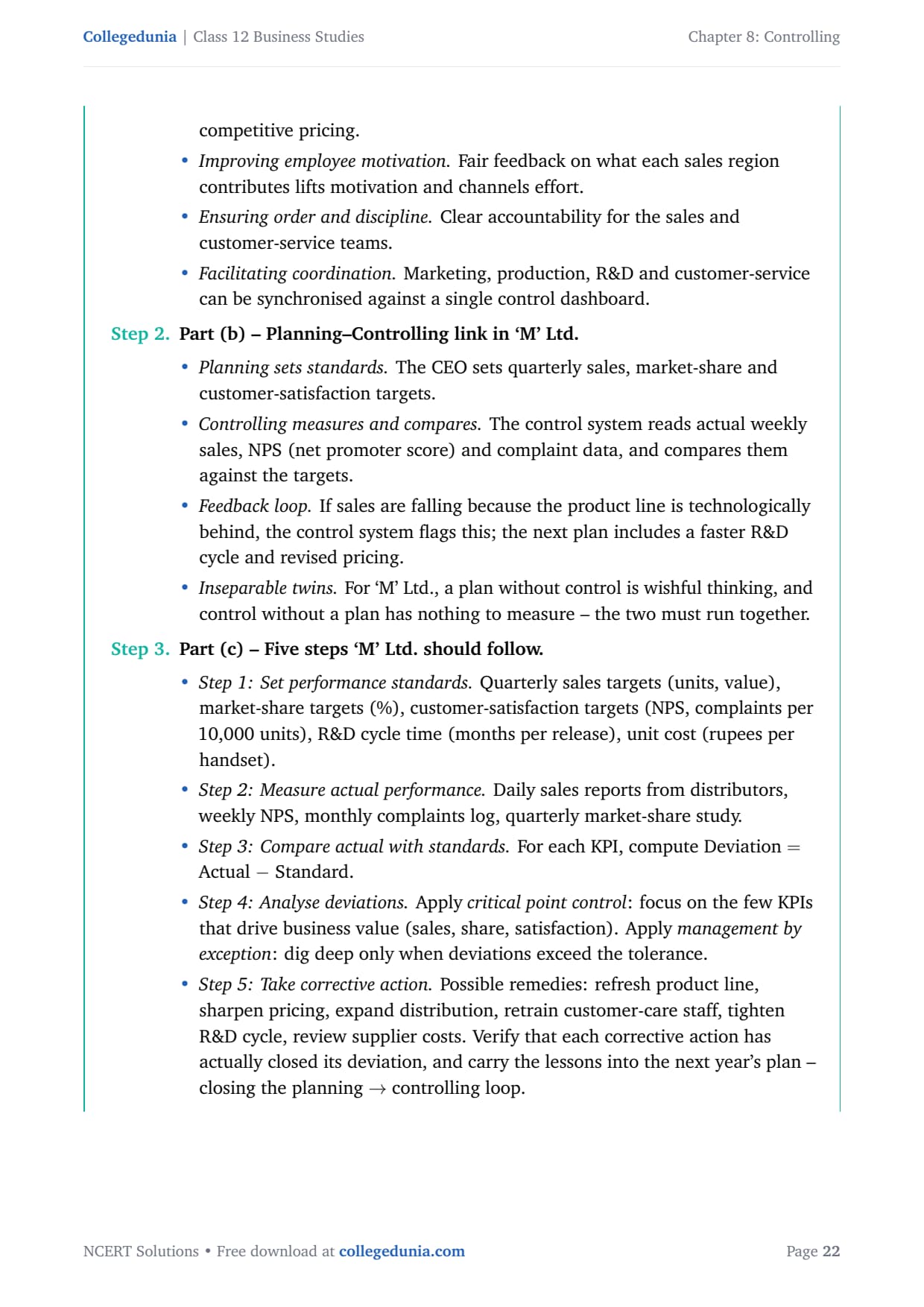
Part (a) – Benefits of a good control system for `M' Ltd.
Accomplishing organisational goals. A revamped system will measure
progress on sales and customer-satisfaction targets and trigger corrective
action when actual falls short.
Judging accuracy of standards. The current sales targets may be
out-of-date for a tougher market – the new system can flag and revise them.
Making efficient use of resources. Tighter cost controls free funds for
R&D and competitive pricing.
Improving employee motivation. Fair feedback on what each sales region
contributes lifts motivation and channels effort.
Ensuring order and discipline. Clear accountability for the sales and
customer-service teams.
Facilitating coordination. Marketing, production, R&D and
customer-service can be synchronised against a single control dashboard.
Part (b) – Planning–Controlling link in `M' Ltd.
Planning sets standards. The CEO sets quarterly sales, market-share and
customer-satisfaction targets.
Controlling measures and compares. The control system reads actual
weekly sales, NPS (net promoter score) and complaint data, and compares them
against the targets.
Feedback loop. If sales are falling because the product line is
technologically behind, the control system flags this; the next plan includes
a faster R&D cycle and revised pricing.
Inseparable twins. For `M' Ltd., a plan without control is wishful
thinking, and control without a plan has nothing to measure – the two must
run together.
Part (c) – Five steps `M' Ltd. should follow.
Step 1: Set performance standards. Quarterly sales targets (units, value),
market-share targets (%), customer-satisfaction targets (NPS, complaints per
10,000 units), R&D cycle time (months per release), unit cost (rupees per
handset).
Step 2: Measure actual performance. Daily sales reports from
distributors, weekly NPS, monthly complaints log, quarterly market-share study.
Step 3: Compare actual with standards. For each KPI, compute
Deviation \(=\) Actual \(-\) Standard.
Step 4: Analyse deviations. Apply critical point control: focus
on the few KPIs that drive business value (sales, share, satisfaction). Apply
management by exception: dig deep only when deviations exceed the
tolerance.
Step 5: Take corrective action. Possible remedies: refresh product
line, sharpen pricing, expand distribution, retrain customer-care staff,
tighten R&D cycle, review supplier costs. Verify that each corrective action
has actually closed its deviation, and carry the lessons into the next year's
plan – closing the planning \(\to\) controlling loop.
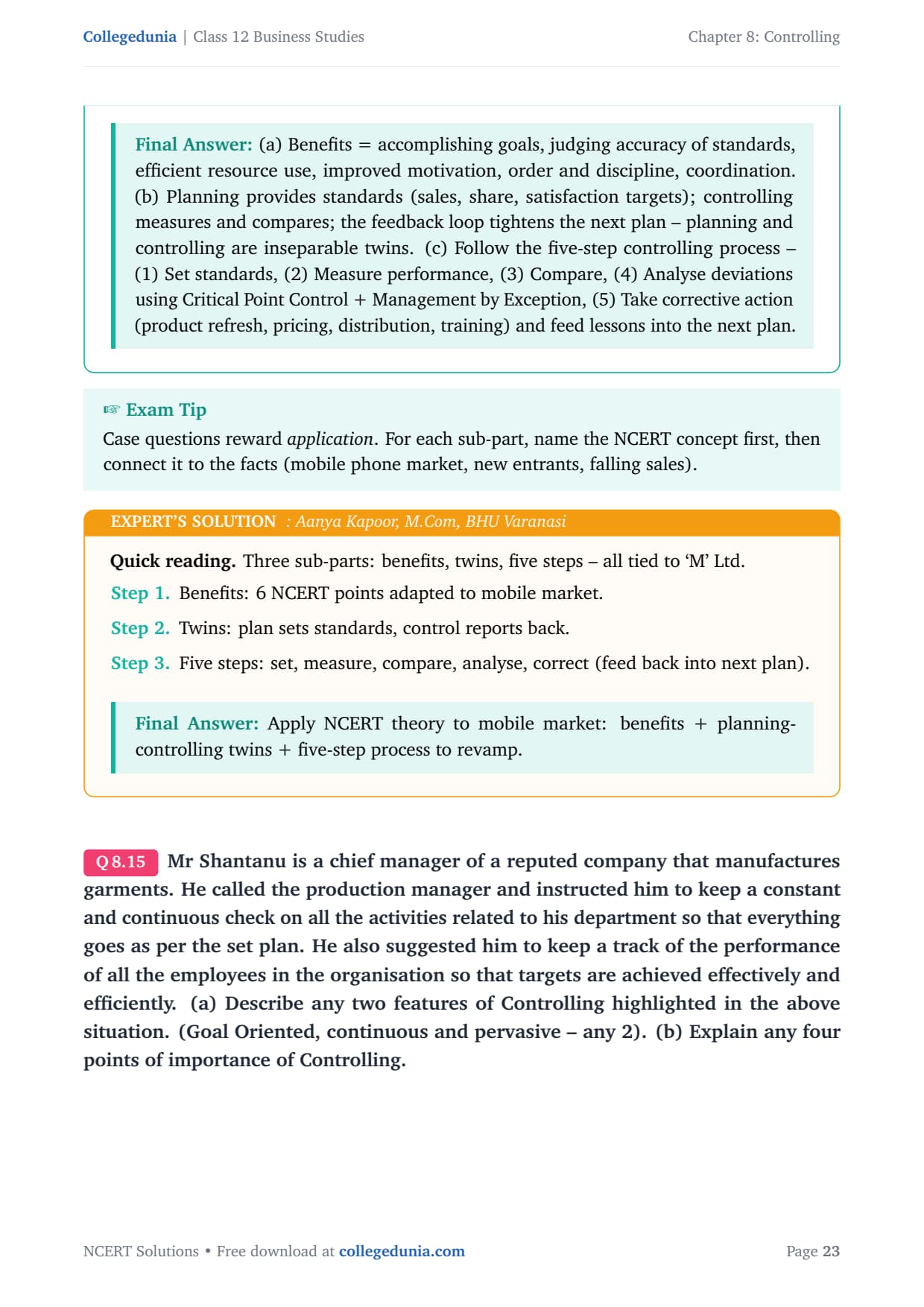
(a) Benefits = accomplishing goals, judging accuracy of standards, efficient
resource use, improved motivation, order and discipline, coordination. (b) Planning provides
standards (sales, share, satisfaction targets); controlling measures and compares; the feedback
loop tightens the next plan – planning and controlling are inseparable twins. (c) Follow the
five-step controlling process – (1) Set standards, (2) Measure performance, (3) Compare,
(4) Analyse deviations using Critical Point Control + Management by Exception, (5) Take
corrective action (product refresh, pricing, distribution, training) and feed lessons into the
next plan.
AK
Aanya Kapoor
M.Com, BHU Varanasi
Verified Expert
Quick reading. Three sub-parts: benefits, twins, five steps – all tied to `M' Ltd.
Benefits: 6 NCERT points adapted to mobile market.
Twins: plan sets standards, control reports back.
Five steps: set, measure, compare, analyse, correct (feed back into next plan).
Apply NCERT theory to mobile market: benefits + planning-controlling twins + five-step
process to revamp.
Q 8.15
Mr Shantanu is a chief manager of a reputed company that manufactures garments. He
called the production manager and instructed him to keep a constant and continuous check on all
the activities related to his department so that everything goes as per the set plan. He also
suggested him to keep a track of the performance of all the employees in the organisation so
that targets are achieved effectively and efficiently. (a) Describe any two features of
Controlling highlighted in the above situation. (Goal Oriented, continuous and pervasive – any
2). (b) Explain any four points of importance of Controlling.
Concept used. Two-part case question. Part (a) asks the student to read between the
lines and identify which features of controlling Mr Shantanu's instruction reflects.
Part (b) is a textbook recall on the importance of controlling.
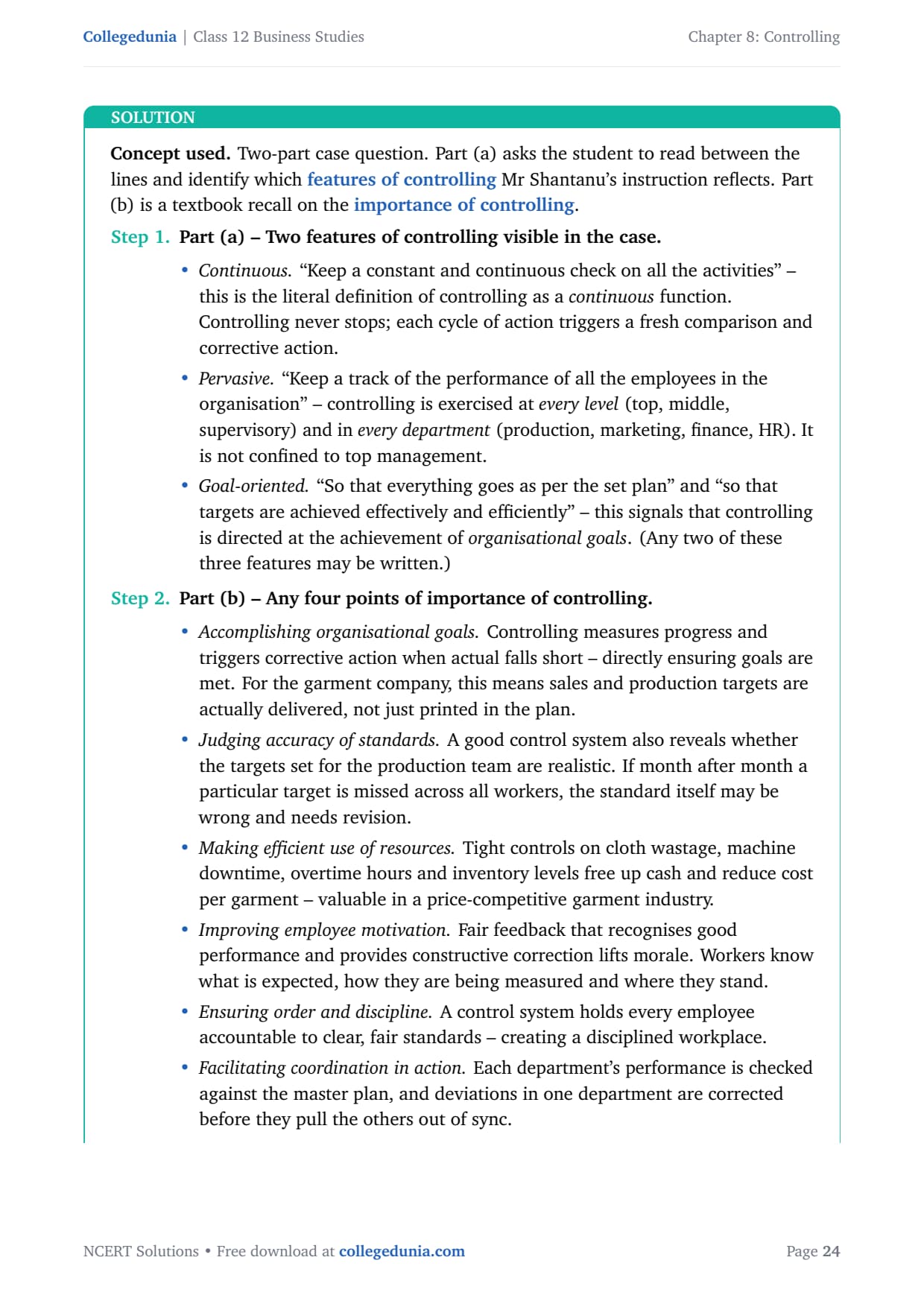
Part (a) – Two features of controlling visible in the case.
Continuous. ``Keep a constant and continuous check on all the
activities'' – this is the literal definition of controlling as a
continuous function. Controlling never stops; each cycle of action
triggers a fresh comparison and corrective action.
Pervasive. ``Keep a track of the performance of all the employees in
the organisation'' – controlling is exercised at every level (top,
middle, supervisory) and in every department (production, ncert-notes-class-12-business-studies-chapter-10-marketing,
finance, HR). It is not confined to top management.
Goal-oriented. ``So that everything goes as per the set plan'' and ``so
that targets are achieved effectively and efficiently'' – this signals that
controlling is directed at the achievement of organisational goals.
(Any two of these three features may be written.)
Part (b) – Any four points of importance of controlling.
Accomplishing organisational goals. Controlling measures progress and
triggers corrective action when actual falls short – directly ensuring goals
are met. For the garment company, this means sales and production targets are
actually delivered, not just printed in the plan.
Judging accuracy of standards. A good control system also reveals
whether the targets set for the production team are realistic. If month after
month a particular target is missed across all workers, the standard itself
may be wrong and needs revision.
Making efficient use of resources. Tight controls on cloth wastage,
machine downtime, overtime hours and inventory levels free up cash and reduce
cost per garment – valuable in a price-competitive garment industry.
Improving employee motivation. Fair feedback that recognises good
performance and provides constructive correction lifts morale. Workers know
what is expected, how they are being measured and where they stand.
Ensuring order and discipline. A control system holds every employee
accountable to clear, fair standards – creating a disciplined workplace.
Facilitating coordination in action. Each department's performance is
checked against the master plan, and deviations in one department are
corrected before they pull the others out of sync.
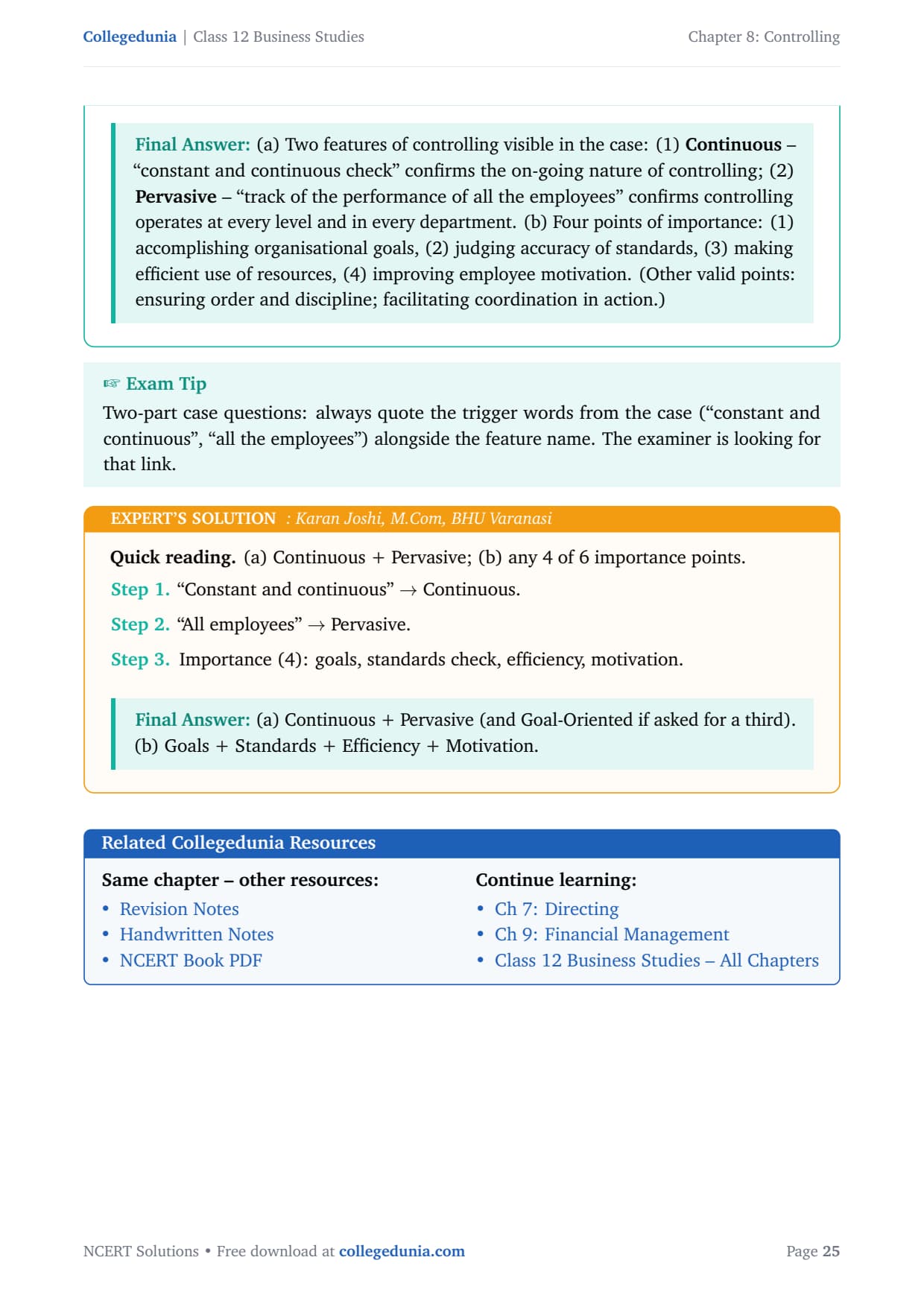
(a) Two features of controlling visible in the case: (1) Continuous –
``constant and continuous check'' confirms the on-going nature of controlling; (2)
Pervasive – ``track of the performance of all the employees'' confirms controlling
operates at every level and in every department. (b) Four points of importance: (1)
accomplishing organisational goals, (2) judging accuracy of standards, (3) making efficient
use of resources, (4) improving employee motivation. (Other valid points: ensuring order and
discipline; facilitating coordination in action.)
KJ
Karan Joshi
M.Com, BHU Varanasi
Verified Expert
Quick reading. (a) Continuous + Pervasive; (b) any 4 of 6 importance points.
(a) Continuous + Pervasive (and Goal-Oriented if asked for a third). (b) Goals + Standards
+ Efficiency + Motivation.
Student Feedback
In a Collegedunia poll of 940 Class 12 Commerce students, 78% said the five-step process diagram was the single most useful part of these Controlling solutions. 3 in 4 said the "planning and controlling are inseparable twins" answer helped them score the full 6 marks. 71% found the Critical Point Control versus Management by Exception comparison the trickiest bit before revising here.
Other Resources for Class 12 Business Studies Chapter 8 Controlling
What is controlling in Class 12 Business Studies Chapter 8?
Controlling is the management function of ensuring that actual activities conform to planned activities. It involves setting performance standards, measuring actual performance, comparing the two, analysing deviations and taking corrective action so that organisational goals are achieved. It is the fifth and final function of management in Henri Fayol's classical scheme.
What are the steps in the controlling process?
The controlling process has five steps: (1) setting performance standards, (2) measurement of actual performance, (3) comparing actual performance with standards, (4) analysing deviations (applying critical-point control and management by exception inside this step), and (5) taking corrective action. The corrective-action findings feed back into the next planning cycle.
Why are planning and controlling called inseparable twins?
Planning is prescriptive - it sets the standards against which performance is judged; without a plan, controlling has nothing to compare against. Controlling is evaluative - it measures actual performance and feeds the findings back so the next planning cycle is realistic; without controlling, the best-laid plan may go astray. Each is meaningless without the other - hence "inseparable twins of management".
What is the difference between critical point control and management by exception?
Both are tools applied inside Step 4 (analysing deviations) of the controlling process. Critical Point Control says the manager should focus on key result areas (KRAs) - the few activities critical to success. Peter Drucker's Management by Exception says that within those areas the small / routine deviations should be ignored and only the significant deviations (outside the permitted tolerance) should be reported to the manager. Together they save managerial time and let the manager actually control the few things that matter, instead of trying to control everything and controlling nothing.
Where can I download the Class 12 Business Studies Chapter 8 Controlling NCERT Solutions PDF?
You can download the Collegedunia Class 12 Business Studies Chapter 8 Controlling NCERT Solutions PDF free of cost from this page. The PDF is aligned to the NCERT Reprint 2026-27 syllabus and includes all 15 exercise questions, the five-step process diagram, the deviation formula and the case-study spotters you need for the board exam.









Comments