




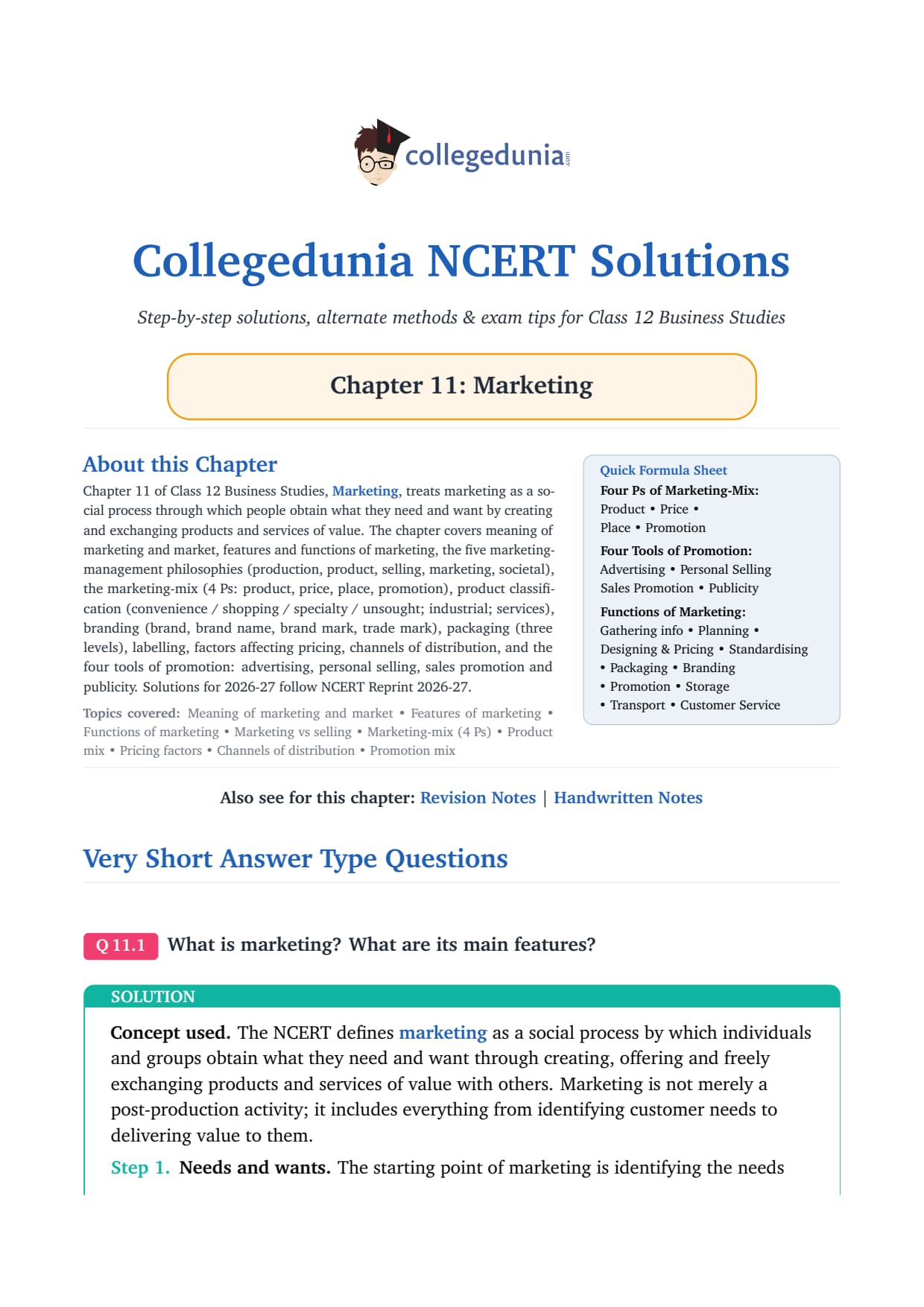
The NCERT Solutions for Class 12 Business Studies Chapter 10 Marketing answer every textbook question using Philip Kotler's definition and the four Ps the chapter is built around. You get product, price, place and promotion covered in full for the 2026-27 CBSE syllabus.

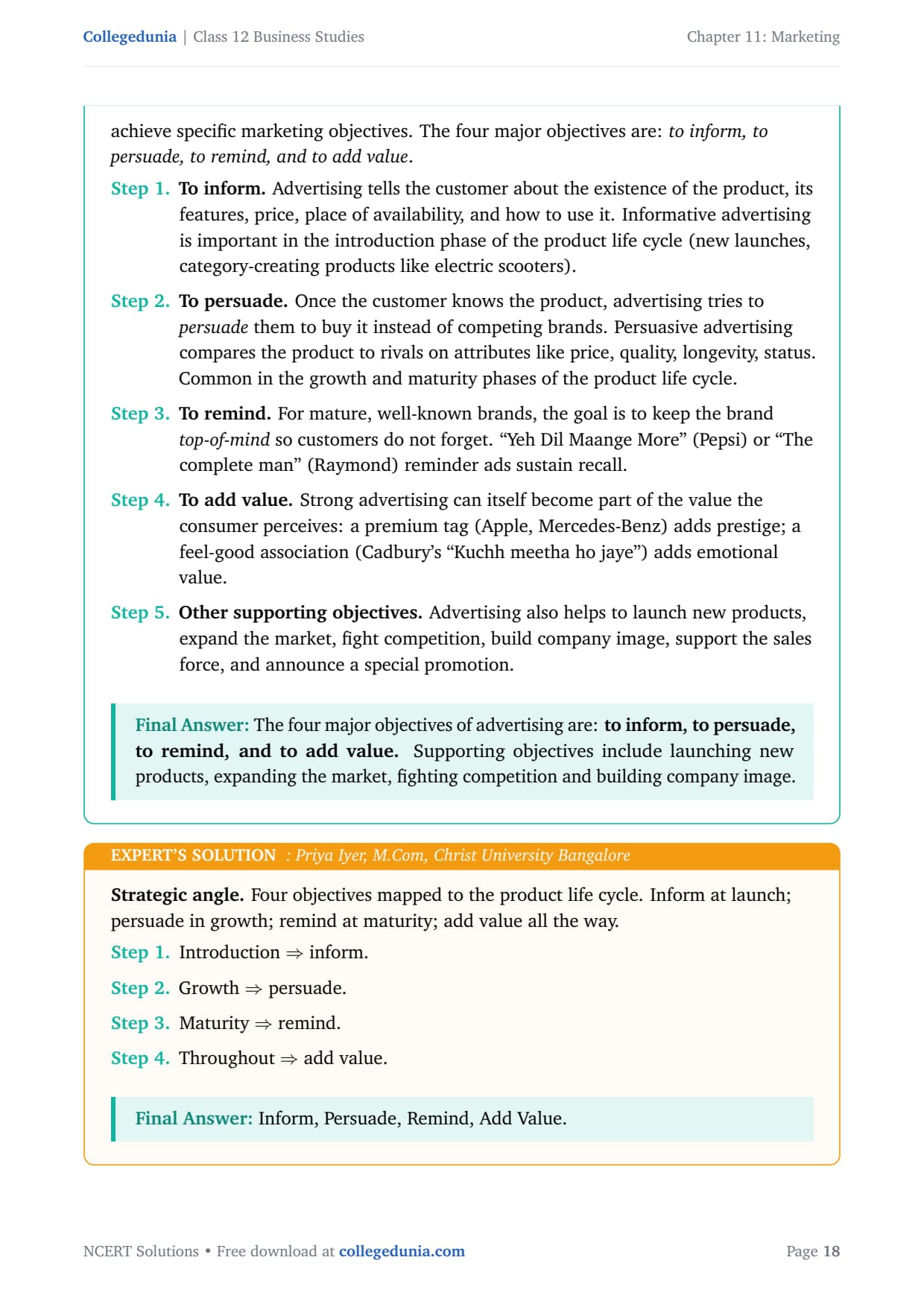
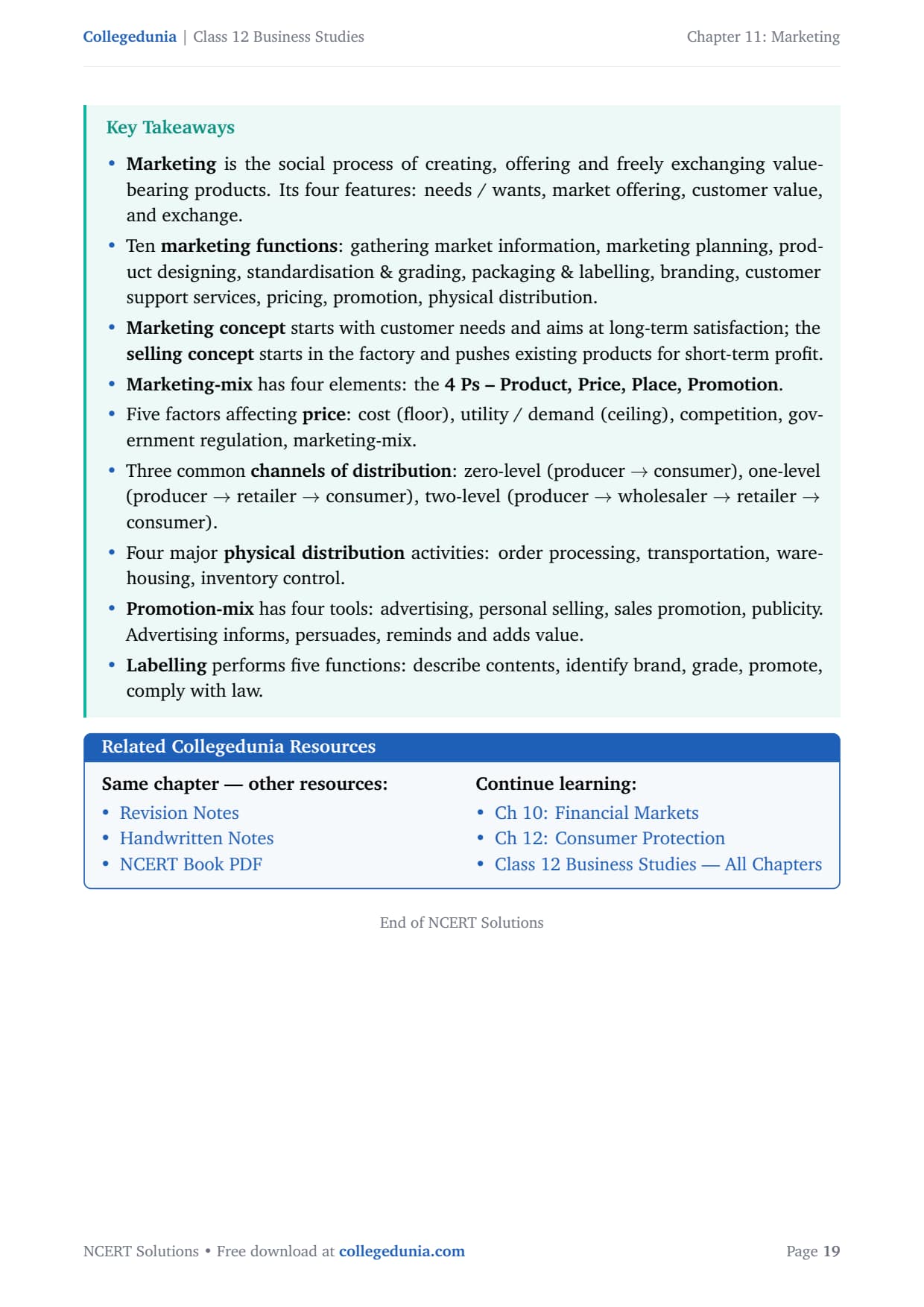
- CBSE Weightage: 6 to 10 marks (Unit 3, Business Finance and Marketing)
- Questions Solved: 14 NCERT exercise questions (5 Very Short, 3 Short, 6 Long Answer)
The Marketing Class 12 NCERT Solutions PDF is written for two students: the student covering Chapter 10 for the first time, and the candidate revising in the final week before the board exam. Every long answer opens with a Concept Used block that defines the marketing rule being applied, walks through the points in the order an examiner expects, and ends with a one-line boxed final answer. Comparison tables (marketing vs selling, advertising vs personal selling, Brand vs Brand Name vs Brand Mark vs Trade Mark) are written in the CBSE 6-row format.
Marketing Class 12 NCERT Solutions: Topic Map
The 14 NCERT exercise questions span the full Marketing chapter. The topic map below tags each section to its concept and the marks it typically carries in the CBSE board paper.
| Section | What is Covered | Marks in the Board Exam |
|---|---|---|
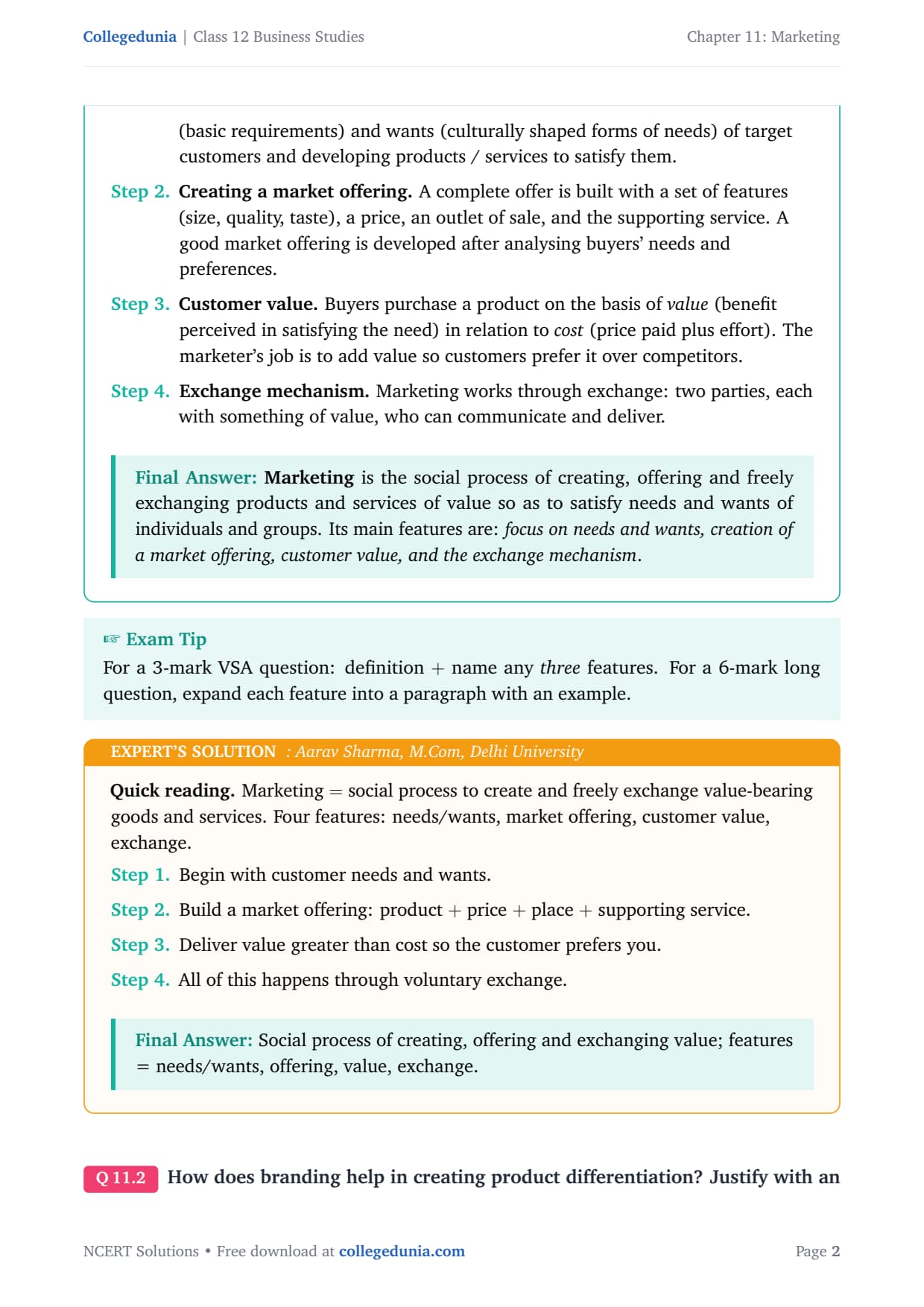
| 1. Meaning and Features of Marketing | Philip Kotler definition; four features: needs and wants, market offering, customer value, exchange mechanism | 3 to 4-mark VSA |
| 2. Marketing Management Philosophies | Production, Product, Selling, Marketing, Societal Marketing concepts | 5 to 6-mark long answer |
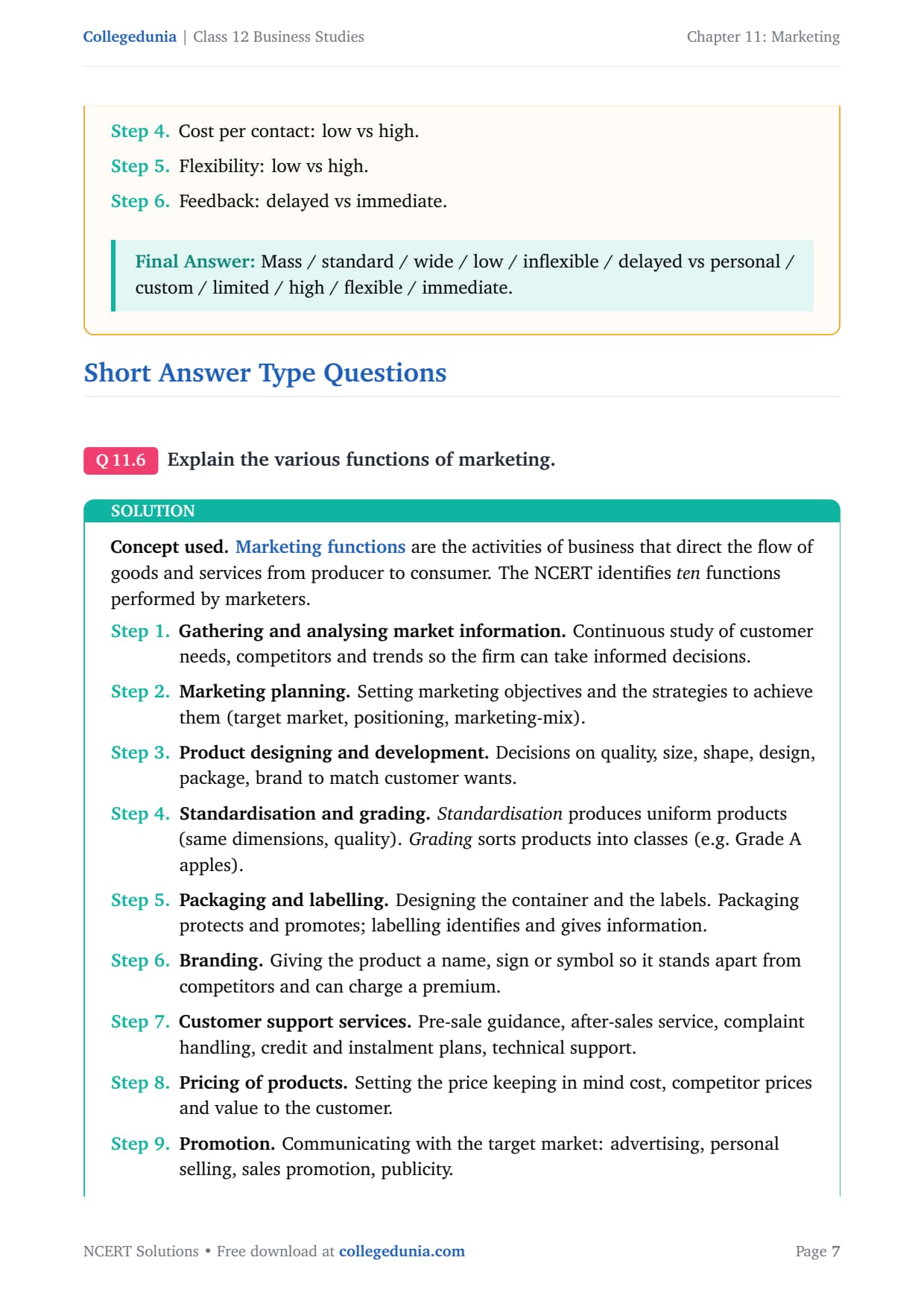
| 3. Functions of Marketing | Twelve functions: market information, planning, design, standardisation, packaging, branding, customer support, pricing, promotion, physical distribution, transportation, storage | 5 to 6-mark long answer |
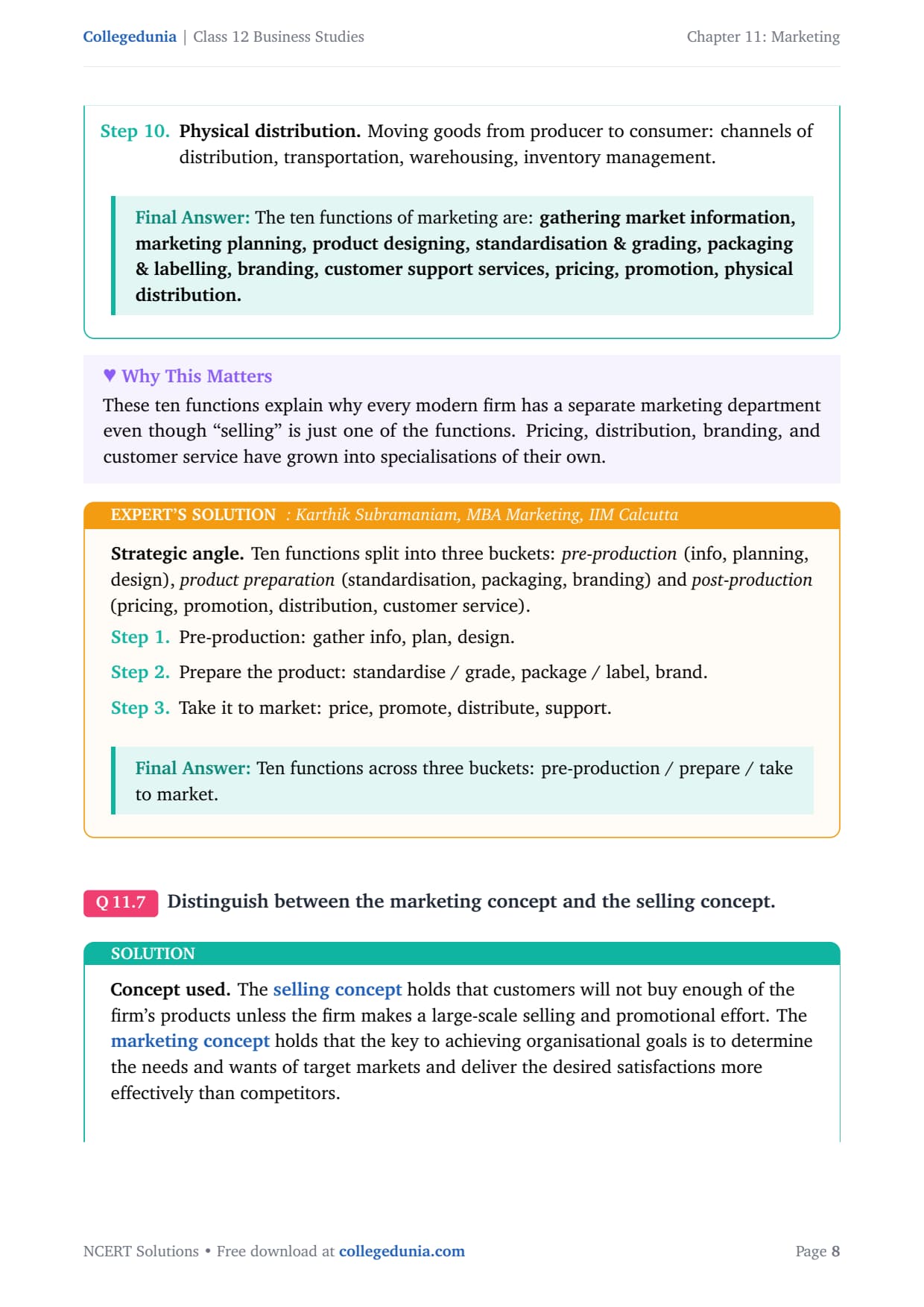
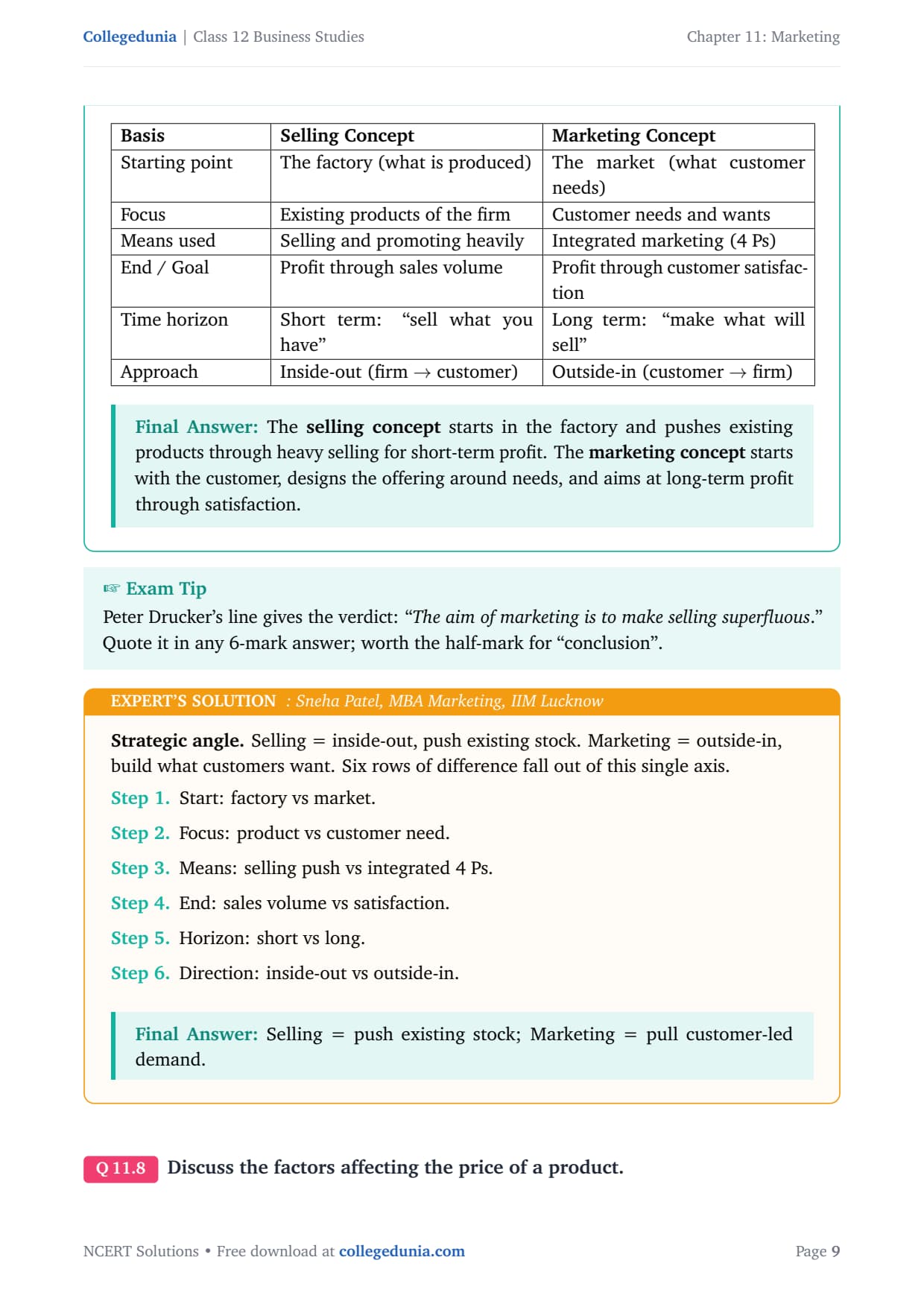
| 4. Marketing Concept vs Selling Concept | Six points: factory vs market, product vs need, push vs pull | 4 to 6-mark comparison |
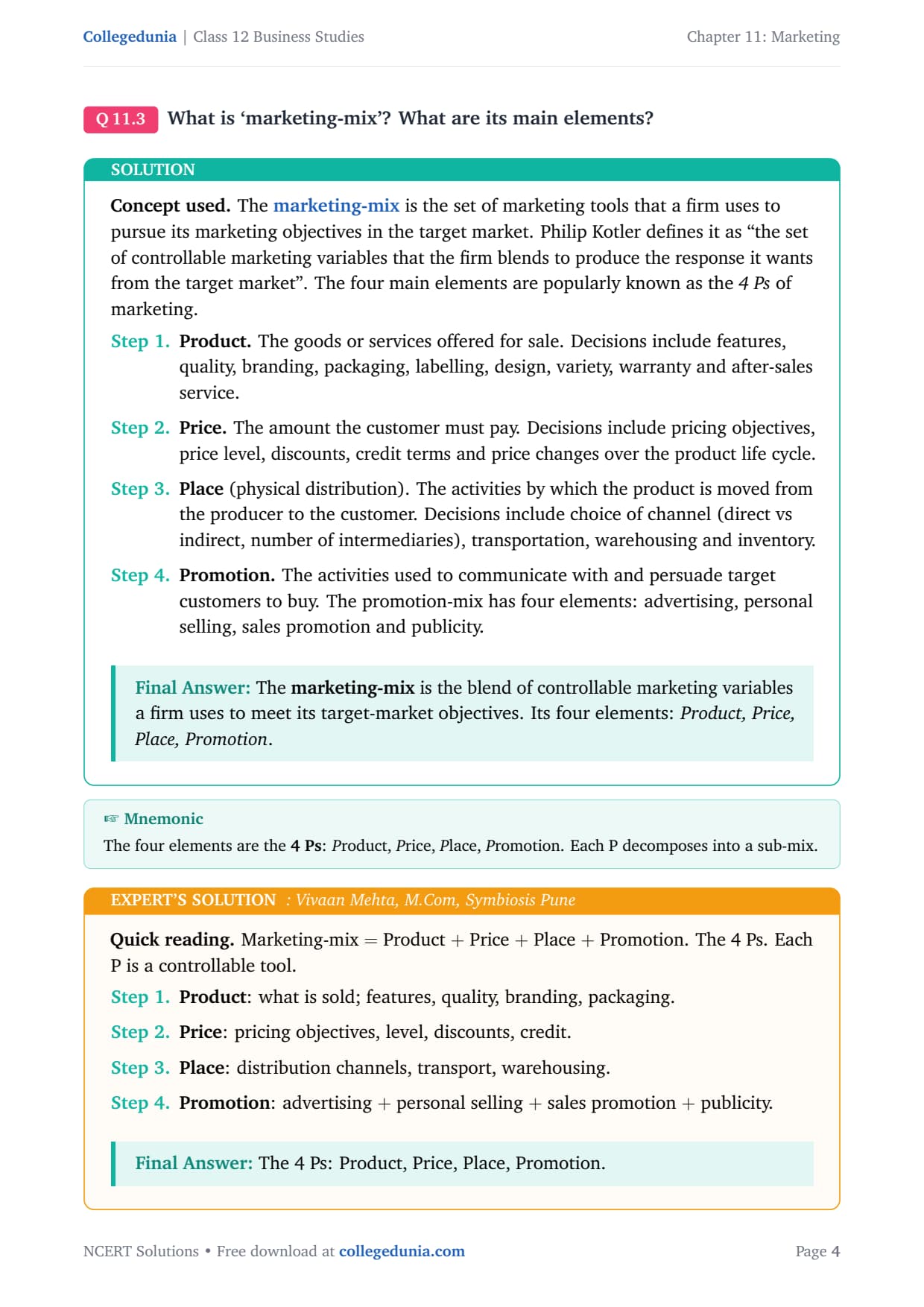
| 5. Marketing-Mix (4 Ps) | Product, Price, Place, Promotion with sub-decisions under each | 5 to 6-mark; foundational |
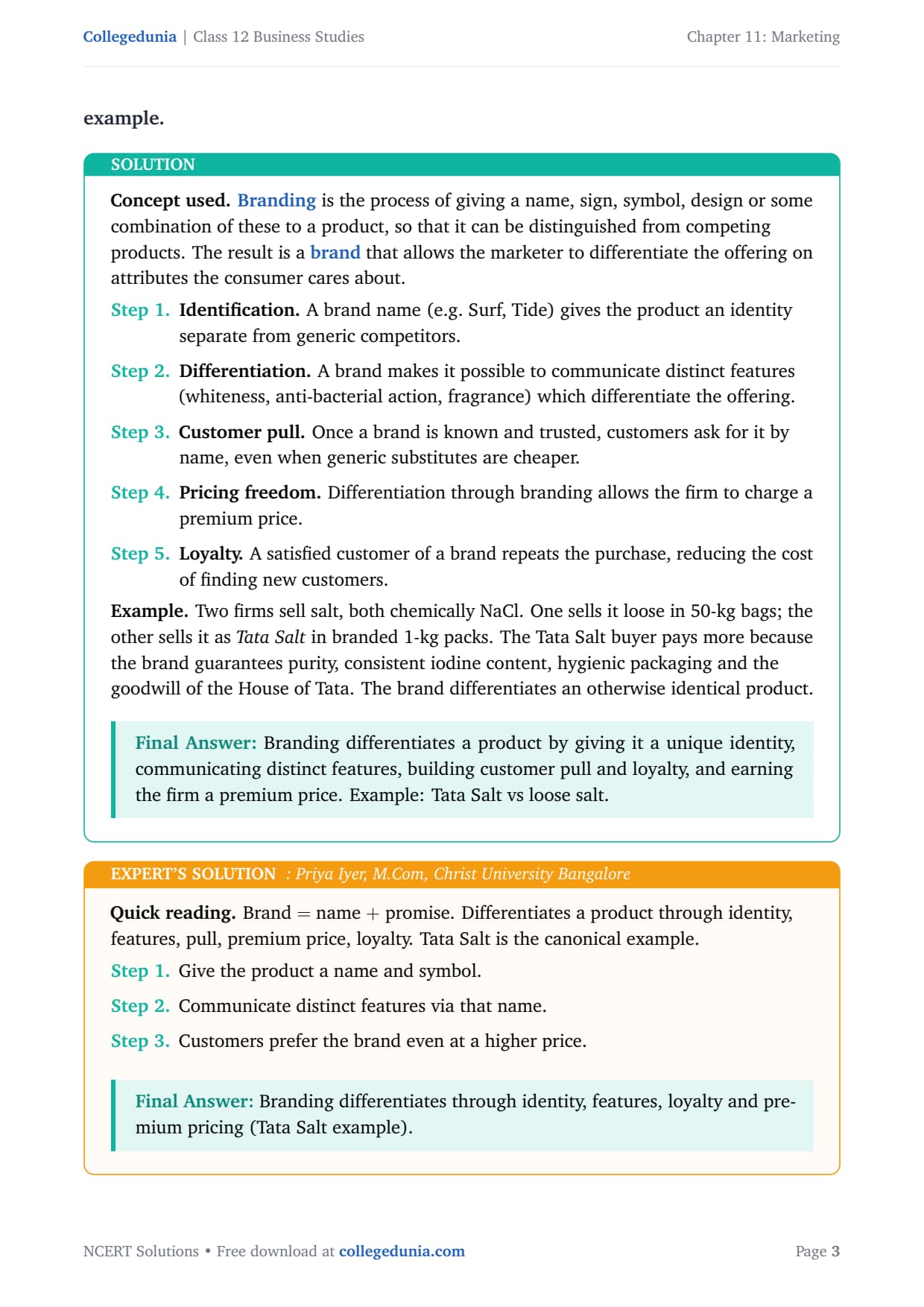
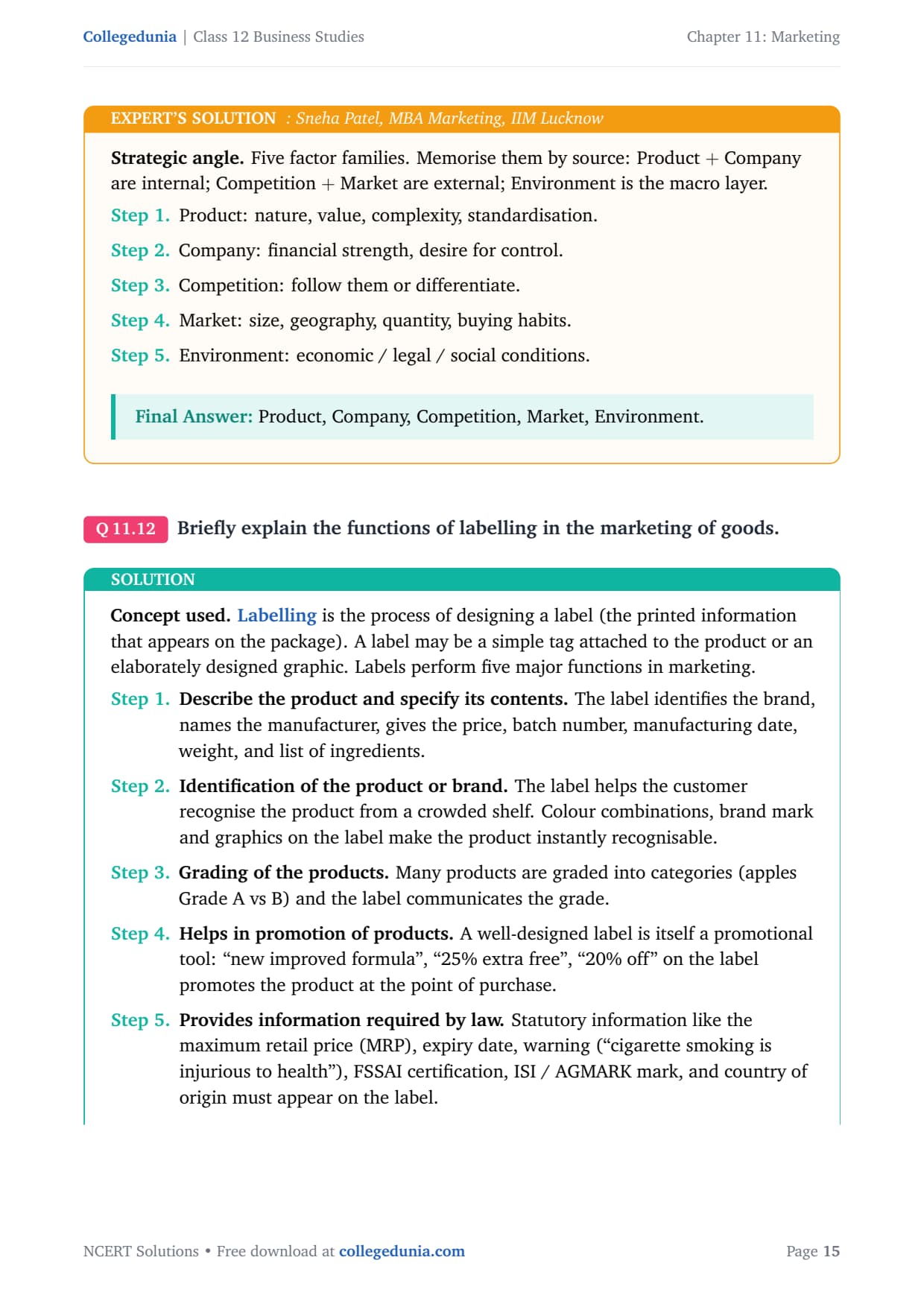
| 6. Product Decisions | Product classification (consumer / industrial / services); Brand vs Brand Name vs Brand Mark vs Trade Mark; three packaging levels; labelling; warranty | 4 to 6-mark; Tata Salt and FMCG examples |
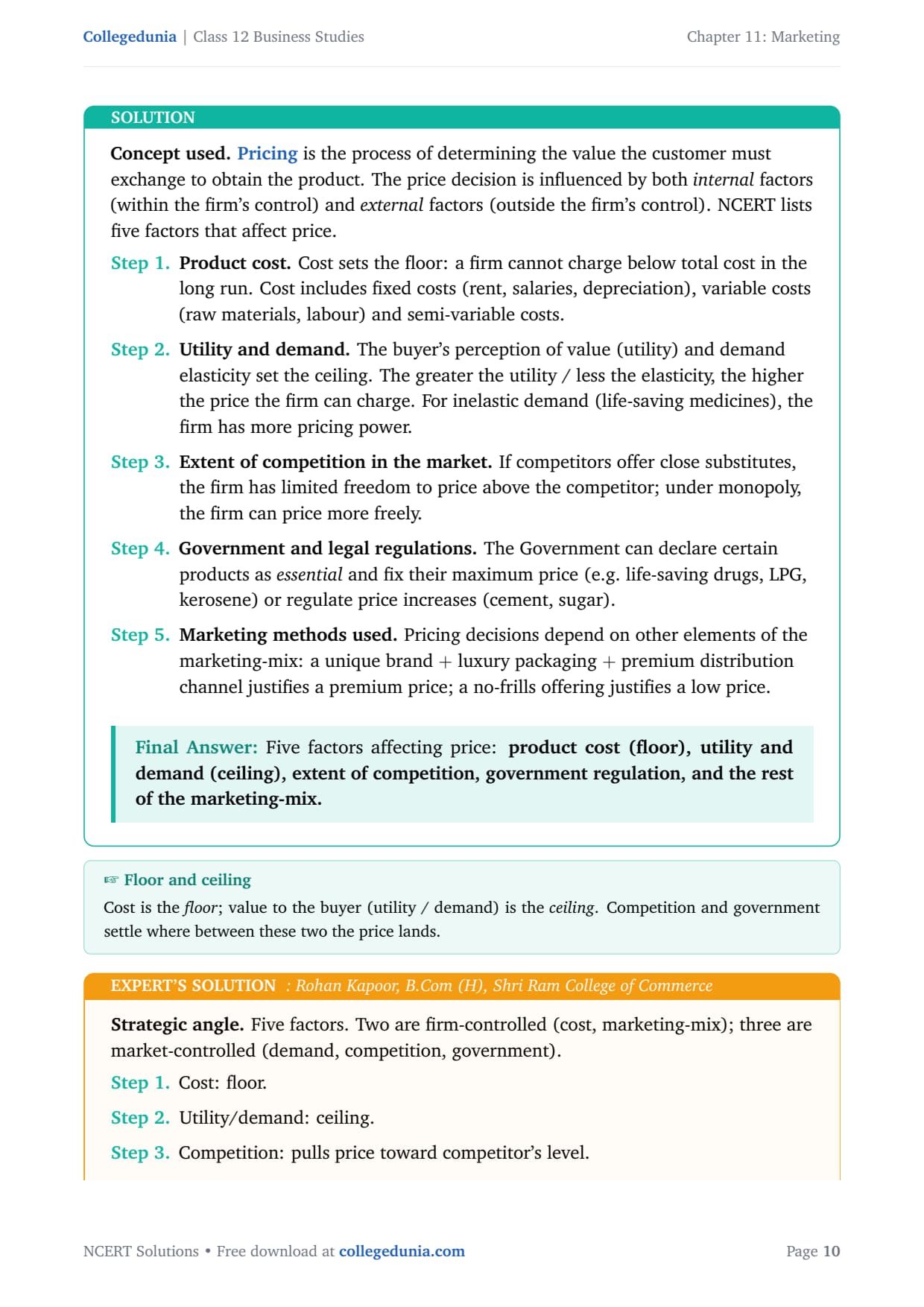
| 7. Price Decisions | Pricing objectives, factors affecting price, strategies: skimming, penetration, cost-plus | 5 to 6-mark long answer |
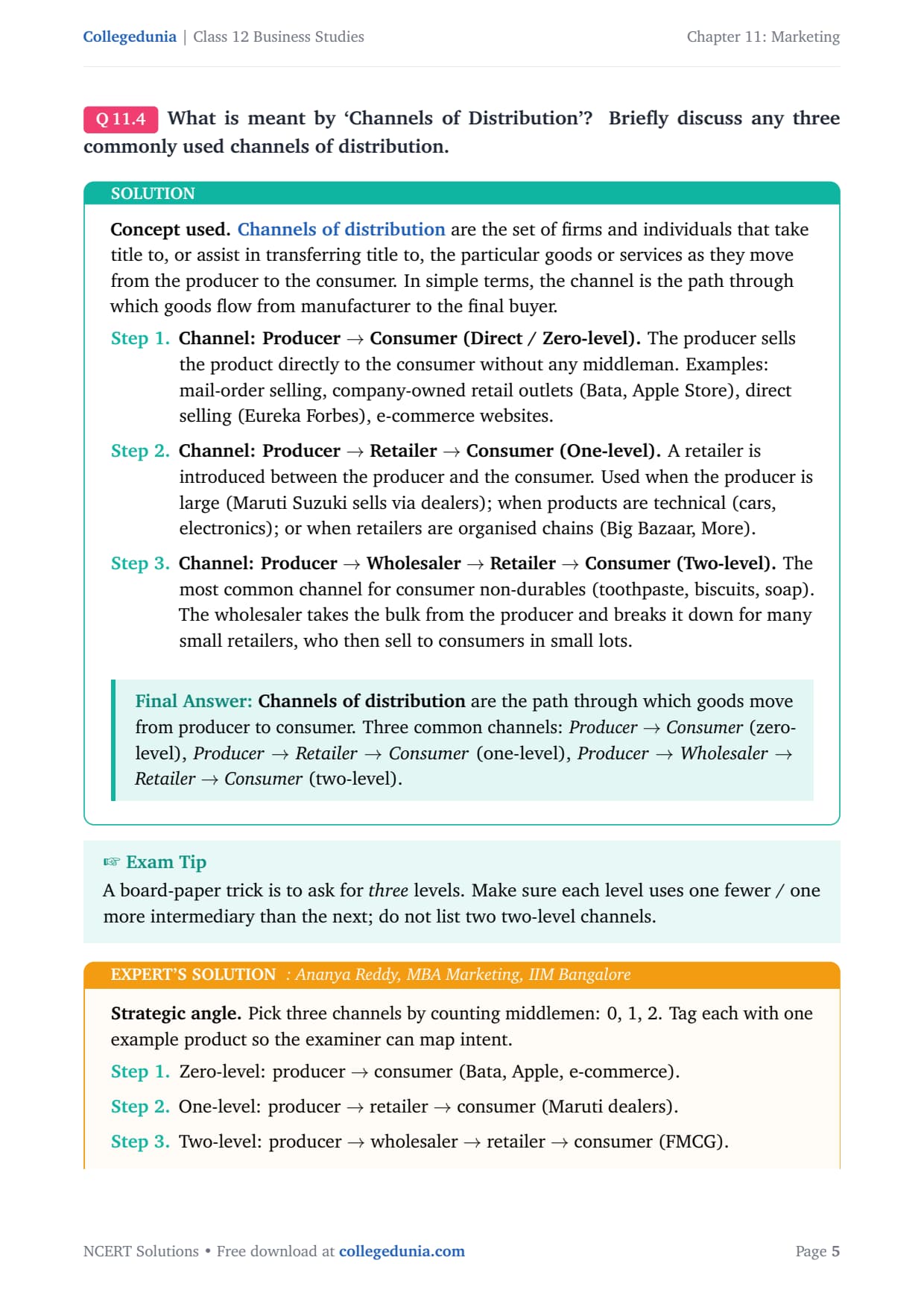
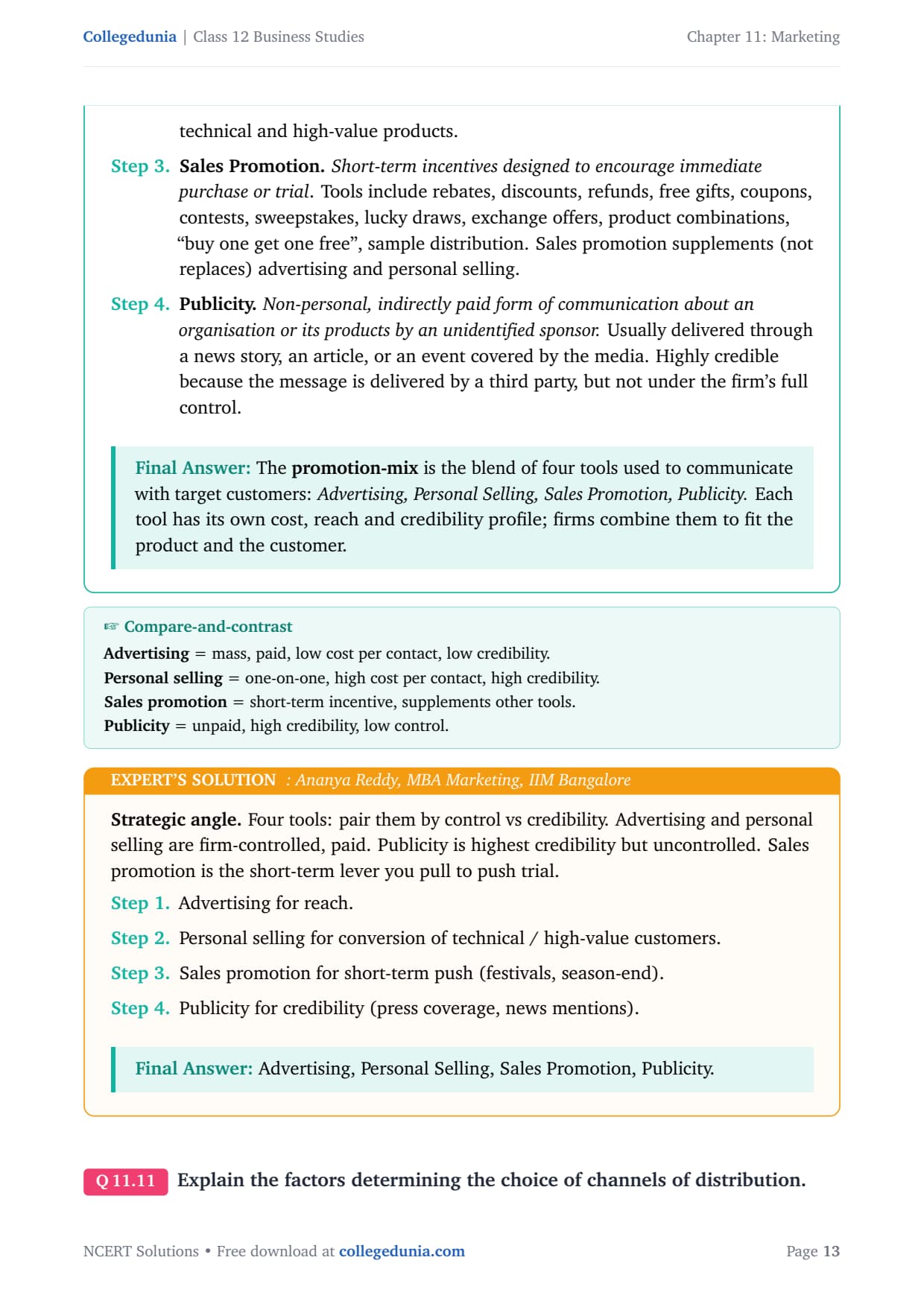
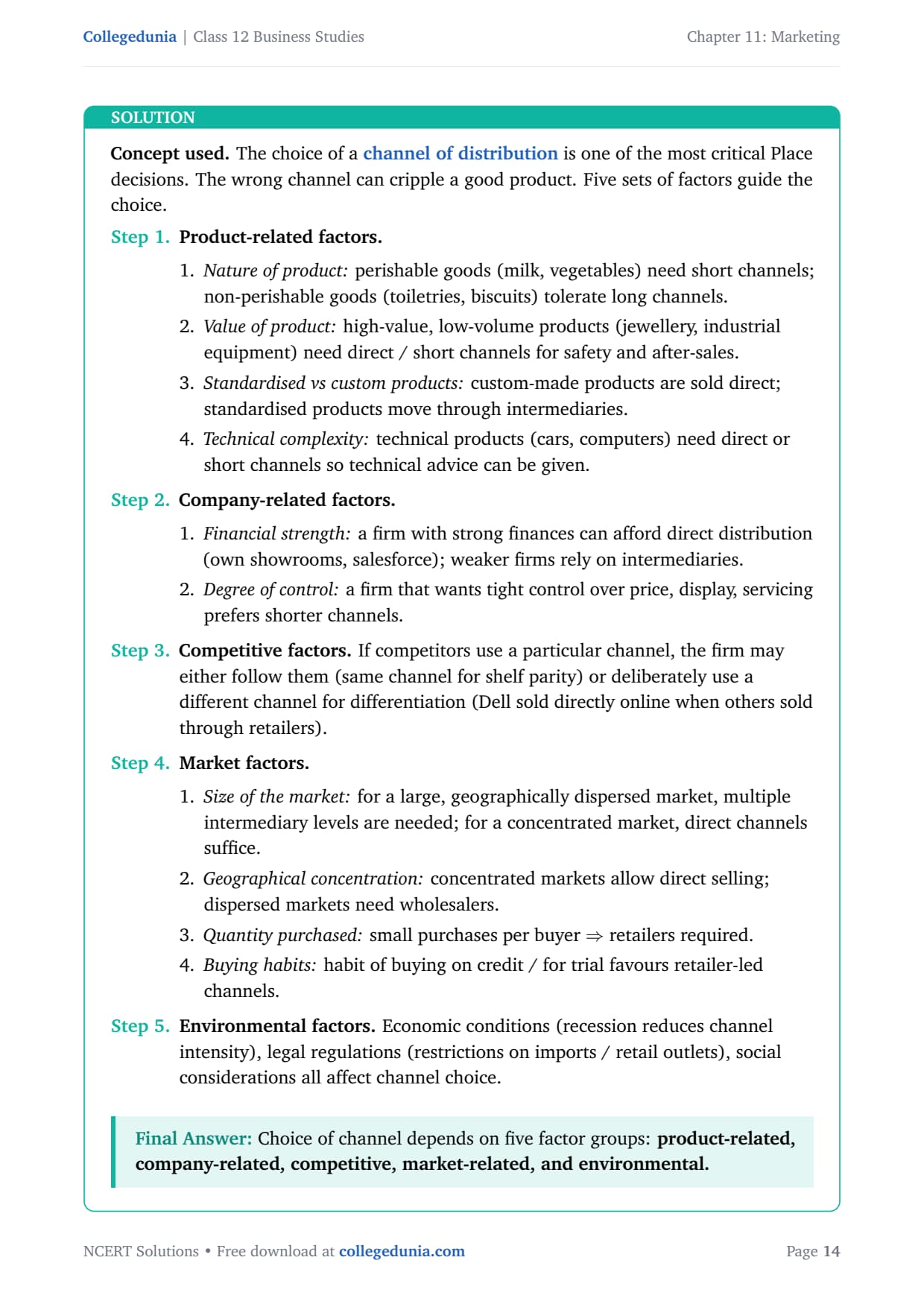
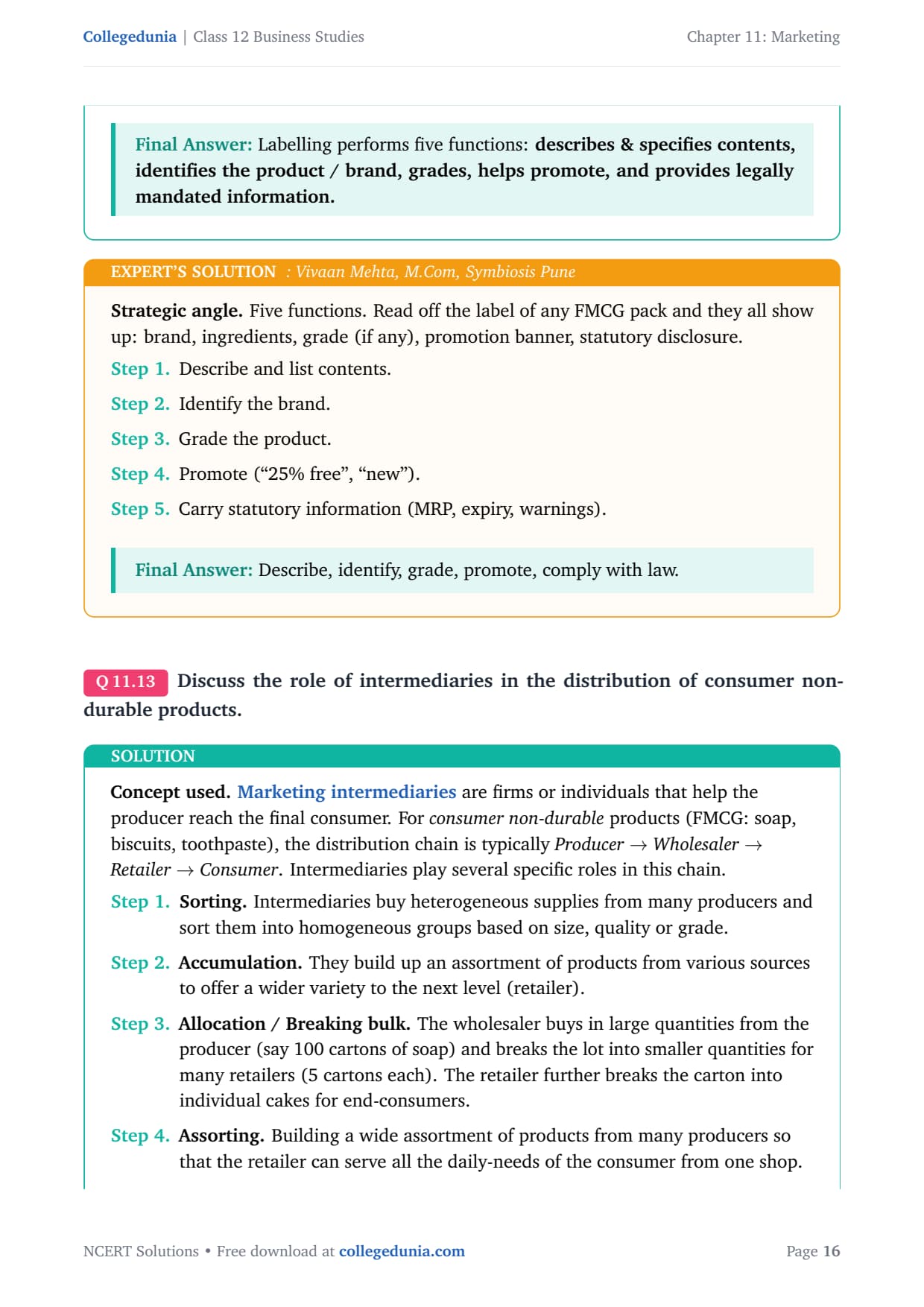
| 8. Channels of Distribution | Zero-, one-, two- and three-level channels with examples | 4 to 6-mark |
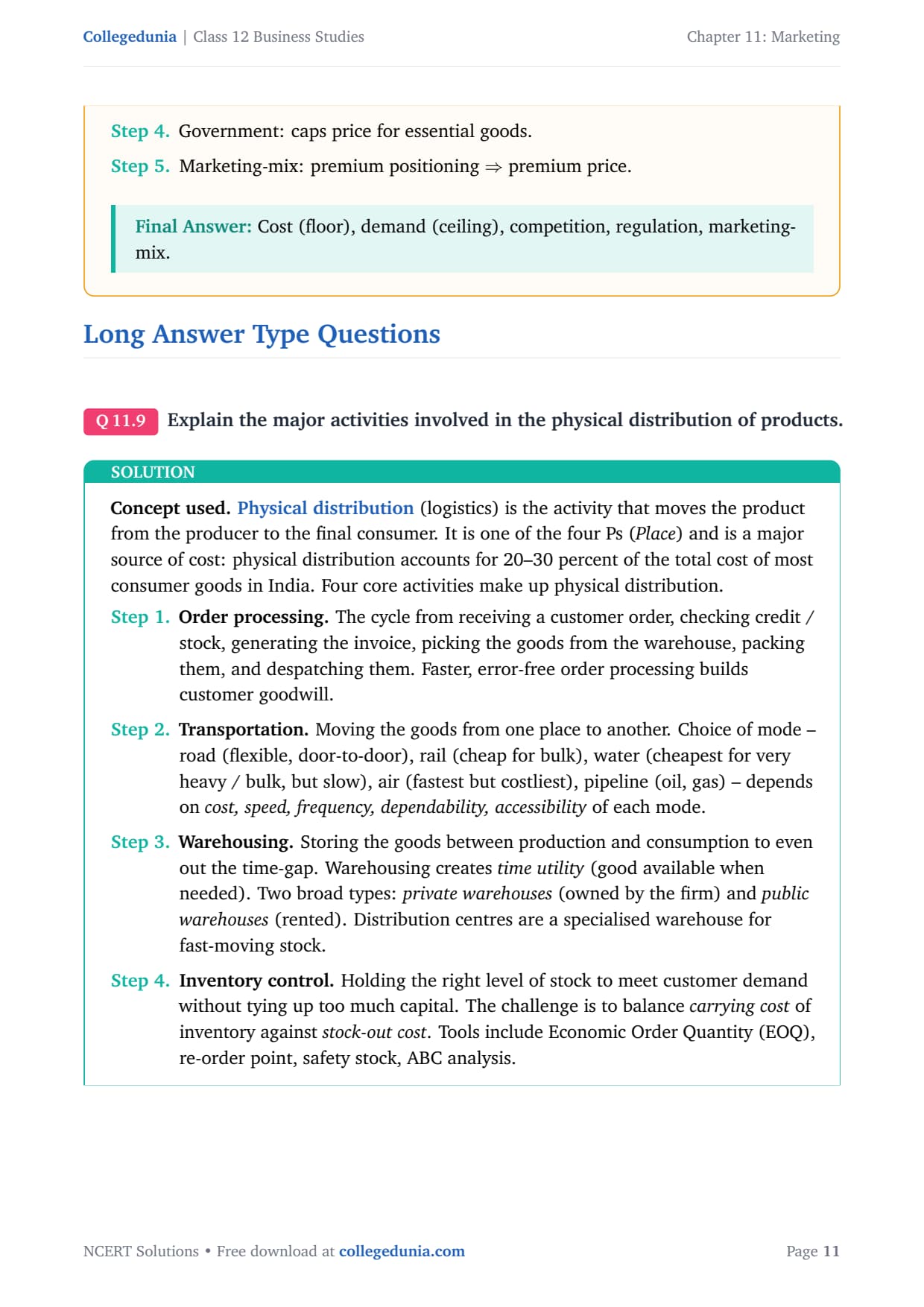
| 9. Physical Distribution | Order processing, transportation, warehousing, inventory control | 4 to 6-mark |
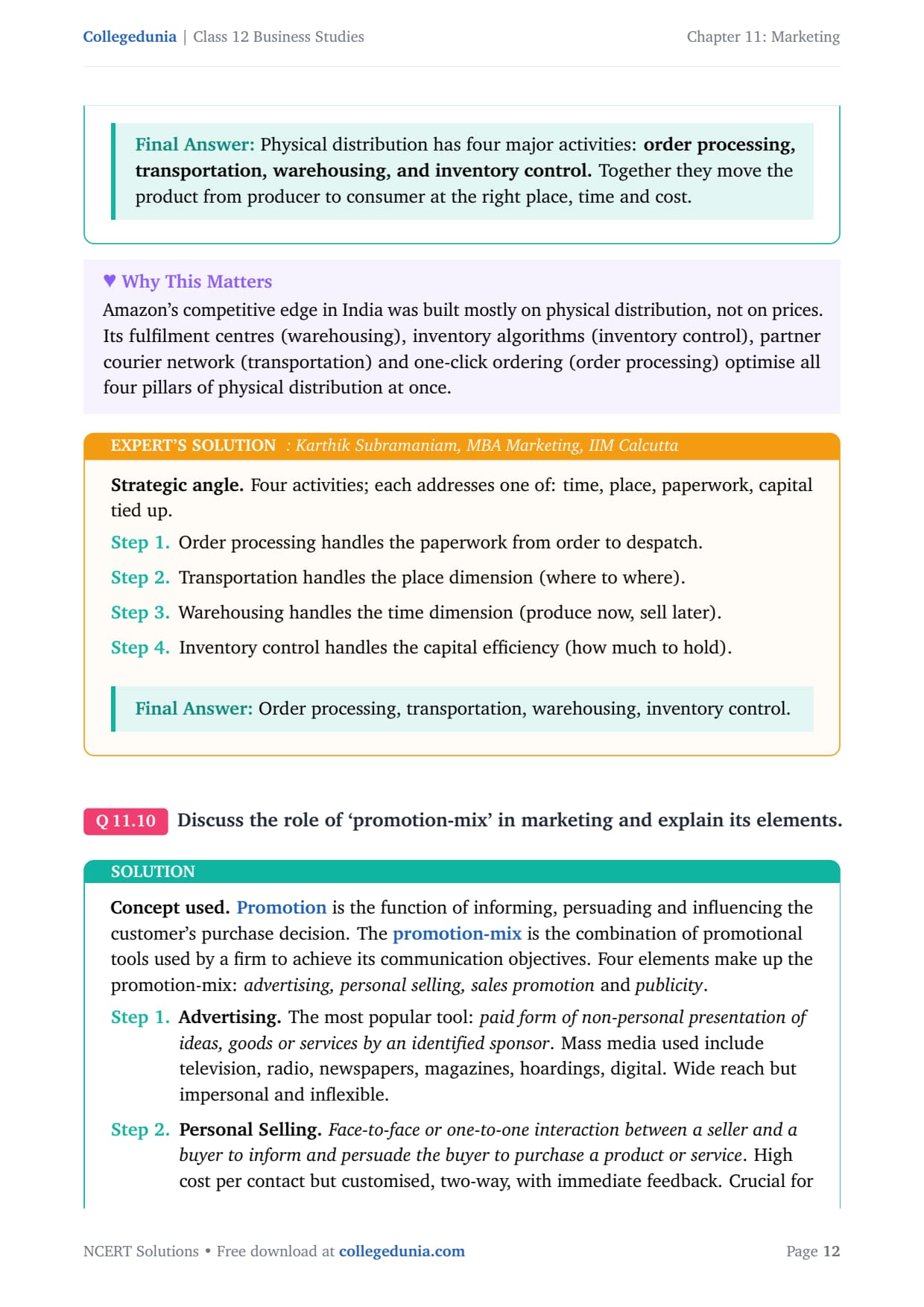
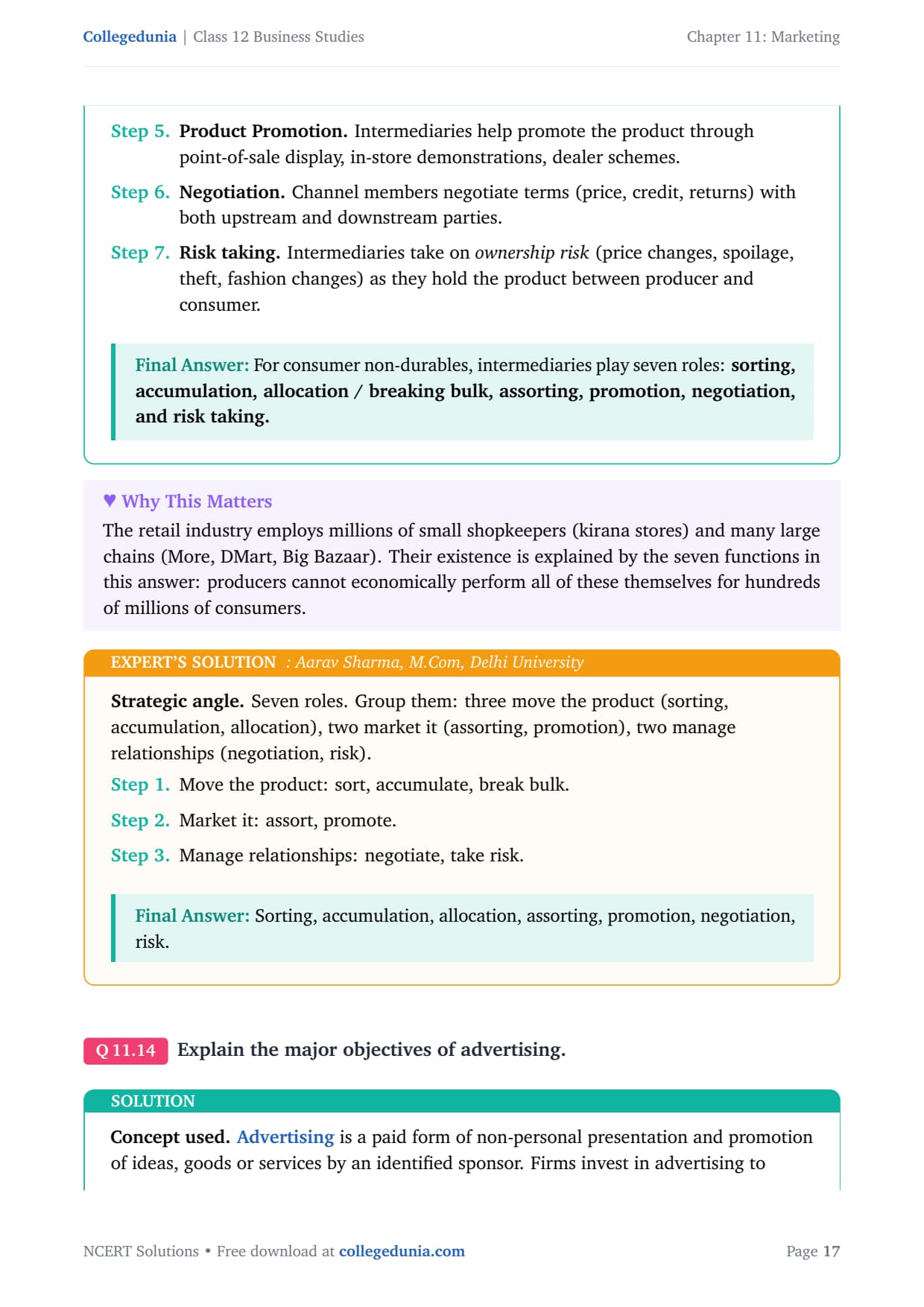
| 10. Promotion-Mix | Advertising, Personal Selling, Sales Promotion, Public Relations, Publicity | 5 to 6-mark long answer |
What the Class 12 Business Studies Chapter 10 NCERT Solutions PDF Contains
- Question-wise step-by-step answers to all 14 NCERT exercise questions (5 Very Short Answer, 3 Short Answer, 6 Long Answer).
- Concept Used block at the start of every solution naming the marketing rule, model or principle being applied.
- Boxed Final Answer at the end of every solution for last-minute revision.
- Comparison tables for marketing vs selling, advertising vs personal selling, and Brand vs Brand Name vs Brand Mark vs Trade Mark in the CBSE 6-row format.
- Solved examples on the three packaging levels (Primary, Secondary, Transportation), three pricing strategies (skimming, penetration, cost-plus) and four channel levels (0, 1, 2, 3).
- Real-world examples: Tata Salt for branding, Amazon for physical distribution, Maruti dealers for one-level channels.
- Cross-links to Notes, Handwritten Notes and the NCERT Book PDF for the same chapter.
Marks Distribution Across the 14 NCERT Questions
The Class 12 Business Studies board paper typically picks 2 or 3 questions from this chapter, distributed across the three answer-length brackets. The split below mirrors how the exercise itself is graded.
| Question Type | How Many in the Exercise | Typical Board Marks | What the Board Asks |
|---|---|---|---|
| Very Short Answer | 5 questions | 1 to 3 marks each | "Define marketing-mix" or "What is branding" |
| Short Answer | 3 questions | 4 marks each | "Explain the functions of marketing" or "Distinguish marketing vs selling" |
| Long Answer | 6 questions | 5 to 6 marks each | "Discuss factors affecting price" or "Promotion-mix elements" |
Common Mistakes Students Make in Marketing Class 12
Six recurring mistakes account for most of the lost marks in this chapter. Each one has a clean fix that you can apply mid-answer.
| Common Mistake | Why It Costs Marks | How to Fix It |
|---|---|---|
| Treating marketing as a synonym of selling | The marketing concept starts with customer needs; selling starts in the factory | Open every answer with the Philip Kotler line: "Marketing is a social process by which individuals and groups obtain what they need and want through creating, offering and freely exchanging products of value with others" |
| Listing only 3 Ps of the marketing-mix | The fourth P (Promotion) is the most-tested in case studies | Always list all four: Product, Price, Place, Promotion |
| Picking two two-level channels instead of four distinct levels | Examiner expects 0, 1, 2 and 3 intermediary levels | One channel per row: producer to consumer; producer to retailer to consumer; producer to wholesaler to retailer to consumer; producer to agent to wholesaler to retailer to consumer |
| Confusing Brand, Brand Name, Brand Mark and Trade Mark | Each carries a distinct definition that the examiner tests with a one-line case | Brand = overall identity; Brand Name = the part that can be spoken; Brand Mark = the symbol or design; Trade Mark = a brand or part of a brand given legal protection |
| Confusing advertising with publicity | Advertising is paid and identifies the sponsor; publicity is unpaid and may have no identified sponsor | Tag each tool of the promotion-mix with its payment status and sponsor visibility |
| Skipping the wholesaler or agent in distribution channel answers | Examiner deducts marks if the intermediary is omitted from the FMCG channel | Always name every intermediary in the chain explicitly |
How Collegedunia NCERT Solutions Help You with Marketing
The Collegedunia NCERT Solutions for Class 12 Business Studies Chapter 10 are calibrated to the CBSE marking scheme. Every long answer opens with a Concept Used block (which is what an examiner is hunting for first), follows the order of points the NCERT textbook itself uses, and ends with a one-line boxed answer that doubles as last-minute revision. The non-negotiables for this chapter, the five marketing philosophies, the twelve functions of marketing, the 4 Ps marketing-mix and the five-tool promotion-mix, are written in the exact heading + 2-line structure that earns full marks in the board paper.
Continue Learning
- Ch 10: Financial Markets Class 12 NCERT Solutions
- Ch 9: Financial Management Class 12 NCERT Solutions
- All Class 12 Business Studies Chapters
Student Feedback
In a Collegedunia poll of 640 Class 12 Commerce students, 81% said the Concept Used blocks made the marketing-mix answers easier to reproduce in the board exam. 3 in 4 said the Brand vs Brand Name vs Brand Mark vs Trade Mark table was the single most useful part for scoring the case-study question.
Other Resources for Class 12 Business Studies Chapter 10 Marketing
| Resource | Link |
|---|---|
| NCERT Solutions | Marketing NCERT Solutions |
| Revision Notes | Marketing Class 12 Notes |
| Handwritten Notes | Marketing Handwritten Notes |
| NCERT Book PDF | Marketing NCERT Book PDF |
Marketing Class 12 - Frequently Asked Questions
What is the Philip Kotler definition of marketing in Class 12 Business Studies Chapter 10?
What is the Philip Kotler definition of marketing in Class 12 Business Studies Chapter 10?
According to Philip Kotler, marketing is a social process by which individuals and groups obtain what they need and want through creating, offering and freely exchanging products and services of value with others. The four features are: focus on needs and wants, creation of a market offering, customer value, and the exchange mechanism.
What are the four Ps of marketing-mix?
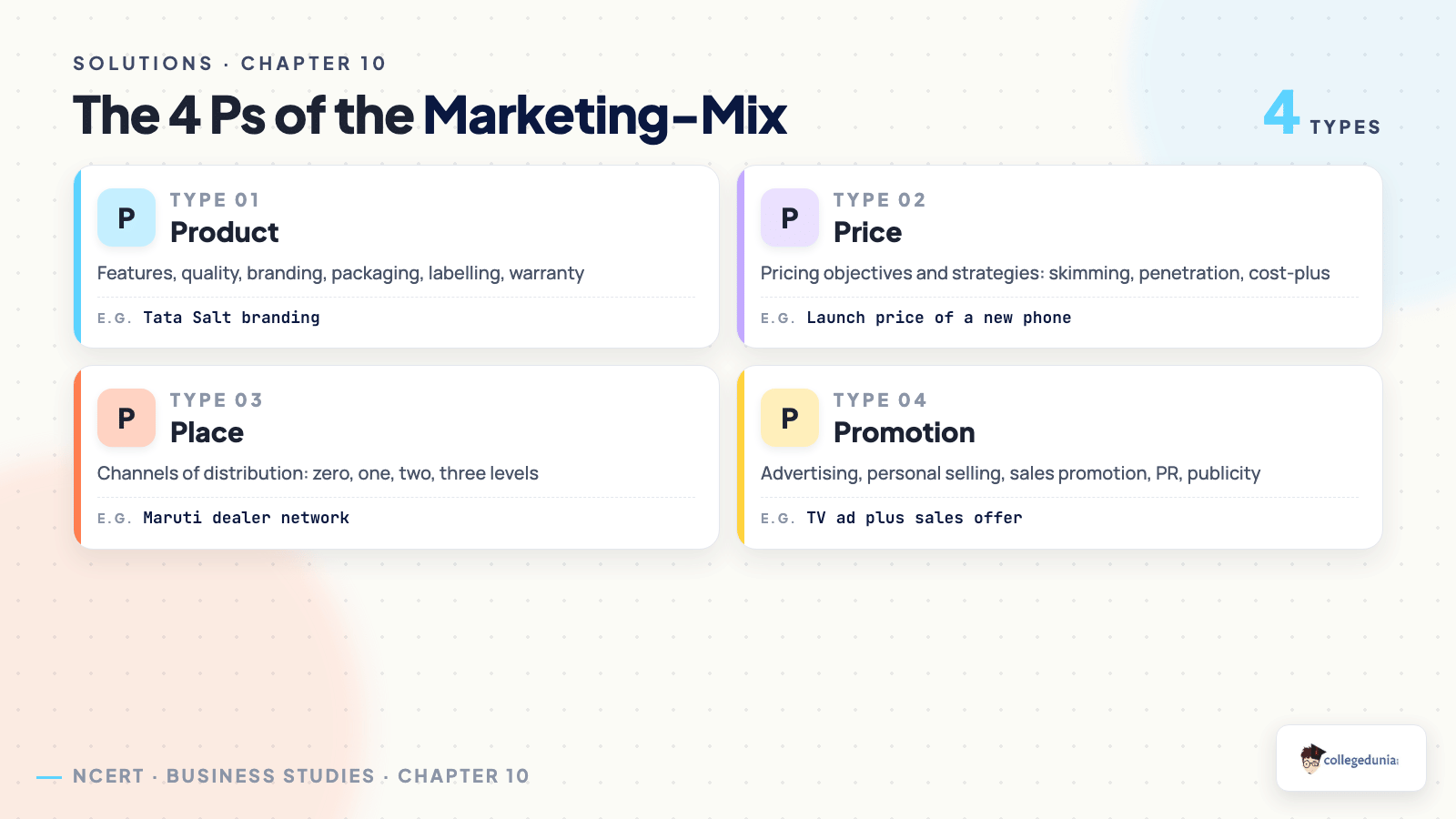
The marketing-mix has four elements known as the 4 Ps: (1) Product (features, quality, branding, packaging, labelling, warranty); (2) Price (pricing objectives, level, discounts, strategies like skimming, penetration and cost-plus); (3) Place (zero-, one-, two- and three-level channels of distribution, transport, warehousing, inventory); and (4) Promotion (advertising, personal selling, sales promotion, public relations, publicity).
What is the difference between Brand, Brand Name, Brand Mark and Trade Mark?
Brand is the overall name, term, symbol or design that identifies the seller's product. Brand Name is the part of a brand that can be spoken (e.g. Tata Salt). Brand Mark is the part of a brand that can be recognised but not spoken (e.g. the Tata logo). Trade Mark is a brand or part of a brand that has been given legal protection so no other firm can use it.
What is the difference between the marketing concept and the selling concept?
The marketing concept starts with the customer: it identifies needs and wants and designs the offering to satisfy them, aiming at long-term profit through satisfaction. The selling concept starts in the factory: it pushes existing products through heavy selling and promotion, aiming at short-term profit through sales volume. Marketing is outside-in; selling is inside-out.
What are the five tools of the promotion-mix?
The promotion-mix has five tools: (1) Advertising (paid, non-personal, mass communication); (2) Personal Selling (face-to-face, two-way, high cost per contact); (3) Sales Promotion (short-term incentives like discounts, coupons, free gifts); (4) Public Relations (managing the firm's image through publicity, press releases, corporate communication, lobbying and counselling); and (5) Publicity (non-personal, unpaid, third-party news coverage). Firms blend the five tools according to product and target customer.
Where can I download the Class 12 Business Studies Chapter 10 Marketing NCERT Solutions PDF?
You can download the Collegedunia Class 12 Business Studies Chapter 10 Marketing NCERT Solutions PDF free of cost from this page. The PDF is aligned to the NCERT Reprint 2026-27 syllabus and includes step-by-step answers, comparison tables, the five philosophies, twelve functions of marketing and the five-tool promotion-mix.



Comments