




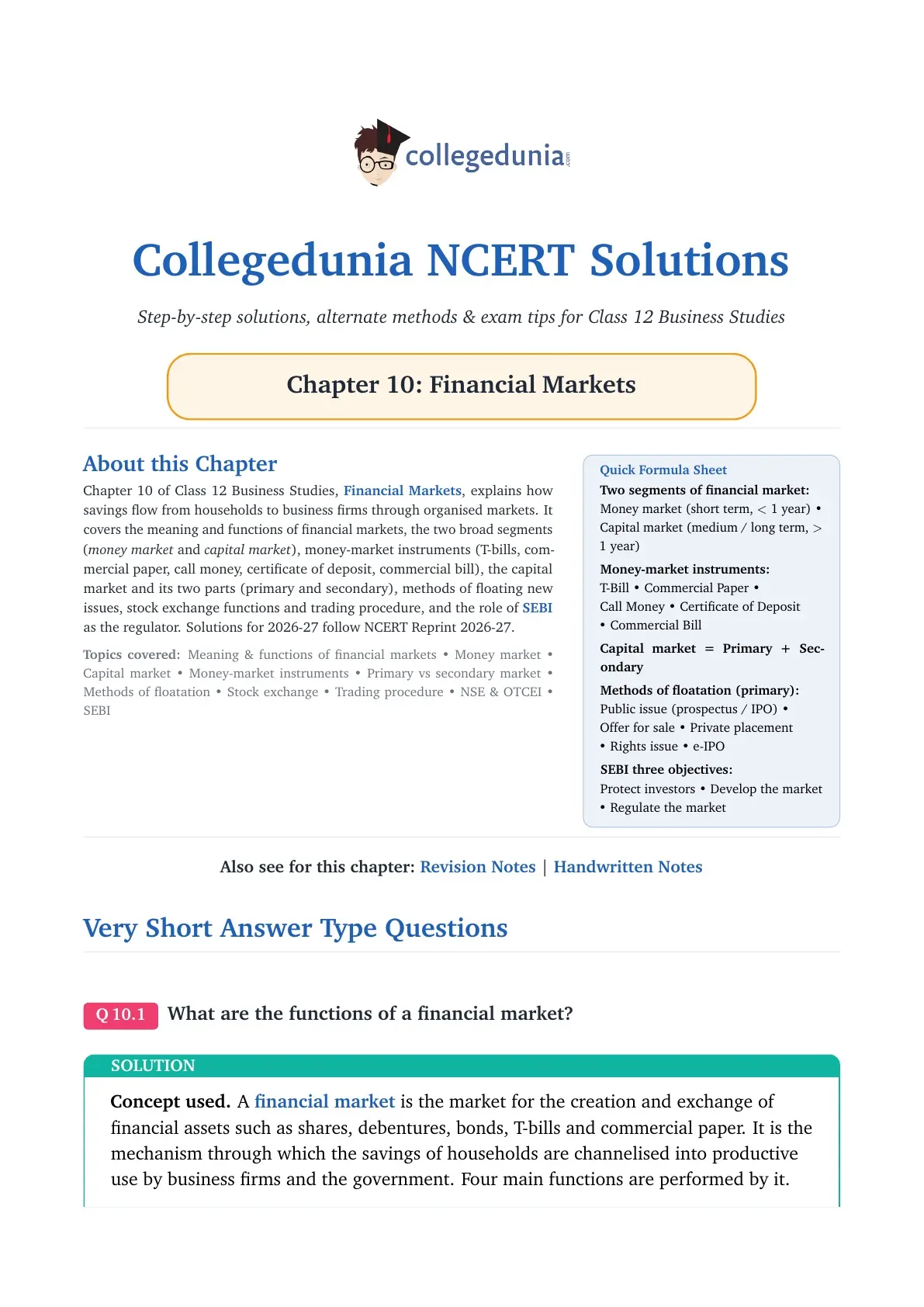
NCERT Solutions for Class 12 Business Studies Chapter 10 Financial Markets cover the 2026-27 CBSE syllabus with step-by-step answers: meaning and four functions of a financial market, money vs capital market, five money-market instruments (T-Bill, Commercial Paper, Call Money, CD, Commercial Bill), primary vs secondary market, methods of floatation, stock exchange, NSE, OTCEI, SEBI and the six-step trading procedure.

- CBSE Weightage: 6 to 10 marks (Unit 3, Business Finance and Marketing)
- Questions Solved: 17 NCERT exercise questions (5 Very Short, 4 Short, 8 Long Answer)
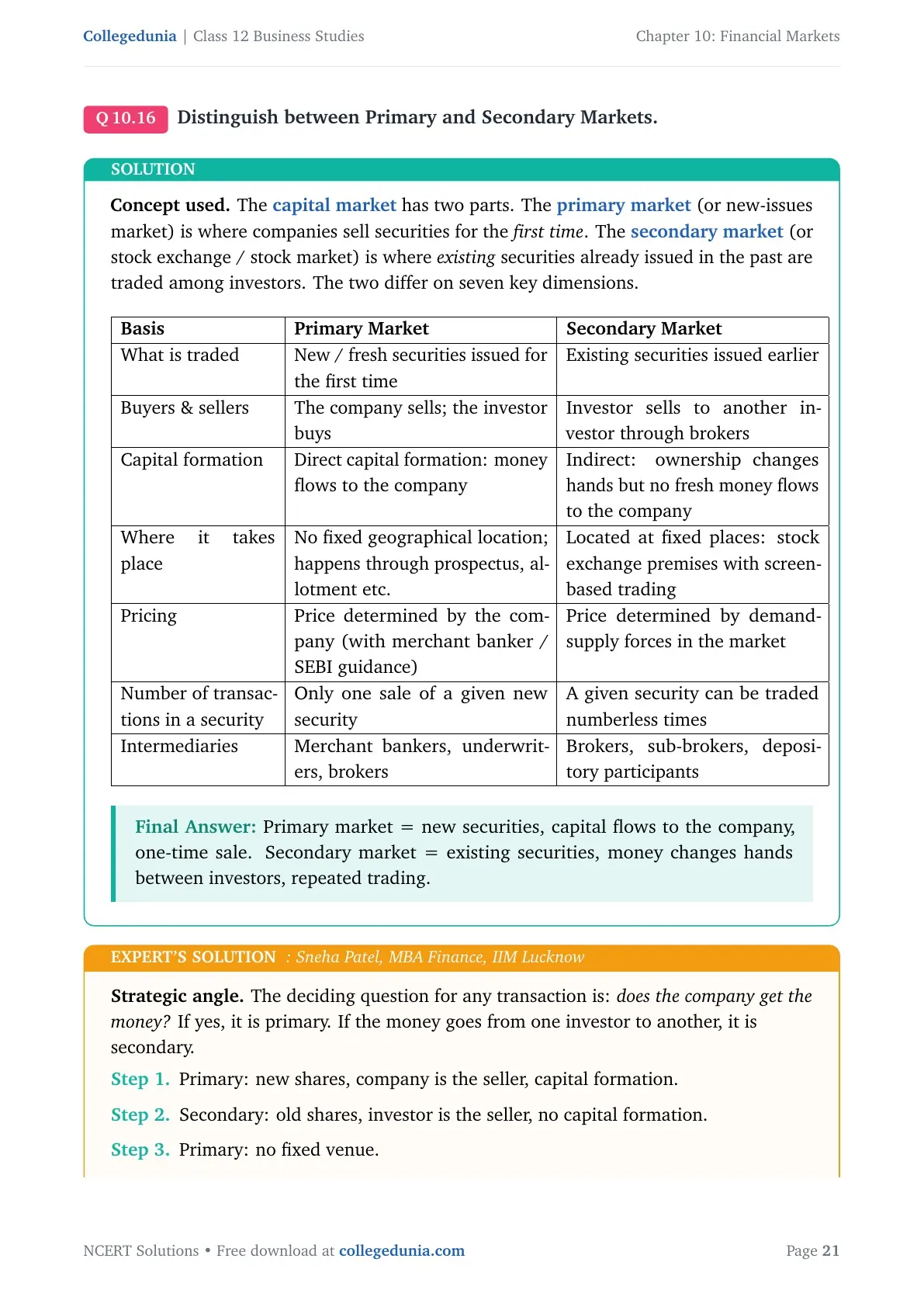
The Financial Markets Class 12 NCERT Solutions PDF is written for a first-time reader of the chapter and for a board-exam candidate revising the night before. Every answer opens with a Concept Used block that defines the rule being applied, walks through every step in order, and closes with a boxed final answer for last-minute revision. Comparison tables (money vs capital market, primary vs secondary market) are written in the format CBSE examiners actually award marks for.
Financial Markets Class 12 NCERT Solutions: Topic Map
The 17 NCERT exercise questions span every concept the CBSE exam touches in this chapter. The topic map below tags each section to its concept and the marks it usually carries in the board paper.
| Section | What is Covered | Marks in the Board Exam |
|---|---|---|
| 1. Functions of Financial Market | Four functions: Mobilisation, Price discovery, Liquidity, Reduce transaction cost | 3 to 4-mark; mnemonic M-P-L-R |
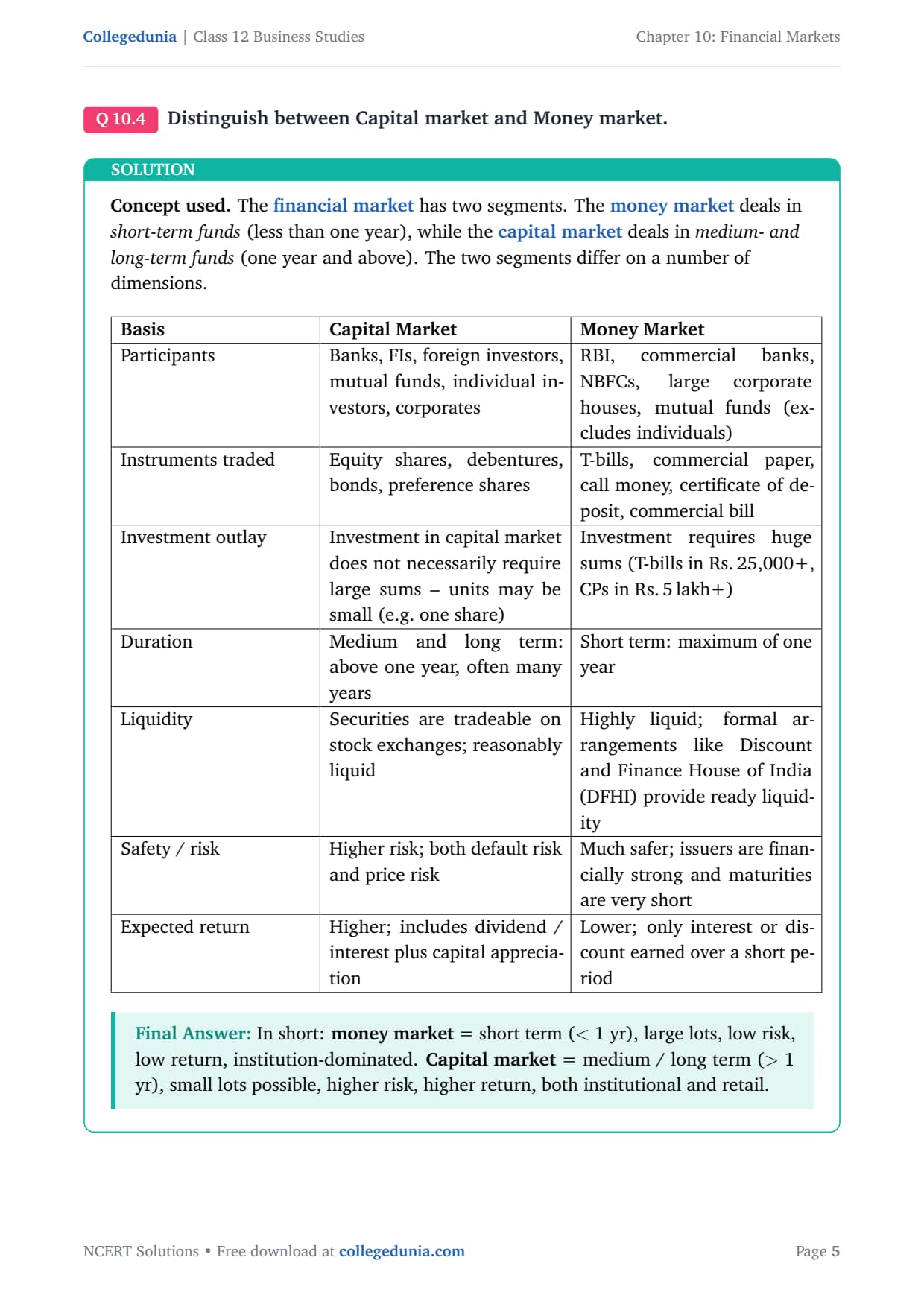
| 2. Money Market vs Capital Market | Money Market = short-term (less than 1 year); Capital Market = Primary + Secondary (medium and long-term) | 4 to 6-mark; two-column table |
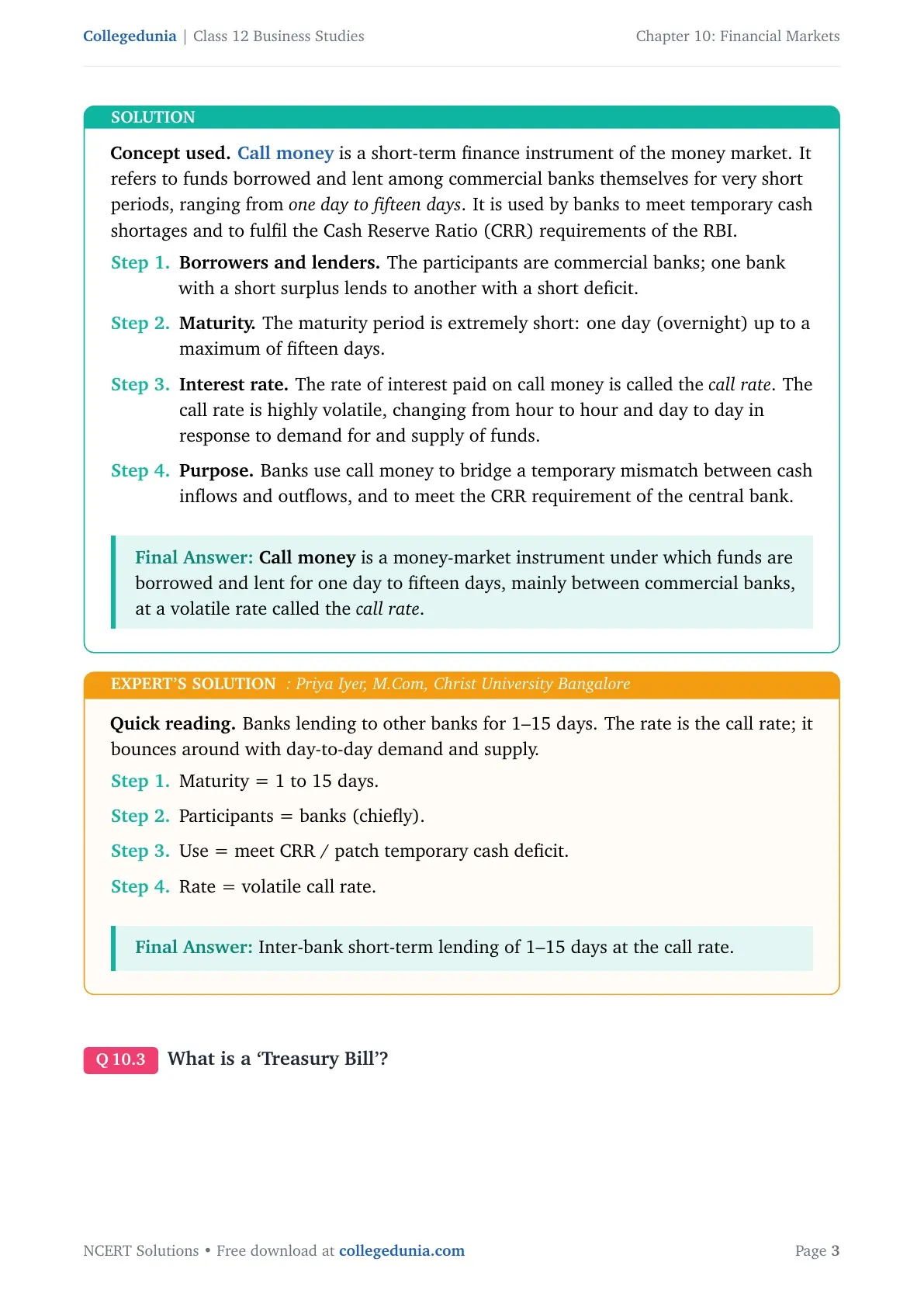
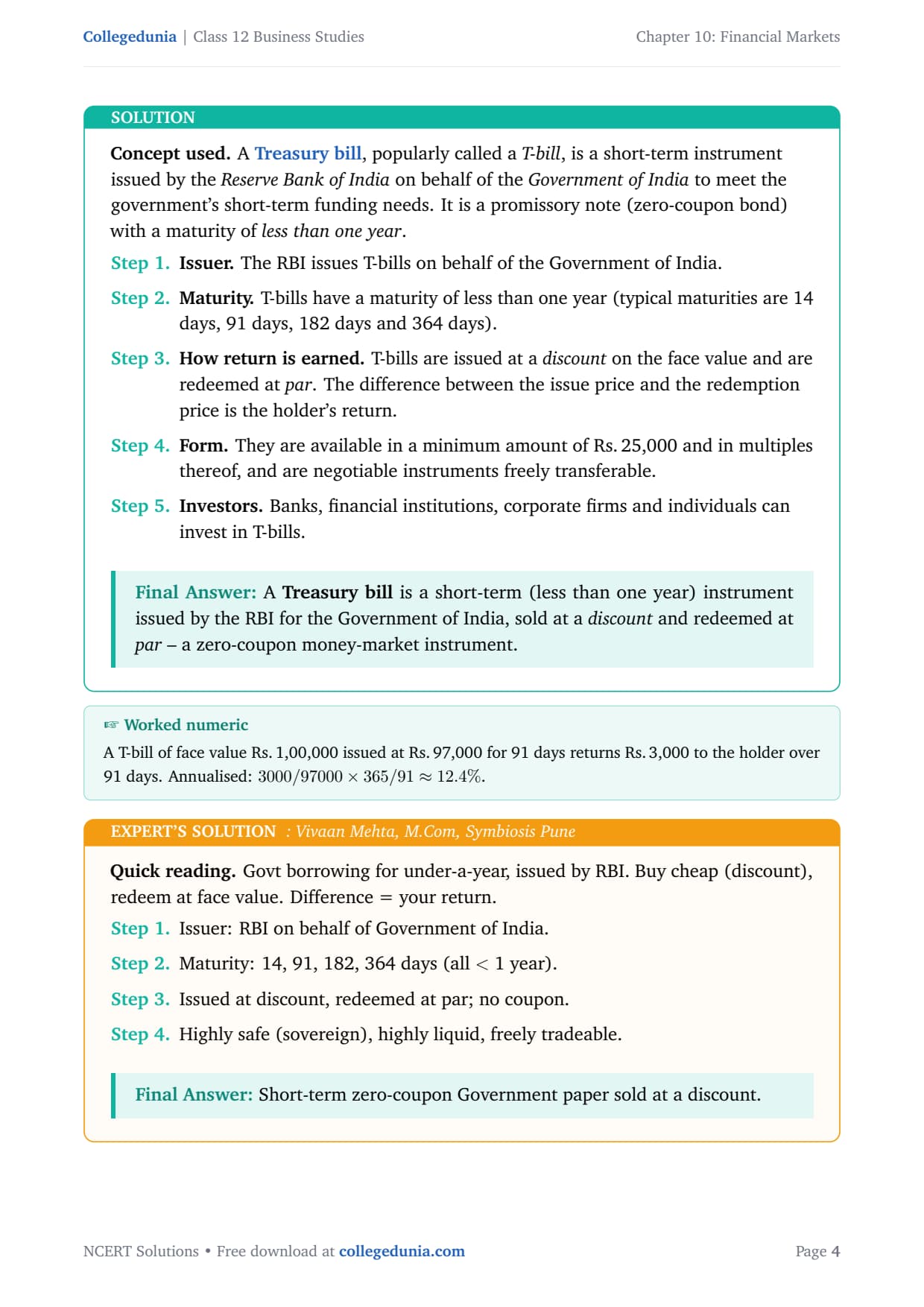
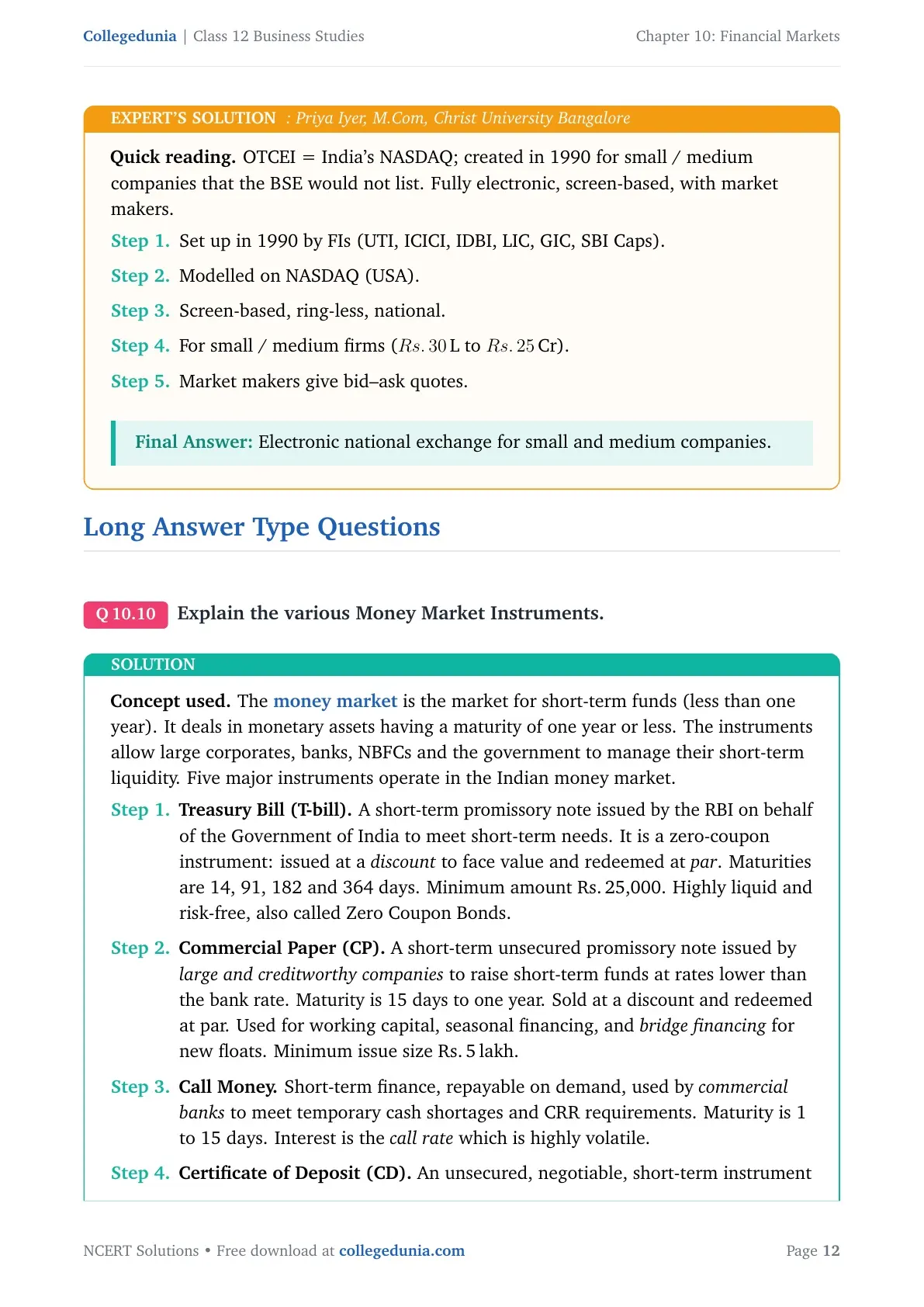
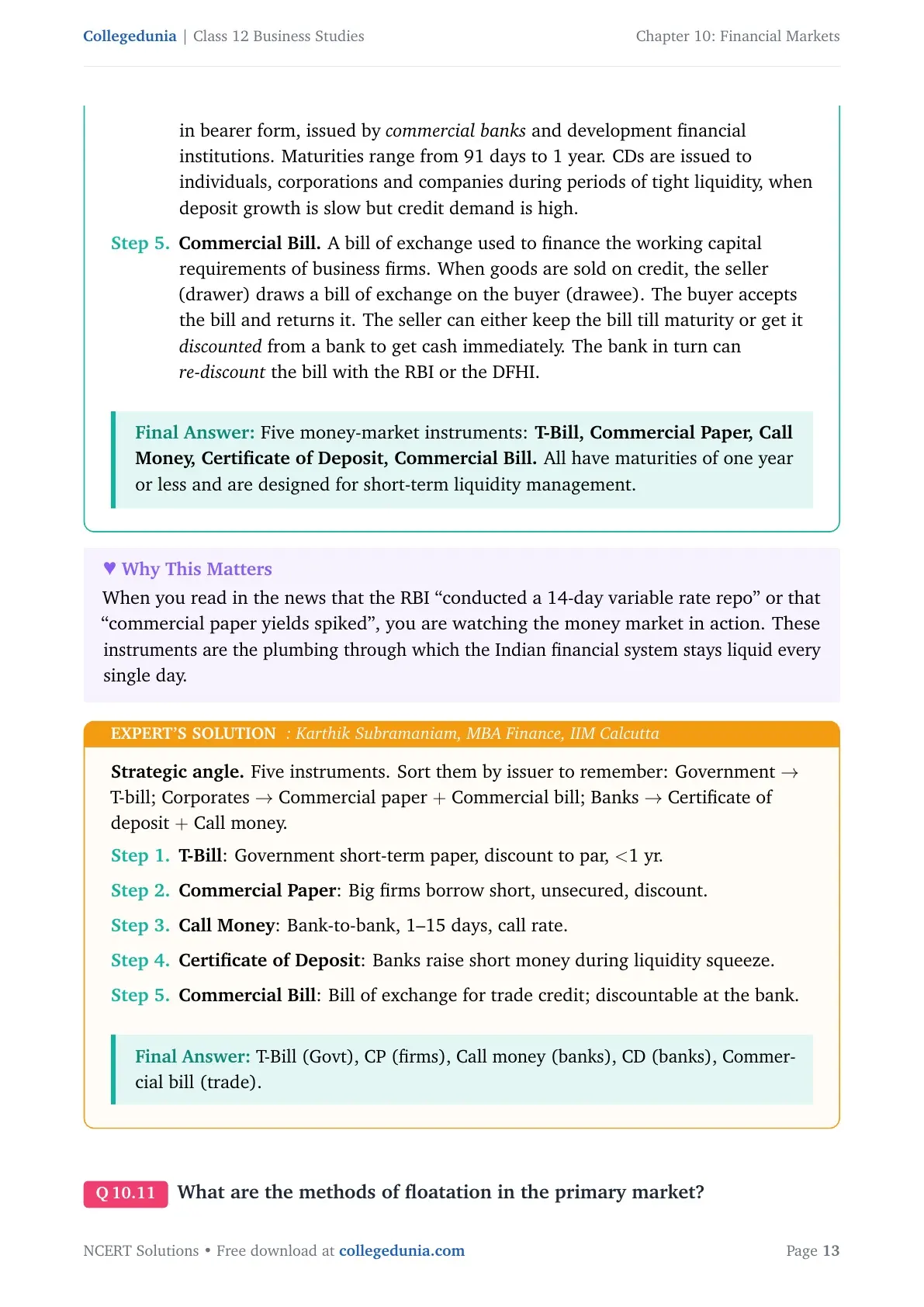
| 3. Money Market Instruments (5) | T-Bill (RBI, zero-risk, Rs 25,000 min, 14/91/182/364 days, issued at discount), Commercial Bill, Commercial Paper (15 days to 1 year, introduced 1990), Call Money (1 to 15 days, inter-bank), Certificate of Deposit (Rs 1 lakh min) | 6-mark long answer; issuer + maturity + ticket size |
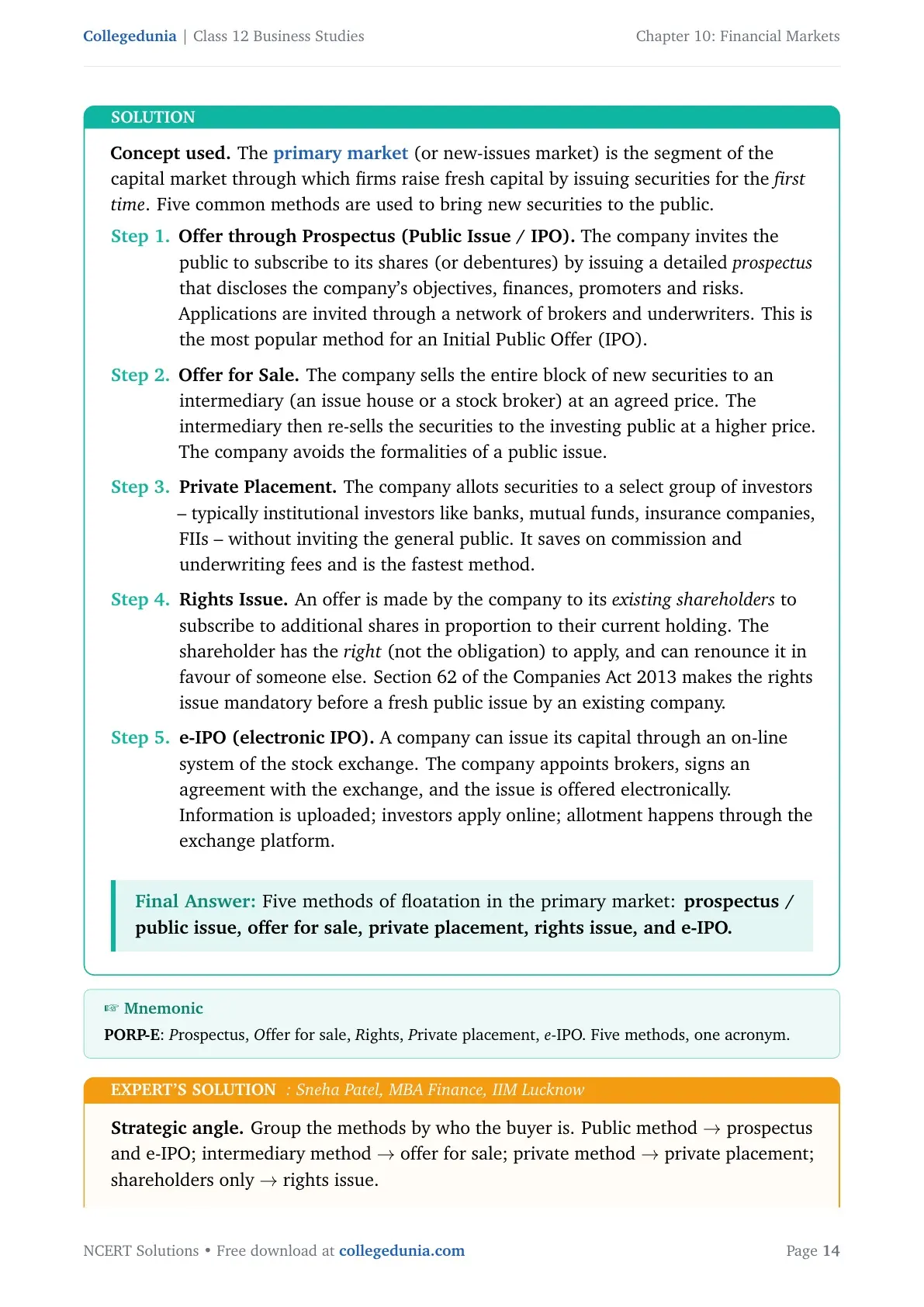
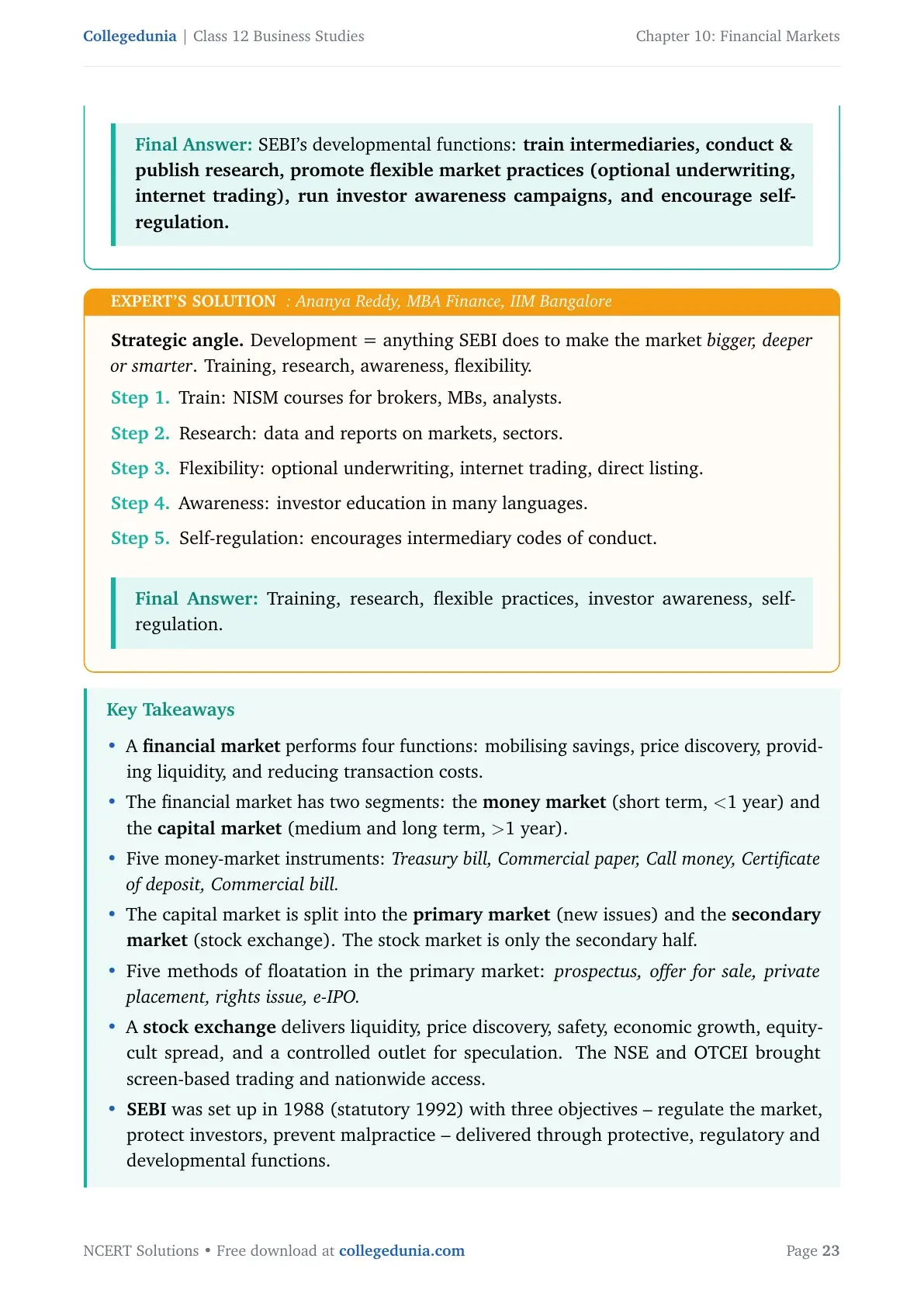
| 4. Primary Market: Five Methods of Floatation | Prospectus, Offer for Sale, Rights Issue, Private Placement, e-IPO (plus Bonus Issue) | 4 to 6-mark; PORP-E mnemonic |
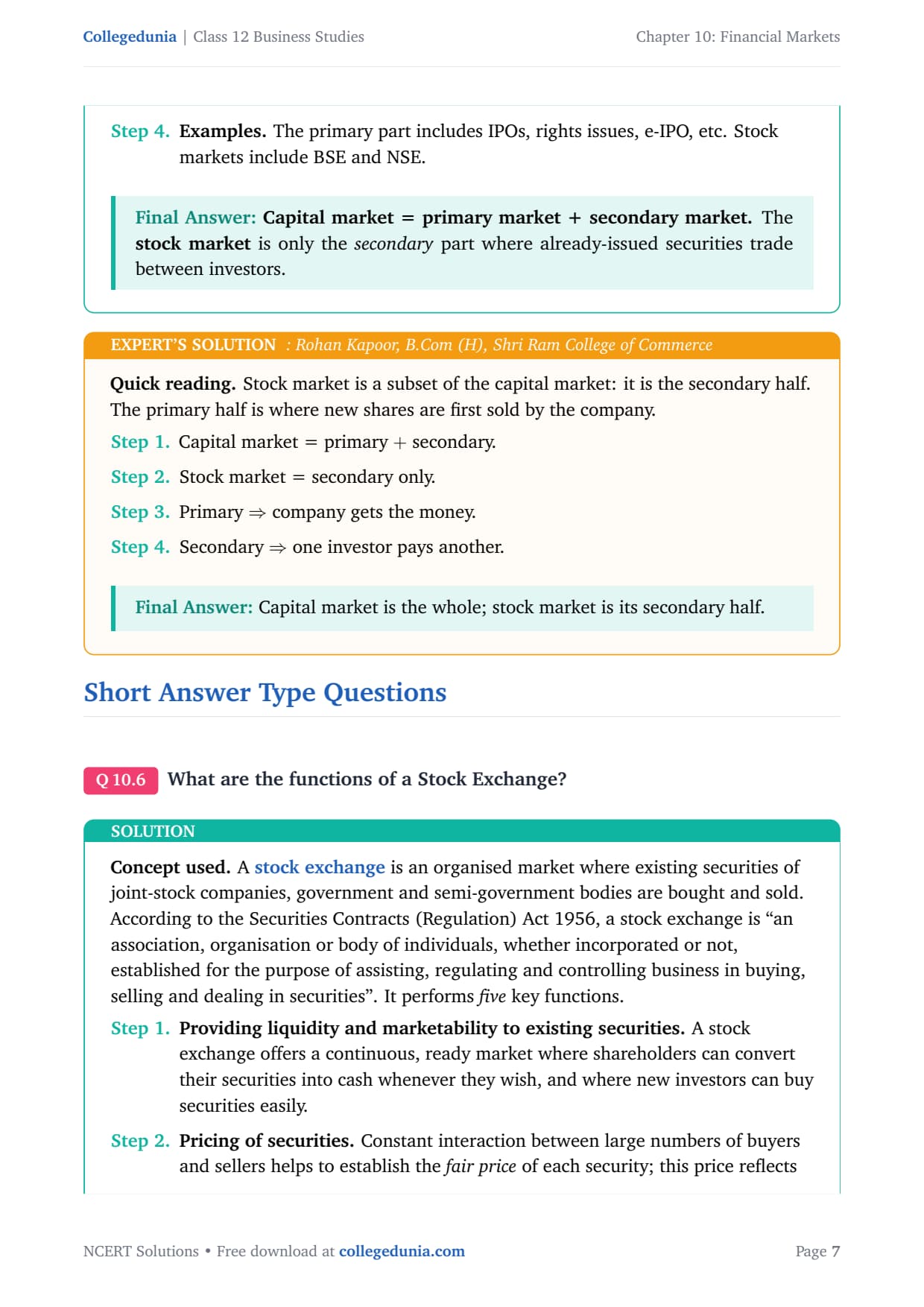
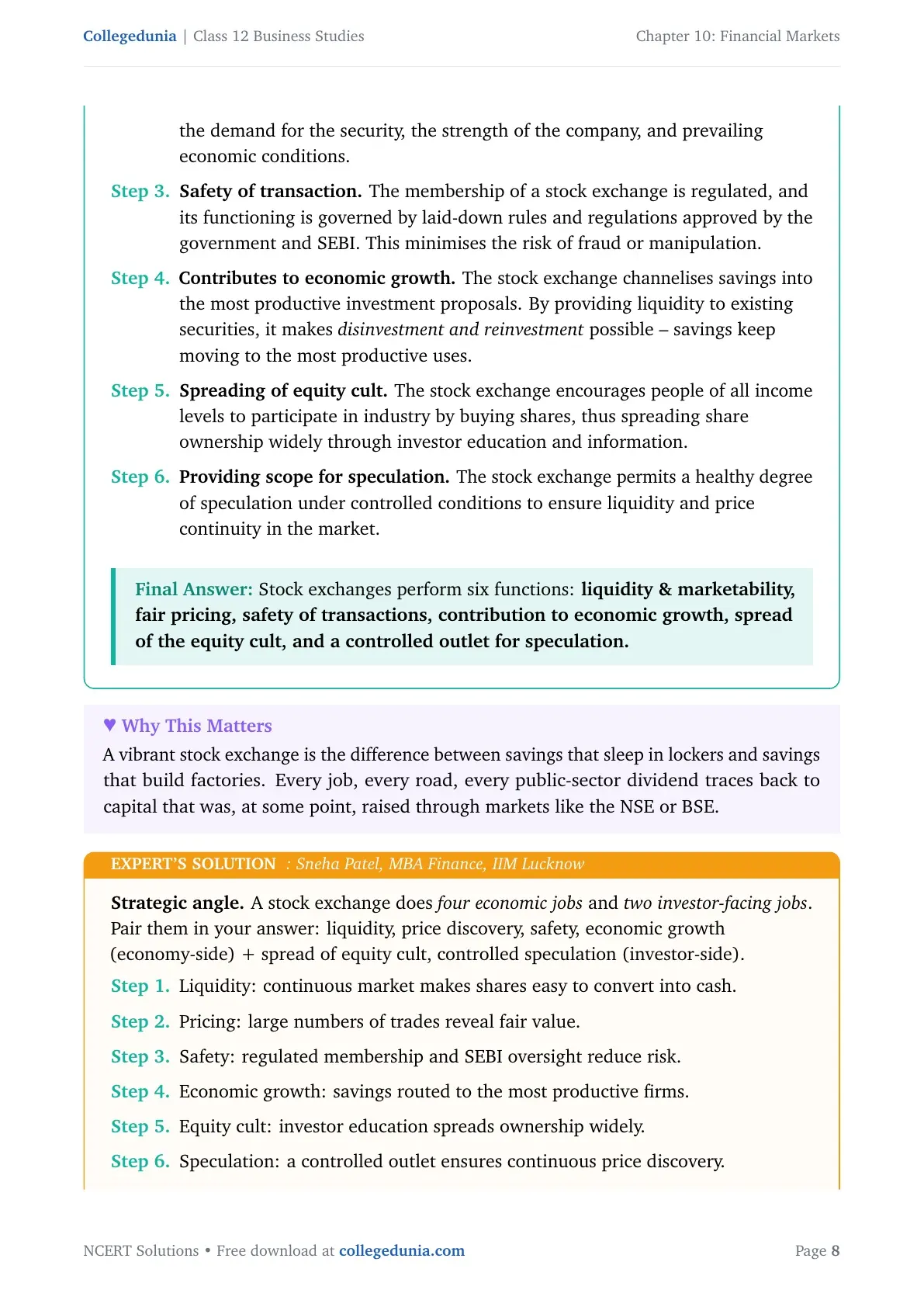
| 5. Secondary Market: BSE and NSE | BSE (1875, oldest in Asia), NSE (1992, screen-based, nationwide); indices Sensex (BSE) and Nifty 50 (NSE) | 4 to 6-mark; stock exchange functions |
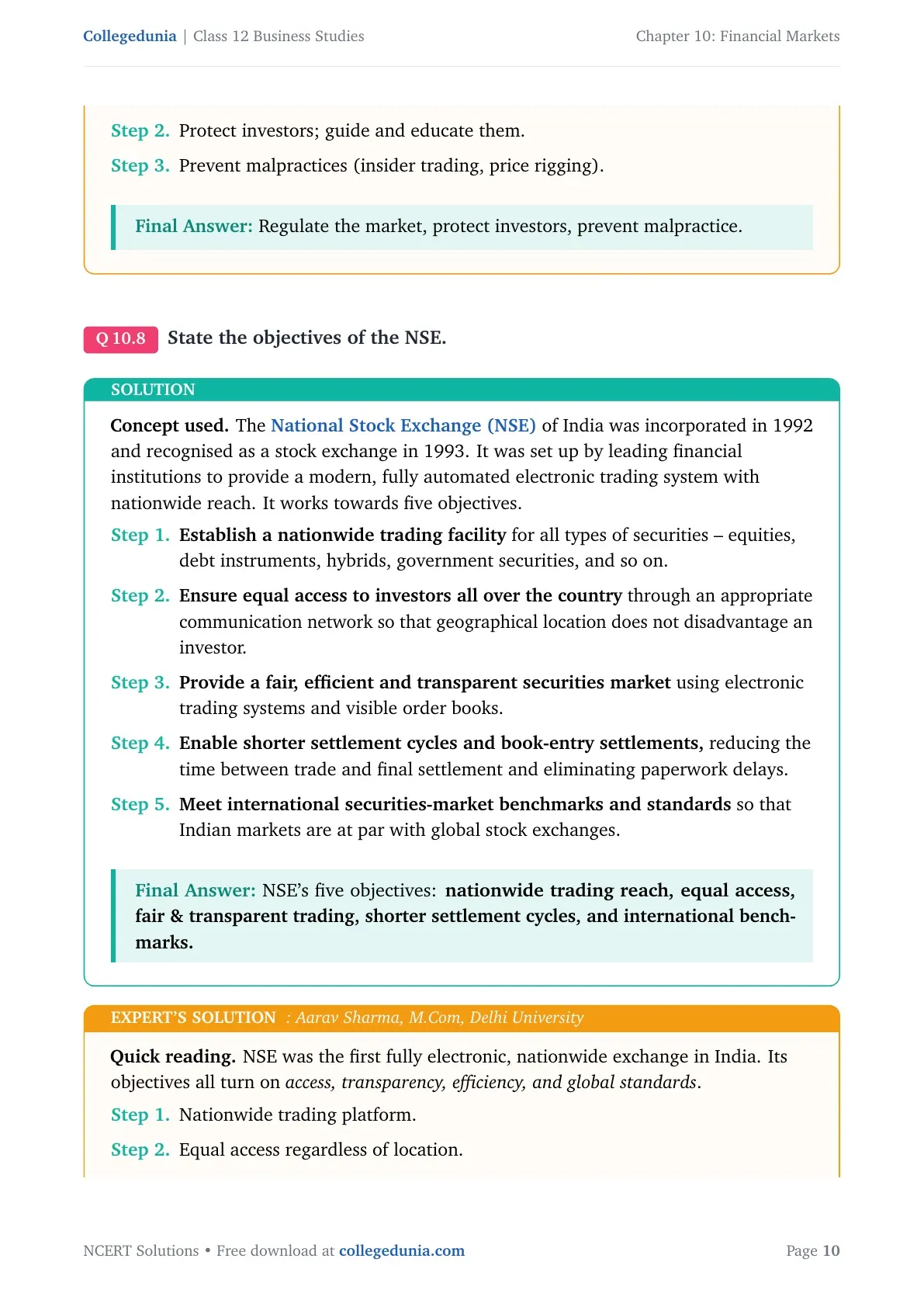
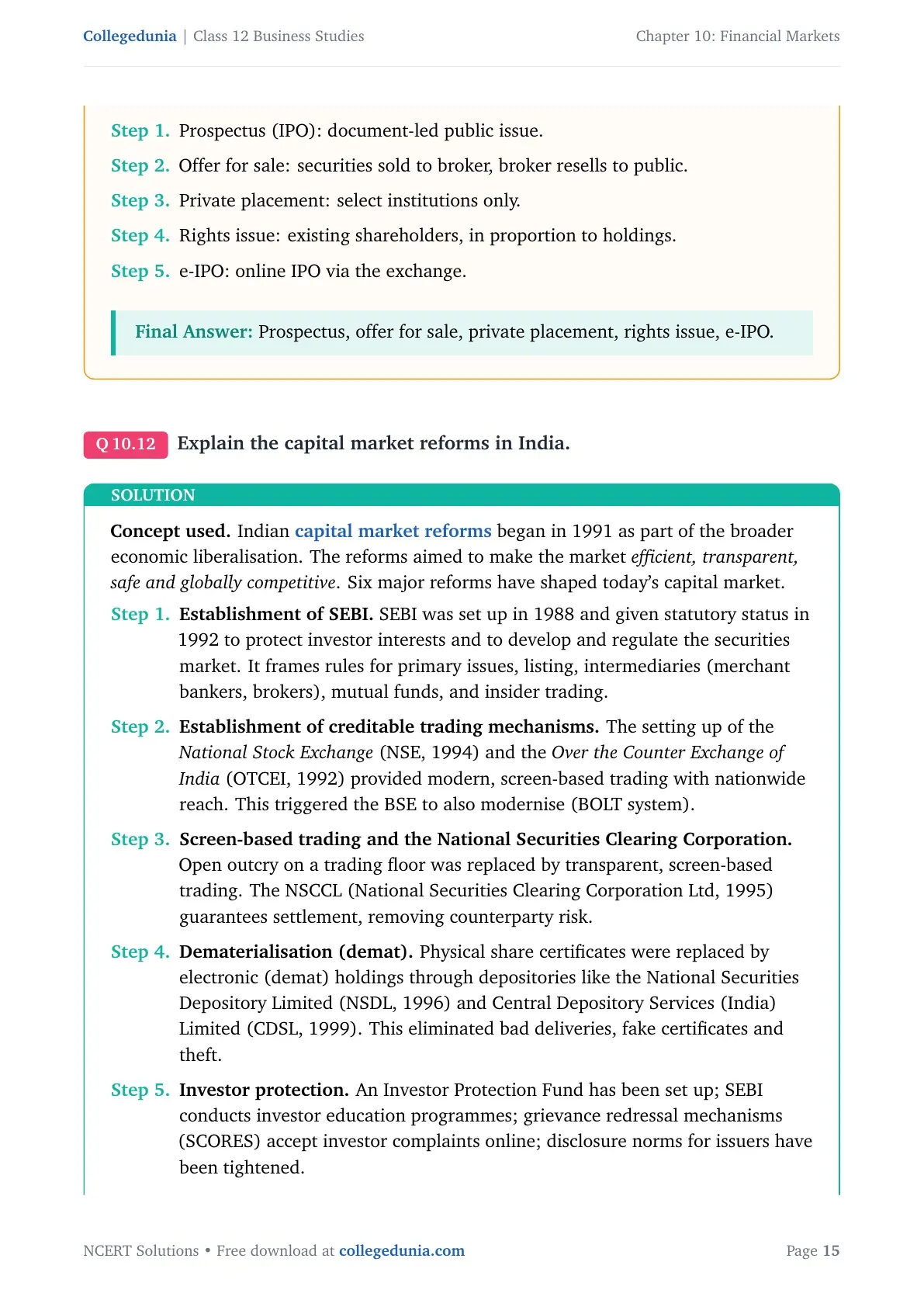
| 6. NSE Objectives | Five objectives: nationwide reach, equal access, transparency, T+2 rolling settlement, global benchmarks | 3 to 4-mark |
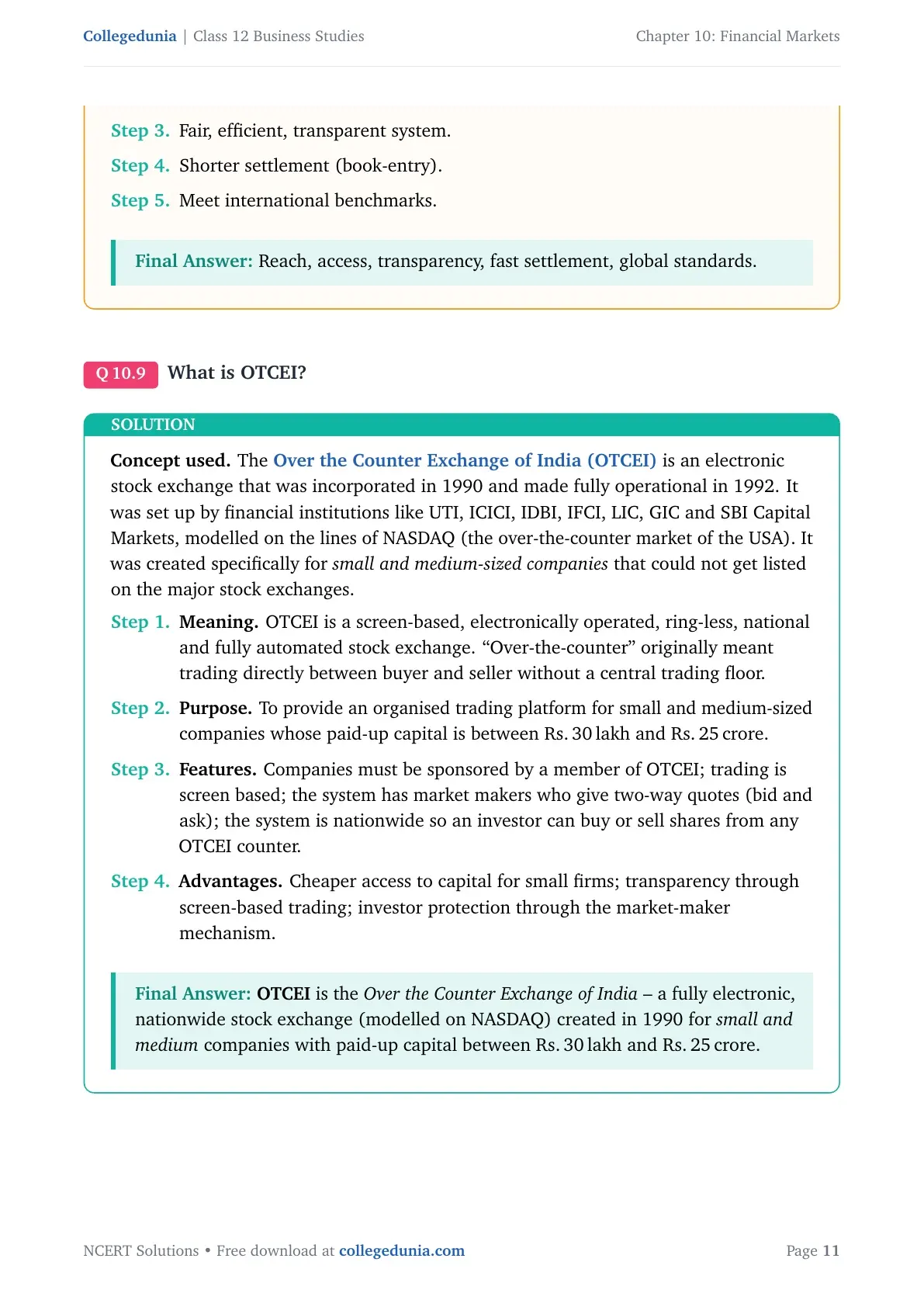
| 7. OTCEI | 1990, NASDAQ-modelled, ring-less, for paid-up capital between Rs 30 lakh and Rs 25 crore | 3-mark short note |
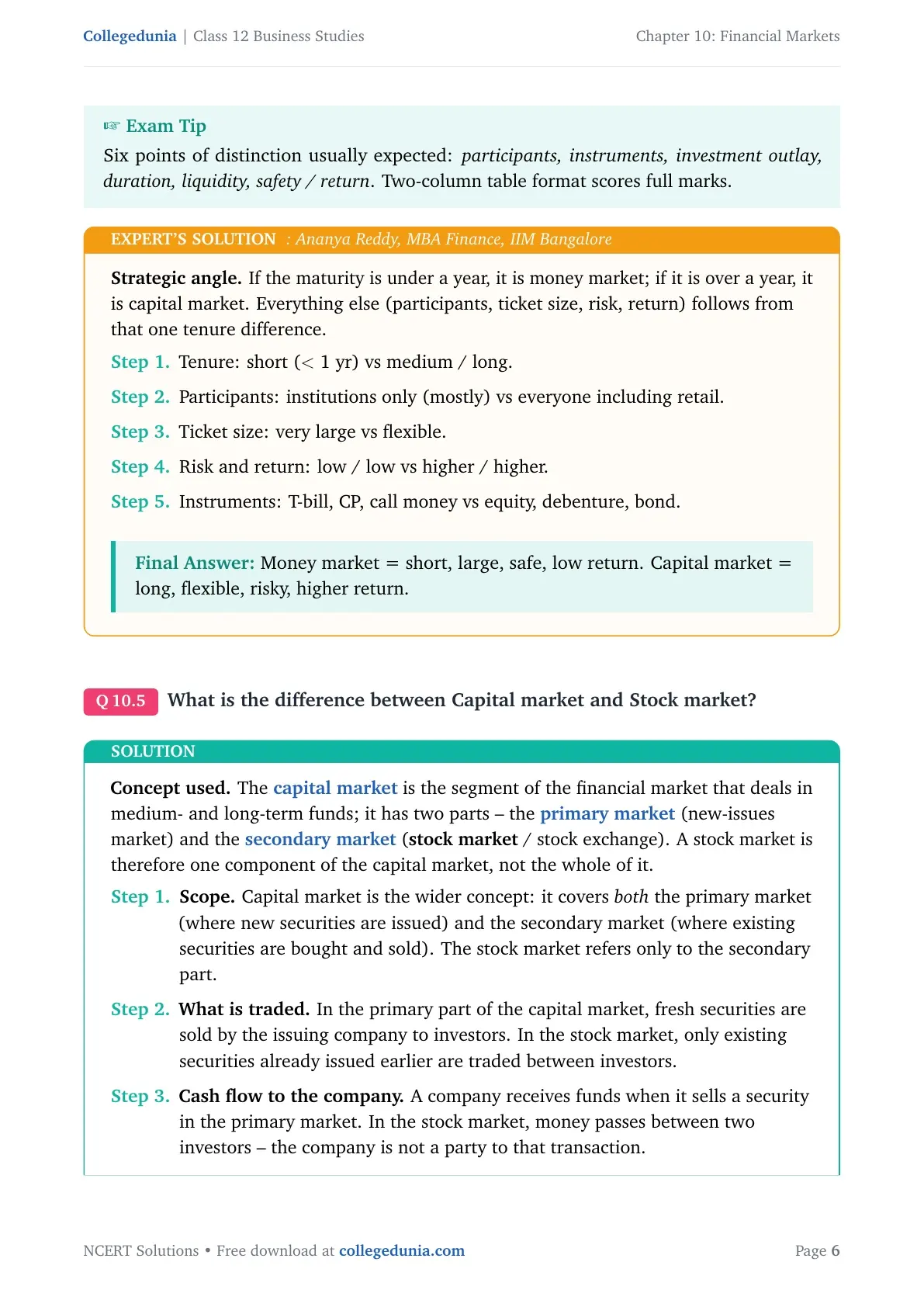
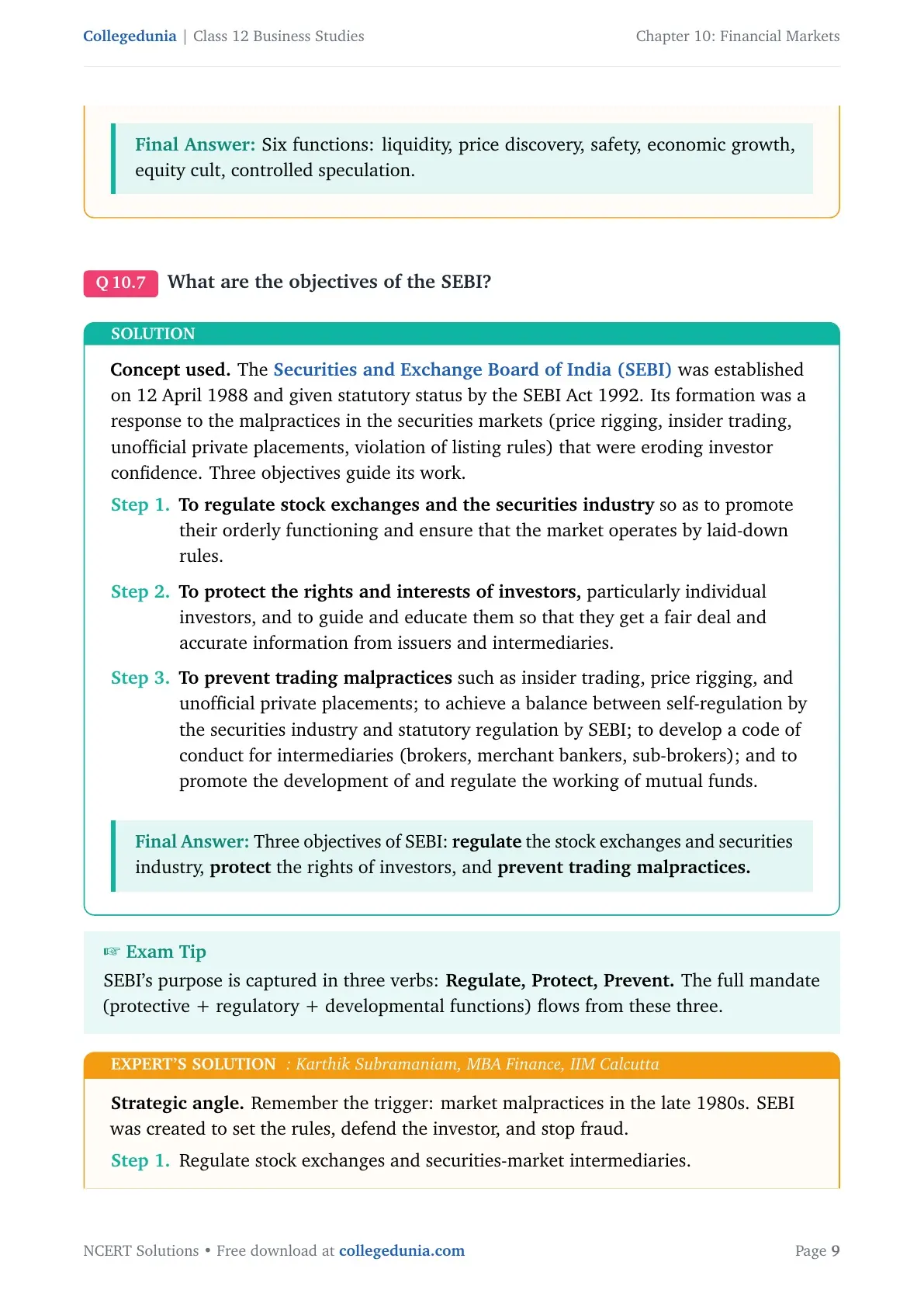
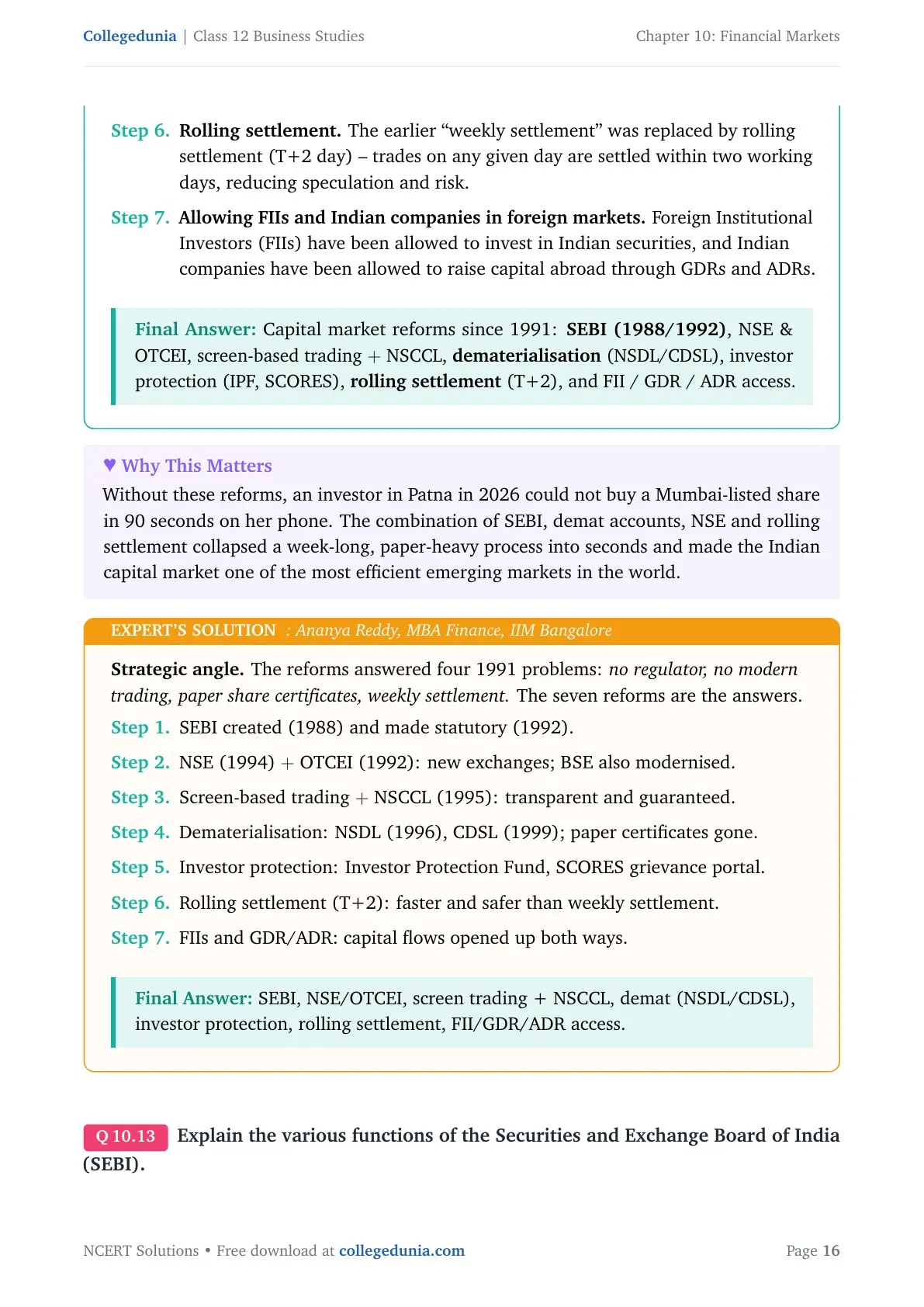
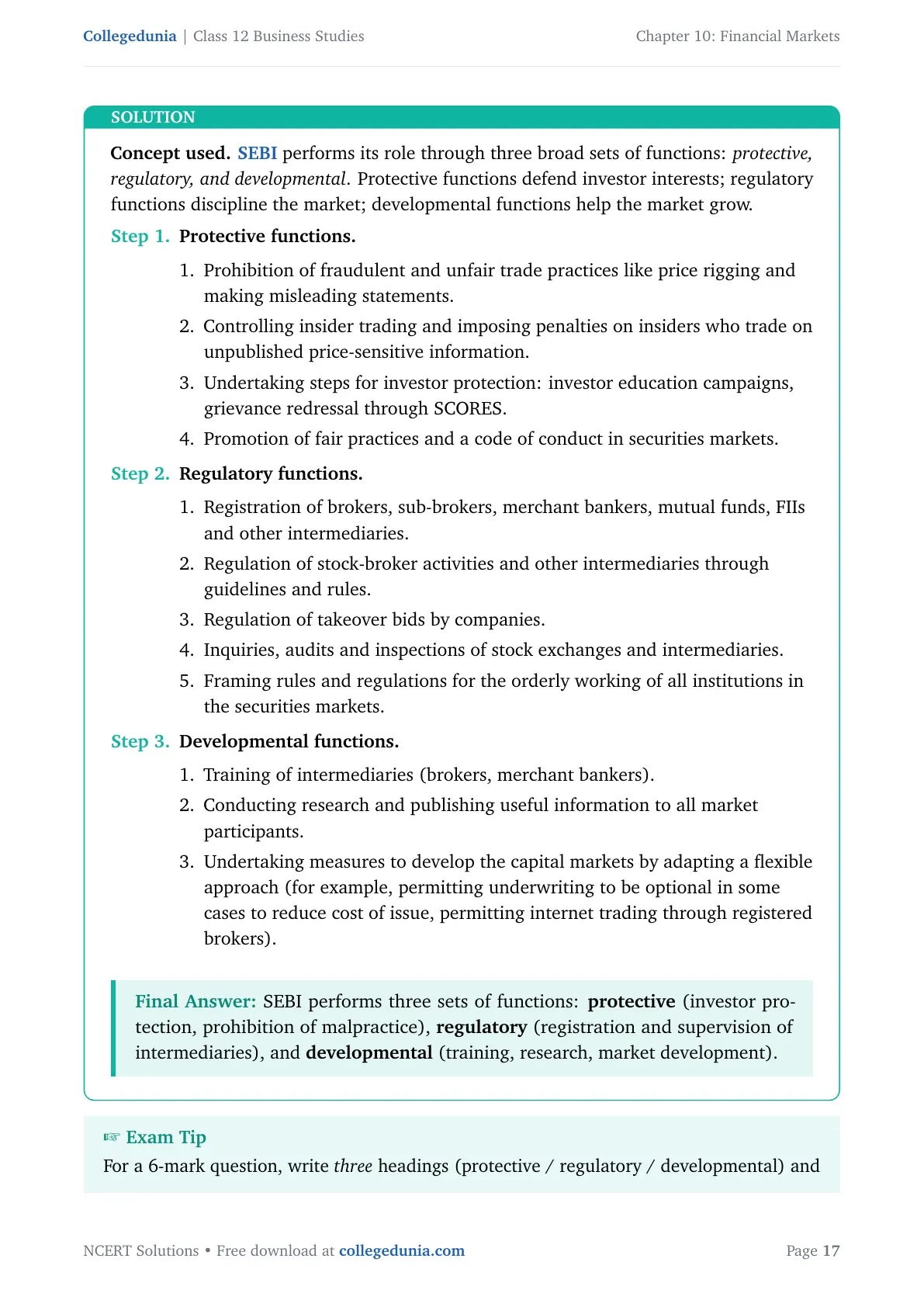
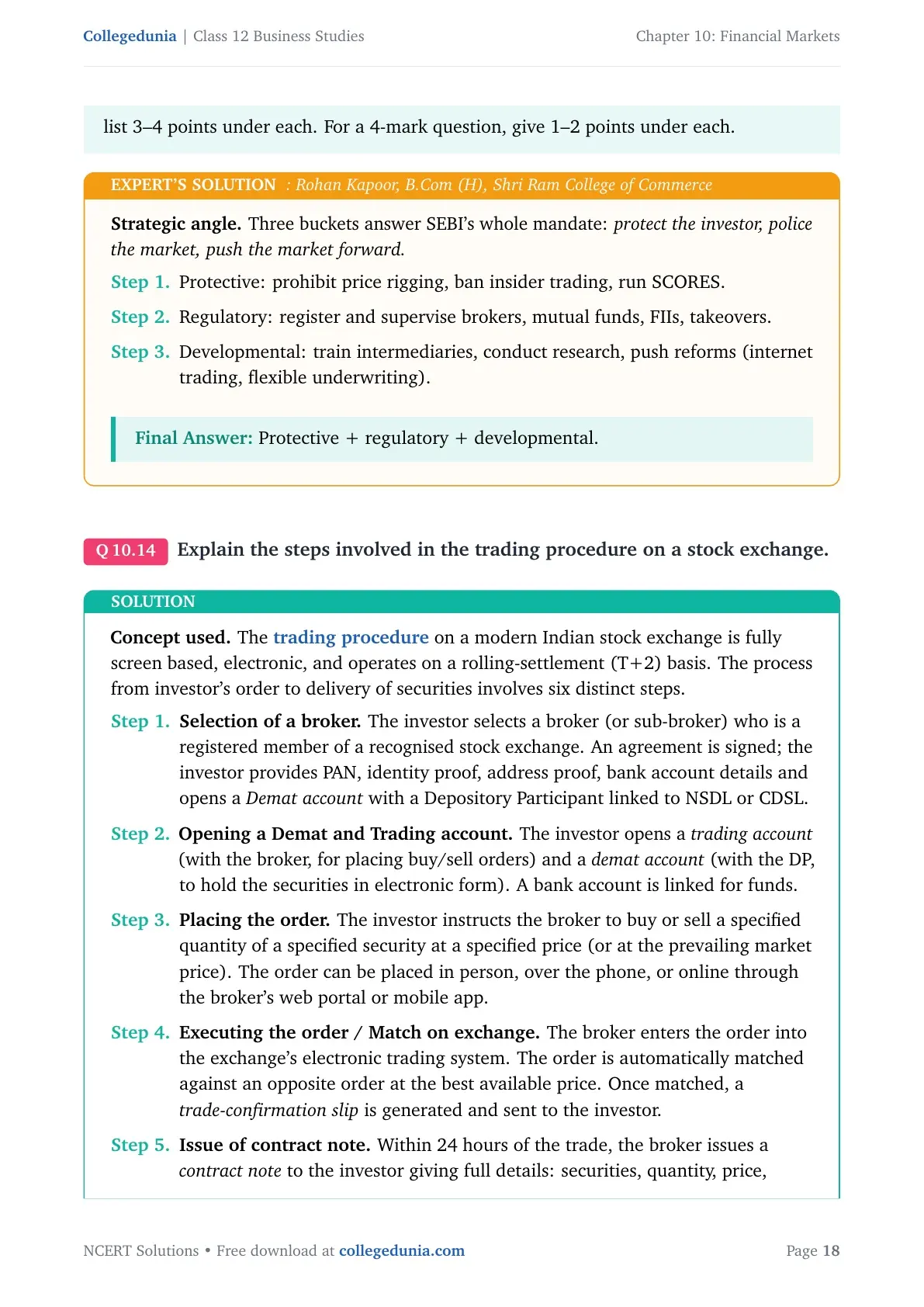
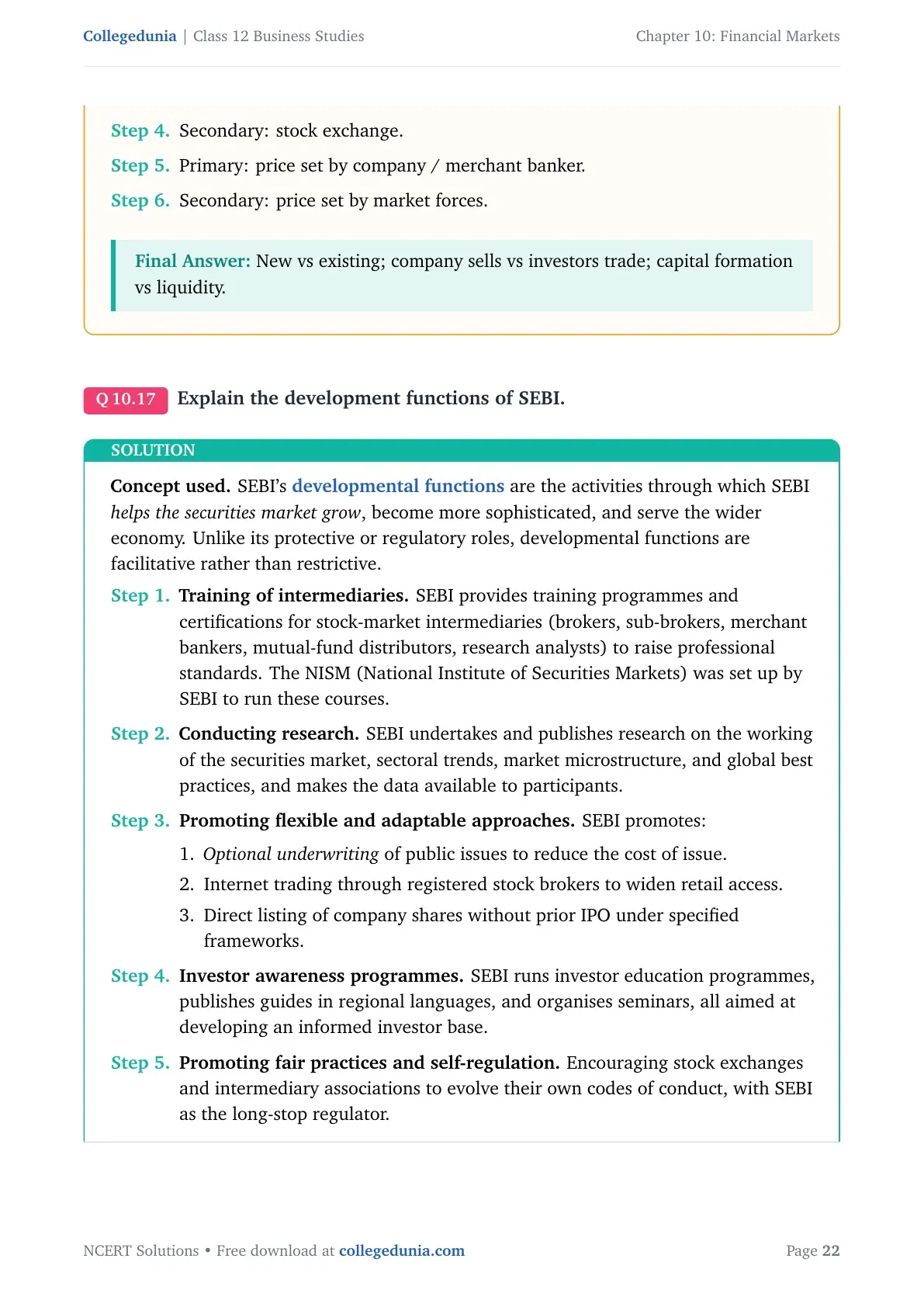
| 8. SEBI's Three Sets of Functions | SEBI established 1988, statutory status 1992; three function groups: Regulatory, Developmental, Protective | 6-mark long answer favourite |
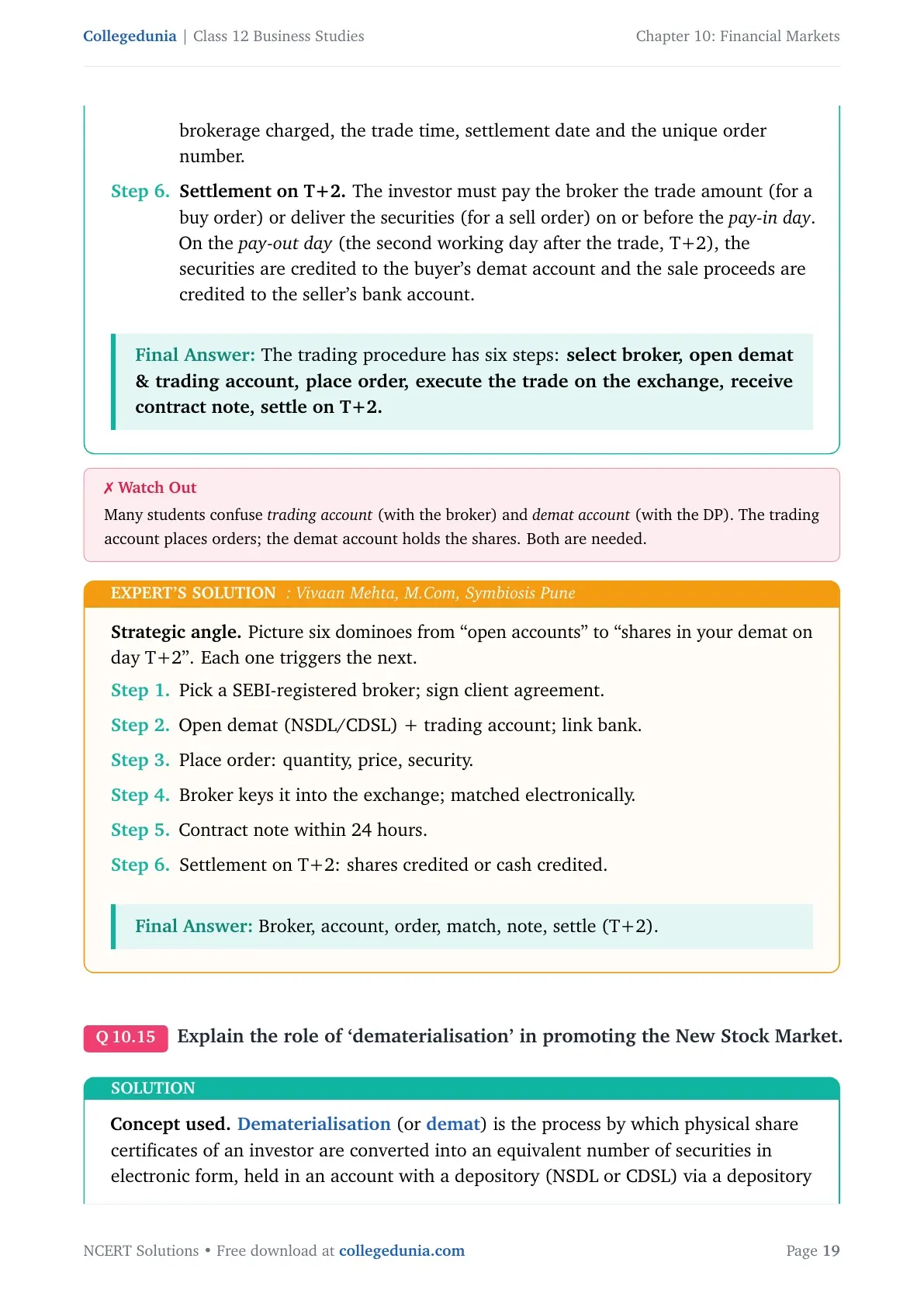
| 9. Trading Procedure | Demat to Order to Execution to T+2 rolling settlement | 4 to 6-mark; demat vs trading account |
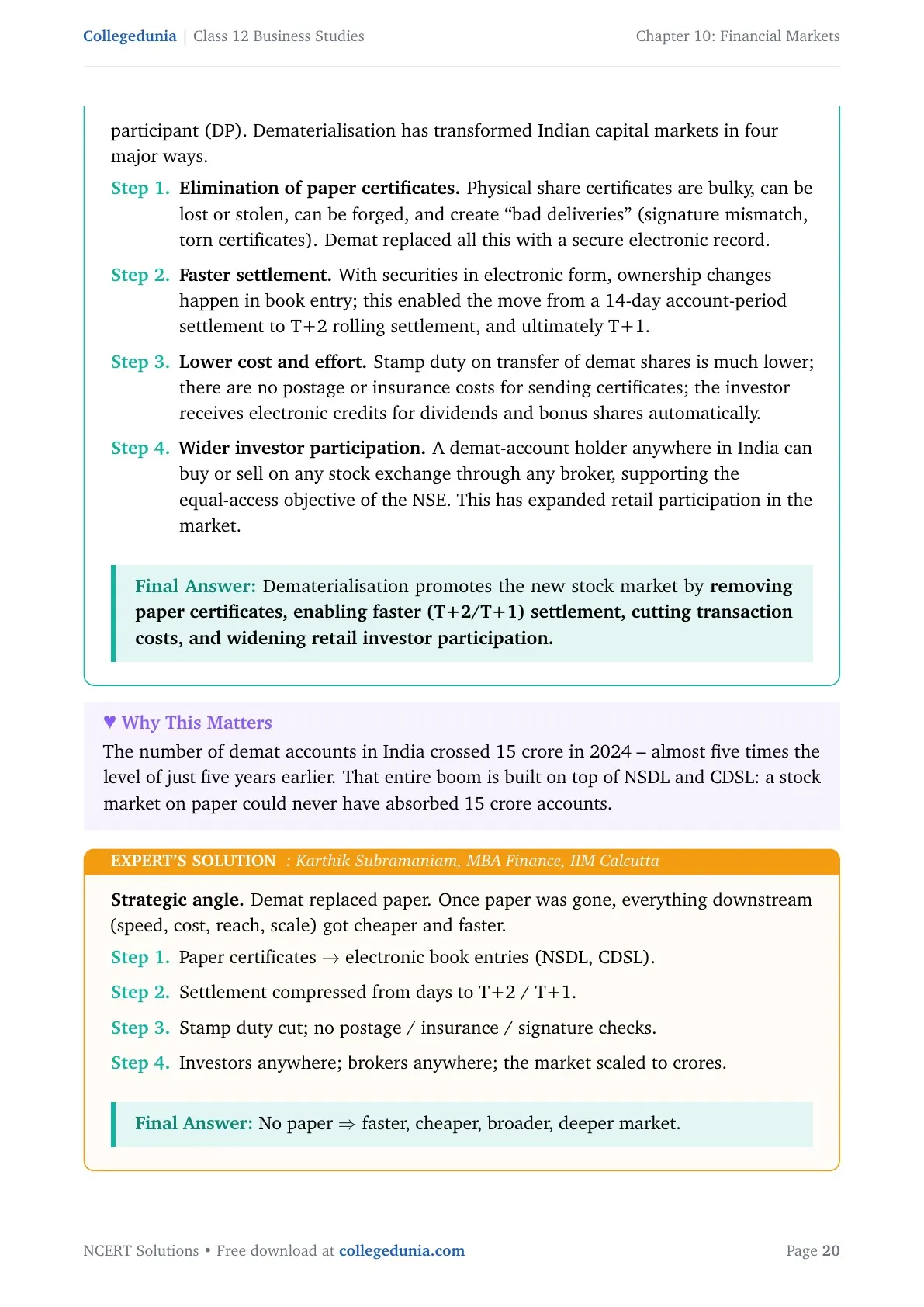
| 10. Dematerialisation | NSDL (1996), CDSL (1999); paper to electronic; rolling settlement | 3 to 4-mark |
What the Class 12 Business Studies Chapter 10 NCERT Solutions PDF Contains
- Question-wise step-by-step answers to all 17 NCERT exercise questions (5 Very Short Answer, 4 Short Answer, 8 Long Answer).
- Concept Used block at the start of every solution naming the model, instrument or regulation being applied.
- Boxed Final Answer at the end of every solution for last-minute revision.
- Comparison tables for money vs capital market and primary vs secondary market in the CBSE 6-row format.
- Five-instrument money-market grid (T-Bill, CP, Call Money, CD, Commercial Bill) with maturity, issuer, return mechanism, ticket size.
- Cross-links to Notes, Handwritten Notes and the NCERT Book PDF for the same chapter.
Marks Distribution Across the 17 NCERT Questions
The Class 12 Business Studies board paper typically picks 2 or 3 questions from this chapter, distributed across the three answer-length brackets. The split below mirrors how the exercise itself is graded.
| Question Type | How Many in the Exercise | Typical Board Marks | What the Board Asks |
|---|---|---|---|
| Very Short Answer | 5 questions | 1 to 3 marks each | "Define Treasury Bill" or "Distinguish in one line" |
| Short Answer | 4 questions | 4 marks each | "State functions of a Stock Exchange" or "Objectives of NSE" |
| Long Answer | 8 questions | 5 to 6 marks each | "Explain the various money-market instruments" or "Functions of SEBI" |
Common Mistakes Students Make in Financial Markets Class 12
Five of the ten lost marks in this chapter come from the same handful of mix-ups. Each one has a single keyword that points to the right answer.
| Common Mistake | Why It Costs Marks | How to Fix It |
|---|---|---|
| Treating Capital Market and Stock Market as the same | Stock market is only the secondary half of the capital market | Write: Capital Market = Primary Market + Secondary Market (Stock Exchange) |
| Confusing Demat Account with Trading Account | Trading account is with the broker for placing orders; demat is with the DP for holding shares | Both are needed; never the same account |
| Calling Call Money a long-term instrument | Call money is 1 to 15 days, used between commercial banks | Memorise: Call Money = 1 to 15 days, banks only, call rate |
| Listing only 3 functions of SEBI in a 6-mark question | Examiner expects 3 categories x 2 to 3 points each | Use the headings Protective / Regulatory / Developmental; list 2 to 3 points under each |
| Skipping the issuer in a money-market instrument question | RBI issues T-Bills; banks issue CDs; firms issue CPs | Always name the issuer in the first sentence of every instrument answer |
How Collegedunia NCERT Solutions Help You with Financial Markets
The Collegedunia NCERT Solutions are calibrated to the way the CBSE Class 12 board paper actually marks Business Studies questions. Every long answer opens with a Concept-Used block (which is what the examiner is hunting for first), uses the steps the chapter introduces, and closes with a one-line boxed answer that doubles as last-minute revision. The two non-negotiables for this chapter, the SEBI three-fold mandate and the trading procedure, are written in the exact heading + 2-3-bullet structure that earns full marks.
Continue Learning
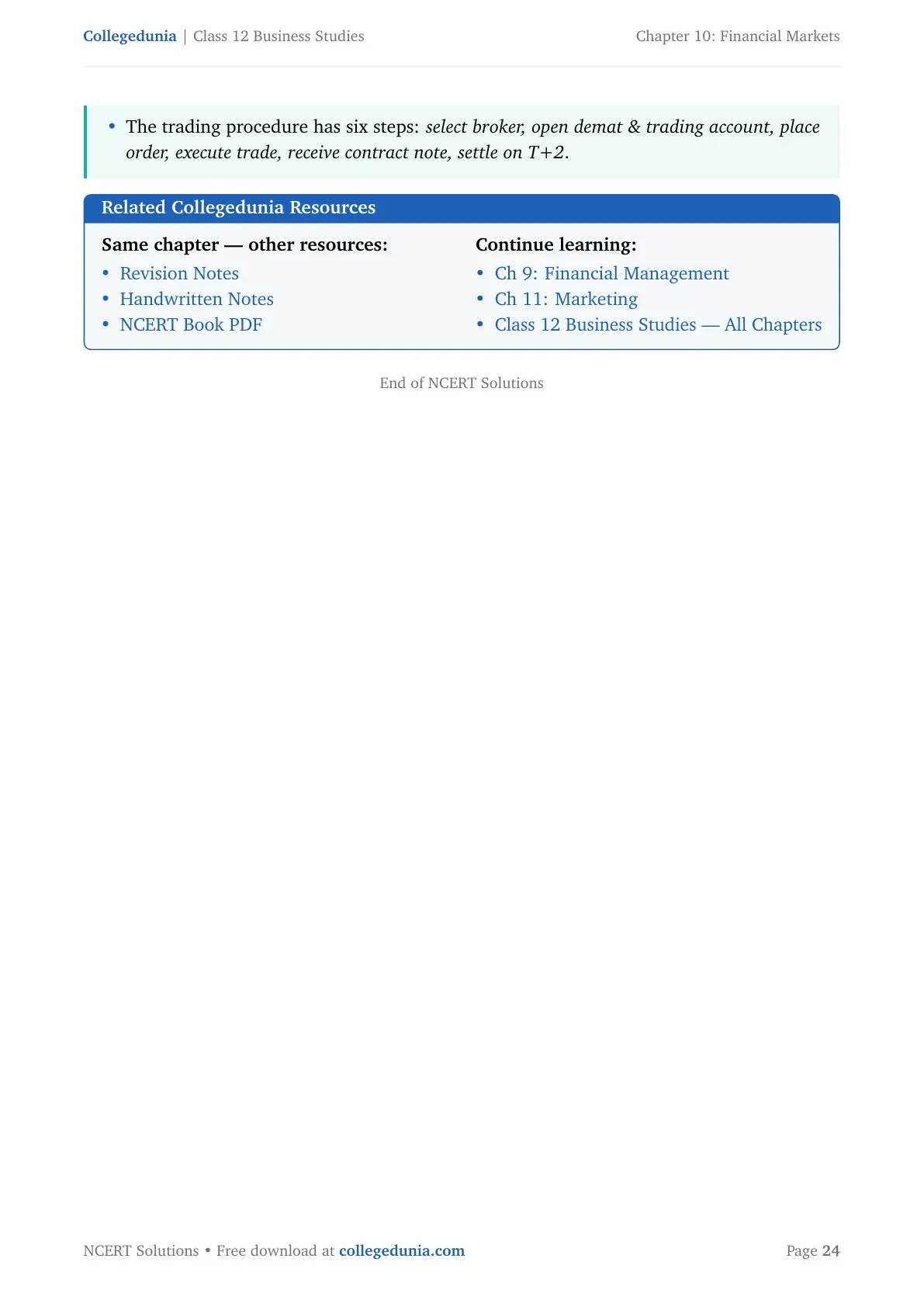
- Ch 9: Financial Management Class 12 NCERT Solutions
- Ch 11: Marketing Class 12 NCERT Solutions
- All Class 12 Business Studies Chapters
Student Feedback
In a Collegedunia poll of 940 Class 12 Commerce students, 82% said the SEBI three-fold mandate and the six-step trading procedure were the two answers they revised most from this chapter. 3 in 4 said the boxed final answers and the money-market instrument grid made last-night revision faster.
Other Resources for Class 12 Business Studies Chapter 10 Financial Markets
| Resource | Link |
|---|---|
| NCERT Solutions | Financial Markets NCERT Solutions |
| Revision Notes | Financial Markets Class 12 Notes |
| Handwritten Notes | Financial Markets Handwritten Notes |
| NCERT Book PDF | Financial Markets NCERT Book PDF |
Financial Markets Class 12 - Frequently Asked Questions
What are the four functions of a financial market in Class 12 Business Studies?
What are the four functions of a financial market in Class 12 Business Studies?
The four functions of a financial market are (1) mobilisation of savings and channelising them into the most productive use, (2) price discovery, (3) providing liquidity to financial assets, and (4) reducing the cost of transactions. The mnemonic M-P-L-R helps you remember them in the right order in the board exam.
What is the difference between the money market and the capital market?
The money market deals in short-term funds (less than one year) and trades instruments like T-Bills, Commercial Paper, Call Money, Certificates of Deposit and Commercial Bills. The capital market deals in medium and long-term funds (more than one year) and trades equity shares, debentures and bonds. The money market is mostly an institutional and large-investor market; the capital market includes retail investors too.
What are the five money-market instruments in Class 12 Business Studies Chapter 10?
The five money-market instruments are: Treasury Bill (T-Bill) issued by RBI on behalf of the Government (zero-risk, Rs 25,000 minimum, maturities 14/91/182/364 days, issued at discount); Commercial Bill a bill of exchange used to finance trade credit; Commercial Paper (CP) issued by creditworthy firms (15 days to 1 year, introduced in 1990); Call Money between commercial banks for 1 to 15 days (inter-bank); and Certificate of Deposit (CD) issued by banks during liquidity squeezes (Rs 1 lakh minimum).
What are the three objectives of SEBI?
The Securities and Exchange Board of India (SEBI) was established in 1988 and given statutory powers under the SEBI Act 1992. Its three objectives are: (1) to regulate stock exchanges and the securities industry, (2) to protect the rights and interests of investors, and (3) to prevent trading malpractices like insider trading and price rigging. These objectives are delivered through three sets of functions: Regulatory, Developmental and Protective.
Where can I download the Class 12 Business Studies Chapter 10 Financial Markets NCERT Solutions PDF?
You can download the Collegedunia Class 12 Business Studies Chapter 10 Financial Markets NCERT Solutions PDF free of cost from this page. The PDF is aligned to the NCERT Reprint 2026-27 syllabus and includes step-by-step answers, comparison tables, the five-instrument money-market grid and the six-step trading procedure.



Comments