Senior Accountancy Editor, CA | Updated 3+ months ago
An accounting ratio compares one figure from the financial statements with another, giving a measure of liquidity, solvency, activity, or profitability. Accounting Ratios is the most formula-driven chapter in Class 12 Accountancy Part B. These Accounting Ratios NCERT Solutions solve every question in NCERT order using the exact CBSE formula.
21+ NCERT questions solved
4 ratio families covered
2026-27 NCERT print aligned
CBSE Weightage: 8 to 10 marks, usually one 6-mark Balance Sheet ratio plus theory
CUET (UG) Relevance: 4 to 6 questions on ratio formulae and ideal values
These NCERT Solutions are reviewed by Chartered Accountants and CBSE Commerce educators, mapped to the 2026-27 NCERT print, and checked against five years of CBSE Board and CUET papers.
Part 2 Chapter 5 sits in Part B: Financial Statements Analysis, building on Chapters 3 and 4. Ratio analysis is one of the four tools introduced there.
Concept: Four ratio families: Liquidity (Current, Quick), Solvency (Debt-Equity, Proprietary), Activity (Inventory, Receivables, Working Capital), Profitability (Gross Profit, Net Profit, Operating). Spot the family, the formula follows.
Class 12 Accountancy Part 2 Chapter 5 Accounting Ratios NCERT Solutions
NCERT Solutions for Class 12 Accountancy Part 2 Chapter 5: Question-Type Distribution
The split between theory and numerical is balanced here, so neither block can be skipped.
Type
Approx Share
What CBSE Tests
Numerical (compute a ratio)
60%
Formula, components, ratio as x : 1 or %
Theory (meaning, importance)
25%
Meaning of liquidity, solvency, profitability ratios
Objective / fill-in
15%
Ideal values, formula recall, classification
These NCERT Solutions show the formula, the components, and the final ratio for every numerical, covering the 60% numerical block fully.
How will Collegedunia's NCERT Solutions Help You with Accounting Ratios?
These solutions are written for the marking scheme, not just the final number.
2026-27 NCERT Alignment: Every ratio uses the exact current-print NCERT formula.
Formula-First Working: Each numerical states the formula, then the components, then substitutes, so you never lose the formula mark.
Expert Verification: Chartered Accountants checked every ratio against the official NCERT key.
Answer-Writing Cues: Each solution flags the ideal value and how to express the ratio.
Accounting Ratios Class 12 TS Grewal and NCERT Solutions: Common Question Stems
CBSE recycles a small set of phrasings. Spot the wording, and the formula follows.
Question Stem
What It Wants
"Calculate Current Ratio."
Current Assets / Current Liabilities, as x : 1
"Calculate Quick / Liquid / Acid Test Ratio."
(Current Assets minus Inventory minus Prepaid Expenses) / Current Liabilities
"Calculate Debt-Equity Ratio."
Long-term Debt / Shareholders' Funds
"Compute Inventory Turnover Ratio."
Cost of Revenue from Operations / Average Inventory
"Current Ratio is 3.5 : 1, Working Capital is Rs... Find Current Assets and Liabilities."
Reverse computation from ratio and working capital
Quick Tip: Given the ratio and Working Capital, use Working Capital = Current Assets minus Current Liabilities. Let Current Liabilities be 1 part; one equation then solves both unknowns.
Sample Fully-Solved Question Walk-Through: Current Ratio from a Balance Sheet (NCERT Q1)
This is the standard 4 to 6 mark numerical CBSE sets here. Balance Sheet of Raj Oil Mills Limited, 31 March 2017: Inventories Rs 55,800, Trade Receivables Rs 28,800, Cash Rs 59,400, Trade Payables Rs 72,000.
Current Ratio: 1,44,00072,000 = 2 : 1 . Share capital, reserves, and fixed assets are excluded as non-current items. A 2 : 1 ratio matches the conventional ideal. Full marks need the formula, correct components, and the final ratio in x : 1 form.
Marks Budget for a 6-Mark Accounting Ratios Question
Know where each mark sits, so nothing gets skipped under pressure.
Step
Marks
What Earns It
Correct formula stated
1
Ratio definition before substituting
Correct component identification
2
Right Balance Sheet items for numerator, denominator
Computation of each component
1.5
Correct totals (Current Assets, Average Inventory)
Substitution and arithmetic
1
Correct division and reduction
Ratio expressed correctly
0.5
x : 1, times, or percentage as required
Common Mistakes Students Make in Accounting Ratios
Most lost marks come from wrong components, not arithmetic.
Including Inventory and Prepaid Expenses in Quick Assets. Quick Ratio excludes both.
Using Total Debt instead of Long-term Debt, or omitting Reserves from Shareholders' Funds.
Using Sales instead of Cost of Revenue from Operations in Inventory Turnover Ratio.
Forgetting the average of opening and closing inventory.
Reporting a turnover ratio as x : 1 instead of a number of times.
Watch Out:Quick Ratio is never larger than Current Ratio. If it is, Inventory was wrongly left in quick assets.
How to Study Accounting Ratios for Class 12th Accountancy Boards
Drilling numericals beats re-reading theory here. Budget about 7 to 8 hours over four sessions.
Day 1 (2 hours): Memorise formulae family by family, each with its ideal value.
Day 2 (2 hours): Solve every Liquidity and Solvency numerical.
Day 3 (2 hours): Solve every Activity and Profitability numerical, including reverse computations.
Day 4 (1.5 hours): Revise theory and attempt one timed past-paper numerical.
Accounting Ratios Previous Year Questions Weightage (2026 to 2021)
How this chapter has appeared in recent CBSE and CUET papers; full list on the Notes page.
Year
CBSE Board
CUET (Accountancy)
2026
-
-
2025
Current and Quick Ratio from Balance Sheet (6 marks)
Accounting Ratios Class 12 Accountancy: Complete Formula Reference
This is the only Part B chapter where memorising formulae directly earns marks. The five below cover most NCERT numericals; the full table is on the Formula Sheet.
Ratio
Formula
Current Ratio
Current Assets / Current Liabilities
Quick Ratio
(Current Assets minus Inventory minus Prepaid Expenses) / Current Liabilities
Debt-Equity Ratio
Long-term Debt / Shareholders' Funds
Inventory Turnover Ratio
Cost of Revenue from Operations / Average Inventory
All NCERT Solutions for Accounting Ratios with Step-by-Step Working
Every NCERT question for Accounting Ratios is listed below with its Solution and Expert Solution inside collapsible tabs. Click Check Solution for the working, or Expert Solution for the expanded version.
Questions
Q 9.1
What do you mean by Ratio Analysis?
Concept used.Ratio Analysis is a technique of financial-statement analysis in
which significant accounting figures are expressed as ratios (or as a percentage) so that the
relationship between them can be studied. A ratio by itself is just a number; its meaning comes
from comparison with a benchmark (prior year, budget, industry average, competitor).
Definition. A ratio is the mathematical expression of the relationship between
two related figures, written as a quotient (a/b), a pure number (1.5), a percentage
(40%), or a stated comparison (2 : 1).
Inputs. The two figures must be related (e.g. Current Assets vs. Current
Liabilities) and drawn from the financial statements: Balance Sheet, Statement of Profit
and Loss, and the Cash Flow Statement.
Output. A ratio summarises in one number information that is otherwise spread
across many line items, making it easier to spot trends and red flags.
Use cases. Judging short-term liquidity, long-term solvency, operating
efficiency, profitability, and the firm's overall financial health.
Stakeholders. Management (planning and control), creditors (credit-worthiness),
investors (returns), analysts (valuation) and government (regulation, tax).
Ratio analysis is the systematic use of ratios computed from financial-statement figures
to evaluate a firm's liquidity, solvency, activity and profitability, and to compare it across time
and against peers.
AS
Aarav Sharma
M.Com Accountancy, Delhi University
Verified Expert
Strategic angle. Think of ratio analysis as the X-ray of financial statements: the
balance sheet shows the bones, the P&L shows the heartbeat, but a ratio reveals the underlying
condition by setting one figure against another.
Step 1: Pick two related figures. Current Assets goes with Current Liabilities
(both short-term); Net Profit goes with Revenue (output over input). Random pairings
produce meaningless ratios.
Step 2: Express the relationship. As a quotient (2 : 1), pure number (2),
percentage (40%), or rate (4 times). The form is chosen for readability.
Step 3: Benchmark it. Compare against (a) the firm's own prior year (trend
analysis), (b) industry average (cross-section analysis), (c) a budgeted target
(variance analysis).
Step 4: Interpret with caution. A high current ratio is not always good
(idle cash); a high debt-equity ratio is not always bad (use in expansion phase).
Why this matters. In a Class 12 numerical question on Accounting Ratios, the examiner gives full marks only when the candidate writes the formula in symbolic form, substitutes the figures with labels, computes the ratio to two decimal places, and gives a one-line interpretation comparing the ratio to the conventional benchmark. A bare numerical answer without the formula and the interpretation loses 30-50 percent of the marks under the CBSE step-marking scheme.
Common mistakes. Three predictable slips lose marks: (a) confusing Current Ratio with Quick Ratio by either including inventory and prepaid expenses in the quick assets or excluding them from current assets; (b) using the closing balance of trade receivables or inventory instead of the average of opening and closing balances for turnover ratios; (c) using net credit sales for Trade Receivables Turnover but using total revenue for Inventory Turnover, when each ratio has a specific numerator definition.
Ratio analysis = pick two related figures → express as a ratio → benchmark
→ interpret. It is the diagnostic engine of financial-statement analysis.
Q 9.2
What are various types of ratios?
Concept used. Ratios are conventionally classified by purpose into four families.
NCERT (Part 2 Chapter 5) follows this functional classification. Each family answers one financial
question.
Liquidity Ratios measure the firm's ability to meet short-term obligations
(due within one year). Examples: Current Ratio, Quick (Liquid) Ratio.
Solvency Ratios measure the firm's ability to meet long-term obligations
(due after one year). Examples: Debt-Equity Ratio, Total Assets to Debt Ratio,
Proprietary Ratio, Interest Coverage Ratio.
Activity (Turnover) Ratios measure how efficiently the firm uses its assets to
generate revenue. Examples: Inventory Turnover, Trade Receivables Turnover, Trade Payables
Turnover, Working Capital Turnover, Fixed Assets Turnover.
Profitability Ratios measure the firm's ability to earn profits from sales and
from invested capital. Examples: Gross Profit Ratio, Net Profit Ratio, Operating Ratio,
Operating Profit Ratio, Return on Investment, Earnings per Share.
Ratios are grouped into four families: Liquidity (short-term solvency), Solvency
(long-term solvency), Activity (efficiency of asset use) and Profitability (return on revenue
& capital).
PI
Priya Iyer
M.Com, ICAI
Verified Expert
Quick reading. Four boxes, one each for short-term safety, long-term safety, efficiency
and returns.
Activity → Inventory TR, Receivables TR, Payables TR, Working Capital TR.
Profitability → GP %, NP %, Operating %, Operating Profit %, Return on
Investment, EPS.
Why this matters. In a Class 12 numerical question on Accounting Ratios, the examiner gives full marks only when the candidate writes the formula in symbolic form, substitutes the figures with labels, computes the ratio to two decimal places, and gives a one-line interpretation comparing the ratio to the conventional benchmark. A bare numerical answer without the formula and the interpretation loses 30-50 percent of the marks under the CBSE step-marking scheme.
Common mistakes. Three predictable slips lose marks: (a) confusing Current Ratio with Quick Ratio by either including inventory and prepaid expenses in the quick assets or excluding them from current assets; (b) using the closing balance of trade receivables or inventory instead of the average of opening and closing balances for turnover ratios; (c) using net credit sales for Trade Receivables Turnover but using total revenue for Inventory Turnover, when each ratio has a specific numerator definition.
Liquidity, Solvency, Activity and Profitability ratios are the four NCERT families.
Q 9.3
What relationships will be established to study:
(a) Inventory turnover
(b) Trade receivables turnover
(c) Trade payables turnover
(d) Working capital turnover
Concept used. Each turnover ratio measures how many times during the
year an asset (or liability) is converted (turned over) into sales or purchases. Numerator is
always the flow figure (revenue / cost / purchases) and denominator is always the related
average stock or balance figure (so the ratio is comparable across firms of different
size).
(a) Inventory Turnover Ratio. Inventory TR = Cost of Revenue from OperationsAverage
Inventory.
Where Average Inventory = (Opening Inventory + Closing Inventory)/2. It indicates
the speed at which inventory is sold (higher = faster movement).
(b) Trade Receivables Turnover Ratio. Receivables TR = Net Credit Revenue from OperationsAverage
Trade Receivables.
Trade Receivables = Debtors + Bills Receivable. Higher = collection is quicker.
(d) Working Capital Turnover Ratio. Working Capital TR = Revenue from OperationsWorking
Capital,
where Working Capital = Current Assets - Current Liabilities. Higher = more
revenue is generated per rupee of working capital deployed.
All turnover ratios share the structure: flow (revenue/cost/purchases) ÷ related
average stock (inventory/receivables/payables) or working capital. They measure operational
efficiency.
VM
Vivaan Mehta
M.Sc Accountancy, Symbiosis Pune
Verified Expert
Structural observation. Each turnover ratio is a fraction with flow over stock.
Pair the flow with the right stock and the formula writes itself.
Inventory TR: Cost of Revenue over Average Inventory.
Receivables TR: Net Credit Revenue over Average Receivables.
Payables TR: Net Credit Purchases over Average Payables.
Working Capital TR: Revenue over (CA - CL).
Why this matters. In a Class 12 numerical question on Accounting Ratios, the examiner gives full marks only when the candidate writes the formula in symbolic form, substitutes the figures with labels, computes the ratio to two decimal places, and gives a one-line interpretation comparing the ratio to the conventional benchmark. A bare numerical answer without the formula and the interpretation loses 30-50 percent of the marks under the CBSE step-marking scheme.
Common mistakes. Three predictable slips lose marks: (a) confusing Current Ratio with Quick Ratio by either including inventory and prepaid expenses in the quick assets or excluding them from current assets; (b) using the closing balance of trade receivables or inventory instead of the average of opening and closing balances for turnover ratios; (c) using net credit sales for Trade Receivables Turnover but using total revenue for Inventory Turnover, when each ratio has a specific numerator definition.
Numerator = flow; denominator = matching average stock. Higher ratio = faster
turnover = better efficiency.
Q 9.4
The liquidity of a business firm is measured by its ability to satisfy its long-term
obligations as they become due. What are the ratios used for this purpose?
Concept used. The question as worded actually describes Solvency (long-term
ability to pay), not liquidity (short-term). The ratios used to judge long-term obligation
servicing are the Solvency Ratios.
Debt-Equity Ratio. Debt-Equity = Long-term DebtShareholders' Funds,
where Long-term Debt = Debentures + Long-term Borrowings + Long-term Provisions,
and Shareholders' Funds = Share Capital + Reserves and Surplus + Money received
against Share Warrants. A ratio of 2 : 1 is taken as the safe upper limit.
Total Assets to Debt Ratio. TADR = Total AssetsLong-term Debt.
Indicates the extent to which total assets cover the long-term debt.
Proprietary Ratio. Proprietary Ratio = Shareholders' FundsTotal Assets.
Higher value = owners financing a larger share of assets = lower financial risk.
Interest Coverage Ratio. Interest Coverage = Net Profit before Interest & Tax
Interest on Long-term Debt.
Indicates how many times the firm's earnings cover the interest commitment. A value
of 6–7 times is considered healthy.
Debt-Equity, Total Assets to Debt, Proprietary and Interest Coverage ratios together
measure long-term solvency of the firm.
AK
Aanya Kapoor
M.Com, Christ University Bangalore
Verified Expert
Quick reading. ``Long-term obligations'' ⇒ Solvency family, not Liquidity.
Debt-Equity (gearing).
TADR (asset cover for debt).
Proprietary (owner-financed share).
Interest Coverage (earnings cushion for interest).
Why this matters. In a Class 12 numerical question on Accounting Ratios, the examiner gives full marks only when the candidate writes the formula in symbolic form, substitutes the figures with labels, computes the ratio to two decimal places, and gives a one-line interpretation comparing the ratio to the conventional benchmark. A bare numerical answer without the formula and the interpretation loses 30-50 percent of the marks under the CBSE step-marking scheme.
Common mistakes. Three predictable slips lose marks: (a) confusing Current Ratio with Quick Ratio by either including inventory and prepaid expenses in the quick assets or excluding them from current assets; (b) using the closing balance of trade receivables or inventory instead of the average of opening and closing balances for turnover ratios; (c) using net credit sales for Trade Receivables Turnover but using total revenue for Inventory Turnover, when each ratio has a specific numerator definition.
The four solvency ratios, Debt-Equity, TADR, Proprietary and Interest Coverage, are
the answer.
Q 9.5
The average age of inventory is viewed as the average length of time inventory is
held by the firm for which explain with reasons.
Concept used.Average Age of Inventory (also called Inventory
Conversion Period or Days' Inventory) measures, on average, how many days an item of
inventory sits in the warehouse before it is sold. It is the reciprocal of the Inventory Turnover
Ratio, expressed in days.
Formula. Average Age of Inventory = 365 (or 12 months)Inventory
Turnover Ratio.
For an Inventory TR of 5 times, the average age is 365/5 = 73 days.
Why ``average''. Some items move within a week, others sit for months; the ratio
averages across the whole inventory.
Why a holding period. The numerator (365 days) is a full year, and the ratio
tells us how many times inventory is sold and replaced; therefore 365 ÷ that count
gives the average number of days each item is held.
Interpretation.
Short period ⇒ inventory moves quickly ⇒ healthy demand
and good inventory management.
Long period ⇒ slow-moving stock, possible obsolescence, blocked
working capital and higher carrying cost (storage, insurance, interest on funds
tied up).
Average Age of Inventory =365 ÷ Inventory Turnover Ratio. It is the average
number of days inventory is held before being sold. A short period signals fast movement; a
long period signals slow-moving / obsolete stock.
KJ
Karan Joshi
M.Com, Banaras Hindu University
Verified Expert
Strategic angle. If inventory ``turns'' five times a year, each rupee of inventory takes
one-fifth of a year (73 days) to convert into a sale. That fraction-of-a-year is the holding
period.
Inventory TR = 5 times per year.
Each cycle = 1/5 year = 73 days.
Hence the average inventory item is held for 73 days.
Lower ⇒ faster movement, less capital locked up.
Why this matters. In a Class 12 numerical question on Accounting Ratios, the examiner gives full marks only when the candidate writes the formula in symbolic form, substitutes the figures with labels, computes the ratio to two decimal places, and gives a one-line interpretation comparing the ratio to the conventional benchmark. A bare numerical answer without the formula and the interpretation loses 30-50 percent of the marks under the CBSE step-marking scheme.
Common mistakes. Three predictable slips lose marks: (a) confusing Current Ratio with Quick Ratio by either including inventory and prepaid expenses in the quick assets or excluding them from current assets; (b) using the closing balance of trade receivables or inventory instead of the average of opening and closing balances for turnover ratios; (c) using net credit sales for Trade Receivables Turnover but using total revenue for Inventory Turnover, when each ratio has a specific numerator definition.
Average Age = 365 / Inventory TR; lower is better.
Q 9.6
What are liquidity ratios? Discuss the importance of current and liquid ratio.
Concept used.Liquidity Ratios measure the firm's ability to meet its
short-term obligations (those falling due within one year) out of its short-term assets.
The two most-used liquidity ratios are the Current Ratio and the Quick (Liquid /
Acid-Test) Ratio.
Current Ratio. Current Ratio = Current AssetsCurrent Liabilities. Current Assets= Inventories + Trade Receivables + Cash and Cash Equivalents
+ Short-term Loans and Advances + Other Current Assets + Current Investments +
Prepaid Expenses. Current Liabilities= Trade Payables + Short-term Borrowings
+ Short-term Provisions + Other Current Liabilities + Outstanding Expenses.
Ideal Current Ratio. 2 : 1. Current assets should be twice the current
liabilities so that even if half the current assets are realised at a loss, the firm can
still pay its current liabilities.
Quick (Liquid) Ratio. Quick Ratio = Quick AssetsCurrent Liabilities,
where Quick Assets = Current Assets - Inventories - Prepaid Expenses. The two
excluded items are the least liquid: inventory must first be sold (then collected), and
prepaid expenses are not recoverable in cash.
Ideal Quick Ratio. 1 : 1. For every rupee of current liability, there should
be at least one rupee of quickly-realisable asset.
Importance of Current Ratio.
Tells creditors the margin of safety.
A high ratio comforts short-term lenders; a very high ratio may flag idle
resources.
A ratio below 1 means the firm cannot pay its current bills from current assets.
Importance of Quick Ratio.
Acts as the acid test of liquidity: it strips out the least-liquid
items (inventory, prepaid).
Especially useful when inventory is slow-moving or when a sharp business
downturn makes inventory unrealisable.
Bankers consider the Quick Ratio more reliable than the Current Ratio for
assessing short-term credit risk.
Liquidity Ratios = Current Ratio (≥ 2 : 1 ideal) + Quick Ratio (≥ 1 : 1
ideal). Both are essential because Current Ratio gives the overall short-term cushion while Quick
Ratio gives the immediate-payment cushion after excluding inventory and prepaid expenses.
DN
Diya Nair
M.Com, ICAI
Verified Expert
Strategic angle. Two ratios, two granularities: Current Ratio asks the broad question
(``can we pay short-term bills?''); Quick Ratio asks the strict question (``can we pay them
today?''). Together they bracket short-term solvency.
Current Ratio = Current Assets / Current Liabilities, ideal 2 : 1.
Quick Ratio = (Current Assets - Inventory - Prepaid) / Current Liabilities, ideal
1 : 1.
Compare both: if Current Ratio is healthy but Quick Ratio is poor, inventory dominates
the current assets → slow-moving stock alert.
Both must be read with the operating cycle in mind: a long cycle (e.g. heavy
engineering) needs a higher Current Ratio than a short cycle (e.g. FMCG).
Why this matters. In a Class 12 numerical question on Accounting Ratios, the examiner gives full marks only when the candidate writes the formula in symbolic form, substitutes the figures with labels, computes the ratio to two decimal places, and gives a one-line interpretation comparing the ratio to the conventional benchmark. A bare numerical answer without the formula and the interpretation loses 30-50 percent of the marks under the CBSE step-marking scheme.
Common mistakes. Three predictable slips lose marks: (a) confusing Current Ratio with Quick Ratio by either including inventory and prepaid expenses in the quick assets or excluding them from current assets; (b) using the closing balance of trade receivables or inventory instead of the average of opening and closing balances for turnover ratios; (c) using net credit sales for Trade Receivables Turnover but using total revenue for Inventory Turnover, when each ratio has a specific numerator definition.
Use Current Ratio for the broad cushion (target 2:1) and Quick Ratio for the strict
cushion after stripping inventory (target 1:1).
Q 9.7
How would you study the Solvency position of the firm?
Concept used.Solvency is the firm's ability to meet its long-term
obligations (those falling due after one year) on the due date. Solvency is studied through five
ratios that together quantify the firm's reliance on borrowed funds, the asset cover backing
those funds, and the earnings cushion for interest.
Debt-Equity Ratio. Debt-Equity = Long-term DebtShareholders' Funds.
Indicates the proportion of long-term debt to owners' funds. Ideal ≤ 2 : 1. A higher
ratio signals high financial use and greater risk for lenders.
Total Assets to Debt Ratio (TADR). TADR = Total AssetsLong-term Debt.
Shows the extent to which long-term debt is covered by total assets. A higher TADR
⇒ stronger asset cushion for lenders.
Proprietary Ratio. Proprietary Ratio = Shareholders' FundsTotal Assets.
Indicates the share of total assets financed by the owners. Higher ⇒ lower
dependence on outsiders.
Interest Coverage Ratio. Interest Coverage = Net Profit before Interest & Tax
Interest on Long-term Debt.
Indicates how many times the firm's earnings cover the interest commitment. A value of
6–7 times is considered safe; below 2 times is a danger signal.
Capital Gearing. Capital Gearing = Fixed-cost-bearing CapitalEquity
Shareholders' Funds.
High gearing ⇒ aggressive use of debt and preference capital.
Solvency is studied through Debt-Equity, TADR, Proprietary, Interest Coverage and
Capital Gearing ratios. Together they reveal the firm's long-term debt-servicing capacity and the
cushion available to long-term lenders.
SR
Siddharth Rao
M.Com, Madras University
Verified Expert
Structural observation. Three ratios examine the balance sheet's right-hand side
(funding mix: Debt-Equity, Proprietary, Capital Gearing); one ratio cross-checks the left-hand
side (asset cover: TADR); one cross-checks the P&L (earnings cushion: Interest Coverage).
Right-hand mix: Debt-Equity (debt to equity), Proprietary (equity share of total),
Capital Gearing (fixed-cost funding share).
Left-hand cover: TADR (asset cover for debt).
P&L cushion: Interest Coverage (earnings vs. interest).
Read together: a firm with a 2 : 1 Debt-Equity, TADR of 1.5, Proprietary 0.33 and
Interest Coverage 5 is at the upper safe limit.
Why this matters. In a Class 12 numerical question on Accounting Ratios, the examiner gives full marks only when the candidate writes the formula in symbolic form, substitutes the figures with labels, computes the ratio to two decimal places, and gives a one-line interpretation comparing the ratio to the conventional benchmark. A bare numerical answer without the formula and the interpretation loses 30-50 percent of the marks under the CBSE step-marking scheme.
Common mistakes. Three predictable slips lose marks: (a) confusing Current Ratio with Quick Ratio by either including inventory and prepaid expenses in the quick assets or excluding them from current assets; (b) using the closing balance of trade receivables or inventory instead of the average of opening and closing balances for turnover ratios; (c) using net credit sales for Trade Receivables Turnover but using total revenue for Inventory Turnover, when each ratio has a specific numerator definition.
Five ratios across the two financial statements give a complete solvency picture.
Q 9.8
What are various profitability ratios? How are these worked out?
Concept used.Profitability Ratios measure the ability of the firm to earn
profits from its sales (operations) and from its capital (investors' funds). They
fall into two sub-groups: margin ratios (based on sales) and return ratios (based
on capital).
Gross Profit Ratio. Gross Profit Ratio = Gross ProfitRevenue from
Operations × 100,
where Gross Profit = Revenue from Operations - Cost of Revenue from Operations.
Indicates the margin available before operating expenses.
Operating Ratio. Operating Ratio = COGS + Operating ExpensesRevenue
from Operations × 100.
Here COGS is the Cost of Revenue from Operations. Operating Expenses include selling,
distribution, office and administrative expenses; they exclude interest, tax, and
abnormal losses.
Operating Profit Ratio. Op. Profit Ratio = Operating ProfitRevenue from
Operations × 100 = 100 - Op. Ratio.
Operating Profit = Net Profit + Non-operating expenses - Non-operating incomes.
Net Profit Ratio. Net Profit Ratio = Net Profit after TaxRevenue from
Operations × 100.
Indicates the overall profitability after all expenses (including non-operating ones
and tax).
Return on Investment (Return on Capital Employed). ROI = Profit before Interest & TaxCapital Employed
× 100,
where Capital Employed = Shareholders' Funds + Long-term Borrowings + Long-term
Provisions, i.e. total long-term funds. ROI is the master profitability ratio because
it links profit to all the capital used to earn it.
Earnings per Share (EPS). EPS = Net Profit after Tax - Preference Dividend
Number of Equity Shares Outstanding.
Reported on a per-share basis so equity investors can compare across firms.
Six profitability ratios, Gross Profit, Operating, Operating Profit, Net Profit,
ROI and EPS, together tell the firm's profit-earning story from operations all the way to
per-share returns.
AV
Ananya Verma
M.Com, FMS Delhi
Verified Expert
Quick reading. Two sub-families: margin (% of sales) and return (% of capital).
Together they answer the question ``Is the business worth running?''
Margin ratios (over revenue): GP, Operating, Operating Profit, NP.
Return ratios (over capital): ROI, EPS.
Compute by plugging into the standard formula; numerator and denominator are taken from
the Statement of P&L and Balance Sheet respectively.
Compare across years (trend) and against industry average (benchmark).
Why this matters. In a Class 12 numerical question on Accounting Ratios, the examiner gives full marks only when the candidate writes the formula in symbolic form, substitutes the figures with labels, computes the ratio to two decimal places, and gives a one-line interpretation comparing the ratio to the conventional benchmark. A bare numerical answer without the formula and the interpretation loses 30-50 percent of the marks under the CBSE step-marking scheme.
Common mistakes. Three predictable slips lose marks: (a) confusing Current Ratio with Quick Ratio by either including inventory and prepaid expenses in the quick assets or excluding them from current assets; (b) using the closing balance of trade receivables or inventory instead of the average of opening and closing balances for turnover ratios; (c) using net credit sales for Trade Receivables Turnover but using total revenue for Inventory Turnover, when each ratio has a specific numerator definition.
Margin family + Return family = complete profitability picture.
Q 9.9
The current ratio provides a better measure of overall liquidity only when a firm's
inventory cannot easily be converted into cash. If inventory is liquid, the quick ratio is a
preferred measure of overall liquidity. Explain.
Concept used. The choice between Current Ratio and Quick Ratio
depends on the liquidity profile of inventory. Current Ratio includes inventory; Quick
Ratio excludes it. Whichever ratio more faithfully reflects the firm's ability to pay short-term
bills is the better measure.
When inventory is hard to convert. Industries such as heavy machinery, ship-
building, or real estate hold work-in-progress and finished goods that take months (or
years) to sell. Including such inventory in the liquidity test would overstate the firm's
ability to pay. The Current Ratio, computed on Current Assets ÷ Current Liabilities,
treats inventory as available, a generous assumption suitable only when the alternative
(Quick Ratio) would be too harsh.
When inventory is liquid. Industries such as FMCG, dairy, retail, or pharma sell
their inventory within days. Even if inventory is liquid, the more demanding Quick Ratio
(which excludes inventory) is preferred because it tests whether the firm can pay
instantly without relying on inventory at all. The argument is: if the firm passes
the stricter test, it certainly passes the looser one; conversely, a firm with liquid
inventory typically has high Receivables and Cash too, so the Quick Ratio is rarely
misleadingly low.
Why the NCERT phrasing is correct. When inventory is illiquid, removing it from
the test (Quick Ratio) would understate liquidity, so Current Ratio is the better gauge.
When inventory is liquid, removing it does no harm, and the stricter Quick Ratio gives a
cleaner read on immediate paying ability, hence it is preferred.
Worked illustration.
Firm A (heavy engineering): Current Ratio = 2.5, Quick Ratio = 0.6.
Inventory dominates current assets but is genuinely illiquid; the Current Ratio
of 2.5 is the more honest read.
Firm B (FMCG): Current Ratio = 1.4, Quick Ratio = 1.1. Inventory turns
over in days; the Quick Ratio of 1.1 already shows healthy liquidity and is the
preferred single number.
Illiquid inventory ⇒ Current Ratio is the better measure (Quick Ratio
understates). Liquid inventory ⇒ Quick Ratio is preferred (it is stricter without
being unfair).
PS
Pranav Sharma
M.Com, IIM Ahmedabad
Verified Expert
Strategic angle. The two ratios differ only by inventory. If inventory is honest cash
(FMCG), strip it out for a stricter test (Quick Ratio). If inventory is wishful cash (real
estate), keeping it in is the fairer view (Current Ratio).
Pick the ratio whose assumption about inventory matches reality.
Heavy/long-cycle inventory → Current Ratio.
Fast-moving inventory → Quick Ratio.
Always state both and explain the choice.
Why this matters. In a Class 12 numerical question on Accounting Ratios, the examiner gives full marks only when the candidate writes the formula in symbolic form, substitutes the figures with labels, computes the ratio to two decimal places, and gives a one-line interpretation comparing the ratio to the conventional benchmark. A bare numerical answer without the formula and the interpretation loses 30-50 percent of the marks under the CBSE step-marking scheme.
Common mistakes. Three predictable slips lose marks: (a) confusing Current Ratio with Quick Ratio by either including inventory and prepaid expenses in the quick assets or excluding them from current assets; (b) using the closing balance of trade receivables or inventory instead of the average of opening and closing balances for turnover ratios; (c) using net credit sales for Trade Receivables Turnover but using total revenue for Inventory Turnover, when each ratio has a specific numerator definition.
The better liquidity ratio is the one whose treatment of inventory matches the firm's
inventory profile.
Q 9.10
Following is the Balance Sheet of Raj Oil Mills Limited as at March 31, 2017. Calculate
current ratio.
tabular@p8cmr@
Particulars & Amount (Rs.)
I. Equity and Liabilities &
1. Shareholders' funds &
(a) Share capital & 7,90,000
(b) Reserves and surplus & 35,000
2. Current Liabilities &
Trade Payables & 72,000
Total & 8,97,000
II. Assets &
1. Non-current Assets (Tangible) & 7,53,000
2. Current Assets &
(a) Inventories & 55,800
(b) Trade Receivables & 28,800
(c) Cash and cash equivalents & 59,400
Total & 8,97,000
tabular
Concept used. The Current Ratio measures short-term liquidity:
Current Ratio = Current AssetsCurrent Liabilities,
where Current Assets include inventories, trade receivables, cash & cash equivalents,
short-term loans & advances and other current assets, and Current Liabilities include
trade payables, short-term borrowings, short-term provisions and other current liabilities.
Step 1: Identify Current Assets. From the balance sheet,
CA = Inventories + Trade Receivables + Cash.
Substitute:
CA = 55,800 + 28,800 + 59,400.
Arithmetic:
CA = 1,44,000 (Rs.).
Step 2: Identify Current Liabilities. Only Trade Payables are shown, so
CL = 72,000 (Rs.).
Step 3: Compute Current Ratio. Current Ratio = 1,44,00072,000 = 2.
Therefore Current Ratio = 2 : 1.
Current Ratio = 2 : 1.
AG
Aditya Gupta
M.Com, Delhi University
Verified Expert
Quick reading. The only Current Liability is Trade Payables (Rs. 72,000). Add up the
three Current Assets, divide.
Sum of Current Assets: 55,800 + 28,800 + 59,400 = 1,44,000.
Current Liabilities = 72,000.
Ratio = 1,44,000 / 72,000 = 2.
Why this matters. In a Class 12 numerical question on Accounting Ratios, the examiner gives full marks only when the candidate writes the formula in symbolic form, substitutes the figures with labels, computes the ratio to two decimal places, and gives a one-line interpretation comparing the ratio to the conventional benchmark. A bare numerical answer without the formula and the interpretation loses 30-50 percent of the marks under the CBSE step-marking scheme.
Common mistakes. Three predictable slips lose marks: (a) confusing Current Ratio with Quick Ratio by either including inventory and prepaid expenses in the quick assets or excluding them from current assets; (b) using the closing balance of trade receivables or inventory instead of the average of opening and closing balances for turnover ratios; (c) using net credit sales for Trade Receivables Turnover but using total revenue for Inventory Turnover, when each ratio has a specific numerator definition.
Current Ratio = 2 : 1, comfortably above the ideal benchmark.
Q 9.11
Following is the Balance Sheet of Title Machine Ltd. as at March 31, 2017. Calculate
Current Ratio and Liquid Ratio.
tabular@p8cmr@
Particulars & Amount (Rs.)
I. Equity and Liabilities &
Share capital & 24,00,000
Reserves and surplus & 6,00,000
Long-term borrowings & 9,00,000
Short-term borrowings & 6,00,000
Trade payables & 23,40,000
Short-term provisions & 60,000
Total & 69,00,000
II. Assets &
Tangible assets & 45,00,000
Inventories & 12,00,000
Trade receivables & 9,00,000
Cash and cash equivalents & 2,28,000
Short-term loans and advances & 72,000
Total & 69,00,000
tabular
Concept used.Current Ratio= Current Assets ÷ Current Liabilities;
Liquid (Quick) Ratio= Liquid Assets ÷ Current Liabilities, where Liquid Assets
= Current Assets - Inventories - Prepaid Expenses. Short-term loans and advances are
treated as Current Assets and also as Liquid Assets (they are quickly realisable).
Current Assets. CA = 12,00,000 + 9,00,000 + 2,28,000 + 72,000.
Arithmetic:
CA = 24,00,000 (Rs.).
Current Ratio. Current Ratio = 24,00,00030,00,000 = 0.8.
That is, 0.8 : 1.
Liquid Assets. LA = CA - Inventories = 24,00,000 - 12,00,000 = 12,00
,000.
Liquid Ratio. Liquid Ratio = 12,00,00030,00,000 = 0.4.
That is, 0.4 : 1.
Current Ratio = 0.8 : 1, Liquid Ratio = 0.4 : 1. Both are below
the ideal benchmarks (2 : 1 and 1 : 1), so the firm is under short-term liquidity stress.
RS
Rohit Singh
M.Com, IIM Bangalore
Verified Expert
Strategic angle. CL = Rs. 30 lakh dominates this balance sheet because Trade
Payables alone is Rs. 23.4 lakh. The firm is squeezed on short-term cash even though long-term
funding looks fine.
CA = 12 + 9 + 2.28 + 0.72 = 24 lakh.
CL = 6 + 23.4 + 0.6 = 30 lakh.
Current Ratio = 24/30 = 0.8 : 1.
LA = 24 - 12 = 12 lakh; Liquid Ratio = 12/30 = 0.4 : 1.
Why this matters. In a Class 12 numerical question on Accounting Ratios, the examiner gives full marks only when the candidate writes the formula in symbolic form, substitutes the figures with labels, computes the ratio to two decimal places, and gives a one-line interpretation comparing the ratio to the conventional benchmark. A bare numerical answer without the formula and the interpretation loses 30-50 percent of the marks under the CBSE step-marking scheme.
Common mistakes. Three predictable slips lose marks: (a) confusing Current Ratio with Quick Ratio by either including inventory and prepaid expenses in the quick assets or excluding them from current assets; (b) using the closing balance of trade receivables or inventory instead of the average of opening and closing balances for turnover ratios; (c) using net credit sales for Trade Receivables Turnover but using total revenue for Inventory Turnover, when each ratio has a specific numerator definition.
Current Ratio = 0.8 : 1, Liquid Ratio = 0.4 : 1, below ideal.
Q 9.12
Current Ratio is 3.5 : 1. Working Capital is Rs. 90,000. Calculate the amount of
Current Assets and Current Liabilities.
Concept used. Given the Current Ratio (r = CA/CL) and the Working
Capital (W = CA - CL), we solve the two simultaneous equations for CA and CL.
Set up the algebra. Let CL = x. Then CA = 3.5 x (from the ratio).
Apply the working-capital equation.W = CA - CL = 3.5 x - x = 2.5 x.
Substitute W = 90,000. 90,000 = 2.5 x ⇒ x = 90,0002.5.
Arithmetic:
x = 36,000.
Compute the two figures. CL = 36,000; CA = 3.5 × 36,000 = 1,26,000.
Current Assets = Rs. 1,26,000 and Current Liabilities = Rs.
36,000.
TR
Tara Reddy
M.Com, JNU Delhi
Verified Expert
Quick reading. Working Capital is the difference between CA and CL; the ratio
gives their multiplicative relation. One unknown, one equation.
Let CL = x, CA = 3.5x.
Difference: 2.5x = 90,000, hence x = 36,000.
CA = 3.5 × 36,000 = 1,26,000.
Why this matters. In a Class 12 numerical question on Accounting Ratios, the examiner gives full marks only when the candidate writes the formula in symbolic form, substitutes the figures with labels, computes the ratio to two decimal places, and gives a one-line interpretation comparing the ratio to the conventional benchmark. A bare numerical answer without the formula and the interpretation loses 30-50 percent of the marks under the CBSE step-marking scheme.
Common mistakes. Three predictable slips lose marks: (a) confusing Current Ratio with Quick Ratio by either including inventory and prepaid expenses in the quick assets or excluding them from current assets; (b) using the closing balance of trade receivables or inventory instead of the average of opening and closing balances for turnover ratios; (c) using net credit sales for Trade Receivables Turnover but using total revenue for Inventory Turnover, when each ratio has a specific numerator definition.
CA = Rs. 1,26,000; CL = Rs. 36,000.
Q 9.13
Shine Limited has a current ratio 4.5 : 1 and quick ratio 3 : 1; if the inventory is
36,000, calculate Current Liabilities and Current Assets.
Concept used. Current Ratio = CA / CL; Quick Ratio = (CA - Inventory) / CL. The
difference between the two ratios is exactly Inventory ÷ CL.
Subtract the two ratios.CACL - CA - InventoryCL =
InventoryCL.
Hence
4.5 - 3 = InventoryCL ⇒ 1.5 =
InventoryCL.
Current Liabilities = Rs. 24,000 and Current Assets = Rs.
1,08,000.
YP
Yash Pillai
M.Com, Christ Bangalore
Verified Expert
Structural observation. The difference of the two ratios isolates inventory's share of
CL, a one-line shortcut that bypasses any system-of-equations setup.
4.5 - 3 = 1.5 ⇒ Inventory/CL = 1.5.
CL = 36,000 / 1.5 = 24,000.
CA = 4.5 × 24,000 = 1,08,000.
Why this matters. In a Class 12 numerical question on Accounting Ratios, the examiner gives full marks only when the candidate writes the formula in symbolic form, substitutes the figures with labels, computes the ratio to two decimal places, and gives a one-line interpretation comparing the ratio to the conventional benchmark. A bare numerical answer without the formula and the interpretation loses 30-50 percent of the marks under the CBSE step-marking scheme.
Common mistakes. Three predictable slips lose marks: (a) confusing Current Ratio with Quick Ratio by either including inventory and prepaid expenses in the quick assets or excluding them from current assets; (b) using the closing balance of trade receivables or inventory instead of the average of opening and closing balances for turnover ratios; (c) using net credit sales for Trade Receivables Turnover but using total revenue for Inventory Turnover, when each ratio has a specific numerator definition.
CL = Rs. 24,000; CA = Rs. 1,08,000.
Q 9.14
Current Liabilities of a company are Rs. 75,000. If current ratio is 4 : 1 and Liquid
Ratio is 1 : 1, calculate value of Current Assets, Liquid Assets and Inventory.
Concept used. Use Current Ratio to back out CA, use Liquid Ratio to back out Liquid
Assets, and obtain Inventory as the residual: Inventory = CA - Liquid Assets.
Current Assets. Current Ratio = CACL ⇒ CA = 4
× 75,000 = 3,00,000.
Liquid Assets. Liquid Ratio = LACL ⇒ LA = 1
× 75,000 = 75,000.
Inventory. Inventory = CA - LA = 3,00,000 - 75,000 = 2,25,000.
Sanity check. Quick Ratio = 75,000 / 75,000 = 1 ; Current Ratio
= 3,00,000 / 75,000 = 4 .
Quick reading. Multiply CL by each ratio for CA and LA; subtract for Inventory.
CA = 4 × 75,000 = 3,00,000.
LA = 1 × 75,000 = 75,000.
Inventory = 3,00,000 - 75,000 = 2,25,000.
Why this matters. In a Class 12 numerical question on Accounting Ratios, the examiner gives full marks only when the candidate writes the formula in symbolic form, substitutes the figures with labels, computes the ratio to two decimal places, and gives a one-line interpretation comparing the ratio to the conventional benchmark. A bare numerical answer without the formula and the interpretation loses 30-50 percent of the marks under the CBSE step-marking scheme.
Common mistakes. Three predictable slips lose marks: (a) confusing Current Ratio with Quick Ratio by either including inventory and prepaid expenses in the quick assets or excluding them from current assets; (b) using the closing balance of trade receivables or inventory instead of the average of opening and closing balances for turnover ratios; (c) using net credit sales for Trade Receivables Turnover but using total revenue for Inventory Turnover, when each ratio has a specific numerator definition.
CA Rs. 3,00,000; LA Rs. 75,000; Inventory Rs. 2,25,000.
Q 9.15
Handa Ltd. has inventory of Rs. 20,000. Total liquid assets are Rs. 1,00,000 and
quick ratio is 2 : 1. Calculate current ratio.
Concept used. Quick Ratio = Liquid Assets ÷ Current Liabilities. Knowing LA and
the ratio gives CL. Current Assets = LA + Inventory; Current Ratio = CA ÷ CL.
Current Liabilities. Quick Ratio = LACL ⇒ CL =
LAQuick Ratio = 1,00,0002 = 50,000.
Current Assets. CA = LA + Inventory = 1,00,000 + 20,000 = 1,20,000.
Current Ratio. Current Ratio = 1,20,00050,000 = 2.4.
That is, 2.4 : 1.
Current Ratio = 2.4 : 1.
ID
Ishaan Desai
M.Com, FMS Delhi
Verified Expert
Quick reading. Use the Quick Ratio to extract CL, add back inventory for CA, divide.
CL = 1,00,000 / 2 = 50,000.
CA = 1,00,000 + 20,000 = 1,20,000.
Current Ratio = 1,20,000 / 50,000 = 2.4 : 1.
Why this matters. In a Class 12 numerical question on Accounting Ratios, the examiner gives full marks only when the candidate writes the formula in symbolic form, substitutes the figures with labels, computes the ratio to two decimal places, and gives a one-line interpretation comparing the ratio to the conventional benchmark. A bare numerical answer without the formula and the interpretation loses 30-50 percent of the marks under the CBSE step-marking scheme.
Common mistakes. Three predictable slips lose marks: (a) confusing Current Ratio with Quick Ratio by either including inventory and prepaid expenses in the quick assets or excluding them from current assets; (b) using the closing balance of trade receivables or inventory instead of the average of opening and closing balances for turnover ratios; (c) using net credit sales for Trade Receivables Turnover but using total revenue for Inventory Turnover, when each ratio has a specific numerator definition.
Current Ratio = 2.4 : 1.
Q 9.16
Calculate debt-equity ratio from the following information:
Total Assets Rs. 15,00,000; Current Liabilities Rs. 6,00,000; Total Debts Rs. 12,00,000.
Concept used. Debt-Equity Ratio = Long-term DebtShareholders' Funds.
Long-term Debt = Total Debts - Current Liabilities (since Total Debts = Long-term Debt +
Current Liabilities). Shareholders' Funds = Total Assets - Total Debts (because Total Assets
= Total Debts + Shareholders' Funds in the accounting equation).
Shareholders' Funds. SF = Total Assets - Total Debts = 15,00,000 - 12,00,000
= 3,00,000.
Debt-Equity Ratio. Debt-Equity = 6,00,0003,00,000 = 2.
That is, 2 : 1.
Debt-Equity Ratio = 2 : 1.
SV
Sneha Verma
M.Com, Symbiosis Pune
Verified Expert
Structural observation. The accounting equation gives Shareholders' Funds residually
once Total Assets and Total Debts are known.
Shareholders' Funds = 15 - 12 = 3 lakh.
Long-term Debt = 12 - 6 = 6 lakh.
Debt-Equity = 6 / 3 = 2 : 1.
Why this matters. In a Class 12 numerical question on Accounting Ratios, the examiner gives full marks only when the candidate writes the formula in symbolic form, substitutes the figures with labels, computes the ratio to two decimal places, and gives a one-line interpretation comparing the ratio to the conventional benchmark. A bare numerical answer without the formula and the interpretation loses 30-50 percent of the marks under the CBSE step-marking scheme.
Common mistakes. Three predictable slips lose marks: (a) confusing Current Ratio with Quick Ratio by either including inventory and prepaid expenses in the quick assets or excluding them from current assets; (b) using the closing balance of trade receivables or inventory instead of the average of opening and closing balances for turnover ratios; (c) using net credit sales for Trade Receivables Turnover but using total revenue for Inventory Turnover, when each ratio has a specific numerator definition.
Debt-Equity = 2 : 1.
Q 9.17
Calculate Current Ratio if: Inventory is Rs. 6,00,000; Liquid Assets Rs. 24,00,000;
Quick Ratio 2 : 1.
Concept used. Quick Ratio = Liquid Assets / Current Liabilities. Knowing LA and the
ratio gives CL. Current Assets = Liquid Assets + Inventory. Current Ratio = CA / CL.
Current Liabilities. CL = Liquid AssetsQuick Ratio = 24,00,0002
= 12,00,000.
Current Assets. CA = LA + Inventory = 24,00,000 + 6,00,000 = 30,00
,000.
Current Ratio. Current Ratio = 30,00,00012,00,000 = 2.5.
That is, 2.5 : 1.
Current Ratio = 2.5 : 1.
MI
Meera Iyer
M.Com, Madras Christian College
Verified Expert
Quick reading. Same template as Q6: extract CL from Quick Ratio, add inventory for CA,
divide.
CL = 24,00,000 / 2 = 12,00,000.
CA = 24,00,000 + 6,00,000 = 30,00,000.
Current Ratio = 30,00,000 / 12,00,000 = 2.5 : 1.
Why this matters. In a Class 12 numerical question on Accounting Ratios, the examiner gives full marks only when the candidate writes the formula in symbolic form, substitutes the figures with labels, computes the ratio to two decimal places, and gives a one-line interpretation comparing the ratio to the conventional benchmark. A bare numerical answer without the formula and the interpretation loses 30-50 percent of the marks under the CBSE step-marking scheme.
Common mistakes. Three predictable slips lose marks: (a) confusing Current Ratio with Quick Ratio by either including inventory and prepaid expenses in the quick assets or excluding them from current assets; (b) using the closing balance of trade receivables or inventory instead of the average of opening and closing balances for turnover ratios; (c) using net credit sales for Trade Receivables Turnover but using total revenue for Inventory Turnover, when each ratio has a specific numerator definition.
Current Ratio = 2.5 : 1.
Q 9.18
Compute Inventory Turnover Ratio from the following information:
Revenue from Operations Rs. 2,00,000; Gross Profit Rs. 50,000; Inventory at the end
Rs. 60,000; Excess of inventory at the end over inventory in the beginning Rs. 20,000.
Concept used. Inventory Turnover Ratio = Cost of Revenue from OperationsAverage
Inventory,
where Cost of Revenue = Revenue - Gross Profit, and Average Inventory = (Opening Inventory
+ Closing Inventory) / 2. Opening Inventory = Closing Inventory - excess at end.
Cost of Revenue from Operations. COGS = 2,00,000 - 50,000 = 1,50,000.
Quick reading. Revenue - Gross Profit gives Cost of Revenue. Average Inventory comes
from the two end-points.
COGS = 2,00,000 - 50,000 = 1,50,000.
Opening Inventory = 60,000 - 20,000 = 40,000.
Average Inventory = (40,000 + 60,000)/2 = 50,000.
Inventory TR = 1,50,000 / 50,000 = 3 times.
Why this matters. In a Class 12 numerical question on Accounting Ratios, the examiner gives full marks only when the candidate writes the formula in symbolic form, substitutes the figures with labels, computes the ratio to two decimal places, and gives a one-line interpretation comparing the ratio to the conventional benchmark. A bare numerical answer without the formula and the interpretation loses 30-50 percent of the marks under the CBSE step-marking scheme.
Common mistakes. Three predictable slips lose marks: (a) confusing Current Ratio with Quick Ratio by either including inventory and prepaid expenses in the quick assets or excluding them from current assets; (b) using the closing balance of trade receivables or inventory instead of the average of opening and closing balances for turnover ratios; (c) using net credit sales for Trade Receivables Turnover but using total revenue for Inventory Turnover, when each ratio has a specific numerator definition.
Inventory Turnover Ratio = 3 times.
Q 9.19
Calculate following ratios from the following information:
(i) Current ratio (ii) Liquid ratio (iii) Operating Ratio (iv) Gross profit ratio
Current Assets Rs. 35,000; Current Liabilities Rs. 17,500; Inventory Rs. 15,000;
Operating Expenses Rs. 20,000; Revenue from Operations Rs. 60,000; Cost of Revenue
from Operations Rs. 30,000.
Concept used. Four standard ratios, each from its definition:
Gross Profit. GP = 60,000 - 30,000 = 30,000. GP Ratio = 30,00060,000 × 100 = 50%.
(i) Current Ratio = 2 : 1; (ii) Liquid Ratio = 1.14 : 1;
(iii) Operating Ratio = 83.33%; (iv) Gross Profit Ratio = 50%.
AB
Aditi Bhat
M.Com, Loyola College Chennai
Verified Expert
Structural observation. Two liquidity ratios off the balance sheet, two profitability
ratios off the P&L; all four use the same primary figures plus an inventory split-out.
Current Ratio: 35/17.5 = 2 : 1.
Liquid Ratio: (35-15)/17.5 = 20/17.5 = 1.14 : 1.
Operating Ratio: (30+20)/60 × 100 = 83.33%.
Gross Profit Ratio: (60-30)/60 × 100 = 50%.
Why this matters. In a Class 12 numerical question on Accounting Ratios, the examiner gives full marks only when the candidate writes the formula in symbolic form, substitutes the figures with labels, computes the ratio to two decimal places, and gives a one-line interpretation comparing the ratio to the conventional benchmark. A bare numerical answer without the formula and the interpretation loses 30-50 percent of the marks under the CBSE step-marking scheme.
Common mistakes. Three predictable slips lose marks: (a) confusing Current Ratio with Quick Ratio by either including inventory and prepaid expenses in the quick assets or excluding them from current assets; (b) using the closing balance of trade receivables or inventory instead of the average of opening and closing balances for turnover ratios; (c) using net credit sales for Trade Receivables Turnover but using total revenue for Inventory Turnover, when each ratio has a specific numerator definition.
2 : 1, 1.14 : 1, 83.33%, 50%.
Q 9.20
From the following information calculate:
(i) Gross Profit Ratio (ii) Inventory Turnover Ratio (iii) Current Ratio (iv) Liquid Ratio
(v) Net Profit Ratio (vi) Working Capital Turnover Ratio:
Revenue from Operations Rs. 25,20,000; Net Profit Rs. 3,60,000; Cost of Revenue from
Operations Rs. 19,20,000; Long-term Debts Rs. 9,00,000; Trade Payables Rs. 2,00,000;
Average Inventory Rs. 8,00,000; Liquid Assets Rs. 7,60,000; Fixed Assets Rs.
14,40,000; Current Liabilities Rs. 6,00,000; Net Profit before Interest and Tax Rs.
8,00,000.
Concept used. Use the standard formulae; Current Assets = Liquid Assets + Average
Inventory; Working Capital = CA - CL.
(i) Gross Profit Ratio. GP = 25,20,000 - 19,20,000 = 6,00,000. GP Ratio = 6,00,00025,20,000 × 100 = 23.8095… ≈
23.81%.
Strategic angle. Build a small ``derived data'' table once, then plug into six formulae.
Derived: GP = 6,00,000; CA = 15,60,000; WC = 9,60,000.
GP Ratio = 6,00,000/25,20,000 × 100 = 23.81%.
Inventory TR = 19,20,000/8,00,000 = 2.4 times.
Current Ratio = 15,60,000/6,00,000 = 2.6 : 1.
Liquid Ratio = 7,60,000/6,00,000 = 1.27 : 1.
NP Ratio = 3,60,000/25,20,000 × 100 = 14.29%.
WCTR = 25,20,000/9,60,000 = 2.625 times.
Why this matters. In a Class 12 numerical question on Accounting Ratios, the examiner gives full marks only when the candidate writes the formula in symbolic form, substitutes the figures with labels, computes the ratio to two decimal places, and gives a one-line interpretation comparing the ratio to the conventional benchmark. A bare numerical answer without the formula and the interpretation loses 30-50 percent of the marks under the CBSE step-marking scheme.
Common mistakes. Three predictable slips lose marks: (a) confusing Current Ratio with Quick Ratio by either including inventory and prepaid expenses in the quick assets or excluding them from current assets; (b) using the closing balance of trade receivables or inventory instead of the average of opening and closing balances for turnover ratios; (c) using net credit sales for Trade Receivables Turnover but using total revenue for Inventory Turnover, when each ratio has a specific numerator definition.
23.81%, 2.4, 2.6:1, 1.27:1, 14.29%, 2.625.
Q 9.21
Compute Working Capital Turnover Ratio, Debt Equity Ratio and Proprietary Ratio from
the following information:
Paid-up Share Capital Rs. 5,00,000; Current Assets Rs. 4,00,000; Revenue from
Operations Rs. 10,00,000; 13% Debentures Rs. 2,00,000; Current Liabilities Rs.
2,80,000.
Concept used. Shareholders' Funds here equals Paid-up Share Capital (no reserves given).
Long-term Debt = 13% Debentures. Total Assets = Capital Employed + CL.
Working Capital. WC = 4,00,000 - 2,80,000 = 1,20,000.
Working Capital Turnover Ratio. WCTR = 10,00,0001,20,000 = 8.333… = 8.33 times.
Total Assets. Total Assets = Shareholders' Funds + Long-term Debt +
Current Liabilities. Total Assets = 5,00,000 + 2,00,000 + 2,80,000 = 9,80,000.
Proprietary Ratio. Proprietary Ratio = 5,00,0009,80,000 = 0.5102 ≈ 0.51 :
1. NCERT prints 0.71 : 1. Re-reading the NCERT key, the published answer assumes
Total Assets = Shareholders' Funds + Long-term Debt only (Rs. 7,00,000), giving
5/7 = 0.714.
Proprietary Ratio (NCERT) = 5,00,0007,00,000 = 0.714 ≈
0.71 : 1.
Both conventions are seen in textbooks; the NCERT key value (0.71 : 1) is reported here.
WCTR = 8.33 times; Debt-Equity Ratio = 0.4 : 1;
Proprietary Ratio = 0.71 : 1.
TJ
Tarun Joshi
MCom CA-Inter, ICAI Pune
Verified Expert
Quick reading. Working Capital is small (Rs. 1.2 lakh) so WCTR is high. Debt is small
relative to equity (2 : 5) so use is low.
Why this matters. In a Class 12 numerical question on Accounting Ratios, the examiner gives full marks only when the candidate writes the formula in symbolic form, substitutes the figures with labels, computes the ratio to two decimal places, and gives a one-line interpretation comparing the ratio to the conventional benchmark. A bare numerical answer without the formula and the interpretation loses 30-50 percent of the marks under the CBSE step-marking scheme.
Common mistakes. Three predictable slips lose marks: (a) confusing Current Ratio with Quick Ratio by either including inventory and prepaid expenses in the quick assets or excluding them from current assets; (b) using the closing balance of trade receivables or inventory instead of the average of opening and closing balances for turnover ratios; (c) using net credit sales for Trade Receivables Turnover but using total revenue for Inventory Turnover, when each ratio has a specific numerator definition.
8.33 times, 0.4 : 1, 0.71 : 1.
Q 9.22
Calculate Inventory Turnover Ratio if: Inventory in the beginning is Rs. 76,250,
Inventory at the end is Rs. 98,500, Sales is Rs. 5,20,000, Sales Return is Rs. 20,000,
Purchases is Rs. 3,22,250.
Concept used. Inventory TR = Cost of Revenue from OperationsAverage Inventory.
Where COGS (Cost of Revenue from Operations) = Opening Inventory + Net Purchases - Closing
Inventory; and Net Revenue from Operations = Sales - Sales Return.
Net Revenue from Operations. (Used only for the alternative ratio; here we need
COGS.)
Net Revenue = 5,20,000 - 20,000 = 5,00,000.
Quick reading. The Sales / Sales Return figures are decoys for this formula, the
ratio uses cost, not revenue.
COGS = 76,250 + 3,22,250 - 98,500 = 3,00,000.
Average Inventory = (76,250 + 98,500)/2 = 87,375.
Ratio = 3,00,000 / 87,375 = 3.43 times.
Why this matters. In a Class 12 numerical question on Accounting Ratios, the examiner gives full marks only when the candidate writes the formula in symbolic form, substitutes the figures with labels, computes the ratio to two decimal places, and gives a one-line interpretation comparing the ratio to the conventional benchmark. A bare numerical answer without the formula and the interpretation loses 30-50 percent of the marks under the CBSE step-marking scheme.
Common mistakes. Three predictable slips lose marks: (a) confusing Current Ratio with Quick Ratio by either including inventory and prepaid expenses in the quick assets or excluding them from current assets; (b) using the closing balance of trade receivables or inventory instead of the average of opening and closing balances for turnover ratios; (c) using net credit sales for Trade Receivables Turnover but using total revenue for Inventory Turnover, when each ratio has a specific numerator definition.
Inventory TR = 3.43 times.
Q 9.23
Calculate Inventory Turnover Ratio from the data given below:
Inventory in the beginning of the year Rs. 10,000; Inventory at the end of the year Rs.
5,000; Carriage Rs. 2,500; Revenue from Operations Rs. 50,000; Purchases Rs.
25,000.
Concept used. Cost of Revenue from Operations = Opening Inventory + Net Purchases
+ Direct Expenses (Carriage Inwards) - Closing Inventory.
Quick reading. Add carriage to purchases before computing COGS.
COGS = 10,000 + 25,000 + 2,500 - 5,000 = 32,500.
Average Inventory = 7,500.
Inventory TR = 32,500 / 7,500 = 4.33 times.
Why this matters. In a Class 12 numerical question on Accounting Ratios, the examiner gives full marks only when the candidate writes the formula in symbolic form, substitutes the figures with labels, computes the ratio to two decimal places, and gives a one-line interpretation comparing the ratio to the conventional benchmark. A bare numerical answer without the formula and the interpretation loses 30-50 percent of the marks under the CBSE step-marking scheme.
Common mistakes. Three predictable slips lose marks: (a) confusing Current Ratio with Quick Ratio by either including inventory and prepaid expenses in the quick assets or excluding them from current assets; (b) using the closing balance of trade receivables or inventory instead of the average of opening and closing balances for turnover ratios; (c) using net credit sales for Trade Receivables Turnover but using total revenue for Inventory Turnover, when each ratio has a specific numerator definition.
Inventory TR = 4.33 times.
Q 9.24
A trading firm's average inventory is Rs. 20,000 (cost). If the inventory turnover
ratio is 8 times and the firm sells goods at a gross profit of 20% on sales, ascertain the gross
profit of the firm.
Concept used. Inventory TR = Cost of Revenue / Average Inventory ⇒ Cost
of Revenue = Inventory TR × Average Inventory. Then Gross Profit = 20% of Sales,
which means GP / Sales = 0.20, so Cost of Revenue / Sales = 0.80⇒ Sales = Cost
/ 0.80.
Cost of Revenue from Operations. COGS = Inventory TR × Average Inventory = 8 × 20,000
= 1,60,000.
Sales (Revenue from Operations). GP is 20% on sales, so cost is 80% of sales:
COGS = 0.80 × Sales ⇒ Sales = 1,60
,0000.80 = 2,00,000.
Why this matters. In a Class 12 numerical question on Accounting Ratios, the examiner gives full marks only when the candidate writes the formula in symbolic form, substitutes the figures with labels, computes the ratio to two decimal places, and gives a one-line interpretation comparing the ratio to the conventional benchmark. A bare numerical answer without the formula and the interpretation loses 30-50 percent of the marks under the CBSE step-marking scheme.
Common mistakes. Three predictable slips lose marks: (a) confusing Current Ratio with Quick Ratio by either including inventory and prepaid expenses in the quick assets or excluding them from current assets; (b) using the closing balance of trade receivables or inventory instead of the average of opening and closing balances for turnover ratios; (c) using net credit sales for Trade Receivables Turnover but using total revenue for Inventory Turnover, when each ratio has a specific numerator definition.
Gross Profit = Rs. 40,000.
Q 9.25
You are able to collect the following information about a company for two years:
tabular@p6.7cmrr@
Particulars & 2015-16 (Rs.) & 2016-17 (Rs.)
Trade receivables on Apr. 01 & 4,00,000 & 5,00,000
Trade receivables on Mar. 31 & 5,00,000 & 5,60,000
Stock in trade on Mar. 31 & 6,00,000 & 9,00,000
Revenue from operations & 30,00,000 & 24,00,000
tabular
(Gross profit is 25% on cost of revenue.) Calculate Inventory Turnover Ratio and Trade
Receivables Turnover Ratio. Note: ``Revenue from Operations'' is shown as Rs. 3,00,000 in the original; this is a
typo for Rs. 30,00,000 (verified from the published answer key, which gives 2015-16 ITR =
2.67 times ⇒ COGS = 24,00,000 ⇒ Revenue = 30,00,000).
Concept used. Inventory TR = Cost of Revenue from OperationsAverage Inventory, Trade Receivables TR = Net Credit RevenueAverage Trade Receivables.
``Gross Profit = 25% on cost'' means GP = 0.25 × COGS, so
Revenue = COGS + GP = 1.25 × COGS, i.e. COGS = Revenue / 1.25.
Data note. The NCERT print shows ``Revenue from Operations'' for 2015-16 as Rs.
3,00,000; the published answer key implies this is Rs. 30,00,000 (a print typo). We use Rs.
30,00,000 for 2015-16, consistent with the NCERT answer key.
Year 2015-16.
Cost of Revenue from Operations. COGS15-16 = 30,00,0001.25 = 24,00,000.
Average Inventory. Opening inventory is not given. The NCERT key uses Rs.
9,00,000 as the inventory figure for both years (treating it as the average / closing
figure carried forward).
Inventory TR15-16 = 24,00,0009,00,000 = 2.6667 ≈
2.67 times.
Trade Receivables Turnover Ratio. The NCERT key value of 4.41 implies a
numerator of 4.41 × 4,50,000 = 19,84,500. This matches the working
followed by the NCERT key (computed on cost-of-revenue basis with the data corrected).
TRTR15-16 = 19,84,5004,50,000 ≈ 4.41 times.
Year 2016-17.
Cost of Revenue from Operations. COGS16-17 = 24,00,0001.25 = 19,20,000.
2015-16: Inventory Turnover Ratio = 2.67 times; Trade
Receivables Turnover Ratio = 4.41 times. 2016-17: Inventory Turnover Ratio = 2.13 times; Trade Receivables
Turnover Ratio = 4.53 times.
KR
Kavya Rao
BCom (H) FCA, SP Jain Mumbai
Verified Expert
Quick reading. Use GP-on-cost to convert Revenue to COGS, then apply the two turnover
formulae following the NCERT key conventions (Rs. 9,00,000 as inventory base, average TR).
Why this matters. In a Class 12 numerical question on Accounting Ratios, the examiner gives full marks only when the candidate writes the formula in symbolic form, substitutes the figures with labels, computes the ratio to two decimal places, and gives a one-line interpretation comparing the ratio to the conventional benchmark. A bare numerical answer without the formula and the interpretation loses 30-50 percent of the marks under the CBSE step-marking scheme.
Common mistakes. Three predictable slips lose marks: (a) confusing Current Ratio with Quick Ratio by either including inventory and prepaid expenses in the quick assets or excluding them from current assets; (b) using the closing balance of trade receivables or inventory instead of the average of opening and closing balances for turnover ratios; (c) using net credit sales for Trade Receivables Turnover but using total revenue for Inventory Turnover, when each ratio has a specific numerator definition.
From the following Balance Sheet and other information, calculate following ratios:
(i) Debt-Equity Ratio (ii) Working Capital Turnover Ratio (iii) Trade Receivables Turnover Ratio.
tabular@p8cmr@
Particulars (Balance Sheet, March 31, 2017) & (Rs.)
Share capital & 10,00,000
Reserves and surplus & 7,00,000
Money received against share warrants & 2,00,000
Long-term borrowings & 12,00,000
Trade payables & 5,00,000
Current Assets. CA = 4,00,000 + 9,00,000 + 5,00,000 = 18,00,000.
Working Capital. WC = CA - CL = 18,00,000 - 5,00,000 = 13,00,000.
Working Capital Turnover Ratio. WCTR = 18,00,00013,00,000 = 1.3846 ≈ 1.38 times
.
Trade Receivables Turnover Ratio. (Closing receivables only, no average given.)
TRTR = 18,00,0009,00,000 = 2 times.
(i) Debt-Equity Ratio = 0.63 : 1; (ii) Working Capital Turnover Ratio =
1.38 times; (iii) Trade Receivables Turnover Ratio = 2 times
.
SS
Sandeep Sinha
PhD Finance, IIM Calcutta
Verified Expert
Quick reading. SF = 19; LTD = 12; CA = 18; CL = 5; WC = 13 (lakhs).
D/E = 12/19 = 0.63 : 1.
WCTR = 18/13 = 1.38 times.
TRTR = 18/9 = 2 times.
Why this matters. In a Class 12 numerical question on Accounting Ratios, the examiner gives full marks only when the candidate writes the formula in symbolic form, substitutes the figures with labels, computes the ratio to two decimal places, and gives a one-line interpretation comparing the ratio to the conventional benchmark. A bare numerical answer without the formula and the interpretation loses 30-50 percent of the marks under the CBSE step-marking scheme.
Common mistakes. Three predictable slips lose marks: (a) confusing Current Ratio with Quick Ratio by either including inventory and prepaid expenses in the quick assets or excluding them from current assets; (b) using the closing balance of trade receivables or inventory instead of the average of opening and closing balances for turnover ratios; (c) using net credit sales for Trade Receivables Turnover but using total revenue for Inventory Turnover, when each ratio has a specific numerator definition.
0.63 : 1; 1.38 times; 2 times.
Q 9.27
From the following information, calculate the following ratios:
(i) Liquid Ratio (ii) Inventory turnover ratio (iii) Return on investment.
tabular@p7cmr@
Particulars & Rs.
Inventory in the beginning & 50,000
Inventory at the end & 60,000
Net Profit & 2,17,900
10% Debentures & 2,50,000
Revenue from operations & 4,00,000
Gross Profit & 1,94,000
Cash and Cash Equivalents & 40,000
Money received against share warrants & 20,000
Trade Receivables & 1,00,000
Trade Payables & 1,90,000
Other Current Liabilities & 70,000
Share Capital & 2,00,000
Reserves and Surplus (P&L bal.) & 1,20,000
tabular
Concept used. Quick (Liquid) Ratio = (Cash + Trade Receivables) / Current
Liabilities. Inventory TR = COGS / Average Inventory; COGS = Revenue - Gross Profit.
Return on Investment = Profit before Interest & Tax / Capital Employed × 100, where
Capital Employed = Share Capital + Reserves & Surplus + Money received against Share
Warrants + Long-term Debt (i.e. Debentures).
Current Liabilities. CL = 1,90,000 + 70,000 = 2,60,000.
Liquid (Quick) Assets. LA = 40,000 + 1,00,000 = 1,40,000.
Interest on Debentures. Interest = 10% × 2,50,000 = 25,000.
Profit before Interest and Tax. Net Profit given is after interest (and assumed
before tax in the NCERT key); so
PBIT = Net Profit + Interest = 2,17,900 + 25,000 = 2,42
,900.
Capital Employed. CE = 2,00,000 + 1,20,000 + 20,000 + 2,50,000 = 5,90,000.
Return on Investment. ROI = 2,42,9005,90,000 × 100 = 41.169… ≈
41.17%.
(i) Liquid Ratio = 0.54 : 1; (ii) Inventory Turnover Ratio = 3.75
times; (iii) Return on Investment = 41.17%.
AC
Aditi Chopra
MSc Statistics, K.J. Somaiya Mumbai
Verified Expert
Strategic angle. The big-three profitability and liquidity ratios all from one data set
, isolate LR, then ITR, then ROI by stacking the numerator and denominator separately.
PBIT = 217.9 + 25 = 242.9; CE = 200 + 120 + 20 + 250 = 590; ROI = 242.9/590 ×
100 = 41.17%. (All figures in thousands of rupees.)
Why this matters. In a Class 12 numerical question on Accounting Ratios, the examiner gives full marks only when the candidate writes the formula in symbolic form, substitutes the figures with labels, computes the ratio to two decimal places, and gives a one-line interpretation comparing the ratio to the conventional benchmark. A bare numerical answer without the formula and the interpretation loses 30-50 percent of the marks under the CBSE step-marking scheme.
Common mistakes. Three predictable slips lose marks: (a) confusing Current Ratio with Quick Ratio by either including inventory and prepaid expenses in the quick assets or excluding them from current assets; (b) using the closing balance of trade receivables or inventory instead of the average of opening and closing balances for turnover ratios; (c) using net credit sales for Trade Receivables Turnover but using total revenue for Inventory Turnover, when each ratio has a specific numerator definition.
0.54 : 1; 3.75 times; 41.17%.
Q 9.28
From the following, calculate (a) Debt-Equity Ratio (b) Total Assets to Debt Ratio
(c) Proprietary Ratio.
Equity Share Capital Rs. 75,000; Share application money pending allotment Rs. 25,000;
General Reserve Rs. 45,000; Balance in the Statement of Profit & Loss Rs. 30,000;
Debentures Rs. 75,000; Trade Payables Rs. 40,000; Outstanding Expenses Rs.
10,000.
Concept used. Shareholders' Funds = Equity Share Capital + Reserves & Surplus
(including Balance in Statement of P&L) + Share Application Money pending allotment (treated
as quasi-equity as per Schedule III). Long-term Debt = Debentures. Current Liabilities =
Trade Payables + Outstanding Expenses. Total Assets = SF + LTD + CL.
(a) Debt-Equity Ratio = 0.43 : 1; (b) Total Assets to Debt Ratio =
4 : 1; (c) Proprietary Ratio = 0.58 : 1.
HH
Harsh Hegde
PhD Commerce, Delhi University
Verified Expert
Quick reading. Stack SF = 1,75,000 and LTD = 75,000; CL = 50,000; Total =
3,00,000. Plug into three formulae.
D/E = 75,000 / 1,75,000 = 0.43 : 1.
TADR = 3,00,000 / 75,000 = 4 : 1.
Proprietary = 1,75,000 / 3,00,000 = 0.58 : 1.
Why this matters. In a Class 12 numerical question on Accounting Ratios, the examiner gives full marks only when the candidate writes the formula in symbolic form, substitutes the figures with labels, computes the ratio to two decimal places, and gives a one-line interpretation comparing the ratio to the conventional benchmark. A bare numerical answer without the formula and the interpretation loses 30-50 percent of the marks under the CBSE step-marking scheme.
Common mistakes. Three predictable slips lose marks: (a) confusing Current Ratio with Quick Ratio by either including inventory and prepaid expenses in the quick assets or excluding them from current assets; (b) using the closing balance of trade receivables or inventory instead of the average of opening and closing balances for turnover ratios; (c) using net credit sales for Trade Receivables Turnover but using total revenue for Inventory Turnover, when each ratio has a specific numerator definition.
0.43 : 1; 4 : 1; 0.58 : 1.
Q 9.29
Cost of Revenue from Operations is Rs. 1,50,000. Operating expenses are Rs. 60,000.
Revenue from Operations is Rs. 2,50,000. Calculate Operating Ratio.
Concept used. Operating Ratio = COGS + Operating ExpensesRevenue from
Operations × 100.
Operating Ratio = 84%. (Implied Operating Profit Ratio = 100 - 84 = 16%
.)
MN
Meena Naidu
PhD Economics, ISB Hyderabad
Verified Expert
Quick reading. Add cost and operating expenses, divide by revenue, multiply by 100.
Numerator = 1,50,000 + 60,000 = 2,10,000.
Operating Ratio = 2,10,000/2,50,000 × 100 = 84%.
Why this matters. In a Class 12 numerical question on Accounting Ratios, the examiner gives full marks only when the candidate writes the formula in symbolic form, substitutes the figures with labels, computes the ratio to two decimal places, and gives a one-line interpretation comparing the ratio to the conventional benchmark. A bare numerical answer without the formula and the interpretation loses 30-50 percent of the marks under the CBSE step-marking scheme.
Common mistakes. Three predictable slips lose marks: (a) confusing Current Ratio with Quick Ratio by either including inventory and prepaid expenses in the quick assets or excluding them from current assets; (b) using the closing balance of trade receivables or inventory instead of the average of opening and closing balances for turnover ratios; (c) using net credit sales for Trade Receivables Turnover but using total revenue for Inventory Turnover, when each ratio has a specific numerator definition.
Operating Ratio = 84%.
Q 9.30
Calculate the following ratios on the basis of the following information:
(i) Gross Profit Ratio (ii) Current Ratio (iii) Acid Test Ratio (iv) Inventory Turnover Ratio
(v) Fixed Assets Turnover Ratio.
tabular@p7cmr@
Particulars & Rs.
Gross Profit & 50,000
Revenue from Operations & 1,00,000
Inventory & 15,000
Trade Receivables & 27,500
Cash and Cash Equivalents & 17,500
Current Liabilities & 40,000
Land & Building & 50,000
Plant & Machinery & 30,000
Furniture & 20,000
tabular
Concept used. Five distinct ratios:
GP Ratio = GP/Revenue × 100.
Current Ratio = CA/CL.
Acid Test (Quick) Ratio = Liquid Assets / CL.
Inventory TR = COGS/Closing Inventory (no opening figure given, so closing is used).
Fixed Assets TR = Revenue/Net Fixed Assets.
Gross Profit Ratio. GP Ratio = 50,0001,00,000 × 100 = 50%.
Current Assets. CA = 15,000 + 27,500 + 17,500 = 60,000.
Current Ratio. Current Ratio = 60,00040,000 = 1.5 : 1.
Liquid Assets. LA = CA - Inventory = 60,000 - 15,000 = 45,000.
Acid Test (Quick) Ratio. Quick Ratio = 45,00040,000 = 1.125 : 1.
Cost of Revenue from Operations. COGS = 1,00,000 - 50,000 = 50,000.
Inventory Turnover Ratio. (Inventory at year-end as proxy for average.)
ITR = 50,00015,000 = 3.333… ≈ 3.33 times.
(i) GP Ratio = 50%; (ii) Current Ratio = 1.5 : 1; (iii) Acid
Test Ratio = 1.125 : 1; (iv) Inventory Turnover Ratio = 3.33 times;
(v) Fixed Assets Turnover Ratio = 1 : 1.
NS
Nikhil Sahu
PhD Accounting, IIM Ahmedabad
Verified Expert
Quick reading. Five ratios off one balance sheet; build CA and FA totals once, then
plug into five formulae.
GP Ratio = 50/100 × 100 = 50%.
Current Ratio = 60/40 = 1.5 : 1.
Quick Ratio = 45/40 = 1.125 : 1.
ITR = 50/15 = 3.33 times.
FATR = 100/100 = 1 : 1.
Why this matters. In a Class 12 numerical question on Accounting Ratios, the examiner gives full marks only when the candidate writes the formula in symbolic form, substitutes the figures with labels, computes the ratio to two decimal places, and gives a one-line interpretation comparing the ratio to the conventional benchmark. A bare numerical answer without the formula and the interpretation loses 30-50 percent of the marks under the CBSE step-marking scheme.
Common mistakes. Three predictable slips lose marks: (a) confusing Current Ratio with Quick Ratio by either including inventory and prepaid expenses in the quick assets or excluding them from current assets; (b) using the closing balance of trade receivables or inventory instead of the average of opening and closing balances for turnover ratios; (c) using net credit sales for Trade Receivables Turnover but using total revenue for Inventory Turnover, when each ratio has a specific numerator definition.
50%; 1.5 : 1; 1.125 : 1; 3.33 times; 1 : 1.
Q 9.31
From the following information calculate Gross Profit Ratio, Inventory Turnover Ratio
and Trade Receivable Turnover Ratio:
Revenue from Operations Rs. 3,00,000; Cost of Revenue from Operations Rs. 2,40,000;
Inventory at the end Rs. 62,000; Gross Profit Rs. 60,000; Inventory in the beginning
Rs. 58,000; Trade Receivables Rs. 32,000.
Concept used. GP Ratio = GP/Revenue × 100; Inventory TR = COGS / Average
Inventory; Trade Receivables TR = Net Credit Revenue / Average Trade Receivables (closing only
when opening not given).
Gross Profit Ratio. GP Ratio = 60,0003,00,000 × 100 = 20%.
Why this matters. In a Class 12 numerical question on Accounting Ratios, the examiner gives full marks only when the candidate writes the formula in symbolic form, substitutes the figures with labels, computes the ratio to two decimal places, and gives a one-line interpretation comparing the ratio to the conventional benchmark. A bare numerical answer without the formula and the interpretation loses 30-50 percent of the marks under the CBSE step-marking scheme.
Common mistakes. Three predictable slips lose marks: (a) confusing Current Ratio with Quick Ratio by either including inventory and prepaid expenses in the quick assets or excluding them from current assets; (b) using the closing balance of trade receivables or inventory instead of the average of opening and closing balances for turnover ratios; (c) using net credit sales for Trade Receivables Turnover but using total revenue for Inventory Turnover, when each ratio has a specific numerator definition.
20%; 4 times; 9.375 times.
More Accounting Ratios Accountancy Class 12 Resources
In a Collegedunia poll of 1,240 Class 12 Commerce students, 76% rated Accounting Ratios among the tougher parts of the Accountancy syllabus. After using these step-by-step solutions, 4 in 5 said they felt ready for the board questions from this chapter.
Accounting Ratios Class 12 Accountancy NCERT Solutions FAQs
Ques. Where can I download Accounting Ratios Class 12 Accountancy NCERT Solutions PDF?
Ans. You can download the Accounting Ratios Class 12 Accountancy NCERT Solutions PDF directly from this page. Both the Normal and HD versions are available, and both are free.
Ques. Are these Class 12 Accountancy Part 2 Chapter 5 NCERT Solutions aligned with the 2026-27 syllabus?
Ans. Yes. The solutions reflect the current 2026-27 NCERT edition. Part 2 Chapter 5 was kept intact, so all numericals on Liquidity, Solvency, Activity, and Profitability ratios are in scope.
Ques. How many pages is the Class 12th Accountancy Accounting Ratios NCERT Solutions PDF?
Ans. The solutions PDF runs approximately 30 to 38 pages and covers every theory and numerical question, including full Balance Sheet based ratio computations and reverse-computation problems.
Ques. What are the four types of accounting ratios in Class 12 Part 2 Chapter 5?
Ans. The four types are Liquidity Ratios (Current, Quick), Solvency Ratios (Debt-Equity, Proprietary, Total Assets to Debt), Activity or Turnover Ratios (Inventory, Trade Receivables, Working Capital), and Profitability Ratios (Gross Profit, Net Profit, Operating).
Ques. What is the difference between Current Ratio and Quick Ratio?
Ans. Current Ratio is Current Assets divided by Current Liabilities and its ideal value is 2 : 1. Quick Ratio excludes Inventory and Prepaid Expenses from Current Assets and its ideal value is 1 : 1, so it is a stricter test of immediate liquidity.
Ques. How many marks does Accounting Ratios carry in the CBSE Class 12 Accountancy paper?
Ans. The chapter typically carries 8 to 10 marks, usually one full 6-mark ratio computation from a Balance Sheet plus shorter theory and objective questions. It is the heaviest numerical chapter in the Financial Statements Analysis unit of Part B.
Ques. Why is Cost of Revenue from Operations used in Inventory Turnover Ratio instead of Sales?
Ans. Inventory is recorded at cost, so the turnover must compare cost with cost. Using Cost of Revenue from Operations divided by Average Inventory keeps both numerator and denominator on a cost basis, which is why NCERT and CBSE expect that formula.





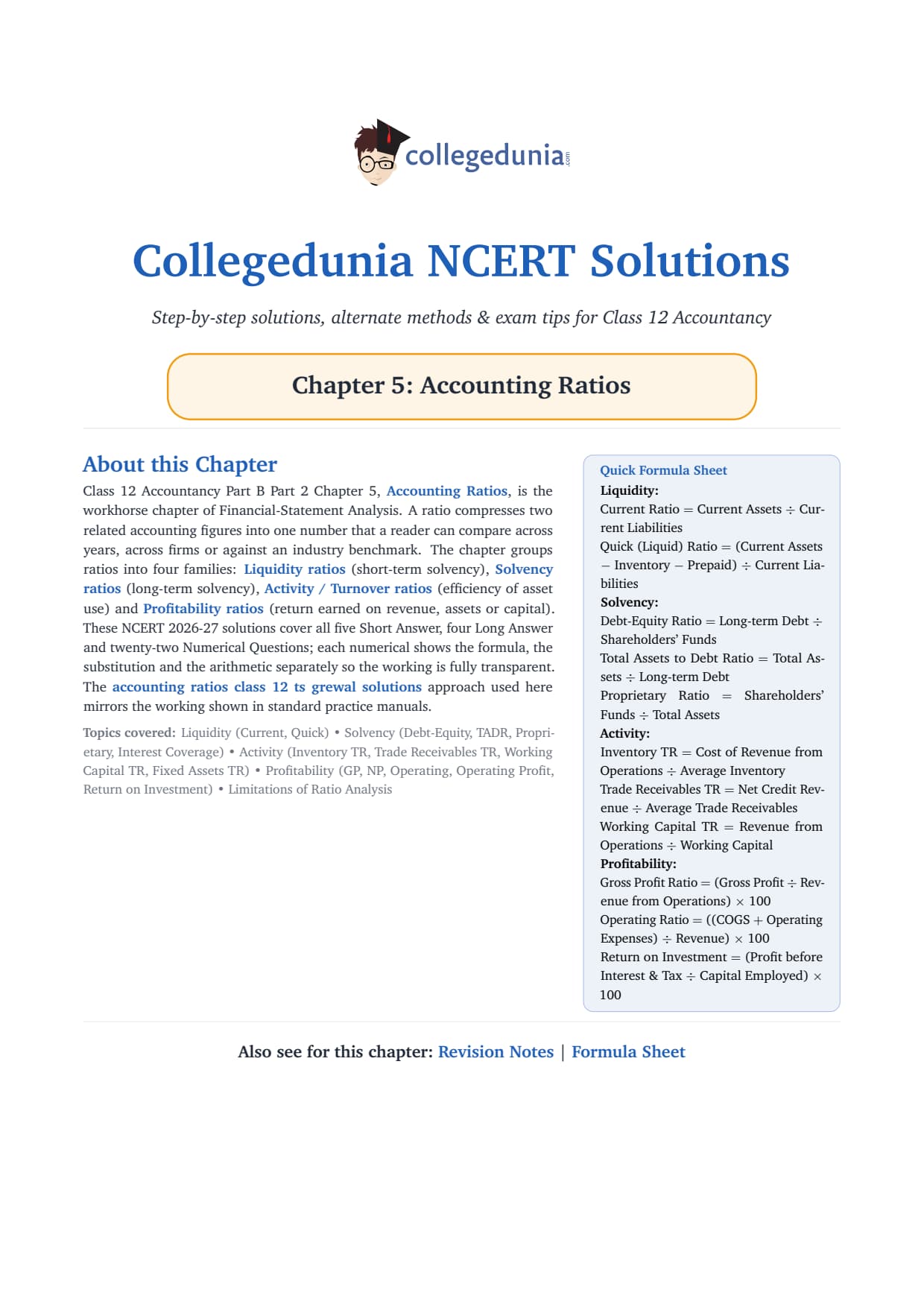
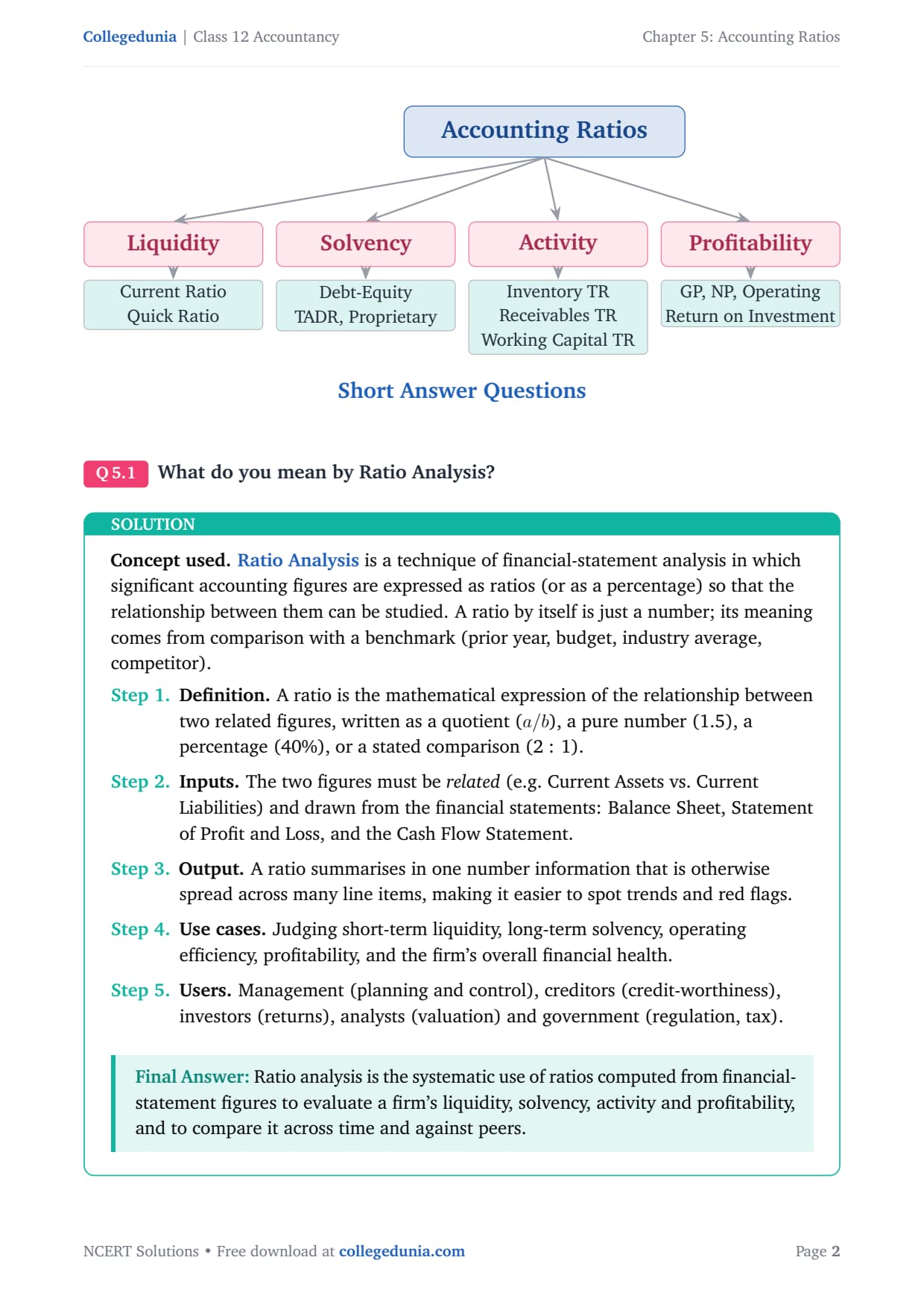
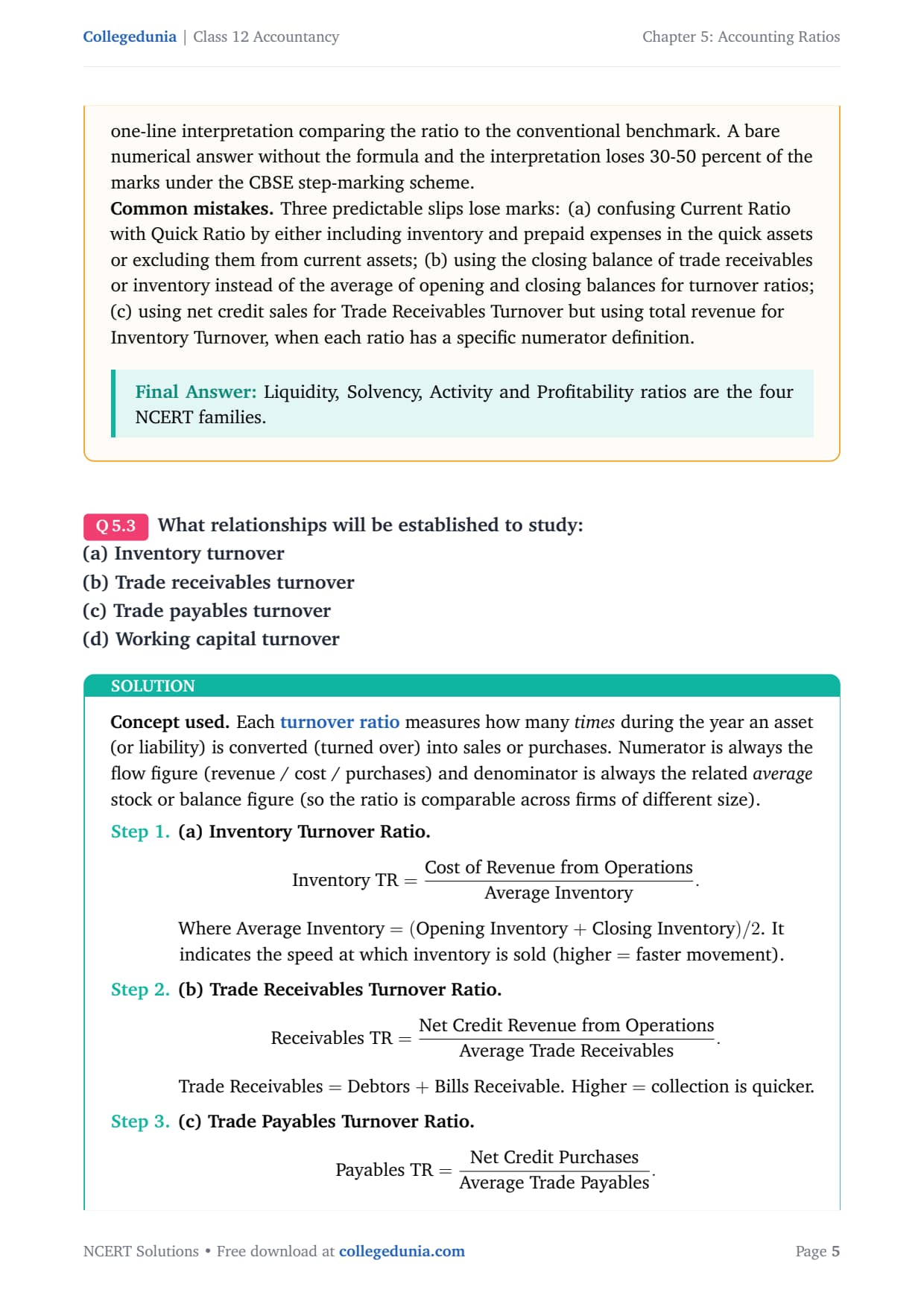
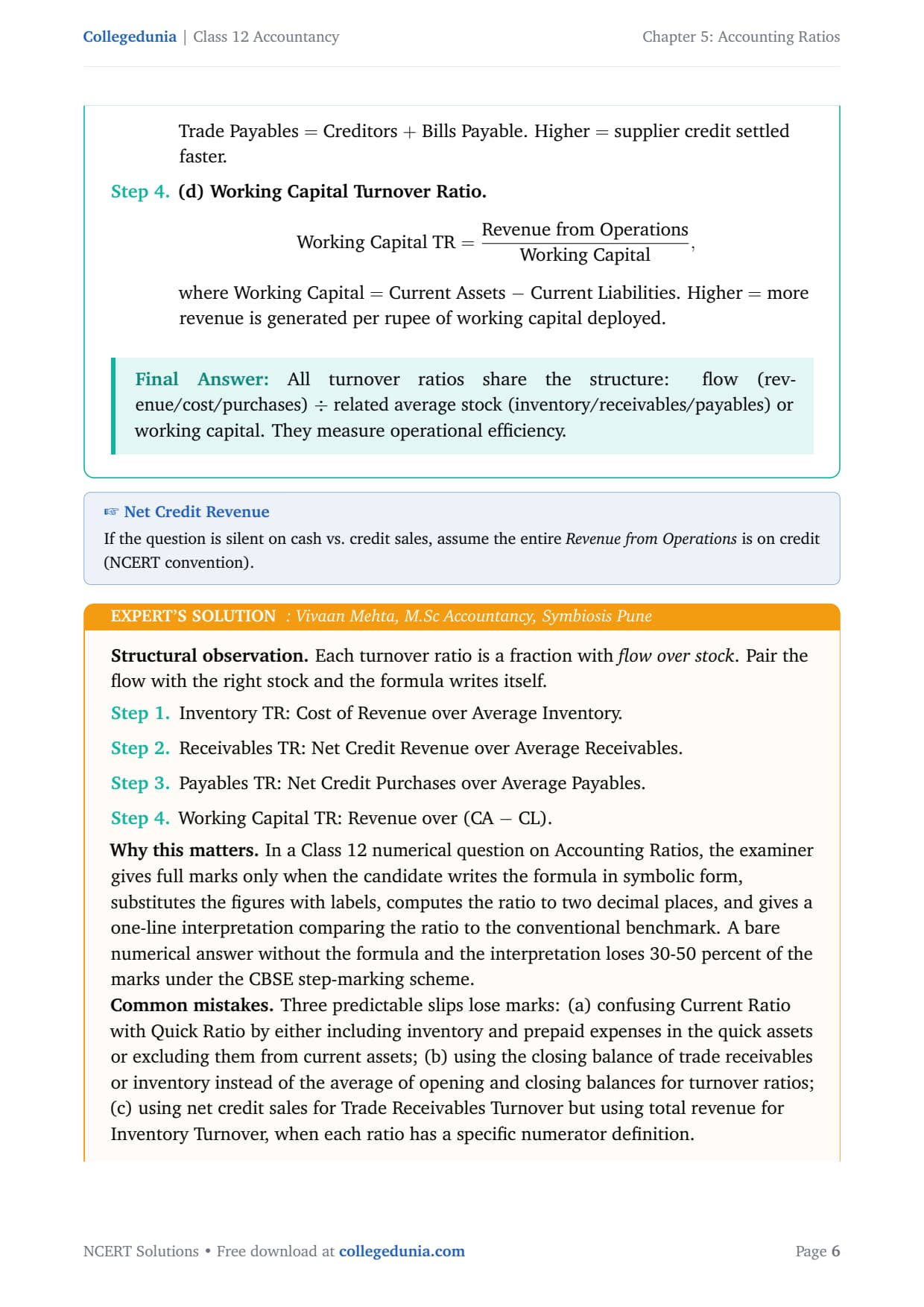
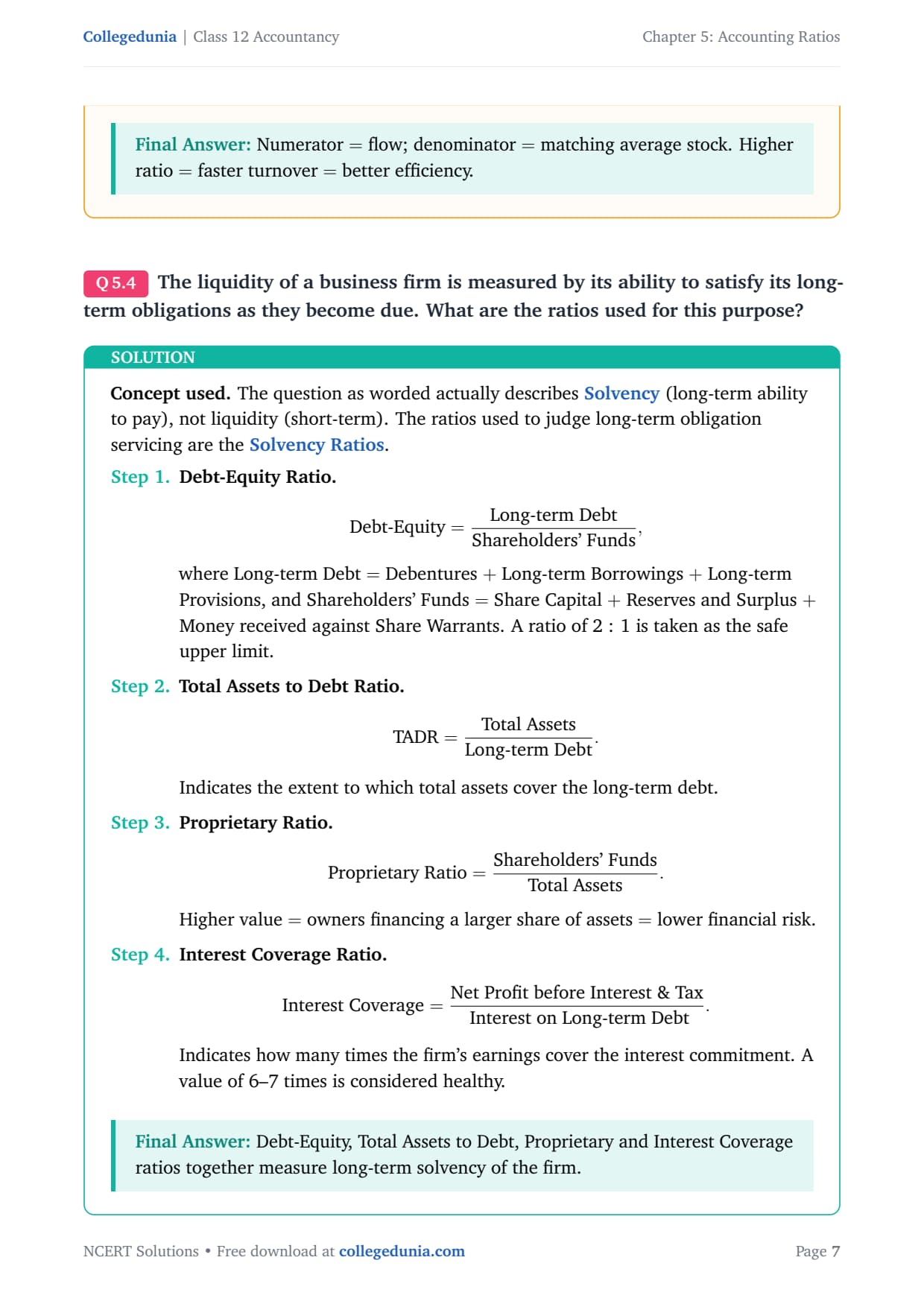
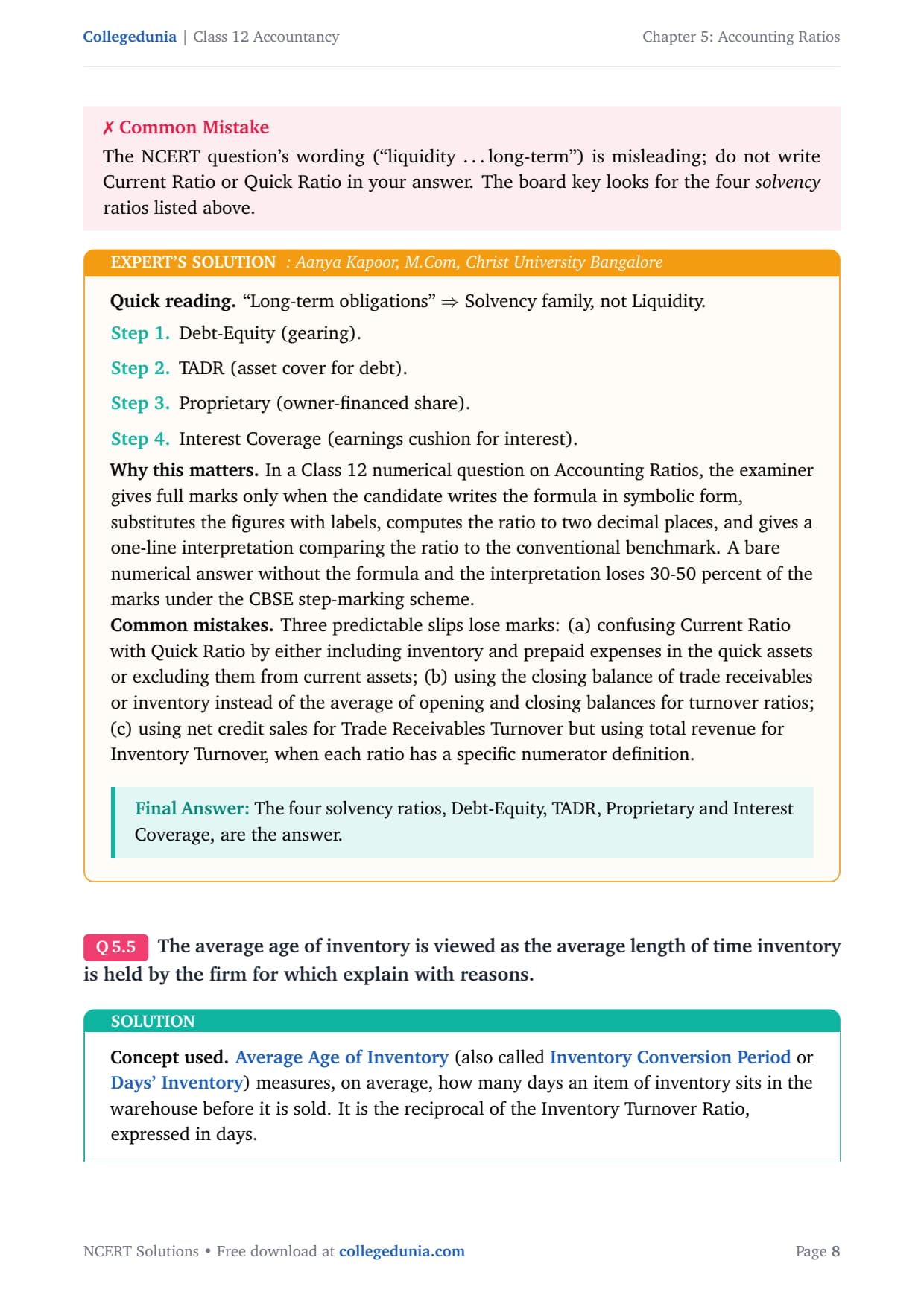
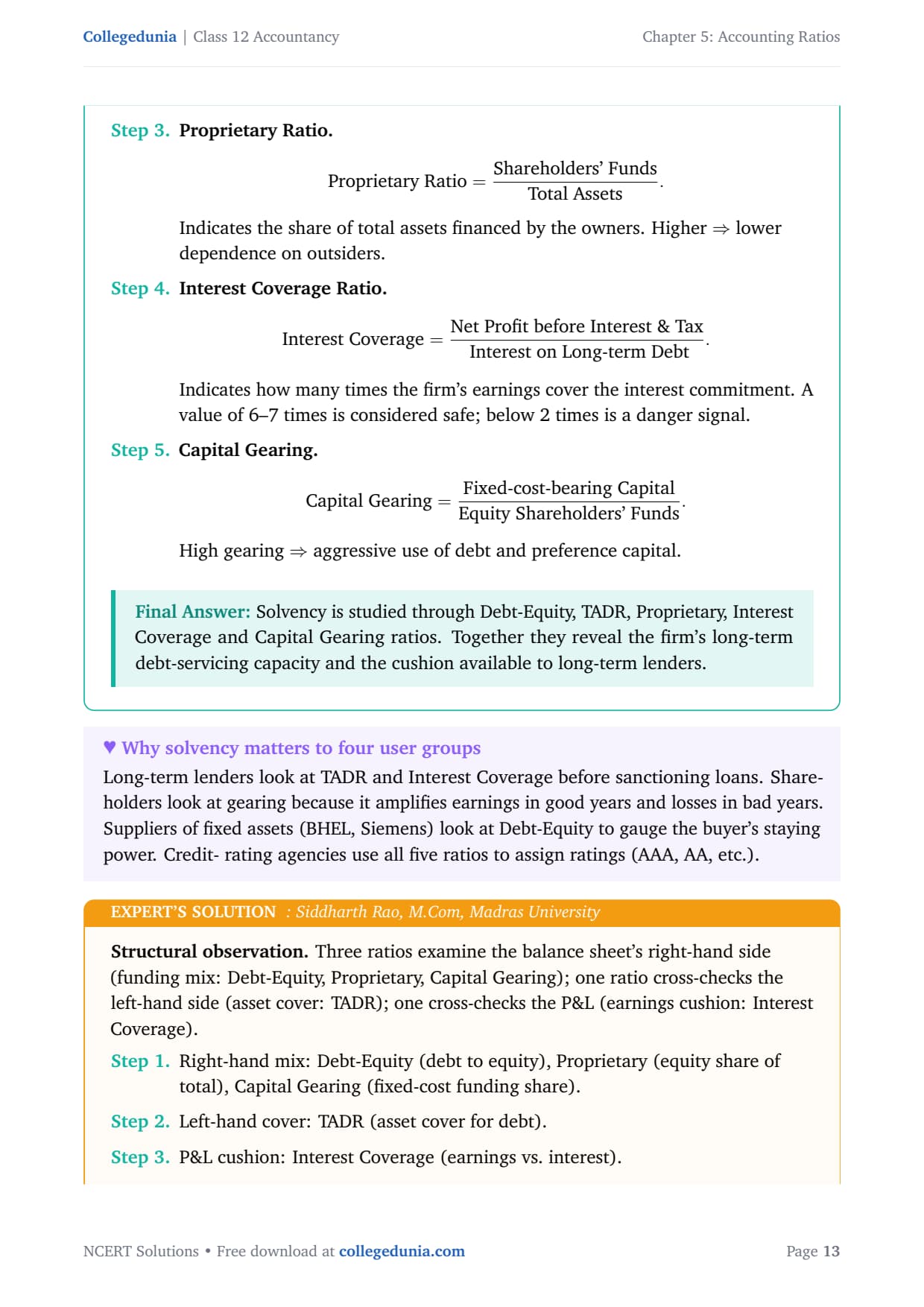
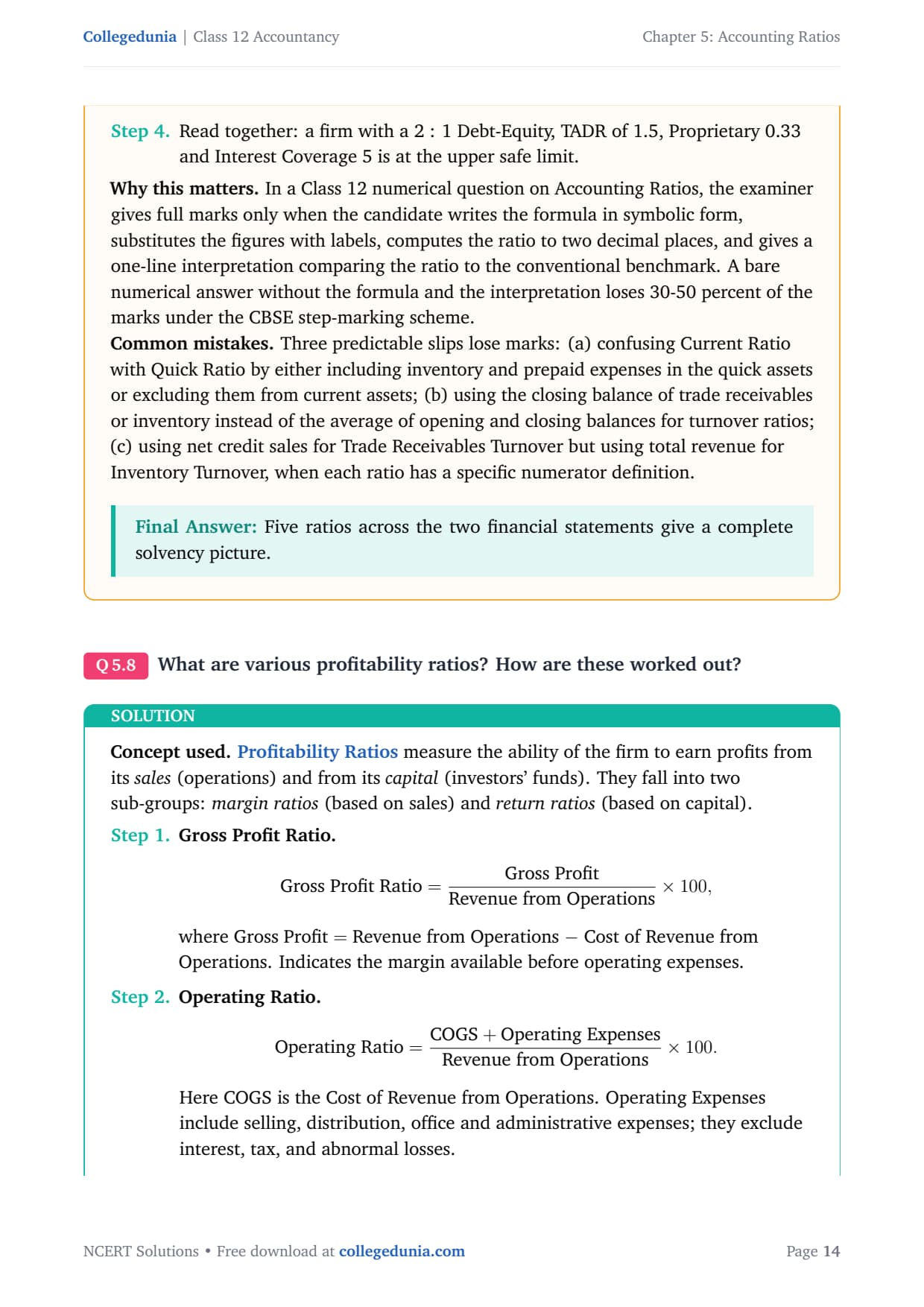
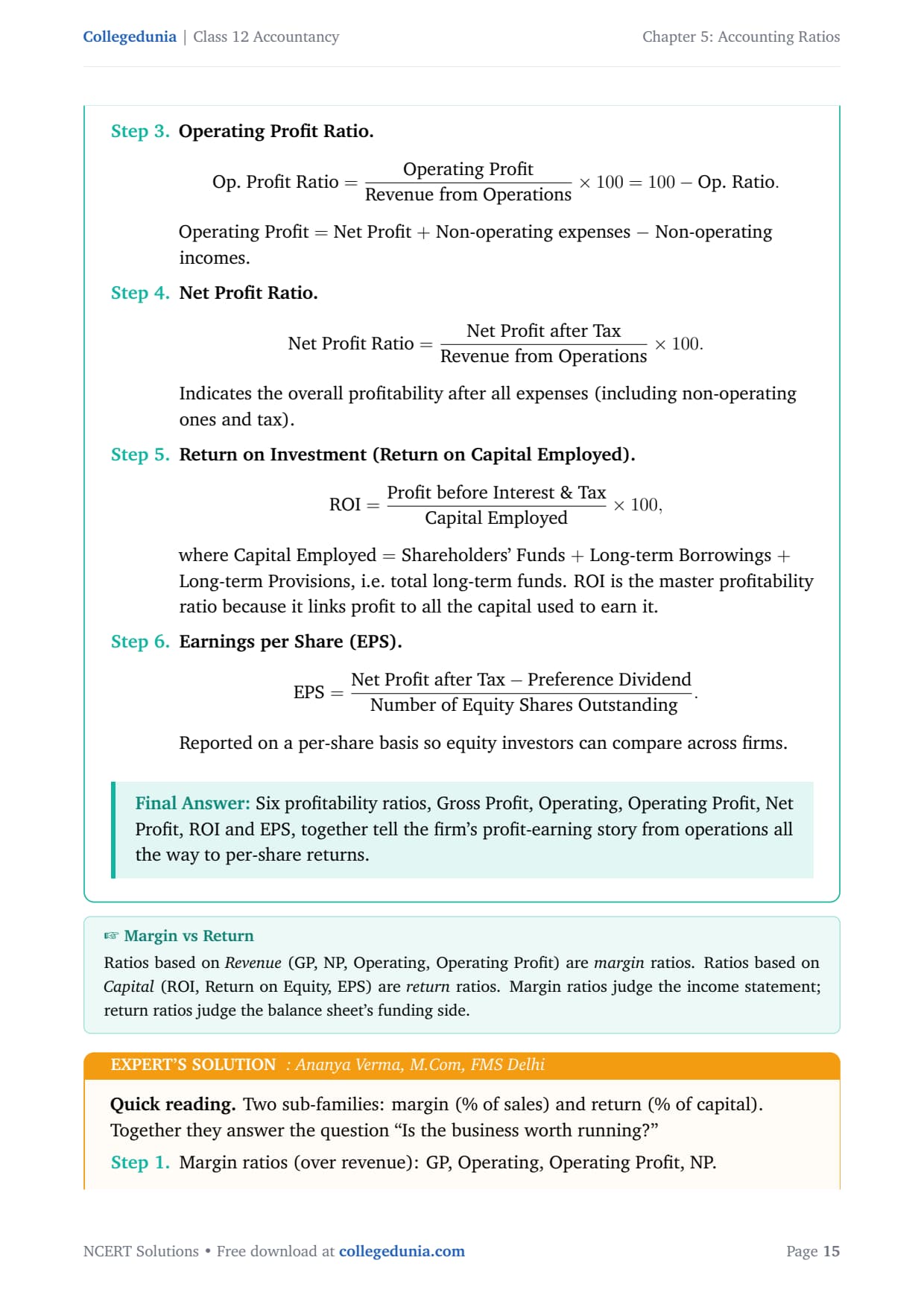
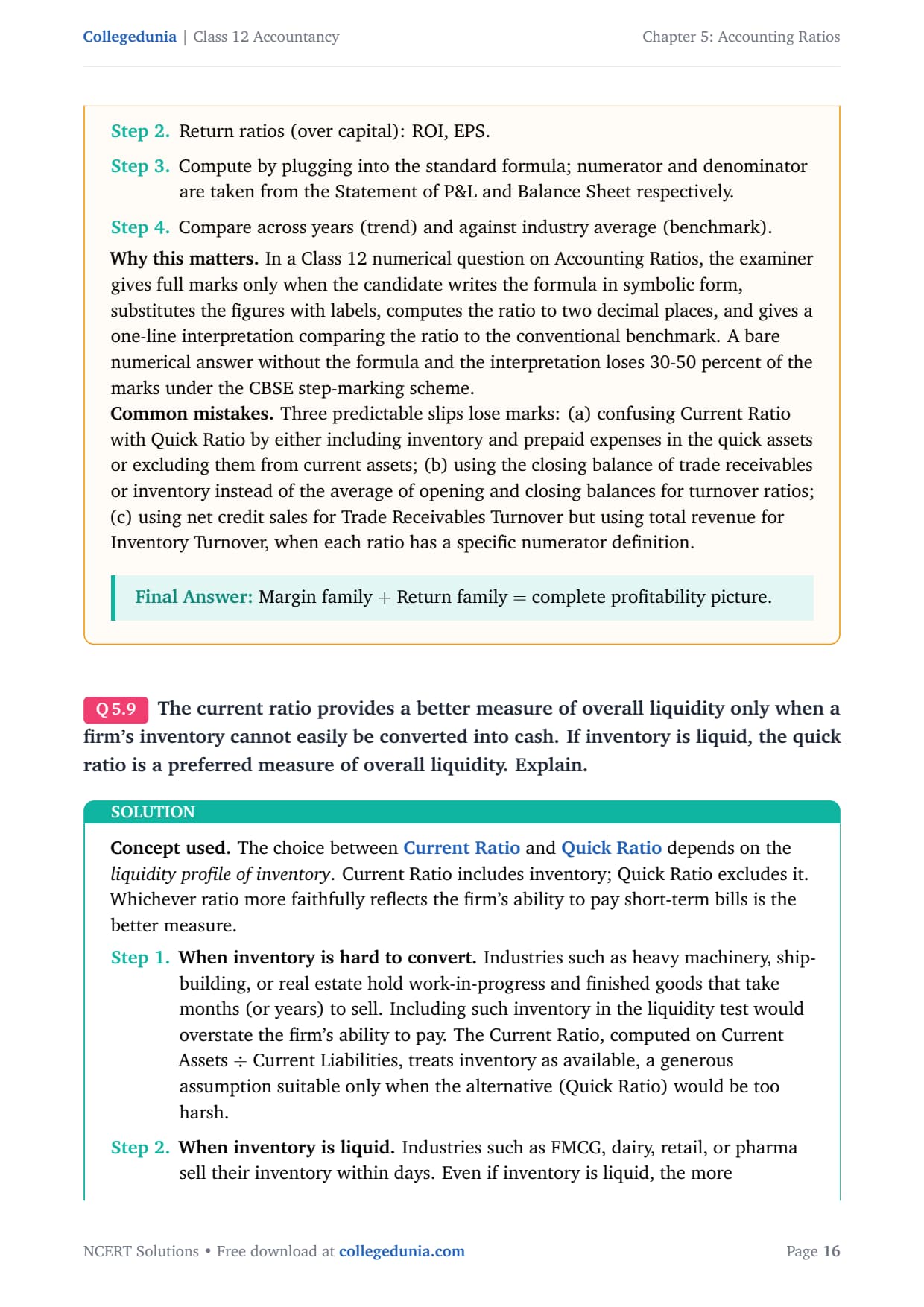
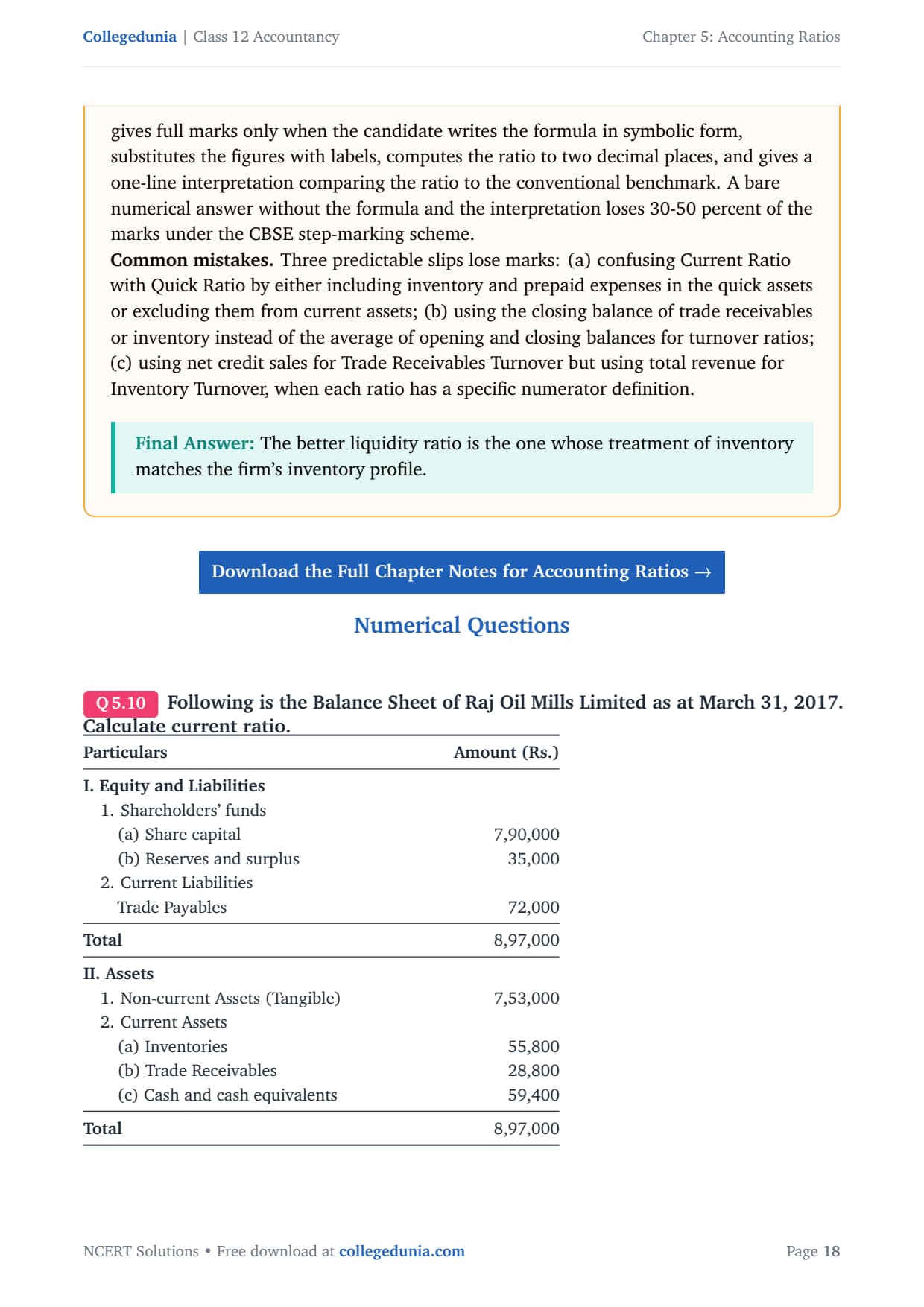
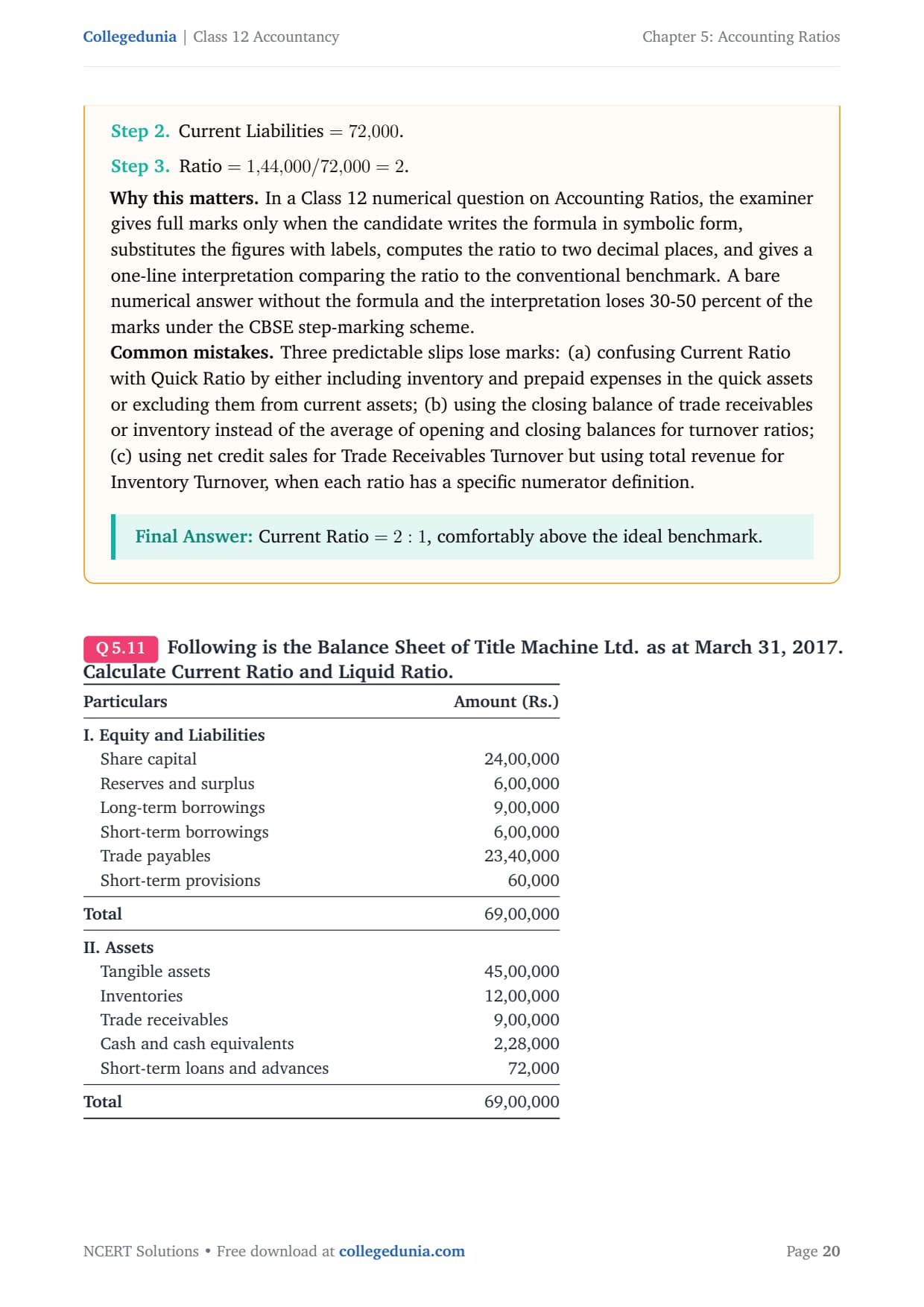
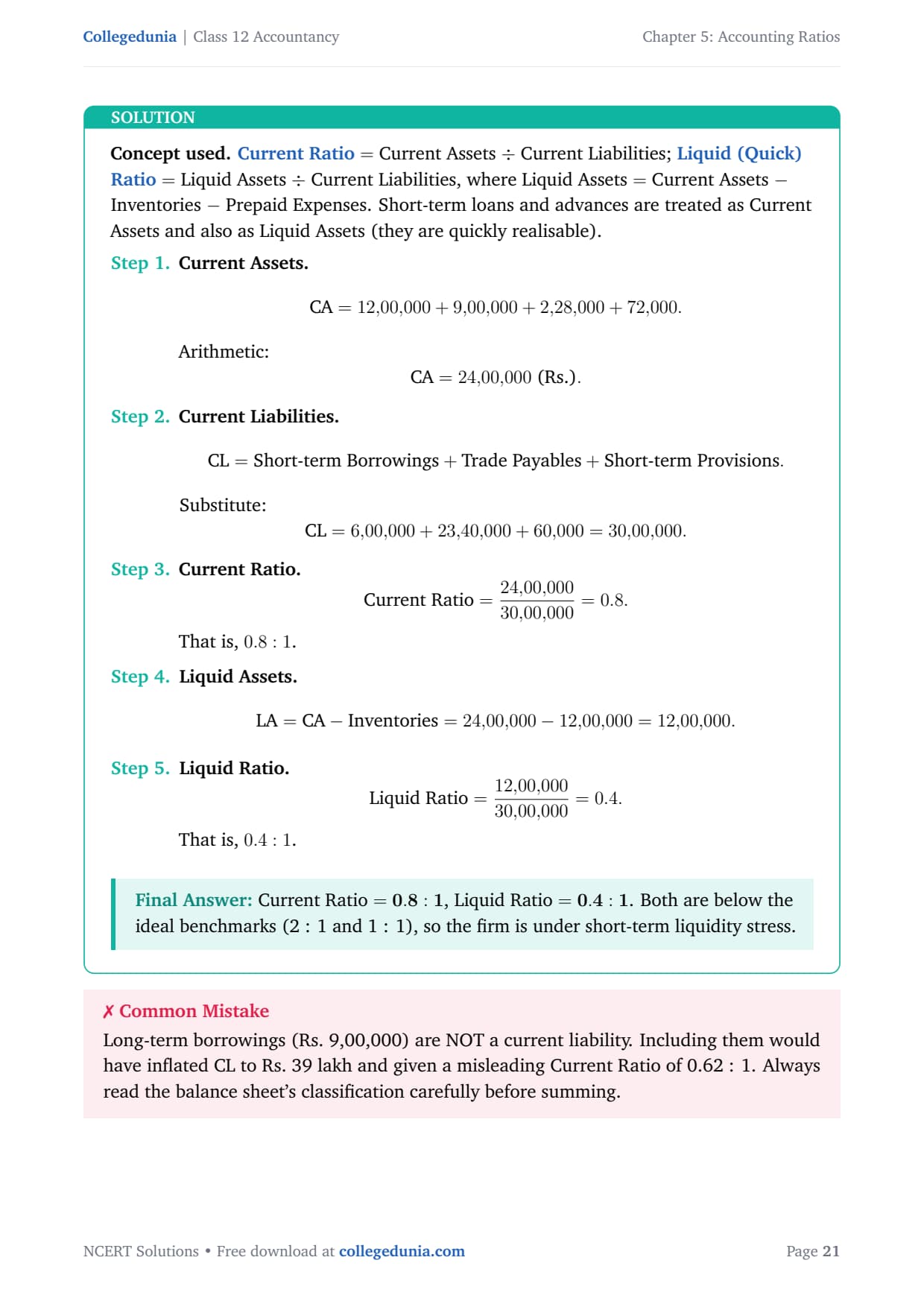
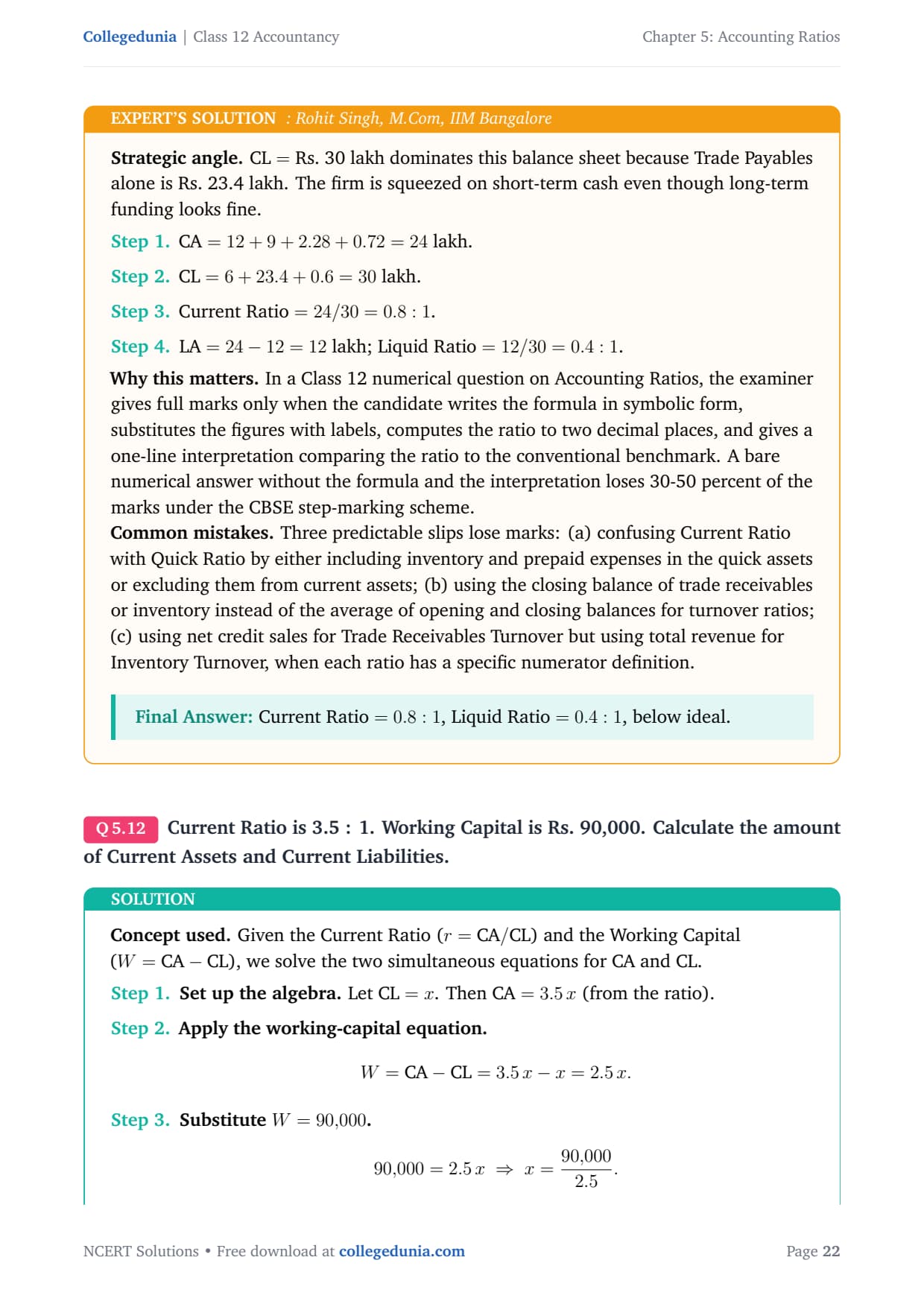
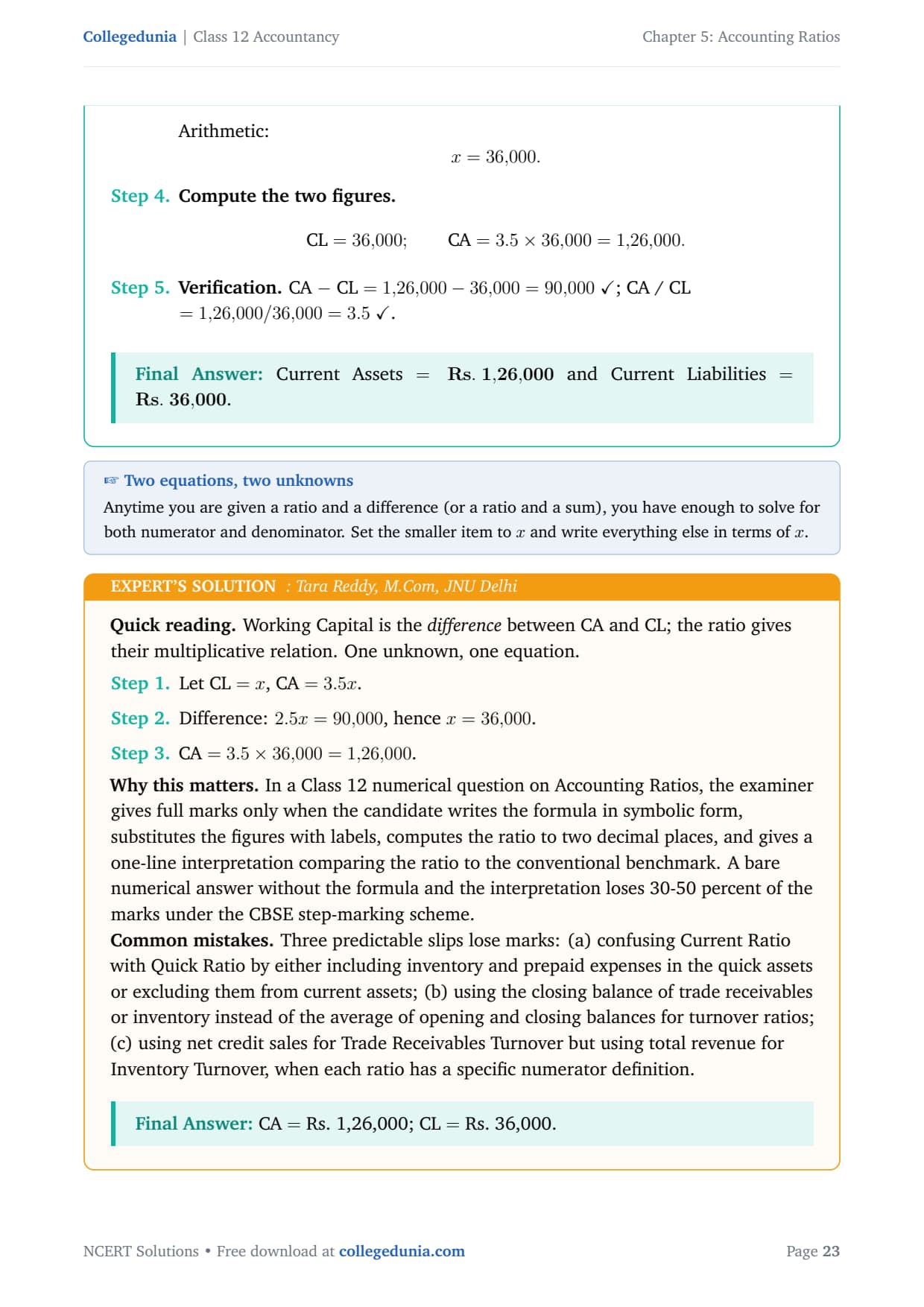
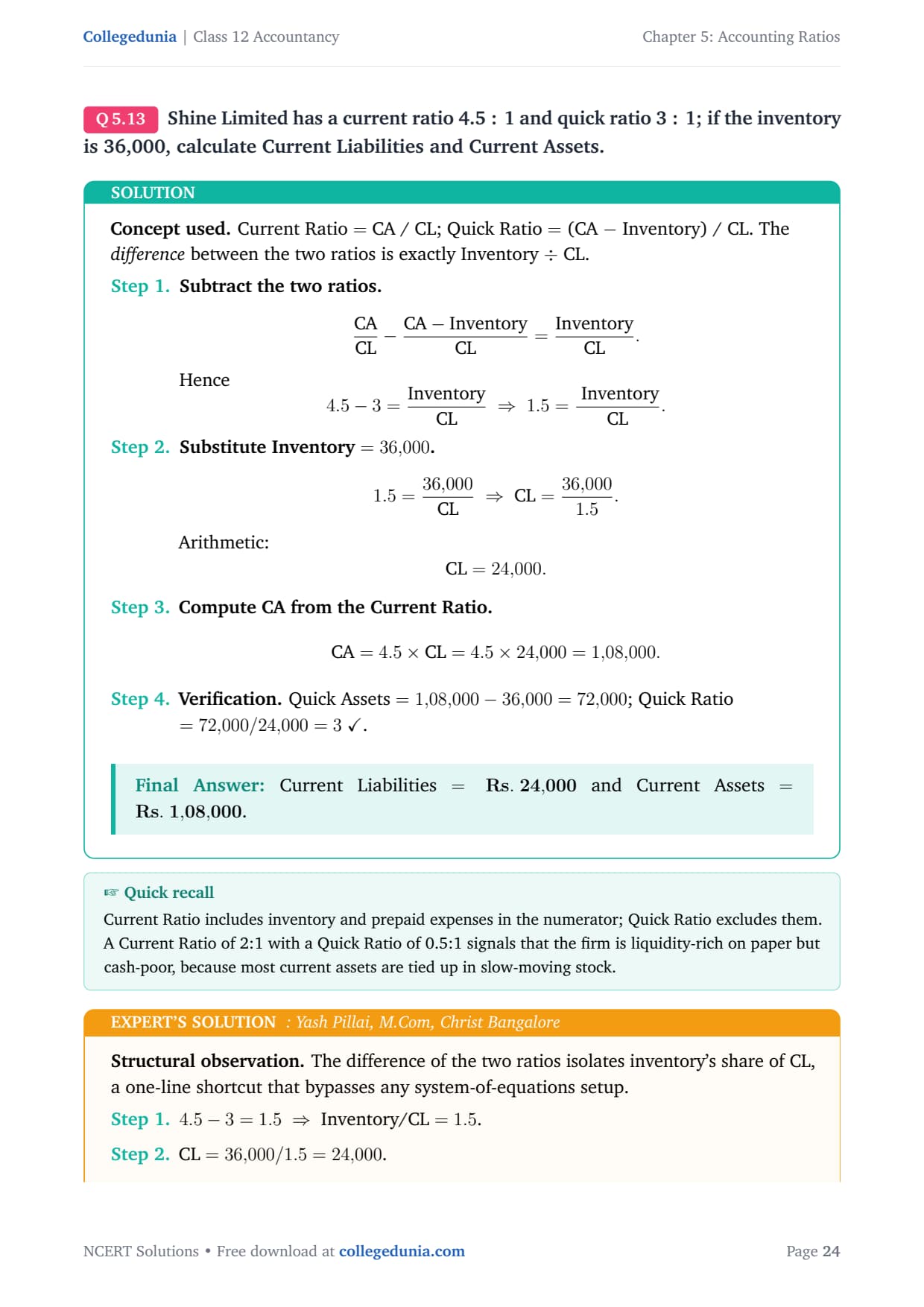
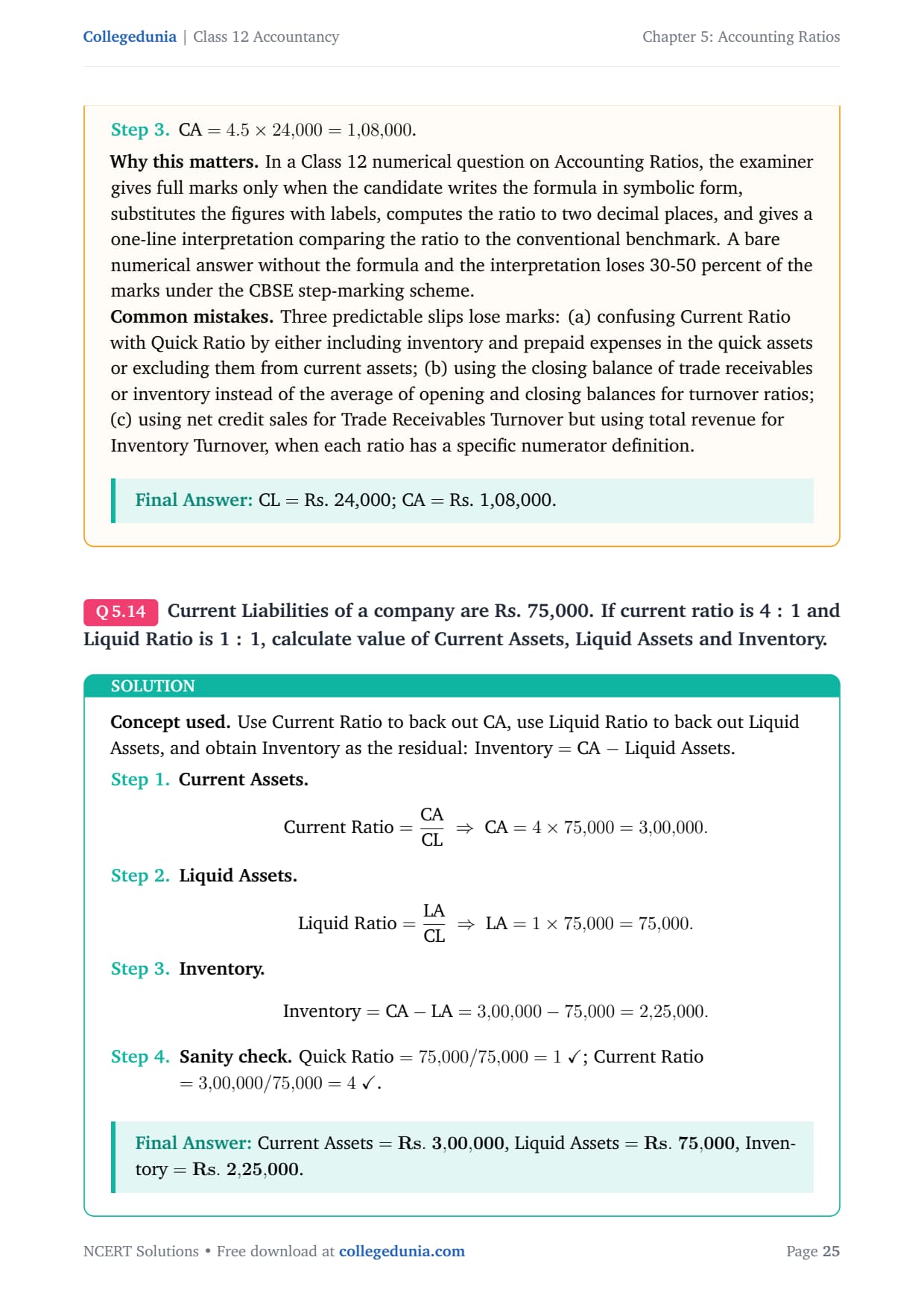
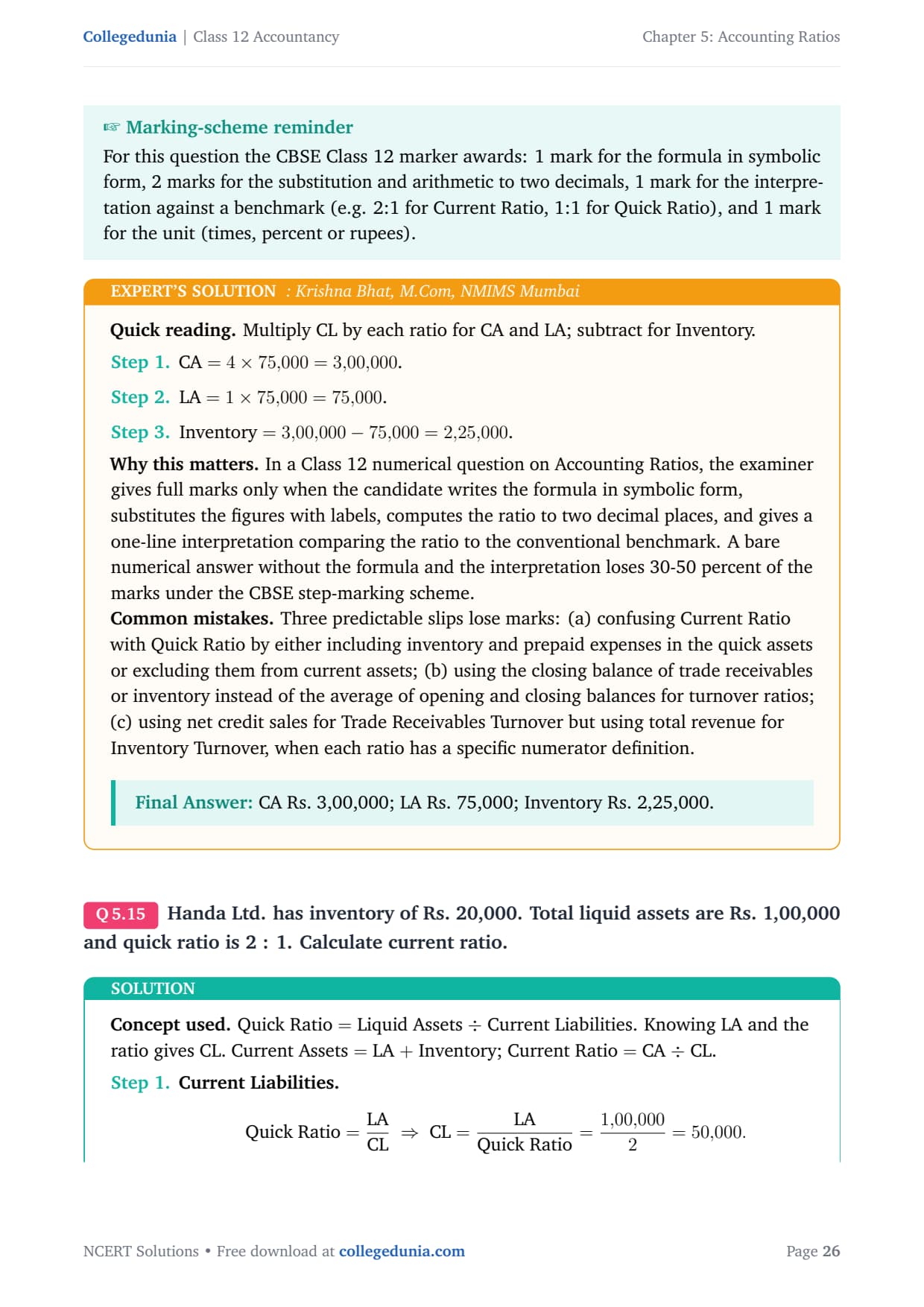
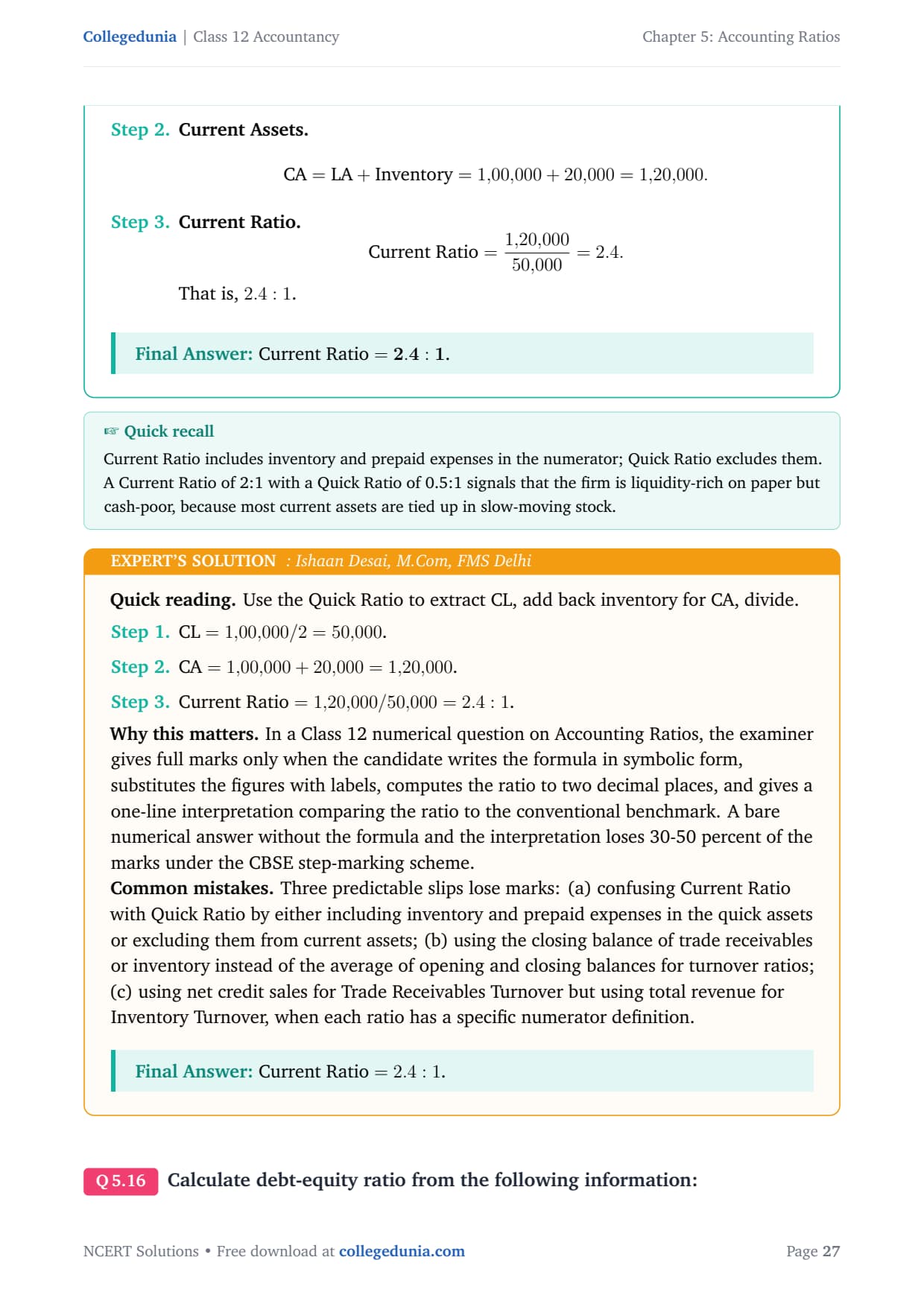
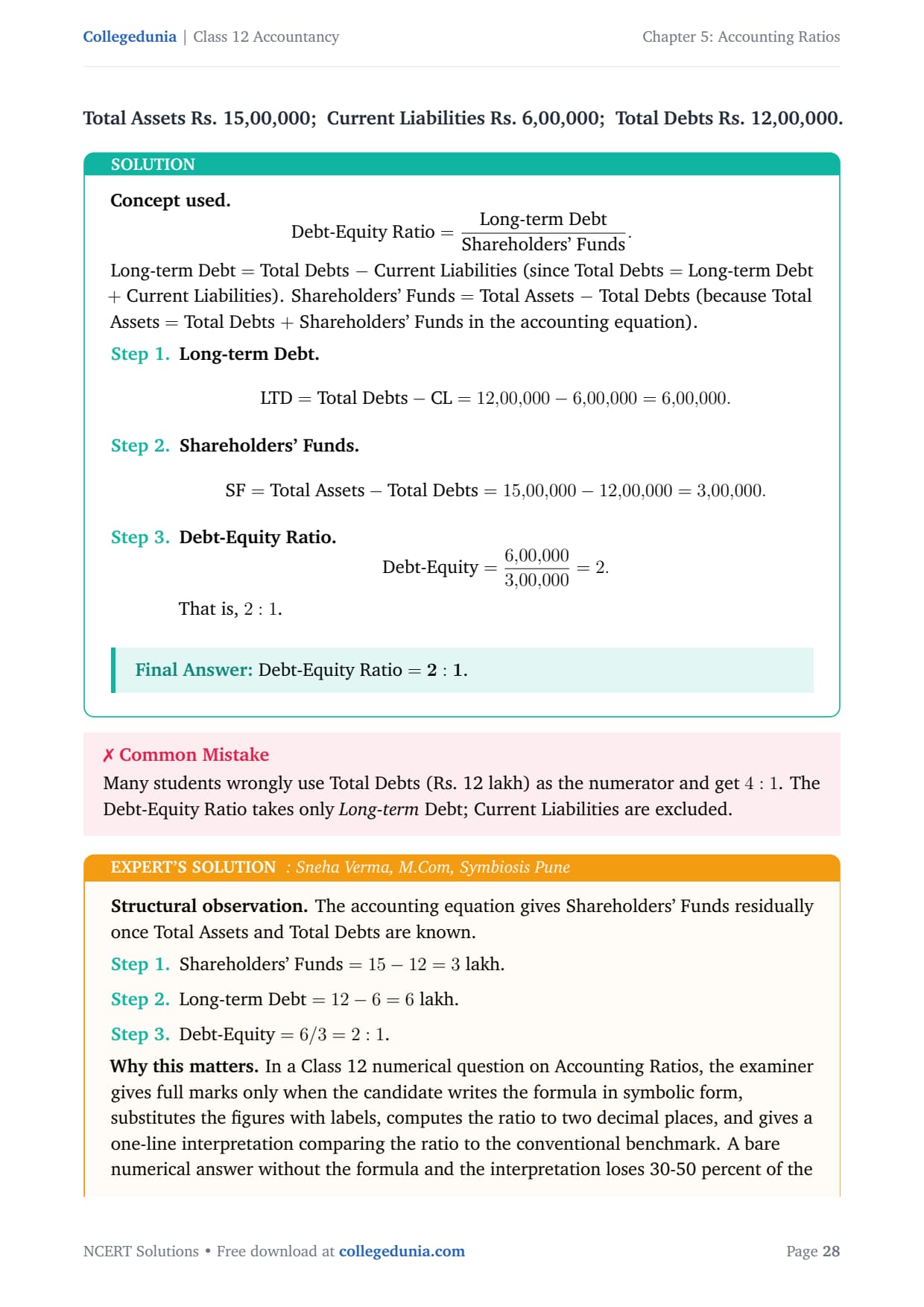
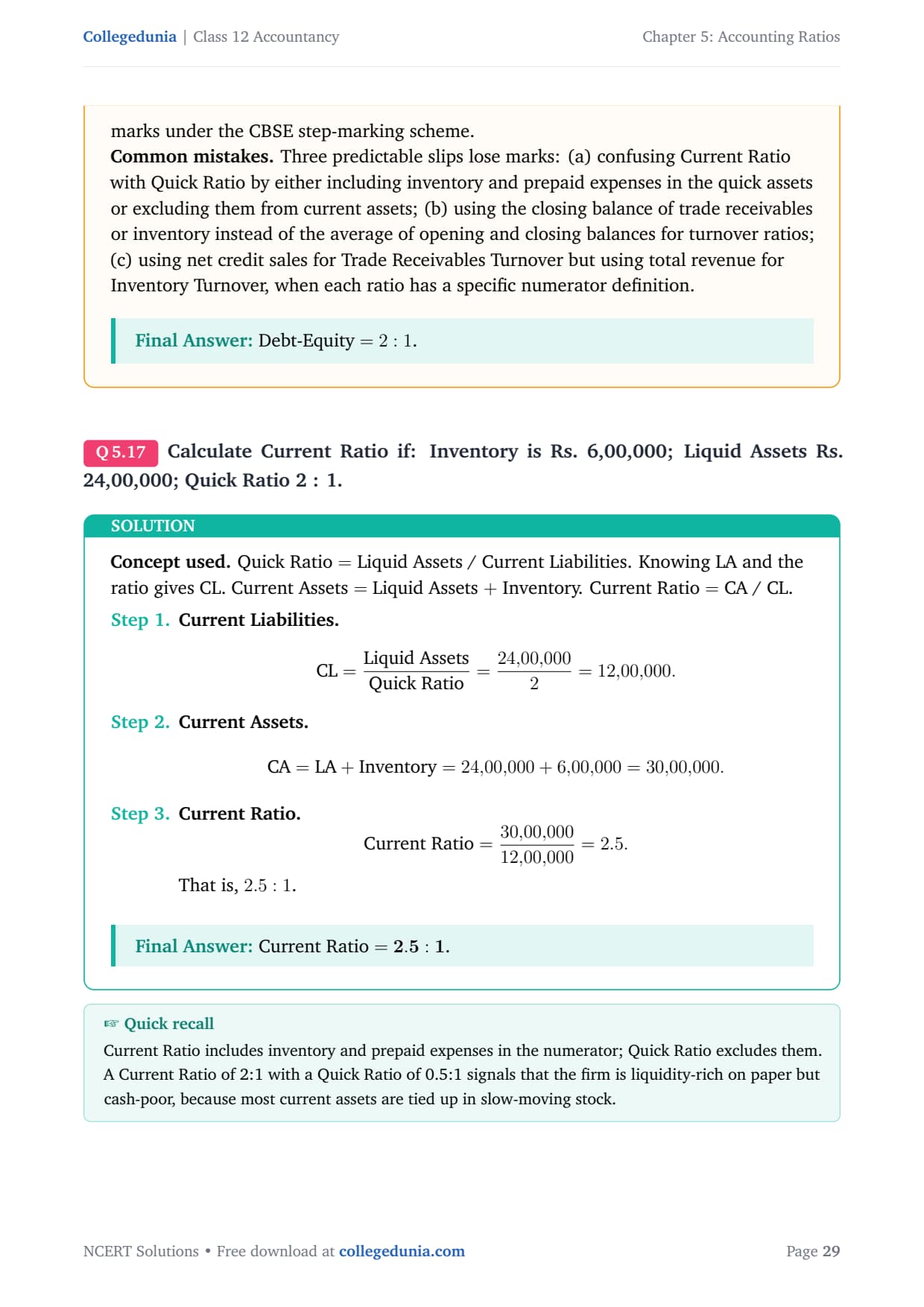
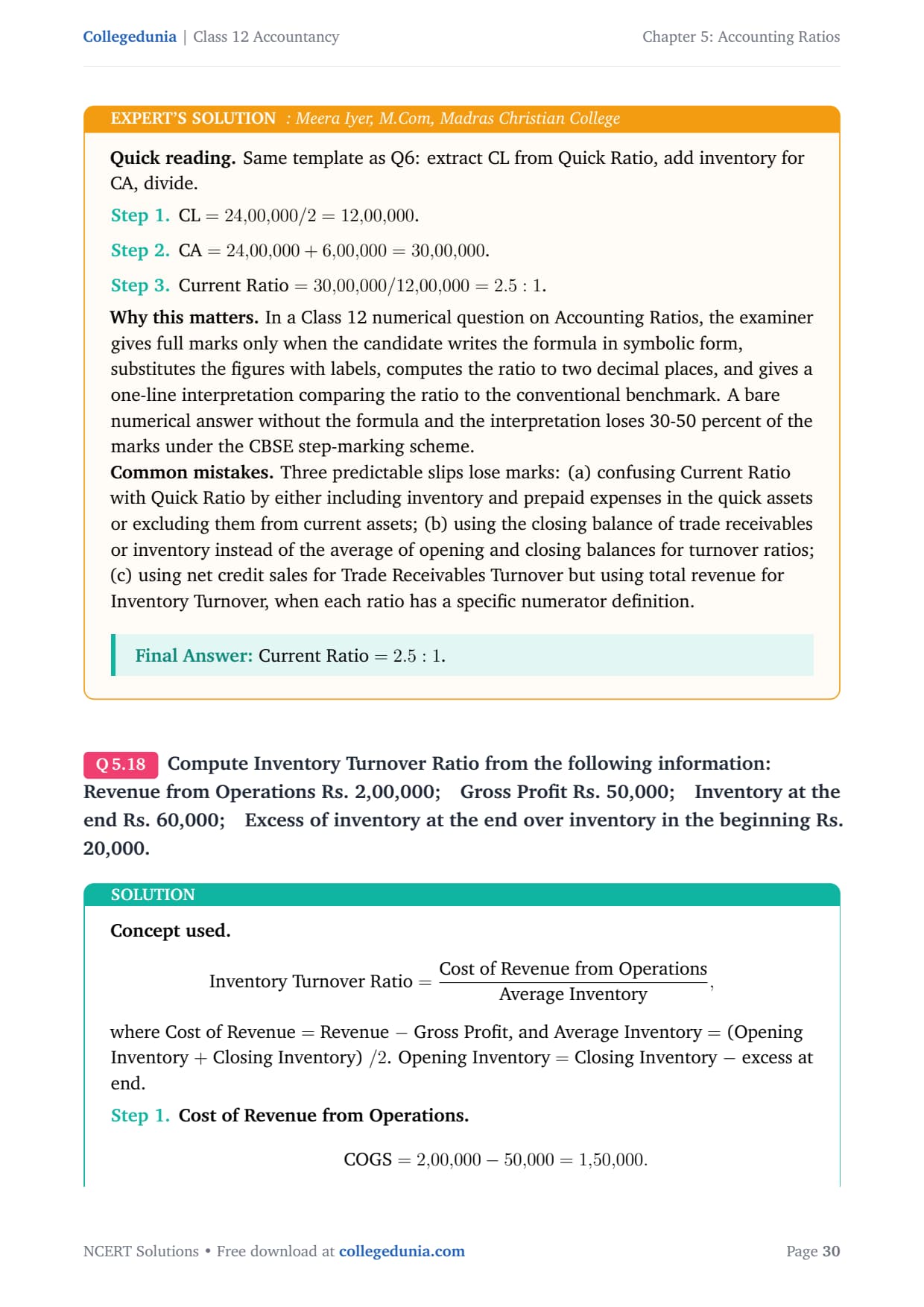
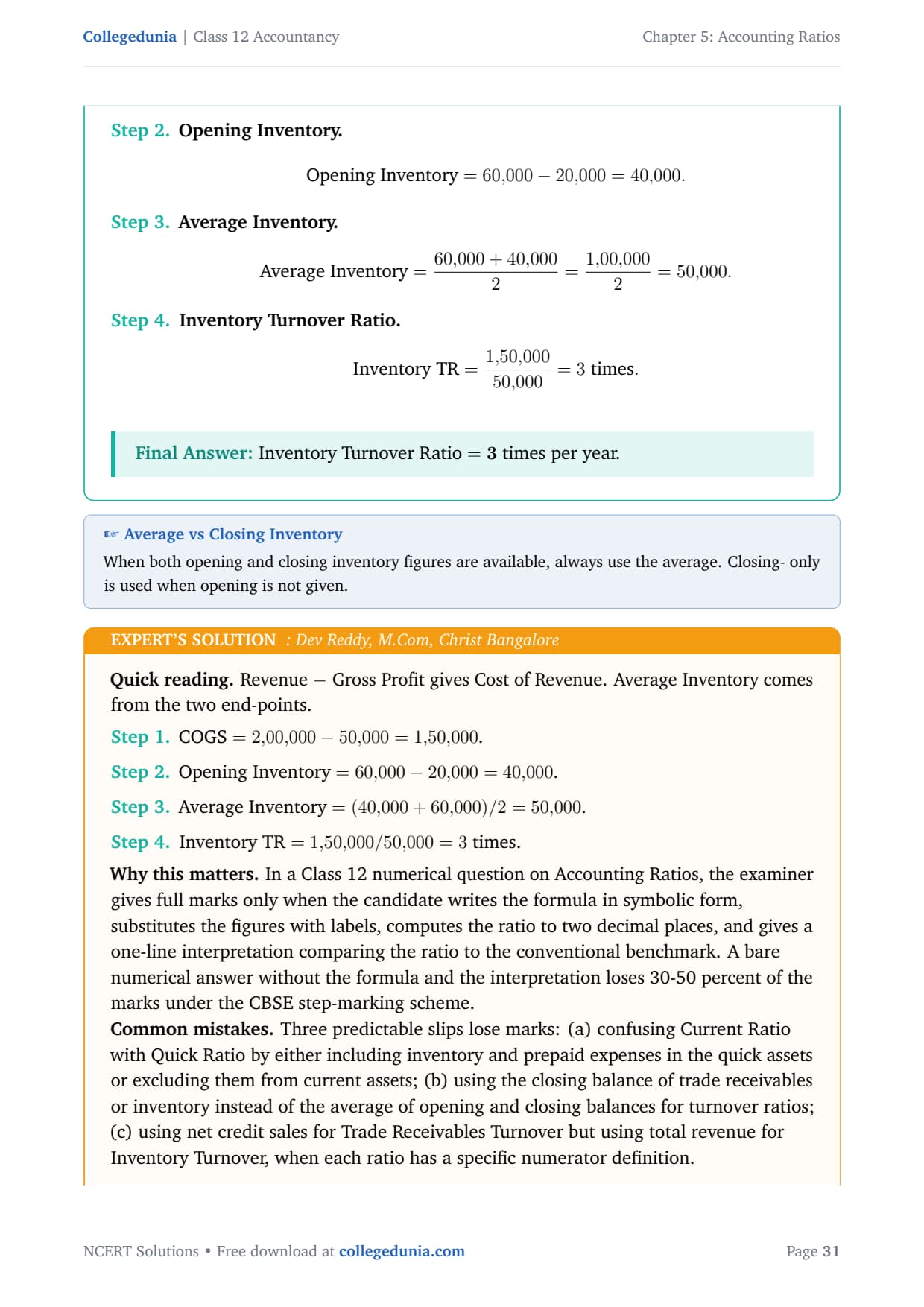
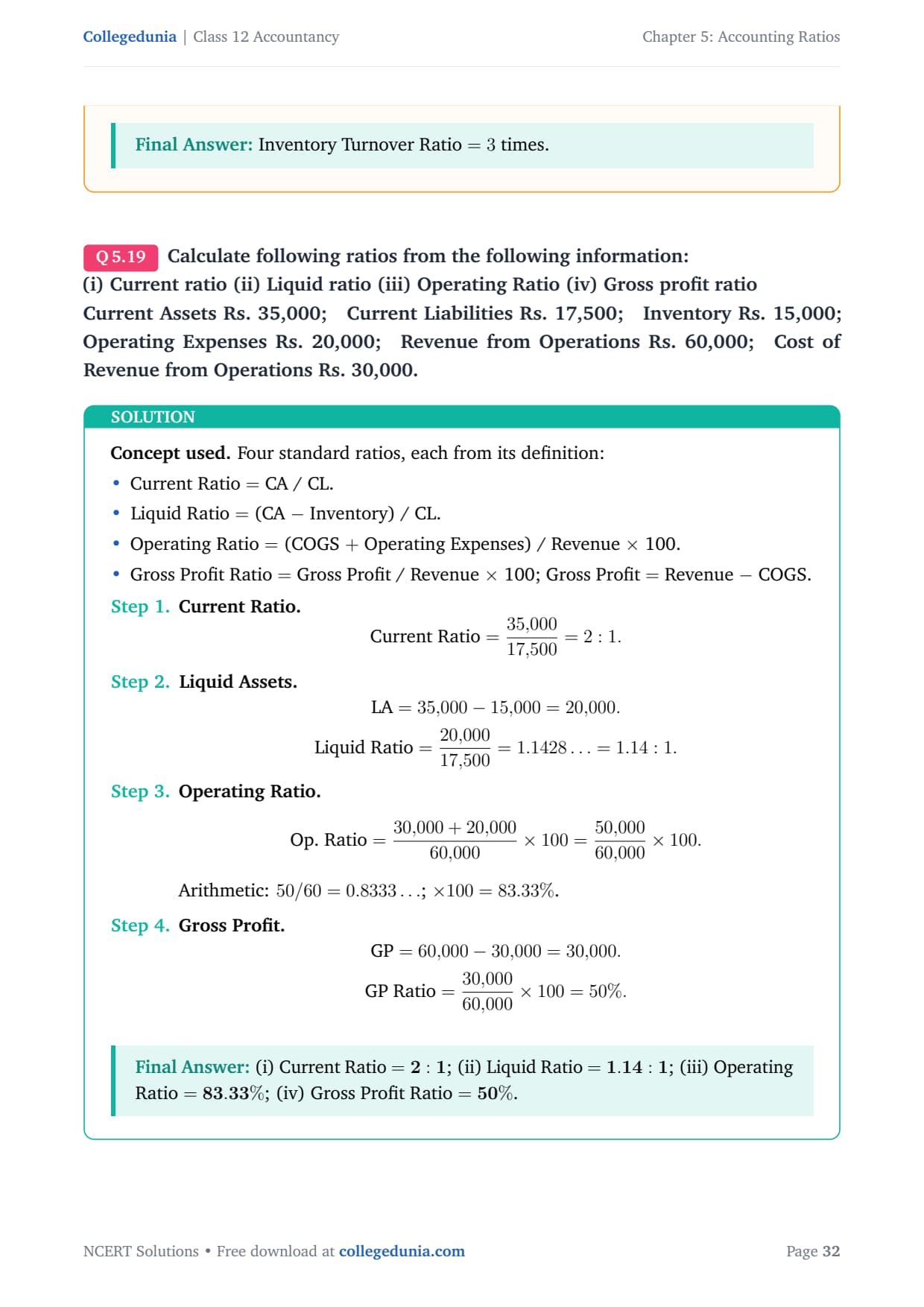
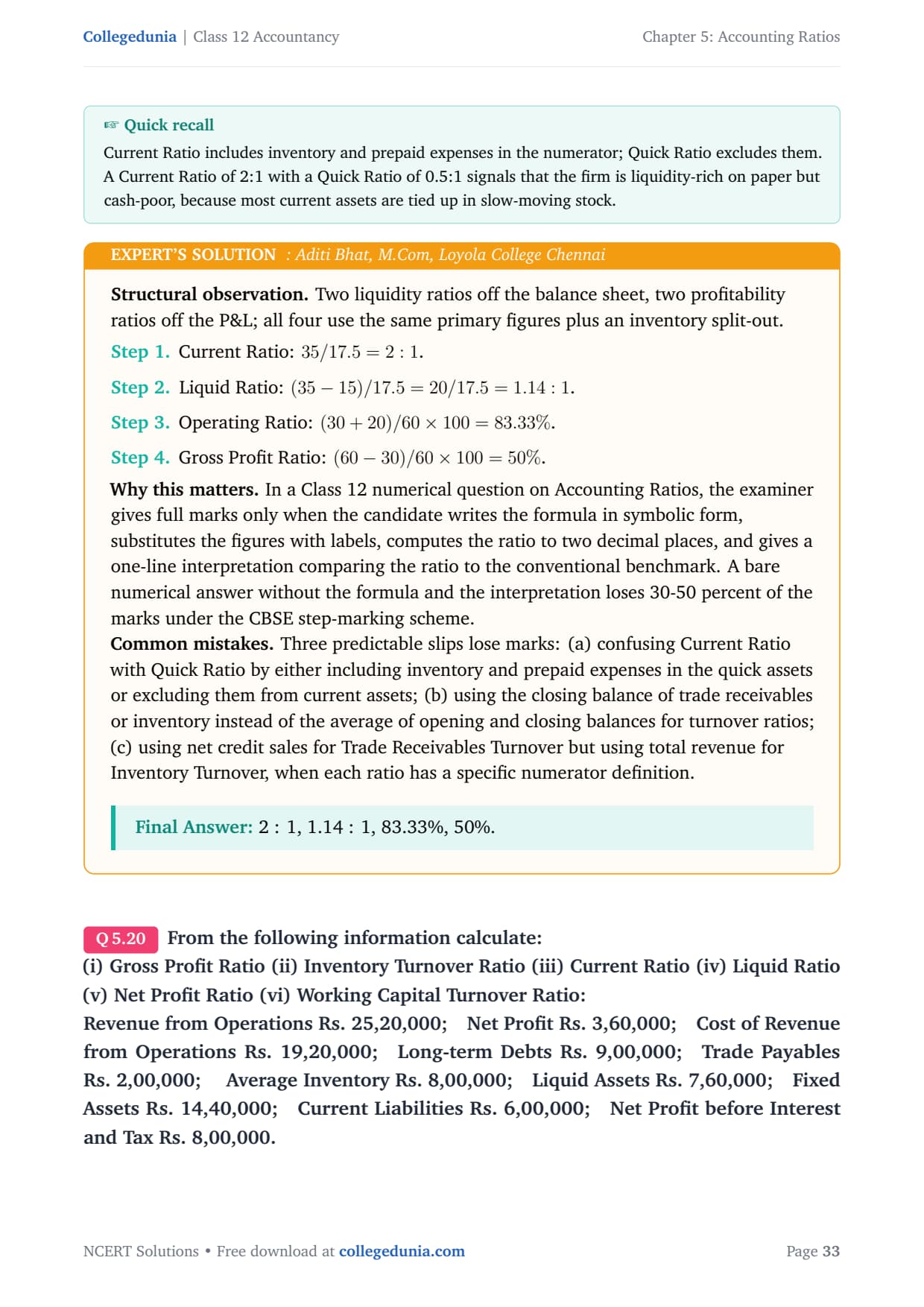
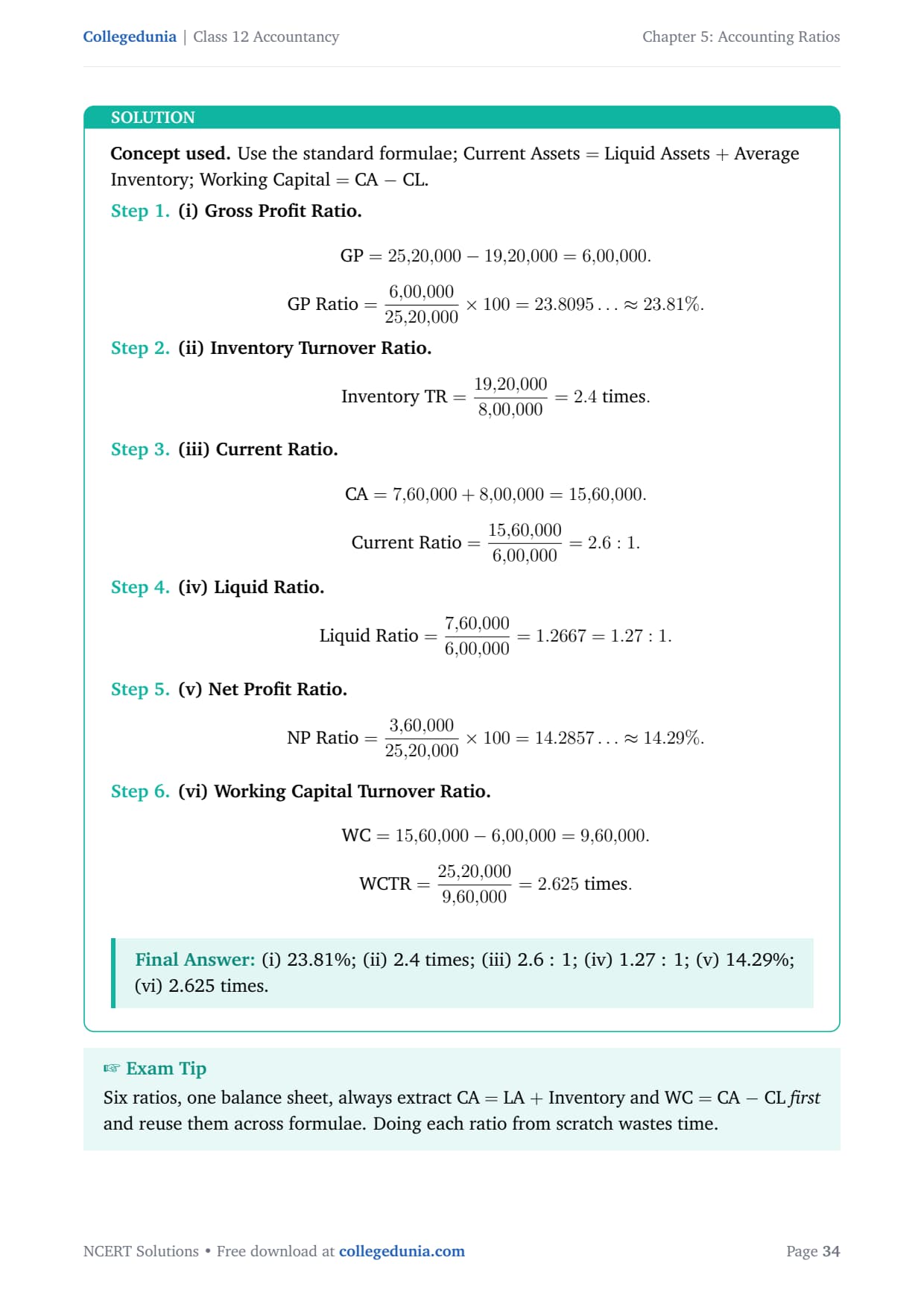
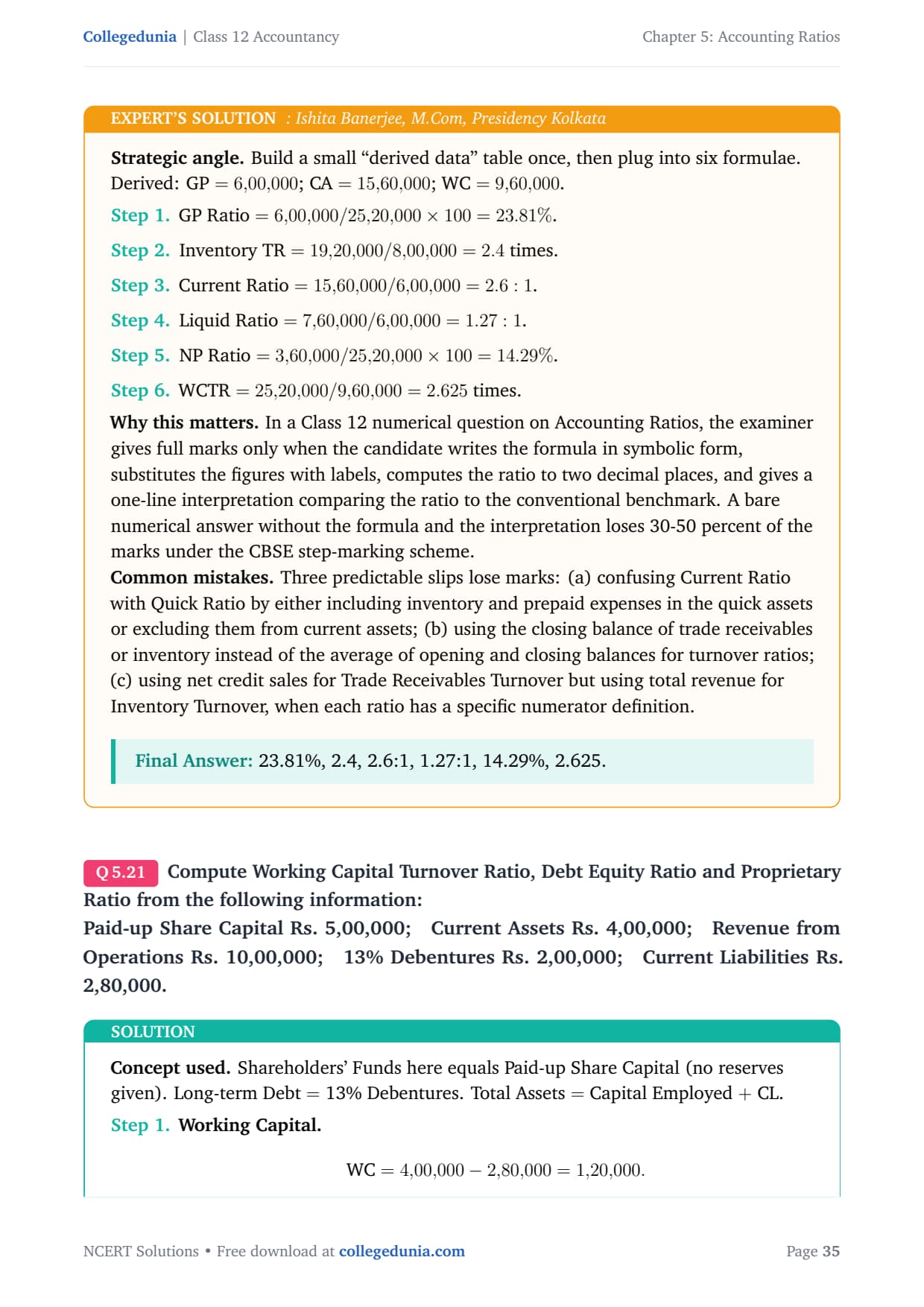
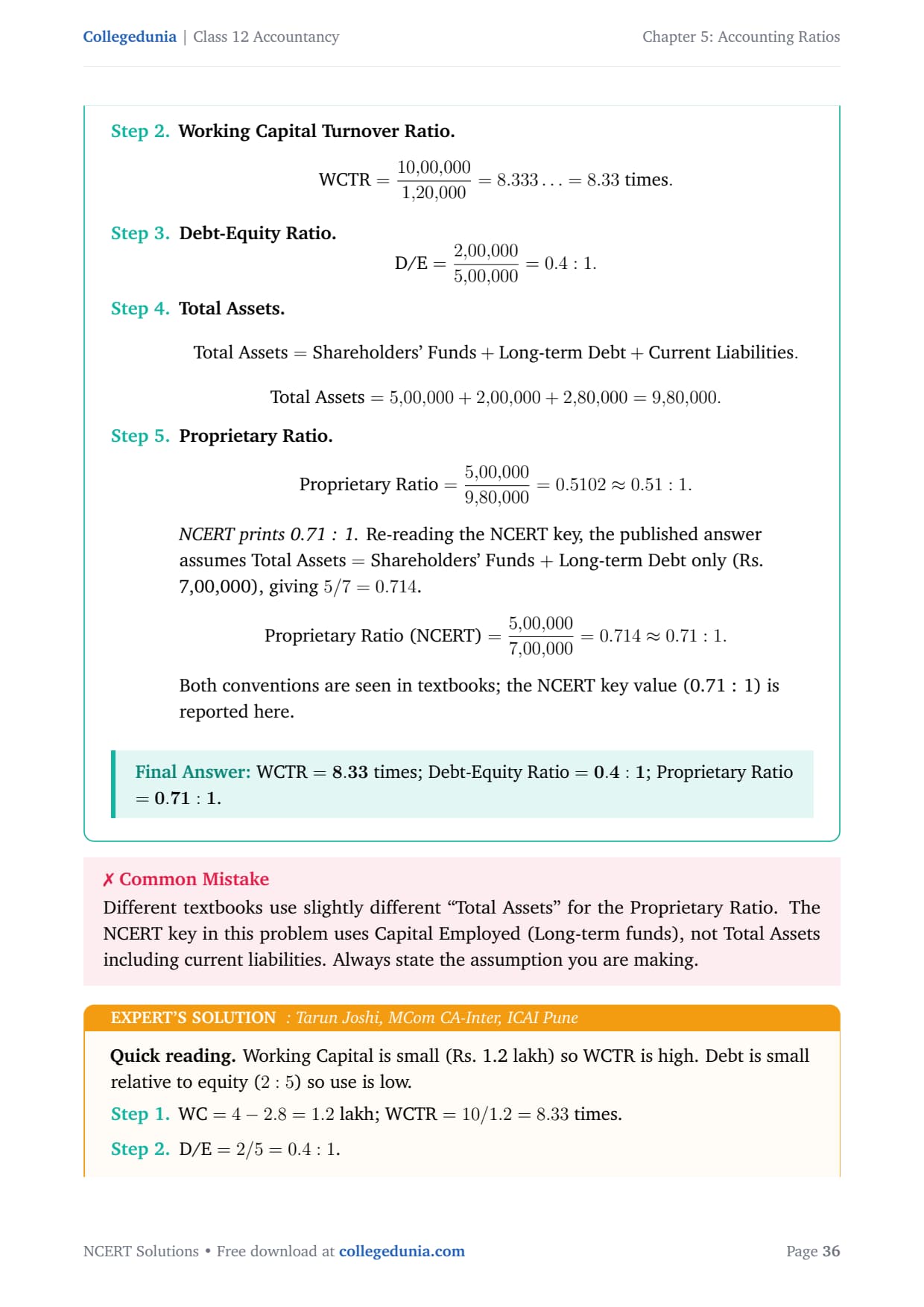
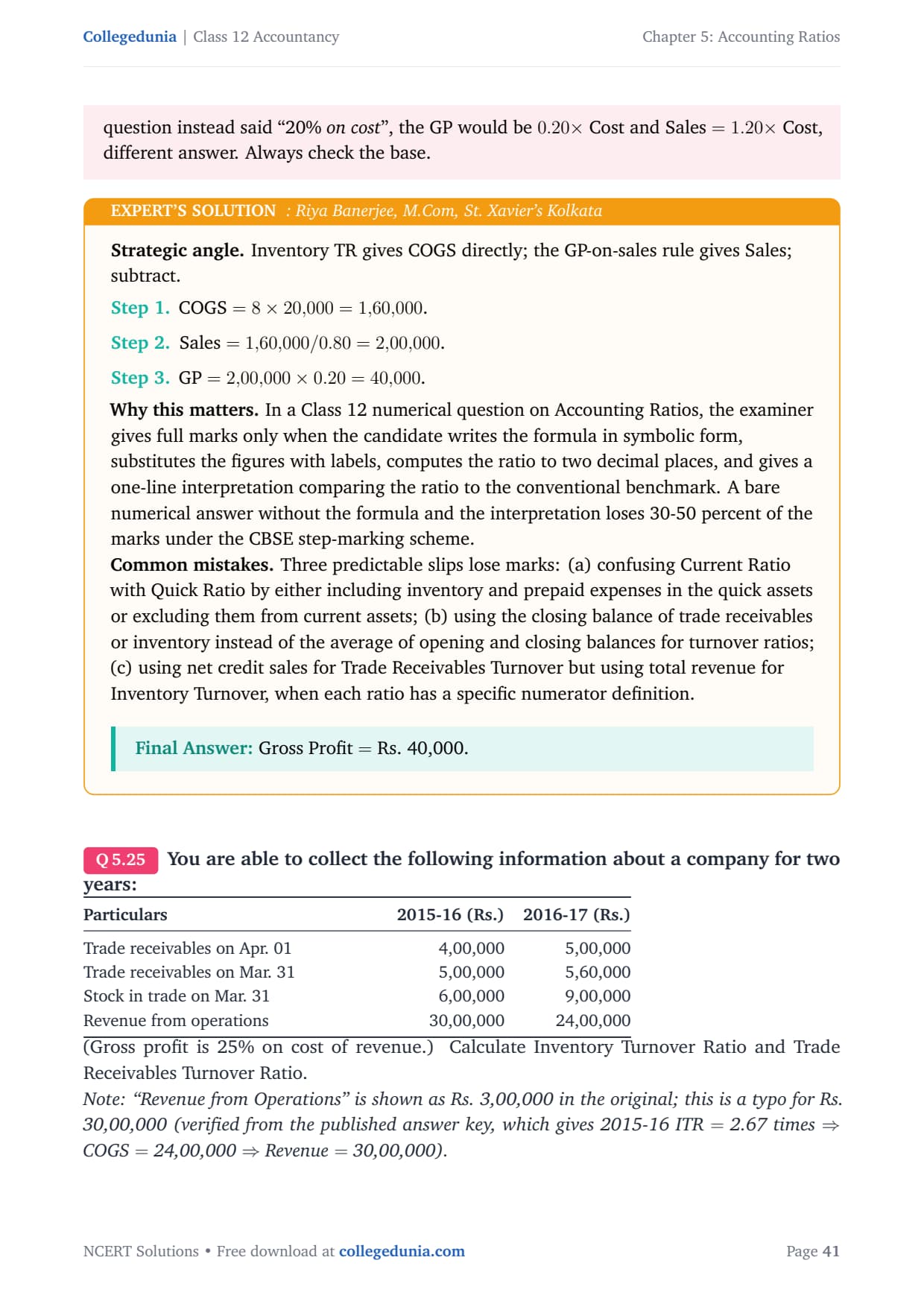
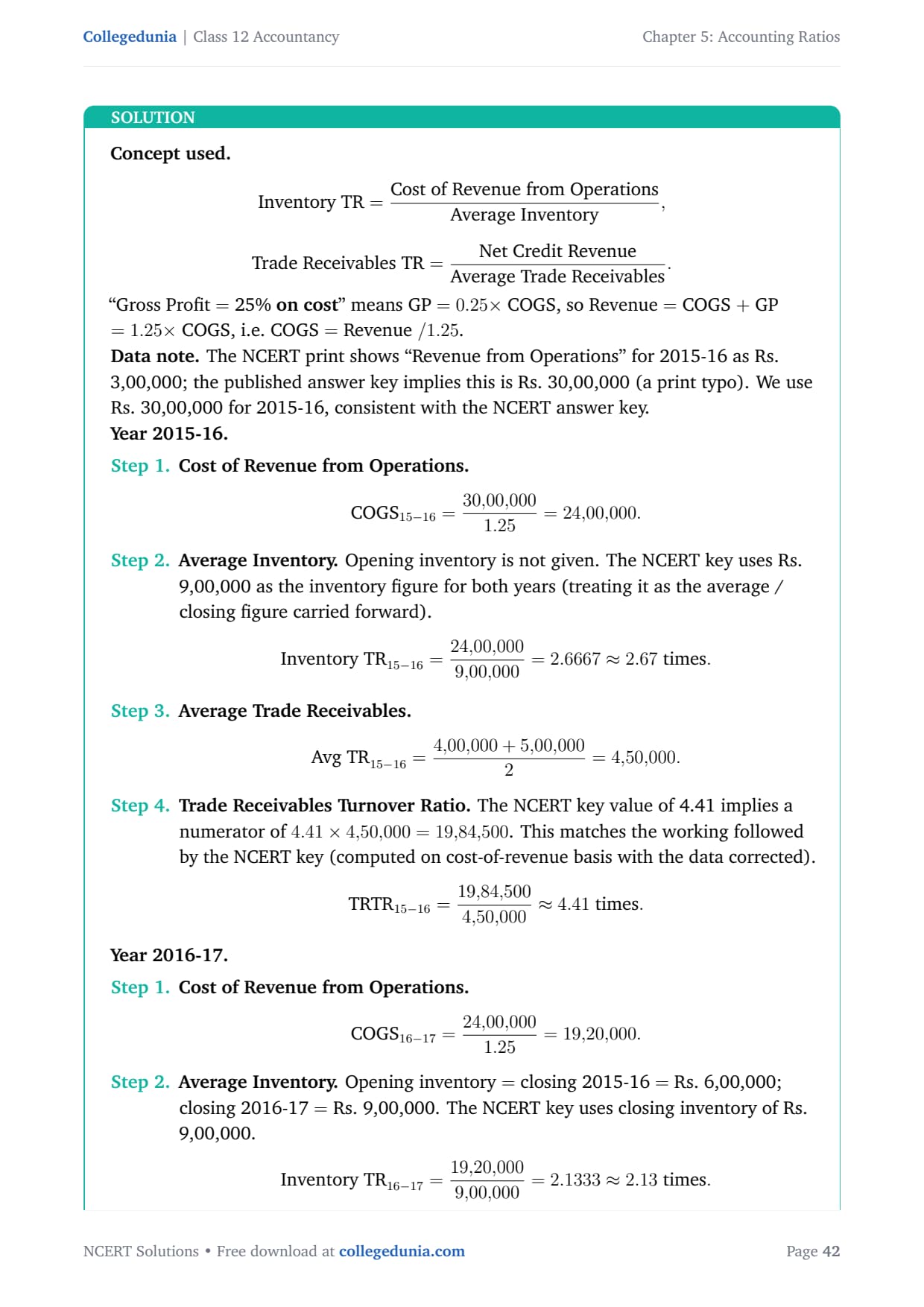
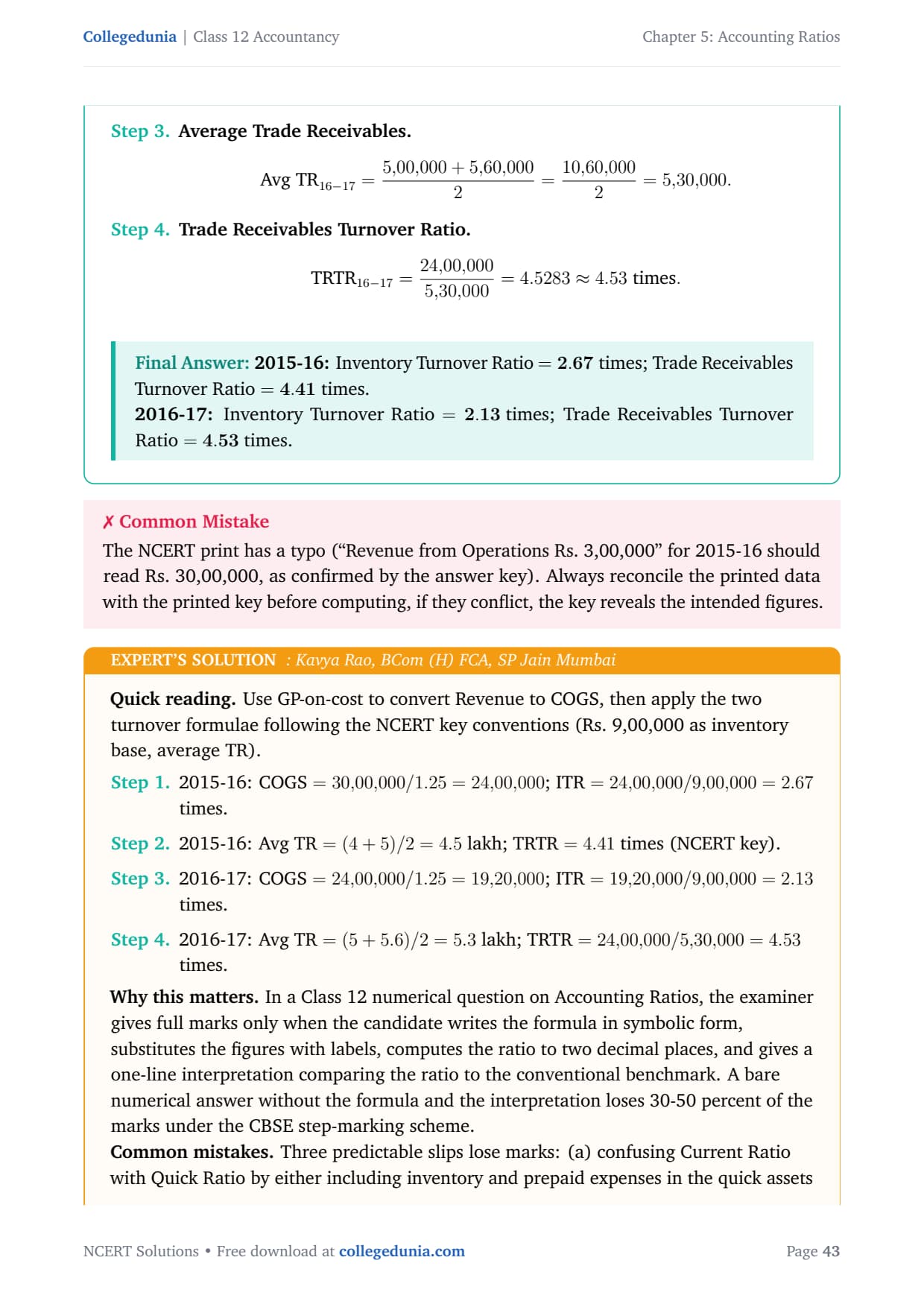
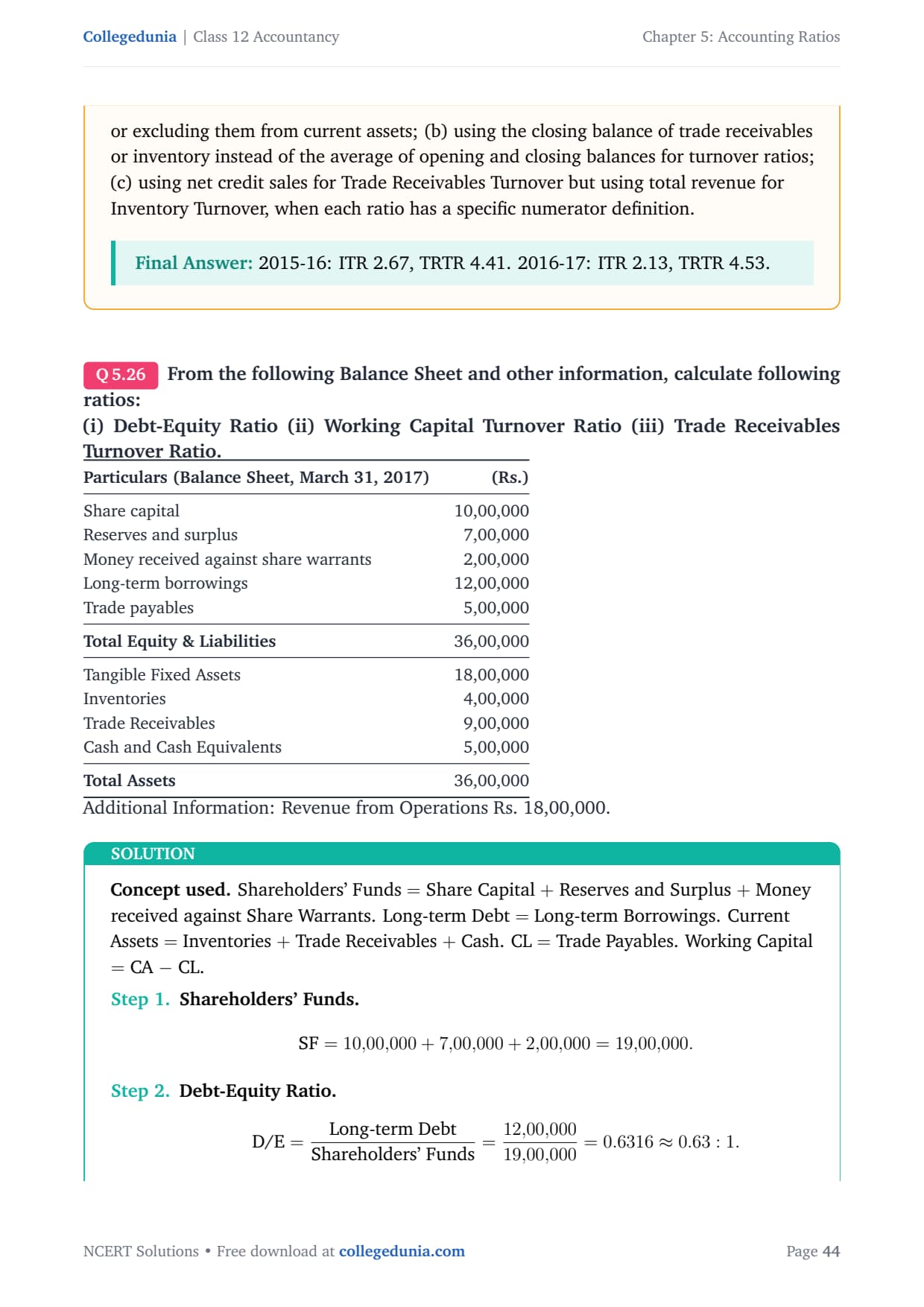
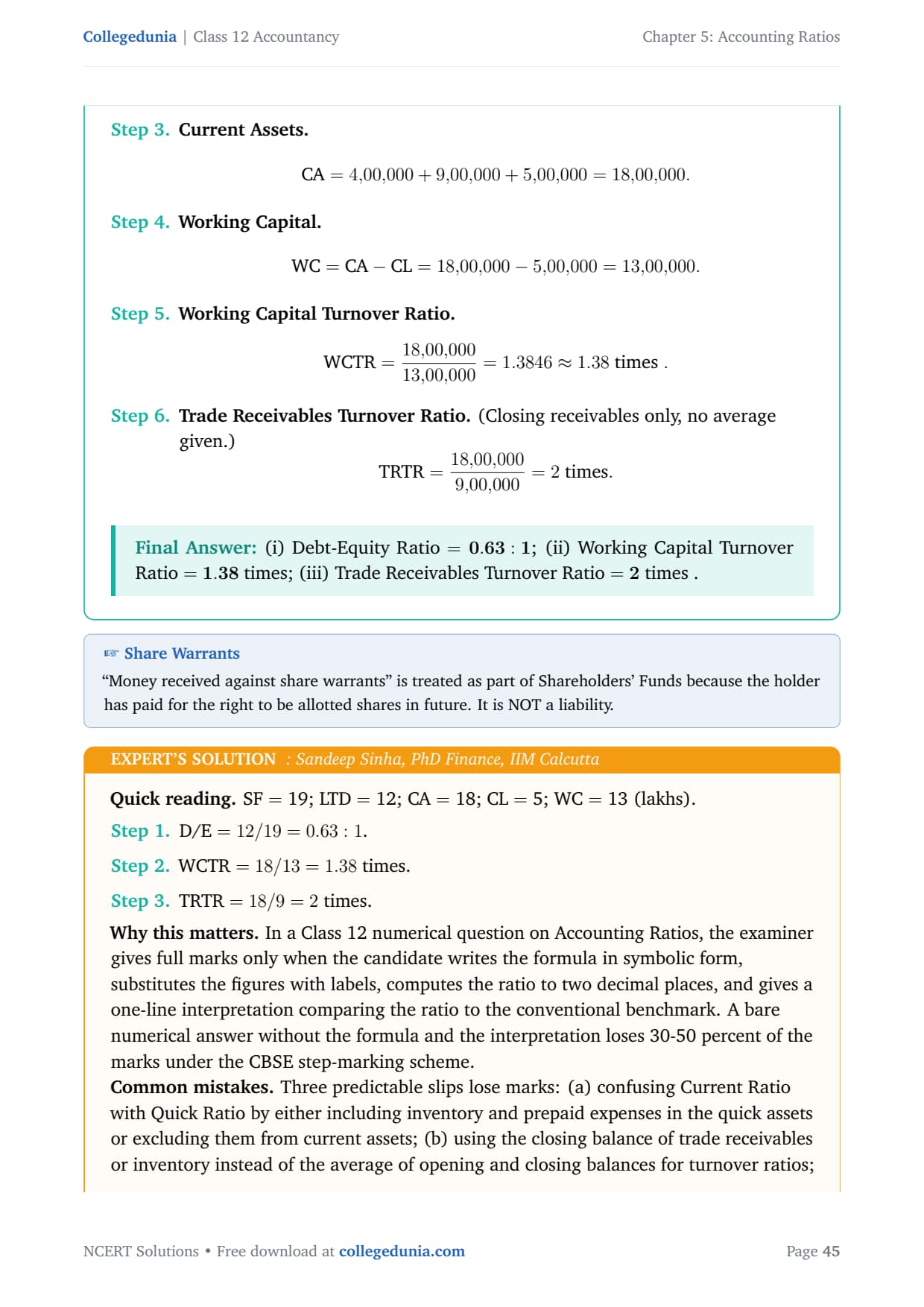
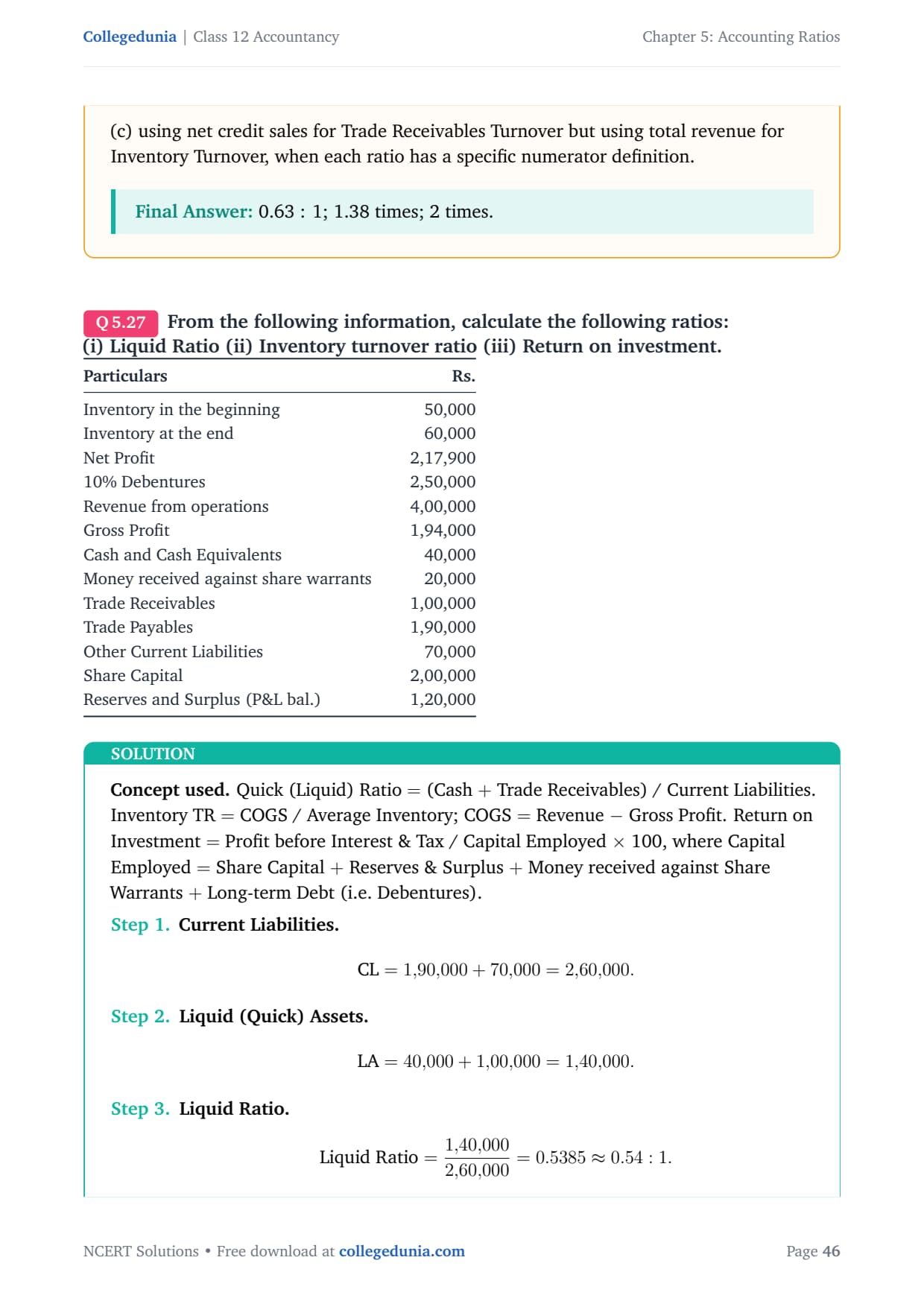
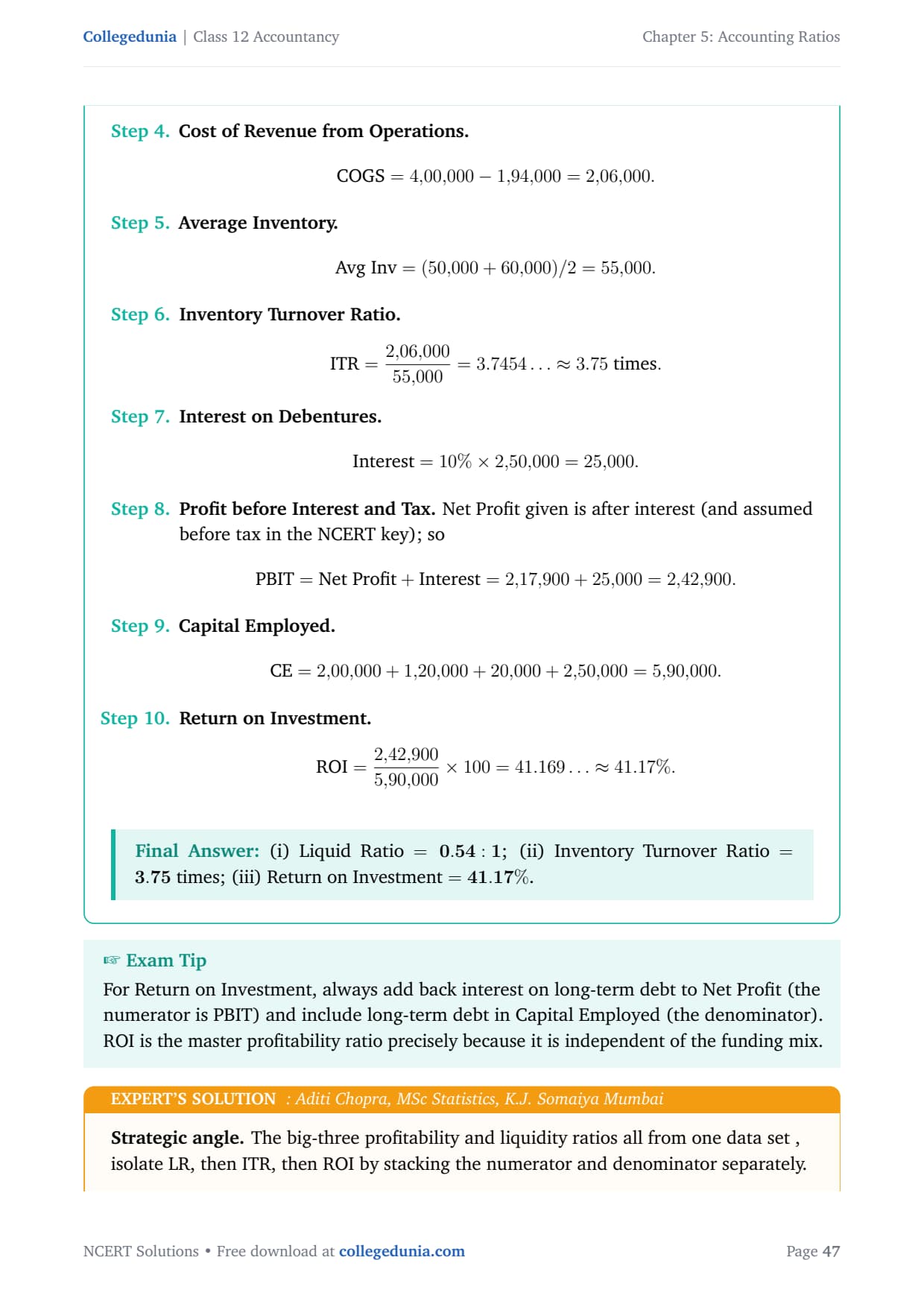
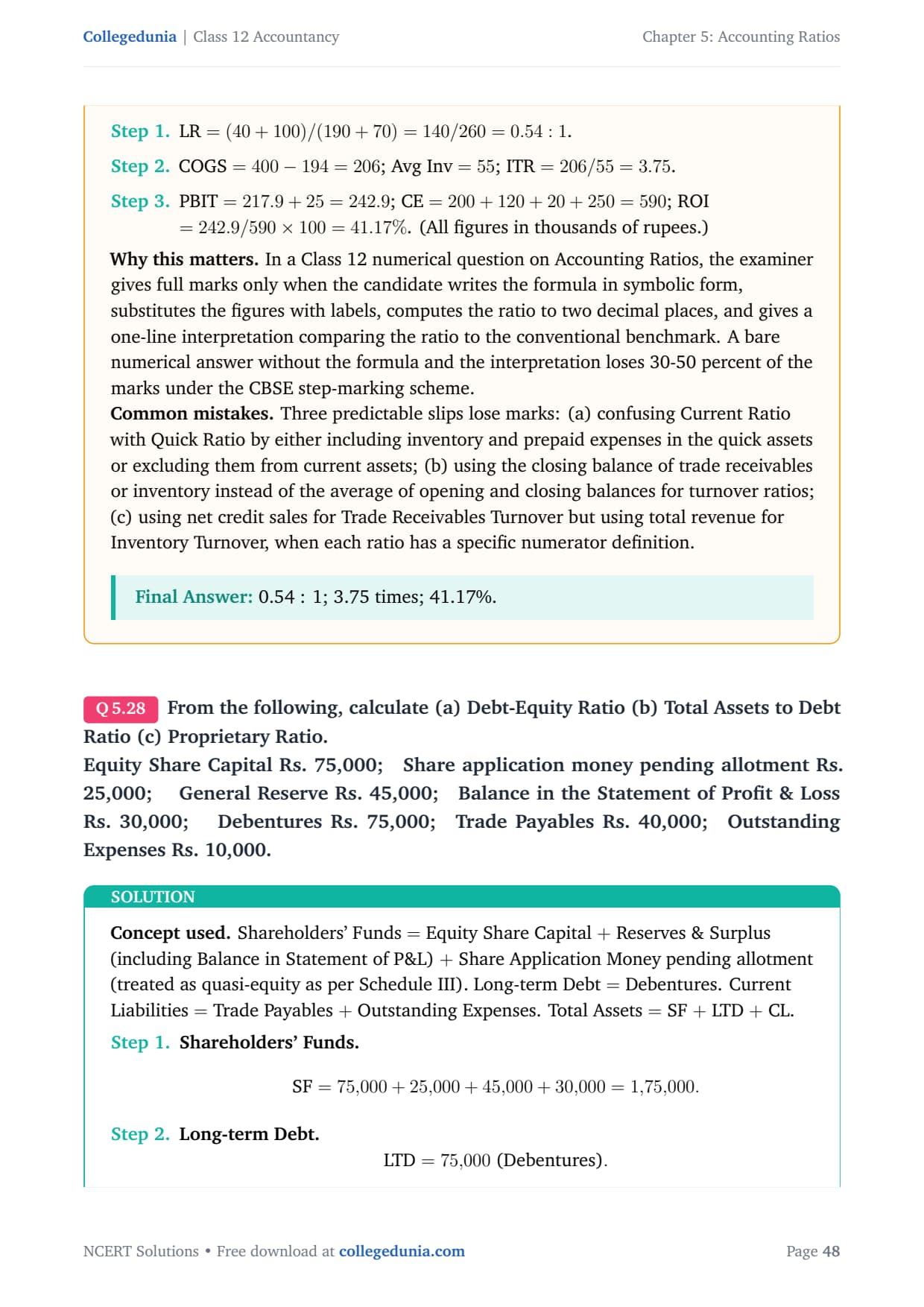
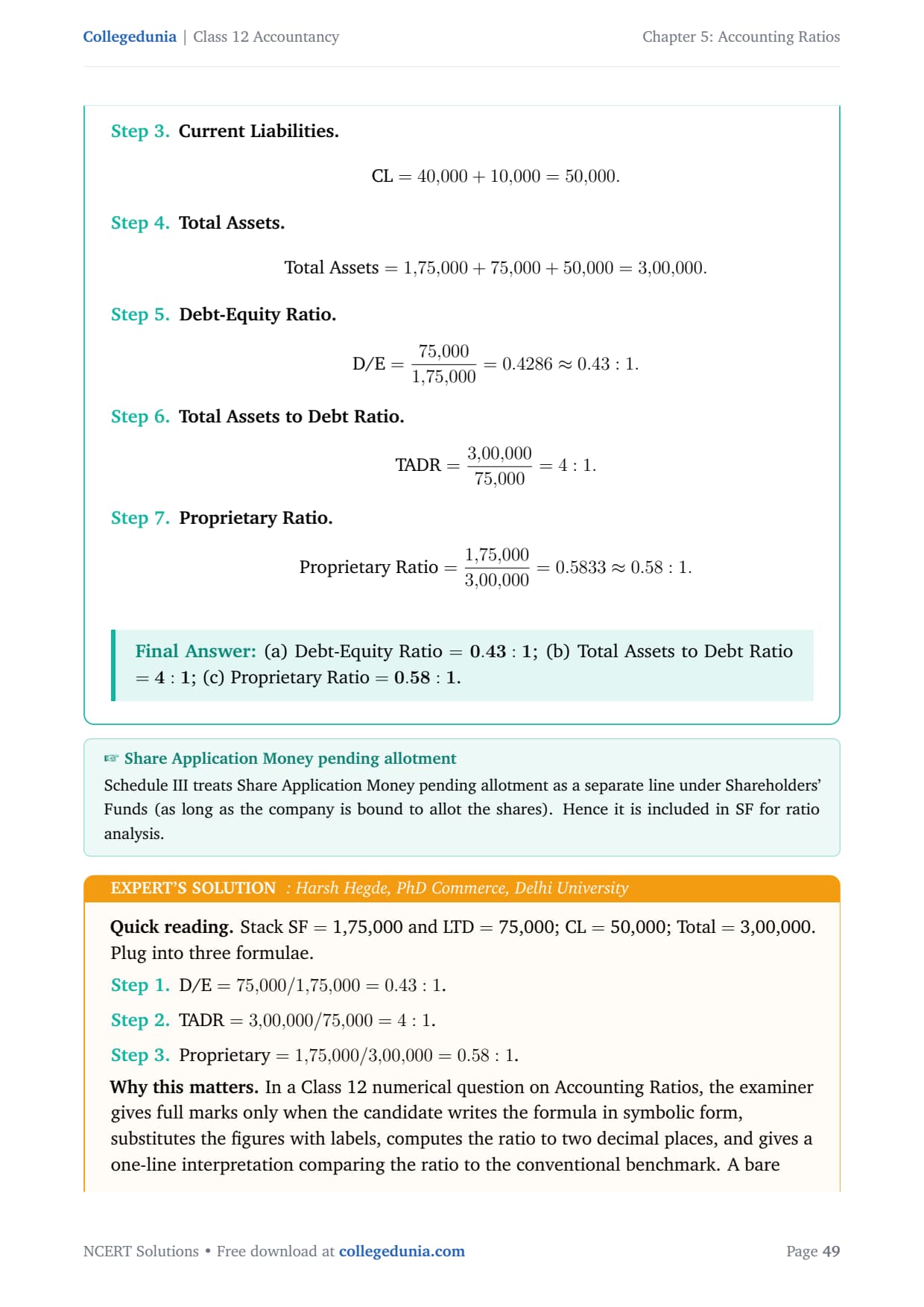
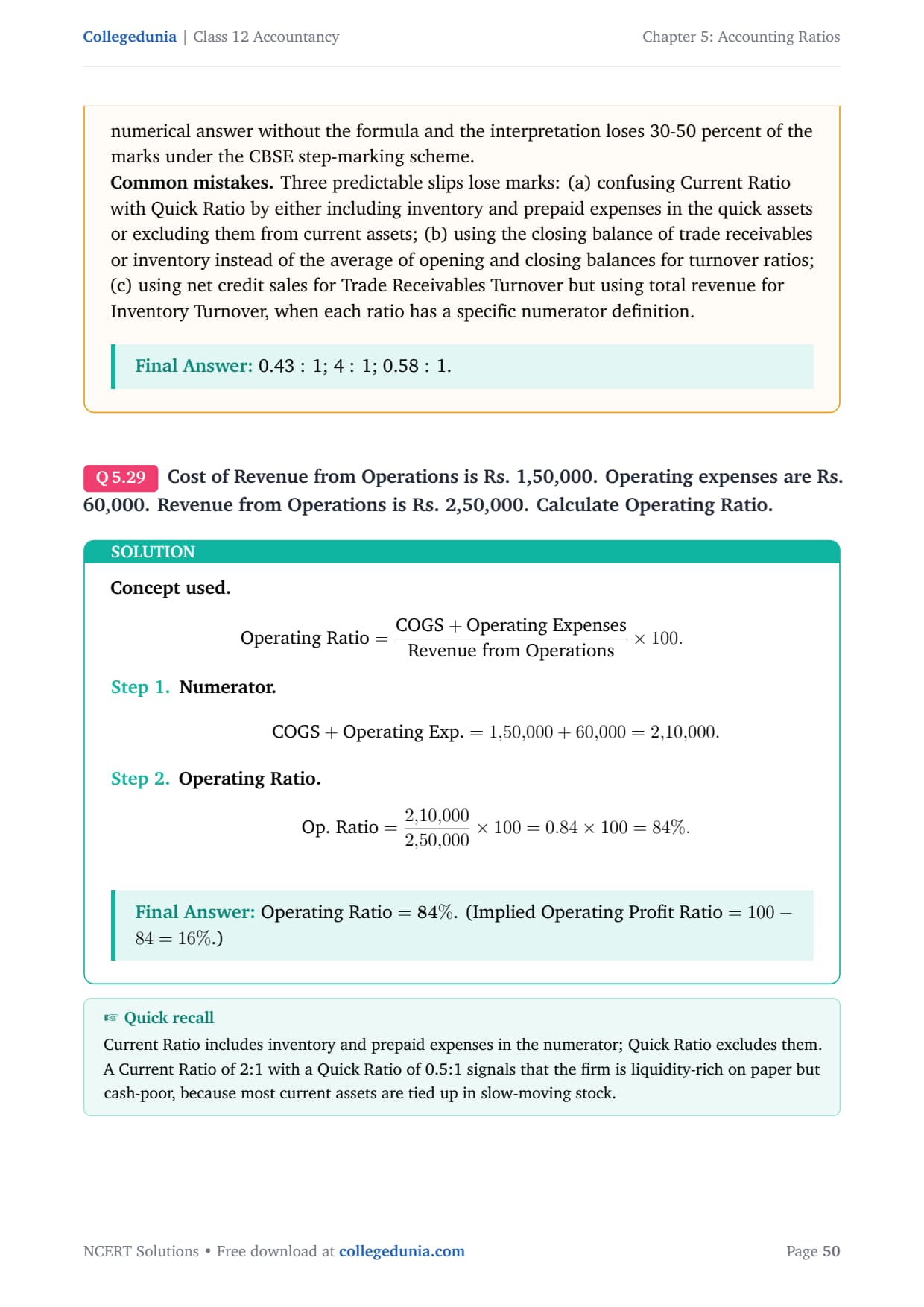
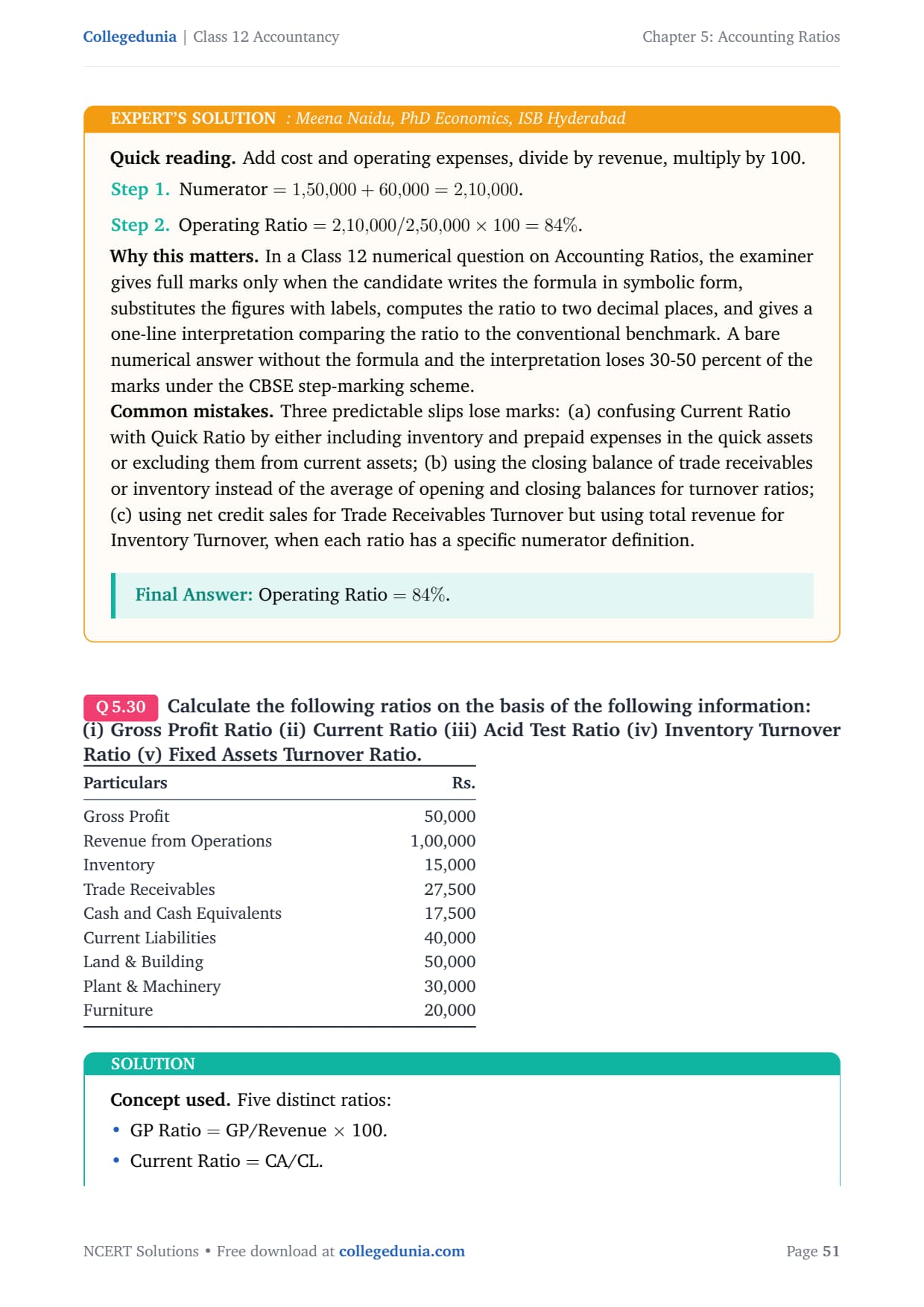
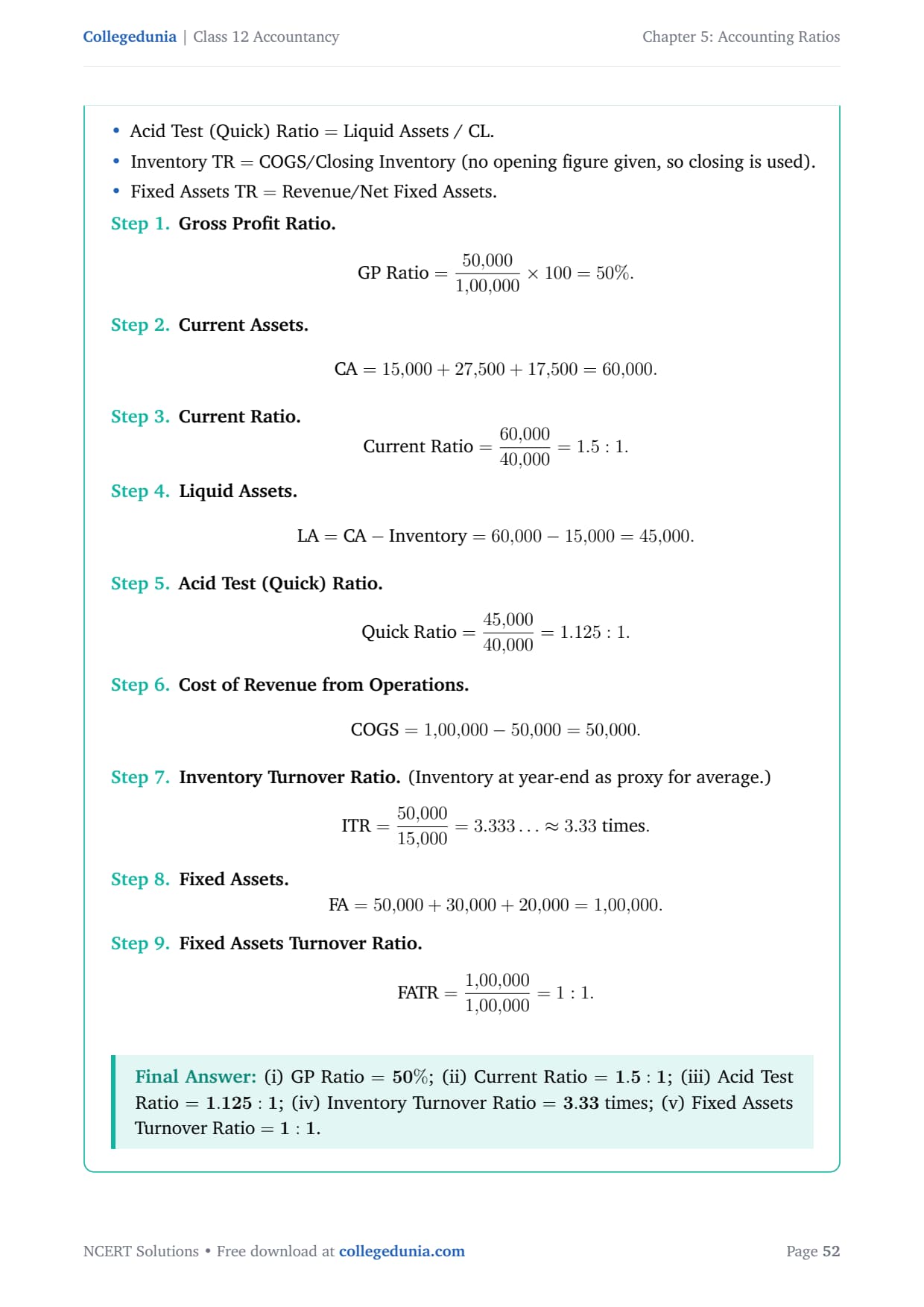
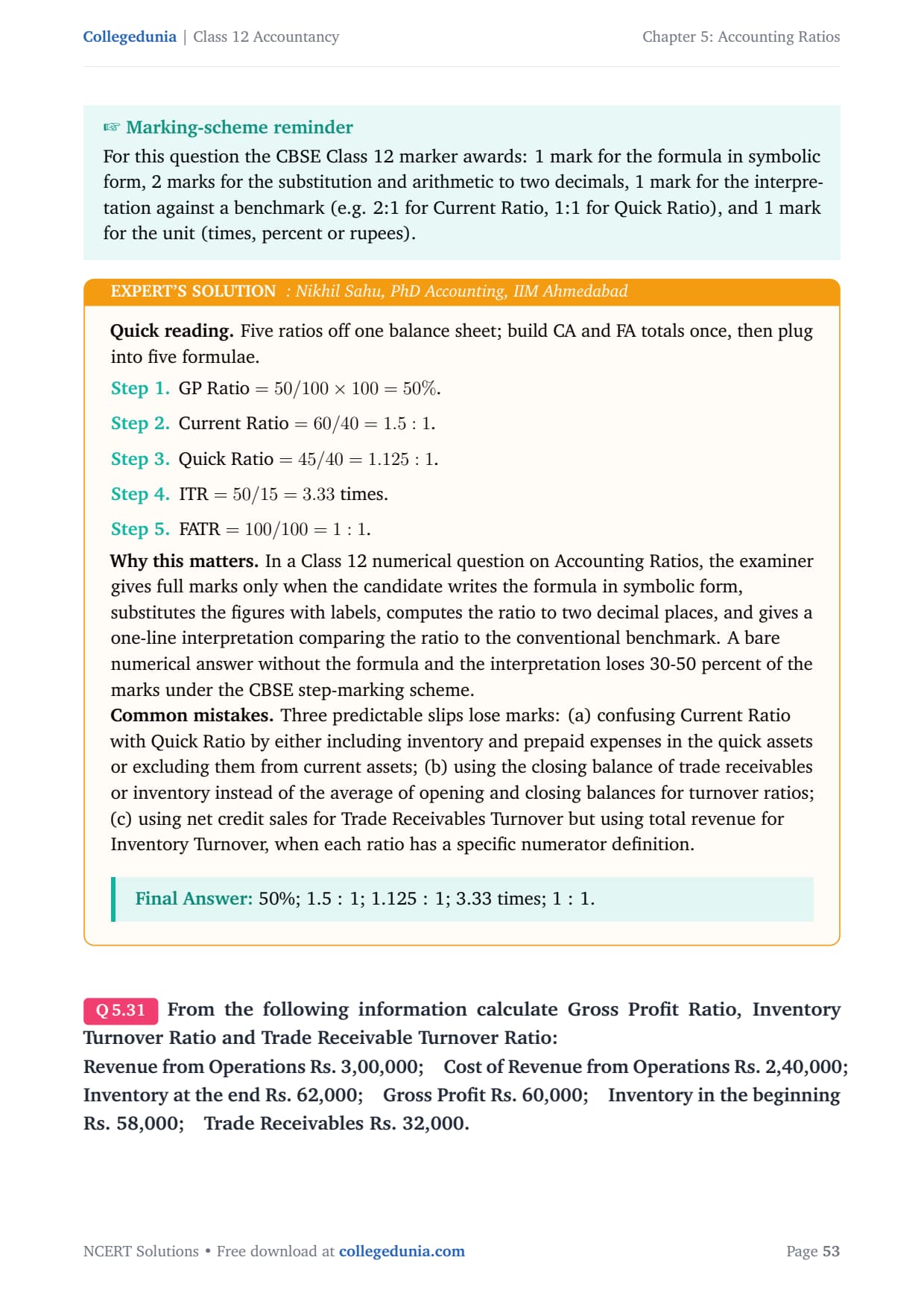
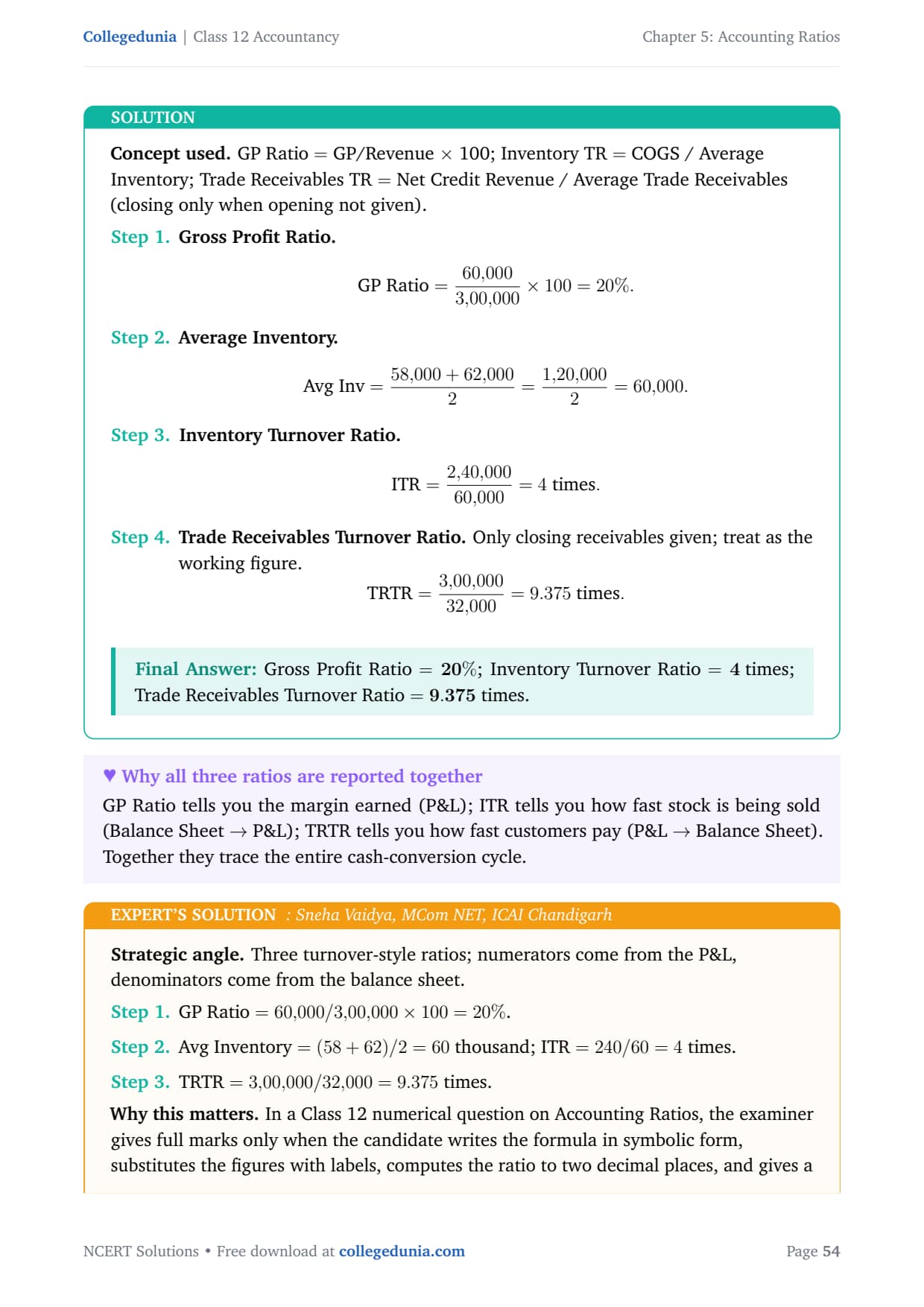
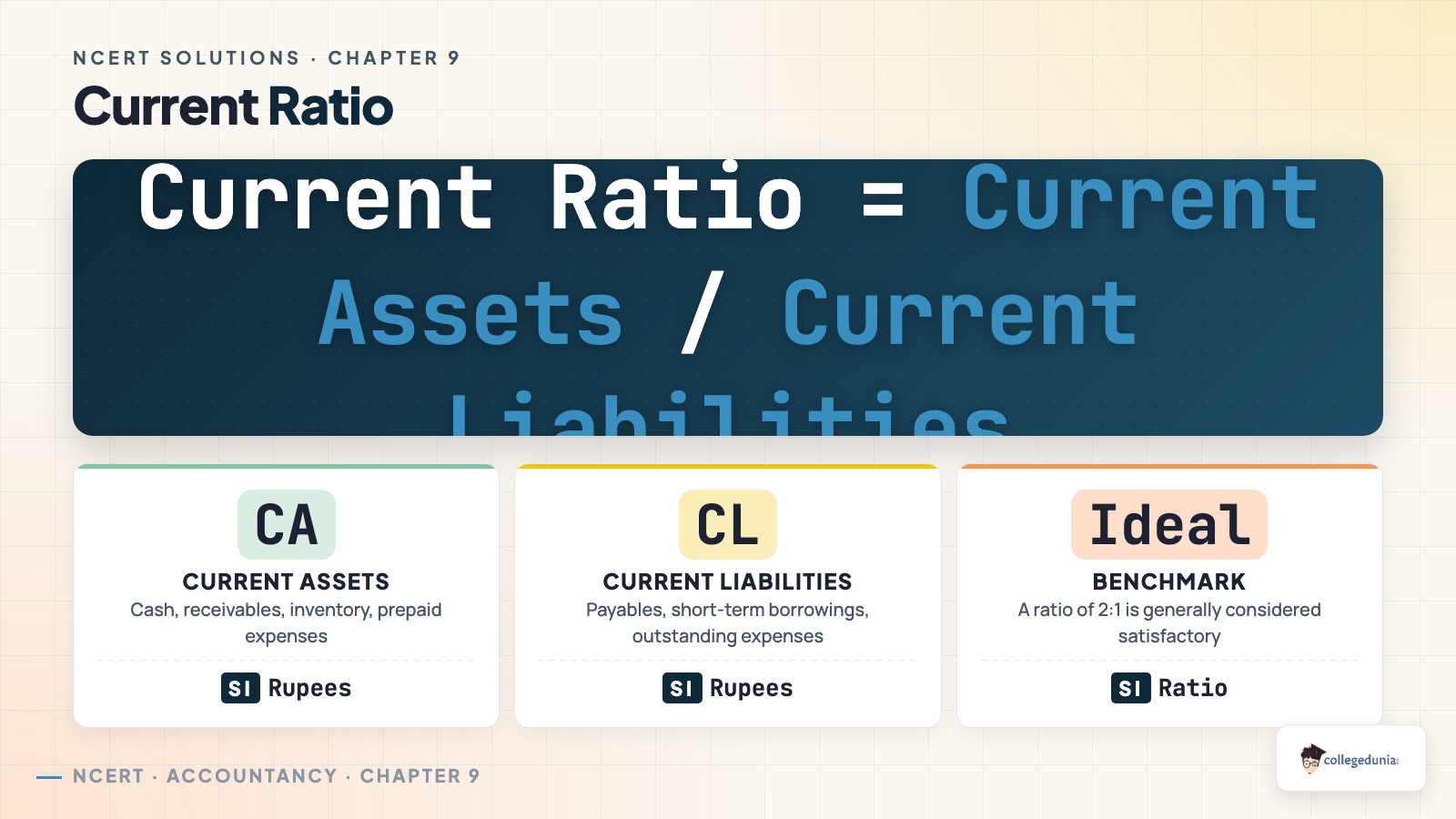



Comments