The NCERT Solutions for Class 11 Psychology Chapter 8 Motivation and Emotion cover all 6 textbook review questions from the latest 2026-27 NCERT book. The chapter explains motivation, the motivational cycle, hunger and thirst, psychosocial motives, Maslow's hierarchy, cultural rules for emotion and practical ways to manage negative emotions.
Covers every review question with a direct answer and a detailed expert explanation.
Focuses on needs, drives, goals, achievement, affiliation, power and emotion regulation.
Useful for school exams because each answer links NCERT terms with everyday examples.
Student Feedback: In a Collegedunia poll of 10,860 Class 11 Psychology students preparing for the 2026-27 school exams, 71% said they mixed up needs, drives and motives until they saw the motivational cycle as a sequence.
Source: 2026-27 Class 11 Psychology student poll across CBSE schools.
Every answer in this chapter set is checked against the 2026-27 NCERT Psychology textbook and written so that students can revise the concept, example and exam framing together.
Motivation and Emotion Key Concepts and Question Map
Chapter 8 treats motivation and emotion as closely connected processes. Motivation explains why behaviour begins and continues, while emotion shows how feelings, bodily arousal and expression shape behaviour. Students should avoid writing the chapter as only definitions. Better answers show the movement from need to drive, from drive to goal-directed action, and from emotional arousal to expression or regulation.
Chapter area
What students must know
Where it helps
Motivation
Need, drive, arousal, goal-directed behaviour and persistence
Question 1
Biological motives
Hunger and thirst depend on body signals and brain mechanisms
Question 2
Psychosocial motives
Achievement, affiliation and power are shaped through social experience
Question 3
Hierarchy of needs
Maslow arranges needs from physiological needs to self-actualisation
Question 4
Emotions
Culture affects expression, labelling and control of emotions
Question 5
Emotion management
NCERT methods include self-awareness, objective appraisal, self-monitoring, self-modeling, cognitive restructuring, relationships and anger control
Question 6
Use NCERT terms exactly: need, drive, arousal, goal, achievement motive, affiliation motive, power motive, self-actualisation, display rules and negative emotion management. These words keep answers precise and close to the textbook.
Motivation and Emotion Class 11 Psychology Revision Video
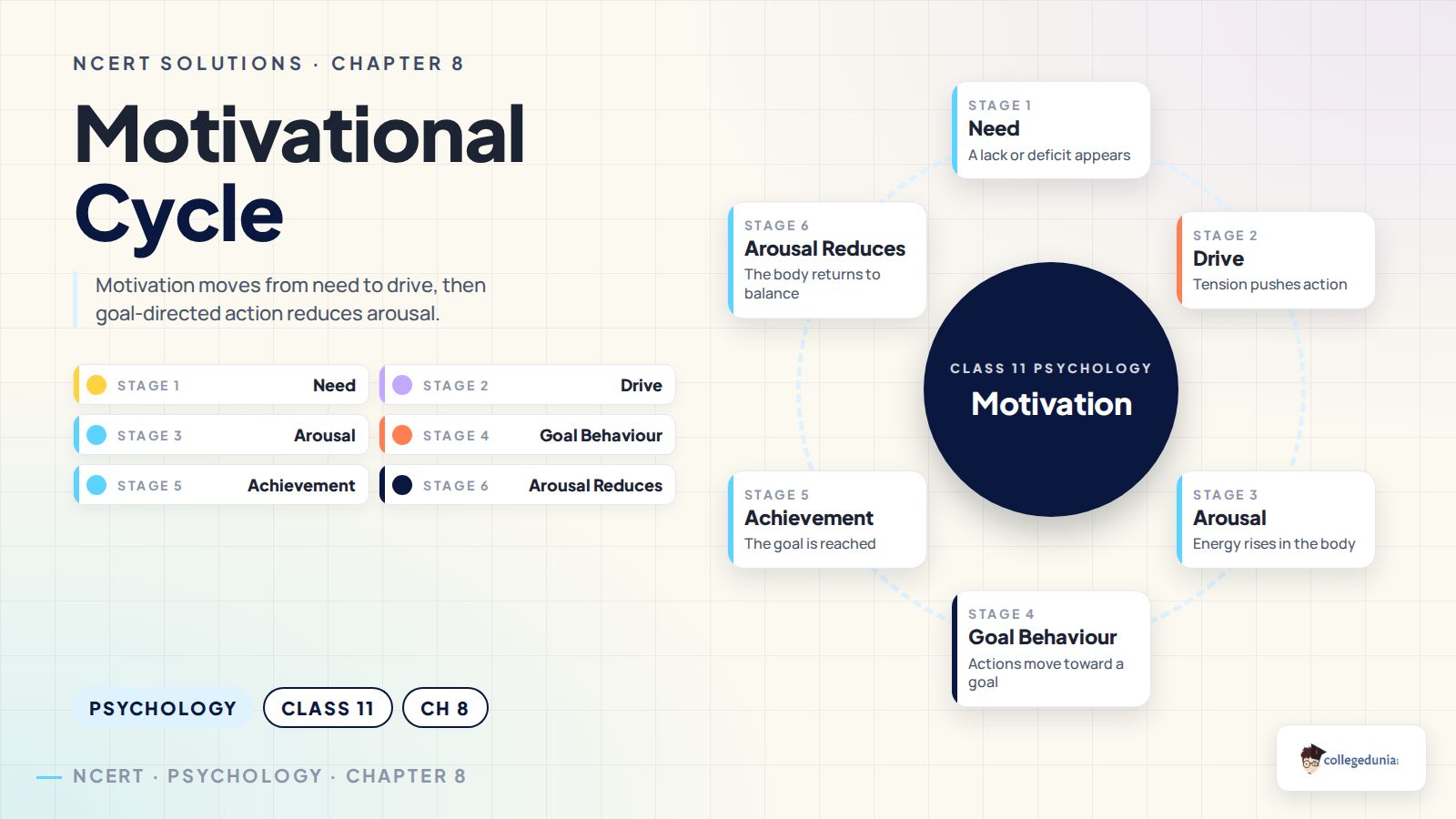
The motivational cycle is the simplest way to frame the first answer. A need appears when something is lacking. That need creates drive or tension. The drive energises the person into action. The action moves toward a goal, and once the goal is reached, arousal reduces. This sequence is visible in hunger, thirst, study goals, friendship needs and achievement behaviour.
Need: a lack or deficit that creates pressure for action.
Drive: an aroused internal state that pushes behaviour.
Goal-directed behaviour: activity chosen to satisfy the need.
Achievement: the point at which the goal is reached and tension falls.
For an exam answer, describe the process with one daily example. Hunger works well: lack of food creates a need, the body creates drive, the person searches for food, eating reduces the drive and balance returns.
Biological and Psychosocial Motives in Motivation and Emotion
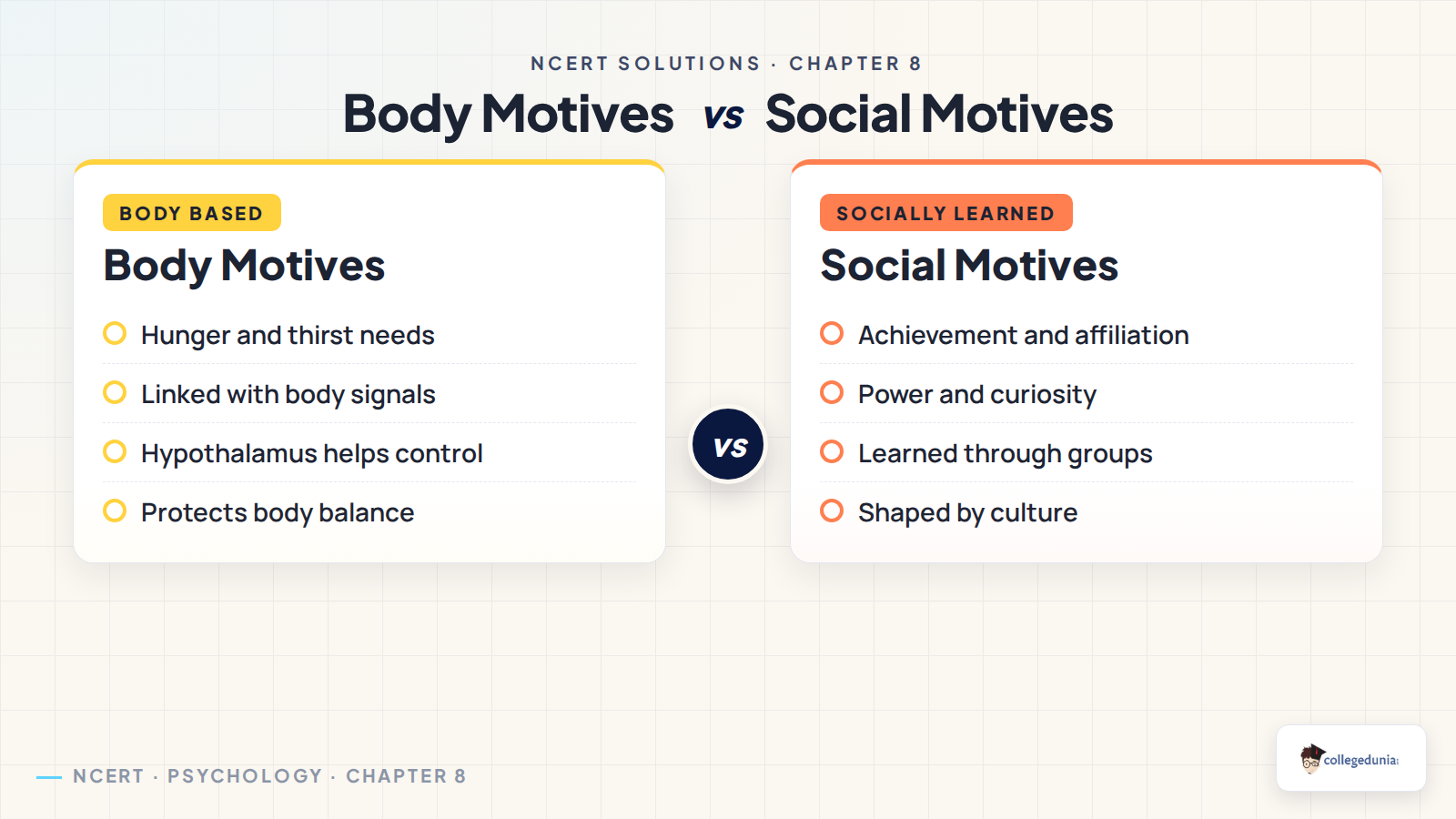
Biological motives are linked with the body's survival needs. Hunger is influenced by stomach contractions, blood glucose, protein level, stored fat, liver signals, hypothalamus and outside food cues. Thirst is linked with cell dehydration, reduced blood volume and osmoreceptors in the anterior hypothalamus. These points help students show that biological motives are not only about a feeling in the mouth or stomach.
Psychosocial motives are learned through family, school, peer groups and culture. Achievement pushes adolescents to do well and seek feedback. Affiliation pushes them to make friends and join groups. Power pushes them to influence, lead and create an impact. NCERT expects examples here, so the best answer names the motive and then gives one adolescent behaviour for each.
Motive type
Core idea
Student example
Biological motive
Maintains body balance and survival
A thirsty student drinks water after sports practice
Achievement motive
Desire to meet a standard of excellence
A student solves extra questions to improve marks
Affiliation motive
Desire for friendly social contact
A student joins a club to feel connected
Power motive
Desire to influence or lead others
A student campaigns for house captain
Maslow's Hierarchy and Emotion Management for Class 11
Maslow's hierarchy gives a broad order of human needs. Physiological needs come first because food, water and sleep are basic for survival. Safety needs come next, followed by love and belongingness, esteem, and self-actualisation. The hierarchy is useful because it shows how lower needs can become urgent before higher growth needs gain strength.
Physiological needs: hunger, thirst, sleep and basic body requirements.
Safety needs: protection, stability and freedom from danger.
Love and belongingness: friendship, family affection and group acceptance.
Esteem needs: respect, recognition, achievement and self-respect.
Self-actualisation: realising one's full potential and inner growth.
The emotion questions need a balanced answer. Culture shapes how emotions are shown, controlled, labelled and interpreted. Negative emotions such as anger, fear, anxiety and sadness should not simply be suppressed. They should be recognised, understood and managed through self-awareness, objective appraisal, self-monitoring, self-modeling, cognitive restructuring, creativity, supportive relationships, empathy, community service, constructive anger control, relaxation, exercise, positive thinking and support.
Related Psychology Resources for Motivation and Emotion
Use the solutions PDF for answer writing, then move to the NCERT book, notes and handwritten notes when you want to revise the same chapter in another format.
All NCERT Solutions for Class 11 Psychology Chapter 8 Motivation and Emotion with Step-by-Step Solutions
Review Questions
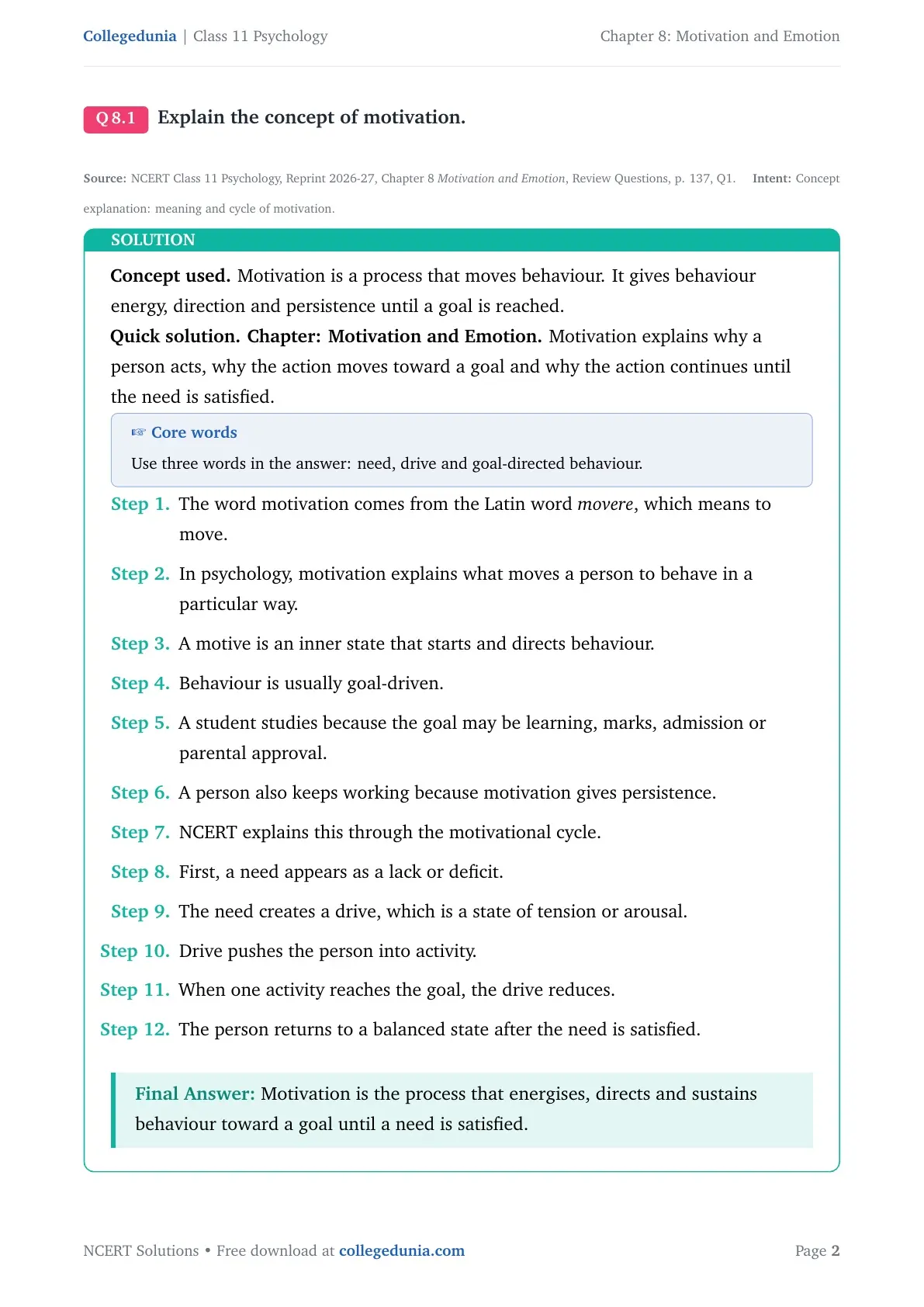
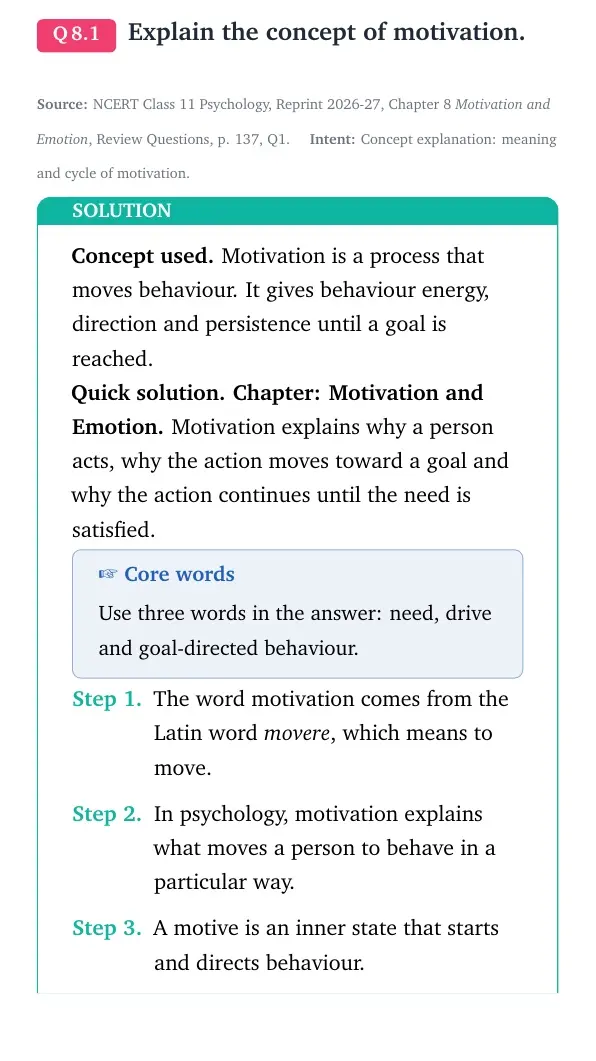
Q 8.1
Explain the concept of motivation.
Concept used. Motivation is a process that moves behaviour. It gives behaviour energy, direction and persistence until a goal is reached.
Motivation explains why a person acts, why the action moves toward a goal and why the action continues until the need is satisfied.
Core words
Use three words in the answer: need, drive and goal-directed behaviour.
The word motivation comes from the Latin word movere, which means to move.
In psychology, motivation explains what moves a person to behave in a particular way.
A motive is an inner state that starts and directs behaviour.
Behaviour is usually goal-driven.
A student studies because the goal may be learning, marks, admission or parental approval.
A person also keeps working because motivation gives persistence.
NCERT explains this through the motivational cycle.
First, a need appears as a lack or deficit.
The need creates a drive, which is a state of tension or arousal.
Drive pushes the person into activity.
When one activity reaches the goal, the drive reduces.
The person returns to a balanced state after the need is satisfied.
Motivation is the process that energises, directs and sustains behaviour toward a goal until a need is satisfied.
AS
Aditi Sharma
M.A. Psychology, University of Delhi
Verified Expert
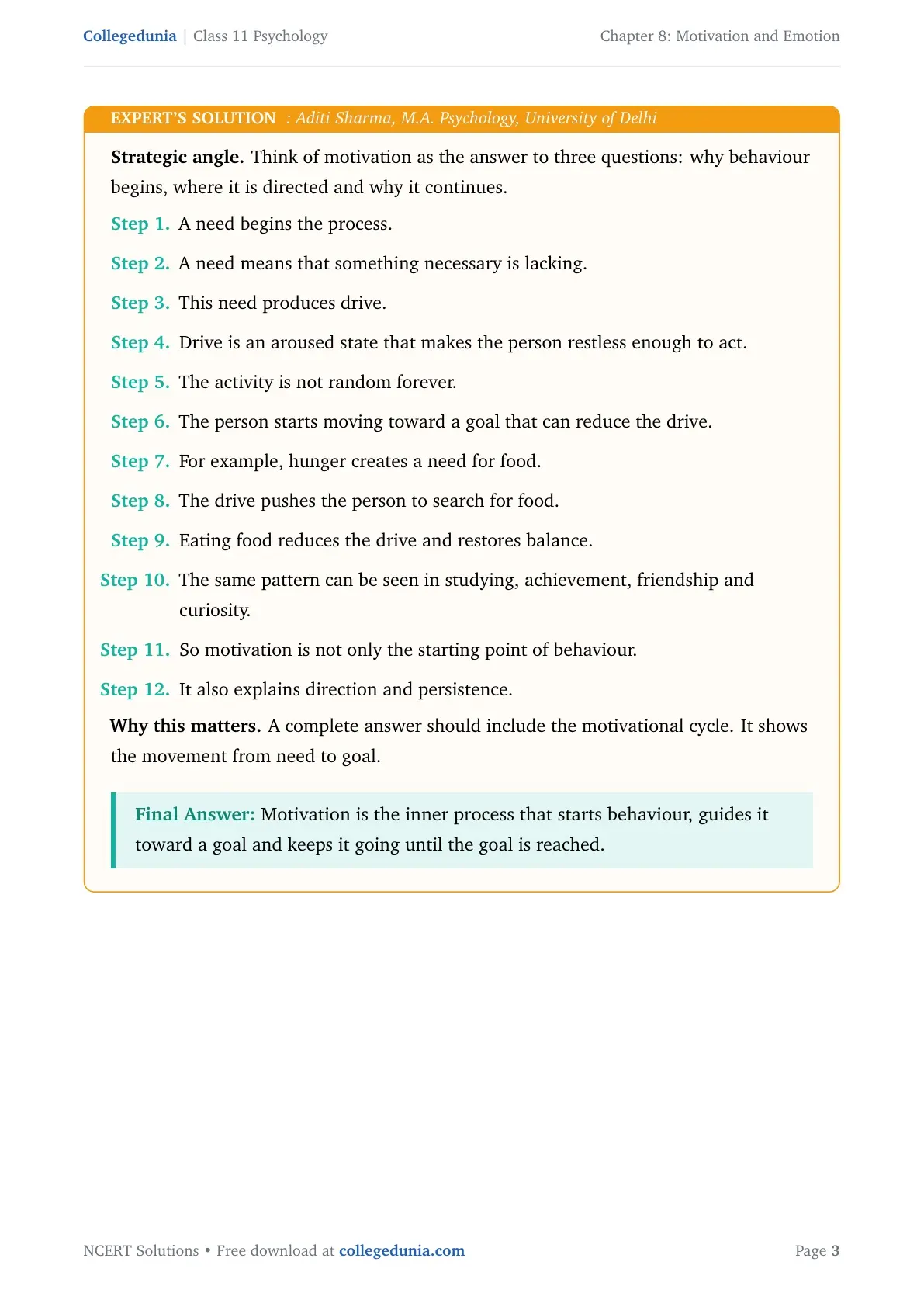
Strategic angle. Think of motivation as the answer to three questions: why behaviour begins, where it is directed and why it continues.
A need begins the process.
A need means that something necessary is lacking.
This need produces drive.
Drive is an aroused state that makes the person restless enough to act.
The activity is not random forever.
The person starts moving toward a goal that can reduce the drive.
For example, hunger creates a need for food.
The drive pushes the person to search for food.
Eating food reduces the drive and restores balance.
The same pattern can be seen in studying, achievement, friendship and curiosity.
So motivation is not only the starting point of behaviour.
It also explains direction and persistence.
Why this matters. A complete answer should include the motivational cycle. It shows the movement from need to goal.
Motivation is the inner process that starts behaviour, guides it toward a goal and keeps it going until the goal is reached.
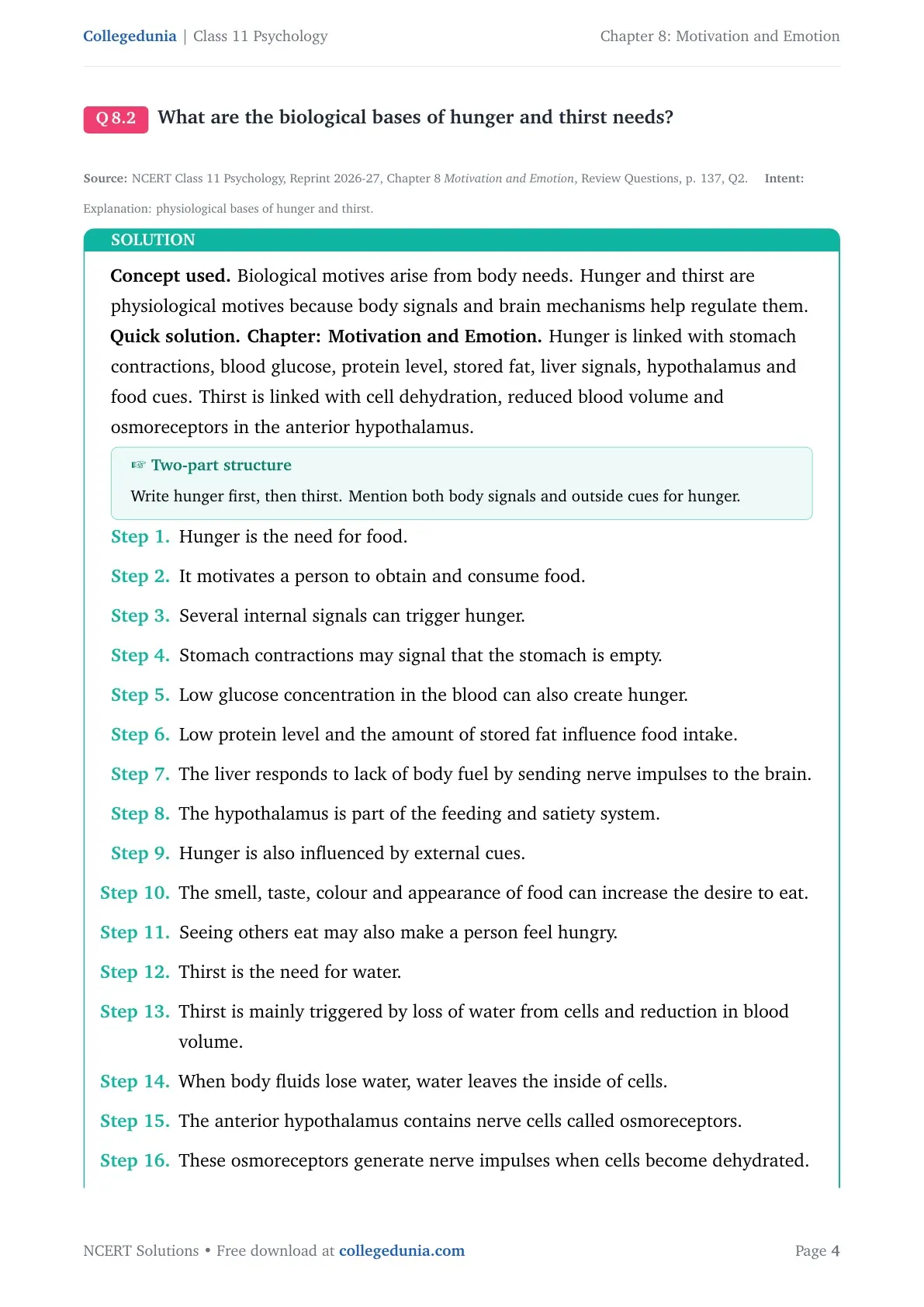
Q 8.2
What are the biological bases of hunger and thirst needs?
Concept used. Biological motives arise from body needs. Hunger and thirst are physiological motives because body signals and brain mechanisms help regulate them.
Hunger is linked with stomach contractions, blood glucose, protein level, stored fat, liver signals, hypothalamus and food cues. Thirst is linked with cell dehydration, reduced blood volume and osmoreceptors in the anterior hypothalamus.
Two-part structure
Write hunger first, then thirst. Mention both body signals and outside cues for hunger.
Hunger is the need for food.
It motivates a person to obtain and consume food.
Several internal signals can trigger hunger.
Stomach contractions may signal that the stomach is empty.
Low glucose concentration in the blood can also create hunger.
Low protein level and the amount of stored fat influence food intake.
The liver responds to lack of body fuel by sending nerve impulses to the brain.
The hypothalamus is part of the feeding and satiety system.
Hunger is also influenced by external cues.
The smell, taste, colour and appearance of food can increase the desire to eat.
Seeing others eat may also make a person feel hungry.
Thirst is the need for water.
Thirst is mainly triggered by loss of water from cells and reduction in blood volume.
When body fluids lose water, water leaves the inside of cells.
The anterior hypothalamus contains nerve cells called osmoreceptors.
These osmoreceptors generate nerve impulses when cells become dehydrated.
Dryness of the mouth and throat may be felt, but it alone does not fully explain drinking.
Hunger and thirst are regulated by body signals, brain mechanisms and related cues. Hunger depends on feeding-satiety signals, while thirst depends mainly on cell dehydration, blood volume and hypothalamic osmoreceptors.
RM
Rohit Mehta
M.Sc Applied Psychology, Christ University
Verified Expert
Quick reading. NCERT treats hunger and thirst as biological motives because they protect the body's internal balance.
Hunger begins when the body needs fuel.
The stomach, blood chemistry, stored fat, liver and hypothalamus all contribute signals.
An empty stomach may contract and send one signal.
Low blood glucose sends another signal.
The liver detects lack of fuel and communicates with the brain.
The hypothalamus helps coordinate feeding and satiety.
Still, hunger is not only internal.
Food aroma, taste and appearance can strengthen the motive to eat.
Thirst begins when the body lacks water.
Cell dehydration is a major signal.
Reduced blood volume is another major signal.
Osmoreceptors in the anterior hypothalamus respond to cell dehydration.
Their impulses help create the motivation to drink water.
This drinking continues until tissues get enough water.
Why this matters. The answer should not say only dry mouth causes thirst. NCERT clearly points to deeper body processes.
The biological bases are internal body deficits and brain responses that push food and water seeking behaviour.
Q 8.3
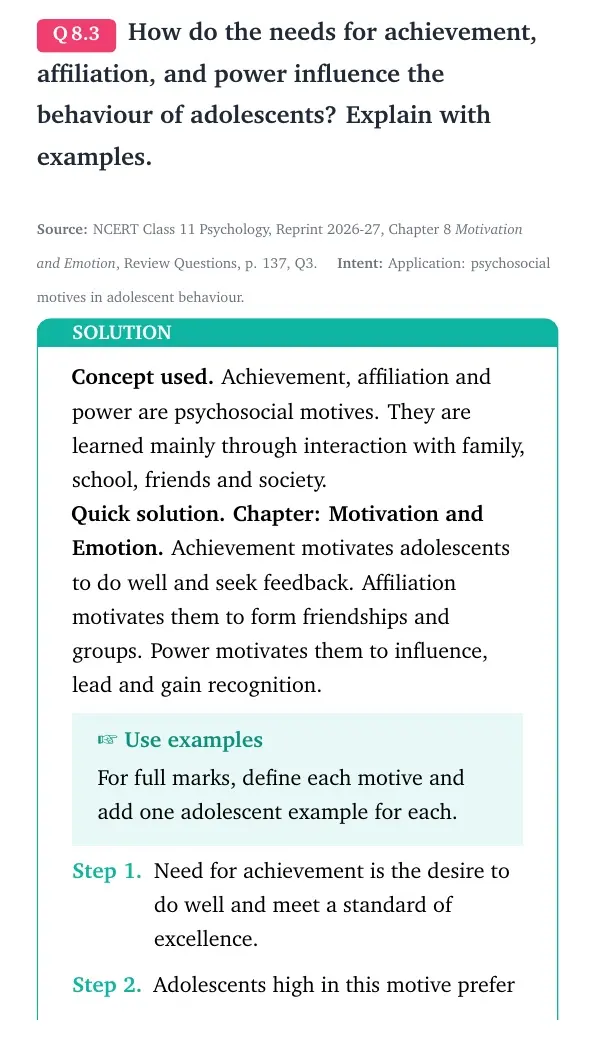
How do the needs for achievement, affiliation, and power influence the behaviour of adolescents? Explain with examples.
Concept used. Achievement, affiliation and power are psychosocial motives. They are learned mainly through interaction with family, school, friends and society.
Achievement motivates adolescents to do well and seek feedback. Affiliation motivates them to form friendships and groups. Power motivates them to influence, lead and gain recognition.
Use examples
For full marks, define each motive and add one adolescent example for each.
Need for achievement is the desire to do well and meet a standard of excellence.
Adolescents high in this motive prefer moderately difficult and challenging tasks.
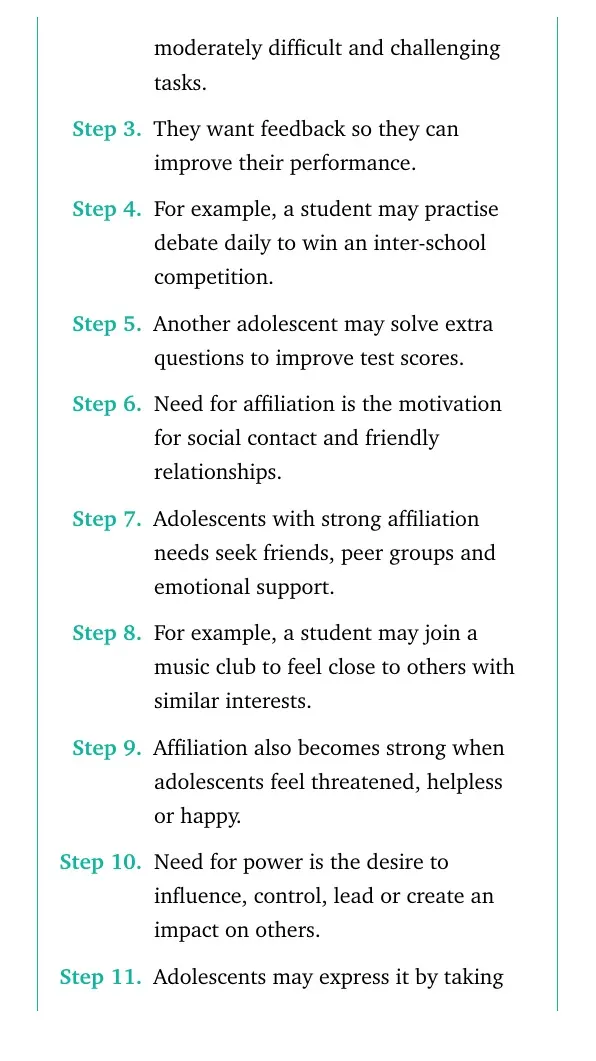
They want feedback so they can improve their performance.
For example, a student may practise debate daily to win an inter-school competition.
Another adolescent may solve extra questions to improve test scores.
Need for affiliation is the motivation for social contact and friendly relationships.
Adolescents with strong affiliation needs seek friends, peer groups and emotional support.
For example, a student may join a music club to feel close to others with similar interests.
Affiliation also becomes strong when adolescents feel threatened, helpless or happy.
Need for power is the desire to influence, control, lead or create an impact on others.
Adolescents may express it by taking leadership roles in class or student groups.
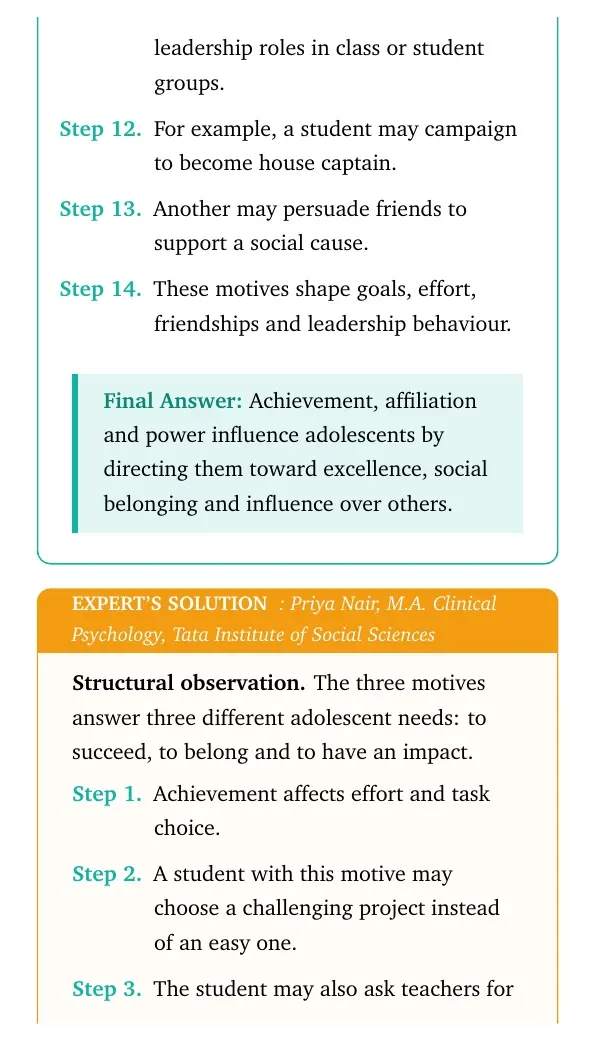
For example, a student may campaign to become house captain.
Another may persuade friends to support a social cause.
These motives shape goals, effort, friendships and leadership behaviour.
Achievement, affiliation and power influence adolescents by directing them toward excellence, social belonging and influence over others.
PN
Priya Nair
M.A. Clinical Psychology, Tata Institute of Social Sciences
Verified Expert
Structural observation. The three motives answer three different adolescent needs: to succeed, to belong and to have an impact.
Achievement affects effort and task choice.
A student with this motive may choose a challenging project instead of an easy one.
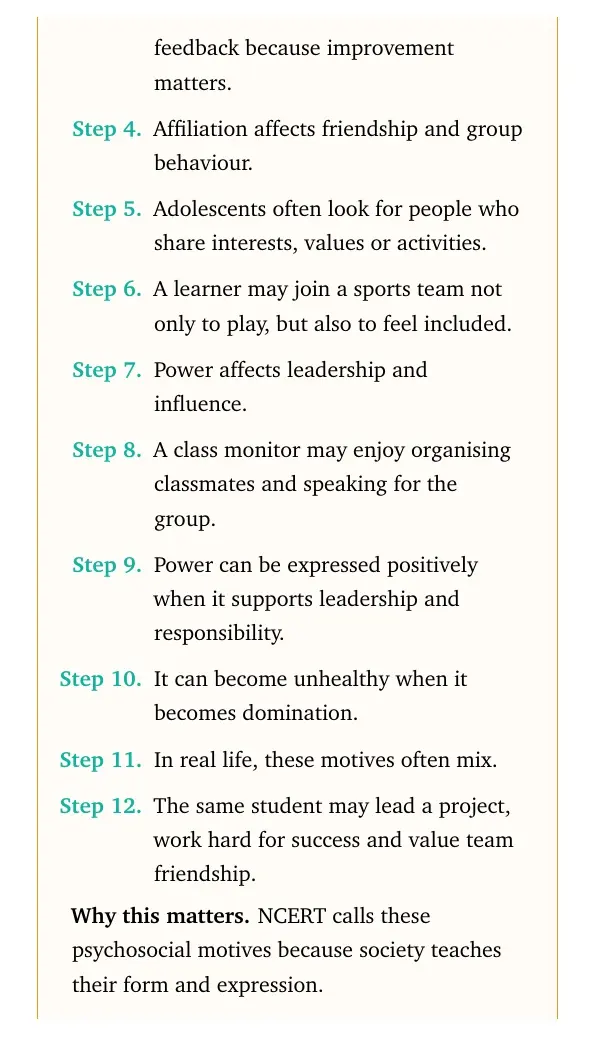
The student may also ask teachers for feedback because improvement matters.
Affiliation affects friendship and group behaviour.
Adolescents often look for people who share interests, values or activities.
A learner may join a sports team not only to play, but also to feel included.
Power affects leadership and influence.
A class monitor may enjoy organising classmates and speaking for the group.
Power can be expressed positively when it supports leadership and responsibility.
It can become unhealthy when it becomes domination.
In real life, these motives often mix.
The same student may lead a project, work hard for success and value team friendship.
Why this matters. NCERT calls these psychosocial motives because society teaches their form and expression.
These motives guide adolescent behaviour by shaping ambition, peer relationships and leadership or influence in social settings.
Q 8.4
What is the basic idea behind Maslow's hierarchy of needs? Explain with suitable examples.
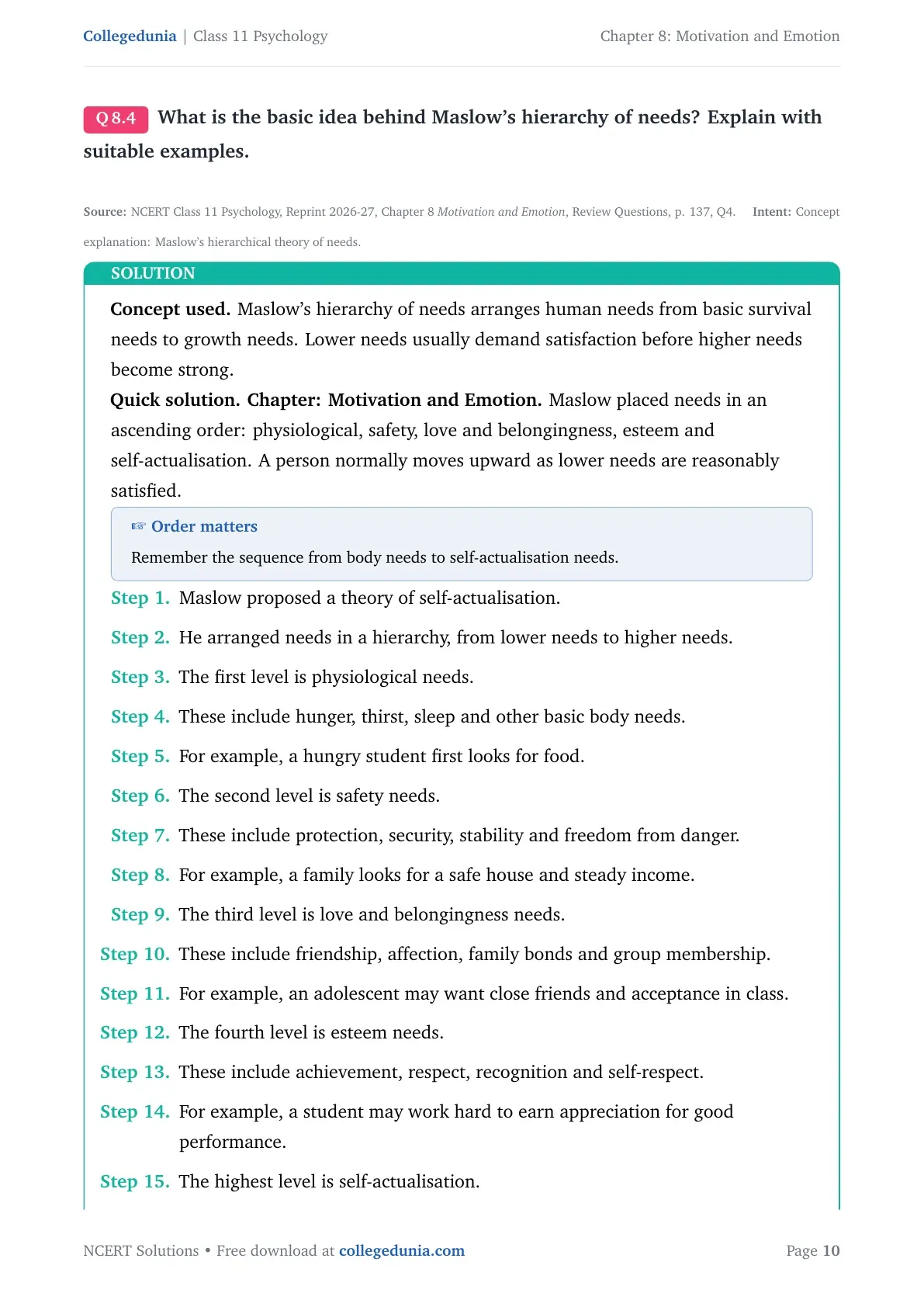
Concept used. Maslow's hierarchy of needs arranges human needs from basic survival needs to growth needs. Lower needs usually demand satisfaction before higher needs become strong.
Maslow placed needs in an ascending order: physiological, safety, love and belongingness, esteem and self-actualisation. A person normally moves upward as lower needs are reasonably satisfied.
Order matters
Remember the sequence from body needs to self-actualisation needs.
Maslow proposed a theory of self-actualisation.
He arranged needs in a hierarchy, from lower needs to higher needs.
The first level is physiological needs.
These include hunger, thirst, sleep and other basic body needs.
For example, a hungry student first looks for food.
The second level is safety needs.
These include protection, security, stability and freedom from danger.
For example, a family looks for a safe house and steady income.
The third level is love and belongingness needs.
These include friendship, affection, family bonds and group membership.
For example, an adolescent may want close friends and acceptance in class.
The fourth level is esteem needs.
These include achievement, respect, recognition and self-respect.
For example, a student may work hard to earn appreciation for good performance.
The highest level is self-actualisation.
It means realising one's full potential and becoming what one is capable of becoming.
For example, a musician may practise for years to develop artistic excellence.
The basic idea is that lower needs usually become urgent first.
When they are reasonably satisfied, higher needs gain motivational force.
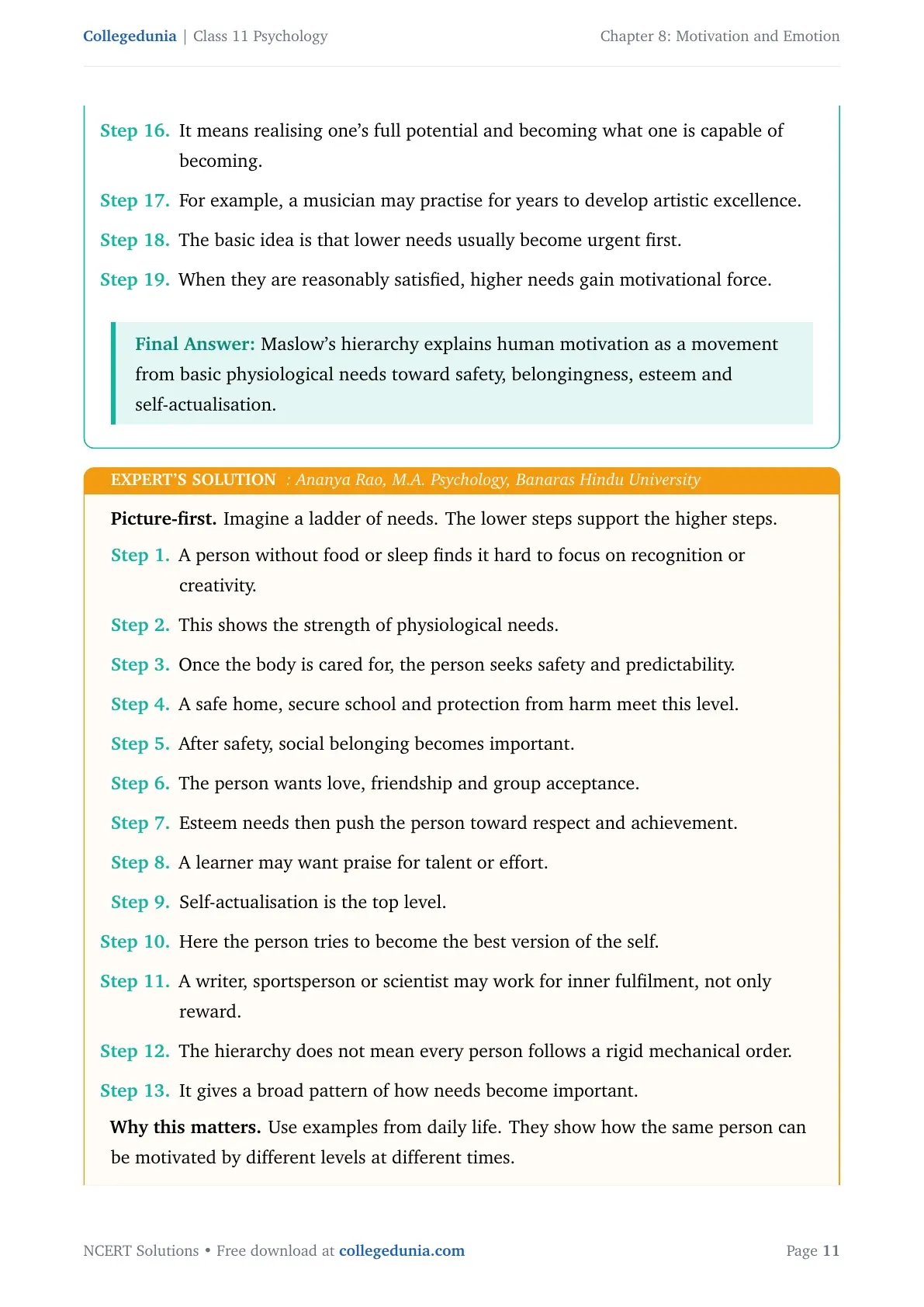
Maslow's hierarchy explains human motivation as a movement from basic physiological needs toward safety, belongingness, esteem and self-actualisation.
AR
Ananya Rao
M.A. Psychology, Banaras Hindu University
Verified Expert
Picture-first. Imagine a ladder of needs. The lower steps support the higher steps.
A person without food or sleep finds it hard to focus on recognition or creativity.
This shows the strength of physiological needs.
Once the body is cared for, the person seeks safety and predictability.
A safe home, secure school and protection from harm meet this level.
After safety, social belonging becomes important.
The person wants love, friendship and group acceptance.
Esteem needs then push the person toward respect and achievement.
A learner may want praise for talent or effort.
Self-actualisation is the top level.
Here the person tries to become the best version of the self.
A writer, sportsperson or scientist may work for inner fulfilment, not only reward.
The hierarchy does not mean every person follows a rigid mechanical order.
It gives a broad pattern of how needs become important.
Why this matters. Use examples from daily life. They show how the same person can be motivated by different levels at different times.
Maslow's basic idea is that human needs form an ascending hierarchy, and higher growth needs become stronger after lower deficiency needs are reasonably met.
Q 8.5
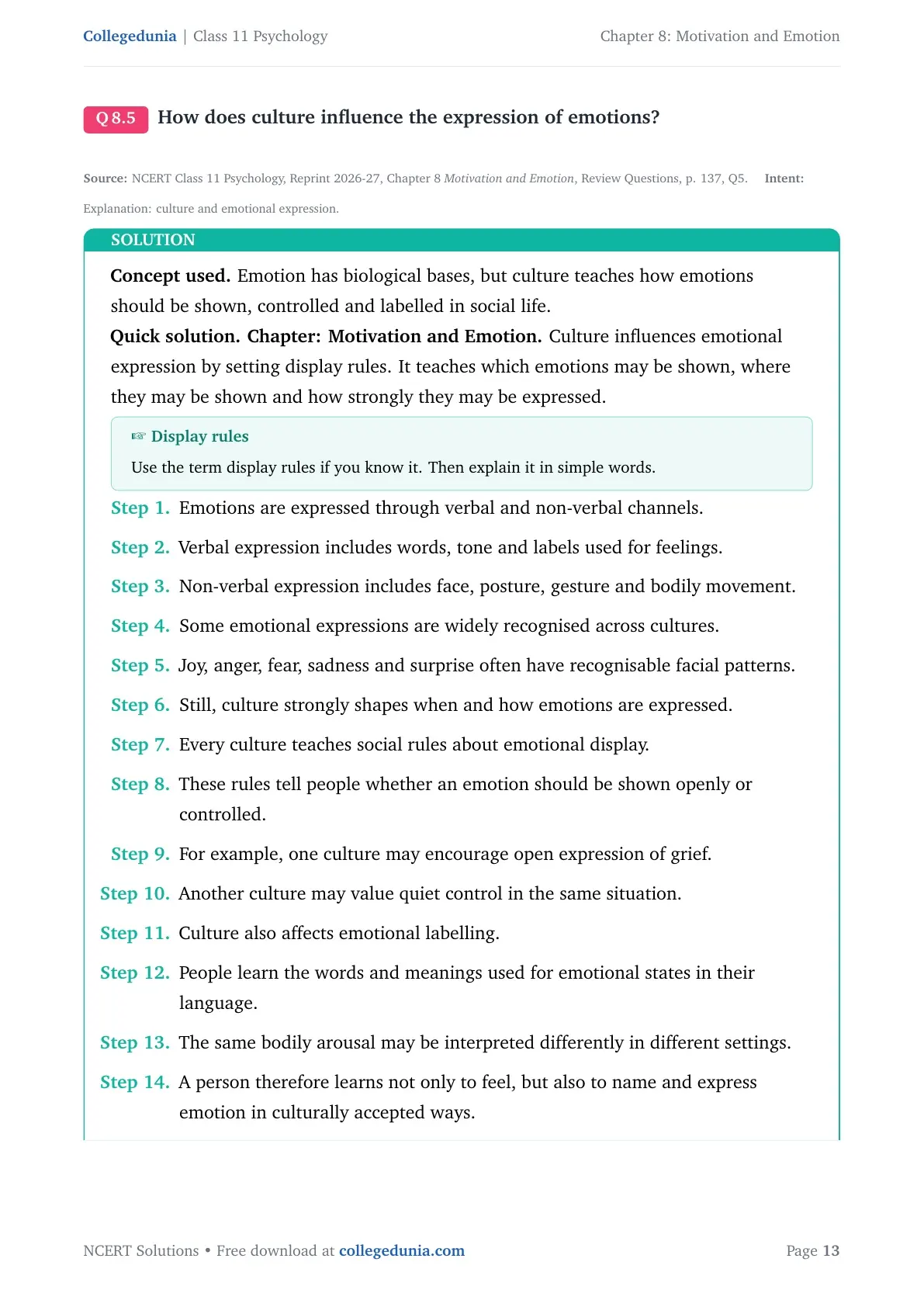
How does culture influence the expression of emotions?
Concept used. Emotion has biological bases, but culture teaches how emotions should be shown, controlled and labelled in social life.
Culture influences emotional expression by setting display rules. It teaches which emotions may be shown, where they may be shown and how strongly they may be expressed.
Display rules
Use the term display rules if you know it. Then explain it in simple words.
Emotions are expressed through verbal and non-verbal channels.
Verbal expression includes words, tone and labels used for feelings.
Non-verbal expression includes face, posture, gesture and bodily movement.
Some emotional expressions are widely recognised across cultures.
Joy, anger, fear, sadness and surprise often have recognisable facial patterns.
Still, culture strongly shapes when and how emotions are expressed.
Every culture teaches social rules about emotional display.
These rules tell people whether an emotion should be shown openly or controlled.
For example, one culture may encourage open expression of grief.
Another culture may value quiet control in the same situation.
Culture also affects emotional labelling.
People learn the words and meanings used for emotional states in their language.
The same bodily arousal may be interpreted differently in different settings.
A person therefore learns not only to feel, but also to name and express emotion in culturally accepted ways.
Culture influences emotion by shaping display rules, expression, control and emotional labels used in social situations.
KI
Kavya Iyer
M.Sc Psychology, University of Hyderabad
Verified Expert
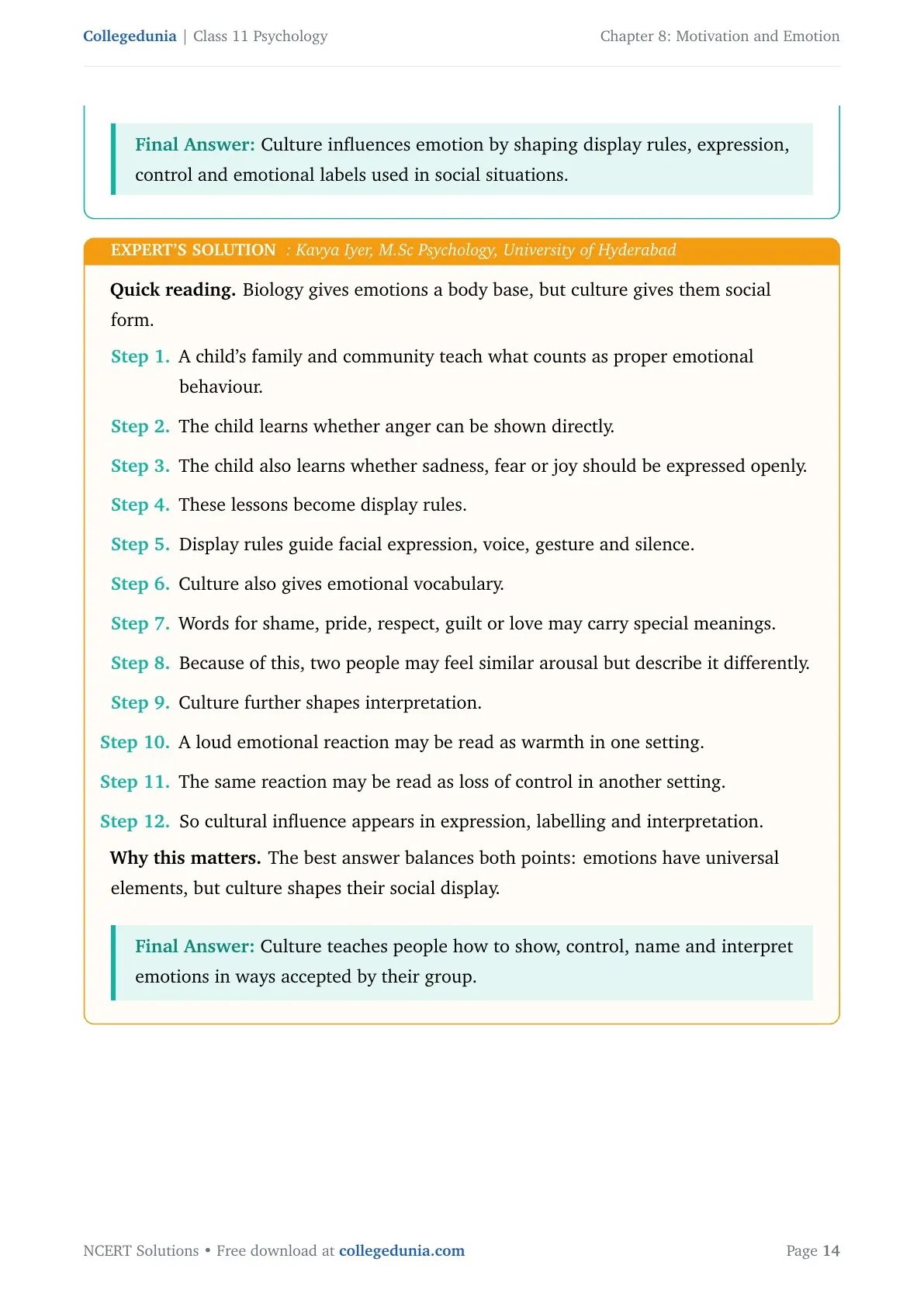
Quick reading. Biology gives emotions a body base, but culture gives them social form.
A child's family and community teach what counts as proper emotional behaviour.
The child learns whether anger can be shown directly.
The child also learns whether sadness, fear or joy should be expressed openly.
These lessons become display rules.
Display rules guide facial expression, voice, gesture and silence.
Culture also gives emotional vocabulary.
Words for shame, pride, respect, guilt or love may carry special meanings.
Because of this, two people may feel similar arousal but describe it differently.
Culture further shapes interpretation.
A loud emotional reaction may be read as warmth in one setting.
The same reaction may be read as loss of control in another setting.
So cultural influence appears in expression, labelling and interpretation.
Why this matters. The best answer balances both points: emotions have universal elements, but culture shapes their social display.
Culture teaches people how to show, control, name and interpret emotions in ways accepted by their group.
Q 8.6
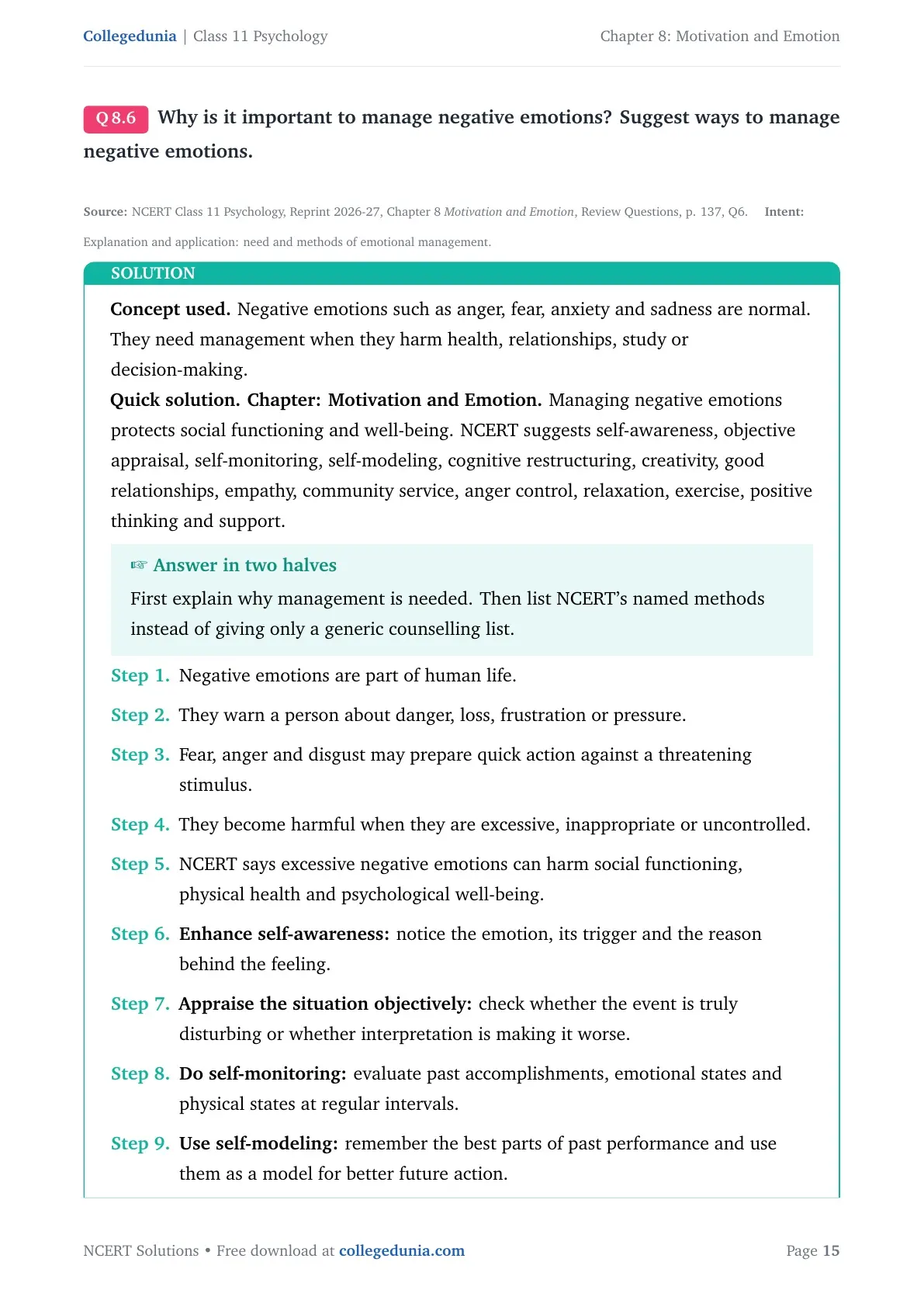
Why is it important to manage negative emotions? Suggest ways to manage negative emotions.
Concept used. Negative emotions such as anger, fear, anxiety and sadness are normal. They need management when they harm health, relationships, study or decision-making.
Managing negative emotions protects social functioning and well-being. NCERT suggests self-awareness, objective appraisal, self-monitoring, self-modeling, cognitive restructuring, creativity, good relationships, empathy, community service, anger control, relaxation, exercise, positive thinking and support.
Answer in two halves
First explain why management is needed. Then list NCERT's named methods instead of giving only a generic counselling list.
Negative emotions are part of human life.
They warn a person about danger, loss, frustration or pressure.
Fear, anger and disgust may prepare quick action against a threatening stimulus.
They become harmful when they are excessive, inappropriate or uncontrolled.
NCERT says excessive negative emotions can harm social functioning, physical health and psychological well-being.
Enhance self-awareness: notice the emotion, its trigger and the reason behind the feeling.
Appraise the situation objectively: check whether the event is truly disturbing or whether interpretation is making it worse.
Do self-monitoring: evaluate past accomplishments, emotional states and physical states at regular intervals.
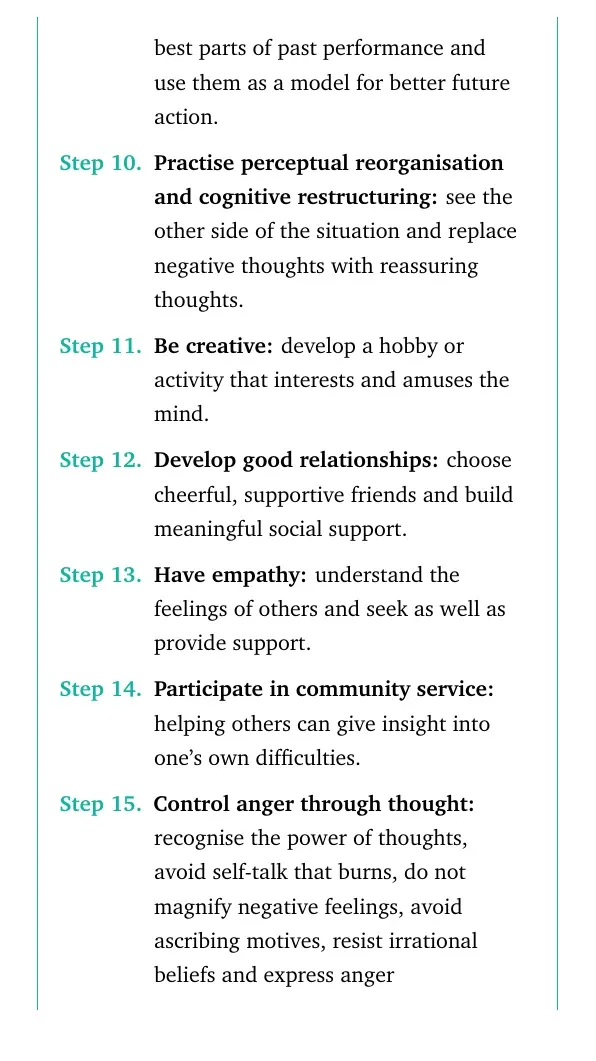
Use self-modeling: remember the best parts of past performance and use them as a model for better future action.
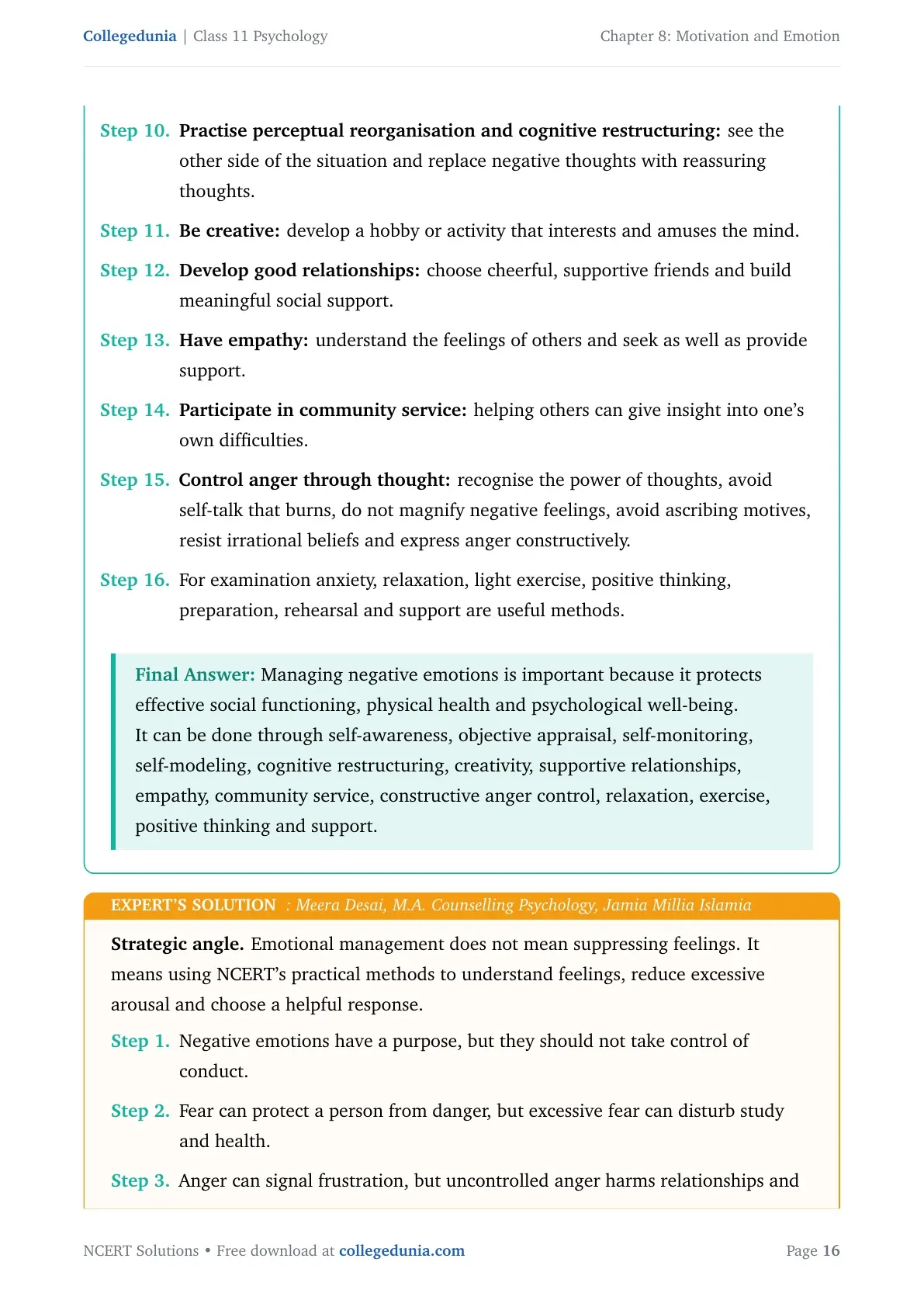
Practise perceptual reorganisation and cognitive restructuring: see the other side of the situation and replace negative thoughts with reassuring thoughts.
Be creative: develop a hobby or activity that interests and amuses the mind.
Develop good relationships: choose cheerful, supportive friends and build meaningful social support.
Have empathy: understand the feelings of others and seek as well as provide support.
Participate in community service: helping others can give insight into one's own difficulties.
Control anger through thought: recognise the power of thoughts, avoid self-talk that burns, do not magnify negative feelings, avoid ascribing motives, resist irrational beliefs and express anger constructively.
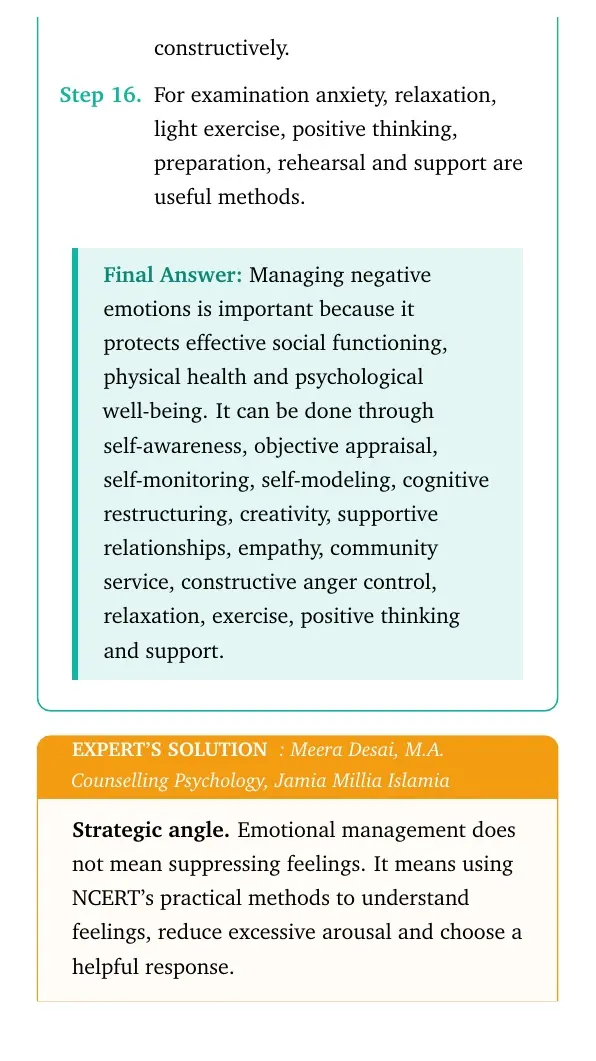
For examination anxiety, relaxation, light exercise, positive thinking, preparation, rehearsal and support are useful methods.
Managing negative emotions is important because it protects effective social functioning, physical health and psychological well-being. It can be done through self-awareness, objective appraisal, self-monitoring, self-modeling, cognitive restructuring, creativity, supportive relationships, empathy, community service, constructive anger control, relaxation, exercise, positive thinking and support.
MD
Meera Desai
M.A. Counselling Psychology, Jamia Millia Islamia
Verified Expert
Strategic angle. Emotional management does not mean suppressing feelings. It means using NCERT's practical methods to understand feelings, reduce excessive arousal and choose a helpful response.
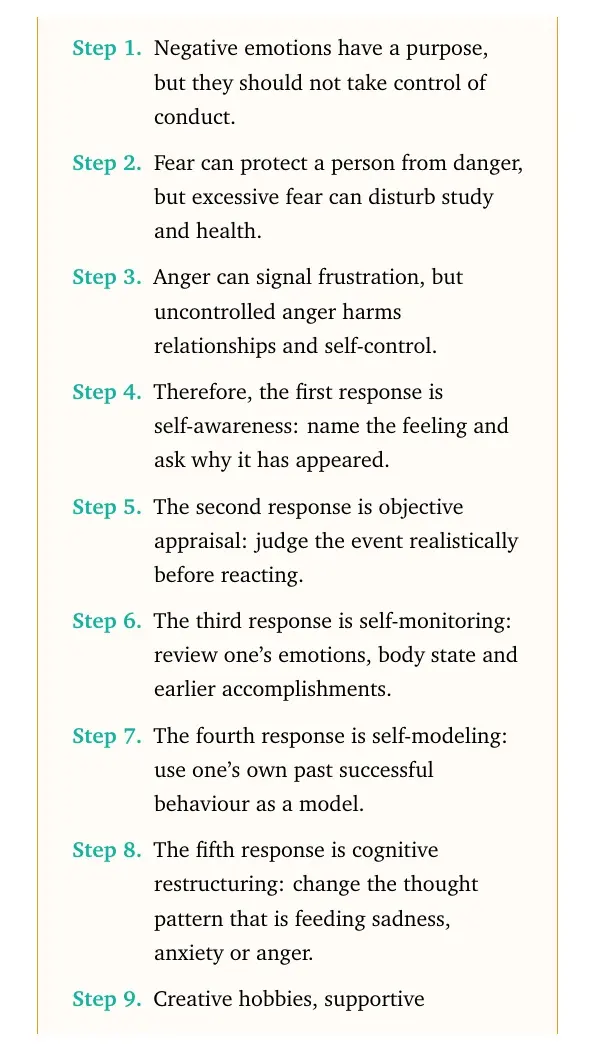
Negative emotions have a purpose, but they should not take control of conduct.
Fear can protect a person from danger, but excessive fear can disturb study and health.
Anger can signal frustration, but uncontrolled anger harms relationships and self-control.
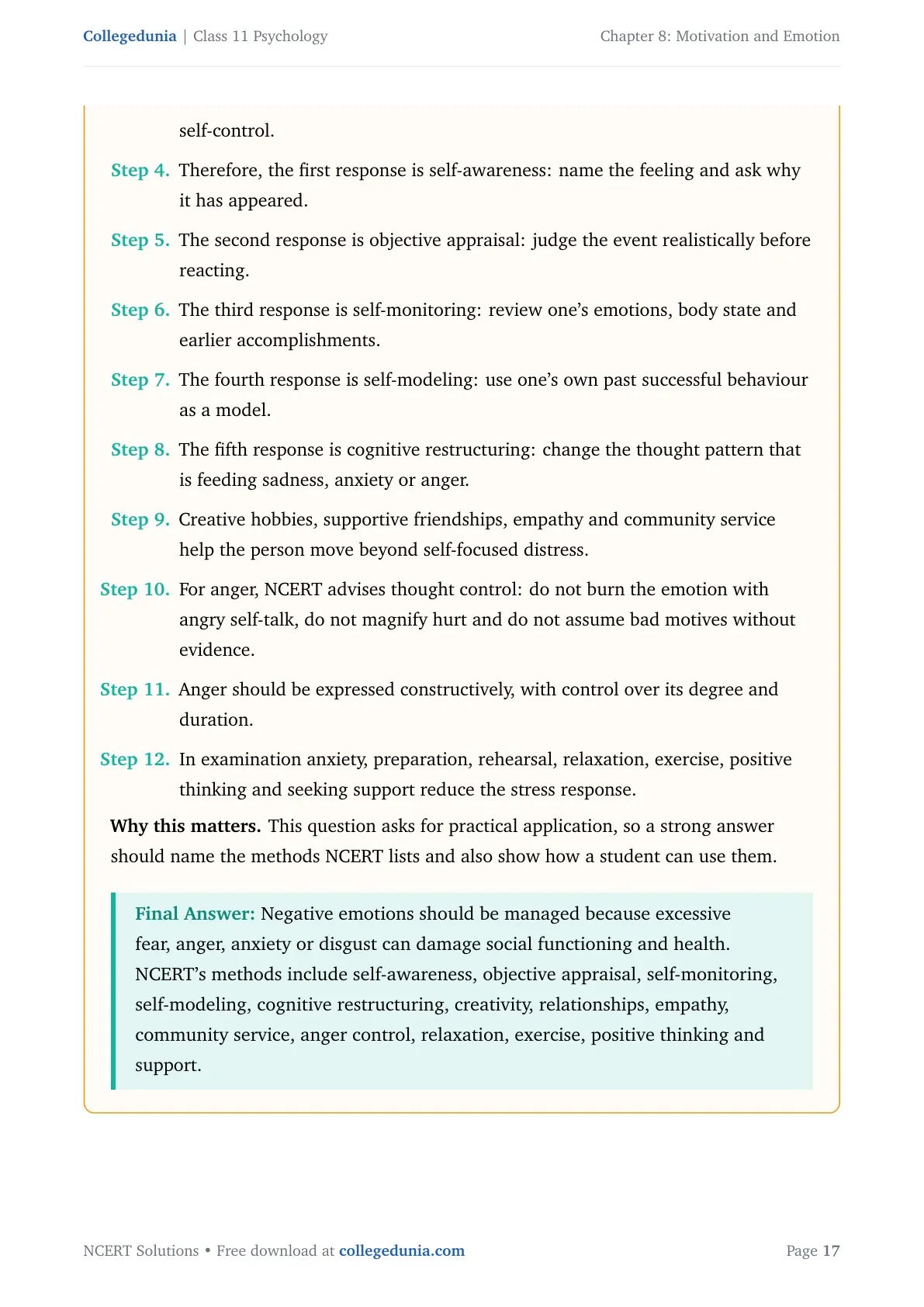
Therefore, the first response is self-awareness: name the feeling and ask why it has appeared.
The second response is objective appraisal: judge the event realistically before reacting.
The third response is self-monitoring: review one's emotions, body state and earlier accomplishments.
The fourth response is self-modeling: use one's own past successful behaviour as a model.
The fifth response is cognitive restructuring: change the thought pattern that is feeding sadness, anxiety or anger.
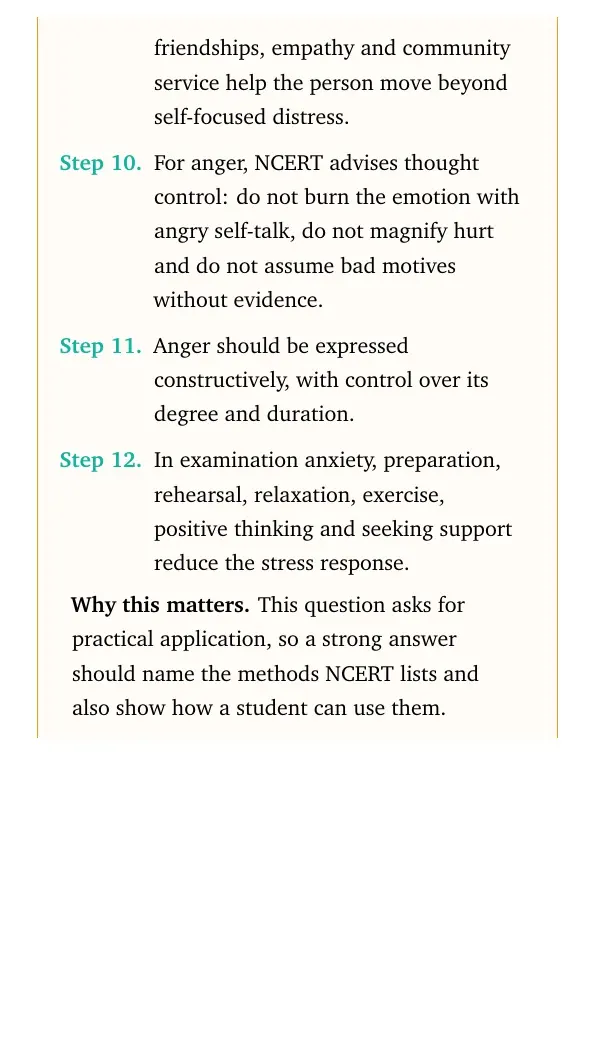
Creative hobbies, supportive friendships, empathy and community service help the person move beyond self-focused distress.
For anger, NCERT advises thought control: do not burn the emotion with angry self-talk, do not magnify hurt and do not assume bad motives without evidence.
Anger should be expressed constructively, with control over its degree and duration.
In examination anxiety, preparation, rehearsal, relaxation, exercise, positive thinking and seeking support reduce the stress response.
Why this matters. This question asks for practical application, so a strong answer should name the methods NCERT lists and also show how a student can use them.
Negative emotions should be managed because excessive fear, anger, anxiety or disgust can damage social functioning and health. NCERT's methods include self-awareness, objective appraisal, self-monitoring, self-modeling, cognitive restructuring, creativity, relationships, empathy, community service, anger control, relaxation, exercise, positive thinking and support.
Motivation and Emotion Class 11 Psychology NCERT Solutions FAQs
How many questions are solved in Class 11 Psychology Chapter 8 Motivation and Emotion?
There are 6 textbook review questions solved in this Class 11 Psychology Chapter 8 NCERT Solutions set. The PDF includes direct answers and detailed expert explanations for the 2026-27 session.
What is the main idea of motivation in Class 11 Psychology?
Motivation is the process that energises, directs and sustains behaviour toward a goal. NCERT explains it through the sequence of need, drive, arousal, goal-directed action and reduction of arousal.
Which biological motives are covered in Motivation and Emotion?
The chapter covers hunger and thirst as biological motives. Hunger is linked with stomach, blood, liver and hypothalamic signals, while thirst is linked with cell dehydration, blood volume and hypothalamic osmoreceptors.
Why is Maslow's hierarchy important for this chapter?
Maslow's hierarchy helps students arrange human needs from basic physiological needs to self-actualisation. It is useful for explaining how lower needs can become urgent before higher growth needs.
How should students revise emotion management for school exams?
Students should revise why negative emotions need management and then list practical methods such as self-awareness, objective appraisal, self-monitoring, self-modeling, cognitive restructuring, supportive relationships, empathy, community service, anger control, relaxation, exercise and support.








Comments