The NCERT Solutions for Class 11 Psychology Chapter 5 Learning cover all 11 textbook review questions from the latest 2026-27 NCERT book. The chapter explains how learning changes behaviour through conditioning, observation, verbal practice, skill acquisition, transfer, motivation and cognitive maps.
Covers every review question with a direct solution and a detailed expert explanation.
Focuses on classical conditioning, operant conditioning, observational learning, verbal learning, skill learning, transfer of learning and learning disabilities.
Useful for school exams because each answer connects the NCERT term, the process and one clear classroom or daily-life example.
Student Feedback: In a Collegedunia poll of 9,740 Class 11 Psychology students preparing for the 2026 school exams, 68% said they understood examples of learning but mixed up reinforcement, punishment and cognitive maps in long answers.
Source: 2026-27 Class 11 Psychology student poll across CBSE schools.
Every answer in this chapter set is checked against the 2026-27 NCERT Psychology textbook and written so that students can revise the concept, example and exam framing together.
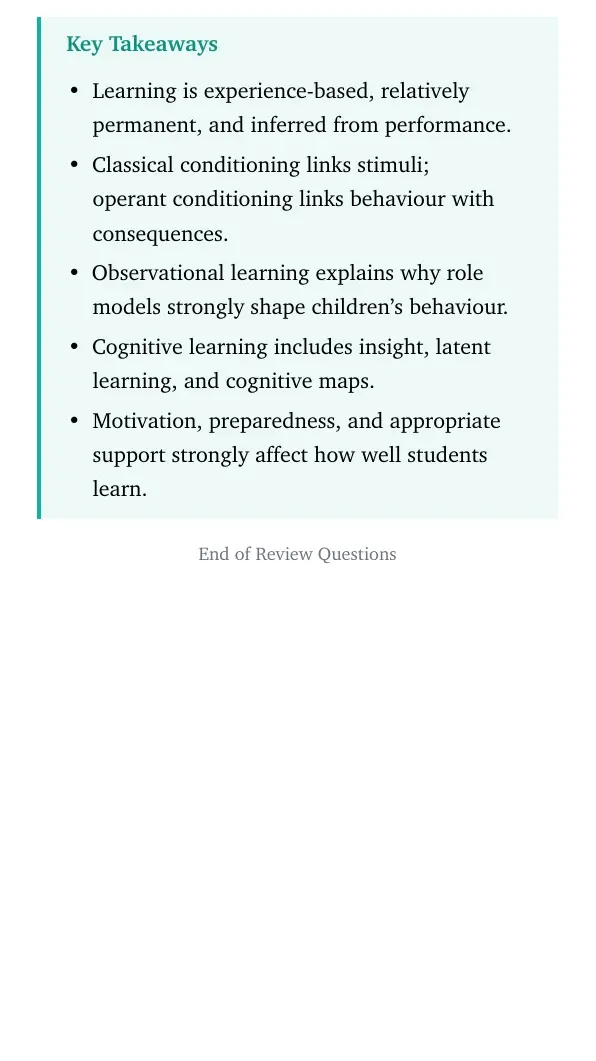
Chapter 5 treats learning as a relatively permanent change in behaviour or behavioural potential due to experience. For exam answers, the safest method is to identify the learning type first and then explain the exact process used in that question.
Chapter area
What students must know
Where it helps
Meaning of learning
Experience-based and relatively permanent change, inferred from performance
Question 1
Classical conditioning
Association between neutral stimulus and unconditioned stimulus
Question 2
Operant conditioning
Voluntary response shaped by reinforcement, punishment and schedules
Question 3
Observational learning
Learning through models, imitation and vicarious consequences
Question 4
Verbal, skill and transfer learning
Serial learning, paired associates, free recall, practice and transfer
Questions 5 to 8
Cognitive learning and difficulties
Insight learning, latent learning, cognitive maps and learning disabilities
Questions 9 to 11
Use the NCERT vocabulary exactly: conditioned stimulus, reinforcement, modeling, positive transfer, motivation, preparedness, insight learning and latent learning. These terms make answers precise and stop examples from sounding generic.
Learning Chapter 5 Video Lesson for Class 11 Psychology
Classical, Operant and Observational Learning in Chapter 5
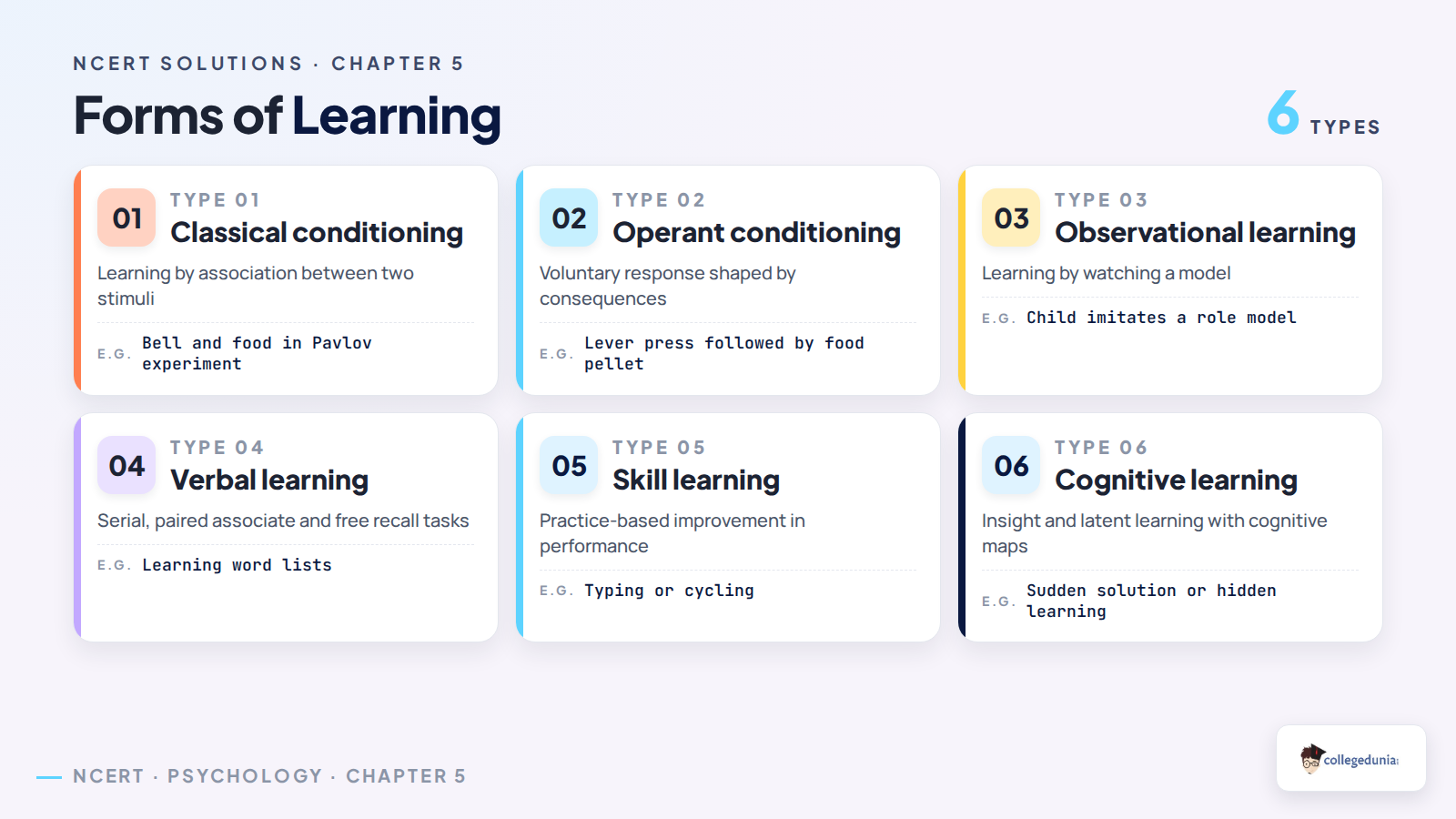
The first half of the chapter compares three major routes of learning. Classical conditioning explains how one stimulus becomes a signal for another. Operant conditioning explains how voluntary behaviour changes because of consequences. Observational learning explains how a learner acquires behaviour by watching a model.
Classical conditioning: Pavlov's dog salivates to the bell because the bell has been paired with food.
Operant conditioning: Skinner's rat presses a lever more often when food follows the response.
Observational learning: a child imitates a model, especially when the model is admired or rewarded.
The solved PDF keeps these three forms separate. That matters because the same example can look similar on the surface, but the answer changes depending on whether the relation is stimulus-stimulus, response-consequence or model-observer.
Verbal Learning, Skill Learning and Transfer of Learning
Verbal learning deals with how learners acquire lists, paired words and recalled material. NCERT describes serial learning, paired-associate learning and free-recall learning. Skill learning is different because it needs practice, feedback, timing and coordinated performance.
Serial learning: the learner remembers items in a fixed order, such as a poem or list.
Paired-associate learning: the learner connects one item with another, such as a foreign word and its meaning.
Free recall: the learner recalls learned items without following the original order.
Skill learning: the learner improves performance through practice, feedback and gradual refinement.
Transfer of learning appears when earlier learning affects later learning. Positive transfer helps the new task, negative transfer interferes with it, and zero transfer has no clear effect. The PDF uses school-friendly examples so students can write this answer without drifting away from NCERT.
Cognitive Learning, Motivation and Preparedness
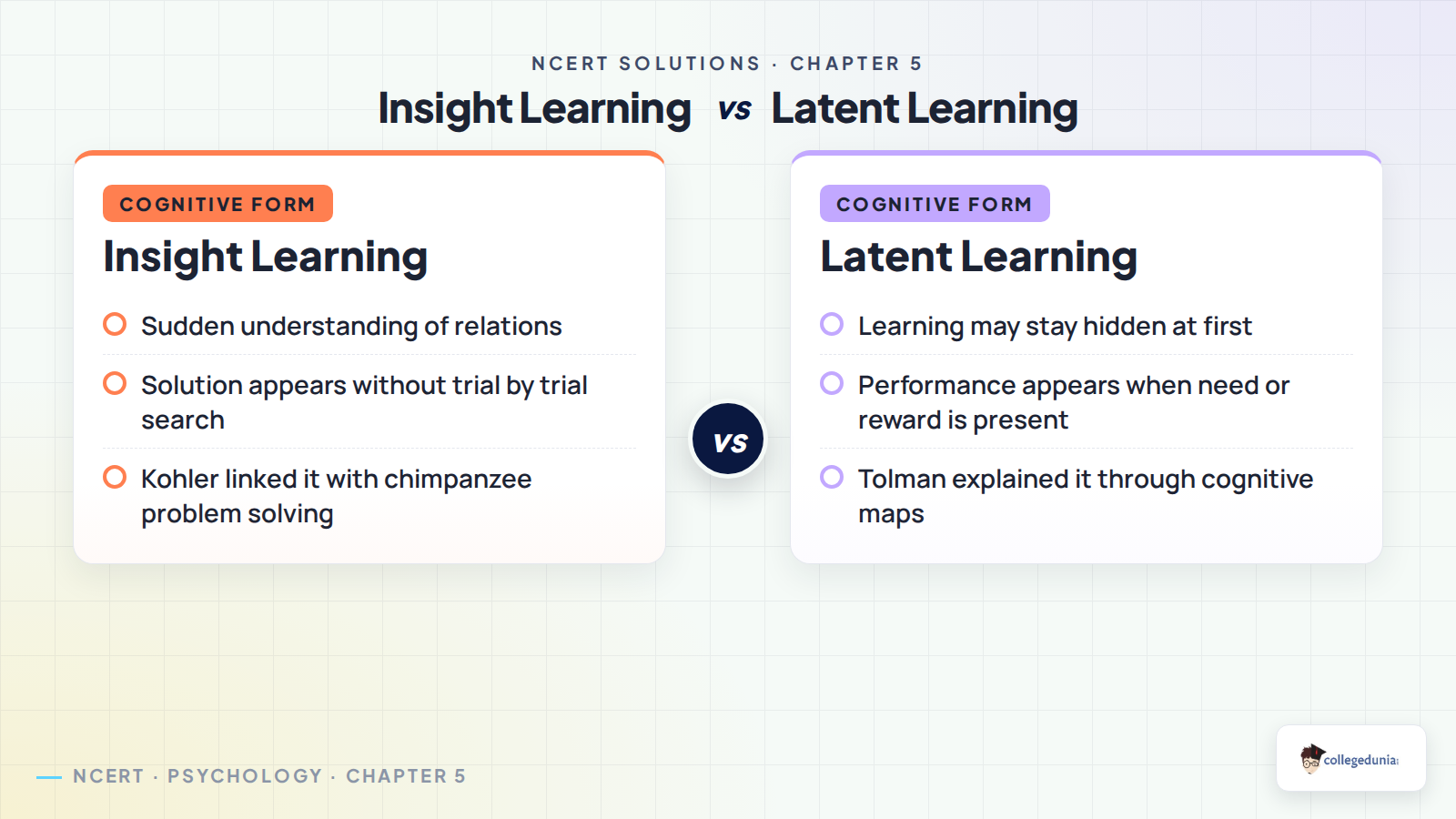
The last part of the chapter moves beyond direct conditioning. Cognitive learning focuses on what the learner understands about relationships, routes or solutions. NCERT explains insight learning and latent learning, and Tolman's explanation of latent learning includes cognitive maps.
Concept
Exam-ready meaning
Example cue
Motivation
Arouses and directs behaviour toward a goal
A student persists because the goal matters
Preparedness
Biological readiness to learn some associations more easily than others
Some fears or tastes are learned faster than arbitrary links
Insight learning
Sudden grasp of the relation among parts of a problem
Kohler's chimpanzee solves the stick or box problem
Latent learning
Learning remains hidden until motivation or reinforcement brings it into performance
Tolman's rats show a learned maze route later
Cognitive map
Mental representation of spatial layout or route
Knowing the path without having shown it earlier
How to Write Better Chapter 5 Psychology Answers
Most mistakes in this chapter happen when students write an example but skip the learning mechanism. A strong answer should name the type of learning, define it in NCERT language, explain the process and close with the correct example.
Start with the term: write classical conditioning, operant conditioning, modeling, positive transfer or latent learning as required.
Show the process: mention association, reinforcement, imitation, practice, transfer, motivation or cognitive map.
Use one example: Pavlov's dog, Skinner box, Bobo doll, paired words, cycling or maze learning.
Close with the exam point: state why the example proves the concept asked in the question.
The solved PDF follows this pattern. Each answer begins with a quick answer, then develops the concept and ends with a concise conclusion suitable for a school exam.
Related Psychology Resources for Learning
Use the solutions PDF for answers, then move to the NCERT book, notes and handwritten notes when you want to revise the same chapter in a different format.
All NCERT Solutions for Class 11 Psychology Chapter 5 Learning with Step-by-Step Solutions
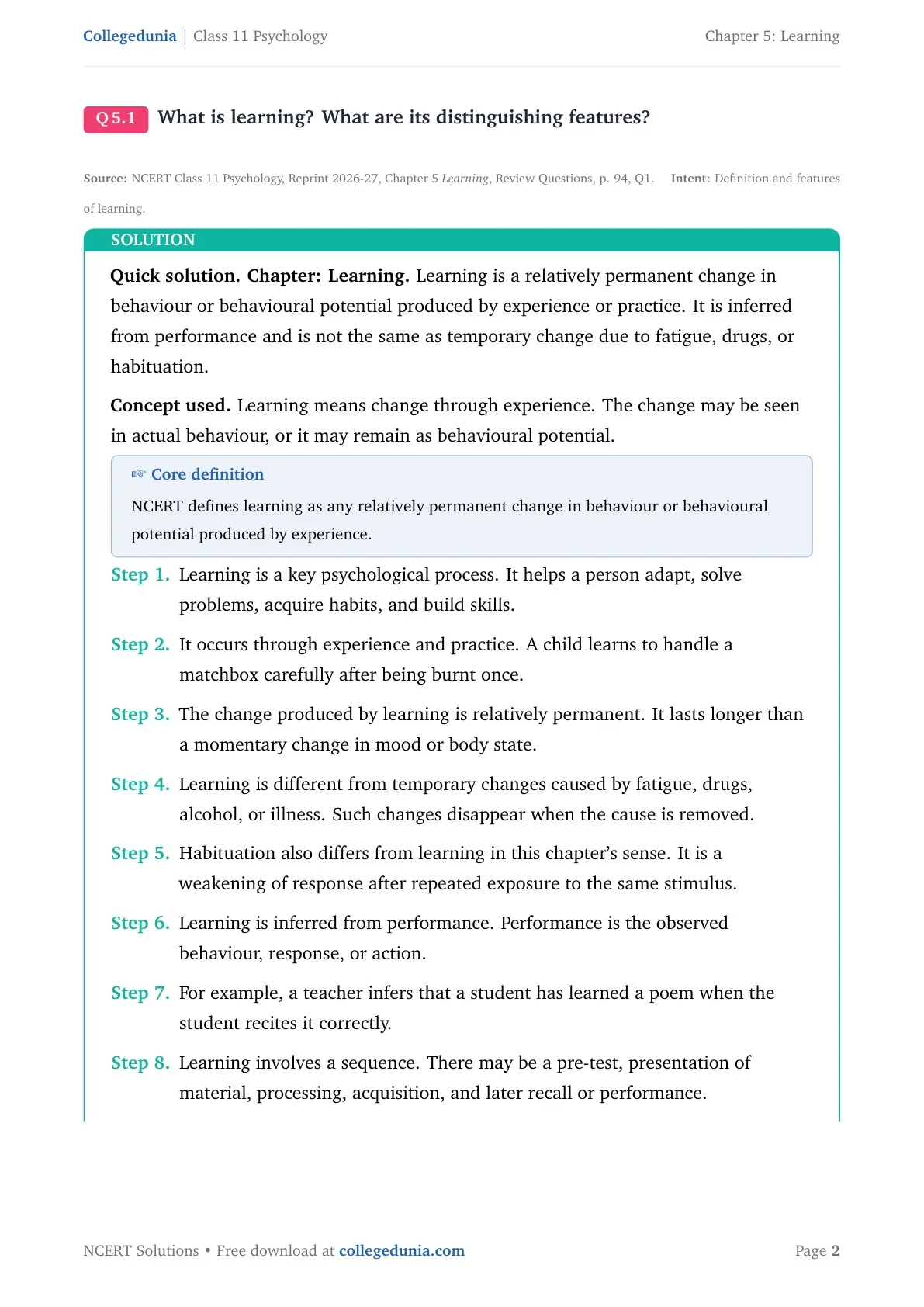
Q 5.1
What is learning? What are its distinguishing features?
Learning is a relatively permanent change in behaviour or behavioural potential produced by experience or practice. It is inferred from performance and is not the same as temporary change due to fatigue, drugs, or habituation.
Concept used. Learning means change through experience. The change may be seen in actual behaviour, or it may remain as behavioural potential.
Core definition
NCERT defines learning as any relatively permanent change in behaviour or behavioural potential produced by experience.
Learning is a key psychological process. It helps a person adapt, solve problems, acquire habits, and build skills.
It occurs through experience and practice. A child learns to handle a matchbox carefully after being burnt once.
The change produced by learning is relatively permanent. It lasts longer than a momentary change in mood or body state.
Learning is different from temporary changes caused by fatigue, drugs, alcohol, or illness. Such changes disappear when the cause is removed.
Habituation also differs from learning in this chapter's sense. It is a weakening of response after repeated exposure to the same stimulus.
Learning is inferred from performance. Performance is the observed behaviour, response, or action.
For example, a teacher infers that a student has learned a poem when the student recites it correctly.
Learning involves a sequence. There may be a pre-test, presentation of material, processing, acquisition, and later recall or performance.
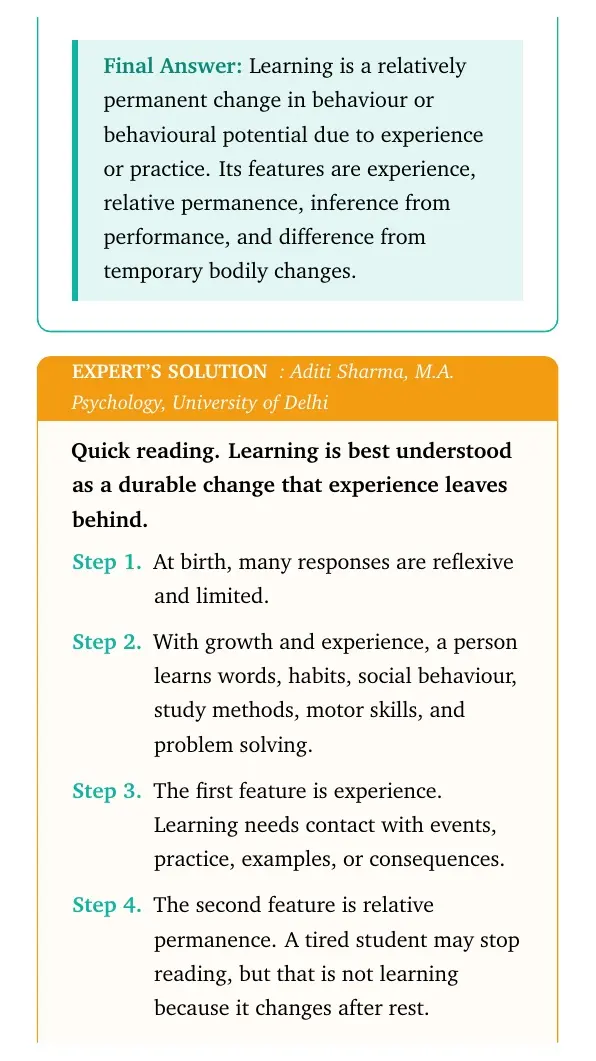
Learning is a relatively permanent change in behaviour or behavioural potential due to experience or practice. Its features are experience, relative permanence, inference from performance, and difference from temporary bodily changes.
AS
Aditi Sharma
M.A. Psychology, University of Delhi
Verified Expert
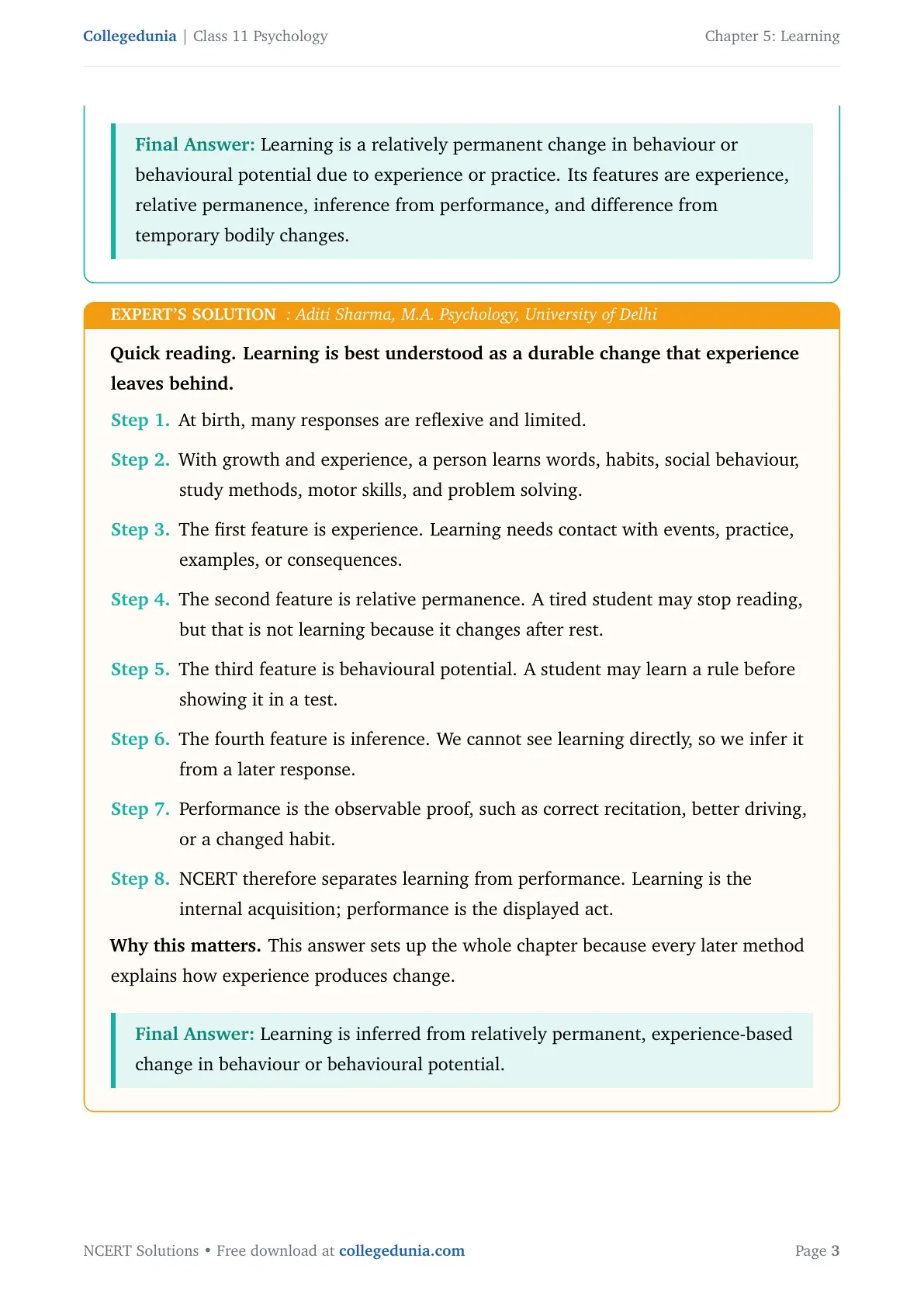
Quick reading. Learning is best understood as a durable change that experience leaves behind.
At birth, many responses are reflexive and limited.
With growth and experience, a person learns words, habits, social behaviour, study methods, motor skills, and problem solving.
The first feature is experience. Learning needs contact with events, practice, examples, or consequences.
The second feature is relative permanence. A tired student may stop reading, but that is not learning because it changes after rest.
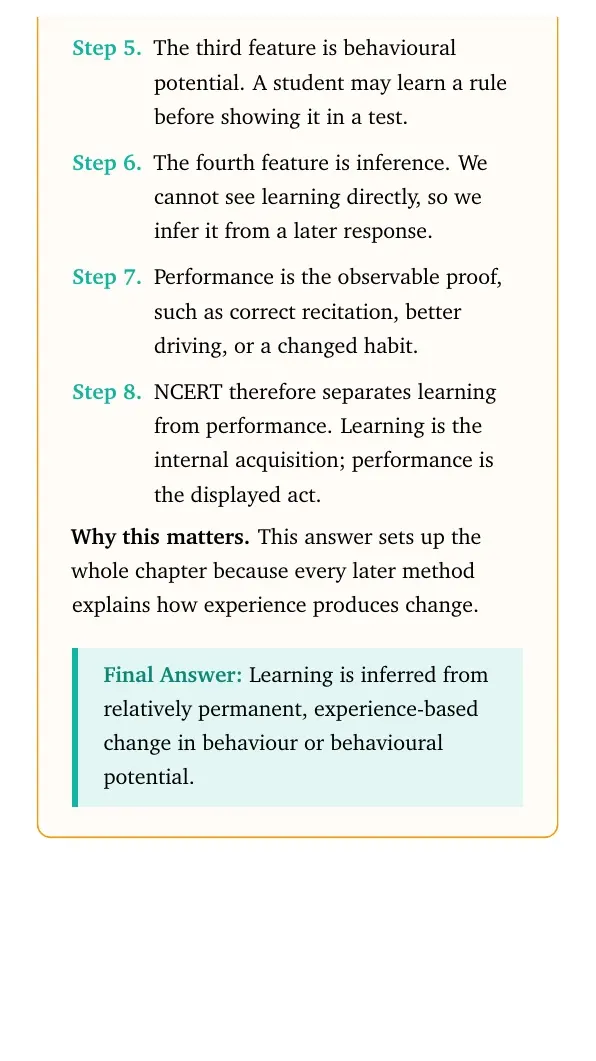
The third feature is behavioural potential. A student may learn a rule before showing it in a test.
The fourth feature is inference. We cannot see learning directly, so we infer it from a later response.
Performance is the observable proof, such as correct recitation, better driving, or a changed habit.
NCERT therefore separates learning from performance. Learning is the internal acquisition; performance is the displayed act.
Why this matters. This answer sets up the whole chapter because every later method explains how experience produces change.
Learning is inferred from relatively permanent, experience-based change in behaviour or behavioural potential.
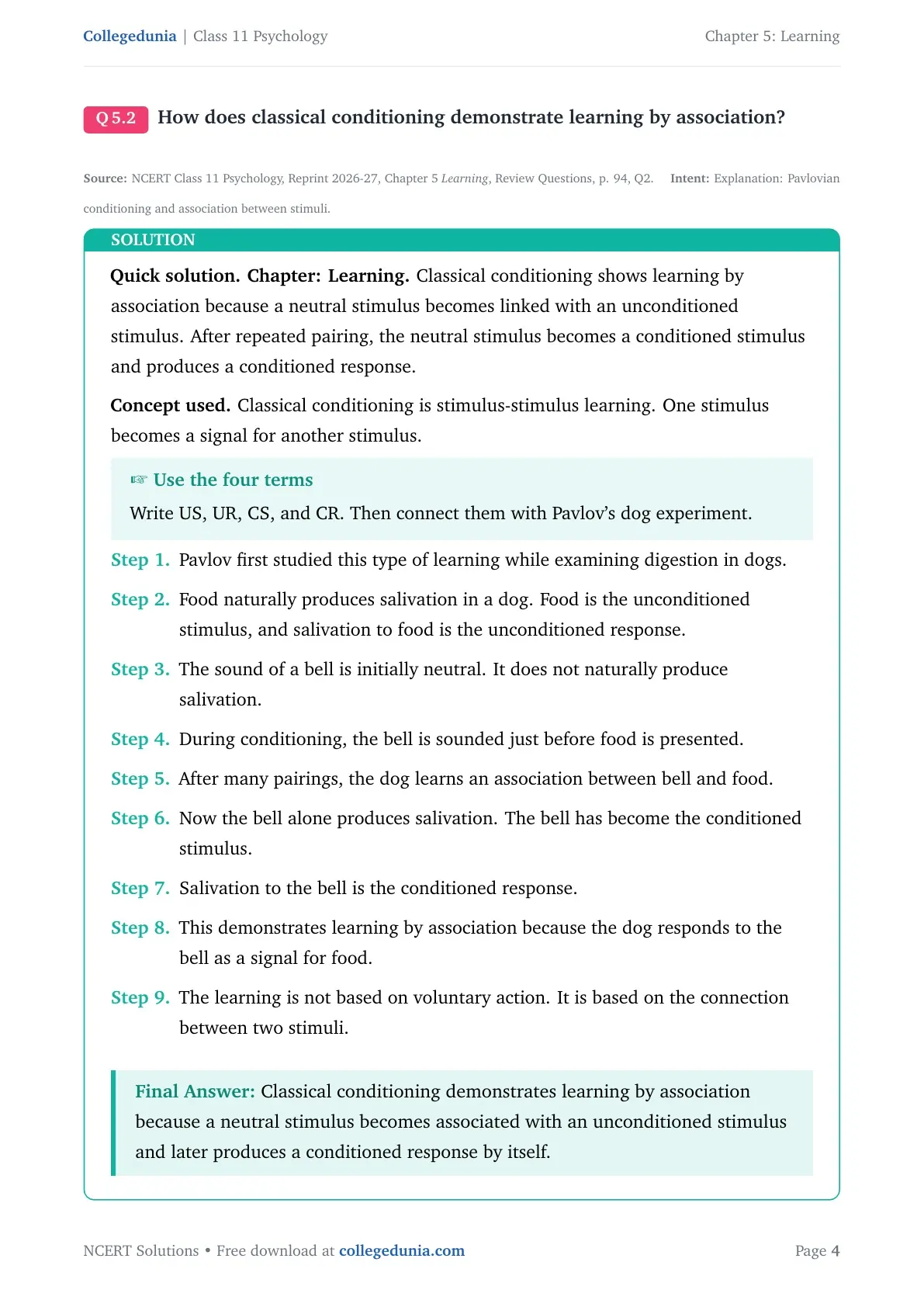
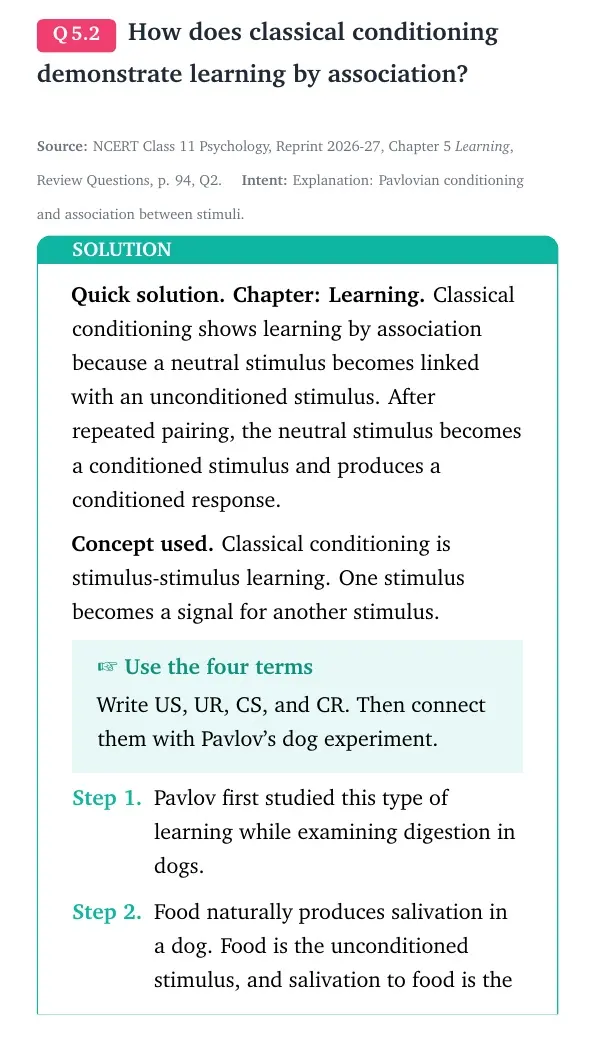
Q 5.2
How does classical conditioning demonstrate learning by association?
Classical conditioning shows learning by association because a neutral stimulus becomes linked with an unconditioned stimulus. After repeated pairing, the neutral stimulus becomes a conditioned stimulus and produces a conditioned response.
Concept used. Classical conditioning is stimulus-stimulus learning. One stimulus becomes a signal for another stimulus.
Use the four terms
Write US, UR, CS, and CR. Then connect them with Pavlov's dog experiment.
Pavlov first studied this type of learning while examining digestion in dogs.
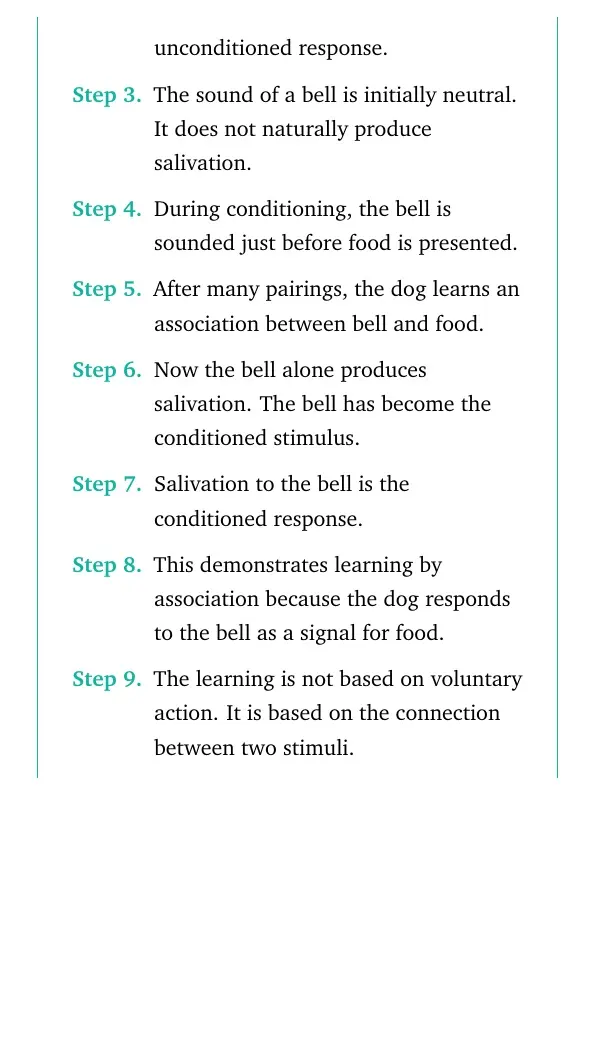
Food naturally produces salivation in a dog. Food is the unconditioned stimulus, and salivation to food is the unconditioned response.
The sound of a bell is initially neutral. It does not naturally produce salivation.
During conditioning, the bell is sounded just before food is presented.
After many pairings, the dog learns an association between bell and food.
Now the bell alone produces salivation. The bell has become the conditioned stimulus.
Salivation to the bell is the conditioned response.
This demonstrates learning by association because the dog responds to the bell as a signal for food.
The learning is not based on voluntary action. It is based on the connection between two stimuli.
Classical conditioning demonstrates learning by association because a neutral stimulus becomes associated with an unconditioned stimulus and later produces a conditioned response by itself.
RM
Rohit Mehta
M.Sc Applied Psychology, Christ University
Verified Expert
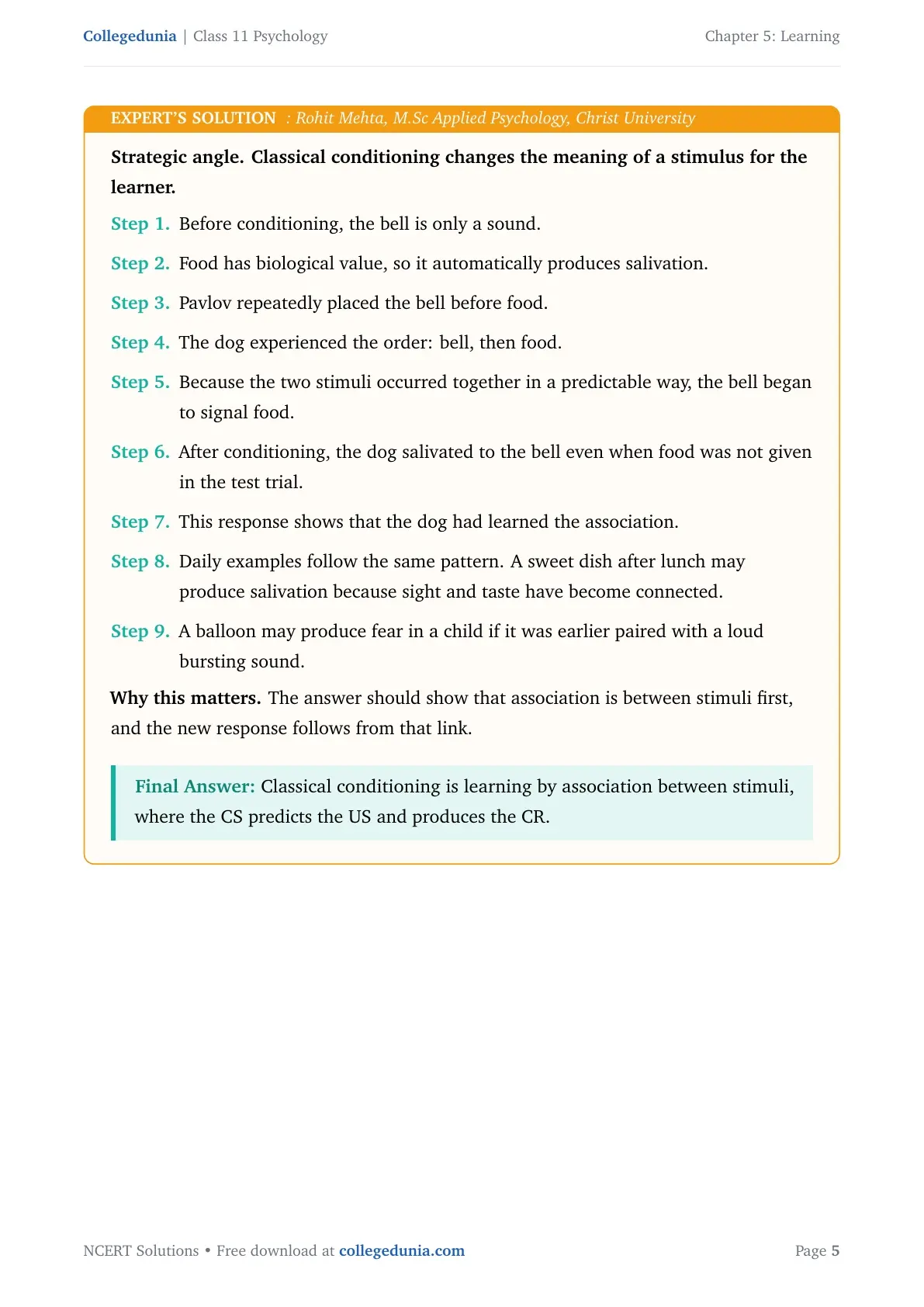
Strategic angle. Classical conditioning changes the meaning of a stimulus for the learner.
Before conditioning, the bell is only a sound.
Food has biological value, so it automatically produces salivation.
Pavlov repeatedly placed the bell before food.
The dog experienced the order: bell, then food.
Because the two stimuli occurred together in a predictable way, the bell began to signal food.
After conditioning, the dog salivated to the bell even when food was not given in the test trial.
This response shows that the dog had learned the association.
Daily examples follow the same pattern. A sweet dish after lunch may produce salivation because sight and taste have become connected.
A balloon may produce fear in a child if it was earlier paired with a loud bursting sound.
Why this matters. The answer should show that association is between stimuli first, and the new response follows from that link.
Classical conditioning is learning by association between stimuli, where the CS predicts the US and produces the CR.
Q 5.3
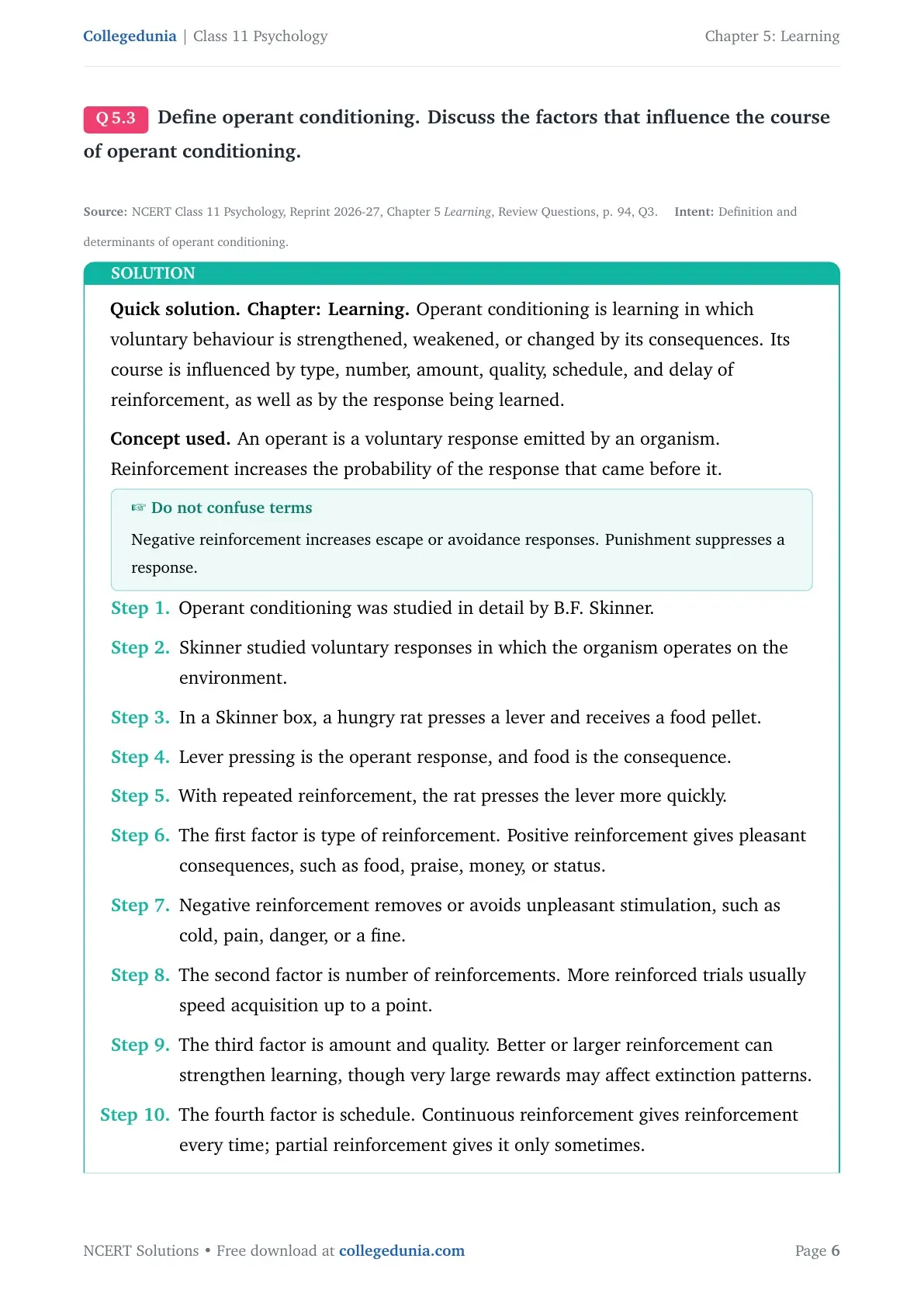
Define operant conditioning. Discuss the factors that influence the course of operant conditioning.
Operant conditioning is learning in which voluntary behaviour is strengthened, weakened, or changed by its consequences. Its course is influenced by type, number, amount, quality, schedule, and delay of reinforcement, as well as by the response being learned.
Concept used. An operant is a voluntary response emitted by an organism. Reinforcement increases the probability of the response that came before it.
Do not confuse terms
Negative reinforcement increases escape or avoidance responses. Punishment suppresses a response.
Operant conditioning was studied in detail by B.F. Skinner.
Skinner studied voluntary responses in which the organism operates on the environment.
In a Skinner box, a hungry rat presses a lever and receives a food pellet.
Lever pressing is the operant response, and food is the consequence.
With repeated reinforcement, the rat presses the lever more quickly.
The first factor is type of reinforcement. Positive reinforcement gives pleasant consequences, such as food, praise, money, or status.
Negative reinforcement removes or avoids unpleasant stimulation, such as cold, pain, danger, or a fine.
The second factor is number of reinforcements. More reinforced trials usually speed acquisition up to a point.
The third factor is amount and quality. Better or larger reinforcement can strengthen learning, though very large rewards may affect extinction patterns.
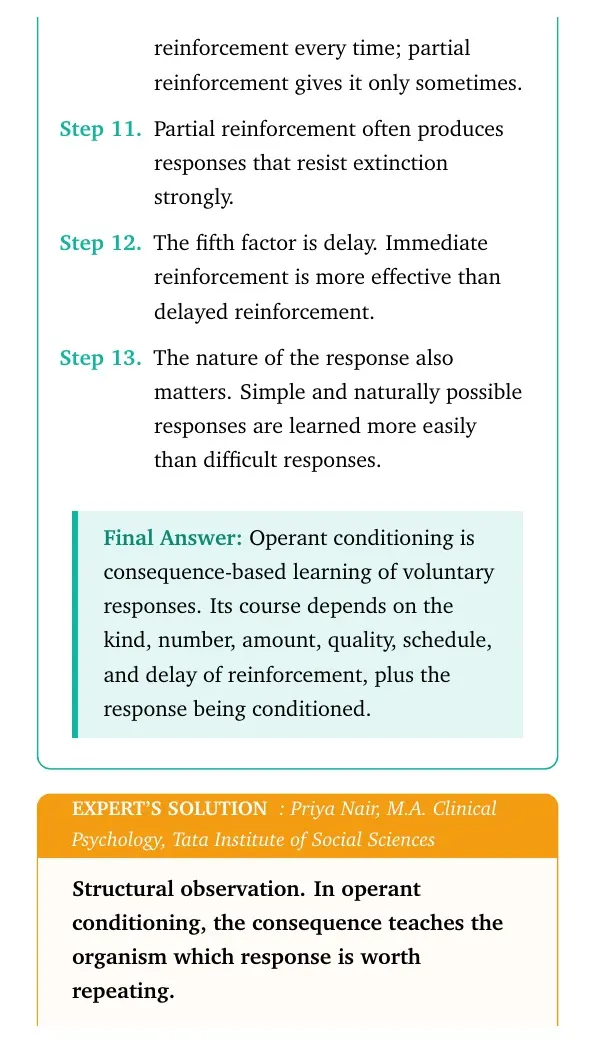
The fourth factor is schedule. Continuous reinforcement gives reinforcement every time; partial reinforcement gives it only sometimes.
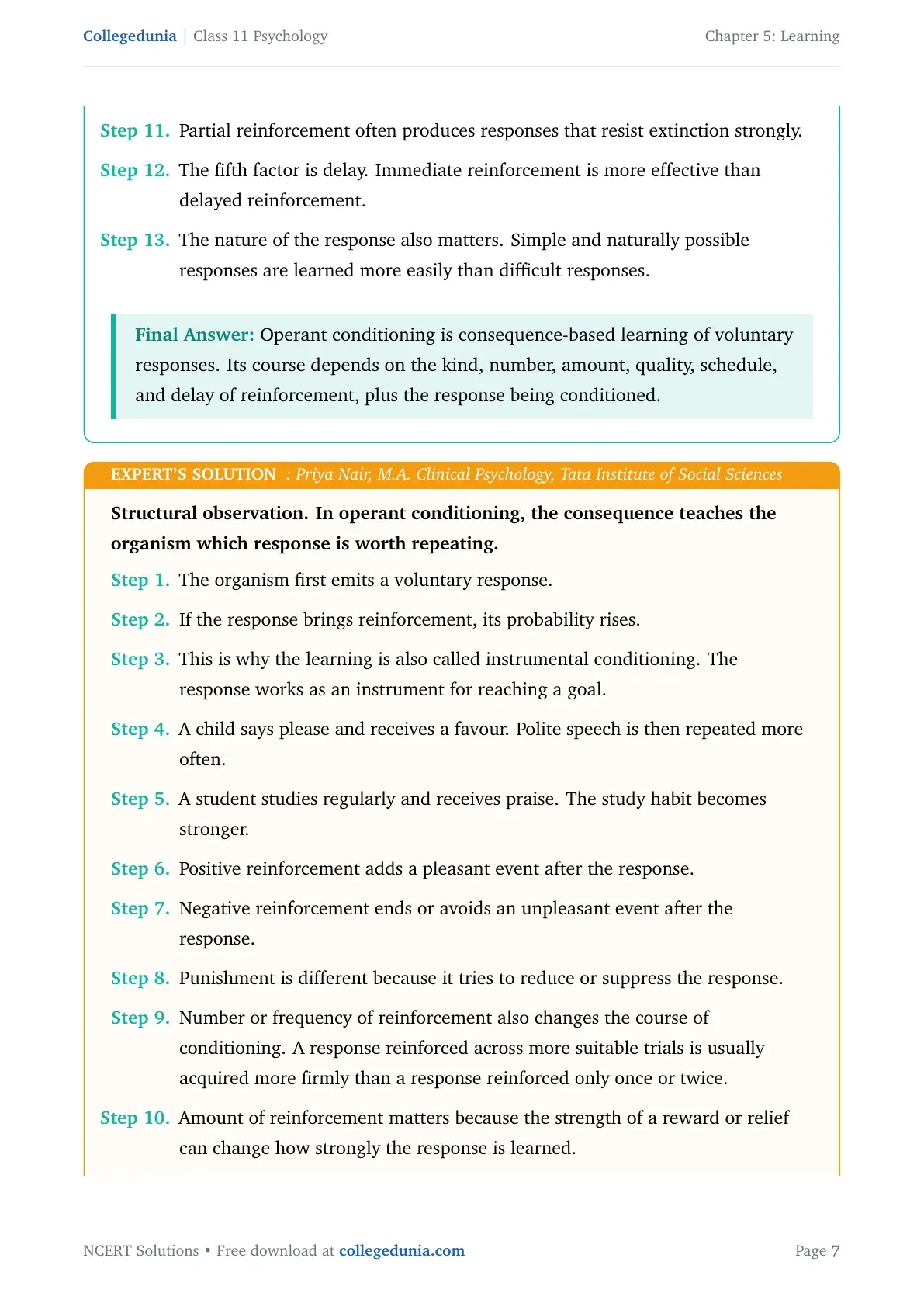
Partial reinforcement often produces responses that resist extinction strongly.
The fifth factor is delay. Immediate reinforcement is more effective than delayed reinforcement.
The nature of the response also matters. Simple and naturally possible responses are learned more easily than difficult responses.
Operant conditioning is consequence-based learning of voluntary responses. Its course depends on the kind, number, amount, quality, schedule, and delay of reinforcement, plus the response being conditioned.
PN
Priya Nair
M.A. Clinical Psychology, Tata Institute of Social Sciences
Verified Expert
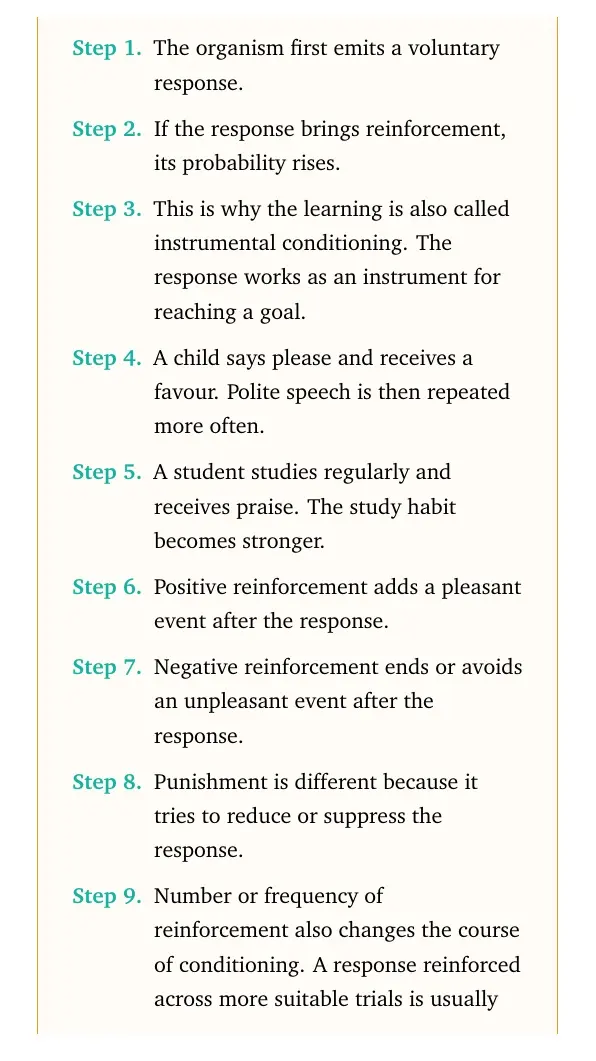
Structural observation. In operant conditioning, the consequence teaches the organism which response is worth repeating.
The organism first emits a voluntary response.
If the response brings reinforcement, its probability rises.
This is why the learning is also called instrumental conditioning. The response works as an instrument for reaching a goal.
A child says please and receives a favour. Polite speech is then repeated more often.
A student studies regularly and receives praise. The study habit becomes stronger.
Positive reinforcement adds a pleasant event after the response.
Negative reinforcement ends or avoids an unpleasant event after the response.
Punishment is different because it tries to reduce or suppress the response.
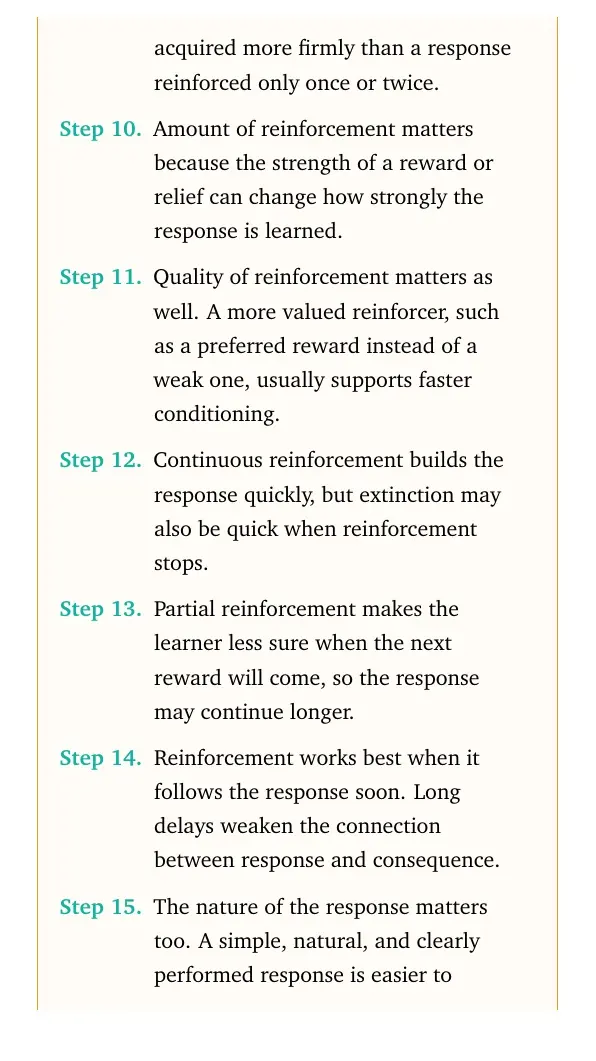
Number or frequency of reinforcement also changes the course of conditioning. A response reinforced across more suitable trials is usually acquired more firmly than a response reinforced only once or twice.
Amount of reinforcement matters because the strength of a reward or relief can change how strongly the response is learned.
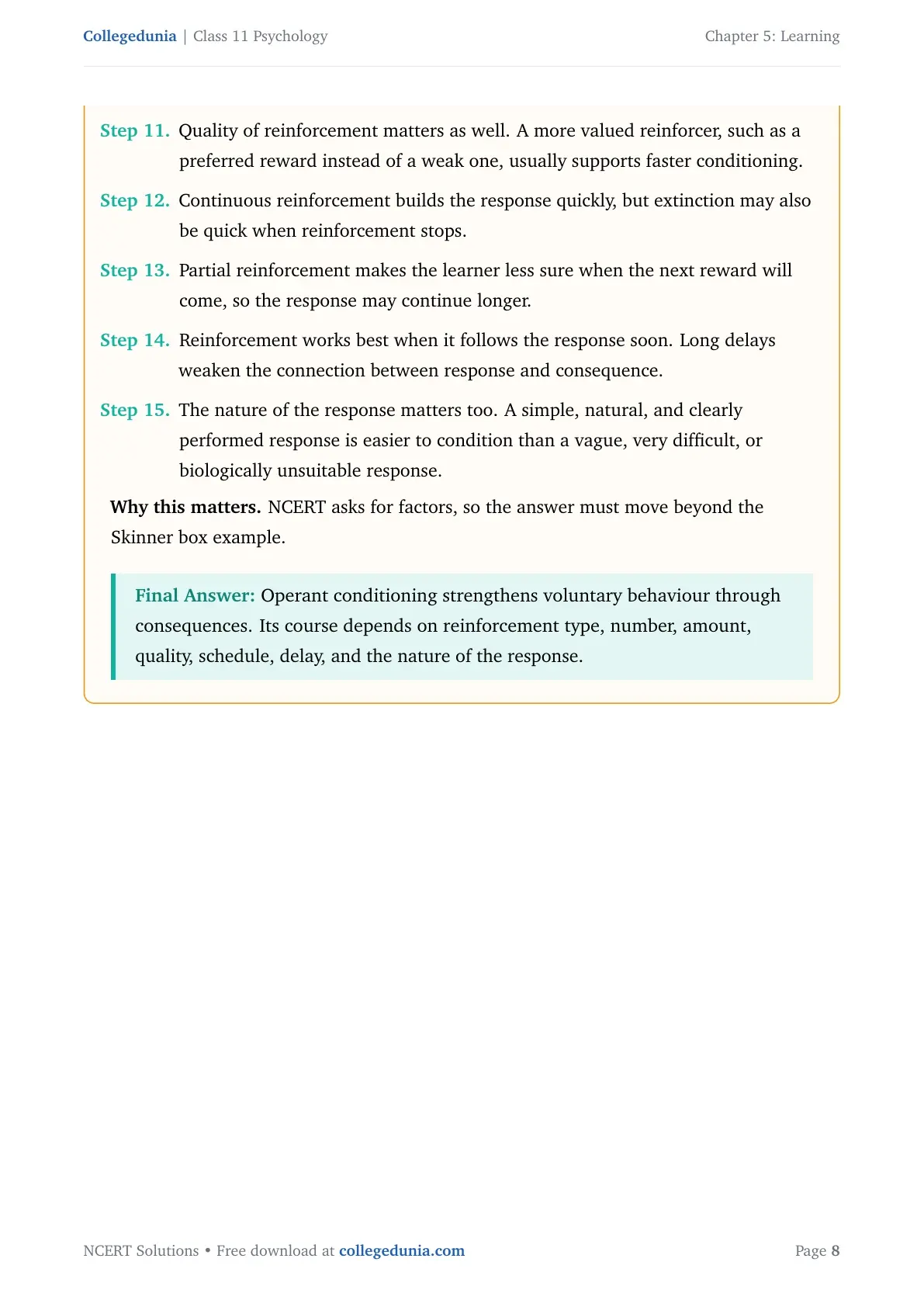
Quality of reinforcement matters as well. A more valued reinforcer, such as a preferred reward instead of a weak one, usually supports faster conditioning.
Continuous reinforcement builds the response quickly, but extinction may also be quick when reinforcement stops.
Partial reinforcement makes the learner less sure when the next reward will come, so the response may continue longer.
Reinforcement works best when it follows the response soon. Long delays weaken the connection between response and consequence.
The nature of the response matters too. A simple, natural, and clearly performed response is easier to condition than a vague, very difficult, or biologically unsuitable response.
Why this matters. NCERT asks for factors, so the answer must move beyond the Skinner box example.
Operant conditioning strengthens voluntary behaviour through consequences. Its course depends on reinforcement type, number, amount, quality, schedule, delay, and the nature of the response.
Q 5.4
A good role model is very important for a growing up child. Discuss the kind of learning that supports it.
A good role model is important because children learn many social behaviours through observational learning. They observe, imitate, and model adults or admired persons, especially when the model's behaviour is rewarded.
Concept used. Observational learning is learning by watching others. It is also called imitation, modeling, or social learning.
Role model effect
Children often learn manners, aggression, politeness, effort, and social conduct by observing adults.
Observational learning occurs when a person learns by observing another person's behaviour.
The person being observed is called a model.
Children often do not know how to behave in a new social situation.
They observe parents, teachers, older children, public figures, and media characters.
Then they imitate or emulate the observed behaviour.
Bandura's Bobo doll study showed that children can learn aggression by observing an aggressive model.
Children who saw the aggressive model being rewarded showed more aggressive behaviour.
Children who saw the model being punished showed less aggression.
This means children acquire knowledge by observing the model, but performance depends on whether the model is rewarded or punished.
A good role model supports healthy behaviour such as courtesy, diligence, politeness, cooperation, and pro-social conduct.
A poor model may teach aggression, indolence, or rude behaviour.
The learning supported by a good role model is observational learning or modeling. It helps children acquire social behaviour by watching and imitating rewarded or admired models.
KI
Karan Iyer
M.Phil Psychology, Jamia Millia Islamia
Verified Expert
Quick reading. A role model teaches by example before any formal instruction begins.
A growing child watches how adults speak, dress, solve problems, control anger, help others, and respond to rules.
These observations become possible behaviour patterns for the child.
If the model is respected or liked, the child is more likely to copy the behaviour.
If the behaviour brings praise or reward, the child is also more likely to perform it.
Bandura showed this clearly through the Bobo doll film.
The group that saw aggression rewarded became the most aggressive in later play.
The group that saw aggression punished became the least aggressive.
Role models therefore shape both what is learned and what is displayed.
Parents and teachers can use this by modeling patience, honesty, study discipline, respectful speech, and helpfulness.
Why this matters. The answer should connect role models with social learning, not with direct reward alone.
A good role model works through observational learning: the child observes, stores, imitates, and performs behaviour seen in valued models.
Q 5.5
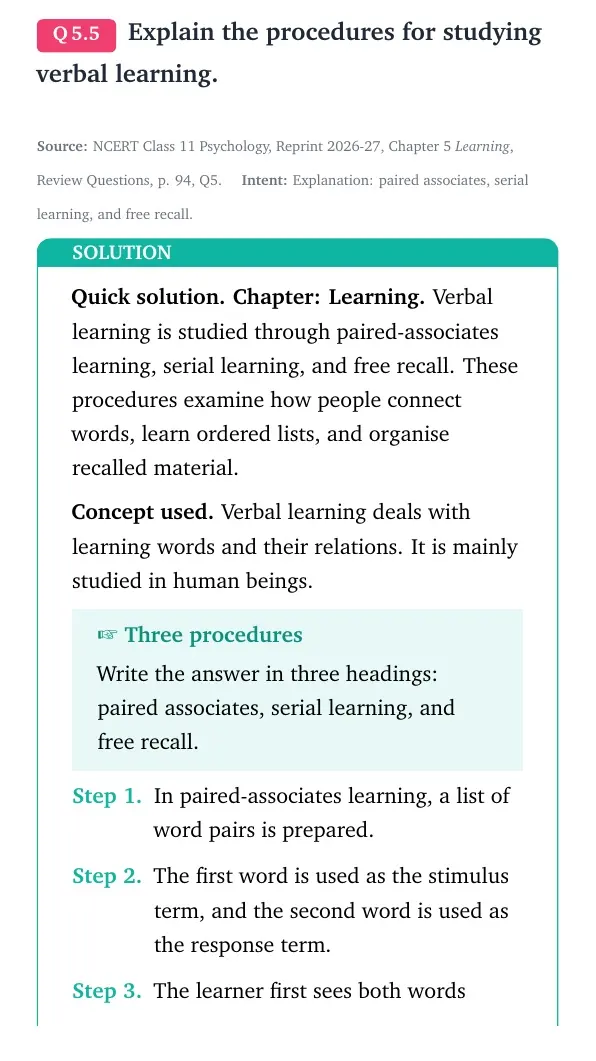
Explain the procedures for studying verbal learning.
Verbal learning is studied through paired-associates learning, serial learning, and free recall. These procedures examine how people connect words, learn ordered lists, and organise recalled material.
Concept used. Verbal learning deals with learning words and their relations. It is mainly studied in human beings.
Three procedures
Write the answer in three headings: paired associates, serial learning, and free recall.
In paired-associates learning, a list of word pairs is prepared.
The first word is used as the stimulus term, and the second word is used as the response term.
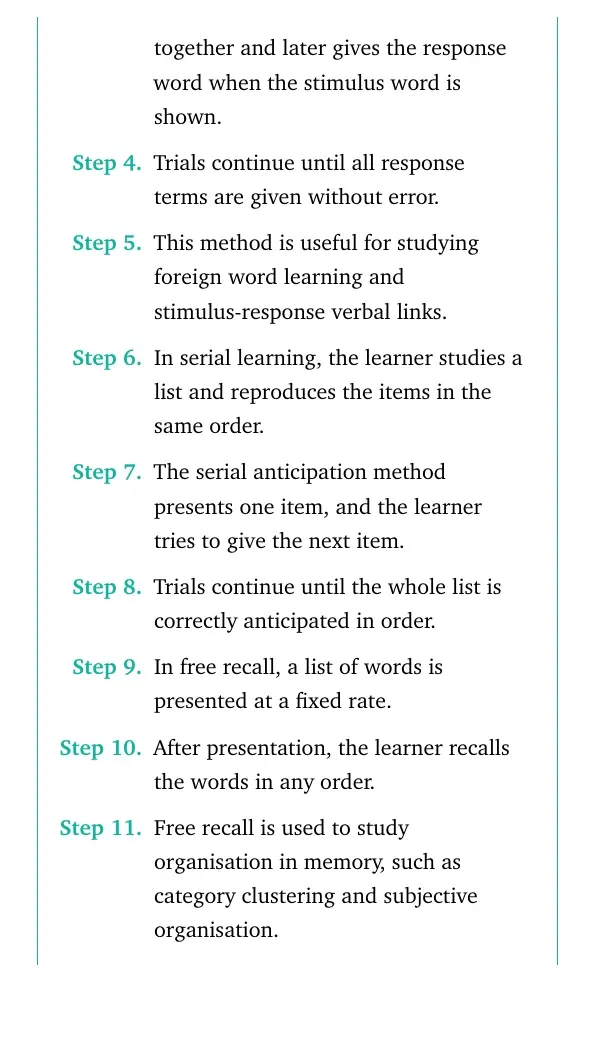
The learner first sees both words together and later gives the response word when the stimulus word is shown.
Trials continue until all response terms are given without error.
This method is useful for studying foreign word learning and stimulus-response verbal links.
In serial learning, the learner studies a list and reproduces the items in the same order.
The serial anticipation method presents one item, and the learner tries to give the next item.
Trials continue until the whole list is correctly anticipated in order.
In free recall, a list of words is presented at a fixed rate.
After presentation, the learner recalls the words in any order.
Free recall is used to study organisation in memory, such as category clustering and subjective organisation.
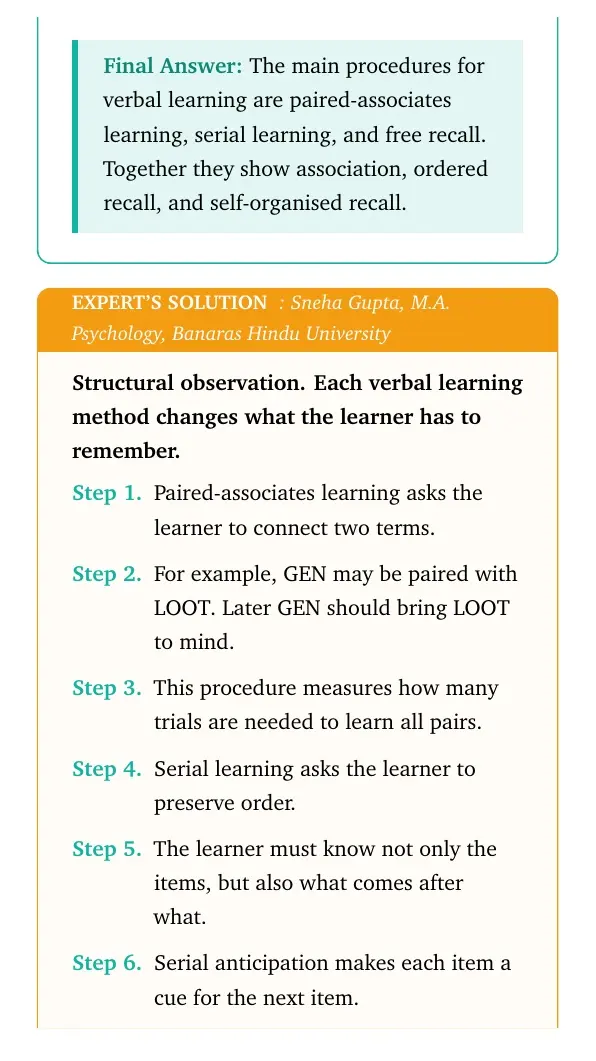
The main procedures for verbal learning are paired-associates learning, serial learning, and free recall. Together they show association, ordered recall, and self-organised recall.
SG
Sneha Gupta
M.A. Psychology, Banaras Hindu University
Verified Expert
Structural observation. Each verbal learning method changes what the learner has to remember.
Paired-associates learning asks the learner to connect two terms.
For example, GEN may be paired with LOOT. Later GEN should bring LOOT to mind.
This procedure measures how many trials are needed to learn all pairs.
Serial learning asks the learner to preserve order.
The learner must know not only the items, but also what comes after what.
Serial anticipation makes each item a cue for the next item.
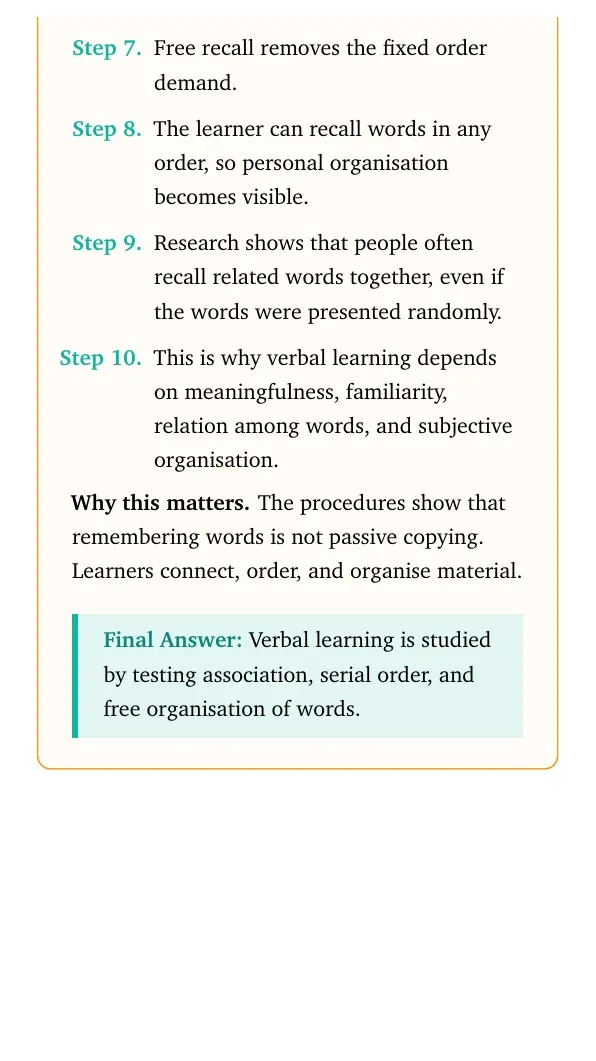
Free recall removes the fixed order demand.
The learner can recall words in any order, so personal organisation becomes visible.
Research shows that people often recall related words together, even if the words were presented randomly.
This is why verbal learning depends on meaningfulness, familiarity, relation among words, and subjective organisation.
Why this matters. The procedures show that remembering words is not passive copying. Learners connect, order, and organise material.
Verbal learning is studied by testing association, serial order, and free organisation of words.
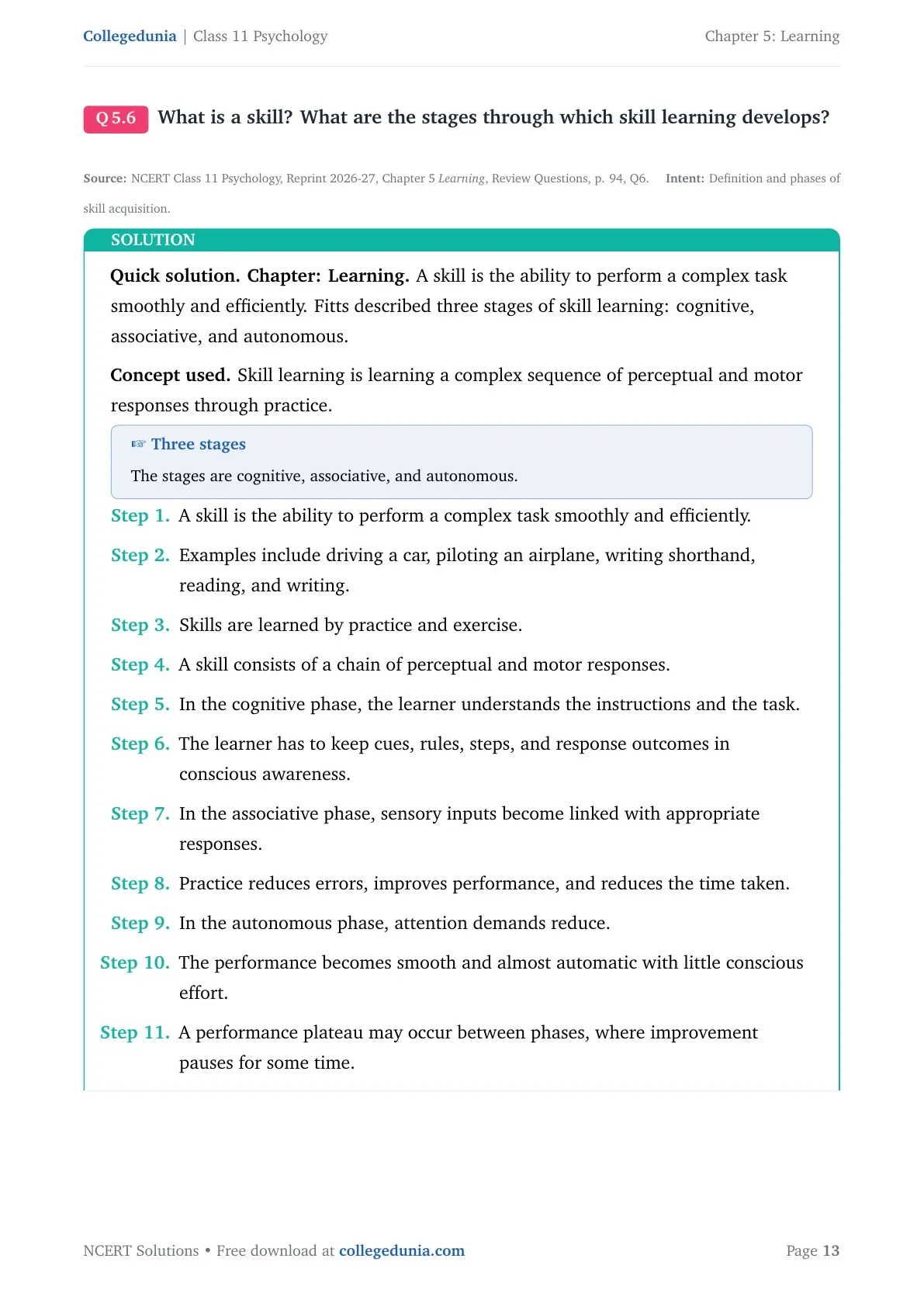
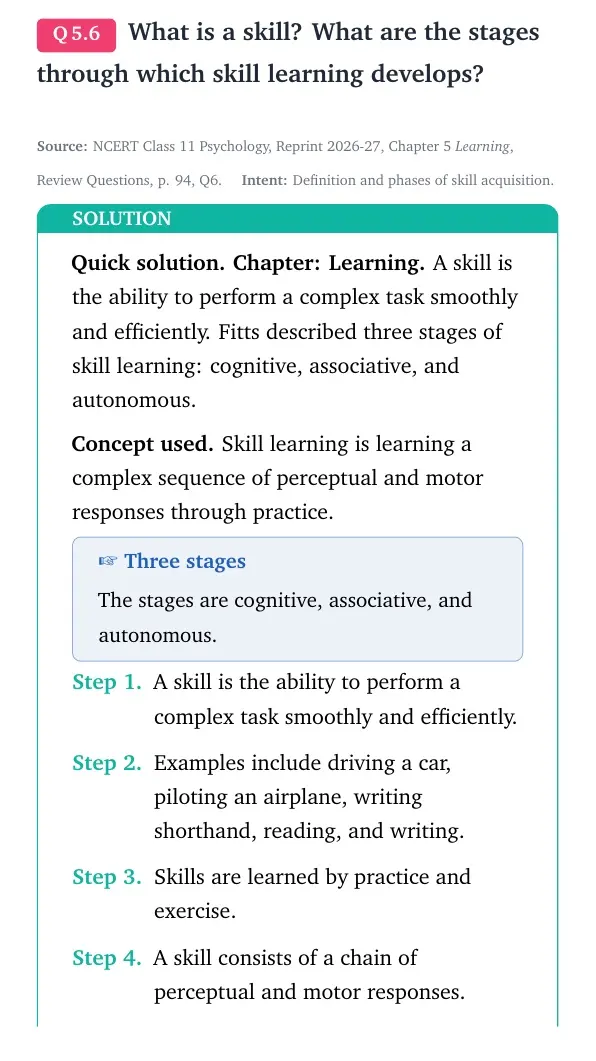
Q 5.6
What is a skill? What are the stages through which skill learning develops?
A skill is the ability to perform a complex task smoothly and efficiently. Fitts described three stages of skill learning: cognitive, associative, and autonomous.
Concept used. Skill learning is learning a complex sequence of perceptual and motor responses through practice.
Three stages
The stages are cognitive, associative, and autonomous.
A skill is the ability to perform a complex task smoothly and efficiently.
Examples include driving a car, piloting an airplane, writing shorthand, reading, and writing.
Skills are learned by practice and exercise.
A skill consists of a chain of perceptual and motor responses.
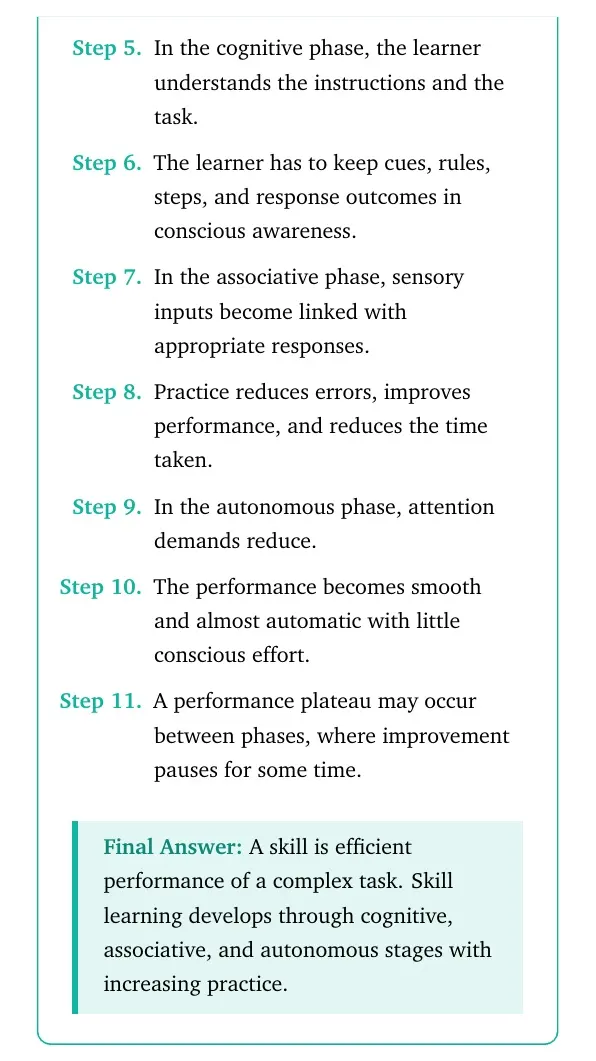
In the cognitive phase, the learner understands the instructions and the task.
The learner has to keep cues, rules, steps, and response outcomes in conscious awareness.
In the associative phase, sensory inputs become linked with appropriate responses.
Practice reduces errors, improves performance, and reduces the time taken.
In the autonomous phase, attention demands reduce.
The performance becomes smooth and almost automatic with little conscious effort.
A performance plateau may occur between phases, where improvement pauses for some time.
A skill is efficient performance of a complex task. Skill learning develops through cognitive, associative, and autonomous stages with increasing practice.
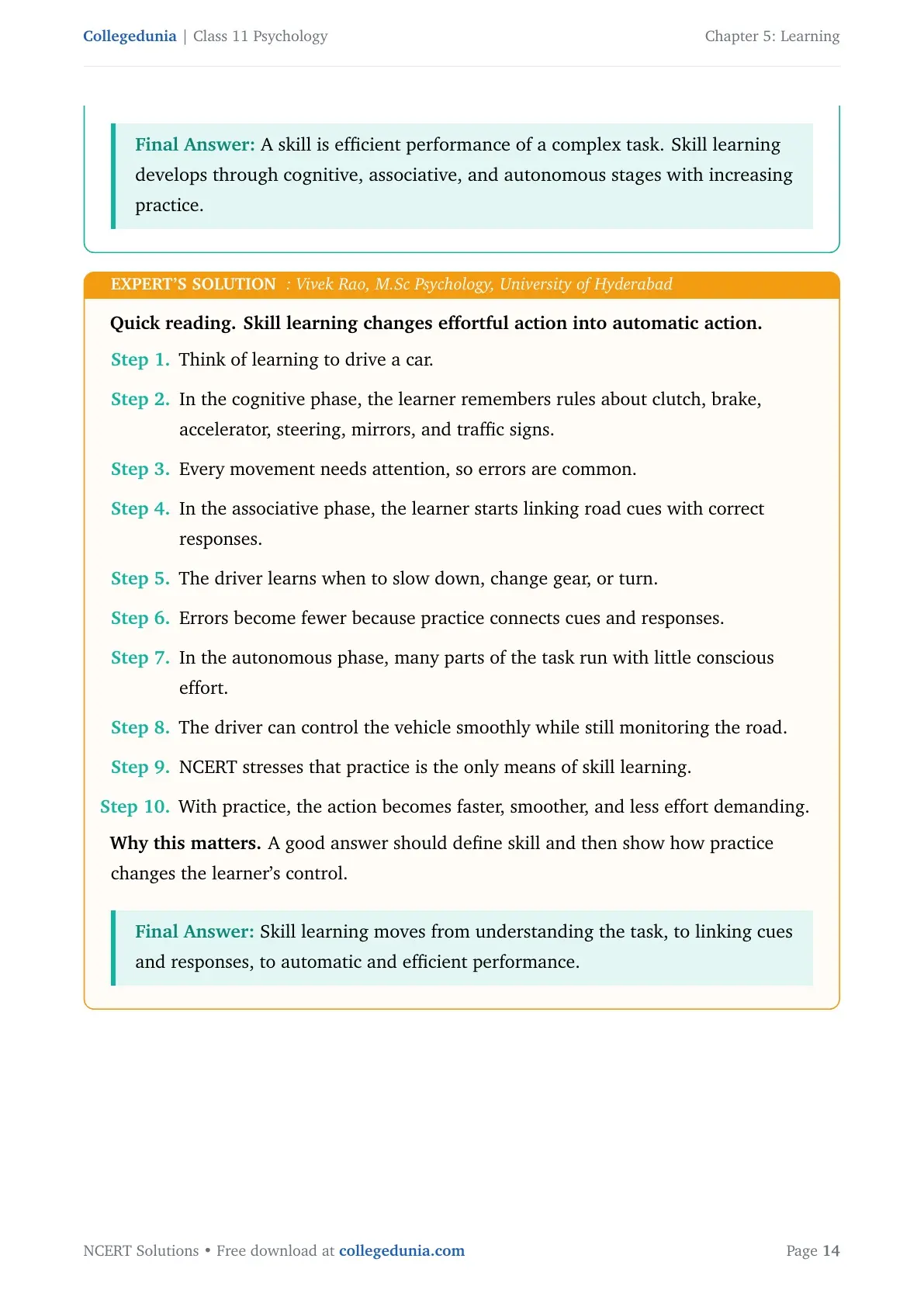
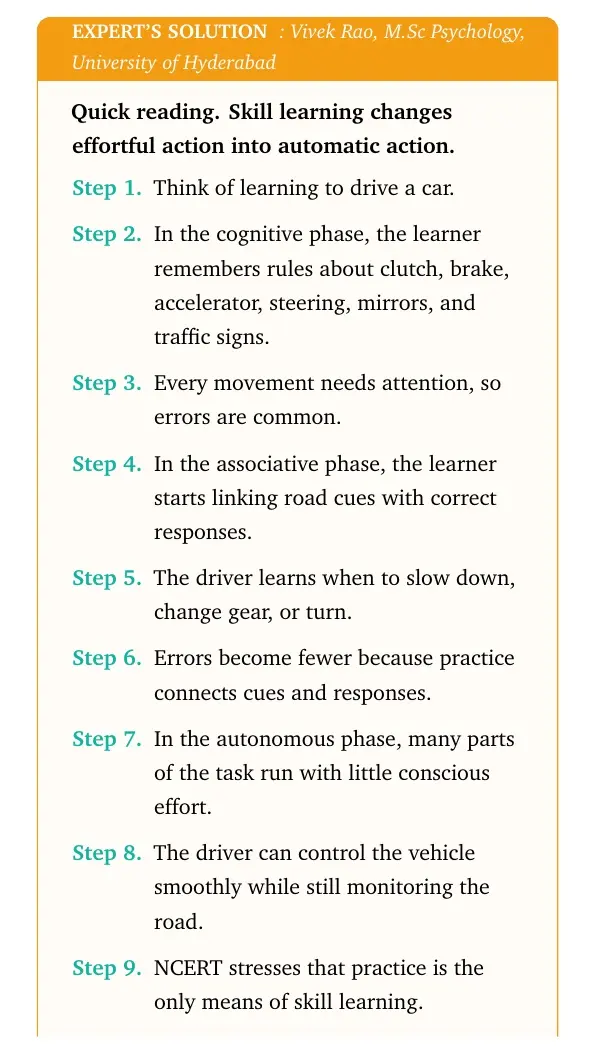
VR
Vivek Rao
M.Sc Psychology, University of Hyderabad
Verified Expert
Quick reading. Skill learning changes effortful action into automatic action.
Think of learning to drive a car.
In the cognitive phase, the learner remembers rules about clutch, brake, accelerator, steering, mirrors, and traffic signs.
Every movement needs attention, so errors are common.
In the associative phase, the learner starts linking road cues with correct responses.
The driver learns when to slow down, change gear, or turn.
Errors become fewer because practice connects cues and responses.
In the autonomous phase, many parts of the task run with little conscious effort.
The driver can control the vehicle smoothly while still monitoring the road.
NCERT stresses that practice is the only means of skill learning.
With practice, the action becomes faster, smoother, and less effort demanding.
Why this matters. A good answer should define skill and then show how practice changes the learner's control.
Skill learning moves from understanding the task, to linking cues and responses, to automatic and efficient performance.
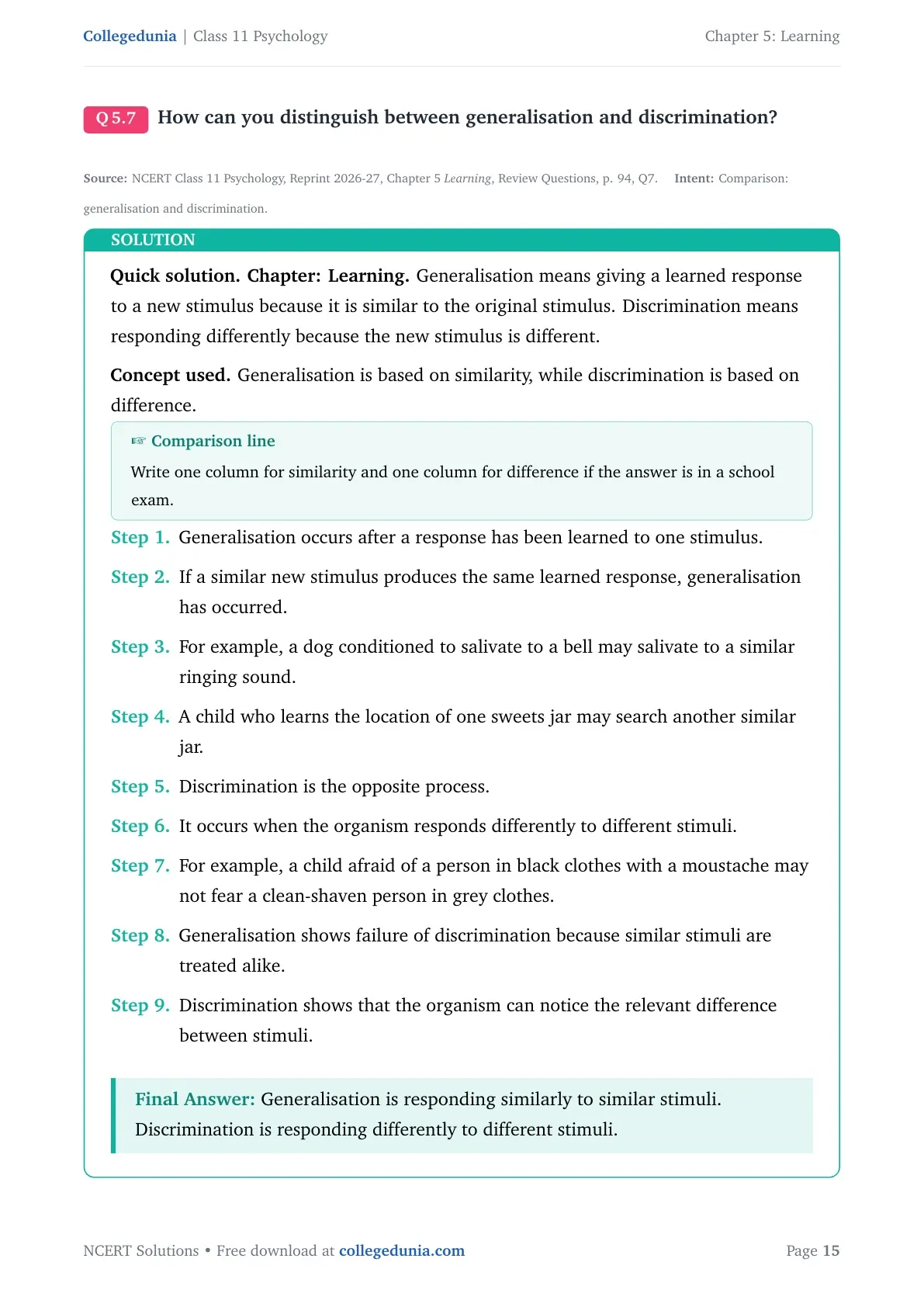
Q 5.7
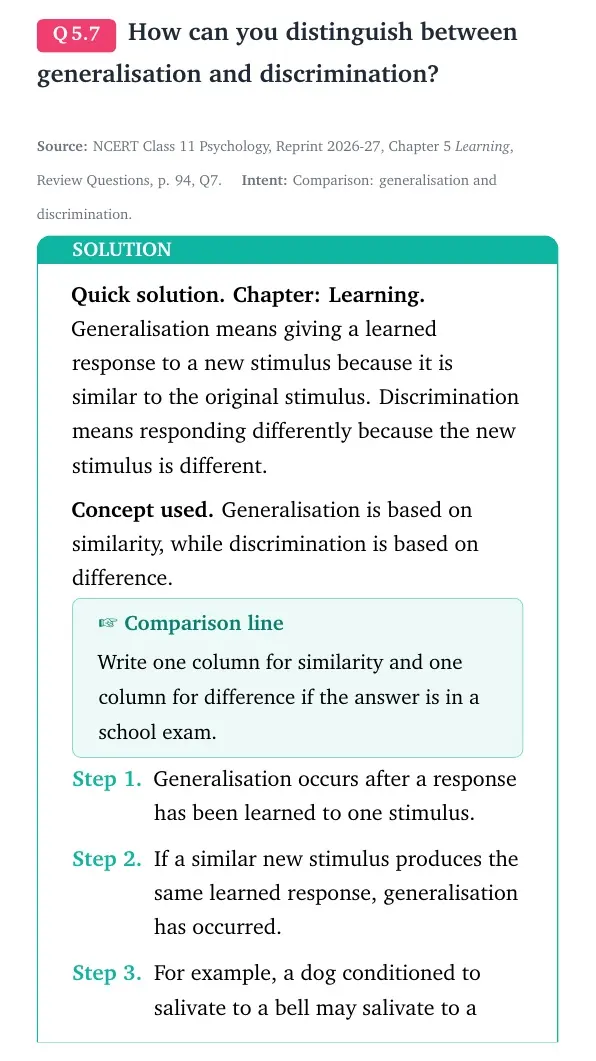
How can you distinguish between generalisation and discrimination?
Generalisation means giving a learned response to a new stimulus because it is similar to the original stimulus. Discrimination means responding differently because the new stimulus is different.
Concept used. Generalisation is based on similarity, while discrimination is based on difference.
Comparison line
Write one column for similarity and one column for difference if the answer is in a school exam.
Generalisation occurs after a response has been learned to one stimulus.
If a similar new stimulus produces the same learned response, generalisation has occurred.
For example, a dog conditioned to salivate to a bell may salivate to a similar ringing sound.
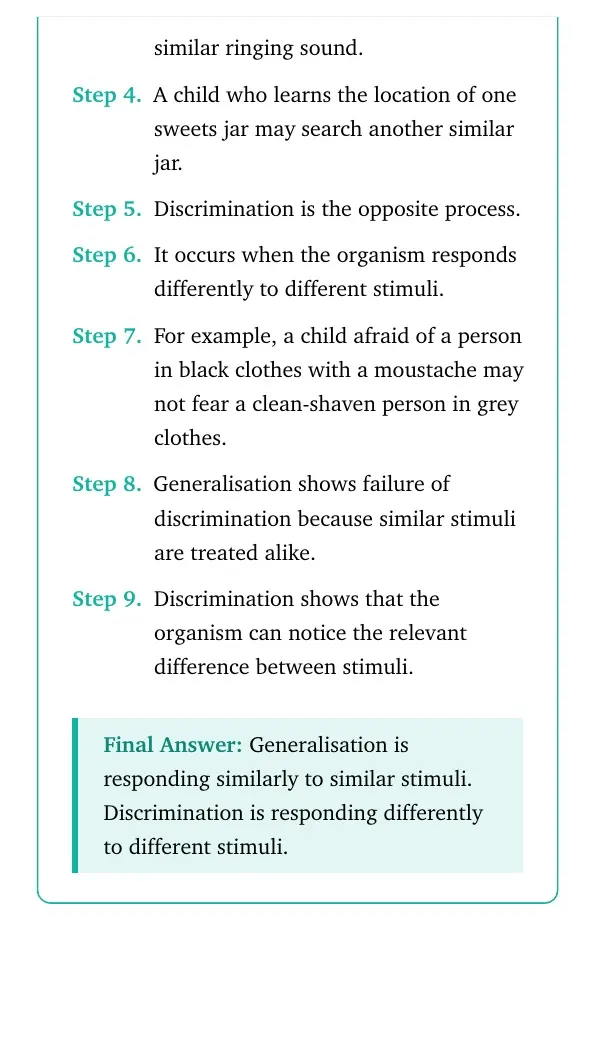
A child who learns the location of one sweets jar may search another similar jar.
Discrimination is the opposite process.
It occurs when the organism responds differently to different stimuli.
For example, a child afraid of a person in black clothes with a moustache may not fear a clean-shaven person in grey clothes.
Generalisation shows failure of discrimination because similar stimuli are treated alike.
Discrimination shows that the organism can notice the relevant difference between stimuli.
Generalisation is responding similarly to similar stimuli. Discrimination is responding differently to different stimuli.
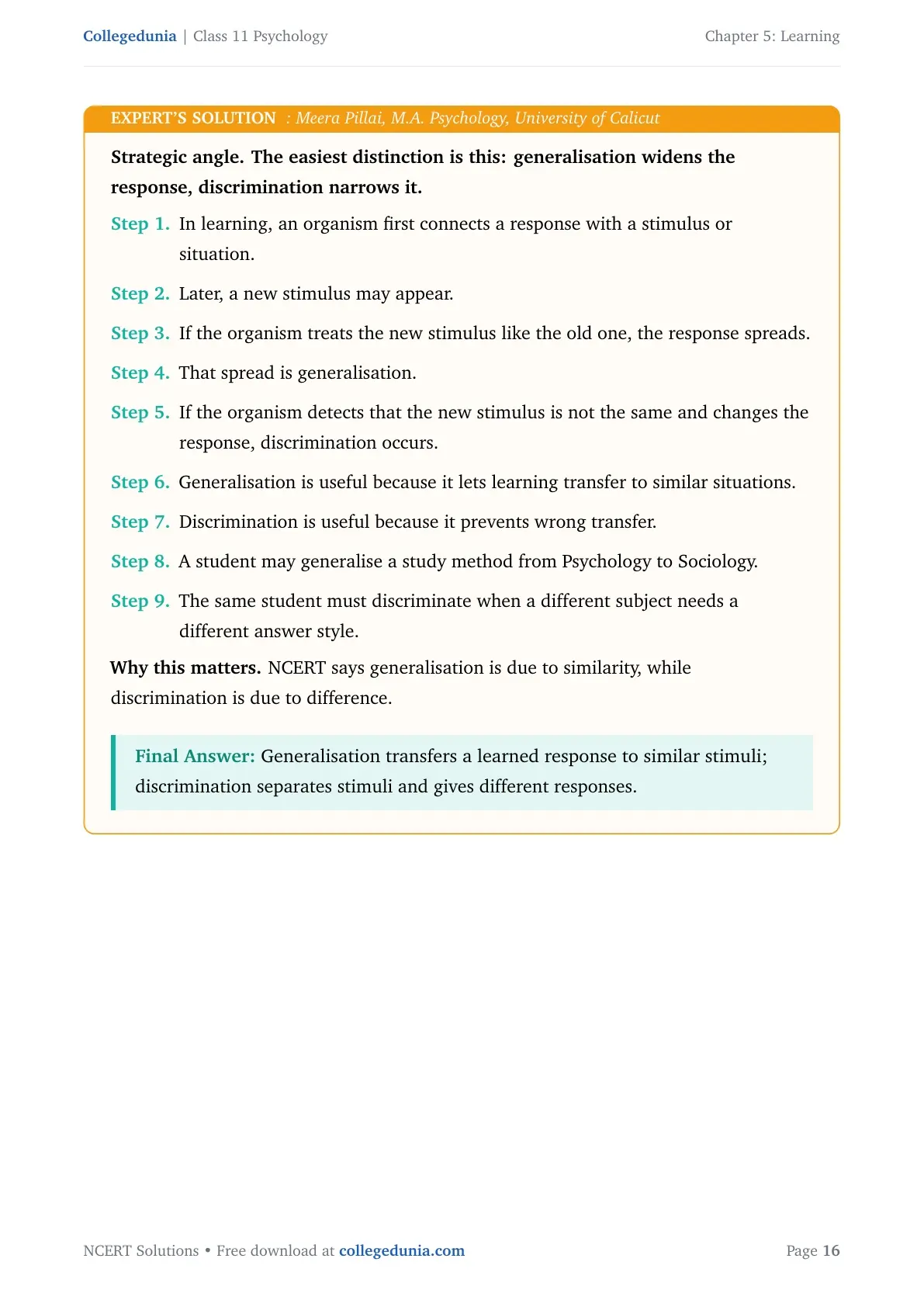
MP
Meera Pillai
M.A. Psychology, University of Calicut
Verified Expert
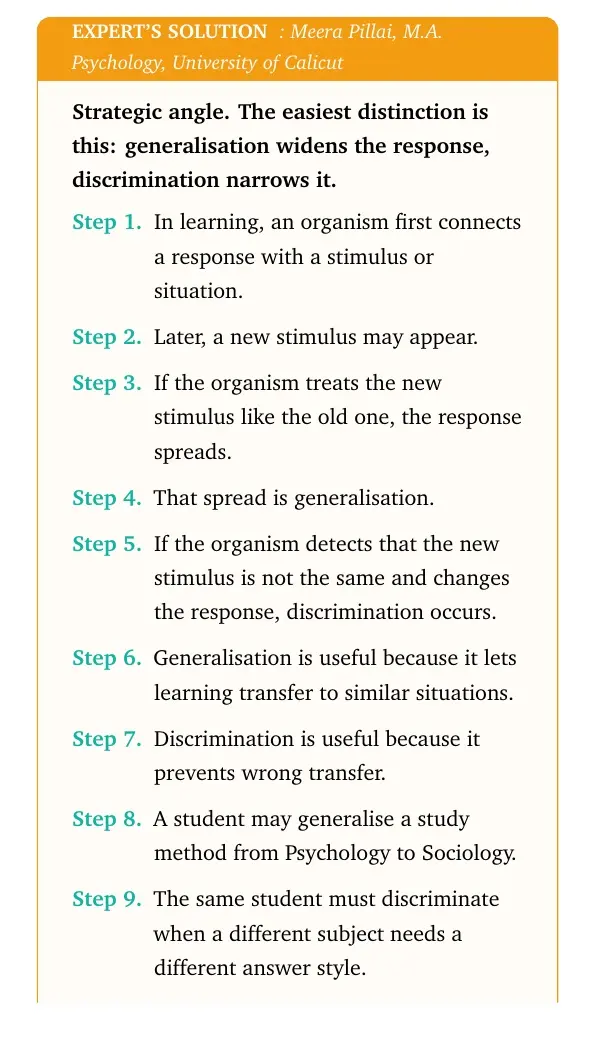
Strategic angle. The easiest distinction is this: generalisation widens the response, discrimination narrows it.
In learning, an organism first connects a response with a stimulus or situation.
Later, a new stimulus may appear.
If the organism treats the new stimulus like the old one, the response spreads.
That spread is generalisation.
If the organism detects that the new stimulus is not the same and changes the response, discrimination occurs.
Generalisation is useful because it lets learning transfer to similar situations.
Discrimination is useful because it prevents wrong transfer.
A student may generalise a study method from Psychology to Sociology.
The same student must discriminate when a different subject needs a different answer style.
Why this matters. NCERT says generalisation is due to similarity, while discrimination is due to difference.
Generalisation transfers a learned response to similar stimuli; discrimination separates stimuli and gives different responses.
Q 5.8
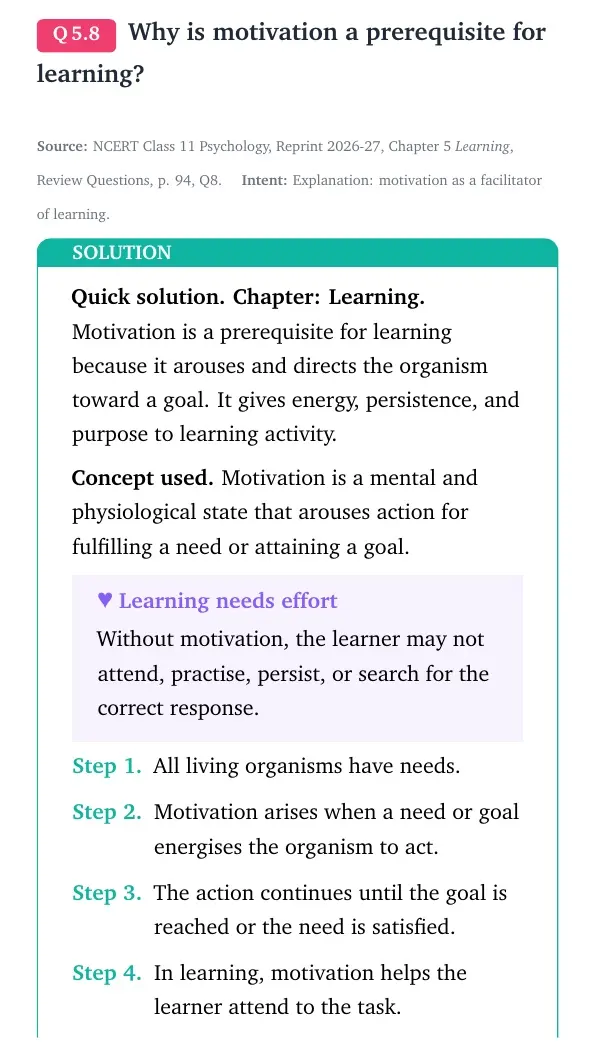
Why is motivation a prerequisite for learning?
Motivation is a prerequisite for learning because it arouses and directs the organism toward a goal. It gives energy, persistence, and purpose to learning activity.
Concept used. Motivation is a mental and physiological state that arouses action for fulfilling a need or attaining a goal.
Learning needs effort
Without motivation, the learner may not attend, practise, persist, or search for the correct response.
All living organisms have needs.
Motivation arises when a need or goal energises the organism to act.
The action continues until the goal is reached or the need is satisfied.
In learning, motivation helps the learner attend to the task.
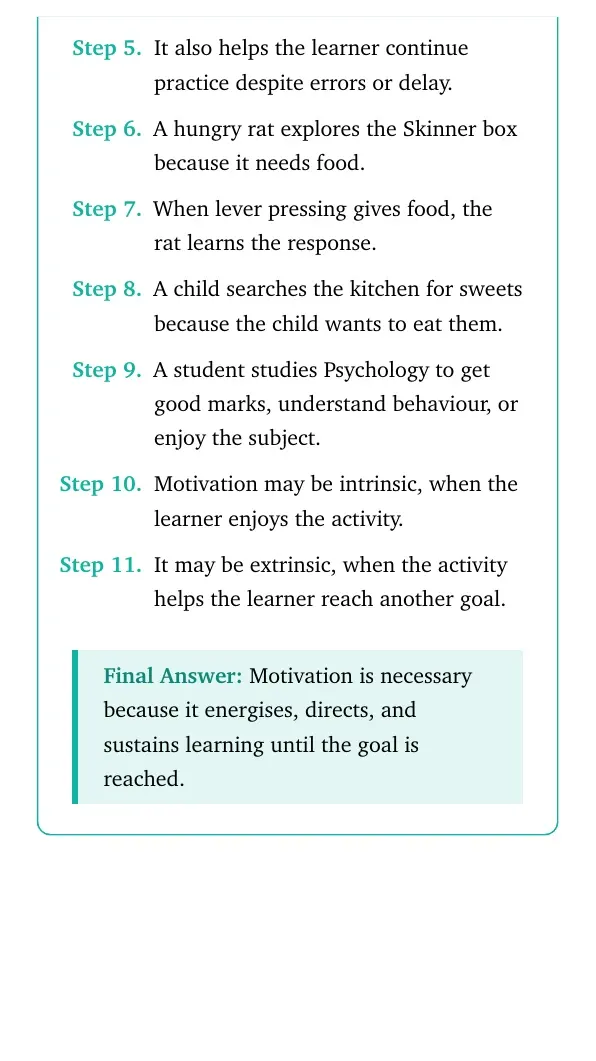
It also helps the learner continue practice despite errors or delay.
A hungry rat explores the Skinner box because it needs food.
When lever pressing gives food, the rat learns the response.
A child searches the kitchen for sweets because the child wants to eat them.
A student studies Psychology to get good marks, understand behaviour, or enjoy the subject.
Motivation may be intrinsic, when the learner enjoys the activity.
It may be extrinsic, when the activity helps the learner reach another goal.
Motivation is necessary because it energises, directs, and sustains learning until the goal is reached.
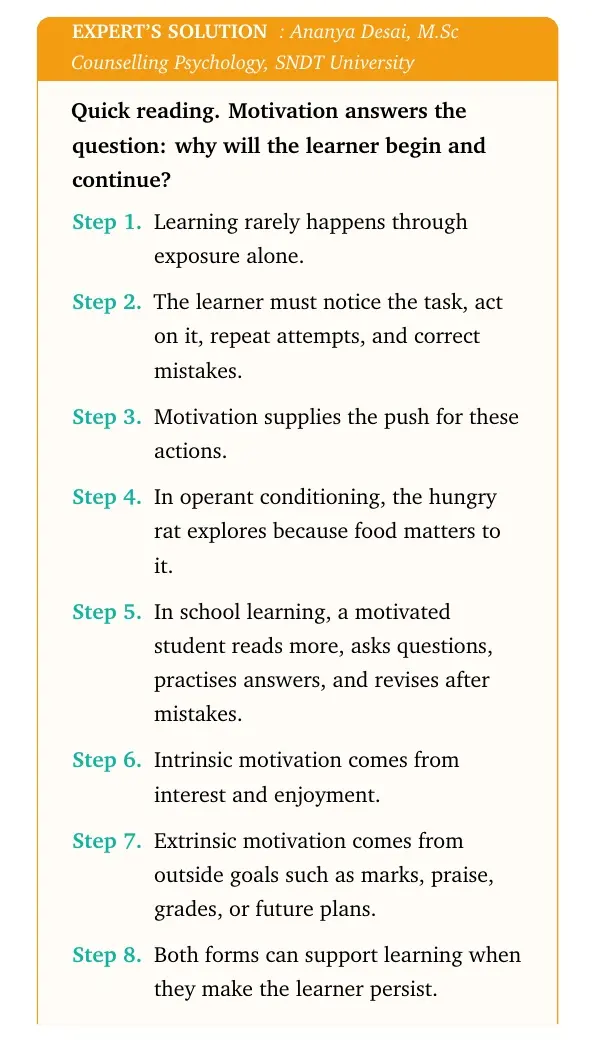
AD
Ananya Desai
M.Sc Counselling Psychology, SNDT University
Verified Expert
Quick reading. Motivation answers the question: why will the learner begin and continue?
Learning rarely happens through exposure alone.
The learner must notice the task, act on it, repeat attempts, and correct mistakes.
Motivation supplies the push for these actions.
In operant conditioning, the hungry rat explores because food matters to it.
In school learning, a motivated student reads more, asks questions, practises answers, and revises after mistakes.
Intrinsic motivation comes from interest and enjoyment.
Extrinsic motivation comes from outside goals such as marks, praise, grades, or future plans.
Both forms can support learning when they make the learner persist.
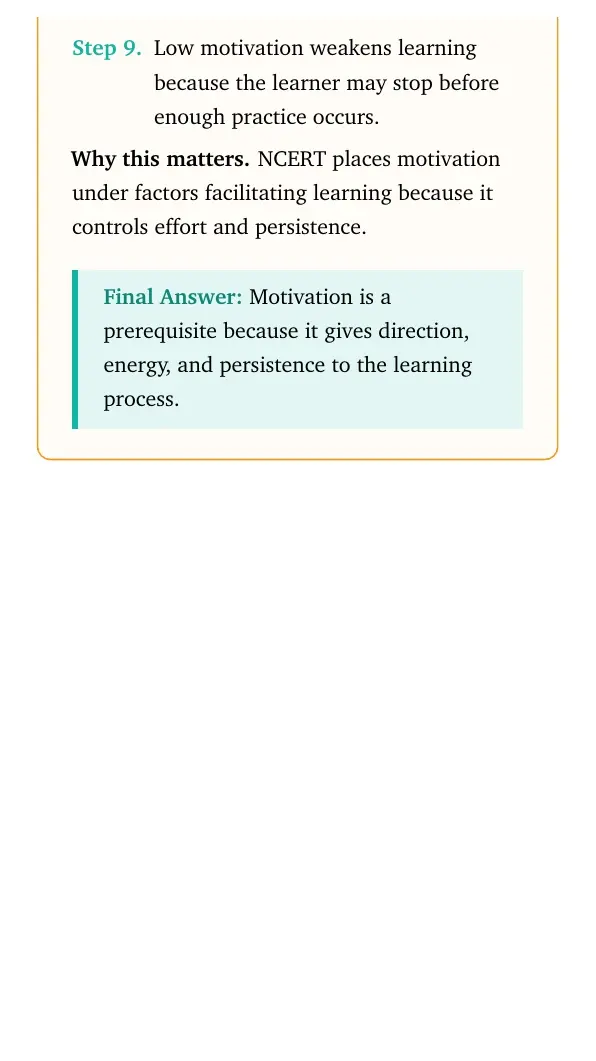
Low motivation weakens learning because the learner may stop before enough practice occurs.
Why this matters. NCERT places motivation under factors facilitating learning because it controls effort and persistence.
Motivation is a prerequisite because it gives direction, energy, and persistence to the learning process.
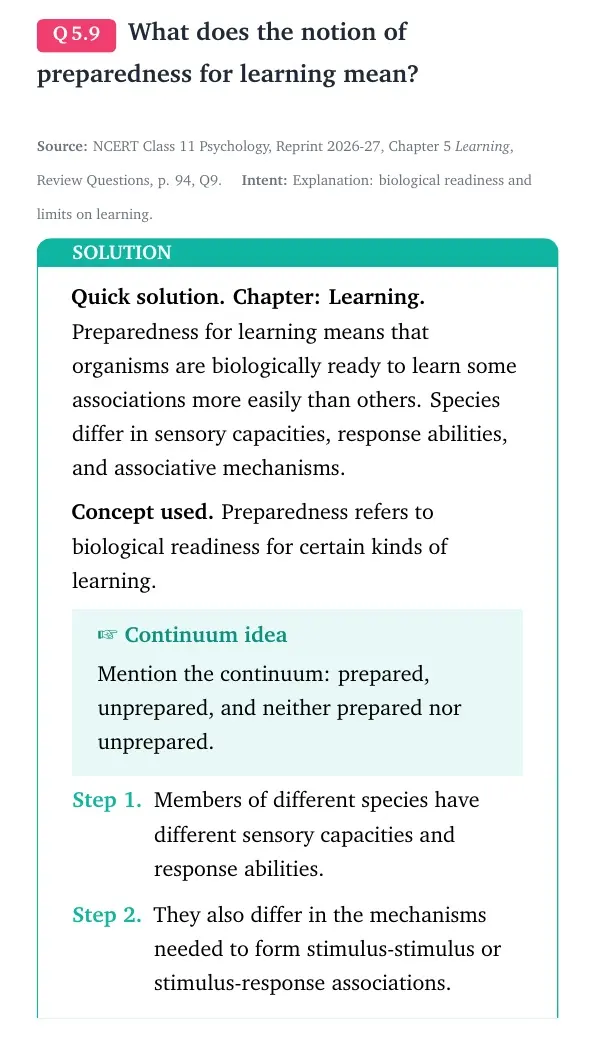
Q 5.9
What does the notion of preparedness for learning mean?
Preparedness for learning means that organisms are biologically ready to learn some associations more easily than others. Species differ in sensory capacities, response abilities, and associative mechanisms.
Concept used. Preparedness refers to biological readiness for certain kinds of learning.
Continuum idea
Mention the continuum: prepared, unprepared, and neither prepared nor unprepared.
Members of different species have different sensory capacities and response abilities.
They also differ in the mechanisms needed to form stimulus-stimulus or stimulus-response associations.
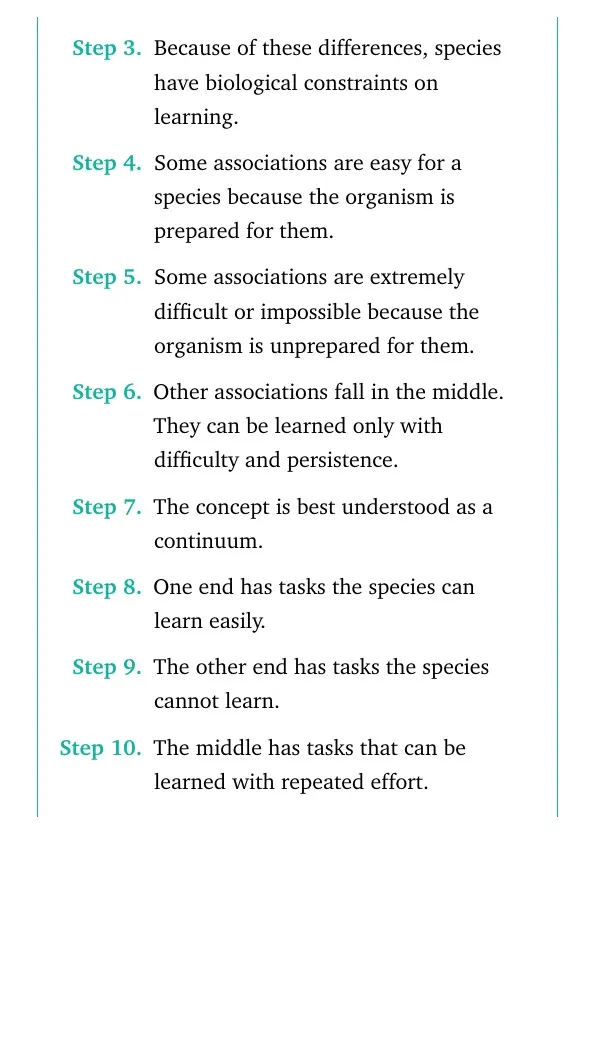
Because of these differences, species have biological constraints on learning.
Some associations are easy for a species because the organism is prepared for them.
Some associations are extremely difficult or impossible because the organism is unprepared for them.
Other associations fall in the middle. They can be learned only with difficulty and persistence.
The concept is best understood as a continuum.
One end has tasks the species can learn easily.
The other end has tasks the species cannot learn.
The middle has tasks that can be learned with repeated effort.
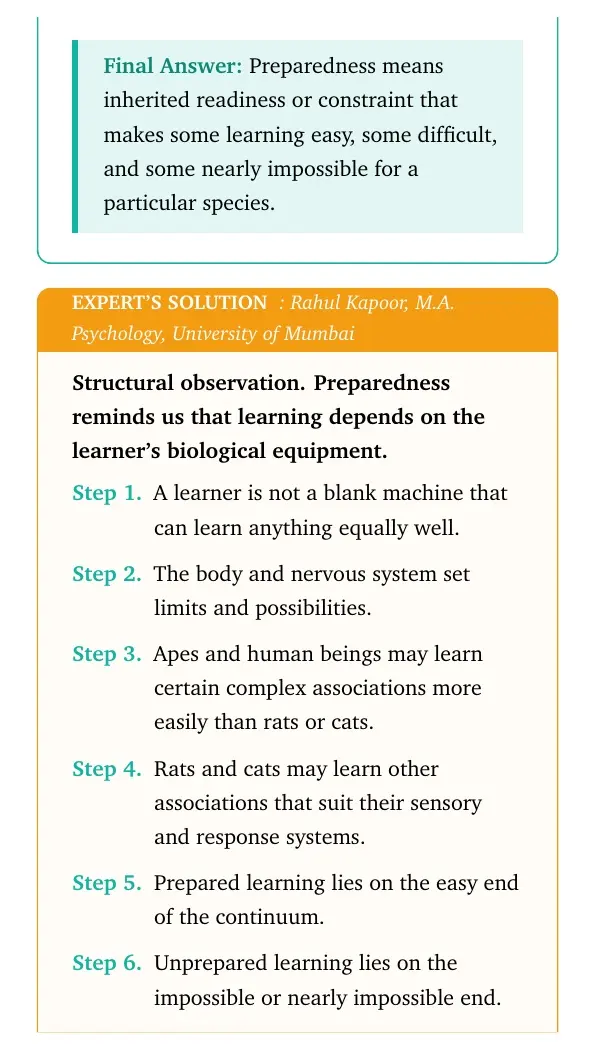
Preparedness means inherited readiness or constraint that makes some learning easy, some difficult, and some nearly impossible for a particular species.
RK
Rahul Kapoor
M.A. Psychology, University of Mumbai
Verified Expert
Structural observation. Preparedness reminds us that learning depends on the learner's biological equipment.
A learner is not a blank machine that can learn anything equally well.
The body and nervous system set limits and possibilities.
Apes and human beings may learn certain complex associations more easily than rats or cats.
Rats and cats may learn other associations that suit their sensory and response systems.
Prepared learning lies on the easy end of the continuum.
Unprepared learning lies on the impossible or nearly impossible end.
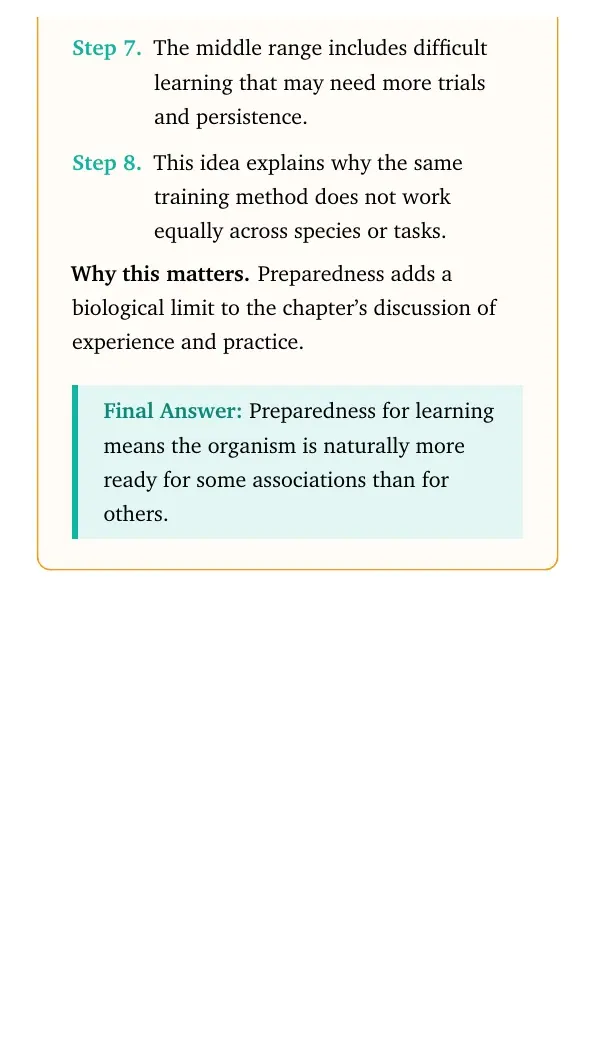
The middle range includes difficult learning that may need more trials and persistence.
This idea explains why the same training method does not work equally across species or tasks.
Why this matters. Preparedness adds a biological limit to the chapter's discussion of experience and practice.
Preparedness for learning means the organism is naturally more ready for some associations than for others.
Q 5.10
Explain the different forms of cognitive learning?
The chapter explains two forms of cognitive learning: insight learning and latent learning. Insight gives a sudden solution; latent learning appears later, and Tolman explains it through cognitive maps.
Concept used. Cognitive learning focuses on change in what the learner knows, not only on a visible stimulus-response connection.
Names to remember
Kohler is linked with insight learning. Tolman is linked with latent learning and cognitive maps.
Cognitive learning explains learning through mental processes.
It studies what the learner knows and understands.
Insight learning was demonstrated by Kohler in experiments with chimpanzees.
The chimpanzee first seems to make no progress.
Then the solution suddenly becomes clear.
For example, a chimpanzee may use a box to stand on or a pole to pull food closer.
The solution can be repeated immediately after it is discovered.
This shows a cognitive relation between means and end.
Latent learning was explained by Tolman.
In latent learning, new learning occurs but is not displayed until reinforcement is available.
Tolman's rats explored a maze without reward and later performed efficiently when reward was given.
This suggested that they had formed a cognitive map, a mental representation of spatial locations and directions.
The forms of cognitive learning explained here are insight learning and latent learning. Insight involves sudden understanding; latent learning remains hidden until reinforcement, and Tolman explains it through cognitive maps.
IB
Ishita Banerjee
M.Sc Psychology, University of Calcutta
Verified Expert
Quick reading. Cognitive learning shows that organisms can learn relationships, routes, and solutions before a response is visibly rewarded.
Conditioning explains many forms of learning through stimulus links and consequences.
Cognitive psychologists added that learners also form mental relations.
In insight learning, the learner restructures the problem.
Kohler's chimpanzee does not merely repeat random acts. It suddenly sees how box, pole, and banana are connected.
Once the relation is understood, the solution is repeated quickly.
In latent learning, the learner gains knowledge without immediately showing it.
Tolman's unrewarded rats explored the maze and learned its layout.
When food was later introduced, the hidden learning appeared in fast maze running.
The mental layout is called a cognitive map.
Both forms prove that learning can involve knowledge, not only an immediate response.
Why this matters. NCERT uses these forms to show that learning can be mental and not always directly observable at first.
Cognitive learning includes insight learning and latent learning. Tolman's explanation of latent learning includes the formation of cognitive maps.
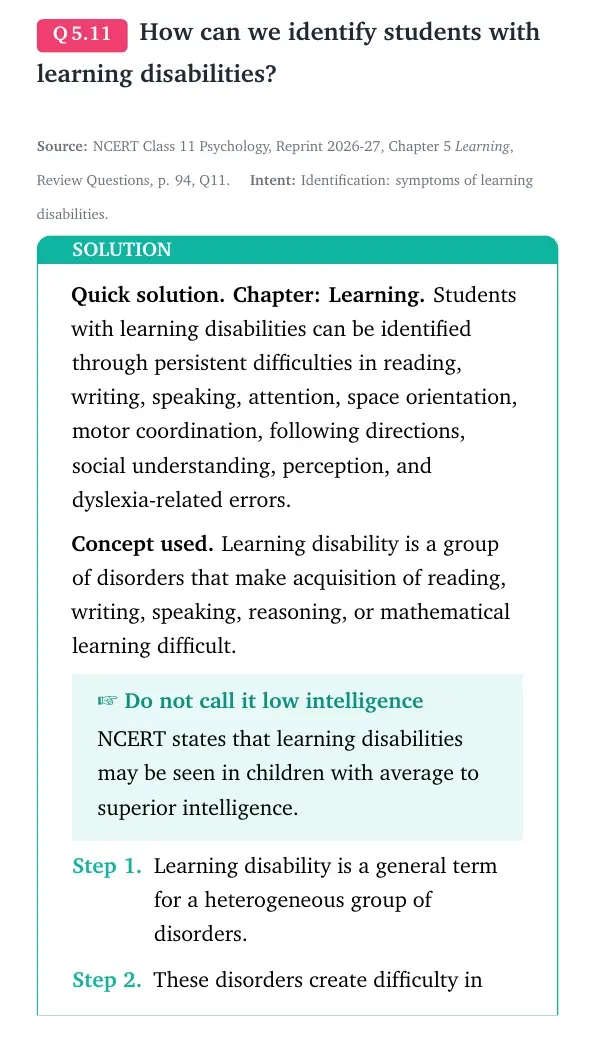
Q 5.11
How can we identify students with learning disabilities?
Students with learning disabilities can be identified through persistent difficulties in reading, writing, speaking, attention, space orientation, motor coordination, following directions, social understanding, perception, and dyslexia-related errors.
Concept used. Learning disability is a group of disorders that make acquisition of reading, writing, speaking, reasoning, or mathematical learning difficult.
Do not call it low intelligence
NCERT states that learning disabilities may be seen in children with average to superior intelligence.
Learning disability is a general term for a heterogeneous group of disorders.
These disorders create difficulty in acquiring reading, writing, speaking, reasoning, or mathematical skills.
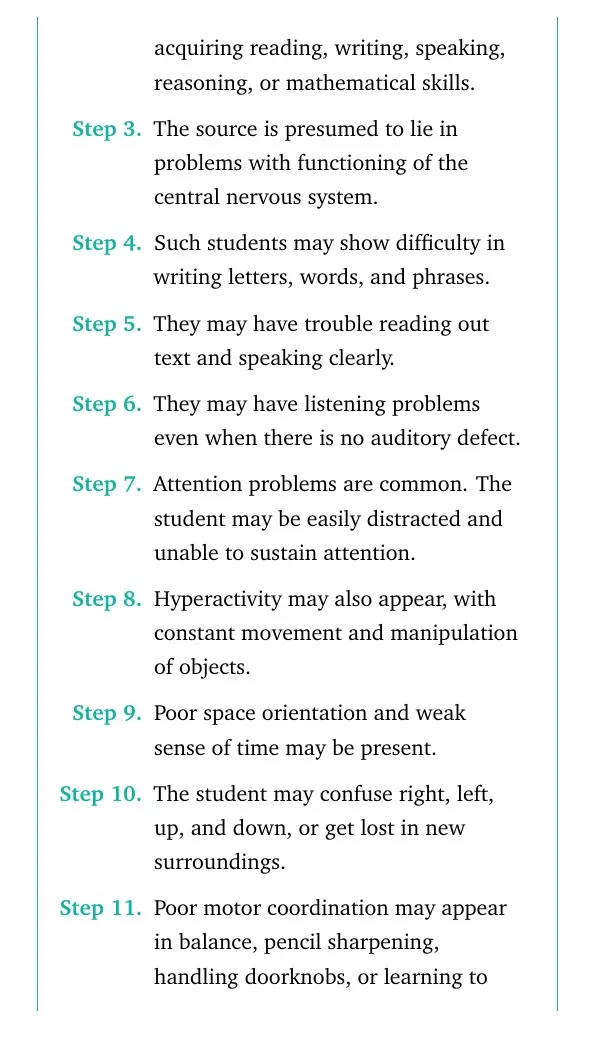
The source is presumed to lie in problems with functioning of the central nervous system.
Such students may show difficulty in writing letters, words, and phrases.
They may have trouble reading out text and speaking clearly.
They may have listening problems even when there is no auditory defect.
Attention problems are common. The student may be easily distracted and unable to sustain attention.
Hyperactivity may also appear, with constant movement and manipulation of objects.
Poor space orientation and weak sense of time may be present.
The student may confuse right, left, up, and down, or get lost in new surroundings.
Poor motor coordination may appear in balance, pencil sharpening, handling doorknobs, or learning to ride a bicycle.
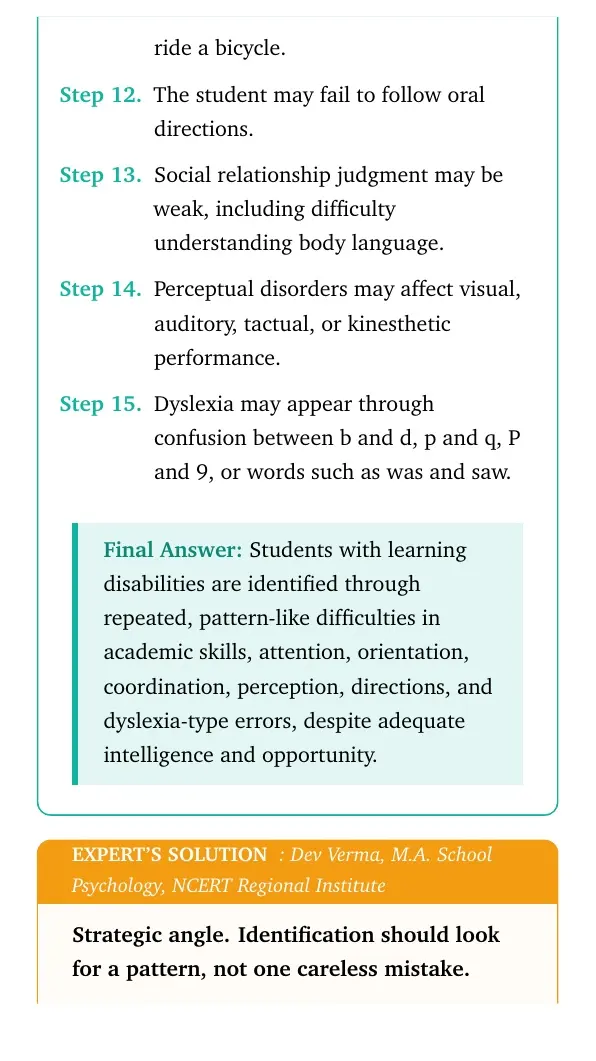
The student may fail to follow oral directions.
Social relationship judgment may be weak, including difficulty understanding body language.
Perceptual disorders may affect visual, auditory, tactual, or kinesthetic performance.
Dyslexia may appear through confusion between b and d, p and q, P and 9, or words such as was and saw.
Students with learning disabilities are identified through repeated, pattern-like difficulties in academic skills, attention, orientation, coordination, perception, directions, and dyslexia-type errors, despite adequate intelligence and opportunity.
DV
Dev Verma
M.A. School Psychology, NCERT Regional Institute
Verified Expert
Strategic angle. Identification should look for a pattern, not one careless mistake.
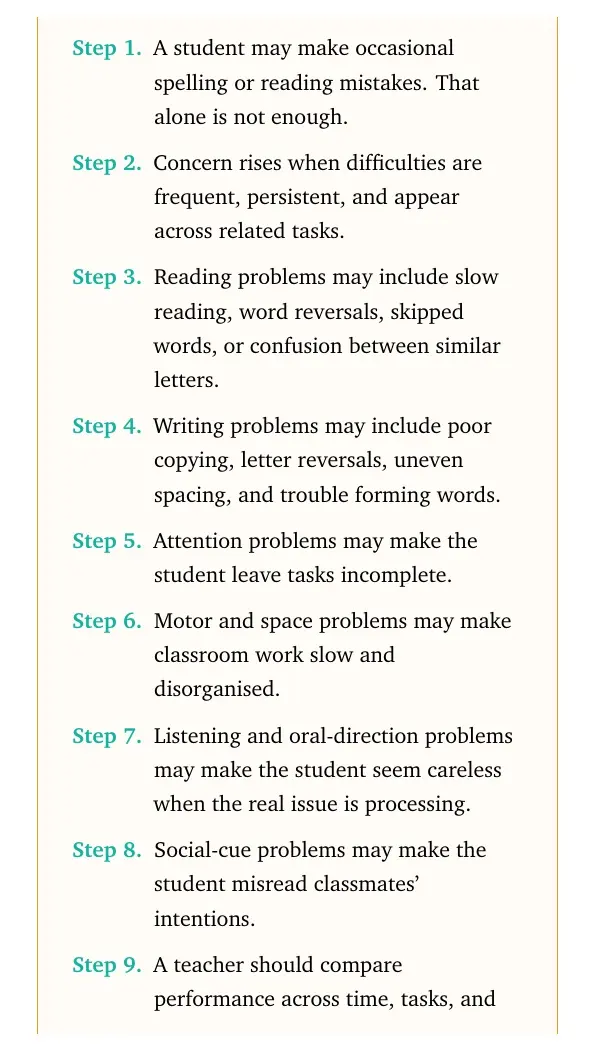
A student may make occasional spelling or reading mistakes. That alone is not enough.
Concern rises when difficulties are frequent, persistent, and appear across related tasks.
Reading problems may include slow reading, word reversals, skipped words, or confusion between similar letters.
Writing problems may include poor copying, letter reversals, uneven spacing, and trouble forming words.
Attention problems may make the student leave tasks incomplete.
Motor and space problems may make classroom work slow and disorganised.
Listening and oral-direction problems may make the student seem careless when the real issue is processing.
Social-cue problems may make the student misread classmates' intentions.
A teacher should compare performance across time, tasks, and support conditions.
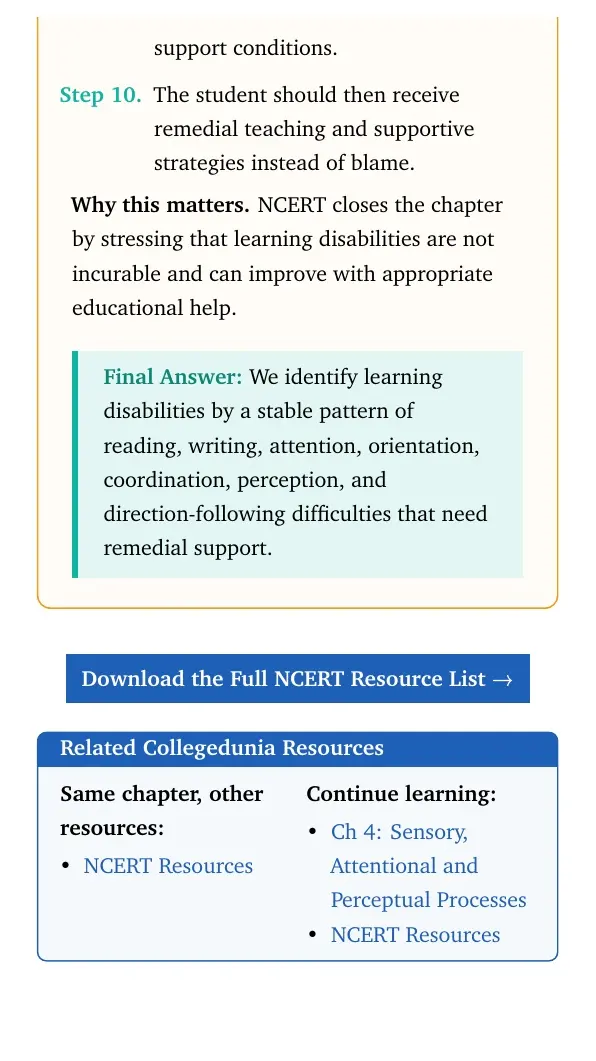
The student should then receive remedial teaching and supportive strategies instead of blame.
Why this matters. NCERT closes the chapter by stressing that learning disabilities are not incurable and can improve with appropriate educational help.
We identify learning disabilities by a stable pattern of reading, writing, attention, orientation, coordination, perception, and direction-following difficulties that need remedial support.
Learning Psychology NCERT Solutions FAQs
Ques. How many review questions are solved in Class 11 Psychology Chapter 5 Learning?
Ans. The PDF solves all 11 review questions from the 2026-27 NCERT Class 11 Psychology Chapter 5 textbook.
Ques. What is the main difference between classical and operant conditioning?
Ans. Classical conditioning links two stimuli, while operant conditioning changes a voluntary response through its consequences.
Ques. Why is cognitive map important in the Learning chapter?
Ans. Cognitive map explains latent learning because the learner may form a mental route before showing the learning in performance.
Ques. Are these solutions useful for the 2026-27 Class 11 Psychology school exam?
Ans. Yes. The answers follow the latest 2026-27 NCERT chapter sequence and explain each concept with examples suited to Class 11 Psychology exams.








Comments