The NCERT Solutions for Class 11 Psychology Chapter 2 Methods of Enquiry in Psychology cover all 12 textbook review questions from the latest 2026-27 NCERT book. The chapter teaches how psychologists frame questions, collect data, compare methods, analyse findings and follow ethics while studying behaviour.
Covers every review question with a direct solution and an expert explanation.
Focuses on research goals, data types, experiments, surveys, tests, case studies and ethics.
Useful for school exams because answers separate definitions, examples and evaluation points.
Student Feedback: In a Collegedunia poll of 10,960 Class 11 Psychology students preparing for the 2026 school exams, 71% said they could name observation and survey but mixed up independent variable, dependent variable and control group.
Source: 2026-27 Class 11 Psychology student poll across CBSE schools.
Every answer in this chapter set is checked against the 2026-27 NCERT Psychology textbook and written so that students can revise the concept, example and exam framing together.
Methods of Enquiry in Psychology: What Class 11 Students Must Know
Methods of Enquiry in Psychology explains how psychological research moves from a question to evidence. The chapter is built around five research goals: description, prediction, explanation, control and application. Students should learn these as a chain, not as isolated words.
Chapter area
What students must know
Where it helps
Goals of enquiry
Description, prediction, explanation, control and application
Questions 1 and 2
Psychological data
Data are varied, contextual and tied to method
Question 3
Experiment
Independent variable, dependent variable, experimental group and control group
Questions 4 to 6
Observation and survey
Naturalistic observation, interviews and questionnaires
Questions 7 to 9
Tests and ethics
Standardised tests, limits of enquiry and research ethics
Questions 10 to 12
The safest exam strategy is to write each answer through the method name, one example and one limitation. This prevents vague answers in questions on experiment, survey and observation.
Scientific Enquiry Steps in Class 11 Psychology Chapter 2
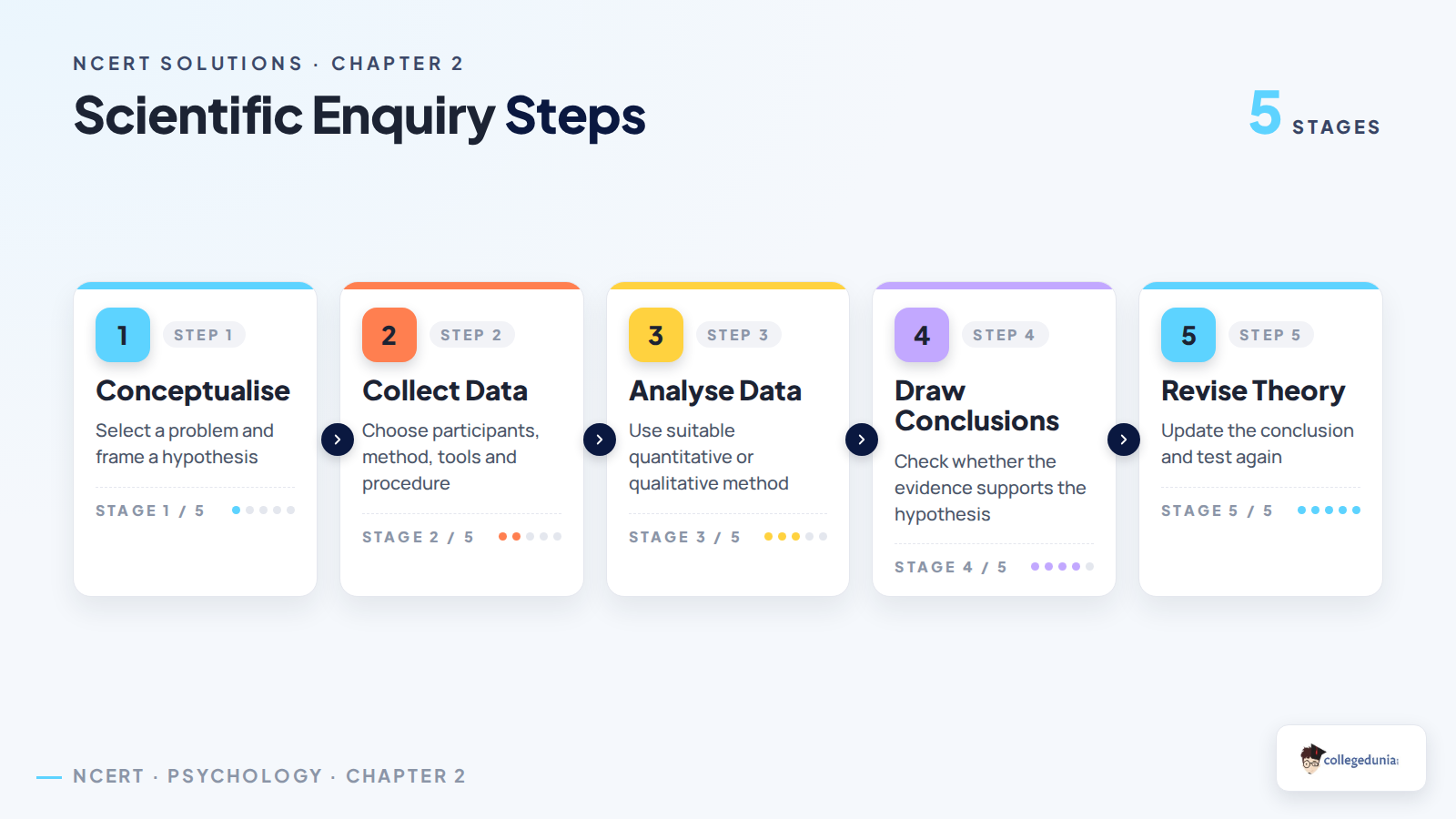
Scientific enquiry starts when a researcher selects a topic and turns it into a clear problem. The next step is data collection. After that, the researcher studies the data, draws conclusions and revises the conclusion if the evidence does not support the first idea.
Conceptualising a problem: select the topic and frame a testable question.
Collecting data: decide participants, method, tools and procedure.
Drawing conclusions: analyse what the data show.
Revising conclusions: update the idea when evidence asks for it.
This cycle is also why research is not a one-time opinion. A conclusion becomes stronger only when it can be checked again.
Experiment, Survey and Observation in Methods of Enquiry in Psychology
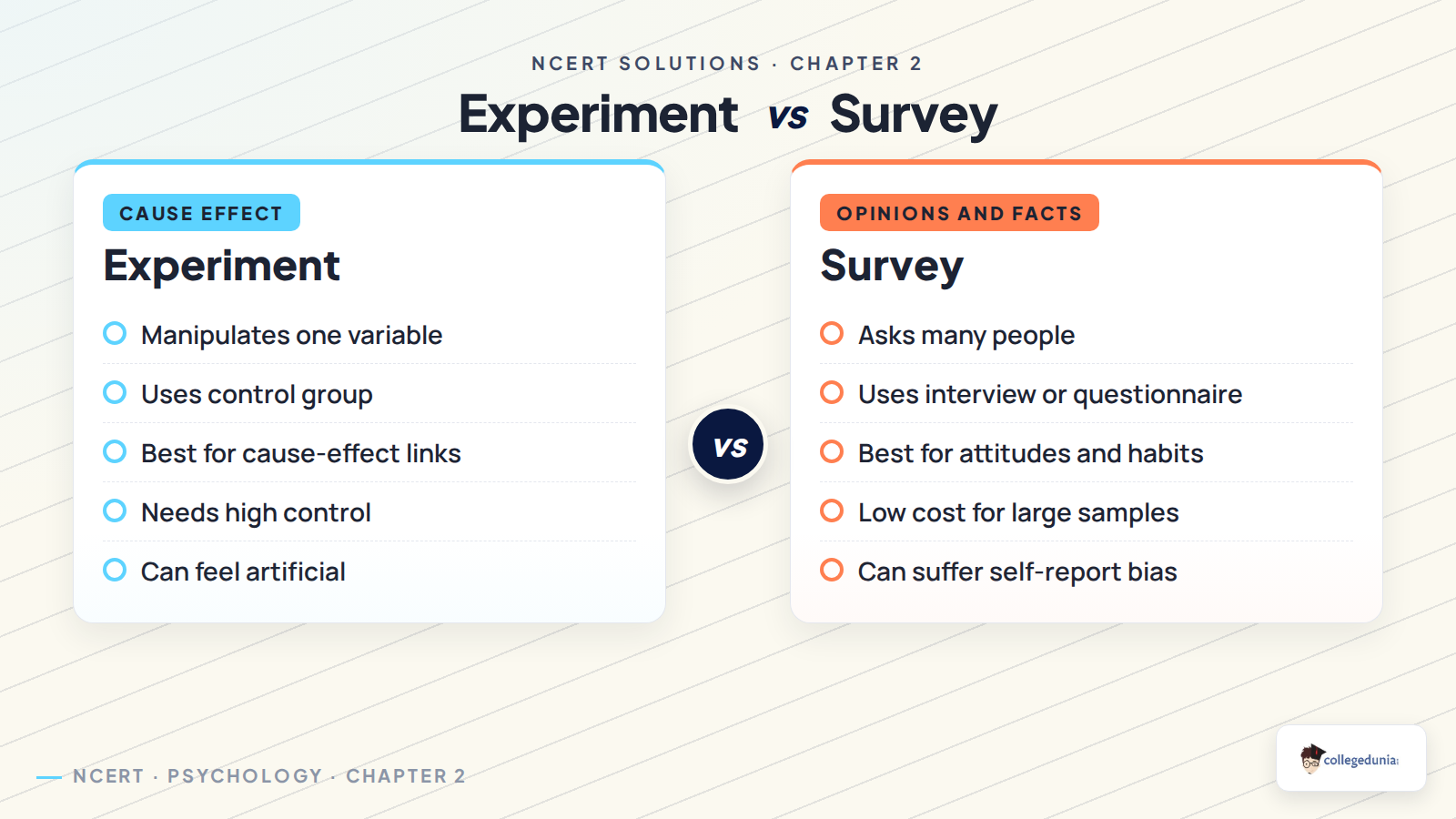
The chapter compares research methods because no single method answers every psychological question. Experiments are best for cause-effect links. Surveys are useful for attitudes, opinions and reported habits. Observation is useful when behaviour needs to be seen in a natural setting.
Method
Best use
Main caution
Observation
Describing real behaviour as it happens
Observer bias and time cost
Experiment
Testing cause-effect relation
Artificial setting and ethical limits
Survey
Studying attitudes, opinions and habits of many people
Self-report bias and low return rate
Psychological test
Comparing individual differences
Needs norms, reliability and validity
Case study
Deep study of one person, group or event
Findings may not fit everyone
How to Write Better Answers for Methods of Enquiry in Psychology
Most mistakes in this chapter happen when students write only definitions. The review questions expect application too. For example, Question 5 asks for a hypothesis and variables, so the answer must name the independent variable and the dependent variable clearly.
Define the term first. Start with enquiry goal, data, experiment, survey or ethics.
Add the NCERT example. Use study habits, smoke reporting, cycling speed or nursery-school play.
Name the key distinction. Use experimental versus control group, interview versus questionnaire or reliability versus validity.
Close with a limitation or ethical point. This helps in longer answers.
The solved PDF follows the same pattern. It gives the quick answer first, then the concept, steps and expert explanation for revision.
Related Psychology Resources for Methods of Enquiry in Psychology
Use the solutions PDF for answers, then move to notes and the NCERT book when you want to revise theory in a different format.
All NCERT Solutions for Class 11 Psychology Chapter 2 Methods of Enquiry in Psychology with Step-by-Step Solutions
Review Questions
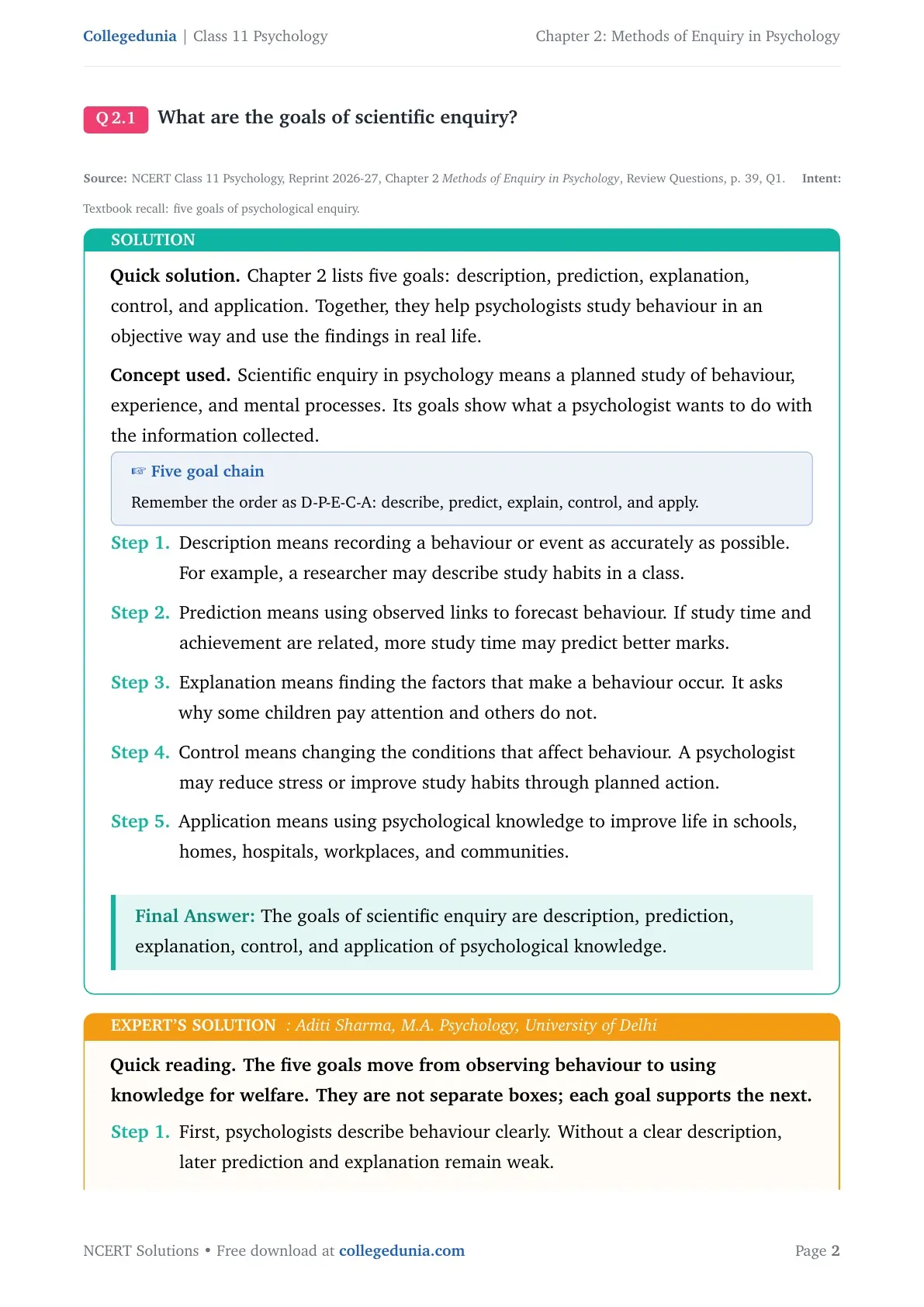
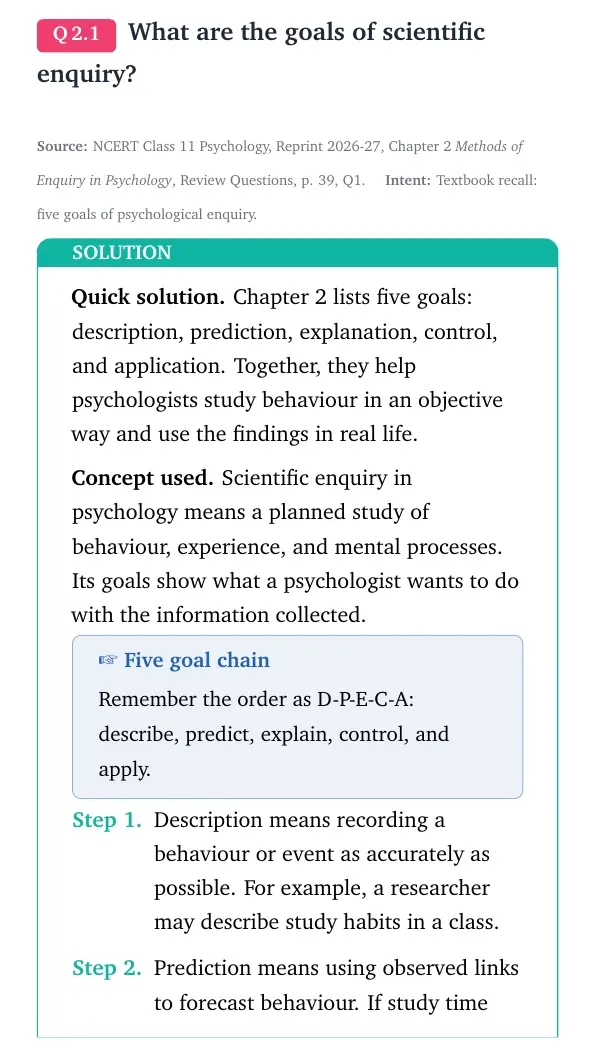
Q 2.1
What are the goals of scientific enquiry?
Chapter 2 lists five goals: description, prediction, explanation, control, and application. Together, they help psychologists study behaviour in an objective way and use the findings in real life.
Concept used. Scientific enquiry in psychology means a planned study of behaviour, experience, and mental processes. Its goals show what a psychologist wants to do with the information collected.
Five goal chain
Remember the order as D-P-E-C-A: describe, predict, explain, control, and apply.
Description means recording a behaviour or event as accurately as possible. For example, a researcher may describe study habits in a class.
Prediction means using observed links to forecast behaviour. If study time and achievement are related, more study time may predict better marks.
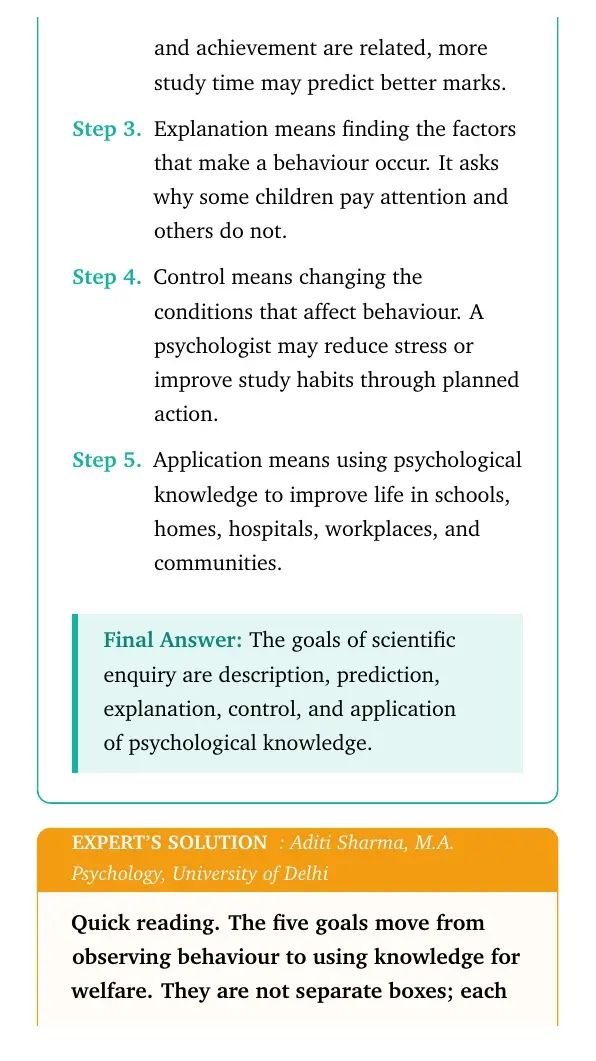
Explanation means finding the factors that make a behaviour occur. It asks why some children pay attention and others do not.
Control means changing the conditions that affect behaviour. A psychologist may reduce stress or improve study habits through planned action.
Application means using psychological knowledge to improve life in schools, homes, hospitals, workplaces, and communities.
The goals of scientific enquiry are description, prediction, explanation, control, and application of psychological knowledge.
AS
Aditi Sharma
M.A. Psychology, University of Delhi
Verified Expert
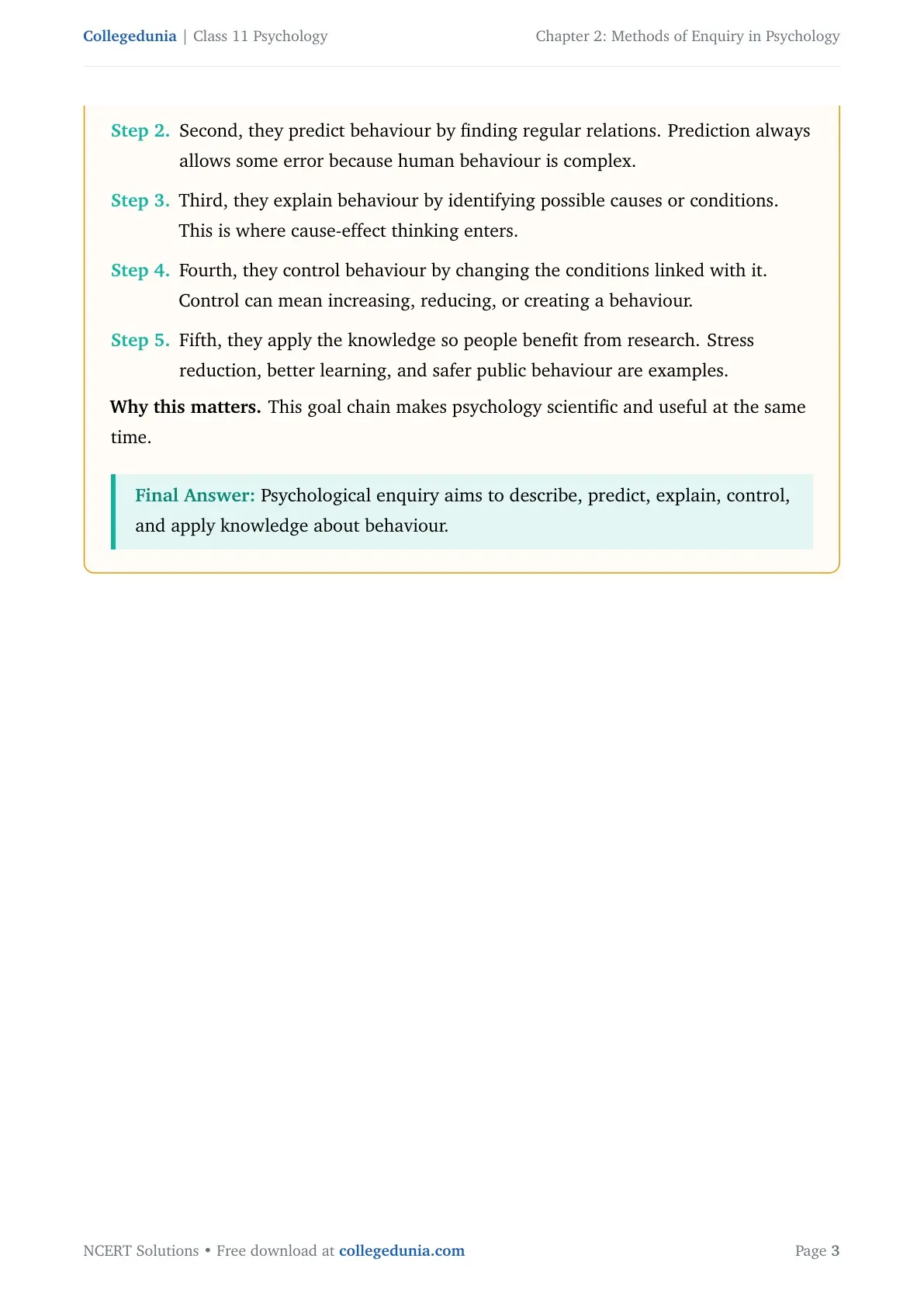
Quick reading. The five goals move from observing behaviour to using knowledge for welfare. They are not separate boxes; each goal supports the next.
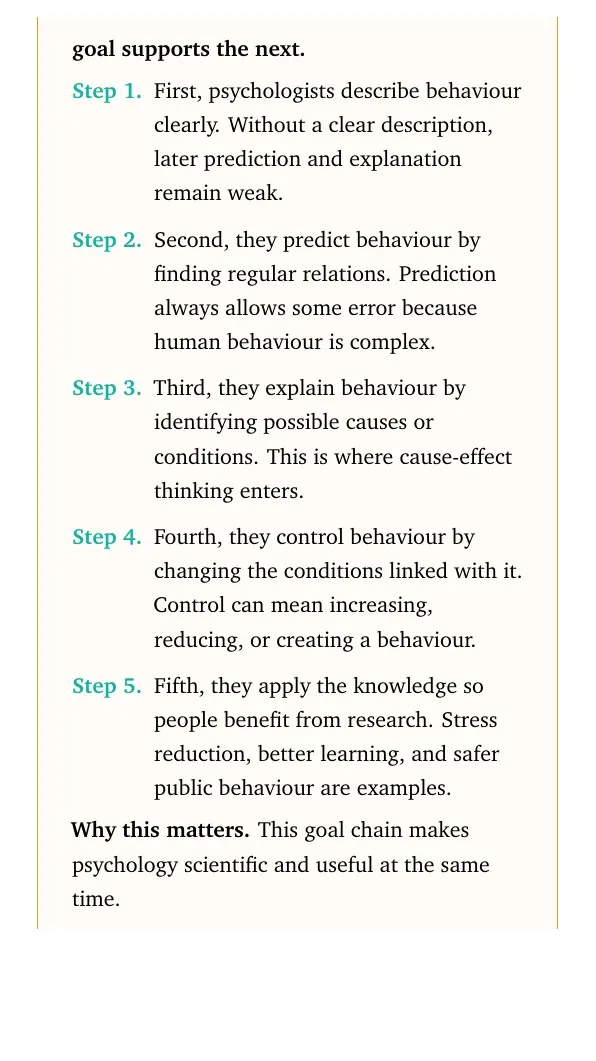
First, psychologists describe behaviour clearly. Without a clear description, later prediction and explanation remain weak.
Second, they predict behaviour by finding regular relations. Prediction always allows some error because human behaviour is complex.
Third, they explain behaviour by identifying possible causes or conditions. This is where cause-effect thinking enters.
Fourth, they control behaviour by changing the conditions linked with it. Control can mean increasing, reducing, or creating a behaviour.
Fifth, they apply the knowledge so people benefit from research. Stress reduction, better learning, and safer public behaviour are examples.
Why this matters. This goal chain makes psychology scientific and useful at the same time.
Psychological enquiry aims to describe, predict, explain, control, and apply knowledge about behaviour.
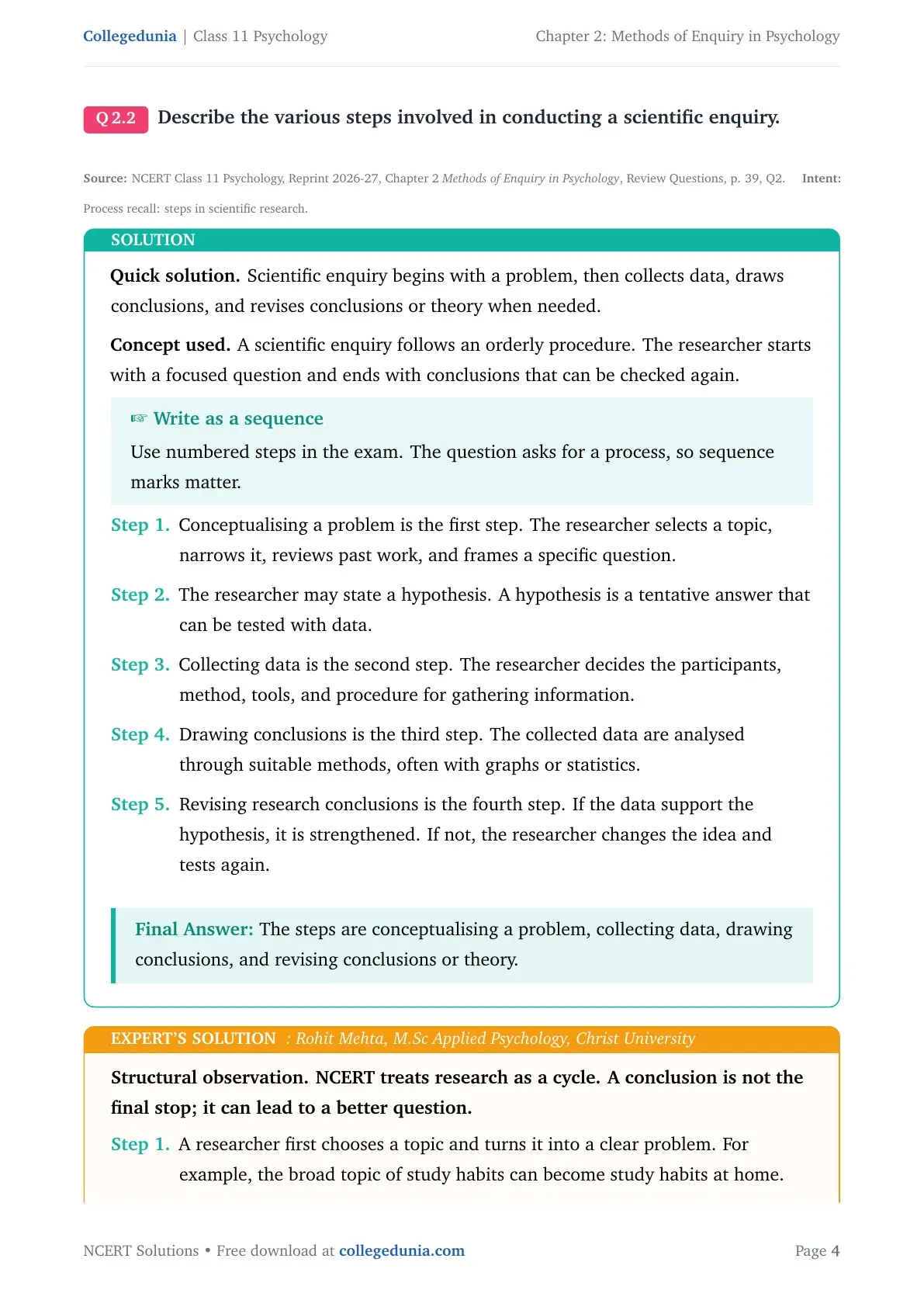
Q 2.2
Describe the various steps involved in conducting a scientific enquiry.
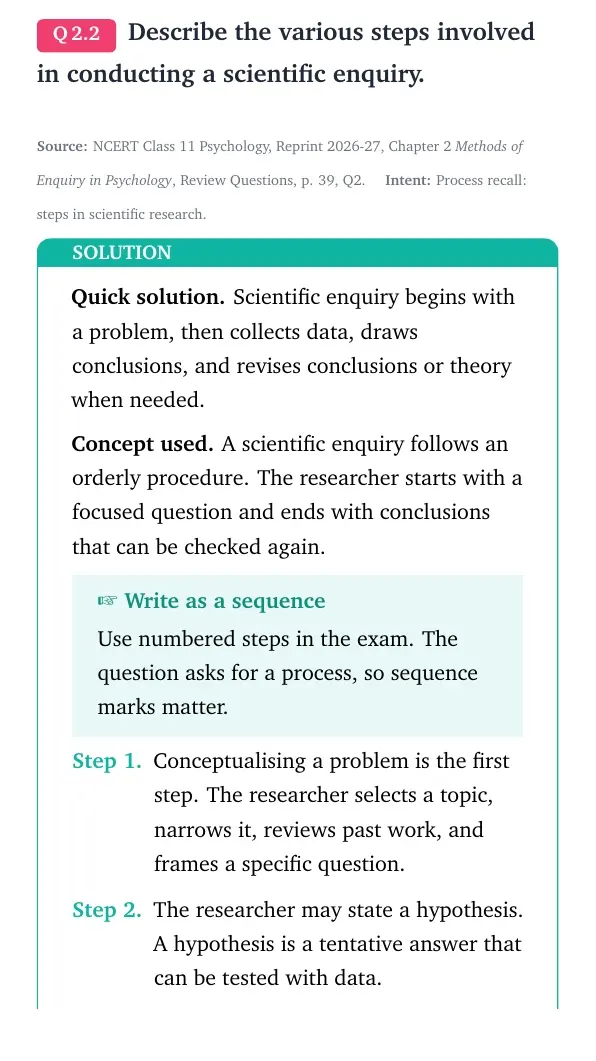
Scientific enquiry begins with a problem, then collects data, draws conclusions, and revises conclusions or theory when needed.
Concept used. A scientific enquiry follows an orderly procedure. The researcher starts with a focused question and ends with conclusions that can be checked again.
Write as a sequence
Use numbered steps in the exam. The question asks for a process, so sequence marks matter.
Conceptualising a problem is the first step. The researcher selects a topic, narrows it, reviews past work, and frames a specific question.
The researcher may state a hypothesis. A hypothesis is a tentative answer that can be tested with data.
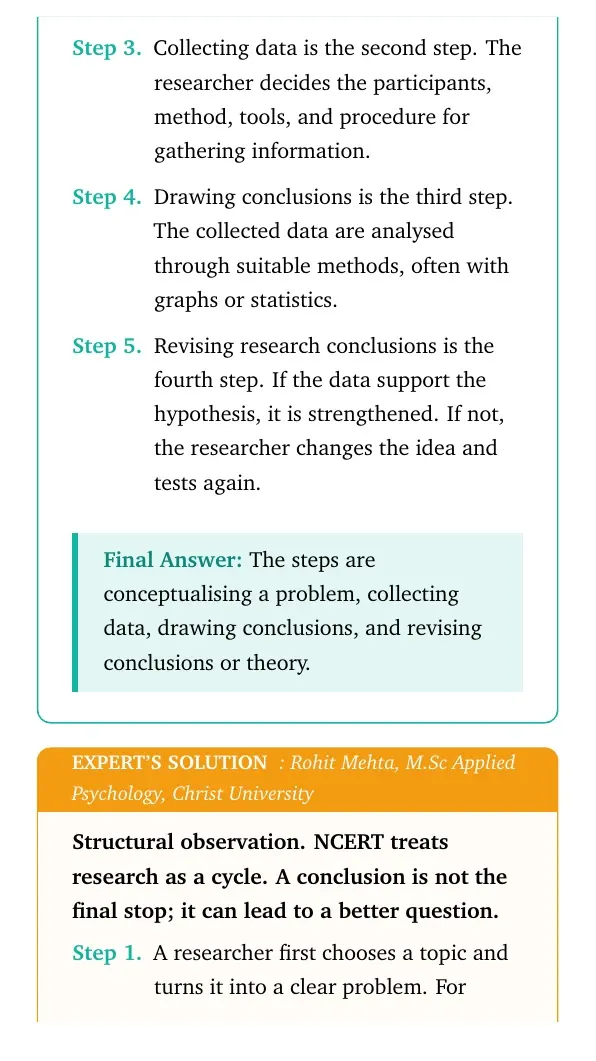
Collecting data is the second step. The researcher decides the participants, method, tools, and procedure for gathering information.
Drawing conclusions is the third step. The collected data are analysed through suitable methods, often with graphs or statistics.
Revising research conclusions is the fourth step. If the data support the hypothesis, it is strengthened. If not, the researcher changes the idea and tests again.
The steps are conceptualising a problem, collecting data, drawing conclusions, and revising conclusions or theory.
RM
Rohit Mehta
M.Sc Applied Psychology, Christ University
Verified Expert
Structural observation. NCERT treats research as a cycle. A conclusion is not the final stop; it can lead to a better question.
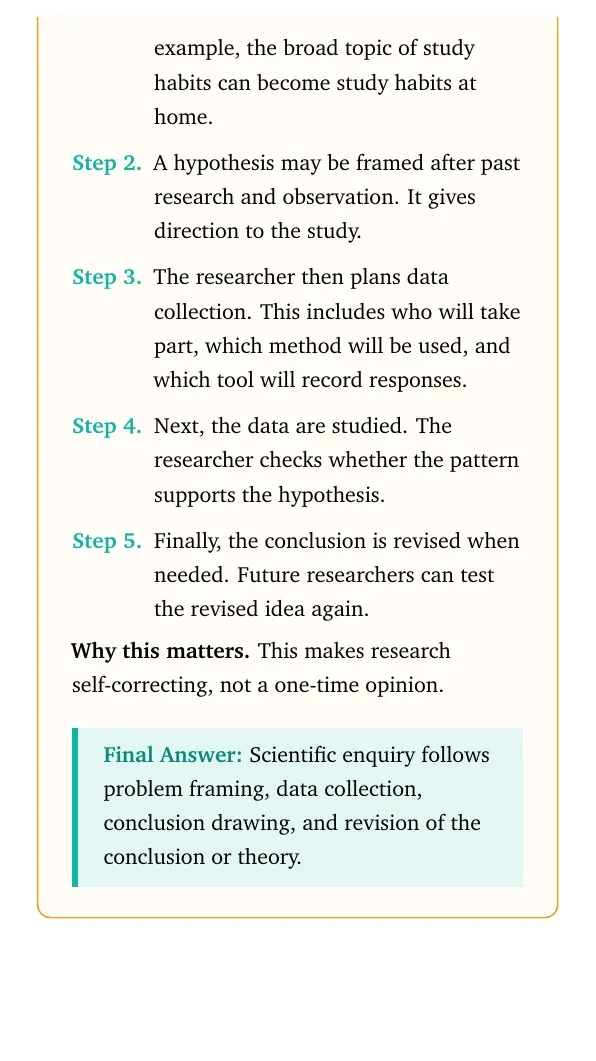
A researcher first chooses a topic and turns it into a clear problem. For example, the broad topic of study habits can become study habits at home.
A hypothesis may be framed after past research and observation. It gives direction to the study.
The researcher then plans data collection. This includes who will take part, which method will be used, and which tool will record responses.
Next, the data are studied. The researcher checks whether the pattern supports the hypothesis.
Finally, the conclusion is revised when needed. Future researchers can test the revised idea again.
Why this matters. This makes research self-correcting, not a one-time opinion.
Scientific enquiry follows problem framing, data collection, conclusion drawing, and revision of the conclusion or theory.
Q 2.3
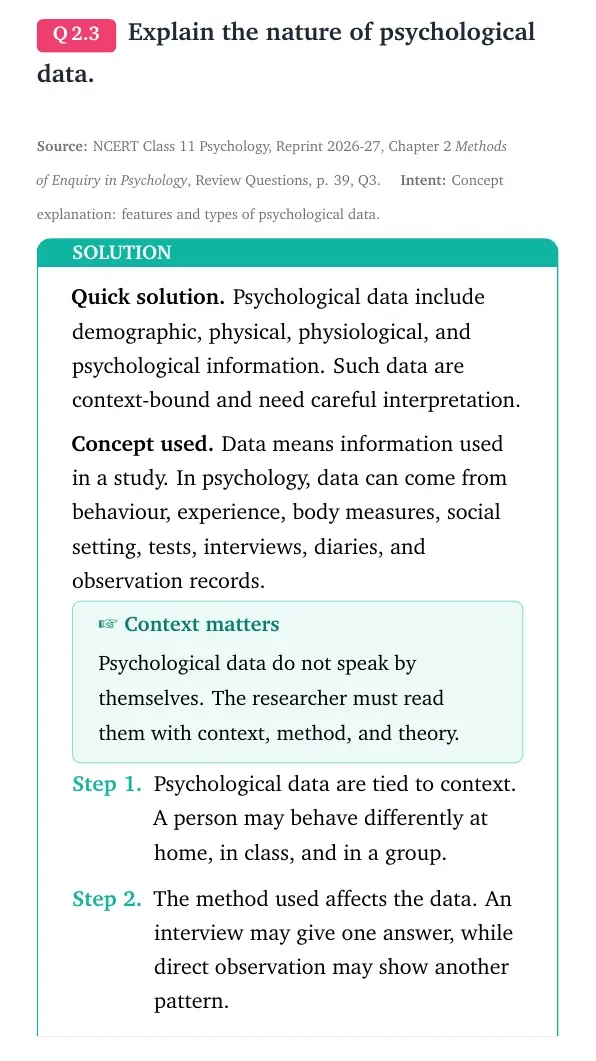
Explain the nature of psychological data.
Psychological data include demographic, physical, physiological, and psychological information. Such data are context-bound and need careful interpretation.
Concept used. Data means information used in a study. In psychology, data can come from behaviour, experience, body measures, social setting, tests, interviews, diaries, and observation records.
Context matters
Psychological data do not speak by themselves. The researcher must read them with context, method, and theory.
Psychological data are tied to context. A person may behave differently at home, in class, and in a group.
The method used affects the data. An interview may give one answer, while direct observation may show another pattern.
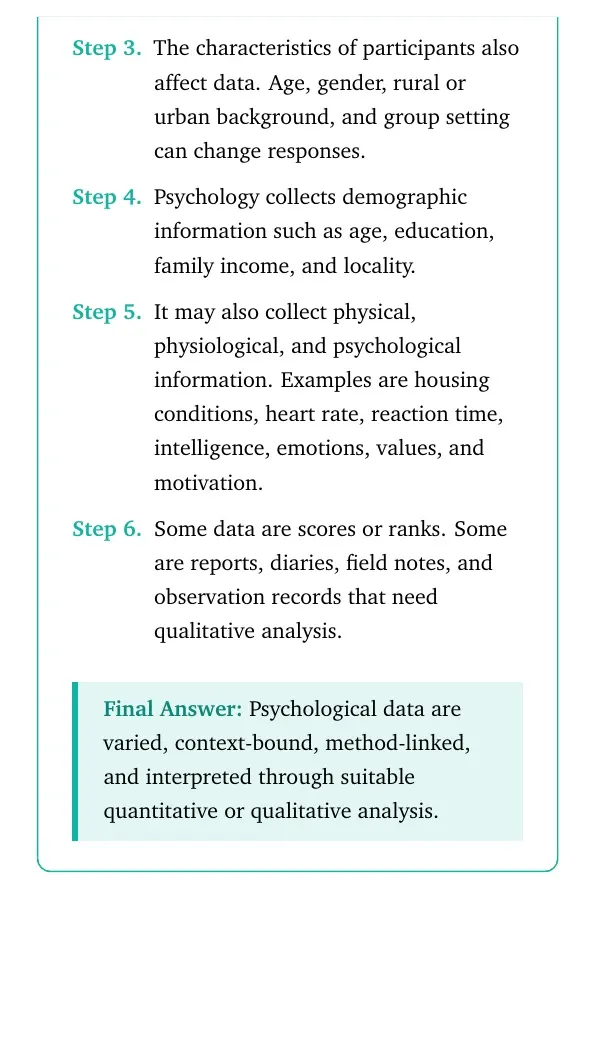
The characteristics of participants also affect data. Age, gender, rural or urban background, and group setting can change responses.
Psychology collects demographic information such as age, education, family income, and locality.
It may also collect physical, physiological, and psychological information. Examples are housing conditions, heart rate, reaction time, intelligence, emotions, values, and motivation.
Some data are scores or ranks. Some are reports, diaries, field notes, and observation records that need qualitative analysis.
Psychological data are varied, context-bound, method-linked, and interpreted through suitable quantitative or qualitative analysis.
PN
Priya Nair
M.A. Clinical Psychology, Tata Institute of Social Sciences
Verified Expert
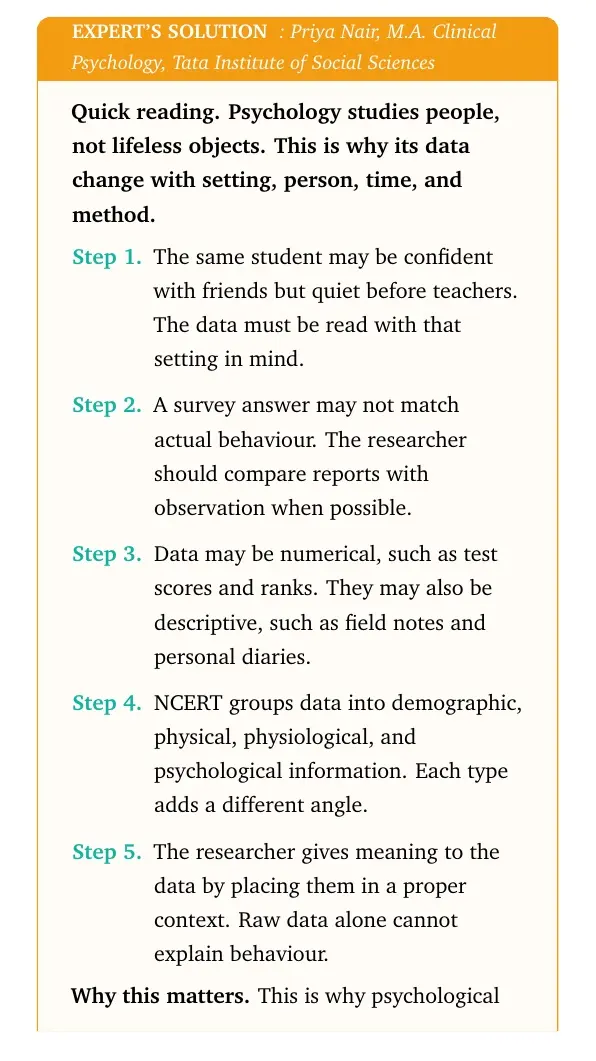
Quick reading. Psychology studies people, not lifeless objects. This is why its data change with setting, person, time, and method.
The same student may be confident with friends but quiet before teachers. The data must be read with that setting in mind.
A survey answer may not match actual behaviour. The researcher should compare reports with observation when possible.
Data may be numerical, such as test scores and ranks. They may also be descriptive, such as field notes and personal diaries.
NCERT groups data into demographic, physical, physiological, and psychological information. Each type adds a different angle.
The researcher gives meaning to the data by placing them in a proper context. Raw data alone cannot explain behaviour.
Why this matters. This is why psychological data need careful collection and careful meaning-making.
Psychological data are information about people and settings. They are varied, contextual, and interpreted with care.
Q 2.4
How do experimental and control groups differ? Explain with the help of an example.
The experimental group receives the independent variable manipulation. The control group is treated similarly but does not receive that manipulation.
Concept used. An experiment studies cause-effect relation by changing one factor and observing its effect while other conditions are kept constant.
Group difference
Write the independent variable first. Then explain which group receives it and which group does not.
An experimental group is exposed to the independent variable. This is the condition the researcher wants to test.
A control group is a comparison group. It is treated like the experimental group except that the key manipulation is absent.
For example, Latane and Darley studied reporting of smoke in a room. Presence of other people was the independent variable.
Students waiting alone formed the control condition. Students waiting with two other people formed experimental conditions.
The dependent variable was whether students reported the smoke. Comparing groups showed how the presence of others affected reporting.
All other conditions, such as the room and smoke situation, had to be kept similar so the difference could be linked with the manipulation.
The experimental group gets the manipulation; the control group does not. The control group helps compare the effect of the independent variable.
KI
Karan Iyer
M.Phil Psychology, Jamia Millia Islamia
Verified Expert
Strategic angle. The control group is not a weaker group. It is the baseline that helps the researcher judge the effect.
Suppose a researcher studies whether background music affects memory. The independent variable is music.
The experimental group studies with music. The control group studies without music.
Both groups should get the same material, same time, and similar room conditions. This keeps other factors steady.
If the music group remembers more or less, the researcher can link the change with music more confidently.
The comparison is useful only when the groups are similar before the manipulation. Random assignment helps make that possible.
In the smoke example, the group waiting alone worked as the comparison point. Groups with others showed how social presence changed action.
Why this matters. A control group protects the study from guessing. It gives a fair comparison and helps the researcher avoid blaming the wrong factor.
Experimental groups receive the independent variable condition, while control groups do not and serve as the comparison baseline.
Q 2.5
A researcher is studying the relationship between speed of cycling and the presence of people. Formulate a relevant hypothesis and identify the independent and dependent variables.
A relevant hypothesis is: cyclists ride faster when people are present than when they ride alone. The independent variable is presence of people, and the dependent variable is speed of cycling.
Concept used. A hypothesis is a testable statement about the expected relation between variables. An independent variable is changed or compared, and a dependent variable is measured.
Use testable wording
A good hypothesis should be specific enough to check. Avoid vague words like better performance without saying how it is measured.
The study is about two variables: speed of cycling and presence of people.
A suitable hypothesis can be: cyclists will show higher cycling speed in the presence of people than when cycling alone.
The independent variable is the presence of people. It has at least two conditions: people present and people absent.
The dependent variable is cycling speed. It can be measured as distance covered in a fixed time or time taken for a fixed distance.
The researcher should keep other factors similar, such as track, bicycle condition, weather, and practice time.
Hypothesis: cyclists ride faster when people are present. Independent variable: presence of people. Dependent variable: speed of cycling.
SG
Sneha Gupta
M.Sc Counselling Psychology, Banaras Hindu University
Verified Expert
Quick reading. The variable that is compared is the independent variable. The outcome that is measured is the dependent variable.
Here the researcher compares two situations: cycling alone and cycling before people.
That comparison makes presence of people the independent variable. The researcher is interested in its effect.
The measured outcome is speed of cycling. This makes speed the dependent variable.
A clear hypothesis is: the presence of people increases cycling speed compared with cycling alone.
The statement can be tested because speed can be recorded and the two conditions can be compared.
A better study would also keep the route, bicycle, time limit, and rider practice similar across both conditions.
Why this matters. The answer earns marks when hypothesis, independent variable, dependent variable, and measurement plan are named separately.
A relevant hypothesis is that presence of people increases cycling speed. Presence is the independent variable; speed is the dependent variable.
Q 2.6
Discuss the strengths and weaknesses of experimental method as a method of enquiry.
The experimental method is strong for studying cause-effect relations under controlled conditions. Its limits include artificial settings, ethical limits, and difficulty in controlling all variables.
Concept used. The experimental method changes an independent variable and studies its effect on a dependent variable while trying to control other variables.
Balanced answer
This question asks for discussion. Give both strengths and weaknesses, not only a definition.
A major strength is control. The researcher can keep many conditions constant and focus on the effect of one variable.
Another strength is cause-effect testing. A well-planned experiment can show whether a change in one factor leads to a change in behaviour.
It also allows repetition. Other researchers can repeat the procedure and check the result.
One weakness is artificiality. A laboratory setting may not match real life, so behaviour may change.
A second weakness is that all outside variables cannot be controlled. Personality, motivation, fatigue, and past experience may affect results.
A third weakness is ethical limits. Some conditions cannot be created if they may harm participants.
The experimental method gives control and cause-effect evidence, but it can be artificial, ethically limited, and hard to control fully.
AR
Arjun Rao
M.A. Psychology, University of Hyderabad
Verified Expert
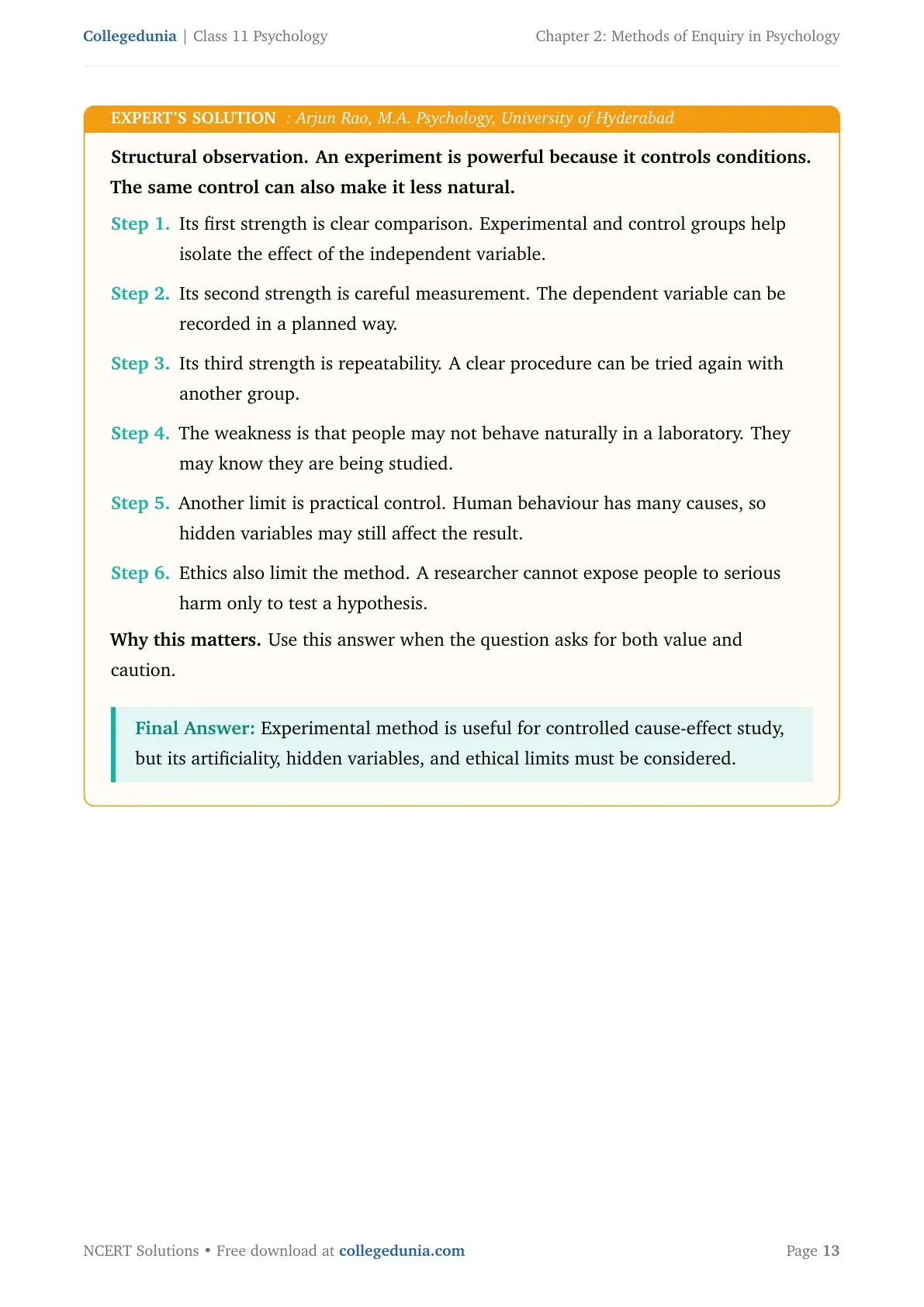
Structural observation. An experiment is powerful because it controls conditions. The same control can also make it less natural.
Its first strength is clear comparison. Experimental and control groups help isolate the effect of the independent variable.
Its second strength is careful measurement. The dependent variable can be recorded in a planned way.
Its third strength is repeatability. A clear procedure can be tried again with another group.
The weakness is that people may not behave naturally in a laboratory. They may know they are being studied.
Another limit is practical control. Human behaviour has many causes, so hidden variables may still affect the result.
Ethics also limit the method. A researcher cannot expose people to serious harm only to test a hypothesis.
Why this matters. Use this answer when the question asks for both value and caution.
Experimental method is useful for controlled cause-effect study, but its artificiality, hidden variables, and ethical limits must be considered.
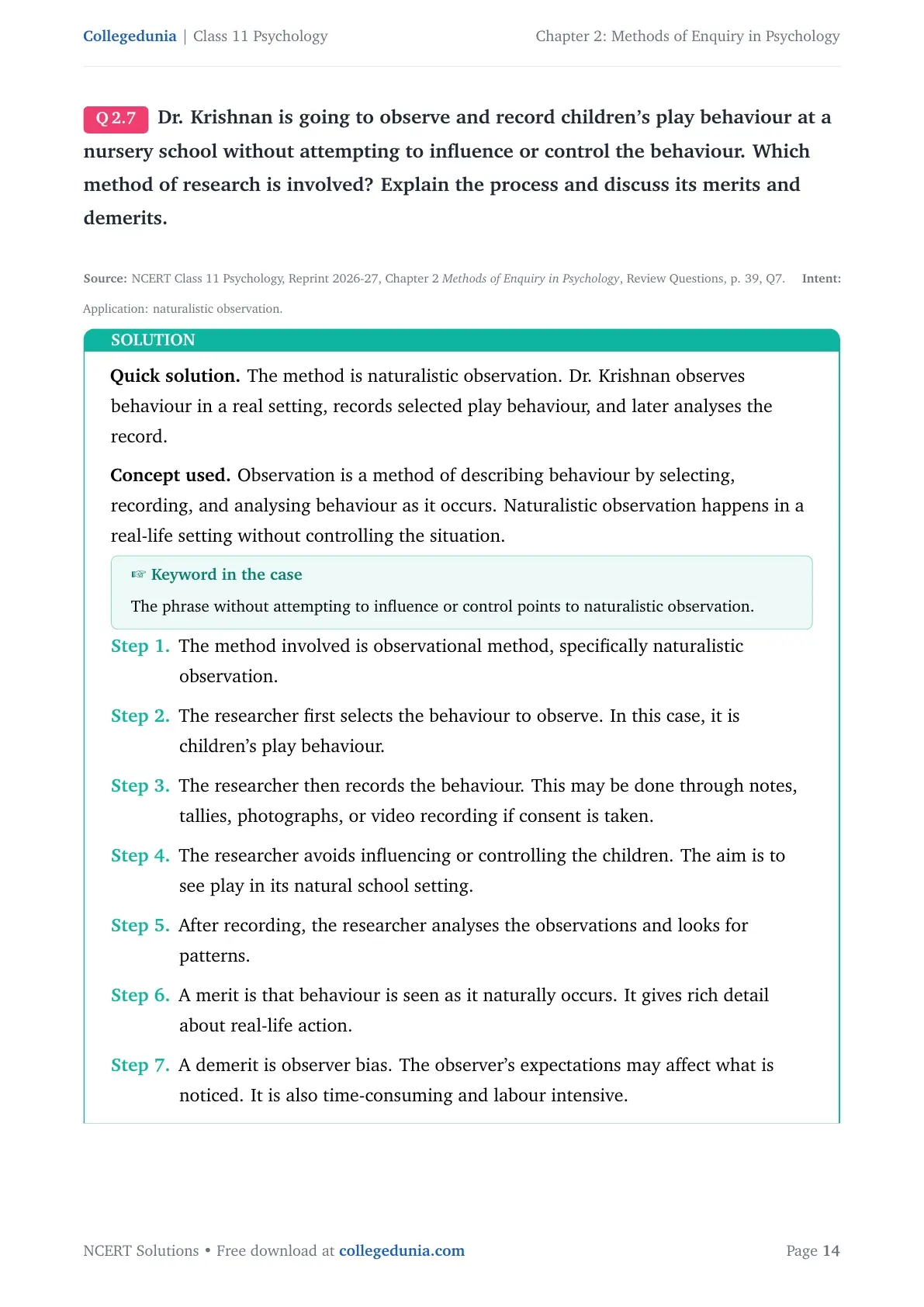
Q 2.7
Dr. Krishnan is going to observe and record children's play behaviour at a nursery school without attempting to influence or control the behaviour. Which method of research is involved? Explain the process and discuss its merits and demerits.
The method is naturalistic observation. Dr. Krishnan observes behaviour in a real setting, records selected play behaviour, and later analyses the record.
Concept used. Observation is a method of describing behaviour by selecting, recording, and analysing behaviour as it occurs. Naturalistic observation happens in a real-life setting without controlling the situation.
Keyword in the case
The phrase without attempting to influence or control points to naturalistic observation.
The method involved is observational method, specifically naturalistic observation.
The researcher first selects the behaviour to observe. In this case, it is children's play behaviour.
The researcher then records the behaviour. This may be done through notes, tallies, photographs, or video recording if consent is taken.
The researcher avoids influencing or controlling the children. The aim is to see play in its natural school setting.
After recording, the researcher analyses the observations and looks for patterns.
A merit is that behaviour is seen as it naturally occurs. It gives rich detail about real-life action.
A demerit is observer bias. The observer's expectations may affect what is noticed. It is also time-consuming and labour intensive.
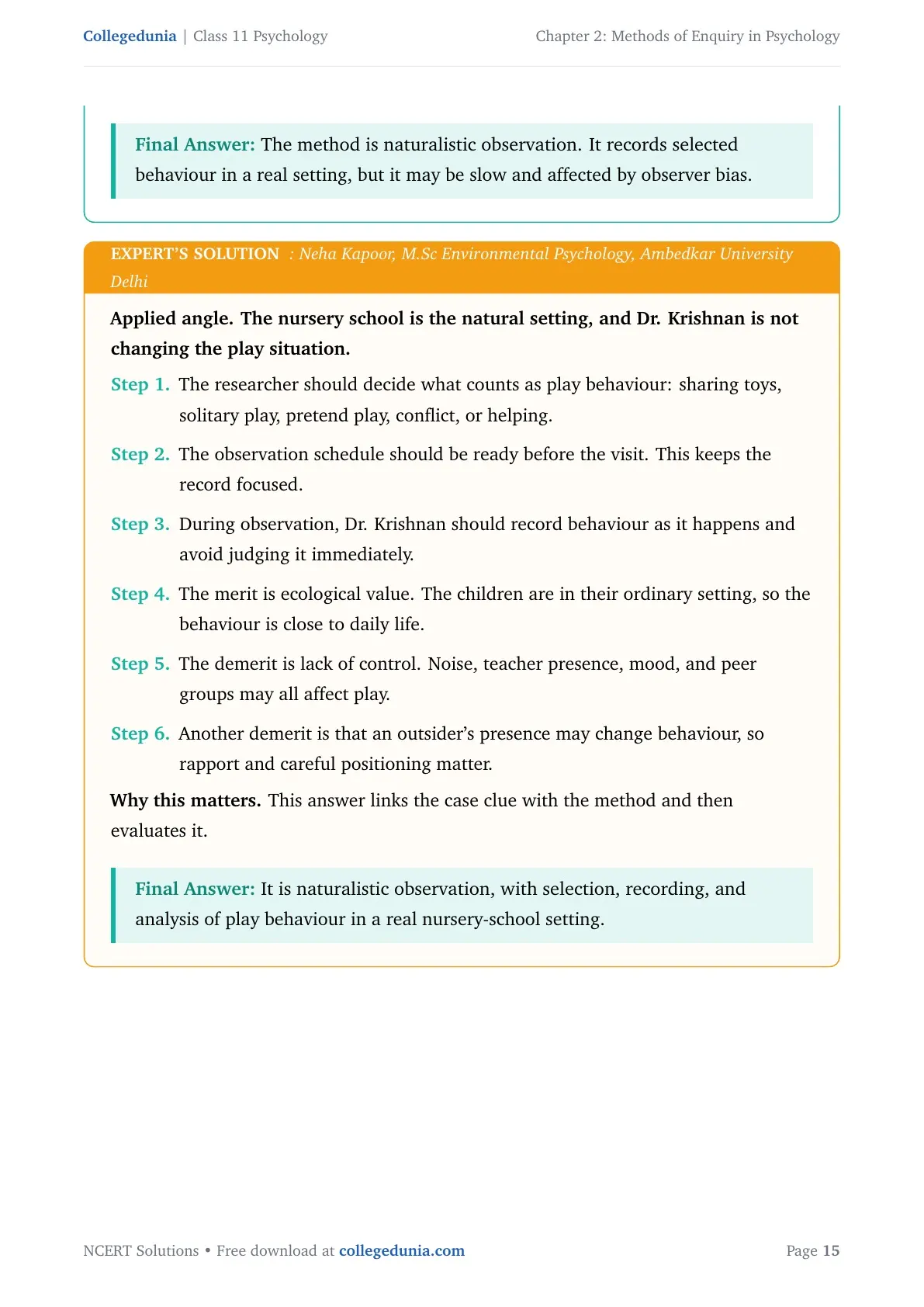
The method is naturalistic observation. It records selected behaviour in a real setting, but it may be slow and affected by observer bias.
NK
Neha Kapoor
M.Sc Environmental Psychology, Ambedkar University Delhi
Verified Expert
Applied angle. The nursery school is the natural setting, and Dr. Krishnan is not changing the play situation.
The researcher should decide what counts as play behaviour: sharing toys, solitary play, pretend play, conflict, or helping.
The observation schedule should be ready before the visit. This keeps the record focused.
During observation, Dr. Krishnan should record behaviour as it happens and avoid judging it immediately.
The merit is ecological value. The children are in their ordinary setting, so the behaviour is close to daily life.
The demerit is lack of control. Noise, teacher presence, mood, and peer groups may all affect play.
Another demerit is that an outsider's presence may change behaviour, so rapport and careful positioning matter.
Why this matters. This answer links the case clue with the method and then evaluates it.
It is naturalistic observation, with selection, recording, and analysis of play behaviour in a real nursery-school setting.
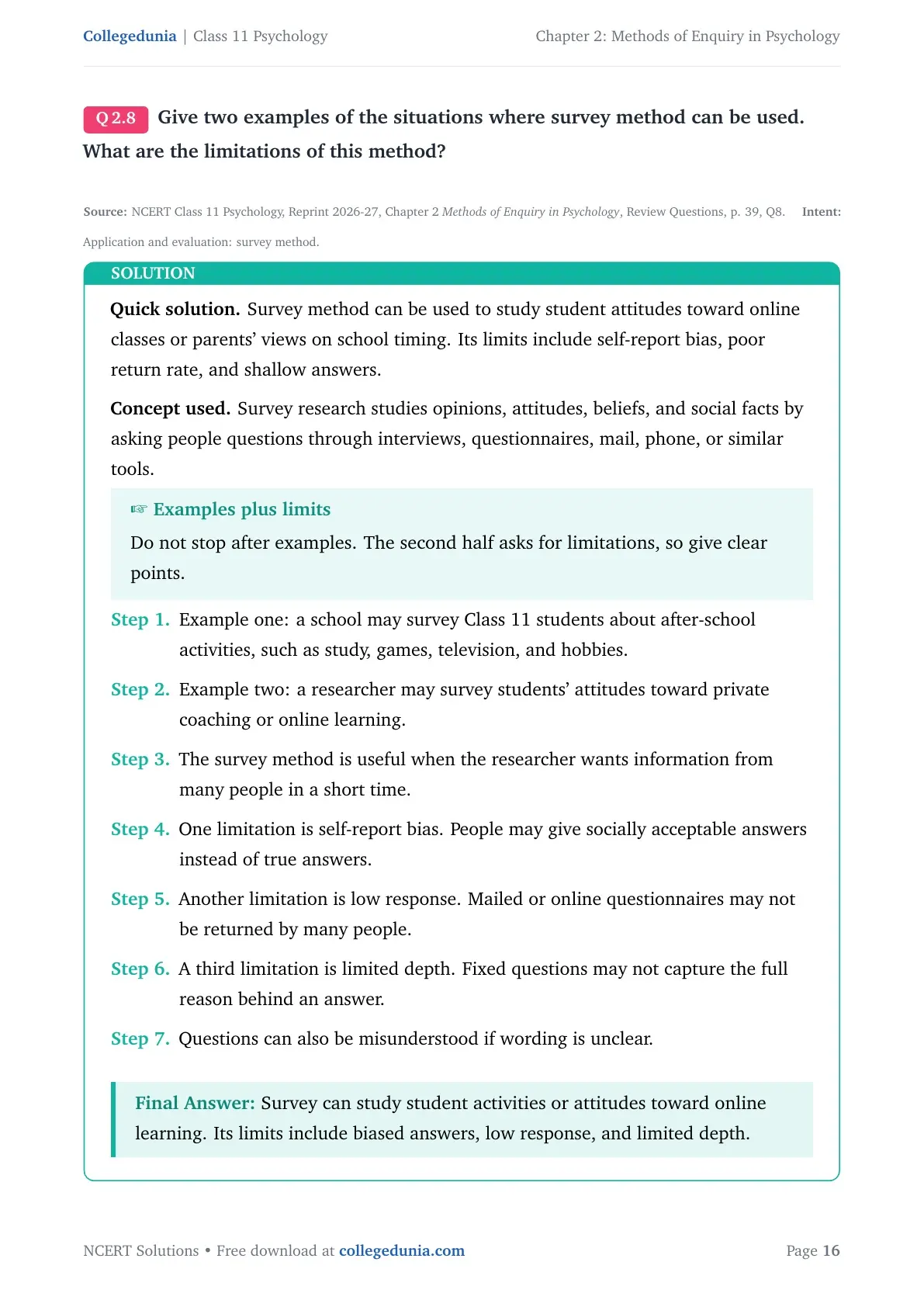
Q 2.8
Give two examples of the situations where survey method can be used. What are the limitations of this method?
Survey method can be used to study student attitudes toward online classes or parents' views on school timing. Its limits include self-report bias, poor return rate, and shallow answers.
Concept used. Survey research studies opinions, attitudes, beliefs, and social facts by asking people questions through interviews, questionnaires, mail, phone, or similar tools.
Examples plus limits
Do not stop after examples. The second half asks for limitations, so give clear points.
Example one: a school may survey Class 11 students about after-school activities, such as study, games, television, and hobbies.
Example two: a researcher may survey students' attitudes toward private coaching or online learning.
The survey method is useful when the researcher wants information from many people in a short time.
One limitation is self-report bias. People may give socially acceptable answers instead of true answers.
Another limitation is low response. Mailed or online questionnaires may not be returned by many people.
A third limitation is limited depth. Fixed questions may not capture the full reason behind an answer.
Questions can also be misunderstood if wording is unclear.
Survey can study student activities or attitudes toward online learning. Its limits include biased answers, low response, and limited depth.
VB
Vivaan Bhat
M.A. Forensic Psychology, Gujarat Forensic Sciences University
Verified Expert
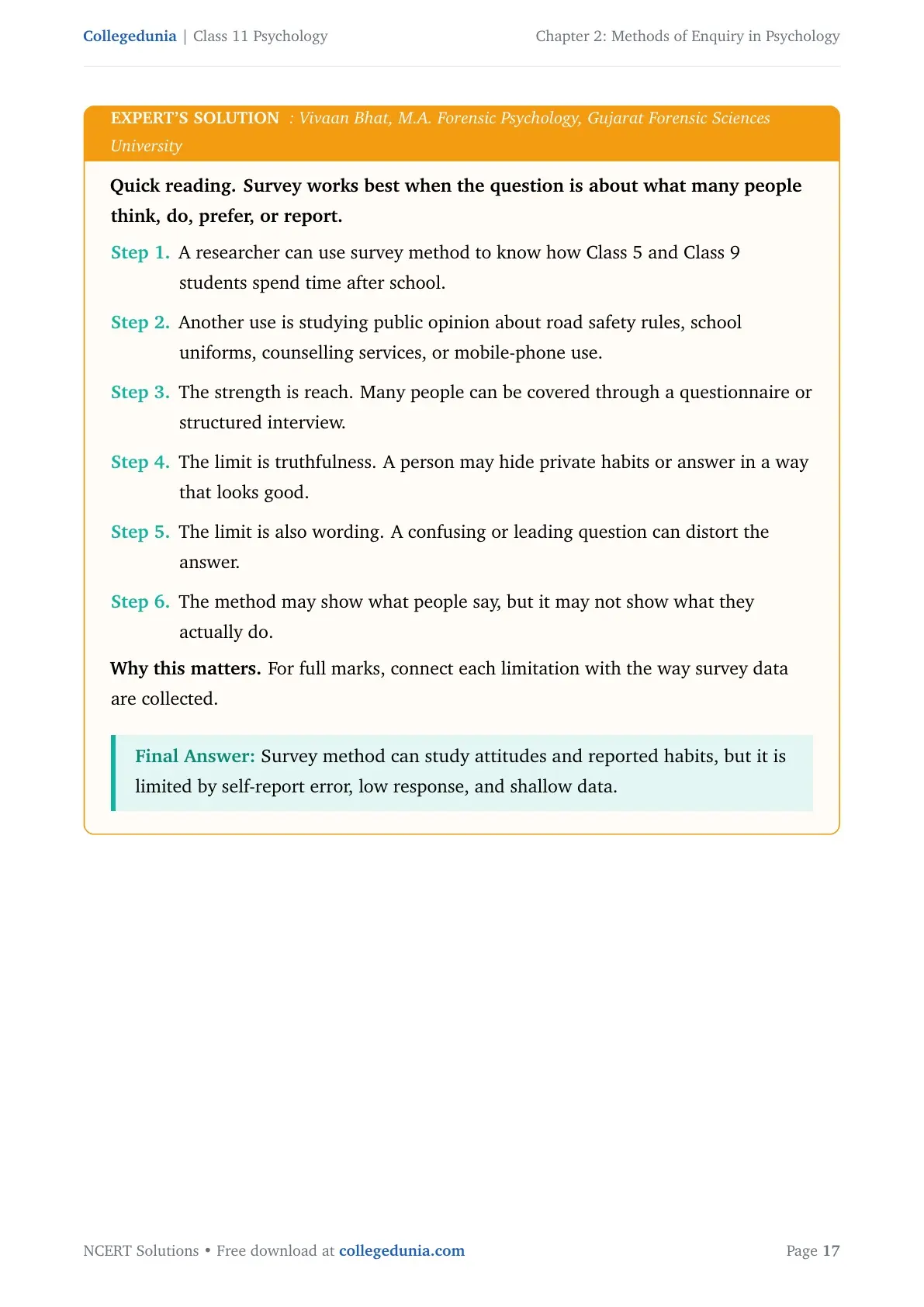
Quick reading. Survey works best when the question is about what many people think, do, prefer, or report.
A researcher can use survey method to know how Class 5 and Class 9 students spend time after school.
Another use is studying public opinion about road safety rules, school uniforms, counselling services, or mobile-phone use.
The strength is reach. Many people can be covered through a questionnaire or structured interview.
The limit is truthfulness. A person may hide private habits or answer in a way that looks good.
The limit is also wording. A confusing or leading question can distort the answer.
The method may show what people say, but it may not show what they actually do.
Why this matters. For full marks, connect each limitation with the way survey data are collected.
Survey method can study attitudes and reported habits, but it is limited by self-report error, low response, and shallow data.
Q 2.9
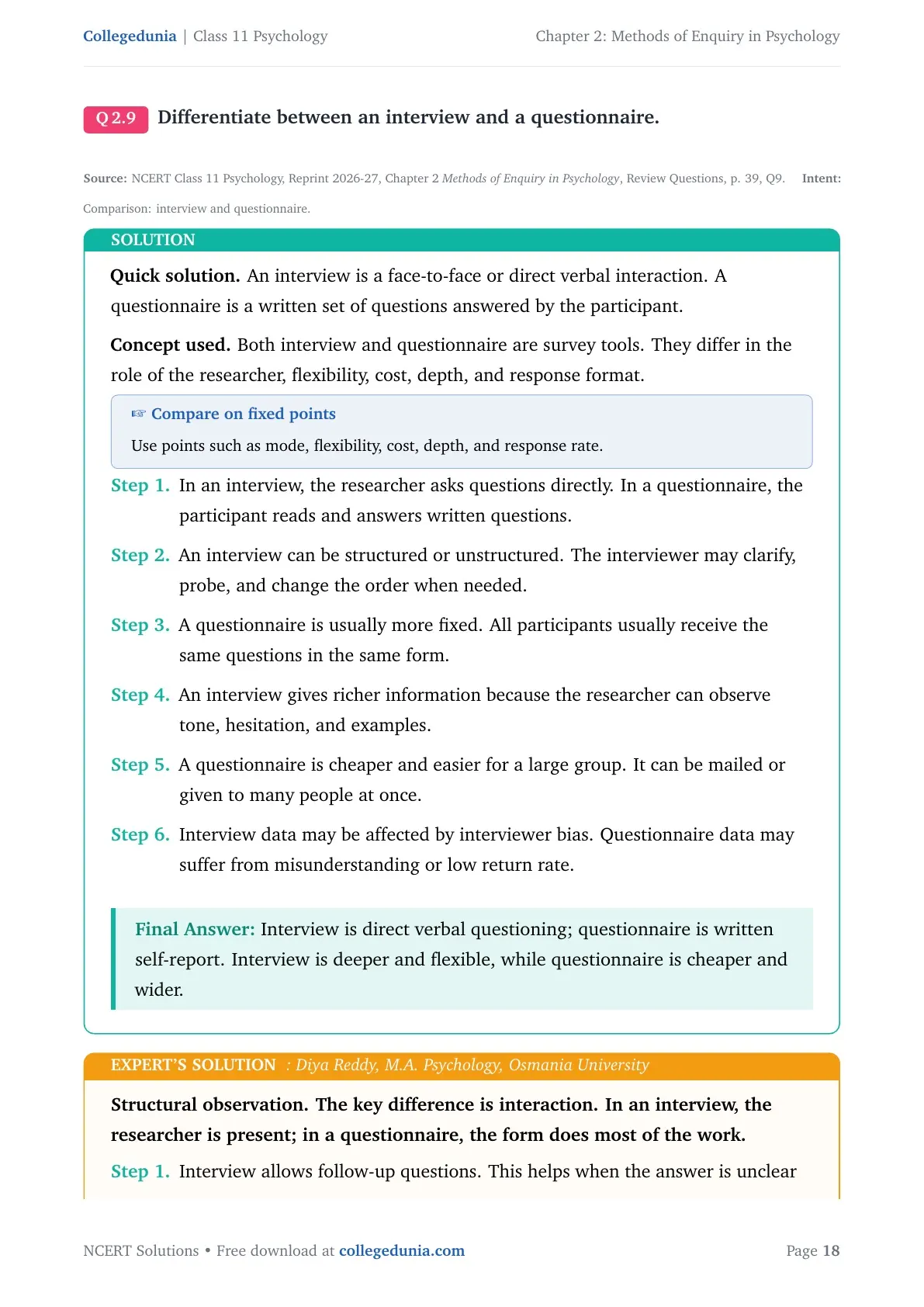
Differentiate between an interview and a questionnaire.
An interview is a face-to-face or direct verbal interaction. A questionnaire is a written set of questions answered by the participant.
Concept used. Both interview and questionnaire are survey tools. They differ in the role of the researcher, flexibility, cost, depth, and response format.
Compare on fixed points
Use points such as mode, flexibility, cost, depth, and response rate.
In an interview, the researcher asks questions directly. In a questionnaire, the participant reads and answers written questions.
An interview can be structured or unstructured. The interviewer may clarify, probe, and change the order when needed.
A questionnaire is usually more fixed. All participants usually receive the same questions in the same form.
An interview gives richer information because the researcher can observe tone, hesitation, and examples.
A questionnaire is cheaper and easier for a large group. It can be mailed or given to many people at once.
Interview data may be affected by interviewer bias. Questionnaire data may suffer from misunderstanding or low return rate.
Interview is direct verbal questioning; questionnaire is written self-report. Interview is deeper and flexible, while questionnaire is cheaper and wider.
DR
Diya Reddy
M.A. Psychology, Osmania University
Verified Expert
Structural observation. The key difference is interaction. In an interview, the researcher is present; in a questionnaire, the form does most of the work.
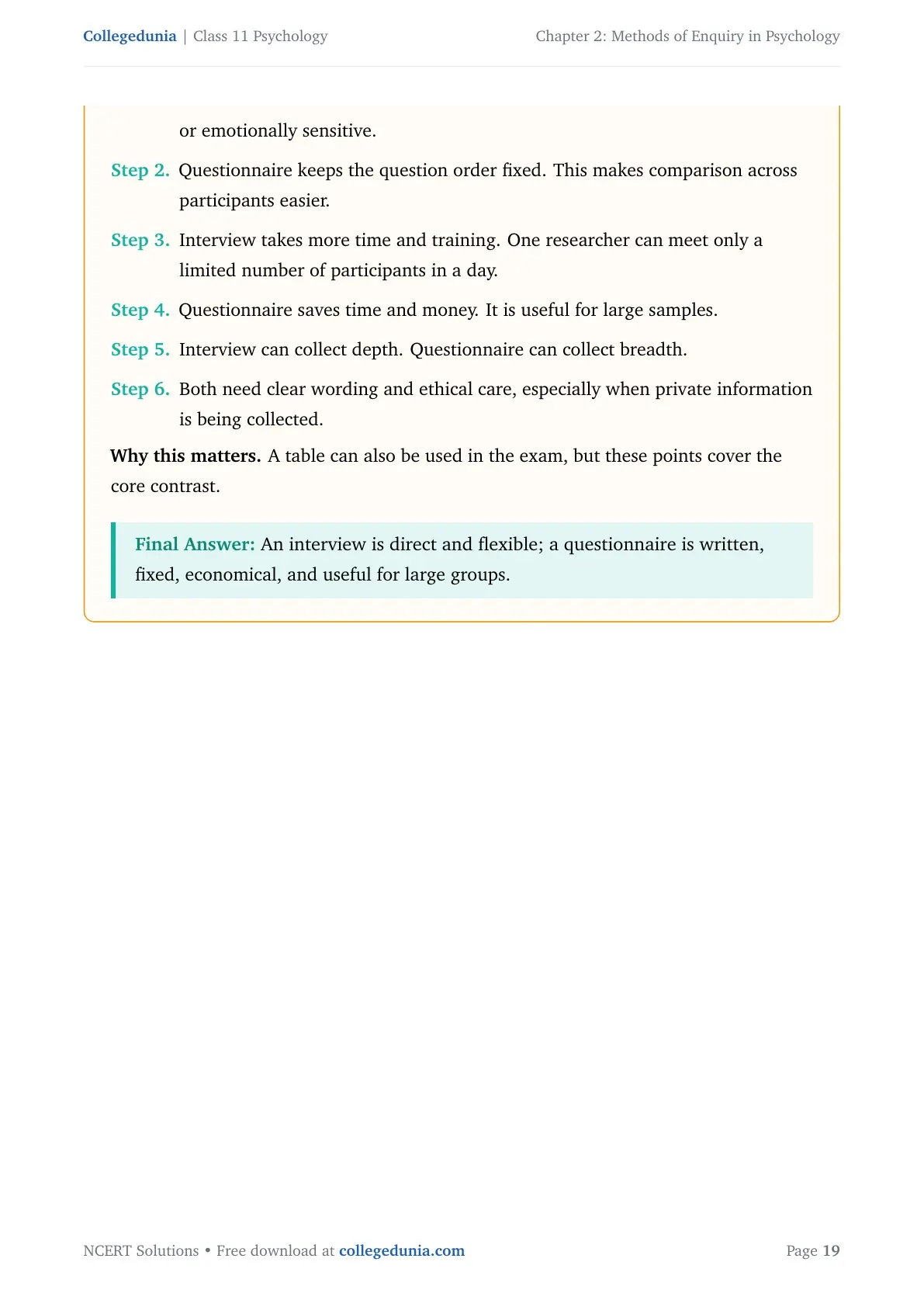
Interview allows follow-up questions. This helps when the answer is unclear or emotionally sensitive.
Questionnaire keeps the question order fixed. This makes comparison across participants easier.
Interview takes more time and training. One researcher can meet only a limited number of participants in a day.
Questionnaire saves time and money. It is useful for large samples.
Interview can collect depth. Questionnaire can collect breadth.
Both need clear wording and ethical care, especially when private information is being collected.
Why this matters. A table can also be used in the exam, but these points cover the core contrast.
An interview is direct and flexible; a questionnaire is written, fixed, economical, and useful for large groups.
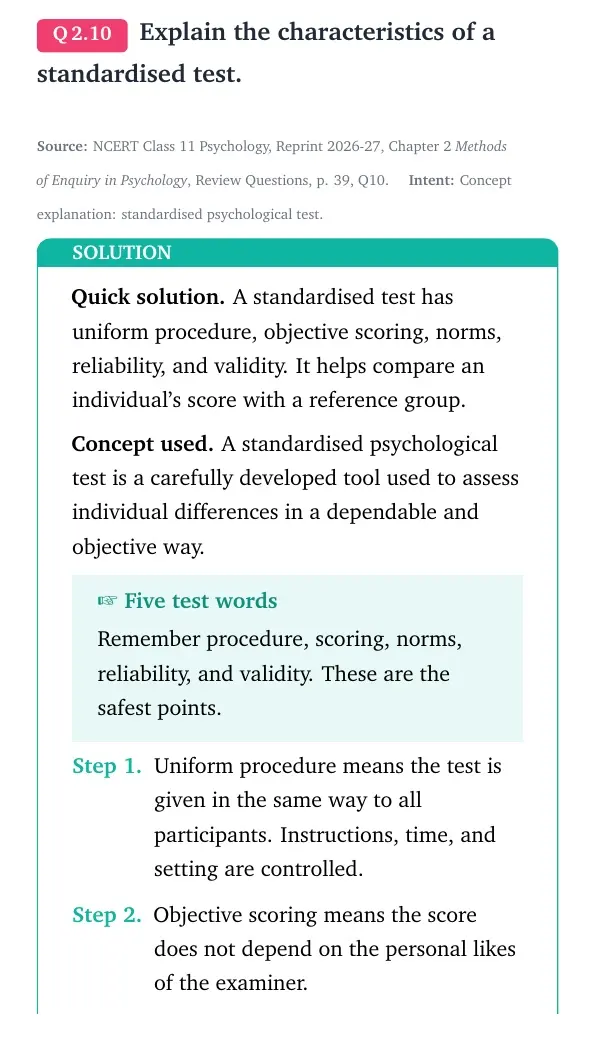
Q 2.10
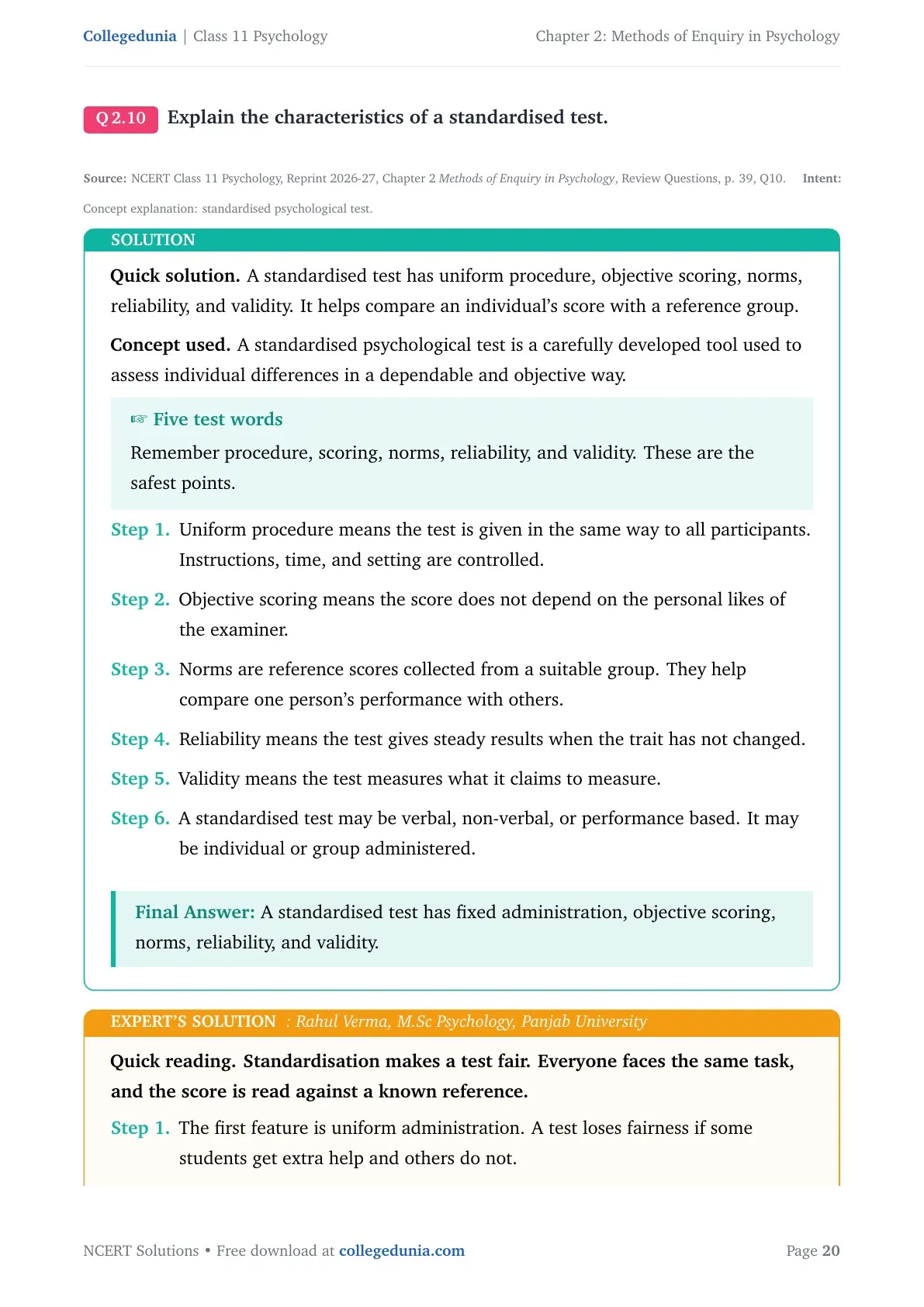
Explain the characteristics of a standardised test.
A standardised test has uniform procedure, objective scoring, norms, reliability, and validity. It helps compare an individual's score with a reference group.
Concept used. A standardised psychological test is a carefully developed tool used to assess individual differences in a dependable and objective way.
Five test words
Remember procedure, scoring, norms, reliability, and validity. These are the safest points.
Uniform procedure means the test is given in the same way to all participants. Instructions, time, and setting are controlled.
Objective scoring means the score does not depend on the personal likes of the examiner.
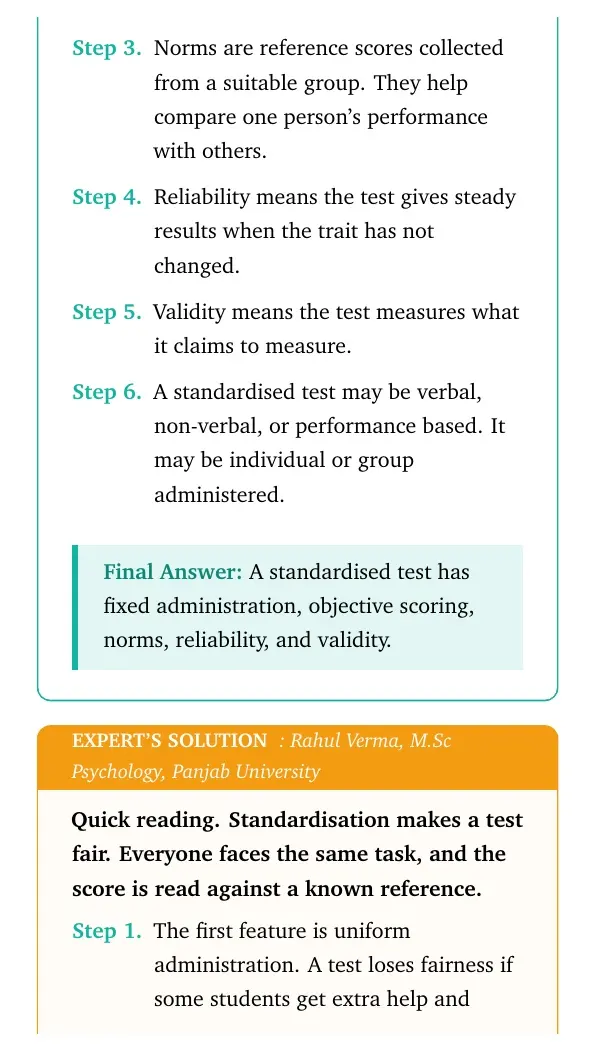
Norms are reference scores collected from a suitable group. They help compare one person's performance with others.
Reliability means the test gives steady results when the trait has not changed.
Validity means the test measures what it claims to measure.
A standardised test may be verbal, non-verbal, or performance based. It may be individual or group administered.
A standardised test has fixed administration, objective scoring, norms, reliability, and validity.
RV
Rahul Verma
M.Sc Psychology, Panjab University
Verified Expert
Quick reading. Standardisation makes a test fair. Everyone faces the same task, and the score is read against a known reference.
The first feature is uniform administration. A test loses fairness if some students get extra help and others do not.
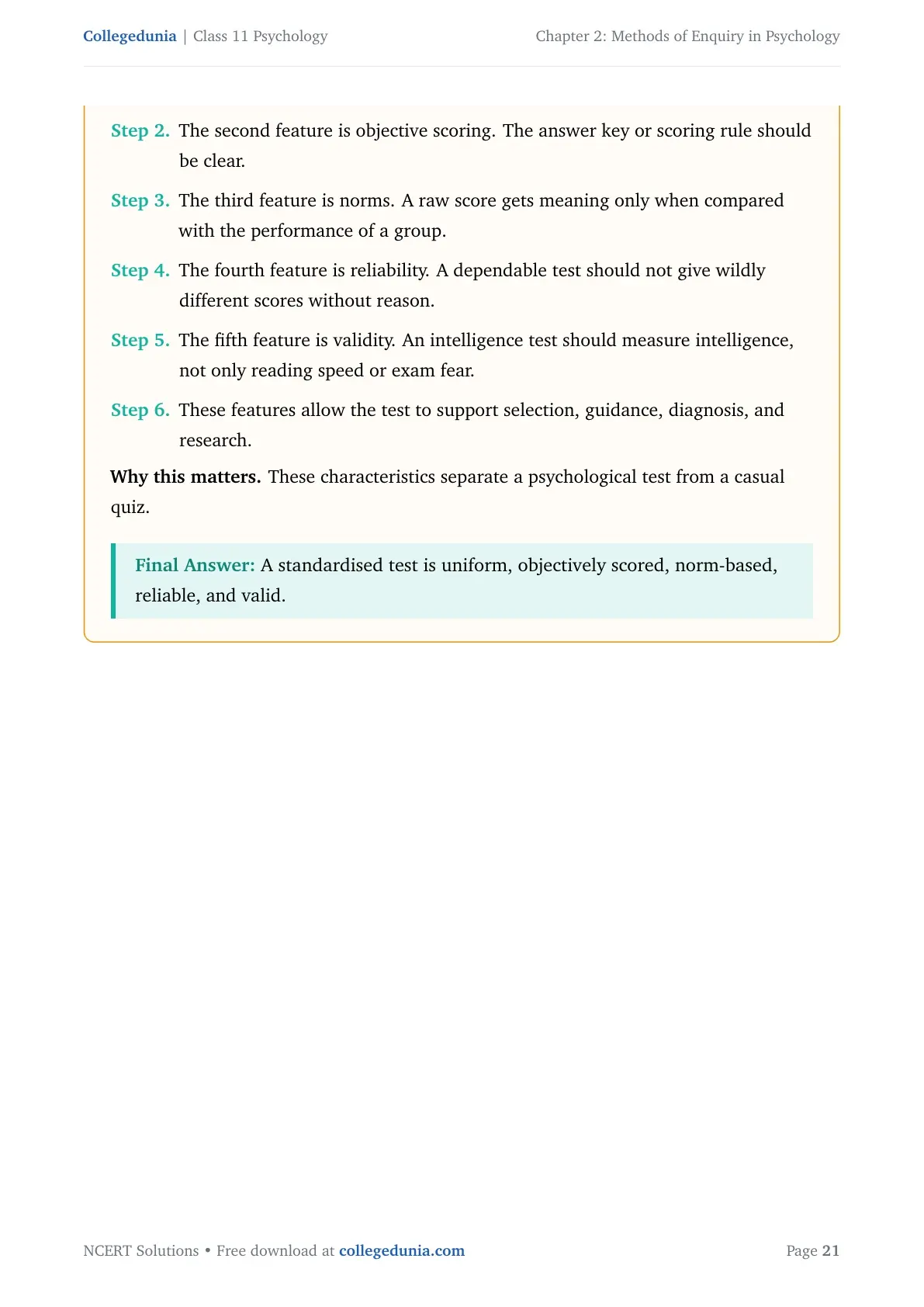
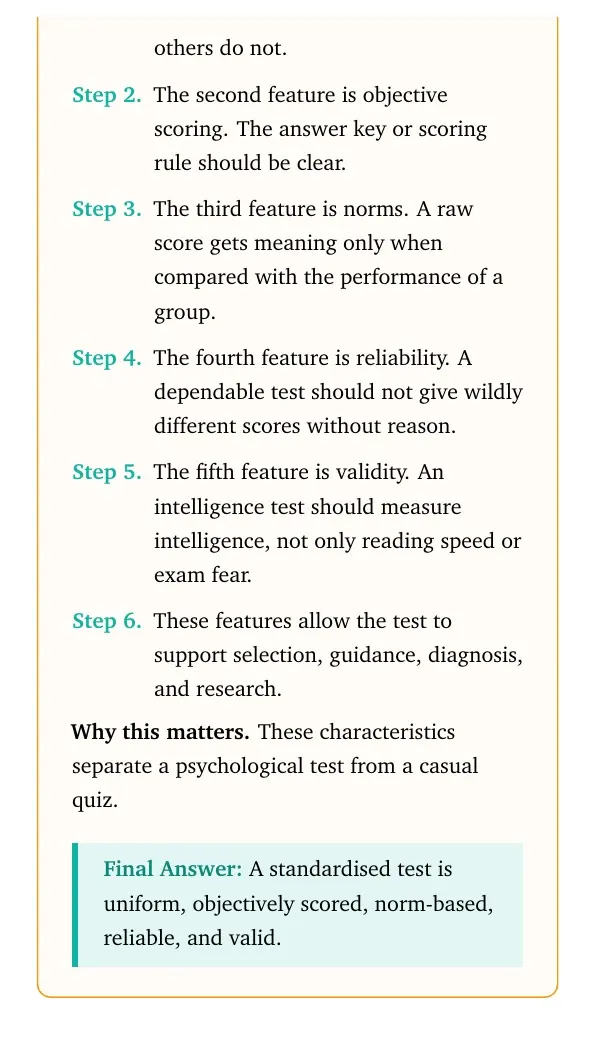
The second feature is objective scoring. The answer key or scoring rule should be clear.
The third feature is norms. A raw score gets meaning only when compared with the performance of a group.
The fourth feature is reliability. A dependable test should not give wildly different scores without reason.
The fifth feature is validity. An intelligence test should measure intelligence, not only reading speed or exam fear.
These features allow the test to support selection, guidance, diagnosis, and research.
Why this matters. These characteristics separate a psychological test from a casual quiz.
A standardised test is uniform, objectively scored, norm-based, reliable, and valid.
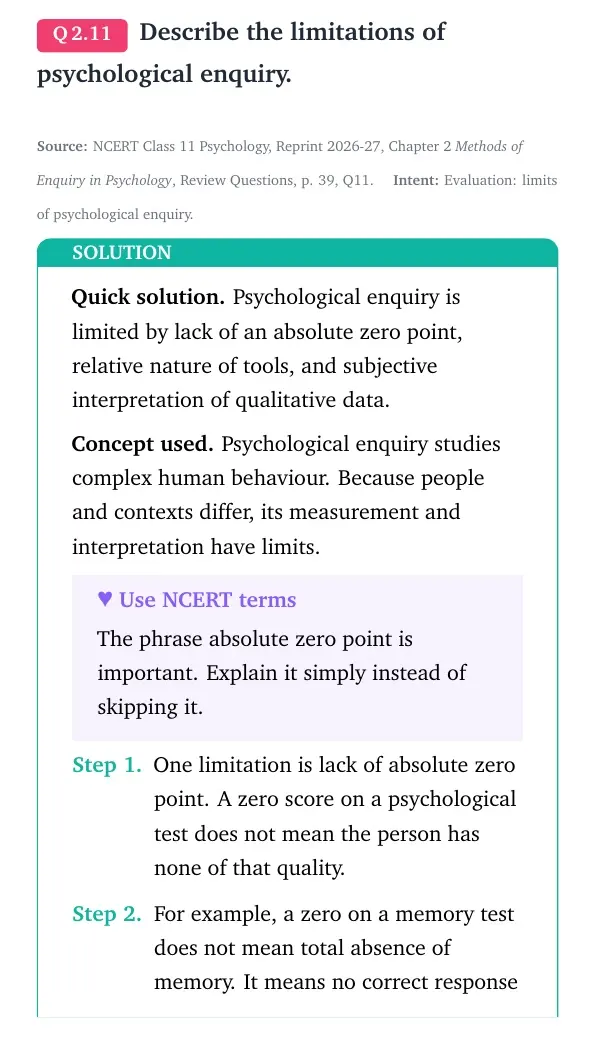
Q 2.11
Describe the limitations of psychological enquiry.
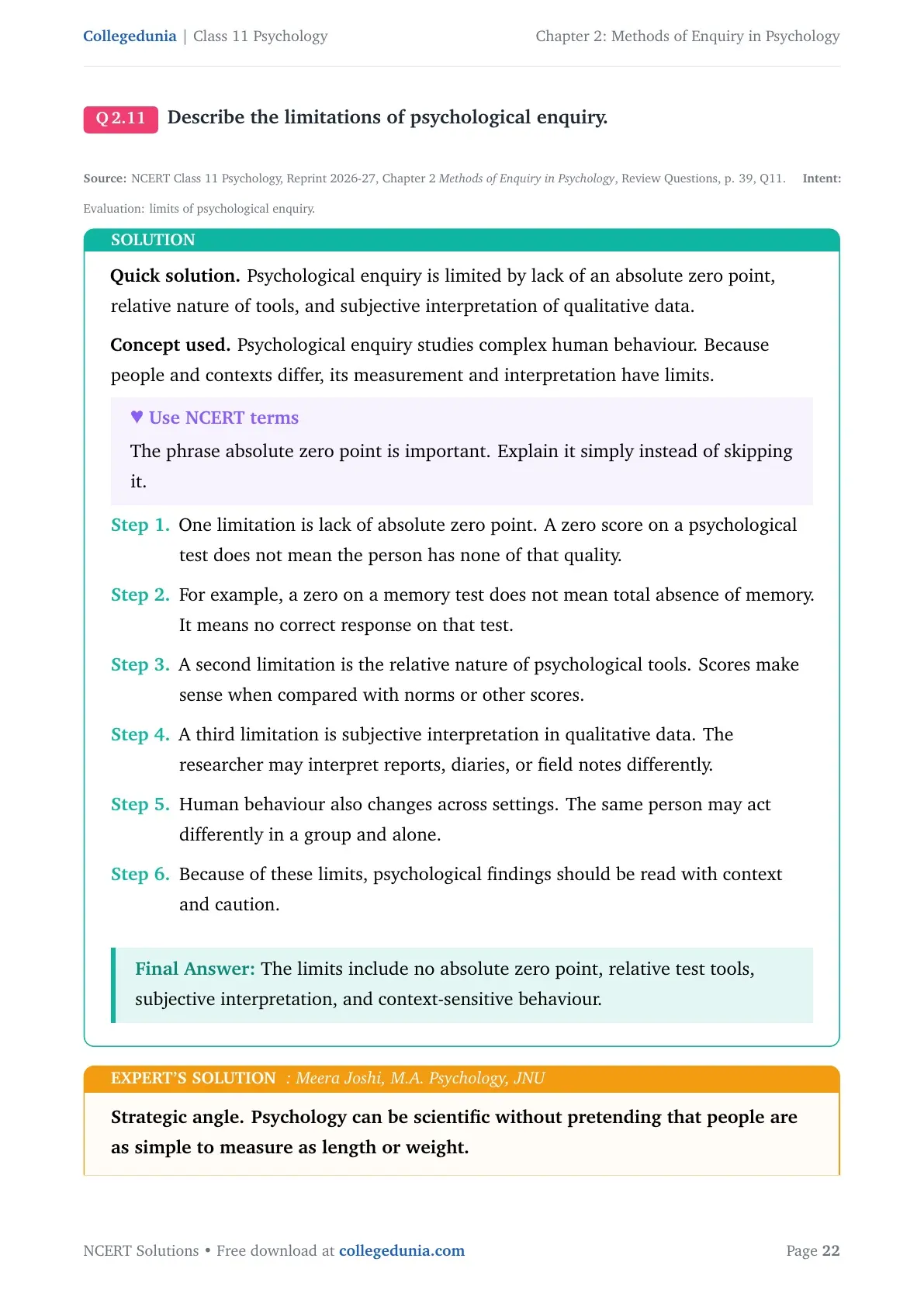
Psychological enquiry is limited by lack of an absolute zero point, relative nature of tools, and subjective interpretation of qualitative data.
Concept used. Psychological enquiry studies complex human behaviour. Because people and contexts differ, its measurement and interpretation have limits.
Use NCERT terms
The phrase absolute zero point is important. Explain it simply instead of skipping it.
One limitation is lack of absolute zero point. A zero score on a psychological test does not mean the person has none of that quality.
For example, a zero on a memory test does not mean total absence of memory. It means no correct response on that test.
A second limitation is the relative nature of psychological tools. Scores make sense when compared with norms or other scores.
A third limitation is subjective interpretation in qualitative data. The researcher may interpret reports, diaries, or field notes differently.
Human behaviour also changes across settings. The same person may act differently in a group and alone.
Because of these limits, psychological findings should be read with context and caution.
The limits include no absolute zero point, relative test tools, subjective interpretation, and context-sensitive behaviour.
MJ
Meera Joshi
M.A. Psychology, JNU
Verified Expert
Strategic angle. Psychology can be scientific without pretending that people are as simple to measure as length or weight.
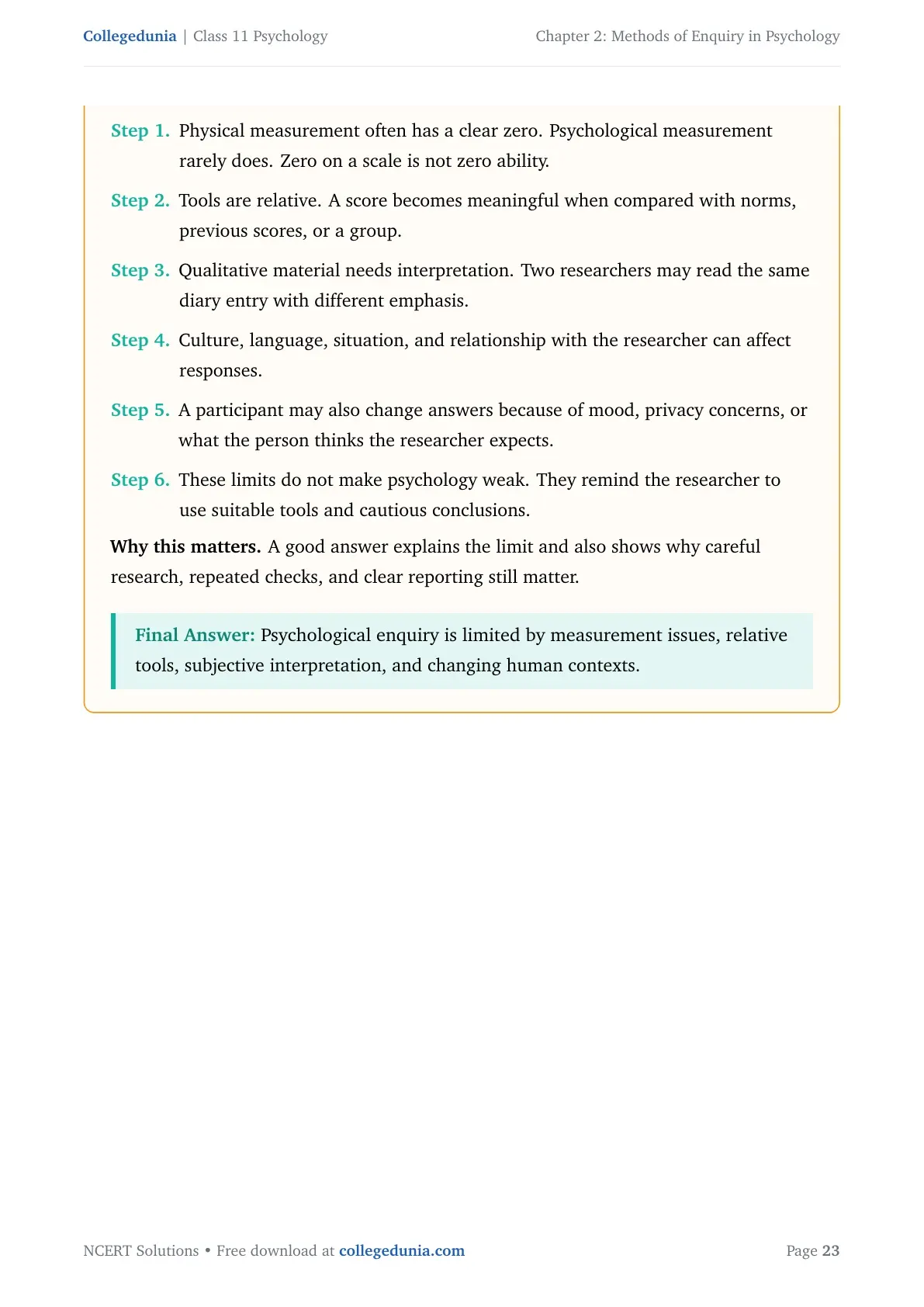
Physical measurement often has a clear zero. Psychological measurement rarely does. Zero on a scale is not zero ability.
Tools are relative. A score becomes meaningful when compared with norms, previous scores, or a group.
Qualitative material needs interpretation. Two researchers may read the same diary entry with different emphasis.
Culture, language, situation, and relationship with the researcher can affect responses.
A participant may also change answers because of mood, privacy concerns, or what the person thinks the researcher expects.
These limits do not make psychology weak. They remind the researcher to use suitable tools and cautious conclusions.
Why this matters. A good answer explains the limit and also shows why careful research, repeated checks, and clear reporting still matter.
Psychological enquiry is limited by measurement issues, relative tools, subjective interpretation, and changing human contexts.
Q 2.12
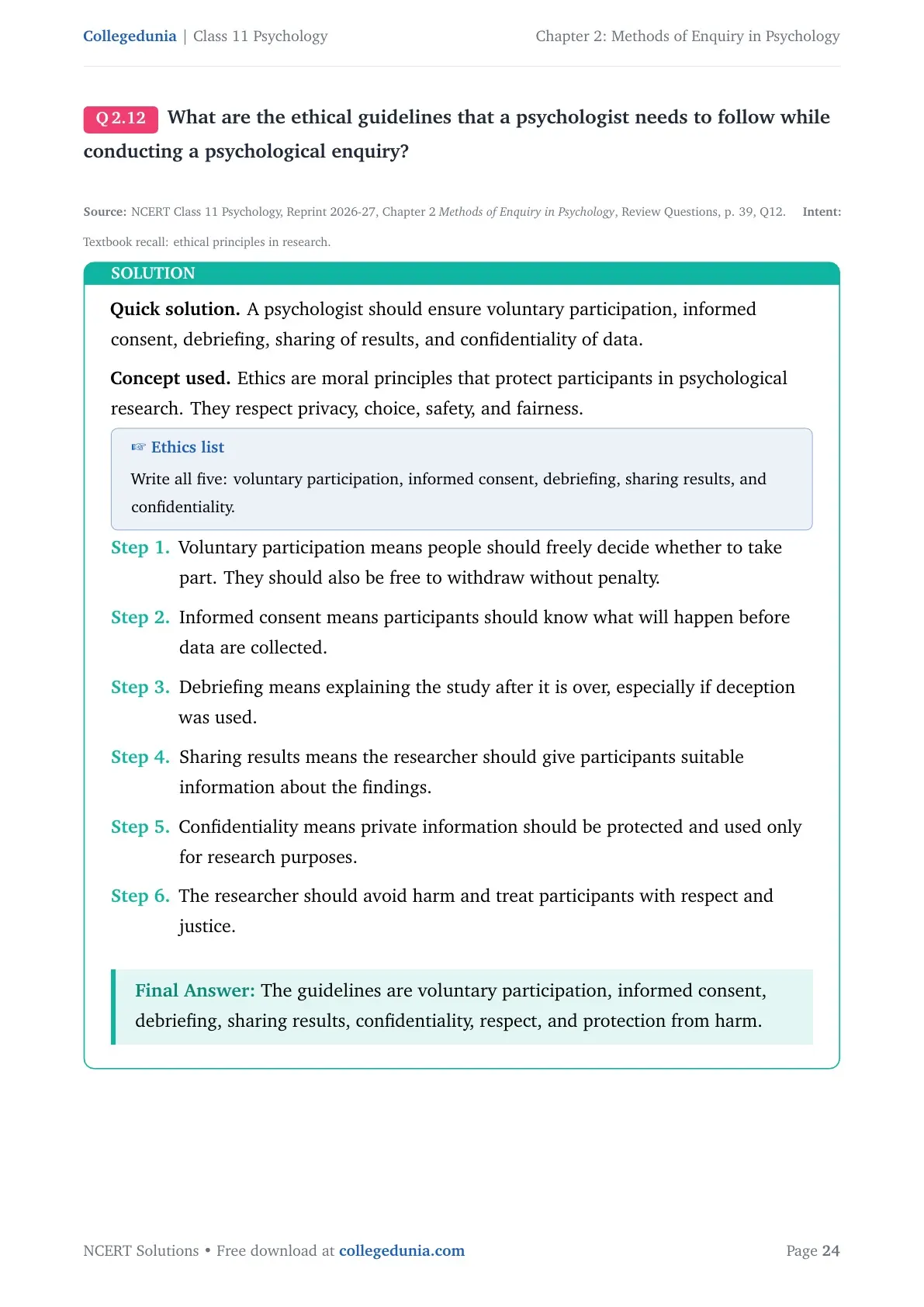
What are the ethical guidelines that a psychologist needs to follow while conducting a psychological enquiry?
A psychologist should ensure voluntary participation, informed consent, debriefing, sharing of results, and confidentiality of data.
Concept used. Ethics are moral principles that protect participants in psychological research. They respect privacy, choice, safety, and fairness.
Ethics list
Write all five: voluntary participation, informed consent, debriefing, sharing results, and confidentiality.
Voluntary participation means people should freely decide whether to take part. They should also be free to withdraw without penalty.
Informed consent means participants should know what will happen before data are collected.
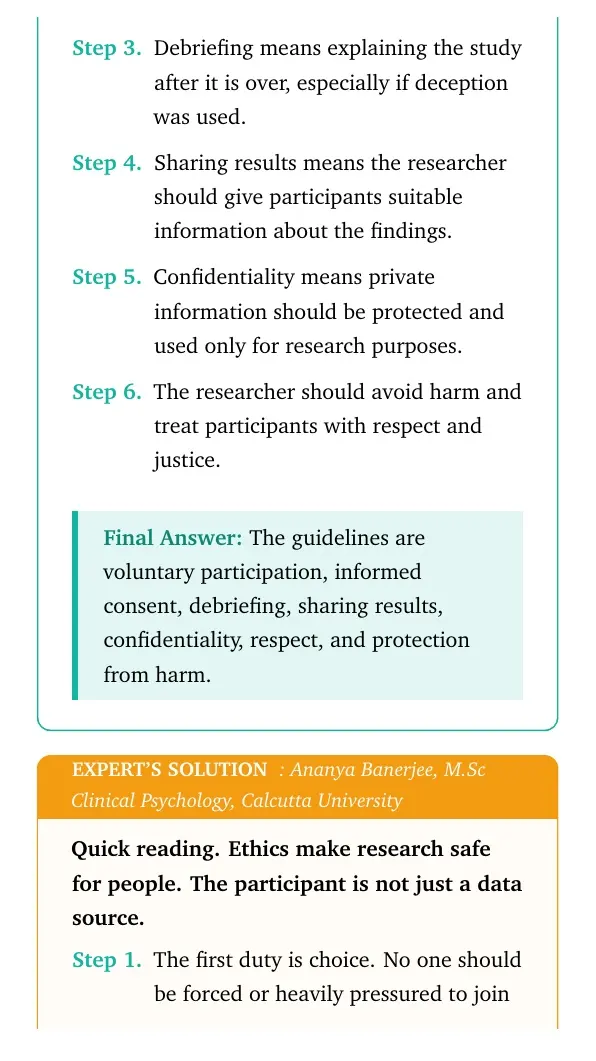
Debriefing means explaining the study after it is over, especially if deception was used.
Sharing results means the researcher should give participants suitable information about the findings.
Confidentiality means private information should be protected and used only for research purposes.
The researcher should avoid harm and treat participants with respect and justice.
The guidelines are voluntary participation, informed consent, debriefing, sharing results, confidentiality, respect, and protection from harm.
AB
Ananya Banerjee
M.Sc Clinical Psychology, Calcutta University
Verified Expert
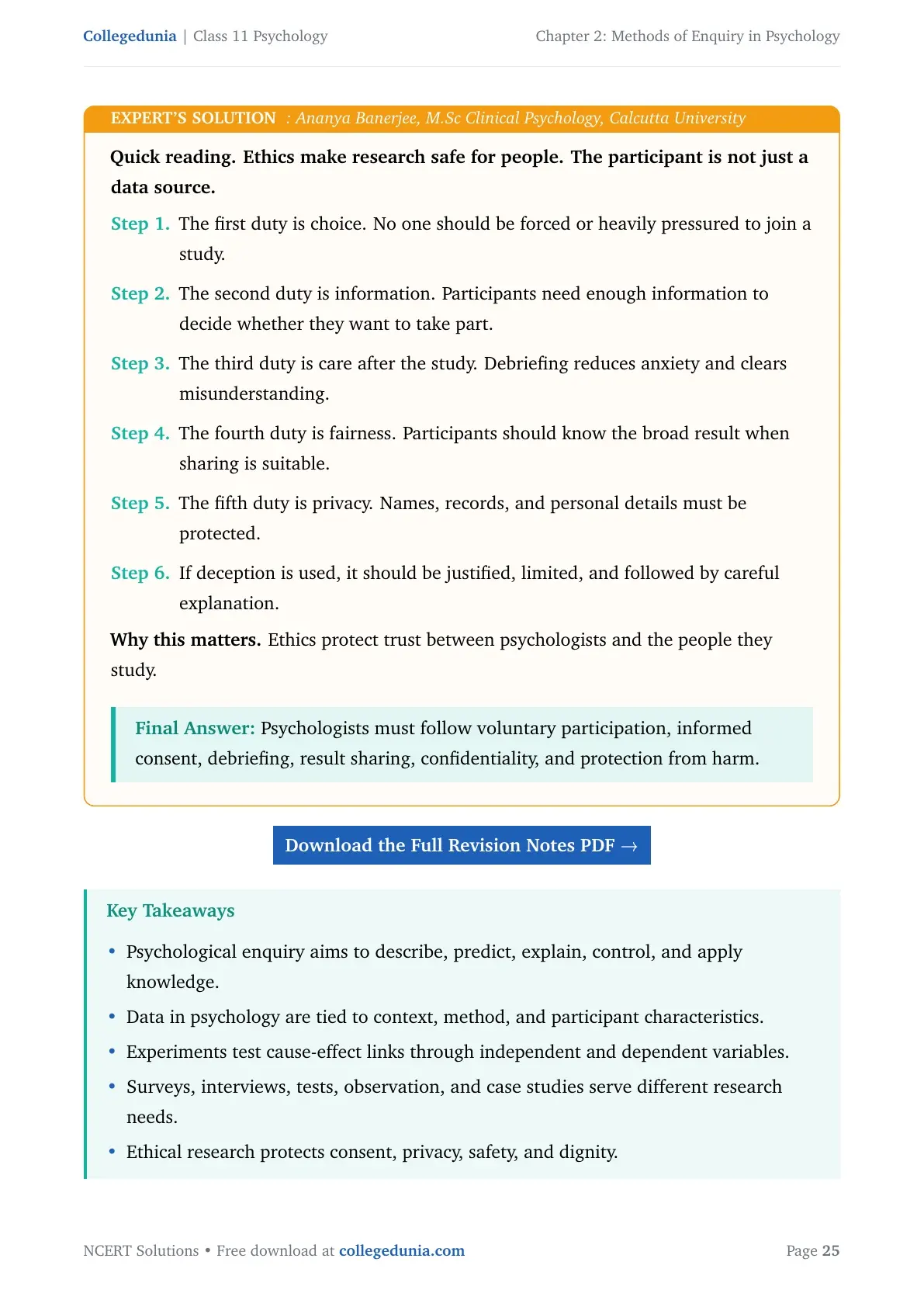
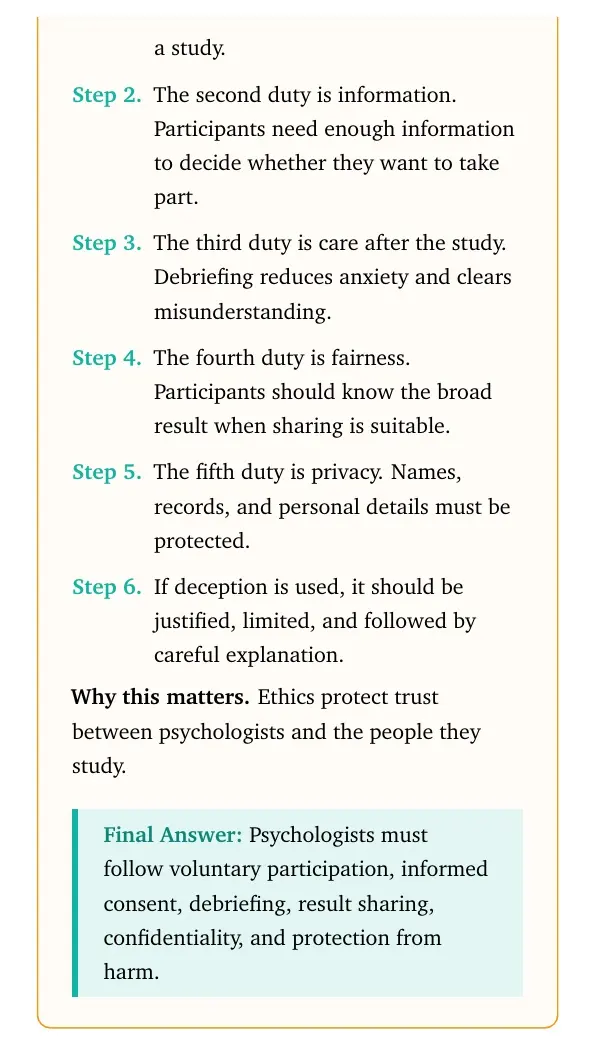
Quick reading. Ethics make research safe for people. The participant is not just a data source.
The first duty is choice. No one should be forced or heavily pressured to join a study.
The second duty is information. Participants need enough information to decide whether they want to take part.
The third duty is care after the study. Debriefing reduces anxiety and clears misunderstanding.
The fourth duty is fairness. Participants should know the broad result when sharing is suitable.
The fifth duty is privacy. Names, records, and personal details must be protected.
If deception is used, it should be justified, limited, and followed by careful explanation.
Why this matters. Ethics protect trust between psychologists and the people they study.
Psychologists must follow voluntary participation, informed consent, debriefing, result sharing, confidentiality, and protection from harm.
Methods of Enquiry in Psychology Class 11 NCERT Solutions FAQs
Ques. How many questions are solved in Class 11 Psychology Chapter 2 Methods of Enquiry in Psychology?
Ans. The chapter has 12 NCERT review questions. This page and the downloadable PDF include a stepwise solution and an expert explanation for each one.
Ques. What are the main goals of psychological enquiry?
Ans. The main goals are description, prediction, explanation, control and application. These goals help psychologists study behaviour and use findings in real life.
Ques. What is the difference between experimental and control group?
Ans. The experimental group receives the independent variable manipulation. The control group is treated similarly but does not receive that manipulation, so it works as the comparison point.
Ques. Which research method is used when behaviour is recorded in a real setting?
Ans. Naturalistic observation is used when behaviour is recorded in a real setting without trying to control or influence it.









Comments