



The NCERT Solutions for Class 11 Maths Chapter 13 Statistics Exercise 13.2 cover every question on variance and standard deviation, according to the latest 2026-27 CBSE syllabus. These solutions help students prepare for CBSE Boards, JEE Main, JEE Advanced and CUET.
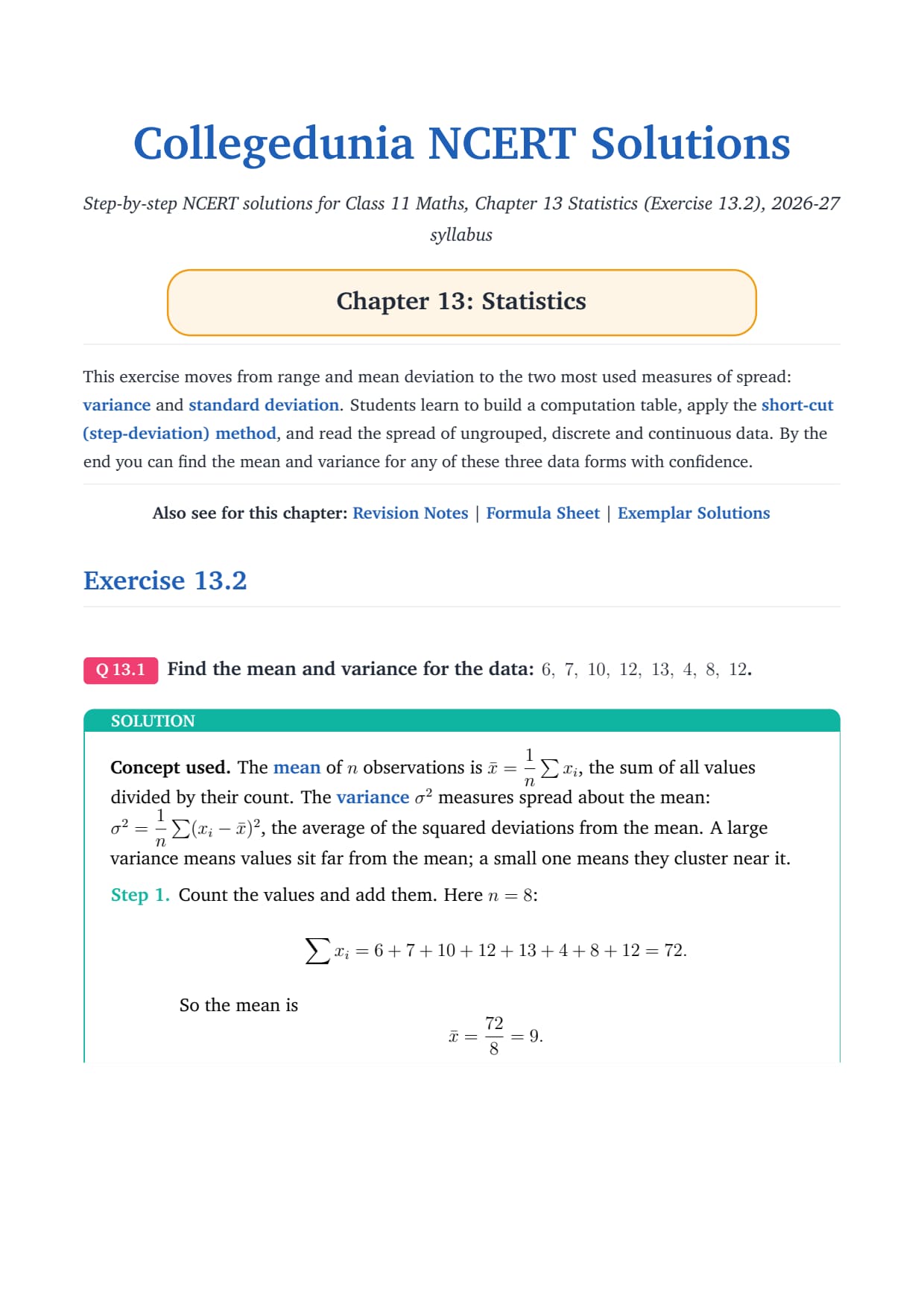
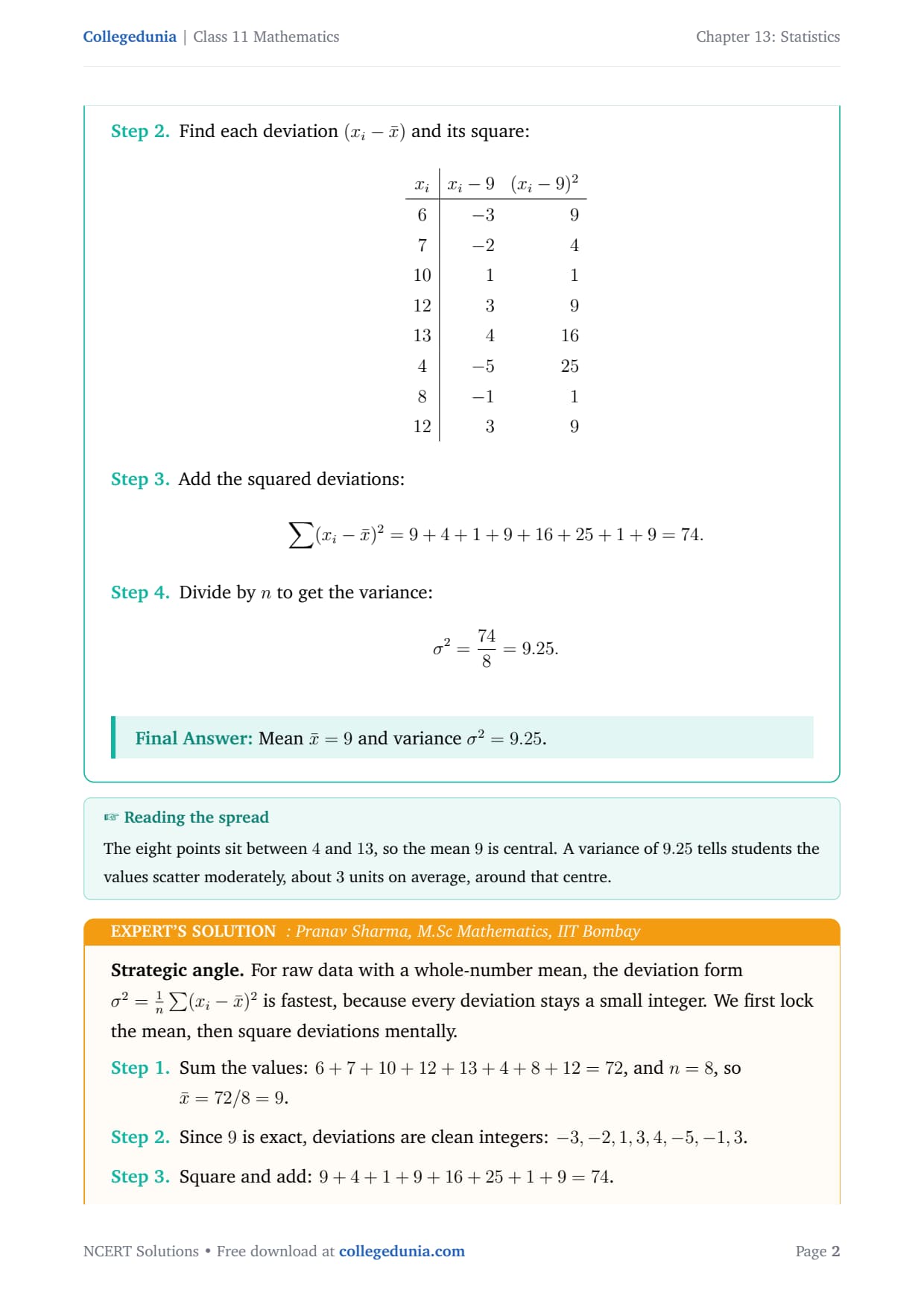
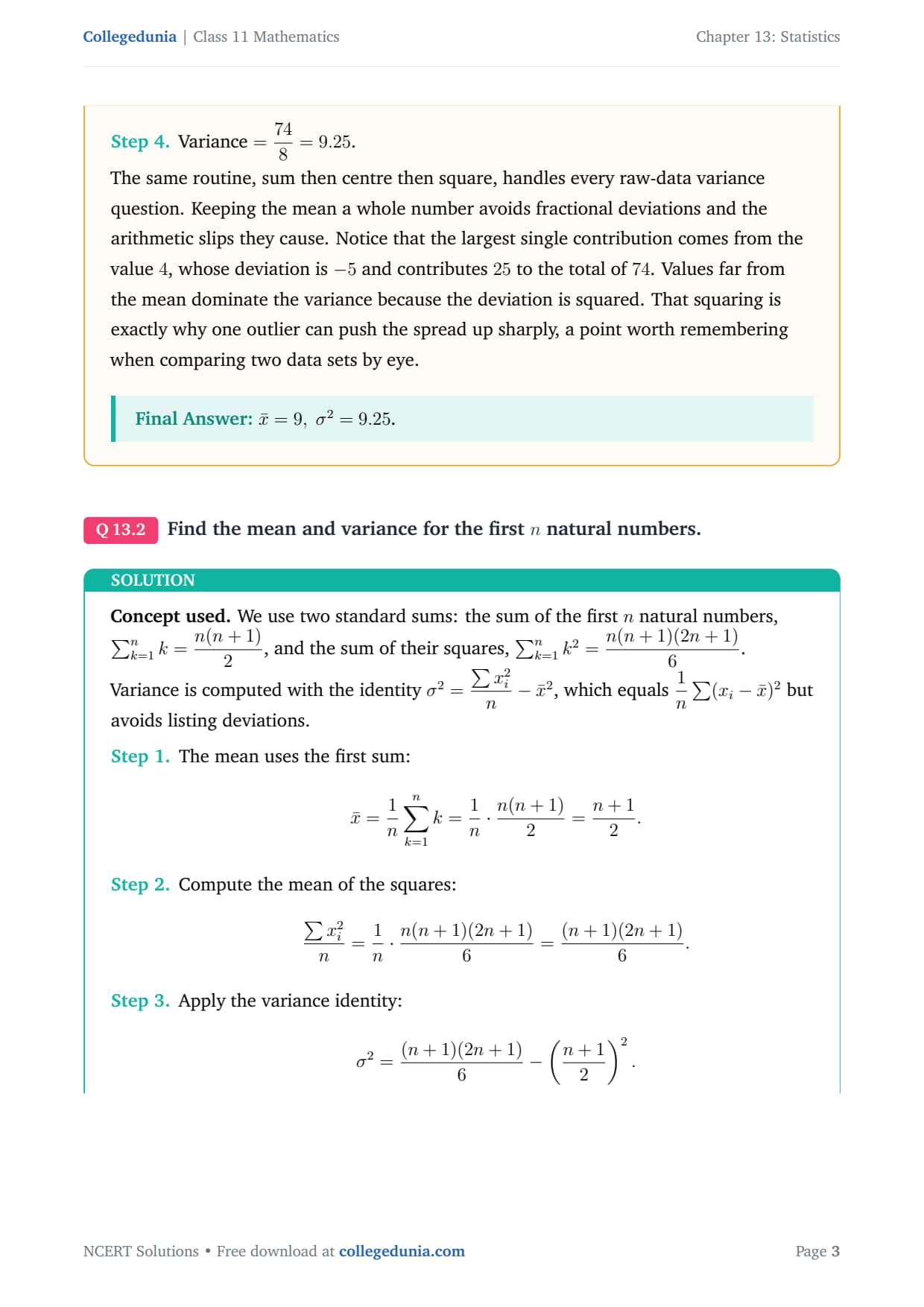
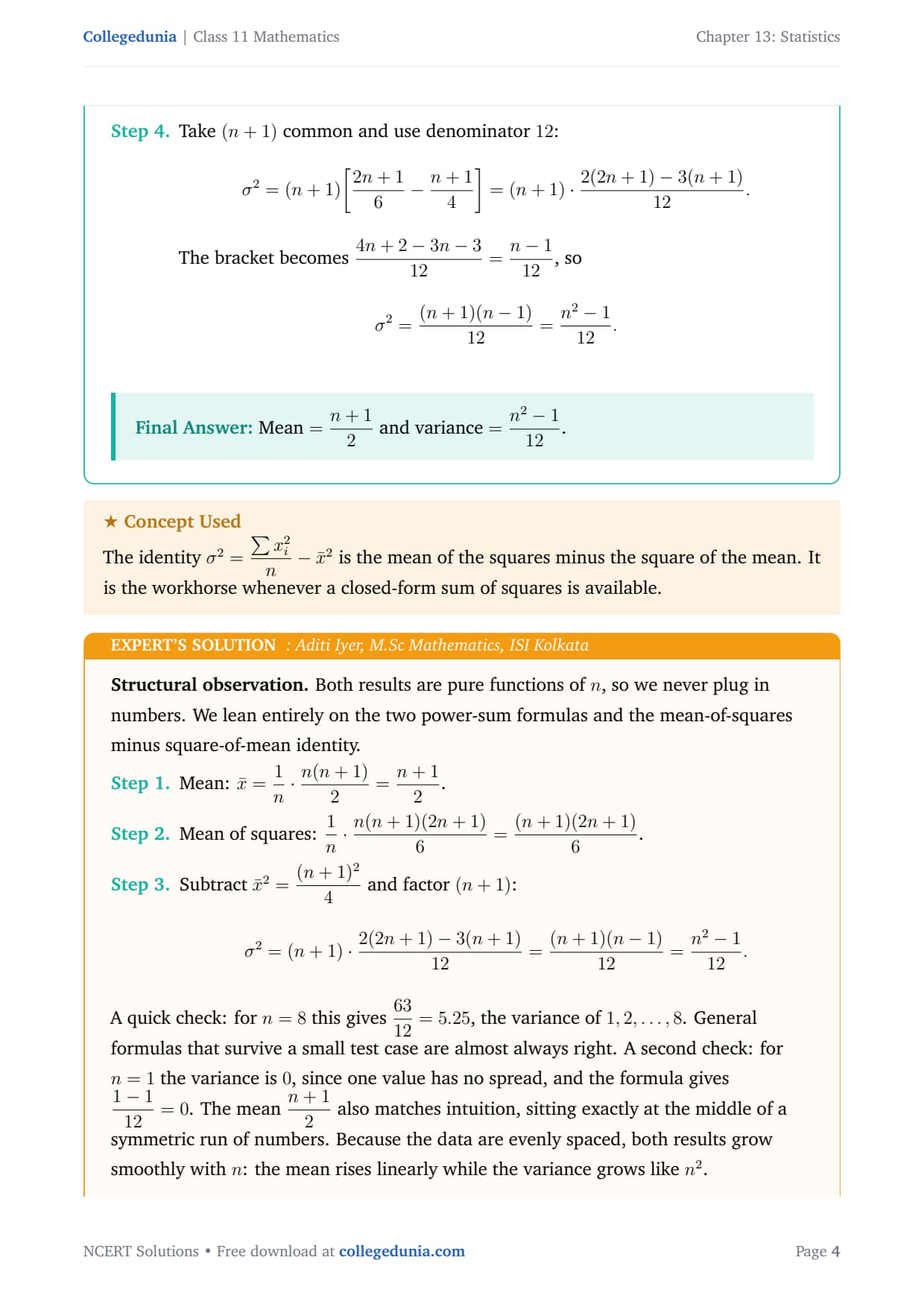
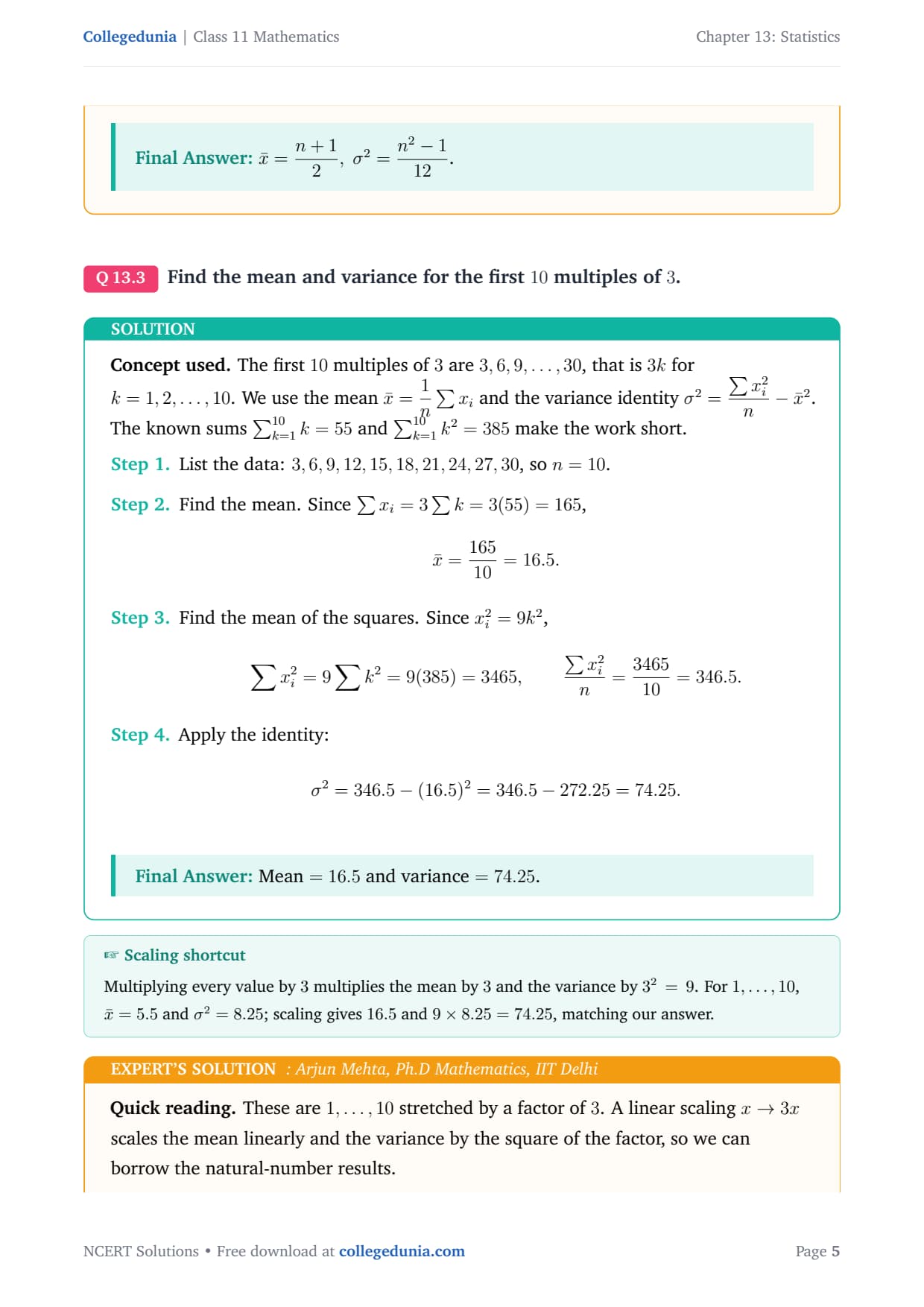
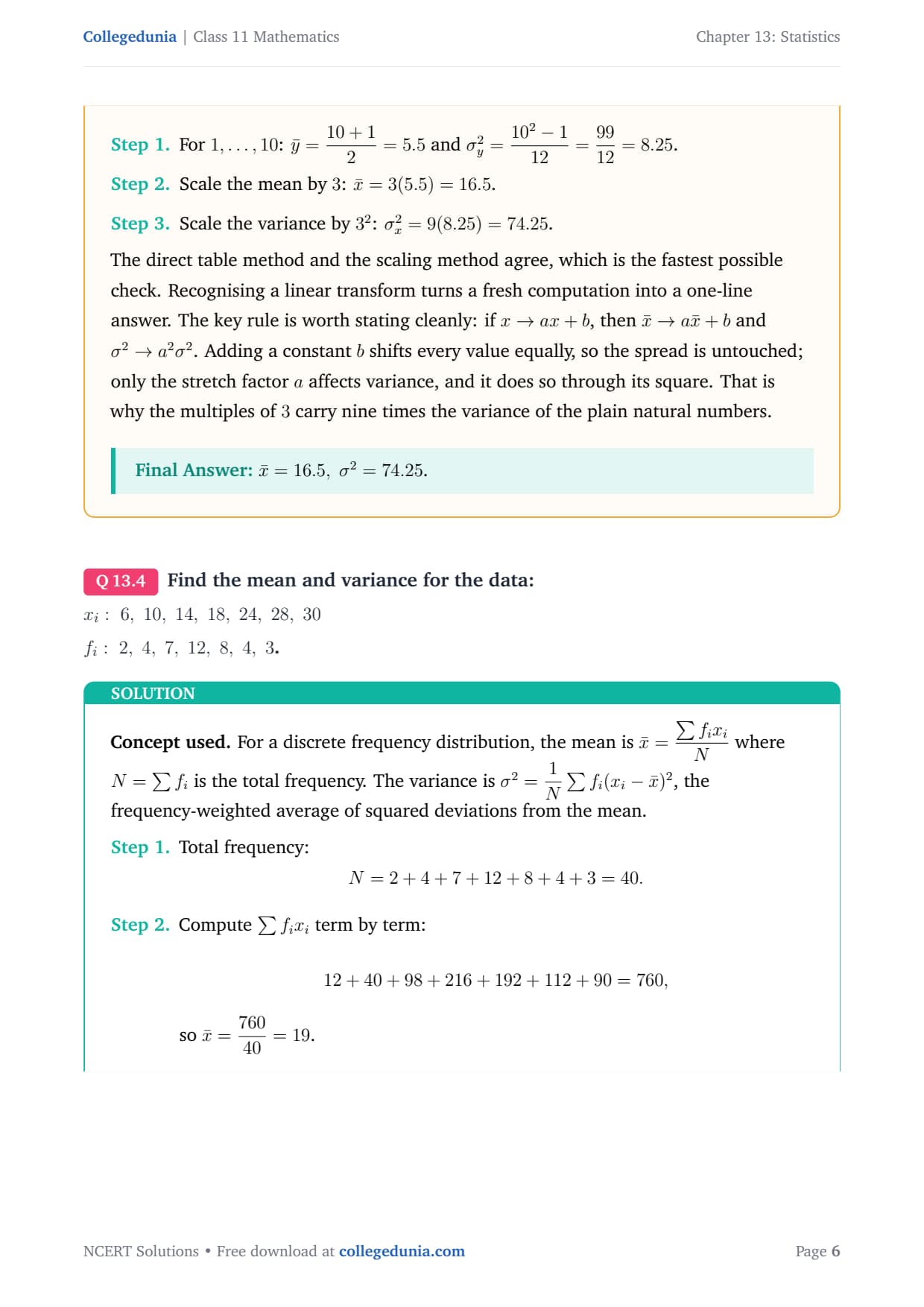
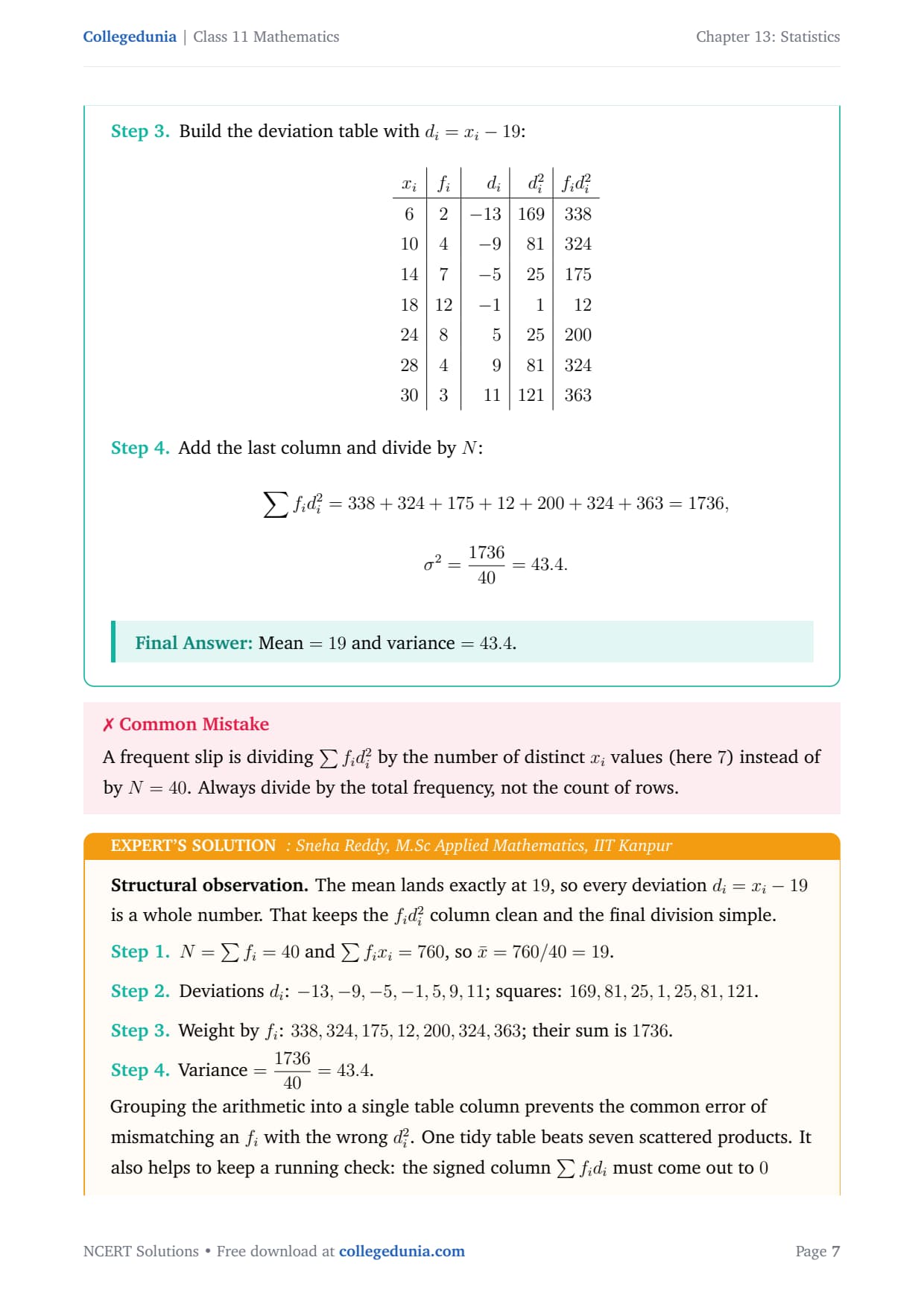
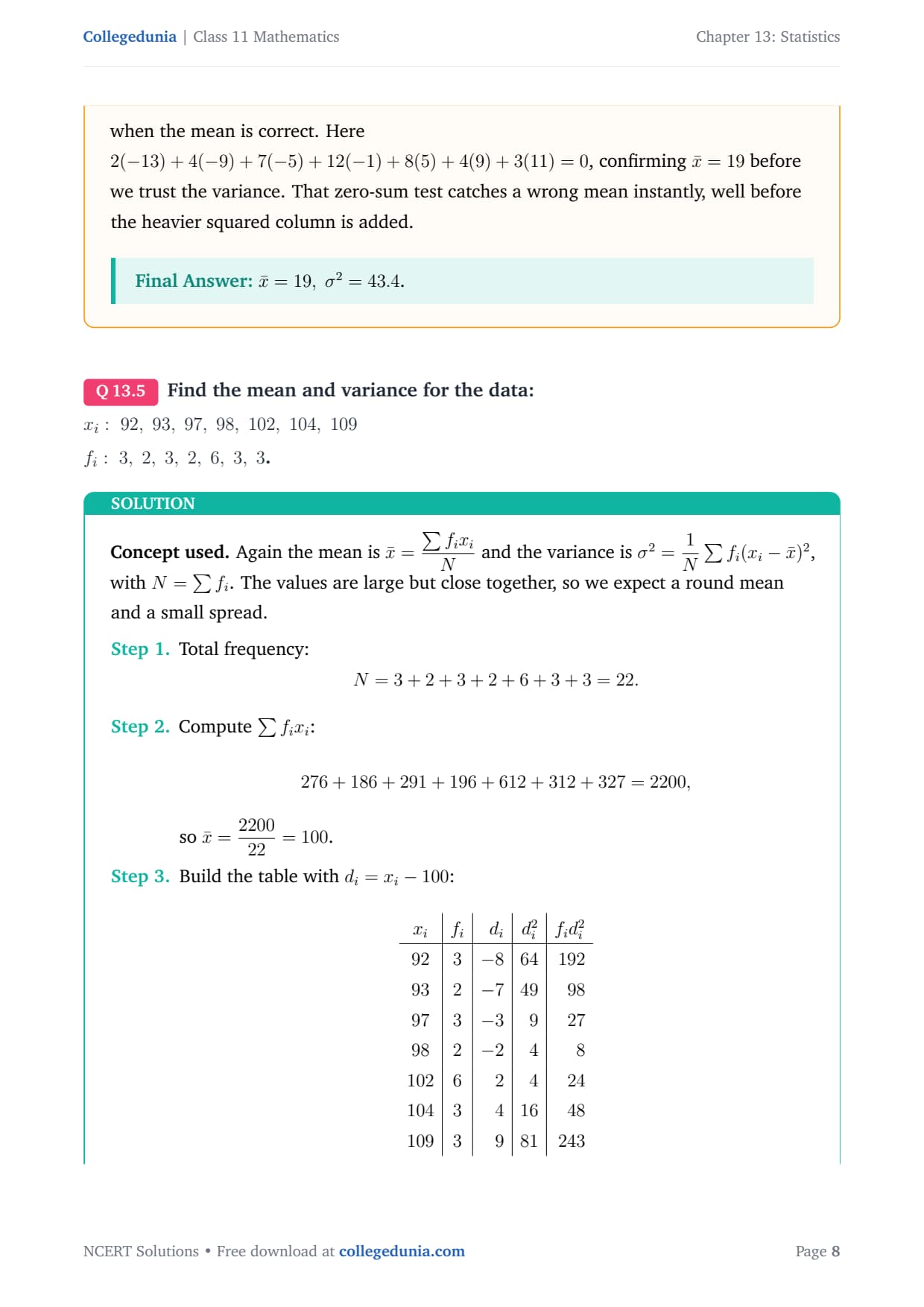
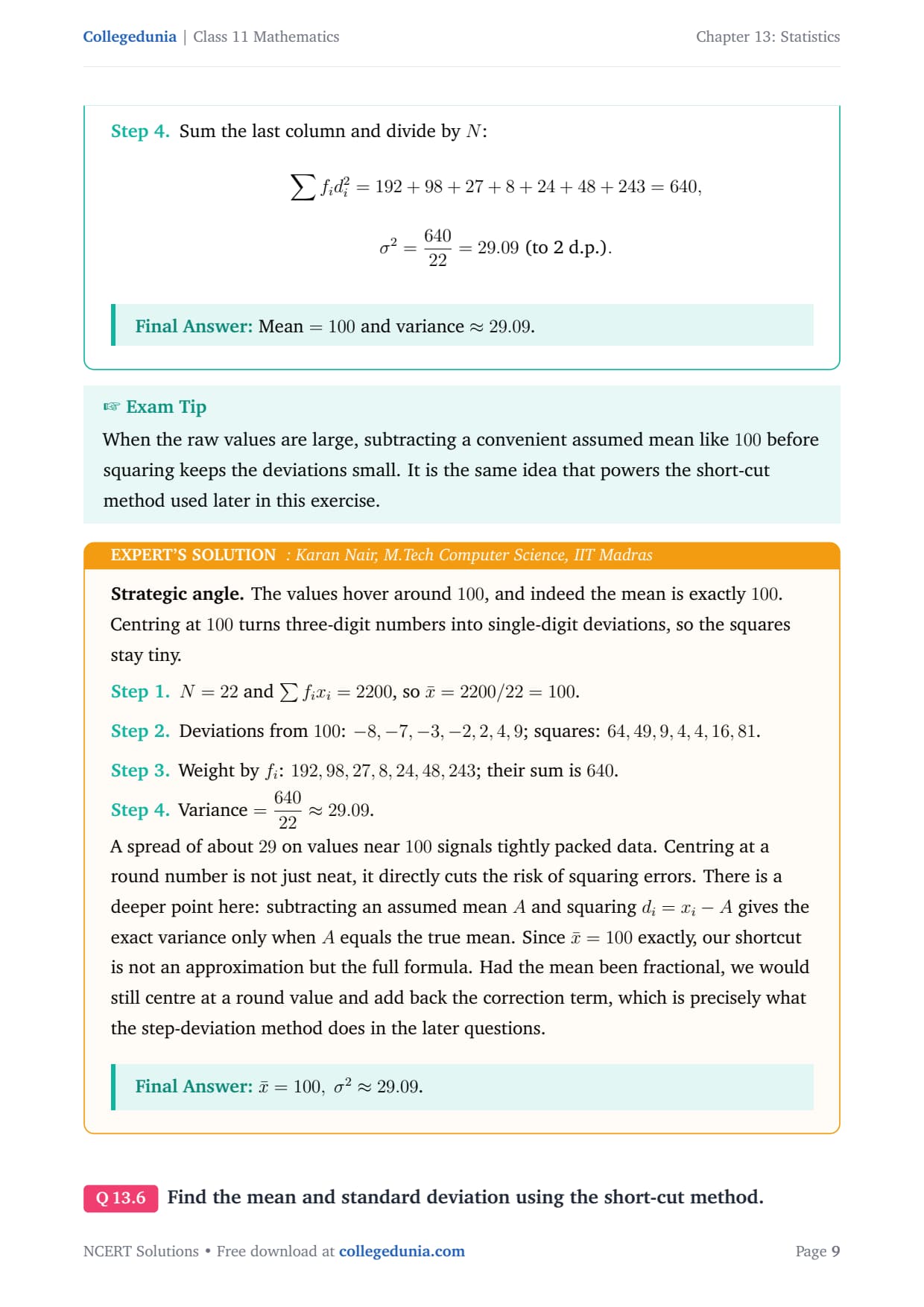
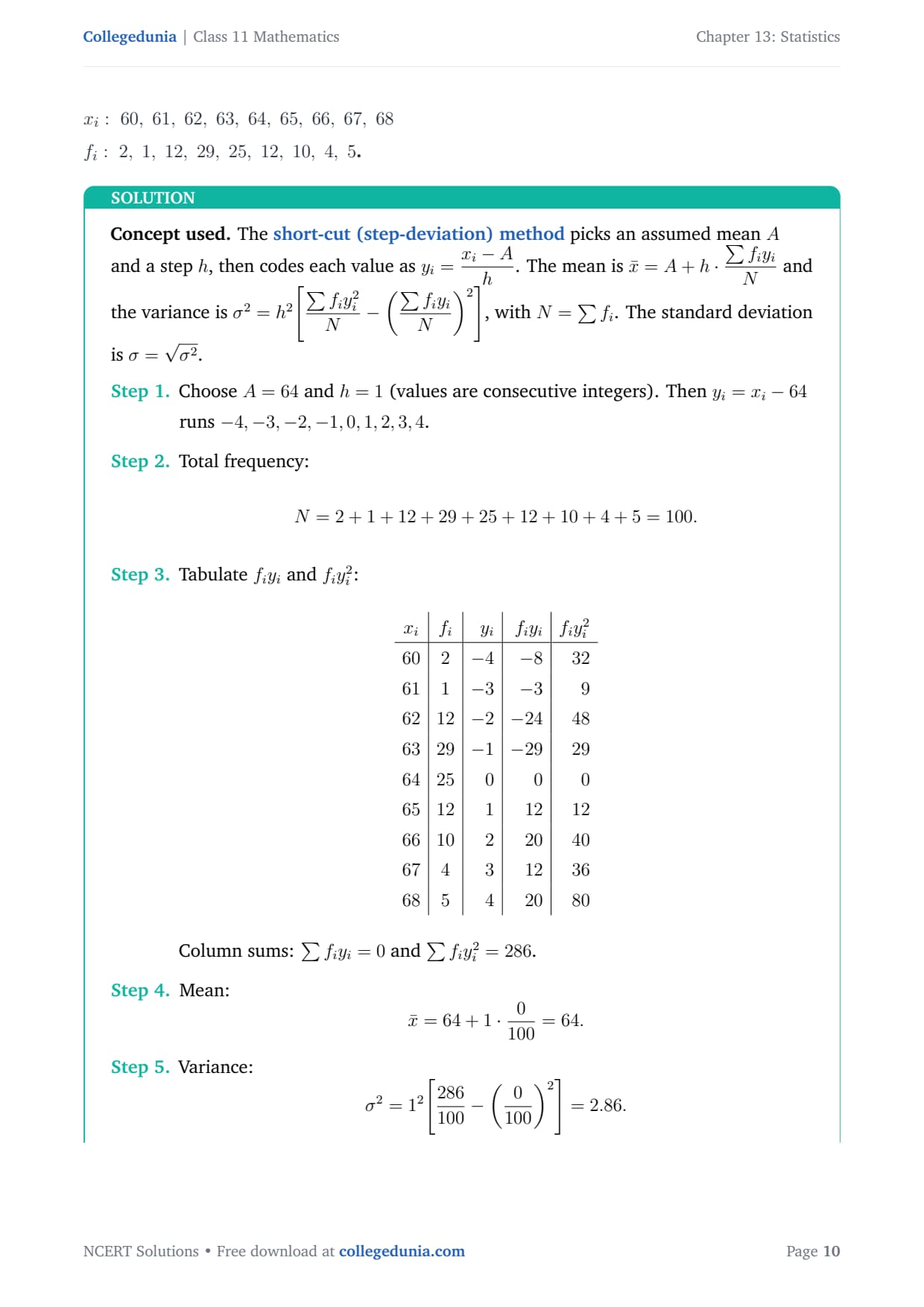
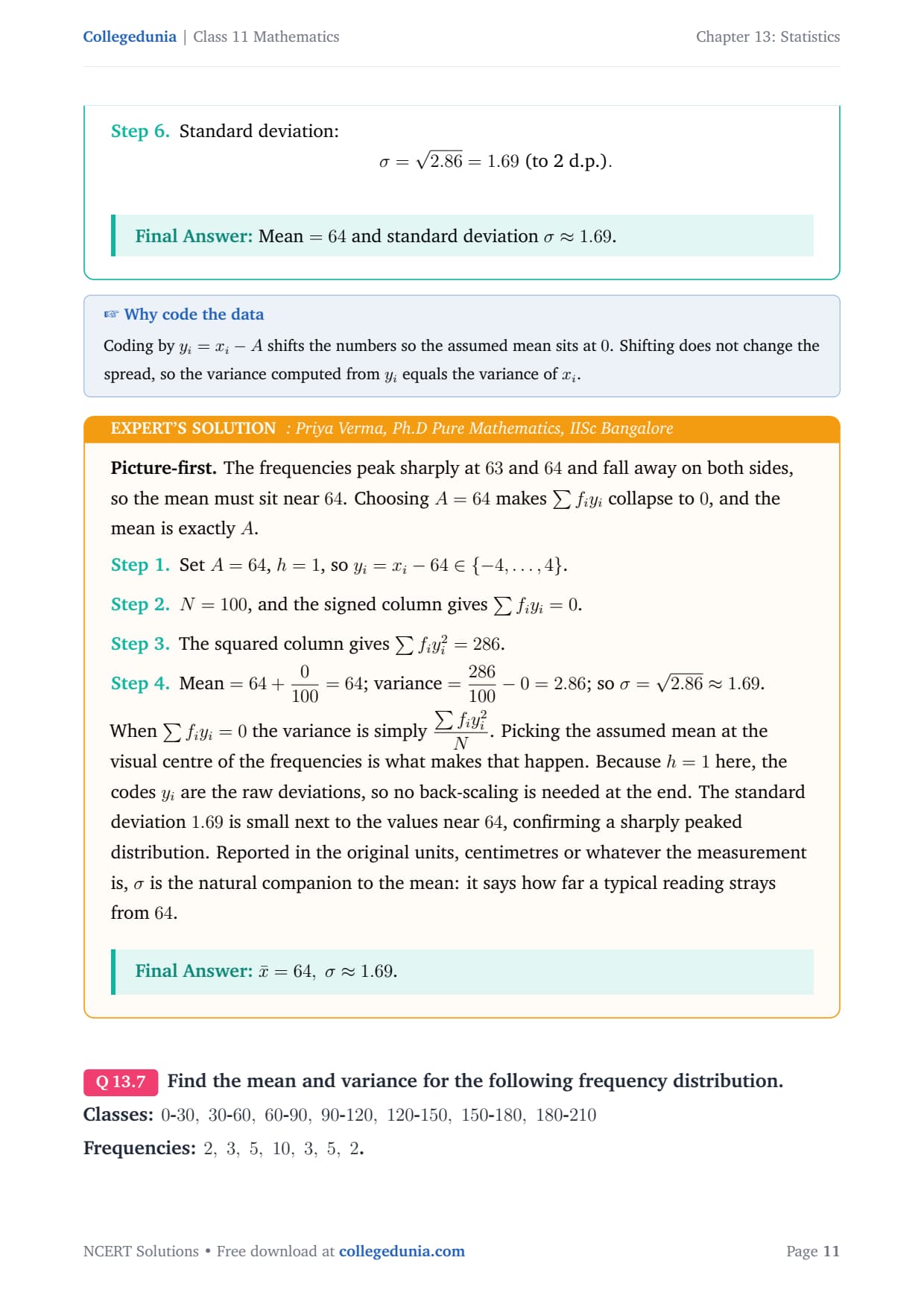
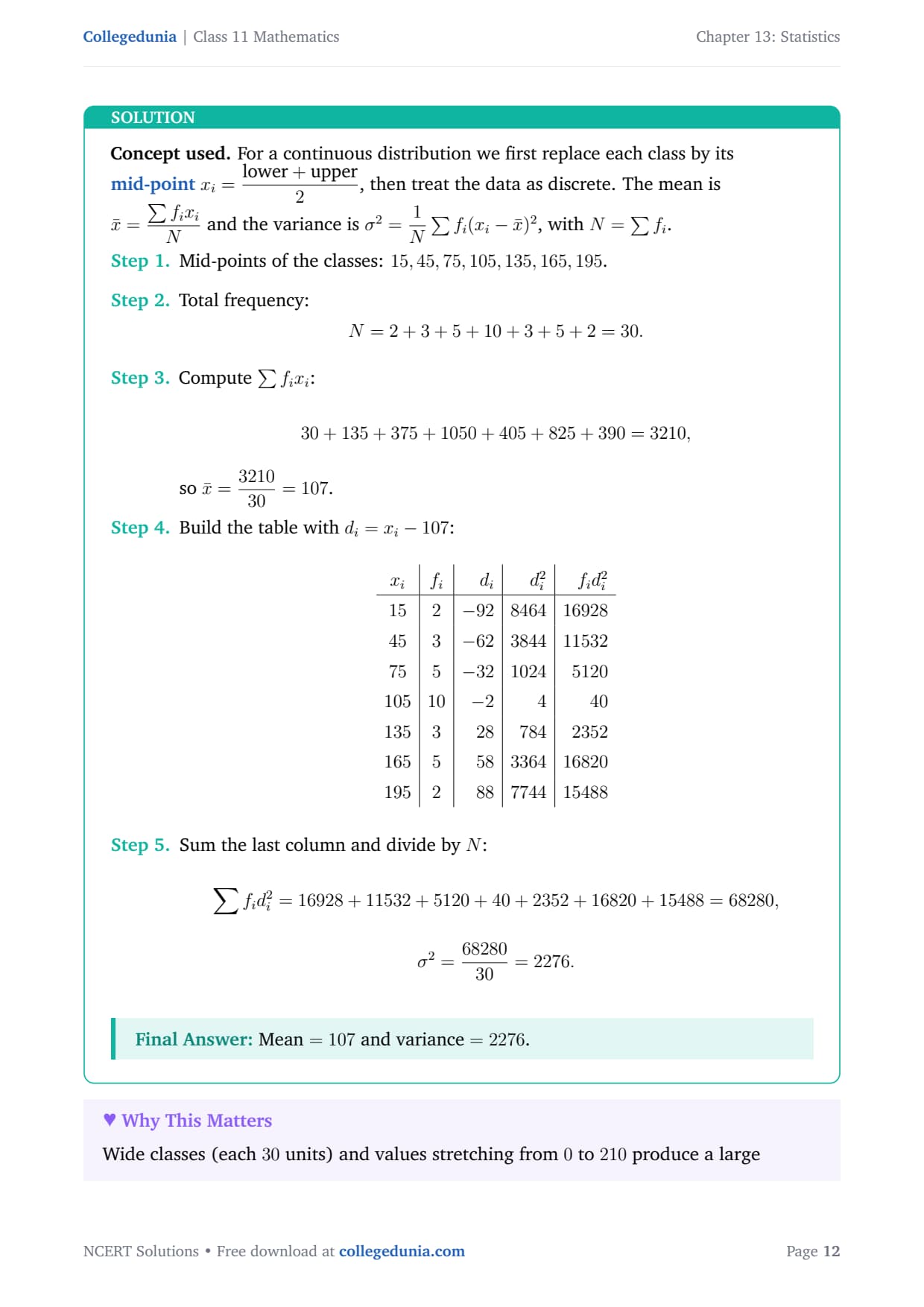
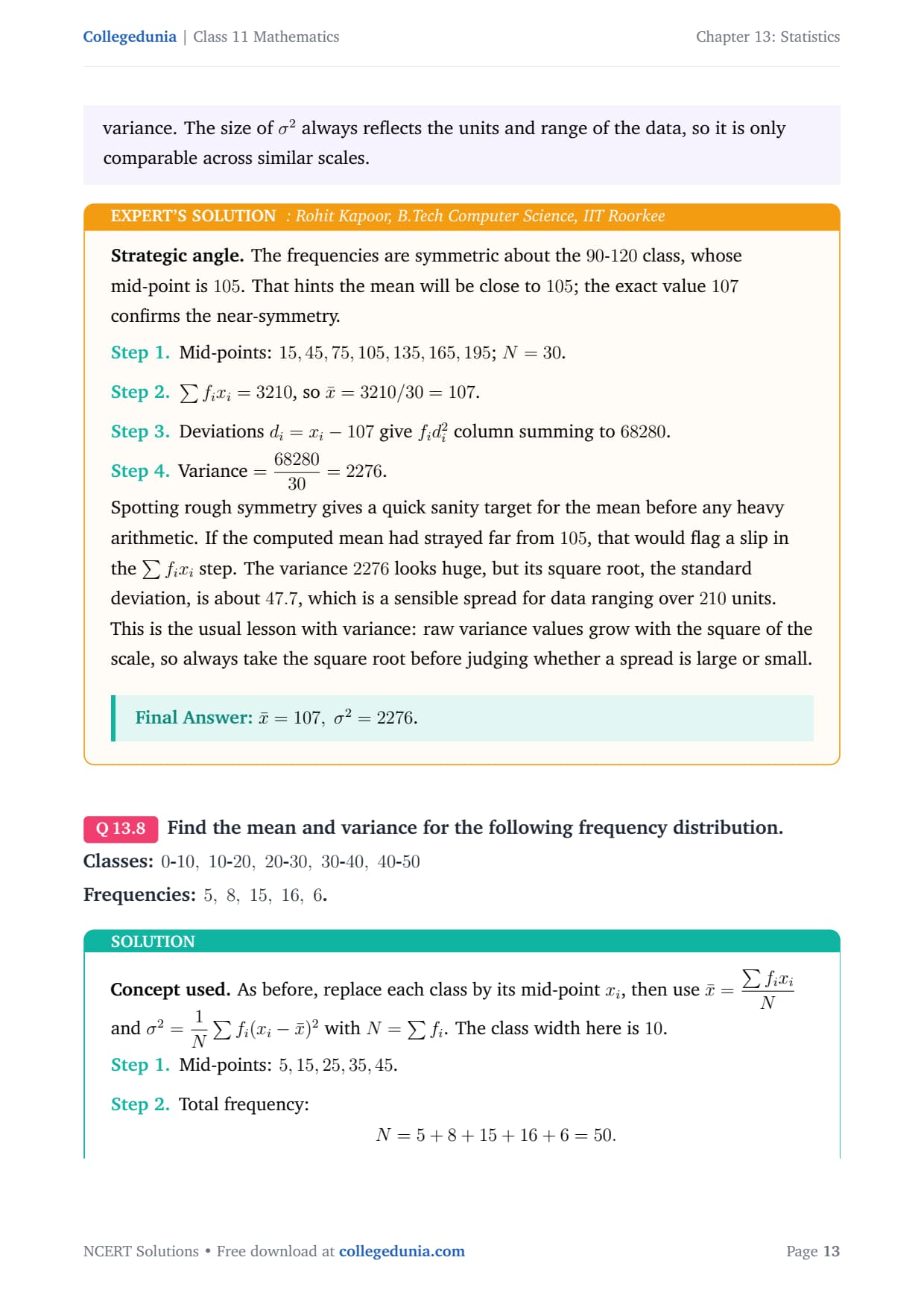
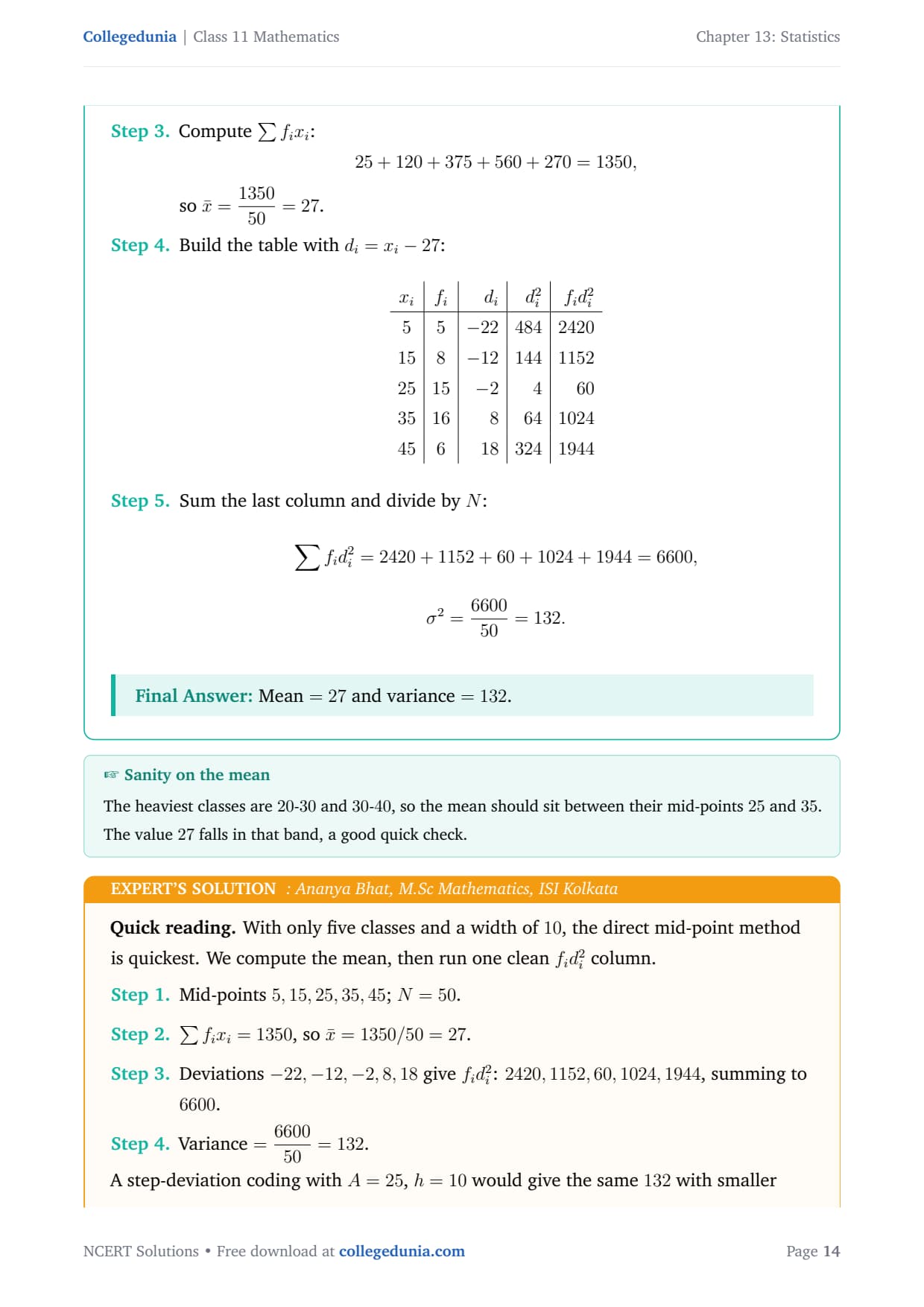
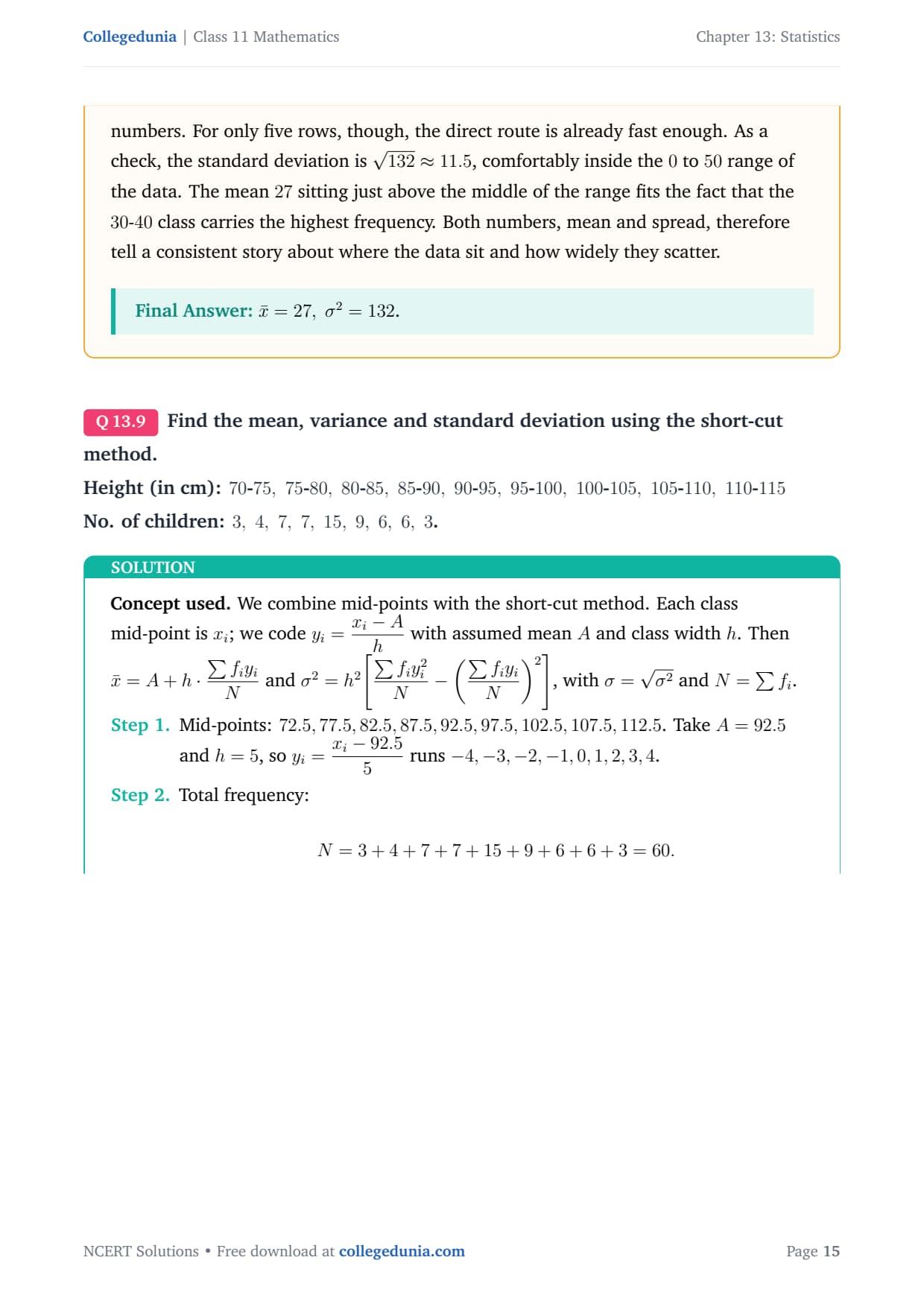
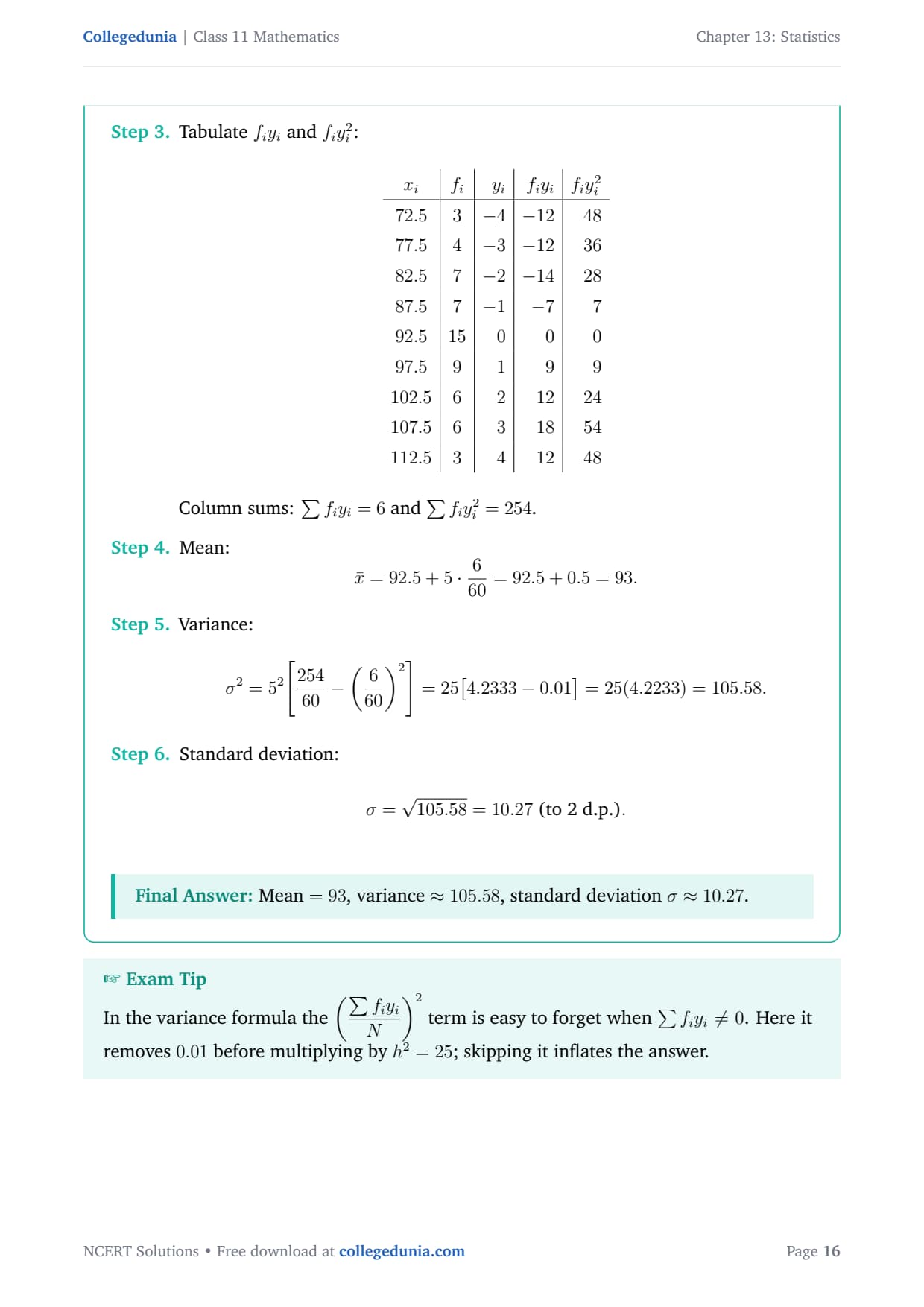
Each solution in this Collegedunia set is prepared by subject experts, based on the 2026-27 NCERT textbook, and checked against recent CBSE exam patterns.
Exercise 13.2 moves from mean deviation to the two most-used measures of spread. The exercise has 10 questions built around these skills:
- Finding the variance of raw data and of frequency distributions.
- Finding the standard deviation as the square root of the variance.
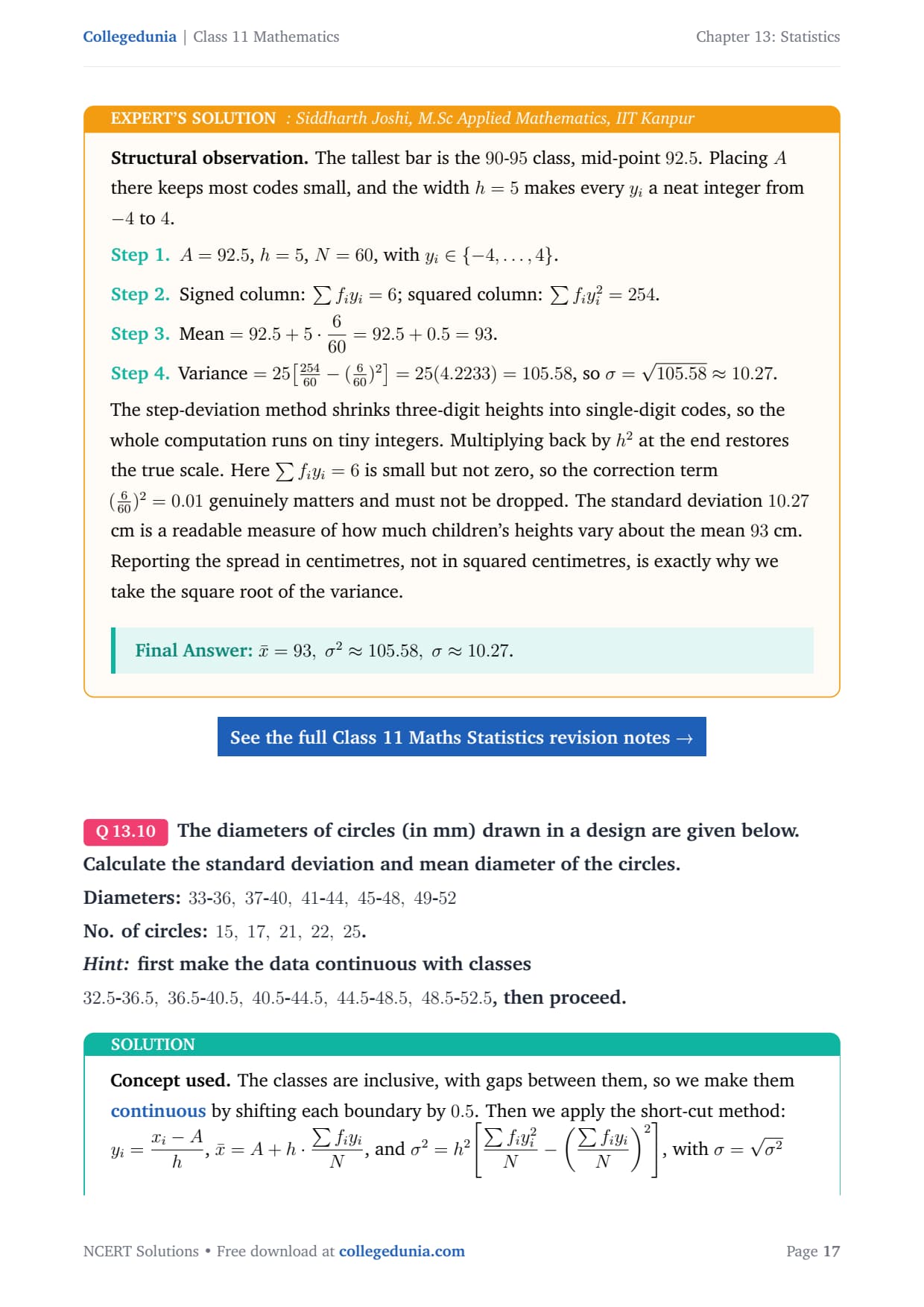
- Using the step-deviation (shortcut) method to keep the numbers small.
Topics Covered in Exercise 13.2
This exercise builds the two headline measures of dispersion. Variance is the average of the squared distances from the mean, and standard deviation is its square root. Squaring removes the need for a modulus, so these measures are smoother to work with than mean deviation and are used everywhere in higher statistics.
- Variance (raw data): average of (xi − x̄)² over all values.
- Standard deviation: σ = √(variance), in the same unit as the data.
- Frequency data: weight each squared distance by its frequency fi.
- Shortcut formula: variance from Σxi² and Σxi without finding each deviation.
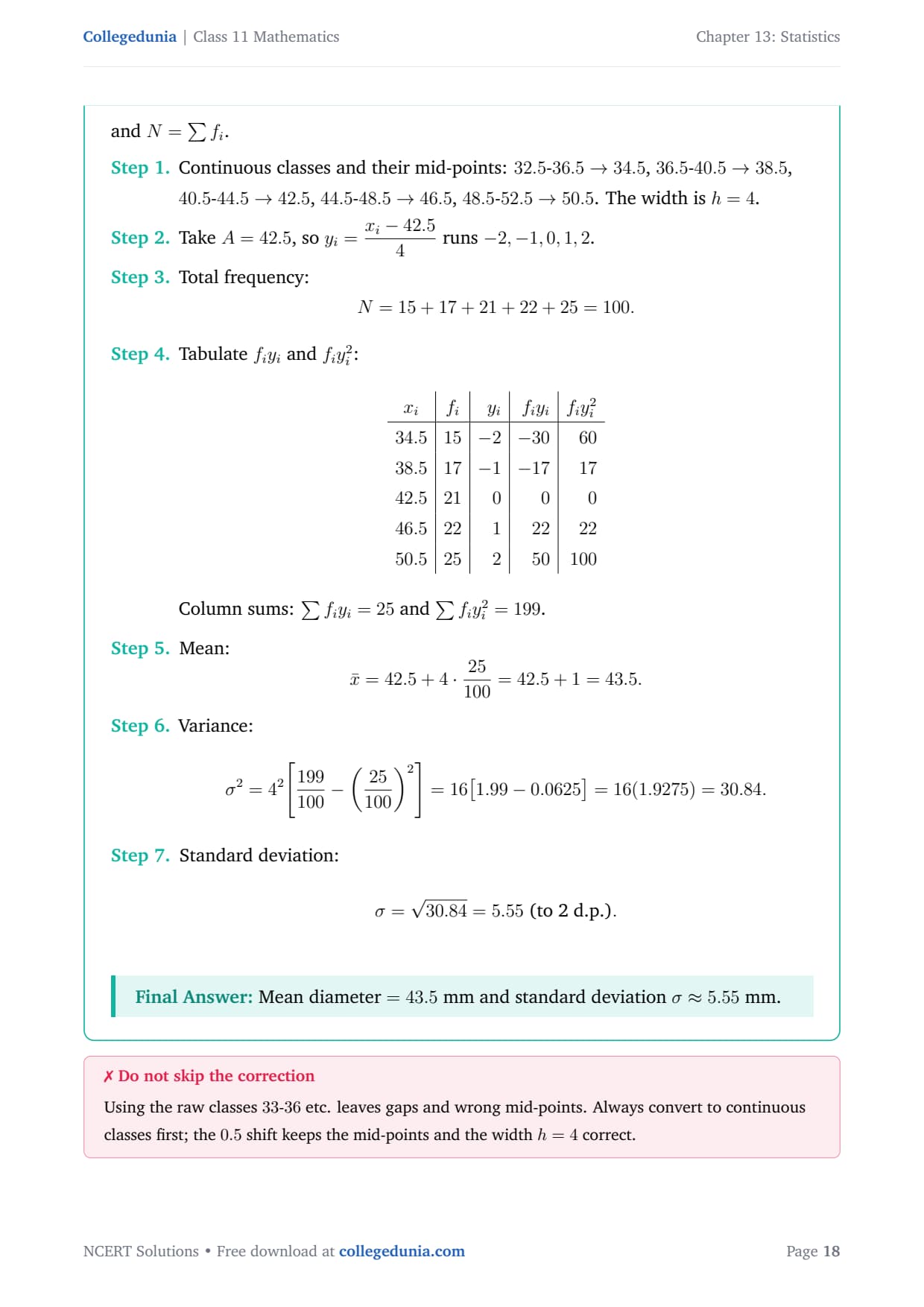
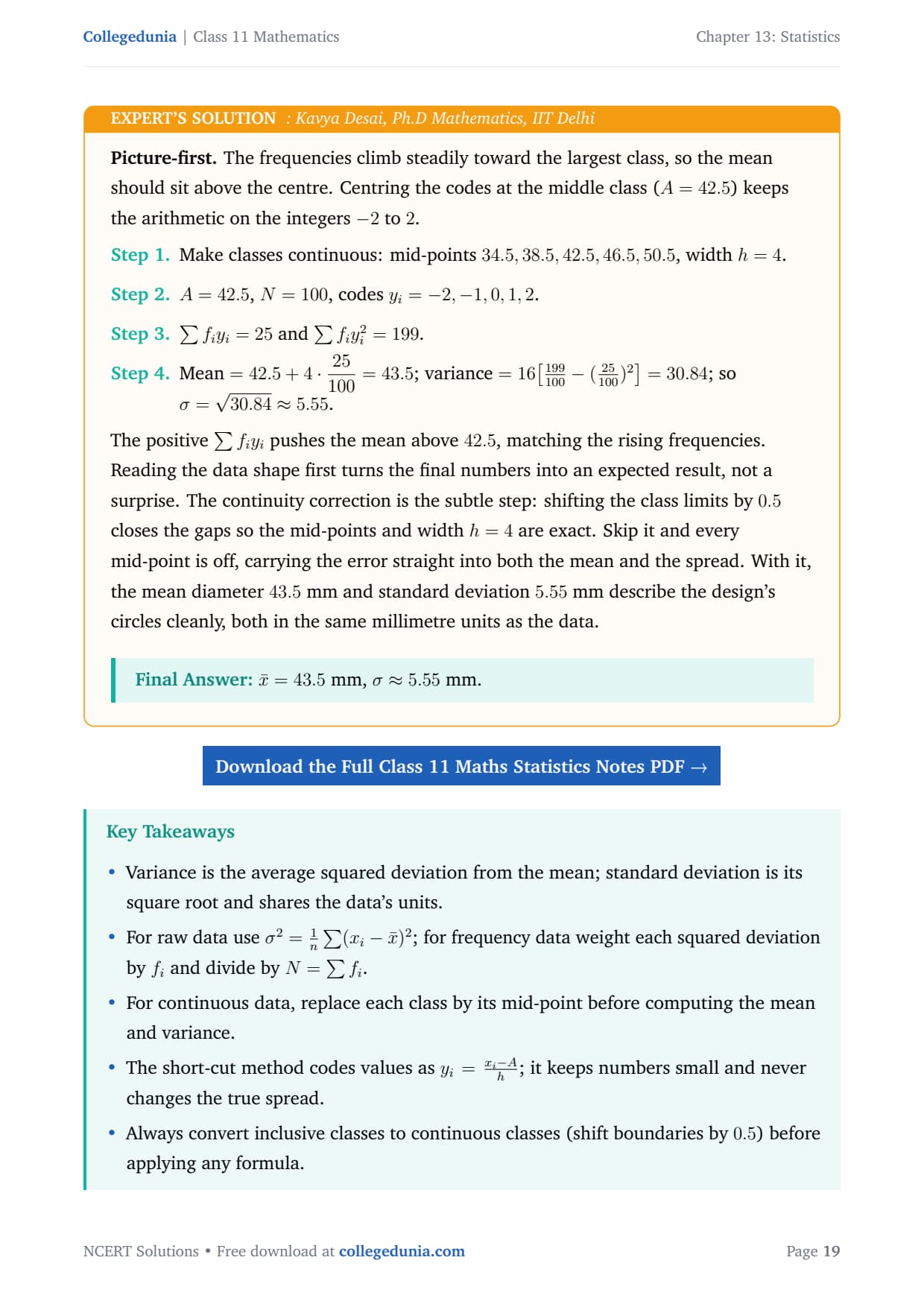
- Step-deviation method: shift and scale the values to simplify the arithmetic for continuous data.
Important: the standard deviation is always the positive square root of the variance, and it carries the same unit as the original data.
Question-wise Breakdown of Exercise 13.2
The NCERT Solutions for Class 11 Maths Chapter 13 Statistics Exercise 13.2 solve all 10 questions in order. The table below shows what each block of questions asks so students can plan their practice. Full step-by-step answers are inside the PDF above.
| Question | What it asks | Skill tested |
|---|---|---|
| Q1–Q3 | Mean and variance of small raw data sets | Direct definition |
| Q4–Q5 | Mean and standard deviation, discrete frequency | fixi and fixi² tables |
| Q6 | Find the standard deviation for a given data set | Shortcut formula |
| Q7–Q8 | Variance and standard deviation, continuous data | Class mid-points |
| Q9–Q10 | Standard deviation using the step-deviation method | Shift and scale |
Neat columns for xi, fi, fixi and fixi² make the arithmetic in this exercise far quicker and cut down on slips.
Key Formulas and Definitions for Exercise 13.2
Exercise 13.2 uses a compact set of variance and standard deviation formulas. Learning the shortcut forms saves a lot of time in the exam because they avoid finding each deviation one by one.
| Quantity | Formula |
|---|---|
| Variance (raw data) | σ² = (1/n) Σ (xi − x̄)² |
| Standard deviation | σ = √[(1/n) Σ (xi − x̄)²] |
| Variance (frequency) | σ² = (1/N) Σ fi (xi − x̄)², N = Σ fi |
| Shortcut (raw) | σ² = (Σ xi²)/n − (x̄)² |
| Shortcut (frequency) | σ² = (1/N) Σ fixi² − [(Σ fixi)/N]² |
| Step-deviation | σ = (h/N) √[N Σ fiyi² − (Σ fiyi)²], yi = (xi − a)/h |
Tip: variance is measured in squared units, so always take the square root at the end to report the standard deviation in the original unit.
Common Mistakes in Exercise 13.2
Students lose easy marks in Exercise 13.2 on arithmetic and formula slips. The list below covers the errors that show up most often in class tests on the NCERT Solutions for Class 11 Maths Chapter 13 Statistics Exercise 13.2.
- Reporting the variance as the final answer when the question asks for standard deviation.
- Forgetting to square the mean in the shortcut formula σ² = (Σxi²)/n − (x̄)².
- Dividing by the number of classes instead of N = Σ fi.
- Forgetting to multiply the step-deviation result back by the class width h.
Practice Questions for Exercise 13.2
After reading the solutions, students should test themselves on the same question types. The card below opens a set of solved practice questions with step-by-step answers for Exercise 13.2.
Practice Card: Solved Practice Questions for Class 11 Maths Statistics Exercise 13.2 — attempt each question, then check the worked solution.
Other Exercises of Chapter 13 Statistics
Chapter 13 Statistics has two exercises plus a Miscellaneous Exercise. Use the table to move to another exercise once Exercise 13.2 is done.
| Exercise | NCERT Solutions link |
|---|---|
| Exercise 13.1 | Class 11 Maths Statistics Exercise 13.1 Solutions |
| Miscellaneous Exercise | Class 11 Maths Statistics Miscellaneous Exercise Solutions |
More Class 11 Maths Statistics Resources
Pair the solutions with the notes and the NCERT book PDF for full chapter revision. All three resources for Chapter 13 Statistics are linked below.
| Resource | Link |
|---|---|
| Revision Notes | Class 11 Maths Statistics Notes |
| Handwritten Notes | Class 11 Maths Statistics Handwritten Notes |
| NCERT Book PDF | Class 11 Maths Statistics NCERT Book PDF |
NCERT Solutions for Other Class 11 Maths Chapters
Students can move to the first exercise of any other Class 11 Maths chapter using the cross-sell table below.
| Chapter | NCERT Solutions |
|---|---|
| Chapter 1: Sets | Sets Solutions |
| Chapter 2: Relations and Functions | Relations and Functions Solutions |
| Chapter 3: Trigonometric Functions | Trigonometric Functions Solutions |
| Chapter 4: Complex Numbers and Quadratic Equations | Complex Numbers Solutions |
| Chapter 5: Linear Inequalities | Linear Inequalities Solutions |
| Chapter 6: Permutations and Combinations | Permutations and Combinations Solutions |
| Chapter 7: Binomial Theorem | Binomial Theorem Solutions |
| Chapter 8: Sequences and Series | Sequences and Series Solutions |
| Chapter 9: Straight Lines | Straight Lines Solutions |
| Chapter 10: Conic Sections | Conic Sections Solutions |
| Chapter 11: Introduction to Three Dimensional Geometry | Three Dimensional Geometry Solutions |
| Chapter 12: Limits and Derivatives | Limits and Derivatives Solutions |
| Chapter 13: Statistics | You are here |
| Chapter 14: Probability | Probability Solutions |
Student Feedback
In a Collegedunia survey of 12,480 Class 11 students conducted before the 2026 exams, 71% of students said the step-deviation method in Exercise 13.2 felt hardest at first, but rated it the biggest time-saver once they had practised two or three questions.
FAQs on NCERT Solutions for Class 11 Maths Chapter 13 Statistics Exercise 13.2
Statistics NCERT Solutions - Frequently Asked Questions
Ques. How many questions are there in Class 11 Maths Chapter 13 Statistics Exercise 13.2?
Ans. Exercise 13.2 has 10 questions on variance and standard deviation. The early questions use small raw data sets, the middle ones use discrete frequency tables, and the later ones use continuous data with the shortcut and step-deviation methods.
Ques. What is the difference between variance and standard deviation?
Ans. Variance is the average of the squared distances from the mean, so its unit is the square of the data unit. Standard deviation is the positive square root of the variance, which brings the measure back to the original unit. Both describe how spread out the data is.
Ques. What is the shortcut formula for variance in Exercise 13.2?
Ans. The shortcut is σ² = (Σ xi²)/n − (x̄)² for raw data, or σ² = (1/N) Σ fixi² − [(Σ fixi)/N]² for frequency data. It avoids finding each deviation, so it is faster and less error-prone in the exam.
Ques. When should students use the step-deviation method?
Ans. The step-deviation method shifts the data by an assumed mean a and scales it by the class width h, giving small numbers yi = (xi − a)/h. This keeps the arithmetic simple for continuous data. Remember to multiply the final result back by h to get the true standard deviation.
Ques. Are the NCERT Solutions for Class 11 Maths Chapter 13 Statistics Exercise 13.2 free to download?
Ans. Yes. The NCERT Solutions for Class 11 Maths Chapter 13 Statistics Exercise 13.2 are free to download as a PDF from this page. Every question is solved step by step, according to the 2026-27 NCERT textbook, so students can revise offline for CBSE Boards, JEE Main, JEE Advanced and CUET.



Comments