The NCERT Solutions for Class 11 Geography Chapter 10 Water in the Atmosphere cover all 8 exercise and project-work items from the latest 2026-27 NCERT book. Students can revise humidity, evaporation, condensation, clouds, precipitation and rainfall distribution with direct answers and expert explanations.
Includes every Chapter 10 textbook question in solved PDF and inline question-card format.
Explains key ideas such as relative humidity, dew point, cloud formation and precipitation types.
Useful for school exams because the answers keep definitions, causes and diagrams together.
Student Feedback: In a Collegedunia poll of 10,360 Class 11 Geography students preparing for the 2026-27 school exams, 74% said the chapter became easier when humidity, condensation and precipitation were revised as one connected process.
Source: 2026-27 Class 11 Geography student poll across CBSE schools.
Every answer in this chapter set is checked against the 2026-27 NCERT Geography textbook and written so that students can revise the definition, cause and example together.
Water in the Atmosphere explains how moisture enters air, how it condenses and how it returns to the earth as different forms of precipitation. The solutions PDF follows the NCERT exercise order so that students can move from MCQ terms to longer explanations on clouds, dew, frost and world rainfall distribution.
Chapter area
What students must know
Where it helps
Atmospheric moisture
Humidity, evaporation, transpiration and saturation
Question 1 and Question 3
Relative humidity
Actual moisture compared with full air capacity at the same temperature
Question 3
Condensation
Dew point, dew, frost, fog, mist and clouds
Questions 5 and 7
Precipitation
Rainfall, snowfall, sleet and hailstones
Question 2
Rainfall distribution
Latitudinal pattern, coastal effect, interiors, mountains and rain-shadow areas
Question 6
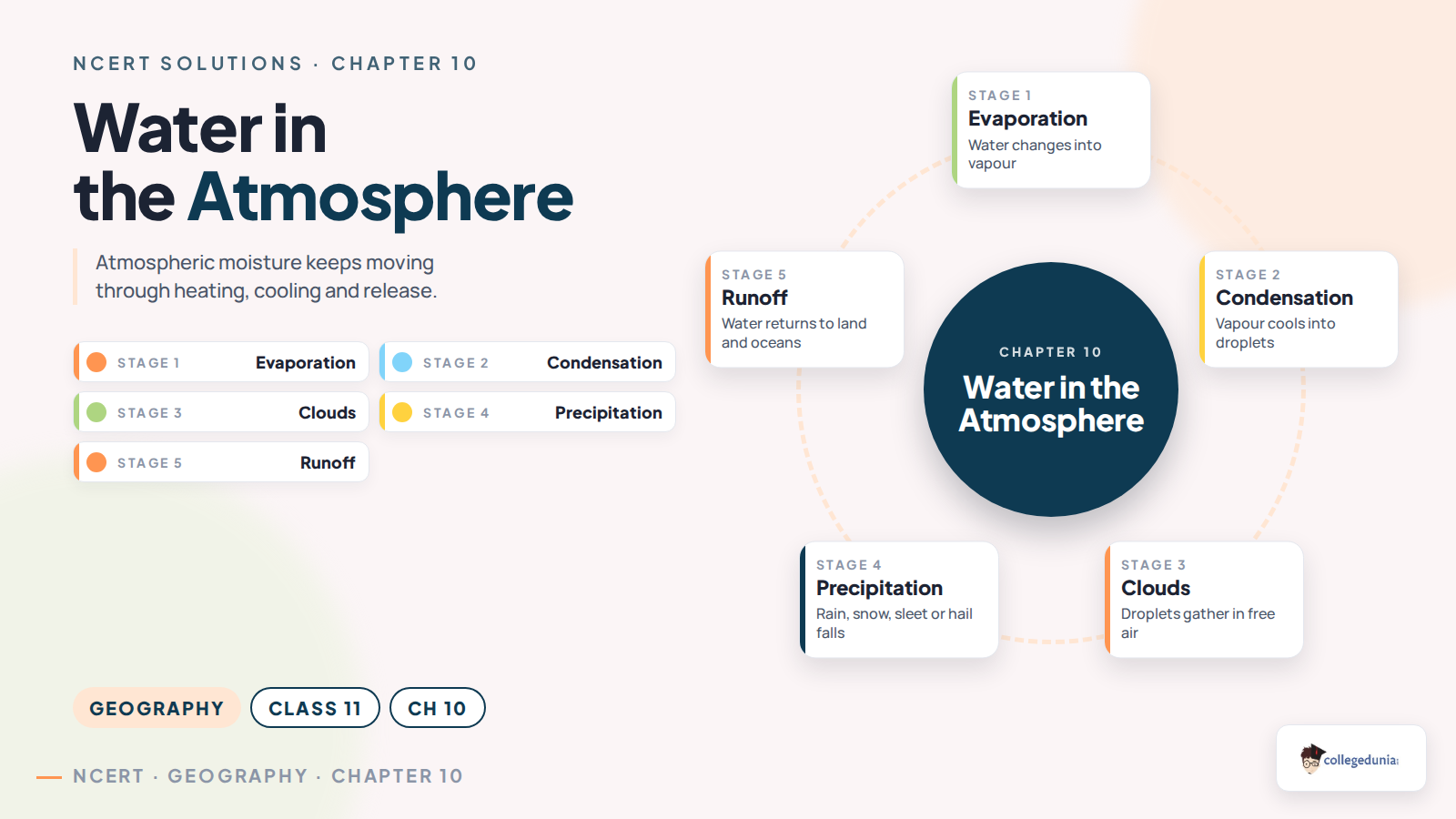
Start this chapter with the water cycle idea: evaporation adds moisture, cooling causes condensation, and heavy droplets fall as precipitation. Once this chain is clear, the longer NCERT answers become much easier to frame.
Water Cycle and Humidity in Water in the Atmosphere
The chapter treats water vapour as the most important variable part of the atmosphere. Evaporation from oceans, lakes, rivers and moist soil adds vapour to the air. Transpiration from plants also contributes moisture. Warm air can hold more vapour, while cold air has a lower holding capacity.
Absolute humidity: actual weight of water vapour present in a unit volume of air.
Specific humidity: weight of water vapour per unit weight of air.
Relative humidity: percentage comparison between actual moisture and full capacity.
Dew point: temperature at which air becomes saturated and condensation begins.
This is why the solution for relative humidity uses percentage language. The answer is not just about how much vapour is present; it is about the relationship between present vapour and the air's capacity at that temperature.
Clouds, Condensation and Precipitation Forms
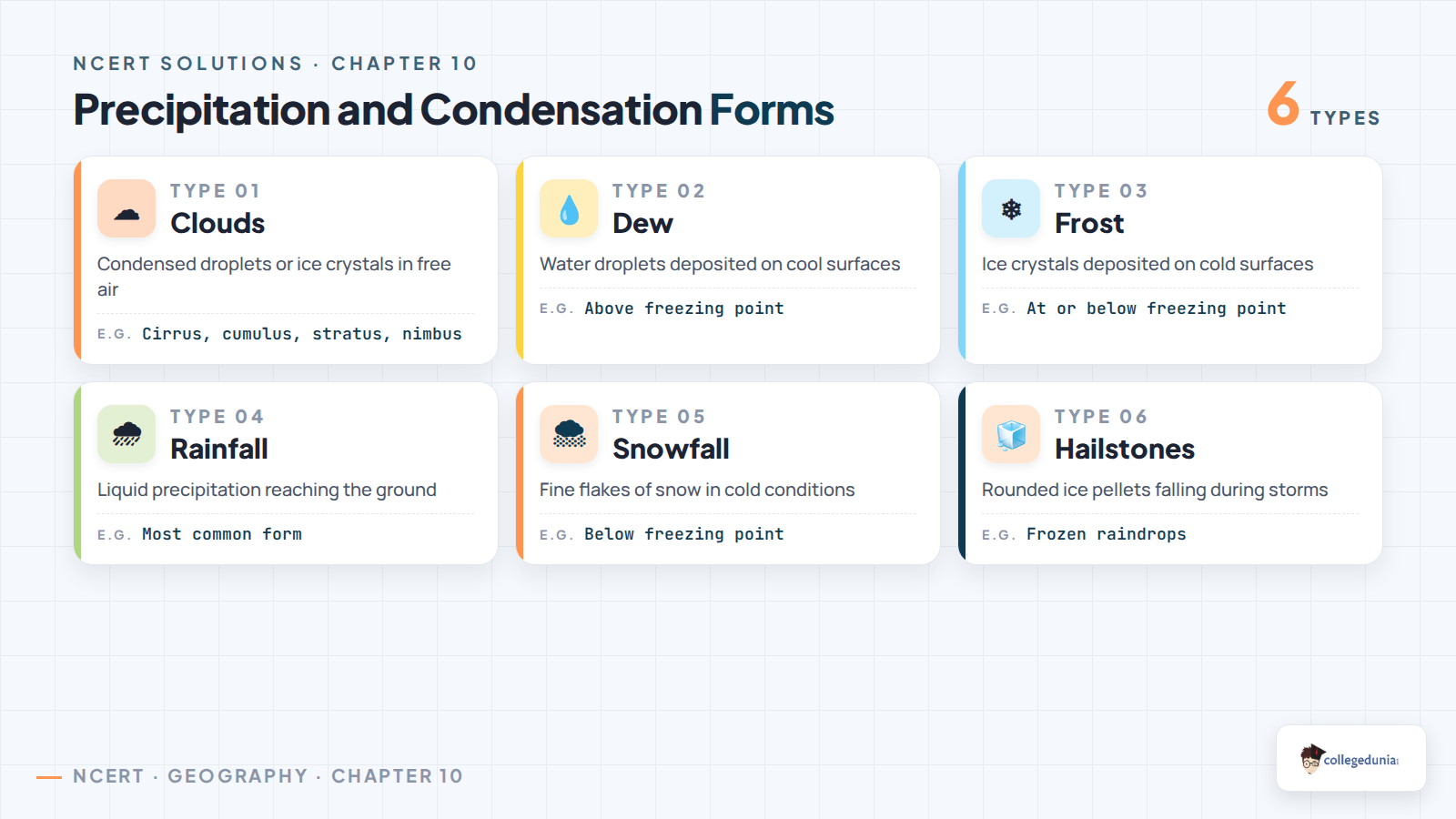
Condensation happens when moist air cools to dew point and water vapour changes into droplets or ice crystals. The form depends on where condensation occurs and whether the temperature is above or below freezing point. Dew forms on cool surfaces above freezing point, while frost forms as ice crystals at or below freezing point.
Form
How it forms
Answer clue
Dew
Water droplets on cool solid surfaces
Dew point above freezing point
Frost
Ice crystals on cold surfaces
At or below freezing point
Fog and mist
Condensation near the ground around nuclei
Mist has lower density than fog
Clouds
Condensed droplets or ice crystals in free air
Cirrus, cumulus, stratus and nimbus
Precipitation
Moisture released after particles become heavy
Rain, snow, sleet and hail
How to Write Better Answers for Water in the Atmosphere
Chapter 10 answers score well when the explanation is written as a process chain. For cloud formation, begin with moist air, cooling and condensation nuclei before listing cloud types. For rainfall distribution, compare equator, poles, coasts, interiors, windward slopes and leeward slopes. For dew and frost, use the freezing-point condition clearly.
Use exact NCERT terms. Write evaporation, condensation, dew point, saturated air and relative humidity clearly.
Add the controlling condition. Mention temperature, altitude, moisture source or surface cooling wherever relevant.
Classify only after defining. For clouds and precipitation, give the process first and the types after it.
Use contrast pairs. Dew versus frost and windward versus leeward slopes make long answers sharper.
All NCERT Solutions for Class 11 Geography Chapter 10 Water in the Atmosphere with Step-by-Step Solutions
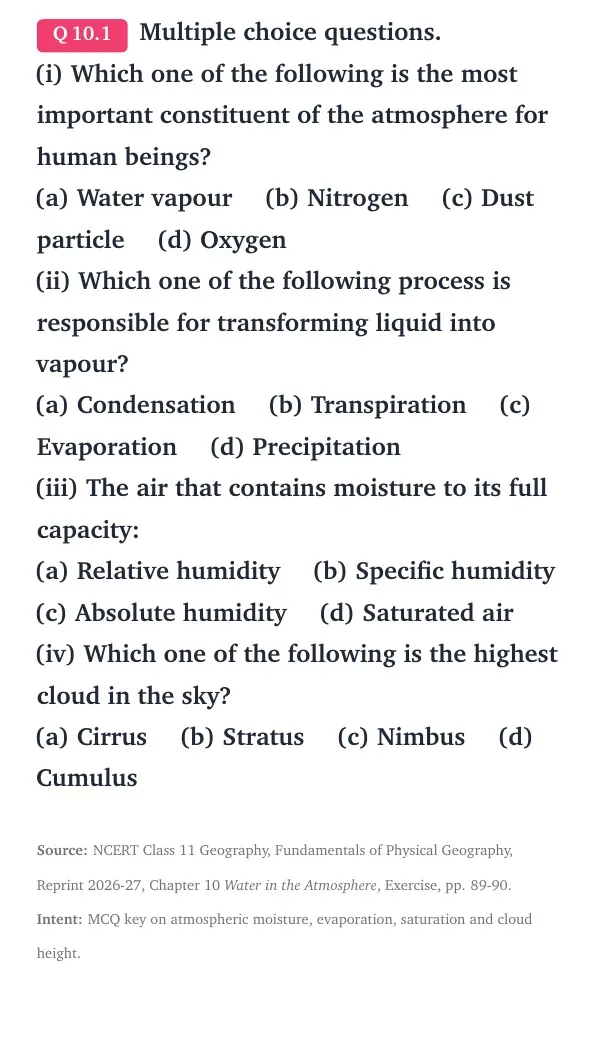
Q 10.1
Multiple choice questions.
(i) Which one of the following is the most important constituent of the atmosphere for human beings?
(a) Water vapour (b) Nitrogen (c) Dust particle (d) Oxygen
(ii) Which one of the following process is responsible for transforming liquid into vapour?
(a) Condensation (b) Transpiration (c) Evaporation (d) Precipitation
(iii) The air that contains moisture to its full capacity:
(a) Relative humidity (b) Specific humidity (c) Absolute humidity (d) Saturated air
(iv) Which one of the following is the highest cloud in the sky?
(a) Cirrus (b) Stratus (c) Nimbus (d) Cumulus
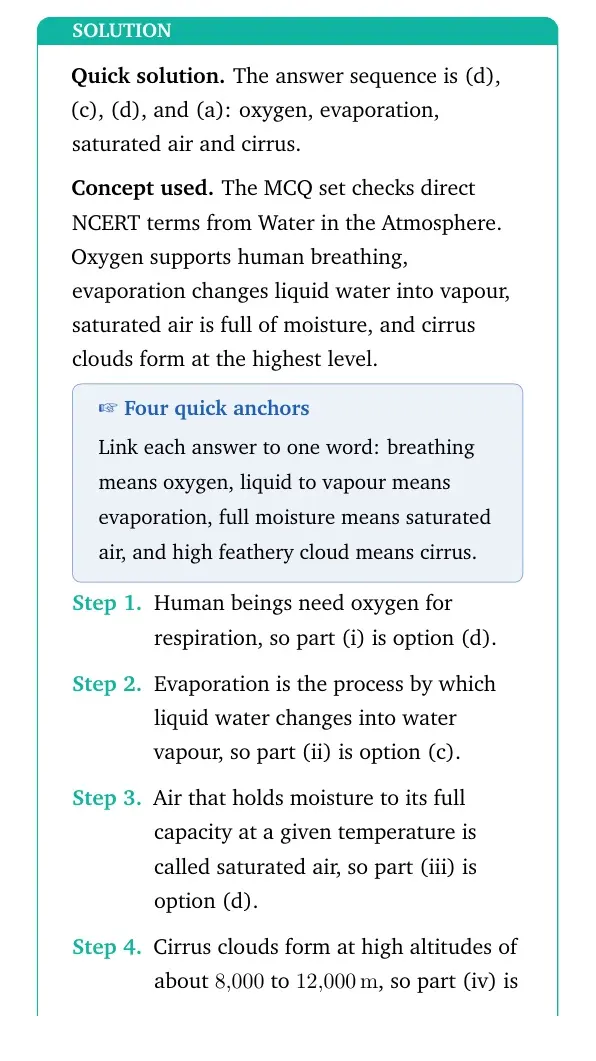
The answer sequence is (d), (c), (d), and (a): oxygen, evaporation, saturated air and cirrus.
Concept used. The MCQ set checks direct NCERT terms from Water in the Atmosphere. Oxygen supports human breathing, evaporation changes liquid water into vapour, saturated air is full of moisture, and cirrus clouds form at the highest level.
Four quick anchors
Link each answer to one word: breathing means oxygen, liquid to vapour means evaporation, full moisture means saturated air, and high feathery cloud means cirrus.
Human beings need oxygen for respiration, so part (i) is option (d).
Evaporation is the process by which liquid water changes into water vapour, so part (ii) is option (c).
Air that holds moisture to its full capacity at a given temperature is called saturated air, so part (iii) is option (d).
Cirrus clouds form at high altitudes of about 8,000 to 12,000 m, so part (iv) is option (a).
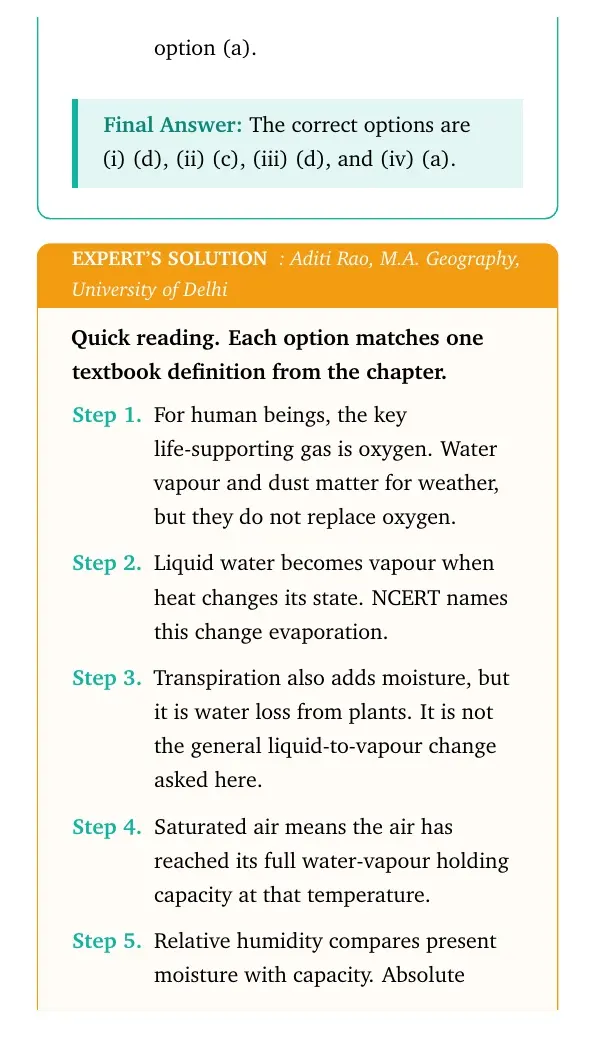
The correct options are (i) (d), (ii) (c), (iii) (d), and (iv) (a).
AR
Aditi Rao
M.A. Geography, University of Delhi
Verified Expert
Quick reading. Each option matches one textbook definition from the chapter.
For human beings, the key life-supporting gas is oxygen. Water vapour and dust matter for weather, but they do not replace oxygen.
Liquid water becomes vapour when heat changes its state. NCERT names this change evaporation.
Transpiration also adds moisture, but it is water loss from plants. It is not the general liquid-to-vapour change asked here.
Saturated air means the air has reached its full water-vapour holding capacity at that temperature.
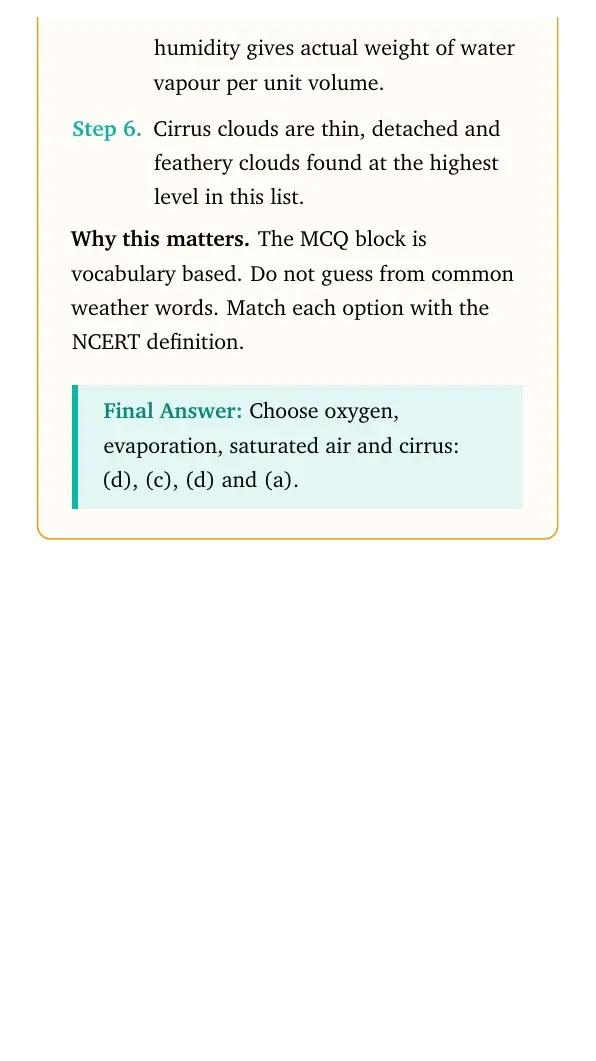
Relative humidity compares present moisture with capacity. Absolute humidity gives actual weight of water vapour per unit volume.
Cirrus clouds are thin, detached and feathery clouds found at the highest level in this list.
Why this matters. The MCQ block is vocabulary based. Do not guess from common weather words. Match each option with the NCERT definition.
Choose oxygen, evaporation, saturated air and cirrus: (d), (c), (d) and (a).
Q 10.2
Name the three types of precipitation.
Three common types of precipitation are rainfall, snowfall and hailstones. Sleet is another form mentioned in the chapter.
Concept used. Precipitation is the release of moisture after condensation when droplets or ice particles become too heavy for air to hold.
Name and define
For a 30-word answer, write the three names and add one tiny meaning for each.
Rainfall occurs when water reaches the earth in liquid form.
Snowfall occurs when moisture falls as fine flakes of snow at temperatures below freezing point.
Hailstones are small rounded pieces of ice formed when rainwater passes through colder layers.
NCERT also describes sleet as frozen raindrops or refrozen melted snow-water.
The three main types are rainfall, snowfall and hailstones. Sleet may be added as another form of precipitation.
RM
Rohan Mehta
M.Sc Earth Science, IIT Kharagpur
Verified Expert
List method. The safest answer names the form first and then states how it reaches the surface.
Precipitation starts after continuous condensation in free air.
When the air cannot support the condensed particles, gravity pulls them down.
If the falling moisture remains liquid, it is rainfall.
If the temperature is below freezing point, the moisture forms fine snow flakes and falls as snowfall.
If raindrops freeze into small rounded ice pieces before reaching the ground, they become hailstones.
If raindrops or melted snow refreeze near the ground, the form is called sleet.
Why this matters. NCERT uses precipitation as the wider term. Rain, snow, hail and sleet are the forms, not separate weather systems.
Rainfall, snowfall and hailstones are three types; sleet is also a form of precipitation.
Q 10.3
Explain relative humidity.
Relative humidity is the percentage of moisture present in air compared with the full capacity of air at that temperature.
Concept used. Air has a water-vapour holding capacity that changes with temperature. Relative humidity compares actual moisture with that capacity.
Use percent language
The word relative means comparison. Mention present moisture, full capacity and the same temperature.
At a given temperature, air can hold only a certain maximum amount of water vapour.
The actual moisture present may be less than this maximum capacity.
Relative humidity compares the actual moisture with the full moisture-holding capacity.
It is expressed as a percentage.
When temperature changes, the air's capacity also changes, so relative humidity changes too.
It is usually greater over oceans and lower over continental interiors.
Relative humidity is the percentage of moisture in air compared with the air's full capacity at the same temperature.
KI
Kavya Iyer
M.Sc Geography, Savitribai Phule Pune University
Verified Expert
Comparison view. Do not define it as just the amount of water vapour.
First note the actual water vapour present in a parcel of air.
Then note the maximum water vapour that the same parcel can hold at its present temperature.
Relative humidity is the ratio between these two quantities, written as a percentage.
If the air is close to its full capacity, relative humidity is high.
If the air is far below its full capacity, relative humidity is low.
Warm air can hold more water vapour than cold air, so a temperature change can alter the percentage even when moisture amount stays similar.
Why this matters. This answer tests the difference between actual amount and comparison with capacity. That comparison is the scoring phrase.
Relative humidity means actual moisture divided by full capacity at that temperature, expressed as a percentage.
Q 10.4
Why does the amount of water vapour decreases rapidly with altitude?
Water vapour decreases with altitude because temperature falls, evaporation is weaker and most moisture comes from the earth's surface.
Concept used. The air's capacity to hold water vapour depends on temperature. Moisture is supplied mainly near the surface by evaporation and transpiration.
Three reasons
Write source, temperature and condensation: moisture starts near the surface, cold air holds less, and vapour condenses while rising.
Most atmospheric moisture comes from oceans, lakes, rivers, soils and plants near the earth's surface.
As height increases, the direct source of evaporation becomes weaker.
Temperature generally decreases with altitude in the lower atmosphere.
Cooler air has a lower capacity to hold water vapour.
Rising moist air may cool to dew point and condense into droplets or ice crystals.
For these reasons, water vapour is concentrated in the lower atmosphere and falls rapidly with height.
Water vapour decreases rapidly with altitude because moisture sources are near the surface, temperature falls upward and cooler air holds less vapour.
NJ
Neha Joshi
M.A. Geography, Jawaharlal Nehru University
Verified Expert
Vertical-distribution angle. The lower atmosphere is both warmer and closer to moisture sources.
Evaporation from water bodies and transpiration from plants add most water vapour near the ground.
Air close to the surface is usually warmer, so it can retain more moisture.
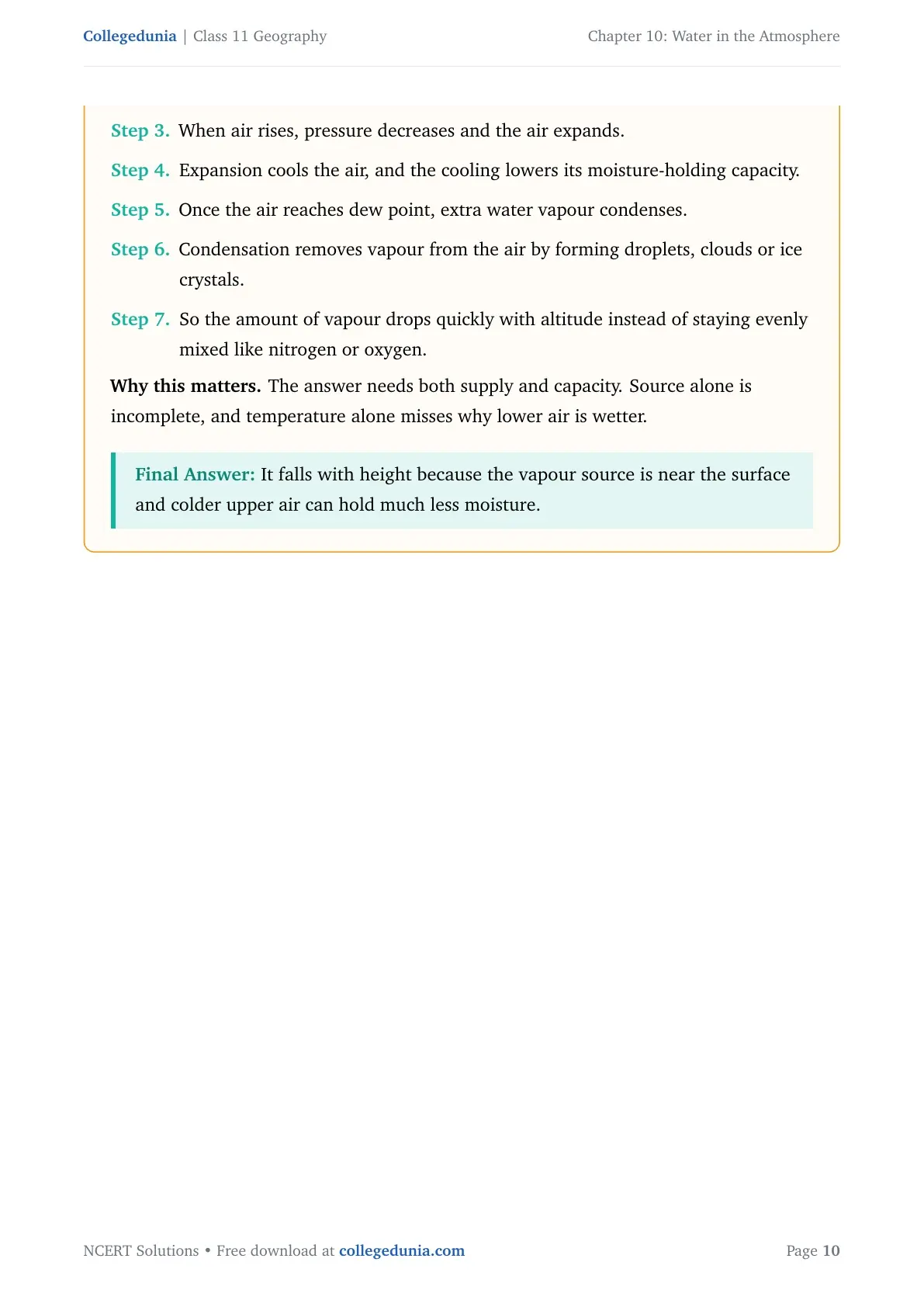
When air rises, pressure decreases and the air expands.
Expansion cools the air, and the cooling lowers its moisture-holding capacity.
Once the air reaches dew point, extra water vapour condenses.
Condensation removes vapour from the air by forming droplets, clouds or ice crystals.
So the amount of vapour drops quickly with altitude instead of staying evenly mixed like nitrogen or oxygen.
Why this matters. The answer needs both supply and capacity. Source alone is incomplete, and temperature alone misses why lower air is wetter.
It falls with height because the vapour source is near the surface and colder upper air can hold much less moisture.
Q 10.5
How are clouds formed? Classify them.
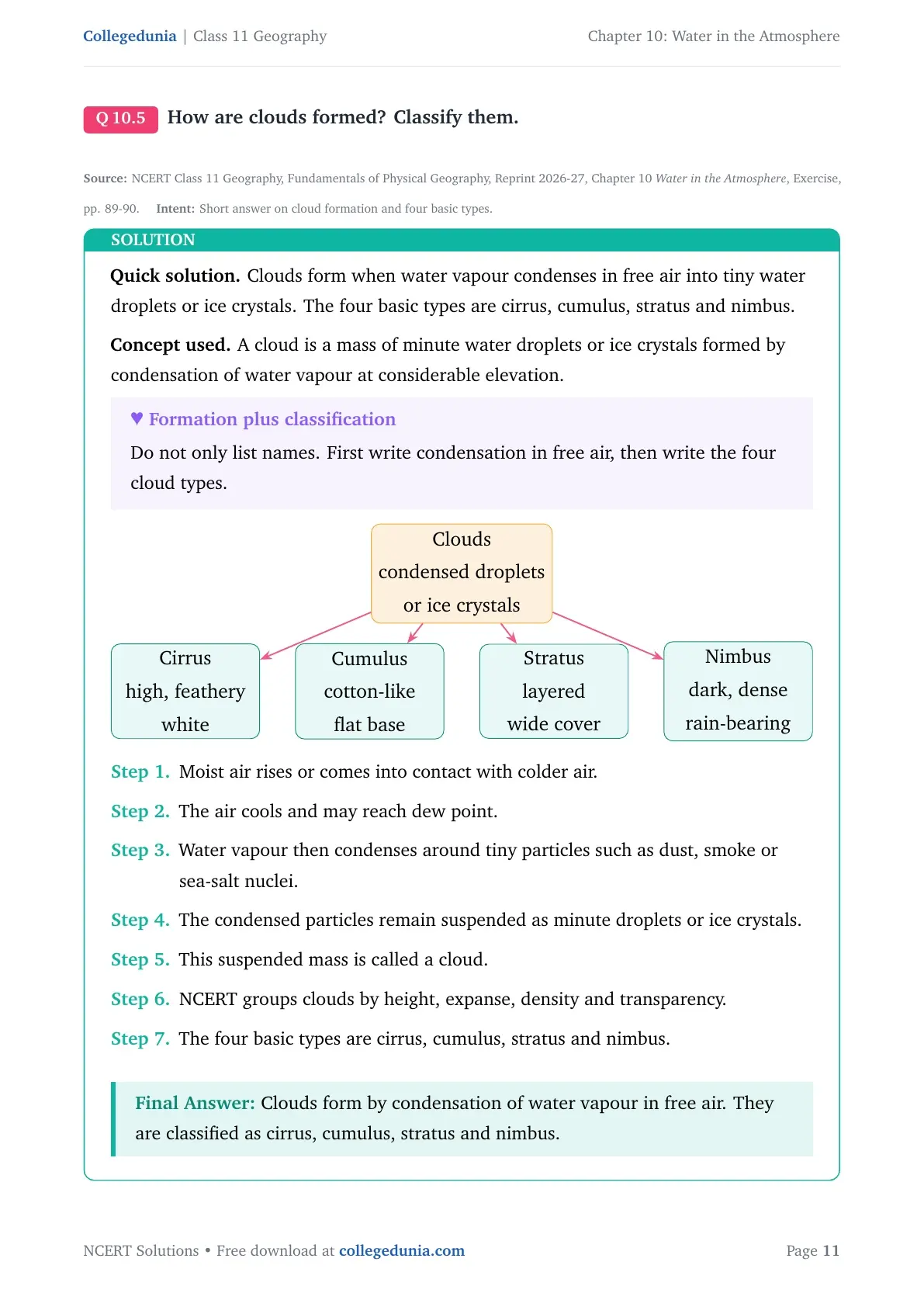
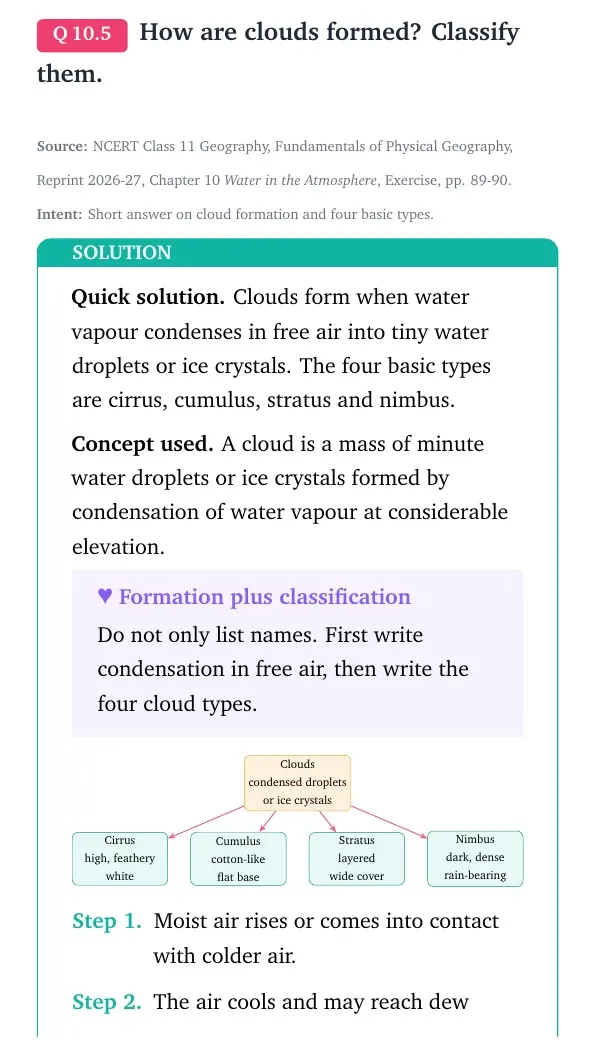
Clouds form when water vapour condenses in free air into tiny water droplets or ice crystals. The four basic types are cirrus, cumulus, stratus and nimbus.
Concept used. A cloud is a mass of minute water droplets or ice crystals formed by condensation of water vapour at considerable elevation.
Formation plus classification
Do not only list names. First write condensation in free air, then write the four cloud types.
!%
[See diagram in the PDF version]
Moist air rises or comes into contact with colder air.
The air cools and may reach dew point.
Water vapour then condenses around tiny particles such as dust, smoke or sea-salt nuclei.
The condensed particles remain suspended as minute droplets or ice crystals.
This suspended mass is called a cloud.
NCERT groups clouds by height, expanse, density and transparency.
The four basic types are cirrus, cumulus, stratus and nimbus.
Clouds form by condensation of water vapour in free air. They are classified as cirrus, cumulus, stratus and nimbus.
AS
Arjun Singh
M.Sc Geology, Banaras Hindu University
Verified Expert
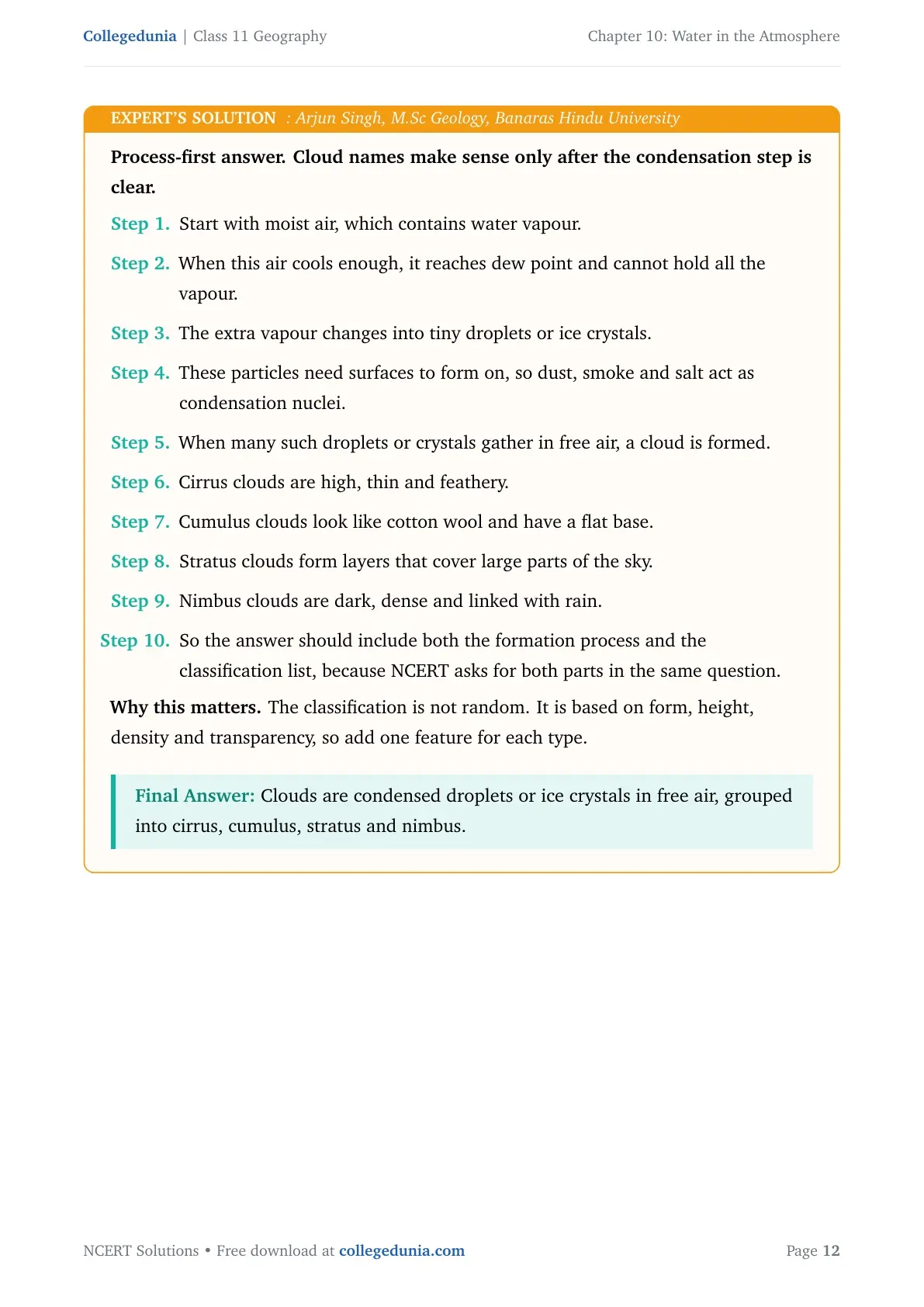
Process-first answer. Cloud names make sense only after the condensation step is clear.
Start with moist air, which contains water vapour.
When this air cools enough, it reaches dew point and cannot hold all the vapour.
The extra vapour changes into tiny droplets or ice crystals.
These particles need surfaces to form on, so dust, smoke and salt act as condensation nuclei.
When many such droplets or crystals gather in free air, a cloud is formed.
Cirrus clouds are high, thin and feathery.
Cumulus clouds look like cotton wool and have a flat base.
Stratus clouds form layers that cover large parts of the sky.
Nimbus clouds are dark, dense and linked with rain.
So the answer should include both the formation process and the classification list, because NCERT asks for both parts in the same question.
Why this matters. The classification is not random. It is based on form, height, density and transparency, so add one feature for each type.
Clouds are condensed droplets or ice crystals in free air, grouped into cirrus, cumulus, stratus and nimbus.
Q 10.6
Discuss the salient features of the world distribution of precipitation.
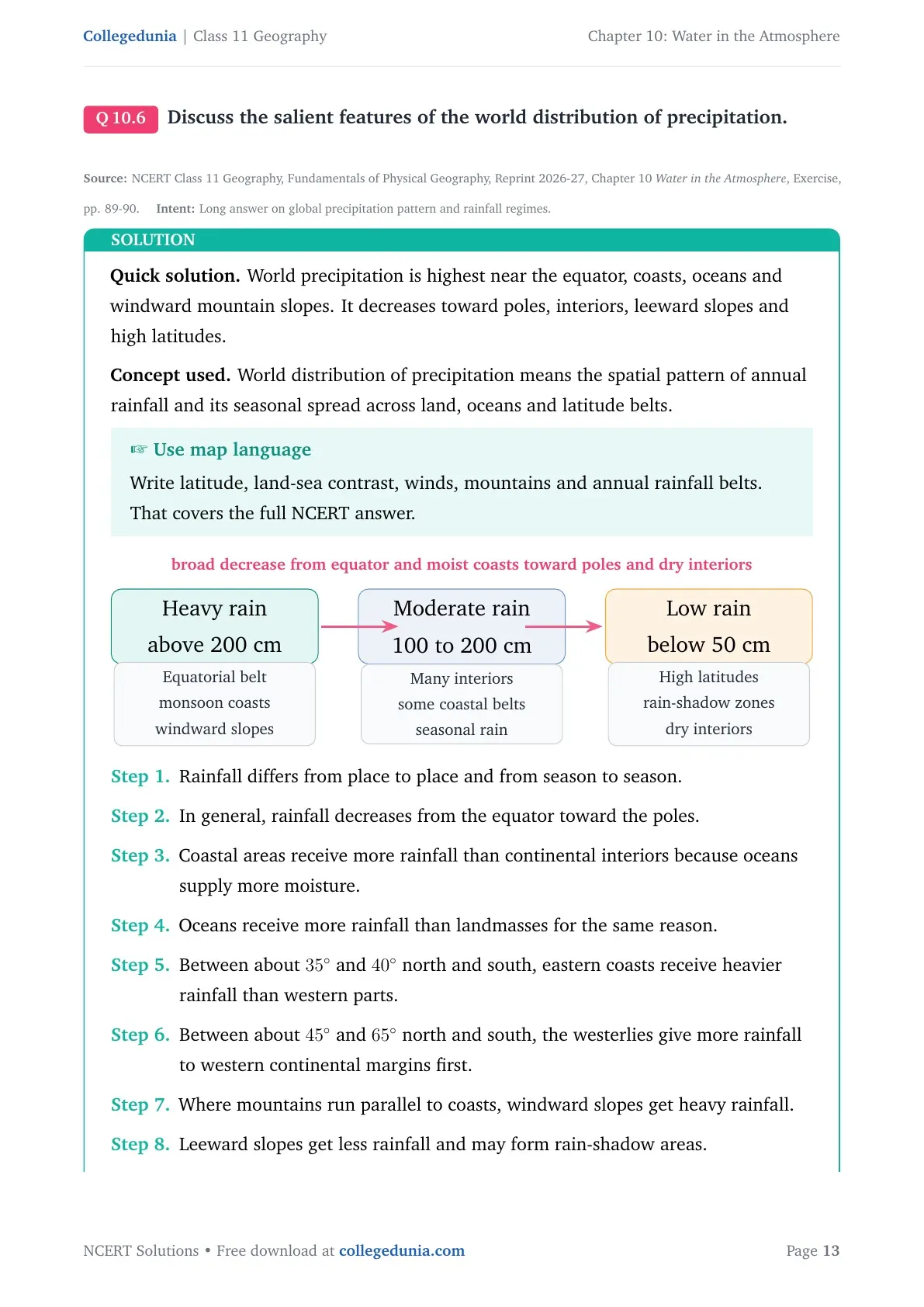
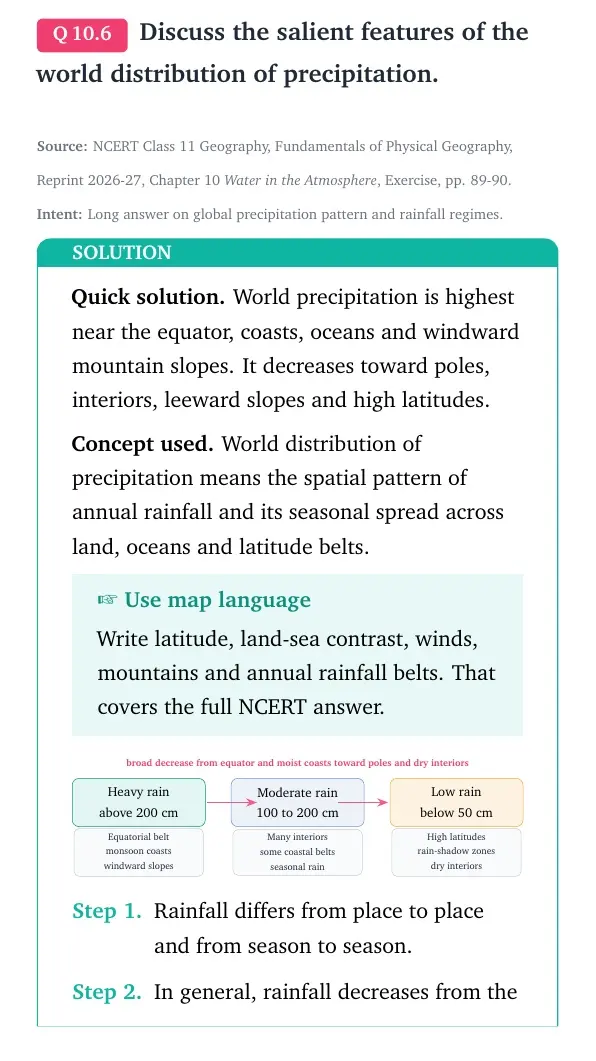
World precipitation is highest near the equator, coasts, oceans and windward mountain slopes. It decreases toward poles, interiors, leeward slopes and high latitudes.
Concept used. World distribution of precipitation means the spatial pattern of annual rainfall and its seasonal spread across land, oceans and latitude belts.
Use map language
Write latitude, land-sea contrast, winds, mountains and annual rainfall belts. That covers the full NCERT answer.
!%
[See diagram in the PDF version]
Rainfall differs from place to place and from season to season.
In general, rainfall decreases from the equator toward the poles.
Coastal areas receive more rainfall than continental interiors because oceans supply more moisture.
Oceans receive more rainfall than landmasses for the same reason.
Between about 35∘ and 40∘ north and south, eastern coasts receive heavier rainfall than western parts.
Between about 45∘ and 65∘ north and south, the westerlies give more rainfall to western continental margins first.
Where mountains run parallel to coasts, windward slopes get heavy rainfall.
Leeward slopes get less rainfall and may form rain-shadow areas.
Heavy rainfall above 200 cm occurs in the equatorial belt, windward western coasts of cool temperate zones and monsoon coasts.
Moderate rainfall of about 100 to 200 cm occurs in many interior continental areas and some coastal areas.
Low rainfall below 50 cm occurs in rain-shadow areas, interiors and high latitudes.
Precipitation decreases from equator to poles, is higher over oceans and coasts, is controlled by winds and mountains, and is lowest in interiors, rain-shadow areas and high latitudes.
FK
Farah Khan
M.A. Geography, Jamia Millia Islamia
Verified Expert
Distribution angle. Treat the answer like a map, moving from global belts to local controls.
The equatorial belt receives heavy rainfall because warm air rises and moisture supply is high.
Moving poleward, average rainfall generally decreases because air is colder and holds less moisture.
Sea-facing areas get more rain than interiors because moist air reaches them first.
Interiors lose rainfall because air masses drop moisture before moving far inland.
The eastern coasts near 35∘ to 40∘ north and south receive heavier rainfall because of warm currents and onshore winds in many regions.
The western margins between 45∘ and 65∘ north and south receive rainfall from the westerlies.
Mountains add a strong local control. Windward slopes force air upward, causing cooling and rain.
Leeward slopes receive dry descending air, so they get less rainfall.
The annual regimes can be grouped as heavy, moderate and low rainfall belts.
Seasonal distribution also matters because rainfall spread through the year is more useful than the same total falling in a short burst.
In a map-based answer, mention that heavy rainfall belts are not just equatorial; monsoon coasts and windward western coasts can also cross the 200 cm mark.
End with low rainfall areas such as high latitudes, rain-shadow zones and continental interiors, because these complete the contrast asked by distribution.
Why this matters. A strong long answer gives both the broad pattern and the reasons. Only listing regions makes the answer thin.
The world pattern depends on latitude, moisture source, prevailing winds, coasts, mountains and rain-shadow effects.
Q 10.7
What are forms of condensation? Describe the process of dew and frost formation.
The main forms of condensation are dew, frost, fog, mist and clouds. Dew forms as water droplets above freezing point; frost forms as ice crystals below freezing point.
Concept used. Condensation is the change of water vapour into liquid water or ice after moist air loses heat and reaches dew point.
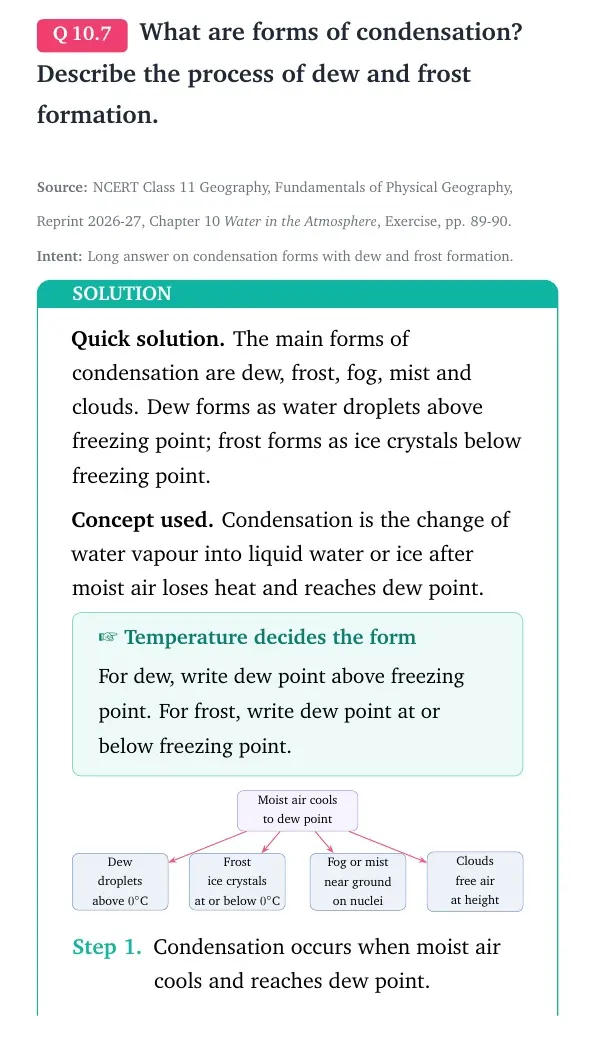
Temperature decides the form
For dew, write dew point above freezing point. For frost, write dew point at or below freezing point.
!%
[See diagram in the PDF version]
Condensation occurs when moist air cools and reaches dew point.
After condensation, moisture may appear as dew, frost, fog, mist or clouds.
Dew forms when moisture is deposited as water droplets on cool solid objects.
These objects include grass blades, leaves, stones and other exposed surfaces.
Dew needs clear sky, calm air, high relative humidity and long cold nights.
For dew, the dew point must be above the freezing point.
Frost forms when condensation takes place on a cold surface below freezing point.
In frost, excess moisture becomes minute ice crystals instead of liquid droplets.
The ideal conditions are similar to dew, but the air temperature must be at or below 0∘C.
Condensation forms include dew, frost, fog, mist and clouds. Dew forms as droplets above freezing point, while frost forms as ice crystals at or below freezing point.
MN
Meera Nair
Ph.D Geography, IISc Bangalore
Verified Expert
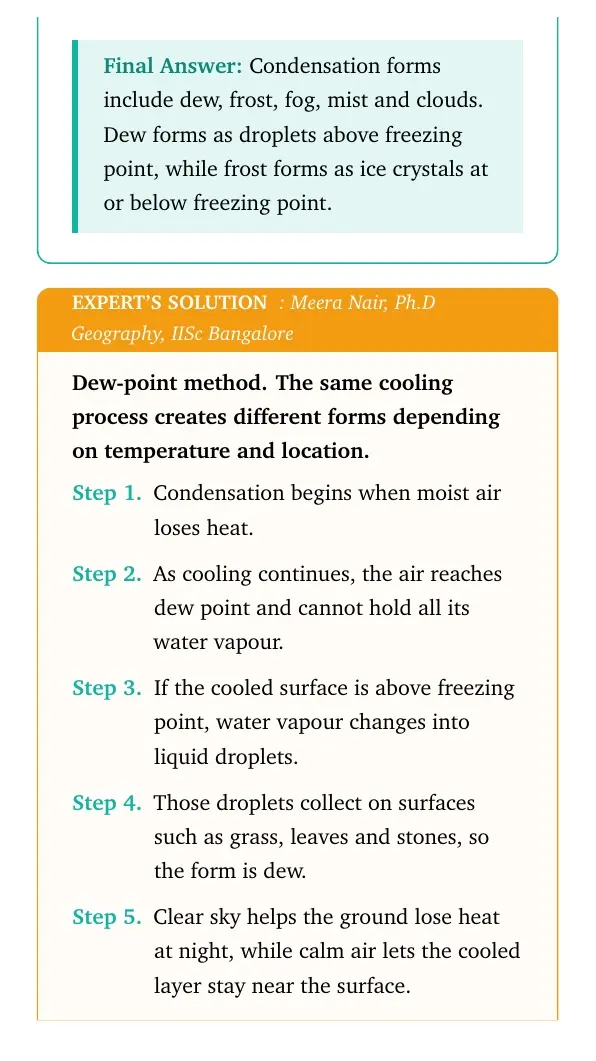
Dew-point method. The same cooling process creates different forms depending on temperature and location.
Condensation begins when moist air loses heat.
As cooling continues, the air reaches dew point and cannot hold all its water vapour.
If the cooled surface is above freezing point, water vapour changes into liquid droplets.
Those droplets collect on surfaces such as grass, leaves and stones, so the form is dew.
Clear sky helps the ground lose heat at night, while calm air lets the cooled layer stay near the surface.
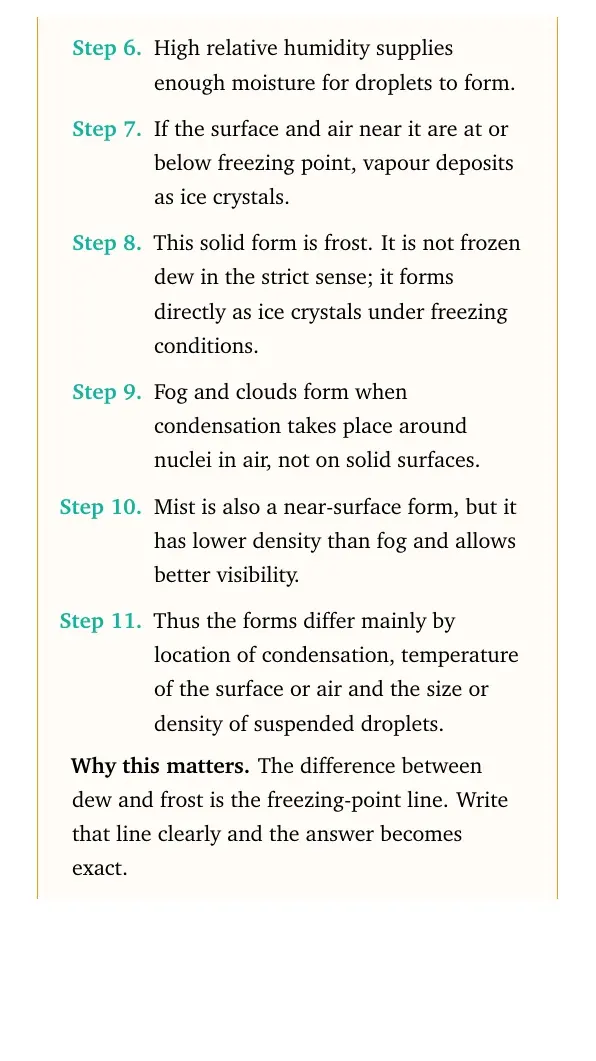
High relative humidity supplies enough moisture for droplets to form.
If the surface and air near it are at or below freezing point, vapour deposits as ice crystals.
This solid form is frost. It is not frozen dew in the strict sense; it forms directly as ice crystals under freezing conditions.
Fog and clouds form when condensation takes place around nuclei in air, not on solid surfaces.
Mist is also a near-surface form, but it has lower density than fog and allows better visibility.
Thus the forms differ mainly by location of condensation, temperature of the surface or air and the size or density of suspended droplets.
Why this matters. The difference between dew and frost is the freezing-point line. Write that line clearly and the answer becomes exact.
Dew forms as liquid droplets when dew point is above freezing point; frost forms as ice crystals when it is at or below freezing point.
Q 10.8
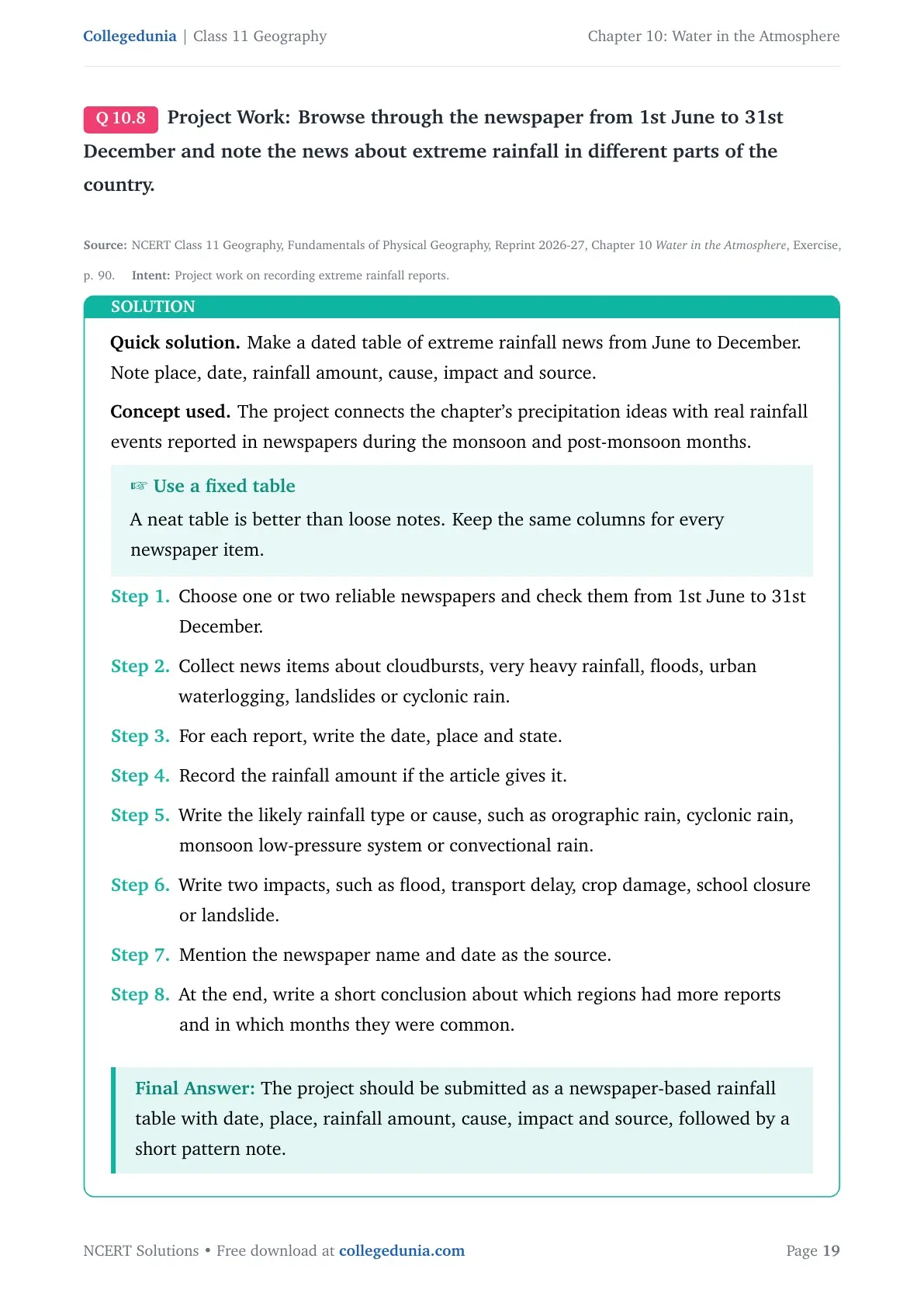
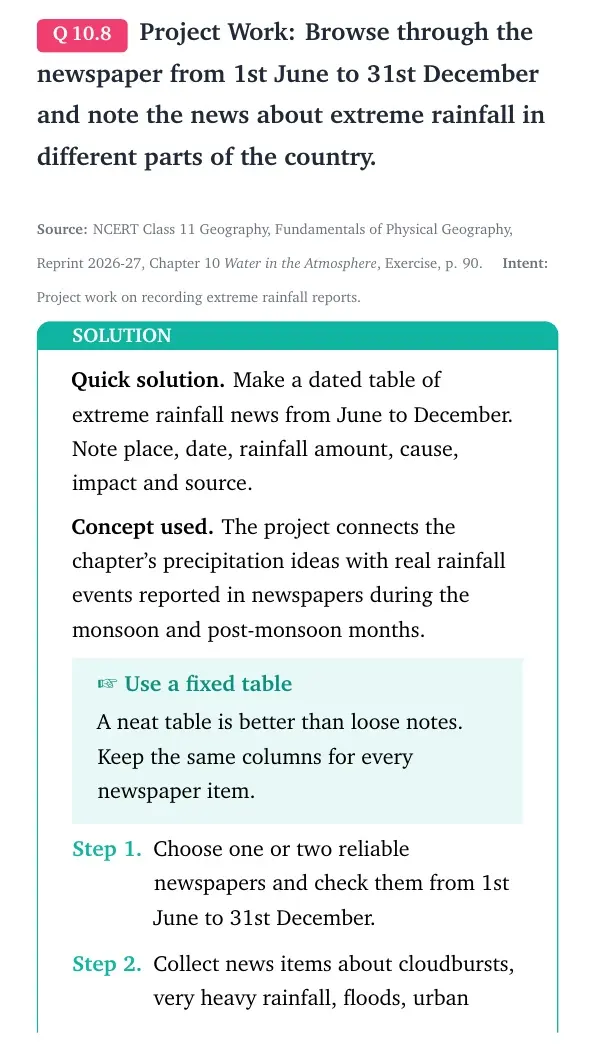
Project Work: Browse through the newspaper from 1st June to 31st December and note the news about extreme rainfall in different parts of the country.
Make a dated table of extreme rainfall news from June to December. Note place, date, rainfall amount, cause, impact and source.
Concept used. The project connects the chapter's precipitation ideas with real rainfall events reported in newspapers during the monsoon and post-monsoon months.
Use a fixed table
A neat table is better than loose notes. Keep the same columns for every newspaper item.
Choose one or two reliable newspapers and check them from 1st June to 31st December.
Collect news items about cloudbursts, very heavy rainfall, floods, urban waterlogging, landslides or cyclonic rain.
For each report, write the date, place and state.
Record the rainfall amount if the article gives it.
Write the likely rainfall type or cause, such as orographic rain, cyclonic rain, monsoon low-pressure system or convectional rain.
Write two impacts, such as flood, transport delay, crop damage, school closure or landslide.
Mention the newspaper name and date as the source.
At the end, write a short conclusion about which regions had more reports and in which months they were common.
The project should be submitted as a newspaper-based rainfall table with date, place, rainfall amount, cause, impact and source, followed by a short pattern note.
IB
Ishita Banerjee
M.A. Geography, University of Hyderabad
Verified Expert
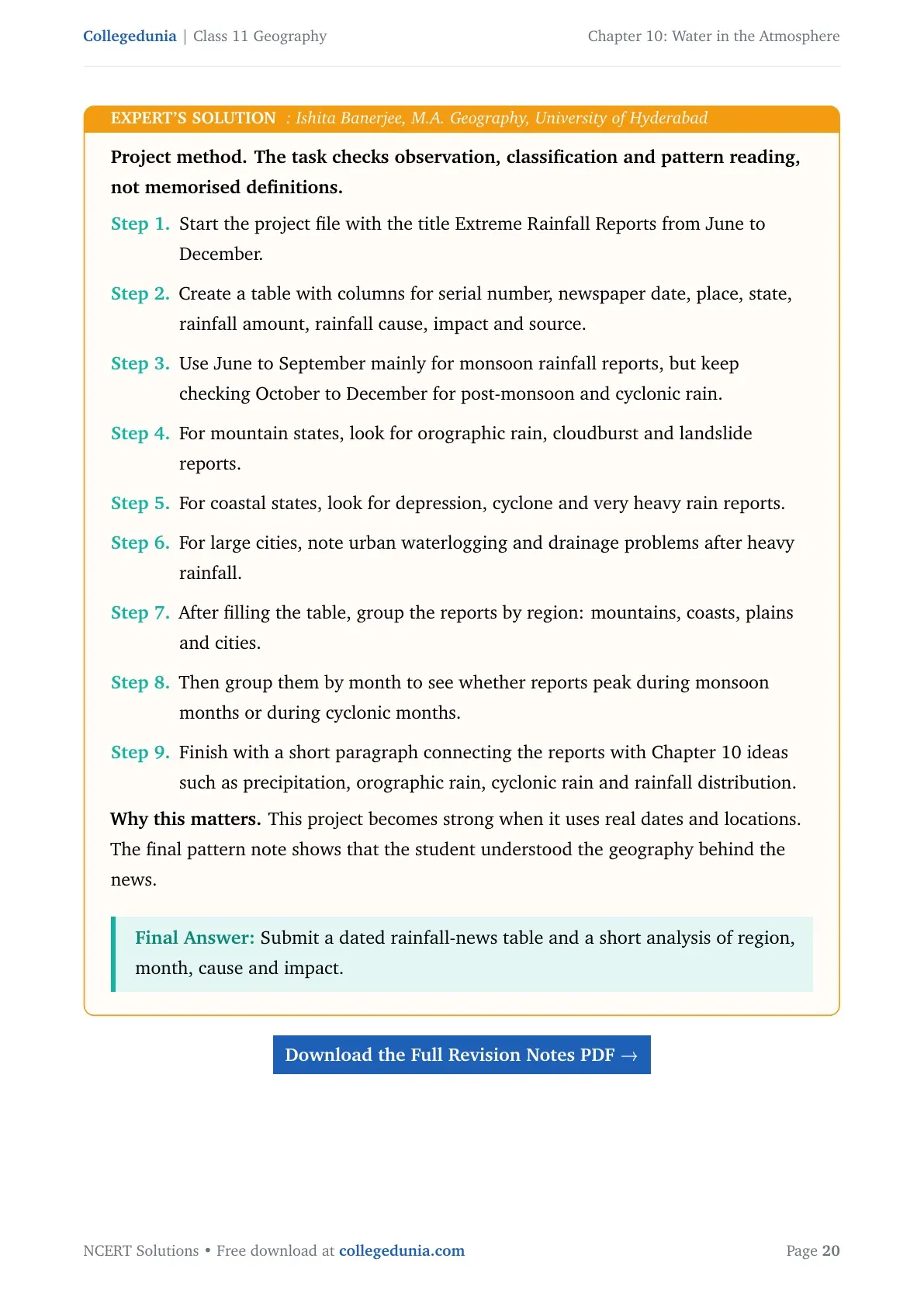
Project method. The task checks observation, classification and pattern reading, not memorised definitions.
Start the project file with the title Extreme Rainfall Reports from June to December.
Create a table with columns for serial number, newspaper date, place, state, rainfall amount, rainfall cause, impact and source.
Use June to September mainly for monsoon rainfall reports, but keep checking October to December for post-monsoon and cyclonic rain.
For mountain states, look for orographic rain, cloudburst and landslide reports.
For coastal states, look for depression, cyclone and very heavy rain reports.
For large cities, note urban waterlogging and drainage problems after heavy rainfall.
After filling the table, group the reports by region: mountains, coasts, plains and cities.
Then group them by month to see whether reports peak during monsoon months or during cyclonic months.
Finish with a short paragraph connecting the reports with Chapter 10 ideas such as precipitation, orographic rain, cyclonic rain and rainfall distribution.
Why this matters. This project becomes strong when it uses real dates and locations. The final pattern note shows that the student understood the geography behind the news.
Submit a dated rainfall-news table and a short analysis of region, month, cause and impact.
Related Geography Resources for Water in the Atmosphere
Use the solutions PDF for solved answers, then move to the NCERT book and notes when you want to revise the chapter theory in a different format.












Comments