




NCERT Solutions for Class 11 Business Studies Chapter 9 MSME and Business Entrepreneurship cover all textbook questions from the latest 2026-27 NCERT book. The answers explain MSME meaning, micro enterprise features, village industries, enterprise categories, entrepreneurship traits, startup steps and project-based case work in simple CBSE answer language.
- PDF coverage: 20 solved items, including 18 exercise questions and 2 project prompts.
- Best for: revising MSME classification, entrepreneurship features, business ideas and case-based answers.
- Use this with: the official NCERT book, chapter notes and the all-chapters solutions table below.











Student Feedback: In a Collegedunia poll of 11,420 Class 11 Business Studies students preparing for the 2026-27 school exams, 74% said Chapter 9 became easier when MSME categories and entrepreneurship steps were revised together.
Source: 2026-27 Class 11 Business Studies student poll across CBSE schools.
Every answer in this chapter set is checked against the 2026-27 NCERT Business Studies textbook and written so that students can connect the definition, marker point and business example in one answer.
What MSME and Business Entrepreneurship Covers in Class 11
MSME and Business Entrepreneurship explains how small business units support jobs, regional balance and innovation. The chapter also shows how entrepreneurship converts an idea into an enterprise. For exam answers, students should connect every definition with a practical business example.
| Chapter area | What students must know | Where it helps |
|---|---|---|
| MSME meaning | Micro, small and medium enterprise classification | Questions 1, 2, 3 and 4 |
| Village industries | Rural production, artisan support and traditional skills | Questions 9, 10 and 11 |
| Entrepreneurship | Opportunity search, risk bearing and innovation | Questions 5, 6, 7 and 8 |
| Enterprise setup | Idea selection, feasibility, funding, launch and review | Questions 12, 13, 14 and 15 |
| Project work | Business plan, resource mapping and simple market study | Questions 19 and 20 |
MSME and Entrepreneurship Explained for Class 11
Source: Magnet Brains on YouTube
MSME Classification for Class 11 Business Studies
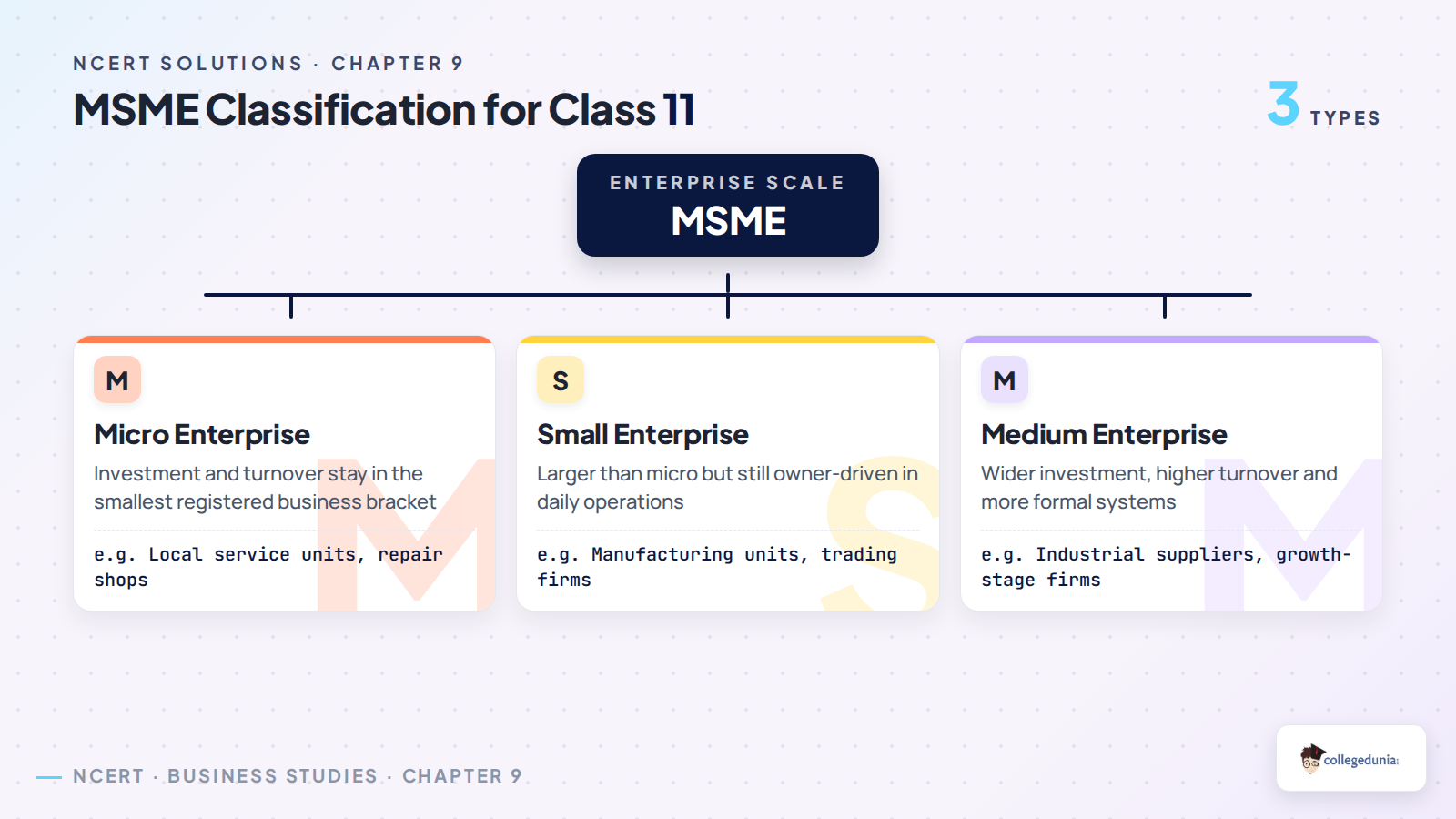
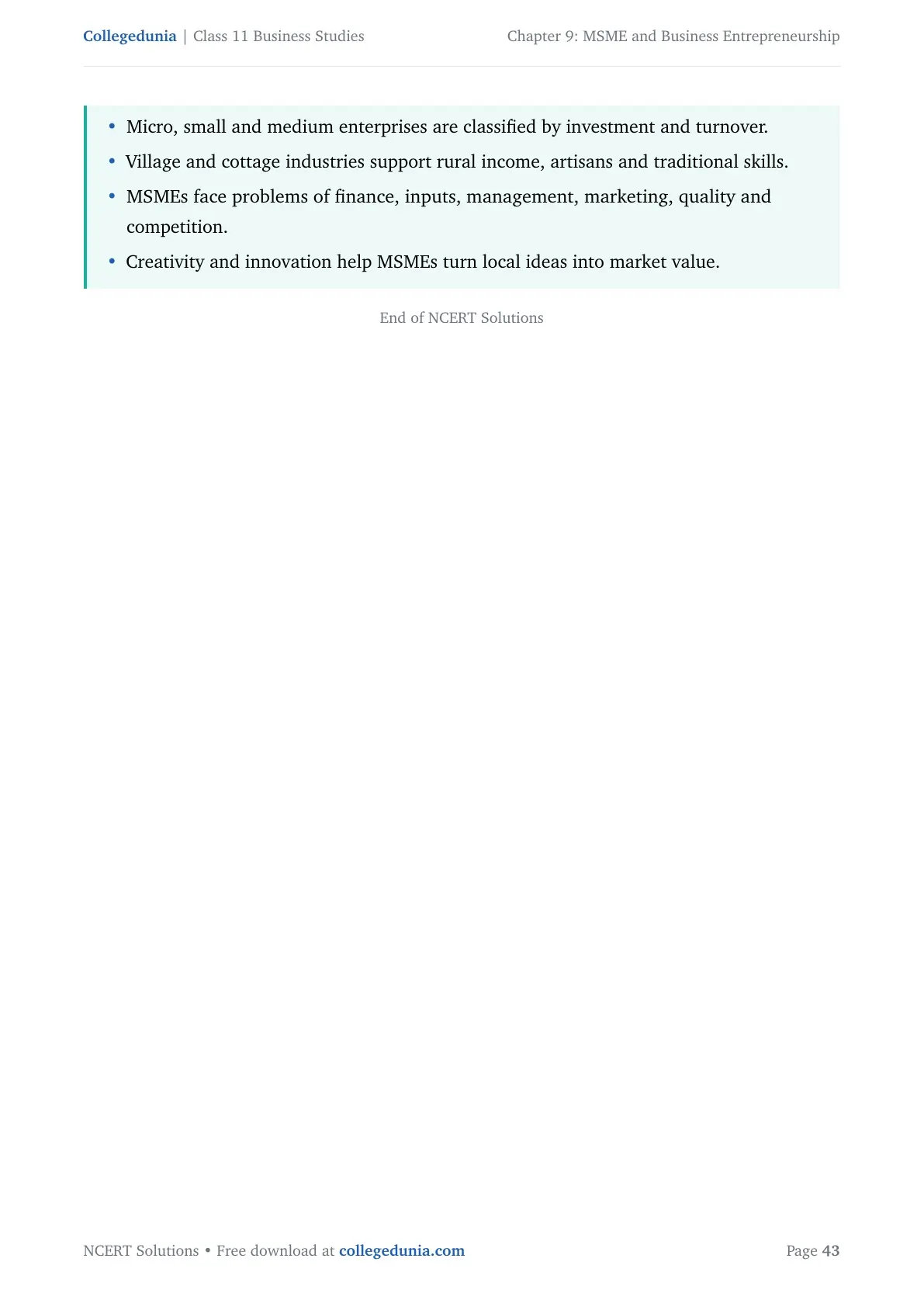
MSME stands for micro, small and medium enterprises. The answer should not treat all small businesses as one group. NCERT expects students to explain why these units matter: they create jobs, use local resources, support balanced regional growth and give first-time entrepreneurs a starting point.
- Micro enterprise: the smallest scale unit, often close to the owner and local market.
- Small enterprise: a larger unit with wider operations, more capital and more workers.
- Medium enterprise: a growing unit with formal systems, wider reach and higher investment.
- Village industry: a rural enterprise that may work with or without power and supports artisans.
Business Entrepreneurship Process in Chapter 9
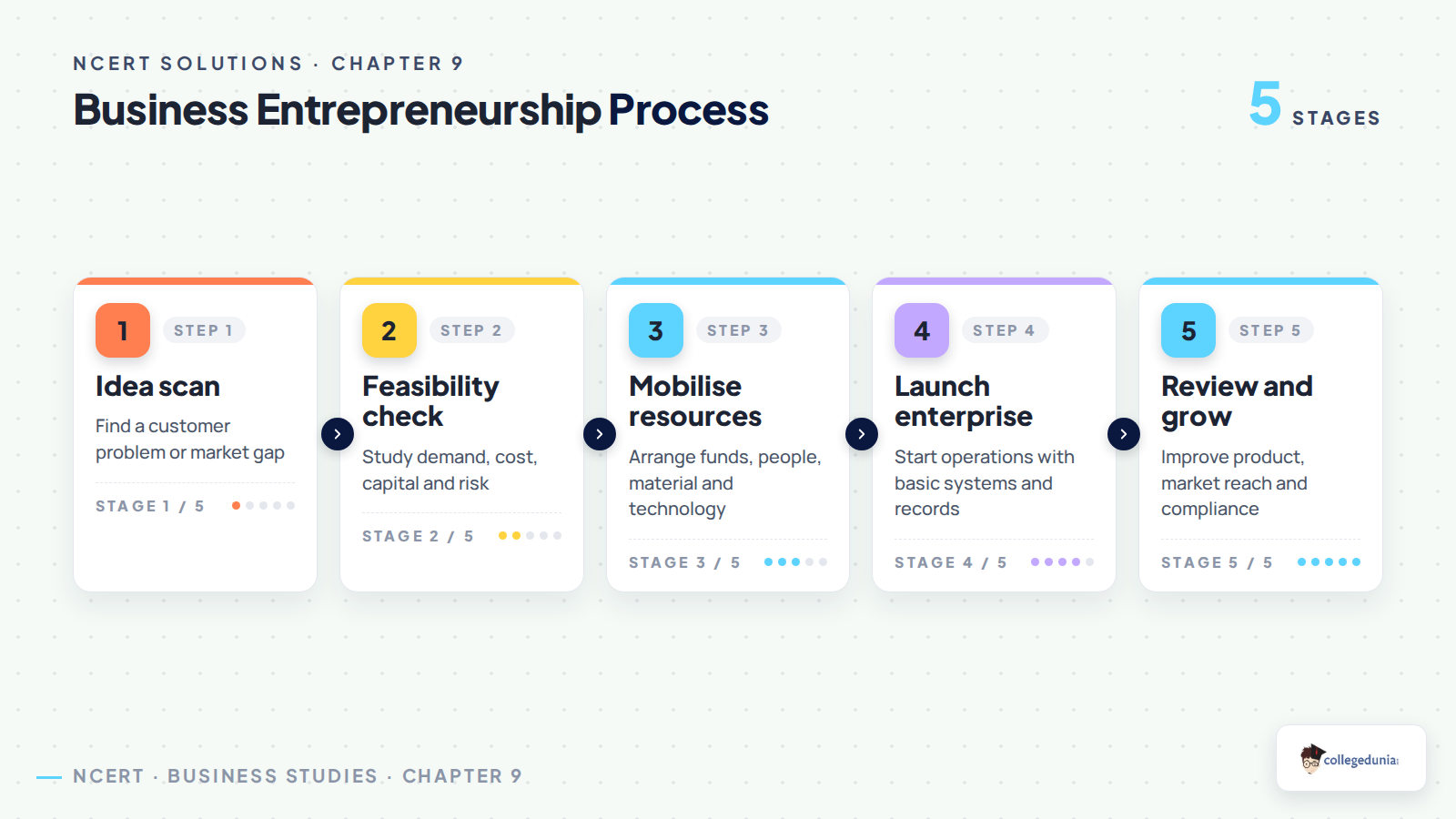
Entrepreneurship is more than starting a shop. It is the process of spotting an opportunity, taking a calculated risk and organising resources to create value. In Business Studies answers, the strongest points are opportunity, innovation, risk, coordination and social contribution.
- Idea scan: identify a customer need, market gap or local problem.
- Feasibility check: study demand, cost, capital, competition and risk.
- Resource mobilisation: arrange funds, people, material, technology and permissions.
- Launch: begin operations with records, quality control and customer contact.
- Review: improve the product, market reach, pricing and compliance.
How to Write Better MSME and Entrepreneurship Answers
Chapter 9 answers score well when students avoid generic statements like "small business is useful". Use NCERT headings and make each point concrete. For MSME questions, state the category, then add employment, local resources and regional balance. For entrepreneurship questions, state the trait, then show how it works in a real business decision.
- Definition questions: write the direct meaning before adding examples.
- Difference questions: compare scale, capital, risk and control in separate rows.
- Long answers: use headings such as innovation, risk, employment and balanced growth.
- Project prompts: mention product idea, target customer, capital need and promotion method.
Related Business Studies Resources for MSME and Business Entrepreneurship
Use the solutions PDF for solved answers, then move to the NCERT book and notes when you want to revise the chapter theory in a different format.
| Resource | Best use | Link |
|---|---|---|
| NCERT Book PDF | Original NCERT reading and exercise questions | MSME and Business Entrepreneurship Class 11 NCERT Book PDF |
| Notes | Quick chapter summary, enterprise categories and entrepreneurship traits | MSME and Business Entrepreneurship Class 11 Notes |
| Handwritten Notes | Fast recall before a school test | MSME and Business Entrepreneurship Class 11 Handwritten Notes |
NCERT Solutions for All Class 11 Business Studies Chapters
All NCERT Solutions for Class 11 Business Studies Chapter 9 MSME and Business Entrepreneurship with Step-by-Step Solutions
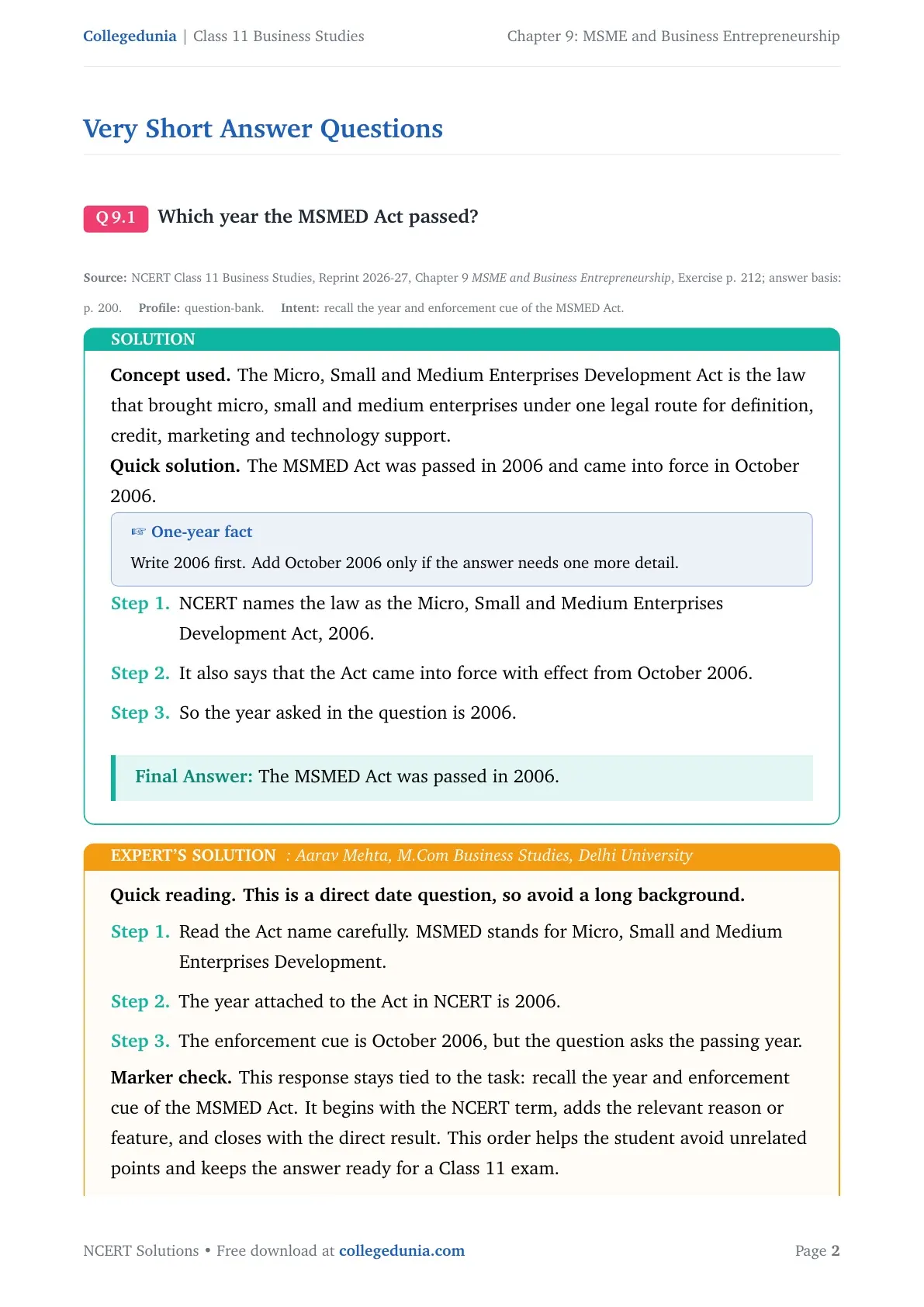
Question 1
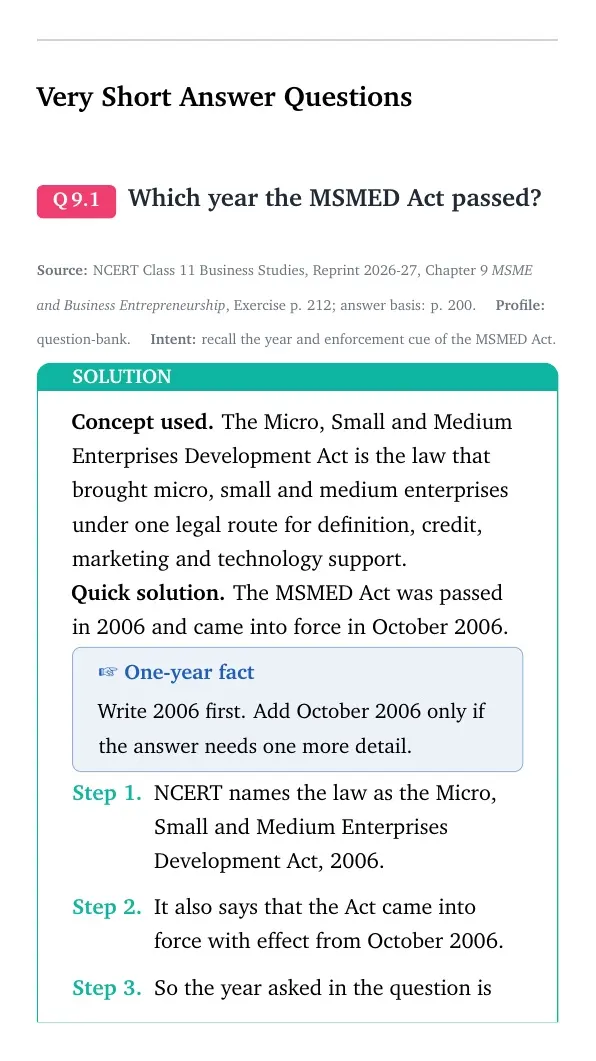
Which year the MSMED Act passed?
Quick solution. The MSMED Act was passed in 2006 and came into force in October 2006.
Concept used. The Micro, Small and Medium Enterprises Development Act is the law that brought micro, small and medium enterprises under one legal route for definition, credit, marketing and technology support.
- NCERT names the law as the Micro, Small and Medium Enterprises Development Act, 2006.
- It also says that the Act came into force with effect from October 2006.
- So the year asked in the question is 2006.
Final answer: The MSMED Act was passed in 2006.
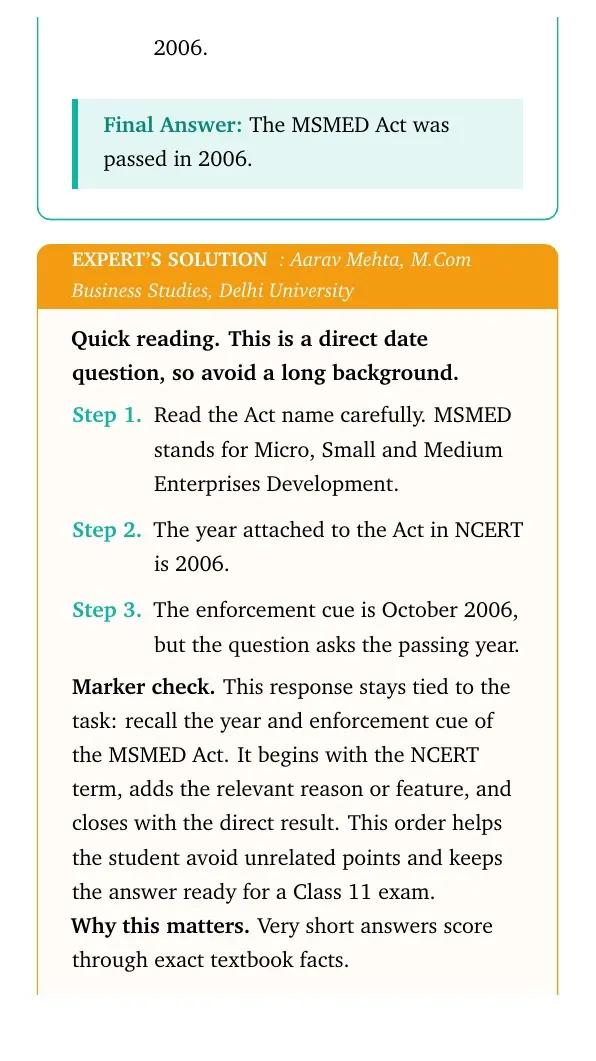
Quick reading. This is a direct date question, so avoid a long background.
- Read the Act name carefully. MSMED stands for Micro, Small and Medium Enterprises Development.
- The year attached to the Act in NCERT is 2006.
- The enforcement cue is October 2006, but the question asks the passing year.
Why this matters. Very short answers score through exact textbook facts.
Expert answer: MSMED Act, 2006.
Question 2
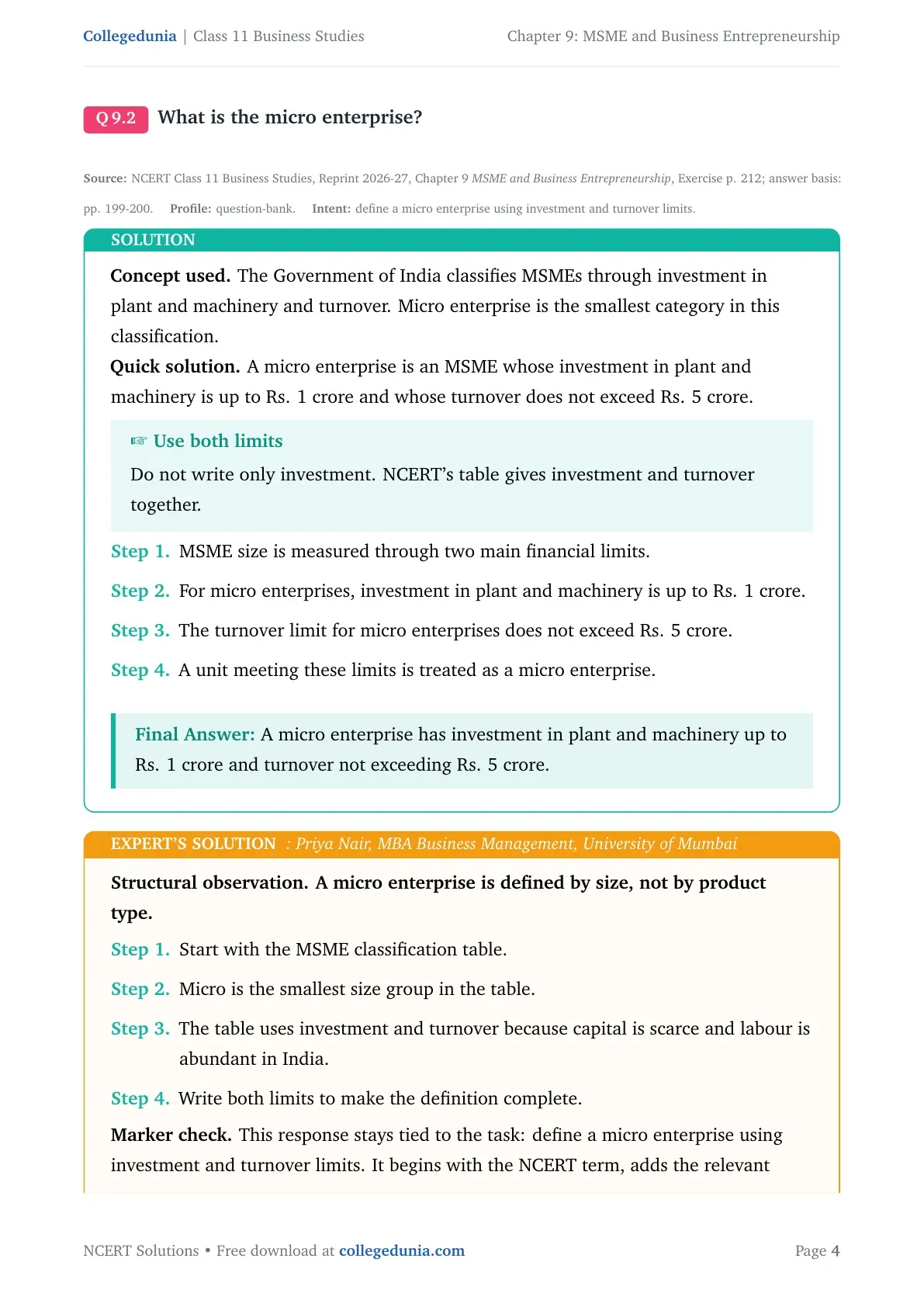
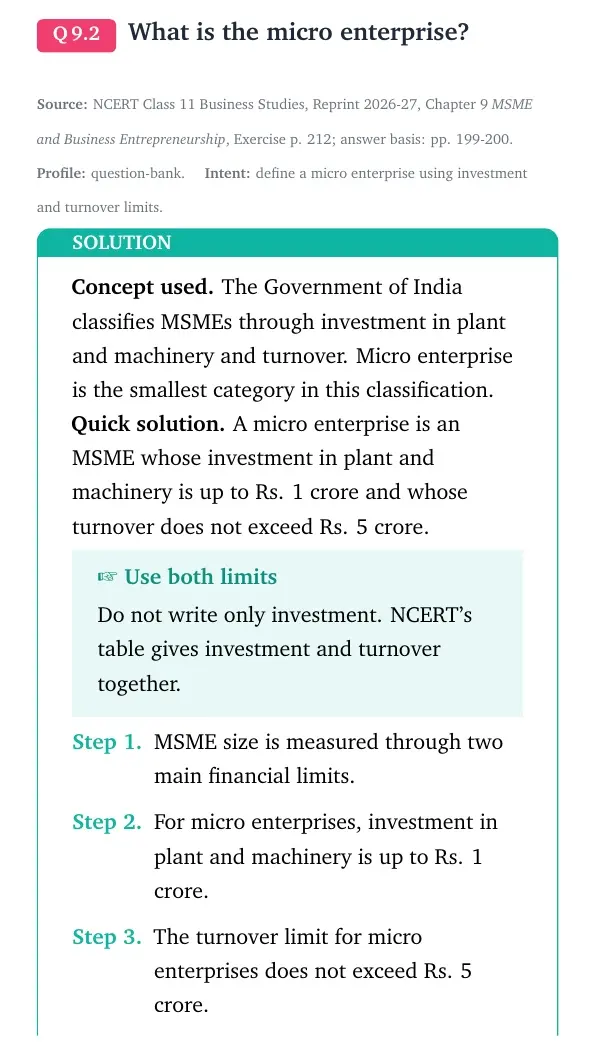
What is the micro enterprise?
Quick solution. A micro enterprise is an MSME whose investment in plant and machinery is up to Rs. 1 crore and whose turnover does not exceed Rs. 5 crore.
Concept used. The Government of India classifies MSMEs through investment in plant and machinery and turnover. Micro enterprise is the smallest category in this classification.
- MSME size is measured through two main financial limits.
- For micro enterprises, investment in plant and machinery is up to Rs. 1 crore.
- The turnover limit for micro enterprises does not exceed Rs. 5 crore.
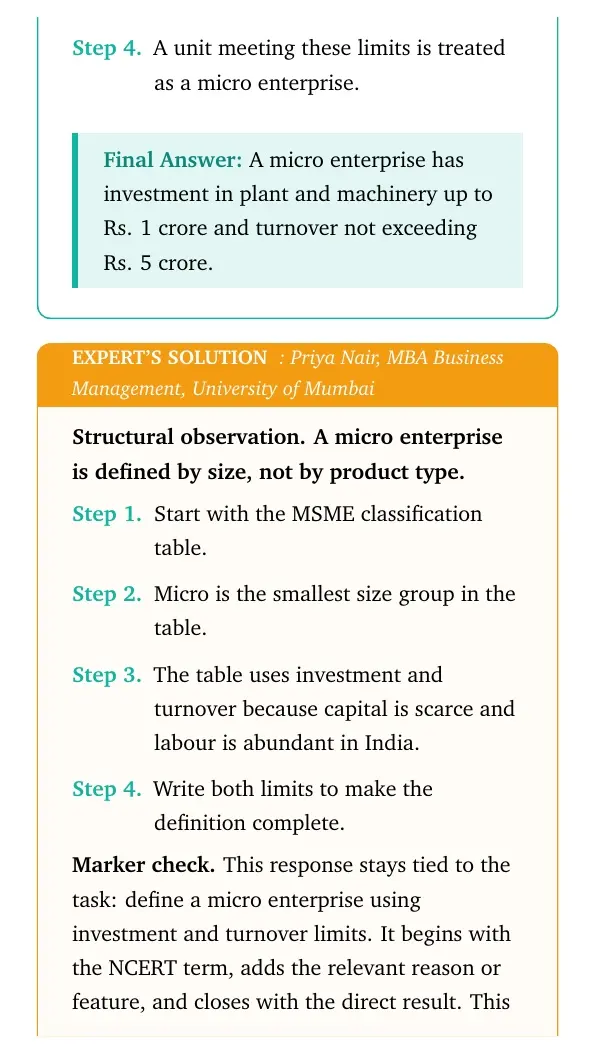
- A unit meeting these limits is treated as a micro enterprise.
Final answer: A micro enterprise has investment in plant and machinery up to Rs. 1 crore and turnover not exceeding Rs. 5 crore.
Structural observation. A micro enterprise is defined by size, not by product type.
- Start with the MSME classification table.
- Micro is the smallest size group in the table.
- The table uses investment and turnover because capital is scarce and labour is abundant in India.
- Write both limits to make the definition complete.
Why this matters. A two-limit answer prevents loss of marks in a definition question.
Expert answer: A micro enterprise is the smallest MSME category, with investment up to Rs. 1 crore and turnover up to Rs. 5 crore.
Question 3
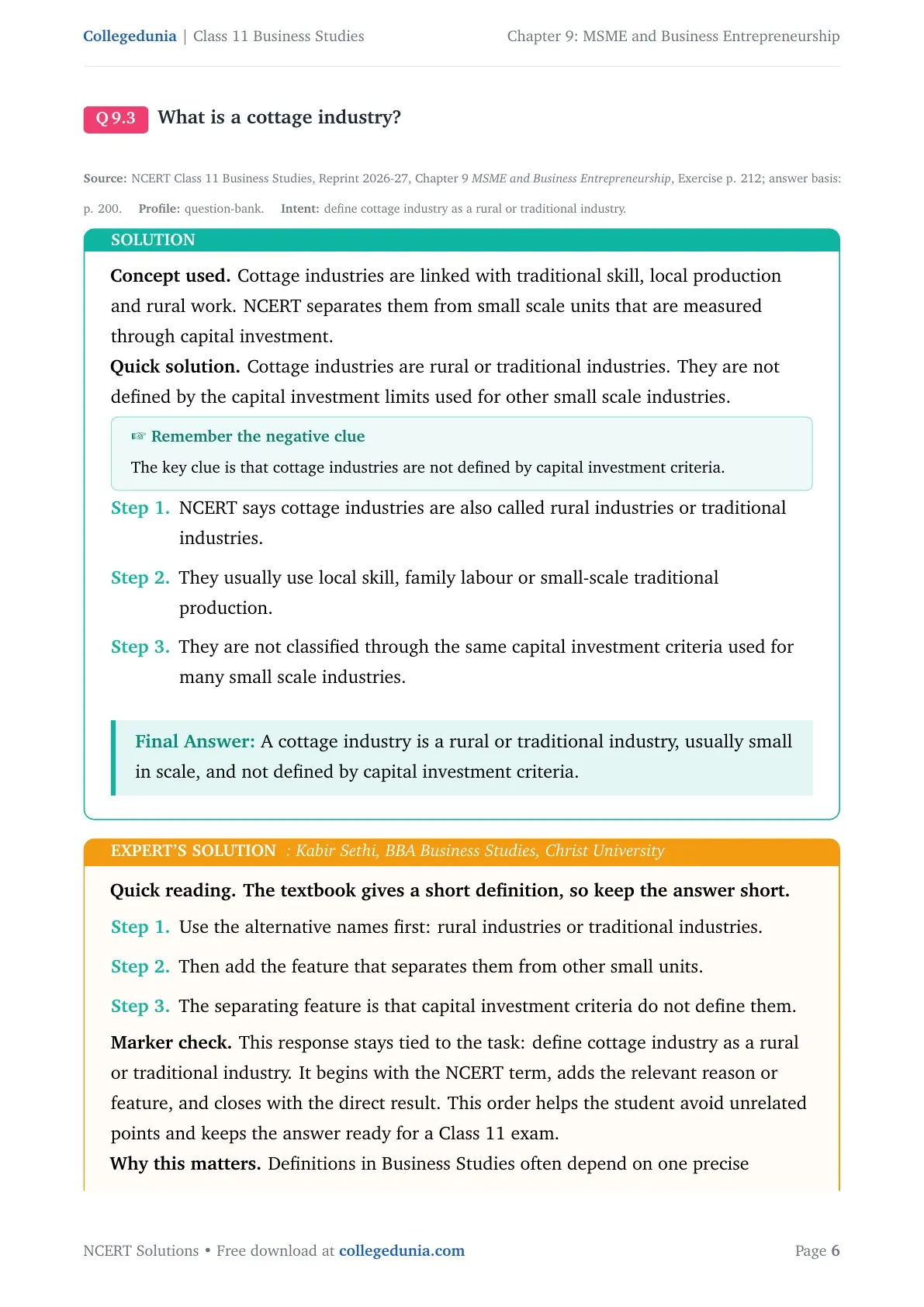
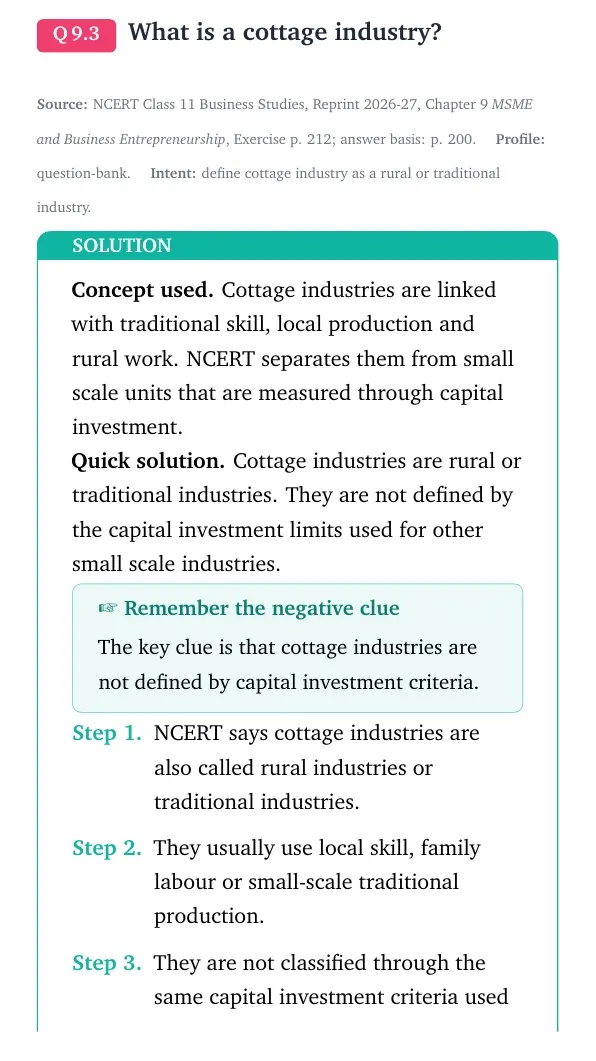
What is a cottage industry?
Quick solution. Cottage industries are rural or traditional industries. They are not defined by the capital investment limits used for other small scale industries.
Concept used. Cottage industries are linked with traditional skill, local production and rural work. NCERT separates them from small scale units that are measured through capital investment.
- NCERT says cottage industries are also called rural industries or traditional industries.
- They usually use local skill, family labour or small-scale traditional production.
- They are not classified through the same capital investment criteria used for many small scale industries.
Final answer: A cottage industry is a rural or traditional industry, usually small in scale, and not defined by capital investment criteria.
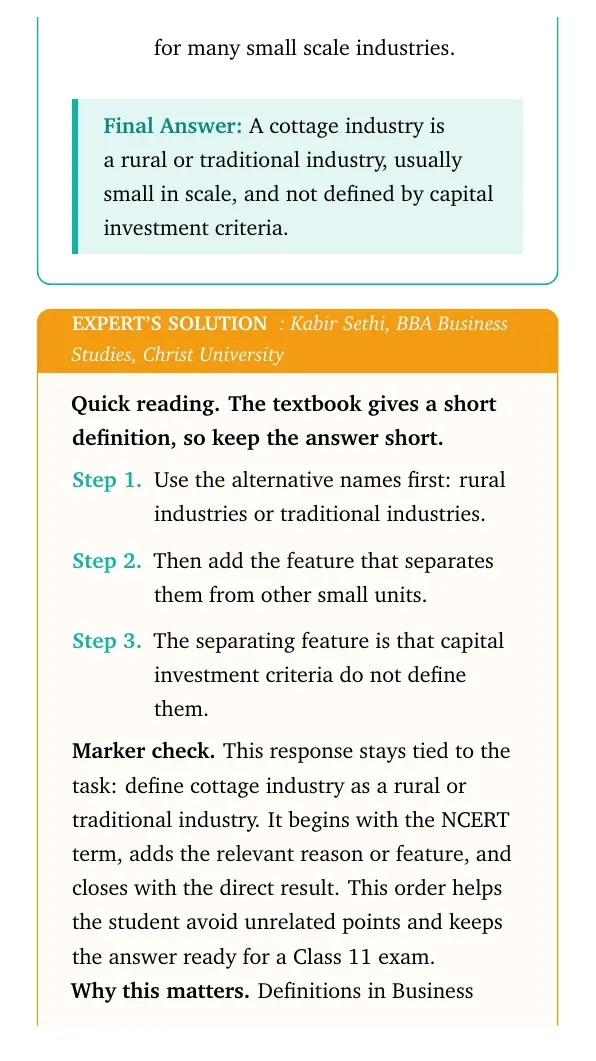
Quick reading. The textbook gives a short definition, so keep the answer short.
- Use the alternative names first: rural industries or traditional industries.
- Then add the feature that separates them from other small units.
- The separating feature is that capital investment criteria do not define them.
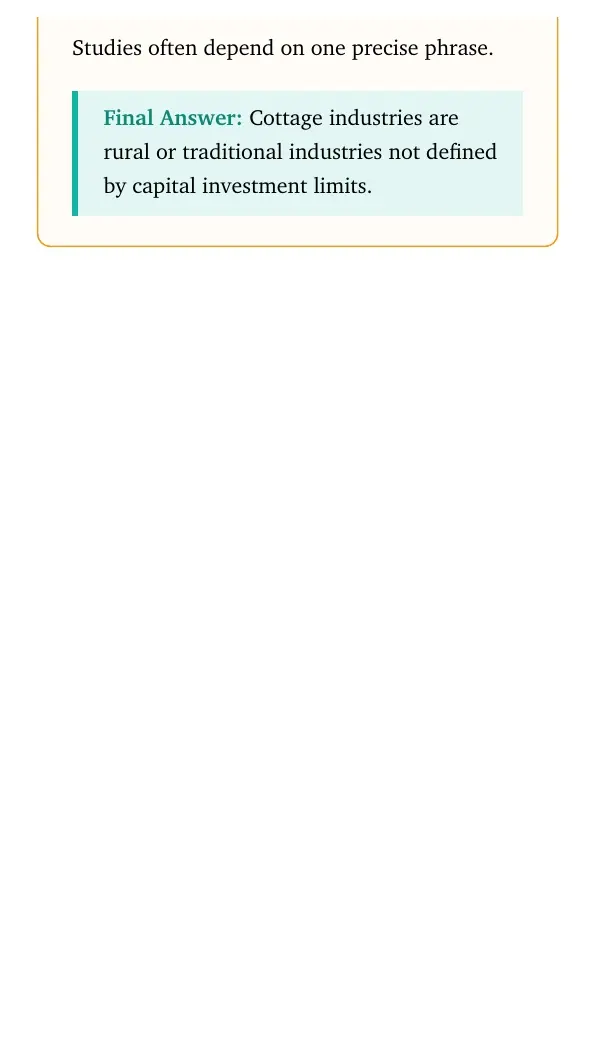
Why this matters. Definitions in Business Studies often depend on one precise phrase.
Expert answer: Cottage industries are rural or traditional industries not defined by capital investment limits.
Question 4
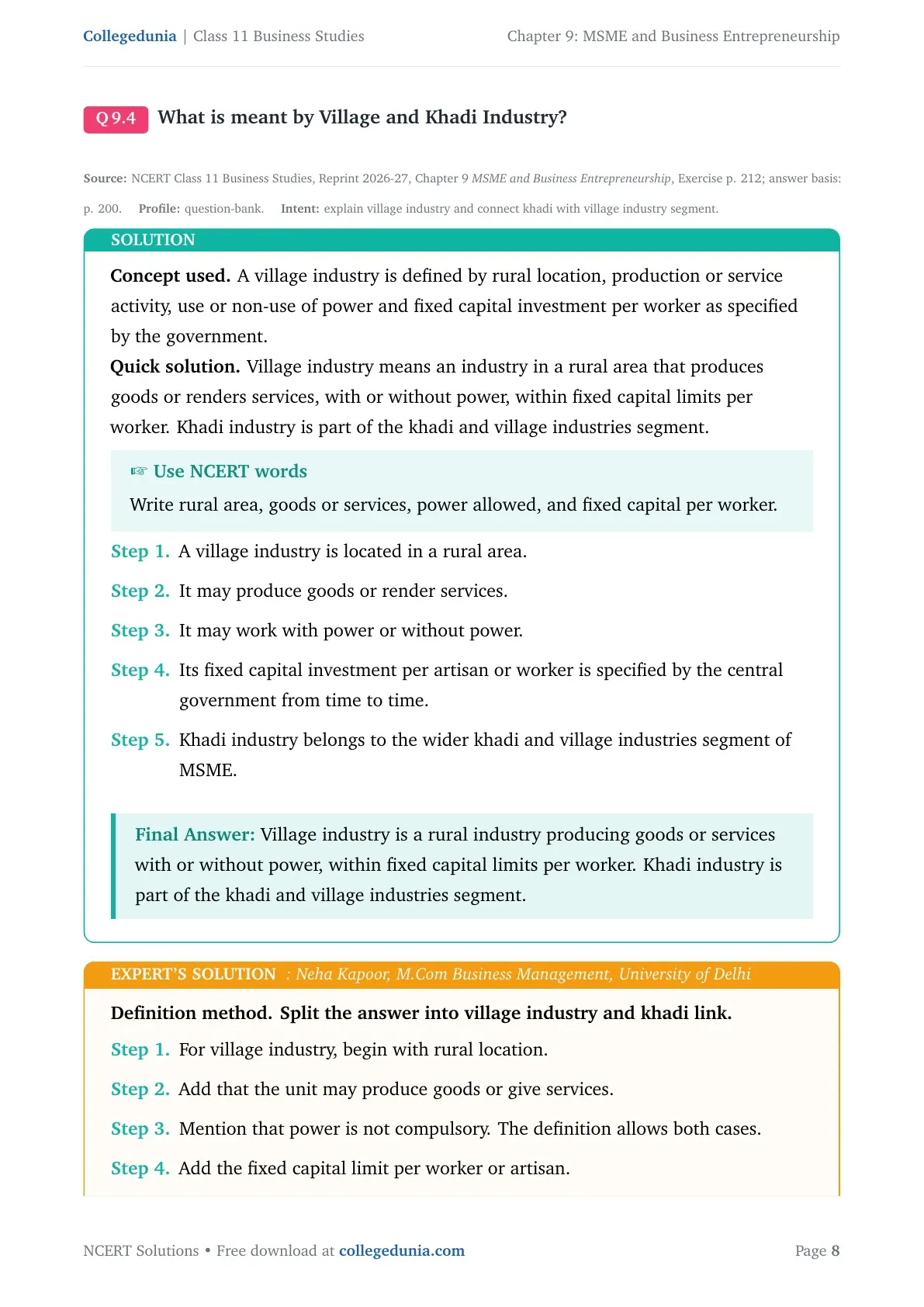
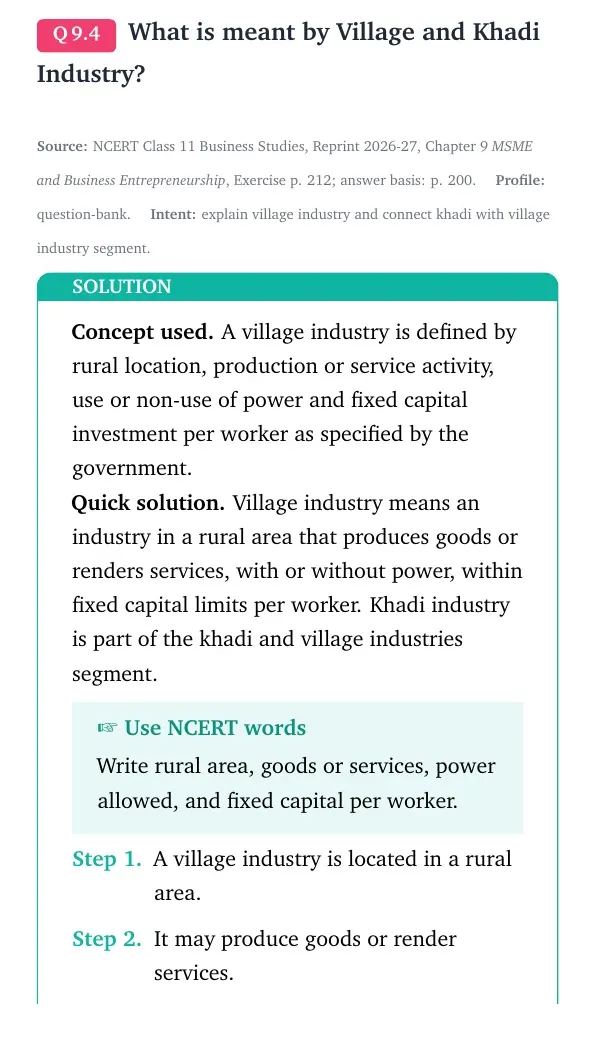
What is meant by Village and Khadi Industry?
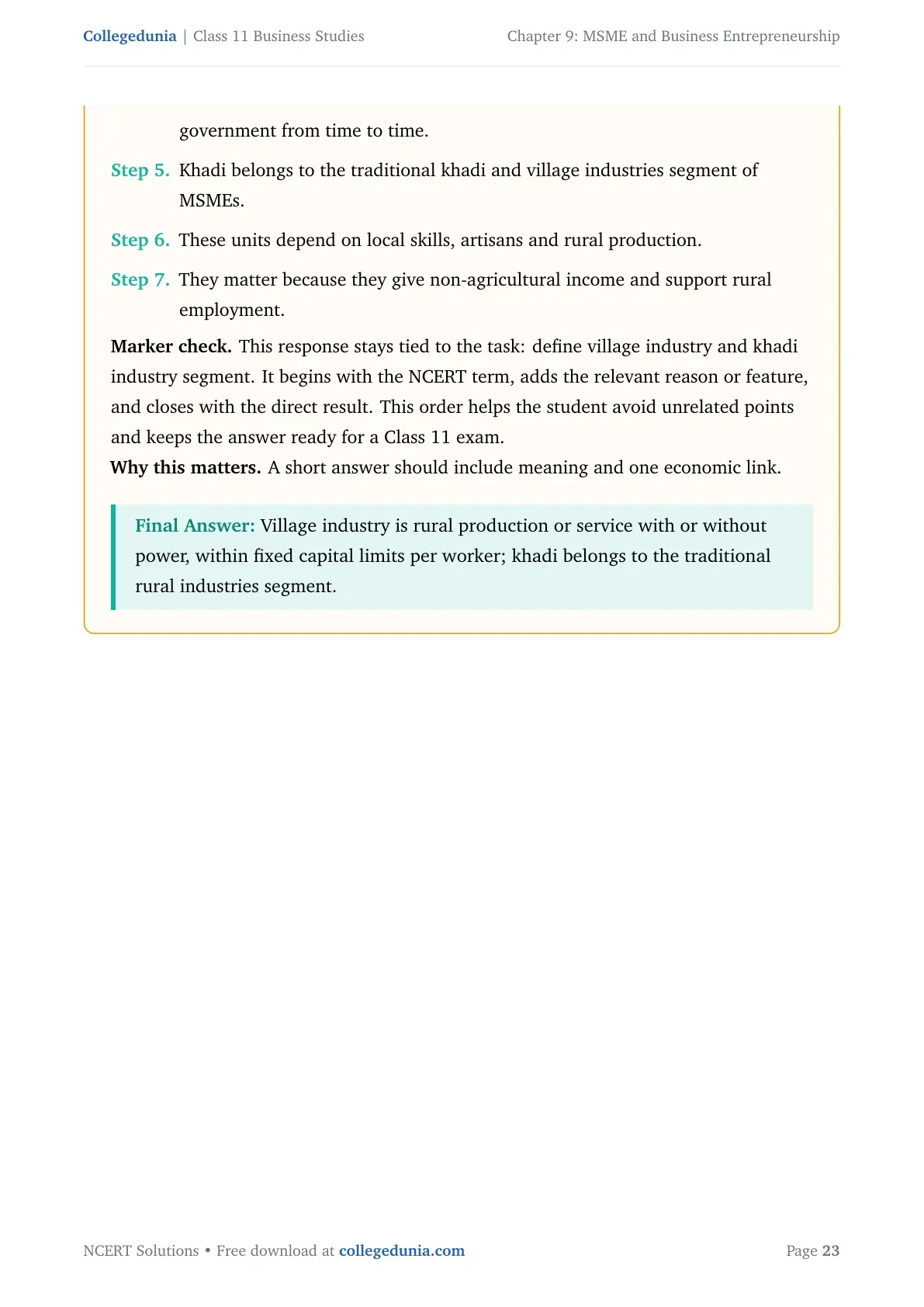
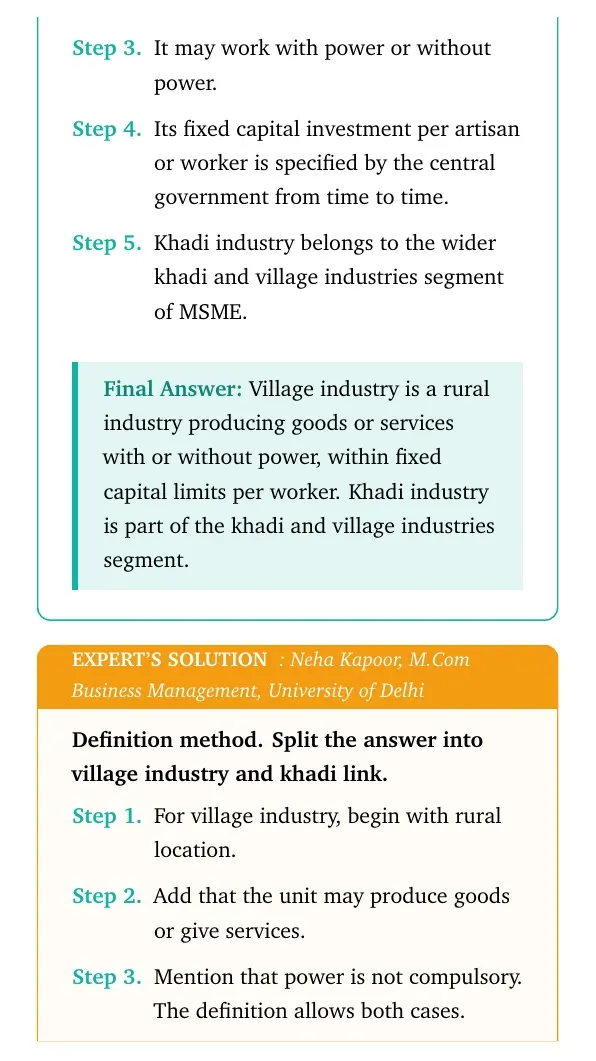
Quick solution. Village industry means an industry in a rural area that produces goods or renders services, with or without power, within fixed capital limits per worker. Khadi industry is part of the khadi and village industries segment.
Concept used. A village industry is defined by rural location, production or service activity, use or non-use of power and fixed capital investment per worker as specified by the government.
- A village industry is located in a rural area.
- It may produce goods or render services.
- It may work with power or without power.
- Its fixed capital investment per artisan or worker is specified by the central government from time to time.
- Khadi industry belongs to the wider khadi and village industries segment of MSME.
Final answer: Village industry is a rural industry producing goods or services with or without power, within fixed capital limits per worker. Khadi industry is part of the khadi and village industries segment.
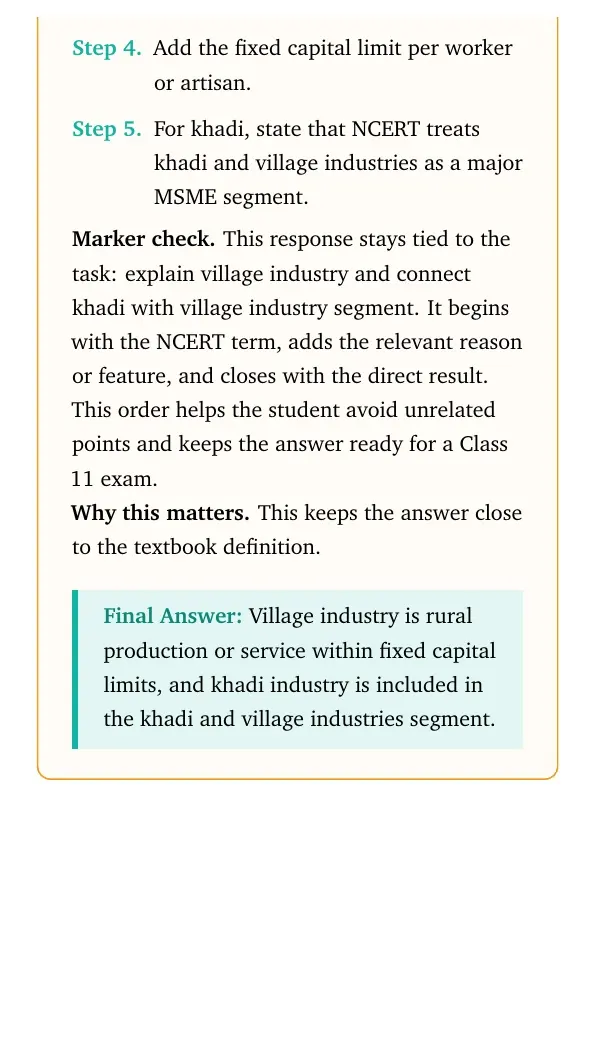
Definition method. Split the answer into village industry and khadi link.
- For village industry, begin with rural location.
- Add that the unit may produce goods or give services.
- Mention that power is not compulsory. The definition allows both cases.
- Add the fixed capital limit per worker or artisan.
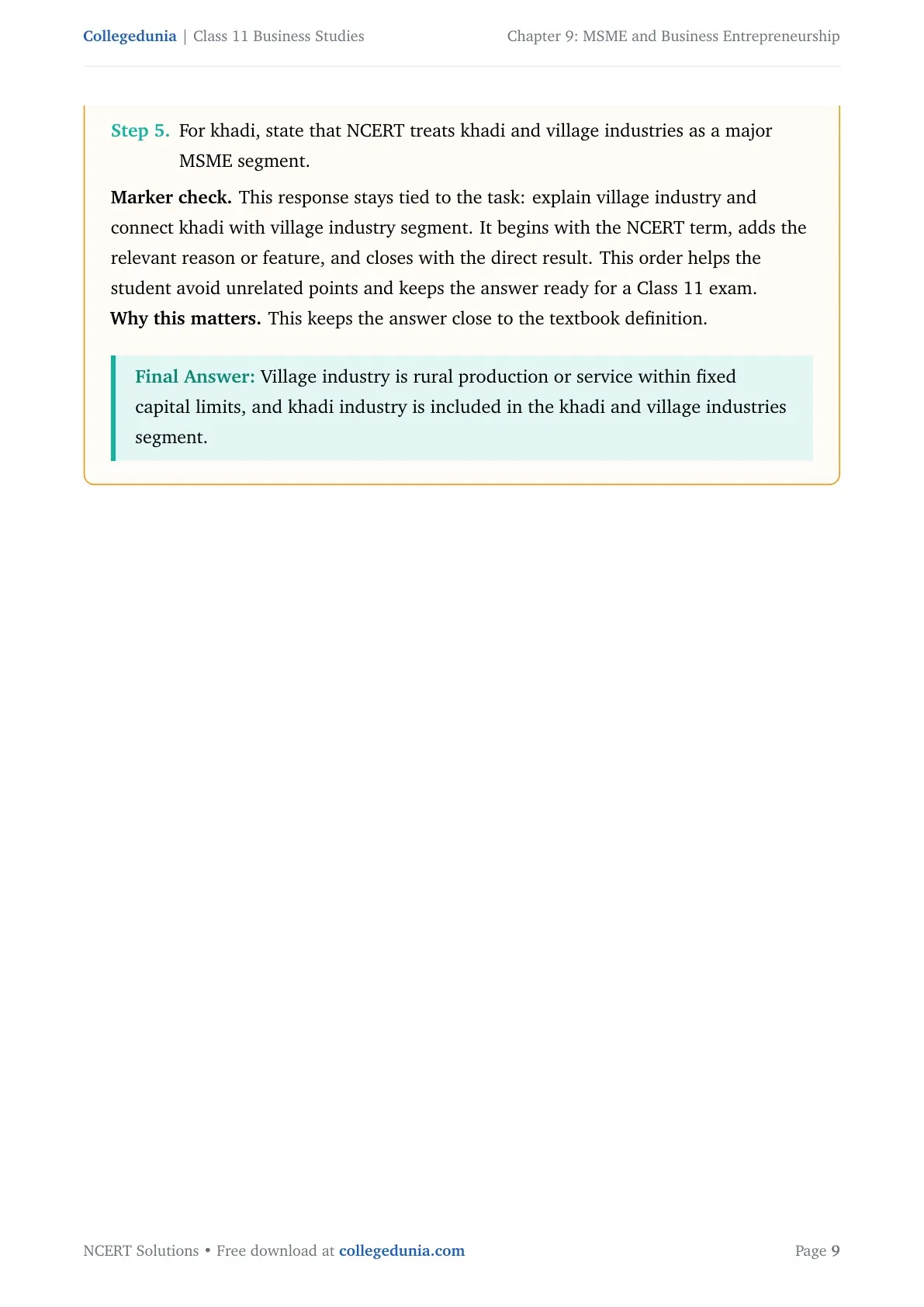
- For khadi, state that NCERT treats khadi and village industries as a major MSME segment.
Why this matters. This keeps the answer close to the textbook definition.
Expert answer: Village industry is rural production or service within fixed capital limits, and khadi industry is included in the khadi and village industries segment.
Question 5
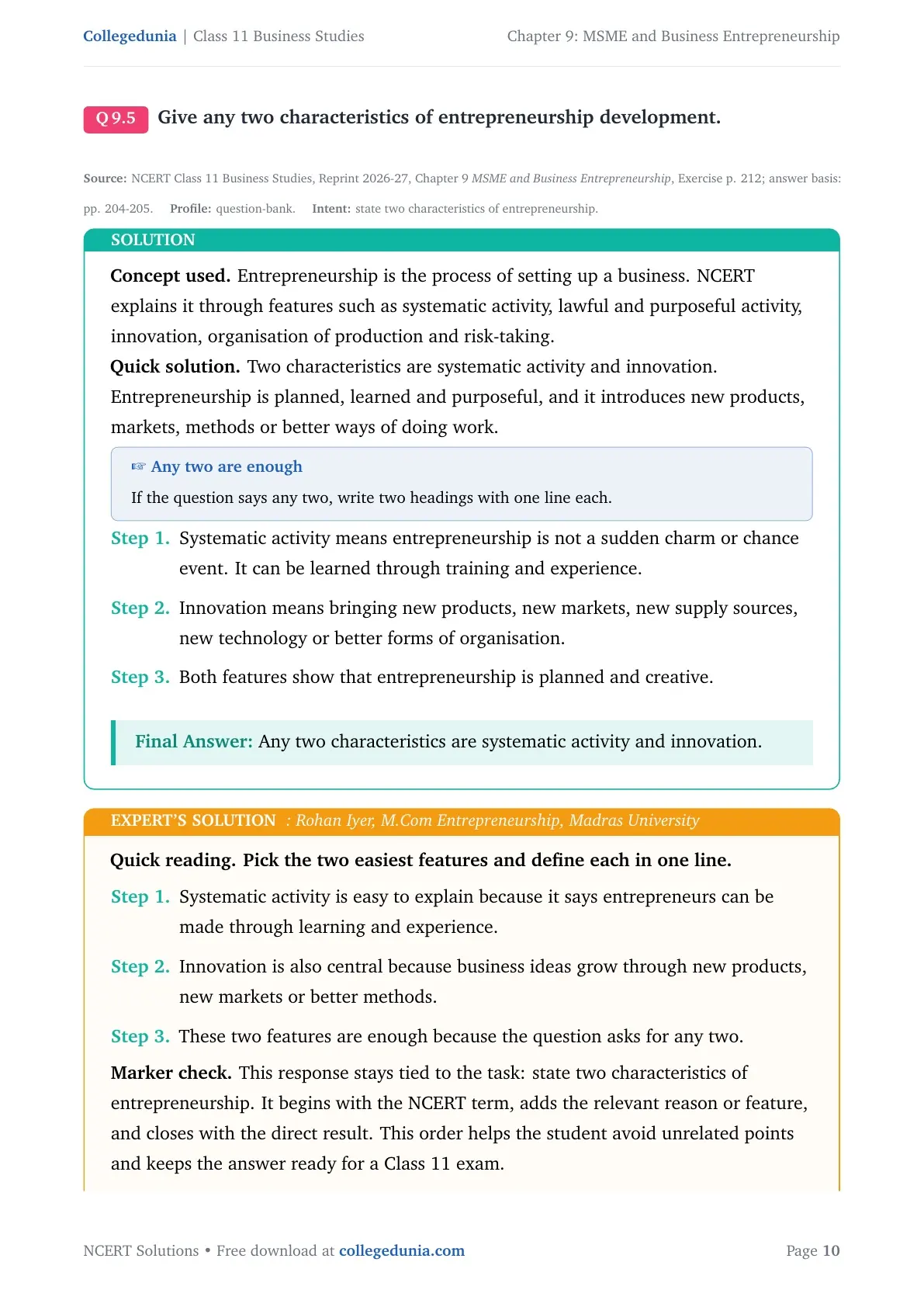
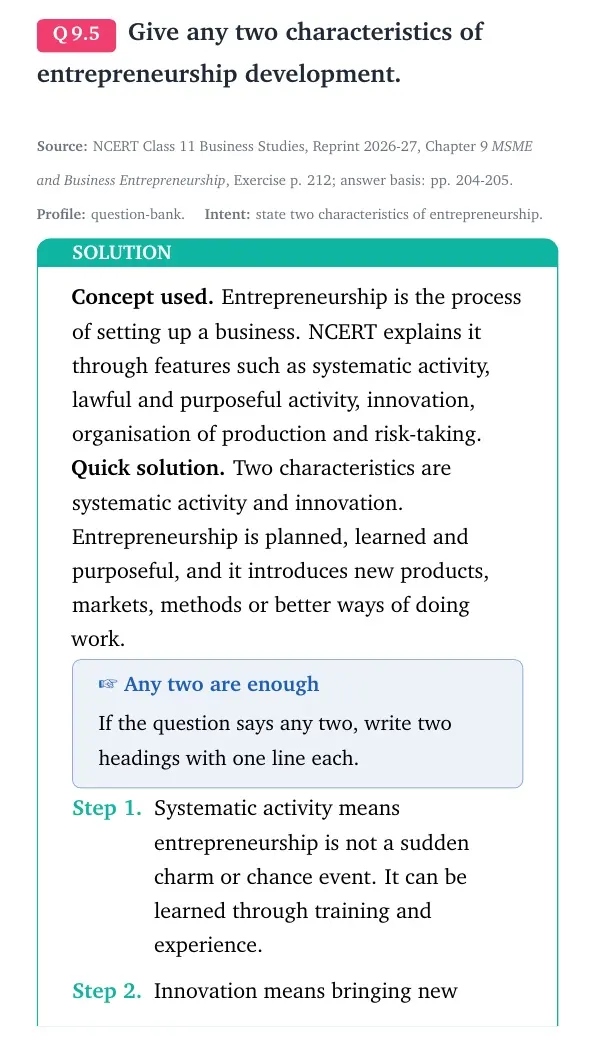
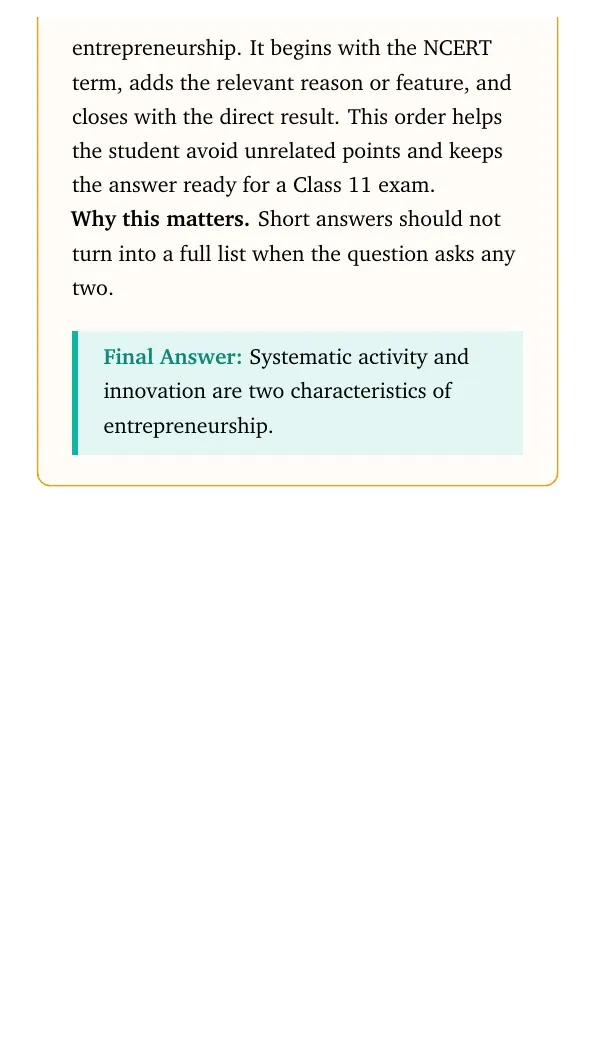
Give any two characteristics of entrepreneurship development.
Quick solution. Two characteristics are systematic activity and innovation. Entrepreneurship is planned, learned and purposeful, and it introduces new products, markets, methods or better ways of doing work.
Concept used. Entrepreneurship is the process of setting up a business. NCERT explains it through features such as systematic activity, lawful and purposeful activity, innovation, organisation of production and risk-taking.
- Systematic activity means entrepreneurship is not a sudden charm or chance event. It can be learned through training and experience.
- Innovation means bringing new products, new markets, new supply sources, new technology or better forms of organisation.
- Both features show that entrepreneurship is planned and creative.
Final answer: Any two characteristics are systematic activity and innovation.
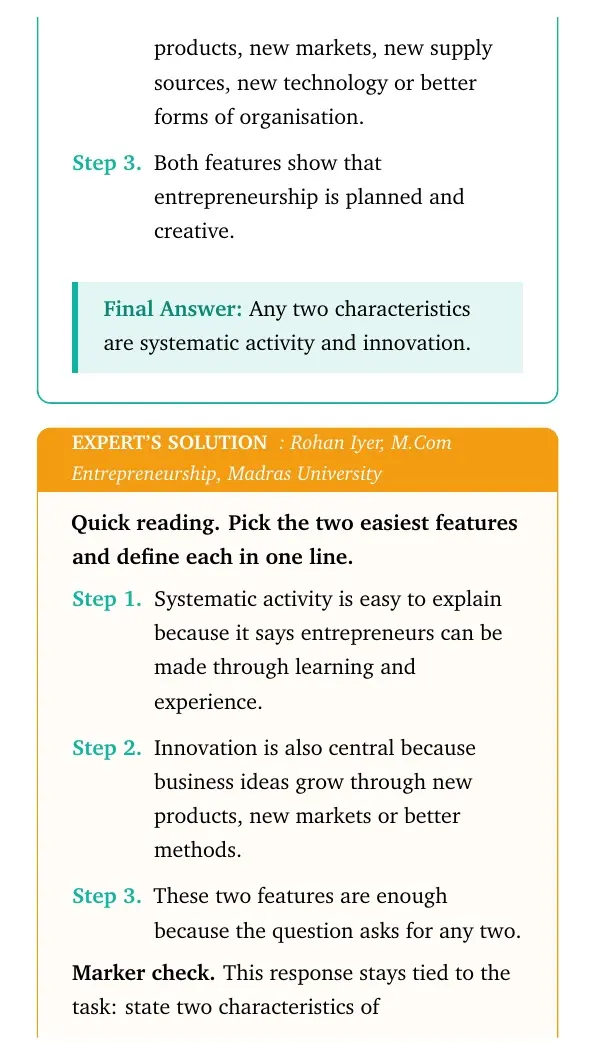
Quick reading. Pick the two easiest features and define each in one line.
- Systematic activity is easy to explain because it says entrepreneurs can be made through learning and experience.
- Innovation is also central because business ideas grow through new products, new markets or better methods.
- These two features are enough because the question asks for any two.
Why this matters. Short answers should not turn into a full list when the question asks any two.
Expert answer: Systematic activity and innovation are two characteristics of entrepreneurship.
Question 6
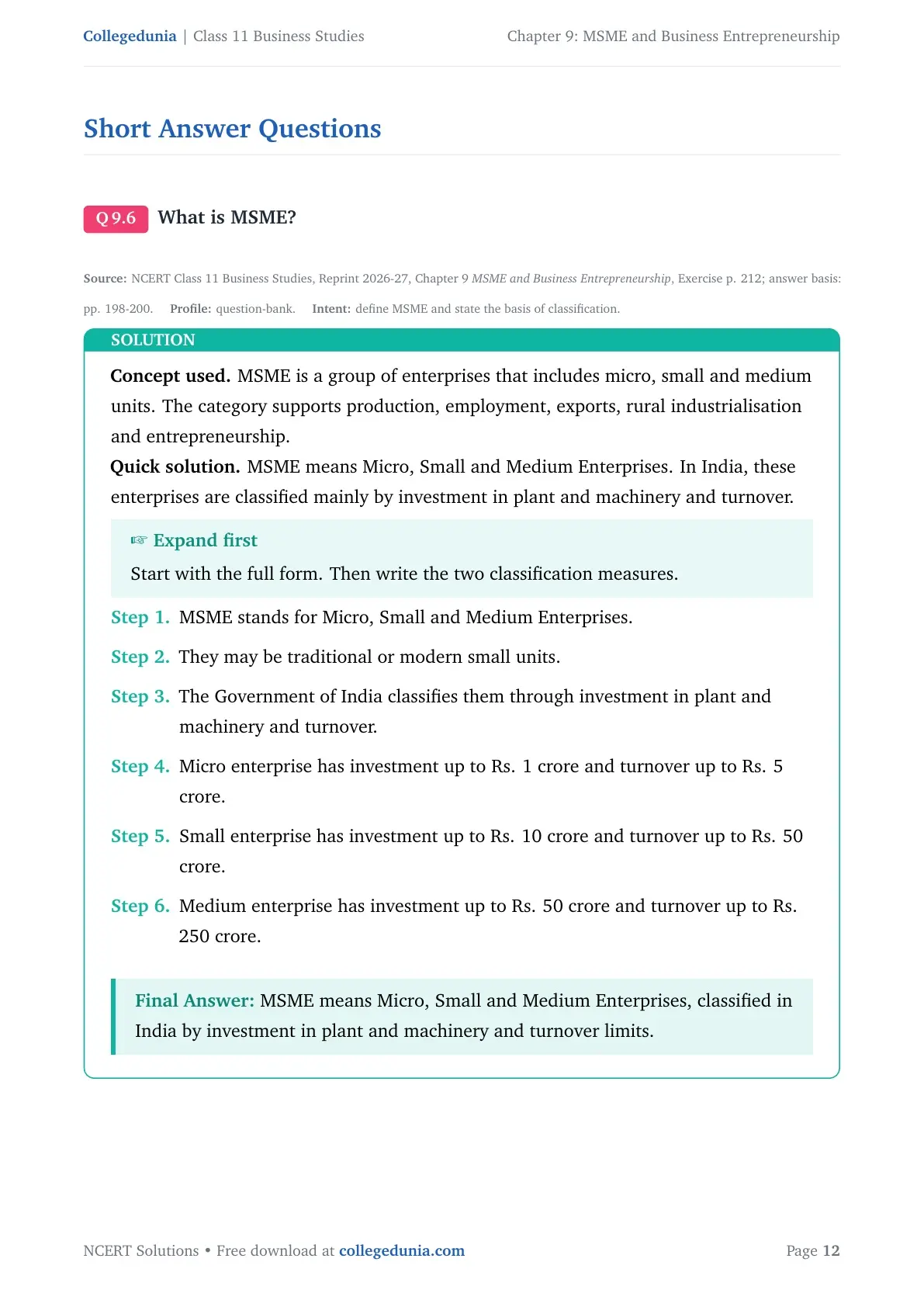
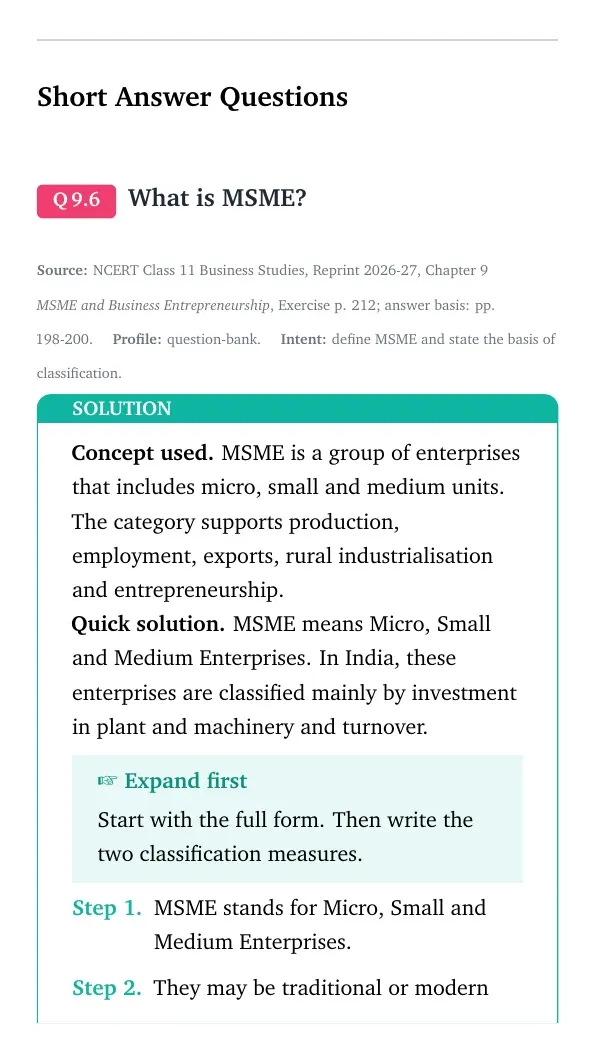
What is MSME?
Quick solution. MSME means Micro, Small and Medium Enterprises. In India, these enterprises are classified mainly by investment in plant and machinery and turnover.
Concept used. MSME is a group of enterprises that includes micro, small and medium units. The category supports production, employment, exports, rural industrialisation and entrepreneurship.
- MSME stands for Micro, Small and Medium Enterprises.
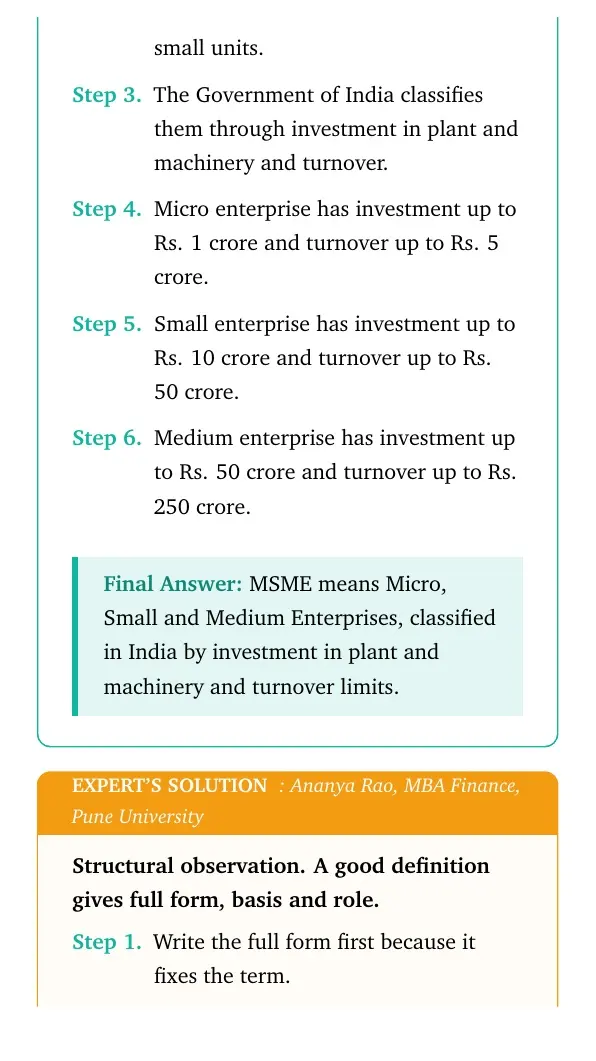
- They may be traditional or modern small units.
- The Government of India classifies them through investment in plant and machinery and turnover.
- Micro enterprise has investment up to Rs. 1 crore and turnover up to Rs. 5 crore.
- Small enterprise has investment up to Rs. 10 crore and turnover up to Rs. 50 crore.
- Medium enterprise has investment up to Rs. 50 crore and turnover up to Rs. 250 crore.
Final answer: MSME means Micro, Small and Medium Enterprises, classified in India by investment in plant and machinery and turnover limits.
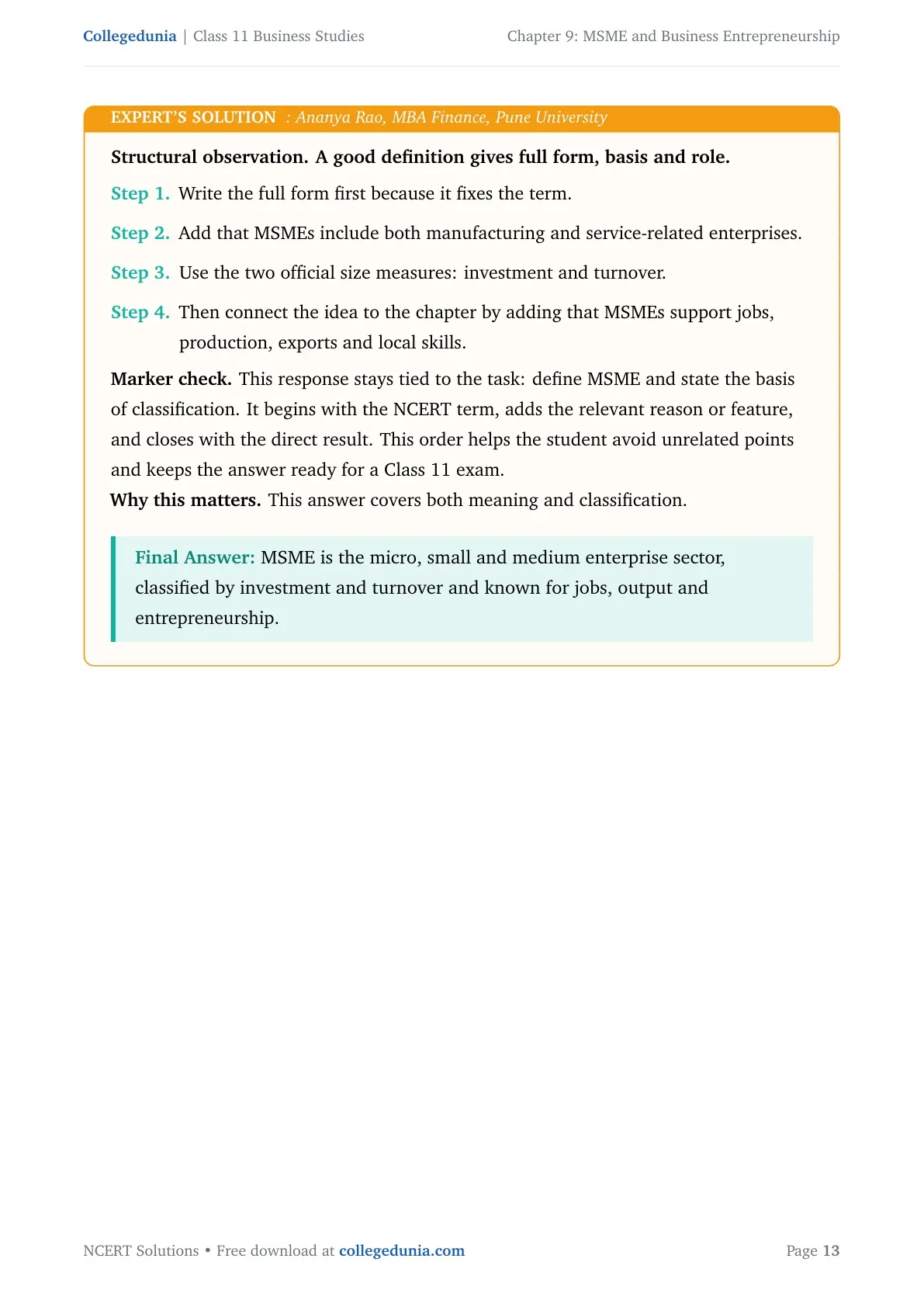
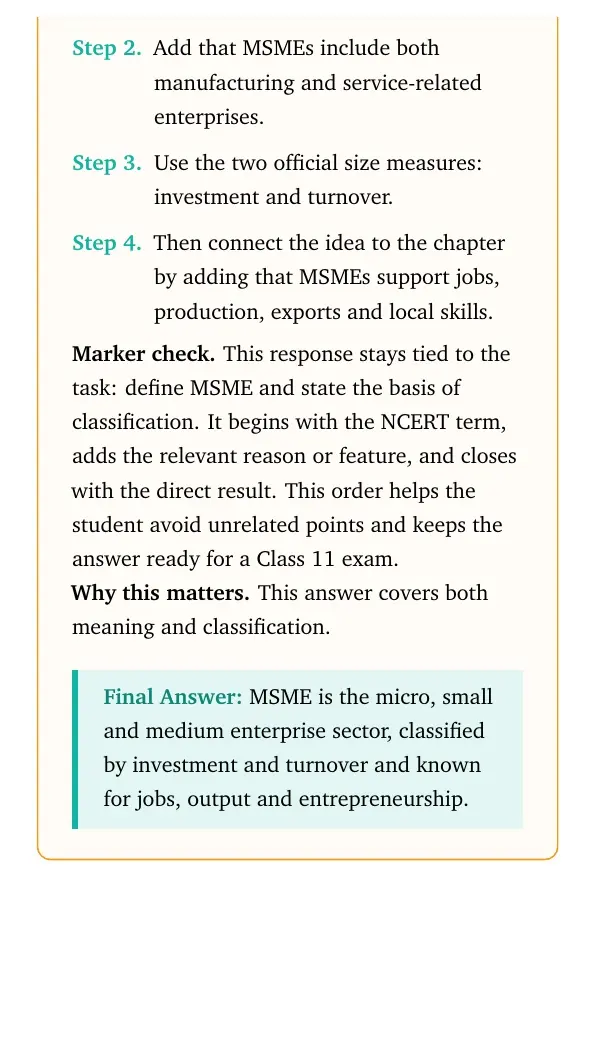
Structural observation. A good definition gives full form, basis and role.
- Write the full form first because it fixes the term.
- Add that MSMEs include both manufacturing and service-related enterprises.
- Use the two official size measures: investment and turnover.
- Then connect the idea to the chapter by adding that MSMEs support jobs, production, exports and local skills.
Why this matters. This answer covers both meaning and classification.
Expert answer: MSME is the micro, small and medium enterprise sector, classified by investment and turnover and known for jobs, output and entrepreneurship.
Question 7
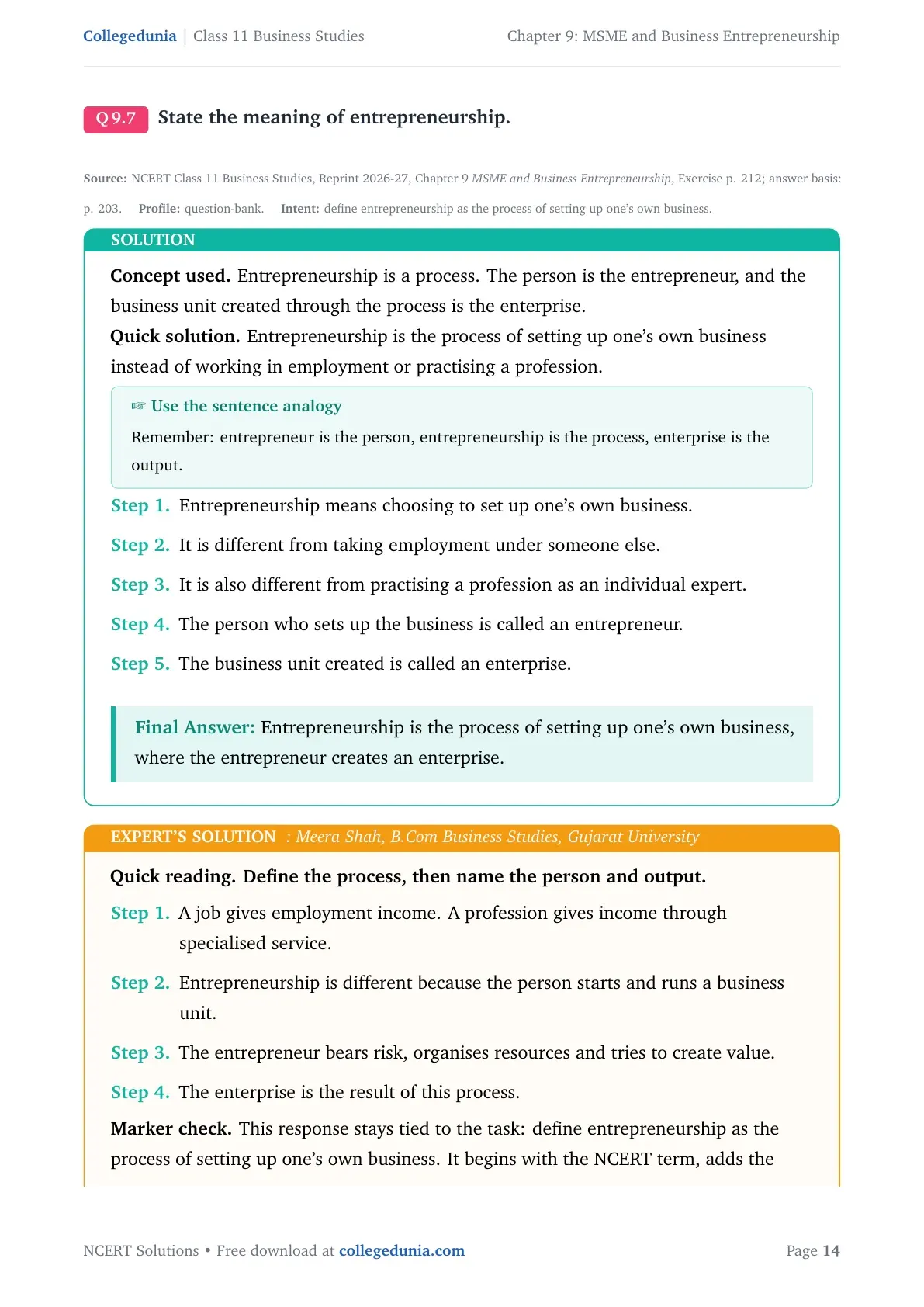
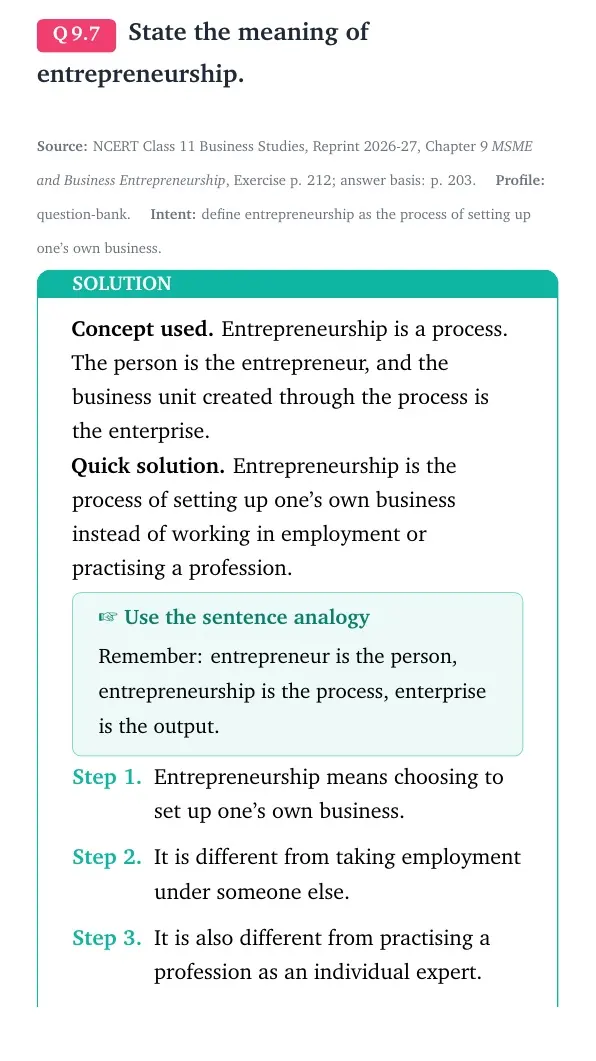
State the meaning of entrepreneurship.
Quick solution. Entrepreneurship is the process of setting up one's own business instead of working in employment or practising a profession.
Concept used. Entrepreneurship is a process. The person is the entrepreneur, and the business unit created through the process is the enterprise.
- Entrepreneurship means choosing to set up one's own business.
- It is different from taking employment under someone else.
- It is also different from practising a profession as an individual expert.
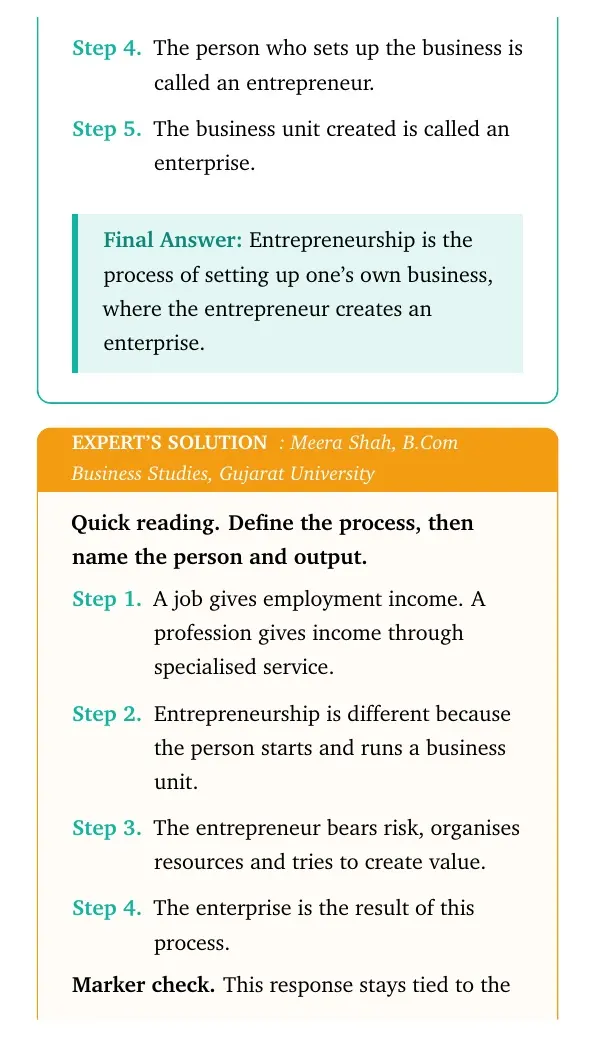
- The person who sets up the business is called an entrepreneur.
- The business unit created is called an enterprise.
Final answer: Entrepreneurship is the process of setting up one's own business, where the entrepreneur creates an enterprise.
Quick reading. Define the process, then name the person and output.
- A job gives employment income. A profession gives income through specialised service.
- Entrepreneurship is different because the person starts and runs a business unit.
- The entrepreneur bears risk, organises resources and tries to create value.
- The enterprise is the result of this process.
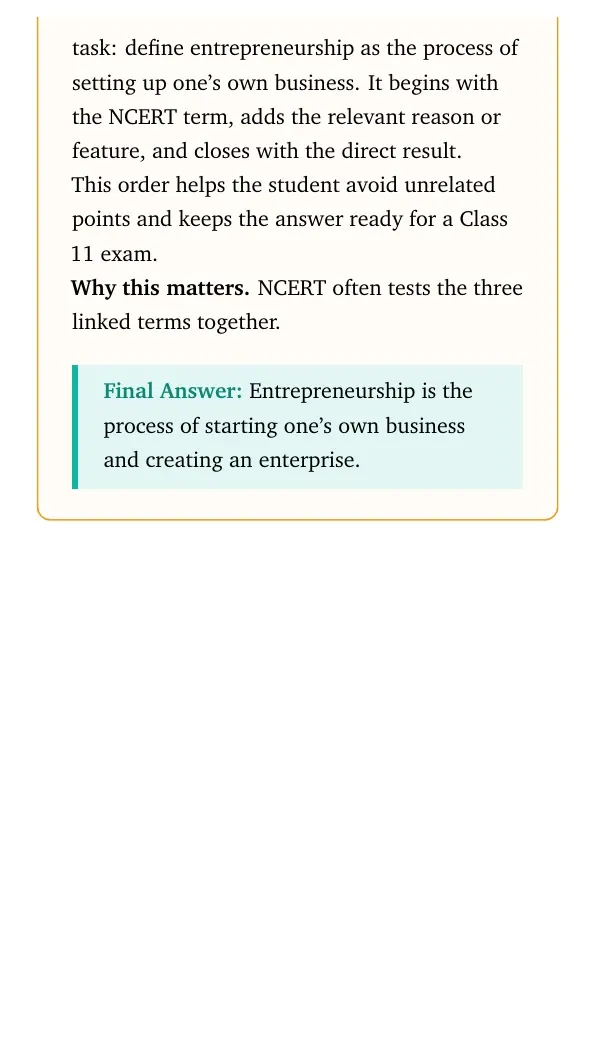
Why this matters. NCERT often tests the three linked terms together.
Expert answer: Entrepreneurship is the process of starting one's own business and creating an enterprise.
Question 8
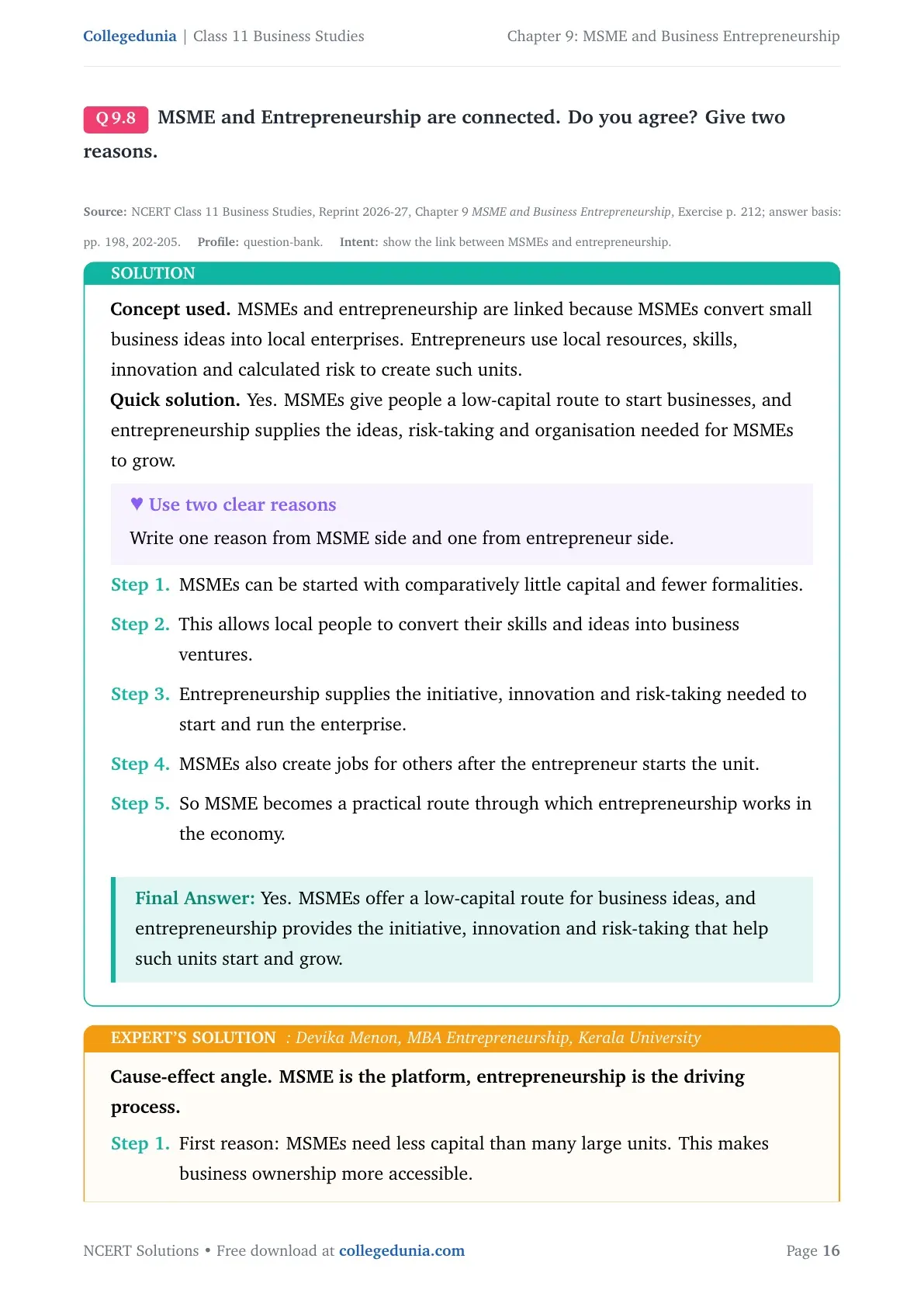
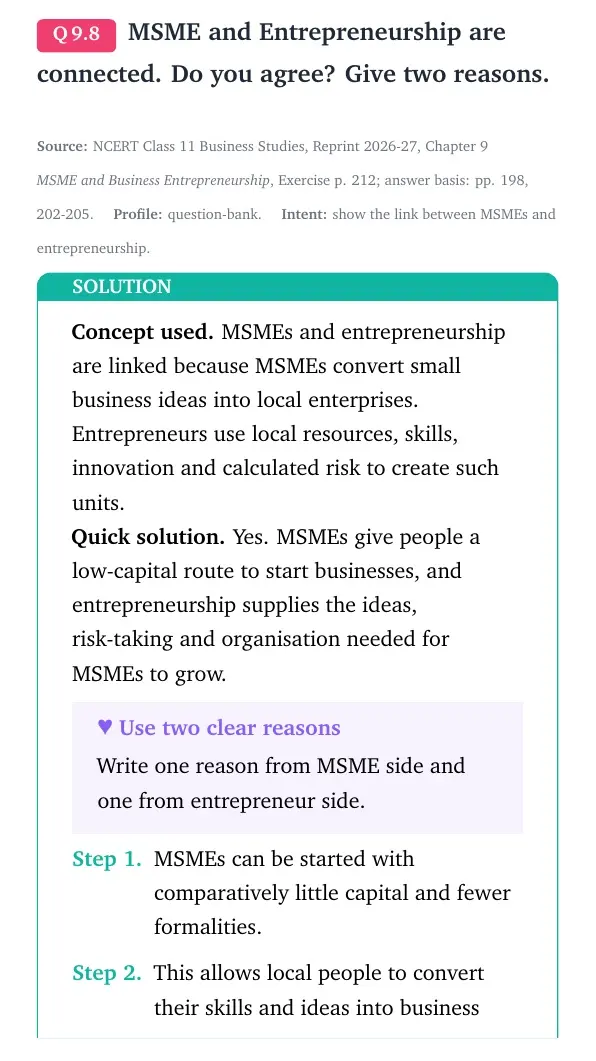
MSME and Entrepreneurship are connected. Do you agree? Give two reasons.
Quick solution. Yes. MSMEs give people a low-capital route to start businesses, and entrepreneurship supplies the ideas, risk-taking and organisation needed for MSMEs to grow.
Concept used. MSMEs and entrepreneurship are linked because MSMEs convert small business ideas into local enterprises. Entrepreneurs use local resources, skills, innovation and calculated risk to create such units.
- MSMEs can be started with comparatively little capital and fewer formalities.
- This allows local people to convert their skills and ideas into business ventures.
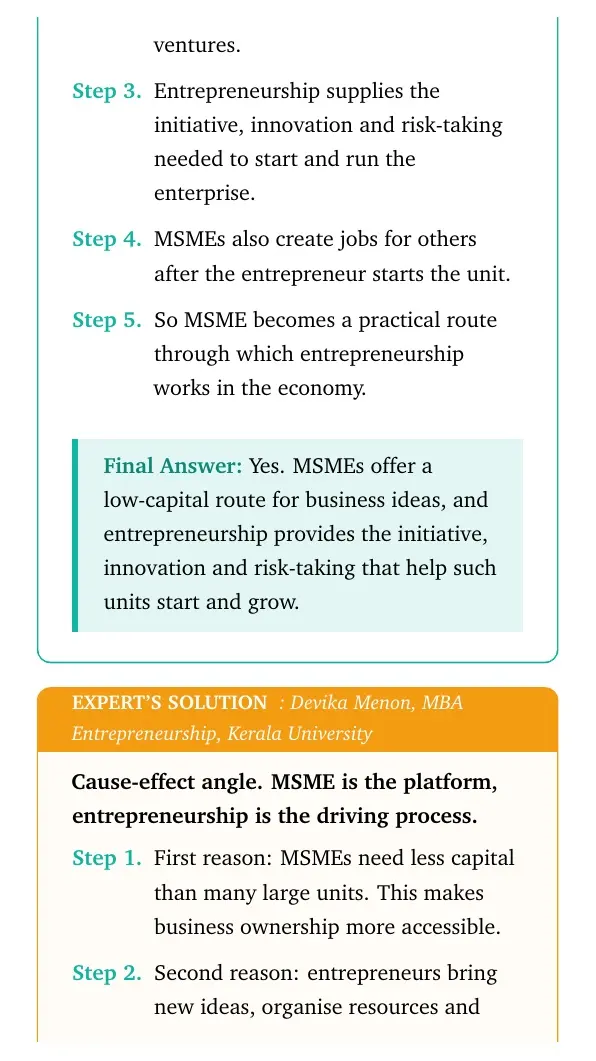
- Entrepreneurship supplies the initiative, innovation and risk-taking needed to start and run the enterprise.
- MSMEs also create jobs for others after the entrepreneur starts the unit.
- So MSME becomes a practical route through which entrepreneurship works in the economy.
Final answer: Yes. MSMEs offer a low-capital route for business ideas, and entrepreneurship provides the initiative, innovation and risk-taking that help such units start and grow.
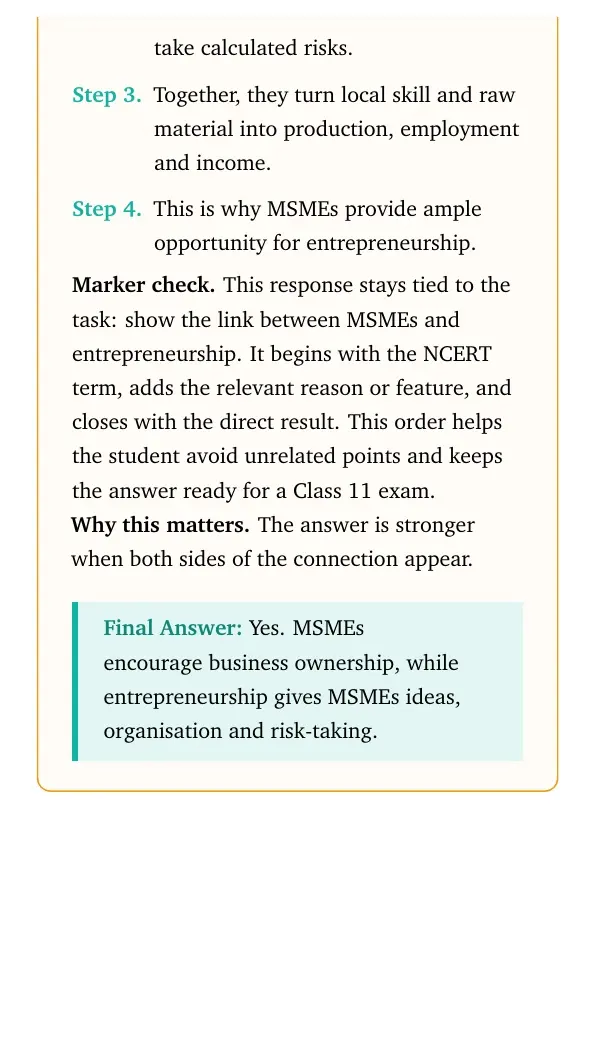
Cause-effect angle. MSME is the platform, entrepreneurship is the driving process.
- First reason: MSMEs need less capital than many large units. This makes business ownership more accessible.
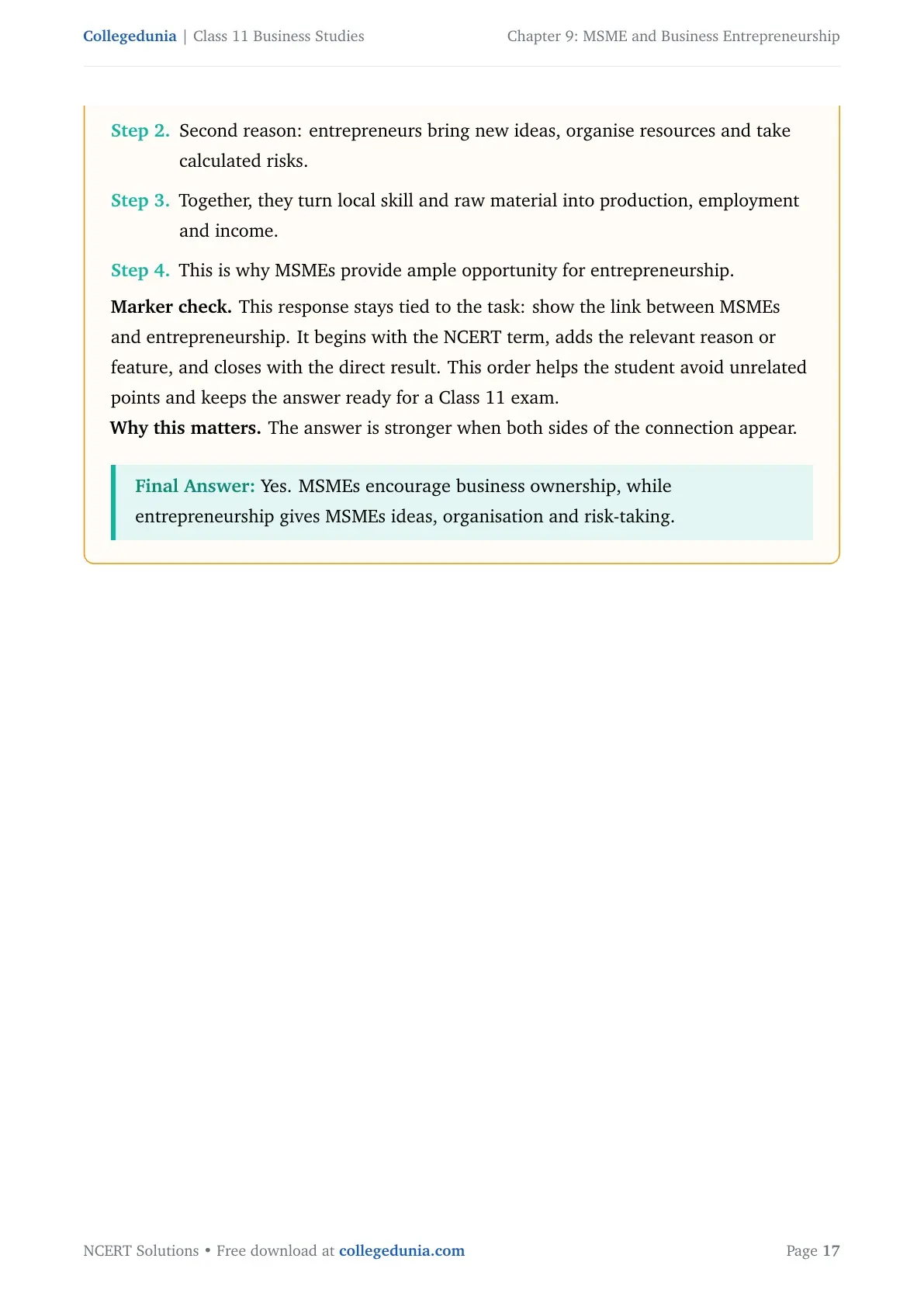
- Second reason: entrepreneurs bring new ideas, organise resources and take calculated risks.
- Together, they turn local skill and raw material into production, employment and income.
- This is why MSMEs provide ample opportunity for entrepreneurship.
Why this matters. The answer is stronger when both sides of the connection appear.
Expert answer: Yes. MSMEs encourage business ownership, while entrepreneurship gives MSMEs ideas, organisation and risk-taking.
Question 9
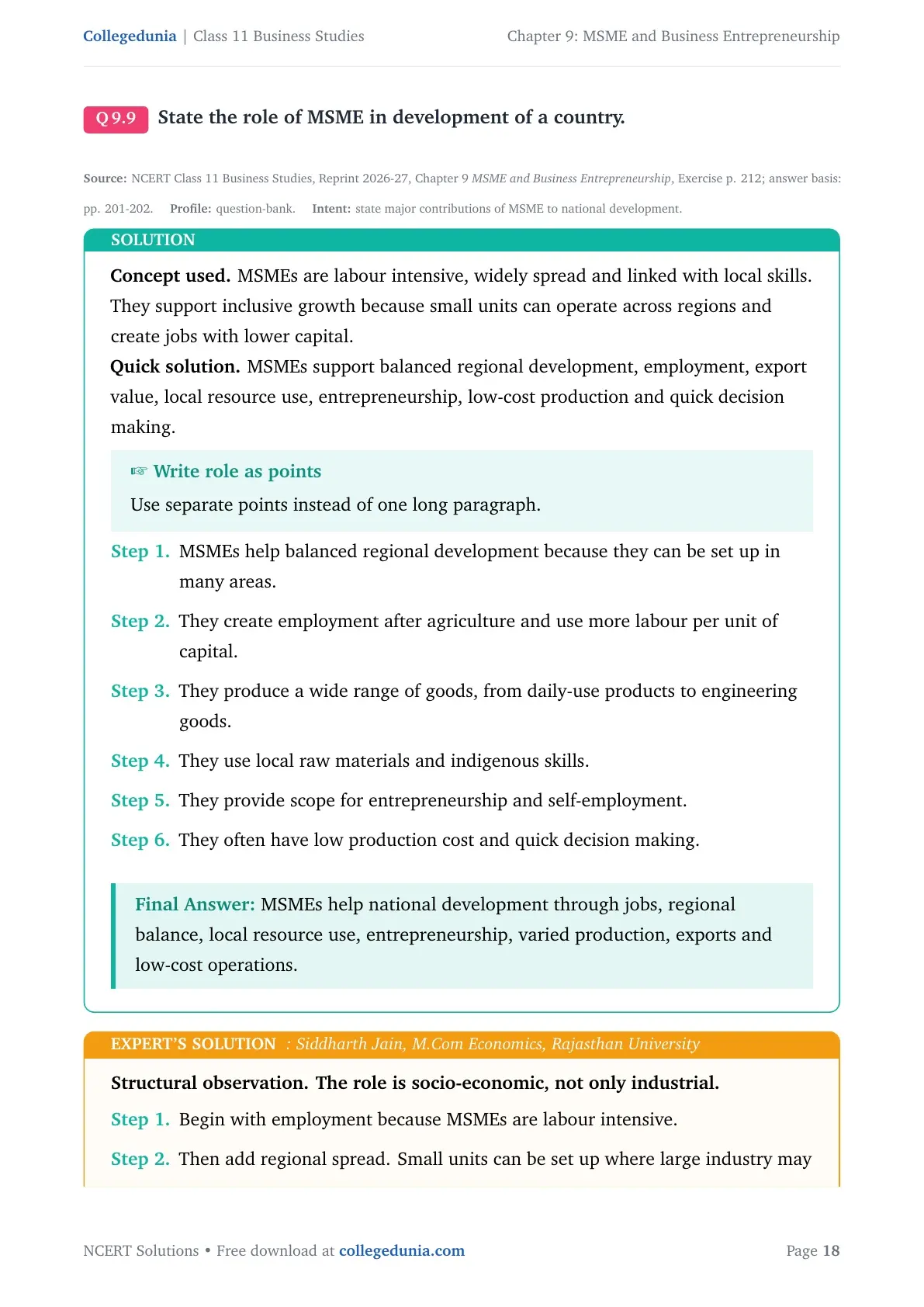
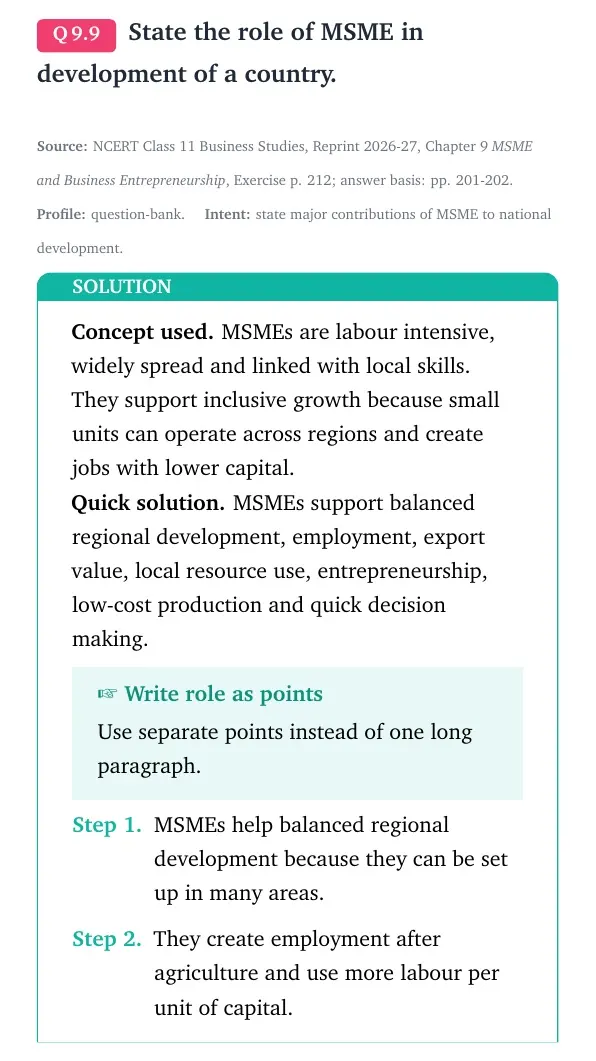
State the role of MSME in development of a country.
Quick solution. MSMEs support balanced regional development, employment, export value, local resource use, entrepreneurship, low-cost production and quick decision making.
Concept used. MSMEs are labour intensive, widely spread and linked with local skills. They support inclusive growth because small units can operate across regions and create jobs with lower capital.
- MSMEs help balanced regional development because they can be set up in many areas.
- They create employment after agriculture and use more labour per unit of capital.
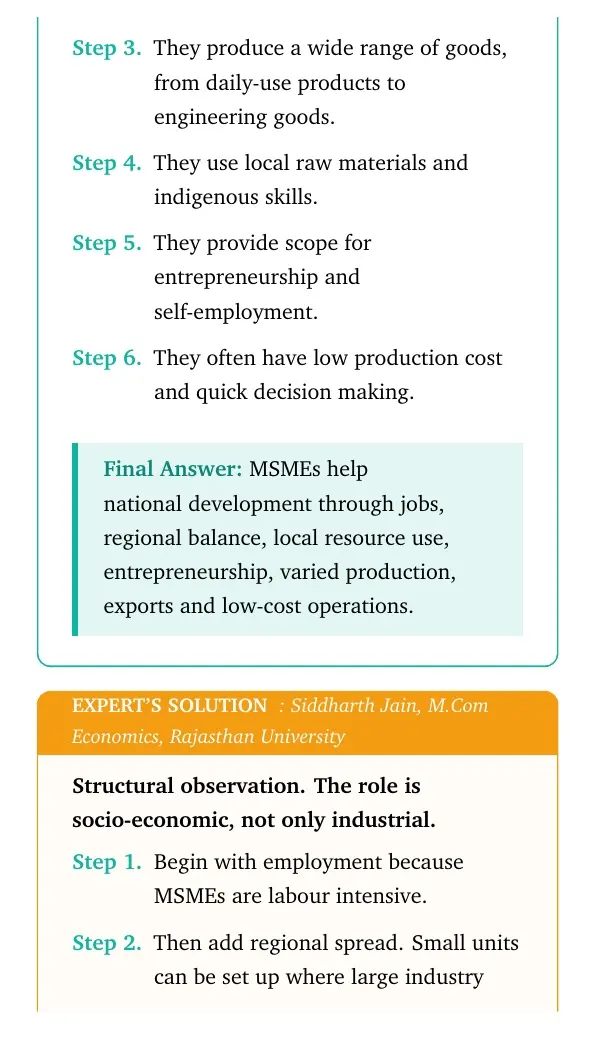
- They produce a wide range of goods, from daily-use products to engineering goods.
- They use local raw materials and indigenous skills.
- They provide scope for entrepreneurship and self-employment.
- They often have low production cost and quick decision making.
Final answer: MSMEs help national development through jobs, regional balance, local resource use, entrepreneurship, varied production, exports and low-cost operations.
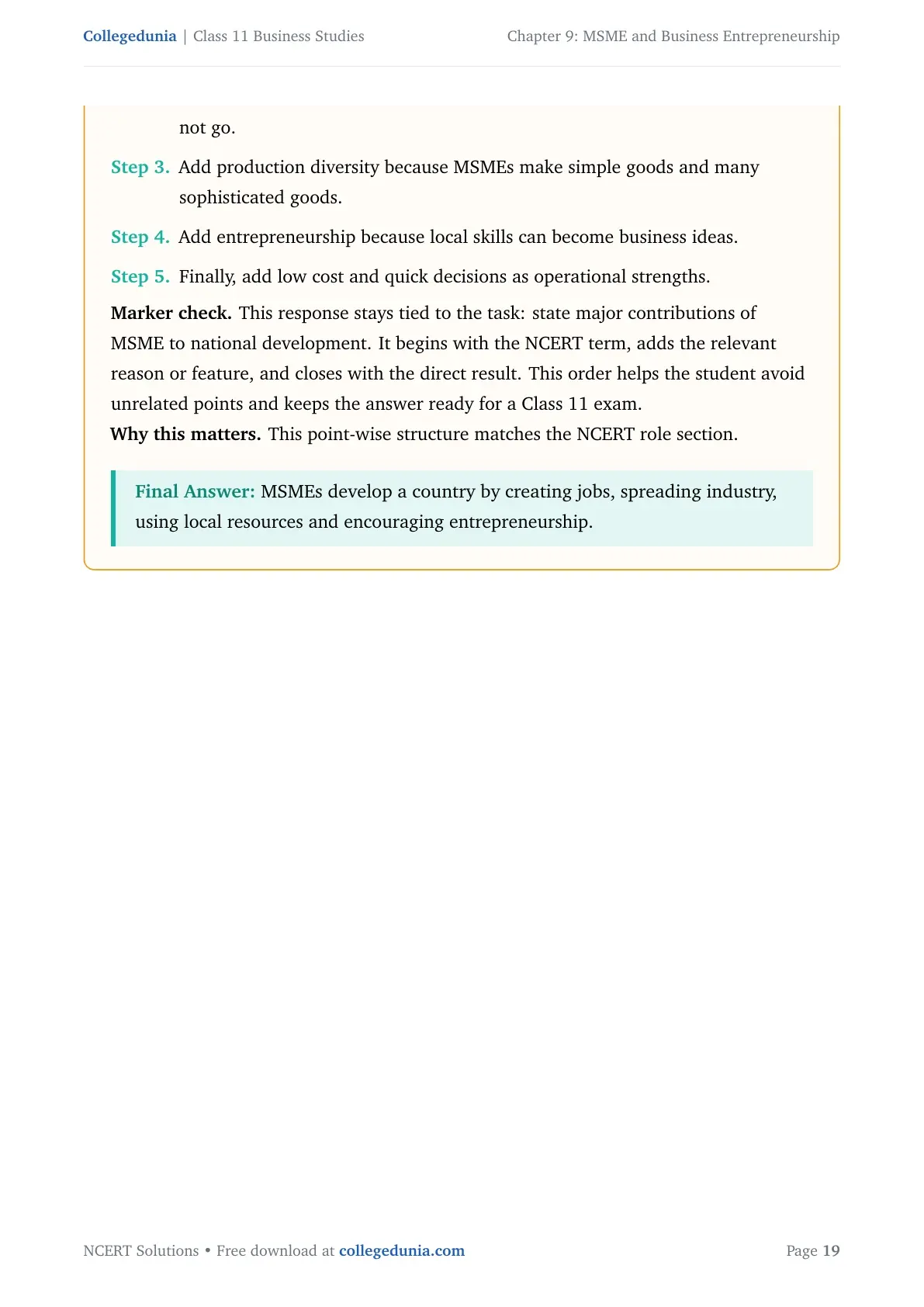
Structural observation. The role is socio-economic, not only industrial.
- Begin with employment because MSMEs are labour intensive.
- Then add regional spread. Small units can be set up where large industry may not go.
- Add production diversity because MSMEs make simple goods and many sophisticated goods.
- Add entrepreneurship because local skills can become business ideas.
- Finally, add low cost and quick decisions as operational strengths.
Why this matters. This point-wise structure matches the NCERT role section.
Expert answer: MSMEs develop a country by creating jobs, spreading industry, using local resources and encouraging entrepreneurship.
Question 10
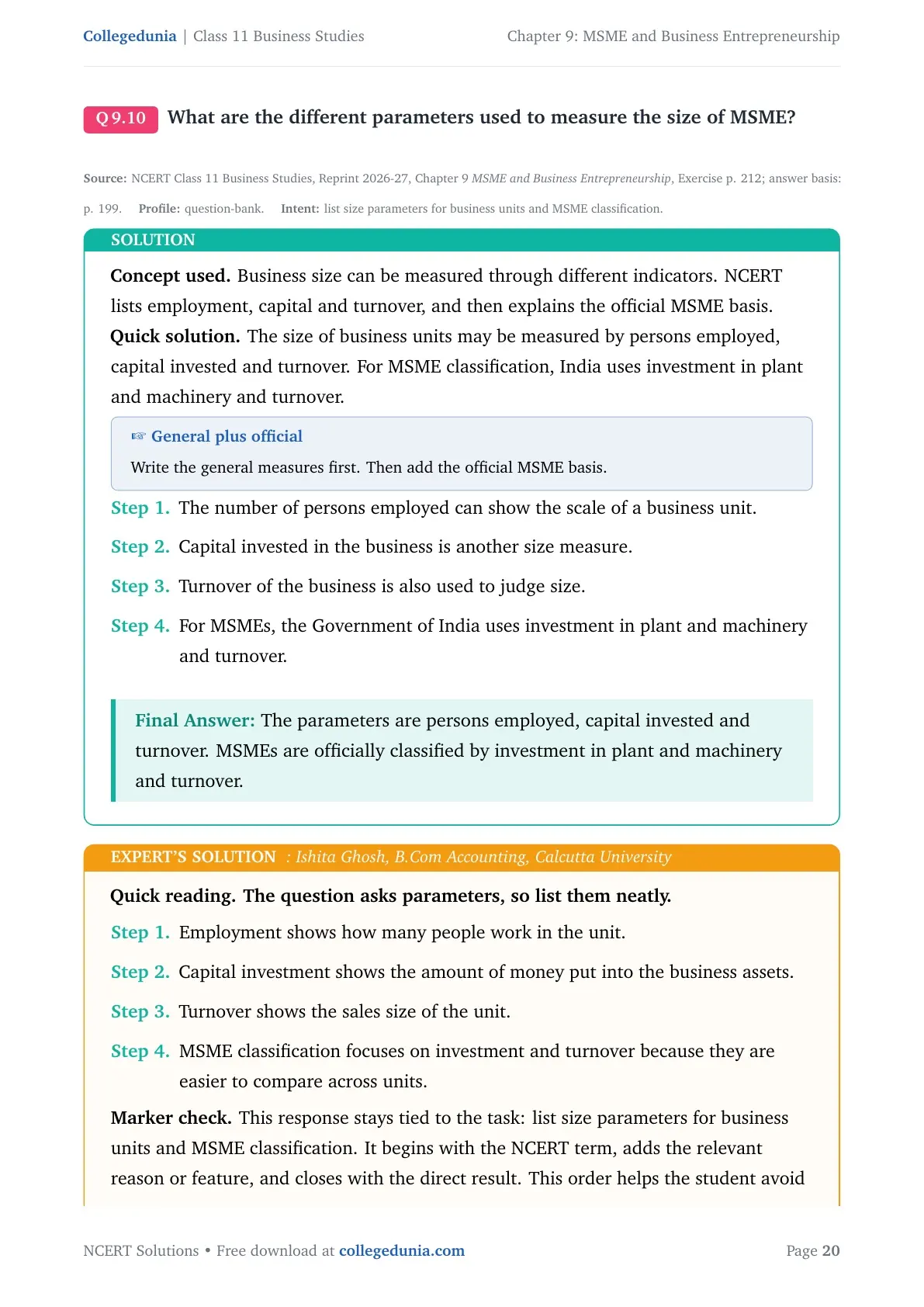
What are the different parameters used to measure the size of MSME?
Quick solution. The size of business units may be measured by persons employed, capital invested and turnover. For MSME classification, India uses investment in plant and machinery and turnover.
Concept used. Business size can be measured through different indicators. NCERT lists employment, capital and turnover, and then explains the official MSME basis.
- The number of persons employed can show the scale of a business unit.
- Capital invested in the business is another size measure.
- Turnover of the business is also used to judge size.
- For MSMEs, the Government of India uses investment in plant and machinery and turnover.
Final answer: The parameters are persons employed, capital invested and turnover. MSMEs are officially classified by investment in plant and machinery and turnover.
Quick reading. The question asks parameters, so list them neatly.
- Employment shows how many people work in the unit.
- Capital investment shows the amount of money put into the business assets.
- Turnover shows the sales size of the unit.
- MSME classification focuses on investment and turnover because they are easier to compare across units.
Why this matters. This answer covers both the textbook list and the MSME table.
Expert answer: Persons employed, capital invested and turnover are size parameters; MSMEs use investment and turnover limits.
Question 11
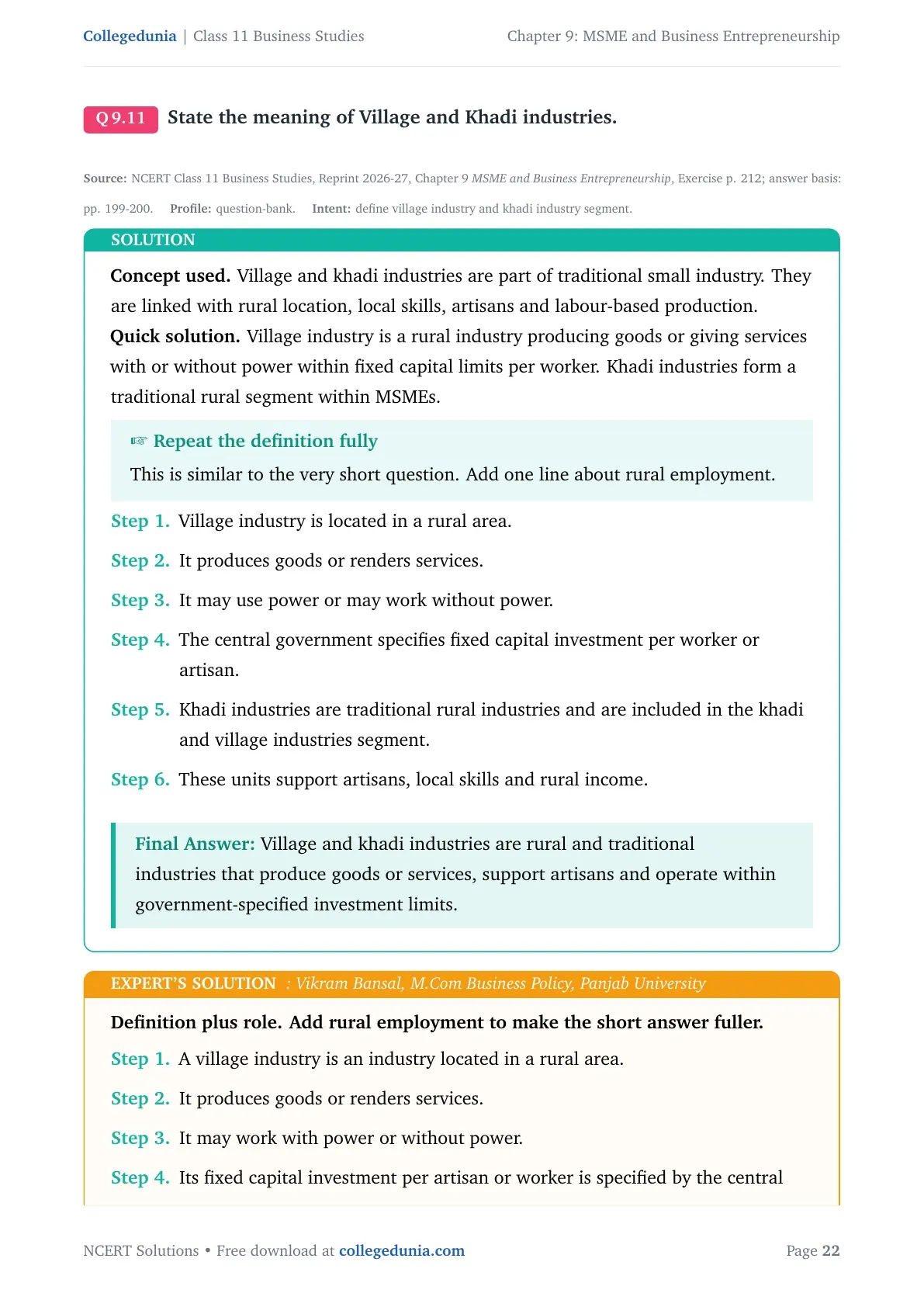
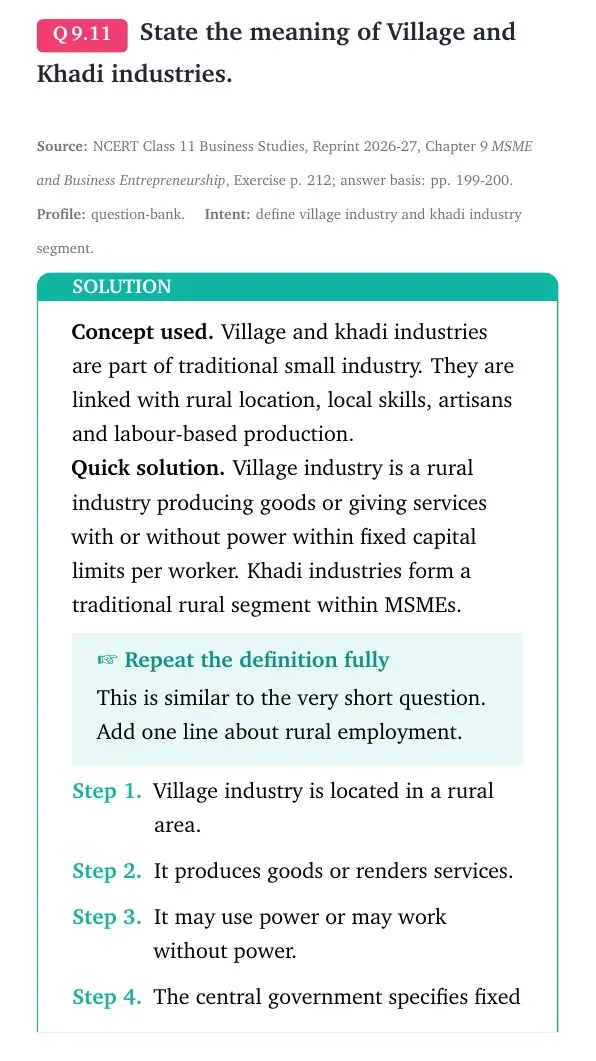
State the meaning of Village and Khadi industries.
Quick solution. Village industry is a rural industry producing goods or giving services with or without power within fixed capital limits per worker. Khadi industries form a traditional rural segment within MSMEs.
Concept used. Village and khadi industries are part of traditional small industry. They are linked with rural location, local skills, artisans and labour-based production.
- Village industry is located in a rural area.
- It produces goods or renders services.
- It may use power or may work without power.
- The central government specifies fixed capital investment per worker or artisan.
- Khadi industries are traditional rural industries and are included in the khadi and village industries segment.
- These units support artisans, local skills and rural income.
Final answer: Village and khadi industries are rural and traditional industries that produce goods or services, support artisans and operate within government-specified investment limits.
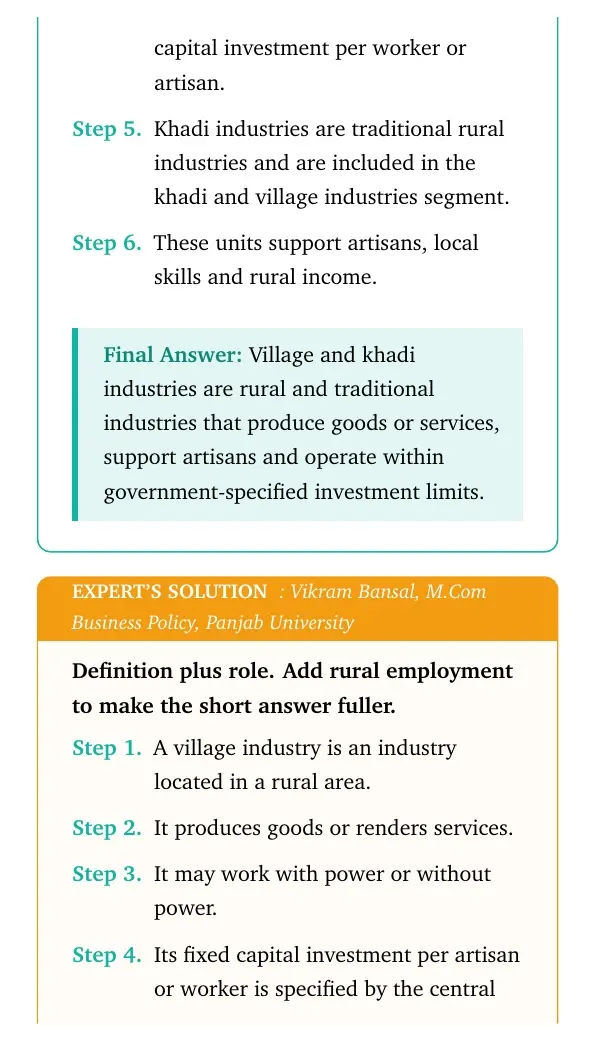
Definition plus role. Add rural employment to make the short answer fuller.
- A village industry is an industry located in a rural area.
- It produces goods or renders services.
- It may work with power or without power.
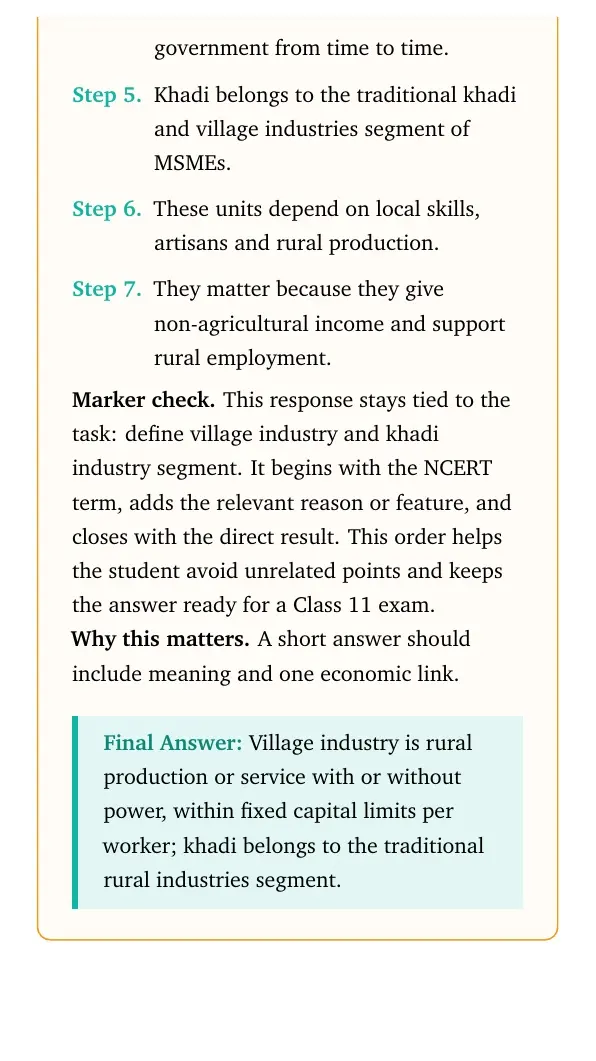
- Its fixed capital investment per artisan or worker is specified by the central government from time to time.
- Khadi belongs to the traditional khadi and village industries segment of MSMEs.
- These units depend on local skills, artisans and rural production.
- They matter because they give non-agricultural income and support rural employment.
Why this matters. A short answer should include meaning and one economic link.
Expert answer: Village industry is rural production or service with or without power, within fixed capital limits per worker; khadi belongs to the traditional rural industries segment.
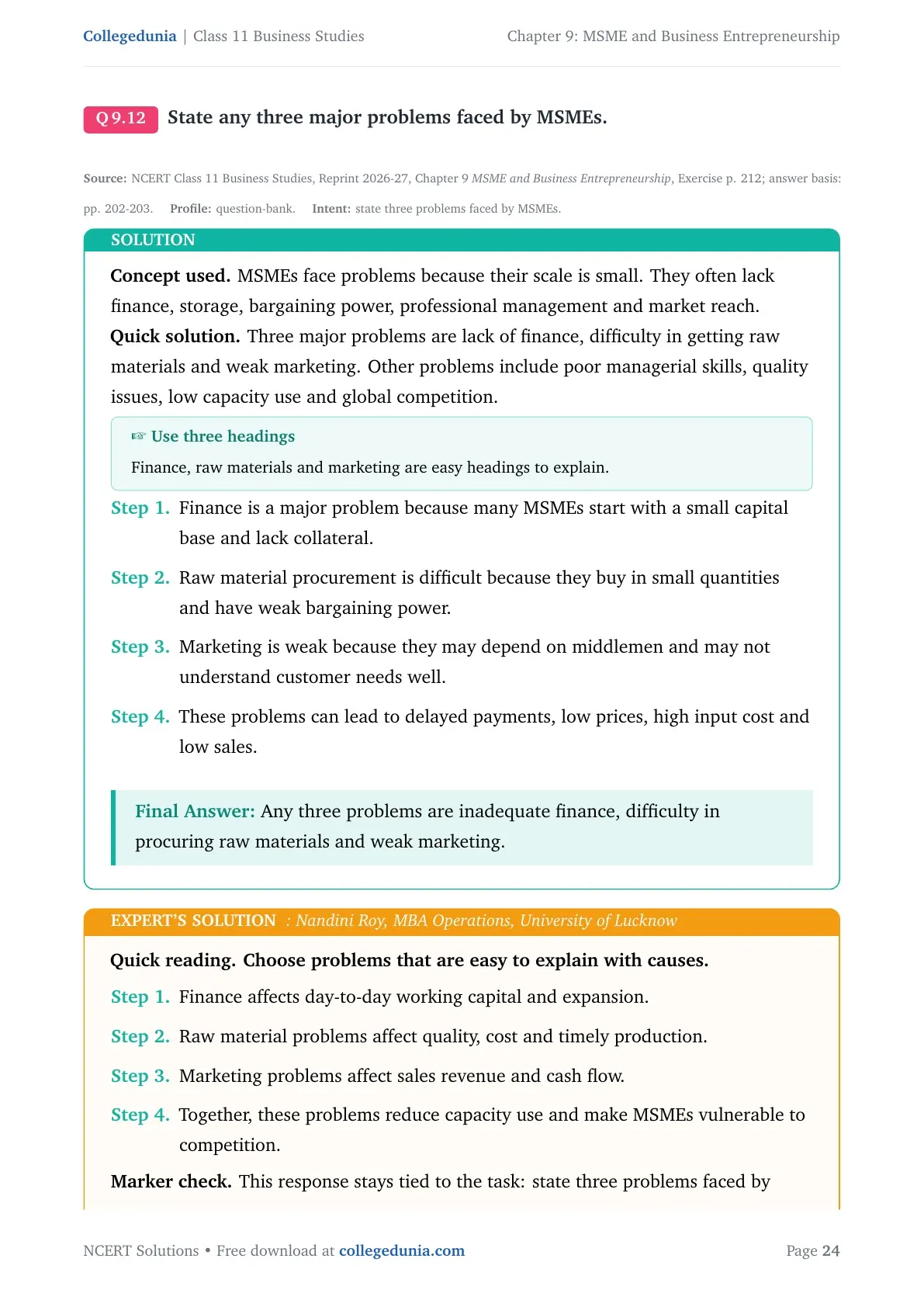
Question 12
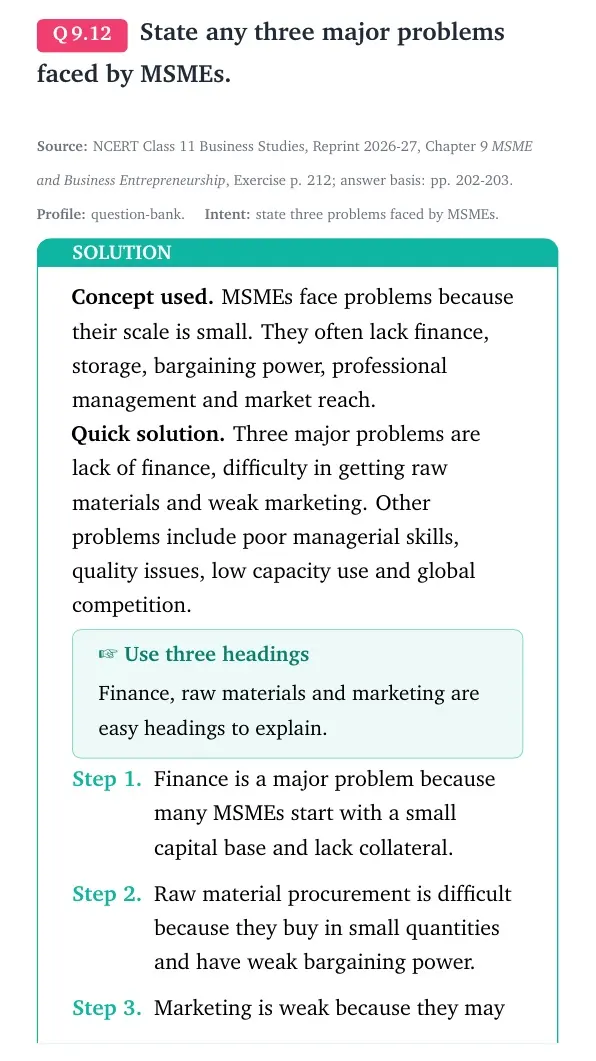
State any three major problems faced by MSMEs.
Quick solution. Three major problems are lack of finance, difficulty in getting raw materials and weak marketing. Other problems include poor managerial skills, quality issues, low capacity use and global competition.
Concept used. MSMEs face problems because their scale is small. They often lack finance, storage, bargaining power, professional management and market reach.
- Finance is a major problem because many MSMEs start with a small capital base and lack collateral.
- Raw material procurement is difficult because they buy in small quantities and have weak bargaining power.
- Marketing is weak because they may depend on middlemen and may not understand customer needs well.
- These problems can lead to delayed payments, low prices, high input cost and low sales.
Final answer: Any three problems are inadequate finance, difficulty in procuring raw materials and weak marketing.
Quick reading. Choose problems that are easy to explain with causes.
- Finance affects day-to-day working capital and expansion.
- Raw material problems affect quality, cost and timely production.
- Marketing problems affect sales revenue and cash flow.
- Together, these problems reduce capacity use and make MSMEs vulnerable to competition.
Why this matters. The marker usually wants names plus brief explanation.
Expert answer: Three major MSME problems are finance shortage, raw material difficulty and weak marketing.
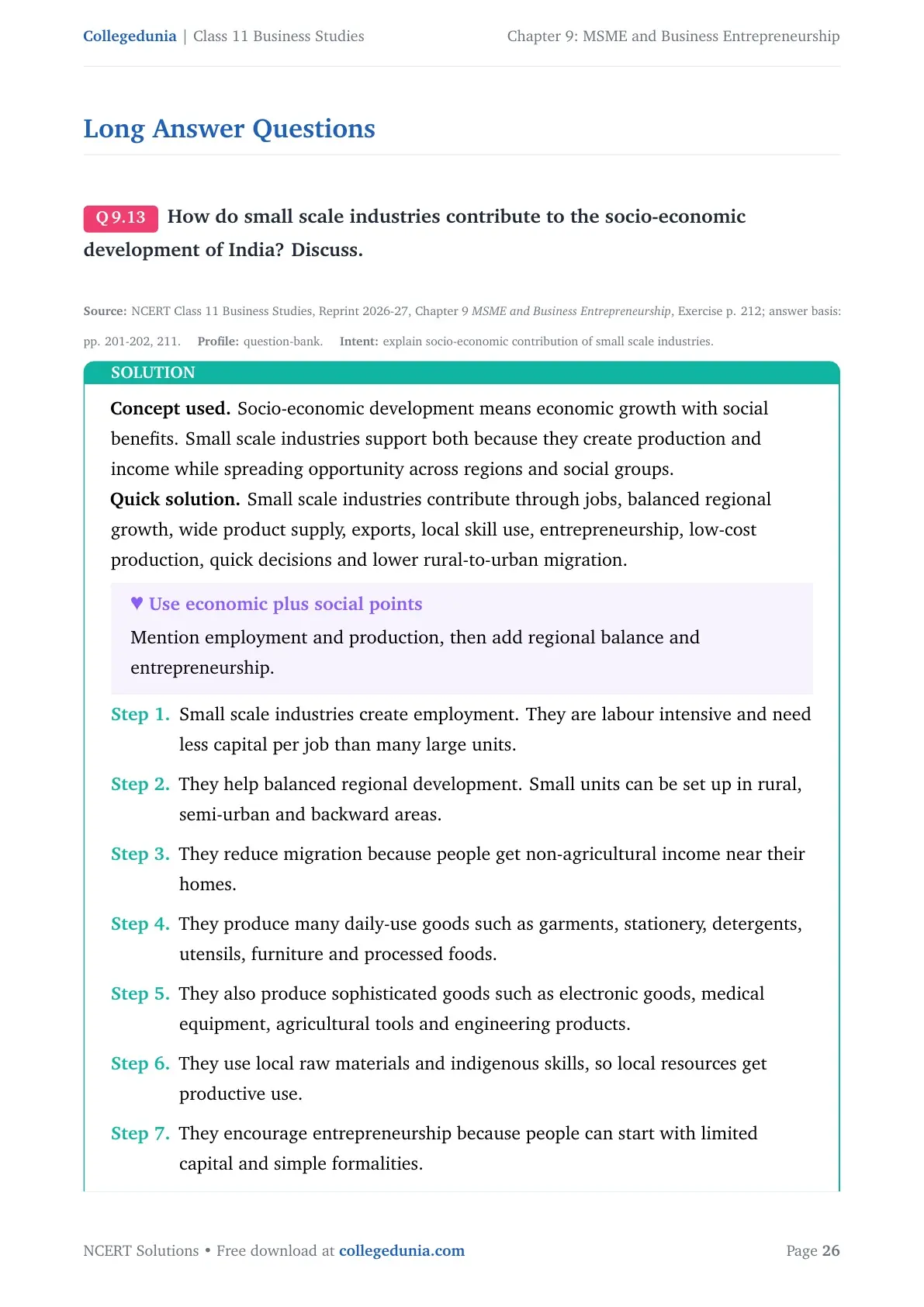
Question 13
How do small scale industries contribute to the socio-economic development of India? Discuss.
Quick solution. Small scale industries contribute through jobs, balanced regional growth, wide product supply, exports, local skill use, entrepreneurship, low-cost production, quick decisions and lower rural-to-urban migration.
Concept used. Socio-economic development means economic growth with social benefits. Small scale industries support both because they create production and income while spreading opportunity across regions and social groups.
- Small scale industries create employment. They are labour intensive and need less capital per job than many large units.
- They help balanced regional development. Small units can be set up in rural, semi-urban and backward areas.
- They reduce migration because people get non-agricultural income near their homes.
- They produce many daily-use goods such as garments, stationery, detergents, utensils, furniture and processed foods.
- They also produce sophisticated goods such as electronic goods, medical equipment, agricultural tools and engineering products.
- They use local raw materials and indigenous skills, so local resources get productive use.
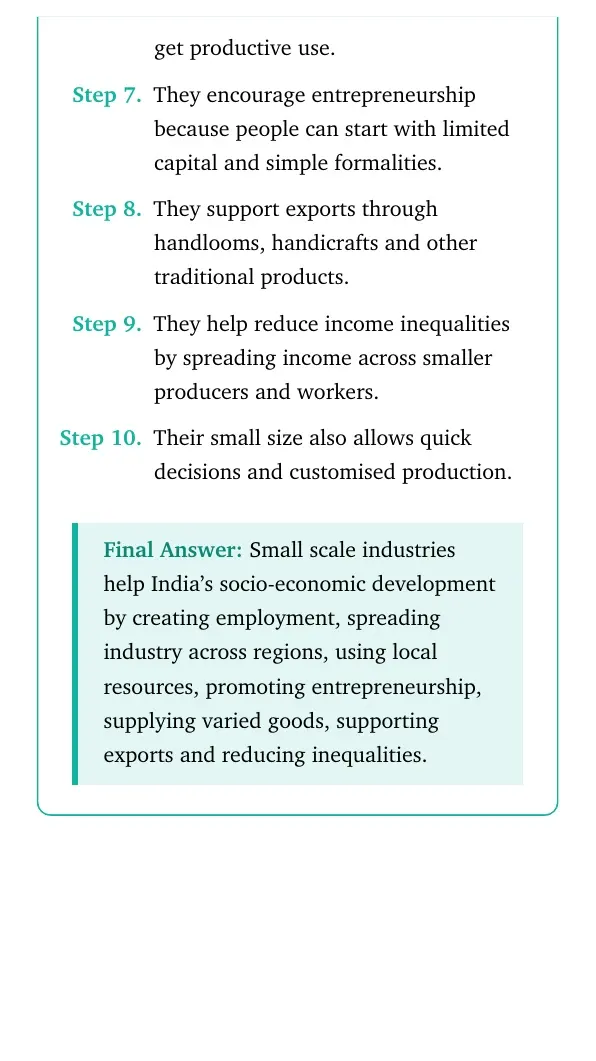
- They encourage entrepreneurship because people can start with limited capital and simple formalities.
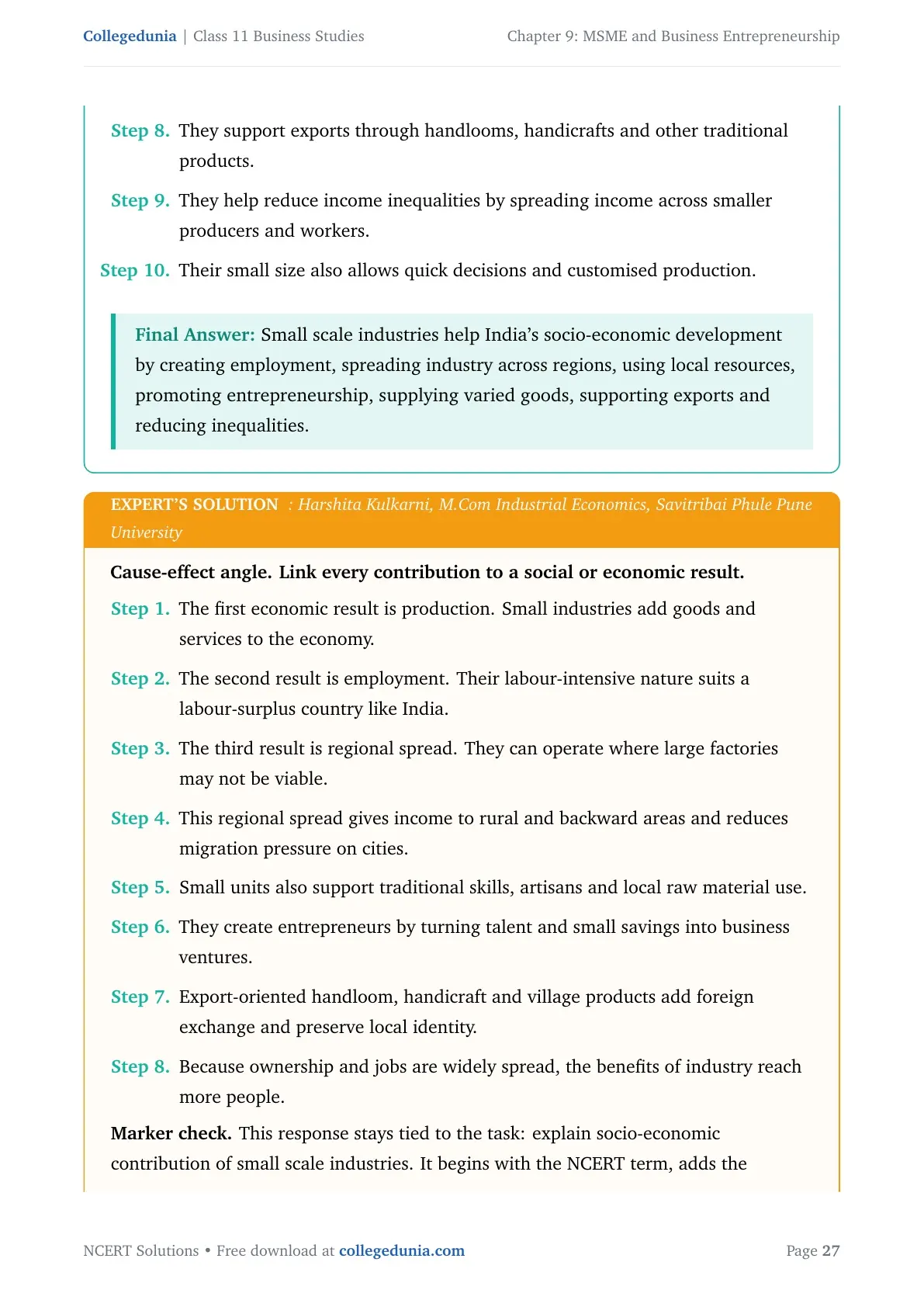
- They support exports through handlooms, handicrafts and other traditional products.
- They help reduce income inequalities by spreading income across smaller producers and workers.
- Their small size also allows quick decisions and customised production.
Final answer: Small scale industries help India's socio-economic development by creating employment, spreading industry across regions, using local resources, promoting entrepreneurship, supplying varied goods, supporting exports and reducing inequalities.
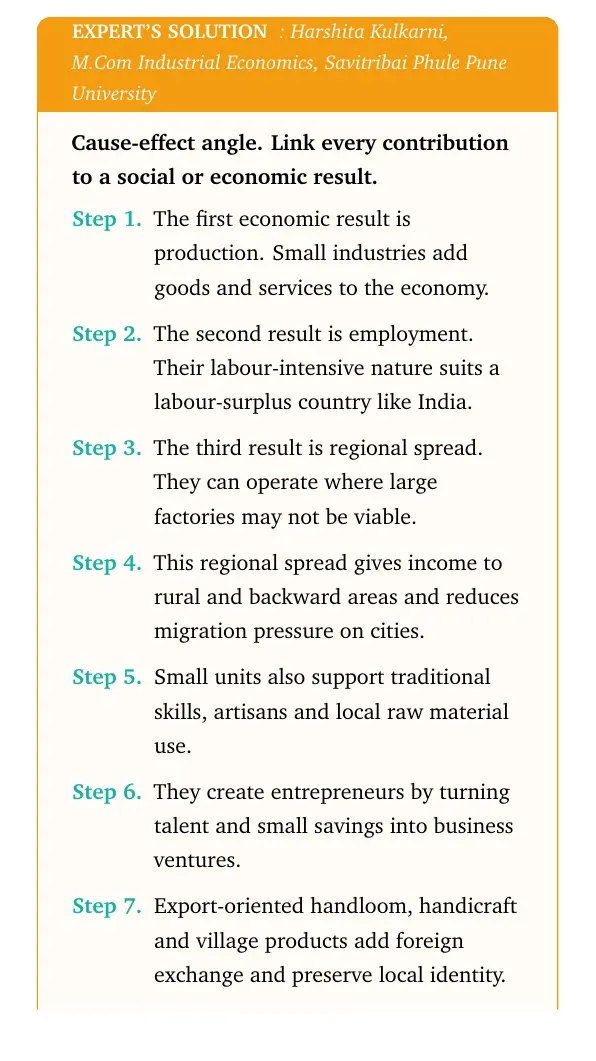
Cause-effect angle. Link every contribution to a social or economic result.
- The first economic result is production. Small industries add goods and services to the economy.
- The second result is employment. Their labour-intensive nature suits a labour-surplus country like India.
- The third result is regional spread. They can operate where large factories may not be viable.
- This regional spread gives income to rural and backward areas and reduces migration pressure on cities.
- Small units also support traditional skills, artisans and local raw material use.
- They create entrepreneurs by turning talent and small savings into business ventures.
- Export-oriented handloom, handicraft and village products add foreign exchange and preserve local identity.
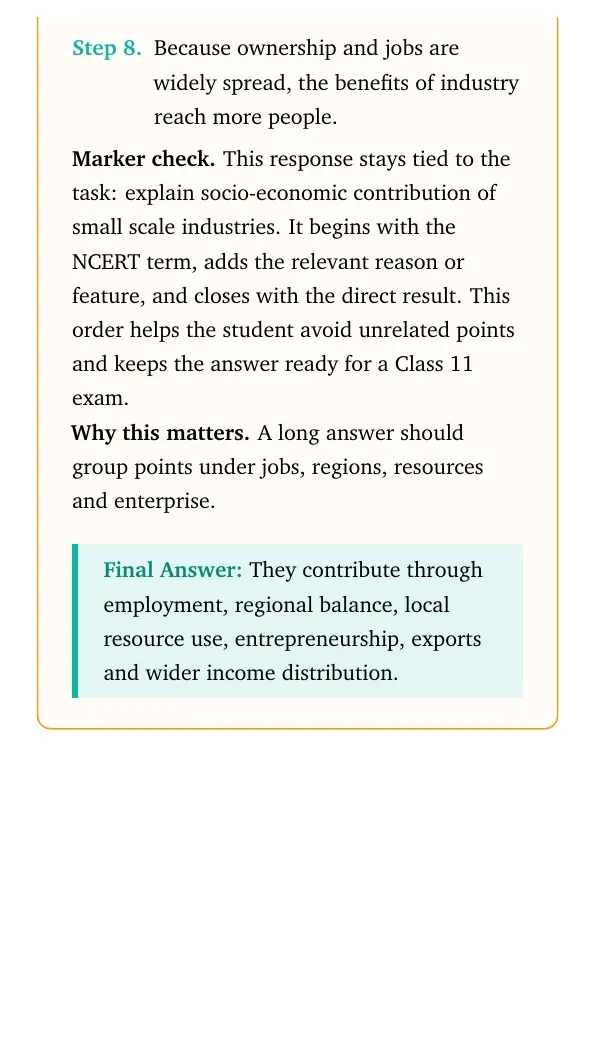
- Because ownership and jobs are widely spread, the benefits of industry reach more people.
Why this matters. A long answer should group points under jobs, regions, resources and enterprise.
Expert answer: They contribute through employment, regional balance, local resource use, entrepreneurship, exports and wider income distribution.
Question 14
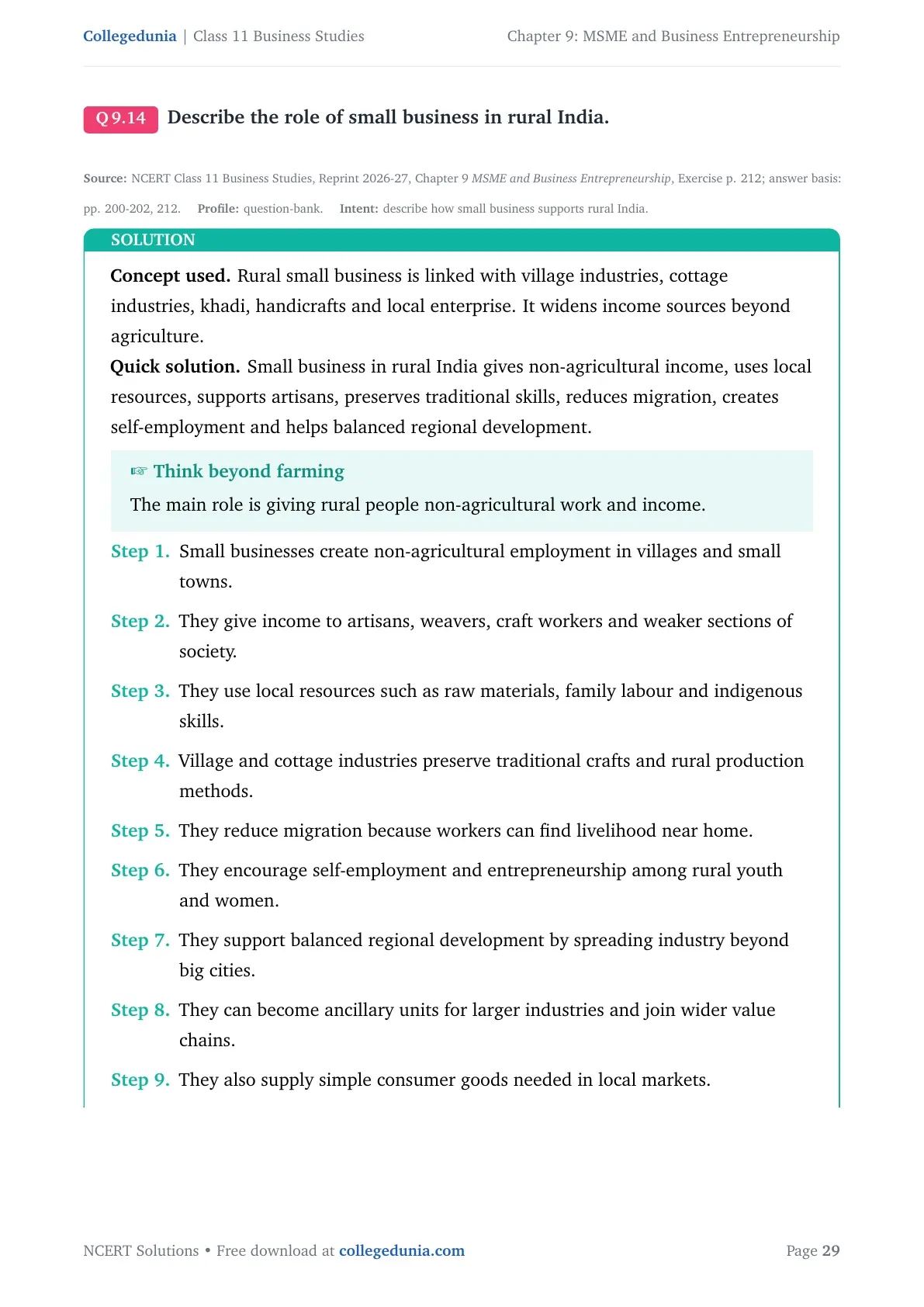
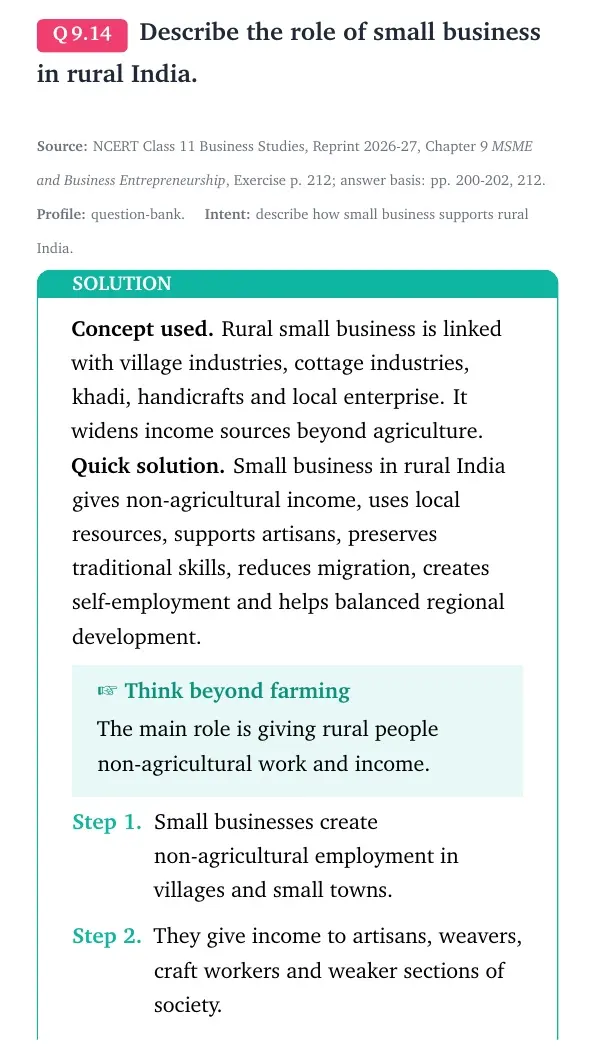
Describe the role of small business in rural India.
Quick solution. Small business in rural India gives non-agricultural income, uses local resources, supports artisans, preserves traditional skills, reduces migration, creates self-employment and helps balanced regional development.
Concept used. Rural small business is linked with village industries, cottage industries, khadi, handicrafts and local enterprise. It widens income sources beyond agriculture.
- Small businesses create non-agricultural employment in villages and small towns.
- They give income to artisans, weavers, craft workers and weaker sections of society.
- They use local resources such as raw materials, family labour and indigenous skills.
- Village and cottage industries preserve traditional crafts and rural production methods.
- They reduce migration because workers can find livelihood near home.
- They encourage self-employment and entrepreneurship among rural youth and women.
- They support balanced regional development by spreading industry beyond big cities.
- They can become ancillary units for larger industries and join wider value chains.
- They also supply simple consumer goods needed in local markets.
Final answer: Small business in rural India provides non-agricultural employment, supports artisans, uses local resources, preserves traditional skills, reduces migration and spreads industrial development.
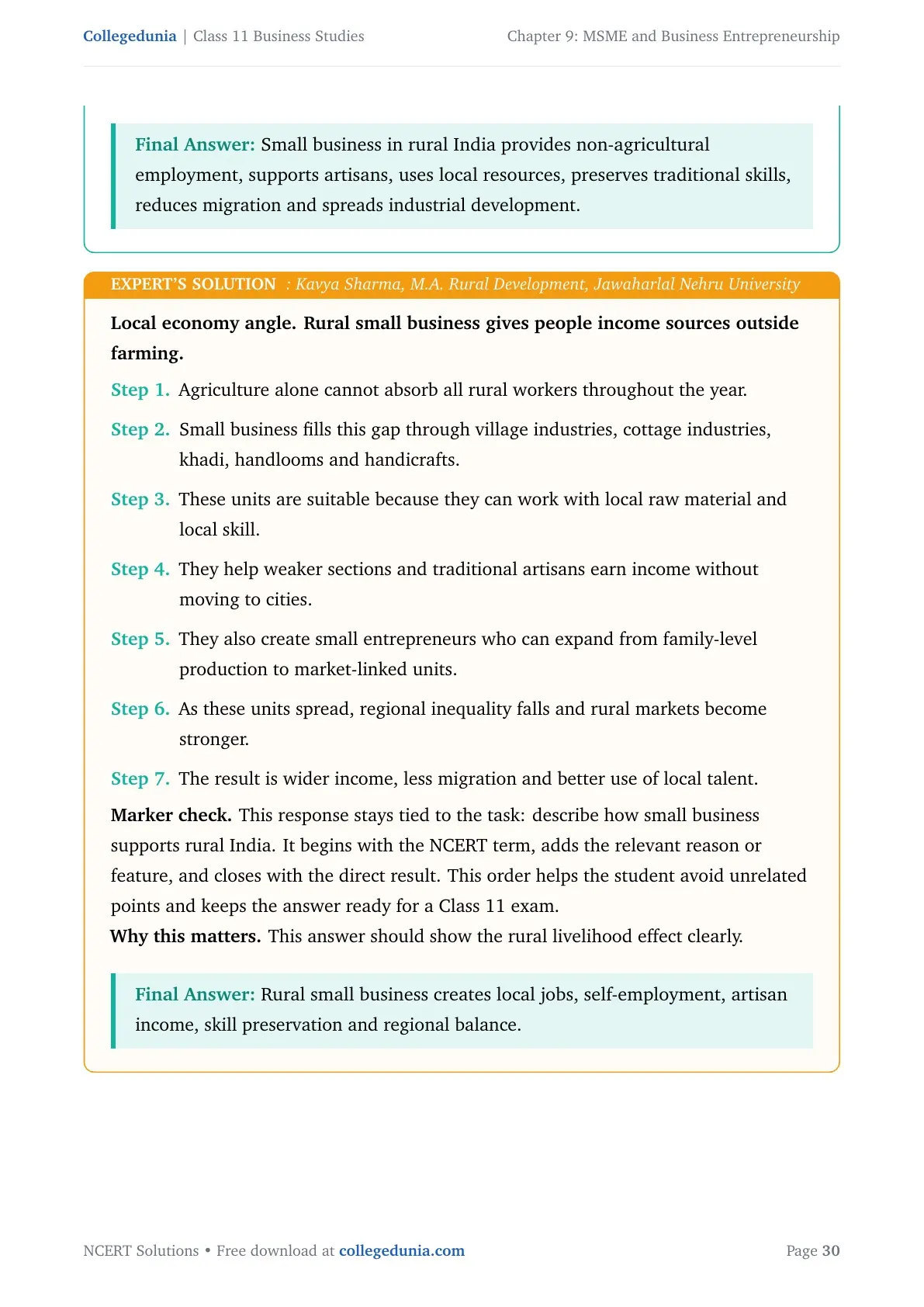
Local economy angle. Rural small business gives people income sources outside farming.
- Agriculture alone cannot absorb all rural workers throughout the year.
- Small business fills this gap through village industries, cottage industries, khadi, handlooms and handicrafts.
- These units are suitable because they can work with local raw material and local skill.
- They help weaker sections and traditional artisans earn income without moving to cities.
- They also create small entrepreneurs who can expand from family-level production to market-linked units.
- As these units spread, regional inequality falls and rural markets become stronger.
- The result is wider income, less migration and better use of local talent.
Why this matters. This answer should show the rural livelihood effect clearly.
Expert answer: Rural small business creates local jobs, self-employment, artisan income, skill preservation and regional balance.
Question 15
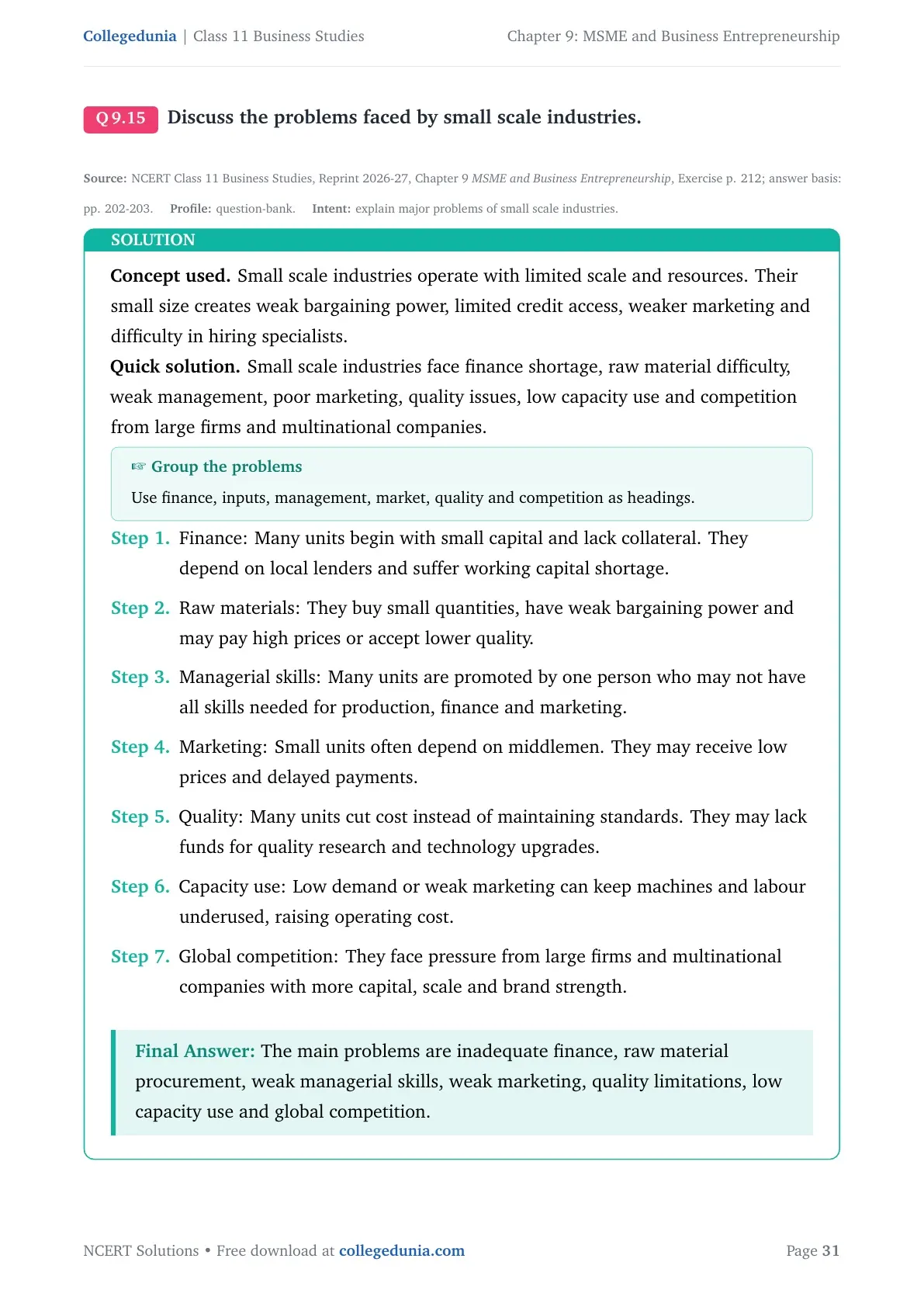
Discuss the problems faced by small scale industries.
Quick solution. Small scale industries face finance shortage, raw material difficulty, weak management, poor marketing, quality issues, low capacity use and competition from large firms and multinational companies.
Concept used. Small scale industries operate with limited scale and resources. Their small size creates weak bargaining power, limited credit access, weaker marketing and difficulty in hiring specialists.
- Finance: Many units begin with small capital and lack collateral. They depend on local lenders and suffer working capital shortage.
- Raw materials: They buy small quantities, have weak bargaining power and may pay high prices or accept lower quality.
- Managerial skills: Many units are promoted by one person who may not have all skills needed for production, finance and marketing.
- Marketing: Small units often depend on middlemen. They may receive low prices and delayed payments.
- Quality: Many units cut cost instead of maintaining standards. They may lack funds for quality research and technology upgrades.
- Capacity use: Low demand or weak marketing can keep machines and labour underused, raising operating cost.
- Global competition: They face pressure from large firms and multinational companies with more capital, scale and brand strength.
Final answer: The main problems are inadequate finance, raw material procurement, weak managerial skills, weak marketing, quality limitations, low capacity use and global competition.
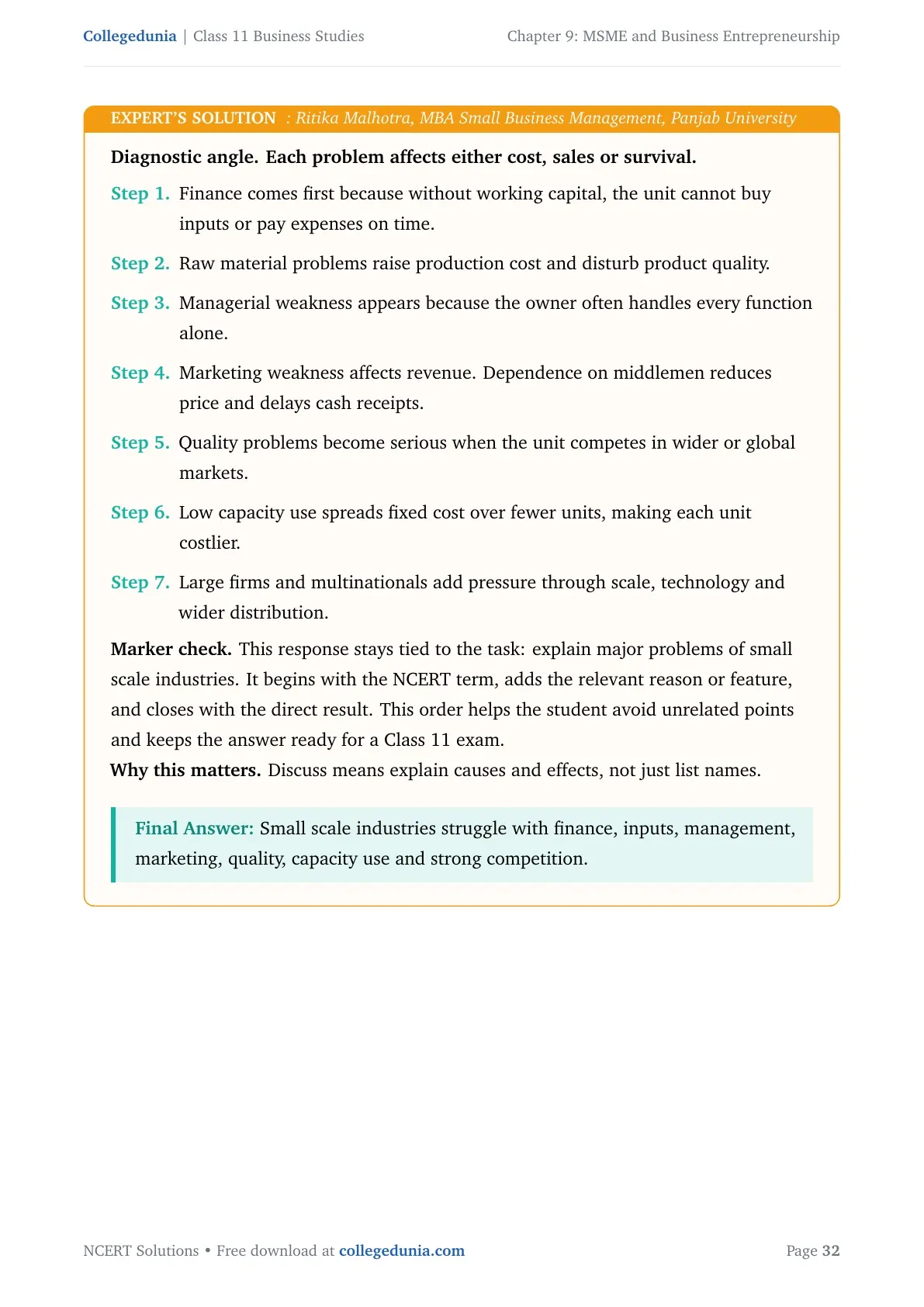
Diagnostic angle. Each problem affects either cost, sales or survival.
- Finance comes first because without working capital, the unit cannot buy inputs or pay expenses on time.
- Raw material problems raise production cost and disturb product quality.
- Managerial weakness appears because the owner often handles every function alone.
- Marketing weakness affects revenue. Dependence on middlemen reduces price and delays cash receipts.
- Quality problems become serious when the unit competes in wider or global markets.
- Low capacity use spreads fixed cost over fewer units, making each unit costlier.
- Large firms and multinationals add pressure through scale, technology and wider distribution.
Why this matters. Discuss means explain causes and effects, not just list names.
Expert answer: Small scale industries struggle with finance, inputs, management, marketing, quality, capacity use and strong competition.
Question 16
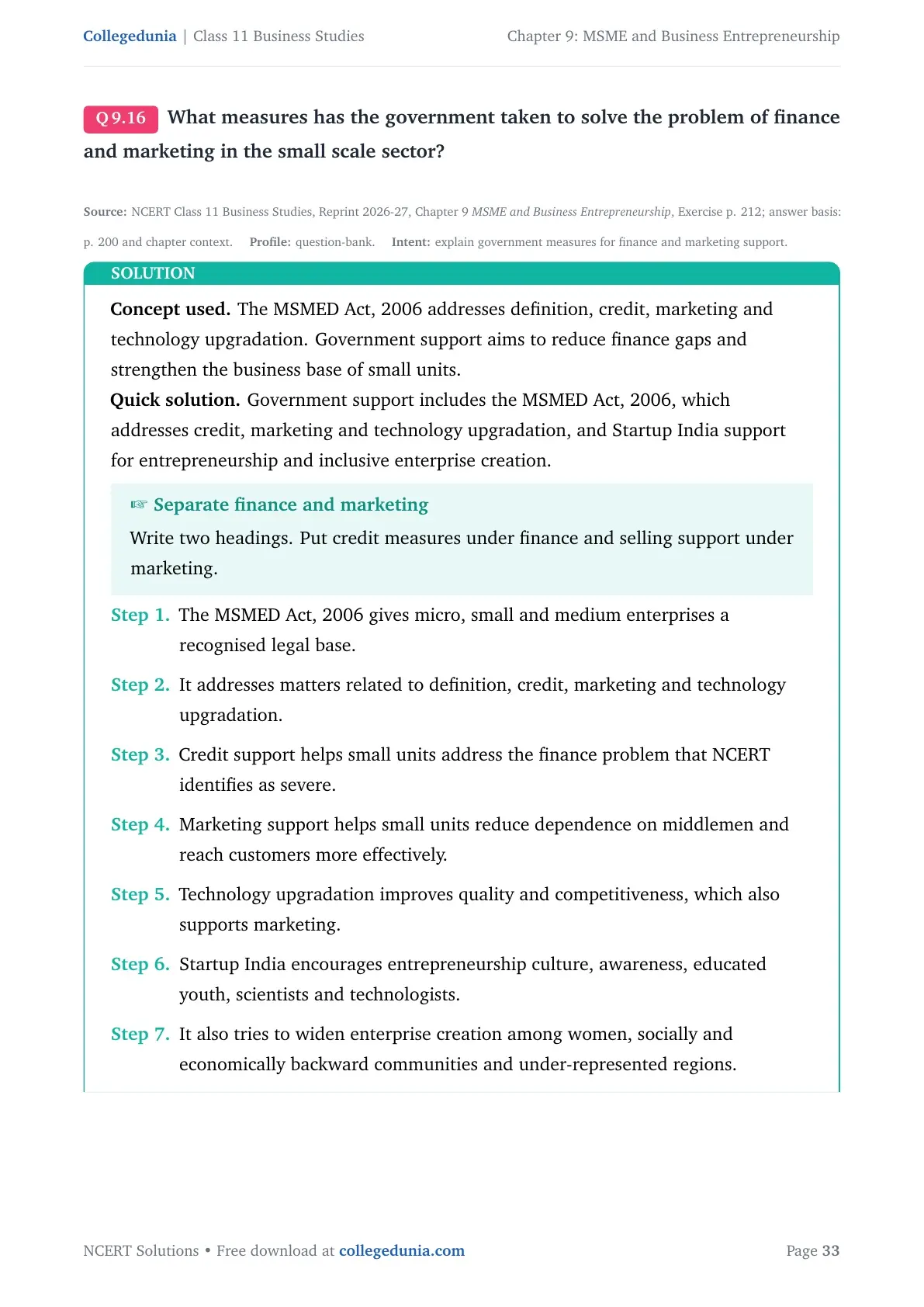
What measures has the government taken to solve the problem of finance and marketing in the small scale sector?
Quick solution. Government support includes the MSMED Act, 2006, which addresses credit, marketing and technology upgradation, and Startup India support for entrepreneurship and inclusive enterprise creation.
Concept used. The MSMED Act, 2006 addresses definition, credit, marketing and technology upgradation. Government support aims to reduce finance gaps and strengthen the business base of small units.
- The MSMED Act, 2006 gives micro, small and medium enterprises a recognised legal base.
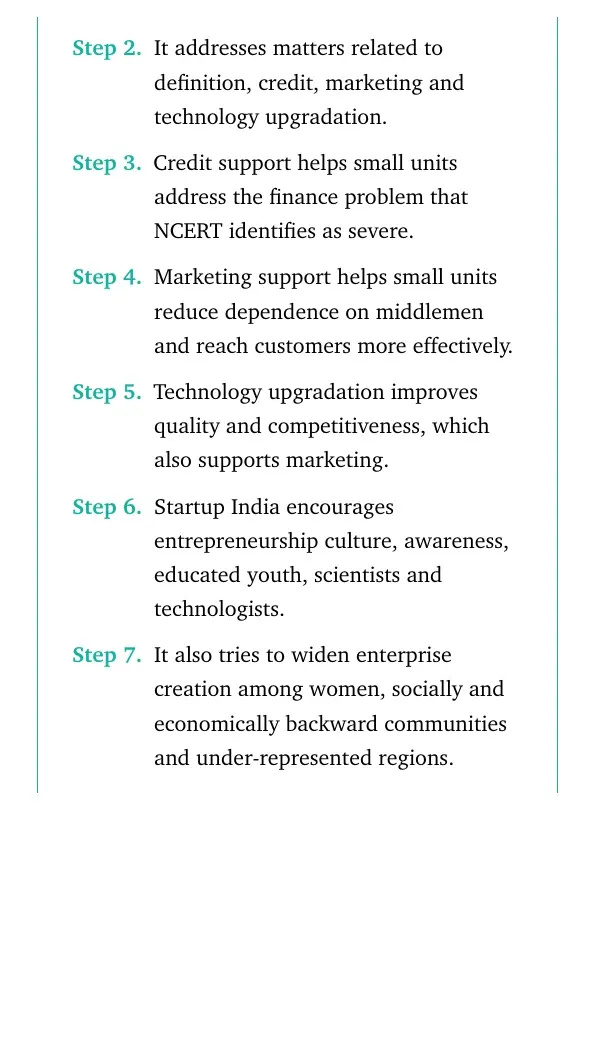
- It addresses matters related to definition, credit, marketing and technology upgradation.
- Credit support helps small units address the finance problem that NCERT identifies as severe.
- Marketing support helps small units reduce dependence on middlemen and reach customers more effectively.
- Technology upgradation improves quality and competitiveness, which also supports marketing.
- Startup India encourages entrepreneurship culture, awareness, educated youth, scientists and technologists.
- It also tries to widen enterprise creation among women, socially and economically backward communities and under-represented regions.
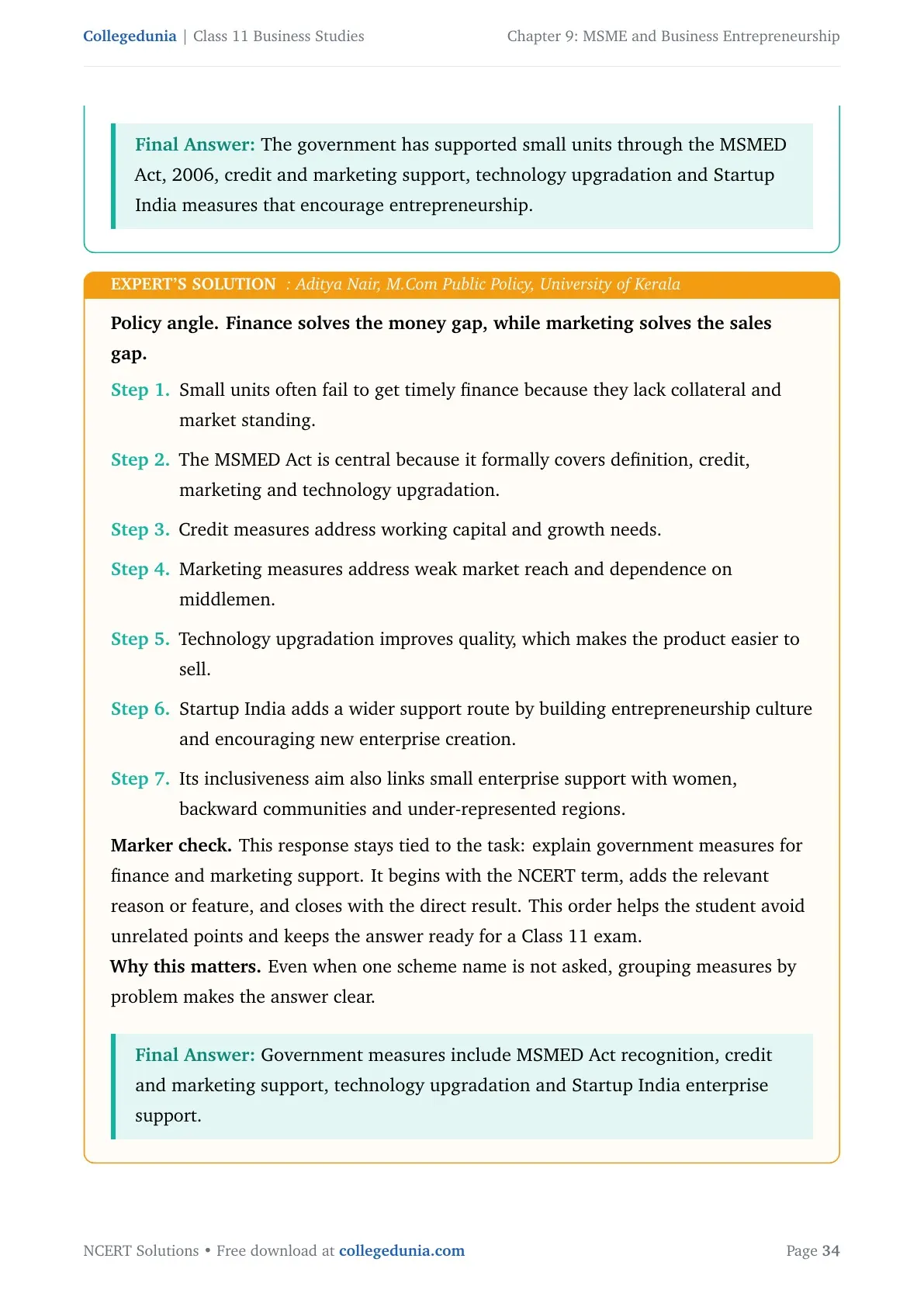
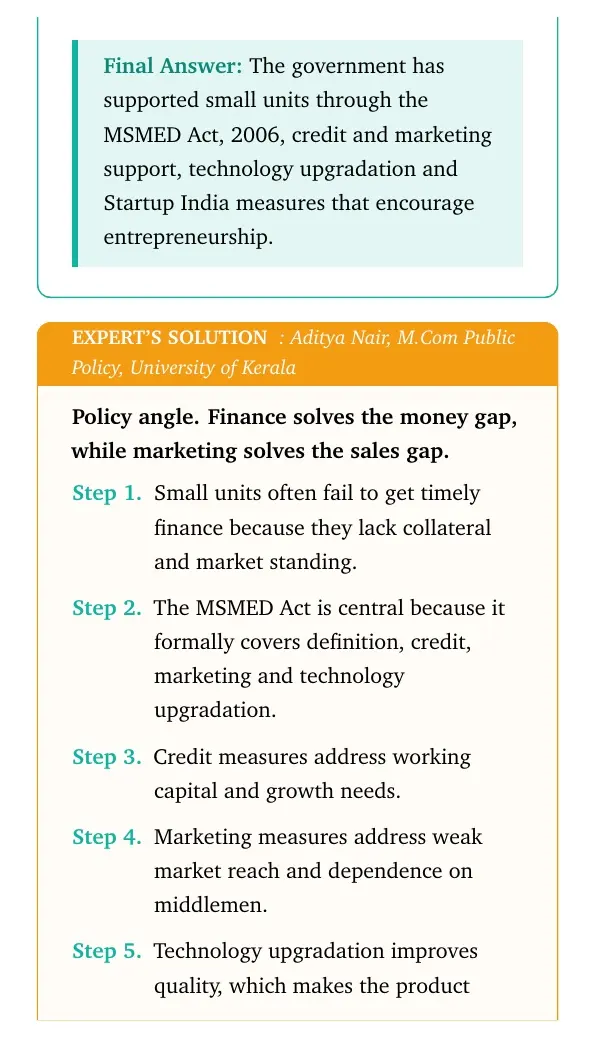
Final answer: The government has supported small units through the MSMED Act, 2006, credit and marketing support, technology upgradation and Startup India measures that encourage entrepreneurship.
Policy angle. Finance solves the money gap, while marketing solves the sales gap.
- Small units often fail to get timely finance because they lack collateral and market standing.
- The MSMED Act is central because it formally covers definition, credit, marketing and technology upgradation.
- Credit measures address working capital and growth needs.
- Marketing measures address weak market reach and dependence on middlemen.
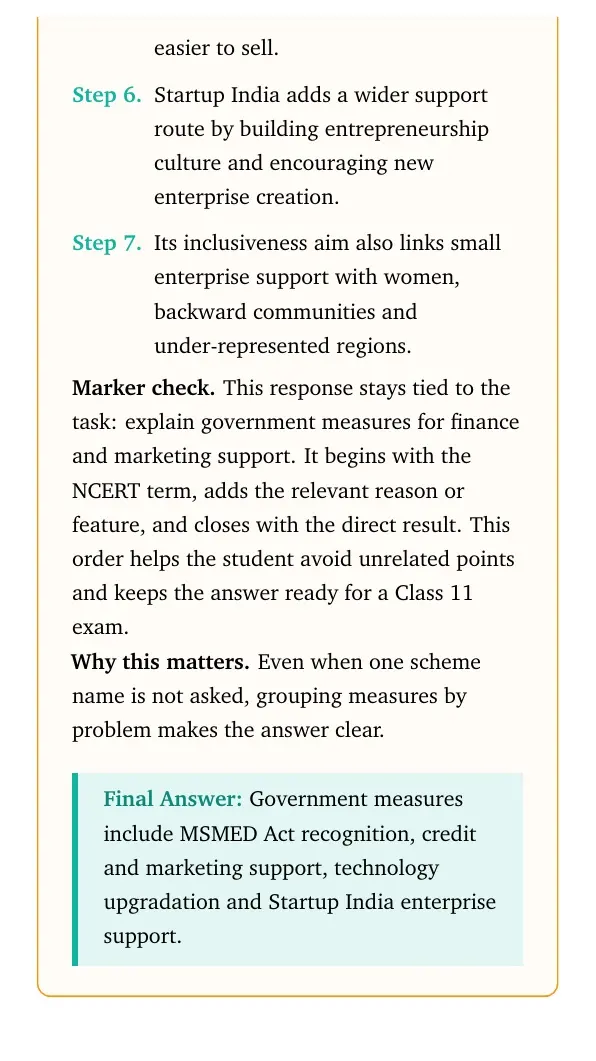
- Technology upgradation improves quality, which makes the product easier to sell.
- Startup India adds a wider support route by building entrepreneurship culture and encouraging new enterprise creation.
- Its inclusiveness aim also links small enterprise support with women, backward communities and under-represented regions.
Why this matters. Even when one scheme name is not asked, grouping measures by problem makes the answer clear.
Expert answer: Government measures include MSMED Act recognition, credit and marketing support, technology upgradation and Startup India enterprise support.
Question 17
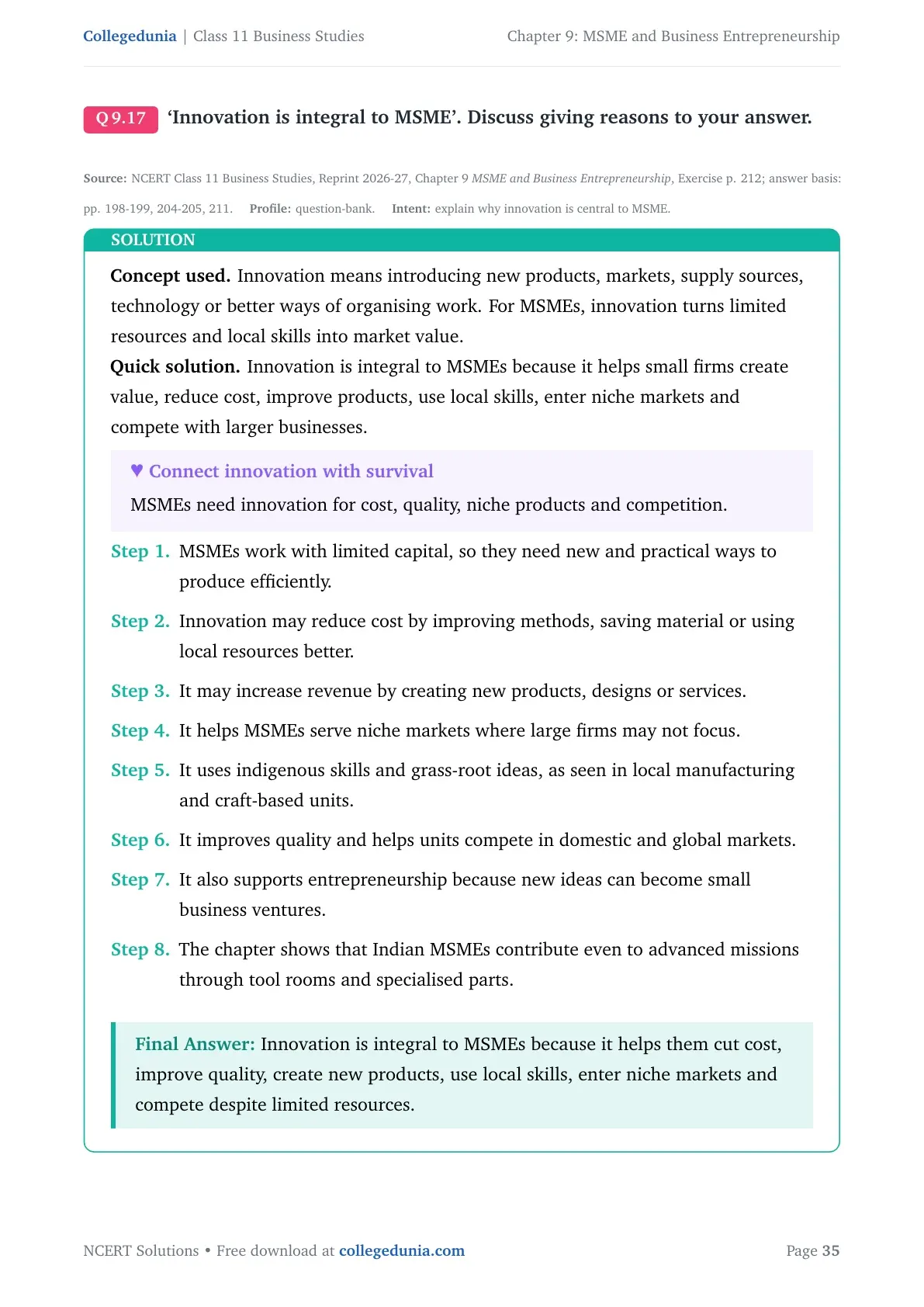
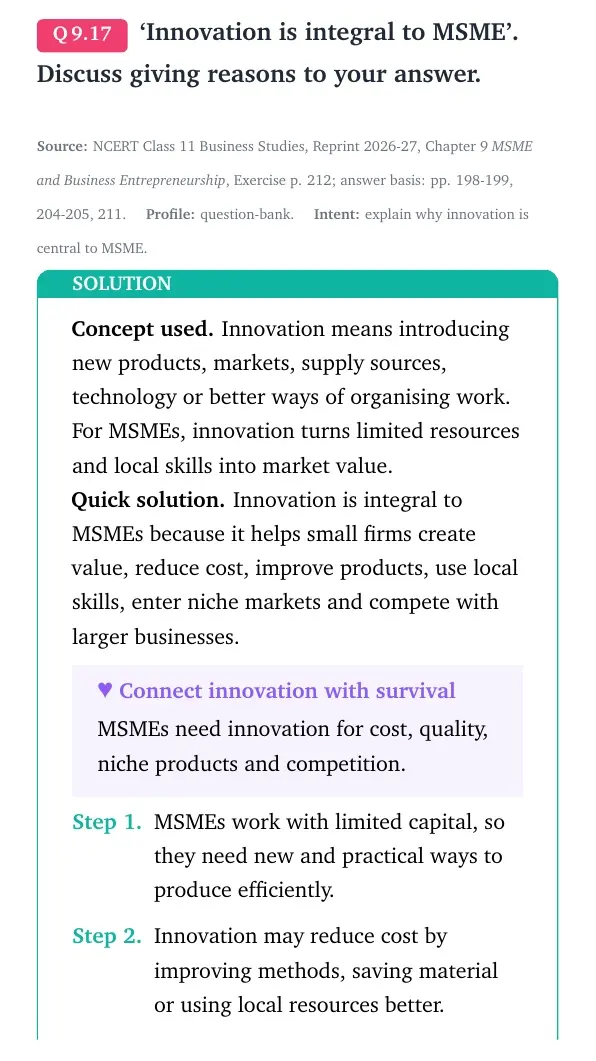
`Innovation is integral to MSME'. Discuss giving reasons to your answer.
Quick solution. Innovation is integral to MSMEs because it helps small firms create value, reduce cost, improve products, use local skills, enter niche markets and compete with larger businesses.
Concept used. Innovation means introducing new products, markets, supply sources, technology or better ways of organising work. For MSMEs, innovation turns limited resources and local skills into market value.
- MSMEs work with limited capital, so they need new and practical ways to produce efficiently.
- Innovation may reduce cost by improving methods, saving material or using local resources better.
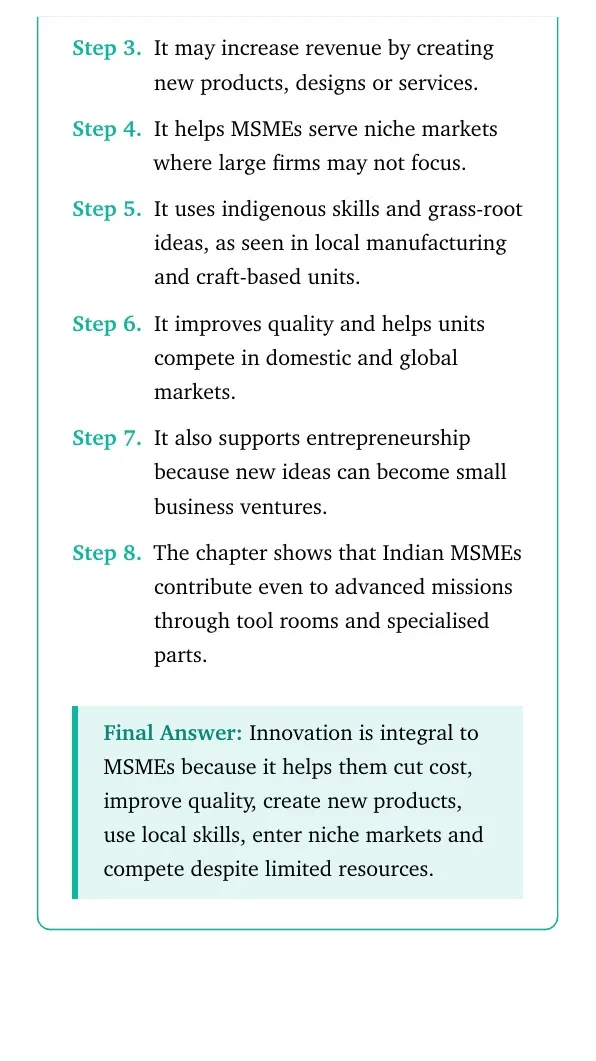
- It may increase revenue by creating new products, designs or services.
- It helps MSMEs serve niche markets where large firms may not focus.
- It uses indigenous skills and grass-root ideas, as seen in local manufacturing and craft-based units.
- It improves quality and helps units compete in domestic and global markets.
- It also supports entrepreneurship because new ideas can become small business ventures.
- The chapter shows that Indian MSMEs contribute even to advanced missions through tool rooms and specialised parts.
Final answer: Innovation is integral to MSMEs because it helps them cut cost, improve quality, create new products, use local skills, enter niche markets and compete despite limited resources.
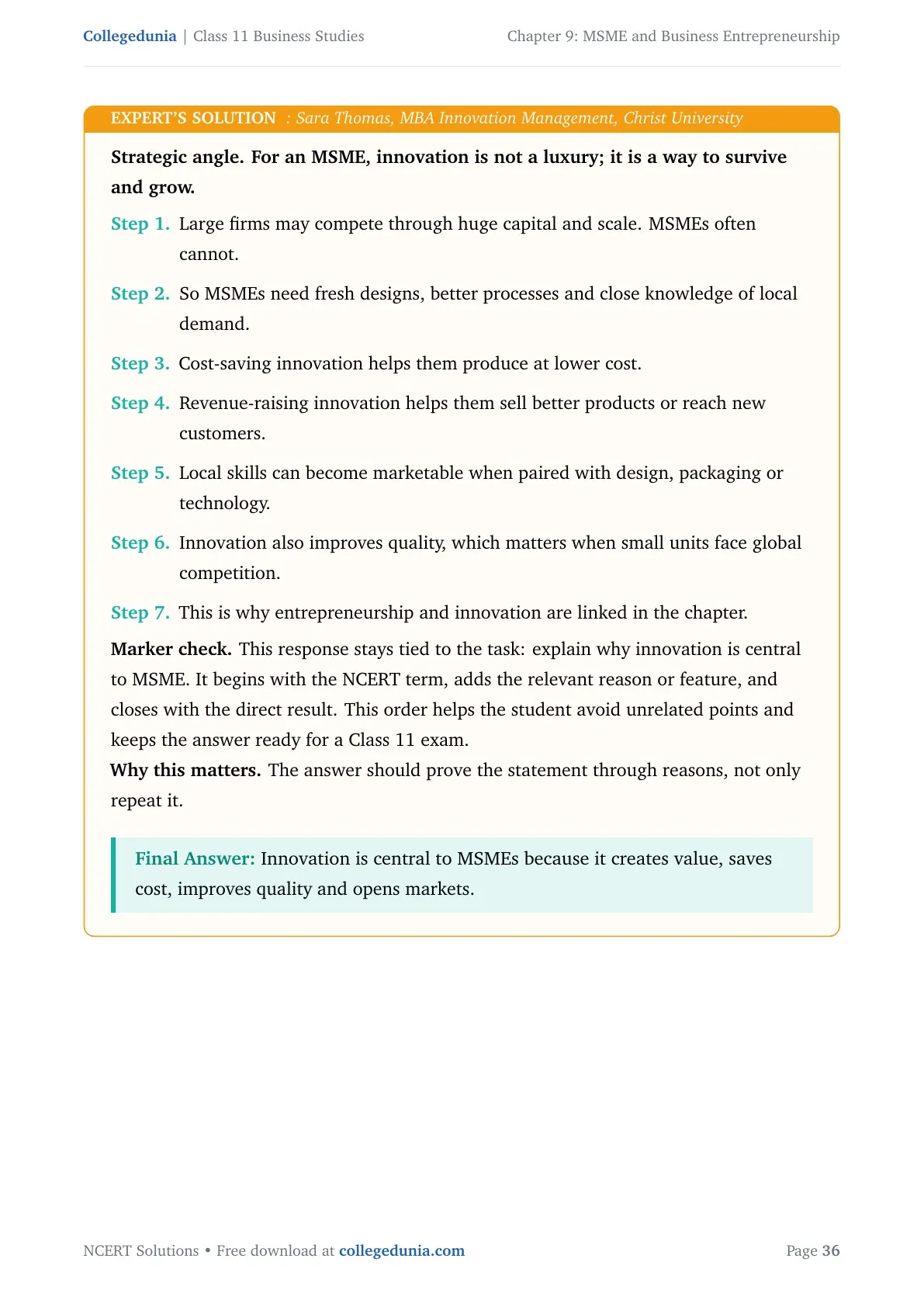
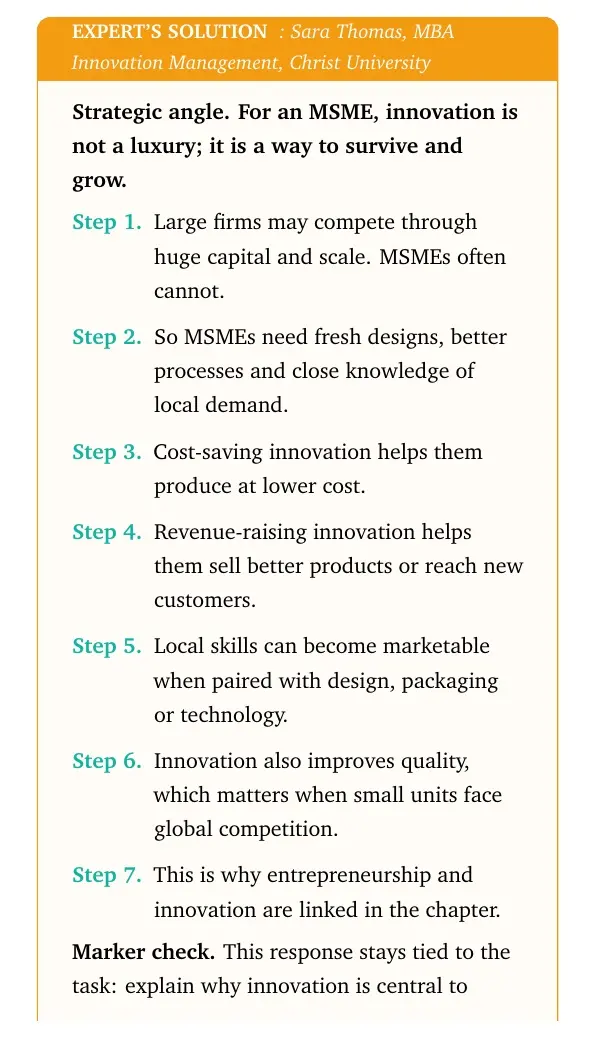
Strategic angle. For an MSME, innovation is not a luxury; it is a way to survive and grow.
- Large firms may compete through huge capital and scale. MSMEs often cannot.
- So MSMEs need fresh designs, better processes and close knowledge of local demand.
- Cost-saving innovation helps them produce at lower cost.
- Revenue-raising innovation helps them sell better products or reach new customers.
- Local skills can become marketable when paired with design, packaging or technology.
- Innovation also improves quality, which matters when small units face global competition.
- This is why entrepreneurship and innovation are linked in the chapter.
Why this matters. The answer should prove the statement through reasons, not only repeat it.
Expert answer: Innovation is central to MSMEs because it creates value, saves cost, improves quality and opens markets.
Question 18
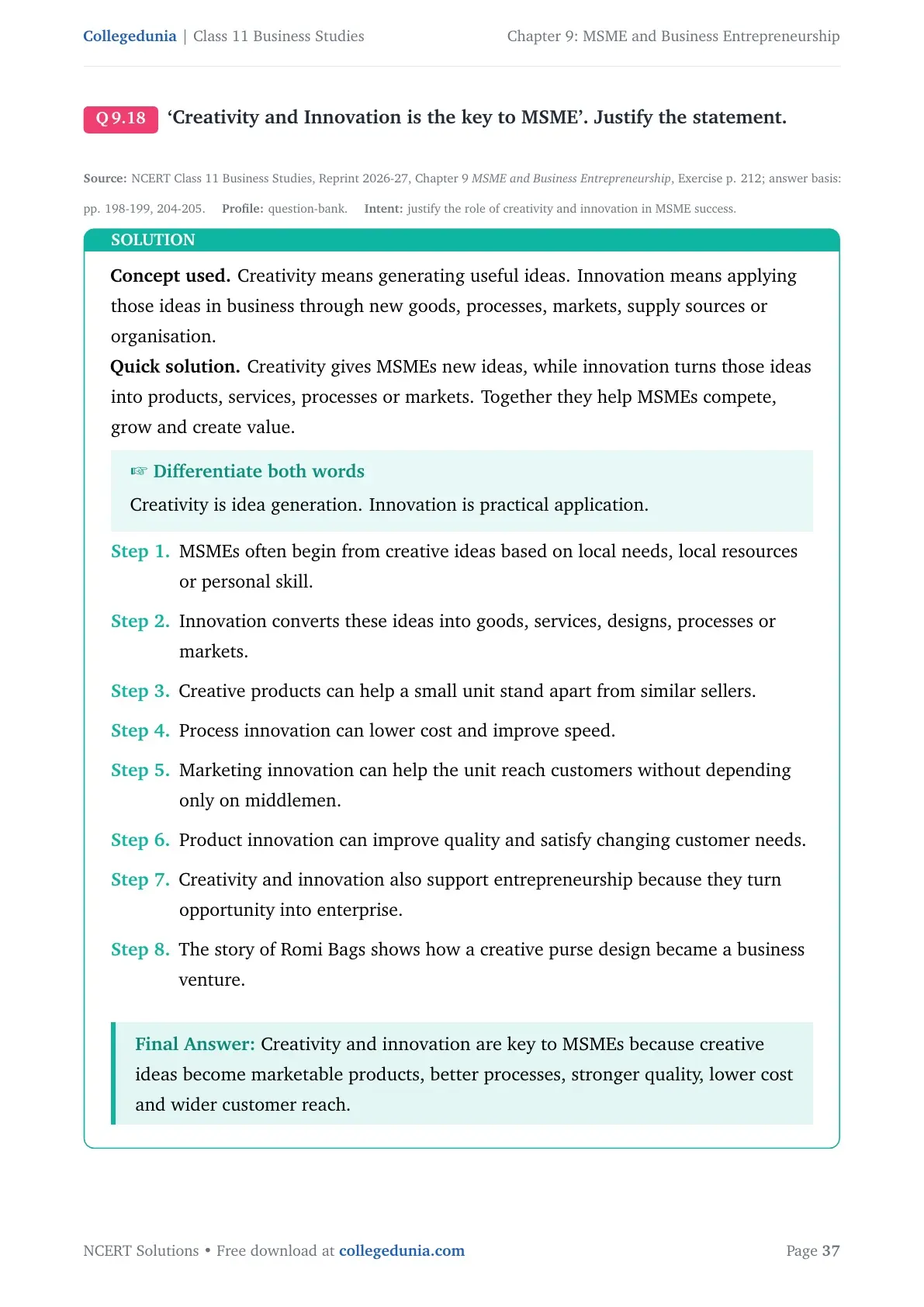
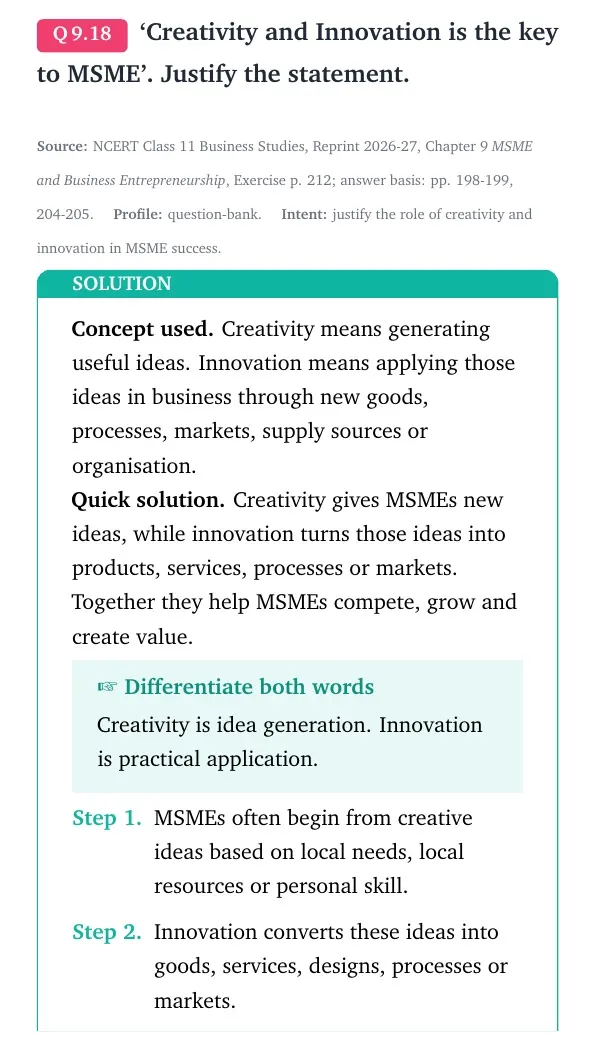
`Creativity and Innovation is the key to MSME'. Justify the statement.
Quick solution. Creativity gives MSMEs new ideas, while innovation turns those ideas into products, services, processes or markets. Together they help MSMEs compete, grow and create value.
Concept used. Creativity means generating useful ideas. Innovation means applying those ideas in business through new goods, processes, markets, supply sources or organisation.
- MSMEs often begin from creative ideas based on local needs, local resources or personal skill.
- Innovation converts these ideas into goods, services, designs, processes or markets.
- Creative products can help a small unit stand apart from similar sellers.
- Process innovation can lower cost and improve speed.
- Marketing innovation can help the unit reach customers without depending only on middlemen.
- Product innovation can improve quality and satisfy changing customer needs.
- Creativity and innovation also support entrepreneurship because they turn opportunity into enterprise.
- The story of Romi Bags shows how a creative purse design became a business venture.
Final answer: Creativity and innovation are key to MSMEs because creative ideas become marketable products, better processes, stronger quality, lower cost and wider customer reach.
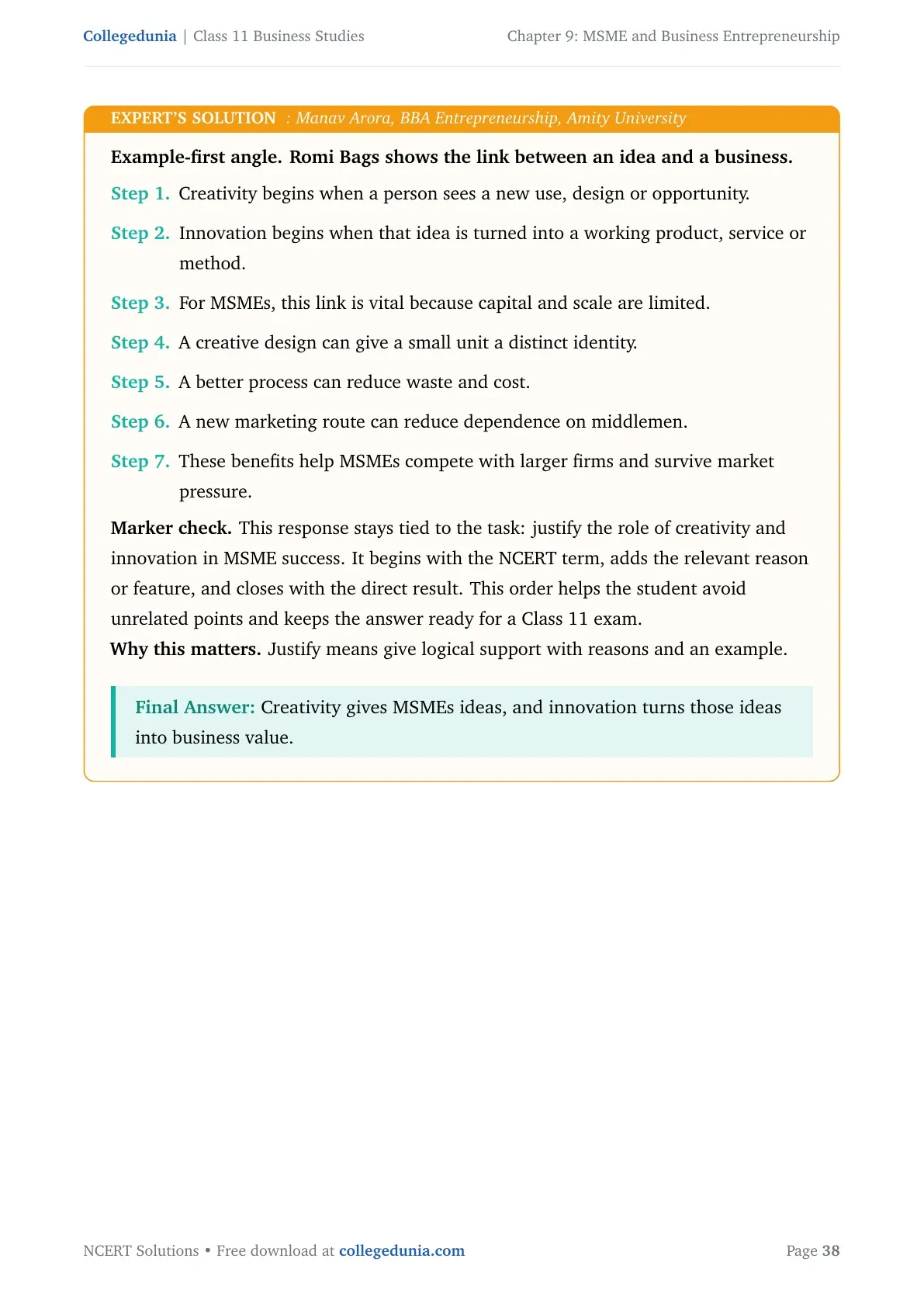
Example-first angle. Romi Bags shows the link between an idea and a business.
- Creativity begins when a person sees a new use, design or opportunity.
- Innovation begins when that idea is turned into a working product, service or method.
- For MSMEs, this link is vital because capital and scale are limited.
- A creative design can give a small unit a distinct identity.
- A better process can reduce waste and cost.
- A new marketing route can reduce dependence on middlemen.
- These benefits help MSMEs compete with larger firms and survive market pressure.
Why this matters. Justify means give logical support with reasons and an example.
Expert answer: Creativity gives MSMEs ideas, and innovation turns those ideas into business value.
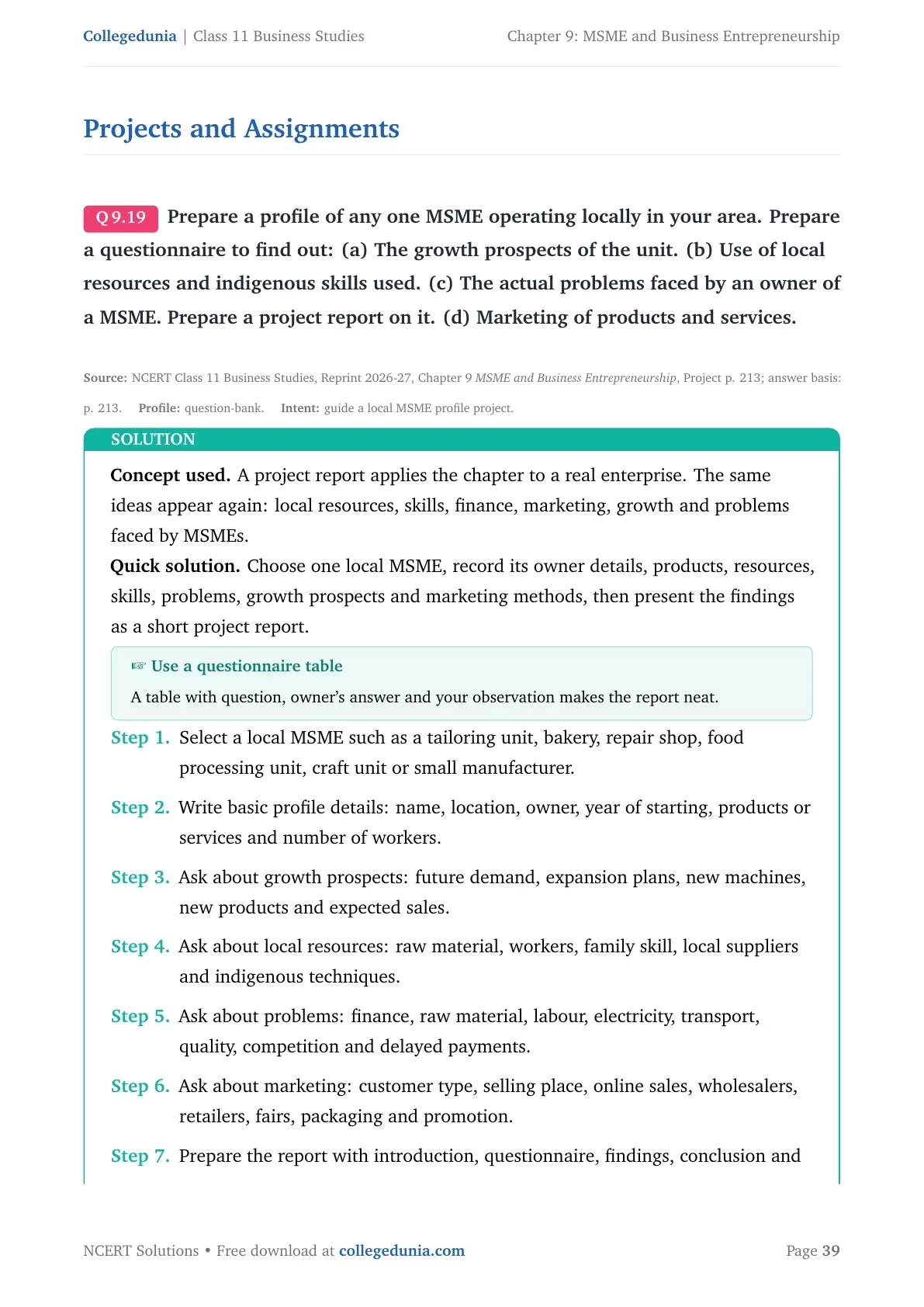
Question 19
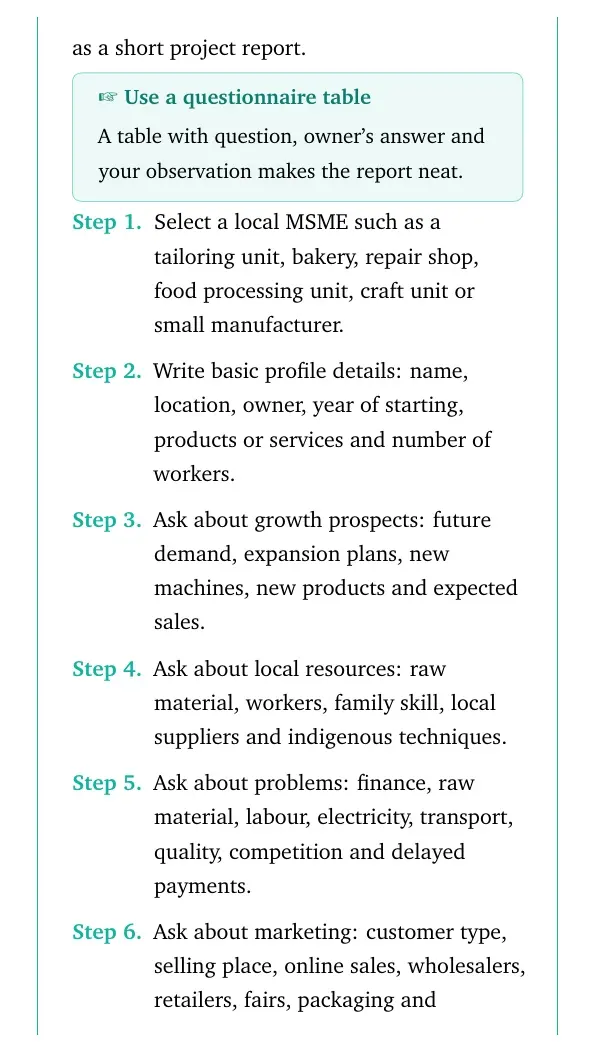
Prepare a profile of any one MSME operating locally in your area. Prepare a questionnaire to find out: (a) The growth prospects of the unit. (b) Use of local resources and indigenous skills used. (c) The actual problems faced by an owner of a MSME. Prepare a project report on it. (d) Marketing of products and services.
Quick solution. Choose one local MSME, record its owner details, products, resources, skills, problems, growth prospects and marketing methods, then present the findings as a short project report.
Concept used. A project report applies the chapter to a real enterprise. The same ideas appear again: local resources, skills, finance, marketing, growth and problems faced by MSMEs.
- Select a local MSME such as a tailoring unit, bakery, repair shop, food processing unit, craft unit or small manufacturer.
- Write basic profile details: name, location, owner, year of starting, products or services and number of workers.
- Ask about growth prospects: future demand, expansion plans, new machines, new products and expected sales.
- Ask about local resources: raw material, workers, family skill, local suppliers and indigenous techniques.
- Ask about problems: finance, raw material, labour, electricity, transport, quality, competition and delayed payments.
- Ask about marketing: customer type, selling place, online sales, wholesalers, retailers, fairs, packaging and promotion.
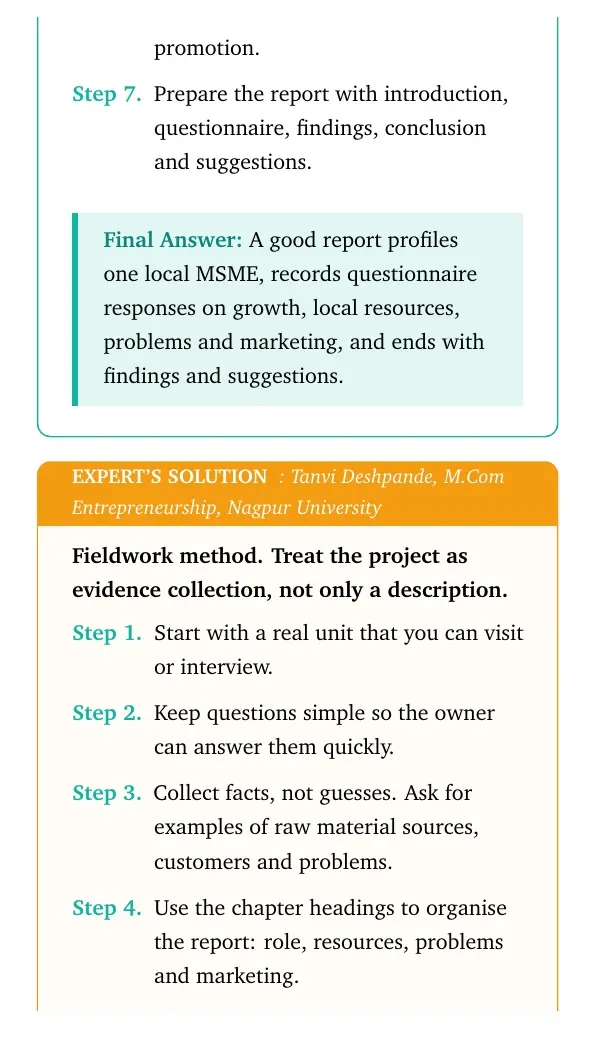
- Prepare the report with introduction, questionnaire, findings, conclusion and suggestions.
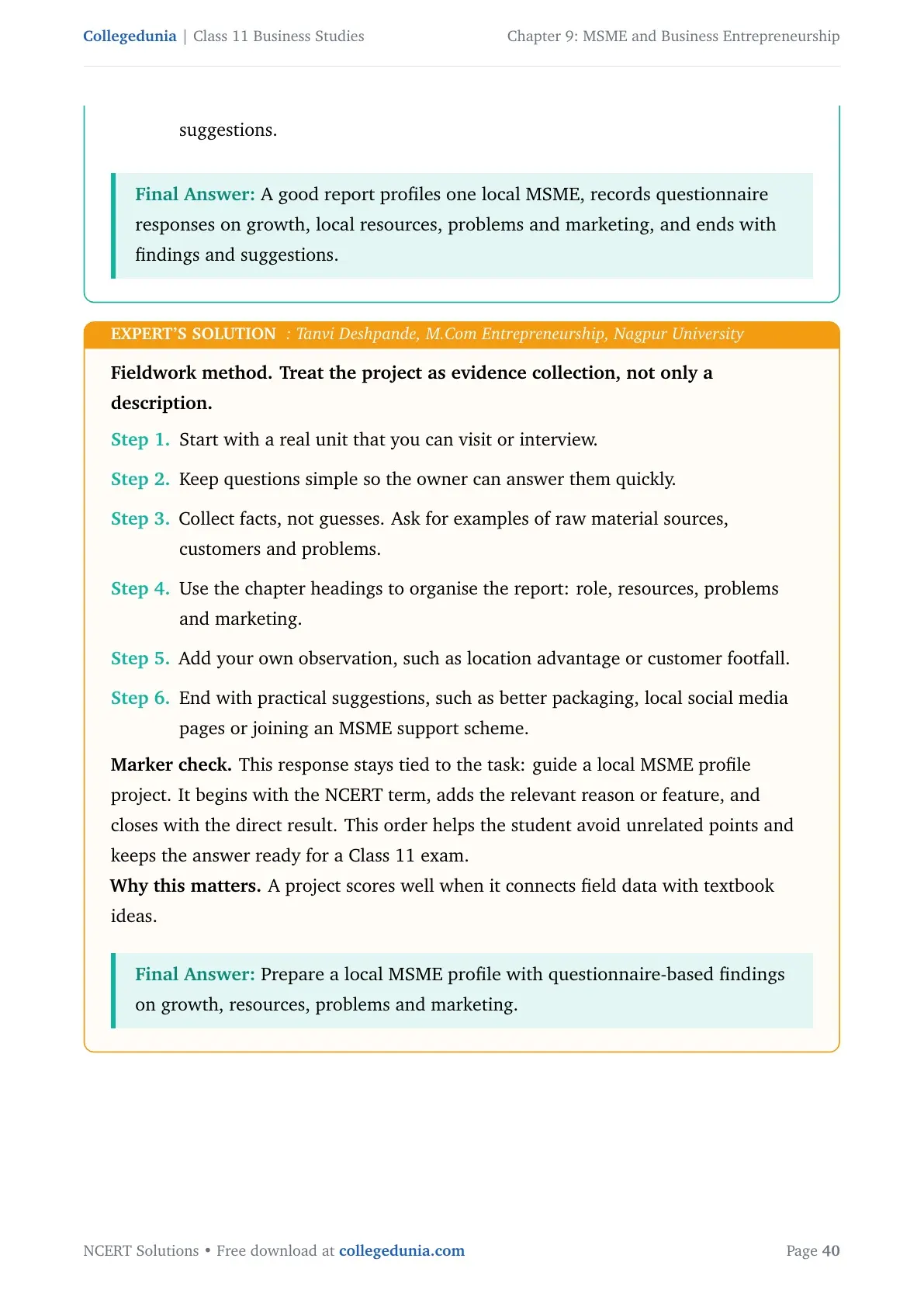
Final answer: A good report profiles one local MSME, records questionnaire responses on growth, local resources, problems and marketing, and ends with findings and suggestions.
Fieldwork method. Treat the project as evidence collection, not only a description.
- Start with a real unit that you can visit or interview.
- Keep questions simple so the owner can answer them quickly.
- Collect facts, not guesses. Ask for examples of raw material sources, customers and problems.
- Use the chapter headings to organise the report: role, resources, problems and marketing.
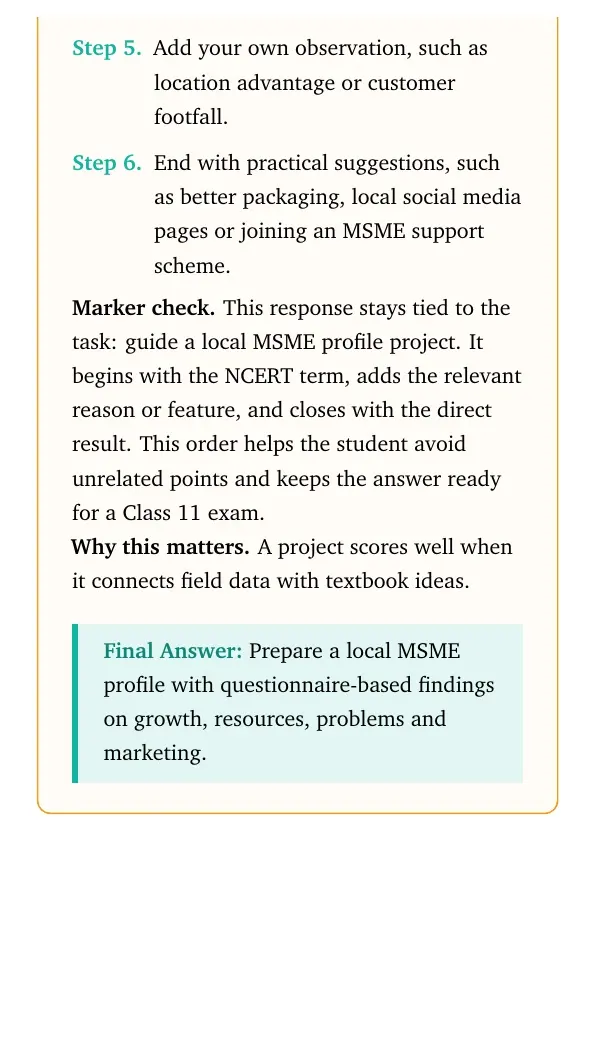
- Add your own observation, such as location advantage or customer footfall.
- End with practical suggestions, such as better packaging, local social media pages or joining an MSME support scheme.
Why this matters. A project scores well when it connects field data with textbook ideas.
Expert answer: Prepare a local MSME profile with questionnaire-based findings on growth, resources, problems and marketing.
Question 20
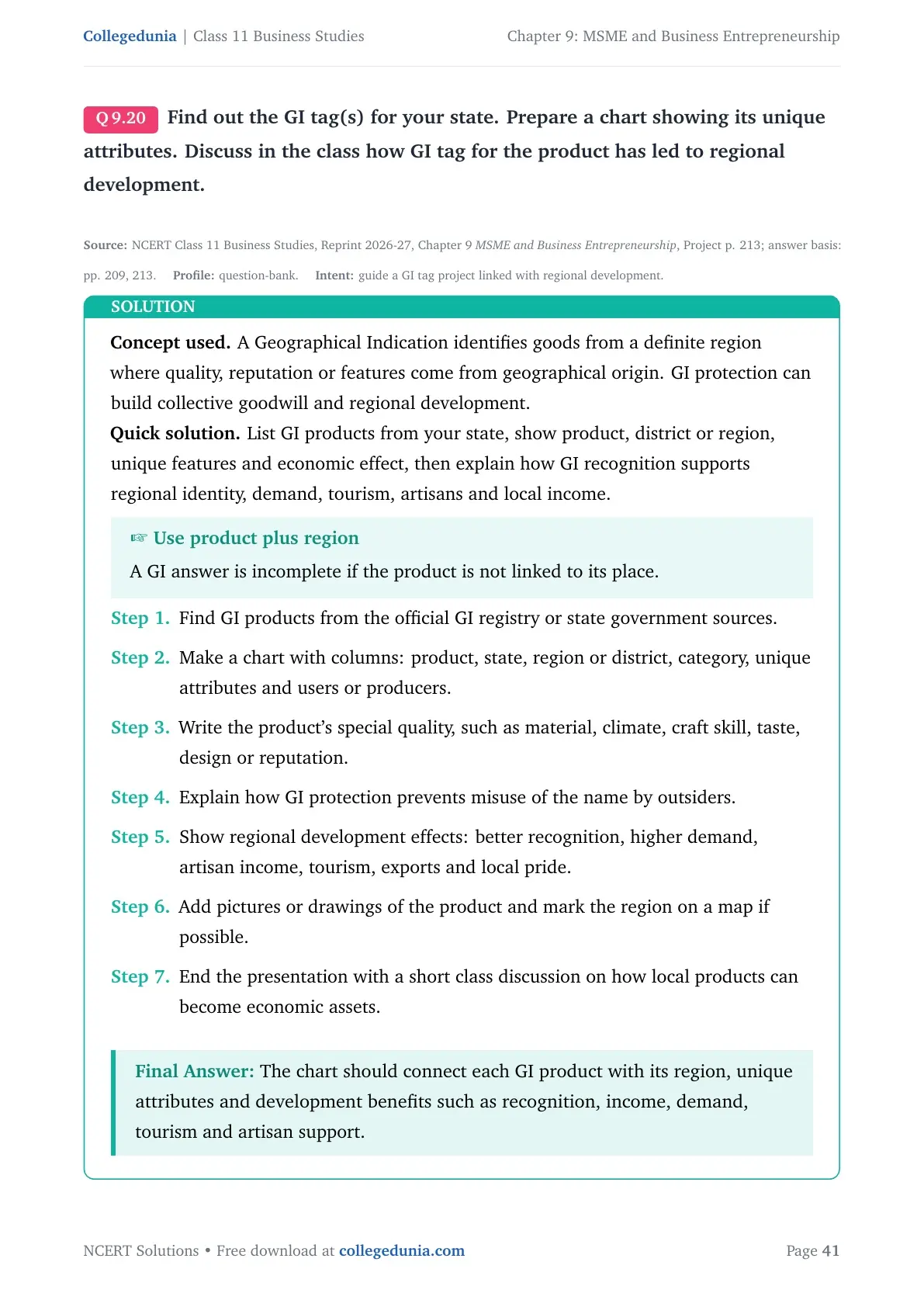
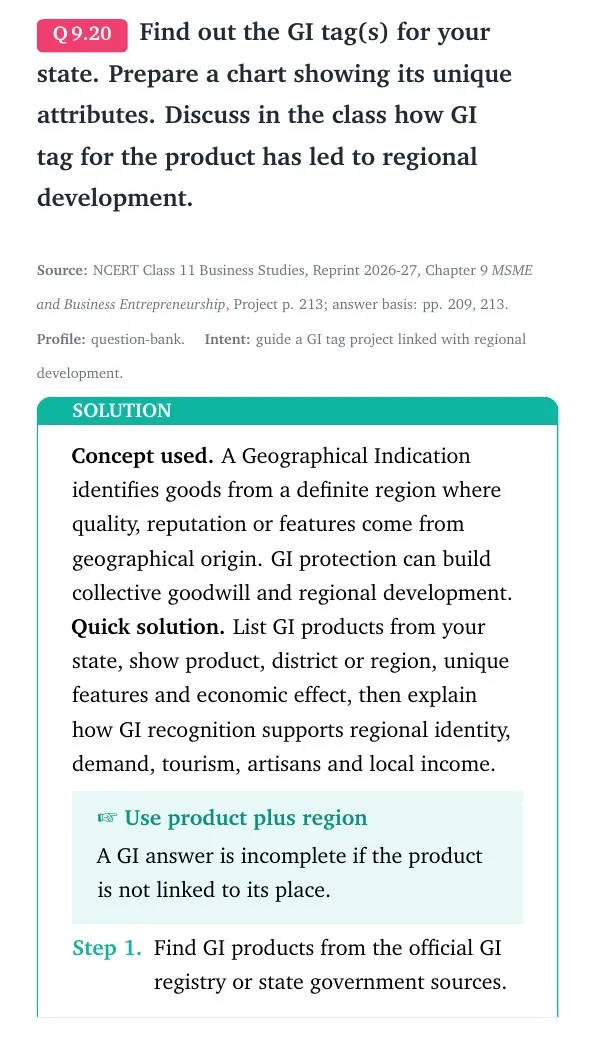
Find out the GI tag(s) for your state. Prepare a chart showing its unique attributes. Discuss in the class how GI tag for the product has led to regional development.
Quick solution. List GI products from your state, show product, district or region, unique features and economic effect, then explain how GI recognition supports regional identity, demand, tourism, artisans and local income.
Concept used. A Geographical Indication identifies goods from a definite region where quality, reputation or features come from geographical origin. GI protection can build collective goodwill and regional development.
- Find GI products from the official GI registry or state government sources.
- Make a chart with columns: product, state, region or district, category, unique attributes and users or producers.
- Write the product's special quality, such as material, climate, craft skill, taste, design or reputation.
- Explain how GI protection prevents misuse of the name by outsiders.
- Show regional development effects: better recognition, higher demand, artisan income, tourism, exports and local pride.
- Add pictures or drawings of the product and mark the region on a map if possible.
- End the presentation with a short class discussion on how local products can become economic assets.
Final answer: The chart should connect each GI product with its region, unique attributes and development benefits such as recognition, income, demand, tourism and artisan support.
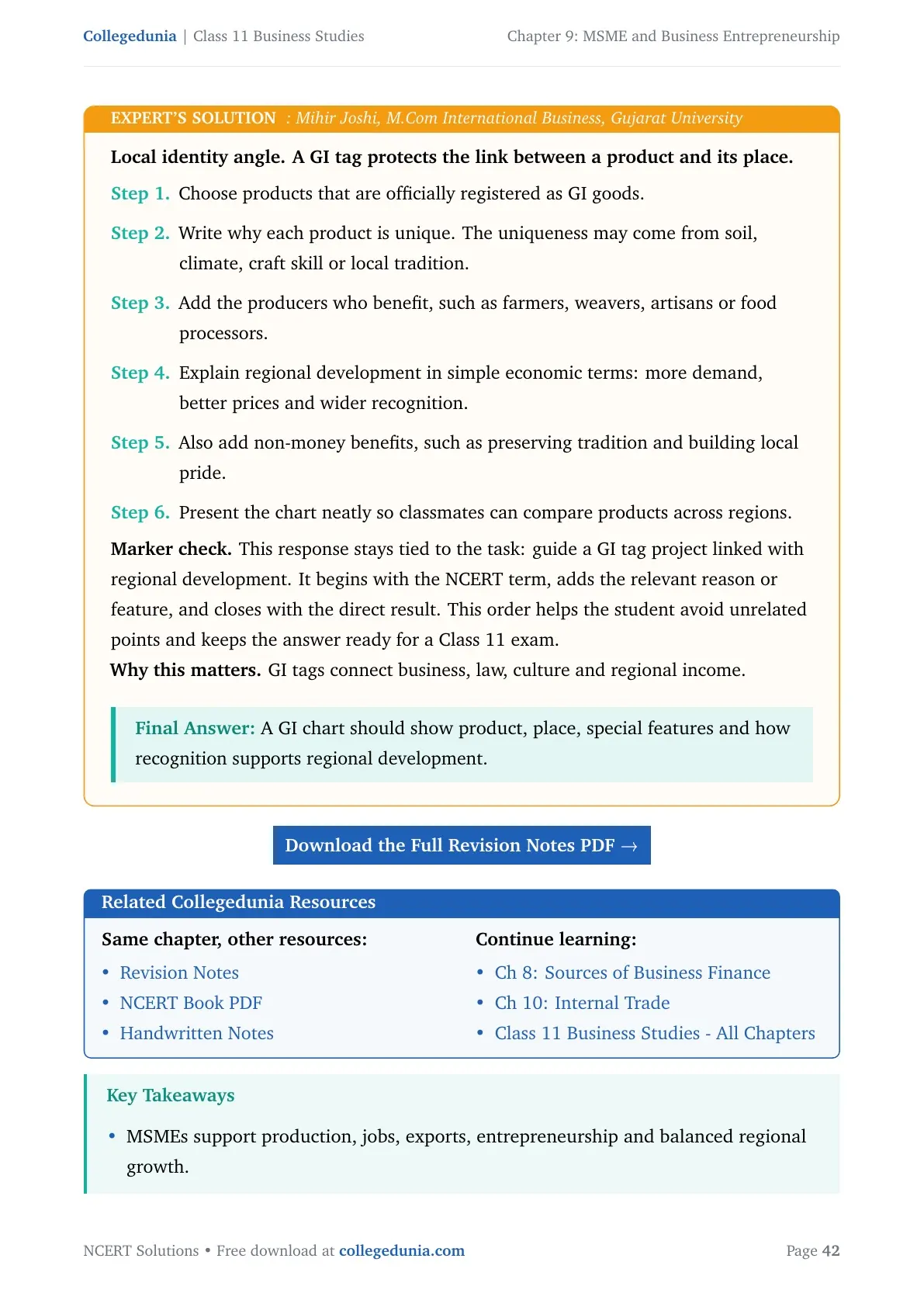
Local identity angle. A GI tag protects the link between a product and its place.
- Choose products that are officially registered as GI goods.
- Write why each product is unique. The uniqueness may come from soil, climate, craft skill or local tradition.
- Add the producers who benefit, such as farmers, weavers, artisans or food processors.
- Explain regional development in simple economic terms: more demand, better prices and wider recognition.
- Also add non-money benefits, such as preserving tradition and building local pride.
- Present the chart neatly so classmates can compare products across regions.
Why this matters. GI tags connect business, law, culture and regional income.
Expert answer: A GI chart should show product, place, special features and how recognition supports regional development.
MSME and Business Entrepreneurship Class 11 NCERT Solutions FAQs
Ques. How many questions are solved in Class 11 Business Studies Chapter 9 MSME and Business Entrepreneurship?
Ans. This page solves 20 items from the chapter. It includes 18 exercise questions and 2 project prompts with step-by-step answers and expert explanations.
Ques. What is MSME in Class 11 Business Studies Chapter 9?
Ans. MSME means micro, small and medium enterprises. These units operate at smaller scales than large industries and support employment, local resources and balanced regional growth.
Ques. What is entrepreneurship according to this chapter?
Ans. Entrepreneurship is the process of finding a business opportunity, taking calculated risk and organising resources to create goods or services for the market.
Ques. Why are village industries important in Chapter 9?
Ans. Village industries create rural jobs, support artisans, use local skills and help reduce pressure on cities. They are also linked with balanced regional development.
Ques. How should students use the Chapter 9 solutions PDF?
Ans. First read the NCERT question, then compare the solution with the expert explanation. Mark definitions, category points and examples for quick school-test revision.



Comments