




NCERT Solutions for Class 11 Business Studies Chapter 6 Social Responsibilities of Business and Business Ethics cover all textbook questions from the latest 2026-27 NCERT book. The answers explain social responsibility, stakeholder duties, environmental protection, pollution control, Corporate Social Responsibility and business ethics in clear CBSE answer language.
- PDF coverage: 16 textbook questions with detailed answers and expert explanations.
- Best for: revising social responsibility arguments, CSR rules, pollution control and business ethics elements.
- Use this with: the official NCERT book, chapter notes and the all-chapters solutions table below.
Student Feedback: In a Collegedunia poll of 11,180 Class 11 Business Studies students preparing for the 2026-27 school exams, 73% said Chapter 6 became easier when social responsibility, environmental protection and business ethics were revised as one connected unit.
Source: 2026-27 Class 11 Business Studies student poll across CBSE schools.
Every answer in this chapter set is checked against the 2026-27 NCERT Business Studies textbook and written so that students can revise the definition, reason and example together.
What Class 11 Business Studies Chapter 6 Covers
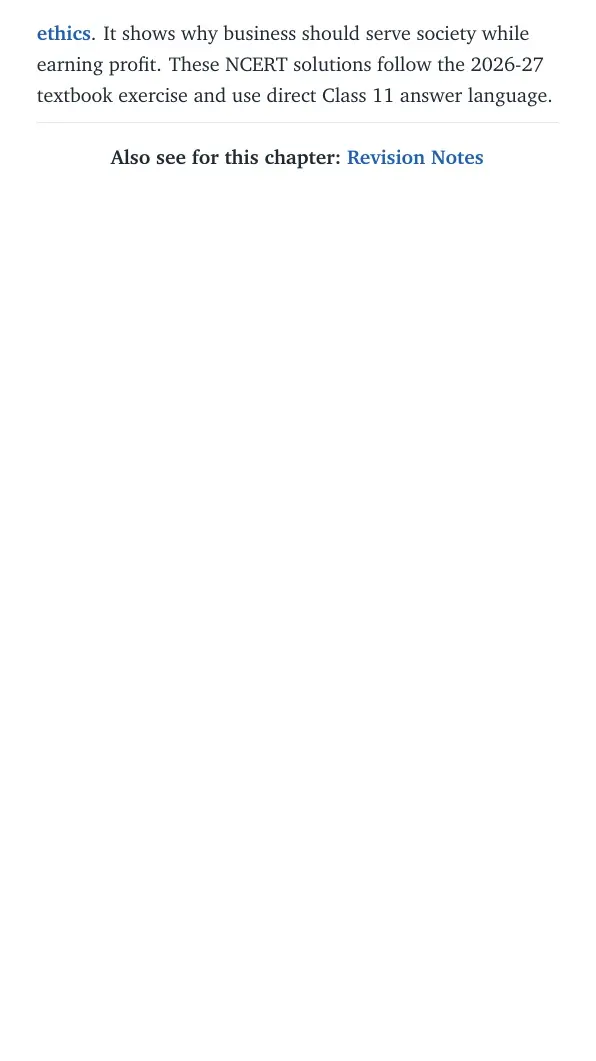
Social Responsibilities of Business and Business Ethics explains why business cannot work only for profit. NCERT connects the chapter with social values, law, workers, consumers, owners, the government, the community and environmental protection. The safest way to revise the chapter is to write every answer as a duty plus reason plus example.
| Chapter area | What students must know | Where it helps |
|---|---|---|
| Social responsibility | Meaning, legal difference, need and arguments | Questions 1, 7 and 8 |
| Stakeholder duties | Responsibilities towards owners, workers, consumers and society | Question 5 and Question 15 |
| Environmental protection | Environment, pollution types, causes and control steps | Questions 2, 4, 9, 10, 11 and 13 |
| Corporate Social Responsibility | Companies Act 2013 cues and Schedule VII activity areas | Questions 6 and 16 |
| Business ethics | Meaning, moral conduct and basic implementation elements | Questions 3, 12 and 14 |
Social Responsibility and Ethics Video for Class 11
Source: Magnet Brains on YouTube
Social Responsibility Areas in Business Studies Chapter 6
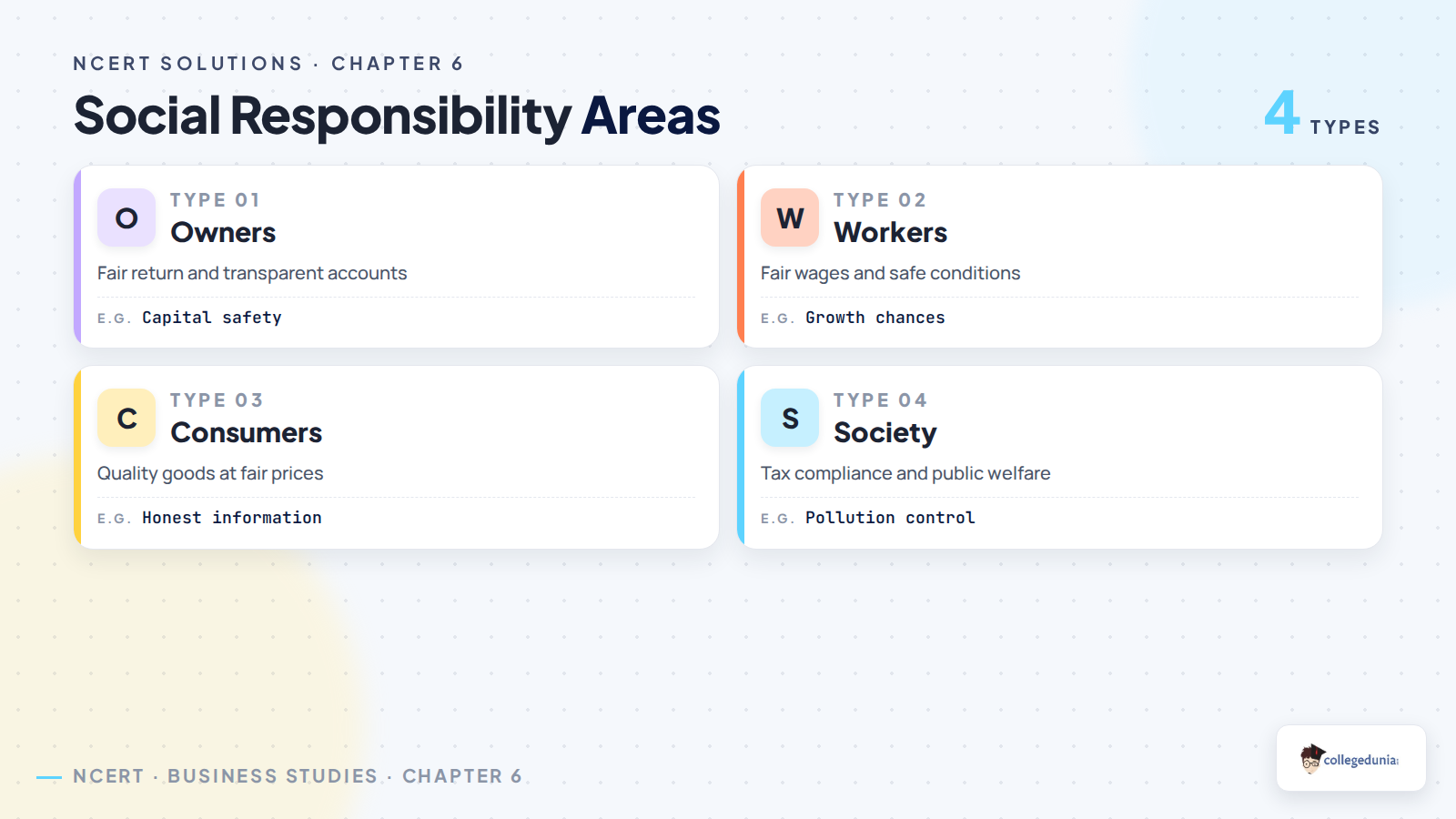
A business uses society's resources, so it owes duties to the groups affected by its decisions. The NCERT answer is strongest when each group is named separately. Owners expect a fair return and transparent accounts, workers expect wages and safe conditions, consumers expect quality goods, and society expects lawful taxes and public welfare.
- Owners: fair return on investment, truthful reporting and protection of capital.
- Workers: fair wages, safe working conditions, job dignity and growth chances.
- Consumers: right quality, right quantity, fair price and honest information.
- Government and community: tax compliance, law-abiding conduct and contribution to public welfare.
Environmental Protection and Pollution Control in Chapter 6
Business activity can create air, water, land and noise pollution through smoke, gases, chemicals, waste disposal and heavy machinery. NCERT expects students to connect environmental protection with social responsibility because pollution harms health, natural resources and future production capacity.
| Pollution type | Common business source | Control step |
|---|---|---|
| Air pollution | Smoke, chemical fumes and fuel burning | Cleaner fuel, filters and emission control |
| Water pollution | Industrial waste, sewage and chemicals | Treatment plants and safe discharge systems |
| Land pollution | Solid waste, plastics and toxic dumping | Recycling, safe disposal and waste reduction |
| Noise pollution | Machines, generators and transport | Sound barriers, maintenance and planned work hours |
Business Ethics Implementation Steps for Class 11
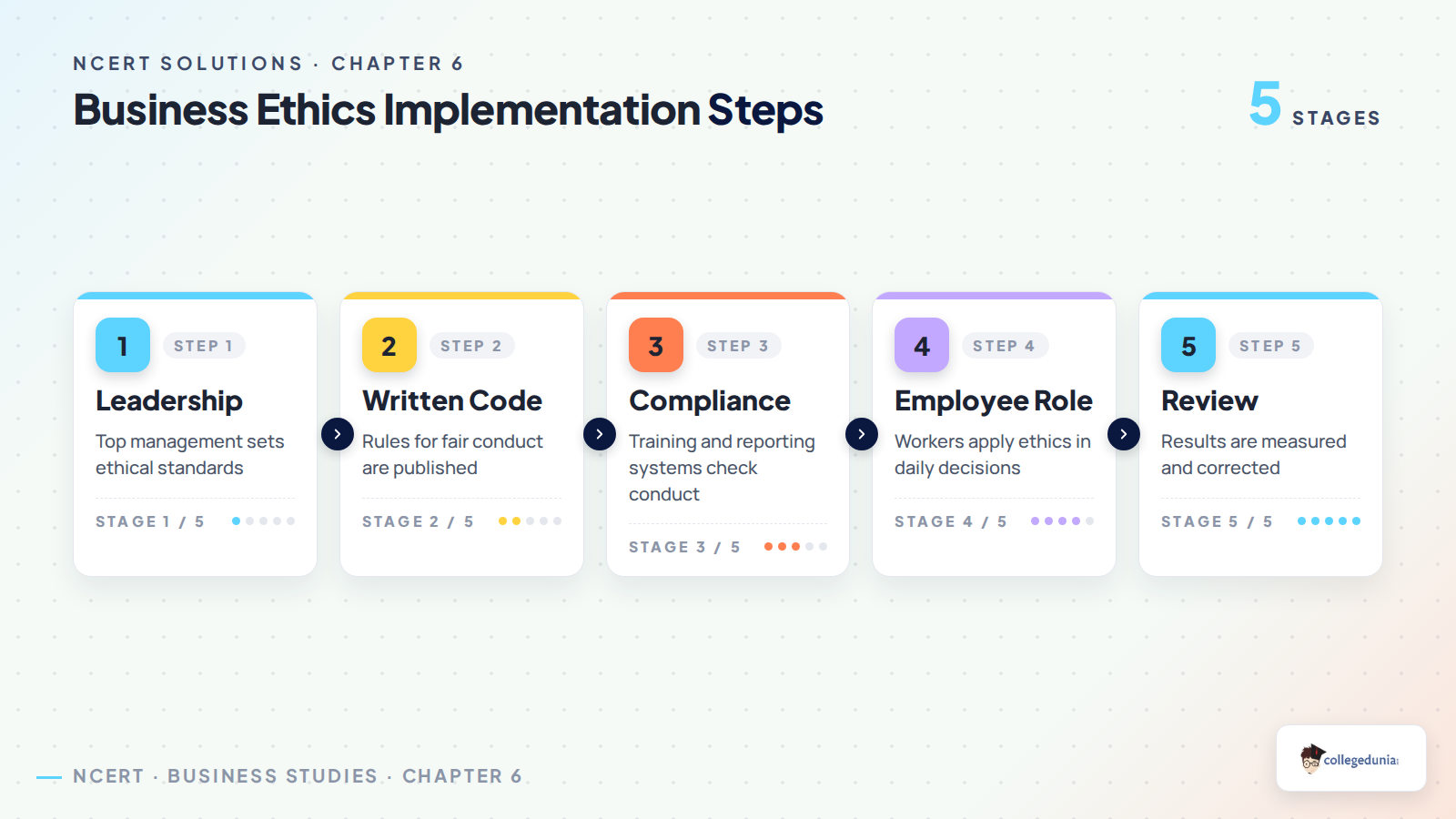
Business ethics means using moral principles while taking business decisions. The answer to the ethics question should not stop at a definition. Students should list the five implementation elements: commitment from top management, a written code, compliance systems, employee involvement and measurement of results.
- Top management commitment: senior managers must set the example for fair conduct.
- Written code: the business should publish rules for employees and managers.
- Compliance mechanism: training, checks and reporting systems make the code practical.
- Employee involvement: ethical conduct works only when people at all levels participate.
- Measuring results: review helps the firm correct weak areas and improve future conduct.
How to Write Better Answers for Social Responsibility and Business Ethics
Chapter 6 answers score well when students avoid vague moral statements and use NCERT headings. For social responsibility, write the meaning first, then explain why society expects business to act responsibly. For environmental questions, define the pollution type, mention a source and add one control measure. For CSR, mention Section 135, eligible companies and approved socially useful activities.
- Definition questions: write the direct NCERT meaning before the example.
- Difference questions: compare scope, compulsion and motive in separate points.
- Long answers: use headings for arguments, stakeholder duties and environmental steps.
- Project answers: name real activities such as education, sanitation, skill training and safe drinking water.
Related Business Studies Resources for Social Responsibilities of Business and Business Ethics
Use the solutions PDF for solved answers, then move to the NCERT book and notes when you want to revise the chapter theory in a different format.
| Resource | Best use | Link |
|---|---|---|
| NCERT Book PDF | Original NCERT reading and exercise questions | Social Responsibilities of Business and Business Ethics Class 11 NCERT Book PDF |
| Notes | Quick chapter summary, duties and ethics terms | Social Responsibilities of Business and Business Ethics Class 11 Notes |
| Handwritten Notes | Last minute recall before a school test | Social Responsibilities of Business and Business Ethics Class 11 Handwritten Notes |
NCERT Solutions for All Class 11 Business Studies Chapters
All NCERT Solutions for Class 11 Business Studies Chapter 6 Social Responsibilities of Business and Business Ethics with Step-by-Step Solutions
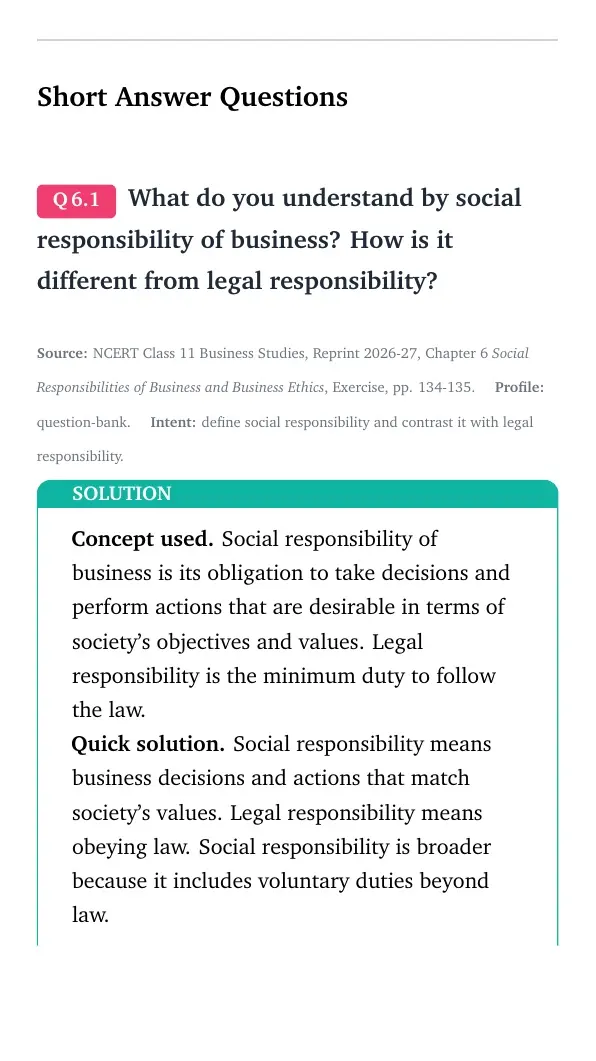
Question 1
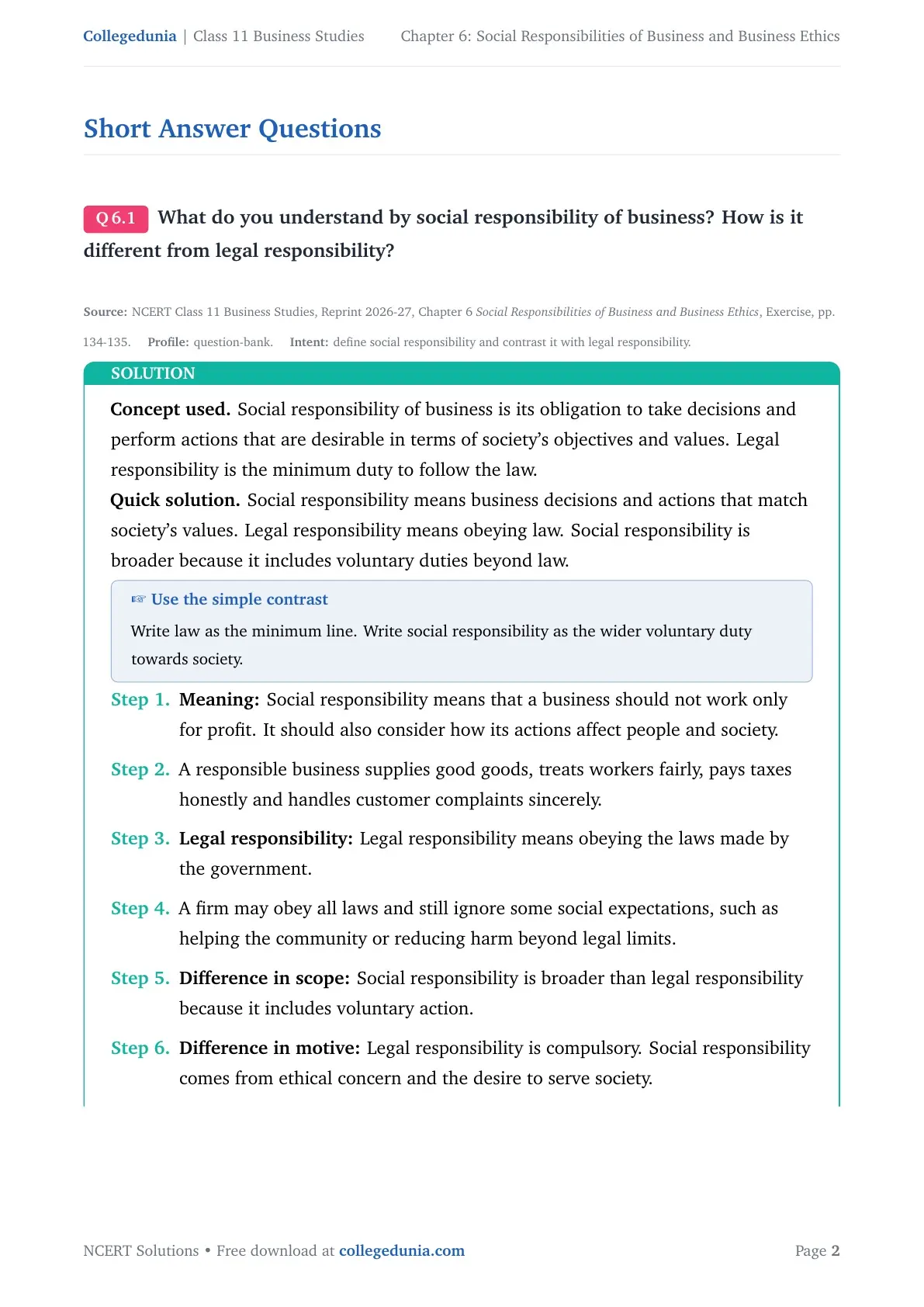
What do you understand by social responsibility of business? How is it different from legal responsibility?
Quick solution. Social responsibility means business decisions and actions that match society's values. Legal responsibility means obeying law. Social responsibility is broader because it includes voluntary duties beyond law.
Concept used. Social responsibility of business is its obligation to take decisions and perform actions that are desirable in terms of society's objectives and values. Legal responsibility is the minimum duty to follow the law.
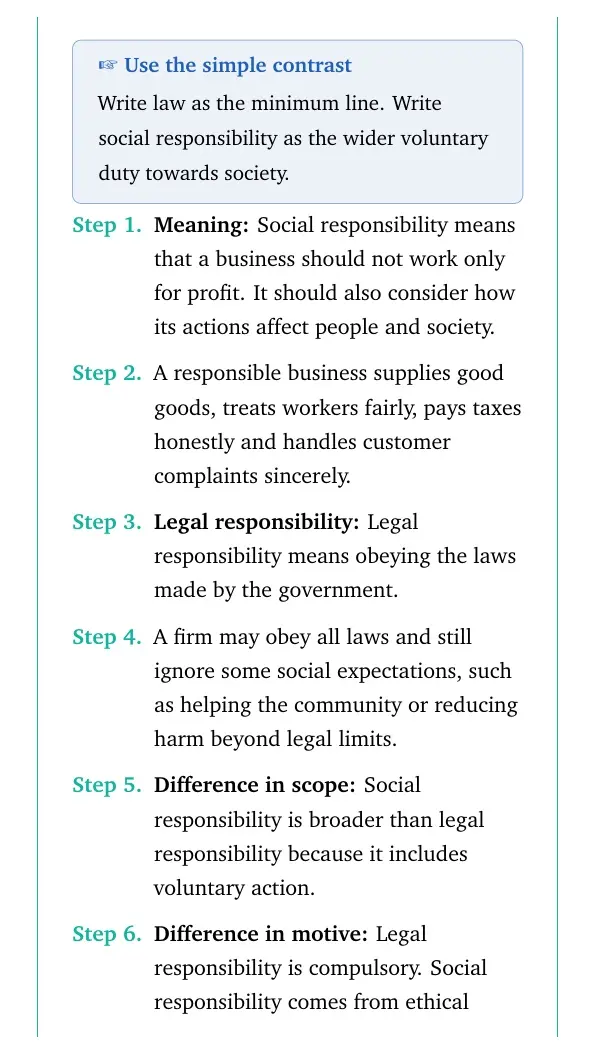
- Meaning: Social responsibility means that a business should not work only for profit. It should also consider how its actions affect people and society.
- A responsible business supplies good goods, treats workers fairly, pays taxes honestly and handles customer complaints sincerely.
- Legal responsibility: Legal responsibility means obeying the laws made by the government.
- A firm may obey all laws and still ignore some social expectations, such as helping the community or reducing harm beyond legal limits.
- Difference in scope: Social responsibility is broader than legal responsibility because it includes voluntary action.
- Difference in motive: Legal responsibility is compulsory. Social responsibility comes from ethical concern and the desire to serve society.
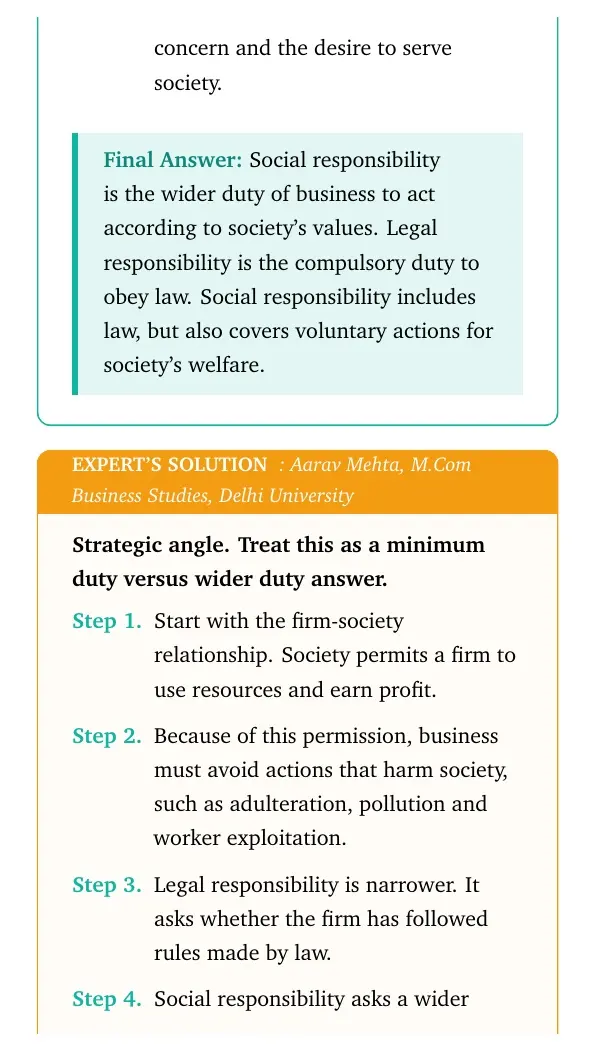
Final answer: Social responsibility is the wider duty of business to act according to society's values. Legal responsibility is the compulsory duty to obey law. Social responsibility includes law, but also covers voluntary actions for society's welfare.
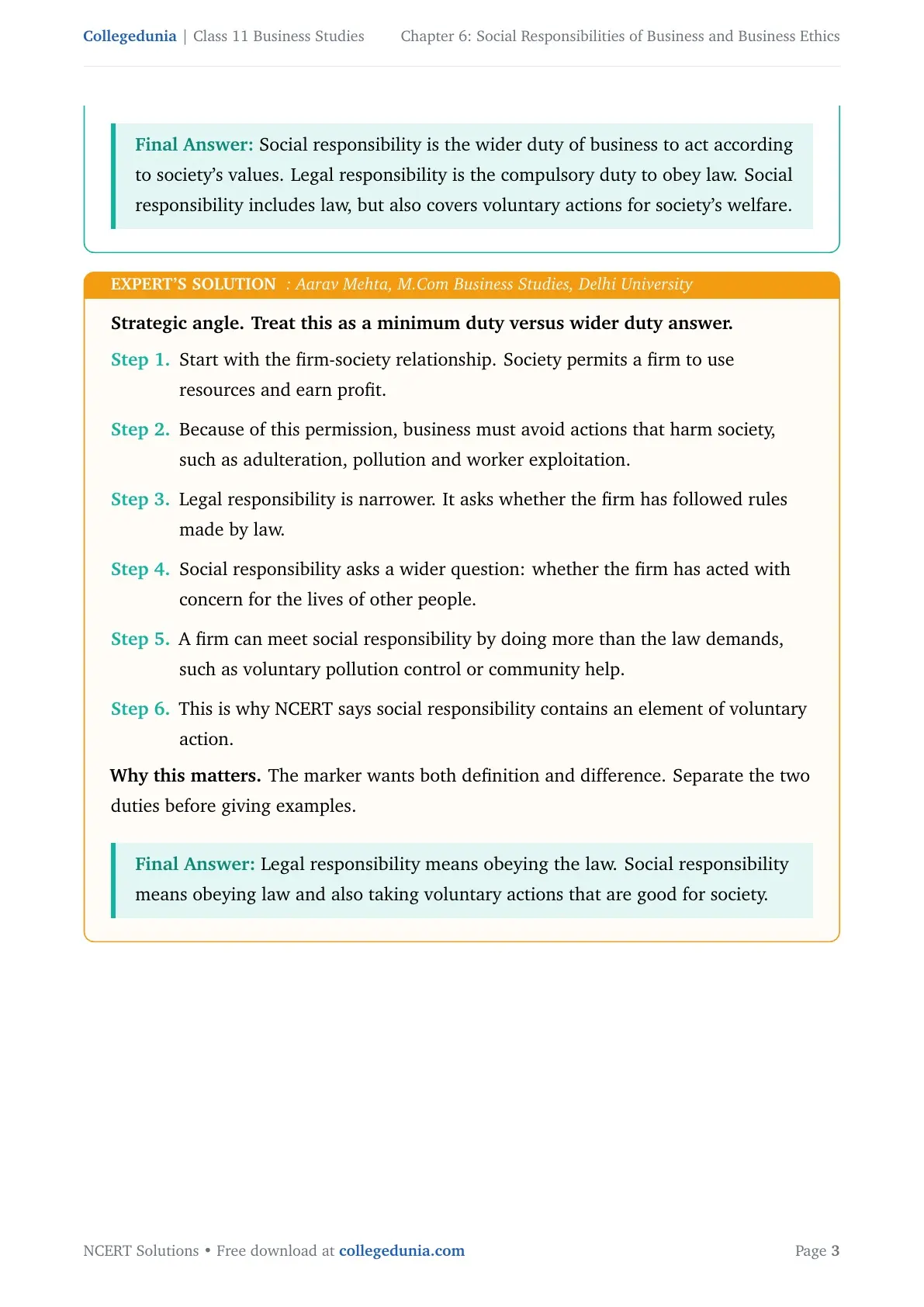
Strategic angle. Treat this as a minimum duty versus wider duty answer.
- Start with the firm-society relationship. Society permits a firm to use resources and earn profit.
- Because of this permission, business must avoid actions that harm society, such as adulteration, pollution and worker exploitation.
- Legal responsibility is narrower. It asks whether the firm has followed rules made by law.
- Social responsibility asks a wider question: whether the firm has acted with concern for the lives of other people.
- A firm can meet social responsibility by doing more than the law demands, such as voluntary pollution control or community help.
- This is why NCERT says social responsibility contains an element of voluntary action.
Why this matters. The marker wants both definition and difference. Separate the two duties before giving examples.
Expert answer: Legal responsibility means obeying the law. Social responsibility means obeying law and also taking voluntary actions that are good for society.
Question 2
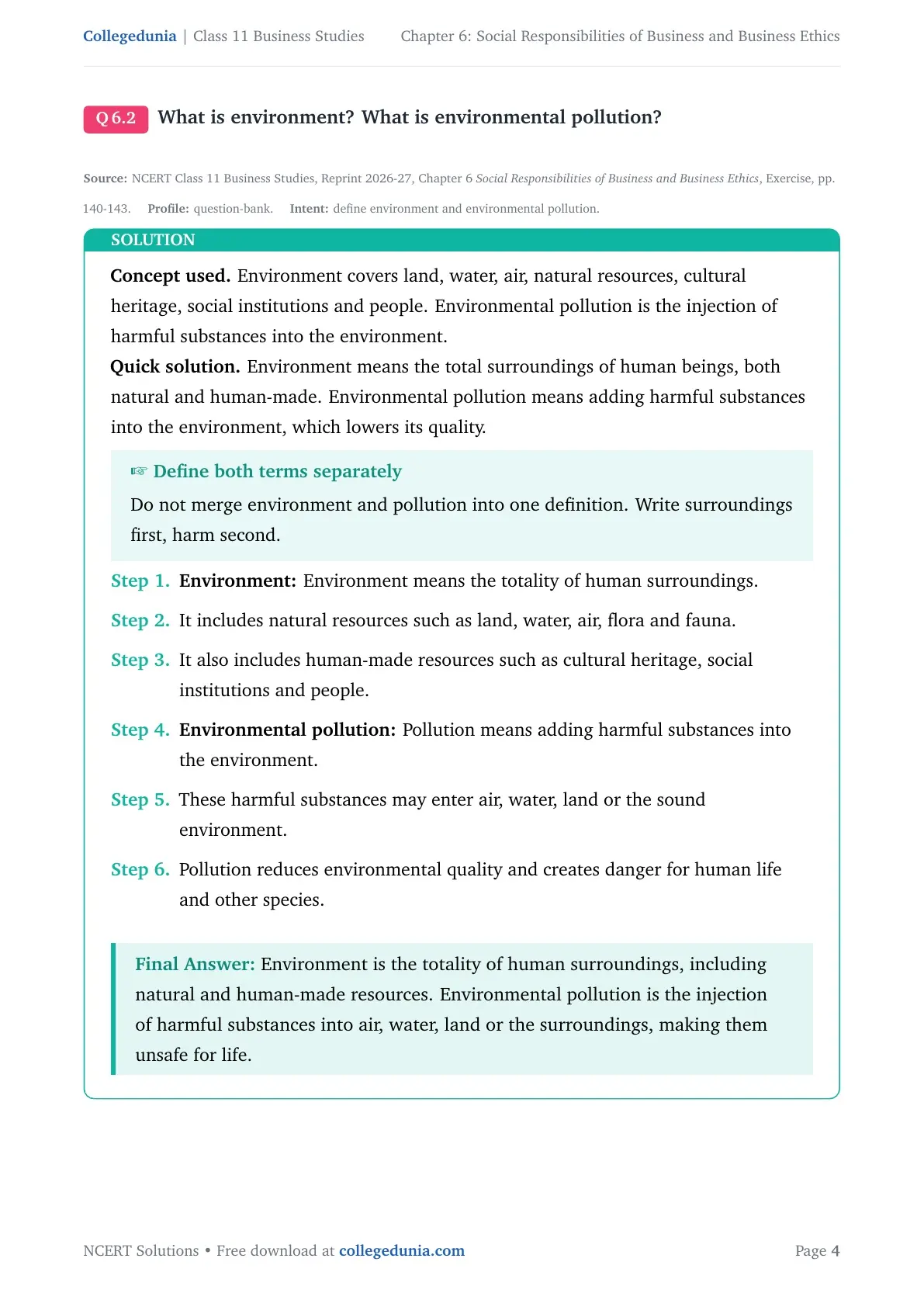
What is environment? What is environmental pollution?
Quick solution. Environment means the total surroundings of human beings, both natural and human-made. Environmental pollution means adding harmful substances into the environment, which lowers its quality.
Concept used. Environment covers land, water, air, natural resources, cultural heritage, social institutions and people. Environmental pollution is the injection of harmful substances into the environment.
- Environment: Environment means the totality of human surroundings.
- It includes natural resources such as land, water, air, flora and fauna.
- It also includes human-made resources such as cultural heritage, social institutions and people.
- Environmental pollution: Pollution means adding harmful substances into the environment.
- These harmful substances may enter air, water, land or the sound environment.
- Pollution reduces environmental quality and creates danger for human life and other species.
Final answer: Environment is the totality of human surroundings, including natural and human-made resources. Environmental pollution is the injection of harmful substances into air, water, land or the surroundings, making them unsafe for life.
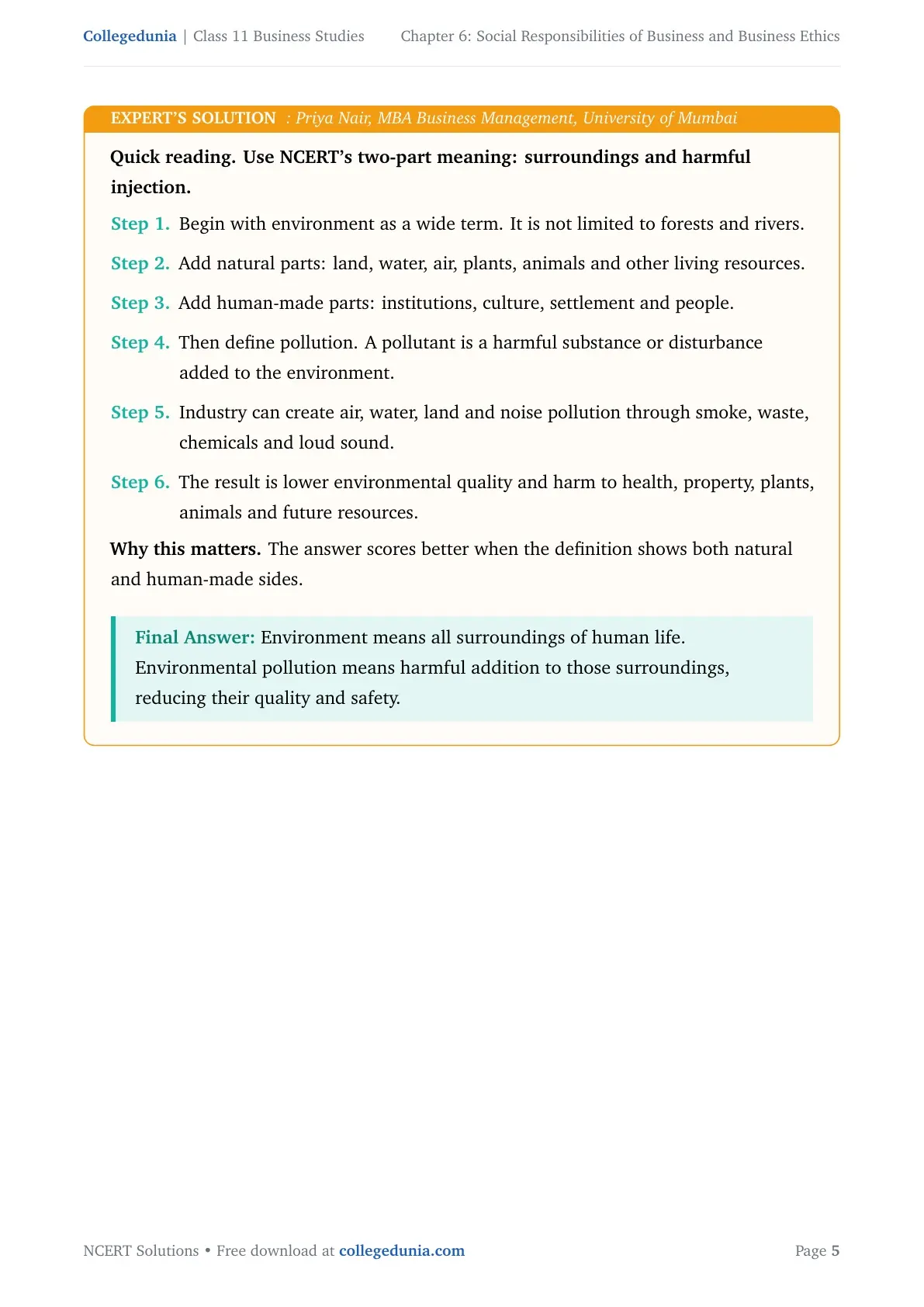
Quick reading. Use NCERT's two-part meaning: surroundings and harmful injection.
- Begin with environment as a wide term. It is not limited to forests and rivers.
- Add natural parts: land, water, air, plants, animals and other living resources.
- Add human-made parts: institutions, culture, settlement and people.
- Then define pollution. A pollutant is a harmful substance or disturbance added to the environment.
- Industry can create air, water, land and noise pollution through smoke, waste, chemicals and loud sound.
- The result is lower environmental quality and harm to health, property, plants, animals and future resources.
Why this matters. The answer scores better when the definition shows both natural and human-made sides.
Expert answer: Environment means all surroundings of human life. Environmental pollution means harmful addition to those surroundings, reducing their quality and safety.
Question 3
What is business ethics? Mention the basic elements of business ethics.
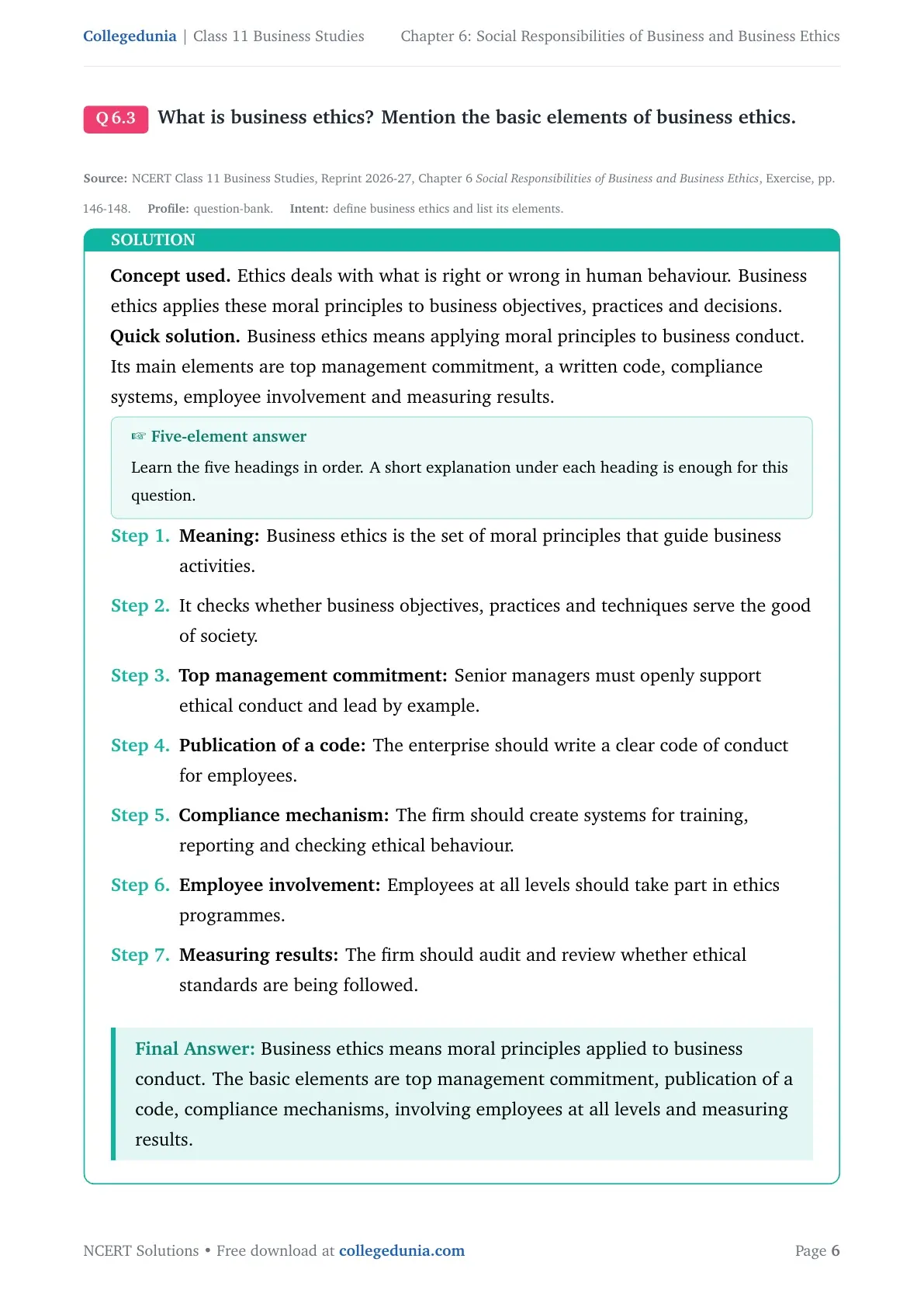
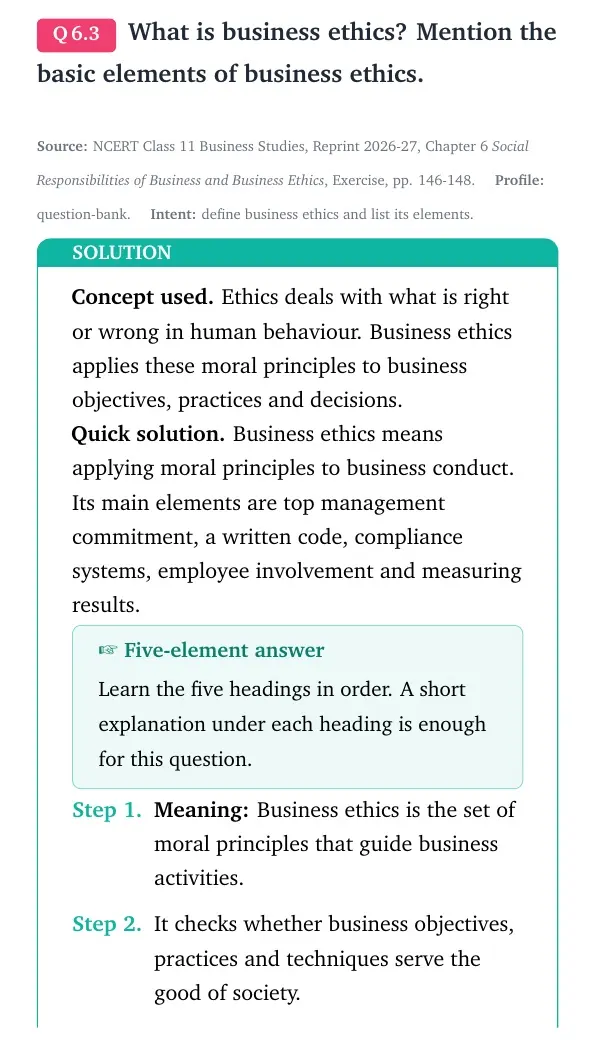
Quick solution. Business ethics means applying moral principles to business conduct. Its main elements are top management commitment, a written code, compliance systems, employee involvement and measuring results.
Concept used. Ethics deals with what is right or wrong in human behaviour. Business ethics applies these moral principles to business objectives, practices and decisions.
- Meaning: Business ethics is the set of moral principles that guide business activities.
- It checks whether business objectives, practices and techniques serve the good of society.
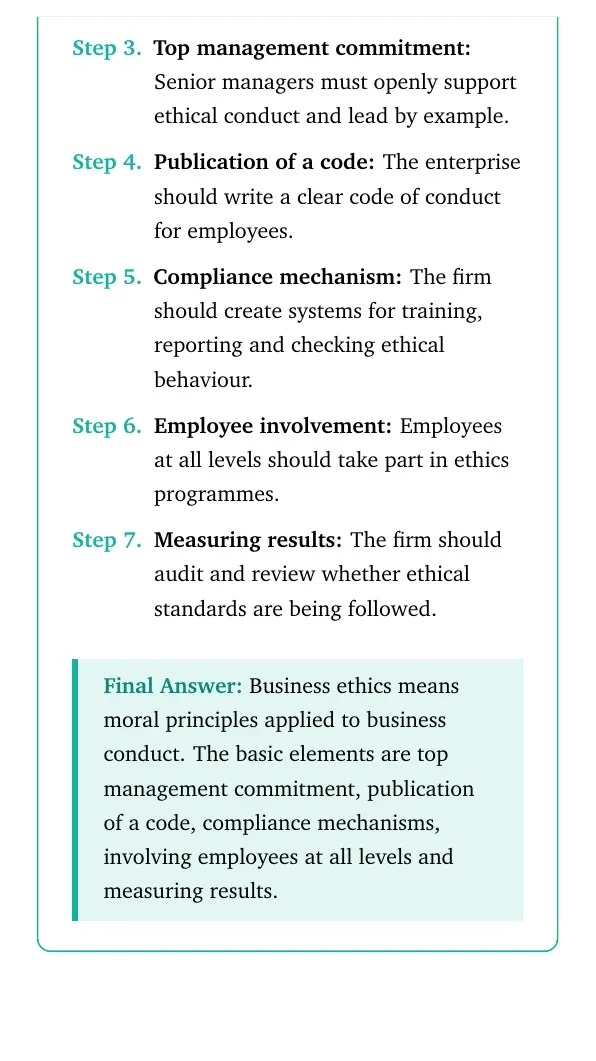
- Top management commitment: Senior managers must openly support ethical conduct and lead by example.
- Publication of a code: The enterprise should write a clear code of conduct for employees.
- Compliance mechanism: The firm should create systems for training, reporting and checking ethical behaviour.
- Employee involvement: Employees at all levels should take part in ethics programmes.
- Measuring results: The firm should audit and review whether ethical standards are being followed.
Final answer: Business ethics means moral principles applied to business conduct. The basic elements are top management commitment, publication of a code, compliance mechanisms, involving employees at all levels and measuring results.
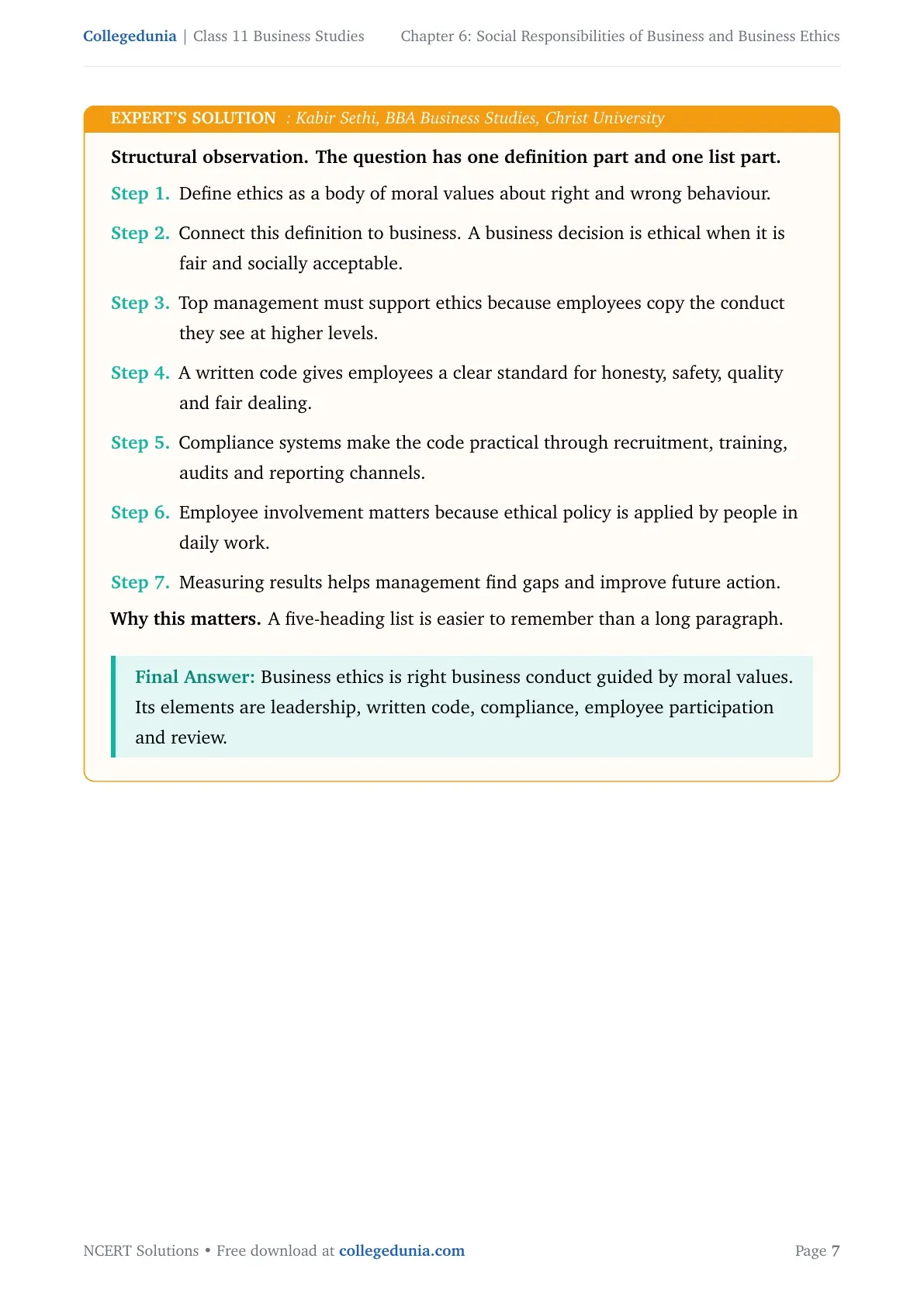
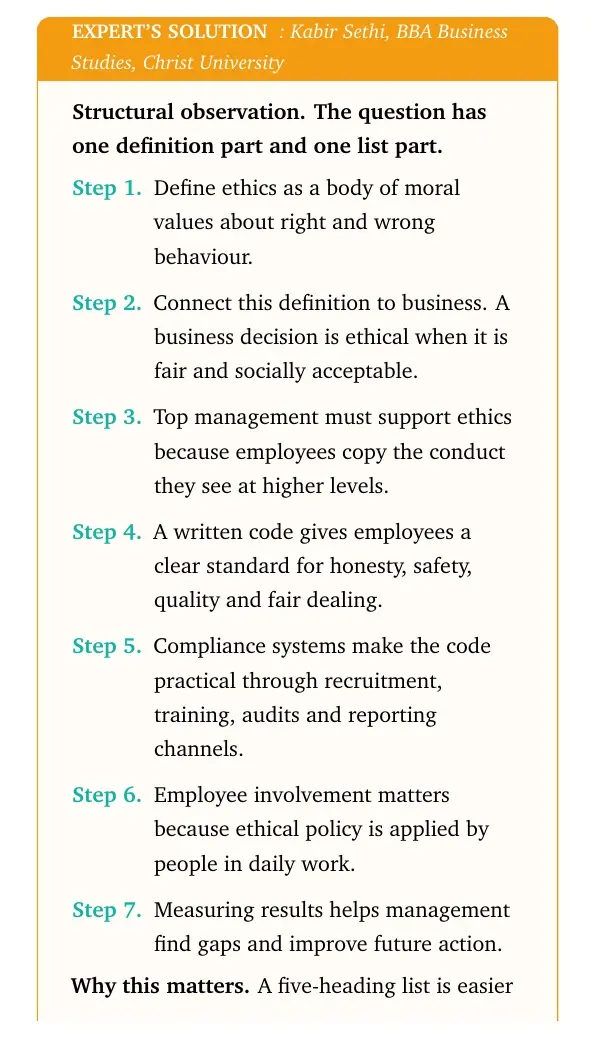
Structural observation. The question has one definition part and one list part.
- Define ethics as a body of moral values about right and wrong behaviour.
- Connect this definition to business. A business decision is ethical when it is fair and socially acceptable.
- Top management must support ethics because employees copy the conduct they see at higher levels.
- A written code gives employees a clear standard for honesty, safety, quality and fair dealing.
- Compliance systems make the code practical through recruitment, training, audits and reporting channels.
- Employee involvement matters because ethical policy is applied by people in daily work.
- Measuring results helps management find gaps and improve future action.
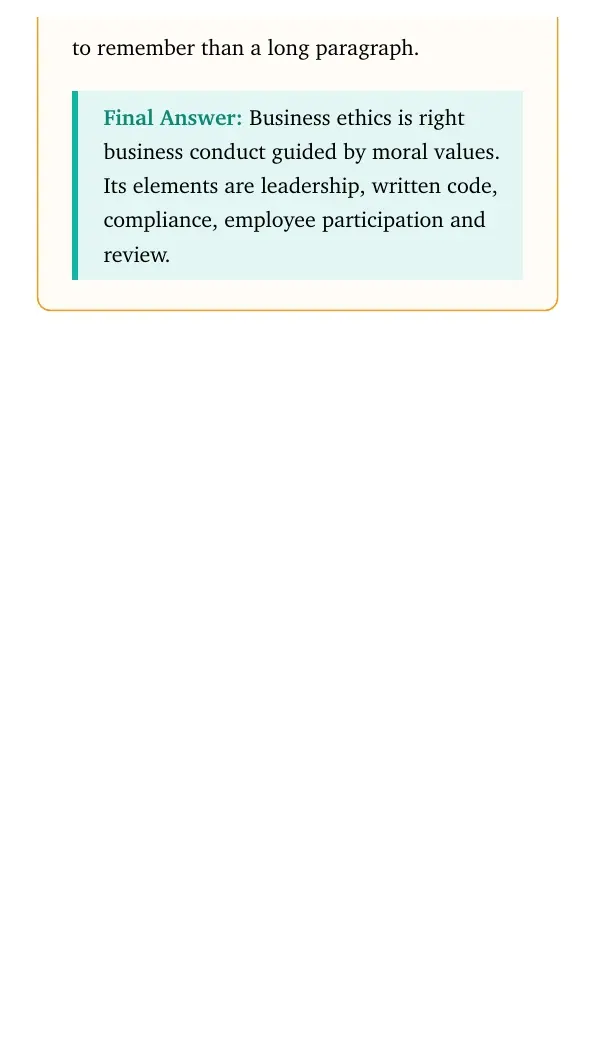
Why this matters. A five-heading list is easier to remember than a long paragraph.
Expert answer: Business ethics is right business conduct guided by moral values. Its elements are leadership, written code, compliance, employee participation and review.
Question 4
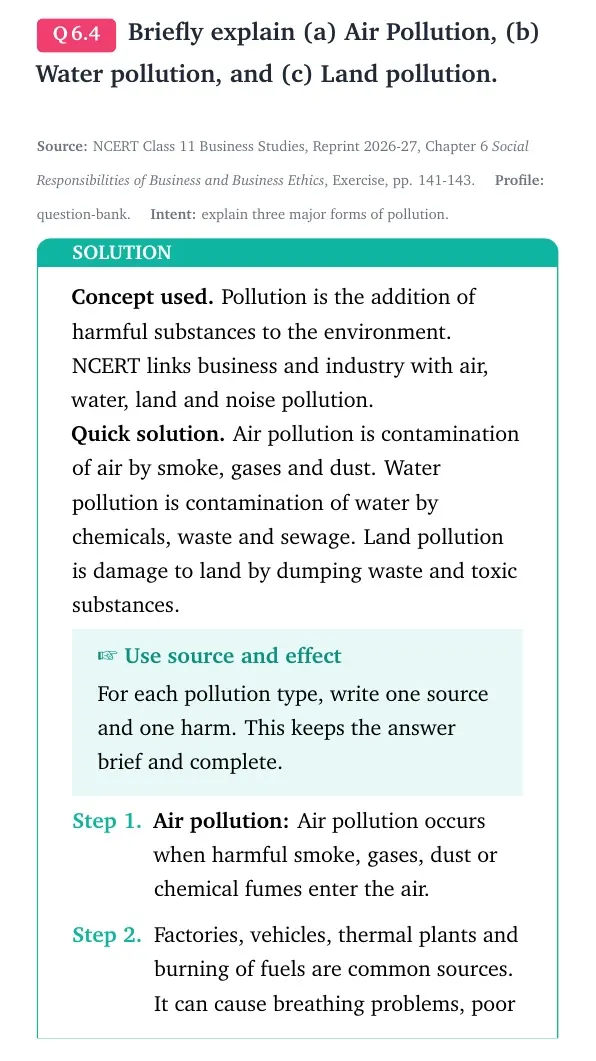
Briefly explain (a) Air Pollution, (b) Water pollution, and (c) Land pollution.
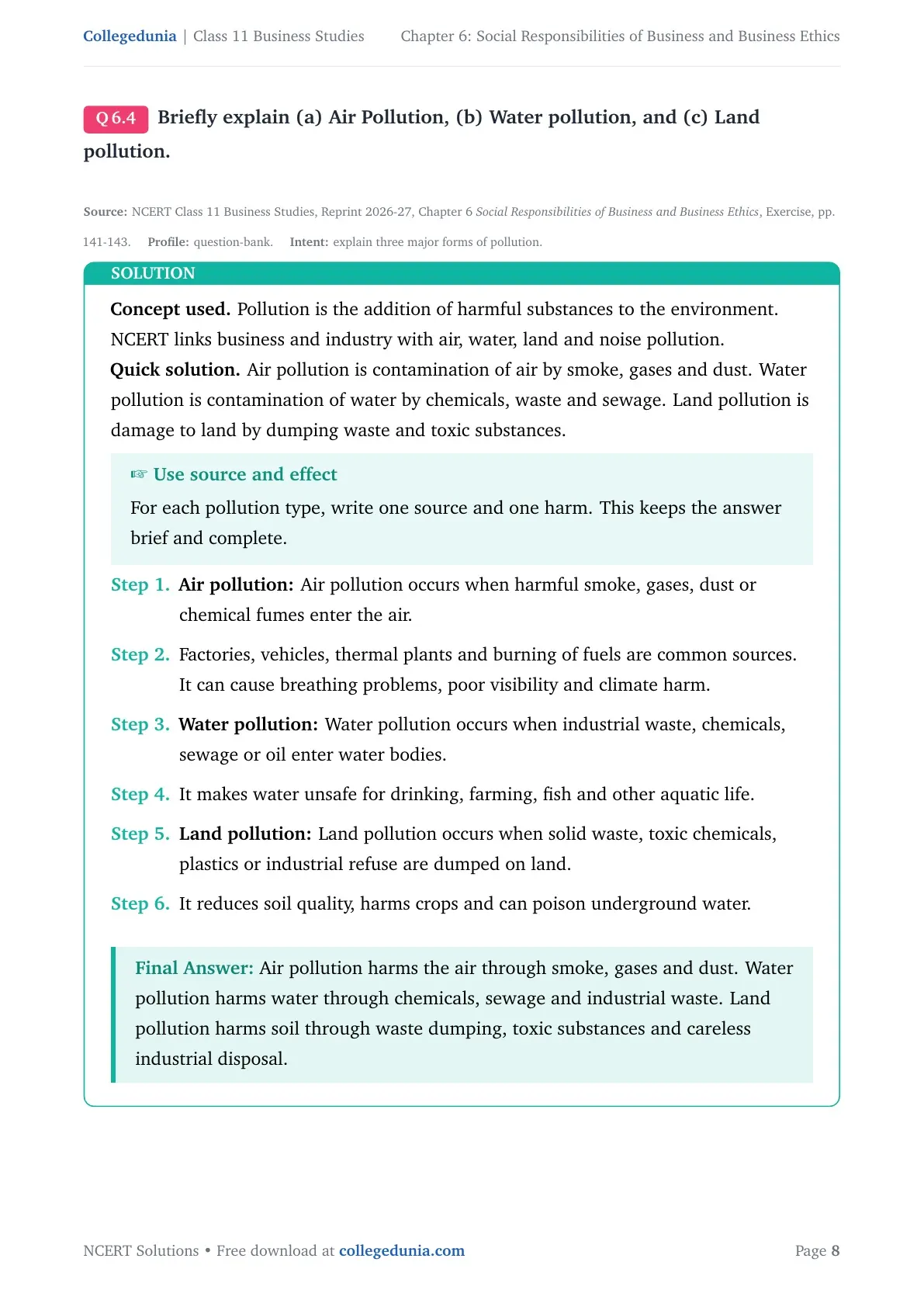
Quick solution. Air pollution is contamination of air by smoke, gases and dust. Water pollution is contamination of water by chemicals, waste and sewage. Land pollution is damage to land by dumping waste and toxic substances.
Concept used. Pollution is the addition of harmful substances to the environment. NCERT links business and industry with air, water, land and noise pollution.
- Air pollution: Air pollution occurs when harmful smoke, gases, dust or chemical fumes enter the air.
- Factories, vehicles, thermal plants and burning of fuels are common sources. It can cause breathing problems, poor visibility and climate harm.
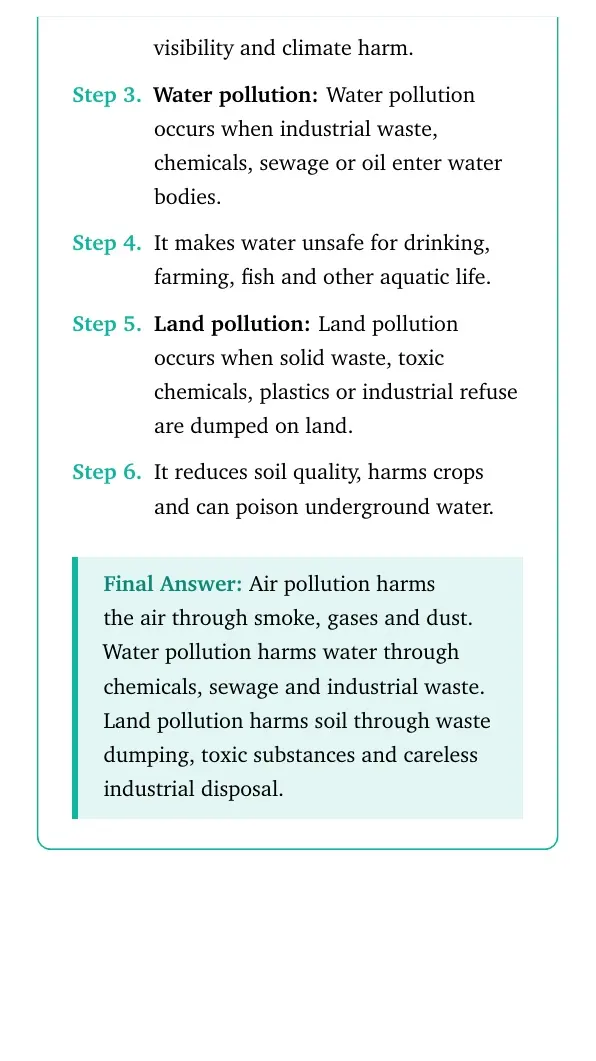
- Water pollution: Water pollution occurs when industrial waste, chemicals, sewage or oil enter water bodies.
- It makes water unsafe for drinking, farming, fish and other aquatic life.
- Land pollution: Land pollution occurs when solid waste, toxic chemicals, plastics or industrial refuse are dumped on land.
- It reduces soil quality, harms crops and can poison underground water.
Final answer: Air pollution harms the air through smoke, gases and dust. Water pollution harms water through chemicals, sewage and industrial waste. Land pollution harms soil through waste dumping, toxic substances and careless industrial disposal.
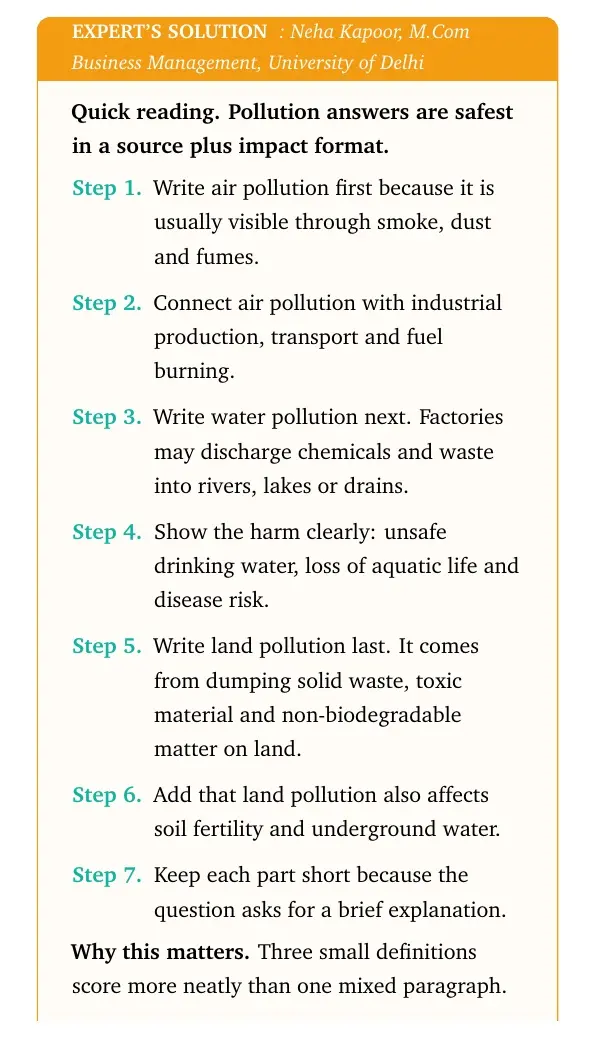
Quick reading. Pollution answers are safest in a source plus impact format.
- Write air pollution first because it is usually visible through smoke, dust and fumes.
- Connect air pollution with industrial production, transport and fuel burning.
- Write water pollution next. Factories may discharge chemicals and waste into rivers, lakes or drains.
- Show the harm clearly: unsafe drinking water, loss of aquatic life and disease risk.
- Write land pollution last. It comes from dumping solid waste, toxic material and non-biodegradable matter on land.
- Add that land pollution also affects soil fertility and underground water.
- Keep each part short because the question asks for a brief explanation.
Why this matters. Three small definitions score more neatly than one mixed paragraph.
Expert answer: Air, water and land pollution are harmful changes in air, water and soil caused by waste, smoke, chemicals, sewage and unsafe disposal.
Question 5
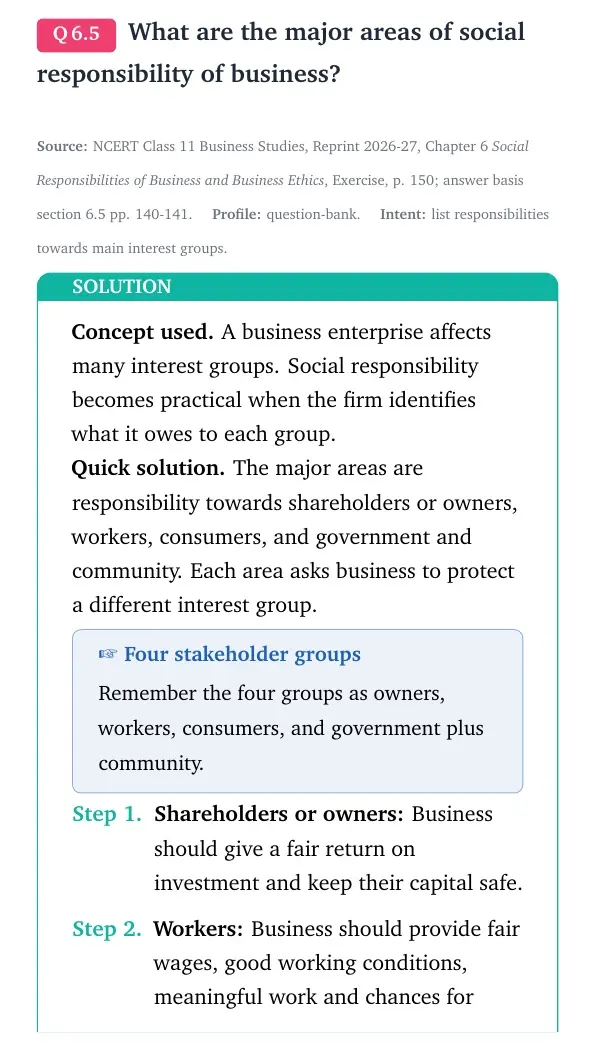
What are the major areas of social responsibility of business?
Quick solution. The major areas are responsibility towards shareholders or owners, workers, consumers, and government and community. Each area asks business to protect a different interest group.
Concept used. A business enterprise affects many interest groups. Social responsibility becomes practical when the firm identifies what it owes to each group.
- Shareholders or owners: Business should give a fair return on investment and keep their capital safe.
- Workers: Business should provide fair wages, good working conditions, meaningful work and chances for growth.
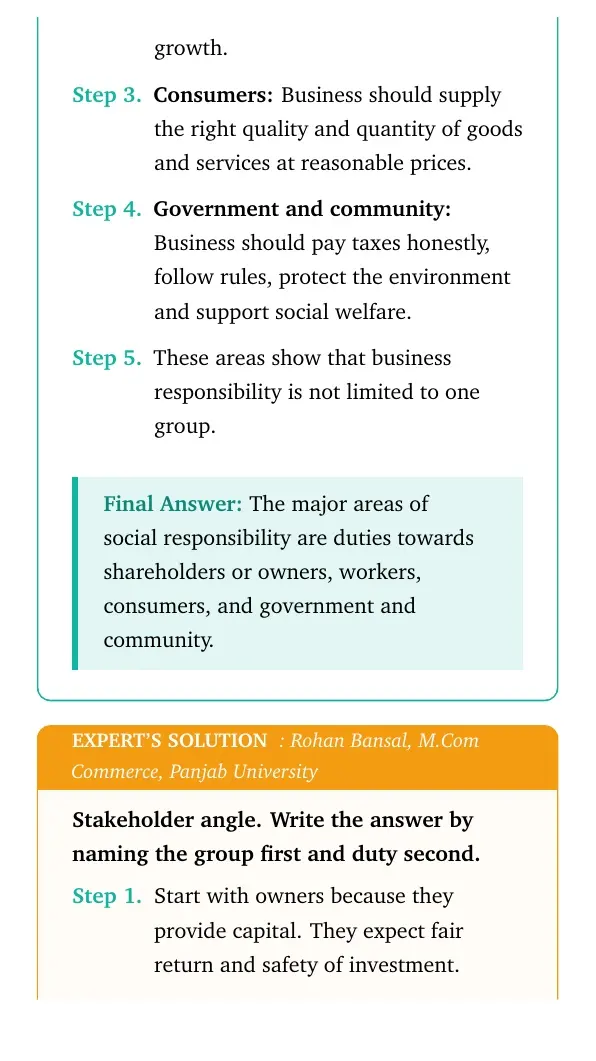
- Consumers: Business should supply the right quality and quantity of goods and services at reasonable prices.
- Government and community: Business should pay taxes honestly, follow rules, protect the environment and support social welfare.
- These areas show that business responsibility is not limited to one group.
Final answer: The major areas of social responsibility are duties towards shareholders or owners, workers, consumers, and government and community.
Stakeholder angle. Write the answer by naming the group first and duty second.
- Start with owners because they provide capital. They expect fair return and safety of investment.
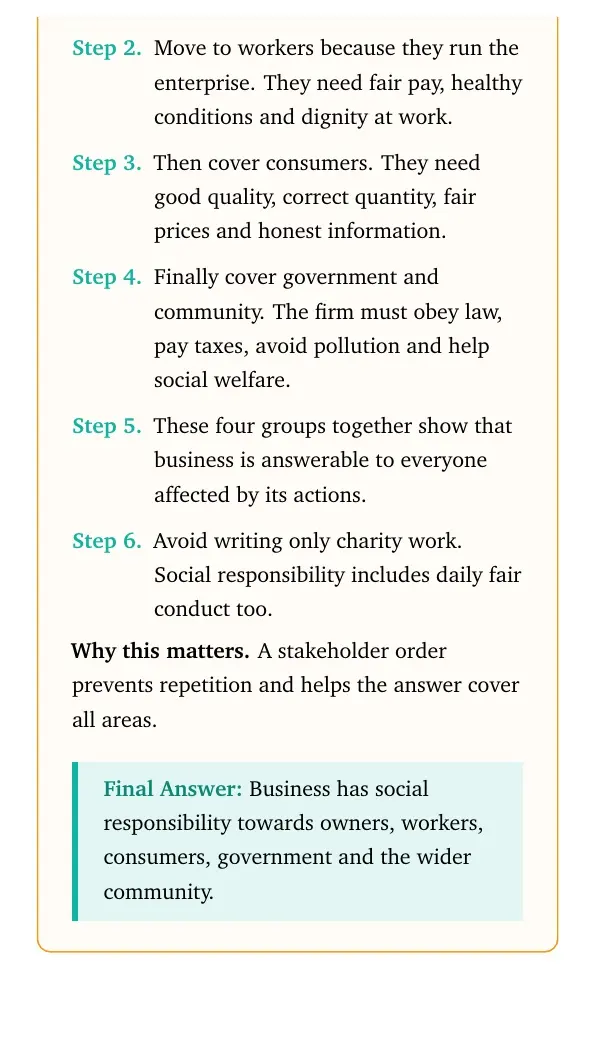
- Move to workers because they run the enterprise. They need fair pay, healthy conditions and dignity at work.
- Then cover consumers. They need good quality, correct quantity, fair prices and honest information.
- Finally cover government and community. The firm must obey law, pay taxes, avoid pollution and help social welfare.
- These four groups together show that business is answerable to everyone affected by its actions.
- Avoid writing only charity work. Social responsibility includes daily fair conduct too.
Why this matters. A stakeholder order prevents repetition and helps the answer cover all areas.
Expert answer: Business has social responsibility towards owners, workers, consumers, government and the wider community.
Question 6
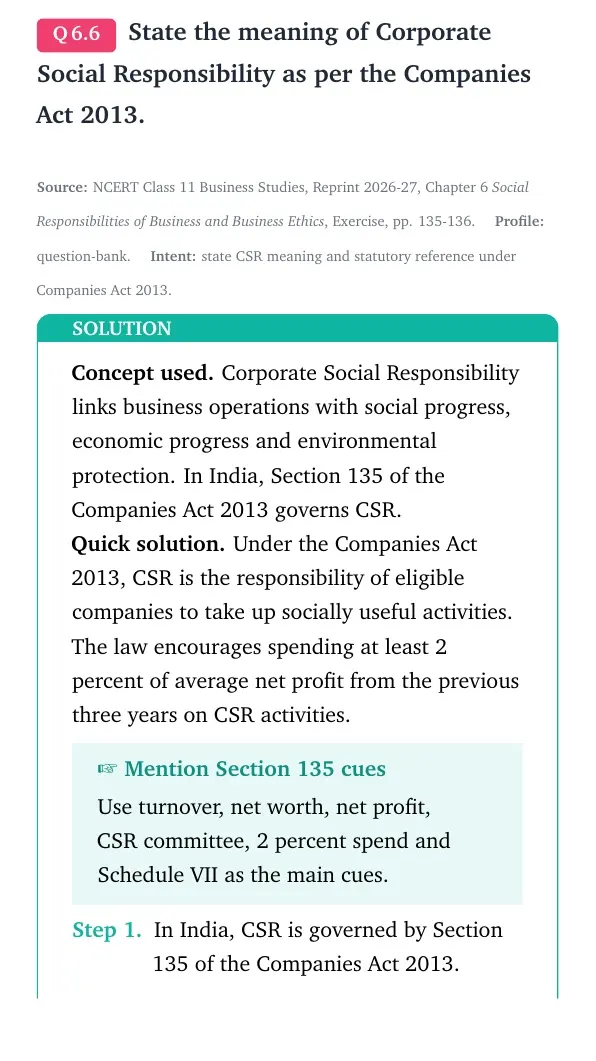
State the meaning of Corporate Social Responsibility as per the Companies Act 2013.
Quick solution. Under the Companies Act 2013, CSR is the responsibility of eligible companies to take up socially useful activities. The law encourages spending at least 2 percent of average net profit from the previous three years on CSR activities.
Concept used. Corporate Social Responsibility links business operations with social progress, economic progress and environmental protection. In India, Section 135 of the Companies Act 2013 governs CSR.
- In India, CSR is governed by Section 135 of the Companies Act 2013.
- The provisions apply to companies with annual turnover of Rs. 1,000 crore or more.
- They also apply to companies with net worth of Rs. 500 crore or more, or net profit of Rs. 5 crore or more.
- Eligible companies need a CSR committee of board members, including at least one independent director.
- The Act encourages companies to spend at least 2% of their average net profit of the previous three years on CSR activities.
- CSR activities should fall under Schedule VII and only activities undertaken in India are counted.
Final answer: Corporate Social Responsibility under the Companies Act 2013 means the duty of eligible companies to spend effort and resources on approved social, economic and environmental activities through a CSR committee and Schedule VII projects.
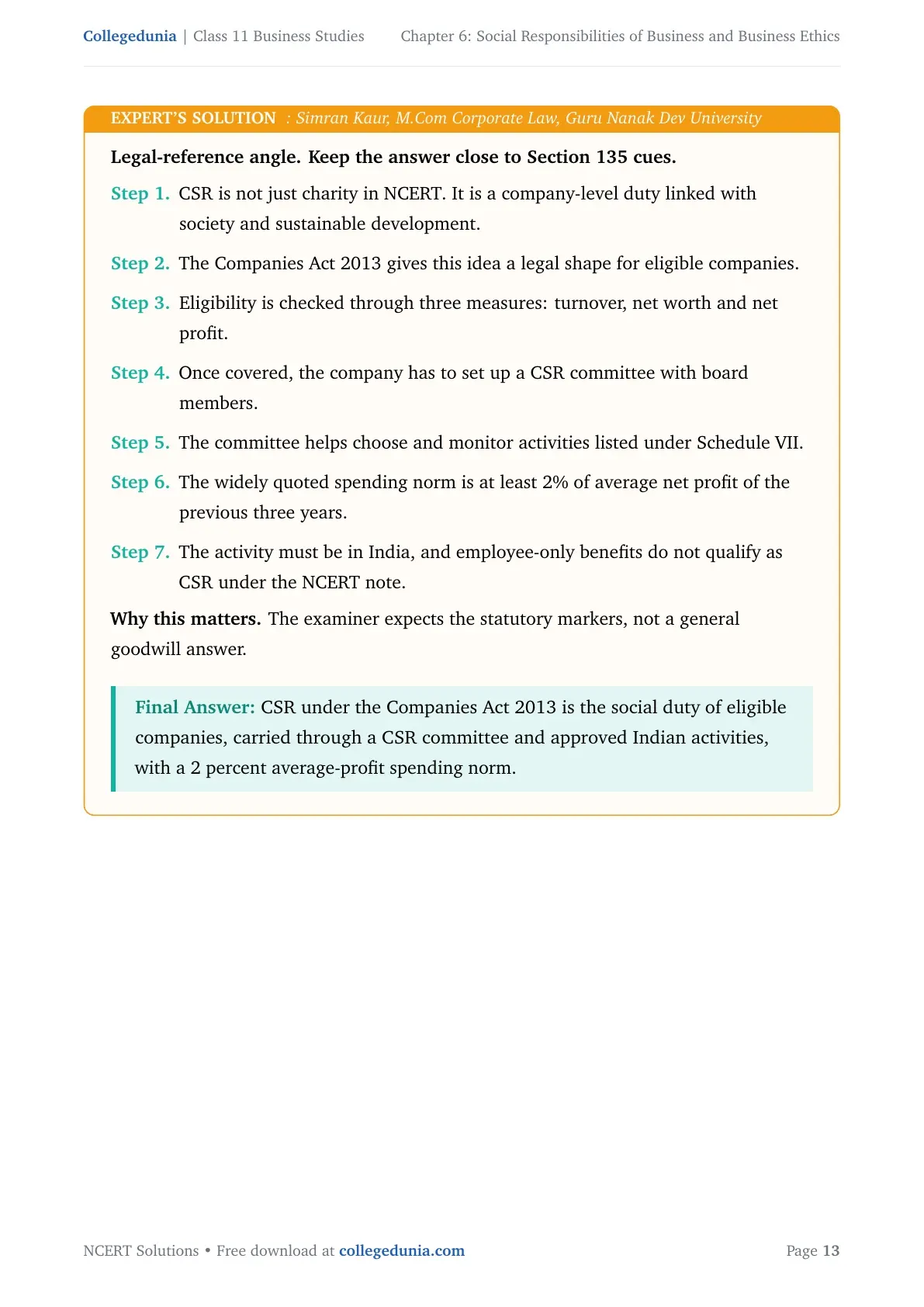
Legal-reference angle. Keep the answer close to Section 135 cues.
- CSR is not just charity in NCERT. It is a company-level duty linked with society and sustainable development.
- The Companies Act 2013 gives this idea a legal shape for eligible companies.
- Eligibility is checked through three measures: turnover, net worth and net profit.
- Once covered, the company has to set up a CSR committee with board members.
- The committee helps choose and monitor activities listed under Schedule VII.
- The widely quoted spending norm is at least 2% of average net profit of the previous three years.
- The activity must be in India, and employee-only benefits do not qualify as CSR under the NCERT note.
Why this matters. The examiner expects the statutory markers, not a general goodwill answer.
Expert answer: CSR under the Companies Act 2013 is the social duty of eligible companies, carried through a CSR committee and approved Indian activities, with a 2 percent average-profit spending norm.
Question 7
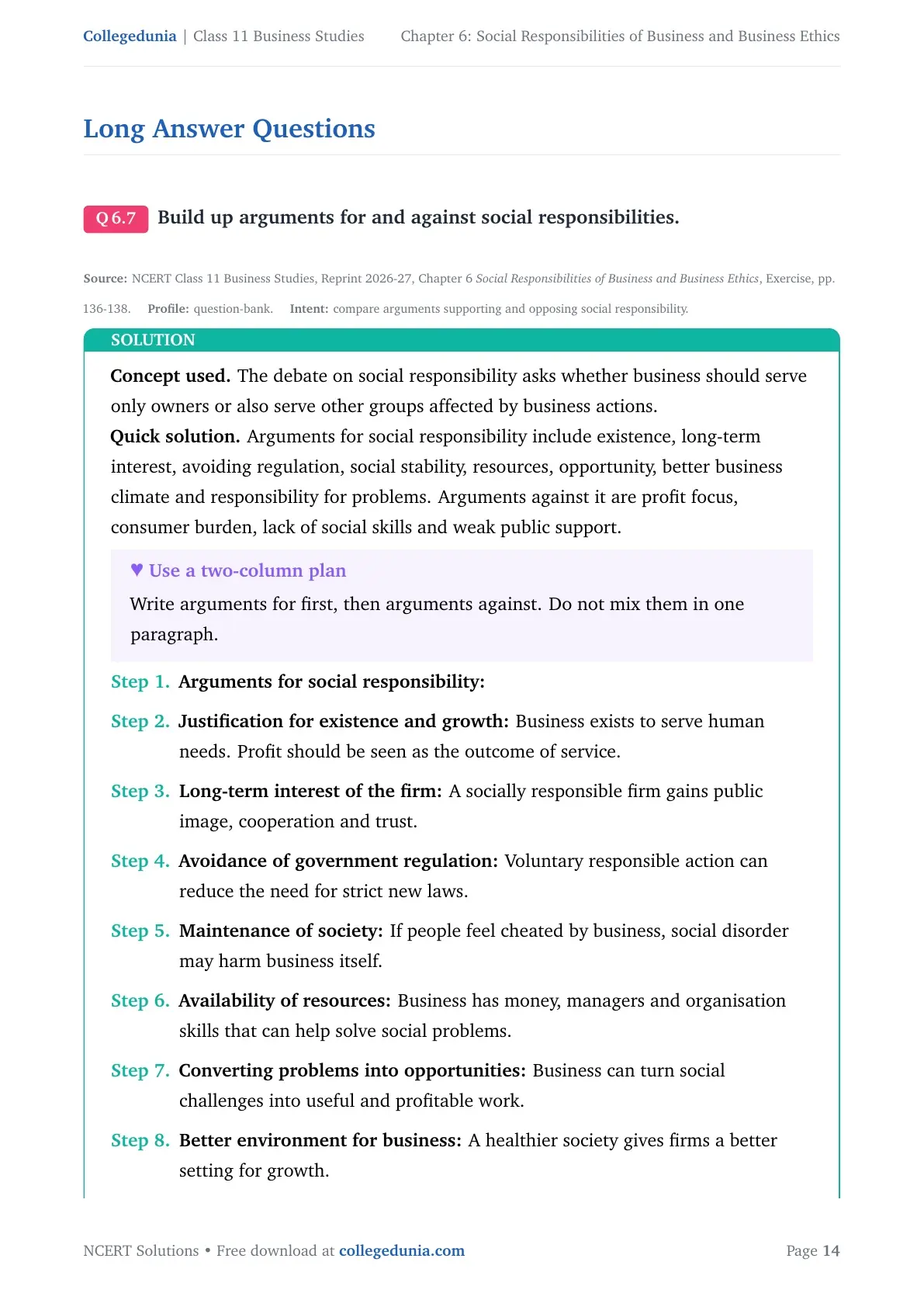
Build up arguments for and against social responsibilities.
Quick solution. Arguments for social responsibility include existence, long-term interest, avoiding regulation, social stability, resources, opportunity, better business climate and responsibility for problems. Arguments against it are profit focus, consumer burden, lack of social skills and weak public support.
Concept used. The debate on social responsibility asks whether business should serve only owners or also serve other groups affected by business actions.
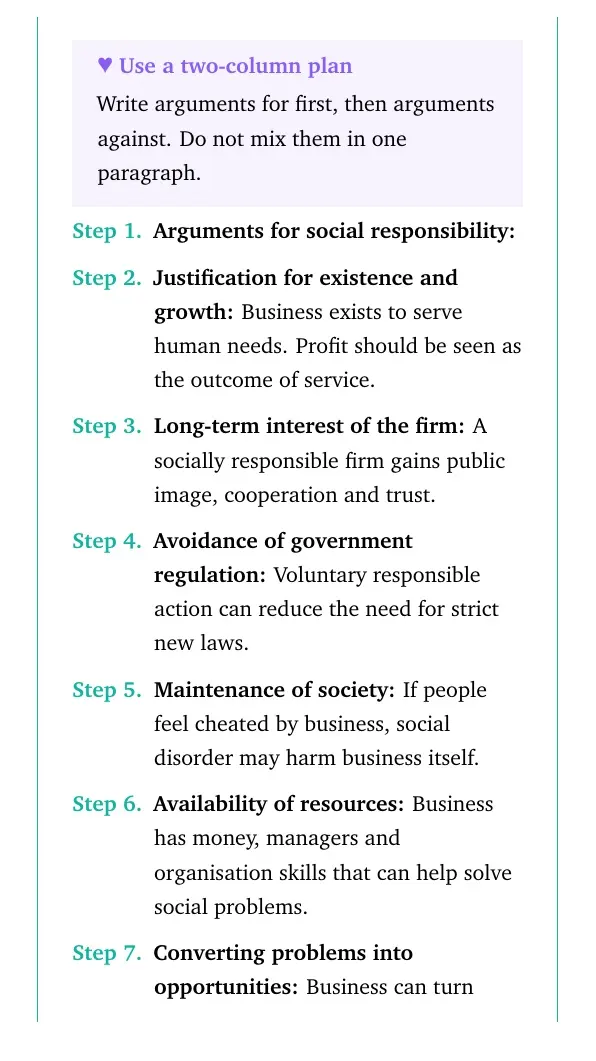
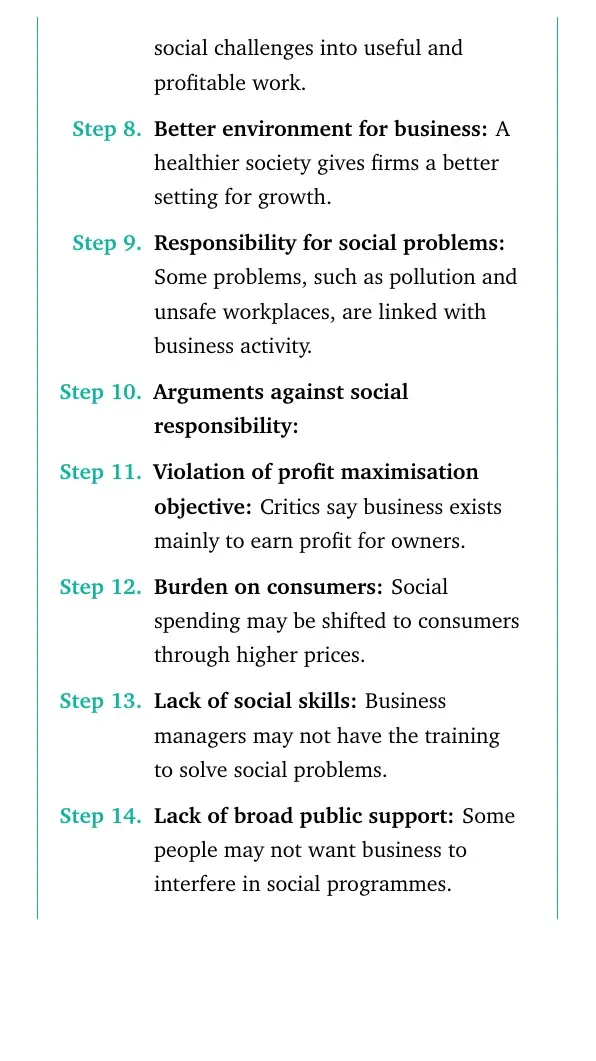
- Arguments for social responsibility:
- Justification for existence and growth: Business exists to serve human needs. Profit should be seen as the outcome of service.
- Long-term interest of the firm: A socially responsible firm gains public image, cooperation and trust.
- Avoidance of government regulation: Voluntary responsible action can reduce the need for strict new laws.
- Maintenance of society: If people feel cheated by business, social disorder may harm business itself.
- Availability of resources: Business has money, managers and organisation skills that can help solve social problems.
- Converting problems into opportunities: Business can turn social challenges into useful and profitable work.
- Better environment for business: A healthier society gives firms a better setting for growth.
- Responsibility for social problems: Some problems, such as pollution and unsafe workplaces, are linked with business activity.
- Arguments against social responsibility:
- Violation of profit maximisation objective: Critics say business exists mainly to earn profit for owners.
- Burden on consumers: Social spending may be shifted to consumers through higher prices.
- Lack of social skills: Business managers may not have the training to solve social problems.
- Lack of broad public support: Some people may not want business to interfere in social programmes.
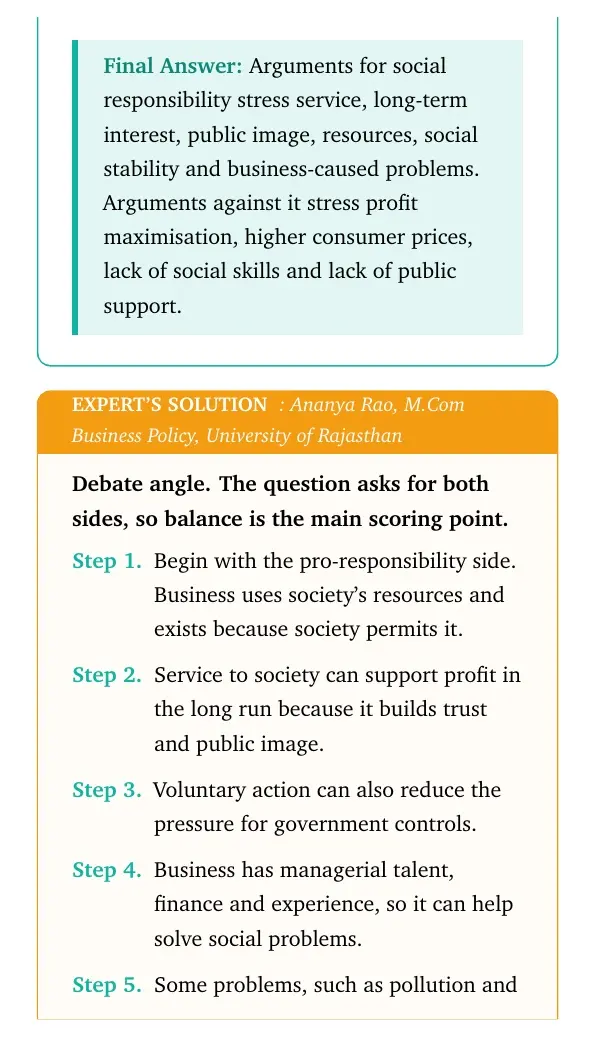
Final answer: Arguments for social responsibility stress service, long-term interest, public image, resources, social stability and business-caused problems. Arguments against it stress profit maximisation, higher consumer prices, lack of social skills and lack of public support.
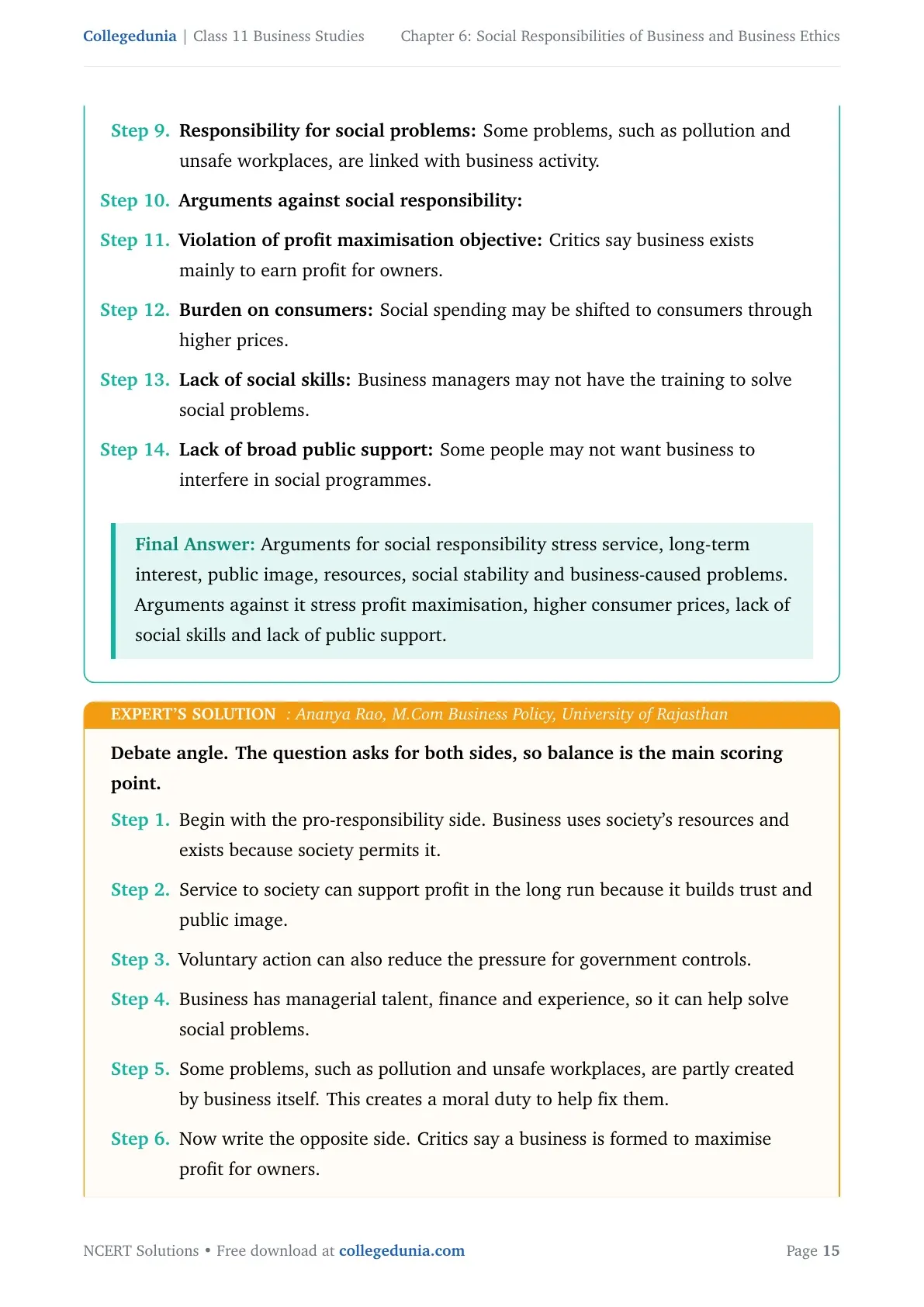
Debate angle. The question asks for both sides, so balance is the main scoring point.
- Begin with the pro-responsibility side. Business uses society's resources and exists because society permits it.
- Service to society can support profit in the long run because it builds trust and public image.
- Voluntary action can also reduce the pressure for government controls.
- Business has managerial talent, finance and experience, so it can help solve social problems.
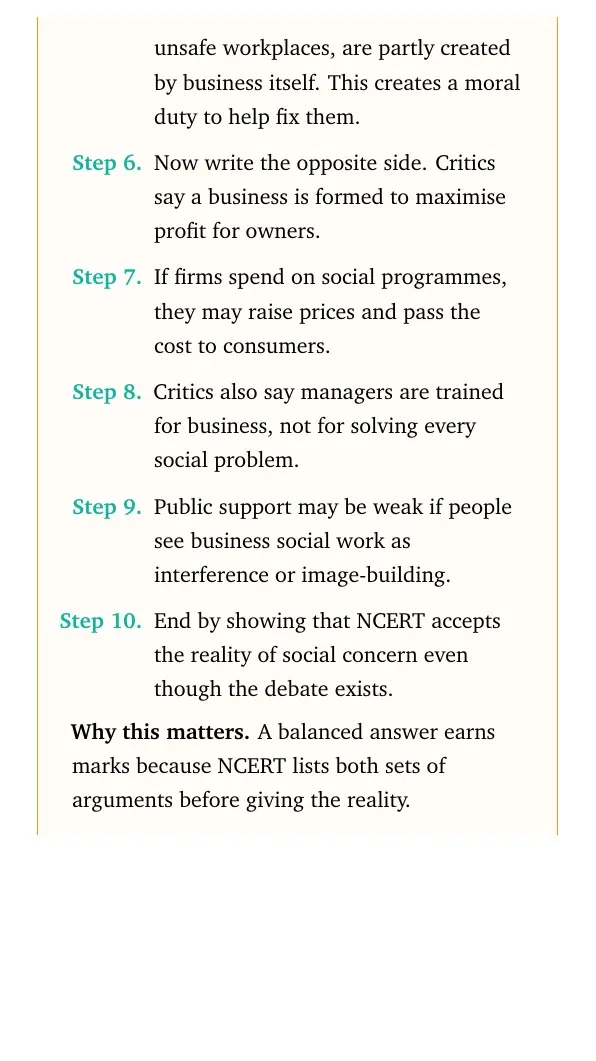
- Some problems, such as pollution and unsafe workplaces, are partly created by business itself. This creates a moral duty to help fix them.
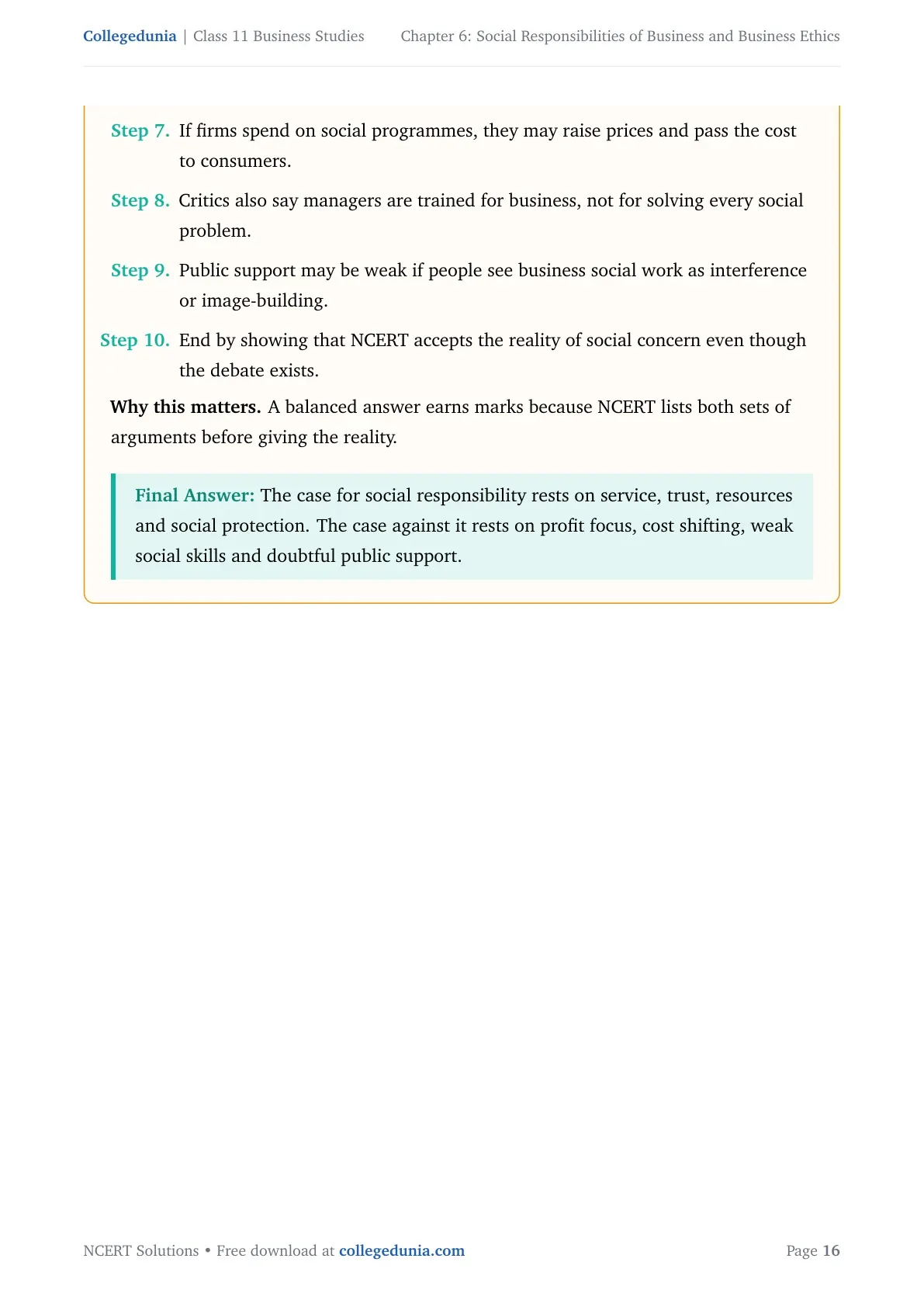
- Now write the opposite side. Critics say a business is formed to maximise profit for owners.
- If firms spend on social programmes, they may raise prices and pass the cost to consumers.
- Critics also say managers are trained for business, not for solving every social problem.
- Public support may be weak if people see business social work as interference or image-building.
- End by showing that NCERT accepts the reality of social concern even though the debate exists.
Why this matters. A balanced answer earns marks because NCERT lists both sets of arguments before giving the reality.
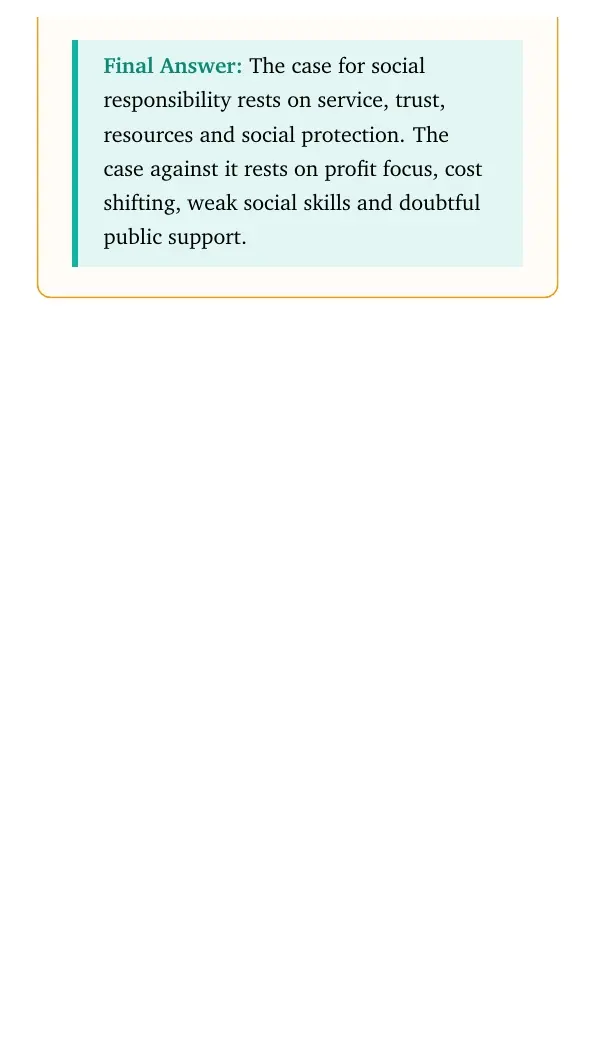
Expert answer: The case for social responsibility rests on service, trust, resources and social protection. The case against it rests on profit focus, cost shifting, weak social skills and doubtful public support.
Question 8
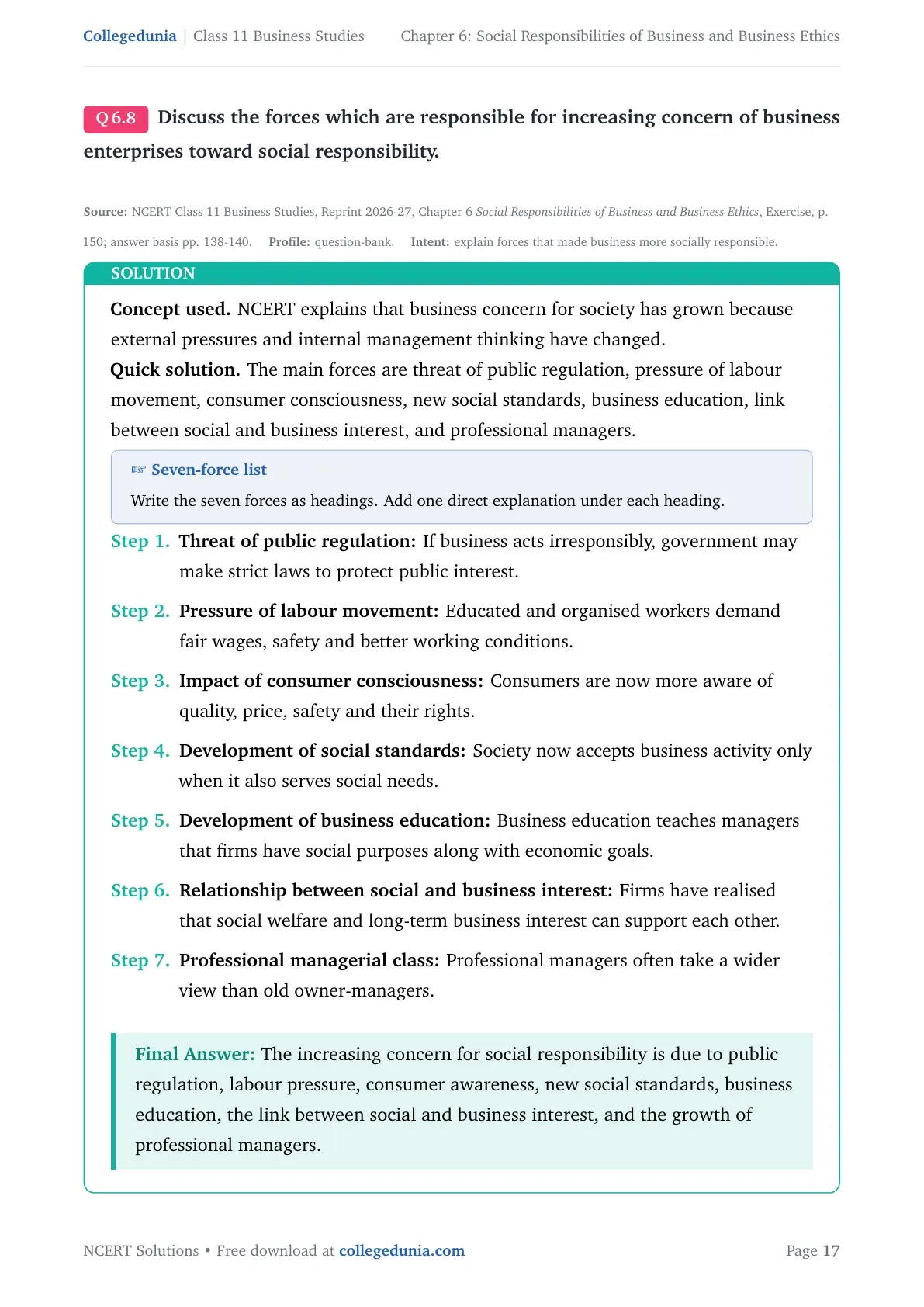
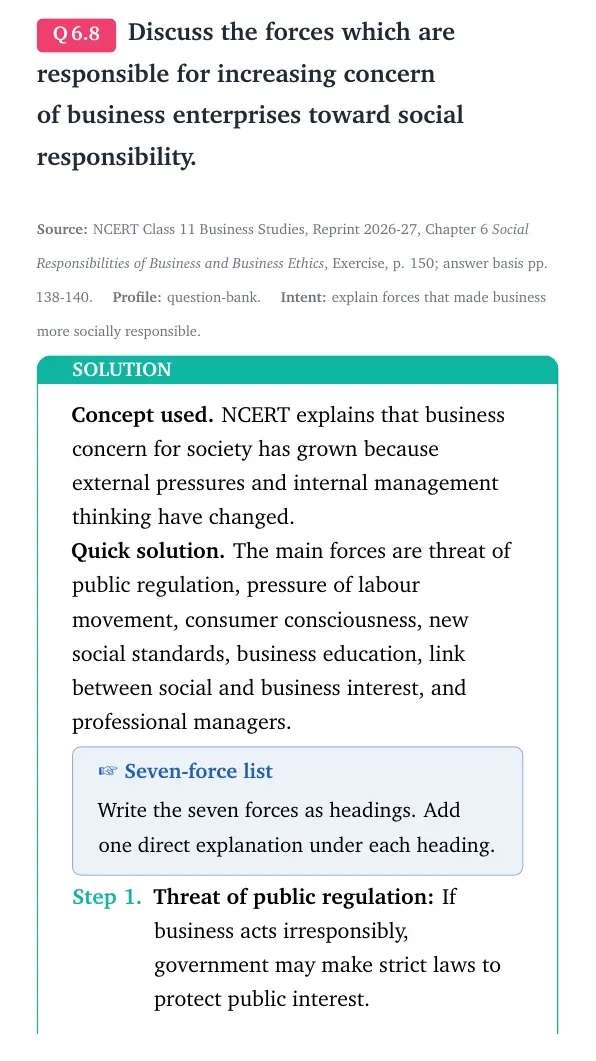
Discuss the forces which are responsible for increasing concern of business enterprises toward social responsibility.
Quick solution. The main forces are threat of public regulation, pressure of labour movement, consumer consciousness, new social standards, business education, link between social and business interest, and professional managers.
Concept used. NCERT explains that business concern for society has grown because external pressures and internal management thinking have changed.
- Threat of public regulation: If business acts irresponsibly, government may make strict laws to protect public interest.
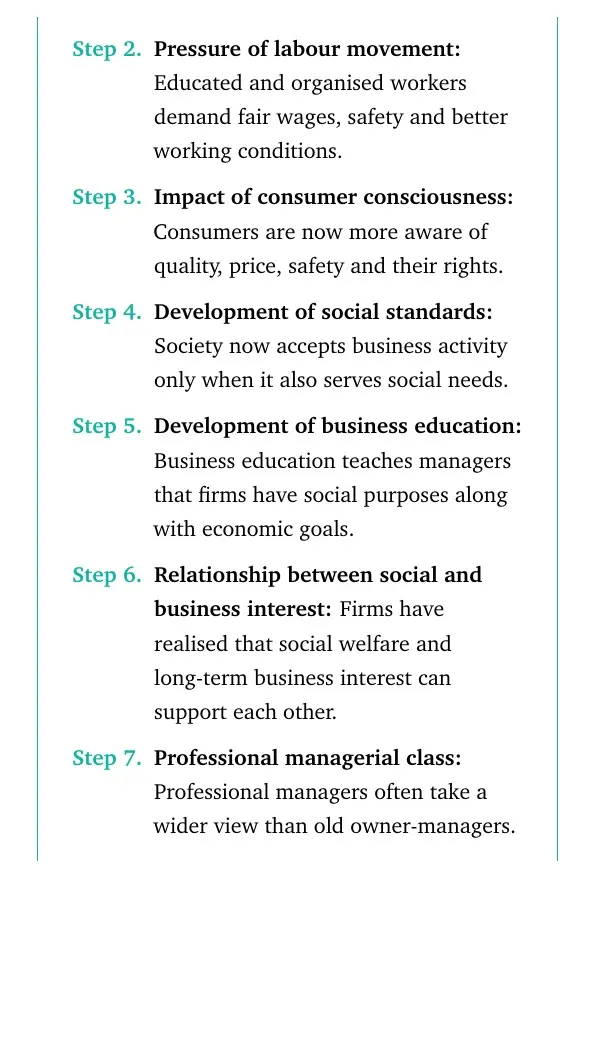
- Pressure of labour movement: Educated and organised workers demand fair wages, safety and better working conditions.
- Impact of consumer consciousness: Consumers are now more aware of quality, price, safety and their rights.
- Development of social standards: Society now accepts business activity only when it also serves social needs.
- Development of business education: Business education teaches managers that firms have social purposes along with economic goals.
- Relationship between social and business interest: Firms have realised that social welfare and long-term business interest can support each other.
- Professional managerial class: Professional managers often take a wider view than old owner-managers.
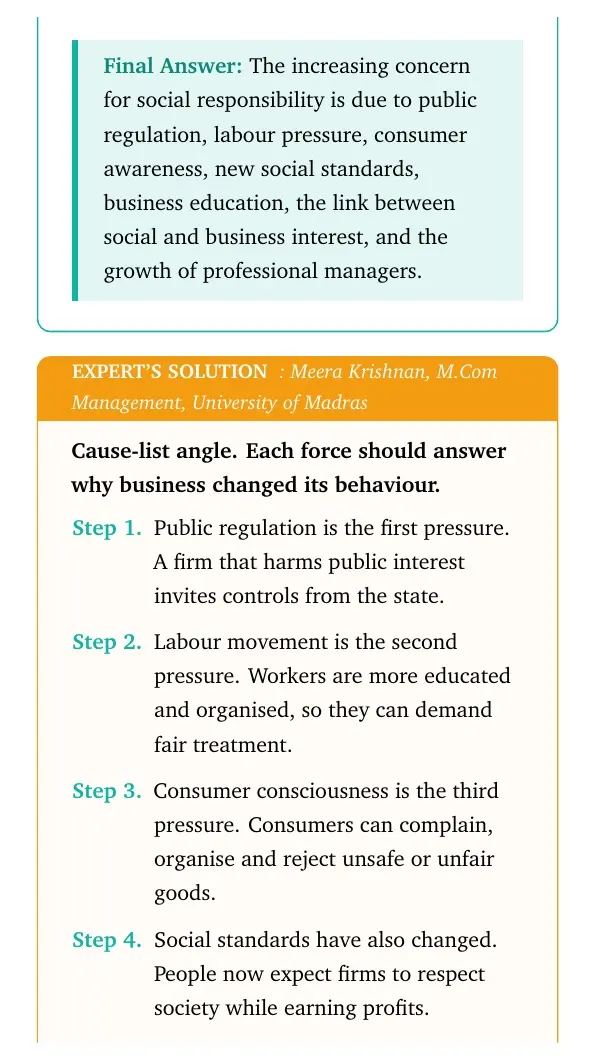
Final answer: The increasing concern for social responsibility is due to public regulation, labour pressure, consumer awareness, new social standards, business education, the link between social and business interest, and the growth of professional managers.
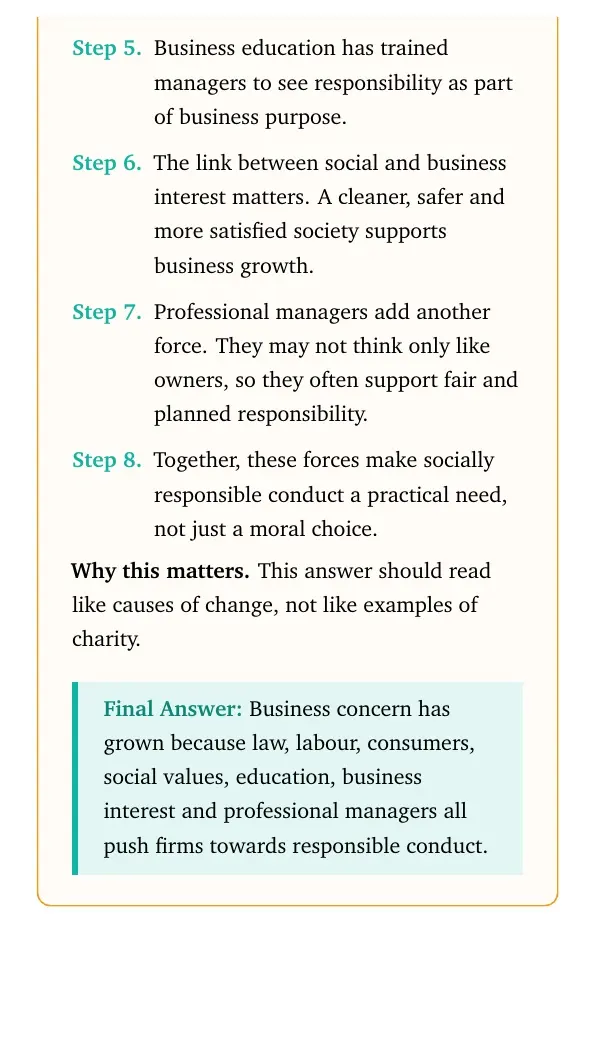
Cause-list angle. Each force should answer why business changed its behaviour.
- Public regulation is the first pressure. A firm that harms public interest invites controls from the state.
- Labour movement is the second pressure. Workers are more educated and organised, so they can demand fair treatment.
- Consumer consciousness is the third pressure. Consumers can complain, organise and reject unsafe or unfair goods.
- Social standards have also changed. People now expect firms to respect society while earning profits.
- Business education has trained managers to see responsibility as part of business purpose.
- The link between social and business interest matters. A cleaner, safer and more satisfied society supports business growth.
- Professional managers add another force. They may not think only like owners, so they often support fair and planned responsibility.
- Together, these forces make socially responsible conduct a practical need, not just a moral choice.
Why this matters. This answer should read like causes of change, not like examples of charity.
Expert answer: Business concern has grown because law, labour, consumers, social values, education, business interest and professional managers all push firms towards responsible conduct.
Question 9
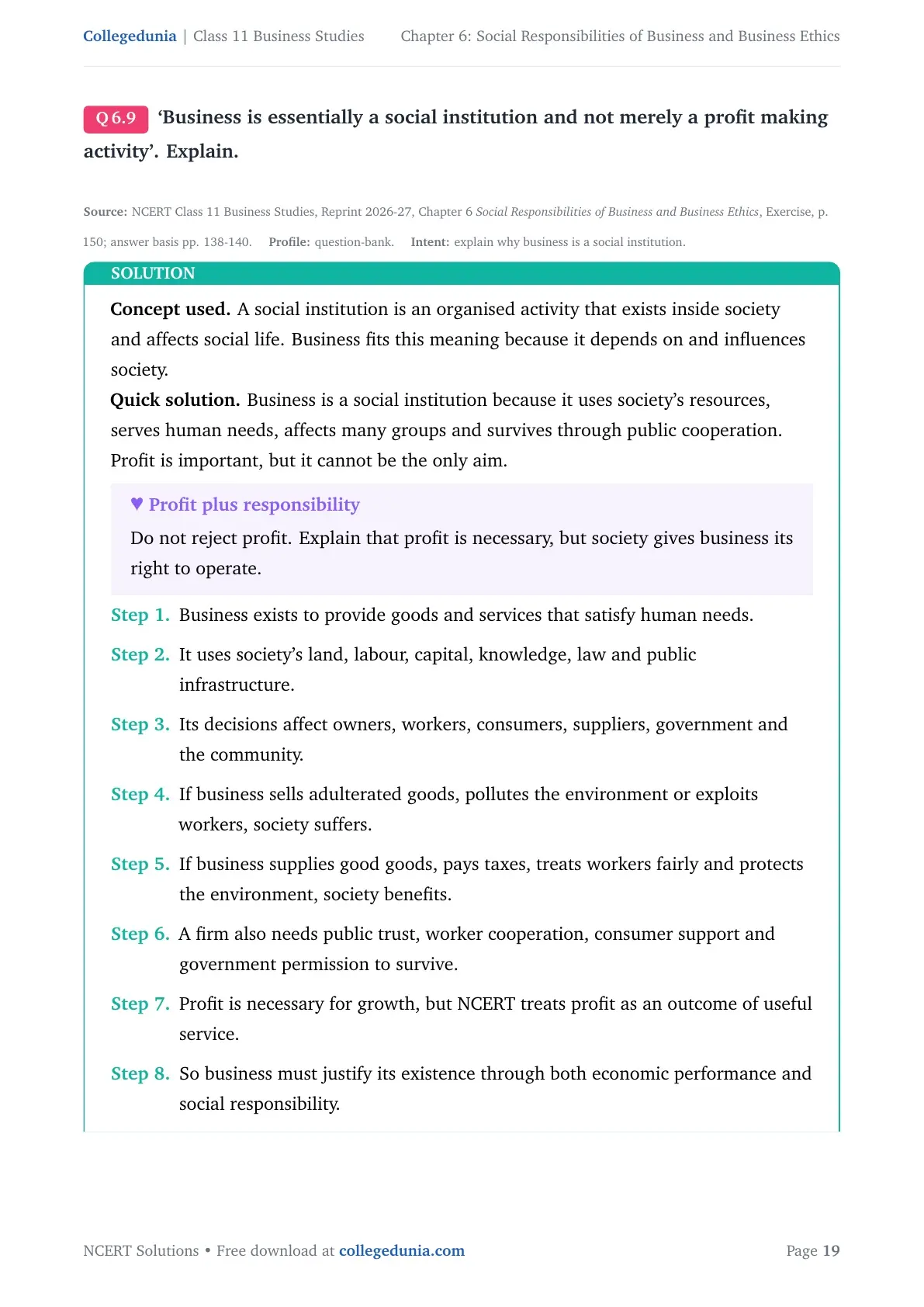
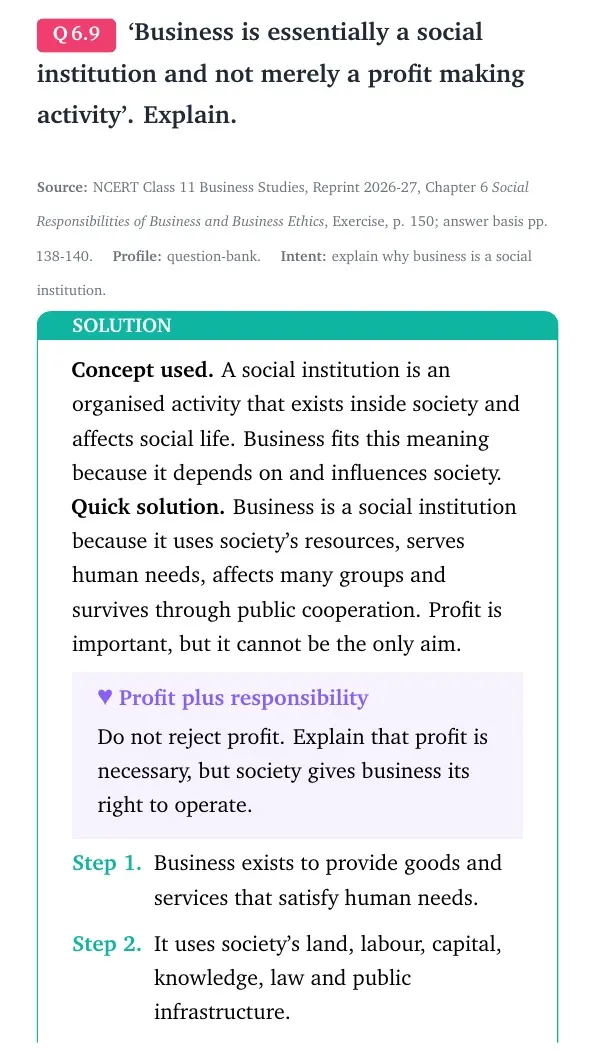
`Business is essentially a social institution and not merely a profit making activity'. Explain.
Quick solution. Business is a social institution because it uses society's resources, serves human needs, affects many groups and survives through public cooperation. Profit is important, but it cannot be the only aim.
Concept used. A social institution is an organised activity that exists inside society and affects social life. Business fits this meaning because it depends on and influences society.
- Business exists to provide goods and services that satisfy human needs.
- It uses society's land, labour, capital, knowledge, law and public infrastructure.
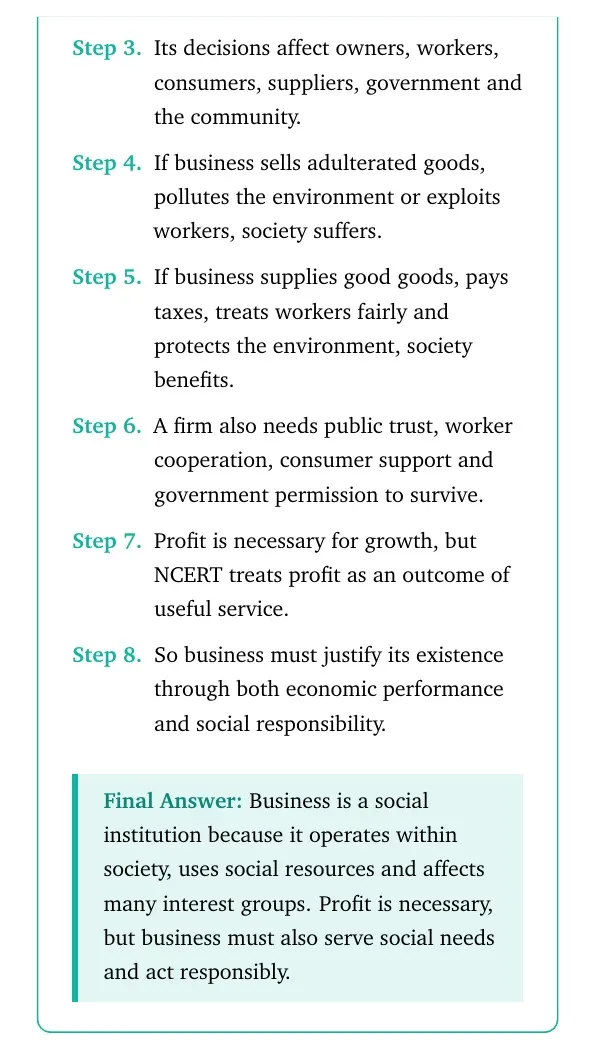
- Its decisions affect owners, workers, consumers, suppliers, government and the community.
- If business sells adulterated goods, pollutes the environment or exploits workers, society suffers.
- If business supplies good goods, pays taxes, treats workers fairly and protects the environment, society benefits.
- A firm also needs public trust, worker cooperation, consumer support and government permission to survive.
- Profit is necessary for growth, but NCERT treats profit as an outcome of useful service.
- So business must justify its existence through both economic performance and social responsibility.
Final answer: Business is a social institution because it operates within society, uses social resources and affects many interest groups. Profit is necessary, but business must also serve social needs and act responsibly.
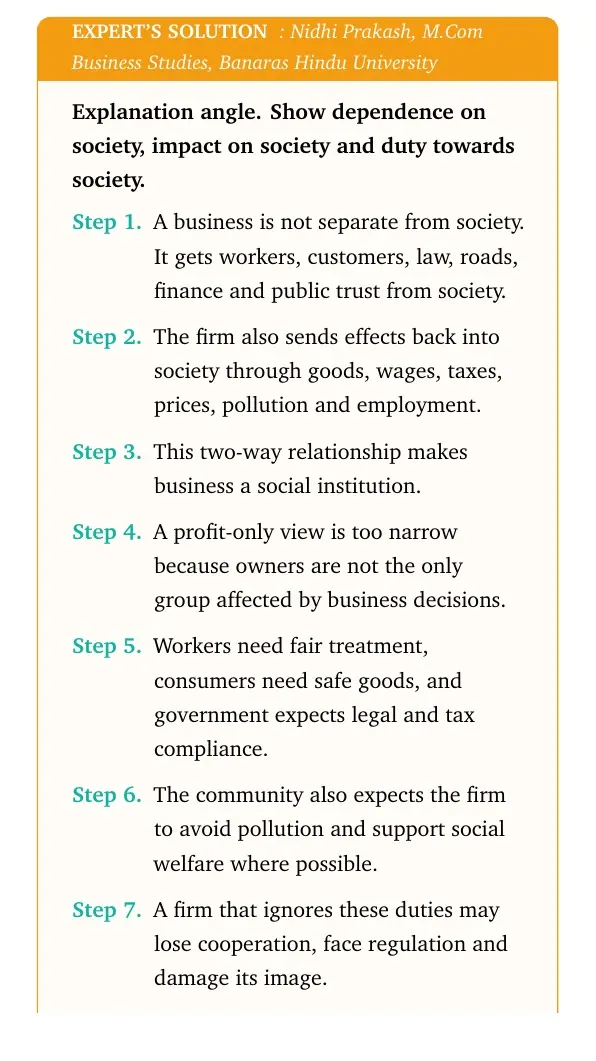
Explanation angle. Show dependence on society, impact on society and duty towards society.
- A business is not separate from society. It gets workers, customers, law, roads, finance and public trust from society.
- The firm also sends effects back into society through goods, wages, taxes, prices, pollution and employment.
- This two-way relationship makes business a social institution.
- A profit-only view is too narrow because owners are not the only group affected by business decisions.
- Workers need fair treatment, consumers need safe goods, and government expects legal and tax compliance.
- The community also expects the firm to avoid pollution and support social welfare where possible.
- A firm that ignores these duties may lose cooperation, face regulation and damage its image.
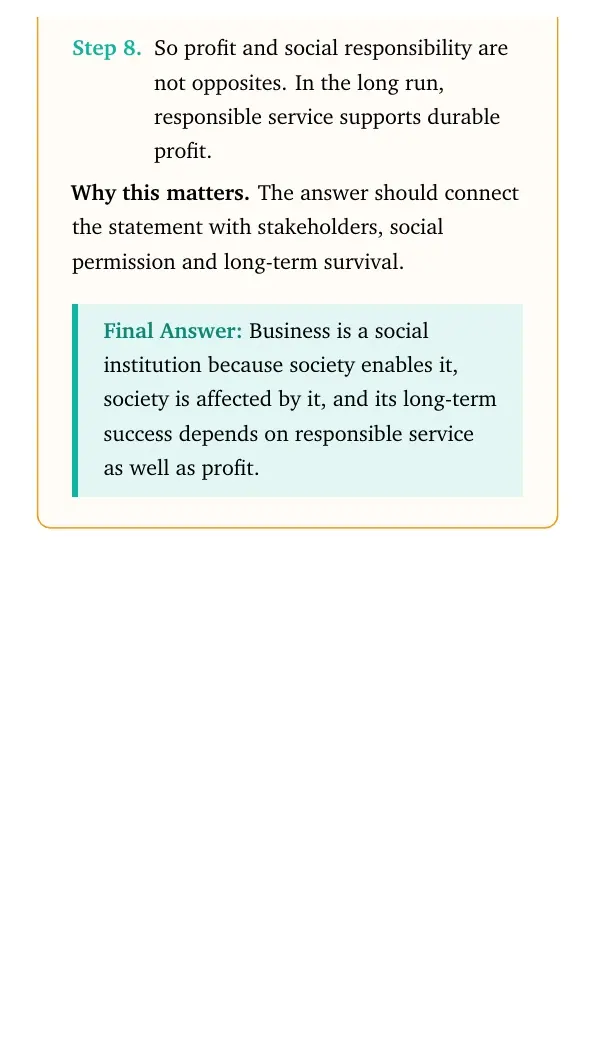
- So profit and social responsibility are not opposites. In the long run, responsible service supports durable profit.
Why this matters. The answer should connect the statement with stakeholders, social permission and long-term survival.
Expert answer: Business is a social institution because society enables it, society is affected by it, and its long-term success depends on responsible service as well as profit.
Question 10
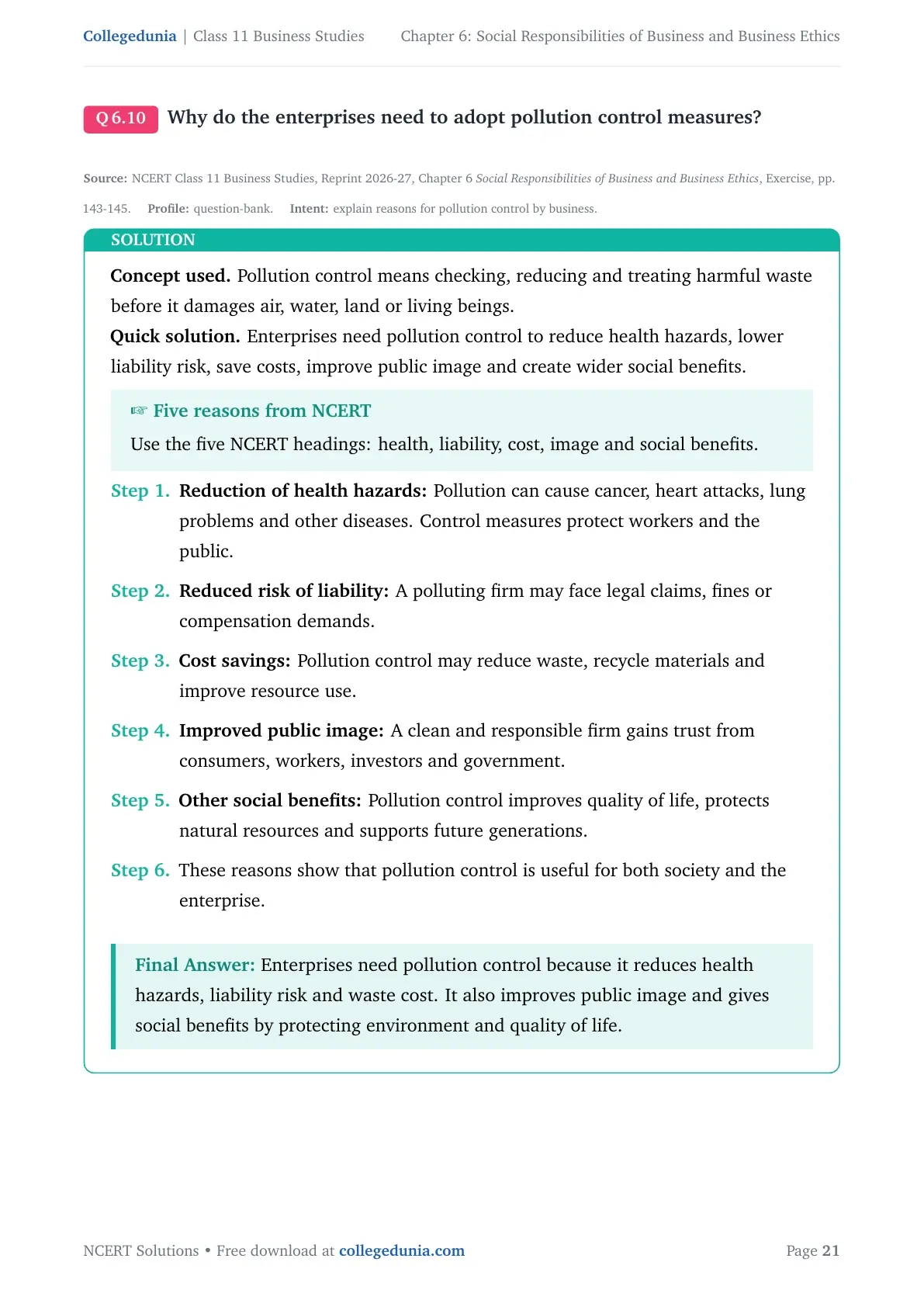
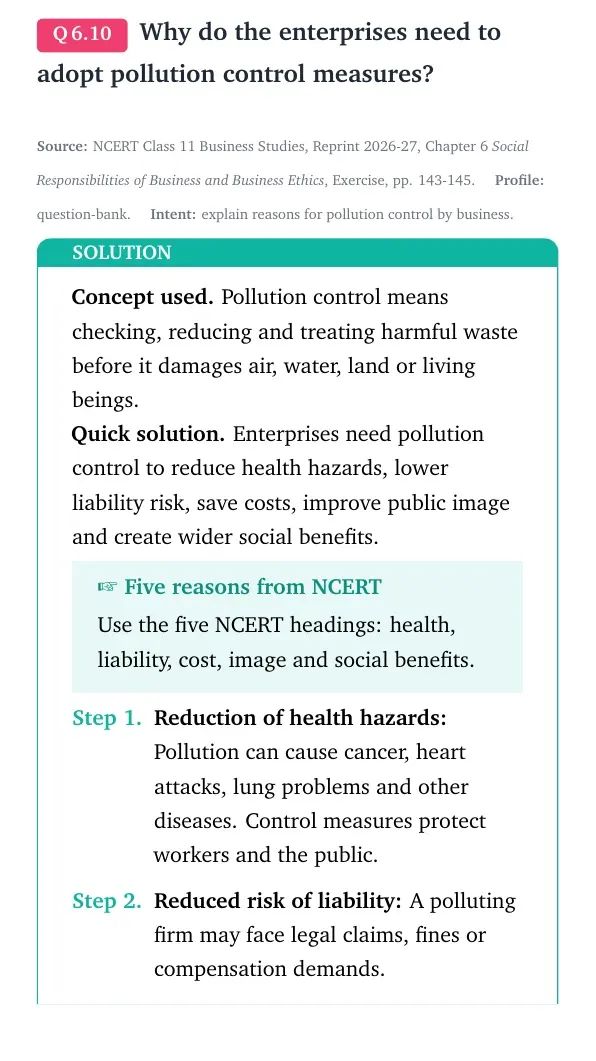
Why do the enterprises need to adopt pollution control measures?
Quick solution. Enterprises need pollution control to reduce health hazards, lower liability risk, save costs, improve public image and create wider social benefits.
Concept used. Pollution control means checking, reducing and treating harmful waste before it damages air, water, land or living beings.
- Reduction of health hazards: Pollution can cause cancer, heart attacks, lung problems and other diseases. Control measures protect workers and the public.
- Reduced risk of liability: A polluting firm may face legal claims, fines or compensation demands.
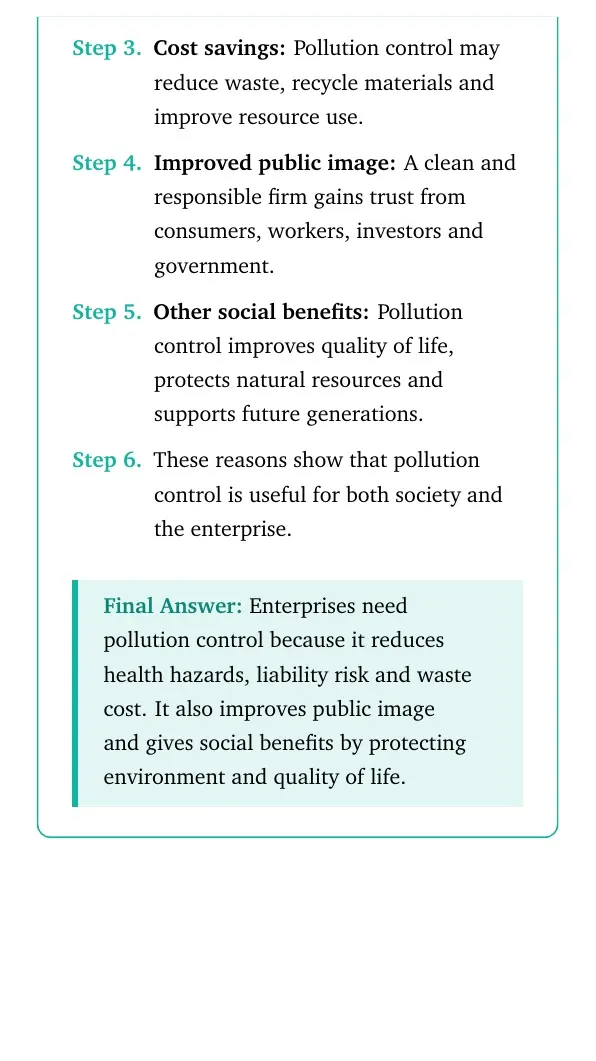
- Cost savings: Pollution control may reduce waste, recycle materials and improve resource use.
- Improved public image: A clean and responsible firm gains trust from consumers, workers, investors and government.
- Other social benefits: Pollution control improves quality of life, protects natural resources and supports future generations.
- These reasons show that pollution control is useful for both society and the enterprise.
Final answer: Enterprises need pollution control because it reduces health hazards, liability risk and waste cost. It also improves public image and gives social benefits by protecting environment and quality of life.
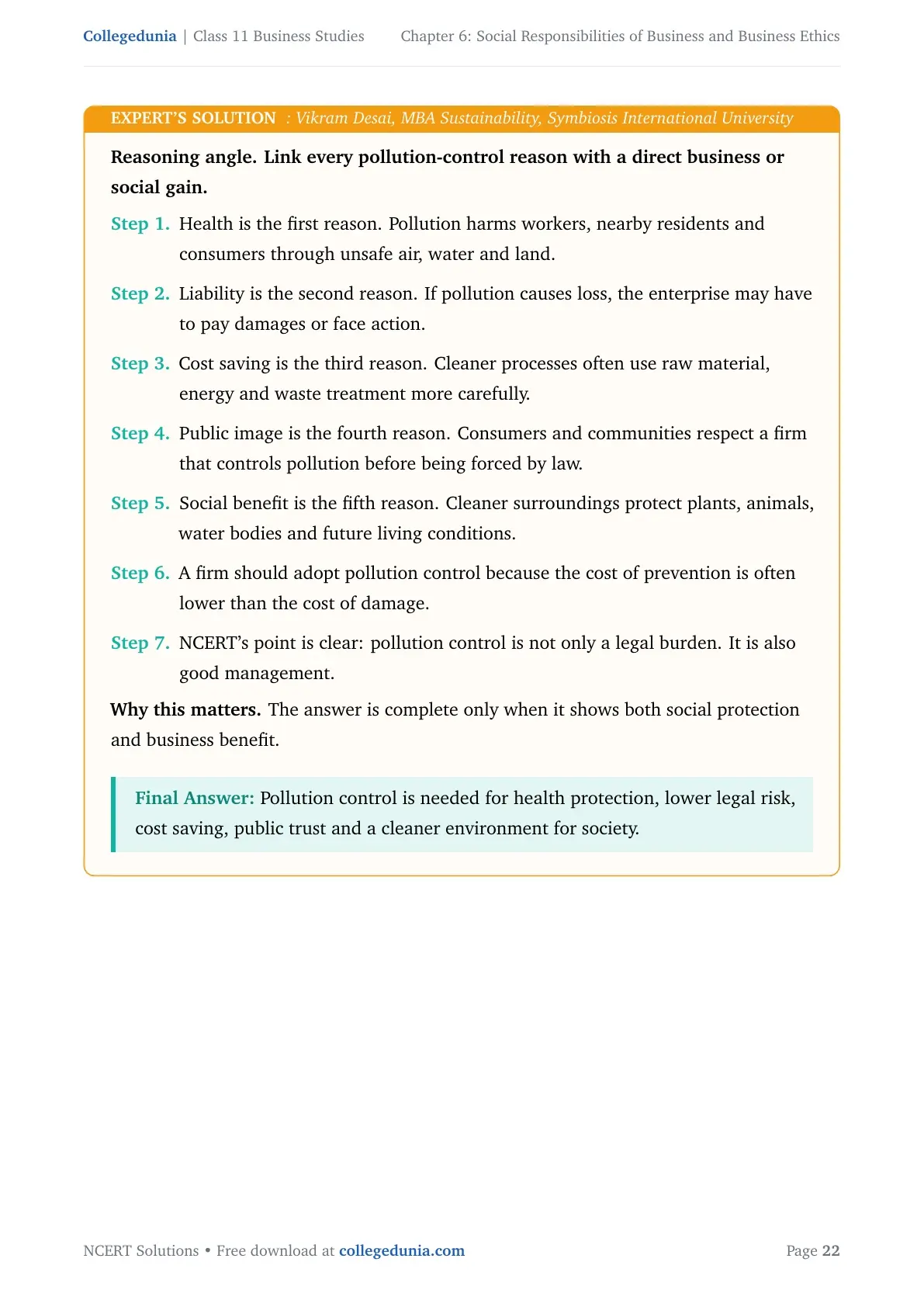
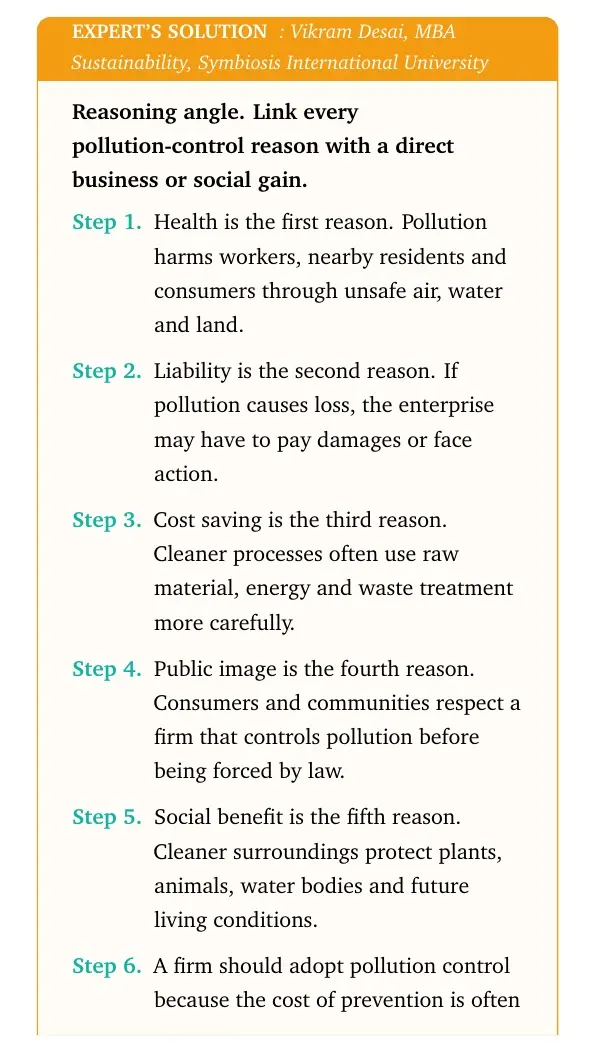
Reasoning angle. Link every pollution-control reason with a direct business or social gain.
- Health is the first reason. Pollution harms workers, nearby residents and consumers through unsafe air, water and land.
- Liability is the second reason. If pollution causes loss, the enterprise may have to pay damages or face action.
- Cost saving is the third reason. Cleaner processes often use raw material, energy and waste treatment more carefully.
- Public image is the fourth reason. Consumers and communities respect a firm that controls pollution before being forced by law.
- Social benefit is the fifth reason. Cleaner surroundings protect plants, animals, water bodies and future living conditions.
- A firm should adopt pollution control because the cost of prevention is often lower than the cost of damage.
- NCERT's point is clear: pollution control is not only a legal burden. It is also good management.
Why this matters. The answer is complete only when it shows both social protection and business benefit.
Expert answer: Pollution control is needed for health protection, lower legal risk, cost saving, public trust and a cleaner environment for society.
Question 11
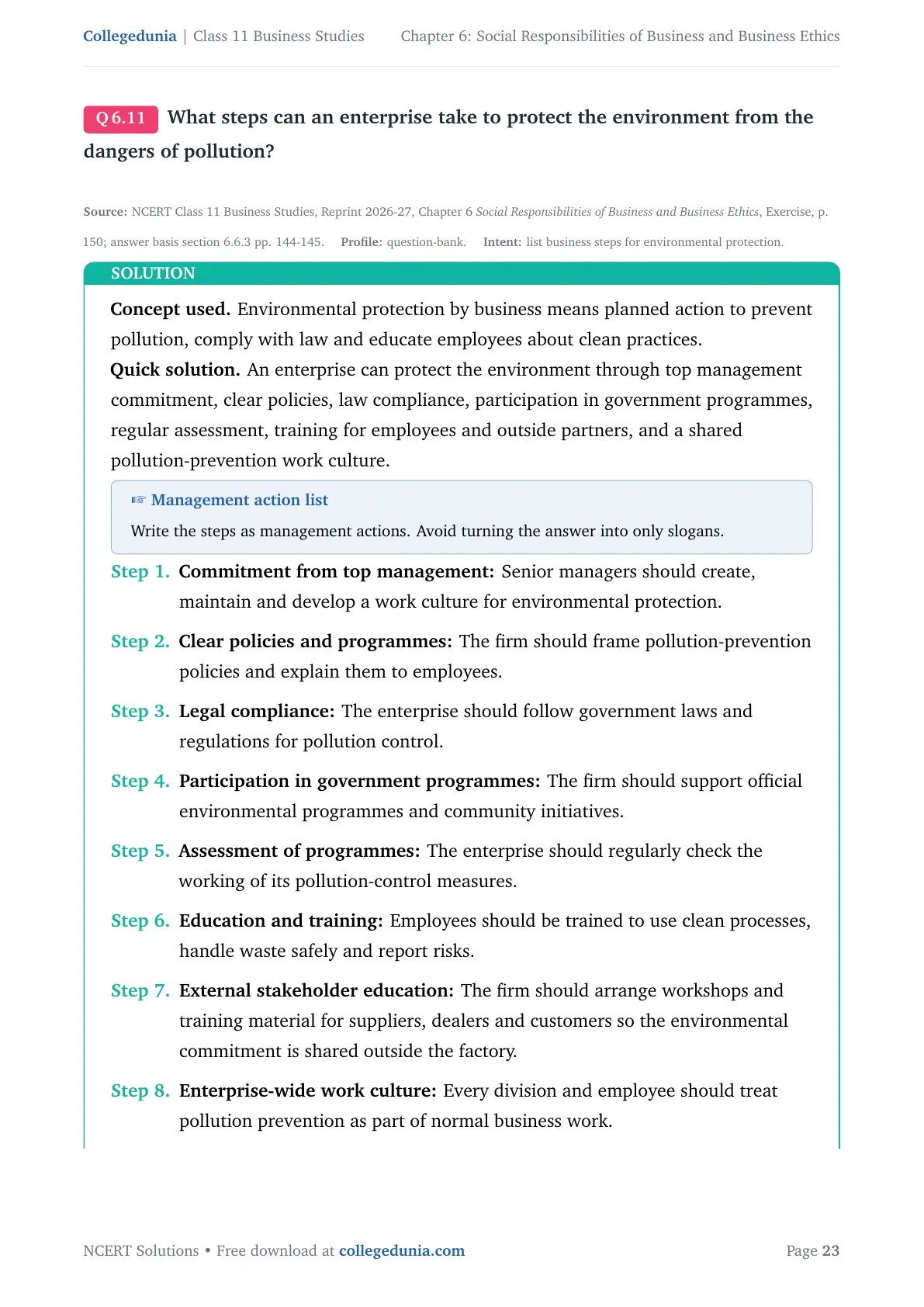
What steps can an enterprise take to protect the environment from the dangers of pollution?
Quick solution. An enterprise can protect the environment through top management commitment, clear policies, law compliance, participation in government programmes, regular assessment, training for employees and outside partners, and a shared pollution-prevention work culture.
Concept used. Environmental protection by business means planned action to prevent pollution, comply with law and educate employees about clean practices.
- Commitment from top management: Senior managers should create, maintain and develop a work culture for environmental protection.
- Clear policies and programmes: The firm should frame pollution-prevention policies and explain them to employees.
- Legal compliance: The enterprise should follow government laws and regulations for pollution control.
- Participation in government programmes: The firm should support official environmental programmes and community initiatives.
- Assessment of programmes: The enterprise should regularly check the working of its pollution-control measures.
- Education and training: Employees should be trained to use clean processes, handle waste safely and report risks.
- External stakeholder education: The firm should arrange workshops and training material for suppliers, dealers and customers so the environmental commitment is shared outside the factory.
- Enterprise-wide work culture: Every division and employee should treat pollution prevention as part of normal business work.
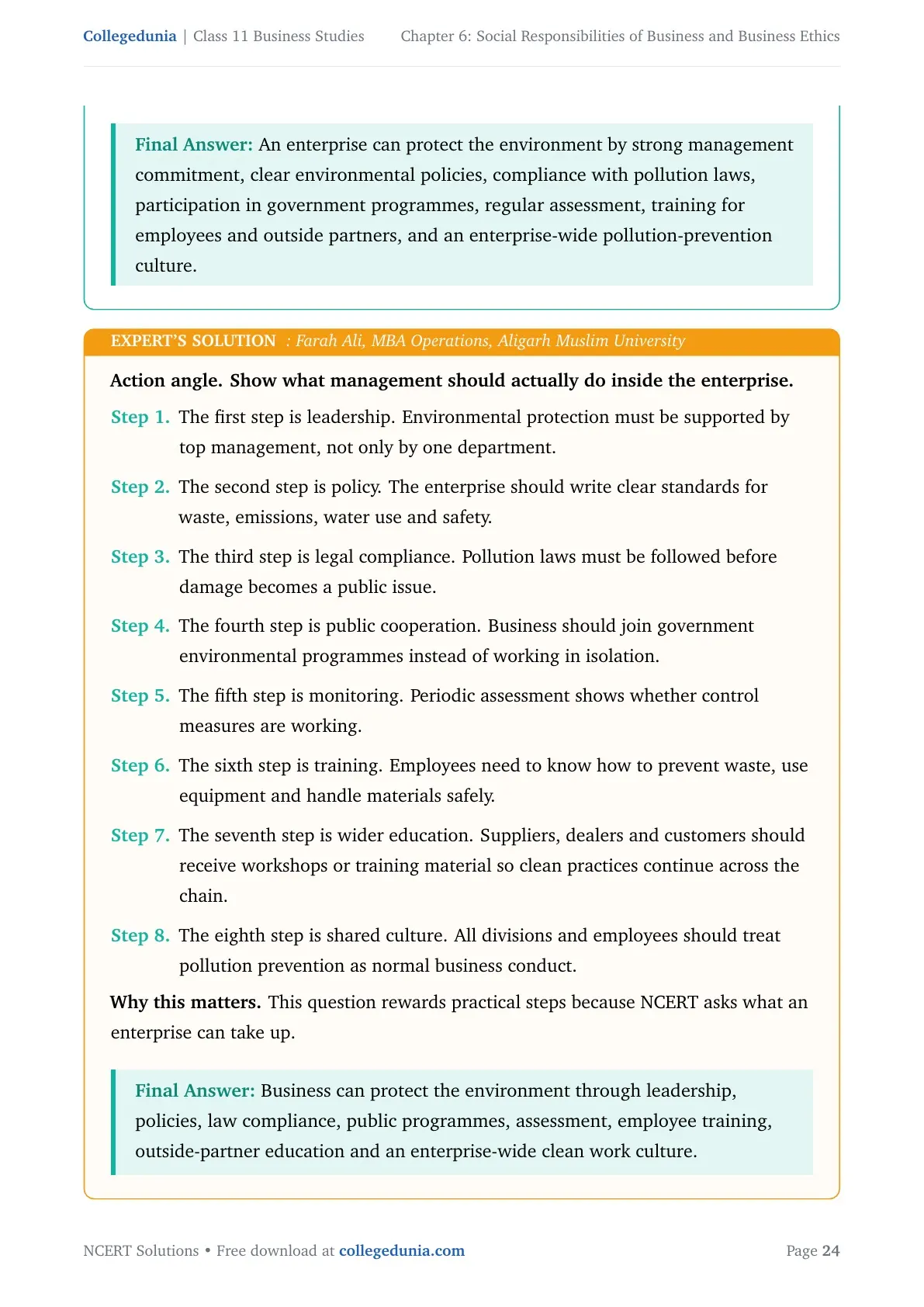
Final answer: An enterprise can protect the environment by strong management commitment, clear environmental policies, compliance with pollution laws, participation in government programmes, regular assessment, training for employees and outside partners, and an enterprise-wide pollution-prevention culture.
Action angle. Show what management should actually do inside the enterprise.
- The first step is leadership. Environmental protection must be supported by top management, not only by one department.
- The second step is policy. The enterprise should write clear standards for waste, emissions, water use and safety.
- The third step is legal compliance. Pollution laws must be followed before damage becomes a public issue.
- The fourth step is public cooperation. Business should join government environmental programmes instead of working in isolation.
- The fifth step is monitoring. Periodic assessment shows whether control measures are working.
- The sixth step is training. Employees need to know how to prevent waste, use equipment and handle materials safely.
- The seventh step is wider education. Suppliers, dealers and customers should receive workshops or training material so clean practices continue across the chain.
- The eighth step is shared culture. All divisions and employees should treat pollution prevention as normal business conduct.
Why this matters. This question rewards practical steps because NCERT asks what an enterprise can take up.
Expert answer: Business can protect the environment through leadership, policies, law compliance, public programmes, assessment, employee training, outside-partner education and an enterprise-wide clean work culture.
Question 12
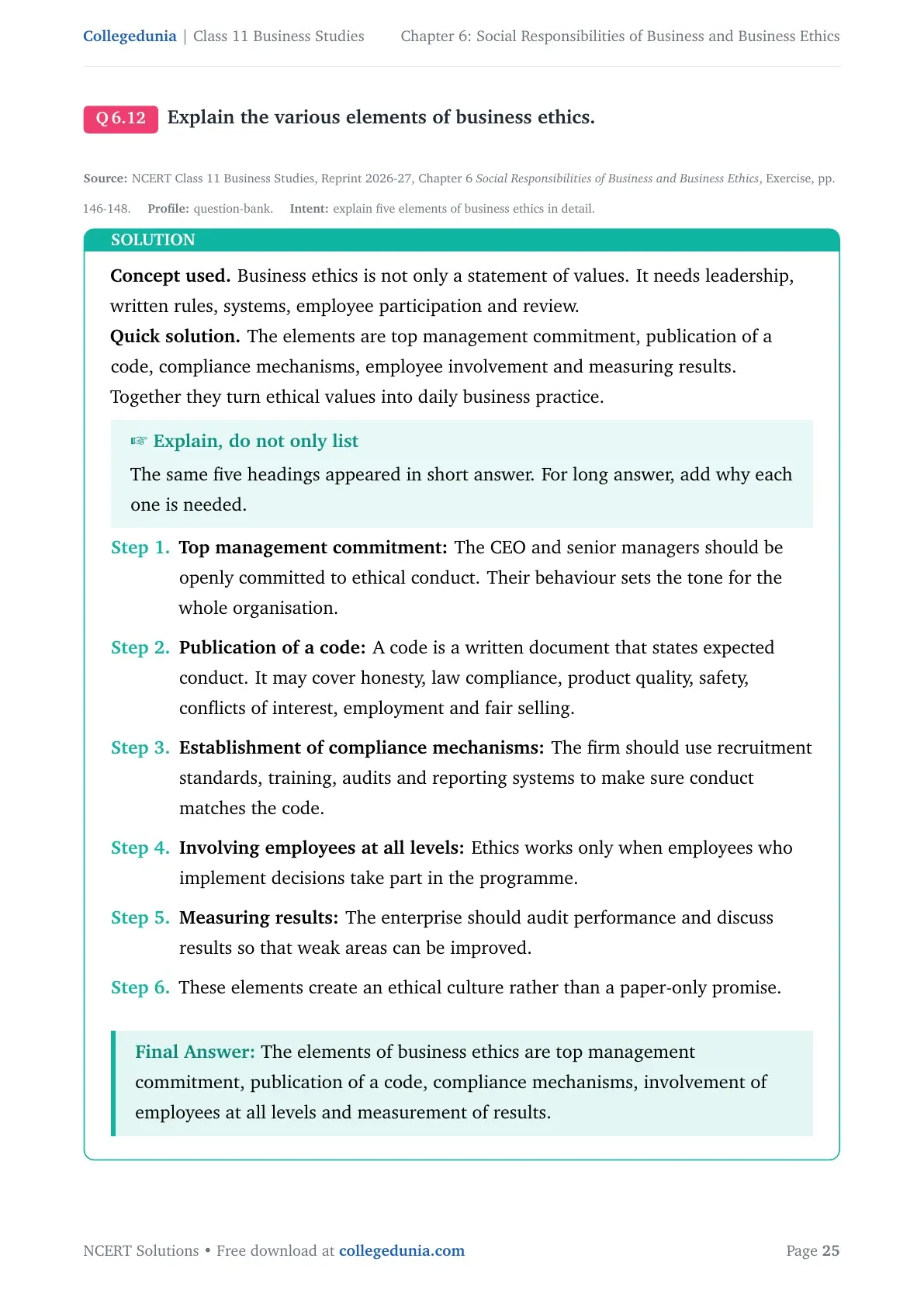
Explain the various elements of business ethics.
Quick solution. The elements are top management commitment, publication of a code, compliance mechanisms, employee involvement and measuring results. Together they turn ethical values into daily business practice.
Concept used. Business ethics is not only a statement of values. It needs leadership, written rules, systems, employee participation and review.
- Top management commitment: The CEO and senior managers should be openly committed to ethical conduct. Their behaviour sets the tone for the whole organisation.
- Publication of a code: A code is a written document that states expected conduct. It may cover honesty, law compliance, product quality, safety, conflicts of interest, employment and fair selling.
- Establishment of compliance mechanisms: The firm should use recruitment standards, training, audits and reporting systems to make sure conduct matches the code.
- Involving employees at all levels: Ethics works only when employees who implement decisions take part in the programme.
- Measuring results: The enterprise should audit performance and discuss results so that weak areas can be improved.
- These elements create an ethical culture rather than a paper-only promise.
Final answer: The elements of business ethics are top management commitment, publication of a code, compliance mechanisms, involvement of employees at all levels and measurement of results.
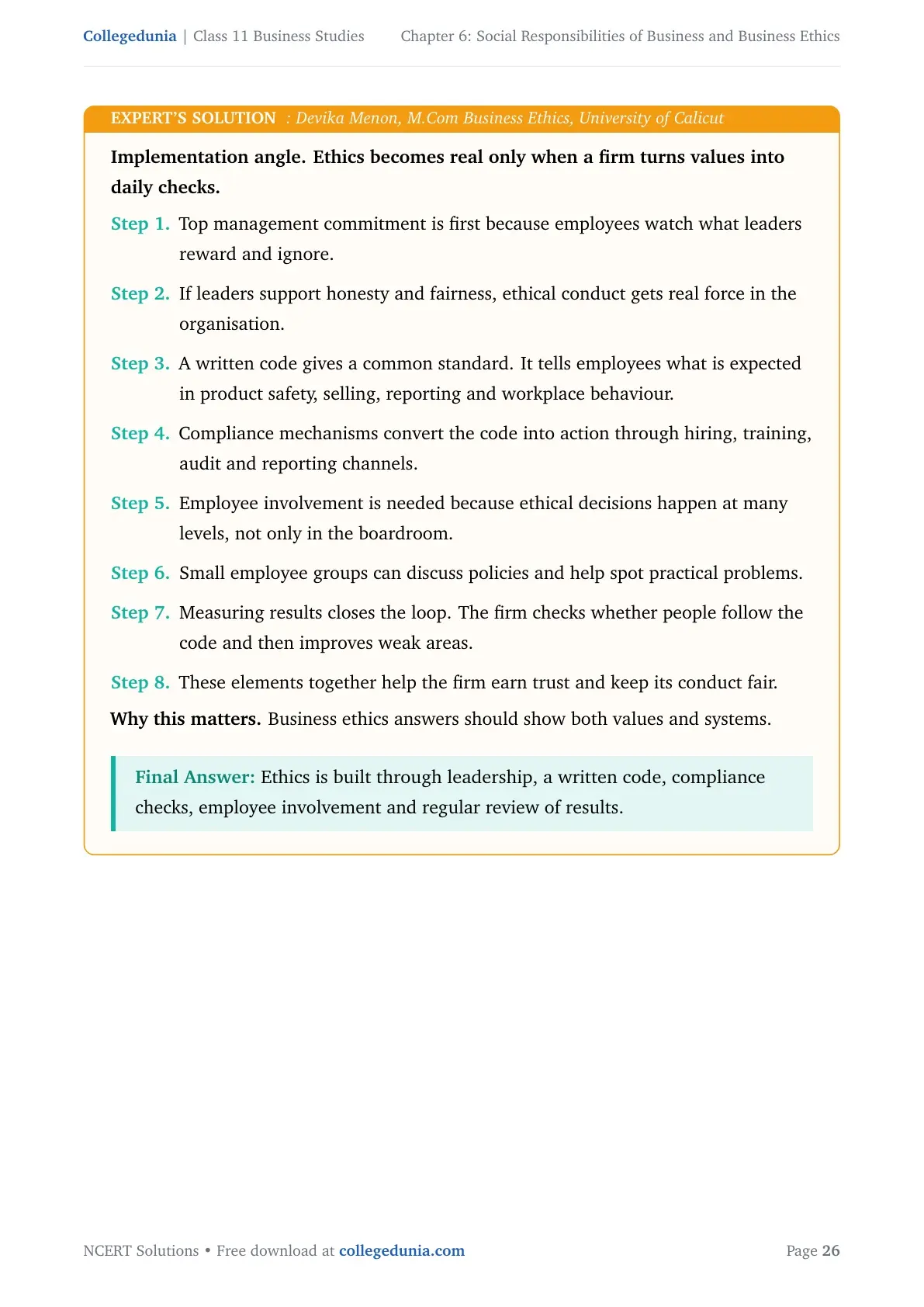
Implementation angle. Ethics becomes real only when a firm turns values into daily checks.
- Top management commitment is first because employees watch what leaders reward and ignore.
- If leaders support honesty and fairness, ethical conduct gets real force in the organisation.
- A written code gives a common standard. It tells employees what is expected in product safety, selling, reporting and workplace behaviour.
- Compliance mechanisms convert the code into action through hiring, training, audit and reporting channels.
- Employee involvement is needed because ethical decisions happen at many levels, not only in the boardroom.
- Small employee groups can discuss policies and help spot practical problems.
- Measuring results closes the loop. The firm checks whether people follow the code and then improves weak areas.
- These elements together help the firm earn trust and keep its conduct fair.
Why this matters. Business ethics answers should show both values and systems.
Expert answer: Ethics is built through leadership, a written code, compliance checks, employee involvement and regular review of results.
Question 13
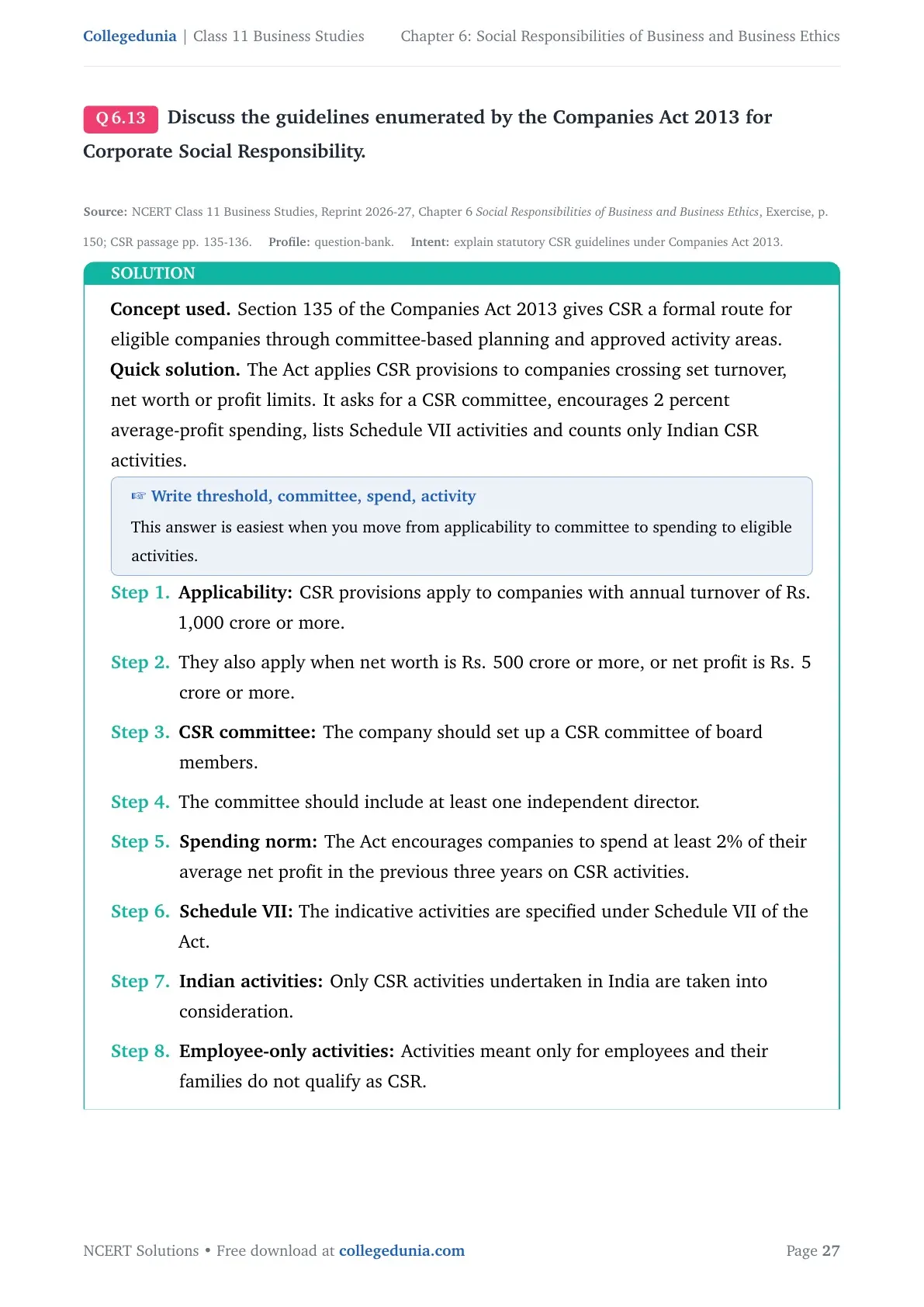
Discuss the guidelines enumerated by the Companies Act 2013 for Corporate Social Responsibility.
Quick solution. The Act applies CSR provisions to companies crossing set turnover, net worth or profit limits. It asks for a CSR committee, encourages 2 percent average-profit spending, lists Schedule VII activities and counts only Indian CSR activities.
Concept used. Section 135 of the Companies Act 2013 gives CSR a formal route for eligible companies through committee-based planning and approved activity areas.
- Applicability: CSR provisions apply to companies with annual turnover of Rs. 1,000 crore or more.
- They also apply when net worth is Rs. 500 crore or more, or net profit is Rs. 5 crore or more.
- CSR committee: The company should set up a CSR committee of board members.
- The committee should include at least one independent director.
- Spending norm: The Act encourages companies to spend at least 2% of their average net profit in the previous three years on CSR activities.
- Schedule VII: The indicative activities are specified under Schedule VII of the Act.
- Indian activities: Only CSR activities undertaken in India are taken into consideration.
- Employee-only activities: Activities meant only for employees and their families do not qualify as CSR.
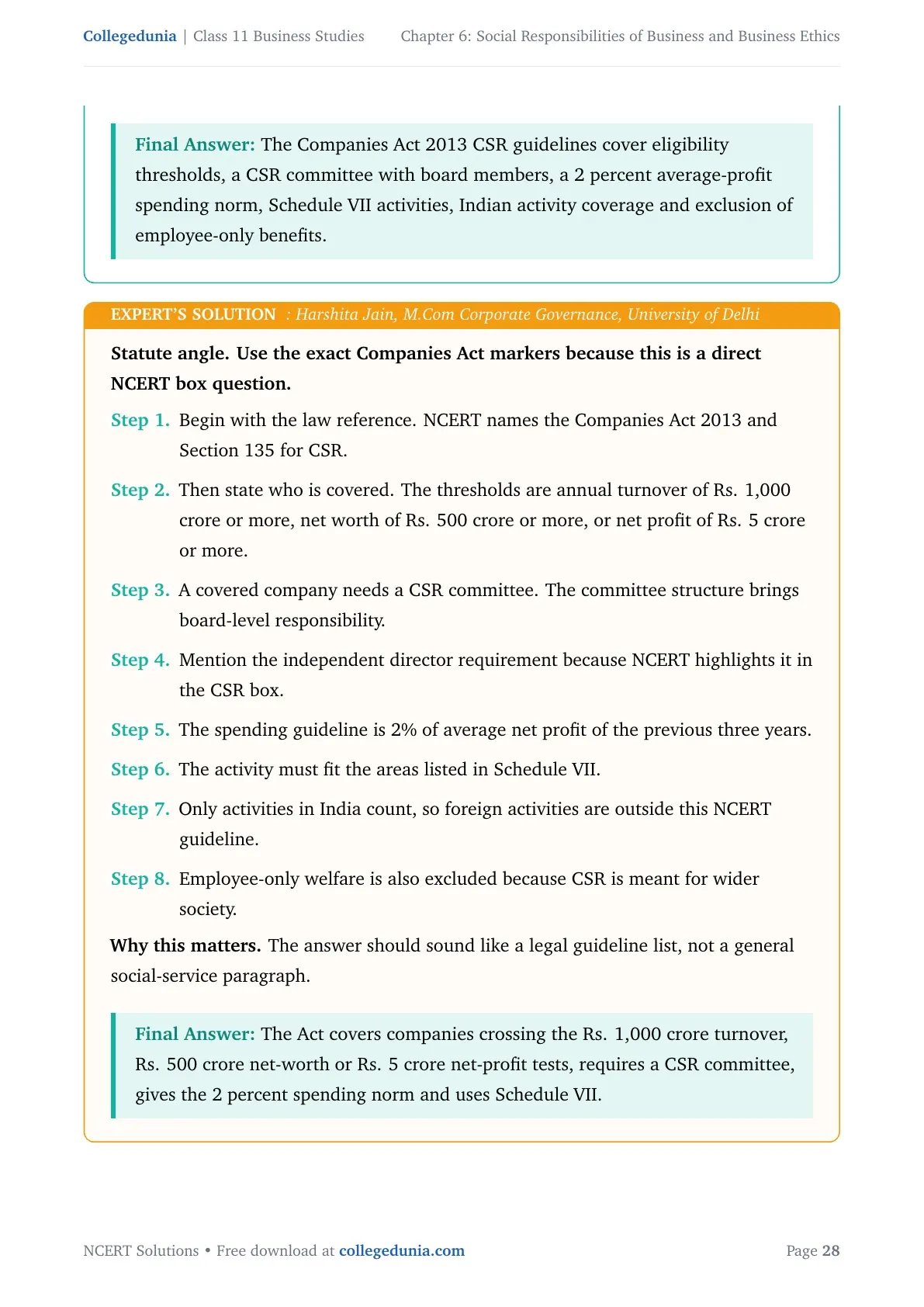
Final answer: The Companies Act 2013 CSR guidelines cover eligibility thresholds, a CSR committee with board members, a 2 percent average-profit spending norm, Schedule VII activities, Indian activity coverage and exclusion of employee-only benefits.
Statute angle. Use the exact Companies Act markers because this is a direct NCERT box question.
- Begin with the law reference. NCERT names the Companies Act 2013 and Section 135 for CSR.
- Then state who is covered. The thresholds are annual turnover of Rs. 1,000 crore or more, net worth of Rs. 500 crore or more, or net profit of Rs. 5 crore or more.
- A covered company needs a CSR committee. The committee structure brings board-level responsibility.
- Mention the independent director requirement because NCERT highlights it in the CSR box.
- The spending guideline is 2% of average net profit of the previous three years.
- The activity must fit the areas listed in Schedule VII.
- Only activities in India count, so foreign activities are outside this NCERT guideline.
- Employee-only welfare is also excluded because CSR is meant for wider society.
Why this matters. The answer should sound like a legal guideline list, not a general social-service paragraph.
Expert answer: The Act covers companies crossing the Rs. 1,000 crore turnover, Rs. 500 crore net-worth or Rs. 5 crore net-profit tests, requires a CSR committee, gives the 2 percent spending norm and uses Schedule VII.
Question 14
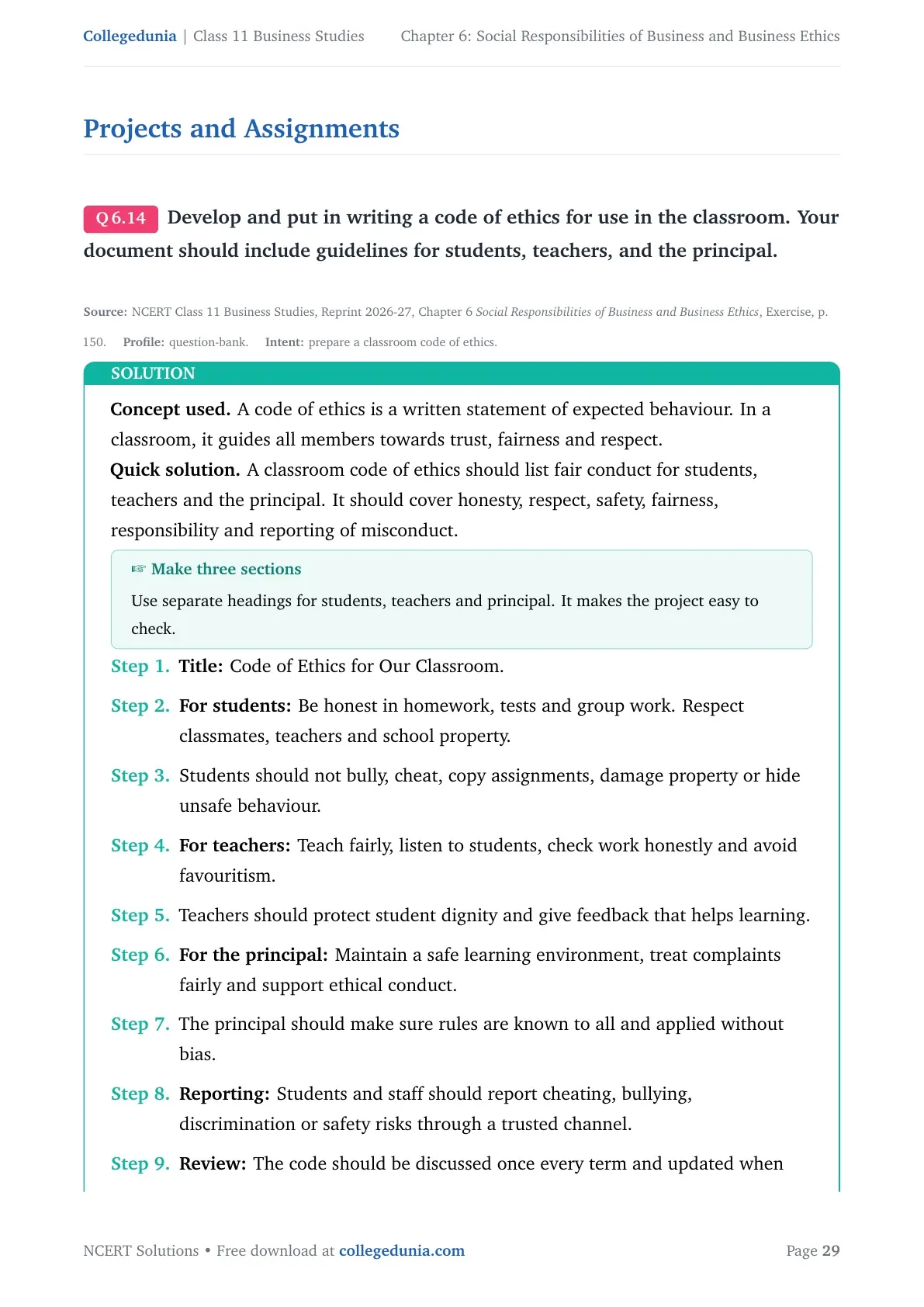
Develop and put in writing a code of ethics for use in the classroom. Your document should include guidelines for students, teachers, and the principal.
Quick solution. A classroom code of ethics should list fair conduct for students, teachers and the principal. It should cover honesty, respect, safety, fairness, responsibility and reporting of misconduct.
Concept used. A code of ethics is a written statement of expected behaviour. In a classroom, it guides all members towards trust, fairness and respect.
- Title: Code of Ethics for Our Classroom.
- For students: Be honest in homework, tests and group work. Respect classmates, teachers and school property.
- Students should not bully, cheat, copy assignments, damage property or hide unsafe behaviour.
- For teachers: Teach fairly, listen to students, check work honestly and avoid favouritism.
- Teachers should protect student dignity and give feedback that helps learning.
- For the principal: Maintain a safe learning environment, treat complaints fairly and support ethical conduct.
- The principal should make sure rules are known to all and applied without bias.
- Reporting: Students and staff should report cheating, bullying, discrimination or safety risks through a trusted channel.
- Review: The code should be discussed once every term and updated when needed.
Final answer: A suitable classroom code of ethics should include rules for honesty, respect, fairness, safety, responsibility, unbiased teaching, fair discipline and a clear reporting system.
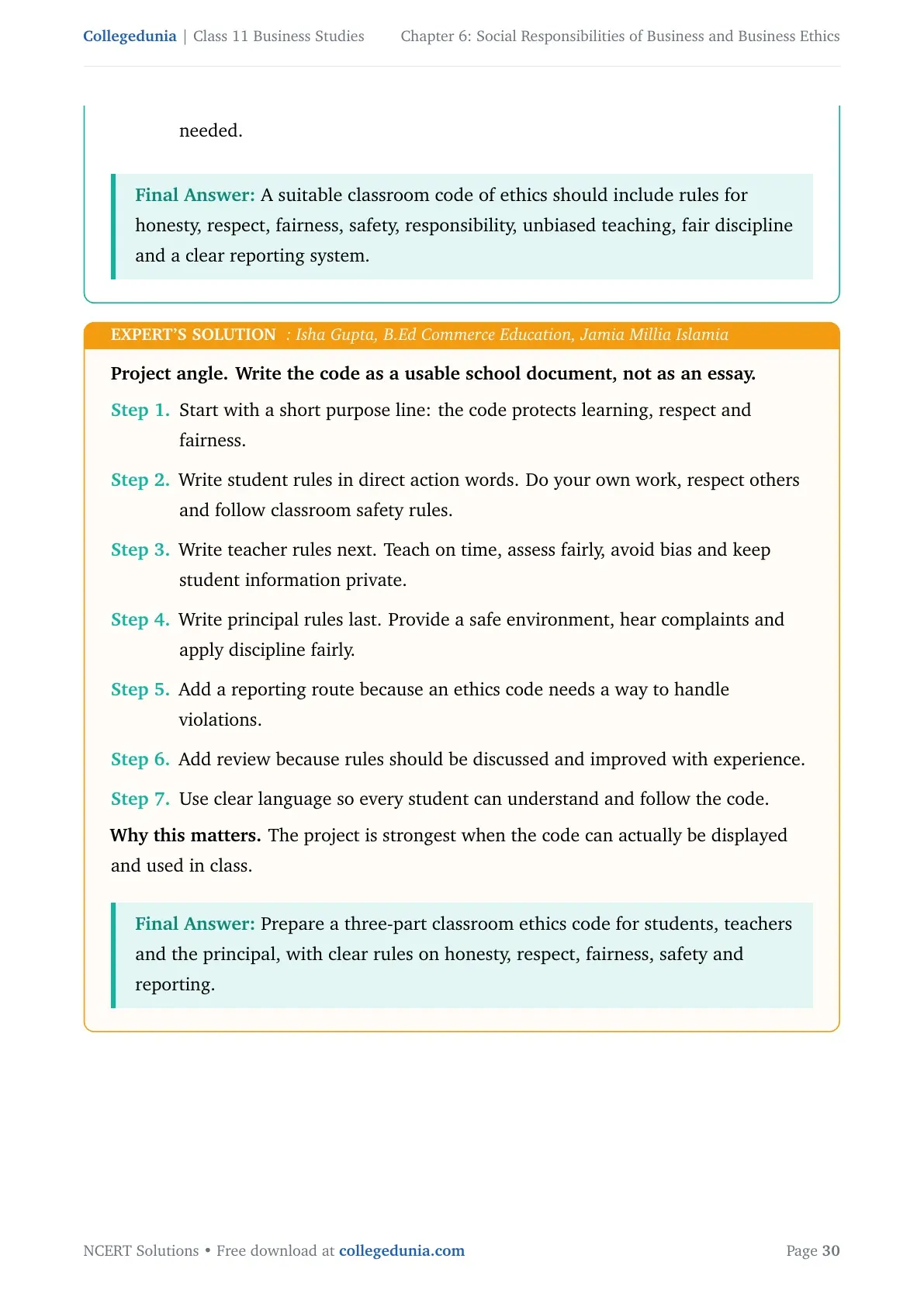
Project angle. Write the code as a usable school document, not as an essay.
- Start with a short purpose line: the code protects learning, respect and fairness.
- Write student rules in direct action words. Do your own work, respect others and follow classroom safety rules.
- Write teacher rules next. Teach on time, assess fairly, avoid bias and keep student information private.
- Write principal rules last. Provide a safe environment, hear complaints and apply discipline fairly.
- Add a reporting route because an ethics code needs a way to handle violations.
- Add review because rules should be discussed and improved with experience.
- Use clear language so every student can understand and follow the code.
Why this matters. The project is strongest when the code can actually be displayed and used in class.
Expert answer: Prepare a three-part classroom ethics code for students, teachers and the principal, with clear rules on honesty, respect, fairness, safety and reporting.
Question 15
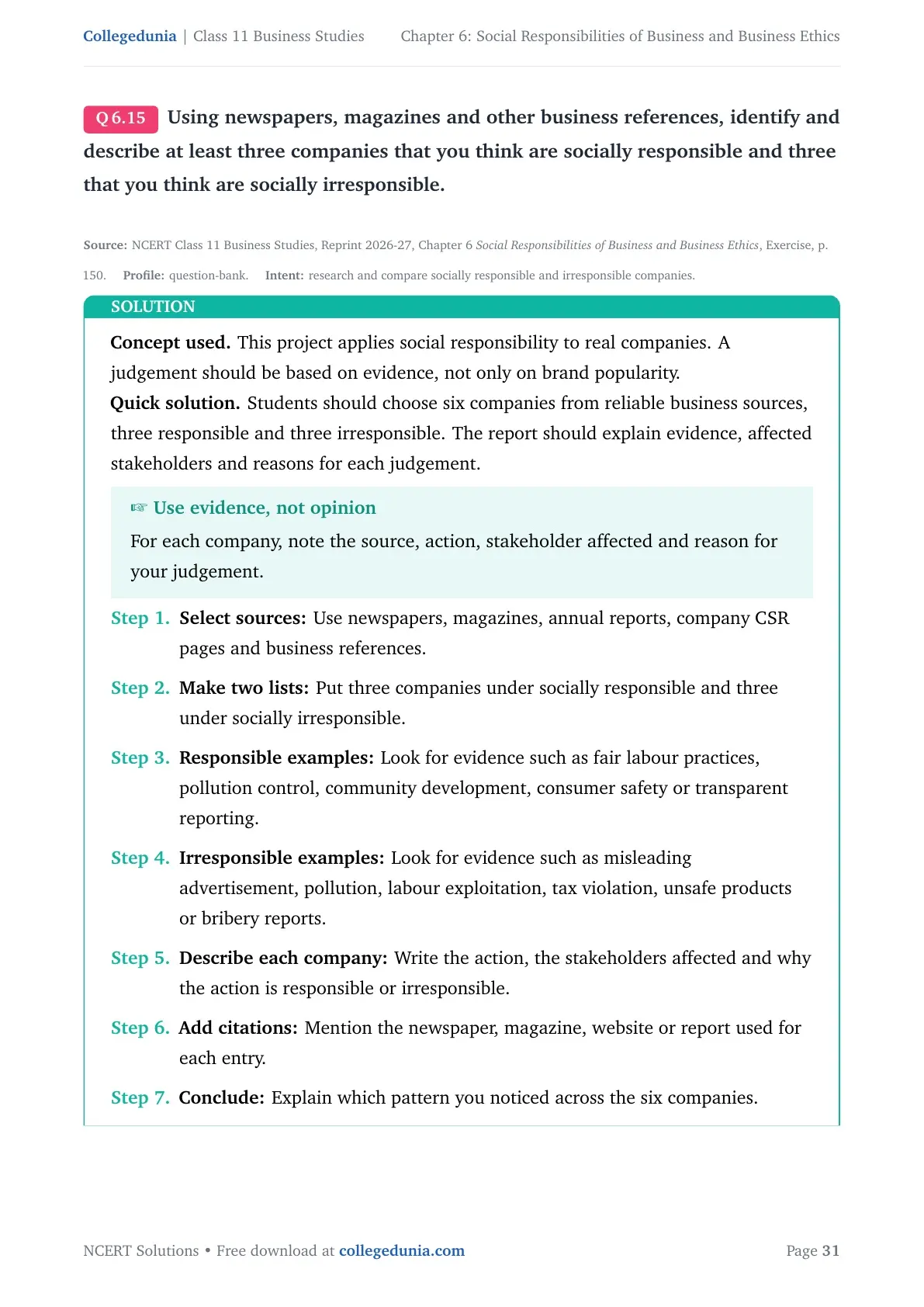
Using newspapers, magazines and other business references, identify and describe at least three companies that you think are socially responsible and three that you think are socially irresponsible.
Quick solution. Students should choose six companies from reliable business sources, three responsible and three irresponsible. The report should explain evidence, affected stakeholders and reasons for each judgement.
Concept used. This project applies social responsibility to real companies. A judgement should be based on evidence, not only on brand popularity.
- Select sources: Use newspapers, magazines, annual reports, company CSR pages and business references.
- Make two lists: Put three companies under socially responsible and three under socially irresponsible.
- Responsible examples: Look for evidence such as fair labour practices, pollution control, community development, consumer safety or transparent reporting.
- Irresponsible examples: Look for evidence such as misleading advertisement, pollution, labour exploitation, tax violation, unsafe products or bribery reports.
- Describe each company: Write the action, the stakeholders affected and why the action is responsible or irresponsible.
- Add citations: Mention the newspaper, magazine, website or report used for each entry.
- Conclude: Explain which pattern you noticed across the six companies.
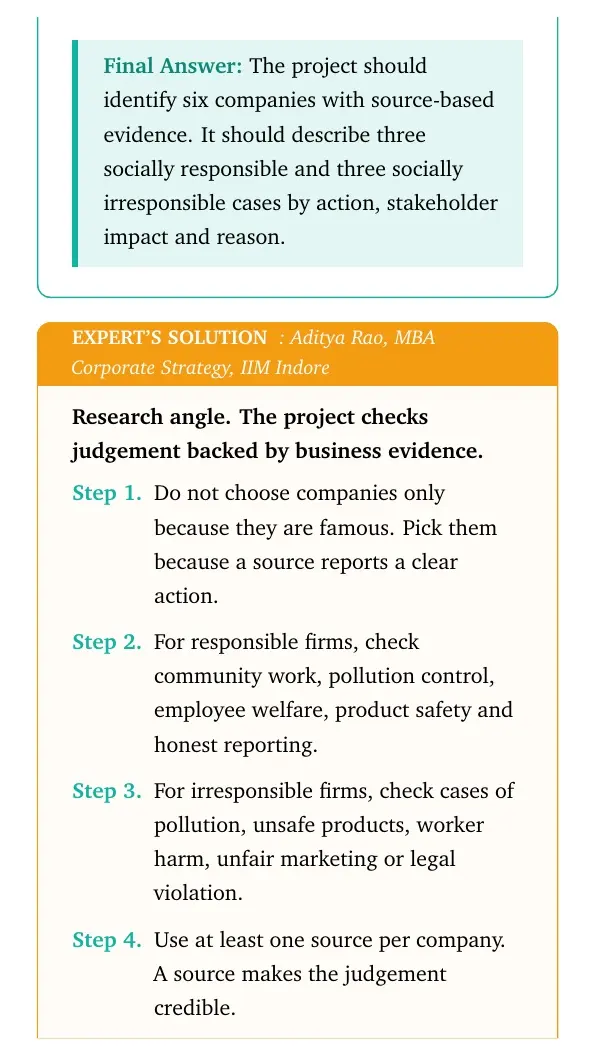
Final answer: The project should identify six companies with source-based evidence. It should describe three socially responsible and three socially irresponsible cases by action, stakeholder impact and reason.
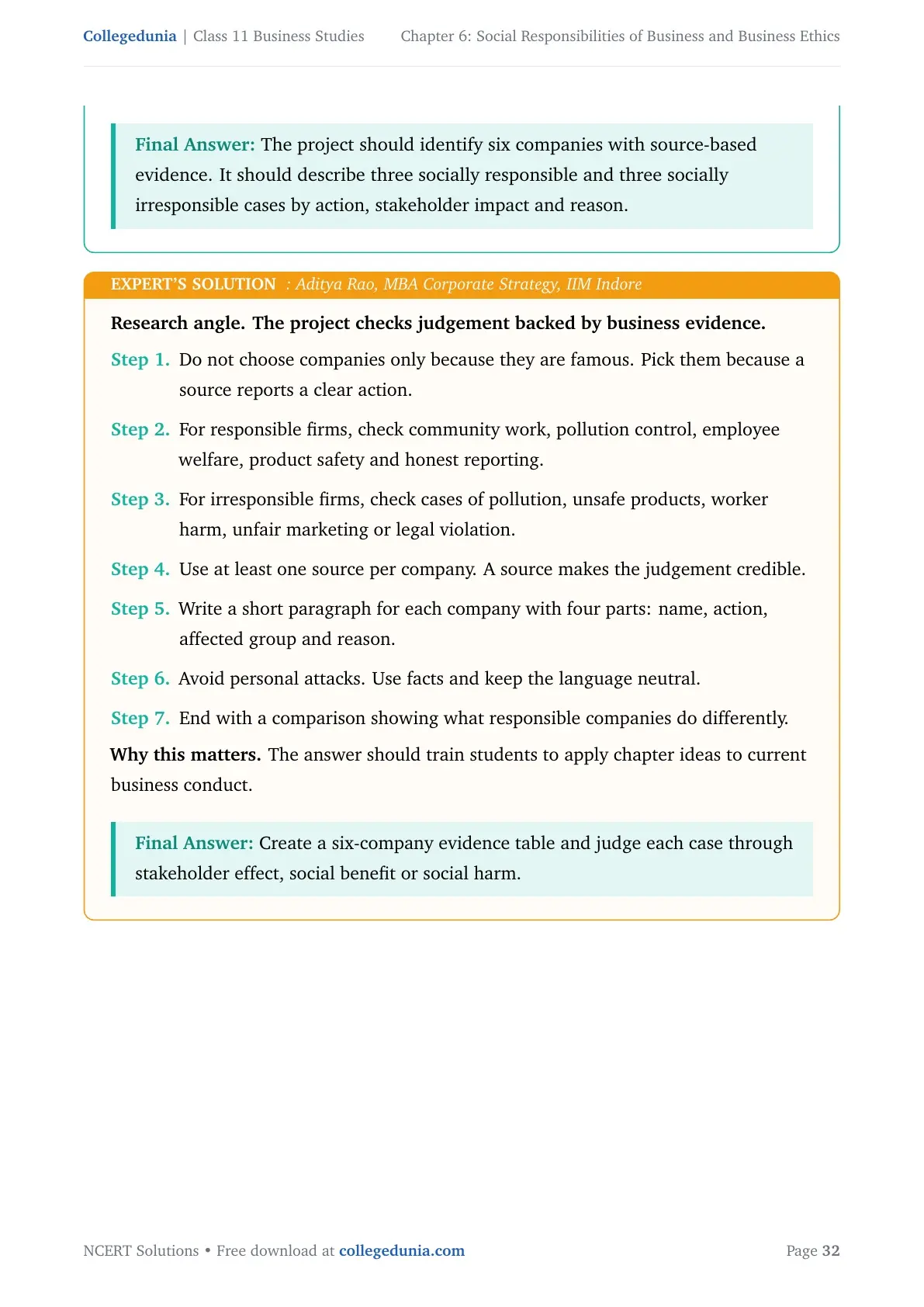
Research angle. The project checks judgement backed by business evidence.
- Do not choose companies only because they are famous. Pick them because a source reports a clear action.
- For responsible firms, check community work, pollution control, employee welfare, product safety and honest reporting.
- For irresponsible firms, check cases of pollution, unsafe products, worker harm, unfair marketing or legal violation.
- Use at least one source per company. A source makes the judgement credible.
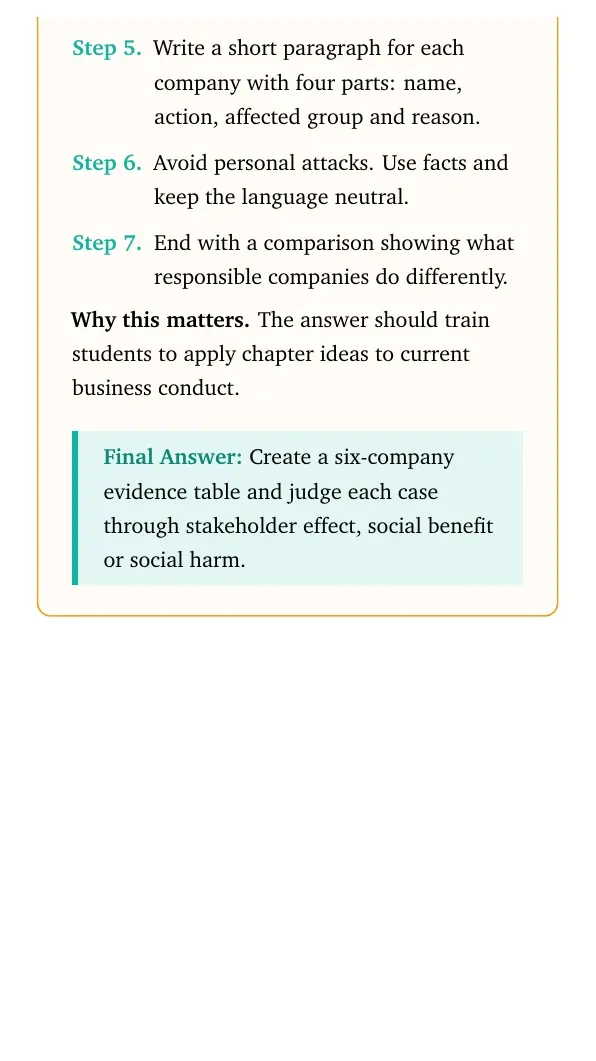
- Write a short paragraph for each company with four parts: name, action, affected group and reason.
- Avoid personal attacks. Use facts and keep the language neutral.
- End with a comparison showing what responsible companies do differently.
Why this matters. The answer should train students to apply chapter ideas to current business conduct.
Expert answer: Create a six-company evidence table and judge each case through stakeholder effect, social benefit or social harm.
Question 16
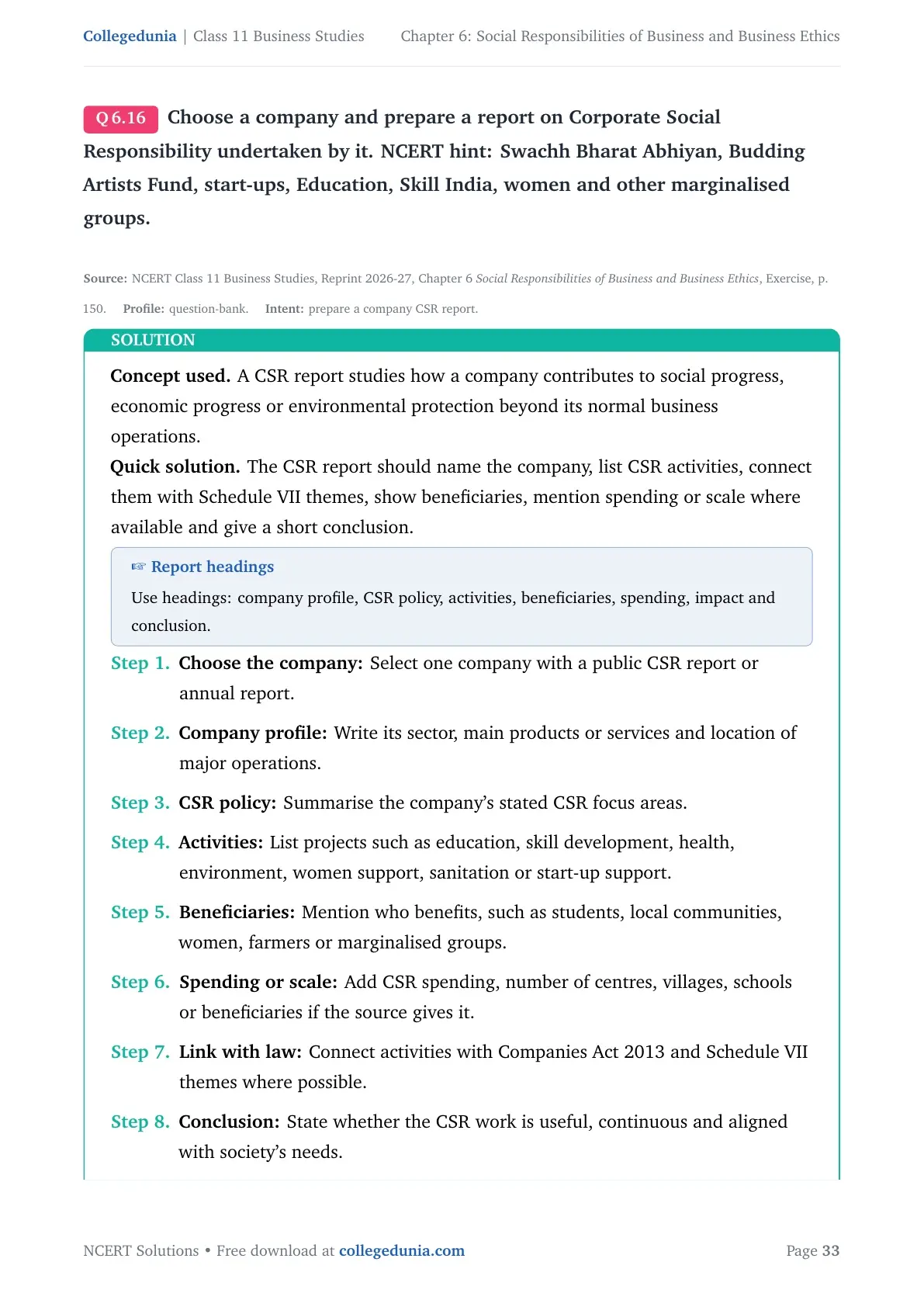
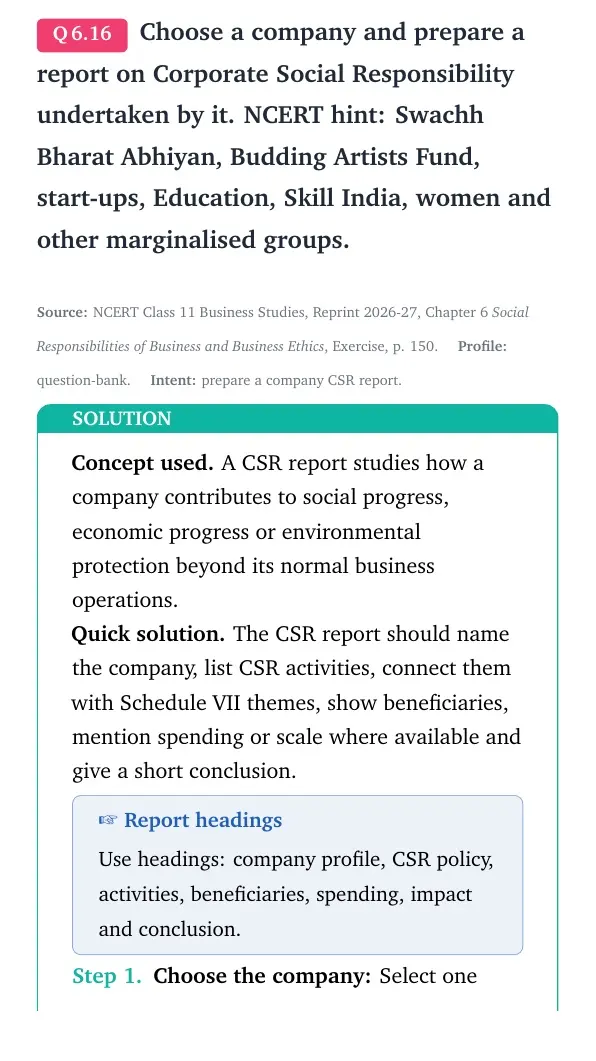
Choose a company and prepare a report on Corporate Social Responsibility undertaken by it. NCERT hint: Swachh Bharat Abhiyan, Budding Artists Fund, start-ups, Education, Skill India, women and other marginalised groups.
Quick solution. The CSR report should name the company, list CSR activities, connect them with Schedule VII themes, show beneficiaries, mention spending or scale where available and give a short conclusion.
Concept used. A CSR report studies how a company contributes to social progress, economic progress or environmental protection beyond its normal business operations.
- Choose the company: Select one company with a public CSR report or annual report.
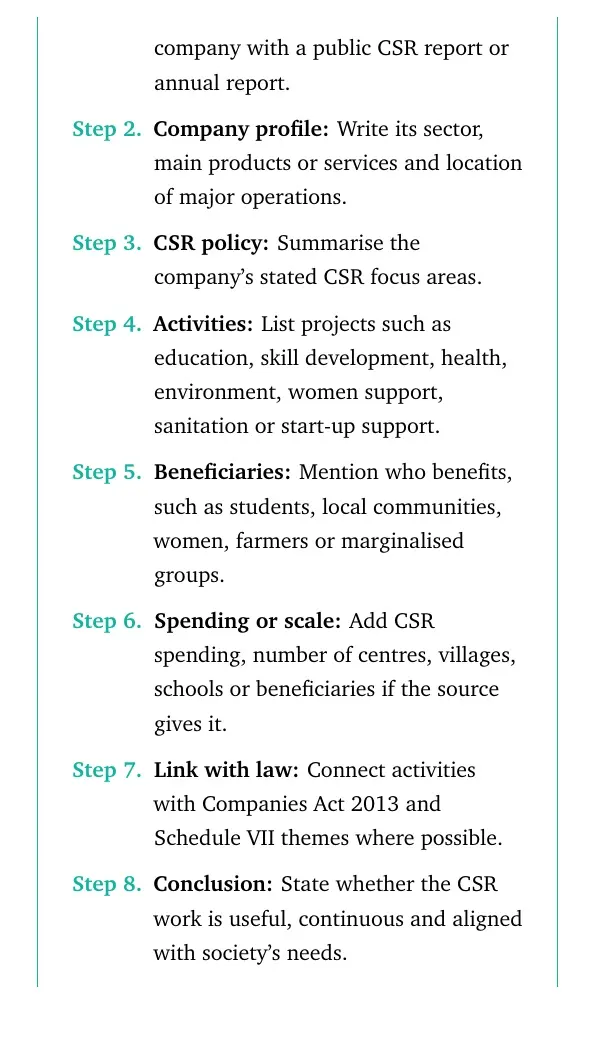
- Company profile: Write its sector, main products or services and location of major operations.
- CSR policy: Summarise the company's stated CSR focus areas.
- Activities: List projects such as education, skill development, health, environment, women support, sanitation or start-up support.
- Beneficiaries: Mention who benefits, such as students, local communities, women, farmers or marginalised groups.
- Spending or scale: Add CSR spending, number of centres, villages, schools or beneficiaries if the source gives it.
- Link with law: Connect activities with Companies Act 2013 and Schedule VII themes where possible.
- Conclusion: State whether the CSR work is useful, continuous and aligned with society's needs.
Final answer: A good CSR report includes company profile, CSR policy, activity areas, beneficiaries, spending or scale, Schedule VII link, source details and a short evaluation.
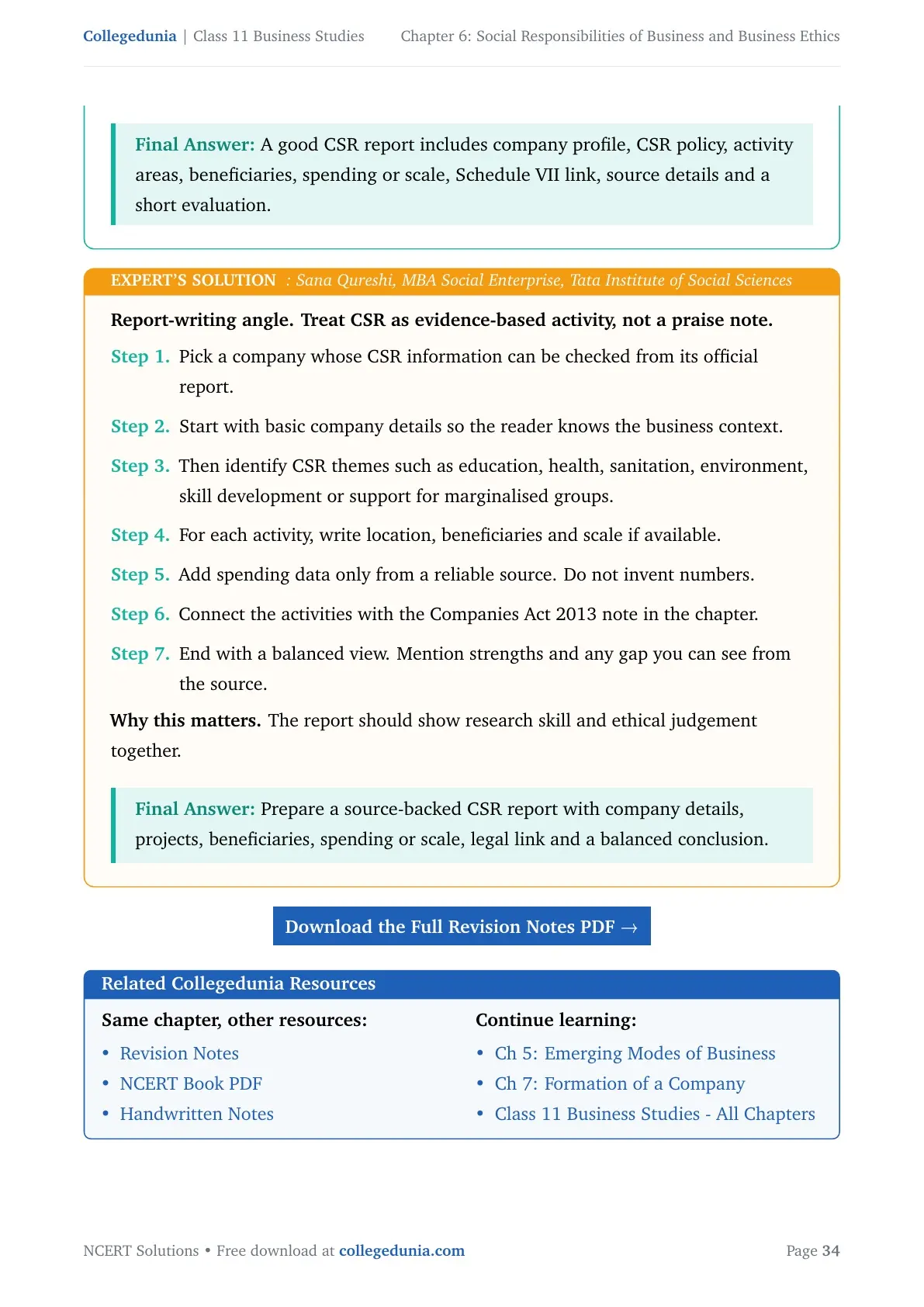
Report-writing angle. Treat CSR as evidence-based activity, not a praise note.
- Pick a company whose CSR information can be checked from its official report.
- Start with basic company details so the reader knows the business context.
- Then identify CSR themes such as education, health, sanitation, environment, skill development or support for marginalised groups.
- For each activity, write location, beneficiaries and scale if available.
- Add spending data only from a reliable source. Do not invent numbers.
- Connect the activities with the Companies Act 2013 note in the chapter.
- End with a balanced view. Mention strengths and any gap you can see from the source.
Why this matters. The report should show research skill and ethical judgement together.
Expert answer: Prepare a source-backed CSR report with company details, projects, beneficiaries, spending or scale, legal link and a balanced conclusion.
Social Responsibilities of Business and Business Ethics Class 11 NCERT Solutions FAQs
Ques. How many questions are solved in Class 11 Business Studies Chapter 6 Social Responsibilities of Business and Business Ethics?
Ans. The chapter has 16 NCERT textbook questions. This page and the downloadable PDF include short answers, long answers, project guidance and expert explanations.
Ques. What is social responsibility of business in Chapter 6?
Ans. Social responsibility means the duty of business to act according to society's values and welfare. It is wider than legal responsibility because it includes voluntary duties beyond law.
Ques. What are the main areas of social responsibility of business?
Ans. The main areas are responsibilities towards owners or shareholders, workers, consumers, the government and the community.
Ques. What are the basic elements of business ethics?
Ans. The basic elements are top management commitment, publication of a code, compliance mechanism, employee involvement and measurement of results.
Ques. Why is environmental protection included in social responsibility?
Ans. Environmental protection is included because business activity can create air, water, land and noise pollution. A responsible business reduces harm and uses resources carefully.



Comments