The NCERT Solutions for Class 10 Science Chapter 6 Control and Coordination cover all 26 questions (14 in-text and 12 exercise), for the 2026-27 CBSE syllabus.
Answers follow the textbook flow: the nervous system, neuron and synapse, reflex action, the human brain, and coordination in plants through tropic movements and plant hormones.
All 26 NCERT questions solved with clear steps, labelled diagrams, and an Expert Solution per question.
Full coverage of the neuron, synapse, reflex arc, human brain, phototropism, and plant and animal hormones the CBSE board paper tests.
Aligned with the 2026-27 CBSE Class 10 Science syllabus, in plain English.
Solved by Collegedunia Science Experts
These NCERT Solutions for Class 10 Science Chapter 6 Control and Coordination are checked against the latest 2026-27 NCERT textbook and refined against the last five years of CBSE board papers. Each of the 26 questions gives a Check Solution for the clean board answer and an Expert Solution for extra marks.
The Nervous System: Neuron, Synapse and the Path of the Impulse
A neuron (nerve cell) is the basic unit of the nervous system. It carries information as an electrical impulse:
Dendrites: short branched fibres that receive information.
Cell body: holds the nucleus; the impulse passes through it.
Axon: the long fibre that carries the impulse away.
Synapse: the gap at the axon end where the message passes to the next neuron.
At the synapse the impulse cannot jump the gap as electricity, so the axon end releases chemicals that cross it and start a fresh impulse: electrical, then chemical, then electrical. As chemicals are released on one side only, a message travels in one direction.
Reflex Action and the Reflex Arc
A reflex action is a sudden, automatic response that needs no thinking, like pulling your hand back from a hot plate. It is controlled by the spinal cord through the reflex arc, not the brain, which saves a fraction of a second.
The reflex arc follows a fixed five-step path.
Step
Part involved
What it does
1
Receptor
Detects the stimulus (heat, pain, touch)
2
Sensory neuron
Carries the impulse to the spinal cord
3
Spinal cord
Processes the signal at once and passes it on
4
Motor neuron
Carries the instruction to the muscle
5
Muscle (effector)
Acts, e.g. pulls the hand away
The spinal cord controls the reflex for speed; the brain only becomes aware a moment later, so separate control from awareness. Walking, by contrast, is a voluntary action.
The Human Brain and Its Parts
The brain has three regions: fore-brain, mid-brain and hind-brain. Most "name the part" questions come from this split, so pair each part with its job:
Brain part
Main job
Example
Fore-brain
Thinking, seeing, hearing, smell and voluntary action
Deciding to walk; sensing the smell of an agarbatti
Cerebellum (hind-brain)
Posture and equilibrium (balance)
Walking straight; riding a bicycle
Medulla (hind-brain)
Involuntary acts like heartbeat, breathing, blood pressure
Heart beating while you sleep
Coordination in Plants: Tropic Movements and Plant Hormones
Plants have no nervous system and no muscles, so they coordinate only by chemicals, the plant hormones (phytohormones).
Tropic movements
A tropic movement is a slow, directional growth towards or away from a stimulus:
Tropism
Stimulus
Example
Phototropism
Light
Shoot bends towards light
Geotropism
Gravity
Roots grow down, shoots grow up
Hydrotropism
Water
Roots grow towards water
Chemotropism
Chemicals
Pollen tube grows towards the ovule
How auxin bends a shoot towards light
The hormone auxin is made at the shoot tip. When light falls on one side, auxin moves to the shady side, those cells grow longer, and the shoot bends towards the light: more auxin means more growth on that side. Plant hormones are growth promoters plus one inhibitor:
Auxin: cell elongation and bending towards light.
Gibberellin: helps the stem grow.
Cytokinin: promotes cell division.
Abscisic acid: the growth inhibitor; causes wilting.
Hormones in Animals: The Endocrine System
In animals, chemical coordination is done by hormones made by endocrine glands. These ductless glands pour hormones into the blood, which carries them to the target organs. Each hormone affects only cells with its matching receptor.
Iodised salt is advised because the thyroid needs iodine to make thyroxin, which prevents goitre. Diabetic patients get insulin injections because their pancreas makes too little insulin. Hormone levels stay correct by feedback control.
Common Mistakes Students Make in the Control and Coordination Chapter
The repeat-offender mistakes in board answers:
Saying the brain controls a reflex: the spinal cord controls it; the brain only becomes aware after.
Naming "hind-brain" for balance: the exact part is the cerebellum; the medulla controls heartbeat.
Mixing hormones: insulin, thyroxin, adrenaline are animal; auxin, gibberellin, cytokinin are plant.
Forgetting auxin's side: it moves to the shady side, so the shoot bends towards light.
Skipping the labelled diagram: for the neuron and reflex arc it can carry one or two marks.
How to Use the Control and Coordination NCERT Solutions PDF for Board Prep
Control and Coordination is short but trap-heavy. Use two passes: first note the key terms, then practise the diagrams and difference tables from memory before checking them here. The board paper usually reuses a difference question, a "name the brain part" question, and a tropism question.
Other Resources for Class 10 Science Chapter 6 Control and Coordination
Pair these solutions with the other Chapter 6 resources:
66% of Class 10 students said the hardest part was keeping the brain parts and their jobs apart. 3 out of 5 students lost marks by swapping reflex versus voluntary action. Toppers found a neat labelled diagram added 1 to 2 marks, and the average student spent 3 to 4 hours on this chapter.
Source: 2026-27 Class 10 Science student poll. Sample of 9,600 students from CBSE schools across 13 states.
NCERT Solutions for Class 10 Science: All Chapters
Related Links: NCERT Solutions for the other Class 10 Science chapters.
All NCERT Solutions for Class 10 Science Chapter 6 Control and Coordination with Step-by-Step Solutions
Tap Check Solution for the board answer and Expert Solution for extra marks.
Q 1
What is the difference between a reflex action and walking?
A reflex action is a sudden, automatic and quick response to a stimulus that needs no thinking. It is controlled by the spinal cord through a reflex arc. Walking is a voluntary action: it is done on purpose, under our control, and is managed by the fore-brain.
A reflex happens on its own, like pulling the hand back the moment we touch a hot plate. We do not decide to do it.
In a reflex the message is handled quickly in the spinal cord, so the response is very fast; the brain learns of it only afterwards.
Walking is something we choose to do, including the direction and the speed.
Walking is controlled by the brain and uses voluntary muscles, so it stays under conscious control.
Answer: A reflex action is fast, automatic and controlled by the spinal cord (no thinking needed), while walking is a slow, voluntary action that we decide to do and that the brain controls.
MN
Dr. Meenakshi Nair
Ph.D Zoology, University of Delhi
Verified Expert
Sort every action into one of three boxes: reflex, voluntary or involuntary. The clue word is "decision". If the body acts before we can think, it is a reflex. If we first decide and then act, it is voluntary.
A reflex is sudden and protective and is decided in the spinal cord, so a person cannot stop their hand jerking back off a hot pan.
Walking is planned by the fore-brain, so a person can start or stop it at will, while the cerebellum quietly keeps them balanced.
Set your answer on three lines, control centre, speed, and whether it is willed, and you cover every mark while showing why the two actions are handled so differently.
Answer: Reflex = involuntary and spinal-cord controlled; walking = voluntary and brain controlled.
Q 2
What happens at the synapse between two neurons?
A synapse is the tiny gap between the axon end of one neuron and the dendrite of the next. A nerve message travels inside a neuron as an electrical impulse, but it cannot jump the gap as electricity, so at the synapse it is changed into a chemical signal.
The electrical impulse travels along the axon and reaches its end at the synapse.
The impulse triggers the release of chemicals (neurotransmitters) into the gap.
These chemicals cross the gap by diffusion and reach the dendrite of the next neuron.
On reaching it, the chemicals start a fresh electrical impulse, so the message is passed on.
Answer: At the synapse the electrical impulse of the first neuron releases chemicals; these cross the gap and start a new electrical impulse in the next neuron, so the message moves forward.
AR
Aditya Rao
M.Sc Neuroscience, NCBS Bengaluru
Verified Expert
Think of the synapse as a relay-race baton pass. The runner cannot stretch electricity across the gap, so the handover uses chemicals. This hand-off is the whole point of the synapse.
The change from electrical to chemical and back makes sure the message moves in only one direction, because only the sending side has the chemical store.
It also lets the body control the message: it can be made stronger, weaker, or stopped at the synapse.
So the synapse is not just a gap to be crossed; it is a control point in the nervous system.
Answer: The synapse converts the electrical impulse into a chemical signal that crosses the gap and restarts an electrical impulse in the next neuron, allowing one-way transmission.
Q 3
Which part of the brain maintains posture and equilibrium of the body?
The brain has three main parts: the fore-brain, the mid-brain and the hind-brain. The hind-brain has a part called the cerebellum, which looks after the body's posture and balance.
Posture means keeping the body steady and upright; equilibrium means keeping balance.
These need the muscles to work together smoothly and with the right force.
The cerebellum controls this fine coordination of voluntary muscle action.
This is why walking straight, riding a bicycle or picking up a pencil is smooth and well balanced.
Answer: The cerebellum, a part of the hind-brain, maintains the posture and equilibrium (balance) of the body.
KD
Dr. Kavita Deshpande
M.D Physiology, B.Ed
Verified Expert
Pair each brain part with its star job: fore-brain for thinking and senses, cerebellum for posture and balance, medulla for involuntary acts like heartbeat. Then a question like this becomes instant recall.
Imagine a person whose cerebellum is not working: their movements become shaky and they cannot stand steady, even though their muscles are strong.
That shows the cerebellum adds precision and balance, not power.
For one mark, write cerebellum, not just "hind-brain", because the hind-brain also contains the medulla and pons.
Answer: Cerebellum (hind-brain) controls posture and equilibrium.
Q 4
How do we detect the smell of an agarbatti (incense stick)?
Smell is detected by special nerve cells called olfactory receptors in the lining of the nose. A receptor picks up a particular stimulus and starts a nerve impulse. The smell is finally recognised by the fore-brain.
The burning agarbatti gives off scent particles into the air.
These particles reach the nose, where the olfactory receptors detect them.
The receptors set off an electrical impulse in the sensory nerves.
This impulse travels to the smell area of the fore-brain, which reads the signal, so we sense the smell.
Answer: Scent particles from the agarbatti are detected by olfactory receptors in the nose, which send a nerve impulse to the smell area of the fore-brain, where the smell is recognised.
SK
Sneha Kulkarni
M.Sc Botany, Savitribai Phule Pune University
Verified Expert
Use the receptor-to-brain template for every sense question: stimulus reaches the sense organ, receptors detect it, an impulse travels along sensory neurons, and the fore-brain interprets it.
Name the receptor correctly: smell uses olfactory receptors; taste uses gustatory receptors on the tongue.
A cold dulls taste because a blocked nose stops the olfactory receptors, proving the nose does most of the work in flavour.
Fit the agarbatti into this template and you will not leave out a mark-bearing step.
Answer: Olfactory receptors in the nose detect smell particles and send an impulse to the fore-brain, which recognises the smell.
Q 5
What is the role of the brain in reflex action?
A reflex action is controlled by the reflex arc in the spinal cord, not the brain. The brain's role is limited: the message is also carried to the brain so we become aware of what happened, but the brain does not control the quick response.
The receptor detects the stimulus and sends an impulse along a sensory neuron to the spinal cord.
The spinal cord at once passes the signal to a motor neuron, which makes the muscle act. This loop is the reflex arc.
Because the spinal cord handles the response, the action happens before the brain can think about it.
The information still travels up to the brain, so the brain comes to know about the reflex just after it has happened.
Answer: The brain does not control a reflex action; the spinal cord does, through the reflex arc, for speed. The brain only receives the information afterwards so that we become aware of the action.
RS
Rohit Saxena
M.Sc Physiology, Banaras Hindu University
Verified Expert
Separate "control" from "awareness". The trap is to say the brain controls the reflex. It does not. The control sits in the spinal cord; the brain's only role is awareness.
A person with a spinal cord injury can lose a reflex below the cut even though the brain is healthy, which proves the spinal cord runs the reflex.
The brain's late arrival of information is useful, because it lets us learn from the event, for example to be careful near a hot stove.
Answer: The brain only becomes aware of the reflex; the actual control is by the spinal cord through the reflex arc.
Q 6
What are plant hormones?
Plant hormones (phytohormones) are chemicals made by plants that control and coordinate their growth, development and responses to the environment. They are made in one part of the plant and move to another part where they act.
Plants have no nervous system, so they use chemicals, not nerves, to coordinate their activities.
These chemicals are the plant hormones, made in small amounts.
Some promote growth, for example auxin, gibberellin and cytokinin.
Some slow or stop growth, for example abscisic acid, which causes wilting of leaves.
Answer: Plant hormones are chemicals made by plants that control their growth, development and responses to stimuli; examples include auxin, gibberellin, cytokinin (promoters) and abscisic acid (inhibitor).
AM
Dr. Anjali Menon
Ph.D Plant Science, University of Hyderabad
Verified Expert
Group the four hormones by what they do: auxin (cell elongation, bending to light), gibberellin (stem growth), cytokinin (cell division), and abscisic acid (stops growth). Three promote, one inhibits.
Plant hormones act far from where they are made; auxin is made at the shoot tip but causes growth lower down.
This "made here, acts there" idea is the same logic as animal hormones travelling in blood.
A definition alone often loses a mark, so always add one promoter and the one inhibitor.
Answer: Plant hormones are growth-controlling chemicals made in one part of a plant that act in another part; e.g. auxin, gibberellin, cytokinin, abscisic acid.
Q 7
How is the movement of leaves of the sensitive plant different from the movement of a shoot towards light?
The folding of the sensitive plant (touch-me-not) leaves is a quick movement that does not involve growth and is not directional. The bending of a shoot towards light is a slow movement caused by growth and is directional (a tropic movement).
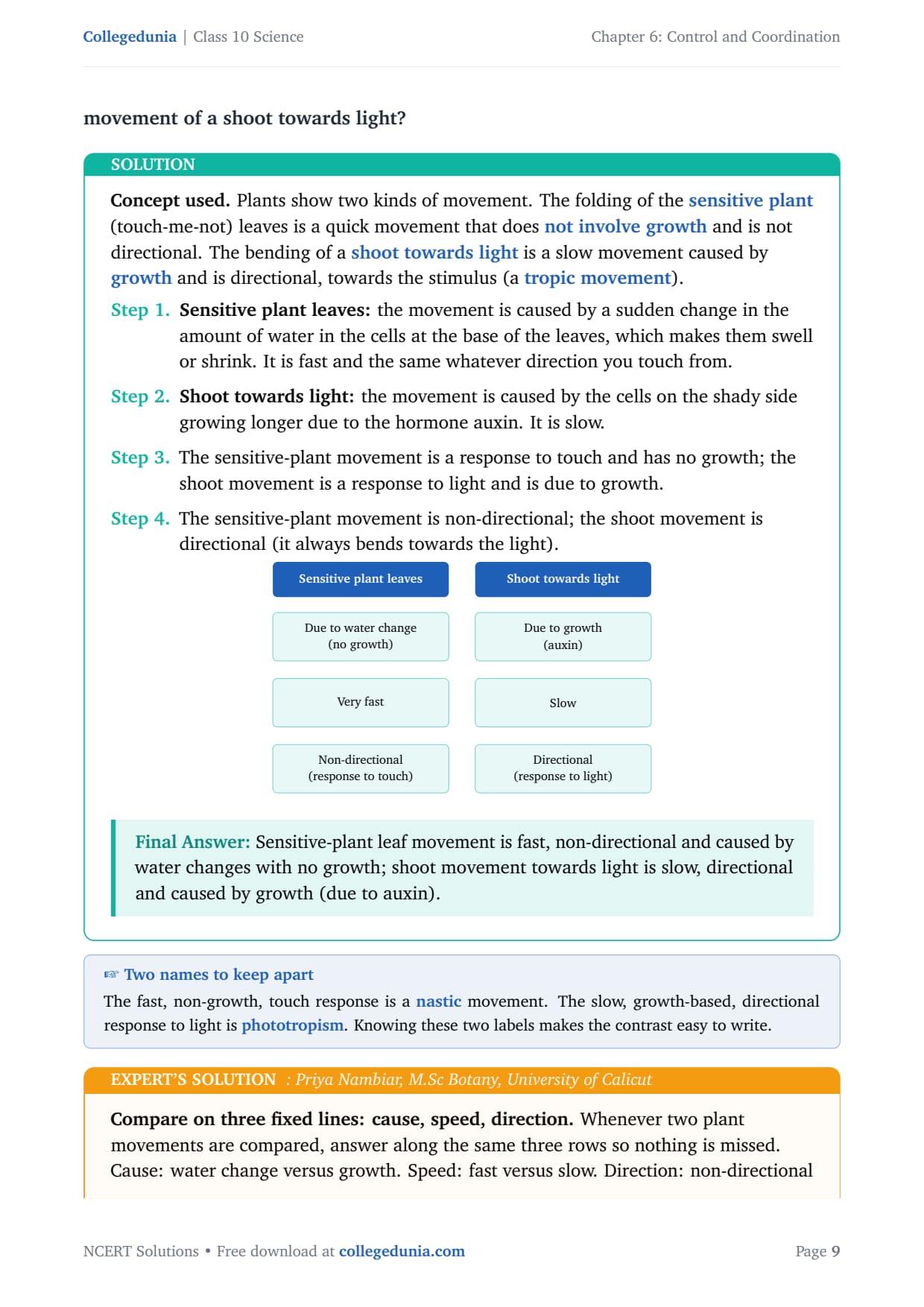
Point
Sensitive plant leaves
Shoot towards light
Cause
Water change (no growth)
Growth (due to auxin)
Speed
Very fast
Slow
Direction
Non-directional (response to touch)
Directional (response to light)
Answer: Sensitive-plant leaf movement is fast, non-directional and caused by water changes with no growth; shoot movement towards light is slow, directional and caused by growth due to auxin.
PN
Priya Nambiar
M.Sc Botany, University of Calicut
Verified Expert
Compare on three fixed lines: cause, speed, direction. Both movements solve the same problem, reacting to the environment, but with very different tools.
The sensitive plant uses a quick, reversible water trick, because it cannot grow a new leaf position every time it is touched.
The shoot uses permanent growth, because it wants a lasting change to capture more light.
Name both movements: the fast, non-growth, touch response is a nastic movement; the slow, growth-based response to light is phototropism. Putting the correct name and the cause turns a partial reply into a full-mark one.
Answer: Sensitive plant: fast, non-directional, water-driven, no growth. Shoot to light: slow, directional, growth-driven (auxin).
Q 8
Give an example of a plant hormone that promotes growth.
Plant hormones that increase growth are called growth promoters. The main examples named in the chapter are auxin, gibberellin and cytokinin.
Auxin helps cells grow longer (cell elongation) and causes shoots to bend towards light.
Gibberellin helps in the growth of the stem.
Cytokinin promotes cell division and is found in higher amounts in fruits and seeds.
Any one of these is a correct example of a growth-promoting plant hormone.
Answer: Auxin is an example of a plant hormone that promotes growth (gibberellin and cytokinin also promote growth).
SI
Dr. Suresh Iyer
Ph.D Plant Physiology, M.Ed
Verified Expert
Tie each promoter to one keyword: auxin equals "longer cells and bending to light", gibberellin equals "stem growth", cytokinin equals "cell division in fruits and seeds".
If you must name only one, write auxin, because the chapter explains it in most detail and you can back it up with a reason.
Three promoters exist because growth is not one event: making cells bigger, taller and more many each need a separate hormone.
Answer: Auxin (also gibberellin or cytokinin) is a growth-promoting plant hormone.
Q 9
How do auxins promote the growth of a tendril around a support?
A tendril is a thread-like part of some climbing plants that is sensitive to touch. Its coiling around a support is caused by uneven growth, controlled by the hormone auxin.
When a tendril touches a support, the side in contact stops growing fast.
Auxin moves away from the contact side and collects on the side away from the support.
The extra auxin on the far side makes those cells grow longer than the contact side.
Because one side grows more, the tendril bends and coils around the support, so the plant can climb.
Answer: When a tendril touches a support, auxin shifts to the side away from the support and makes that side grow faster; this uneven growth makes the tendril coil around the support.
VJ
Vandana Joshi
M.Sc Plant Biology, Panjab University
Verified Expert
Always say which side gets more auxin and which grows more. The mark-bearing logic is the uneven distribution of auxin.
State that the side away from the support gets more auxin and grows longer, while the contact side grows less.
This is the same rule as bending to light: auxin gathers where it is dark or untouched and makes that side grow more.
There is no muscle and no nerve; the tendril simply grows unevenly, and the result is a tight grip on the support.
Answer: Auxin collects on the side of the tendril away from the support, making that side grow faster; the unequal growth coils the tendril around the support.
Q 10
Design an experiment to show hydrotropism.
Hydrotropism is the growth of a plant part in response to water: roots grow towards water (positive hydrotropism). To show it, we make water available on only one side and watch which way the roots grow.
Take a wide trough, fill it with soil, and sow a few germinating seeds in the middle.
Bury a small porous clay pot of water near one side, a little away from the seeds, so water seeps out only on that side.
Keep the soil on the other side dry, and place the set-up where light and gravity act equally on both sides.
Water gently near the buried pot for a few days, then carefully dig out the seedlings.
The roots will have bent and grown towards the side with the water, even though the seeds were sown in the middle. This shows hydrotropism.
Answer: Sow germinating seeds in soil with a buried porous pot of water on one side and dry soil on the other; after a few days the roots bend towards the water, demonstrating hydrotropism.
RP
Dr. Ramesh Pillai
Ph.D Plant Science, JNU New Delhi
Verified Expert
Build any tropism experiment from one recipe: give the stimulus from one side only, keep everything else equal, let the plant grow, then show the part has bent in a definite direction.
State the control conditions clearly: light and gravity must act equally, so that only water differs.
Add a control set-up with water on all sides, where the roots grow straight down; comparing the two pots makes the result convincing.
Finally, write both the observation (roots bend towards the water) and the conclusion (roots show positive hydrotropism), because many students forget the conclusion.
Answer: Provide water on only one side of growing seeds while keeping light and gravity equal; roots bending towards the water side prove hydrotropism.
Q 11
How does chemical coordination take place in animals?
In animals, chemical coordination is done by hormones made by endocrine glands. These glands have no ducts, so they pour their hormones directly into the blood, which carries them to the target organs where they act.
Endocrine glands such as the thyroid, pituitary, pancreas and adrenal glands produce hormones.
The hormones are released straight into the blood, in very small but precise amounts.
Blood carries them all over the body, but each hormone acts only on its particular target organ.
At the target organ the hormone brings about the required change; the amount is kept correct by feedback control.
Answer: Chemical coordination in animals is done by hormones; endocrine glands secrete them into the blood, which carries them to target organs where they produce the needed response.
NB
Dr. Neha Bhatt
M.D Endocrinology, B.Ed
Verified Expert
Remember the three-word chain: gland, blood, target. Name a few glands, say the hormones go into the blood, and stress that each hormone acts only on its own target organ.
The clever part is specificity: blood reaches every cell, yet a hormone affects only the cells with the matching receptor.
That is why insulin can lower blood sugar while adrenaline speeds up the heart, even though both travel in the same blood.
The nervous system gives fast, local control; the hormonal system gives slower, body-wide control. Both work together.
Answer: Endocrine glands secrete hormones into the blood, which delivers them to specific target organs, achieving chemical coordination.
Q 12
Why is the use of iodised salt advisable?
The thyroid gland needs the element iodine to make the hormone thyroxin, which controls the metabolism of carbohydrates, proteins and fats. Iodised salt is common salt to which iodine has been added.
Thyroxin is made by the thyroid gland, and iodine is needed to make it.
If our diet lacks iodine, the thyroid cannot make enough thyroxin.
A shortage of thyroxin disturbs metabolism and can cause goitre, in which the neck swells.
Using iodised salt supplies the iodine the thyroid needs, so enough thyroxin is made and goitre is prevented.
Answer: Iodised salt provides iodine, which the thyroid needs to make thyroxin. Enough iodine keeps thyroxin levels normal and prevents the iodine-deficiency disease goitre.
AK
Dr. Arvind Kulkarni
Ph.D Human Physiology, B.Ed
Verified Expert
Trace iodine to the disease in one line: iodine, then thyroxin, then prevention of goitre. If you write all three links, the answer is complete; "iodine is good for health" is too vague.
Thyroxin sets the rate of metabolism, the speed at which the body uses food for energy and growth.
Too little of it slows the body down and affects growth, especially in children.
So iodised salt is not just about avoiding a swollen neck; it protects normal metabolism and proper growth.
Answer: Iodine in iodised salt lets the thyroid make thyroxin, keeping metabolism normal and preventing goitre.
Q 13
How does our body respond when adrenaline is secreted into the blood?
Adrenaline is a hormone secreted by the adrenal glands in times of fear, anger or stress. It is released into the blood and prepares the body for quick action (the fight-or-flight response).
Adrenaline makes the heart beat faster, so more oxygen-rich blood is pumped.
Small arteries to the digestive system and skin narrow, so blood is diverted to the skeletal muscles.
The breathing rate increases, so more oxygen is taken in.
Together these changes give the muscles more oxygen and energy, readying the body to fight or run.
Answer: Adrenaline makes the heart beat faster, raises the breathing rate, and diverts blood from the digestive system and skin to the skeletal muscles, preparing the body for fight or flight.
SV
Sandeep Verma
M.Sc Zoology, Aligarh Muslim University
Verified Expert
List the effects organ by organ: heart beats faster, breathing rate rises, blood is redirected to skeletal muscles. Three clear effects usually cover the marks.
Blood is shifted away from the gut and skin because those organs are not urgently needed in an emergency.
Adrenaline supports the nervous system: nerves spot the danger in an instant, and adrenaline keeps the body primed for minutes afterwards.
Answer: Adrenaline speeds up the heartbeat and breathing and diverts blood to the skeletal muscles, readying the body for fight or flight.
Q 14
Why are some patients of diabetes treated by giving injections of insulin?
Insulin is a hormone made by the pancreas. Its job is to control (lower) the level of sugar in the blood. Diabetes is a condition in which the blood sugar level is too high.
In some diabetic patients, the pancreas does not make enough insulin.
Without enough insulin, the blood sugar level rises and stays high, which can be harmful.
To make up for the shortage, such patients are given insulin from outside, as injections.
The injected insulin helps regulate the blood sugar and keeps it within the normal range.
Answer: In these patients the pancreas does not secrete enough insulin, so blood sugar rises. Insulin injections supply the missing hormone and bring the blood sugar back to normal.
PR
Dr. Pooja Reddy
M.D Medicine, CMC Vellore
Verified Expert
Match the treatment to the cause: too little insulin, so add insulin. State the cause first, then the treatment, for a complete answer.
Insulin is a protein, so if swallowed it would be broken down in the stomach like food; that is why it must be injected.
This links to feedback control: normally the pancreas senses rising sugar and releases more insulin, but here that loop is broken.
Seeing the disease as a broken feedback control, rather than a random illness, is the joined-up understanding the board rewards.
Answer: Their pancreas makes too little insulin, so blood sugar rises; insulin injections replace the missing hormone and control the blood sugar level.
Q 15
Which of the following is a plant hormone? (a) Insulin (b) Thyroxin (c) Oestrogen (d) Cytokinin.
A plant hormone is a chemical made by plants to control their growth. We pick the only option that is a plant hormone; the rest are animal hormones.
Insulin is an animal hormone (from the pancreas) that controls blood sugar. Not a plant hormone.
Thyroxin is an animal hormone (from the thyroid). Not a plant hormone.
Oestrogen is an animal hormone (a female sex hormone). Not a plant hormone.
Cytokinin is made by plants and promotes cell division. It is a plant hormone.
Answer: (d) Cytokinin.
LK
Lakshmi Krishnan
M.Sc Botany, Madras University
Verified Expert
Three traps, one answer. The question puts three well-known animal hormones next to one plant hormone, hoping you pick a familiar name. Ask of each option: does a plant make this?
Keep a short list of animal hormones (insulin, thyroxin, adrenaline, oestrogen) and plant hormones (auxin, gibberellin, cytokinin, abscisic acid).
Do not rely on the sound of the name; instead remember the function: cytokinin promotes cell division in plants.
Answer: (d) Cytokinin is the plant hormone.
Q 16
The gap between two neurons is called a (a) dendrite. (b) synapse. (c) axon. (d) impulse.
The very small gap between the axon end of one neuron and the dendrite of the next is called a synapse. We match each option to its meaning.
A dendrite is the branched part of a neuron that receives signals. Not a gap.
A synapse is the gap between two neurons across which the signal is passed. This is the gap.
An axon is the long fibre that carries the impulse. Not a gap.
An impulse is the electrical signal itself, not a gap.
Answer: (b) Synapse.
VS
Dr. Vikram Singh
Ph.D Neuroscience, M.Ed
Verified Expert
The gap is the only thing that is not part of the cell. Dendrite, axon and impulse all belong to or come from the neuron, while the synapse is the space between two neurons.
At the synapse the electrical impulse is converted into a chemical that crosses the gap and restarts the impulse in the next neuron.
Because it is the handover point, it is one of the most asked terms in this chapter.
Answer: (b) Synapse is the gap between two neurons.
Q 17
The brain is responsible for (a) thinking. (b) regulating the heart beat. (c) balancing the body. (d) all of the above.
Different parts of the brain do different jobs. The fore-brain handles thinking, the medulla regulates the heartbeat, and the cerebellum keeps the body balanced. So the brain as a whole is responsible for all three.
Thinking is done by the fore-brain, so (a) is true.
Heartbeat is an involuntary action controlled by the medulla, so (b) is true.
Balance and posture are controlled by the cerebellum, so (c) is true.
Since (a), (b) and (c) are all correct, the answer is (d).
Answer: (d) All of the above.
SG
Dr. Shalini Gupta
Ph.D Zoology, University of Lucknow
Verified Expert
Test each option before choosing "all". Map each task to a brain part: thinking to fore-brain, heartbeat to medulla, balance to cerebellum. All three check out.
This question tests whether you know the brain is divided into regions with distinct roles.
When every listed task is a genuine brain job, the answer is "all of the above", but verify each piece first.
Answer: (d) All of the above; the brain controls thinking, heartbeat and balance through its different parts.
Q 18
What is the function of receptors in our body? Think of situations where receptors do not work properly. What problems are likely to arise?
Receptors are specialised nerve cell tips in our sense organs that detect a particular stimulus and start a nerve impulse. Different receptors detect different stimuli: gustatory for taste, olfactory for smell, and so on.
Function: receptors detect changes such as light, sound, taste, smell, heat and touch, and pass this information into the nervous system as impulses.
They are located in the sense organs: the eye, ear, nose, tongue and skin.
When receptors fail: the body cannot detect that stimulus, so it cannot respond in time.
Problems: if heat or pain receptors fail, a person may get burnt or injured without knowing; if taste or smell receptors fail, spoilt food might be eaten; ear-receptor failure can affect hearing and balance.
Answer: Receptors detect stimuli and start nerve impulses. If they fail, the body cannot sense those changes, so a person may get burnt, eat spoilt food, or fail to react to danger in time.
MT
Manish Tiwari
M.Sc Physiology, University of Allahabad
Verified Expert
Answer in two halves: the normal job, then the consequences of failure. The question has two parts, so split your answer.
First state the function clearly: receptors detect stimuli and start impulses.
Then give real examples of failure for two different senses, to show range.
The key insight is that detection must come before response. A perfect brain and fast muscles are useless if the receptor never reports the danger, so the reflex arc never fires.
Answer: Receptors detect environmental stimuli and trigger impulses; if they fail, the body cannot sense changes such as heat, taste or smell, leading to injury, eating spoilt food, or failure to respond to danger.
Q 19
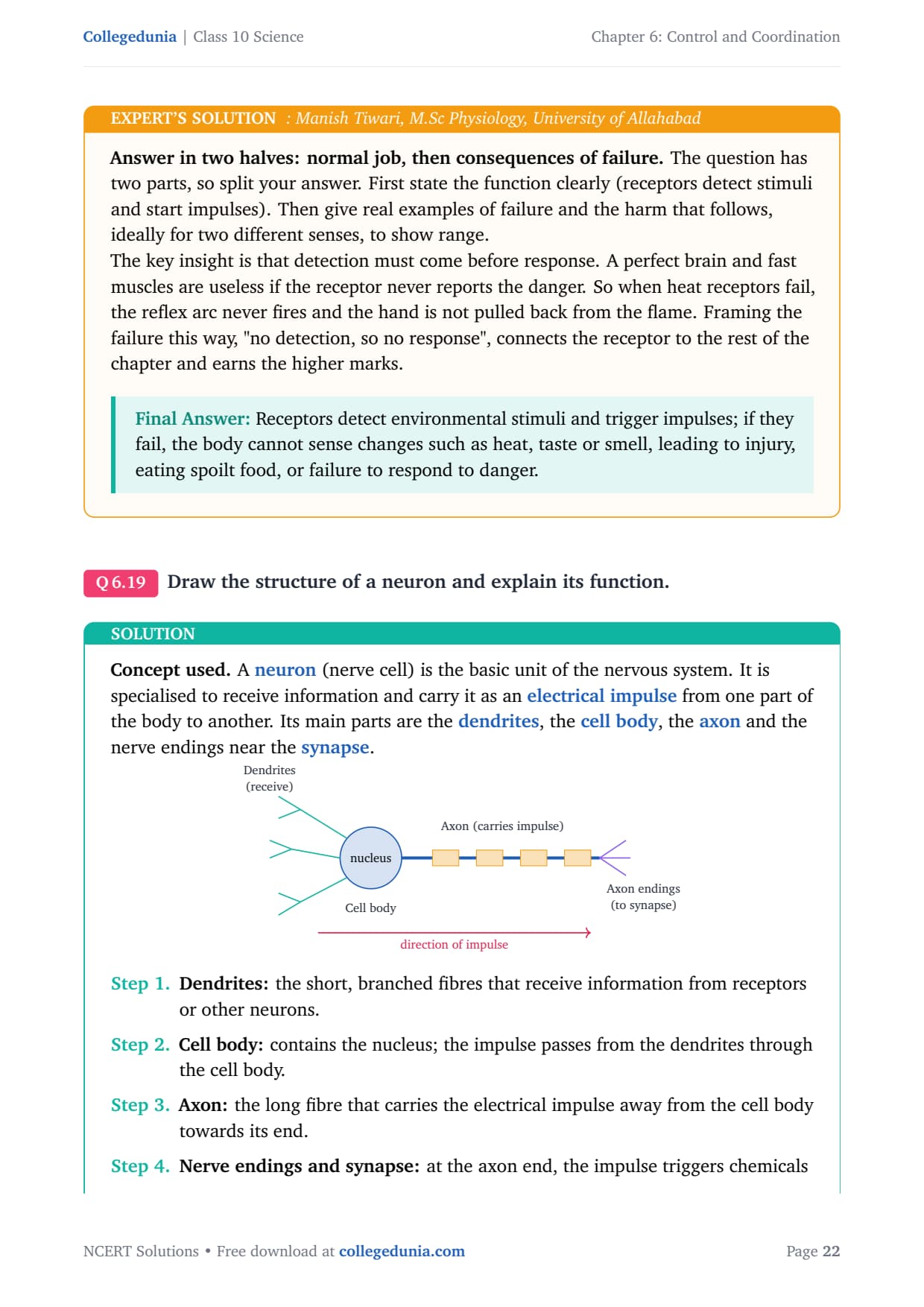
Draw the structure of a neuron and explain its function.
A neuron (nerve cell) is the basic unit of the nervous system. It is specialised to receive information and carry it as an electrical impulse from one part of the body to another. Its main parts are the dendrites, the cell body, the axon and the nerve endings near the synapse.
Dendrites: the short, branched fibres that receive information from receptors or other neurons.
Cell body: contains the nucleus; the impulse passes from the dendrites through the cell body.
Axon: the long fibre that carries the impulse away from the cell body towards its end.
Nerve endings and synapse: at the axon end, the impulse triggers chemicals that cross the synapse to the next neuron or muscle.
Function. A neuron receives information at the dendrites, converts it into an electrical impulse, carries it along the axon, and releases chemicals at the synapse to pass the message on.
Answer: A neuron has dendrites (receive), a cell body (with nucleus), an axon (carries the impulse) and nerve endings at the synapse. Its function is to receive information and conduct it as an electrical impulse across the body, passing it on chemically at the synapse.
FA
Dr. Farhan Ahmed
Ph.D Neurobiology, NCBS Bengaluru
Verified Expert
Tell the story of one signal travelling through the neuron: it enters at the dendrites, moves through the cell body, races down the axon, and leaves at the nerve endings to cross the synapse.
The neuron is long and thin so it can carry signals over real distances, sometimes from the toe to the spinal cord.
When you draw it, keep the cell body rounded with the nucleus inside, show several branched dendrites on one side and one long axon on the other, and add an arrow for the direction of the impulse.
Inside the neuron the message is electrical, but at the axon endings it becomes chemicals that cross the synapse. Writing this two-step idea lifts an ordinary answer to a complete one.
Answer: Neuron parts: dendrites (receive), cell body (nucleus), axon (carries impulse), nerve endings (synapse). Function: receive information and conduct it as an electrical impulse across the body, handing it on chemically at the synapse.
Q 20
How does phototropism occur in plants?
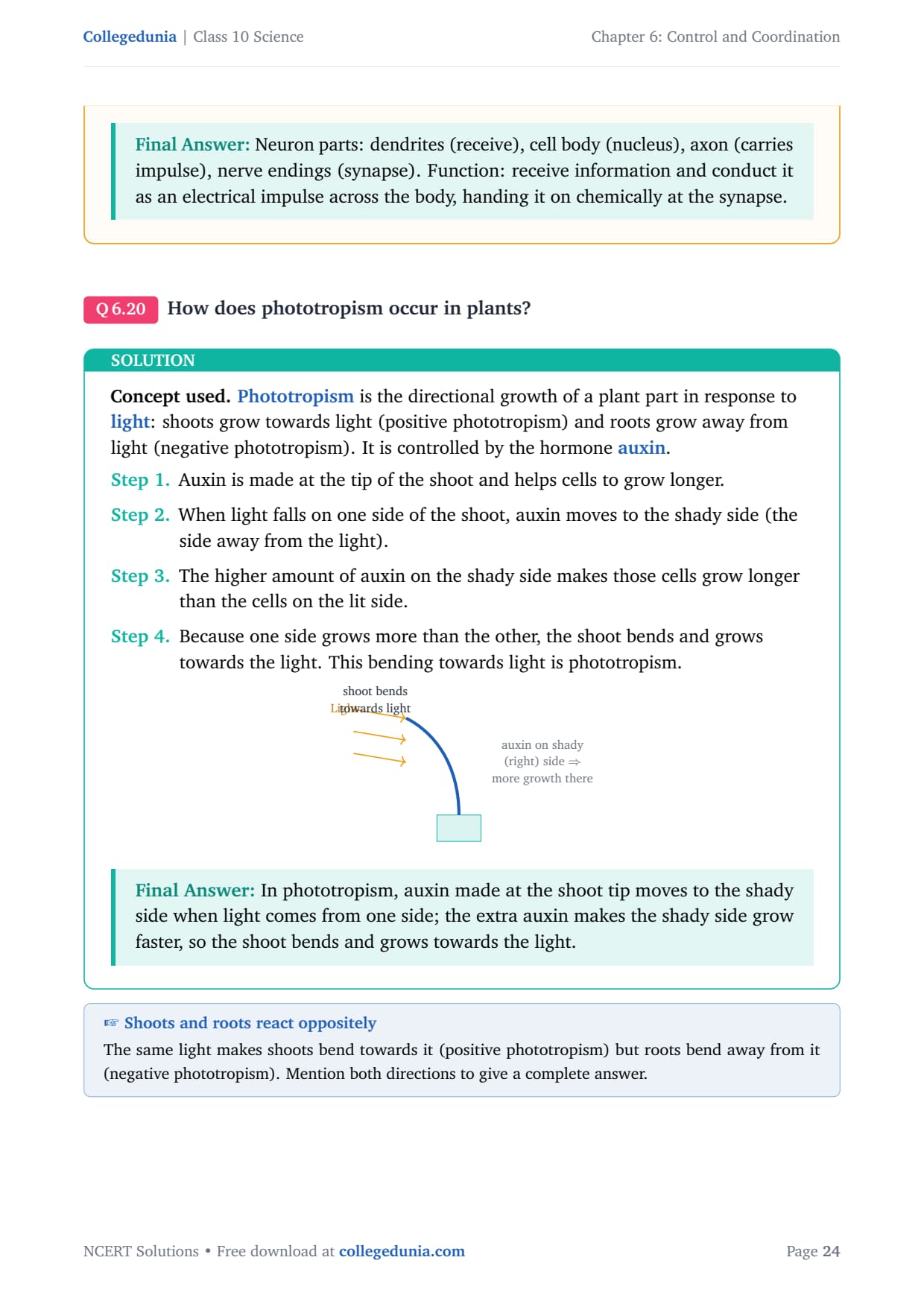
Phototropism is the directional growth of a plant part in response to light: shoots grow towards light (positive) and roots grow away from light (negative). It is controlled by the hormone auxin.
Auxin is made at the tip of the shoot and helps cells grow longer.
When light falls on one side, auxin moves to the shady side.
The extra auxin on the shady side makes those cells grow longer than the cells on the lit side.
Because one side grows more, the shoot bends and grows towards the light. This is phototropism.
Answer: In phototropism, auxin made at the shoot tip moves to the shady side when light comes from one side; the extra auxin makes the shady side grow faster, so the shoot bends towards the light.
DN
Deepa Nair
M.Sc Botany, Kerala University
Verified Expert
Always state where auxin gathers and why it bends: auxin shifts to the shady side, that side grows more, so the shoot bends towards light. "The plant grows towards light" alone misses the mechanism.
This is the same auxin gradient that coils a tendril around a support, so the two answers reinforce each other.
Shoots and roots react oppositely: shoots bend towards light (to reach sunlight), roots bend away (to stay in the soil).
The plant turns a one-sided light source into one-sided growth with no eyes and no nerves, just a hormone moving to the darker side.
Answer: Phototropism: auxin gathers on the shady side of the shoot, making that side grow faster, so the shoot bends towards the light.
Q 21
Which signals will get disrupted in case of a spinal cord injury?
The spinal cord is the main pathway that carries messages between the body and the brain, and it forms the reflex arcs. So an injury to the spinal cord breaks these pathways.
All nerves from the body pass through the spinal cord on their way to and from the brain.
Sensory signals going from the body up to the brain (touch, pain, temperature) get disrupted.
Motor signals (instructions) going from the brain down to the muscles also get disrupted, so the affected muscles cannot move properly.
The reflex arcs that pass through the injured part are broken too, so reflexes in that region are lost.
Answer: A spinal cord injury disrupts the signals passing between the body and the brain, the sensory signals going up and the motor signals coming down, as well as the reflexes handled by the injured part.
ARo
Dr. Anand Rao
Ph.D Physiology, Osmania University
Verified Expert
Name both directions of traffic: sensory signals heading up to the brain and motor signals heading down to the muscles, plus the reflexes that loop through the cord.
The loss usually affects the body below the level of the injury, because the pathways above remain connected to the brain.
This explains why an injury low in the back affects the legs while the arms may still work.
Seeing the spinal cord as a two-way cable, with damage cutting everything below the break, turns a vague answer into a precise one.
Answer: The sensory signals going to the brain and the motor signals coming from it (and the reflexes through that region) get disrupted by a spinal cord injury.
Q 22
How does chemical coordination occur in plants?
Plants have no nervous system, so they coordinate only by chemical means, using plant hormones (phytohormones). These are made in one part of the plant and move to another part to bring about the response.
When a plant detects a stimulus (light, gravity or touch), its cells make a suitable plant hormone.
The hormone is made at one place but acts at another, so it diffuses to where it is needed.
There the hormone changes the growth of cells, for example making them grow longer, which coordinates the response.
Examples: auxin bends shoots to light; gibberellin and cytokinin promote growth; abscisic acid stops growth and causes wilting.
Answer: Chemical coordination in plants is done by plant hormones (auxin, gibberellin, cytokinin, abscisic acid). They are made in one part of the plant, diffuse to where they are needed, and control growth and responses.
SP
Dr. Sunita Patil
Ph.D Plant Science, University of Mumbai
Verified Expert
Emphasise "made here, acts there": a hormone is produced at one site and acts at a distant site after diffusing. Back it with auxin moving from the shoot tip to cause bending.
Stress that plants lack both nerves and muscles, so chemicals are their only coordinating system.
Contrast with animals: animals have both a fast nervous system and a chemical system, while plants rely on chemicals alone.
That makes plant responses slower but able to reach every cell, which shows you understand why plants manage without nerves.
Answer: Plants coordinate chemically through plant hormones made in one part and acting in another (e.g. auxin); they have no nervous system, so chemicals alone control growth and responses.
Q 23
What is the need for a system of control and coordination in an organism?
The body of a multicellular organism is made of many organs and tissues. For the body to work as one unit, these parts must work together in a controlled way and respond correctly to the environment. This is the job of the control and coordination systems.
An organism must detect changes (stimuli) and respond suitably, for example moving away from danger or towards food.
Different organs do different jobs, so their actions must be coordinated to work smoothly as one whole.
The response to each stimulus must be controlled and appropriate.
Control and coordination also keep internal conditions steady (such as blood sugar) and protect the body. The nervous system and hormones together do this.
Answer: A system of control and coordination lets an organism detect changes and respond suitably, make its organs work together as one unit, give correct controlled responses, and keep its internal conditions steady and protected.
RK
Dr. Rajat Khanna
M.D Physiology, B.Ed
Verified Expert
Give three or four distinct needs, not one repeated: respond to the environment, make organs work together, give appropriate responses, and maintain a steady internal state.
A multicellular body is a team; each organ is specialised, so something must direct them to act in step.
The nervous and hormonal systems are that captain, coordinating the players.
Four clear, different points score better than one idea said in four ways, and framing it as "teamwork between specialised parts" ties the chapter together.
Answer: Control and coordination let an organism sense and respond to its environment, make its organs act together, give correct controlled responses, and keep internal conditions stable.
Q 24
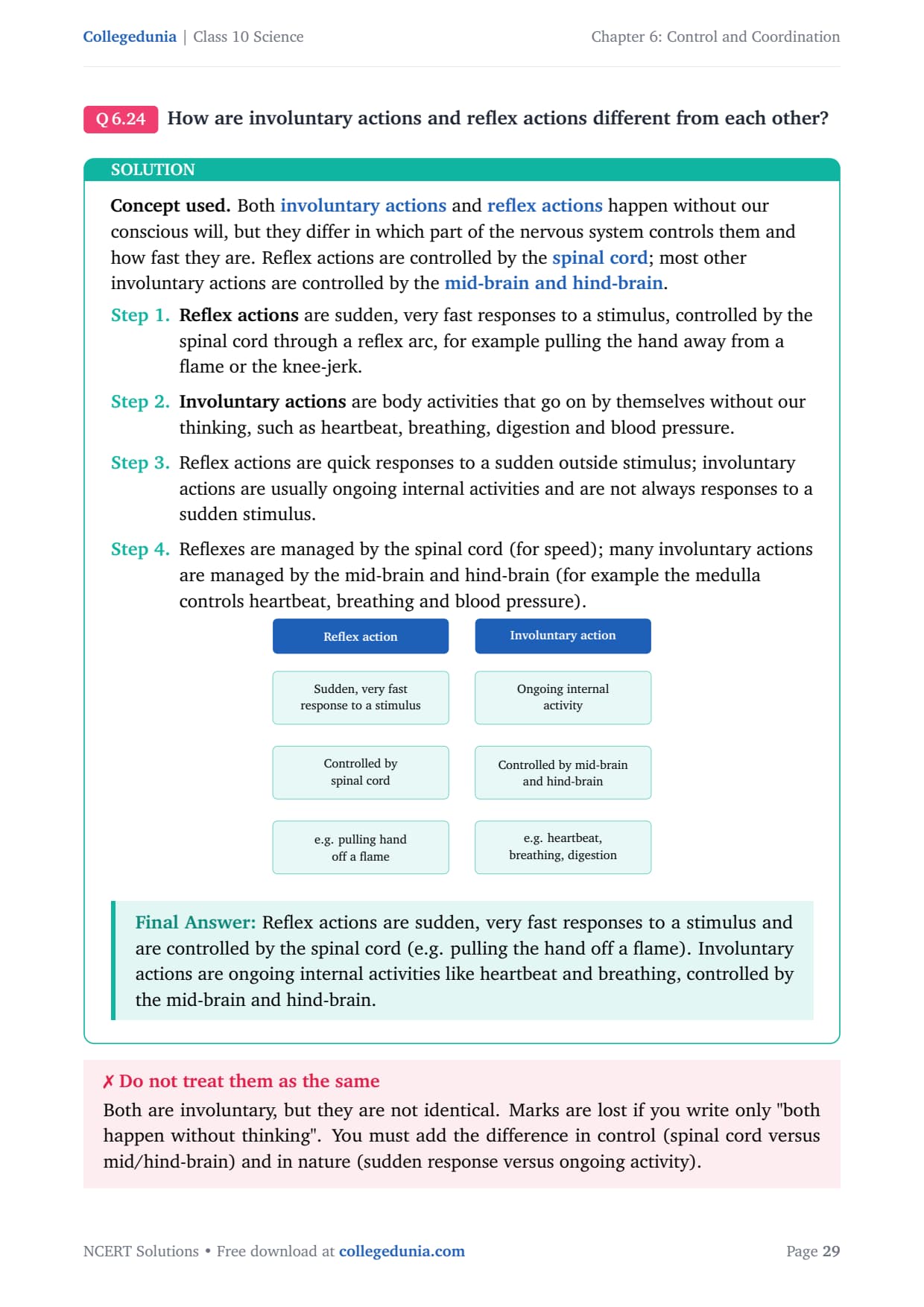
How are involuntary actions and reflex actions different from each other?
Both involuntary actions and reflex actions happen without our conscious will, but they differ in which part of the nervous system controls them and how fast they are. Reflexes are controlled by the spinal cord; most other involuntary actions are controlled by the mid-brain and hind-brain.
Point
Reflex action
Involuntary action
Nature
Sudden, very fast response to a stimulus
Ongoing internal activity
Control
Spinal cord
Mid-brain and hind-brain
Example
Pulling the hand off a flame
Heartbeat, breathing, digestion
Answer: Reflex actions are sudden, very fast responses controlled by the spinal cord (e.g. pulling the hand off a flame). Involuntary actions are ongoing internal activities like heartbeat and breathing, controlled by the mid-brain and hind-brain.
AB
Dr. Ananya Bose
Ph.D Neuroscience, University of Calcutta
Verified Expert
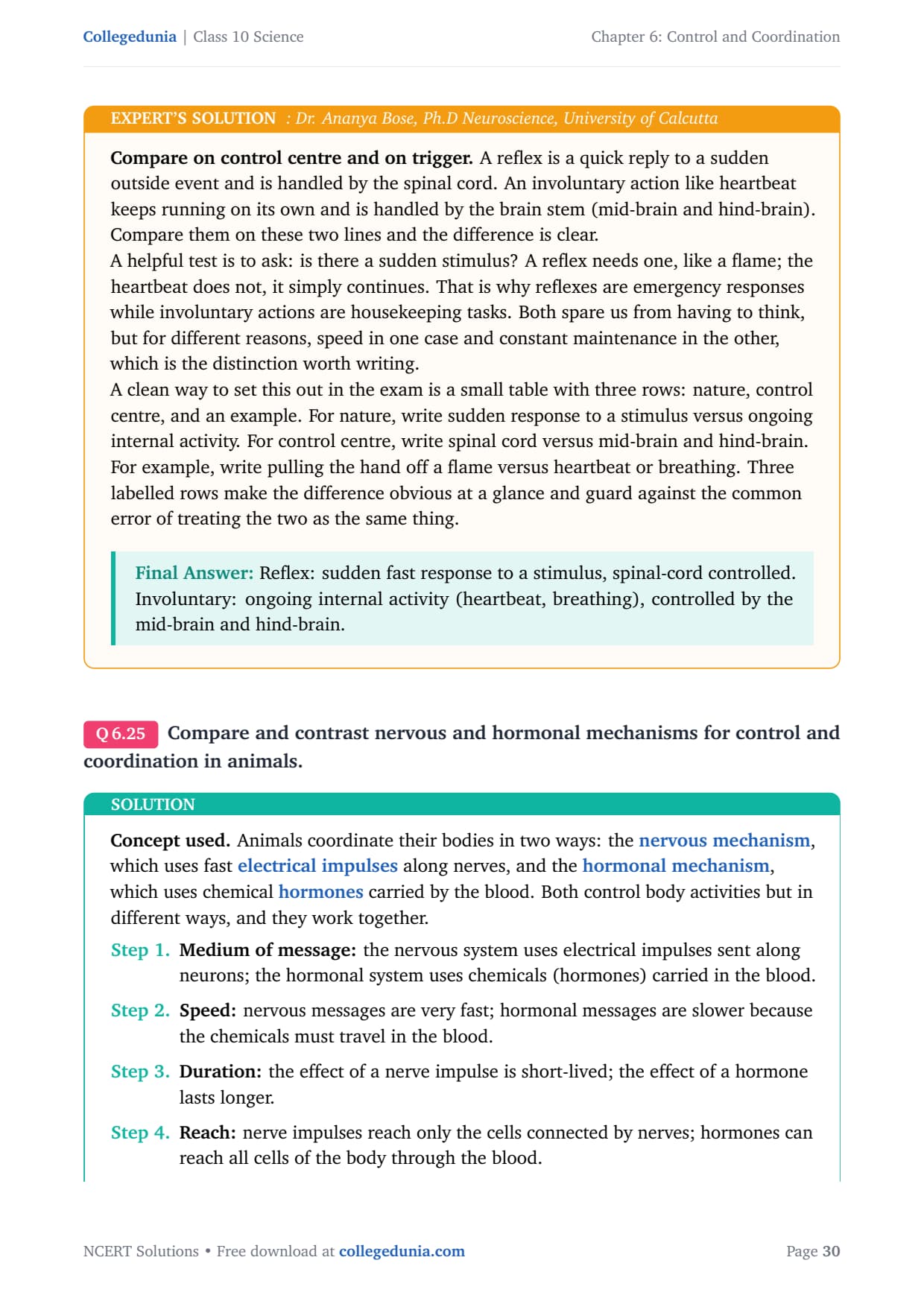
Compare on control centre and on trigger. A reflex is a quick reply to a sudden outside event, handled by the spinal cord. An involuntary action like heartbeat keeps running on its own, handled by the brain stem.
A helpful test is to ask: is there a sudden stimulus? A reflex needs one, like a flame; the heartbeat does not.
So reflexes are emergency responses, while involuntary actions are housekeeping tasks.
Set this out as a small table with three rows, nature, control centre and an example, to guard against treating the two as the same thing.
Answer: Reflex: sudden fast response to a stimulus, spinal-cord controlled. Involuntary: ongoing internal activity, controlled by the mid-brain and hind-brain.
Q 25
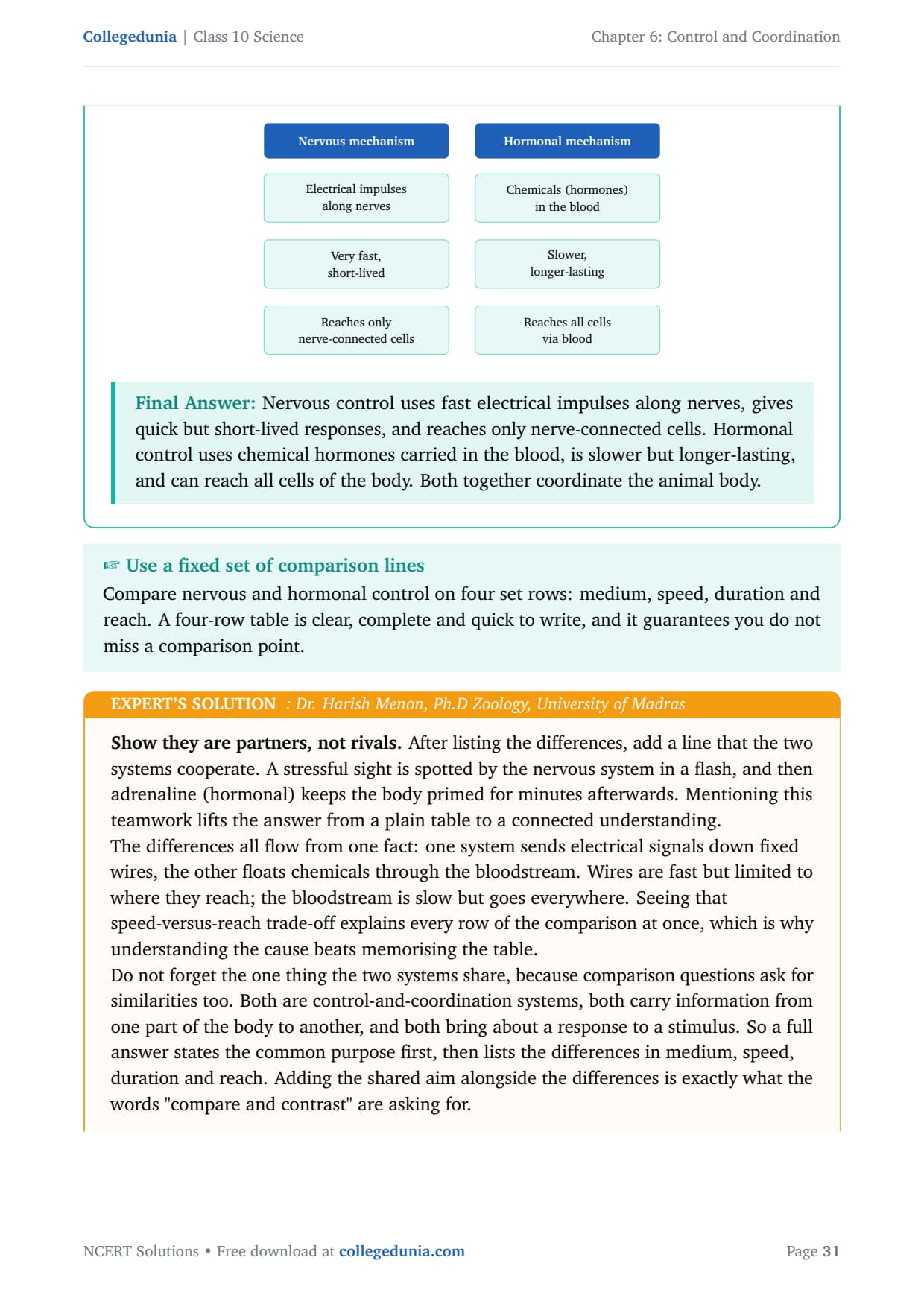
Compare and contrast nervous and hormonal mechanisms for control and coordination in animals.
Animals coordinate their bodies in two ways: the nervous mechanism, which uses fast electrical impulses along nerves, and the hormonal mechanism, which uses chemical hormones carried by the blood. Both control body activities and work together.
Point
Nervous mechanism
Hormonal mechanism
Medium
Electrical impulses along nerves
Chemicals (hormones) in the blood
Speed
Very fast
Slower (travels in blood)
Duration
Short-lived
Longer-lasting
Reach
Only nerve-connected cells
All cells of the body via blood
Answer: Nervous control uses fast electrical impulses, gives quick but short-lived responses, and reaches only nerve-connected cells. Hormonal control uses chemical hormones in the blood, is slower but longer-lasting, and reaches all cells. Both together coordinate the body.
HM
Dr. Harish Menon
Ph.D Zoology, University of Madras
Verified Expert
Show they are partners, not rivals. A stressful sight is spotted by the nervous system in a flash, and then adrenaline keeps the body primed for minutes afterwards.
The differences all flow from one fact: one system sends signals down fixed wires, the other floats chemicals through the bloodstream.
Wires are fast but limited; the bloodstream is slow but goes everywhere. That speed-versus-reach trade-off explains every row.
State the shared purpose too, because "compare and contrast" asks for similarities: both carry information from one part of the body to another and bring about a response.
Answer: Nervous: electrical, fast, short, nerve-limited. Hormonal: chemical, slow, long-lasting, body-wide. The two systems work together.
Q 26
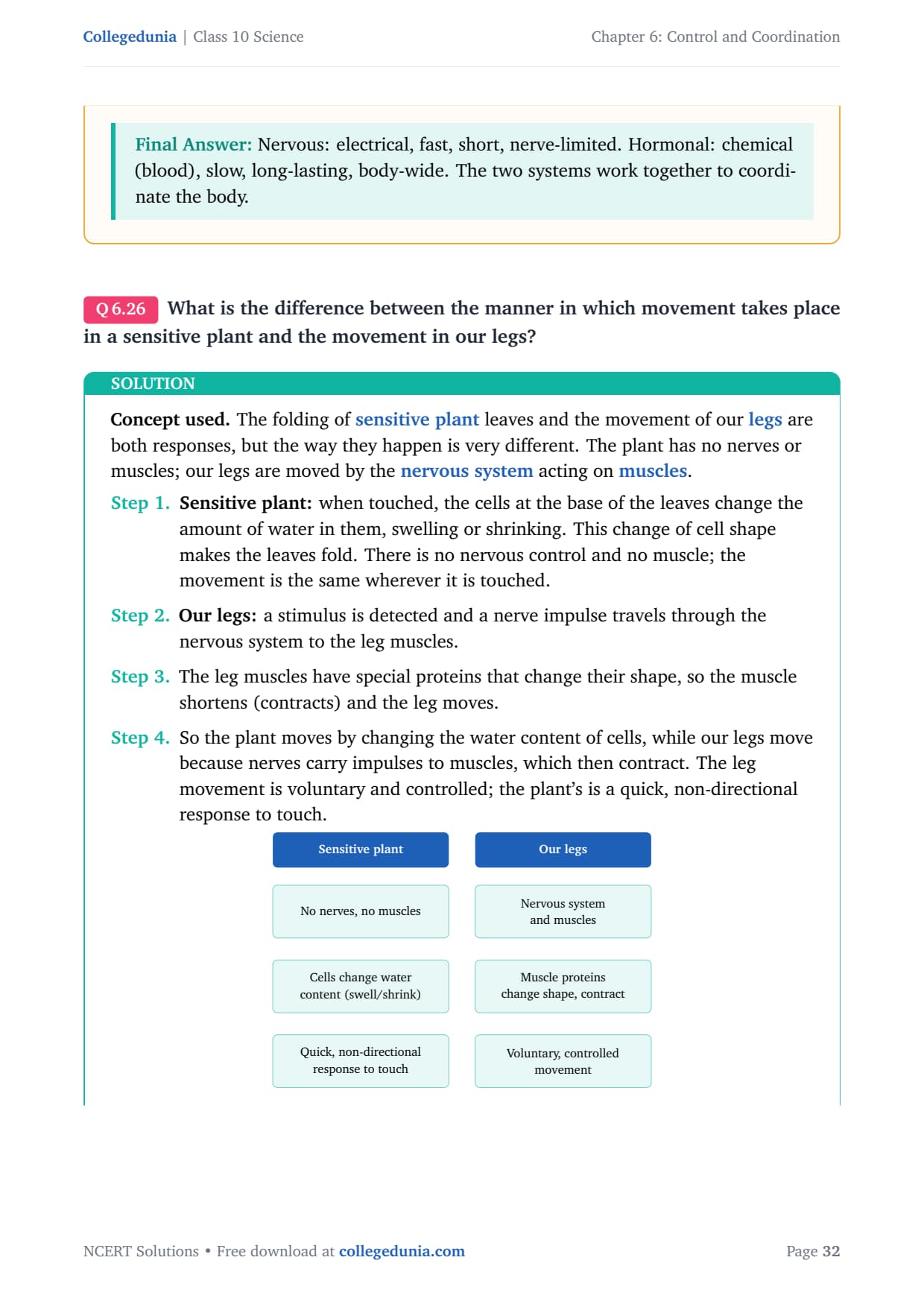
What is the difference between the manner in which movement takes place in a sensitive plant and the movement in our legs?
The folding of sensitive plant leaves and the movement of our legs are both responses, but the way they happen is very different. The plant has no nerves or muscles; our legs are moved by the nervous system acting on muscles.
Point
Sensitive plant
Our legs
Tissue used
No nerves, no muscles
Nervous system and muscles
How cells change
Cells change water content (swell or shrink)
Muscle proteins change shape and contract
Type of response
Quick, non-directional touch response
Voluntary, controlled movement
Answer: In the sensitive plant, leaves move because cells change their water content with no nerves or muscles. Our legs move because nerves carry impulses to leg muscles, whose proteins change shape and contract. The plant's movement is a quick touch response; the leg movement is voluntary and muscle-driven.
GS
Dr. Geeta Sharma
Ph.D Botany, University of Rajasthan
Verified Expert
Focus on the machinery, not just the result. The marks lie in how each is produced: water change in plant cells versus nerve-driven muscle contraction in our legs.
Both rely on cells changing shape, but the plant moves water in and out of cells, while our legs use purpose-built contractile proteins controlled by nerves.
The sensitive plant's fold is the same no matter which way the leaf is touched; our leg movement is planned, with the brain deciding and the cerebellum keeping us balanced.
Set it out on three lines: the tissue used, the way cells change shape, and the kind of response.
Answer: Sensitive plant: cells change water content (no nerves or muscles), quick touch response. Legs: nerves carry impulses to muscles whose proteins contract, giving voluntary movement.
NCERT Solutions Class 10 Science Chapter 6 Control and Coordination FAQs
Ques. How many questions are there in NCERT Class 10 Science Chapter 6 Control and Coordination?
Ans. There are 26 questions in NCERT Class 10 Science Chapter 6 Control and Coordination: 14 in-text questions in the boxes inside the chapter and 12 end-of-chapter exercise questions. All 26 are solved with a step-by-step Check Solution and an Expert Solution. The exercise set includes three MCQs (on the plant hormone, the synapse and brain functions) and long-answer questions on the neuron, phototropism and the comparison of nervous and hormonal control.
Ques. What happens at the synapse between two neurons?
Ans. The synapse is the tiny gap between the axon end of one neuron and the dendrite of the next. A nerve message travels inside a neuron as an electrical impulse, but it cannot cross the gap as electricity. At the synapse the impulse makes the axon end release chemicals, which cross the gap and start a fresh electrical impulse in the next neuron. So the signal goes electrical, then chemical, then electrical again, and it can travel in one direction only.
Ques. What is the difference between a reflex action and walking?
Ans. A reflex action is a sudden, automatic and very fast response that needs no thinking, such as pulling the hand back from a hot plate; it is controlled by the spinal cord through the reflex arc. Walking is a voluntary action that we decide to do on purpose; it is controlled by the fore-brain and uses voluntary muscles. So a reflex is involuntary and spinal-cord controlled, while walking is voluntary and brain controlled.
Ques. Which part of the brain controls posture and balance?
Ans. The cerebellum, a part of the hind-brain, maintains the posture and equilibrium (balance) of the body. It controls the fine coordination of voluntary muscle action, which is why walking in a straight line, riding a bicycle or picking up a pencil is smooth and well balanced. For one mark, write cerebellum and not just hind-brain, because the hind-brain also contains the medulla, which instead controls heartbeat and breathing.
Ques. How does phototropism occur in plants?
Ans. Phototropism is the directional growth of a plant part in response to light, with shoots growing towards light and roots growing away from it. It is controlled by the hormone auxin, made at the shoot tip. When light comes from one side, auxin moves to the shady side; the extra auxin there makes those cells grow longer, so the shoot bends and grows towards the light. The marks are for stating where auxin gathers and why the shoot bends, not just that the plant grows towards light.
Ques. Why is the use of iodised salt advisable?
Ans. The thyroid gland needs the element iodine to make the hormone thyroxin, which controls the body's metabolism. If the diet lacks iodine, the thyroid cannot make enough thyroxin, which disturbs metabolism and can cause goitre, a swelling of the neck. Iodised salt is common salt with iodine added, so it supplies the iodine the thyroid needs, keeps thyroxin levels normal, and prevents goitre.
Ques. How many pages is the Class 10 Science Control and Coordination NCERT Solutions PDF?
Ans. The Control and Coordination NCERT Solutions PDF covers all 26 questions (14 in-text and 12 exercise) with step-by-step Check Solutions, labelled diagrams of the neuron, the synapse, the reflex arc and the shoot bending to light, and an Expert Solution for each question. It is free to download for the 2026-27 session and is built for the CBSE Class 10 board exam.
Ques. Is the NCERT Solutions for Class 10 Science Chapter 6 aligned with the 2026-27 syllabus?
Ans. Yes. This page reflects the current 2026-27 CBSE syllabus for Class 10 Science. Every answer follows the NCERT textbook flow for Control and Coordination, covering the nervous system, reflex action, the human brain, coordination in plants, and hormones in animals. The solutions are written in plain English for board exam students and are useful for both the CBSE board exam and school unit tests.








Comments