The NCERT Solutions for Class 10 Science Chapter 4 Carbon and its Compounds cover all 28 questions (13 in-text and 15 exercise) for the 2026-27 CBSE syllabus, with covalent bonding, catenation, tetravalency, ethanol, ethanoic acid, soaps and detergents.
All 28 NCERT questions solved with electron dot structures, step-by-step working, and an Expert Solution per question.
Full coverage of covalent bonding, functional groups, homologous series, nomenclature, reactions, soaps and detergents tested by CBSE.
Solved by Collegedunia Science Experts
These NCERT Solutions for Class 10 Science Chapter 4 Carbon and its Compounds are checked against the latest 2026-27 NCERT textbook and refined against the last five years of CBSE board papers. Each of the 28 questions gives a Check Solution for the clean board answer and an Expert Solution for extra marks.
Question-wise Breakdown of the Carbon and its Compounds NCERT Solutions
Chapter 4 has 13 in-text questions and 15 exercise questions, 28 in all. The table maps each group to its topic, answer style and typical mark weight.
Questions
Topic covered
Answer style
Typical marks
In-text Q 1, 2, 5
Dot structures of CO2, S8, cyclopentane
Dot structure with lone pairs
2-3 marks
In-text Q 3, 4
Isomers of pentane, catenation, tetravalency
Structures or two properties
2-3 marks
In-text Q 6, 7
Naming compounds from functional groups
Structure or name
3 marks
In-text Q 8 to 13
Oxidation, soaps, detergents, micelles
Reason with equation or test
2-3 marks
Q 14, 15, 16
MCQs on ethane, butanone, blackened vessel
Option with one-line reason
1 mark
Q 17, 18, 19
Covalent bond in CH3Cl, homologous series
Definition with structure
3-5 marks
Q 20 to 28
Ethanol vs ethanoic acid, scum, hydrogenation
Reason or test with example
2-3 marks
Covalent Bonding and Electron Dot Structures in Carbon Compounds
A covalent bond forms when two atoms share an electron pair to complete their outer shell (the octet rule). Carbon has 4 outer electrons, so it shares 4 pairs and is tetravalent. Bonding by sharing forms no ions, so most carbon compounds are poor conductors with low melting points.
Single, double, triple bonds: one, two or three shared pairs. CO2 is O=C=O.
Lone pairs matter: oxygen, sulphur and fluorine carry lone pairs that must appear in the dot structure.
Bonds per atom equals valency: carbon 4, oxygen 2, hydrogen 1.
Tetravalency and Catenation: Why Carbon Forms So Many Compounds
Two properties explain the millions of carbon compounds: tetravalency (carbon forms four bonds) and catenation (carbon atoms link into chains, branches and rings).
Catenation: small carbon makes strong C-C bonds, so chains run to thousands of atoms.
Tetravalency: four bonding points let many atoms (H, O, N, S, Cl) attach.
Saturated vs unsaturated: alkanes (CnH2n+2) have only single bonds; unsaturated compounds have a C=C or C≡C bond and undergo addition.
Functional Groups, Homologous Series and Nomenclature
A functional group is the reactive part of a molecule and decides its chemistry. A homologous series is a family with the same general formula and functional group, where members differ by a -CH2- unit (14 u).
Functional group
Formula
Suffix or prefix
Example
Alcohol
-OH
-ol
Ethanol
Aldehyde
-CHO
-al
Methanal
Ketone
C=O (inside chain)
-one
Propanone
Carboxylic acid
-COOH
-oic acid
Ethanoic acid
Halogen
-Cl, -Br
chloro-, bromo-
Bromoethane
To name a compound, count the longest chain for the root (meth-, eth-, prop-, but-, pent-, hex-), then add the prefix or suffix, dropping the final "e" before a vowel (ethane to ethanol).
Oxidation, Combustion, Addition and Substitution Reactions
Carbon compounds take part in four reaction types.
Combustion: oxidation in air. Complete gives a blue flame; incomplete gives a sooty flame.
Oxidation: ethanol becomes ethanoic acid with alkaline KMnO4 or acidified K2Cr2O7.
Addition: unsaturated compounds add across a multiple bond. Hydrogenation with nickel turns oils into vanaspati ghee.
Substitution: alkanes replace a hydrogen with chlorine in sunlight.
The bromine water test separates them: an unsaturated hydrocarbon decolourises bromine water; a saturated one does not.
Ethanol, Ethanoic Acid, Soaps and Detergents
Ethanol is a neutral alcohol; ethanoic acid is the acidic active part of vinegar.
Carbonate test: ethanoic acid gives brisk CO2 bubbles with sodium hydrogencarbonate and reddens blue litmus; ethanol gives none.
Soap: the sodium salt of a long-chain carboxylic acid. In water it forms micelles that trap oily dirt.
Hard water: soap forms insoluble scum with calcium and magnesium ions, but detergents do not.
Common Mistakes Students Make in the Carbon and its Compounds Chapter
The repeat-offender mistakes:
Forgetting lone pairs on oxygen, sulphur and fluorine.
Single bonds in CO2: carbon must make two double bonds (O=C=O).
Mixing prefixes and suffixes: halogens are prefixes; alcohol, aldehyde, ketone and acid are suffixes.
Saying detergents form scum: only soap does.
Calling the sodium test distinguishing: both react with sodium; use the carbonate test.
How to Use the Carbon and its Compounds NCERT Solutions PDF for Board Prep
Use two passes. First, practise electron dot structures and naming alcohols, aldehydes, ketones and acids. Second, work the reaction questions, then soap, scum and micelle questions. Dot structures, nomenclature and the cleaning action of soap are CBSE repeat favourites, so practise the bromine water and carbonate tests until they are quick.
Previous Year Question Trends from the Carbon and its Compounds Chapter
The table maps the question types CBSE has asked recently.
Year
Question type asked
Marks
2025
Dot structure of a molecule; define catenation
3 + 1
2024
Cleaning action of soap; soap vs detergent
3 + 2
2023
Name compounds, draw structures; bromine water test
3 + 2
2022
Ethanol to ethanoic acid oxidation; homologous series
2 + 3
2021
Distinguish ethanol and ethanoic acid; hydrogenation
3 + 2
Also Check: The full set of CBSE board paper questions is in the PDF above.
Other Resources for Class 10 Science Chapter 4 Carbon and its Compounds
Pair these solutions with the notes, handwritten notes and NCERT book chapter below.
69% of Class 10 students said drawing electron dot structures and naming compounds was the hardest part of this chapter. 3 out of 5 students told us they lost marks by forgetting the lone pairs on oxygen, sulphur or fluorine in dot structures.
Toppers found that naming the functional group before drawing the structure added 1 to 2 marks on the 3-mark questions, and the average student spent 3 to 4 hours on this chapter across the first read and exercise practice.
Source: 2026-27 Class 10 Science student poll. Sample of 10,200 students from CBSE schools across 14 states, conducted before the 2026 boards.
NCERT Solutions for Class 10 Science: All Chapters
Related Links: NCERT Solutions for the other Class 10 Science chapters.
All NCERT Solutions for Class 10 Science Chapter 4 Carbon and its Compounds with Step-by-Step Solutions
Q 1
What would be the electron dot structure of carbon dioxide which has the formula CO2?
A covalent bond forms when two atoms share a pair of electrons so each completes its outermost shell (the octet rule). Carbon has 4 outer electrons and needs 4 more, so it is tetravalent. Oxygen has 6 outer electrons and needs 2 more.
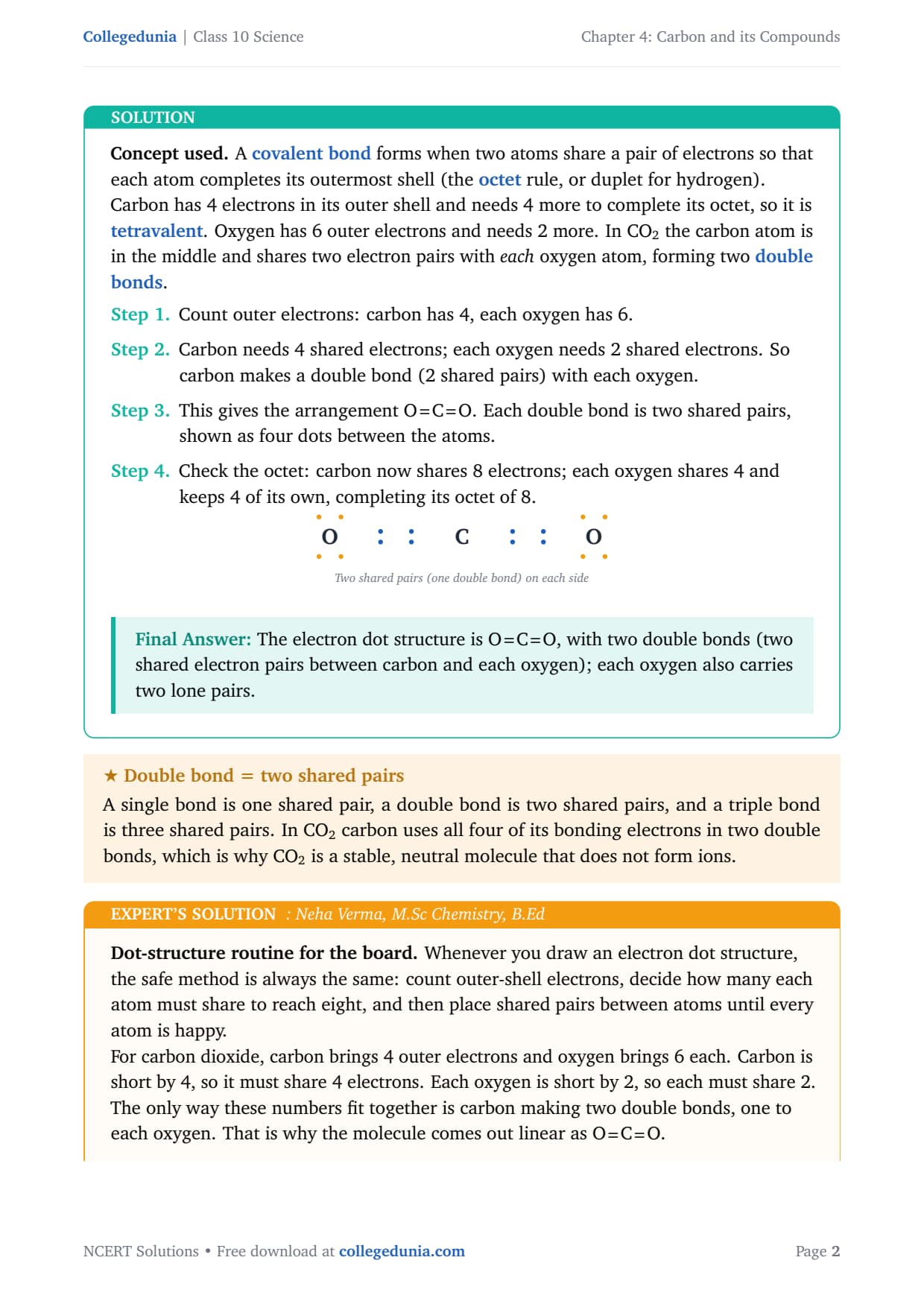
Carbon sits in the middle and shares two electron pairs with each oxygen atom, making two double bonds.
The arrangement is O=C=O; each double bond is two shared pairs, shown as four dots between the atoms.
Check the octet: carbon now shares 8 electrons; each oxygen shares 4 and keeps 4 of its own, completing its octet of 8.
Each oxygen also carries two lone pairs.
Answer: The electron dot structure is O=C=O with two double bonds (two shared electron pairs between carbon and each oxygen); each oxygen carries two lone pairs.
NV
Neha Verma
M.Sc Chemistry, B.Ed
Verified Expert
Dot-structure routine for the board. Whenever you draw an electron dot structure, use the same method: count outer-shell electrons, decide how many each atom must share to reach eight, then place shared pairs until every atom is happy.
Carbon brings 4 outer electrons and oxygen brings 6 each. Carbon is short by 4, so it must share 4 electrons. Each oxygen is short by 2, so each must share 2. The only way these numbers fit is carbon making two double bonds, one to each oxygen, so the molecule comes out linear as O=C=O.
Confirm by counting electrons around each atom after bonding. Carbon shows 8 shared electrons (two double bonds). Each oxygen shows 4 shared electrons in its double bond plus 4 of its own as two lone pairs, again making 8. Students lose marks when they forget the lone pairs on oxygen, so always add those two dot-pairs on each oxygen.
Answer: Carbon dioxide is O=C=O: two carbon-oxygen double bonds, each oxygen with two lone pairs, every atom completing its octet.
Q 2
What would be the electron dot structure of a molecule of sulphur which is made up of eight atoms of sulphur? (Hint: the eight atoms of sulphur are joined together in the form of a ring.)
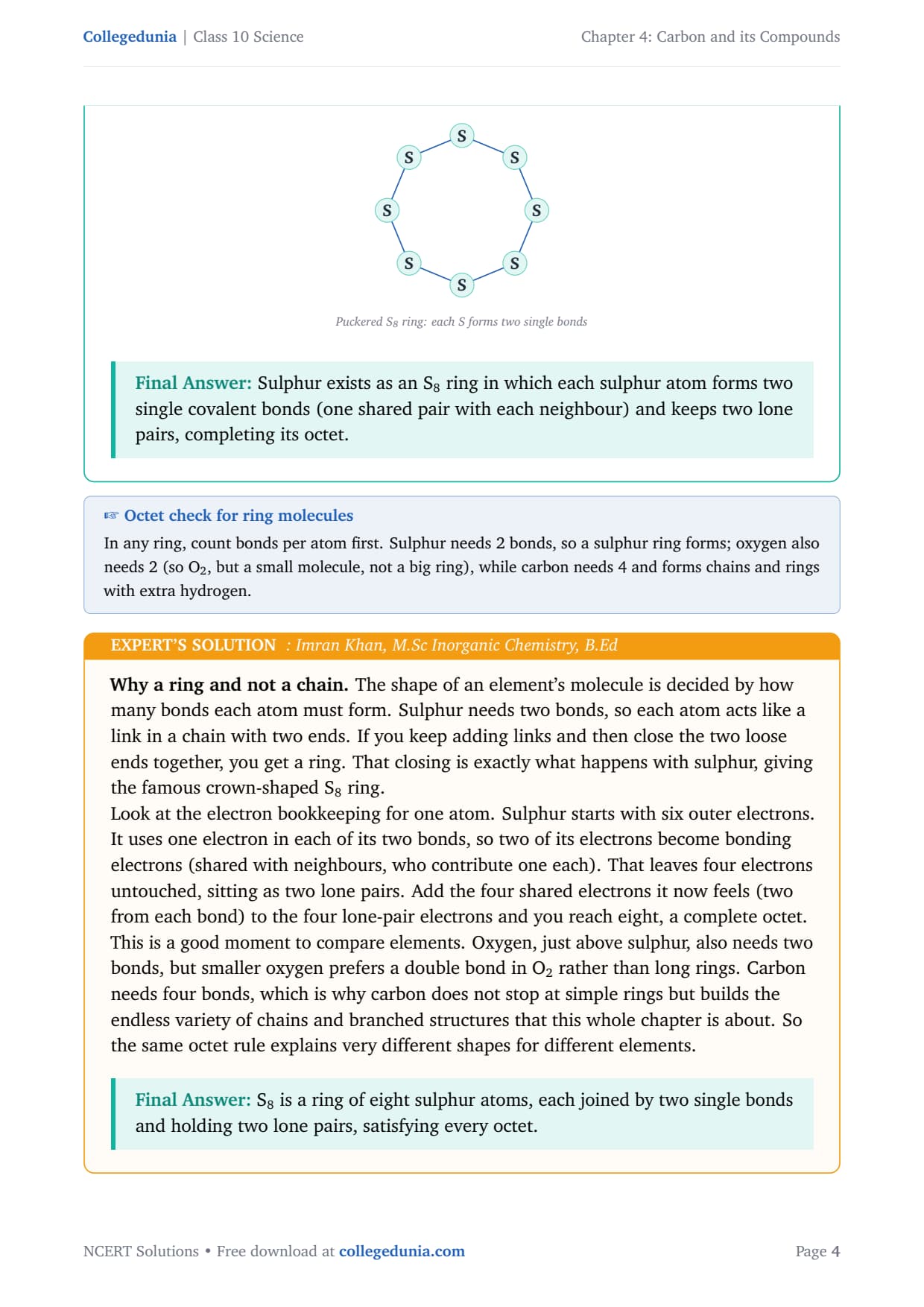
Sulphur is in group 16, so each sulphur atom has 6 electrons in its outermost shell and needs 2 more to complete its octet. To get those 2 electrons, every sulphur atom forms two single covalent bonds, one to each neighbour.
Eight sulphur atoms link into a closed ring (S8), each atom bonded to two others.
Each sulphur uses 2 of its electrons in bonding and keeps the remaining 4 as two lone pairs.
Check: 2 shared electrons on each side give 4, plus 4 lone-pair electrons, completing the octet of 8 for every atom.
Answer: Sulphur exists as an S8 ring in which each sulphur atom forms two single covalent bonds (one shared pair with each neighbour) and keeps two lone pairs, completing its octet.
IK
Imran Khan
M.Sc Inorganic Chemistry, B.Ed
Verified Expert
Why a ring and not a chain. The shape of an element's molecule is decided by how many bonds each atom must form. Sulphur needs two bonds, so each atom acts like a link in a chain with two ends. Close the two loose ends together and you get a ring, which is exactly the crown-shaped S8 ring.
Look at the electron bookkeeping for one atom. Sulphur starts with six outer electrons. It uses one electron in each of its two bonds, so two of its electrons become bonding electrons. That leaves four electrons as two lone pairs. Add the four shared electrons it now feels to the four lone-pair electrons and you reach eight, a complete octet.
Compare elements to see the pattern. Oxygen, just above sulphur, also needs two bonds but prefers a double bond in O2 rather than long rings. Carbon needs four bonds, which is why it builds the endless chains this whole chapter is about. The same octet rule explains very different shapes.
Answer:S8 is a ring of eight sulphur atoms, each joined by two single bonds and holding two lone pairs, satisfying every octet.
Q 3
How many structural isomers can you draw for pentane?
Structural isomers are compounds that have the same molecular formula but different arrangements of atoms. Pentane has the molecular formula C5H12. By arranging the five carbon atoms as a straight chain or branched chains, we get different structures, all still C5H12.
n-pentane (straight chain): all five carbons in one line, CH3-CH2-CH2-CH2-CH3.
iso-pentane (2-methylbutane): a four-carbon chain with one -CH3 branch on the second carbon.
neo-pentane (2,2-dimethylpropane): a three-carbon chain with two -CH3 branches on the middle carbon.
No other arrangement keeps the formula C5H12, so there are exactly three.
Answer: Pentane has three structural isomers: n-pentane, iso-pentane (2-methylbutane) and neo-pentane (2,2-dimethylpropane).
AN
Anjali Nair
M.Sc Organic Chemistry, B.Ed
Verified Expert
A systematic way to find isomers. Drawing isomers by guesswork leads to repeats or misses. A safer routine is to work down from the longest carbon chain to shorter ones, attaching the leftover carbons as branches.
For pentane you have five carbons. First put all five in a straight line, which is n-pentane. Next make the main chain four carbons long and use the fifth carbon as a methyl branch. The branch can only sit on the second carbon, giving iso-pentane. Finally make the main chain three carbons long and hang both extra carbons on the central carbon, giving neo-pentane.
A point students forget is that the same structure drawn flipped or rotated is not a new isomer. n-Pentane written left to right is the same as written right to left. So even though there seem to be many drawings, only three are genuinely different arrangements of atoms. Three is the correct and complete answer for pentane.
Answer: Three structural isomers of pentane: n-pentane, iso-pentane (2-methylbutane) and neo-pentane (2,2-dimethylpropane).
Q 4
What are the two properties of carbon which lead to the huge number of carbon compounds we see around us?
Carbon forms a very large number of compounds because of two special properties: catenation (the ability of carbon atoms to bond with one another) and tetravalency (carbon has a valency of four).
Catenation: carbon atoms join to other carbon atoms by strong covalent bonds to form long straight chains, branched chains and rings. The carbon atom is small, so it holds the shared electrons tightly and the bonds are strong.
Tetravalency: carbon has four electrons in its outer shell, so it can form four covalent bonds with hydrogen, oxygen, nitrogen, sulphur, chlorine and with carbon itself.
Together, catenation builds the carbon backbone and tetravalency lets many different atoms attach to it, so the number of possible compounds becomes enormous.
Answer: The two properties are catenation (carbon links to other carbon atoms forming chains, branches and rings) and tetravalency (carbon forms four covalent bonds).
RS
Rohit Sharma
M.Sc Chemistry, B.Ed
Verified Expert
Two ideas that multiply together. The key to this answer is seeing how the two properties combine, not just listing them. Catenation decides how big and varied the carbon skeleton can be, while tetravalency decides how richly that skeleton can be decorated with other atoms. Multiply the two and you get millions of carbon compounds.
Catenation is special to carbon because its carbon-carbon bond is strong and stable. The carbon atom is small, so the shared electrons sit close to both nuclei and are held firmly. This lets carbon make chains of two, ten, or even thousands of atoms, and also rings, without the structure falling apart.
Tetravalency means every carbon offers four hands for bonding. On a long chain, the inner carbons use two hands to continue the chain and have two more free for hydrogen or other atoms. This is why the same carbon skeleton can carry many different functional groups, giving alcohols, acids, aldehydes and so on.
Answer: Catenation (self-linking into chains and rings) and tetravalency (four covalent bonds) together produce the huge number of carbon compounds.
Q 5
What will be the formula and electron dot structure of cyclopentane?
Cyclopentane is a cyclic (ring) saturated hydrocarbon. "Cyclo" means the carbon atoms are joined in a closed ring, and "pentane" tells us there are five carbon atoms. In a ring, each carbon uses two of its four bonds to join its two neighbouring carbons, so the remaining two bonds on each carbon are taken by hydrogen atoms.
Five carbon atoms join in a ring; each carbon is bonded to two other carbons.
Each carbon's two remaining bonds hold two hydrogen atoms, so each carbon carries a CH2 group.
Total hydrogens = 5 × 2 = 10, so the molecular formula is C5H10.
In the electron dot structure each bond is a shared pair: the five C-C bonds form the ring and every carbon shares one pair with each of its two hydrogens.
Answer: Cyclopentane has the molecular formula C5H10: a five-carbon ring where each carbon (a CH2 group) is single-bonded to two neighbouring carbons and to two hydrogen atoms.
SA
Sania Ahmed
M.Sc Chemistry, B.Ed
Verified Expert
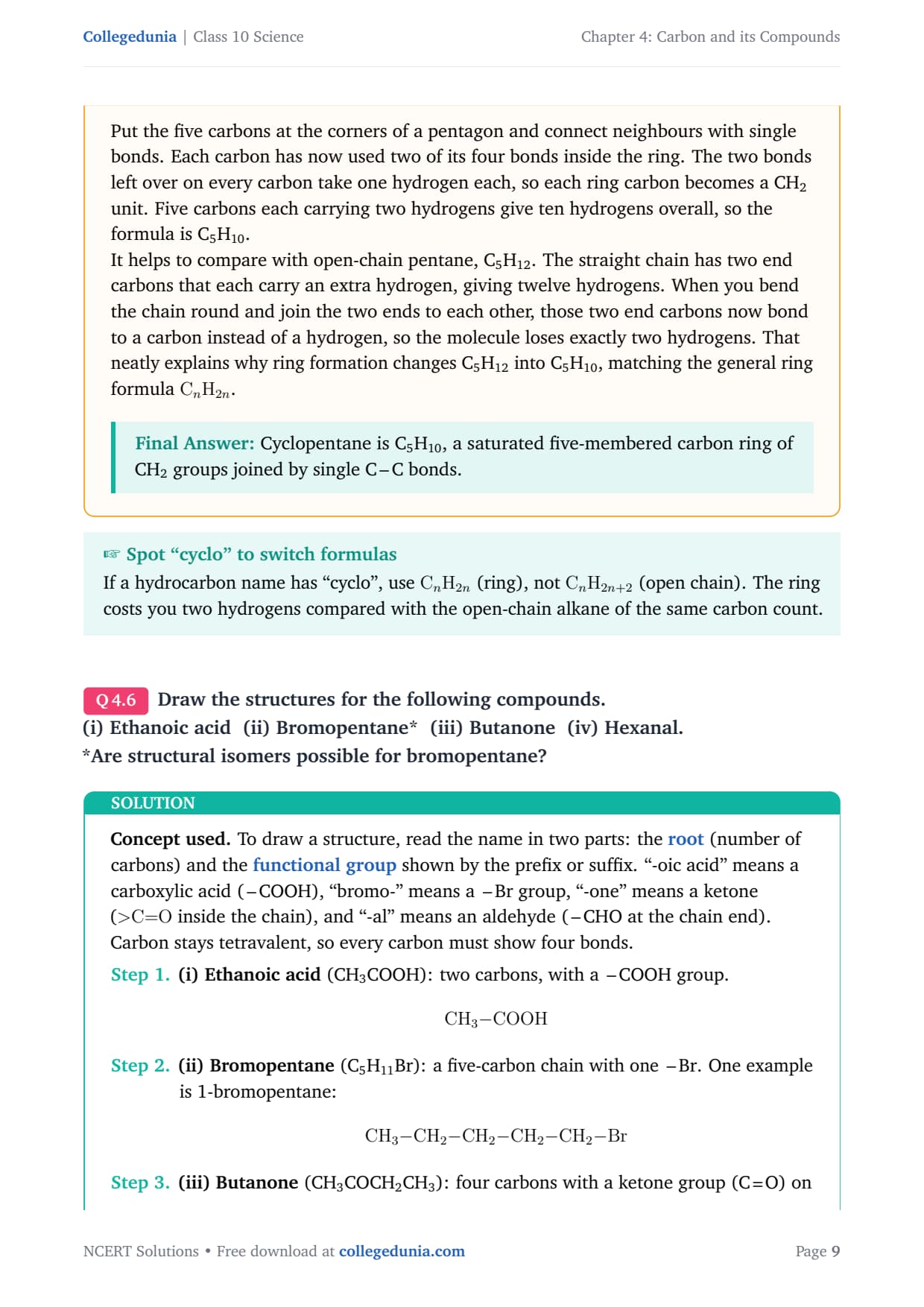
Reading the name to build the molecule. The name cyclopentane carries all the information you need. "Pent" fixes five carbons, "ane" tells you the ring is saturated, and "cyclo" tells you those five carbons form a closed loop.
Put the five carbons at the corners of a pentagon and connect neighbours with single bonds. Each carbon has now used two of its four bonds inside the ring. The two bonds left over on every carbon take one hydrogen each, so each ring carbon becomes a CH2 unit. Five carbons each carrying two hydrogens give ten hydrogens, so the formula is C5H10.
Compare with open-chain pentane, C5H12. When you bend the chain round and join the two ends, those two end carbons now bond to a carbon instead of a hydrogen, so the molecule loses exactly two hydrogens. That explains the general ring formula CnH2n.
Answer: Cyclopentane is C5H10, a saturated five-membered carbon ring of CH2 groups joined by single bonds.
Q 6
Draw the structures for the following compounds.
(i) Ethanoic acid (ii) Bromopentane* (iii) Butanone (iv) Hexanal. *Are structural isomers possible for bromopentane?
To draw a structure, read the name in two parts: the root (number of carbons) and the functional group shown by the prefix or suffix. "-oic acid" means a carboxylic acid (-COOH), "bromo-" means a -Br group, "-one" means a ketone, and "-al" means an aldehyde. Carbon stays tetravalent.
(i) Ethanoic acid:CH3-COOH (two carbons, with a -COOH group).
(ii) Bromopentane: a five-carbon chain with one -Br, e.g. 1-bromopentane CH3-CH2-CH2-CH2-CH2-Br.
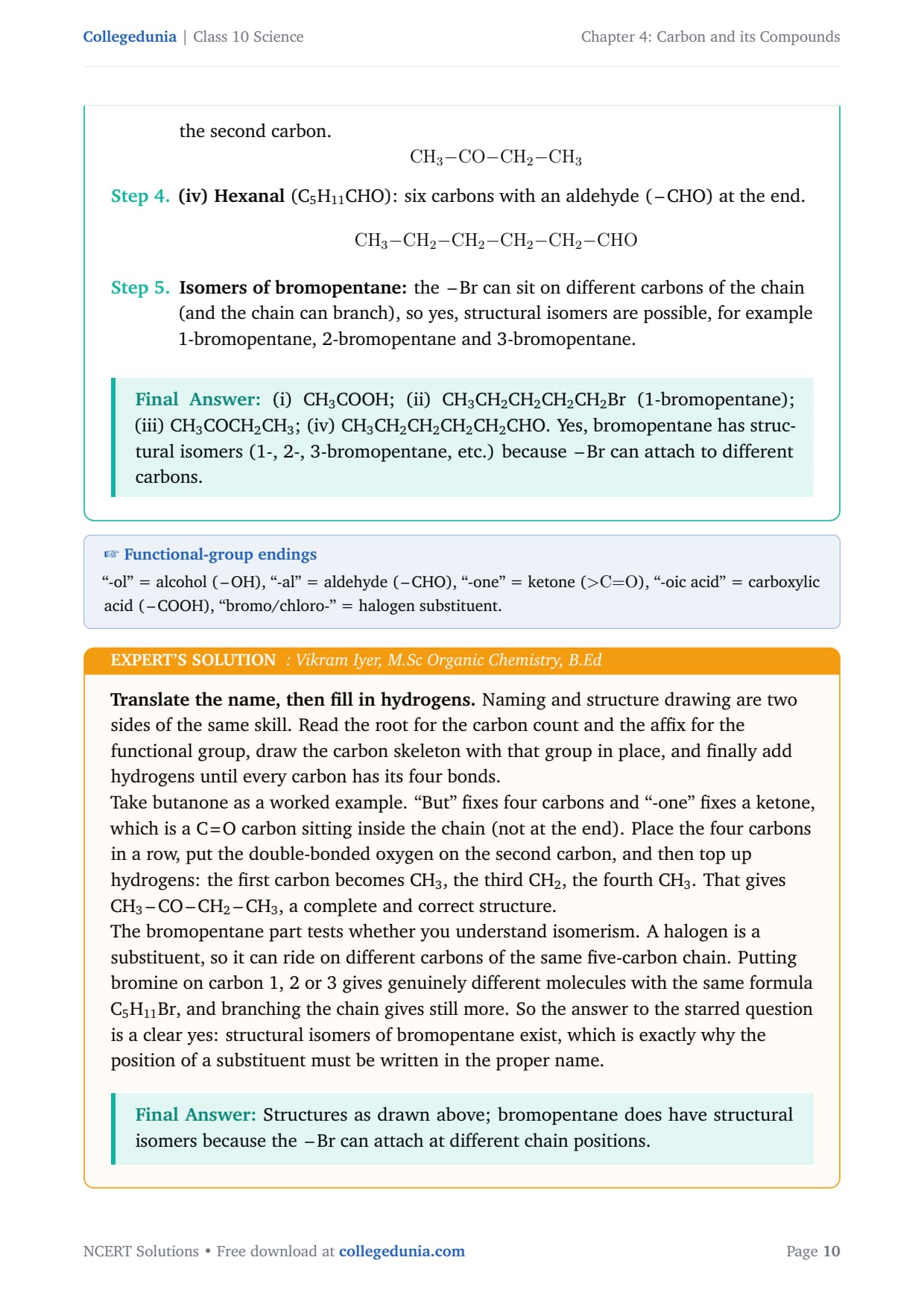
(iii) Butanone:CH3-CO-CH2-CH3 (four carbons, ketone on the second carbon).
(iv) Hexanal:CH3-CH2-CH2-CH2-CH2-CHO (six carbons, aldehyde at the end).
Isomers of bromopentane: yes. The -Br can sit on different carbons (1-, 2-, 3-bromopentane), so structural isomers are possible.
Answer: Structures as above; bromopentane does have structural isomers because the -Br can attach at different chain positions.
VI
Vikram Iyer
M.Sc Organic Chemistry, B.Ed
Verified Expert
Translate the name, then fill in hydrogens. Read the root for the carbon count and the affix for the functional group, draw the carbon skeleton with that group in place, then add hydrogens until every carbon has its four bonds.
Take butanone as a worked example. "But" fixes four carbons and "-one" fixes a ketone, a C=O carbon sitting inside the chain. Place the four carbons in a row, put the double-bonded oxygen on the second carbon, then top up hydrogens to give CH3-CO-CH2-CH3.
The bromopentane part tests isomerism. A halogen is a substituent, so it can ride on different carbons of the same chain. Putting bromine on carbon 1, 2 or 3 gives different molecules with the same formula C5H11Br, so the answer to the starred question is a clear yes.
Answer: Structures as drawn; bromopentane has structural isomers because the -Br can attach at different positions.
Q 7
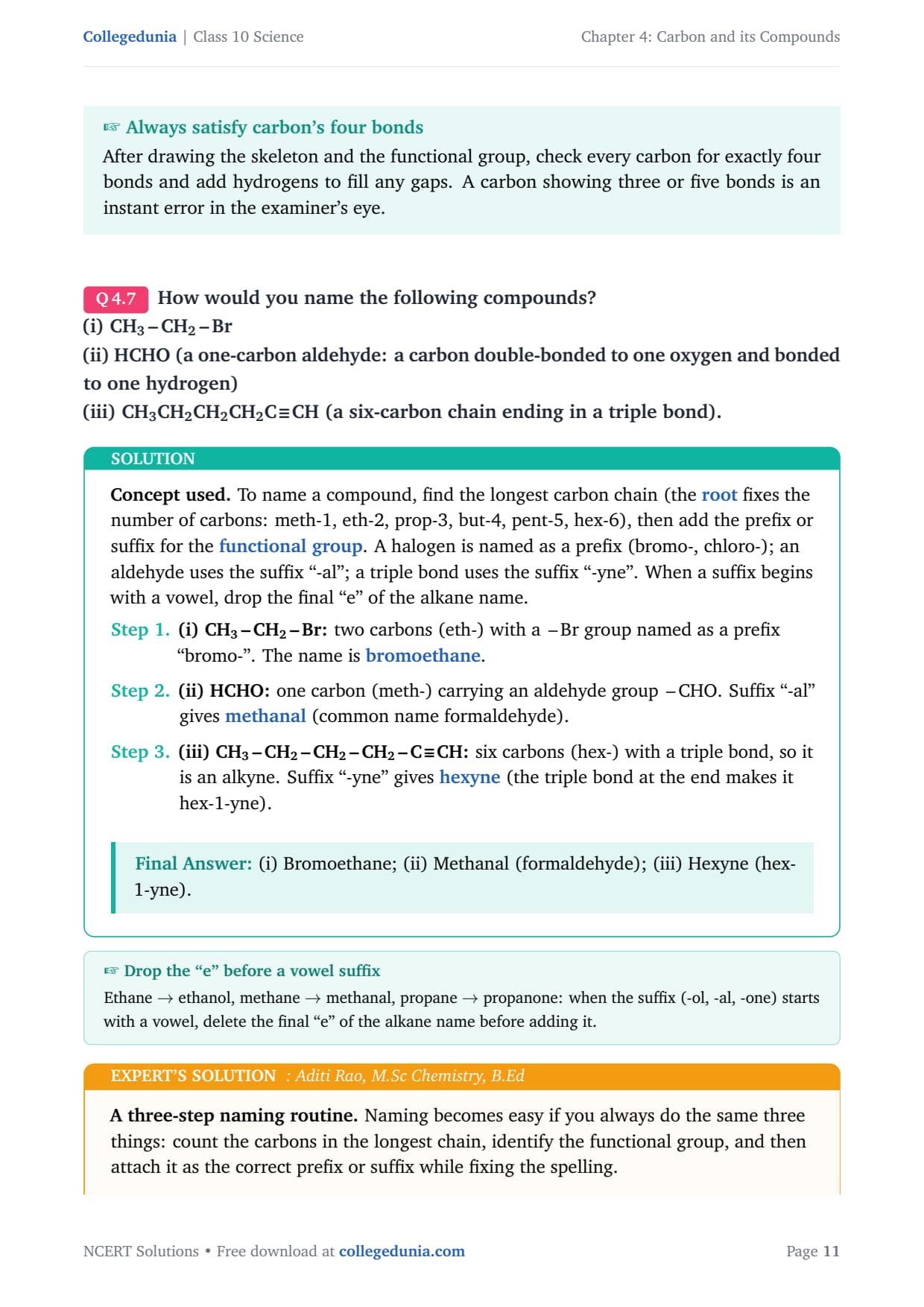
How would you name the following compounds?
(i) CH3-CH2-Br (ii) HCHO (a one-carbon aldehyde) (iii) CH3-CH2-CH2-CH2-C≡CH (a six-carbon chain ending in a triple bond).
To name a compound, find the longest carbon chain (the root fixes the number of carbons: meth-1, eth-2, prop-3, but-4, pent-5, hex-6), then add the prefix or suffix for the functional group. A halogen is a prefix (bromo-); an aldehyde uses "-al"; a triple bond uses "-yne". When a suffix begins with a vowel, drop the final "e".
(i) Two carbons (eth-) with a -Br prefix: bromoethane.
(ii) One carbon (meth-) with an aldehyde group, suffix "-al": methanal (formaldehyde).
(iii) Six carbons (hex-) with a triple bond, suffix "-yne": hexyne (hex-1-yne).
Answer: (i) Bromoethane; (ii) Methanal (formaldehyde); (iii) Hexyne (hex-1-yne).
AR
Aditi Rao
M.Sc Chemistry, B.Ed
Verified Expert
A three-step naming routine. Always do the same three things: count the carbons in the longest chain, identify the functional group, then attach it as the correct prefix or suffix while fixing the spelling.
Step one is the carbon count. Memorise the first six: meth (1), eth (2), prop (3), but (4), pent (5), hex (6). For CH3-CH2-Br the chain is two carbons (eth), for HCHO just one (meth), and the last compound is six carbons (hex).
Step two is the group: bromine is the prefix "bromo", an aldehyde uses "-al", a triple bond uses "-yne". Step three is to combine and tidy the spelling, dropping the final "e" before a vowel suffix. That gives bromoethane, methanal and hexyne.
Answer: (i) Bromoethane, (ii) Methanal, (iii) Hexyne.
Q 8
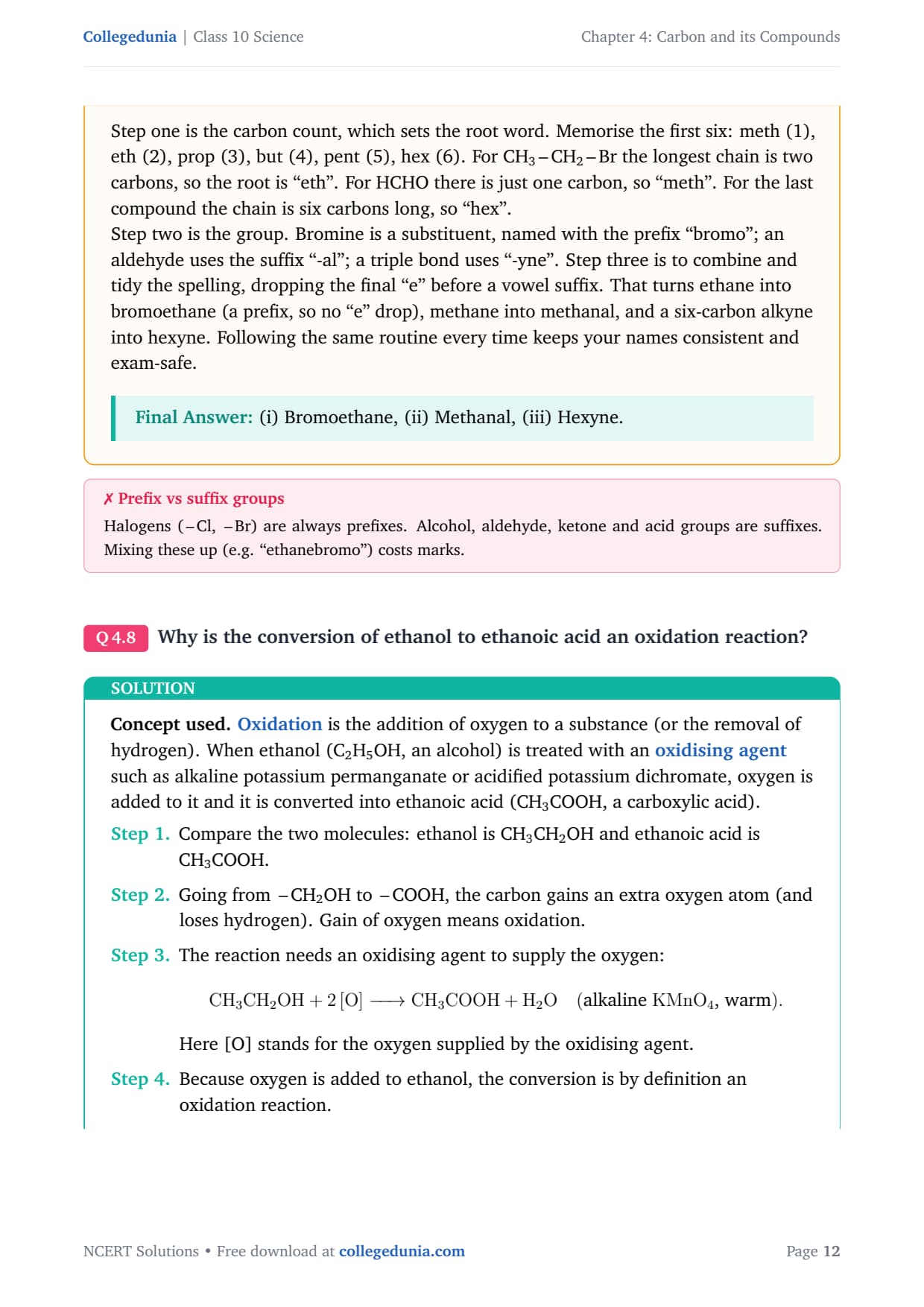
Why is the conversion of ethanol to ethanoic acid an oxidation reaction?
Oxidation is the addition of oxygen to a substance (or the removal of hydrogen). When ethanol (C2H5OH) is treated with an oxidising agent such as alkaline potassium permanganate, oxygen is added and it is converted into ethanoic acid (CH3COOH).
Compare the molecules: ethanol is CH3CH2OH and ethanoic acid is CH3COOH.
Going from -CH2OH to -COOH, the carbon gains an extra oxygen atom (and loses hydrogen). Gain of oxygen means oxidation.
The reaction needs an oxidising agent to supply the oxygen: CH3CH2OH + 2[O] → CH3COOH + H2O (alkaline KMnO4, warm).
Answer: Going from ethanol to ethanoic acid adds oxygen to the molecule (and removes hydrogen), which is the definition of oxidation; it needs an oxidising agent such as alkaline KMnO4 or acidified K2Cr2O7.
FS
Farah Sheikh
M.Sc Chemistry, B.Ed
Verified Expert
Track the oxygen and hydrogen. The cleanest way to prove a reaction is oxidation is to compare the starting and ending molecules atom by atom. Adding oxygen, or removing hydrogen, is oxidation.
In ethanol the key carbon carries two hydrogens and one -OH group (-CH2OH). In ethanoic acid that same carbon carries a doubly bonded oxygen as well as an -OH (-COOH). The molecule has picked up an extra oxygen and shed hydrogen, so by the oxygen-gain rule this is oxidation.
Ethanol will not turn into the acid on its own; it needs an oxidising agent to hand over the oxygen. Alkaline potassium permanganate or acidified potassium dichromate do this job, and as they give up oxygen they are reduced and lose colour. The colour change in the test tube is a visible signal that oxidation is taking place.
Answer: The conversion adds oxygen to ethanol to form ethanoic acid, so it is an oxidation reaction driven by an oxidising agent.
Q 9
A mixture of oxygen and ethyne is burnt for welding. Can you tell why a mixture of ethyne and air is not used?
For complete combustion a fuel needs enough oxygen. Ethyne (C2H2) burns in pure oxygen with a very hot, clean flame, but in air only about one-fifth is oxygen, so combustion is incomplete.
In pure oxygen, ethyne burns completely: 2C2H2 + 5O2 → 4CO2 + 2H2O + a lot of heat, giving a flame around 3000°C, hot enough to weld metals.
In air, the oxygen is limited (air is about 21% oxygen), so ethyne undergoes incomplete combustion, giving a sooty yellow flame and far less heat.
A sooty, cooler flame cannot reach the temperature needed for welding and would dirty the metal joint.
Answer: Burning ethyne in air gives incomplete combustion (limited oxygen), so a smoky, cooler flame. In pure oxygen, combustion is complete and gives a very hot, clean flame (about 3000°C) needed to weld metals, which is why oxygen, not air, is used.
MG
Manish Gupta
M.Sc Chemistry, B.Ed
Verified Expert
Heat depends on completeness of burning. A fuel gives out its maximum heat only when it burns completely, and complete burning needs a generous oxygen supply. Welding needs that maximum heat, so the oxygen supply must be as rich as possible.
Air is mostly nitrogen, with only about a fifth being oxygen. Burning ethyne in air starves the flame of oxygen, so the carbon is not fully oxidised. The result is incomplete combustion: some carbon escapes as soot, the flame turns smoky and yellow, and much less heat is produced. Such a flame is not hot enough to melt metal.
Pure oxygen removes this limitation. With oxygen all around it, ethyne burns completely to carbon dioxide and water, releasing its full energy in a clean, intensely hot blue flame near three thousand degrees Celsius. That is more than enough to melt steel, and with no soot the joint stays clean.
Answer: Air supplies too little oxygen, so ethyne burns incompletely with a smoky, cool flame; pure oxygen gives complete combustion and a flame hot enough (about 3000°C) for welding.
Q 10
How would you distinguish experimentally between an alcohol and a carboxylic acid?
A carboxylic acid (-COOH) is acidic, while an alcohol (-OH) is neutral. So a test that responds to acids will separate the two. The clearest test uses sodium carbonate or sodium hydrogencarbonate.
Take small, separate samples of the two liquids and add a pinch of sodium hydrogencarbonate to each.
The carboxylic acid reacts and gives brisk effervescence of carbon dioxide: CH3COOH + NaHCO3 → CH3COONa + H2O + CO2.
The alcohol gives no bubbles, because it is not acidic.
Confirmation with litmus: the carboxylic acid turns blue litmus red; the alcohol does not change litmus.
Answer: Add sodium hydrogencarbonate: the carboxylic acid gives brisk bubbles of CO2 while the alcohol gives none. The acid also turns blue litmus red; the alcohol leaves litmus unchanged.
PM
Pooja Menon
M.Sc Chemistry, B.Ed
Verified Expert
Test the acidic property, since only one has it. The reliable way to tell two compounds apart is to pick a property that one has and the other does not. Here the carboxylic acid is acidic and the alcohol is neutral, so any acid test gives a clear yes or no answer.
The strongest test is the reaction with a carbonate or hydrogencarbonate. Acids release carbon dioxide, seen as brisk effervescence, which you can confirm by passing the gas through lime water, which turns milky. The alcohol, being neutral, does nothing. The test tube that fizzes contains the acid.
Keep a back-up ready. Blue litmus turns red in the carboxylic acid but stays blue in the alcohol. A third option is the ester test: warming the acid with an alcohol and a little concentrated sulphuric acid gives a sweet, fruity smell. Any one separates the two, but the carbonate fizz test is the quickest and most convincing.
Answer: The carboxylic acid fizzes with sodium hydrogencarbonate (releases CO2) and reddens blue litmus; the alcohol does neither, so these tests distinguish them.
Q 11
What are oxidising agents?
Oxidation means adding oxygen to (or removing hydrogen from) a substance. The substance that brings about this change by supplying oxygen (or taking away hydrogen) is called an oxidising agent. In doing so, the oxidising agent is itself reduced.
An oxidising agent gives oxygen to another substance, or removes hydrogen, causing that substance to be oxidised.
While it oxidises the other substance, it gains the hydrogen or loses the oxygen, so it is itself reduced.
Examples in this chapter: alkaline potassium permanganate (KMnO4) and acidified potassium dichromate (K2Cr2O7), which oxidise alcohols to carboxylic acids.
Answer: Oxidising agents are substances that supply oxygen to (or remove hydrogen from) another substance, oxidising it; examples are alkaline KMnO4 and acidified K2Cr2O7.
SP
Sunita Pillai
M.Sc Chemistry, B.Ed
Verified Expert
Define by what it does to the other substance. The simplest, exam-safe definition describes its effect on its partner: it is the substance that causes oxidation in something else by handing over oxygen or pulling away hydrogen.
A small but important point is what happens to the oxidising agent itself. When it donates oxygen, it ends up with less oxygen than before, which is reduction. So in every such reaction the oxidising agent is reduced while its partner is oxidised; the two changes always go together.
Connect the idea to real reagents. Alkaline potassium permanganate and acidified potassium dichromate turn alcohols into carboxylic acids by adding oxygen. Their colour change, permanganate fading from purple and dichromate turning from orange to green, is direct evidence that they are being reduced as they oxidise the alcohol.
Answer: An oxidising agent supplies oxygen (or removes hydrogen) to oxidise another substance and is itself reduced; alkaline KMnO4 and acidified K2Cr2O7 are common examples.
Q 12
Would you be able to check if water is hard by using a detergent?
Hard water contains dissolved calcium and magnesium salts. Soap reacts with these salts to form an insoluble scum, so soap does not lather well in hard water, which is how soap detects hardness. Detergents, however, do not form insoluble salts with calcium and magnesium ions.
Soap forms an insoluble scum with the Ca2+ and Mg2+ ions of hard water, so it lathers poorly in hard water and well in soft water.
Detergents do not form insoluble precipitates with these ions, so they give a good lather in both hard and soft water.
Because a detergent foams the same way in both, you cannot tell the two apart with it.
Answer: No. Detergents lather well in both hard and soft water because they do not form insoluble salts with calcium and magnesium ions, so they give no difference to detect hardness. Soap (which forms scum in hard water) must be used instead.
AP
Arun Pillai
M.Sc Chemistry, B.Ed
Verified Expert
A test needs a difference; detergents give none. To test for hardness you need a substance that behaves differently in hard and soft water. Soap fits because it lathers freely in soft water but struggles in hard water, forming scum instead.
Soap is the sodium salt of a long-chain carboxylic acid. In hard water its carboxylate ions grab the calcium and magnesium ions and fall out as an insoluble scum, leaving little soap free to make lather. So soap foams poorly in hard water and well in soft water, a clear observable difference.
A detergent is built differently. Its charged end (usually a sulphonate group) does not form insoluble salts with calcium and magnesium, so it stays dissolved and keeps foaming whether the water is hard or soft. Because the result looks the same in both cases, a detergent cannot reveal hardness.
Answer: A detergent cannot test hardness because it lathers equally in hard and soft water; use soap, which forms scum and lathers poorly only in hard water.
Q 13
People use a variety of methods to wash clothes. Usually after adding the soap, they 'beat' the clothes on a stone, or beat it with a paddle, scrub with a brush or the mixture is agitated in a washing machine. Why is agitation necessary to get clean clothes?
A soap molecule has two ends: a hydrophobic (water-hating) hydrocarbon tail that sticks to oily dirt, and a hydrophilic (water-loving) ionic head that stays in water. The tails surround a dirt particle while the heads face the water, forming a tiny ball called a micelle that traps the dirt.
Soap molecules trap the oily dirt by forming micelles, with their tails buried in the dirt and their ionic heads in the water.
This dirt clings to the surface of the cloth fibres; soap alone loosens it but does not pull it out.
Agitation (beating, scrubbing, machine spinning) provides the mechanical energy that dislodges the dirt particles from the cloth.
Once loosened, the dirt is carried away inside the micelles into the water and rinsed off.
Answer: Agitation supplies the mechanical force needed to loosen and remove the dirt particles that the soap (in micelles) has surrounded but only loosely holds, so the dirt leaves the cloth fibres and is carried into the water.
KR
Kavya Reddy
M.Sc Chemistry, B.Ed
Verified Expert
Two jobs: loosening and lifting. Washing has a chemical part and a physical part, and this question is about the physical part. The soap wraps oily dirt in micelles, but those dirt-filled micelles are still stuck onto the fibres. Something has to knock them loose.
Oily grime fills the gaps between fibres and grips them. Soap molecules slide their water-hating tails into this oil and their water-loving heads out into the water, breaking the oil into tiny droplets held in micelles. So far, those micelles are merely formed in place; nothing has moved them out of the weave.
Agitation supplies the energy for that final step. Beating clothes on a stone, scrubbing with a brush, or spinning them in a machine repeatedly squeezes the fabric, shaking the soap-coated dirt free of the fibres. Once free, each dirt droplet is sealed inside a micelle and a rinse washes it away.
Answer: Agitation gives the mechanical force that frees the soap-trapped dirt from the cloth fibres, after which the micelles carry it into the water and it rinses away.
Answer: (b) 7 covalent bonds (one C-C bond and six C-H bonds).
DJ
Deepak Joshi
M.Sc Chemistry, B.Ed
Verified Expert
Build the molecule, then tally. The reliable method for any bond-count question is to draw the complete structure first and only then count, because a careful drawing makes the answer obvious.
Ethane is two carbons bonded to each other, and since carbon is tetravalent each carbon needs four bonds. One of those is the central carbon-carbon bond. That leaves three bonds free on each carbon, filled by hydrogen atoms, giving the familiar CH3-CH3.
Now tally the lines. There is one carbon-carbon bond, then three carbon-hydrogen bonds on each carbon, six in all. One plus six is seven, so ethane has seven covalent bonds and option (b) is correct. The same draw-then-count habit handles bond counts for any small molecule.
Answer: (b) 7 covalent bonds.
Q 15
Butanone is a four-carbon compound with the functional group
The suffix in an organic name tells you the functional group. The ending "-one" is the suffix for a ketone, a carbon-oxygen double bond (C=O) located on a carbon inside the chain.
Read the name: "butan-" means four carbons; "-one" means a ketone group.
So butanone has a C=O group on an inner carbon. Its structure is CH3-CO-CH2-CH3.
The other options do not match: "-oic acid" is a carboxylic acid, "-al" an aldehyde, "-ol" an alcohol.
Answer: (c) ketone (the suffix "-one" denotes a ketone group).
RD
Reena Das
M.Sc Organic Chemistry, B.Ed
Verified Expert
Let the suffix decide. Multiple-choice questions on functional groups are usually solved by spotting the name ending. Each functional group owns a unique suffix, so once you recognise the ending you can pick the answer.
Butanone ends in "-one", which belongs to ketones, a carbon double-bonded to oxygen sitting on a carbon in the middle of the chain. Writing out the molecule confirms it: CH3-CO-CH2-CH3, where the second carbon carries the C=O.
Rule the others out to be sure. A carboxylic acid ends in "-oic acid" with -COOH; an aldehyde ends in "-al" with a terminal -CHO; an alcohol ends in "-ol" with an -OH. None match butanone, so the functional group is a ketone.
Answer: (c) ketone.
Q 16
While cooking, if the bottom of the vessel is getting blackened on the outside, it means that
(a) the food is not cooked completely. (b) the fuel is not burning completely. (c) the fuel is wet. (d) the fuel is burning completely.
Incomplete combustion happens when a fuel does not get enough oxygen. It produces unburnt carbon particles, called soot, which deposit as a black layer. A clean blue flame means complete combustion; a yellow, sooty flame means incomplete combustion.
A black deposit on the vessel is soot, which is unburnt carbon.
Soot forms only when the fuel burns incompletely, with too little oxygen.
So a blackened vessel bottom is direct evidence that the fuel is not burning completely.
The fix is to open the air inlets so more oxygen reaches the flame and it burns blue.
Answer: (b) the fuel is not burning completely. The black layer is soot (unburnt carbon) from incomplete combustion due to insufficient oxygen.
HK
Harish Kumar
M.Sc Chemistry, B.Ed
Verified Expert
Black means soot means too little oxygen. The clue is the black colour. Black soot on cookware is a sure sign of unburnt carbon, and carbon goes unburnt only when there is not enough oxygen for complete combustion.
Compare the two ways a fuel can burn. With plenty of oxygen the carbon is fully oxidised to carbon dioxide, the flame is blue, and no soot forms. With too little oxygen some carbon survives as fine black particles that settle on the nearest cool surface, the bottom of the vessel.
The other options do not explain a black deposit. Whether the food is fully cooked or the fuel is slightly wet does not by itself blacken the vessel, and complete burning would leave it clean, ruling out option (d). Only (b) links the soot to its cause.
Answer: (b) the fuel is not burning completely.
Q 17
Explain the nature of the covalent bond using the bond formation in CH3Cl.
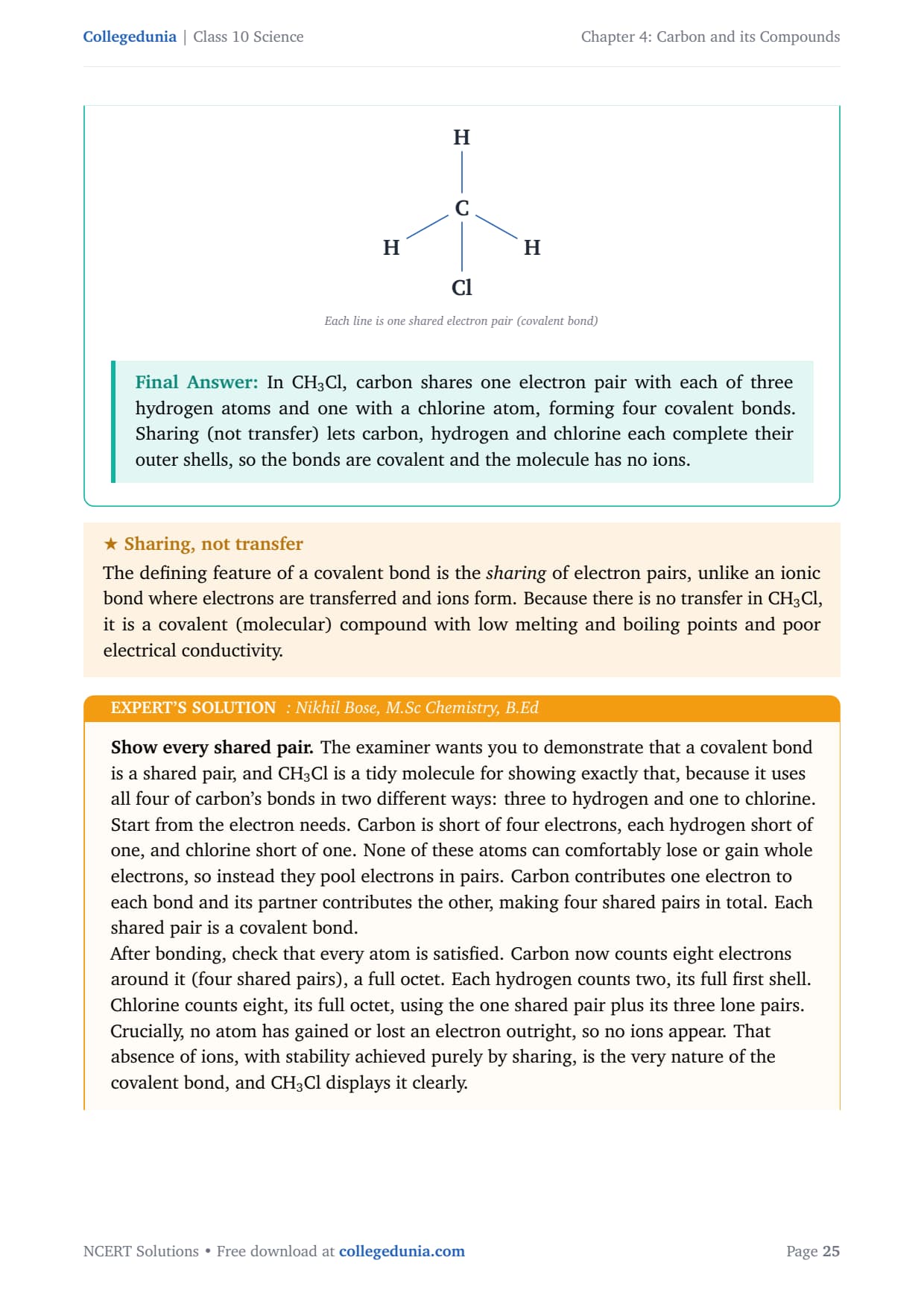
A covalent bond is formed by the sharing of electron pairs so each atom completes its outermost shell. Carbon (4 outer electrons) needs 4 more; hydrogen (1 electron) needs 1 more; chlorine (7 outer electrons) needs 1 more. In CH3Cl carbon shares one electron pair with each of three hydrogens and one with chlorine.
Carbon has 4 valence electrons and forms 4 covalent bonds (tetravalency).
Three bonds are with hydrogen atoms; each C-H bond is a shared pair, and each hydrogen completes its duplet.
The fourth bond is with chlorine: carbon and chlorine share one pair (C-Cl); chlorine completes its octet.
No electrons are transferred, so no ions form; this is what makes the bond covalent.
Answer: In CH3Cl, carbon shares one electron pair with each of three hydrogen atoms and one with a chlorine atom, forming four covalent bonds. Sharing (not transfer) lets each atom complete its outer shell, so the molecule has no ions.
NB
Nikhil Bose
M.Sc Chemistry, B.Ed
Verified Expert
Show every shared pair. The examiner wants you to show that a covalent bond is a shared pair, and CH3Cl is tidy for showing exactly that, because it uses all four of carbon's bonds in two ways: three to hydrogen and one to chlorine.
Start from the electron needs. Carbon is short of four electrons, each hydrogen short of one, chlorine short of one. None can comfortably lose or gain whole electrons, so they pool electrons in pairs. Carbon contributes one electron to each bond and its partner contributes the other, making four shared pairs.
After bonding, check each atom. Carbon counts eight electrons (four shared pairs), a full octet; each hydrogen counts two; chlorine counts eight using the one shared pair plus its three lone pairs. No atom has gained or lost an electron outright, so no ions appear. That stability achieved purely by sharing is the nature of the covalent bond.
Answer:CH3Cl has four covalent bonds (three C-H, one C-Cl), each a shared electron pair; sharing completes every atom's outer shell without forming ions.
In an electron dot (Lewis) structure every bond is shown as a shared pair and non-bonding electrons are shown as lone pairs. Each atom must reach its full outer shell: 8 for C, O, S, F and 2 for H. Carbon is tetravalent, oxygen and sulphur are divalent, fluorine and hydrogen are monovalent.
(a) Ethanoic acid (CH3COOH): structure CH3-C(=O)-O-H; one carbon bonds to three hydrogens, the second has a C=O double bond and an O-H; both oxygens carry lone pairs.
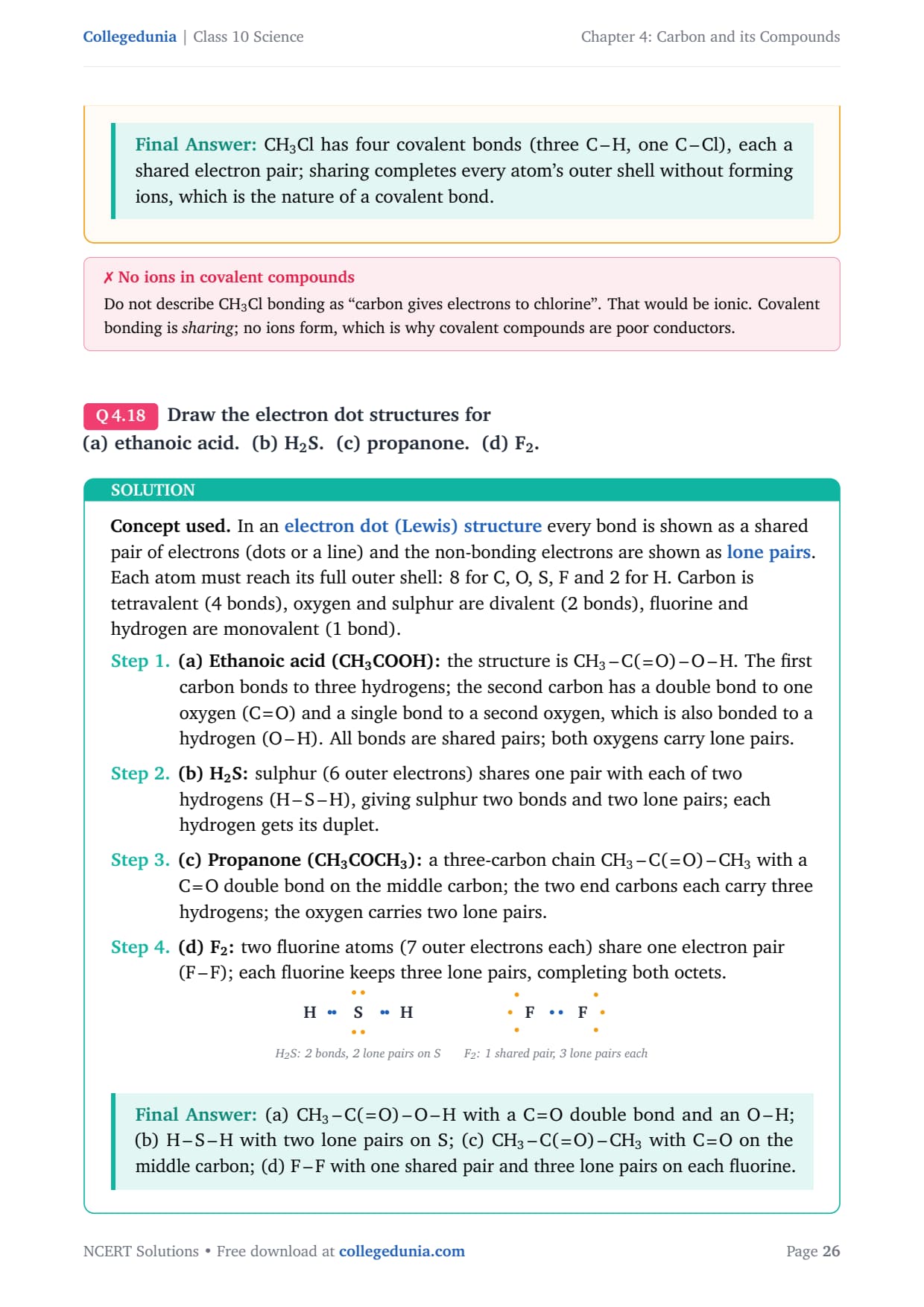
(b) H2S: sulphur shares one pair with each of two hydrogens (H-S-H), giving two bonds and two lone pairs.
(c) Propanone (CH3COCH3): a three-carbon chain CH3-C(=O)-CH3 with a C=O on the middle carbon; oxygen has two lone pairs.
(d) F2: two fluorine atoms share one pair (F-F); each keeps three lone pairs.
Answer: (a) CH3-C(=O)-O-H; (b) H-S-H with two lone pairs on S; (c) CH3-C(=O)-CH3; (d) F-F with one shared pair and three lone pairs on each fluorine.
LN
Lakshmi Nair
M.Sc Chemistry, B.Ed
Verified Expert
Same recipe for every molecule. All four parts use one routine: decide how many bonds each atom needs from its valency, connect the atoms with that many shared pairs, then add lone pairs until every atom reaches eight (or two for hydrogen).
For the carbon-oxygen compounds, ethanoic acid and propanone, the trick is the carbonyl. Oxygen needs two bonds, so at a chain carbon it forms a double bond (C=O); in ethanoic acid the second oxygen takes one bond to carbon and one to hydrogen (O-H). Give the end carbons their three hydrogens and the structures are complete.
The two small molecules are simpler. In H2S, sulphur forms two single bonds to hydrogen and keeps two lone pairs, a bent H-S-H. In F2, each fluorine needs one bond, so the atoms share one pair and each keeps three lone pairs. Showing the lone pairs is essential; leaving them out is the most common reason these answers lose marks.
Answer: Dot structures as drawn: ethanoic acid CH3-C(=O)-O-H, H2S bent with two lone pairs on S, propanone CH3-C(=O)-CH3, and F2 with a single shared pair and three lone pairs per fluorine.
Q 19
What is an homologous series? Explain with an example.
A homologous series is a family of organic compounds that have the same general formula and the same functional group, in which each member differs from the next by a -CH2- unit (a mass of 14 u). Members show a gradual change in physical properties and similar chemical properties.
All members have the same general formula and functional group, so they react chemically in a similar way.
Two successive members differ by one -CH2- group, that is, by 14 u.
Physical properties change steadily as the chain grows (boiling point rises with more carbons).
Example, the alkane series:CH4, C2H6, C3H8, C4H10, all following CnH2n+2.
Answer: A homologous series is a group of organic compounds with the same general formula and functional group, where consecutive members differ by a -CH2- unit (14 u); e.g. the alkanes CH4, C2H6, C3H8, C4H10.
SB
Suresh Babu
M.Sc Organic Chemistry, B.Ed
Verified Expert
One family, one functional group. The idea is that chemistry is decided mainly by the functional group, not by chain length. So compounds sharing the same functional group form a family whose members behave alike chemically.
The defining numerical feature is the constant difference between neighbours. Move from one member to the next and you always add a single -CH2- unit, which weighs 14 u. This is why the molecular masses go up in steps of 14 and why one general formula, like CnH2n+2 for alkanes, captures every member.
The alkanes methane, ethane, propane and butane each differ from the previous by -CH2-, all fit CnH2n+2, and all burn and undergo substitution in similar ways. Their boiling points rise steadily as the chain lengthens. Alcohols form another homologous series in the same way.
Answer: A homologous series is a family with the same general formula and functional group whose members differ by -CH2-; the alkanes are a standard example.
Q 20
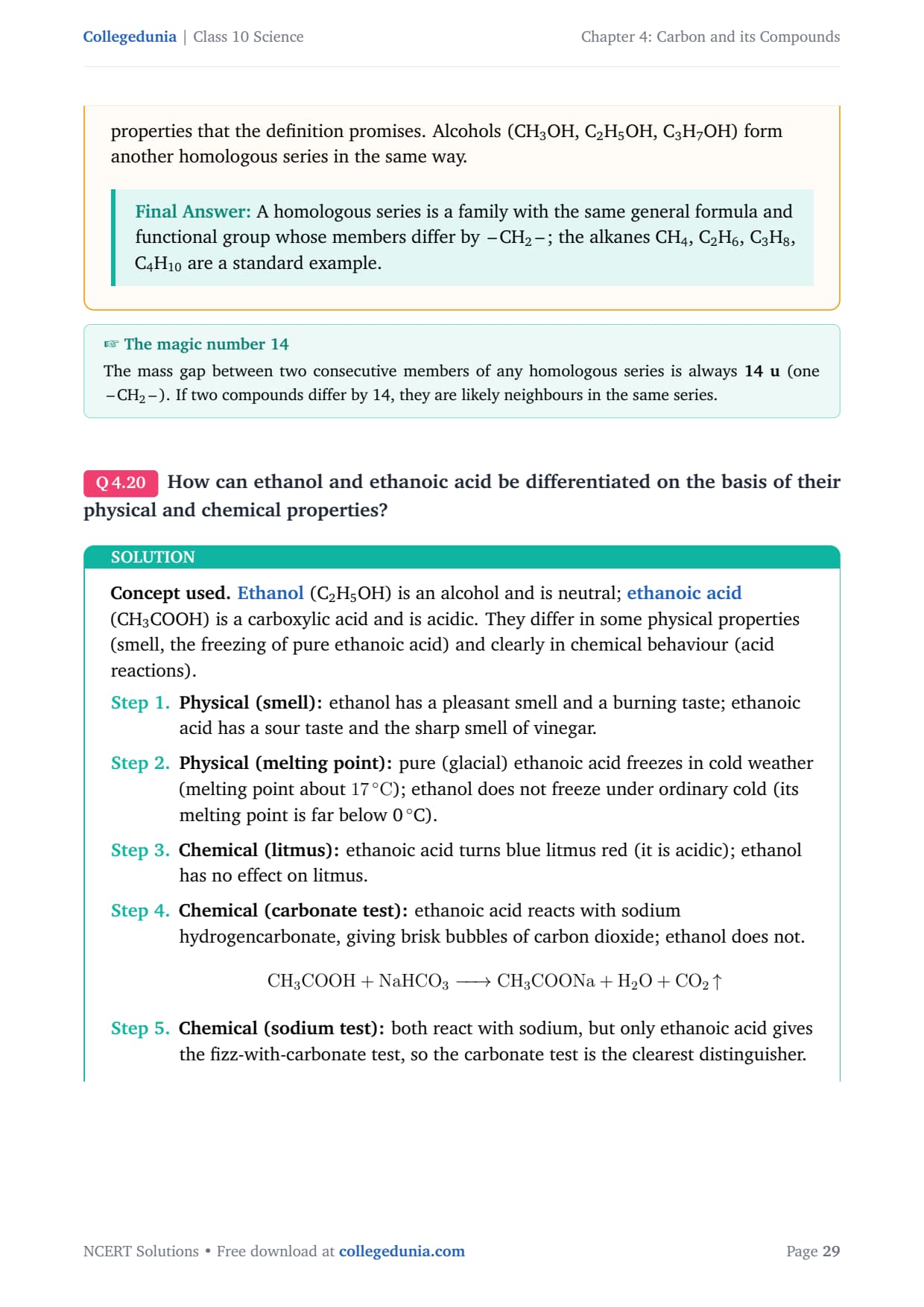
How can ethanol and ethanoic acid be differentiated on the basis of their physical and chemical properties?
Ethanol (C2H5OH) is an alcohol and is neutral; ethanoic acid (CH3COOH) is a carboxylic acid and is acidic. They differ in some physical properties and clearly in chemical behaviour.
Smell: ethanol has a pleasant smell; ethanoic acid has a sour taste and the sharp smell of vinegar.
Melting point: pure (glacial) ethanoic acid freezes in cold weather (about 17°C); ethanol does not freeze under ordinary cold.
Litmus: ethanoic acid turns blue litmus red; ethanol has no effect on litmus.
Carbonate test: ethanoic acid reacts with sodium hydrogencarbonate giving brisk CO2 bubbles: CH3COOH + NaHCO3 → CH3COONa + H2O + CO2; ethanol does not.
Answer: Ethanoic acid is acidic: it turns blue litmus red and gives brisk CO2 bubbles with sodium hydrogencarbonate, and as glacial acid freezes near 17°C. Ethanol is neutral: no litmus change, no fizz, and a pleasant smell.
GM
Geeta Mohan
M.Sc Chemistry, B.Ed
Verified Expert
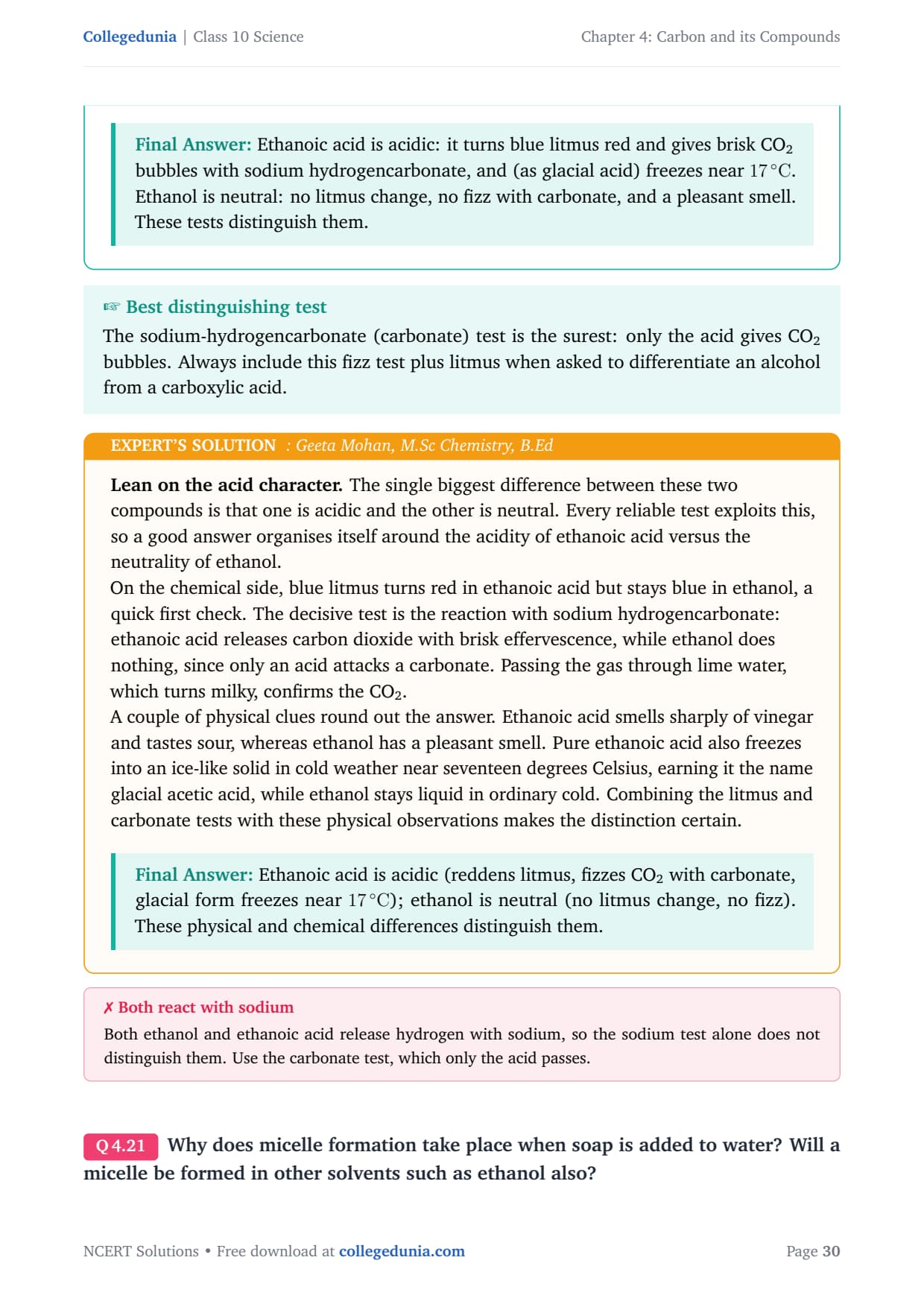
Lean on the acid character. The single biggest difference is that one is acidic and the other is neutral. Every reliable test exploits this, so organise your answer around the acidity of ethanoic acid versus the neutrality of ethanol.
On the chemical side, blue litmus turns red in ethanoic acid but stays blue in ethanol, a quick first check. The decisive test is the reaction with sodium hydrogencarbonate: ethanoic acid releases carbon dioxide with brisk effervescence, while ethanol does nothing. Passing the gas through lime water, which turns milky, confirms the CO2.
A couple of physical clues round out the answer. Ethanoic acid smells sharply of vinegar and tastes sour, whereas ethanol has a pleasant smell. Pure ethanoic acid also freezes into an ice-like solid near seventeen degrees Celsius, earning it the name glacial acetic acid, while ethanol stays liquid in ordinary cold.
Answer: Ethanoic acid is acidic (reddens litmus, fizzes CO2 with carbonate, glacial form freezes near 17°C); ethanol is neutral (no litmus change, no fizz).
Q 21
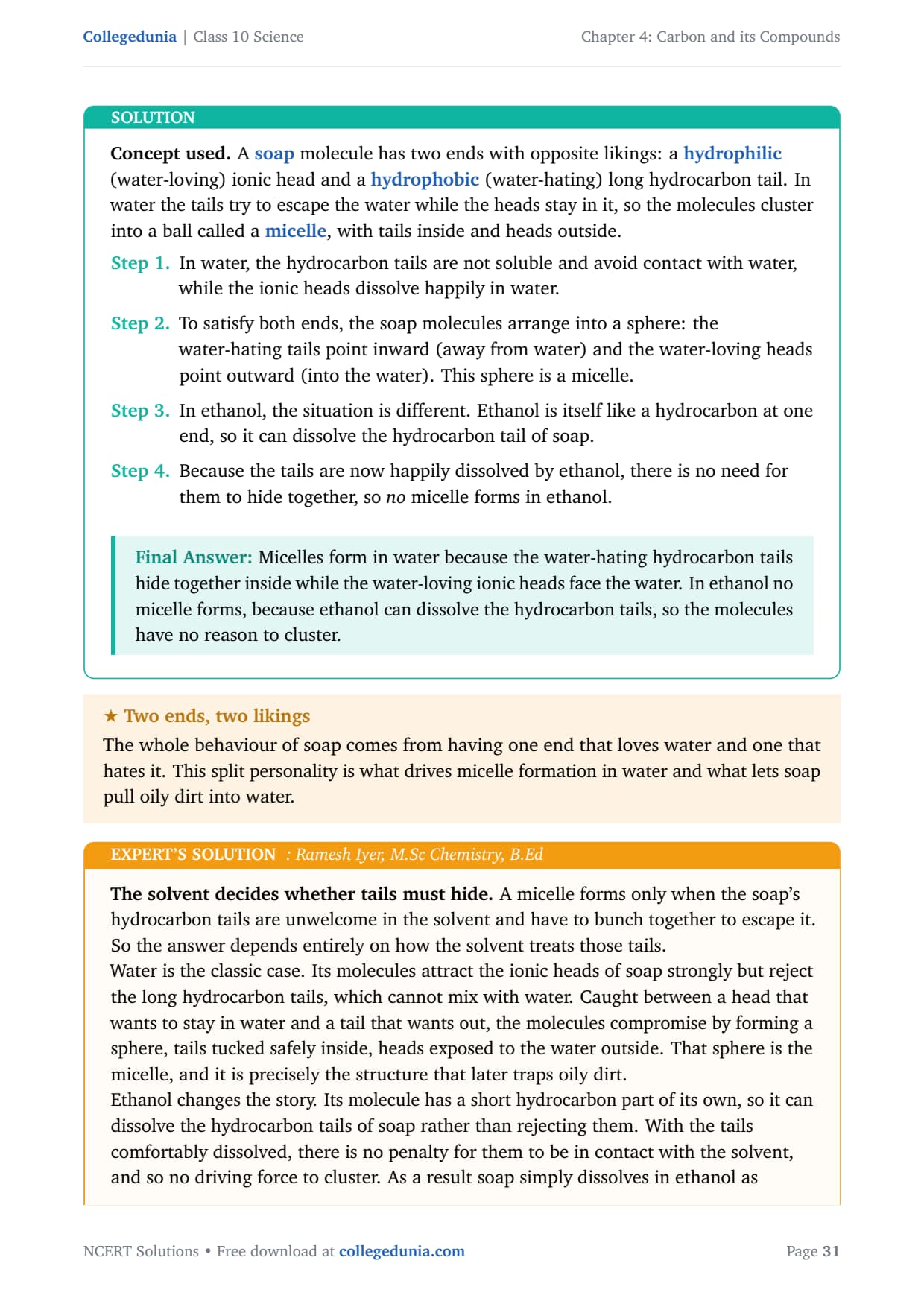
Why does micelle formation take place when soap is added to water? Will a micelle be formed in other solvents such as ethanol also?
A soap molecule has two ends with opposite likings: a hydrophilic (water-loving) ionic head and a hydrophobic (water-hating) long hydrocarbon tail. In water the tails try to escape the water while the heads stay in it, so the molecules cluster into a ball called a micelle.
In water, the hydrocarbon tails avoid contact with water, while the ionic heads dissolve happily in water.
To satisfy both ends, the molecules form a sphere: water-hating tails inward, water-loving heads outward. This sphere is a micelle.
In ethanol, the situation differs. Ethanol is itself like a hydrocarbon at one end, so it can dissolve the hydrocarbon tail of soap.
Because the tails are happily dissolved by ethanol, there is no need for them to hide together, so no micelle forms in ethanol.
Answer: Micelles form in water because the water-hating tails hide together inside while the water-loving ionic heads face the water. In ethanol no micelle forms, because ethanol can dissolve the hydrocarbon tails, so the molecules have no reason to cluster.
RI
Ramesh Iyer
M.Sc Chemistry, B.Ed
Verified Expert
The solvent decides whether tails must hide. A micelle forms only when the soap's hydrocarbon tails are unwelcome in the solvent and have to bunch together to escape it. So the answer depends entirely on how the solvent treats those tails.
Water is the classic case. Its molecules attract the ionic heads strongly but reject the long hydrocarbon tails. Caught between a head that wants to stay in water and a tail that wants out, the molecules compromise by forming a sphere, tails tucked inside, heads exposed to the water. That sphere is the micelle.
Ethanol changes the story. Its molecule has a short hydrocarbon part of its own, so it can dissolve the hydrocarbon tails rather than rejecting them. With the tails comfortably dissolved, there is no driving force to cluster, and soap dissolves in ethanol as separate molecules. So micelle formation is a response to a hostile solvent, not an automatic property of soap.
Answer: Micelles form in water because the hydrocarbon tails avoid water by clustering inward; in ethanol, which dissolves those tails, no micelle forms.
Q 22
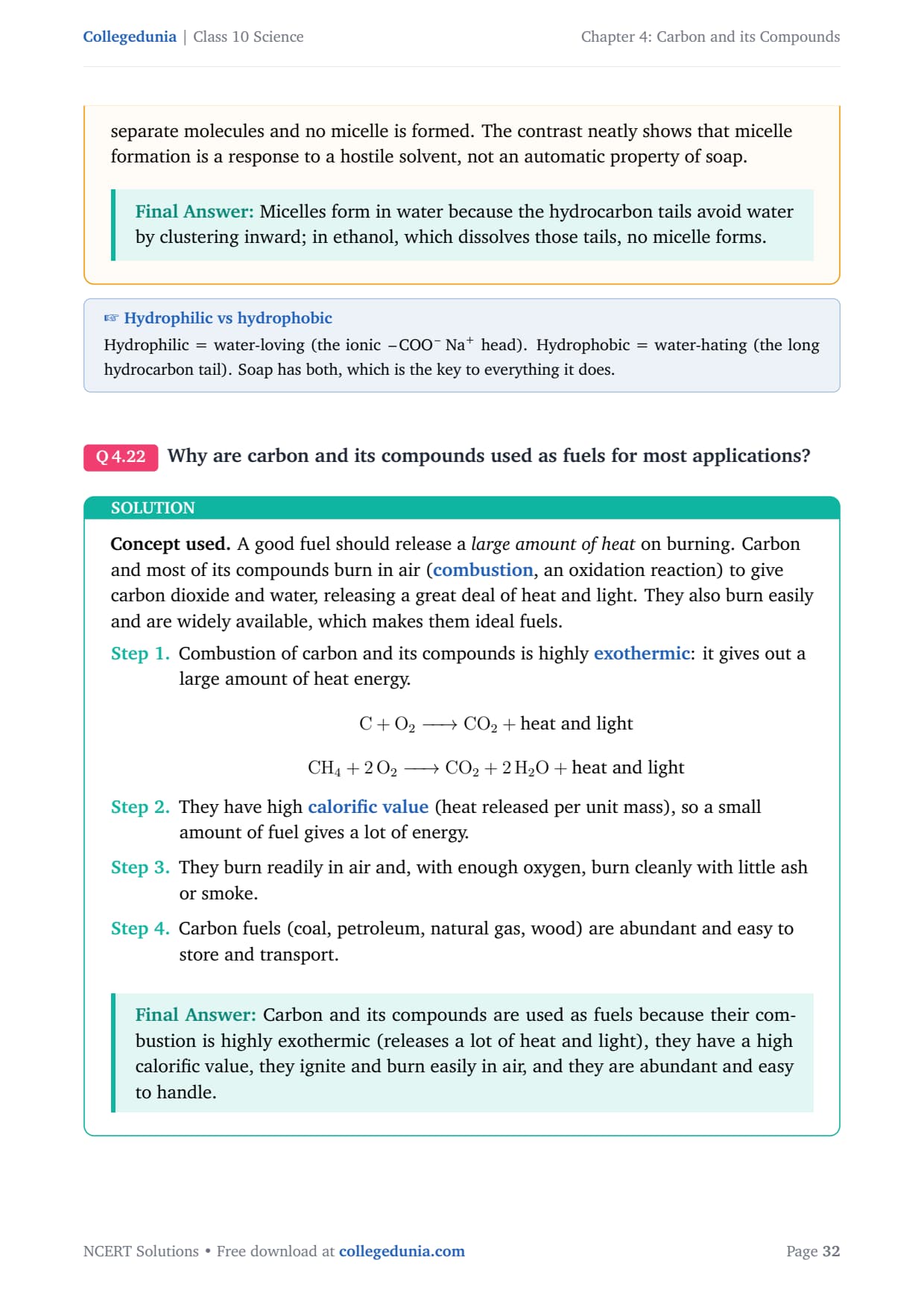
Why are carbon and its compounds used as fuels for most applications?
A good fuel should release a large amount of heat on burning. Carbon and most of its compounds burn in air (combustion, an oxidation reaction) to give carbon dioxide and water, releasing a great deal of heat and light.
Combustion of carbon and its compounds is highly exothermic: C + O2 → CO2 + heat, and CH4 + 2O2 → CO2 + 2H2O + heat.
They have high calorific value (heat per unit mass), so a small amount of fuel gives a lot of energy.
They burn readily in air and, with enough oxygen, burn cleanly with little ash or smoke.
Carbon fuels (coal, petroleum, natural gas, wood) are abundant and easy to store and transport.
Answer: Carbon and its compounds are used as fuels because their combustion is highly exothermic (releases a lot of heat and light), they have a high calorific value, they ignite and burn easily in air, and they are abundant and easy to handle.
VK
Vinod Krishnan
M.Sc Chemistry, B.Ed
Verified Expert
What makes a substance a good fuel. The question is really asking what qualities a fuel needs, and then noting that carbon and its compounds have them. A useful fuel must release plenty of heat, ignite easily, burn cleanly, and be available cheaply, and carbon compounds tick every box.
The heart of it is energy. When carbon and the hydrogen in its compounds combine with oxygen, they form carbon dioxide and water and pour out a large amount of heat, because combustion is strongly exothermic. Their high calorific value means even a small quantity delivers a lot of useful energy.
The practical qualities seal the case. Carbon fuels catch fire readily, so they are easy to use, and with a good air supply they burn with a clean flame and leave little residue. They are also abundant as wood, coal, petroleum and natural gas, and convenient to store and carry.
Answer: Because their combustion is strongly exothermic with high calorific value, they ignite and burn easily and cleanly, and they are abundant and convenient, carbon and its compounds make excellent fuels.
Q 23
Explain the formation of scum when hard water is treated with soap.
Hard water contains dissolved salts of calcium and magnesium. Soap is the sodium salt of a long-chain carboxylic acid. When soap meets the calcium and magnesium ions of hard water, it forms insoluble salts that appear as a curdy white solid called scum.
Hard water supplies Ca2+ and Mg2+ ions.
Soap reacts with these ions; the calcium and magnesium salts of the long-chain acid are insoluble in water.
These insoluble salts separate as a white, curdy precipitate (the scum): 2C17H35COONa + Ca2+ → (C17H35COO)2Ca + 2Na+.
Because some soap is wasted forming scum, more soap is needed to lather in hard water.
Answer: Soap reacts with the calcium and magnesium ions in hard water to form insoluble calcium and magnesium salts of the long-chain carboxylic acid, which separate as a white curdy precipitate called scum.
AV
Asha Varma
M.Sc Chemistry, B.Ed
Verified Expert
An ion swap that ruins the soap. Scum forms because the metal ions in hard water replace the sodium in soap, and the new salts they make refuse to dissolve. Following this ion swap step by step makes the answer clear.
Soap is sodium stearate or a similar sodium salt of a long-chain carboxylic acid, and it is soluble in water, which is why ordinary soap lathers. Hard water is loaded with calcium and magnesium ions, which are more strongly attracted to the carboxylate part than sodium is, so they push the sodium out.
The catch is that the resulting calcium and magnesium salts are insoluble. Instead of dissolving and lathering, they clump into a sticky white solid, the scum, that clings to clothes and the bath. Because this consumes soap without cleaning, you must add extra soap before any lather appears.
Answer: Calcium and magnesium ions in hard water replace the sodium in soap to form insoluble calcium/magnesium salts of the carboxylic acid, which separate as the white curdy scum.
Q 24
What change will you observe if you test soap with litmus paper (red and blue)?
Soap is the sodium salt of a weak carboxylic acid and a strong base (NaOH). A salt of a weak acid and a strong base is basic (alkaline). A basic substance turns red litmus blue and leaves blue litmus unchanged.
Soap is made from a strong base (sodium hydroxide) and a weak acid (long-chain carboxylic acid), so its solution is mildly basic.
A basic solution turns red litmus paper blue.
A basic solution causes no change to blue litmus paper (it stays blue).
Answer: Soap is basic in nature, so it turns red litmus paper blue and leaves blue litmus paper unchanged.
MI
Meera Iyer
M.Sc Chemistry, B.Ed
Verified Expert
Predict the nature, then read the litmus. The fastest way to answer a litmus question is to first work out whether the substance is acidic, basic or neutral, because litmus simply reports that nature.
Soap is made by reacting fats or oils (a weak, long-chain carboxylic acid) with sodium hydroxide, a strong base, in a process called saponification. A salt of a weak acid and a strong base is mildly basic, because the strong base dominates. So a soap solution is alkaline.
Knowing it is basic, the litmus results follow at once. Red litmus turns blue in the presence of a base, so red litmus dipped in soap solution turns blue. Blue litmus is already blue and a base cannot change it further, so it stays blue. Reporting both observations gives a complete answer.
Answer: Soap, being basic, turns red litmus blue and keeps blue litmus blue.
Q 25
What is hydrogenation? What is its industrial application?
Hydrogenation is an addition reaction in which an unsaturated hydrocarbon (one having a C=C double bond or C≡C triple bond) adds hydrogen in the presence of a catalyst such as nickel or palladium to form a saturated hydrocarbon.
An unsaturated compound has double or triple bonds, which can take up extra hydrogen.
With a nickel or palladium catalyst, hydrogen adds across these bonds, turning them into single bonds: C2H4 + H2 → C2H6 (nickel catalyst).
Industrial application: hydrogenation of vegetable oils. Liquid oils have long unsaturated chains; adding hydrogen with a nickel catalyst converts them into solid or semi-solid fats, known as vanaspati ghee.
Answer: Hydrogenation is the addition of hydrogen to an unsaturated hydrocarbon in the presence of a nickel or palladium catalyst, converting it to a saturated hydrocarbon. Its main industrial use is hydrogenating liquid vegetable oils into solid fats (vanaspati ghee).
SR
Sandeep Rao
M.Sc Chemistry, B.Ed
Verified Expert
Adding hydrogen across double bonds. Hydrogenation is a specific kind of addition reaction: the guest being added is hydrogen, and the host that accepts it is an unsaturated carbon-carbon bond. Wherever there is a double or triple bond, hydrogen can slot in and saturate it.
The reaction needs a catalyst, usually finely divided nickel or palladium, to bring the hydrogen and the unsaturated molecule together on its surface. With the catalyst present, hydrogen atoms add across each C=C bond, converting it to a single bond. Ethene becoming ethane is the textbook example.
The industrial payoff is in food processing. Vegetable oils are liquids because their long chains are highly unsaturated. Hydrogenating them removes the double bonds, the chains straighten and pack together, and the liquid oil sets into a solid fat. This is how vanaspati ghee is made from cheap oils.
Answer: Hydrogenation adds hydrogen across the double or triple bonds of an unsaturated hydrocarbon using a Ni/Pd catalyst, making it saturated; industrially it turns liquid vegetable oils into solid vanaspati ghee.
Q 26
Which of the following hydrocarbons undergo addition reactions: C2H6, C3H8, C3H6, C2H2 and CH4.
Only unsaturated hydrocarbons (those with a C=C double bond or C≡C triple bond) undergo addition reactions. Saturated hydrocarbons (only single bonds) do not add; they undergo substitution instead.
Check each formula against the saturated alkane formula CnH2n+2.
C2H6 (ethane), C3H8 (propane) and CH4 (methane) fit CnH2n+2, so they are saturated, no addition.
C3H6 (propene) has fewer hydrogens, so it has a C=C double bond, unsaturated, undergoes addition.
C2H2 (ethyne) has a C≡C triple bond, unsaturated, undergoes addition.
Answer:C3H6 (propene) and C2H2 (ethyne) undergo addition reactions because they are unsaturated. C2H6, C3H8 and CH4 are saturated and do not.
NP
Naveen Pillai
M.Sc Organic Chemistry, B.Ed
Verified Expert
Hydrogen count reveals unsaturation. Sorting a list of hydrocarbons into those that add and those that do not is really a test of saturation, and saturation can be read straight off the hydrogen count using CnH2n+2.
Ethane C2H6, propane C3H8 and methane CH4 all satisfy CnH2n+2 exactly, so they are saturated alkanes with only single bonds. With no multiple bond to open up, they cannot add; they react by substitution.
The two that fall short are the reactive ones. Propene C3H6 has two hydrogens fewer than propane, the sign of one C=C bond, and ethyne C2H2 is short by four, indicating a C≡C bond. These readily add hydrogen and halogens.
Answer:C3H6 and C2H2 undergo addition; the rest are saturated and do not.
Q 27
Give a test that can be used to differentiate between saturated and unsaturated hydrocarbons.
Unsaturated hydrocarbons have C=C or C≡C bonds that readily undergo addition reactions. The bromine water test uses this: bromine water (orange-brown) adds across the double or triple bond and loses its colour.
Add a few drops of bromine water (orange-brown) to the hydrocarbon.
An unsaturated hydrocarbon adds bromine across its double or triple bond, so the orange-brown colour disappears quickly.
A saturated hydrocarbon does not add bromine, so the orange-brown colour does not fade.
Result: decolourisation indicates an unsaturated hydrocarbon; no change indicates a saturated one.
Answer: The bromine water test: an unsaturated hydrocarbon decolourises orange-brown bromine water (by addition across its double or triple bond), while a saturated hydrocarbon does not change its colour.
DM
Divya Menon
M.Sc Chemistry, B.Ed
Verified Expert
A colour change that reports unsaturation. The cleverness of this test is that it turns an invisible structural feature, a double or triple bond, into a colour change you can see. Bromine water is coloured, and it loses that colour only when consumed by an addition reaction.
When you shake an unsaturated hydrocarbon with bromine water, bromine adds across the C=C or C≡C bond to form a colourless product. As the orange-brown bromine is used up, the solution goes from coloured to clear. That decolourisation is your positive signal.
A saturated hydrocarbon behaves differently. With only single bonds it has nowhere for bromine to add, so the orange-brown colour persists. Colour gone means unsaturated, colour stays means saturated. An alternative is dilute alkaline potassium permanganate (Baeyer's reagent), decolourised only by unsaturated compounds.
Answer: Shake the hydrocarbon with bromine water: decolourisation means unsaturated; no colour change means saturated.
Q 28
Explain the mechanism of the cleaning action of soaps.
A soap molecule has two parts: a long hydrophobic (water-hating, oil-loving) hydrocarbon tail and a hydrophilic (water-loving) ionic head. Most dirt sticks to clothes because of oil and grease, and oil does not dissolve in water. Soap links the oily dirt to the water using these two ends, forming micelles.
The hydrophobic tails attach to the oily dirt (they dissolve in oil), while the hydrophilic heads stay in the water.
Many soap molecules surround each oil droplet, tails buried in the oil and heads pointing out into the water, forming a ball-like cluster called a micelle.
The micelle pulls the oily dirt off the cloth and holds it suspended in the water as an emulsion; the negatively charged heads repel one another so the micelles do not join back.
With agitation, the dirt-loaded micelles are washed away with the rinse water, leaving the cloth clean.
Answer: Soap molecules surround an oil or dirt droplet with their hydrophobic tails buried in the oil and their hydrophilic heads facing the water, forming a micelle. The micelle lifts the dirt off the cloth and keeps it suspended in water; with agitation it is rinsed away, cleaning the cloth.
PK
Prakash Menon
M.Sc Chemistry, B.Ed
Verified Expert
Bridging oil and water. The cleaning action of soap solves a basic problem: dirt is mostly oily, and oil will not mix with water. Soap acts as a bridge by having one end that likes oil and another that likes water.
When soap dissolves in the wash water, its hydrocarbon tails seek out the oily grime and dig into it, while its ionic heads remain dissolved in the surrounding water. As many soap molecules gather round a single oil droplet, they wrap it completely, tails inward in the oil and heads outward in the water, building the spherical micelle.
This micelle carries the dirt away. Its outer heads are all negatively charged, so neighbouring micelles repel each other and stay separated rather than clumping back onto the cloth, giving a stable emulsion. A bit of agitation shakes the dirt-filled micelles loose, and a rinse floats them off.
Answer: Soap's hydrophobic tails embed in the oily dirt and its hydrophilic heads face the water, forming charged micelles that emulsify and suspend the dirt; agitation and rinsing then carry the dirt away, cleaning the cloth.
NCERT Solutions Class 10 Science Chapter 4 Carbon and its Compounds FAQs
Ques. How many questions are there in NCERT Class 10 Science Chapter 4 Carbon and its Compounds?
Ans. There are 28 questions in all: 13 in-text questions inside the chapter and 15 end-of-chapter exercise questions. All 28 are solved here with full step-by-step answers and an Expert Solution. The mix covers electron dot structures, naming compounds, oxidation and addition reactions, and daily-life topics like soaps, detergents and hard water.
Ques. What are the two properties of carbon that lead to so many carbon compounds?
Ans. The two properties are catenation and tetravalency. Catenation is the ability of carbon atoms to bond with one another by strong covalent bonds to form long chains, branched chains and rings. Tetravalency means carbon has a valency of four, so it can bond with four other atoms such as hydrogen, oxygen, nitrogen and chlorine. Together, catenation builds the carbon backbone and tetravalency lets many different atoms attach to it, which is why the number of possible compounds is enormous.
Ques. Why is the conversion of ethanol to ethanoic acid an oxidation reaction?
Ans. Oxidation is the addition of oxygen or the removal of hydrogen. Ethanol is CH3CH2OH and ethanoic acid is CH3COOH, so going from one to the other the carbon gains an extra oxygen atom and loses hydrogen. Because oxygen is added, this is an oxidation reaction. It needs an oxidising agent such as alkaline potassium permanganate or acidified potassium dichromate to supply the oxygen, and the colour of the reagent fades as the reaction takes place.
Ques. What is a homologous series in Class 10 Science Chapter 4?
Ans. A homologous series is a family of organic compounds with the same general formula and the same functional group, in which each member differs from the next by a -CH2- unit, a mass of 14 u. Members react chemically in a similar way and show a gradual change in physical properties such as boiling point. The alkanes methane, ethane, propane and butane are a standard example, all following the general formula CnH2n+2.
Ques. How can you distinguish between ethanol and ethanoic acid?
Ans. The clearest test is the carbonate test. Ethanoic acid reacts with sodium hydrogencarbonate and gives brisk bubbles of carbon dioxide, while ethanol gives no bubbles because it is neutral. The acid also turns blue litmus red, while ethanol does not change litmus. Note that both react with sodium to release hydrogen, so the sodium test alone cannot tell them apart; the carbonate fizz test is the surest distinguisher.
Ques. How does soap clean dirty clothes?
Ans. A soap molecule has a water-hating hydrocarbon tail and a water-loving ionic head. In water, many soap molecules surround an oily dirt droplet with their tails buried in the oil and their heads facing the water, forming a ball called a micelle. The micelle lifts the dirt off the cloth and holds it suspended in the water as an emulsion. Agitation, such as beating or scrubbing, then shakes the dirt-loaded micelles free of the fibres so they rinse away, leaving the cloth clean.
Ques. How many pages is the Class 10 Science Chapter 4 Carbon and its Compounds NCERT Solutions PDF?
Ans. The Carbon and its Compounds NCERT Solutions PDF covers all 28 questions with electron dot structures, step-by-step working, and an Expert Solution for each question. It is free to download for the 2026-27 session and follows the latest NCERT textbook exactly, including the in-text and end-of-chapter questions.
Ques. Is the NCERT Solutions for Class 10 Science Chapter 4 aligned with the 2026-27 syllabus?
Ans. Yes. This page reflects the current 2026-27 CBSE syllabus for Class 10 Science. The Carbon and its Compounds chapter is unchanged for the current cycle, and every answer follows the NCERT textbook, including covalent bonding, catenation and tetravalency, functional groups and homologous series, and the chemistry of soaps and detergents. The solutions are written in plain English for the CBSE board exam.









Comments