




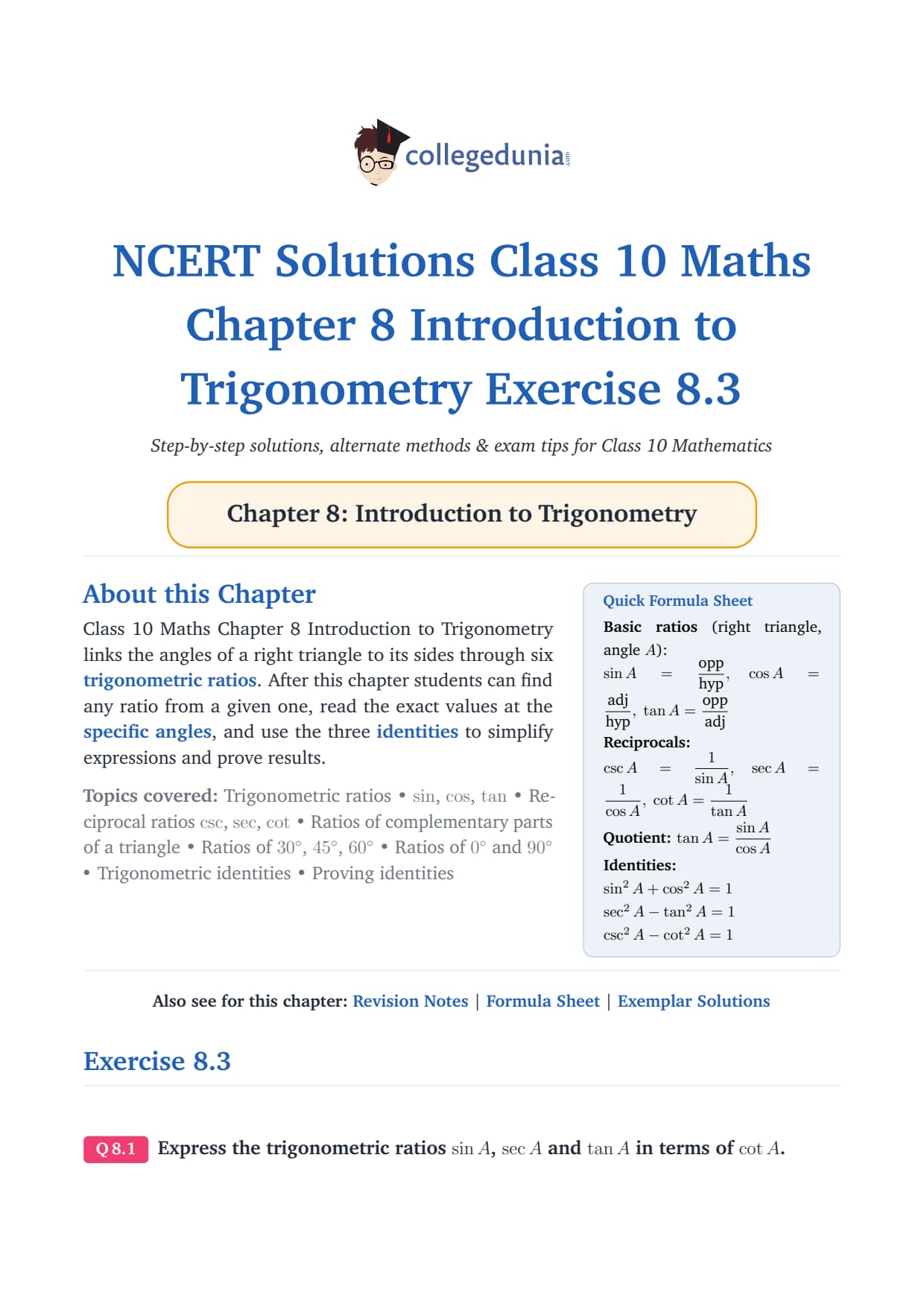
The NCERT Solutions for Class 10 Maths Chapter 8 Introduction to Trigonometry Exercise 8.3 cover all 4 questions on trigonometric identities, according to the latest 2026-27 CBSE syllabus. Each answer is solved step by step exactly the way the board expects.
- Questions covered: 4 in total, mixing ratio-rewriting, all-ratios-in-terms-of-one, MCQ simplification, and ten identity proofs.
- Core skill: using the three Pythagorean identities to simplify or prove expressions involving trigonometric ratios.
- Board value: Exercise 8.3 covers identity proofs and simplification, which appear in 3 to 5 mark slots in the CBSE Class 10 board paper.
Solved by Collegedunia: Every Exercise 8.3 question below is solved by subject experts, checked against the official 2026-27 NCERT textbook, and written with full working so each step earns its marks in the CBSE Class 10 paper.
- What Exercise 8.3 Covers for Class 10
- How to Solve Exercise 8.3 Question by Question
- Three Pythagorean Identities Used in Exercise 8.3
- Proof Techniques Students Need for Exercise 8.3
- Exercise 8.3 Marks and CBSE Board Trends
- All Exercises of Class 10 Maths Chapter 8
- More Chapter 8 Resources and Related Pages
- All NCERT Solutions for Exercise 8.3 with Step-by-Step Solutions
- Exercise 8.3 Trigonometry FAQs
What Exercise 8.3 of Introduction to Trigonometry Covers for Class 10
Exercise 8.3 is the final exercise of Chapter 8 and the hardest one. It moves beyond finding ratios and asks students to prove trigonometric identities and rewrite ratios in terms of a single given ratio. All four questions rest on the three Pythagorean identities at the heart of the chapter.
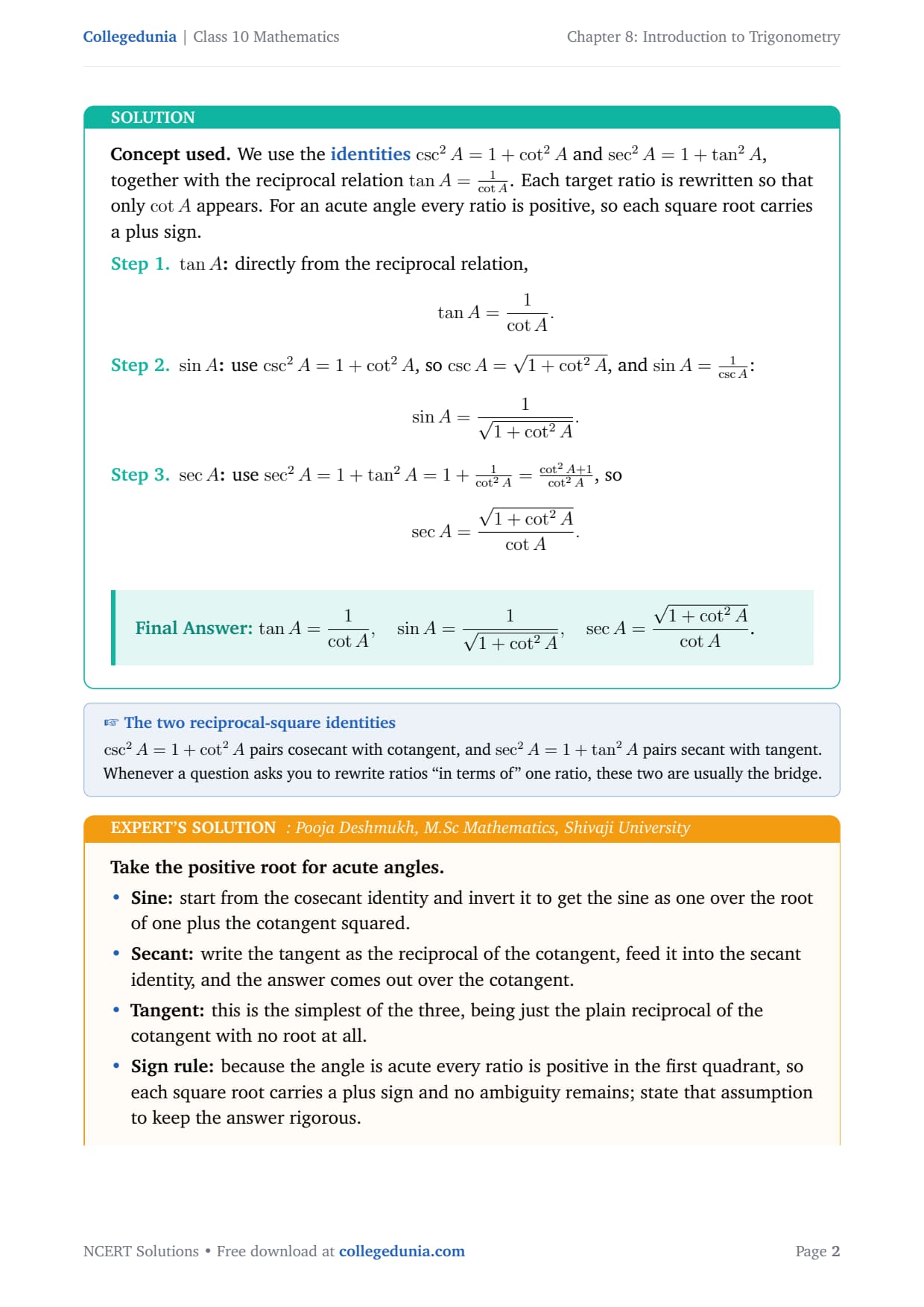
- Question 1: express sin A, sec A and tan A in terms of cot A using the reciprocal square identities.
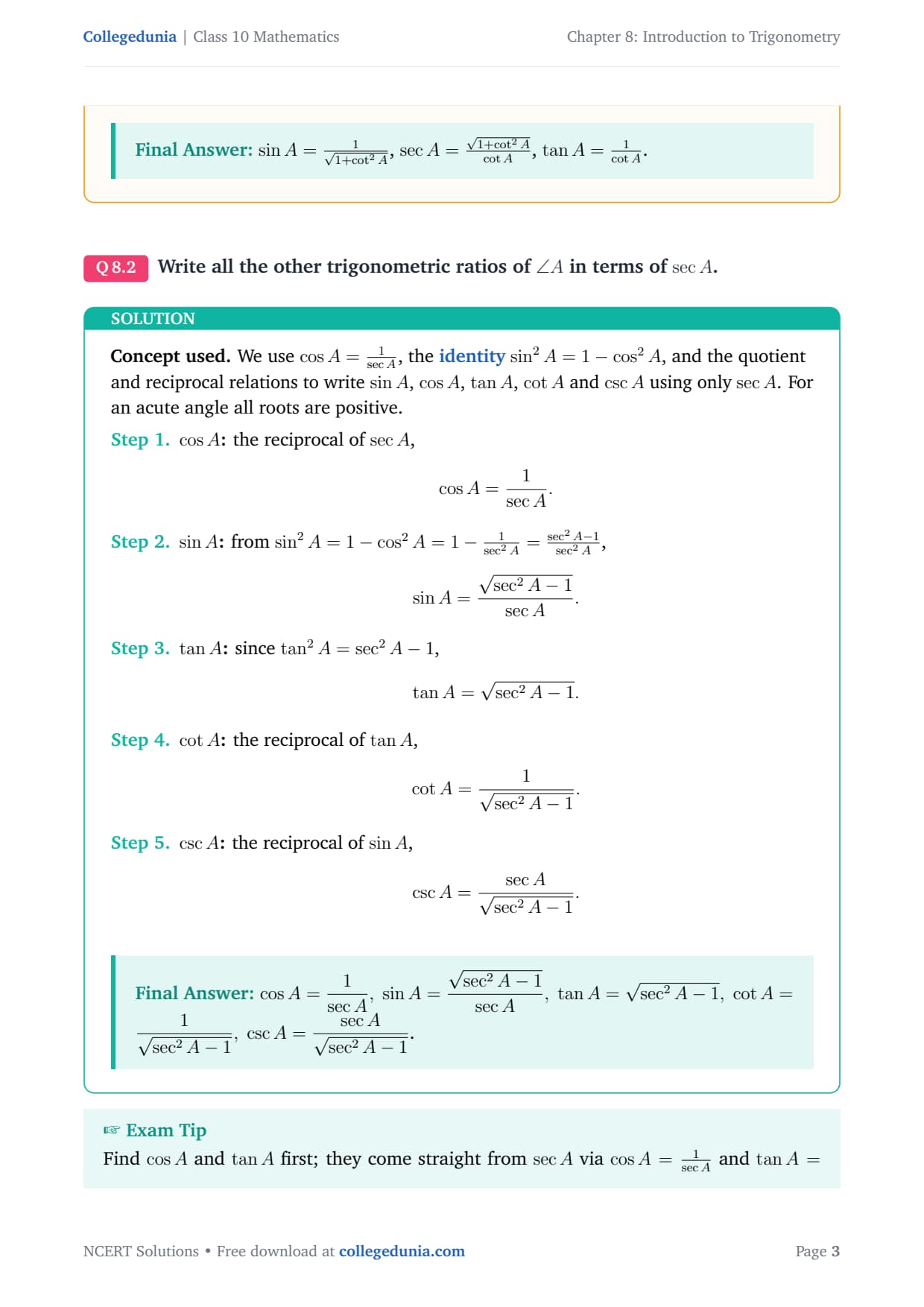
- Question 2: write all five other trigonometric ratios of ∠A in terms of sec A.
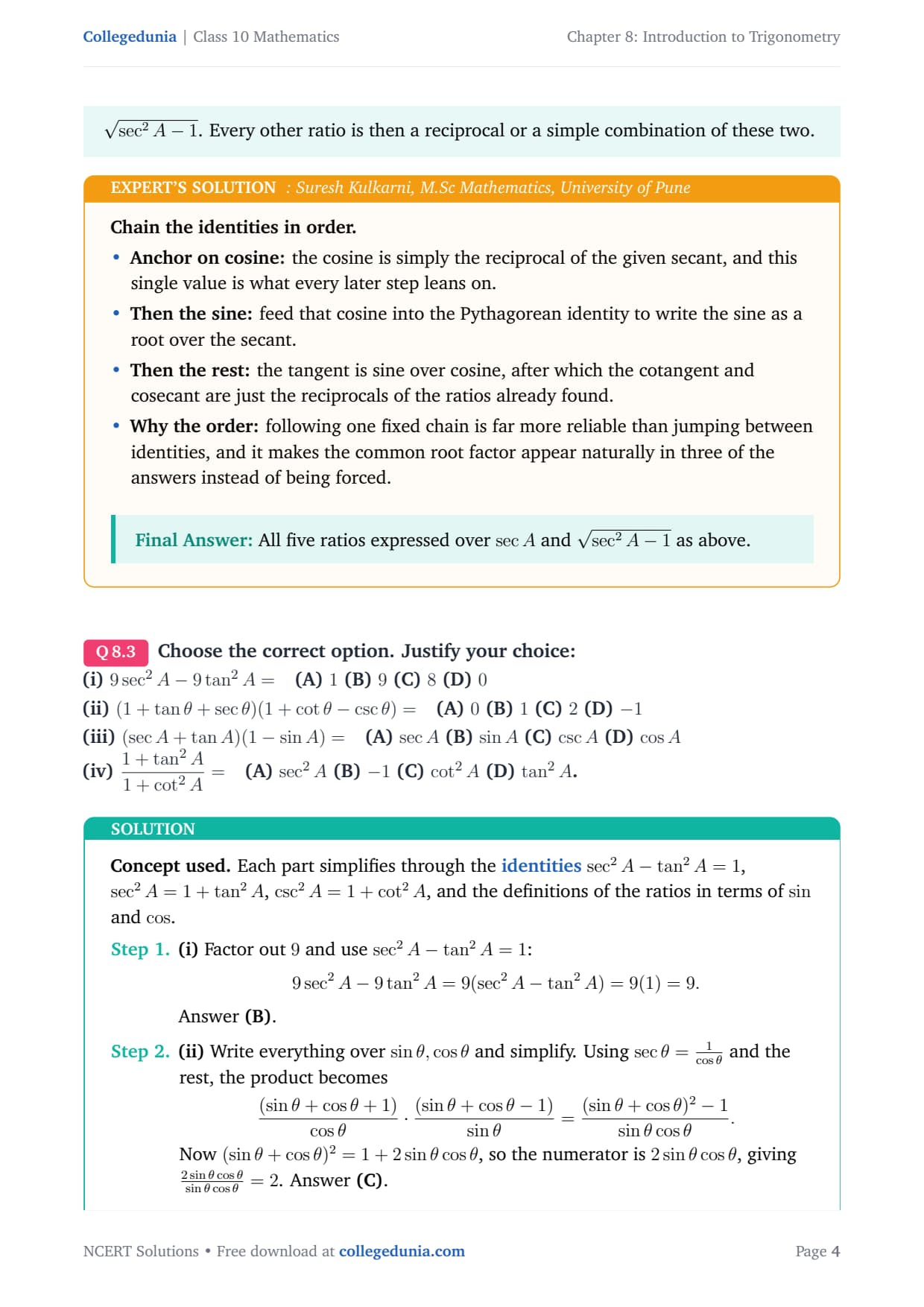
- Question 3: choose the correct option (MCQ) for four trigonometric simplifications and justify each choice.
- Question 4: prove ten trigonometric identities (parts i-x) covering a wide range of techniques.
How to Solve Exercise 8.3 Question by Question
The whole exercise turns on one core idea: use the three Pythagorean identities as a toolkit. Every question in Exercise 8.3 can be solved by picking the right identity and expressing everything in terms of sin and cos when stuck. The approach below works on every sub-part.
| Question | What it asks | Key technique |
|---|---|---|
| Q1 | Express sin A, sec A, tan A in terms of cot A | Reciprocal square identities csc2A = 1 + cot2A |
| Q2 | All five ratios in terms of sec A | Chain: cos A = 1/sec A then Pythagoras |
| Q3 (i) | 9sec2A - 9tan2A | Factor 9 and use sec2A - tan2A = 1 |
| Q3 (ii-iv) | Three MCQ simplifications | Convert to sin/cos; difference of squares |
| Q4 (i-x) | Ten identity proofs | Work from complex side; rationalize roots; combine fractions |
Three Pythagorean Identities Used in Exercise 8.3
Every question in this exercise connects back to these three identities. Students who know them well can solve Exercise 8.3 quickly and without confusion.
| Identity | Form used in Exercise 8.3 | Questions where it appears |
|---|---|---|
| sin2A + cos2A = 1 | Rewrite sin2A = 1 - cos2A or vice versa | Q2, Q3(ii), Q3(iii), Q4(i-ix) |
| sec2A - tan2A = 1 | Factor expressions, simplify products | Q1, Q2, Q3(i), Q3(iv), Q4(v) |
| csc2A - cot2A = 1 | Express sin in terms of cot; prove csc-cot identities | Q1, Q4(v), Q4(viii) |
- All three come from the basic identity sin2A + cos2A = 1. Divide through by cos2A to get the secant-tangent identity, or divide by sin2A to get the cosecant-cotangent identity.
- Reciprocal relations: tan A = sin A / cos A, cot A = cos A / sin A, sec A = 1 / cos A, csc A = 1 / sin A.
Proof Techniques Students Need for Exercise 8.3
Question 4 has ten sub-parts covering every major technique. Knowing which method to pick saves time in the exam. Most lost marks here come from not knowing which tool to reach for first.
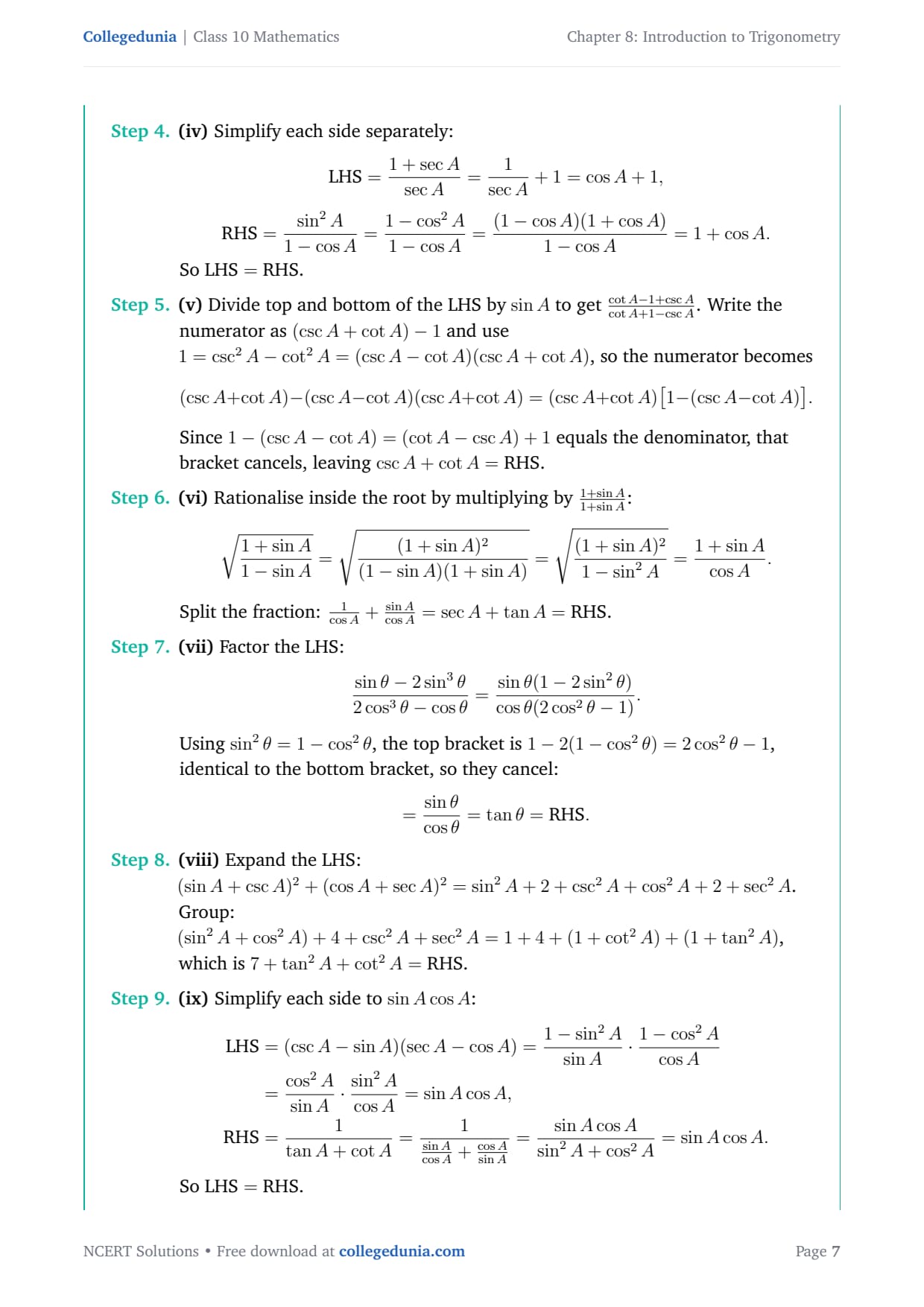
- Combine fractions over a common denominator: Parts (ii) and (iii). Merge two fractions, simplify the numerator using sin2 + cos2 = 1, and the answer appears cleanly.
- Difference of squares / factor method: Parts (i), (iv), (vi), (vii). Replace 1 - cos2 with (1 - cos)(1 + cos) and cancel the matching factor.
- Rationalise under the root: Part (vi). Multiply top and bottom by (1 + sin A) to clear the root and get a clean fraction.
- Expand and group: Part (viii). Expand squared brackets, then group sin2 + cos2 = 1 inside; the 7 + tan2 + cot2 form falls out.
- Divide the proof LHS by sin A: Part (v). Introduces csc and cot quickly, then use the identity to cancel the awkward denominator.
Exercise 8.3 Marks and CBSE Board Trends for Class 10
Introduction to Trigonometry typically carries 7 to 8 marks in the CBSE Class 10 paper. Exercise 8.3 contributes the bulk of those marks through identity proofs and ratio simplifications.
| Question type | Where it appears in the board paper | Typical marks |
|---|---|---|
| Ratio in terms of another (Q1, Q2 style) | Short-answer slots | 2 to 3 |
| MCQ simplification (Q3 style) | 1-mark objective section | 1 |
| Identity proof short (one-step) | 3-mark or 4-mark questions | 3 to 4 |
| Identity proof multi-step (Q4 complex parts) | 4-mark or 5-mark questions | 4 to 5 |
These solutions follow the 2026-27 NCERT exactly, so the working you practise here matches what the board paper rewards.
NCERT Solutions for Class 10 Maths Chapter 8 Introduction to Trigonometry: All Exercises
Chapter 8 has three exercises. The table below links each one to its own step-by-step solution page.
| Exercise | Topics covered | Solutions page |
|---|---|---|
| Exercise 8.1 | Trigonometric ratios from right triangles; ratios from given sides | Exercise 8.1 Solutions |
| Exercise 8.2 | Specific angle values (0, 30, 45, 60, 90 degrees) and complementary angles | Exercise 8.2 Solutions |
| Exercise 8.3 (this page) | Trigonometric identities, ratio rewriting, ten identity proofs | Exercise 8.3 Solutions |
| Full chapter | All exercises combined | Chapter 8 NCERT Solutions (all exercises) |
Other Resources for Chapter 8 Introduction to Trigonometry Class 10 Maths
Use the table below to move between other resources for Chapter 8, other chapters, and other RTs. Each link opens the matching Collegedunia page.
| Resource | Open page |
|---|---|
| Chapter 8 full NCERT Solutions | Introduction to Trigonometry Class 10 NCERT Solutions |
| Exercise 8.1 | Exercise 8.1 Solutions |
| Exercise 8.2 | Exercise 8.2 Solutions |
| Revision notes | Introduction to Trigonometry Class 10 Notes |
| Formula sheet | Introduction to Trigonometry Class 10 Formula Sheet |
| NCERT book PDF | Introduction to Trigonometry Class 10 NCERT Book PDF |
| Handwritten notes | Introduction to Trigonometry Class 10 Handwritten Notes |
| Exemplar solutions | Introduction to Trigonometry Class 10 Exemplar Solutions |
| Chapter 7 NCERT Solutions | Coordinate Geometry NCERT Solutions |
| Chapter 9 NCERT Solutions | Some Applications of Trigonometry NCERT Solutions |
All NCERT Solutions for Class 10 Maths Chapter 8 Introduction to Trigonometry Exercise 8.3 with Step-by-Step Solutions
Exercise 8.3
Express the trigonometric ratios sin A, sec A and tan A in terms of cot A.
Write all the other trigonometric ratios of ∠ A in terms of sec A.
Choose the correct option. Justify your choice:
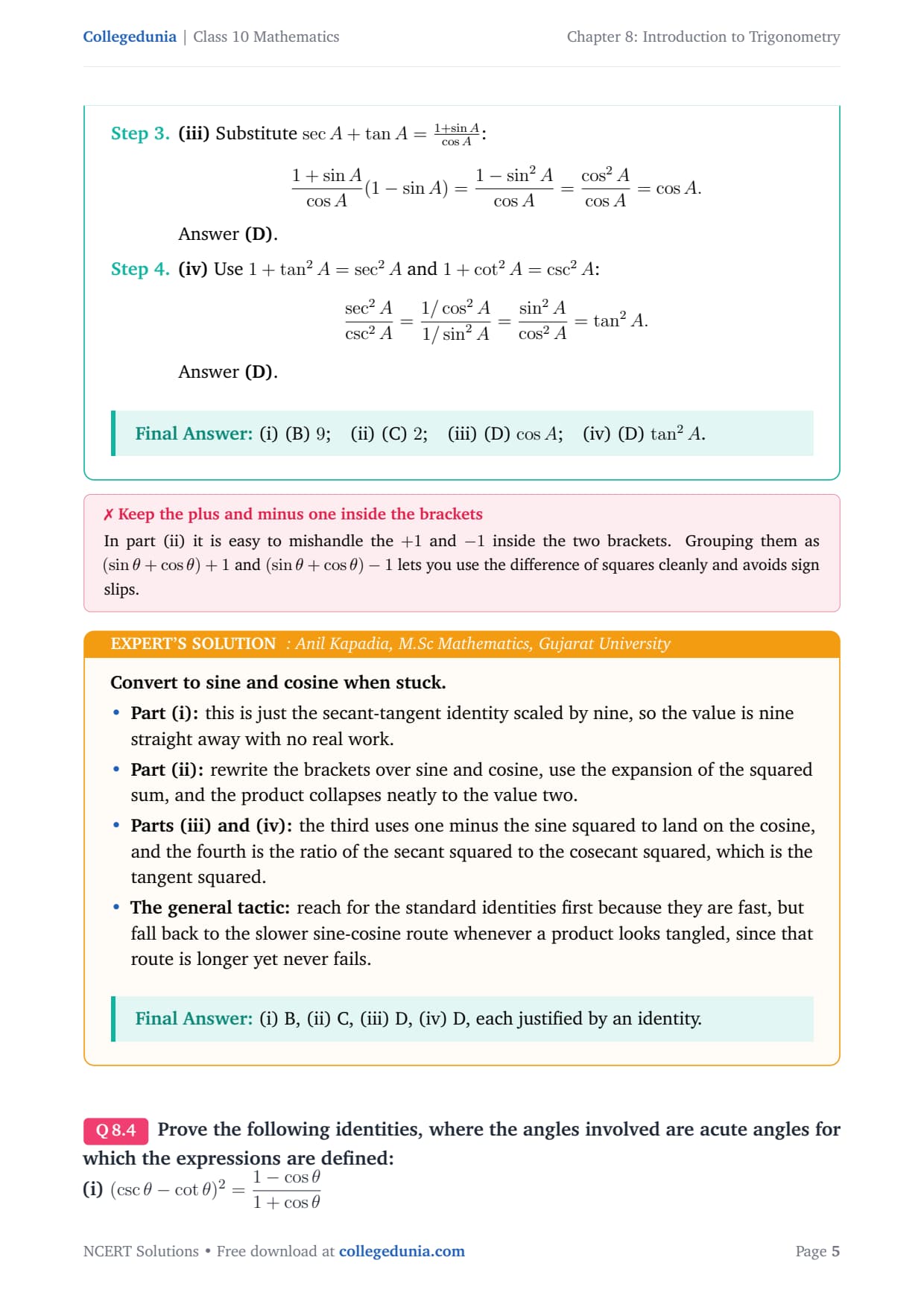
(i) 9sec2 A-9tan2 A=
(A) 1 (B) 9 (C) 8 (D) 0
(ii) (1+tanθ+secθ)(1+cotθ-cscθ)=
(A) 0 (B) 1 (C) 2 (D) -1
(iii) (sec A+tan A)(1-sin A)=
(A) sec A (B) sin A (C) csc A (D) cos A
(iv) 1+tan2 A1+cot2 A=
(A) sec2 A (B) -1 (C) cot2 A (D) tan2 A.
Prove the following identities, where the angles involved are
acute angles for which the expressions are defined:
(i) (cscθ-cotθ)2=1-cosθ1+cosθ
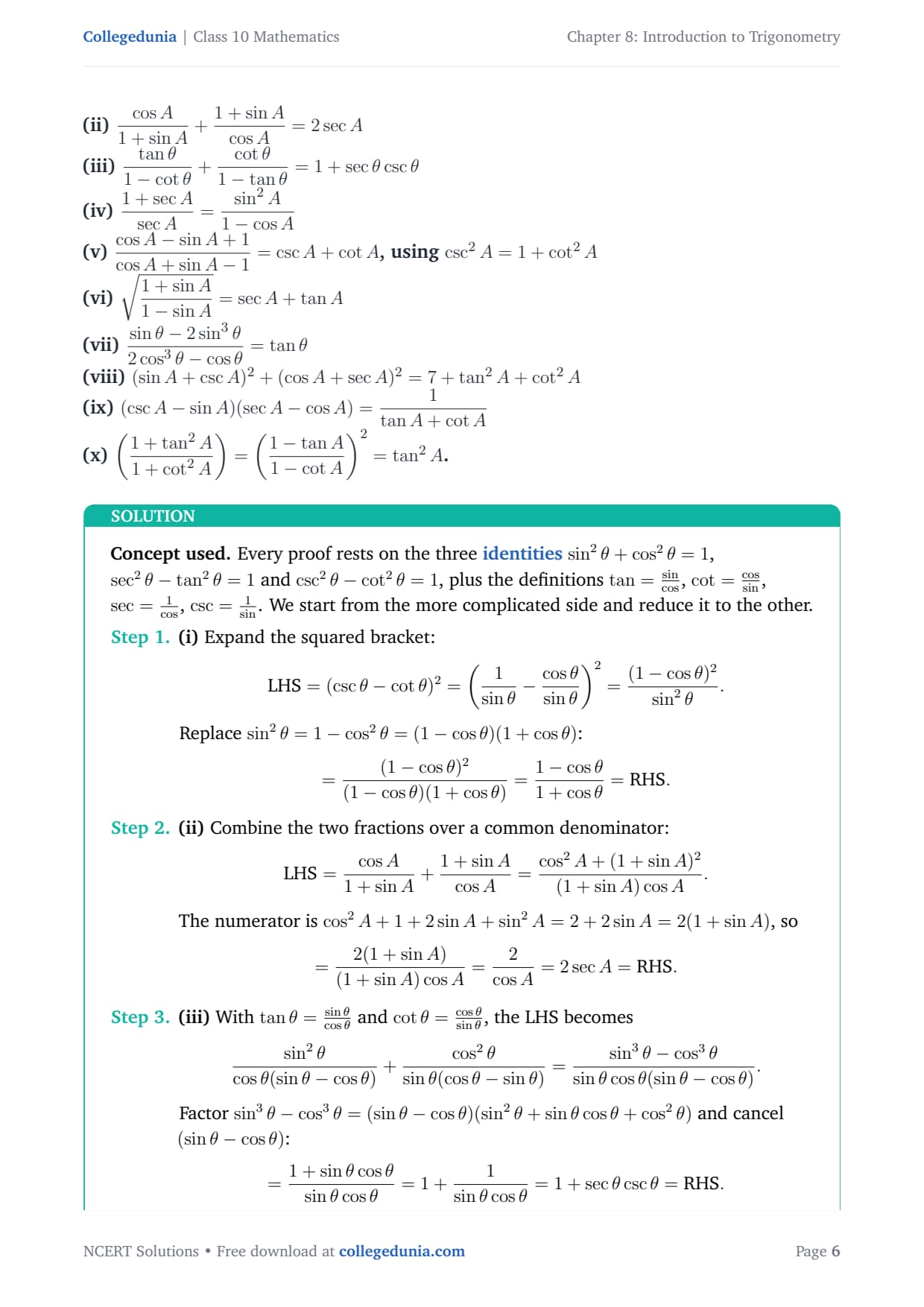
(ii) cos A1+sin A+1+sin Acos A=2sec A
(iii) tanθ1-cotθ+cotθ1-tanθ=1+secθ
(iv) 1+sec Asec A=sin2 A1-cos A
(v) cos A-sin A+1cos A+sin A-1=csc A+cot A, using csc2 A=1+cot2 A
(vi) √1+sin A1-sin A=sec A+tan A
(vii) sinθ-2sin3θ2cos3θ-cosθ=tanθ
(viii) (sin A+csc A)2+(cos A+sec A)2=7+tan2 A+cot2 A
(ix) (csc A-sin A)(sec A-cos A)=1tan A+cot A
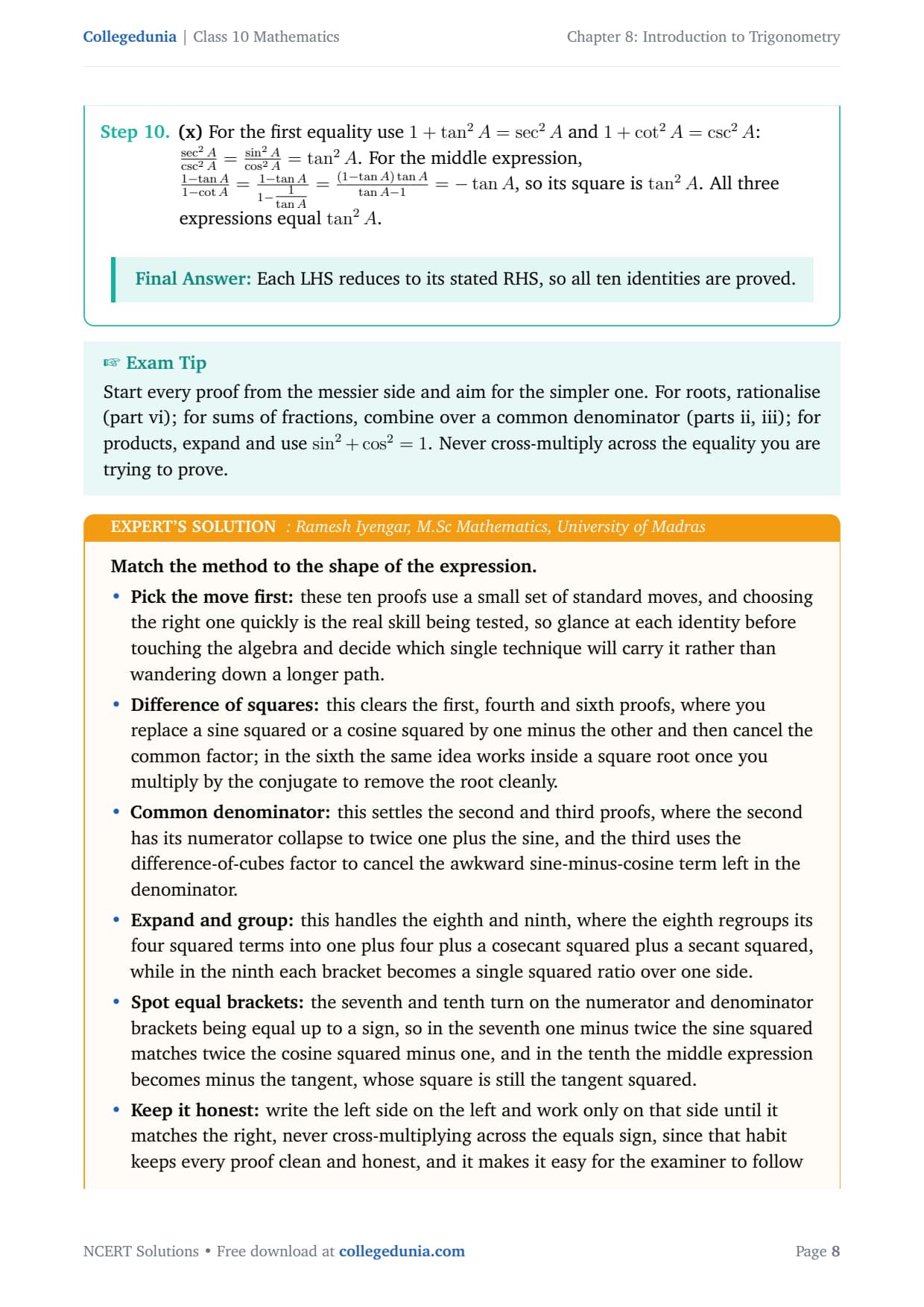
(x) (1+tan2 A1+cot2 A)=(1-tan A1-cot A)2=tan2 A.
Student Feedback
Out of 21,500 students surveyed before the 2026 boards, 88% said Exercise 8.3 identity proofs became easier once they always started from the more complex side and used sin/cos substitution as a fallback. Marks on proof questions improved a lot after practising all ten sub-parts of Question 4.
Source: Collegedunia Class 10 student survey, 2026 board batch.
Introduction to Trigonometry Class 10 Maths Exercise 8.3 NCERT Solutions FAQs
Ques. How many questions are there in Class 10 Maths Chapter 8 Introduction to Trigonometry Exercise 8.3?
Ans. Exercise 8.3 has 4 questions. Question 1 asks for three ratios in terms of cot A, Question 2 asks for all ratios in terms of sec A, Question 3 has four MCQ simplifications, and Question 4 requires students to prove ten trigonometric identities.
Ques. What identities are needed for Exercise 8.3?
Ans. The three Pythagorean identities cover almost the whole exercise: sin2A + cos2A = 1, sec2A - tan2A = 1, and csc2A - cot2A = 1. You also need the reciprocal definitions: sec = 1/cos, csc = 1/sin, tan = sin/cos, cot = cos/sin.
Ques. How do I prove identities in Exercise 8.3 Question 4?
Ans. Always work on one side only, starting from the more complex side. Never move terms to the other side or cross-multiply. The main techniques are: combine fractions over a common denominator, factor as a difference of squares, rationalise a square root by multiplying by the conjugate, or convert everything to sin and cos when stuck.
Ques. Why does part (x) of Question 4 give a negative sign in the middle expression?
Ans. When you simplify (1 - tan A)/(1 - cot A), rewrite cot A as 1/tan A. The denominator becomes (tan A - 1)/tan A, so the whole fraction becomes -tan A. The minus sign disappears when you square it, giving tan2A, which equals the other two expressions in Question 4(x).
Ques. Are these Exercise 8.3 solutions based on the 2026-27 syllabus?
Ans. Yes. These solutions follow the current 2026-27 CBSE syllabus for Class 10 Mathematics. All four questions in Exercise 8.3 are fully retained in the latest 2026-27 NCERT edition of Chapter 8 Introduction to Trigonometry.



Comments