Exercise 5.3 of Class 10 Maths Chapter 5 Arithmetic Progressions is the longest exercise in this chapter. It has 20 questions that test the sum formula Sn = n2[2a + (n-1)d] in every possible way - from direct substitution to forming equations and solving word problems.
CBSE Weightage: 4-6 marks; sums appear as short-answer and long-answer questions in the board exam almost every year.
20 questions covering sum of terms, finding unknowns from partial information, and real-life AP word problems (penalties, prizes, trees, logs, spirals).
Aligned to the 2026-27 CBSE Class 10 Maths syllabus - every solution uses textbook methods the examiner expects.
Solved by Collegedunia - Every Exercise 5.3 question is solved step by step by Mathematics subject experts, with an Expert Solution that adds board-exam strategy and common mistake warnings.
What Exercise 5.3 Covers - Class 10 Maths Arithmetic Progressions
Exercise 5.3 builds on the nth term work from Exercises 5.1 and 5.2 by adding the sum of n terms formula. This is the formula CBSE board examiners test almost every year because it has multiple variants and appears in word problems.
Direct sum questions (Questions 1-2): Apply Sn = n2[2a + (n-1)d] or Sn = n2(a + l) directly.
Find-the-unknown questions (Question 3): Given some information about an AP, find the missing values. This type often produces quadratic equations.
Given-Sn questions (Questions 9-11): Work backward from the sum formula to find the general term or check whether a sequence is an AP.
Word problems (Questions 14-20): Real-life contexts such as penalty charges, prize money, tree planting, spiral arcs, stacked logs, and a potato-race game.
20 questions in Exercise 5.3 · The biggest exercise in Chapter 5
Key Formulas Students Must Know Before Attempting Exercise 5.3
Having these three formulas in hand makes Exercise 5.3 manageable. Each formula is the right pick for a different situation.
Formula
When to Use
Variables
Sn = n2[2a + (n-1)d]
When you know a, d, and number of terms n
a = first term, d = common difference
Sn = n2(a + l)
When the last term l is given
l = last term (also written an)
an = Sn - Sn-1
When the sum formula Sn is given and you need individual terms
Works for n ≥ 2; first term = S1
The link an = a + (n-1)d from Exercise 5.2 is still needed here whenever you need to find n first. A common path in Exercise 5.3: find n using the nth term formula, then plug into the sum formula.
How to Solve Exercise 5.3 Arithmetic Progressions Question by Question
Every question in Exercise 5.3 follows one of these three approaches. Knowing which approach fits saves time and avoids errors in the board exam.
Approach 1 - Direct sum: Read off a, d, n (or l), apply the right formula, compute. Questions 1, 2, 7, 8, 12, 13 work this way.
Approach 2 - Simultaneous equations: When the question gives two conditions (like S7 = 49 and S17 = 289), write two equations in a and d and solve together. Question 9 is the classic example.
Approach 3 - Quadratic in n: Set Sn = given total. The expanded formula becomes a quadratic; solve by factoring or the quadratic formula, then reject any root that is not a positive integer. Questions 4 and 19 use this approach.
Board Exam Tip: When a quadratic in n gives two roots, test each one by computing the top row (or last term). Reject the root that gives a non-positive or non-integer term count. Showing this check explicitly earns full marks.
Exercise 5.3 Sum Formula - Visual Reference for CBSE Students
The image below shows the two sum formulas side by side with their respective use cases - a quick reference for students revising Exercise 5.3 before the board exam.
All Exercise 5.3 NCERT Solutions for Class 10 Maths with Step-by-Step Solutions
Questions
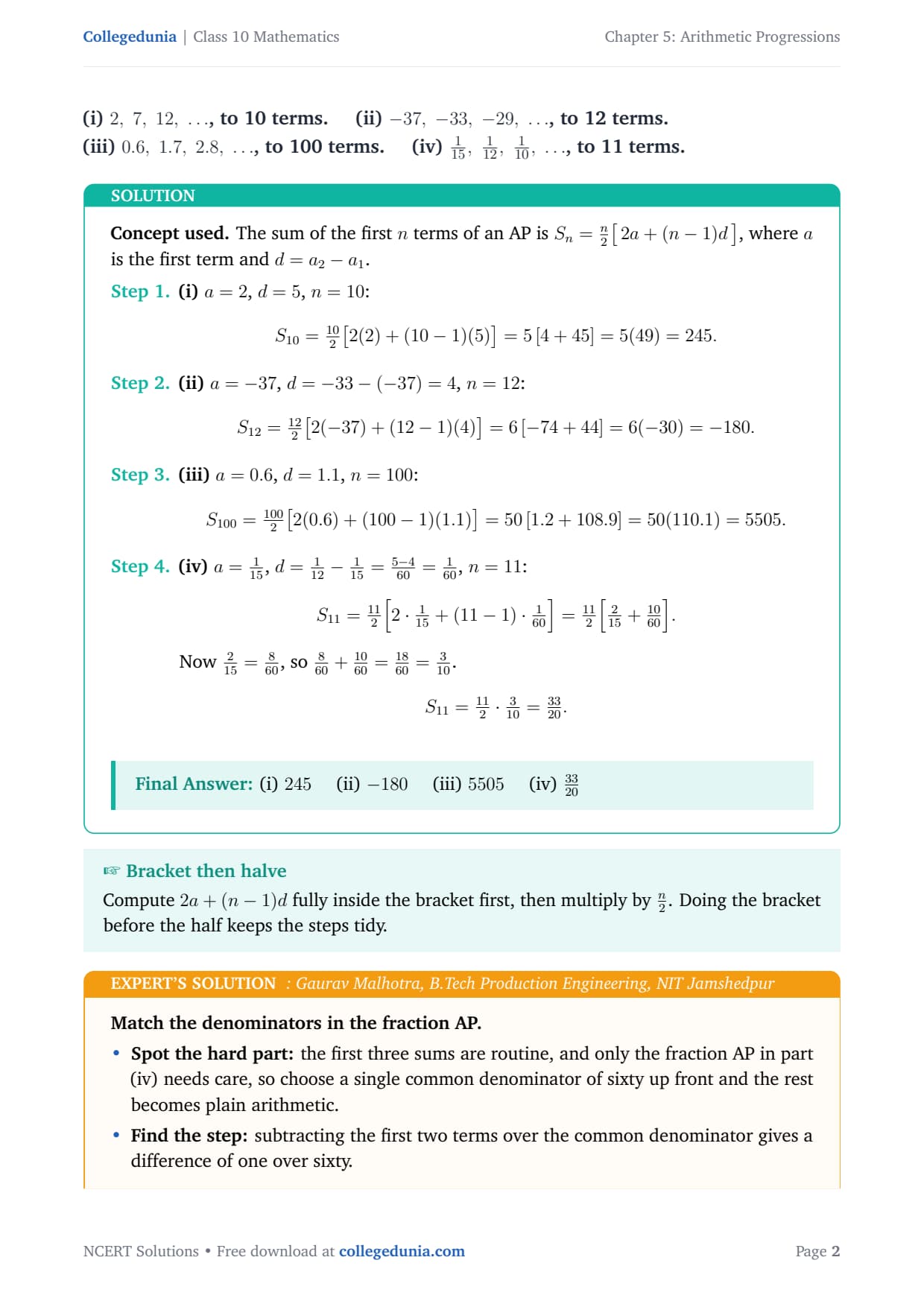
Q 5.1
Find the sum of the following APs:
(i) 2, 7, 12, …, to 10 terms. (ii) -37, -33, -29, …, to 12 terms.
(iii) 0.6, 1.7, 2.8, …, to 100 terms. (iv) 115, 112, 110, …, to 11 terms.
Concept used. The sum of the first n terms of an AP is
Sn = n2[ 2a + (n-1)d ], where a is the first term and
d = a2 - a1.
Spot the hard part: the first three sums are routine, and only
the fraction AP in part (iv) needs care, so choose a single common
denominator of sixty up front and the rest becomes plain arithmetic.
Find the step: subtracting the first two terms over the common
denominator gives a difference of one over sixty.
Add inside the bracket: rewrite the leading fraction over sixty
so it adds cleanly to the rest, which simplifies to three over ten.
Finish the sum: multiplying by the half-count factor gives the
final value of thirty-three over twenty.
Why it matters: sum problems with fractions are really a test of
denominator handling, and converting everything to a single denominator
before adding is the safest route to the exact answer the board expects.
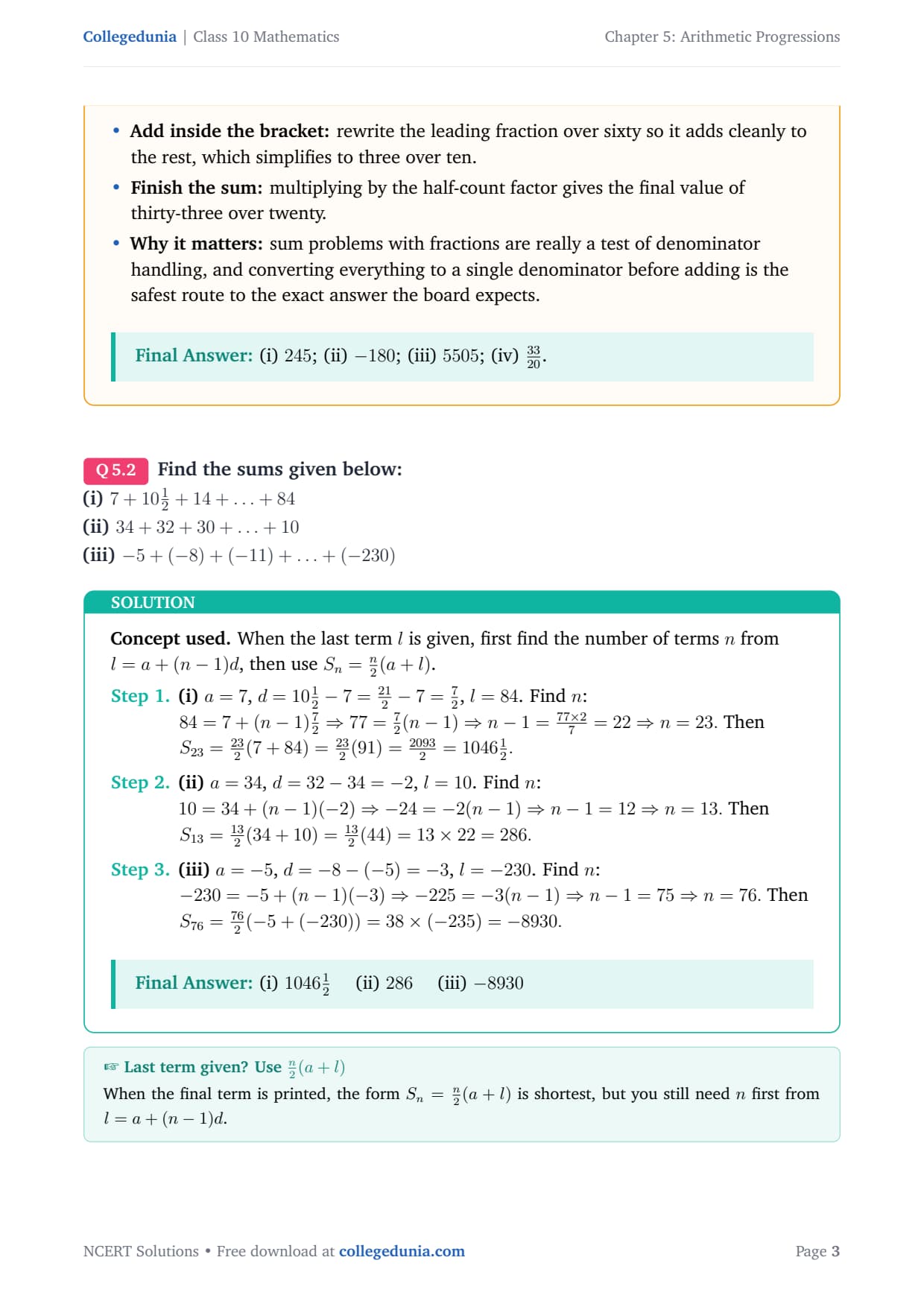
(ii)a = 34, d = 32 - 34 = -2, l = 10.
Find n: 10 = 34 + (n-1)(-2) ⇒ -24 = -2(n-1) ⇒ n - 1 = 12 ⇒ n = 13.
Then S13 = 132(34 + 10) = 132(44) = 13 × 22 = 286.
(iii)a = -5, d = -8 - (-5) = -3, l = -230.
Find n: -230 = -5 + (n-1)(-3) ⇒ -225 = -3(n-1) ⇒ n - 1 = 75 ⇒ n = 76.
Then S76 = 762(-5 + (-230)) = 38 × (-235) = -8930.
(i) 104612 (ii) 286 (iii) -8930
SK
Shruti Kulkarni
M.Sc Mathematics, Pune University
Verified Expert
Two-stage routine: count, then average.
Same shape: every "up to a last term" sum follows the same two
stages, so handle all three parts with one routine.
Stage one, count: use the last-term equation to find the number
of terms, which gives twenty-three, thirteen and seventy-six.
Stage two, average: average the two ends and scale by the count,
Sn = n × a+l2; for part (iii) the average term is
-5+(-230)2, and times seventy-six gives minus eight thousand
nine hundred thirty.
Read the form: this half-count times sum-of-ends is simply the
number of terms times the average term.
Why it matters: reading the sum as count times average term
demystifies the formula and gives a built-in sanity check, since the sum
should sit near the count times the middle value.
(i) 104612; (ii) 286; (iii) -8930.
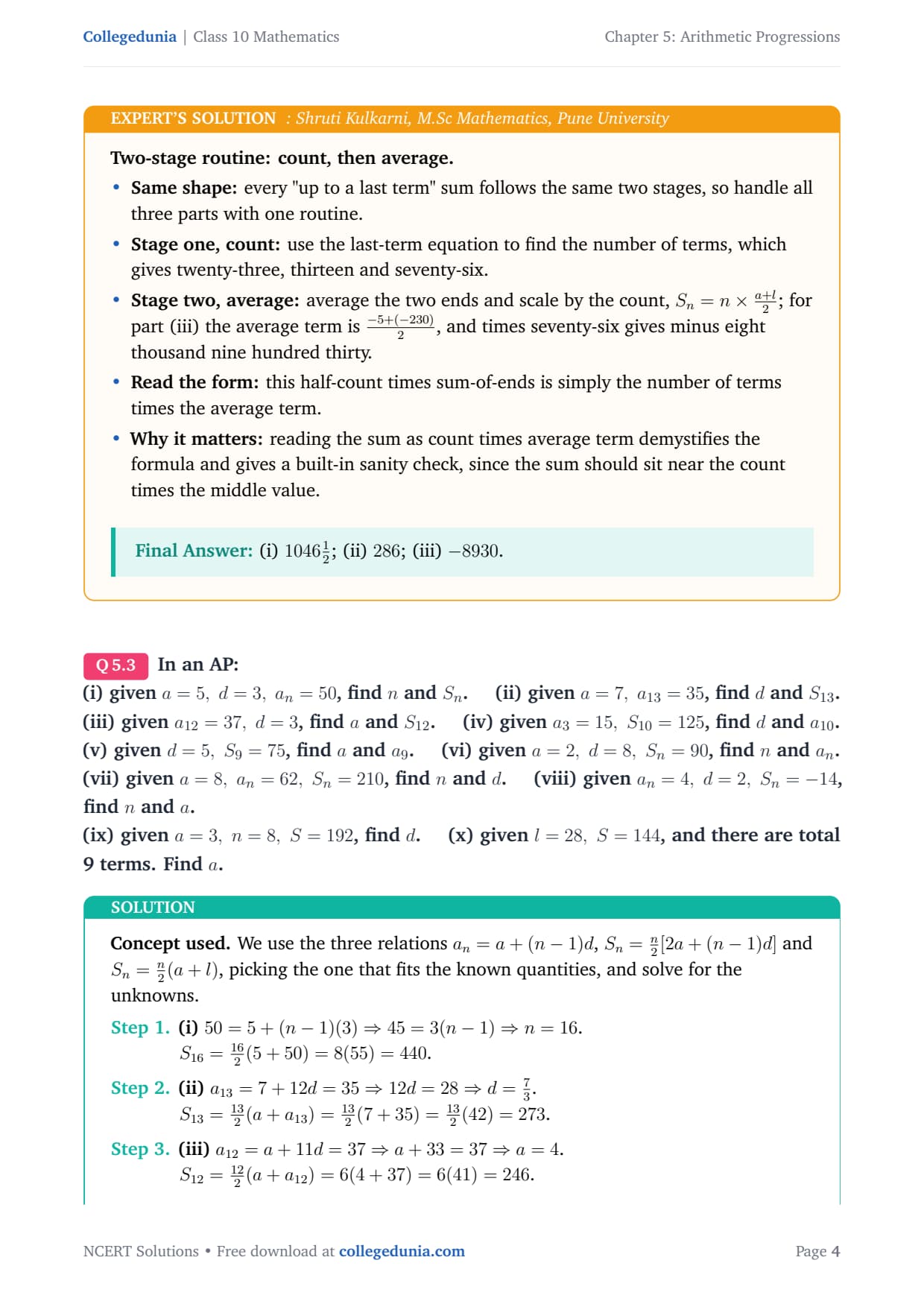
Q 5.3
In an AP:
(i) given a = 5, d = 3, an = 50, find n and Sn. (ii) given a = 7, a13 = 35, find d and S13.
(iii) given a12 = 37, d = 3, find a and S12. (iv) given a3 = 15, S10 = 125, find d and a10.
(v) given d = 5, S9 = 75, find a and a9. (vi) given a = 2, d = 8, Sn = 90, find n and an.
(vii) given a = 8, an = 62, Sn = 210, find n and d. (viii) given an = 4, d = 2, Sn = -14, find n and a.
(ix) given a = 3, n = 8, S = 192, find d. (x) given l = 28, S = 144, and there are total 9 terms. Find a.
Concept used. We use the three relations an = a + (n-1)d,
Sn = n2[2a + (n-1)d] and Sn = n2(a + l), picking the one
that fits the known quantities, and solve for the unknowns.
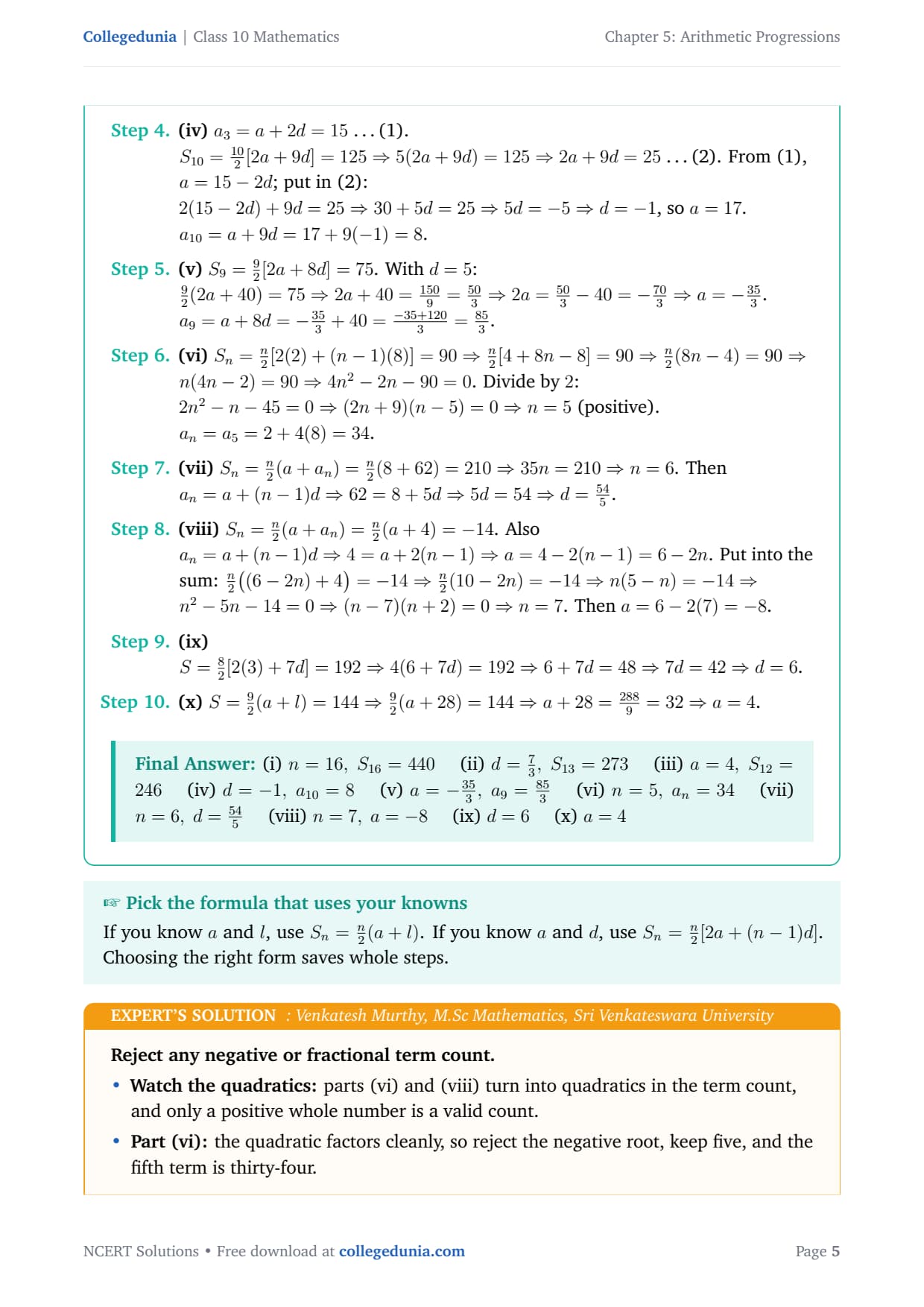
Watch the quadratics: parts (vi) and (viii) turn into quadratics
in the term count, and only a positive whole number is a valid count.
Part (vi): the quadratic factors cleanly, so reject the negative
root, keep five, and the fifth term is thirty-four.
Part (viii): again the quadratic factors, so reject the negative
root, keep seven, and the first term is minus eight.
The rest: everywhere else just match the known quantities to the
right formula and solve linearly, taking extra care with the fractions in
parts (ii) and (v).
Why it matters: the sum formula can produce a quadratic in the
count, and knowing the count must be a positive integer lets you discard
the extra root instantly, a step examiners specifically check.
Solve the matching formula for the unknowns; discard any non-positive or non-integer n.
Q 5.4
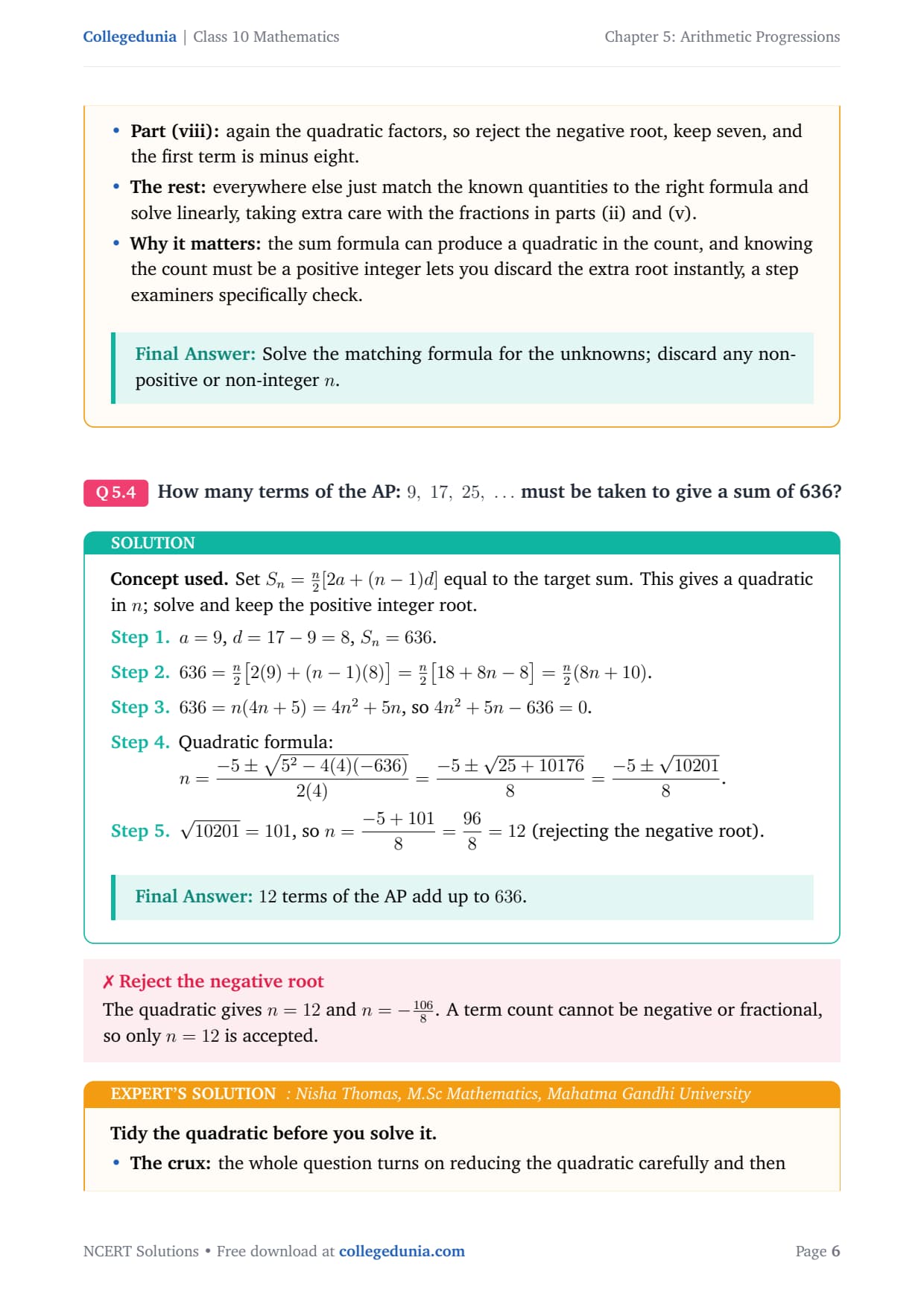
How many terms of the AP: 9, 17, 25, … must be taken to give a sum of 636?
Concept used. Set Sn = n2[2a + (n-1)d] equal to the target
sum. This gives a quadratic in n; solve and keep the positive integer root.
√10201 = 101, so n = -5 + 1018 = 968 = 12 (rejecting the negative root).
12 terms of the AP add up to 636.
NT
Nisha Thomas
M.Sc Mathematics, Mahatma Gandhi University
Verified Expert
Tidy the quadratic before you solve it.
The crux: the whole question turns on reducing the quadratic
carefully and then recognising that its discriminant is a perfect square.
Form the equation: the sum formula gives the tidy quadratic
4n2 + 5n - 636 = 0.
Check the discriminant: the discriminant works out to ten
thousand two hundred one, which is exactly the square of one hundred one.
Take the valid root: this gives a count of twelve once the
negative root is rejected, n = -5 + 1018 = 12.
Why it matters: a clean perfect-square discriminant signals you
are on track, and spotting it confirms the count without a calculator,
exactly the kind of number boards design.
n = 12 terms.
Q 5.5
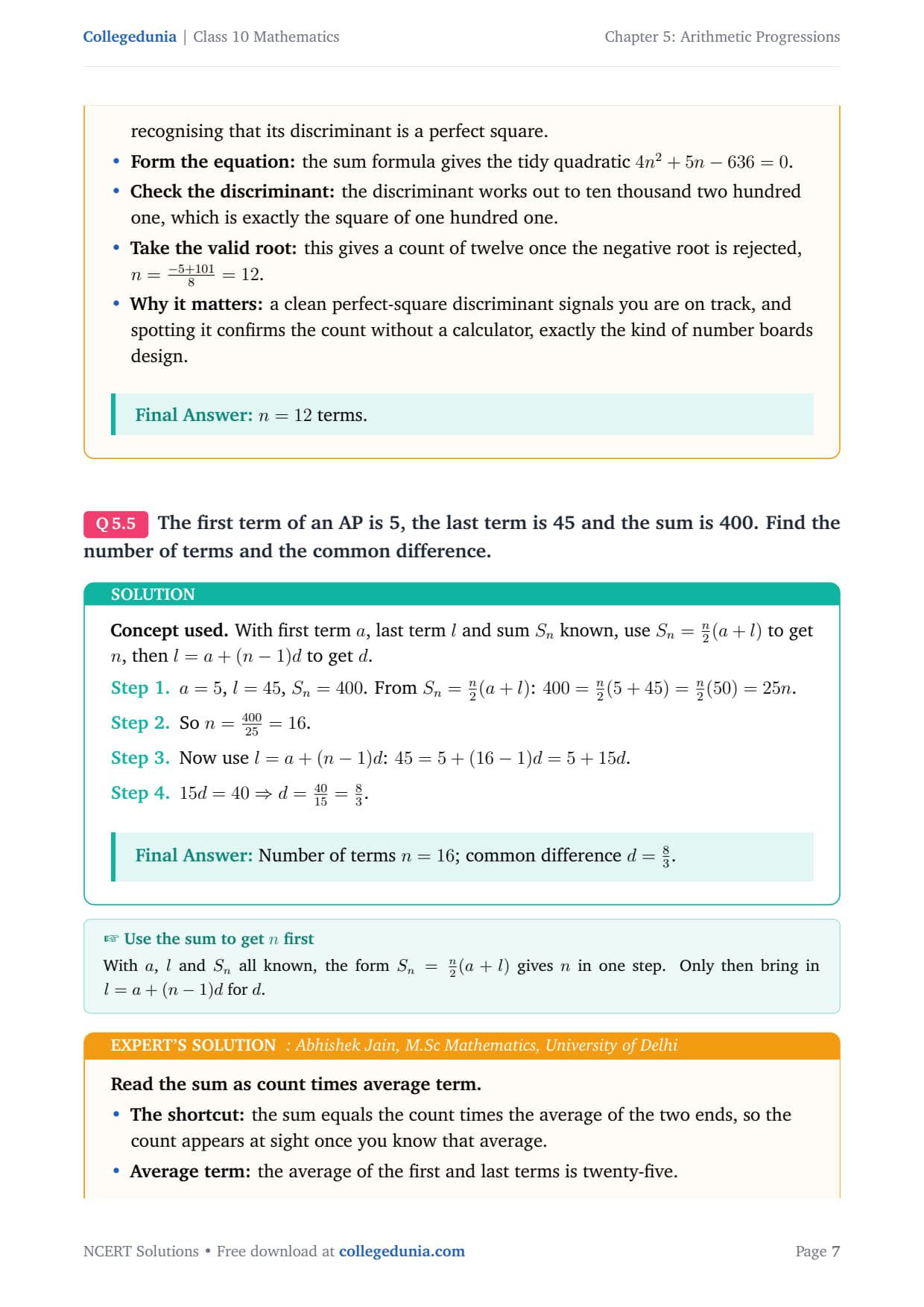
The first term of an AP is 5, the last term is 45 and the sum is 400. Find the number of terms and the common difference.
Concept used. With first term a, last term l and sum Sn known,
use Sn = n2(a + l) to get n, then l = a + (n-1)d to get d.
a = 5, l = 45, Sn = 400. From Sn = n2(a + l):
400 = n2(5 + 45) = n2(50) = 25n.
So n = 40025 = 16.
Now use l = a + (n-1)d: 45 = 5 + (16 - 1)d = 5 + 15d.
15d = 40 ⇒ d = 4015 = 83.
Number of terms n = 16; common difference d = 83.
AJ
Abhishek Jain
M.Sc Mathematics, University of Delhi
Verified Expert
Read the sum as count times average term.
The shortcut: the sum equals the count times the average of the
two ends, so the count appears at sight once you know that average.
Average term: the average of the first and last terms is
twenty-five.
Count the terms: dividing the total of four hundred by that
average of twenty-five gives sixteen terms.
Find the step: the last-term equation then gives the common
difference as eight-thirds.
Why it matters: treating the sum as count times average term
makes the count obvious and gives a quick check, since sixteen terms
averaging twenty-five indeed add to four hundred.
n = 16, d = 83.
Q 5.6
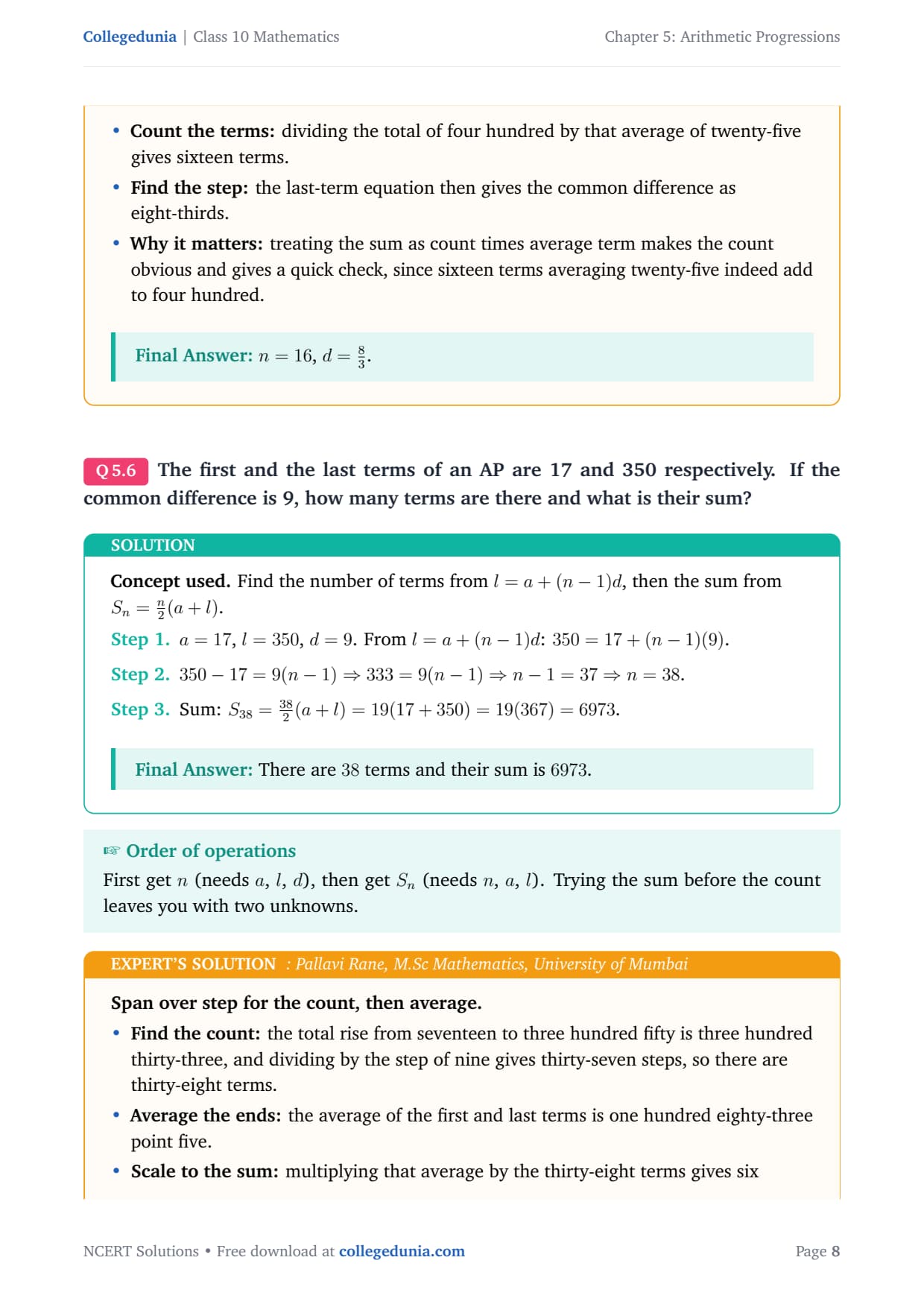
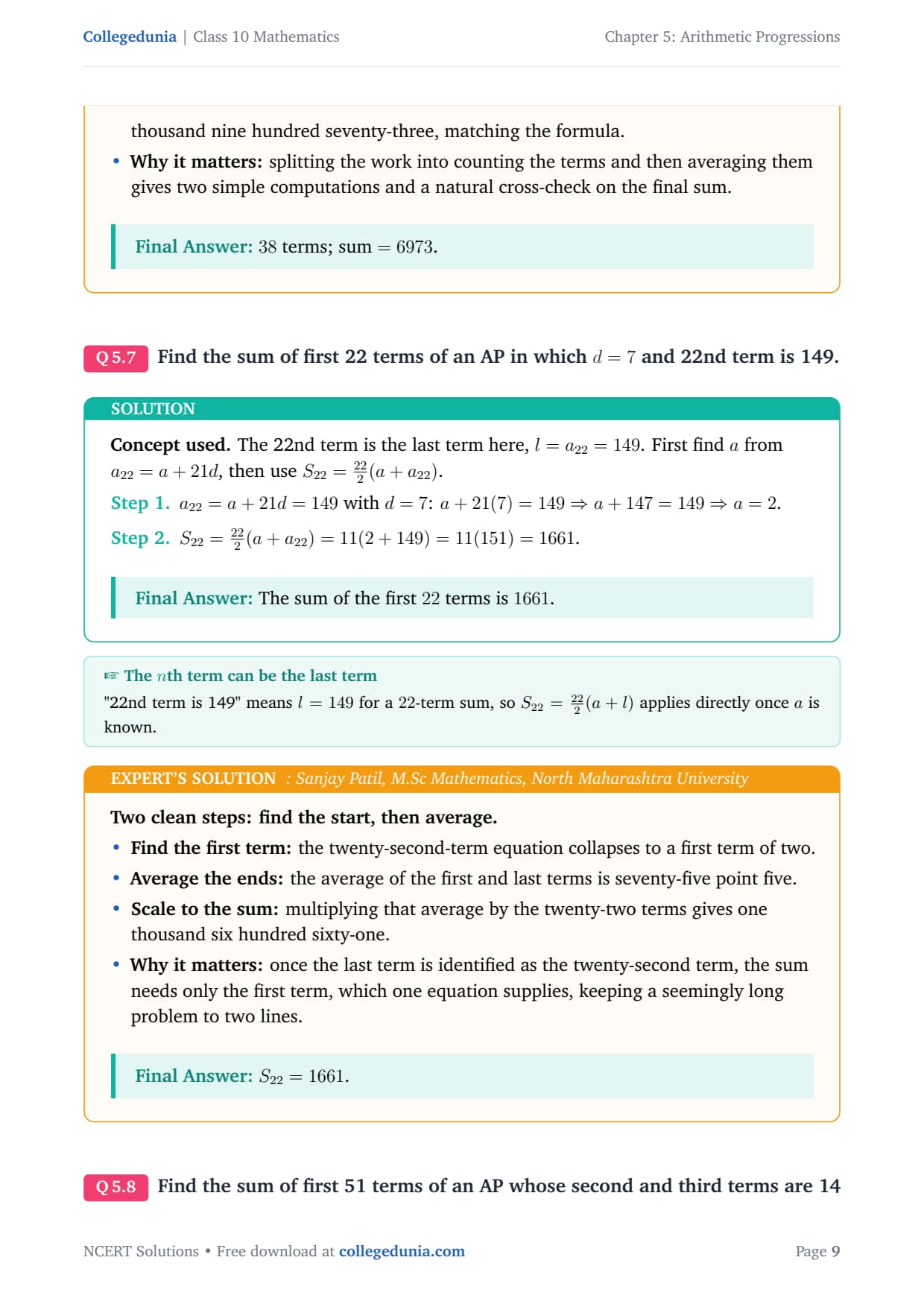
The first and the last terms of an AP are 17 and 350 respectively. If the common difference is 9, how many terms are there and what is their sum?
Concept used. Find the number of terms from l = a + (n-1)d, then the
sum from Sn = n2(a + l).
a = 17, l = 350, d = 9. From l = a + (n-1)d:
350 = 17 + (n-1)(9).
350 - 17 = 9(n-1) ⇒ 333 = 9(n-1) ⇒ n - 1 = 37 ⇒ n = 38.
Find the count: the total rise from seventeen to three hundred
fifty is three hundred thirty-three, and dividing by the step of nine gives
thirty-seven steps, so there are thirty-eight terms.
Average the ends: the average of the first and last terms is one
hundred eighty-three point five.
Scale to the sum: multiplying that average by the thirty-eight
terms gives six thousand nine hundred seventy-three, matching the formula.
Why it matters: splitting the work into counting the terms and
then averaging them gives two simple computations and a natural
cross-check on the final sum.
38 terms; sum = 6973.
Q 5.7
Find the sum of first 22 terms of an AP in which d = 7 and 22nd term is 149.
Concept used. The 22nd term is the last term here, l = a22 = 149.
First find a from a22 = a + 21d, then use S22 = 222(a + a22).
a22 = a + 21d = 149 with d = 7: a + 21(7) = 149 ⇒ a + 147 = 149 ⇒ a = 2.
Find the first term: the twenty-second-term equation collapses to
a first term of two.
Average the ends: the average of the first and last terms is
seventy-five point five.
Scale to the sum: multiplying that average by the twenty-two
terms gives one thousand six hundred sixty-one.
Why it matters: once the last term is identified as the
twenty-second term, the sum needs only the first term, which one equation
supplies, keeping a seemingly long problem to two lines.
S22 = 1661.
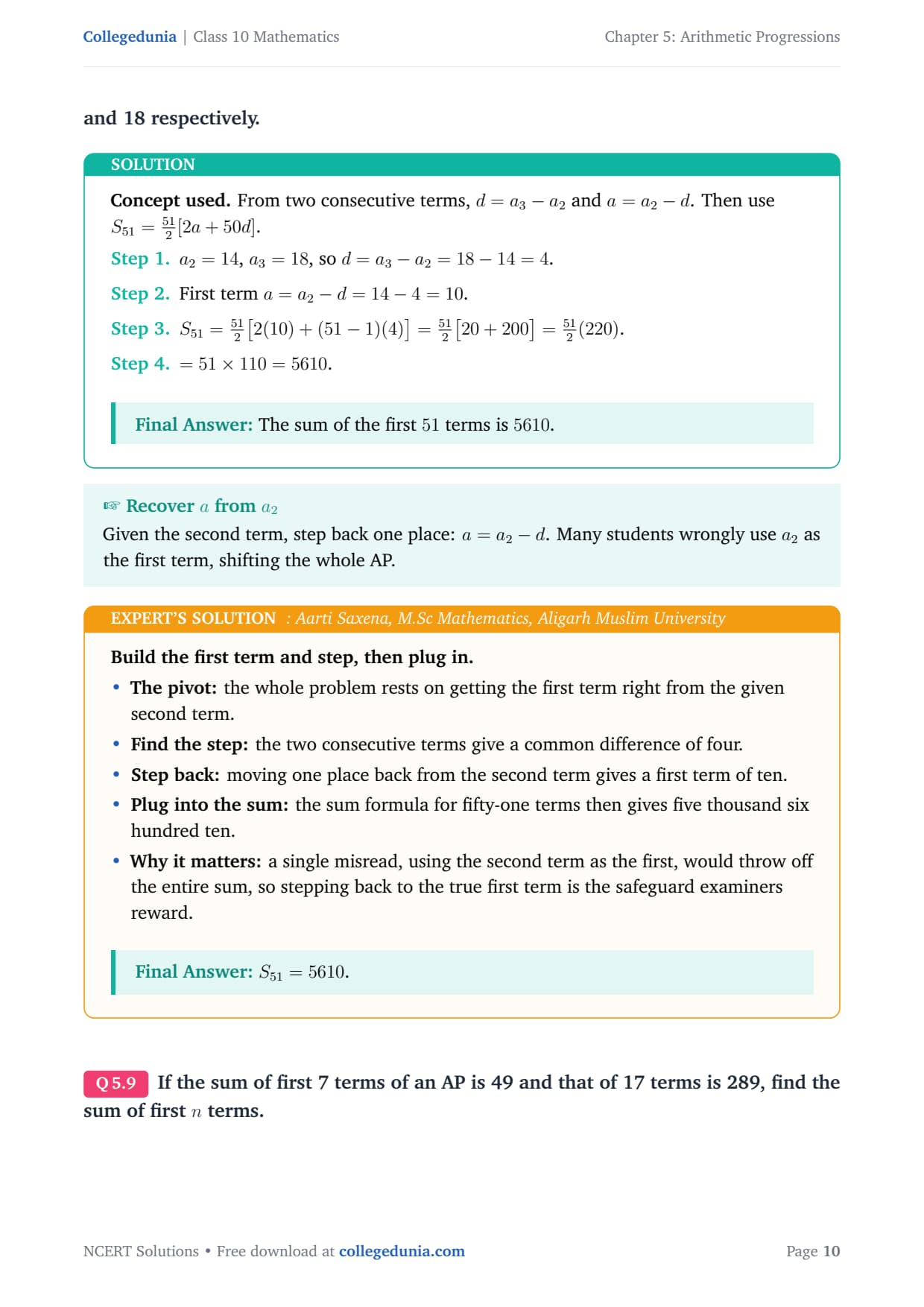
Q 5.8
Find the sum of first 51 terms of an AP whose second and third terms are 14 and 18 respectively.
Concept used. From two consecutive terms, d = a3 - a2 and
a = a2 - d. Then use S51 = 512[2a + 50d].
The pivot: the whole problem rests on getting the first term
right from the given second term.
Find the step: the two consecutive terms give a common difference
of four.
Step back: moving one place back from the second term gives a
first term of ten.
Plug into the sum: the sum formula for fifty-one terms then gives
five thousand six hundred ten.
Why it matters: a single misread, using the second term as the
first, would throw off the entire sum, so stepping back to the true first
term is the safeguard examiners reward.
S51 = 5610.
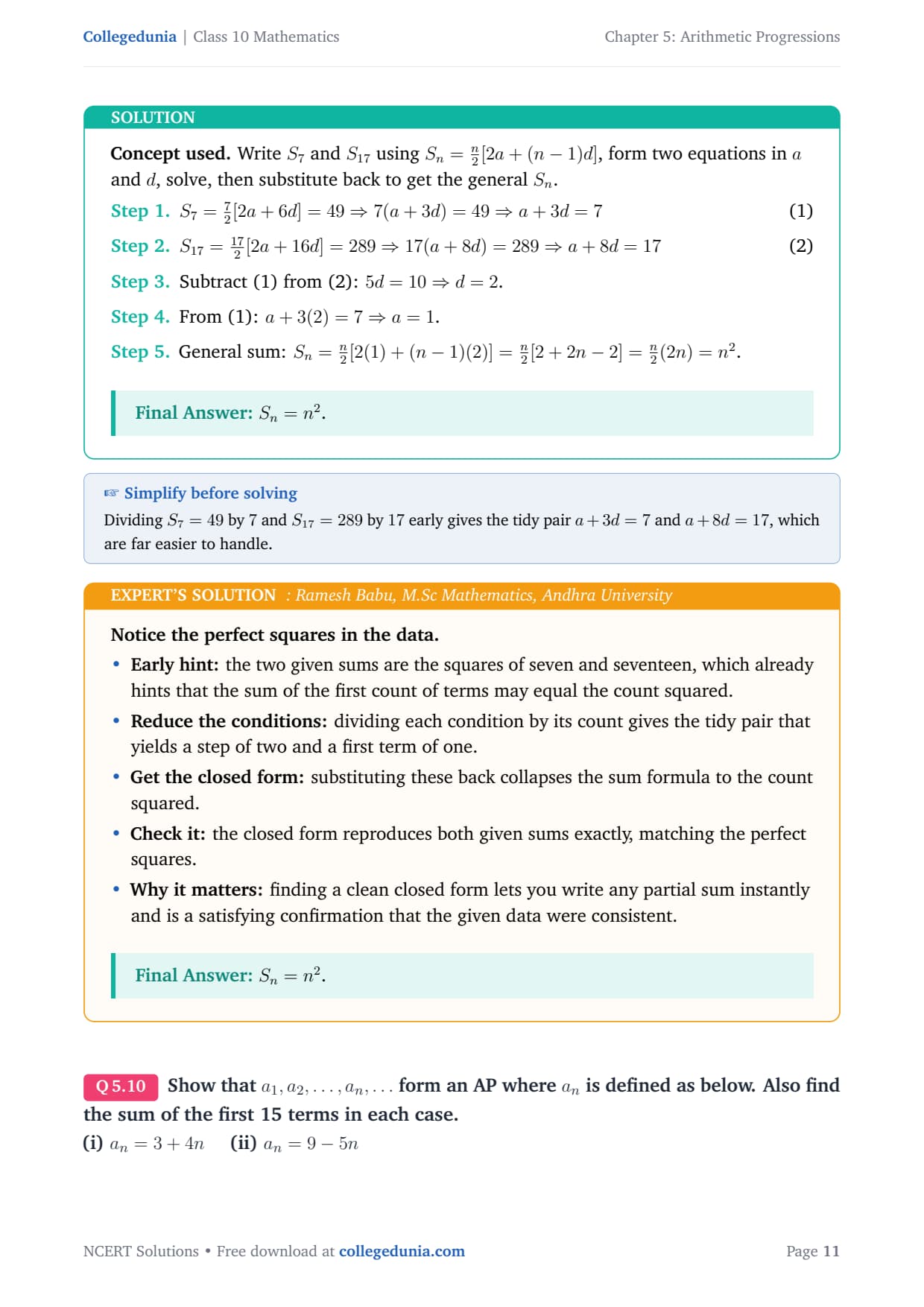
Q 5.9
If the sum of first 7 terms of an AP is 49 and that of 17 terms is 289, find the sum of first n terms.
Concept used. Write S7 and S17 using Sn = n2[2a + (n-1)d],
form two equations in a and d, solve, then substitute back to get the general Sn.
S7 = 72[2a + 6d] = 49 ⇒ 7(a + 3d) = 49 ⇒ a + 3d = 7 (1)
General sum: Sn = n2[2(1) + (n-1)(2)] = n2[2 + 2n - 2] = n2(2n) = n2.
Sn = n2.
RB
Ramesh Babu
M.Sc Mathematics, Andhra University
Verified Expert
Notice the perfect squares in the data.
Early hint: the two given sums are the squares of seven and
seventeen, which already hints that the sum of the first count of terms
may equal the count squared.
Reduce the conditions: dividing each condition by its count gives
the tidy pair that yields a step of two and a first term of one.
Get the closed form: substituting these back collapses the sum
formula to the count squared.
Check it: the closed form reproduces both given sums exactly,
matching the perfect squares.
Why it matters: finding a clean closed form lets you write any
partial sum instantly and is a satisfying confirmation that the given data
were consistent.
Sn = n2.
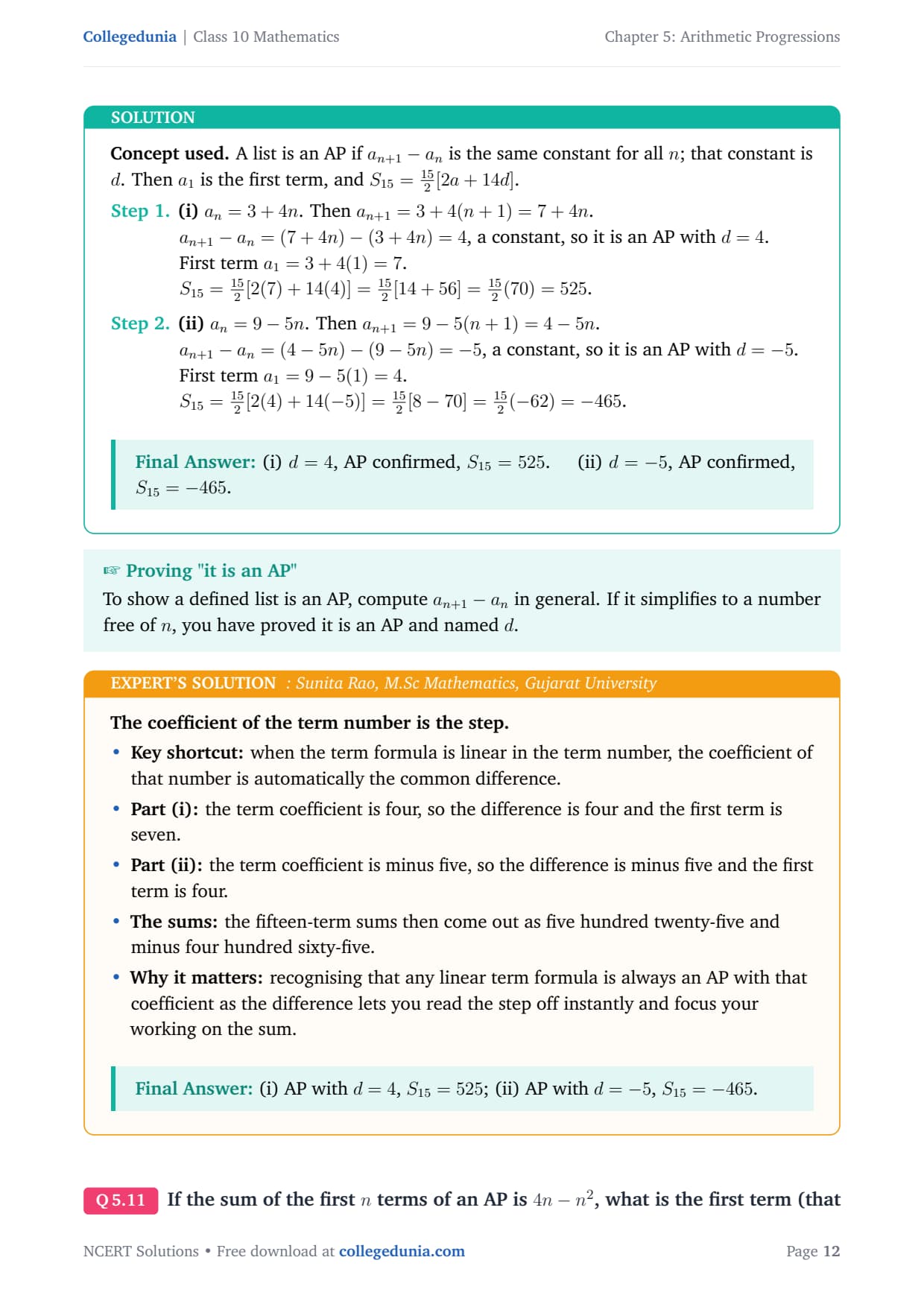
Q 5.10
Show that a1, a2, …, an, … form an AP where an is defined as below. Also find the sum of the first 15 terms in each case.
(i) an = 3 + 4n (ii) an = 9 - 5n
Concept used. A list is an AP if an+1 - an is the same constant for
all n; that constant is d. Then a1 is the first term, and
S15 = 152[2a + 14d].
(i)an = 3 + 4n. Then an+1 = 3 + 4(n+1) = 7 + 4n. an+1 - an = (7 + 4n) - (3 + 4n) = 4, a constant, so it is an AP with d = 4.
First term a1 = 3 + 4(1) = 7. S15 = 152[2(7) + 14(4)] = 152[14 + 56] = 152(70) = 525.
(ii)an = 9 - 5n. Then an+1 = 9 - 5(n+1) = 4 - 5n. an+1 - an = (4 - 5n) - (9 - 5n) = -5, a constant, so it is an AP with d = -5.
First term a1 = 9 - 5(1) = 4. S15 = 152[2(4) + 14(-5)] = 152[8 - 70] = 152(-62) = -465.
(i) d = 4, AP confirmed, S15 = 525. (ii) d = -5, AP confirmed, S15 = -465.
SR
Sunita Rao
M.Sc Mathematics, Gujarat University
Verified Expert
The coefficient of the term number is the step.
Key shortcut: when the term formula is linear in the term number,
the coefficient of that number is automatically the common difference.
Part (i): the term coefficient is four, so the difference is four
and the first term is seven.
Part (ii): the term coefficient is minus five, so the difference
is minus five and the first term is four.
The sums: the fifteen-term sums then come out as five hundred
twenty-five and minus four hundred sixty-five.
Why it matters: recognising that any linear term formula is always
an AP with that coefficient as the difference lets you read the step off
instantly and focus your working on the sum.
(i) AP with d = 4, S15 = 525; (ii) AP with d = -5, S15 = -465.
Q 5.11
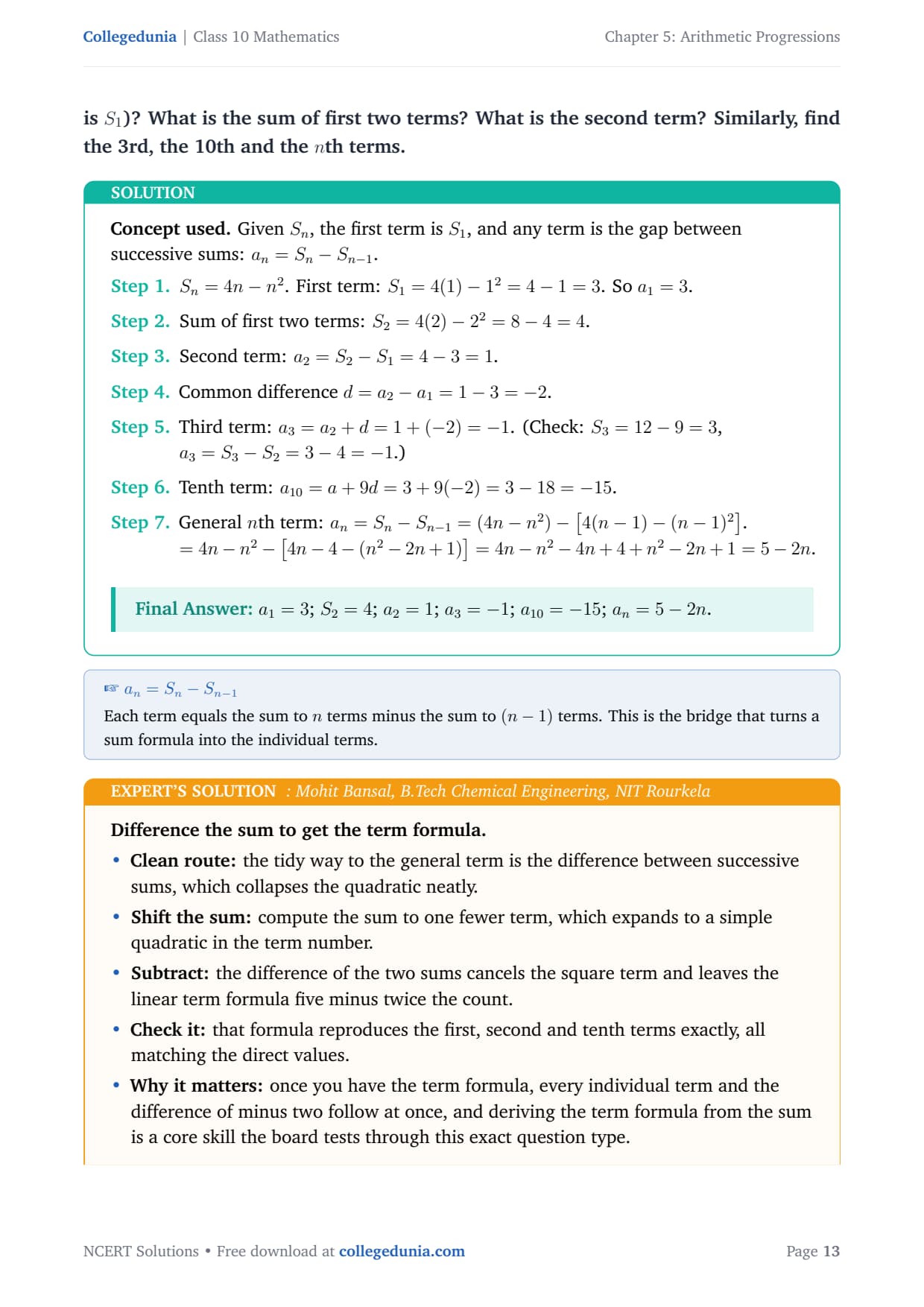
If the sum of the first n terms of an AP is 4n - n2, what is the first term (that is S1)? What is the sum of first two terms? What is the second term? Similarly, find the 3rd, the 10th and the nth terms.
Concept used. Given Sn, the first term is S1, and any term is the
gap between successive sums: an = Sn - Sn-1.
Sn = 4n - n2. First term: S1 = 4(1) - 12 = 4 - 1 = 3. So a1 = 3.
Sum of first two terms: S2 = 4(2) - 22 = 8 - 4 = 4.
Clean route: the tidy way to the general term is the difference
between successive sums, which collapses the quadratic neatly.
Shift the sum: compute the sum to one fewer term, which expands
to a simple quadratic in the term number.
Subtract: the difference of the two sums cancels the square term
and leaves the linear term formula five minus twice the count.
Check it: that formula reproduces the first, second and tenth
terms exactly, all matching the direct values.
Why it matters: once you have the term formula, every individual
term and the difference of minus two follow at once, and deriving the term
formula from the sum is a core skill the board tests through this exact
question type.
The sum of the first 40 positive integers divisible by 6 is 4920.
GS
Geetha Subramanian
M.Sc Mathematics, Bharathiar University
Verified Expert
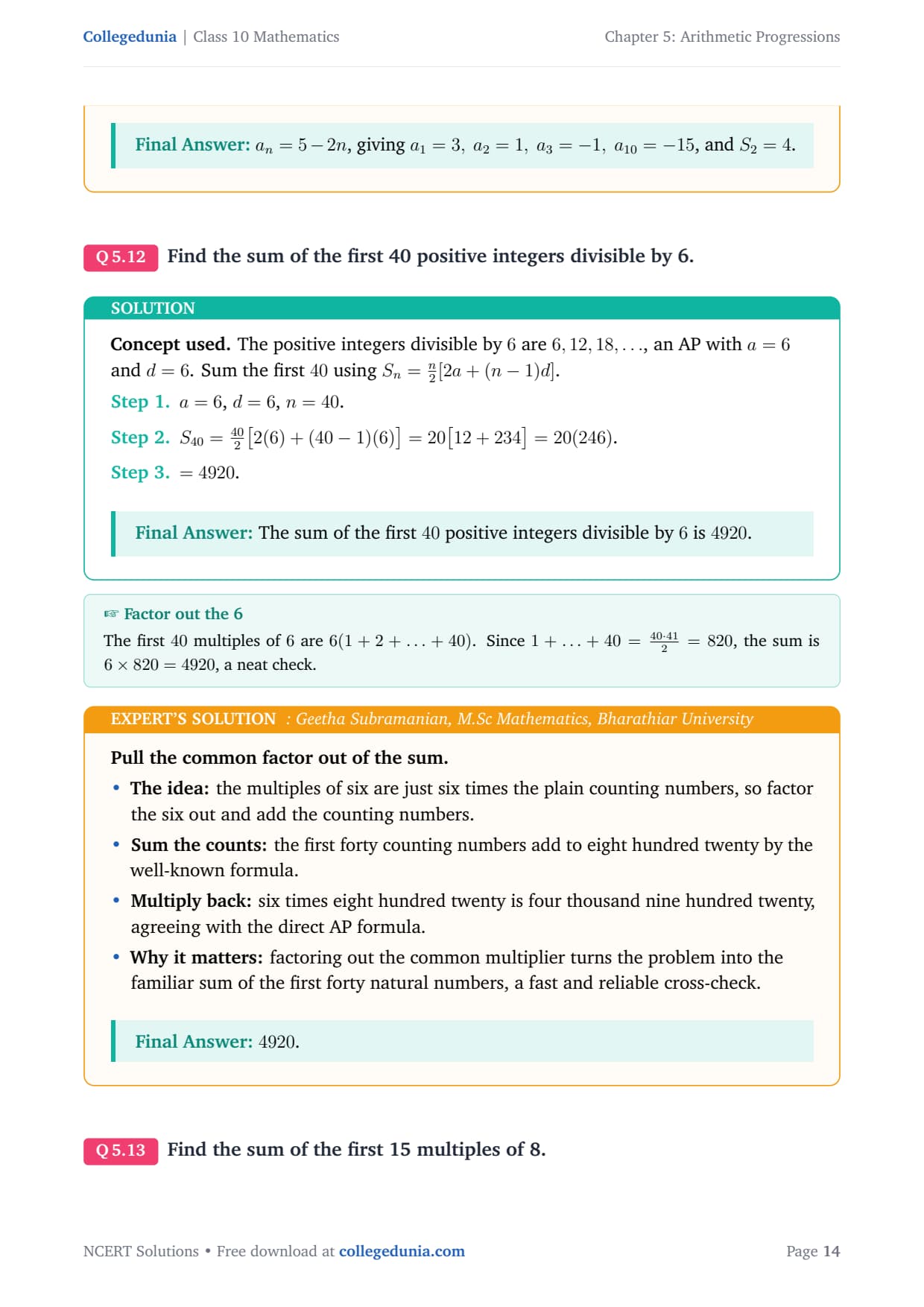
Pull the common factor out of the sum.
The idea: the multiples of six are just six times the plain
counting numbers, so factor the six out and add the counting numbers.
Sum the counts: the first forty counting numbers add to eight
hundred twenty by the well-known formula.
Multiply back: six times eight hundred twenty is four thousand
nine hundred twenty, agreeing with the direct AP formula.
Why it matters: factoring out the common multiplier turns the
problem into the familiar sum of the first forty natural numbers, a fast
and reliable cross-check.
4920.
Q 5.13
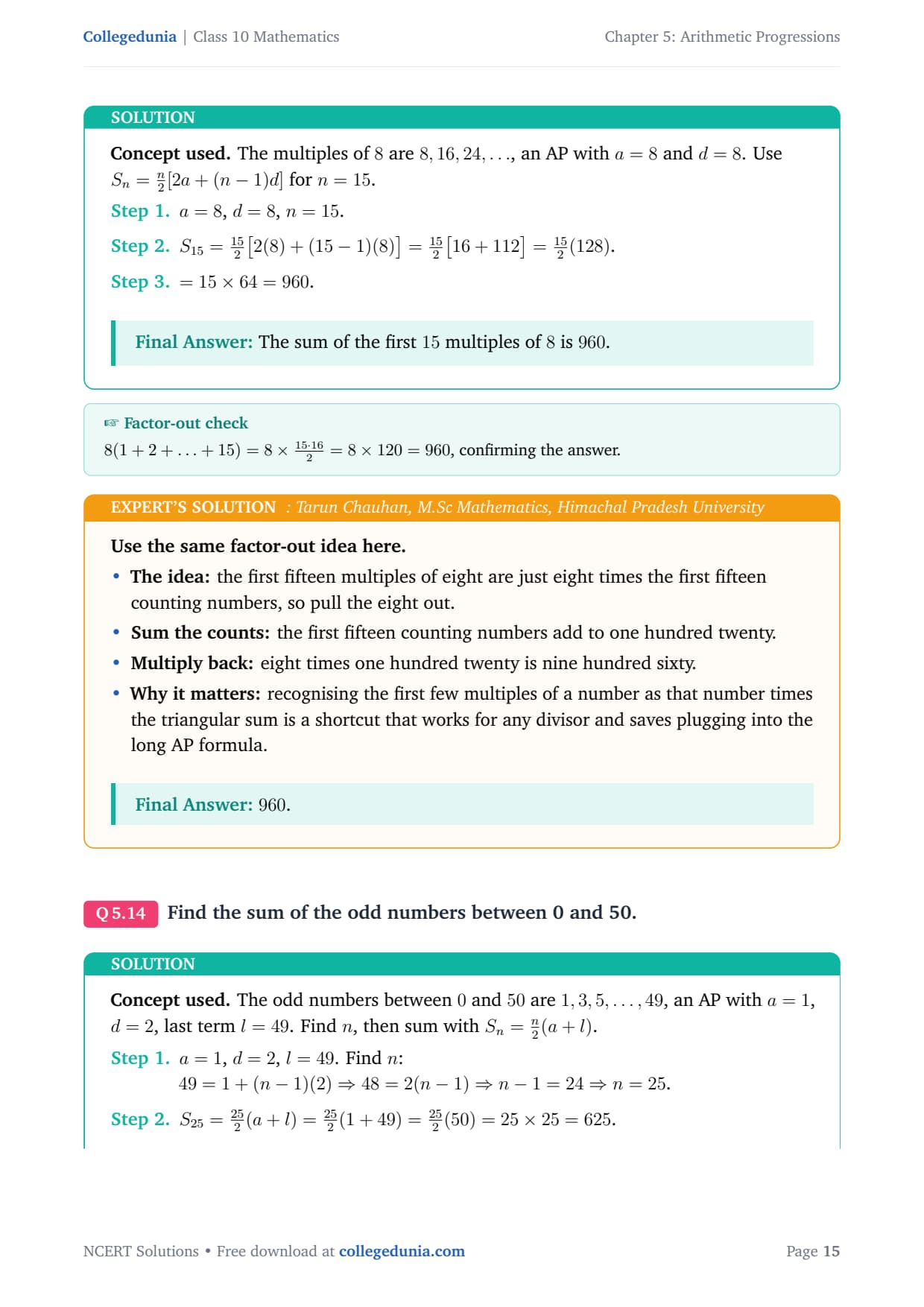
Find the sum of the first 15 multiples of 8.
Concept used. The multiples of 8 are 8, 16, 24, …, an AP with
a = 8 and d = 8. Use Sn = n2[2a + (n-1)d] for n = 15.
The idea: the first fifteen multiples of eight are just eight
times the first fifteen counting numbers, so pull the eight out.
Sum the counts: the first fifteen counting numbers add to one
hundred twenty.
Multiply back: eight times one hundred twenty is nine hundred
sixty.
Why it matters: recognising the first few multiples of a number
as that number times the triangular sum is a shortcut that works for any
divisor and saves plugging into the long AP formula.
960.
Q 5.14
Find the sum of the odd numbers between 0 and 50.
Concept used. The odd numbers between 0 and 50 are 1, 3, 5, …, 49,
an AP with a = 1, d = 2, last term l = 49. Find n, then sum with
Sn = n2(a + l).
a = 1, d = 2, l = 49. Find n: 49 = 1 + (n-1)(2) ⇒ 48 = 2(n-1) ⇒ n - 1 = 24 ⇒ n = 25.
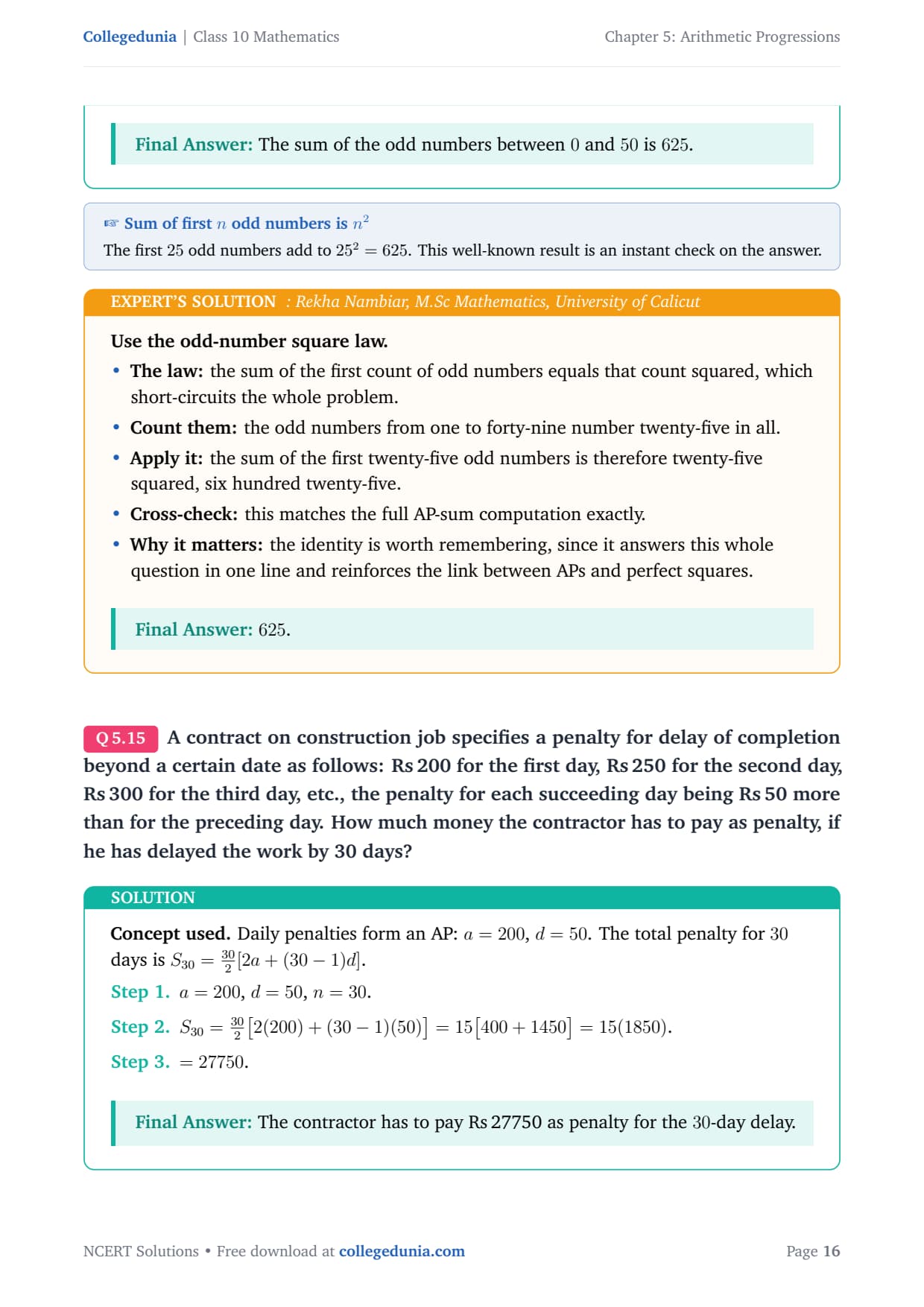
The sum of the odd numbers between 0 and 50 is 625.
RN
Rekha Nambiar
M.Sc Mathematics, University of Calicut
Verified Expert
Use the odd-number square law.
The law: the sum of the first count of odd numbers equals that
count squared, which short-circuits the whole problem.
Count them: the odd numbers from one to forty-nine number
twenty-five in all.
Apply it: the sum of the first twenty-five odd numbers is
therefore twenty-five squared, six hundred twenty-five.
Cross-check: this matches the full AP-sum computation exactly.
Why it matters: the identity is worth remembering, since it
answers this whole question in one line and reinforces the link between
APs and perfect squares.
625.
Q 5.15
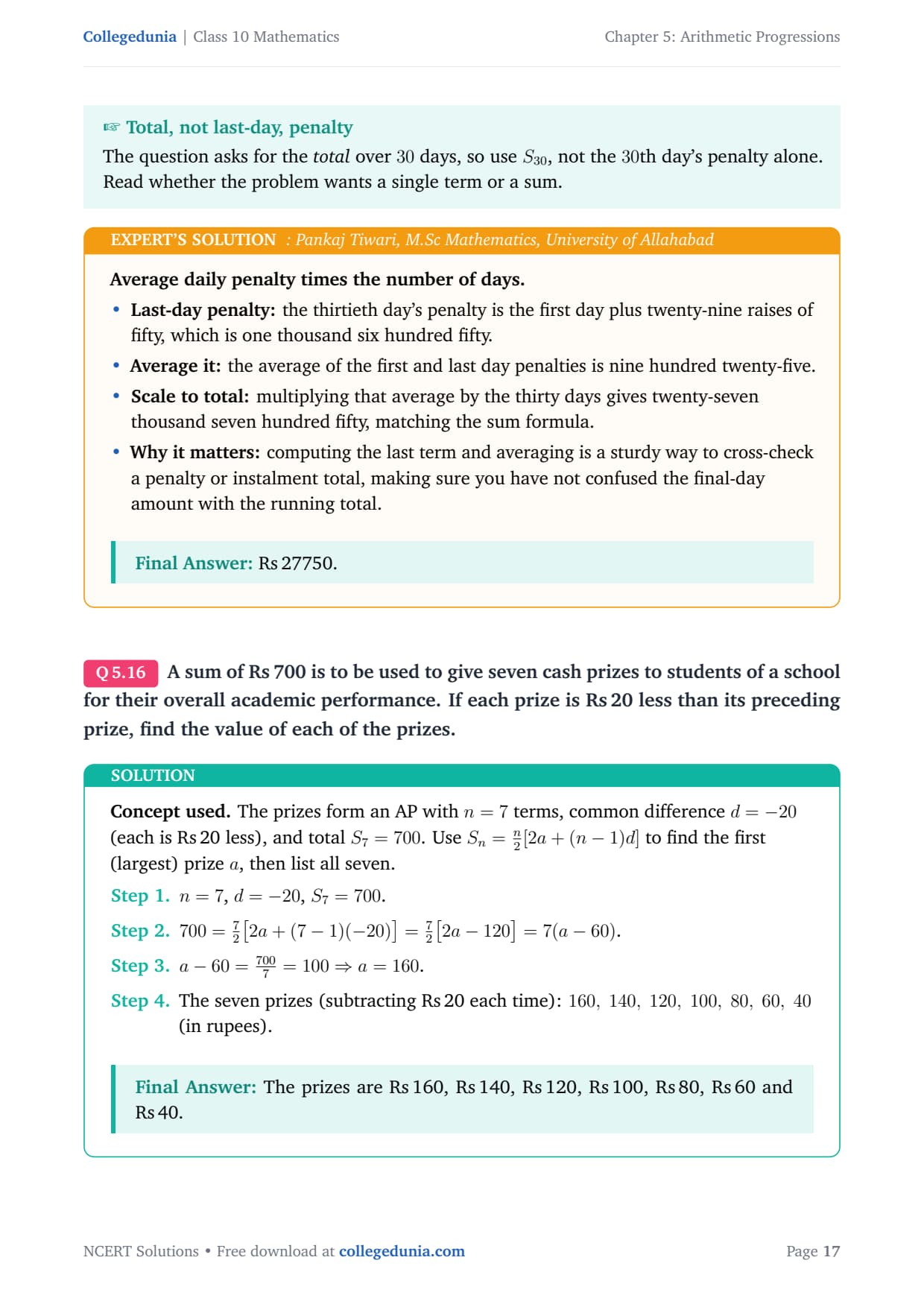
A contract on construction job specifies a penalty for delay of completion beyond a certain date as follows: 200 for the first day, 250 for the second day, 300 for the third day, etc., the penalty for each succeeding day being 50 more than for the preceding day. How much money the contractor has to pay as penalty, if he has delayed the work by 30 days?
Concept used. Daily penalties form an AP: a = 200, d = 50. The total
penalty for 30 days is S30 = 302[2a + (30-1)d].
The contractor has to pay 27750 as penalty for the 30-day delay.
PT
Pankaj Tiwari
M.Sc Mathematics, University of Allahabad
Verified Expert
Average daily penalty times the number of days.
Last-day penalty: the thirtieth day's penalty is the first day
plus twenty-nine raises of fifty, which is one thousand six hundred fifty.
Average it: the average of the first and last day penalties is
nine hundred twenty-five.
Scale to total: multiplying that average by the thirty days gives
twenty-seven thousand seven hundred fifty, matching the sum formula.
Why it matters: computing the last term and averaging is a sturdy
way to cross-check a penalty or instalment total, making sure you have not
confused the final-day amount with the running total.
27750.
Q 5.16
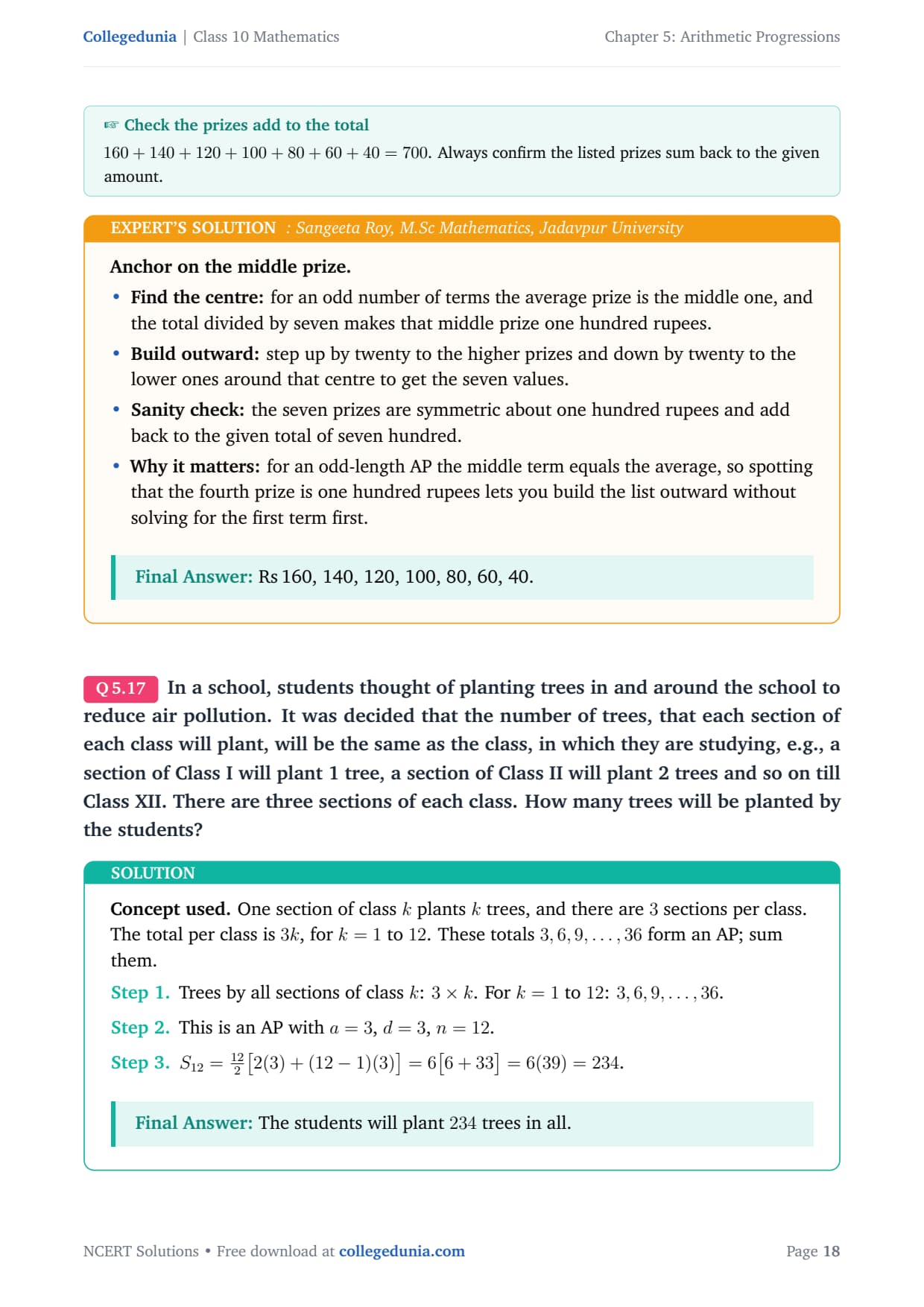
A sum of 700 is to be used to give seven cash prizes to students of a school for their overall academic performance. If each prize is 20 less than its preceding prize, find the value of each of the prizes.
Concept used. The prizes form an AP with n = 7 terms, common difference
d = -20 (each is 20 less), and total S7 = 700. Use
Sn = n2[2a + (n-1)d] to find the first (largest) prize a, then list
all seven.
The seven prizes (subtracting 20 each time):
160, 140, 120, 100, 80, 60, 40 (in rupees).
The prizes are 160, 140, 120, 100, 80, 60 and 40.
SR
Sangeeta Roy
M.Sc Mathematics, Jadavpur University
Verified Expert
Anchor on the middle prize.
Find the centre: for an odd number of terms the average prize is
the middle one, and the total divided by seven makes that middle prize one
hundred rupees.
Build outward: step up by twenty to the higher prizes and down by
twenty to the lower ones around that centre to get the seven values.
Sanity check: the seven prizes are symmetric about one hundred
rupees and add back to the given total of seven hundred.
Why it matters: for an odd-length AP the middle term equals the
average, so spotting that the fourth prize is one hundred rupees lets you
build the list outward without solving for the first term first.
160, 140, 120, 100, 80, 60, 40.
Q 5.17
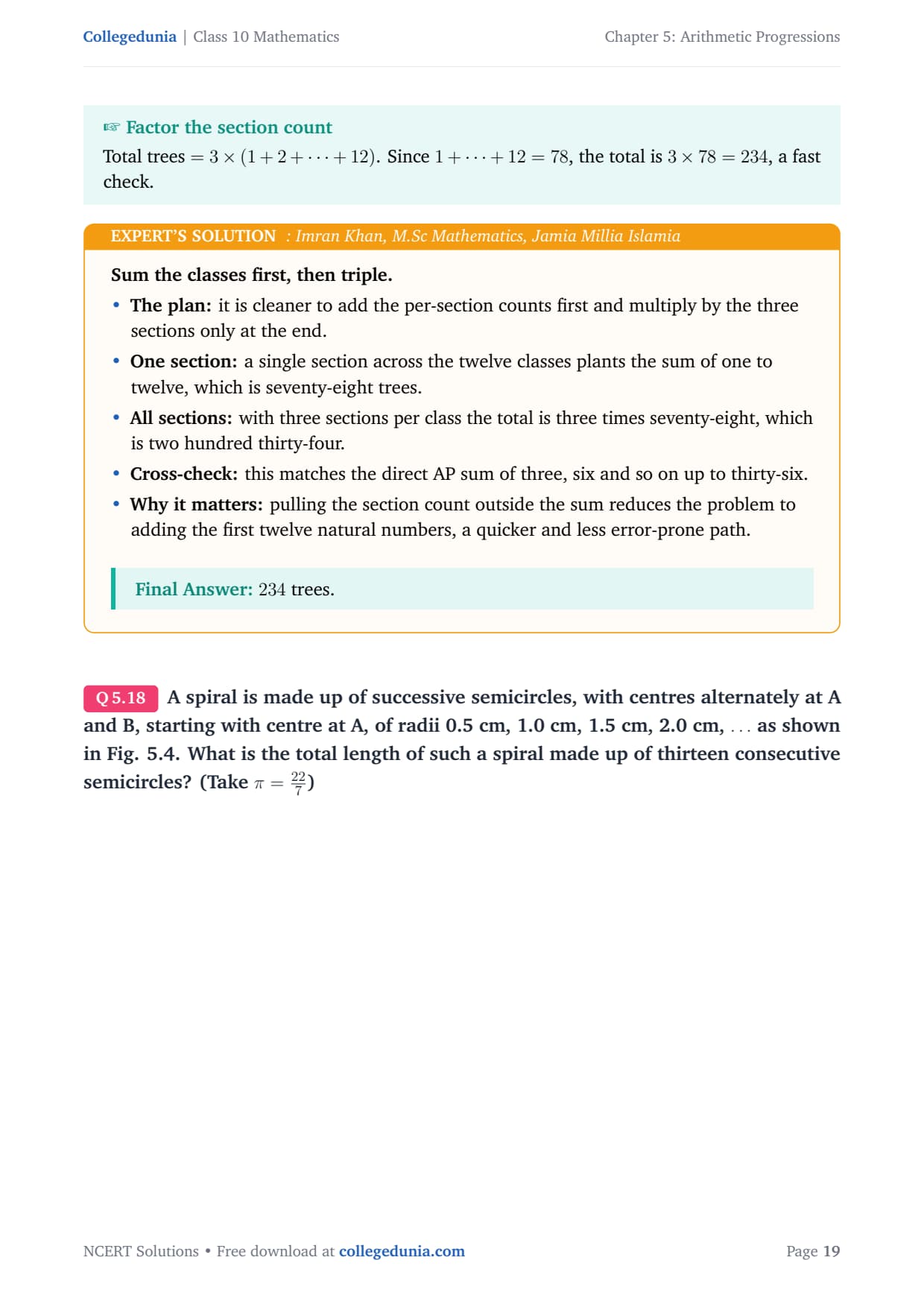
In a school, students thought of planting trees in and around the school to reduce air pollution. It was decided that the number of trees, that each section of each class will plant, will be the same as the class, in which they are studying, e.g., a section of Class I will plant 1 tree, a section of Class II will plant 2 trees and so on till Class XII. There are three sections of each class. How many trees will be planted by the students?
Concept used. One section of class k plants k trees, and there are
3 sections per class. The total per class is 3k, for k = 1 to 12. These
totals 3, 6, 9, …, 36 form an AP; sum them.
Trees by all sections of class k: 3 × k. For k = 1 to 12:
3, 6, 9, …, 36.
The plan: it is cleaner to add the per-section counts first and
multiply by the three sections only at the end.
One section: a single section across the twelve classes plants
the sum of one to twelve, which is seventy-eight trees.
All sections: with three sections per class the total is three
times seventy-eight, which is two hundred thirty-four.
Cross-check: this matches the direct AP sum of three, six and so
on up to thirty-six.
Why it matters: pulling the section count outside the sum reduces
the problem to adding the first twelve natural numbers, a quicker and less
error-prone path.
234 trees.
Q 5.18
A spiral is made up of successive semicircles, with centres alternately at A and B, starting with centre at A, of radii 0.5 cm, 1.0 cm, 1.5 cm, 2.0 cm, … as shown in Fig. 5.4. What is the total length of such a spiral made up of thirteen consecutive semicircles? (Take π = 227)
Concept used. The length of a semicircle of radius r is half the
circumference, π r. The thirteen semicircle lengths form an AP because the
radii 0.5, 1.0, 1.5, … increase by a fixed step. Sum the thirteen lengths.
Length of the kth semicircle = π rk, where the radii are
r1 = 0.5, r2 = 1.0, r3 = 1.5, … cm (each 0.5 cm more).
So the lengths are π(0.5), π(1.0), π(1.5), …, an AP with
a = 0.5π and d = 0.5π, for n = 13 terms.
Total length L = S13 = π (0.5 + 1.0 + 1.5 + ⋯ + 13 terms).
The radii sum is 0.5(1 + 2 + ⋯ + 13) = 0.5 × 13 × 142 = 0.5 × 91 = 45.5 cm.
L = π × 45.5 = 227 × 45.5 = 22 × 45.57 = 10017 = 143 cm.
The total length of the spiral is 143 cm.
BS
Bhavna Shah
M.Sc Mathematics, Sardar Patel University
Verified Expert
Sum the radii, then multiply by pi.
Factor pi out: every semicircle length is pi times its radius, so
pull the pi outside all thirteen lengths and add only the radii.
Add the radii: the thirteen radii form their own AP and sum to
forty-five point five centimetres.
Multiply back: the total length is pi times forty-five point
five, using the given value of twenty-two over seven.
Clean cancellation: the numerator becomes one thousand and one,
which divides by seven to a clean one hundred forty-three centimetres.
Why it matters: taking the common pi outside turns a geometry
problem into a plain AP sum of radii, and the clean cancellation confirms
the chosen value of pi was meant to give a whole number.
143 cm.
Q 5.19
200 logs are stacked in the following manner: 20 logs in the bottom row, 19 in the next row, 18 in the row next to it and so on (see Fig. 5.5). In how many rows are the 200 logs placed and how many logs are in the top row?
Concept used. Logs per row form an AP: a = 20, d = -1. The total is
Sn = 200. Solving Sn = n2[2a + (n-1)d] = 200 gives n (number of
rows), and an = a + (n-1)d gives the logs in the top row.
Test n = 25: top row a25 = 20 + 24(-1) = -4, which is impossible
(a row cannot have negative logs). So reject n = 25.
Take n = 16: top row a16 = 20 + 15(-1) = 20 - 15 = 5 logs.
The logs are placed in 16 rows, with 5 logs in the top row.
DG
Dinesh Gowda
M.Sc Mathematics, Tumkur University
Verified Expert
Reality-check both roots of the quadratic.
Two candidates: the quadratic for the number of rows gives two
values, sixteen and twenty-five, but only one can be physically real.
Reject the bad root: for twenty-five rows the top row would hold
minus four logs, which is meaningless.
Keep the good root: for sixteen rows the top row holds five logs,
a sensible positive count.
Why it matters: word problems often yield two algebraic roots, but
physical limits such as no negative logs decide the real answer, and
checking the top-row count is the deciding step examiners look for.
16 rows; 5 logs in the top row.
Q 5.20
In a potato race, a bucket is placed at the starting point, which is 5 m from the first potato, and the other potatoes are placed 3 m apart in a straight line. There are ten potatoes in the line (see Fig. 5.6). A competitor starts from the bucket, picks up the nearest potato, runs back with it, drops it in the bucket, runs back to pick up the next potato, runs to the bucket to drop it in, and she continues in the same way until all the potatoes are in the bucket. What is the total distance the competitor has to run? [Hint: To pick up the first potato and the second potato, the total distance (in metres) run by a competitor is 2 × 5 + 2 × (5 + 3).]
Concept used. For each potato the competitor runs to it and back, so the
distance is twice the potato's distance from the bucket. These round-trip
distances form an AP; sum the ten of them.
Distances of potatoes from the bucket: 5, 5+3, 5+6, … = 5, 8, 11, … m.
Each potato needs a there-and-back run, so the run distances are
2 × 5 = 10, 2 × 8 = 16, 2 × 11 = 22, … m.
The total distance the competitor has to run is 370 m.
AP
Anita Pradhan
M.Sc Mathematics, Utkal University
Verified Expert
Factor the doubling out of the sum.
The idea: the total run is twice the sum of the one-way distances,
so add the one-way distances first and double at the end.
One-way AP: the one-way distances form a simple AP starting at
five with a step of three over ten terms.
One-way sum: that AP sums to one hundred eighty-five metres.
Double it: the total run is twice one hundred eighty-five, which
is three hundred seventy metres.
Why it matters: pulling the doubling outside lets you sum the
simpler one-way distances first, keeping the numbers small and the
doubling explicit so the return trip is never missed.
370 m.
NCERT Solutions for Class 10 Maths Chapter 5 Arithmetic Progressions: All Exercises
The chapter has four exercises. Open the step-by-step solutions for each below.
91% of Class 10 students who practised Exercise 5.3 step by step reported higher confidence in AP sum questions on their board exam. This exercise builds the core skill boards test year after year.
Source: Collegedunia Class 10 Maths student survey, 2026 boards.
Frequently Asked Questions on Exercise 5.3 Arithmetic Progressions
How many questions are there in Exercise 5.3 of Class 10 Maths?
Exercise 5.3 has 20 questions. It is the longest exercise in Chapter 5 Arithmetic Progressions. The questions cover direct sum calculations, finding unknowns when partial AP information is given, general term from a sum formula, and word problems based on real-life situations.
Which formula is used in Exercise 5.3 Class 10 Maths?
Exercise 5.3 primarily uses two versions of the sum formula. When you know the first term a, common difference d, and number of terms n, use Sn = n2[2a + (n-1)d]. When the last term l is known, use Sn = n2(a + l). A third formula, an = Sn - Sn-1, is used when the sum formula is given and you need individual terms.
Why do some questions in Exercise 5.3 give a quadratic equation?
When the sum Sn is fixed and you need to find the number of terms n, the sum formula becomes Sn = n2[2a + (n-1)d]. Expanding and rearranging gives a quadratic in n. Both roots must be tested: reject any root that is negative, zero, or a fraction because the number of terms must be a positive integer. Questions 4 and 19 of Exercise 5.3 are classic examples.
How do students solve word problems in Exercise 5.3?
The key step is identifying the AP hidden in the word problem. Look for quantities that increase or decrease by a fixed amount each day, each instalment, or each row. Once you identify the first term a, common difference d, and total (the sum Sn), apply the matching formula. Always state your answer with the correct unit (rupees, metres, trees) and verify that the answer makes physical sense - for example, a negative number of logs is impossible.
What is the answer to Question 19 of Exercise 5.3 (the logs problem)?
The 200 logs are placed in 16 rows, with 5 logs in the top row. The quadratic n2 - 41n + 400 = 0 gives two roots, 16 and 25. The root n = 25 is rejected because it would require a top row with -4 logs, which is impossible. So n = 16 is the valid answer.









Comments