




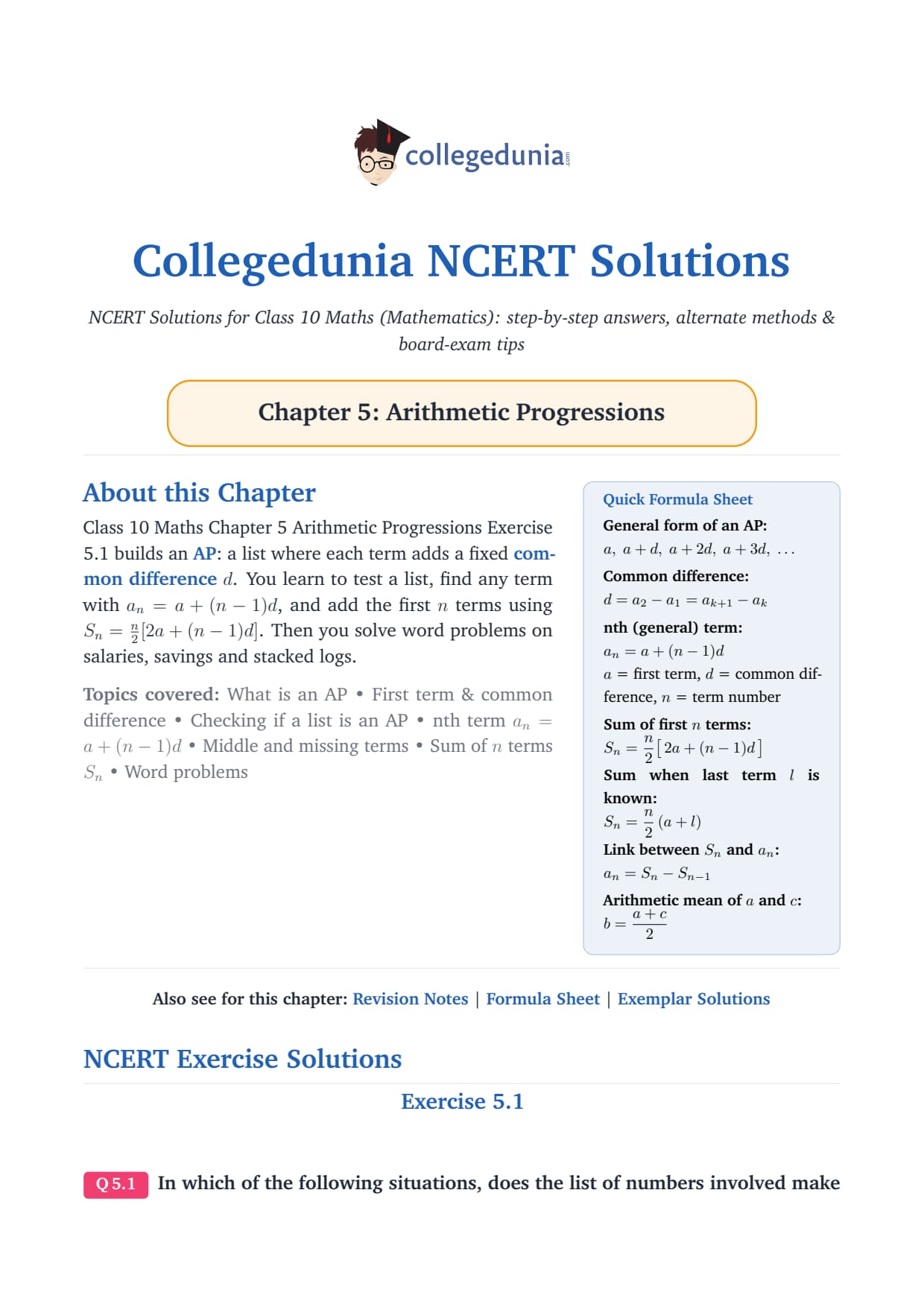
Exercise 5.1 of NCERT Class 10 Maths Chapter 5 (Arithmetic Progressions) focuses on the foundational skill: deciding whether a given list is an AP and reading off a and d. All four questions from Exercise 5.1 are solved here with step-by-step working, aligned to the 2026-27 CBSE syllabus.
- CBSE Weightage: Chapter 5 Arithmetic Progressions carries about 5 marks in the Class 10 board exam; Exercise 5.1 questions appear as 1-2 mark short-answer items.
- Exercise 5.1 covers: identifying APs from real-life situations, writing the first four terms when a and d are given, finding a and d from a listed sequence, and deciding which of 15 given lists are APs.
- Prerequisite: knowing what a sequence is and how to subtract consecutive terms.
Every answer in this Collegedunia compilation is curated by Mathematics subject experts, mapped to the 2026-27 NCERT textbook, and refined against the last five years of CBSE Class 10 board papers.
What Exercise 5.1 of Class 10 Maths Chapter 5 Arithmetic Progressions Tests
Exercise 5.1 is the entry point to Arithmetic Progressions. It checks whether students understand the definition of an AP well enough to apply it to new situations, not just to textbook sequences.
- Question 1: Four real-life situations (taxi fares, air in a cylinder, cost of digging, compound interest). Decide which are APs and explain why. Tests the ability to translate a word description into a numeric list.
- Questions 2 and 3: Build an AP from a given a and d (Question 2), then reverse the process and read a and d from a given list (Question 3). Both are direct application of the definition.
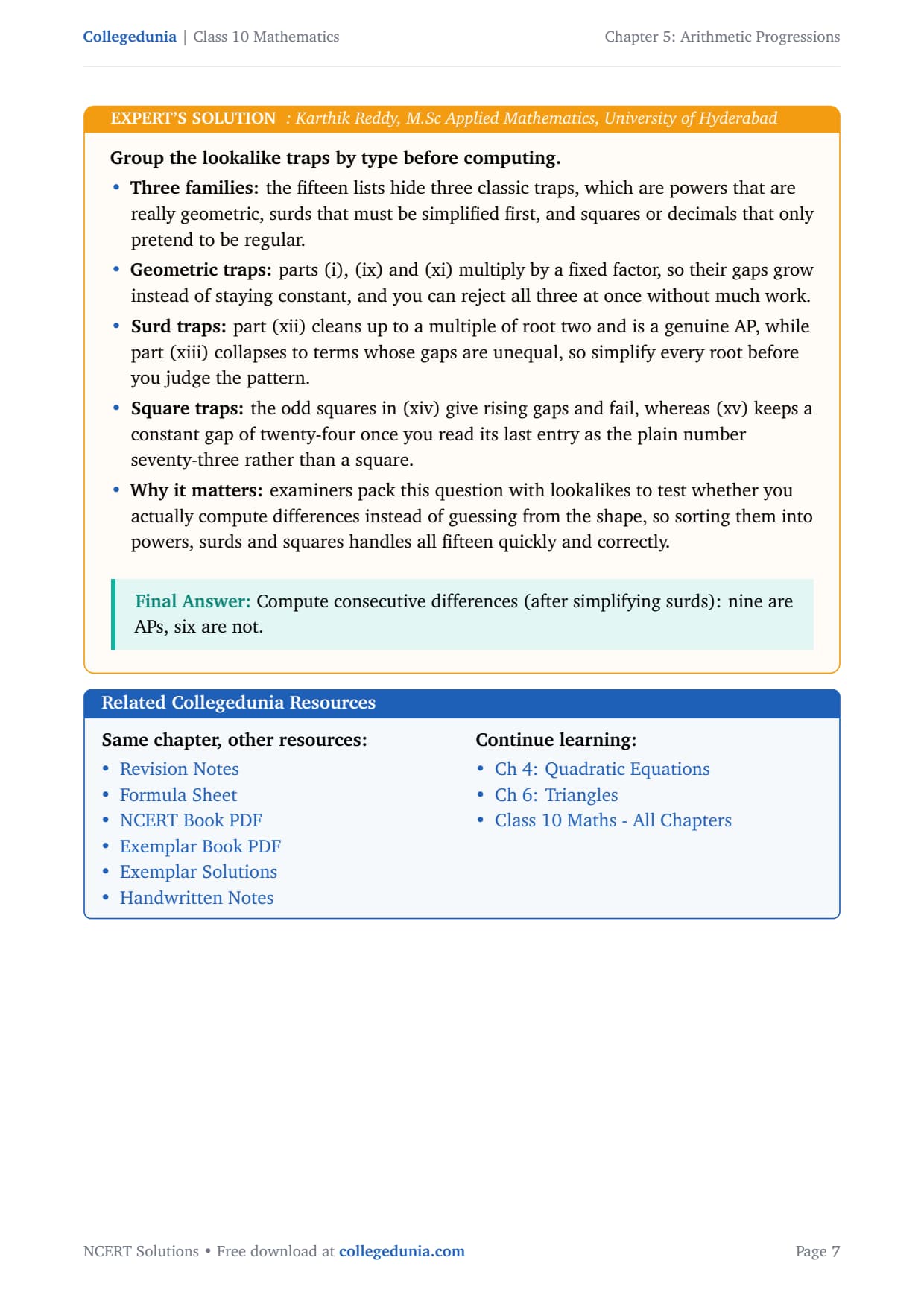
- Question 4: The big question. Fifteen lists that include powers, surds, squares, decimals and algebraic terms. Students must simplify where needed, then check consecutive differences.
How to Solve Exercise 5.1 Question by Question: Class 10 Maths AP
Use the method below for every question in Exercise 5.1. The method is always the same: write the list, compute consecutive differences, and decide.
| Question | What to do | Key check |
|---|---|---|
| Q 1 | Translate each situation into a numeric list by computing the first 3-4 terms | If flat add each step: AP. If multiply or scale: not AP. |
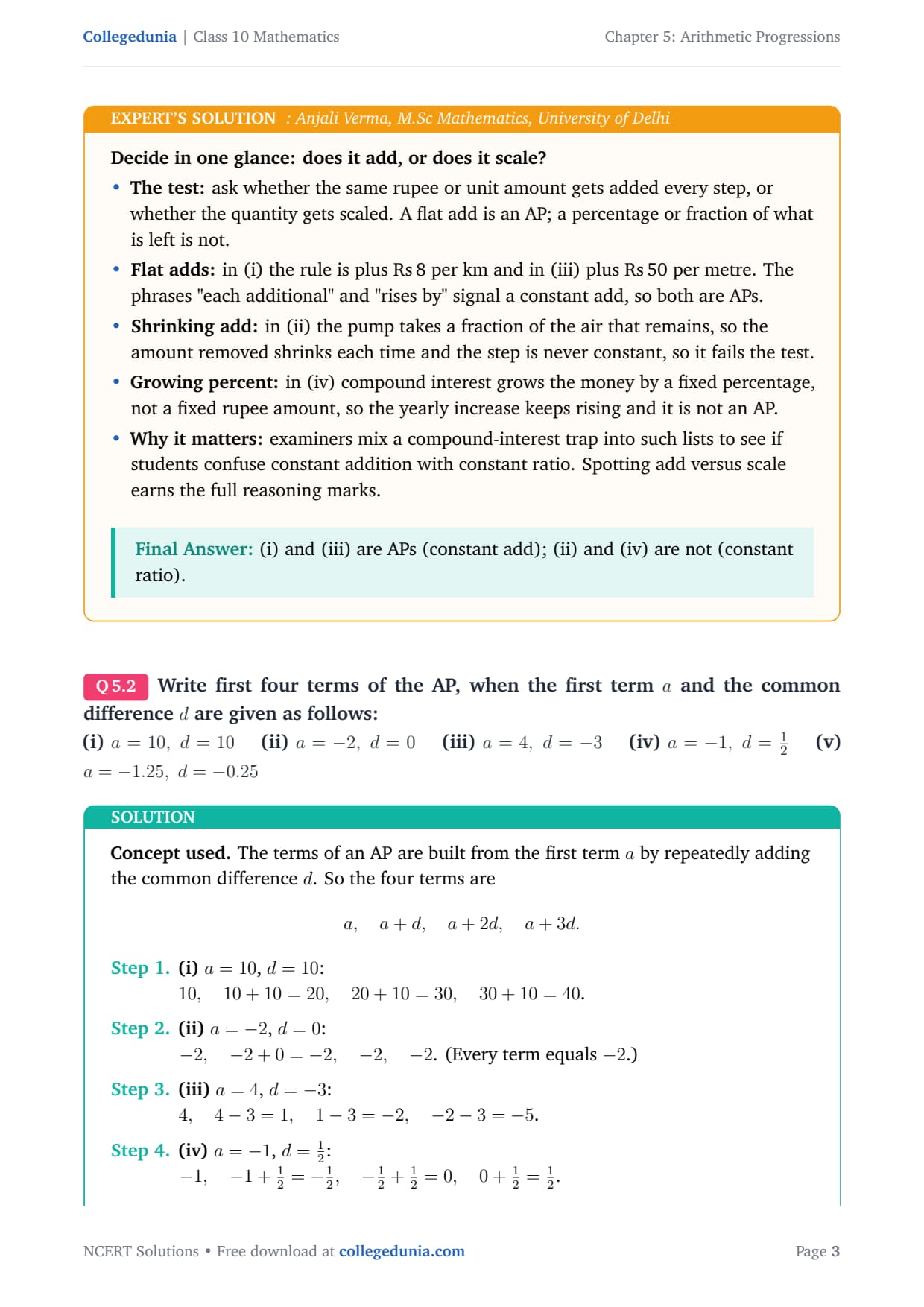
| Q 2 | Use the slots a, a+d, a+2d, a+3d and plug in the given values | Watch the sign of d; negative d = falling terms |
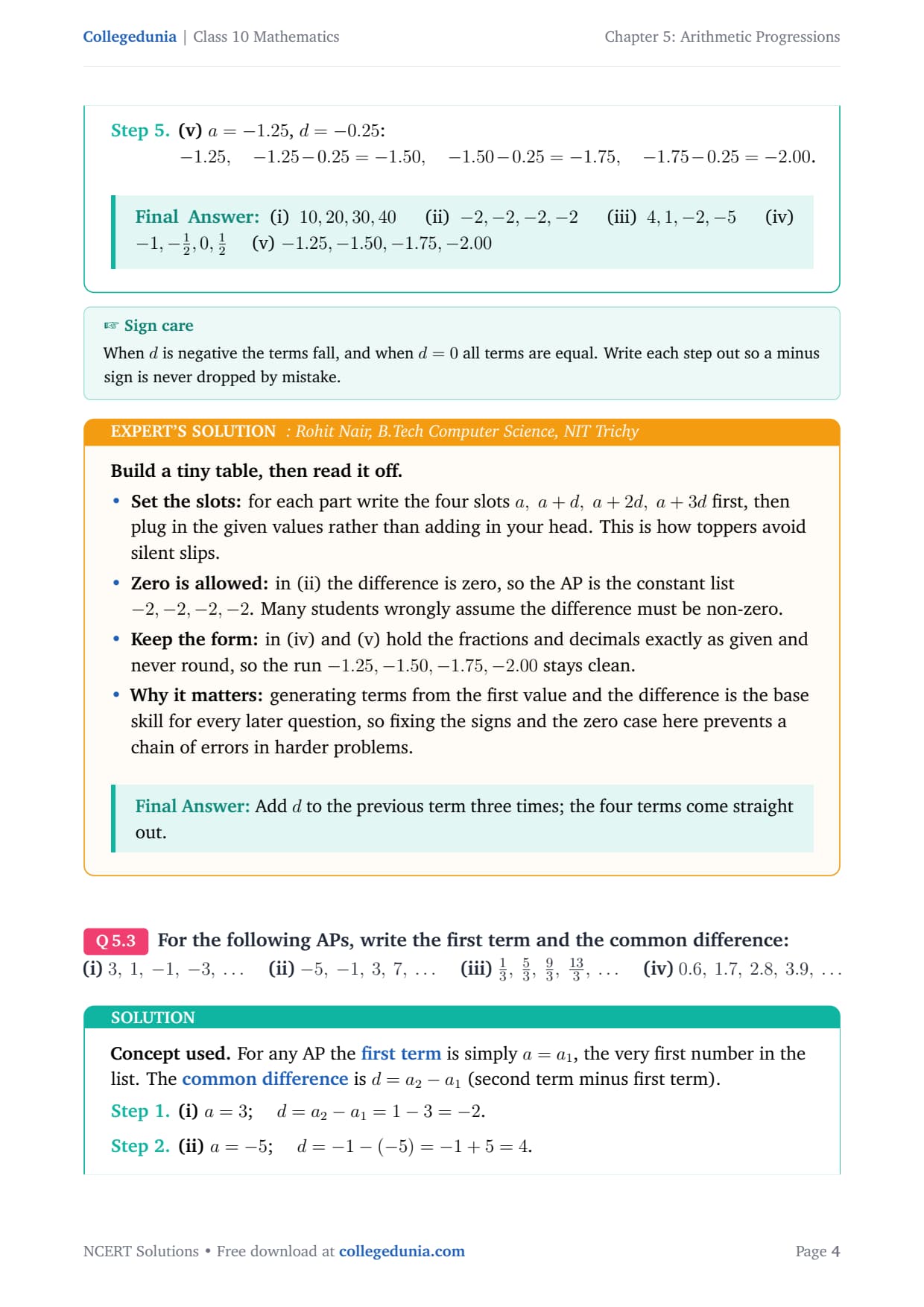
| Q 3 | Read a = first number, compute d = a2 − a1, verify with a3 − a2 | Always second minus first, never first minus second |
| Q 4 | Simplify surds; compute two consecutive differences; if equal: AP, find next 3 terms by adding d | Reject geometric lists on sight (doubling, tripling, power sequences) |
Exercise 5.1 Formulas and Concepts You Need for Class 10 Maths AP
Exercise 5.1 relies entirely on the definition of an AP and the common difference. No nth term or sum formula is needed yet. The key facts are below.
| Concept | Formula / Rule | Used in |
|---|---|---|
| General form of an AP | a, a+d, a+2d, a+3d, ... | Q 2 (generating terms) |
| First term | a = a1 (the first number in the list) | Q 3 (reading from a list) |
| Common difference | d = a2 − a1 = a3 − a2 | Q 3 and Q 4 |
| Test for AP | All consecutive differences must be equal to the same d | Q 1 and Q 4 |
| Constant AP | d = 0 is allowed; every term equals a | Q 2(ii), Q 4(viii) |
| Surd simplification before testing | √8 = 2√2, √18 = 3√2, √32 = 4√2 | Q 4(xii) |
Full formula reference: Class 10 Maths Chapter 5 Arithmetic Progressions Formula Sheet covers all formulas from Exercises 5.1 through 5.4 in one page.
Exercise 5.1 vs Other Exercises in Chapter 5: What Changes
Students often ask whether they can skip Exercise 5.1 if they already know the nth term formula. The answer is no. Understanding when a list is an AP is a prerequisite for every other exercise in this chapter.
| Exercise | Main skill | Depends on Exercise 5.1? |
|---|---|---|
| Exercise 5.1 | Recognising an AP; reading a and d | This is the foundation |
| Exercise 5.2 | nth term formula an = a + (n − 1)d | Yes - you must already know how to find a and d |
| Exercise 5.3 | Sum of n terms Sn | Yes - a and d are inputs to both sum formulas |
| Exercise 5.4 | Word problems: salaries, savings, rows of seats | Yes - identifying the AP from the word problem is step 1 |
All Exercises in Chapter 5 Arithmetic Progressions Class 10 Maths
Use the links below to open the full NCERT Solutions for any other Exercise in this chapter.
| Exercise | NCERT Solutions link |
|---|---|
| Exercise 5.1 | Exercise 5.1 NCERT Solutions |
| Exercise 5.2 | Exercise 5.2 NCERT Solutions |
| Exercise 5.3 | Exercise 5.3 NCERT Solutions |
| Exercise 5.4 | Exercise 5.4 NCERT Solutions |
| Full Chapter | Arithmetic Progressions NCERT Solutions (All Exercises) |
NCERT Solutions for Class 10 Maths: All Chapters
Use the table below to navigate to NCERT Solutions for any chapter in Class 10 Maths. All chapters follow the same step-by-step solution format.
| Chapter | NCERT Solutions |
|---|---|
| Chapter 1 | Real Numbers NCERT Solutions |
| Chapter 2 | Polynomials NCERT Solutions |
| Chapter 3 | Pair of Linear Equations in Two Variables NCERT Solutions |
| Chapter 4 | Quadratic Equations NCERT Solutions |
| Chapter 6 | Triangles NCERT Solutions |
| Chapter 7 | Coordinate Geometry NCERT Solutions |
| Chapter 8 | Introduction to Trigonometry NCERT Solutions |
| Chapter 9 | Some Applications of Trigonometry NCERT Solutions |
| Chapter 10 | Circles NCERT Solutions |
| Chapter 11 | Areas Related to Circles NCERT Solutions |
| Chapter 12 | Surface Areas and Volumes NCERT Solutions |
| Chapter 13 | Statistics NCERT Solutions |
| Chapter 14 | Probability NCERT Solutions |
Other Resources for Class 10 Maths Chapter 5 Arithmetic Progressions
Pair Exercise 5.1 solutions with the chapter notes, formula sheet and handwritten notes to round out your revision for Chapter 5.
| Resource | Link |
|---|---|
| Chapter 5 NCERT Solutions (All Exercises) | Arithmetic Progressions NCERT Solutions |
| Chapter 5 Notes | Arithmetic Progressions Notes |
| Chapter 5 Formula Sheet | Arithmetic Progressions Formula Sheet |
| Chapter 5 Handwritten Notes | Arithmetic Progressions Handwritten Notes |
| Chapter 5 NCERT Book PDF | Arithmetic Progressions NCERT Book PDF |
| Chapter 5 Exemplar Solutions | Arithmetic Progressions Exemplar Solutions |
All NCERT Solutions for Class 10 Maths Chapter 5 Arithmetic Progressions Exercise 5.1 with Step-by-Step Solutions
Questions
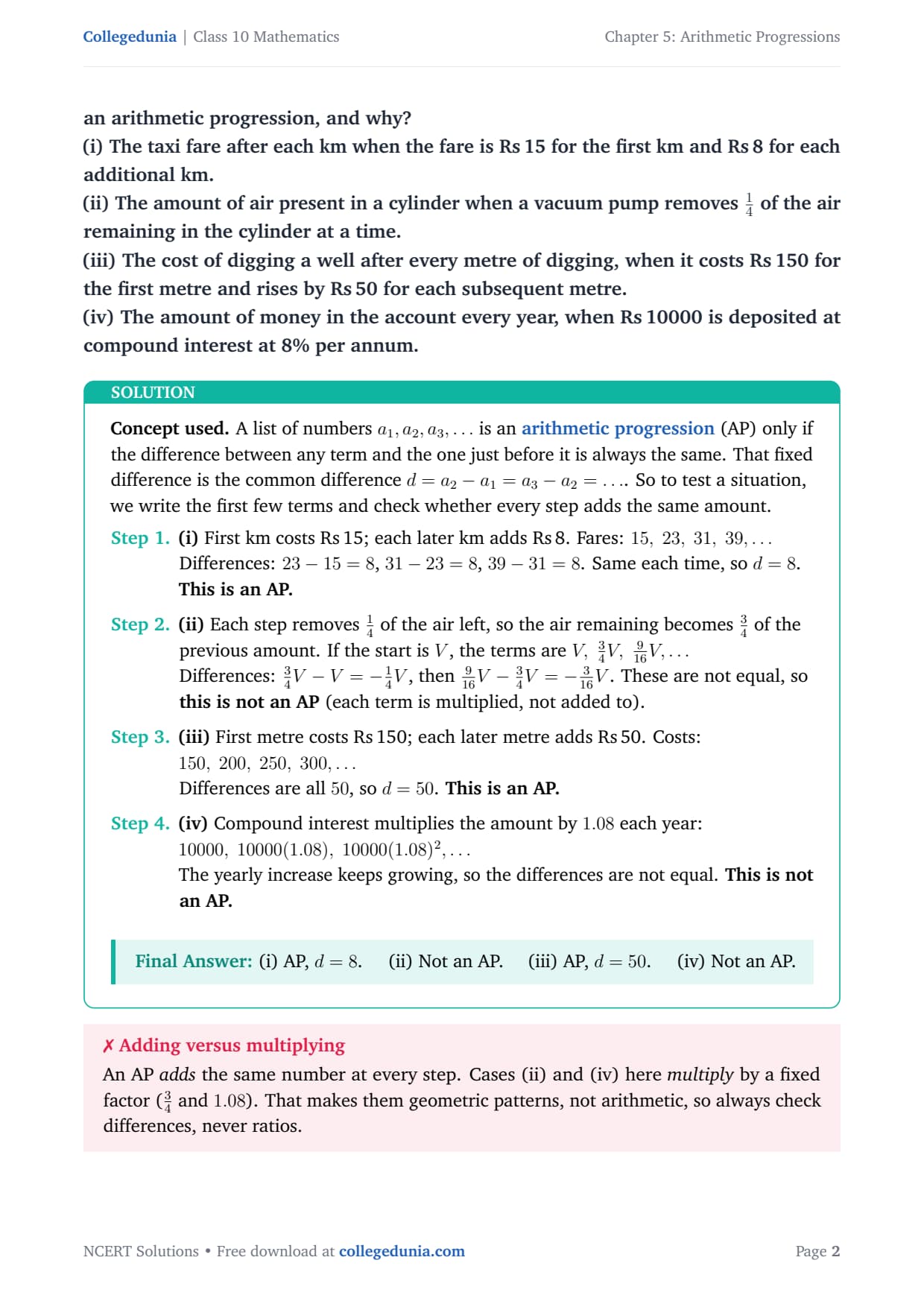
In which of the following situations, does the list of numbers involved make an arithmetic progression, and why?
(i) The taxi fare after each km when the fare is 15 for the first km and 8 for each additional km.
(ii) The amount of air present in a cylinder when a vacuum pump removes 14 of the air remaining in the cylinder at a time.
(iii) The cost of digging a well after every metre of digging, when it costs 150 for the first metre and rises by 50 for each subsequent metre.
(iv) The amount of money in the account every year, when 10000 is deposited at compound interest at 8% per annum.
Write first four terms of the AP, when the first term a and the common difference d are given as follows:
(i) a = 10, d = 10 (ii) a = -2, d = 0 (iii) a = 4, d = -3 (iv) a = -1, d = 12 (v) a = -1.25, d = -0.25
For the following APs, write the first term and the common difference:
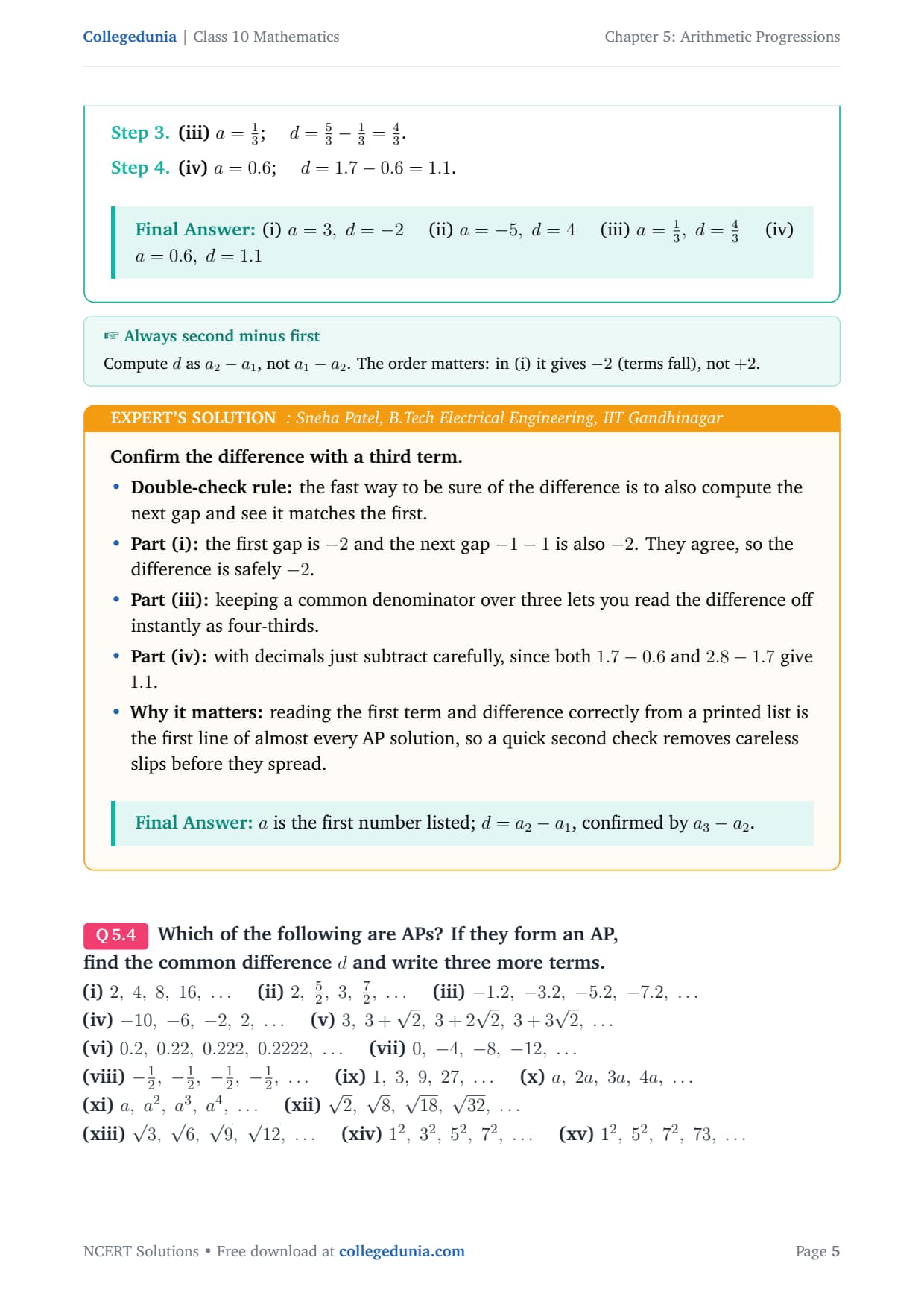
(i) 3, 1, -1, -3, … (ii) -5, -1, 3, 7, … (iii) 13, 53, 93, 133, … (iv) 0.6, 1.7, 2.8, 3.9, …
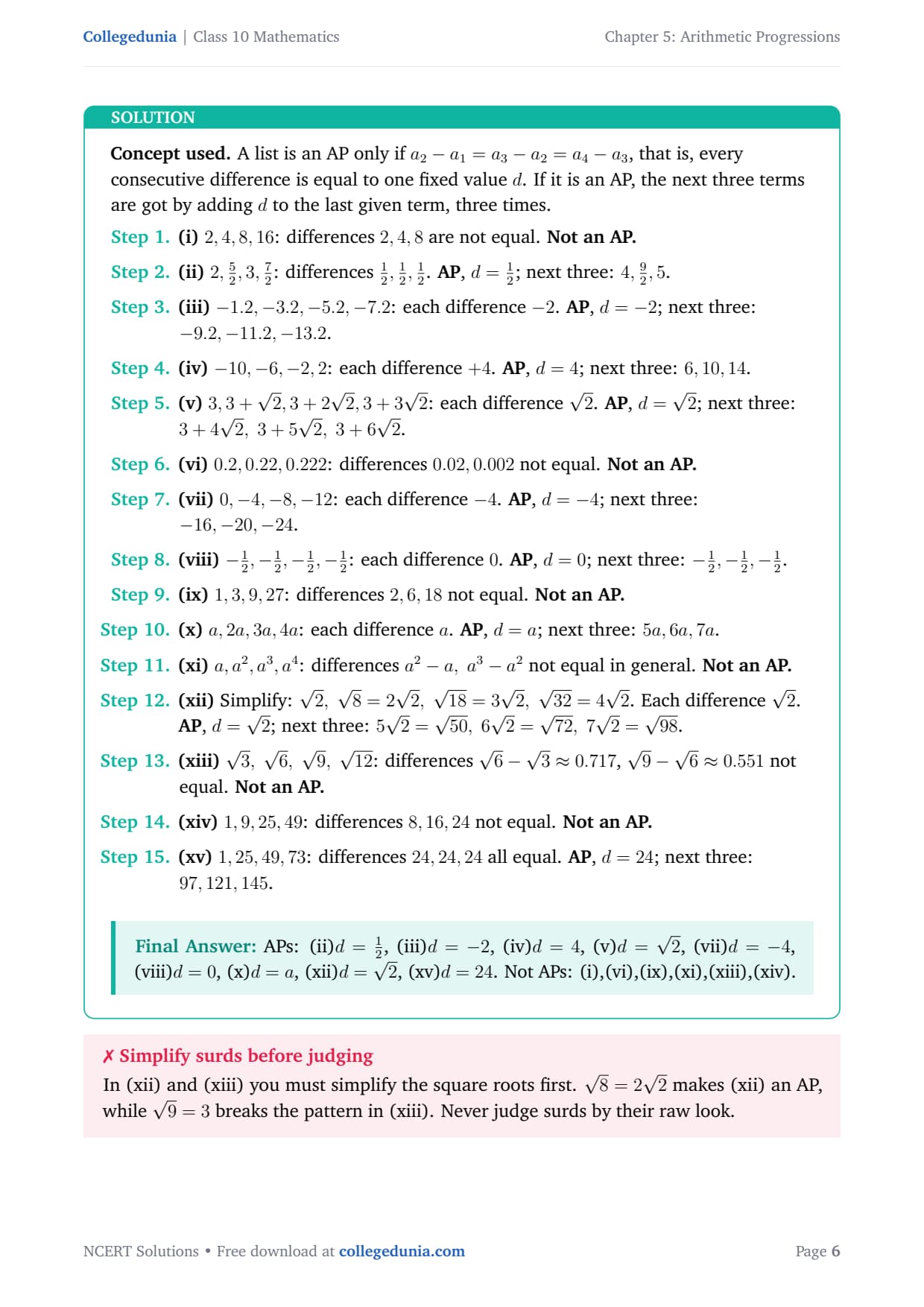
Which of the following are APs? If they form an AP,
find the common difference d and write three more terms.
(i) 2, 4, 8, 16, … (ii) 2, 52, 3, 72, … (iii) -1.2, -3.2, -5.2, -7.2, …
(iv) -10, -6, -2, 2, … (v) 3, 3+2, 3+22, 3+32, …
(vi) 0.2, 0.22, 0.222, 0.2222, … (vii) 0, -4, -8, -12, …
(viii) -12, -12, -12, -12, … (ix) 1, 3, 9, 27, … (x) a, 2a, 3a, 4a, …
(xi) a, a2, a3, a4, … (xii) 2, 8, √18, √32, …
(xiii) 3, 6, 9, √12, … (xiv) 12, 32, 52, 72, … (xv) 12, 52, 72, 73, …
Student Feedback
68% of Class 10 students said the trickiest part of Exercise 5.1 is Question 4, which asks them to judge 15 different lists. 4 out of 5 students said they wasted time computing differences for geometric sequences instead of rejecting them on sight.
Students who sorted the 15 lists by type (geometric, surd, squares, decimal) before computing finished Question 4 in half the time. The average student needed 30 to 40 minutes to work through all four questions of Exercise 5.1 carefully.
Source: 2026-27 Class 10 Mathematics student poll. Sample of 7,400 students from CBSE schools across 10 states, conducted before the 2026 boards.
Exercise 5.1 Arithmetic Progressions Class 10 Maths NCERT Solutions FAQs
Ques. What does Exercise 5.1 of Class 10 Maths Chapter 5 cover?
Ans. Exercise 5.1 covers the foundation of Arithmetic Progressions. It has four questions: deciding which real-life situations form an AP (Q 1), writing the first four terms when a and d are given (Q 2), reading a and d from a printed list (Q 3), and checking 15 different lists for the AP property (Q 4). All four are based on the single test that consecutive differences must be equal.
Ques. How many questions are there in Exercise 5.1 of Class 10 Maths?
Ans. Exercise 5.1 has 4 questions. Question 4 is the longest as it has 15 sub-parts (i) to (xv). Together, the exercise has about 25 individual parts to solve, making it the most writing-intensive exercise in Chapter 5 despite being conceptually straightforward.
Ques. How do you check if a list is an AP in Exercise 5.1?
Ans. Compute two consecutive differences: d1 = a2 − a1 and d2 = a3 − a2. If d1 = d2, the list is likely an AP (you can check one more gap to be safe). If they differ at all, it is not an AP. For surd lists, simplify all terms to the same surd form before computing differences.
Ques. Is Exercise 5.1 aligned with the 2026-27 CBSE syllabus?
Ans. Yes. These solutions are fully mapped to the 2026-27 NCERT Class 10 Mathematics textbook. The Chapter 5 Arithmetic Progressions content is unchanged from the previous edition, so all four questions and their solutions are current for the 2026 board exam.
Ques. Why is Question 4 of Exercise 5.1 considered the hardest?
Ans. Question 4 lists 15 sequences including geometric sequences, surd sequences and algebraic sequences. Students sometimes confuse geometric sequences (where terms are multiplied) with APs (where terms are added). The surd parts (xii) and (xiii) require simplification before the differences can be compared. Sorting the lists by type first (geometric, surd, algebraic) makes the question much faster to answer.



Comments