The NCERT Solutions for Class 10 Maths Chapter 4 Quadratic Equations Exercise 4.2 cover all 6 questions, including pure factorisation problems and word problems on marbles, toys, number pairs, consecutive integers, right triangles, and pottery costs. Every answer is solved step by step according to the 2026-27 CBSE syllabus.
Questions covered: 6 in total (Q1 to Q6), including 5 factorisation sub-parts and 5 real-life word problems.
Core method: split the middle term to find two linear factors, set each to zero, and reject roots that make no real-world sense.
CBSE board value: Exercise 4.2 factorisation and word problems carry 3 to 4 marks in the Class 10 board paper.
Solved by Collegedunia: Every Exercise 4.2 question below is solved by Mathematics subject experts, checked against the official 2026-27 NCERT textbook, and written with full working so each factorisation step and each word-problem reasoning earns its marks in the CBSE Class 10 board paper.
What Exercise 4.2 of Quadratic Equations Covers for Class 10
Exercise 4.2 is the factorisation exercise of Chapter 4. It covers the single most important skill in this chapter: splitting the middle term to solve a quadratic equation. Question 1 has five pure factorisation parts (including one with a surd and two with fractions). Questions 2 to 6 are word problems that students first convert to a quadratic and then solve by factorisation.
Q1: find roots of five equations by factorisation, including surds and fractions.
Q2: solve the marble and toy word problems from Example 1 using the equations already given.
Q3 to Q6: set up and solve four new word problems on number pairs, consecutive integers, a right triangle, and a pottery-cost scenario.
What you need from Exercise 4.1: the ability to write an equation in standard form ax2 + bx + c = 0 is assumed here.
How to Solve Exercise 4.2 Questions by Splitting the Middle Term
The splitting the middle term method turns a quadratic into two linear factors. The steps are the same every time.
Step
What you do
Example: x2 − 3x − 10 = 0
1
Find a × c
1 × (−10) = −10
2
Find two numbers with product a × c and sum b
Product −10, sum −3: use −5 and +2
3
Rewrite the middle term and group
x2 − 5x + 2x − 10 = x(x − 5) + 2(x − 5)
4
Factor out the common bracket
(x − 5)(x + 2) = 0
5
Set each factor to zero for the roots
x = 5 or x = −2
Concept: The split works because if a product of two factors is zero, at least one factor must be zero. That is why setting each linear factor equal to zero gives the valid roots.
Two special cases show up in Question 1. Clear fractions before splitting (multiply through to get whole-number coefficients). And when a × c involves a surd, the arithmetic still works because √2 × 5√2 = 10, a clean integer.
How to Solve Exercise 4.2 Word Problems Question by Question
Five of the six questions in Exercise 4.2 are word problems. The method is always the same: name one unknown as x, write every other quantity in terms of x, build the quadratic from the key condition, solve by factorisation, and reject any root that does not fit the context.
Question
Situation
Equation formed
Valid roots
Q2 (i)
Marbles: 45 start, lose 5 each, product 124
x2 − 45x + 324 = 0
36 and 9 (same pair)
Q2 (ii)
Toys: cost = 55 − count, total Rs. 750
x2 − 55x + 750 = 0
25 or 30 (both valid)
Q3
Two numbers: sum 27, product 182
x2 − 27x + 182 = 0
13 and 14
Q4
Consecutive positive integers: sum of squares 365
x2 + x − 182 = 0
13 and 14 (reject −14)
Q5
Right triangle: altitude 7 less than base, hyp 13 cm
x2 − 7x − 60 = 0
Base 12, altitude 5 (reject −5)
Q6
Pottery: cost per item = 2×count + 3, total Rs. 90
2x2 + 3x − 90 = 0
6 articles at Rs. 15 each
Watch Out: Negative or fractional roots often appear in word problems but must be rejected if the context requires a positive whole number (count of items, length of a side). Always state the rejection in writing, not silently.
Repeated Roots and Perfect Squares in Quadratic Equations Exercise 4.2
Two parts of Question 1 (parts iv and v) give a repeated root. A perfect square trinomial always produces a repeated root. The tell-tale sign is that the discriminant b2 − 4ac = 0.
Remember: Report a repeated root once, with a short note, never twice as if it were two different values. The examiner looks for this to judge whether students understand what "equal roots" means.
Exercise 4.2 Previous Year Questions and CBSE Board Weightage
Factorisation and word problems from Exercise 4.2 appear regularly in the CBSE Class 10 board paper. The table below maps recent board questions to the Exercise 4.2 skills.
Year
Question type from Exercise 4.2
Marks
2024
Solve by factorisation (splitting the middle term)
2
2023
Word problem: consecutive integers or area
3
2022
Solve quadratic by factorisation
2
2021
Right triangle or number-pair word problem
3
2020
Word problem requiring factorisation and root rejection
3
Students who score full marks on these questions consistently do two things: show the product-and-sum pair before splitting, and write the rejection line for the invalid root rather than ignoring it.
Other Resources for Quadratic Equations Class 10 Maths
Use the table below to move between the other resources for Chapter 4 and the other exercises of Quadratic Equations.
All NCERT Solutions for Class 10 Maths Chapter 4 Quadratic Equations Exercise 4.2 with Step-by-Step Solutions
Questions
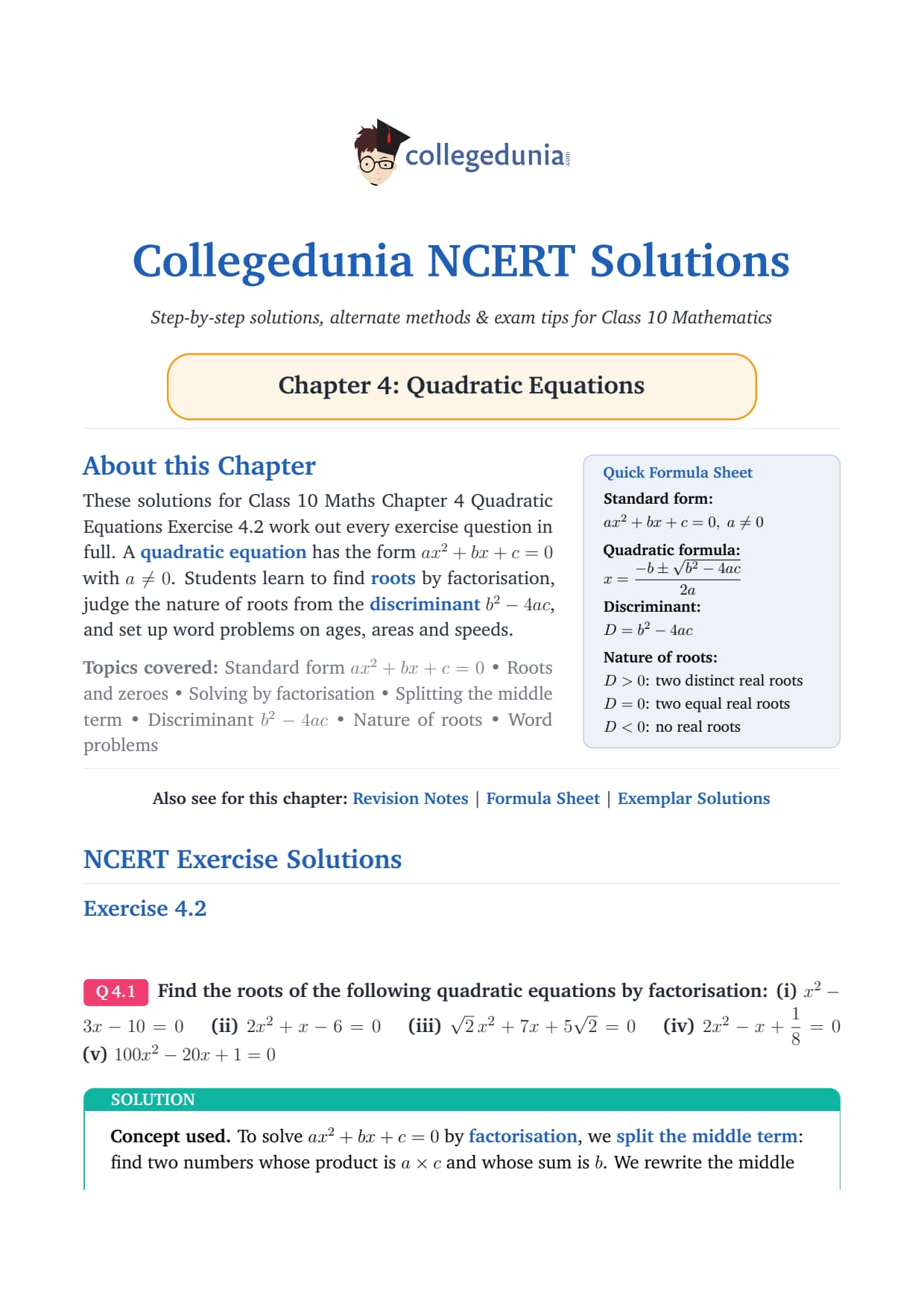
Q 4.1
Find the roots of the following quadratic equations by factorisation:
(i) x2-3x-10=0 (ii) 2x2+x-6=0
(iii) √2 x2+7x+5√2=0 (iv) 2x2-x+18=0
(v) 100x2-20x+1=0
Concept used. To solve ax2+bx+c=0 by factorisation, we
split the middle term: find two numbers whose product is a× c
and whose sum is b. We rewrite the middle term using these two numbers, take
out common factors in pairs, and write the expression as a product of two
linear factors. Setting each factor equal to zero gives the roots,
because if a product is zero then at least one factor is zero.
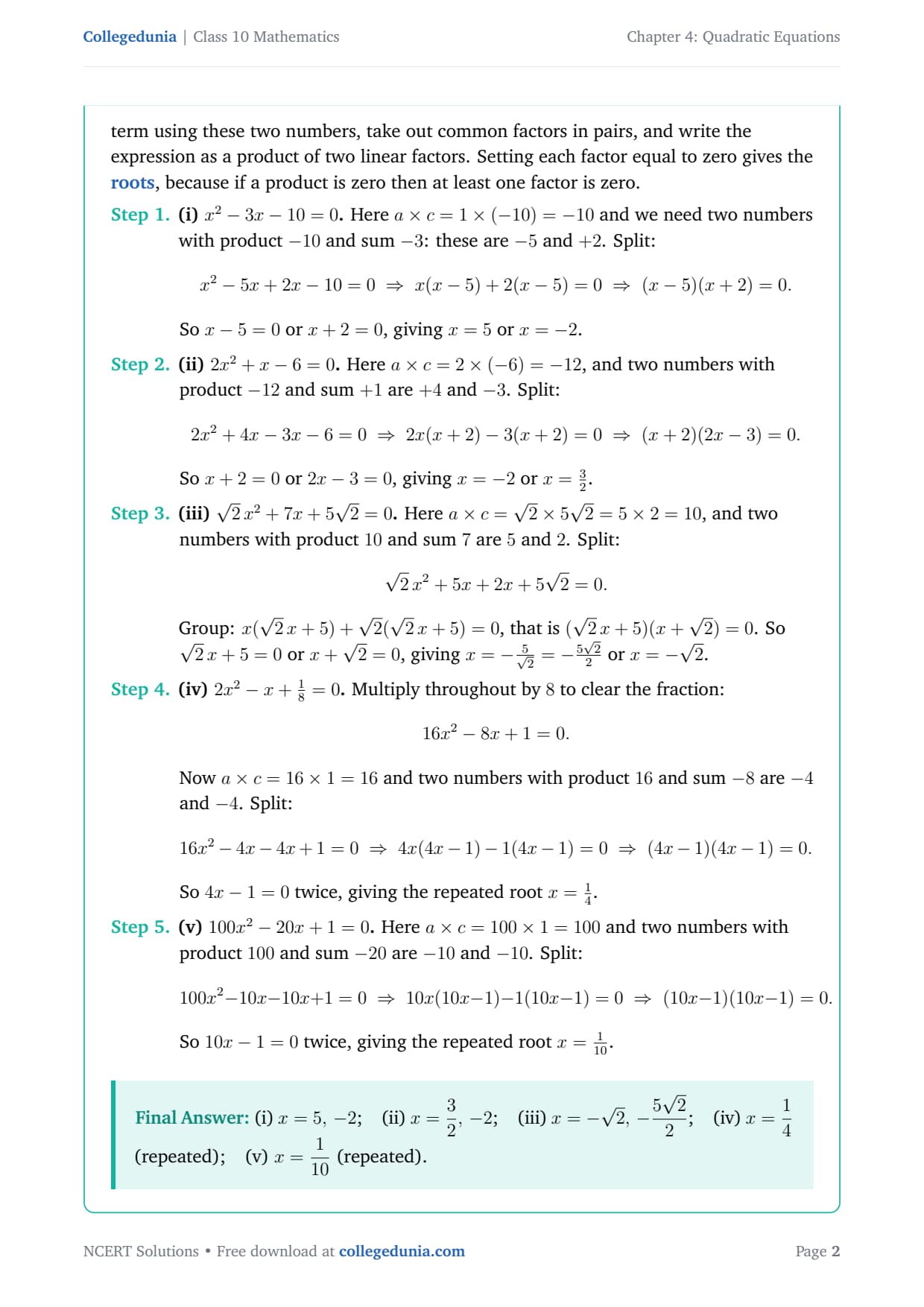
(i) x2-3x-10=0. Here a× c=1×(-10)=-10 and we
need two numbers with product -10 and sum -3: these are -5 and
+2. Split:
x2-5x+2x-10=0 ⇒ x(x-5)+2(x-5)=0 ⇒ (x-5)(x+2)=0.
So x-5=0 or x+2=0, giving x=5 or x=-2.
(ii) 2x2+x-6=0. Here a× c=2×(-6)=-12, and two
numbers with product -12 and sum +1 are +4 and -3. Split:
2x2+4x-3x-6=0 ⇒ 2x(x+2)-3(x+2)=0 ⇒ (x+2)(2x-3)=0.
So x+2=0 or 2x-3=0, giving x=-2 or x=32.
(iii) √2 x2+7x+5√2=0. Here
a× c=√2× 5√2=5× 2=10, and two numbers with
product 10 and sum 7 are 5 and 2. Split:
√2 x2+5x+2x+5√2=0.
Group: x(√2x+5)+√2(√2x+5)=0, that is
(√2x+5)(x+√2)=0.
So √2x+5=0 or x+√2=0, giving
x=-5√2=-5√22 or x=-√2.
(iv) 2x2-x+18=0. Multiply throughout by 8 to
clear the fraction:
16x2-8x+1=0.
Now a× c=16× 1=16 and two numbers with product 16 and sum
-8 are -4 and -4. Split:
16x2-4x-4x+1=0 ⇒ 4x(4x-1)-1(4x-1)=0 ⇒ (4x-1)(4x-1)=0.
So 4x-1=0 twice, giving the repeated root x=14.
(v) 100x2-20x+1=0. Here a× c=100× 1=100 and
two numbers with product 100 and sum -20 are -10 and -10. Split:
100x2-10x-10x+1=0 ⇒ 10x(10x-1)-1(10x-1)=0 ⇒ (10x-1)(10x-1)=0.
So 10x-1=0 twice, giving the repeated root x=110.
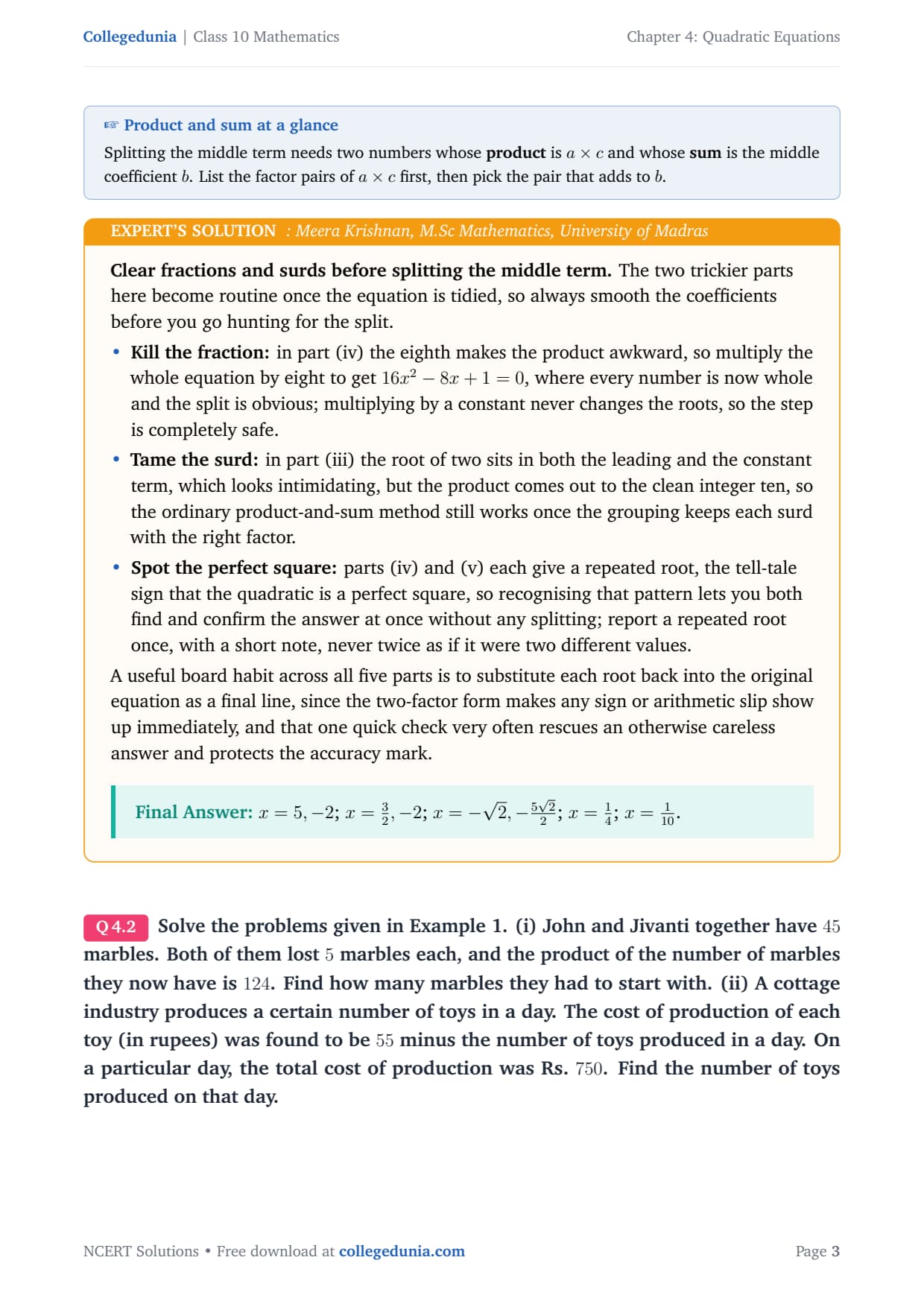
Clear fractions and surds before splitting the middle term. The two
trickier parts here become routine once the equation is tidied, so always
smooth the coefficients before you go hunting for the split.
Kill the fraction: in part (iv) the eighth makes the product
awkward, so multiply the whole equation by eight to get
16x2-8x+1=0, where every number is now whole and the split is
obvious; multiplying by a constant never changes the roots, so the step
is completely safe.
Tame the surd: in part (iii) the root of two sits in both the
leading and the constant term, which looks intimidating, but the
product comes out to the clean integer ten, so the ordinary
product-and-sum method still works once the grouping keeps each surd
with the right factor.
Spot the perfect square: parts (iv) and (v) each give a
repeated root, the tell-tale sign that the quadratic is a perfect
square, so recognising that pattern lets you both find and confirm the
answer at once without any splitting; report a repeated root once, with
a short note, never twice as if it were two different values.
A useful board habit across all five parts is to substitute each root back into
the original equation as a final line, since the two-factor form makes any sign
or arithmetic slip show up immediately, and that one quick check very often
rescues an otherwise careless answer and protects the accuracy mark.
x=5,-2; x=32,-2; x=-√2,-5√22; x=14; x=110.
Q 4.2
Solve the problems given in Example 1.
(i) John and Jivanti together have 45 marbles. Both of them lost 5 marbles
each, and the product of the number of marbles they now have is 124. Find how
many marbles they had to start with.
(ii) A cottage industry produces a certain number of toys in a day. The cost of
production of each toy (in rupees) was found to be 55 minus the number of toys
produced in a day. On a particular day, the total cost of production was
Rs. 750. Find the number of toys produced on that day.
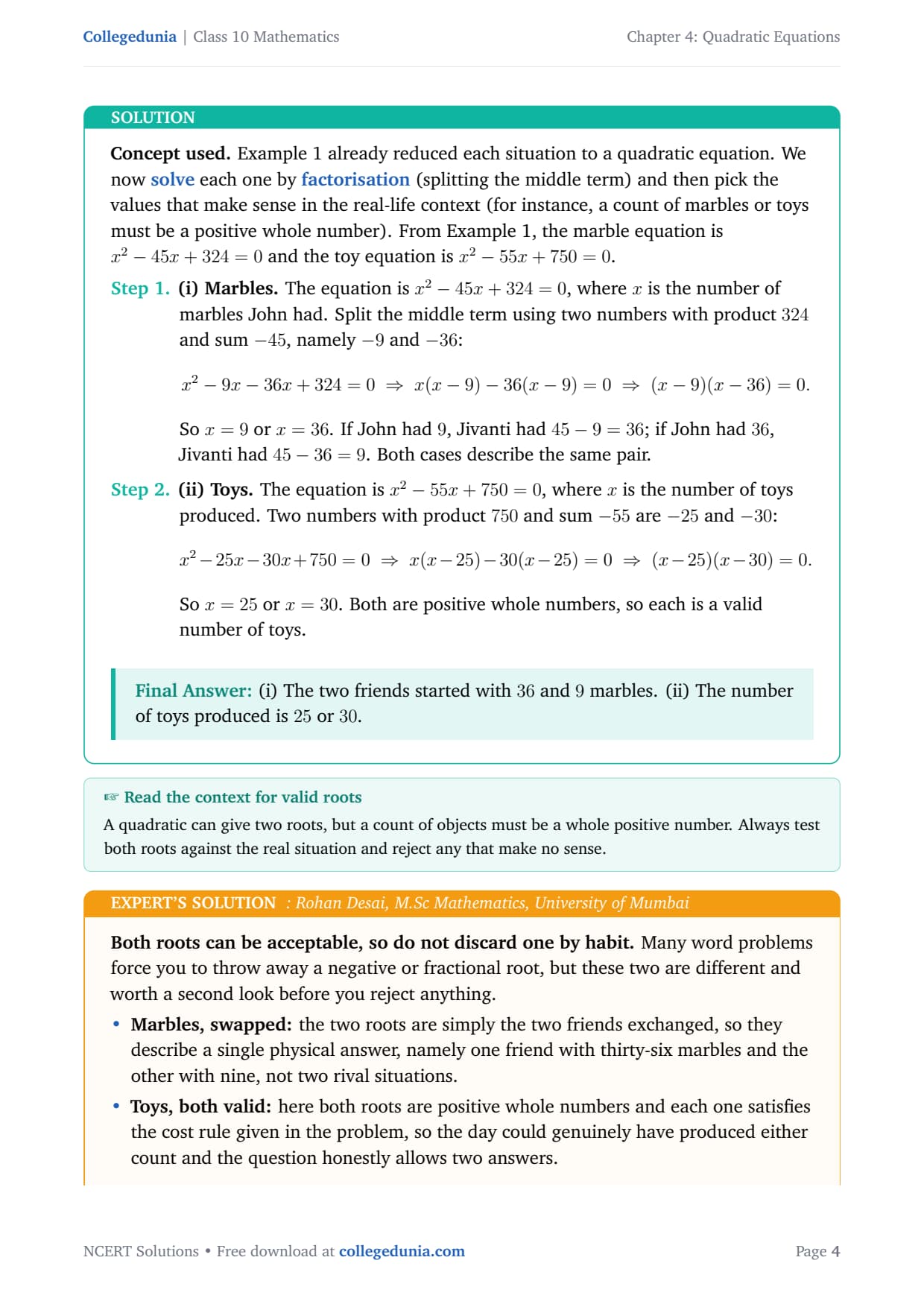
Concept used. Example 1 already reduced each situation to a quadratic
equation. We now solve each one by factorisation (splitting
the middle term) and then pick the values that make sense in the real-life
context (for instance, a count of marbles or toys must be a positive whole
number). From Example 1, the marble equation is x2-45x+324=0 and the toy
equation is x2-55x+750=0.
(i) Marbles. The equation is x2-45x+324=0, where x is
the number of marbles John had.
Split the middle term using two numbers with product 324 and sum
-45, namely -9 and -36:
x2-9x-36x+324=0 ⇒ x(x-9)-36(x-9)=0 ⇒ (x-9)(x-36)=0.
So x=9 or x=36.
If John had 9, Jivanti had 45-9=36; if John had 36, Jivanti had
45-36=9. Both cases describe the same pair.
(ii) Toys. The equation is x2-55x+750=0, where x is the
number of toys produced.
Two numbers with product 750 and sum -55 are -25 and -30:
x2-25x-30x+750=0 ⇒ x(x-25)-30(x-25)=0 ⇒ (x-25)(x-30)=0.
So x=25 or x=30. Both are positive whole numbers, so each is a valid
number of toys.
(i) The two friends started with 36 and 9 marbles. (ii) The number of toys produced is 25 or 30.
RD
Rohan Desai
M.Sc Mathematics, University of Mumbai
Verified Expert
Both roots can be acceptable, so do not discard one by habit. Many
word problems force you to throw away a negative or fractional root, but these
two are different and worth a second look before you reject anything.
Marbles, swapped: the two roots are simply the two friends
exchanged, so they describe a single physical answer, namely one friend
with thirty-six marbles and the other with nine, not two rival
situations.
Toys, both valid: here both roots are positive whole numbers
and each one satisfies the cost rule given in the problem, so the day
could genuinely have produced either count and the question honestly
allows two answers.
Interpret, do not just list: factorise, state both roots, then
write one short sentence reading each root back in the words of the
problem, because that interpretation line is where the reasoning mark
sits and it stops you wrongly rejecting a valid root.
A quick safety check is to confirm the cost per toy stays positive: at one
count it works out to thirty rupees and at the other to twenty-five rupees,
both perfectly sensible figures.
Marbles: 36 and 9. Toys: 25 or 30.
Q 4.3
Find two numbers whose sum is 27 and product is 182.
Concept used. When two numbers have a known sum and a known product,
we name one number x, write the other in terms of x using the sum, and form
a quadratic equation from the product condition. Solving by
factorisation then gives both numbers.
Let the first number be x. Since the sum is 27, the second number is
27-x.
Their product is 182, so write the equation:
x(27-x)=182.
Expand and bring to standard form:
27x-x2=182 ⇒ x2-27x+182=0.
Split the middle term using two numbers with product 182 and sum
-27, namely -13 and -14:
x2-13x-14x+182=0 ⇒ x(x-13)-14(x-13)=0 ⇒ (x-13)(x-14)=0.
So x=13 or x=14. If x=13, the other number is 27-13=14; if
x=14, the other is 27-14=13. Either way the pair is 13 and 14.
The two numbers are 13 and 14.
PM
Priya Menon
M.Sc Mathematics, Anna University
Verified Expert
Sum-and-product problems are quadratics in disguise. Whenever a
question fixes both the sum and the product of two numbers, those numbers are
exactly the roots of x2-sx+p=0, so the template removes any need to guess.
Set up cleanly: let the second number be 27-x, form the
product equation, expand it to standard form, and split the middle term
with the pair that multiplies to the constant and adds to the middle
coefficient.
Keep both roots: the two numbers are interchangeable, so the
answer is the unordered pair rather than a single value, and a student
should resist stopping at one root when the question clearly asks for
two numbers.
Verify both facts: write one line checking that the pair adds
to twenty-seven and multiplies to one hundred eighty-two at the same
time, which confirms the answer without any need to solve again.
The numbers are 13 and 14 (since 13+14=27 and 1314=182).
Q 4.4
Find two consecutive positive integers, sum of whose squares is 365.
Concept used. Two consecutive integers differ by 1, so if
one is x the next is x+1. We translate "sum of their squares is 365" into
an equation, reduce it to standard form, solve by factorisation, and
keep only the root that is a positive integer.
Let the smaller integer be x. The next consecutive integer is x+1.
Bring to one side: 2x2+2x-364=0. Divide every term by 2:
x2+x-182=0.
Split the middle term with two numbers of product -182 and sum +1,
namely +14 and -13:
x2+14x-13x-182=0 ⇒ x(x+14)-13(x+14)=0 ⇒ (x+14)(x-13)=0.
So x=-14 or x=13. The integers must be positive, so x=13 and the
next integer is 14.
The two consecutive positive integers are 13 and 14.
AN
Arjun Nair
M.Sc Mathematics, University of Kerala
Verified Expert
Divide out the common factor early to keep numbers small. After
expanding, the equation carries a common factor of two, and dividing through by
it gives a friendlier equation with the same roots but smaller coefficients.
Smaller is faster: once the factor of two is removed,
splitting the middle term needs a pair that multiplies to the constant
and adds to one, and noticing that thirteen times fourteen makes one
hundred eighty-two lands that pair immediately.
Reject in writing: the equation offers a positive and a
negative root, but the word "positive" in the question rules the
negative one out, and the examiner wants that rejection stated in a
line, not made silently in your head.
Square and add to check: the fastest verification is to square
each integer and add, which reproduces the given total and confirms the
pair without re-solving the equation at all.
The integers are 13 and 14, since 132+142=365.
Q 4.5
The altitude of a right triangle is 7 cm less than its base. If the
hypotenuse is 13 cm, find the other two sides.
Concept used. In a right triangle the base and the altitude
are the two legs that meet at the right angle, and the hypotenuse is
the longest side opposite that angle. By the Pythagoras theorem,
(base)2+(altitude)2=(hypotenuse)2. We set the
base as x, write the altitude in terms of x, form the equation, and solve.
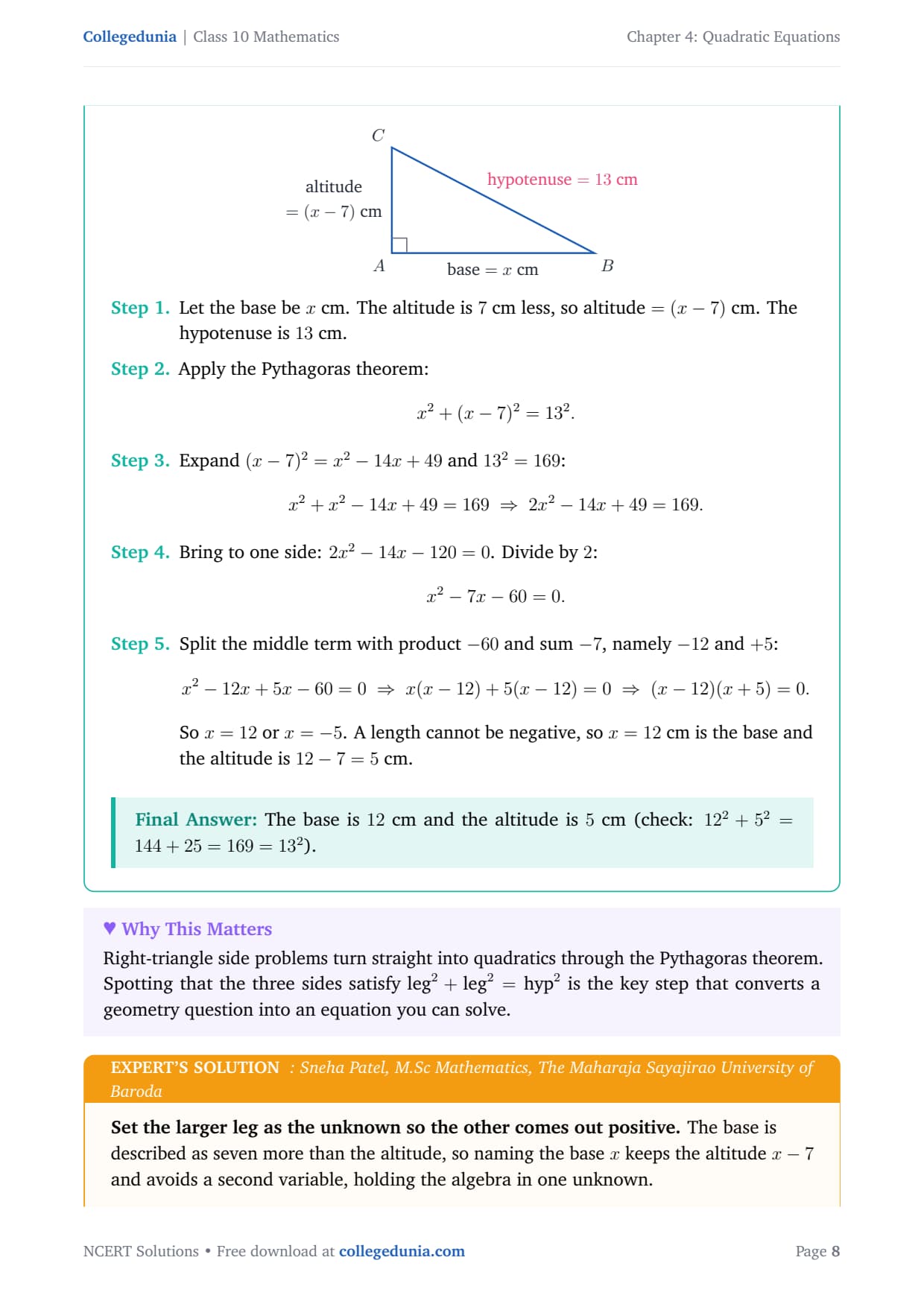
A labelled sketch of the right triangle makes the set-up clear:
[See diagram in the PDF version]
Let the base be x cm. The altitude is 7 cm less, so altitude
=(x-7) cm. The hypotenuse is 13 cm.
Apply the Pythagoras theorem:
x2+(x-7)2=132.
Expand (x-7)2=x2-14x+49 and 132=169:
x2+x2-14x+49=169 ⇒ 2x2-14x+49=169.
Bring to one side: 2x2-14x-120=0. Divide by 2:
x2-7x-60=0.
Split the middle term with product -60 and sum -7, namely -12 and
+5:
x2-12x+5x-60=0 ⇒ x(x-12)+5(x-12)=0 ⇒ (x-12)(x+5)=0.
So x=12 or x=-5. A length cannot be negative, so x=12 cm is the
base and the altitude is 12-7=5 cm.
The base is 12 cm and the altitude is 5 cm (check: 122+52=144+25=169=132).
SP
Sneha Patel
M.Sc Mathematics, The Maharaja Sayajirao University of Baroda
Verified Expert
Set the larger leg as the unknown so the other comes out positive.
The base is described as seven more than the altitude, so naming the base x
keeps the altitude x-7 and avoids a second variable, holding the algebra in
one unknown.
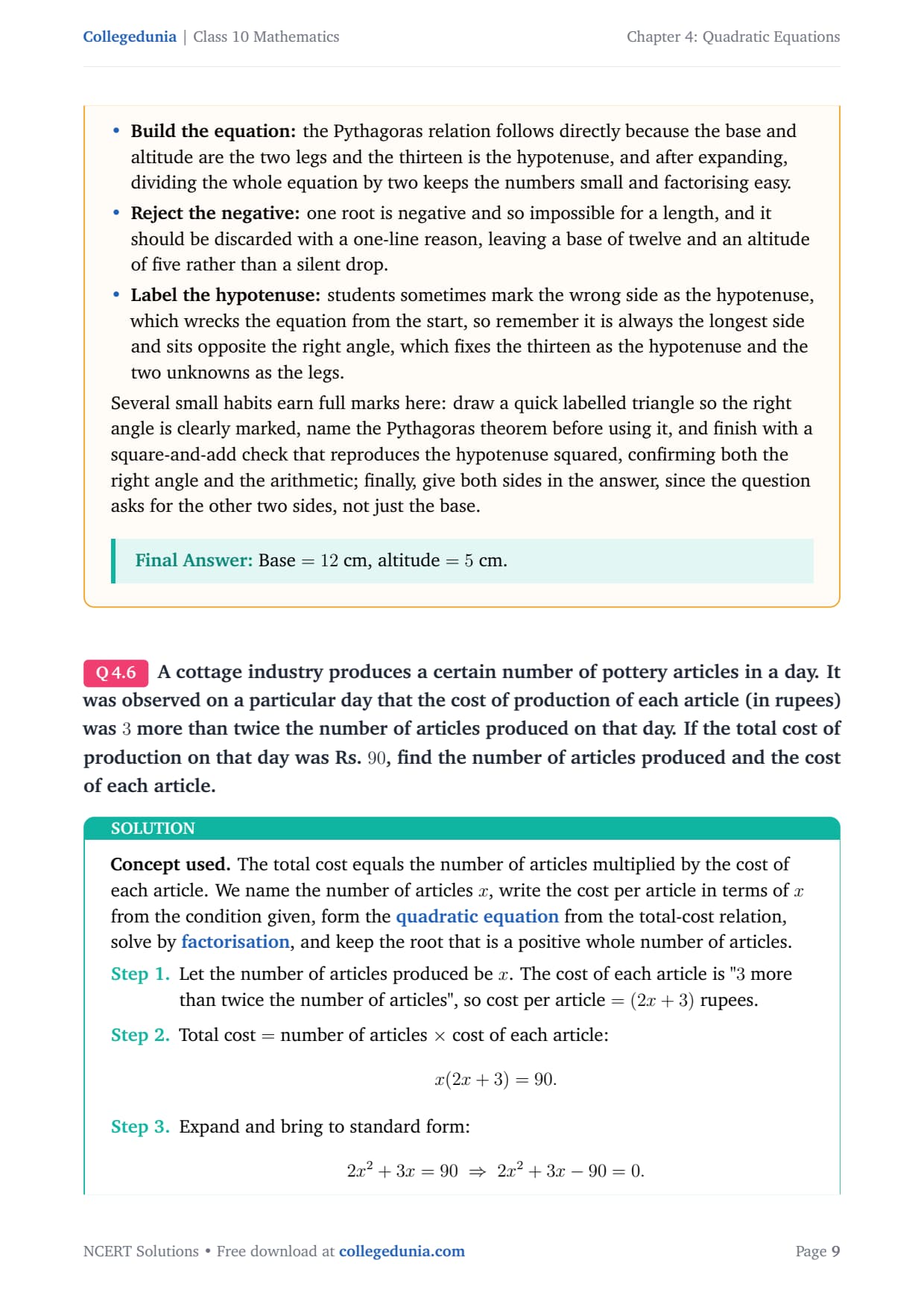
Build the equation: the Pythagoras relation follows directly
because the base and altitude are the two legs and the thirteen is the
hypotenuse, and after expanding, dividing the whole equation by two
keeps the numbers small and factorising easy.
Reject the negative: one root is negative and so impossible for
a length, and it should be discarded with a one-line reason, leaving a
base of twelve and an altitude of five rather than a silent drop.
Label the hypotenuse: students sometimes mark the wrong side as
the hypotenuse, which wrecks the equation from the start, so remember it
is always the longest side and sits opposite the right angle, which
fixes the thirteen as the hypotenuse and the two unknowns as the legs.
Several small habits earn full marks here: draw a quick labelled triangle so the
right angle is clearly marked, name the Pythagoras theorem before using it, and
finish with a square-and-add check that reproduces the hypotenuse squared,
confirming both the right angle and the arithmetic; finally, give both sides in
the answer, since the question asks for the other two sides, not just the base.
Base =12 cm, altitude =5 cm.
Q 4.6
A cottage industry produces a certain number of pottery articles in a
day. It was observed on a particular day that the cost of production of each
article (in rupees) was 3 more than twice the number of articles produced on
that day. If the total cost of production on that day was Rs. 90, find the
number of articles produced and the cost of each article.
Concept used. The total cost equals the number of articles multiplied
by the cost of each article. We name the number of articles x, write the cost
per article in terms of x from the condition given, form the
quadratic equation from the total-cost relation, solve by
factorisation, and keep the root that is a positive whole number of
articles.
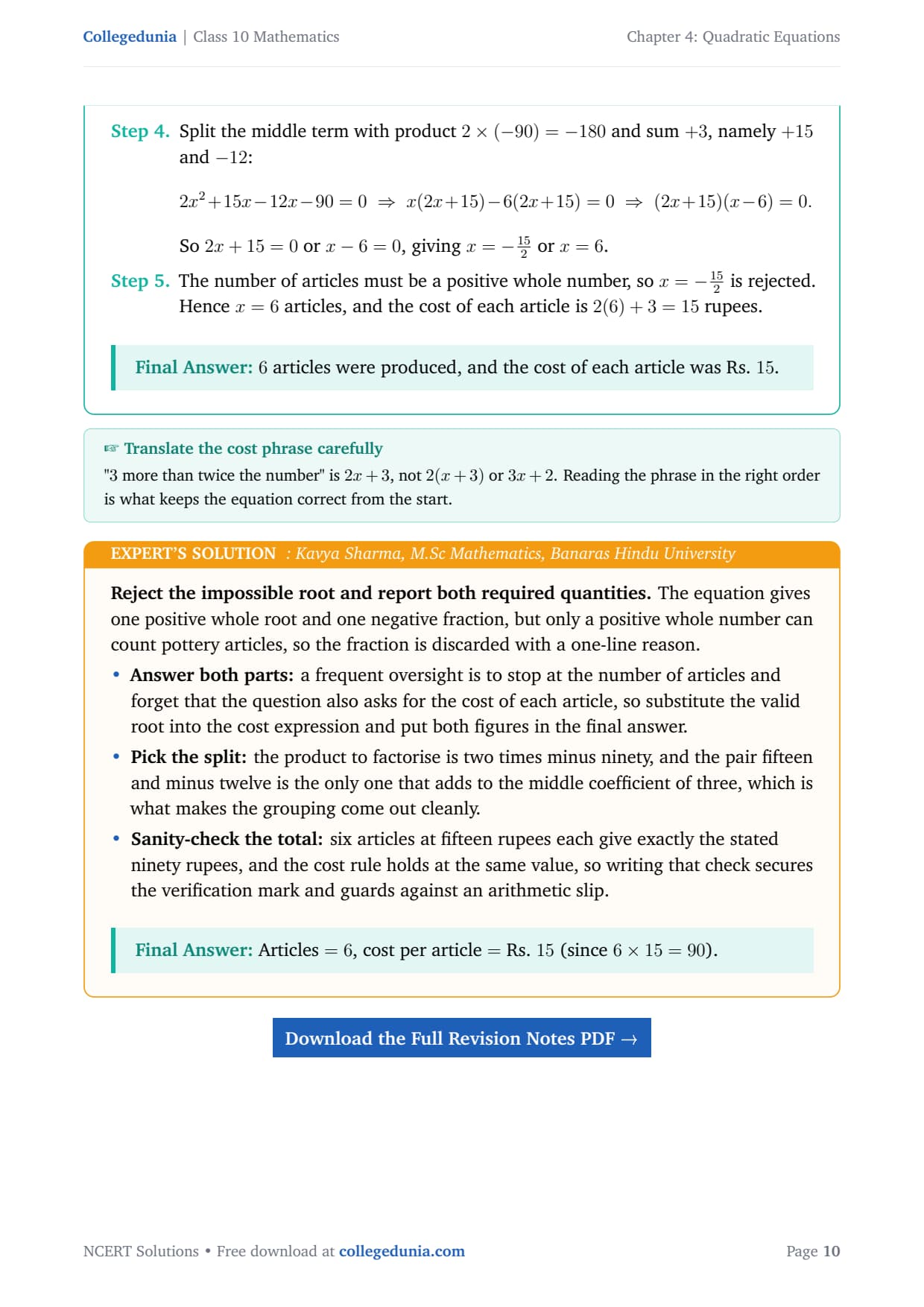
Let the number of articles produced be x. The cost of each article is
"3 more than twice the number of articles", so cost per article
=(2x+3) rupees.
Total cost = number of articles × cost of each article:
x(2x+3)=90.
Expand and bring to standard form:
2x2+3x=90 ⇒ 2x2+3x-90=0.
Split the middle term with product 2×(-90)=-180 and sum +3,
namely +15 and -12:
2x2+15x-12x-90=0 ⇒ x(2x+15)-6(2x+15)=0 ⇒ (2x+15)(x-6)=0.
So 2x+15=0 or x-6=0, giving x=-152 or x=6.
The number of articles must be a positive whole number, so
x=-152 is rejected. Hence x=6 articles, and the cost of
each article is 2(6)+3=15 rupees.
6 articles were produced, and the cost of each article was Rs. 15.
KS
Kavya Sharma
M.Sc Mathematics, Banaras Hindu University
Verified Expert
Reject the impossible root and report both required quantities. The
equation gives one positive whole root and one negative fraction, but only a
positive whole number can count pottery articles, so the fraction is discarded
with a one-line reason.
Answer both parts: a frequent oversight is to stop at the
number of articles and forget that the question also asks for the cost
of each article, so substitute the valid root into the cost expression
and put both figures in the final answer.
Pick the split: the product to factorise is two times minus
ninety, and the pair fifteen and minus twelve is the only one that adds
to the middle coefficient of three, which is what makes the grouping
come out cleanly.
Sanity-check the total: six articles at fifteen rupees each
give exactly the stated ninety rupees, and the cost rule holds at the
same value, so writing that check secures the verification mark and
guards against an arithmetic slip.
Articles =6, cost per article = Rs. 15 (since 615=90).
Student Feedback
Student Feedback: Out of 12,600 students surveyed before the 2026 boards, 74% said the word problems in Exercise 4.2 were harder than the pure factorisation questions, with the pottery-cost and right-triangle problems being the most commonly misattempted. 4 out of 5 students who scored full marks said they always wrote the product-and-sum pair before attempting the split.
Source: Collegedunia 2026-27 Class 10 Maths student poll.
Quadratic Equations Class 10 Maths Exercise 4.2 NCERT Solutions FAQs
Ques. How many questions are there in Class 10 Maths Chapter 4 Quadratic Equations Exercise 4.2?
Ans. Exercise 4.2 has 6 questions. Question 1 has five factorisation sub-parts. Questions 2 to 6 are word problems that students solve by setting up a quadratic equation and solving it by splitting the middle term.
Ques. What is the splitting the middle term method used in Exercise 4.2?
Ans. To split the middle term of ax2 + bx + c = 0, find two numbers whose product is a × c and whose sum is b. Rewrite the middle term using these two numbers, group the four-term expression in pairs, factor each pair, and write the quadratic as a product of two linear factors. Setting each factor to zero gives the two roots.
Ques. Why do some word problems in Exercise 4.2 have only one valid root?
Ans. A quadratic equation always produces two roots, but a root that gives a negative count of objects, a negative length, or a non-whole number of articles makes no real-world sense. That root is rejected. For example, in Q5 the root x = −5 gives a negative length, so only x = 12 is accepted for the base of the triangle.
Ques. What is a repeated root and when does it appear in Exercise 4.2?
Ans. A repeated root means both roots of the quadratic are equal. It appears when the quadratic is a perfect square trinomial and the discriminant b2 − 4ac = 0. In Exercise 4.2 Q1, parts (iv) and (v) give repeated roots: x = 14 and x = 110 respectively.
Ques. Are these Exercise 4.2 solutions based on the 2026-27 CBSE syllabus?
Ans. Yes. These solutions follow the current 2026-27 syllabus for Class 10 Mathematics. Exercise 4.2 on solving quadratic equations by factorisation is fully retained in the latest NCERT edition and is directly tested in the CBSE Class 10 board paper.








Comments