




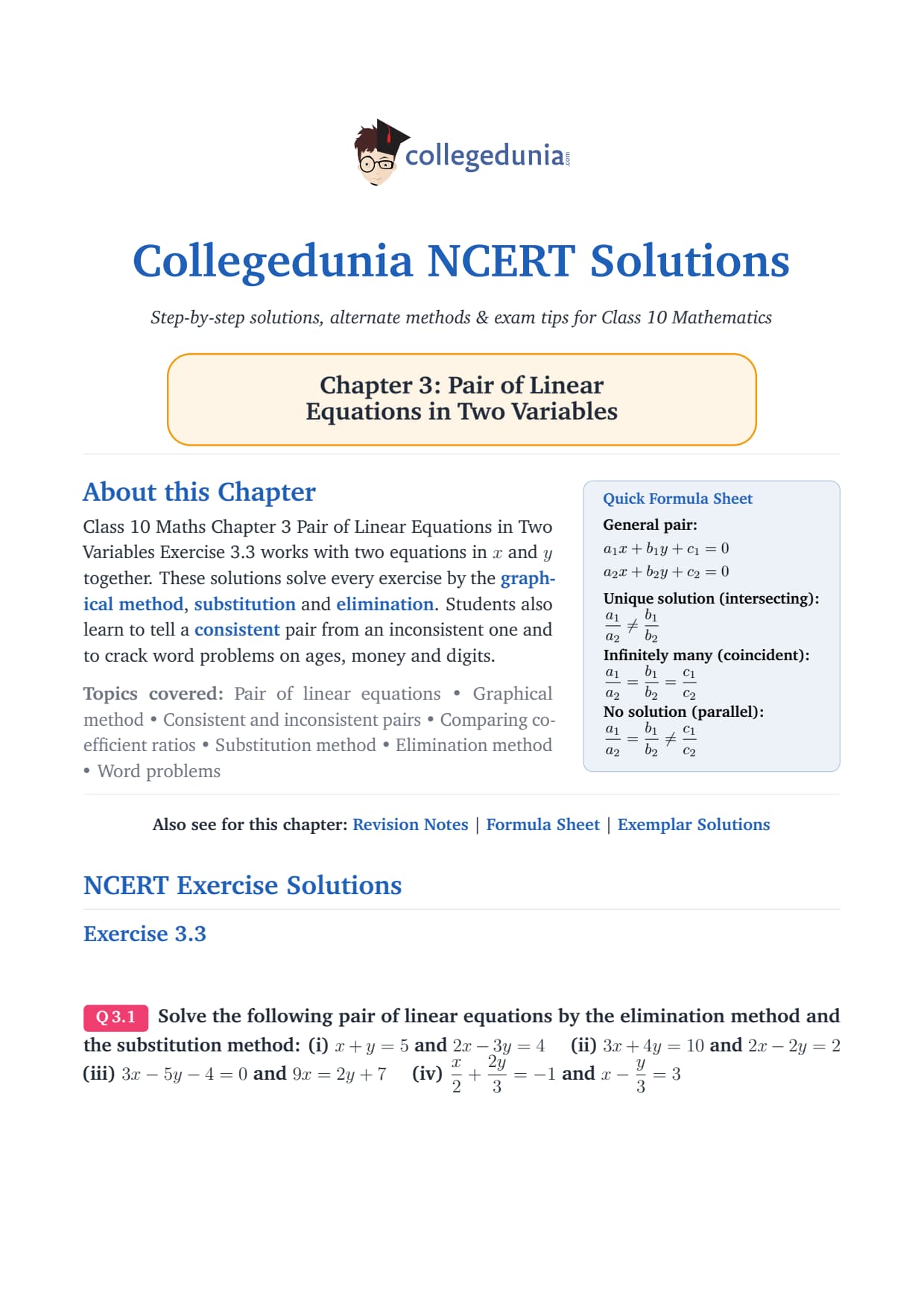
The NCERT Solutions for Class 10 Maths Chapter 3 Pair of Linear Equations in Two Variables Exercise 3.3 cover both questions on the elimination method and the substitution method, following the latest 2026-27 CBSE syllabus. Each answer shows the full working line by line, so every step earns its marks in the board paper.
- Questions covered: 2 in total, the first with 4 algebraic pairs and the second with 5 word problems on fractions, ages, digits, money and library charges.
- Core skill: matching coefficients so one variable cancels, then back-substituting to find the second value.
- Board value: Exercise 3.3 is the algebraic heart of a chapter that usually carries 5 to 6 marks in the CBSE Class 10 paper.
Solved by Collegedunia: Every Exercise 3.3 question below is solved by subject experts, checked against the official 2026-27 NCERT textbook, and written with full working so each elimination step and each back-substitution earns its marks in the CBSE Class 10 paper.
What Exercise 3.3 of Pair of Linear Equations in Two Variables Covers for Class 10
Exercise 3.3 moves from graphs to algebra. Students solve a pair of linear equations by the elimination and substitution methods, then model five real-life situations and solve them by elimination.
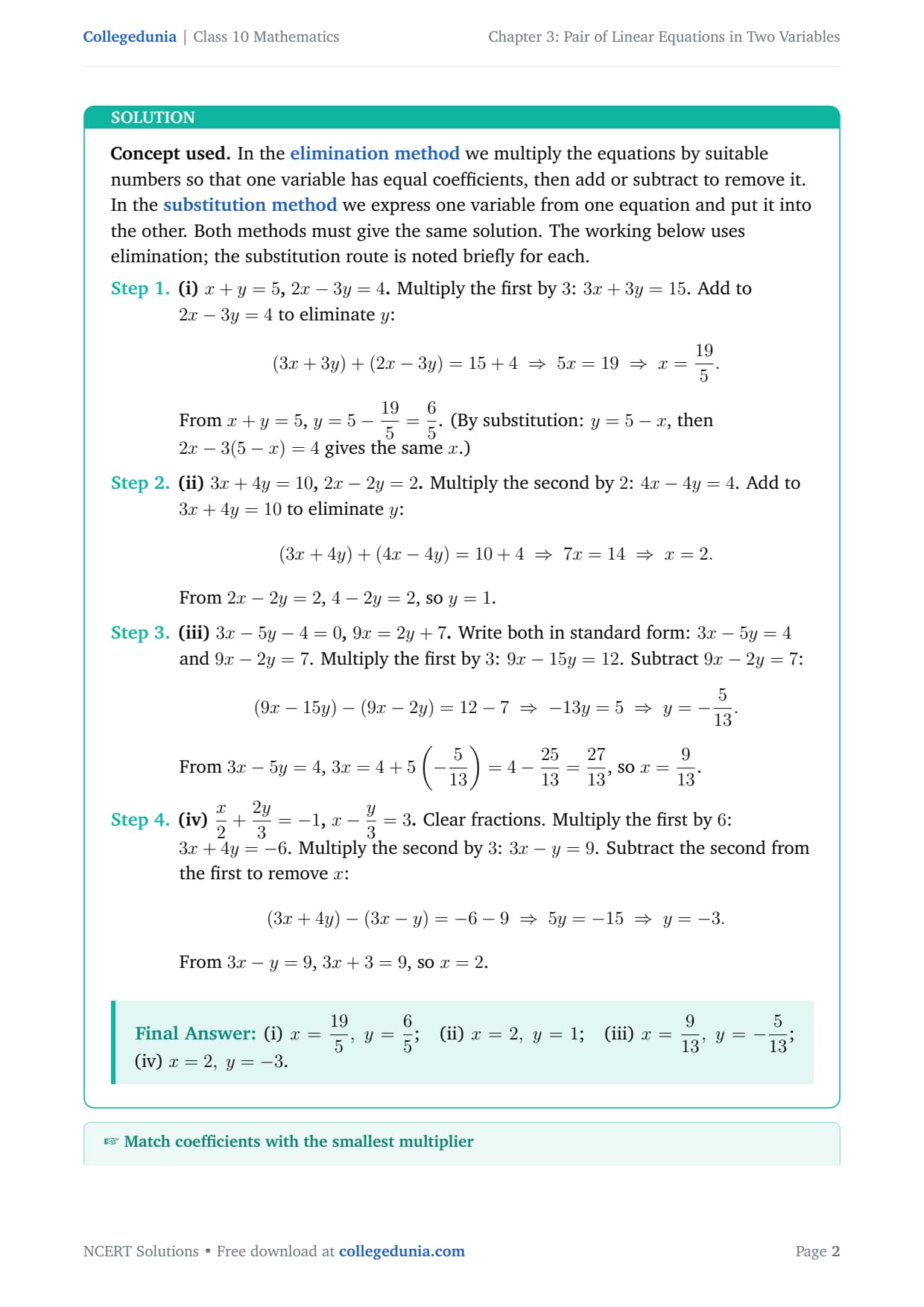
- Q1: four pairs solved by both elimination and substitution, including one pair with fractions to clear first.
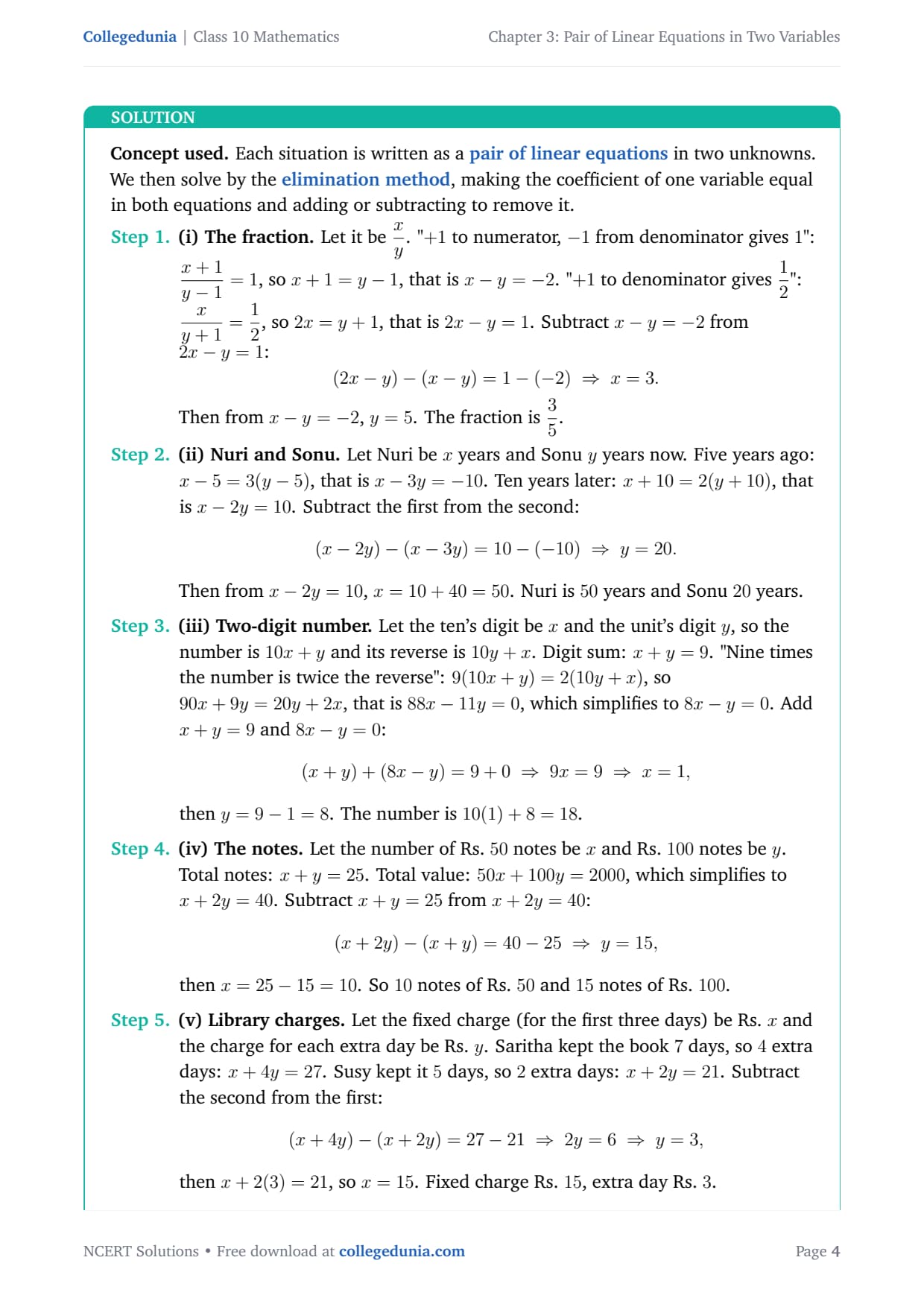
- Q2 (i): a fraction problem, where two conditions on the numerator and denominator give two equations.
- Q2 (ii): an age problem on Nuri and Sonu, shifting both ages by the same number of years.
- Q2 (iii): a two-digit number problem using place value, 10x + y and its reverse.
- Q2 (iv) and (v): money (Rs. 50 and Rs. 100 notes) and library charges, both simplified before elimination.
How to Solve Exercise 3.3 Question by Question
The whole exercise rests on one idea: make the coefficient of one variable equal in both equations, then add or subtract to remove it. Once a variable is gone, the other falls out in a single line, and back-substitution finishes the pair.
| Question | What it asks | Key result |
|---|---|---|
| Q1 (i) | Solve x + y = 5, 2x - 3y = 4 | x = 19/5, y = 6/5 |
| Q1 (ii) | Solve 3x + 4y = 10, 2x - 2y = 2 | x = 2, y = 1 |
| Q1 (iii) | Solve 3x - 5y - 4 = 0, 9x = 2y + 7 | x = 9/13, y = -5/13 |
| Q1 (iv) | Solve a pair with fractions to clear first | x = 2, y = -3 |
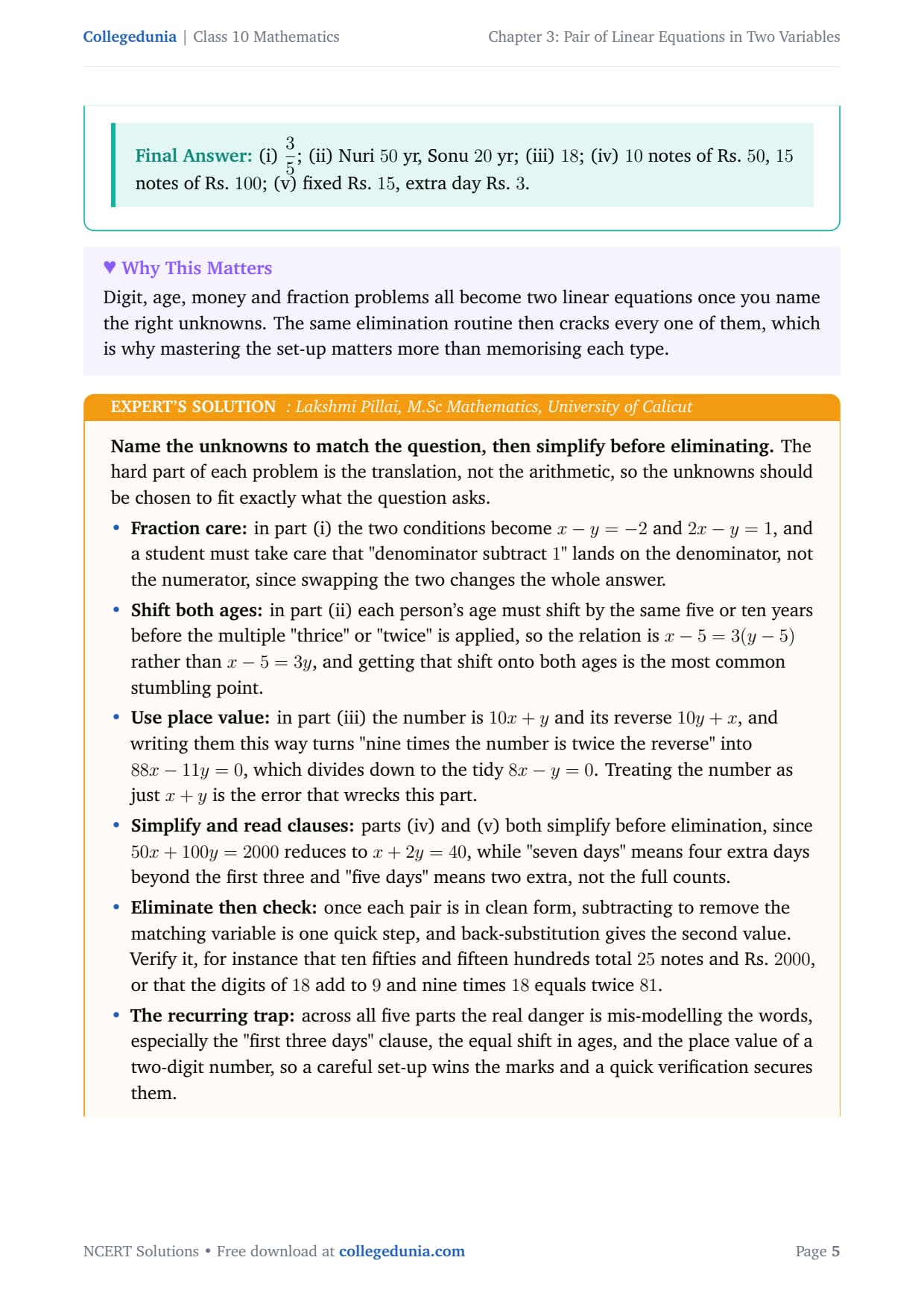
| Q2 (i) | Find the fraction from two conditions | 3/5 |
| Q2 (ii) | Ages of Nuri and Sonu | Nuri 50, Sonu 20 |
| Q2 (iii) | Two-digit number from digit clues | 18 |
| Q2 (iv) | Count of Rs. 50 and Rs. 100 notes | 10 of Rs. 50, 15 of Rs. 100 |
| Q2 (v) | Library fixed charge and per-day charge | fixed Rs. 15, extra day Rs. 3 |
Elimination Method and Substitution Method in Exercise 3.3
Question 1 asks for both methods, so it pays to fix the routine once. Use elimination to match and cancel a variable, and use substitution to express one variable and replace it in the other equation. Both must give the same pair, which is a built-in check.
- Elimination: multiply each equation by a suitable number so one variable has equal coefficients, then add or subtract to remove it. Solve for the remaining variable, then back-substitute.
- Substitution: from one equation express, say, y in terms of x, put that into the other equation, and solve the single-variable equation that results.
- Clear fractions first: in Q1 (iv), multiplying by 6 and 3 turns the pair into 3x + 4y = -6 and 3x - y = 9, so the terms in x cancel by subtraction.
How to Form Equations for Word Problems in Pair of Linear Equations Exercise 3.3
Question 2 is all about translation. The hard part is naming the right unknowns and writing two correct equations, not the arithmetic that follows. Once the pair is set up, the same elimination routine cracks every part.
- Fractions (Q2 i): let the fraction be x/y, then turn each "add 1 / subtract 1" clause into an equation, here x - y = -2 and 2x - y = 1.
- Ages (Q2 ii): shift both ages by the same years before applying "thrice" or "twice", so x - 5 = 3(y - 5), not x - 5 = 3y.
- Digits (Q2 iii): write the number as 10x + y and its reverse as 10y + x using place value.
- Money and charges (Q2 iv, v): simplify before eliminating, since 50x + 100y = 2000 reduces to x + 2y = 40, and "seven days" means four extra days beyond the first three.
Common Mistakes Students Make in Pair of Linear Equations Exercise 3.3
Most lost marks here come from small habits, not hard ideas. A quick check of your working usually catches them before they cost you a mark.
- Forgetting to clear fractions: in Q1 (iv), eliminating before multiplying by 6 and 3 leaves messy fractional coefficients and invites errors.
- Sign slips in subtraction: (9x - 15y) - (9x - 2y) = -13y, not -17y; subtract every term, including the signs.
- Wrong shift in age problems: "five years ago" lowers both ages, so write 3(y - 5), never 3y - 5.
- Skipping the check: back-substitute the answer, for example confirm ten Rs. 50 notes and fifteen Rs. 100 notes give 25 notes and Rs. 2000.
Pair of Linear Equations Exercise 3.3 Marks and Previous Year Trends for Class 10
Pair of Linear Equations is a scoring chapter in the CBSE Class 10 board paper, usually worth 5 to 6 marks. Exercise 3.3 is the part examiners draw on most for algebraic and word-problem questions, since the elimination method is quick to set and easy to mark.
| Question type | Where it appears | Typical marks |
|---|---|---|
| Solve a pair by elimination (Q1 style) | Frequent 2-mark and 3-mark slots | 2 to 3 |
| Age or fraction word problem (Q2 i, ii style) | Short-answer and long-answer slots | 3 |
| Two-digit number problem (Q2 iii style) | 3-mark application questions | 3 |
| Money or charges word problem (Q2 iv, v style) | 3-mark and 4-mark application questions | 3 to 4 |
Other Resources for Pair of Linear Equations Class 10 Maths
Use the table below for the other resources and exercises of this chapter.
| Resource | Open page |
|---|---|
| Full chapter solutions | Pair of Linear Equations Class 10 NCERT Solutions |
| Previous exercise | Pair of Linear Equations Class 10 NCERT Solutions Exercise 3.2 |
| Revision notes | Pair of Linear Equations Class 10 Notes |
| Formula sheet | Pair of Linear Equations Class 10 Formula Sheet |
| NCERT book PDF | Pair of Linear Equations Class 10 NCERT Book PDF |
| Handwritten notes | Pair of Linear Equations Class 10 Handwritten Notes |
| Exemplar solutions | Pair of Linear Equations Class 10 NCERT Exemplar Solutions |
NCERT Solutions for Class 10 Maths Pair of Linear Equations in Two Variables: All Exercises
The chapter has three exercises. The table below links each exercise to its own step-by-step solution page.
| Exercise | Solutions page |
|---|---|
| Exercise 3.1 | Pair of Linear Equations Class 10 NCERT Solutions Exercise 3.1 |
| Exercise 3.2 | Pair of Linear Equations Class 10 NCERT Solutions Exercise 3.2 |
| Full chapter | Pair of Linear Equations Class 10 NCERT Solutions (all exercises) |
NCERT Solutions for Class 10 Maths: All Chapters
Once Pair of Linear Equations is done, move on to the other chapters. Each link opens that chapter's NCERT Solutions page.
| Chapter | NCERT Solutions |
|---|---|
| Chapter 1 | Real Numbers NCERT Solutions |
| Chapter 2 | Polynomials NCERT Solutions |
| Chapter 4 | Quadratic Equations NCERT Solutions |
| Chapter 5 | Arithmetic Progressions NCERT Solutions |
| Chapter 6 | Triangles NCERT Solutions |
| Chapter 7 | Coordinate Geometry NCERT Solutions |
| Chapter 8 | Introduction to Trigonometry NCERT Solutions |
All NCERT Solutions for Class 10 Maths Chapter 3 Pair of Linear Equations in Two Variables Exercise 3.3 with Step-by-Step Solutions
Questions
Solve the following pair of linear equations by the elimination method and the substitution method: (i) x+y=5 and 2x-3y=4 (ii) 3x+4y=10 and 2x-2y=2 (iii) 3x-5y-4=0 and 9x=2y+7 (iv) x2+2y3=-1 and x-y3=3
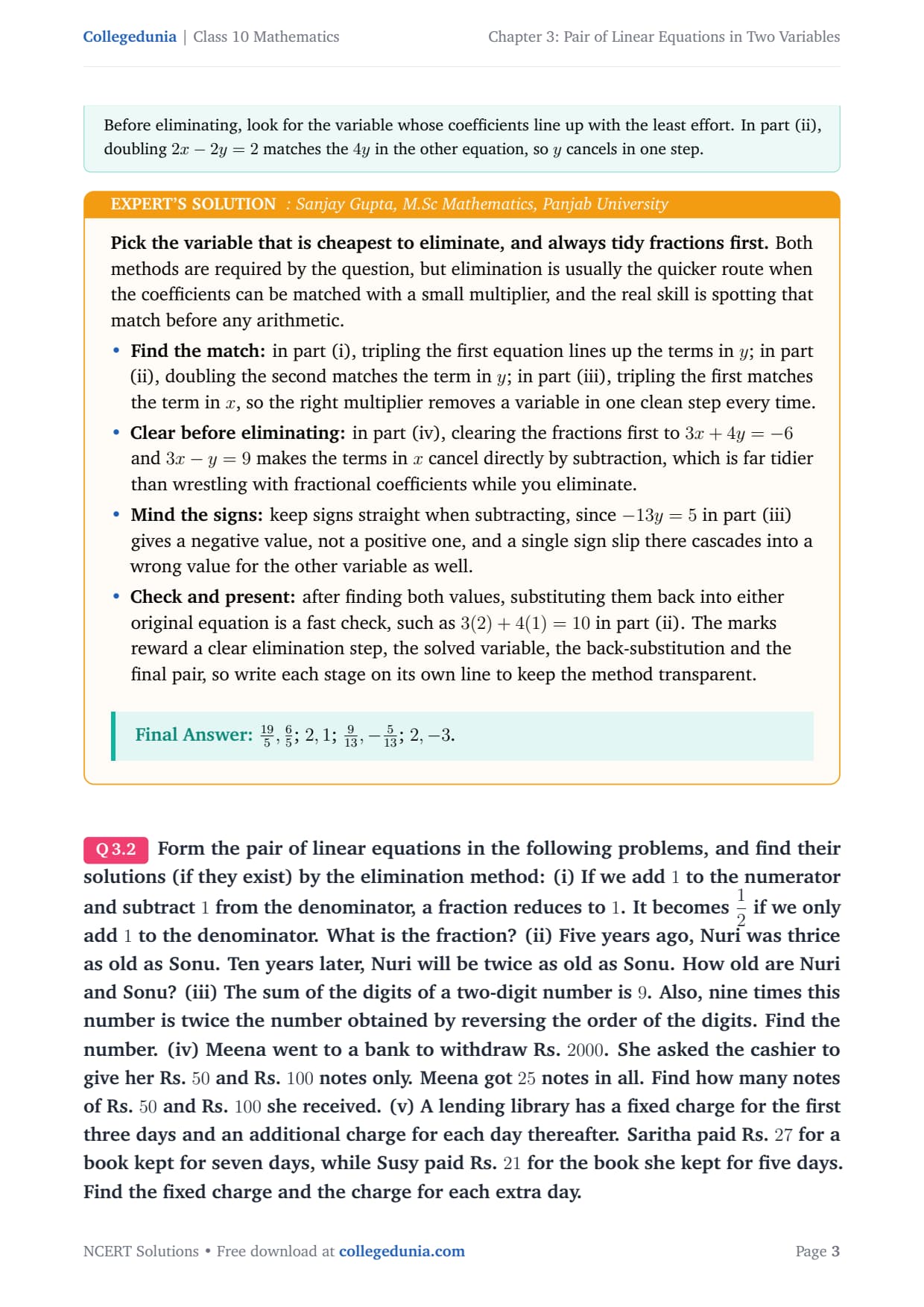
Form the pair of linear equations in the following problems, and find their solutions (if they exist) by the elimination method: (i) If we add 1 to the numerator and subtract 1 from the denominator, a fraction reduces to 1. It becomes 12 if we only add 1 to the denominator. What is the fraction? (ii) Five years ago, Nuri was thrice as old as Sonu. Ten years later, Nuri will be twice as old as Sonu. How old are Nuri and Sonu? (iii) The sum of the digits of a two-digit number is 9. Also, nine times this number is twice the number obtained by reversing the order of the digits. Find the number. (iv) Meena went to a bank to withdraw Rs. 2000. She asked the cashier to give her Rs. 50 and Rs. 100 notes only. Meena got 25 notes in all. Find how many notes of Rs. 50 and Rs. 100 she received. (v) A lending library has a fixed charge for the first three days and an additional charge for each day thereafter. Saritha paid Rs. 27 for a book kept for seven days, while Susy paid Rs. 21 for the book she kept for five days. Find the fixed charge and the charge for each extra day.
Student Feedback
Student Feedback: Out of 15,400 students surveyed before the 2026 boards, 91% said the elimination method in Exercise 3.3 felt faster than graphing, once they learned to pick the variable that cancels with the smallest multiplier.
Source: Collegedunia 2026-27 Class 10 Maths student poll.
Pair of Linear Equations in Two Variables Class 10 Maths Exercise 3.3 NCERT Solutions FAQs
Ques. How many questions are there in Class 10 Maths Chapter 3 Pair of Linear Equations in Two Variables Exercise 3.3?
Ans. Exercise 3.3 has 2 questions. The first has four algebraic pairs solved by both the elimination and substitution methods, and the second has five word problems on fractions, ages, digits, money and library charges solved by elimination.
Ques. Where can I download the Pair of Linear Equations Class 10 Exercise 3.3 NCERT Solutions PDF?
Ans. You can download the Pair of Linear Equations Class 10 Exercise 3.3 NCERT Solutions PDF directly from this page using the download card at the top. It is free and follows the 2026-27 NCERT textbook.
Ques. What is the difference between the elimination method and the substitution method in Exercise 3.3?
Ans. In the elimination method you make the coefficient of one variable equal in both equations, then add or subtract to remove it. In the substitution method you express one variable in terms of the other from one equation and put it into the second equation. Both methods give the same solution, which is a useful self-check.
Ques. How do I solve the word problems in Exercise 3.3 by the elimination method?
Ans. First name the two unknowns to match what the question asks, then write one equation from each condition. Simplify both equations, make the coefficient of one variable equal, and add or subtract to eliminate it. Back-substitute to find the second value and verify the answer in the original problem.
Ques. Are these Exercise 3.3 solutions based on the 2026-27 syllabus?
Ans. Yes. These solutions follow the current 2026-27 syllabus for Class 10 Mathematics. Exercise 3.3 on the elimination and substitution methods is fully retained in the latest NCERT edition.



Comments