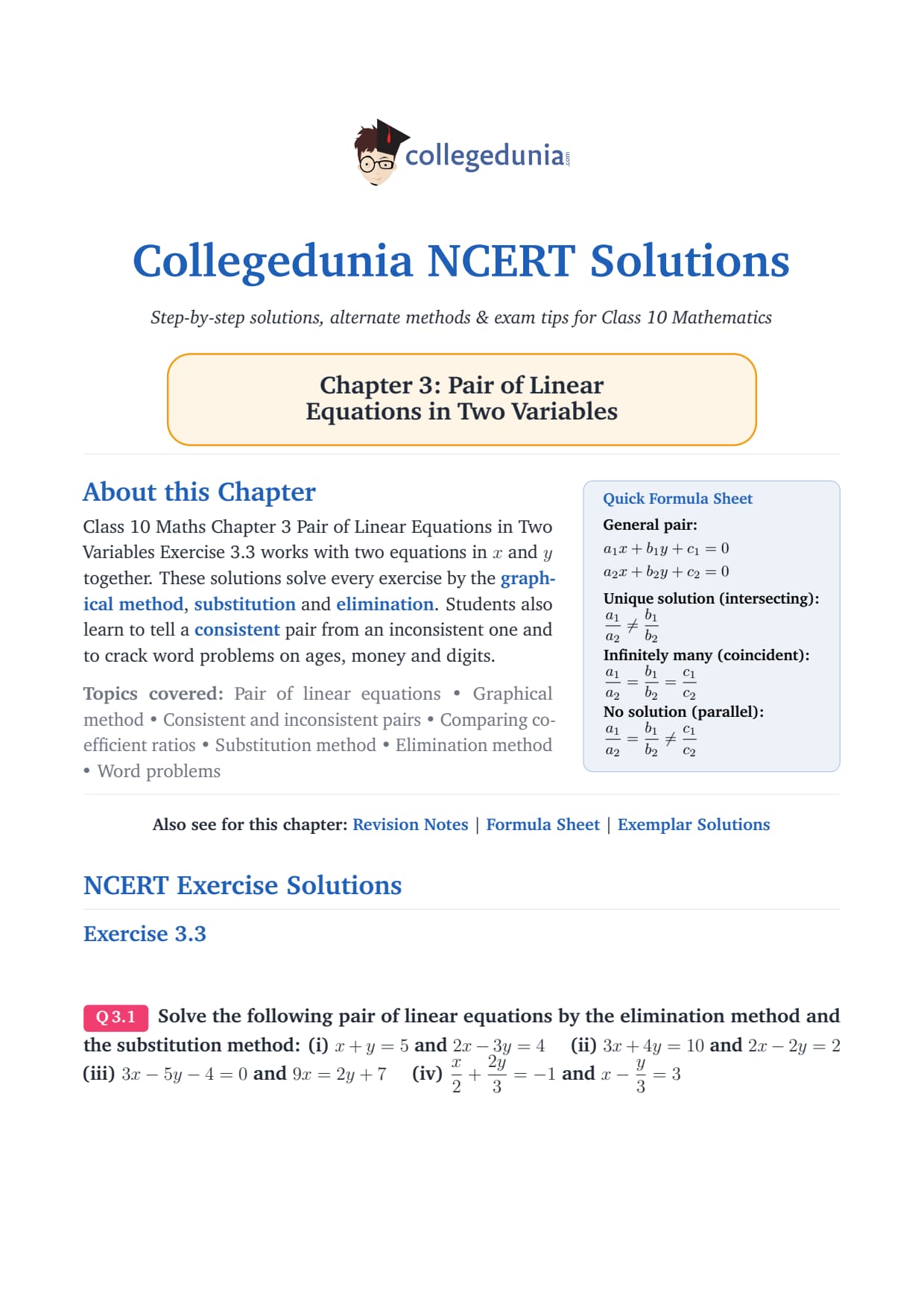
The NCERT Solutions for Class 10 Maths Chapter 3 Pair of Linear Equations in Two Variables solve every textbook question by the graphical, substitution and elimination methods, set to the 2026-27 CBSE syllabus. Each answer is in plain steps, so you can tell a consistent pair from an inconsistent one and score full marks.
Covers all 12 questions across Exercise 3.1, 3.2 and 3.3, with step-by-step model answers.
From the Algebra unit, worth about 5 to 7 marks in the board paper.
Every solution here is written by subject experts from the official NCERT Mathematics textbook, and checked against the last five years of CBSE board papers.
Solved by Collegedunia: All 12 questions below carry a step-by-step Solution and an Expert Solution, in CBSE marking-scheme style and verified by senior Mathematics educators for 2026-27.
Watch Pair of Linear Equations Class 10 Maths Explained
Elimination method, with age, two-digit number and library-charge problems
Medium
The board paper almost always uses one word problem solved by substitution or elimination and one short consistency check. Practise one of each type.
Concept Anchor: A pair of linear equations is two straight lines, and the way they sit decides the answer. Intersecting lines give one solution, coincident lines give infinitely many, and parallel lines give none.
How to Solve a Pair of Linear Equations by Substitution and Elimination
Exercise 3.2 and 3.3 use two algebra methods. Both give the same answer, so pick the shorter one.
Substitution: write one variable using the other, for example x = 4 + y, then put it into the second equation to get one equation in one variable.
Elimination: match the coefficients of one variable, then add or subtract to remove it in one step.
Clear fractions and decimals first. Multiply a fraction equation by its common denominator, or a decimal one by 10, to get whole numbers.
Always check. Put the pair (x, y) back into both original equations. This is a free accuracy mark.
Pair of Linear Equations NCERT Solutions: Important Topics and Weightage
The table lists the chapter topics by the skill CBSE tests and the usual mark value.
Topic
What CBSE Tests
Mark Weightage
Graphical method
Plotting two lines and reading the intersection as the solution
3 to 5
Coefficient ratio test
Intersecting, parallel or coincident from the ratios of a, b and c
1 to 2
Consistent or inconsistent pairs
One solution, none, or infinitely many
2
Substitution method
Expressing one variable and substituting to solve
2 to 3
Elimination method
Matching coefficients, then adding or subtracting
2 to 3
Word problems
Forming equations from ages, money, digits and geometry
3 to 5
Exam Tip: Before you draw any graph, run the ratio test. It tells you in one line whether a solution exists, so you only plot pairs that have one.
Solved Example: Checking Whether a Pair of Equations Is Consistent
This example shows the answer shape a CBSE marker expects for a 2-mark consistency question. The same steps work for any pair.
Question (2 marks). Is the pair 2x − 3y = 8 and 4x − 6y = 9 consistent or inconsistent?
Step 1, Standard form. Move every term to one side: 2x − 3y − 8 = 0 and 4x − 6y − 9 = 0. So a1 = 2, b1 = −3, c1 = −8 and a2 = 4, b2 = −6, c2 = −9.
Step 2, Compare the ratios.a1a2 = 12 and b1b2 = 12 are equal. But c1c2 = 89 is different.
Step 3, Conclude. Since a1a2 = b1b2 ≠ c1c2, the lines are parallel and never meet. The pair is inconsistent, with no solution.
Common Mistakes Students Make in Pair of Linear Equations
Dropping a minus sign in the ratios. Carry the sign with each term. So b1 = −4 gives −46, not 46. A lost sign flips the answer.
Comparing constants without standard form. Write each equation as ax + by + c = 0 before reading c. So 3x + 2y = 5 gives c1 = −5.
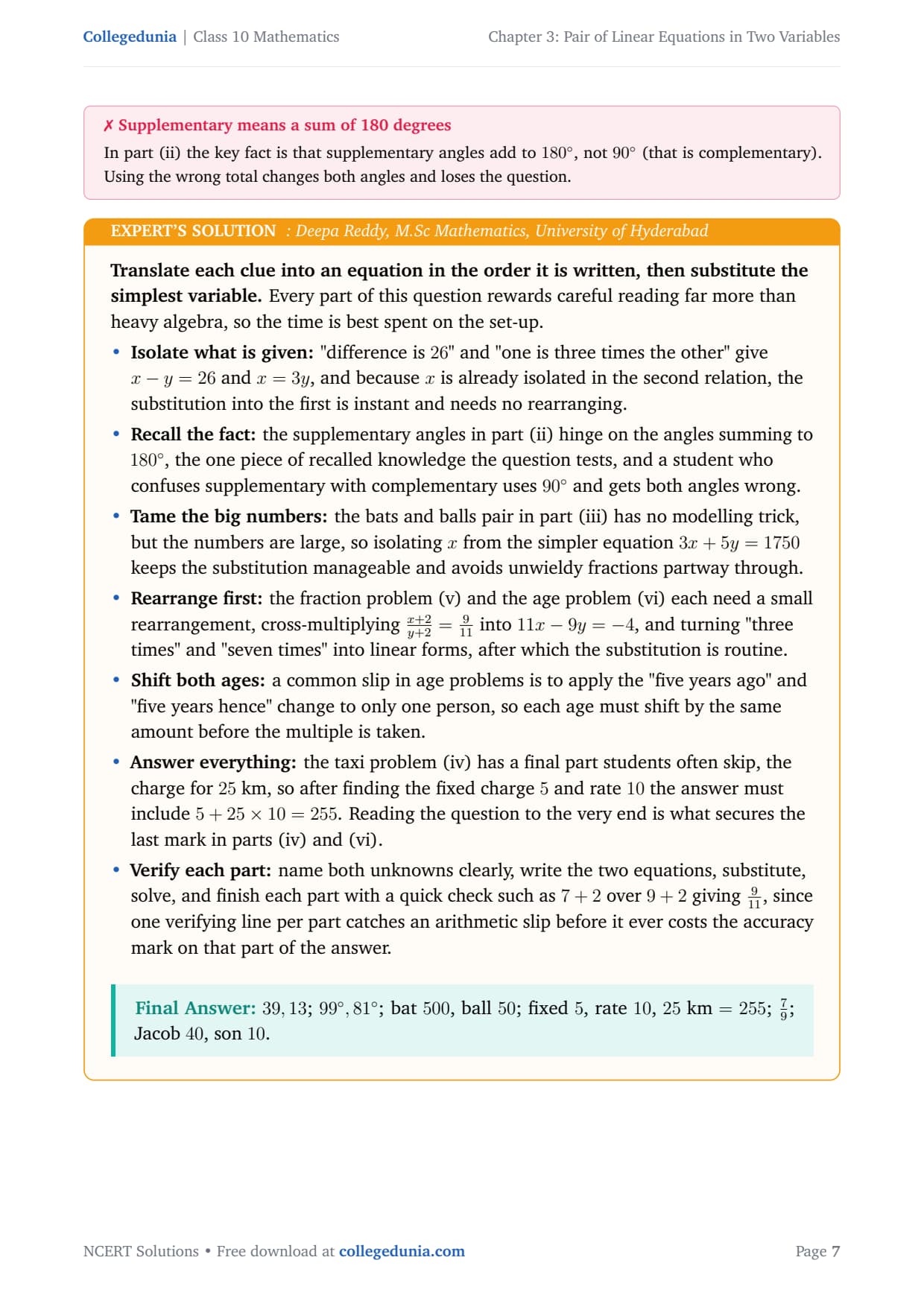
Mixing supplementary and complementary angles. Supplementary angles add to 180°, not 90°.
Shifting only one age. "Five years ago" or "five years later" must change both ages by the same amount before any multiple like "thrice".
Reading an identity as "no solution". A true statement like 9 = 9 means infinitely many solutions, not zero.
Fix these five points to move from average to full marks. Always write the method name before solving.
Other Resources for Pair of Linear Equations Class 10 Maths
These solutions answer the back-exercise questions. To revise the full chapter, use the other Chapter 3 resources below.
All NCERT Solutions for Pair of Linear Equations with Step-by-Step Solutions
Questions
Q 3.1
Form the pair of linear equations in the following problems, and find
their solutions graphically.
(i) 10 students of Class X took part in a Mathematics quiz. If the number of
girls is 4 more than the number of boys, find the number of boys and girls who
took part in the quiz.
(ii) 5 pencils and 7 pens together cost Rs. 50, whereas 7 pencils and
5 pens together cost Rs. 46. Find the cost of one pencil and that of one pen.
Concept used. To solve a pair of linear equations
graphically, we plot each equation as a straight line by finding two solution
points for it. The point where the two lines intersect gives the
common solution, that is the values of x and y that satisfy both equations
at once.
(i) Forming the equations. Let the number of boys be x and
the number of girls be y. The total is 10, so x+y=10. The girls
are 4 more than the boys, so y=x+4, that is x-y=-4. The pair is
x+y=10, x-y=-4.
Two points on each line.
For x+y=10: if x=0 then y=10; if x=10 then y=0. Points
(0,10) and (10,0).
For x-y=-4 (that is y=x+4): if x=0 then y=4; if x=2 then y=6.
Points (0,4) and (2,6).
Reading the graph. The two lines meet at (3,7).
A sketch of the two lines and their meeting point:
[See diagram in the PDF version]
So x=3 and y=7: there are 3 boys and 7 girls.
(ii) Forming the equations. Let the cost of one pencil be
Rs. x and one pen be Rs. y. Then
5x+7y=50, 7x+5y=46.
Two points on each line.
For 5x+7y=50: if x=3 then y=5; if x=10 then y=0. Points
(3,5) and (10,0).
For 7x+5y=46: if x=3 then y=5; if x=8 then y=-2. Points
(3,5) and (8,-2).
Both lines pass through (3,5), so they intersect there. Hence
x=3 and y=5: one pencil costs Rs. 3 and one pen costs Rs. 5.
(i) Boys =3, girls =7. (ii) Pencil = Rs. 3, pen = Rs. 5.
AR
Anjali Rao
M.Sc Mathematics, University of Delhi
Verified Expert
Translate each sentence into one equation, then let the graph confirm
the meeting point. The first job in both parts is to name the two unknowns and
write exactly two equations, because a graphical solution needs a pair of lines
and nothing more.
Word to equation: keep the wording in the same order it is
written. In part (i) "girls are 4 more than boys" becomes y=x+4 and
"ten students in all" becomes x+y=10, which saves a student from the
common sign slip of writing the difference the wrong way round as
y-x=-4.
Read the crossing: plot each line through two neat points and
read where they cross. In part (i) the lines meet at (3,7), giving
3 boys and 7 girls. In part (ii) the two cost lines both pass
through (3,5), so the pencil is Rs. 3 and the pen is Rs. 5.
Where the marks sit: the examiner rewards three separate
things, the correctly formed pair of equations, a small table of two
points for each line, and a clearly marked meeting point, so a student
should label that crossing on the graph itself and not merely state it
in words below the diagram where it is easy to miss.
Defend the answer: put the read-off point back into both of the
original equations as a final step. A graph that is drawn slightly off
the true crossing can still be defended by that one line of checking,
since here the totals 3+7=10 and the difference 7-3=4 both come out
exactly right and confirm the reading.
Boys 3, girls 7; pencil Rs. 3, pen Rs. 5.
Q 3.2
On comparing the ratios a1a2, b1b2
and c1c2, find out whether the lines representing the following
pairs of linear equations intersect at a point, are parallel or coincident:
(i) 5x-4y+8=0, 7x+6y-9=0
(ii) 9x+3y+12=0, 18x+6y+24=0
(iii) 6x-3y+10=0, 2x-y+9=0
Concept used. For two lines a1x+b1y+c1=0 and
a2x+b2y+c2=0, the three coefficient ratios decide their geometry:
if a1a2≠b1b2 the lines intersect
at one point; if a1a2=b1b2=c1c2
they are coincident; and if
a1a2=b1b2≠c1c2 they are
parallel.
(i) 5x-4y+8=0 and 7x+6y-9=0.
Here a1a2=57 and
b1b2=-46=-23.
Since 57≠-23, the lines intersect at a
point.
(ii) 9x+3y+12=0 and 18x+6y+24=0.
Here a1a2=918=12,
b1b2=36=12 and
c1c2=1224=12.
All three ratios are equal, so the lines are coincident.
(iii) 6x-3y+10=0 and 2x-y+9=0.
Here a1a2=62=3,
b1b2=-3-1=3 and
c1c2=109.
Since a1a2=b1b2=3 but
c1c2=109 is different, the lines are
parallel.
(i) Intersecting; (ii) Coincident; (iii) Parallel.
VI
Vikram Iyer
M.Sc Mathematics, Savitribai Phule Pune University
Verified Expert
Compare the ratios in a fixed order and stop at the first that
differs. The whole question is one rule applied three times, so the work is
fast once the order of checking is fixed.
Fixed order: write all three lines in the form ax+by+c=0,
then compute the first two ratios a1/a2 and b1/b2. If
those two differ, as in part (i), the lines intersect and there is no
need to look at the constant ratio at all.
Then the constant: only when the first two match do you check
the third ratio. Equal everywhere means coincident as in part (ii),
while the constant breaking the pattern means parallel as in part (iii).
Sign trap: the most common error is dropping a minus, because
b1=-4 and b2=-1 must keep their signs, and rounding the
constant ratio 109 in part (iii) to a careless 1 would
wrongly turn parallel lines into coincident ones.
Earning the marks: show each ratio reduced to lowest terms and
then write the one word conclusion, since the reasoning marks sit in the
comparison rather than in the verdict on its own.
Intersecting; coincident; parallel.
Q 3.3
On comparing the ratios a1a2, b1b2
and c1c2, find out whether the following pairs of linear
equations are consistent, or inconsistent.
(i) 3x+2y=5; 2x-3y=7
(ii) 2x-3y=8; 4x-6y=9
(iii) 32x+53y=7; 9x-10y=14
(iv) 5x-3y=11; -10x+6y=-22
(v) 43x+2y=8; 2x+3y=12
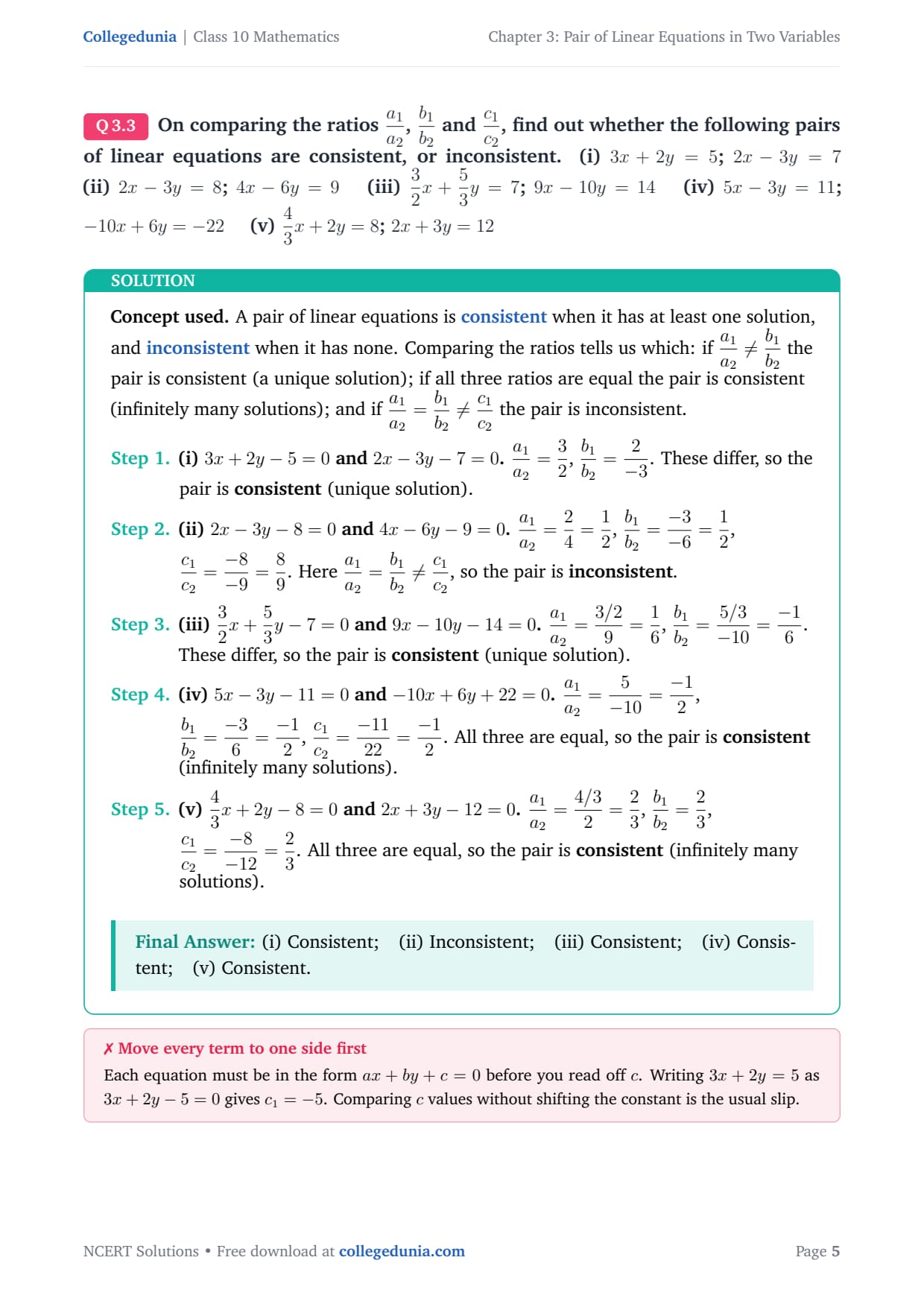
Concept used. A pair of linear equations is consistent when
it has at least one solution, and inconsistent when it has none.
Comparing the ratios tells us which: if
a1a2≠b1b2 the pair is consistent (a unique
solution); if all three ratios are equal the pair is consistent (infinitely
many solutions); and if
a1a2=b1b2≠c1c2 the pair is
inconsistent.
(i) 3x+2y-5=0 and 2x-3y-7=0.a1a2=32,
b1b2=2-3. These differ, so the pair is
consistent (unique solution).
(ii) 2x-3y-8=0 and 4x-6y-9=0.a1a2=24=12,
b1b2=-3-6=12,
c1c2=-8-9=89.
Here a1a2=b1b2≠c1c2,
so the pair is inconsistent.
(iii) 32x+53y-7=0 and 9x-10y-14=0.a1a2=3/29=16,
b1b2=5/3-10=-16. These differ, so
the pair is consistent (unique solution).
(iv) 5x-3y-11=0 and -10x+6y+22=0.a1a2=5-10=-12,
b1b2=-36=-12,
c1c2=-1122=-12.
All three are equal, so the pair is consistent (infinitely
many solutions).
(v) 43x+2y-8=0 and 2x+3y-12=0.a1a2=4/32=23,
b1b2=23,
c1c2=-8-12=23.
All three are equal, so the pair is consistent (infinitely
many solutions).
(i) Consistent; (ii) Inconsistent; (iii) Consistent; (iv) Consistent; (v) Consistent.
MK
Meera Krishnan
M.Sc Mathematics, University of Madras
Verified Expert
Consistent or inconsistent is decided by the ratio test, so classify,
never solve. This question never asks for the actual values of x and y,
only whether a solution exists, so a student should resist solving and read off
the three ratios instead.
Clean routine: write each equation as ax+by+c=0, simplify any
fractions, and compare a1/a2 with b1/b2 before touching
the constant ratio.
The verdicts: parts (i) and (iii) have unequal first two
ratios, so they are consistent with a unique solution; part (ii) matches
in the first two but not the third, the exact signature of an
inconsistent pair; parts (iv) and (v) match in all three, so they are
consistent with infinitely many solutions.
Fraction care: the fractional coefficients in (iii) and (v) are
where errors creep in, so dividing 32 by 9 to get
16 should be done carefully, and in (iv) keeping the minus on
-10 and -22 is what makes all three ratios equal.
Full marks: state the three ratios, the comparison and the one
word verdict, and add whether a consistent pair has one solution or
infinitely many, since that distinction often carries a mark of its own.
Which of the following pairs of linear equations are
consistent/inconsistent? If consistent, obtain the solution graphically:
(i) x+y=5, 2x+2y=10 (ii) x-y=8, 3x-3y=16
(iii) 2x+y-6=0, 4x-2y-4=0 (iv) 2x-2y-2=0, 4x-4y-5=0
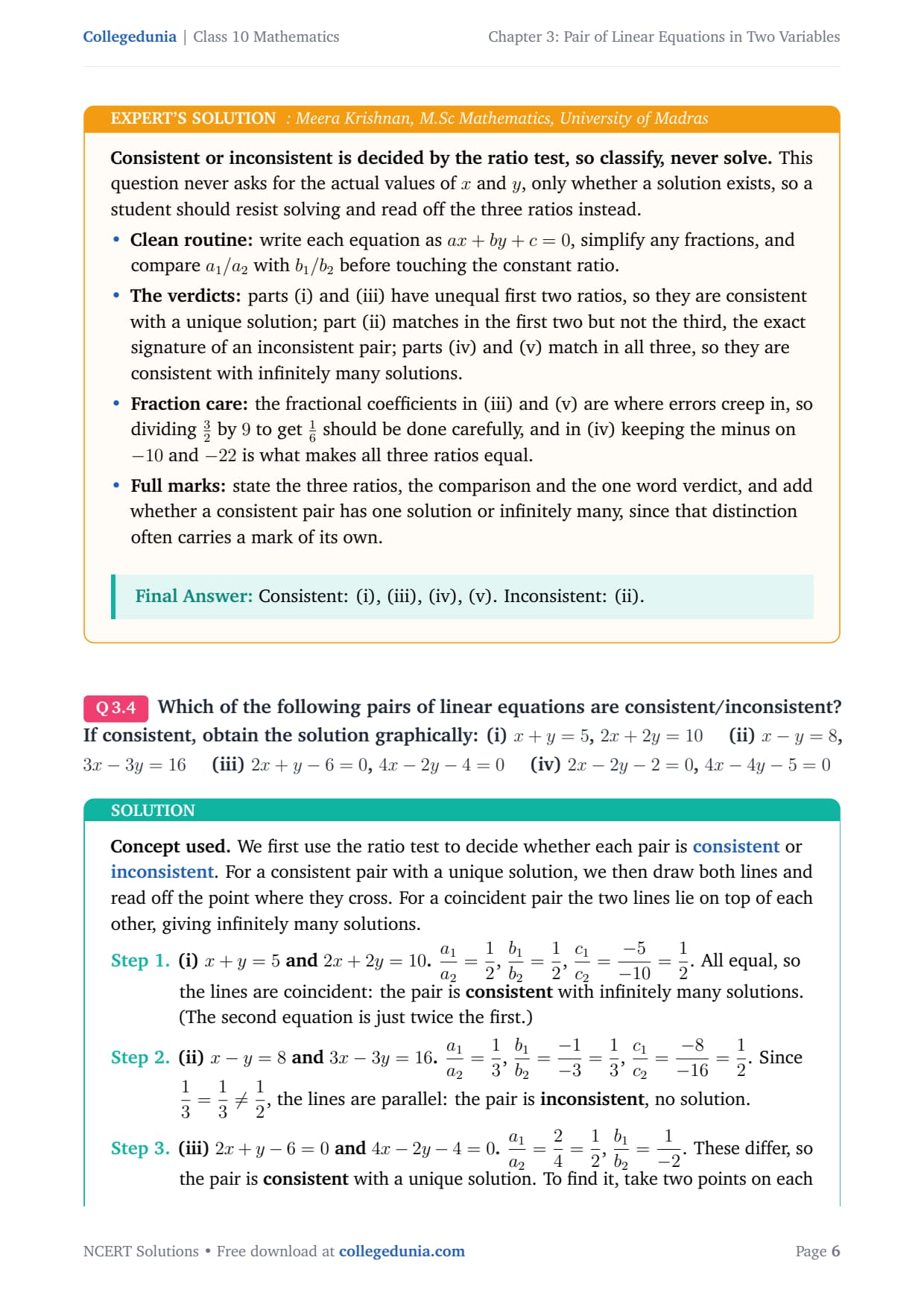
Concept used. We first use the ratio test to decide whether each pair
is consistent or inconsistent. For a consistent pair with a
unique solution, we then draw both lines and read off the point where they
cross. For a coincident pair the two lines lie on top of each other, giving
infinitely many solutions.
(i) x+y=5 and 2x+2y=10.a1a2=12, b1b2=12,
c1c2=-5-10=12. All equal, so the lines
are coincident: the pair is consistent with infinitely many
solutions. (The second equation is just twice the first.)
(ii) x-y=8 and 3x-3y=16.a1a2=13, b1b2=-1-3=13,
c1c2=-8-16=12.
Since 13=13≠12, the lines are parallel: the pair
is inconsistent, no solution.
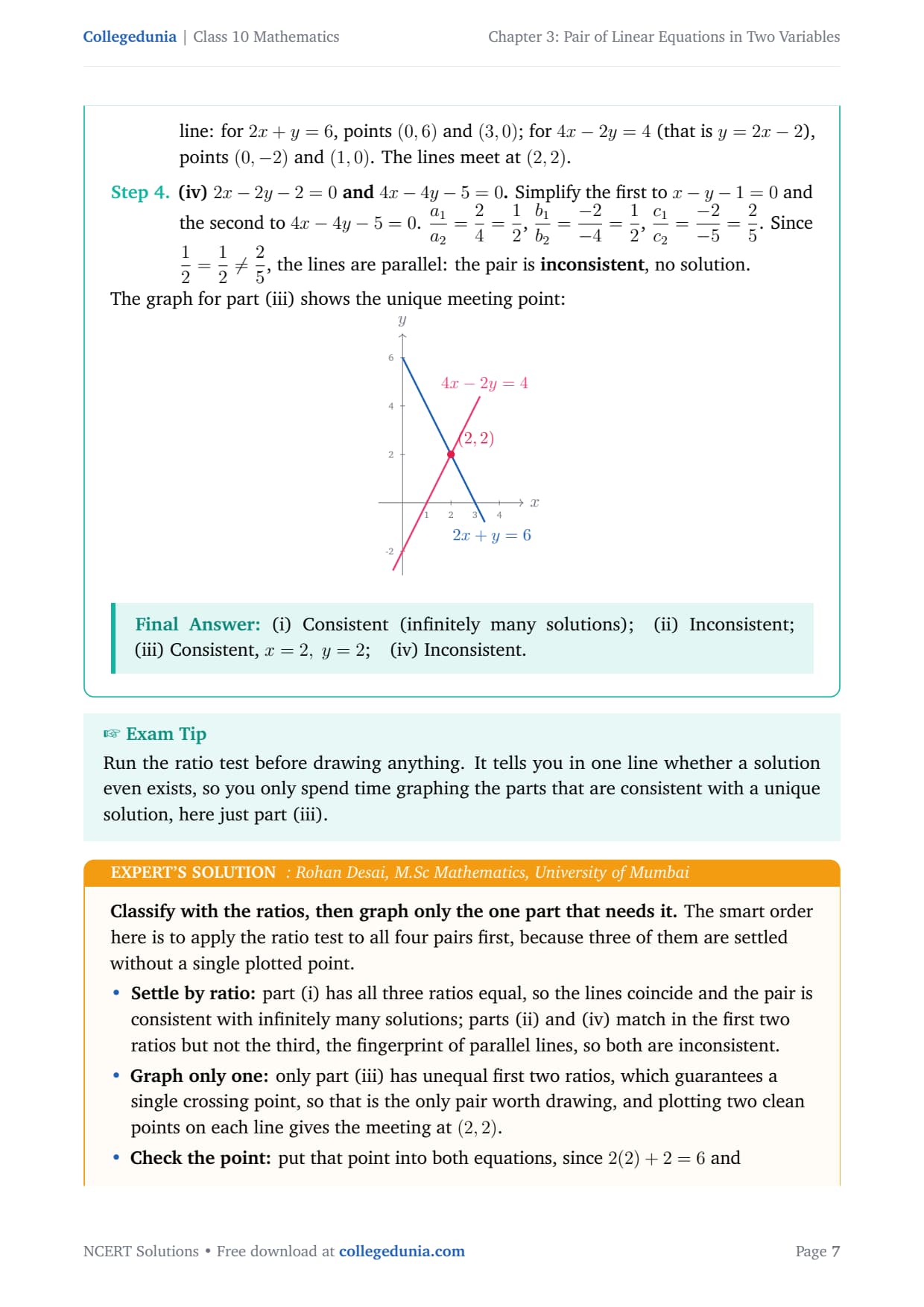
(iii) 2x+y-6=0 and 4x-2y-4=0.a1a2=24=12,
b1b2=1-2. These differ, so the pair is
consistent with a unique solution. To find it, take two points
on each line:
for 2x+y=6, points (0,6) and (3,0);
for 4x-2y=4 (that is y=2x-2), points (0,-2) and (1,0).
The lines meet at (2,2).
(iv) 2x-2y-2=0 and 4x-4y-5=0.
Simplify the first to x-y-1=0 and the second to 4x-4y-5=0.
a1a2=24=12,
b1b2=-2-4=12,
c1c2=-2-5=25.
Since 12=12≠25, the lines are parallel: the pair
is inconsistent, no solution.
The graph for part (iii) shows the unique meeting point:
[See diagram in the PDF version]
(i) Consistent (infinitely many solutions); (ii) Inconsistent; (iii) Consistent, x=2, y=2; (iv) Inconsistent.
RD
Rohan Desai
M.Sc Mathematics, University of Mumbai
Verified Expert
Classify with the ratios, then graph only the one part that needs it.
The smart order here is to apply the ratio test to all four pairs first, because
three of them are settled without a single plotted point.
Settle by ratio: part (i) has all three ratios equal, so the
lines coincide and the pair is consistent with infinitely many
solutions; parts (ii) and (iv) match in the first two ratios but not the
third, the fingerprint of parallel lines, so both are inconsistent.
Graph only one: only part (iii) has unequal first two ratios,
which guarantees a single crossing point, so that is the only pair worth
drawing, and plotting two clean points on each line gives the meeting at
(2,2).
Check the point: put that point into both equations, since
2(2)+2=6 and 4(2)-2(2)=4 are both true, which confirms the read-off
before any marks are claimed.
Standard form first: in parts (ii) and (iv), write each
equation as ax+by+c=0 before reading the constant, because a term left
on the wrong side flips the third ratio and could turn a parallel pair
into a coincident one. Simplifying also helps, since dividing
2x-2y-2=0 by 2 gives x-y-1=0 and makes the comparison obvious.
Marks rule: state every verdict with its ratio reasoning, and
supply a graph only where a unique solution exists, because graphing the
inconsistent pairs earns nothing while skipping the one unique pair loses
the plotting marks.
Half the perimeter of a rectangular garden, whose length is 4 m more
than its width, is 36 m. Find the dimensions of the garden.
Concept used. For a rectangle, the perimeter is
2(length+width), so half the perimeter is simply
length+width. We name the two dimensions, write one equation
from "half the perimeter is 36" and another from "length is 4 m more than
width", and solve the pair.
Let the length be x m and the width be y m. Half the perimeter is
length + width, so
x+y=36.
The length is 4 m more than the width:
x=y+4 ⇒ x-y=4.
Add the two equations x+y=36 and x-y=4:
(x+y)+(x-y)=36+4 ⇒ 2x=40 ⇒ x=20.
Substitute x=20 into x+y=36:
20+y=36 ⇒ y=16.
The length is 20 m and the width is 16 m.
PM
Priya Menon
M.Sc Mathematics, Anna University
Verified Expert
Read "half the perimeter" as length plus width to avoid an extra step.
The one idea that simplifies this problem is recognising that half of 2(l+w) is
just l+w.
Clean first equation: half the perimeter gives the tidy
x+y=36 straight away, rather than the longer 2(x+y)=72 that you would
then have to divide down.
Add, do not substitute: the second condition gives x-y=4, and
adding the two equations cancels y at once to give x=20, after which
y=16 follows. Adding is faster here because the y terms are already
+y and -y, so they vanish with no multiplication.
Protect the marks: label which letter is length and which is
width, state both equations, show the elimination, and finish with a
check that 20+16=36 and 20-16=4. Forgetting both dimensions or mixing
up length and width are the two slips that cost marks, so naming the
variables clearly at the start guards the answer.
Length =20 m, width =16 m.
Q 3.6
Given the linear equation 2x+3y-8=0, write another linear equation
in two variables such that the geometrical representation of the pair so formed
is:
(i) intersecting lines (ii) parallel lines (iii) coincident lines
Concept used. Starting from 2x+3y-8=0 (so a1=2, b1=3,
c1=-8), we choose the second equation a2x+b2y+c2=0 to match the
required geometry, using the ratio conditions:
intersecting needs a1/a2≠ b1/b2,
parallel needs a1/a2= b1/b2≠ c1/c2, and
coincident needs a1/a2= b1/b2= c1/c2. Many correct
answers are possible; one valid choice is given for each case.
(i) Intersecting lines. We need
a1/a2≠ b1/b2. Choose, for example,
a2=3, b2=2, since 23≠32. A valid
equation is
3x+2y-7=0.
(ii) Parallel lines. We need
a1/a2= b1/b2≠ c1/c2. Keep the same
x,y ratios but change the constant: multiply a1,b1 by 2 to
get a2=4, b2=6, and pick a constant that breaks the third
ratio, say c2=-9. A valid equation is
4x+6y-9=0,
because 24=36=12 but
-8-9=89≠12.
(iii) Coincident lines. We need all three ratios equal, so
simply multiply the whole given equation by any non-zero constant, say
2:
4x+6y-16=0,
because 24=36=-8-16=12.
Engineer the second equation to fit the ratio rule for each case. The
question is open ended, so the goal is not a unique answer but a second equation
that provably meets each geometric condition, and the cleanest way to guarantee
that is to work backwards from the ratio test.
Intersecting: any choice with unequal first two ratios works,
so simply swapping the coefficients to give 3x+2y-7=0 is a safe pick
that is easy to justify.
Parallel: keep a and b in the same ratio as the original,
easiest by multiplying 2x+3y by a constant, and then choose a constant
term that breaks the third ratio, which 4x+6y-9=0 does.
Coincident: the surest move is to multiply the entire given
equation by a non-zero number, here 2, giving 4x+6y-16=0, because
every ratio then equals that same number automatically.
Show the why: state the ratio condition being targeted before
writing each equation and confirm the ratios afterwards, since the marks
are for the justification rather than the particular numbers chosen, and
an examiner accepts any equation that satisfies the stated condition with
working shown.
Draw the graphs of the equations x-y+1=0 and 3x+2y-12=0.
Determine the coordinates of the vertices of the triangle formed by these lines
and the x-axis, and shade the triangular region.
Concept used. Each linear equation is a straight line. Two such lines
together with the x-axis (the line y=0) enclose a triangle. The
vertices of that triangle are the three crossing points: where the two
lines meet each other, and where each line meets the x-axis.
Points on each line.
For x-y+1=0 (that is y=x+1): if x=0, y=1; if x=2, y=3.
For 3x+2y-12=0 (that is y=12-3x2): if x=0, y=6; if
x=4, y=0.
Where the two lines meet. Solve y=x+1 and 3x+2y=12
together. Substitute:
3x+2(x+1)=12 ⇒ 5x+2=12 ⇒ x=2,
then y=2+1=3. The lines meet at (2,3).
Where each line meets the x-axis (y=0).
For x-y+1=0: x-0+1=0, so x=-1, giving (-1,0).
For 3x+2y-12=0: 3x-12=0, so x=4, giving (4,0).
The triangle has vertices (2,3), (-1,0) and (4,0).
The shaded triangle formed by the two lines and the x-axis:
[See diagram in the PDF version]
The vertices of the triangle are (2,3), (-1,0) and (4,0).
SP
Sneha Patel
M.Sc Mathematics, The Maharaja Sayajirao University of Baroda
Verified Expert
Find the three corners as three separate intersections, then shade.
The triangle here is bounded by three lines, the two given equations and the
x-axis, so its three vertices are exactly the three pairwise crossings.
The apex: the top corner is where the two given lines meet, and
solving them together gives (2,3), the single point that satisfies both
equations at once.
The base corners: the base lies along the x-axis, so the
other two vertices come from setting y=0 in each equation, which gives
(-1,0) from the first line and (4,0) from the second.
Draw and shade: a student who draws both lines accurately
through two plotted points each will see the same three corners, and
shading the enclosed region answers the final part of the question.
Where marks live: the graph must show both lines labelled, the
three vertices marked with their coordinates, and the region clearly
shaded, because stating the vertices without the diagram, or the diagram
without the coordinates, leaves easy marks on the table.
Sanity check: the base from x=-1 to x=4 has length 5 and
the height to the apex is 3, so the area is
1253=7.5 square units, a tidy confirmation that the
three corners are right.
Vertices (2,3), (-1,0), (4,0).
NCERT solutions Class 10 Mathematics Chapter 3 Pair of Linear Equations in Two Variables
All 3 questions with collapsible Solution and Expert Solution. Tap a button to reveal the working.
Questions
Q 3.1
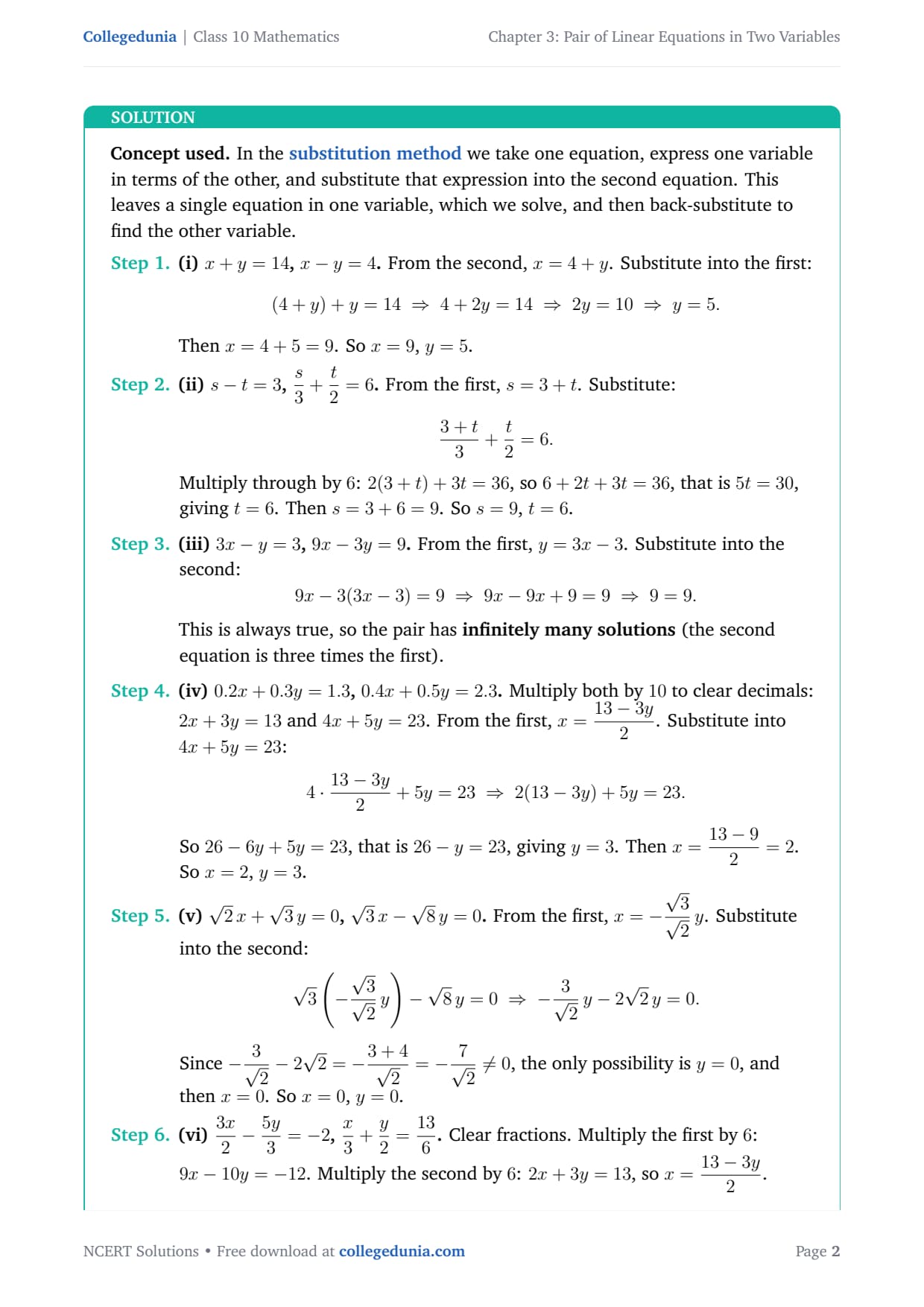
Solve the following pair of linear equations by the substitution method.
(i) x+y=14, x-y=4
(ii) s-t=3, s3+t2=6
(iii) 3x-y=3, 9x-3y=9
(iv) 0.2x+0.3y=1.3, 0.4x+0.5y=2.3
(v) √2x+√3y=0, √3x-√8y=0
(vi) 3x2-5y3=-2, x3+y2=136
Concept used. In the substitution method we take one
equation, express one variable in terms of the other, and substitute that
expression into the second equation. This leaves a single equation in one
variable, which we solve, and then back-substitute to find the other variable.
(i) x+y=14, x-y=4. From the second, x=4+y. Substitute
into the first:
(4+y)+y=14 ⇒ 4+2y=14 ⇒ 2y=10 ⇒ y=5.
Then x=4+5=9. So x=9, y=5.
(ii) s-t=3, s3+t2=6. From the first,
s=3+t. Substitute:
3+t3+t2=6.
Multiply through by 6: 2(3+t)+3t=36, so 6+2t+3t=36, that is
5t=30, giving t=6. Then s=3+6=9. So s=9, t=6.
(iii) 3x-y=3, 9x-3y=9. From the first, y=3x-3.
Substitute into the second:
9x-3(3x-3)=9 ⇒ 9x-9x+9=9 ⇒ 9=9.
This is always true, so the pair has infinitely many
solutions (the second equation is three times the first).
(iv) 0.2x+0.3y=1.3, 0.4x+0.5y=2.3. Multiply both by 10
to clear decimals: 2x+3y=13 and 4x+5y=23. From the first,
x=13-3y2. Substitute into 4x+5y=23:
4·13-3y2+5y=23 ⇒ 2(13-3y)+5y=23.
So 26-6y+5y=23, that is 26-y=23, giving y=3. Then
x=13-92=2. So x=2, y=3.
(v) √2x+√3y=0, √3x-√8y=0.
From the first, x=-√3√2y. Substitute into the
second:
√3(-√3√2y)-√8y=0
⇒ -3√2y-2√2y=0.
Since -32-22=-3+42=-720,
the only possibility is y=0, and then x=0. So x=0, y=0.
(vi) 3x2-5y3=-2,
x3+y2=136.
Clear fractions. Multiply the first by 6: 9x-10y=-12. Multiply the
second by 6: 2x+3y=13, so x=13-3y2. Substitute into
9x-10y=-12:
9·13-3y2-10y=-12 ⇒ 117-27y2-10y=-12.
Multiply by 2: 117-27y-20y=-24, so 117-47y=-24, that is
47y=141, giving y=3. Then x=13-92=2. So x=2, y=3.
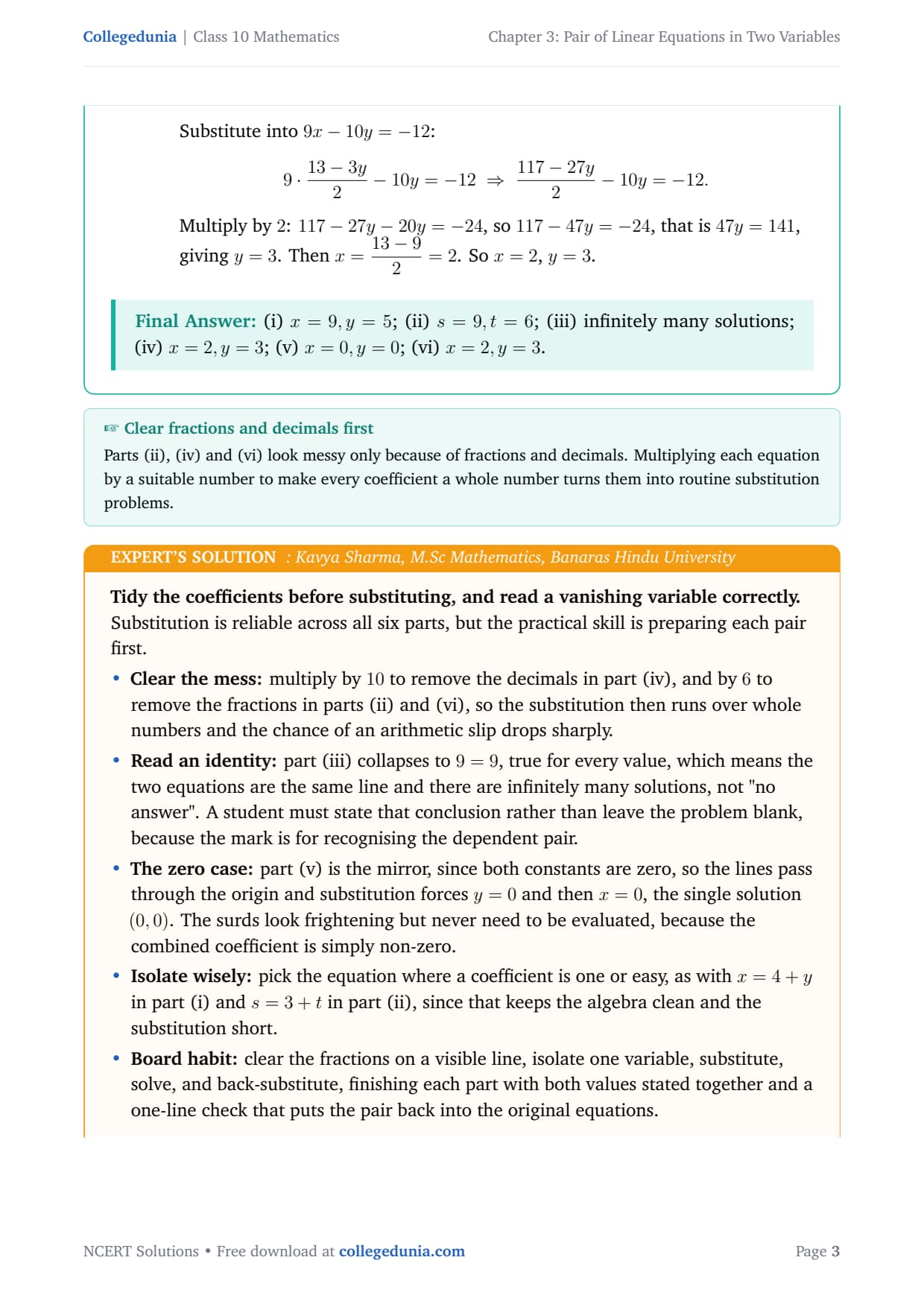
(i) x=9,y=5; (ii) s=9,t=6; (iii) infinitely many solutions; (iv) x=2,y=3; (v) x=0,y=0; (vi) x=2,y=3.
KS
Kavya Sharma
M.Sc Mathematics, Banaras Hindu University
Verified Expert
Tidy the coefficients before substituting, and read a vanishing
variable correctly. Substitution is reliable across all six parts, but the
practical skill is preparing each pair first.
Clear the mess: multiply by 10 to remove the decimals in part
(iv), and by 6 to remove the fractions in parts (ii) and (vi), so the
substitution then runs over whole numbers and the chance of an
arithmetic slip drops sharply.
Read an identity: part (iii) collapses to 9=9, true for every
value, which means the two equations are the same line and there are
infinitely many solutions, not "no answer". A student must state that
conclusion rather than leave the problem blank, because the mark is for
recognising the dependent pair.
The zero case: part (v) is the mirror, since both constants are
zero, so the lines pass through the origin and substitution forces y=0
and then x=0, the single solution (0,0). The surds look frightening
but never need to be evaluated, because the combined coefficient is
simply non-zero.
Isolate wisely: pick the equation where a coefficient is one or
easy, as with x=4+y in part (i) and s=3+t in part (ii), since that
keeps the algebra clean and the substitution short.
Board habit: clear the fractions on a visible line, isolate one
variable, substitute, solve, and back-substitute, finishing each part
with both values stated together and a one-line check that puts the pair
back into the original equations.
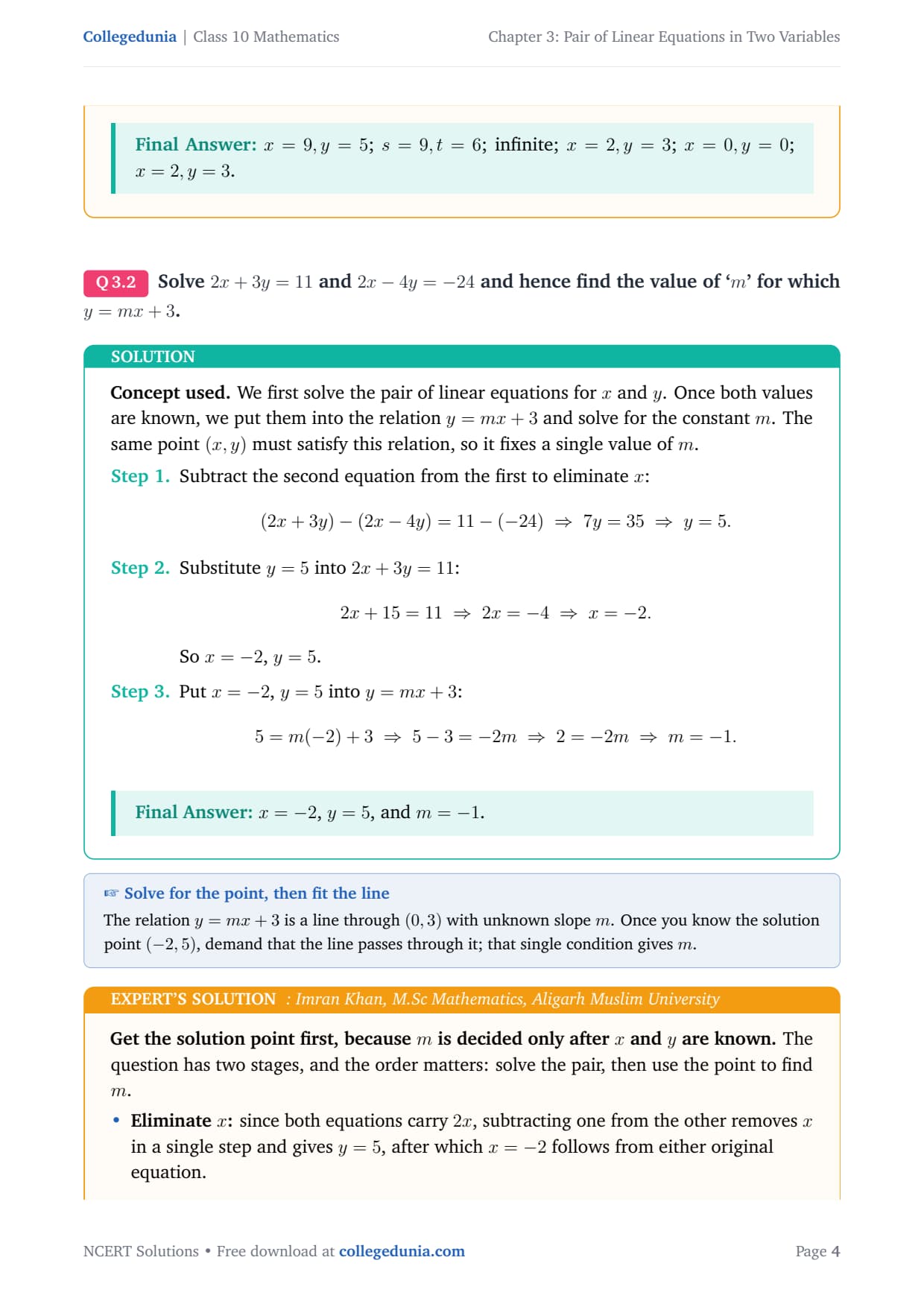
Solve 2x+3y=11 and 2x-4y=-24 and hence find the value of `m' for
which y=mx+3.
Concept used. We first solve the pair of linear equations for x and
y. Once both values are known, we put them into the relation y=mx+3 and
solve for the constant m. The same point (x,y) must satisfy this relation,
so it fixes a single value of m.
Subtract the second equation from the first to eliminate x:
(2x+3y)-(2x-4y)=11-(-24) ⇒ 7y=35 ⇒ y=5.
Substitute y=5 into 2x+3y=11:
2x+15=11 ⇒ 2x=-4 ⇒ x=-2.
So x=-2, y=5.
Put x=-2, y=5 into y=mx+3:
5=m(-2)+3 ⇒ 5-3=-2m ⇒ 2=-2m ⇒ m=-1.
x=-2, y=5, and m=-1.
IK
Imran Khan
M.Sc Mathematics, Aligarh Muslim University
Verified Expert
Get the solution point first, because m is decided only after x and
y are known. The question has two stages, and the order matters: solve the
pair, then use the point to find m.
Eliminate x: since both equations carry 2x, subtracting one
from the other removes x in a single step and gives y=5, after which
x=-2 follows from either original equation.
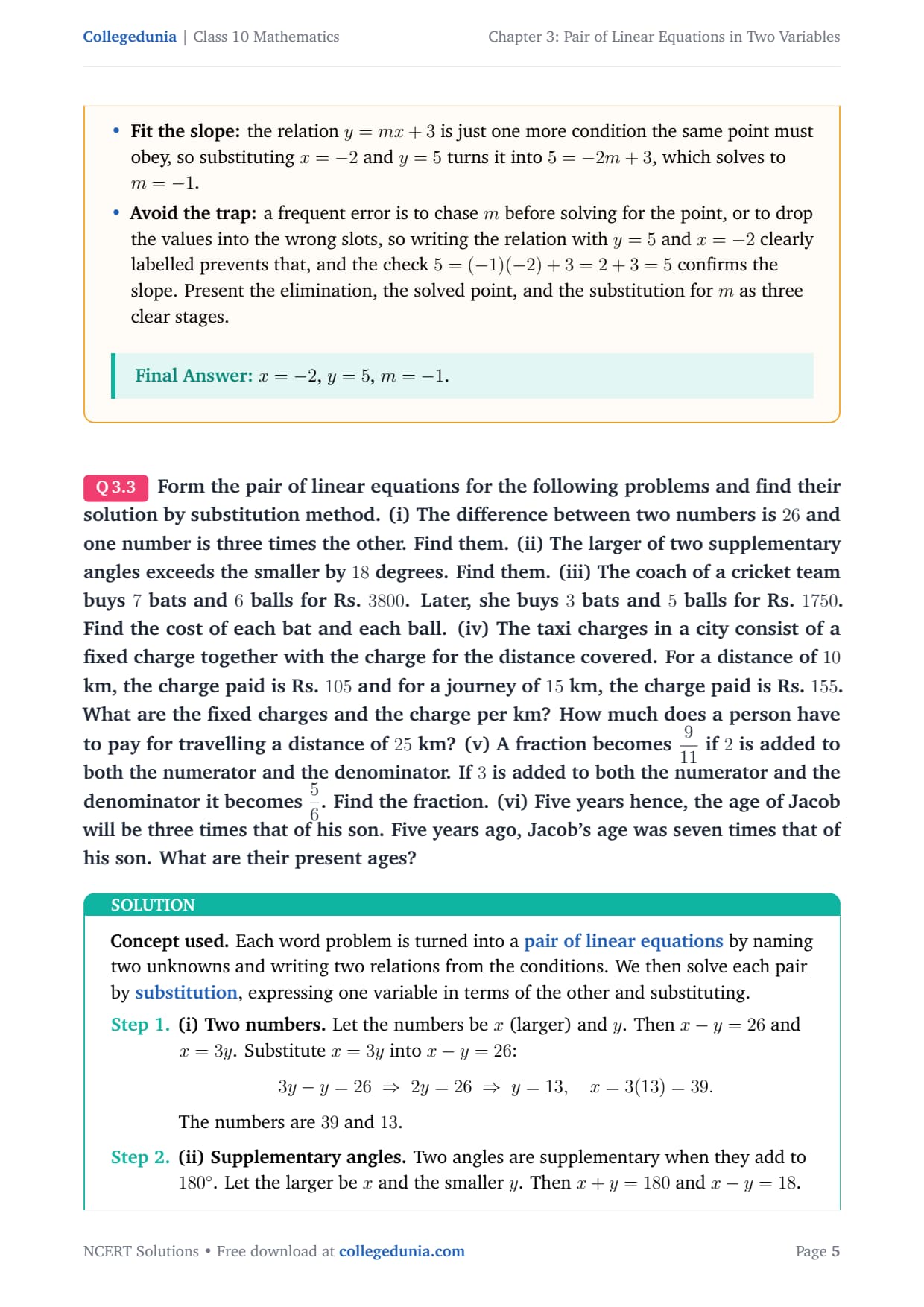
Fit the slope: the relation y=mx+3 is just one more condition
the same point must obey, so substituting x=-2 and y=5 turns it into
5=-2m+3, which solves to m=-1.
Avoid the trap: a frequent error is to chase m before solving
for the point, or to drop the values into the wrong slots, so writing the
relation with y=5 and x=-2 clearly labelled prevents that, and the
check 5=(-1)(-2)+3=2+3=5 confirms the slope. Present the elimination,
the solved point, and the substitution for m as three clear stages.
x=-2, y=5, m=-1.
Q 3.3
Form the pair of linear equations for the following problems and find
their solution by substitution method.
(i) The difference between two numbers is 26 and one number is three times the
other. Find them.
(ii) The larger of two supplementary angles exceeds the smaller by 18 degrees.
Find them.
(iii) The coach of a cricket team buys 7 bats and 6 balls for Rs. 3800.
Later, she buys 3 bats and 5 balls for Rs. 1750. Find the cost of each bat
and each ball.
(iv) The taxi charges in a city consist of a fixed charge together with the
charge for the distance covered. For a distance of 10 km, the charge paid is
Rs. 105 and for a journey of 15 km, the charge paid is Rs. 155. What are
the fixed charges and the charge per km? How much does a person have to pay for
travelling a distance of 25 km?
(v) A fraction becomes 911 if 2 is added to both the numerator and
the denominator. If 3 is added to both the numerator and the denominator it
becomes 56. Find the fraction.
(vi) Five years hence, the age of Jacob will be three times that of his son.
Five years ago, Jacob's age was seven times that of his son. What are their
present ages?
Concept used. Each word problem is turned into a pair of
linear equations by naming two unknowns and writing two relations from the
conditions. We then solve each pair by substitution, expressing one
variable in terms of the other and substituting.
(i) Two numbers. Let the numbers be x (larger) and y.
Then x-y=26 and x=3y. Substitute x=3y into x-y=26:
3y-y=26 ⇒ 2y=26 ⇒ y=13, x=3(13)=39.
The numbers are 39 and 13.
(ii) Supplementary angles. Two angles are supplementary when
they add to 180∘. Let the larger be x and the smaller y.
Then x+y=180 and x-y=18. From the second, x=18+y. Substitute:
(18+y)+y=180 ⇒ 18+2y=180 ⇒ 2y=162 ⇒ y=81,
so x=18+81=99. The angles are 99∘ and 81∘.
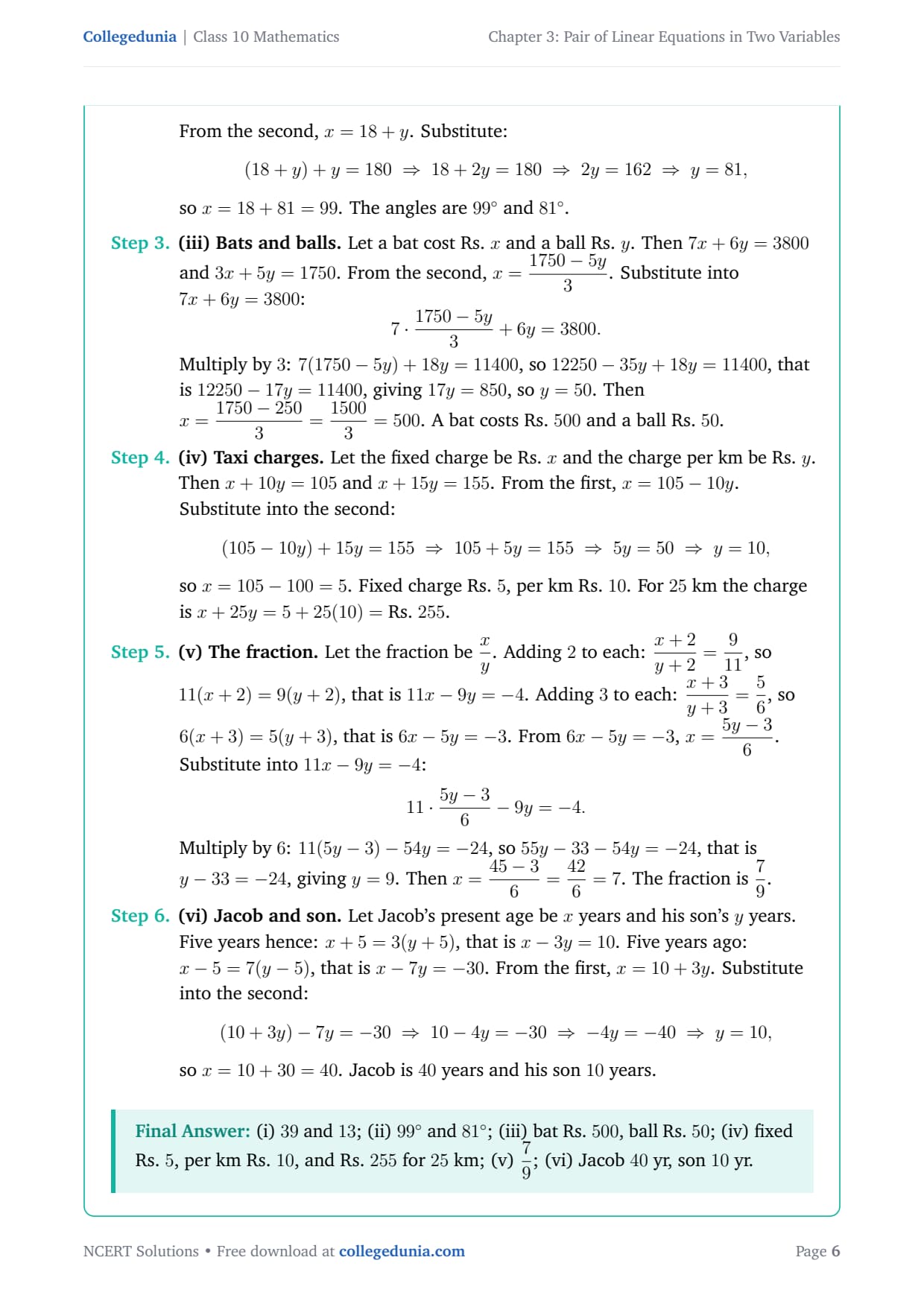
(iii) Bats and balls. Let a bat cost Rs. x and a ball Rs. y.
Then 7x+6y=3800 and 3x+5y=1750. From the second,
x=1750-5y3. Substitute into 7x+6y=3800:
7·1750-5y3+6y=3800.
Multiply by 3: 7(1750-5y)+18y=11400, so 12250-35y+18y=11400,
that is 12250-17y=11400, giving 17y=850, so y=50. Then
x=1750-2503=15003=500. A bat costs Rs. 500 and a
ball Rs. 50.
(iv) Taxi charges. Let the fixed charge be Rs. x and the
charge per km be Rs. y. Then x+10y=105 and x+15y=155. From the
first, x=105-10y. Substitute into the second:
(105-10y)+15y=155 ⇒ 105+5y=155 ⇒ 5y=50 ⇒ y=10,
so x=105-100=5. Fixed charge Rs. 5, per km Rs. 10. For 25 km the
charge is x+25y=5+25(10)=Rs. 255.
(v) The fraction. Let the fraction be xy.
Adding 2 to each: x+2y+2=911, so
11(x+2)=9(y+2), that is 11x-9y=-4.
Adding 3 to each: x+3y+3=56, so
6(x+3)=5(y+3), that is 6x-5y=-3.
From 6x-5y=-3, x=5y-36. Substitute into 11x-9y=-4:
11·5y-36-9y=-4.
Multiply by 6: 11(5y-3)-54y=-24, so 55y-33-54y=-24, that is
y-33=-24, giving y=9. Then x=45-36=426=7. The
fraction is 79.
(vi) Jacob and son. Let Jacob's present age be x years and
his son's y years.
Five years hence: x+5=3(y+5), that is x-3y=10.
Five years ago: x-5=7(y-5), that is x-7y=-30.
From the first, x=10+3y. Substitute into the second:
(10+3y)-7y=-30 ⇒ 10-4y=-30 ⇒ -4y=-40 ⇒ y=10,
so x=10+30=40. Jacob is 40 years and his son 10 years.
(i) 39 and 13; (ii) 99∘ and 81∘; (iii) bat Rs. 500, ball Rs. 50; (iv) fixed Rs. 5, per km Rs. 10, and Rs. 255 for 25 km; (v) 79; (vi) Jacob 40 yr, son 10 yr.
DR
Deepa Reddy
M.Sc Mathematics, University of Hyderabad
Verified Expert
Translate each clue into an equation in the order it is written, then
substitute the simplest variable. Every part of this question rewards careful
reading far more than heavy algebra, so the time is best spent on the set-up.
Isolate what is given: "difference is 26" and "one is three
times the other" give x-y=26 and x=3y, and because x is already
isolated in the second relation, the substitution into the first is
instant and needs no rearranging.
Recall the fact: the supplementary angles in part (ii) hinge on
the angles summing to 180∘, the one piece of recalled knowledge
the question tests, and a student who confuses supplementary with
complementary uses 90∘ and gets both angles wrong.
Tame the big numbers: the bats and balls pair in part (iii) has
no modelling trick, but the numbers are large, so isolating x from the
simpler equation 3x+5y=1750 keeps the substitution manageable and
avoids unwieldy fractions partway through.
Rearrange first: the fraction problem (v) and the age problem
(vi) each need a small rearrangement, cross-multiplying
x+2y+2=911 into 11x-9y=-4, and turning "three
times" and "seven times" into linear forms, after which the substitution
is routine.
Shift both ages: a common slip in age problems is to apply the
"five years ago" and "five years hence" change to only one person, so
each age must shift by the same amount before the multiple is taken.
Answer everything: the taxi problem (iv) has a final part
students often skip, the charge for 25 km, so after finding the fixed
charge 5 and rate 10 the answer must include 5+2510=255.
Reading the question to the very end is what secures the last mark in
parts (iv) and (vi).
Verify each part: name both unknowns clearly, write the two
equations, substitute, solve, and finish each part with a quick check
such as 7+2 over 9+2 giving 911, since one verifying line
per part catches an arithmetic slip before it ever costs the accuracy
mark on that part of the answer.
39,13; 99∘,81∘; bat 500, ball 50; fixed 5, rate 10, 25 km =255; 79; Jacob 40, son 10.
NCERT solutions Class 10 Mathematics Chapter 3 Pair of Linear Equations in Two Variables
All 2 questions with collapsible Solution and Expert Solution. Tap a button to reveal the working.
Questions
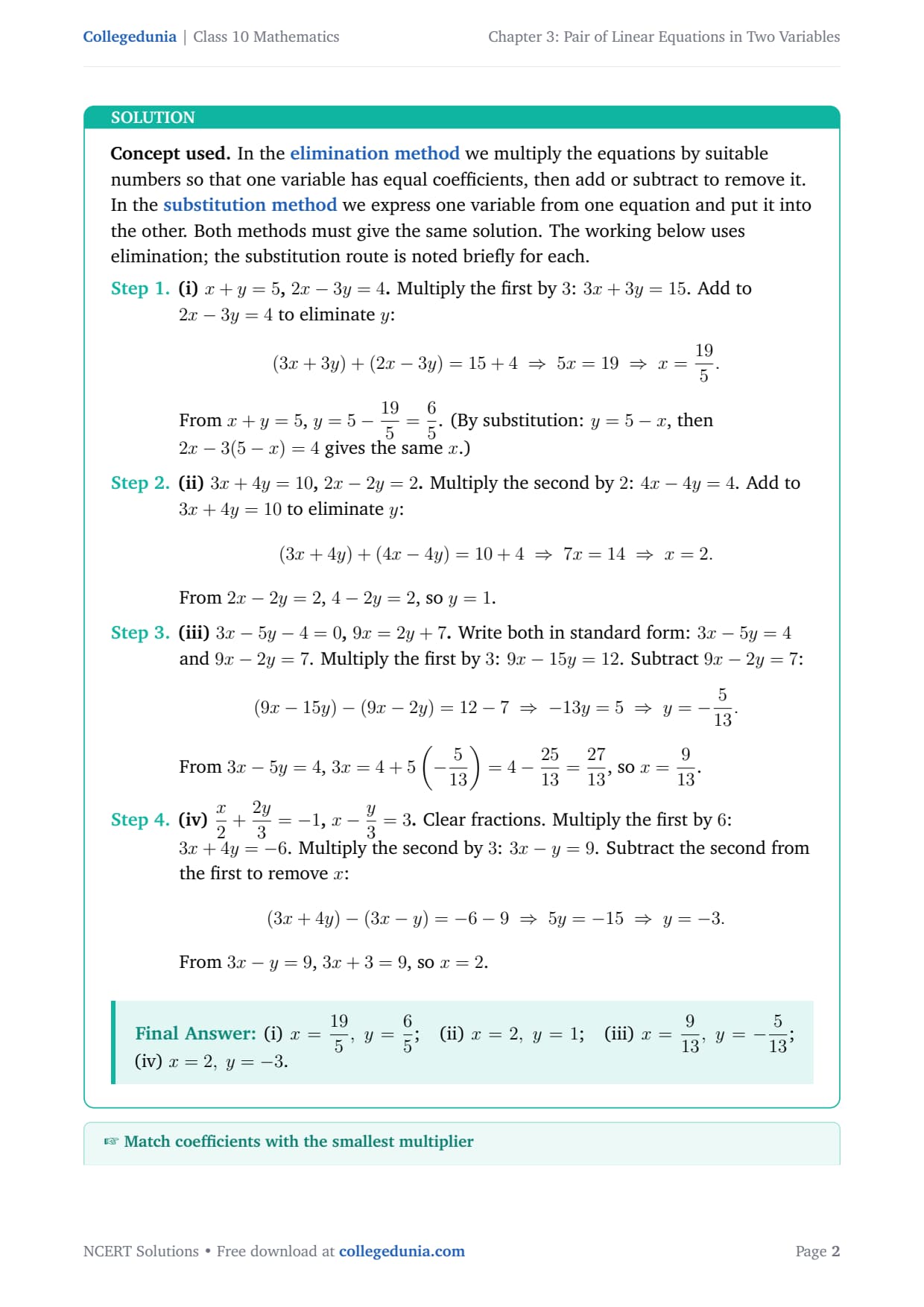
Q 3.1
Solve the following pair of linear equations by the elimination method
and the substitution method:
(i) x+y=5 and 2x-3y=4
(ii) 3x+4y=10 and 2x-2y=2
(iii) 3x-5y-4=0 and 9x=2y+7
(iv) x2+2y3=-1 and x-y3=3
Concept used. In the elimination method we multiply the
equations by suitable numbers so that one variable has equal coefficients, then
add or subtract to remove it. In the substitution method we express
one variable from one equation and put it into the other. Both methods must give
the same solution. The working below uses elimination; the substitution route is
noted briefly for each.
(i) x+y=5, 2x-3y=4. Multiply the first by 3:
3x+3y=15. Add to 2x-3y=4 to eliminate y:
(3x+3y)+(2x-3y)=15+4 ⇒ 5x=19 ⇒ x=195.
From x+y=5, y=5-195=65.
(By substitution: y=5-x, then 2x-3(5-x)=4 gives the same x.)
(ii) 3x+4y=10, 2x-2y=2. Multiply the second by 2:
4x-4y=4. Add to 3x+4y=10 to eliminate y:
(3x+4y)+(4x-4y)=10+4 ⇒ 7x=14 ⇒ x=2.
From 2x-2y=2, 4-2y=2, so y=1.
(iii) 3x-5y-4=0, 9x=2y+7. Write both in standard form:
3x-5y=4 and 9x-2y=7. Multiply the first by 3: 9x-15y=12.
Subtract 9x-2y=7:
(9x-15y)-(9x-2y)=12-7 ⇒ -13y=5 ⇒ y=-513.
From 3x-5y=4, 3x=4+5(-513)=4-2513=2713,
so x=913.
(iv) x2+2y3=-1, x-y3=3.
Clear fractions. Multiply the first by 6: 3x+4y=-6. Multiply the
second by 3: 3x-y=9. Subtract the second from the first to remove
x:
(3x+4y)-(3x-y)=-6-9 ⇒ 5y=-15 ⇒ y=-3.
From 3x-y=9, 3x+3=9, so x=2.
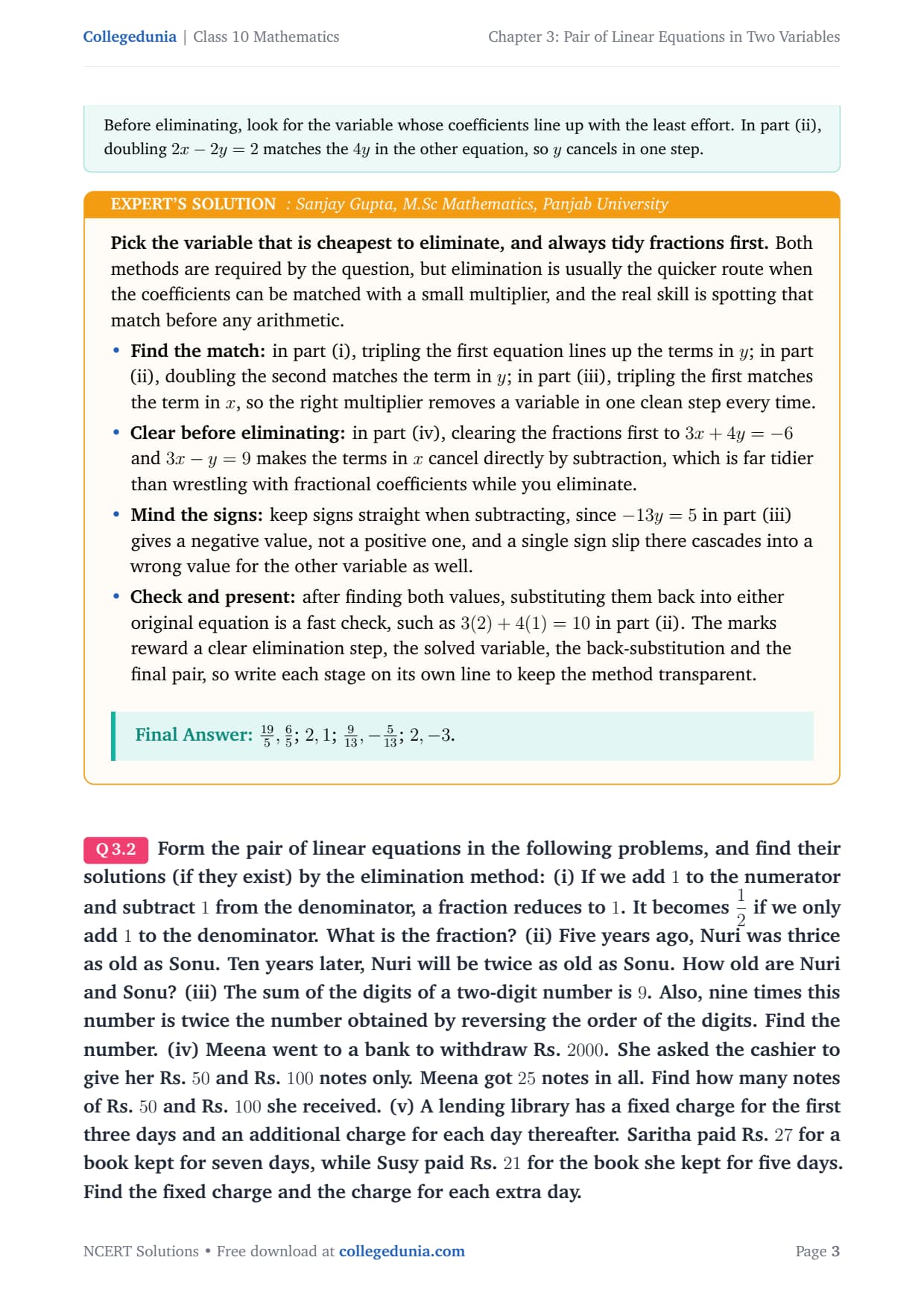
Pick the variable that is cheapest to eliminate, and always tidy
fractions first. Both methods are required by the question, but elimination is
usually the quicker route when the coefficients can be matched with a small
multiplier, and the real skill is spotting that match before any arithmetic.
Find the match: in part (i), tripling the first equation lines
up the terms in y; in part (ii), doubling the second matches the term
in y; in part (iii), tripling the first matches the term in x, so the
right multiplier removes a variable in one clean step every time.
Clear before eliminating: in part (iv), clearing the fractions
first to 3x+4y=-6 and 3x-y=9 makes the terms in x cancel directly
by subtraction, which is far tidier than wrestling with fractional
coefficients while you eliminate.
Mind the signs: keep signs straight when subtracting, since
-13y=5 in part (iii) gives a negative value, not a positive one, and a
single sign slip there cascades into a wrong value for the other
variable as well.
Check and present: after finding both values, substituting them
back into either original equation is a fast check, such as
3(2)+4(1)=10 in part (ii). The marks reward a clear elimination step,
the solved variable, the back-substitution and the final pair, so write
each stage on its own line to keep the method transparent.
195,65; 2,1; 913,-513; 2,-3.
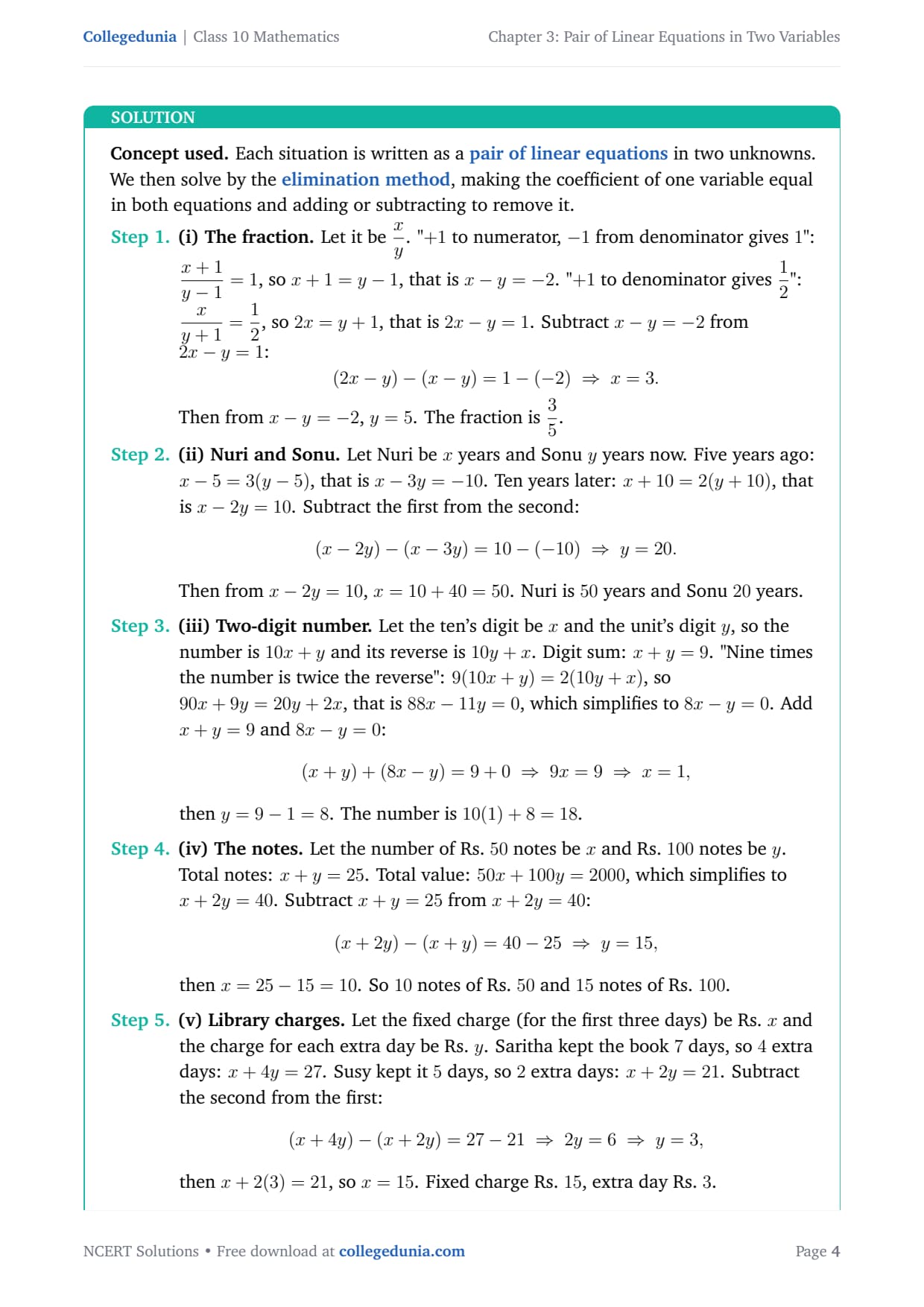
Q 3.2
Form the pair of linear equations in the following problems, and find
their solutions (if they exist) by the elimination method:
(i) If we add 1 to the numerator and subtract 1 from the denominator, a
fraction reduces to 1. It becomes 12 if we only add 1 to the
denominator. What is the fraction?
(ii) Five years ago, Nuri was thrice as old as Sonu. Ten years later, Nuri will
be twice as old as Sonu. How old are Nuri and Sonu?
(iii) The sum of the digits of a two-digit number is 9. Also, nine times this
number is twice the number obtained by reversing the order of the digits. Find
the number.
(iv) Meena went to a bank to withdraw Rs. 2000. She asked the cashier to give
her Rs. 50 and Rs. 100 notes only. Meena got 25 notes in all. Find how many
notes of Rs. 50 and Rs. 100 she received.
(v) A lending library has a fixed charge for the first three days and an
additional charge for each day thereafter. Saritha paid Rs. 27 for a book kept
for seven days, while Susy paid Rs. 21 for the book she kept for five days.
Find the fixed charge and the charge for each extra day.
Concept used. Each situation is written as a pair of linear
equations in two unknowns. We then solve by the elimination method,
making the coefficient of one variable equal in both equations and adding or
subtracting to remove it.
(i) The fraction. Let it be xy.
"+1 to numerator, -1 from denominator gives 1":
x+1y-1=1, so x+1=y-1, that is x-y=-2.
"+1 to denominator gives 12": xy+1=12, so
2x=y+1, that is 2x-y=1.
Subtract x-y=-2 from 2x-y=1:
(2x-y)-(x-y)=1-(-2) ⇒ x=3.
Then from x-y=-2, y=5. The fraction is 35.
(ii) Nuri and Sonu. Let Nuri be x years and Sonu y years
now. Five years ago: x-5=3(y-5), that is x-3y=-10.
Ten years later: x+10=2(y+10), that is x-2y=10.
Subtract the first from the second:
(x-2y)-(x-3y)=10-(-10) ⇒ y=20.
Then from x-2y=10, x=10+40=50. Nuri is 50 years and Sonu 20
years.
(iii) Two-digit number. Let the ten's digit be x and the
unit's digit y, so the number is 10x+y and its reverse is 10y+x.
Digit sum: x+y=9.
"Nine times the number is twice the reverse":
9(10x+y)=2(10y+x), so 90x+9y=20y+2x, that is 88x-11y=0, which
simplifies to 8x-y=0.
Add x+y=9 and 8x-y=0:
(x+y)+(8x-y)=9+0 ⇒ 9x=9 ⇒ x=1,
then y=9-1=8. The number is 10(1)+8=18.
(iv) The notes. Let the number of Rs. 50 notes be x and
Rs. 100 notes be y. Total notes: x+y=25. Total value:
50x+100y=2000, which simplifies to x+2y=40.
Subtract x+y=25 from x+2y=40:
(x+2y)-(x+y)=40-25 ⇒ y=15,
then x=25-15=10. So 10 notes of Rs. 50 and 15 notes of
Rs. 100.
(v) Library charges. Let the fixed charge (for the first three
days) be Rs. x and the charge for each extra day be Rs. y.
Saritha kept the book 7 days, so 4 extra days: x+4y=27.
Susy kept it 5 days, so 2 extra days: x+2y=21.
Subtract the second from the first:
(x+4y)-(x+2y)=27-21 ⇒ 2y=6 ⇒ y=3,
then x+2(3)=21, so x=15. Fixed charge Rs. 15, extra day Rs. 3.
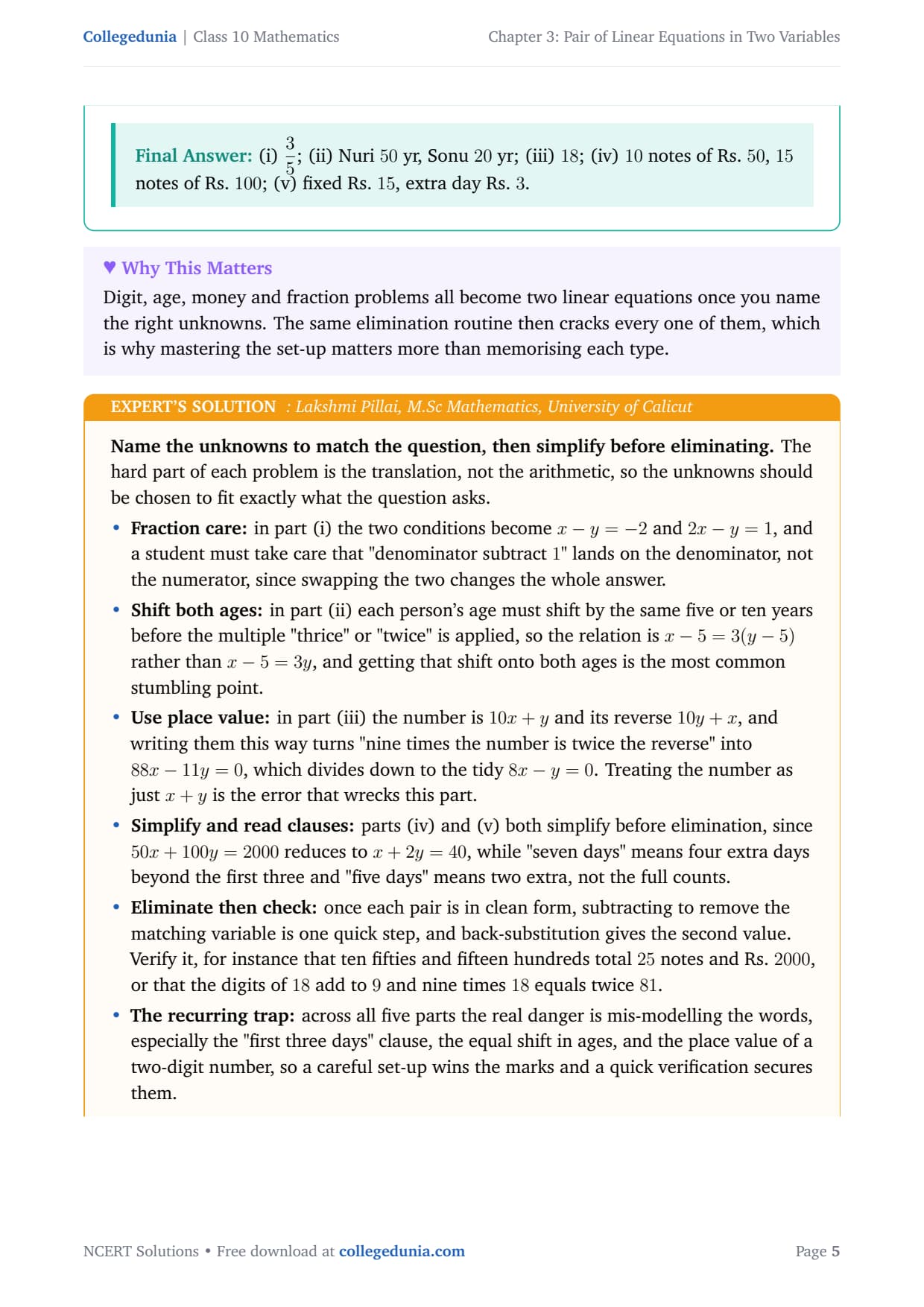
(i) 35; (ii) Nuri 50 yr, Sonu 20 yr; (iii) 18; (iv) 10 notes of Rs. 50, 15 notes of Rs. 100; (v) fixed Rs. 15, extra day Rs. 3.
LP
Lakshmi Pillai
M.Sc Mathematics, University of Calicut
Verified Expert
Name the unknowns to match the question, then simplify before
eliminating. The hard part of each problem is the translation, not the
arithmetic, so the unknowns should be chosen to fit exactly what the question
asks.
Fraction care: in part (i) the two conditions become x-y=-2
and 2x-y=1, and a student must take care that "denominator subtract
1" lands on the denominator, not the numerator, since swapping the two
changes the whole answer.
Shift both ages: in part (ii) each person's age must shift by
the same five or ten years before the multiple "thrice" or "twice" is
applied, so the relation is x-5=3(y-5) rather than x-5=3y, and
getting that shift onto both ages is the most common stumbling point.
Use place value: in part (iii) the number is 10x+y and its
reverse 10y+x, and writing them this way turns "nine times the number
is twice the reverse" into 88x-11y=0, which divides down to the tidy
8x-y=0. Treating the number as just x+y is the error that wrecks this
part.
Simplify and read clauses: parts (iv) and (v) both simplify
before elimination, since 50x+100y=2000 reduces to x+2y=40, while
"seven days" means four extra days beyond the first three and "five
days" means two extra, not the full counts.
Eliminate then check: once each pair is in clean form,
subtracting to remove the matching variable is one quick step, and
back-substitution gives the second value. Verify it, for instance that
ten fifties and fifteen hundreds total 25 notes and Rs. 2000, or that
the digits of 18 add to 9 and nine times 18 equals twice 81.
The recurring trap: across all five parts the real danger is
mis-modelling the words, especially the "first three days" clause, the
equal shift in ages, and the place value of a two-digit number, so a
careful set-up wins the marks and a quick verification secures them.
35; Nuri 50, Sonu 20; 18; ten Rs. 50 and fifteen Rs. 100; fixed 15, per extra day 3.
Student Feedback: In a Collegedunia poll of 5,840 Class 10 Maths students before the 2026 boards, 71% of students wanted clear worked answers for the word problems and the consistency check. Most said writing the two equations first made the rest easy.
Source: 2026-27 Class 10 Maths student poll. Sample of 5,840 students from CBSE schools across 11 states.
FAQs on Pair of Linear Equations NCERT Solutions
What is a pair of linear equations in two variables in Class 10 Maths Chapter 3?
It is two equations of the form ax plus by plus c equals 0, each a straight line on the graph. Solving the pair means finding the values of x and y that fit both equations, which is where the two lines meet.
How do you decide whether a pair of linear equations is consistent or inconsistent?
Write both equations as ax plus by plus c equals 0 and compare the coefficient ratios. If a1 over a2 is not equal to b1 over b2, it has one solution. If all three ratios are equal, it has infinitely many. If only the third differs, it is inconsistent with no solution.
What is the difference between the substitution and elimination methods?
In substitution, you write one variable from one equation and put it into the other. In elimination, you match the coefficients of one variable, then add or subtract to remove it. Both give the same answer.
How do you solve word problems on a pair of linear equations?
Name the two unknowns and turn each sentence into one equation. For ages, shift both ages by the same years before any multiple. For a two-digit number, use 10x plus y. Then solve by substitution or elimination.
How many questions are there in Class 10 Maths Chapter 3 Pair of Linear Equations in Two Variables?
It has 12 questions across three exercises: 7 in Exercise 3.1 on graphical and ratio methods, 3 in Exercise 3.2 on substitution, and 2 in Exercise 3.3 on elimination. All 12 are solved step by step here.
Are these Pair of Linear Equations NCERT Solutions based on the 2026-27 CBSE syllabus?
Yes. Every answer follows the 2026-27 NCERT Mathematics textbook in CBSE marking-scheme style, checked against the last five years of CBSE Class 10 board papers.









Comments