Maths Mentor, Thapar Institute | Updated 3+ months ago
The NCERT Solutions for Class 10 Maths Chapter 2 Polynomials answer every textbook question on the geometrical meaning of zeroes, finding zeroes by splitting the middle term, and the relationship between zeroes and coefficients, all to the latest 2026-27 CBSE syllabus. Each answer is in plain steps so you can revise fast and score full marks.
Covers all 3 questions from Exercise 2.1 and Exercise 2.2, with step-by-step model answers.
This Class 10 Maths chapter sits in the Algebra unit, worth about 5 to 6 marks in the board paper.
Pairs with the Notes, Handwritten Notes and NCERT Book PDF linked lower on this page.
Every solution here is written by subject experts from the official NCERT Mathematics textbook and checked against the last five years of CBSE board papers.
Solved by Collegedunia: All 3 textbook questions below carry a step-by-step Solution and an Expert Solution in CBSE marking-scheme style, verified for the 2026-27 session.
Polynomials NCERT Solutions: Exercise-wise Question Map and Weightage
Class 10 Maths Chapter 2 has two exercises and 3 questions in all. The table below shows what each exercise tests and the marks it usually carries in the board paper.
Finding zeroes by splitting the middle term, checking the sum and product, and building a quadratic from a given sum and product
2 to 3
In the board paper you usually get one short question on the number of zeroes from a graph, plus one find-the-zeroes sum from Exercise 2.2. So spend most practice time on the sum-and-product check.
Concept Anchor: The whole chapter is built on one idea. The zeroes of p(x) are the x-values where the graph cuts the x-axis. For a quadratic, those zeroes also tie back to the coefficients through the sum and product rules.
How to Find Zeroes by Splitting the Middle Term
Most marks in Exercise 2.2 come from one routine: write the quadratic in standard form, split the middle term, factorise, then find the zeroes.
Write the polynomial in standard formax2 + bx + c to see the coefficients a, b and c.
Find the producta × c. Split the middle term bx into two terms that multiply to a × c and add to b.
Group the four terms in pairs, take out the common factor, and write the polynomial as two brackets.
Set each bracket to zero to find the two zeroes α (alpha) and β (beta).
Exam Tip: After you find the zeroes, always write the two checks α + β = −b/a and αβ = c/a. They are free marks, and a failed check warns you of a slip before you write a wrong answer.
Solved Example: Verifying the Relationship Between Zeroes and Coefficients
This solved example shows the answer shape a CBSE marker expects for a 3-mark find-the-zeroes question.
Question (3 marks). Find the zeroes of 6x2 − 7x − 3 and verify the relationship between the zeroes and the coefficients.
Step 1, Coefficients. Here a = 6, b = −7, c = −3, so a × c = −18.
Step 2, Split the middle term. Two numbers that multiply to −18 and add to −7 are −9 and +2. So 6x2 − 7x − 3 = 6x2 − 9x + 2x − 3.
Step 3, Group and factorise.3x(2x − 3) + 1(2x − 3) = (2x − 3)(3x + 1).
Step 4, Find the zeroes. Setting each factor to zero gives α = 32 and β = −13.
Step 5, Verify. Sum: α + β = 76 = −ba. Product: αβ = −12 = ca. Both match, so the zeroes are correct.
Common Mistakes Students Make in Polynomials
Coefficients out of order. Rewrite 6x2 − 3 − 7x as 6x2 − 7x − 3 first, so b = −7 and c = −3. The most common slip in Exercise 2.2.
Missing a zero with no constant term. In 4u2 + 8u = 4u(u + 2), students forget that u = 0 is also a zero.
Dropping the repeated zero. A perfect square like 4s2 − 4s + 1 = (2s − 1)2 has the zero s = 12 twice.
Wrong sign when building a quadratic. In x2 − (sum)x + (product), a negative sum gives a positive middle term.
Counting graph zeroes wrong. A line above and parallel to the x-axis has zero zeroes, not one.
Fix these five points and you usually move from average to full marks. The board rewards answers that name the rule first, so write the concept line before you solve.
Other Resources for Polynomials Class 10 Maths
These NCERT Solutions answer the back-exercise questions. To revise the full chapter, use them with the resources below.
All NCERT Solutions for Polynomials with Step-by-Step Solutions
Questions
Q 2.1
The graphs of y=p(x) are given in Fig. 2.10 below, for some
polynomials p(x). Find the number of zeroes of p(x) in each case.
Concept used. A real number k is a zero of a polynomial
p(x) when p(k)=0. Geometrically, the zeroes of p(x) are exactly the
x-coordinates of the points where the graph of y=p(x)cuts or touches
the x-axis. So to count the zeroes from a graph, we simply count how many
times the curve meets the x-axis. (If the graph never meets the x-axis, the
polynomial has no zero from that graph.)
(i) The graph is a straight line lying above the
x-axis and parallel to it. It never meets the x-axis, so the curve
crosses the x-axis at 0 points. Number of zeroes =0.
(ii) The curve meets the x-axis at exactly 1 point. Number
of zeroes =1.
(iii) The curve crosses the x-axis at 3 separate points.
Number of zeroes =3.
(iv) The curve meets the x-axis at 2 points. Number of
zeroes =2.
(v) The curve crosses the x-axis at 4 separate points.
Number of zeroes =4.
(vi) The curve meets the x-axis at 3 points. Number of
zeroes =3.
(i) 0; (ii) 1; (iii) 3; (iv) 2; (v) 4; (vi) 3.
AR
Anjali Rao
M.Sc Mathematics, University of Delhi
Verified Expert
Marks here go to a clean count of crossings, not to any calculation.
The right method is to slide your eye along the x-axis from left to right and
tally every point where the curve sits on the axis. The pitfalls are all about
what counts as a meeting point.
The parallel line: a line that runs above and parallel to the
axis, as in part (i), never meets it, so the count is zero, not one. A
graph being present does not guarantee a zero.
A touch still counts: when a curve just touches the axis and
turns back without crossing, that single contact point is still one zero,
so never skip it.
Best presentation: write the count beside each label and add one
short reason for the harder parts, such as the curve cutting the axis at
three separate points.
Show the reasoning: link the count to the rule that a polynomial
of degree n meets the axis at most n times. That tells the examiner
why the numbers come out the way they do.
Zeroes are 0, 1, 3, 2, 4, 3 for parts (i)–(vi); each equals the number of points where the graph meets the x-axis.
NCERT solutions Class 10 Mathematics Chapter 2 Polynomials
All 2 questions with collapsible Solution and Expert Solution. Tap a button to reveal the working.
Questions
Q 2.1
Find the zeroes of the following quadratic polynomials and verify the
relationship between the zeroes and the coefficients:
(i) x2-2x-8 (ii) 4s2-4s+1 (iii) 6x2-3-7x
(iv) 4u2+8u (v) t2-15 (vi) 3x2-x-4.
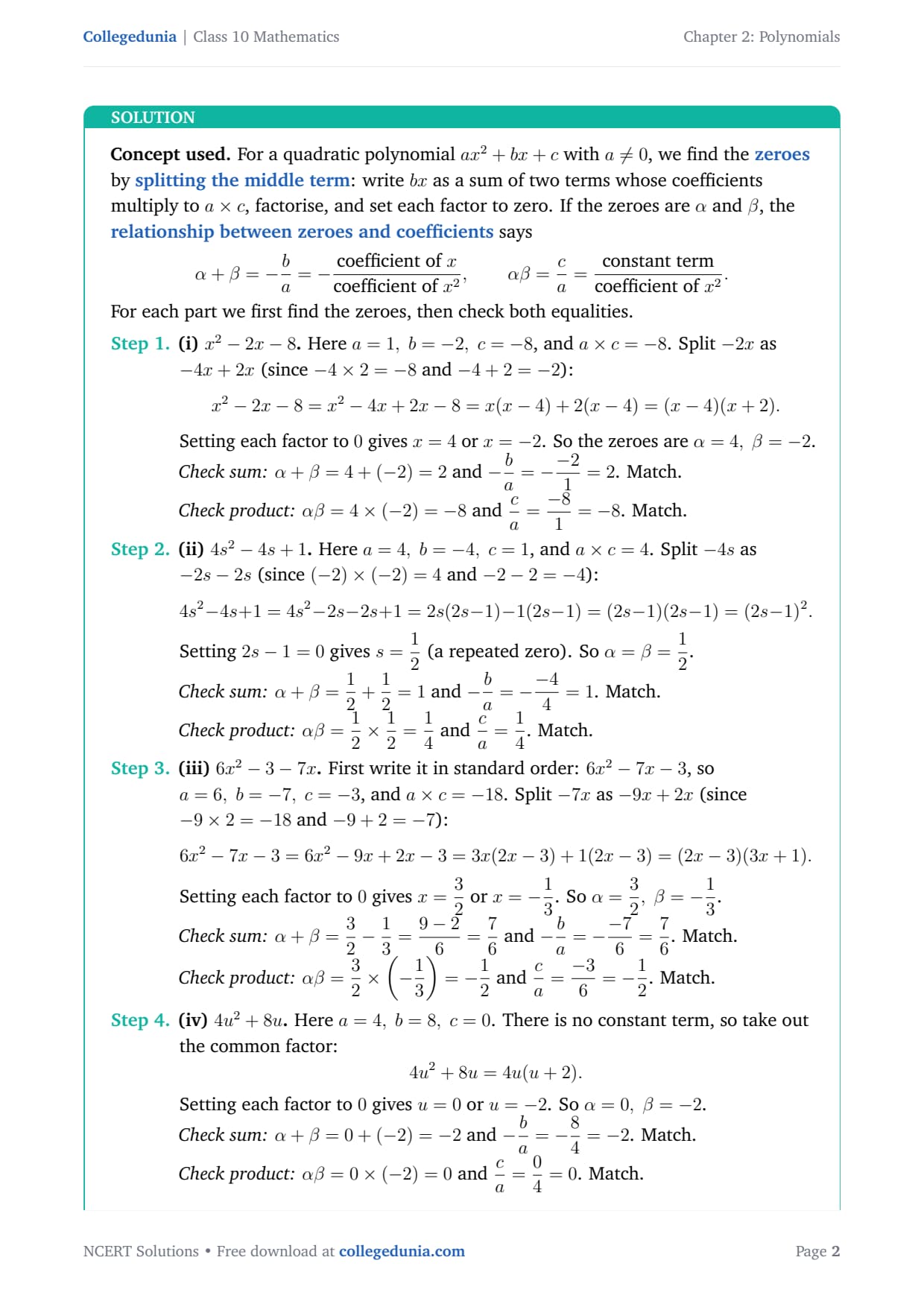
Concept used. For a quadratic polynomial ax2+bx+c with a0, we
find the zeroes by splitting the middle term: write bx as a
sum of two terms whose coefficients multiply to a× c, factorise, and set
each factor to zero. If the zeroes are α and β, the
relationship between zeroes and coefficients says
α+β=-ba=-coefficient of xcoefficient of x2,
αβ=ca=constant termcoefficient of x2.
For each part we first find the zeroes, then check both equalities.
(i) x2-2x-8. Here a=1, b=-2, c=-8, and a× c=-8.
Split -2x as -4x+2x (since -42=-8 and -4+2=-2):
x2-2x-8=x2-4x+2x-8=x(x-4)+2(x-4)=(x-4)(x+2).
Setting each factor to 0 gives x=4 or x=-2. So the zeroes are
α=4, β=-2. Check sum:α+β=4+(-2)=2 and
-ba=--21=2. Match. Check product:αβ=4×(-2)=-8 and
ca=-81=-8. Match.
(ii) 4s2-4s+1. Here a=4, b=-4, c=1, and a× c=4.
Split -4s as -2s-2s (since (-2)×(-2)=4 and -2-2=-4):
4s2-4s+1=4s2-2s-2s+1=2s(2s-1)-1(2s-1)=(2s-1)(2s-1)=(2s-1)2.
Setting 2s-1=0 gives s=12 (a repeated zero). So
α=β=12. Check sum:α+β=12+12=1 and
-ba=--44=1. Match. Check product:αβ=12×12=14
and ca=14. Match.
(iii) 6x2-3-7x. First write it in standard order:
6x2-7x-3, so a=6, b=-7, c=-3, and a× c=-18.
Split -7x as -9x+2x (since -92=-18 and -9+2=-7):
6x2-7x-3=6x2-9x+2x-3=3x(2x-3)+1(2x-3)=(2x-3)(3x+1).
Setting each factor to 0 gives x=32 or x=-13. So
α=32, β=-13. Check sum:α+β=32-13=9-26=76
and -ba=--76=76. Match. Check product:αβ=32×(-13)=-12
and ca=-36=-12. Match.
(iv) 4u2+8u. Here a=4, b=8, c=0. There is no constant
term, so take out the common factor:
4u2+8u=4u(u+2).
Setting each factor to 0 gives u=0 or u=-2. So α=0, β=-2. Check sum:α+β=0+(-2)=-2 and
-ba=-84=-2. Match. Check product:αβ=0×(-2)=0 and
ca=04=0. Match.
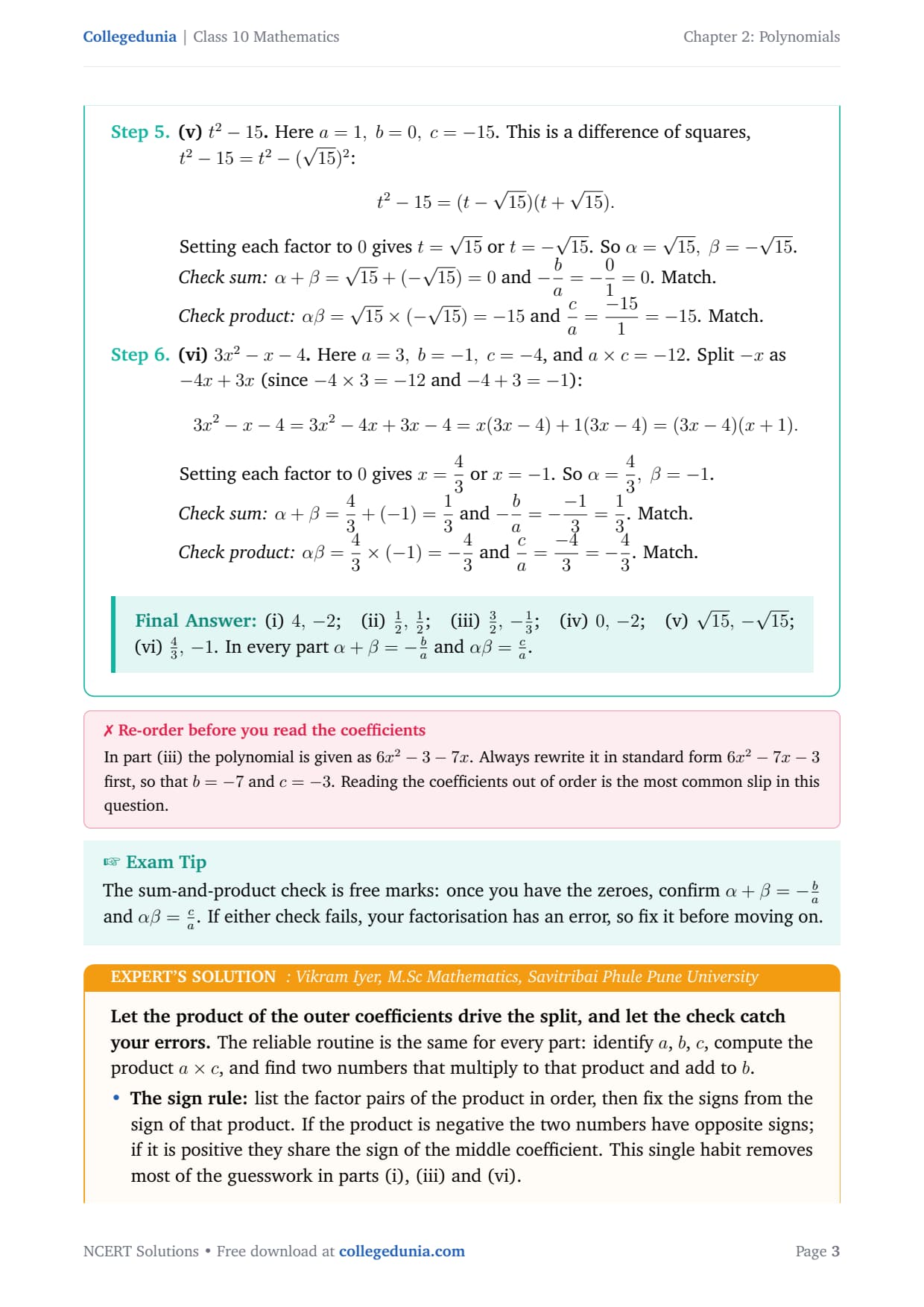
(v) t2-15. Here a=1, b=0, c=-15. This is a difference of
squares, t2-15=t2-(√15)2:
t2-15=(t-√15)(t+√15).
Setting each factor to 0 gives t=√15 or t=-√15. So
α=√15, β=-√15. Check sum:α+β=√15+(-√15)=0 and
-ba=-01=0. Match. Check product:αβ=√15×(-√15)=-15 and
ca=-151=-15. Match.
(vi) 3x2-x-4. Here a=3, b=-1, c=-4, and a× c=-12.
Split -x as -4x+3x (since -43=-12 and -4+3=-1):
3x2-x-4=3x2-4x+3x-4=x(3x-4)+1(3x-4)=(3x-4)(x+1).
Setting each factor to 0 gives x=43 or x=-1. So
α=43, β=-1. Check sum:α+β=43+(-1)=13 and
-ba=--13=13. Match. Check product:αβ=43×(-1)=-43 and
ca=-43=-43. Match.
(i) 4, -2; (ii) 12, 12; (iii) 32, -13; (iv) 0, -2; (v) √15, -√15; (vi) 43, -1. In every part α+β=-ba and αβ=ca.
VI
Vikram Iyer
M.Sc Mathematics, Savitribai Phule Pune University
Verified Expert
Let the product of the outer coefficients drive the split, and let the
check catch your errors. The reliable routine is the same for every part:
identify a, b, c, compute the product a× c, and find two numbers that
multiply to that product and add to b.
The sign rule: list the factor pairs of the product in order,
then fix the signs from the sign of that product. If the product is
negative the two numbers have opposite signs; if it is positive they
share the sign of the middle coefficient. This single habit removes most
of the guesswork in parts (i), (iii) and (vi).
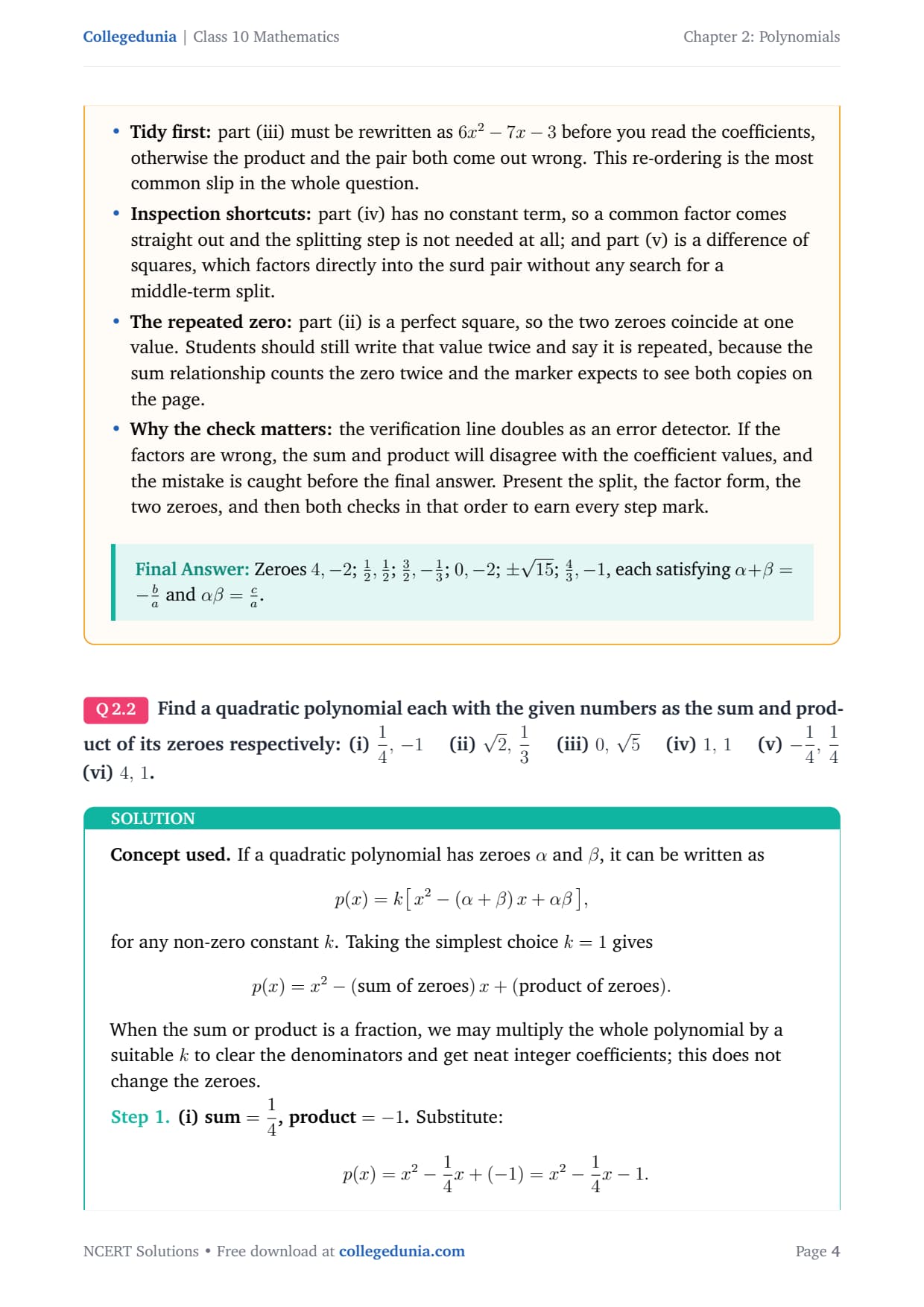
Tidy first: part (iii) must be rewritten as 6x2-7x-3 before
you read the coefficients, otherwise the product and the pair both come
out wrong. This re-ordering is the most common slip in the whole question.
Inspection shortcuts: part (iv) has no constant term, so a
common factor comes straight out and the splitting step is not needed at
all; and part (v) is a difference of squares, which factors directly into
the surd pair without any search for a middle-term split.
The repeated zero: part (ii) is a perfect square, so the two
zeroes coincide at one value. Students should still write that value twice
and say it is repeated, because the sum relationship counts the zero twice
and the marker expects to see both copies on the page.
Why the check matters: the verification line doubles as an error
detector. If the factors are wrong, the sum and product will disagree with
the coefficient values, and the mistake is caught before the final answer.
Present the split, the factor form, the two zeroes, and then both checks
in that order to earn every step mark.
Zeroes 4,-2; 12,12; 32,-13; 0,-2; ±√15; 43,-1, each satisfying α+β=-ba and αβ=ca.
Q 2.2
Find a quadratic polynomial each with the given numbers as the sum and
product of its zeroes respectively:
(i) 14, -1 (ii) √2, 13 (iii) 0, √5
(iv) 1, 1 (v) -14, 14 (vi) 4, 1.
Concept used. If a quadratic polynomial has zeroes α and β,
it can be written as
p(x)=k[ x2-(α+β) x+αβ ],
for any non-zero constant k. Taking the simplest choice k=1 gives
p(x)=x2-(sum of zeroes) x+(product of zeroes).
When the sum or product is a fraction, we may multiply the whole polynomial by a
suitable k to clear the denominators and get neat integer coefficients; this
does not change the zeroes.
(i) sum =14, product =-1. Substitute:
p(x)=x2-14x+(-1)=x2-14x-1.
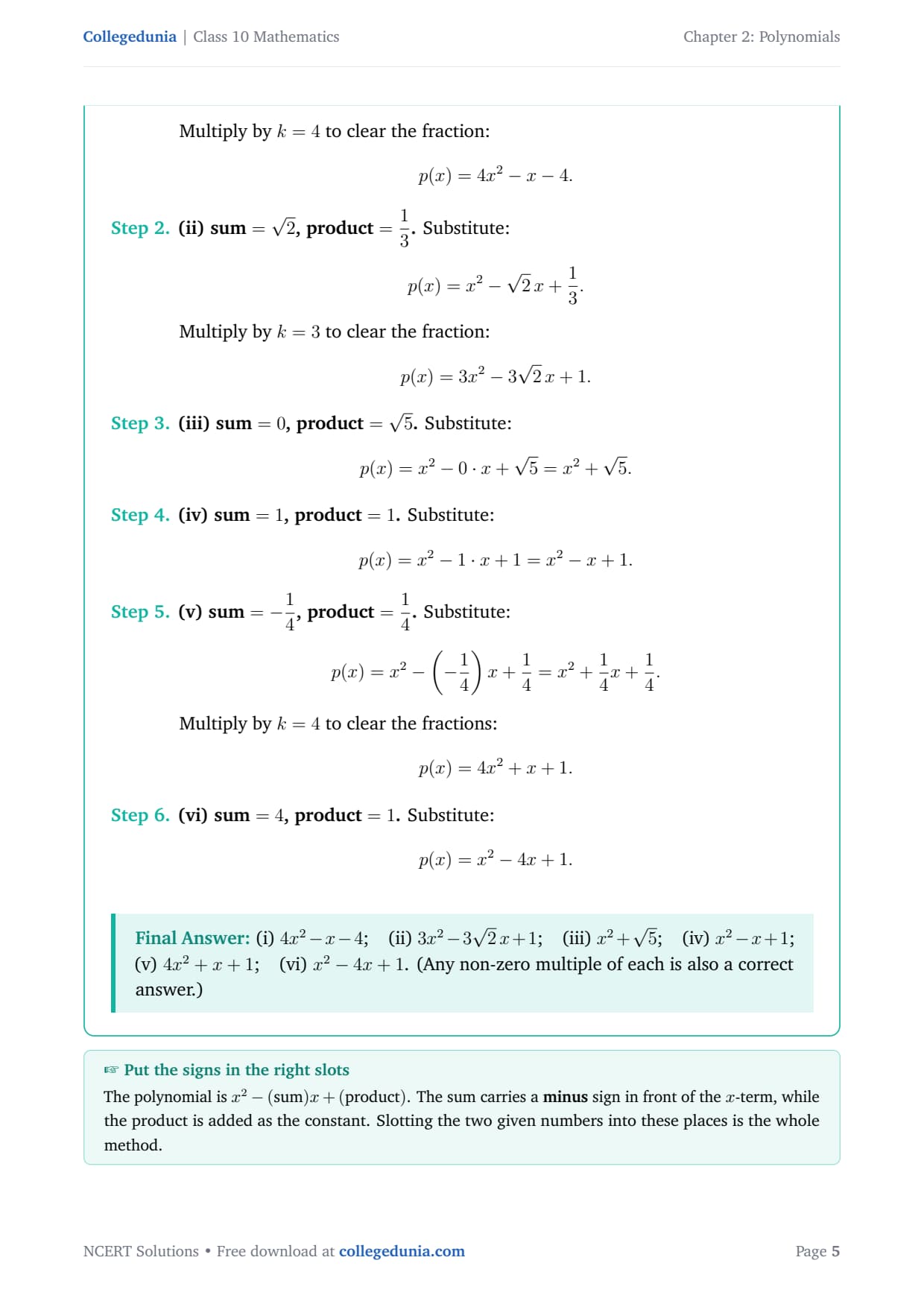
Multiply by k=4 to clear the fraction:
p(x)=4x2-x-4.
(ii) sum =√2, product =13. Substitute:
p(x)=x2-√2x+13.
Multiply by k=3 to clear the fraction:
p(x)=3x2-3√2x+1.
(iii) sum =0, product =√5. Substitute:
p(x)=x2-0· x+√5=x2+√5.
(iv) sum =1, product =1. Substitute:
p(x)=x2-1· x+1=x2-x+1.
(v) sum =-14, product =14. Substitute:
p(x)=x2-(-14)x+14=x2+14x+14.
Multiply by k=4 to clear the fractions:
p(x)=4x2+x+1.
(vi) sum =4, product =1. Substitute:
p(x)=x2-4x+1.
(i) 4x2-x-4; (ii) 3x2-3√2x+1; (iii) x2+√5; (iv) x2-x+1; (v) 4x2+x+1; (vi) x2-4x+1. (Any non-zero multiple of each is also a correct answer.)
MK
Meera Krishnan
M.Sc Mathematics, University of Madras
Verified Expert
Write the standard form first, then scale only to tidy the coefficients.
Every part is answered by the same one-line template
x2-(α+β)x+αβ, so the marks lie in placing the sum and the
product correctly and in handling the scaling constant.
Slot the signs: the sum always sits in the middle term with a
minus in front, and the product is the constant. This is why a negative
sum like the one in part (v) turns into a positive middle term after the
double negative, which students often get wrong.
Scale to clear fractions: when a fraction appears, multiply the
whole polynomial by the common denominator. The zeroes stay the same while
the fractions vanish, which is how parts (i), (ii) and (v) reach neat
integer coefficients.
Say it is not unique: any non-zero multiple gives a valid answer
with the same zeroes, so state that in the solution. Many students lose a
mark by believing only one polynomial works.
Self-check: read the sum and product back off your scaled
polynomial using the coefficient relationships; they should return the two
given numbers. That confirms both the signs and the scaling in one step.
4x2-x-4, 3x2-3√2x+1, x2+√5, x2-x+1, 4x2+x+1, x2-4x+1 (or any non-zero multiple of each).
Student Feedback: In a Collegedunia poll of 5,840 Class 10 Maths students before the 2026 boards, 68% of students wanted a clear worked answer for counting zeroes from a graph and checking the sum and product of zeroes. Most said writing a, b and c first made the check easier.
Source: 2026-27 Class 10 Maths student poll, 5,840 students across 11 states.
FAQs on Polynomials NCERT Solutions
What is the geometrical meaning of the zeroes of a polynomial in Class 10 Maths Chapter 2?
The zeroes of p(x) are the x-values where the graph of y = p(x) cuts or touches the x-axis. So the number of zeroes equals the number of points where the curve meets the x-axis. A linear graph meets it at most once, a quadratic at most twice, and a degree-n polynomial at most n times.
How do you find the zeroes of a quadratic polynomial by splitting the middle term?
Write the quadratic in standard form ax squared plus bx plus c, find the product a times c, and split the middle term bx into two terms whose coefficients multiply to a times c and add to b. Group the four terms in pairs, take out the common factor, and set each bracket to zero to find the two zeroes.
What is the relationship between the zeroes and coefficients of a quadratic polynomial?
For a quadratic ax squared plus bx plus c with zeroes alpha and beta, the sum of the zeroes equals minus b over a and the product equals c over a. Use these two relations to check your answer fast.
How do you form a quadratic polynomial from the sum and product of its zeroes?
Use the form x squared minus (sum) x plus (product). For example, a sum of 4 and a product of 1 give x squared minus 4x plus 1. If the sum or product is a fraction, multiply the whole polynomial by the common denominator to get neat integer coefficients.
How many questions are there in Class 10 Maths Chapter 2 Polynomials?
Polynomials has 3 questions across two exercises: 1 in Exercise 2.1 on counting zeroes from a graph, and 2 in Exercise 2.2 on finding zeroes and forming a quadratic. All 3 are solved step by step on this page.
Are these Polynomials NCERT Solutions based on the 2026-27 CBSE syllabus?
Yes. Every answer follows the latest 2026-27 NCERT Mathematics textbook and the CBSE marking-scheme style, and is checked against the last five years of board papers.









Comments