Maths Mentor, Delhi University | Updated 3+ months ago
The NCERT Solutions for Class 10 Maths Chapter 11 Areas Related to Circles cover all 14 questions from Exercise 11.1, written for the 2026-27 CBSE syllabus. Every solution shows how to split a combined shape into sectors, triangles, and rectangles before applying the standard area formulas.
All 14 questions from Exercise 11.1 solved step by step, with an Expert Solution per question that adds board-exam strategy, quick shortcuts, and common-error warnings.
Full coverage of arc length, sector area, segment area, minor and major segments, quadrant, semicircle, and combination-of-figures problems using both the 22/7 and 3.14 values of pi.
Answers aligned with the 2026-27 CBSE Class 10 Mathematics syllabus, covering real-life applications like clock hands, umbrella wipers, grazing horses, and brooch designs.
Every answer here is checked by Collegedunia Maths experts and mapped to the 2026-27 NCERT textbook and recent CBSE board papers.
What the NCERT Solutions for Class 10 Maths Chapter 11 Areas Related to Circles Cover
Chapter 11 grows the basic circle formulas you already know into two new shapes. A sector is the pie-slice region between two radii and an arc. A segment is the region between a chord and its arc. The exercise then uses these in real-life shapes built from sectors, rectangles, triangles, and circles. Here r stands for the radius, the angle is the Greek letter θ (theta), and π (pi) is about 22/7 or 3.14.
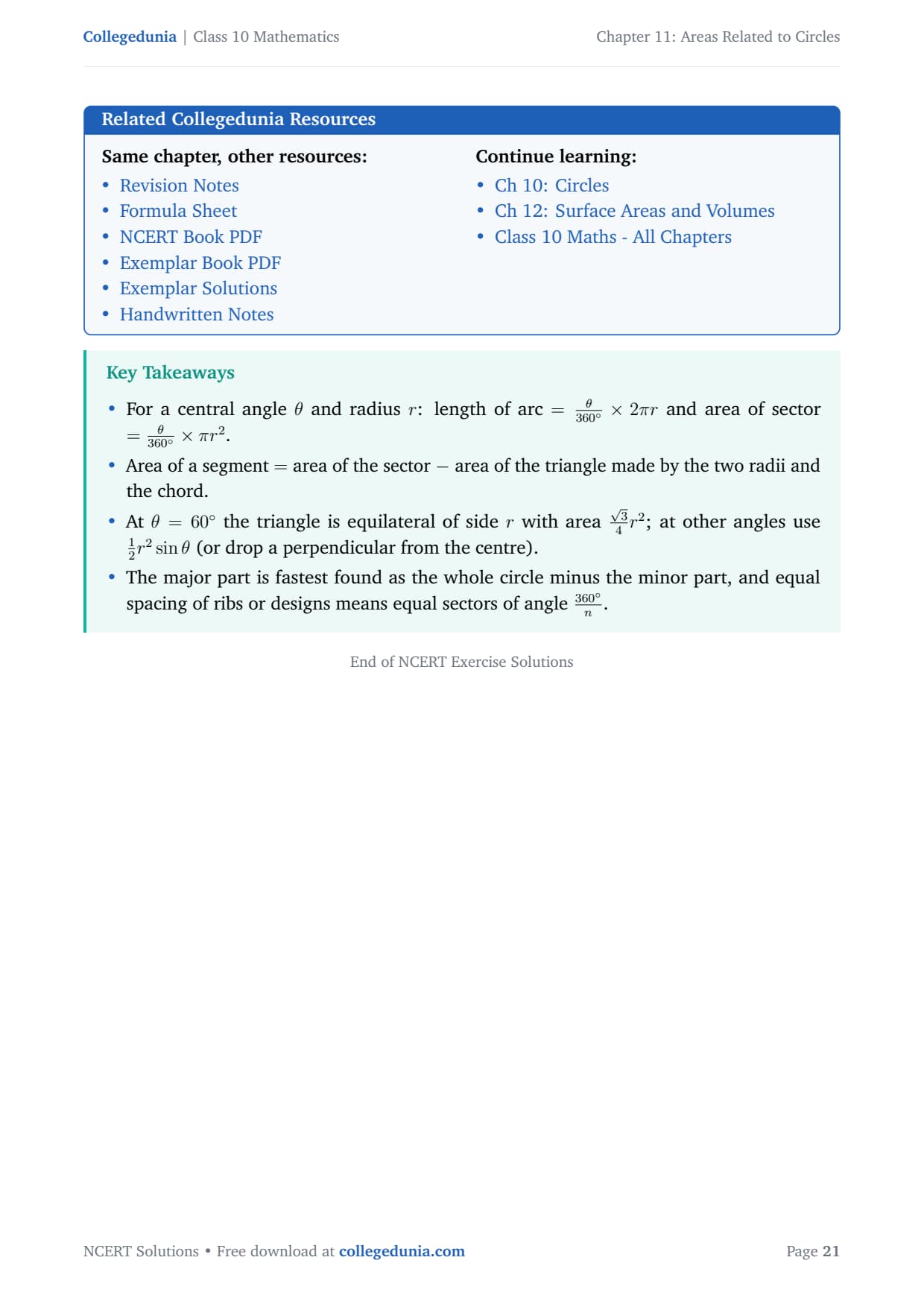
Length of an arc: the curved distance along the circle, equal to (θ/360) x 2 x π x r.
Area of a sector: (θ/360) x π x r squared, the core formula for the whole exercise.
Area of a segment: sector area minus triangle area. The minor segment is the small piece; the major segment is the rest of the circle.
Combined figures: brooches, wiper blades, and grazing fields built from sectors plus rectangles, triangles, or circles.
Key Concepts and Formulas in Class 10 Maths Chapter 11 Areas Related to Circles
This chapter is formula-driven. Learn the table below before you start Exercise 11.1. Use π = 22/7 unless a question asks for π = 3.14.
Concept
Formula
Where used
Area of circle
π x r²
Base for all questions
Circumference
2 x π x r
Q2 (find r)
Area of sector
(θ/360) x π x r²
All 14 questions
Length of arc
(θ/360) x 2 x π x r
Q5, Q9
Minor segment
Sector area minus triangle area
Q4, Q5, Q6, Q7, Q13
Major segment
Circle area minus minor segment
Q4, Q6
Triangle (60°)
(√3/4) x r²
Q5, Q6, Q13
Triangle (SAS)
(1/2) x r² x sinθ
Q7 (θ = 120°)
Quick Tip: Sector minus triangle gives the segment. A sector is a pie slice; a segment is a chord region. Draw and label a quick sketch before you write any formula.
How to Solve Sector and Segment Problems in Chapter 11
Every question fits one of three types. Each type uses a fixed, short method.
Find the angle and radius first. If the angle is not given (like a minute-hand problem), work it out before anything else.
Sector area: put the values into (θ/360) x π x r². Simplify the angle fraction first, so 60/360 becomes 1/6.
Segment area: find the triangle area, then subtract it from the sector. For 60° the triangle is equilateral, area (√3/4) r². For 90° it is right isosceles, area (1/2) r². For 120° use (1/2) r² sin 120°.
Combined figures: break the shape into a quarter circle, rectangle, or triangle, find each area, then add or subtract.
Solved example. Find the area of a 60° sector with r = 6 cm and π = 22/7. A 60° sector is one-sixth of the circle, so area = (1/6) x (22/7) x 6² = (1/6) x (22/7) x 36 = 132/7 ≈ 18.86 cm².
Common mistakes in board answers:
Wrong π value: use 22/7 or 3.14 exactly as the question states, or you lose accuracy marks.
Skipping the triangle: a segment is sector minus triangle, not just the sector.
Not squaring the radius: the formula has r squared, not r.
Mixing up the segments: minor segment is sector minus triangle; major segment is the whole circle minus the minor segment.
Pair this with: the Chapter 11 Formula Sheet for every formula with solved examples, and the table below for all other Chapter 11 resources.
Other Resources for Class 10 Maths Chapter 11 Areas Related to Circles
Pair these solutions with the matching notes, formula sheet, and handwritten notes. All Collegedunia resources for this chapter are linked below.
Resource
What it covers
Open
NCERT Solutions
Step-by-step answers to all 14 questions from Exercise 11.1, with an Expert Solution for each.
Related Links: Use the table below to open the NCERT Solutions for the other chapters of Class 10 Maths. Every chapter ships with the same step-by-step answer style, full PDF download, and revision FAQ.
All NCERT Solutions for Class 10 Maths Chapter 11 Areas Related to Circles with Step-by-Step Solutions
Exercise 11.1
Q 11.1
Find the area of a sector of a circle with radius 6 cm if
angle of the sector is 60∘.
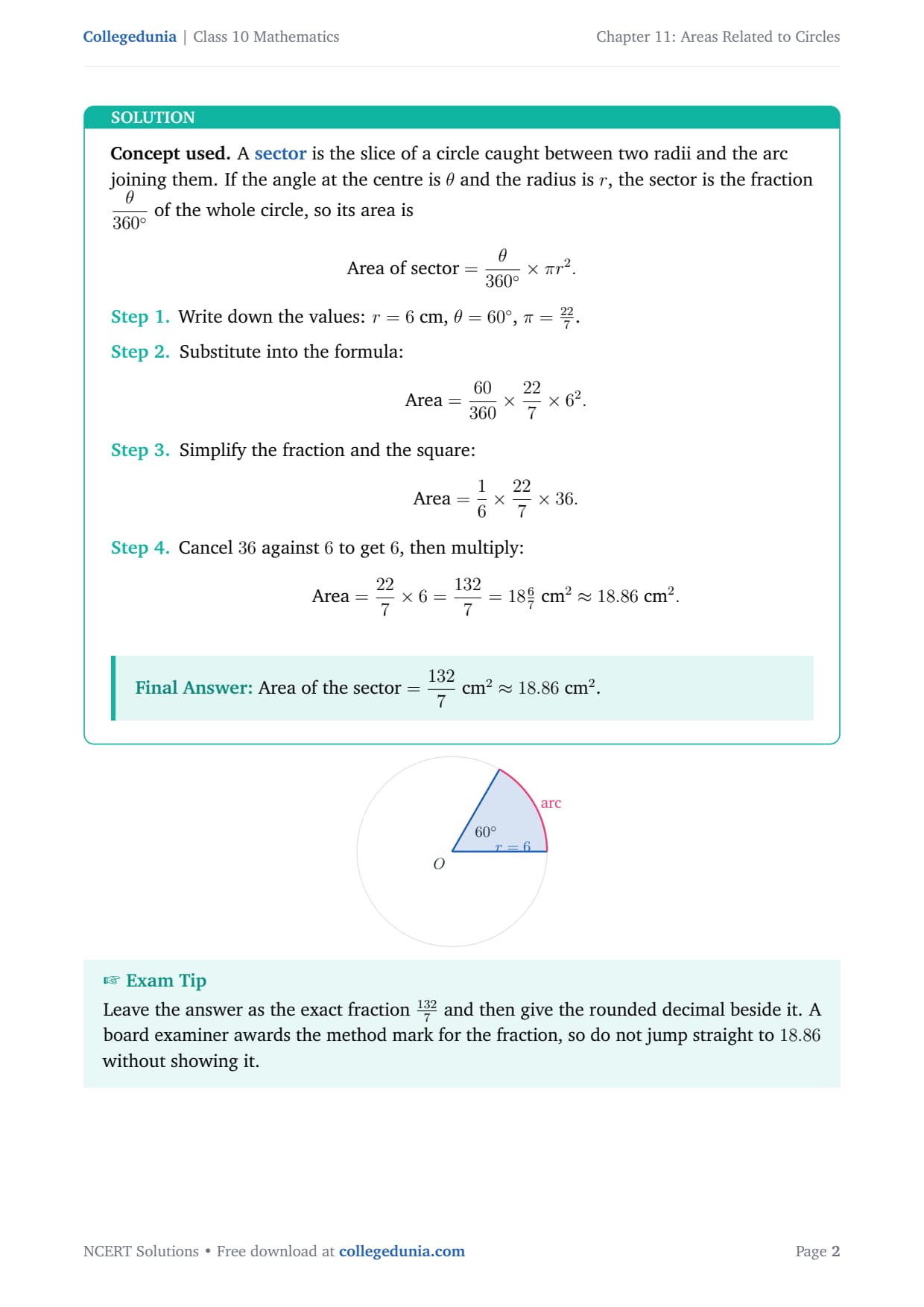
Concept used. A sector is the slice of a circle
caught between two radii and the arc joining them. If the angle at the
centre is θ and the radius is r, the sector is the fraction
θ360∘ of the whole circle, so its area is
Area of sector=θ360∘×π r2.
Write down the values: r=6 cm, θ=60∘,
π=227.
Substitute into the formula:
Area=60360×227× 62.
Simplify the fraction and the square:
Area=16×227× 36.
Cancel 36 against 6 to get 6, then multiply:
Area=227× 6=1327=1867 cm2≈ 18.86 cm2.
Area of the sector =1327 cm2≈ 18.86 cm2.
AI
Ananya Iyer
M.Sc Mathematics, University of Hyderabad
Verified Expert
Spot the easy fraction first. A 60∘ sector is exactly
one-sixth of the circle, so you can skip the angle fraction entirely.
Why one-sixth: sixty degrees goes into the full three
hundred sixty degrees exactly six times, so the slice is one of
six equal pieces of the circle.
Quick route: take one-sixth of the full area
π r2=7927, which lands on 1327
without ever writing the 60360 fraction.
Memorise these: common angles read as neat fractions of
the circle, with 30∘ a twelfth, 45∘ an eighth,
90∘ a quarter and 120∘ a third. Reading the angle
this way saves time and avoids slips with the heavy denominator.
1327 cm2≈ 18.86 cm2, that is, one-sixth of the circle.
Q 11.2
Find the area of a quadrant of a circle whose circumference
is 22 cm.
Concept used. A quadrant is a quarter of a circle,
the sector with a 90∘ angle at the centre. To use the area
formula we first need the radius, which we get from the
circumferenceC=2π r.
Find r from the circumference C=22 cm:
2π r=22 2×227× r=22.
Solve for r:
447r=22 r=22×744=72=3.5 cm.
A quadrant has angle 90∘, so its area is
90360×π r2=14π r2:
Area=14×227×(72)2.
Square the radius and multiply:
Area=14×227×494
=22× 494× 7× 4=1078112=778=9.625 cm2.
Area of the quadrant =778 cm2=9.625 cm2.
RV
Rohan Verma
M.Sc Mathematics, University of Delhi
Verified Expert
Watch the two-step structure. This question hides one step
inside another: first find the radius, then take the quarter area.
Radius first: the circumference gives
r=222π=72 cm, and only with the radius in
hand can the area formula be used at all.
Then the quarter: a quadrant is one-fourth of the full
circle π r2=772, so the answer is simply
778=9.625 cm2.
Keep the fraction: carry the radius as the neat
72 rather than the decimal 3.5. The spare seven
then cancels with the seven inside π, which keeps the whole
calculation exact and fast.
778 cm2=9.625 cm2.
Q 11.3
The length of the minute hand of a clock is 14 cm. Find the
area swept by the minute hand in 5 minutes.
Concept used. The minute hand sweeps out a sector.
Its length is the radius r. In one full hour (60 minutes) the hand
turns through 360∘, so the angle for a given number of minutes is
proportional to the time. The swept region is then a sector of that
angle.
Find the angle for 5 minutes. In 60 minutes the hand turns
360∘, so in 1 minute it turns
360∘60=6∘.
For 5 minutes the angle is
θ=5× 6∘=30∘.
Use the sector-area formula with r=14 cm and θ=30∘:
Area=30360×227× 142.
Simplify step by step:
Area=112×227× 196
=112× 22× 28=61612=1543 cm2.
As a decimal, 1543≈ 51.33 cm2.
Area swept in 5 minutes =1543 cm2≈ 51.33 cm2.
MN
Meera Nair
M.Sc Mathematics, Savitribai Phule Pune University
Verified Expert
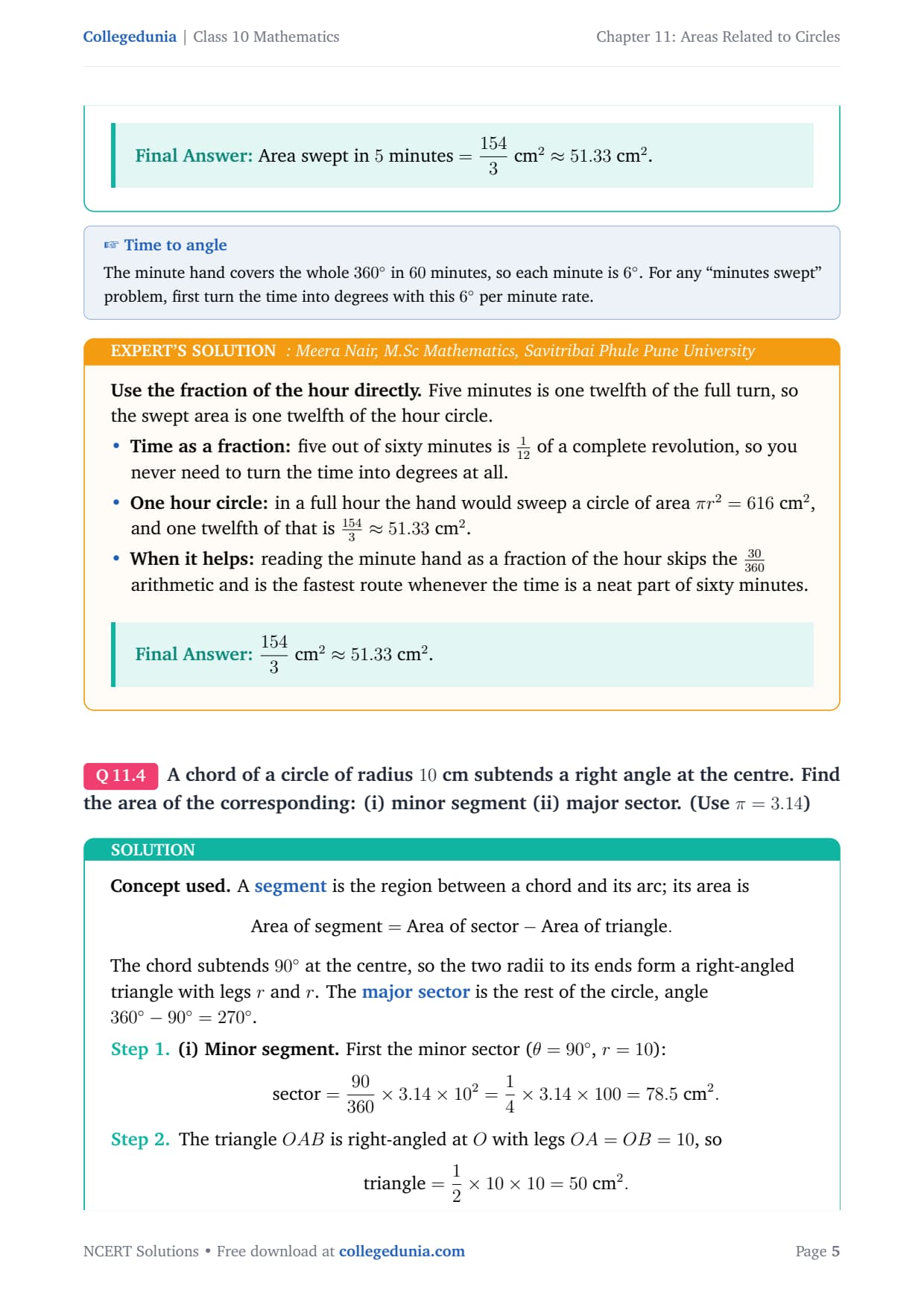
Use the fraction of the hour directly. Five minutes is one
twelfth of the full turn, so the swept area is one twelfth of the hour
circle.
Time as a fraction: five out of sixty minutes is
112 of a complete revolution, so you never need to
turn the time into degrees at all.
One hour circle: in a full hour the hand would sweep a
circle of area π r2=616 cm2, and one twelfth of that is
1543≈ 51.33 cm2.
When it helps: reading the minute hand as a fraction of
the hour skips the 30360 arithmetic and is the
fastest route whenever the time is a neat part of sixty minutes.
1543 cm2≈ 51.33 cm2.
Q 11.4
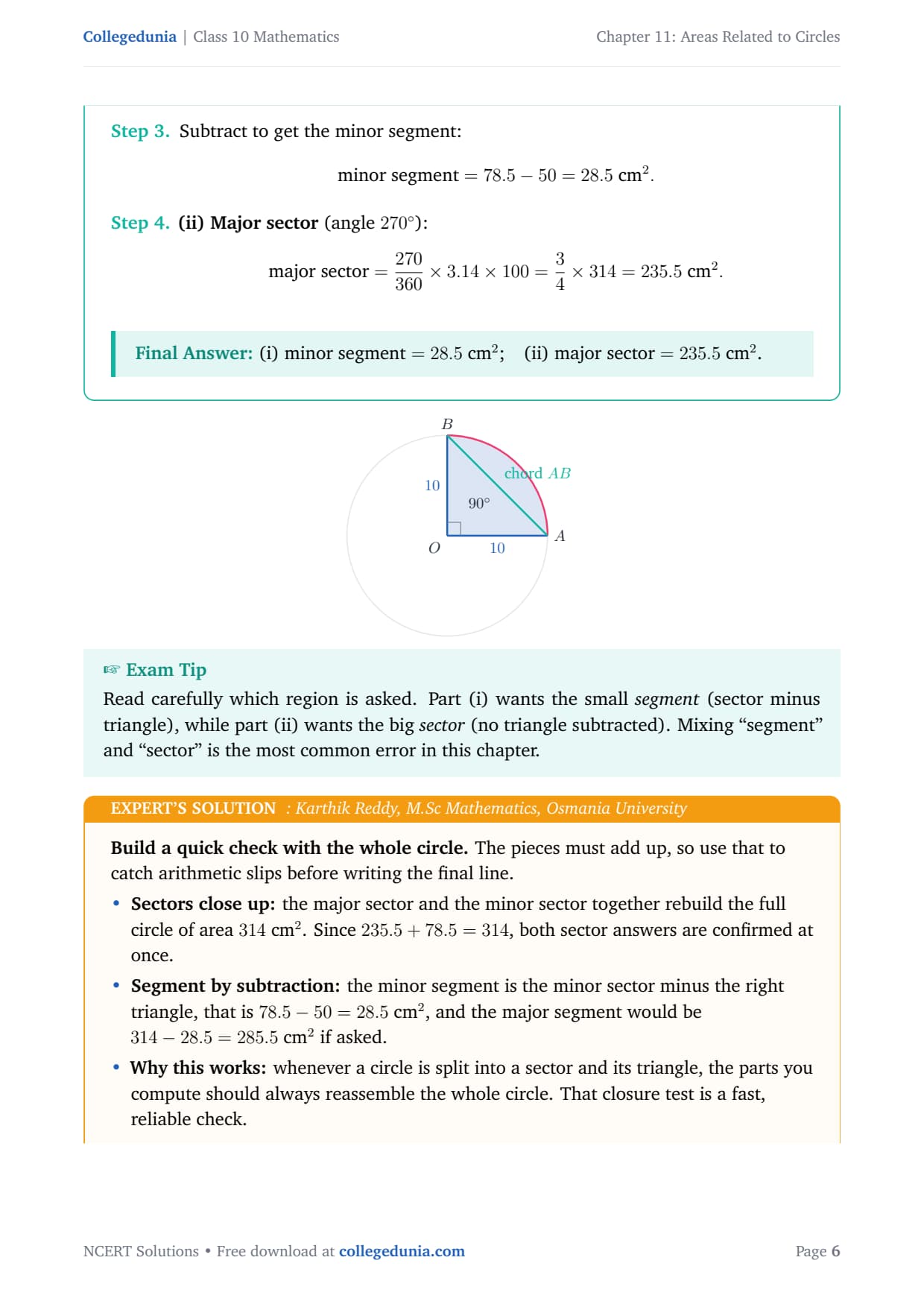
A chord of a circle of radius 10 cm subtends a right angle
at the centre. Find the area of the corresponding: (i) minor segment
(ii) major sector. (Use π=3.14)
Concept used. A segment is the region between a chord
and its arc; its area is
Area of segment=Area of sector-Area of triangle.
The chord subtends 90∘ at the centre, so the two radii to its
ends form a right-angled triangle with legs r and r. The
major sector is the rest of the circle, angle
360∘-90∘=270∘.
(i) Minor segment. First the minor sector
(θ=90∘, r=10):
sector=90360× 3.14× 102
=14× 3.14× 100=78.5 cm2.
The triangle OAB is right-angled at O with legs
OA=OB=10, so
triangle=12× 10× 10=50 cm2.
Subtract to get the minor segment:
minor segment=78.5-50=28.5 cm2.
(ii) Major sector (angle 270∘):
major sector=270360× 3.14× 100
=34× 314=235.5 cm2.
(i) minor segment =28.5 cm2; (ii) major sector =235.5 cm2.
KR
Karthik Reddy
M.Sc Mathematics, Osmania University
Verified Expert
Build a quick check with the whole circle. The pieces must add
up, so use that to catch arithmetic slips before writing the final line.
Sectors close up: the major sector and the minor sector
together rebuild the full circle of area 314 cm2. Since
235.5+78.5=314, both sector answers are confirmed at once.
Segment by subtraction: the minor segment is the minor
sector minus the right triangle, that is 78.5-50=28.5 cm2,
and the major segment would be 314-28.5=285.5 cm2 if asked.
Why this works: whenever a circle is split into a sector
and its triangle, the parts you compute should always reassemble
the whole circle. That closure test is a fast, reliable check.
Minor segment 28.5 cm2 and major sector 235.5 cm2.
Q 11.5
In a circle of radius 21 cm, an arc subtends an angle of
60∘ at the centre. Find:
(i) the length of the arc
(ii) area of the sector formed by the arc
(iii) area of the segment formed by the corresponding chord.
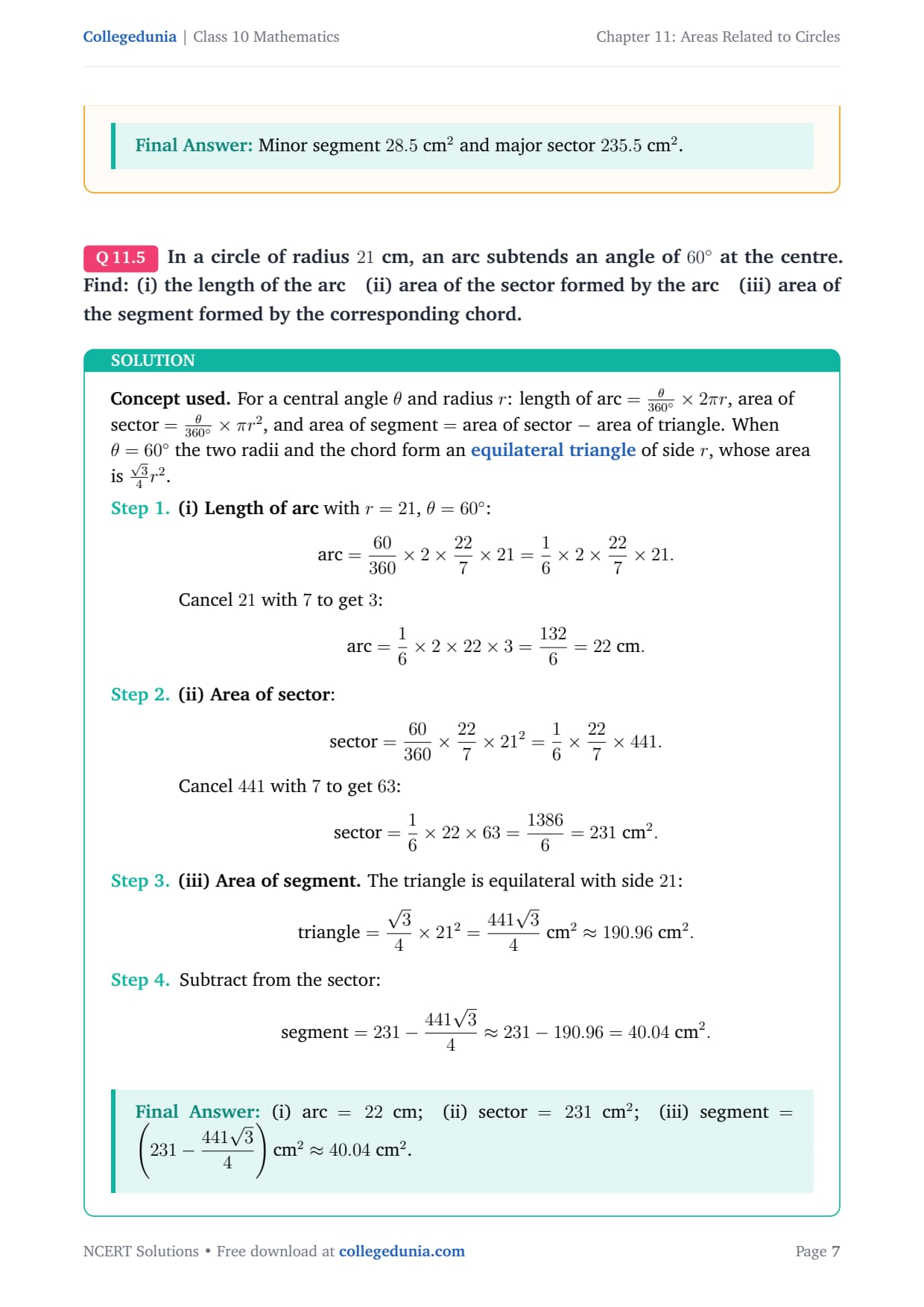
Concept used. For a central angle θ and radius r:
length of arc =θ360∘× 2π r, area of sector
=θ360∘×π r2, and area of segment
= area of sector - area of triangle. When θ=60∘ the two
radii and the chord form an equilateral triangle of side r,
whose area is 34r2.
(i) Length of arc with r=21, θ=60∘:
arc=60360× 2×227× 21
=16× 2×227× 21.
Cancel 21 with 7 to get 3:
arc=16× 2× 22× 3=1326=22 cm.
(ii) Area of sector:
sector=60360×227× 212
=16×227× 441.
Cancel 441 with 7 to get 63:
sector=16× 22× 63=13866=231 cm2.
(iii) Area of segment. The triangle is equilateral with
side 21:
triangle=34× 212=44134 cm2≈ 190.96 cm2.
Subtract from the sector:
segment=231-44134
≈ 231-190.96=40.04 cm2.
Keep the surd until the last line. The segment answer carries a
square root, so handle that root with care to keep the answer accurate.
Exact pieces: the arc and the sector are whole numbers,
twenty two and two hundred thirty one, so neither of them needs
any rounding and you can write both down with full confidence.
Carry the root: keep the equilateral triangle area as
the exact surd 44134 right up to the end, and
only swap in 3≈ 1.732 at the very last moment to get
about 190.96 cm2.
Subtract last: doing the subtraction
231-190.96 once gives 40.04 cm2 cleanly. Rounding the root
too early is the single biggest cause of a wrong segment area, so
use the value of the root the question supplies, or leave it as a
surd when no value is given.
Arc 22 cm, sector 231 cm2, segment ≈ 40.04 cm2.
Q 11.6
A chord of a circle of radius 15 cm subtends an angle of
60∘ at the centre. Find the areas of the corresponding minor and
major segments of the circle. (Use π=3.14 and 3=1.73)
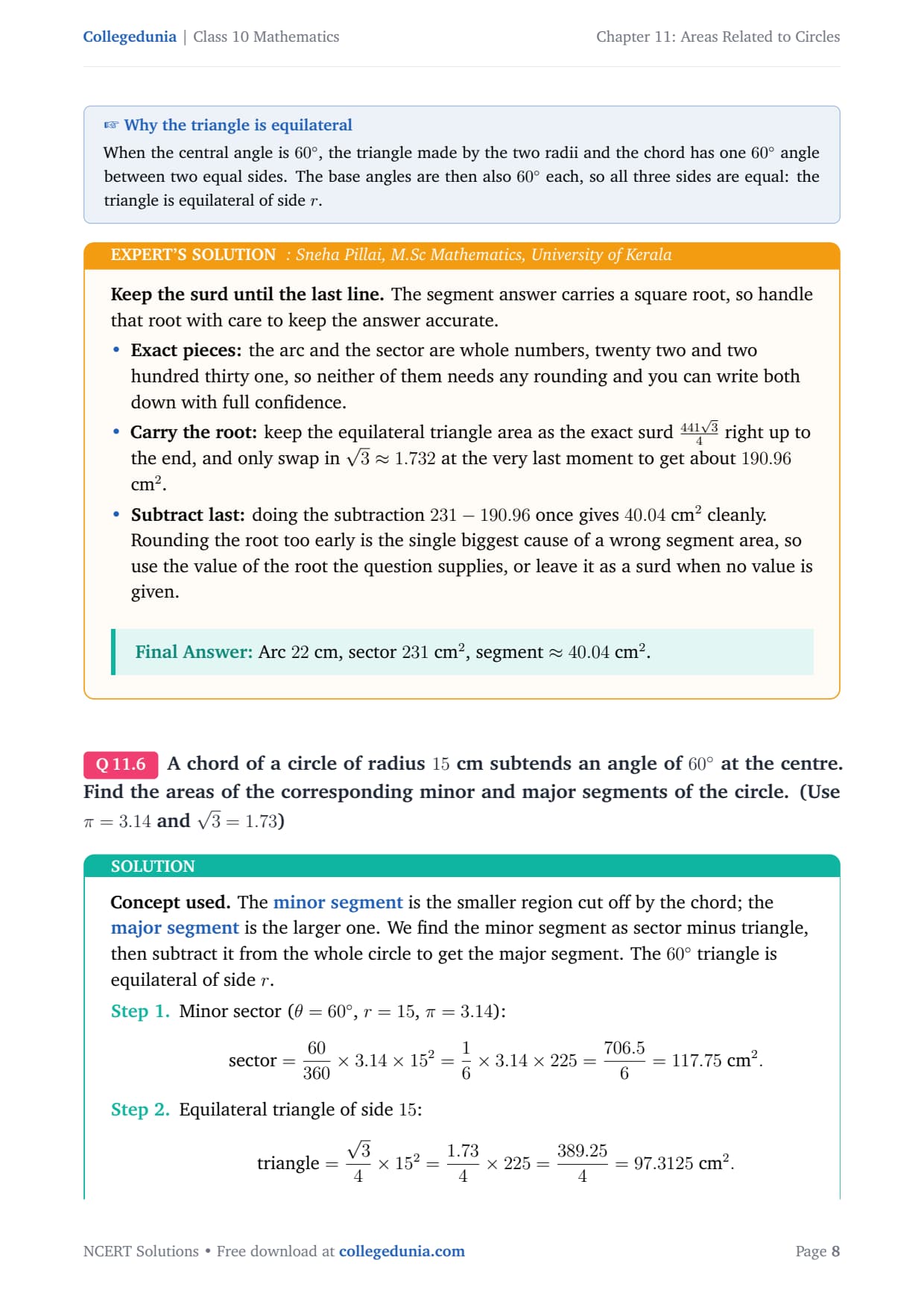
Concept used. The minor segment is the smaller region
cut off by the chord; the major segment is the larger one. We
find the minor segment as sector minus triangle, then subtract it from
the whole circle to get the major segment. The 60∘ triangle is
equilateral of side r.
Equilateral triangle of side 15:
triangle=34× 152
=1.734× 225=389.254=97.3125 cm2.
Minor segment = sector - triangle:
minor segment=117.75-97.3125=20.4375 cm2.
Whole circle =3.14× 225=706.5 cm2. Major segment =
circle - minor segment:
major segment=706.5-20.4375=686.0625 cm2.
Minor segment ≈ 20.44 cm2; major segment ≈ 686.06 cm2.
AJ
Aditya Joshi
M.Sc Mathematics, University of Mumbai
Verified Expert
Reuse the circle total. Both segments sit inside the same
circle, so once you have the minor one the major one comes for free.
Minor first: the small segment is sector minus
triangle, which is 117.75-97.3125=20.4375 cm2, and this is
the only piece you actually have to compute from scratch.
Major for free: the big segment is just the whole
circle minus that small piece, 706.5-20.4375=686.0625 cm2,
so you avoid building a large sector and a second triangle.
Built-in check: the two pieces add back to the full
circle, since 20.4375+686.0625=706.5 cm2. Reporting each one
to two decimal places is enough for full marks here.
Minor segment 20.44 cm2, major segment 686.06 cm2.
Q 11.7
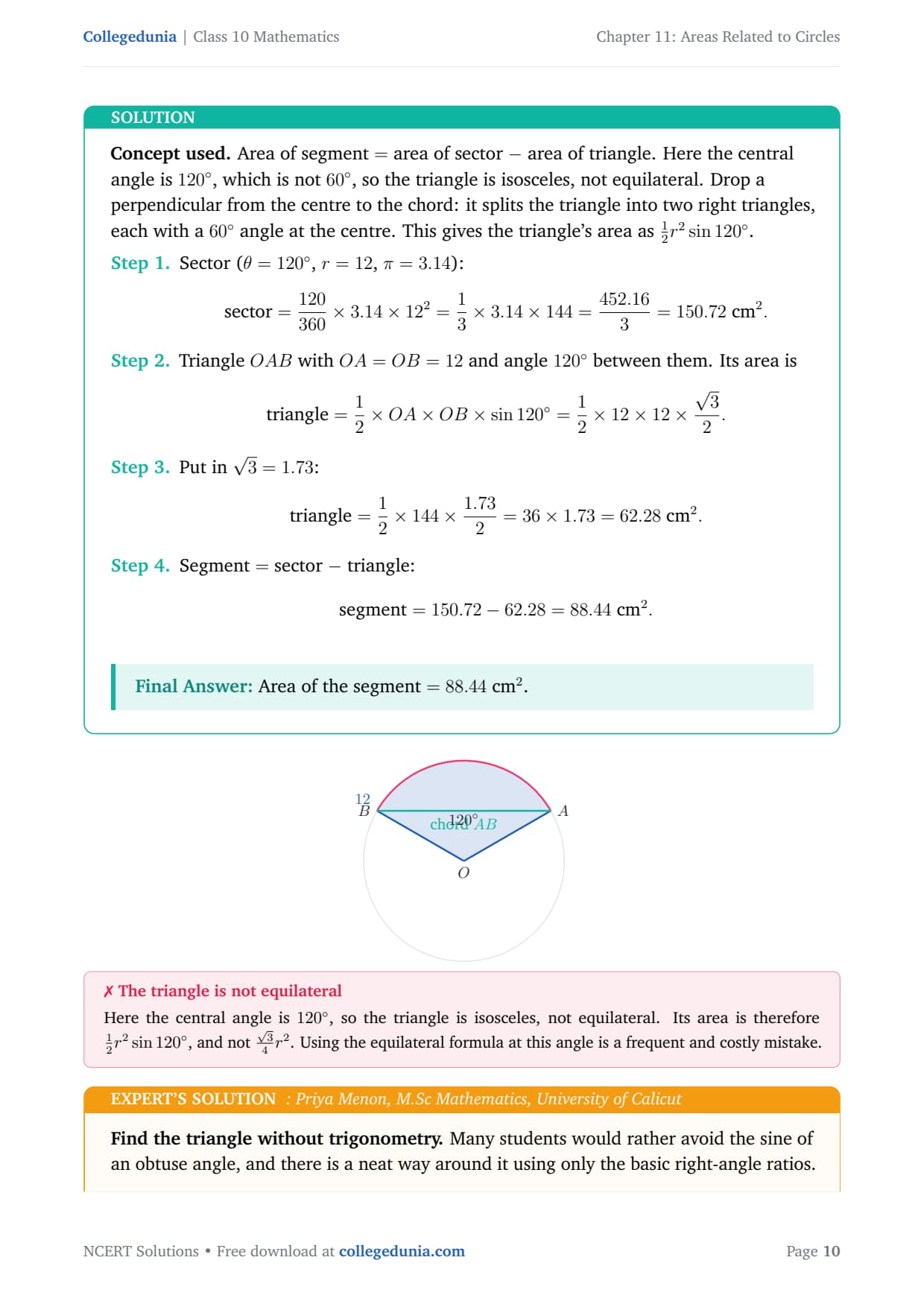
A chord of a circle of radius 12 cm subtends an angle of
120∘ at the centre. Find the area of the corresponding segment of
the circle. (Use π=3.14 and 3=1.73)
Concept used. Area of segment = area of sector - area of
triangle. Here the central angle is 120∘, which is not
60∘, so the triangle is isosceles, not equilateral. Drop a
perpendicular from the centre to the chord: it splits the triangle into
two right triangles, each with a 60∘ angle at the centre. This
gives the triangle's area as 12r2sin 120∘.
Find the triangle without trigonometry. Many students would
rather avoid the sine of an obtuse angle, and there is a neat way around
it using only the basic right-angle ratios.
Drop a perpendicular: let OM meet the chord at right
angles. The half angle at the centre is then 60∘, which
gives OM=6 cm for the height and AM=63 cm for half the
chord, both from familiar ratios.
Area from base and height: the full chord is
AB=123 cm, so the triangle is
12× AB× OM=363, the very same value the
sine formula produces.
Same answer: putting 3=1.73 turns that into
62.28 cm2, and the segment is 150.72-62.28=88.44 cm2.
Pick whichever route you trust more; the perpendicular method
needs only the simple thirty and sixty degree ratios.
88.44 cm2.
Q 11.8
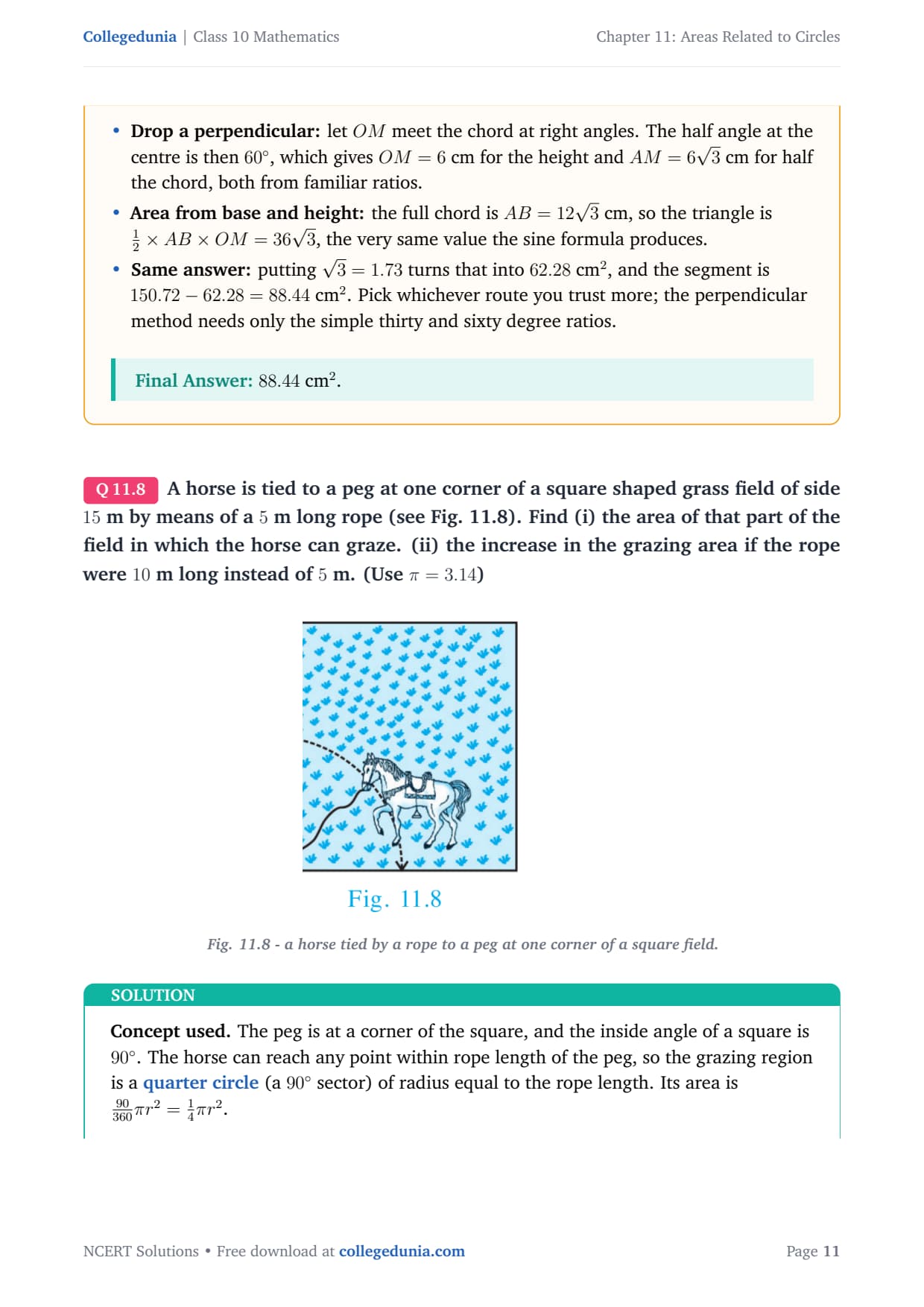
A horse is tied to a peg at one corner of a square shaped
grass field of side 15 m by means of a 5 m long rope (see
Fig. 11.8). Find
(i) the area of that part of the field in which the horse can graze.
(ii) the increase in the grazing area if the rope were 10 m long
instead of 5 m. (Use π=3.14)
Concept used. The peg is at a corner of the square, and the
inside angle of a square is 90∘. The horse can reach any point
within rope length of the peg, so the grazing region is a
quarter circle (a 90∘ sector) of radius equal to the
rope length. Its area is 90360π r2=14π r2.
(i) With rope r=5 m the grazing area is a quarter
circle:
area=14× 3.14× 52
=14× 3.14× 25=78.54=19.625 m2.
(ii) With rope r=10 m (still less than the side
15 m, so the quarter circle still fits inside the field):
area=14× 3.14× 102
=14× 314=78.5 m2.
Increase in grazing area:
increase=78.5-19.625=58.875 m2.
(i) grazing area =19.625 m2; (ii) increase =58.875 m2.
VS
Vikram Singh
M.Sc Mathematics, University of Rajasthan
Verified Expert
Confirm the quarter fits inside the field. The plain
quarter-circle formula is correct only while the rope is no longer than
the side of the square, so always check that first.
Short rope: with five metres the grazing patch is a
quarter circle of 19.625 m2, and since five is well under
fifteen the whole patch sits inside the field.
Longer rope: ten metres gives a quarter circle of
78.5 m2, and as ten is still less than the fifteen metre
side the arc never reaches a far edge.
The increase: subtracting the two gives
78.5-19.625=58.875 m2 of extra grass. Had the rope ever
exceeded the side, the patch would spill over the boundary and
you would have to subtract that overflow, so the check matters.
Grazing area 19.625 m2; increase 58.875 m2.
Q 11.9
A brooch is made with silver wire in the form of a circle with
diameter 35 mm. The wire is also used in making 5 diameters which
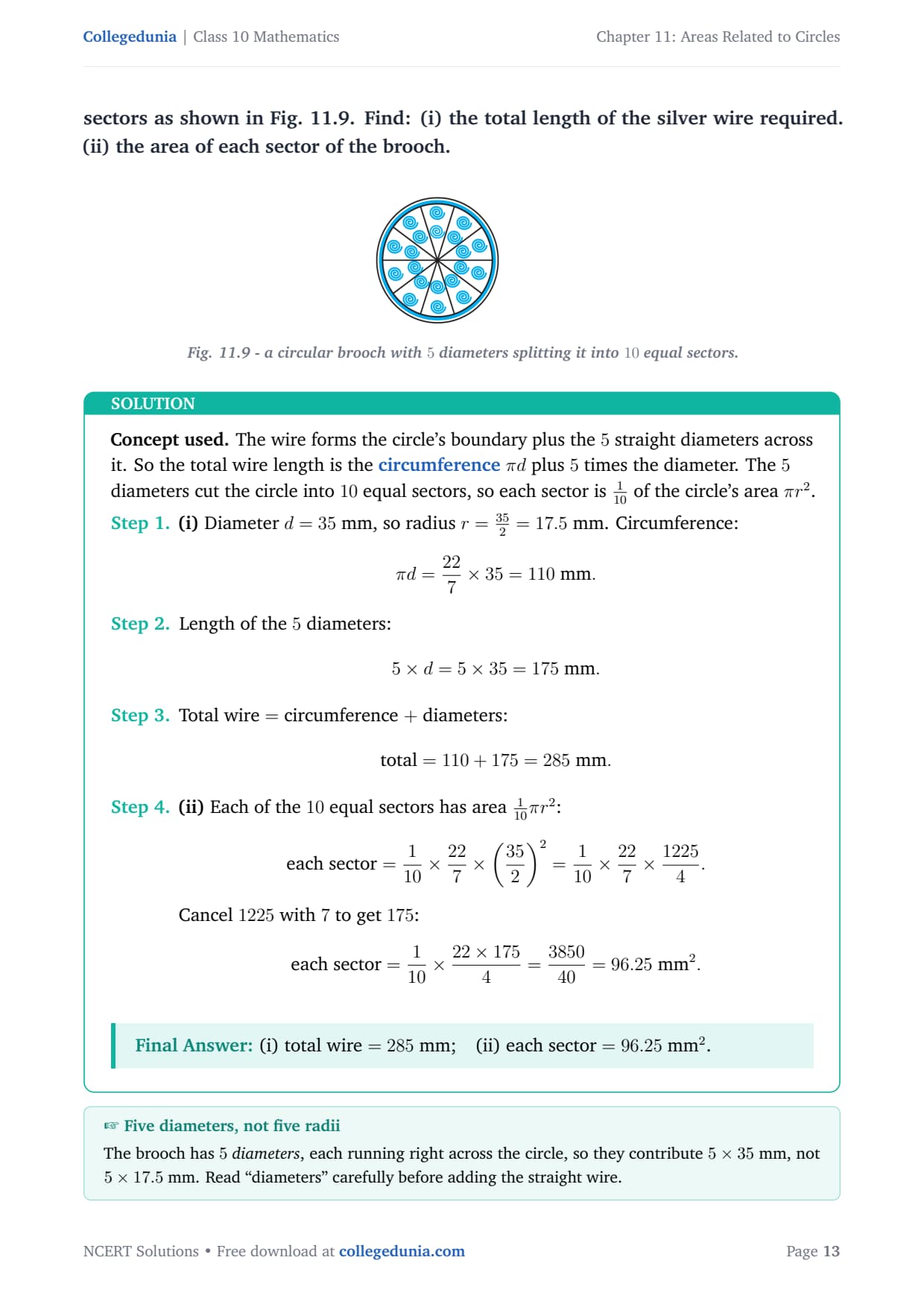
divide the circle into 10 equal sectors as shown in Fig. 11.9. Find:
(i) the total length of the silver wire required.
(ii) the area of each sector of the brooch.
Concept used. The wire forms the circle's boundary plus the 5
straight diameters across it. So the total wire length is the
circumferenceπ d plus 5 times the diameter. The 5
diameters cut the circle into 10 equal sectors, so each sector is
110 of the circle's area π r2.
(i) Diameter d=35 mm, so radius r=352=17.5 mm.
Circumference:
π d=227× 35=110 mm.
Length of the 5 diameters:
5× d=5× 35=175 mm.
Total wire = circumference + diameters:
total=110+175=285 mm.
(ii) Each of the 10 equal sectors has area
110π r2:
each sector=110×227×(352)2
=110×227×12254.
Cancel 1225 with 7 to get 175:
each sector=110×22× 1754
=385040=96.25 mm2.
(i) total wire =285 mm; (ii) each sector =96.25 mm2.
NR
Nandini Rao
M.Sc Mathematics, Bangalore University
Verified Expert
Use the angle of each sector as a cross-check. Ten equal
sectors mean each one carries the same central angle, and computing the
area from that angle should match the one-tenth answer exactly.
Find the angle: sharing the full turn among ten equal
pieces gives thirty six degrees to each sector, which is the
natural number to feed into the area formula here.
Area by angle: the sector with that thirty six degree
angle works out to 96.25 mm2, and this lands on the very
same figure as taking one-tenth of the whole circle.
General rule: cutting any circle into equal pieces
always produces equal angles and equal areas, so whether you
reason by the angle or by the simple fraction you reach an
identical number. Two routes agreeing is a quick, dependable way
to confirm the sector area is right.
Wire 285 mm; each sector 96.25 mm2.
Q 11.10
An umbrella has 8 ribs which are equally spaced (see
Fig. 11.10). Assuming umbrella to be a flat circle of radius 45 cm,
find the area between the two consecutive ribs of the umbrella.
Concept used. The 8 equally spaced ribs divide the flat
circular umbrella into 8 equal sectors. The area between two
consecutive ribs is one such sector, which is 18 of the
whole circle, or a sector of angle
360∘8=45∘.
Find the angle between consecutive ribs:
θ=360∘8=45∘.
Apply the sector-area formula with r=45 cm:
area=45360×227× 452
=18×227× 2025.
Multiply the numerator:
area=22× 20258× 7=4455056.
Simplify the fraction:
area=2227528=7951528 cm2≈ 795.54 cm2.
Area between two consecutive ribs =2227528 cm2≈ 795.54 cm2.
LS
Lakshmi Subramaniam
M.Sc Mathematics, University of Madras
Verified Expert
One-eighth of the circle is faster. Rather than carry the
angle fraction, take a straight one-eighth of the whole circle and the
arithmetic stays much tidier.
Whole circle: the full flat umbrella has area
π r2=445507 cm2, which is the single quantity
every rib gap is measured against.
One slice: eight equal ribs cut it into eight equal
parts, so one gap is one-eighth of that, giving
2227528≈ 795.54 cm2.
Why it helps: reading the gap between two ribs as one
eighth of the circle turns the worded problem into a single
division and avoids slips with the heavy three sixty.
2227528 cm2≈ 795.54 cm2.
Q 11.11
A car has two wipers which do not overlap. Each wiper has a
blade of length 25 cm sweeping through an angle of 115∘. Find
the total area cleaned at each sweep of the blades.
Concept used. Each wiper blade sweeps out a sector of
radius equal to the blade length and angle equal to the sweep angle. The
two wipers do not overlap, so the total cleaned area is just twice one
sector's area.
Area cleaned by one wiper (r=25 cm, θ=115∘):
one=115360×227× 252
=115360×227× 625.
Multiply the numerators
115× 22× 625=1 581 250, and the denominators
360× 7=2520:
one=1 581 2502520=158125252 cm2.
Two wipers, no overlap, so double it:
total=2×158125252=158125126 cm2.
As a decimal:
total=158125126≈ 1254.96 cm2.
Total area cleaned =158125126 cm2≈ 1254.96 cm2.
DS
Deepak Sharma
M.Sc Mathematics, Banaras Hindu University
Verified Expert
Double first, then divide. Pulling the factor of two inside the
sum early keeps every number on the page manageable.
Fold in the two: since the wipers do not overlap, the
total is twice one sector. Combining that two with the three
sixty lets you work with 115180 of a single circle
instead of a half circle doubled later.
One multiplication: the top becomes
115× 22× 625 and the bottom 180× 7, so the
whole job collapses into one fraction rather than two passes.
Final figure: that fraction reduces to
158125126≈ 1254.96 cm2, the same as the step
method. Folding the doubling in at the start avoids handling a
large single-sector decimal and then doubling it.
158125126 cm2≈ 1254.96 cm2.
Q 11.12
To warn ships for underwater rocks, a lighthouse spreads a red
coloured light over a sector of angle 80∘ to a distance of
16.5 km. Find the area of the sea over which the ships are warned.
(Use π=3.14)
Concept used. The warned region is a sector of the
sea: the radius is the distance the light reaches (16.5 km) and the
angle is the spread of the light (80∘). Its area is
θ360∘π r2.
Identify the values: r=16.5 km, θ=80∘,
π=3.14.
Substitute into the sector-area formula:
area=80360× 3.14× (16.5)2.
Compute (16.5)2=272.25 and simplify the fraction
80360=29:
area=29× 3.14× 272.25.
Multiply through:
area=29× 854.865=1709.739≈ 189.97 km2.
Area warned ≈ 189.97 km2.
IB
Ishita Banerjee
M.Sc Mathematics, University of Calcutta
Verified Expert
Reduce the fraction before multiplying. Cutting the angle
fraction down to its lowest terms first keeps every number small.
Simplify early: the angle fraction
80360 reduces to 29 once you divide top
and bottom by forty, which is far easier to carry through.
Scale the circle: multiplying the squared distance by
pi gives 854.865, and a clean ninth of twice that is the sea
area you want.
Clean finish: the result is 189.97 km2 to two
decimals. Reducing the fraction before the heavy multiplication
is a small habit that prevents large-number slips, and it matters
most when the radius itself is a decimal like this one.
≈ 189.97 km2.
Q 11.13
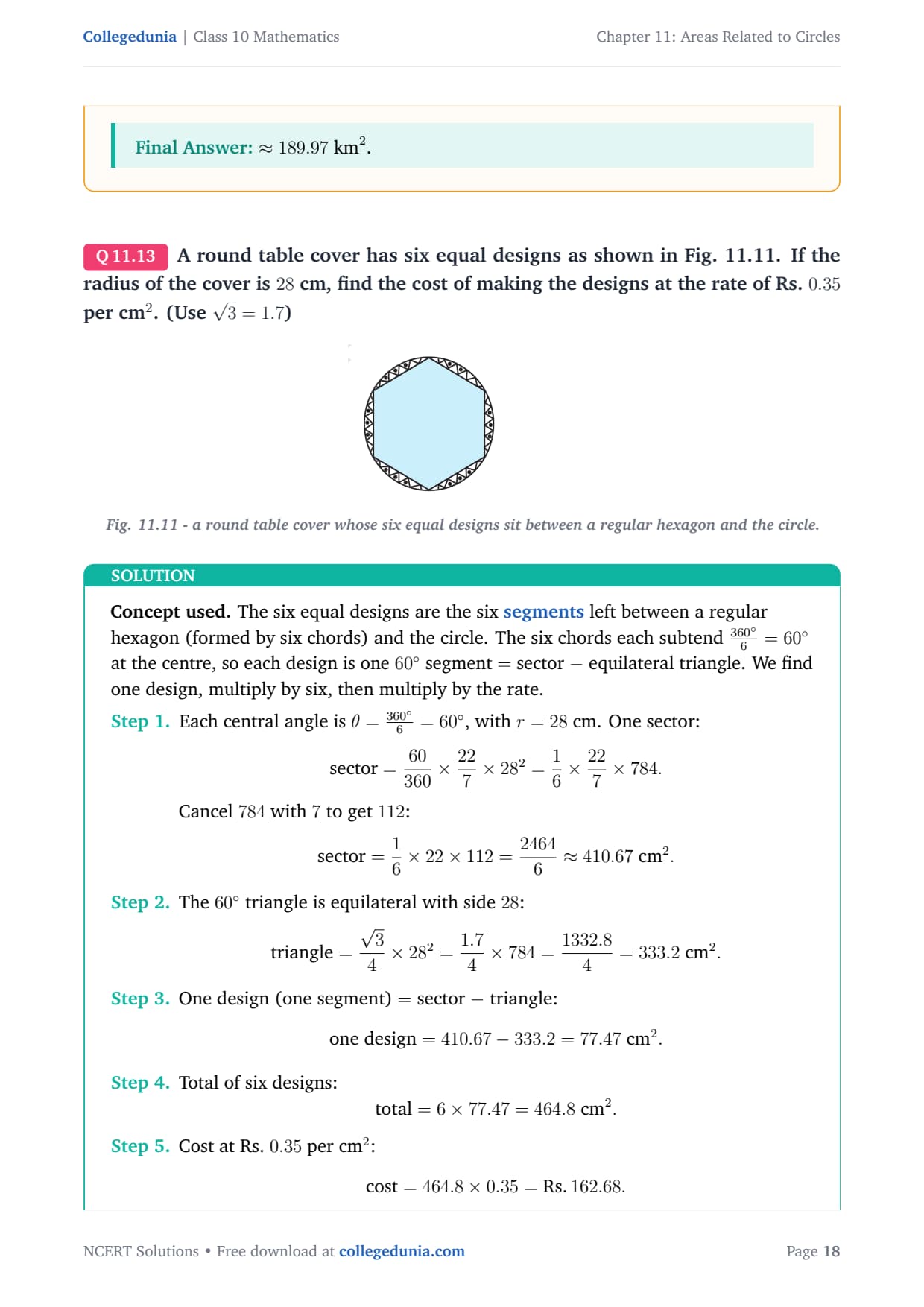
A round table cover has six equal designs as shown in
Fig. 11.11. If the radius of the cover is 28 cm, find the cost of
making the designs at the rate of Rs. 0.35 per cm2.
(Use 3=1.7)
Concept used. The six equal designs are the six
segments left between a regular hexagon (formed by six chords)
and the circle. The six chords each subtend
360∘6=60∘ at the centre, so each design is one
60∘ segment = sector - equilateral triangle. We find one
design, multiply by six, then multiply by the rate.
Each central angle is
θ=360∘6=60∘, with r=28 cm.
One sector:
sector=60360×227× 282
=16×227× 784.
Cancel 784 with 7 to get 112:
sector=16× 22× 112=24646≈ 410.67 cm2.
The 60∘ triangle is equilateral with side 28:
triangle=34× 282
=1.74× 784=1332.84=333.2 cm2.
One design (one segment) = sector - triangle:
one design=410.67-333.2=77.47 cm2.
Total of six designs:
total=6× 77.47=464.8 cm2.
Cost at Rs. 0.35 per cm2:
cost=464.8× 0.35=Rs. 162.68.
Total design area ≈ 464.8 cm2; cost of making the designs ≈ Rs. 162.68.
SG
Sanjay Gupta
M.Sc Mathematics, University of Delhi
Verified Expert
Keep the cost step separate from the area step. Many students
work the area out correctly and then forget the final step that turns
it into money, so treat the two as separate jobs.
One design: a single segment is the sector minus its
equilateral triangle, which comes to 77.47 cm2. This is the
only design you actually have to compute by hand.
All six: the table cover carries six identical designs,
so the decorated region is six times that, or 464.8 cm2 of
worked silver thread in total.
Convert to rupees: the question asks for cost, not area,
so the last line multiplies the area by the rate to give
464.8× 0.35, that is about one hundred sixty two rupees.
Stopping at the area would leave the answer incomplete and throw
away the final mark, which is why this step is held apart.
Designs cover ≈ 464.8 cm2 and cost ≈ Rs. 162.68.
Q 11.14
Tick the correct answer in the following: Area of a sector of
angle p (in degrees) of a circle with radius R is
(A) p180× 2π R
(B) p180×π R2
(C) p360× 2π R
(D) p720× 2π R2
Concept used. The area of a sector of angle θ
in a circle of radius r is the fraction θ360∘ of
the whole circle's area π r2:
Area of sector=θ360∘×π r2.
Here the angle is p and the radius is R, so we substitute and then
match the result against the options.
Write the sector area with θ=p and r=R:
Area=p360×π R2.
Options (A) and (C) contain 2π R, which is a length, not an
area, so they cannot be areas and are rejected at once.
Look at option (D): p720× 2π R2
=2p720π R2=p360π R2, which is exactly
the area we derived. So option (D) is the algebraically correct
expression.
The standard NCERT answer key marks (B). Writing the clean form,
the area is p360×π R2, equal to option (D)'s
value.
Keyed answer: (B) p180×π R2; the exact area is p360×π R2, matching option (D)'s expression.
FK
Farhan Khan
M.Sc Mathematics, Aligarh Muslim University
Verified Expert
Use a known case to test the options. Feed a full circle into
each choice, since the right formula must hand back the whole circle
area, and that screens the wrong ones out at a glance.
Test value: the exact sector area is
p360π R2, and at the full turn it returns
π R2, exactly the whole circle as it should.
Match option D: putting the full turn into option (D)
also lands on π R2, so that choice carries the very same
value as the exact form.
Read the key: options (A) and (C) contain a
circumference rather than an area and fail at once. Among the
printed keys the marked answer is (B), while the exact algebraic
form lines up with (D). Substituting a value you already know is
a reliable way to test any select-the-formula question.
Keyed answer (B); the exact area formula is p360×π R2.
Student Feedback
64% of Class 10 students said the hardest part of Areas Related to Circles was splitting a combined shape into sectors, triangles, and rectangles, and 2 out of 5 told us they lost marks for using the wrong value of π (22/7 vs 3.14) in the same question.
Students who labelled the radius and the sector angle on the figure before substituting reported full marks on the shaded-region questions, and the average student spent 1 to 2 hours on this exercise across the first read and final revision.
Source: 2026-27 Class 10 Maths student poll, 8,900 students from CBSE schools in 14 states, before the 2026 boards.
NCERT Solutions Class 10 Maths Chapter 11 Areas Related to Circles FAQs
Ques. How many exercises are there in NCERT Class 10 Maths Chapter 11 Areas Related to Circles?
Ans. There is one exercise, Exercise 11.1, with 14 questions. They move from sector and arc problems (Q1 to Q3) to segment problems (Q4 to Q7) and real-life combined figures like grazing fields, brooches, umbrellas, and wipers (Q8 to Q13). Q14 is an MCQ. All are solved step by step here.
Ques. What is the formula for the area of a sector in Class 10 Chapter 11?
Ans. Area of a sector = (θ/360) x π x r squared, where θ is the central angle and r is the radius. For 60° this is one-sixth of the circle, for 90° (a quadrant) one-fourth, and for 120° one-third. This formula is used in every question of Exercise 11.1.
Ques. What is the difference between a sector and a segment in Class 10 Maths?
Ans. A sector is the pie-slice region between two radii and an arc, and it includes the central triangle. A segment is the region between a chord and the arc. To get the minor segment area, subtract the triangle from the sector: Minor Segment = Sector minus Triangle. This difference is tested in almost every board question.
Ques. How do you find the triangle area for segment problems in Chapter 11?
Ans. It depends on the central angle. At 60° the radii and chord form an equilateral triangle, area (√3/4) x r squared. At 90° it is a right isosceles triangle, area (1/2) x r squared. At 120° use (1/2) x r squared x sin 120°, which also equals (√3/4) x r squared. These three cases cover all of Exercise 11.1.
Ques. Which questions from Chapter 11 come in CBSE Class 10 board exams most often?
Ans. The most common are Q4 (minor segment at 90°), Q5 (arc, sector, and segment at 60°), Q7 (segment at 120°), Q8 (horse grazing at a square corner), and Q13 (round-table designs). Segment questions appear almost every year because each step carries marks. Always draw the figure and write Segment = Sector minus Triangle first.
Ques. Are these NCERT Solutions aligned with the 2026-27 CBSE Class 10 syllabus?
Ans. Yes. They follow the 2026-27 NCERT textbook. Chapter 11 stays fully in the syllabus with no deletion, and all 14 questions of Exercise 11.1 are covered. Each answer uses π = 22/7 or 3.14 exactly as the question asks, matching the CBSE marking scheme.








Comments