




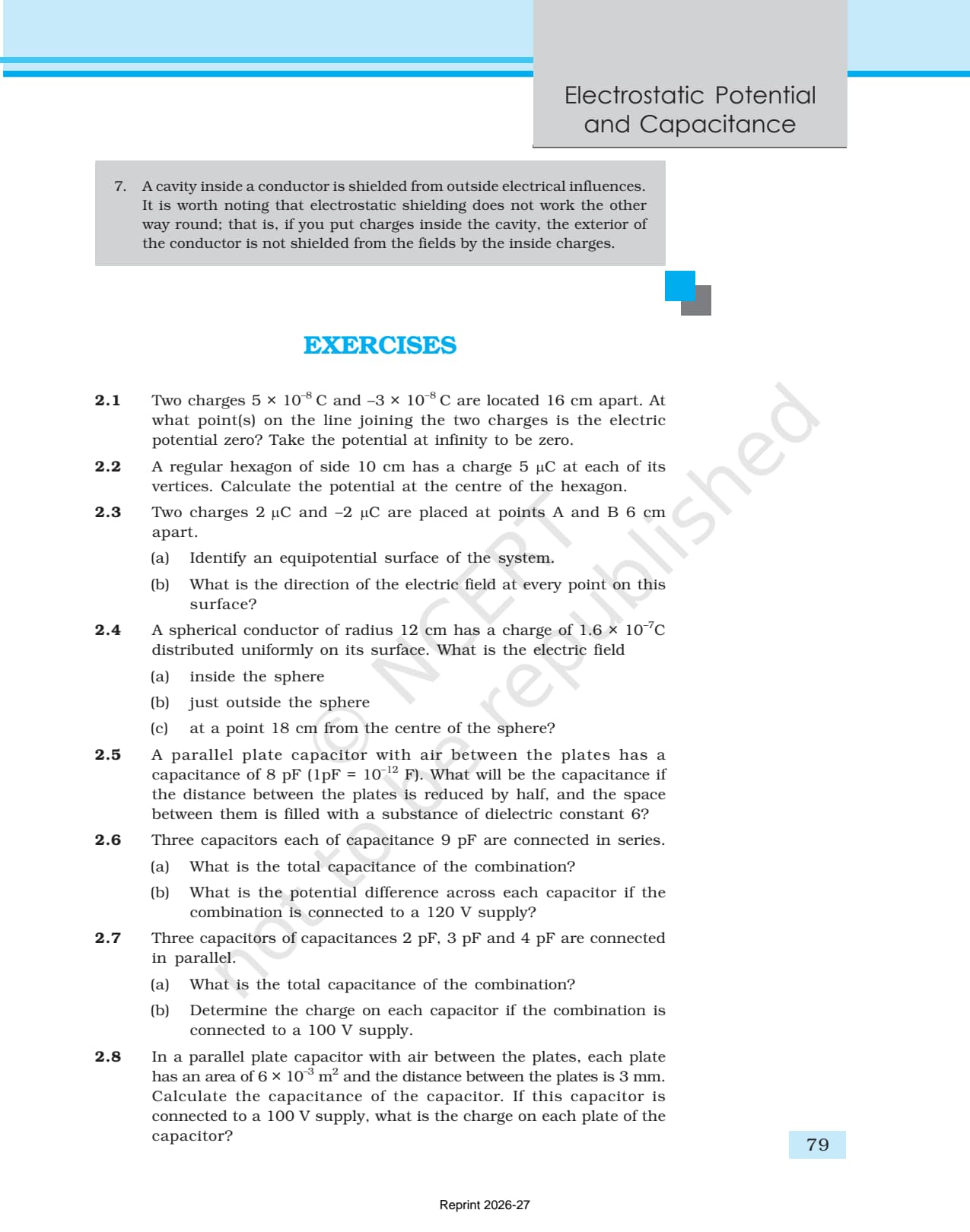
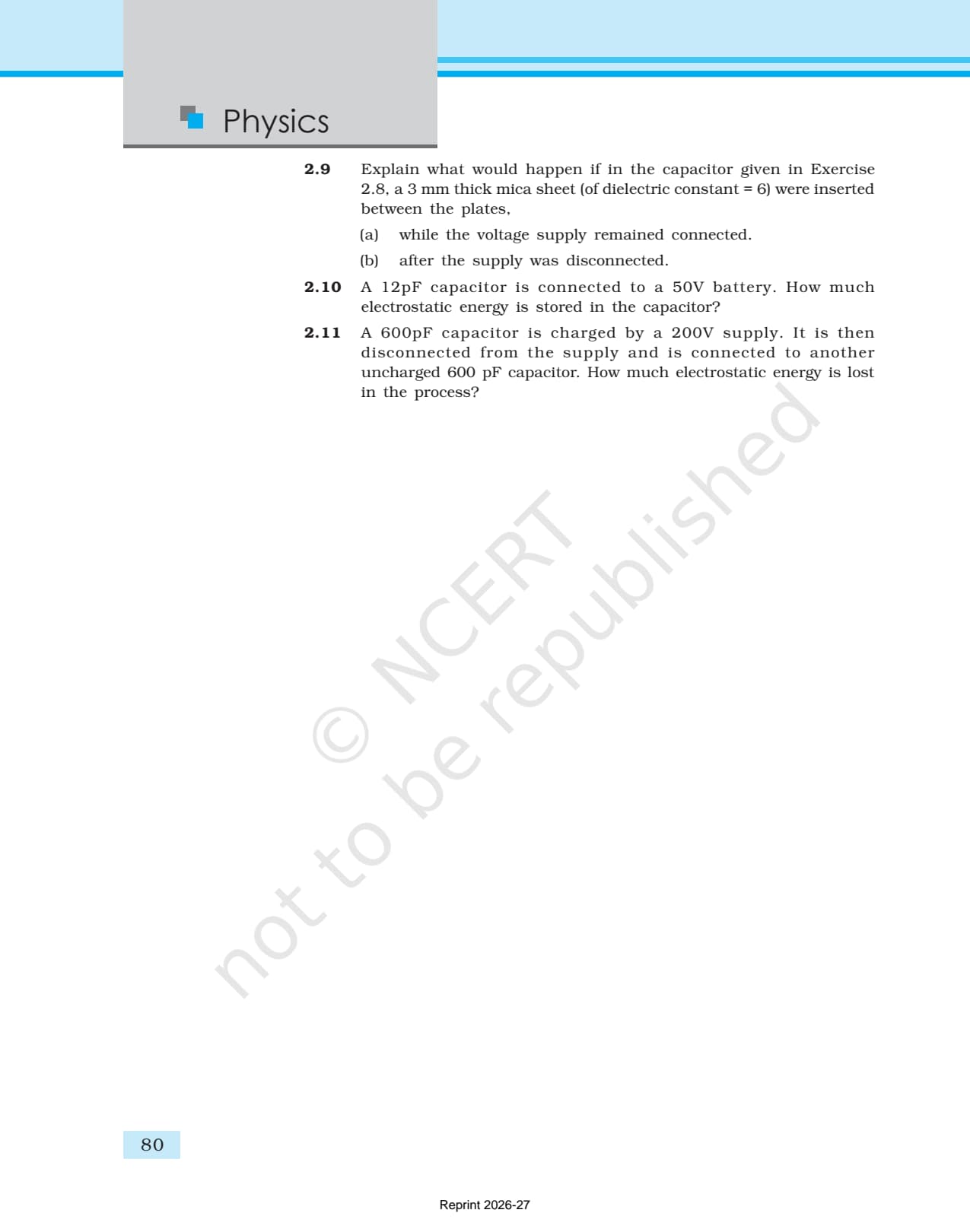
Class 12 Physics Chapter 2 covers Electrostatic Potential and Capacitance. It builds the scalar framework of electrostatics using potential, capacitance, and energy concepts. This page hosts the free 2026-27 NCERT PDF - scroll through the flipbook below or download it directly.


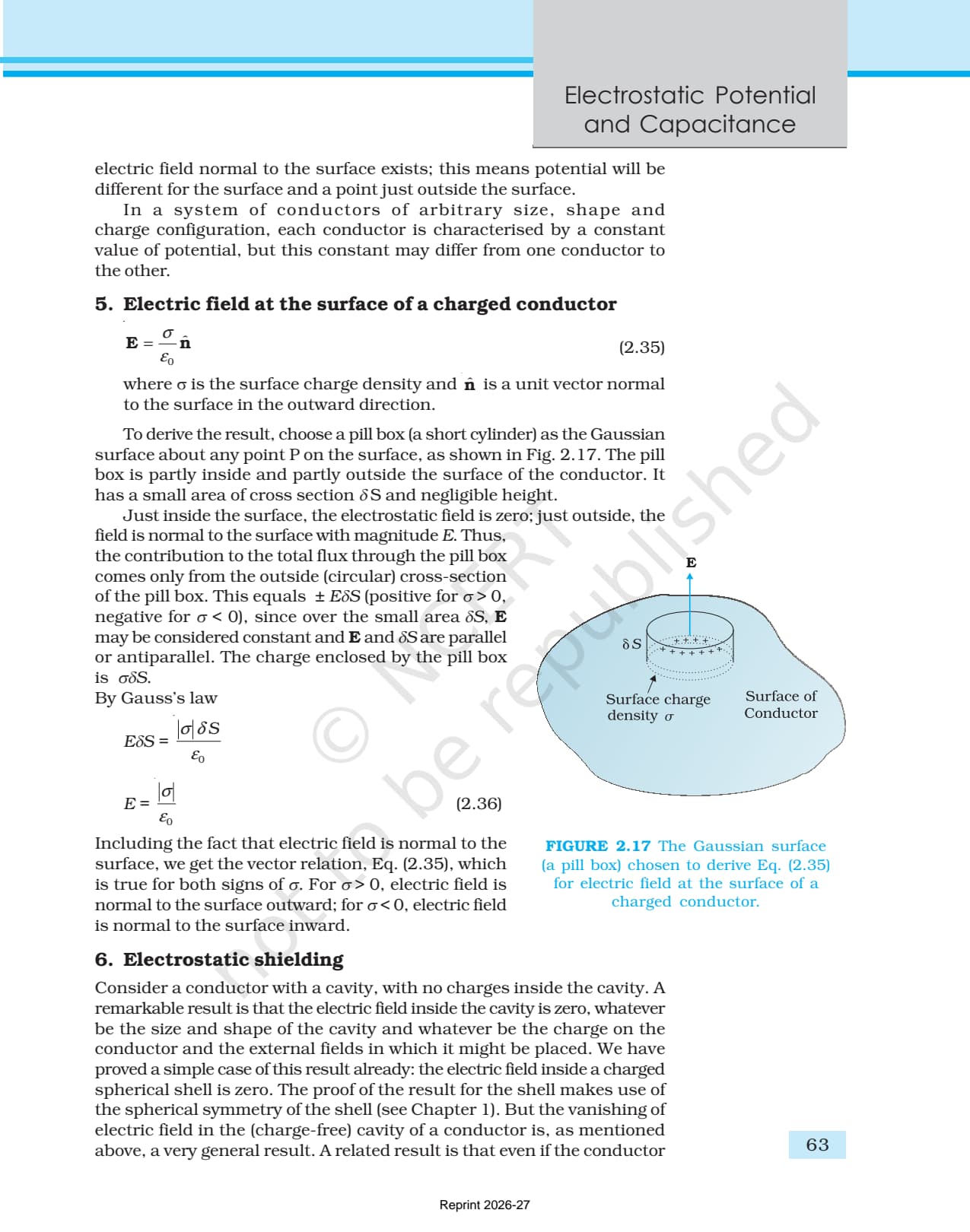
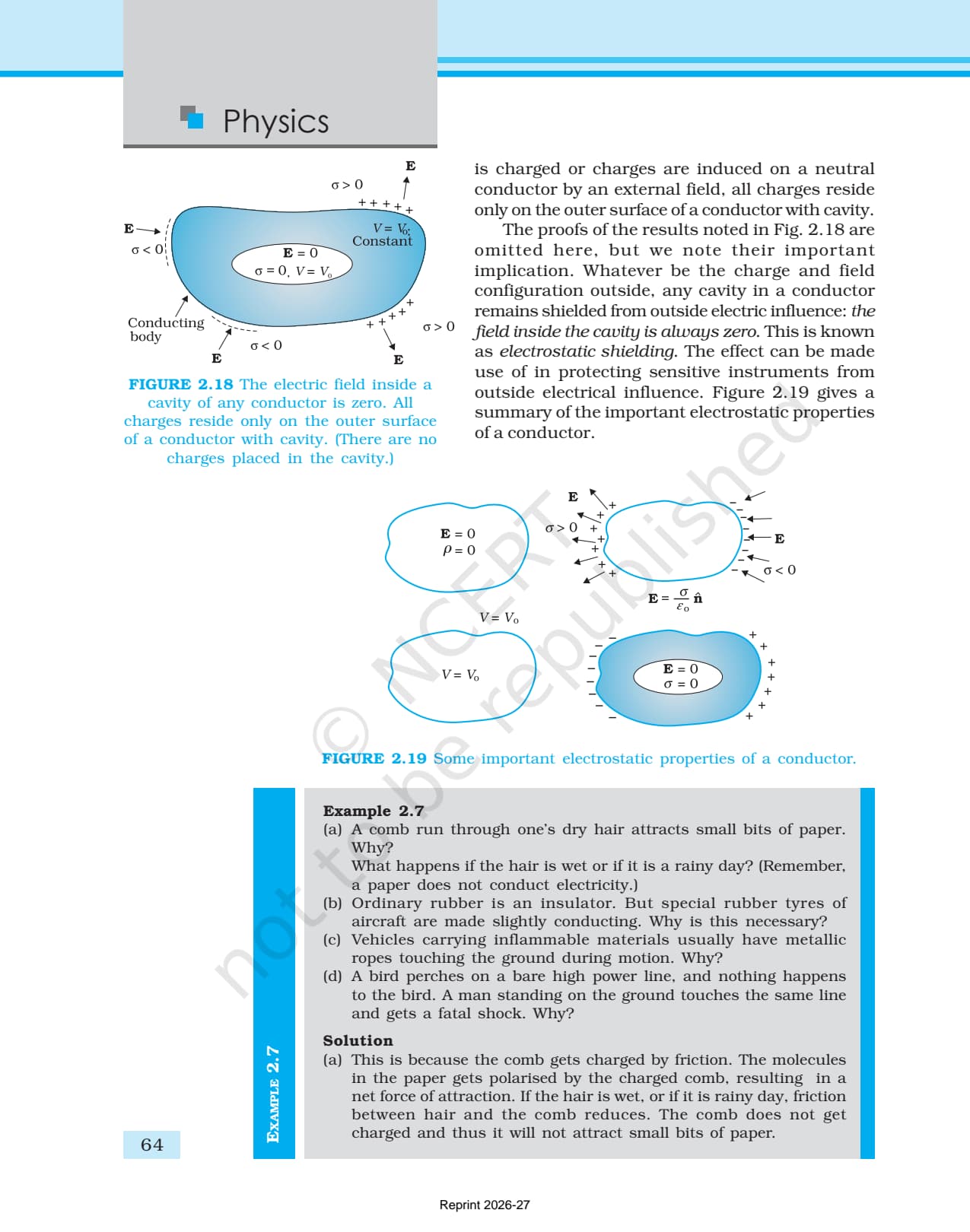
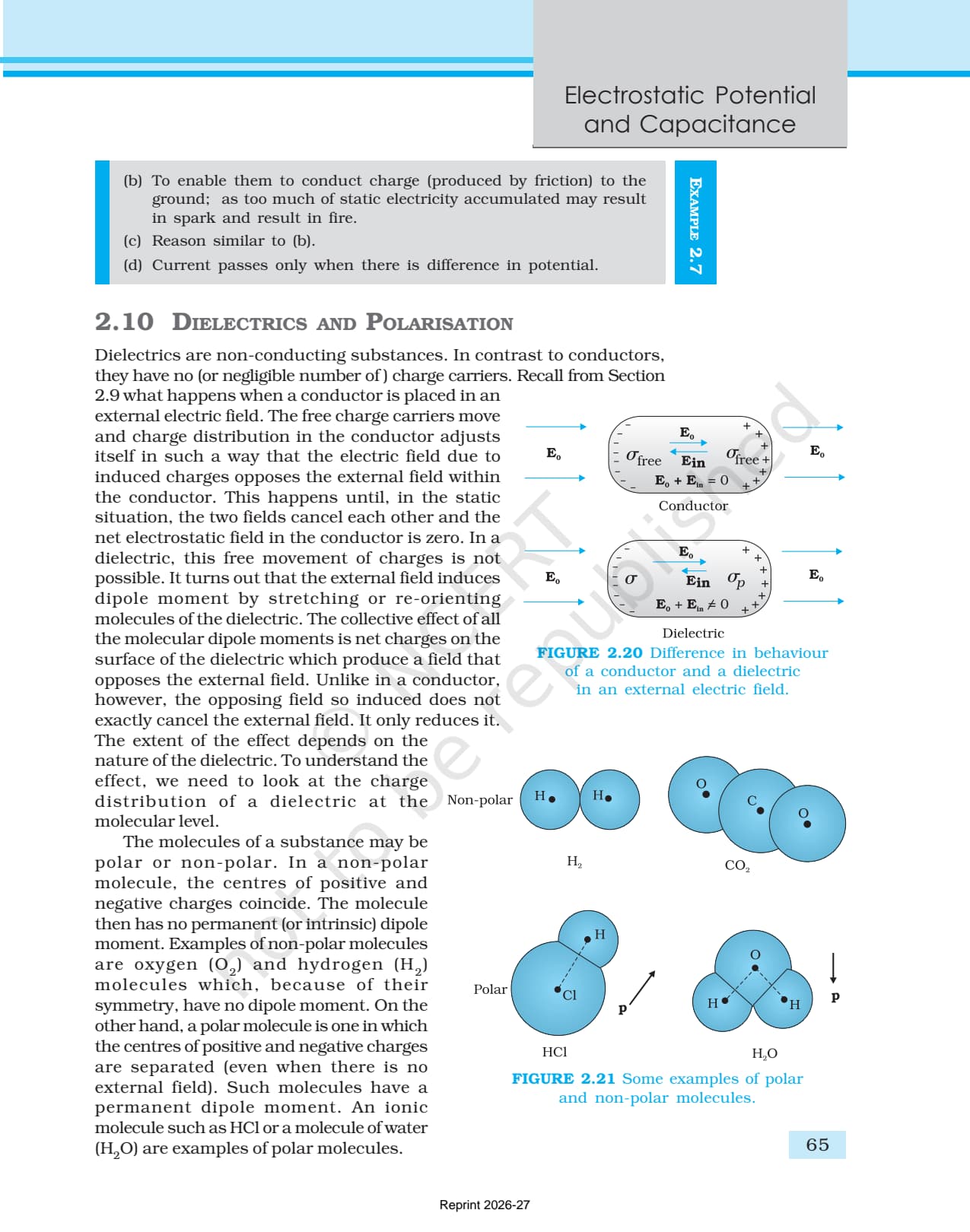
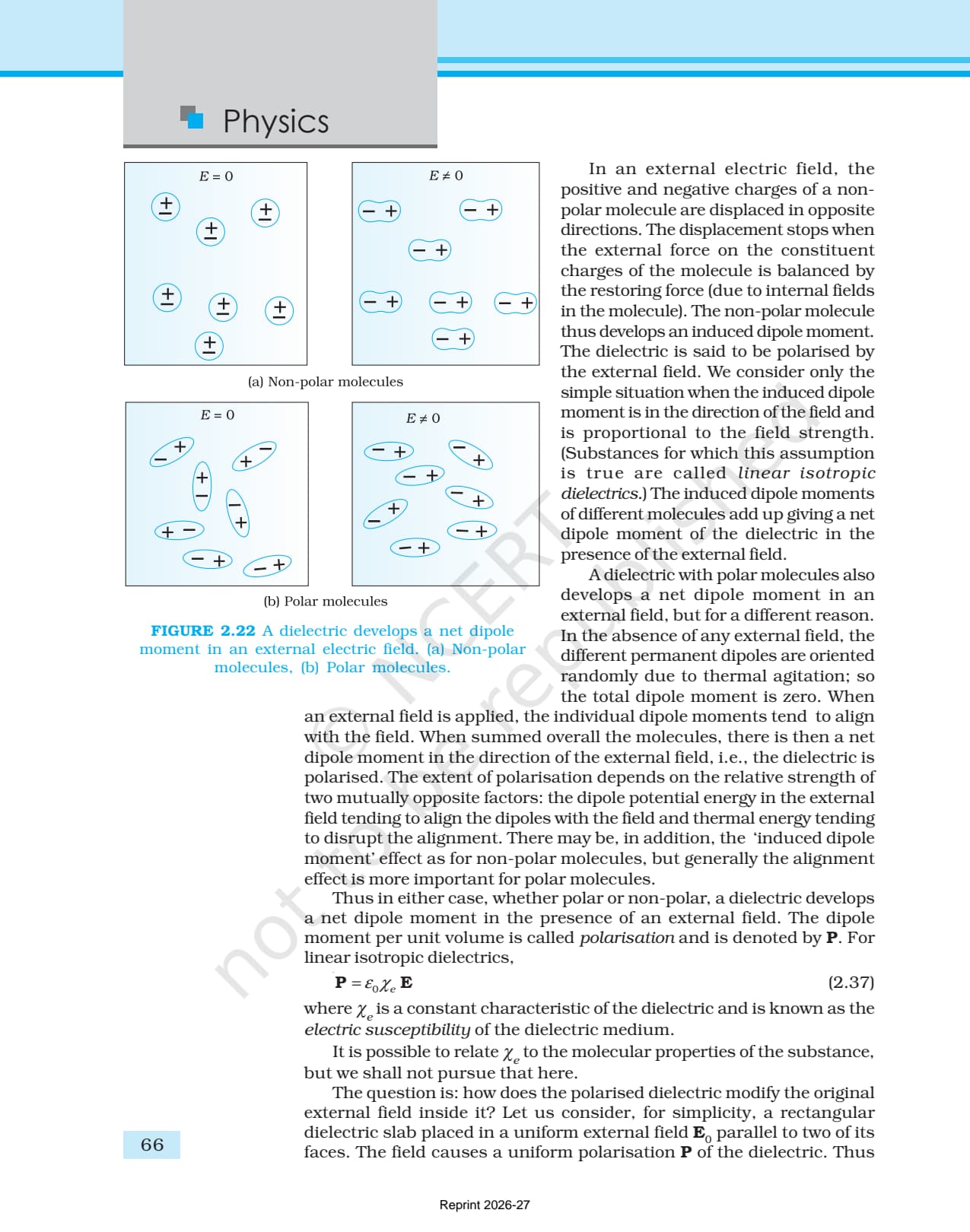
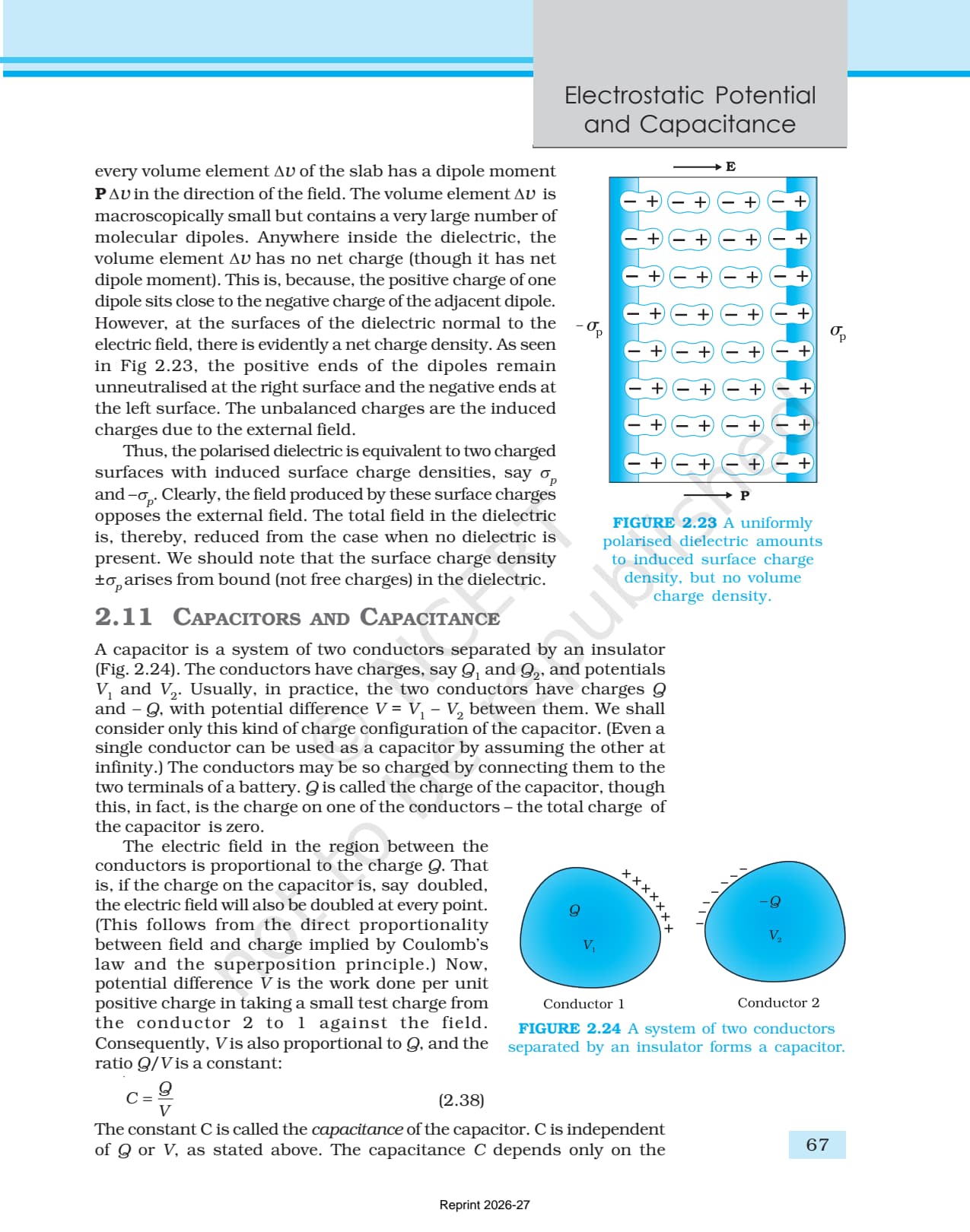
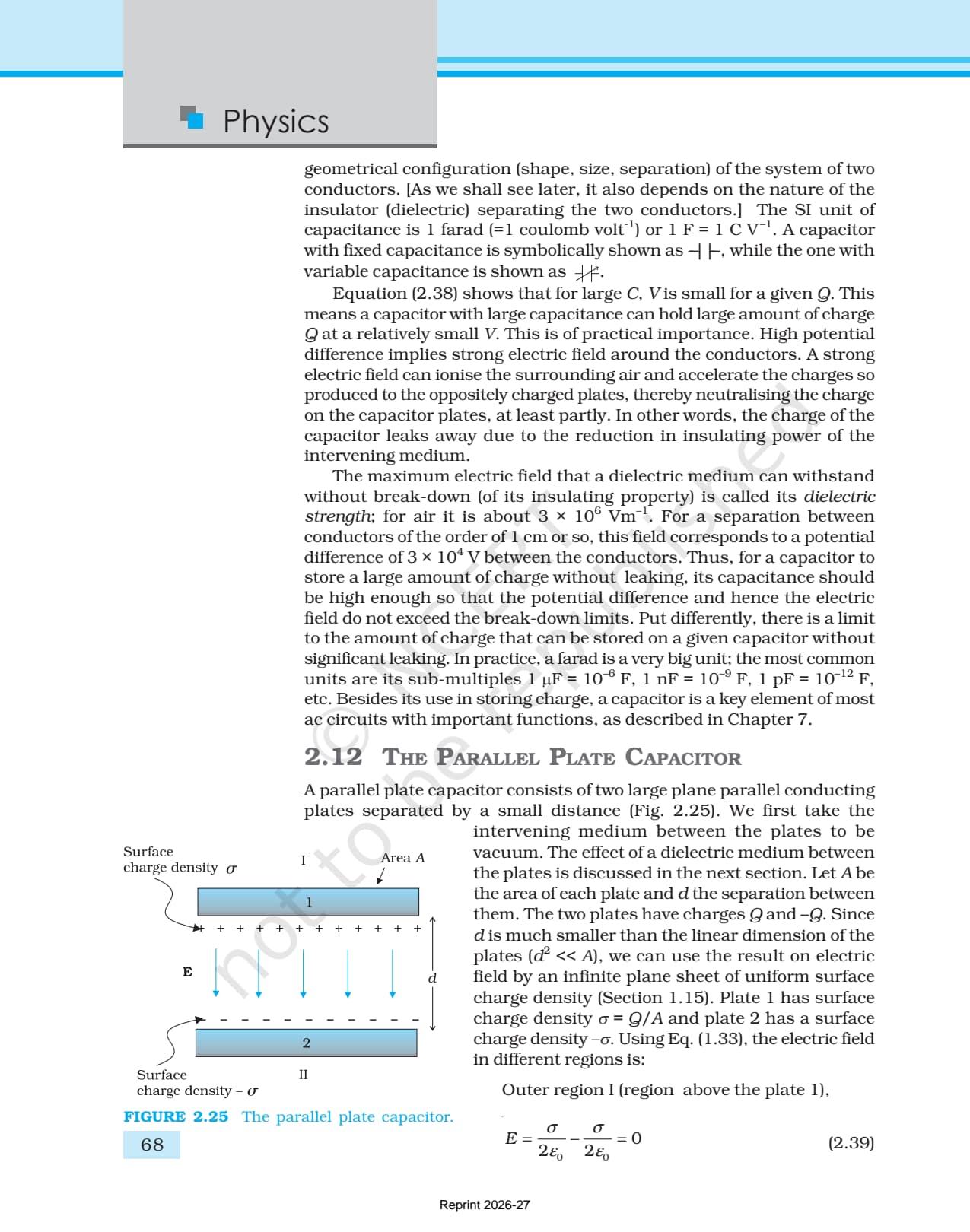
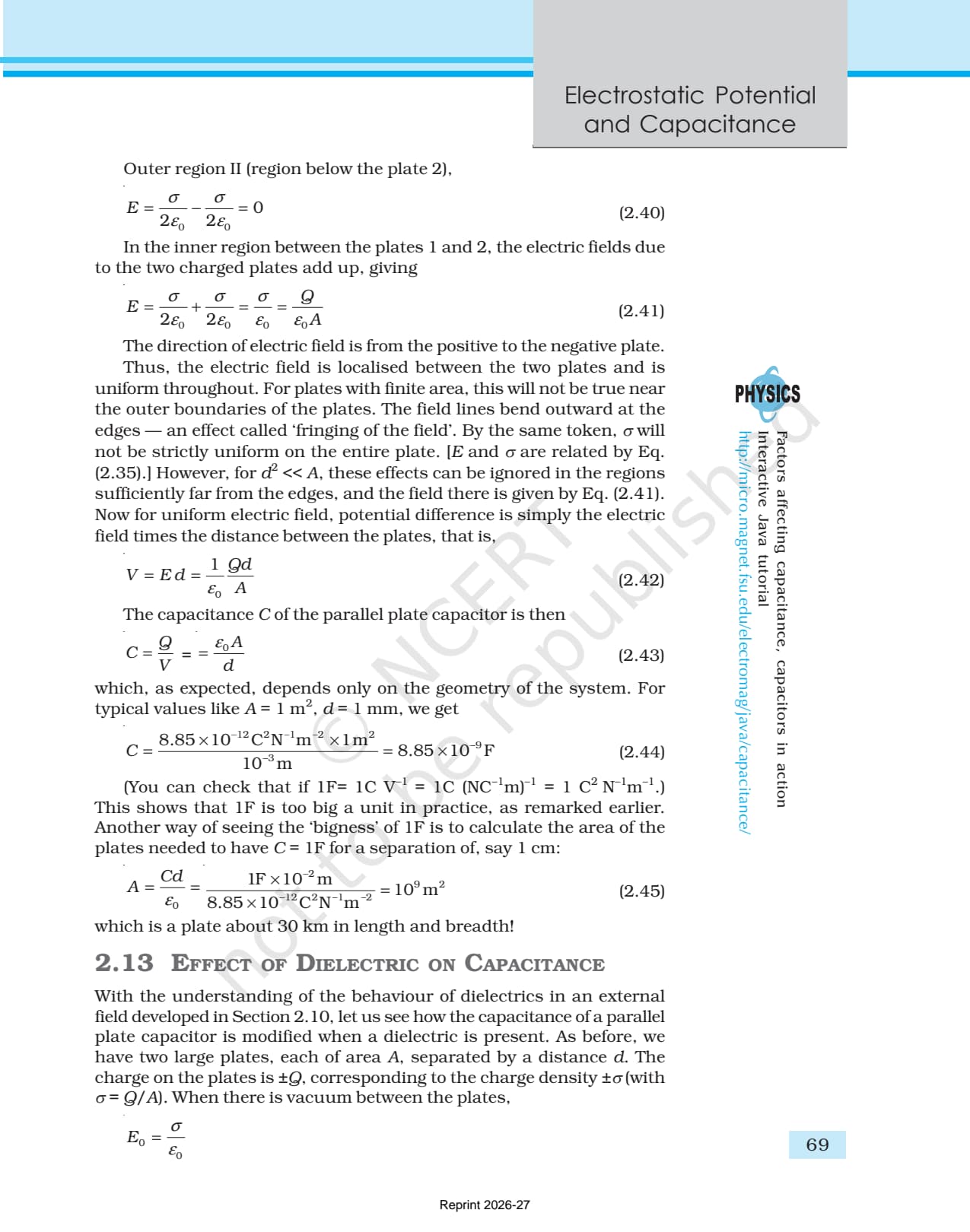
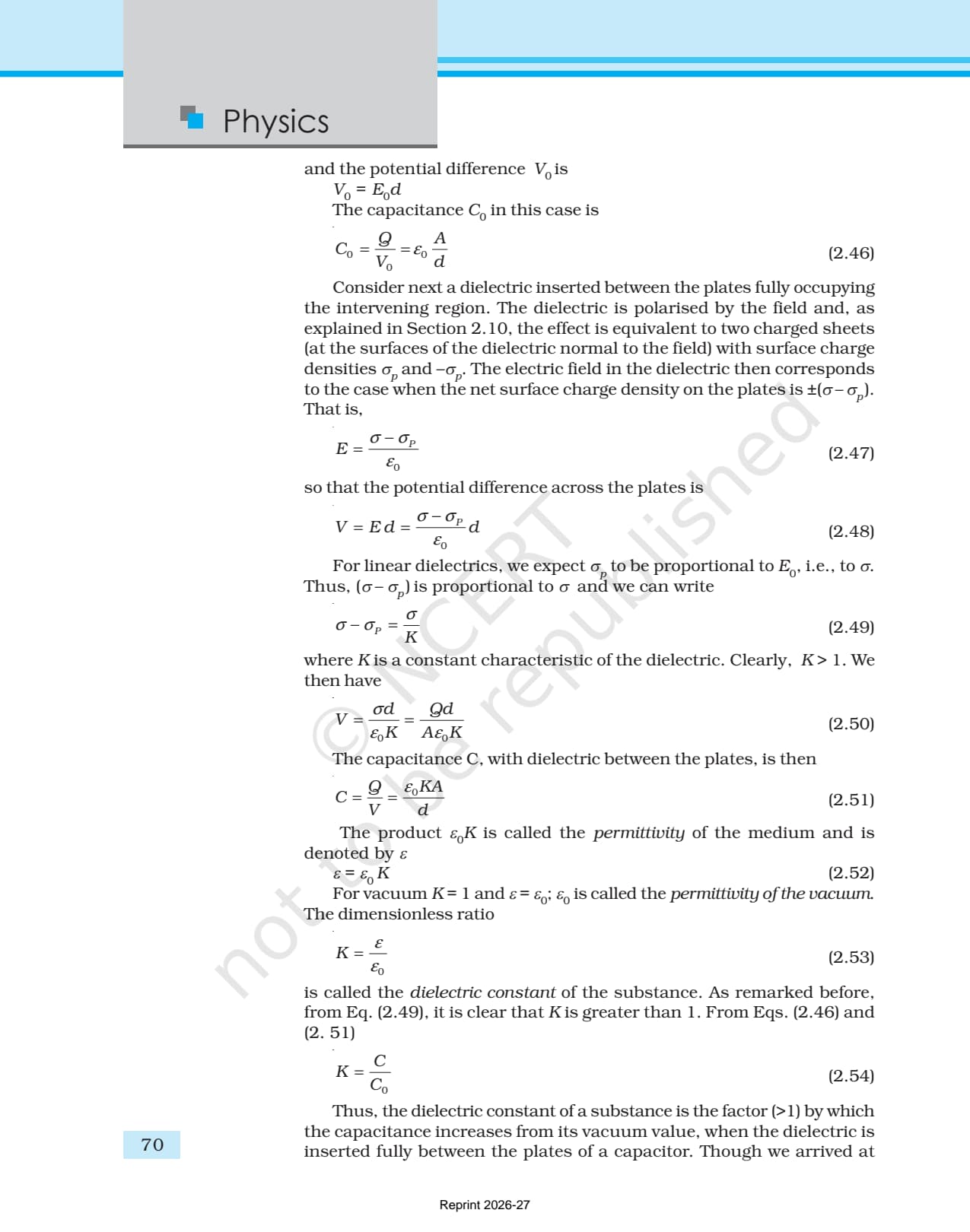
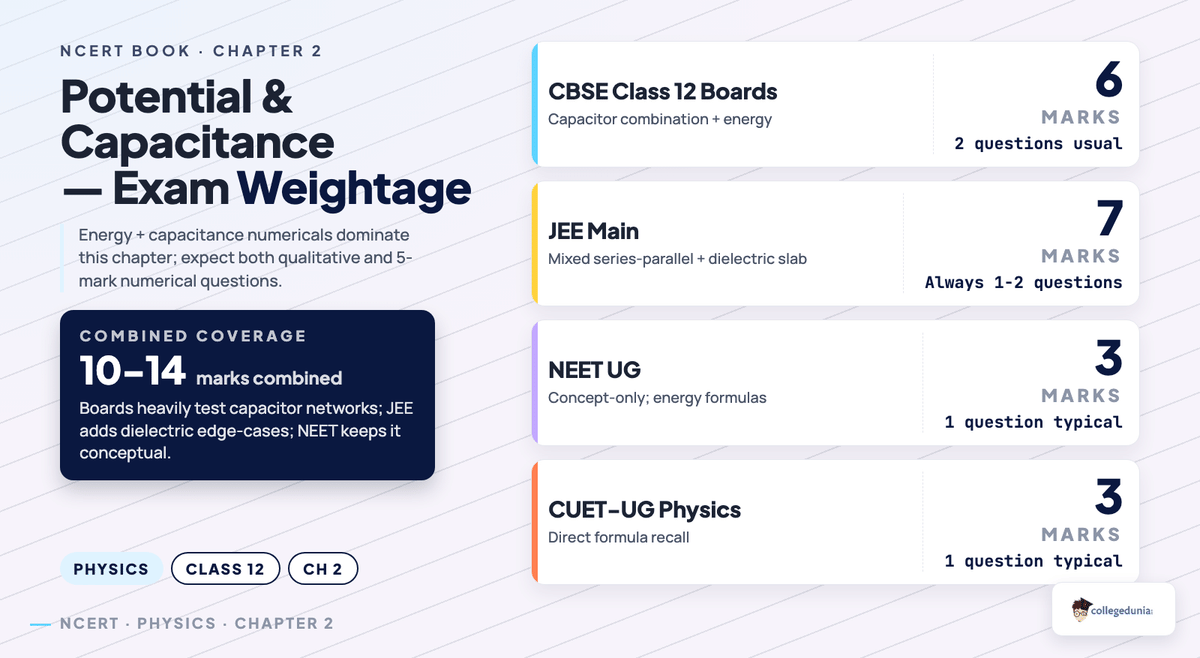
- CBSE Class 12 Weightage: 6-8 marks (Electrostatics unit, 17 marks combined with Chapter 1)
- JEE Main Weightage: 3-4% (1-2 questions per shift)
- NEET Weightage: 1-2 questions per year
Why Electrostatic Potential and Capacitance Matters for CBSE, JEE, and NEET
Chapter 2 is the second half of the Electrostatics unit. Combined with Chapter 1, it claims a 17-mark slice of the 70-mark Class 12 Physics paper. The scalar approach - using potential V instead of vector E - is why CBSE sets long derivation questions from this chapter almost every year. Three question patterns repeat across CBSE, JEE Main, and NEET papers from 2025 backwards:
- Equivalent capacitance and charge on a network: CBSE 2025 (5-mark), JEE Main 2025, NEET 2024.
- Dipole potential and field (axial or equatorial): CBSE almost every year 2022-2025, usually a 3-mark question.
- Energy stored and energy lost in capacitor sharing: CBSE 2-3 marks (2022, 2023, 2025) and basis of several JEE numericals.
Together these three patterns account for around 70% of Chapter 2 marks in CBSE Boards over five years.
Electrostatic Potential and Capacitance NCERT Book: Section-by-Section Breakdown
The chapter has 15 numbered sections over 36 pages (pp. 45 to 80 of the printed textbook). Use this table as a reading checklist. Sections 2.11 to 2.15 alone account for over 50% of this chapter's CBSE marks.
| Section | Title | Approx. Page Range | Core Idea |
|---|---|---|---|
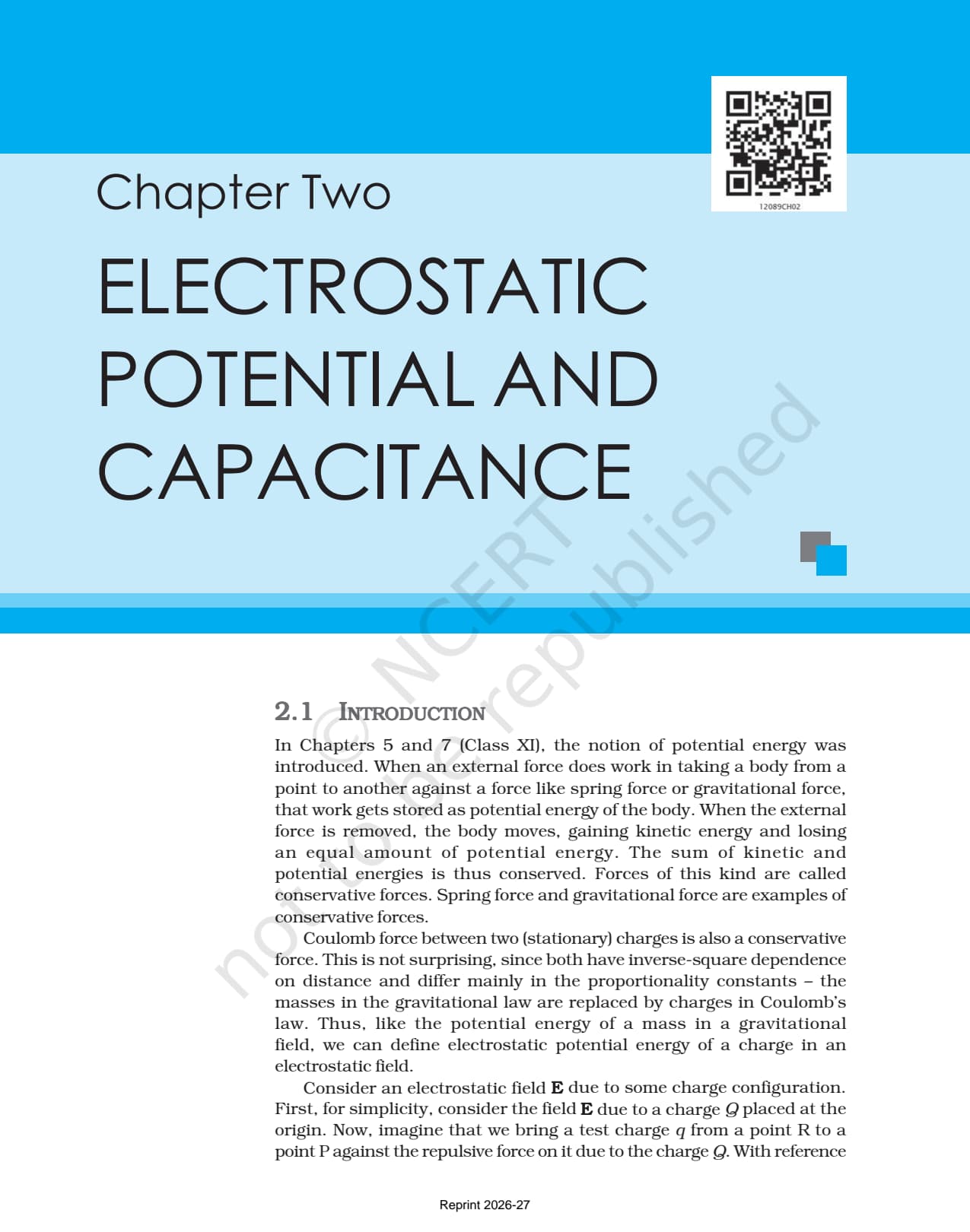
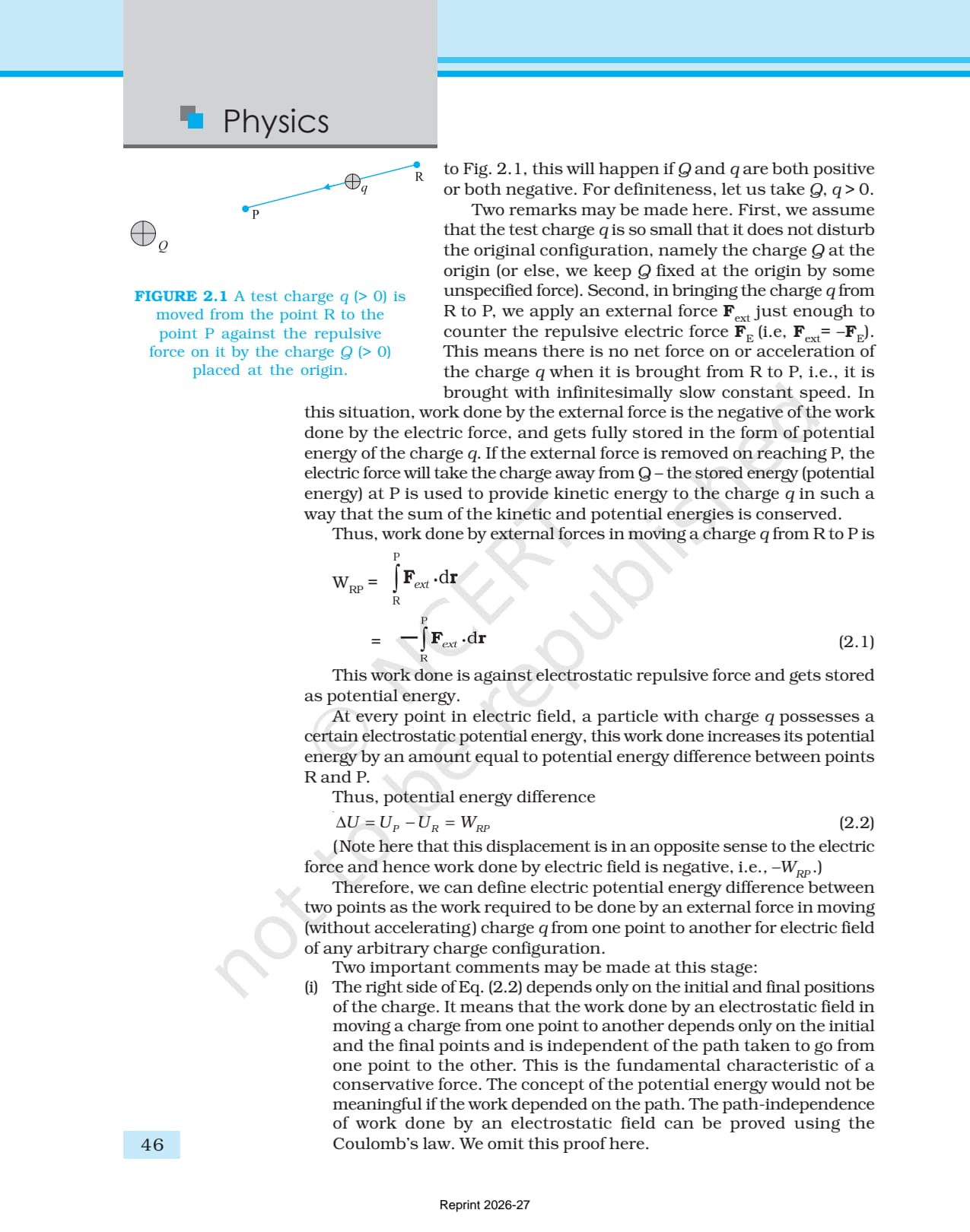
| 2.1 | Introduction | 45-47 | PE concept carries over from gravitation |
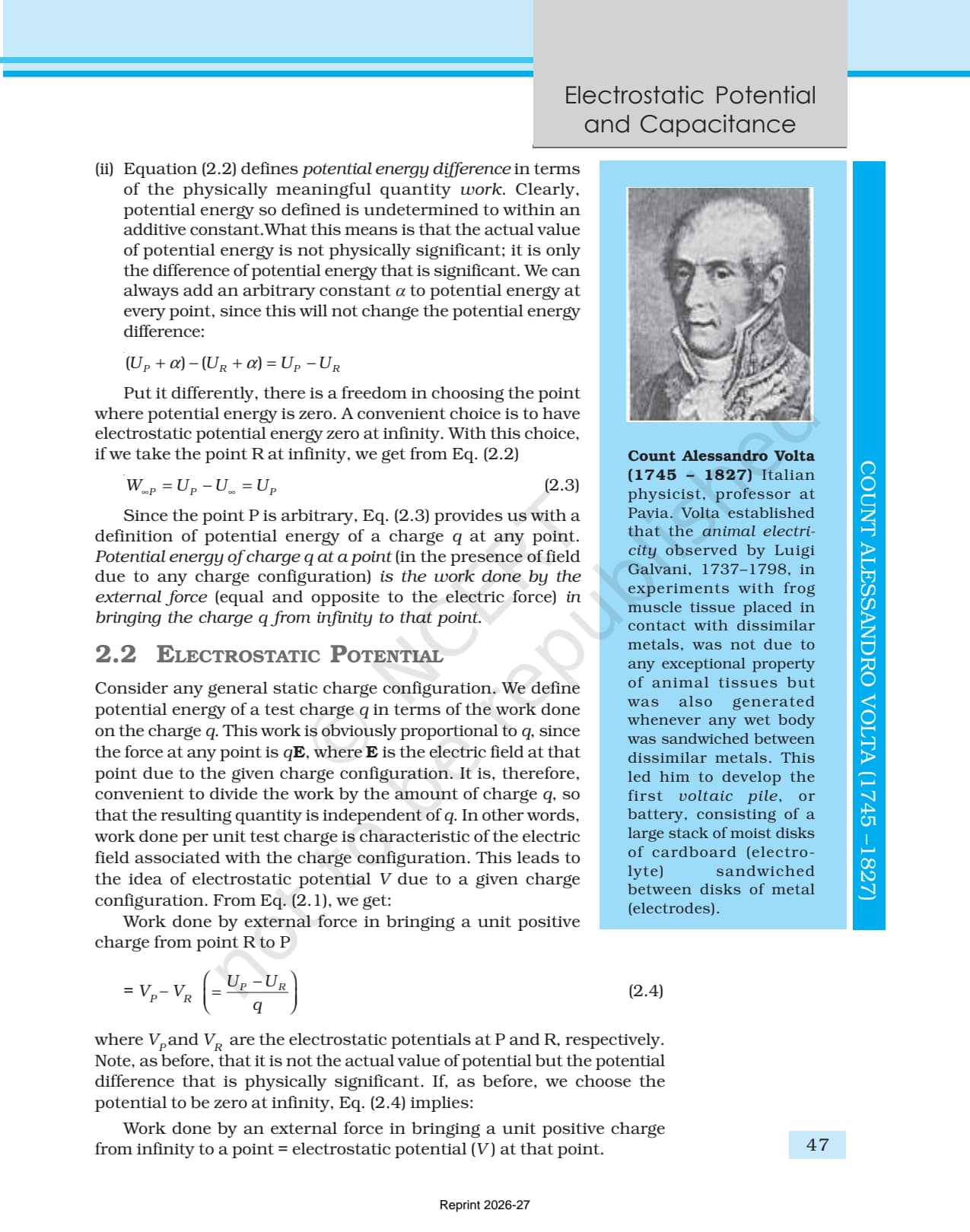
| 2.2 | Electrostatic Potential | 47-48 | V defined as work per unit positive charge |
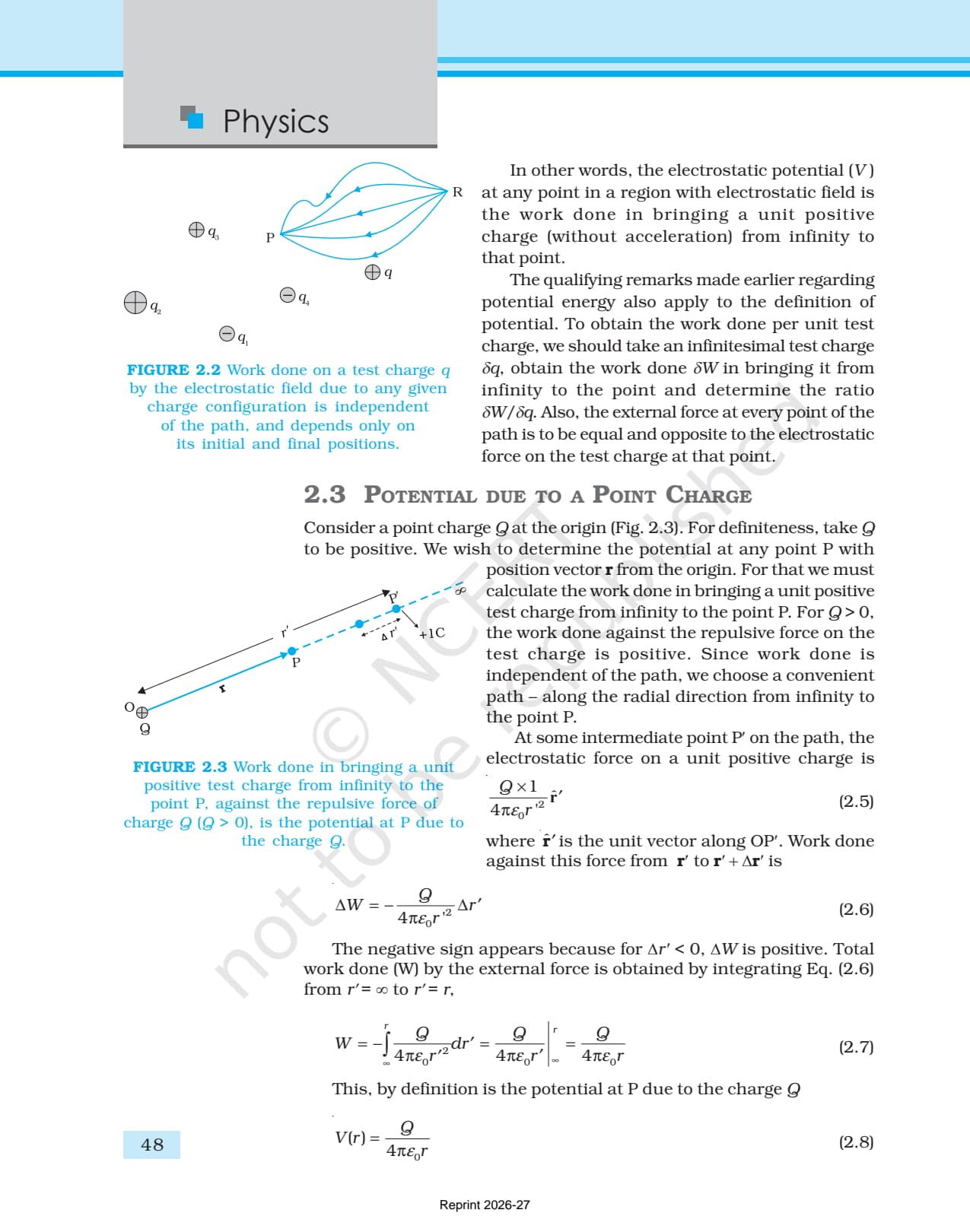
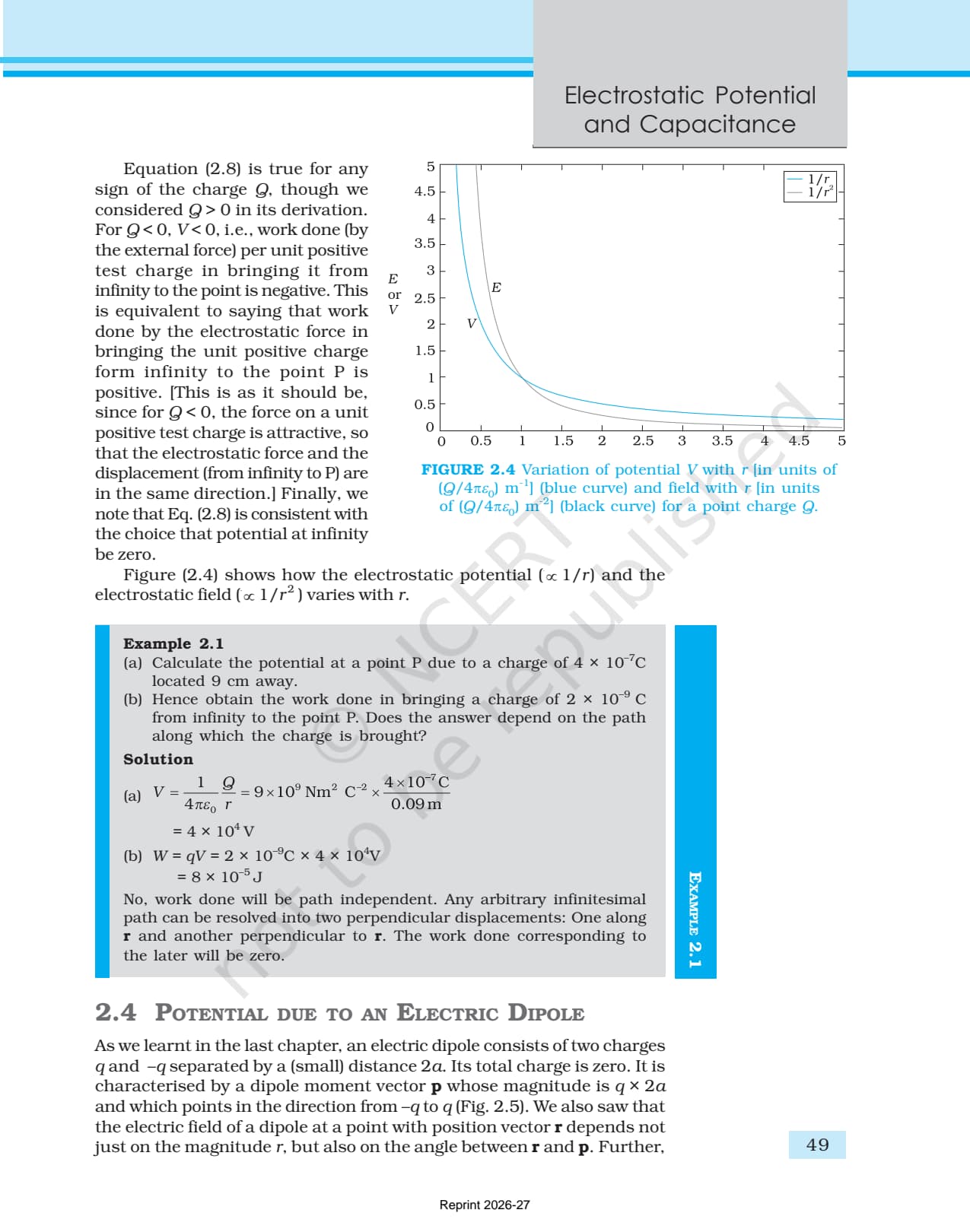
| 2.3 | Potential due to a Point Charge | 48-49 | V = kQ/r derivation |
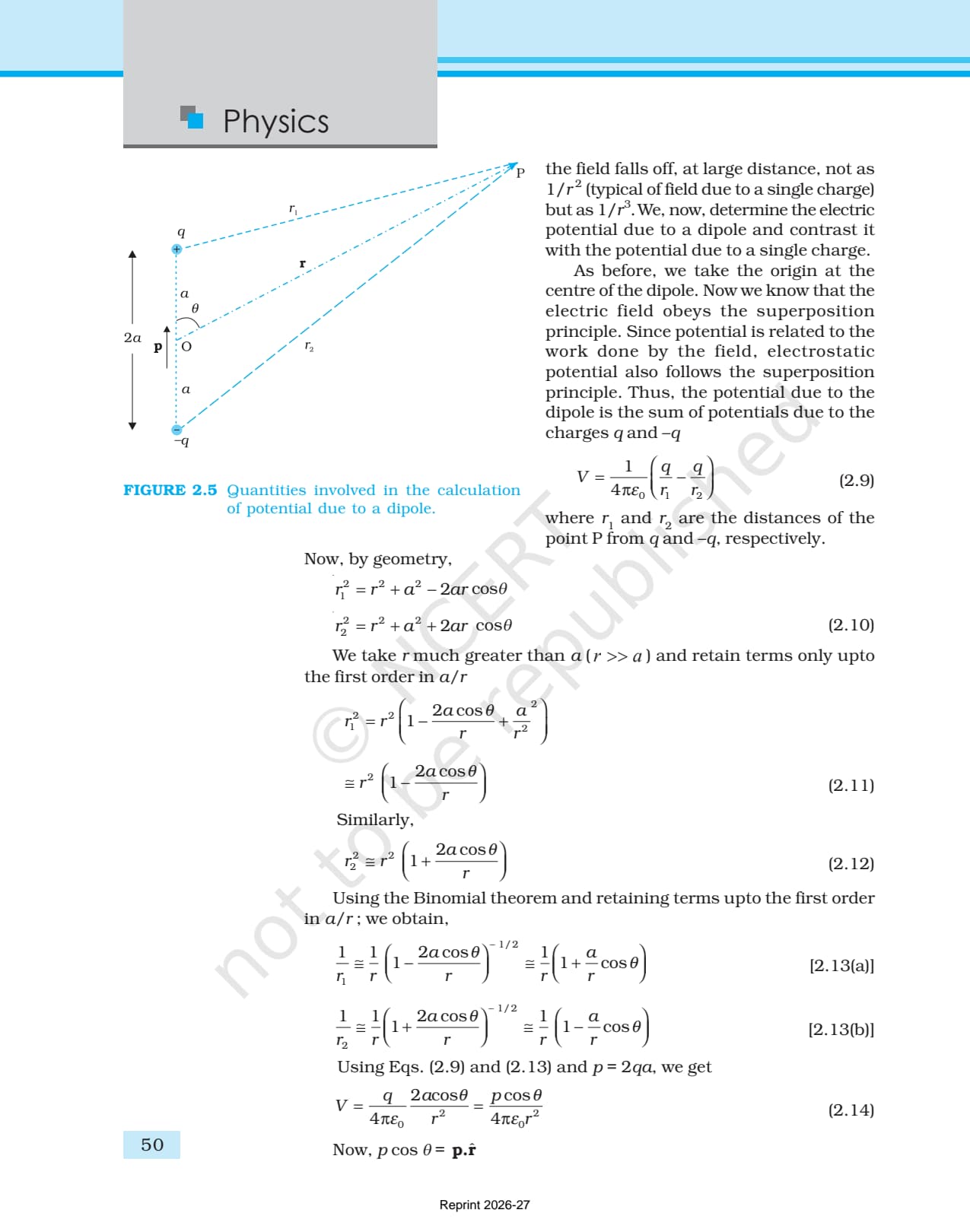
| 2.4 | Potential due to an Electric Dipole | 49-51 | Axial, equatorial, general-angle expressions |
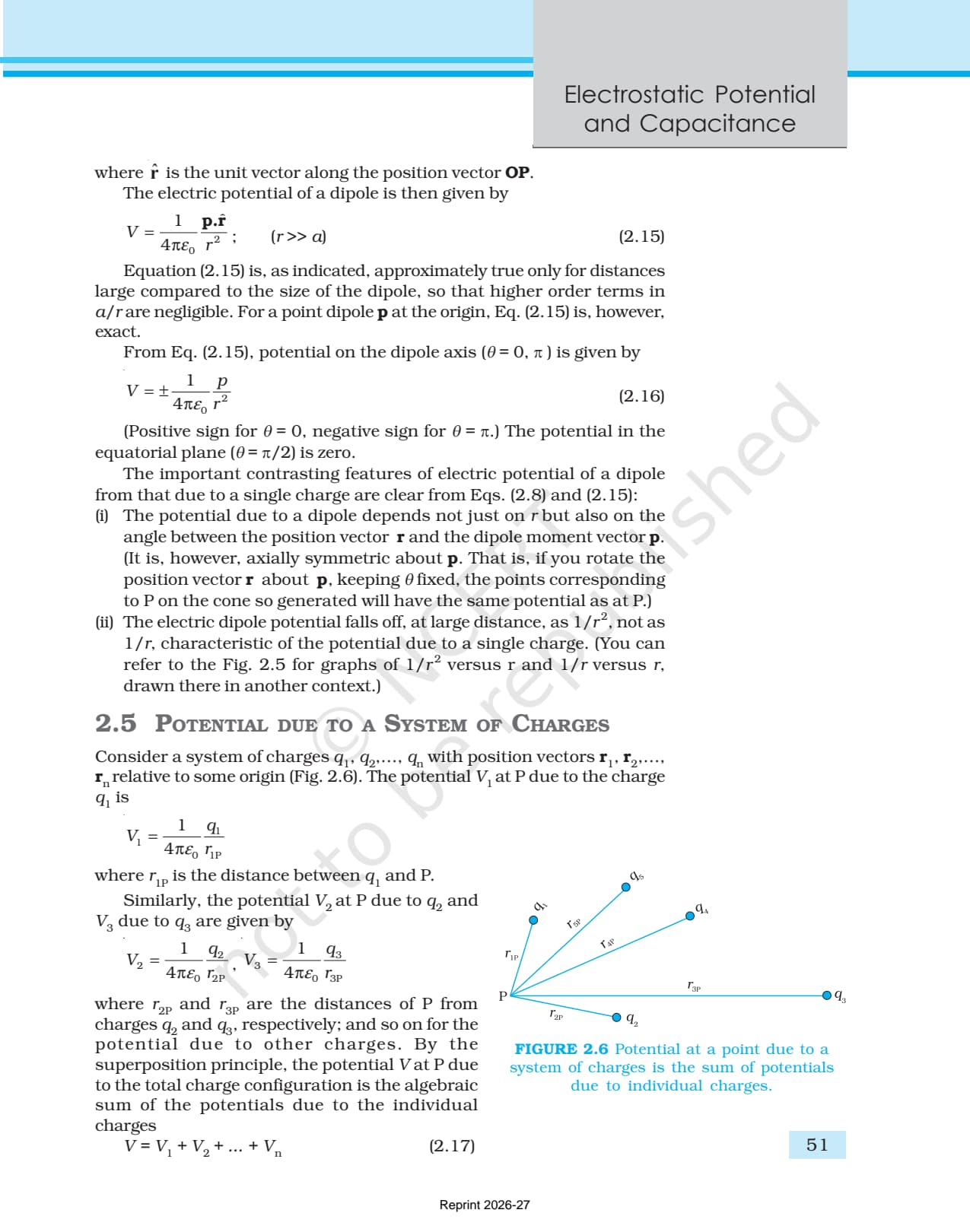
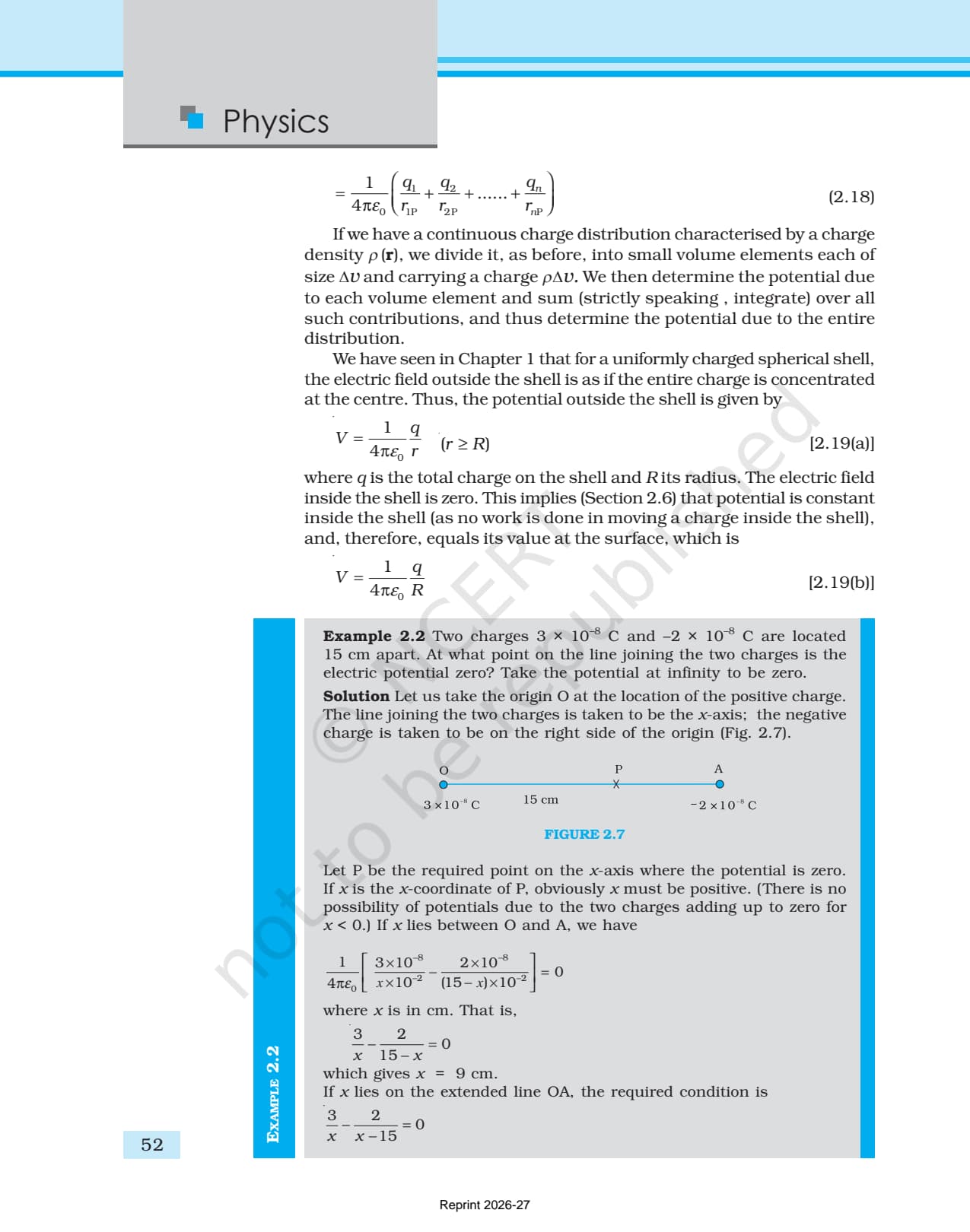
| 2.5 | Potential due to a System of Charges | 51-53 | Superposition for V |
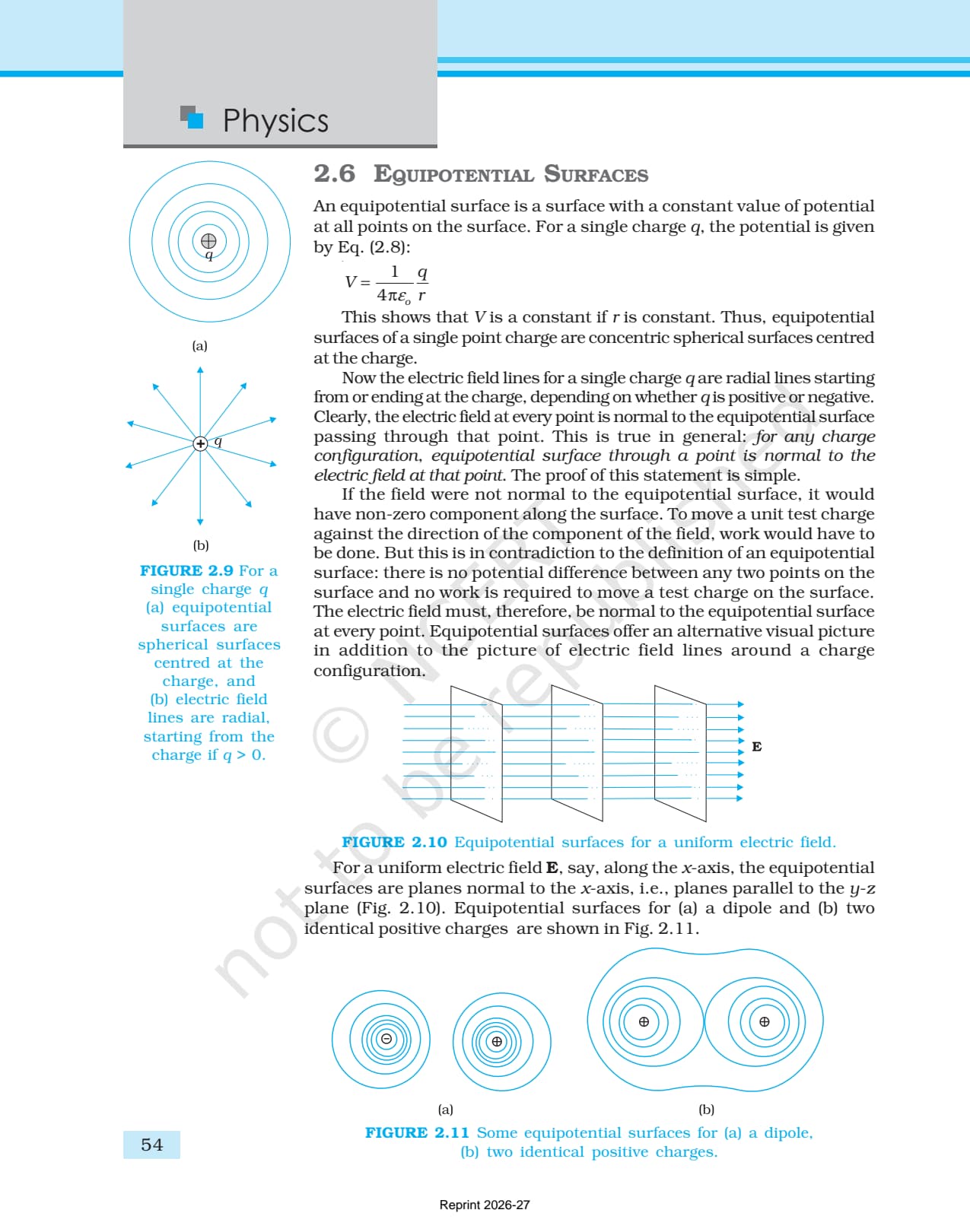
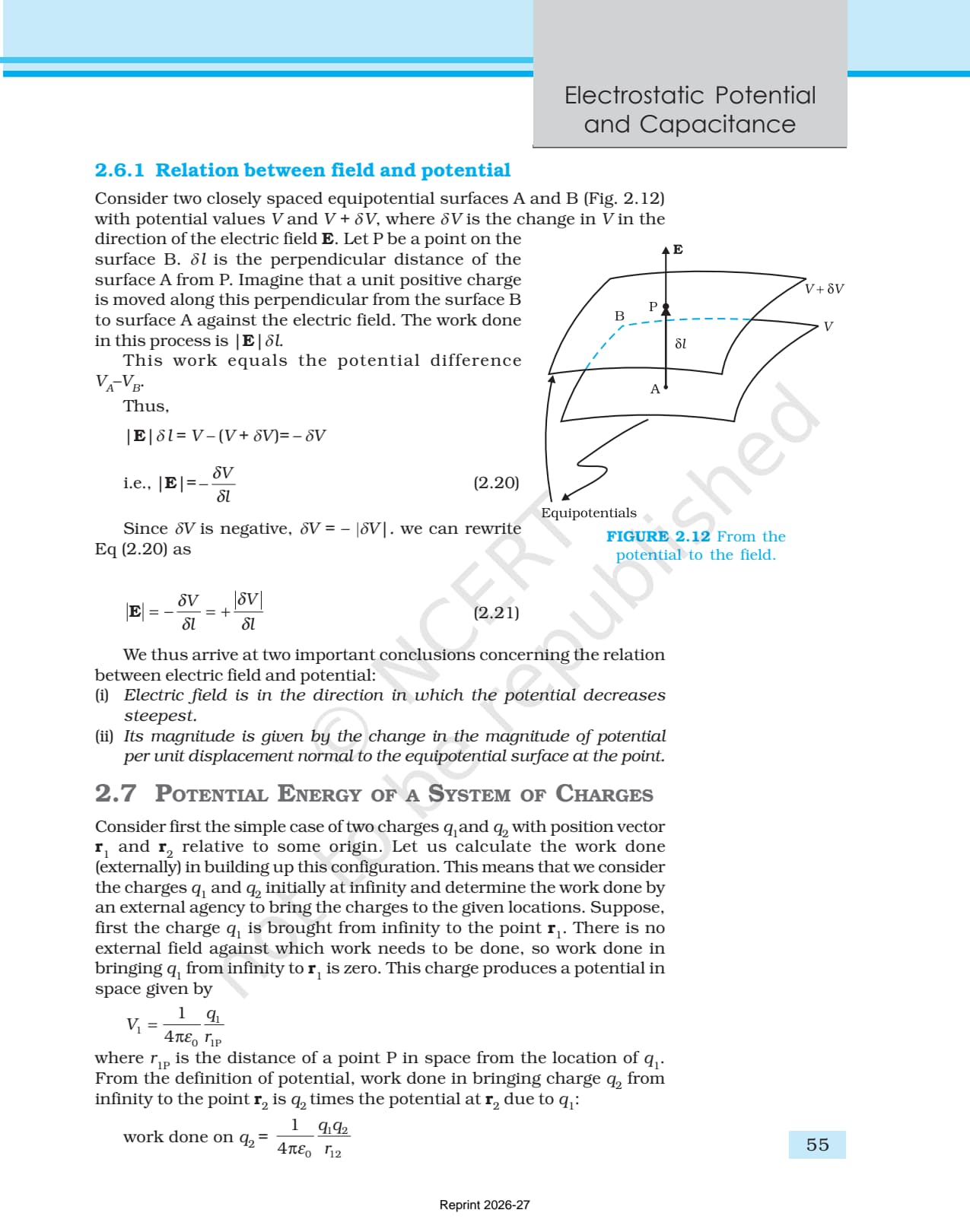
| 2.6 | Equipotential Surfaces | 53-55 | Shape for point, dipole, uniform field; E perpendicular to V |
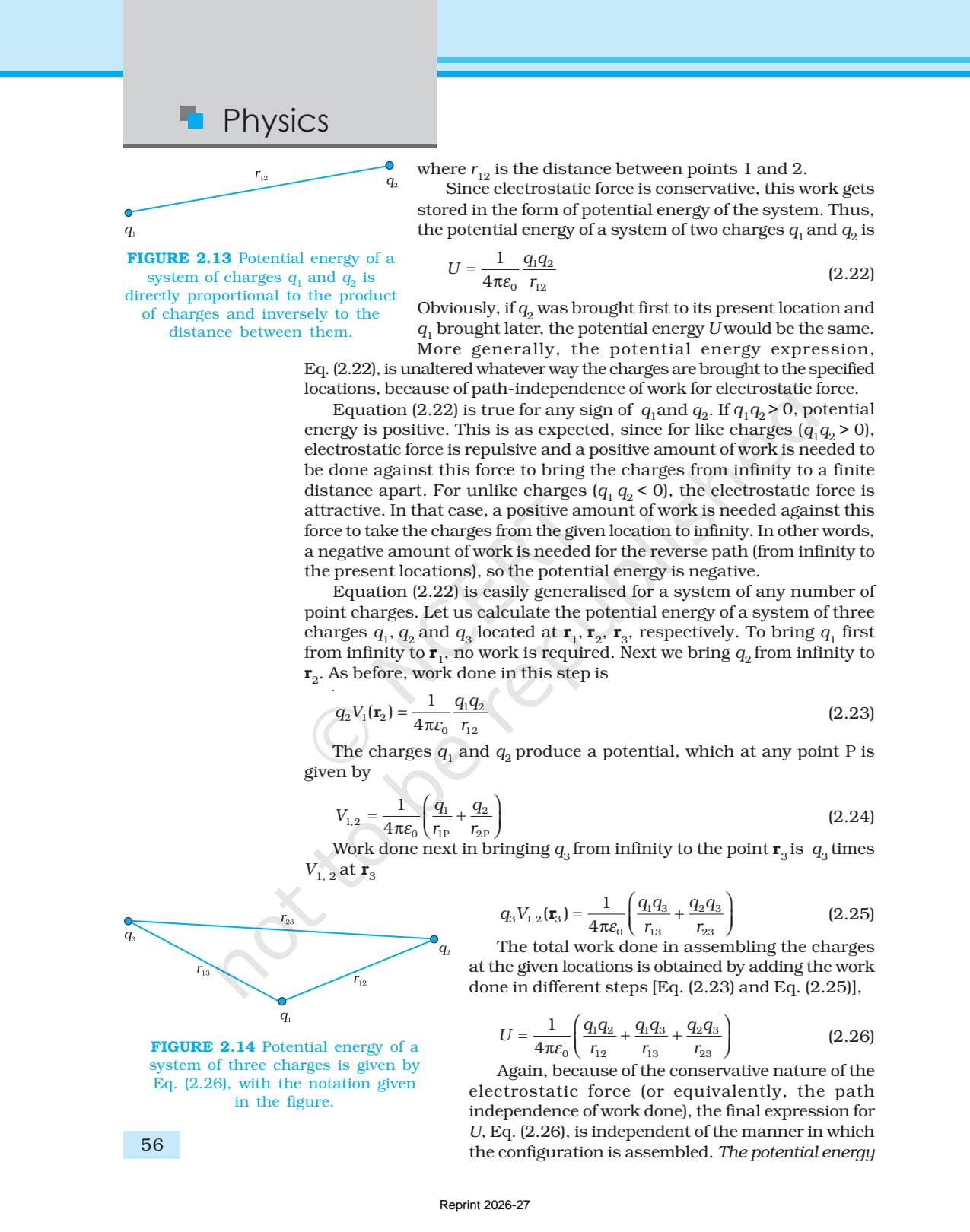
| 2.7 | Potential Energy of a System of Charges | 55-57 | PE of two- and three-charge configurations |
| 2.8 | Potential Energy in an External Field | 57-60 | Single charge, two-charge, dipole PE = -p·E |
| 2.9 | Electrostatics of Conductors | 60-63 | Six properties of conductors in equilibrium |
| 2.10 | Dielectrics and Polarisation | 63-66 | Polar vs non-polar, polarisation vector P |
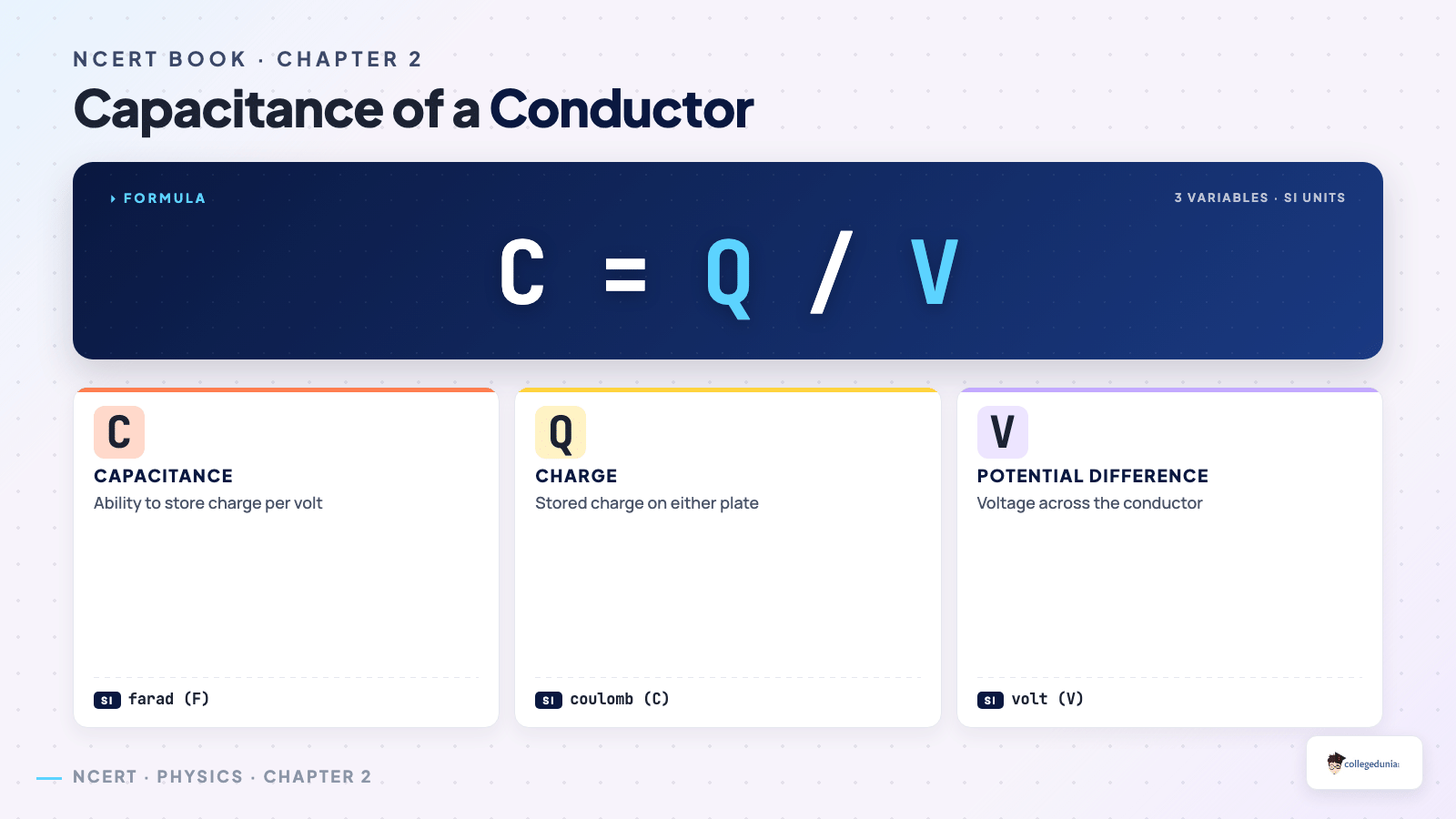
| 2.11 | Capacitors and Capacitance | 66-67 | C = Q/V, units, dielectric strength |
| 2.12 | The Parallel Plate Capacitor | 67-69 | C0 = ε0A/d full derivation |
| 2.13 | Effect of Dielectric on Capacitance | 69-71 | C = Kε0A/d, dielectric constant K |
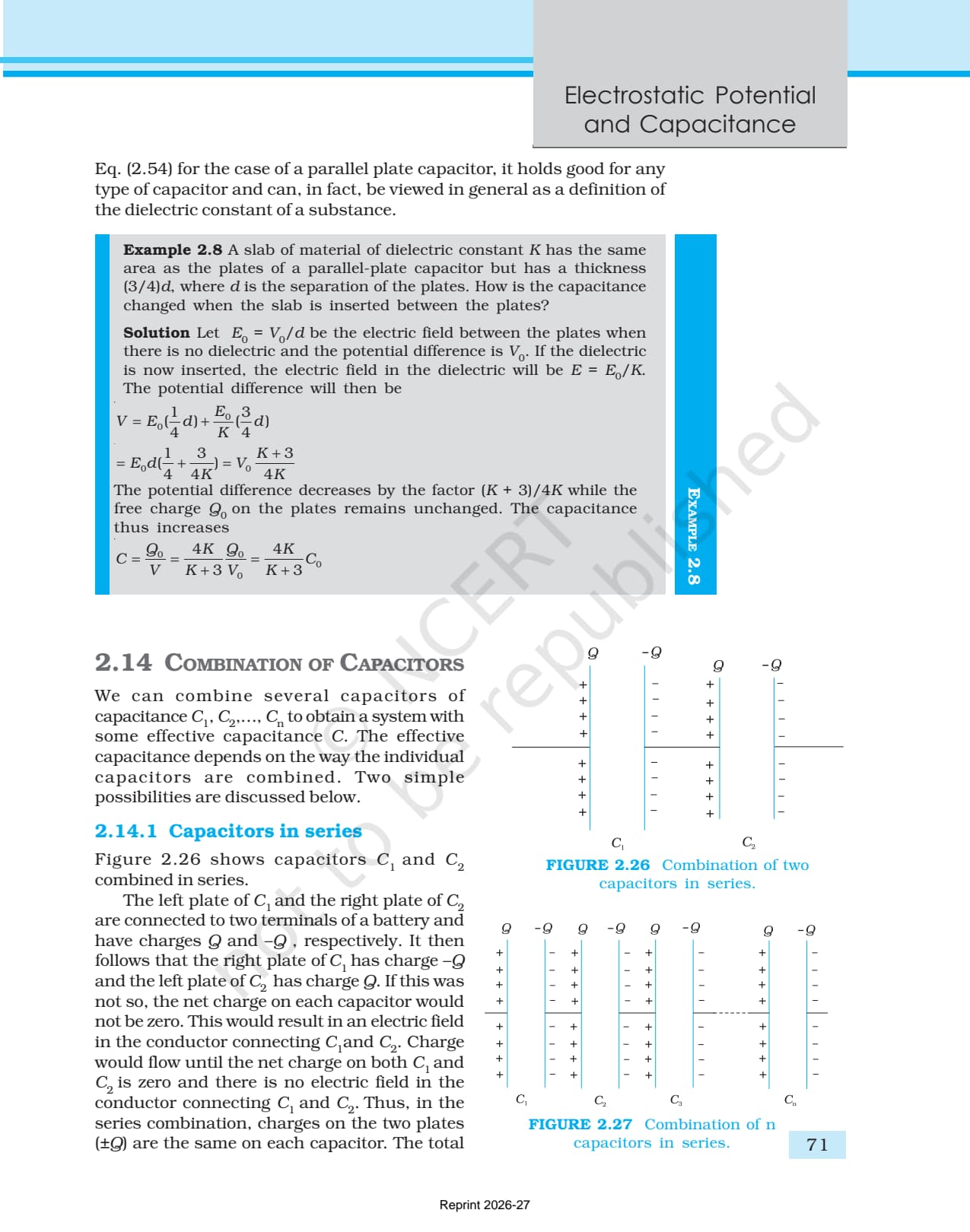
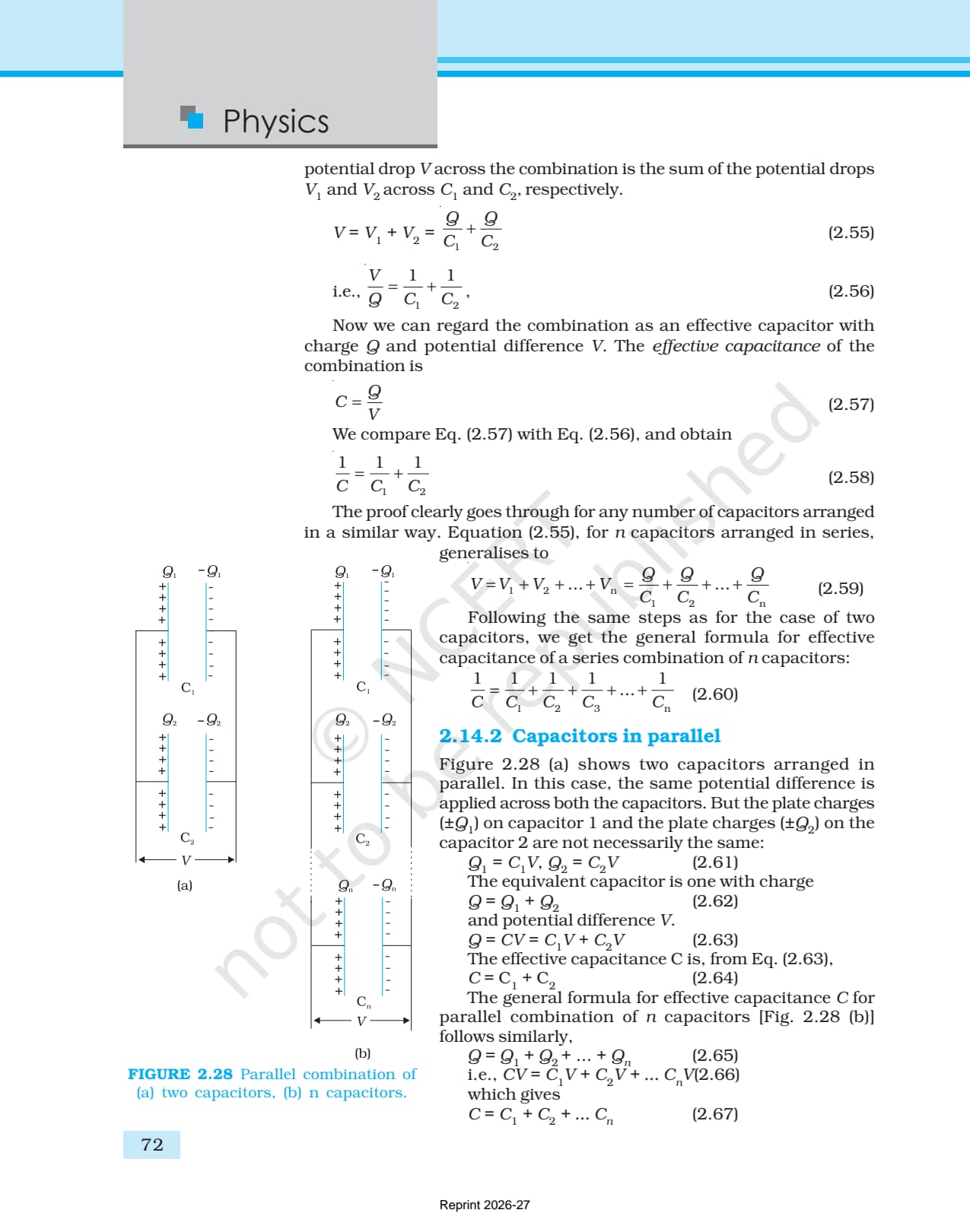
| 2.14 | Combination of Capacitors | 71-74 | Series and parallel combination formulas |
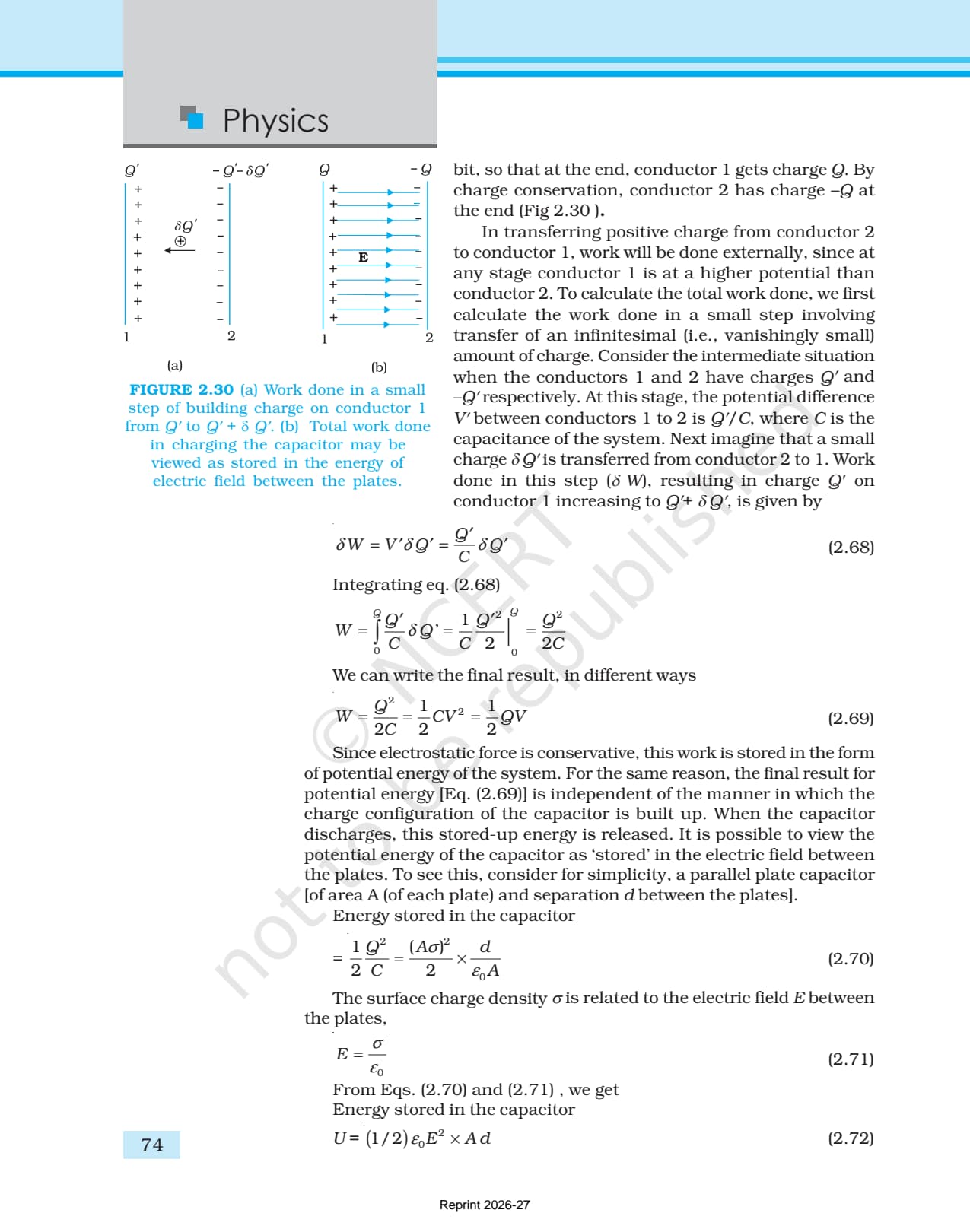
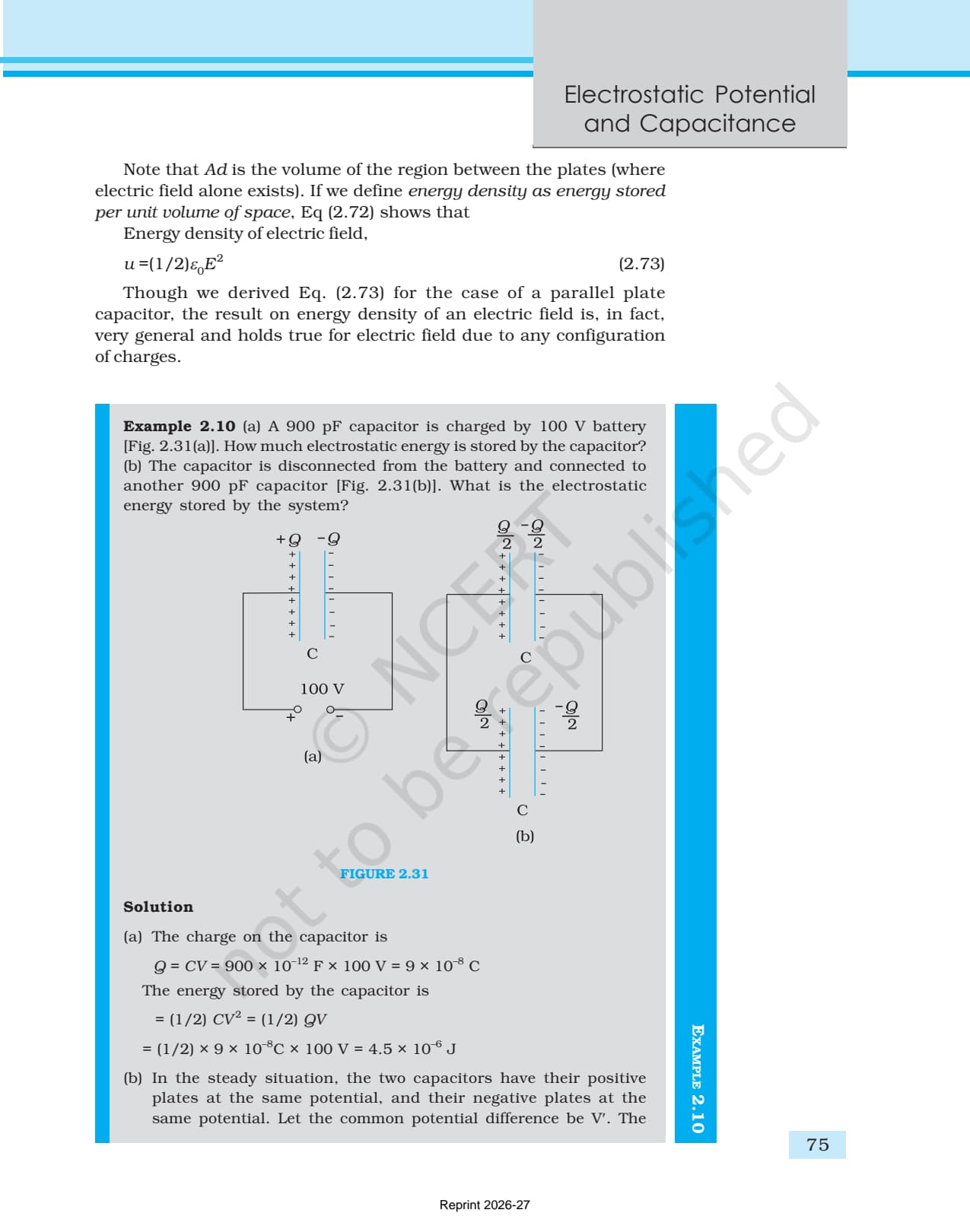
| 2.15 | Energy Stored in a Capacitor | 74-77 | U = ½CV², energy density u = ½ε0E² |
Plan your second pass to spend twice as long on the capacitance block (Sections 2.11 to 2.15). This is where the 5-mark CBSE question almost always lives.
Every NCERT Intext Example in Class 12 Physics Chapter 2 Electrostatic Potential and Capacitance
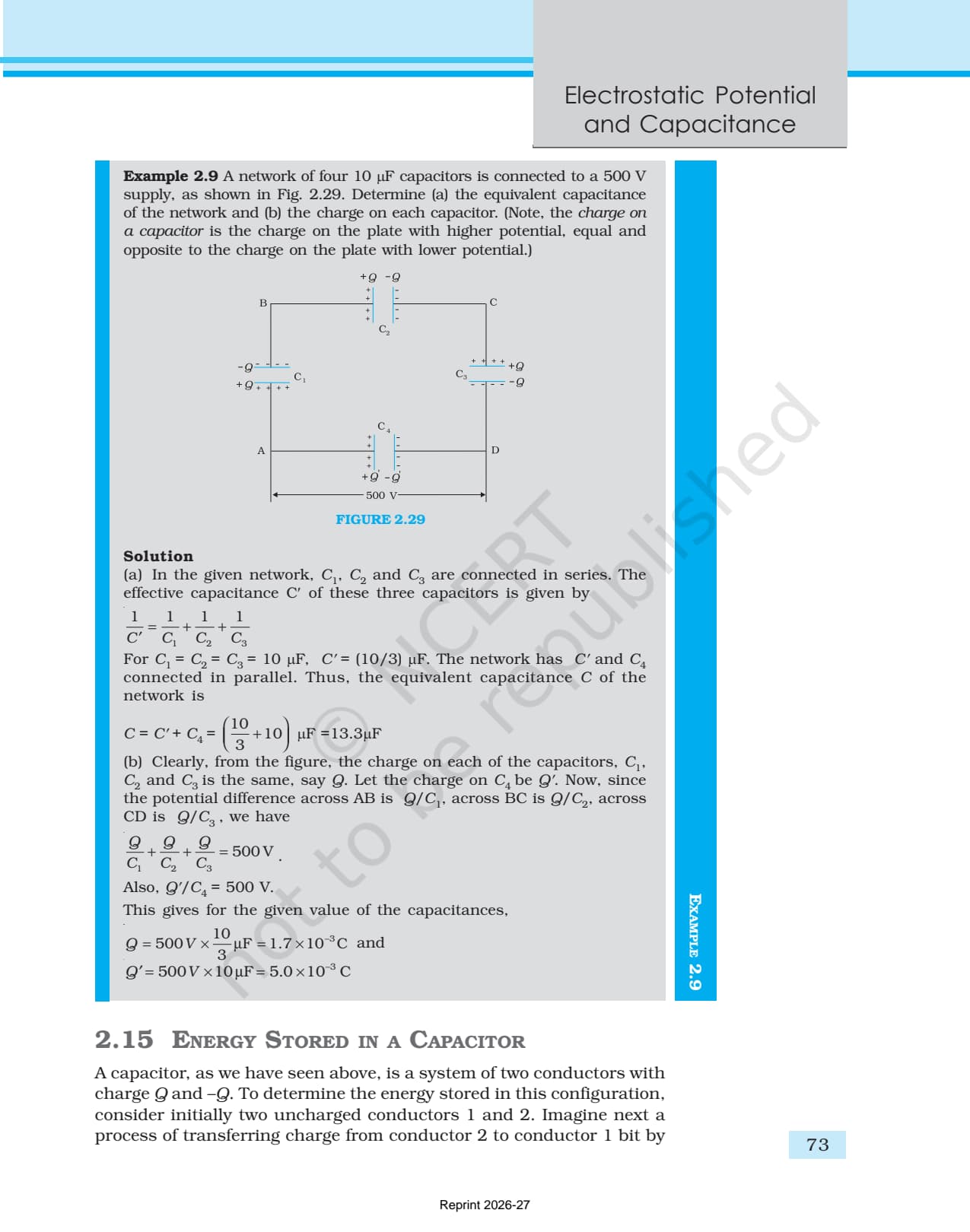
The 10 solved examples model the steps a CBSE marker rewards. Try each one with the book closed before doing the end-of-chapter exercises. Examples 2.9 and 2.10 are the two patterns CBSE recycles most often as 3-mark and 5-mark questions.
| Example | Sub-topic | What it Covers |
|---|---|---|
| 2.1 | Point-charge potential | V = kQ/r and W = qV |
| 2.2 | Potential and PE for two charges | Superposition of V, PE computation |
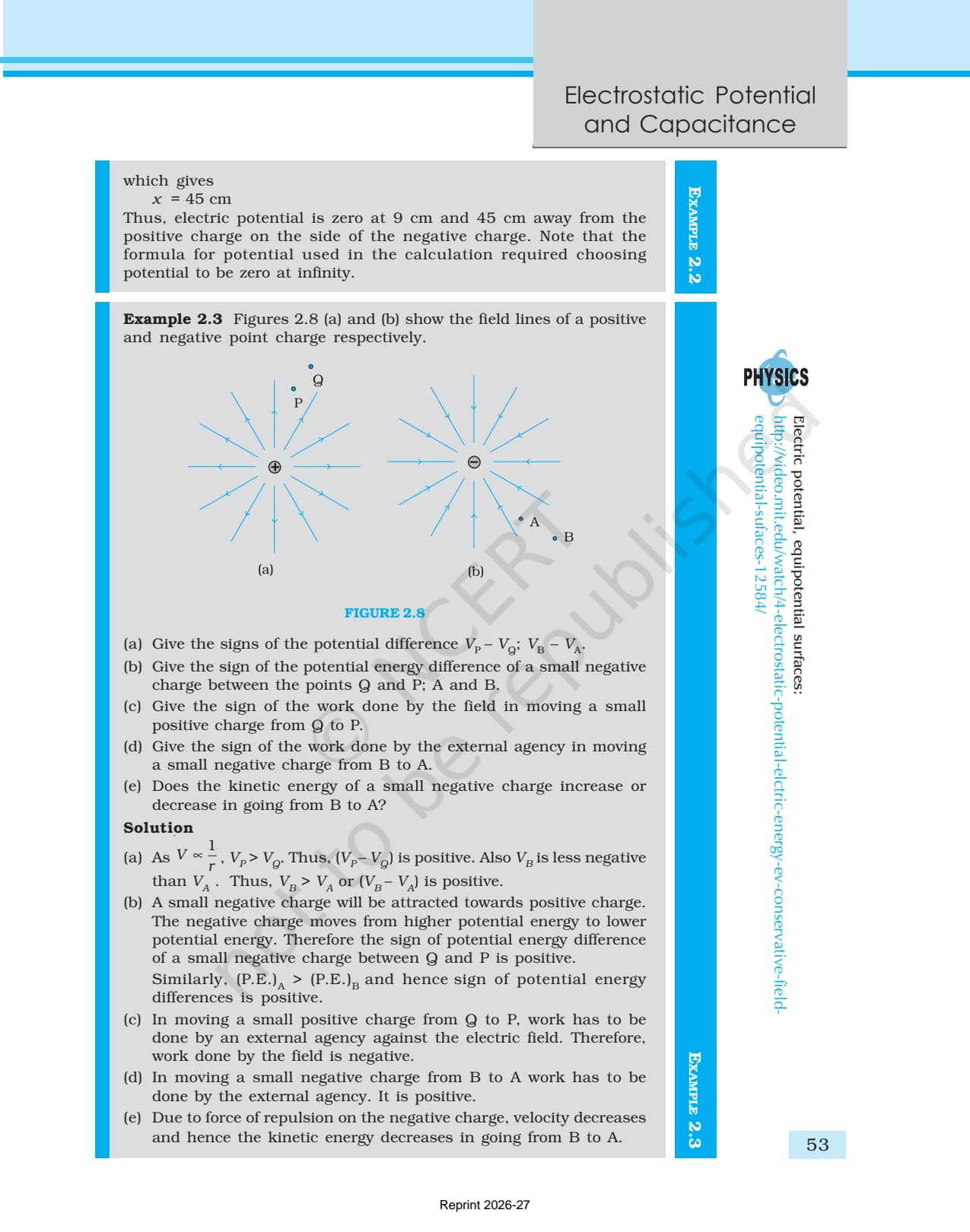
| 2.3 | Equipotential surface from field lines | Reading equipotential density |
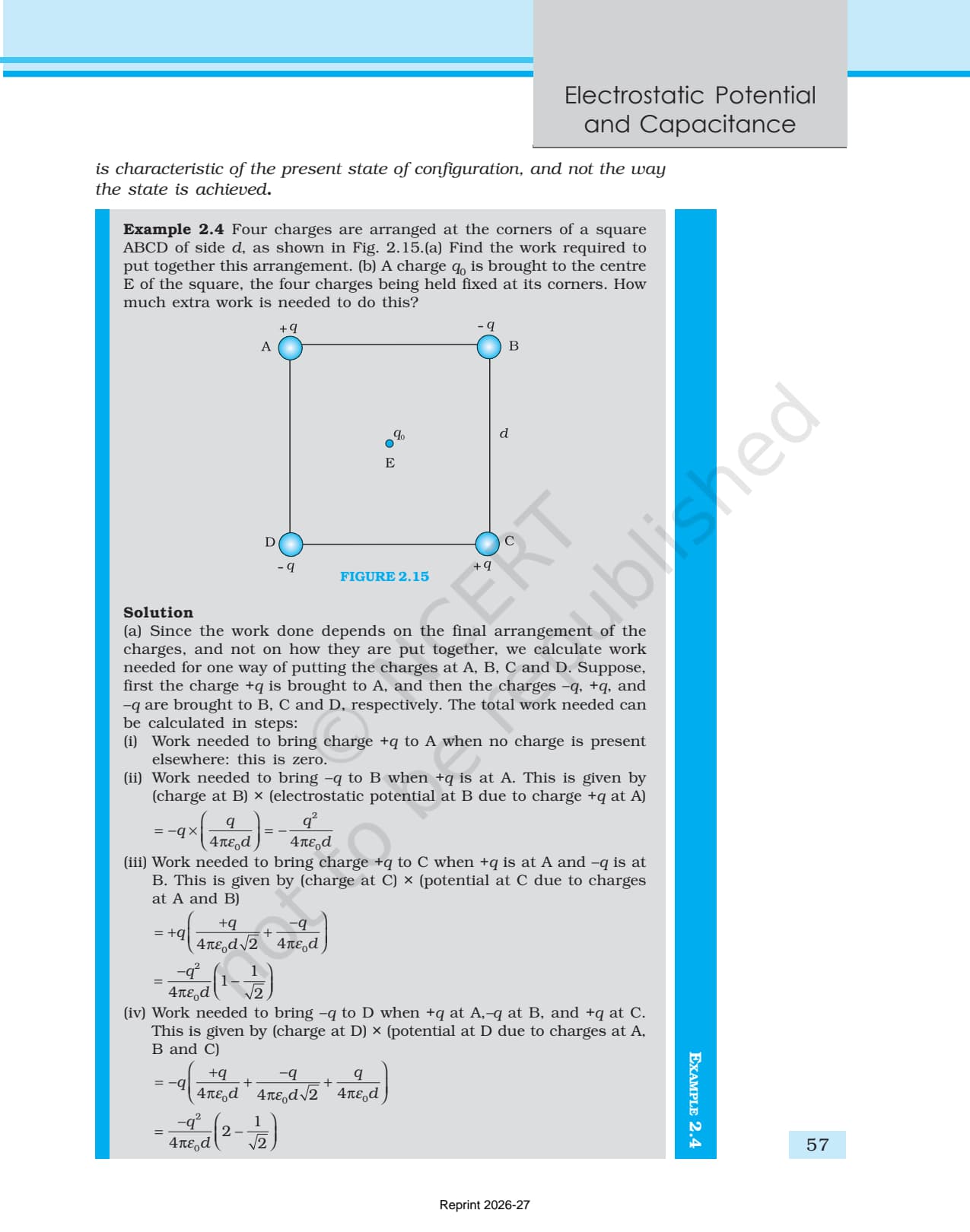
| 2.4 | Four charges at a square's corners | Net V and net PE at centre |
| 2.5 | Dipole in external field PE | U = -p·E, angle-dependent change |
| 2.6 | Dipole moment of a polar molecule | Dipole moment from molecular dimensions |
| 2.7 | Conductor and dielectric properties | Concept-level on E inside conductors |
| 2.8 | Dielectric slab inside parallel plates | C change for full or partial insertion |
| 2.9 | Four-capacitor 500 V network | Equivalent C and charge on each |
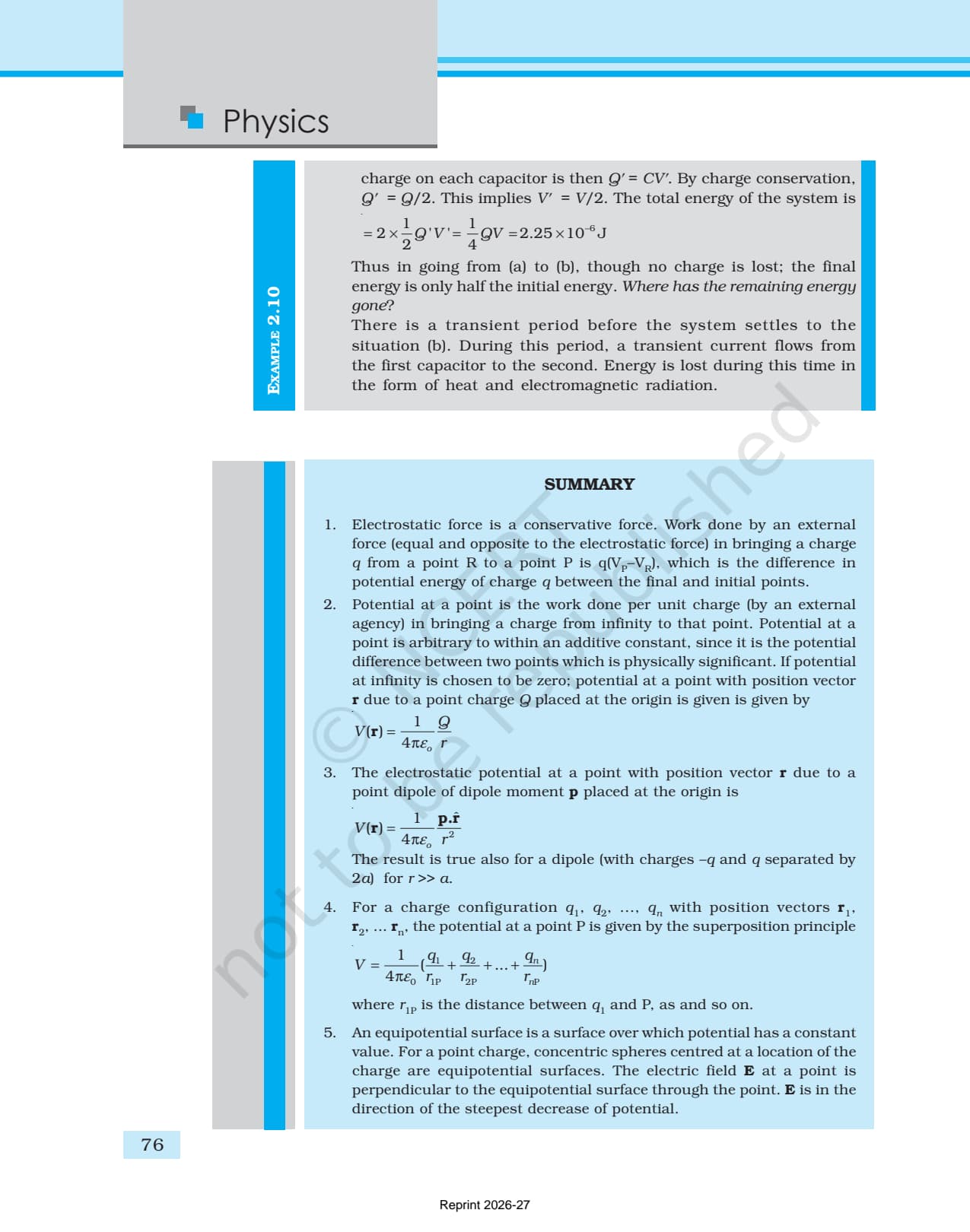
| 2.10 | Sharing of charge between two capacitors | Energy loss in 900 pF sharing problem |
Top 5 Formulae from Class 12 Physics Chapter 2 Electrostatic Potential and Capacitance
These five relations cover nearly every CBSE 5-marker and JEE Main numerical from Chapter 2. For the full master table with units and a "when to use which" guide, check the Formula Sheet linked below.
| Quantity | Formula |
|---|---|
| Potential due to a point charge | V = (1 / 4πε0) · Q / r |
| Potential due to a dipole (axial) | V = (1 / 4πε0) · p cos θ / r² |
| Capacitance of a parallel-plate capacitor (with dielectric) | C = Kε0A / d |
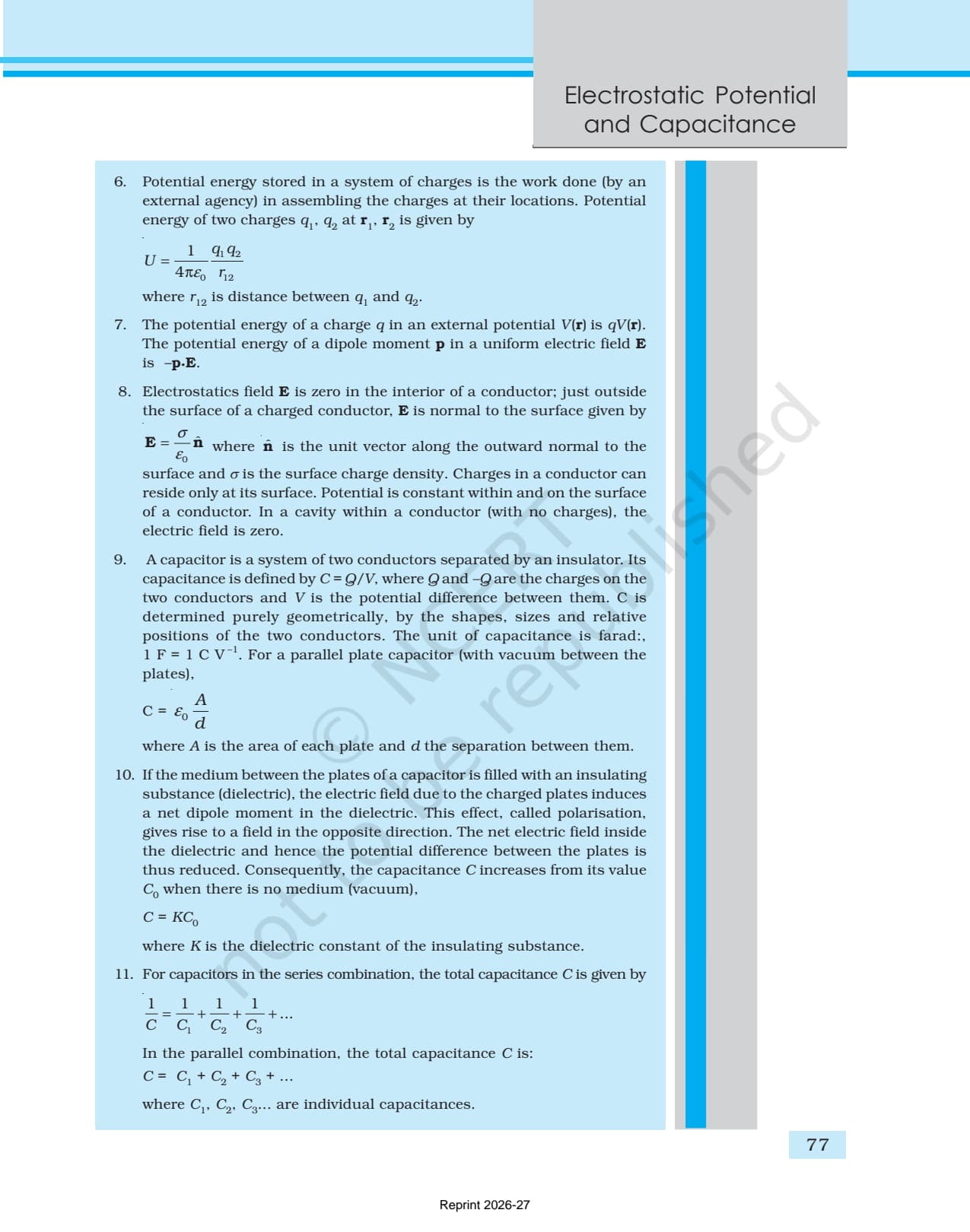
| Equivalent capacitance (series and parallel) | 1/Cs = Σ 1/Ci ; Cp = Σ Ci |
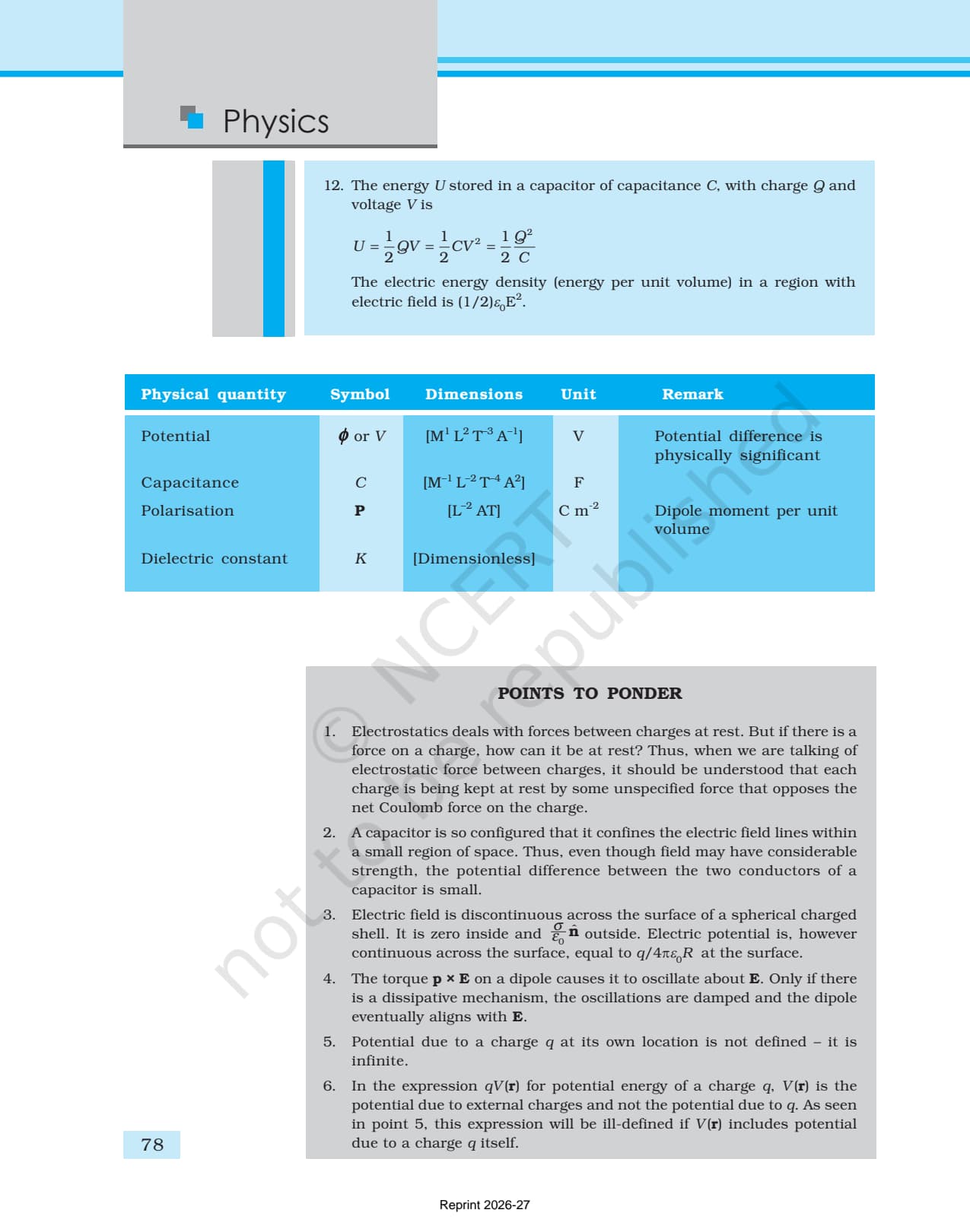
| Energy stored in a capacitor | U = ½ CV² = ½ Q² / C = ½ QV |
Electrostatic Potential and Capacitance Class 12 Physics Formula Sheet - full table with units and decision guide.
3-Day Study Plan for Class 12 Physics Chapter 2 Electrostatic Potential and Capacitance
The 36-page chapter splits cleanly across three working days. These hours assume Chapter 1 is already revised, since derivations in Sections 2.3 to 2.5 build directly on the field expressions from Chapter 1.
| Day | Sections | Examples | Exercises |
|---|---|---|---|
| Day 1 (3h) | 2.1 to 2.6 (V, Equipotential) | 2.1 to 2.3 | 2.1 to 2.3 |
| Day 2 (3h) | 2.7 to 2.10 (PE, Conductors, Dielectrics) | 2.4 to 2.6 | 2.4 |
| Day 3 (4h) | 2.11 to 2.15 (C, Combinations, Energy) | 2.7 to 2.10 | 2.5 to 2.11 |
If you only have two days, merge Day 1 and Day 2. Keep a full evening for Day 3 - the capacitor block from Section 2.11 onwards is where the 5-mark CBSE question almost always comes from.
Electrostatic Potential and Capacitance Weightage Compared Across Class 12 Physics Chapters
The visual below maps CBSE Class 12 Physics marks across all 14 NCERT chapters, averaged over the last five board papers.
Student Feedback
"The section breakdown table helped me plan exactly how much time to spend on each part. Sections 2.11 to 2.15 took longer than I thought but the practice paid off before my CBSE pre-board." - Class 12 student, Pune
"Downloaded the PDF and read it alongside the solutions. The formula table on this page saved a lot of revision time before my Board exam." - Aryan, Delhi (scored 68/70 in Physics)
"The 3-day study plan worked really well. I completed all 11 exercises and felt confident going into the exam." - Priya, Class 12, Hyderabad
Electrostatic Potential and Capacitance - Video Lecture for Class 12 Physics
Source: NCERT Wallah on YouTube
Other Resources for Electrostatic Potential and Capacitance - Class 12 Physics
| Resource | Link |
|---|---|
| NCERT Book PDF | Electrostatic Potential and Capacitance NCERT Book PDF |
| NCERT Solutions | Electrostatic Potential and Capacitance Class 12 NCERT Solutions |
| Notes | Electrostatic Potential and Capacitance Class 12 Notes |
| Formula Sheet | Electrostatic Potential and Capacitance Class 12 Formula Sheet |
NCERT Book PDF for Class 12 Physics: All Chapters
Use the links below to get the NCERT Book PDF for any other Class 12 Physics chapter.
| Chapter | Resource |
|---|---|
| Chapter 1 | Electric Charges and Fields NCERT PDF |
| Chapter 2 | Electrostatic Potential and Capacitance NCERT PDF |
| Chapter 3 | Current Electricity NCERT PDF |
| Chapter 4 | Moving Charges and Magnetism NCERT PDF |
| Chapter 5 | Magnetism and Matter NCERT PDF |
| Chapter 6 | Electromagnetic Induction NCERT PDF |
| Chapter 7 | Alternating Current NCERT PDF |
| Chapter 8 | Electromagnetic Waves NCERT PDF |
| Chapter 9 | Ray Optics and Optical Instruments NCERT PDF |
| Chapter 10 | Wave Optics NCERT PDF |
| Chapter 11 | Dual Nature of Radiation and Matter NCERT PDF |
| Chapter 12 | Atoms NCERT PDF |
| Chapter 13 | Nuclei NCERT PDF |
| Chapter 14 | Semiconductor Electronics NCERT PDF |
Electrostatic Potential and Capacitance NCERT PDF: available above as a free download, fully aligned to the 2026-27 NCERT release.
Electrostatic Potential and Capacitance NCERT PDF - Frequently Asked Questions
Ques. Where can I download the Electrostatic Potential and Capacitance NCERT PDF for free?
Ans. You can download the Electrostatic Potential and Capacitance NCERT PDF directly from this Collegedunia page. The PDF is free and updated for the 2026-27 NCERT syllabus.
Ques. Is this the 2026-27 NCERT and has anything changed from the older edition?
Ans. Yes. The PDF on this page reflects the current 2026-27 NCERT for Class 12 Physics Chapter 2. The 15-section structure, 10 intext examples, and 11 end-of-chapter exercises are all intact. The Van de Graaff generator section from older editions has been removed, and the polarisation discussion is now qualitative only.
Ques. How many pages and exercises does Class 12 Physics Chapter 2 NCERT contain?
Ans. The chapter runs about 36 pages (pp. 45 to 80 in the printed textbook), with 10 solved intext examples and 11 end-of-chapter exercises. Most students need 8 to 10 hours total for the first reading plus exercise attempt.
Ques. What is the CBSE weightage of Electrostatic Potential and Capacitance for the Class 12 Board exam?
Ans. Electrostatic Potential and Capacitance contributes 6 to 8 marks to the Class 12 Physics Board exam. Combined with Chapter 1 Electric Charges and Fields, the Electrostatics unit accounts for 17 marks in the 70-mark theory paper - more than any other unit.
Ques. Which sections of Class 12 Physics Chapter 2 are most important for CBSE and JEE?
Ans. Sections 2.4 (Dipole Potential), 2.6 (Equipotential Surfaces), 2.12 (Parallel-plate Capacitor), 2.13 (Effect of Dielectric), 2.14 (Combination of Capacitors), and 2.15 (Energy Stored) account for the bulk of CBSE and JEE marks year after year. The capacitor-network problem from Example 2.9 and the dipole-potential derivation are the two most-recycled question stems.



Comments