




The NCERT Book for Class 10 Science Chapter 9 Light Reflection and Refraction is the official CBSE textbook chapter, free to read and download for the 2026-27 session. This chapter explains how light bends and bounces: the reflection of light by plane and spherical mirrors, the refraction of light through a glass slab and spherical lenses, and the formulae that link object distance, image distance and focal length.
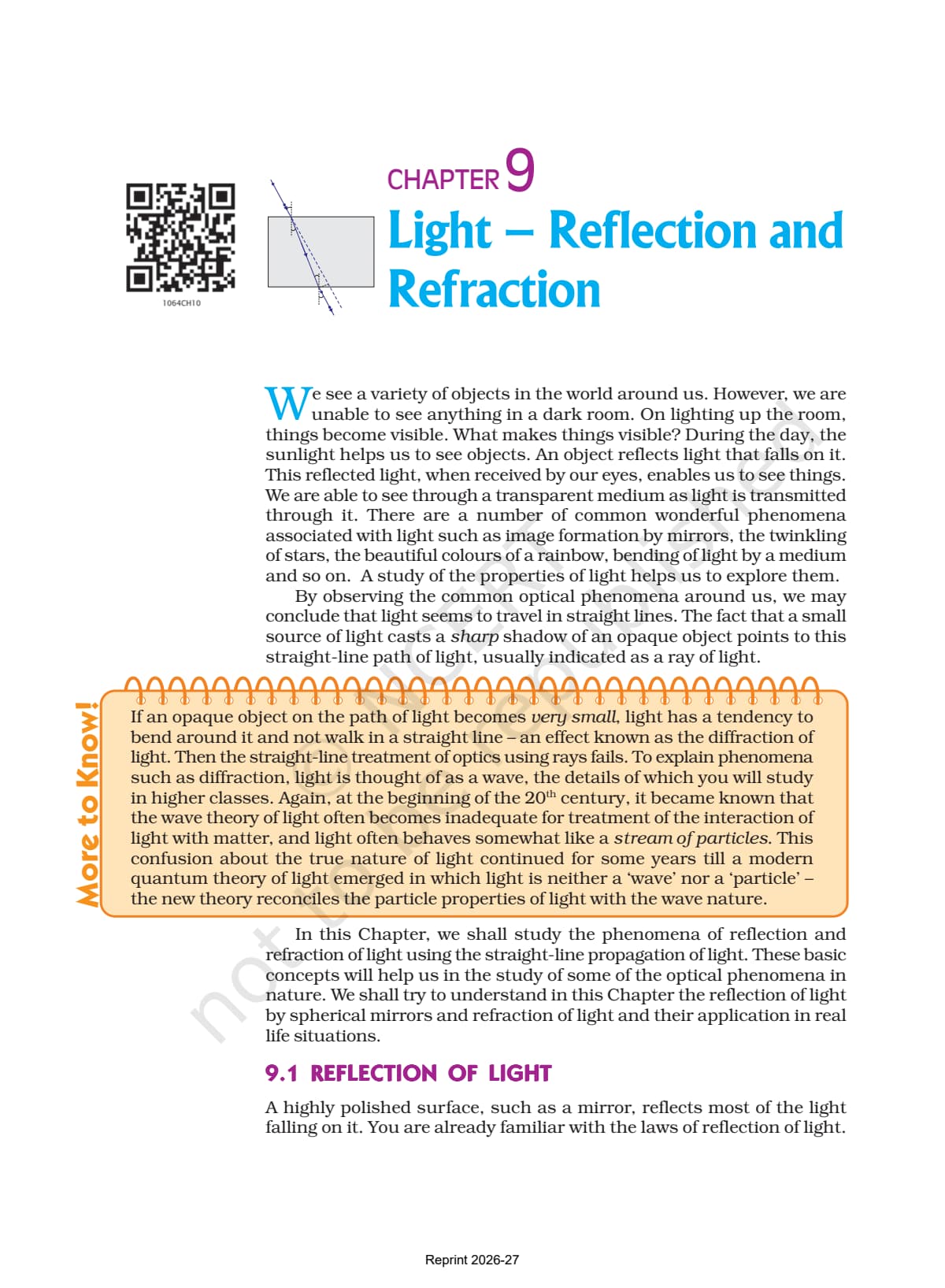
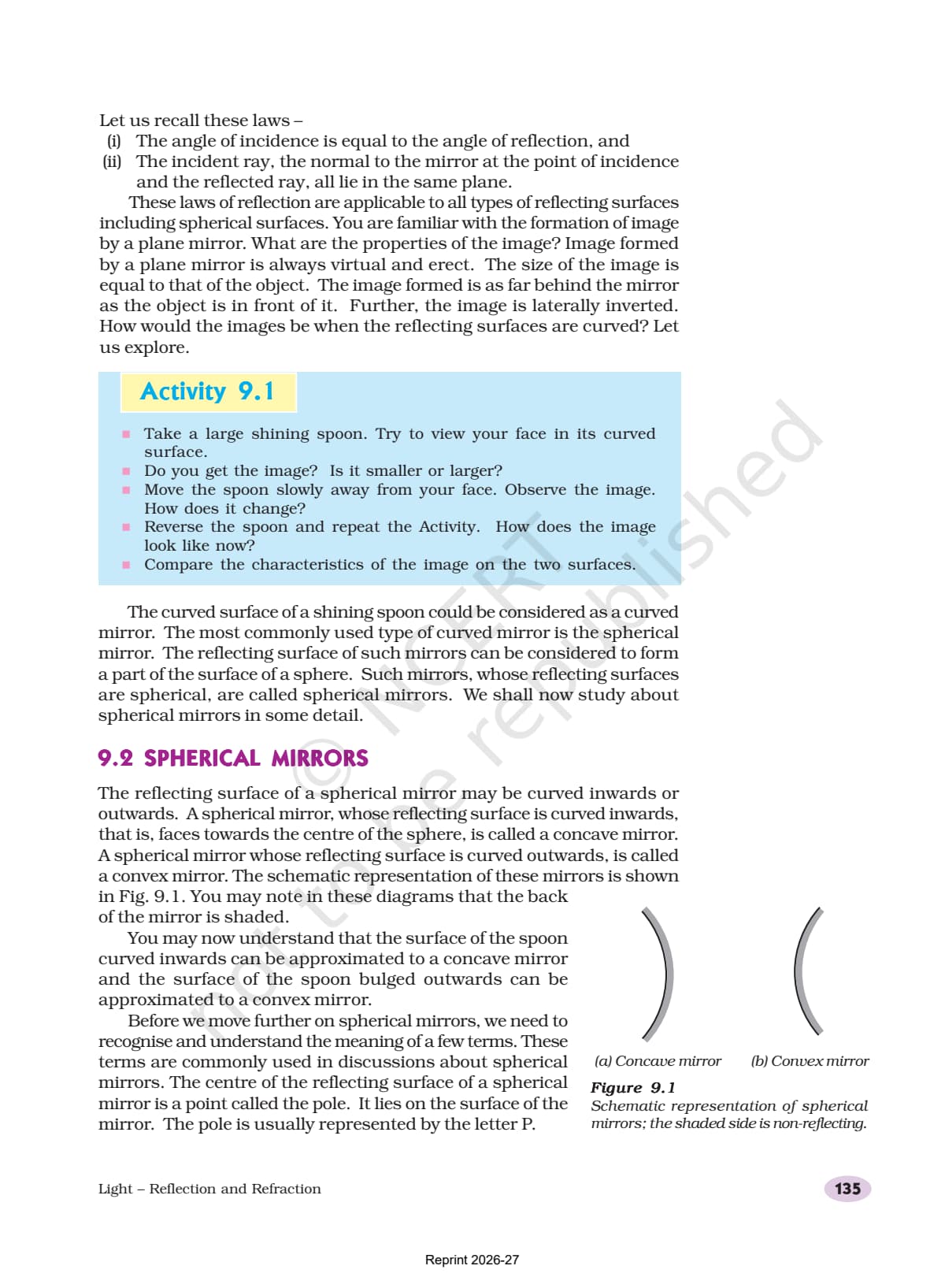
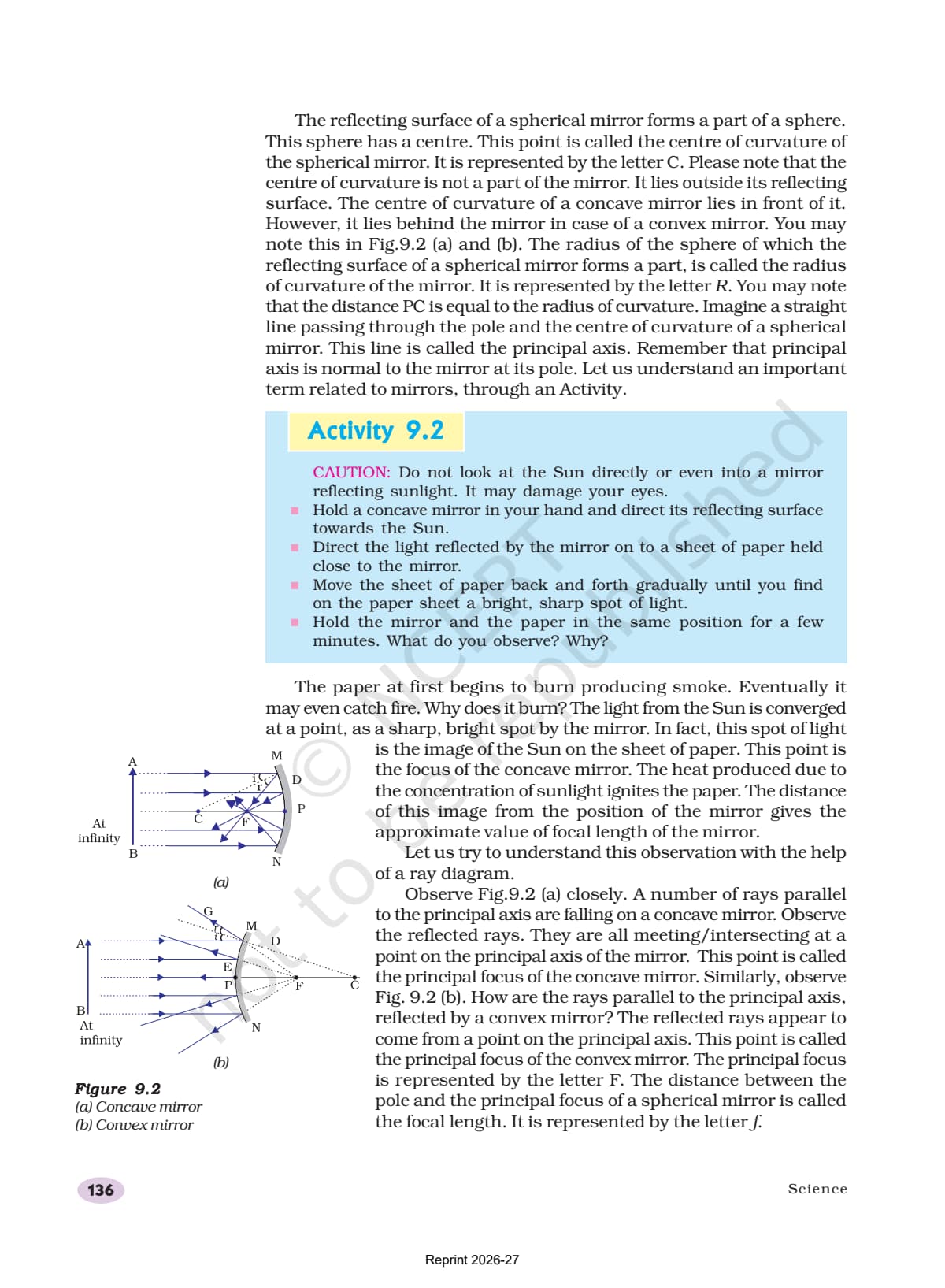
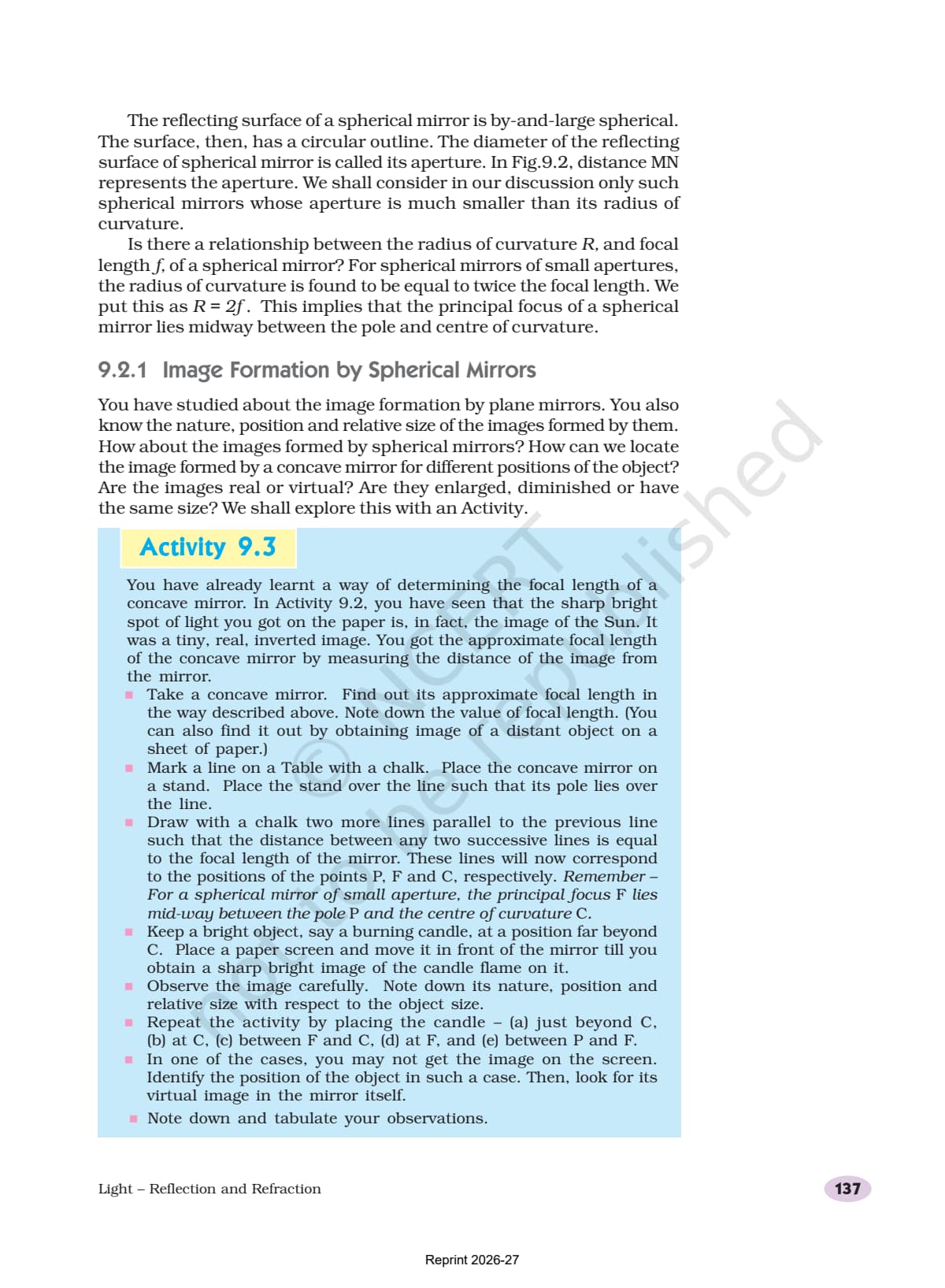
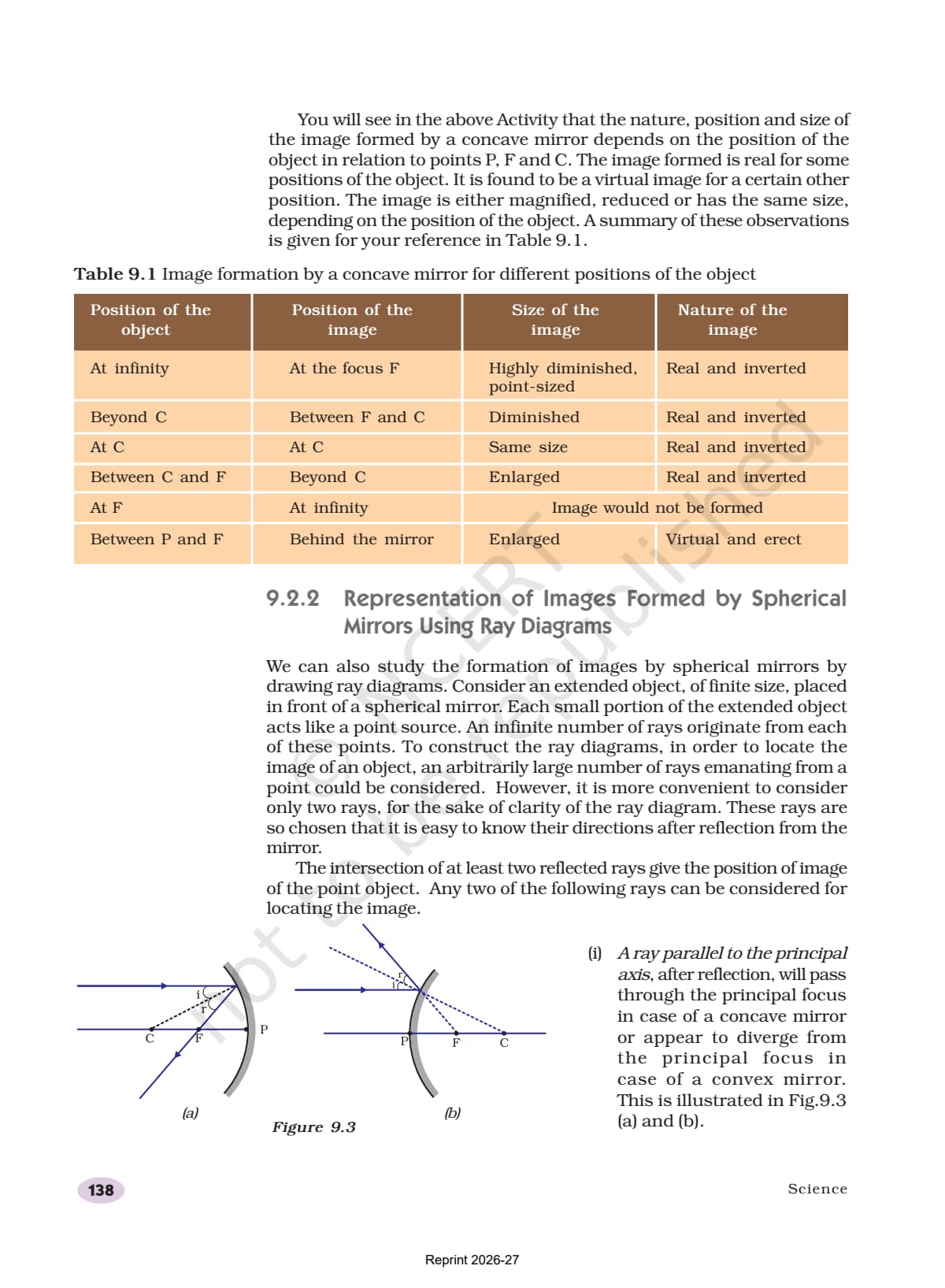
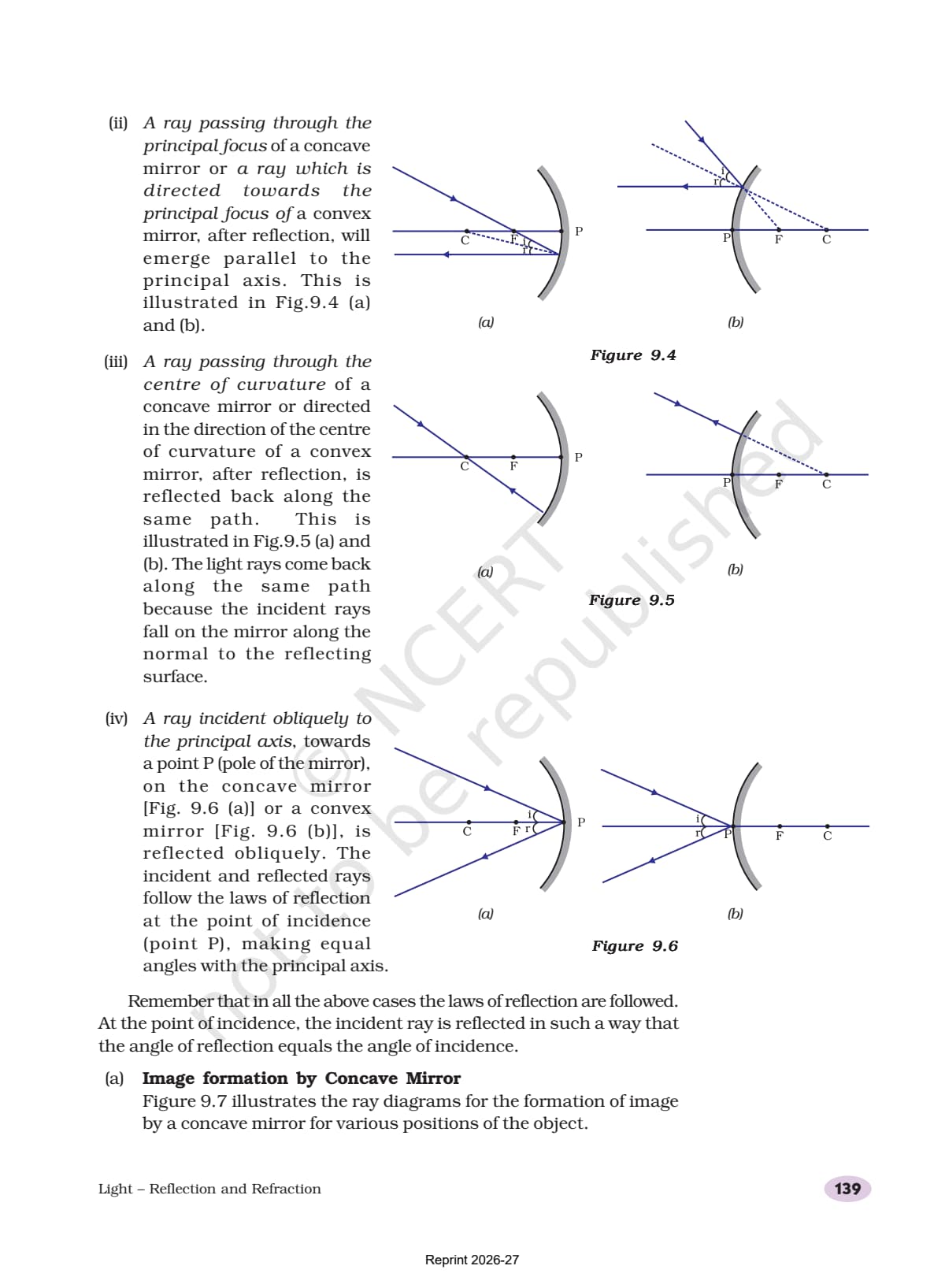
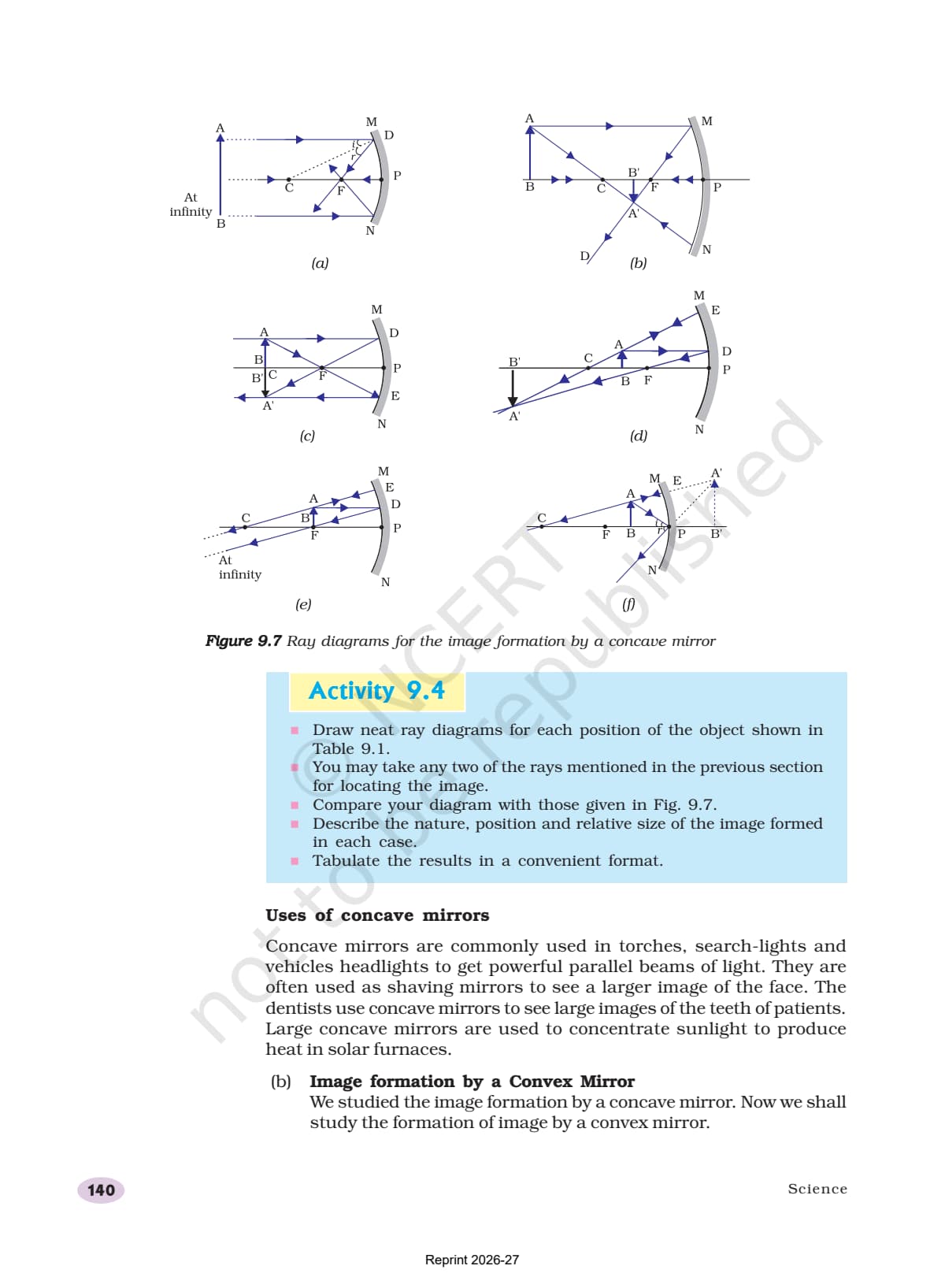
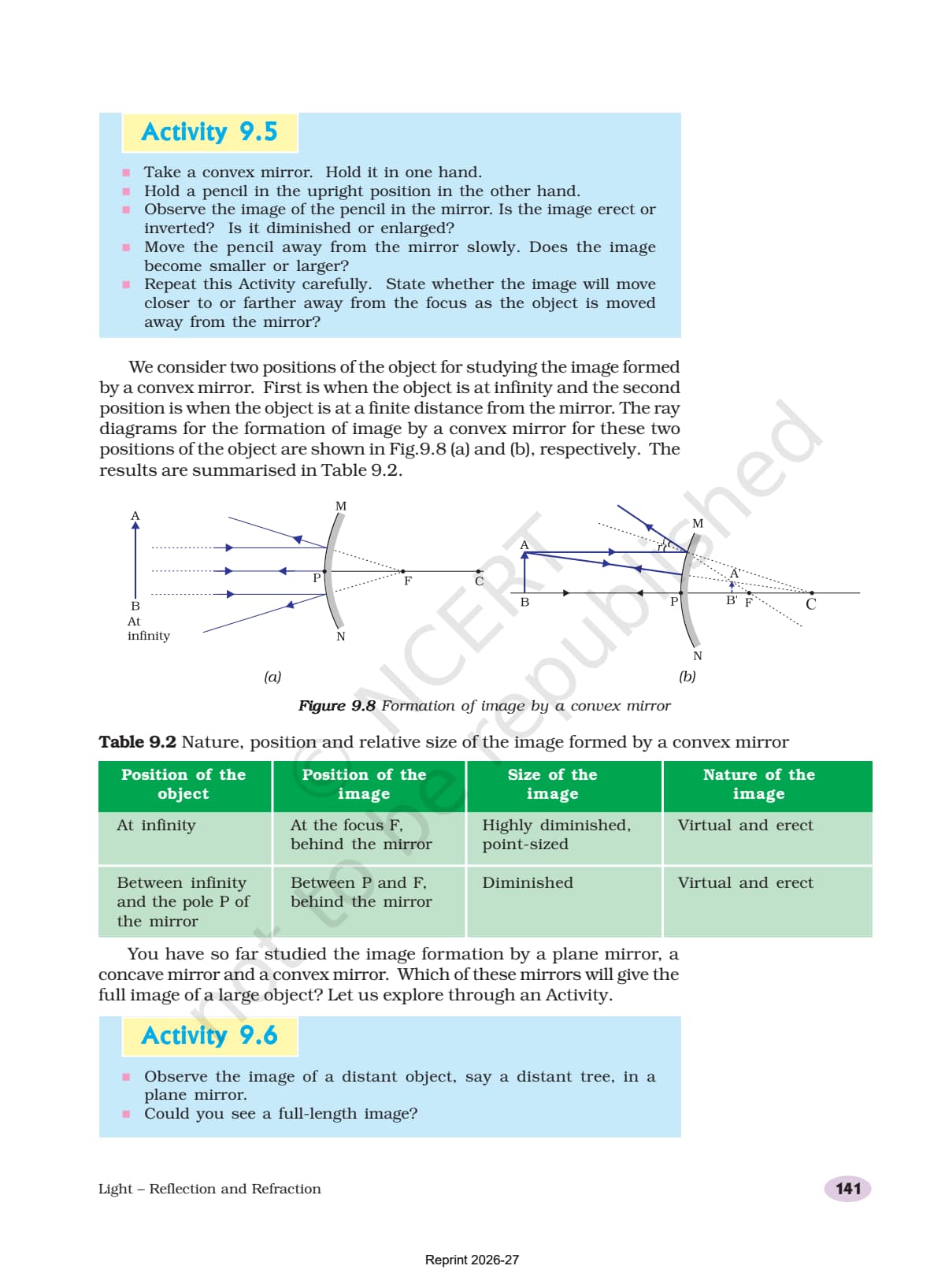
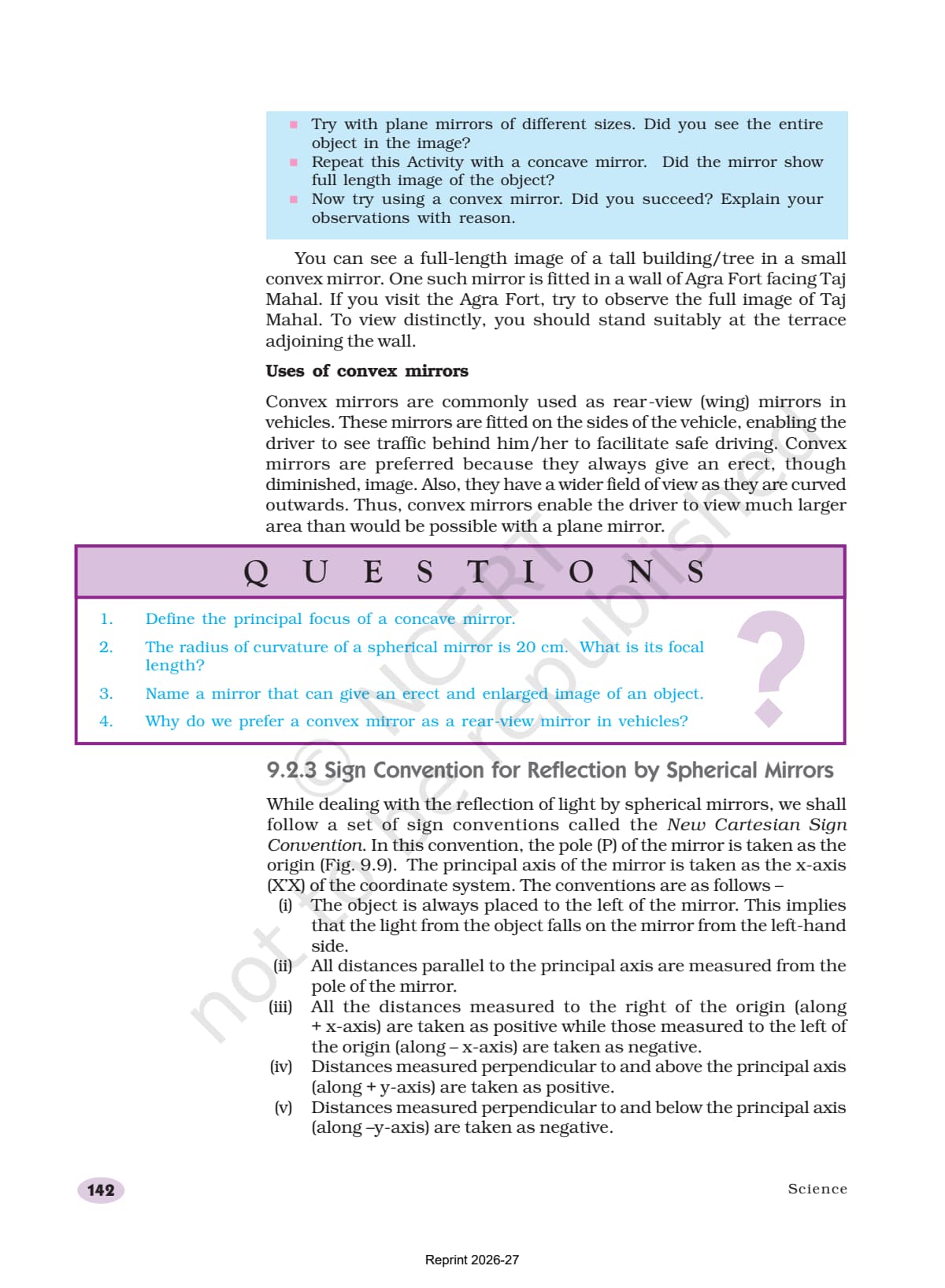
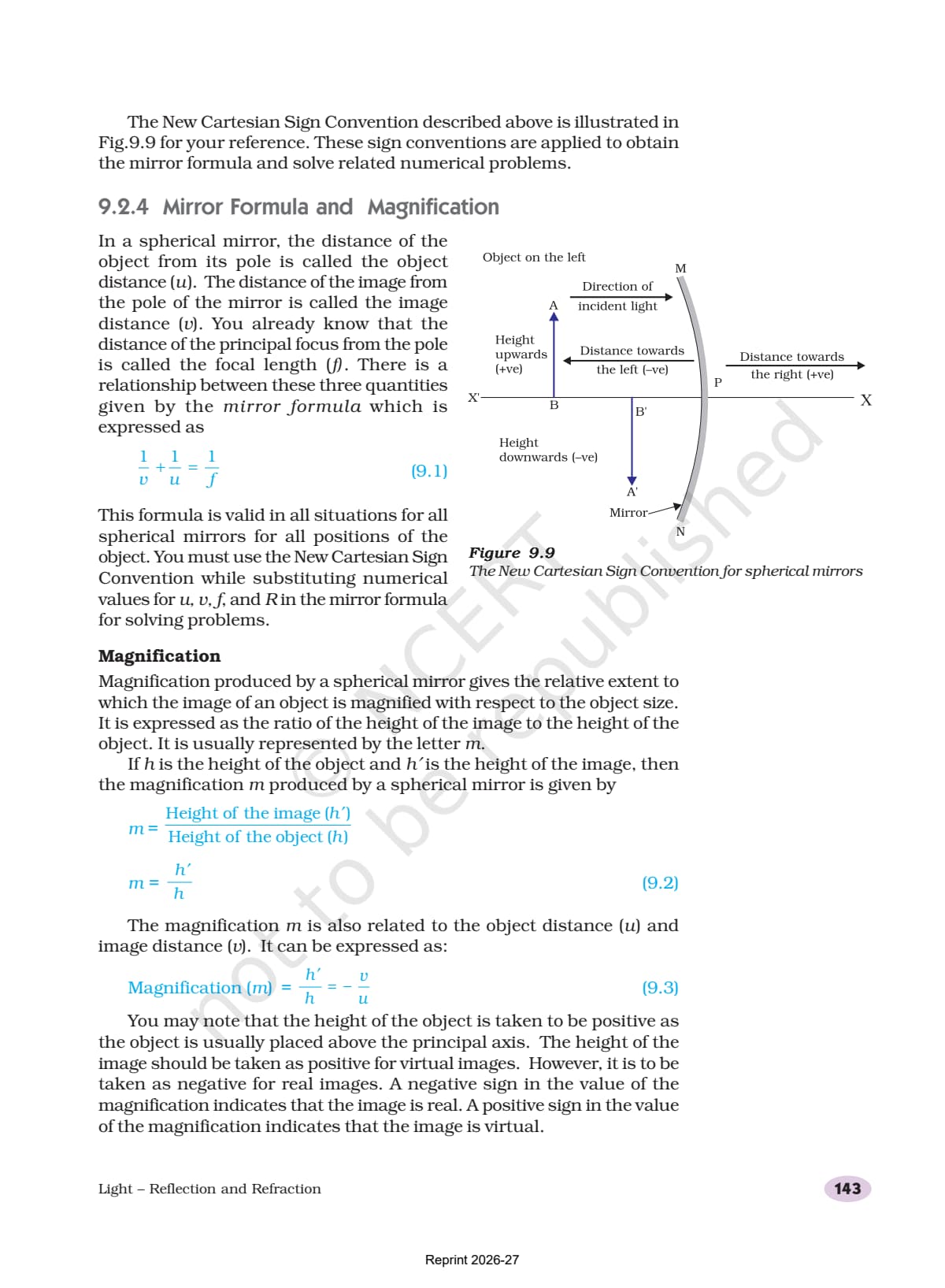
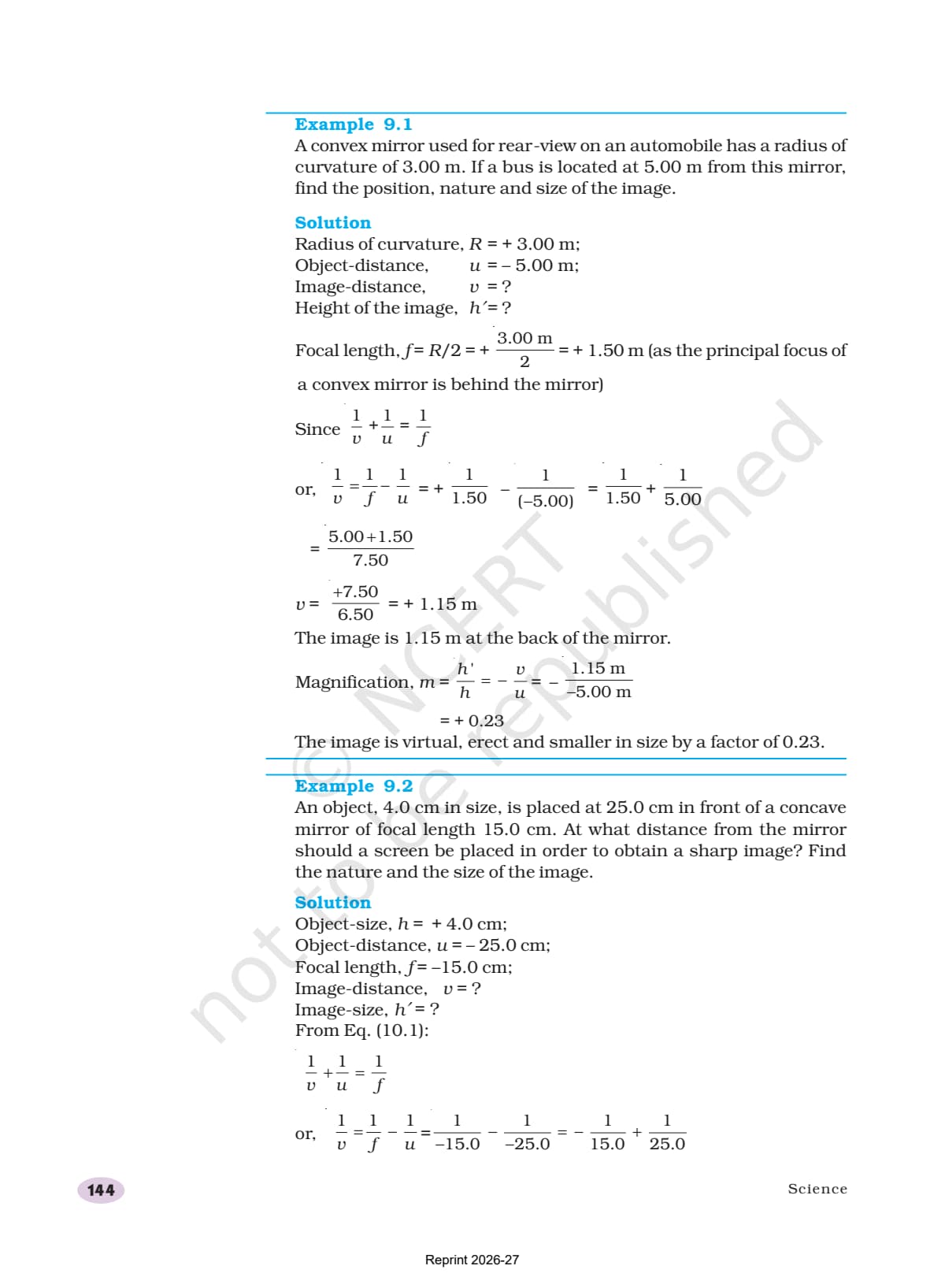
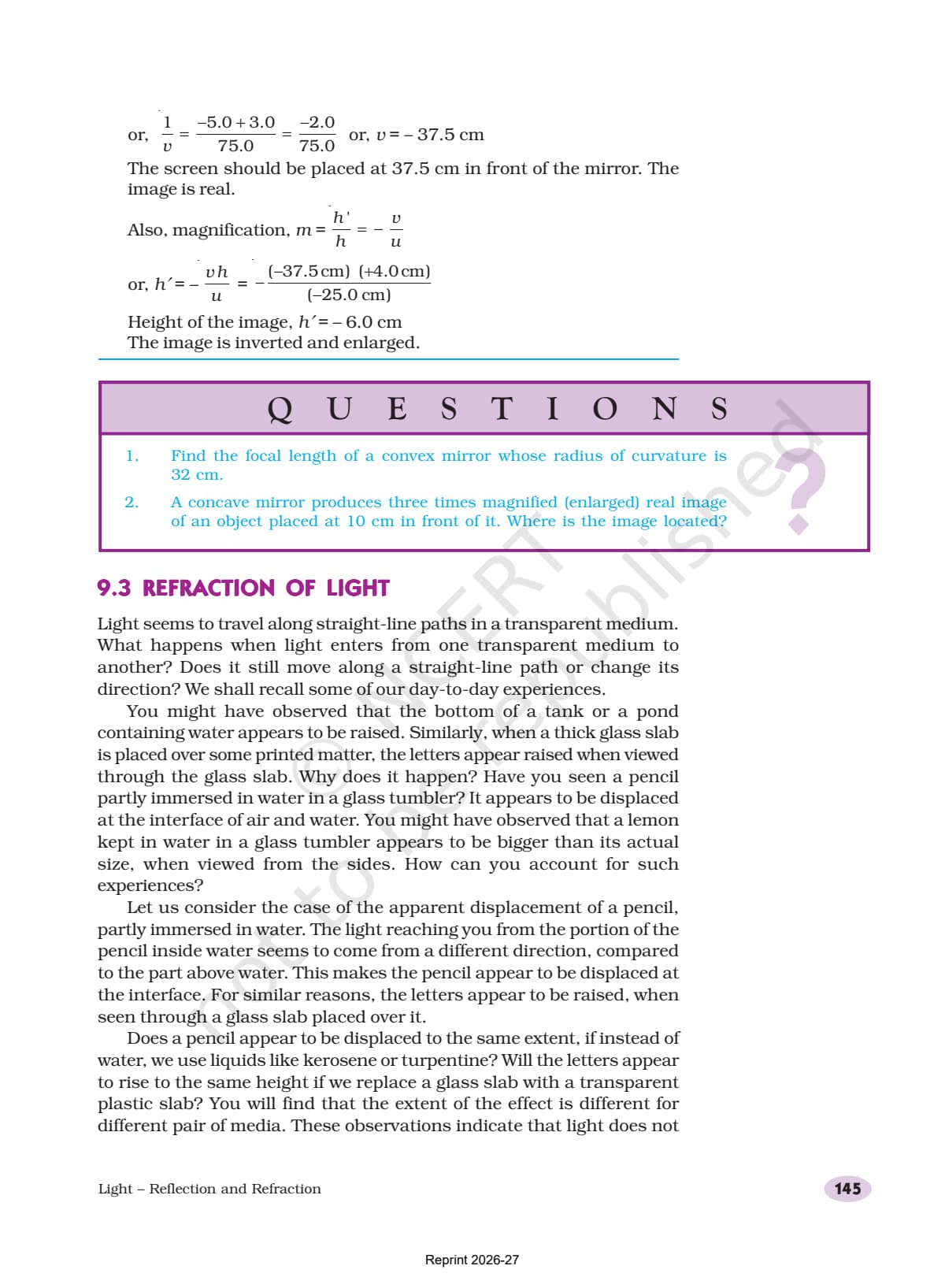
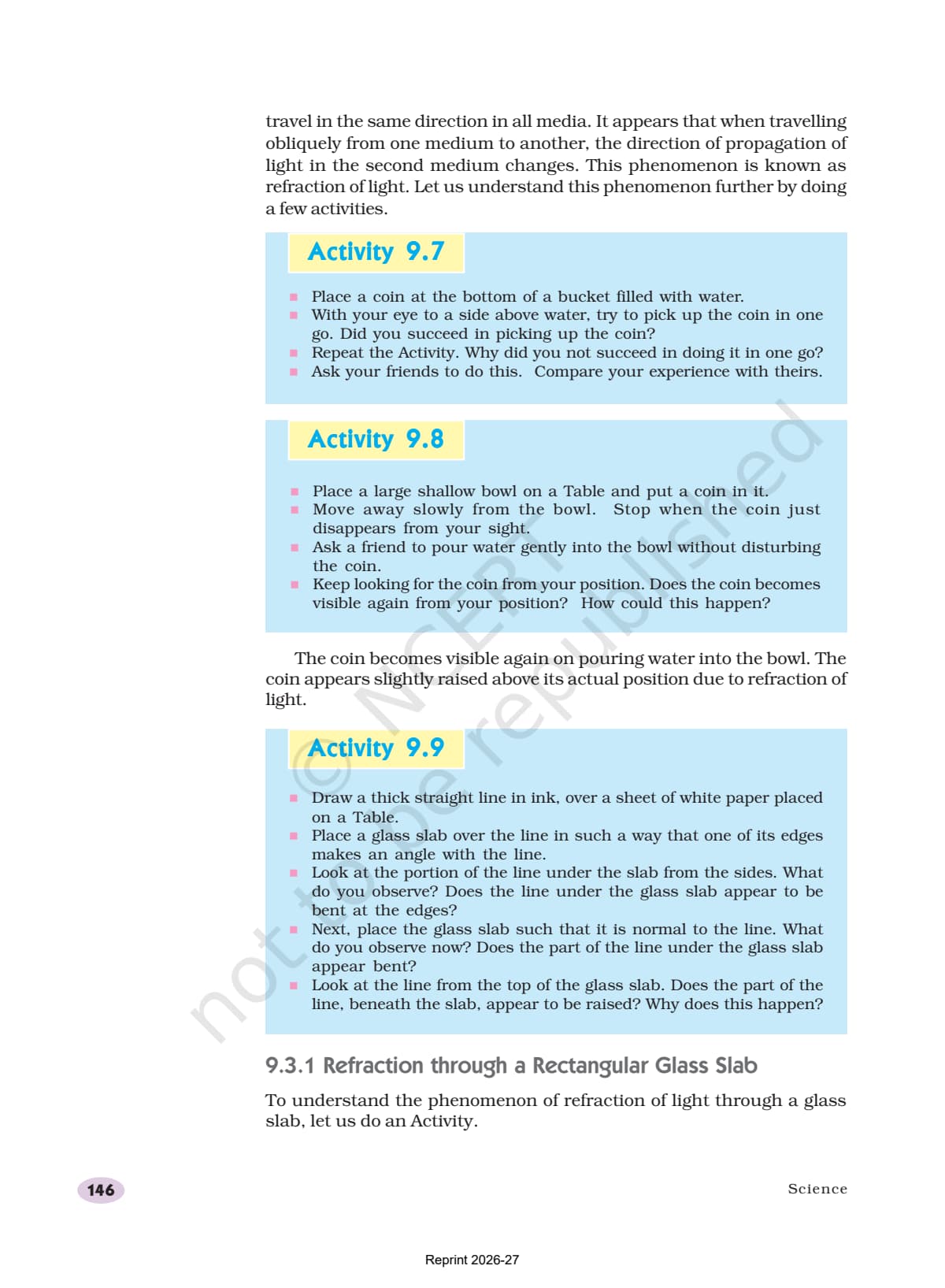
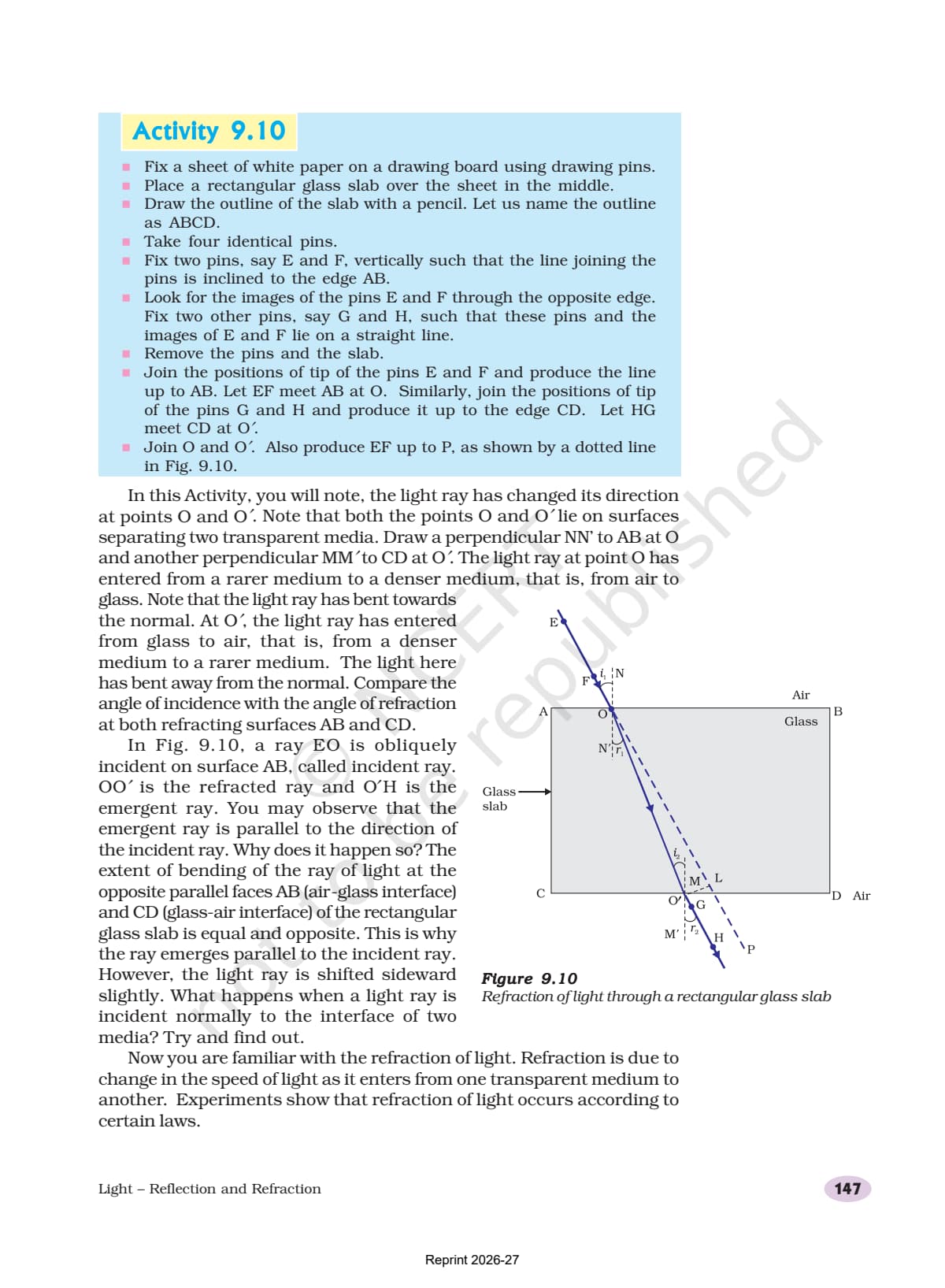
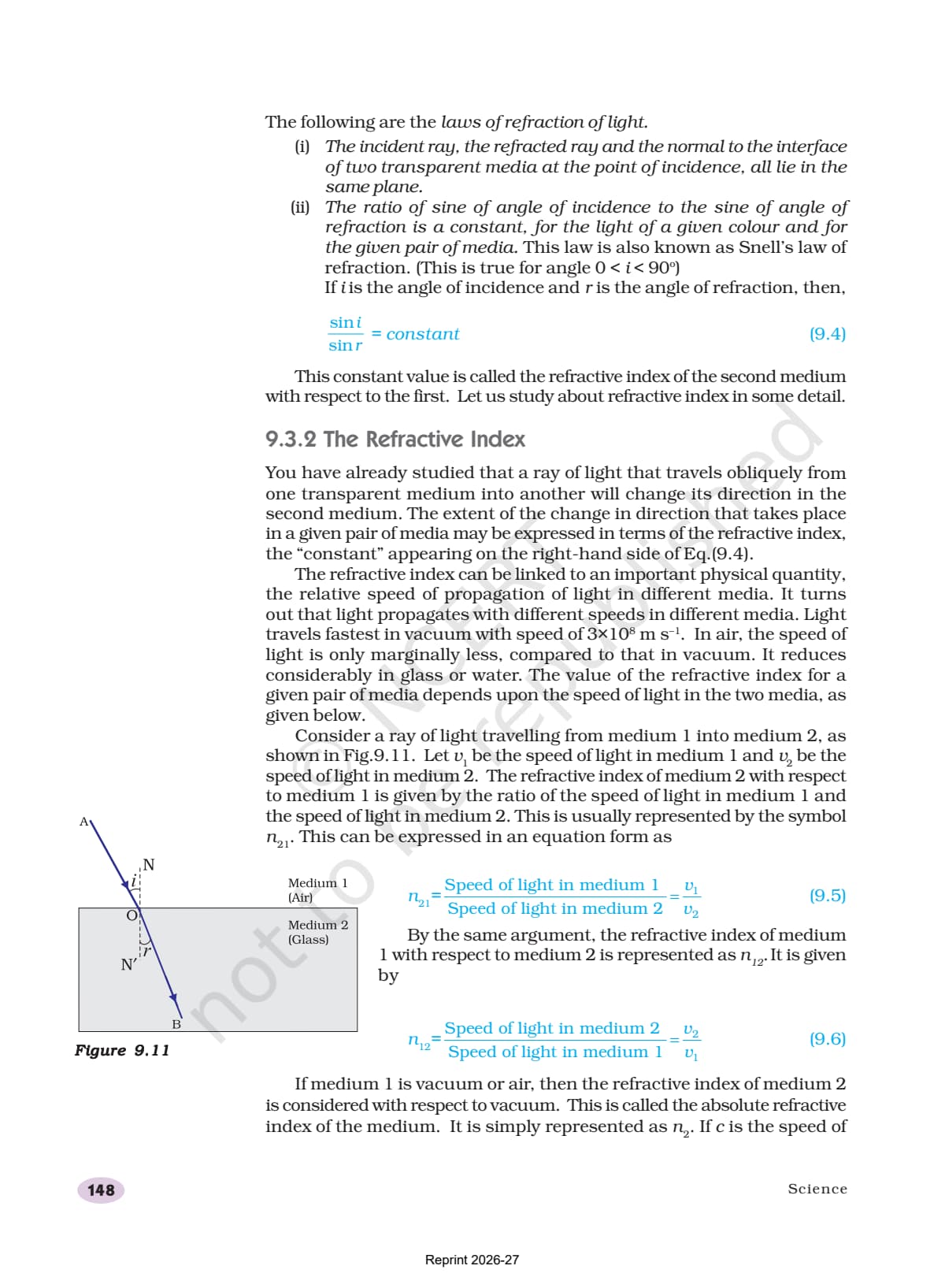
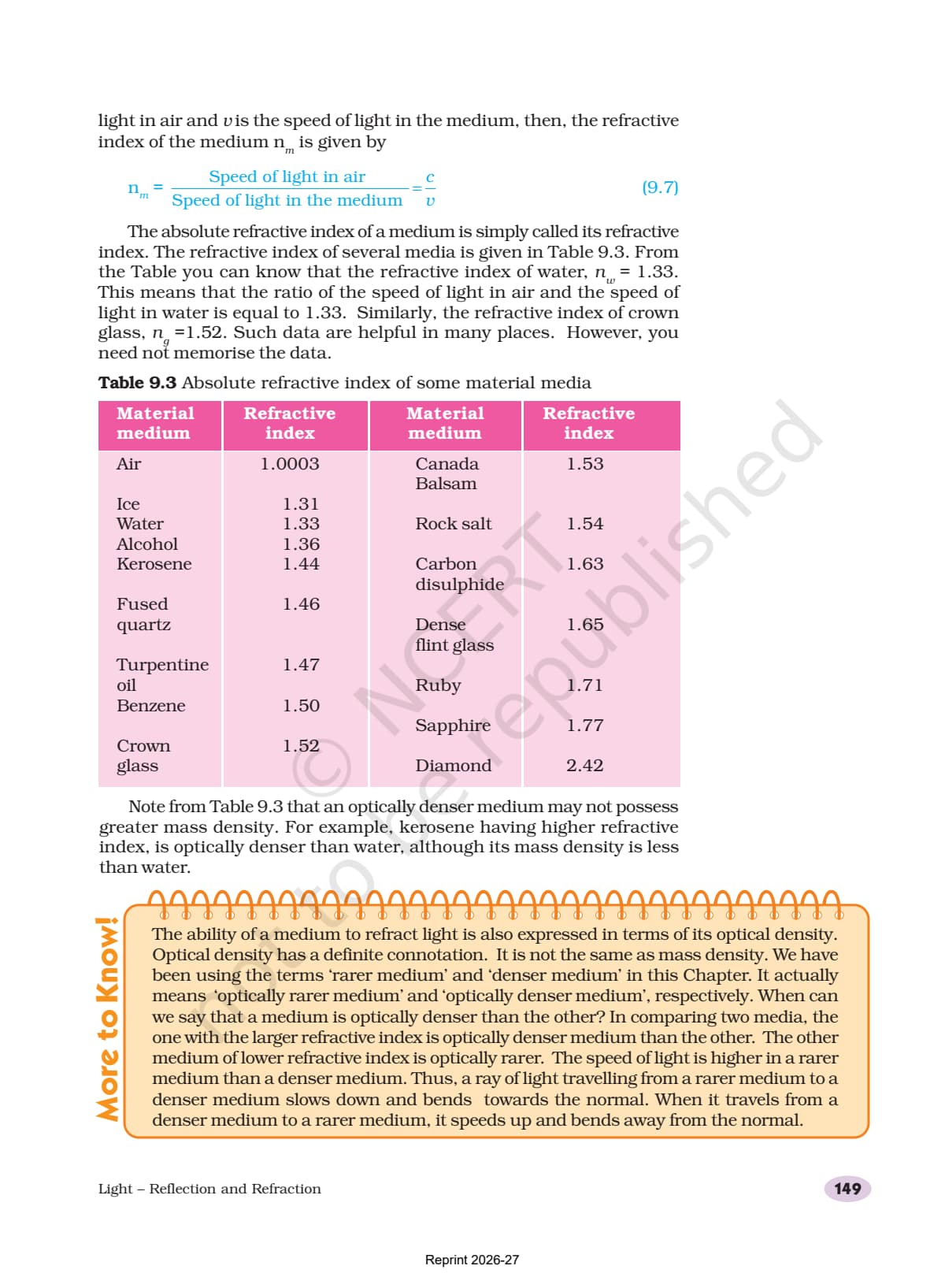
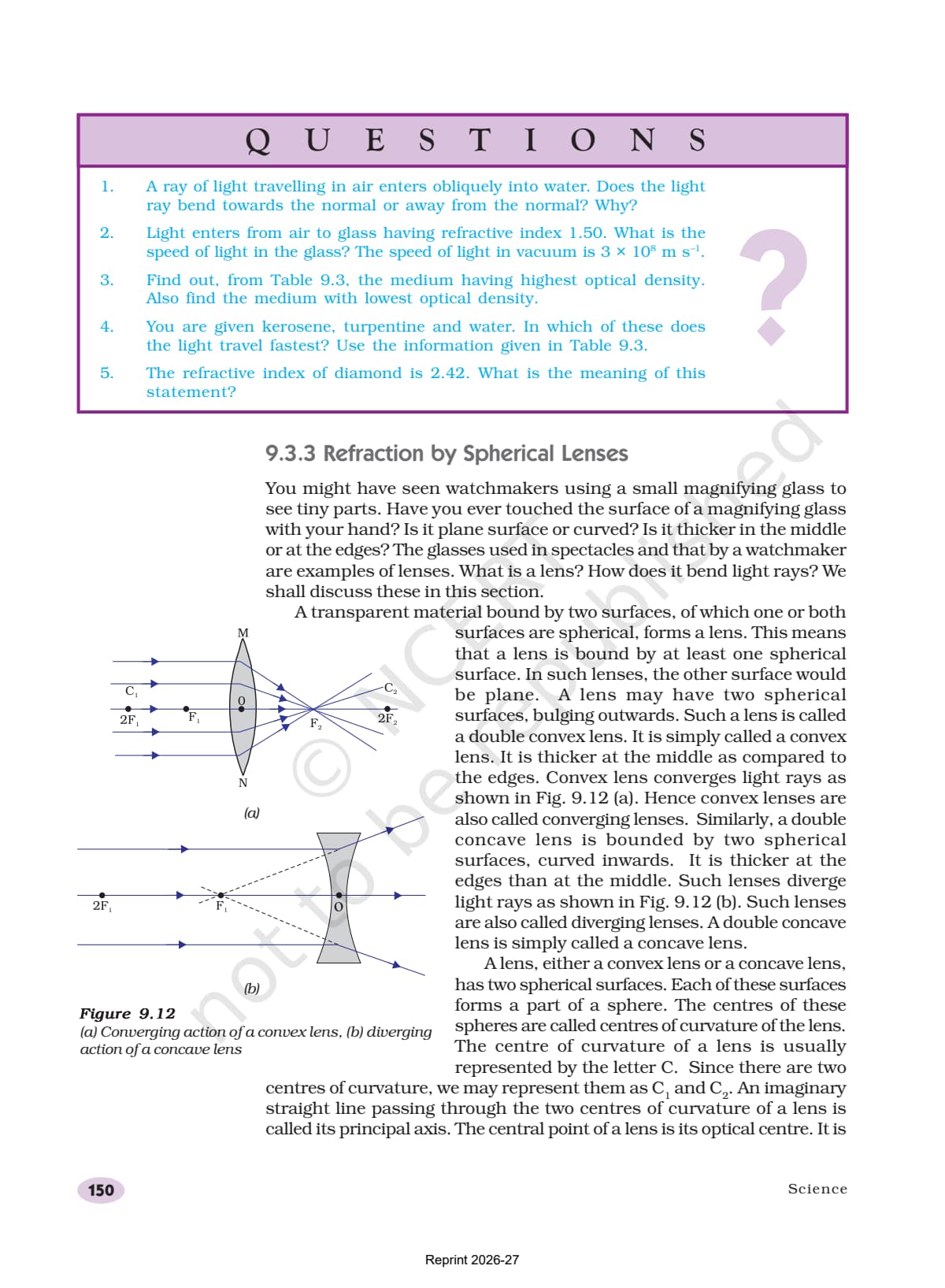
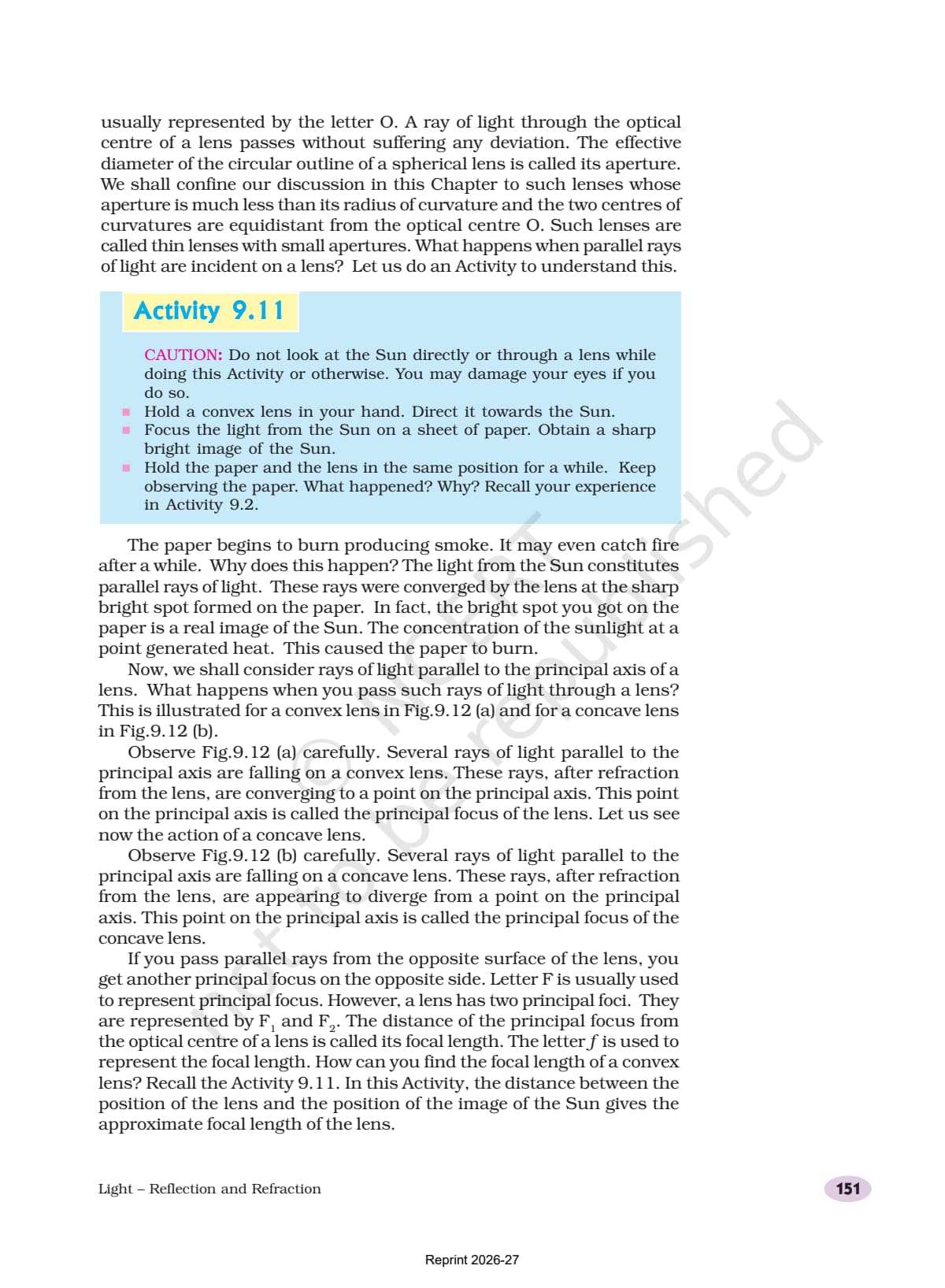
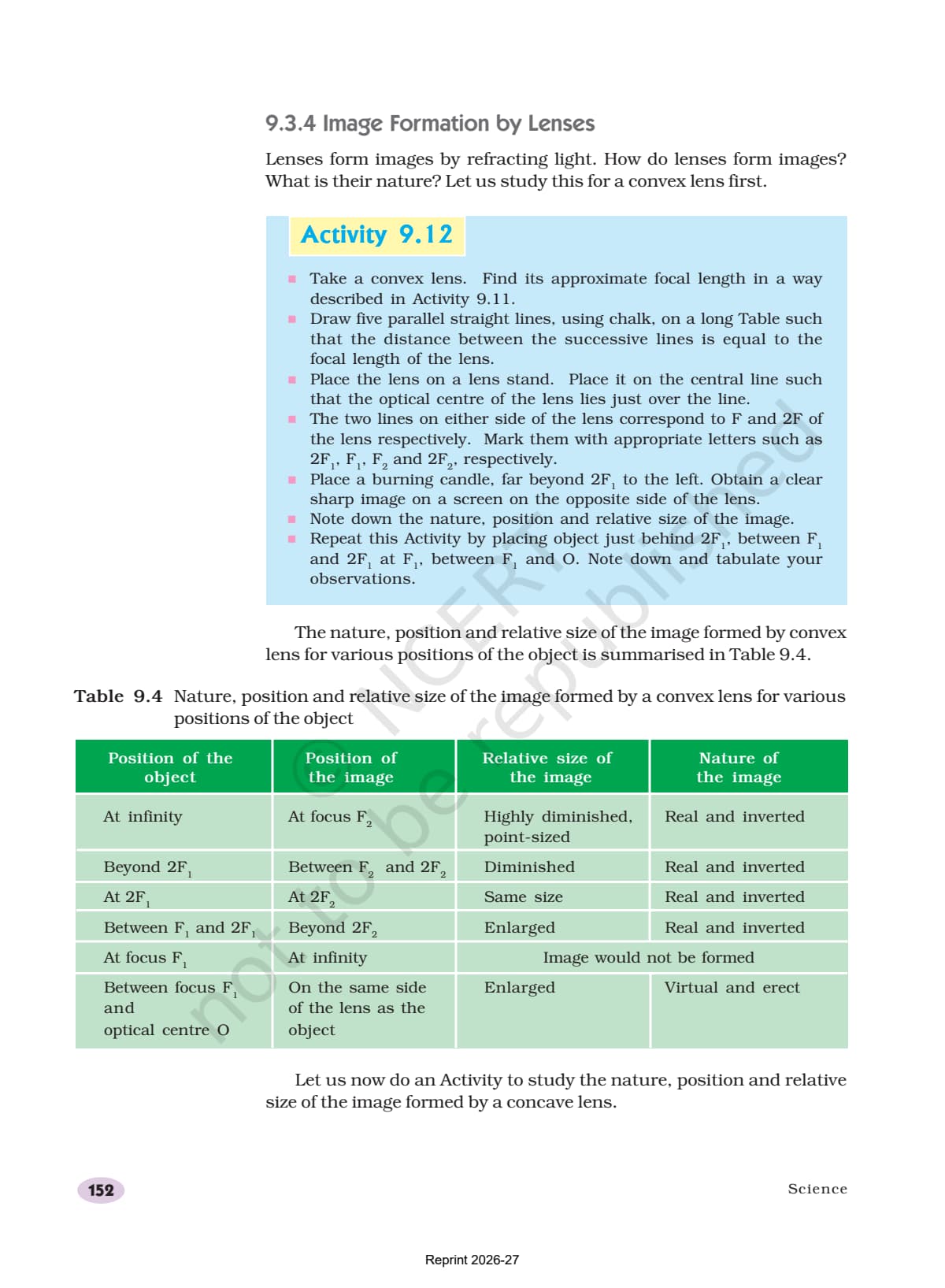
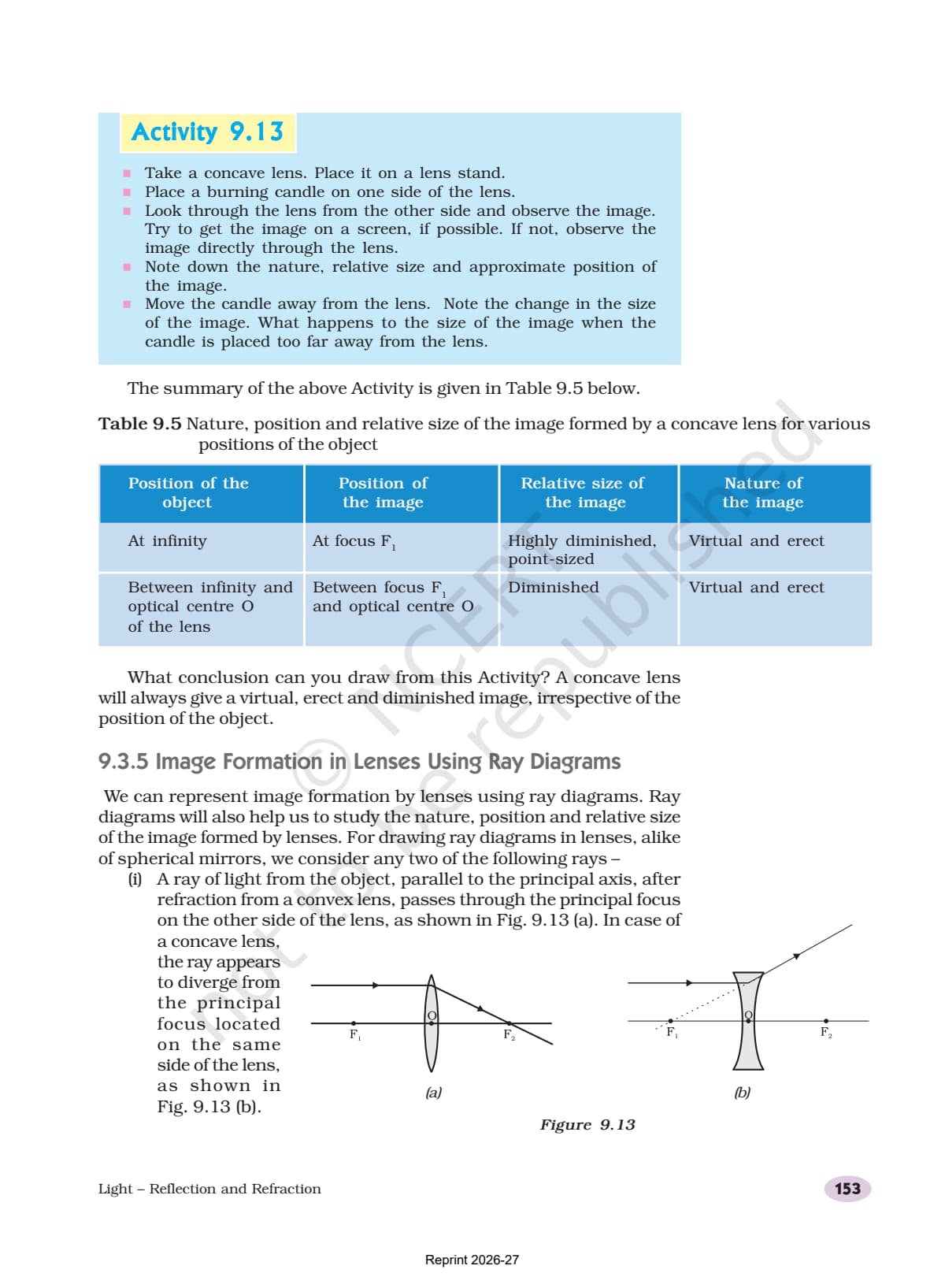
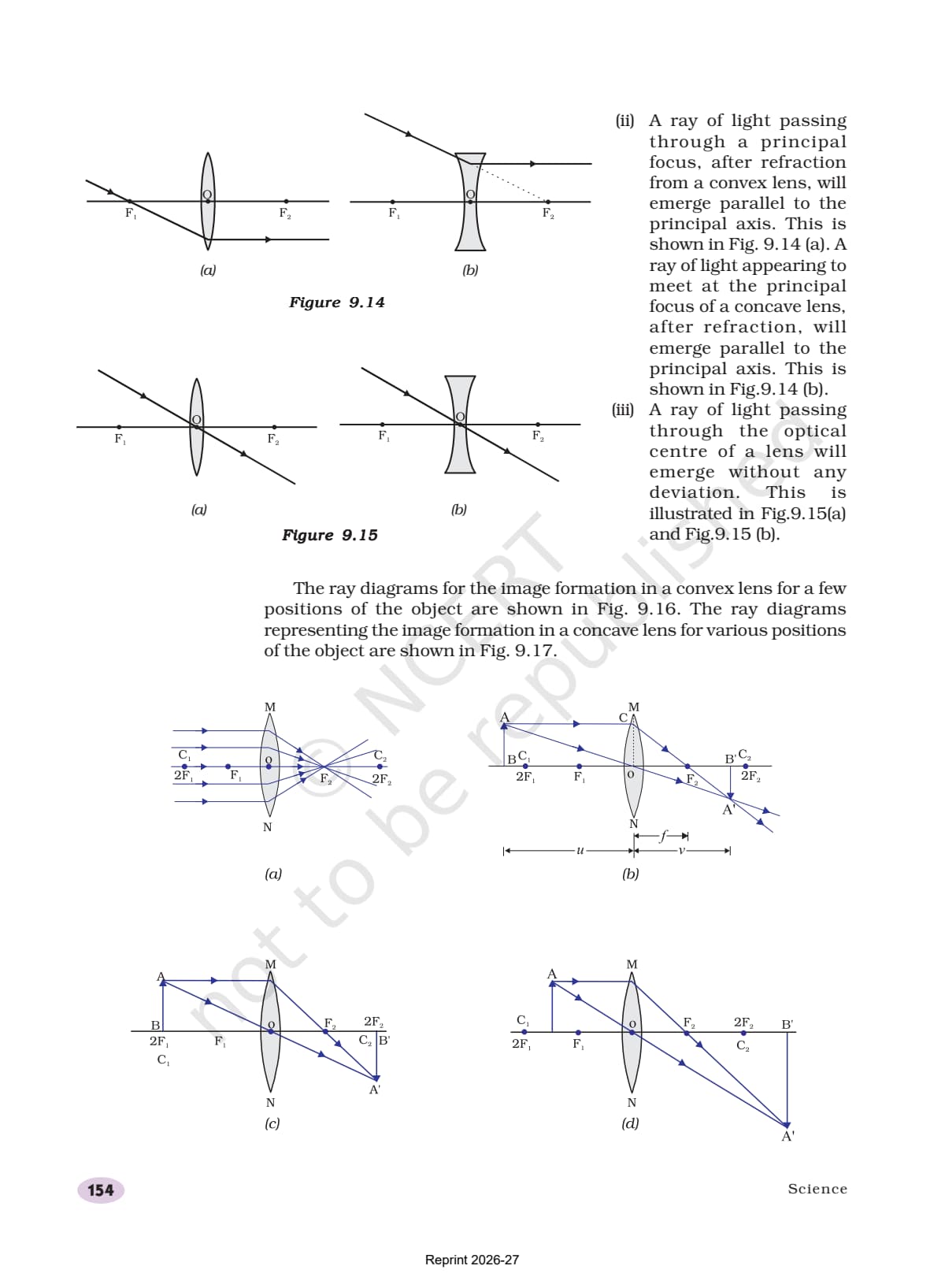
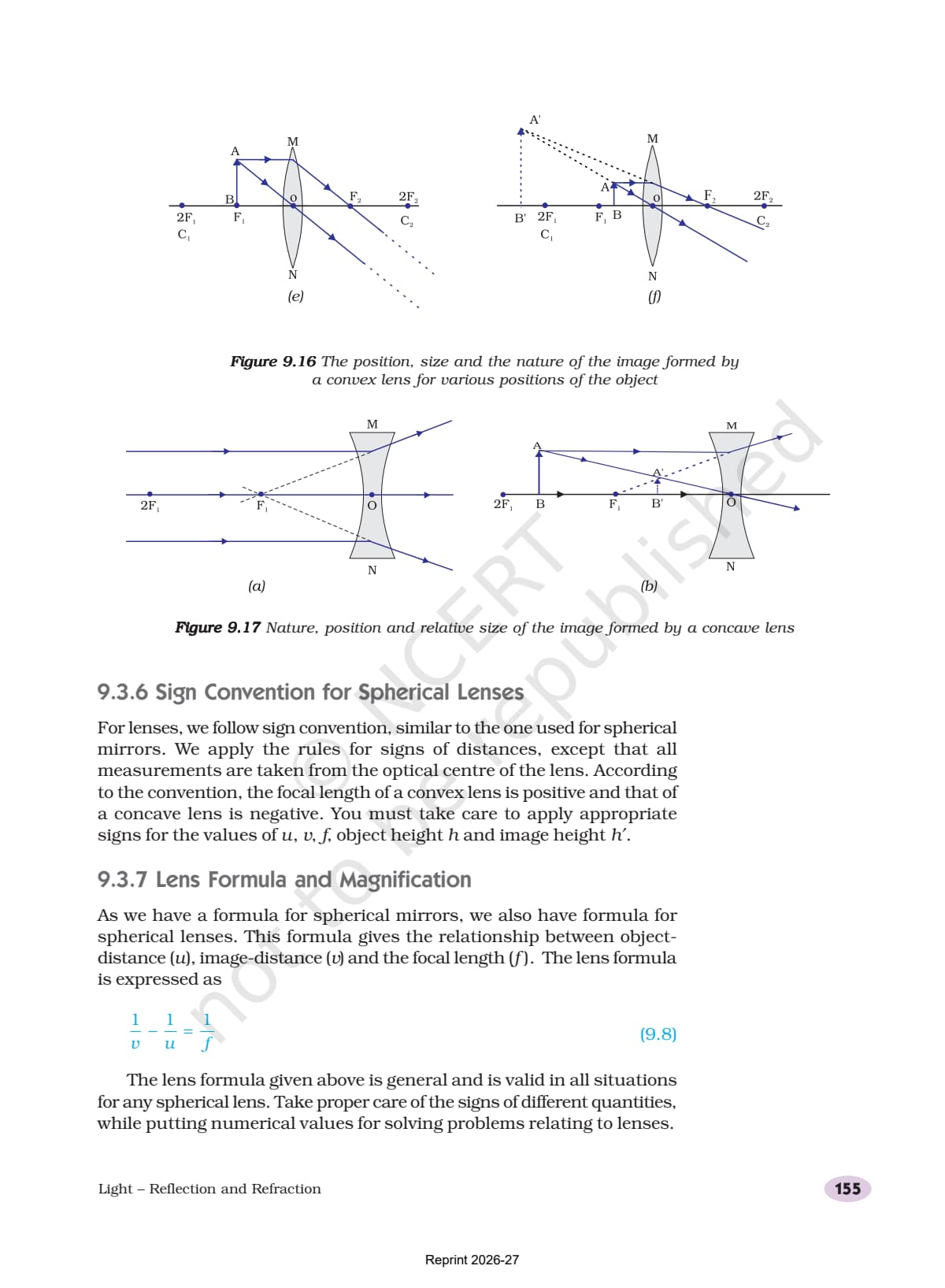
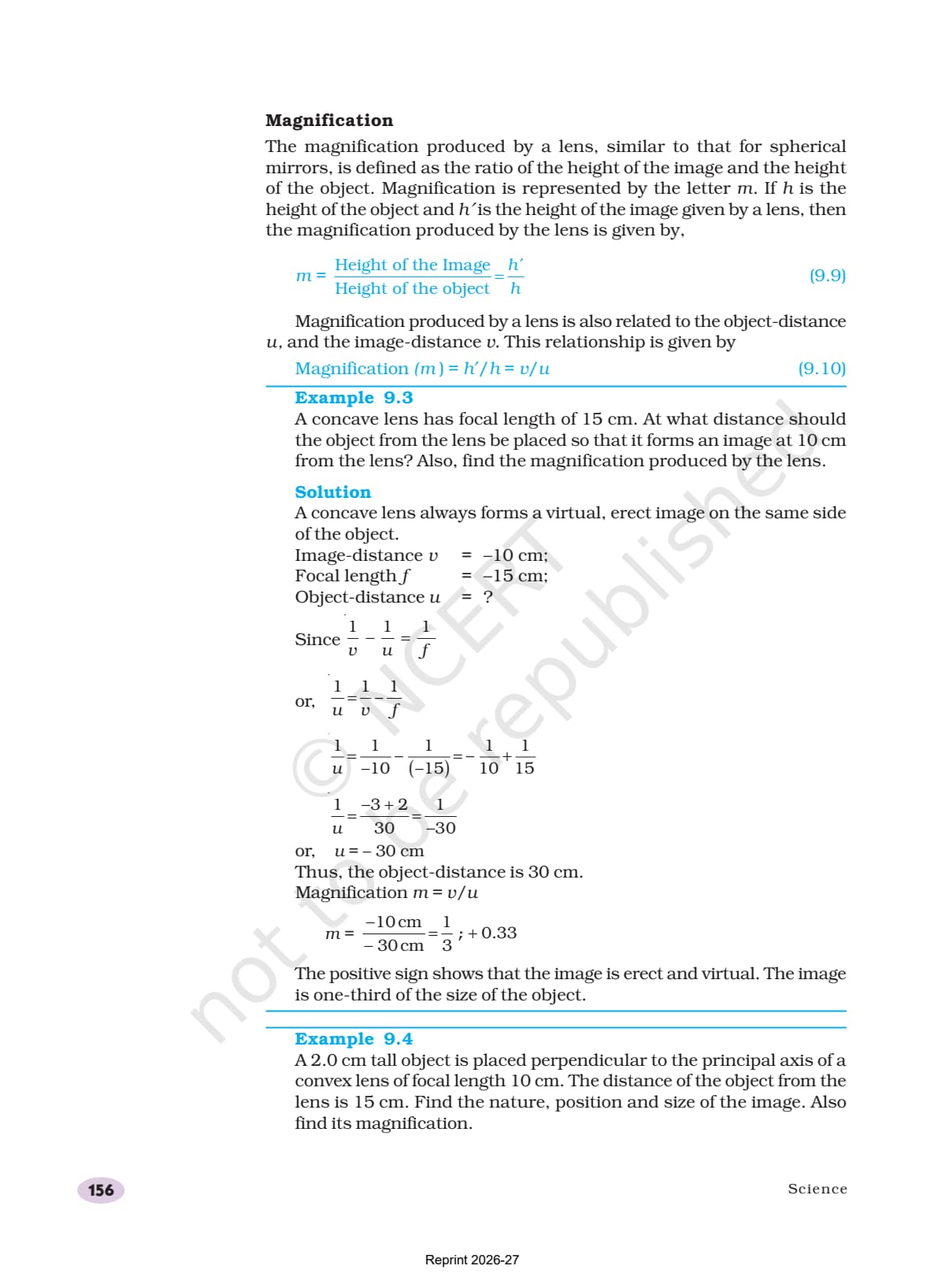
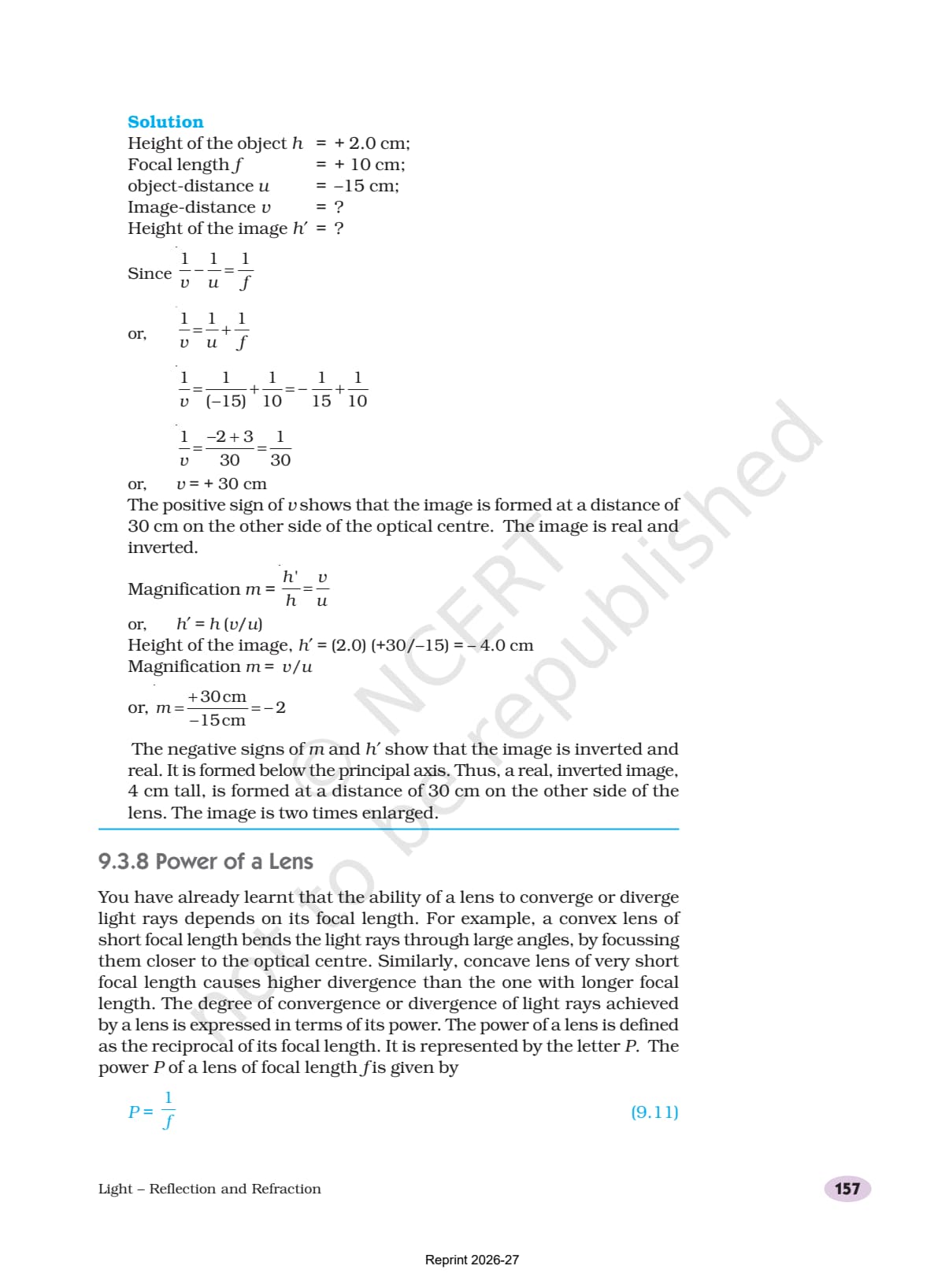
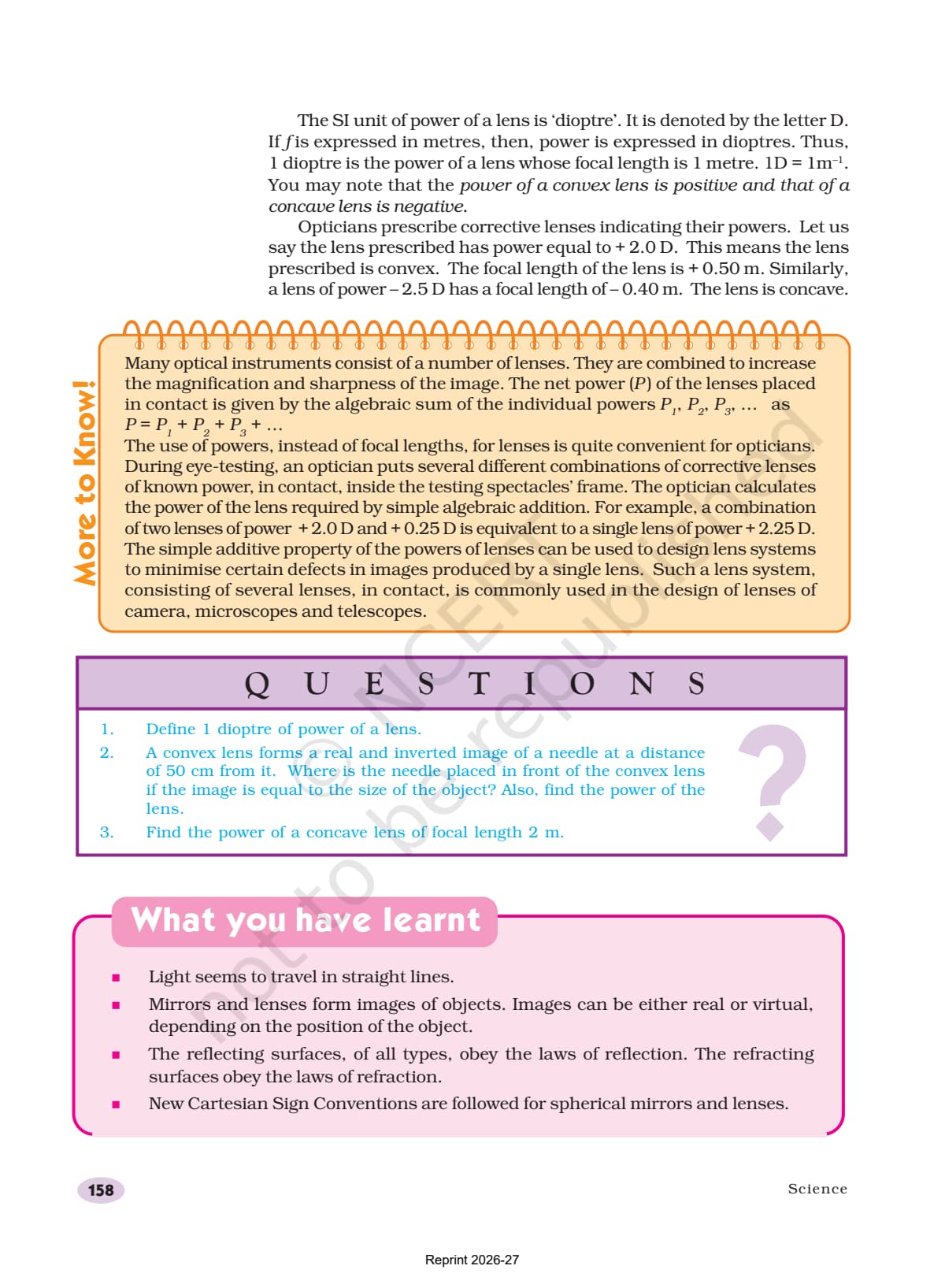
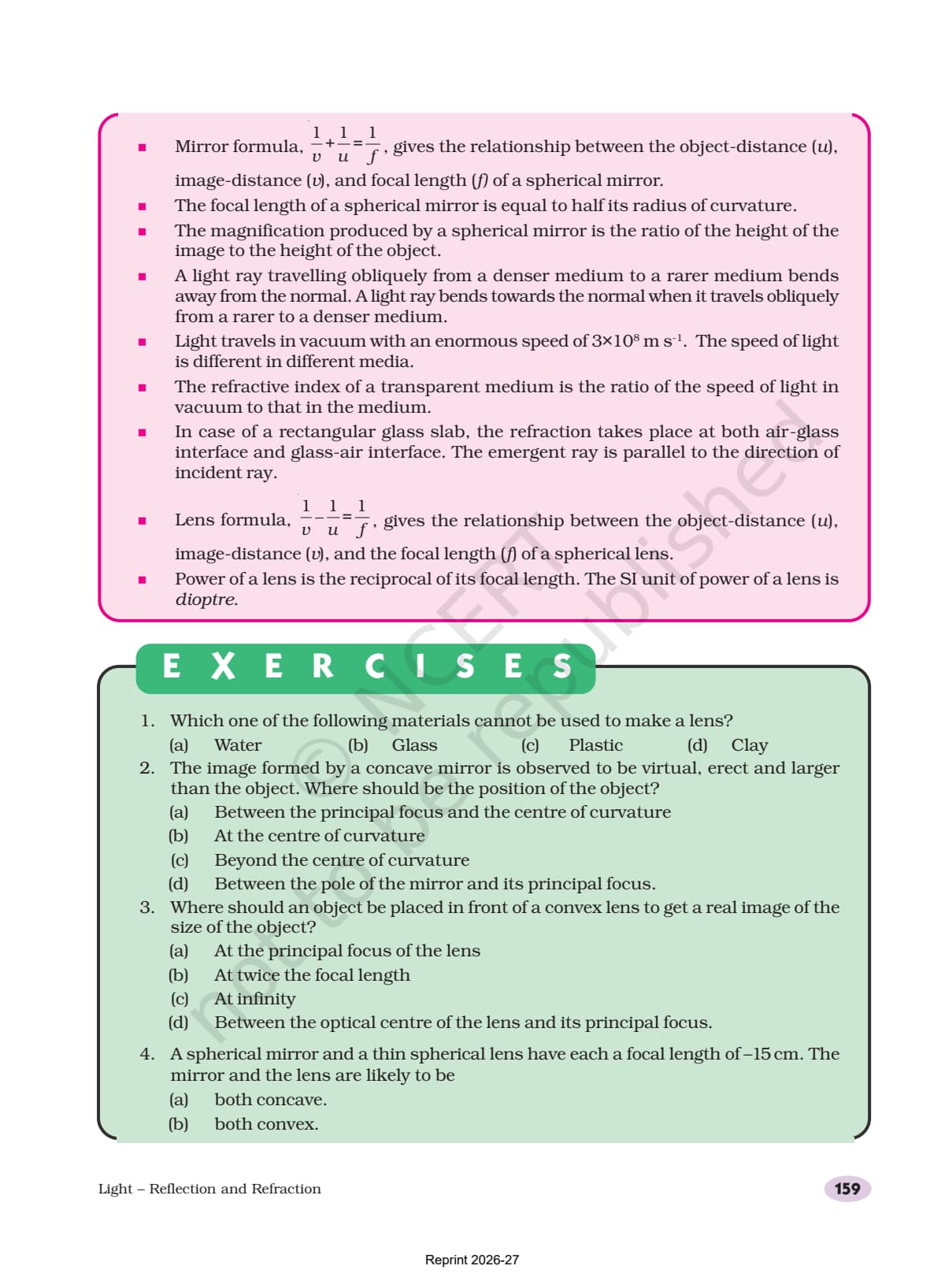
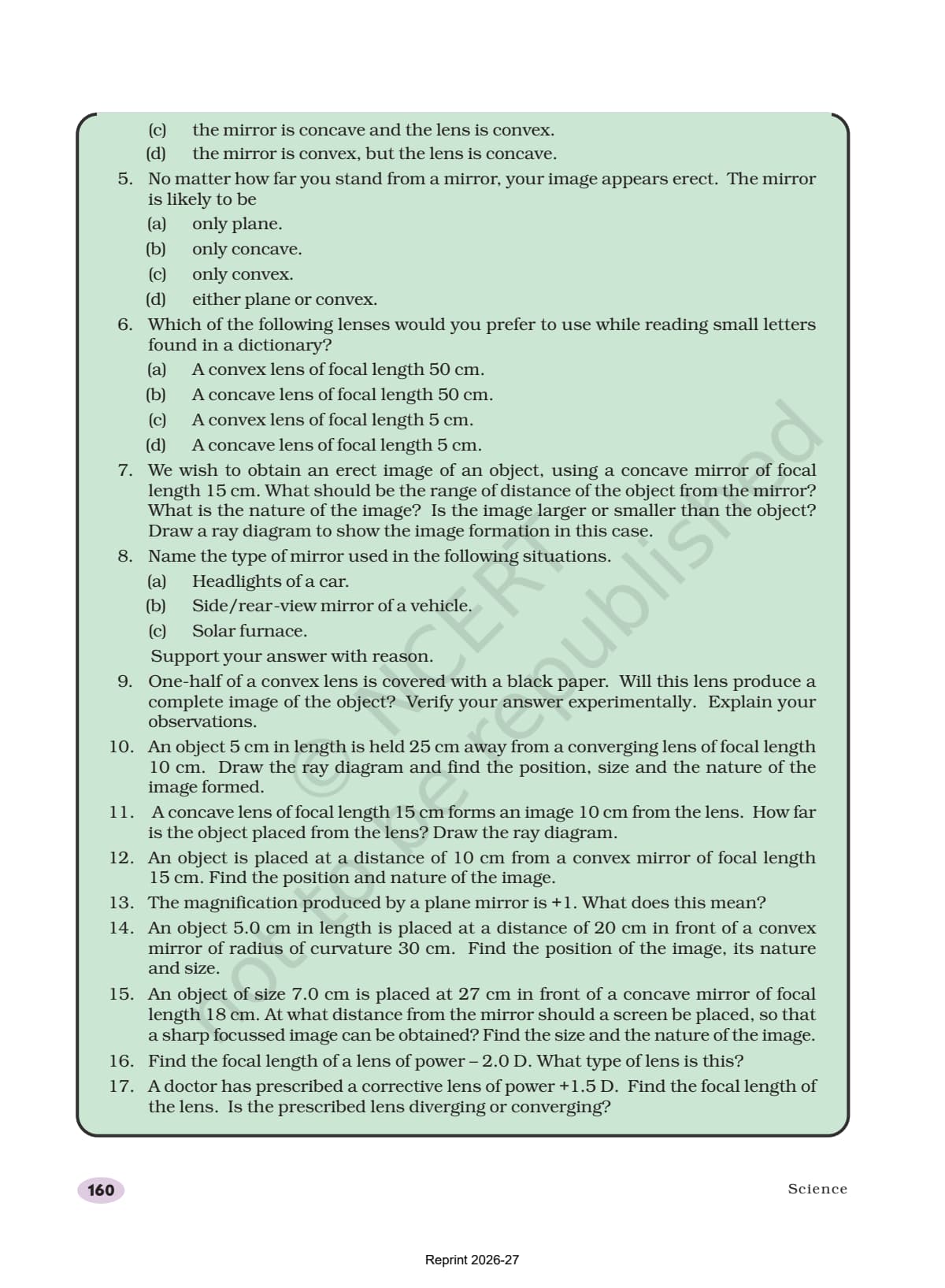
- Official NCERT textbook PDF of Chapter 9, with every activity, ray diagram, in-text question and exercise exactly as printed.
- Covers laws of reflection, concave and convex mirrors, the mirror formula, magnification, refractive index, Snell's law, convex and concave lenses, the lens formula and the power of a lens.
- Aligned with the 2026-27 CBSE Class 10 Science syllabus, useful for board exam revision and as the base text for the solutions and notes.
This page hosts the official NCERT Class 10 Science textbook chapter, mapped to the 2026-27 CBSE syllabus and checked page by page against the printed Light Reflection and Refraction chapter.
Student Feedback: What 13,200 students told us about this chapter
77% of Class 10 students said the parts they struggled with most were the sign convention, drawing the four ray diagrams for mirrors and lenses, and plugging values into the mirror and lens formulae. 3 out of 5 students told us that learning the two standard rays for each spherical mirror first, then practising the numericals, was what finally made the chapter click.
Students reported spending on average 5 to 6 hours on the full chapter across the first read and revision, and toppers said tracing the textbook ray diagrams (Fig. 9.2 to Fig. 9.16) by hand stopped them from getting the image position and sign wrong in the board exam.
Source: 2026-27 Class 10 Science student poll. Sample of 13,200 students from CBSE schools across 13 states, taken before the 2026 board exams.
What the NCERT Book for Class 10 Science Chapter 9 Light Reflection and Refraction Covers
The PDF above is the complete official NCERT chapter, as printed in the 2026-27 textbook. It begins with the reflection of light and spherical mirrors, then covers the refraction of light, refractive index and spherical lenses.
- Reflection and spherical mirrors: the laws of reflection, concave versus convex mirrors, and the four standard rays used to locate an image.
- Mirror formula and magnification: 1/v + 1/u = 1/f and m = -v/u = h'/h, with the New Cartesian sign convention.
- Refraction and refractive index: how light bends at a boundary, Snell's law, and the refractive index of a medium.
- Lenses and power: convex and concave lenses, the lens formula 1/v - 1/u = 1/f, and power P = 1/f in dioptres.
Light - Reflection and Refraction Class 10 Science Full Chapter Video
Source: Magnet Brains on YouTube
Reflection of Light and the Laws of Reflection in Class 10 Science Chapter 9
Section 9.1 opens with a familiar idea: a highly polished surface, such as a mirror, reflects most of the light falling on it. Every ray diagram in the chapter rests on the two laws of reflection. These laws apply to all reflecting surfaces, including the curved surface of a spherical mirror, not just flat plane mirrors.
| Law of reflection | What it states |
|---|---|
| First law | The angle of incidence is equal to the angle of reflection |
| Second law | The incident ray, the reflected ray and the normal at the point of incidence all lie in the same plane |
A plane mirror gives an image that is virtual, erect, the same size as the object, and laterally inverted, formed as far behind the mirror as the object is in front. This four-point list is a favourite one-mark board question, and these properties carry over as the starting point for spherical mirrors.
Spherical Mirrors: Concave and Convex in Class 10 Science Chapter 9
Spherical mirrors have a reflecting surface that is part of a sphere. A surface curving inwards is a concave mirror; one curving outwards is a convex mirror. The chapter defines the standard terms: pole, centre of curvature, radius of curvature, principal axis, principal focus and focal length.
| Term | Meaning in Chapter 9 |
|---|---|
| Pole (P) | The centre of the mirror's reflecting surface |
| Centre of curvature (C) | The centre of the sphere the mirror is part of |
| Radius of curvature (R) | The radius of that sphere (distance PC) |
| Principal focus (F) | Where parallel rays meet (or appear to) after reflection |
| Focal length (f) | Pole to focus distance, half the radius of curvature |
For a spherical mirror of small aperture, the focal length is half the radius of curvature: R = 2f. So a mirror of radius 20 cm has a focal length of 10 cm.
- Concave mirror: a converging mirror; parallel rays meet at a real focus in front, so it can form both real and virtual images.
- Convex mirror: a diverging mirror; parallel rays appear to come from a virtual focus behind, so it always forms a small, virtual, erect image.
Image Formation and Ray Diagrams in Class 10 Science Chapter 9
Sections 9.2.1 and 9.2.2 explain how to locate an image using ray diagrams. You draw any two of four standard rays from the top of the object; where the reflected rays meet (or appear to meet) is the top of the image. The same rules work for both mirror types.
For a concave mirror, the image changes as the object moves. Beyond C it is real, inverted and smaller; between C and F it is real, inverted and larger; inside the focus it becomes virtual, erect and enlarged, which is how a shaving mirror works. For a convex mirror, the image is always virtual, erect and diminished, wherever the object is.
| Object position (concave mirror) | Image: nature, size, position |
|---|---|
| Beyond C | Real, inverted, diminished, between F and C |
| At C | Real, inverted, same size, at C |
| Between C and F | Real, inverted, enlarged, beyond C |
| At F | Real, inverted, highly enlarged, at infinity |
| Between P and F | Virtual, erect, enlarged, behind the mirror |
Concave mirrors are used in torches, vehicle headlights and shaving mirrors, while convex mirrors are used as rear-view mirrors because they give an erect, diminished image and a wider field of view. Note that a convex mirror never forms a real image of a real object, a common slip that costs marks.
Sign Convention, Mirror Formula and Magnification in Class 10 Science
Sections 9.2.3 and 9.2.4 give the maths of mirrors. The New Cartesian Sign Convention takes the pole as origin: distances against the incident light are negative, distances above the axis are positive, and distances below are negative. Getting these signs right is what most board numericals test.
| Quantity | Symbol | Sign rule |
|---|---|---|
| Object distance | u | Always negative (object is in front of the mirror) |
| Image distance | v | Negative if real (in front), positive if virtual (behind) |
| Focal length | f | Negative for concave, positive for convex |
| Object height | h | Positive (measured upwards) |
| Image height | h' | Positive if erect, negative if inverted |
The mirror formula links object distance, image distance and focal length: 1/v + 1/u = 1/f. The magnification is written two ways: m = h'/h and m = -v/u. A negative m means a real, inverted image; a positive m means a virtual, erect image, and the size of m tells you whether it is enlarged or diminished.
- If |m| > 1 the image is larger; if |m| < 1 it is smaller; if |m| = 1 it is the same size.
- Always substitute with signs: put u, v and f in with their correct signs before solving.
Refraction of Light and Refractive Index in Class 10 Science Chapter 9
Section 9.3 turns to refraction, the bending of light as it passes from one transparent medium to another. Light bends because its speed changes at the boundary, towards the normal when it enters a denser medium and away from the normal when it enters a rarer one. Everyday examples: a pencil looks bent in water, and a pool looks shallower than it is.
In refraction through a glass slab, the ray emerges parallel to the original ray but shifted sideways (the lateral displacement). The second law of refraction is Snell's law: sin i / sin r is constant for a pair of media.
| Law of refraction | What it states |
|---|---|
| First law | The incident ray, the refracted ray and the normal all lie in the same plane |
| Second law (Snell's law) | sin i / sin r is constant for a given pair of media; this constant is the refractive index |
Section 9.3.2 explains the refractive index. It is the ratio of the speed of light in a vacuum to the speed in the medium, so a larger refractive index means light travels more slowly and bends more. Water (about 1.33) bends light less than glass (about 1.5), which bends it less than diamond (about 2.42).
Spherical Lenses, Lens Formula and Power of a Lens in Class 10 Science
Section 9.3.3 onward covers spherical lenses. A convex lens is thicker in the middle, converges light and has a real focus; a concave lens is thinner in the middle, diverges light and has a virtual focus. As with mirrors, you locate the image by drawing two standard rays from the top of the object.
The lens formula is 1/v - 1/u = 1/f, with the same sign convention and magnification m = h'/h = v/u. For lenses, a convex lens has positive f and a concave lens negative f. A convex lens forms real images for distant objects and a virtual, enlarged image when the object is inside the focus (the magnifying-glass case).
Section 9.3.8 defines the power of a lens as P = 1/f (f in metres), with unit the dioptre (D). A convex lens has positive power and a concave lens negative power, and the powers of thin lenses in contact add up.
| Quantity | Convex lens | Concave lens |
|---|---|---|
| Focal length f | Positive | Negative |
| Power P = 1/f | Positive (in dioptres) | Negative (in dioptres) |
| Action on light | Converging | Diverging |
What You Have Learnt and Common Exam Traps in Class 10 Science Chapter 9
Read the chapter in two passes: first the laws of reflection, the mirror terms and the sign convention, then the ray diagrams (Fig. 9.2 to Fig. 9.16) and the worked numericals. Draw the ray diagrams yourself rather than just reading them, because that is the drill the board paper rewards most.
Other Resources for Class 10 Science Chapter 9 Light Reflection and Refraction
Read the official NCERT Book chapter above, then revise with the matching NCERT Solutions, revision notes, formula sheet and handwritten notes. All resources for Class 10 Science Chapter 9 Light Reflection and Refraction are linked in the table below.
| Resource | What it covers | Open |
|---|---|---|
| NCERT Book PDF | Official Class 10 Science Chapter 9 textbook, with every activity, ray diagram and exercise. | You are here |
| NCERT Solutions | Step-by-step answers to all in-text and exercise questions of the chapter. | Class 10 Science Chapter 9 NCERT Solutions |
| Notes | Concept-first revision notes on reflection, mirrors, refraction, lenses and the key formulae. | Class 10 Science Chapter 9 Notes |
| Formula Sheet | Quick reference of the mirror formula, lens formula, magnification and power of a lens. | Class 10 Science Chapter 9 Formula Sheet |
| Handwritten Notes | Scanned-style handwritten pages for last-minute board revision. | Class 10 Science Chapter 9 Handwritten Notes |
NCERT Book for Class 10 Science: All Chapters
Related Links: Use the table below to open the official NCERT Book PDF for the other chapters of Class 10 Science. Every chapter ships with the same official textbook PDF, chapter overview, and board-ready FAQ.
| Chapter | NCERT Book PDF link |
|---|---|
| Chapter 1 | Chemical Reactions and Equations NCERT Book PDF |
| Chapter 2 | Acids, Bases and Salts NCERT Book PDF |
| Chapter 3 | Metals and Non-metals NCERT Book PDF |
| Chapter 4 | Carbon and its Compounds NCERT Book PDF |
| Chapter 5 | Life Processes NCERT Book PDF |
| Chapter 6 | Control and Coordination NCERT Book PDF |
| Chapter 7 | How do Organisms Reproduce NCERT Book PDF |
| Chapter 8 | Heredity NCERT Book PDF |
| Chapter 9 | Light Reflection and Refraction NCERT Book PDF (You are here) |
| Chapter 10 | The Human Eye and the Colourful World NCERT Book PDF |
| Chapter 11 | Electricity NCERT Book PDF |
| Chapter 12 | Magnetic Effects of Electric Current NCERT Book PDF |
| Chapter 13 | Our Environment NCERT Book PDF |
NCERT Book Class 10 Science Chapter 9 Light Reflection and Refraction FAQs
Ques. What does Chapter 9 Light Reflection and Refraction cover in the Class 10 Science NCERT Book?
Ans. Chapter 9 of the Class 10 Science NCERT Book covers two main ideas: the reflection of light and the refraction of light. It begins with the laws of reflection and the image formed by a plane mirror, then moves to spherical mirrors, explaining concave and convex mirrors, how they form images, and the four standard rays used in ray diagrams. It gives the New Cartesian sign convention, the mirror formula 1/v + 1/u = 1/f, and magnification. The second half covers refraction, the laws of refraction including Snell's law, the meaning of the refractive index, and spherical lenses with the lens formula 1/v - 1/u = 1/f and the power of a lens. It is aligned with the 2026-27 CBSE syllabus.
Ques. What is the difference between a concave and a convex mirror in Class 10 Science Chapter 9?
Ans. A concave mirror has a reflecting surface that curves inwards, like the inside of a spoon, and it converges parallel light to a real focus in front of the mirror. Because of this it can form both real and virtual images, depending on where the object is placed, which is why it is used in torches, vehicle headlights and shaving mirrors. A convex mirror has a reflecting surface that curves outwards and it diverges parallel light, which appears to come from a virtual focus behind the mirror. A convex mirror always forms a virtual, erect and diminished image, so it gives a wide field of view and is used as a rear-view mirror in vehicles.
Ques. What is the mirror formula and what is the sign convention used in Chapter 9?
Ans. The mirror formula is 1/v + 1/u = 1/f, where u is the object distance, v is the image distance and f is the focal length, all measured from the pole of the mirror. The chapter uses the New Cartesian Sign Convention. Distances are measured from the pole, distances against the direction of the incident light are negative, distances above the principal axis are positive and those below are negative. So the object distance u is always negative, the focal length of a concave mirror is negative while that of a convex mirror is positive, and the sign of the image distance v tells you whether the image is real (negative) or virtual (positive). Always substitute the signs before solving the numerical.
Ques. What is magnification and how is it calculated in Class 10 Science Chapter 9?
Ans. Magnification tells you how large the image is compared with the object and whether it is erect or inverted. It is the ratio of the height of the image to the height of the object, m = h'/h, and for a spherical mirror it is also given by m = -v/u. A negative value of magnification means the image is real and inverted, while a positive value means the image is virtual and erect. If the size of the magnification is greater than one the image is enlarged, if it is less than one the image is diminished, and if it equals one the image is the same size as the object. The same idea applies to lenses, where m = v/u.
Ques. What is the refractive index and Snell's law in Class 10 Science Chapter 9?
Ans. Refraction is the bending of light as it passes from one transparent medium to another because its speed changes at the boundary. The laws of refraction state that the incident ray, the refracted ray and the normal all lie in one plane, and that the ratio sin i / sin r is a constant for a given pair of media, which is Snell's law. This constant is the refractive index of the second medium with respect to the first. The refractive index can also be defined as the ratio of the speed of light in a vacuum to its speed in the medium, so a higher refractive index means light travels more slowly and bends more in that medium, like diamond with a value of about 2.42.
Ques. What is the lens formula and the power of a lens in Class 10 Science Chapter 9?
Ans. The lens formula is 1/v - 1/u = 1/f, which connects the object distance u, the image distance v and the focal length f of a spherical lens, using the New Cartesian sign convention. For lenses the focal length of a convex lens is taken as positive and that of a concave lens as negative. The power of a lens is the reciprocal of its focal length in metres, P = 1/f, and its unit is the dioptre (D), where 1 D is the power of a lens of focal length 1 metre. A convex lens has a positive power and a concave lens has a negative power. When two thin lenses are placed in contact, their powers add up, which is how lens combinations are made.
Ques. Why does the mirror formula use a plus sign while the lens formula uses a minus sign?
Ans. The two formulae look almost the same but differ in one sign, and this difference comes from the geometry of how mirrors and lenses bend light. The mirror formula is 1/v + 1/u = 1/f because in a mirror both the object and the real image lie on the same side, the side from which the light comes. The lens formula is 1/v - 1/u = 1/f because light passes through a lens, so the real image forms on the side opposite to the object. Mixing up these two signs is the most common numerical mistake in this chapter, so it is a good habit to write the correct formula clearly at the top of every solution before you put in the numbers.
Ques. Is the Class 10 Science Chapter 9 NCERT Book PDF free to download for 2026-27?
Ans. Yes. The official NCERT Book PDF for Class 10 Science Chapter 9 Light Reflection and Refraction is free to read and download on this page for the 2026-27 session. It is the complete chapter as printed in the CBSE textbook, including every activity, ray diagram, in-text question and end-of-chapter exercise. You can pair the book with the linked NCERT Solutions and revision notes for the same chapter so that you read the textbook and revise from one place before the board exam.



Comments