




Chapter 5 Exploring Mixtures and their Separation shows that almost nothing around us is pure. These NCERT Notes for Class 9 Science Chapter 5 Exploring Mixtures and their Separation pack the whole chapter into one revision-friendly page for the 2026-27 session. You learn to sort mixtures as homogeneous or heterogeneous, tell solutions, suspensions and colloids apart, measure concentration, and match each separation method to the property it uses. Every idea comes with a table, a diagram or a memory tip so you can revise fast before a test.
- Full chapter covered: mixtures, solutions, concentration, the Tyndall effect and eight separation methods, matched to the 2026-27 NCERT Exploration book.
- What is inside: quick-revision tables for homogeneous versus heterogeneous mixtures, the solution-suspension-colloid comparison, and a separation-method chooser.
- Best for: last-day revision, unit tests and CBSE-style periodic tests, with mistakes to avoid and self-check questions.
Student Feedback on Exploring Mixtures and their Separation
In a Collegedunia poll of 12,840 Class 9 students during the 2026-27 session, 68% of students said the solution, suspension and colloid table was the part they revised the most. Students also rated the separation-method chooser as the note they found most useful the night before a unit test.
Source: 2026-27 Class 9 Science student poll. Sample of 12,840 students from CBSE schools.
Exploring Mixtures and their Separation Class 9 Explained Simply
Source: Magnet Brains on YouTube
How These Class 9 Science Notes Help You Revise Exploring Mixtures and their Separation
These notes are built for revision, not for a first read. They keep the concept, the everyday example and the exam tip for each idea close together, so a quick scan brings the whole chapter back. That is exactly how a Class 9 unit test or a CBSE-style periodic test rewards you.
- 2026-27 NCERT alignment: the notes follow the new Exploration book and its Revise, Reflect, Refine exercise, so nothing extra or outdated slips in.
- Tables over paragraphs: the big comparisons, homogeneous versus heterogeneous and solution-suspension-colloid, are set as tables you can memorise at a glance.
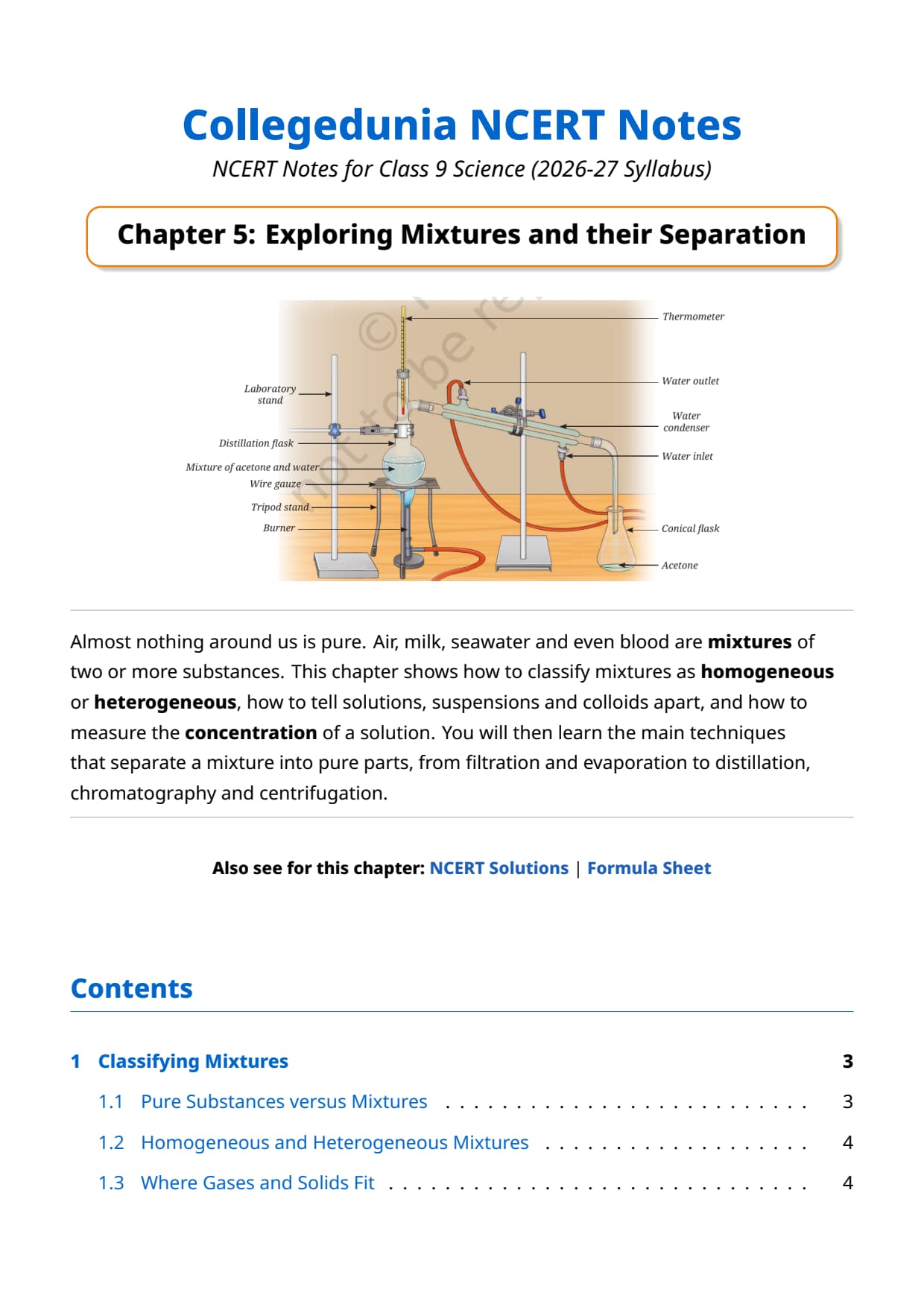
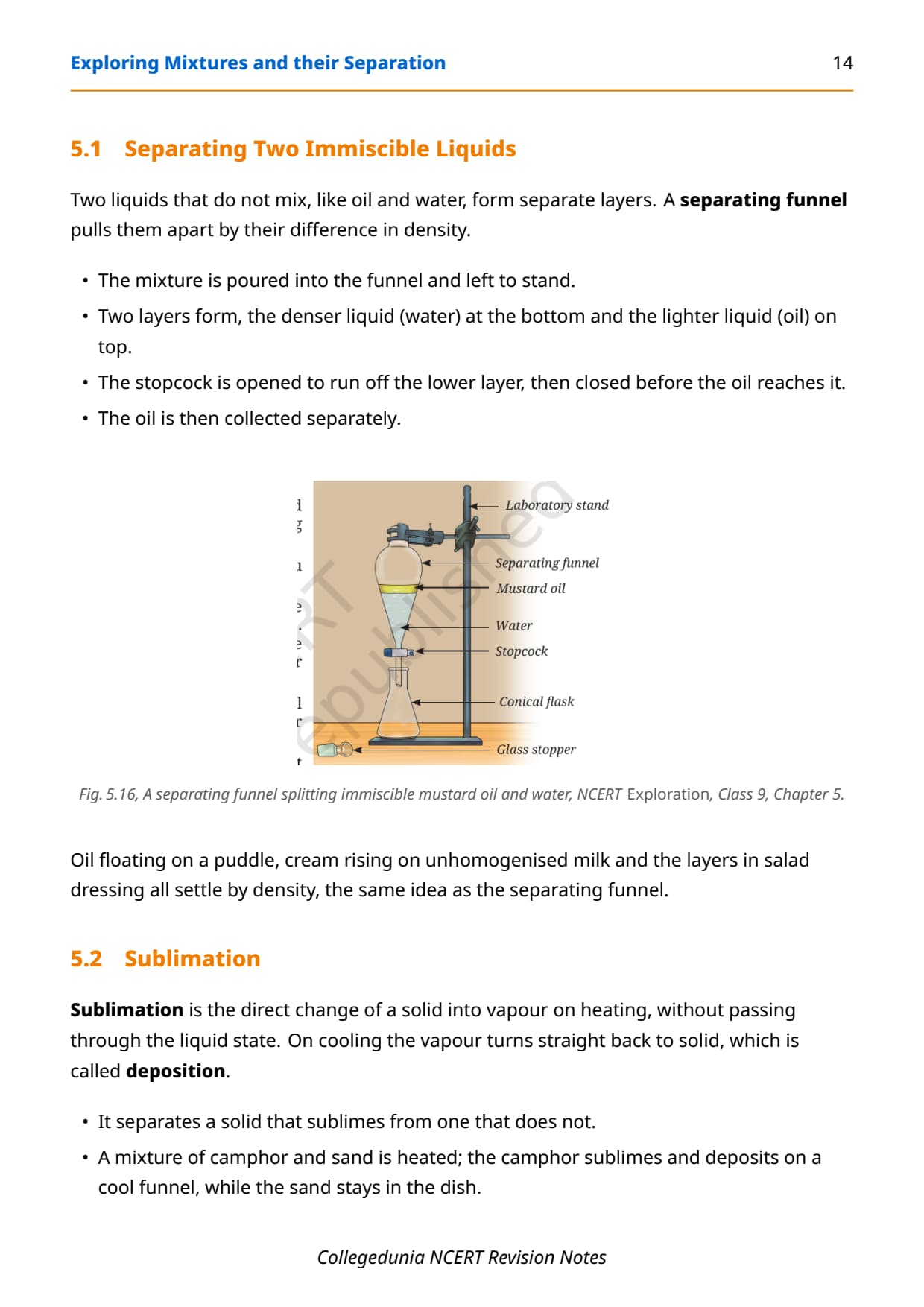
- Diagrams where they help: the distillation flow and the separating funnel are shown as simple labelled steps.
- Mistakes flagged early: the traps that cost marks, such as calling milk a solution, are called out beside each concept.
What the Class 9 Science Exploring Mixtures and their Separation PDF Contains
The PDF is a clean, printable copy of everything on this page. It is handy for last-day revision because it puts each concept, its example and its exam tip on one line of sight, with the key tables together at the end.
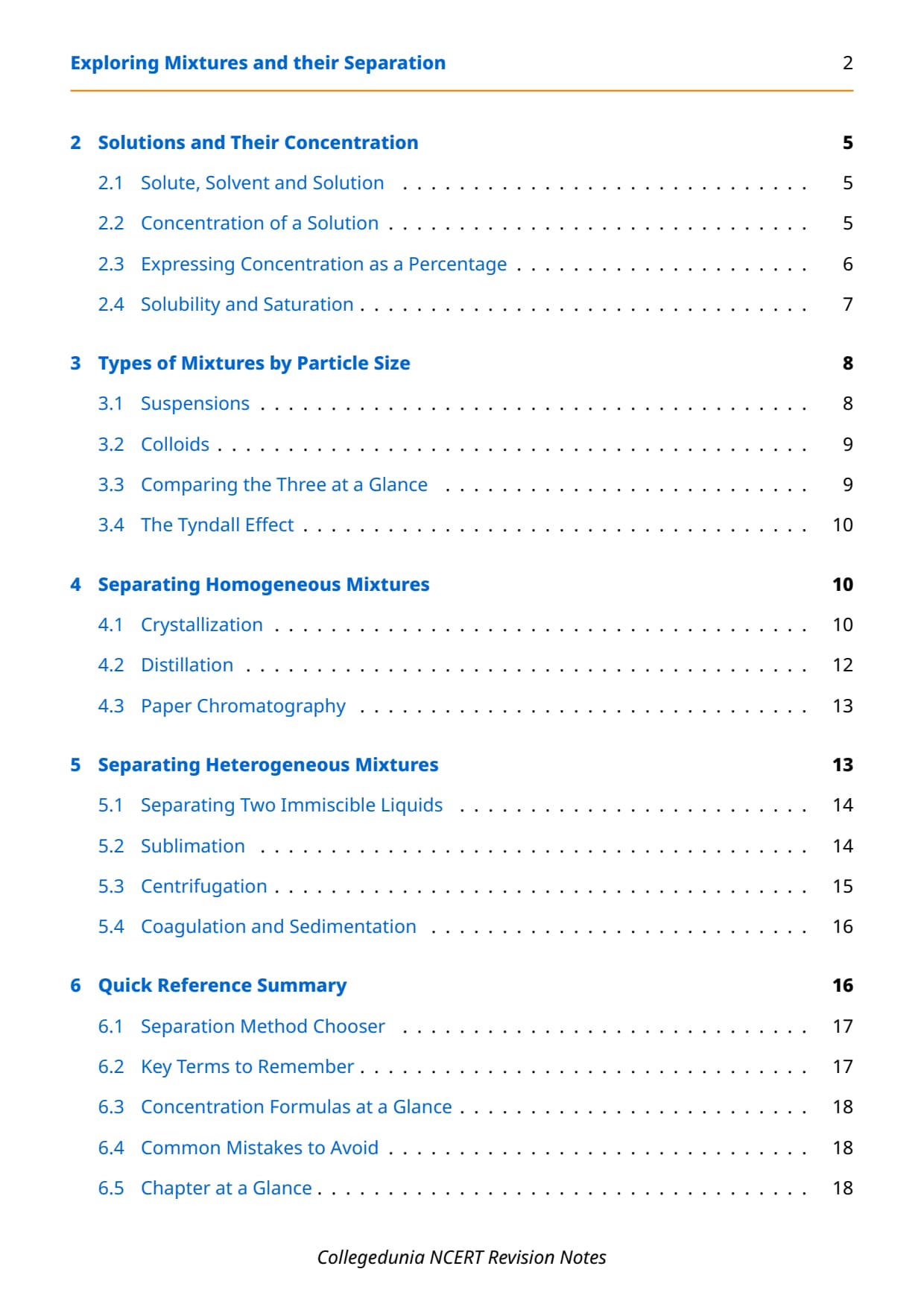
- Concept notes on mixtures, solutions, concentration, particle size, the Tyndall effect and separation methods.
- Ready-made revision tables and a separation-method chooser that maps each method to the property it uses.
- Common mistakes to avoid and ten self-check questions in the style of the exam.
Classifying Mixtures in Exploring Mixtures and their Separation: Homogeneous and Heterogeneous
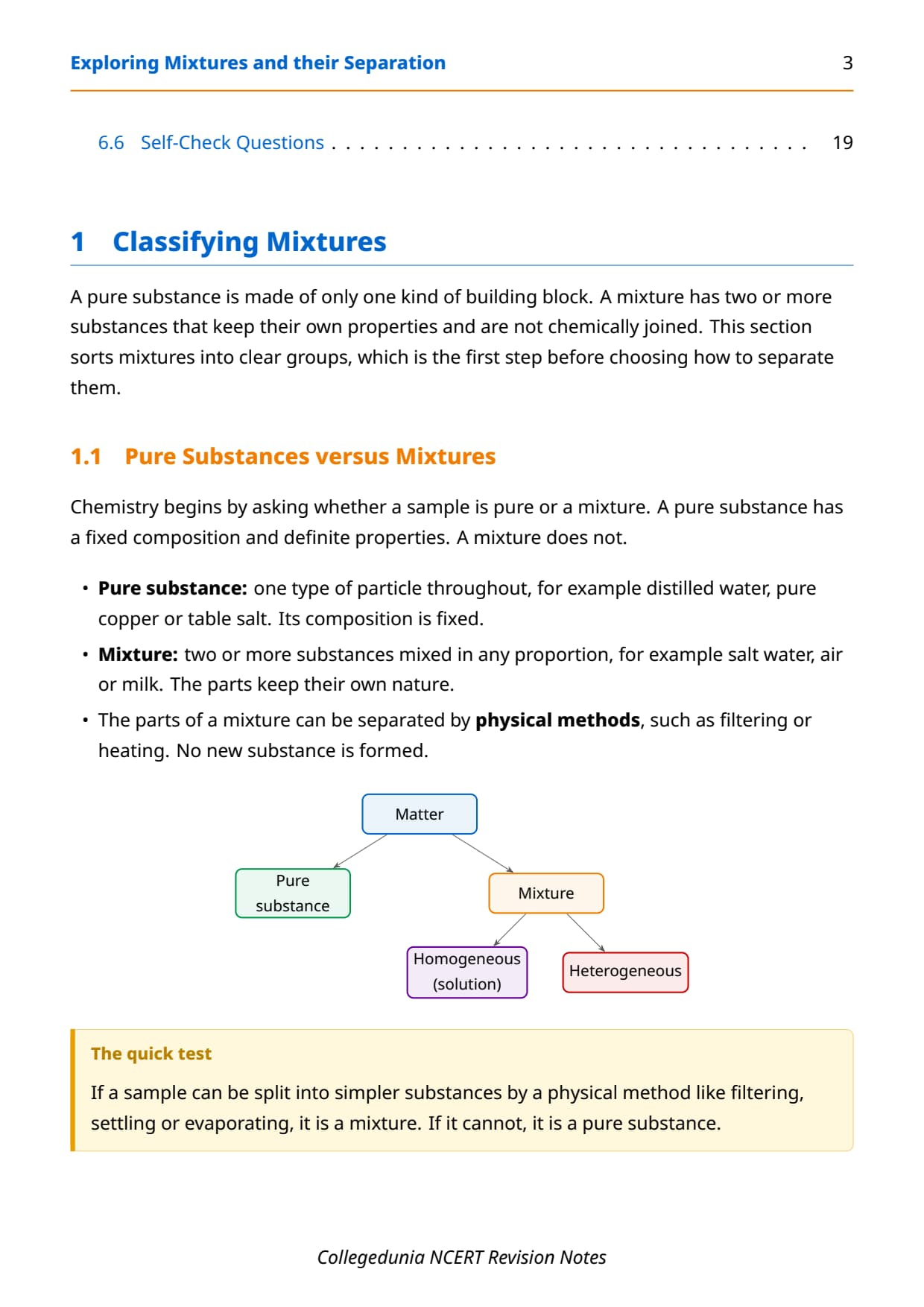
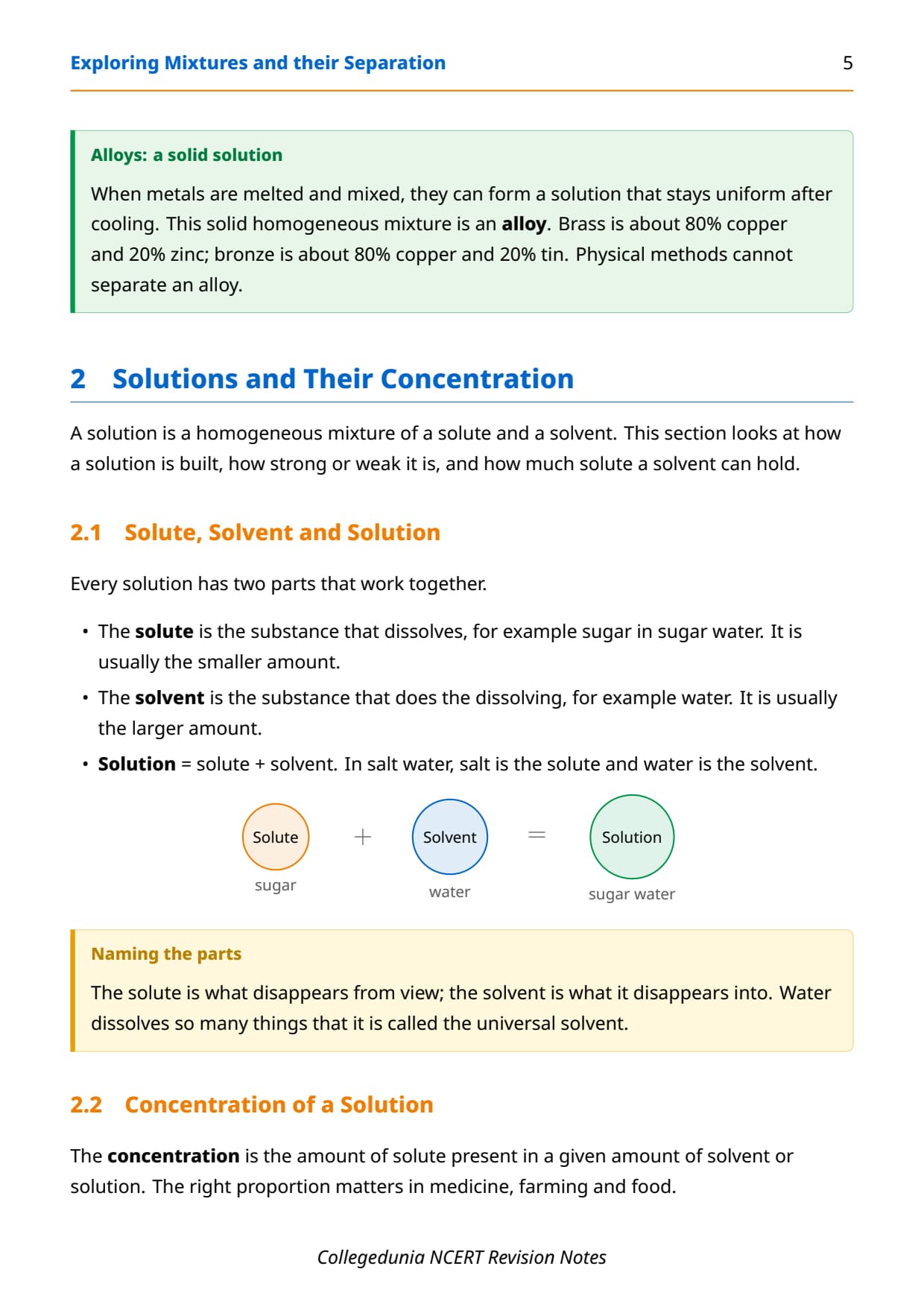
A pure substance is made of only one kind of particle and has a fixed composition, like distilled water or pure copper. A mixture has two or more substances mixed in any proportion, and its parts keep their own properties. The first job of this chapter is to sort every mixture into one of two groups.
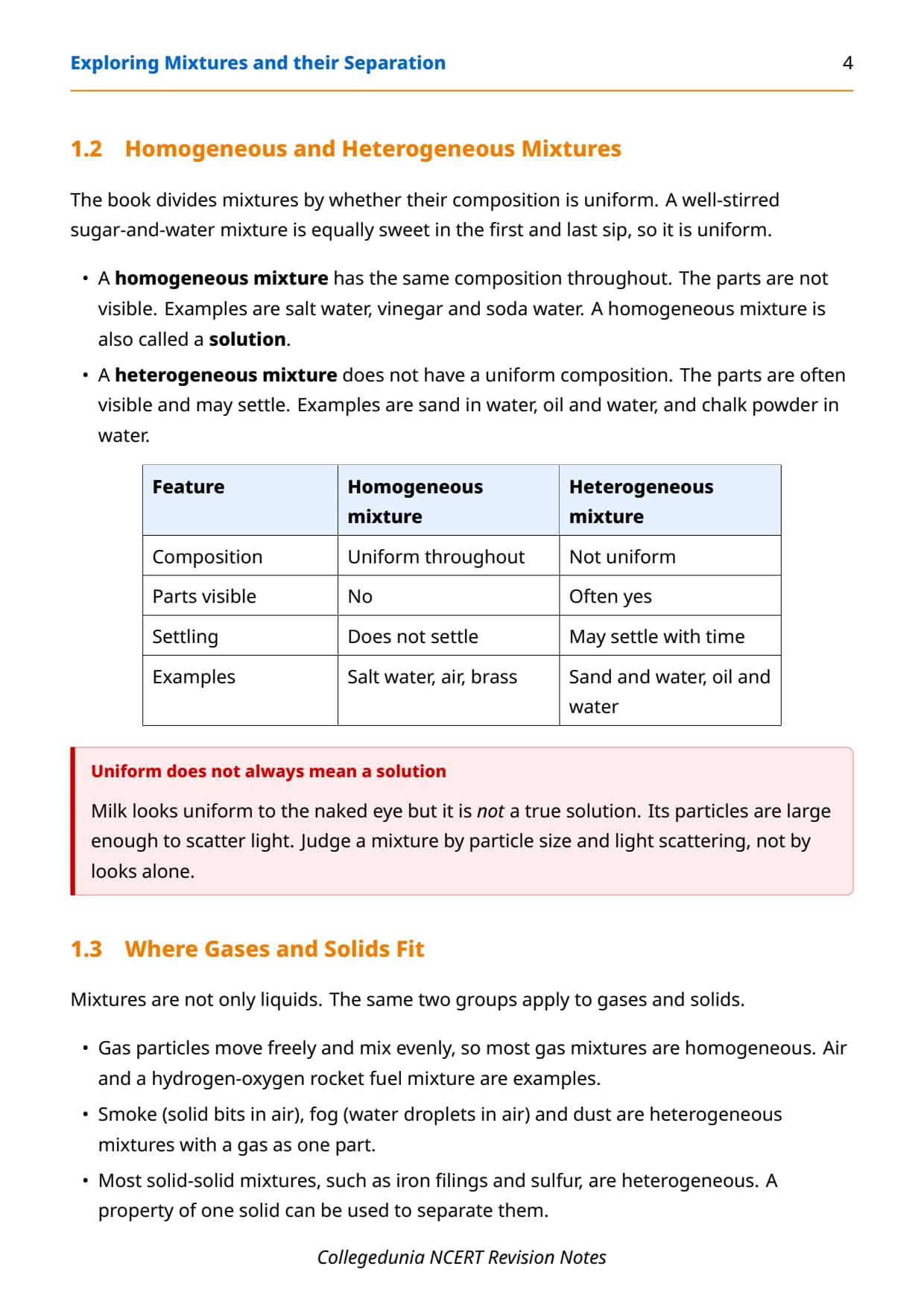
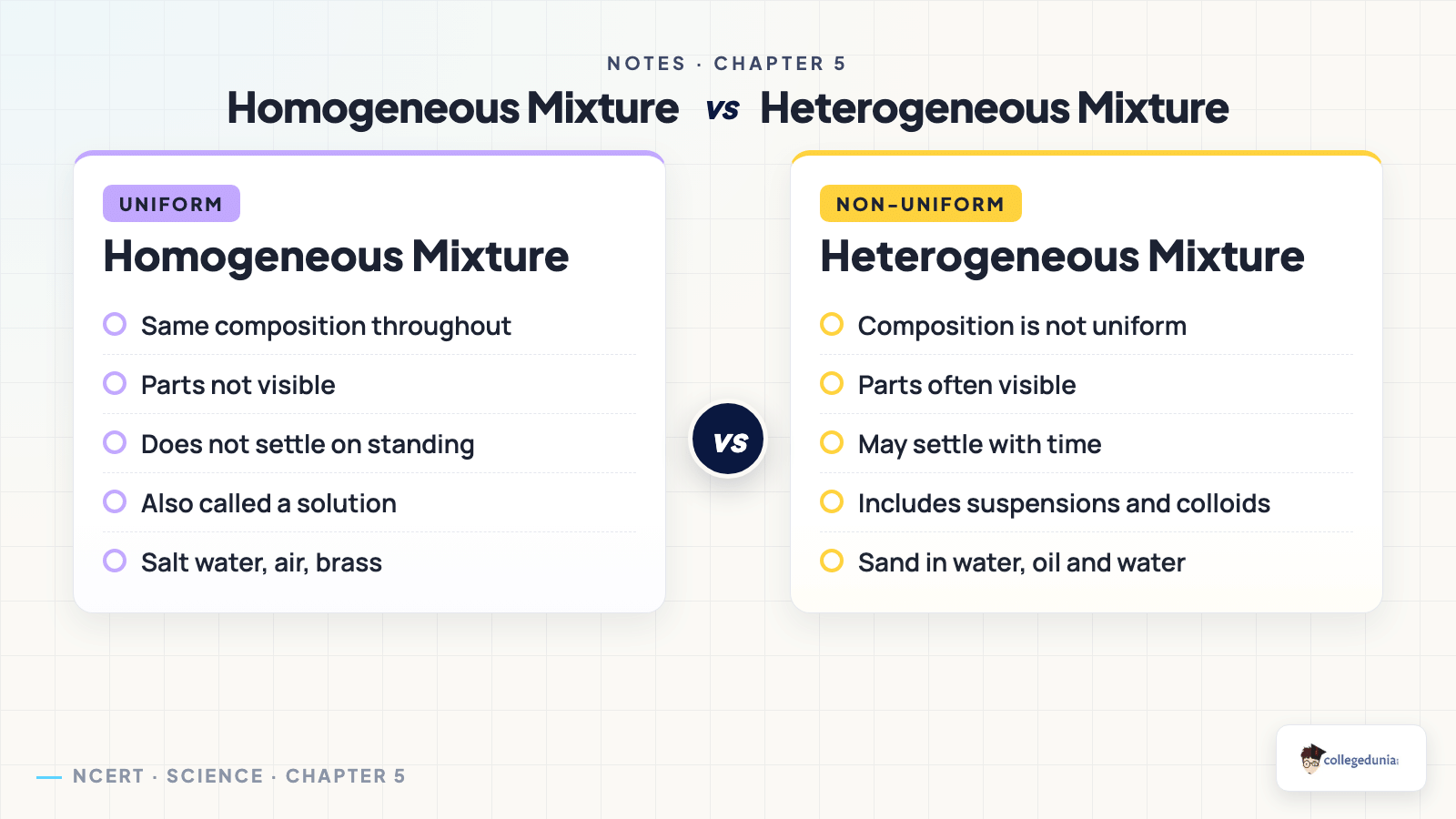
- A homogeneous mixture has the same composition throughout, with no visible boundary. It is also called a solution. Examples are salt water, air, vinegar and brass.
- A heterogeneous mixture does not have a uniform composition. Its parts are often visible and may settle. Examples are sand in water, oil and water, and chalk in water.
- The parts of any mixture can be separated by physical methods, such as filtering or heating, without forming a new substance.
| Feature | Homogeneous mixture | Heterogeneous mixture |
|---|---|---|
| Composition | Uniform throughout | Not uniform |
| Parts visible | No | Often yes |
| Settling | Does not settle | May settle with time |
| Also called | A solution | Suspension or colloid |
| Examples | Salt water, air, brass | Sand and water, oil and water |
Common trap: milk looks uniform to the eye but it is a colloid, so it is heterogeneous, not a true solution. Judge a mixture by particle size and light scattering, not by looks alone. Alloys like brass and bronze are solid solutions, so they count as homogeneous.
Solute, Solvent and Concentration of a Solution in Class 9 Science Chapter 5
A solution is a homogeneous mixture of a solute and a solvent. Getting these two names right makes the whole concentration topic easy, because every concentration sum is just a part divided by the whole.
- The solute is the substance that dissolves, such as sugar in sugar water. It is usually the smaller amount.
- The solvent is the substance that does the dissolving, such as water. It is usually the larger amount, and water is called the universal solvent.
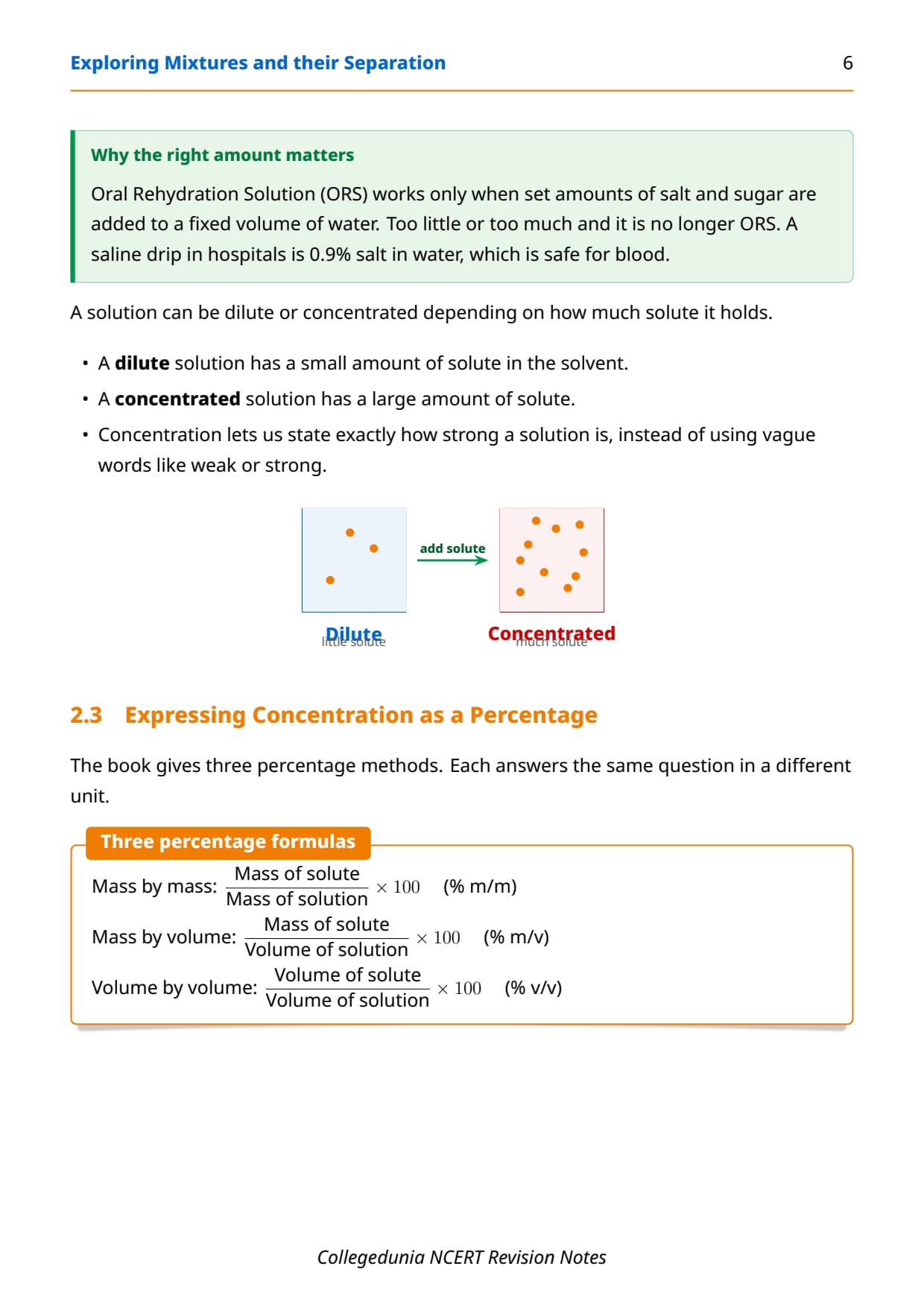
- Concentration is the amount of solute present in a given amount of solvent or solution. A dilute solution has little solute; a concentrated solution has a lot.
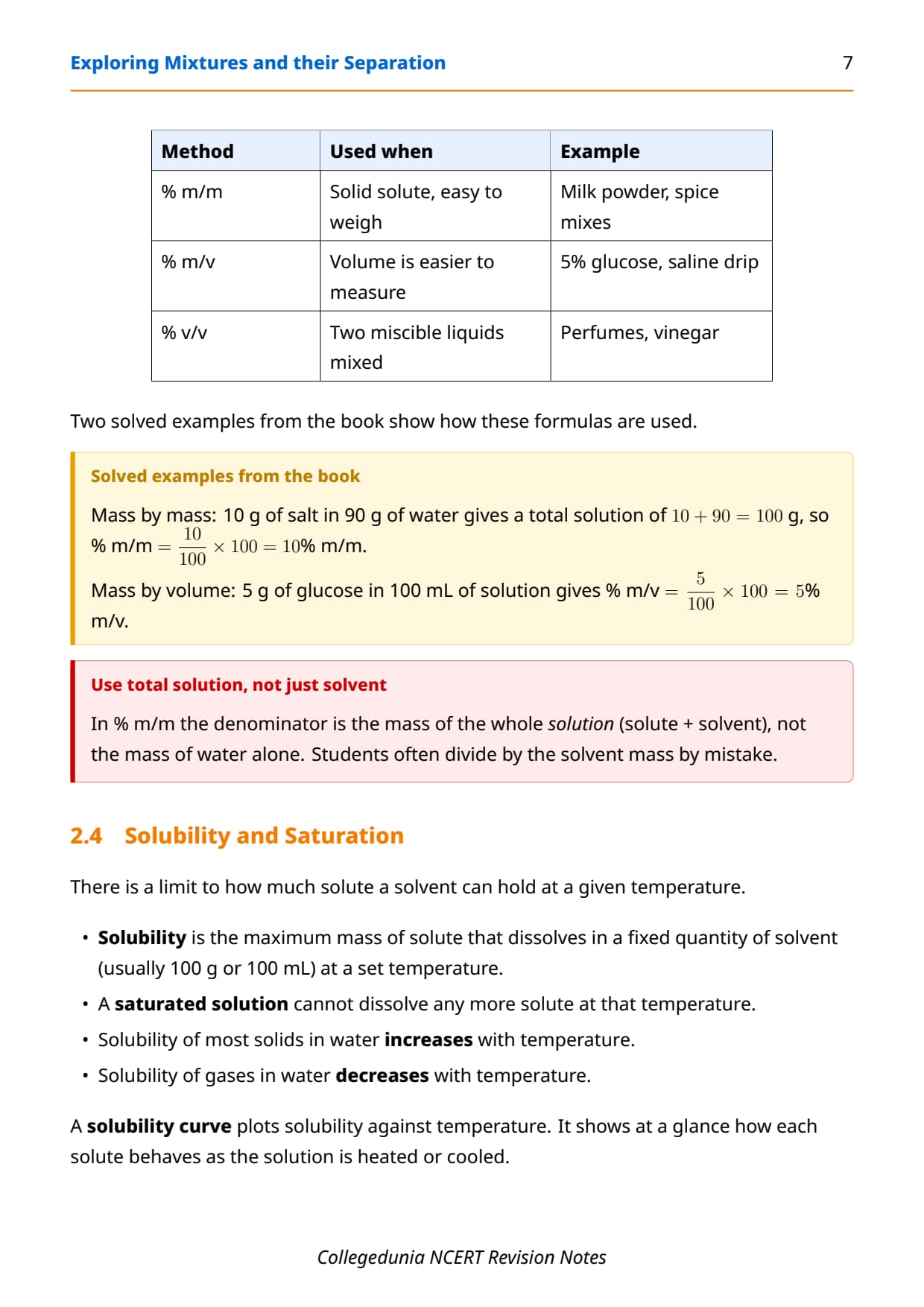
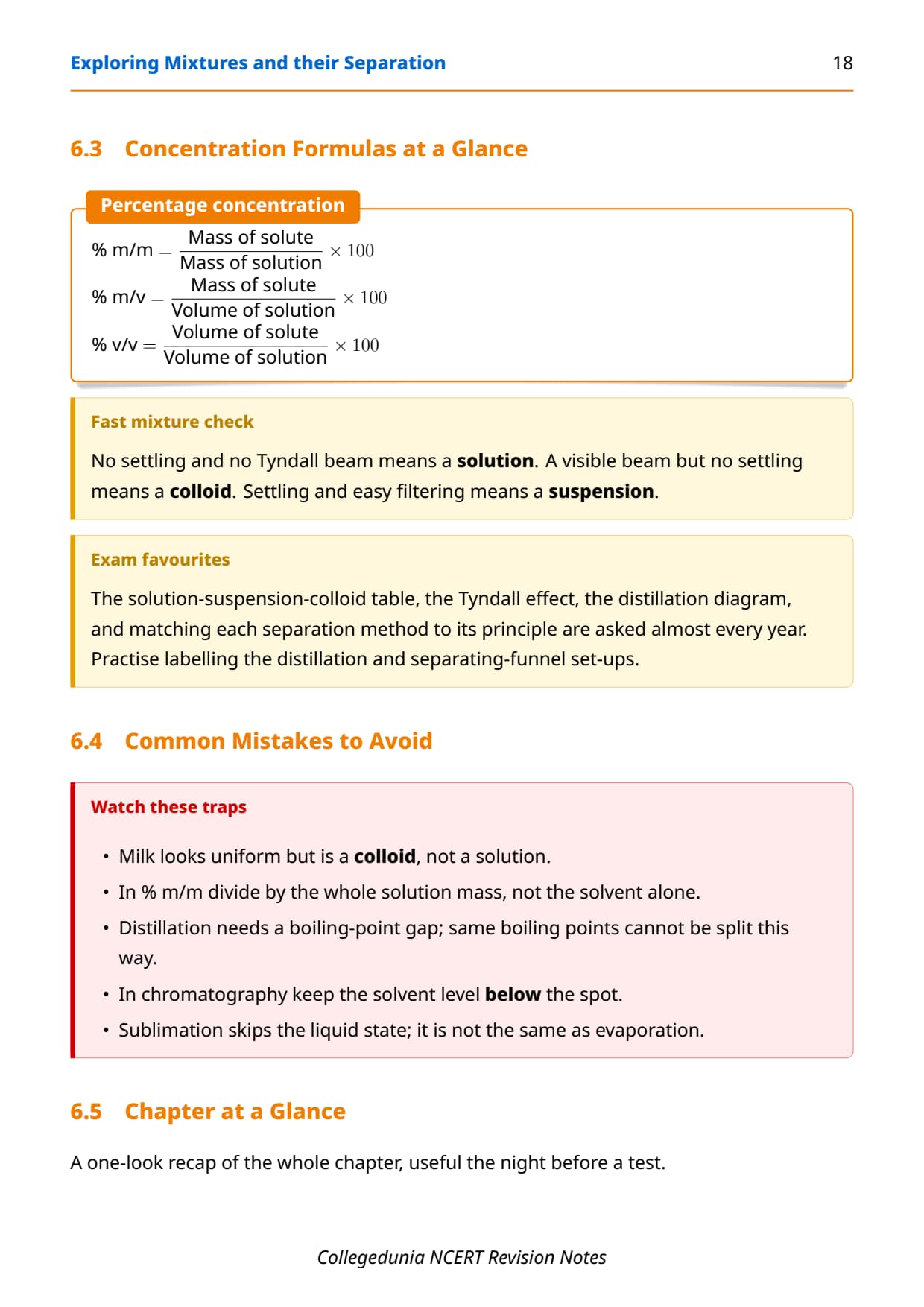
The book gives three percentage formulas. Each answers the same question in a different unit, so you pick the formula by looking at whether the amounts are masses or volumes.
| Formula | What it is | Use it when |
|---|---|---|
| % m/m | (mass of solute ÷ mass of solution) × 100 | A solid solute is easy to weigh, as in a spice mix. |
| % m/v | (mass of solute ÷ volume of solution) × 100 | A solid is dissolved in a liquid volume, as in a saline drip. |
| % v/v | (volume of solute ÷ volume of solution) × 100 | Two miscible liquids are mixed, as in vinegar. |
Watch this: in % m/m the denominator is the mass of the whole solution (solute plus solvent), not the mass of water alone. For example, 10 g of salt in 90 g of water gives a 100 g solution, so the concentration is (10 ÷ 100) × 100 = 10% m/m.
Solution, Suspension and Colloid Compared by Particle Size
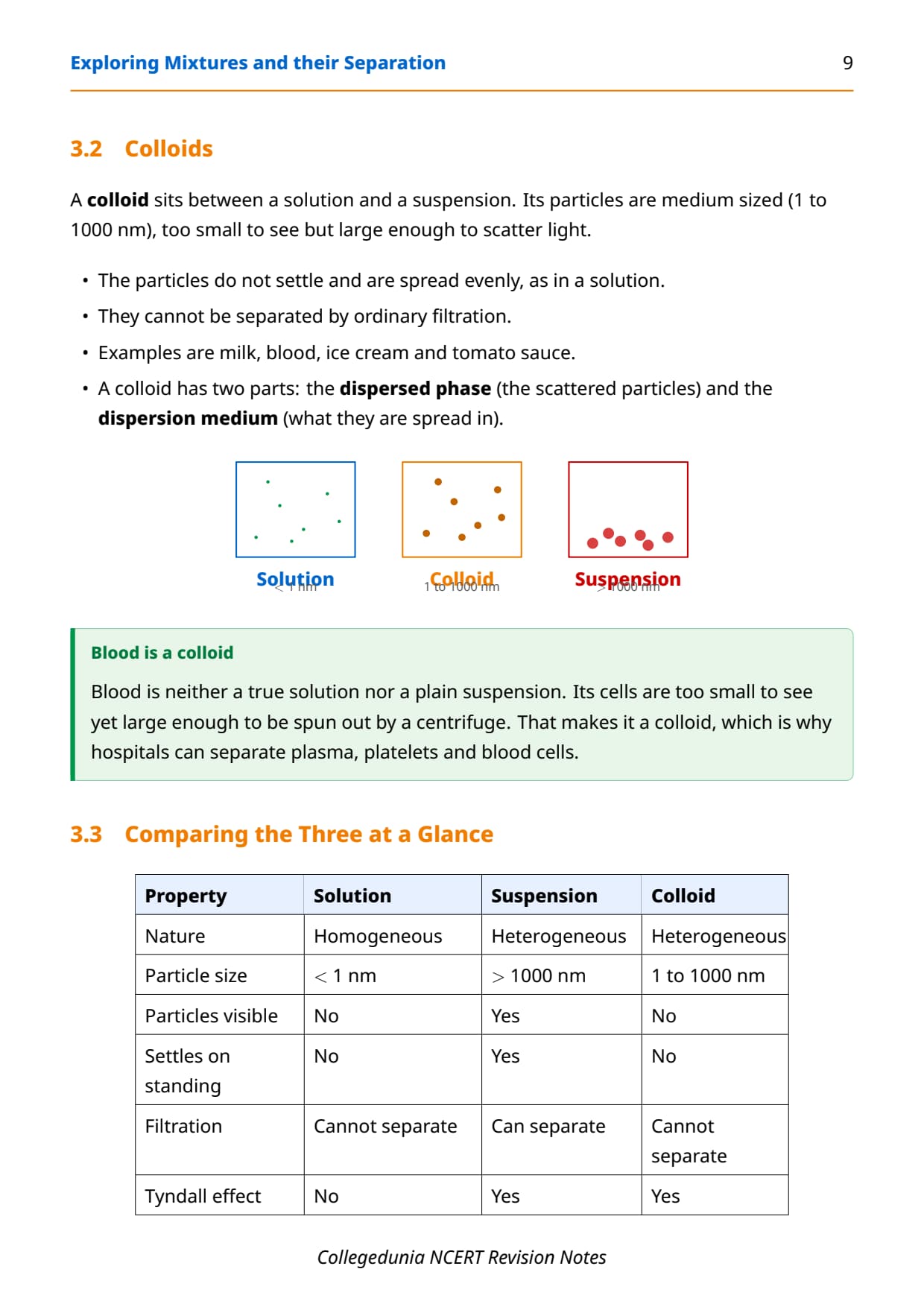
Solutions, suspensions and colloids look similar at first, but they differ in one thing: particle size. Fix the two boundaries at 1 nm and 1000 nm, and every other property, such as settling, filtering and light scattering, follows straight from where the mixture sits on that scale.
| Property | Solution | Suspension | Colloid |
|---|---|---|---|
| Nature | Homogeneous | Heterogeneous | Heterogeneous |
| Particle size | Less than 1 nm | More than 1000 nm | 1 to 1000 nm |
| Particles visible | No | Yes | No |
| Settles on standing | No | Yes | No |
| Separated by filtration | No | Yes | No |
| Tyndall effect | No | Yes | Yes |
| Examples | Salt solution, brass | Sand in water, mud | Milk, smoke, butter |
Read the size row first. Once you know a mixture has small, large or medium particles, the other rows are fixed for you. A colloid also has two parts: the dispersed phase (the scattered particles) and the dispersion medium (what they are spread in).
The Tyndall Effect in Exploring Mixtures and their Separation
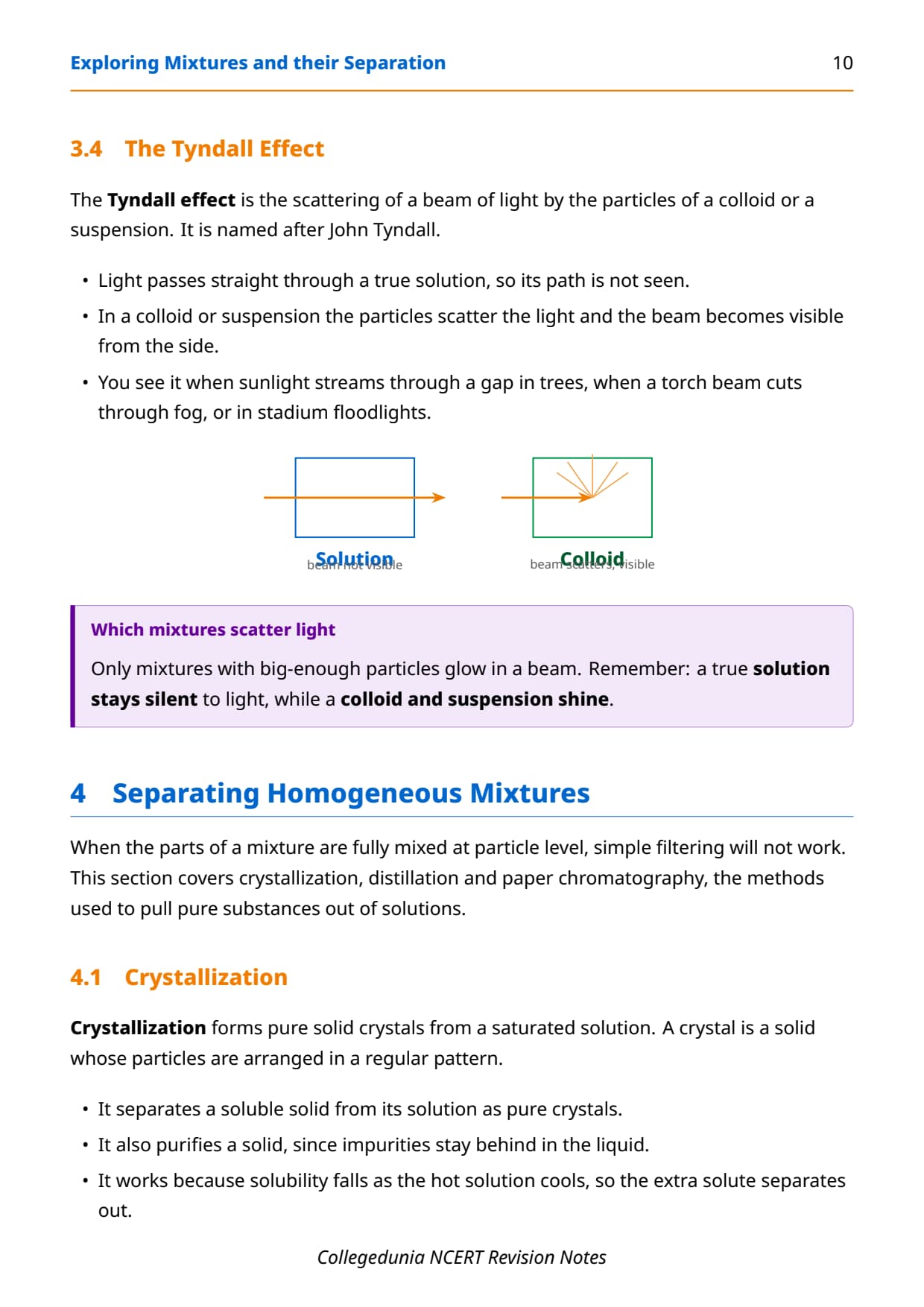
The Tyndall effect is the scattering of a beam of light by the particles of a colloid or a suspension, which makes the beam visible from the side. It is named after John Tyndall. It happens only when particles are large enough to scatter light, so a true solution never shows it.
- Light passes straight through a true solution, so its path is not seen.
- In a colloid or a suspension the particles scatter the light and the beam glows.
- You see it when sunlight streams through a gap in trees, when a torch beam cuts through fog, or in stadium floodlights.
Remember: it is size, not colour, that decides scattering. A deep blue copper sulfate solution still shows no Tyndall effect, because its dissolved particles are smaller than 1 nm.
Solubility and Saturated Solutions in Class 9 Science Chapter 5
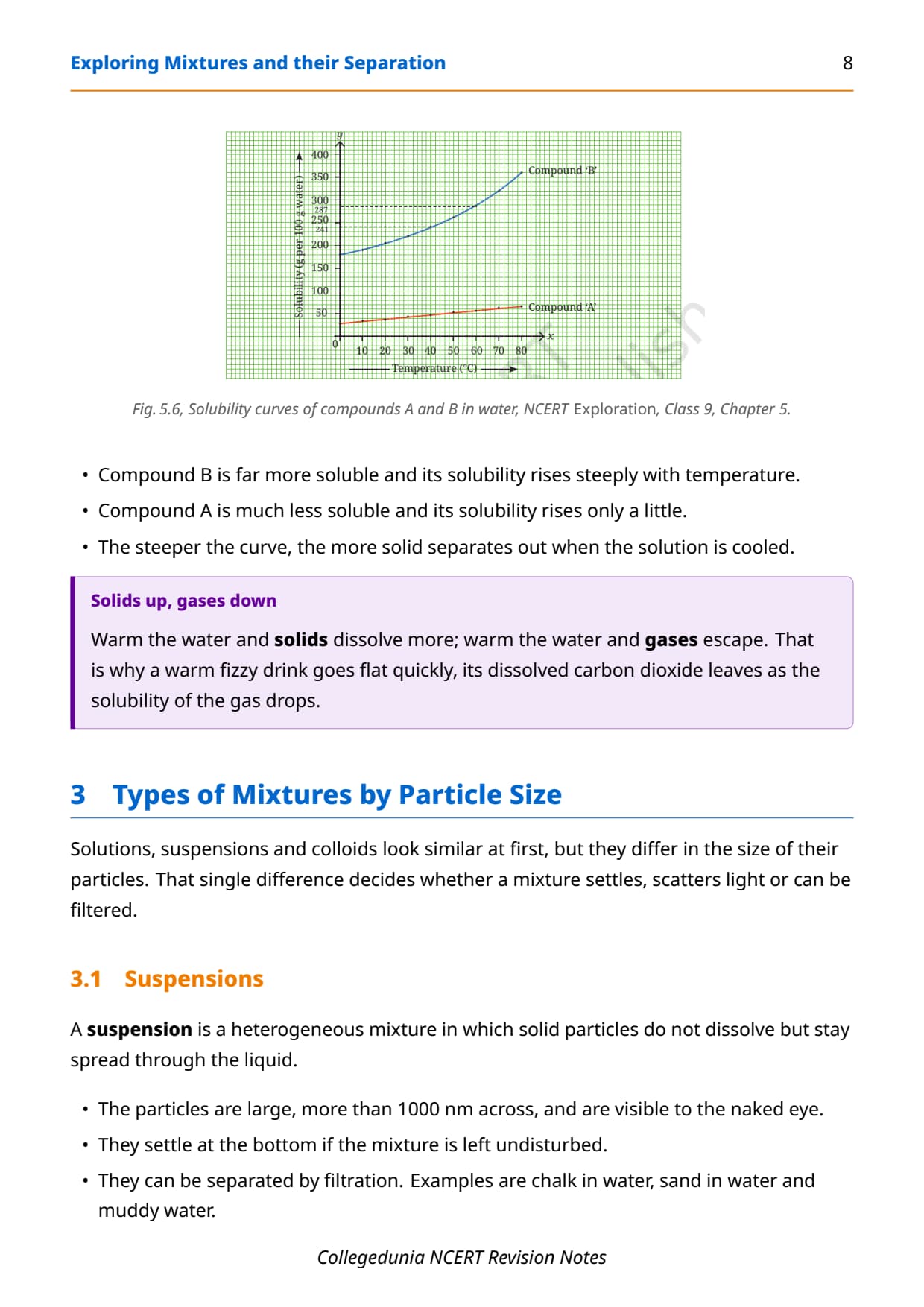
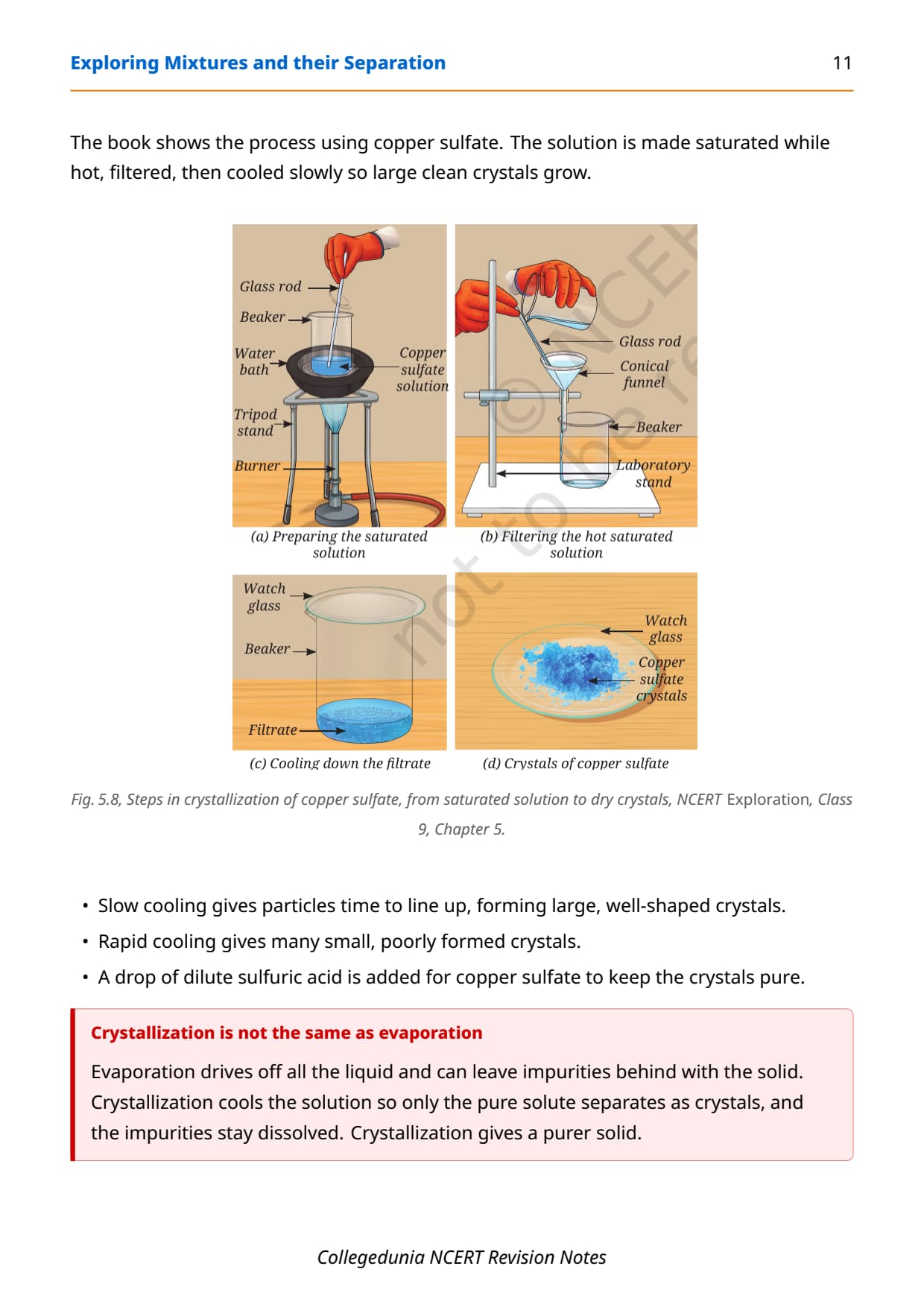
Solubility is the maximum mass of a solute that dissolves in a fixed quantity of solvent, usually 100 g of water, at a set temperature. When a solution can hold no more solute at that temperature, it is a saturated solution.
- The solubility of most solids in water increases with temperature.
- The solubility of gases in water decreases with temperature, which is why a warm fizzy drink goes flat quickly.
- A solubility curve plots solubility against temperature. The steeper the curve, the more solid separates out when the hot solution is cooled.
This single idea explains crystallisation later in the chapter: a solution that is saturated when hot holds too much solute when cooled, so the extra solute separates out as pure crystals.
Separation Methods in Exploring Mixtures and their Separation, from Filtration to Chromatography
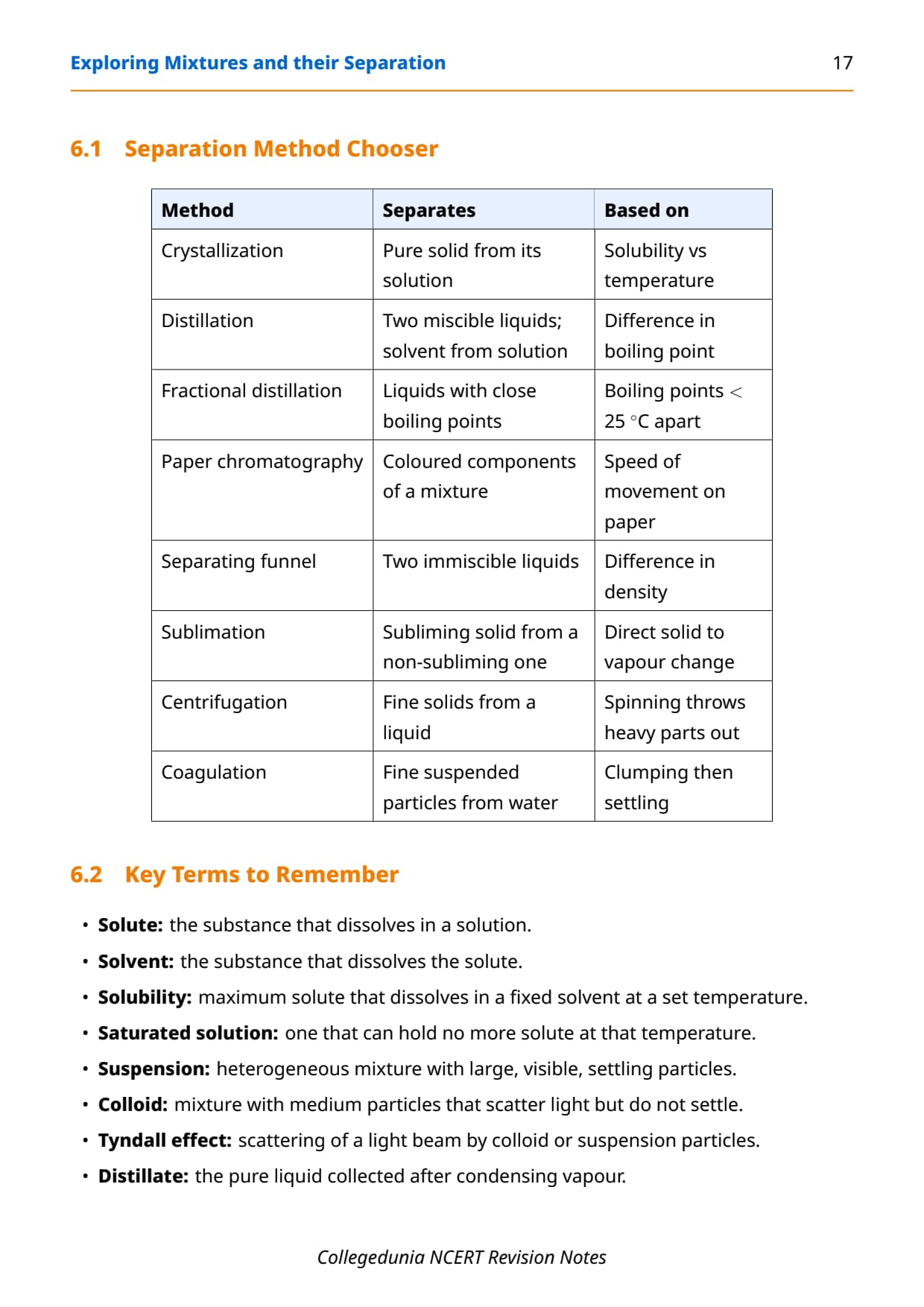
To separate a mixture, first ask one question: in what property do the parts differ? That property, whether it is solubility, boiling point, density or particle size, names the method for you. This chapter uses eight standard methods.
| Method | Separates | Based on |
|---|---|---|
| Crystallisation | A pure solid from its solution | Solubility falls on cooling |
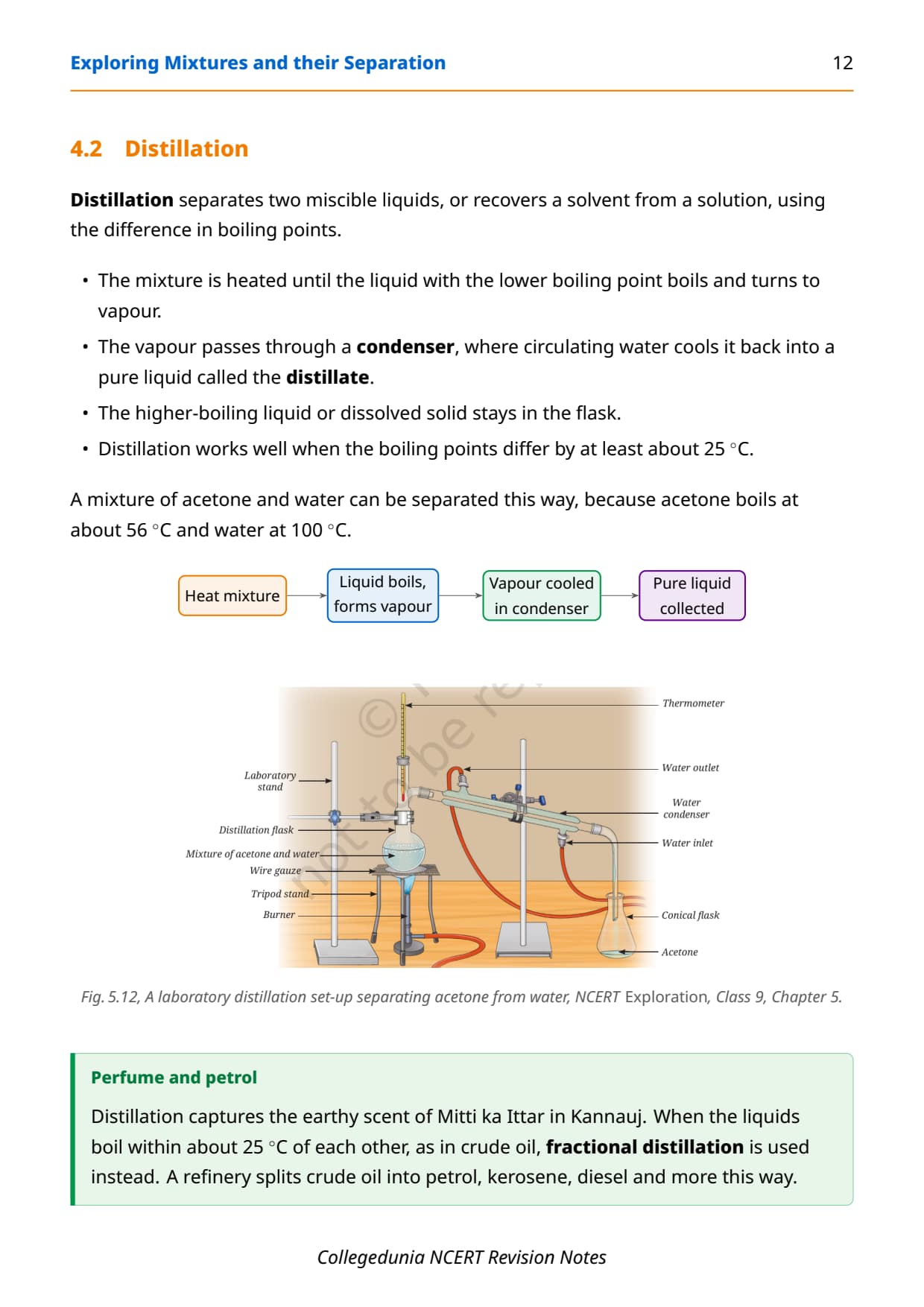
| Distillation | Two miscible liquids; solvent from a solution | Difference in boiling point |
| Fractional distillation | Liquids with close boiling points | Boiling points under 25°C apart |
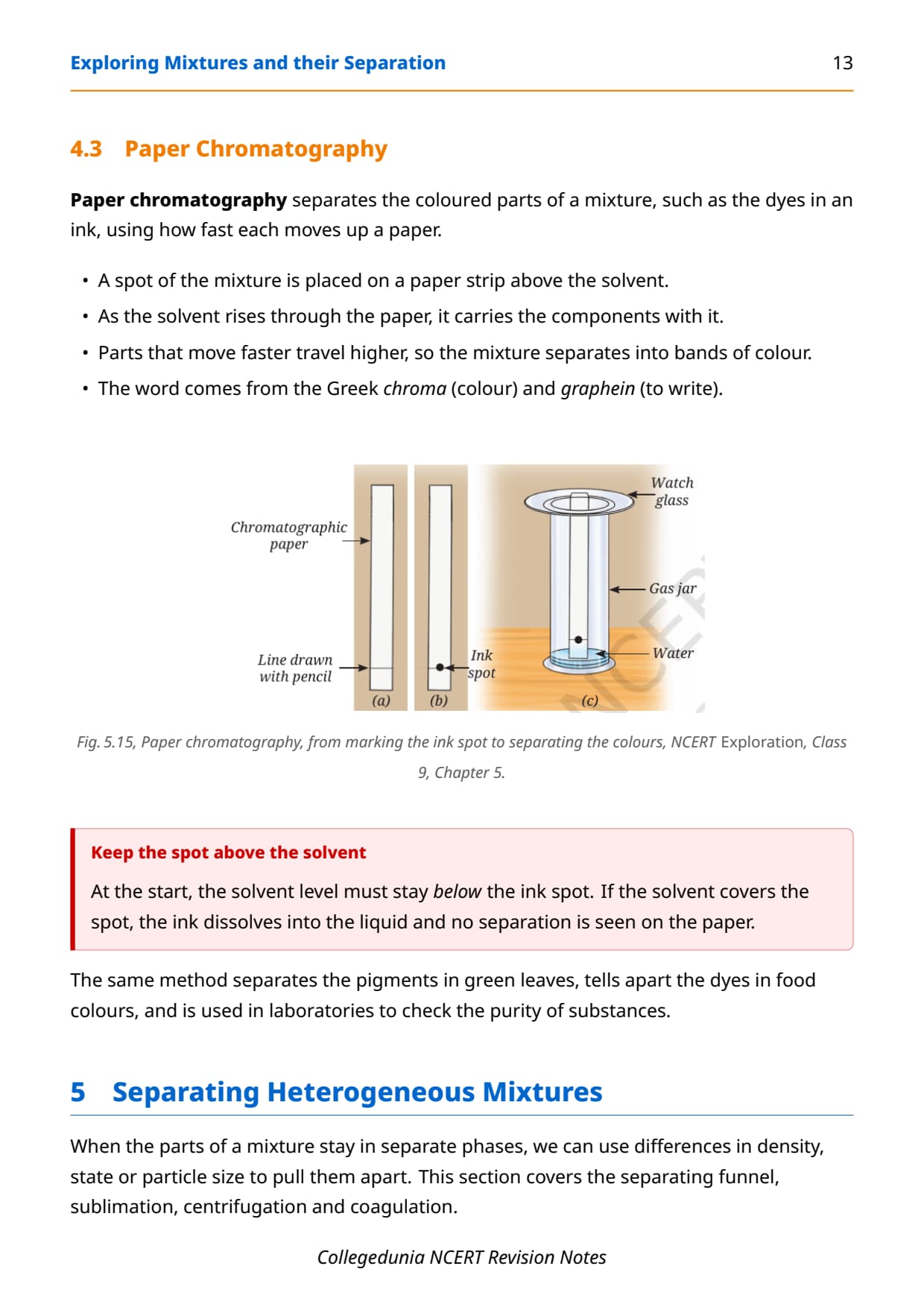
| Paper chromatography | Coloured parts of a mixture, like ink dyes | Speed of movement on paper |
| Separating funnel | Two immiscible liquids, like oil and water | Difference in density |
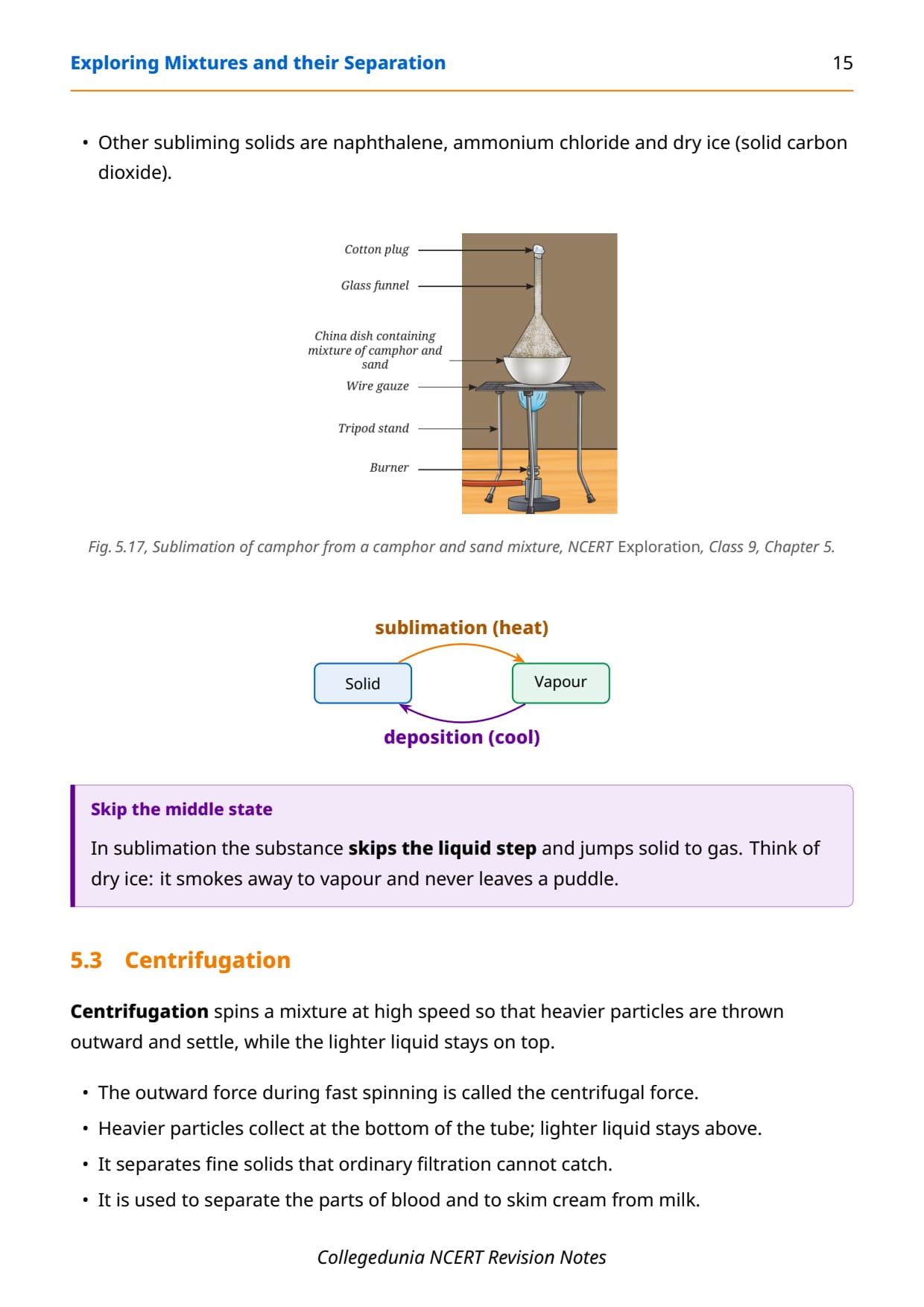
| Sublimation | A subliming solid from a non-subliming one | Solid changing straight to vapour |
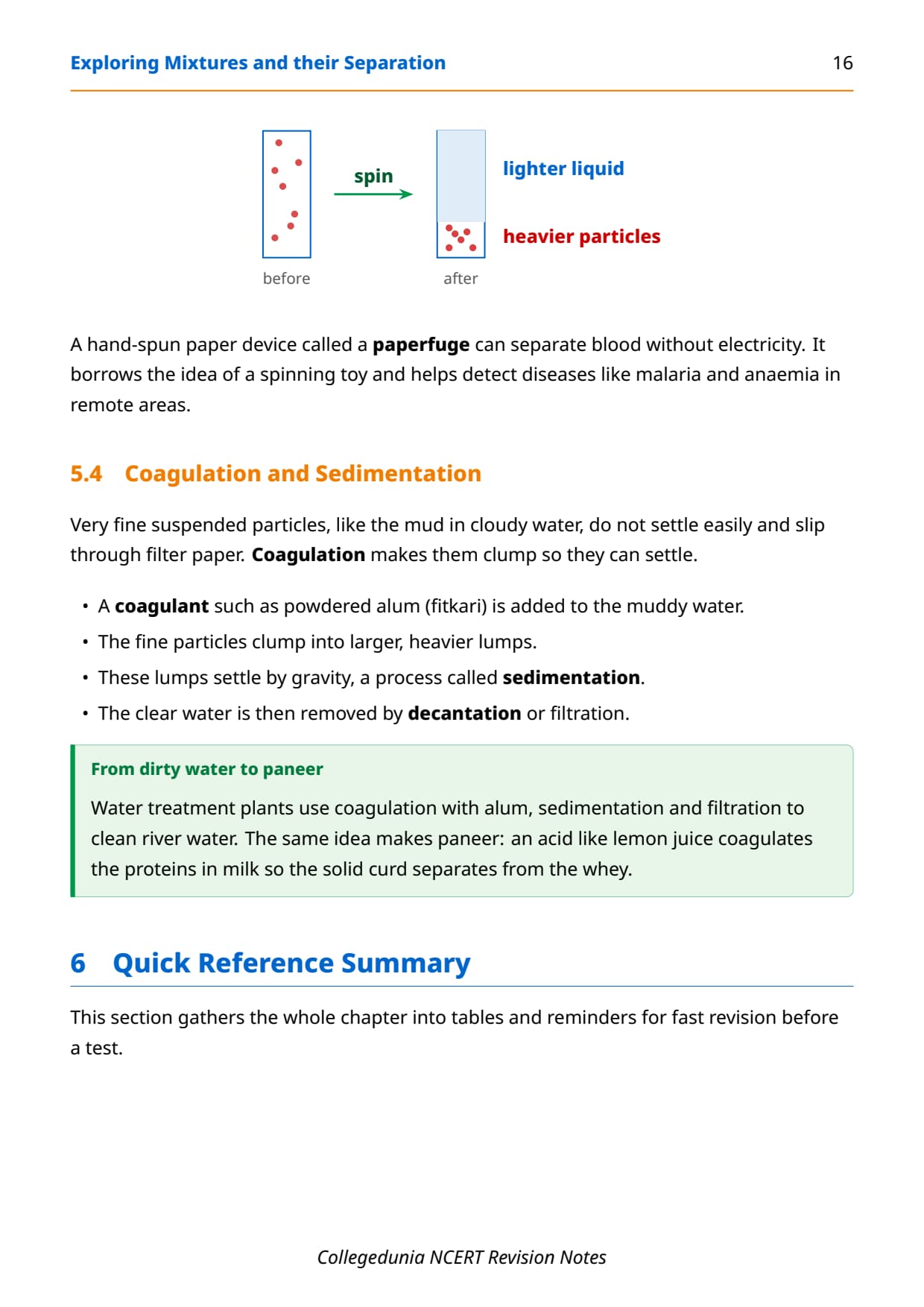
| Centrifugation | Fine solids from a liquid, like blood cells | Fast spinning throws heavy parts out |
| Coagulation | Fine suspended particles from water | Clumping, then settling |
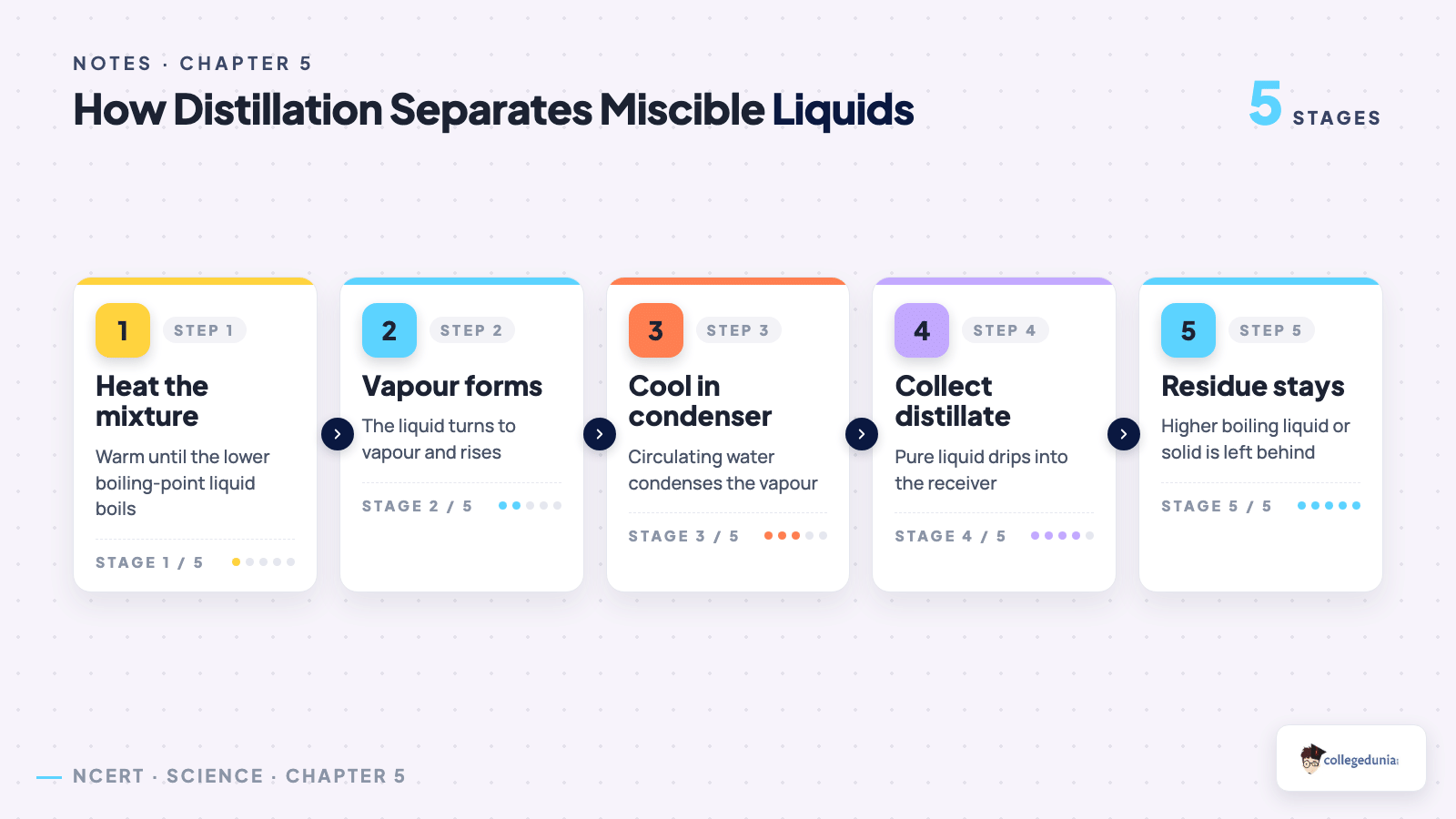
Exam tip: in distillation the lower boiling liquid boils first, turns to vapour, then cools back to a pure liquid called the distillate in the condenser. In chromatography keep the solvent level below the ink spot, or the ink dissolves away and no separation is seen.
Quick Revision Summary and Common Mistakes for Class 9 Science Chapter 5
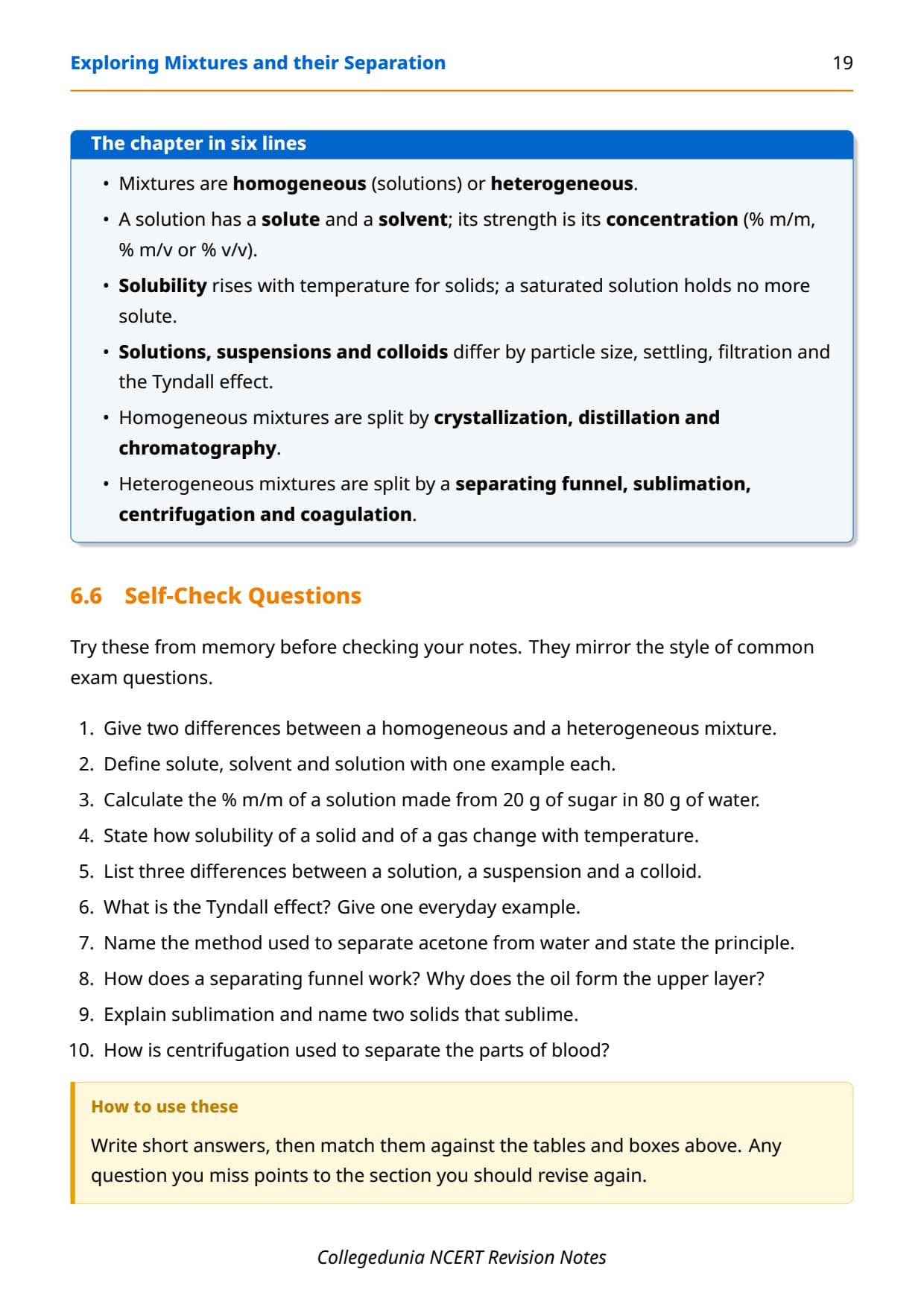
Use this six-line recap the night before a test. If you can rebuild these points from memory, you have the chapter.
- Mixtures are homogeneous (solutions) or heterogeneous.
- A solution has a solute and a solvent; its strength is its concentration (% m/m, % m/v or % v/v).
- Solubility rises with temperature for solids; a saturated solution holds no more solute.
- Solutions, suspensions and colloids differ by particle size, settling, filtration and the Tyndall effect.
- Homogeneous mixtures are split by crystallisation, distillation and chromatography.
- Heterogeneous mixtures are split by a separating funnel, sublimation, centrifugation and coagulation.
- Calling milk, smoke or blood a solution. They are colloids, so they are heterogeneous.
- In % m/m, dividing the solute by the solvent instead of the total solution mass.
- Using distillation for liquids with the same boiling point. There must be a boiling-point gap.
- Letting the solvent cover the spot in chromatography, which washes the ink away.
- Confusing sublimation with evaporation. Sublimation skips the liquid state.
Other Class 9 Science Chapter 5 Resources
Also Check: use these sister resources for the same chapter alongside these notes.
| Resource | Best for |
|---|---|
| Exploring Mixtures and their Separation Class 9 NCERT Solutions | All 17 Revise, Reflect, Refine questions solved step by step. |
| Exploring Mixtures and their Separation Class 9 Handwritten Notes | A topper's neat handwritten notes for one-shot revision. |
| Exploring Mixtures and their Separation Class 9 Formula Sheet | The three concentration formulas and key values on one page. |
| Exploring Mixtures and their Separation Class 9 NCERT Book PDF | The original chapter from the NCERT Exploration book. |
Class 9 Science Notes for Other Chapters
Related Links: continue your Class 9 Science revision with the notes for other chapters.
| Chapter | Class 9 Science Notes |
|---|---|
| Chapter 2 | Cell The Building Block of Life |
| Chapter 3 | Tissues in Action |
| Chapter 4 | Describing Motion Around Us |
| Chapter 6 | How Forces Affect Motion |
| Chapter 7 | Work Energy and Simple Machines |
| Chapter 8 | Journey Inside the Atom |
| Chapter 9 | Atomic Foundations of Matter |
Exploring Mixtures and their Separation Class 9 Science Notes FAQs
Ques. Where can I download the Class 9 Science Chapter 5 Exploring Mixtures and their Separation Notes PDF?
Ans. You can download the Exploring Mixtures and their Separation Class 9 Science Notes PDF directly from this page. Both the Normal and HD versions are free.
Ques. What is the difference between a homogeneous and a heterogeneous mixture?
Ans. A homogeneous mixture has a uniform composition throughout with no visible parts, and is also called a solution, like salt water. A heterogeneous mixture is not uniform and its parts are often visible, like sand in water.
Ques. How do you tell a solution, a suspension and a colloid apart?
Ans. By particle size. A solution has particles smaller than 1 nm, a colloid has particles from 1 to 1000 nm, and a suspension has particles larger than 1000 nm. Only suspensions settle and can be filtered, while colloids and suspensions show the Tyndall effect.
Ques. What is the Tyndall effect in Class 9 Science Chapter 5?
Ans. The Tyndall effect is the scattering of a beam of light by the particles of a colloid or a suspension, which makes the beam visible. A true solution does not show it because its particles are too small to scatter light.
Ques. Which separation methods are covered in these notes?
Ans. The notes cover eight methods: crystallisation, distillation, fractional distillation, paper chromatography, the separating funnel, sublimation, centrifugation and coagulation. Each is matched to the property it uses, such as boiling point or density.
Ques. What are the three concentration formulas in this chapter?
Ans. Mass by mass (% m/m) is (mass of solute ÷ mass of solution) × 100, mass by volume (% m/v) is (mass of solute ÷ volume of solution) × 100, and volume by volume (% v/v) is (volume of solute ÷ volume of solution) × 100.
Ques. Are these notes aligned with the 2026-27 NCERT syllabus?
Ans. Yes. The notes follow the new 2026-27 NCERT Exploration book for Class 9 Science and its Revise, Reflect, Refine exercise, so the concepts and their order match your textbook.



Comments