




The NCERT Notes for Class 9 Science Chapter 4 Describing Motion Around Us bring together every idea the new Exploration textbook tests on straight-line motion. These notes explain distance, displacement, speed, velocity and acceleration in plain steps, show how to read motion from graphs, and set out the three equations of motion. They finish with uniform circular motion, so a Class 9 student can revise the whole chapter fast before a test.
Every note in this Collegedunia compilation is prepared by subject experts, matched to the 2026-27 NCERT Exploration textbook, and written in short, exam-ready steps for Class 9 Science students.
- Full concept coverage: rest and motion, distance vs displacement, scalars and vectors, speed, velocity, acceleration, motion graphs, equations of motion and circular motion.
- Revision-ready: quick tables, solved examples, common-mistake alerts and a night-before recap of the whole chapter.
- Exam link: builds the base for Forces, Work and Energy, and later CBSE, JEE and NEET physics.
Student Feedback
In a Collegedunia survey of 11,540 Class 9 students conducted before the 2026 boards, 76% said telling distance from displacement was the part they most wanted a clear note on. About 4 out of 5 rated the solved graph and equation examples the most useful revision aid, and many said the idea that uniform circular motion is accelerated finally made sense once they saw it explained with the tangent arrow.
Describing Motion Around Us Class 9 Explained in a Short Video
Source: Magnet Brains on YouTube
What the Describing Motion Around Us Class 9 Notes Cover
Everything around us moves, from a rolling ball to a spinning planet. Chapter 4 teaches students to describe motion along a straight line and then extend the idea to a circle. The NCERT Notes for Class 9 Science Chapter 4 Describing Motion Around Us follow the same order as the Exploration textbook, so the notes match your class teaching.
- Motion in a straight line: rest, motion, reference point, distance and displacement.
- Scalars and vectors: which quantities need a direction and which do not.
- Speed, velocity and acceleration: the three quantities that describe how fast motion is and how it changes.
- Graphs and equations: reading position-time and velocity-time graphs, plus the three kinematic equations.
- Uniform circular motion: motion at constant speed but changing direction.
This chapter carries steady weight in Class 9 Science exams because it mixes theory, graph reading and simple numericals. Motion is one of the most-tested Physics chapters in Class 9. Master it once and the later chapters on force and energy become much easier.
Motion in a Straight Line: Rest, Reference Point, Distance and Displacement
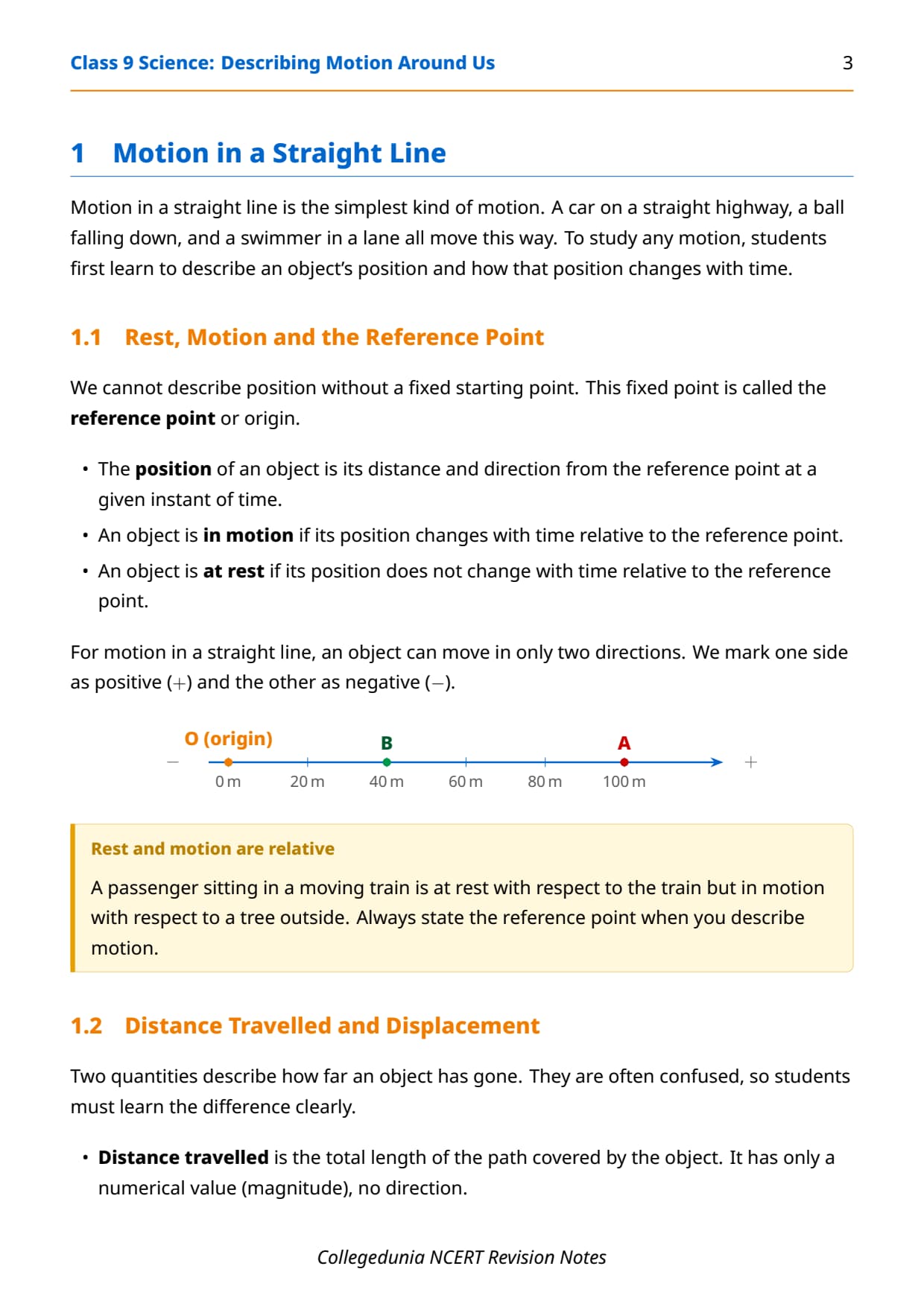
Motion in a straight line is the simplest kind of motion. A car on a straight highway, a ball falling down, and a swimmer in a lane all move this way. To describe any motion, students first fix a starting point. This fixed point is called the reference point or origin.
- The position of an object is its distance and direction from the reference point at a given instant.
- An object is in motion if its position changes with time relative to the reference point.
- An object is at rest if its position stays the same relative to the reference point.
Rest and motion are relative. A passenger sitting in a moving train is at rest with respect to the train but in motion with respect to a tree outside. So students must always state the reference point. Two quantities then describe how far the object has gone, and they are often mixed up.
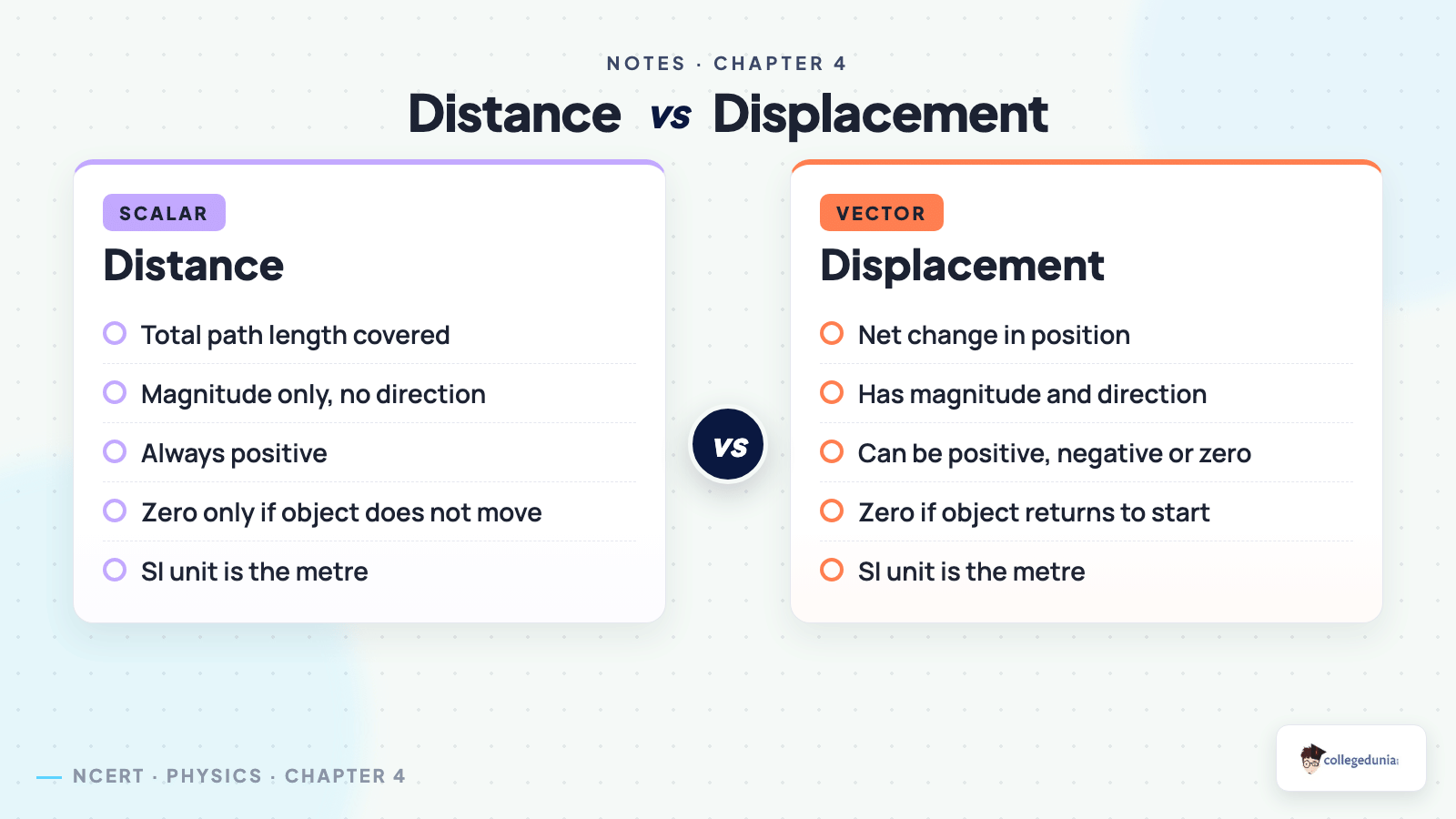
- Distance travelled is the total length of the path covered. It has only a value, no direction, so it is a scalar.
- Displacement is the net change in position between two instants. It has both value and direction, so it is a vector.
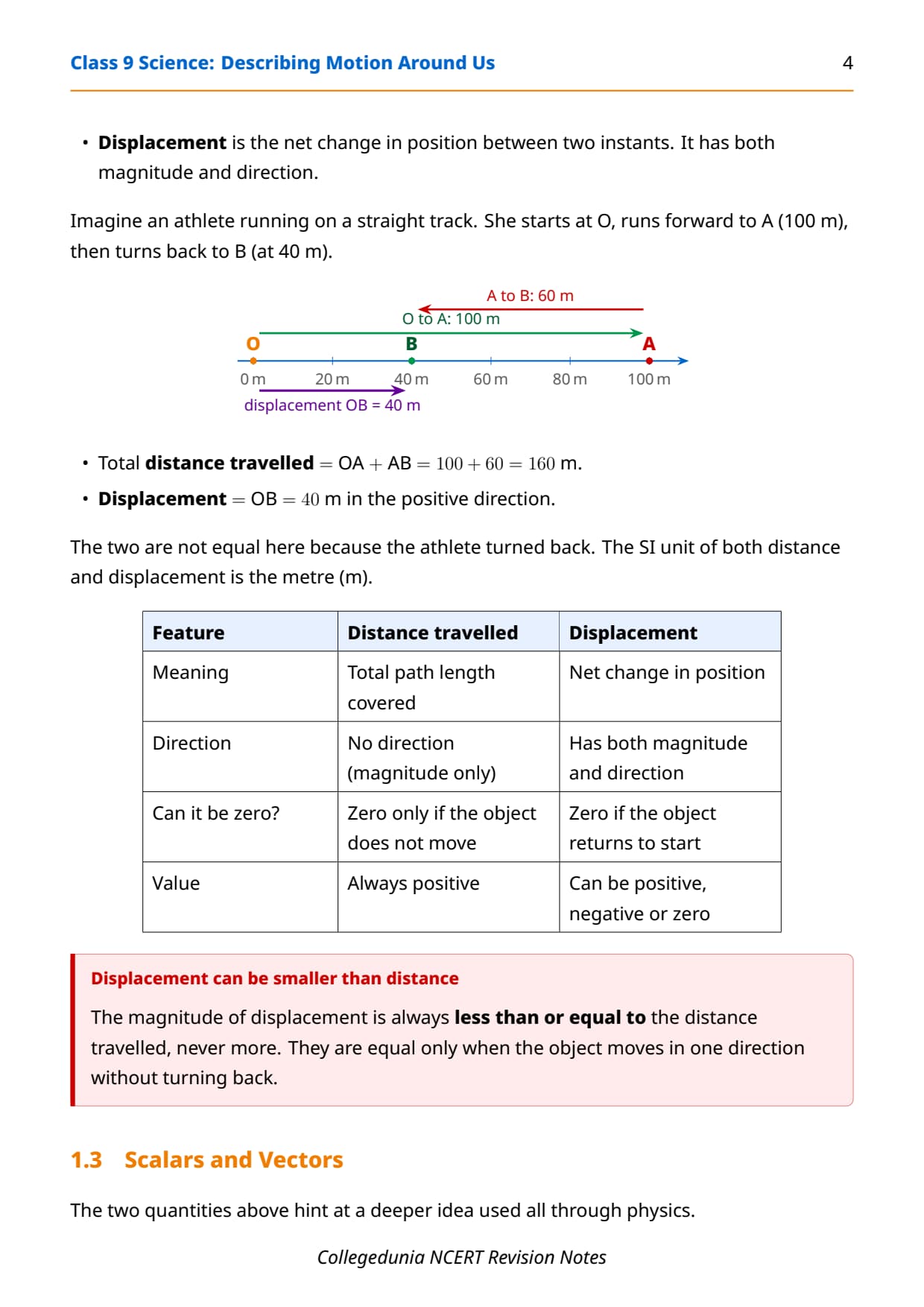
Take an athlete who starts at O, runs forward to A at 100 m, then turns back to B at 40 m. The total distance is 100 + 60 = 160 m, but the displacement is only 40 m in the forward direction. They differ because she turned back.
| Feature | Distance travelled | Displacement |
|---|---|---|
| Meaning | Total path length covered | Net change in position |
| Direction | None (magnitude only) | Has magnitude and direction |
| Can it be zero? | Zero only if the object does not move | Zero if the object returns to start |
| Sign | Always positive | Can be positive, negative or zero |
The magnitude of displacement is always less than or equal to the distance, never more. They are equal only when the object moves in one direction without turning back. The SI unit of both is the metre (m).
Scalars and Vectors in Describing Motion Around Us
Distance and displacement point to a deeper idea used all through physics. Every physical quantity is either a scalar or a vector, and knowing the difference stops most sign errors in this chapter.
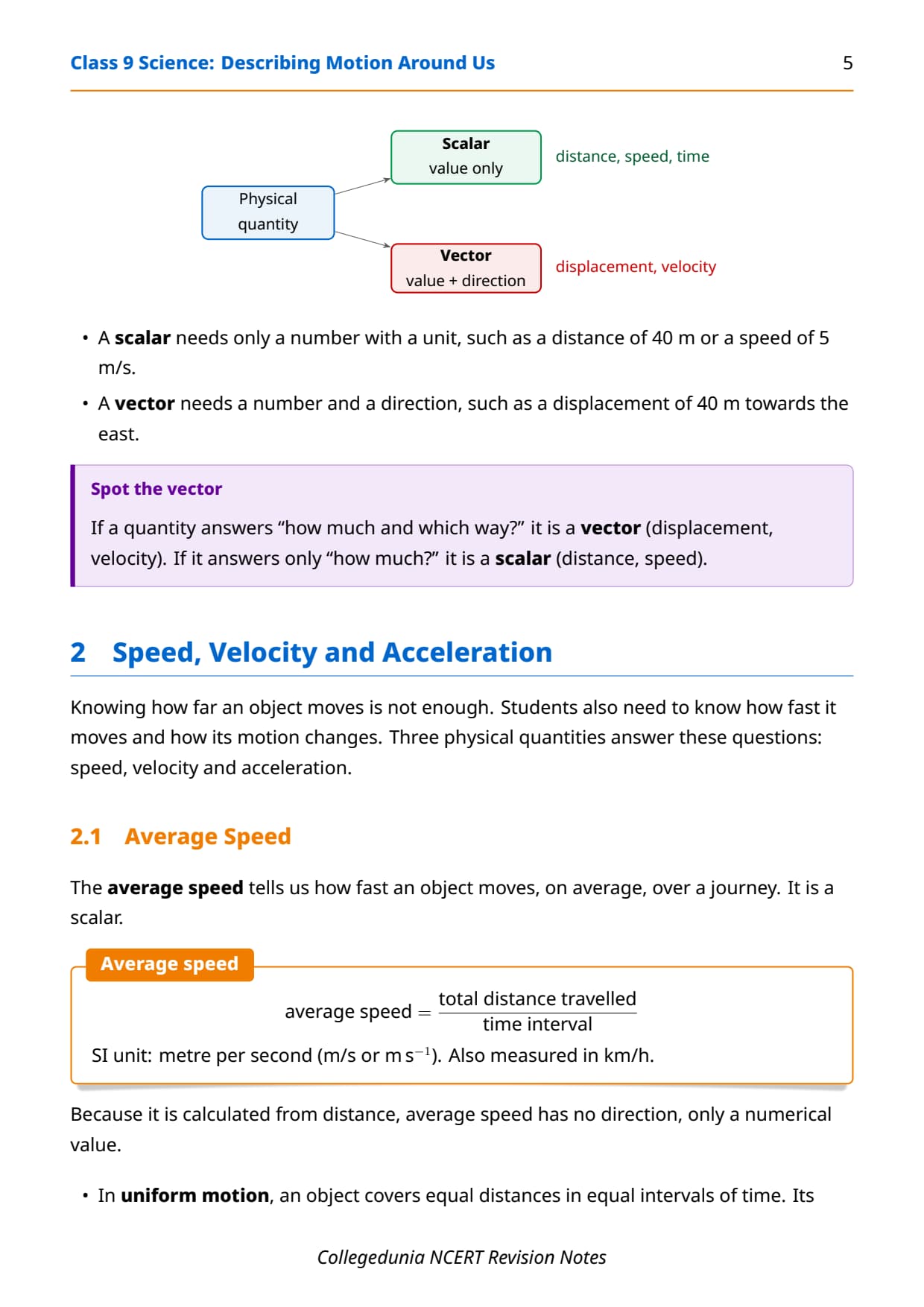
- A scalar needs only a number with a unit, such as a distance of 40 m or a speed of 5 m/s.
- A vector needs a number and a direction, such as a displacement of 40 m towards the east.
- Scalars in this chapter: distance, speed and time. Vectors: displacement, velocity and acceleration.
A simple test helps students spot the type. If a quantity answers how much and which way? it is a vector. If it answers only how much? it is a scalar. Keep this test in mind, because the exam often asks you to classify a quantity or to explain why velocity is a vector while speed is not.
Speed, Velocity and Acceleration Explained for Class 9 Science
Knowing how far an object moves is not enough. Students also need to know how fast it moves and how its motion changes. Three quantities answer these questions, and the notes below give the formula and unit for each one.
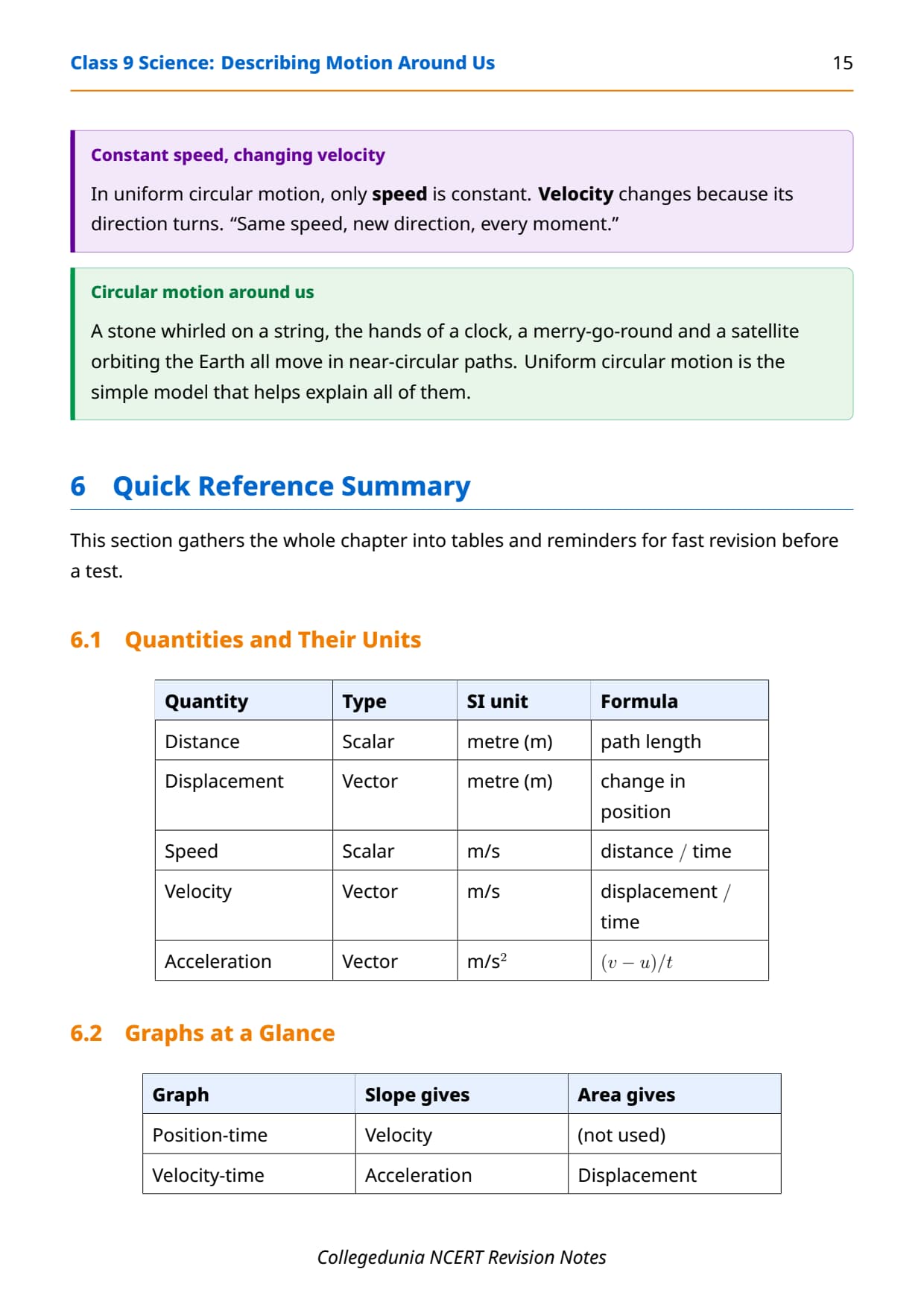
| Quantity | Type | Formula | SI unit |
|---|---|---|---|
| Average speed | Scalar | total distance / time | m/s |
| Average velocity | Vector | displacement / time | m/s |
| Average acceleration | Vector | (v − u) / time | m/s² |
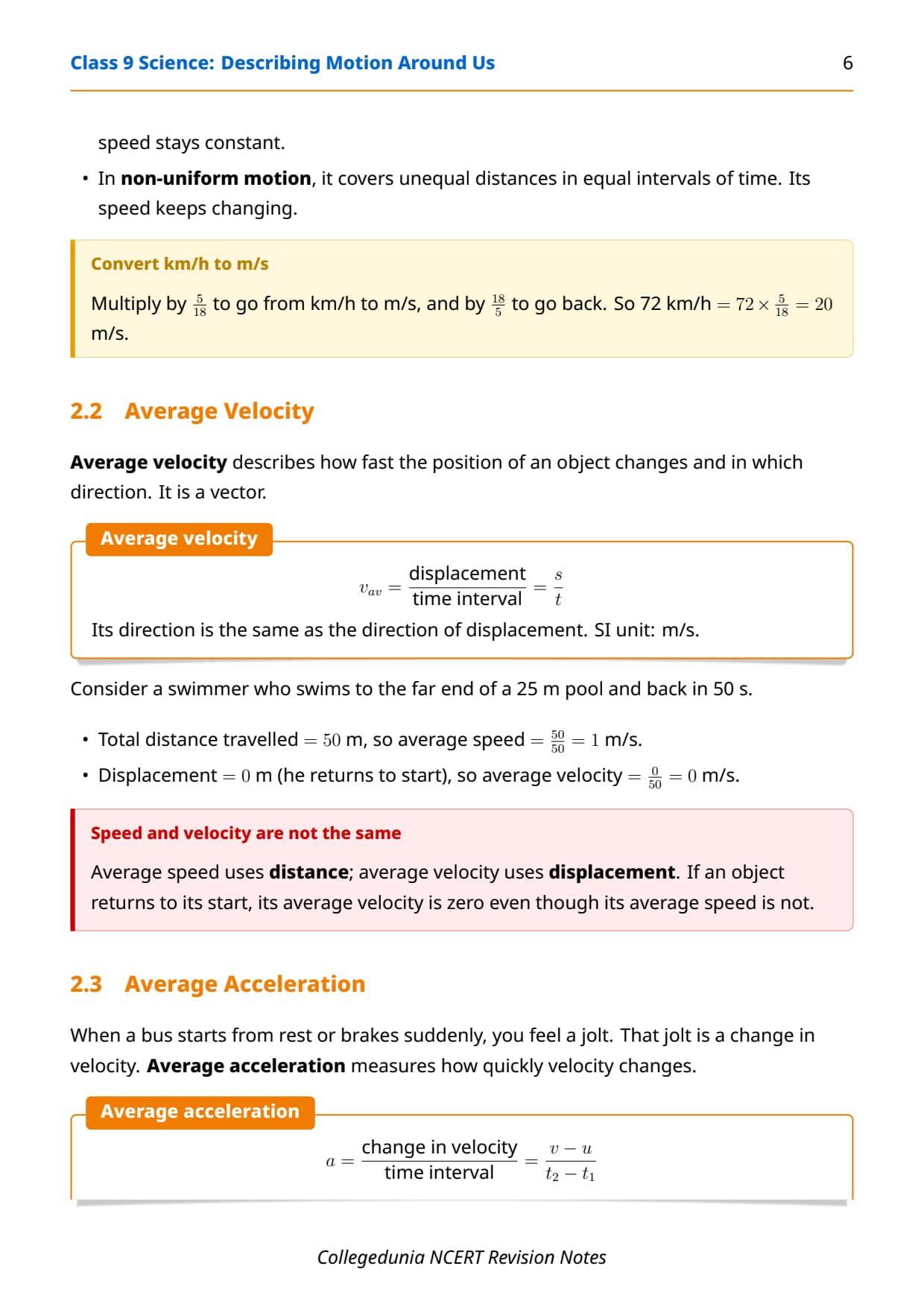
In uniform motion an object covers equal distances in equal times, so its speed stays constant. In non-uniform motion it covers unequal distances in equal times, so its speed keeps changing. A handy unit trick: multiply km/h by 5/18 to get m/s. So 72 km/h becomes 20 m/s.
Velocity adds direction to speed. Think of a swimmer who swims to the far end of a 25 m pool and back in 50 s. The total distance is 50 m, so the average speed is 1 m/s. The displacement is 0 m because he returns to start, so the average velocity is 0 m/s. This shows why average speed uses distance while average velocity uses displacement.
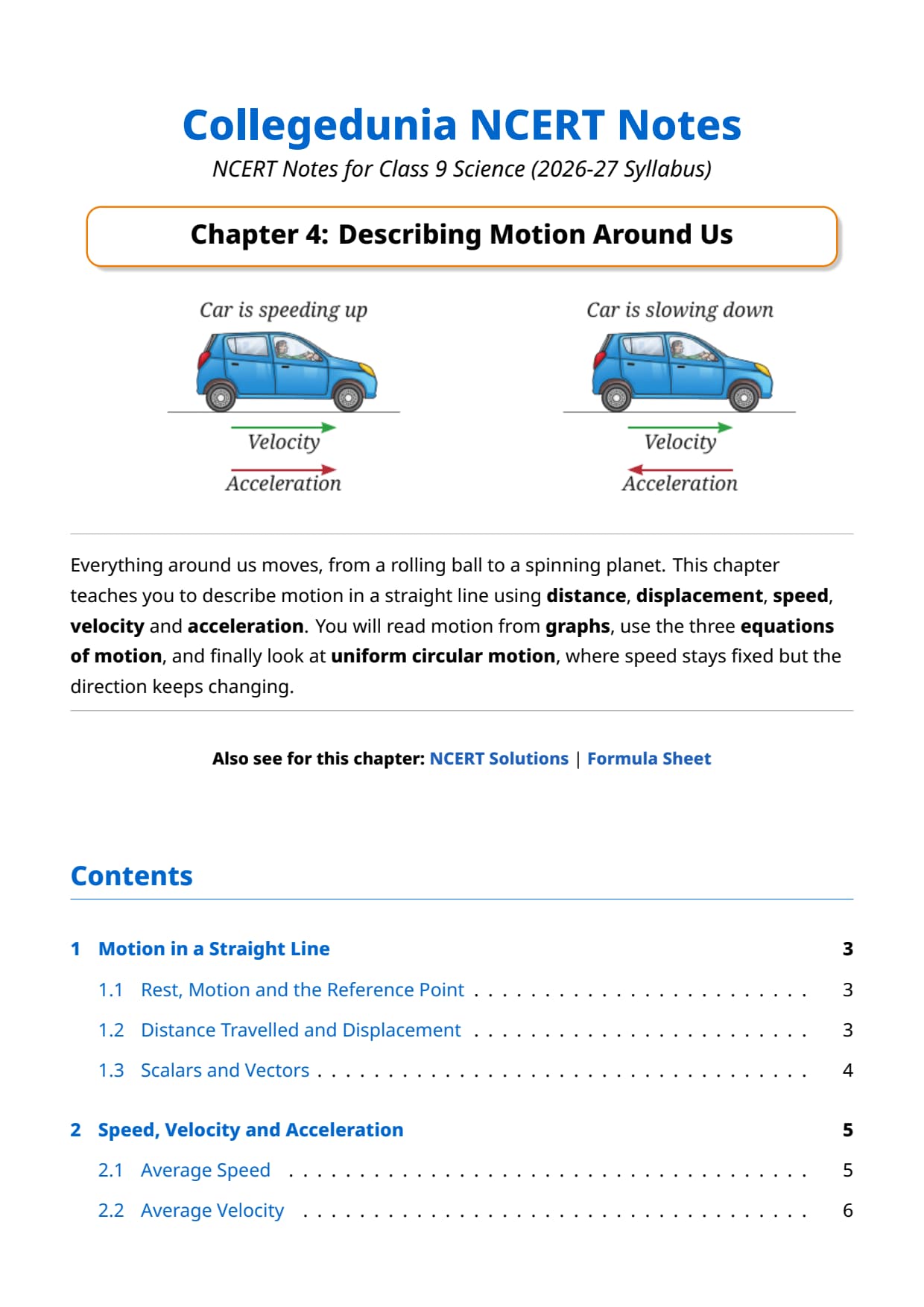
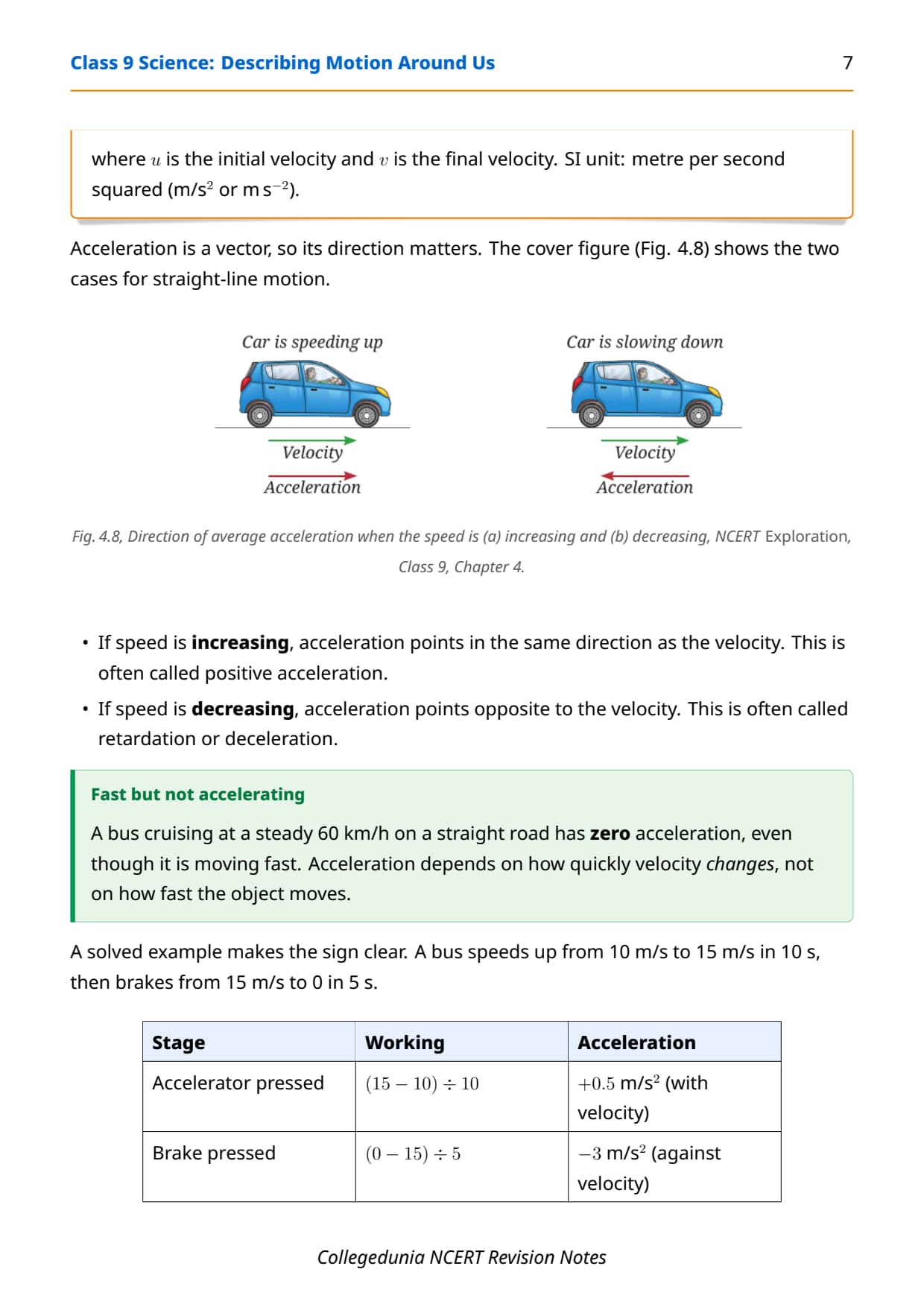
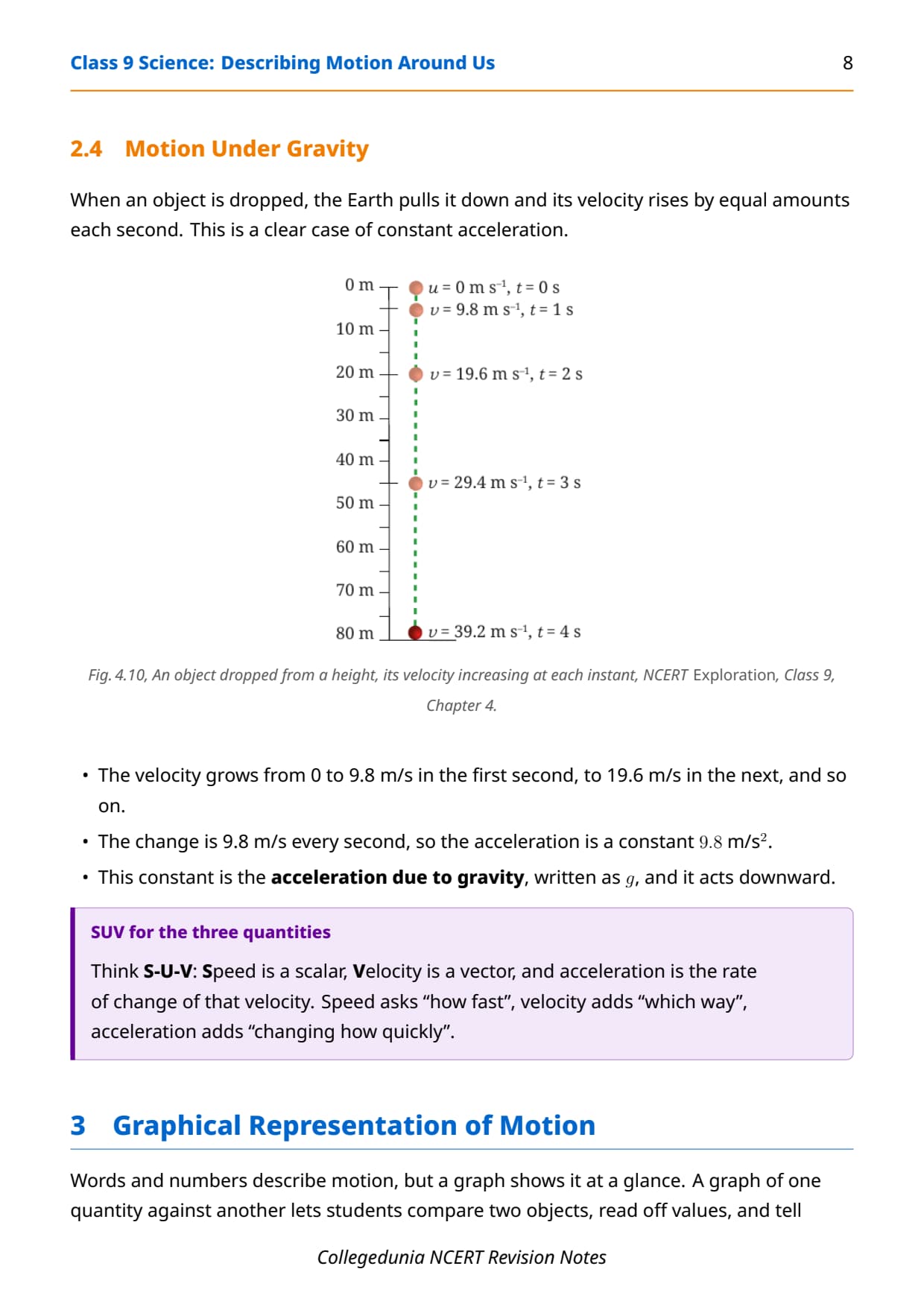
Acceleration measures how quickly velocity changes. When a bus starts from rest or brakes suddenly, you feel a jolt, and that jolt is a change in velocity. If speed is increasing, acceleration points along the velocity (positive). If speed is decreasing, it points against the velocity, and we call it retardation. A bus cruising at a steady 60 km/h has zero acceleration, even though it moves fast, because its velocity is not changing. For a freely falling body the velocity rises by 9.8 m/s each second, so the acceleration due to gravity, g, is 9.8 m/s² acting downward.
Equations of Motion for Constant Acceleration in Class 9 Science
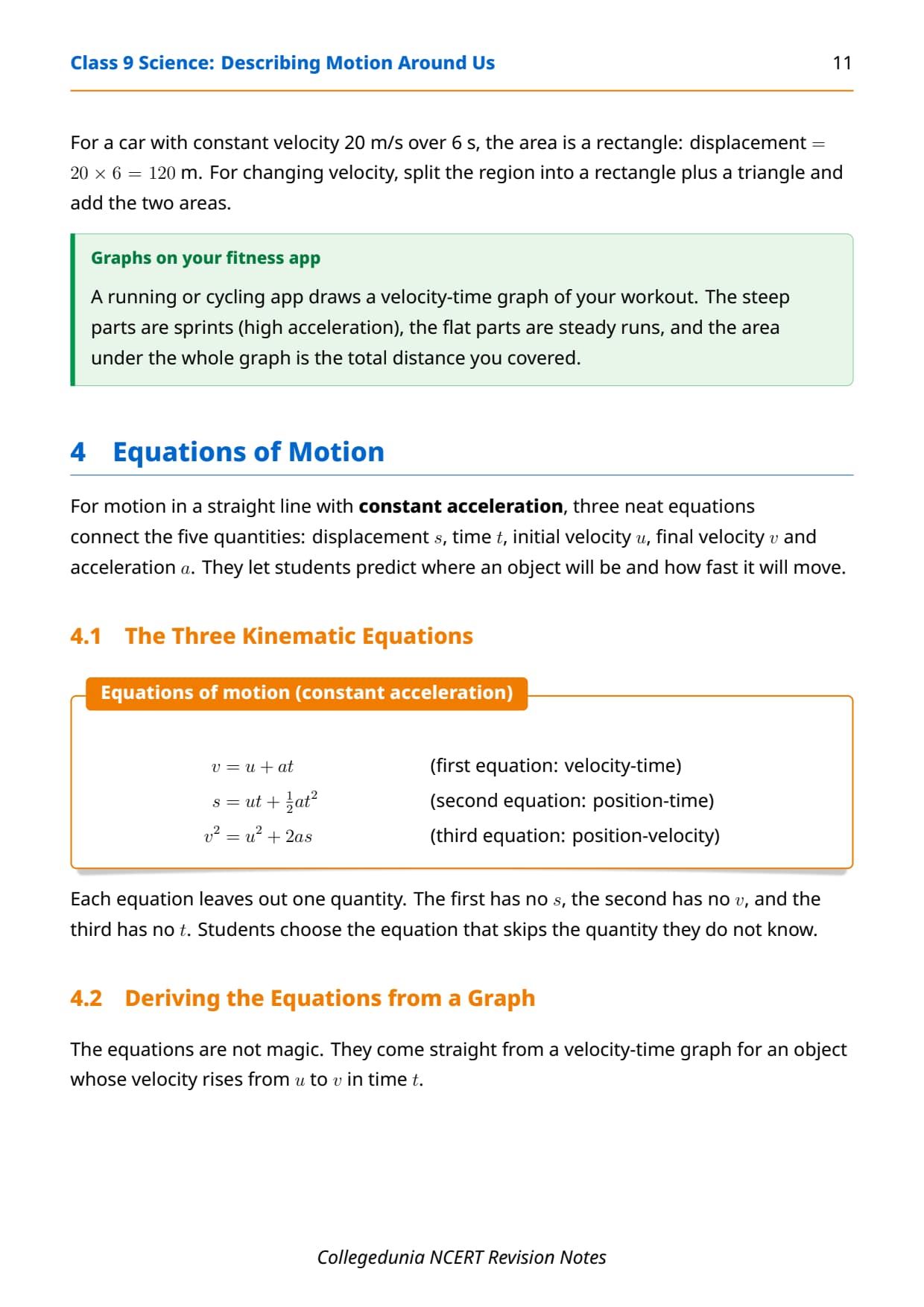
For straight-line motion with constant acceleration, three neat equations connect five quantities: displacement s, time t, initial velocity u, final velocity v and acceleration a. They let students predict where an object will be and how fast it will move.
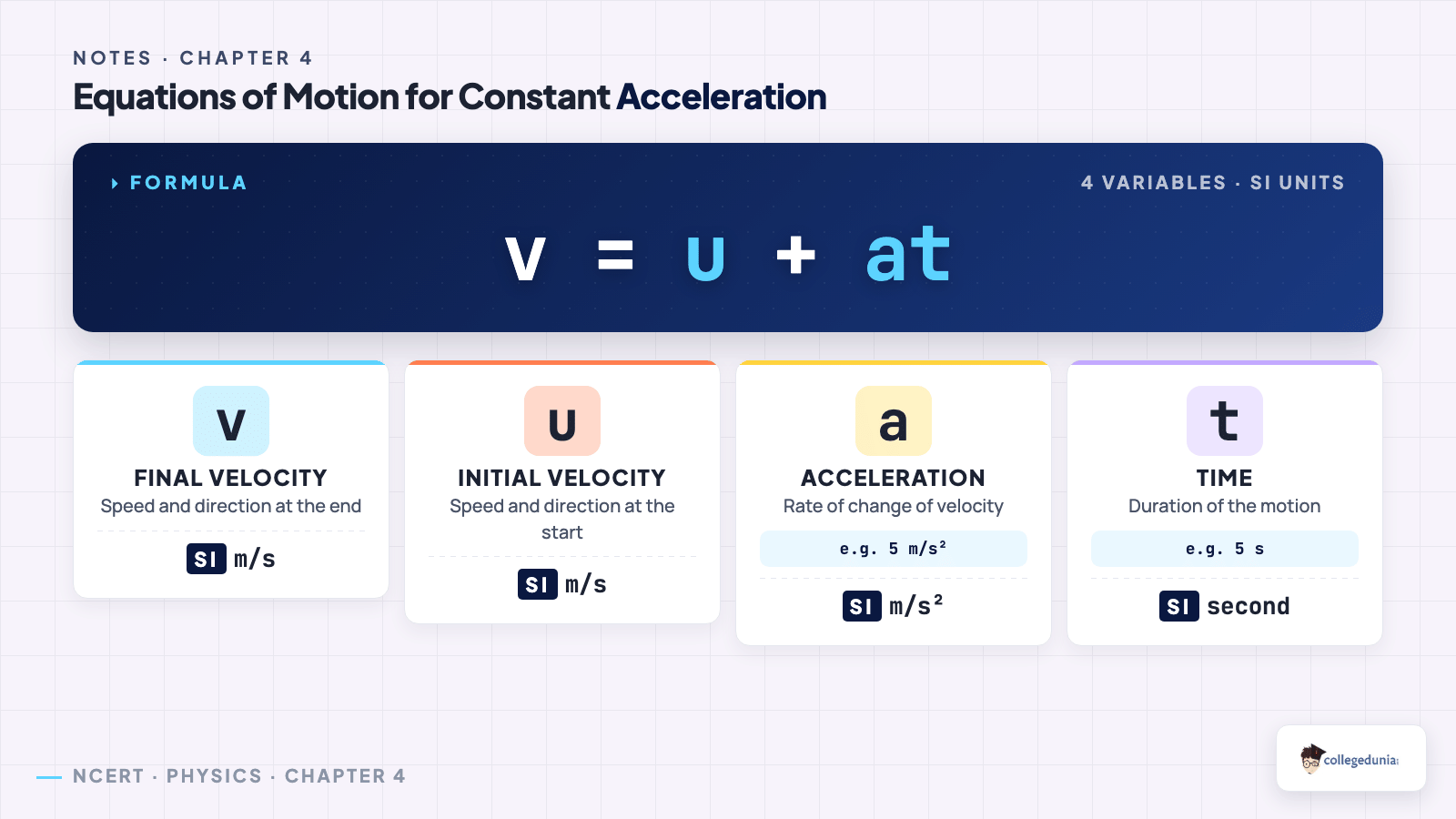
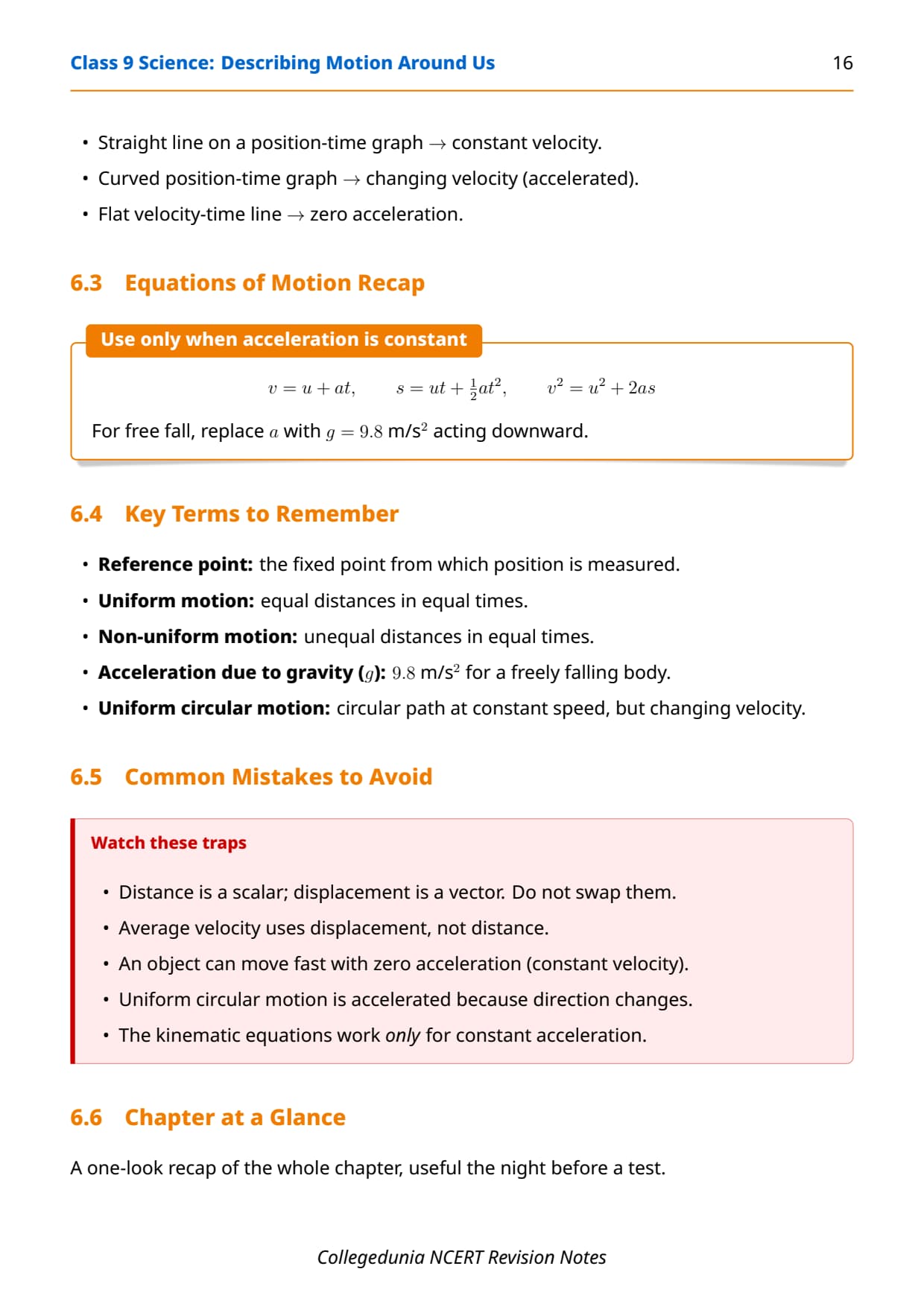
- First equation (velocity-time): v = u + at. This one has no s.
- Second equation (position-time): s = ut + ½at². This one has no v.
- Third equation (position-velocity): v² = u² + 2as. This one has no t.
Each equation leaves out one quantity, so students pick the equation that skips the value they do not know. If time is missing, use v² = u² + 2as. If final velocity is missing, use s = ut + ½at². If displacement is missing, use v = u + at. For free fall, replace a with g = 9.8 m/s².
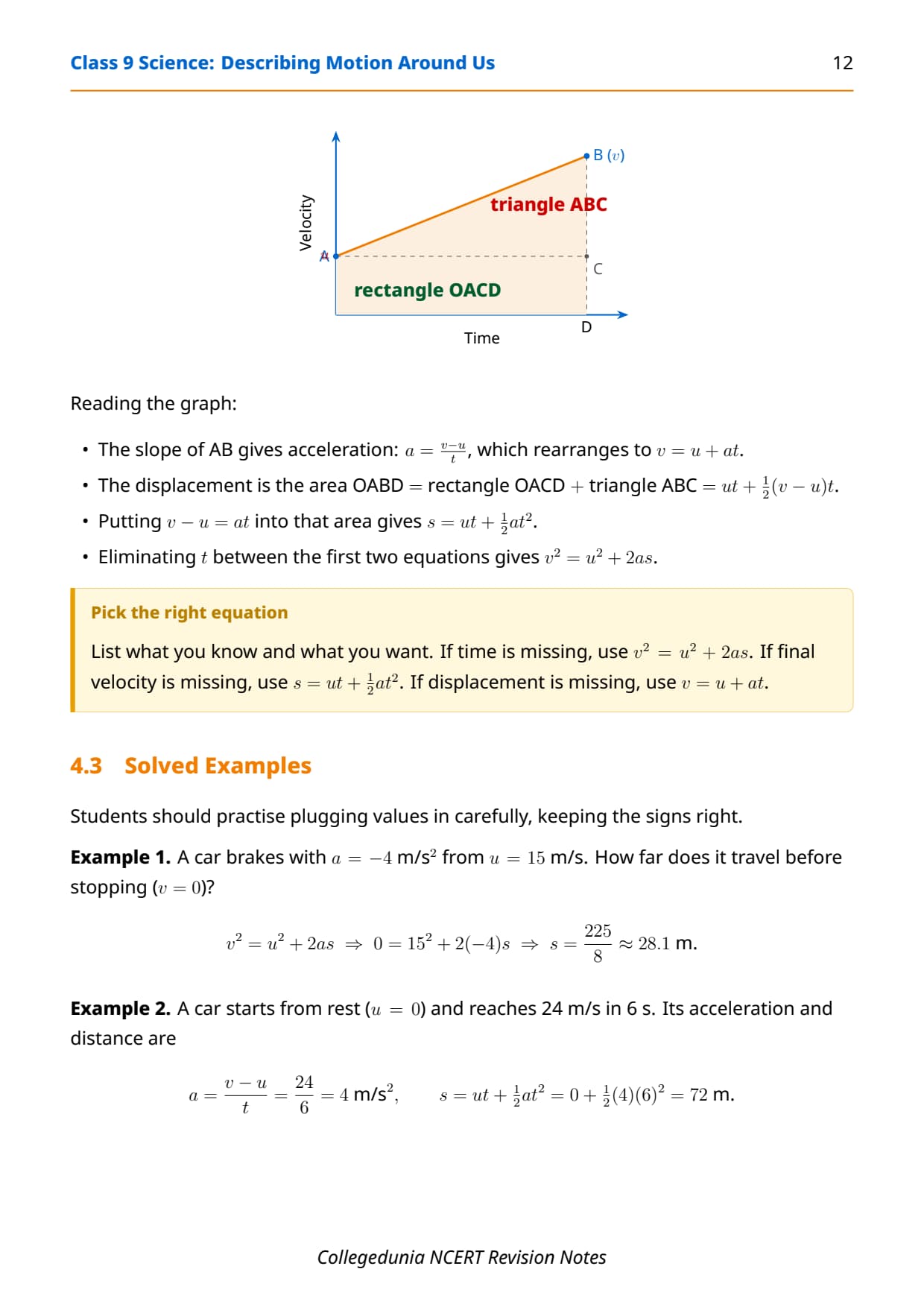
These equations are not magic. They come straight from a velocity-time graph in which velocity rises from u to v in time t. The slope of the line gives the acceleration, which rearranges to v = u + at. The area under the line gives the displacement, which works out to s = ut + ½at². Removing t between the first two results gives v² = u² + 2as, so all three come from one graph.
Graphical Representation of Motion in Class 9 Science
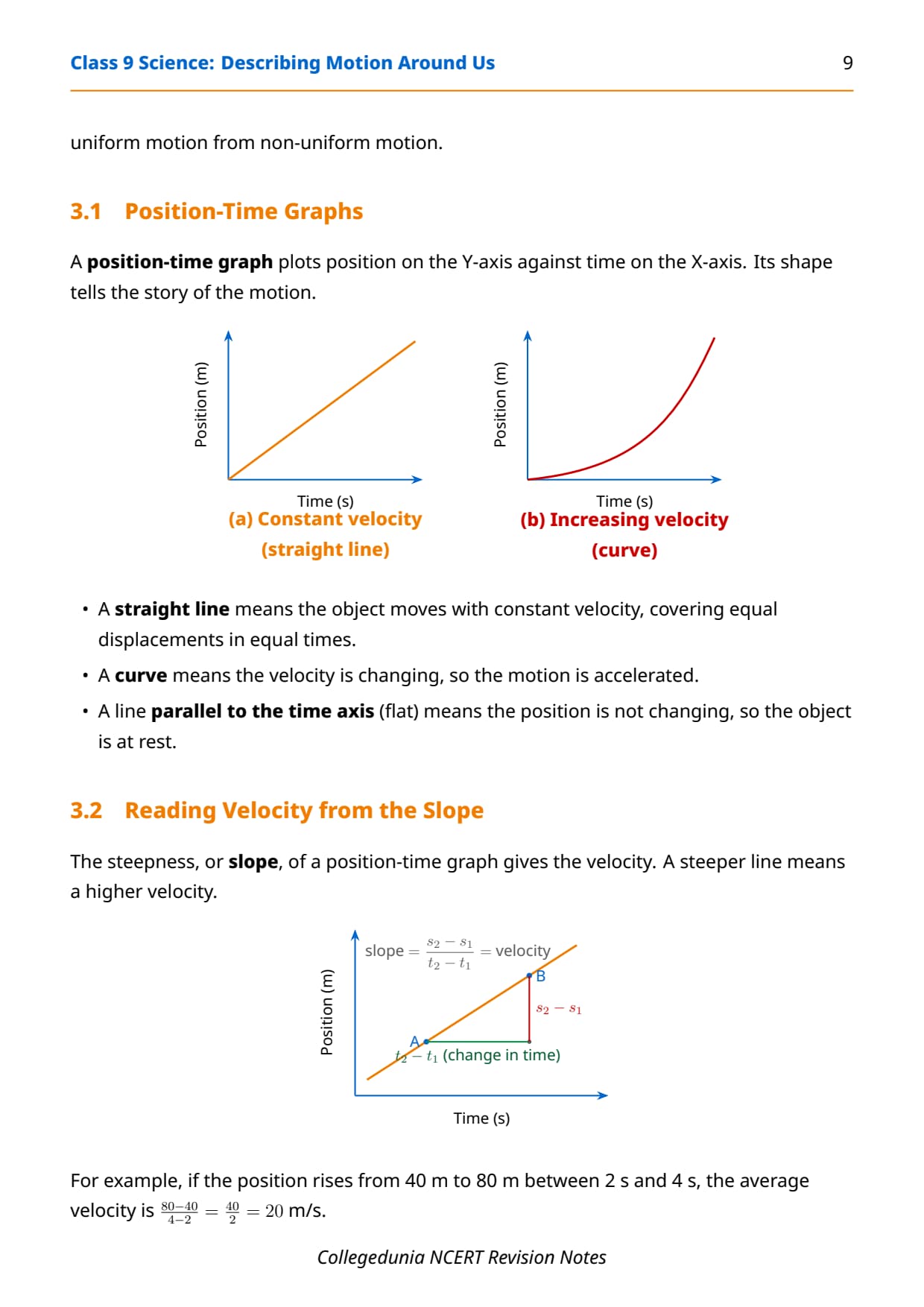
Words and numbers describe motion, but a graph shows it at a glance. A graph lets students compare two objects, read off values, and tell uniform motion from non-uniform motion. The two graphs you need are the position-time graph and the velocity-time graph.
- A straight line on a position-time graph means constant velocity.
- A curve on a position-time graph means changing velocity, so the motion is accelerated.
- A line parallel to the time axis means the object is at rest.
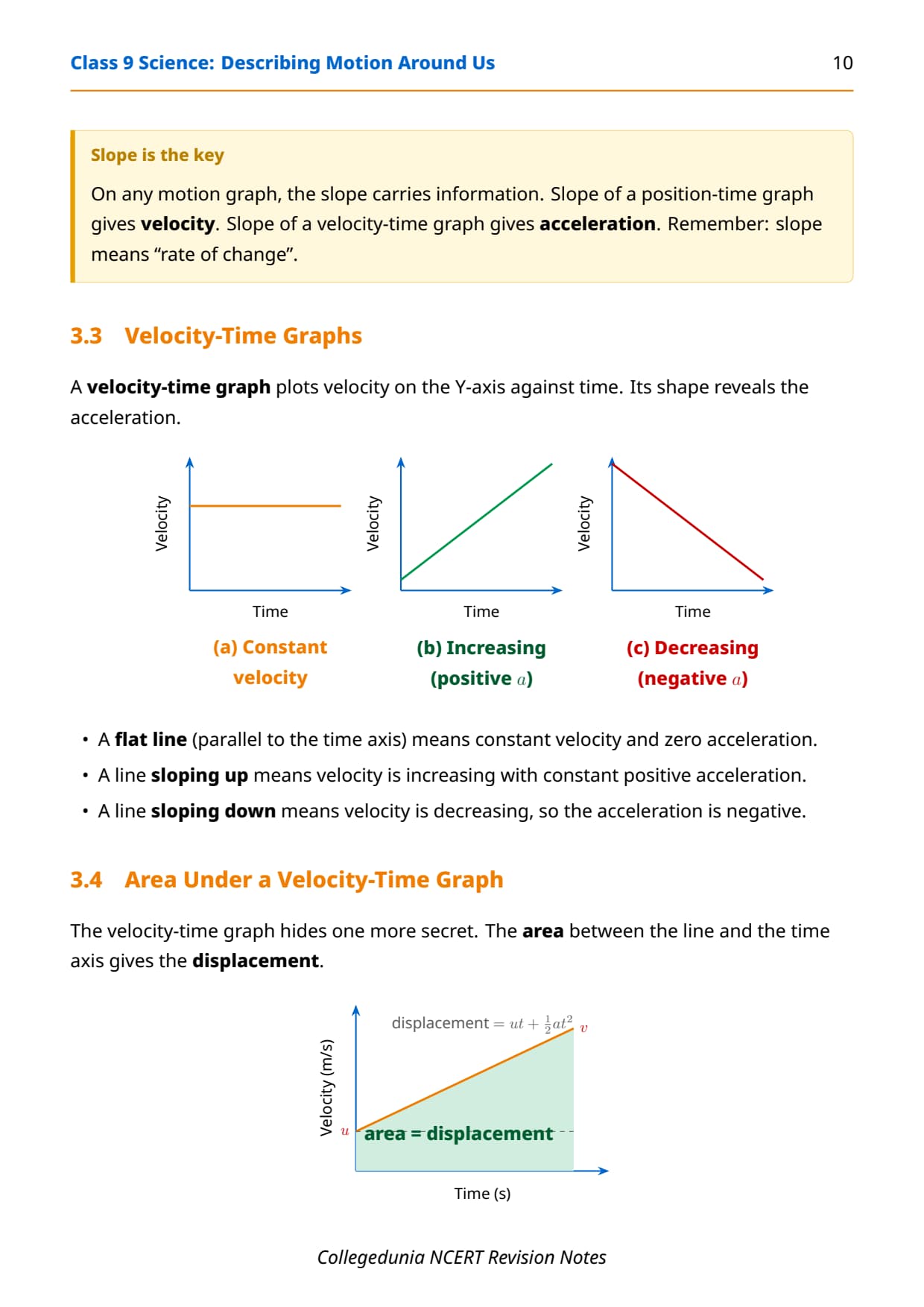
The steepness, or slope, of a position-time graph gives the velocity. A steeper line means a higher velocity. For example, if the position rises from 40 m to 80 m between 2 s and 4 s, the average velocity is (80 − 40) / (4 − 2) = 20 m/s. The slope is the single most useful idea on any motion graph.
| Graph | Slope gives | Area under it gives |
|---|---|---|
| Position-time | Velocity | Not used |
| Velocity-time | Acceleration | Displacement |
On a velocity-time graph a flat line means constant velocity and zero acceleration, a line sloping up means positive acceleration, and a line sloping down means negative acceleration. The area under a velocity-time graph gives the displacement. For a car at a steady 20 m/s for 6 s, the area is a rectangle, so the displacement is 20 × 6 = 120 m. For changing velocity, split the region into a rectangle plus a triangle and add the two areas.
Uniform Circular Motion in the Describing Motion Around Us Chapter
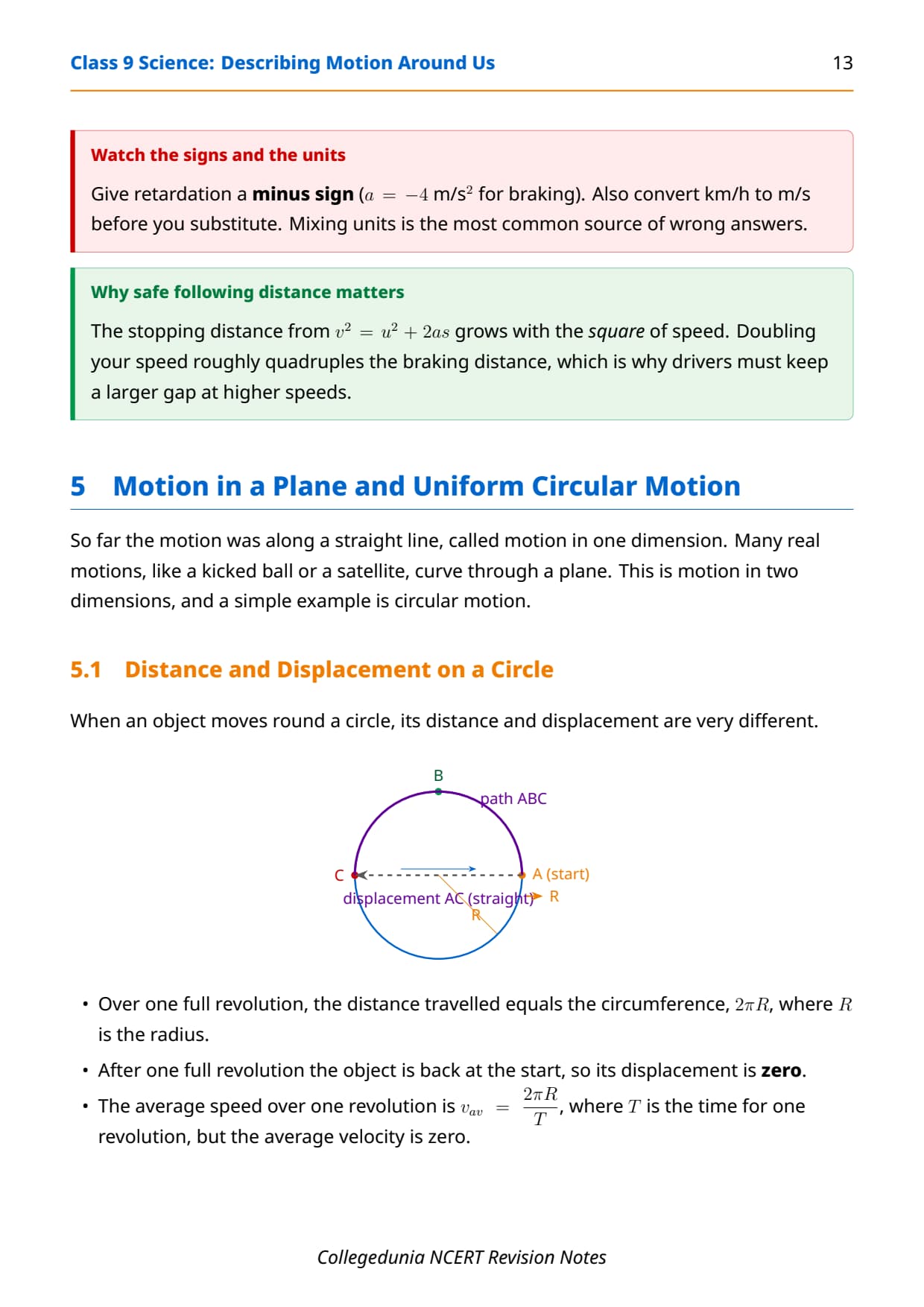
So far the motion was along a straight line. Many real motions, like a kicked ball or a satellite, curve through a plane. A simple example is circular motion, and it behaves in a way that surprises many students. Over one full revolution the object returns to its start, so its displacement is zero even though the distance travelled equals the circumference 2πR.
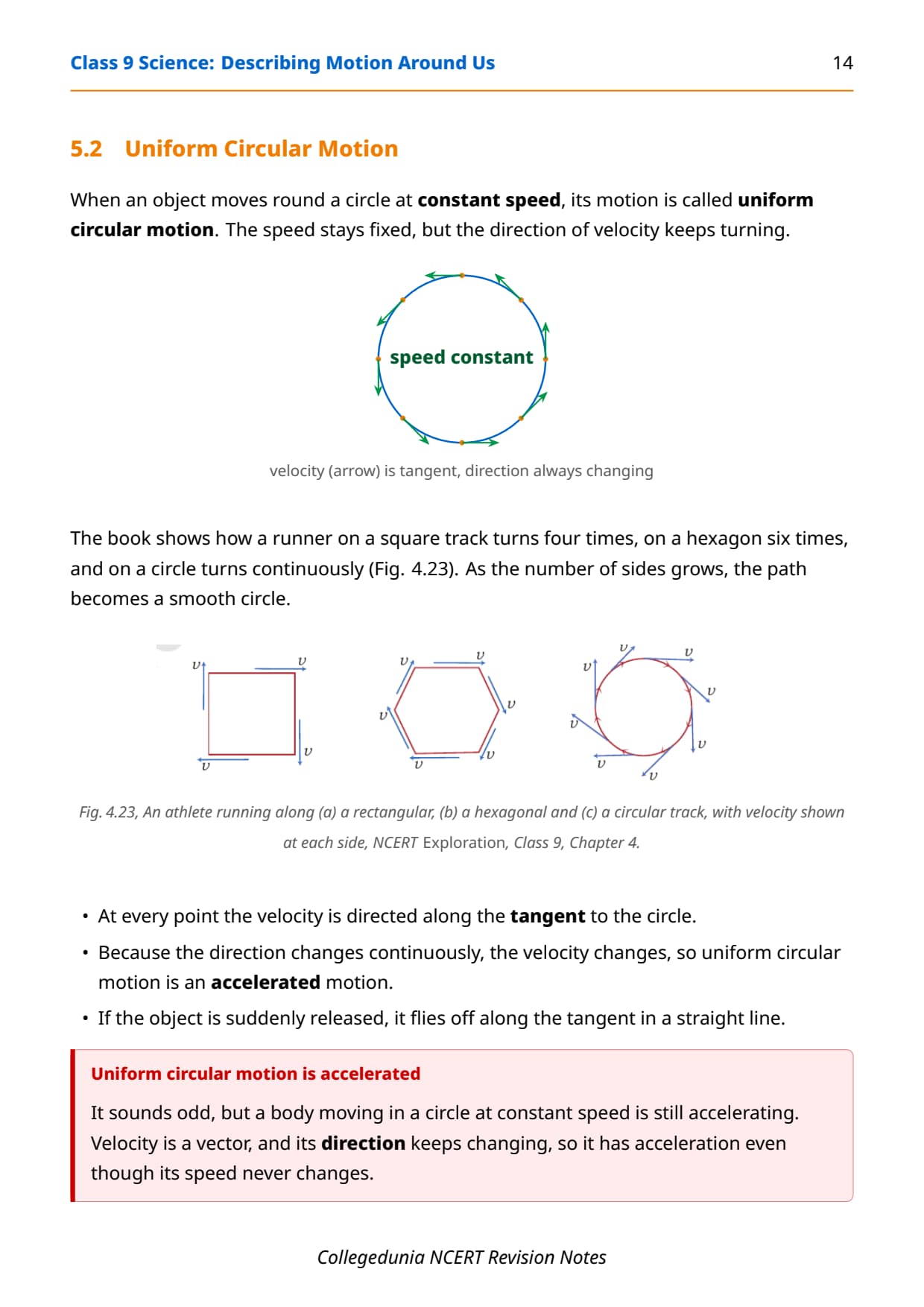
When an object moves round a circle at constant speed, its motion is called uniform circular motion. The speed stays fixed, but the direction of the velocity keeps turning. Because velocity is a vector and its direction changes at every instant, the velocity changes, which means the motion is accelerated.
- At every point the velocity is directed along the tangent to the circle.
- Because the direction changes continuously, uniform circular motion is an accelerated motion.
- If the object is suddenly released, it flies off along the tangent in a straight line.
- Everyday examples: a stone whirled on a string, the hands of a clock, a merry-go-round and a satellite orbiting the Earth.
A body moving in a circle at constant speed is still accelerating. This is one of the most common exam questions from the chapter, so remember the reason: the speed never changes, but the direction, and therefore the velocity, changes every moment.
Common Mistakes Students Make in the Describing Motion Around Us Chapter
Most marks lost in this chapter come from a few repeated slips. The Describing Motion Around Us Class 9 notes flag them here so students can check their work before the exam.
- Swapping distance and displacement: distance is a scalar, displacement is a vector. Do not treat them as equal unless the motion is in one direction.
- Using distance for velocity: average velocity uses displacement, not distance. If an object returns to start, its average velocity is zero.
- Thinking fast means accelerating: an object can move fast with zero acceleration when its velocity is constant.
- Calling circular motion non-accelerated: uniform circular motion is accelerated because the direction of velocity changes.
- Ignoring signs and units: give retardation a minus sign, and convert km/h to m/s before you substitute.
- Using the equations wrongly: the three kinematic equations work only when acceleration is constant.
Watching these six traps is often worth a few extra marks. A quick habit helps: before you write an answer, note whether each quantity is a scalar or a vector, and check the unit of every value you plug in.
Describing Motion Around Us Class 9 Solved Example with Step-by-Step Working
Here is one numerical solved step by step, so students can see the method used across the chapter. A car brakes with an acceleration of −4 m/s² from an initial velocity of 15 m/s. How far does it travel before it stops?
- List what you know: u = 15 m/s, v = 0 (it stops), a = −4 m/s². Time is not given.
- Pick the equation without t: use v² = u² + 2as.
- Substitute the values: 0 = (15)² + 2(−4)s, so 0 = 225 − 8s.
- Solve for s: 8s = 225, so s = 225 / 8 ≈ 28.1 m.
The stopping distance grows with the square of the speed. Double the speed and the braking distance roughly quadruples, which is why drivers must keep a larger gap at higher speeds. This is a favourite real-life link that examiners like to ask about.
How the Describing Motion Around Us Notes Pair with NCERT Solutions and the Formula Sheet
These notes are one part of a set. Students revise fastest when they use the notes, the solutions and the formula sheet together, each for its own job.
- Start with these notes to learn the concepts, the graphs and the three equations of motion.
- Move to the NCERT Solutions to practise every Revise, Reflect, Refine question with full steps.
- Keep the Formula Sheet open for a one-page recap of speed, velocity, acceleration and the kinematic equations.
- Use the Handwritten Notes for a quick last-night read in a topper's clear handwriting.
Together these four resources cover the chapter for the 2026-27 session. The notes explain, the solutions drill, the formula sheet recaps, and the book PDF gives the exact textbook wording when you need it.
How to Use the Describing Motion Around Us Notes Page Most Effectively
A short, repeatable plan turns these notes into marks. Students who follow the three blocks below report the steadiest scores on the motion chapter.
- Block 1, learn: read one section, then close the page and write the key formula and one example from memory.
- Block 2, practise: solve two numericals and read one graph for that section before moving on.
- Block 3, recap: the night before a test, read only the tables, the common-mistake box and the chapter recap.
Repeat the three blocks for each section, and finish with the self-check questions. Any question you miss points straight to the section you should revise again, which keeps your revision focused and short.
More Describing Motion Around Us Class 9 Science Resources
| Resource | Open |
|---|---|
| Revision Notes | Describing Motion Around Us Class 9 Notes |
| NCERT Solutions | Describing Motion Around Us Class 9 NCERT Solutions |
| Handwritten Notes | Describing Motion Around Us Class 9 Handwritten Notes |
| Formula Sheet | Describing Motion Around Us Class 9 Formula Sheet |
| NCERT Book PDF | Describing Motion Around Us Class 9 NCERT Book PDF |
NCERT Notes for Class 9 Science: All Chapters
Use the table below to open the NCERT Notes for any other chapter of the new Class 9 Science Exploration book.
| Chapter | NCERT Notes |
|---|---|
| Chapter 2 | Cell The Building Block of Life |
| Chapter 3 | Tissues in Action |
| Chapter 4 | Describing Motion Around Us |
| Chapter 5 | Exploring Mixtures and their Separation |
| Chapter 6 | How Forces Affect Motion |
| Chapter 7 | Work, Energy, and Simple Machines |
| Chapter 8 | Journey Inside the Atom |
| Chapter 9 | Atomic Foundations of Matter |
| Chapter 10 | Sound Waves Characteristics and Applications |
| Chapter 11 | Reproduction How Life Continues |
| Chapter 12 | Patterns in Life Diversity and Classification |
| Chapter 13 | Earth as a System Energy, Matter, and Life |
Describing Motion Around Us Class 9 Science NCERT Notes FAQs
Ques. Where can I download the NCERT Notes for Class 9 Science Chapter 4 Describing Motion Around Us PDF?
Ans. You can download the Describing Motion Around Us Class 9 notes PDF free from this page. It matches the 2026-27 NCERT Exploration textbook and covers the full chapter in short, revision-ready steps.
Ques. What is the difference between distance and displacement?
Ans. Distance is the total path length covered and is a scalar, so it has no direction. Displacement is the net change in position and is a vector, so it has magnitude and direction. Displacement is always less than or equal to distance.
Ques. What are the three equations of motion in Class 9 Science?
Ans. The three equations for constant acceleration are v = u + at, s = ut + ½at², and v² = u² + 2as. Here u is initial velocity, v is final velocity, a is acceleration, s is displacement and t is time.
Ques. Why is uniform circular motion called accelerated motion?
Ans. In uniform circular motion the speed is constant, but the direction of the velocity keeps changing. Velocity is a vector, so a change in its direction is a change in velocity, which means the motion is accelerated.
Ques. What does the slope of a velocity-time graph represent?
Ans. The slope of a velocity-time graph gives the acceleration. The area under the same graph gives the displacement. On a position-time graph, it is the slope that gives the velocity.
Ques. Is Describing Motion Around Us part of the new Class 9 Science book?
Ans. Yes. Describing Motion Around Us is Chapter 4 of the new Exploration textbook for the 2026-27 syllabus. It is a base Physics chapter that supports later chapters on force, work and energy.



Comments