



Inside these Class 8 Maths notes for Proportional Reasoning-2, you will find the map-scale rule that turns RF 1 : 60,00,000 into 1 cm = 60 km, the protractor method for drawing a pie chart, and the one test that separates direct proportion from inverse proportion. Every rule follows Ganita Prakash Part 2 for the 2026-27 session.
- Chapter: Chapter 3 of Ganita Prakash Part 2, the Class 8 Maths textbook for 2026-27
- Two rules to fix: direct proportion keeps x ÷ y fixed, inverse proportion keeps x × y fixed
- Pie chart formula: slice angle = (part ÷ whole) × 360°, and the angles must total 360°
Every rule, worked example and diagram in these Class 8 Maths notes is checked line by line against the printed Ganita Prakash Part 2 chapter for the 2026-27 session.
What Makes a Relationship Proportional in the Proportional Reasoning-2 Chapter
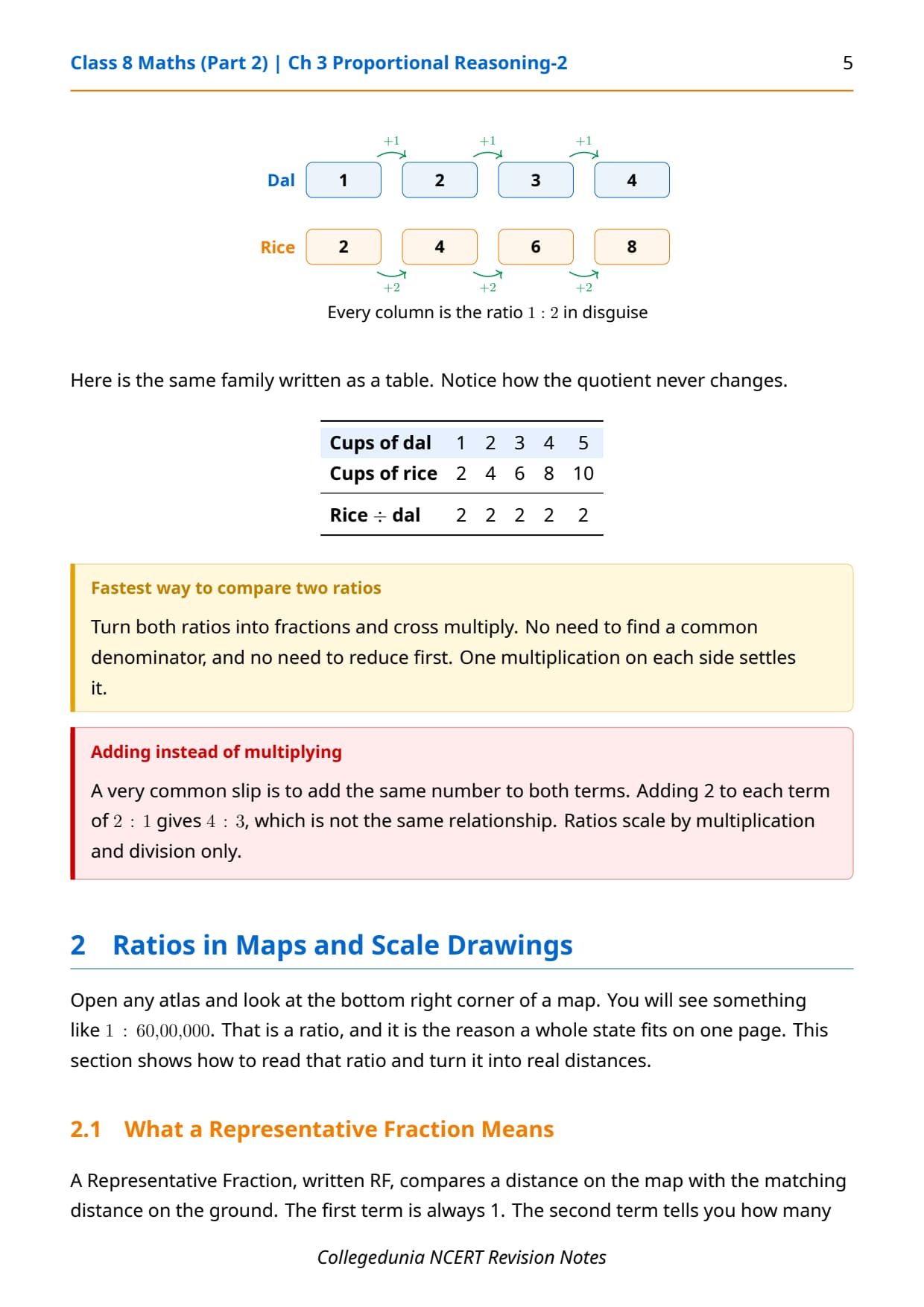
Two quantities are proportional when they change by the same factor. Double one and the other doubles. Halve one and the other halves. The textbook uses idli batter: 2 cups of rice to 1 cup of urad dal. Six cups of rice then needs 3 cups of dal.
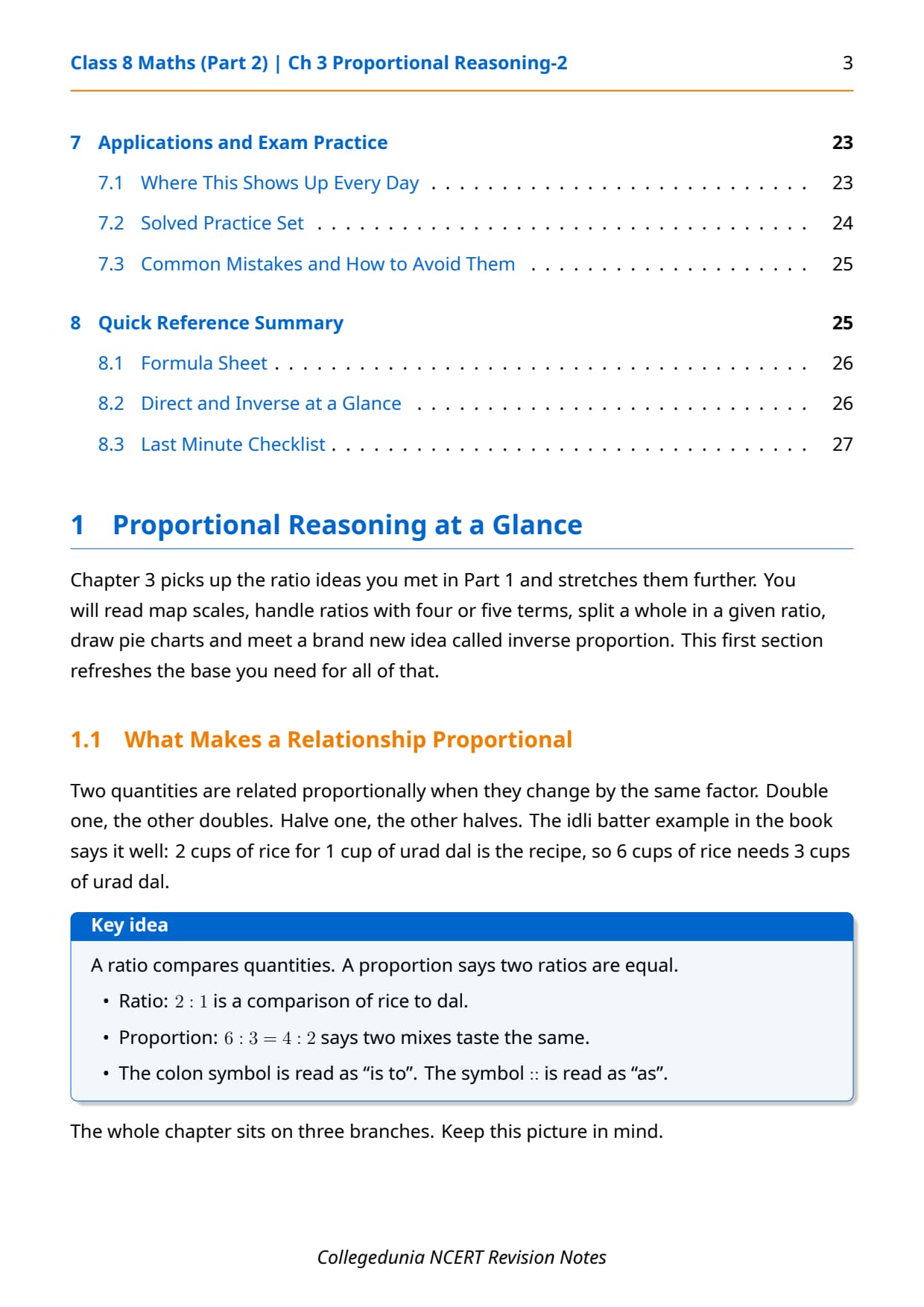
A ratio compares quantities. A proportion says two ratios are equal. The colon is read as "is to" and the double colon is read as "as", so 6 : 3 :: 4 : 2 is read aloud as "6 is to 3 as 4 is to 2".
- Ratio: 2 : 1 compares rice to dal in one recipe
- Proportion: 6 : 3 = 4 : 2 says two different mixes taste the same
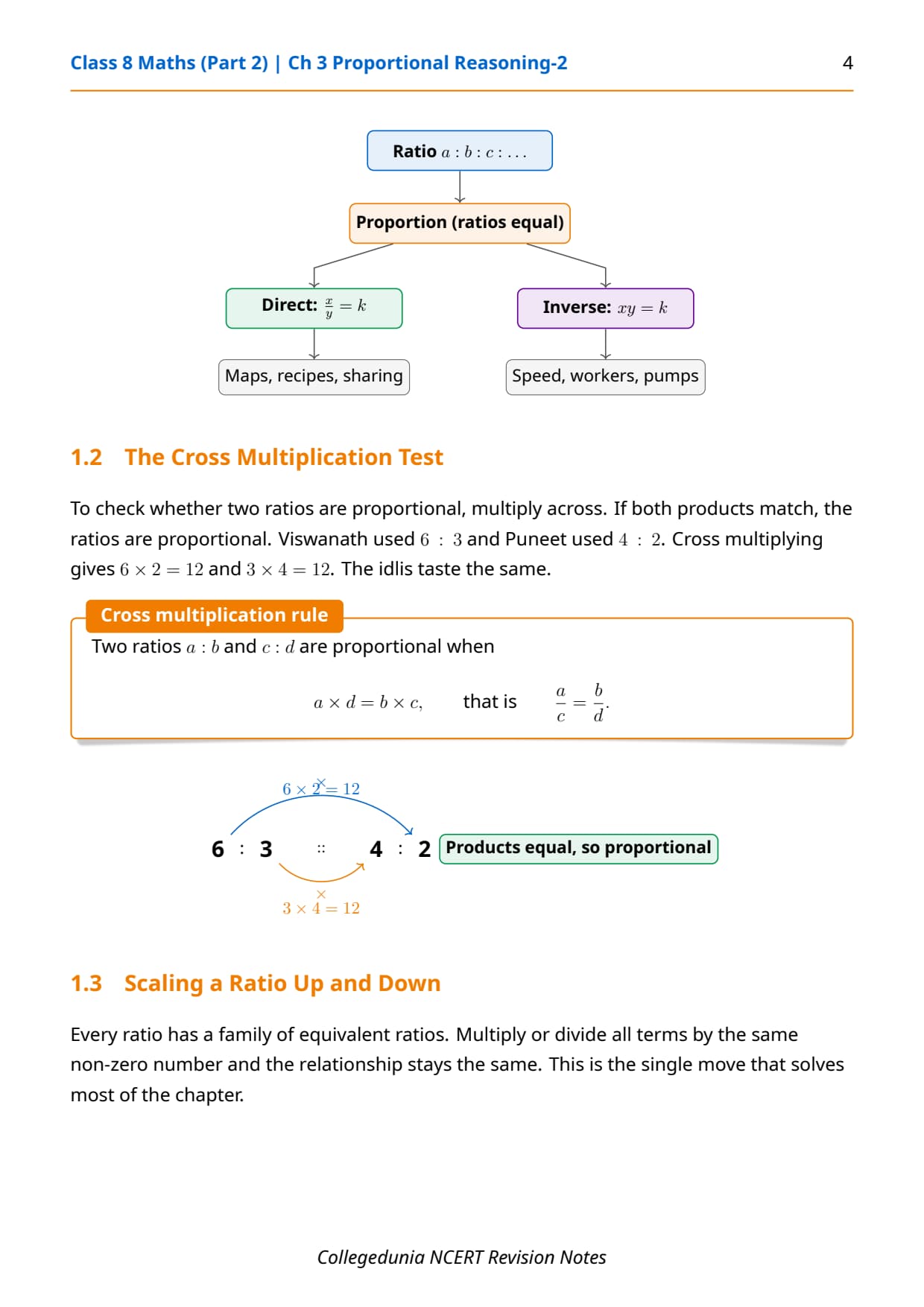
- Cross multiplication test: a : b and c : d are proportional when a × d = b × c
- Equivalent ratios: multiply or divide every term by the same non-zero number
Viswanath used 6 : 3 and Puneet used 4 : 2. Cross multiplying gives 6 × 2 = 12 and 3 × 4 = 12. The products match, so the two batters are the same mix. This one multiplication settles any comparison, with no common denominator needed.
| Cups of dal | Cups of rice | Rice ÷ dal |
|---|---|---|
| 1 | 2 | 2 |
| 2 | 4 | 2 |
| 3 | 6 | 2 |
| 4 | 8 | 2 |
| 5 | 10 | 2 |
Ratios scale by multiplication and division only, never by addition. Adding 2 to both terms of 2 : 1 gives 4 : 3, which is a different mix. That single slip is the most common wrong answer in the opening exercise.
Proportional Reasoning-2 Explained in Simple Language
Source: MOS Classes Maths (Shine Luthra) on YouTube
Map Scales and the Representative Fraction: Reading RF 1 : 60,00,000
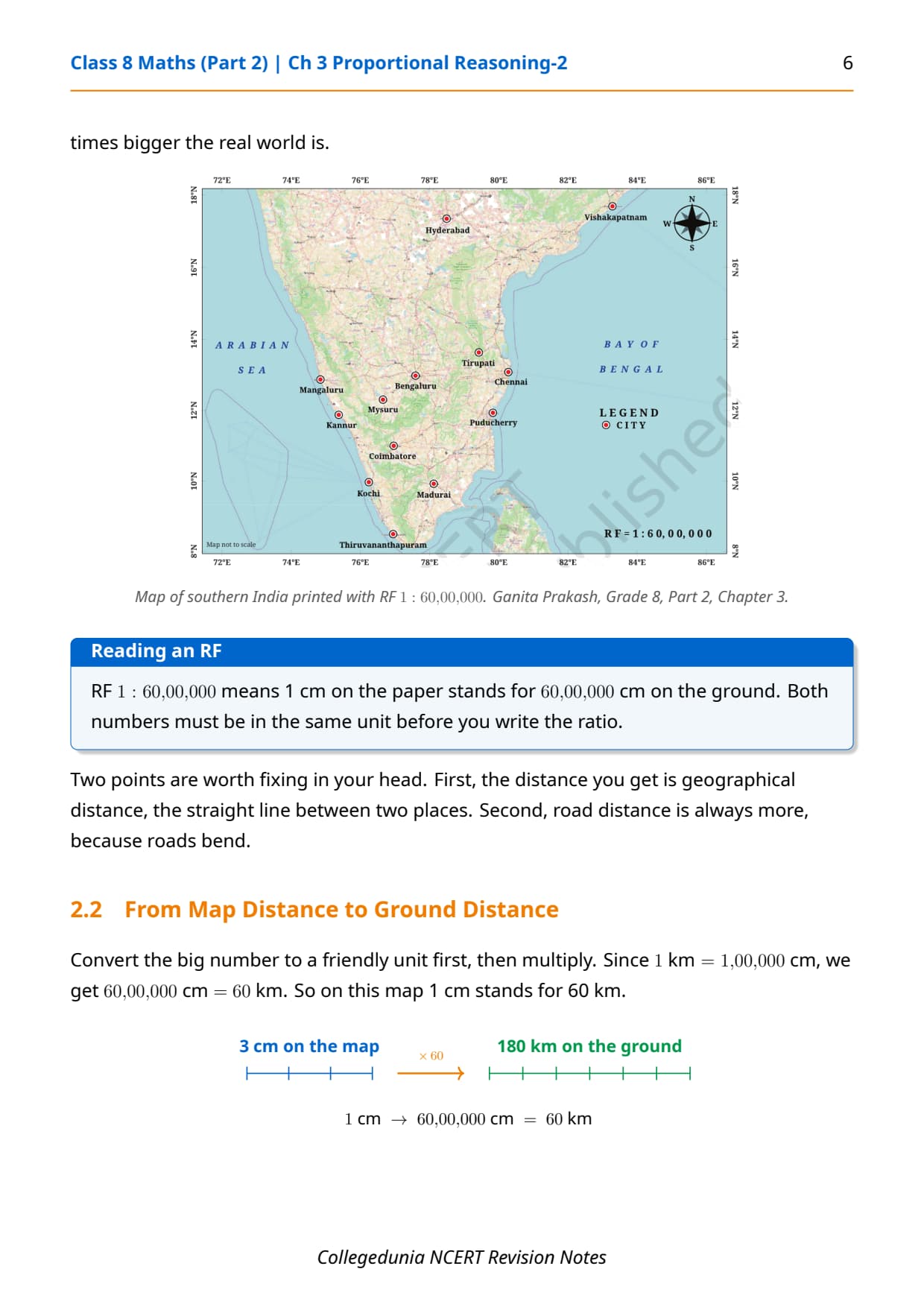
Look at the bottom corner of any atlas page and you will see a ratio like 1 : 60,00,000. That is the Representative Fraction, written RF. It compares one unit of distance on the paper with the matching distance on the ground.
The first term of an RF is always 1. The second term tells you how many times bigger the real world is. So RF 1 : 60,00,000 means 1 cm on the map stands for 60,00,000 cm on the ground. Both numbers must be in the same unit before you write the ratio.
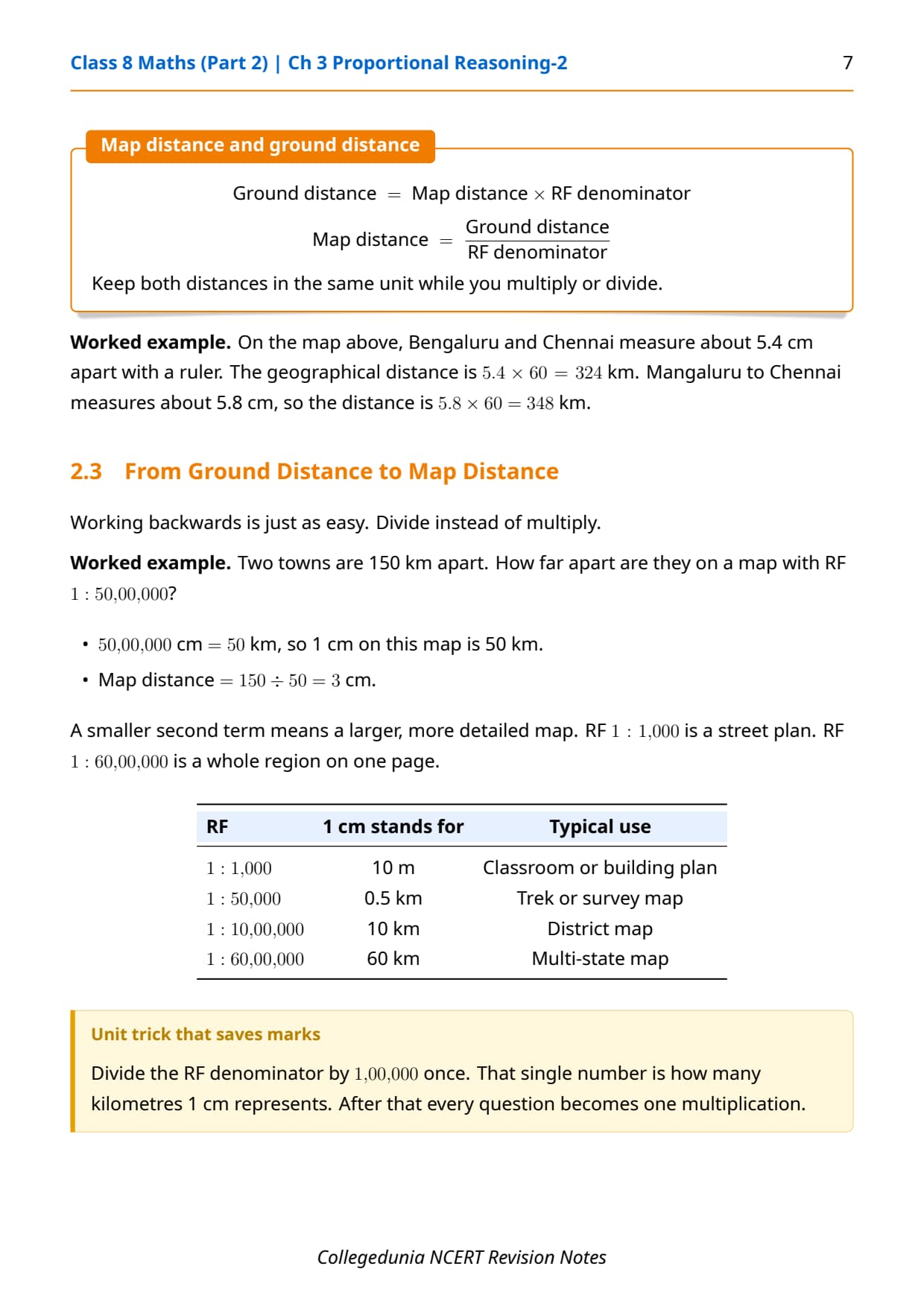
Since 1 km = 1,00,000 cm, dividing gives 60,00,000 cm = 60 km. On that map, 1 cm is 60 km. Bengaluru to Chennai measures about 5.4 cm with a ruler, so the distance is 5.4 × 60 = 324 km.
| RF | 1 cm stands for | Typical use |
|---|---|---|
| 1 : 1,000 | 10 m | Classroom or building plan |
| 1 : 50,000 | 0.5 km | Trek or survey map |
| 1 : 10,00,000 | 10 km | District map |
| 1 : 60,00,000 | 60 km | Multi-state map |
The two directions are simple once you fix them. Ground distance = map distance × RF denominator. Map distance = ground distance ÷ RF denominator. Two towns 150 km apart sit 150 ÷ 50 = 3 cm apart on a map with RF 1 : 50,00,000.
- Unit trick: divide the RF denominator by 1,00,000 once to get the kilometres per centimetre
- Direction check: map to ground you multiply, ground to map you divide
- Smaller second term: a more detailed map, so 1 : 1,000 is a street plan
- What you measure: geographical distance, the straight line, so road distance is always more
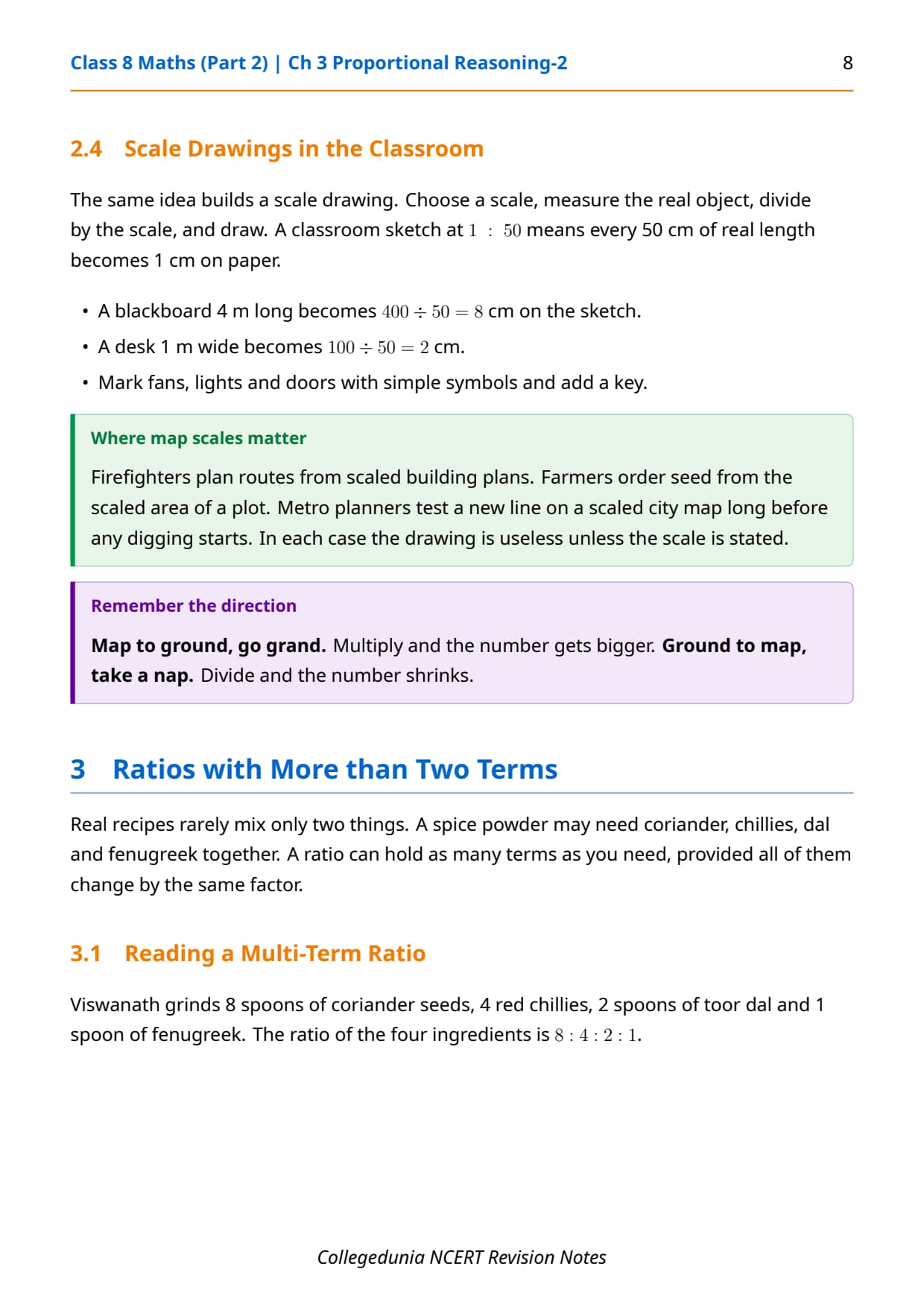
Scale drawings use the same rule. A classroom sketch at 1 : 50 turns a 4 m blackboard into 400 ÷ 50 = 8 cm on paper, and a 1 m desk into 2 cm. Firefighters, farmers and metro planners all work from drawings like these, and the drawing is useless unless the scale is written on it.
Ratios With More Than Two Terms: Spice Mixes, Paint and Concrete
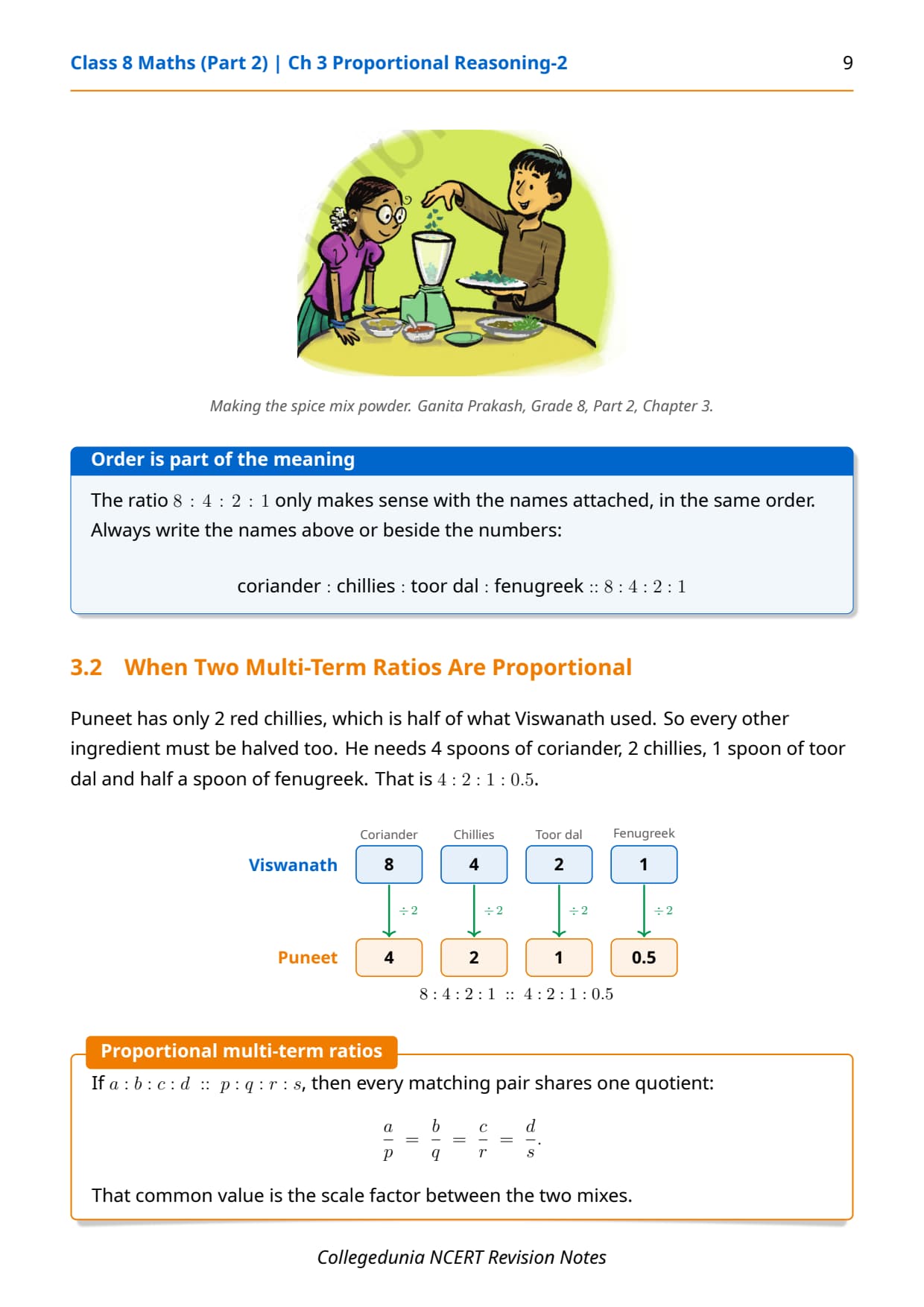
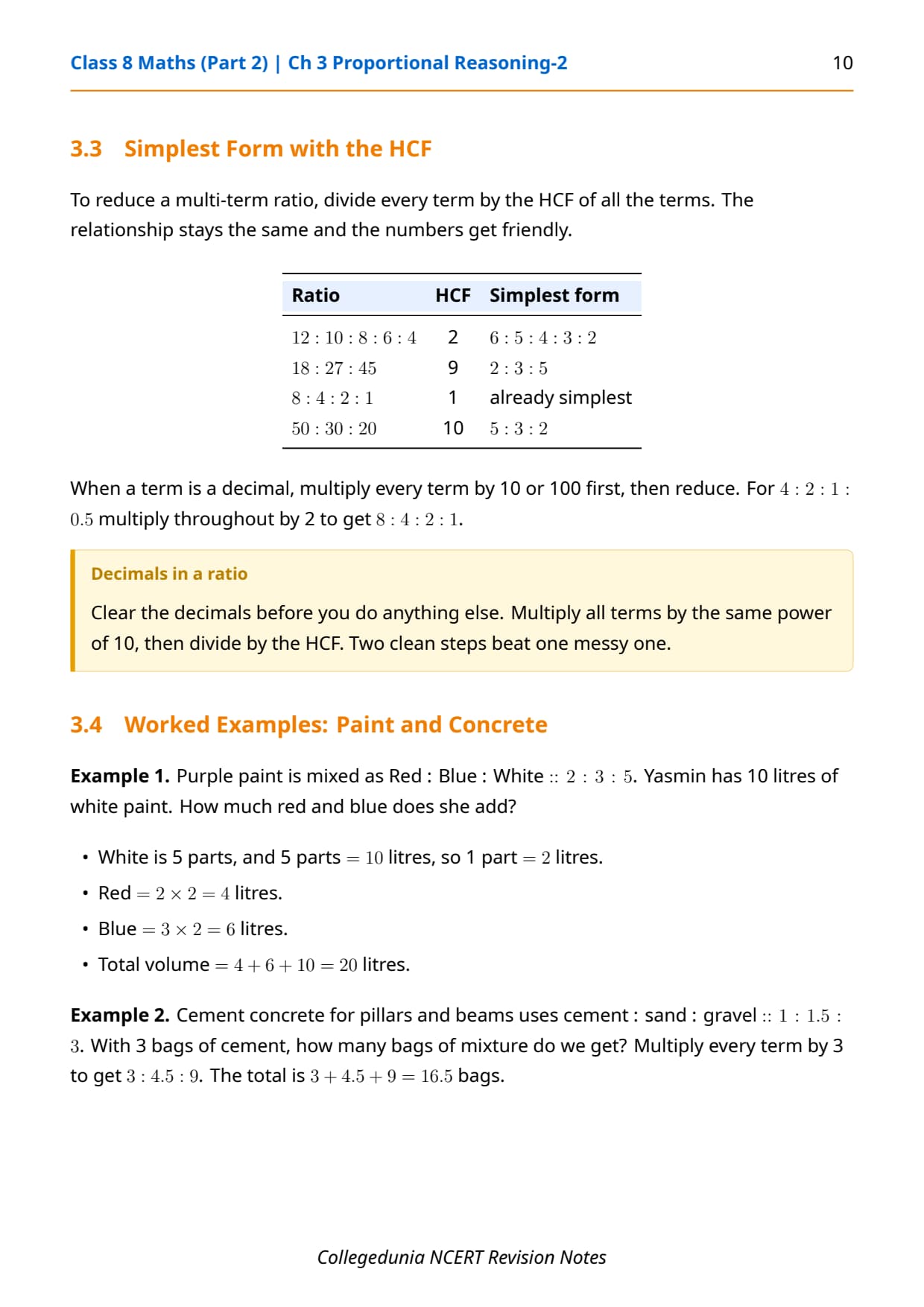
Real recipes rarely mix only two things. A ratio can hold as many terms as you need, as long as every term changes by the same factor. Viswanath grinds 8 spoons of coriander, 4 red chillies, 2 spoons of toor dal and 1 spoon of fenugreek, so the ratio is 8 : 4 : 2 : 1.
Order is part of the meaning. The numbers say nothing without the names beside them in the same order. Write coriander : chillies : toor dal : fenugreek above the ratio, then work. Puneet halves everything and gets 4 : 2 : 1 : 0.5, which is the same mix at half size.
Two multi-term ratios are proportional when every matching pair shares one quotient. If a : b : c : d :: p : q : r : s, then a ÷ p = b ÷ q = c ÷ r = d ÷ s. That common value is the scale factor between the two mixes.
| Ratio | HCF | Simplest form |
|---|---|---|
| 12 : 10 : 8 : 6 : 4 | 2 | 6 : 5 : 4 : 3 : 2 |
| 18 : 27 : 45 | 9 | 2 : 3 : 5 |
| 8 : 4 : 2 : 1 | 1 | Already simplest |
| 50 : 30 : 20 | 10 | 5 : 3 : 2 |
To reduce a multi-term ratio, divide every term by the HCF of all the terms. When one term is a decimal, clear the decimals first. Multiply 4 : 2 : 1 : 0.5 throughout by 2 and you get back to 8 : 4 : 2 : 1. Two clean steps beat one messy one.
Worked example. Purple paint is mixed as red : blue : white :: 2 : 3 : 5, and Yasmin has 10 litres of white. White is 5 parts, so 5 parts = 10 litres and 1 part = 2 litres. Red is 2 × 2 = 4 litres, blue is 3 × 2 = 6 litres, and the total is 20 litres.
The 10 litres belongs to white, the third term, not the first. Students often divide the given amount by the first term out of habit. Circle the term you were given before you find the value of one part.
Dividing a Whole in a Given Ratio: The Part Value Method and the Fraction Formula
Sometimes you are given the total and asked to split it. A 150 minute practice session, 110 units of concrete, or the 180° inside a triangle. The method never changes, and it takes three lines.
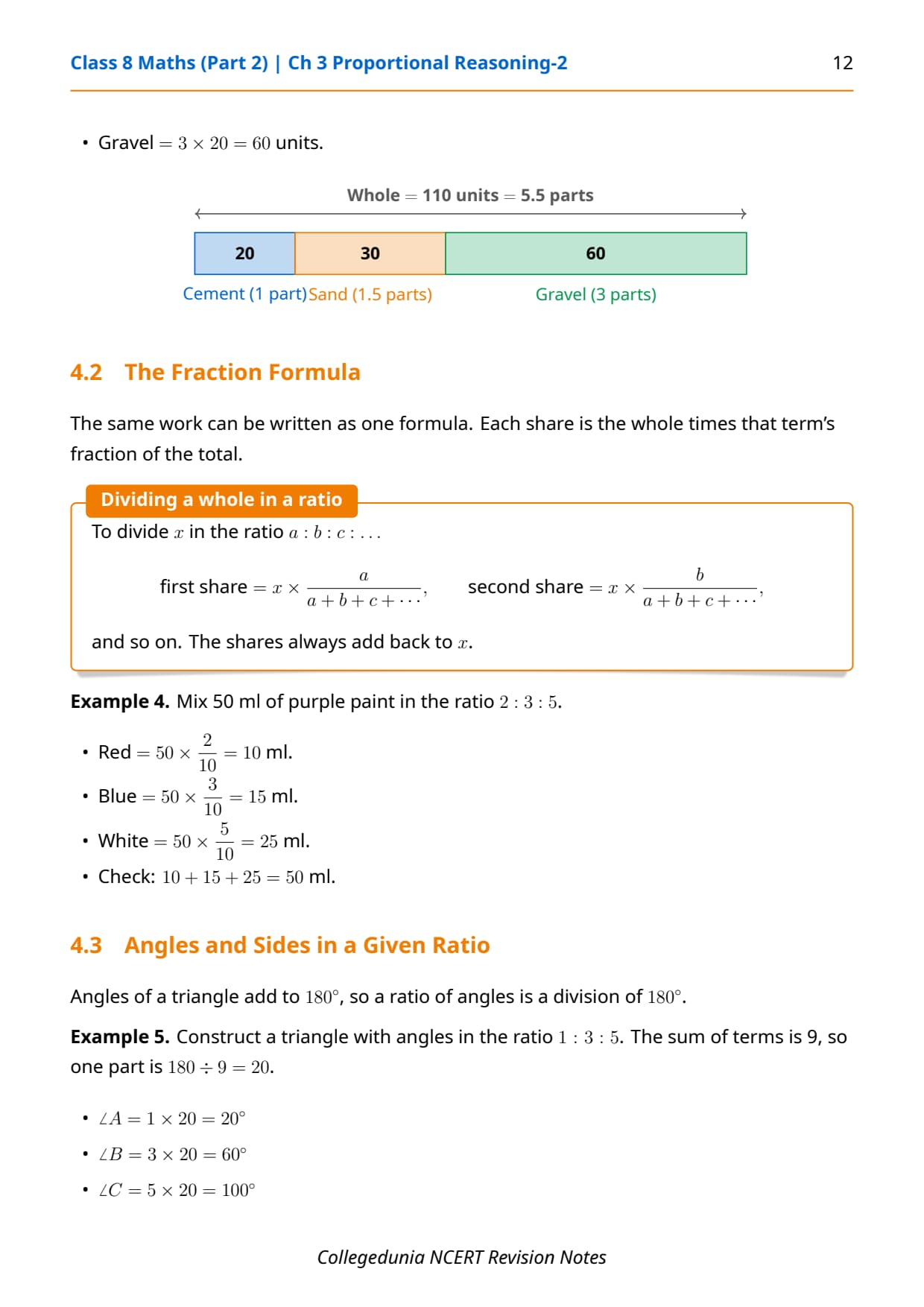
- Add the terms of the ratio. That sum is the number of equal parts the whole is cut into.
- Divide the whole by that sum to get the value of one part.
- Multiply each term by the part value, then add your answers back to check.
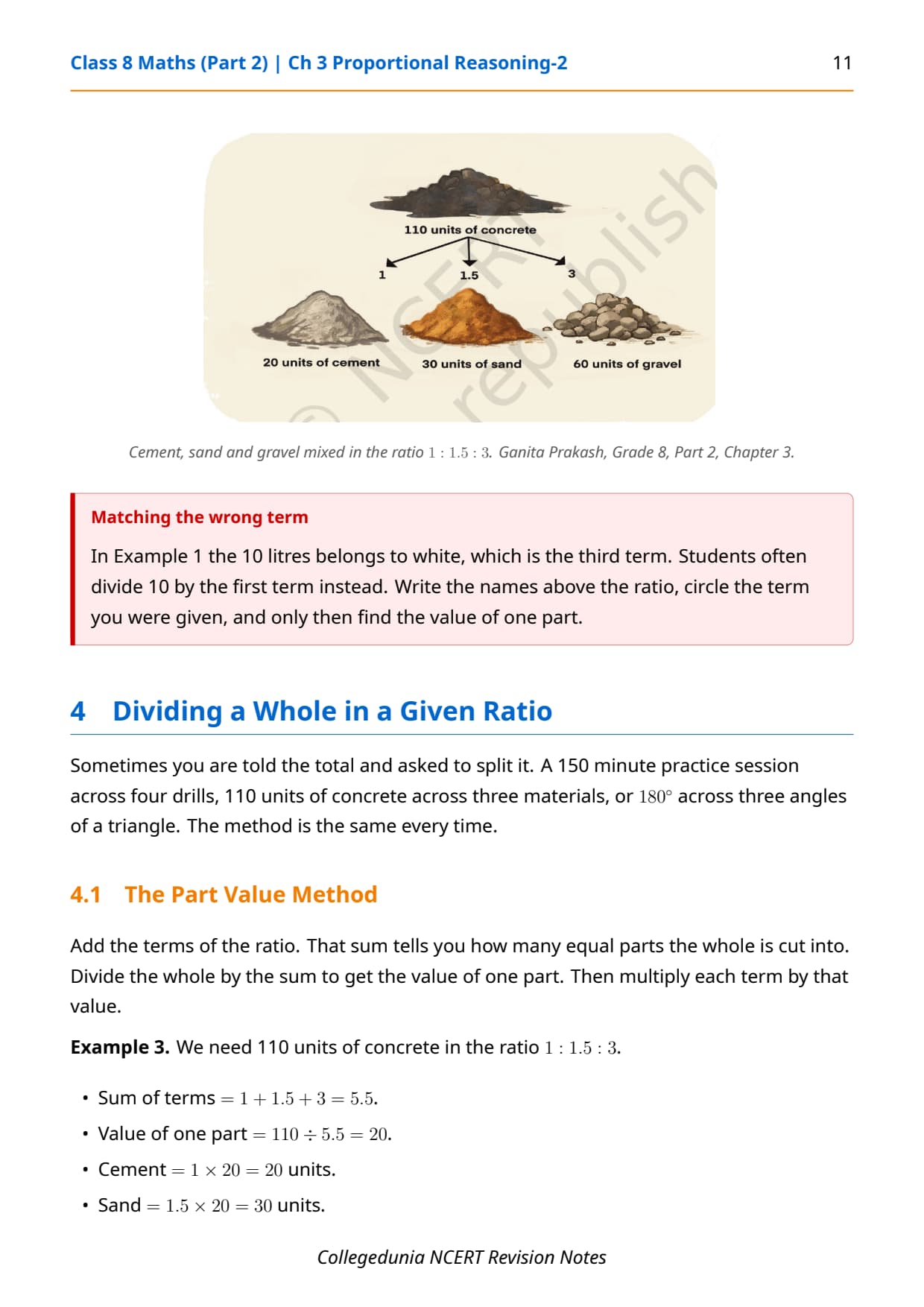
Worked example. Split 110 units of concrete in the ratio 1 : 1.5 : 3. The sum is 1 + 1.5 + 3 = 5.5, so one part is 110 ÷ 5.5 = 20. Cement is 20 units, sand is 30 units and gravel is 60 units. The three shares add back to 110.
The same work fits in one formula. To divide a total x in the ratio a : b : c, each share is the total times that term's fraction of the sum. The first share is x × a ÷ (a + b + c), and so on for the rest.
| Question | Ratio | Sum of terms | One part | Shares |
|---|---|---|---|---|
| 50 ml of purple paint | 2 : 3 : 5 | 10 | 5 ml | 10, 15 and 25 ml |
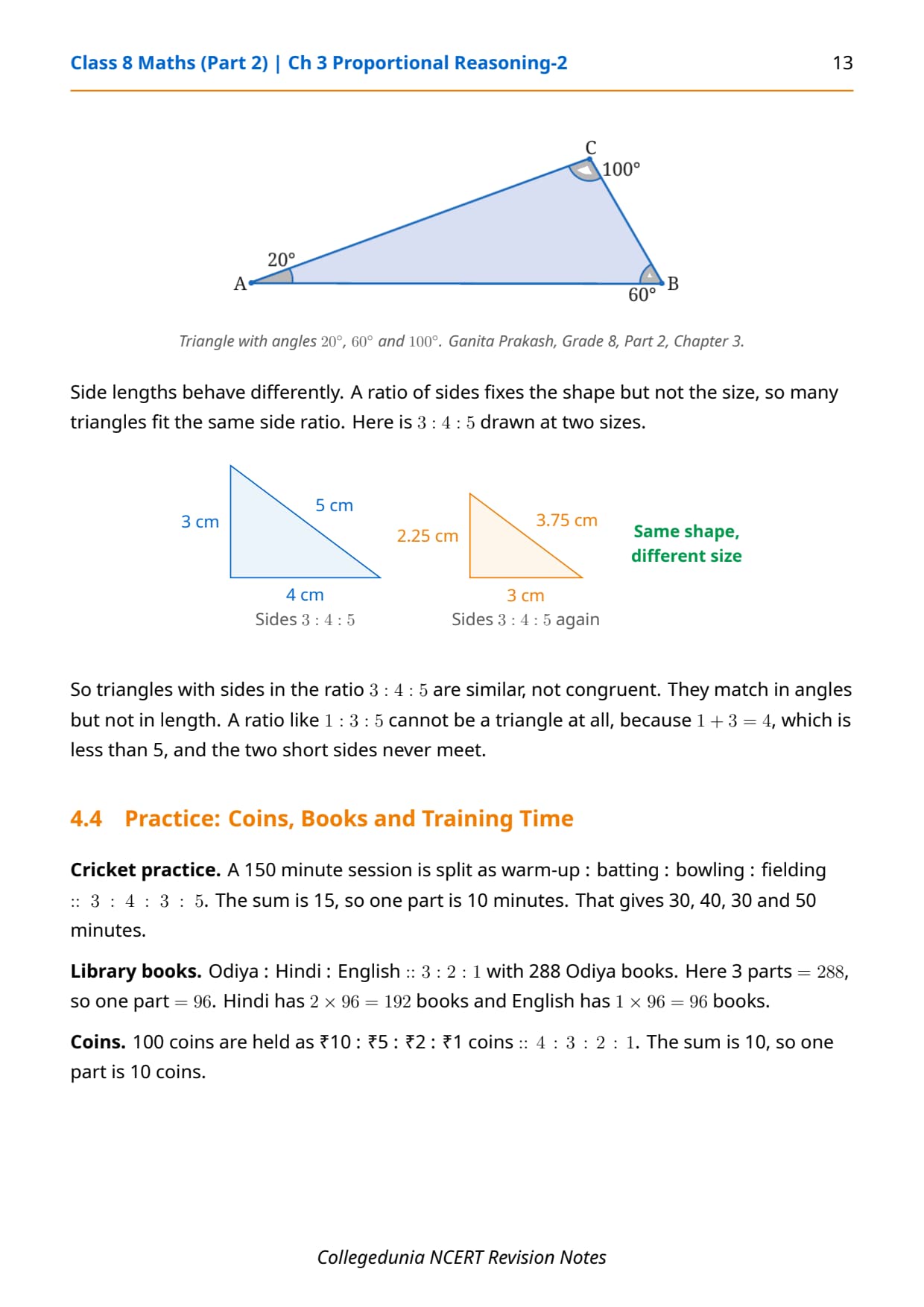
| Angles of a triangle | 1 : 3 : 5 | 9 | 20° | 20°, 60° and 100° |
| 150 minute cricket session | 3 : 4 : 3 : 5 | 15 | 10 min | 30, 40, 30 and 50 min |
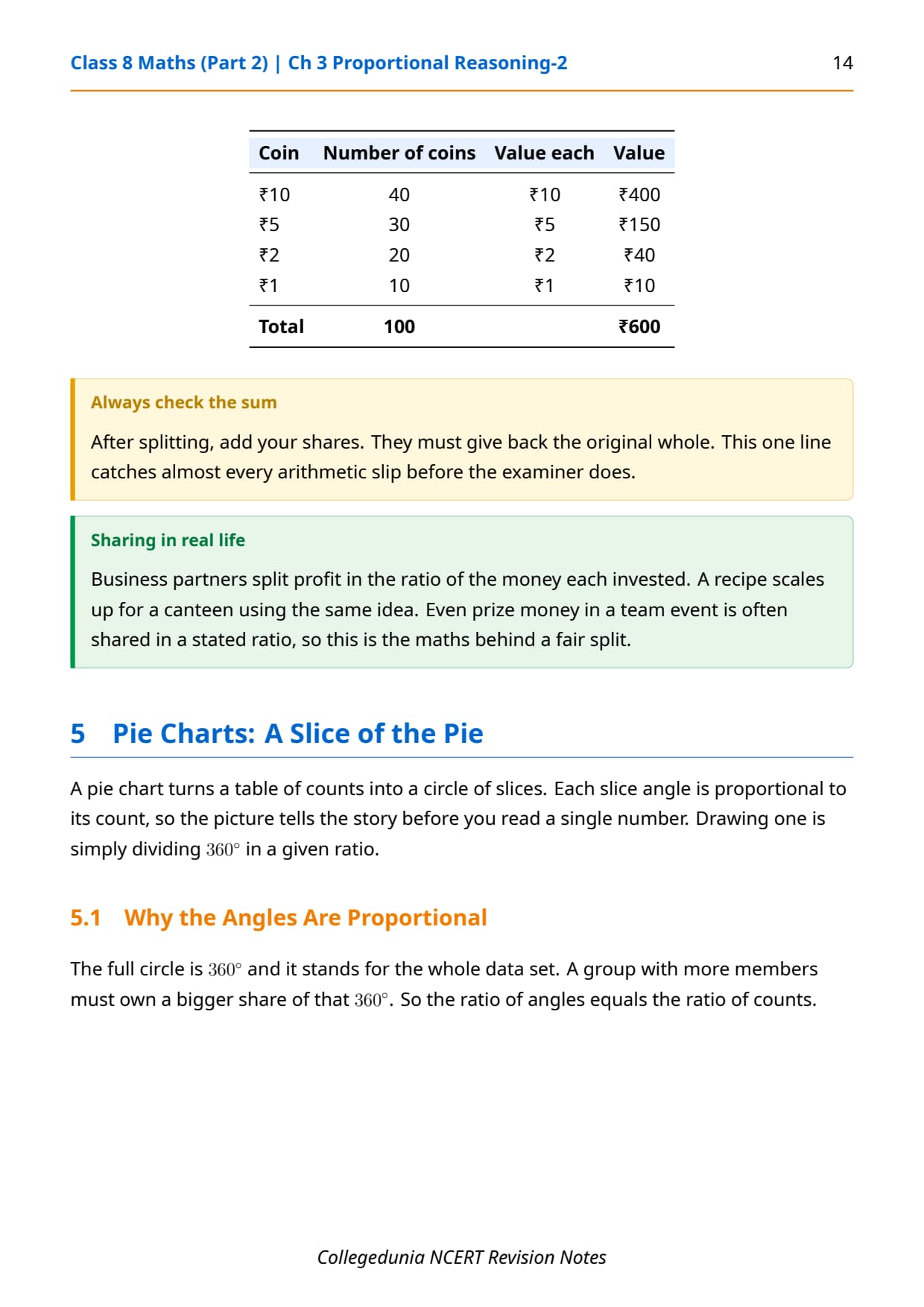
| 100 coins by value | 4 : 3 : 2 : 1 | 10 | 10 coins | 40, 30, 20 and 10 coins |
Angles behave differently from sides. A ratio of angles divides 180° and fixes exactly one triangle shape. A ratio of sides fixes the shape but not the size, so a 3 : 4 : 5 triangle can be drawn at any scale. Those triangles are similar, not congruent.
One more check saves marks. A side ratio like 1 : 3 : 5 cannot be a triangle at all, because 1 + 3 = 4 is less than 5 and the two short sides never meet. Always test that the two smaller terms add to more than the largest.
Pie Charts: Turning a Table of Counts Into Angles You Can Draw
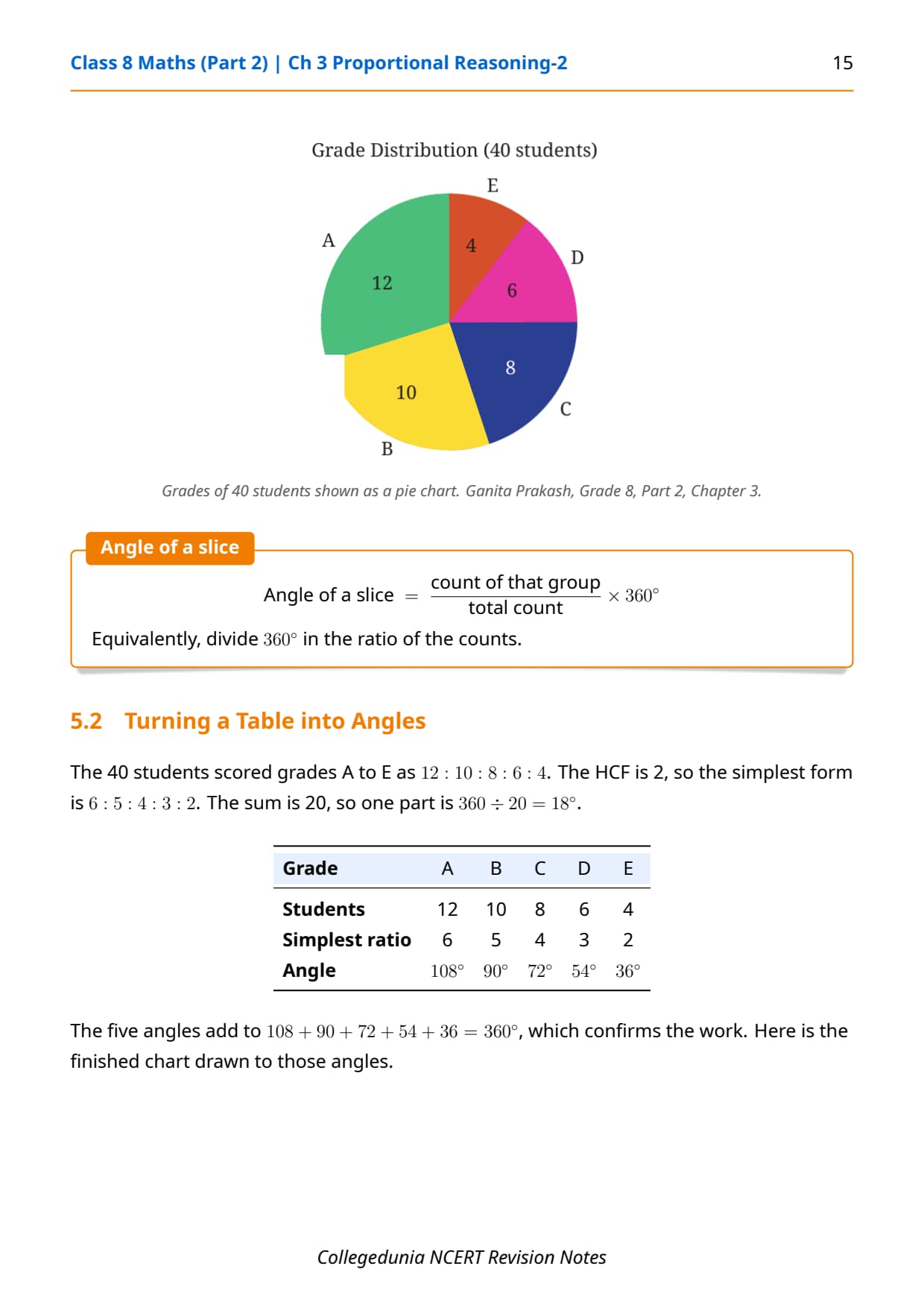
A pie chart turns a table of counts into a circle of slices. The full circle is 360° and stands for the whole data set, so a group with more members owns a bigger share of that 360°. Drawing one is just dividing 360° in a given ratio.
The formula is short. Angle of a slice = (count of that group ÷ total count) × 360°. Reduce the counts to their simplest ratio first and the arithmetic gets much friendlier.
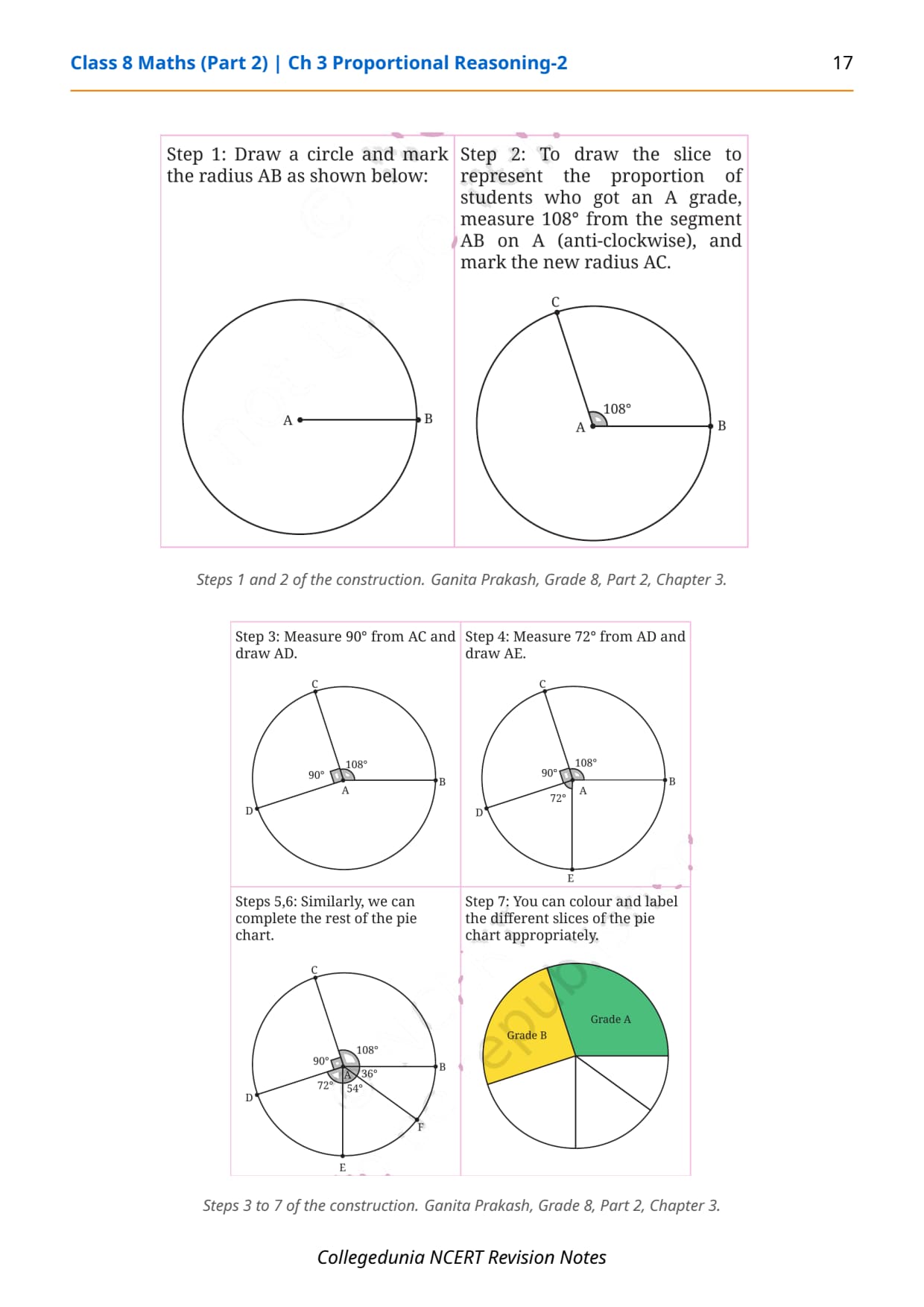
Take the textbook example. Forty students scored grades A to E as 12 : 10 : 8 : 6 : 4. The HCF is 2, so the simplest form is 6 : 5 : 4 : 3 : 2. The sum is 20, so one part is 360 ÷ 20 = 18°.
| Grade | Students | Simplest ratio | Angle |
|---|---|---|---|
| A | 12 | 6 | 108° |
| B | 10 | 5 | 90° |
| C | 8 | 4 | 72° |
| D | 6 | 3 | 54° |
| E | 4 | 2 | 36° |
| Total | 40 | 20 | 360° |
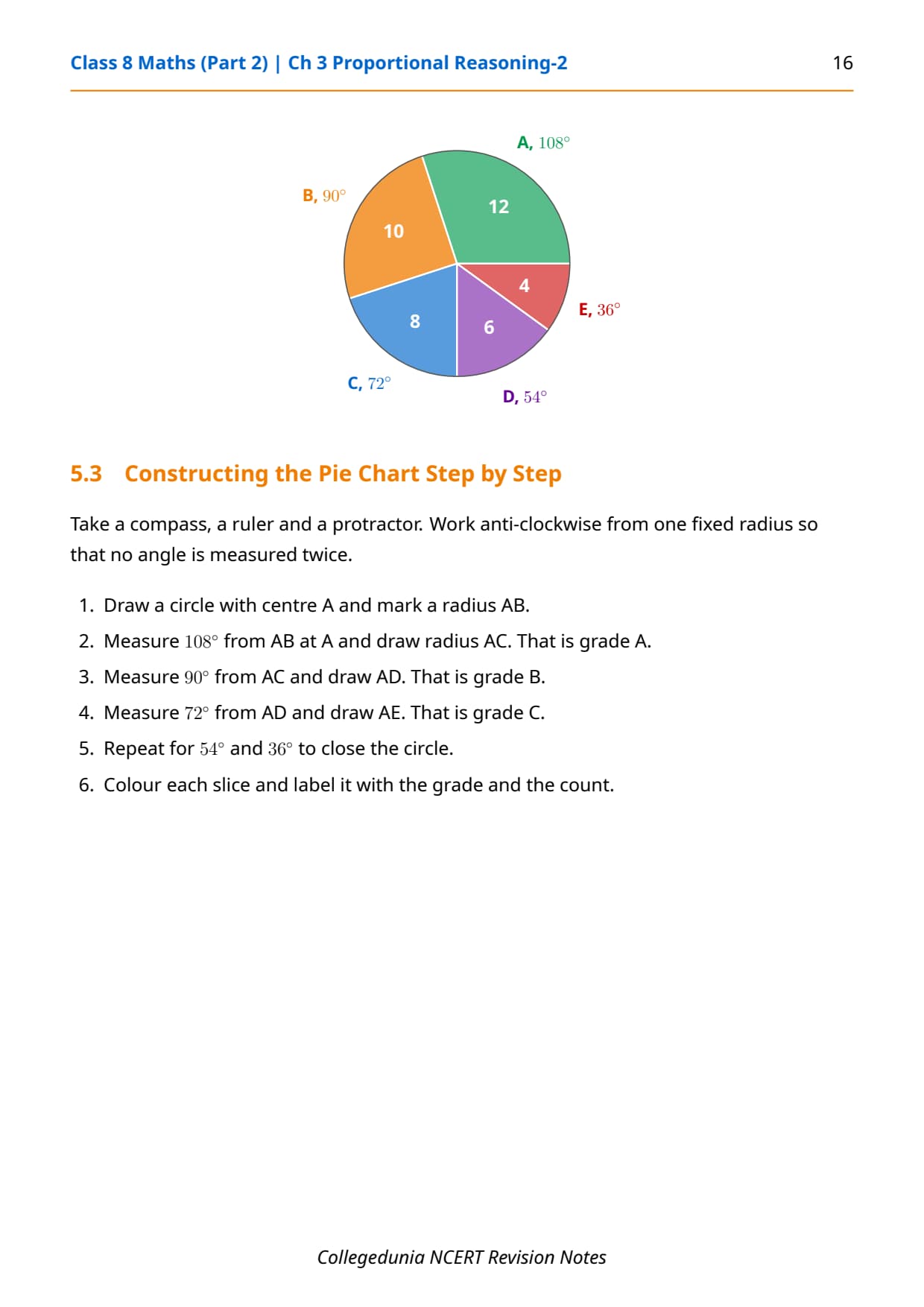
The five angles add to 108 + 90 + 72 + 54 + 36 = 360°, which confirms the whole table in one line. Do that addition every time before you pick up the compass, because a wrong angle found early costs nothing to fix.
How to Construct a Pie Chart With a Protractor Step by Step
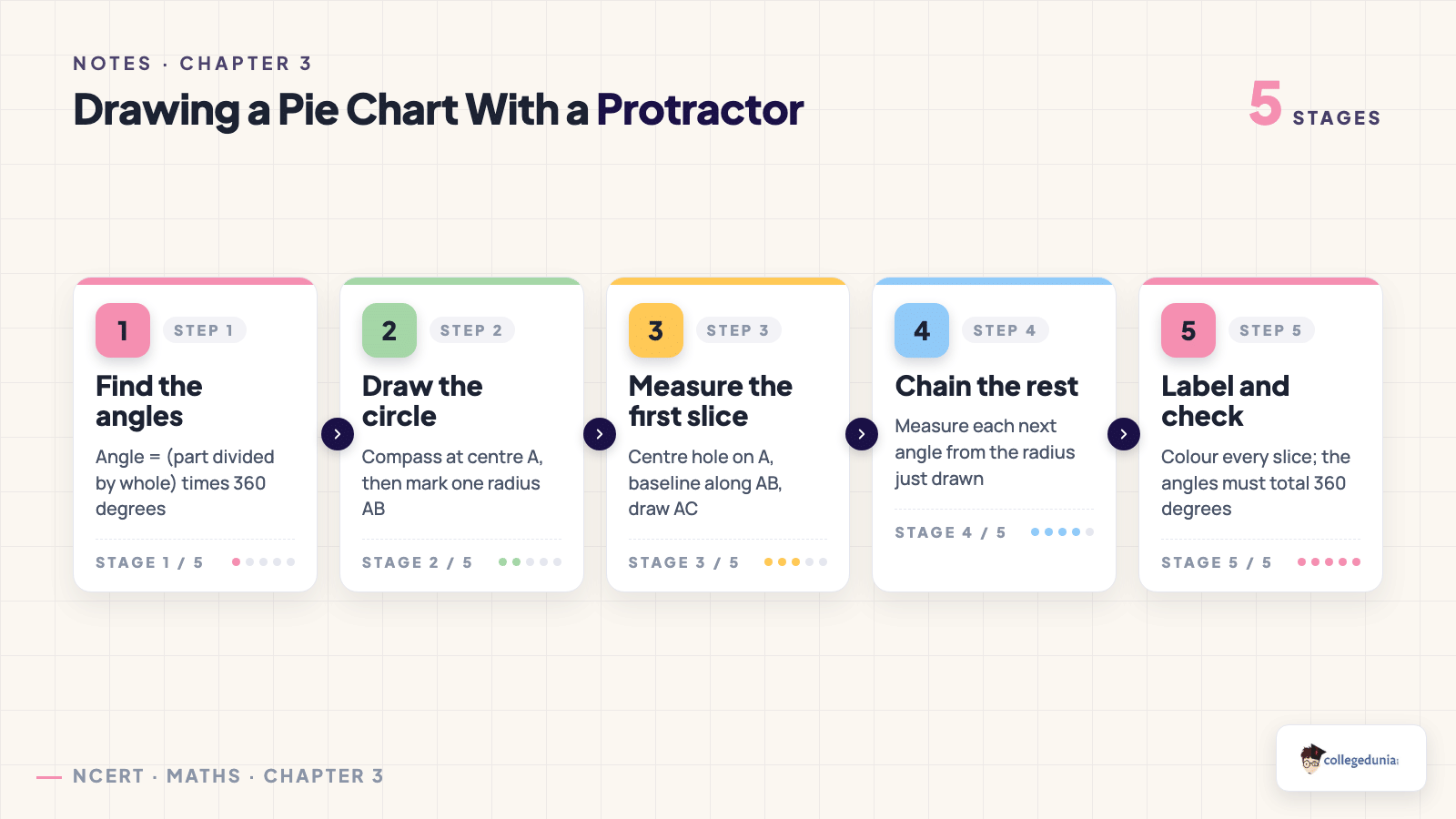
You need a compass, a ruler and a protractor. Work in one direction only, always from the radius you drew last, so that no angle gets measured twice. The steps below build the grades chart from the table above.
- Draw a circle with centre A and mark one radius AB as your starting line.
- Measure 108° from AB at A and draw the radius AC. That slice is grade A.
- Measure 90° from AC and draw AD for grade B.
- Measure 72° from AD and draw AE for grade C.
- Repeat with 54° and 36°, and the last radius should land back on AB.
- Colour each slice and label it with the grade name and the count.
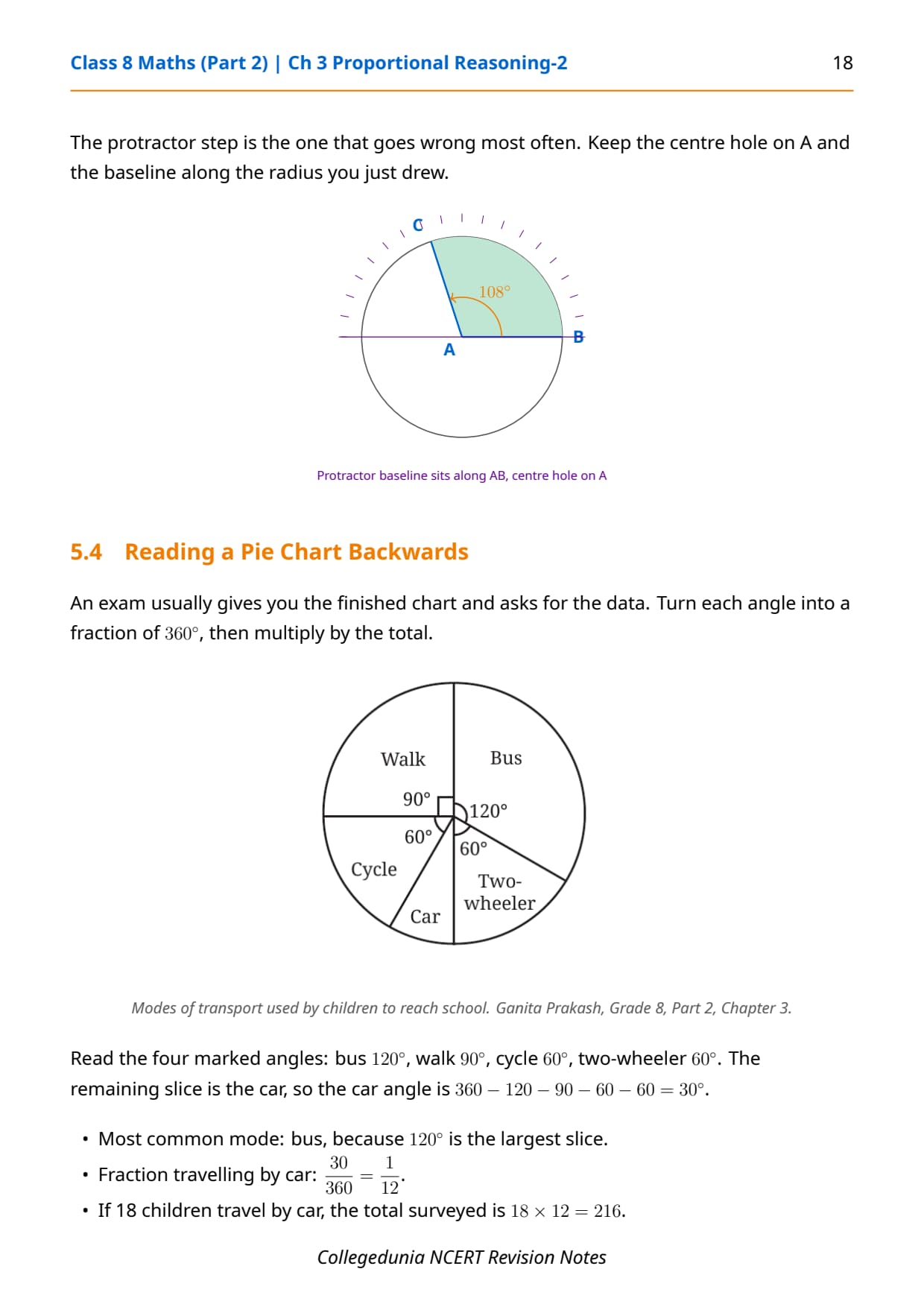
The protractor step is where most marks are lost. Keep the centre hole exactly on A and the baseline flat along the radius you just drew. Reading the outer scale when you should read the inner one turns 108° into 72° and the whole chart closes short.
If the last radius does not land on AB, the angles do not total 360°. Go back to the table rather than nudging the drawing, because the arithmetic error is always the real problem.
Reading a Pie Chart Backwards and Reading Ring Charts
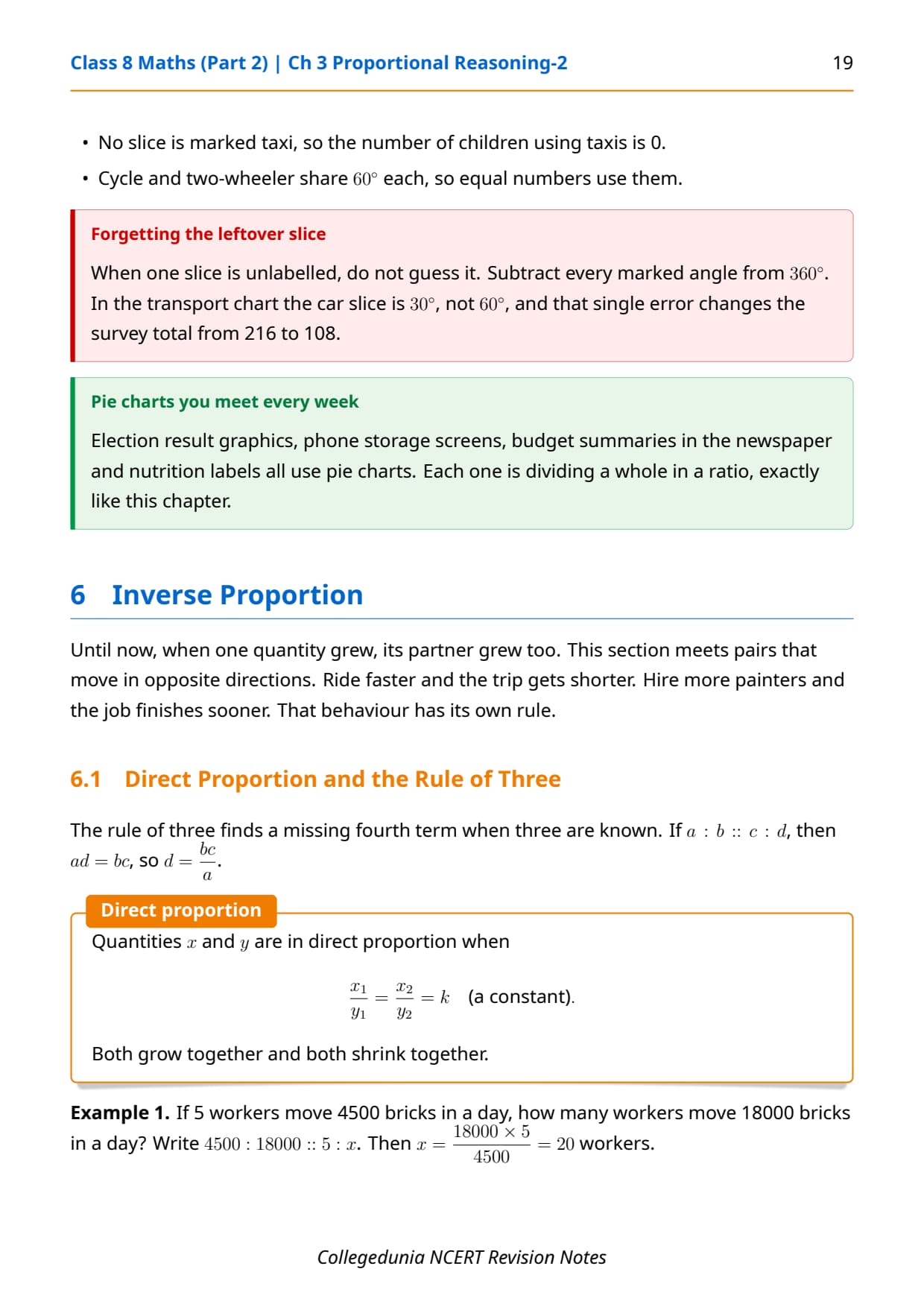
An exam usually hands you the finished chart and asks for the data. Reverse the formula: turn each angle into a fraction of 360°, then multiply that fraction by the total. One unlabelled slice is a standard trap.
In the transport chart the marked angles are bus 120°, walk 90°, cycle 60° and two-wheeler 60°. The car slice is unmarked, so subtract: 360 − 120 − 90 − 60 − 60 = 30°. Guessing 60° instead changes the survey total from 216 to 108.
- Most common mode: bus, because 120° is the largest slice
- Fraction by car: 30 ÷ 360 = 1 ÷ 12 of all children surveyed
- Total surveyed: if 18 children travel by car, the total is 18 × 12 = 216
- Zero slices: no slice is marked taxi, so the taxi count is 0, not unknown
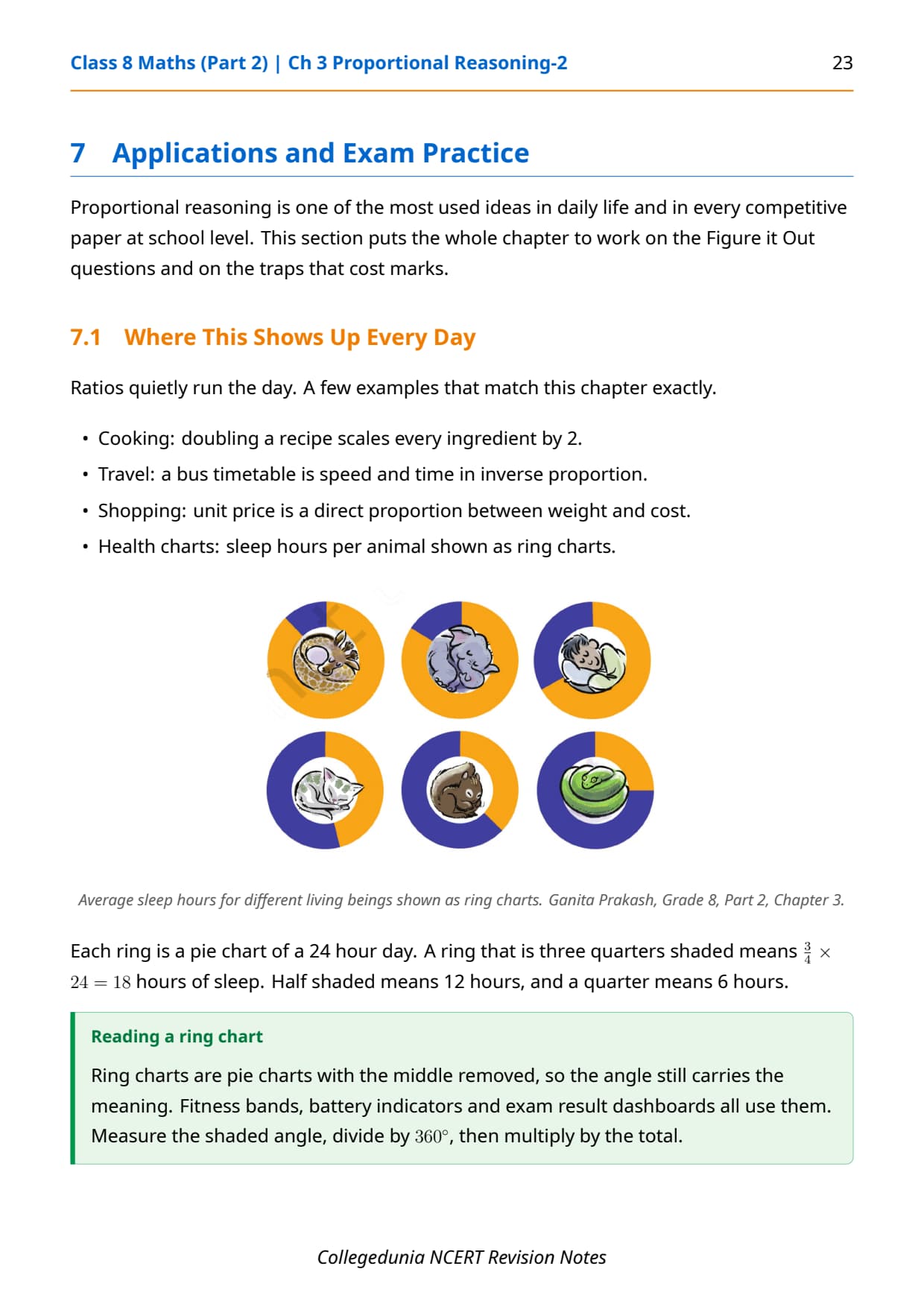
Ring charts work the same way with the middle removed, so the angle still carries the meaning. The sleep chart in the book shows a ring as a whole 24 hour day. A ring three quarters shaded is 0.75 × 24 = 18 hours of sleep, half shaded is 12 hours and a quarter is 6 hours.
Fitness bands, battery indicators and exam result dashboards all draw ring charts. The method is fixed: measure the shaded angle, divide by 360°, then multiply by the total.
Direct and Inverse Proportion: Speed, Time, Workers and Pumps
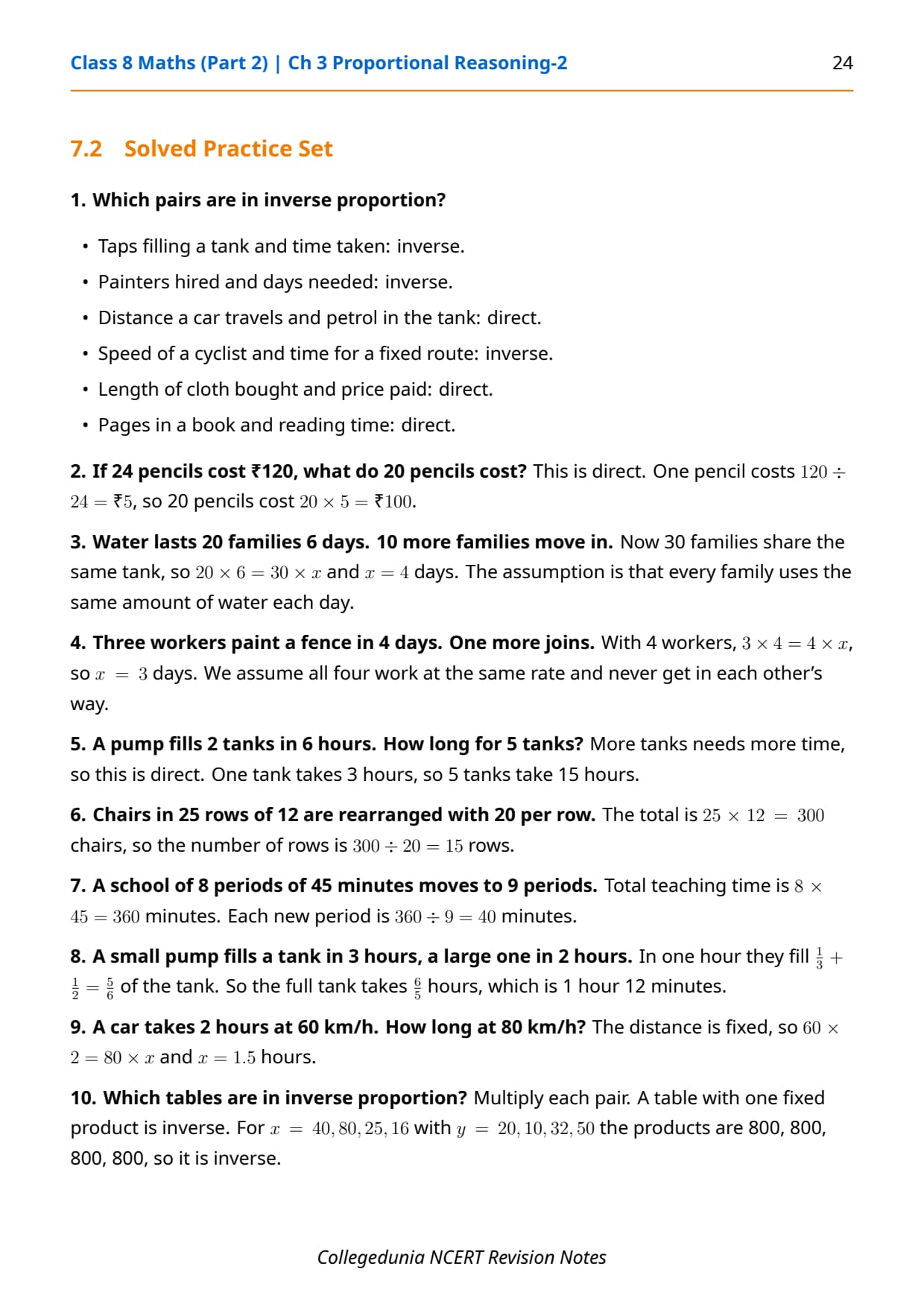
Until this section, when one quantity grew its partner grew too. Now meet pairs that move in opposite directions. Ride faster and the trip gets shorter. Hire more painters and the job finishes sooner. That behaviour has its own rule.
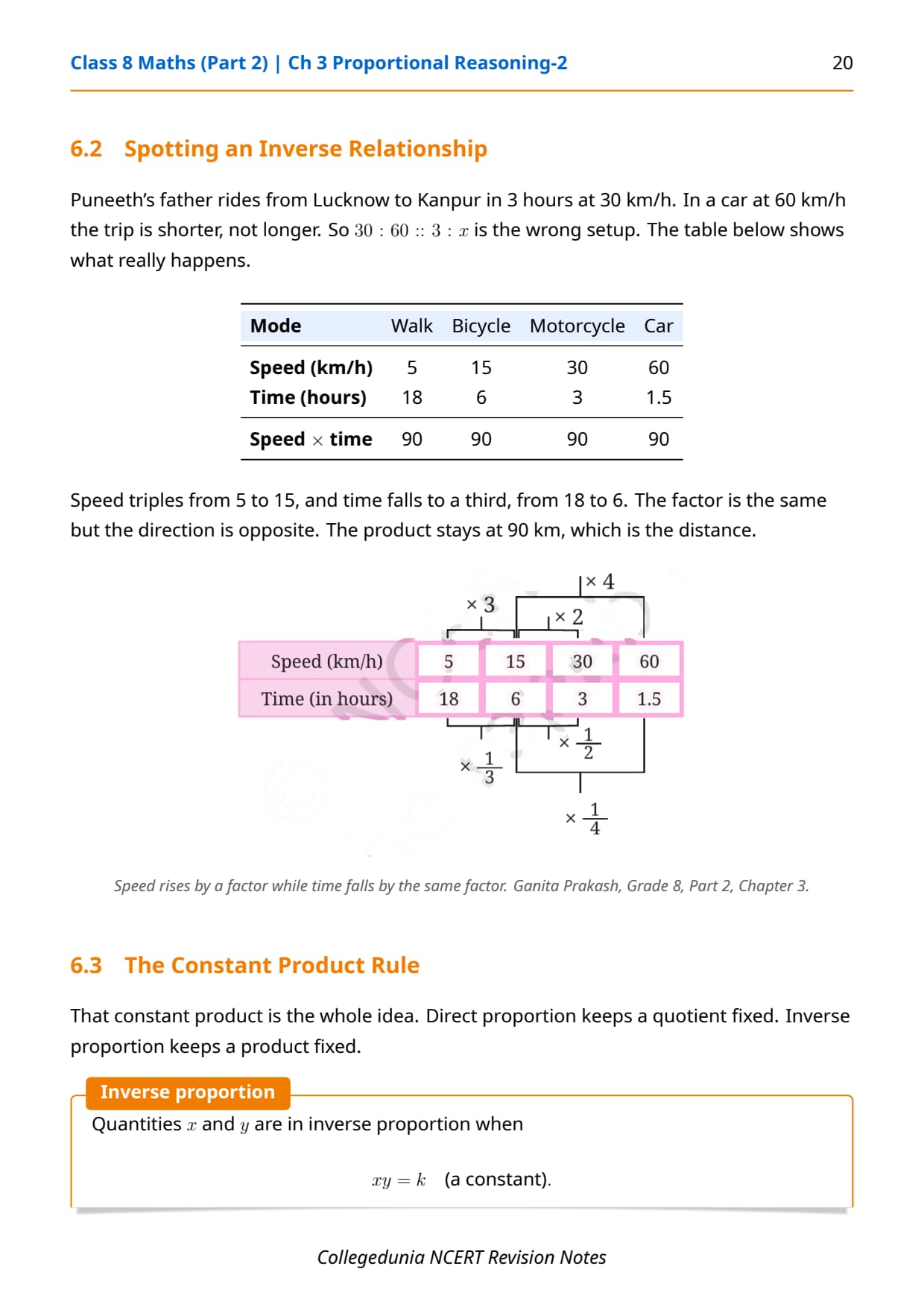
Puneeth's father rides from Lucknow to Kanpur in 3 hours at 30 km/h. In a car at 60 km/h the trip is shorter, so writing 30 : 60 :: 3 : x is the wrong setup. Look at what the numbers actually do.
| Mode | Speed (km/h) | Time (hours) | Speed × time |
|---|---|---|---|
| Walk | 5 | 18 | 90 |
| Bicycle | 15 | 6 | 90 |
| Motorcycle | 30 | 3 | 90 |
| Car | 60 | 1.5 | 90 |
Speed triples from 5 to 15 and time falls to a third, from 18 to 6. Same factor, opposite direction. The product stays at 90, which is the distance in kilometres. That constant product is the whole idea of inverse proportion.
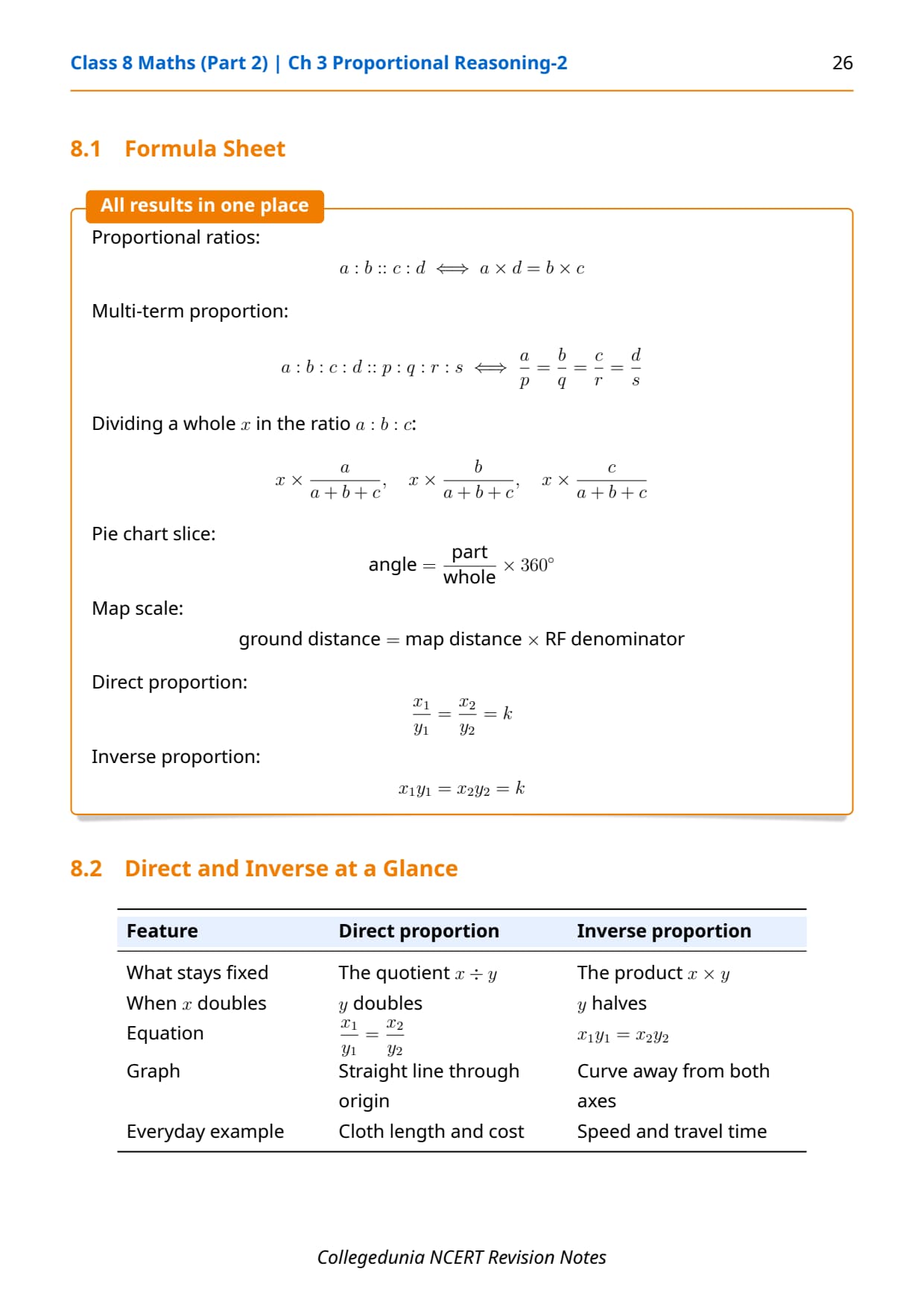
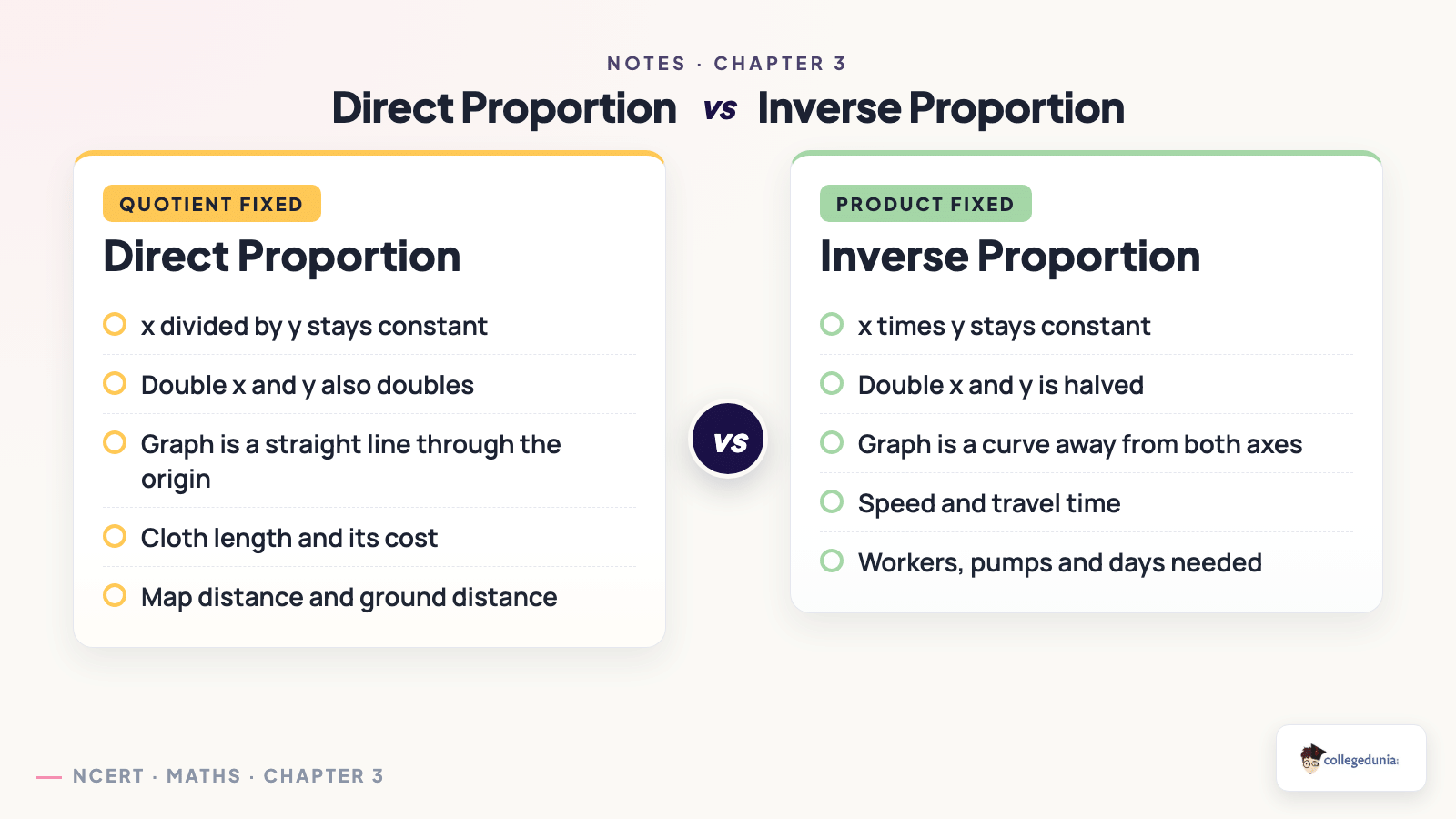
Direct proportion keeps a quotient fixed. Inverse proportion keeps a product fixed. Written out, direct means x₁ ÷ y₁ = x₂ ÷ y₂ = k, and inverse means x₁ × y₁ = x₂ × y₂ = k.
| Feature | Direct proportion | Inverse proportion |
|---|---|---|
| What stays fixed | The quotient x ÷ y | The product x × y |
| When x doubles | y doubles | y halves |
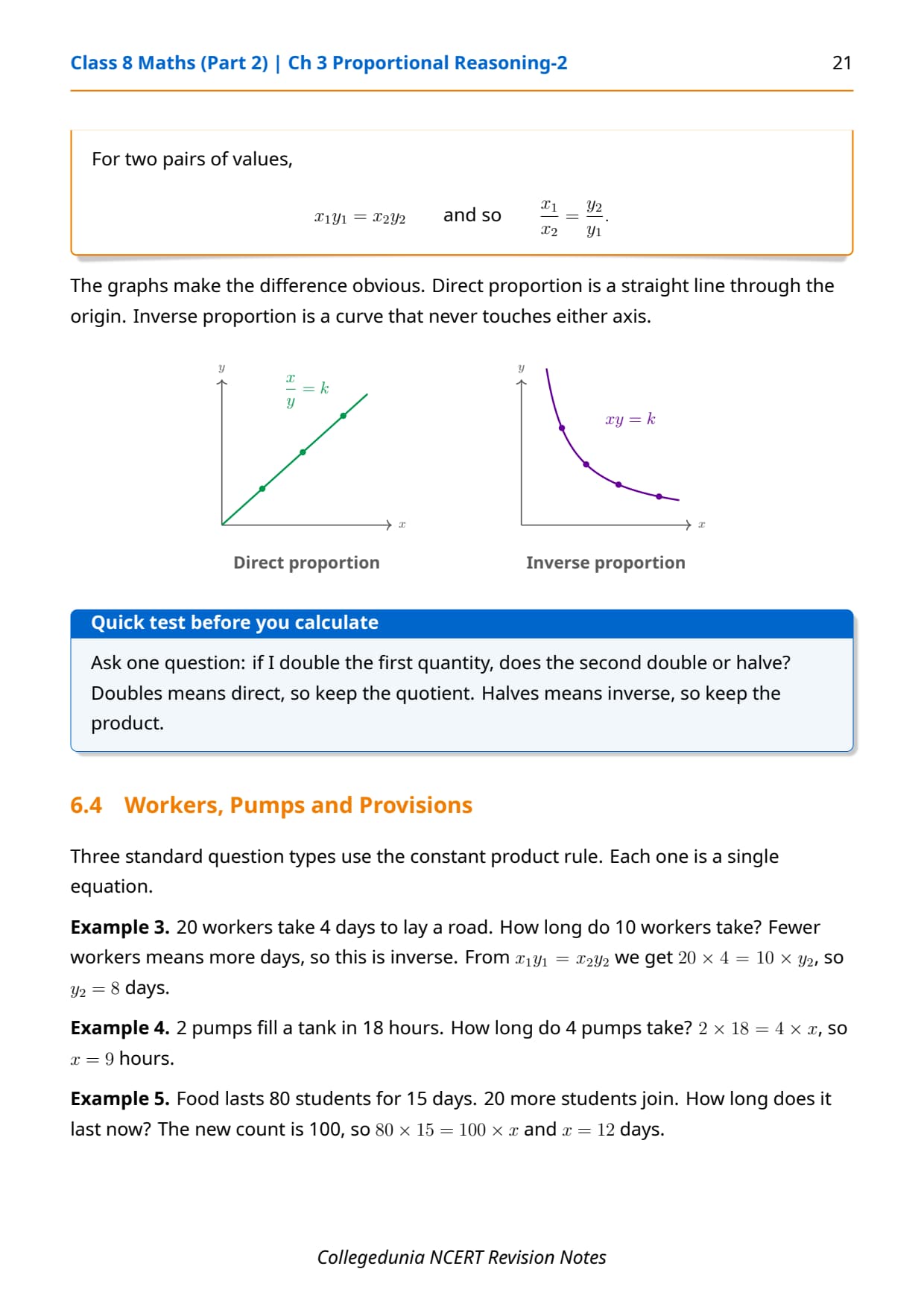
| Graph shape | Straight line through the origin | Curve that never touches either axis |
| Everyday example | Cloth length and cost | Speed and travel time |
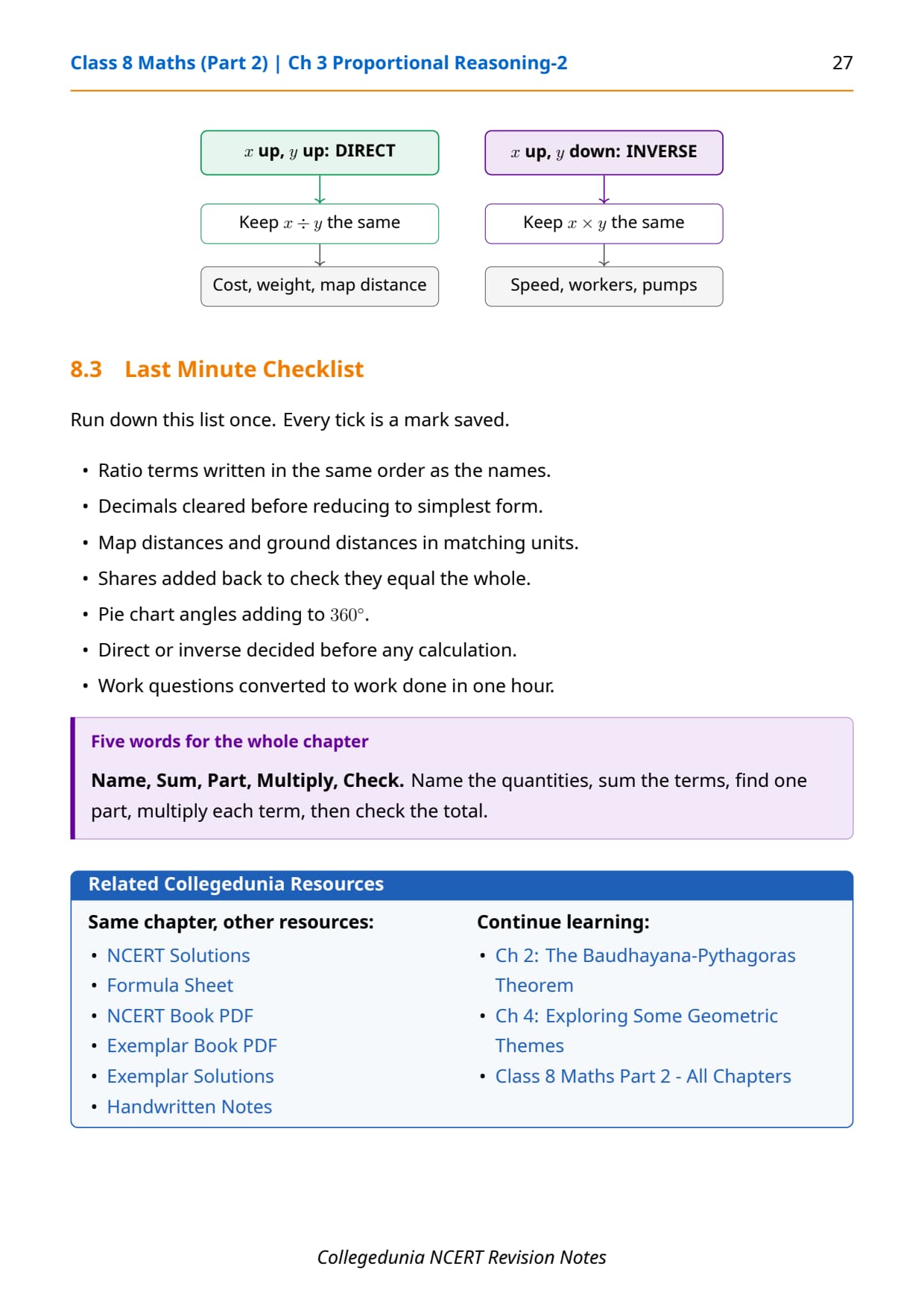
The one question to ask first. If I double the first quantity, does the second double or halve? Doubles means direct, so keep the quotient. Halves means inverse, so keep the product. Ask it before you write a single number.
Three standard question types then reduce to one equation each. Write x₁y₁ = x₂y₂, fill in the three numbers you know, and divide.
| Situation | Constant k | Equation | Answer |
|---|---|---|---|
| 20 workers take 4 days, how long for 10? | 80 | 20 × 4 = 10 × y | 8 days |
| 2 pumps fill a tank in 18 hours, how long for 4? | 36 | 2 × 18 = 4 × x | 9 hours |
| Food lasts 80 students 15 days, 20 more join | 1200 | 80 × 15 = 100 × x | 12 days |
| 42 machines take 63 days, how many for 54 days? | 2646 | 42 × 63 = m × 54 | 49 machines |
Direct questions still use the rule of three. If 5 workers move 4500 bricks in a day, then 4500 : 18000 :: 5 : x gives x = 18000 × 5 ÷ 4500 = 20 workers. More bricks needs more workers, so the setup is direct and the quotient is what stays fixed.
Working Together Questions: Add the Rates, Never the Times
Work questions are the one place in this chapter where you must switch to rates before doing anything else. Adding the two times together is always wrong, and it is the error examiners expect to see.
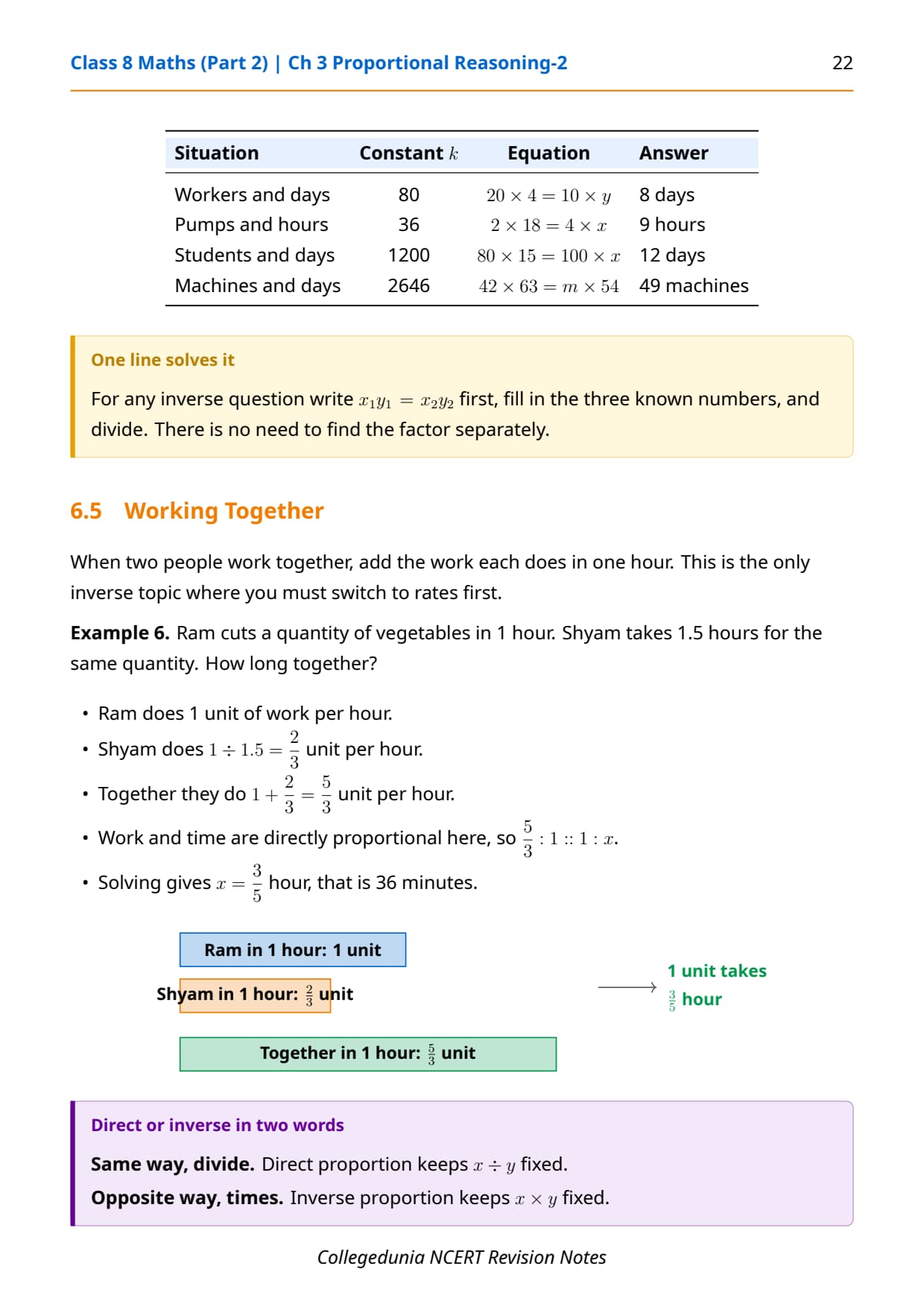
Ram cuts a quantity of vegetables in 1 hour and Shyam takes 1.5 hours for the same job. Working together they cannot take 2.5 hours, because two people are faster than one. Convert to work done in one hour instead.
- Ram does 1 unit of work per hour.
- Shyam does 1 ÷ 1.5 = 2/3 unit per hour.
- Together they do 1 + 2/3 = 5/3 unit per hour.
- One full unit therefore takes 3/5 hour, which is 36 minutes.
The same three lines solve the pump version. A small pump fills a tank in 3 hours and a large one in 2 hours, so in one hour they fill 1/3 + 1/2 = 5/6 of the tank. The full tank then takes 6/5 hours, which is 1 hour 12 minutes.
Once you are working in units per hour, the rates add directly and the question becomes a direct proportion. That is why the answer is always shorter than the faster worker's own time.
Common Mistakes Students Make in the Proportional Reasoning-2 Chapter
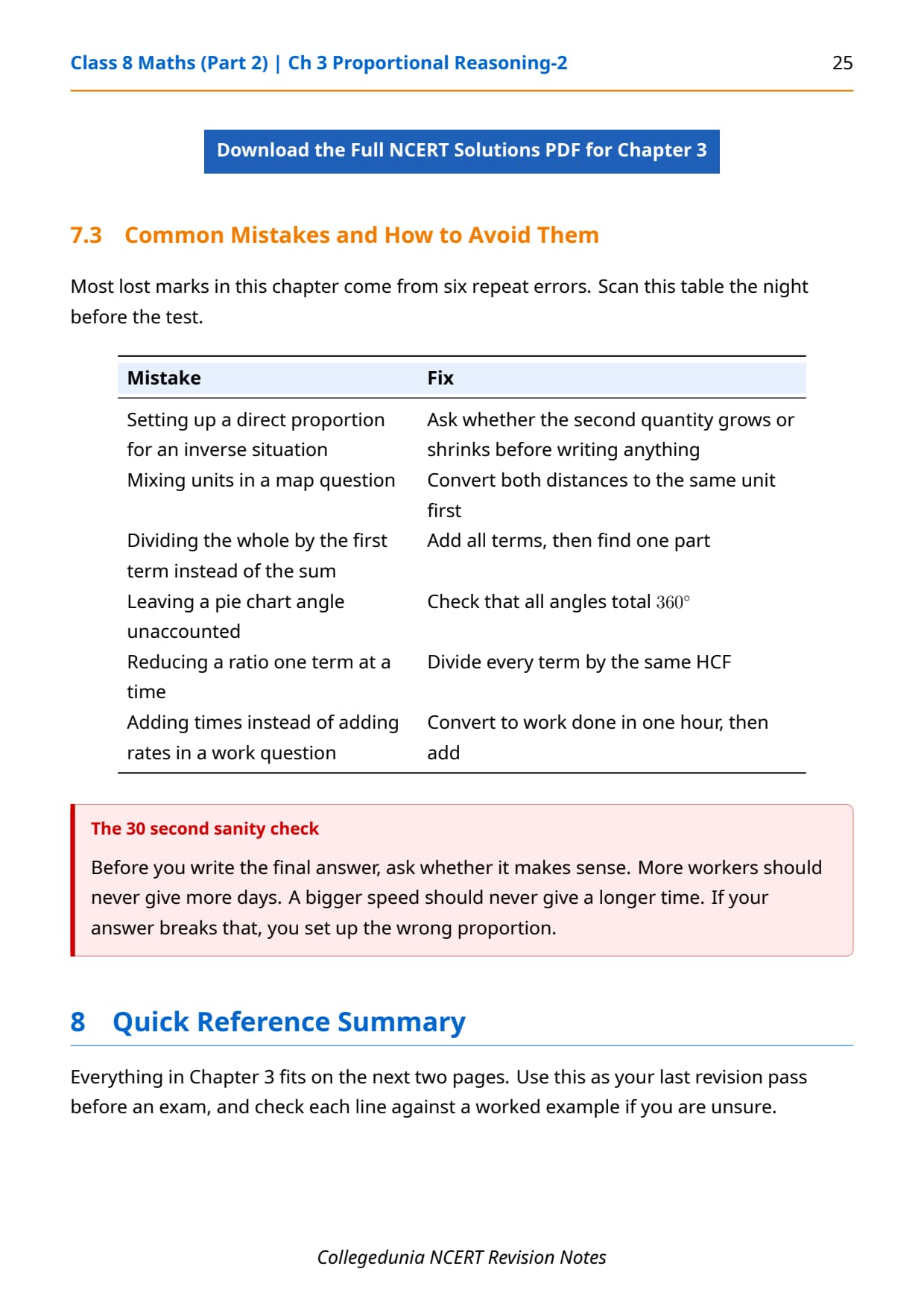
Most lost marks in this chapter come from six repeat errors. Each one has a fix that takes a few seconds. Scan this table the night before a test.
| Mistake | Fix |
|---|---|
| Setting up a direct proportion for an inverse situation | Ask whether the second quantity grows or shrinks before writing anything |
| Mixing units in a map question | Convert both distances to the same unit first, usually centimetres |
| Dividing the whole by the first term instead of the sum | Add all the terms, then find the value of one part |
| Leaving one pie chart slice unaccounted | Subtract the marked angles from 360° and check the total |
| Reducing a ratio one term at a time | Divide every term by the same HCF in one step |
| Adding times instead of adding rates in a work question | Convert to work done in one hour, then add |
The 30 second sanity check. Before writing the final answer, ask whether it makes sense. More workers should never give more days. A bigger speed should never give a longer time. If your answer breaks that, the proportion was set up the wrong way round.
Five words for the whole chapter. Name, Sum, Part, Multiply, Check. Name the quantities in order, sum the terms, find one part, multiply each term, then check the total. Those five steps cover every ratio question in Ganita Prakash Part 2.
Question Trends and Marks for Proportional Reasoning in Class 8 Tests
Class 8 papers are set by schools, so the exact pattern varies. Across the question banks we track, eight question types cover almost everything asked from this chapter.
| Question type | Usual marks | What to revise |
|---|---|---|
| Check whether two ratios are proportional | 1 to 2 | Cross multiplication |
| Convert an RF into kilometres per centimetre | 2 | Divide the denominator by 1,00,000 |
| Find a ground distance or a map distance | 2 to 3 | Multiply going out, divide coming back |
| Reduce a multi-term ratio to simplest form | 2 | Clear decimals, then divide by the HCF |
| Divide a whole in a given ratio | 3 | Sum of terms, then value of one part |
| Turn a data table into pie chart angles and draw it | 3 to 4 | (part ÷ whole) × 360° and the protractor steps |
| Read a pie chart backwards for a missing count | 3 | Subtract to find the unlabelled slice |
| Workers, pumps, provisions or speed and time | 3 to 4 | x₁y₁ = x₂y₂ |
The ideas here carry straight into Class 9 and Class 10. Unitary method, percentage change, similar triangles and later the whole of statistics all rest on the same proportional thinking. Students heading for olympiads or an engineering foundation course meet the constant product rule again in physics.
What the Proportional Reasoning-2 Class 8 Notes PDF Contains
The downloadable PDF runs to 27 pages and follows the same order as the printed chapter, so you can keep it open beside the textbook while you revise.
- Sections 1 and 2: proportional relationships, cross multiplication, and the full map-scale method with the RF table
- Sections 3 and 4: multi-term ratios, HCF reduction, and dividing a whole using both the part value method and the fraction formula
- Sections 5 and 6: pie chart angles, the protractor construction in six steps, and the constant product rule for inverse proportion
- Sections 7 and 8: ten solved practice questions, the mistake table, a one-page formula sheet and a last-minute checklist
Colour-coded boxes mark the formulas, the quick tips and the common traps. The final two pages hold the direct versus inverse comparison and a tick-list you can read in the ten minutes before a test.
How These Notes Pair With the Other Class 8 Maths Resources
Use the notes to learn the rules, then move to the solved questions for practice. The table below links every resource we publish for this chapter.
| Resource | Best used for | Link |
|---|---|---|
| Handwritten Notes | Fast revision in a topper's handwriting | Handwritten Notes for Proportional Reasoning |
| NCERT Book PDF | The official Ganita Prakash Part 2 chapter file | Download the Ganita Prakash Part 2 Chapter PDF |
| NCERT Solutions | Every textbook question solved step by step | NCERT Solutions for Proportional Reasoning (coming soon) |
| Formula Sheet | A one-page recap of every rule in the chapter | Formula Sheet for Proportional Reasoning (coming soon) |
Tip: read the notes once, attempt the Figure it Out questions with the book closed, then open the solutions only for the questions you could not finish.
Class 8 Maths Notes for Ganita Prakash Part 2: All Chapters
All seven chapters of the Class 8 Maths Part 2 textbook have their own notes page for the 2026-27 session.
| Chapter | Title | Notes |
|---|---|---|
| Chapter 1 | Fractions in Disguise | Fractions in Disguise Class 8 Notes |
| Chapter 2 | The Baudhayana-Pythagoras Theorem | The Baudhayana-Pythagoras Theorem Class 8 Notes |
| Chapter 3 | Proportional Reasoning-2 | You are here |
| Chapter 4 | Exploring Some Geometric Themes | Exploring Some Geometric Themes Class 8 Notes (coming soon) |
| Chapter 5 | Tales by Dots and Lines | Tales by Dots and Lines Class 8 Notes (coming soon) |
| Chapter 6 | Algebra Play | Algebra Play Class 8 Notes (coming soon) |
| Chapter 7 | Area | Area Class 8 Notes (coming soon) |
Every chapter also has a Ganita Prakash Part 2 book PDF page and a handwritten revision set, so you can pick the format that suits your revision time.
FAQs on NCERT Class 8 Maths Notes Chapter 3 Proportional Reasoning-2
Quick Answers on Map Scales, Pie Charts and Inverse Proportion
Ques. What does the map scale RF 1 : 60,00,000 mean?
Ans. It means 1 cm on the map stands for 60,00,000 cm on the ground. Since 1 km is 1,00,000 cm, dividing gives 60 km. So 1 cm on that map represents 60 km of real distance, measured as a straight line.
Ques. How do you turn a map distance into a ground distance?
Ans. Multiply the measured map distance by the RF denominator, keeping both in the same unit. On a 1 : 60,00,000 map, 1 cm is 60 km, so 5.4 cm becomes 5.4 times 60 = 324 km. Going the other way you divide instead.
Ques. What is the difference between a ratio and a proportion?
Ans. A ratio compares quantities, such as 2 : 1 for rice and dal. A proportion states that two ratios are equal, such as 6 : 3 = 4 : 2. You test a proportion by cross multiplying: a : b and c : d are proportional when a times d equals b times c.
Ques. How do you reduce a ratio with more than two terms?
Ans. Clear any decimals first by multiplying every term by 10 or 100. Then find the HCF of all the terms and divide every term by it in one step. For example 12 : 10 : 8 : 6 : 4 has HCF 2, so the simplest form is 6 : 5 : 4 : 3 : 2.
Ques. How do you divide a whole in a given ratio?
Ans. Add the terms of the ratio to get the number of equal parts. Divide the whole by that sum to find the value of one part. Multiply each term by the part value. For 110 units in 1 : 1.5 : 3 the sum is 5.5, one part is 20, so the shares are 20, 30 and 60.
Ques. What is the formula for a pie chart angle?
Ans. Angle of a slice equals the count of that group divided by the total count, multiplied by 360 degrees. It is the same as dividing 360 degrees in the ratio of the counts. Always add the finished angles to confirm they total 360 degrees.
Ques. How do you construct a pie chart with a protractor?
Ans. Draw a circle, mark one radius, then measure the first angle from that radius. Draw the next radius, measure the second angle from it, and continue in the same direction. Keep the protractor centre hole on the circle centre and its baseline along the last radius drawn. Colour and label each slice at the end.
Ques. How do you find a missing slice in a pie chart?
Ans. Subtract every marked angle from 360 degrees. In the transport chart the marked slices are 120, 90, 60 and 60 degrees, so the car slice is 30 degrees. Guessing that value instead of subtracting changes the survey total from 216 to 108.
Ques. What is inverse proportion in Class 8 Maths?
Ans. Two quantities are in inverse proportion when their product stays constant. Double one and the other halves. Written out, x times y equals k, so for two pairs of values x1 times y1 equals x2 times y2. Speed and travel time over a fixed distance are the standard example.
Ques. How do you tell direct proportion from inverse proportion?
Ans. Ask one question before calculating: if the first quantity doubles, does the second double or halve? Doubling means direct, so the quotient stays fixed. Halving means inverse, so the product stays fixed. A direct graph is a straight line through the origin, while an inverse graph is a curve that never touches either axis.
Ques. How do you solve working together questions?
Ans. Convert each person or machine to work done in one hour, then add those rates. Ram does 1 unit an hour and Shyam does 2/3 unit an hour, so together they do 5/3 unit an hour. One full unit then takes 3/5 hour, which is 36 minutes. Never add the two times.
Ques. Are these Class 8 Maths notes based on the 2026-27 syllabus?
Ans. Yes. The notes follow Ganita Prakash Part 2, the Class 8 Maths textbook for the 2026-27 session, section by section. Every rule, worked example and diagram matches the printed chapter.



Comments