



These The Crisis of Democratic Order Class 12 Notes give a quick, exam-ready summary of the Emergency of 1975 to 1977 and how Indian democracy bounced back, set to the 2026-27 CBSE syllabus. The notes pull together every key date, term and cause from Chapter 6 of Politics in India Since Independence. Students can use them for a fast revision the night before a test or to fix the main ideas before they attempt the back-exercise questions.
- Covers the background to the Emergency, why it was declared, its effects and the 1977 election in one place.
- This Class 12 Political Science chapter usually carries 5 to 6 marks in the board paper.
- Pairs with the NCERT Solutions, Handwritten Notes and Book PDF linked lower on this page.
These The Crisis of Democratic Order Class 12 notes are written from the official NCERT Politics in India Since Independence textbook and checked against the last five years of CBSE board papers.
Student Feedback: In a Collegedunia poll of 8,510 Class 12 Political Science students taken before the 2026 boards, 72% of students said short, point-wise notes on the lead-up to the Emergency and its effects were the fastest way to revise this chapter. Most students kept the key dates of June 1975 and the 1977 result on a single sheet for last-minute recall.
Source: 2026-27 Class 12 Political Science student poll. Sample of 8,510 students from CBSE schools across 12 states.
What the Crisis of Democratic Order Notes Cover
The Crisis of Democratic Order is the sixth chapter of Politics in India Since Independence. It studies the Emergency of 1975 to 1977, when normal rights were suspended and the press was censored. This was the most controversial phase of Indian democracy, and the chapter asks whether it was justified at all.
The easiest way to organise your revision is to split the chapter into three threads:
- Before: the economic crisis, the protests and the clash with the judiciary.
- During: the arrests, censorship, the 42nd Amendment and the excesses.
- After: the 1977 election, the Janata Party and the lessons learnt.
So these notes are really about how a democracy was tested and recovered. If you sort each fact under before, during or after the Emergency first, almost every question in The Crisis of Democratic Order class 12 becomes easier to answer. Keep this three-part frame at the top of your revision sheet and slot each new detail into one of the boxes as you read.
Background: Economic Crisis and Unrest
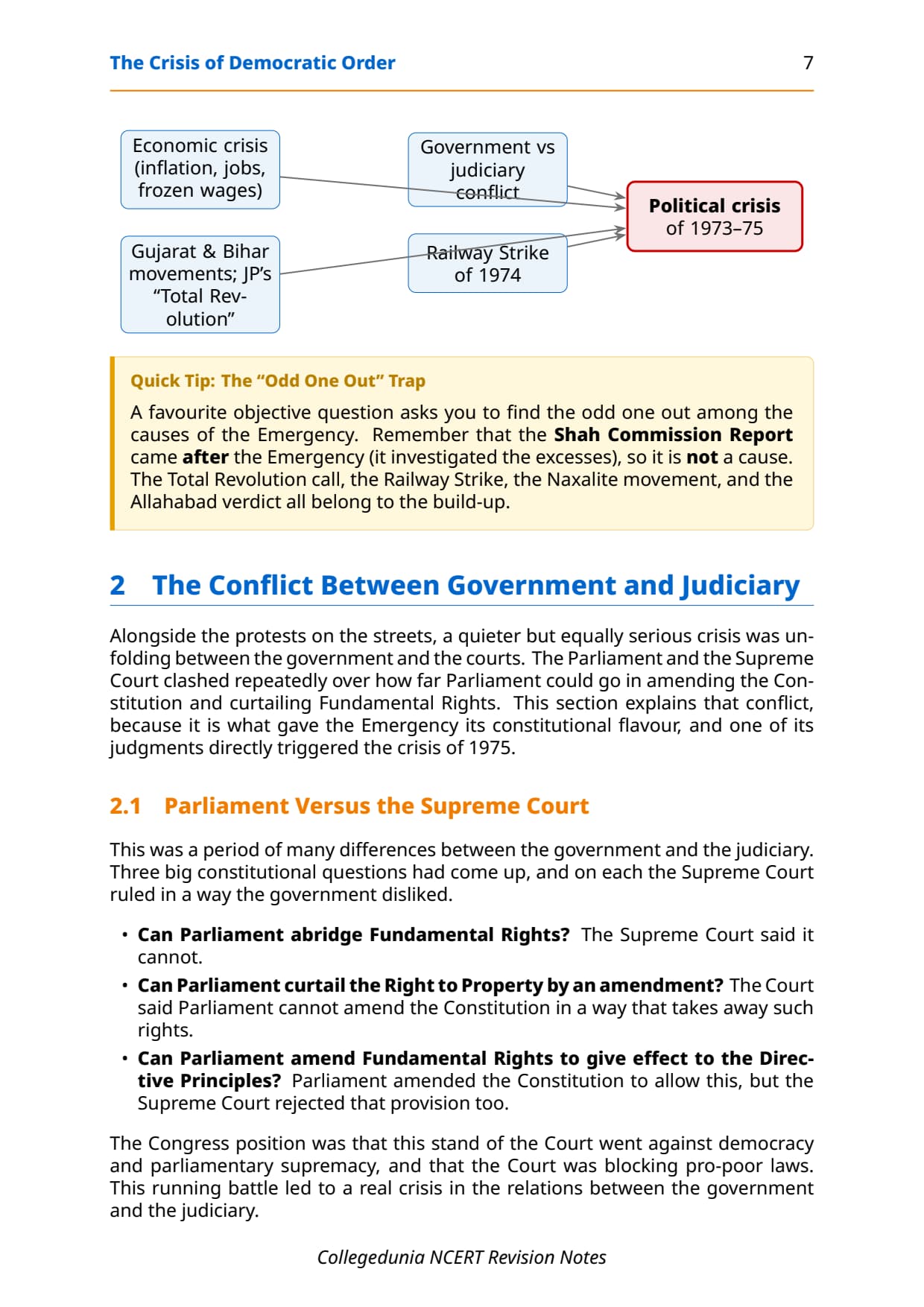
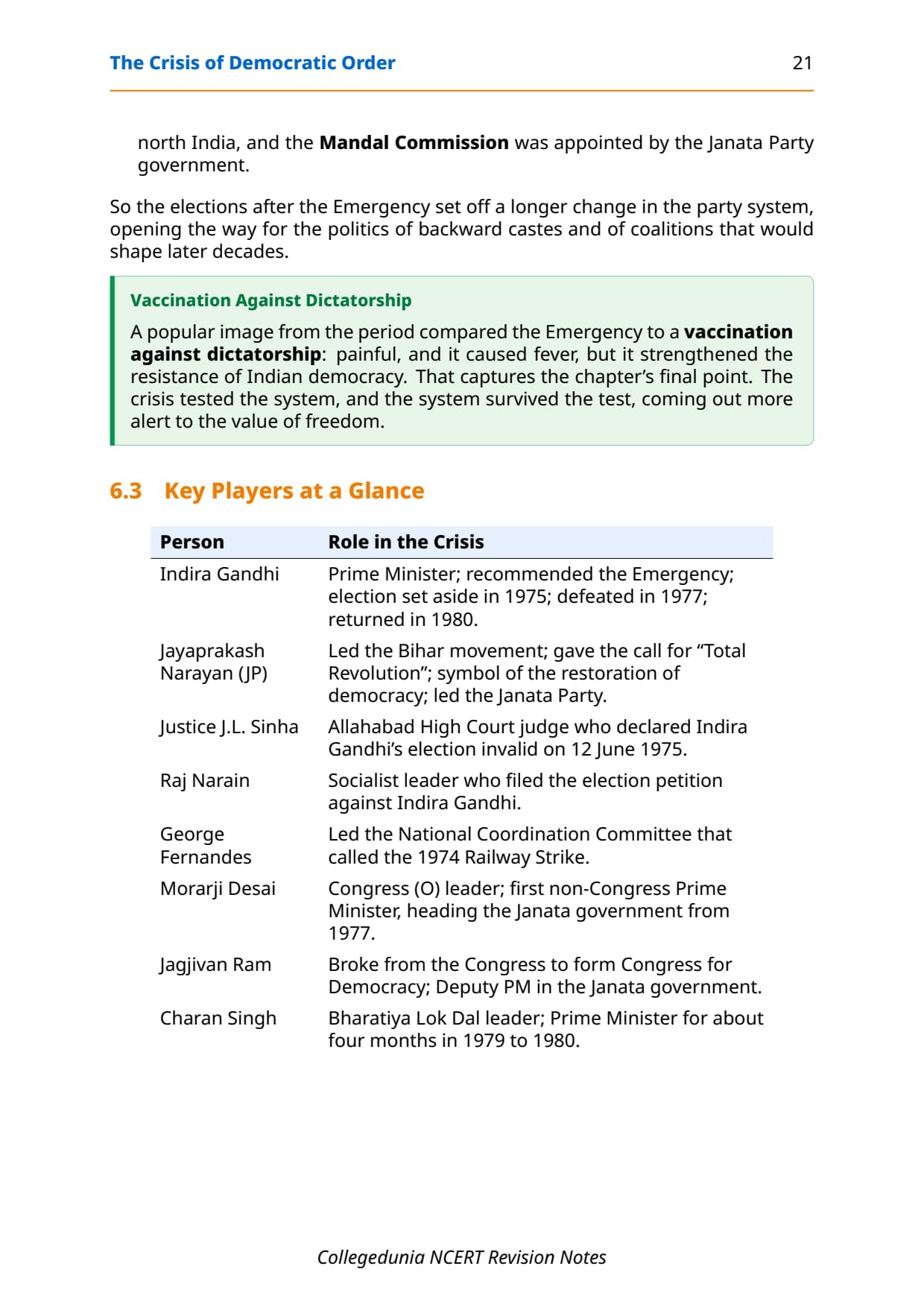
The Emergency grew out of years of strain. By the early 1970s prices were rising and protests were spreading. For quick revision, learn the build-up as four short, boxed points so you can copy them straight onto the answer sheet.
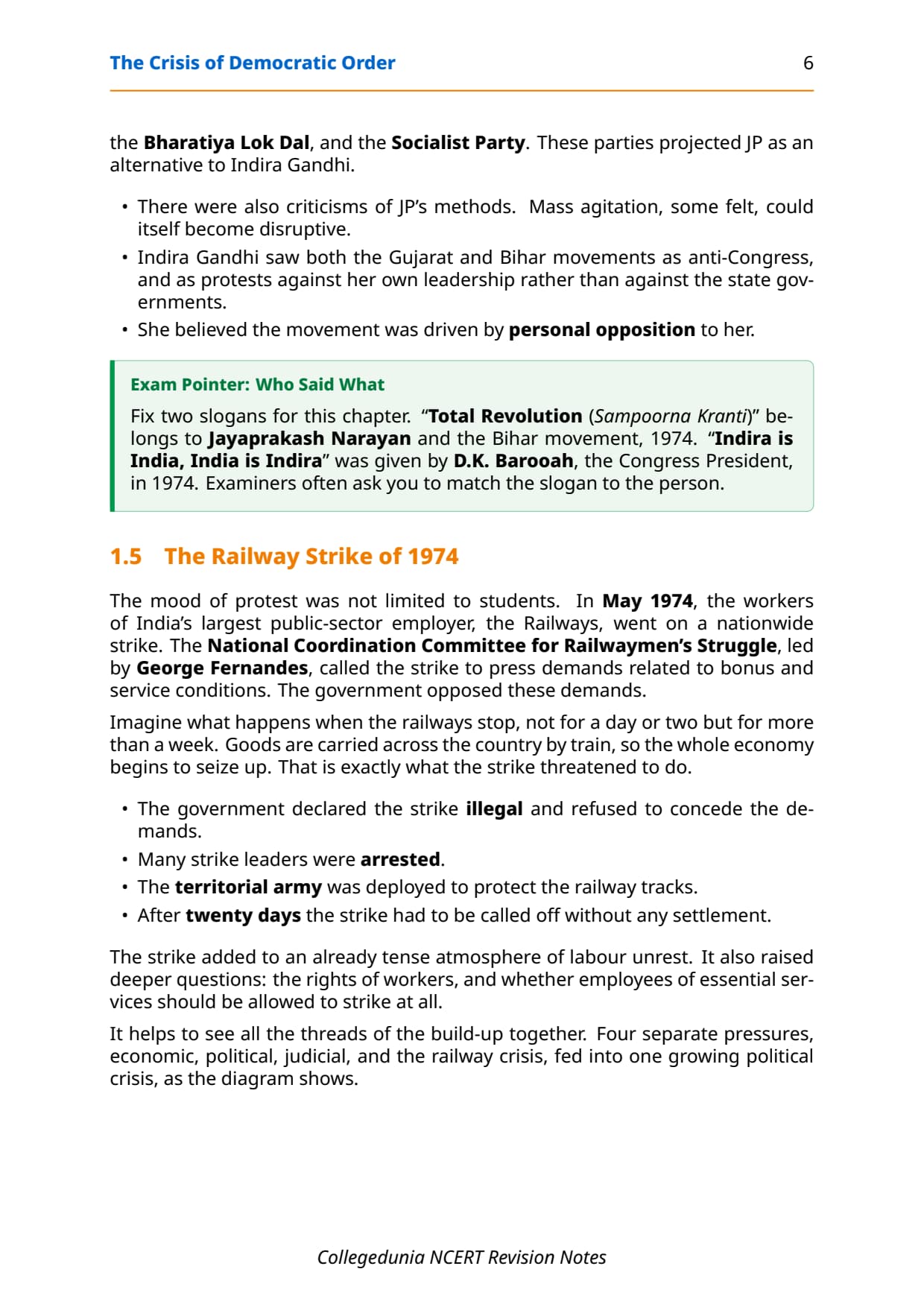
- Economic crisis: rising prices, food shortages and unemployment hit ordinary people hard.
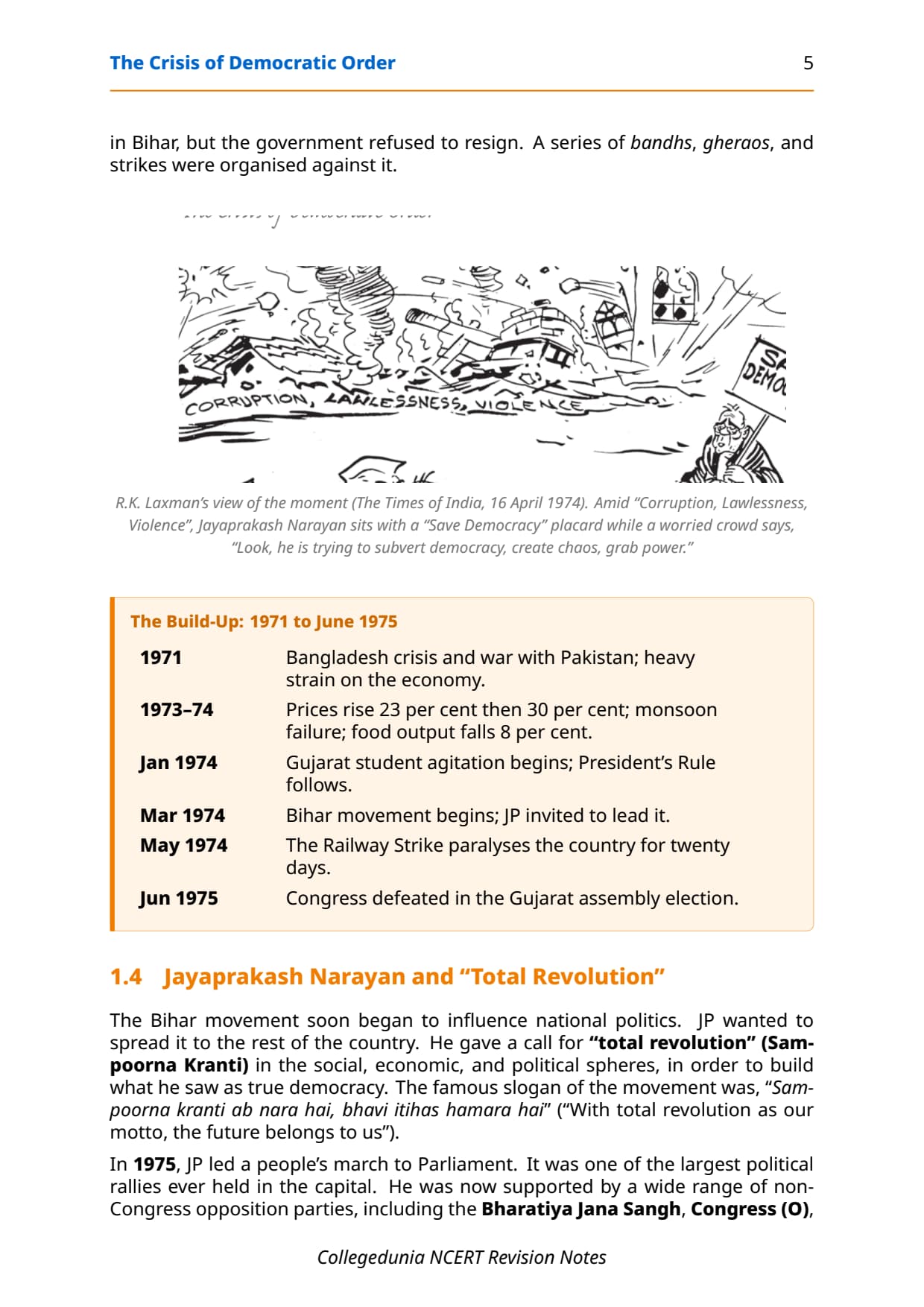
- Gujarat and Bihar movements: students protested against corruption and price rise in 1974.
- Total Revolution: Jayaprakash Narayan called for a full change in society and politics.
- Railway Strike: the 1974 strike led by George Fernandes stopped the railways for weeks.
The point examiners test most is that the unrest of 1973 to 1975 was the build-up to the Emergency. The protests were peaceful in aim but huge in scale. Keep this balance ready, because the background question and the "odd one out" both turn on these events.
Why the Emergency Was Declared
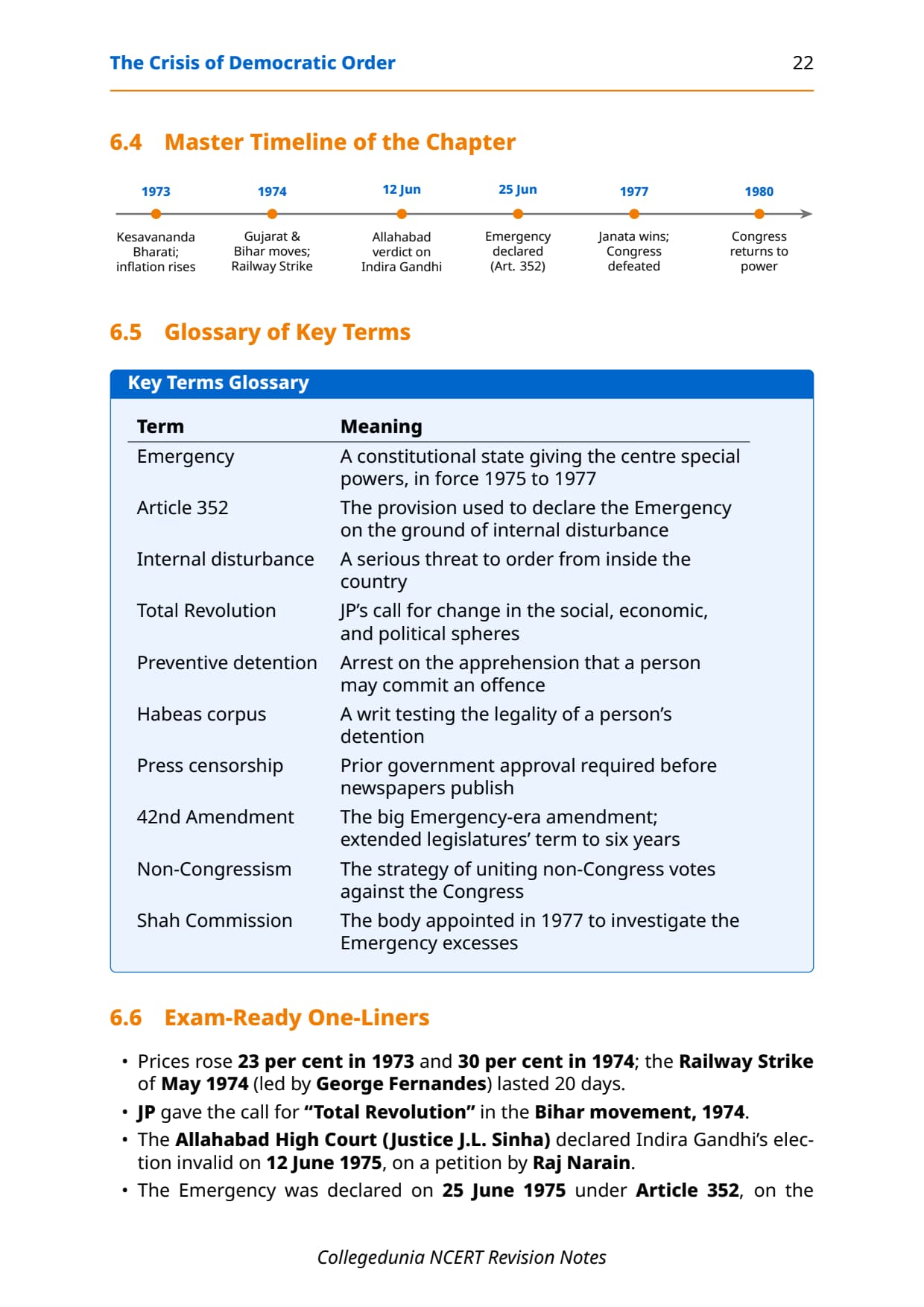
The trigger was a court verdict, not the protests alone. These notes keep the causes as a clear table rather than a story. Learn them as a list and you can answer any version of the question.
| Cause | What it meant |
|---|---|
| Allahabad HC verdict | On 12 June 1975 the court set aside Indira Gandhi's election over an electoral malpractice. |
| Call to resign | The opposition and JP demanded she step down and called for nationwide protests. |
| Threat to order | The government said the unrest threatened internal stability and the economy. |
| Article 352 invoked | On 25 June 1975 the Emergency was declared on the ground of "internal disturbance". |
The one-line takeaway for your sheet is that the government gave disorder as its reason, but critics saw it as a way to stay in power. The chapter separates the reasons the government gave from the reasons critics suspected. Keep this two-sided split clear in your notes so you can argue both sides.
What Happened During the Emergency
Once the Emergency was in force, the way the country was governed changed sharply. These notes keep the effects under four heads, because students often forget one. Learn one word for each so you cover all four in the exam.
- Civil liberties: fundamental rights were suspended; people could be jailed without trial.
- Executive and Judiciary: the executive grew very powerful and the courts were curbed.
- Mass media: press censorship meant content had to be cleared before printing.
- Police and bureaucracy: officials followed orders, and excesses like forced sterilisation took place.
The honest revision line is that the Emergency showed how easily power can be misused when checks are removed. The 42nd Amendment widened the government's powers, while slum demolitions and the sterilisation drive caused real suffering. Tie each effect to one named example so the timeline sticks.
The 1977 Election and the Janata Party
The Emergency was lifted in early 1977 and an election was called. The result was historic, so these notes give the cause and the outcome side by side. The exam wants both before any judgement.
- A referendum: the 1977 vote became a vote for or against the Emergency itself.
- The Janata Party: opposition groups merged into one party to take on the Congress together.
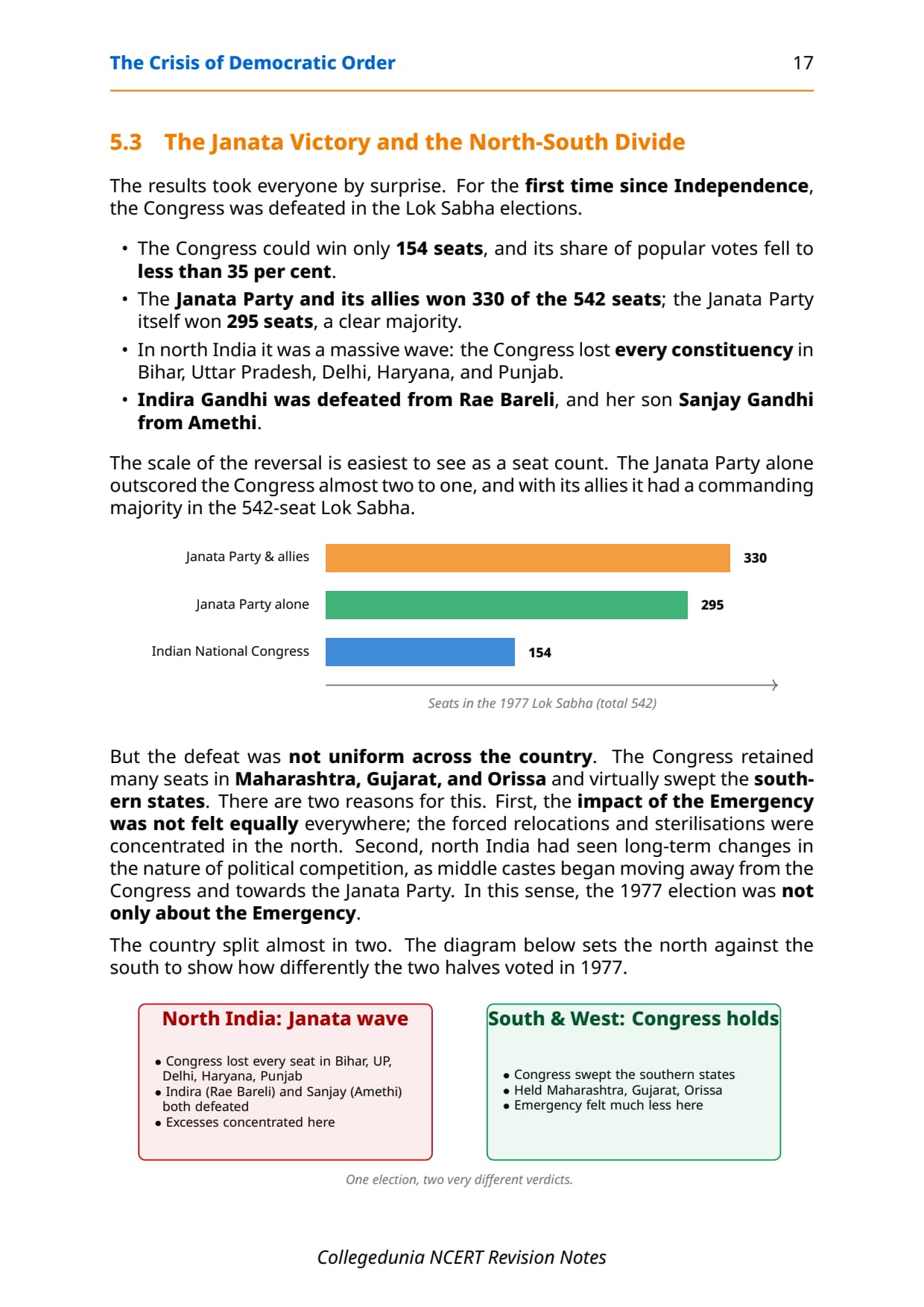
- The result: the Congress lost for the first time since 1947, winning only 154 seats.
- North-South split: the Congress lost heavily in the north but held on in the south.
The judgement to remember is that 1977 was the first time the opposition came to power at the Centre. Voters in the north, who had felt the excesses most, turned against the Congress. Keep the cause, the result and this verdict as three clear notes for the long answer.
Lessons of the Emergency
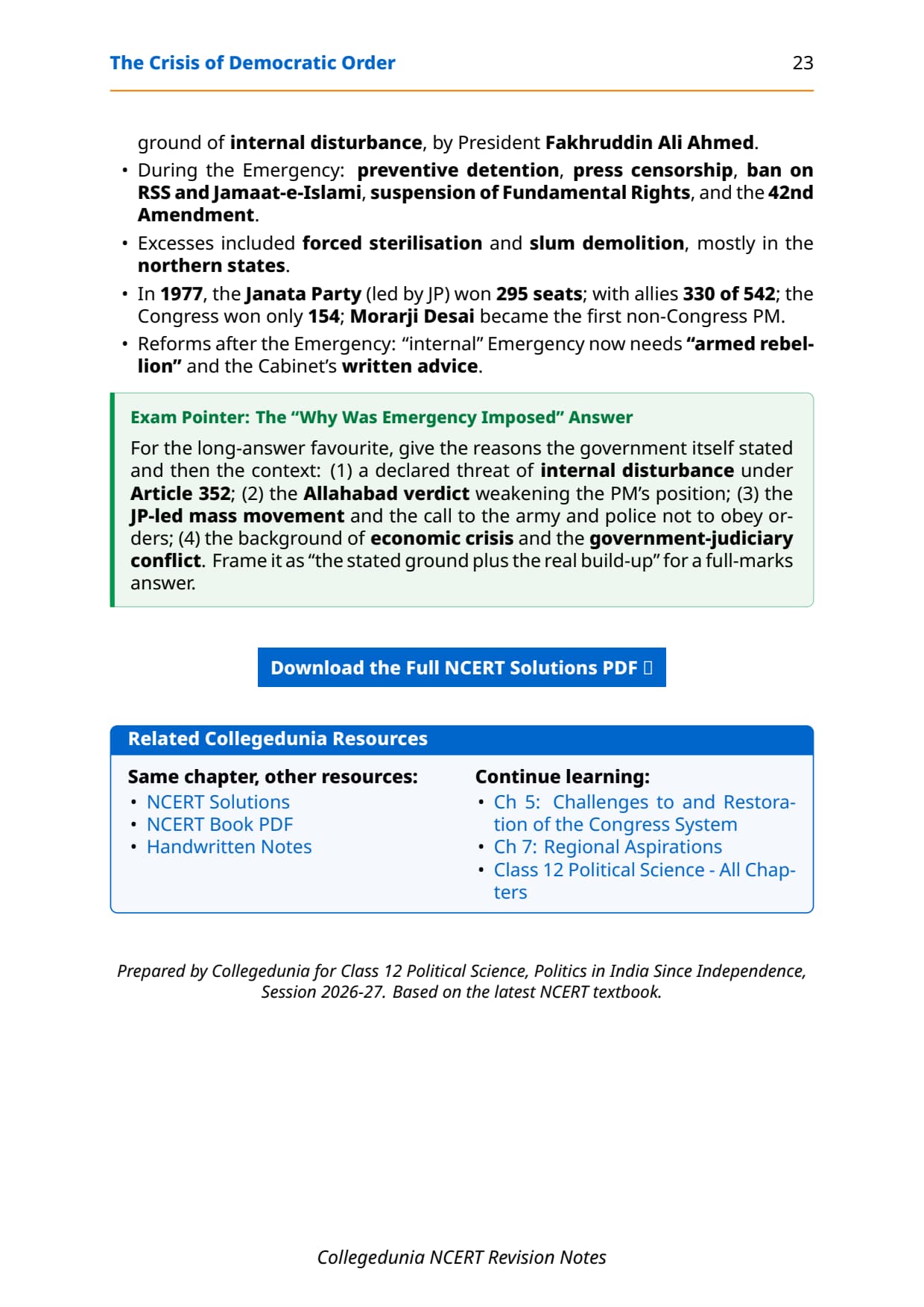
The chapter ends with what India learnt. This topic links the Emergency to the health of democracy, so it is a regular short and long answer. The table keeps the main lessons side by side for fast revision.
| Lesson | Why it matters |
|---|---|
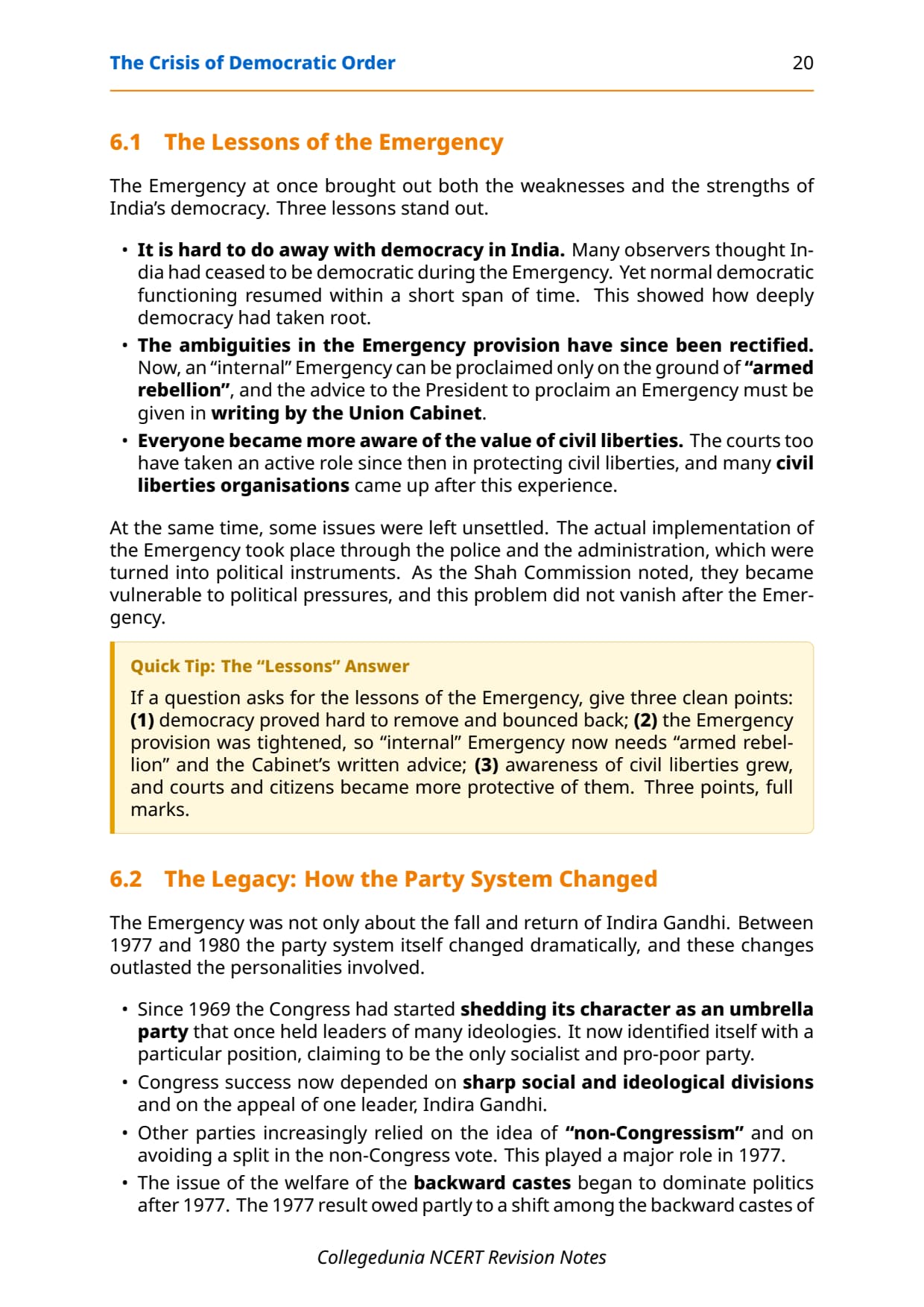
| Hard to remove democracy | The 1977 vote showed Indians value their democratic rights and will defend them. |
| Need for clear rules | "Internal disturbance" was too vague; the ground was later changed to "armed rebellion". |
| The Shah Commission | Set up in 1977, it documented the excesses so they could not be denied later. |
The sharp point for your notes is that the Emergency made future governments far more careful about using such powers. The Shah Commission's findings became the official record of the abuses, and the law was tightened. This is the heart of the "lessons" answer, so keep it ready.
The Crisis of Democratic Order Important Questions and Exam Pointers
CBSE sets a steady mix of objective, short and long answers from this chapter. Knowing the pattern helps students decide how much to write and which topics to revise first. A focused list of The Crisis of Democratic Order important questions saves a lot of time before the board exam.
- Long answer (5 to 6 marks): the effects of the Emergency, or why the opposition won in 1977.
- Short answer (4 marks): the reasons the government gave, or the Shah Commission's findings.
- Source-based: a passage on the 1977 election or the near two-party system, with sub-parts.
- Objective and match: dates, Article 352, the Railway Strike and the "Total Revolution" call.
For quick recall, students often practise a short class 12 political science chapter 6 mcq drill and a list of The Crisis of Democratic Order class 12 important questions. The most repeated items are the effects of the Emergency and the reasons for the 1977 result, so keep those answer points ready in your own words. Reading these notes once, then writing the key lists from memory, is the fastest way to lock the chapter in.
Common Mistakes Students Make in This Chapter
A few errors cost marks every year. Most come from mixing up dates or giving only one side of the Emergency debate. Fixing these five points is the quickest way to lift a score, so add them to the end of your revision sheet.
- Writing that the Emergency suspended "all" fundamental rights - it suspended most, not every single one.
- Saying it was declared because of the economy - the stated ground was internal disturbance.
- Confusing the Allahabad verdict date (12 June 1975) with the Emergency date (25 June 1975).
- Forgetting that George Fernandes led the 1974 Railway Strike, not the Total Revolution.
- Giving only the government's side - a good answer also gives the critics' view before judging.
Students who fix these five points usually move from average to high marks. The exam rewards a balanced view, so always give both the stated reason and the criticism before you judge them. These notes flag each soft point so you can phrase it safely in the answer sheet.
How These Notes Pair with the Solutions and Book PDF
These revision notes summarise the chapter. To prepare fully, students should use them alongside the other resources for the same chapter, all linked in the table below. Read the notes first, then test yourself with the solutions, and open the book PDF whenever you need the original text and figures.
| Resource | Best used for |
|---|---|
| The Crisis of Democratic Order NCERT Solutions | Step-by-step answers to all 10 back-exercise questions |
| The Crisis of Democratic Order Handwritten Notes | Last-minute, one-shot revision in a scanned notebook style |
| The Crisis of Democratic Order NCERT Book PDF | Reading the original NCERT chapter text and figures |
Tip: read these notes first, then attempt the solutions on your own, and only then check the model answers. That order builds memory faster than copying answers straight away.
All Class 12 Political Science Notes by Chapter
The table links the revision notes for every chapter in both Class 12 Political Science books, so students can move across the course in one click. The Crisis of Democratic Order is highlighted.
| Chapter | Notes |
|---|---|
| Contemporary World Politics | |
| Chapter 1 | The End of Bipolarity |
| Chapter 2 | Contemporary Centres of Power |
| Chapter 3 | Contemporary South Asia |
| Chapter 4 | International Organisations |
| Chapter 5 | Security in the Contemporary World |
| Chapter 6 | Environment and Natural Resources |
| Chapter 7 | Globalisation |
| Politics in India Since Independence | |
| Chapter 1 | Challenges of Nation Building |
| Chapter 2 | Era of One-Party Dominance |
| Chapter 3 | Politics of Planned Development |
| Chapter 4 | India's External Relations |
| Chapter 5 | Challenges to and Restoration of the Congress System |
| Chapter 6 | The Crisis of Democratic Order |
| Chapter 7 | Regional Aspirations |
| Chapter 8 | Recent Developments in Indian Politics |
FAQs on The Crisis of Democratic Order Class 12 Notes
The Crisis of Democratic Order Class 12 Political Science Notes Common Questions
Ques. Where can I download the The Crisis of Democratic Order Class 12 notes PDF?
Ans. You can download the The Crisis of Democratic Order Class 12 Political Science notes PDF directly from this page. It is free, follows the 2026-27 NCERT, and covers the background, the declaration, the effects and the 1977 election in a short, point-wise format.
Ques. What does The Crisis of Democratic Order chapter cover for Class 12?
Ans. It covers the economic crisis and unrest of the early 1970s, the Gujarat and Bihar movements, the Allahabad verdict, the declaration of the Emergency on 25 June 1975, its effects, the 1977 election and the lessons learnt for Indian democracy.
Ques. On what ground was the Emergency declared in 1975?
Ans. The Emergency was declared under Article 352 on the ground of a threat of "internal disturbance", not the economy. The immediate trigger was the Allahabad High Court verdict against Indira Gandhi and the opposition's call for her to resign.
Ques. Why is The Crisis of Democratic Order important for the board exam?
Ans. Because it is a high-scoring chapter on a key turning point in Indian democracy. The effects of the Emergency, the reasons for the 1977 result and the Shah Commission appear almost every year, so revising these notes well secures both objective and long-answer marks.
Ques. How should I use these notes to revise quickly?
Ans. Read the notes once under the before, during and after frame, keep the June 1975 dates and the 1977 result on one sheet, then write the key lists from memory. Finish by attempting a short class 12 political science chapter 6 mcq drill to test the small facts.



Comments