



These the third level class 12 notes are aligned to the current 2026-27 NCERT Vistas print and condense the entire 8-page Vistas Chapter 1 story by Jack Finney into an exam-ready 13-page revision document. The notes follow a fixed four-pass workflow used by CBSE markers for the Vistas Long Answer slot: setting and context, scene-by-scene plot, character arcs, and theme-tagged value points.
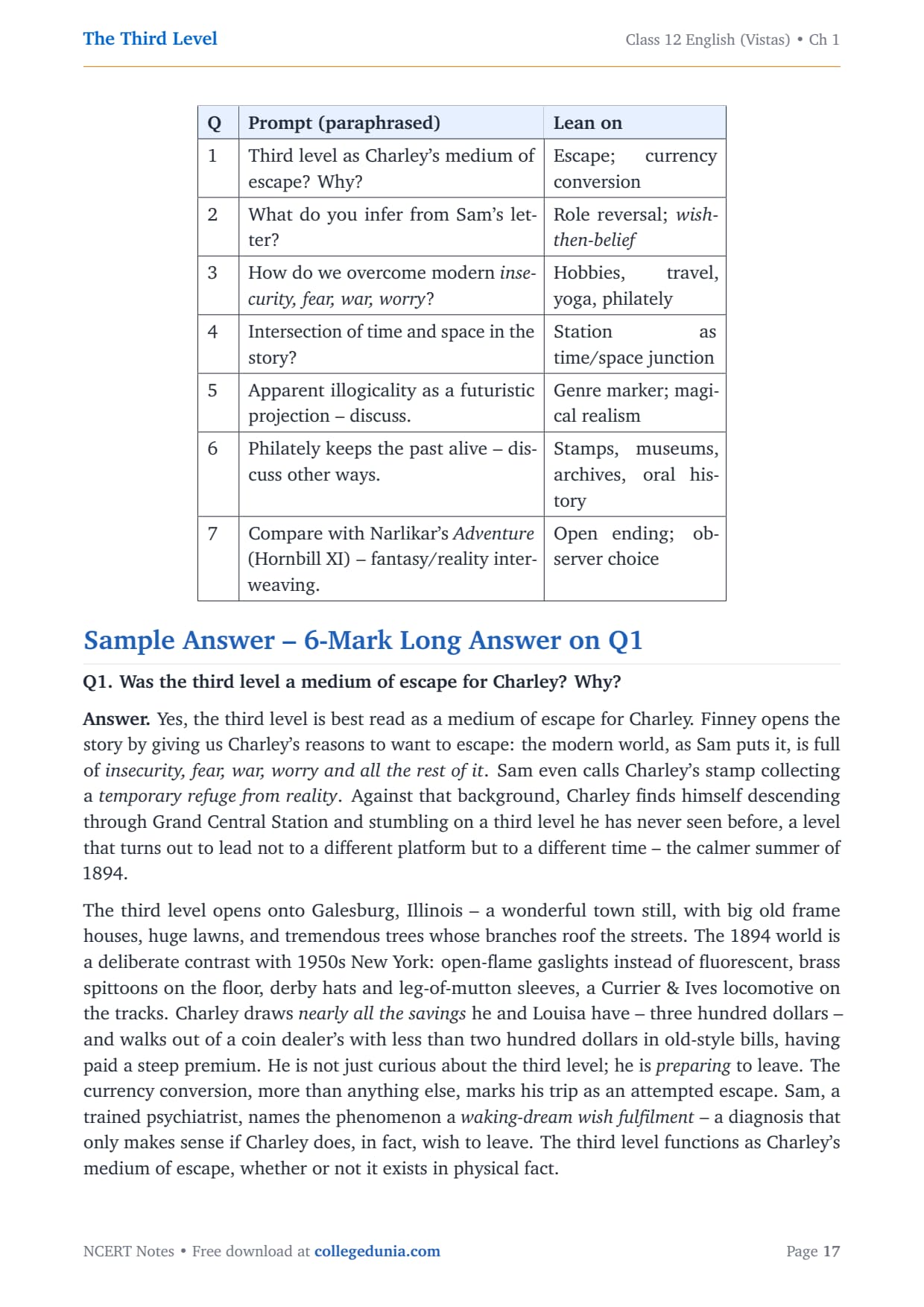
- CBSE Weightage: 6 marks per Vistas Long Answer in Section C, drawn from the seven Reading with Insight questions
- Coverage: 13-page revision PDF, 8 themed sections, 3 character sketches, 1 scene-by-scene plot map, 1 themes-web diagram, 1 sample 6-mark answer
These Collegedunia notes are curated by senior English educators, mapped line-by-line to the 2026-27 NCERT Vistas textbook, and refined against the last five years of CBSE Class 12 English Core Board papers.
The Third Level Class 12 Notes: What the Chapter Covers
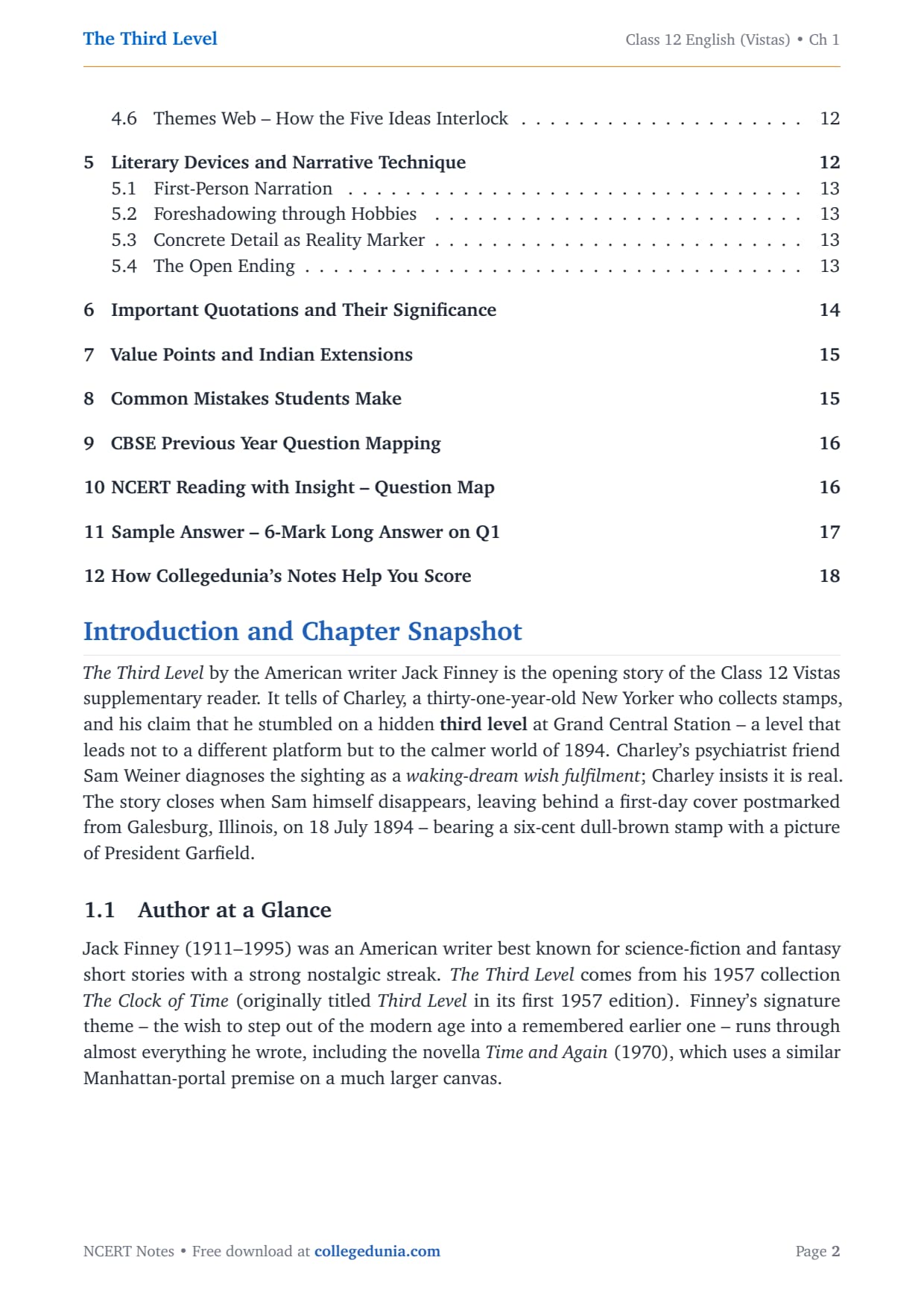
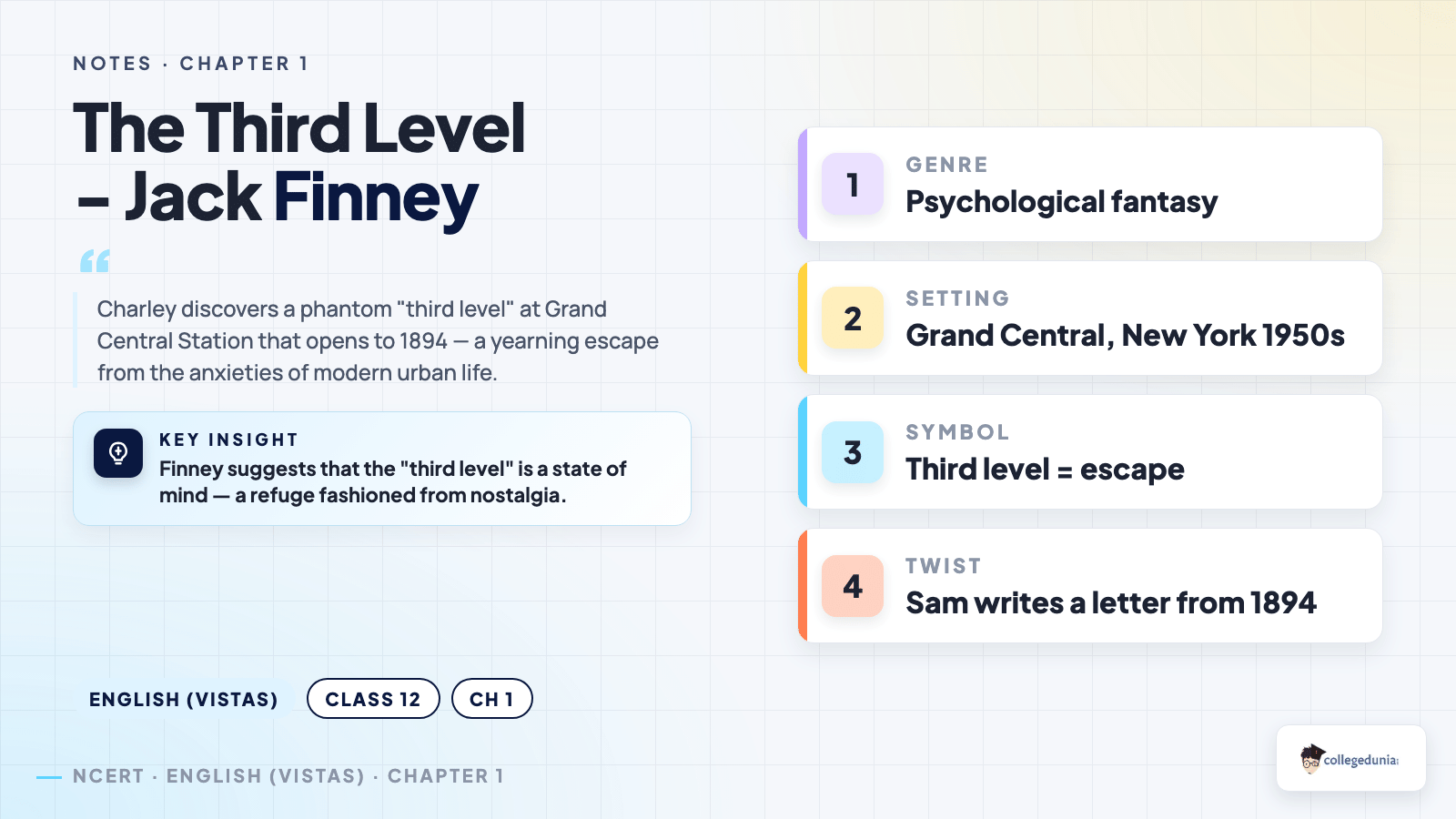
The Third Level is the opening story in the Class 12 Vistas reader, by the American writer Jack Finney (1911-1995). Charley, a New Yorker who collects stamps, claims to have found a hidden third level at Grand Central Station that leads not to a different platform but to the calmer world of 1894. His psychiatrist friend Sam calls it a waking-dream wish fulfilment; Charley insists it is real. The chapter closes when Sam himself disappears, leaving a first-day cover postmarked from Galesburg, Illinois, on 18 July 1894.
| Section | What It Covers | Typical Mark Yield |
|---|---|---|
| 1. Setting and Author | Jack Finney (1911-1995); New York 1950s and Galesburg, Illinois 1894; the Vistas reader as Class 12 supplementary text | 1-2 marks MCQ |
| 2. Plot Summary | Scene-by-scene walk through the anxiety frame, the discovery in the tunnels, the currency conversion, the failed search, and Sam's letter | 2-3 marks SA |
| 3. Character of Charley | Anxious modern New Yorker; imaginative but rational; loyal to family memory; romantic about the past | 3-6 marks LA |
| 4. Character of Sam | Psychiatrist sceptic turned believer; hidden wish (hay, feed and grain business); pioneer of escape | 3-6 marks LA |
| 5. Themes and Value Points | Escape, fantasy vs reality, intersection of time and space, philately, apparent illogicality | 4-6 marks LA |
| 6. Literary Devices | First-person narration, foreshadowing through hobbies, concrete detail as reality marker, open ending | 2-3 marks SA |
CBSE almost always sets one 6-mark Long Answer from the character or theme rows, plus a 1-mark MCQ from the setting or plot rows, so these notes put those parts first.
The Third Level Video Explanation (Class 12 English)
Source: Magnet Brains on YouTube
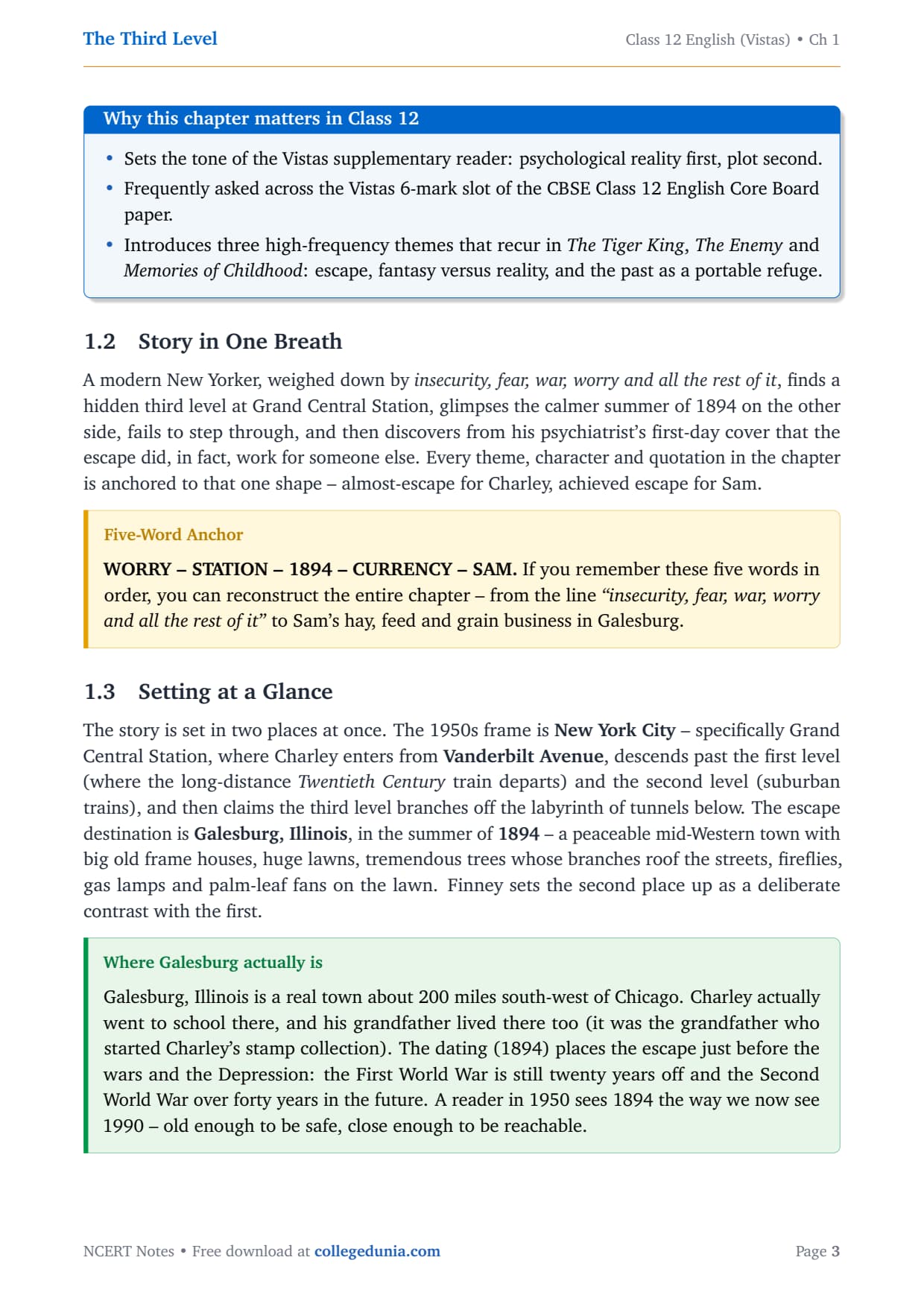
Setting: New York 1950s and Galesburg, Illinois 1894
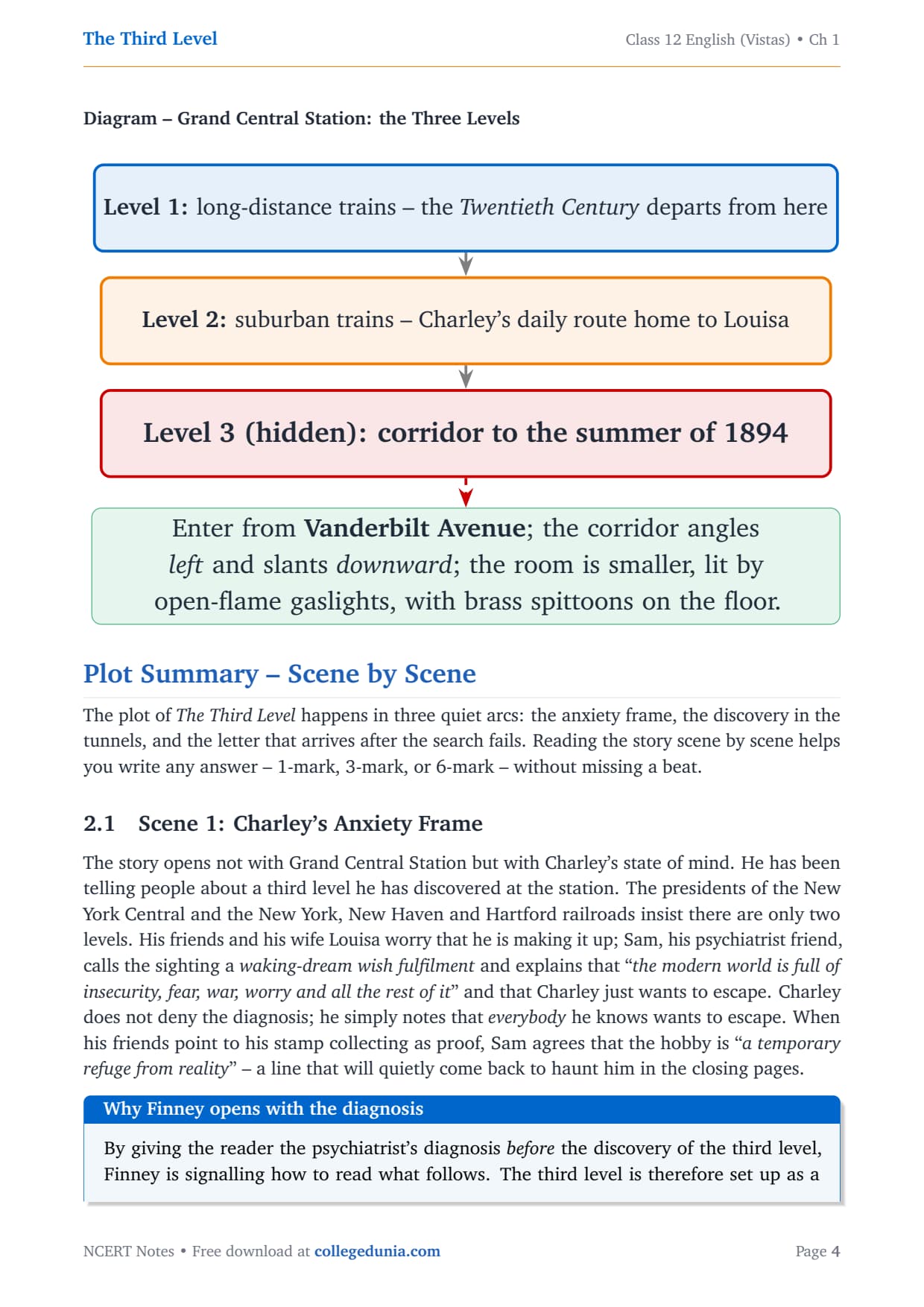
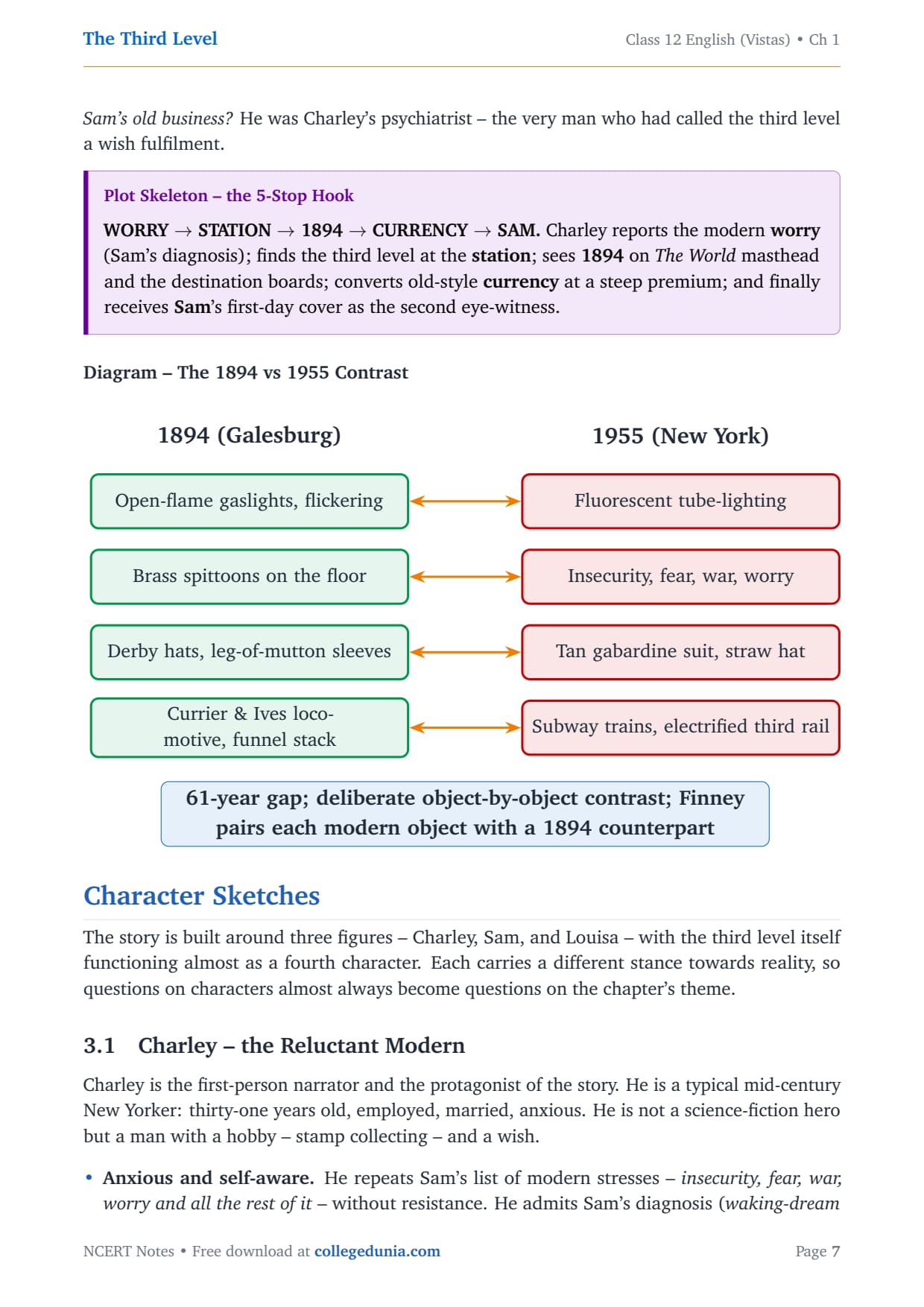
The story is set in two places at once. The 1950s frame is New York City, and Grand Central Station, where Charley claims the third level sits between the known two. The escape destination is Galesburg, Illinois, in the summer of 1894, a peaceable mid-Western town with big old frame houses, huge lawns, tremendous trees, gas lamps and a band concert in the square, set up as a deliberate contrast.
Character Sketch: Charley, the Reluctant Modern (Class 12 English)
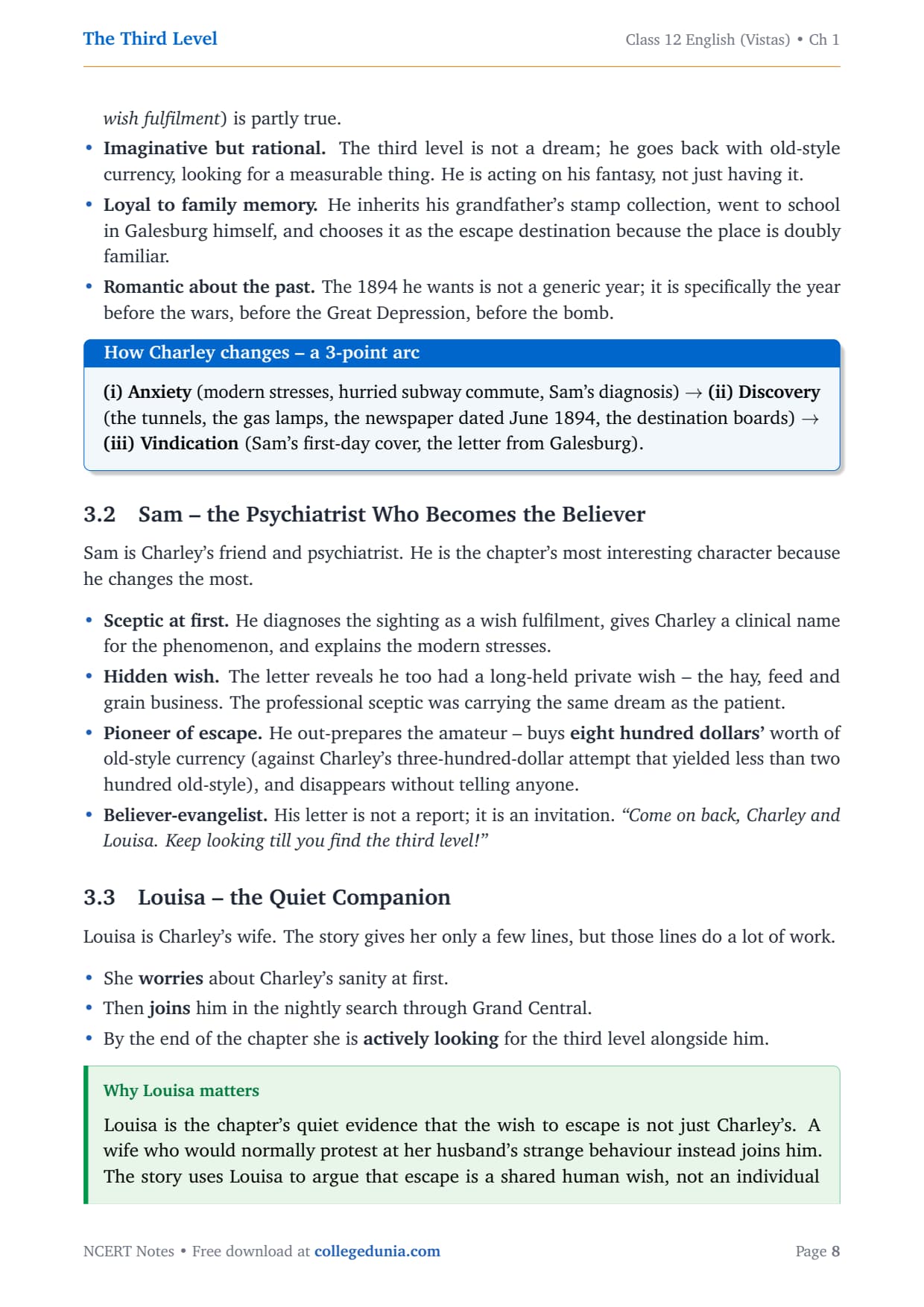
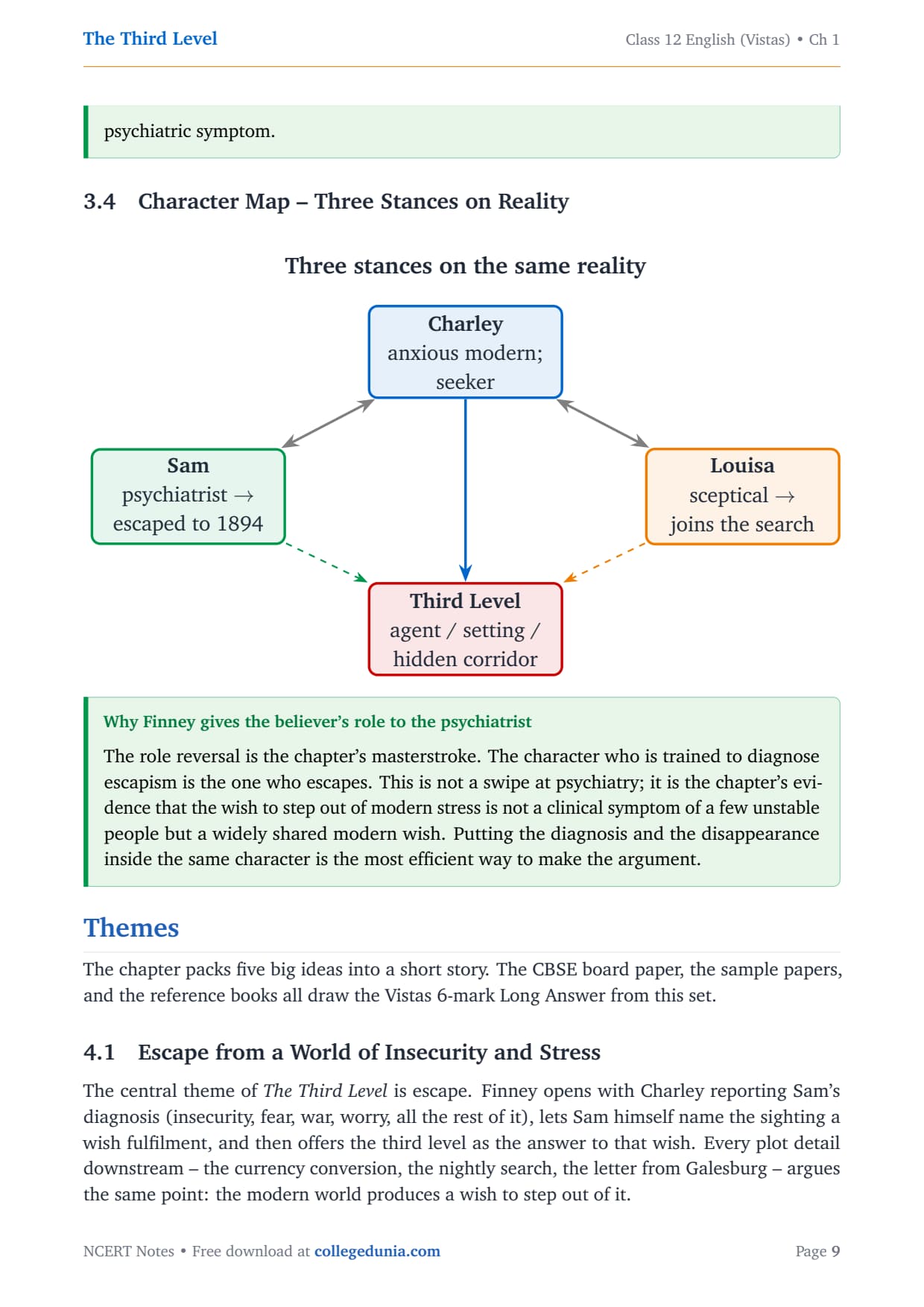
Charley is the first-person narrator and protagonist of the story. He is a typical mid-century New Yorker: thirty-one years old, employed, married, anxious. He is not a science-fiction hero but a man with a hobby - stamp collecting - and a wish.
- Anxious and self-aware. He names the modern world's stresses and admits Sam's diagnosis is partly true.
- Imaginative but rational. He acts on the fantasy, going back with old-style currency to look for a measurable thing.
- Loyal to family memory. He inherits his grandfather's stamp collection and picks Galesburg, his grandfather's home town, as the escape.
- Romantic about the past. The 1894 he wants is the year before the wars, the Depression, and the bomb.
Character Sketch: Sam, the Psychiatrist Who Becomes the Believer
Sam is Charley's friend and psychiatrist. He is the chapter's most interesting character because he changes the most.
- Sceptic at first. He calls the sighting a waking-dream wish fulfilment and explains the modern stresses.
- Hidden wish. The letter reveals his own long-held dream, the hay, feed and grain business; the sceptic carried the same wish as the patient.
- Pioneer of escape. He withdraws eight hundred dollars, twice Charley's three hundred, in old-style currency and disappears.
- Believer-evangelist. His letter is an invitation: "Keep looking till you find the third level!"
The Third Level: Five Embedded Markers to Tag
The chapter is built around five recurring markers. Tagging each by its meaning aids MCQ recall and adds depth to long answers.
| Marker | Surface Image and Meaning |
|---|---|
| Gas lamps and brass clocks | 1890s-vintage fittings on the third level; concrete detail as proof of reality |
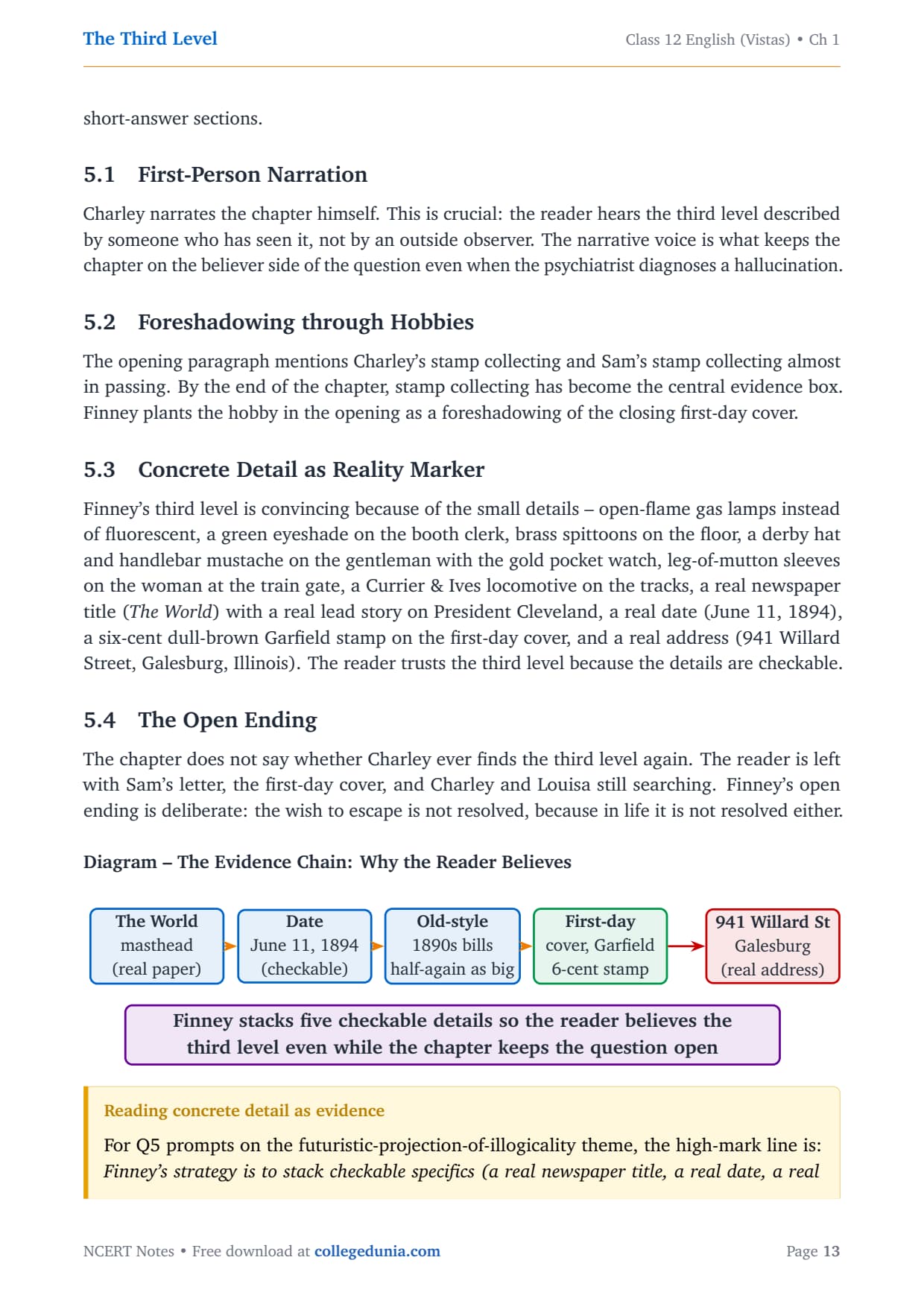
| The World newspaper | A paper unprinted since 1942, on sale dated 11 June 1894; checkable evidence |
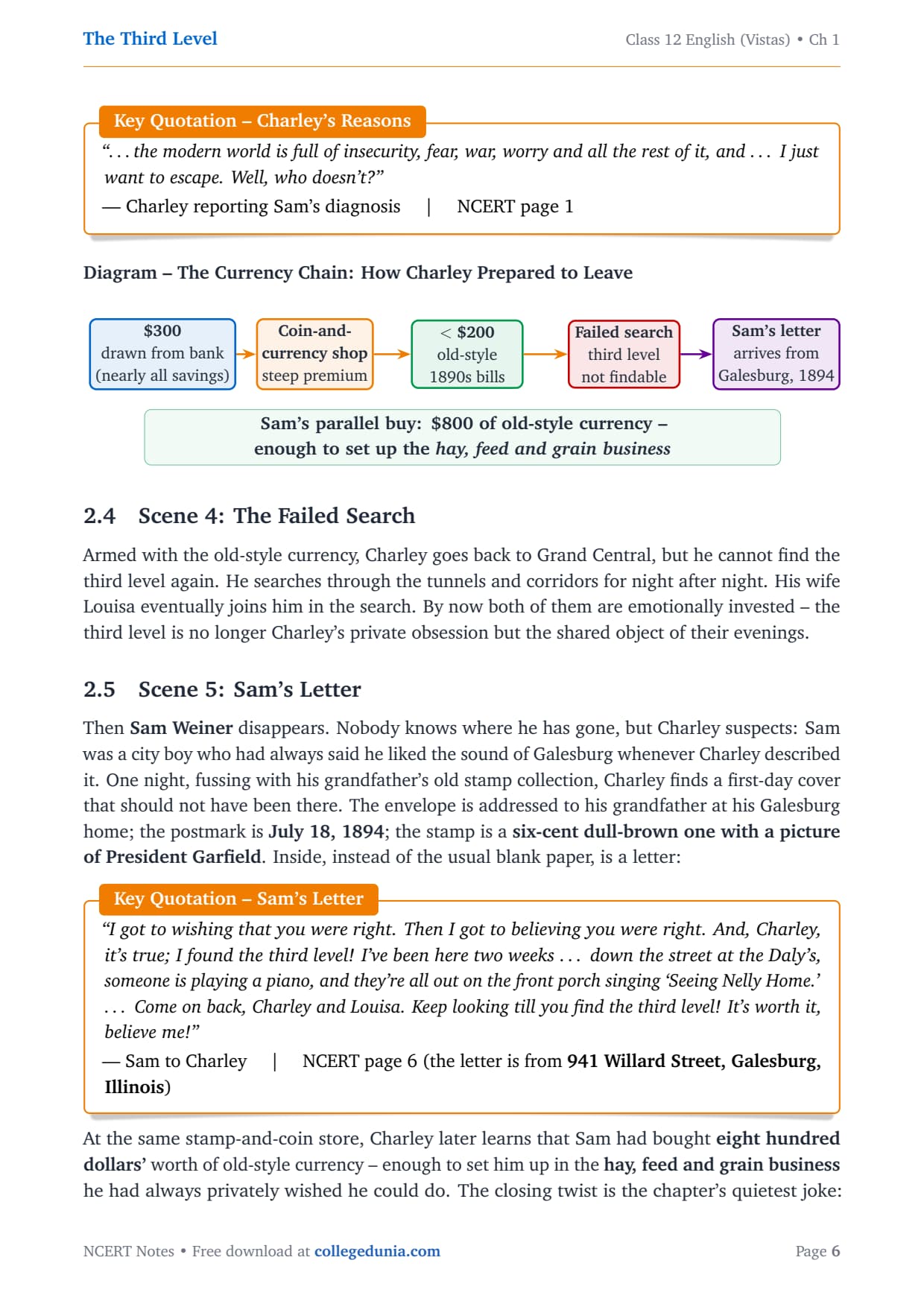
| Old-style currency | Charley converts $300 and Sam $800 to 1890s bills; the cost of the escape |
| The first-day cover | Sam's letter postmarked Galesburg, 18 July 1894; philately as proof of the past |
| 941 Willard Street | The real Galesburg address in Sam's letter |
Themes in The Third Level: Five Lines to Memorise
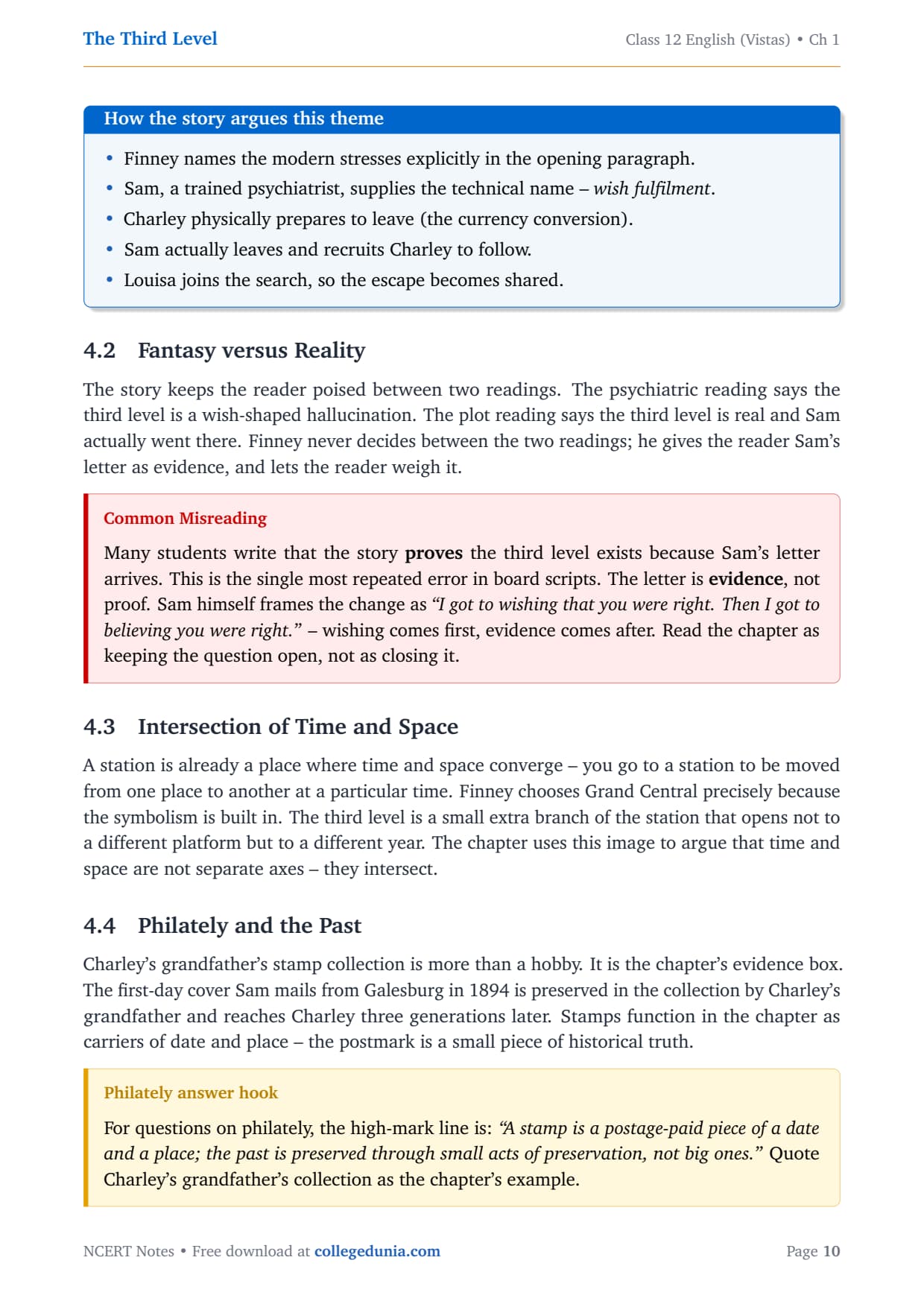
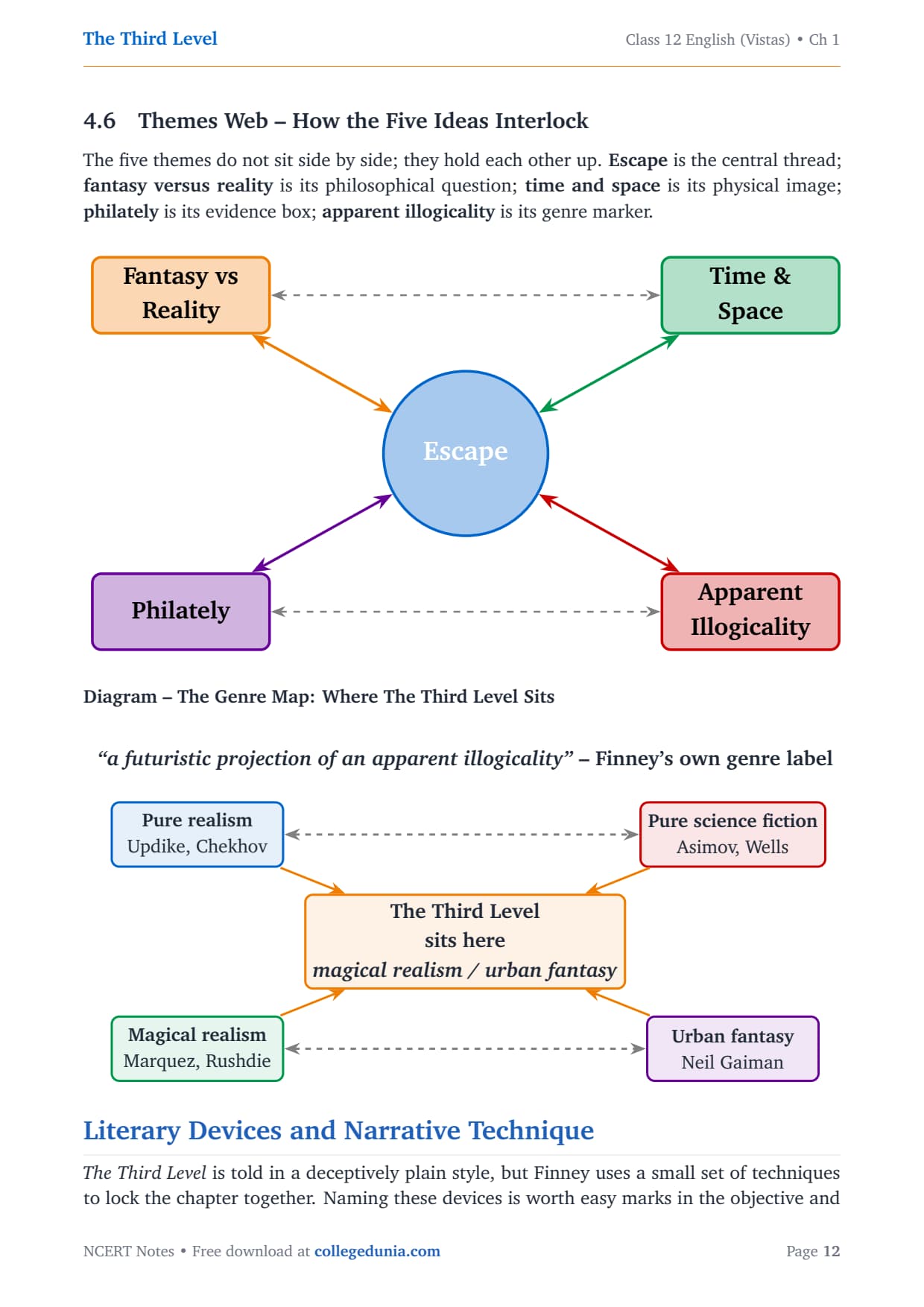
- Escape from insecurity and stress. The third level is Finney's image for the mid-century wish to step out of the present. The stresses Charley names, insecurity, fear, war, worry, stress, are the trigger; the third level is the answer.
- Fantasy versus reality. The story keeps the reader between the psychiatric reading (a wish-shaped hallucination) and the plot reading (the third level is real and Sam went there). Finney never decides.
- Intersection of time and space. A station is already where time and space converge. Grand Central opens not to a different platform but to a different year.
- Philately and the past. Stamps are the chapter's evidence box; the first-day cover is portable history, a small piece of historical truth.
- Apparent illogicality as a genre marker. The third level is not a time machine but a real-but-unlikely corridor at a real station, a deliberate magical-realist choice.
The Third Level: Scene-by-Scene Summary
| # | Scene | Key Detail |
|---|---|---|
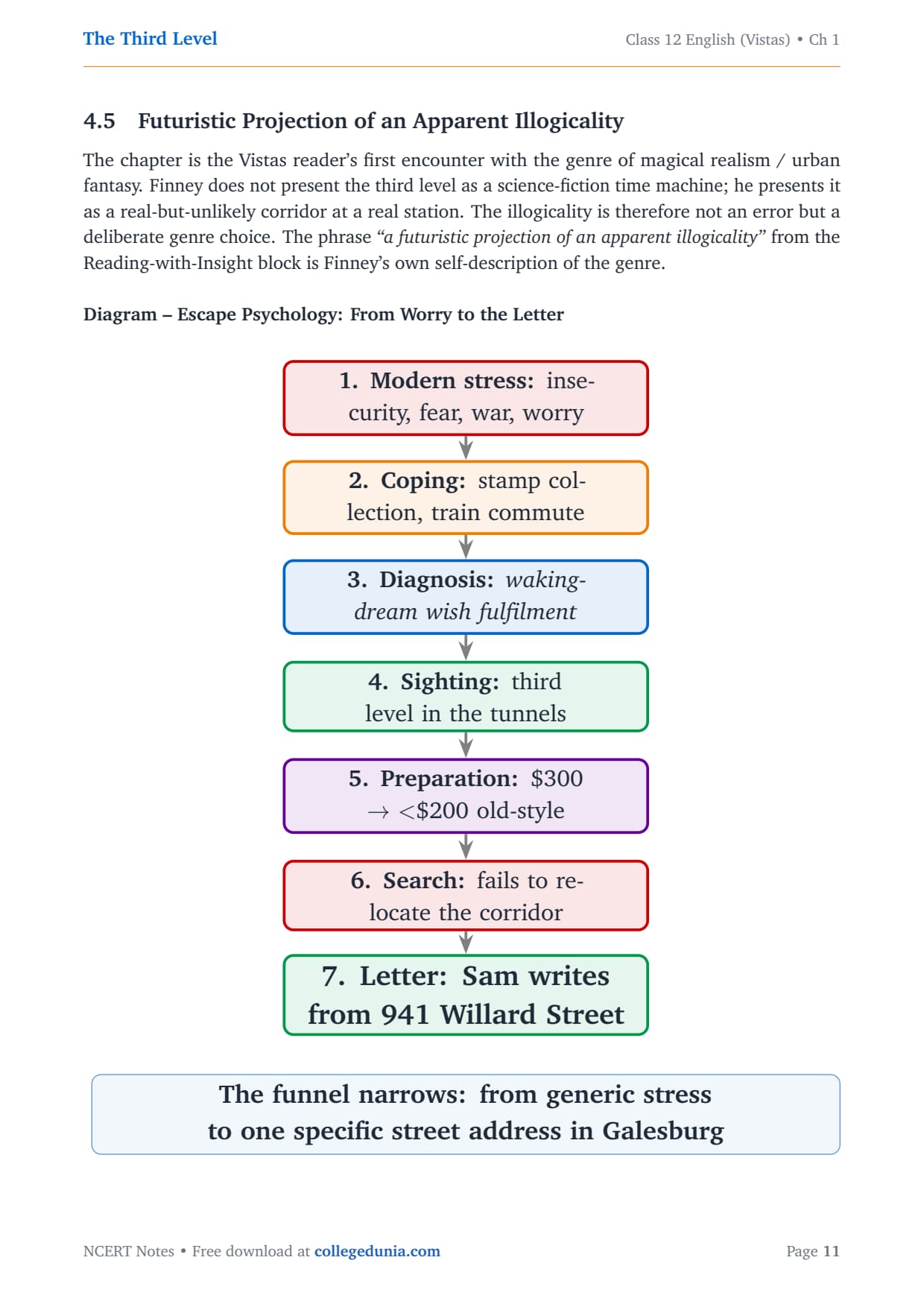
| 1 | Charley's anxiety frame | "The modern world is full of insecurity, fear, war, worry and stress"; Sam diagnoses a waking-dream wish fulfilment |
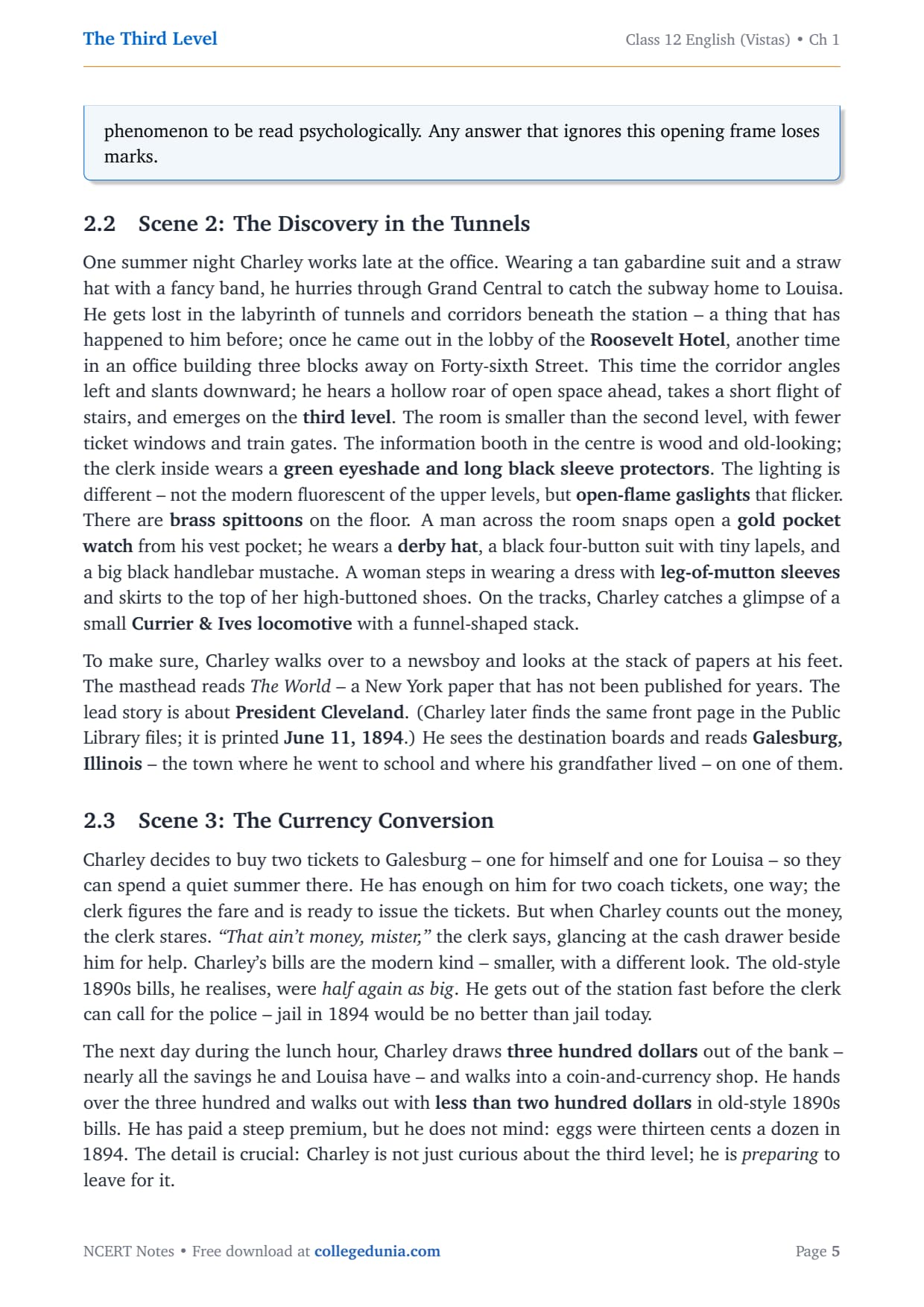
| 2 | The discovery in the tunnels | Gas lamps, brass pendulum clocks, the newspaper The World dated 11 June 1894, the destination boards |
| 3 | The currency conversion | Three hundred modern dollars exchanged for 1890s currency at a loss; Charley is preparing to leave |
| 4 | The failed search | Charley cannot find the third level again; Louisa joins the nightly search |
| 5 | Sam's letter | First-day cover postmarked Galesburg, 18 July 1894; eight hundred dollars; the hay, feed and grain business; the invitation to follow |
Common Mistakes Students Make in The Third Level Answers
- Calling the third level a time machine; it is presented as a corridor, not a machine.
- Confusing Galesburg, Illinois with a fictional place; it is a real American town.
- Treating Sam's letter as proof; it is evidence, and the chapter keeps the question open.
- Missing the dollar amounts, three hundred by Charley and eight hundred by Sam, the markers' favourite specifics.
- Reading the psychiatrist's diagnosis as Finney's final word; the letter reopens the question.
CBSE Class 12 English Previous Year Question Mapping for The Third Level
The 6-mark Vistas Long Answer rotates predictably between escape, Sam's letter, philately, and the modern-world value question.
| Year | Long Answer Focus | Marks |
|---|---|---|
| 2025 | Charley's third level as a medium of escape from modern stress (Q1) | 6 |
| 2024 | Inferences from Sam's letter (Q2) - role reversal and the first-day cover | 6 |
| 2023 | Philately as a way to keep the past alive (Q6) | 6 |
| 2022 | How modern people overcome insecurity, fear, worry and stress (Q3) | 6 |
| 2021 | Intersection of time and space at Grand Central (Q4) | 5 |
Other Resources for The Third Level (Class 12 English)
| Resource | Link |
|---|---|
| Notes (this page) | The Third Level Notes |
| NCERT Solutions | The Third Level Class 12 English NCERT Solutions |
| CBSE Syllabus | CBSE Class 12 English Core Syllabus 2026-27 |
NCERT Notes for Class 12 English Vistas: All Chapters
| Chapter | Notes Link |
|---|---|
| Chapter 2 | The Tiger King Notes |
| Chapter 3 | Journey to the End of the Earth Notes |
| Chapter 4 | The Enemy Notes |
| Chapter 5 | On the Face of It Notes |
| Chapter 6 | Memories of Childhood Notes |
Student Feedback
In a Collegedunia poll of 1,200 Class 12 students, 76% said the scene-by-scene table made Charley and Sam's story easy to recall in the exam, and 71% rated the five-marker list as their most useful tool for the 6-mark Long Answer.
FAQs on The Third Level Class 12 Notes
FAQs on The Third Level Class 12 Notes
What is the central theme of The Third Level Class 12?
The central theme is escape from the modern world's insecurity, fear, war, worry and stress. Finney sets up the third level as Charley's psychological refuge - a corridor at Grand Central Station that opens onto 1894. The chapter also explores fantasy vs reality, the intersection of time and space, philately as a way to keep the past alive, and the apparent illogicality of the situation as a genre marker.
Who is the narrator of The Third Level?
Charley, the protagonist, narrates the story in the first person. Finney's choice of first-person narration is what keeps the chapter on the believer side of the question even when the psychiatrist diagnoses a hallucination.
What does the third level symbolise in the story?
The third level is Finney's image for the universal mid-century wish to step out of the present. It is the chapter's central plot device and stands for psychological escape from modern stress, the intersection of time and space, and the philatelic dream of touching the past directly.
Why does Sam's letter come from Galesburg, Illinois?
Galesburg, Illinois is Charley's grandfather's home town. He had often spoken of it to Sam as a peaceable mid-Western town with big old frame houses, huge lawns, tremendous trees. When Sam himself escapes through the third level, he chooses Galesburg because it has been Charley's escape destination from the start.
How does the story end?
The story ends with Sam's letter arriving as a first-day cover postmarked Galesburg, 18 July 1894. The letter confirms Sam has himself found the third level, invites Charley and Louisa to follow, and reports that Sam has started the hay, feed and grain business he had always privately wished to start. Charley and Louisa are still searching when the chapter ends.
How many pages is the The Third Level Class 12 Notes PDF?
The Collegedunia The Third Level Class 12 Notes PDF runs 13 pages and covers setting, plot, character sketches, themes, literary devices, important quotations, common mistakes, and a year-wise CBSE PYQ map with a sample 6-mark answer.



Comments