




The Kubla Khan Class 12 notes explain Coleridge's NCERT Kaleidoscope poem for the 2026-27 reprint. Use this page to revise the dream setting, river imagery, surreal contrasts, magical elements and answer cues before downloading the full PDF.
- Download the Class 12 English Supplementary Chapter 9 notes PDF for fast revision.
- Revise Xanadu, Alph, the pleasure dome, the chasm and the Abyssinian maid.
- Student focus: the chapter tests imagery, contrast, sound and poetic ecstasy.
Chapter9Kaleidoscope:KublaKhanNotes.pdf?page=1&dpi=150)
Chapter9Kaleidoscope:KublaKhanNotes.pdf?page=2&dpi=150)
Chapter9Kaleidoscope:KublaKhanNotes.pdf?page=3&dpi=150)
Chapter9Kaleidoscope:KublaKhanNotes.pdf?page=4&dpi=150)
Chapter9Kaleidoscope:KublaKhanNotes.pdf?page=5&dpi=150)
Chapter9Kaleidoscope:KublaKhanNotes.pdf?page=6&dpi=150)
Chapter9Kaleidoscope:KublaKhanNotes.pdf?page=7&dpi=150)
Chapter9Kaleidoscope:KublaKhanNotes.pdf?page=8&dpi=150)
Chapter9Kaleidoscope:KublaKhanNotes.pdf?page=9&dpi=150)
Chapter9Kaleidoscope:KublaKhanNotes.pdf?page=10&dpi=150)
Chapter9Kaleidoscope:KublaKhanNotes.pdf?page=11&dpi=150)
Chapter9Kaleidoscope:KublaKhanNotes.pdf?page=12&dpi=150)
Chapter9Kaleidoscope:KublaKhanNotes.pdf?page=13&dpi=150)
Chapter9Kaleidoscope:KublaKhanNotes.pdf?page=14&dpi=150)
Chapter9Kaleidoscope:KublaKhanNotes.pdf?page=15&dpi=150)
Chapter9Kaleidoscope:KublaKhanNotes.pdf?page=16&dpi=150)
Chapter9Kaleidoscope:KublaKhanNotes.pdf?page=17&dpi=150)
Chapter9Kaleidoscope:KublaKhanNotes.pdf?page=18&dpi=150)
Chapter9Kaleidoscope:KublaKhanNotes.pdf?page=19&dpi=150)
Chapter9Kaleidoscope:KublaKhanNotes.pdf?page=20&dpi=150)
Chapter9Kaleidoscope:KublaKhanNotes.pdf?page=21&dpi=150)
Chapter9Kaleidoscope:KublaKhanNotes.pdf?page=22&dpi=150)
Chapter9Kaleidoscope:KublaKhanNotes_flat_MobileCard.pdf?page=1&dpi=150)
Chapter9Kaleidoscope:KublaKhanNotes_flat_MobileCard.pdf?page=2&dpi=150)
Chapter9Kaleidoscope:KublaKhanNotes_flat_MobileCard.pdf?page=3&dpi=150)
Chapter9Kaleidoscope:KublaKhanNotes_flat_MobileCard.pdf?page=4&dpi=150)
Chapter9Kaleidoscope:KublaKhanNotes_flat_MobileCard.pdf?page=5&dpi=150)
Chapter9Kaleidoscope:KublaKhanNotes_flat_MobileCard.pdf?page=6&dpi=150)
Chapter9Kaleidoscope:KublaKhanNotes_flat_MobileCard.pdf?page=7&dpi=150)
Chapter9Kaleidoscope:KublaKhanNotes_flat_MobileCard.pdf?page=8&dpi=150)
Chapter9Kaleidoscope:KublaKhanNotes_flat_MobileCard.pdf?page=9&dpi=150)
Chapter9Kaleidoscope:KublaKhanNotes_flat_MobileCard.pdf?page=10&dpi=150)
Chapter9Kaleidoscope:KublaKhanNotes_flat_MobileCard.pdf?page=11&dpi=150)
Chapter9Kaleidoscope:KublaKhanNotes_flat_MobileCard.pdf?page=12&dpi=150)
Chapter9Kaleidoscope:KublaKhanNotes_flat_MobileCard.pdf?page=13&dpi=150)
Chapter9Kaleidoscope:KublaKhanNotes_flat_MobileCard.pdf?page=14&dpi=150)
Chapter9Kaleidoscope:KublaKhanNotes_flat_MobileCard.pdf?page=15&dpi=150)
Chapter9Kaleidoscope:KublaKhanNotes_flat_MobileCard.pdf?page=16&dpi=150)
Chapter9Kaleidoscope:KublaKhanNotes_flat_MobileCard.pdf?page=17&dpi=150)
Chapter9Kaleidoscope:KublaKhanNotes_flat_MobileCard.pdf?page=18&dpi=150)
Chapter9Kaleidoscope:KublaKhanNotes_flat_MobileCard.pdf?page=19&dpi=150)
Chapter9Kaleidoscope:KublaKhanNotes_flat_MobileCard.pdf?page=20&dpi=150)
Chapter9Kaleidoscope:KublaKhanNotes_flat_MobileCard.pdf?page=21&dpi=150)
Chapter9Kaleidoscope:KublaKhanNotes_flat_MobileCard.pdf?page=22&dpi=150)
Chapter9Kaleidoscope:KublaKhanNotes_flat_MobileCard.pdf?page=23&dpi=150)
Chapter9Kaleidoscope:KublaKhanNotes_flat_MobileCard.pdf?page=24&dpi=150)
Chapter9Kaleidoscope:KublaKhanNotes_flat_MobileCard.pdf?page=25&dpi=150)
Chapter9Kaleidoscope:KublaKhanNotes_flat_MobileCard.pdf?page=26&dpi=150)
Chapter9Kaleidoscope:KublaKhanNotes_flat_MobileCard.pdf?page=27&dpi=150)
These Class 12 English Supplementary Kubla Khan notes are checked against the 2026-27 NCERT chapter and built for quick board revision.
Student Feedback on Kubla Khan
In a Collegedunia poll of 12,860 Class 12 English students using NCERT literature resources, many students understood the dream story but missed how the images work together.
- 76% wanted a clearer split between real and imaginary details.
- 69% needed help with eye images, sound images and water movement words.
- 61% found the fragment question hard to frame in exam language.
Source: 2026-27 Class 12 English student poll. Sample of 12,860 students using NCERT-aligned study resources.
Kubla Khan Dream Setting for Class 12 Kaleidoscope
Kubla Khan begins in Xanadu, where the emperor orders a pleasure dome. The setting looks royal and planned, but the river Alph pulls the poem into hidden caverns and a sunless sea.
- Xanadu: the royal place where the decree is made.
- Pleasure dome: a sign of power, art and luxury.
- Alph: the sacred river that joins surface beauty with mystery.
Kubla Khan Class 12 Video Recap
Source: Magnet Brains on YouTube
Kubla Khan Real and Imaginary Details Explained
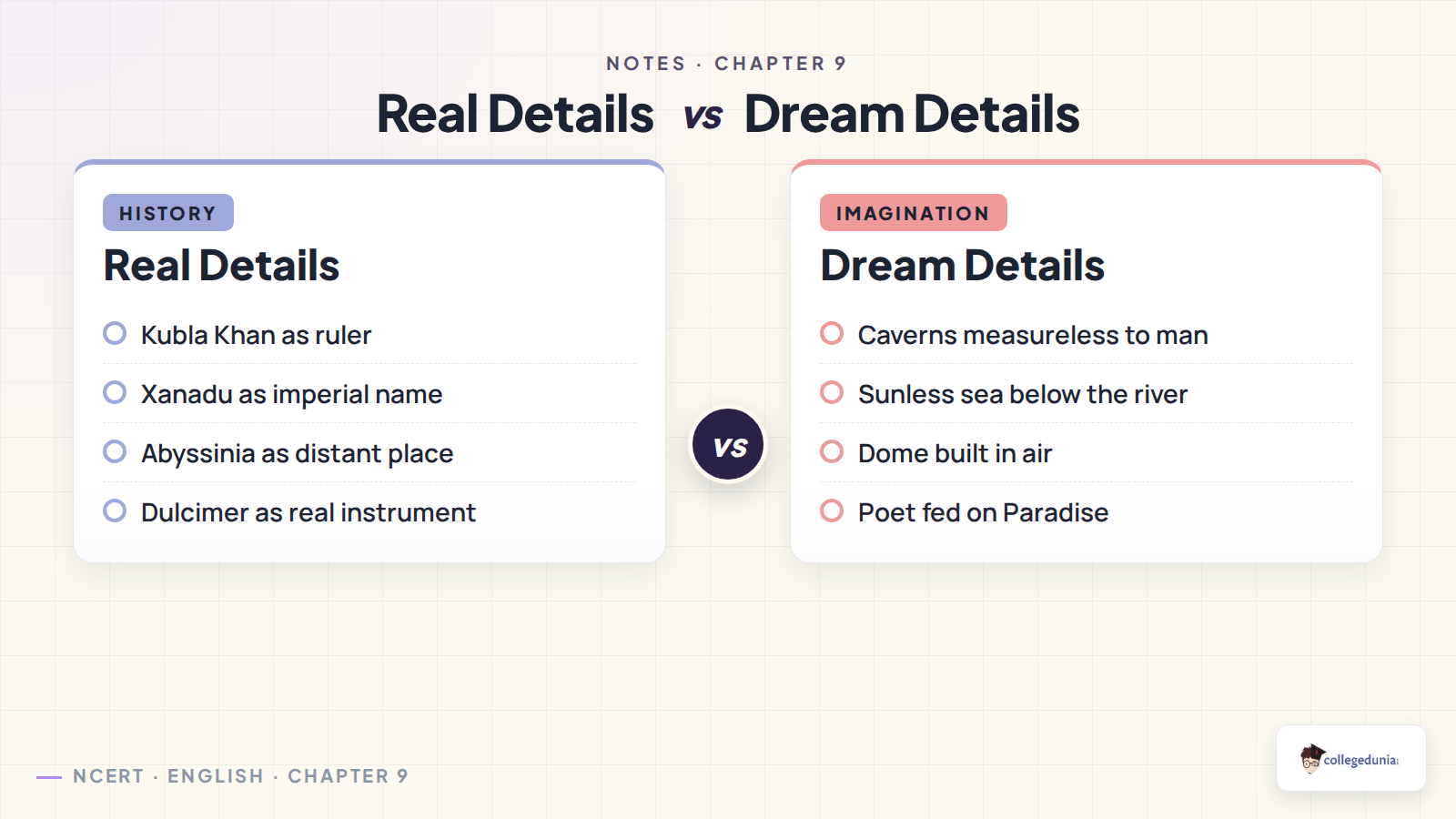
The poem uses real-sounding names, then changes them through dream logic. Kubla Khan and Xanadu give the poem a historical base. The measureless caverns, sunless sea and dome in air make the world surreal.
| Detail | Real side | Dream side |
|---|---|---|
| Kubla Khan | A historical ruler | A dream figure of command |
| Xanadu | An imperial setting | A symbolic landscape |
| Alph | Named like a sacred river | Runs through impossible caverns |
| Abyssinian maid | A distant cultural image | A vision of lost music |
Kubla Khan Imagery and Contrast Table
Most NCERT questions in Kubla Khan ask students to group images. Do not list them randomly. Sort them by sight, sound, movement and mood.
| Image type | Examples | Revision cue |
|---|---|---|
| Eye images | gardens, forests, dome shadow, flashing eyes | Show visual richness |
| Sound images | wailing, turmoil, mingled measure, dulcimer | Create mystery and music |
| Contrasts | sunny dome and caves of ice | Beauty stands beside danger |
| Water movement | ran, forced, burst, flung, meandering, sank | Track pressure and collapse |
Deep Romantic Chasm and Ancestral Voices in Kubla Khan
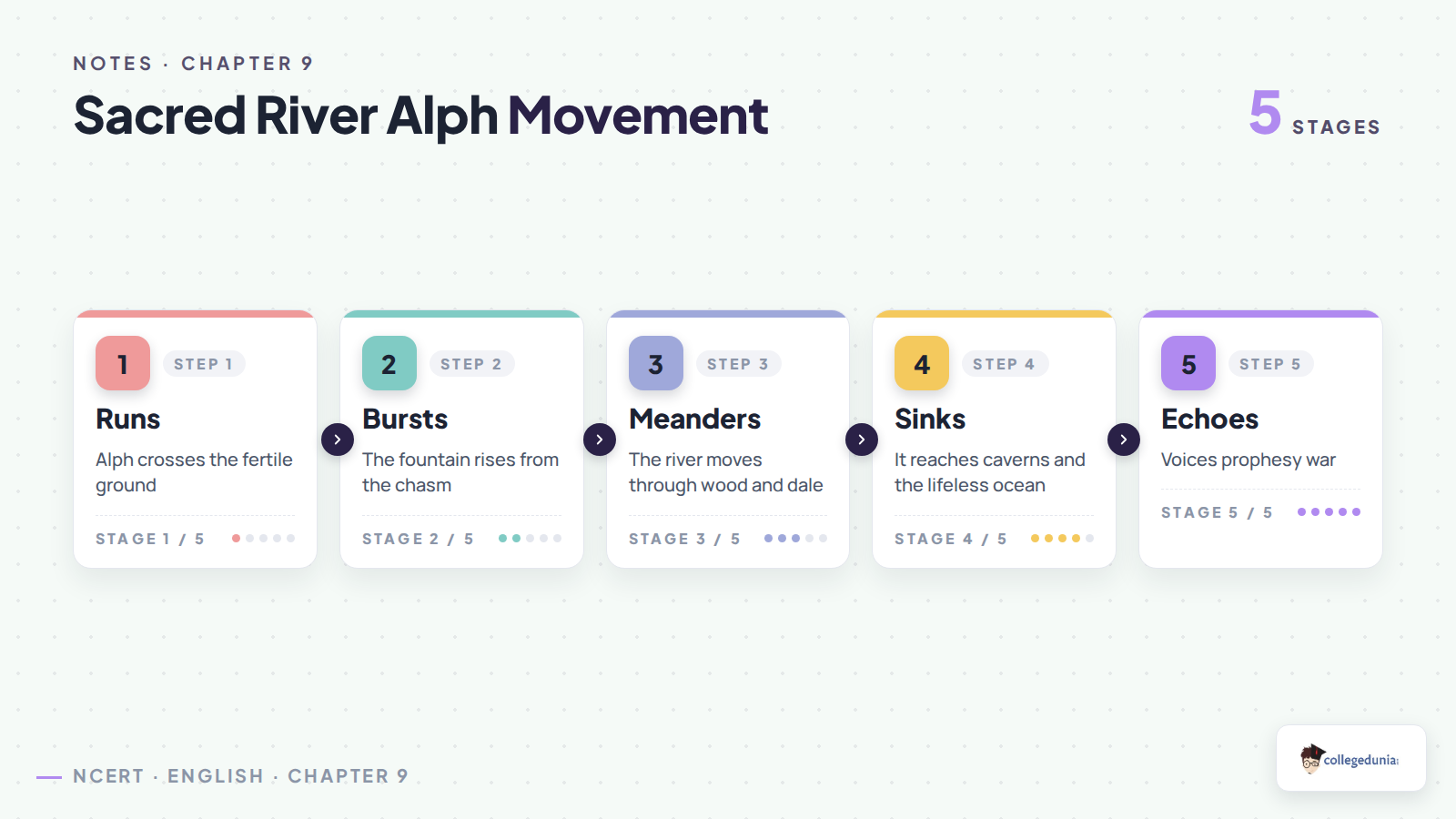
The chasm is called deep, romantic, savage, holy and enchanted. It is the poem's centre of fear and creative energy. The war prophecy is the discordant note that disturbs Kubla's world.
- The chasm links nature with sacred mystery.
- The fountain shows violent pressure from below.
- Ancestral voices connect royal grandeur with political fear.
Kubla Khan Poetic Ecstasy and Magical Elements
The final movement shifts from the emperor to the poet. If the speaker could revive the maid's music, he would build the dome in air. Poetic ecstasy becomes a creative power.
- The Abyssinian maid gives the poem its musical vision.
- The dome in air shows imagination building without stone.
- The warning cries show awe and fear around the inspired poet.
Kubla Khan NCERT Questions Answer Plan
Write each answer with the exact NCERT prompt in mind. Short answers need one clear claim and one image. Long answers need grouped evidence.
| Question focus | What to write |
|---|---|
| Real and imaginary | Explain real names plus dream logic. |
| Imagery | Separate visual, sound and water movement images. |
| Discordant note | Name the ancestral voices prophesying war. |
| Fragment | Show how incompleteness preserves the dream's force. |
Related Resources for Kubla Khan Class 12 English
| Resource | Use it for | Link |
|---|---|---|
| NCERT Solutions | Full textbook answers for Chapter 9 | Open NCERT Solutions |
| NCERT Book PDF | Read the official poem text | Open NCERT Book PDF |
| Handwritten Notes | Revise from a topper's handwritten notes | Open Handwritten Notes |
All Class 12 English Supplementary Notes Chapters
| Chapter | Notes link |
|---|---|
| Chapter 6: Kaleidoscope: A Lecture upon the Shadow | Open Notes |
| Chapter 7: Kaleidoscope: Poems by Milton | Open Notes |
| Chapter 8: Kaleidoscope: Poems by Blake | Open Notes |
| Chapter 10: Kaleidoscope: Trees | Open Notes |
Kubla Khan Class 12 English Notes FAQs
Ques. What is Kubla Khan about?
Ans. Kubla Khan is about a dream vision of Xanadu, a pleasure dome, a sacred river and the poet's longing to recreate that vision through music.
Ques. Why is Kubla Khan called a fragment?
Ans. The poem is called a fragment because Coleridge could not complete the dream vision after an interruption. The broken form adds mystery.
Ques. What is the discordant note in Kubla Khan?
Ans. The discordant note is the ancestral voices prophesying war. It disturbs the beauty of Kubla's pleasure dome.
Ques. How should students revise Kubla Khan notes?
Ans. Students should revise the real and imaginary details, image groups, water movement words, magical elements and the fragment question.



Comments