




The The Argumentative Indian Class 12 English notes explain Amartya Sen's argument about India's long tradition of discussion, dissent and public reasoning. Use this 2026-27 NCERT Kaleidoscope page to revise Krishna and Arjuna, Oppenheimer, Maitreyi, gender and caste voices, democracy and the full Notes PDF.
- Download the Class 12 English Supplementary Chapter 18 Notes PDF for board revision.
- Revise duty versus consequence, public reasoning and Sen's evidence-based argument in one place.
- Student focus: the chapter tests examples and balanced interpretation more than memorised definitions.
Chapter18Kaleidoscope:TheArgumentativeIndianNotes.pdf?page=1&dpi=150)
Chapter18Kaleidoscope:TheArgumentativeIndianNotes.pdf?page=2&dpi=150)
Chapter18Kaleidoscope:TheArgumentativeIndianNotes.pdf?page=3&dpi=150)
Chapter18Kaleidoscope:TheArgumentativeIndianNotes.pdf?page=4&dpi=150)
Chapter18Kaleidoscope:TheArgumentativeIndianNotes.pdf?page=5&dpi=150)
Chapter18Kaleidoscope:TheArgumentativeIndianNotes.pdf?page=6&dpi=150)
Chapter18Kaleidoscope:TheArgumentativeIndianNotes.pdf?page=7&dpi=150)
Chapter18Kaleidoscope:TheArgumentativeIndianNotes.pdf?page=8&dpi=150)
Chapter18Kaleidoscope:TheArgumentativeIndianNotes.pdf?page=9&dpi=150)
Chapter18Kaleidoscope:TheArgumentativeIndianNotes.pdf?page=10&dpi=150)
Chapter18Kaleidoscope:TheArgumentativeIndianNotes.pdf?page=11&dpi=150)
Chapter18Kaleidoscope:TheArgumentativeIndianNotes.pdf?page=12&dpi=150)
Chapter18Kaleidoscope:TheArgumentativeIndianNotes.pdf?page=13&dpi=150)
Chapter18Kaleidoscope:TheArgumentativeIndianNotes.pdf?page=14&dpi=150)
Chapter18Kaleidoscope:TheArgumentativeIndianNotes.pdf?page=15&dpi=150)
Chapter18Kaleidoscope:TheArgumentativeIndianNotes.pdf?page=16&dpi=150)
Chapter18Kaleidoscope:TheArgumentativeIndianNotes.pdf?page=17&dpi=150)
Chapter18Kaleidoscope:TheArgumentativeIndianNotes.pdf?page=18&dpi=150)
Chapter18Kaleidoscope:TheArgumentativeIndianNotes.pdf?page=19&dpi=150)
Chapter18Kaleidoscope:TheArgumentativeIndianNotes.pdf?page=20&dpi=150)
Chapter18Kaleidoscope:TheArgumentativeIndianNotes.pdf?page=21&dpi=150)
Chapter18Kaleidoscope:TheArgumentativeIndianNotes.pdf?page=22&dpi=150)
Chapter18Kaleidoscope:TheArgumentativeIndianNotes_flat_MobileCard.pdf?page=1&dpi=150)
Chapter18Kaleidoscope:TheArgumentativeIndianNotes_flat_MobileCard.pdf?page=2&dpi=150)
Chapter18Kaleidoscope:TheArgumentativeIndianNotes_flat_MobileCard.pdf?page=3&dpi=150)
Chapter18Kaleidoscope:TheArgumentativeIndianNotes_flat_MobileCard.pdf?page=4&dpi=150)
Chapter18Kaleidoscope:TheArgumentativeIndianNotes_flat_MobileCard.pdf?page=5&dpi=150)
Chapter18Kaleidoscope:TheArgumentativeIndianNotes_flat_MobileCard.pdf?page=6&dpi=150)
Chapter18Kaleidoscope:TheArgumentativeIndianNotes_flat_MobileCard.pdf?page=7&dpi=150)
Chapter18Kaleidoscope:TheArgumentativeIndianNotes_flat_MobileCard.pdf?page=8&dpi=150)
Chapter18Kaleidoscope:TheArgumentativeIndianNotes_flat_MobileCard.pdf?page=9&dpi=150)
Chapter18Kaleidoscope:TheArgumentativeIndianNotes_flat_MobileCard.pdf?page=10&dpi=150)
Chapter18Kaleidoscope:TheArgumentativeIndianNotes_flat_MobileCard.pdf?page=11&dpi=150)
Chapter18Kaleidoscope:TheArgumentativeIndianNotes_flat_MobileCard.pdf?page=12&dpi=150)
Chapter18Kaleidoscope:TheArgumentativeIndianNotes_flat_MobileCard.pdf?page=13&dpi=150)
Chapter18Kaleidoscope:TheArgumentativeIndianNotes_flat_MobileCard.pdf?page=14&dpi=150)
Chapter18Kaleidoscope:TheArgumentativeIndianNotes_flat_MobileCard.pdf?page=15&dpi=150)
Chapter18Kaleidoscope:TheArgumentativeIndianNotes_flat_MobileCard.pdf?page=16&dpi=150)
Chapter18Kaleidoscope:TheArgumentativeIndianNotes_flat_MobileCard.pdf?page=17&dpi=150)
Chapter18Kaleidoscope:TheArgumentativeIndianNotes_flat_MobileCard.pdf?page=18&dpi=150)
Chapter18Kaleidoscope:TheArgumentativeIndianNotes_flat_MobileCard.pdf?page=19&dpi=150)
Chapter18Kaleidoscope:TheArgumentativeIndianNotes_flat_MobileCard.pdf?page=20&dpi=150)
Chapter18Kaleidoscope:TheArgumentativeIndianNotes_flat_MobileCard.pdf?page=21&dpi=150)
Chapter18Kaleidoscope:TheArgumentativeIndianNotes_flat_MobileCard.pdf?page=22&dpi=150)
Chapter18Kaleidoscope:TheArgumentativeIndianNotes_flat_MobileCard.pdf?page=23&dpi=150)
Chapter18Kaleidoscope:TheArgumentativeIndianNotes_flat_MobileCard.pdf?page=24&dpi=150)
Chapter18Kaleidoscope:TheArgumentativeIndianNotes_flat_MobileCard.pdf?page=25&dpi=150)
Chapter18Kaleidoscope:TheArgumentativeIndianNotes_flat_MobileCard.pdf?page=26&dpi=150)
These Class 12 English Supplementary The Argumentative Indian notes are checked against the 2026-27 NCERT chapter and built for quick revision.
Student Feedback on The Argumentative Indian
In a Collegedunia poll of 12,680 Class 12 English students using NCERT literature resources, most students found this essay easier after grouping Sen's evidence by moral debate, social voice and democracy.
- 84% wanted a clear difference between faring forward and faring well.
- 78% needed help linking Maitreyi with development as freedom.
- 73% revised the democracy question better through public reasoning examples.
Source: 2026-27 Class 12 English student poll. Sample of 12,680 students using NCERT-aligned study resources.
The Argumentative Indian Class 12 Summary
The Argumentative Indian is Sen's essay on India's tradition of debate, questioning and public reasoning. He begins with prolixity, moves to the epics, and then shows how argument appears in moral, social and political life.
- Central claim: Indian culture has a deep dialogic tradition.
- Key contrast: public reasoning is different from mere talkativeness.
- Answer cue: use named examples such as Krishna, Arjuna, Gargi, Maitreyi, Kabir and democracy.
The Argumentative Indian Class 12 Video Explanation
Source: Magnet Brains on YouTube
Krishna, Arjuna and Oppenheimer
Sen reads the Gita as a debate between duty and consequence. Krishna asks Arjuna to act on duty, while Arjuna worries about the human cost of war. Oppenheimer's atomic-bomb dilemma makes the ancient question modern.
| Idea | NCERT cue | Revision meaning |
|---|---|---|
| Faring forward | act because duty demands it | Krishna's duty-based position. |
| Faring well | judge human consequences | Sen's necessary supplement. |
| Oppenheimer | technical success and later moral reflection | Modern version of the same dilemma. |
| Sen's view | the Gita is one part of the Mahabharata | Broader debate matters more than one fixed message. |
Gender, Caste, Class and Community Voices
Sen does not pretend that old India was equal. He says the story is more complex: women and disadvantaged groups often used argument to question power, caste, materialism and social hierarchy.
| Example | What it shows | Use in answer |
|---|---|---|
| Gargi | woman scholar questions Yajnavalkya | Ancient female intellectual voice. |
| Maitreyi | wealth cannot secure full human fulfilment | Development must mean capability and life. |
| Bharadvaja | shared emotions question caste division | Anti-caste reasoning in classical debate. |
| Kabir and others | working-class poets reject barriers | Argument crosses class and community. |
Democracy as Public Reasoning
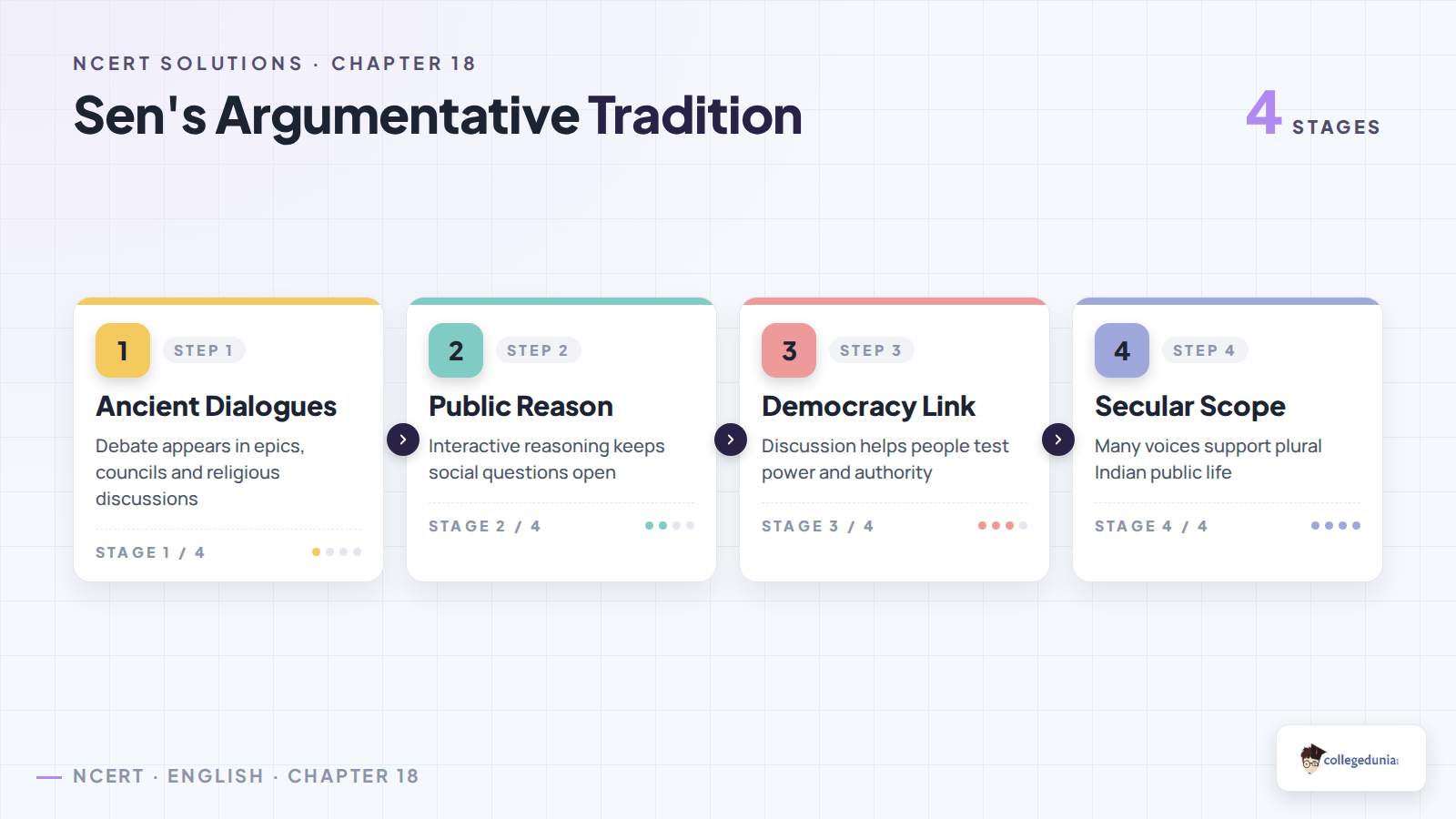
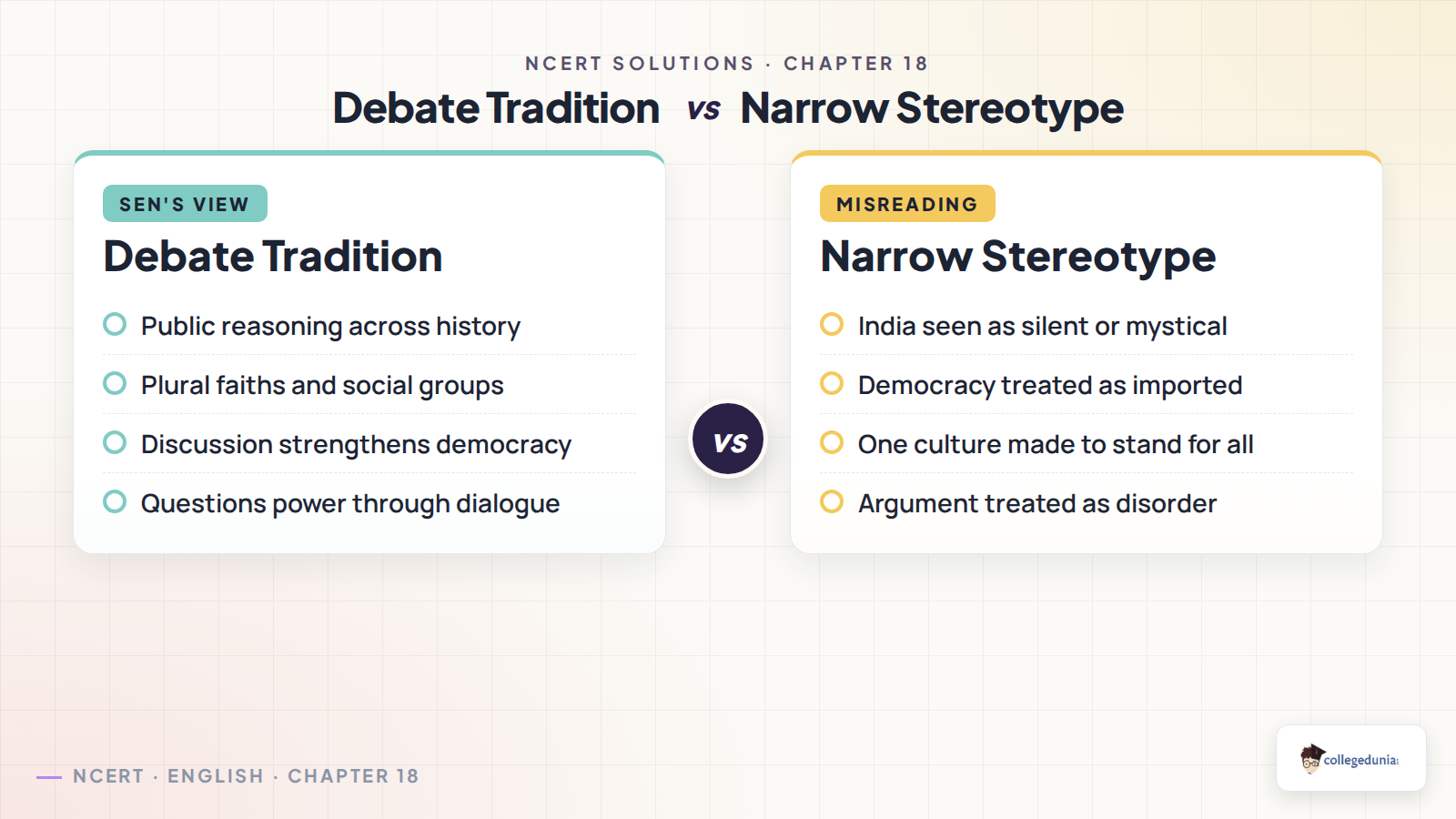
Sen connects India's democratic success with traditions of public discussion and heterodoxy. He avoids two errors: democracy was not only a Western gift, and India was not uniquely destined for democracy.
- Public reasoning: discussion and interactive reasoning help democracy survive.
- Heterodoxy: different views can coexist and argue in public.
- Balanced view: India learned from Western institutions and also drew on its own dialogic traditions.
- Exam cue: mention both misconceptions before giving Sen's corrected position.
Important Evidence for Board Answers
Sen's essay is argumentative writing because it supports claims with evidence. Use short evidence clusters instead of writing broad cultural statements.
| Evidence | Claim supported | Best answer use |
|---|---|---|
| Krishna Menon's United Nations speech | Indians can speak at length | Opening example of prolixity. |
| Ramayana and Mahabharata | dialogue and debate are old | Proof of cultural depth. |
| Krishna and Arjuna | duty needs consequence analysis | Stop and Think answer. |
| Gargi, Maitreyi and Draupadi | women appear as argumentative voices | Gender section evidence. |
| Bharadvaja, Kabir, Dadu, Ravi-das, Sena | argument crosses caste and class | Social inclusion answer. |
Related Resources for The Argumentative Indian Class 12 English
| Resource | Use it for | Link |
|---|---|---|
| NCERT Solutions | Full textbook answers for Chapter 18 | Open NCERT Solutions |
| NCERT Book PDF | Read the official chapter text | Open NCERT Book PDF |
| Handwritten Notes | Revise from concise handwritten notes | Open Handwritten Notes |
All Class 12 English Supplementary Notes Chapters
| Chapter | Notes link |
|---|---|
| Chapter 14: Kaleidoscope: Freedom | Open Notes |
| Chapter 15: Kaleidoscope: The Mark on the Wall | Open Notes |
| Chapter 16: Kaleidoscope: Film-Making | Open Notes |
| Chapter 17: Kaleidoscope: Why the Novel Matters | Open Notes |
| Chapter 19: Kaleidoscope: On Science Fiction | Open Notes |
The Argumentative Indian Class 12 English Notes FAQs
Ques. What is The Argumentative Indian in Class 12 English about?
Ans. The Argumentative Indian is Amartya Sen's essay on India's tradition of debate, dissent, public reasoning and democratic discussion.
Ques. What is the difference between faring forward and faring well?
Ans. Faring forward means acting from duty. Faring well means also considering the human consequences of that action.
Ques. Why does Sen mention Maitreyi?
Ans. Sen uses Maitreyi's question to show that wealth is not enough. Development must expand life, freedom and real capability.
Ques. How should students revise The Argumentative Indian notes?
Ans. Students should revise the essay in three groups: moral debate, gender and caste voices, and democracy as public reasoning.



Comments