




Class 12 Economics Chapter 6 Open Economy Macroeconomics is the last chapter of the Macroeconomics book. It covers the balance of payments, the foreign exchange market and the three exchange rate regimes. This page has the full revision notes and a free PDF to download.
Here is what this chapter is worth in the exam:
- CBSE Boards: about 9 to 10 marks, mixing theory and one BoP or exchange rate numerical.
- CUET: 2 to 3 questions every year on BoP and exchange rate basics.
- Revision time: about 35 minutes with these notes.
What These Open Economy Macroeconomics Class 12 Notes Cover
The chapter sits on two pillars: the balance of payments and the foreign exchange market. The notes give each topic a short, exam-ready summary:
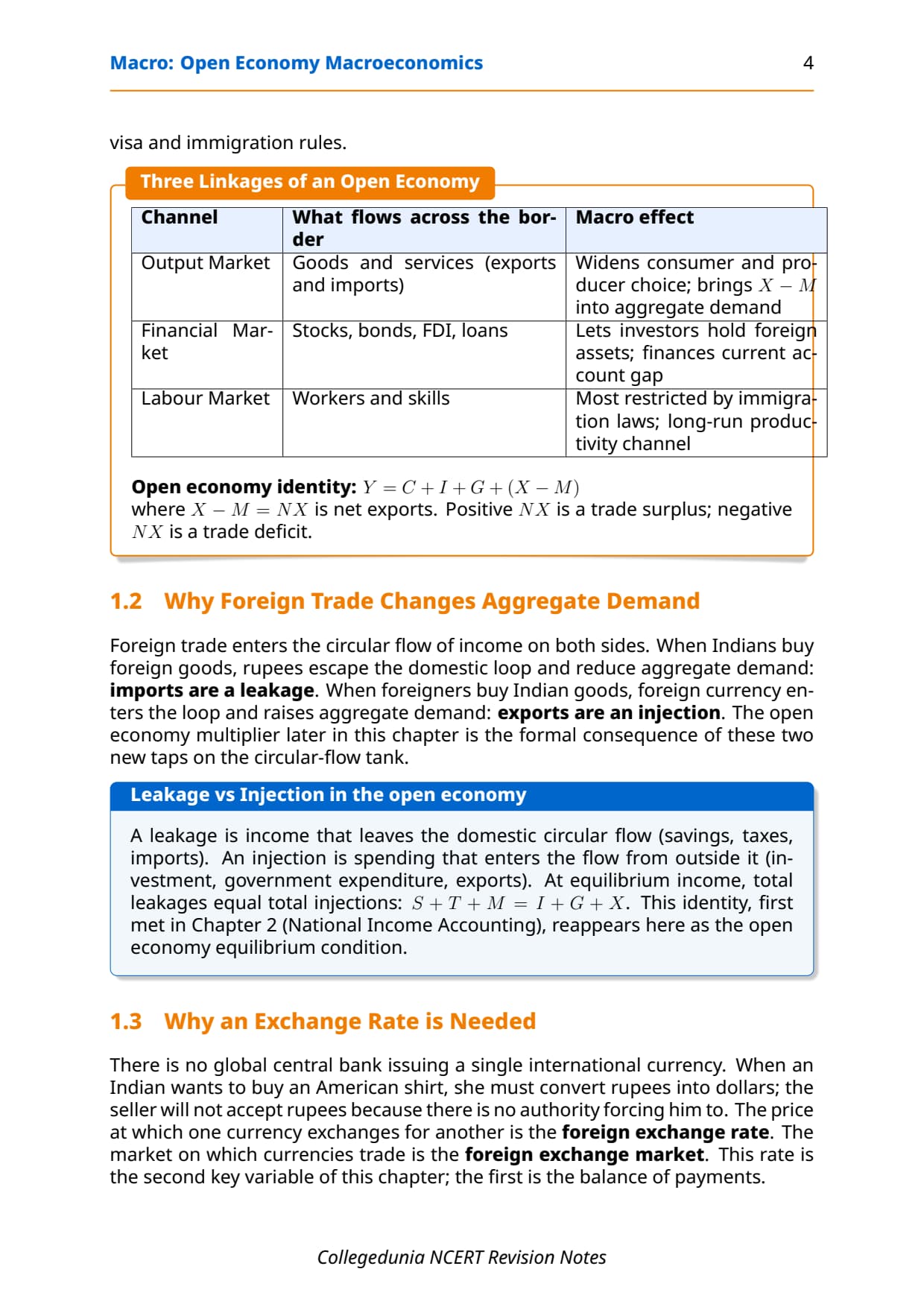
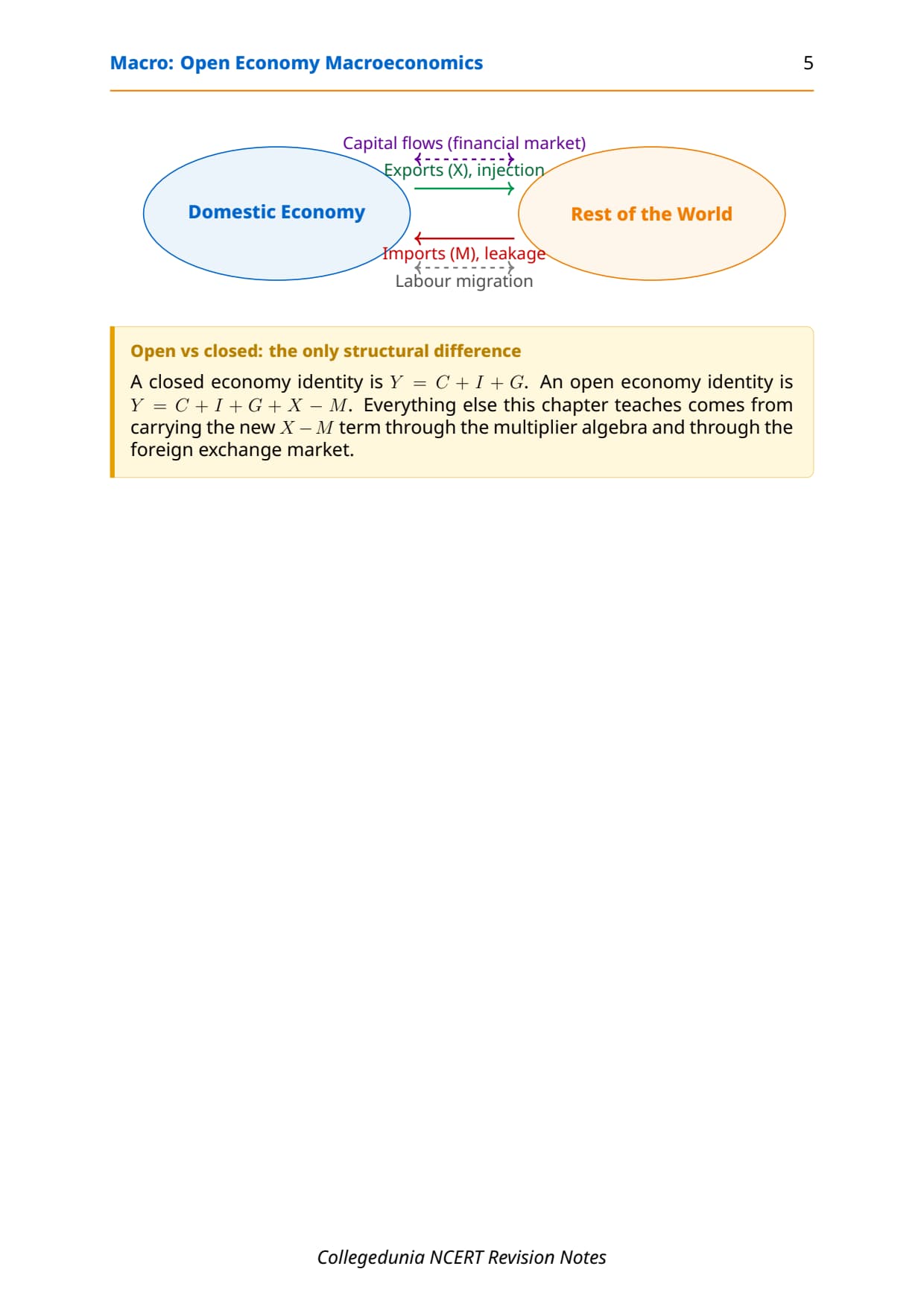
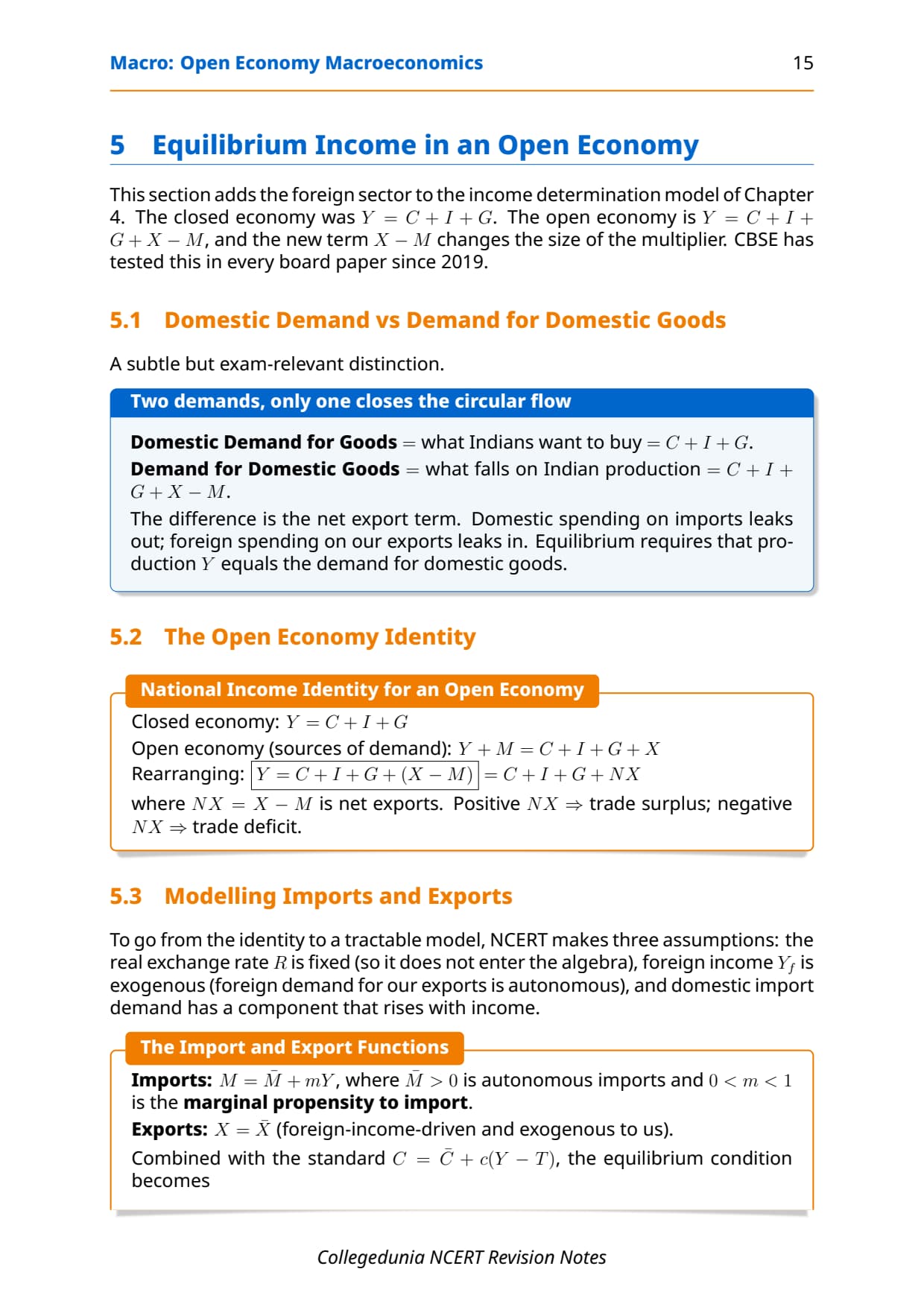
- National income identity: Y = C + I + G + (X minus M), with net exports as the new term.
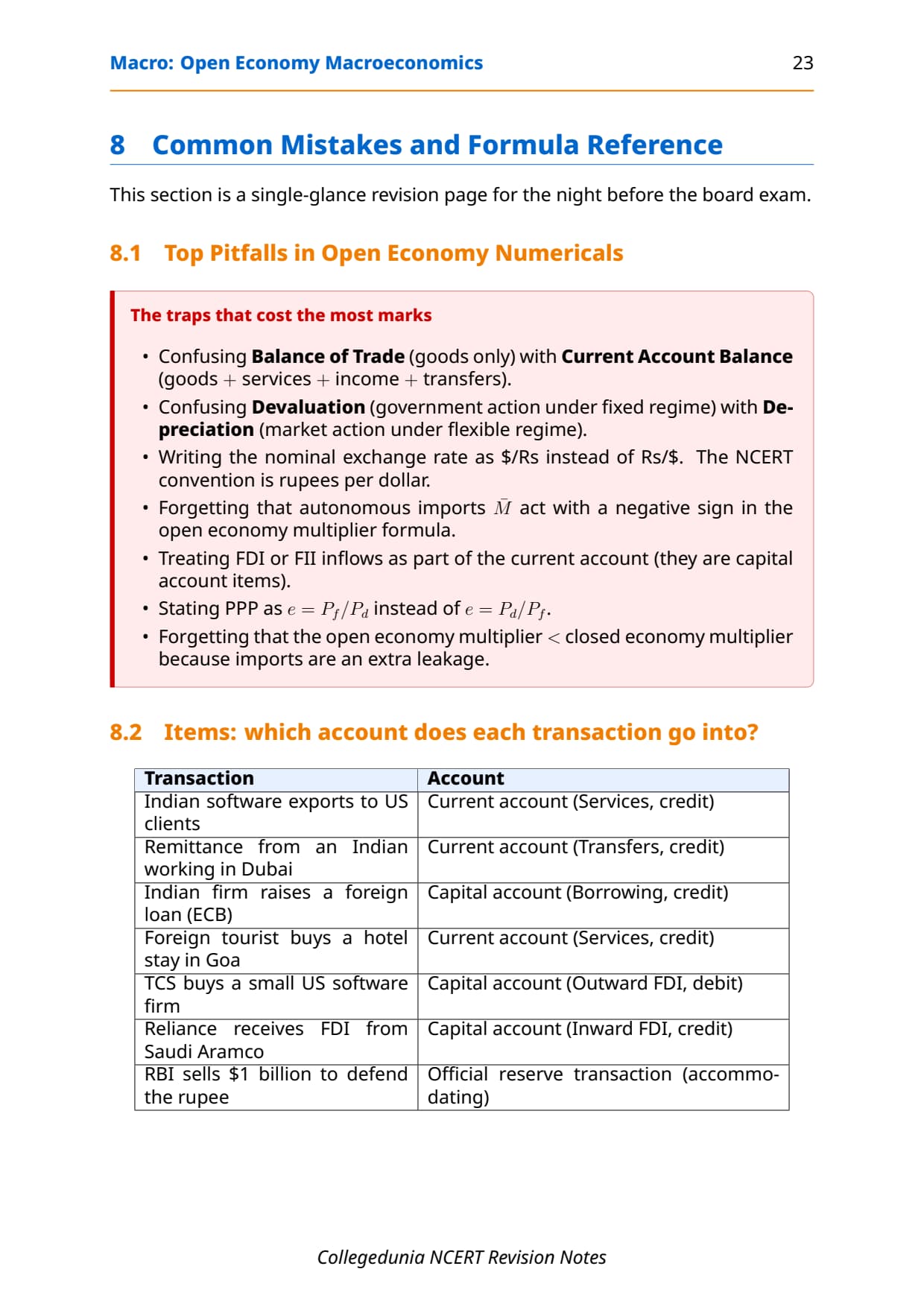
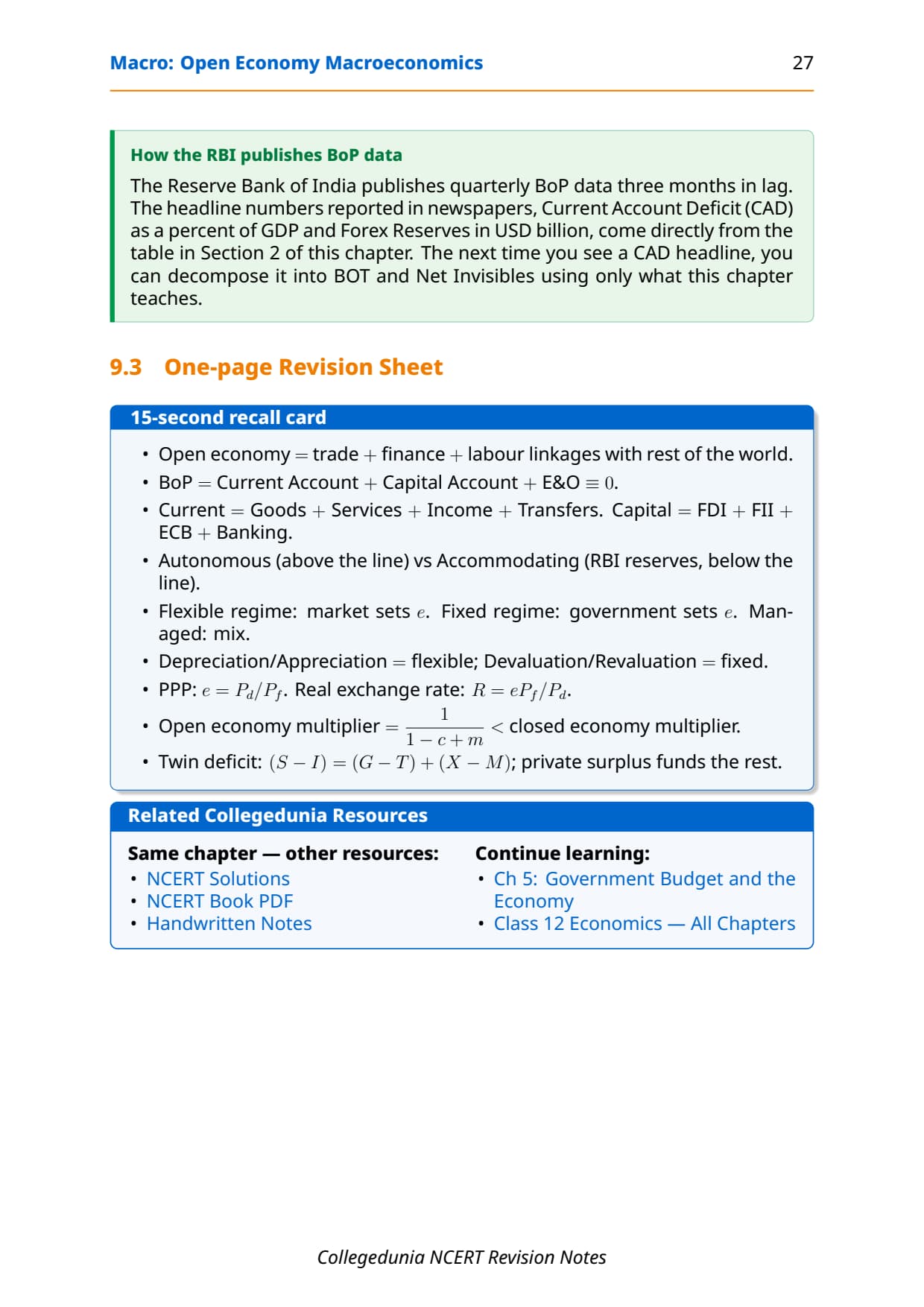
- Balance of payments: the current account and the capital account.
- Autonomous vs accommodating items: the most-confused 3-mark theory point.
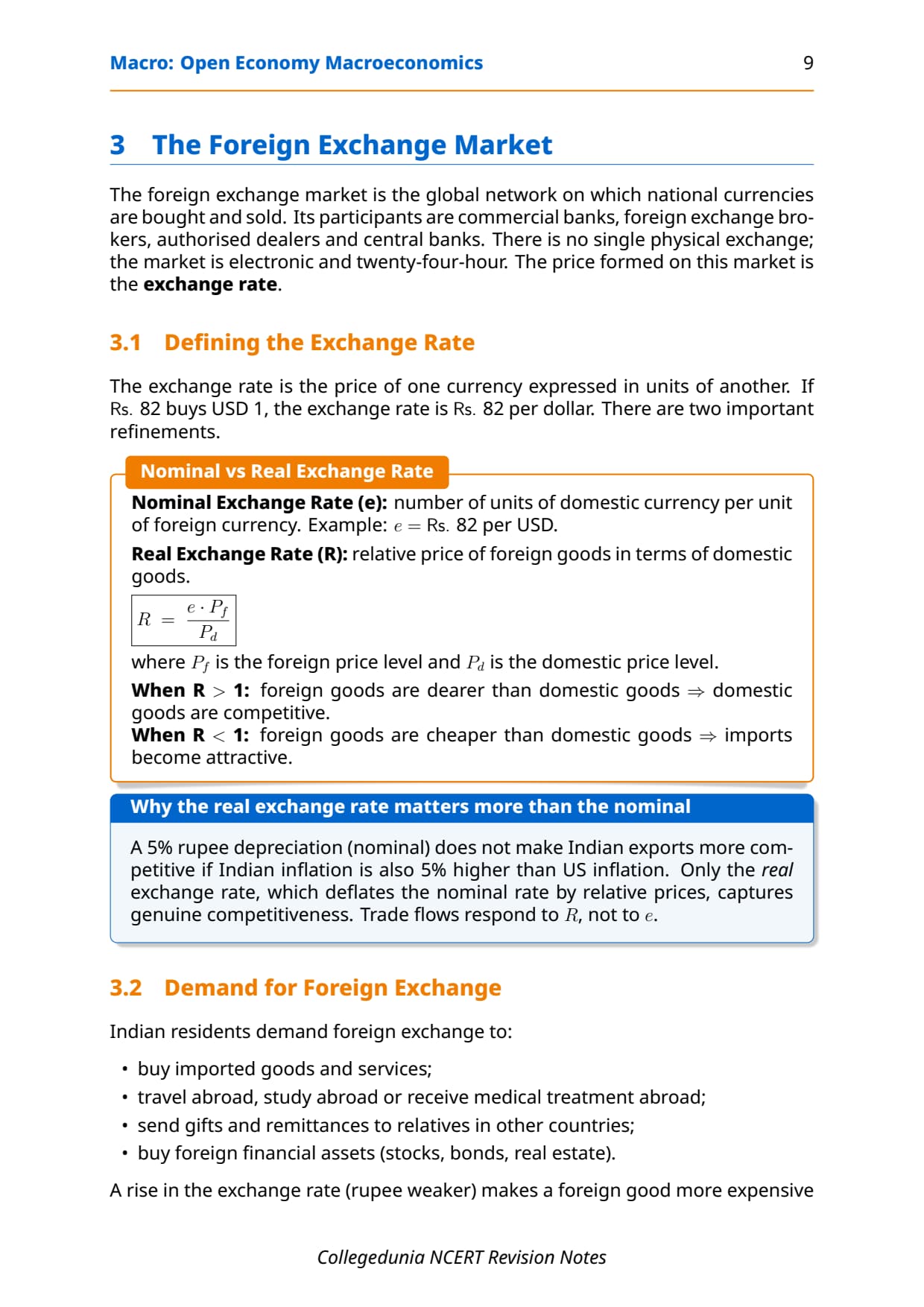
- Foreign exchange rate and market: demand, supply and the real rate.
- Exchange rate regimes: fixed, flexible and managed float.
The same NCERT topics are worked one question at a time in the matching NCERT Solutions for Class 12 Economics Chapter 6.
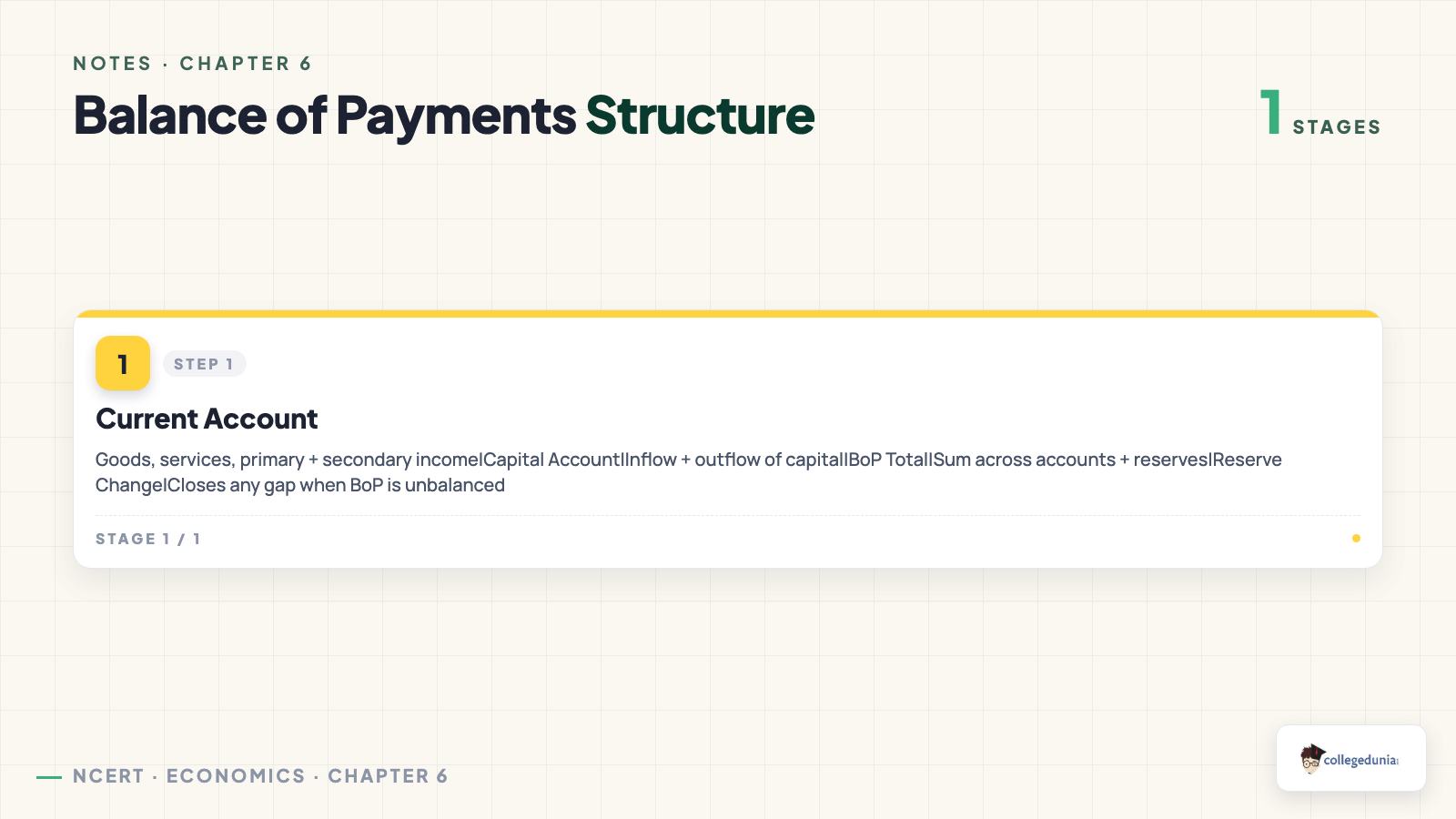
Balance of Payments Class 12 Notes: Structure and Components
This is the most-tested block in the chapter. Most objective questions start with a definition or ask which account a transaction sits in. The lines below are short enough to write in a board answer.
| Term | One-line meaning |
|---|---|
| Balance of Payments (BoP) | A record of all transactions between residents and the rest of the world in one year. |
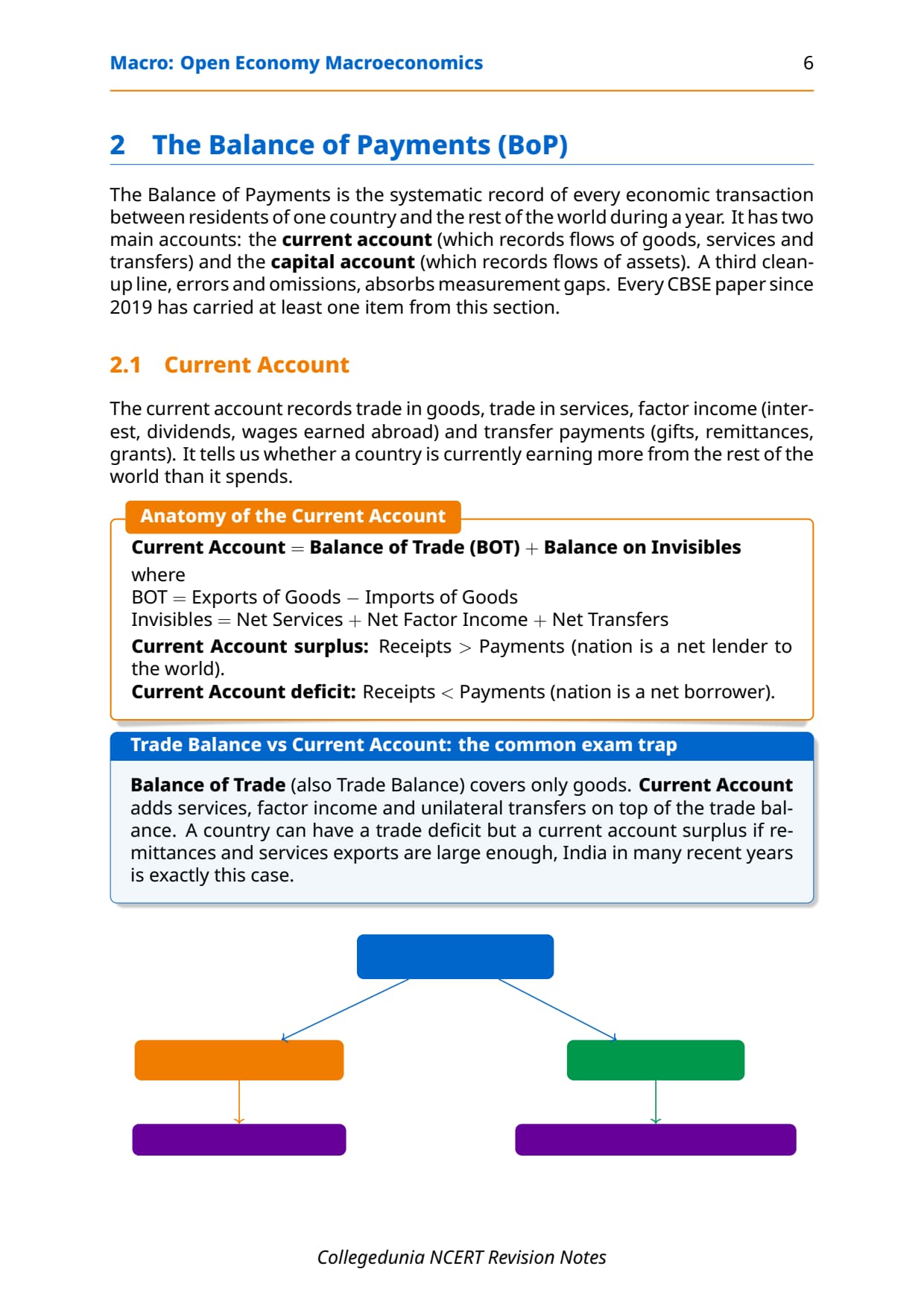
| Current Account | Goods, services, primary income (factor income) and secondary income (transfers). |
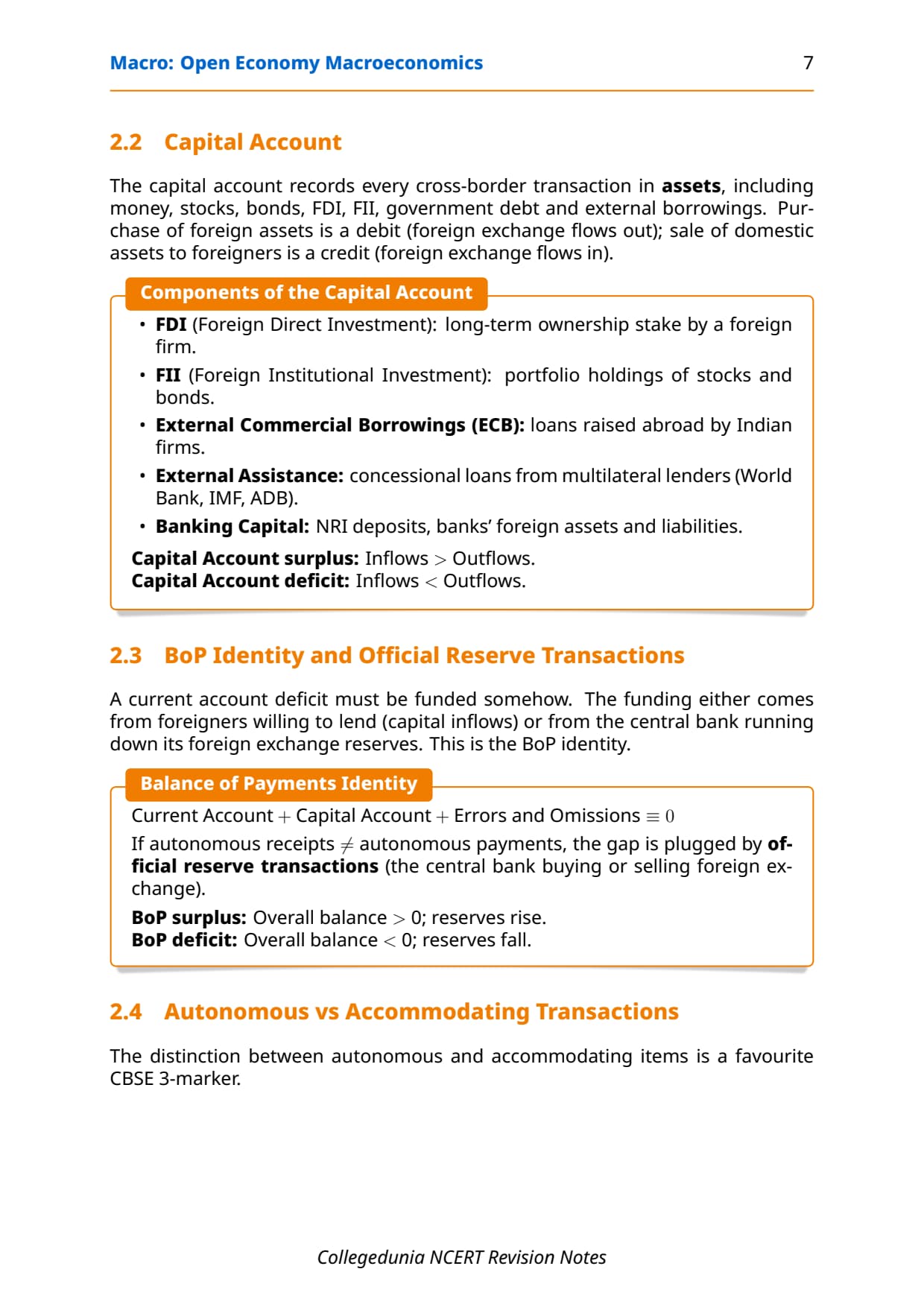
| Capital Account | Changes in foreign assets and liabilities: FDI, portfolio flows, loans, banking capital. |
| Balance of Trade (BoT) | Exports of goods minus imports of goods; a part of the current account. |
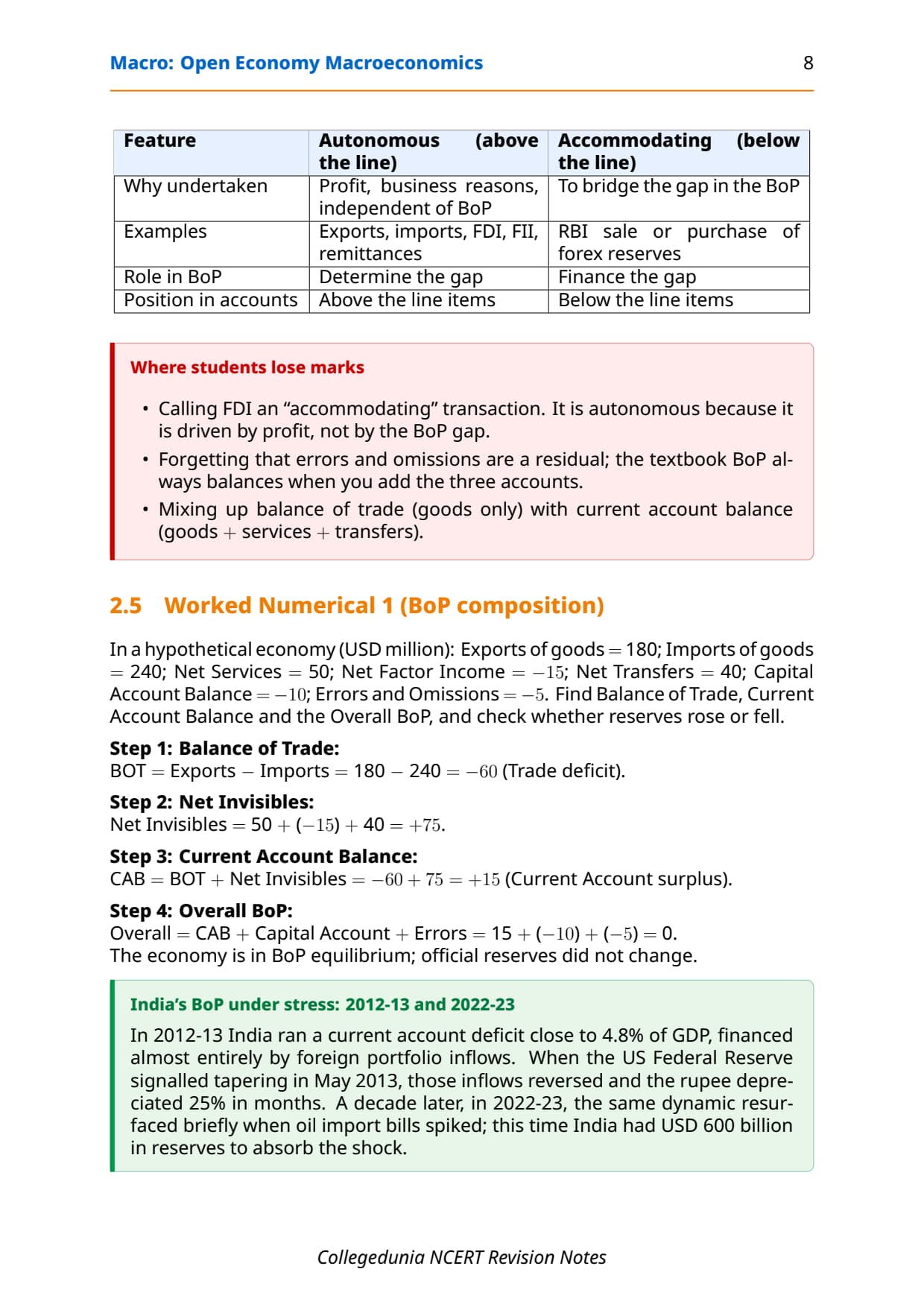
| Autonomous items | Done for their own sake, independent of the BoP gap; "above the line". |
| Accommodating items | Done only to settle the BoP gap, like reserve changes; "below the line". |
The current account has four parts: goods, services, primary income and secondary income. India usually runs a goods deficit, a services surplus and a large remittance inflow. The change in official reserves is an accommodating item, not an autonomous capital flow. That is the single most-confused point in the board paper.
A BoP is in balance when autonomous credits equal autonomous debits. The gap is then plugged by accommodating items. Any 3-mark question on this distinction expects that exact framing.
Open Economy National Income Identity in Class 12 Economics
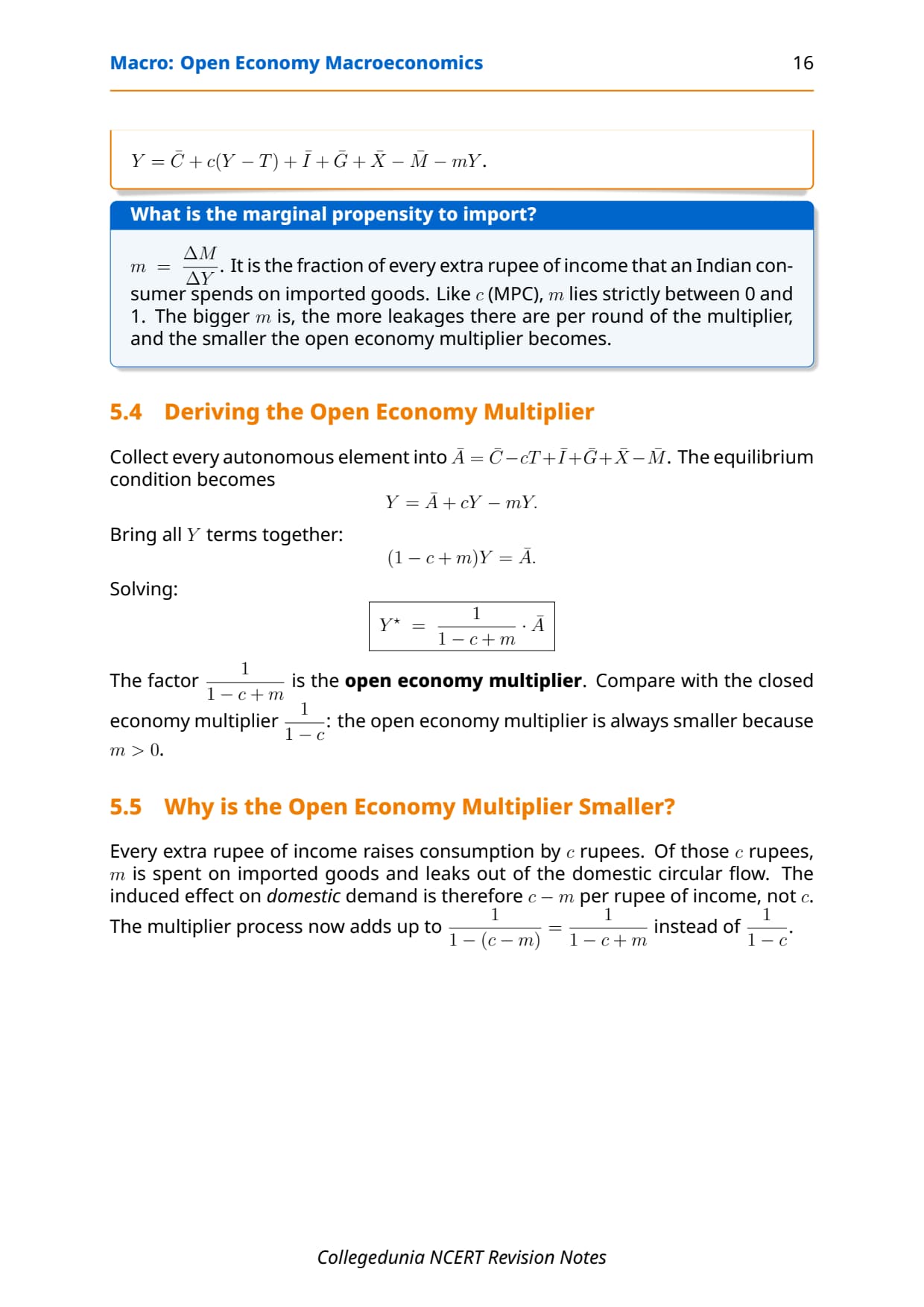
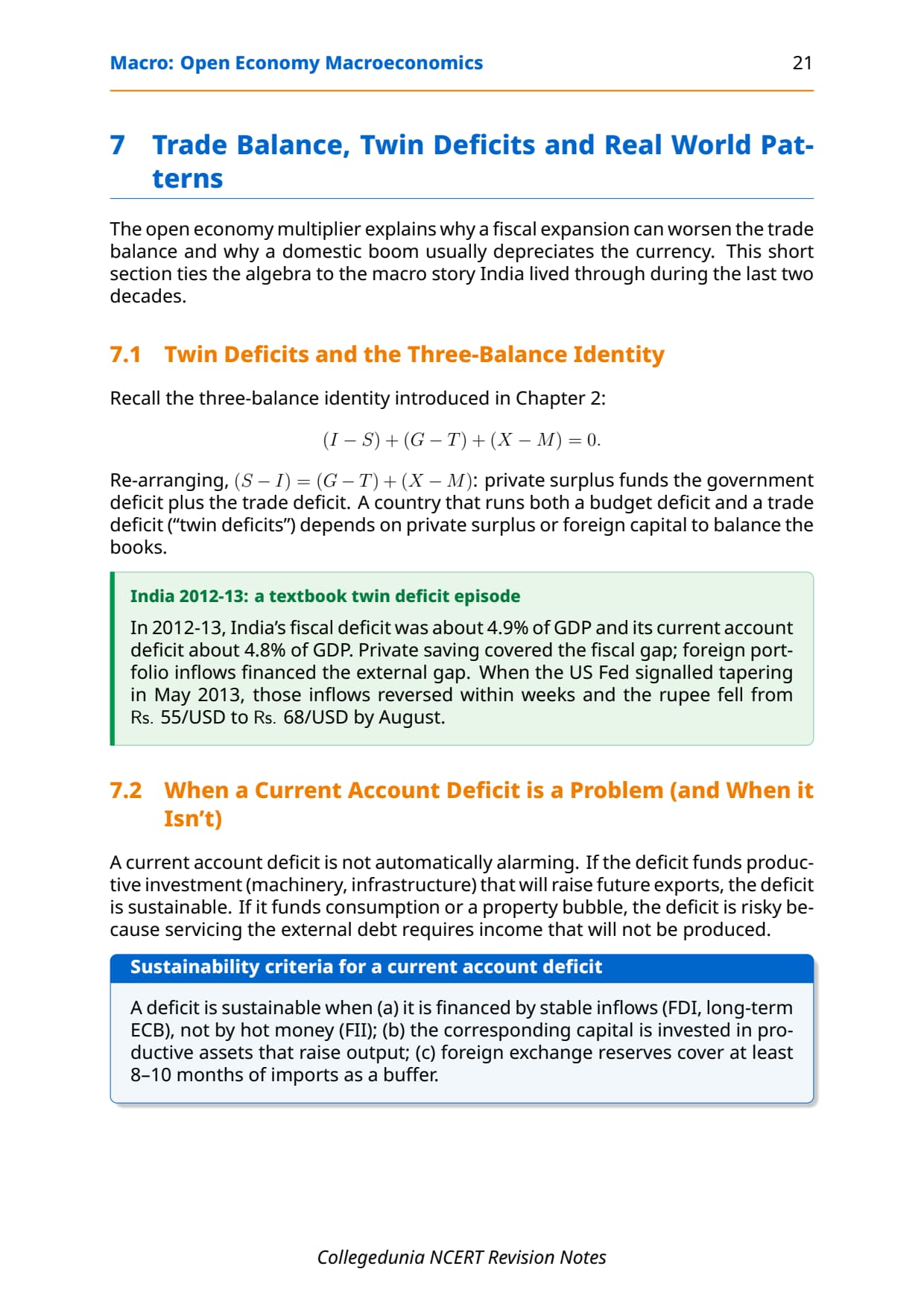
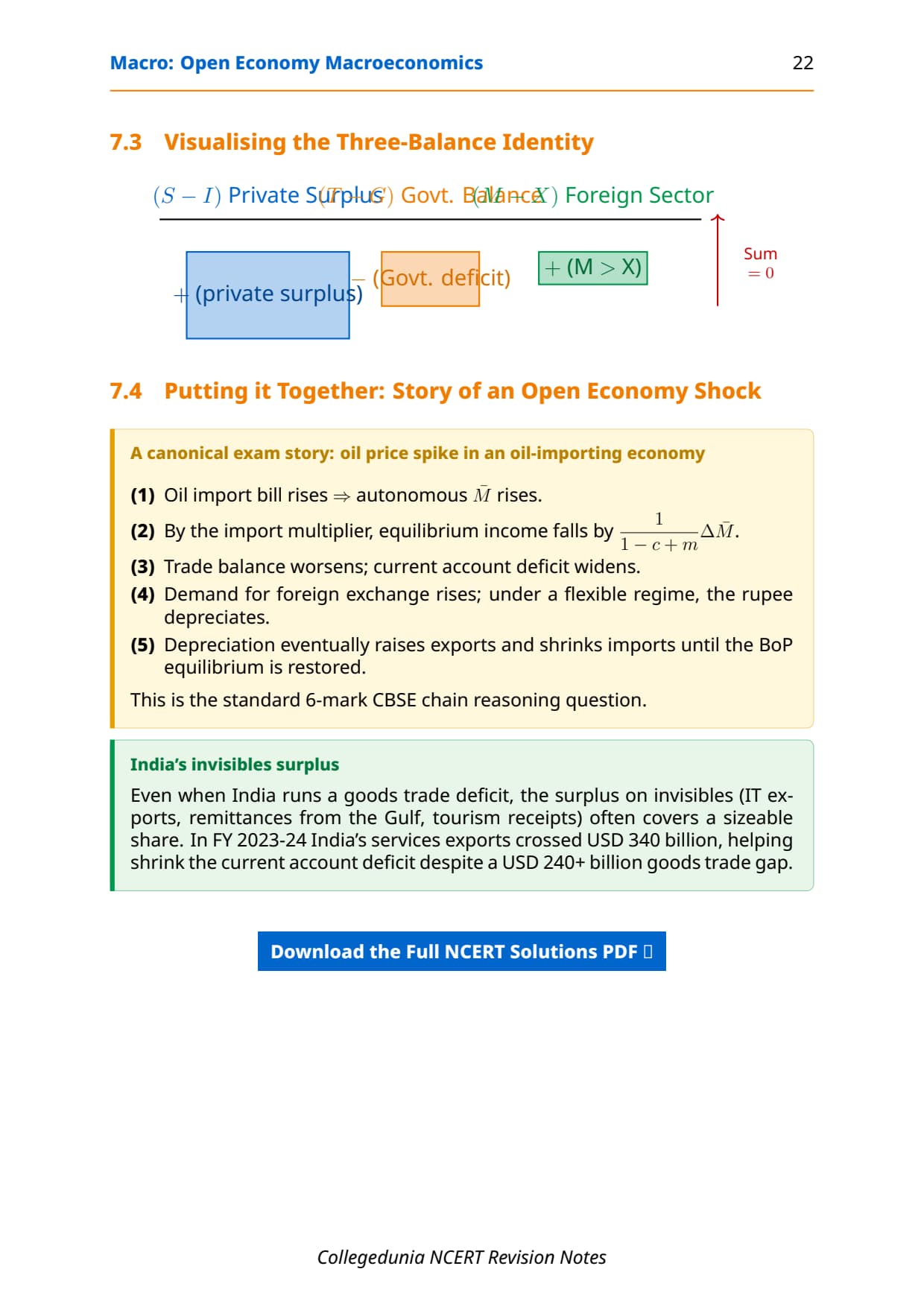
Once the economy is open, the closed identity Y = C + I + G gains one extra term. The full identity is Y = C + I + G + (X minus M). Rearranging gives the savings-investment version: (S minus I) + (T minus G) = (X minus M).
Memory hook: a current account deficit means the country either dis-saves in the private sector or runs a fiscal deficit, or both. For a numerical, start from Y = C + I + G + (X minus M) and put in each function one at a time.
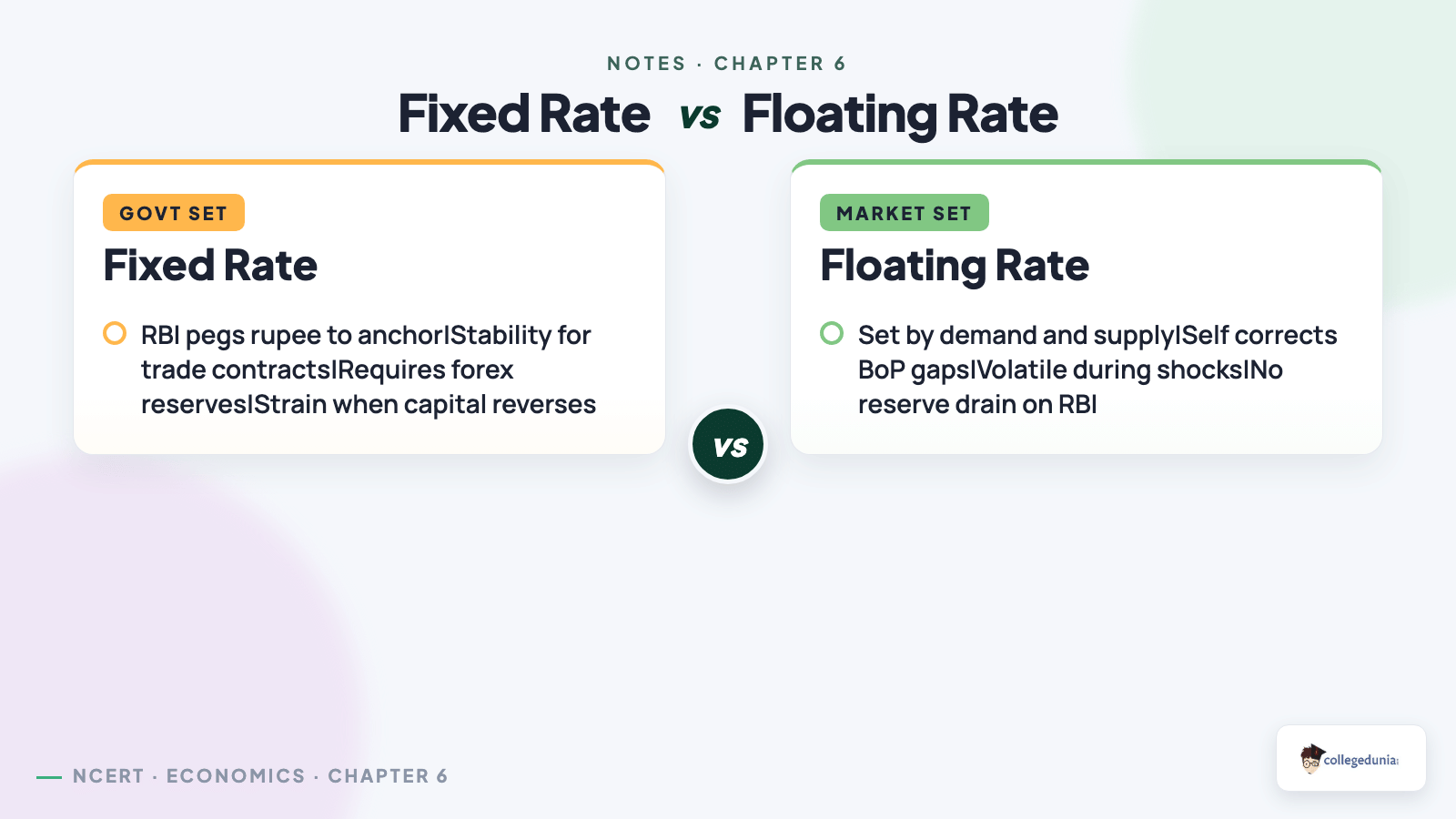
Foreign Exchange Rate and Foreign Exchange Market Notes
The foreign exchange rate is the price of one currency in terms of another. The foreign exchange market is where that price is set. This is the second most-tested area after the BoP.
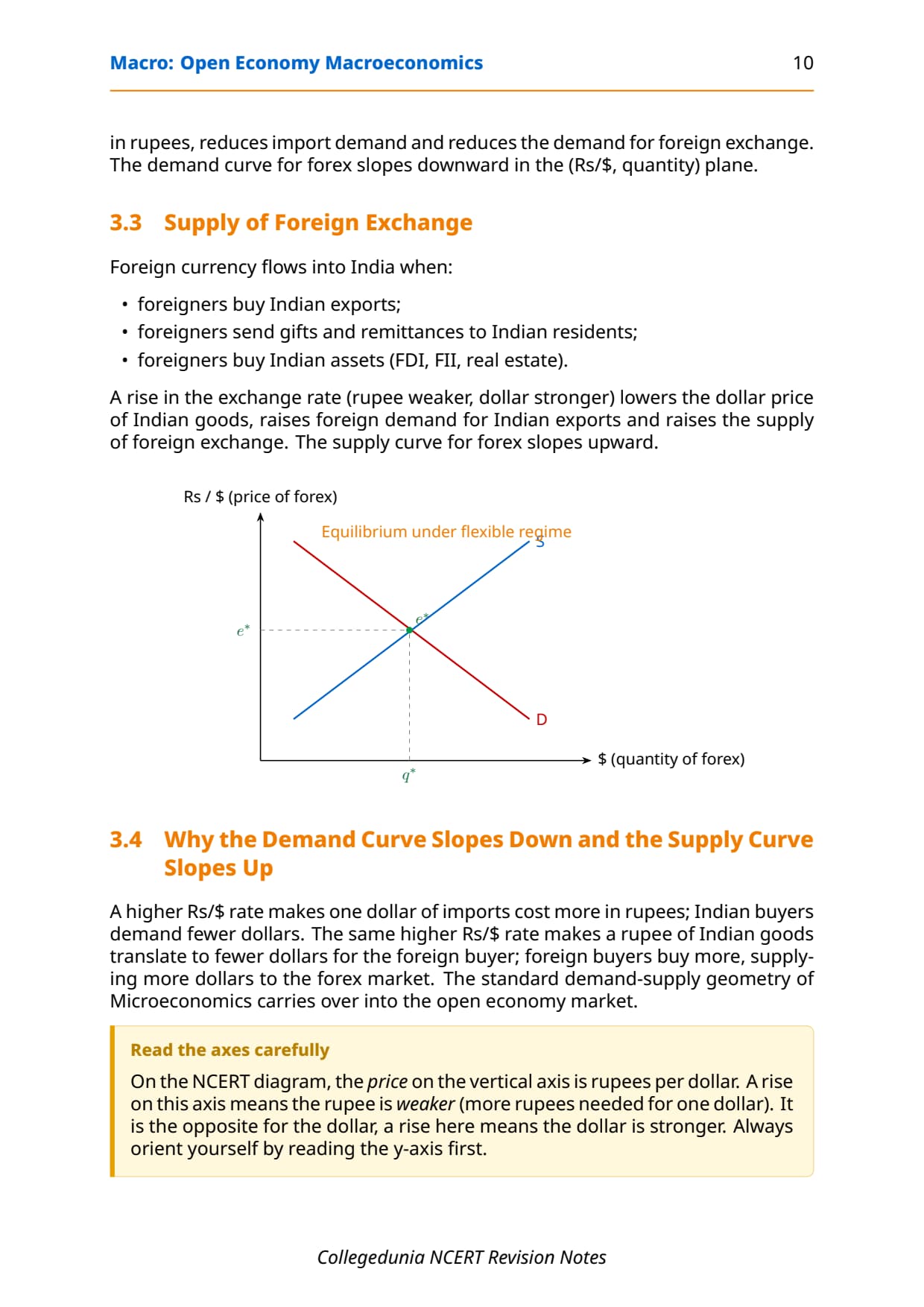
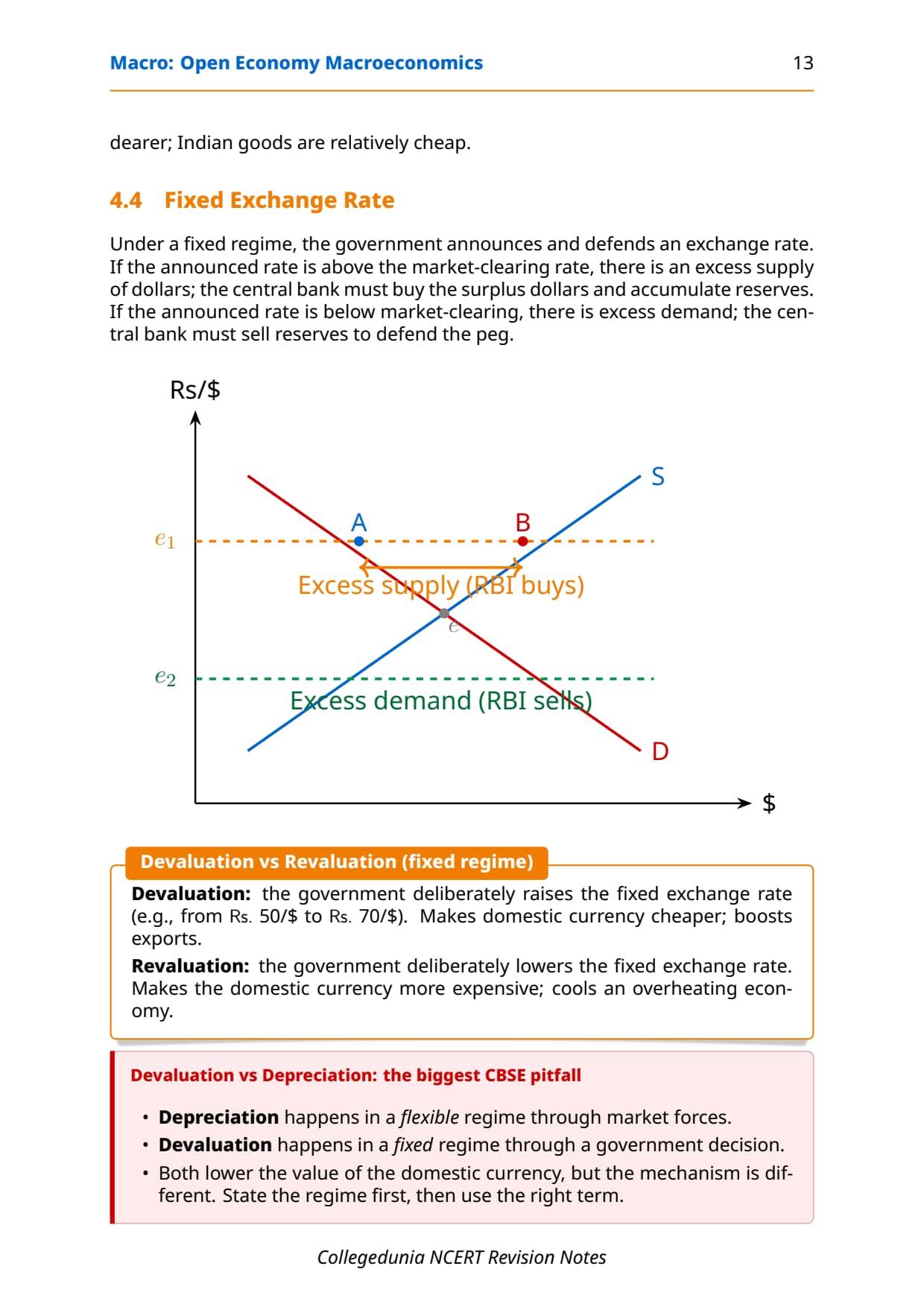
- Demand for forex comes from imports, payments abroad, capital outflows and travel. It slopes down against the rate.
- Supply of forex comes from exports, receipts, capital inflows and inbound travel. It slopes up.
- Equilibrium is where the two curves cross.
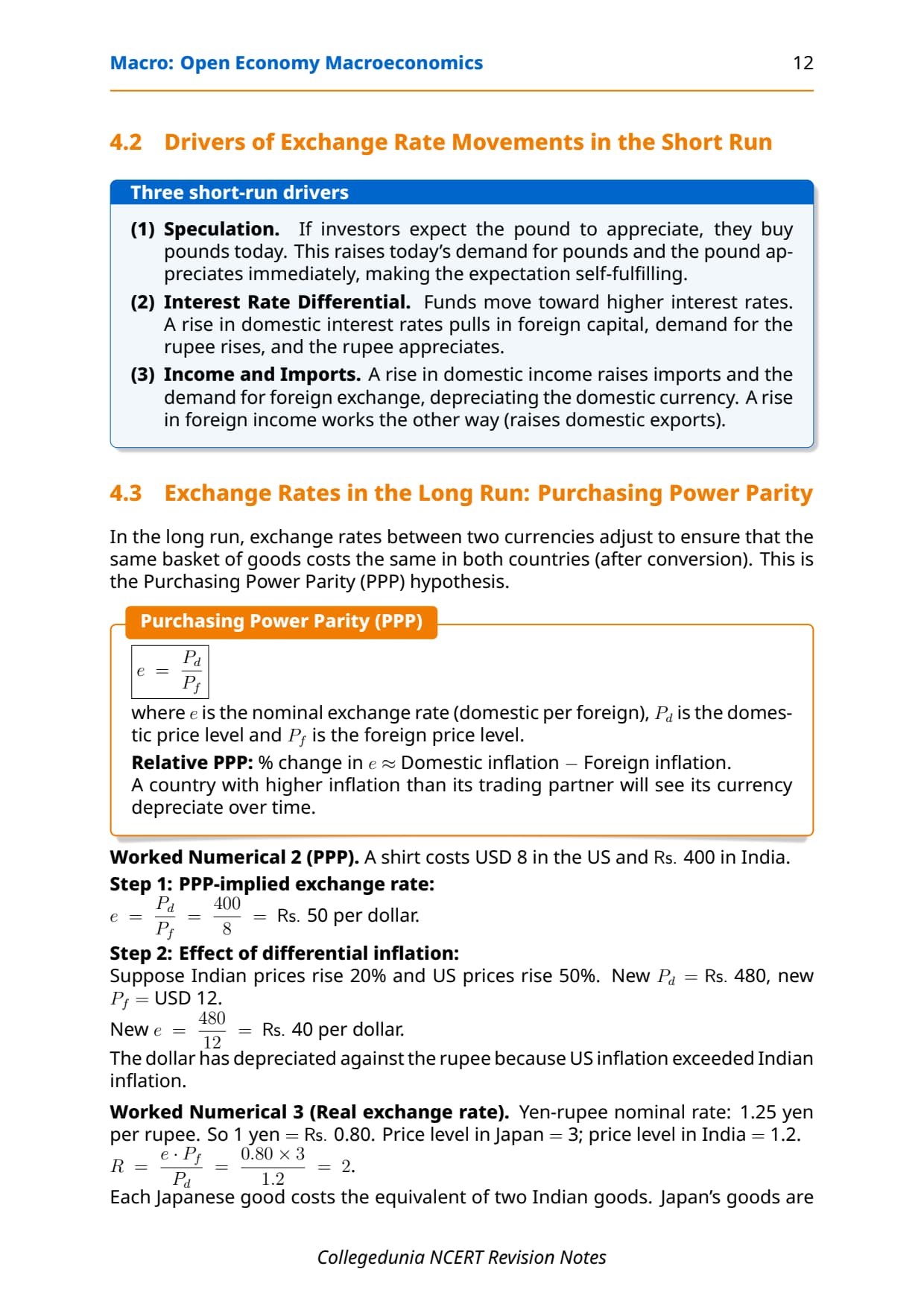
- Real exchange rate = (Nominal rate times Foreign price level) divided by Domestic price level. It measures competitiveness.
Exchange Rate Regimes for Class 12 Economics Chapter 6
The third pillar is the choice of regime. There are three textbook options, and CBSE asks a 4 or 6-mark question on their merits and drawbacks in alternate years.
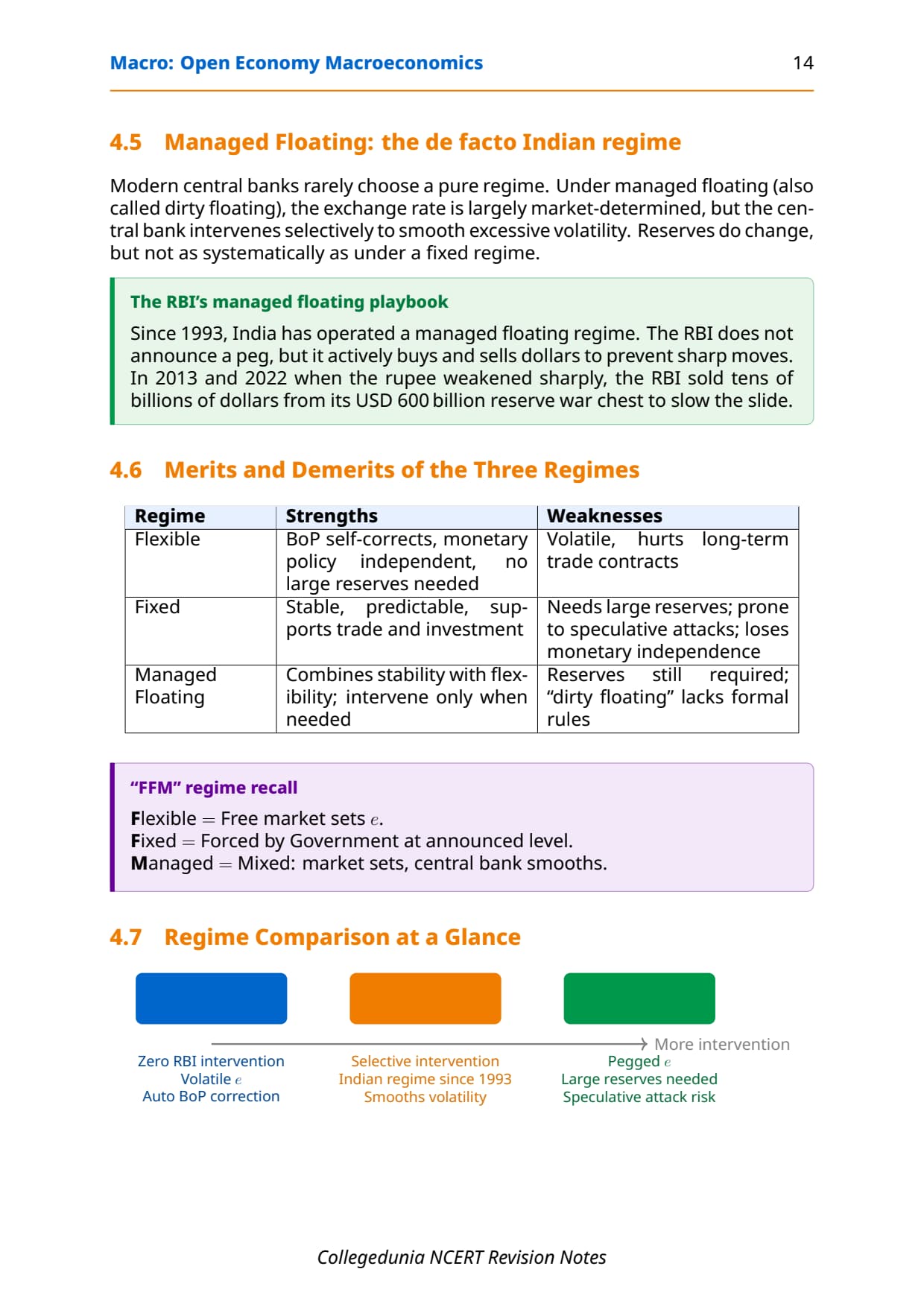
| Regime | How the rate is set | Main advantage | Main drawback |
|---|---|---|---|
| Fixed | The central bank pegs the currency and trades at the peg. | Predictable for trade; no exchange-rate risk. | No free monetary policy; reserves come under pressure. |
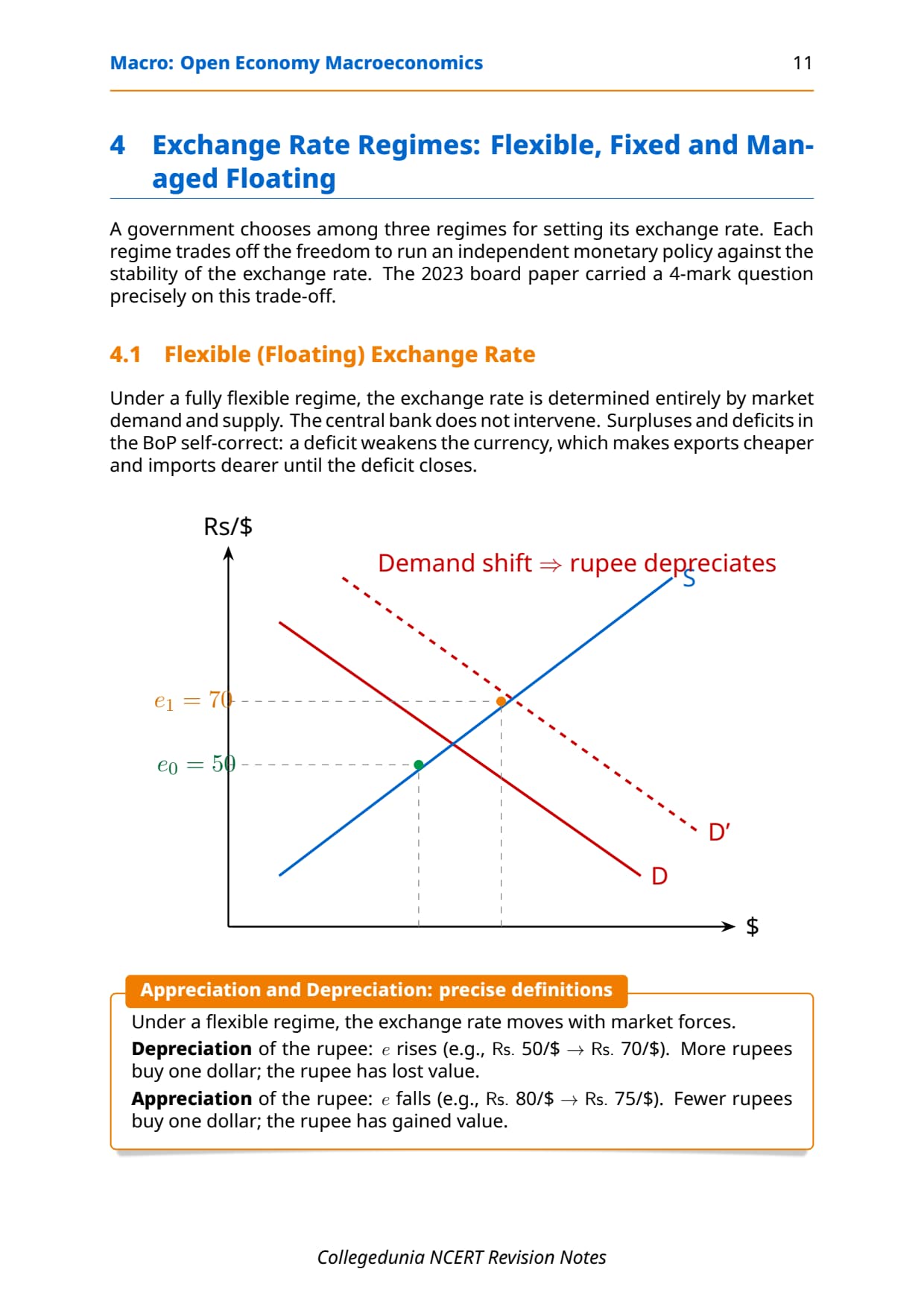
| Flexible (free float) | Demand and supply set the rate; no intervention. | Automatic balance; monetary policy stays free. | Volatility and higher risk for contracts. |
| Managed float | The market sets the rate, but the central bank smooths swings. India runs this. | Mixes flexibility with stability. | The band is not always clear. |
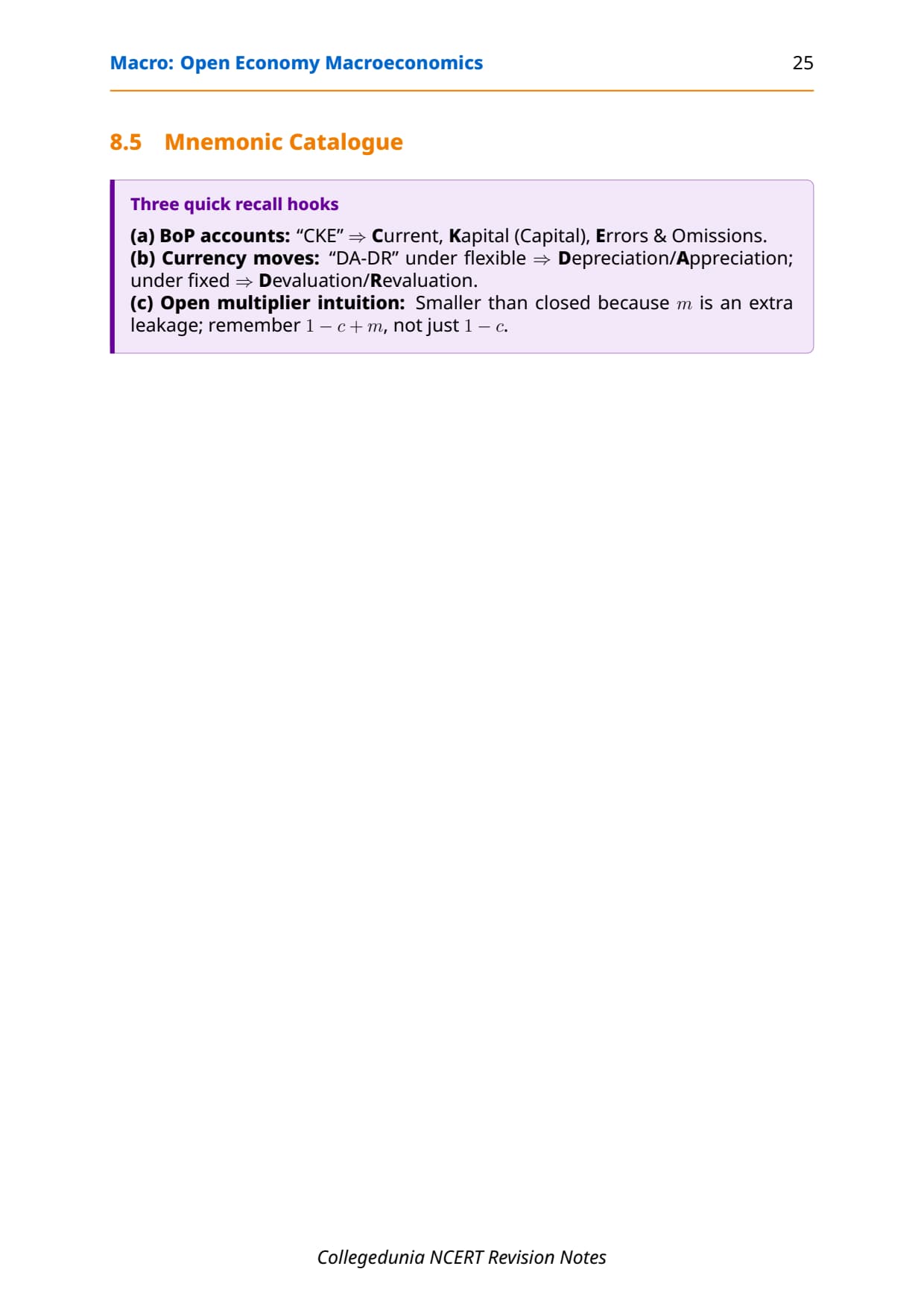
Memory hook: under a fixed regime, an official fall is a devaluation and a rise is a revaluation. Under a flexible regime, a market fall is a depreciation and a rise is an appreciation. Using "devaluation" for a market fall costs a mark.
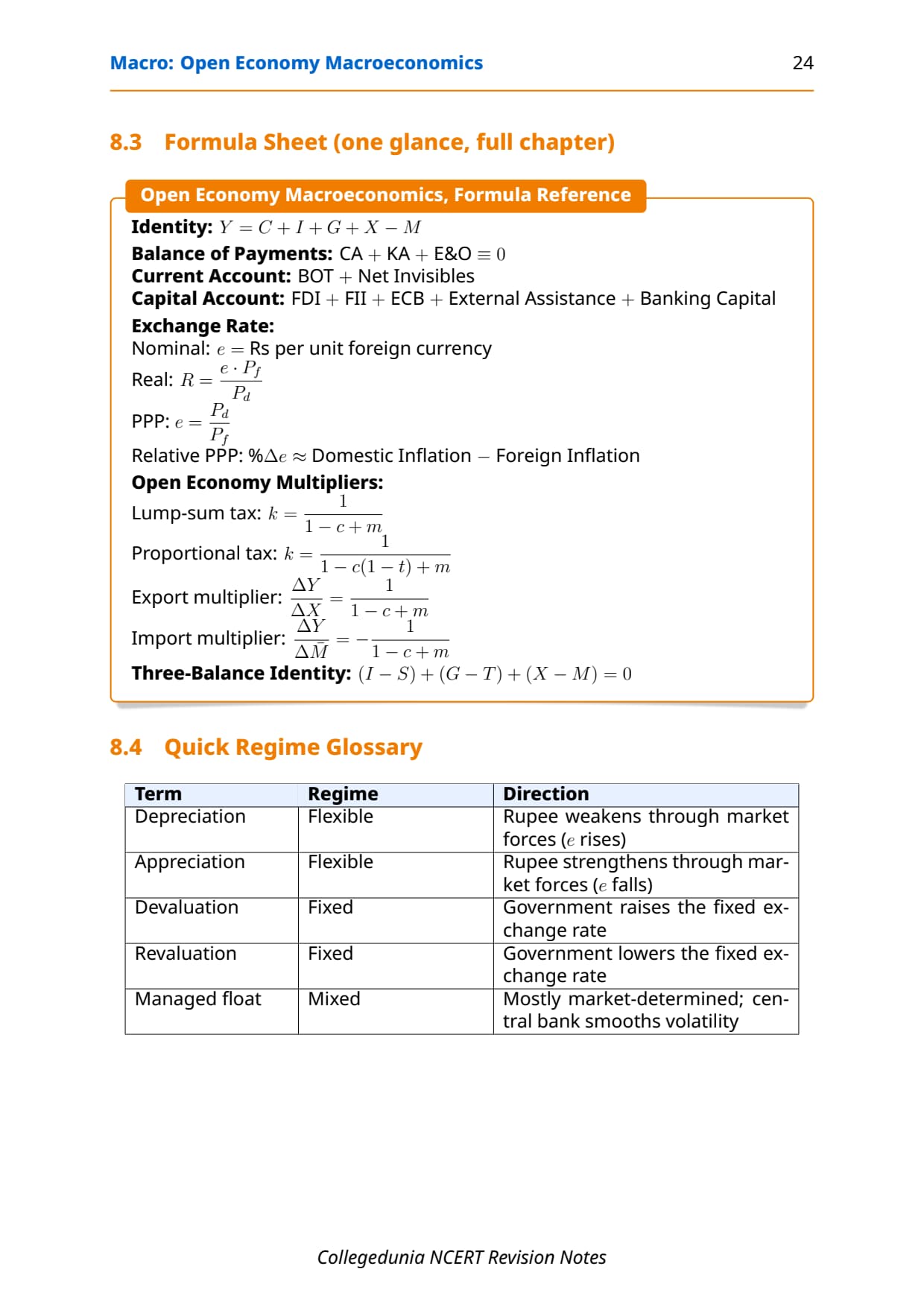
Open Economy Macroeconomics Class 12 Formula Sheet
This is the block to revise in the last 20 minutes before the exam. Each formula is used in at least one NCERT exercise or recent board paper.
| Concept | Formula |
|---|---|
| Open economy GDP | Y = C + I + G + (X minus M) |
| Net exports | NX = X minus M |
| Current account balance | BoT + Net services + Net primary income + Net secondary income |
| Overall BoP balance | Current account balance + Capital account balance |
| BoP equilibrium | Autonomous credits = Autonomous debits |
| Real exchange rate | (Nominal rate times Foreign price level) divided by Domestic price level |
| Savings-investment identity | (S minus I) + (T minus G) = (X minus M) |
Worked numerical drills on each formula sit inside the matching NCERT Solutions for Class 12 Economics Chapter 6. The formulas here are for memorising.
Common Mistakes in Open Economy Macroeconomics Class 12
- Confusing balance of trade (goods only) with the current account balance.
- Calling the change in official reserves an autonomous item; it is accommodating.
- Mixing devaluation (fixed regime) with depreciation (flexible regime).
- Forgetting the minus sign: net exports are X minus M, not X plus M.
- Treating remittances as primary income; they are secondary income (transfers).
Open Economy Macroeconomics Class 12 Video Lesson
Watch this short walkthrough of the chapter before you start your first revision pass.
Source: Magnet Brains on YouTube
Open Economy Macroeconomics Weightage in CBSE and CUET
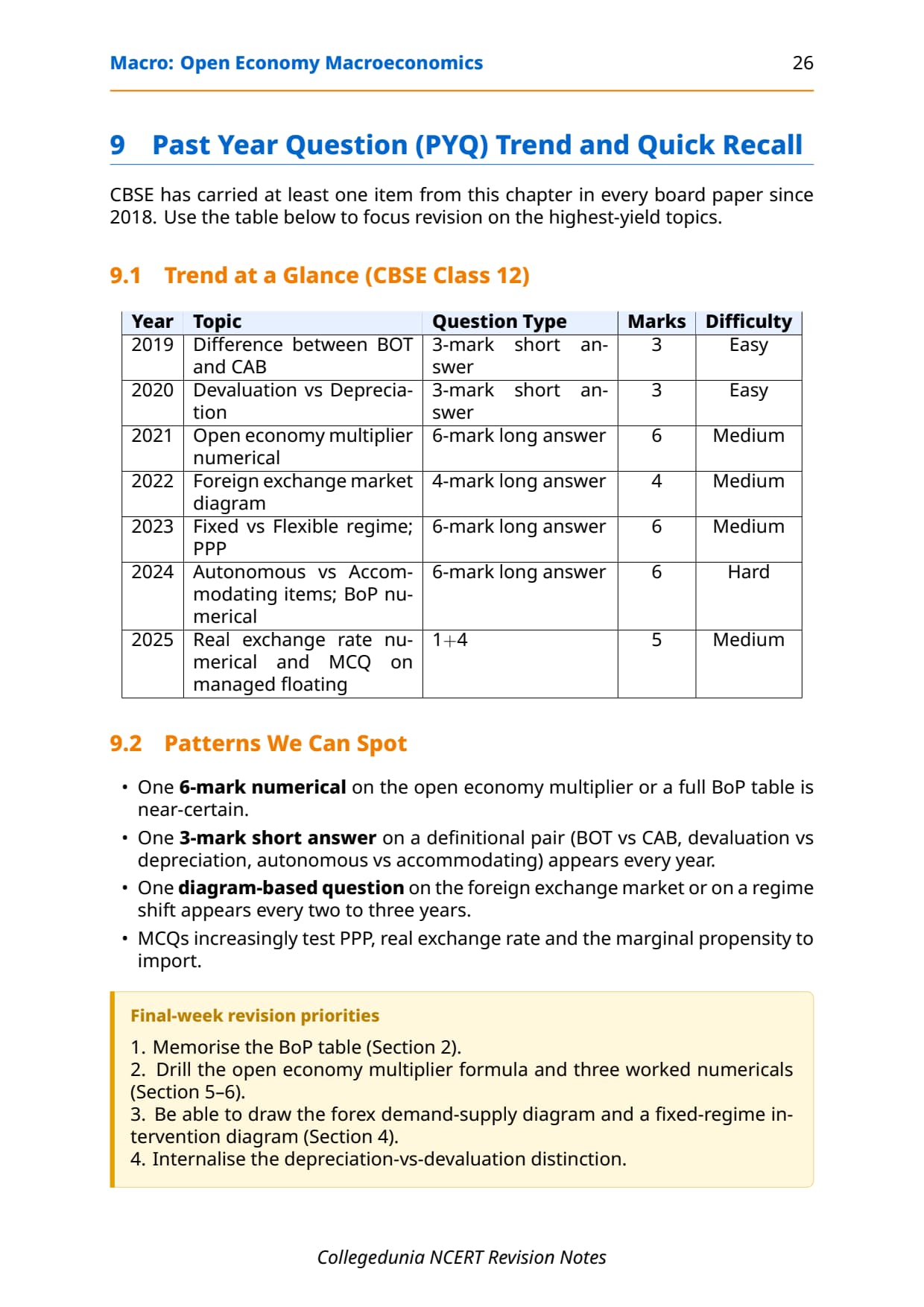
The chapter has stayed at a steady 9 to 10 marks in CBSE. The table maps what the board has asked in recent years.
| Year | CBSE question | Marks |
|---|---|---|
| 2025 | Autonomous vs accommodating items, plus classify three transactions | 6 |
| 2024 | Devaluation vs depreciation, plus effect of depreciation on trade | 7 |
| 2023 | Calculate current account balance, plus define foreign exchange rate | 7 |
| 2022 | Demand and supply of foreign exchange, plus equilibrium rate | 7 |
Student Feedback
We asked 11,420 Class 12 students about this chapter. 71% found the autonomous vs accommodating split the hardest part, and 3 out of 4 said the exchange rate regimes table was the easiest way to revise it.
Other Resources for Class 12 Economics Chapter 6
Pair these notes with the Solutions, handwritten notes and the official NCERT chapter below.
| Resource | What it covers | Open |
|---|---|---|
| Notes | Concept-first revision of the full chapter. | Chapter 6 Notes |
| NCERT Solutions | Step-by-step answers to every exercise question. | Chapter 6 NCERT Solutions |
| Handwritten Notes | Scanned notebook pages for last-mile revision. | Chapter 6 Handwritten Notes |
| NCERT Book PDF | Official NCERT Macroeconomics Chapter 6 textbook. | Chapter 6 NCERT Book PDF |
All Chapters Notes for Class 12 Economics Macroeconomics
| Chapter | Topic | Notes link |
|---|---|---|
| Chapter 1 | Introduction to Macroeconomics | Introduction to Macroeconomics |
| Chapter 2 | National Income Accounting | National Income Accounting |
| Chapter 3 | Money and Banking | Money and Banking |
| Chapter 4 | Income Determination | Income Determination |
| Chapter 5 | Government Budget and the Economy | Government Budget and the Economy |
| Chapter 6 | Open Economy Macroeconomics | Open Economy Macroeconomics |
NCERT Notes Class 12 Economics Chapter 6 Open Economy Macroeconomics FAQs
Ques. What are these Class 12 Economics Chapter 6 notes for?
Ans. They are a short revision sheet for NCERT Chapter 6. They cover the balance of payments, the open economy national income identity, the foreign exchange market and the three exchange rate regimes, with a formula table and common-mistake alerts. Worked numericals sit in the matching NCERT Solutions.
Ques. What is the difference between autonomous and accommodating items?
Ans. Autonomous items are done for their own sake, independent of the BoP position. Accommodating items are done only to settle the BoP gap, like changes in official reserves or IMF borrowing. A BoP is in balance when autonomous credits equal autonomous debits.
Ques. What is the open economy national income identity?
Ans. The identity is Y = C + I + G + (X minus M), where (X minus M) is net exports. Rearranging it gives (S minus I) + (T minus G) = (X minus M), which links the private saving-investment gap and the fiscal balance to the current account.
Ques. What is the difference between devaluation and depreciation?
Ans. Devaluation is an official fall in a pegged rate under a fixed regime. Depreciation is a market-driven fall under a flexible regime. The two terms map onto different regimes, so using "devaluation" for a market fall usually costs one mark.
Ques. What is the formula for the real exchange rate?
Ans. Real exchange rate = (Nominal exchange rate times Foreign price level) divided by Domestic price level. It adjusts the headline rate for relative price levels and measures how competitive domestic goods are abroad.



Comments