




Production and Costs is Chapter 3 of the Class 12 Microeconomics book. It covers the production function, TP, AP and MP, returns to scale and the seven cost curves. This page has the full revision notes and a free PDF to download.


Here is what this chapter is worth in the exam:
- CBSE Boards: about 8 to 10 marks across theory, numericals and cost-curve diagrams.
- CUET: 2 to 3 questions every year on TP-AP-MP and the cost curves.
- Revision time: about 35 minutes with these notes.

What These Production and Costs Class 12 Notes Cover
The chapter has two halves: production and cost. The notes give each topic a short, exam-ready summary.
- Production function (1 to 3 marks): how inputs map to output.
- TP, AP and MP (4 to 6 marks): the most-tested numerical block.
- Returns to a factor vs scale (3 marks): short run vs long run.
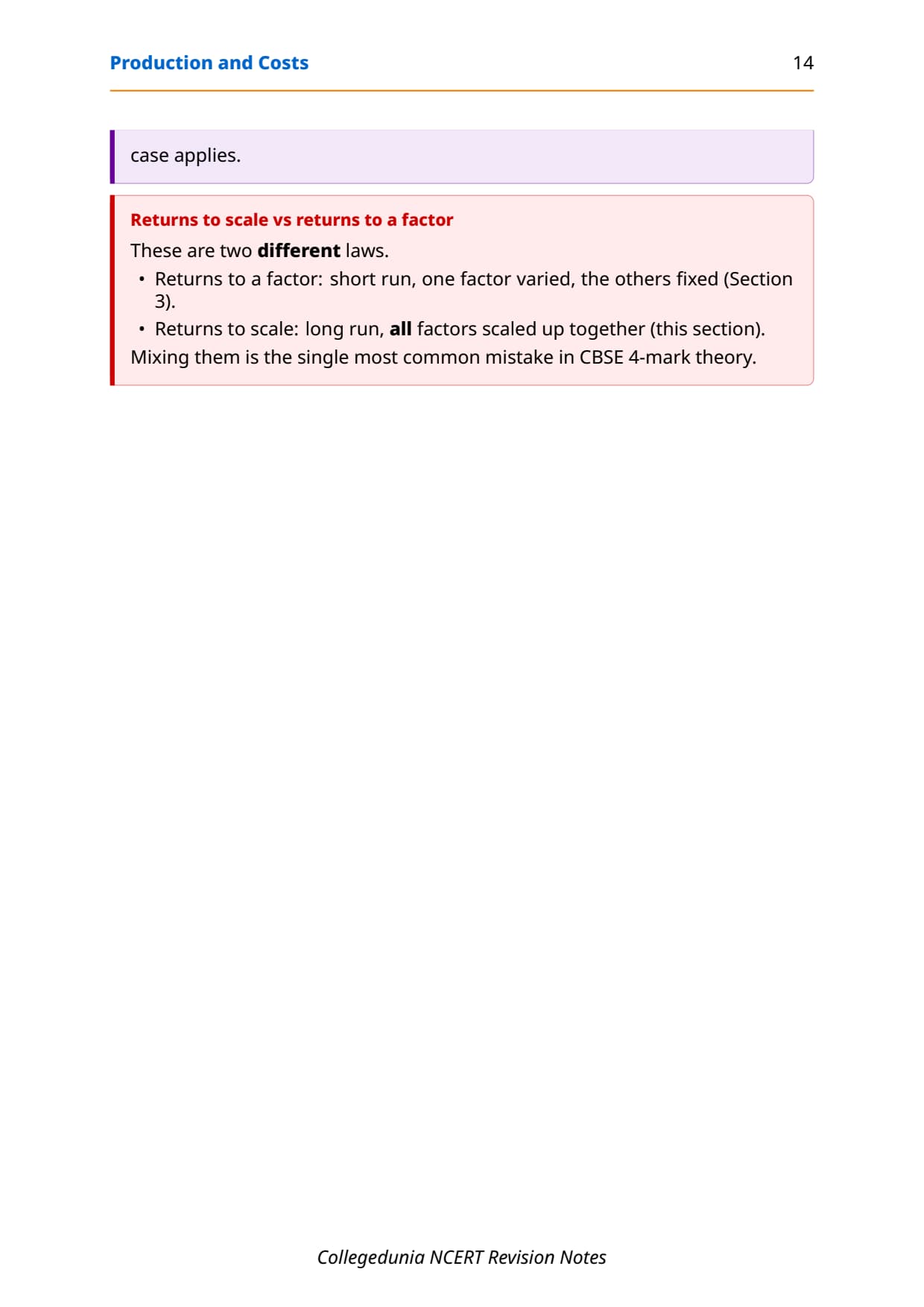
- The seven cost curves (4 marks): TC, TFC, TVC, AC, AFC, AVC and MC.
- Short run vs long run cost (4 marks): the LAC envelope.
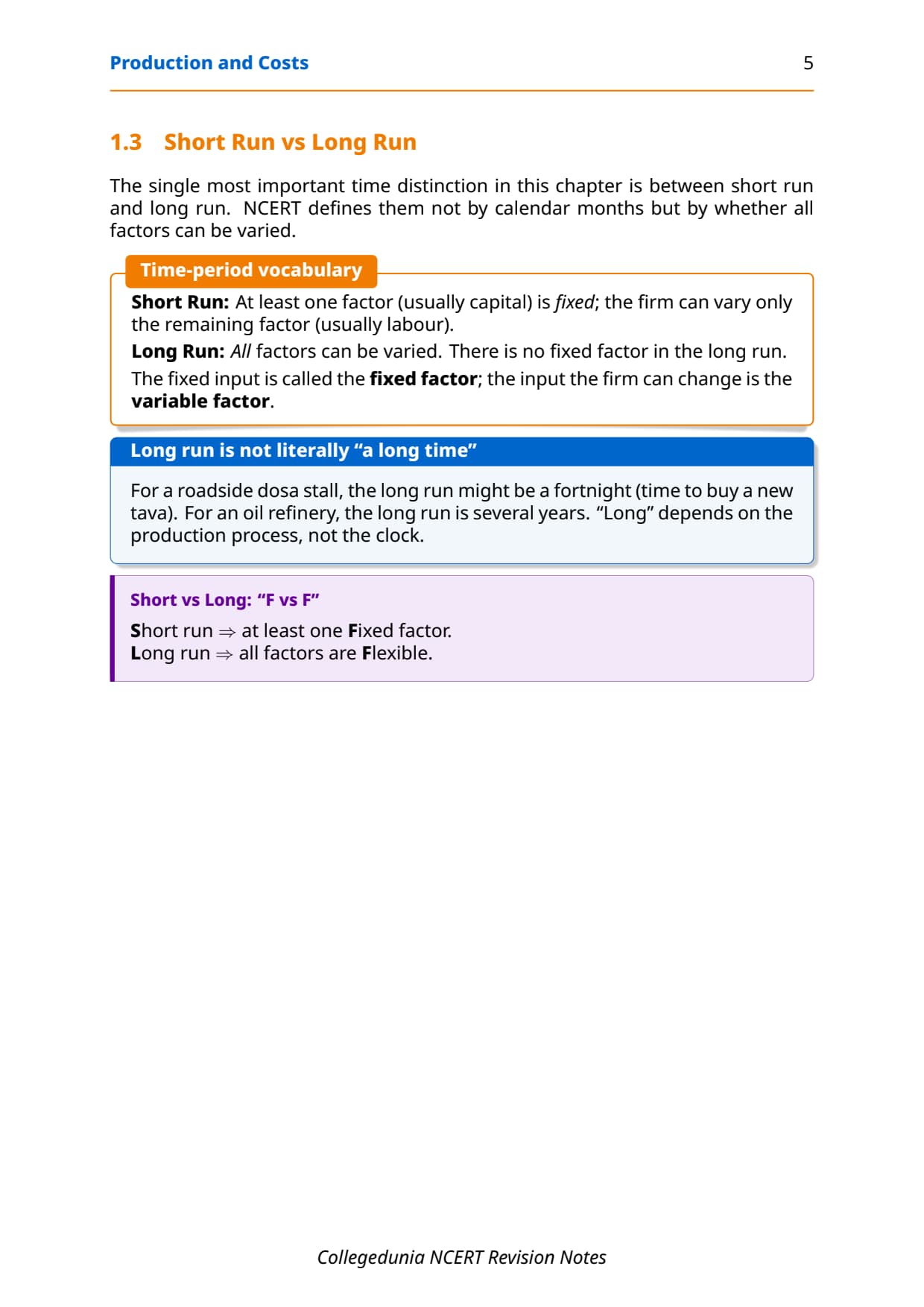
Production Function in Economics Class 12
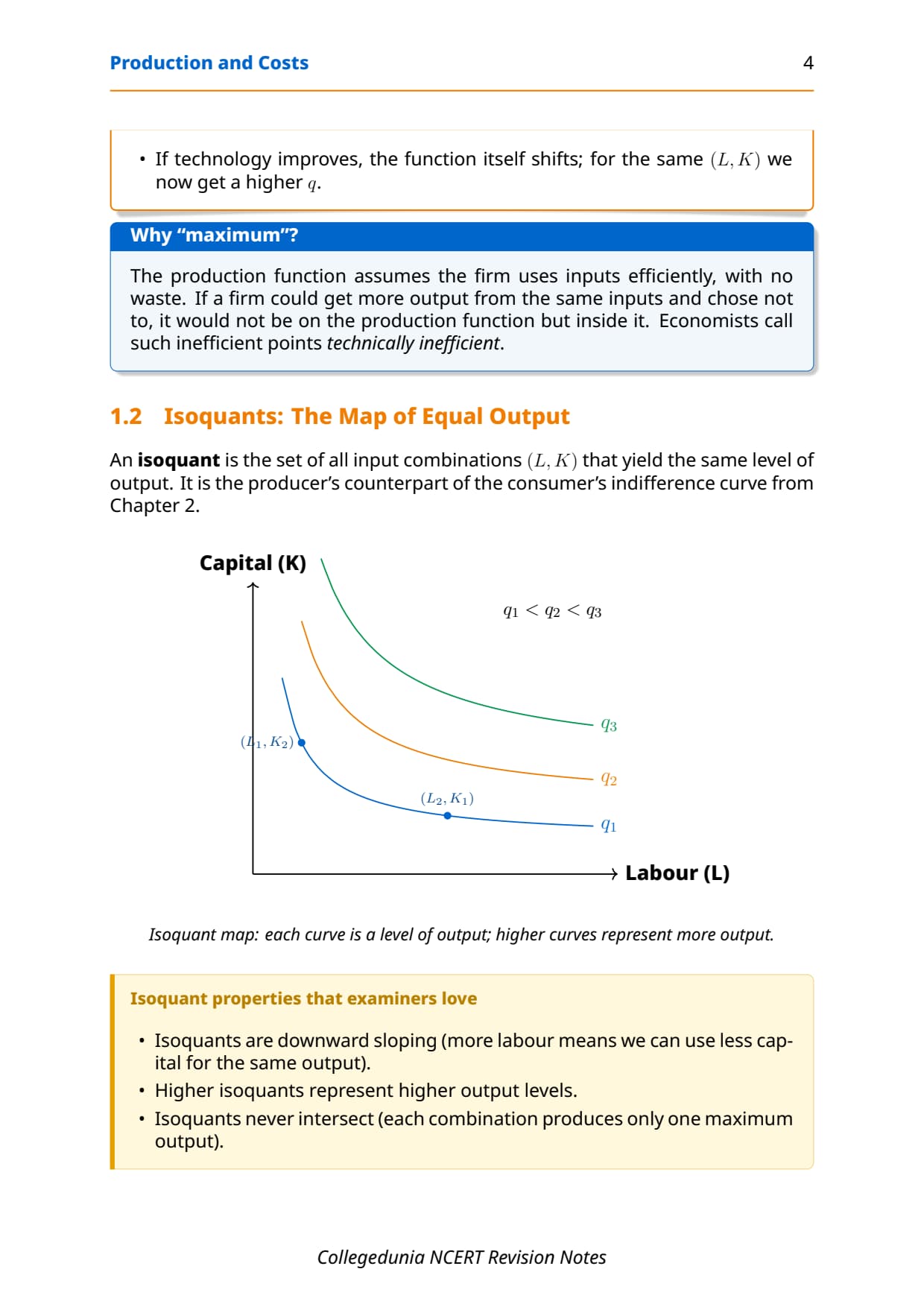
The production function shows the most output a firm can make from each mix of inputs. NCERT writes it as Q = f(L, K), where L is labour, K is capital and technology stays fixed.
- Short run: capital is fixed and only labour varies, so Q = f(L, K-bar). This drives the TP-AP-MP curves.
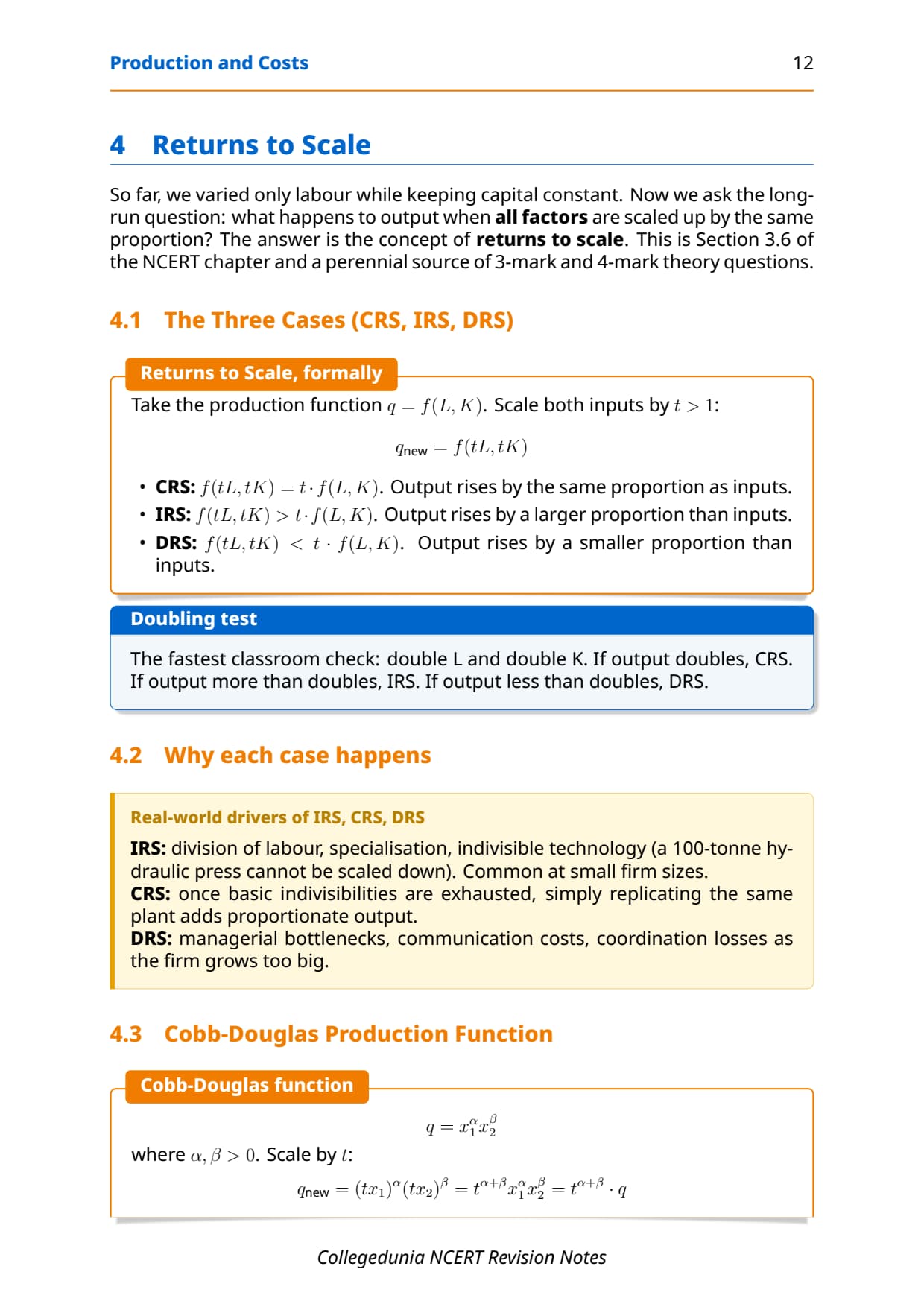
- Long run: both factors can change, so Q = f(L, K). This drives returns to scale.
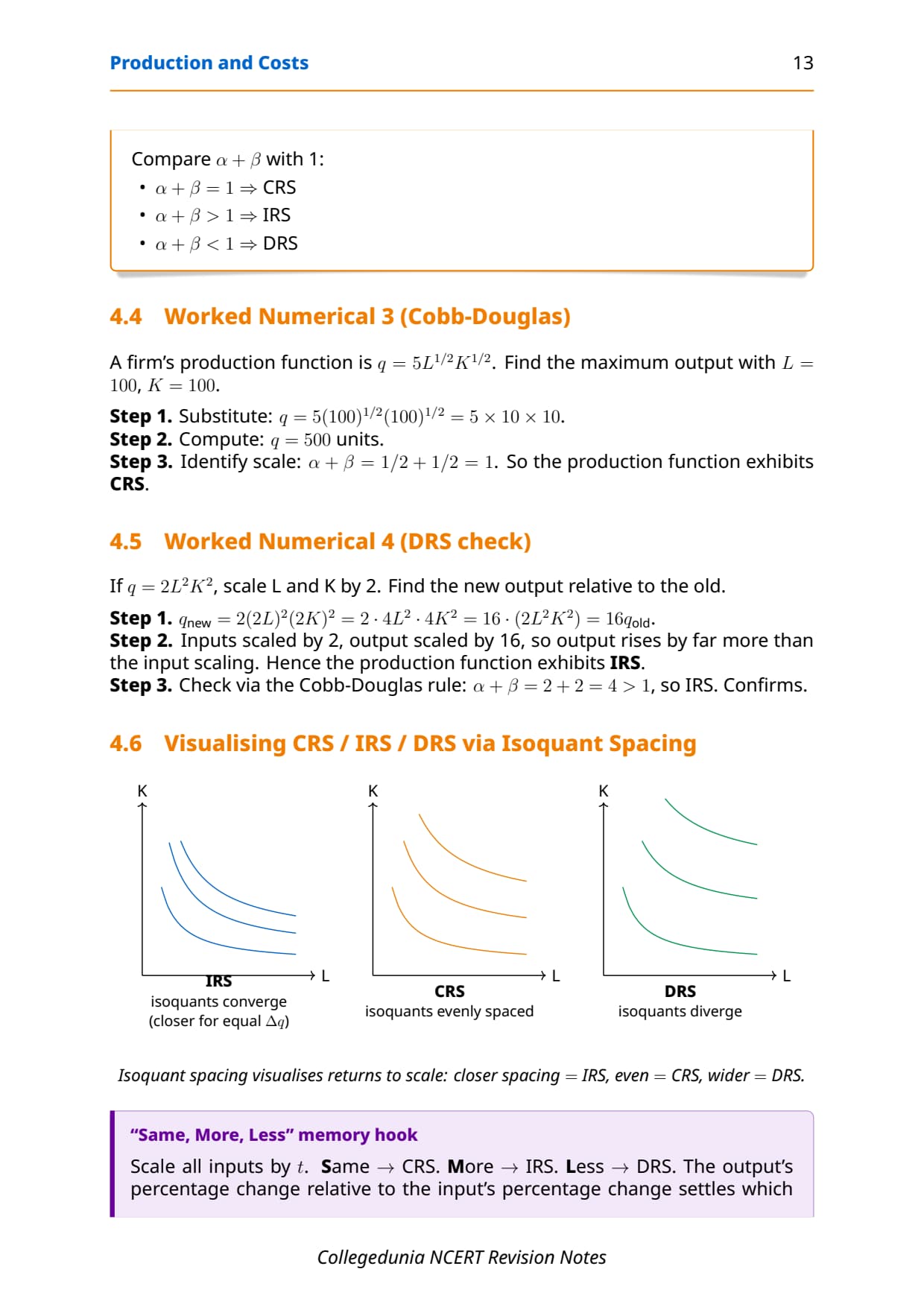
- Cobb-Douglas form: Q = A times L^alpha times K^beta. The sum alpha + beta tells you the returns to scale.
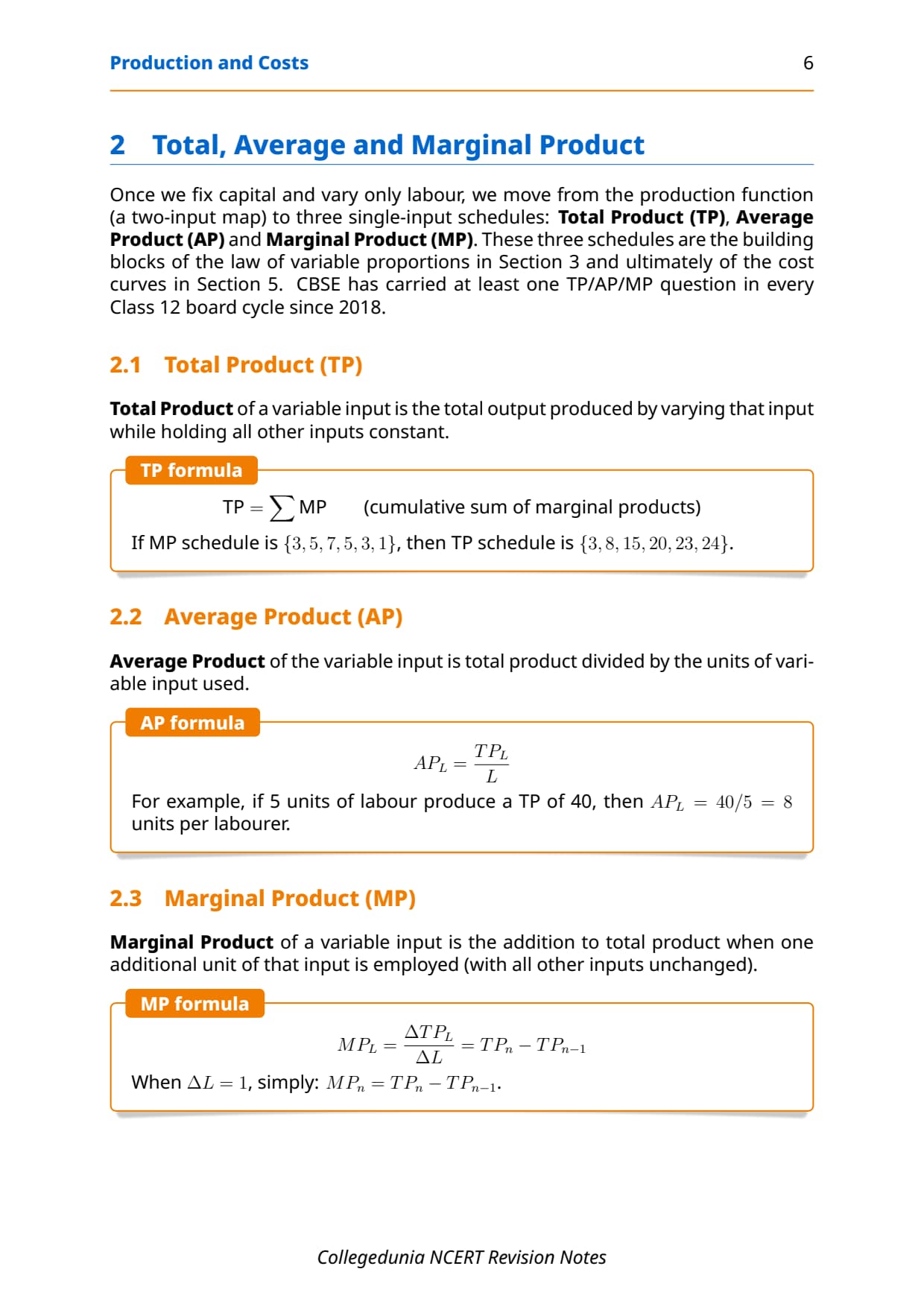
Total Product, Average Product and Marginal Product (TP, AP, MP)
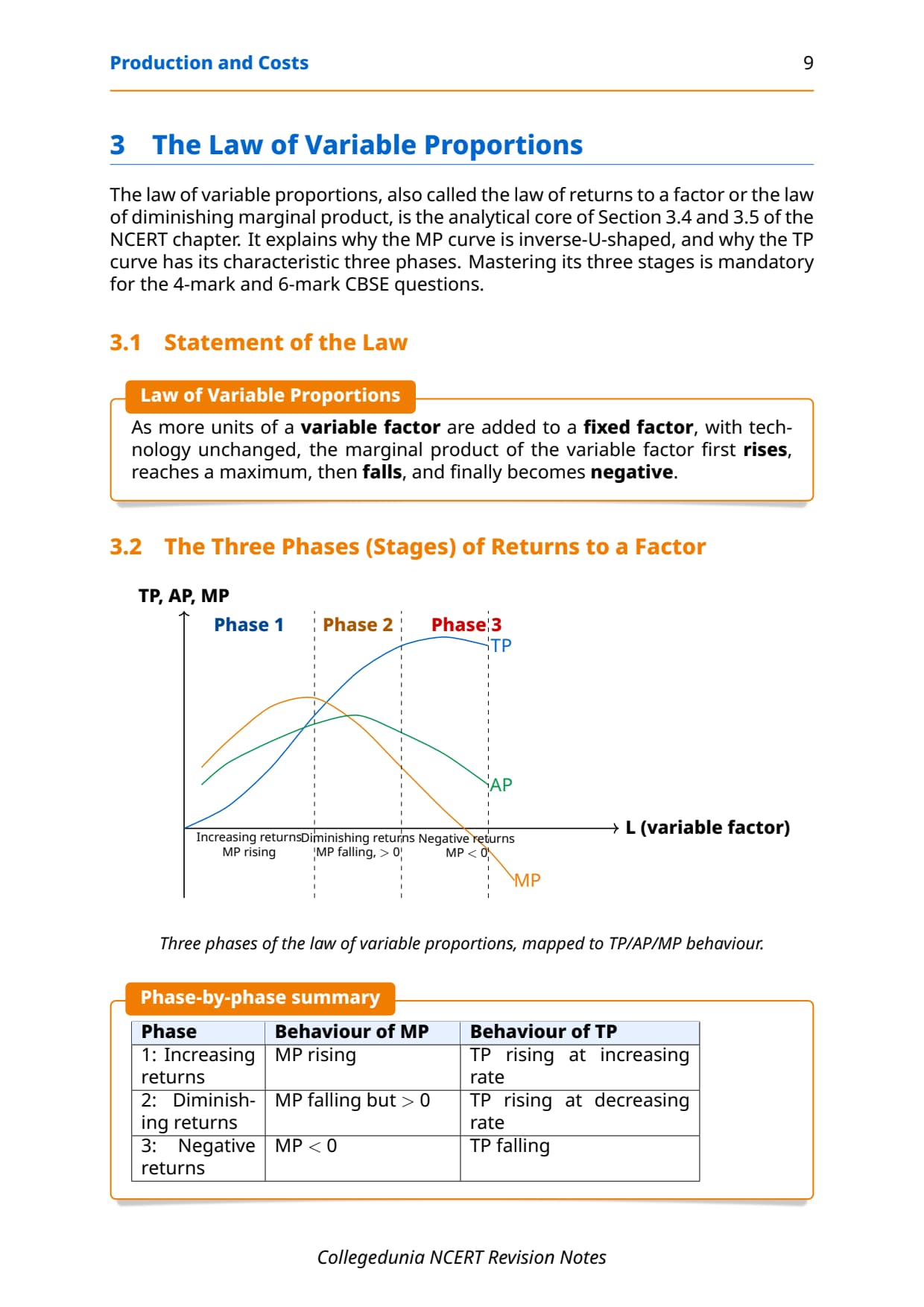
This is the single most-tested block in the chapter. All three are short-run ideas because capital is fixed.
- TP: total output from a given amount of labour.
- AP: output per worker, AP = TP / L.
- MP: the extra output from one more worker, MP = change in TP / change in L.
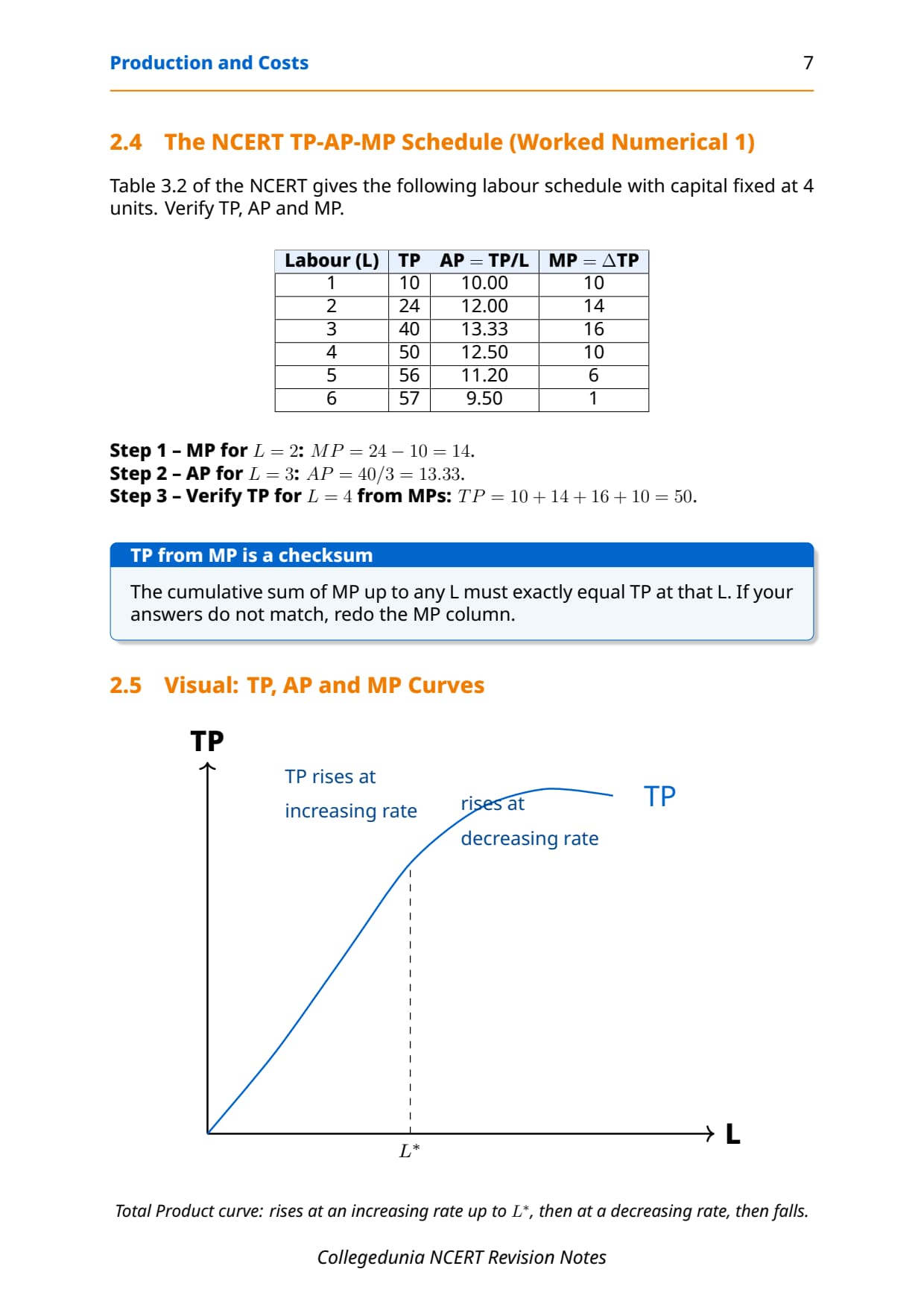
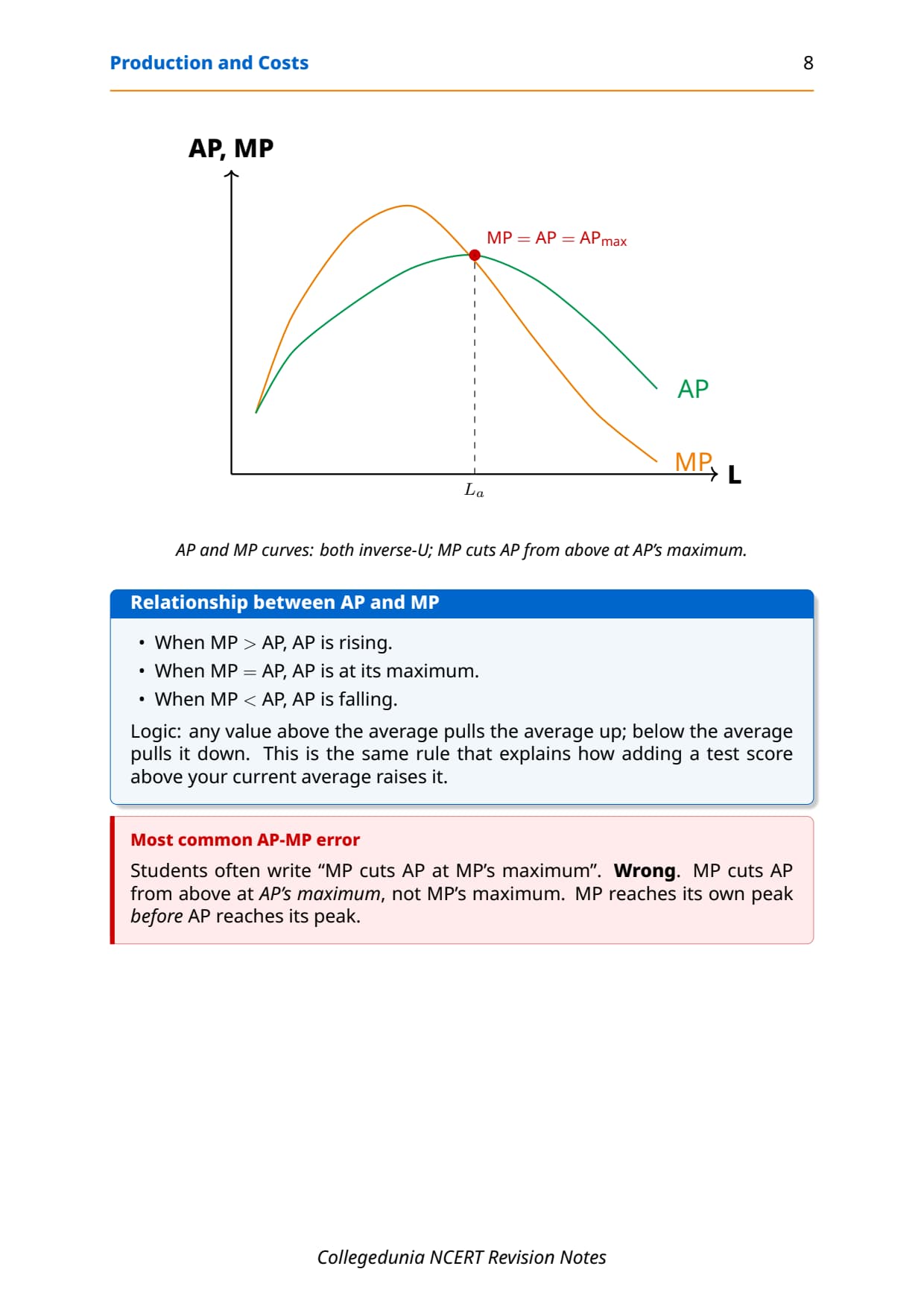
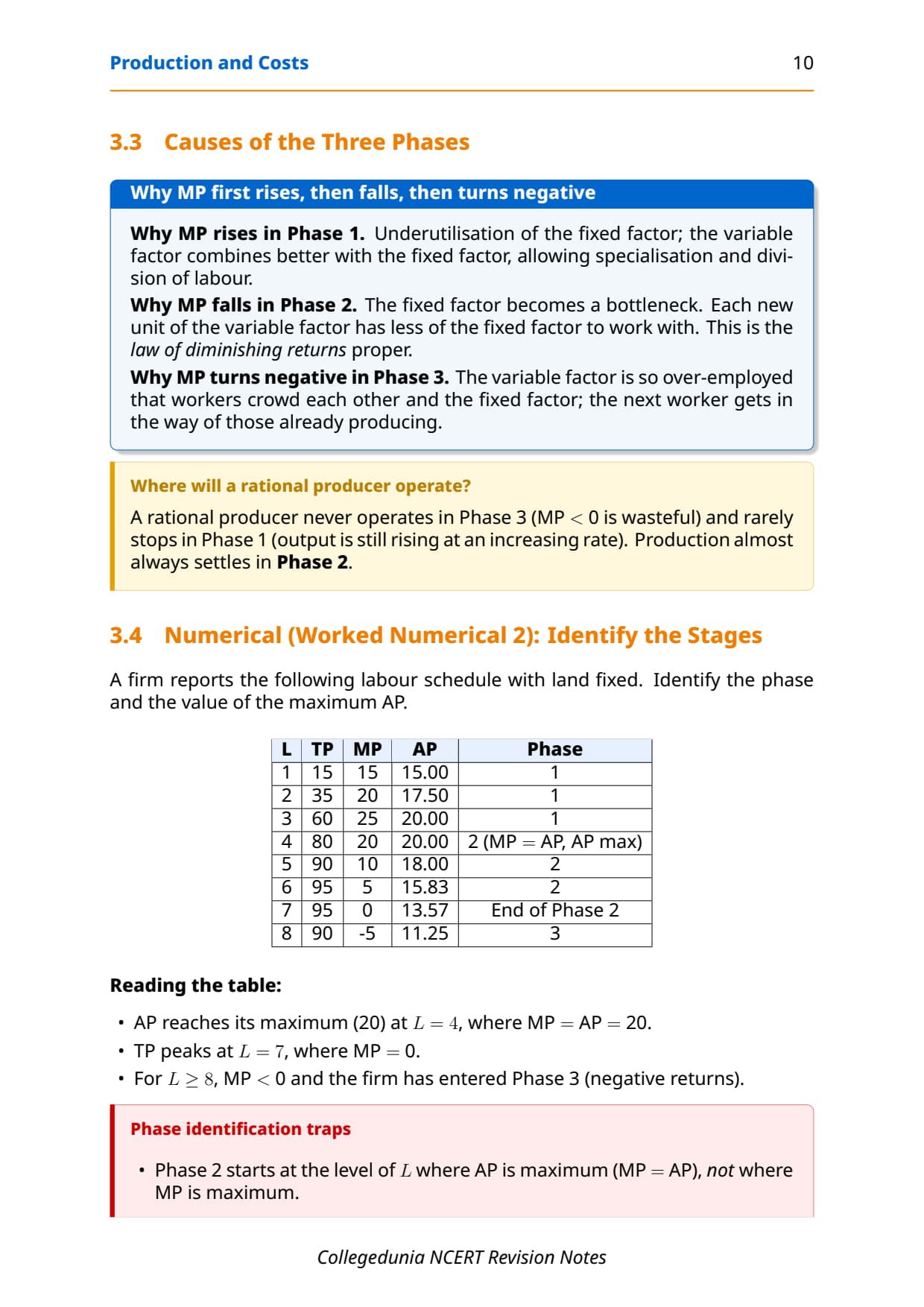
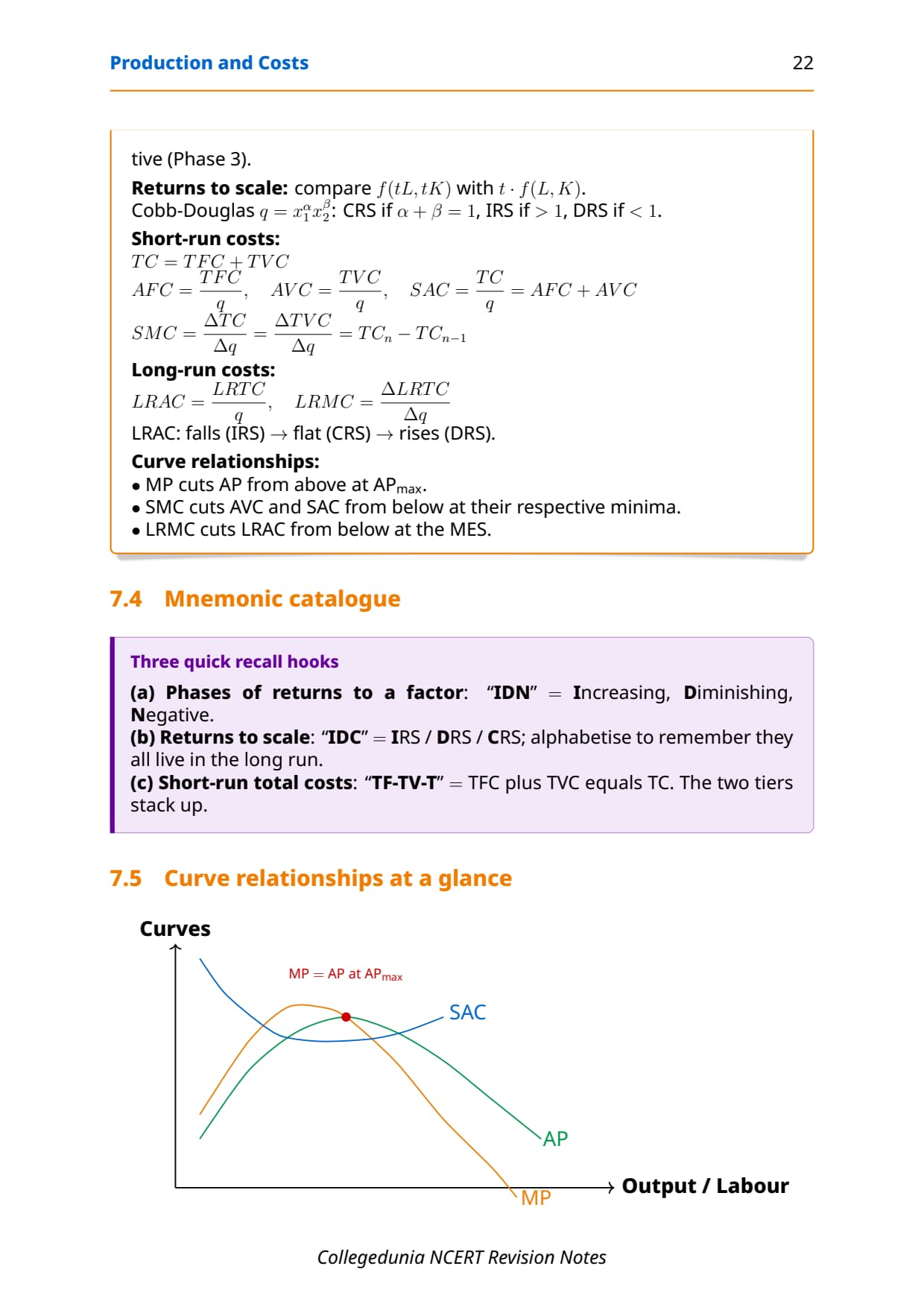
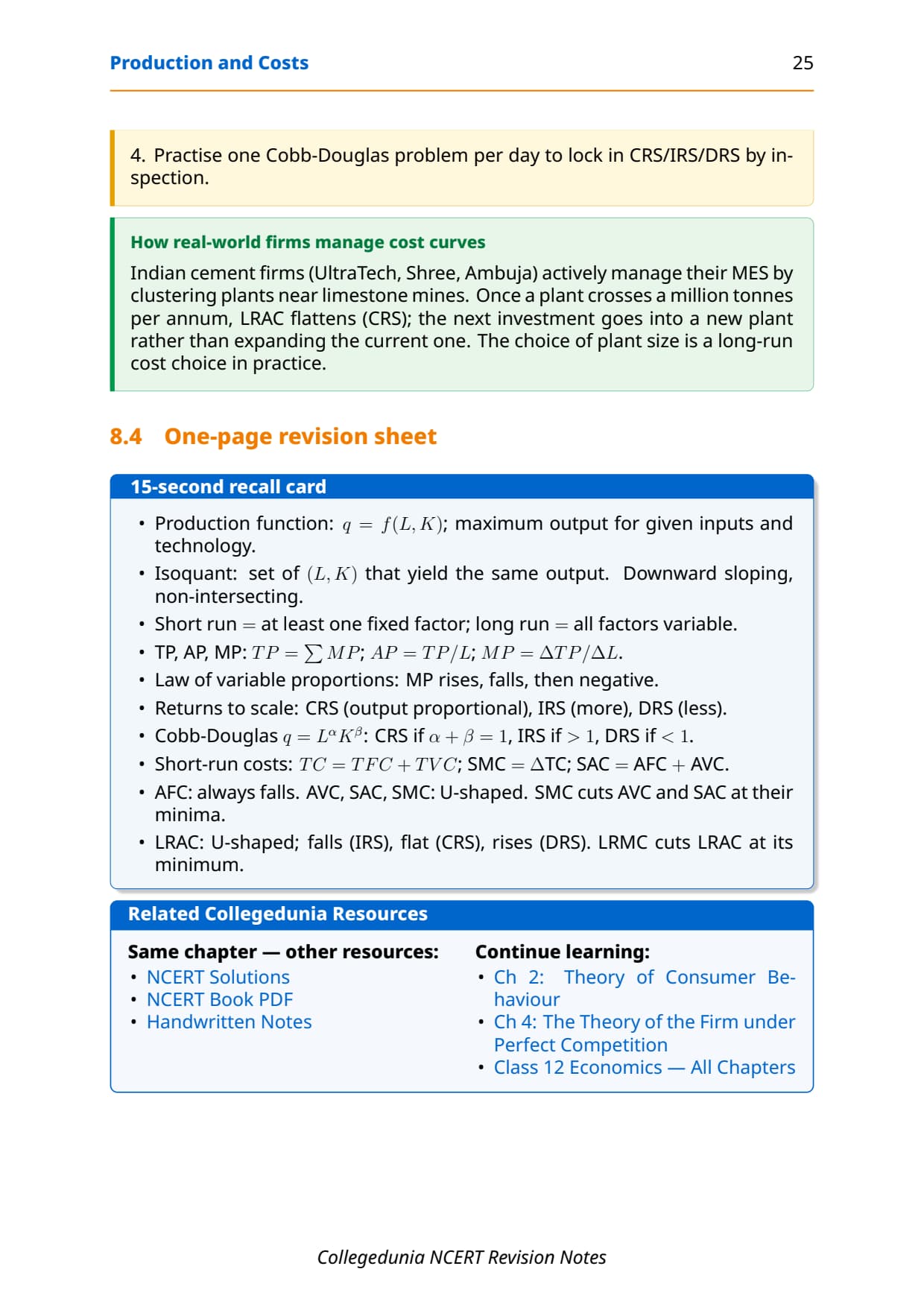
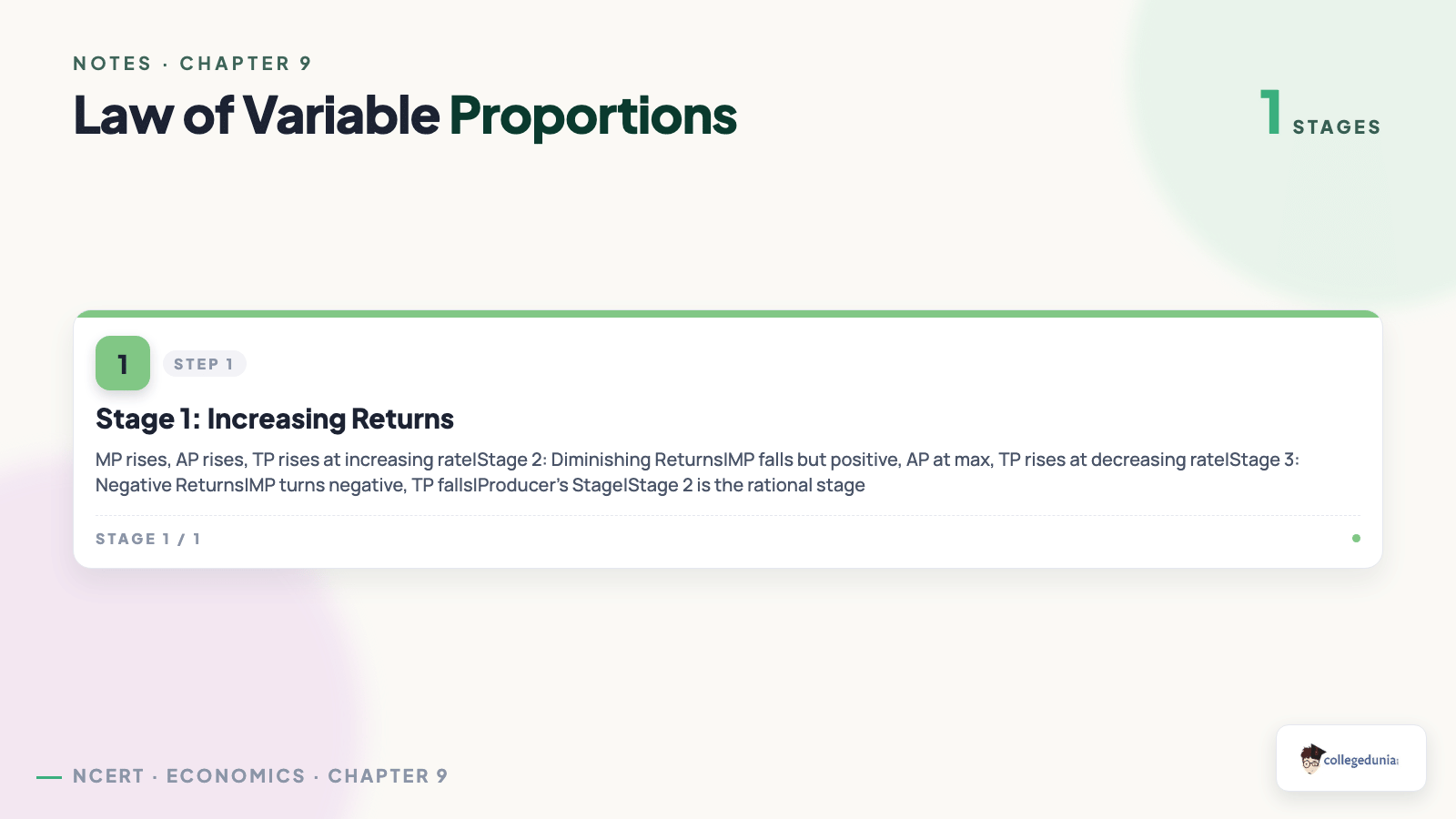
Three rules are tested every year. MP cuts AP at AP's peak. TP is highest when MP is zero, not when MP is highest. MP can be negative in Phase III, but AP cannot.
| Labour (L) | TP | AP = TP/L | MP | Phase |
|---|---|---|---|---|
| 1 | 8 | 8 | 8 | I (increasing) |
| 2 | 20 | 10 | 12 | I |
| 3 | 36 | 12 | 16 | I (MP peak) |
| 4 | 48 | 12 | 12 | II (AP peak, MP = AP) |
| 5 | 55 | 11 | 7 | II (diminishing) |
| 7 | 58 | 8.29 | 0 | II/III boundary (TP max) |
| 8 | 54 | 6.75 | -4 | III (negative MP) |
Most numerical questions on this block since 2020 follow this exact table: students get a TP column and fill in AP, MP and the phase.
Returns to a Factor and Returns to Scale Class 12
These two ideas sound alike but are different. Swapping them loses 3 to 4 marks. The table keeps them apart.
| Basis | Returns to a Factor | Returns to Scale |
|---|---|---|
| Time period | Short run | Long run |
| Which factors vary | Only the variable factor; one stays fixed | All factors vary together |
| Causal law | Law of variable proportions | Returns to scale |
| Three regimes | Increasing, diminishing, negative MP | Increasing, constant, decreasing |
| Test | Sign of MP across L | Sum alpha + beta in Cobb-Douglas |
Cost Function: TC, TFC, TVC, AC, AVC, AFC and MC
The cost set is the second half of the chapter. Every cost is one of seven. These same curves return in Chapter 4.
| Cost | Formula | Shape |
|---|---|---|
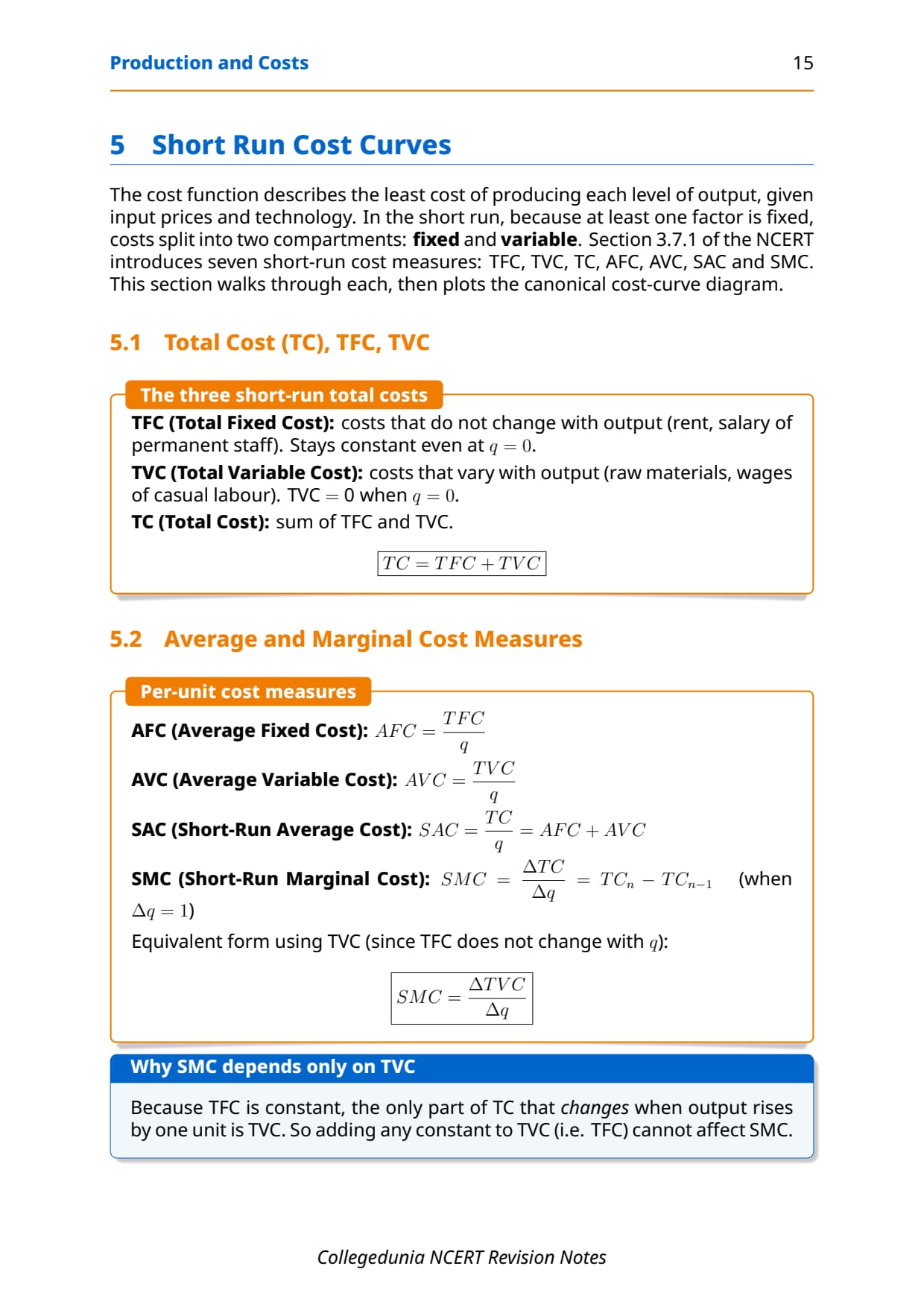
| Total Cost (TC) | TC = TFC + TVC | Rises with Q; starts at TFC |
| Total Fixed Cost (TFC) | TFC = TC at Q = 0 | Horizontal line |
| Total Variable Cost (TVC) | TVC = TC minus TFC | Rises with Q; starts at 0 |
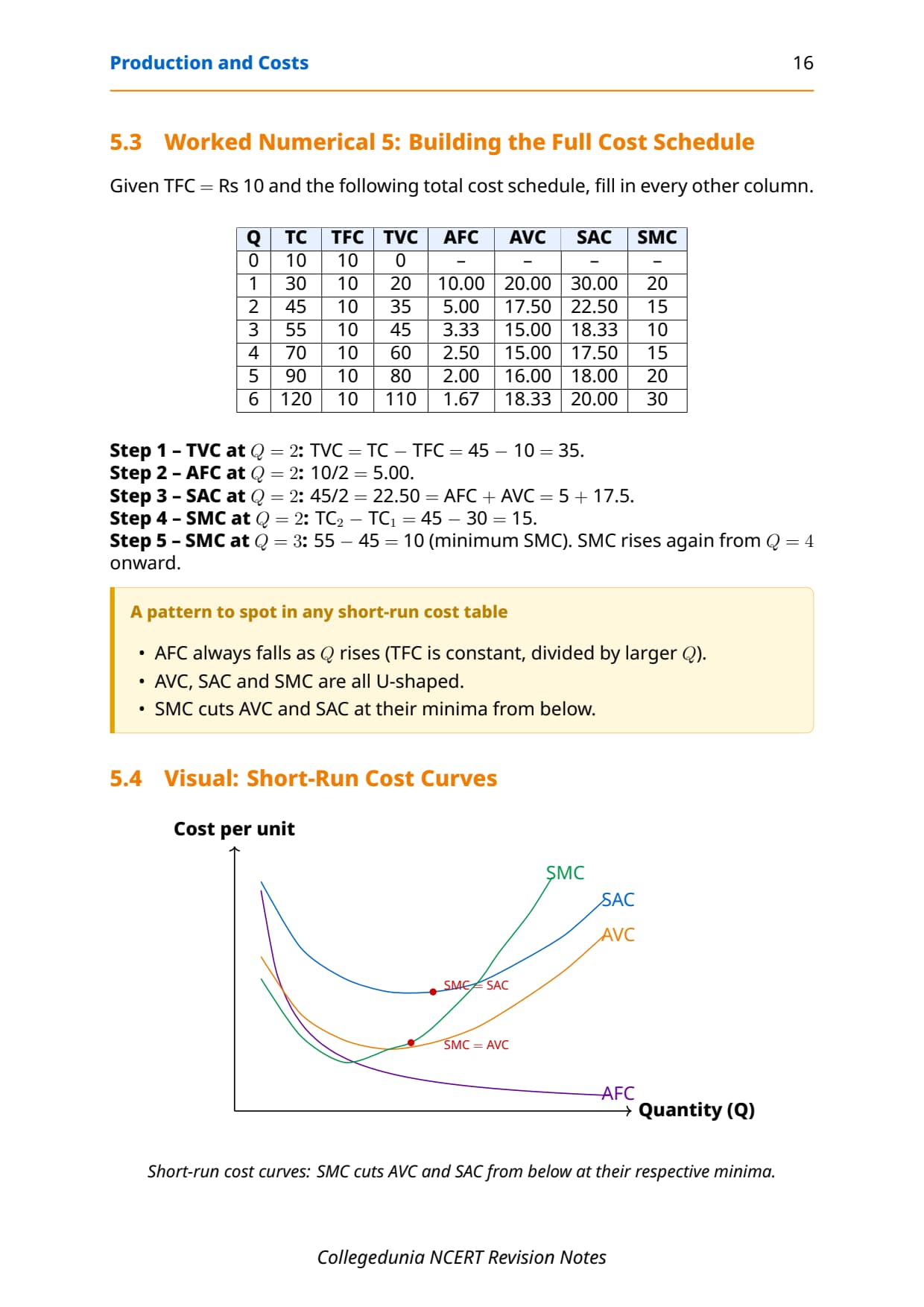
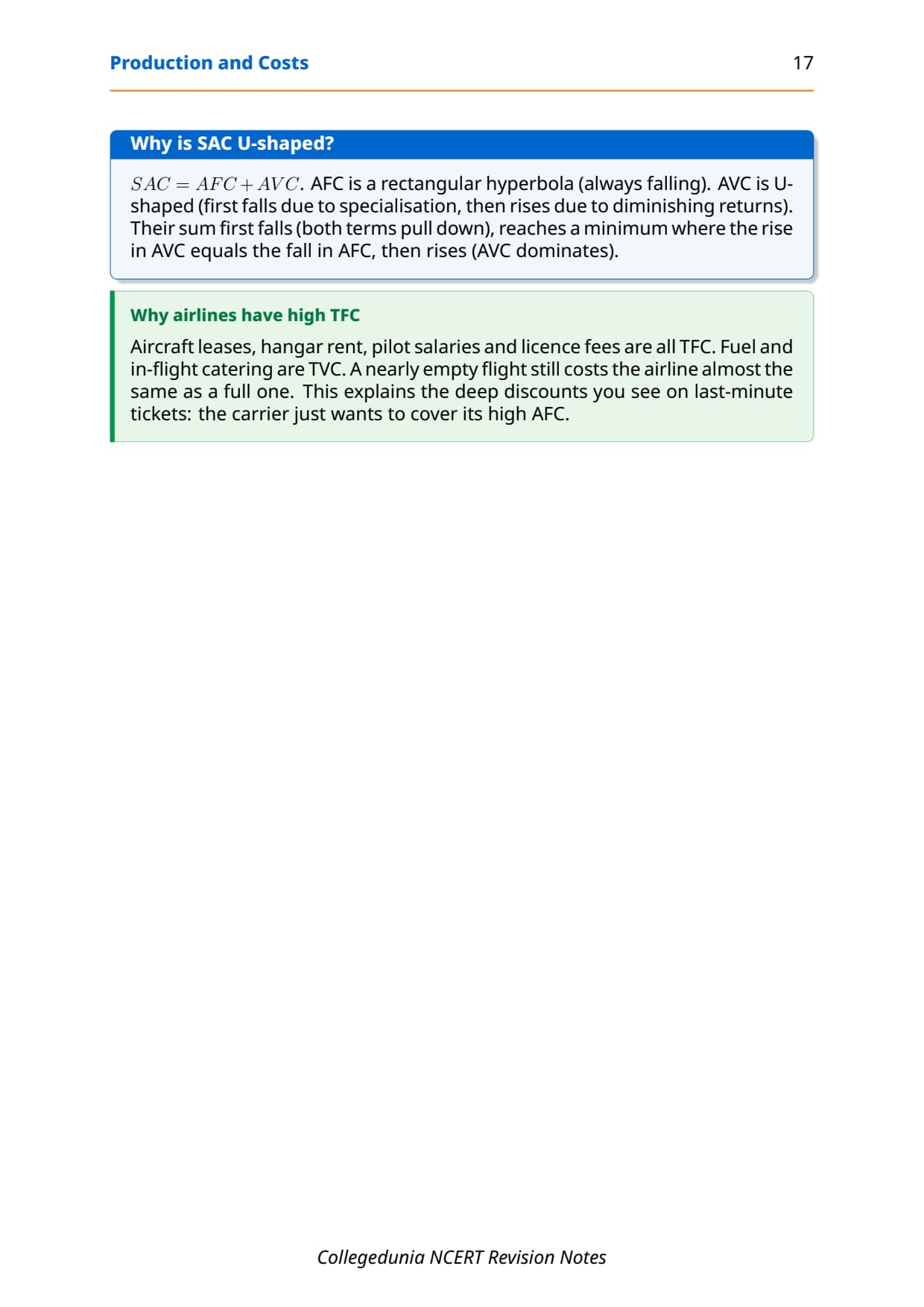
| Average Cost (AC) | AC = TC / Q = AFC + AVC | U-shaped |
| Average Fixed Cost (AFC) | AFC = TFC / Q | Falls continuously |
| Average Variable Cost (AVC) | AVC = TVC / Q | U-shaped |
| Marginal Cost (MC) | MC = change in TC / change in Q | U-shaped; cuts AVC and AC at minimum |
Memory hook: AFC is never U-shaped; it falls all the way. AC and AVC are U-shaped, and the gap between them at any output is exactly AFC. The MC curve cuts both at their lowest points.
Production and Costs Class 12 Video Lesson
Source: Magnet Brains on YouTube
The next image sums up how cost behaves in the short run versus the long run.
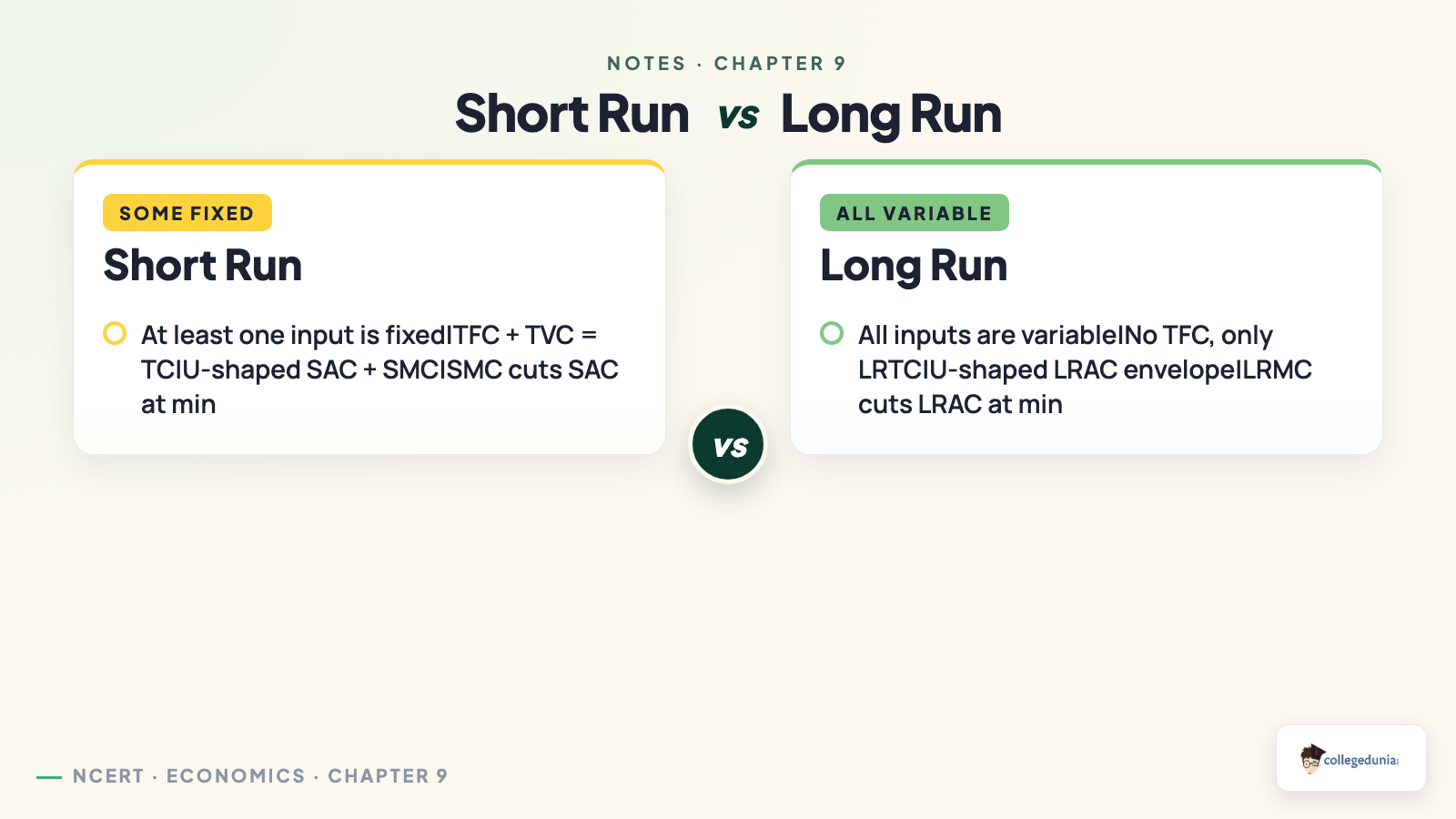
Short-Run vs Long-Run Costs in Production and Costs Class 12
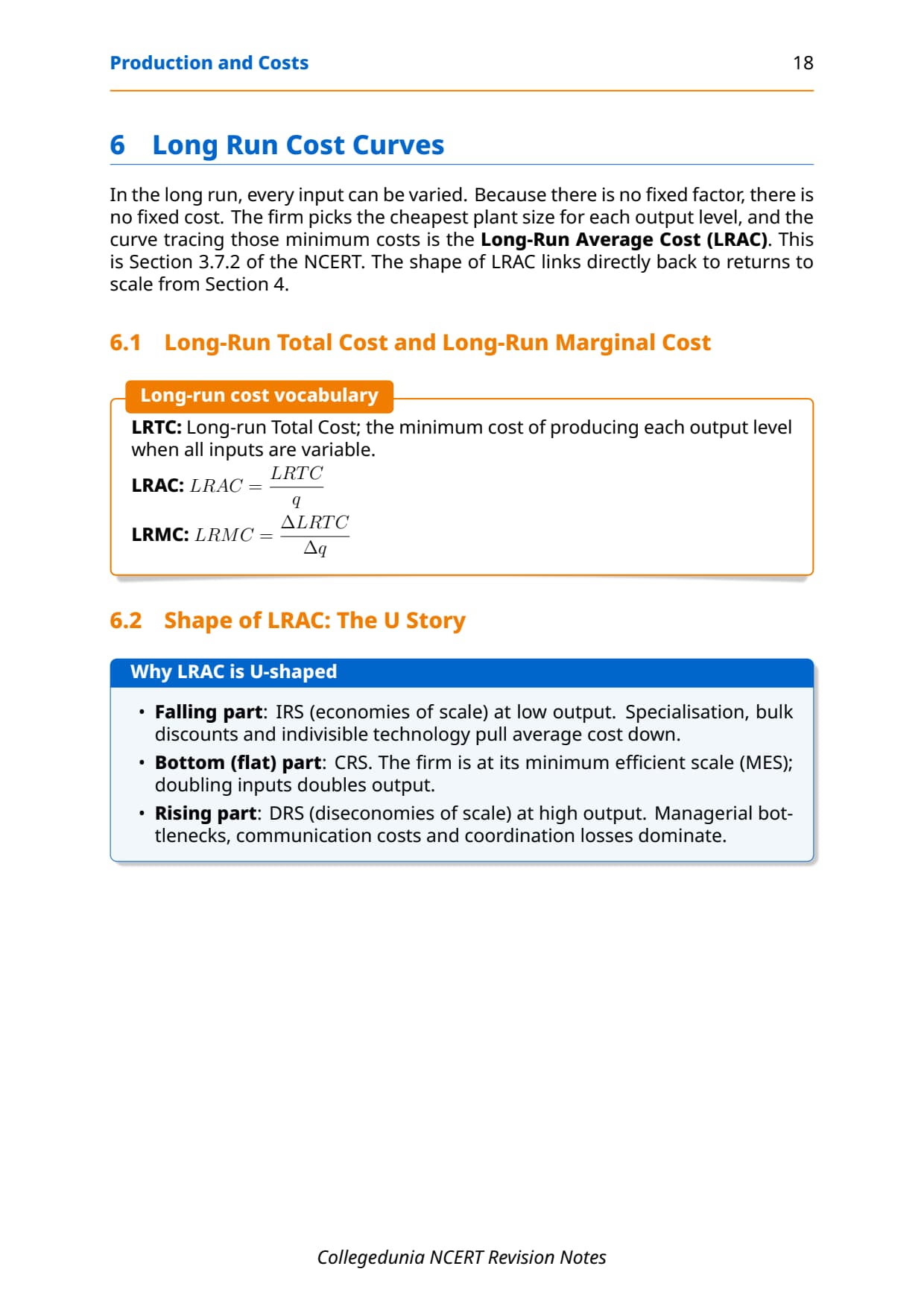
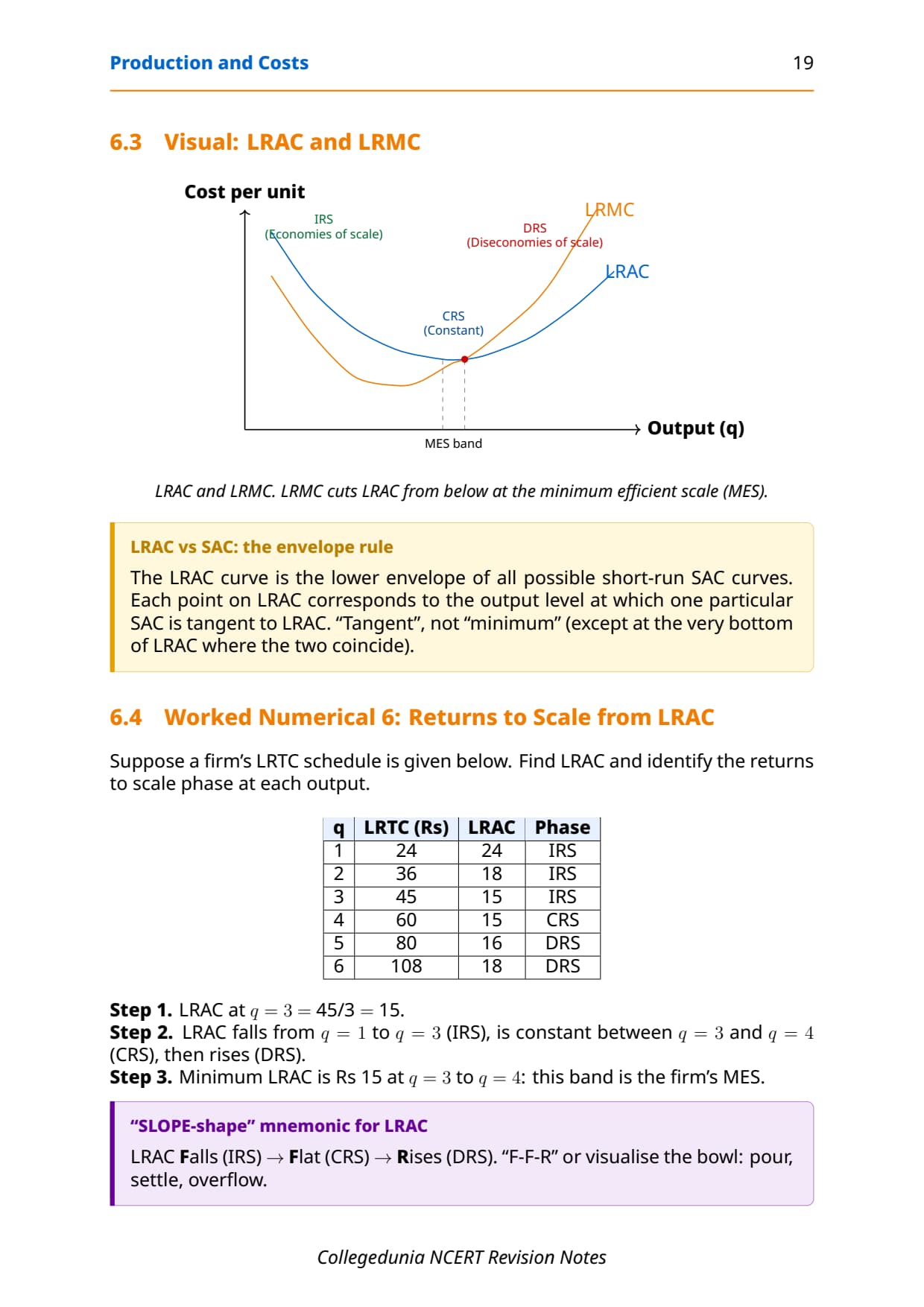
In the short run a firm has all seven cost curves. In the long run no factor is fixed, so there is no Fixed Cost and no AFC. Only TC, AC and MC remain.
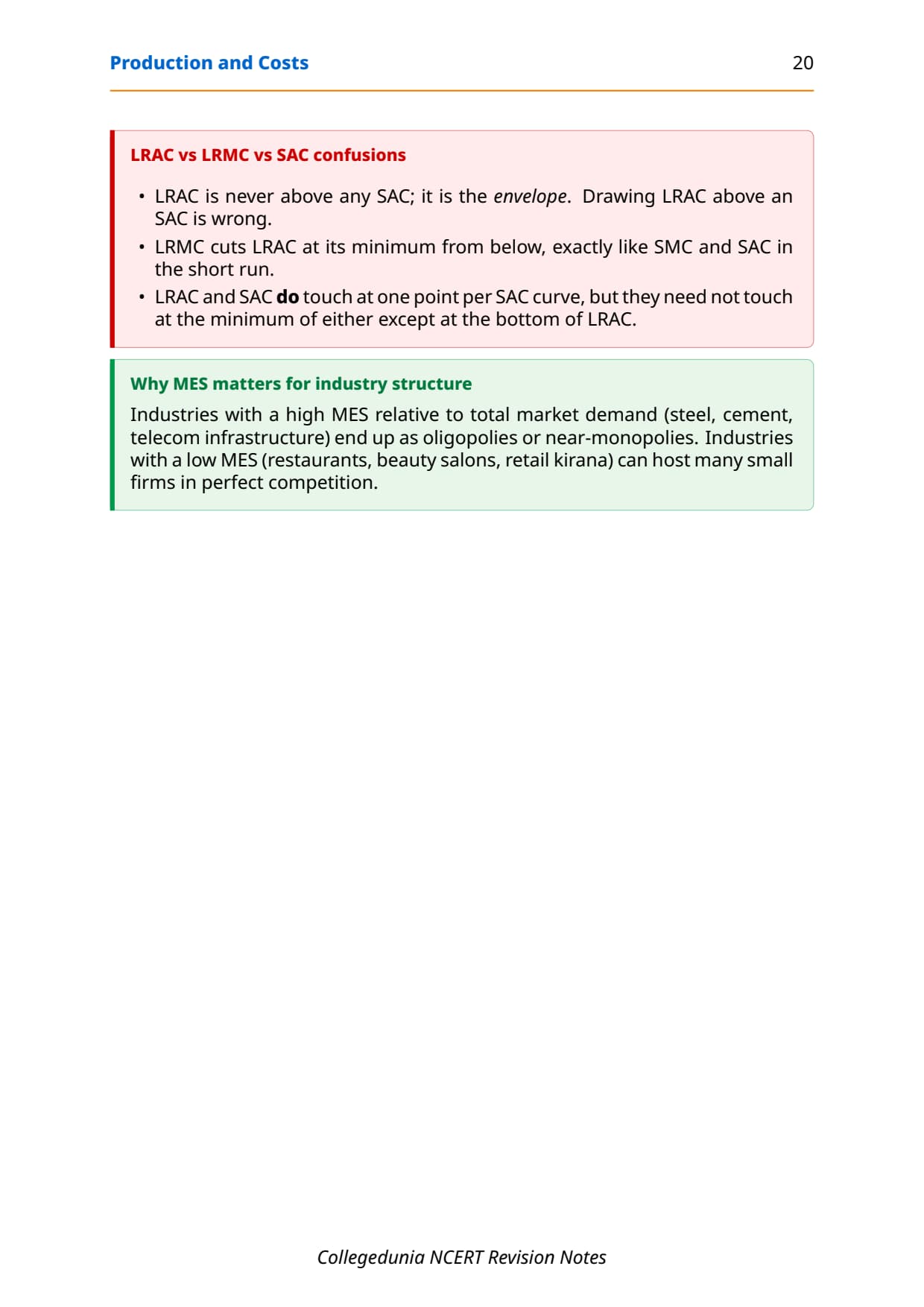
The Long-Run Average Cost (LAC) curve is the envelope of all short-run AC curves. It joins the lowest AC at each output. It is U-shaped because of returns to scale: it falls under IRS, flattens under CRS and rises under DRS.
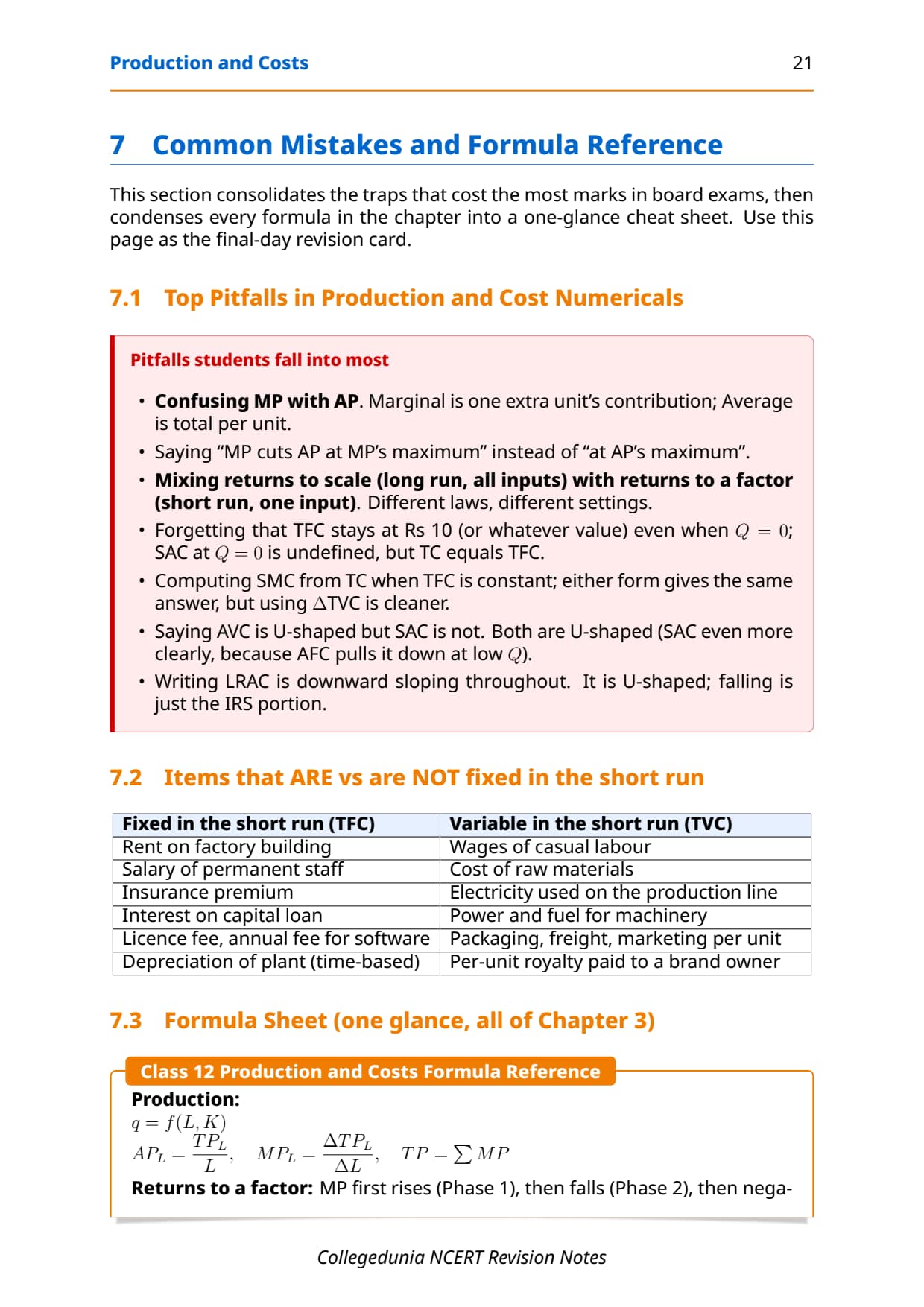
Formula Sheet for Production and Costs Class 12
This is the block to revise in the last 20 minutes before the exam.
| Concept | Formula |
|---|---|
| Production function | Q = f(L, K) |
| Average Product | AP = TP / L |
| Marginal Product | MP = change in TP / change in L |
| Total Cost | TC = TFC + TVC |
| Average Cost | AC = TC / Q = AFC + AVC |
| Marginal Cost | MC = change in TC / change in Q |
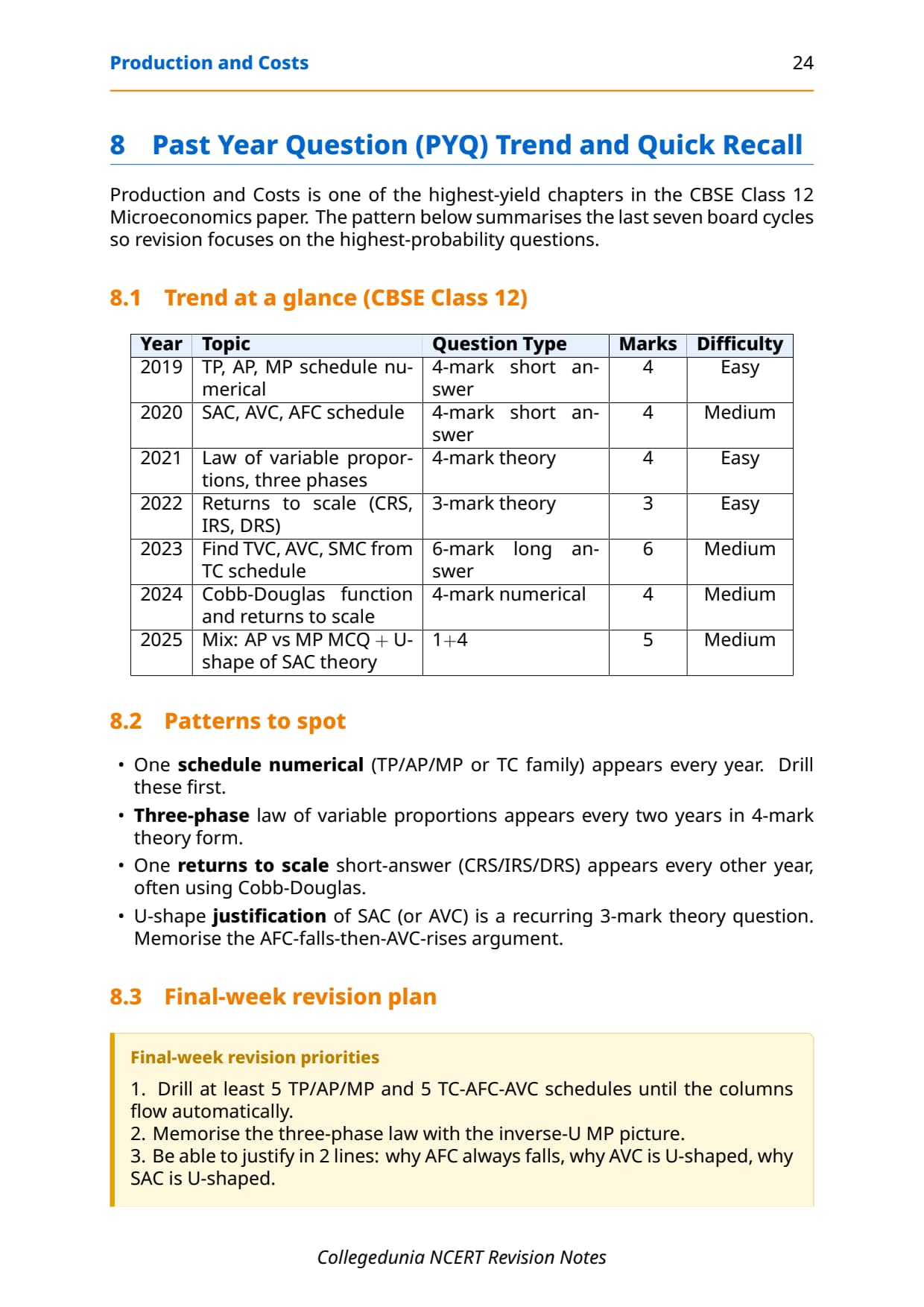
| Cobb-Douglas returns | alpha + beta > 1 IRS, = 1 CRS, < 1 DRS |
Common Mistakes in Production and Costs Class 12
- Confusing returns to a factor (short run) with returns to scale (long run).
- Saying TP is highest when MP is highest; it is highest when MP is zero.
- Drawing MC cut only AC and missing the AVC intersection.
- Treating AFC as U-shaped; it falls all the way down.
- Starting the TVC curve above zero; at zero output TVC is zero.
Production and Costs Weightage in CBSE and CUET
The chapter stays at a steady 8 to 10 marks in CBSE. The table maps what the board has asked.
| Year | CBSE question | Marks |
|---|---|---|
| 2025 | Fill AP and MP from a TP table and name the phase | 6 |
| 2024 | Draw the U-shape of AC and MC with MC cutting AC at minimum | 4 |
| 2023 | Distinguish returns to a factor from returns to scale | 3 |
| 2022 | Find TFC, TVC, AVC and MC from a TC table | 6 |
Student Feedback
We asked 11,260 Class 12 students about this chapter. 71% found the TP, AP and MP link the hardest part, and 3 out of 4 said the U-shape of the AC and MC curves was the most useful thing to revise from these notes.
Other Resources for Class 12 Economics Chapter 3
Pair these notes with the Solutions, handwritten notes and the official NCERT chapter below.
| Resource | What it covers | Open |
|---|---|---|
| Notes | Concept-first revision of the full chapter. | Class 12 Economics Chapter 3 Notes |
| NCERT Solutions | Step-by-step answers to every exercise question. | Class 12 Economics Chapter 3 NCERT Solutions |
| Handwritten Notes | Scanned notebook pages for last-mile revision. | Class 12 Economics Chapter 3 Handwritten Notes |
| NCERT Book PDF | Official NCERT Microeconomics Chapter 3 textbook. | Class 12 Economics Chapter 3 NCERT Book PDF |
All Chapters Notes for Class 12 Microeconomics
| Chapter | Notes link |
|---|---|
| Chapter 1 | Introduction to Microeconomics |
| Chapter 2 | Theory of Consumer Behaviour |
| Chapter 3 | Production and Costs |
| Chapter 4 | Theory of the Firm under Perfect Competition |
| Chapter 5 | Market Equilibrium |
Class 12 Economics Chapter 3 Production and Costs Notes FAQs
Ques. What are these Class 12 Economics Chapter 3 notes for?
Ans. They are a short revision sheet for NCERT Chapter 3. They cover the production function, the TP-AP-MP block, returns to a factor and scale, and the seven cost curves, with a formula table and common-mistake alerts. Worked numericals sit in the matching NCERT Solutions.
Ques. What is the production function in economics class 12?
Ans. It shows the most output a firm can make from each mix of inputs, written as Q = f(L, K) with technology fixed. In the short run capital is fixed and only labour varies. In the long run both factors can change, which is what drives returns to scale.
Ques. What is the difference between returns to a factor and returns to scale?
Ans. Returns to a factor is short run: only the variable factor changes while one factor stays fixed, giving three phases. Returns to scale is long run: all factors change together, and output can rise more than, exactly with, or less than the inputs.
Ques. Why are AC and AVC U-shaped while AFC is not?
Ans. AFC = TFC / Q, and TFC is fixed, so AFC falls all the way down. AVC and AC first fall and then rise because of returns to a factor, so both are U-shaped. The gap between AC and AVC at any output is exactly AFC.
Ques. What is the relationship between TP, AP and MP?
Ans. When MP is above AP, AP rises; when MP is below AP, AP falls; when MP equals AP, AP is at its peak. TP is highest when MP is zero, not when MP is highest. AP cannot be negative while TP is positive, but MP can be negative in Phase III.



Comments