




These Controlling notes for Class 12 bring together everything the CBSE paper tests, the meaning and importance of controlling, the inseparable planning-controlling link, and the step-by-step controlling process, all aligned to the 2026-27 syllabus.

- CBSE Weightage: 6 to 8 marks (Unit 1, Principles and Functions of Management)
- Sections Covered: 8 concept blocks + 10-point exam-ready summary (process, principles, techniques)
The notes are designed for a Class 12 student covering the chapter for the first time, and for board-exam candidates revising in the last week before the paper. Every concept is presented clearly with definitions, the deviation formula, supporting features and one-line takeaways. Mnemonics, quick tips, common-mistake call-outs and CBSE spotter words are placed at the precise points where students typically slip.
Controlling Class 12 Revision Notes: Section Map
| Section | What is Covered | Why It Matters in the Exam |
|---|---|---|
| 1. Meaning of Controlling | Ensuring actual conforms to planned; PDCA loop | 1 to 3-mark definition |
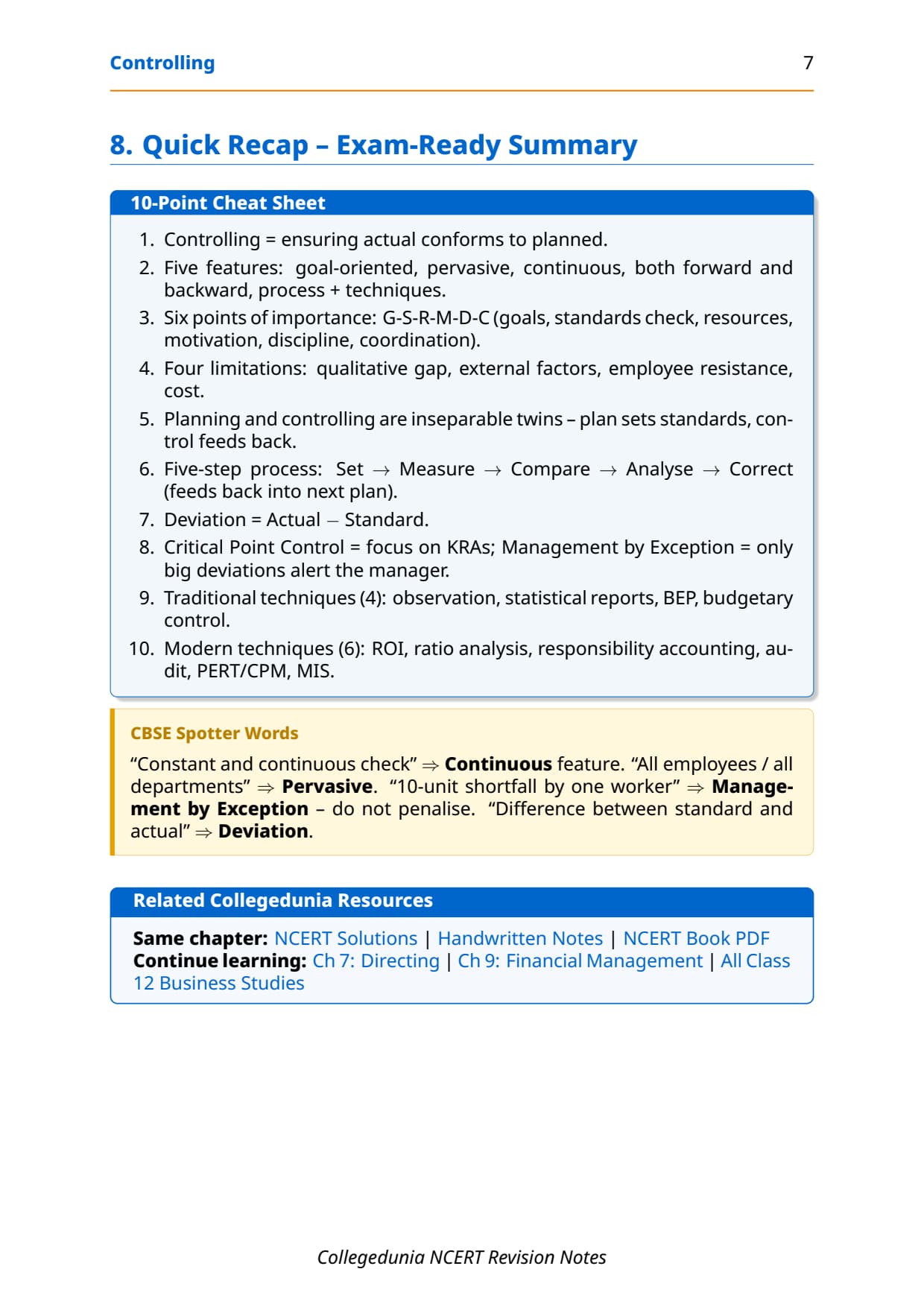
| 2. Features of Controlling | Goal-oriented, pervasive, continuous, both forward and backward looking | 3 to 4-mark case-study spotter |
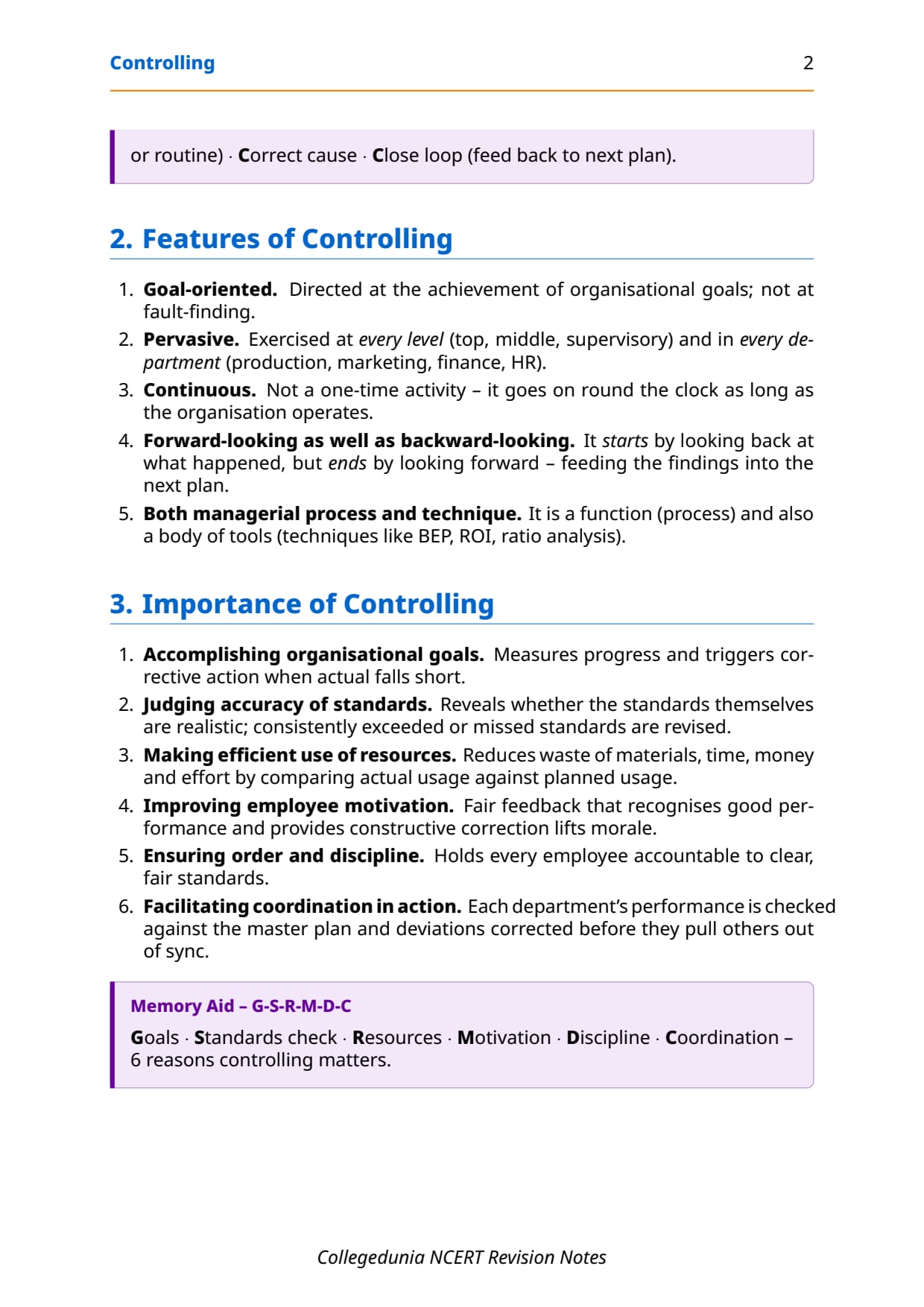
| 3. Importance of Controlling (6 points) | G-S-R-M-D-C mnemonic (goals, standards, resources, motivation, discipline, coordination) | 4 to 6-mark long answer |
| 4. Limitations of Controlling (4 points) | Quantitative gap, external factors, resistance, cost | 3 to 4-mark "name any one" |
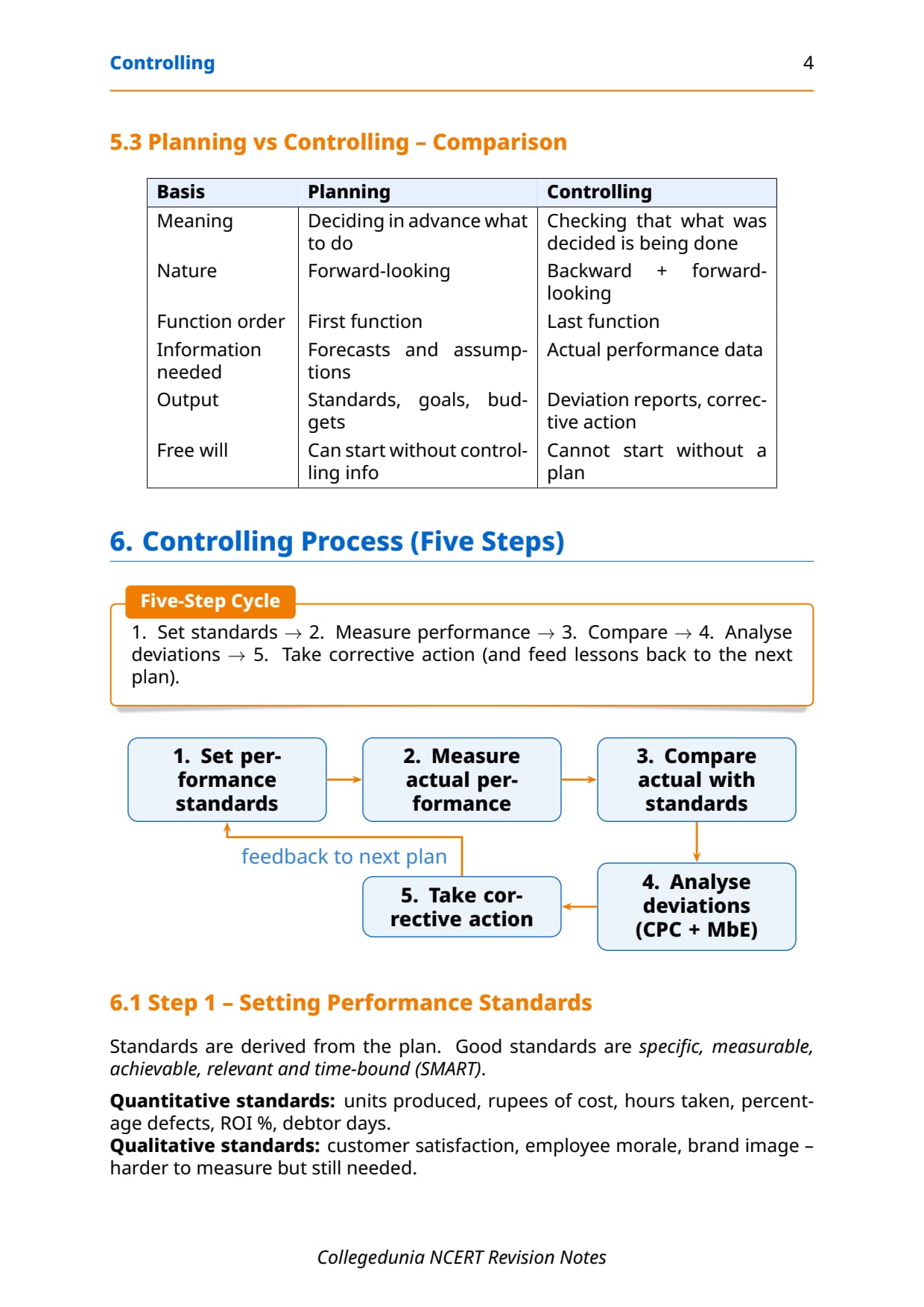
| 5. Planning and Controlling | Inseparable twins; planning prescriptive, controlling evaluative; two-way feedback loop | 5 to 6-mark; almost every year |
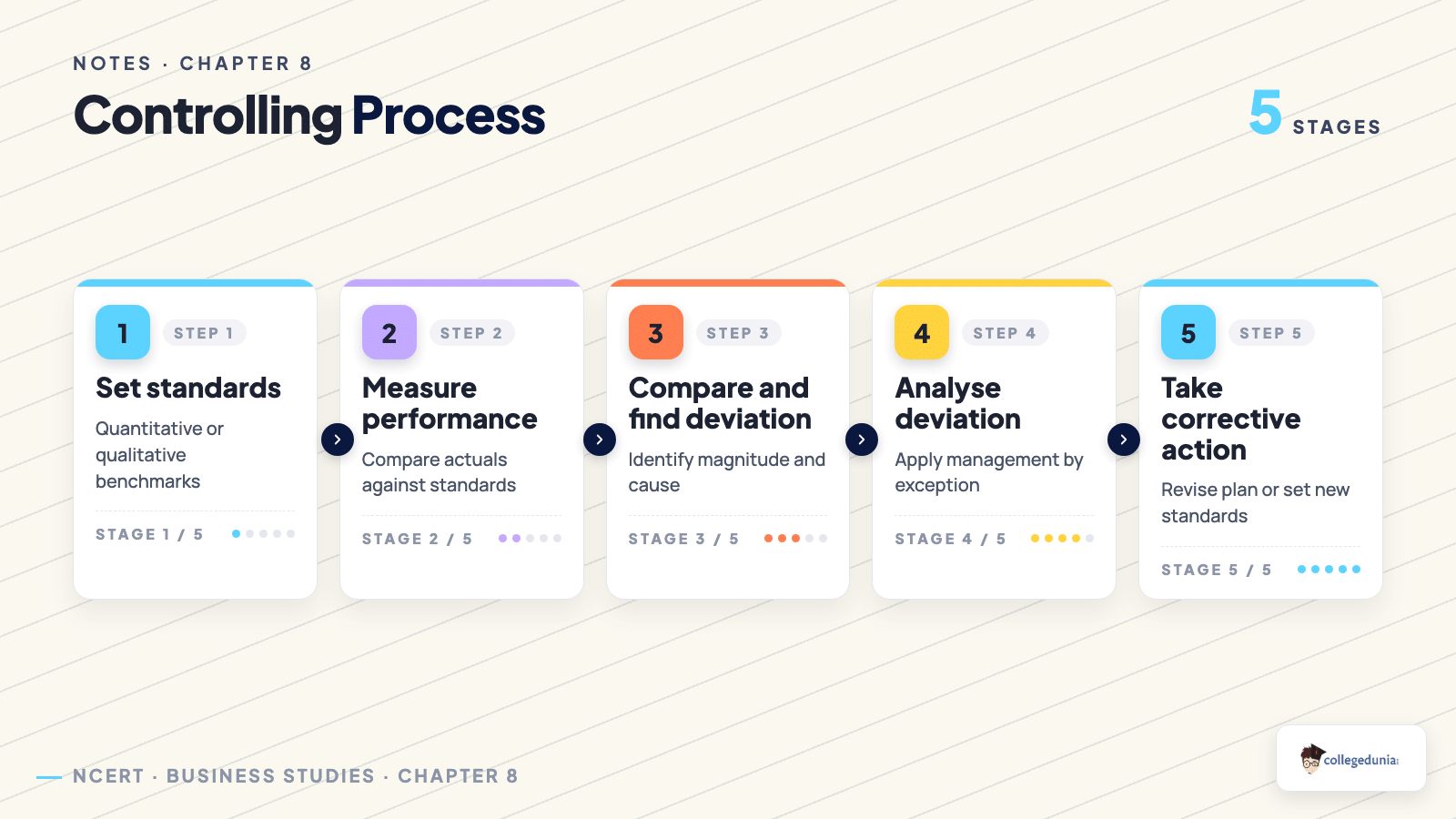
| 6. Five-Step Controlling Process | Set $\to$ Measure $\to$ Compare $\to$ Analyse (CPC + MBE inside Step 4) $\to$ Correct | 6-mark process question; most-asked |
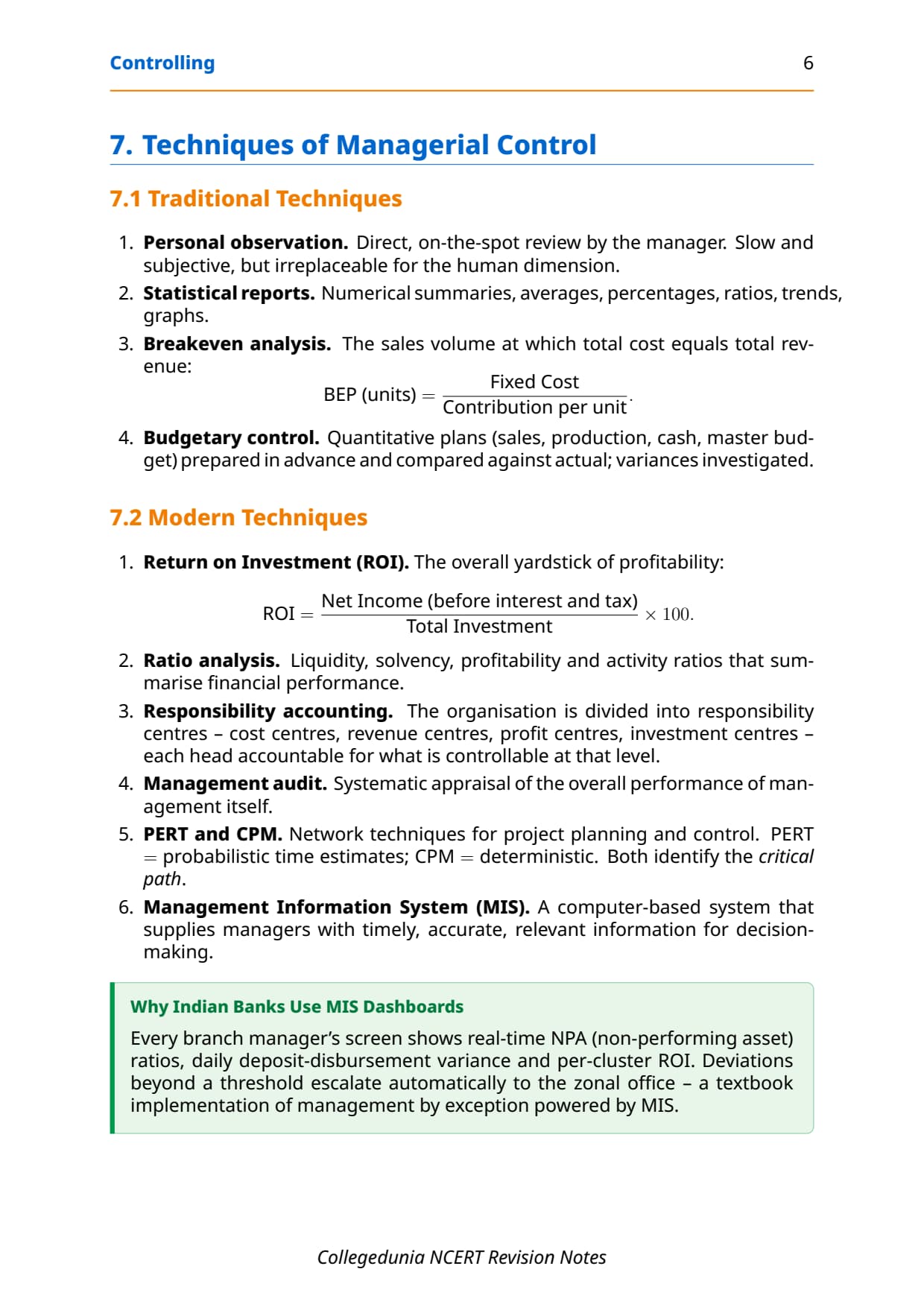
| 7. Techniques of Control | Traditional (4) + Modern (6) with BEP & ROI formulas | 5 to 6-mark "explain any four" |
| 8. Quick Recap | 10-point cheat sheet + spotter words | Last-minute revision |
Controlling Video Walkthrough
Source: Magnet Brains on YouTube
What the Class 12 Business Studies Chapter 8 NCERT Notes PDF Contains
- Full chapter coverage mapped to the 2026-27 NCERT Reprint.
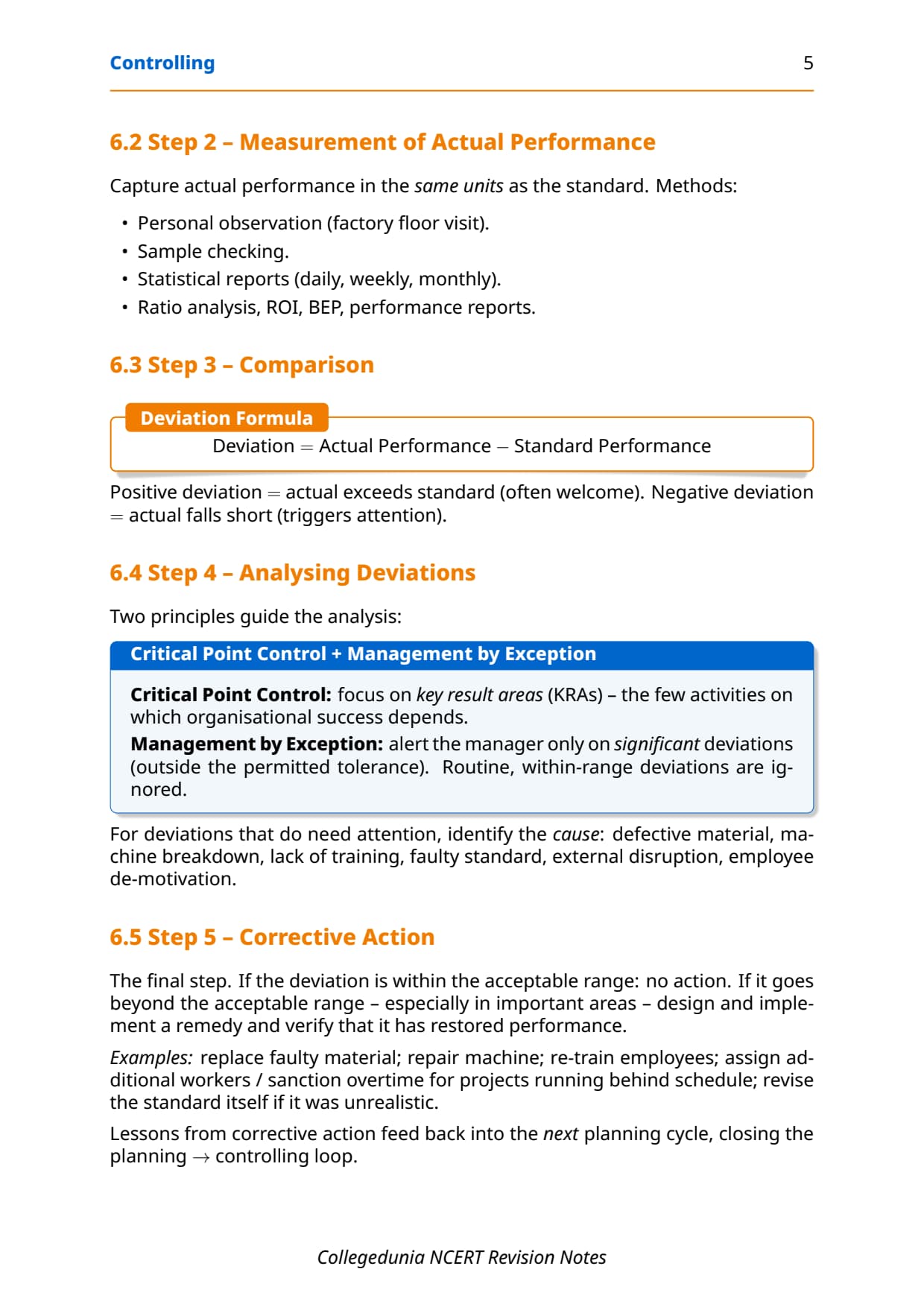
- Concept boxes for every core definition (controlling, deviation, critical point control, management by exception).
- Formula boxes for the deviation formula, BEP and ROI.
- Diagrams for the planning-controlling feedback loop and the five-step controlling process.
- Comparison tables -- planning vs controlling, traditional vs modern techniques.
- Mnemonics and CBSE spotter words (G-S-R-M-D-C, ``constant and continuous'' $\Rightarrow$ Continuous, ``all employees'' $\Rightarrow$ Pervasive).
- Cross-links to Solutions, Handwritten Notes and the NCERT Book PDF for the same chapter.
Continue Learning: More Class 12 Business Studies Chapters
- Ch 7: Directing Class 12 Notes
- Ch 9: Financial Management Class 12 Notes
- All Class 12 Business Studies Chapters
Student Feedback
In a Collegedunia poll of 640 Class 12 Commerce students, 78% said the five-step controlling process was the part of Chapter 8 they revised most before the board exam. 3 in 4 said the planning-controlling link and the deviation formula were the two spots they lost easy marks on last year.
Other Resources for Class 12 Business Studies Chapter 8 Controlling
| Resource | Link |
|---|---|
| NCERT Solutions | Controlling NCERT Solutions |
| Revision Notes | Controlling Class 12 Notes |
| Handwritten Notes | Controlling Handwritten Notes |
| NCERT Book PDF | Controlling NCERT Book PDF |
Controlling Class 12 - Frequently Asked Questions
Controlling Class 12 - Frequently Asked Questions
What is controlling in Class 12 Business Studies Chapter 8?
Controlling is the management function of ensuring that actual activities conform to planned activities. It involves setting performance standards, measuring actual performance, comparing the two, analysing deviations and taking corrective action so that organisational goals are achieved.
What are the main features of controlling?
The five NCERT-listed features are: (1) goal-oriented, (2) pervasive (every level, every department), (3) continuous, (4) both backward and forward-looking, (5) both a managerial process and a body of techniques.
What are the steps in the controlling process?
The controlling process has five steps: (1) setting performance standards, (2) measurement of actual performance, (3) comparing actual performance with standards, (4) analysing deviations, and (5) taking corrective action. The principles of critical point control (focus on KRAs) and Peter Drucker's management by exception (ignore small deviations, report only significant ones) are both applied inside Step 4.
What is the difference between traditional and modern techniques of control?
Traditional techniques (4): personal observation, statistical reports, breakeven analysis, budgetary control. Modern techniques (6): ROI, ratio analysis, responsibility accounting, management audit, PERT/CPM, and Management Information System (MIS). Modern techniques are more analytical, computer-supported and forward-looking.
Where can I download the Class 12 Business Studies Chapter 8 Controlling Notes PDF?
You can download the Collegedunia Class 12 Business Studies Chapter 8 Controlling Notes PDF free of cost from this page. The PDF is aligned to the NCERT Reprint 2026-27 syllabus and includes all the concept boxes, comparison tables, diagrams and CBSE spotter words you need for the board exam.



Comments