




These Organising notes for Class 12 pull together everything the board asks, from the four-step organising process to functional vs divisional structures, formal vs informal organisation, and delegation vs decentralisation, all for the 2026-27 CBSE syllabus.
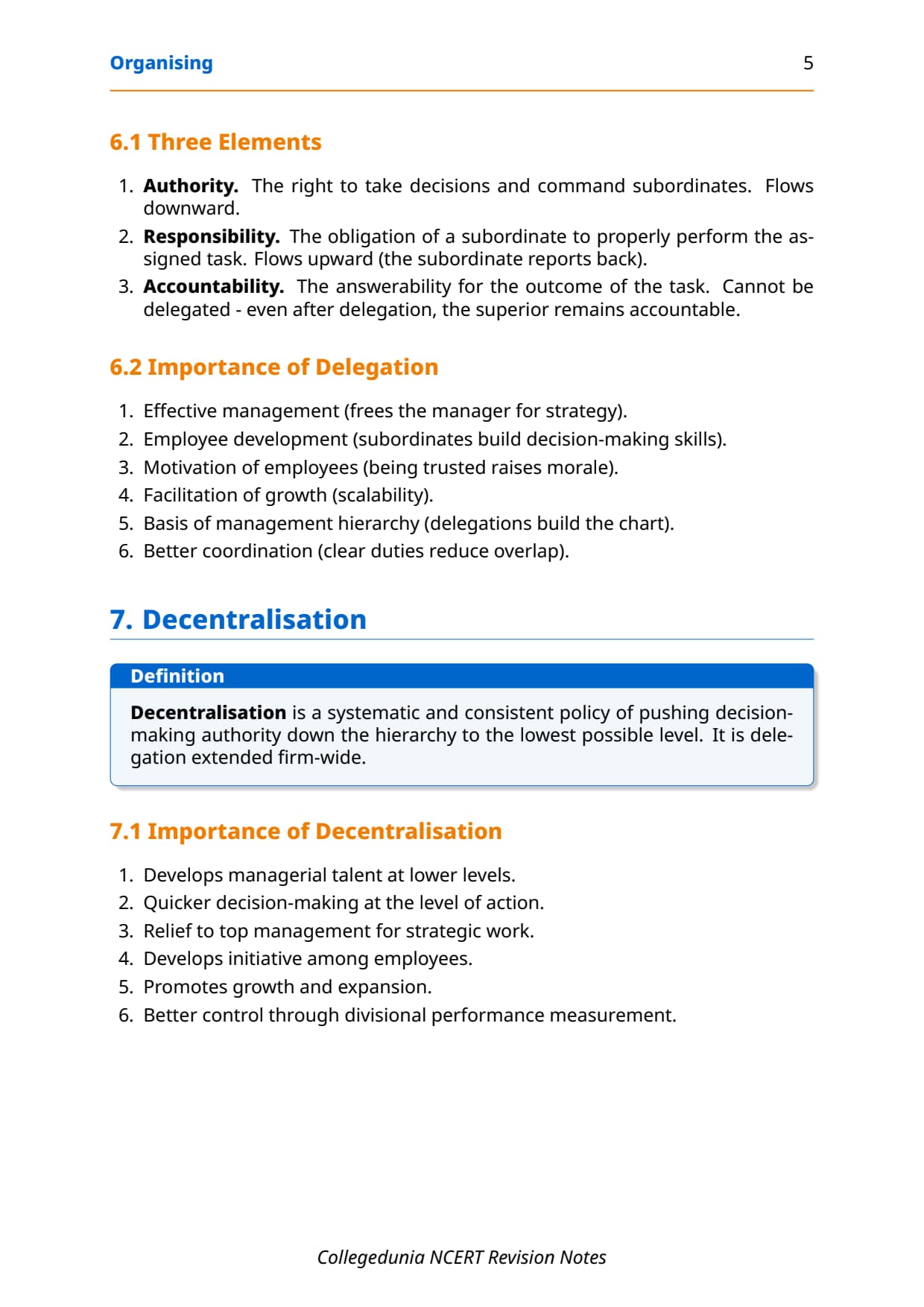
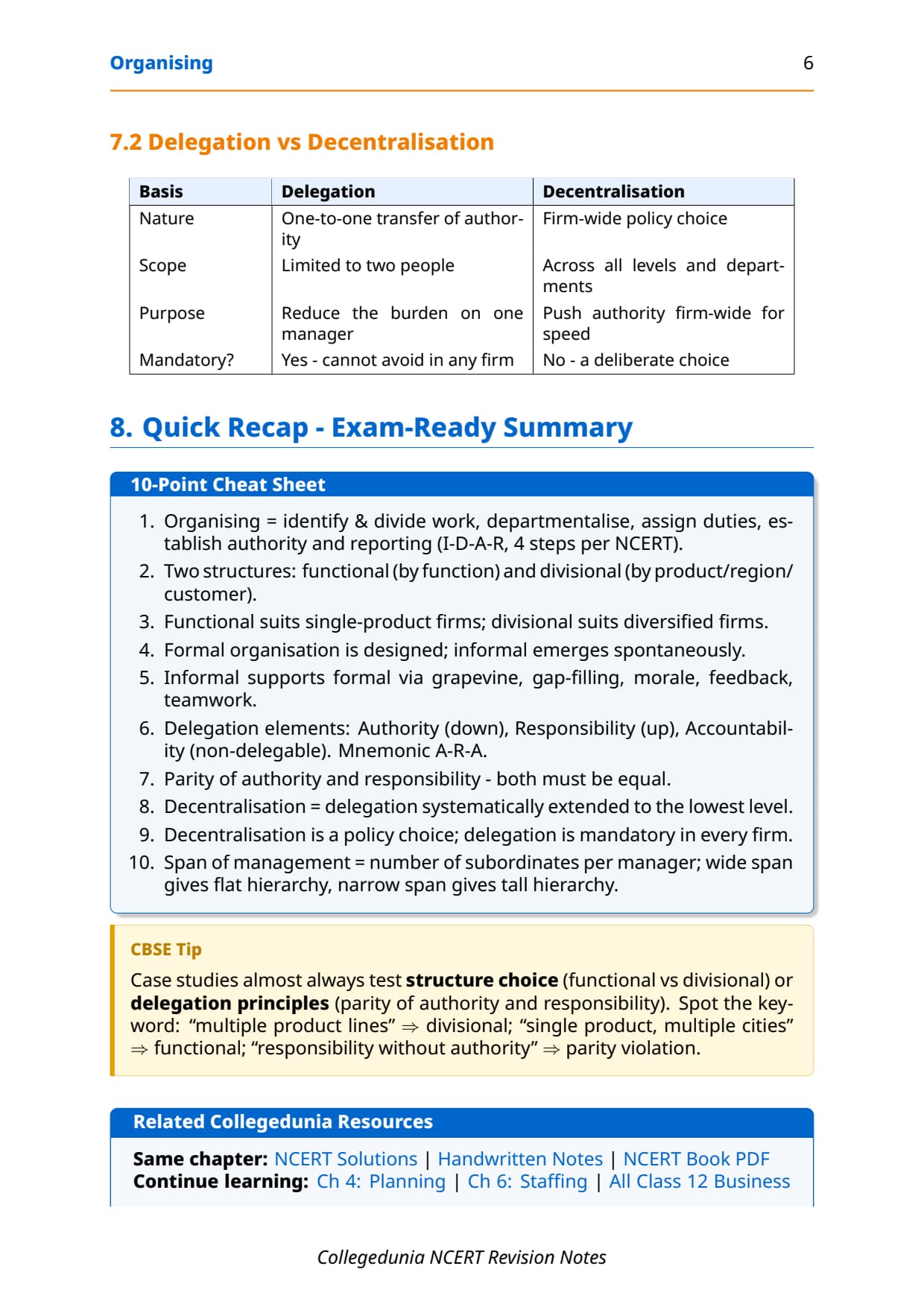
- CBSE Weightage: 6 to 10 marks (Unit 2, Principles and Functions of Management).
- Notes Coverage: 8 sections, multiple numbered lists, 2 difference tables (Functional vs Divisional, Delegation vs Decentralisation), I-D-A-R mnemonic for the organising process and A-R-A mnemonic for delegation.
These Notes are written for a one-night revision: open the PDF, scan the bolded section heads, and you have every CBSE-tested concept of Organising in front of you. The Section 6 Delegation block is the highest-yield section across the chapter.
These Notes are curated by senior Commerce educators, mapped to the 2026-27 NCERT Business Studies textbook, and refined against the last five years of CBSE Class 12 board papers.
Organising Notes Class 12: What Each Section Covers
| Section | Concept | CBSE Mark Range |
|---|---|---|
| 1 | Meaning of Organising | 1 mark |
| 2 | Six points of importance | 3 to 5 marks |
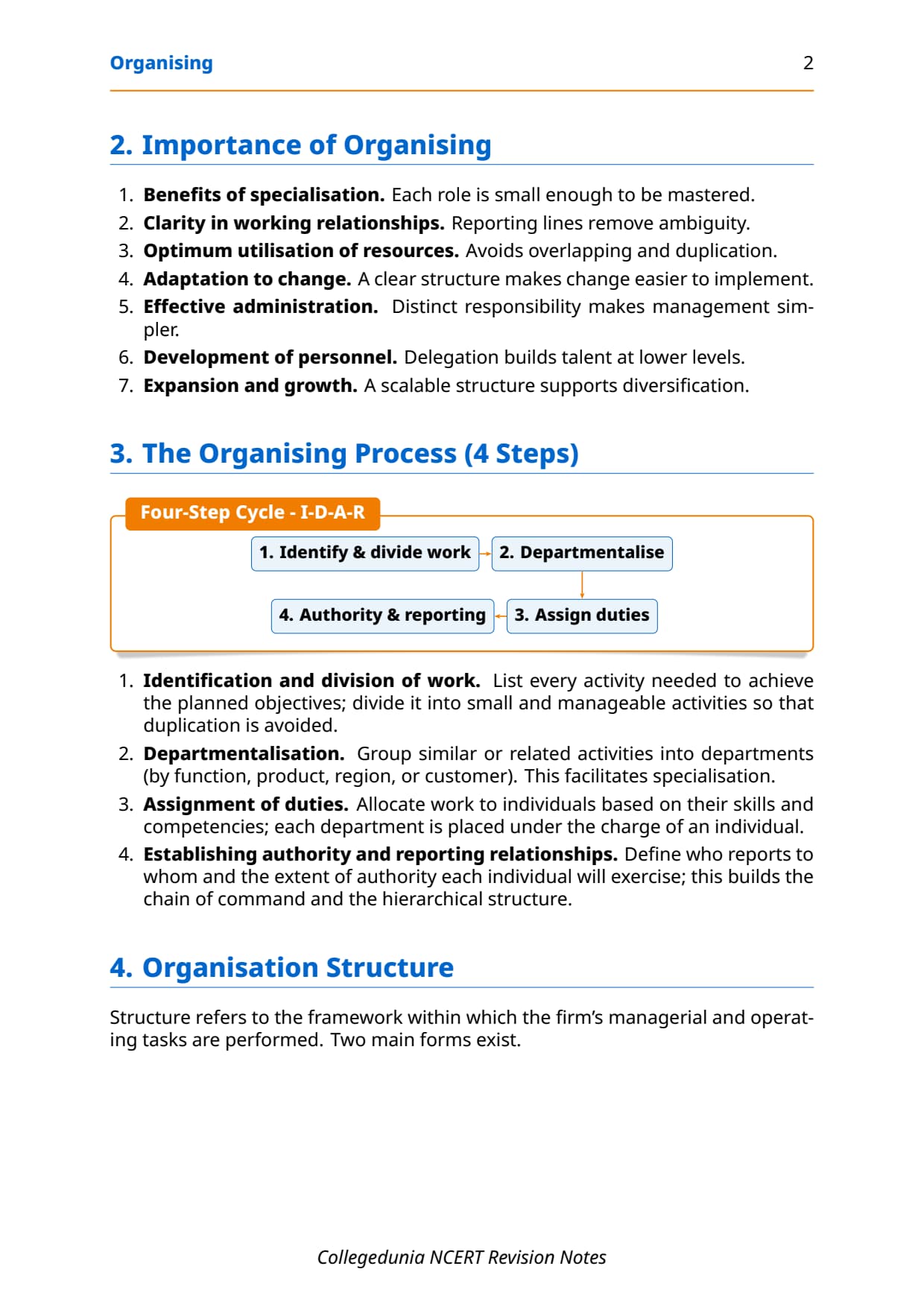
| 3 | Four-step Organising Process (I-D-A-R) | 4 to 6 marks |
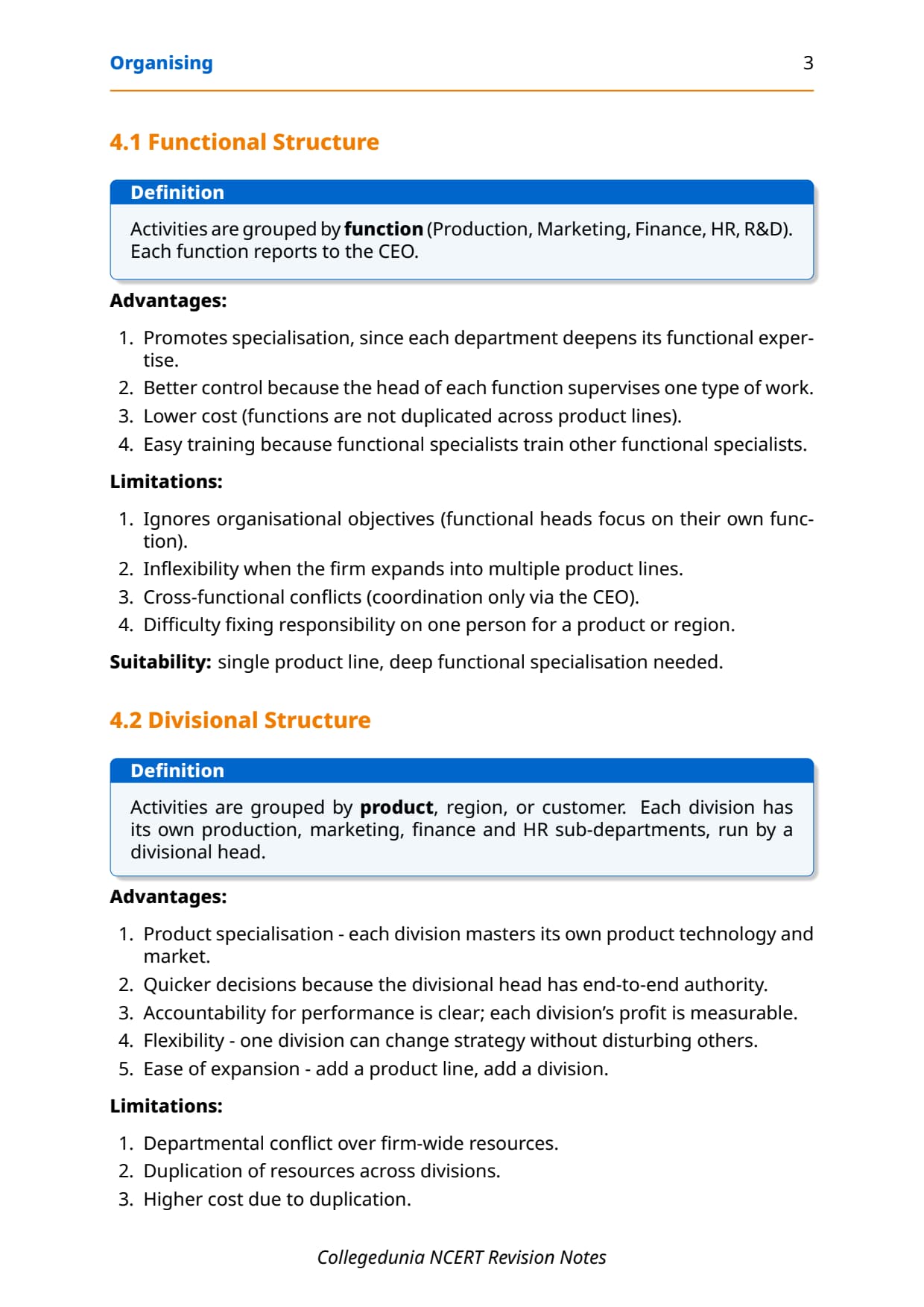
| 4 | Functional vs Divisional Structure | 5 to 6 marks |
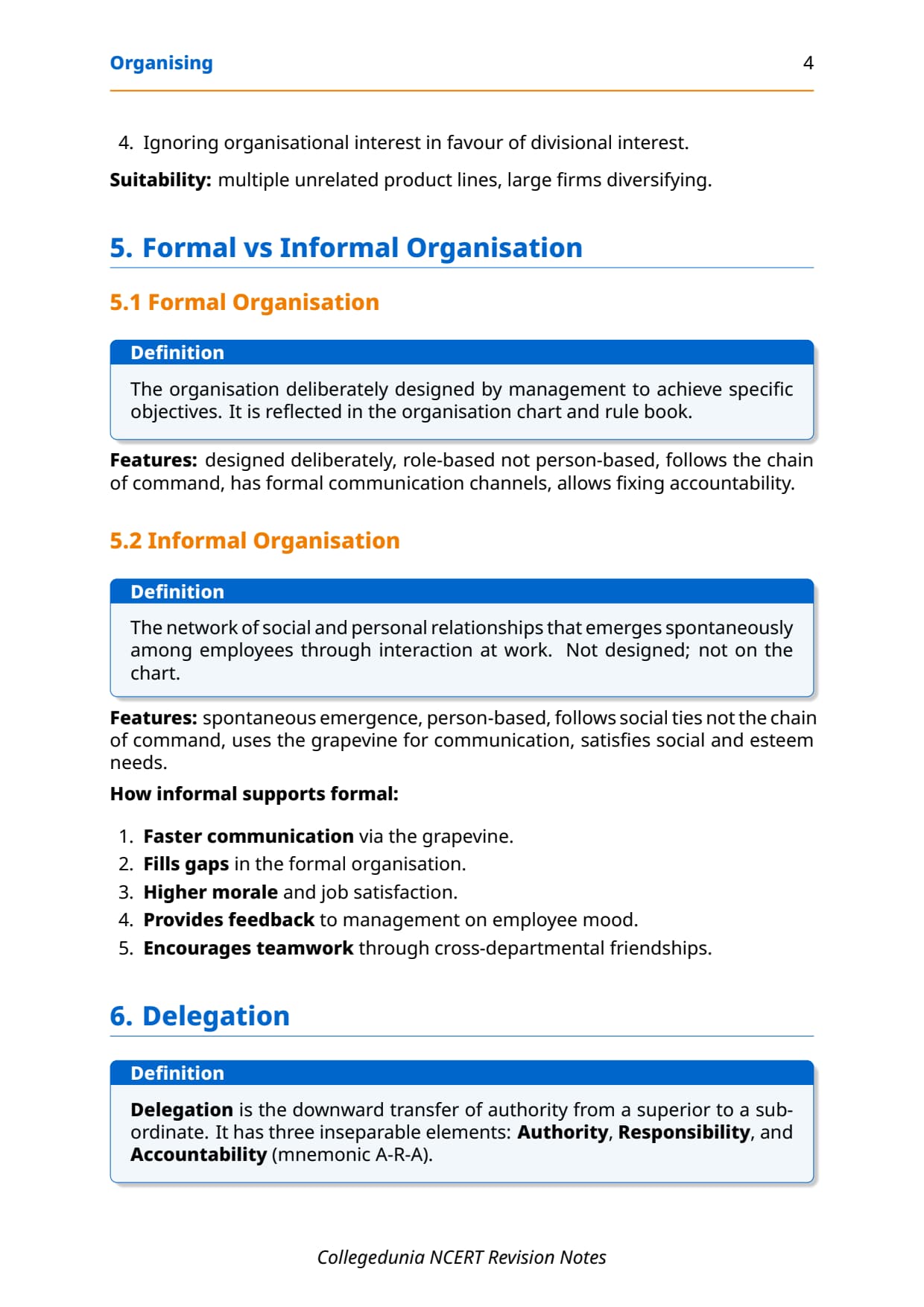
| 5 | Formal vs Informal Organisation | 3 to 5 marks |
| 6 | Delegation (A-R-A) and Its Importance | 3 to 5 marks |
| 7 | Decentralisation | 5 to 6 marks |
| 8 | 10-Point Cheat Sheet | 1 to 3 marks |
Organising Video Walkthrough
Source: Magnet Brains on YouTube
How Collegedunia's Organising Notes Help You Score
- Single-Block Memorisation: Importance, organising process, and delegation are presented as standalone numbered lists you can memorise without context switching.
- Mnemonic Engine: I-D-A-R for the organising process and A-R-A for delegation let you recall the answers under exam pressure.
- Difference Tables: Functional vs Divisional Structure, Delegation vs Decentralisation, Formal vs Informal Organisation - exactly the structure CBSE rewards.
- Case-Study Trigger Anchors: Multiple product lines $\Rightarrow$ divisional; single product, multiple cities $\Rightarrow$ functional; responsibility without authority $\Rightarrow$ parity violation.
- 2026-27 Alignment: Every concept matches the latest NCERT chapter order and CBSE marking scheme.

Top Five Concepts That Almost Always Appear in CBSE Board Papers
- Functional vs Divisional Structure. A "distinguish between" or "recommend a structure" question appears in 4 of the last 6 sessions.
- Three Elements of Delegation. Authority, Responsibility, Accountability with the three directional rules.
- Four-Step Organising Process. 4-6 mark long answer or case-based question on which step has been performed.
- Decentralisation as a Policy. 5 mark long answer on importance of decentralisation.
- Formal vs Informal Organisation. 3-5 mark short answer on how informal supports formal.
Common Mistakes to Avoid in Organising
- Confusing functional with divisional structure for geographically spread firms. Multiple locations alone do not trigger divisional structure.
- Treating responsibility and accountability as interchangeable. Responsibility can be transferred; accountability cannot.
- Saying delegation is the same as decentralisation. Delegation is one-to-one; decentralisation is firm-wide policy.
- Listing fewer than four organising-process steps. NCERT lists four steps (I-D-A-R) and each carries roughly one mark.
- Suggesting that informal organisation should be abolished. The textbook position is that it should be recognised and used, not eliminated.
Student Feedback
In a Collegedunia poll of 640 Class 12 Commerce students, 82% said the I-D-A-R and A-R-A mnemonics made the Organising chapter far easier to recall in the exam. 3 in 4 said the Functional vs Divisional and Delegation vs Decentralisation difference tables were the parts they revised last before the paper.
Other Resources for Class 12 Business Studies Chapter 5 Organising
| Resource | Link |
|---|---|
| NCERT Solutions | Organising NCERT Solutions |
| Revision Notes | Organising Class 12 Notes |
| Handwritten Notes | Organising Handwritten Notes |
| NCERT Book PDF | Organising NCERT Book PDF |
Frequently Asked Questions on Class 12 Business Studies Chapter 5 Notes
Frequently Asked Questions on Class 12 Business Studies Chapter 5 Notes
Q1. Are the Class 12 Business Studies Chapter 5 Notes free to download?
Yes. The complete Collegedunia Notes PDF for Organising is free to download from this page, aligned to the 2026-27 CBSE syllabus.
Q2. What is the difference between functional and divisional structure?
Functional structure groups activities by function (production, marketing, finance, HR) and suits single-product firms. Divisional structure groups activities by product, region or customer with each division running end-to-end, and suits diversified firms.
Q3. What are the three elements of delegation?
Authority (right to act, flows downward), Responsibility (obligation to perform, flows upward), and Accountability (answerability for outcome, cannot be delegated). The mnemonic is A-R-A.
Q4. How does informal organisation support the formal organisation?
Informal organisation supports the formal one through faster communication via the grapevine, filling gaps in the formal structure, raising morale, providing feedback to management, and encouraging cross-departmental teamwork.
Q5. Are these Notes aligned to the 2026-27 CBSE Business Studies syllabus?
Yes. Every section and definition uses the 2026-27 NCERT Business Studies textbook and the latest CBSE marking scheme.



Comments