




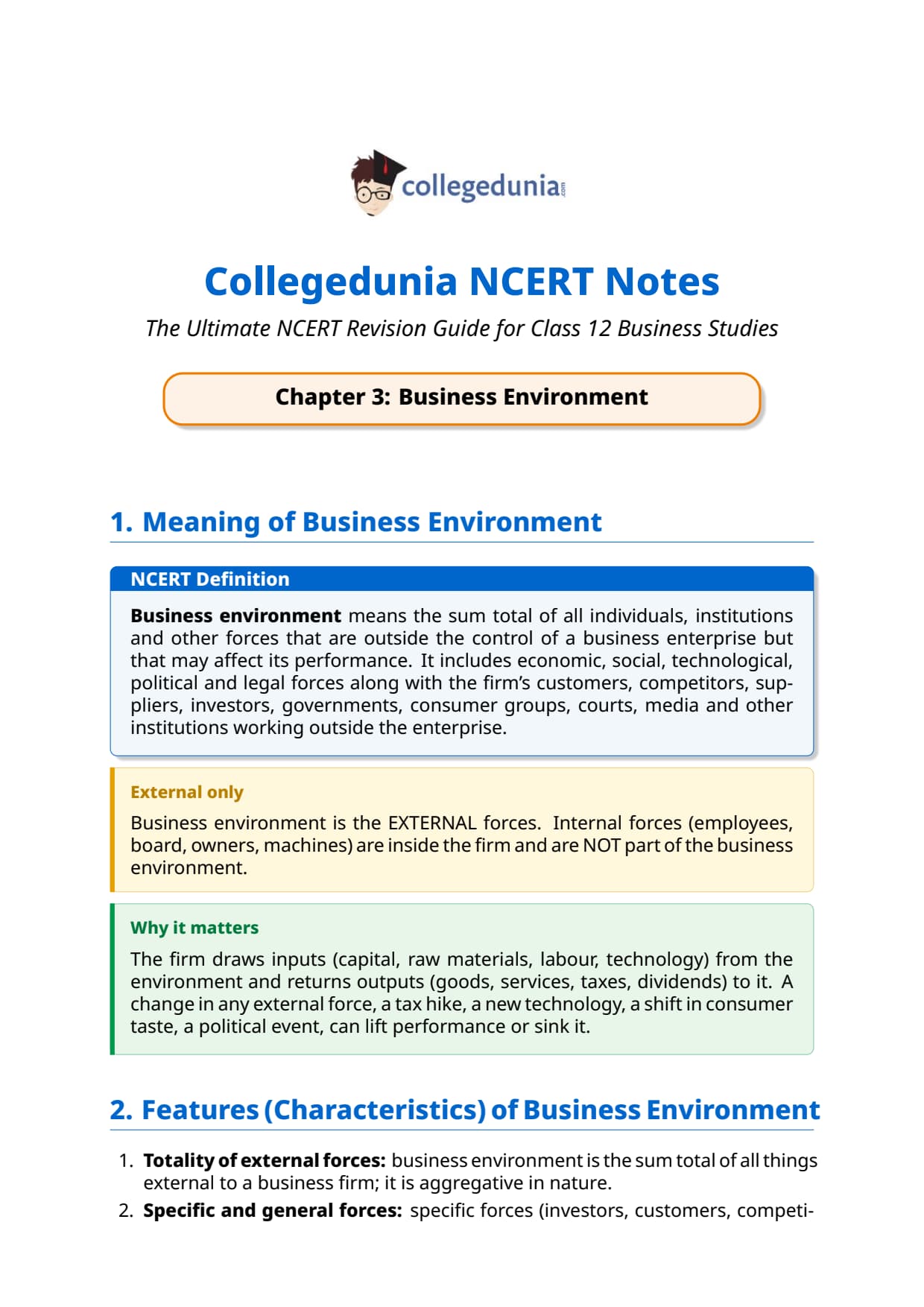
These Business Environment notes for Class 12 have been prepared for fast revision, covering the meaning, features and importance of the environment, its five dimensions, and the impact of LPG reforms, demonetisation and GST, in line with the 2026-27 CBSE syllabus.
- CBSE Weightage: 6 to 10 marks (Unit 1, Principles and Functions of Management)
- Sections Covered: Definition, key features, important topics, exam-cue boxes and Key Takeaways
These notes suit two students: one meeting the chapter for the first time, and one revising in the last week before the board paper.

Business Environment Class 12 Notes: Topic Map
| Topic | Mark Range |
|---|---|
| Meaning and 7 features (totality, specific+general, inter-relatedness, dynamic, uncertainty, complexity, relativity) | 3-4 |
| Importance of business environment (6 points) | 3-6 |
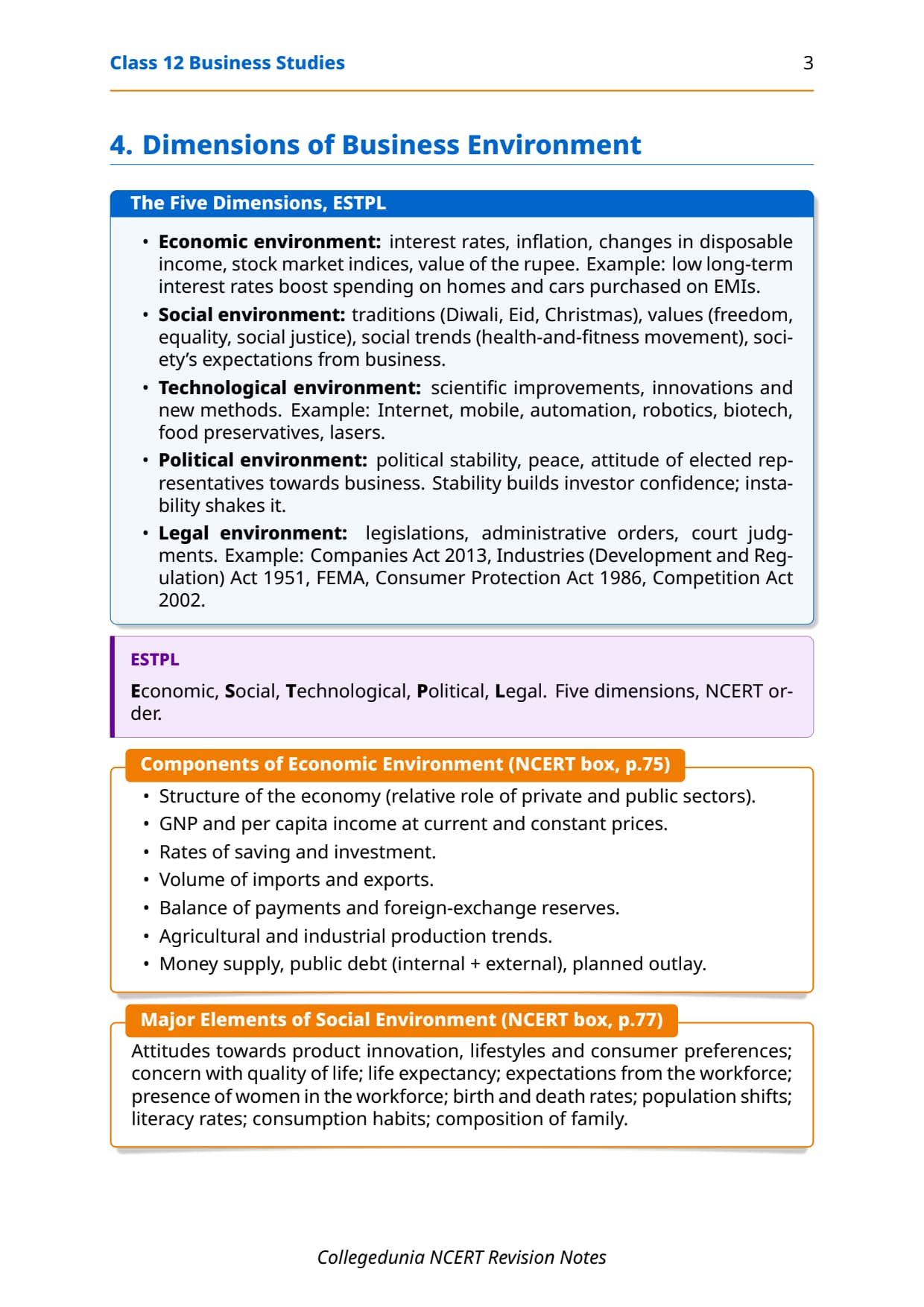
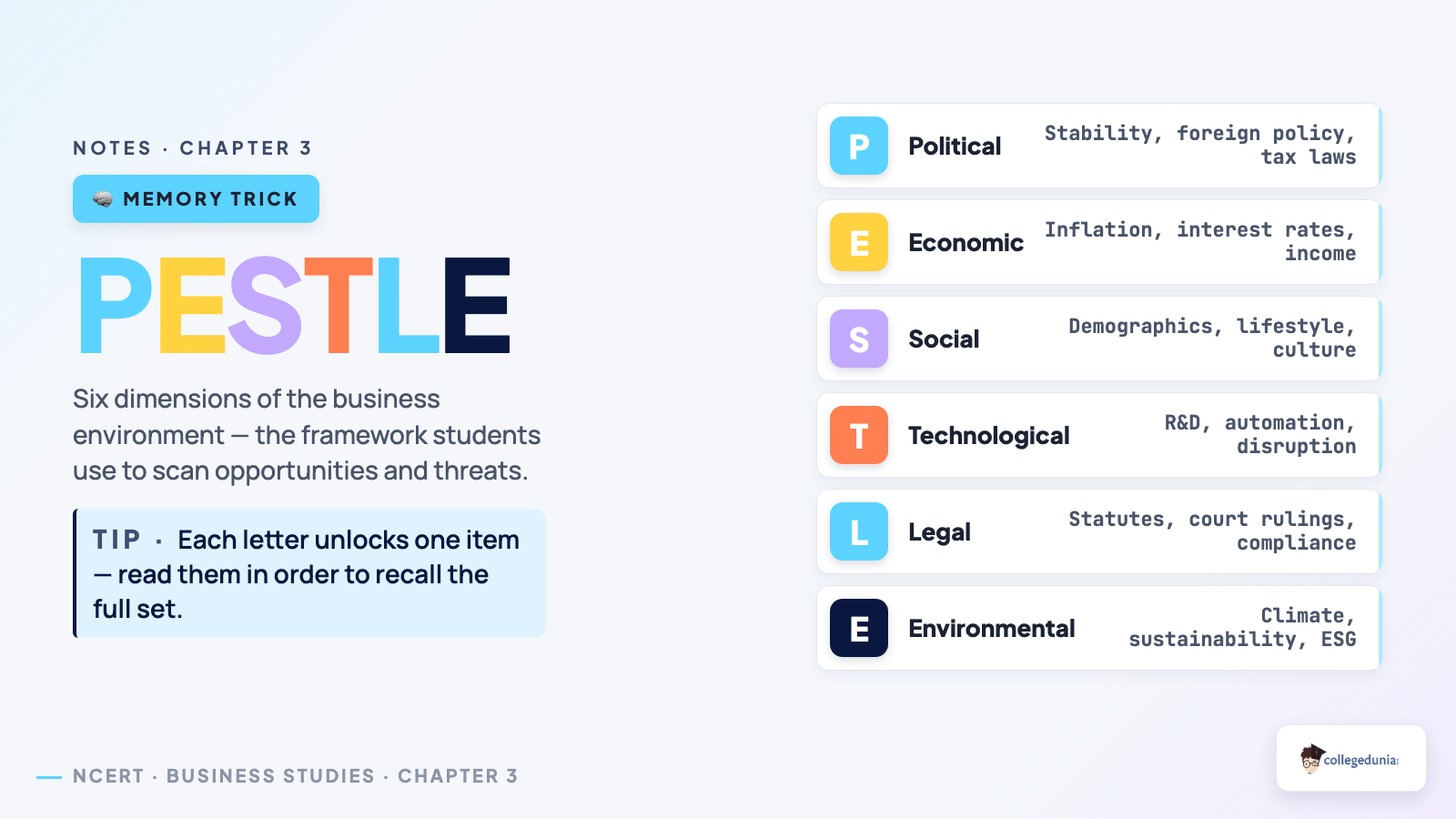
| Five dimensions (Economic, Social, Technological, Political, Legal) | 5-6 |
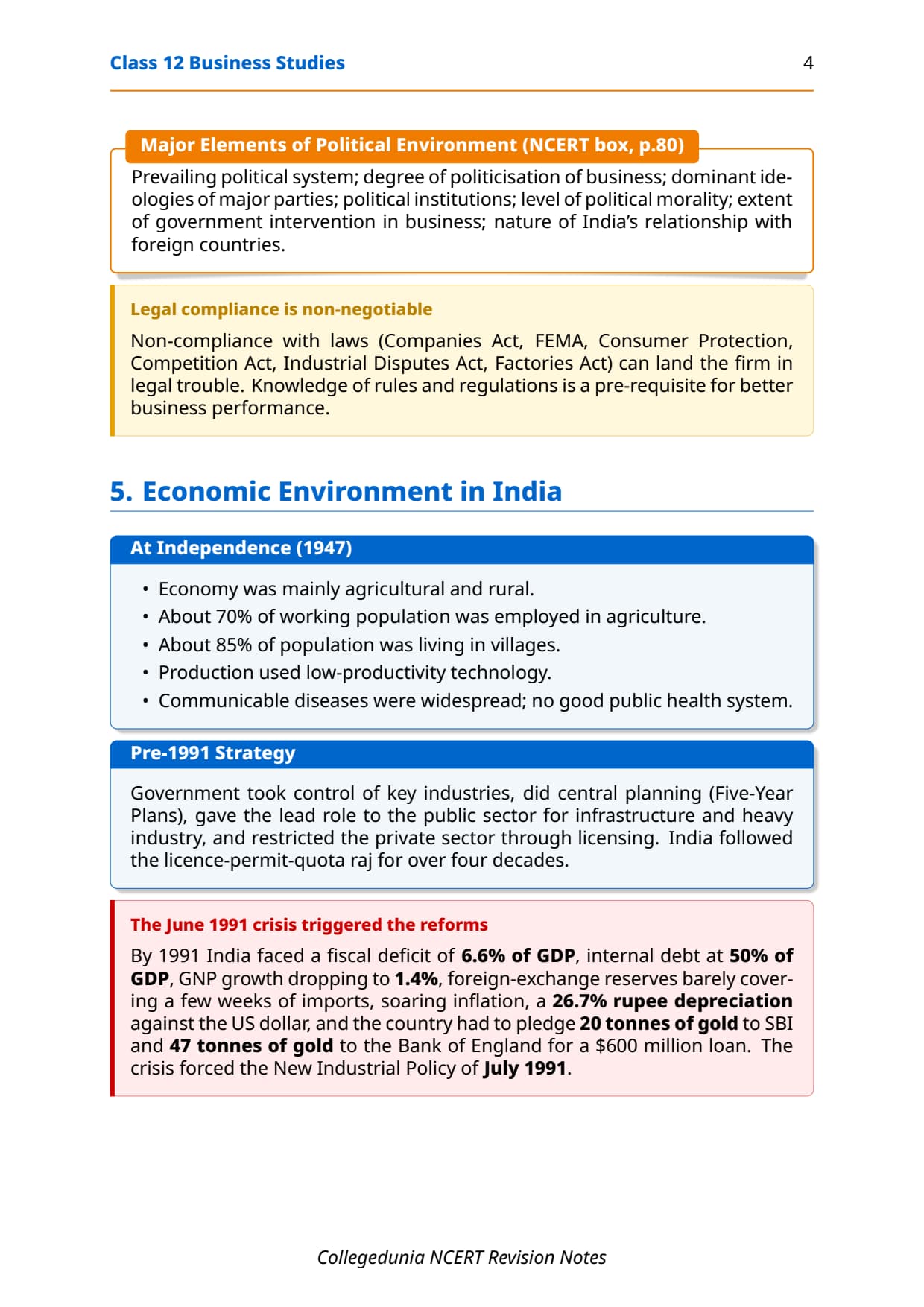
| Economic environment in India: NEP 1991 (BIFR, FIPB, abolition of licensing) | 5-6 |
| Demonetisation 8 Nov 2016 (Rs 500 + Rs 1000 withdrawal) | 5-6 |
| Impact of LPG on Indian business (6-7 impacts) | 5-6 |
| Case-based application | 5-6 |
Business Environment Video Walkthrough
Source: Magnet Brains on YouTube
7 Features of Business Environment (Revision List)
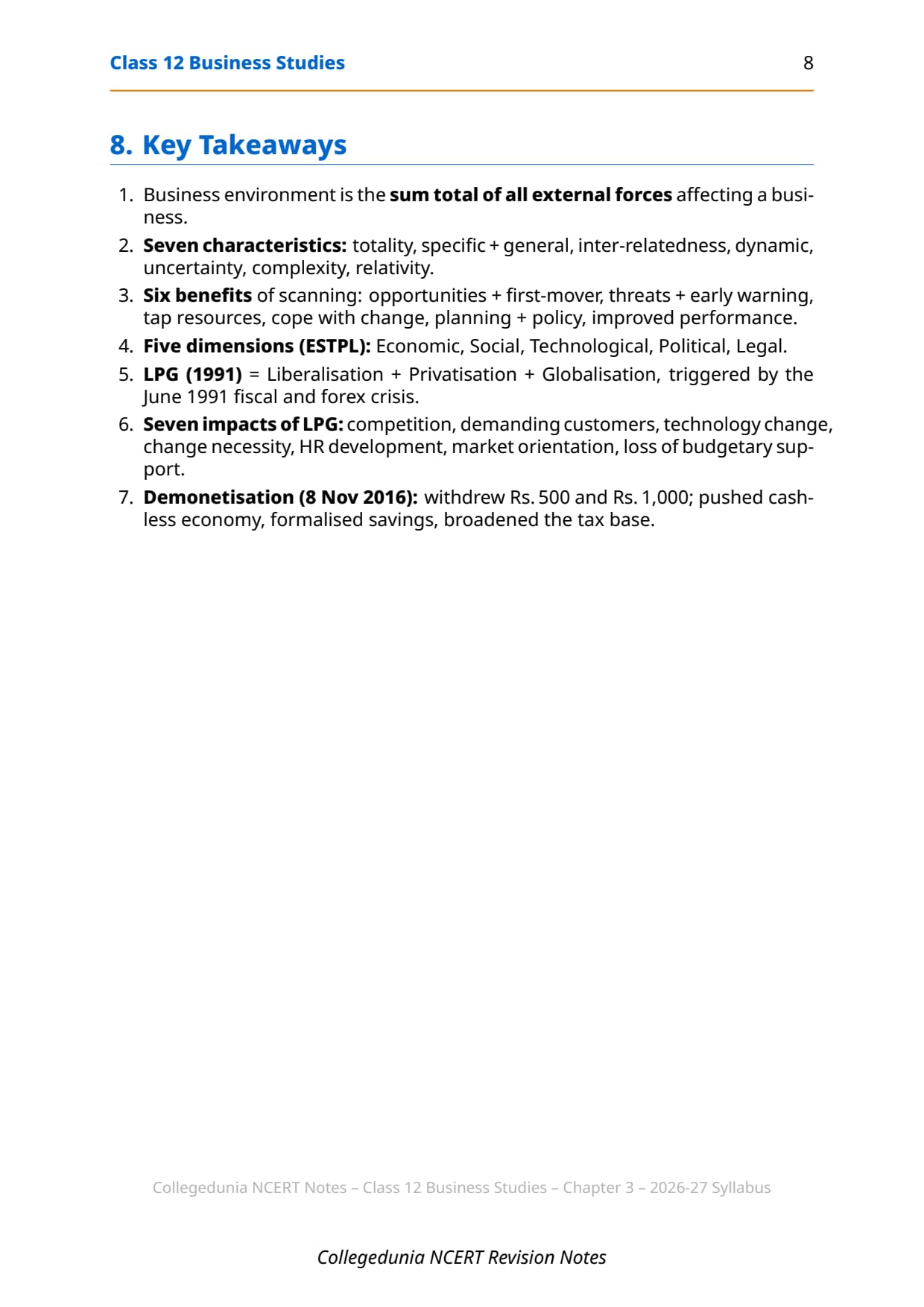
- Totality of external forces: sum of every external force acting on the firm.
- Specific and general forces: specific (customers, suppliers, competitors) affect firms directly; general (economic, social, political, legal, technological) affect all firms.
- Inter-relatedness: changes in one dimension trigger changes in others.
- Dynamic nature: environment keeps changing; no factor stays fixed.
- Uncertainty: hard to predict, especially in IT, fashion, electronics.
- Complexity: totality of many inter-related forces; cannot be fully grasped.
- Relativity: differs across countries and across regions (sari demand high in India, low in France).
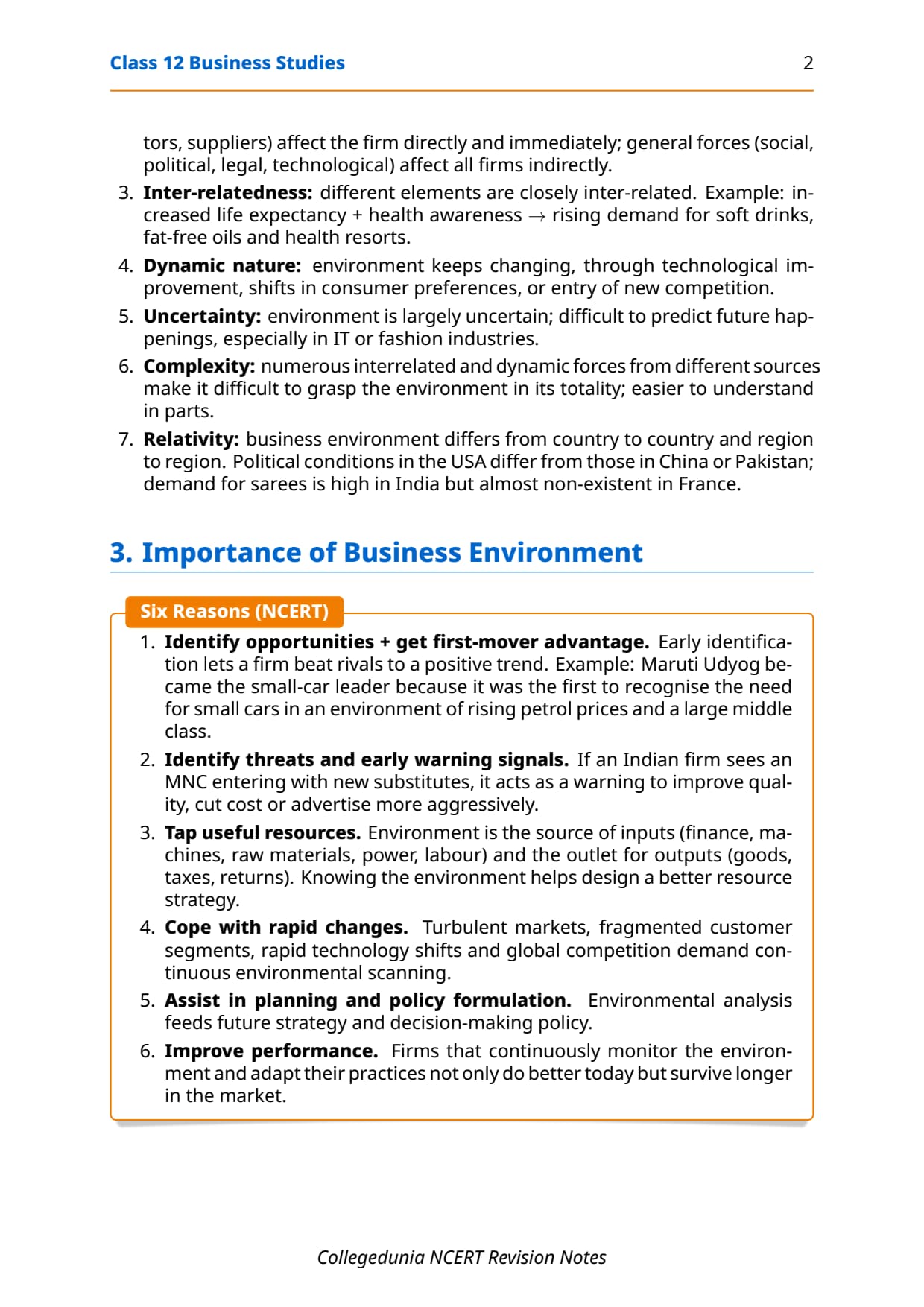
Importance of Business Environment (6 Points)
- Helps the firm identify opportunities and get first-mover advantage.
- Helps identify threats and provides early warning signals.
- Helps in tapping useful resources from the environment.
- Helps in coping with rapid changes in technology, customer preferences, competition.
- Assists in planning and policy formulation.
- Improves firm performance through better adaptation.
New Economic Policy 1991 (Quick Revision)
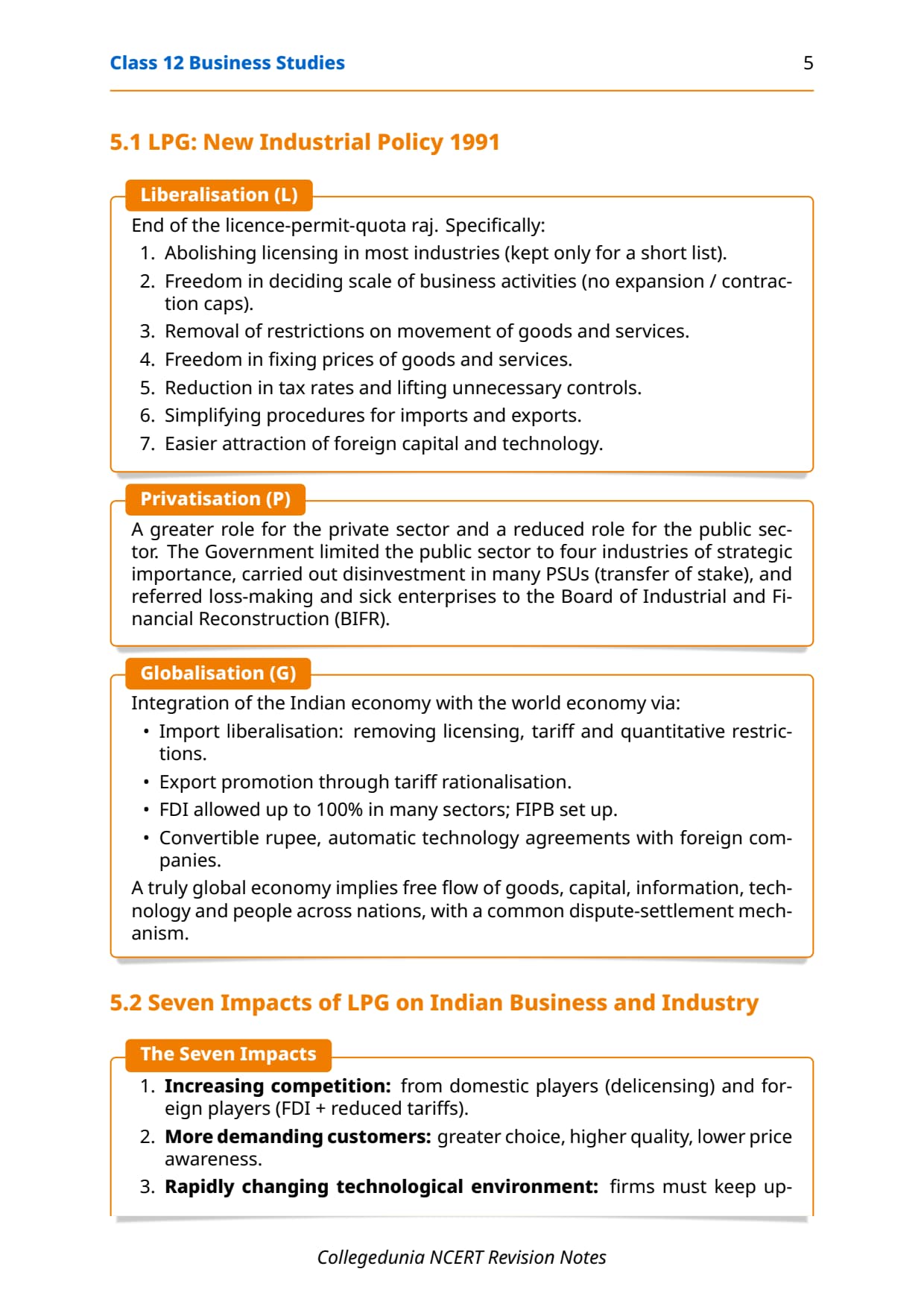
- Liberalisation: abolition of industrial licensing (except defence, atomic energy, hazardous chemicals); freedom in capacity expansion and pricing; reduction in taxes; simpler import-export procedures.
- Privatisation: disinvestment of PSU equity; PSU-reserved industries cut from 17 to 3; sick PSUs referred to BIFR (Board for Industrial and Financial Reconstruction).
- Globalisation: tariff cuts; removal of quantitative import restrictions; FDI through FIPB (Foreign Investment Promotion Board); foreign collaborations encouraged.
Demonetisation: 8 November 2016
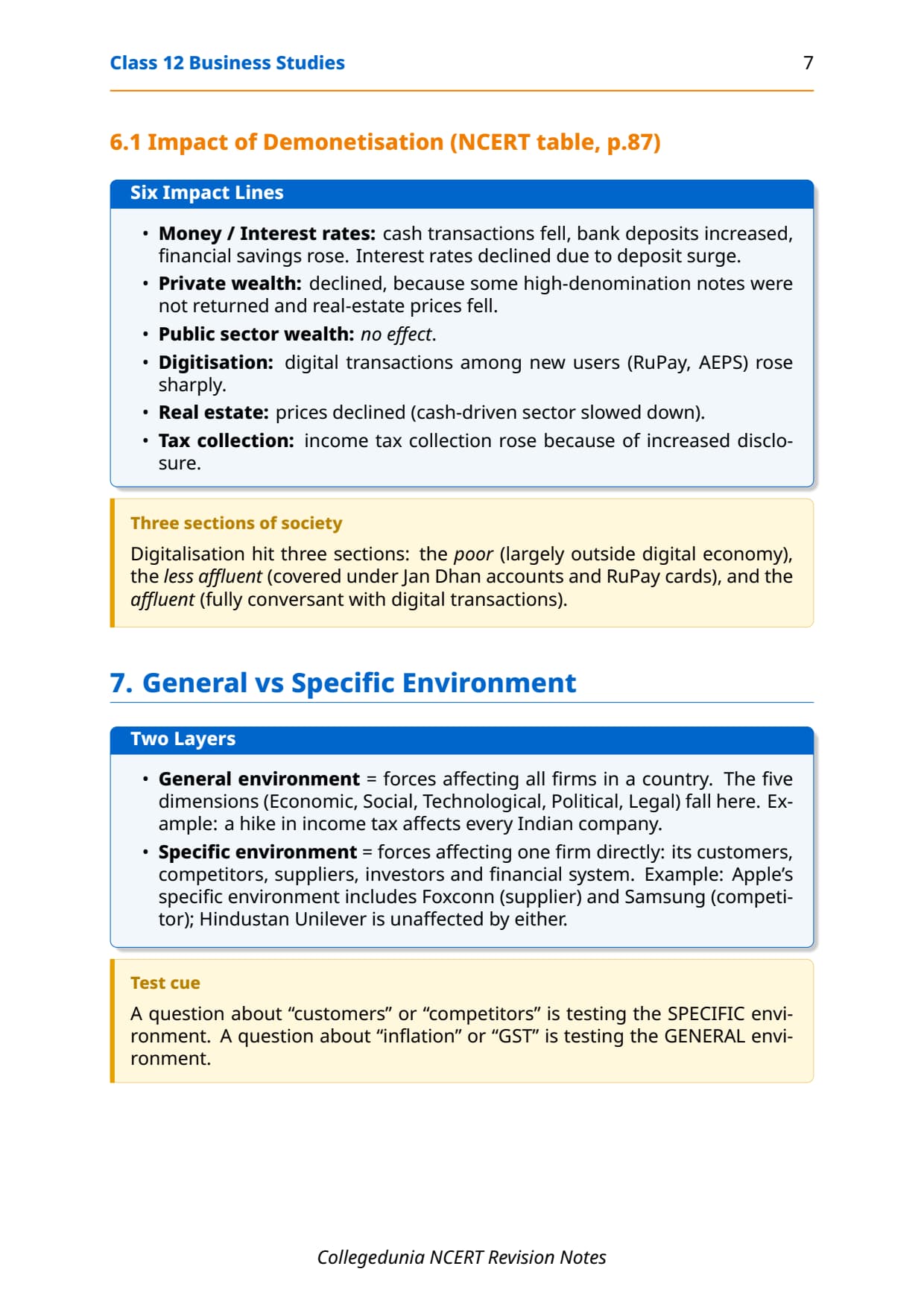
Government withdrew legal tender of Rs 500 and Rs 1000 notes (about 86% of cash in circulation). Aim: curb black money, push digital payments, formalise the economy.
- Money supply: sharp fall in cash, rise in bank deposits.
- Banking: surge in CASA, lower lending rates.
- Cashless economy: rapid uptake of UPI, mobile wallets, digital payments.
- Interest rates fell as liquidity expanded.
- Tax compliance and GST registrations rose in the following year.
6-7 Impacts of Government Policy Changes on Business
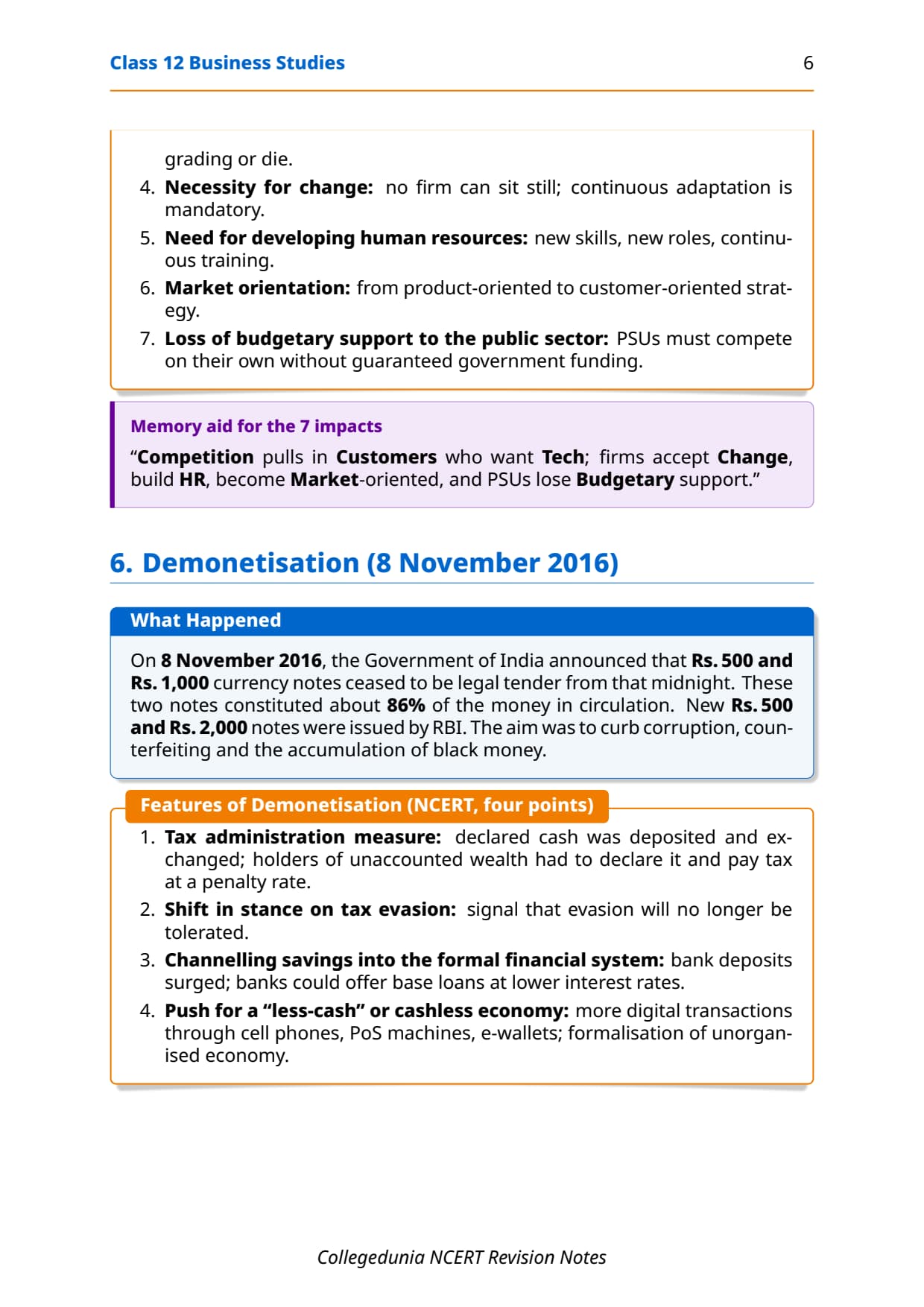
- Increasing competition (foreign and Indian firms).
- More demanding customers (wider choice, higher expectations).
- Rapidly changing technological environment (shorter product life-cycles).
- Necessity for change (no more stable long-term plans).
- Need for developing human resources (skilled, adaptable workforce).
- Market orientation (research customer needs first, then produce).
- Loss of budgetary support to the public sector (PSUs must self-finance).
Common Mistakes to Avoid in Chapter 3
- Confusing business environment with internal environment. The chapter is about external forces only.
- Listing fewer than seven features. CBSE wants all seven: totality, specific+general, inter-relatedness, dynamic, uncertainty, complexity, relativity.
- Listing fewer than five dimensions. There are exactly five: economic, social, technological, political, legal.
- Forgetting that LPG = Liberalisation + Privatisation + Globalisation, the 1991 reforms package launched after the June 1991 BoP crisis.
- Missing date and denominations in demonetisation answers. Mark-scheme expects "8 November 2016" and "Rs 500 + Rs 1000".
- Treating demonetisation only as a political event. It hit the economic dimension hardest.
- Forgetting the named institutions in NEP 1991 answers: BIFR (sick PSUs) and FIPB (foreign investment).
Student Feedback
In a Collegedunia poll of 940 Class 12 Commerce students, 78% said the seven features and the five dimensions were the easiest marks to lock in for this chapter. 3 in 4 said the LPG, demonetisation and GST sections were where they lost marks, mostly by forgetting the 1991 dates and the named bodies like BIFR and FIPB.
Other Resources for Class 12 Business Studies Chapter 3 Business Environment
| Resource | Link |
|---|---|
| NCERT Solutions | Business Environment NCERT Solutions |
| Revision Notes | Business Environment Class 12 Notes |
| Handwritten Notes | Business Environment Handwritten Notes |
| NCERT Book PDF | Business Environment NCERT Book PDF |
FAQs on Business Environment Class 12 Notes
FAQs on Business Environment Class 12 Notes
What is business environment in Class 12 Business Studies?
Business environment refers to all external forces (economic, social, technological, political, legal) that have a bearing on the functioning of a business. It is the sum total of all external factors affecting the business; it is dynamic, complex, multi-faceted and has a far-reaching impact on the business.
What are the five dimensions of business environment?
The five dimensions of business environment are: (1) Economic Environment - interest rates, inflation, GDP, household income; (2) Social Environment - customs, values, lifestyle, education levels; (3) Technological Environment - rate of technological change, innovation, R&D; (4) Political Environment - political stability, government attitude, central-state relations; (5) Legal Environment - laws, regulations, court rulings.
What is the importance of business environment?
Business environment is important because it (1) helps the firm identify opportunities and get first-mover advantage; (2) helps identify threats and early warning signals; (3) helps in tapping useful resources; (4) helps in coping with rapid changes; (5) assists in planning and policy formulation; (6) improves performance.
What is the impact of demonetisation on business environment?
Demonetisation (November 2016) impacted the Indian business environment in three main ways: (1) Money supply - immediate fall in cash holdings, rise in deposits in banks; (2) Banking - rise in CASA deposits, lower lending rates; (3) Cashless economy - rapid growth in digital payments (UPI, mobile wallets) and a shift toward formalisation of the economy.
What are liberalisation, privatisation and globalisation (LPG)?
Liberalisation = removal of unnecessary controls and restrictions on business (licensing, quotas, tariffs). Privatisation = transferring ownership of public sector units to private sector. Globalisation = integration of the Indian economy with the world economy. Together they form the 1991 reforms that transformed Indian business.
What is the impact of liberalisation, privatisation and globalisation on Indian business?
The LPG reforms produced six main impacts on Indian business: (1) Increasing competition; (2) More demanding customers; (3) Rapidly changing technological environment; (4) Necessity for change; (5) Need for developing human resources; (6) Market orientation; (7) Loss of budgetary support to the public sector.
Why is business environment called dynamic in nature?
Business environment is dynamic because the forces shaping it (economic conditions, social values, technology, political climate, legal framework) keep changing continuously. No factor stays fixed; managers must constantly scan, monitor and adapt.



Comments