




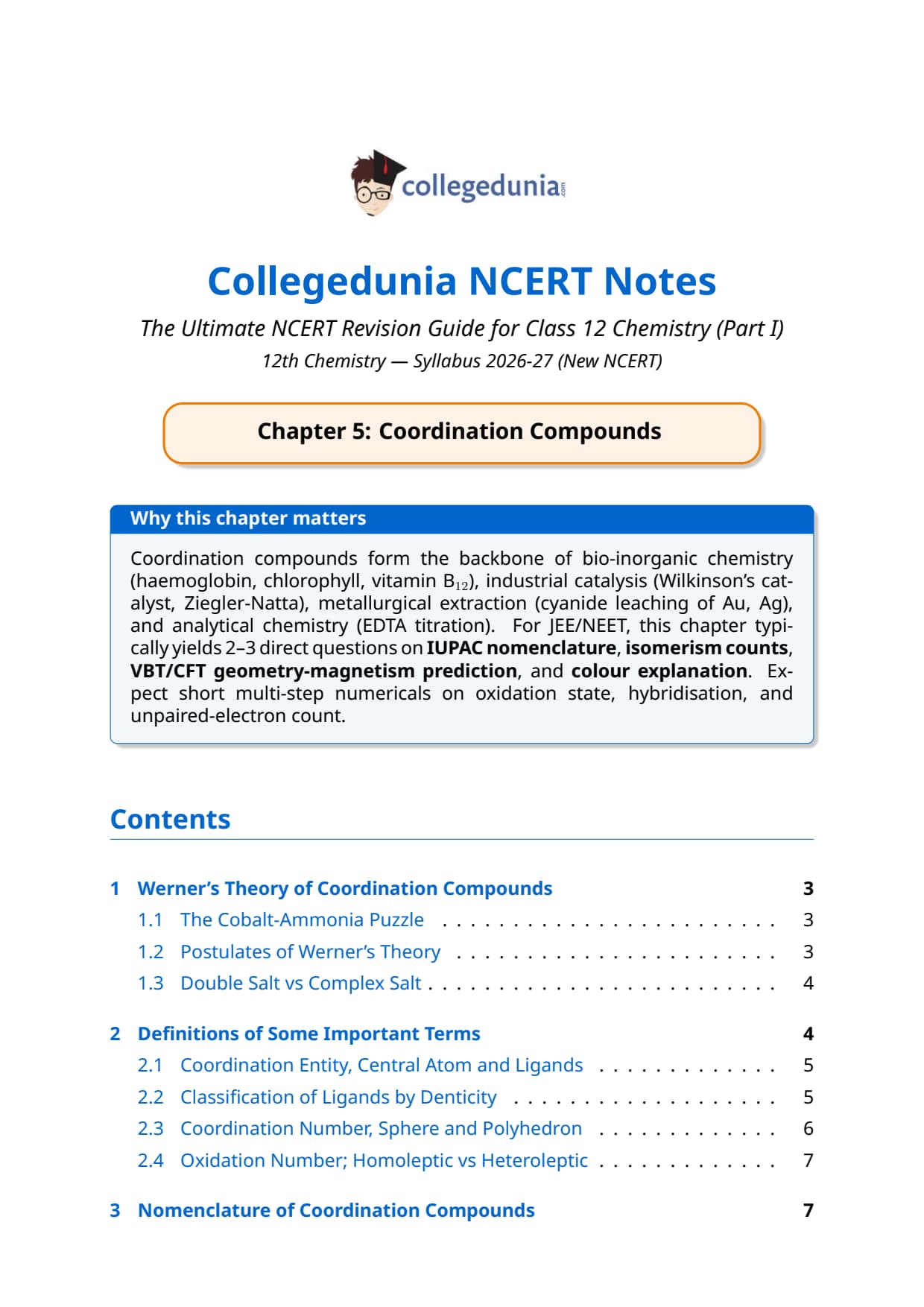
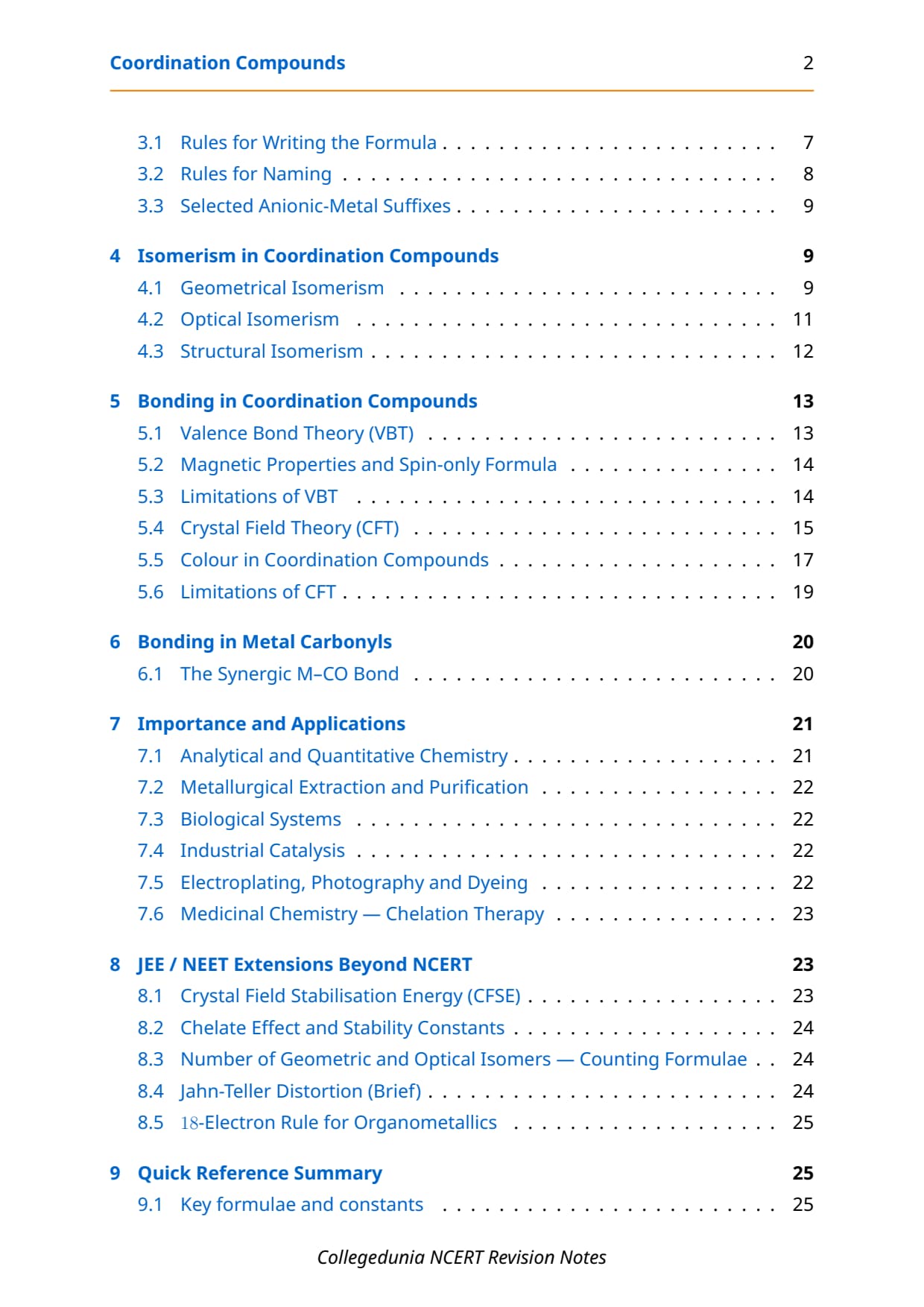
The Coordination Compounds NCERT notes help you prepare for CBSE, JEE and NEET, where the chapter carries 6-8 marks in CBSE and 4-5% in JEE Main. This page hosts the 28-page notes PDF with a Crystal Field Theory mind map.



- CBSE Boards: around 6-8 marks, usually one IUPAC-naming question, one hybridisation or magnetic-moment problem, and one isomerism MCQ.
- JEE Main: 4 to 5% of the paper, 2 to 3 questions per shift on CFSE, isomerism, and the spectrochemical series.
- NEET: 3 to 4 questions per year, the highest of any inorganic chapter, mostly on coordination number, EAN, and ligand strength.
Coordination Compounds Class 12 Chemistry Video Lecture
Source: Magnet Brains on YouTube
Why Coordination Compounds Matter for CBSE, JEE and NEET
A coordination compound has a central metal ion surrounded by neutral or anionic ligands bonded through coordinate (dative) bonds. The chapter rewards three skills: IUPAC naming, predicting geometry and isomerism, and explaining magnetism and colour with crystal field theory.
Most Important Sub-Topics in Coordination Compounds and Their Mark Distribution
The chapter's marks concentrate on a tight set of sub-topics. This table ranks them by frequency.
| Sub-topic | Weightage | CBSE Frequency |
|---|---|---|
| IUPAC nomenclature of mononuclear complexes | High | Every year |
| Crystal field theory: octahedral splitting and CFSE | High | Every year |
| Isomerism (geometrical, optical, linkage, ionisation) | High | 4/5 years |
| Hybridisation, geometry and magnetic moment (VBT) | High | 4/5 years |
| Coordination number, EAN, and Werner postulates | Medium | 3/5 years |
| Stability constants and chelate effect | Medium | 3/5 years |
| Spectrochemical series and strong vs weak ligands | Medium | 3/5 years |
| Bonding in metal carbonyls (synergic effect) | Low | 2/5 years |
| Importance and applications in biology and medicine | Low | 2/5 years |
Coordination Compounds Topic-by-Topic Notes for Class 12 Chemistry
Werner's Theory and Core Definitions
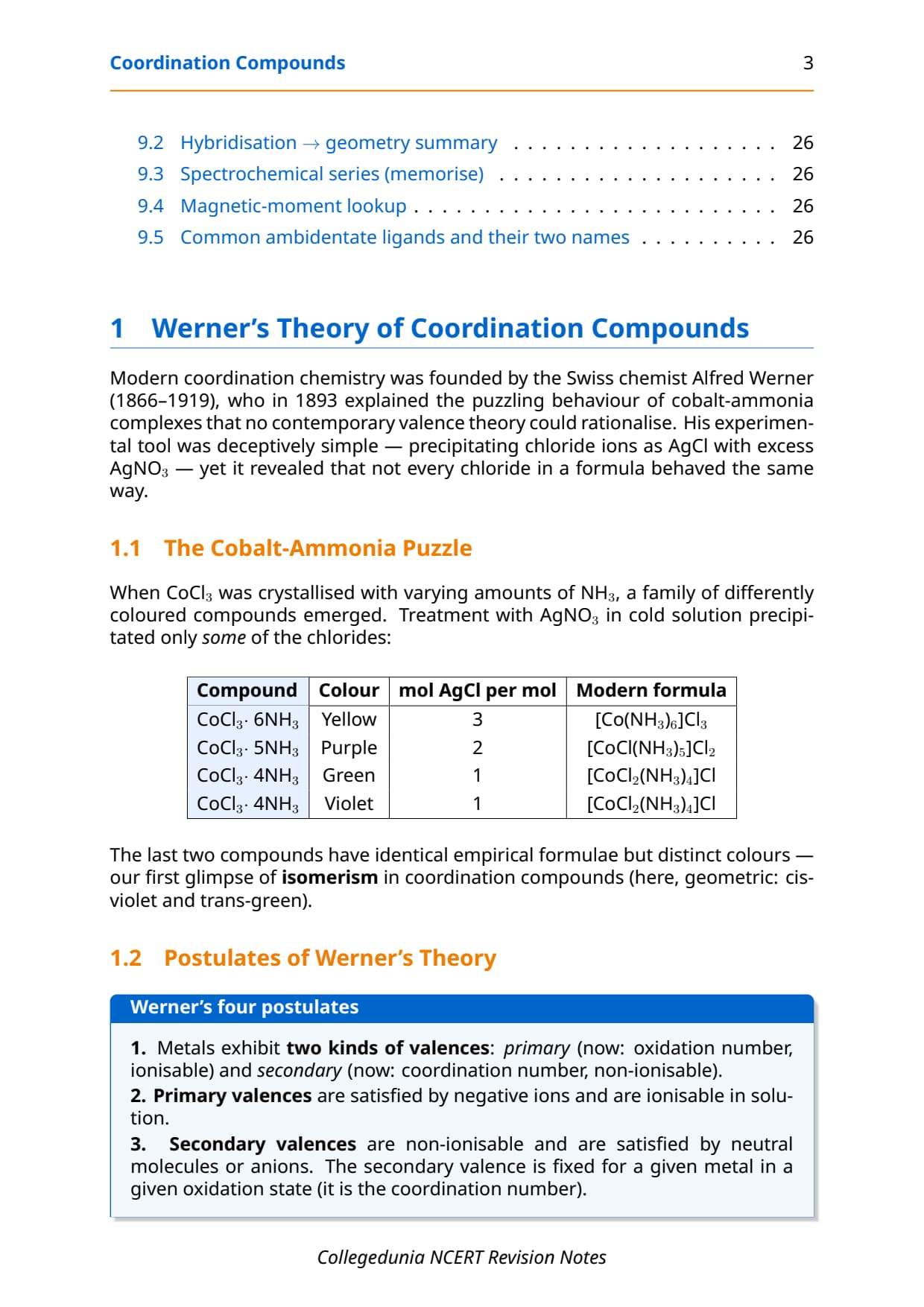
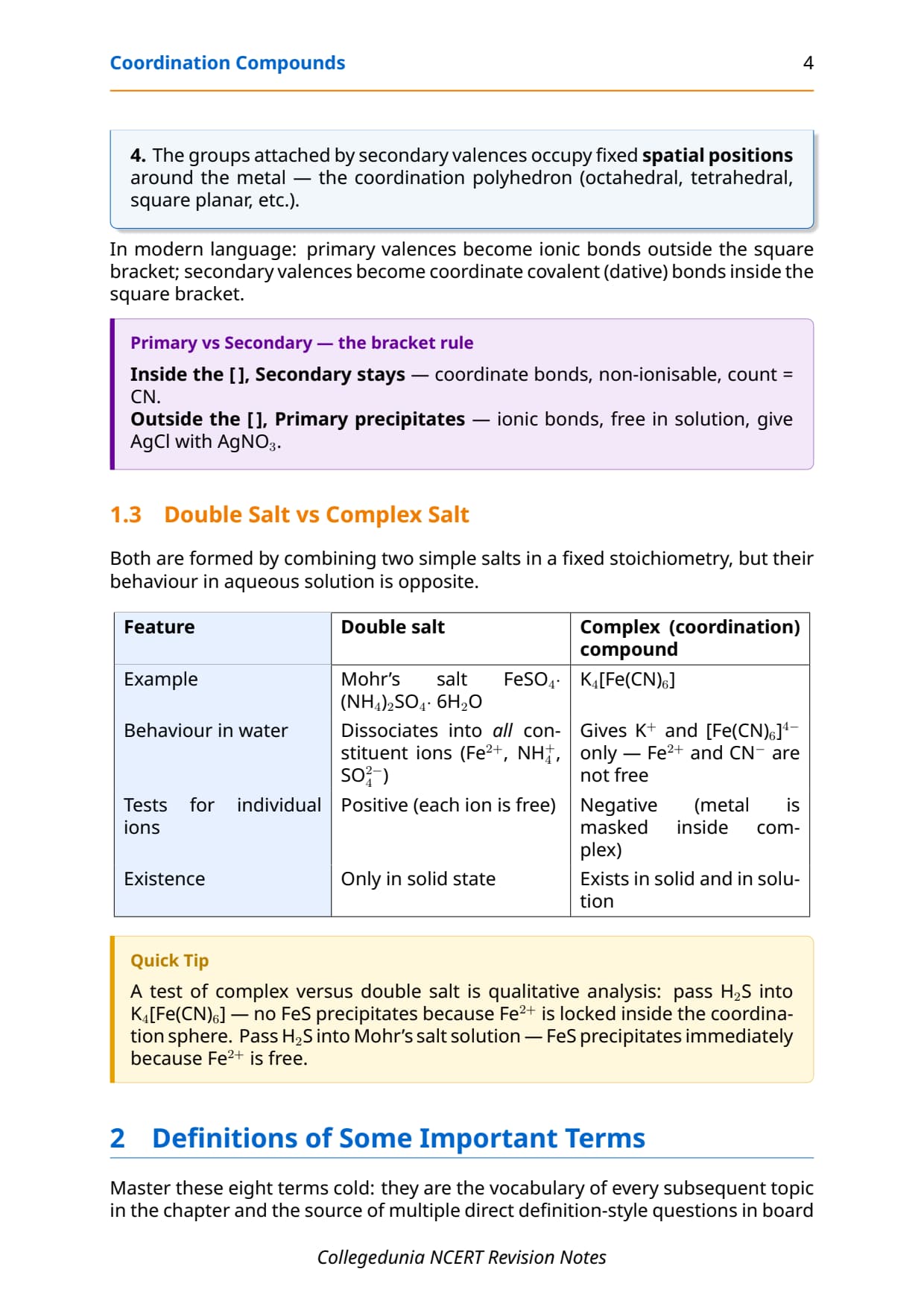
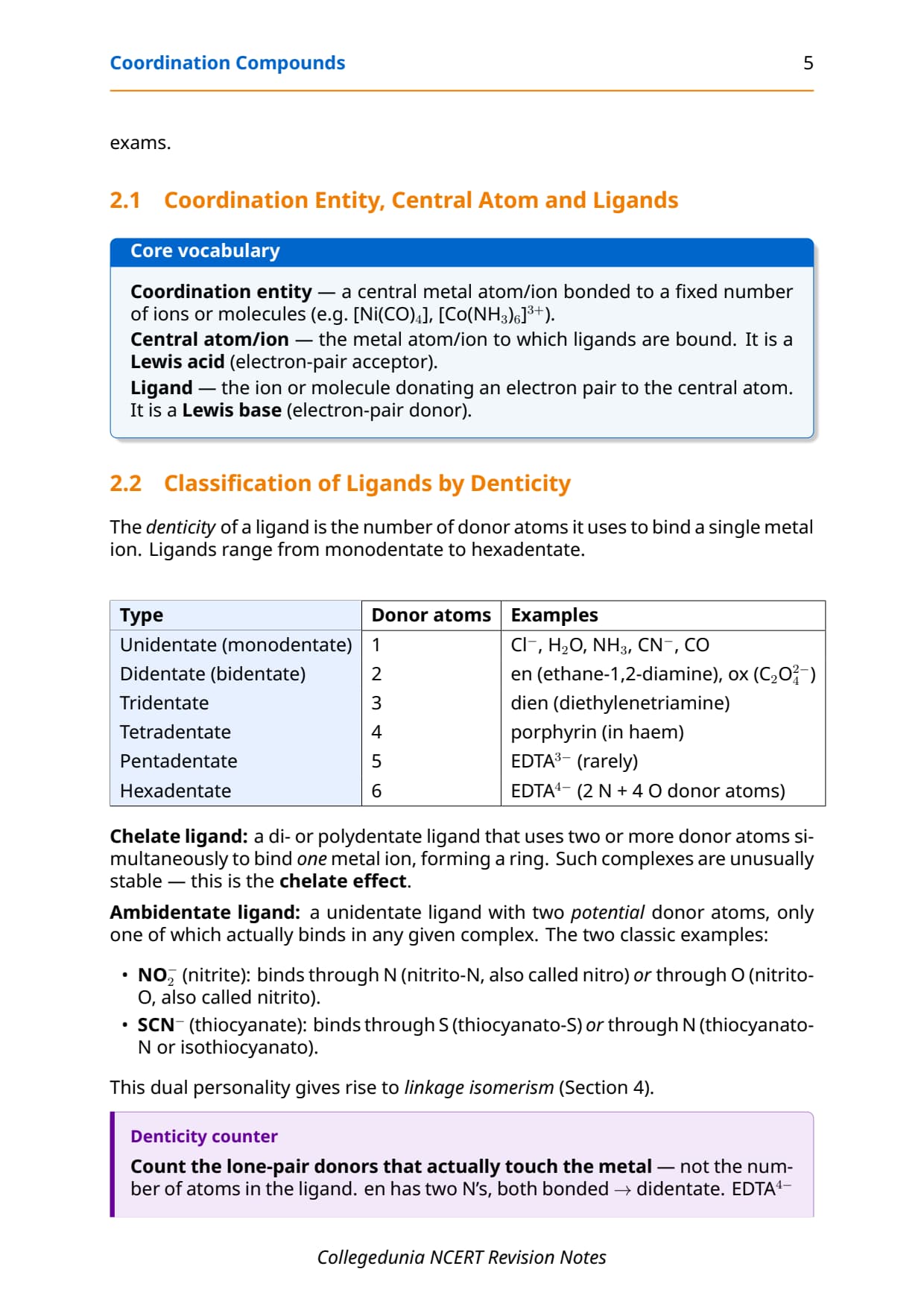
Werner (1893) said every coordination compound has two valences: primary (ionisable), equal to the metal's oxidation state, and secondary (non-ionisable), equal to the coordination number. Ligands fill the secondary valences inside the coordination sphere.
- Coordination sphere: the metal plus its ligands, in square brackets, e.g. [Co(NH3)6]3+.
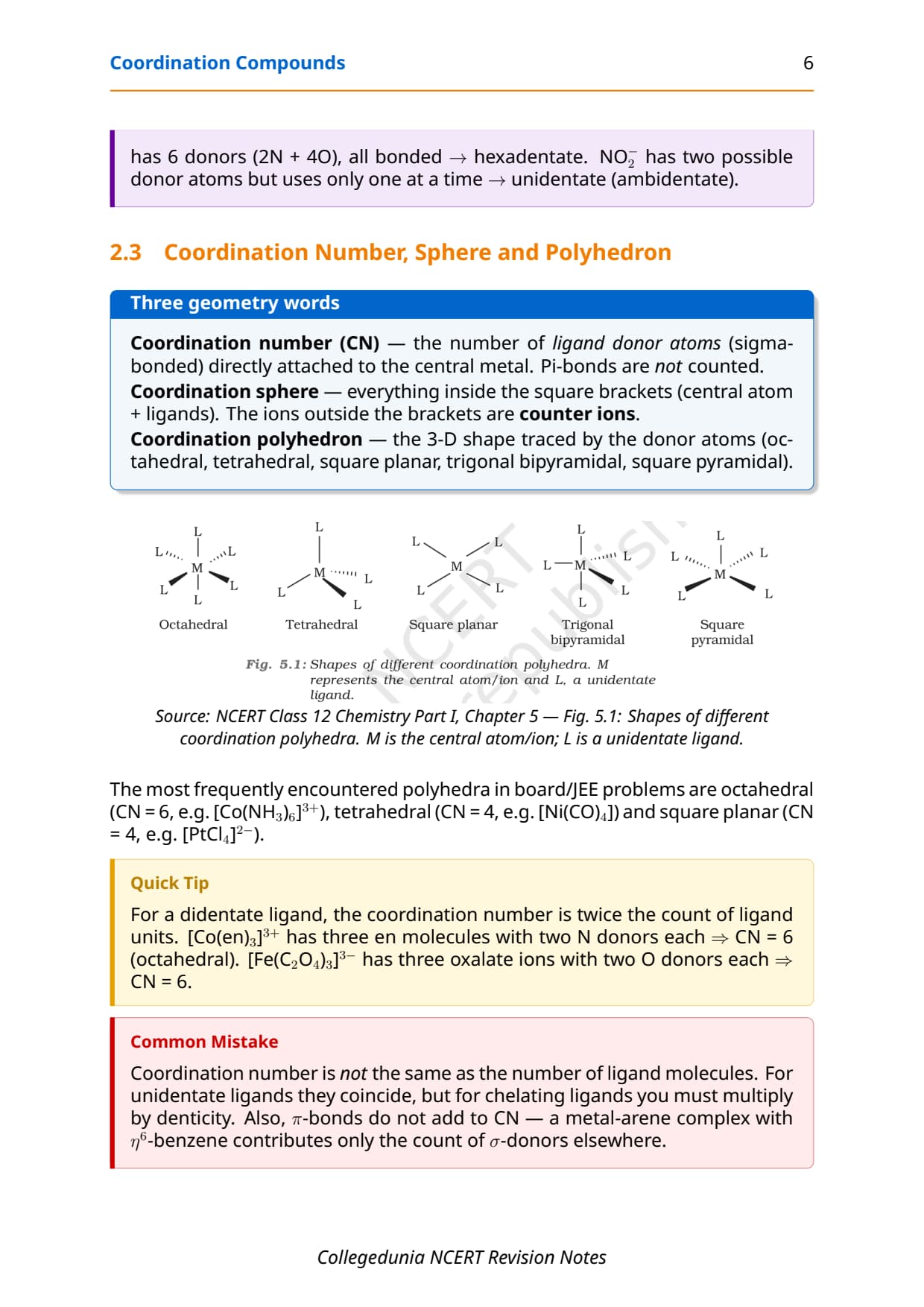
- Coordination number (CN): donor atoms bonded to the metal; commonly 4 (tetrahedral/square planar) or 6 (octahedral).
- Denticity: donor sites on one ligand. Monodentate (NH3), bidentate (en), hexadentate (EDTA4-).
- EAN: total electrons on the metal after coordination; Z - oxidation state + 2 × CN .
IUPAC Nomenclature: The 2005 Rules Applied Step by Step
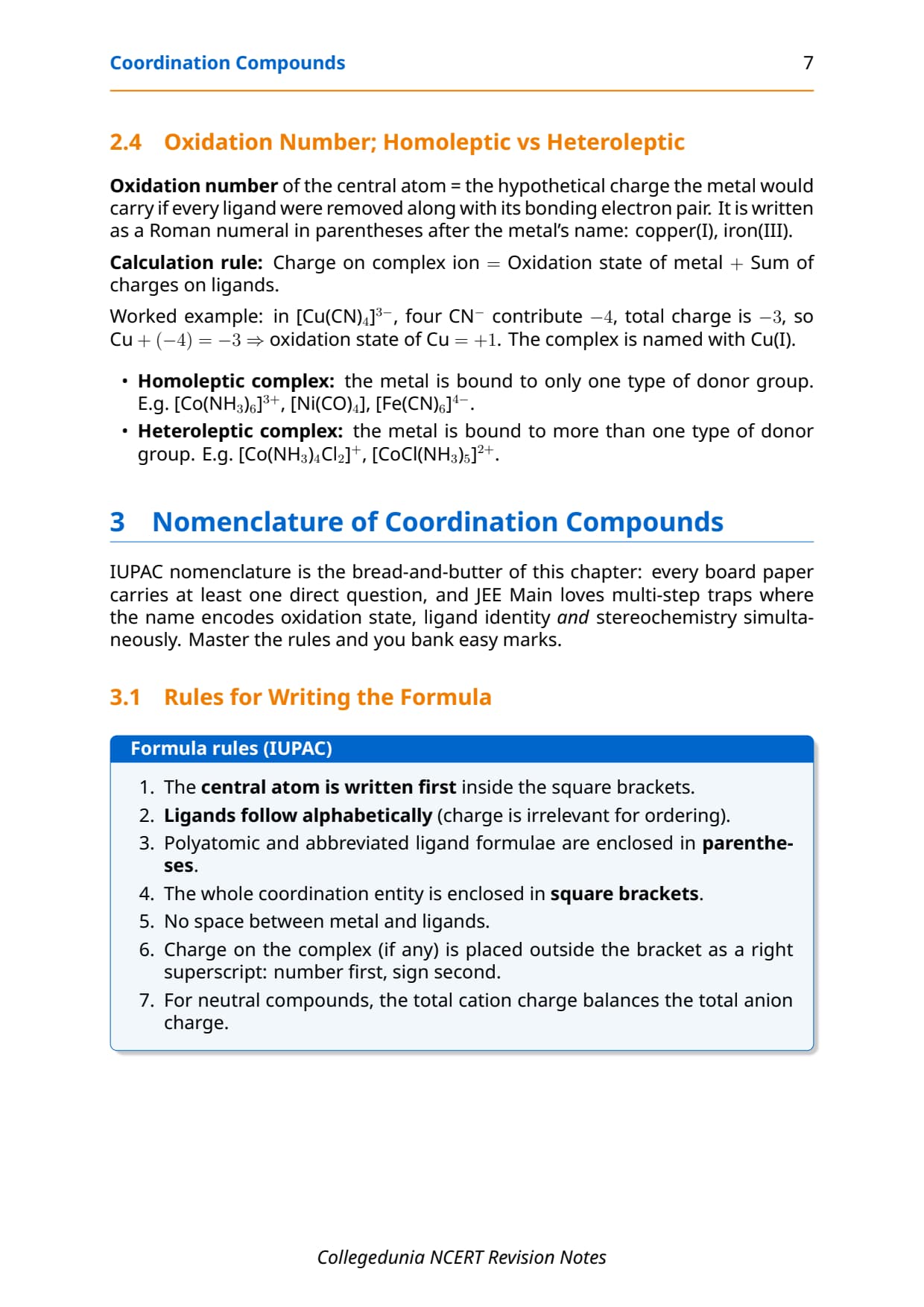
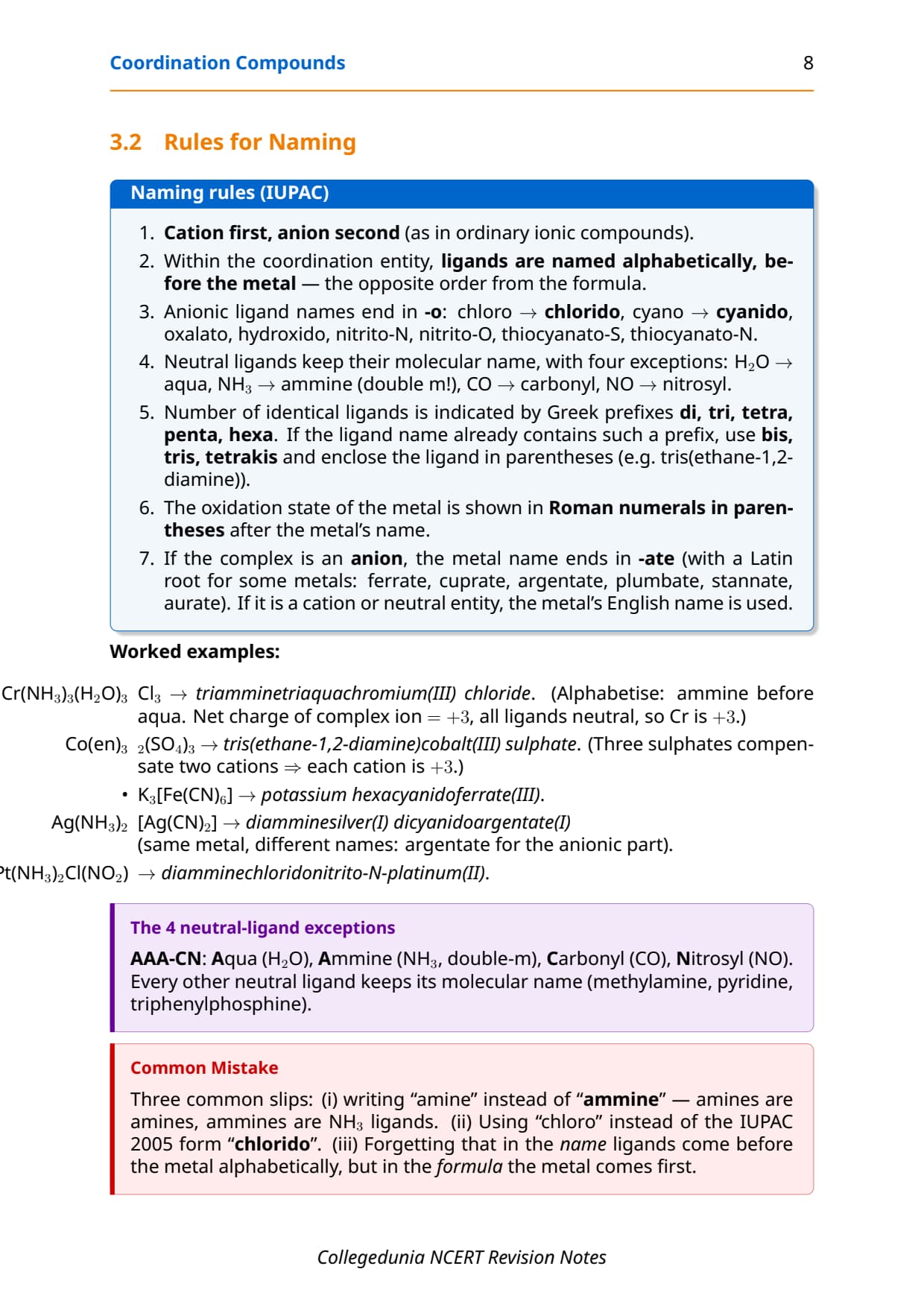
Cation is named first, anion second. Inside the ion, ligands come before the metal in alphabetical order, with the metal's oxidation state in Roman numerals. Anionic ligands end in -o (chlorido, hydroxo); neutral ones keep their name (ammine, aqua); an anionic complex takes the -ate suffix (ferrate, cuprate). Worked names:
| Formula | IUPAC Name |
|---|---|
| [Co(NH3)6]Cl3 | hexaamminecobalt(III) chloride |
| K4[Fe(CN)6] | potassium hexacyanidoferrate(II) |
| [Pt(NH3)2Cl2] | diamminedichloridoplatinum(II) |
| [Cr(H2O)4Cl2]Cl | tetraaquadichloridochromium(III) chloride |
Isomerism in Coordination Compounds
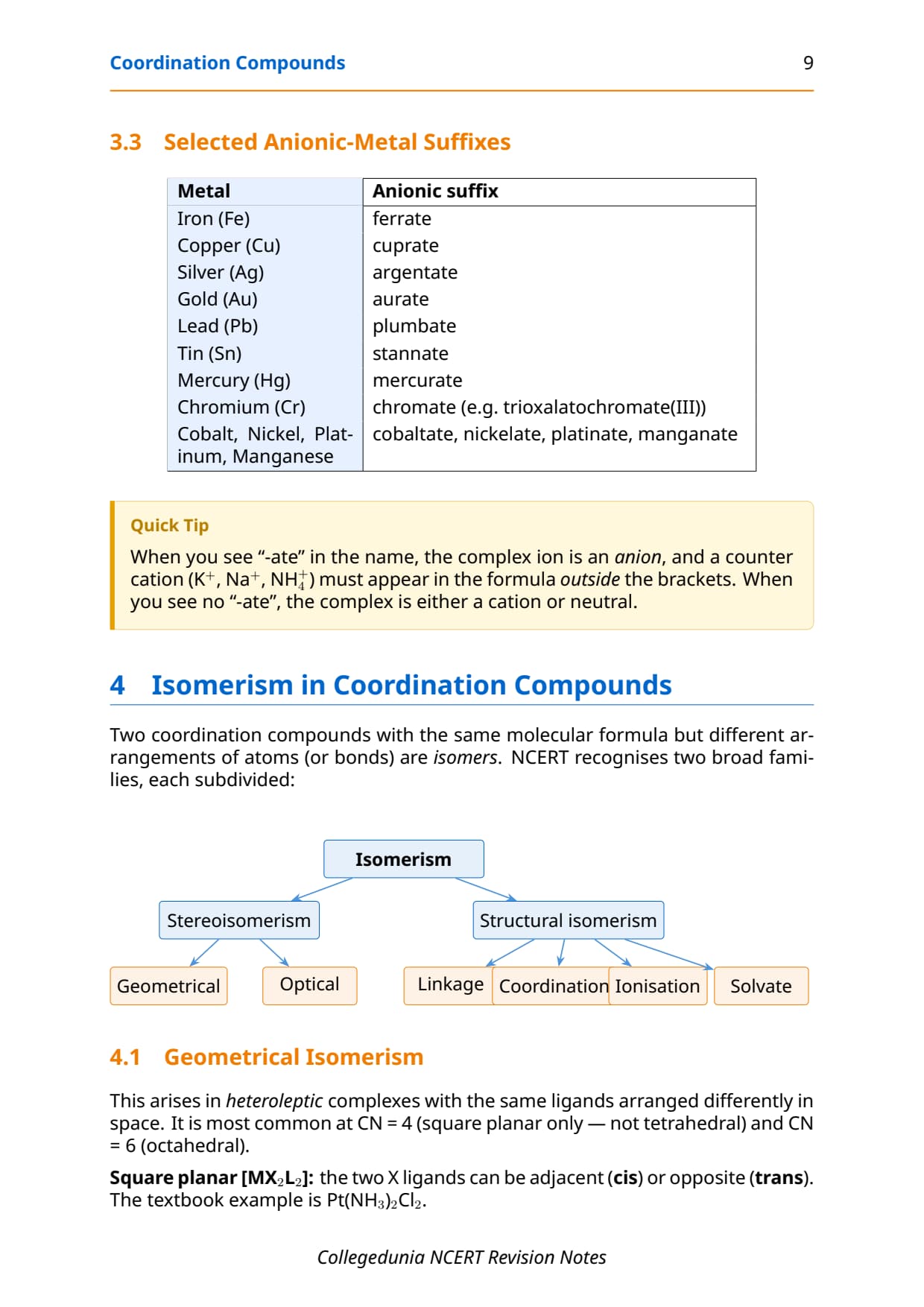
These fall into structural isomerism (different connectivity) and stereoisomerism (same connectivity, different shape).
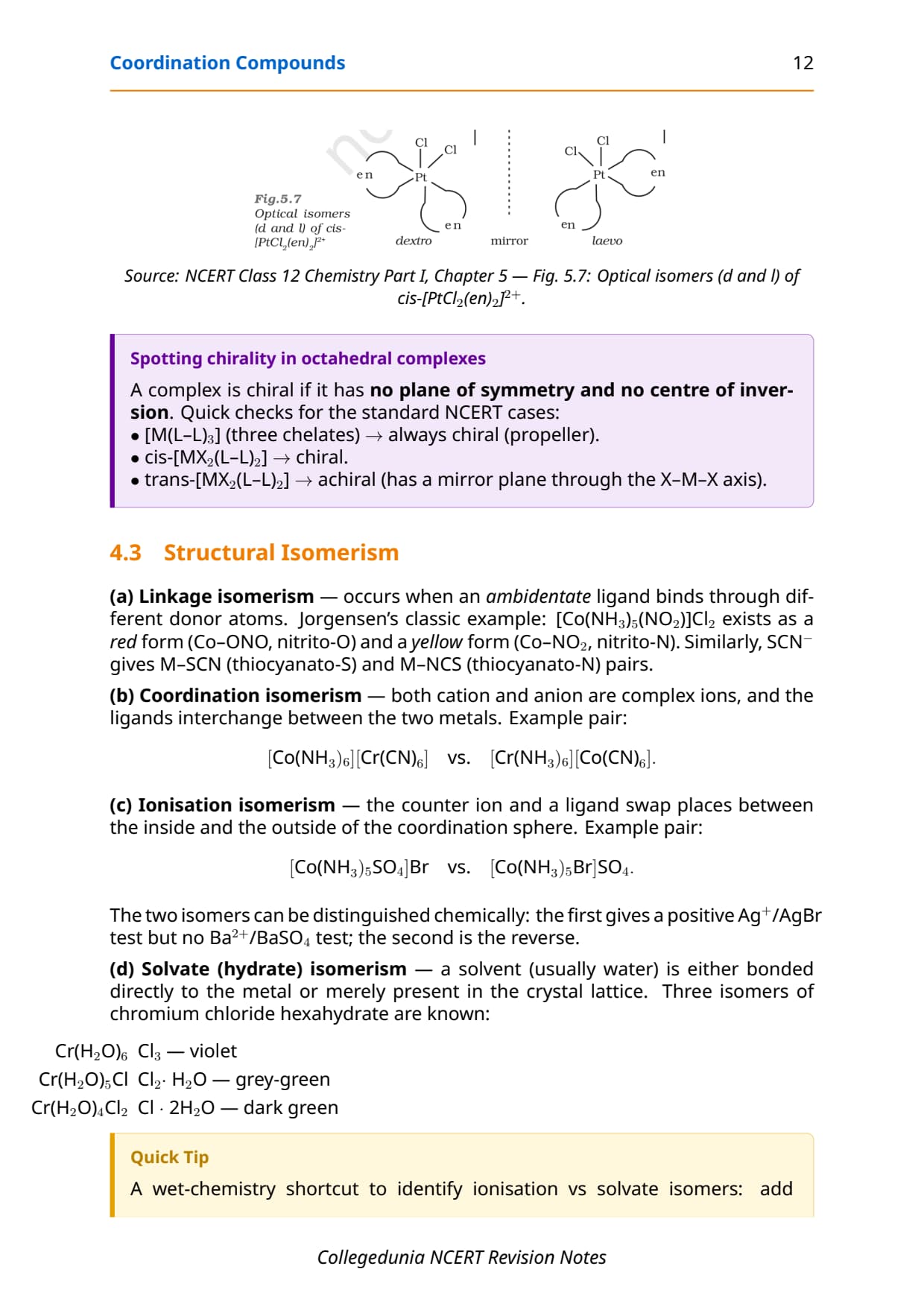
- Ionisation: ligand swaps with the counter-ion, e.g. [Co(NH3)5SO4]Br vs [Co(NH3)5Br]SO4.
- Linkage: ambidentate ligand bonds through different atoms, e.g. -NO2 vs -ONO.
- Coordination: ligands swap between two metal centres in a salt.
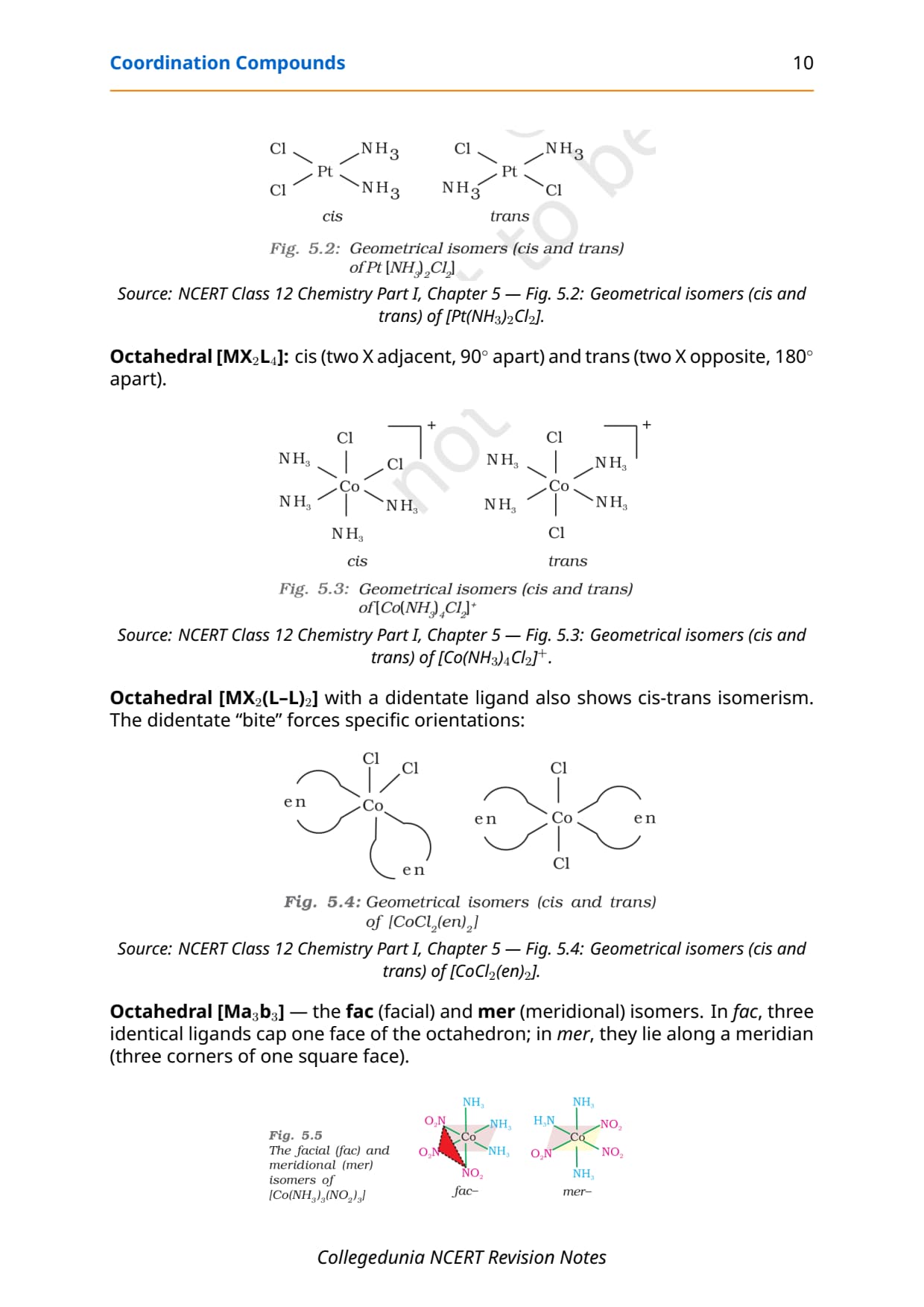
- Geometrical (cis-trans): in square planar MA2B2 and octahedral MA4B2. Cisplatin is anticancer; its trans isomer is not.
- Optical: chiral complexes like [Co(en)3]3+ with two mirror images (Δ and Λ).
Valence Bond Theory (VBT): Hybridisation, Geometry and Magnetism
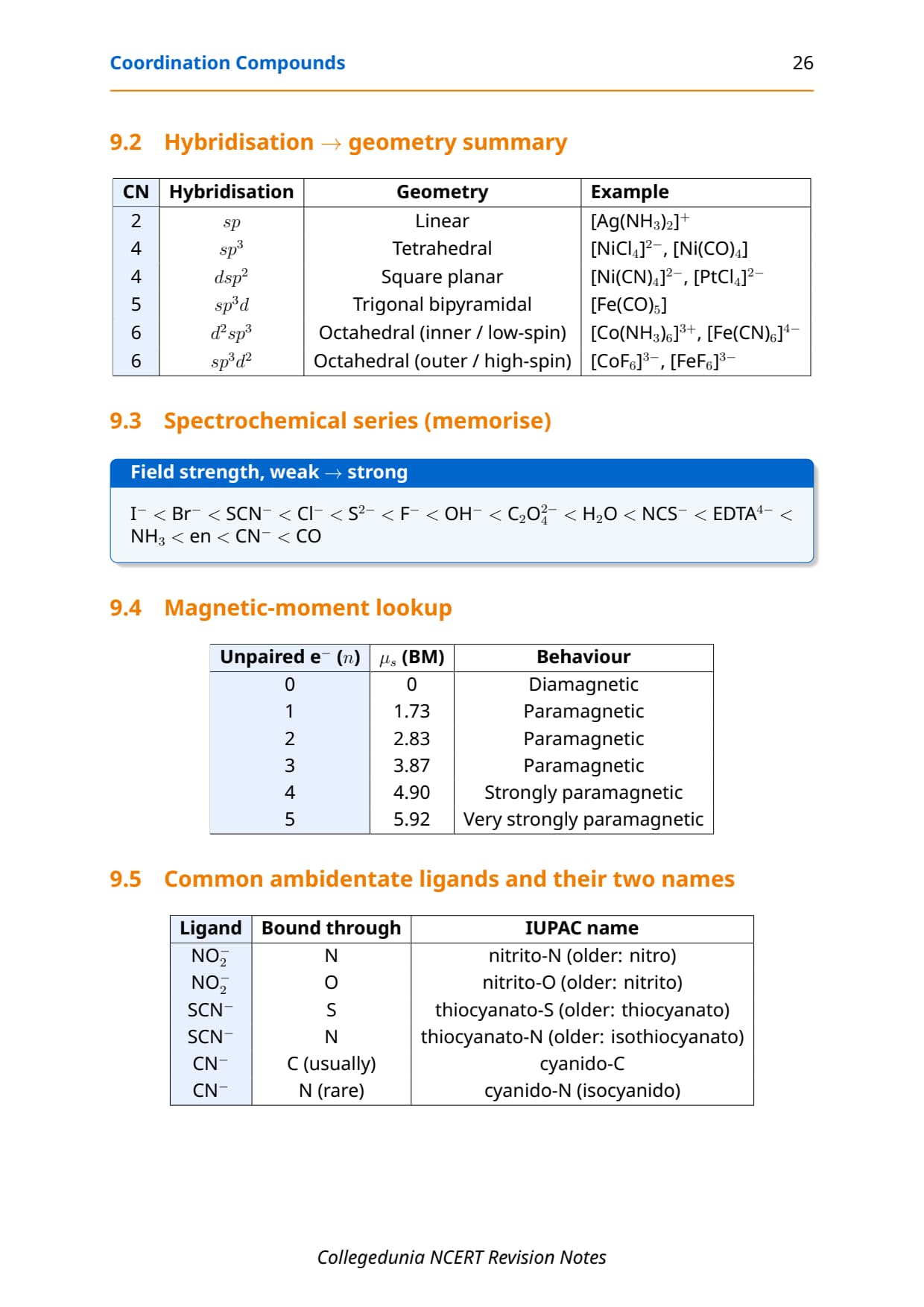
VBT treats the M-L bond as lone-pair donation into hybrid metal orbitals; the hybridisation sets the geometry:
| Coordination Number | Hybridisation | Geometry | Example |
|---|---|---|---|
| 4 | sp3 | Tetrahedral | [NiCl4]2- |
| 4 | dsp2 | Square planar | [Ni(CN)4]2-, [Pt(NH3)2Cl2] |
| 6 (inner orbital, low spin) | d2sp3 | Octahedral | [Co(NH3)6]3+, [Fe(CN)6]3- |
| 6 (outer orbital, high spin) | sp3d2 | Octahedral | [CoF6]3-, [Fe(H2O)6]2+ |
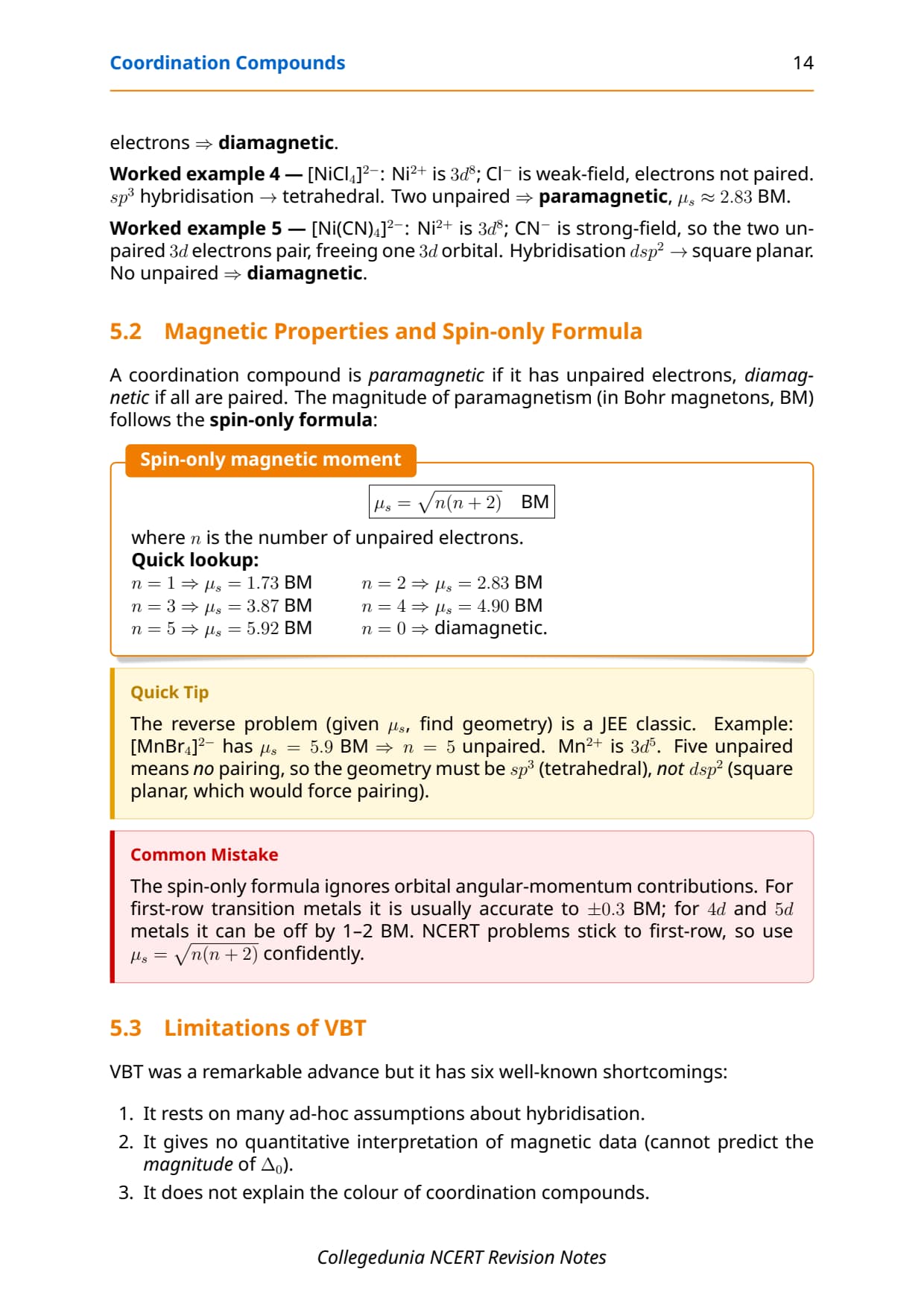
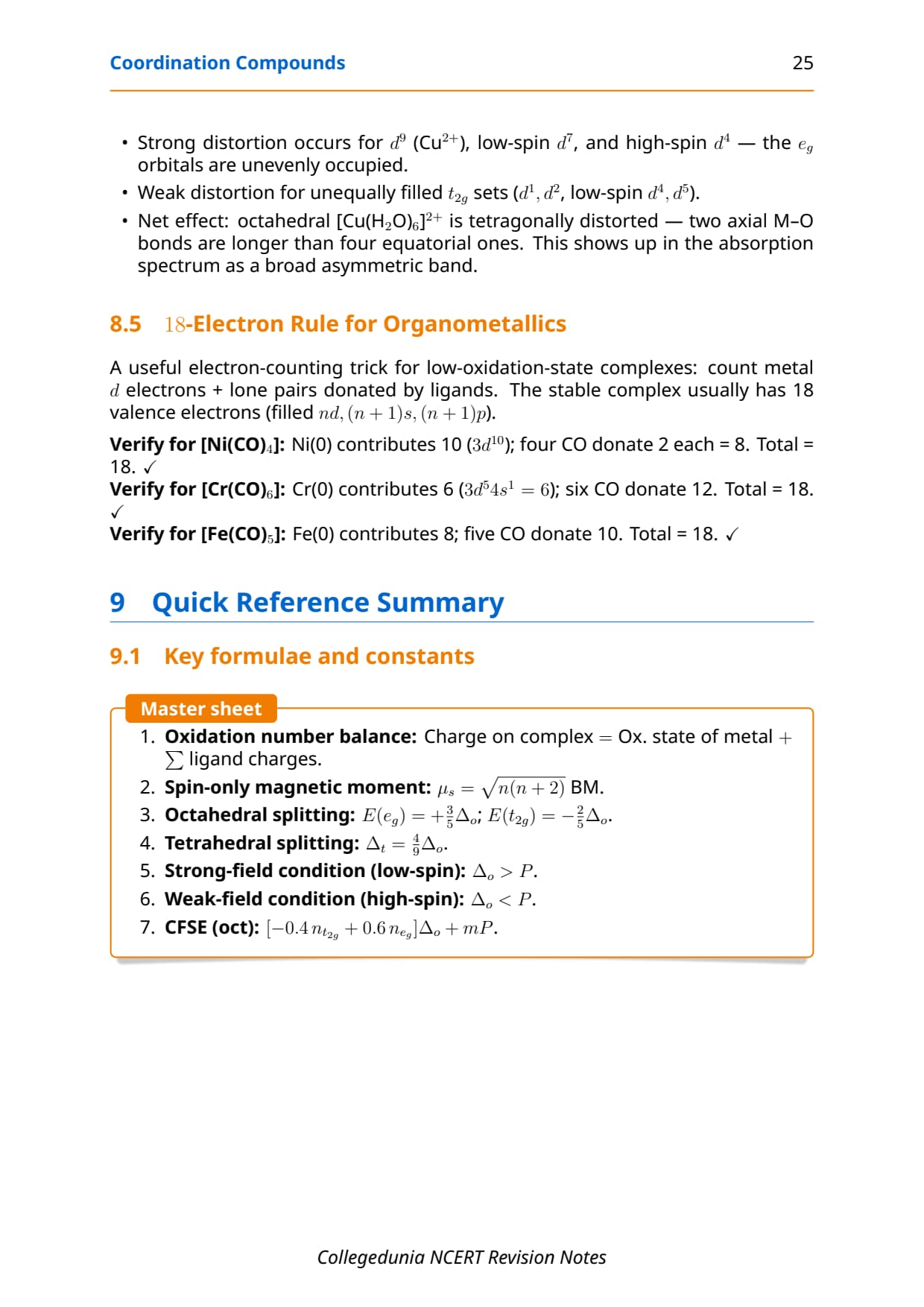
The spin-only magnetic moment is μ = √n(n+2) BM, with n the unpaired d-electrons. Strong-field ligands (CN-, CO) give low-spin; weak-field ligands (F-, H2O) give high-spin.
Crystal Field Theory (CFT) and CFSE
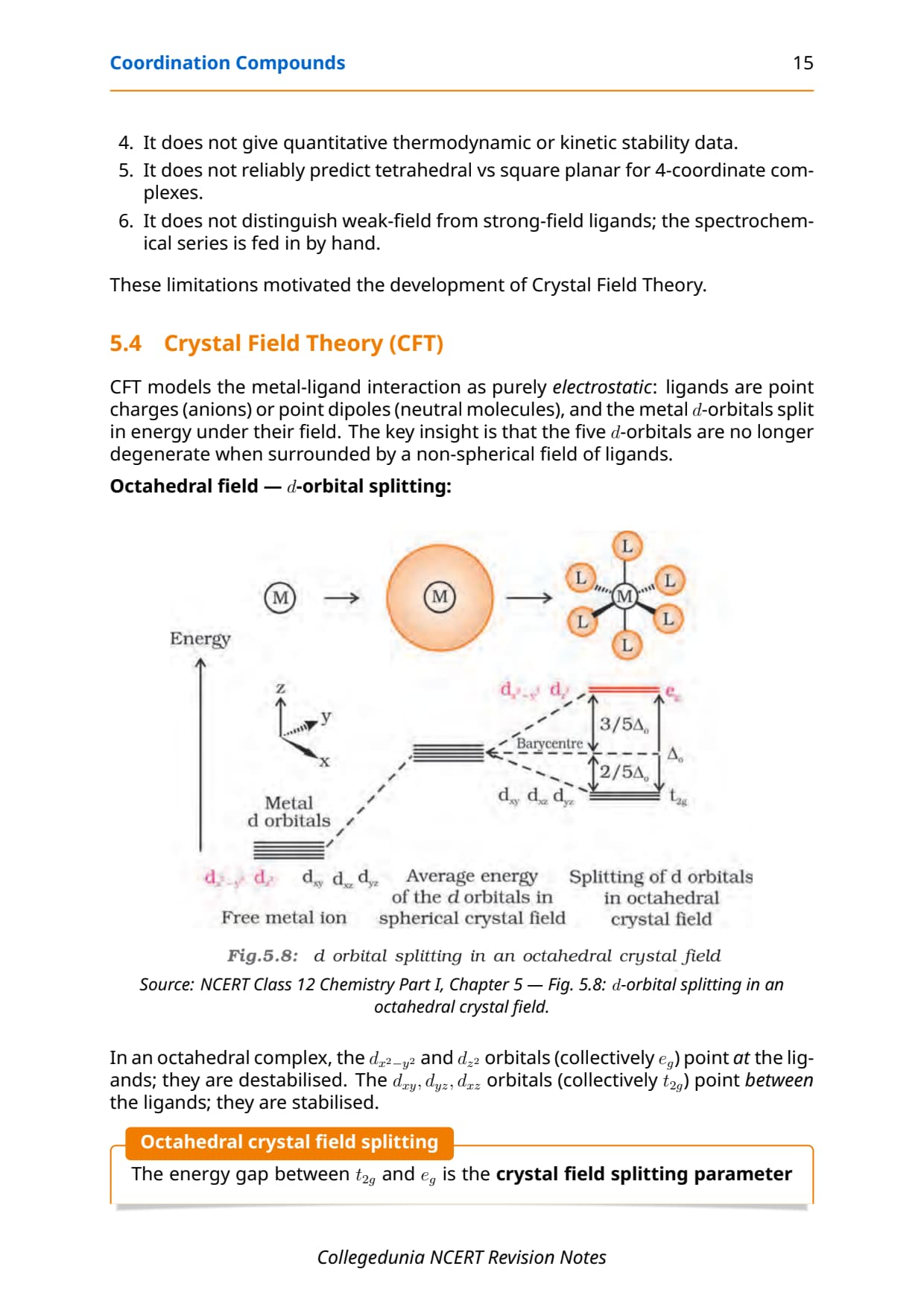
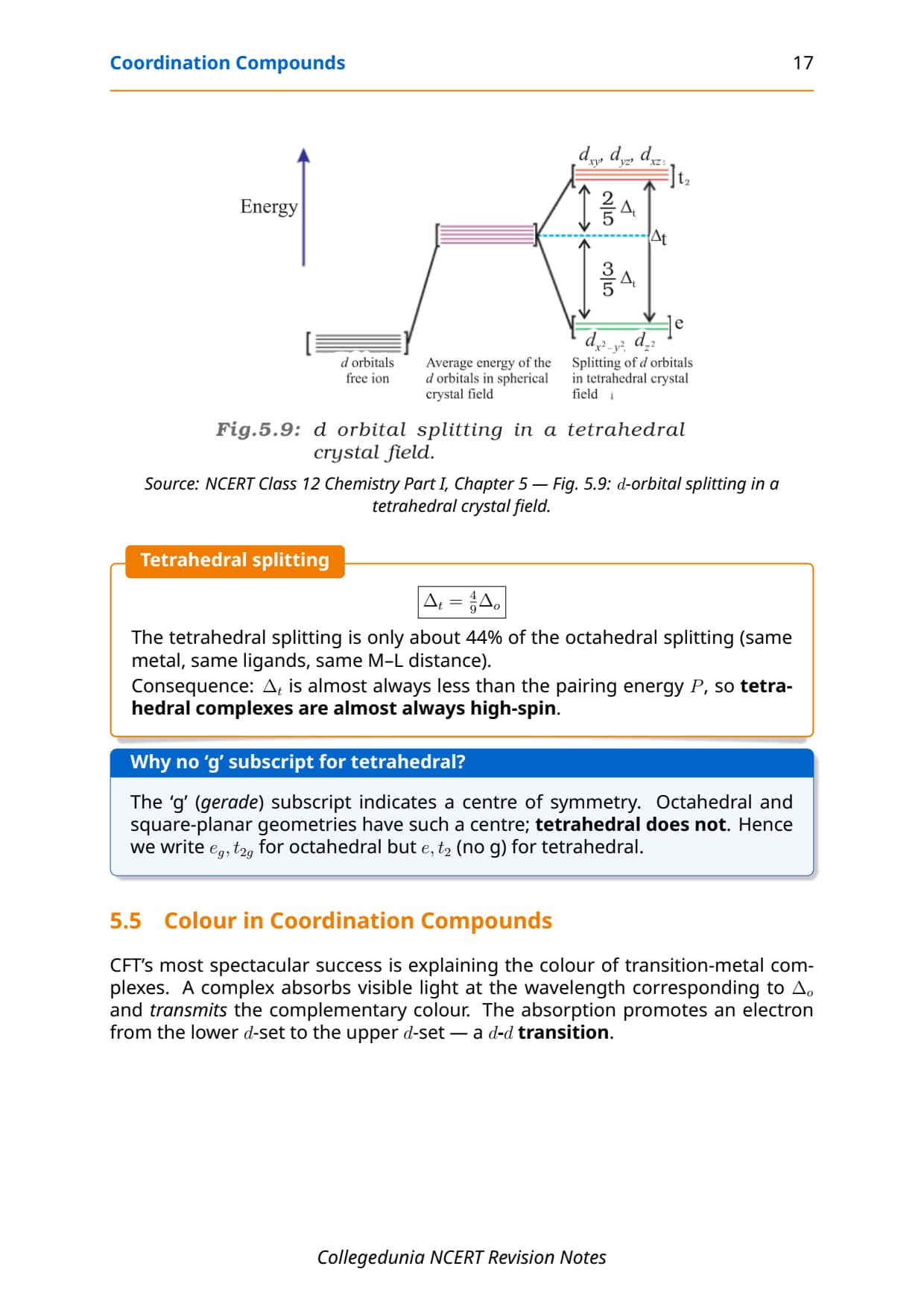
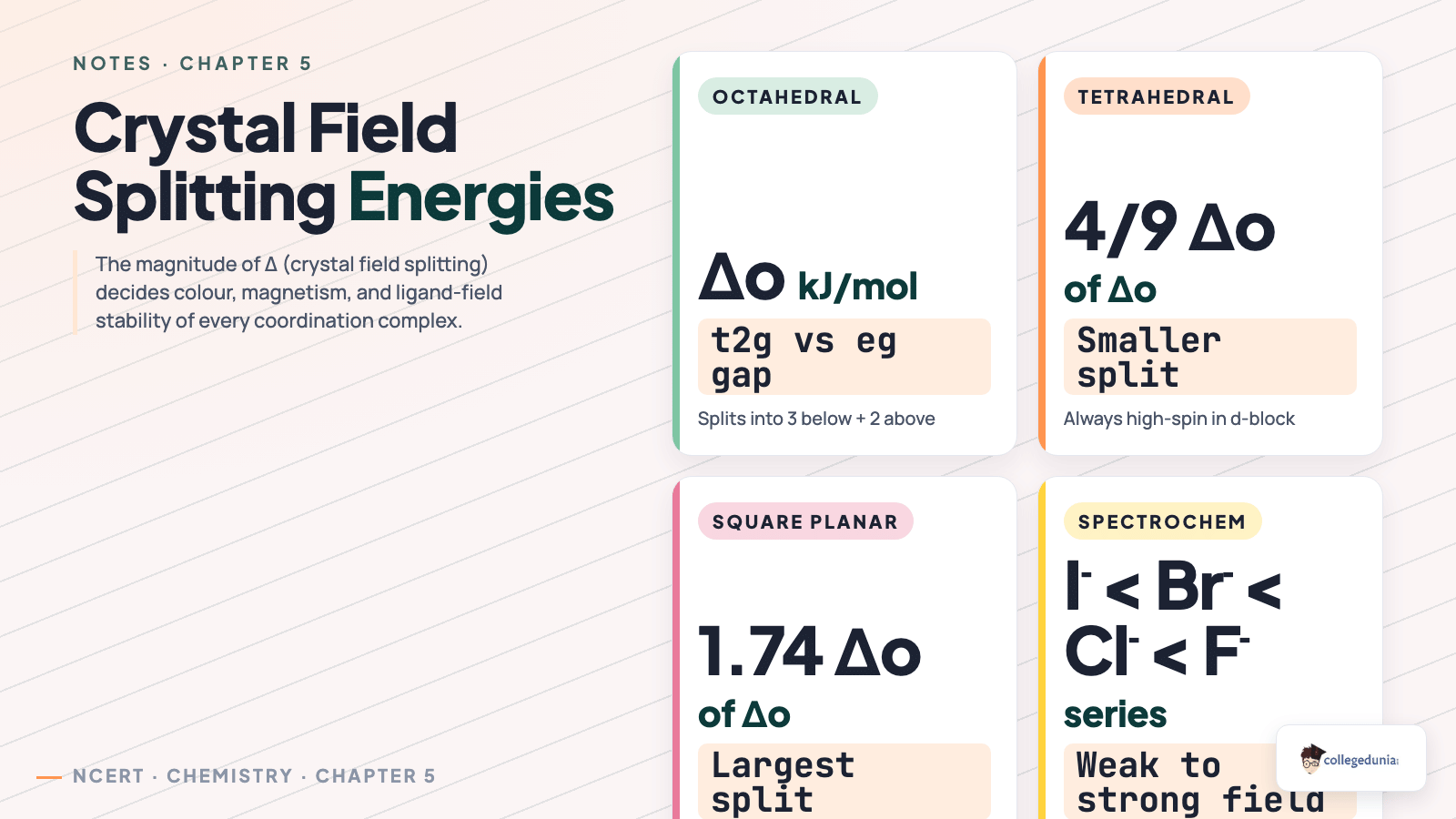
CFT treats ligands as point charges that split the metal d-orbitals. In an octahedral field they split into a lower t2g and higher eg set, separated by o . In a tetrahedral field it reverses and shrinks: t = 49o .
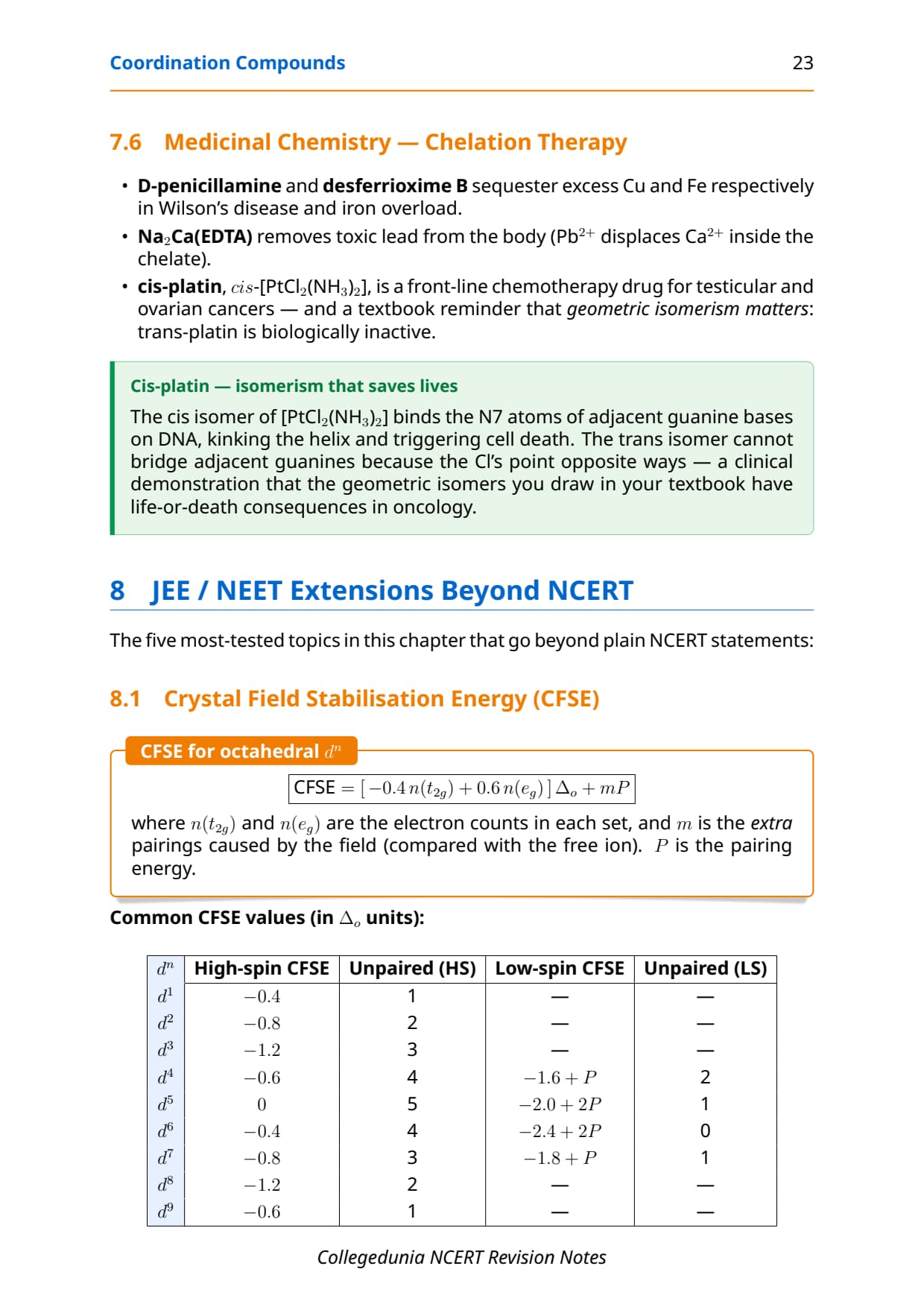
CFSE = [ -0.4 n(t2g) + 0.6 n(eg) ]o + P
where the n terms count electrons in each set and P is the pairing-energy correction.
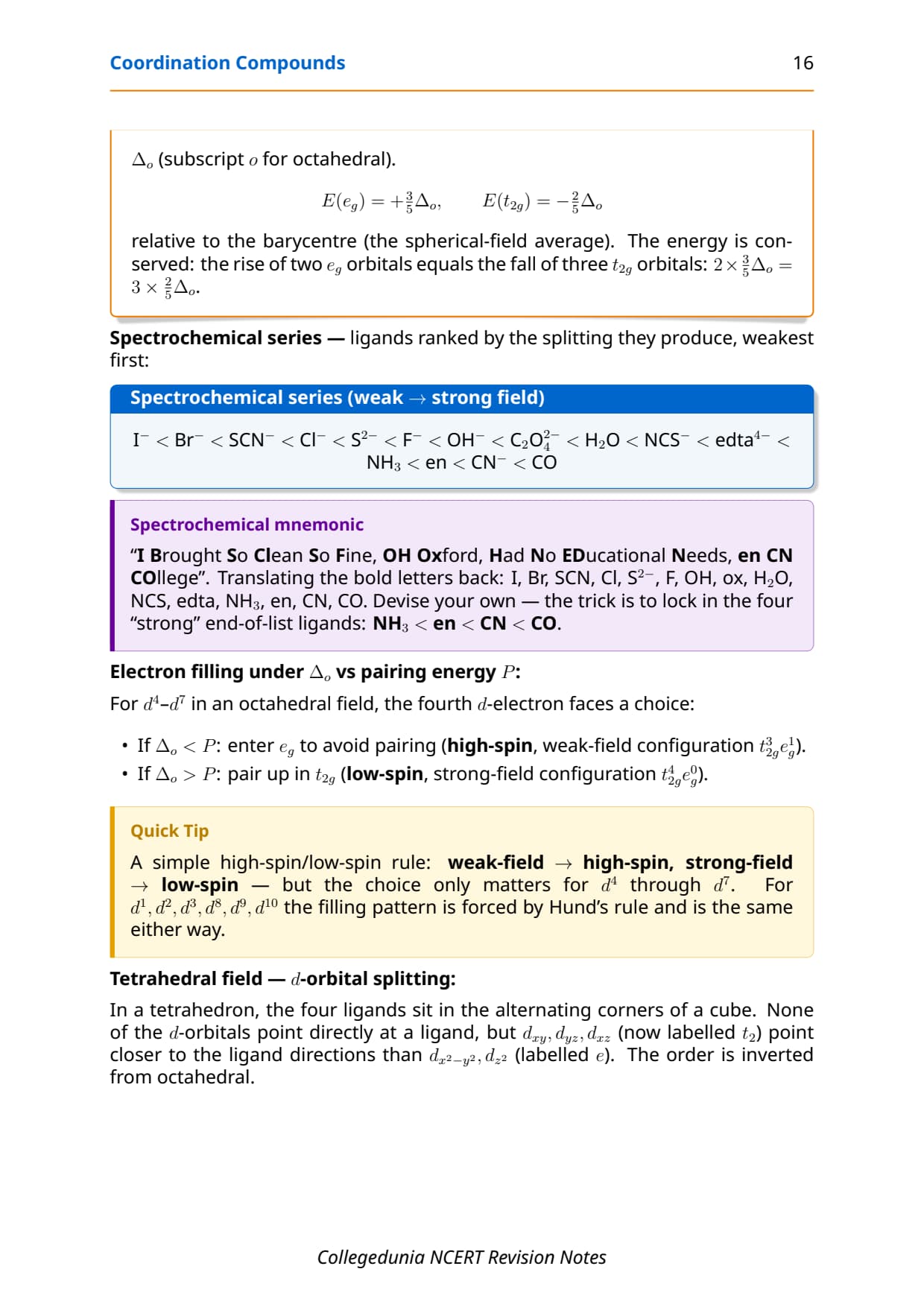
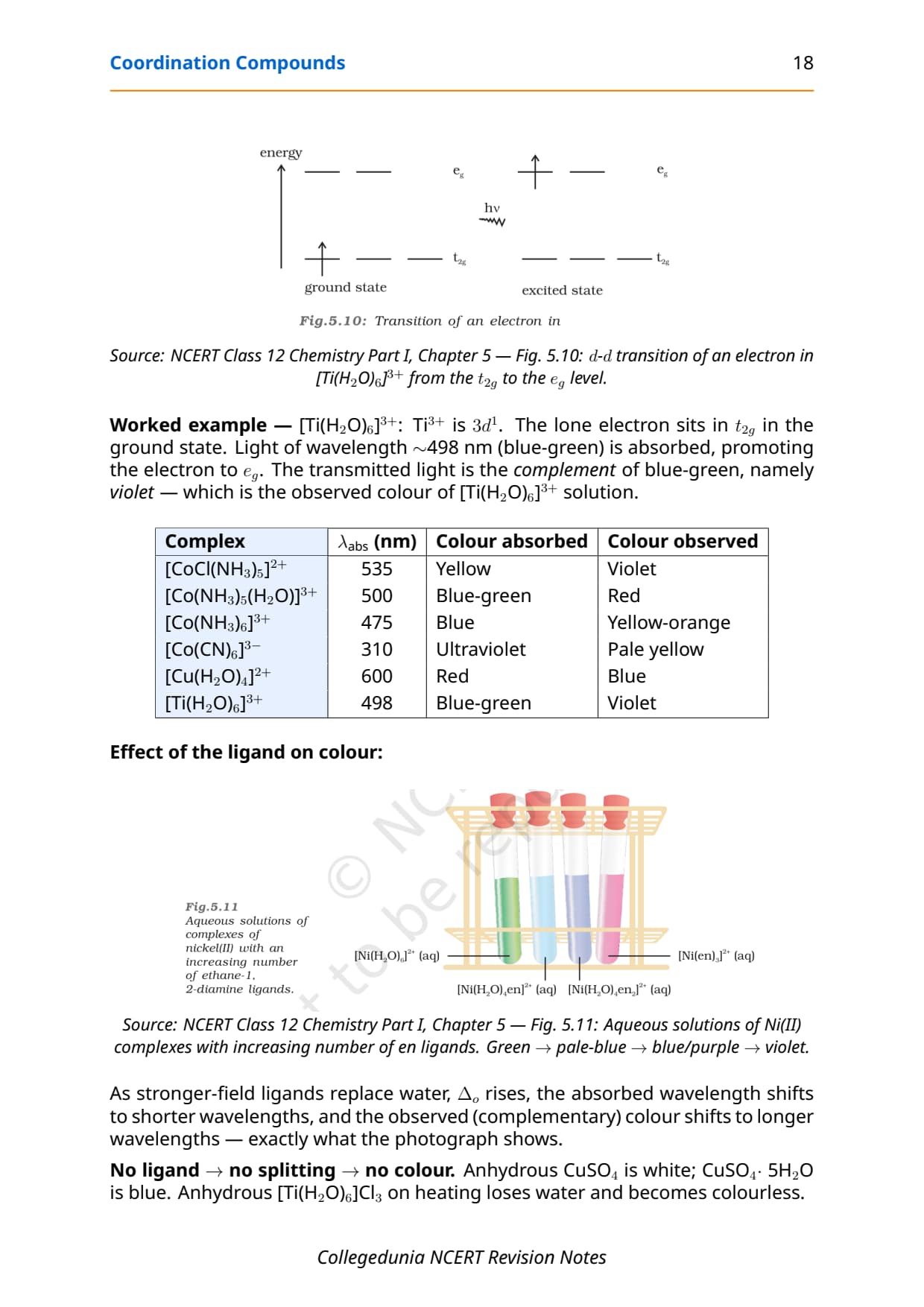
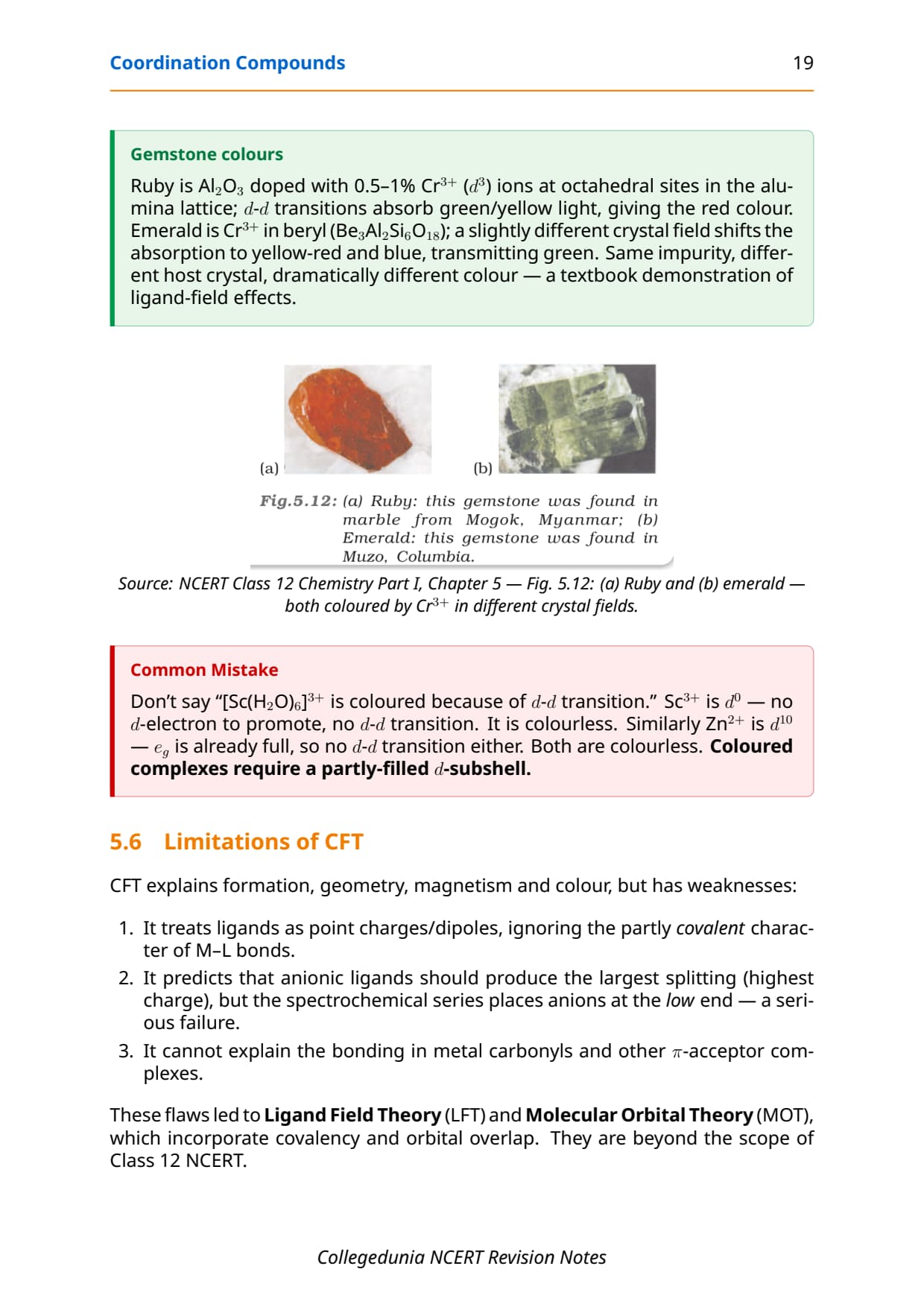
The spectrochemical series ranks ligands by field strength: I- < Br- < Cl- < F- < H2O < NH3 < en < CN- < CO. When o > P the complex is low-spin; when o < P it is high-spin. This is why [Fe(CN)6]4- is diamagnetic while [Fe(H2O)6]2+ is paramagnetic. CFT also explains colour, from the d-electron jump of energy o .
Bonding in Metal Carbonyls: The Synergic Effect
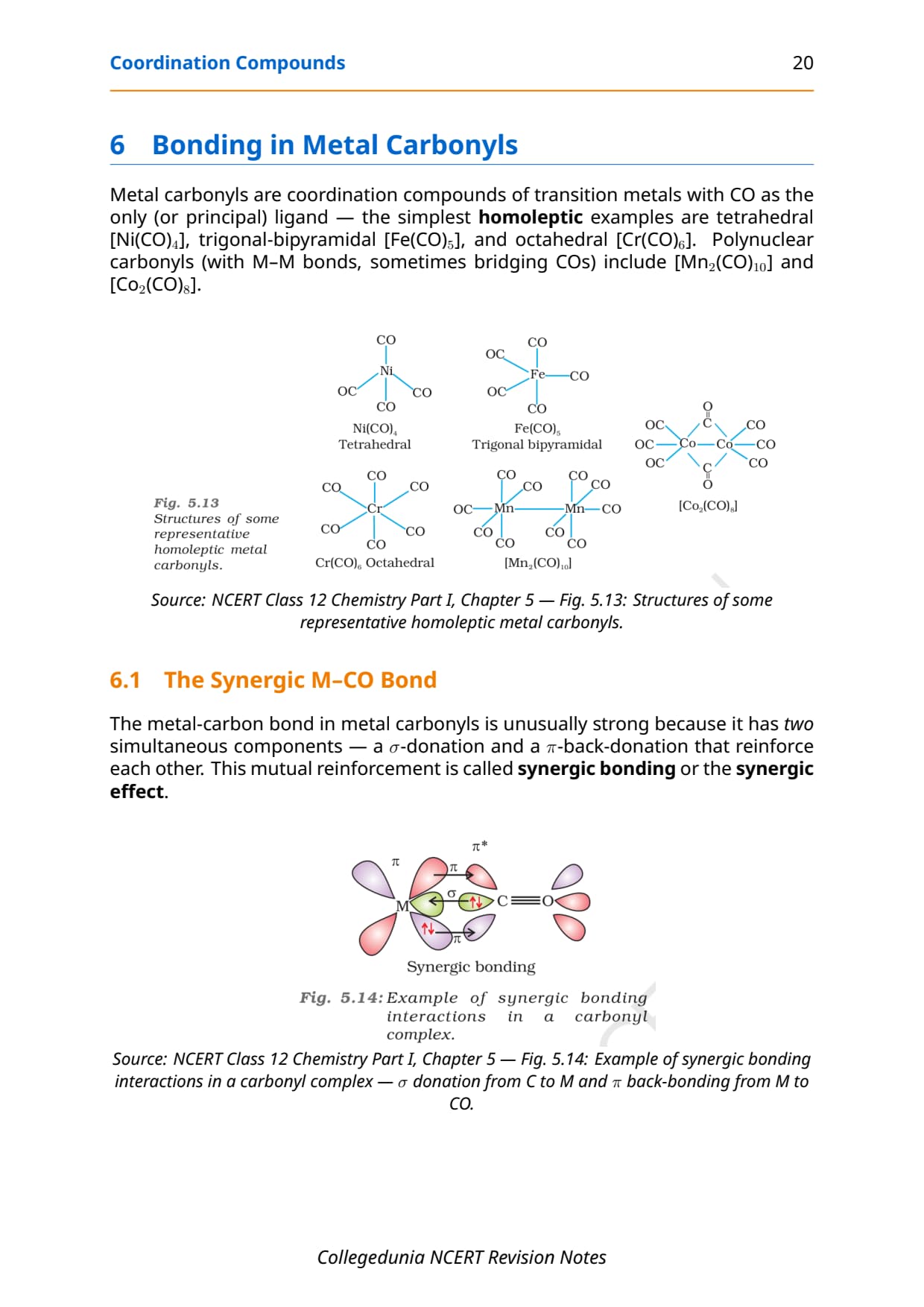
Metal carbonyls like Ni(CO)4 and Fe(CO)5 use a synergic bond: the CO lone pair donates into an empty metal orbital ( σ -donation), and a filled metal d-orbital back-donates into CO's empty π* orbital ( π -back-bonding). This strengthens the M-C bond and weakens the C-O bond, lowering its stretching frequency.
Importance and Applications in Biology, Medicine and Industry
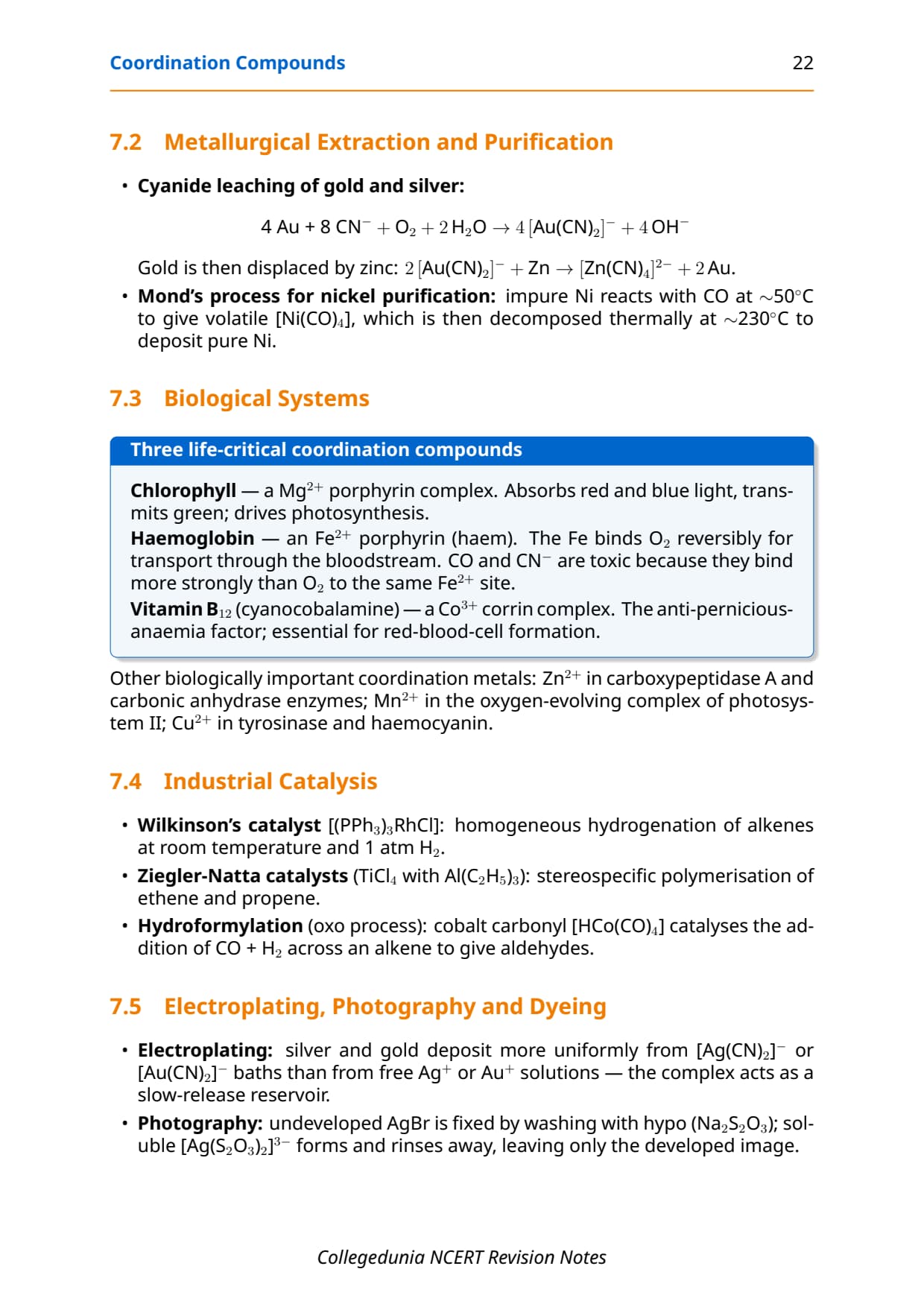
Coordination compounds run biology: haemoglobin (Fe-porphyrin) binds O2 reversibly, chlorophyll is the Mg analogue, and vitamin B12 is a Co-corrin complex. Cisplatin (cis-[Pt(NH3)2Cl2]) is an anticancer drug; the trans isomer is inactive. EDTA chelates lead and mercury in poisoning, and Ni(CO)4 drives the Mond process.
Coordination Compounds Top 6 Formulae for Quick Recall
These six cover most CBSE and JEE numericals here; the full sheet is on the Formula Sheet.
| Quantity / Concept | Expression |
|---|---|
| Effective Atomic Number | EAN = Z - ox. state + 2 × CN |
| Spin-only magnetic moment | μ = √n(n+2) BM |
| CFSE (octahedral) | CFSE = [-0.4 n(t2g) + 0.6 n(eg)]o + P |
| Tetrahedral splitting | t = 49 o |
| Overall stability constant | n = [MLn][M][L]n |
| Wavelength-energy relation (d-d transition) | o = hcλ |
Full master table: Coordination Compounds Class 12 Chemistry Formula Sheet
Common Misconceptions Students Hold in 12th Chemistry Chapter 5
These four beliefs cause most dropped marks. Fix them before the exam.
- Confusing oxidation state with coordination number. In K4[Fe(CN)6], Fe is +2 but its coordination number is 6. A standard 1-mark loss every year.
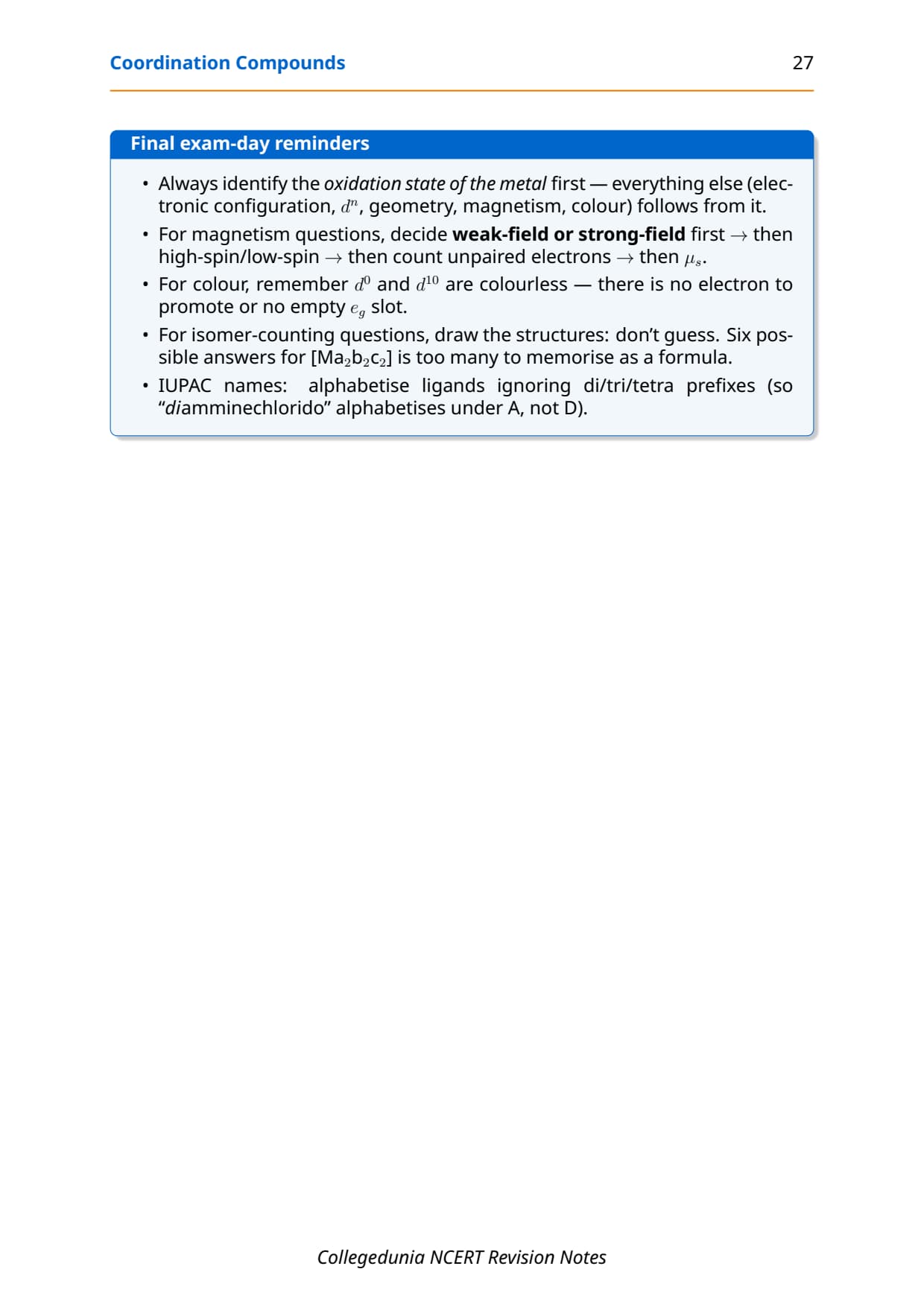
- Naming ligands by formula order, not alphabetical. IUPAC orders ligand names alphabetically, ignoring prefixes, so "ammine" comes before "chlorido".
- Treating every bidentate ligand as a chelate. Chelates need a stable 5- or 6-membered ring; en and oxalate form five-membered rings.
- Applying CFT without checking pairing energy. High- vs low-spin depends on whether o exceeds P , not just ligand strength.
Student Feedback
In a Collegedunia poll of 1,080 Class 12 students, 81% said the colour-coded CFT splitting diagram made high-spin versus low-spin finally click, and 3 in 4 rated the worked IUPAC names as the fastest way to stop losing nomenclature marks.
Other Resources for Coordination Compounds Class 12 Chemistry
| Resource | Link |
|---|---|
| NCERT Solutions | Coordination Compounds Class 12 Chemistry NCERT Solutions |
| Formula Sheet | Coordination Compounds Class 12 Chemistry Formula Sheet |
| NCERT Book PDF | Coordination Compounds Class 12 Chemistry NCERT Book PDF |
| NCERT Exemplar Book PDF | Coordination Compounds Class 12 Chemistry NCERT Exemplar Book PDF |
| NCERT Exemplar Solutions | Coordination Compounds Class 12 Chemistry NCERT Exemplar Solutions |
| Handwritten Notes | Coordination Compounds Class 12 Chemistry Handwritten Notes |
| Notes | Coordination Compounds Class 12 Chemistry Notes |
NCERT Notes for Class 12 Chemistry: All Chapters
Jump to the Notes for any other Class 12 Chemistry chapter below.
| Chapter | Resource |
|---|---|
| Chapter 1 | Solutions Notes |
| Chapter 2 | Electrochemistry Notes |
| Chapter 3 | Chemical Kinetics Notes |
| Chapter 4 | The d- and f-Block Elements Notes |
| Chapter 5 | Coordination Compounds Notes |
| Chapter 6 | Haloalkanes and Haloarenes Notes |
| Chapter 7 | Alcohols, Phenols and Ethers Notes |
| Chapter 8 | Aldehydes, Ketones and Carboxylic Acids Notes |
| Chapter 9 | Amines Notes |
| Chapter 10 | Biomolecules Notes |
Coordination Compounds Class 12 Chemistry Notes FAQs
Ques. Where can I download Coordination Compounds Class 12 Chemistry Notes PDF?
Ans. You can download the Coordination Compounds Class 12 Chemistry Notes PDF directly from this page. Both the Normal and HD versions are available, and both are free.
Ques. Are these notes aligned with the 2026-27 NCERT for Class 12 Chemistry?
Ans. Yes. The notes reflect the current 2026-27 syllabus for Class 12 Chemistry. The new NCERT edition retains all major sub-topics of Coordination Compounds, including Werner's theory, IUPAC nomenclature, isomerism, valence bond theory, and crystal field theory.
Ques. How many pages is the Class 12th Chemistry Coordination Compounds Notes PDF?
Ans. The Notes PDF runs approximately 28 pages and covers Werner's theory, ligands and denticity, coordination number and EAN, IUPAC nomenclature, structural and stereoisomerism, valence bond theory with hybridisation, crystal field theory with octahedral and tetrahedral splitting, bonding in metal carbonyls, and biological applications.
Ques. How much weightage does Coordination Compounds carry in Class 12 Chemistry Board Exam 2026?
Ans. Coordination Compounds carries 6 to 8 marks in the CBSE Class 12 Chemistry Board paper. The standard split is one 3-mark question on IUPAC nomenclature or geometrical isomerism, one 2-mark question on hybridisation or magnetic moment, plus one assertion-reason MCQ.
Ques. What is crystal field theory and how does it explain the colour of coordination compounds?
Ans. Crystal field theory treats ligands as point negative charges that split the metal's degenerate d-orbitals into two sets. In an octahedral field, the t2g set lies below the eg set by an energy gap o . A d-electron absorbs a visible-light photon of energy o and jumps from t2g to eg; the colour observed is complementary to the absorbed wavelength.
Ques. How do I write the IUPAC name of a coordination compound?
Ans. Name the cation first, then the anion. Inside a complex ion, name the ligands in alphabetical order with prefixes (di, tri) for count, then the metal name with its oxidation state in Roman numerals. Use -ate suffix on the metal if the complex ion is anionic. Example: K4[Fe(CN)6] is potassium hexacyanidoferrate(II).
Ques. What is the difference between high-spin and low-spin complexes?
Ans. If the crystal field splitting energy o is greater than the electron pairing energy P , electrons pair up in the lower t2g set first, giving a low-spin (inner-orbital, d2sp3) complex. If o < P , electrons stay unpaired across t2g and eg, giving a high-spin (outer-orbital, sp3d2) complex. Strong-field ligands like CN- and CO favour low spin; weak-field ligands like F- and H2O favour high spin.
Ques. Which sub-topics should I revise the night before the Class 12 Chemistry board exam?
Ans. Revise five sub-topics: IUPAC nomenclature of at least ten worked complexes, crystal field splitting in octahedral and tetrahedral fields with CFSE calculation, geometrical and optical isomerism of square planar and octahedral complexes, hybridisation and magnetic moment using VBT, and the spectrochemical series for predicting high-spin versus low-spin behaviour.
Ques. What is the difference between primary valence and secondary valence in Werner's theory?
Ans. Primary valence equals the oxidation state of the central metal, is ionisable, and is satisfied by anions outside the coordination sphere. Secondary valence equals the coordination number, is non-ionisable, is satisfied by ligands inside the sphere (square brackets), and is directional - it fixes the geometry. In [Co(NH3)5Cl]Cl2, Co3+ has primary valence 3 (the three Cl- total) and secondary valence 6 (five NH3 + one inner Cl-).
Ques. How does crystal field theory differ from valence bond theory (VBT vs CFT)?
Ans. VBT treats the metal-ligand bond as a coordinate covalent bond formed by ligand lone-pair donation into hybridised metal orbitals (sp3, dsp2, d2sp3, sp3d2) and predicts geometry plus magnetic behaviour. CFT treats the interaction as electrostatic, splits the d-orbitals into t2g and eg sets in an octahedral field by o , and quantitatively explains colour (d-d transitions), CFSE, magnetic moment, and the spectrochemical series. CFT is the modern framework; VBT is still used for hybridisation labels and EAN reasoning.
Ques. What is the EAN rule and how do I apply it to Ni(CO)4?
Ans. Sidgwick's Effective Atomic Number rule: EAN = Z(M) - oxidation state + 2 × CN, with extra stability when EAN equals the atomic number of the nearest noble gas. For Ni(CO)4, Z(Ni) = 28, oxidation state of Ni = 0, CN = 4, so EAN = 28 - 0 + 8 = 36, matching Kr. The same EAN = 36 is reached by [Fe(CN)6]4-, justifying its diamagnetism. Ni(CO)4 uses sp3 hybridisation, tetrahedral geometry, and is diamagnetic.
Ques. Why is the splitting in tetrahedral complexes smaller than in octahedral ( t vs o )?
Ans. In a tetrahedral field there are only 4 ligands (vs 6 in octahedral) and none of them sits directly along the d-orbital lobes; the ligand-orbital approach is between the lobes. The geometric factor gives t = 49 o ≈ 0.45 o . Because t is almost always smaller than the pairing energy P, tetrahedral complexes are essentially always high-spin. This is the standard 1-mark CFT MCQ on JEE Main.
Ques. What are ambidentate ligands and which linkage isomers do they form?
Ans. An ambidentate ligand has two donor atoms but bonds to the metal through only one at a time, generating linkage isomers. Classic NCERT pairs: NO2- bonded through N (nitrito-N, -NO2) vs through O (nitrito-O, -ONO); SCN- through S (thiocyanato-S, -SCN) vs through N (thiocyanato-N, -NCS); CN- through C (cyanido) vs through N (isocyanido). The two isomers usually differ in colour, stability, and field strength (CN- through C is a strong-field ligand, isocyanido is weaker).
Ques. Why is the chelate effect important and why is EDTA a hexadentate ligand?
Ans. The chelate effect is the extra thermodynamic stability of complexes with polydentate (chelating) ligands compared to monodentate-only analogues; it is entropy-driven (releasing free water molecules raises disorder). EDTA4- has six donor atoms - four carboxylate oxygens and two amine nitrogens - making it hexadentate. It wraps around a single metal centre forming five fused chelate rings, which is why it sequesters Pb2+, Hg2+ and Ca2+ so strongly that it is used in heavy-metal poisoning therapy and complexometric titrations.
Ques. Which coordination compounds are important in biology - haemoglobin, chlorophyll and Vitamin B12?
Ans. Haemoglobin is an Fe2+-porphyrin complex inside the globin protein; the iron centre binds O2 reversibly as its sixth ligand, enabling oxygen transport. Chlorophyll is the Mg2+-porphyrin (chlorin) analogue inside thylakoids that drives photosynthesis. Vitamin B12 (cyanocobalamin) is a Co3+-corrin complex with CN- as the sixth ligand; deficiency causes pernicious anaemia. NEET asks one biological-coordination question every cycle, most often on the metal centre + ring identity.
Ques. Why is cisplatin biologically active and the trans isomer not?
Ans. Cisplatin is cis-[Pt(NH3)2Cl2], a square planar Pt(II) complex with the two Cl- ligands on adjacent corners. Inside the cell the two Cl- ligands are displaced by water then by adjacent purine bases (G-N7 of DNA), creating a cis 1,2-intrastrand cross-link that distorts DNA and triggers apoptosis. The trans isomer (with Cl- at opposite corners) cannot form the same cis cross-link, so it is therapeutically inactive. This is the textbook example of geometrical isomerism dictating pharmacology.
Ques. What is the synergic bonding (back-bonding) in metal carbonyls like Ni(CO)4?
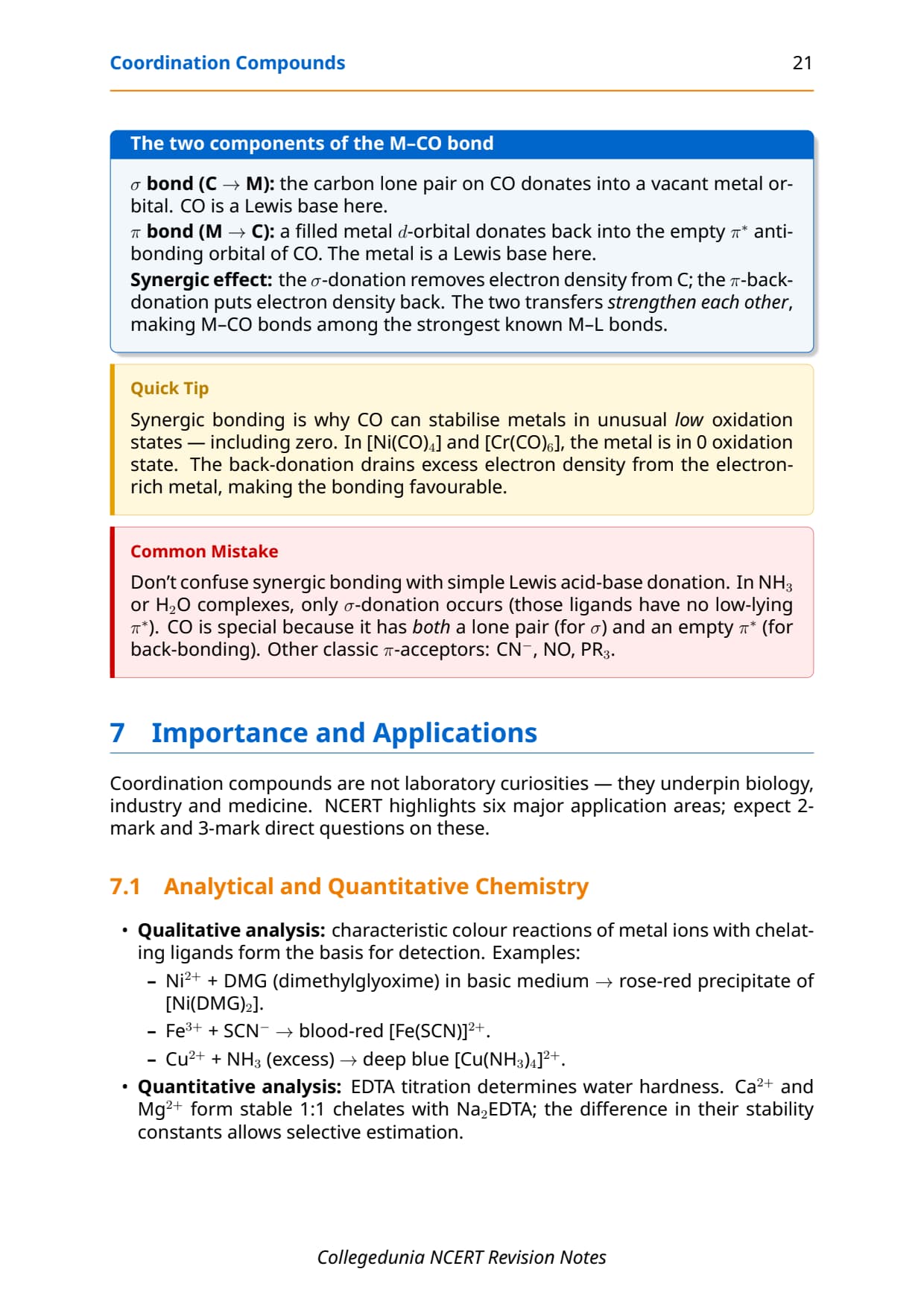
Ans. Metal carbonyls have a special two-way bond. (1) The lone pair on the C atom of CO donates into an empty metal hybrid orbital, forming a σ bond. (2) A filled metal d-orbital donates electron density back into the empty π* anti-bonding orbital of CO, forming a π back-bond. The back-donation strengthens the M-C bond and weakens the C-O bond, which is why the C-O stretching frequency drops from 2143 cm-1 in free CO to roughly 2050 cm-1 in Ni(CO)4. Ni(CO)4 is sp3 hybridised, tetrahedral, and diamagnetic.



Comments