




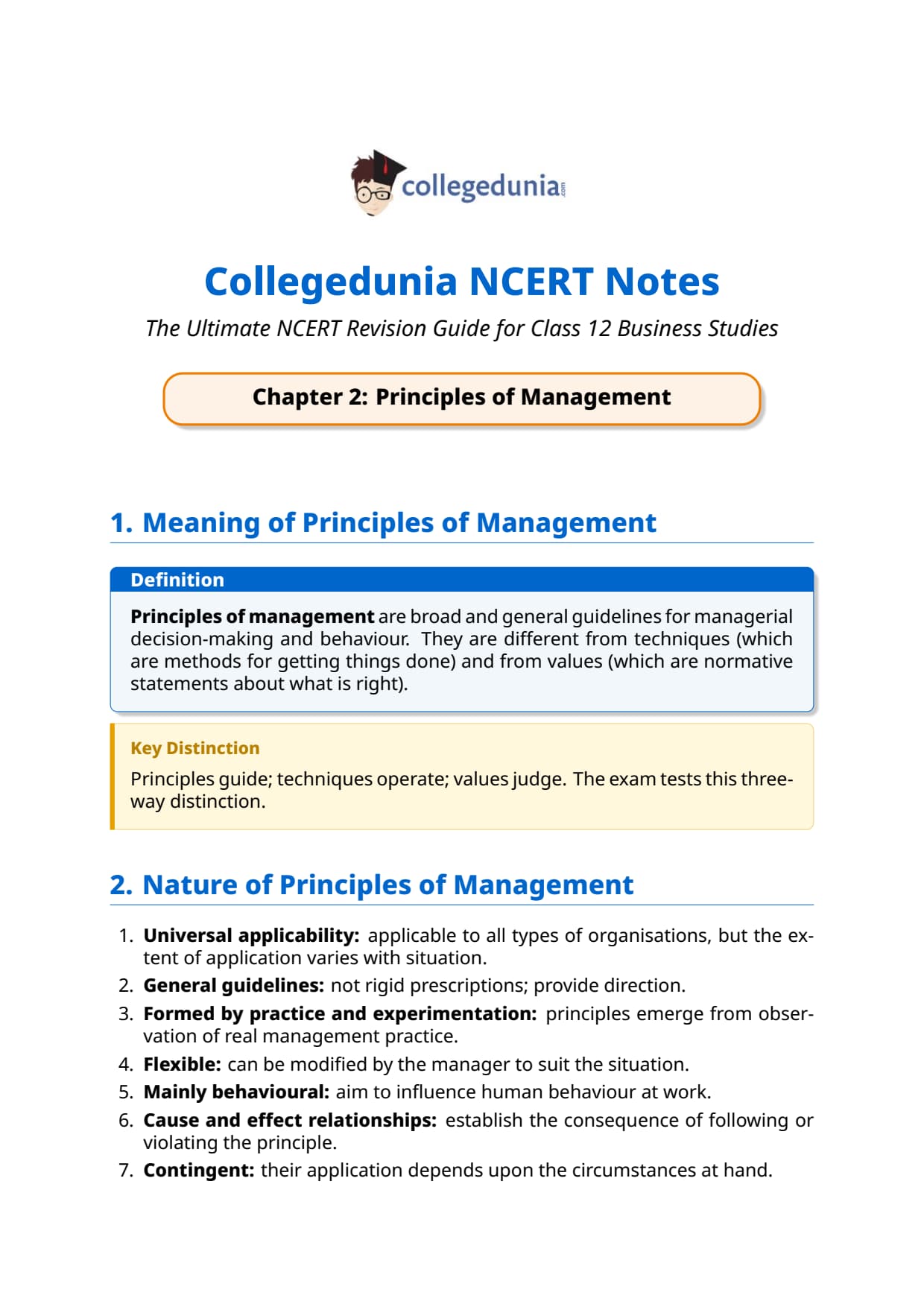
These Principles of Management notes for Class 12 bring together everything the CBSE board tests, from Fayol's 14 principles to Taylor's scientific management and its techniques. Everything sits in one concise revision guide for the 2026-27 syllabus.

- CBSE Weightage: 6 to 12 marks (Unit 1, Principles and Functions of Management)
- Sections Covered: 9 concept blocks + a 7-point Key Takeaways summary
Each principle is a concept-card: a one-line definition, key features and a textbook example. Mnemonics, quick tips, common-mistake call-outs and the Fayol vs Taylor table sit where students usually slip.

Principles of Management Class 12 Notes: Topic Map
| Section | What is Covered | Why It Matters in the Exam |
|---|---|---|
| 1. Nature of Principles | Seven features: universal, formed by practice, flexible, behavioural, cause-effect, contingent, general guidelines | 3-4 marks; "list any three" |
| 2. Significance of Principles | Six points: insight, optimum resource use, scientific decisions, changing environment, social responsibility, manager training | 3-6 marks; one line per point |
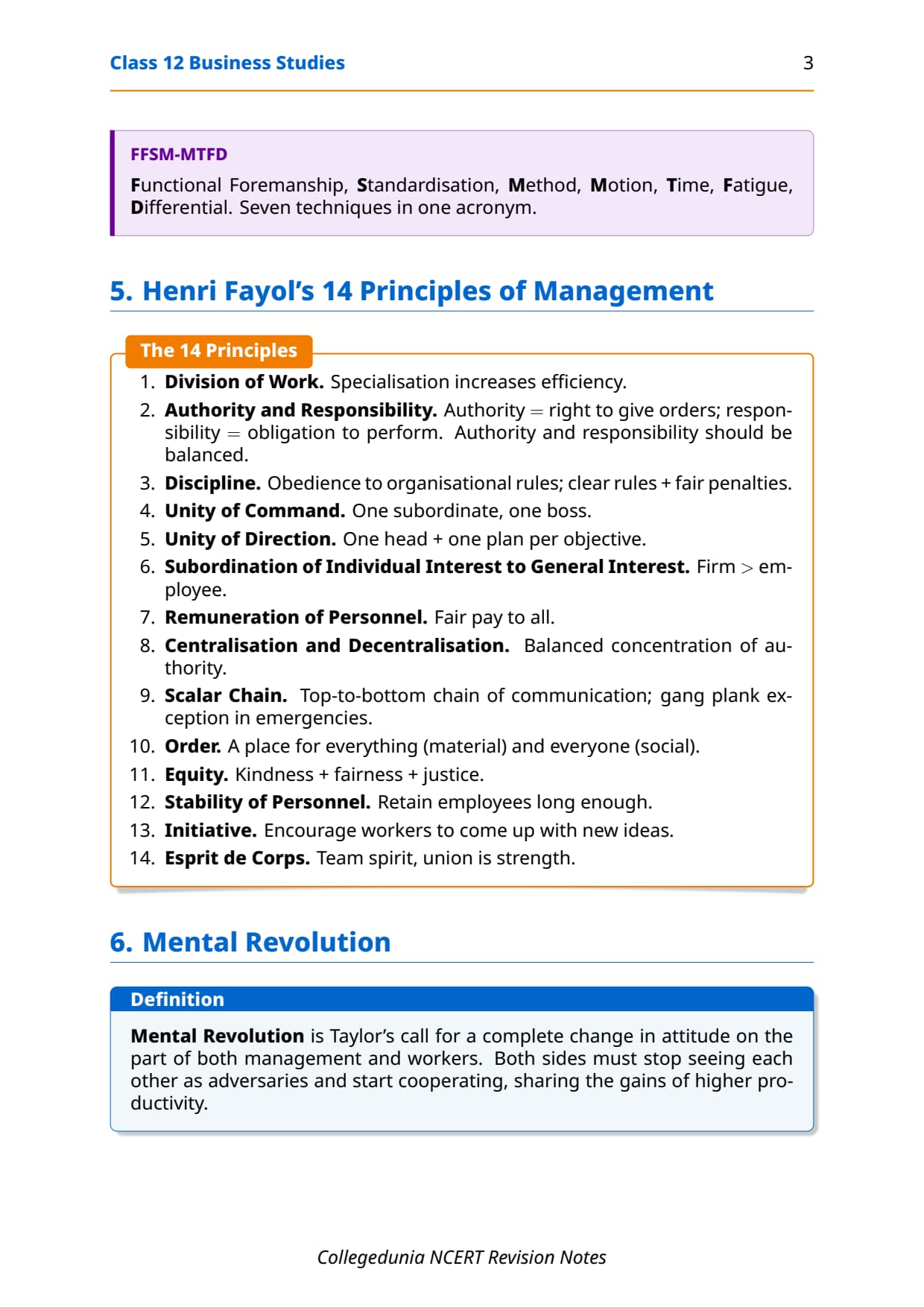
| 3. Fayol's 14 Principles | The full verbatim list, from Division of Work to Esprit de Corps | Most repeated 5-6 mark LA; case-based ID is guaranteed |
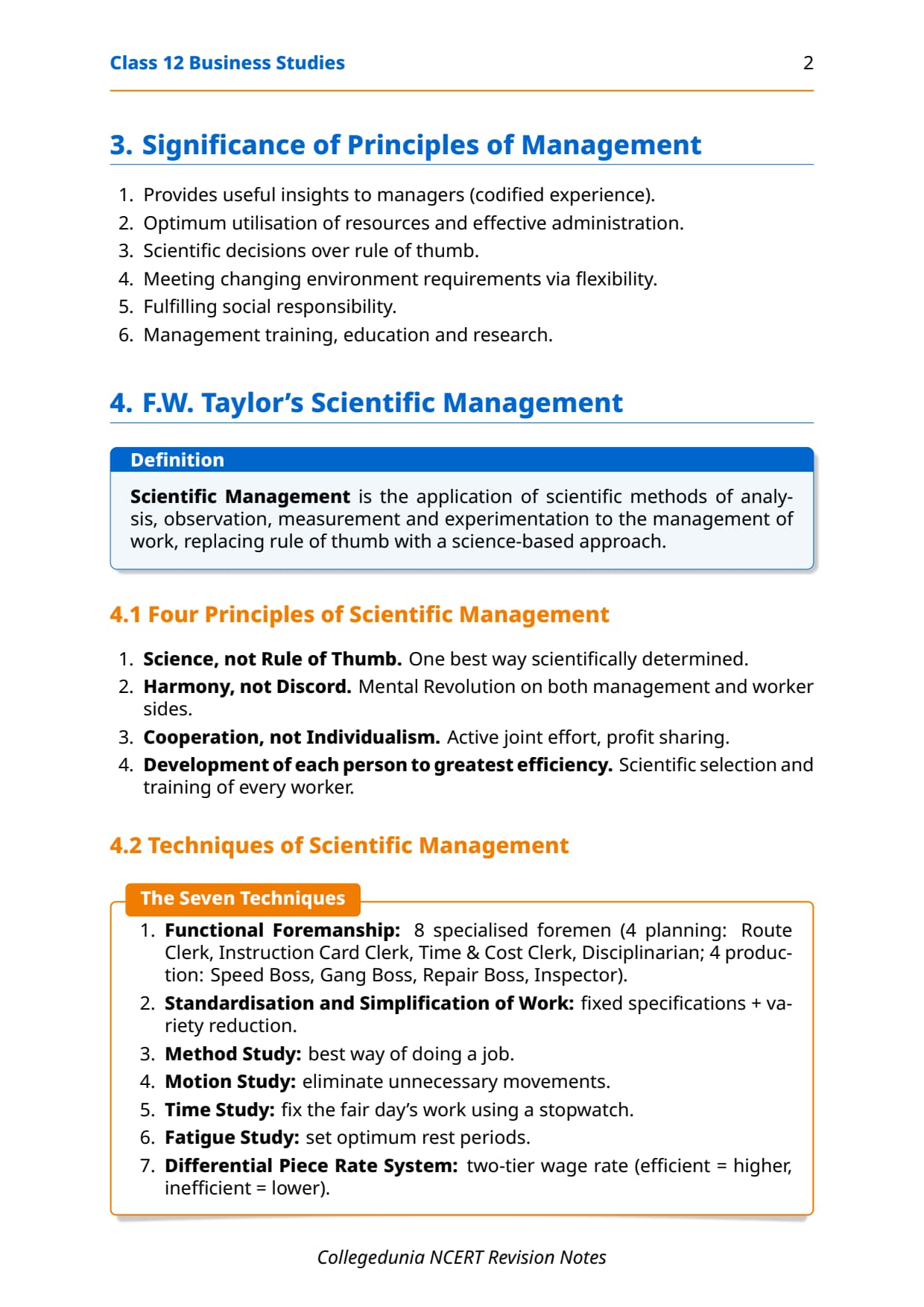
| 4. Taylor's 4 Principles | Science not Rule of Thumb, Harmony not Discord, Cooperation not Individualism, Development of each person | 5-6 marks; pair with Mental Revolution |
| 5. 7 Techniques of Scientific Management | Functional Foremanship, Standardisation, Method, Motion, Time and Fatigue Study, Differential Piece Wage | 5-6 marks; name all seven |
| 6. Functional Foremanship | 8 specialised foremen: 4 planning + 4 production | 3-6 marks; a guaranteed naming list |
| 7. Mental Revolution | Two-sided attitude shift between management and workers | 3-4 marks; the heart of Taylor |
| 8. Differential Piece Wage | Two-tier rate: efficient workers get a higher rate per unit | 1-3 marks; sometimes numerical |
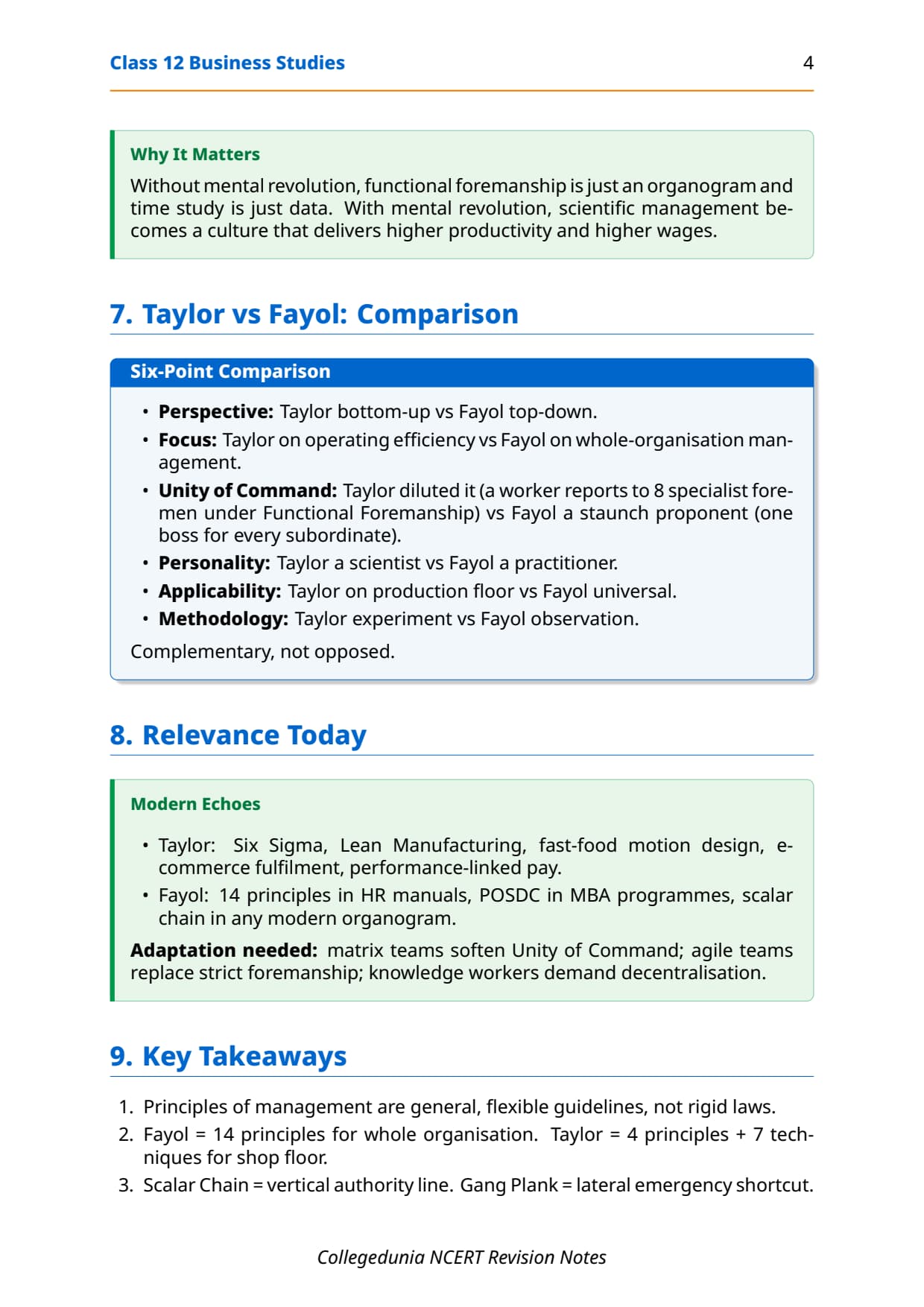
| 9. Fayol vs Taylor | Seven-row comparison across perspective, focus, unity, methodology and results | 5-6 marks; all seven rows needed |
Principles of Management Video Walkthrough
Source: Magnet Brains on YouTube
What the Class 12 Business Studies Chapter 2 Notes PDF Contains
- Definition cards for each principle and technique, with a one-line definition and a textbook example.
- Mnemonics for Fayol's 14 principles and Taylor's 7 techniques so the long lists stick.
- Quick tips for case-cue mapping (Mr. Rathore's cousin maps to Subordination, and so on).
- Real-world boxes linking theory to examples like assembly lines and the Toyota Production System.
- Common-mistake call-outs after each topic (Unity of Command vs Unity of Direction; 5 techniques vs 7).
- Key Takeaways with a 7-point summary for last-minute revision.
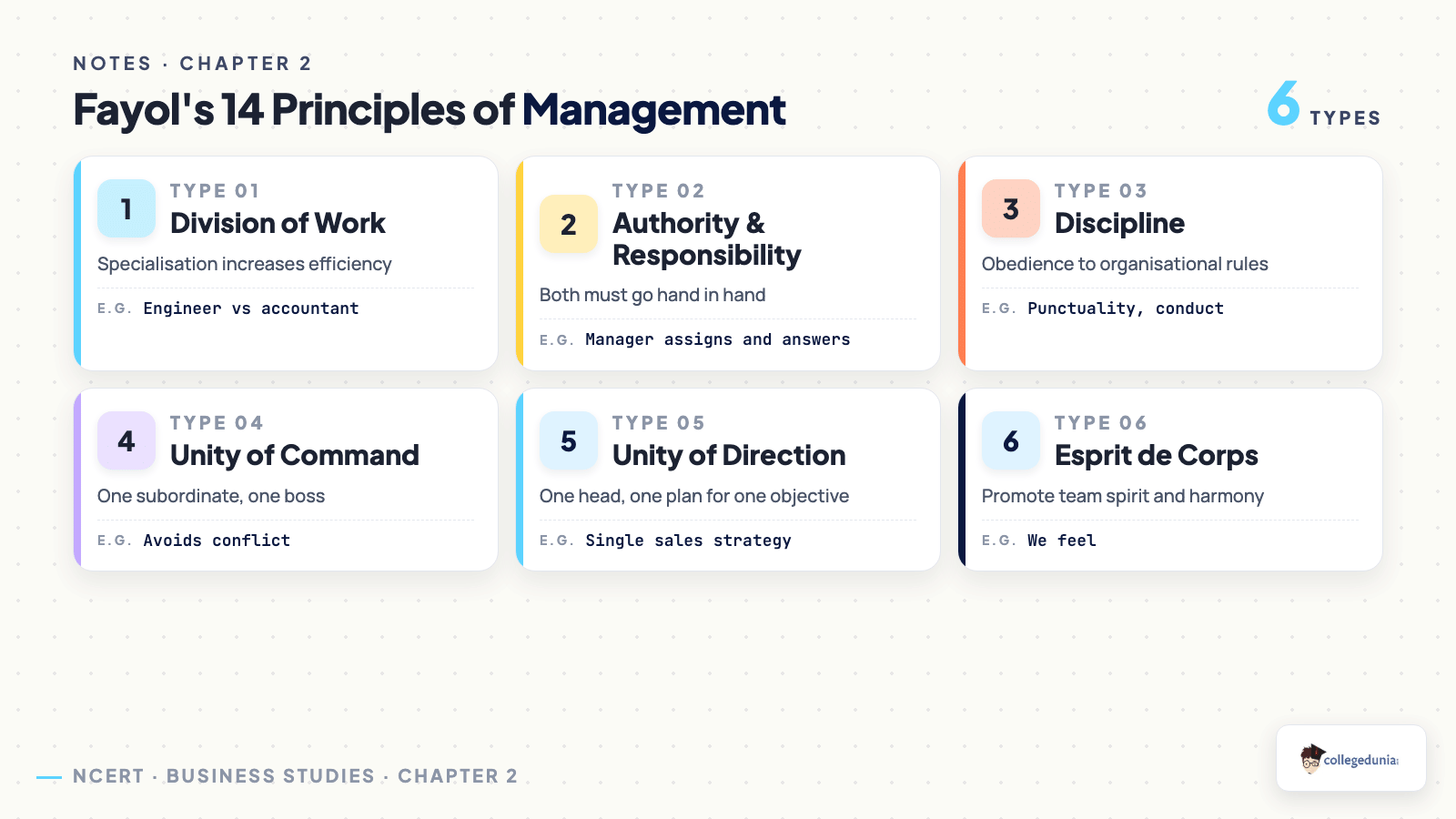
Fayol's 14 Principles: The Verbatim List You Must Know
Class 12 examiners check two boxes on every Chapter 2 answer: was the principle named correctly, and was the NCERT definition quoted in full? The 14 principles must be listed in order:
The 14 Principles (memorise in order):
- Division of Work - specialisation makes work more efficient.
- Authority and Responsibility - the two must always go together.
- Discipline - obedience to organisational rules and agreements.
- Unity of Command - one boss per subordinate.
- Unity of Direction - one head and one plan per objective.
- Subordination of Individual Interest to General Interest - the firm comes first.
- Remuneration of Personnel - fair to both employee and employer.
- Centralisation and Decentralisation - balance of authority concentration.
- Scalar Chain - vertical line of authority; Gang Plank is the lateral emergency exception.
- Order - a place for everything and everyone in its place.
- Equity - kindness and justice in dealings with subordinates.
- Stability of Personnel - low turnover; retain trained staff.
- Initiative - encourage employees to suggest and execute new ideas.
- Esprit de Corps - union is strength; build team spirit.
Taylor's 4 Principles + 7 Techniques: The Complete Scientific Management Set
The single most quoted line from Chapter 2's Taylor section is "Mental Revolution is the essence of Scientific Management". Memorise the 4 principles + 7 techniques together; they pair on long-answer questions.
- Principle 1 - Science, not Rule of Thumb: replace hunch with measurement; one best method for every task.
- Principle 2 - Harmony, not Discord: management and workers must agree on shared gains; no class war.
- Principle 3 - Cooperation, not Individualism: joint effort, not competition between management and workers.
- Principle 4 - Development of Each Person to His/Her Greatest Efficiency: scientific selection and training of every worker.
The Eight Functional Foremen: 4 Planning + 4 Production
Taylor argued that one general foreman cannot be expert in everything. He split supervision into 8 specialised roles, with 4 in planning and 4 on the production floor.
| Planning Section (4) | Responsibility |
|---|---|
| Route Clerk | Decides the sequence of operations and the route each job must follow. |
| Instruction Card Clerk | Prepares written instructions for each worker on how to do the job. |
| Time and Cost Clerk | Sets the time and cost standards for each operation. |
| Disciplinarian | Ensures discipline, enforces rules and handles violations. |
| Production Floor (4) | Responsibility |
|---|---|
| Speed Boss | Ensures work is done at the prescribed speed. |
| Gang Boss | Keeps machines, tools and workers ready for the job. |
| Repair Boss | Maintains machines and tools in good working order. |
| Inspector | Checks the quality of finished work against the standard. |
Fayol vs Taylor: The Seven-Row Comparison
| Basis | Fayol | Taylor |
|---|---|---|
| Perspective | Top-level (general management) | Shop-floor (scientific management) |
| Focus | Improving overall administration | Increasing worker productivity |
| Unity Emphasis | Unity of Command (one boss per worker) | Diluted - 8 specialised foremen |
| Personality | Practical-thinker (managing director) | Scientist-engineer |
| Applicability | Universal across every level and type | Mainly specialised production work |
| Methodology | Personal experience to 14 principles | Observation, experiment, measurement |
| Results | Development of management as a discipline | Higher productivity through mental revolution and standardisation |
Important Topics in Chapter 2 (with Marks Distribution)
| Topic | Typical Marks | Question Type |
|---|---|---|
| Nature and significance of principles | 3-6 | SA or LA (any three nature features) |
| Fayol's 14 principles | 5-6 | LA (most repeated) |
| Taylor's 4 principles | 5-6 | LA (often paired with Mental Revolution) |
| 7 techniques of scientific management | 5-6 | LA (name all seven, explain four) |
| Functional Foremanship (8 foremen) | 3-6 | SA or LA |
| Mental Revolution | 3-4 | SA |
| Differential Piece Wage System | 1-3 | VSA or SA (sometimes numerical) |
| Fayol vs Taylor (7-row comparison) | 5-6 | LA |
| Case-based principle identification | 3-6 | SA or LA |
Previous Year Pattern: Class 12 Business Studies Chapter 2
- Fayol vs Taylor seven-row comparison (LA): 2020, 2022, 2024. All seven rows, including Unity of Command.
- Explain any five Fayol principles with examples (LA): 2019, 2021, 2023. NCERT definition plus one example each.
- 7 techniques of scientific management (LA): 2020, 2022. Name all seven; explain at least four.
- Case-based principle identification (SA): 2021, 2023, 2024. Mr. Rathore = Subordination; Bhasin Limited = six Fayol principles.
- Functional Foremanship (SA or LA): 2022, 2024. Name all eight (4 planning + 4 production).
Common Mistakes to Avoid in Chapter 2
- Confusing Unity of Command with Unity of Direction. One boss per worker vs one head and one plan per objective.
- Listing only 5 or 6 techniques. There are exactly 7. Drop one and you forfeit a mark.
- Forgetting Functional Foremanship has 8 foremen. 4 planning + 4 production. Name all eight.
- Treating Taylor and Fayol as opposed. They are complementary; different angles on the same management problem.
- In the Mr. Rathore case, naming Equity or Discipline. The right answer is Subordination of Individual Interest to General Interest.
- Calling Fayol's principles "absolute" or "rigid". They are general guidelines, flexible and contingent on the situation.
Student Feedback
In a Collegedunia poll of 940 Class 12 Commerce students, 81% said the Fayol vs Taylor seven-row table and the concept-card layout made this chapter the easiest one to revise the night before the exam. 3 in 4 said the case-cue mapping (Mr. Rathore, Bhasin Limited) helped them crack the case-based principle question with confidence.
Other Resources for Class 12 Business Studies Chapter 2 Principles of Management
| Resource | Link |
|---|---|
| NCERT Solutions | Principles of Management NCERT Solutions |
| Revision Notes | Principles of Management Class 12 Notes |
| Handwritten Notes | Principles of Management Handwritten Notes |
| NCERT Book PDF | Principles of Management NCERT Book PDF |
FAQs on Principles of Management Class 12 Notes
FAQs on Principles of Management Class 12 Notes
What are the 14 principles of management by Fayol?
Fayol's 14 principles are: (1) Division of Work, (2) Authority and Responsibility, (3) Discipline, (4) Unity of Command, (5) Unity of Direction, (6) Subordination of Individual Interest to General Interest, (7) Remuneration of Personnel, (8) Centralisation and Decentralisation, (9) Scalar Chain, (10) Order, (11) Equity, (12) Stability of Personnel, (13) Initiative, (14) Esprit de Corps.
What are Taylor's four principles of scientific management?
Taylor's four principles are: (1) Science, not Rule of Thumb, (2) Harmony, not Discord, (3) Cooperation, not Individualism, (4) Development of each person to his/her greatest efficiency and prosperity.
What are the 7 techniques of scientific management?
Taylor's 7 techniques are: (1) Functional Foremanship, (2) Standardisation and Simplification of Work, (3) Method Study, (4) Motion Study, (5) Time Study, (6) Fatigue Study, (7) Differential Piece Wage System. NCERT lists all seven; do not stop at five or six.
What is Functional Foremanship?
Functional Foremanship is Taylor's technique of dividing supervisory authority among eight specialised foremen instead of one general foreman. Four are in the planning section (Route Clerk, Instruction Card Clerk, Time and Cost Clerk, Disciplinarian) and four are on the production floor (Speed Boss, Gang Boss, Repair Boss, Inspector).
What is Mental Revolution in Taylor's scientific management?
Mental Revolution is Taylor's call for a complete change of attitude on the part of both management and workers. Management must stop treating workers as wage-greedy and workers must stop treating management as profit-greedy. Both must commit to mutual cooperation and shared gains.
What is the difference between Scalar Chain and Gang Plank?
Scalar Chain is the formal vertical line of authority from the top to the bottom of the organisation. Gang Plank is an exception that allows two employees at the same level in different departments to communicate directly with each other in an emergency, bypassing the chain to save time, with their superiors' knowledge.
What is the difference between Unity of Command and Unity of Direction?
Unity of Command means one boss per subordinate (avoids conflicting orders). Unity of Direction means one head and one plan per objective (avoids conflicting plans). The first is about supervision; the second is about co-ordinated goals.
Which principle did Mr. Rathore violate by ordering raw material from his cousin at a higher price?
Mr. Rathore violated Fayol's principle of Subordination of Individual Interest to General Interest. He put personal interest (favouring his cousin) above the firm's interest (lower price from the usual supplier).



Comments