




These Consumer Protection notes for Class 12 bring together everything the board tests under the Consumer Protection Act 2019, the six SICHRE rights, consumer responsibilities and the three-tier redressal machinery, all for the 2026-27 CBSE syllabus.
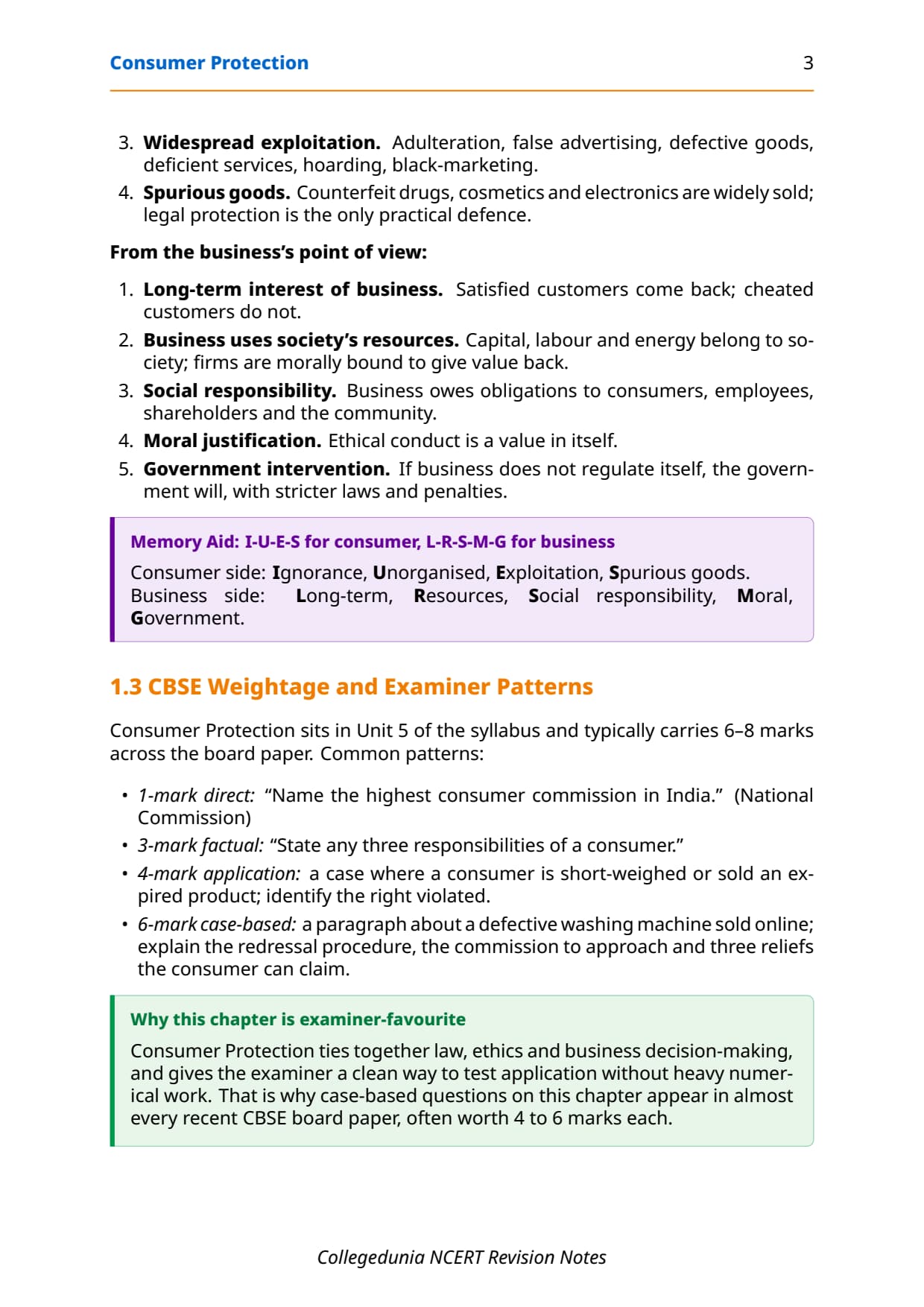
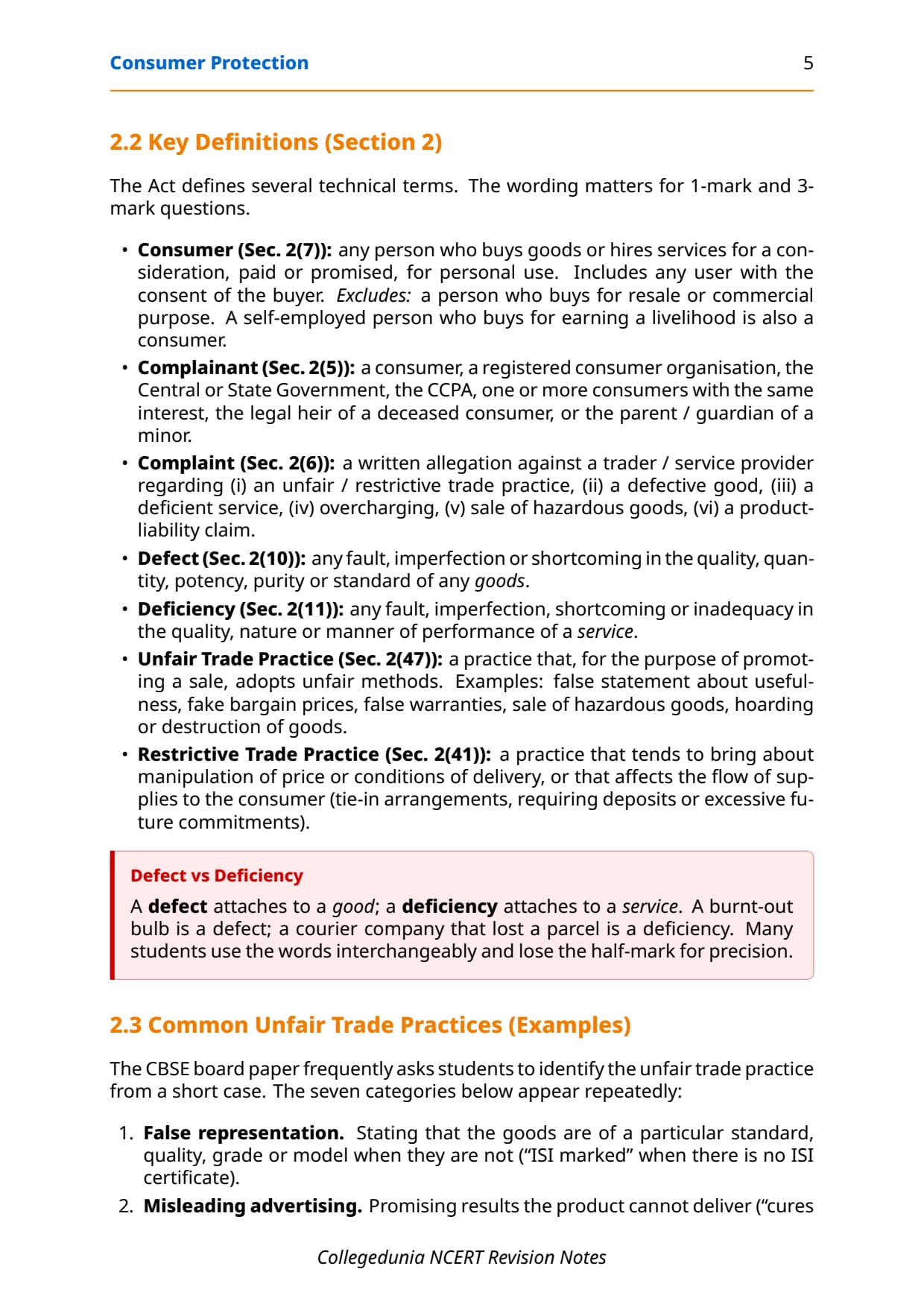
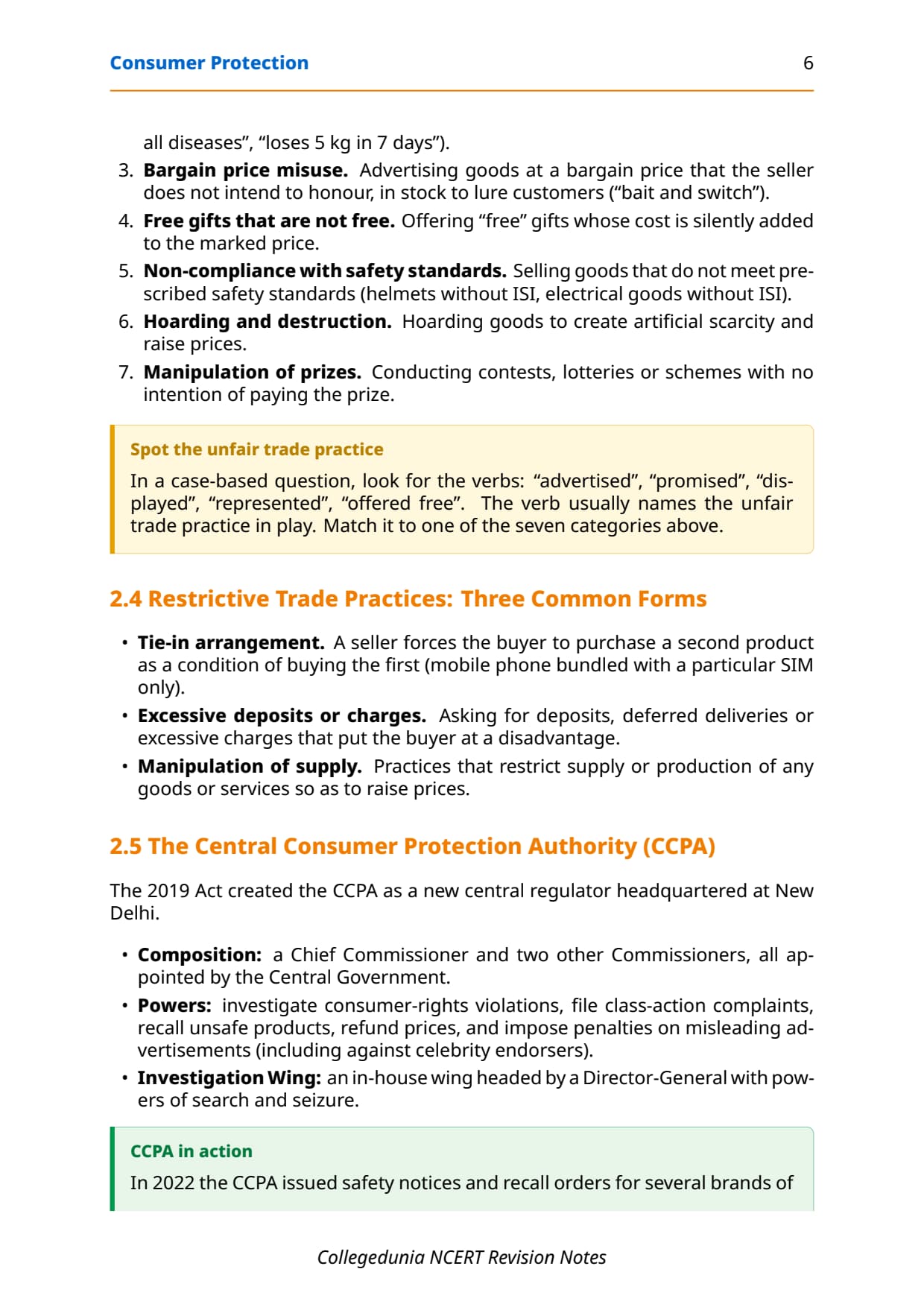
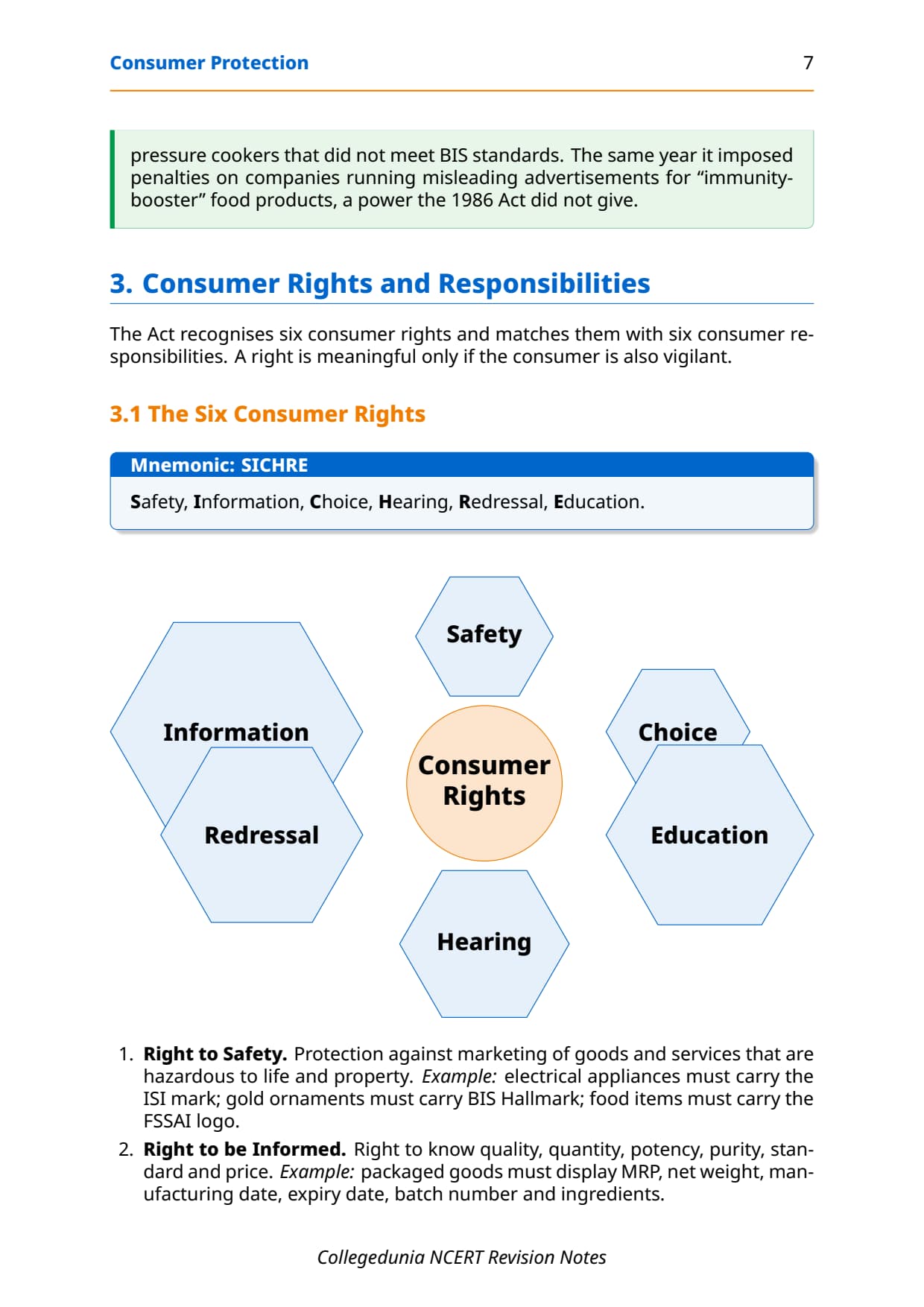
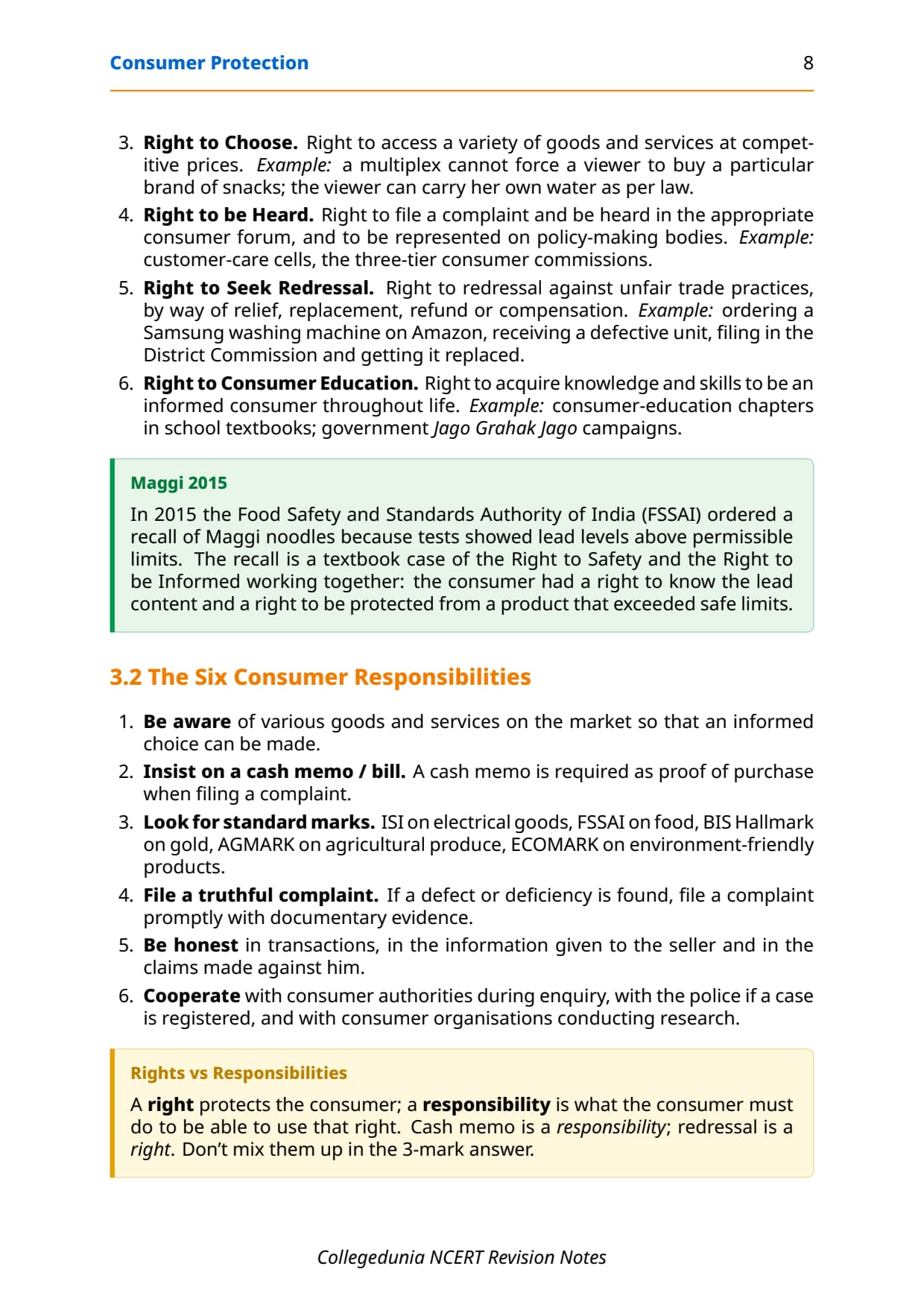
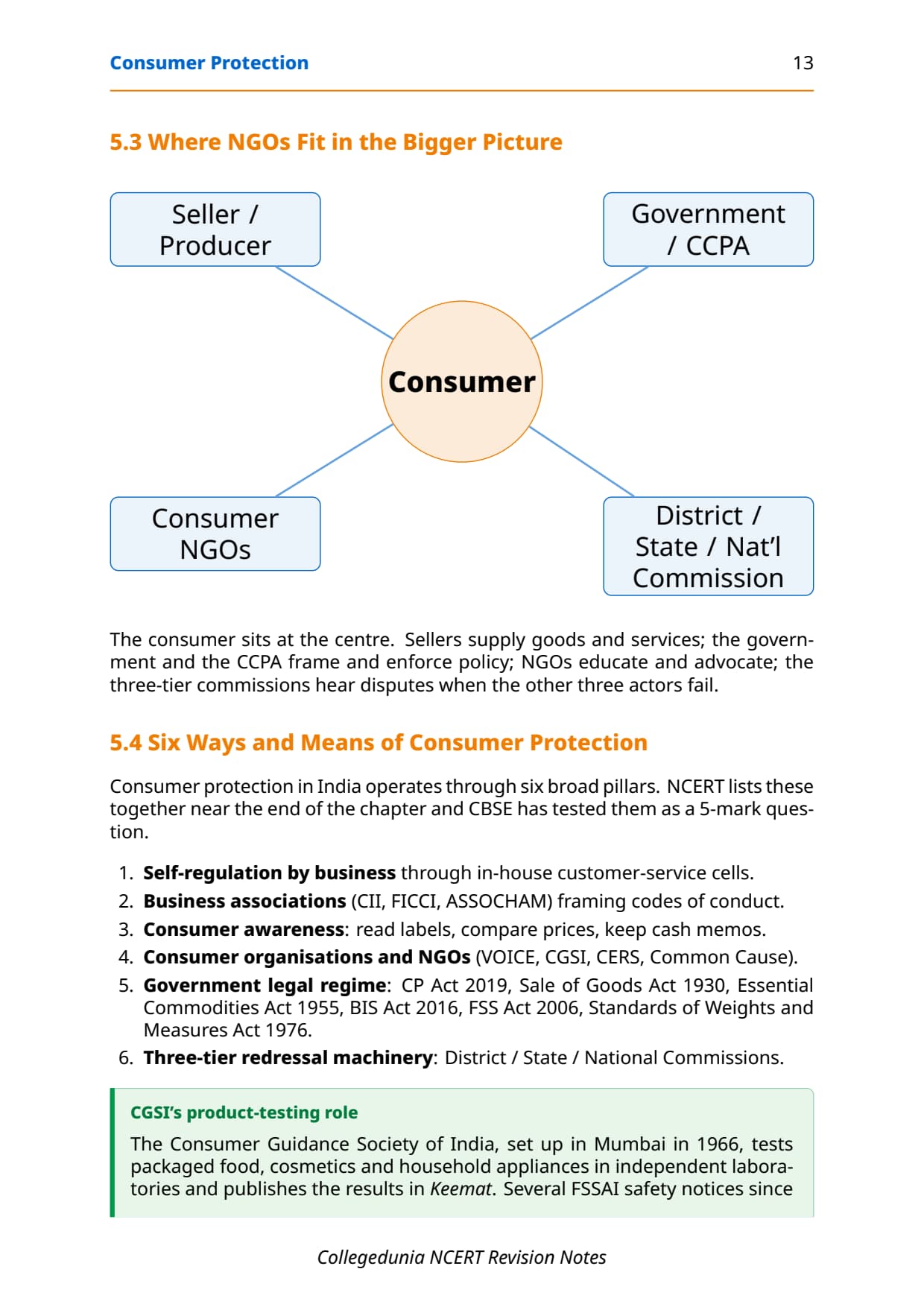
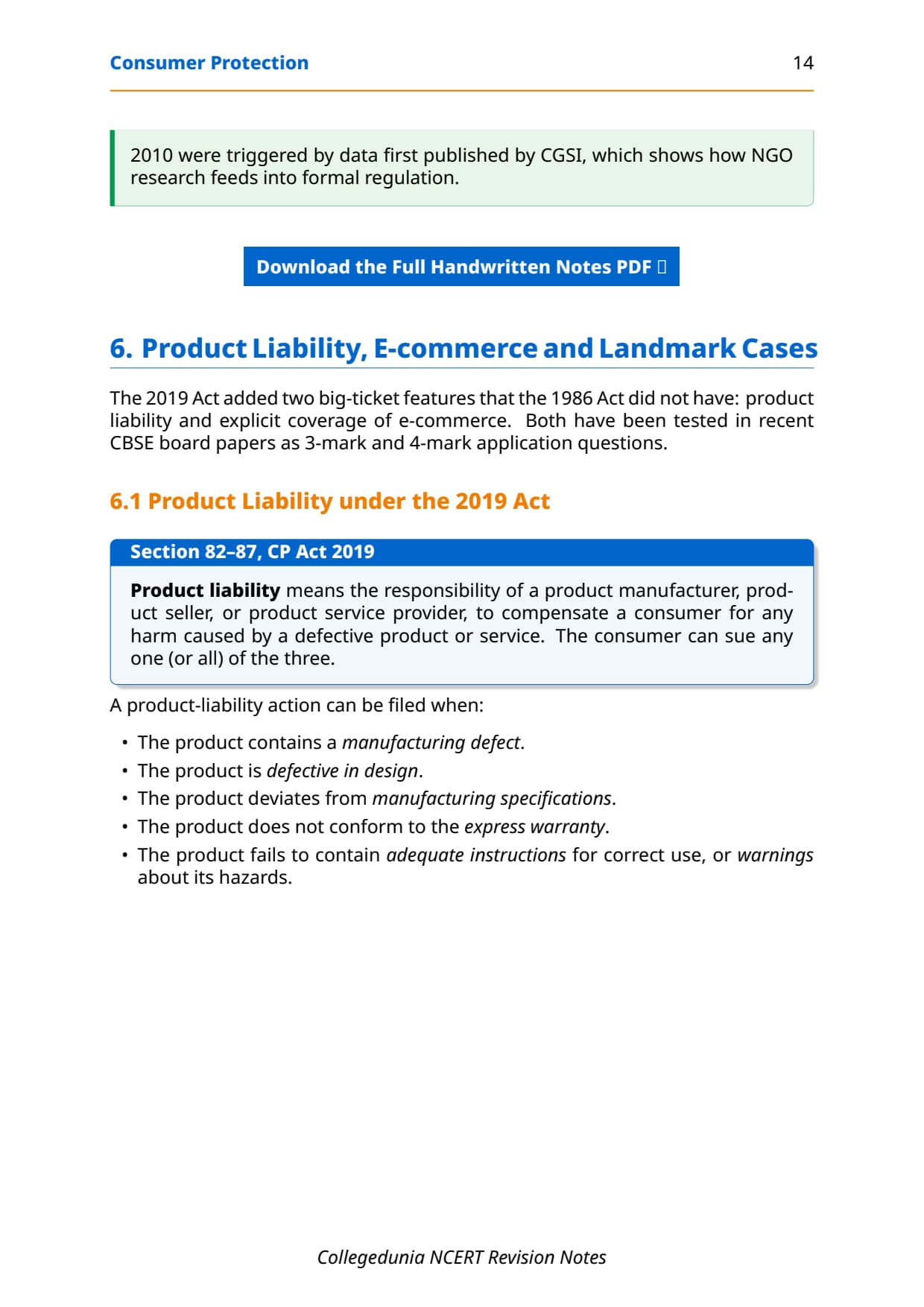
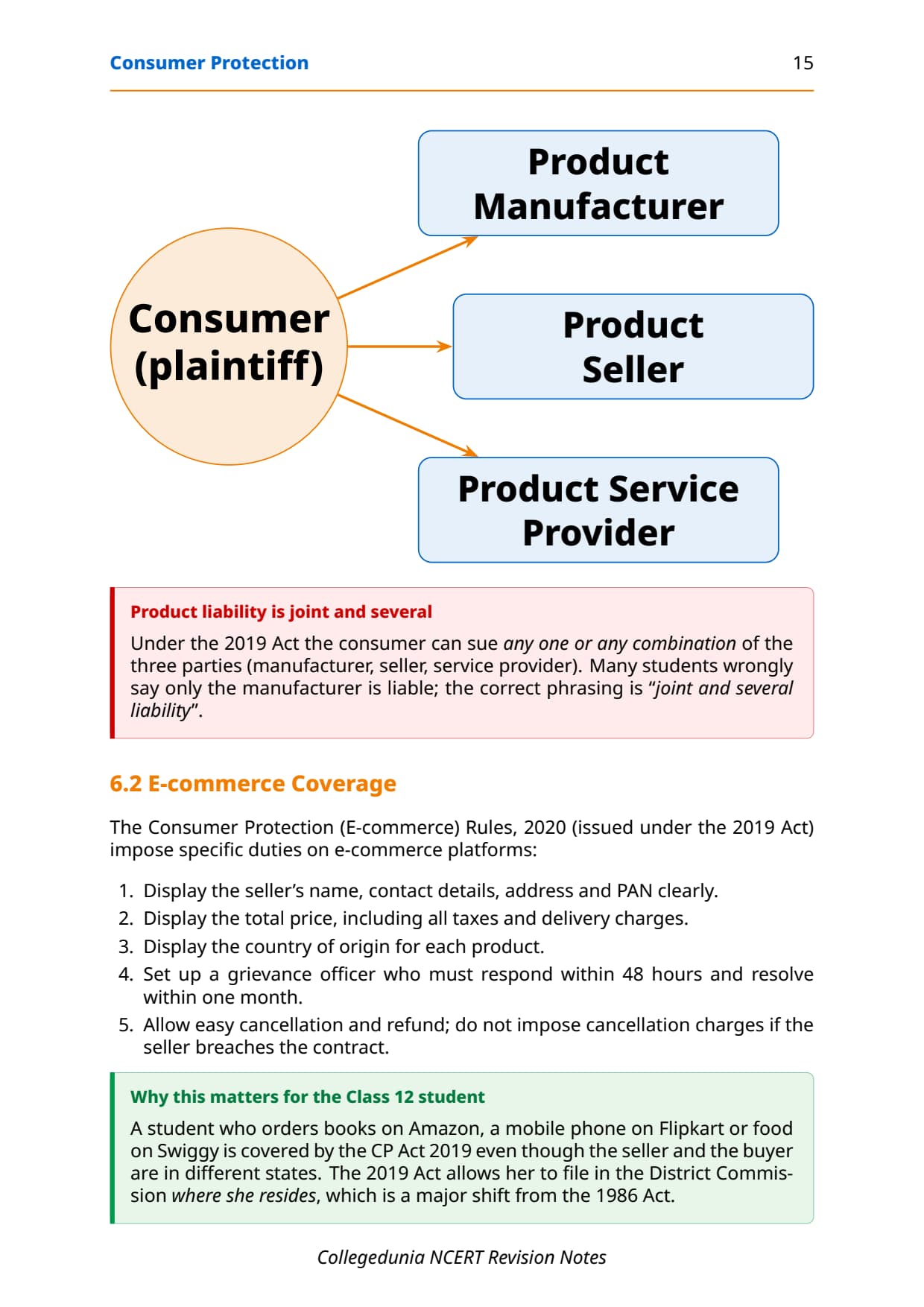
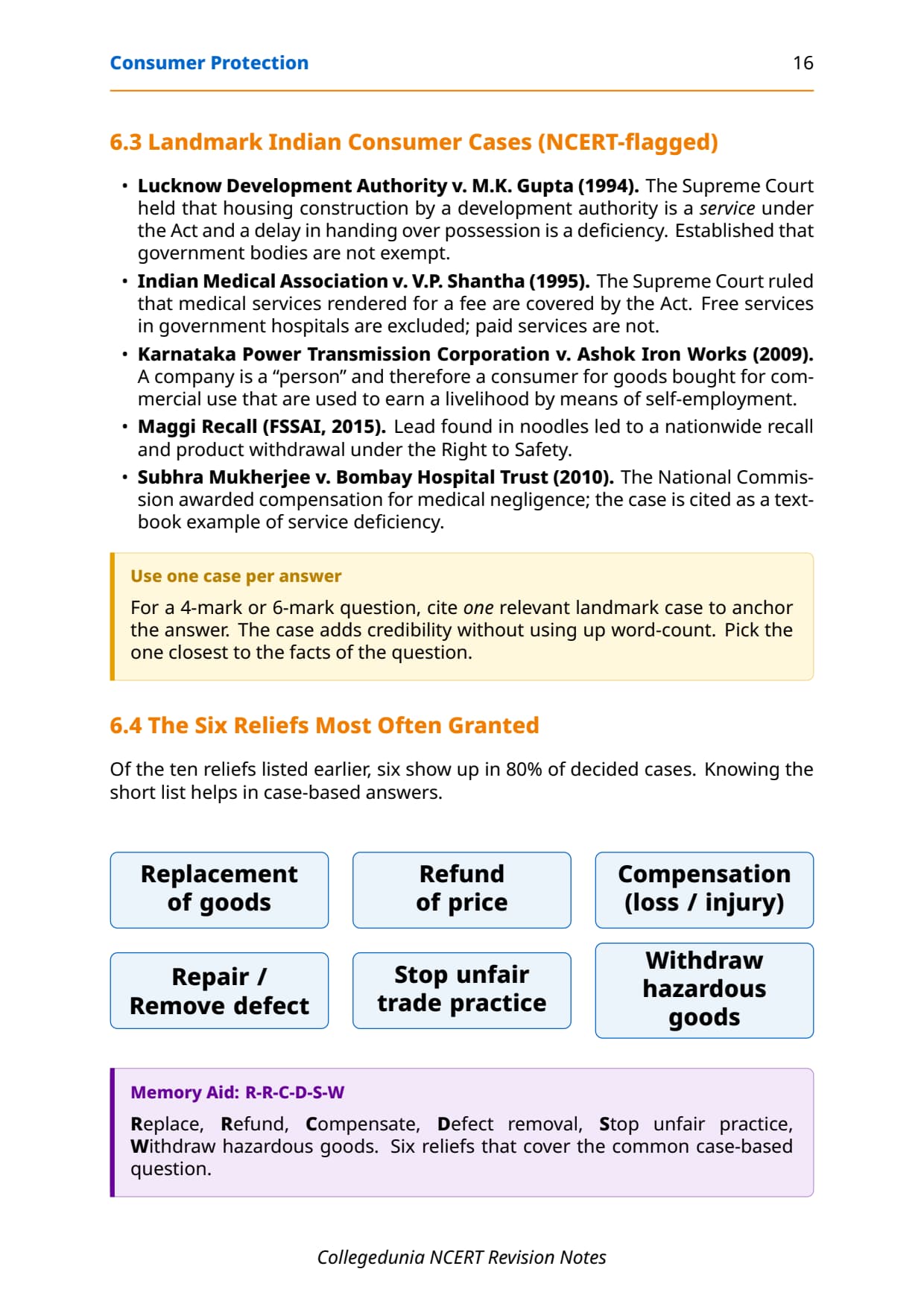
- CBSE Weightage: 5 to 7 marks (Unit 5, Marketing and Consumer Protection)
- Sections Covered: 12 concept blocks + 10-point cheat sheet (consumer rights, redressal tiers, CCPA, reliefs)
- Last chapter of the 2026-27 syllabus - 11 chapters total after the Financial Markets removal
These notes are curated by Commerce experts, mapped to the 2026-27 NCERT, and checked against the last five years of CBSE board papers.
Every concept comes with a clear definition and a one-line takeaway. Mnemonics, quick tips and case-study spotters are placed exactly where students slip in the exam.
Consumer Protection Class 12 Notes: Topic Map
| Section | What is Covered | Why It Matters in the Exam |
|---|---|---|
| 1. Meaning of Consumer | Buyer of goods / hirer of services for consideration (excludes resale and commercial use) | 1 to 3-mark definition |
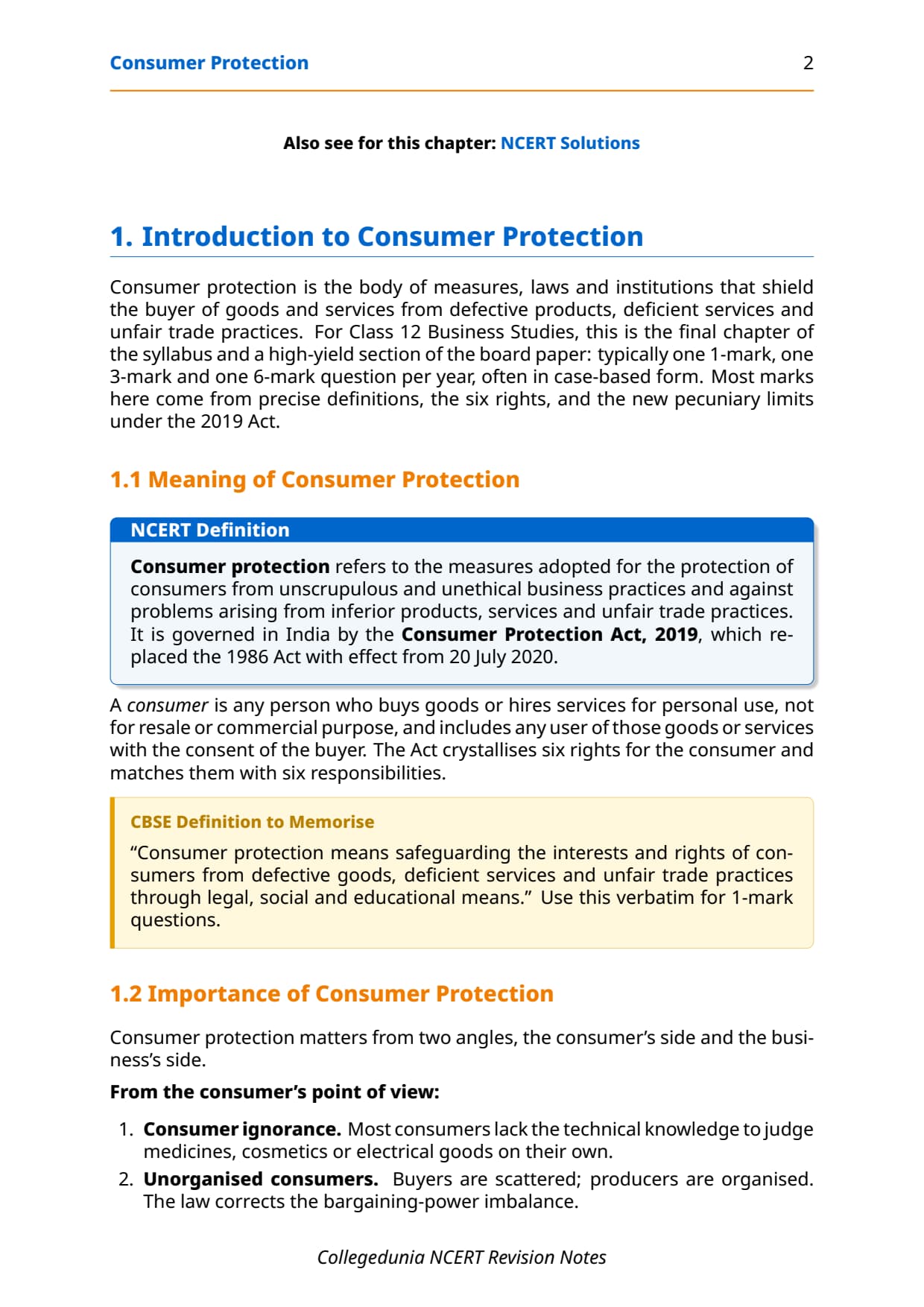
| 2. Importance of Consumer Protection | From the consumer's view (4 points) and from the business's view (6 points) | 4 to 6-mark; favourite case-study setup |
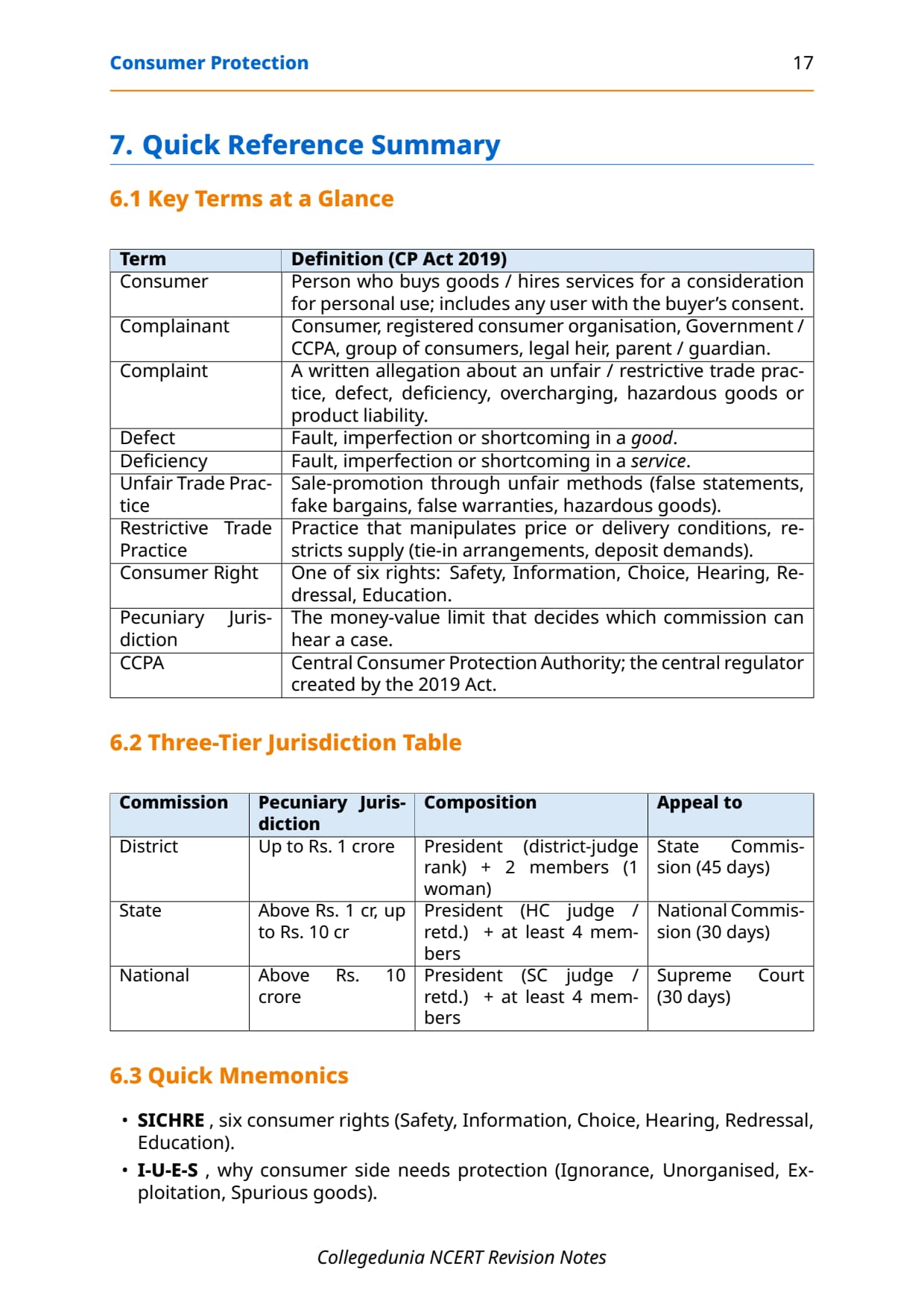
| 3. Six Consumer Rights (SICHRE) | Safety, Information, Choice, Heard, Redressal, Consumer Education | 5 to 6-mark long answer; most-frequent CBSE question of the chapter |
| 4. Six Consumer Responsibilities | Be aware, buy quality-marked goods, learn rights, honest complaint, cash memo, file complaint | 3 to 4-mark "explain any three" |
| 5. Who Can File a Complaint | Consumer, registered consumer association, Central or State Government, legal heir, group of one or more consumers | 2 to 3-mark |
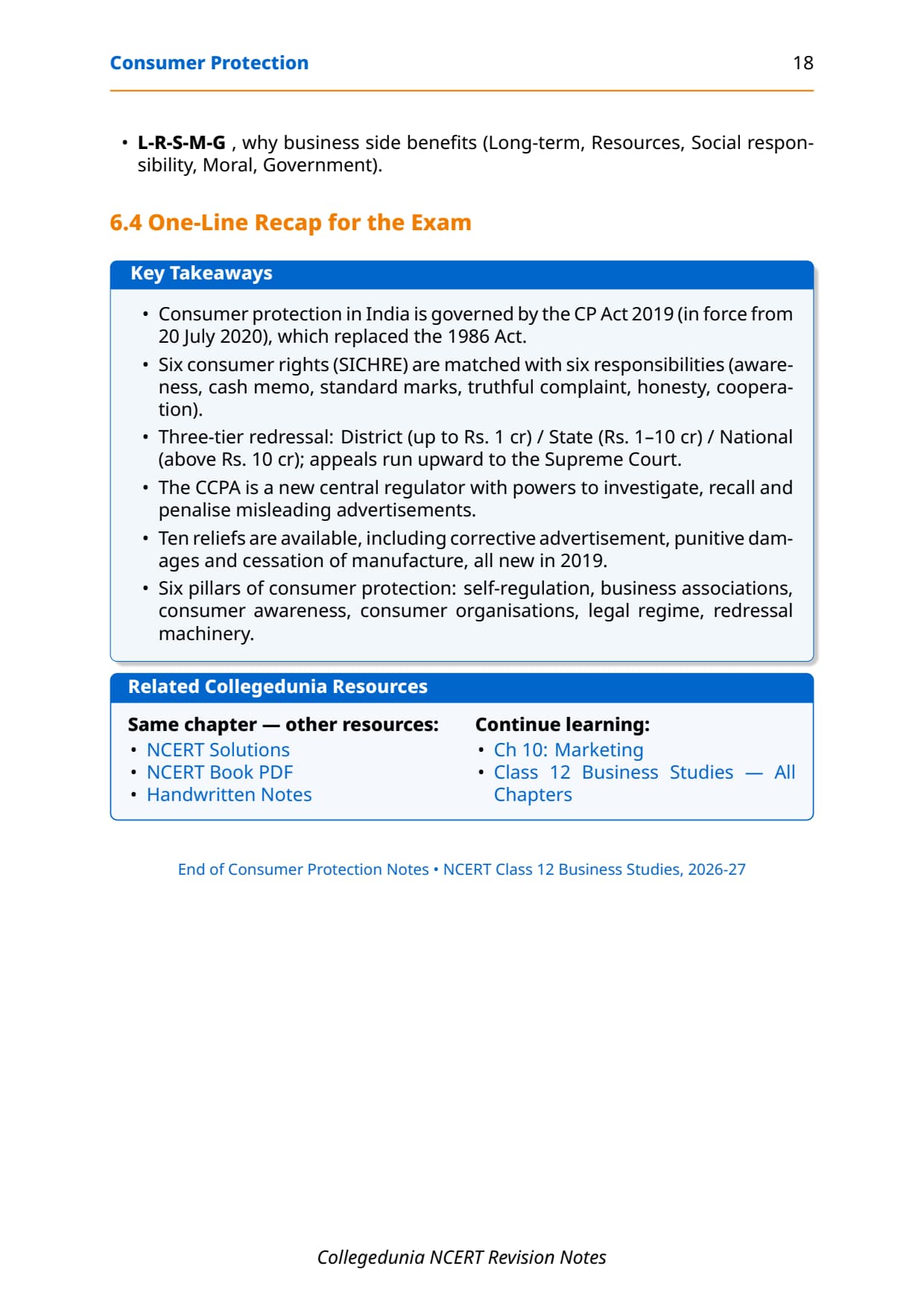
| 6. Three-Tier Redressal Machinery | District Commission (up to Rs 1 crore), State Commission (Rs 1 to 10 crore), National Commission (above Rs 10 crore) | 6 to 8-mark long answer; pecuniary limits are a common 1-mark MCQ |
| 7. Appeal Time Limits | District to State: 45 days; State to National: 30 days; National to Supreme Court: 30 days | 1-mark numeric MCQ |
| 8. CCPA (Central Consumer Protection Authority) | Apex regulator under CP Act 2019; misleading-ad penalties, product recall, class-action suits | 3 to 4-mark; new under 2019 Act |
| 9. Product Liability | Manufacturer, service provider and seller liable for defect, deficiency, false claims | 3-mark; new under 2019 Act |
| 10. Eight Reliefs Available | Removal of defect, replacement, refund, compensation, discontinue unfair practice, withdraw goods, punitive damages, adequate cost | 4 to 5-mark "list any five" |
| 11. Role of Consumer Organisations | Six functions (educate, publish journals, file complaints, expose, research, encourage self-regulation) | 3 to 4-mark |
| 12. Quality Marks | ISI, Hallmark, FPO, AGMARK, Wool Mark, Eco-mark, FSSAI | 1-mark MCQ; case-study spotters |
Consumer Protection Video Walkthrough
Source: Magnet Brains on YouTube
What the Class 12 Business Studies Chapter 11 Notes PDF Contains
- Concept-cards for every named term with a one-line definition and the textbook gloss.
- Mnemonics for the six rights (SICHRE), the redressal slabs (1-10-above) and the eight reliefs (R-R-R-C-D-W-P-C).
- Quick tips that map case-study cues to the right term (defective TV = defect, doctor's negligence = deficiency).
- Comparison tables for CP Act 1986 vs 2019, defect vs deficiency, and the three commissions side by side.
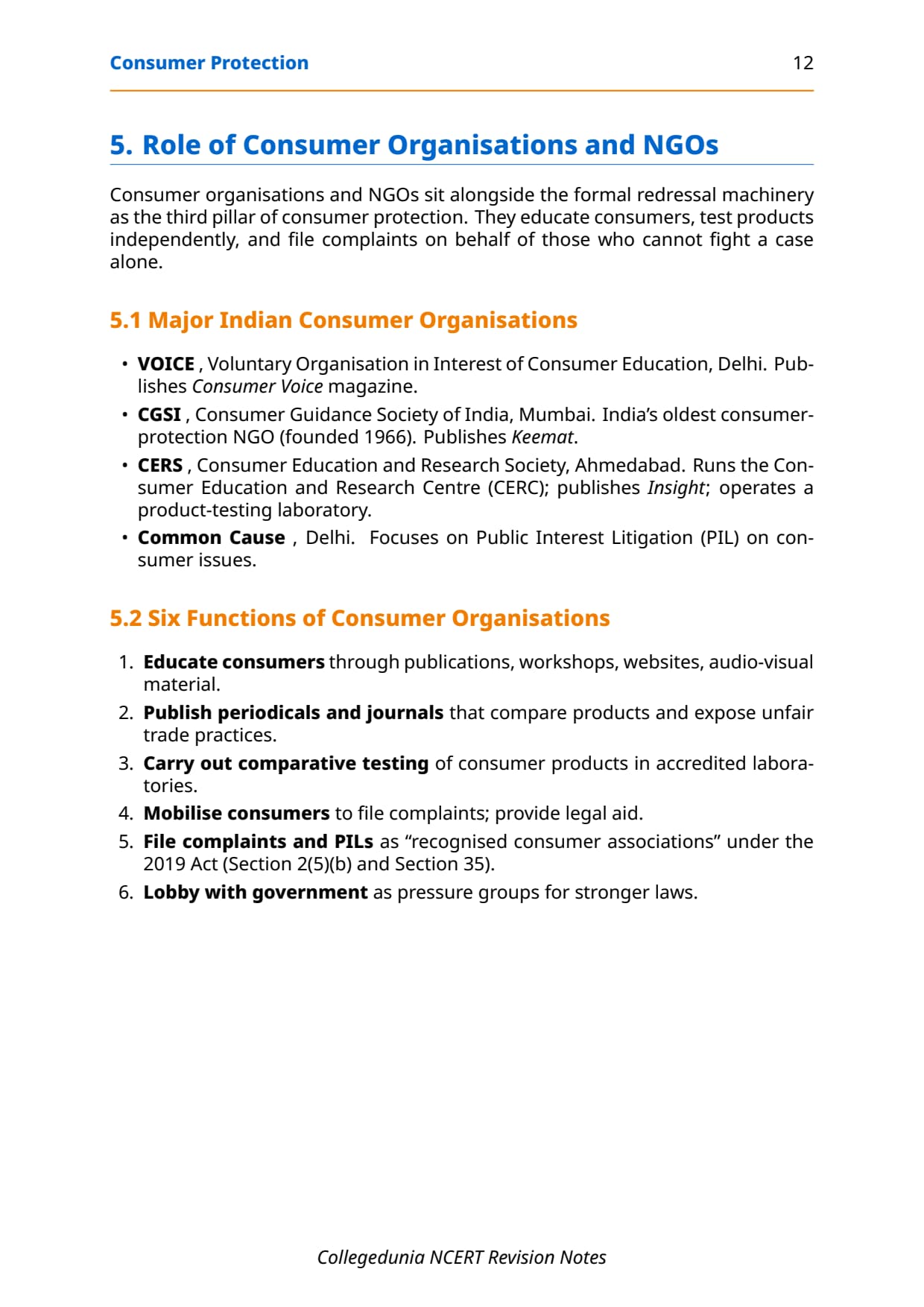
- Diagrams for the redressal flow, the SICHRE rights wheel and the CCPA structure.
- Real-world boxes linking theory to known cases (Maggi ban, misleading-ad recall).
Concept Capsule: Every Named List You Will Be Tested On
Six Consumer Rights (SICHRE)
- Right to Safety - protection against goods and services hazardous to life and property; certifications such as ISI, AGMARK and FSSAI signal compliance.
- Right to be Informed - quality, quantity, purity, standard, price, ingredients, manufacturing and expiry date must be disclosed on every package.
- Right to Choose - access to a variety of goods at competitive prices; bundled selling and forced exclusive dealing are violations.
- Right to be Heard - assurance that consumer interests will be given due consideration; this is the right behind the consumer redressal forum.
- Right to Seek Redressal - relief against unfair trade practices, defective goods or deficient services through District, State or National Commission.
- Right to Consumer Education - acquiring the knowledge and skills to be an informed consumer through schools, the media and consumer organisations.
Six Consumer Responsibilities
- Be aware of the various goods and services available; do not buy blindly.
- Buy quality-marked products - look for ISI, AGMARK, FPO, Hallmark, Wool Mark, FSSAI.
- Learn about consumer rights and exercise them where required.
- File an honest complaint - exaggerated complaints lose credibility and clog the commissions.
- Insist on the cash memo - it is the proof for any future redressal claim.
- Form consumer societies and lodge collective complaints for systemic issues.
Three-Tier Redressal Machinery (CP Act 2019)
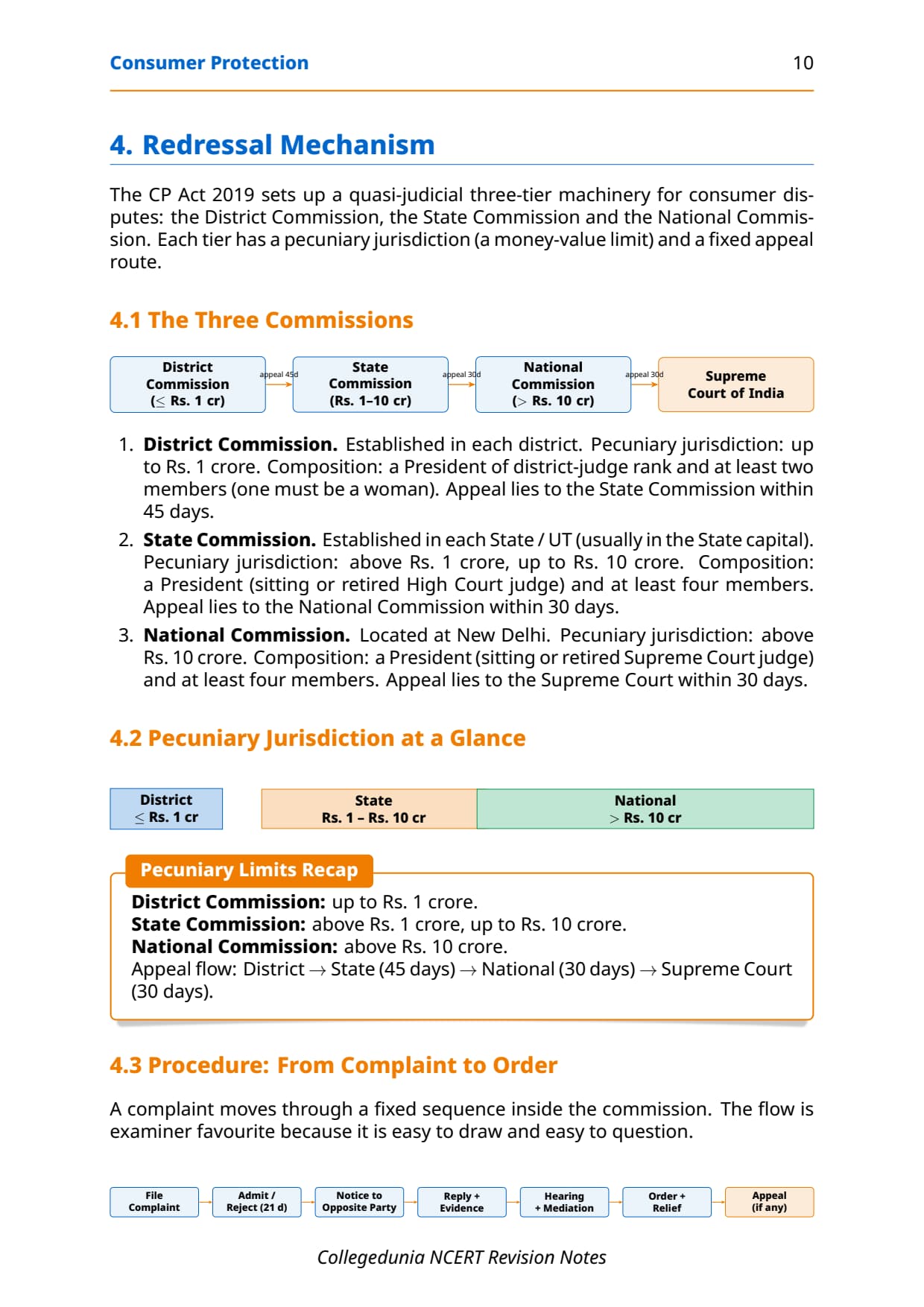
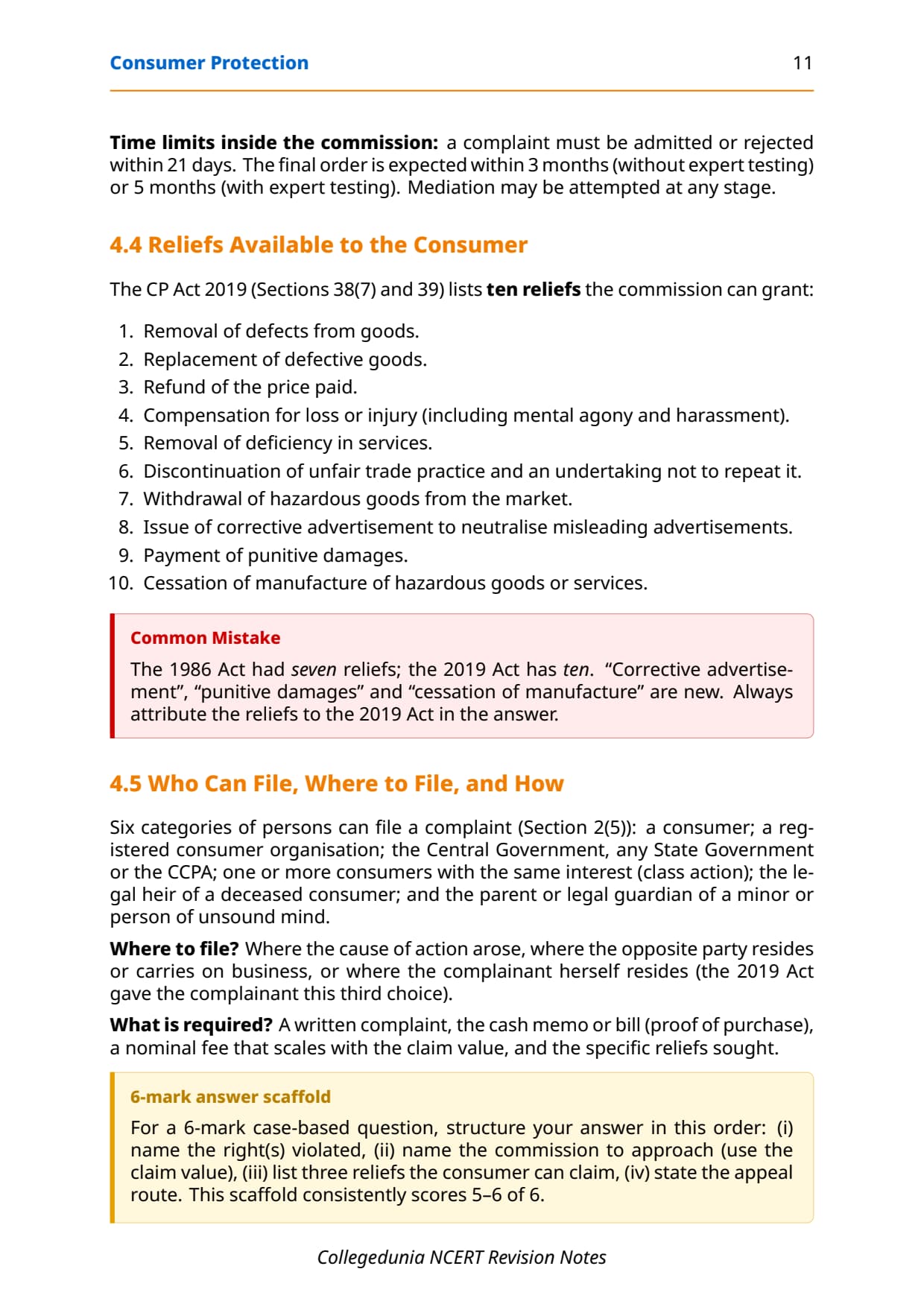
- District Commission - claim value up to Rs 1 crore; appeal lies with the State Commission within 45 days.
- State Commission - claim value above Rs 1 crore and up to Rs 10 crore; appeal lies with the National Commission within 30 days.
- National Commission - claim value above Rs 10 crore; appeal lies with the Supreme Court within 30 days.
Eight Reliefs Available
- Remove the defect from the goods.
- Replace the goods with similar new goods free of defects.
- Refund the price paid by the consumer.
- Pay compensation for loss or injury suffered.
- Discontinue the unfair / restrictive trade practice.
- Withdraw the hazardous goods from sale.
- Pay punitive damages in appropriate cases (added under 2019 Act).
- Adequate cost to the parties.
Who Can File a Complaint
- Any consumer to whom goods are sold or services rendered.
- Any registered consumers' association.
- The Central or State Government.
- One or more consumers on behalf of numerous consumers having the same interest (class action).
- Legal heir or representative of a deceased consumer.
Quality and Standardisation Marks - Where Each Applies
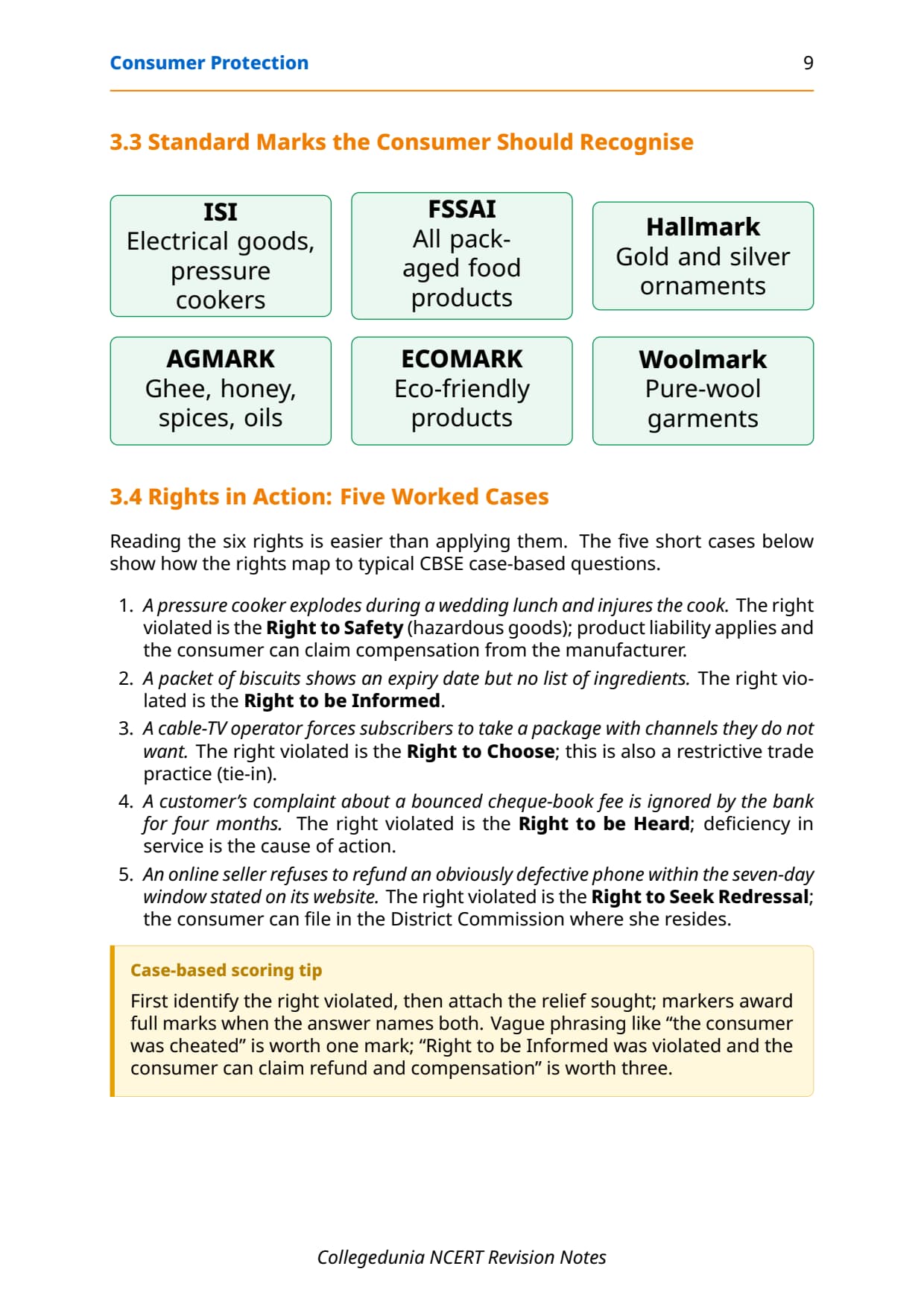
- ISI - electrical, electronics and industrial goods (issued by BIS).
- AGMARK - agricultural products (honey, ghee, butter, atta, masala).
- FPO Mark - processed fruit and vegetable products (jam, squash, pickle).
- Hallmark - purity of gold and silver jewellery (issued by BIS).
- Wool Mark - purity of wool products.
- FSSAI - packaged food items, restaurants, food businesses.
- Eco-Mark - environment-friendly products that meet specified eco-criteria.
Role of Consumer Organisations and NGOs (Six Functions)
- Educate the general public about consumer rights.
- Publish journals and brochures (for example, Insight by CERC).
- File complaints on behalf of consumers in consumer commissions.
- Expose unfair trade practices and misleading advertisements through investigative work.
- Carry out research, testing and comparative product studies.
- Encourage self-regulation within business by promoting voluntary codes of conduct.
CP Act 2019 vs the Old 1986 Act - Five Key Upgrades
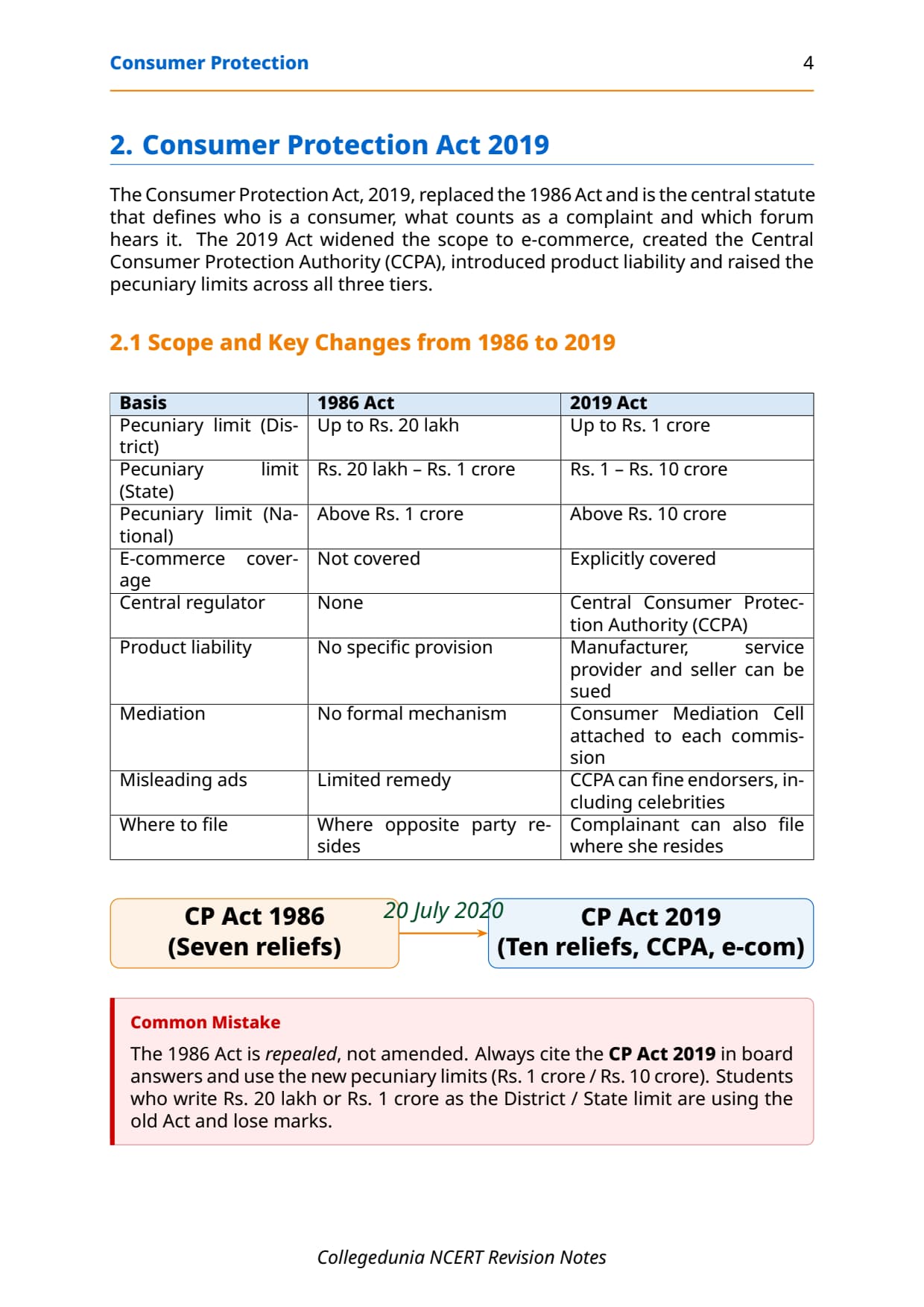
| Feature | CP Act 1986 (Old) | CP Act 2019 (Current Syllabus) |
|---|---|---|
| Apex regulator | Not present | CCPA - Central Consumer Protection Authority |
| District pecuniary limit | Up to Rs 20 lakh | Up to Rs 1 crore |
| State pecuniary limit | Rs 20 lakh to Rs 1 crore | Rs 1 crore to Rs 10 crore |
| National pecuniary limit | Above Rs 1 crore | Above Rs 10 crore |
| E-commerce coverage | Silent | Explicitly covered |
| Product liability | Not defined | Manufacturer, seller and service provider all liable |
| Mediation | Not formal | Mediation cell attached to every commission |
The 2026-27 NCERT carries the 2019 Act, so a board answer should cite the 2019 statute and its slabs (the 1986 Act stands repealed) unless the question asks for the old position.
Student Feedback: How Class 12 Students Rate the Consumer Protection Chapter
- 68% of students ranked the six SICHRE rights as the easiest sub-topic to score on - they are list-based and the mnemonic locks them in.
- 42% of students reported confusing the District / State / National pecuniary slabs on first read - the 1-10-above mnemonic is the fix.
- 57% said the CP Act 2019 vs 1986 upgrades table was the single most useful page in their handwritten notes the night before the exam.
- Most-skipped sub-topic: the eight reliefs (skipped by ~31% of students because the list is long). The notes group them as R-R-R-C-D-W-P-C to fix the order.
Other Resources for Class 12 Business Studies Chapter 11 Consumer Protection
| Resource | Link |
|---|---|
| NCERT Solutions | Consumer Protection NCERT Solutions |
| Revision Notes | Consumer Protection Class 12 Notes |
| Handwritten Notes | Consumer Protection Handwritten Notes |
| NCERT Book PDF | Consumer Protection NCERT Book PDF |
Consumer Protection Class 12 - Frequently Asked Questions
Consumer Protection Class 12 - Frequently Asked Questions
What is consumer protection in Class 12 Business Studies Chapter 11?
Consumer protection is the set of legal and institutional measures that safeguard consumers against unfair trade practices, defective goods and deficient services. In Class 12 Business Studies Chapter 11, it is studied through the CP Act 2019, the six consumer rights, six responsibilities, three-tier redressal machinery and the role of consumer organisations.
What are the six consumer rights under the Consumer Protection Act 2019?
The six consumer rights (mnemonic SICHRE) are: (1) Right to Safety, (2) Right to be Informed, (3) Right to Choose, (4) Right to be Heard, (5) Right to Seek Redressal, (6) Right to Consumer Education. The 2019 Act preserves all six from the 1986 framework and reinforces them through the CCPA.
What are the three tiers of the consumer redressal machinery?
Under the CP Act 2019 there are three commissions: District Commission (claims up to Rs 1 crore), State Commission (Rs 1 crore to Rs 10 crore) and National Commission (above Rs 10 crore). Appeals from District lie with State within 45 days; State to National within 30 days; National to Supreme Court within 30 days.
What is the difference between defect and deficiency?
Defect is a fault, imperfection or shortcoming in the quality, quantity, purity or standard of a good (a TV that does not switch on). Deficiency is an inadequacy or shortcoming in the manner of performance of a service (a doctor's negligence, a courier's delay). The CBSE board paper tests this distinction in nearly every case study.
What is CCPA in the Consumer Protection Act 2019?
The Central Consumer Protection Authority (CCPA) is the apex regulator introduced by the CP Act 2019. It investigates violations of consumer rights, takes action against misleading advertisements, recalls unsafe products, imposes penalties on endorsers and files class-action suits on behalf of consumers.
Where can I download the Class 12 Business Studies Chapter 11 Consumer Protection Notes PDF?
You can download the Collegedunia Class 12 Business Studies Chapter 11 Consumer Protection Notes PDF free of cost from this page. The PDF is aligned to the NCERT Reprint 2026-27 syllabus and includes all the concepts, comparisons, diagrams and case-study spotters you need for the board exam.
What is a consumer under the Consumer Protection Act 2019?
A consumer is any person who buys goods or hires services for consideration - paid, promised or partly paid - for personal use. Buyers for resale and commercial use are excluded, but the 2019 Act explicitly includes online transactions and tele-shopping. The consumer is the legal person who can file a complaint in the redressal commissions.
How is product liability defined in the Consumer Protection Act 2019?
Product liability is the responsibility of the manufacturer, service provider or seller to compensate the consumer for any harm caused by a defective product or deficient service. The 2019 Act made product liability a separate statutory chapter, covering manufacturing defects, design defects, deviation from standards and false claims.
What are consumer responsibilities in Class 12?
The six consumer responsibilities are: (1) be aware of goods and services, (2) buy quality-marked products, (3) learn about consumer rights, (4) file honest complaints, (5) insist on the cash memo and (6) form consumer societies. Rights and responsibilities are paired - the rights cannot be enforced without the consumer's own diligence.



Comments