Economics Mentor, Shaheed Bhagat Singh College | Updated 3+ months ago
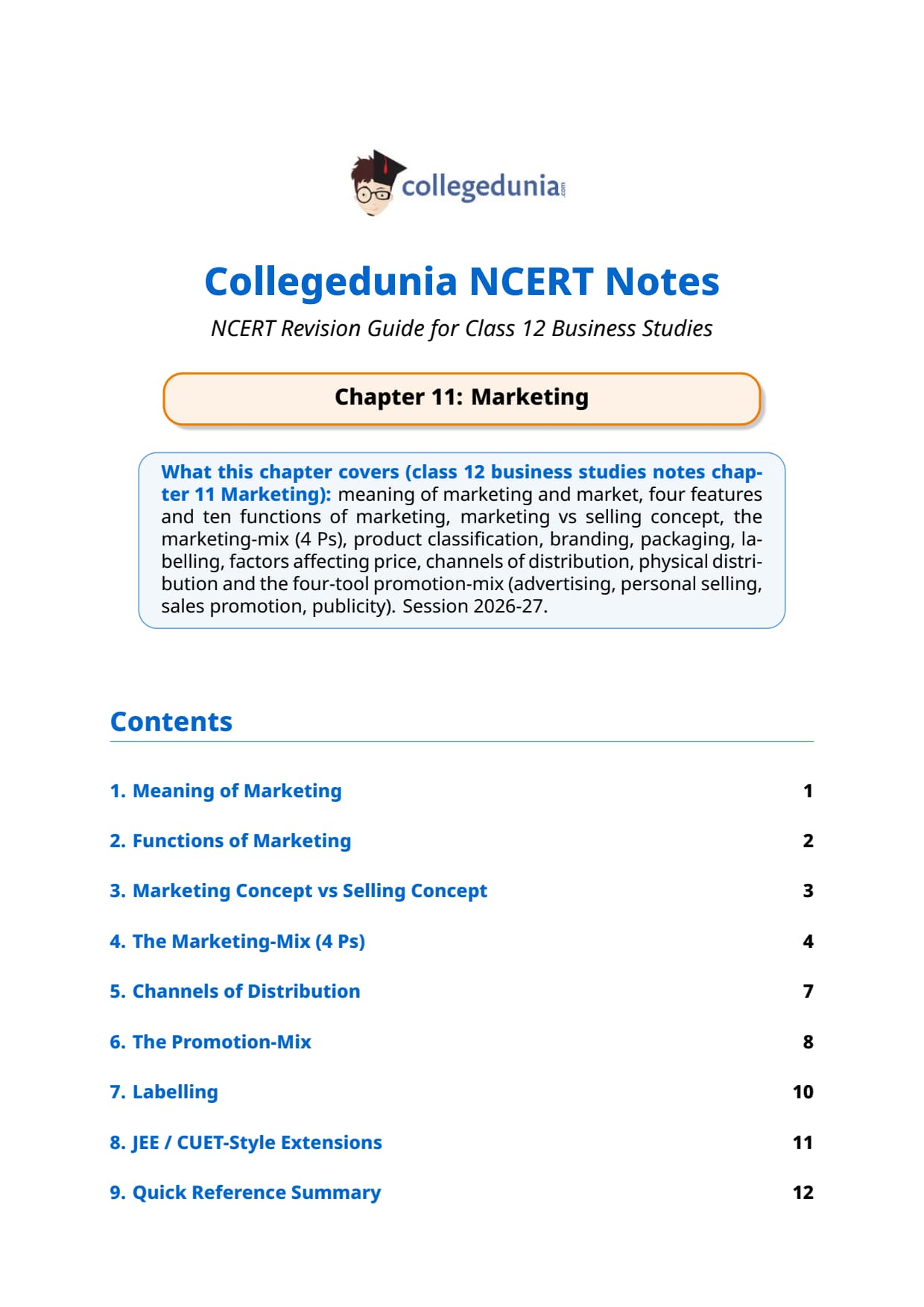
Inside these Class 12 Business Studies Chapter 10 Marketing notes you get Philip Kotler's definition, the marketing management philosophies, and the full four Ps, product, price, place and promotion, condensed for 2026-27 revision.
CBSE Weightage: 6 to 10 marks (Unit 3, Business Finance and Marketing)
Sections Covered: 11 concept blocks with diagrams, comparison tables and four mnemonics
These notes suit both first-time students and last-week revisers. Each concept is a card with a definition, features and a one-line takeaway. Mnemonics, tips and mistake call-outs sit where students usually slip.
Marketing Class 12 Notes: Topic Map
The notes split Chapter 10 into eleven sections. The map below shows each section and the marks it carries in the CBSE board paper.
Section
What is Covered
Exam Weight
1. Meaning of Marketing
Kotler definition, four features
3 to 4-mark VSA
2. Marketing Philosophies
Production, Product, Selling, Marketing, Societal
5 to 6-mark
3. Functions of Marketing
Ten functions in three buckets
5 to 6-mark
4. Marketing vs Selling
Six-row comparison
4 to 6-mark
5. Marketing-Mix (4 Ps)
Product, Price, Place, Promotion
5 to 6-mark
6. Product Decisions
Classification; branding; packaging; labelling
4 to 6-mark
7. Price Decisions
Five factors, three pricing strategies
5 to 6-mark
8. Channels of Distribution
Zero- to three-level channels; five factors
5 to 6-mark
9. Promotion-Mix
Five tools compared
5 to 6-mark
10. JEE / CUET Extensions
PLC, positioning, segmentation, myopia
CUET only
11. Quick Reference
One-page recap, four mnemonics
Revision
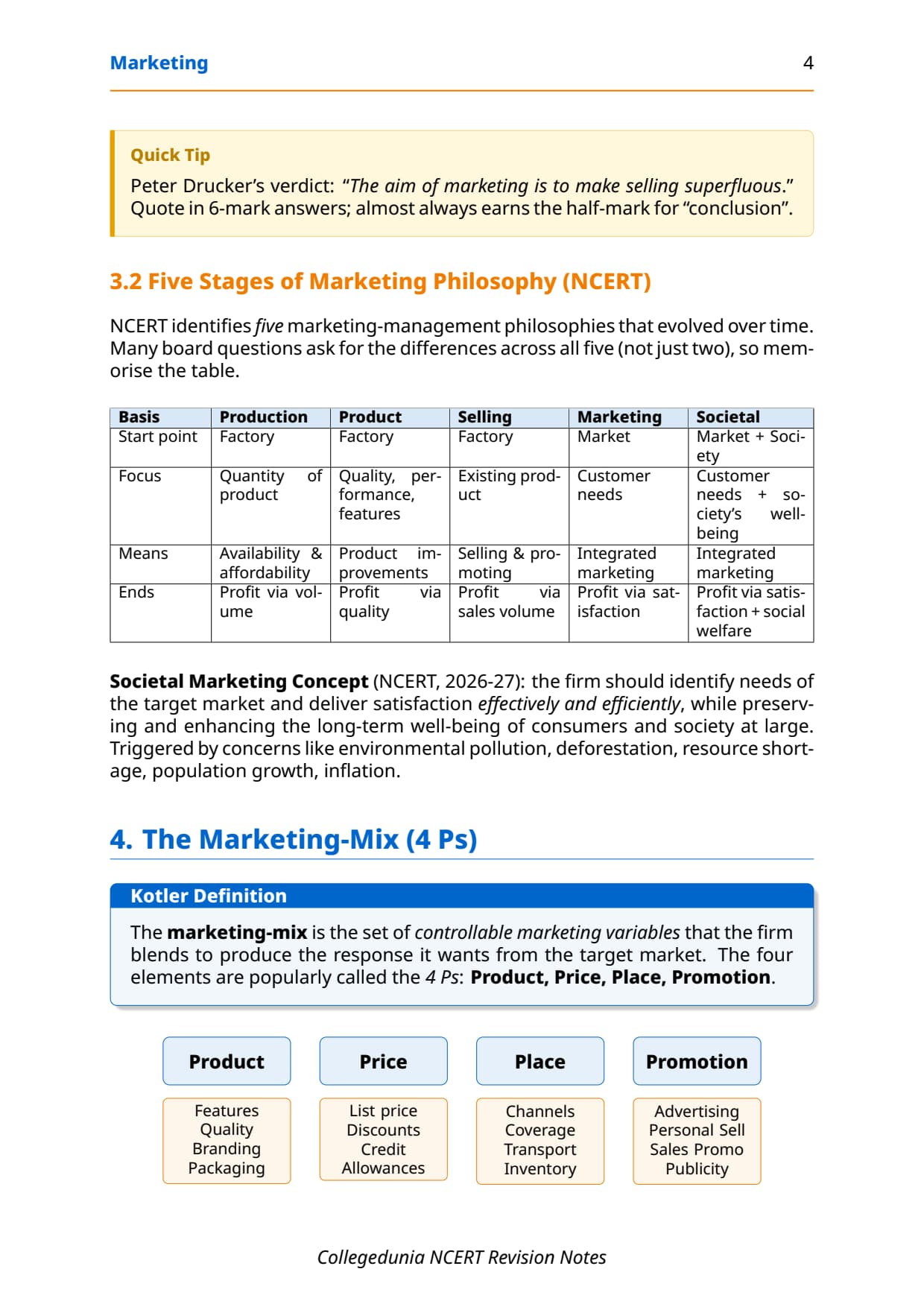
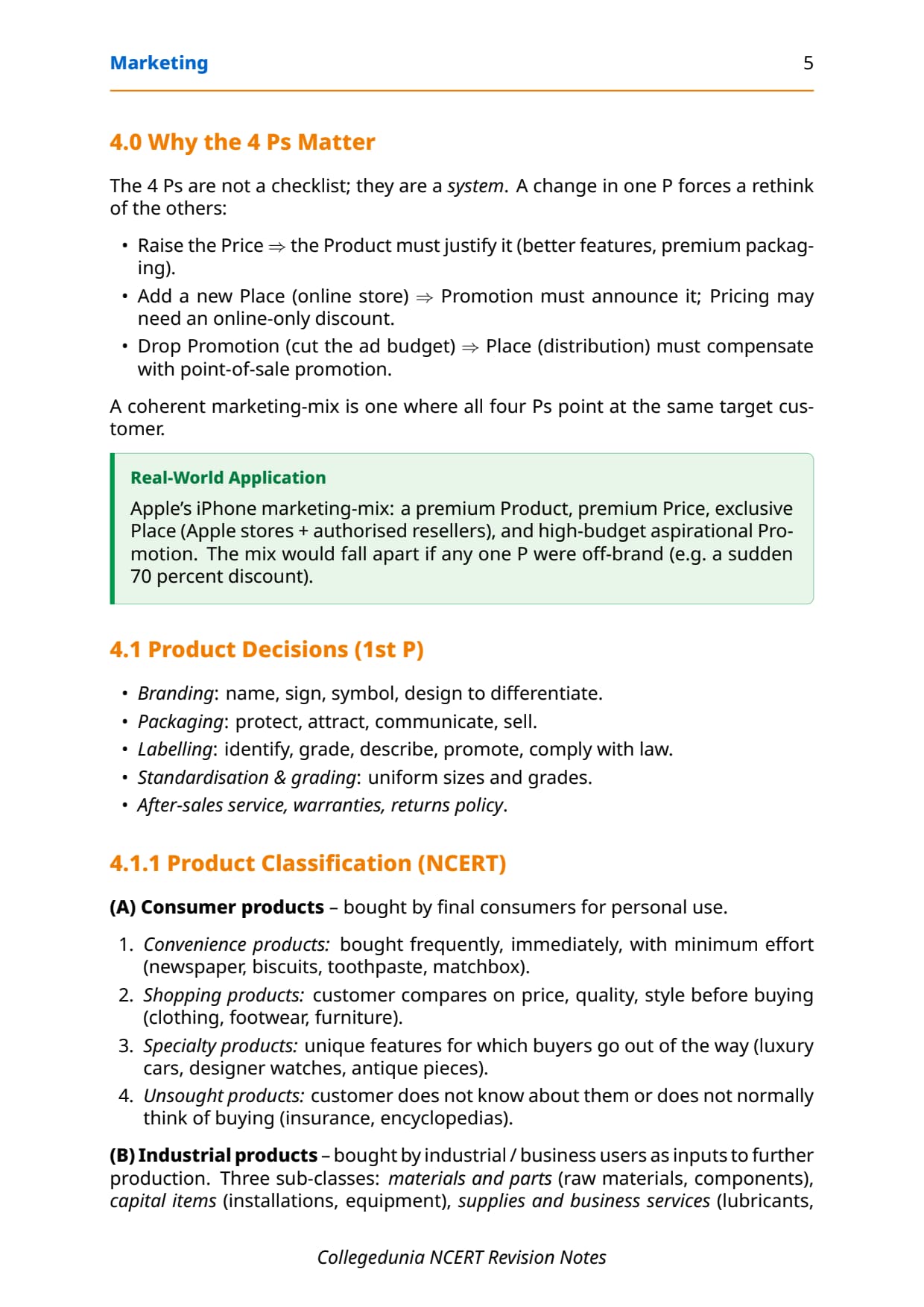
Marketing Class 12 Marketing-Mix: The 4 Ps Decomposed
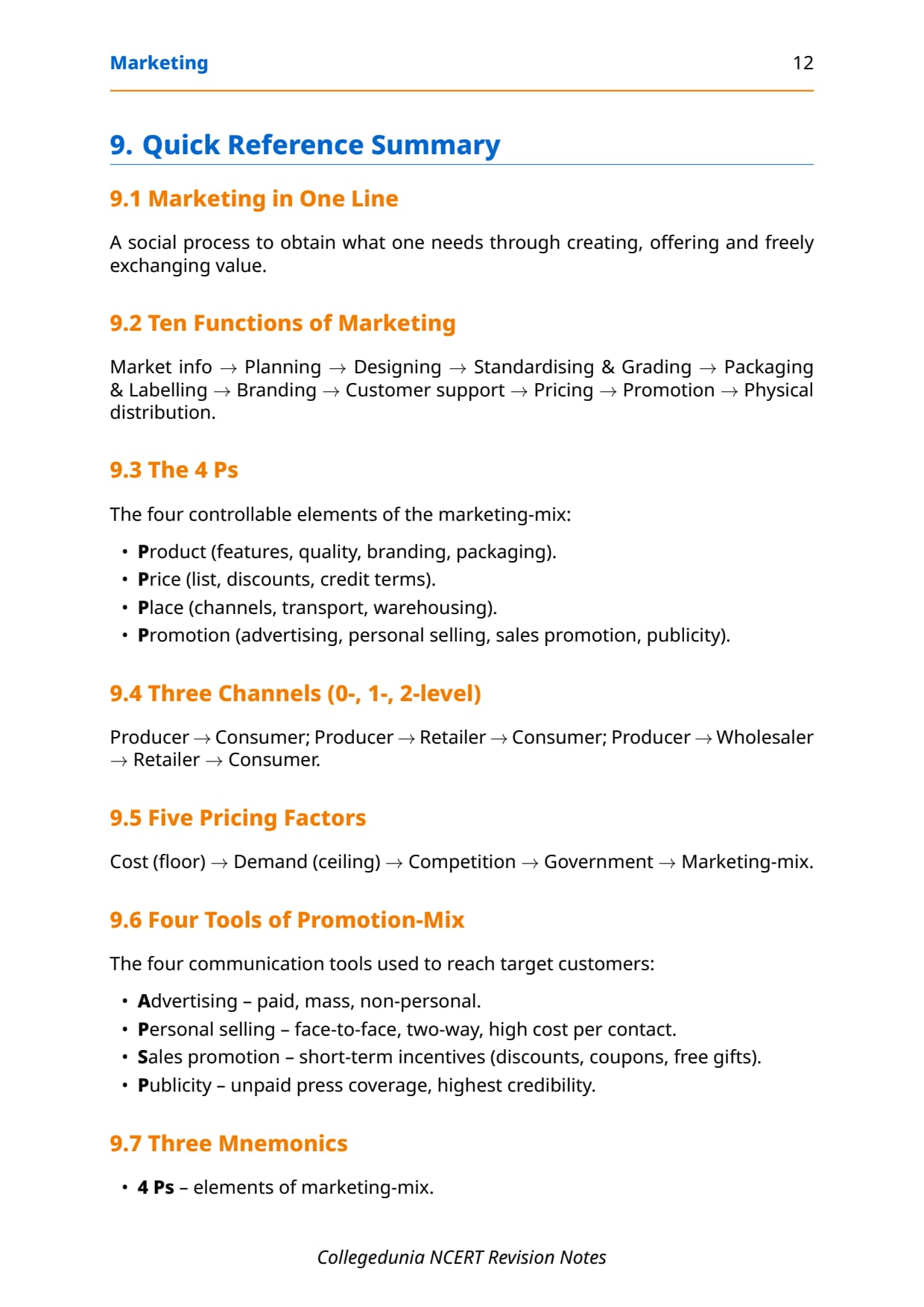
The marketing-mix is the chapter's spine. Each of the four Ps breaks into sub-decisions:
P
Sub-Decisions
Board-Exam Hook
Product
Classification; branding; three packaging levels; labelling; warranty; design
Brand vs Brand Name vs Brand Mark vs Trade Mark (Tata Salt)
Price
Objectives, five factors, three strategies (skimming, penetration, cost-plus); discounts
Five factors + three strategies
Place
Channels of distribution, transport, warehousing, inventory
Four channels with examples
Promotion
Advertising, personal selling, sales promotion, public relations, publicity
Five tools compared
Marketing Product Classification: Three Buckets You Must Know
NCERT divides products into three groups; each group has a fixed sub-classification the board asks about every two or three years.
Product Group
Sub-Classification
Quick Example
Consumer Products
Convenience, Shopping, Specialty, Unsought
Toothpaste (convenience); washing machine (shopping); Rolex (specialty); life insurance (unsought)
Industrial Products
Materials and parts, Capital items, Supplies and business services
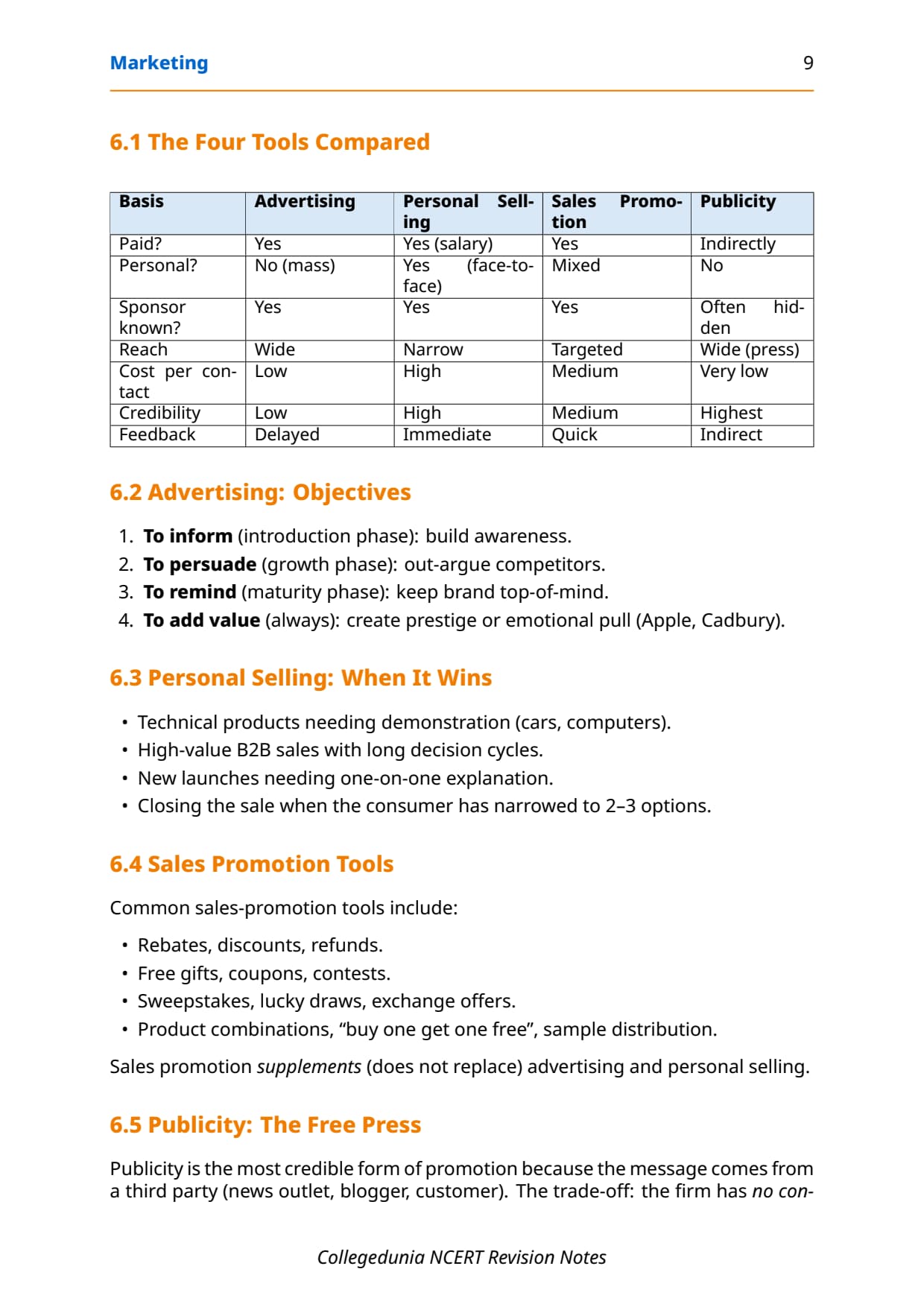
Marketing Promotion-Mix: Five Tools and the PR Functions
The promotion-mix is the most-tested 5 to 6-mark block. Learn the five tools in order, then the five public relations sub-functions inside the fourth tool.
Tool
Paid?
Personal?
Sponsor Identified?
Advertising
Yes
No (mass)
Yes
Personal Selling
Yes
Yes (face-to-face)
Yes
Sales Promotion
Yes (short-term)
Mostly no
Yes
Public Relations
Mostly yes
Mixed
Yes
Publicity
No
No
Often no
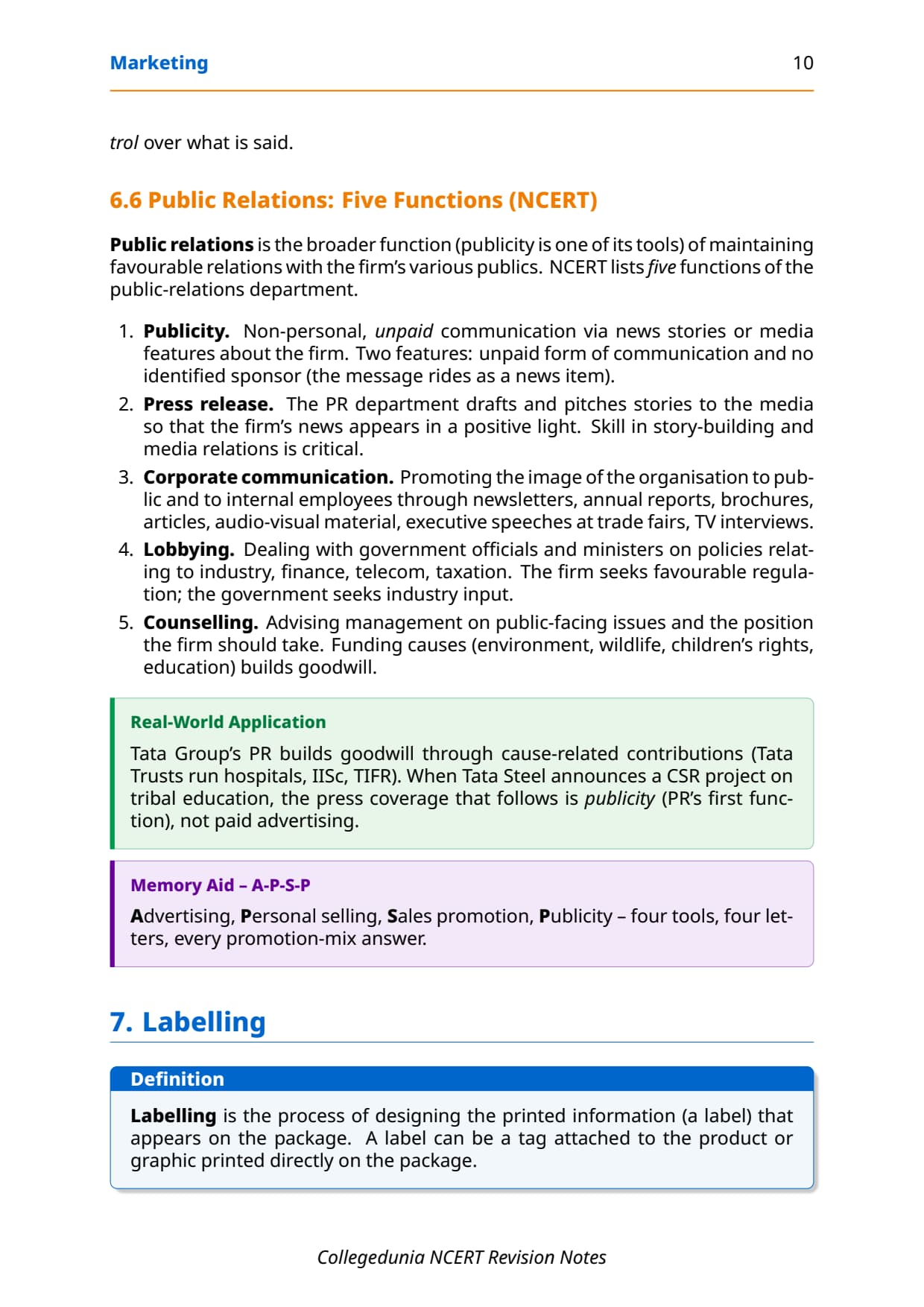
The five Public Relations (PR) functions NCERT lists are: (1) Press Relations (placing favourable news), (2) Product Publicity (publicising specific products), (3) Corporate Communication (internal and external messaging), (4) Lobbying (dealing with legislators over regulation) and (5) Counselling (advising management on public issues and image).
Common Mistakes Students Make in Marketing Class 12
Six recurring mistakes account for most of the lost marks in this chapter. Each one has a clean fix.
Common Mistake
Why It Costs Marks
How to Fix It
Treating marketing as a synonym of selling
Marketing starts with customer needs; selling starts in the factory
Open with the Kotler "satisfy needs" line
Reversing cost and value in pricing
Cost is the floor; value is the ceiling
"Cost sets how low, value sets how high"
Listing only 3 Ps
All four are expected
Use the 4-P mnemonic every time
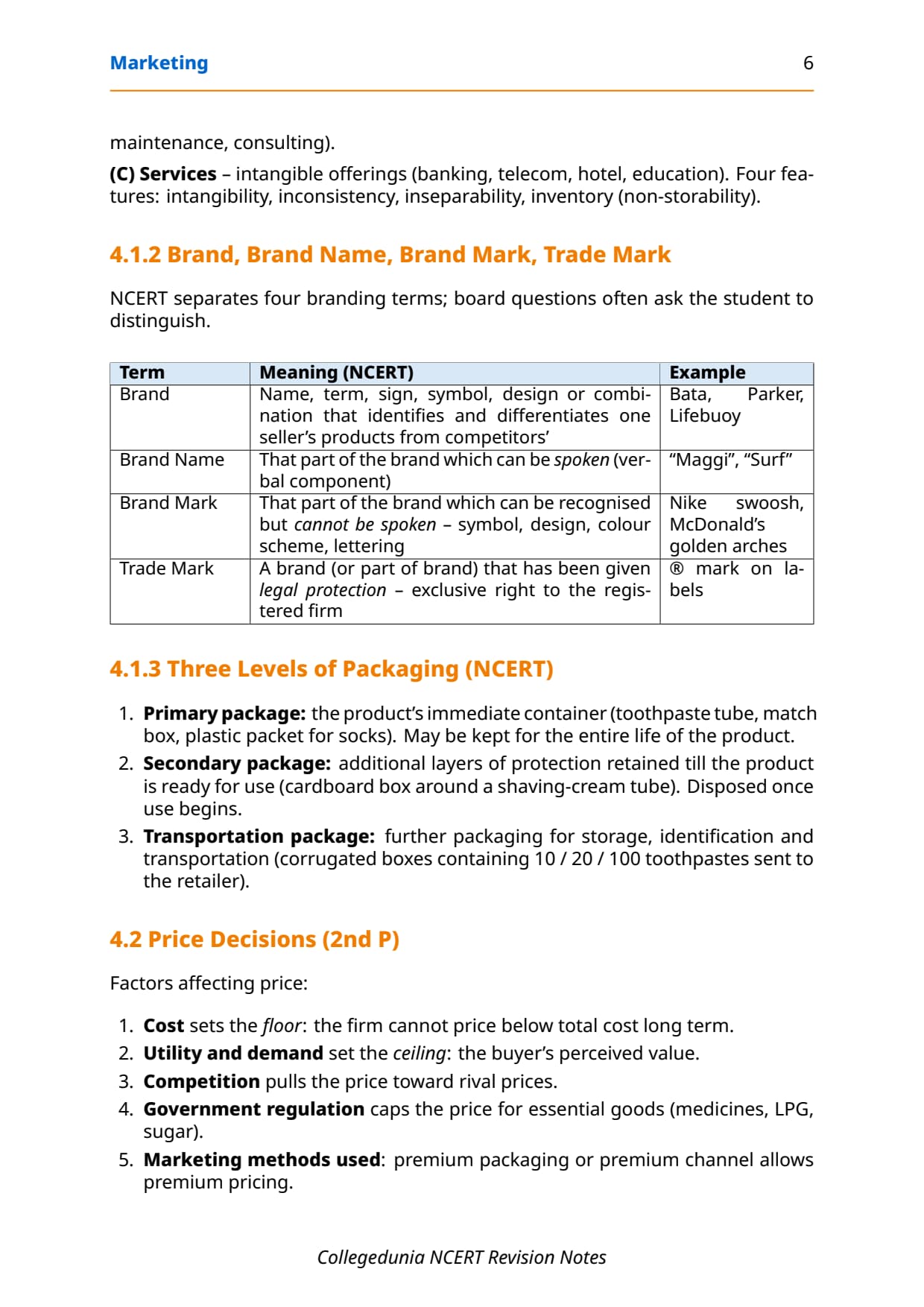
Confusing Brand, Brand Name, Brand Mark, Trade Mark
Each has a precise NCERT definition
Identity / spoken part / symbol / legally protected
Mixing up the channel levels
0, 1, 2 and 3 levels are distinct
One channel per row with an example
Confusing advertising with publicity
Advertising is paid and names the sponsor; publicity is unpaid
Tag each tool by payment and sponsor
Concept Anchor: The chapter's spine is the marketing-mix: the blend of Product, Price, Place and Promotion a firm uses to satisfy a target market. Every other topic sits under one of the 4 Ps.
JEE / NEET / CUET-Style Extensions for Marketing Class 12
Business Studies is outside JEE and NEET, but Chapter 10 maps to CUET (UG) and commerce entrance exams. These terms appear in CUET but not the CBSE board paper:
Product Life Cycle (PLC): Introduction, Growth, Maturity, Decline.
Positioning: the place a brand holds in the customer's mind.
Segmentation: splitting a market into homogeneous groups.
Marketing Myopia (Levitt): defining the business by product, not customer need.
Buying process: Need, Search, Evaluation, Purchase, Post-purchase.
How Collegedunia Notes Help You with Marketing
These notes lock the high-frequency board topics by the second read: the five marketing philosophies, ten functions, 4 Ps and the five-tool promotion-mix. Four mnemonics and clear diagrams for the 4 Ps and the four channels let a student revise the whole chapter in under thirty minutes.
All NCERT Solutions for Marketing with Step-by-Step Working
Every NCERT textbook question for Chapter 10 Marketing is listed below with its full Solution and Expert Solution in collapsible tabs. Click Check Solution for the step-by-step working.
Very Short Answer Type Questions
Q 11.1
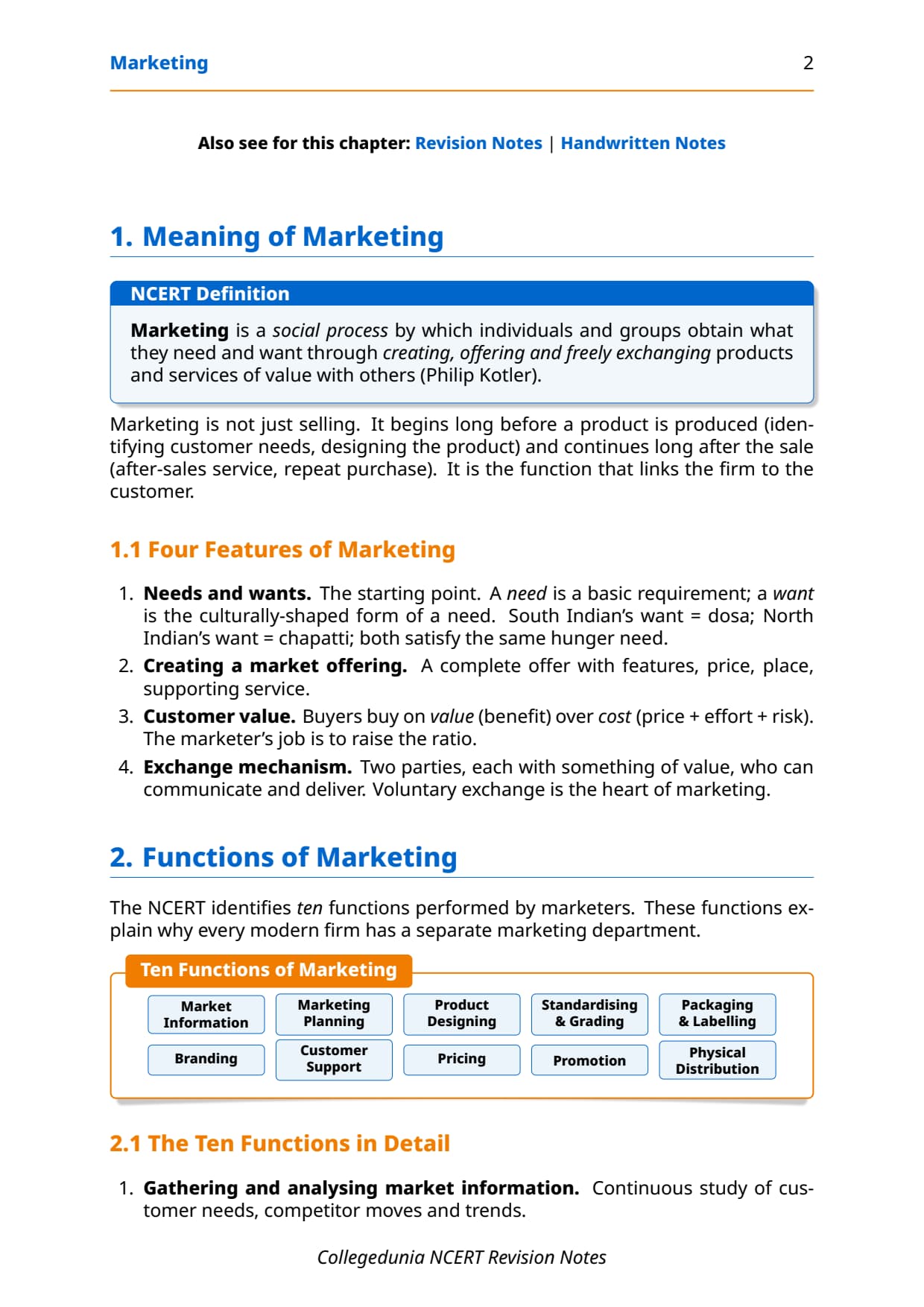
What is marketing? What are its main features?
Concept used. The NCERT defines marketing as a social process by which
individuals and groups obtain what they need and want through creating, offering and freely
exchanging products and services of value with others. Marketing is not merely a post-production
activity; it includes everything from identifying customer needs to delivering value to them.
Needs and wants. The starting point of marketing is identifying the needs (basic
requirements) and wants (culturally shaped forms of needs) of target customers and
developing products / services to satisfy them.
Creating a market offering. A complete offer is built with a set of features
(size, quality, taste), a price, an outlet of sale, and the supporting service. A good
market offering is developed after analysing buyers' needs and preferences.
Customer value. Buyers purchase a product on the basis of value (benefit
perceived in satisfying the need) in relation to cost (price paid plus effort).
The marketer's job is to add value so customers prefer it over competitors.
Exchange mechanism. Marketing works through exchange: two parties, each with
something of value, who can communicate and deliver.
Marketing is the social process of creating, offering and freely exchanging
products and services of value so as to satisfy needs and wants of individuals and groups. Its
main features are: focus on needs and wants, creation of a market offering, customer value,
and the exchange mechanism.
AS
Aarav Sharma
M.Com, Delhi University
Verified Expert
Quick reading. Marketing \(=\) social process to create and freely exchange value-bearing
goods and services. Four features: needs/wants, market offering, customer value, exchange.
Begin with customer needs and wants.
Build a market offering: product \(+\) price \(+\) place \(+\) supporting service.
Deliver value greater than cost so the customer prefers you.
All of this happens through voluntary exchange.
Social process of creating, offering and exchanging value; features = needs/wants,
offering, value, exchange.
Q 11.2
How does branding help in creating product differentiation? Justify with an example.
Concept used.Branding is the process of giving a name, sign, symbol, design
or some combination of these to a product, so that it can be distinguished from competing
products. The result is a brand that allows the marketer to differentiate the offering
on attributes the consumer cares about.
Identification. A brand name (e.g. Surf, Tide) gives the product an identity
separate from generic competitors.
Differentiation. A brand makes it possible to communicate distinct features
(whiteness, anti-bacterial action, fragrance) which differentiate the offering.
Customer pull. Once a brand is known and trusted, customers ask for it by name,
even when generic substitutes are cheaper.
Pricing freedom. Differentiation through branding allows the firm to charge a
premium price.
Loyalty. A satisfied customer of a brand repeats the purchase, reducing the cost
of finding new customers.
Example. Two firms sell salt, both chemically NaCl. One sells it loose in 50-kg bags; the
other sells it as Tata Salt in branded 1-kg packs. The Tata Salt buyer pays more because
the brand guarantees purity, consistent iodine content, hygienic packaging and the goodwill of
the House of Tata. The brand differentiates an otherwise identical product.
Branding differentiates a product by giving it a unique identity, communicating distinct
features, building customer pull and loyalty, and earning the firm a premium price. Example: Tata
Salt vs loose salt.
PI
Priya Iyer
M.Com, Christ University Bangalore
Verified Expert
Quick reading. Brand \(=\) name \(+\) promise. Differentiates a product through identity,
features, pull, premium price, loyalty. Tata Salt is the canonical example.
Give the product a name and symbol.
Communicate distinct features via that name.
Customers prefer the brand even at a higher price.
Branding differentiates through identity, features, loyalty and premium pricing
(Tata Salt example).
Q 11.3
What is `marketing-mix'? What are its main elements?
Concept used. The marketing-mix is the set of marketing tools that a firm uses
to pursue its marketing objectives in the target market. Philip Kotler defines it as ``the set of
controllable marketing variables that the firm blends to produce the response it wants from the
target market''. The four main elements are popularly known as the 4 Ps of marketing.
Product. The goods or services offered for sale. Decisions include features,
quality, branding, packaging, labelling, design, variety, warranty and after-sales service.
Price. The amount the customer must pay. Decisions include pricing objectives,
price level, discounts, credit terms and price changes over the product life cycle.
Place (physical distribution). The activities by which the product is moved from
the producer to the customer. Decisions include choice of channel (direct vs indirect,
number of intermediaries), transportation, warehousing and inventory.
Promotion. The activities used to communicate with and persuade target customers
to buy. The promotion-mix has four elements: advertising, personal selling, sales
promotion and publicity.
The marketing-mix is the blend of controllable marketing variables a firm uses
to meet its target-market objectives. Its four elements: Product, Price, Place, Promotion.
VM
Vivaan Mehta
M.Com, Symbiosis Pune
Verified Expert
Quick reading. Marketing-mix \(=\) Product \(+\) Price \(+\) Place \(+\) Promotion. The 4 Ps.
Each P is a controllable tool.
Product: what is sold; features, quality, branding, packaging.
Place: distribution channels, transport, warehousing.
Promotion: advertising \(+\) personal selling \(+\) sales promotion \(+\) publicity.
The 4 Ps: Product, Price, Place, Promotion.
Q 11.4
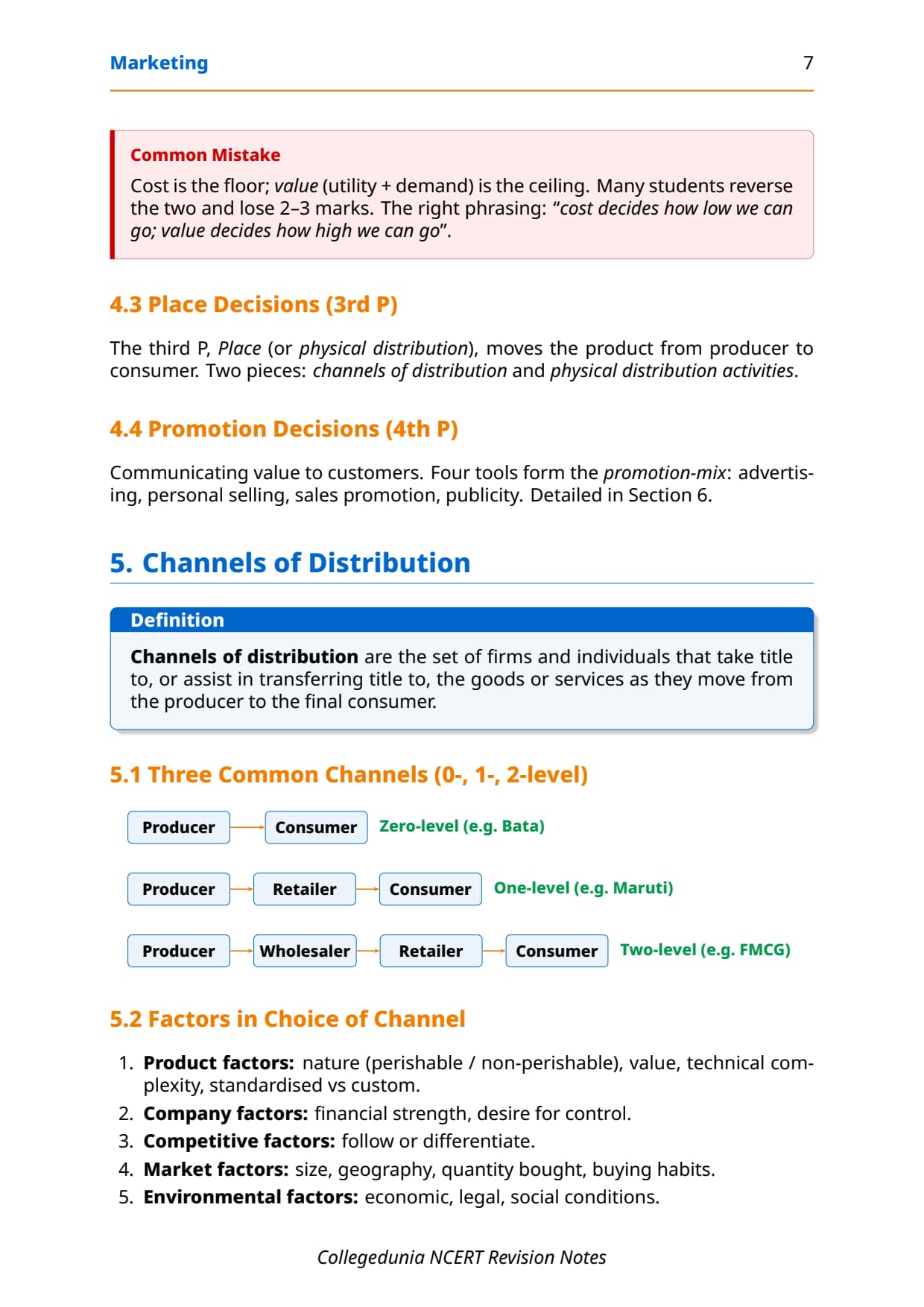
What is meant by `Channels of Distribution'? Briefly discuss any three commonly used channels of distribution.
Concept used.Channels of distribution are the set of firms and individuals
that take title to, or assist in transferring title to, the particular goods or services as they
move from the producer to the consumer. In simple terms, the channel is the path through which
goods flow from manufacturer to the final buyer.
Channel: Producer \(\to\) Consumer (Direct / Zero-level). The producer sells the
product directly to the consumer without any middleman. Examples: mail-order selling,
company-owned retail outlets (Bata, Apple Store), direct selling (Eureka Forbes),
e-commerce websites.
Channel: Producer \(\to\) Retailer \(\to\) Consumer (One-level). A retailer is
introduced between the producer and the consumer. Used when the producer is large
(Maruti Suzuki sells via dealers); when products are technical (cars, electronics); or
when retailers are organised chains (Big Bazaar, More).
Channel: Producer \(\to\) Wholesaler \(\to\) Retailer \(\to\) Consumer (Two-level).
The most common channel for consumer non-durables (toothpaste, biscuits, soap). The
wholesaler takes the bulk from the producer and breaks it down for many small retailers,
who then sell to consumers in small lots.
Channels of distribution are the path through which goods move from producer to
consumer. Three common channels: Producer \(\to\) Consumer (zero-level), Producer \(\to\)
Retailer \(\to\) Consumer (one-level), Producer \(\to\) Wholesaler \(\to\) Retailer \(\to\)
Consumer (two-level).
AR
Ananya Reddy
MBA Marketing, IIM Bangalore
Verified Expert
Strategic angle. Pick three channels by counting middlemen: 0, 1, 2. Tag each with one
example product so the examiner can map intent.
Zero-, one-, two-level channels with one example each.
Q 11.5
Distinguish between Advertising and Personal Selling.
Concept used.Advertising is a paid form of non-personal presentation and
promotion of ideas, goods or services by an identified sponsor. Personal selling is the
direct, face-to-face communication between a seller and a buyer for the purpose of making a sale.
Both are tools of the promotion mix, but they differ on every important dimension.
tabular|p0.20|p0.36|p0.36|
Basis & Advertising & Personal Selling
Form & Impersonal / mass communication & Personal / face-to-face (or call)
Form of message & Standardised; same message for all customers & Customised; salesperson adjusts to each customer
Reach & Wide reach over large geographic area & Limited reach; one customer at a time
Cost per contact & Low (mass media) & High (salary, commission, travel)
Flexibility & Inflexible; same ad for everyone & Highly flexible; pitch adapted on the spot
Feedback & Delayed and indirect (sales data) & Immediate and direct (customer reaction)
Direction & One-way: sponsor \(\to\) students & Two-way: seller \(\leftrightarrow\) buyer
tabular
Advertising is impersonal, standardised, low cost per contact, inflexible, with delayed
feedback. Personal selling is personal, customised, high cost per contact, flexible, with
immediate two-way feedback.
RK
Rohan Kapoor
B.Com (H), Shri Ram College of Commerce
Verified Expert
Strategic angle. Six neat point pairs. The sharpest pair: advertising is mass and
one-way; personal selling is one-on-one and two-way. Build the rest from there.
Form: mass vs face-to-face.
Message: standard vs customised.
Reach: wide vs limited.
Cost per contact: low vs high.
Flexibility: low vs high.
Feedback: delayed vs immediate.
Mass / standard / wide / low / inflexible / delayed vs personal / custom / limited /
high / flexible / immediate.
Short Answer Type Questions
Q 11.6
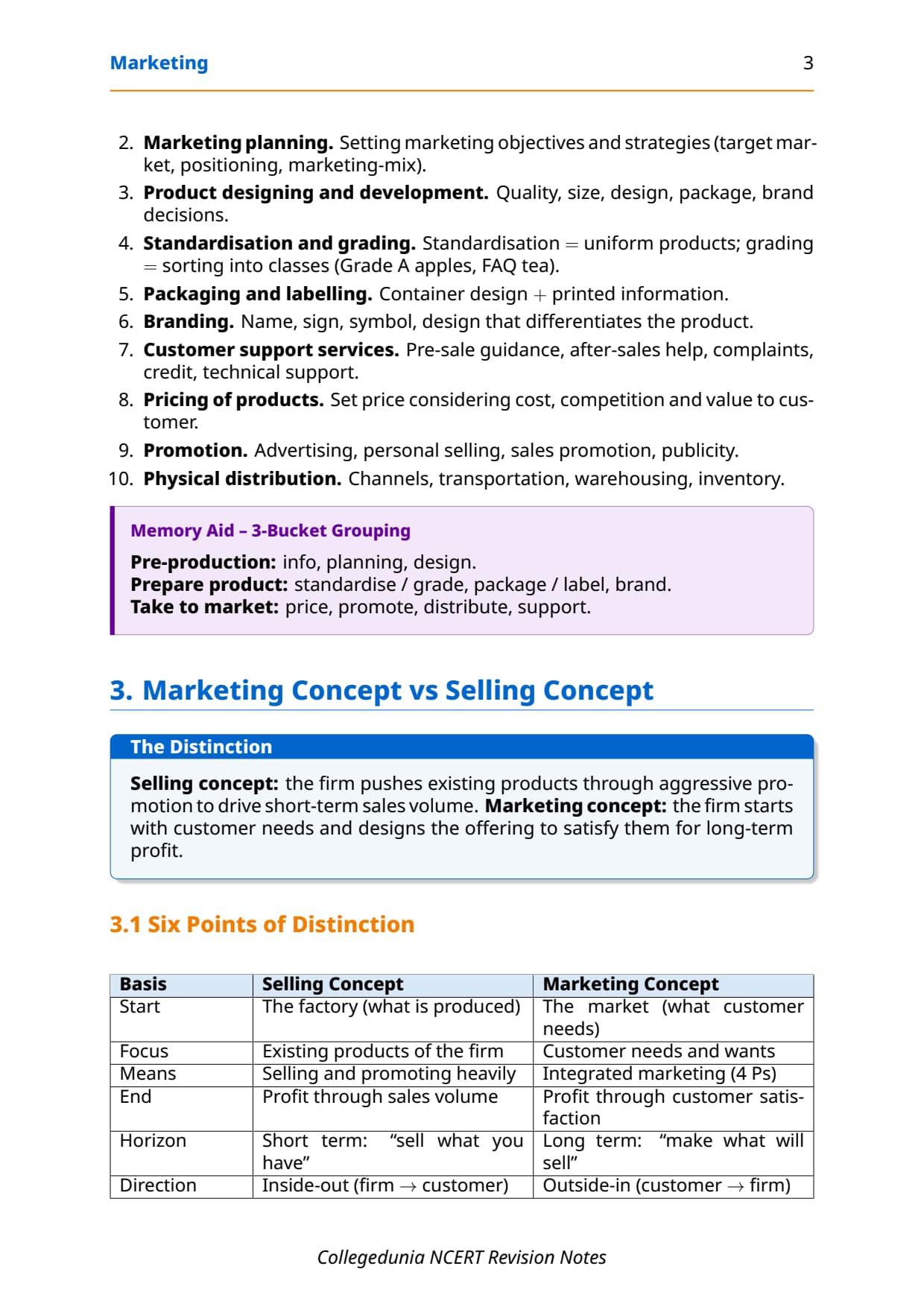
Explain the various functions of marketing.
Concept used.Marketing functions are the activities of business that direct the
flow of goods and services from producer to consumer. The NCERT identifies ten functions
performed by marketers.
Gathering and analysing market information. Continuous study of customer needs,
competitors and trends so the firm can take informed decisions.
Marketing planning. Setting marketing objectives and the strategies to achieve
them (target market, positioning, marketing-mix).
Product designing and development. Decisions on quality, size, shape, design,
package, brand to match customer wants.
Standardisation and grading.Standardisation produces uniform products
(same dimensions, quality). Grading sorts products into classes (e.g. Grade A
apples).
Packaging and labelling. Designing the container and the labels. Packaging
protects and promotes; labelling identifies and gives information.
Branding. Giving the product a name, sign or symbol so it stands apart from
competitors and can charge a premium.
Customer support services. Pre-sale guidance, after-sales service, complaint
handling, credit and instalment plans, technical support.
Pricing of products. Setting the price keeping in mind cost, competitor prices
and value to the customer.
Promotion. Communicating with the target market: advertising, personal selling,
sales promotion, publicity.
Physical distribution. Moving goods from producer to consumer: channels of
distribution, transportation, warehousing, inventory management.
The ten functions of marketing are: gathering market information, marketing
planning, product designing, standardisation & grading, packaging & labelling, branding,
customer support services, pricing, promotion, physical distribution.
KS
Karthik Subramaniam
MBA Marketing, IIM Calcutta
Verified Expert
Strategic angle. Ten functions split into three buckets: pre-production (info,
planning, design), product preparation (standardisation, packaging, branding) and
post-production (pricing, promotion, distribution, customer service).
Pre-production: gather info, plan, design.
Prepare the product: standardise / grade, package / label, brand.
Take it to market: price, promote, distribute, support.
Ten functions across three buckets: pre-production / prepare / take to market.
Q 11.7
Distinguish between the marketing concept and the selling concept.
Concept used. The selling concept holds that customers will not buy enough of
the firm's products unless the firm makes a large-scale selling and promotional effort. The
marketing concept holds that the key to achieving organisational goals is to determine
the needs and wants of target markets and deliver the desired satisfactions more effectively than
competitors.
tabular|p0.20|p0.36|p0.36|
Basis & Selling Concept & Marketing Concept
Starting point & The factory (what is produced) & The market (what customer needs)
Focus & Existing products of the firm & Customer needs and wants
Means used & Selling and promoting heavily & Integrated marketing (4 Ps)
End / Goal & Profit through sales volume & Profit through customer satisfaction
Time horizon & Short term: ``sell what you have'' & Long term: ``make what will sell''
The selling concept starts in the factory and pushes existing products through
heavy selling for short-term profit. The marketing concept starts with the customer,
designs the offering around needs, and aims at long-term profit through satisfaction.
SP
Sneha Patel
MBA Marketing, IIM Lucknow
Verified Expert
Strategic angle. Selling = inside-out, push existing stock. Marketing = outside-in, build
what customers want. Six rows of difference fall out of this single axis.
Discuss the factors affecting the price of a product.
Concept used.Pricing is the process of determining the value the customer must
exchange to obtain the product. The price decision is influenced by both internal factors
(within the firm's control) and external factors (outside the firm's control). NCERT lists
five factors that affect price.
Product cost. Cost sets the floor: a firm cannot charge below total cost in the
long run. Cost includes fixed costs (rent, salaries, depreciation), variable costs (raw
materials, labour) and semi-variable costs.
Utility and demand. The buyer's perception of value (utility) and demand
elasticity set the ceiling. The greater the utility / less the elasticity, the higher
the price the firm can charge. For inelastic demand (life-saving medicines), the firm
has more pricing power.
Extent of competition in the market. If competitors offer close substitutes, the
firm has limited freedom to price above the competitor; under monopoly, the firm can
price more freely.
Government and legal regulations. The Government can declare certain products as
essential and fix their maximum price (e.g. life-saving drugs, LPG, kerosene) or
regulate price increases (cement, sugar).
Marketing methods used. Pricing decisions depend on other elements of the
marketing-mix: a unique brand \(+\) luxury packaging \(+\) premium distribution channel
justifies a premium price; a no-frills offering justifies a low price.
Five factors affecting price: product cost (floor), utility and demand
(ceiling), extent of competition, government regulation, and the rest of the marketing-mix.
RK
Rohan Kapoor
B.Com (H), Shri Ram College of Commerce
Verified Expert
Strategic angle. Five factors. Two are firm-controlled (cost, marketing-mix); three are
market-controlled (demand, competition, government).
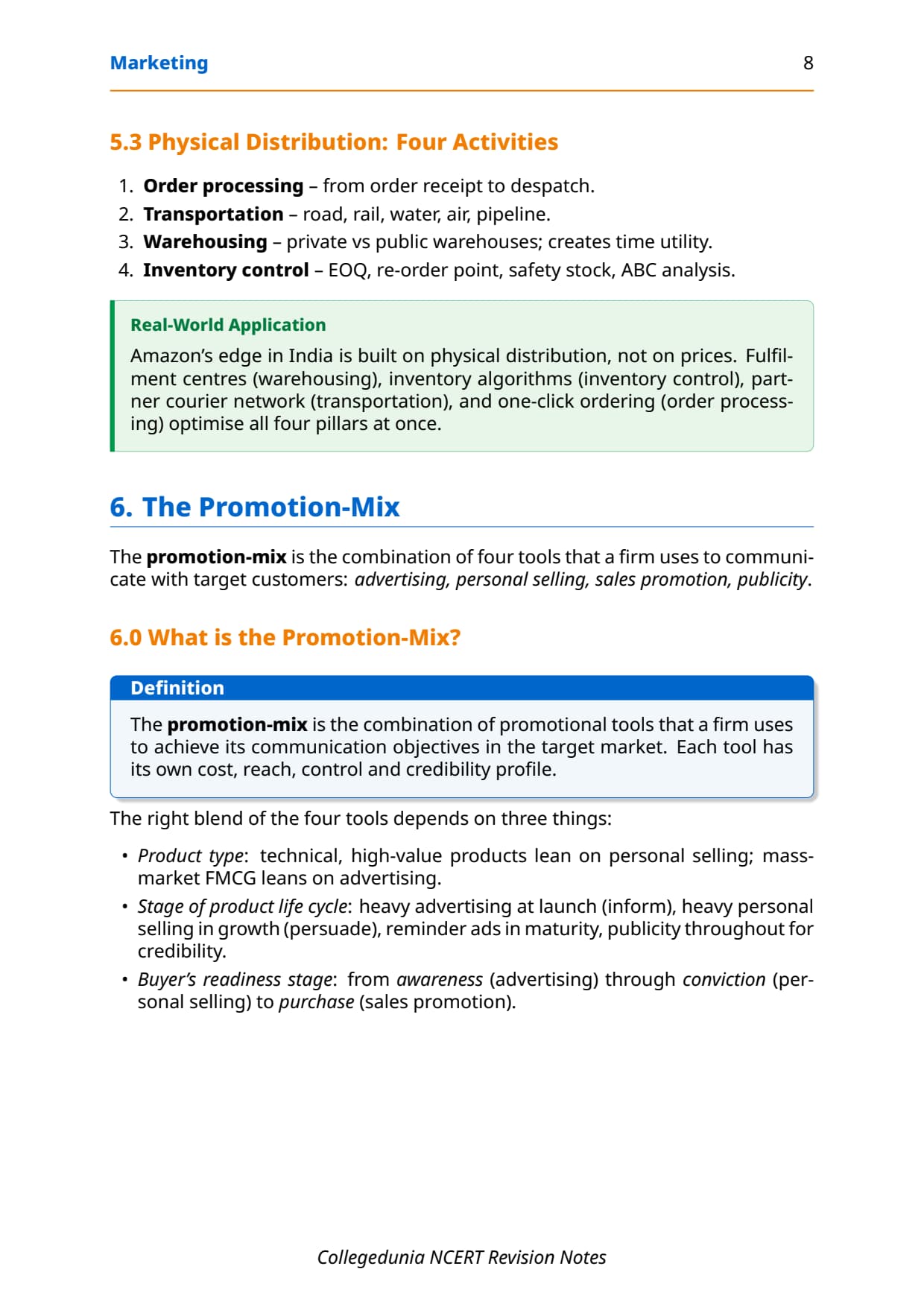
Explain the major activities involved in the physical distribution of products.
Concept used.Physical distribution (logistics) is the activity that moves the
product from the producer to the final consumer. It is one of the four Ps (Place) and is a
major source of cost: physical distribution accounts for 20–30 percent of the total cost of most
consumer goods in India. Four core activities make up physical distribution.
Order processing. The cycle from receiving a customer order, checking credit /
stock, generating the invoice, picking the goods from the warehouse, packing them, and
despatching them. Faster, error-free order processing builds customer goodwill.
Transportation. Moving the goods from one place to another. Choice of mode –
road (flexible, door-to-door), rail (cheap for bulk), water (cheapest for very heavy /
bulk, but slow), air (fastest but costliest), pipeline (oil, gas) – depends on
cost, speed, frequency, dependability, accessibility of each mode.
Warehousing. Storing the goods between production and consumption to even out
the time-gap. Warehousing creates time utility (good available when needed). Two
broad types: private warehouses (owned by the firm) and public warehouses
(rented). Distribution centres are a specialised warehouse for fast-moving stock.
Inventory control. Holding the right level of stock to meet customer demand
without tying up too much capital. The challenge is to balance carrying cost of
inventory against stock-out cost. Tools include Economic Order Quantity (EOQ),
re-order point, safety stock, ABC analysis.
Physical distribution has four major activities: order processing,
transportation, warehousing, and inventory control. Together they move the product from producer
to consumer at the right place, time and cost.
KS
Karthik Subramaniam
MBA Marketing, IIM Calcutta
Verified Expert
Strategic angle. Four activities; each addresses one of: time, place, paperwork, capital
tied up.
Order processing handles the paperwork from order to despatch.
Transportation handles the place dimension (where to where).
Warehousing handles the time dimension (produce now, sell later).
Inventory control handles the capital efficiency (how much to hold).
Order processing, transportation, warehousing, inventory control.
Q 11.10
Discuss the role of `promotion-mix' in marketing and explain its elements.
Concept used.Promotion is the function of informing, persuading and influencing
the customer's purchase decision. The promotion-mix is the combination of promotional
tools used by a firm to achieve its communication objectives. Four elements make up the
promotion-mix: advertising, personal selling, sales promotion and publicity.
Advertising. The most popular tool: paid form of non-personal presentation
of ideas, goods or services by an identified sponsor. Mass media used include television,
radio, newspapers, magazines, hoardings, digital. Wide reach but impersonal and inflexible.
Personal Selling.Face-to-face or one-to-one interaction between a seller
and a buyer to inform and persuade the buyer to purchase a product or service. High cost
per contact but customised, two-way, with immediate feedback. Crucial for technical and
high-value products.
Sales Promotion.Short-term incentives designed to encourage immediate
purchase or trial. Tools include rebates, discounts, refunds, free gifts, coupons,
contests, sweepstakes, lucky draws, exchange offers, product combinations, ``buy one get
one free'', sample distribution. Sales promotion supplements (not replaces) advertising
and personal selling.
Publicity.Non-personal, indirectly paid form of communication about an
organisation or its products by an unidentified sponsor. Usually delivered through a
news story, an article, or an event covered by the media. Highly credible because the
message is delivered by a third party, but not under the firm's full control.
The promotion-mix is the blend of four tools used to communicate with target
customers: Advertising, Personal Selling, Sales Promotion, Publicity. Each tool has its own
cost, reach and credibility profile; firms combine them to fit the product and the customer.
AR
Ananya Reddy
MBA Marketing, IIM Bangalore
Verified Expert
Strategic angle. Four tools: pair them by control vs credibility. Advertising and personal
selling are firm-controlled, paid. Publicity is highest credibility but uncontrolled. Sales
promotion is the short-term lever you pull to push trial.
Advertising for reach.
Personal selling for conversion of technical / high-value customers.
Sales promotion for short-term push (festivals, season-end).
Publicity for credibility (press coverage, news mentions).
Advertising, Personal Selling, Sales Promotion, Publicity.
Q 11.11
Explain the factors determining the choice of channels of distribution.
Concept used. The choice of a channel of distribution is one of the most
critical Place decisions. The wrong channel can cripple a good product. Five sets of factors
guide the choice.
Product-related factors.
Nature of product: perishable goods (milk, vegetables) need short channels;
non-perishable goods (toiletries, biscuits) tolerate long channels.
Value of product: high-value, low-volume products (jewellery, industrial
equipment) need direct / short channels for safety and after-sales.
Standardised vs custom products: custom-made products are sold direct;
standardised products move through intermediaries.
Technical complexity: technical products (cars, computers) need direct or
short channels so technical advice can be given.
Company-related factors.
Financial strength: a firm with strong finances can afford direct distribution
(own showrooms, salesforce); weaker firms rely on intermediaries.
Degree of control: a firm that wants tight control over price, display,
servicing prefers shorter channels.
Competitive factors. If competitors use a particular channel, the firm may
either follow them (same channel for shelf parity) or deliberately use a different
channel for differentiation (Dell sold directly online when others sold through retailers).
Market factors.
Size of the market: for a large, geographically dispersed market, multiple
intermediary levels are needed; for a concentrated market, direct channels suffice.
Geographical concentration: concentrated markets allow direct selling;
dispersed markets need wholesalers.
Quantity purchased: small purchases per buyer \(\Rightarrow\) retailers required.
Buying habits: habit of buying on credit / for trial favours retailer-led
channels.
Environmental factors. Economic conditions (recession reduces channel
intensity), legal regulations (restrictions on imports / retail outlets), social
considerations all affect channel choice.
Choice of channel depends on five factor groups: product-related, company-related,
competitive, market-related, and environmental.
SP
Sneha Patel
MBA Marketing, IIM Lucknow
Verified Expert
Strategic angle. Five factor families. Memorise them by source: Product \(+\) Company are
internal; Competition \(+\) Market are external; Environment is the macro layer.
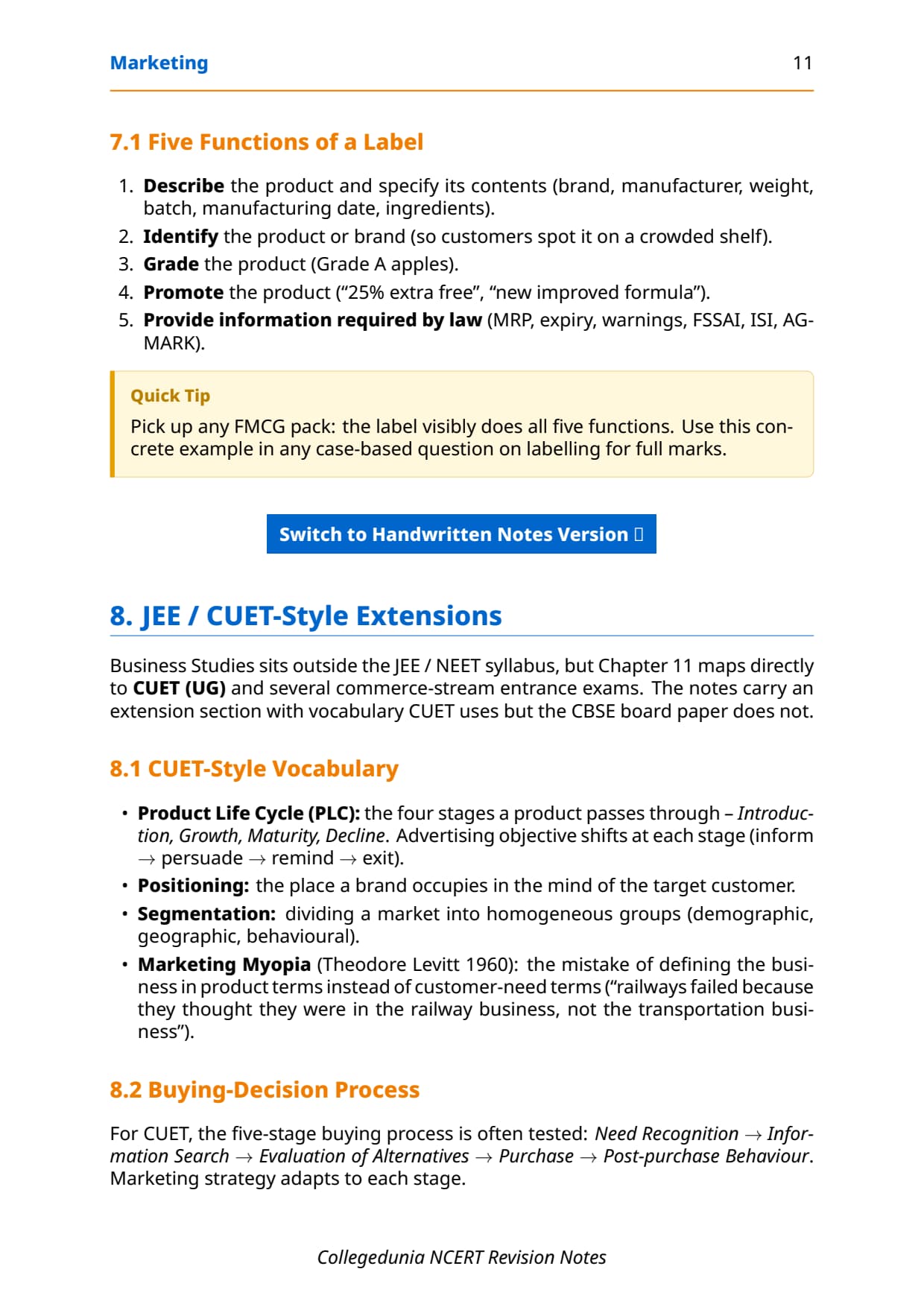
Briefly explain the functions of labelling in the marketing of goods.
Concept used.Labelling is the process of designing a label (the printed
information that appears on the package). A label may be a simple tag attached to the product or
an elaborately designed graphic. Labels perform five major functions in marketing.
Describe the product and specify its contents. The label identifies the brand,
names the manufacturer, gives the price, batch number, manufacturing date, weight, and
list of ingredients.
Identification of the product or brand. The label helps the customer recognise
the product from a crowded shelf. Colour combinations, brand mark and graphics on the
label make the product instantly recognisable.
Grading of the products. Many products are graded into categories (apples Grade
A vs B) and the label communicates the grade.
Helps in promotion of products. A well-designed label is itself a promotional
tool: ``new improved formula'', ``25% extra free'', ``20% off'' on the label promotes
the product at the point of purchase.
Provides information required by law. Statutory information like the maximum
retail price (MRP), expiry date, warning (``cigarette smoking is injurious to health''),
FSSAI certification, ISI / AGMARK mark, and country of origin must appear on the label.
Labelling performs five functions: describes & specifies contents, identifies
the product / brand, grades, helps promote, and provides legally mandated information.
VM
Vivaan Mehta
M.Com, Symbiosis Pune
Verified Expert
Strategic angle. Five functions. Read off the label of any FMCG pack and they all show
up: brand, ingredients, grade (if any), promotion banner, statutory disclosure.
Describe and list contents.
Identify the brand.
Grade the product.
Promote (``25% free'', ``new'').
Carry statutory information (MRP, expiry, warnings).
Describe, identify, grade, promote, comply with law.
Q 11.13
Discuss the role of intermediaries in the distribution of consumer non-durable products.
Concept used.Marketing intermediaries are firms or individuals that help the
producer reach the final consumer. For consumer non-durable products (FMCG: soap, biscuits,
toothpaste), the distribution chain is typically Producer \(\to\) Wholesaler \(\to\) Retailer
\(\to\) Consumer. Intermediaries play several specific roles in this chain.
Sorting. Intermediaries buy heterogeneous supplies from many producers and sort
them into homogeneous groups based on size, quality or grade.
Accumulation. They build up an assortment of products from various sources to
offer a wider variety to the next level (retailer).
Allocation / Breaking bulk. The wholesaler buys in large quantities from the
producer (say 100 cartons of soap) and breaks the lot into smaller quantities for many
retailers (5 cartons each). The retailer further breaks the carton into individual cakes
for end-consumers.
Assorting. Building a wide assortment of products from many producers so that the
retailer can serve all the daily-needs of the consumer from one shop.
Product Promotion. Intermediaries help promote the product through point-of-sale
display, in-store demonstrations, dealer schemes.
Negotiation. Channel members negotiate terms (price, credit, returns) with both
upstream and downstream parties.
Risk taking. Intermediaries take on ownership risk (price changes,
spoilage, theft, fashion changes) as they hold the product between producer and consumer.
For consumer non-durables, intermediaries play seven roles: sorting,
accumulation, allocation / breaking bulk, assorting, promotion, negotiation, and risk taking.
AS
Aarav Sharma
M.Com, Delhi University
Verified Expert
Strategic angle. Seven roles. Group them: three move the product (sorting, accumulation,
allocation), two market it (assorting, promotion), two manage relationships (negotiation, risk).
Concept used.Advertising is a paid form of non-personal presentation and
promotion of ideas, goods or services by an identified sponsor. Firms invest in advertising to
achieve specific marketing objectives. The four major objectives are: to inform, to
persuade, to remind, and to add value.
To inform. Advertising tells the customer about the existence of the product, its
features, price, place of availability, and how to use it. Informative advertising is
important in the introduction phase of the product life cycle (new launches,
category-creating products like electric scooters).
To persuade. Once the customer knows the product, advertising tries to
persuade them to buy it instead of competing brands. Persuasive advertising
compares the product to rivals on attributes like price, quality, longevity, status.
Common in the growth and maturity phases of the product life cycle.
To remind. For mature, well-known brands, the goal is to keep the brand
top-of-mind so customers do not forget. ``Yeh Dil Maange More'' (Pepsi) or ``The
complete man'' (Raymond) reminder ads sustain recall.
To add value. Strong advertising can itself become part of the value the
consumer perceives: a premium tag (Apple, Mercedes-Benz) adds prestige; a feel-good
association (Cadbury's ``Kuchh meetha ho jaye'') adds emotional value.
Other supporting objectives. Advertising also helps to launch new products,
expand the market, fight competition, build company image, support the sales force, and
announce a special promotion.
The four major objectives of advertising are: to inform, to persuade, to remind,
and to add value. Supporting objectives include launching new products, expanding the market,
fighting competition and building company image.
PI
Priya Iyer
M.Com, Christ University Bangalore
Verified Expert
Strategic angle. Four objectives mapped to the product life cycle. Inform at launch;
persuade in growth; remind at maturity; add value all the way.
Introduction \(\Rightarrow\) inform.
Growth \(\Rightarrow\) persuade.
Maturity \(\Rightarrow\) remind.
Throughout \(\Rightarrow\) add value.
Inform, Persuade, Remind, Add Value.
Student Feedback
In a Collegedunia poll of 640 Class 12 Commerce students, 82% said the 4 Ps decomposition table made Chapter 10 Marketing easier to revise. 3 in 4 said the Brand vs Brand Name vs Brand Mark vs Trade Mark comparison cleared their most common exam confusion.
Other Resources for Class 12 Business Studies Chapter 10 Marketing
What is the Philip Kotler definition of marketing in Class 12 Business Studies Chapter 10?
What is the Philip Kotler definition of marketing in Class 12 Business Studies Chapter 10?
According to Philip Kotler, marketing is a social process by which individuals and groups obtain what they need and want through creating, offering and freely exchanging products and services of value with others. Its four features are: focus on needs and wants, creation of a market offering, customer value, and the exchange mechanism. Marketing is not the same as selling: it begins before production (needs analysis, design) and continues after the sale (customer service, repeat purchase).
What are the five marketing management philosophies?
The five philosophies in evolution order are: (1) Production Concept (consumers prefer widely available, low-cost products; focus on mass production and efficiency), (2) Product Concept (consumers favour products of highest quality and performance; focus on continuous product improvement), (3) Selling Concept (aggressive selling and promotion are needed to push existing products), (4) Marketing Concept (firm starts with customer needs and designs offerings to satisfy them better than competitors) and (5) Societal Marketing Concept (firm also considers long-term societal welfare and the environment, not only customer wants).
What is the marketing-mix and what are the 4 Ps?
The marketing-mix is the set of controllable marketing variables a firm blends to produce the response it wants from the target market. The four elements are the 4 Ps: Product (features, branding, packaging, labelling, warranty), Price (pricing objectives, discounts, strategies like skimming, penetration and cost-plus), Place (zero-, one-, two- and three-level channels of distribution, transport, warehousing, inventory) and Promotion (advertising, personal selling, sales promotion, public relations, publicity).
What are the five tools of the promotion-mix?
The promotion-mix has five tools: (1) Advertising (paid, mass, non-personal); (2) Personal Selling (face-to-face, two-way, high cost per contact); (3) Sales Promotion (short-term incentives: discounts, coupons, free gifts); (4) Public Relations (managing the firm's image through publicity, press releases, corporate communication, lobbying and counselling); and (5) Publicity (unpaid press coverage, highest credibility but lowest control). The mnemonic A-PS-SP-PR-Pub helps recall them in order.
Where can I download the Class 12 Business Studies Chapter 10 Marketing Notes PDF?
You can download the Collegedunia Class 12 Business Studies Chapter 10 Marketing Notes PDF free of cost from this page. The PDF is aligned to the NCERT Reprint 2026-27 syllabus and includes eleven concept-card sections, TikZ diagrams for the 4 Ps and four channels, comparison tables and four mnemonics.








Comments