Economics Mentor, Shaheed Bhagat Singh College | Updated 3+ months ago
Notes for Class 12 Business Studies Chapter 10 Financial Markets condense the 2026-27 CBSE syllabus into a single revision guide: the four functions of a financial market, money market vs capital market, five money-market instruments (T-Bill, Commercial Paper, Call Money, CD, Commercial Bill), primary vs secondary market, five methods of floatation, stock exchange functions, NSE, OTCEI, SEBI's three-fold mandate and the six-step trading procedure with T+2 settlement.
CBSE Weightage: 6 to 10 marks (Unit 3, Business Finance and Marketing)
Sections Covered: 9 concept blocks with TikZ diagrams, comparison tables and three mnemonics (M-P-L-R, PORP-E, R-P-P)
The Financial Markets Class 12 notes are pitched for two students: the first-time student of the chapter, and the board-exam candidate in the final-week revision sprint. Every concept is presented as a card with definition, supporting features and a one-line takeaway. Mnemonics, quick tips, mistake call-outs and real-world boxes sit at the precise points where students typically slip in this chapter.
Financial Markets Class 12 Notes: Topic Map
The Collegedunia notes split Chapter 10 into nine sections. Each row of the topic map points to the section and the marks it carries in the CBSE board paper.
Section
What is Covered
Why It Matters in the Exam
1. Concept of Financial Market
Allocation of savings, four functions: Mobilisation, Price discovery, Liquidity, Reduce cost (M-P-L-R)
3 to 4-mark; mnemonic guarantees full marks
2. Money Market
Short-term (less than 1 year). Five instruments: T-Bill (RBI, zero-risk, Rs 25,000 min, 14/91/182/364 days, issued at discount), Commercial Bill, Commercial Paper (15 days to 1 year, intro 1990), Call Money (1 to 15 days, inter-bank), Certificate of Deposit (Rs 1 lakh min)
5 to 6-mark long answer; issuer + maturity + ticket size
3. Capital Market
Capital Market = Primary + Secondary; medium and long-term funds. Comparison tables with money market
4 to 6-mark; CBSE 6-row table format
4. Primary Market: Floatation
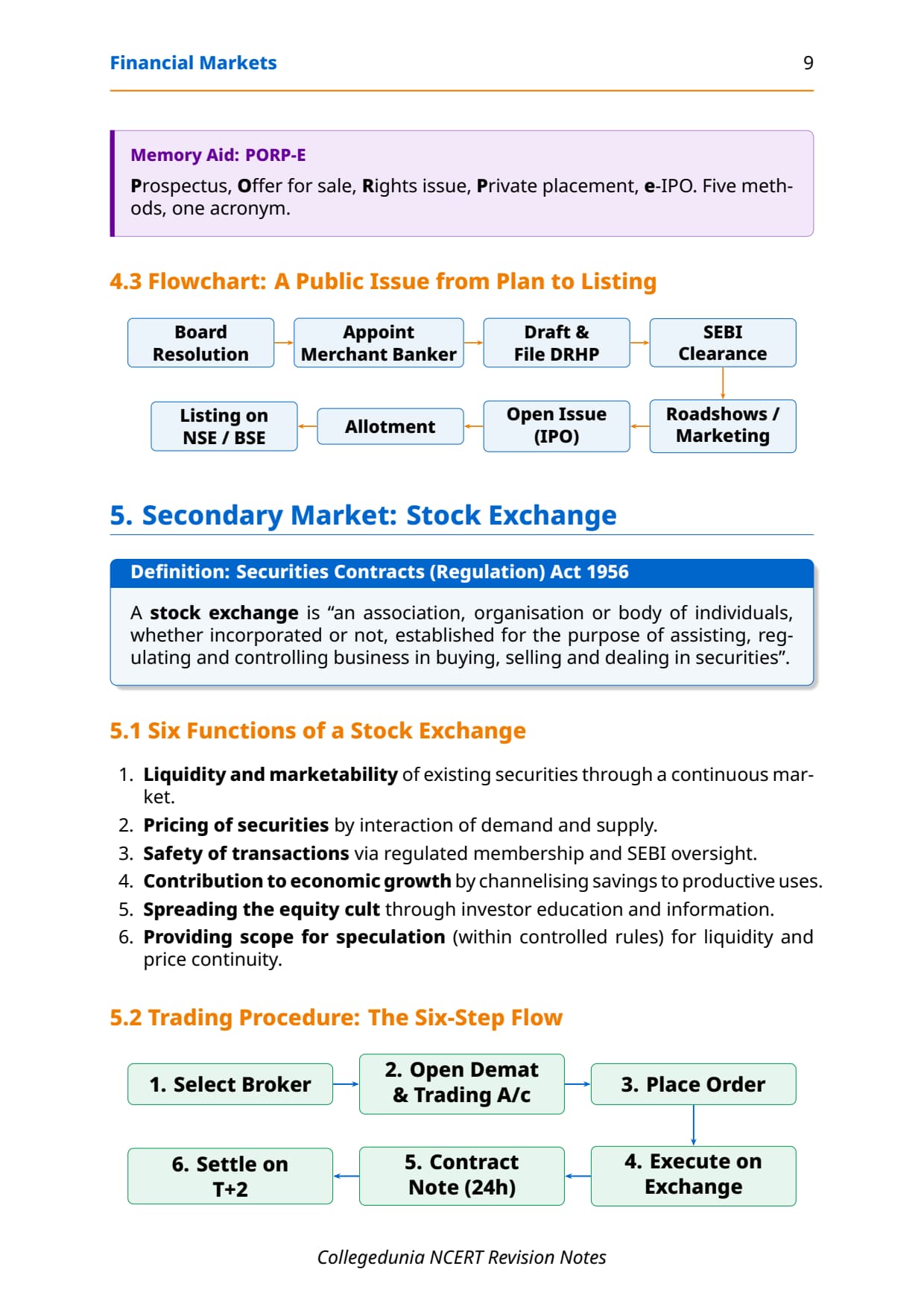
Prospectus, Offer for Sale, Rights Issue, Private Placement, e-IPO (PORP-E); plus Bonus Issue
4 to 6-mark; one mark per method
5. Secondary Market: BSE and NSE
BSE (1875, oldest in Asia), NSE (1992, screen-based, nationwide); indices Sensex (BSE) and Nifty 50 (NSE); six functions, trading procedure, OTCEI
5 to 6-mark; demat vs trading account is a common trap
6. SEBI
SEBI established 1988, statutory status 1992. Three objectives (R-P-P); three sets of functions: Regulatory, Developmental, Protective
The most repeated 6-mark long answer in this chapter
7. Capital Market Reforms
Seven post-1991 reforms; dematerialisation; NSDL vs CDSL
3 to 4-mark short note; demat is a high-frequency topic
8. JEE / NEET / CUET Extensions
Yield, bid-ask, book building, IPO grading
CUET (UG) commerce; outside CBSE board scope
9. Quick Reference Summary
One-page recap with all three mnemonics
Final-night revision sheet
Common Mistakes Students Make in Financial Markets Class 12
Five recurring mistakes cost the most marks in this chapter. Each one has a clean fix.
Common Mistake
Why It Costs Marks
How to Fix It
Treating Capital Market and Stock Market as the same
Stock market is only the secondary half of the capital market
Always name the issuer in the first sentence of every instrument answer
JEE / NEET / CUET-Style Extensions for Financial Markets Class 12
Business Studies sits outside the JEE / NEET syllabus, but Chapter 10 maps directly to CUET (UG) and several commerce-stream entrance exams. The notes carry a dedicated extension section with vocabulary that CUET uses but the CBSE board paper does not:
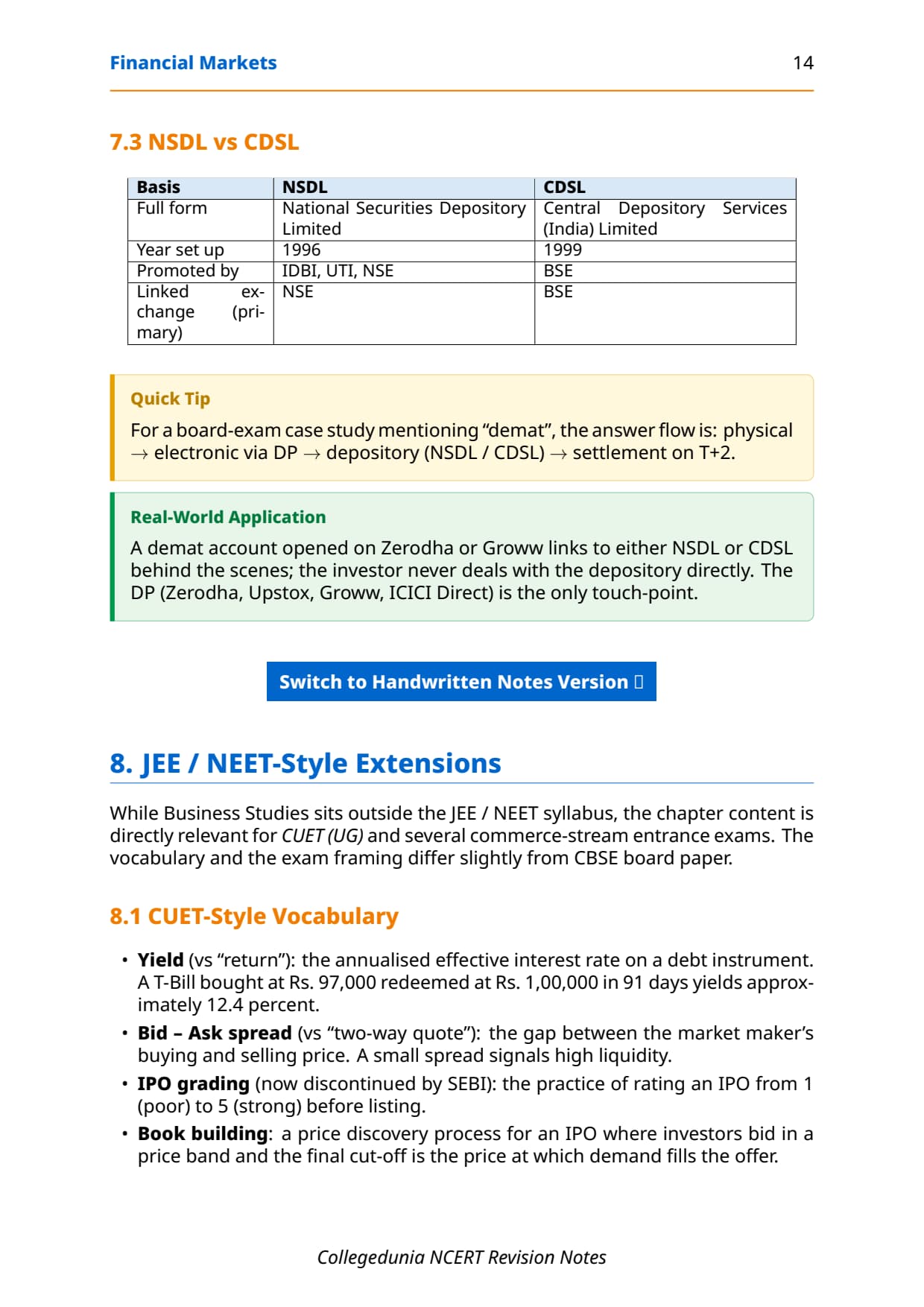
Yield: the annualised effective interest rate on a debt instrument. A 91-day T-Bill at Rs.97,000 yields about 12.4 percent.
Bid-Ask spread: the gap between a market maker's buying and selling price; small spread signals high liquidity.
Book building: an IPO price-discovery process where investors bid in a price band and the cut-off price is where demand fills the offer.
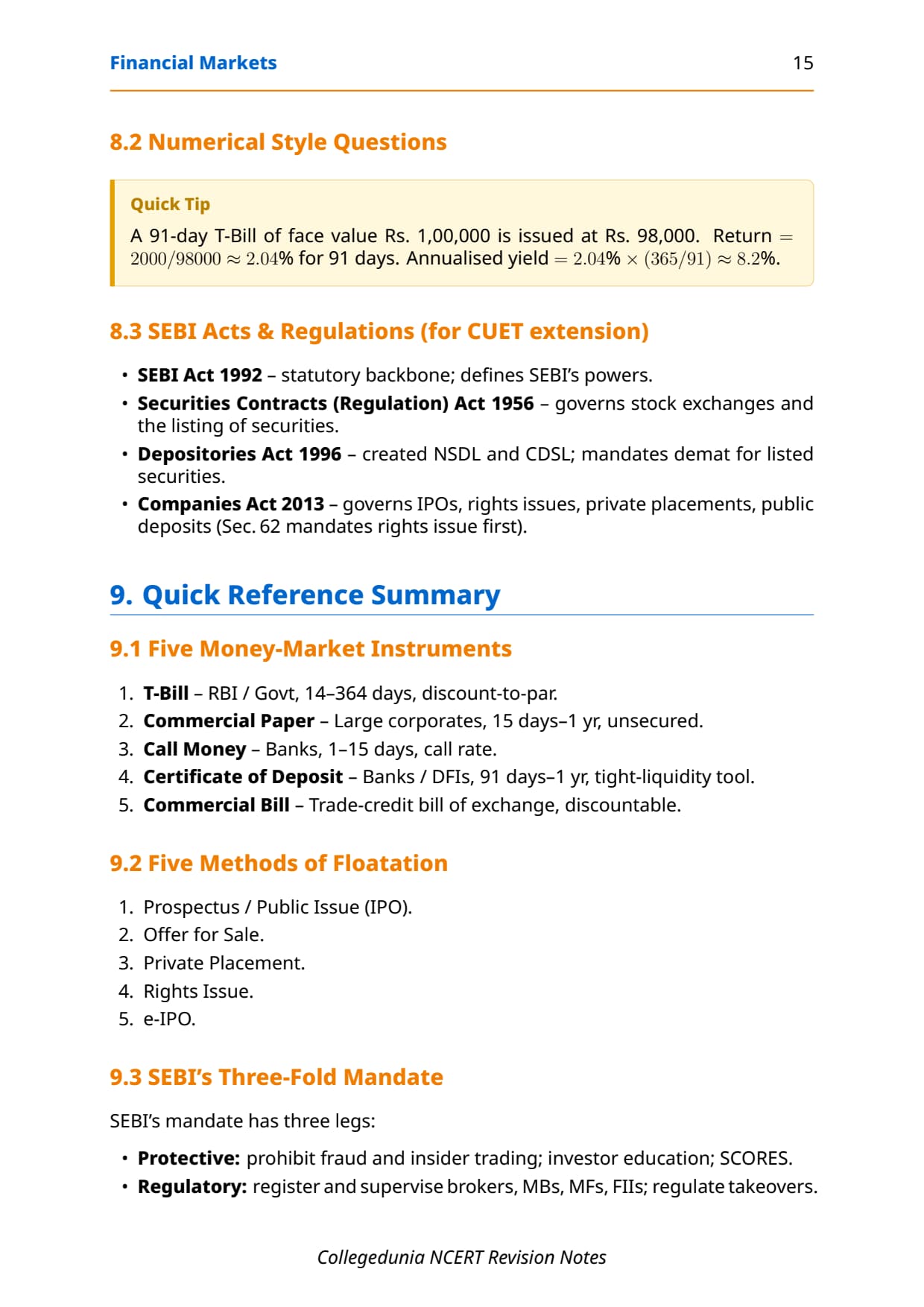
Acts you should name in CUET answers: SEBI Act 1992, Securities Contracts Regulation Act 1956, Depositories Act 1996, Companies Act 2013 (Sec. 62 for rights issue).
Concept Anchor: The one-line key to this chapter is the maturity test. Maturity less than one year goes to the money market; maturity more than one year goes to the capital market. Every instrument question in the board paper turns on this single distinction.
How Collegedunia Notes Help You with Financial Markets
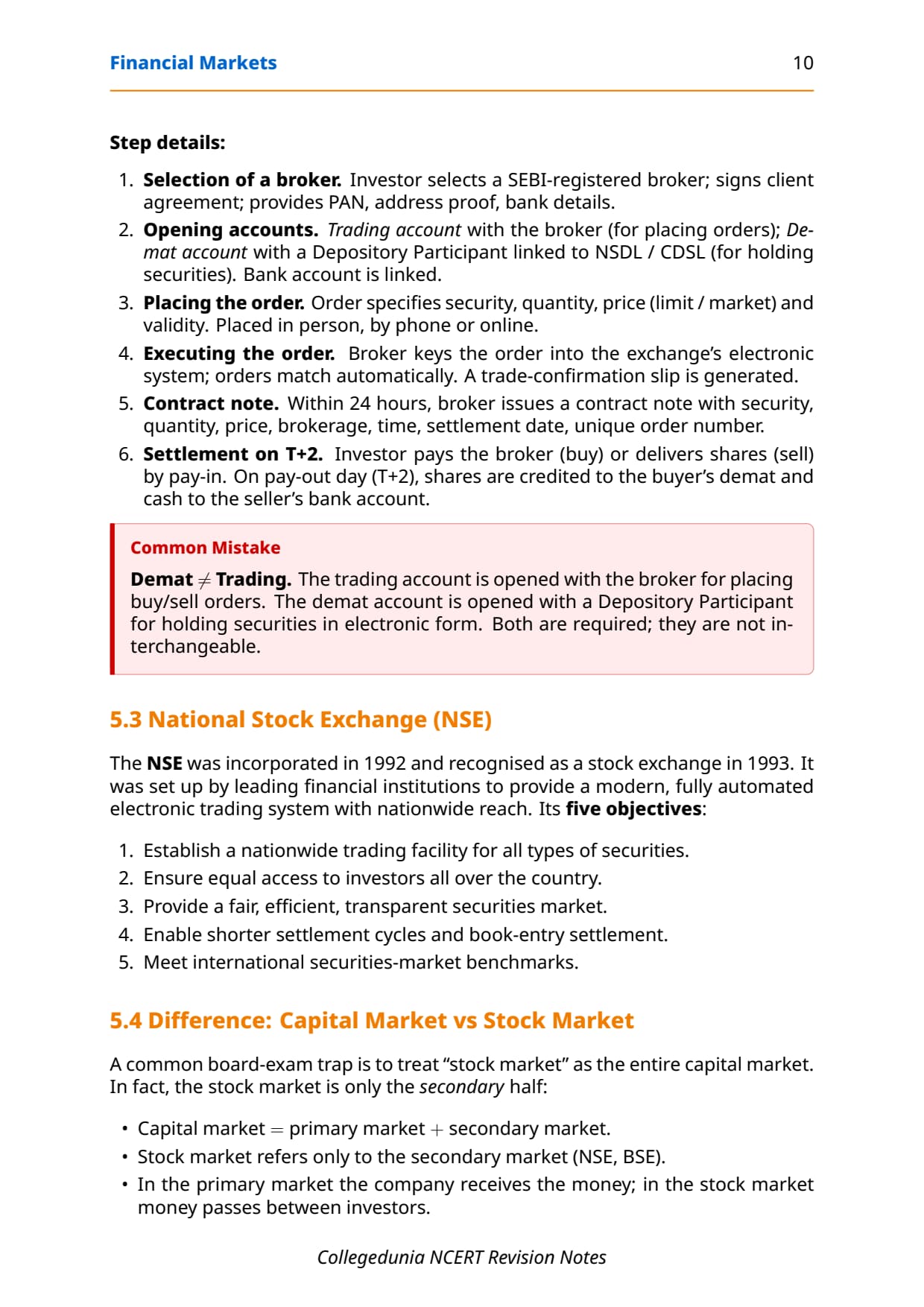
The Collegedunia Financial Markets notes are written so that the highest-frequency board questions, the SEBI three-fold mandate and the six-step trading procedure, are committed to memory by the second read. Three mnemonics (M-P-L-R for functions of a financial market, PORP-E for methods of floatation, R-P-P for SEBI objectives) lock the chapter's three list-heavy topics. TikZ diagrams for fund flow, money-market instruments, primary-issue flowchart and trading procedure mean a student can revise the whole chapter visually in under thirty minutes.
All NCERT Solutions for Financial Markets with Step-by-Step Working
Every NCERT textbook question for Class 12 Business Studies Chapter 10 Financial Markets is listed below with its full Solution and Expert Solution hidden inside collapsible tabs. Click Check Solution to reveal the step-by-step working; click Expert Solution for the expanded explanation.
Very Short Answer Type Questions
Q 10.1
What are the functions of a financial market?
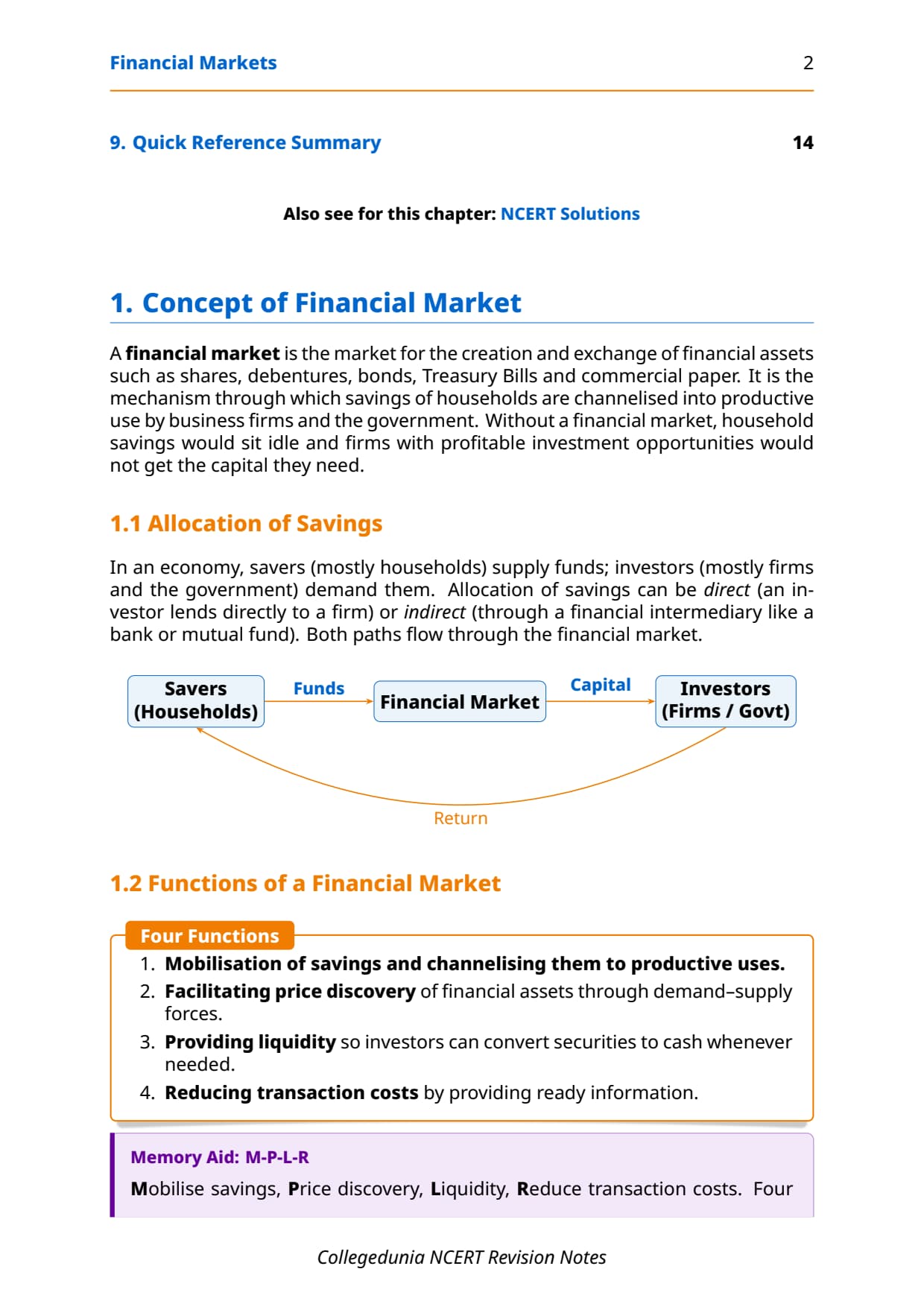
Concept used. A financial market is the market for the creation and exchange of financial assets such as shares, debentures, bonds, T-bills and commercial paper. It is the mechanism through which the savings of households are channelised into productive use by business firms and the government. Four main functions are performed by it.
Mobilisation of savings and channelising them into the most productive use. The financial market acts as a link between savers and investors. Surplus funds of households are pooled and lent to firms that have profitable investment opportunities.
Facilitating price discovery. The interaction of demand for and supply of funds in the financial market helps establish the price of a financial asset, that is, the return that the buyer (saver) earns and the cost the seller (firm) pays.
Providing liquidity to financial assets. A well-developed financial market provides a ready market in which financial assets can be bought and sold easily, so that investors can convert their securities into cash whenever they wish.
Reducing the cost of transactions. The financial market provides information about the securities being traded, saving every participant the effort and cost of searching for buyers or sellers, and the cost of negotiating individual deals.
Financial markets perform four functions: mobilisation of savings, price discovery, providing liquidity, and reducing transaction costs.
AS
Aarav Sharma
M.Com, Delhi University
Verified Expert
Quick reading. Financial market = pipeline from savers \(\to\) investors. Four jobs: move savings, discover prices, give liquidity, cut transaction costs.
Mobilise savings; route them to the best students.
Set the price (return / cost) of funds.
Make securities easy to buy back into cash.
Provide ready information, cutting search and negotiation costs.
Concept used.Call money is a short-term finance instrument of the money market. It refers to funds borrowed and lent among commercial banks themselves for very short periods, ranging from one day to fifteen days. It is used by banks to meet temporary cash shortages and to fulfil the Cash Reserve Ratio (CRR) requirements of the RBI.
Borrowers and lenders. The participants are commercial banks; one bank with a short surplus lends to another with a short deficit.
Maturity. The maturity period is extremely short: one day (overnight) up to a maximum of fifteen days.
Interest rate. The rate of interest paid on call money is called the call rate. The call rate is highly volatile, changing from hour to hour and day to day in response to demand for and supply of funds.
Purpose. Banks use call money to bridge a temporary mismatch between cash inflows and outflows, and to meet the CRR requirement of the central bank.
Call money is a money-market instrument under which funds are borrowed and lent for one day to fifteen days, mainly between commercial banks, at a volatile rate called the call rate.
PI
Priya Iyer
M.Com, Christ University Bangalore
Verified Expert
Quick reading. Banks lending to other banks for 1–15 days. The rate is the call rate; it bounces around with day-to-day demand and supply.
Maturity = 1 to 15 days.
Participants = banks (chiefly).
Use = meet CRR / patch temporary cash deficit.
Rate = volatile call rate.
Inter-bank short-term lending of 1–15 days at the call rate.
Q 10.3
What is a `Treasury Bill'?
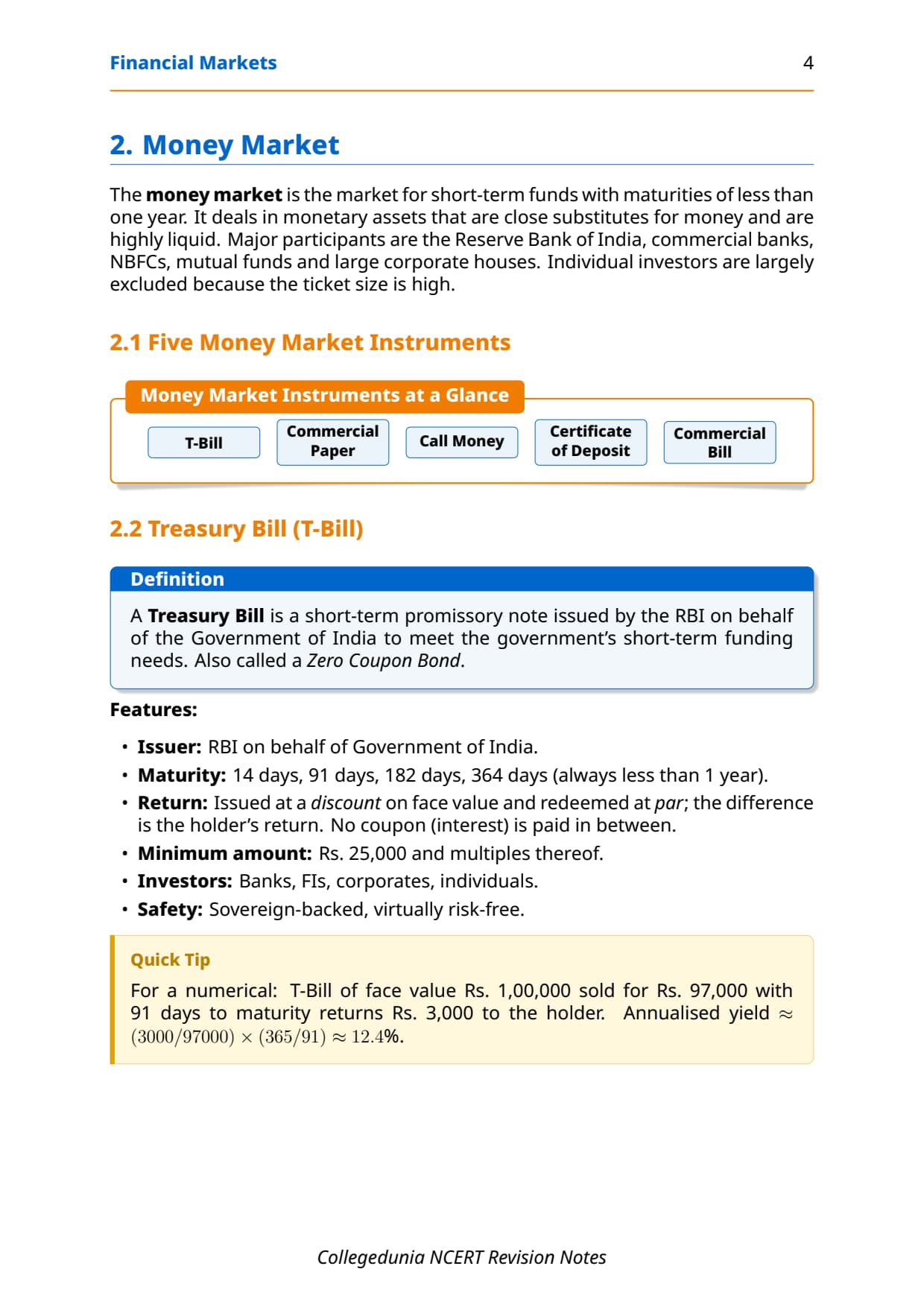
Concept used. A Treasury bill, popularly called a T-bill, is a short-term instrument issued by the Reserve Bank of India on behalf of the Government of India to meet the government's short-term funding needs. It is a promissory note (zero-coupon bond) with a maturity of less than one year.
Issuer. The RBI issues T-bills on behalf of the Government of India.
Maturity. T-bills have a maturity of less than one year (typical maturities are 14 days, 91 days, 182 days and 364 days).
How return is earned. T-bills are issued at a discount on the face value and are redeemed at par. The difference between the issue price and the redemption price is the holder's return.
Form. They are available in a minimum amount of Rs. 25,000 and in multiples thereof, and are negotiable instruments freely transferable.
Investors. Banks, financial institutions, corporate firms and individuals can invest in T-bills.
A Treasury bill is a short-term (less than one year) instrument issued by the RBI for the Government of India, sold at a discount and redeemed at par – a zero-coupon money-market instrument.
VM
Vivaan Mehta
M.Com, Symbiosis Pune
Verified Expert
Quick reading. Govt borrowing for under-a-year, issued by RBI. Buy cheap (discount), redeem at face value. Difference = your return.
Issuer: RBI on behalf of Government of India.
Maturity: 14, 91, 182, 364 days (all \(<\) 1 year).
Short-term zero-coupon Government paper sold at a discount.
Q 10.4
Distinguish between Capital market and Money market.
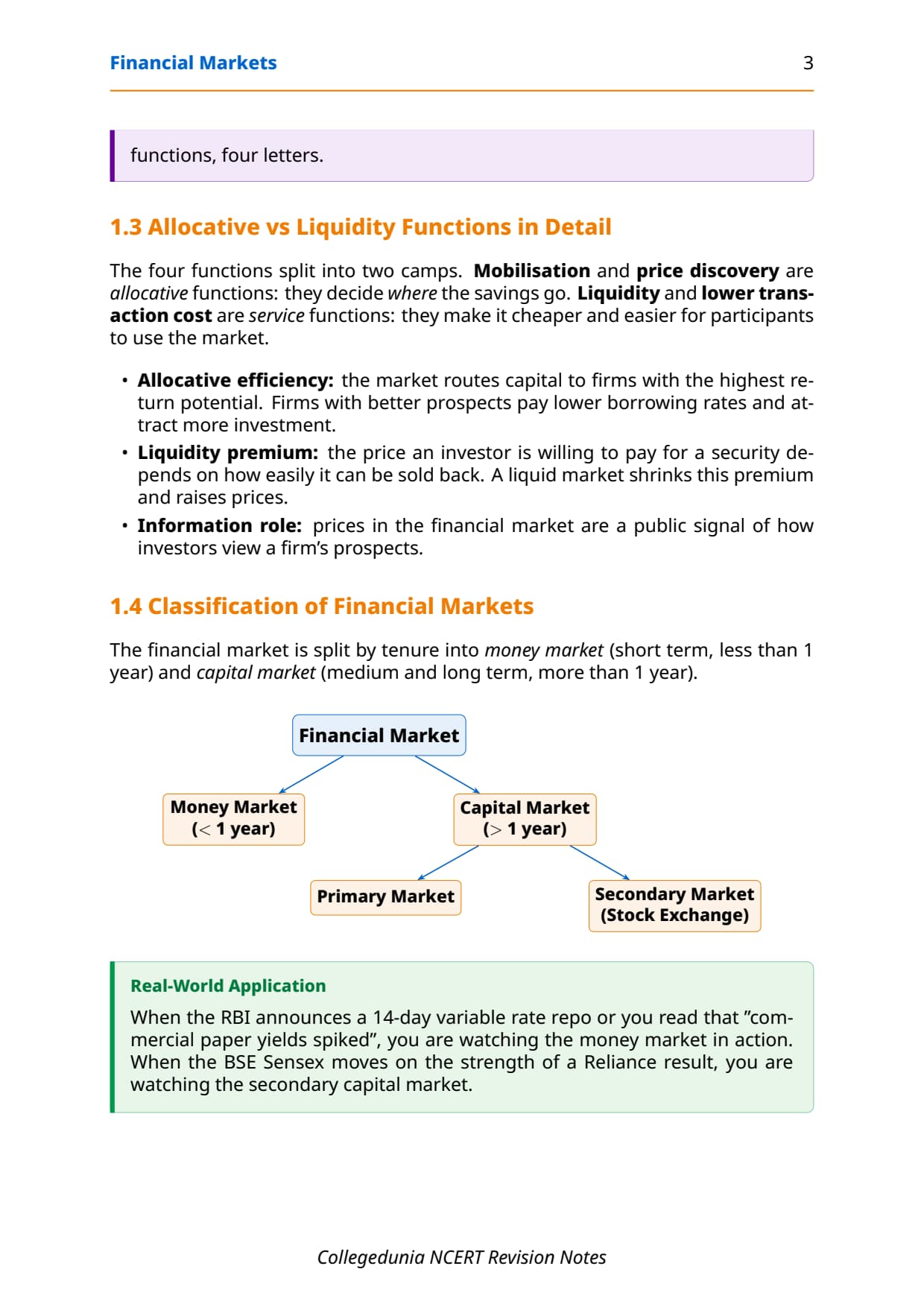
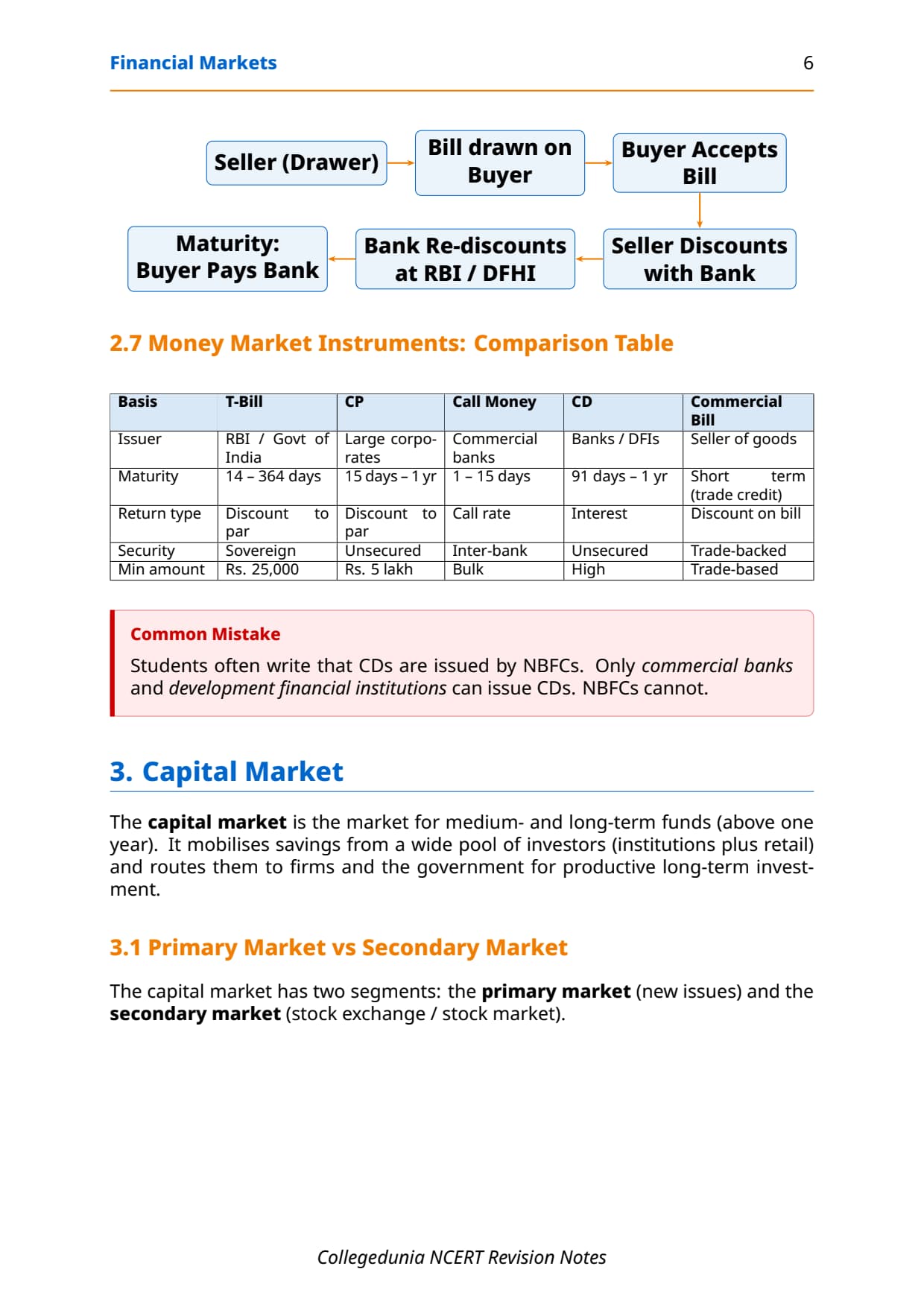
Concept used. The financial market has two segments. The money market deals in short-term funds (less than one year), while the capital market deals in medium- and long-term funds (one year and above). The two segments differ on a number of dimensions.
Instruments traded & Equity shares, debentures, bonds, preference shares & T-bills, commercial paper, call money, certificate of deposit, commercial bill
Investment outlay & Investment in capital market does not necessarily require large sums – units may be small (e.g. one share) & Investment requires huge sums (T-bills in Rs. 25,000+, CPs in Rs. 5 lakh+)
Duration & Medium and long term: above one year, often many years & Short term: maximum of one year
Liquidity & Securities are tradeable on stock exchanges; reasonably liquid & Highly liquid; formal arrangements like Discount and Finance House of India (DFHI) provide ready liquidity
Safety / risk & Higher risk; both default risk and price risk & Much safer; issuers are financially strong and maturities are very short
Expected return & Higher; includes dividend / interest plus capital appreciation & Lower; only interest or discount earned over a short period
tabular
In short: money market = short term (\(<\) 1 yr), large lots, low risk, low return, institution-dominated. Capital market = medium / long term (\(>\) 1 yr), small lots possible, higher risk, higher return, both institutional and retail.
AR
Ananya Reddy
MBA Finance, IIM Bangalore
Verified Expert
Strategic angle. If the maturity is under a year, it is money market; if it is over a year, it is capital market. Everything else (participants, ticket size, risk, return) follows from that one tenure difference.
Tenure: short (\(<\) 1 yr) vs medium / long.
Participants: institutions only (mostly) vs everyone including retail.
Ticket size: very large vs flexible.
Risk and return: low / low vs higher / higher.
Instruments: T-bill, CP, call money vs equity, debenture, bond.
What is the difference between Capital market and Stock market?
Concept used. The capital market is the segment of the financial market that deals in medium- and long-term funds; it has two parts – the primary market (new-issues market) and the secondary market (stock market / stock exchange). A stock market is therefore one component of the capital market, not the whole of it.
Scope. Capital market is the wider concept: it covers both the primary market (where new securities are issued) and the secondary market (where existing securities are bought and sold). The stock market refers only to the secondary part.
What is traded. In the primary part of the capital market, fresh securities are sold by the issuing company to investors. In the stock market, only existing securities already issued earlier are traded between investors.
Cash flow to the company. A company receives funds when it sells a security in the primary market. In the stock market, money passes between two investors – the company is not a party to that transaction.
Examples. The primary part includes IPOs, rights issues, e-IPO, etc. Stock markets include BSE and NSE.
Capital market = primary market + secondary market. The stock market is only the secondary part where already-issued securities trade between investors.
RK
Rohan Kapoor
B.Com (H), Shri Ram College of Commerce
Verified Expert
Quick reading. Stock market is a subset of the capital market: it is the secondary half. The primary half is where new shares are first sold by the company.
Capital market = primary \(+\) secondary.
Stock market = secondary only.
Primary \(\Rightarrow\) company gets the money.
Secondary \(\Rightarrow\) one investor pays another.
Capital market is the whole; stock market is its secondary half.
Short Answer Type Questions
Q 10.6
What are the functions of a Stock Exchange?
Concept used. A stock exchange is an organised market where existing securities of joint-stock companies, government and semi-government bodies are bought and sold. According to the Securities Contracts (Regulation) Act 1956, a stock exchange is ``an association, organisation or body of individuals, whether incorporated or not, established for the purpose of assisting, regulating and controlling business in buying, selling and dealing in securities''. It performs five key functions.
Providing liquidity and marketability to existing securities. A stock exchange offers a continuous, ready market where shareholders can convert their securities into cash whenever they wish, and where new investors can buy securities easily.
Pricing of securities. Constant interaction between large numbers of buyers and sellers helps to establish the fair price of each security; this price reflects the demand for the security, the strength of the company, and prevailing economic conditions.
Safety of transaction. The membership of a stock exchange is regulated, and its functioning is governed by laid-down rules and regulations approved by the government and SEBI. This minimises the risk of fraud or manipulation.
Contributes to economic growth. The stock exchange channelises savings into the most productive investment proposals. By providing liquidity to existing securities, it makes disinvestment and reinvestment possible – savings keep moving to the most productive uses.
Spreading of equity cult. The stock exchange encourages people of all income levels to participate in industry by buying shares, thus spreading share ownership widely through investor education and information.
Providing scope for speculation. The stock exchange permits a healthy degree of speculation under controlled conditions to ensure liquidity and price continuity in the market.
Stock exchanges perform six functions: liquidity & marketability, fair pricing, safety of transactions, contribution to economic growth, spread of the equity cult, and a controlled outlet for speculation.
SP
Sneha Patel
MBA Finance, IIM Lucknow
Verified Expert
Strategic angle. A stock exchange does four economic jobs and two investor-facing jobs. Pair them in your answer: liquidity, price discovery, safety, economic growth (economy-side) + spread of equity cult, controlled speculation (investor-side).
Liquidity: continuous market makes shares easy to convert into cash.
Pricing: large numbers of trades reveal fair value.
Safety: regulated membership and SEBI oversight reduce risk.
Economic growth: savings routed to the most productive firms.
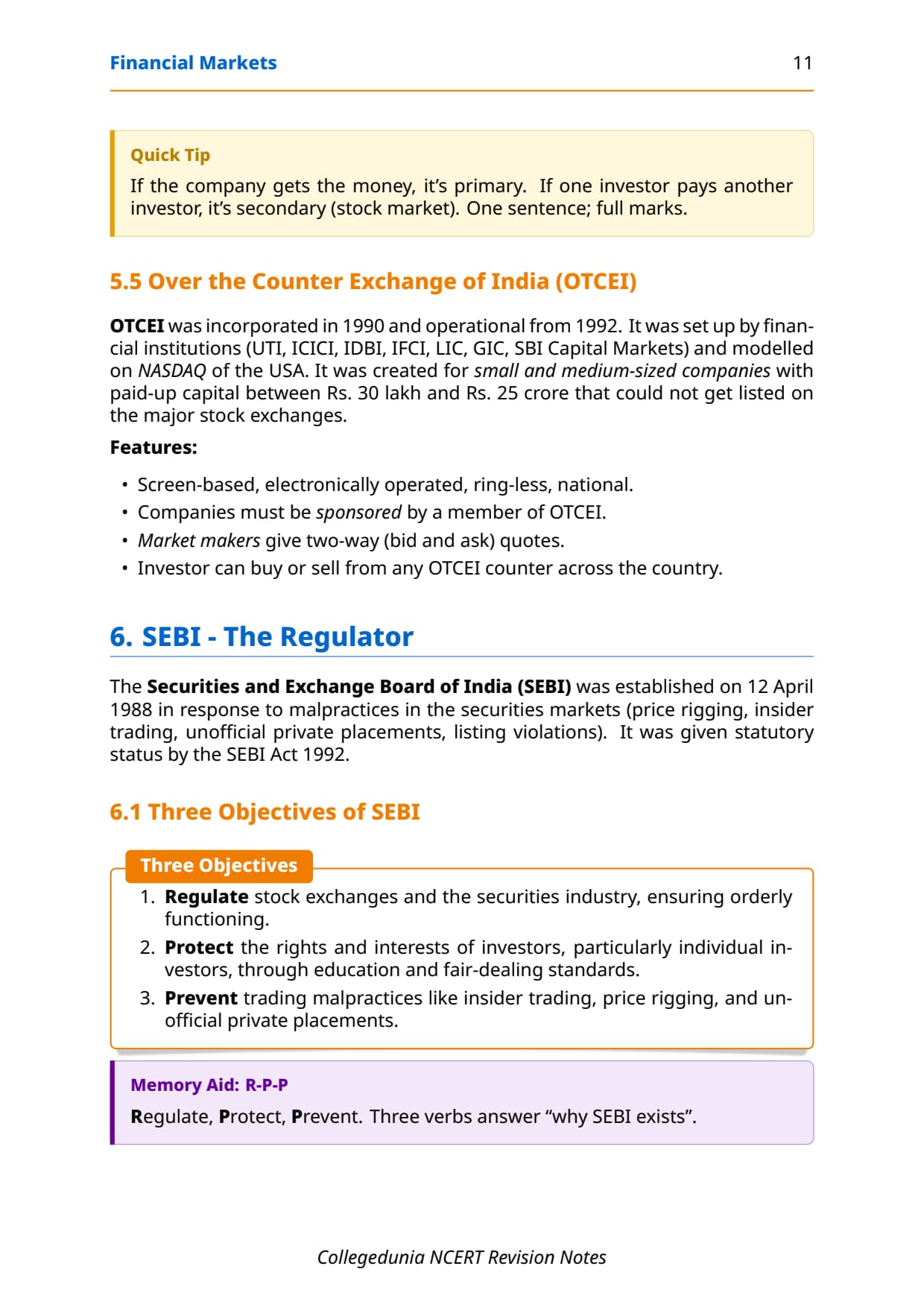
Concept used. The Securities and Exchange Board of India (SEBI) was established on 12 April 1988 and given statutory status by the SEBI Act 1992. Its formation was a response to the malpractices in the securities markets (price rigging, insider trading, unofficial private placements, violation of listing rules) that were eroding investor confidence. Three objectives guide its work.
To regulate stock exchanges and the securities industry so as to promote their orderly functioning and ensure that the market operates by laid-down rules.
To protect the rights and interests of investors, particularly individual investors, and to guide and educate them so that they get a fair deal and accurate information from issuers and intermediaries.
To prevent trading malpractices such as insider trading, price rigging, and unofficial private placements; to achieve a balance between self-regulation by the securities industry and statutory regulation by SEBI; to develop a code of conduct for intermediaries (brokers, merchant bankers, sub-brokers); and to promote the development of and regulate the working of mutual funds.
Three objectives of SEBI: regulate the stock exchanges and securities industry, protect the rights of investors, and prevent trading malpractices.
KS
Karthik Subramaniam
MBA Finance, IIM Calcutta
Verified Expert
Strategic angle. Remember the trigger: market malpractices in the late 1980s. SEBI was created to set the rules, defend the investor, and stop fraud.
Regulate stock exchanges and securities-market intermediaries.
Regulate the market, protect investors, prevent malpractice.
Q 10.8
State the objectives of the NSE.
Concept used. The National Stock Exchange (NSE) of India was incorporated in 1992 and recognised as a stock exchange in 1993. It was set up by leading financial institutions to provide a modern, fully automated electronic trading system with nationwide reach. It works towards five objectives.
Establish a nationwide trading facility for all types of securities – equities, debt instruments, hybrids, government securities, and so on.
Ensure equal access to investors all over the country through an appropriate communication network so that geographical location does not disadvantage an investor.
Provide a fair, efficient and transparent securities market using electronic trading systems and visible order books.
Enable shorter settlement cycles and book-entry settlements, reducing the time between trade and final settlement and eliminating paperwork delays.
Meet international securities-market benchmarks and standards so that Indian markets are at par with global stock exchanges.
NSE's five objectives: nationwide trading reach, equal access, fair & transparent trading, shorter settlement cycles, and international benchmarks.
AS
Aarav Sharma
M.Com, Delhi University
Verified Expert
Quick reading. NSE was the first fully electronic, nationwide exchange in India. Its objectives all turn on access, transparency, efficiency, and global standards.
Nationwide trading platform.
Equal access regardless of location.
Fair, efficient, transparent system.
Shorter settlement (book-entry).
Meet international benchmarks.
Reach, access, transparency, fast settlement, global standards.
Q 10.9
What is OTCEI?
Concept used. The Over the Counter Exchange of India (OTCEI) is an electronic stock exchange that was incorporated in 1990 and made fully operational in 1992. It was set up by financial institutions like UTI, ICICI, IDBI, IFCI, LIC, GIC and SBI Capital Markets, modelled on the lines of NASDAQ (the over-the-counter market of the USA). It was created specifically for small and medium-sized companies that could not get listed on the major stock exchanges.
Meaning. OTCEI is a screen-based, electronically operated, ring-less, national and fully automated stock exchange. ``Over-the-counter'' originally meant trading directly between buyer and seller without a central trading floor.
Purpose. To provide an organised trading platform for small and medium-sized companies whose paid-up capital is between Rs. 30 lakh and Rs. 25 crore.
Features. Companies must be sponsored by a member of OTCEI; trading is screen based; the system has market makers who give two-way quotes (bid and ask); the system is nationwide so an investor can buy or sell shares from any OTCEI counter.
Advantages. Cheaper access to capital for small firms; transparency through screen-based trading; investor protection through the market-maker mechanism.
OTCEI is the Over the Counter Exchange of India – a fully electronic, nationwide stock exchange (modelled on NASDAQ) created in 1990 for small and medium companies with paid-up capital between Rs. 30 lakh and Rs. 25 crore.
PI
Priya Iyer
M.Com, Christ University Bangalore
Verified Expert
Quick reading. OTCEI = India's NASDAQ; created in 1990 for small / medium companies that the BSE would not list. Fully electronic, screen-based, with market makers.
Set up in 1990 by FIs (UTI, ICICI, IDBI, LIC, GIC, SBI Caps).
Modelled on NASDAQ (USA).
Screen-based, ring-less, national.
For small / medium firms (\(Rs.\,30\) L to \(Rs.\,25\) Cr).
Market makers give bid–ask quotes.
Electronic national exchange for small and medium companies.
Long Answer Type Questions
Q 10.10
Explain the various Money Market Instruments.
Concept used. The money market is the market for short-term funds (less than one year). It deals in monetary assets having a maturity of one year or less. The instruments allow large corporates, banks, NBFCs and the government to manage their short-term liquidity. Five major instruments operate in the Indian money market.
Treasury Bill (T-bill). A short-term promissory note issued by the RBI on behalf of the Government of India to meet short-term needs. It is a zero-coupon instrument: issued at a discount to face value and redeemed at par. Maturities are 14, 91, 182 and 364 days. Minimum amount Rs. 25,000. Highly liquid and risk-free, also called Zero Coupon Bonds.
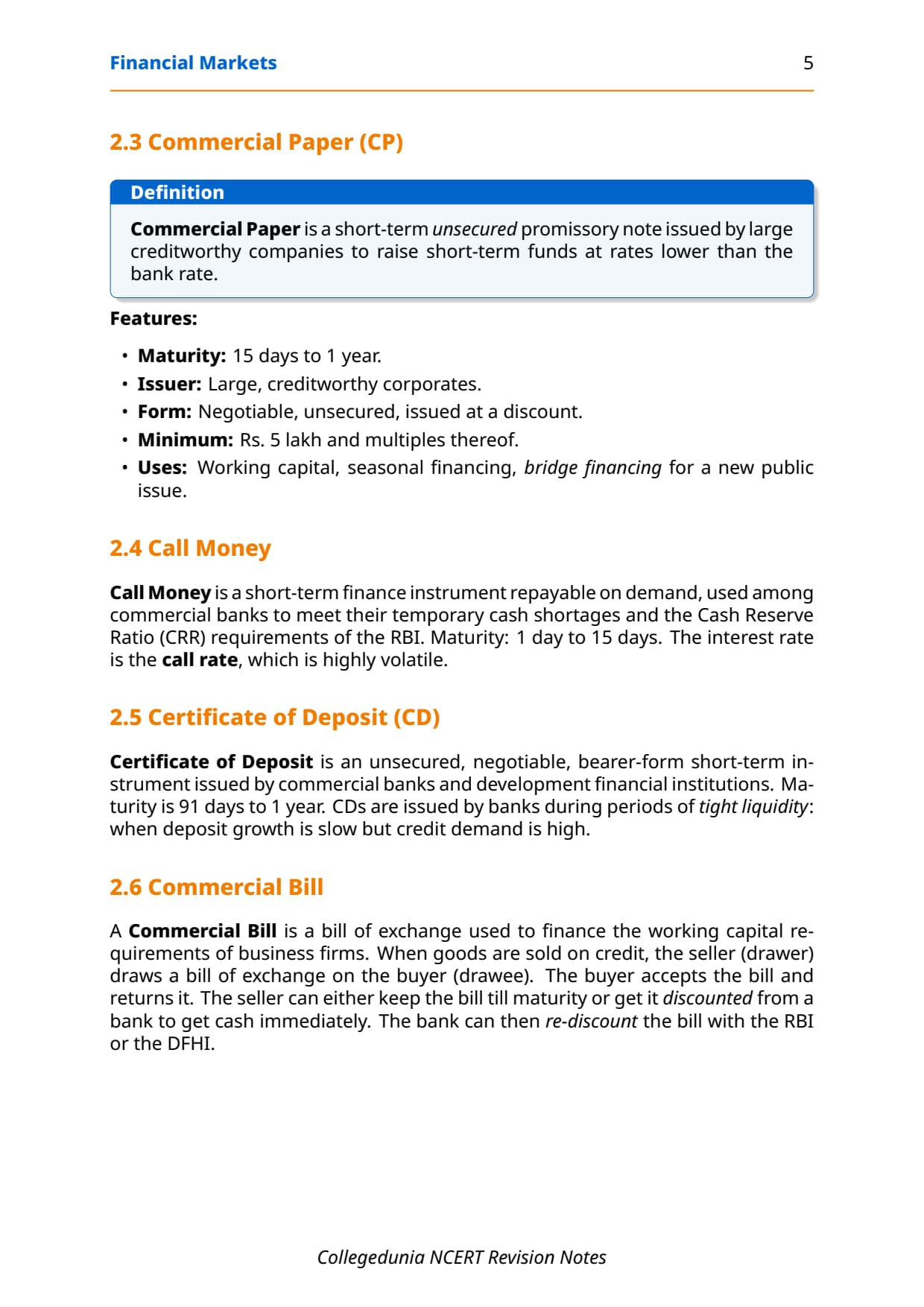
Commercial Paper (CP). A short-term unsecured promissory note issued by large and creditworthy companies to raise short-term funds at rates lower than the bank rate. Maturity is 15 days to one year. Sold at a discount and redeemed at par. Used for working capital, seasonal financing, and bridge financing for new floats. Minimum issue size Rs. 5 lakh.
Call Money. Short-term finance, repayable on demand, used by commercial banks to meet temporary cash shortages and CRR requirements. Maturity is 1 to 15 days. Interest is the call rate which is highly volatile.
Certificate of Deposit (CD). An unsecured, negotiable, short-term instrument in bearer form, issued by commercial banks and development financial institutions. Maturities range from 91 days to 1 year. CDs are issued to individuals, corporations and companies during periods of tight liquidity, when deposit growth is slow but credit demand is high.
Commercial Bill. A bill of exchange used to finance the working capital requirements of business firms. When goods are sold on credit, the seller (drawer) draws a bill of exchange on the buyer (drawee). The buyer accepts the bill and returns it. The seller can either keep the bill till maturity or get it discounted from a bank to get cash immediately. The bank in turn can re-discount the bill with the RBI or the DFHI.
Five money-market instruments: T-Bill, Commercial Paper, Call Money, Certificate of Deposit, Commercial Bill. All have maturities of one year or less and are designed for short-term liquidity management.
KS
Karthik Subramaniam
MBA Finance, IIM Calcutta
Verified Expert
Strategic angle. Five instruments. Sort them by issuer to remember: Government \(\to\) T-bill; Corporates \(\to\) Commercial paper \(+\) Commercial bill; Banks \(\to\) Certificate of deposit \(+\) Call money.
T-Bill: Government short-term paper, discount to par, \(<\)1 yr.
Commercial Paper: Big firms borrow short, unsecured, discount.
Call Money: Bank-to-bank, 1–15 days, call rate.
Certificate of Deposit: Banks raise short money during liquidity squeeze.
Commercial Bill: Bill of exchange for trade credit; discountable at the bank.
T-Bill (Govt), CP (firms), Call money (banks), CD (banks), Commercial bill (trade).
Q 10.11
What are the methods of floatation in the primary market?
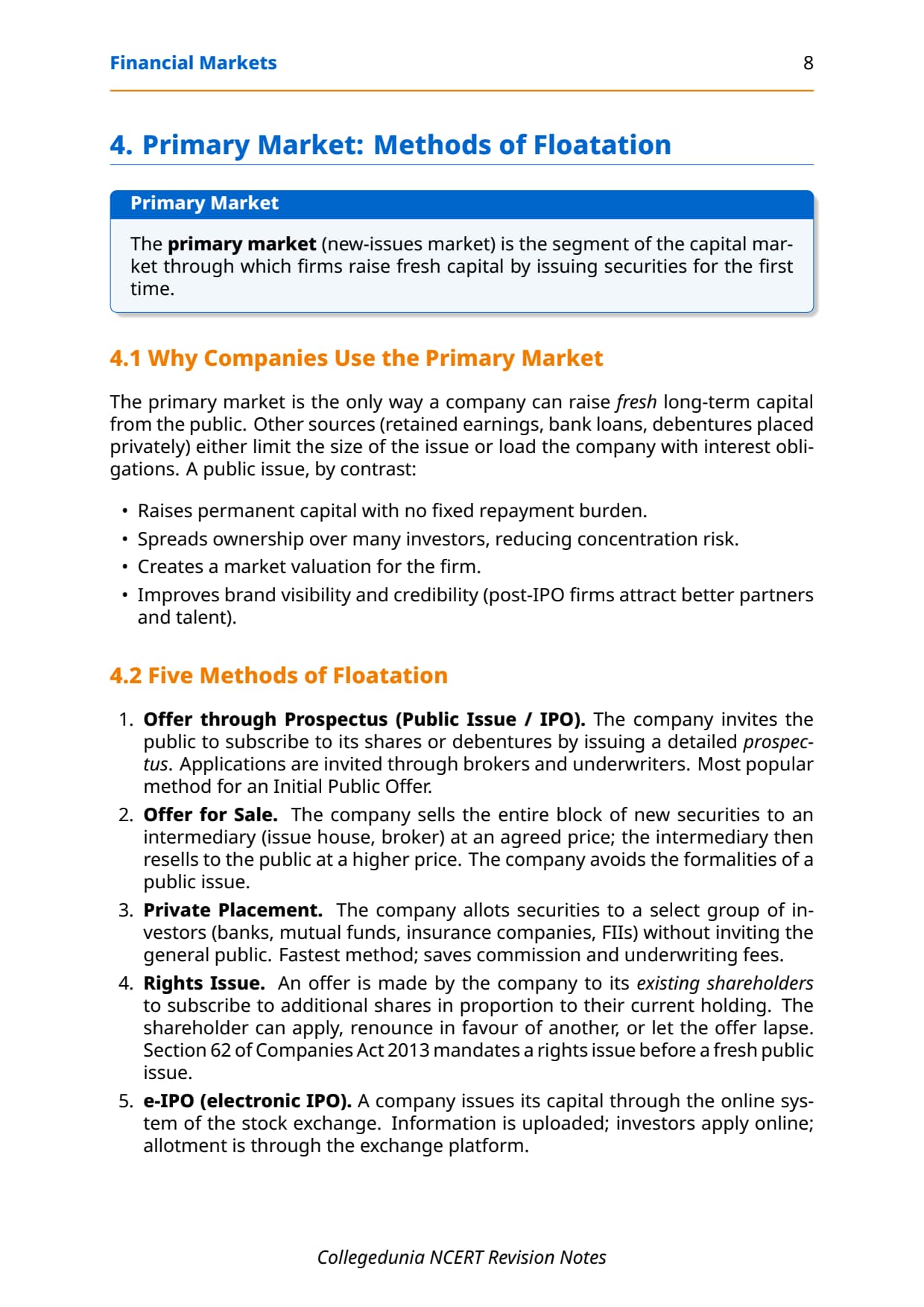
Concept used. The primary market (or new-issues market) is the segment of the capital market through which firms raise fresh capital by issuing securities for the first time. Five common methods are used to bring new securities to the public.
Offer through Prospectus (Public Issue / IPO). The company invites the public to subscribe to its shares (or debentures) by issuing a detailed prospectus that discloses the company's objectives, finances, promoters and risks. Applications are invited through a network of brokers and underwriters. This is the most popular method for an Initial Public Offer (IPO).
Offer for Sale. The company sells the entire block of new securities to an intermediary (an issue house or a stock broker) at an agreed price. The intermediary then re-sells the securities to the investing public at a higher price. The company avoids the formalities of a public issue.
Private Placement. The company allots securities to a select group of investors – typically institutional investors like banks, mutual funds, insurance companies, FIIs – without inviting the general public. It saves on commission and underwriting fees and is the fastest method.
Rights Issue. An offer is made by the company to its existing shareholders to subscribe to additional shares in proportion to their current holding. The shareholder has the right (not the obligation) to apply, and can renounce it in favour of someone else. Section 62 of the Companies Act 2013 makes the rights issue mandatory before a fresh public issue by an existing company.
e-IPO (electronic IPO). A company can issue its capital through an on-line system of the stock exchange. The company appoints brokers, signs an agreement with the exchange, and the issue is offered electronically. Information is uploaded; investors apply online; allotment happens through the exchange platform.
Five methods of floatation in the primary market: prospectus / public issue, offer for sale, private placement, rights issue, and e-IPO.
SP
Sneha Patel
MBA Finance, IIM Lucknow
Verified Expert
Strategic angle. Group the methods by who the buyer is. Public method \(\to\) prospectus and e-IPO; intermediary method \(\to\) offer for sale; private method \(\to\) private placement; shareholders only \(\to\) rights issue.
Prospectus (IPO): document-led public issue.
Offer for sale: securities sold to broker, broker resells to public.
Private placement: select institutions only.
Rights issue: existing shareholders, in proportion to holdings.
e-IPO: online IPO via the exchange.
Prospectus, offer for sale, private placement, rights issue, e-IPO.
Q 10.12
Explain the capital market reforms in India.
Concept used. Indian capital market reforms began in 1991 as part of the broader economic liberalisation. The reforms aimed to make the market efficient, transparent, safe and globally competitive. Six major reforms have shaped today's capital market.
Establishment of SEBI. SEBI was set up in 1988 and given statutory status in 1992 to protect investor interests and to develop and regulate the securities market. It frames rules for primary issues, listing, intermediaries (merchant bankers, brokers), mutual funds, and insider trading.
Establishment of creditable trading mechanisms. The setting up of the National Stock Exchange (NSE, 1994) and the Over the Counter Exchange of India (OTCEI, 1992) provided modern, screen-based trading with nationwide reach. This triggered the BSE to also modernise (BOLT system).
Screen-based trading and the National Securities Clearing Corporation. Open outcry on a trading floor was replaced by transparent, screen-based trading. The NSCCL (National Securities Clearing Corporation Ltd, 1995) guarantees settlement, removing counterparty risk.
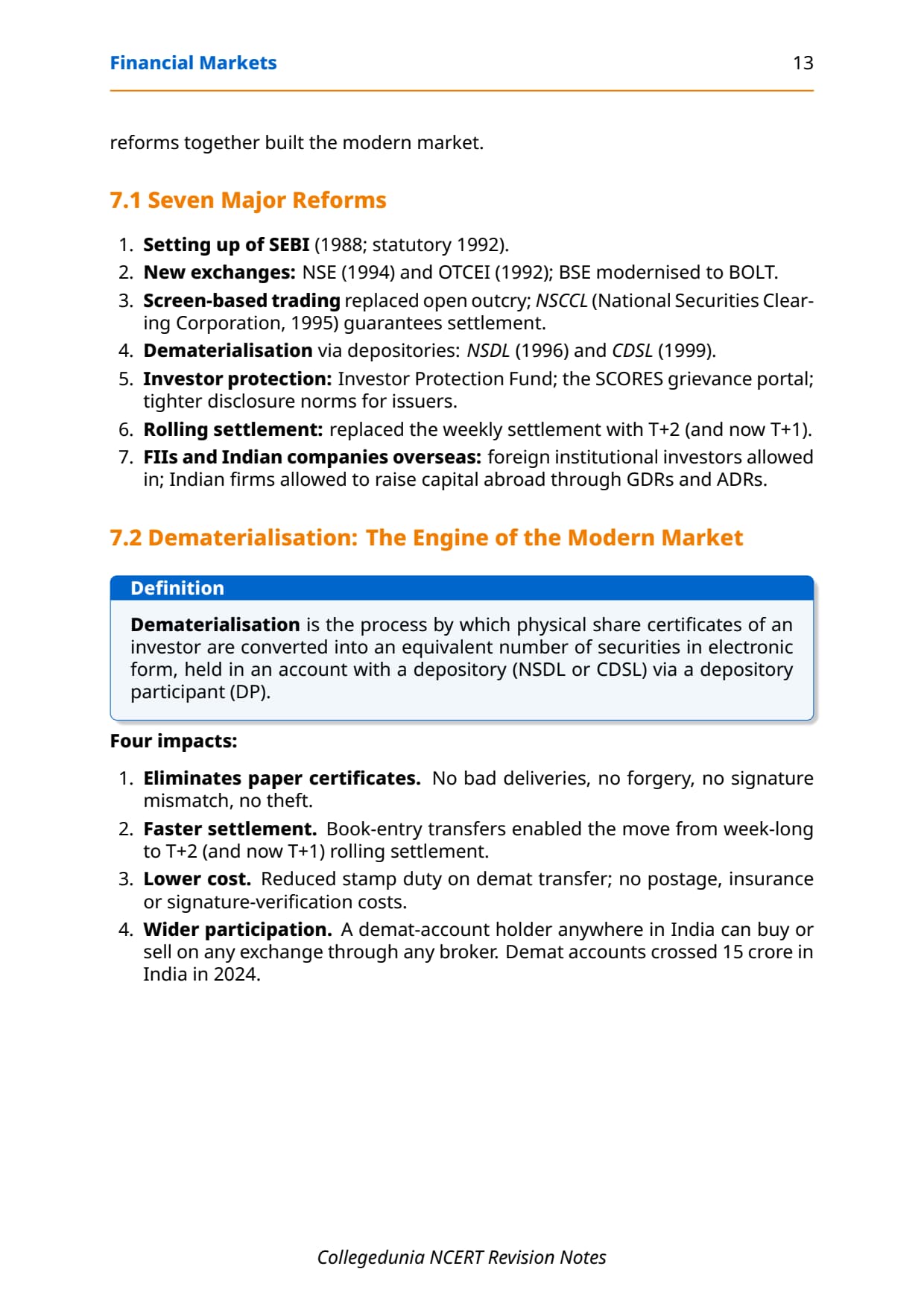
Dematerialisation (demat). Physical share certificates were replaced by electronic (demat) holdings through depositories like the National Securities Depository Limited (NSDL, 1996) and Central Depository Services (India) Limited (CDSL, 1999). This eliminated bad deliveries, fake certificates and theft.
Investor protection. An Investor Protection Fund has been set up; SEBI conducts investor education programmes; grievance redressal mechanisms (SCORES) accept investor complaints online; disclosure norms for issuers have been tightened.
Rolling settlement. The earlier ``weekly settlement'' was replaced by rolling settlement (T+2 day) – trades on any given day are settled within two working days, reducing speculation and risk.
Allowing FIIs and Indian companies in foreign markets. Foreign Institutional Investors (FIIs) have been allowed to invest in Indian securities, and Indian companies have been allowed to raise capital abroad through GDRs and ADRs.
Capital market reforms since 1991: SEBI (1988/1992), NSE & OTCEI, screen-based trading \(+\) NSCCL, dematerialisation (NSDL/CDSL), investor protection (IPF, SCORES), rolling settlement (T+2), and FII / GDR / ADR access.
AR
Ananya Reddy
MBA Finance, IIM Bangalore
Verified Expert
Strategic angle. The reforms answered four 1991 problems: no regulator, no modern trading, paper share certificates, weekly settlement. The seven reforms are the answers.
SEBI created (1988) and made statutory (1992).
NSE (1994) \(+\) OTCEI (1992): new exchanges; BSE also modernised.
Screen-based trading \(+\) NSCCL (1995): transparent and guaranteed.
Dematerialisation: NSDL (1996), CDSL (1999); paper certificates gone.
Explain the various functions of the Securities and Exchange Board of India (SEBI).
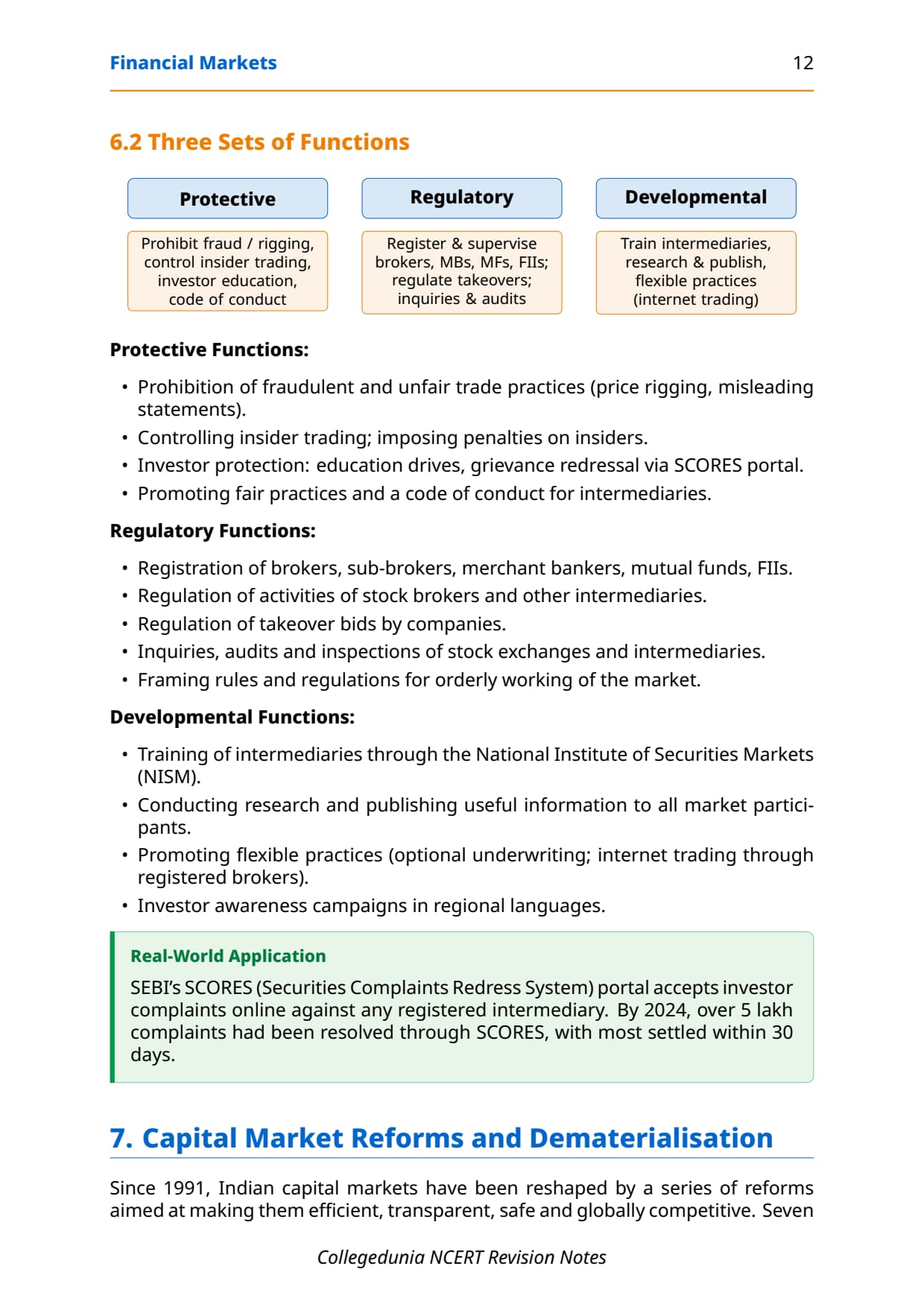
Concept used.SEBI performs its role through three broad sets of functions: protective, regulatory, and developmental. Protective functions defend investor interests; regulatory functions discipline the market; developmental functions help the market grow.
Protective functions.
Prohibition of fraudulent and unfair trade practices like price rigging and making misleading statements.
Controlling insider trading and imposing penalties on insiders who trade on unpublished price-sensitive information.
Undertaking steps for investor protection: investor education campaigns, grievance redressal through SCORES.
Promotion of fair practices and a code of conduct in securities markets.
Regulatory functions.
Registration of brokers, sub-brokers, merchant bankers, mutual funds, FIIs and other intermediaries.
Regulation of stock-broker activities and other intermediaries through guidelines and rules.
Regulation of takeover bids by companies.
Inquiries, audits and inspections of stock exchanges and intermediaries.
Framing rules and regulations for the orderly working of all institutions in the securities markets.
Developmental functions.
Training of intermediaries (brokers, merchant bankers).
Conducting research and publishing useful information to all market participants.
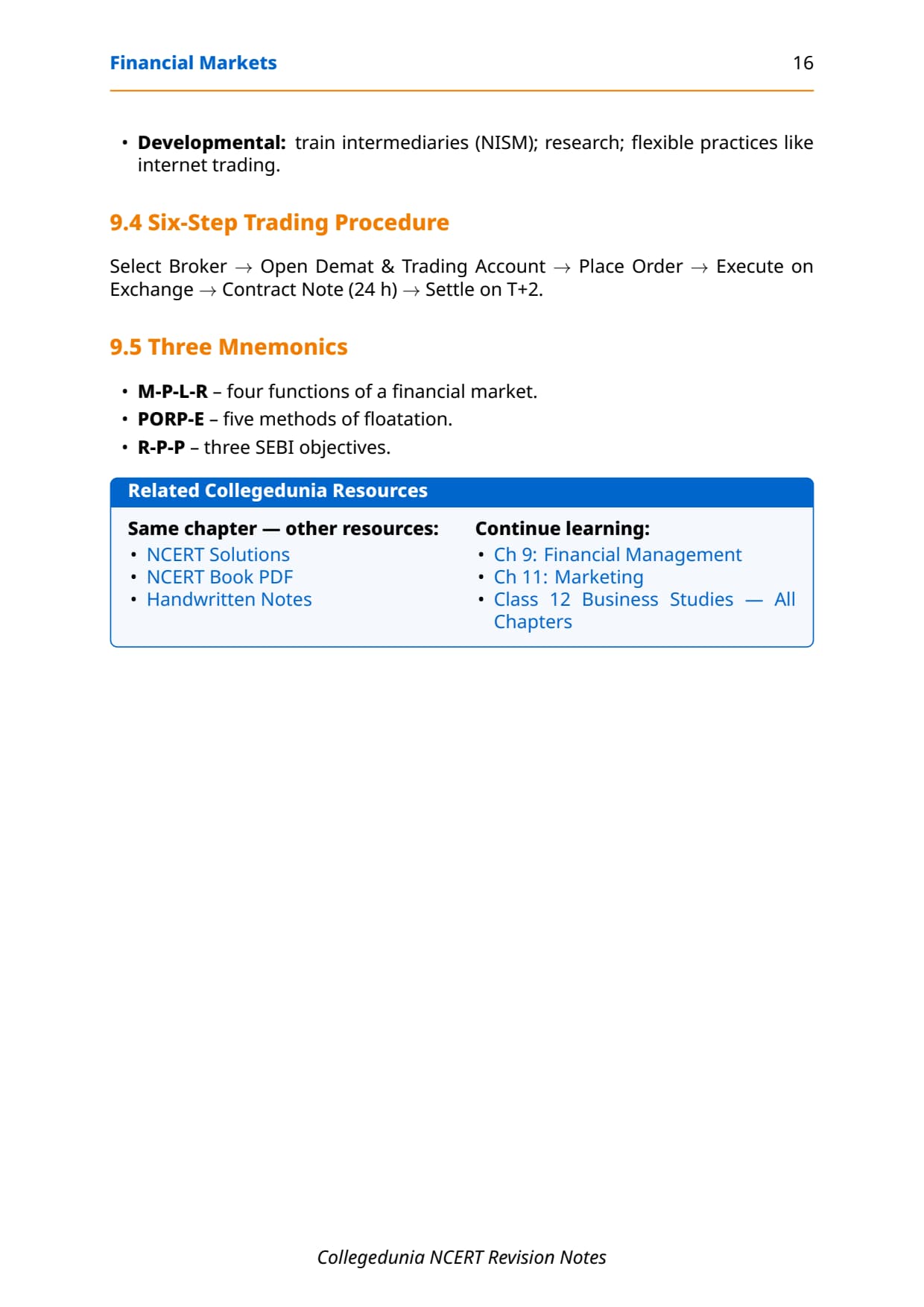
Undertaking measures to develop the capital markets by adapting a flexible approach (for example, permitting underwriting to be optional in some cases to reduce cost of issue, permitting internet trading through registered brokers).
SEBI performs three sets of functions: protective (investor protection, prohibition of malpractice), regulatory (registration and supervision of intermediaries), and developmental (training, research, market development).
RK
Rohan Kapoor
B.Com (H), Shri Ram College of Commerce
Verified Expert
Strategic angle. Three buckets answer SEBI's whole mandate: protect the investor, police the market, push the market forward.
Protective: prohibit price rigging, ban insider trading, run SCORES.
Regulatory: register and supervise brokers, mutual funds, FIIs, takeovers.
Explain the steps involved in the trading procedure on a stock exchange.
Concept used. The trading procedure on a modern Indian stock exchange is fully screen based, electronic, and operates on a rolling-settlement (T+2) basis. The process from investor's order to delivery of securities involves six distinct steps.
Selection of a broker. The investor selects a broker (or sub-broker) who is a registered member of a recognised stock exchange. An agreement is signed; the investor provides PAN, identity proof, address proof, bank account details and opens a Demat account with a Depository Participant linked to NSDL or CDSL.
Opening a Demat and Trading account. The investor opens a trading account (with the broker, for placing buy/sell orders) and a demat account (with the DP, to hold the securities in electronic form). A bank account is linked for funds.
Placing the order. The investor instructs the broker to buy or sell a specified quantity of a specified security at a specified price (or at the prevailing market price). The order can be placed in person, over the phone, or online through the broker's web portal or mobile app.
Executing the order / Match on exchange. The broker enters the order into the exchange's electronic trading system. The order is automatically matched against an opposite order at the best available price. Once matched, a trade-confirmation slip is generated and sent to the investor.
Issue of contract note. Within 24 hours of the trade, the broker issues a contract note to the investor giving full details: securities, quantity, price, brokerage charged, the trade time, settlement date and the unique order number.
Settlement on T+2. The investor must pay the broker the trade amount (for a buy order) or deliver the securities (for a sell order) on or before the pay-in day. On the pay-out day (the second working day after the trade, T+2), the securities are credited to the buyer's demat account and the sale proceeds are credited to the seller's bank account.
The trading procedure has six steps: select broker, open demat & trading account, place order, execute the trade on the exchange, receive contract note, settle on T+2.
VM
Vivaan Mehta
M.Com, Symbiosis Pune
Verified Expert
Strategic angle. Picture six dominoes from ``open accounts'' to ``shares in your demat on day T+2''. Each one triggers the next.
Pick a SEBI-registered broker; sign client agreement.
Open demat (NSDL/CDSL) + trading account; link bank.
Place order: quantity, price, security.
Broker keys it into the exchange; matched electronically.
Contract note within 24 hours.
Settlement on T+2: shares credited or cash credited.
Explain the role of `dematerialisation' in promoting the New Stock Market.
Concept used.Dematerialisation (or demat) is the process by which physical share certificates of an investor are converted into an equivalent number of securities in electronic form, held in an account with a depository (NSDL or CDSL) via a depository participant (DP). Dematerialisation has transformed Indian capital markets in four major ways.
Elimination of paper certificates. Physical share certificates are bulky, can be lost or stolen, can be forged, and create ``bad deliveries'' (signature mismatch, torn certificates). Demat replaced all this with a secure electronic record.
Faster settlement. With securities in electronic form, ownership changes happen in book entry; this enabled the move from a 14-day account-period settlement to T+2 rolling settlement, and ultimately T+1.
Lower cost and effort. Stamp duty on transfer of demat shares is much lower; there are no postage or insurance costs for sending certificates; the investor receives electronic credits for dividends and bonus shares automatically.
Wider investor participation. A demat-account holder anywhere in India can buy or sell on any stock exchange through any broker, supporting the equal-access objective of the NSE. This has expanded retail participation in the market.
Dematerialisation promotes the new stock market by removing paper certificates, enabling faster (T+2/T+1) settlement, cutting transaction costs, and widening retail investor participation.
KS
Karthik Subramaniam
MBA Finance, IIM Calcutta
Verified Expert
Strategic angle. Demat replaced paper. Once paper was gone, everything downstream (speed, cost, reach, scale) got cheaper and faster.
Paper certificates \(\to\) electronic book entries (NSDL, CDSL).
Settlement compressed from days to T+2 / T+1.
Stamp duty cut; no postage / insurance / signature checks.
Investors anywhere; brokers anywhere; the market scaled to crores.
No paper \(\Rightarrow\) faster, cheaper, broader, deeper market.
Q 10.16
Distinguish between Primary and Secondary Markets.
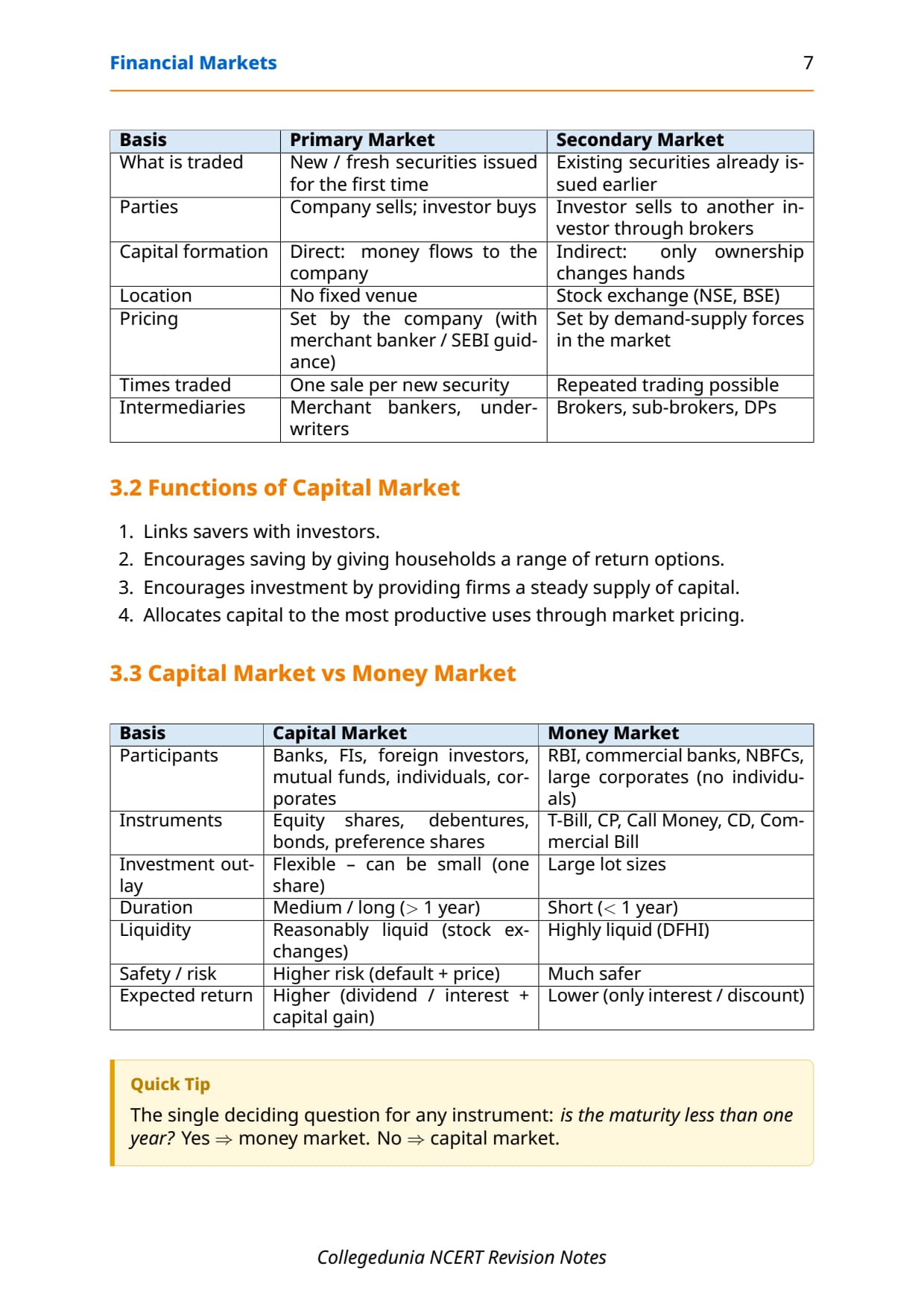
Concept used. The capital market has two parts. The primary market (or new-issues market) is where companies sell securities for the first time. The secondary market (or stock exchange / stock market) is where existing securities already issued in the past are traded among investors. The two differ on seven key dimensions.
tabular|p0.22|p0.36|p0.36|
Basis & Primary Market & Secondary Market
What is traded & New / fresh securities issued for the first time & Existing securities issued earlier
Buyers & sellers & The company sells; the investor buys & Investor sells to another investor through brokers
Capital formation & Direct capital formation: money flows to the company & Indirect: ownership changes hands but no fresh money flows to the company
Where it takes place & No fixed geographical location; happens through prospectus, allotment etc. & Located at fixed places: stock exchange premises with screen-based trading
Pricing & Price determined by the company (with merchant banker / SEBI guidance) & Price determined by demand-supply forces in the market
Number of transactions in a security & Only one sale of a given new security & A given security can be traded numberless times
Primary market = new securities, capital flows to the company, one-time sale. Secondary market = existing securities, money changes hands between investors, repeated trading.
SP
Sneha Patel
MBA Finance, IIM Lucknow
Verified Expert
Strategic angle. The deciding question for any transaction is: does the company get the money? If yes, it is primary. If the money goes from one investor to another, it is secondary.
Primary: new shares, company is the seller, capital formation.
Secondary: old shares, investor is the seller, no capital formation.
Primary: no fixed venue.
Secondary: stock exchange.
Primary: price set by company / merchant banker.
Secondary: price set by market forces.
New vs existing; company sells vs investors trade; capital formation vs liquidity.
Q 10.17
Explain the development functions of SEBI.
Concept used. SEBI's developmental functions are the activities through which SEBI helps the securities market grow, become more sophisticated, and serve the wider economy. Unlike its protective or regulatory roles, developmental functions are facilitative rather than restrictive.
Training of intermediaries. SEBI provides training programmes and certifications for stock-market intermediaries (brokers, sub-brokers, merchant bankers, mutual-fund distributors, research analysts) to raise professional standards. The NISM (National Institute of Securities Markets) was set up by SEBI to run these courses.
Conducting research. SEBI undertakes and publishes research on the working of the securities market, sectoral trends, market microstructure, and global best practices, and makes the data available to participants.
Promoting flexible and adaptable approaches. SEBI promotes:
Optional underwriting of public issues to reduce the cost of issue.
Internet trading through registered stock brokers to widen retail access.
Direct listing of company shares without prior IPO under specified frameworks.
Investor awareness programmes. SEBI runs investor education programmes, publishes guides in regional languages, and organises seminars, all aimed at developing an informed investor base.
Promoting fair practices and self-regulation. Encouraging stock exchanges and intermediary associations to evolve their own codes of conduct, with SEBI as the long-stop regulator.
SEBI's developmental functions: train intermediaries, conduct & publish research, promote flexible market practices (optional underwriting, internet trading), run investor awareness campaigns, and encourage self-regulation.
AR
Ananya Reddy
MBA Finance, IIM Bangalore
Verified Expert
Strategic angle. Development = anything SEBI does to make the market bigger, deeper or smarter. Training, research, awareness, flexibility.
Train: NISM courses for brokers, MBs, analysts.
Research: data and reports on markets, sectors.
Flexibility: optional underwriting, internet trading, direct listing.
Awareness: investor education in many languages.
Self-regulation: encourages intermediary codes of conduct.
In a Collegedunia poll of 940 Class 12 Commerce students, 82% said the three mnemonics (M-P-L-R, PORP-E, R-P-P) made the SEBI and floatation answers far easier to recall in the exam. 3 in 4 said the money market versus capital market comparison table was the single most useful part of these Financial Markets notes.
Other Resources for Class 12 Business Studies Chapter 10 Financial Markets
Financial Markets Class 12 - Frequently Asked Questions
What are the four functions of a financial market?
What are the four functions of a financial market?
The four functions are mobilisation of savings, price discovery, providing liquidity, and reducing transaction costs. The mnemonic M-P-L-R helps recall them in order. The first two (mobilisation, price discovery) are allocative functions; the last two (liquidity, transaction costs) are service functions of the market.
What is the difference between the money market and the capital market?
The money market deals in short-term funds (less than one year), with instruments like T-Bills, CP, Call Money, CD and Commercial Bills. The capital market deals in medium and long-term funds (more than one year), with instruments like equity shares, debentures and bonds. Money market participants are mostly institutions; capital market includes retail investors too.
What are the three sets of functions of SEBI?
SEBI was established in 1988 and granted statutory powers under the SEBI Act 1992. Its three sets of functions are: (1) Regulatory (register and supervise brokers, merchant bankers, mutual funds, FIIs; regulate takeovers; audits and inspections); (2) Developmental (train intermediaries through NISM, conduct research, promote flexible practices like internet trading); and (3) Protective (prohibit fraud and insider trading, investor education, SCORES grievance redressal).
What is dematerialisation in Class 12 Business Studies?
Dematerialisation is the process by which physical share certificates are converted into electronic form, held in an account with a depository (NSDL 1996 or CDSL 1999) via a depository participant. It enabled T+2 rolling settlement as specified in the NCERT 2026-27 syllabus, eliminated paper certificates and bad deliveries, cut transaction costs, and widened retail investor participation. The standard trading procedure is Demat to Order to Execution to T+2 settlement.
Where can I download the Class 12 Business Studies Chapter 10 Financial Markets Notes PDF?
You can download the Collegedunia Class 12 Business Studies Chapter 10 Financial Markets Notes PDF free of cost from this page. The PDF is aligned to the NCERT Reprint 2026-27 syllabus and includes nine concept-card sections, TikZ diagrams for fund flow and trading procedure, comparison tables and three mnemonics.








Comments