




Molecular Basis of Inheritance explains how DNA stores genetic information, copies itself, and turns that code into proteins. It is the highest-weight Genetics and Evolution chapter for both CBSE and NEET. These Class 12 Biology notes condense all ten NCERT sections into one revision PDF you can download on this page.
- CBSE Weightage: 7 to 9 marks (Unit VII, Genetics and Evolution, the single heaviest Biology chapter)
- NEET Weightage: 6 to 8 questions per year (the most-asked Class 12 Biology chapter in NEET)
- CUET (UG) Weightage: 4 to 6 questions per year on DNA structure, replication, and gene expression
How will Collegedunia's Molecular Basis of Inheritance Class 12 Notes Help You?
The notes serve a CBSE student who needs the experiments and central dogma written cleanly, and a NEET aspirant who needs every enzyme and fact recall-ready. They map to the 2026-27 NCERT and the last five CBSE and NEET papers.
- Experiment-first: Griffith, Avery-MacLeod-McCarty, Hershey-Chase, and Meselson-Stahl as aim, method, result, conclusion.
- NEET extras: the full lac operon logic and the enzyme inventory for replication and transcription.
- Diagram-driven: double helix, replication fork, transcription unit, and central dogma sit inline.
Molecular Basis of Inheritance Video Lecture for Class 12 Biology
Source: Magnet Brains on YouTube
Molecular Basis of Inheritance Class 12: Full Concept Walkthrough
DNA: Structure of the Double Helix (Section 5.1)
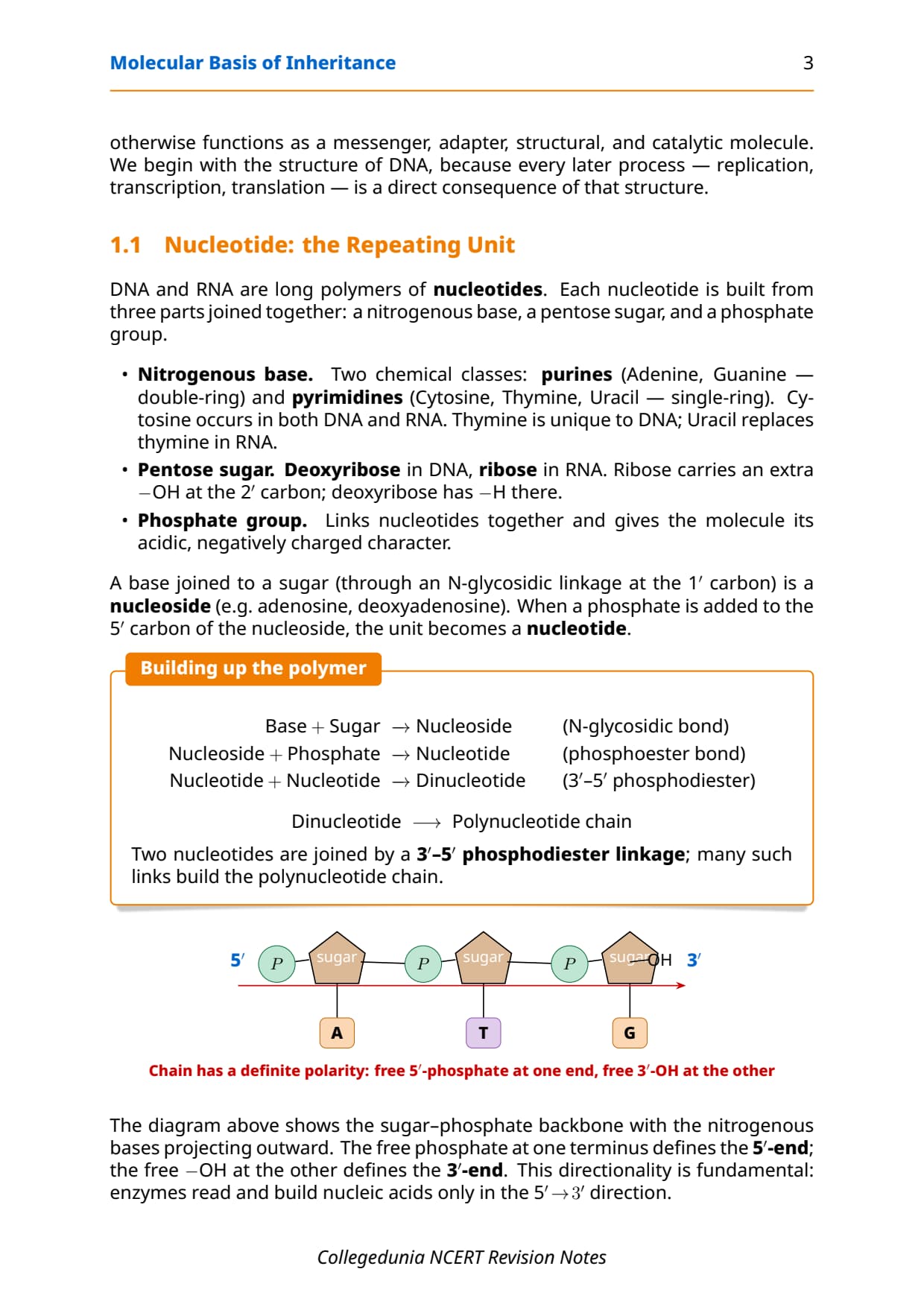
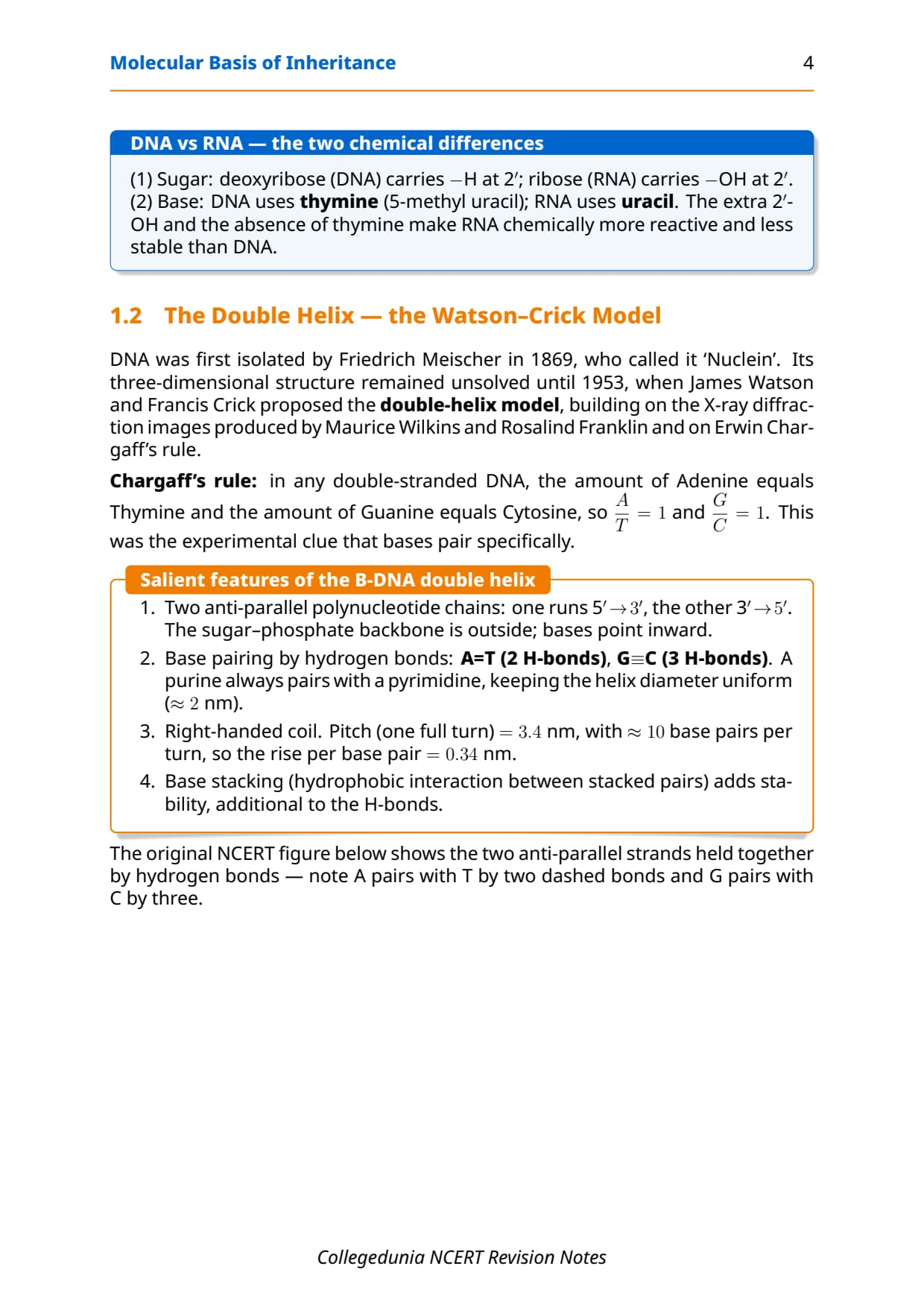
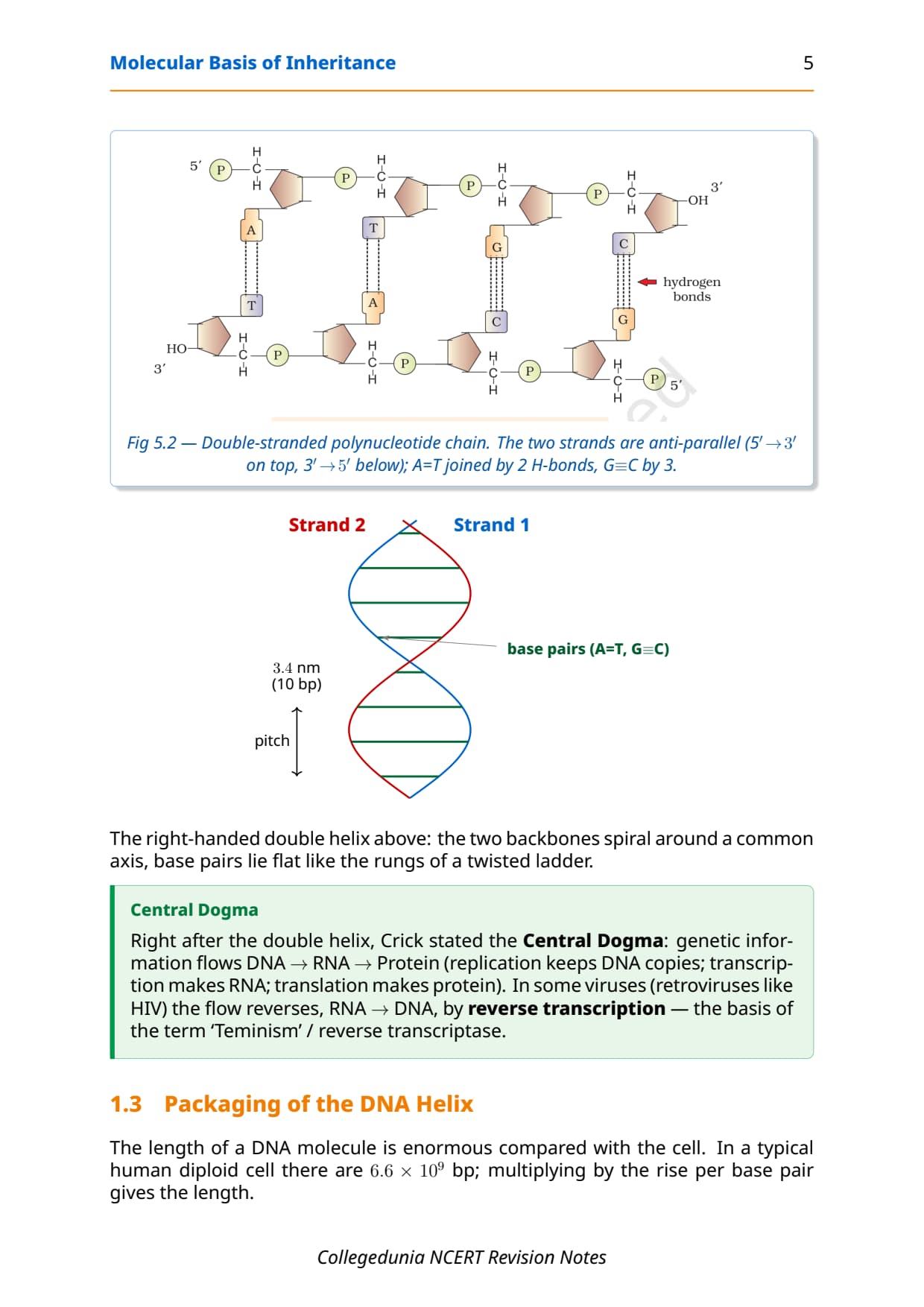
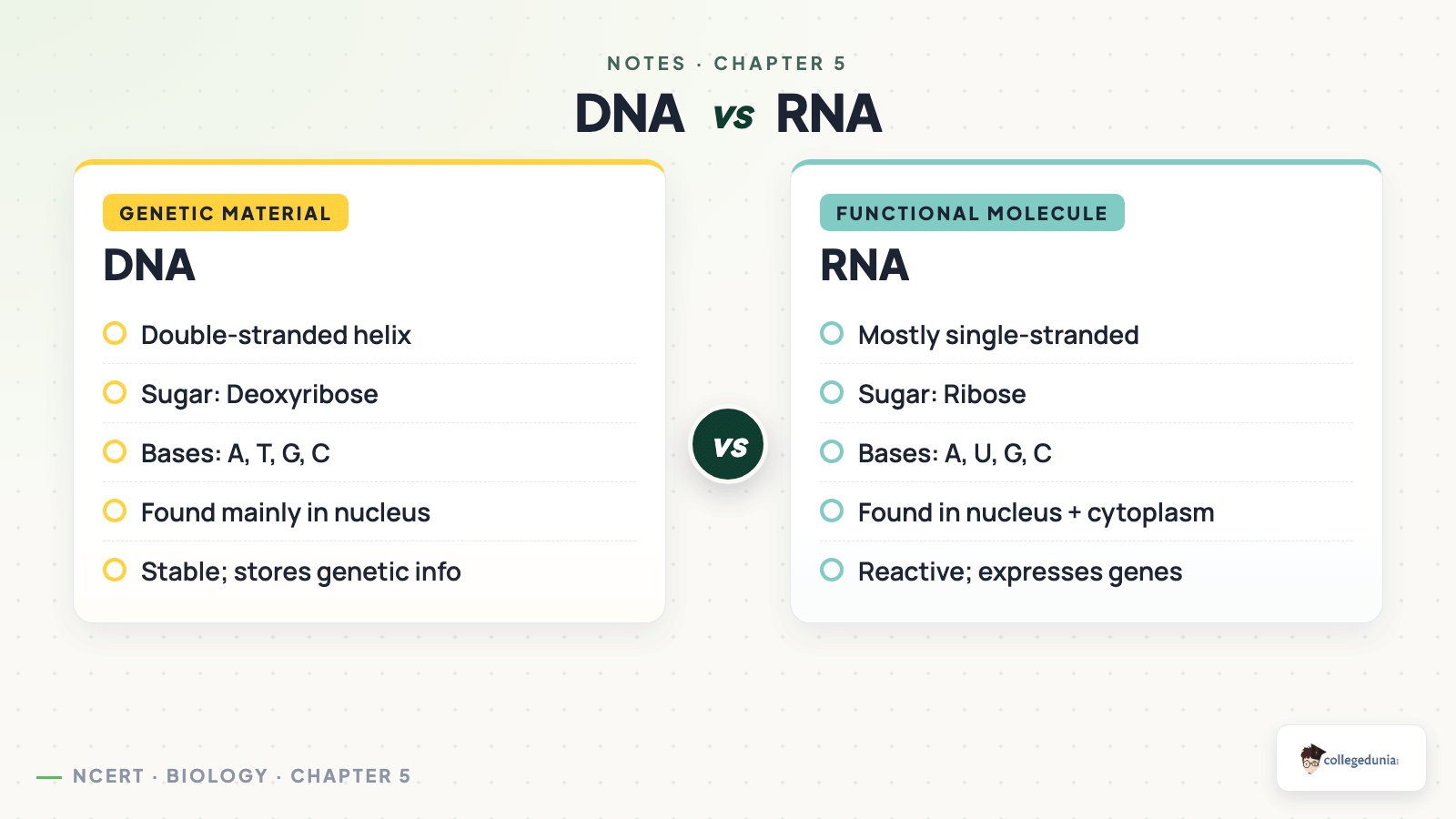
Each DNA nucleotide has a base, a deoxyribose sugar, and a phosphate. Two strands run antiparallel in a right-handed double helix. Chargaff's rule: adenine pairs thymine (two H-bonds), guanine pairs cytosine (three). One turn is 3.4 nm and holds 10 base pairs (0.34 nm apart), the most-asked NEET numerical.
Packaging of DNA: Nucleosome and Chromatin (Section 5.1)
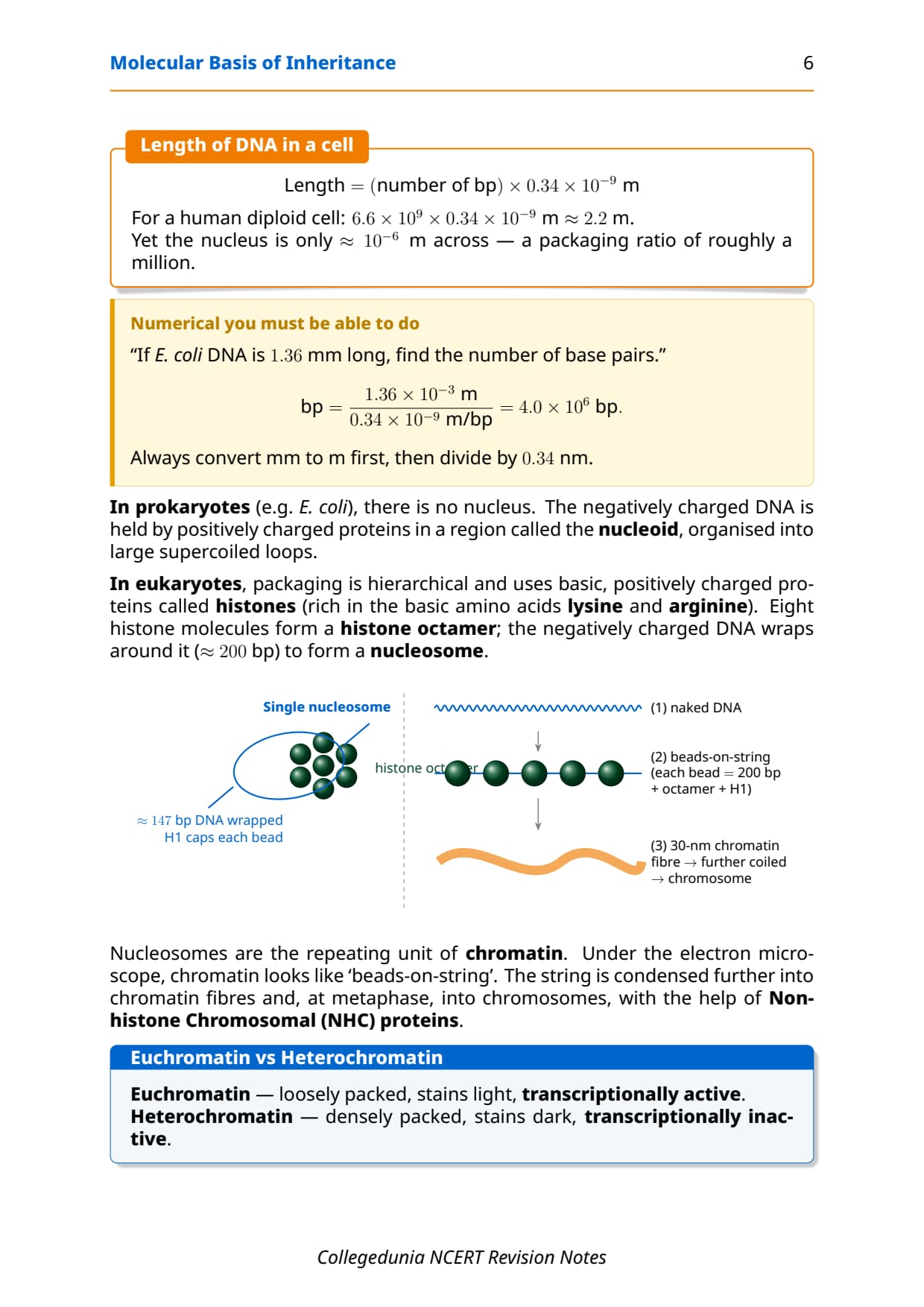
DNA wraps around a histone octamer to form a nucleosome, the repeating unit of chromatin. Euchromatin is loose and active; heterochromatin is dense and inactive.
The Search for Genetic Material (Section 5.2)
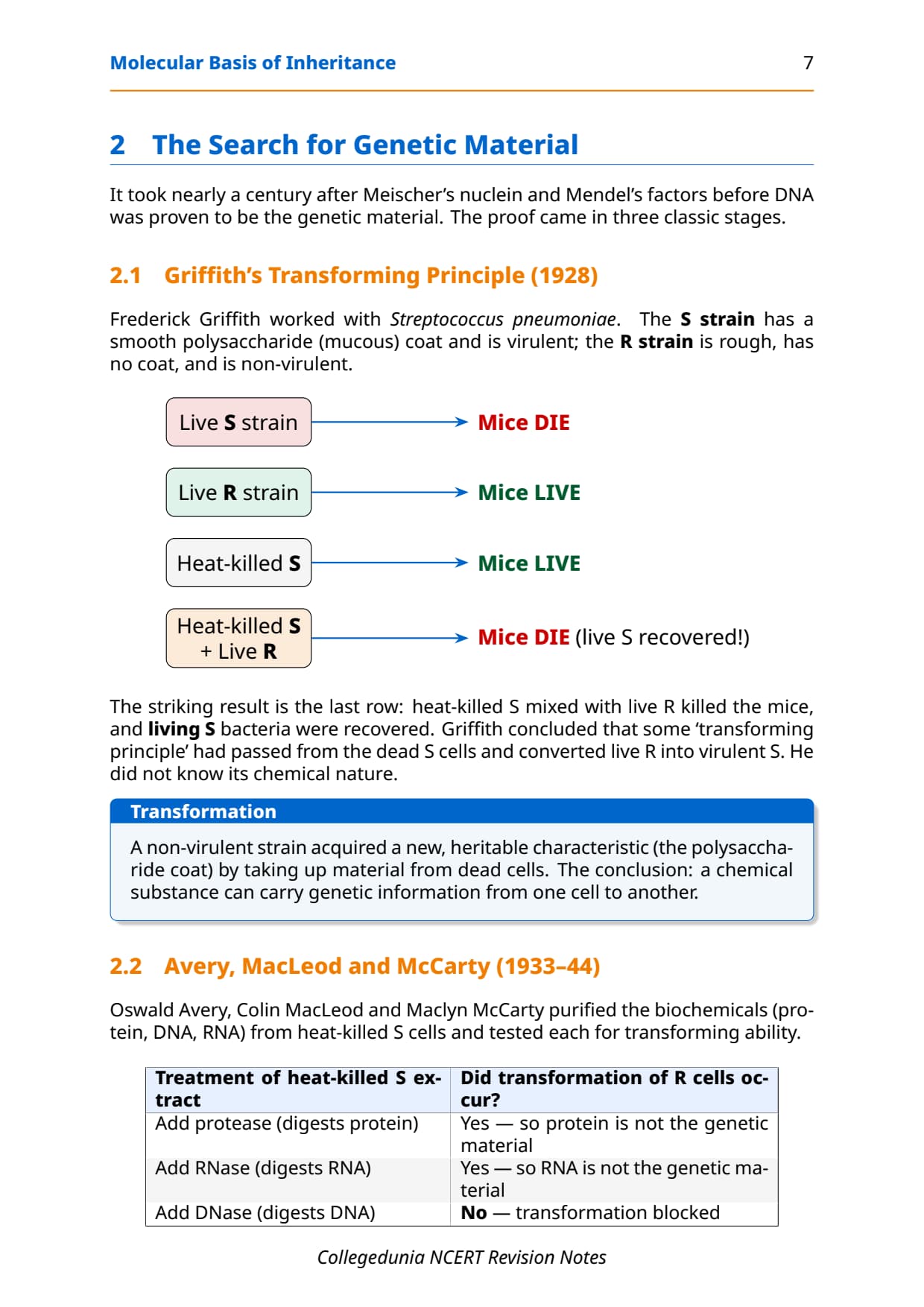
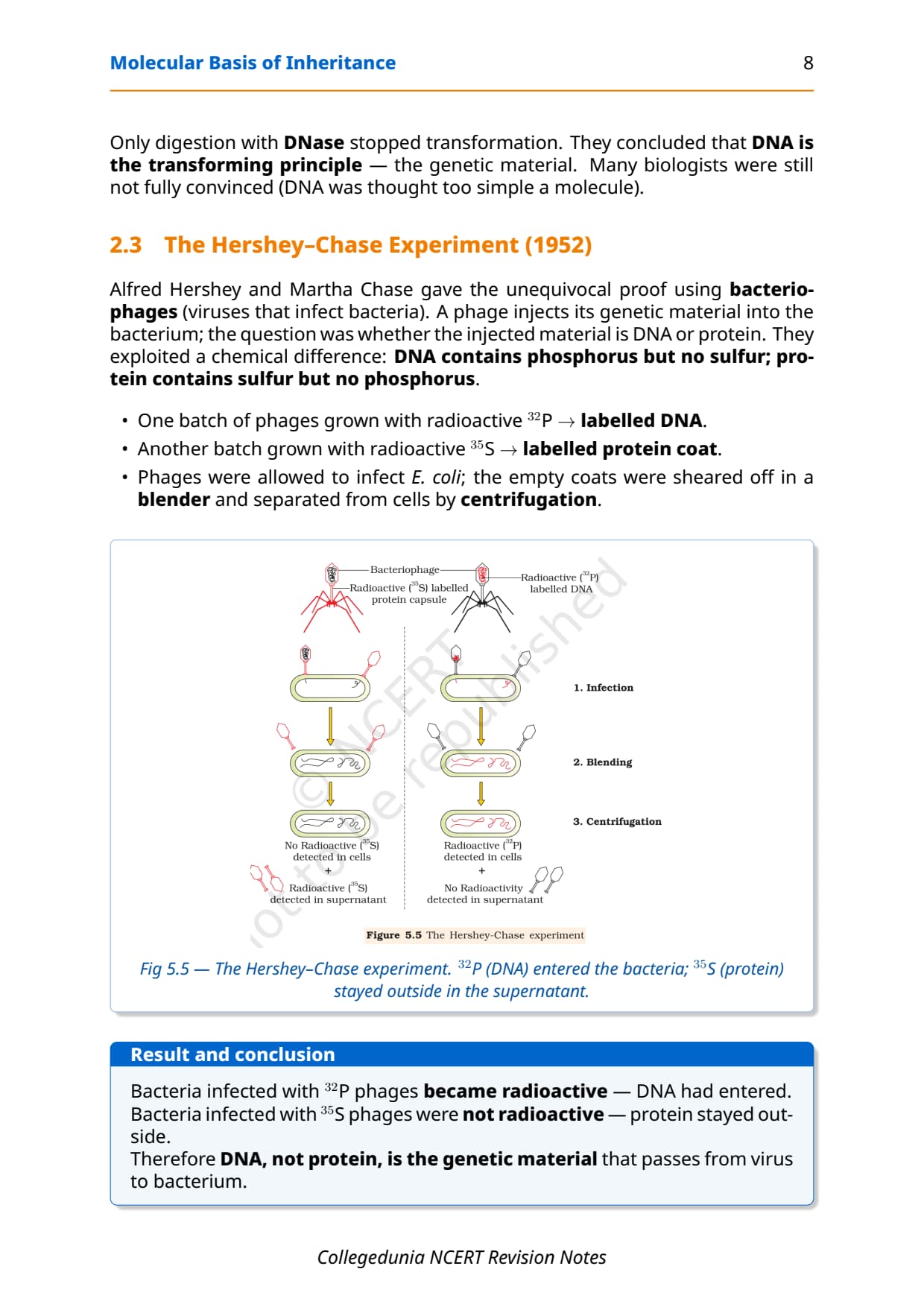
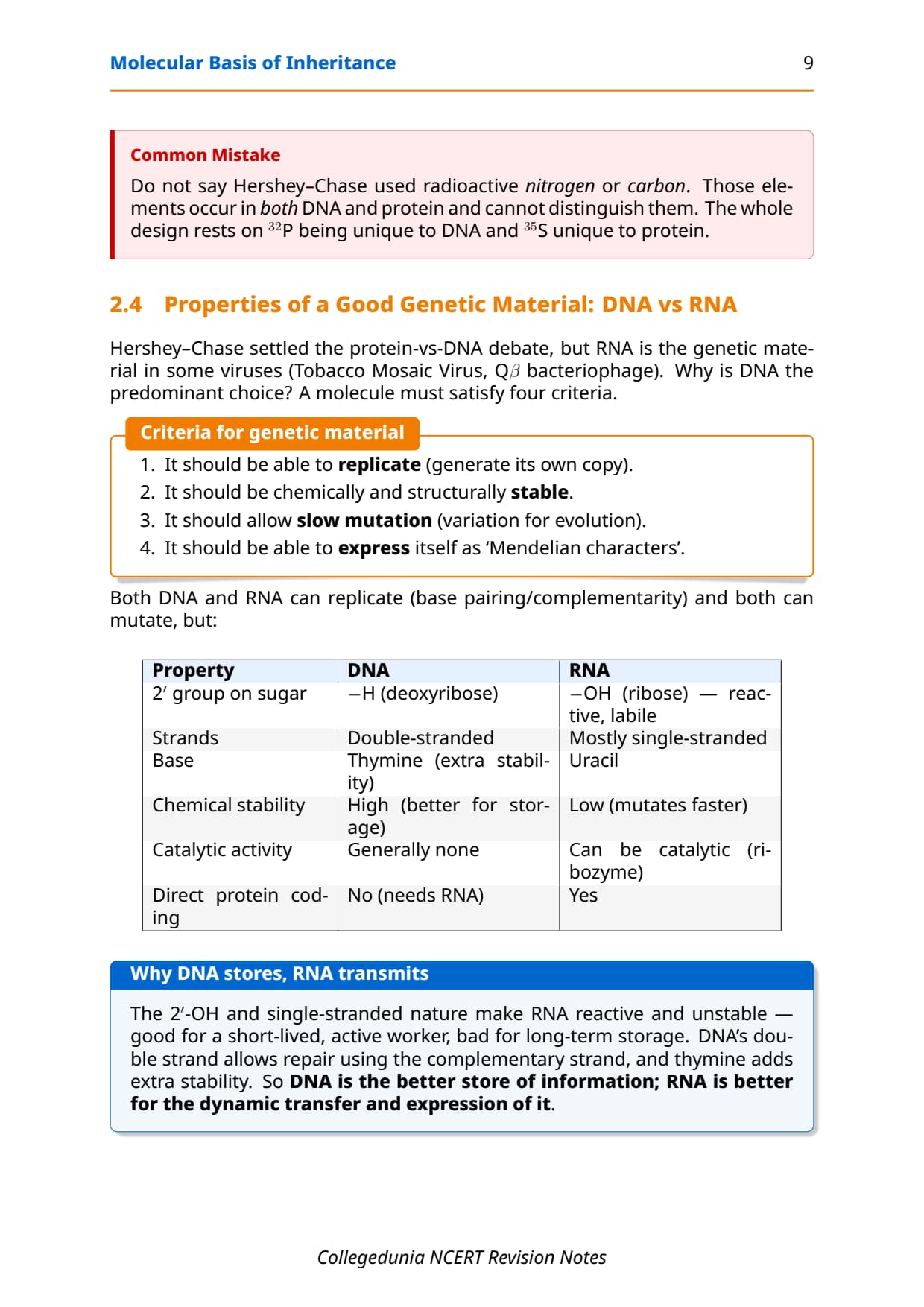
Four experiments proved DNA is the genetic material. Griffith showed a transforming principle in Streptococcus pneumoniae; Avery, MacLeod and McCarty identified it as DNA; and Hershey-Chase used 32P and 35S phage to show only DNA enters the bacterium.
RNA World and DNA as Genetic Material (Section 5.3)
RNA was likely the first genetic material, since it can both store information and act as a catalyst (ribozyme). DNA became the stable store: it resists damage, uses thymine, and repairs accurately.
DNA Replication: Semi-conservative Mechanism (Section 5.4)
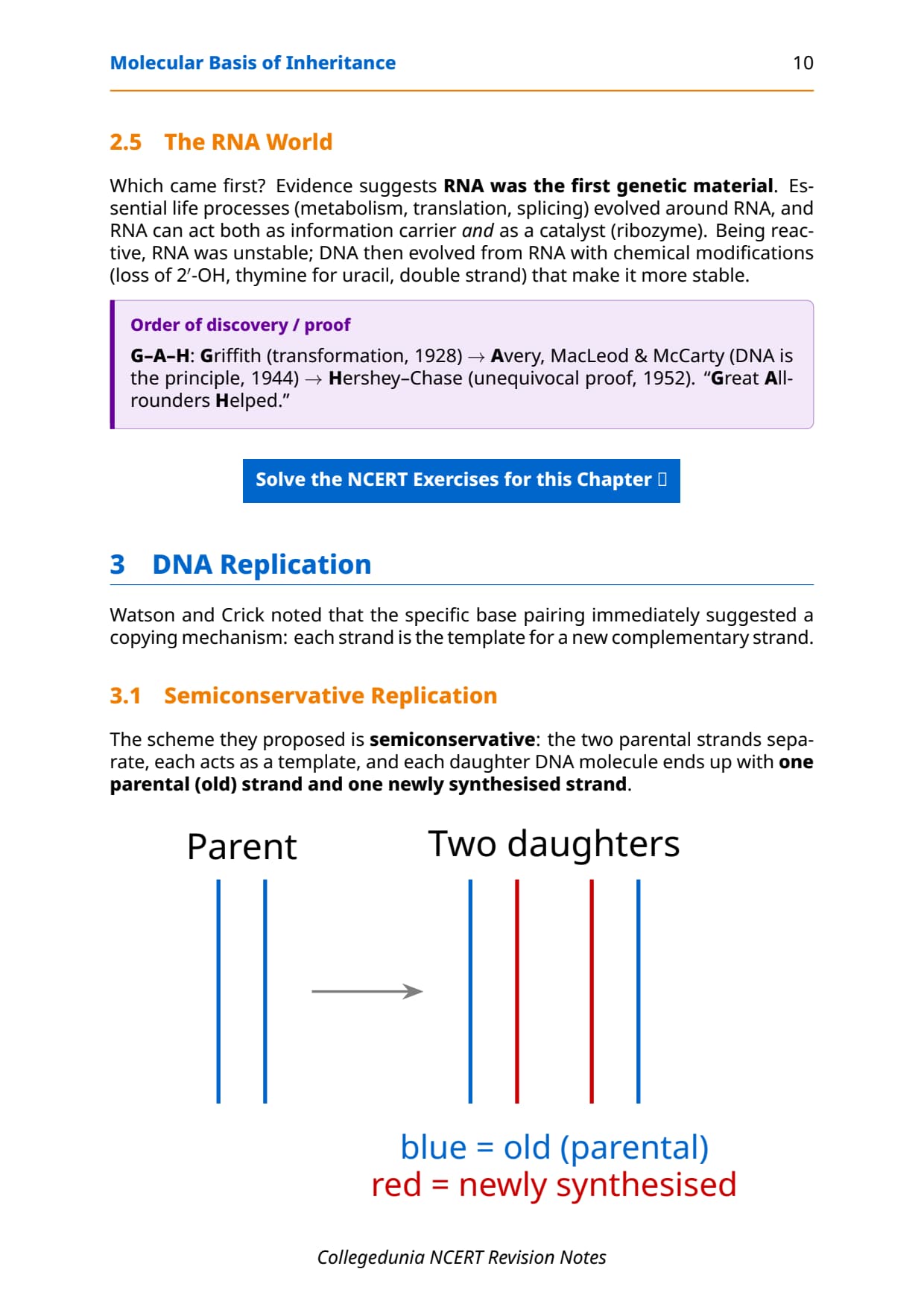
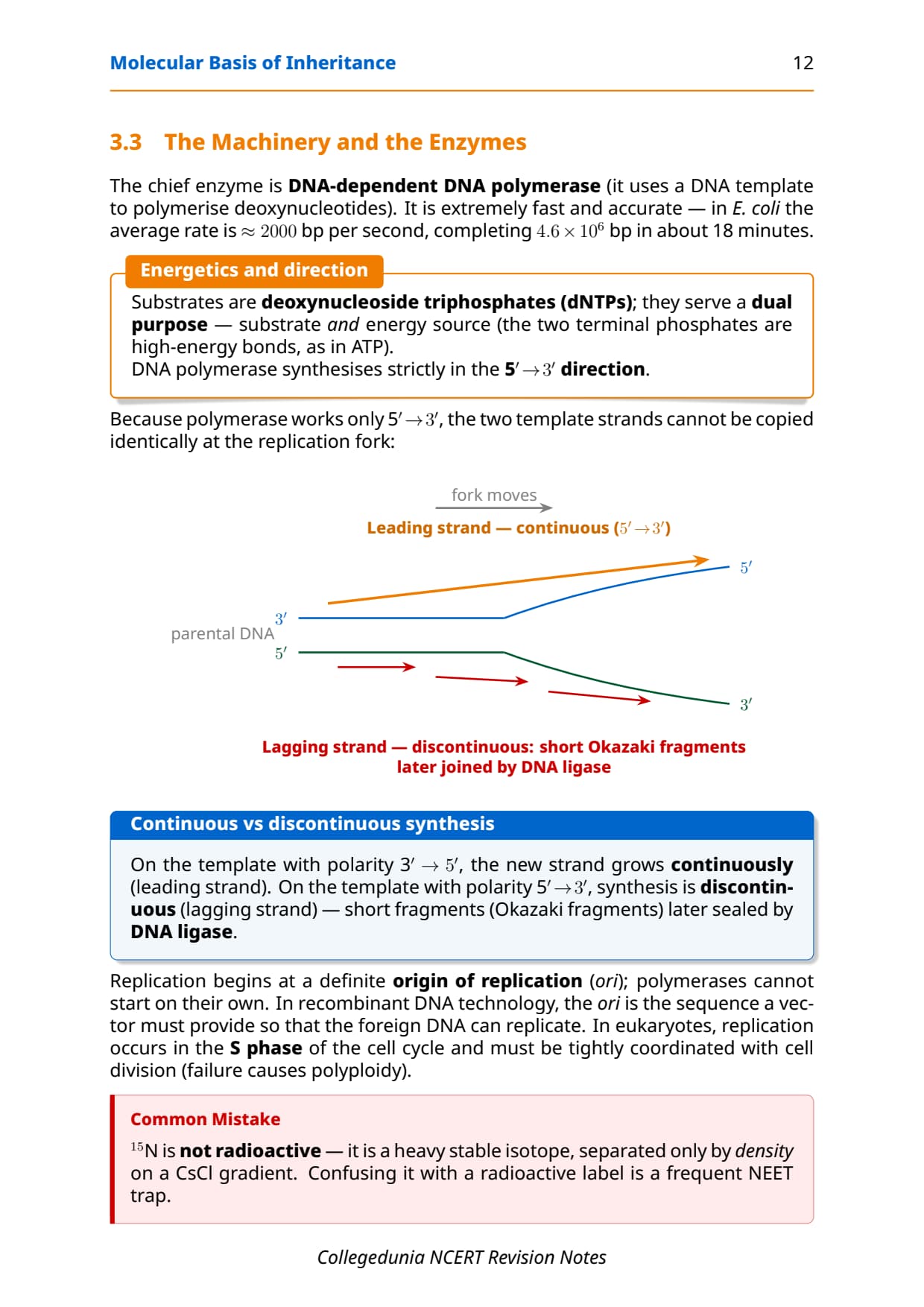
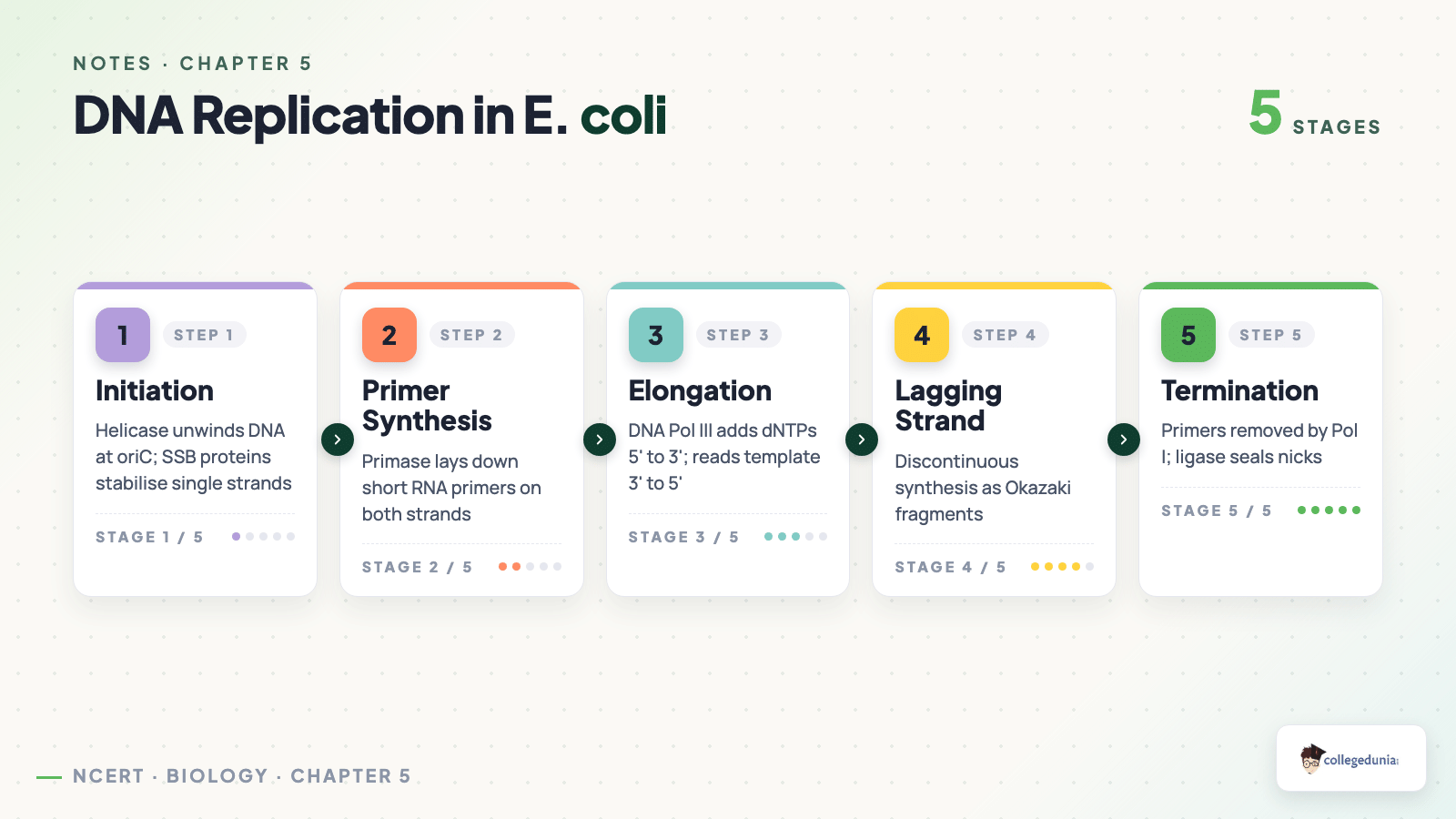
Replication is semi-conservative: each daughter DNA keeps one old and one new strand. Helicase unwinds the helix, DNA polymerase adds nucleotides 5' to 3', the leading strand grows continuously, and the lagging strand forms Okazaki fragments joined by DNA ligase. Meselson-Stahl on E. coli proved this, a guaranteed CBSE 5-marker.
Transcription: Making RNA from DNA (Section 5.5)
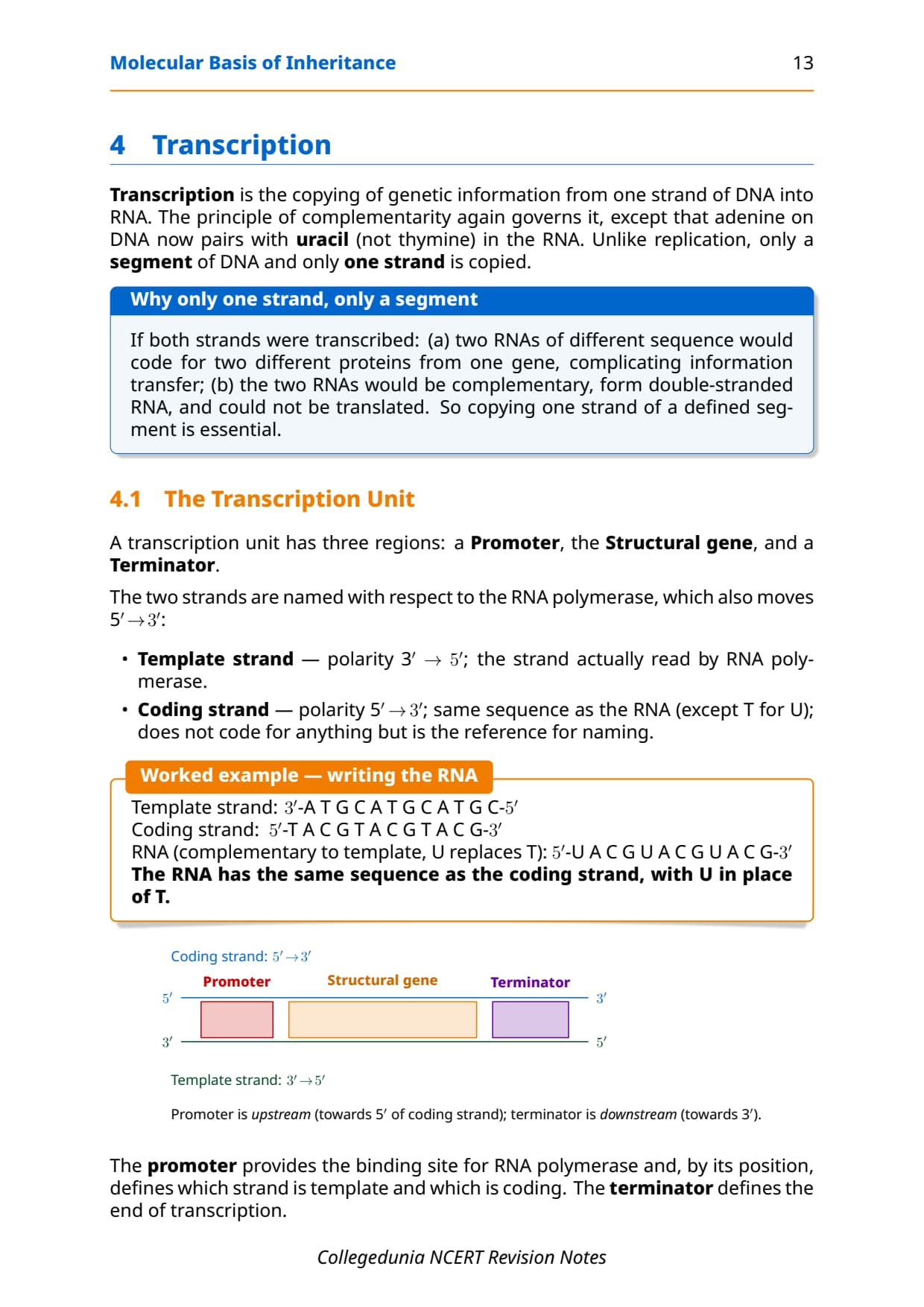
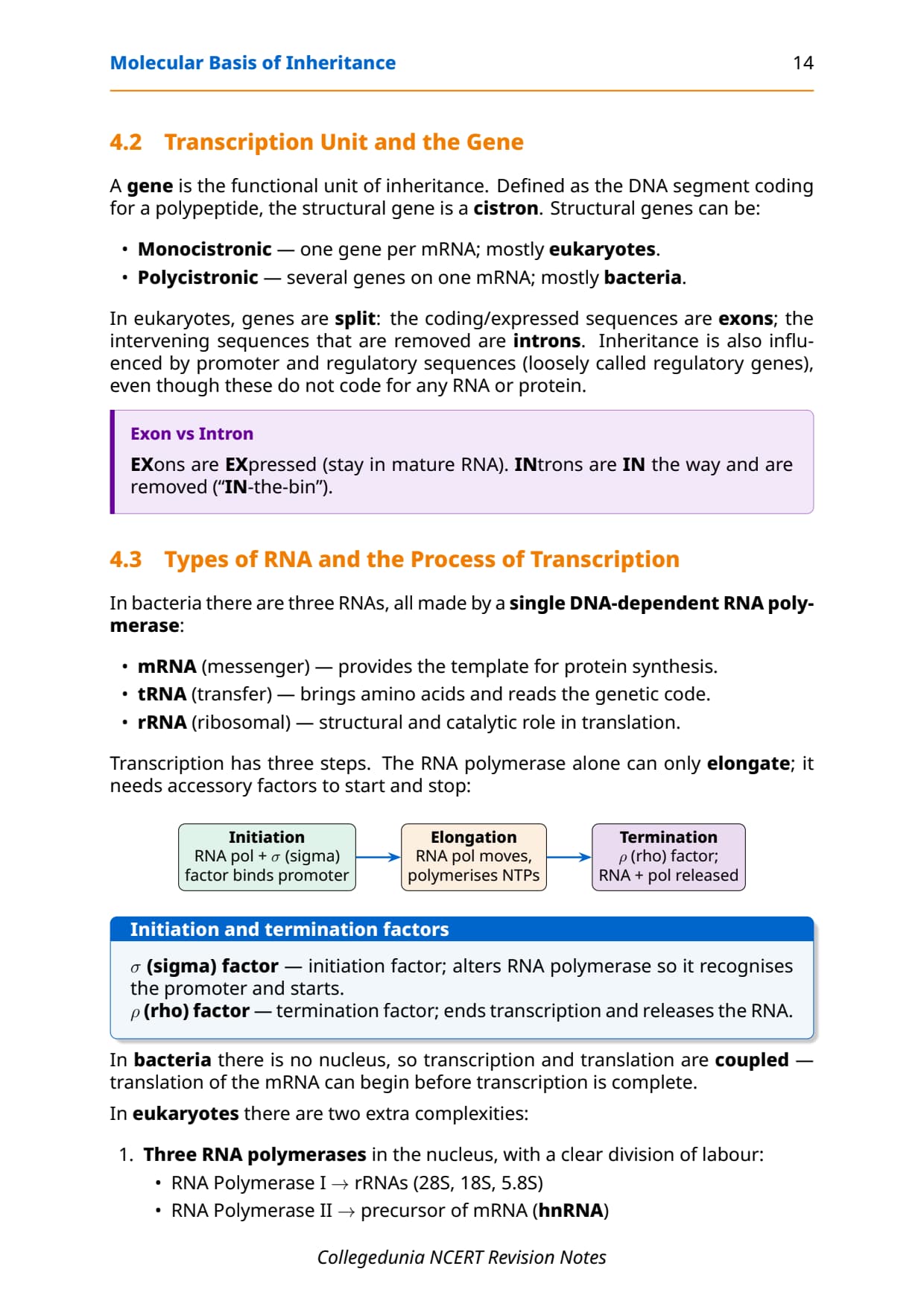
Transcription copies the template strand (3' to 5') into RNA; the coding strand matches the RNA except thymine replaces uracil. In eukaryotes the hnRNA is capped, tailed, and spliced into mRNA.
The Genetic Code (Section 5.6)
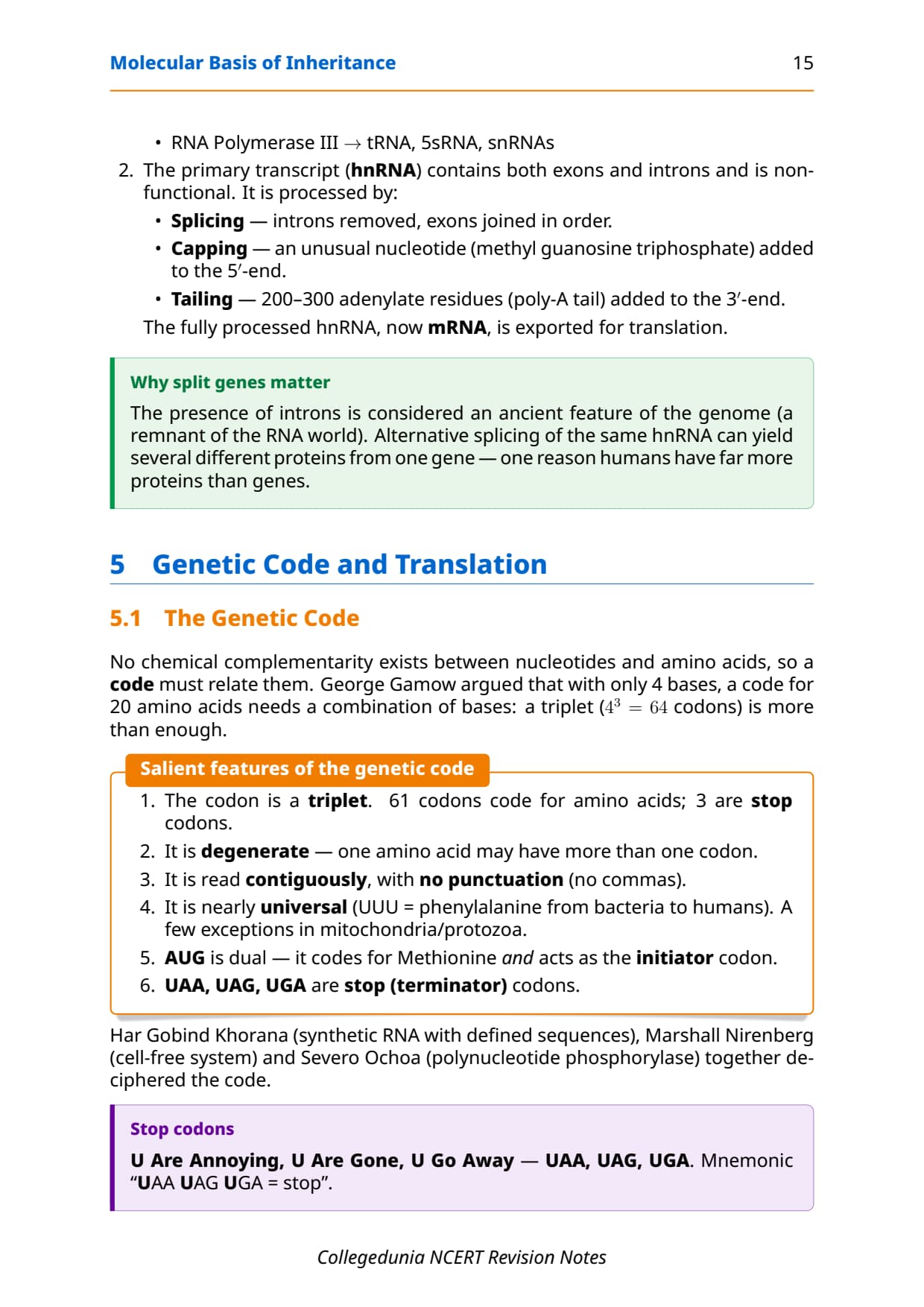
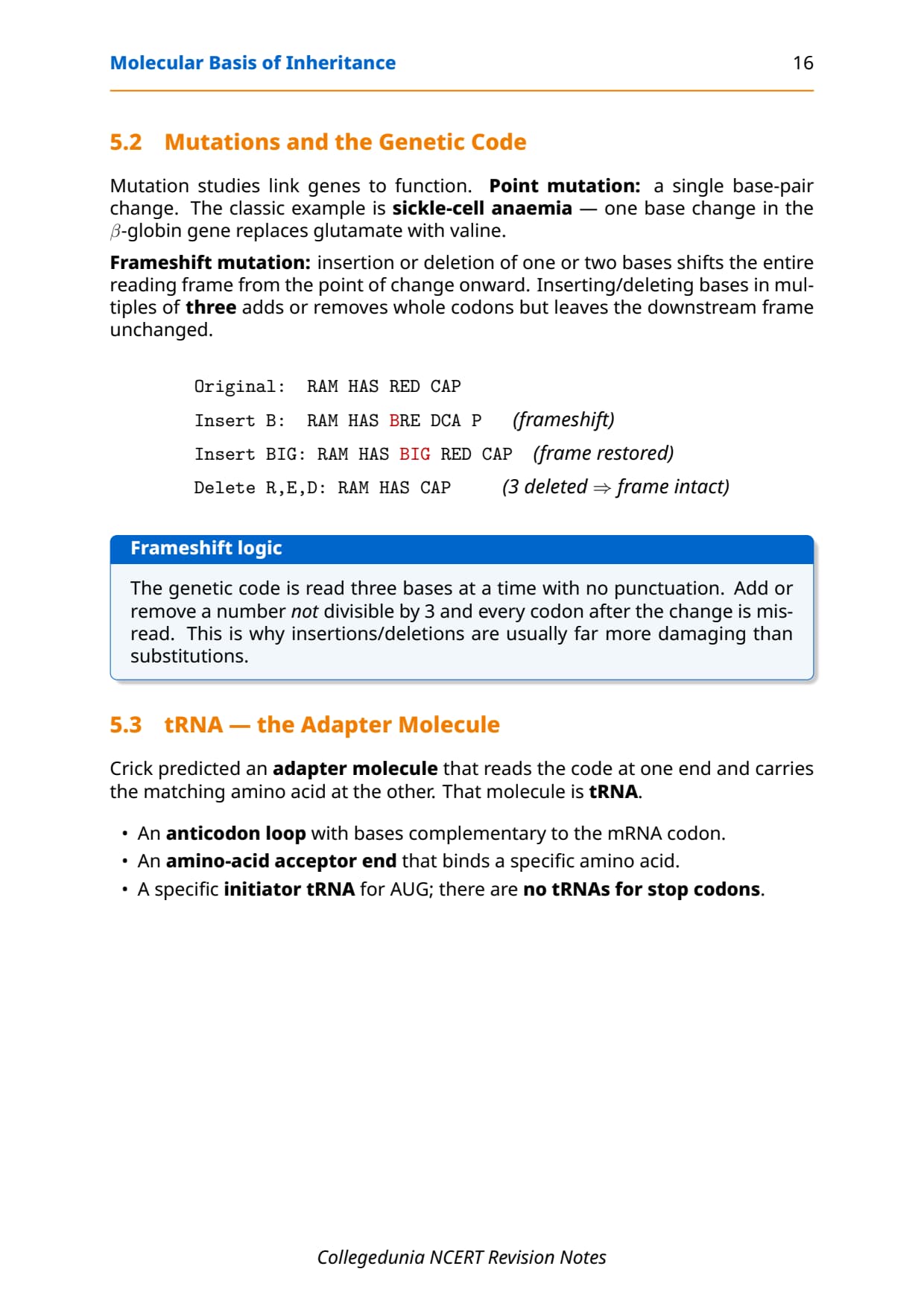
The code is read in triplet codons; 64 codons specify 20 amino acids. It is degenerate, non-overlapping and comma-less, and nearly universal, with AUG as start (also methionine) and UAA, UAG, UGA as stop. It is degenerate but never ambiguous: one codon codes for one amino acid. tRNA reads each codon through its anticodon.
Translation: Protein Synthesis (Section 5.7)
Translation builds protein on the ribosome in three phases: initiation at the start codon, elongation as aminoacyl-tRNAs add amino acids, and termination at the stop codon. The untranslated regions (UTRs) help translation but are not coded.
Regulation of Gene Expression: The Lac Operon (Section 5.8)
The lac operon has a promoter, an operator, a repressor gene (i), and three structural genes (z, y, a). Without lactose, the repressor blocks transcription. With lactose, allolactose inactivates the repressor, so the genes are transcribed and beta-galactosidase is made. It is negatively regulated and inducible, the most-tested gene-regulation topic in NEET.
Human Genome Project and DNA Fingerprinting (Sections 5.9 and 5.10)
The Human Genome Project (1990 to 2003) sequenced all 3.3 billion base pairs of human DNA, finding about 20,500 genes. DNA fingerprinting compares VNTRs via restriction digestion, electrophoresis, Southern blotting, and probe hybridisation, used in forensics and parentage testing.
Sub-Topic Weightage Map: Molecular Basis of Inheritance Class 12 Biology
The split below uses the last five CBSE and NEET papers to show where revision pays off.
| Sub-topic | Weightage | Frequency |
|---|---|---|
| DNA structure and the double helix | High | NEET 5 of last 5 |
| Replication and the Meselson-Stahl experiment | High | CBSE 5 of last 5 |
| Transcription and translation | High | CBSE 4 of last 5 |
| Lac operon and gene regulation | High | NEET 4 of last 5 |
| Search for genetic material (experiments) | Medium | CBSE 3 of last 5 |
| HGP and DNA fingerprinting | Medium | NEET 3 of last 5 |
Molecular Basis of Inheritance Important Derivations and Key Statements for Class 12 Boards
Biology has no algebraic derivations, but this chapter has experiments and facts you must reproduce from memory.
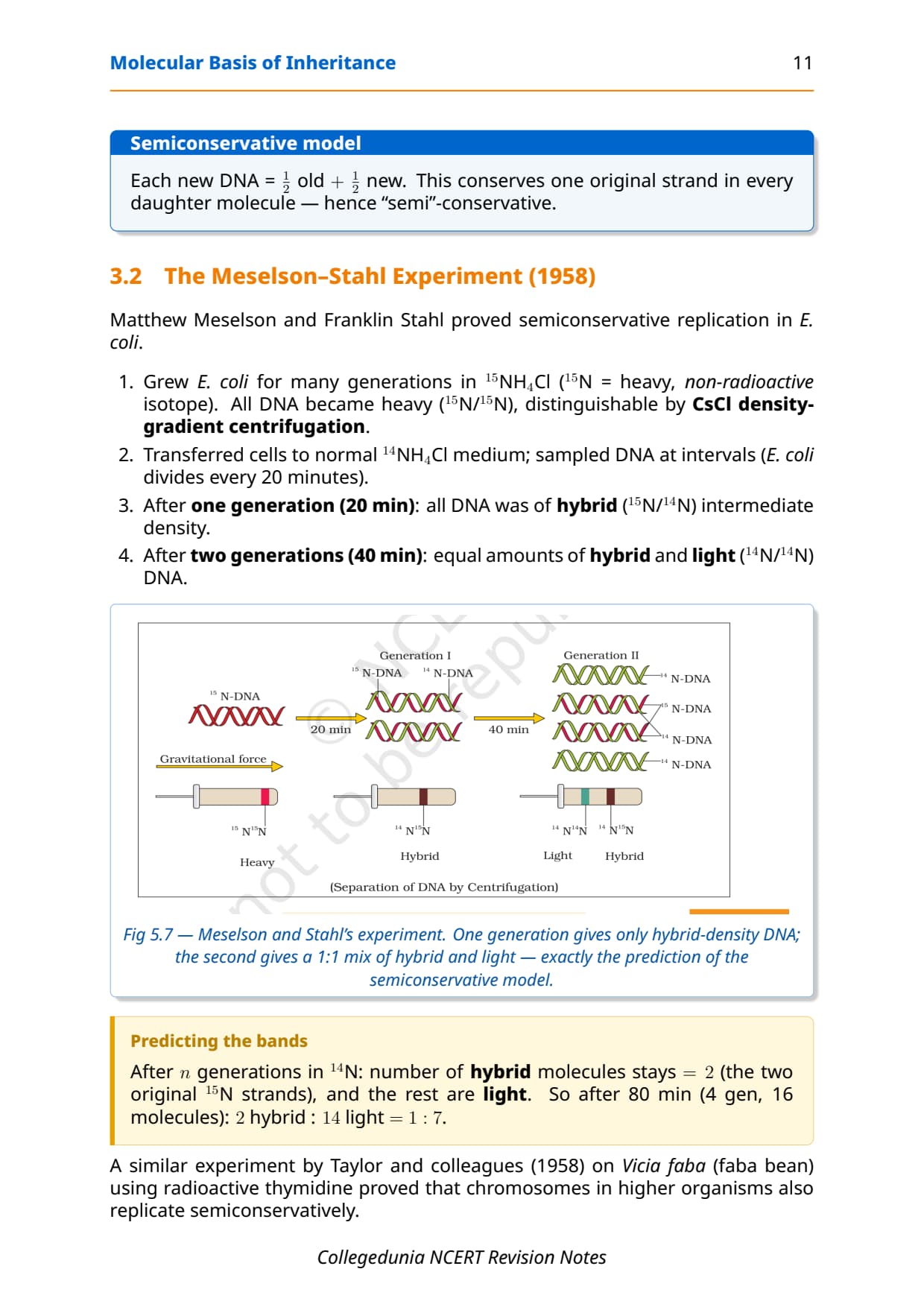
- Meselson-Stahl: proves semi-conservative replication via 15N/14N centrifugation. CBSE 2025, 2022.
- Hershey-Chase: proves DNA is the genetic material via 32P and 35S. CBSE 2024, NEET 2023.
- Lac operon: negative inducible regulation with and without lactose. CBSE 2025, NEET 2024.
Molecular Basis of Inheritance Glossary for Class 12 Biology
Term overlap (transcription vs translation) costs marks. This glossary fixes each term to one meaning.
| Term | One-Line Meaning |
|---|---|
| Nucleotide | A nitrogenous base plus a pentose sugar plus a phosphate group. |
| Nucleosome | DNA wrapped around a histone octamer, the repeating unit of chromatin. |
| Semi-conservative replication | Each new DNA keeps one old strand and one freshly made strand. |
| Okazaki fragments | Short DNA pieces made discontinuously on the lagging strand. |
| Codon | A triplet of mRNA bases that specifies one amino acid. |
| VNTR | Variable number tandem repeat used as a DNA fingerprinting marker. |
Most Repeated Molecular Basis of Inheritance Questions in CBSE Class 12 Boards (2025 to 2021)
The repeat set from the last five CBSE Boards, a useful target list.
- CBSE 2025 (5-mark): Describe the Meselson-Stahl experiment and how it proves semi-conservative replication.
- CBSE 2025 (3-mark): Explain the lac operon in the presence and absence of lactose.
- CBSE 2023 (5-mark): Describe Hershey-Chase and Griffith's experiments and their conclusions.
Common Misconceptions Students Hold About Molecular Basis of Inheritance
Wrong beliefs examiners exploit year after year.
- "The coding strand is transcribed." Wrong. The template strand (3' to 5') is read.
- "Replication is conservative." Wrong. It is semi-conservative; each daughter DNA keeps one parental strand.
- "The lac operon is positively regulated." Wrong. It is negatively regulated and inducible.
Real-World Applications of Molecular Basis of Inheritance (Beyond the Classroom)
An applied chapter; NEET assertion-reason items test these links.
- Forensic science: DNA fingerprinting establishes identity in criminal and disaster cases.
- Parentage testing: VNTR profiles confirm or exclude relationships.
- Medical genomics: Human Genome Project data drives disease-gene discovery and personalised medicine.
Class 12 Biology Molecular Basis of Inheritance Cross-Chapter Concept Map
This chapter links classical and applied genetics. Revise Chapter 4 Principles of Inheritance and Variation first, since mutation feeds into DNA as the genetic material. Read it before Chapter 9 and Chapter 10 Biotechnology, where restriction enzymes and PCR build on replication. The genetic code also supports Chapter 6 Evolution.
Student Feedback on Molecular Basis of Inheritance from a Class 12 Biology Survey
In a survey of 13,400 Class 12 Biology students, the lac operon was rated the hardest sub-topic.
Student Feedback
- 76% of students marked the lac operon mechanism as the hardest sub-topic.
- 64% lost 1-2 marks on the Meselson-Stahl replication proof.
- Average student took 7.6 hours for the first read.
Source: 2025-26 Class 12 Biology student survey, 13,400 students.
Other Resources for Molecular Basis of Inheritance Class 12 Biology
| Resource | Link |
|---|---|
| Notes | Molecular Basis of Inheritance Notes |
| NCERT Solutions | Molecular Basis of Inheritance NCERT Solutions |
| Handwritten Notes | Molecular Basis of Inheritance Handwritten Notes |
| Formula Sheet | Molecular Basis of Inheritance Formula Sheet |
| NCERT Book PDF | Molecular Basis of Inheritance NCERT Book PDF |
| Exemplar Solutions | Molecular Basis of Inheritance Exemplar Solutions |
| Exemplar Book PDF | Molecular Basis of Inheritance NCERT Exemplar Book PDF |
NCERT Notes for Class 12 Biology: All Chapters
Links to the rest of the Class 12 Biology notes.
| Chapter No. | Chapter Notes |
|---|---|
| Chapter 1 | Sexual Reproduction in Flowering Plants Notes |
| Chapter 2 | Human Reproduction Notes |
| Chapter 3 | Reproductive Health Notes |
| Chapter 4 | Principles of Inheritance and Variation Notes |
| Chapter 5 | Molecular Basis of Inheritance Notes |
| Chapter 6 | Evolution Notes |
| Chapter 7 | Human Health and Disease Notes |
| Chapter 8 | Microbes in Human Welfare Notes |
| Chapter 9 | Biotechnology Principles and Processes Notes |
| Chapter 10 | Biotechnology and Its Applications Notes |
| Chapter 11 | Organisms and Populations Notes |
| Chapter 12 | Ecosystem Notes |
| Chapter 13 | Biodiversity and Conservation Notes |
Molecular Basis of Inheritance Class 12 Biology Notes FAQs
Ques. Where can I download the Molecular Basis of Inheritance Class 12 Biology Notes PDF?
Ans. You can download the molecular basis of inheritance class 12 notes PDF directly from this page. Both the Normal and HD versions are available, and both are free.
Ques. Are these molecular basis of inheritance class 12 notes aligned with the 2026-27 NCERT?
Ans. Yes. These notes reflect the current 2026-27 NCERT for Class 12 Biology Chapter 5. DNA and RNA structure, the search for genetic material, replication, transcription, the genetic code, translation, regulation of gene expression, the Human Genome Project, and DNA fingerprinting are all retained in the new edition.
Ques. How many pages is the Class 12th Biology Molecular Basis of Inheritance Notes PDF?
Ans. The Notes PDF runs about 28 pages and covers the DNA double helix and nucleosome packaging, the four genetic-material experiments, semi-conservative replication, transcription, the genetic code, translation, the lac operon, the Human Genome Project, and DNA fingerprinting, plus a quick-revision strip.
Ques. What is the central dogma of molecular biology?
Ans. The central dogma states that genetic information flows from DNA to RNA to protein. DNA is first transcribed into messenger RNA, and the mRNA is then translated into a protein on the ribosome. The reverse flow, from RNA back to DNA, occurs only in retroviruses through the enzyme reverse transcriptase and is the recognised exception to the central dogma.
Ques. What is semi-conservative DNA replication and how was it proved?
Ans. Semi-conservative replication means each new DNA molecule keeps one parental strand and gains one newly synthesised strand. It was proved by Meselson and Stahl in 1958, who grew E. coli in heavy nitrogen (15N) and then shifted it to normal nitrogen (14N). After one generation all DNA was of intermediate (hybrid) density, and after two generations there was an equal mix of hybrid and light DNA, exactly as predicted by a semi-conservative mechanism.
Ques. What are the salient features of the genetic code?
Ans. The genetic code is read as triplet codons; it is degenerate, meaning more than one codon can code for the same amino acid; it is non-overlapping and comma-less; it is nearly universal across organisms; and it has a fixed start codon, AUG, which also codes for methionine, and three stop codons, UAA, UAG, and UGA. The code is degenerate but never ambiguous, since one codon always specifies only one amino acid.
Ques. How does the lac operon regulate gene expression?
Ans. The lac operon is a negatively regulated inducible system. In the absence of lactose, the repressor protein binds the operator and stops RNA polymerase from transcribing the structural genes. When lactose is present, allolactose acts as an inducer and binds the repressor, changing its shape so it can no longer bind the operator. RNA polymerase then transcribes the z, y, and a genes, and the enzymes for lactose metabolism, including beta-galactosidase, are produced.
Ques. Are these notes enough for NEET preparation in Molecular Basis of Inheritance?
Ans. Yes. The notes cover the full NCERT plus the NEET-only depth this chapter needs: the complete lac operon switching logic, the enzyme inventory for replication and transcription, the salient features of the genetic code, and the quantitative DNA facts examiners reuse. Combined with the chapter glossary, the key-statement checklist, and the year-wise PYQ map on the Solutions page, the notes match the depth NEET tests, where this is the most-asked Class 12 Biology chapter.



Comments