




The 2026-27 NCERT keeps Class 12 Biology Chapter 4 Principles of Inheritance and Variation intact, from Mendel's laws to sex determination, mutation, and genetic disorders. It is the foundation chapter of the Genetics and Evolution unit and a high-yield NEET chapter. These principles of inheritance and variation class 12 notes condense every cross and disorder into one revision PDF on this page.
- CBSE Weightage: 6 to 8 marks (Unit VII, Genetics and Evolution)
- NEET Weightage: 4 to 6 questions per year (one of the highest-yield Biology chapters)
- CUET/AIIMS MCQs: ratios, blood groups, and genetic disorders are repeat favourites
The PDF carries the full principles of inheritance and variation class 12 notes, with Punnett squares, the ABO blood-group table, and sex-determination charts, aligned to the 2026-27 syllabus.
Principles of Inheritance and Variation Video Lecture for Class 12 Biology
Source: Magnet Brains on YouTube
Why Principles of Inheritance and Variation Is a NEET High-Yield Class 12 Chapter
This chapter feeds the whole NEET genetics block plus a guaranteed CBSE problem. NEET sets 4 to 6 questions each year on ratios, blood groups, linkage, sex determination, and pedigree analysis. Lock it down and you bank 16 to 24 marks across both exams.
How will Collegedunia's Principles of Inheritance and Variation Class 12 Notes Help You?
The notes serve two students: a CBSE student needing a cross-based numerical, and a NEET aspirant needing every ratio at hand.
- 2026-27 NCERT Alignment: every section retained, Mendel's laws to genetic disorders.
- Cross-Solving Built In: each Punnett square is drawn step by step, so 3:1, 9:3:3:1, and test-cross ratios become automatic.
- NEET Extras: multiple-allele depth on ABO, lethal-gene shifts, and a Mendelian versus chromosomal disorder table.
Most Repeated Principles of Inheritance and Variation Questions in CBSE Class 12 Boards (2025 to 2021)
High-confidence repeats from the last five CBSE Boards.
- CBSE 2025 (5-mark): work a dihybrid cross to F2 and explain independent assortment.
- CBSE 2024 (3-mark): explain incomplete dominance with the Mirabilis jalapa cross.
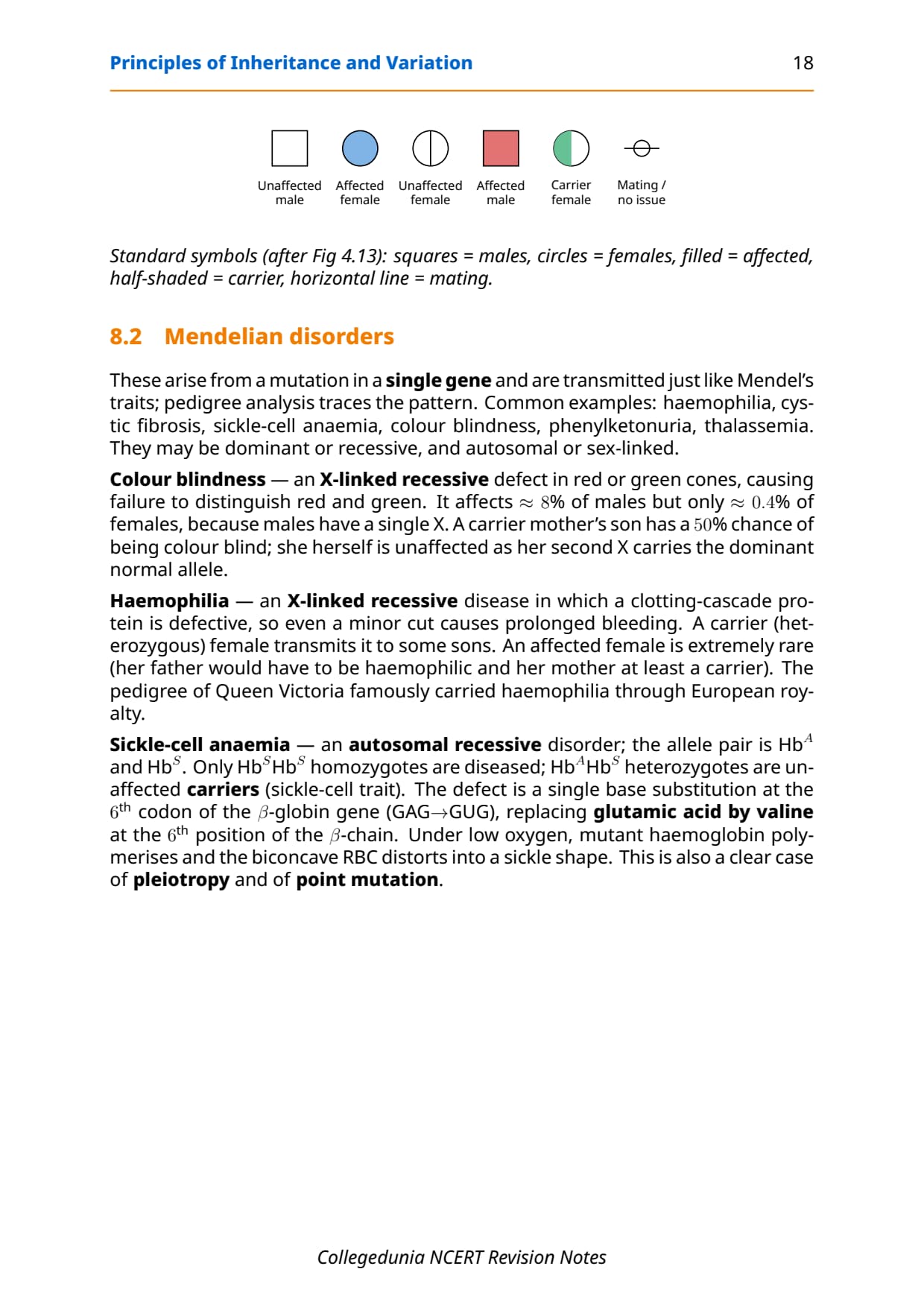
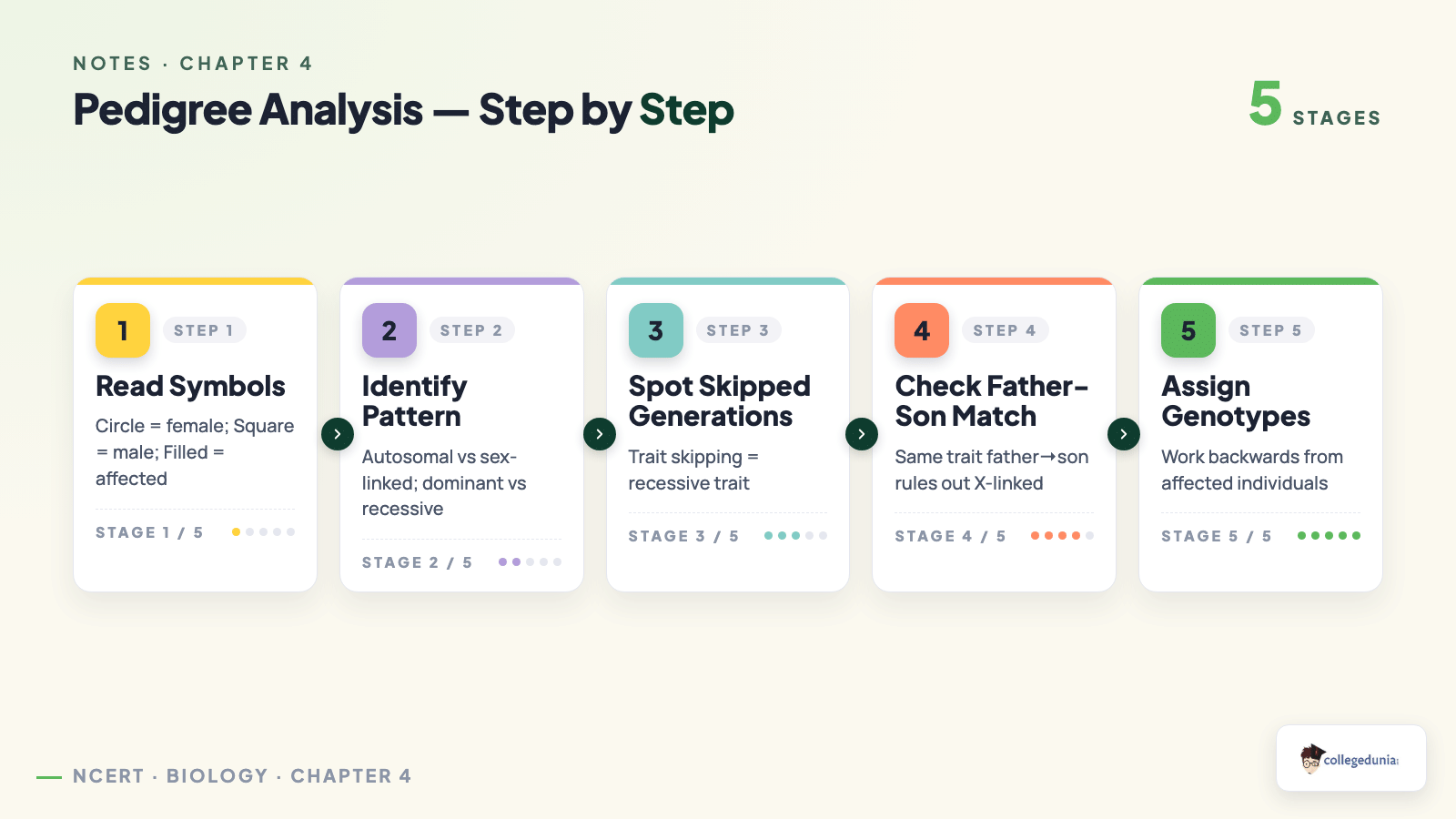
- CBSE 2023 (3-mark): draw and read a pedigree for an autosomal recessive trait.
- CBSE 2022 (5-mark): describe ABO blood grouping as multiple alleles and co-dominance.
- CBSE 2021 (3-mark): distinguish Down's, Klinefelter's, and Turner's syndromes.
Principles of Inheritance and Variation Glossary for Class 12 Biology
Term overlap is where MCQs catch students out; each term below has one precise meaning.
| Term | One-Line Meaning |
|---|---|
| Genotype / Phenotype | Genetic make-up (Tt) versus the observed trait (tall). |
| Homozygous / Heterozygous | Identical alleles (TT, tt) versus different alleles (Tt). |
| Test cross | Cross with homozygous recessive to reveal an unknown genotype. |
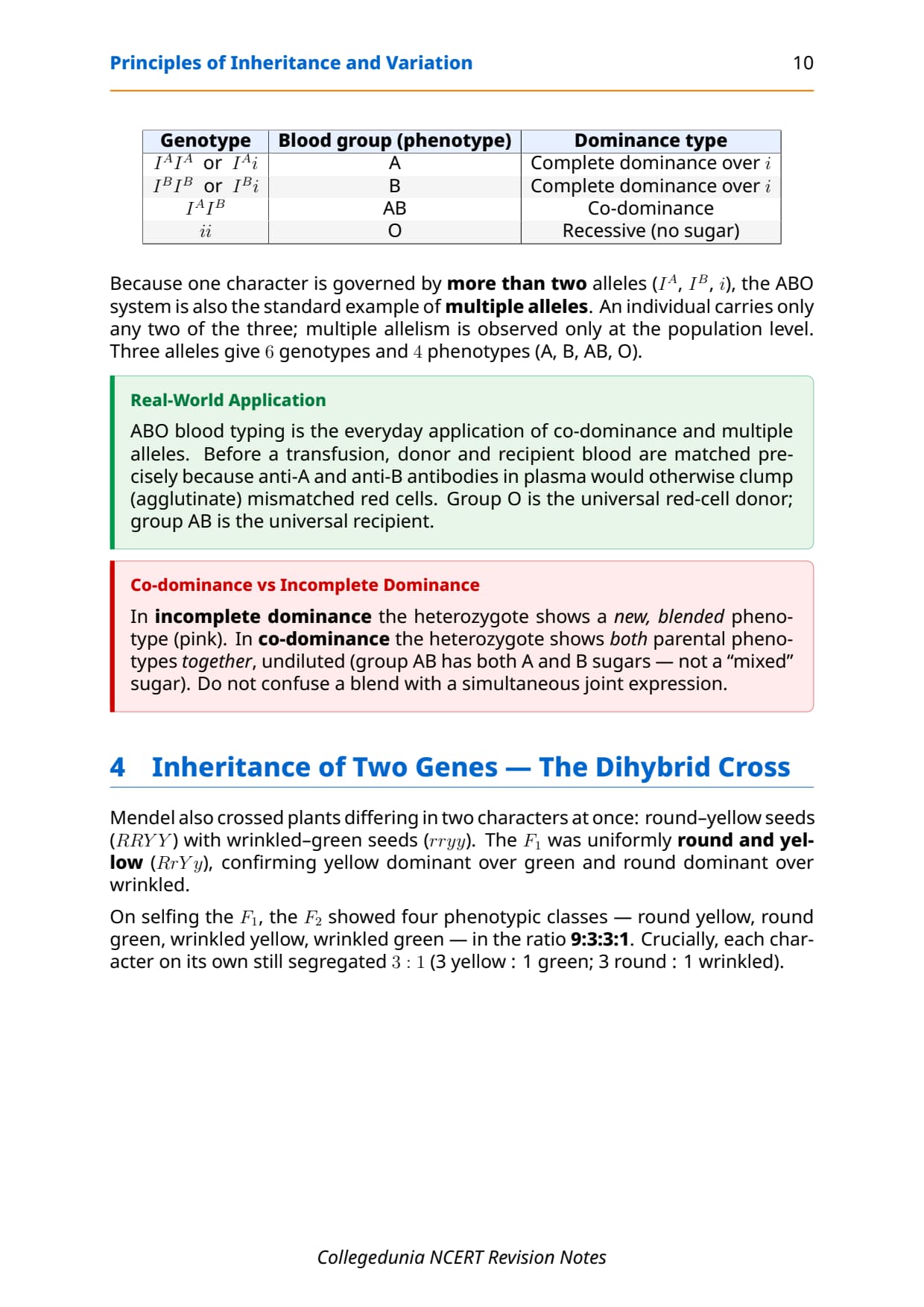
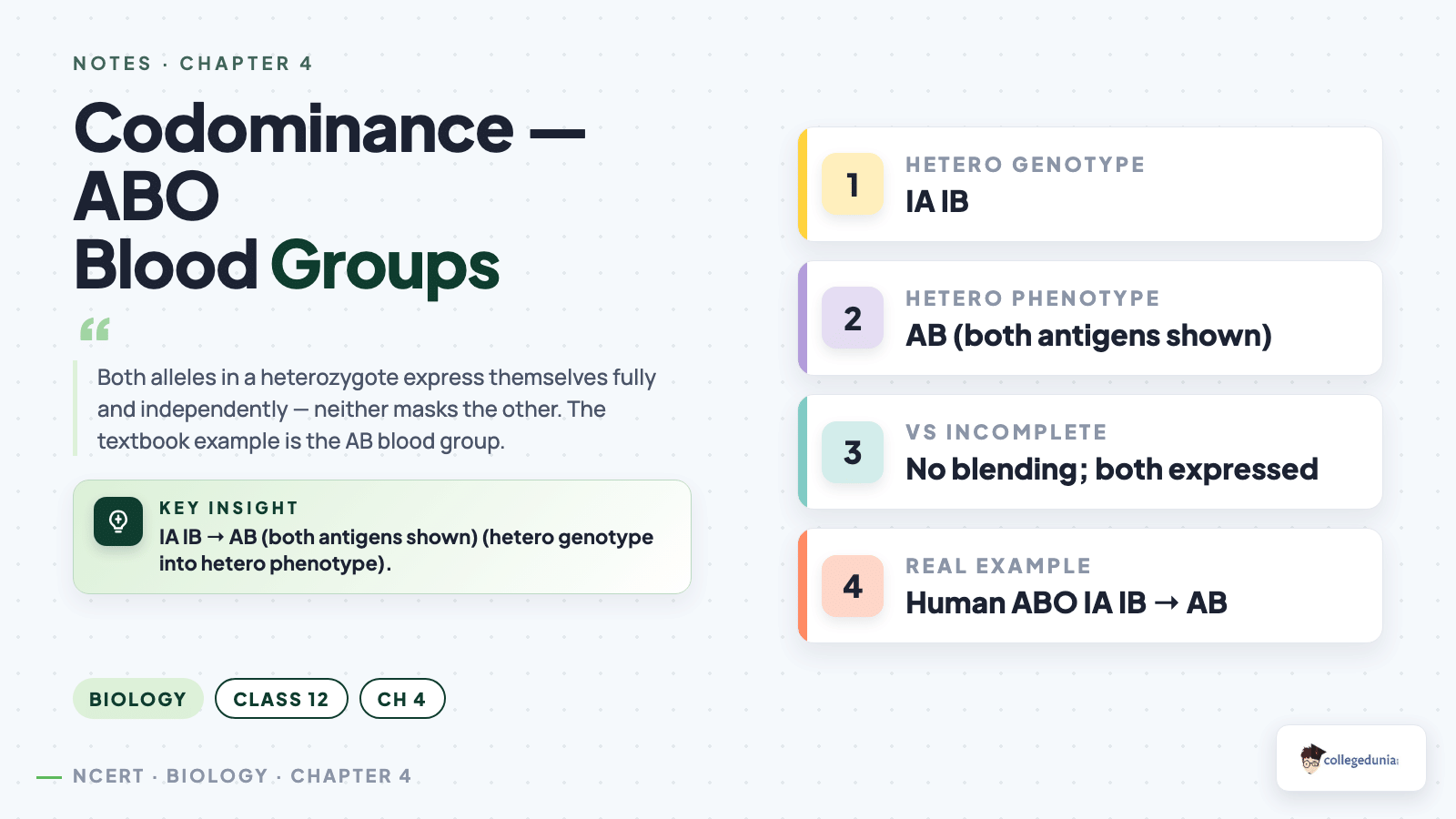
| Co-dominance | Both alleles express fully (AB blood group). |
| Aneuploidy | Gain or loss of a single chromosome (trisomy 21). |
Principles of Inheritance and Variation Topic-by-Topic Notes for Class 12 Biology
Mendel's Laws (Section 4.1)
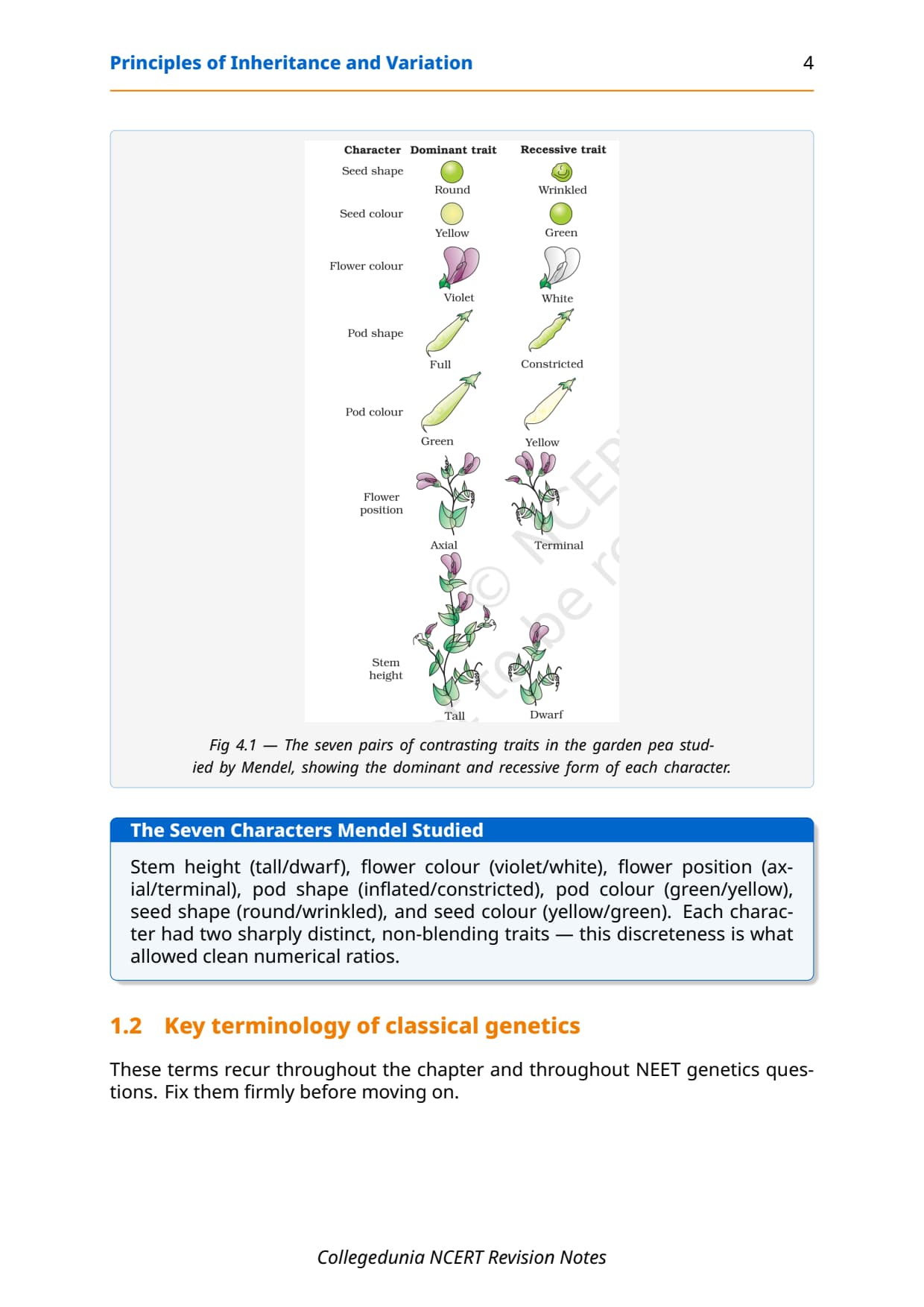
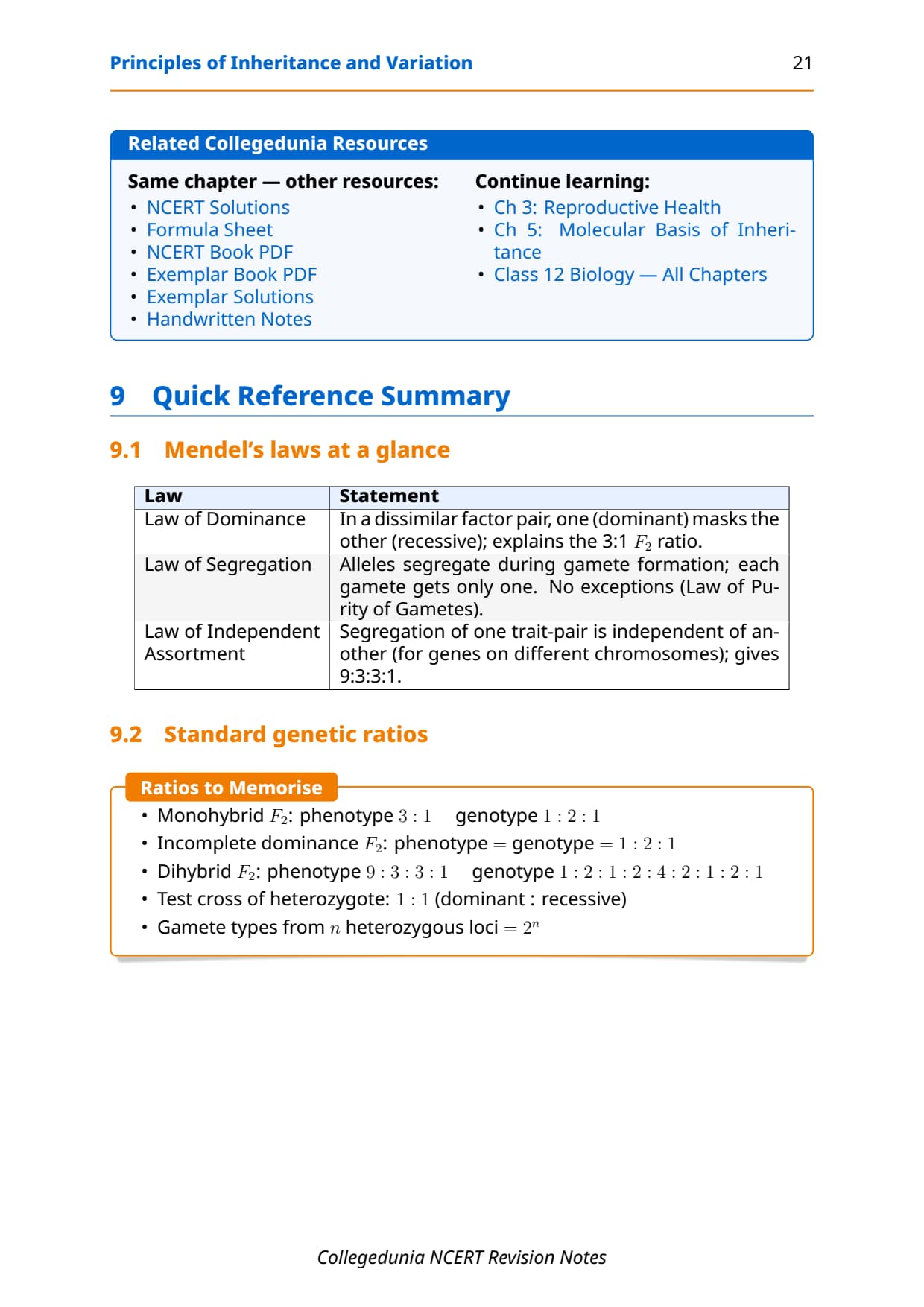
Mendel used the pea Pisum sativum with seven contrasting characters. Dominance: in a heterozygote the dominant allele shows, the recessive is masked. Segregation: the two alleles separate during gamete formation, so each gamete carries one. The recessive trait reappears in F2 because alleles segregate, not blend.
Monohybrid Cross (Section 4.2)
Tall (TT) × dwarf (tt) gives all tall (Tt) F1. Selfing gives F2 genotypic 1:2:1 and phenotypic 3 tall : 1 dwarf. A test cross (Tt × tt) gives 1:1 and exposes an unknown genotype.
Incomplete Dominance and Co-dominance (Section 4.2.2)
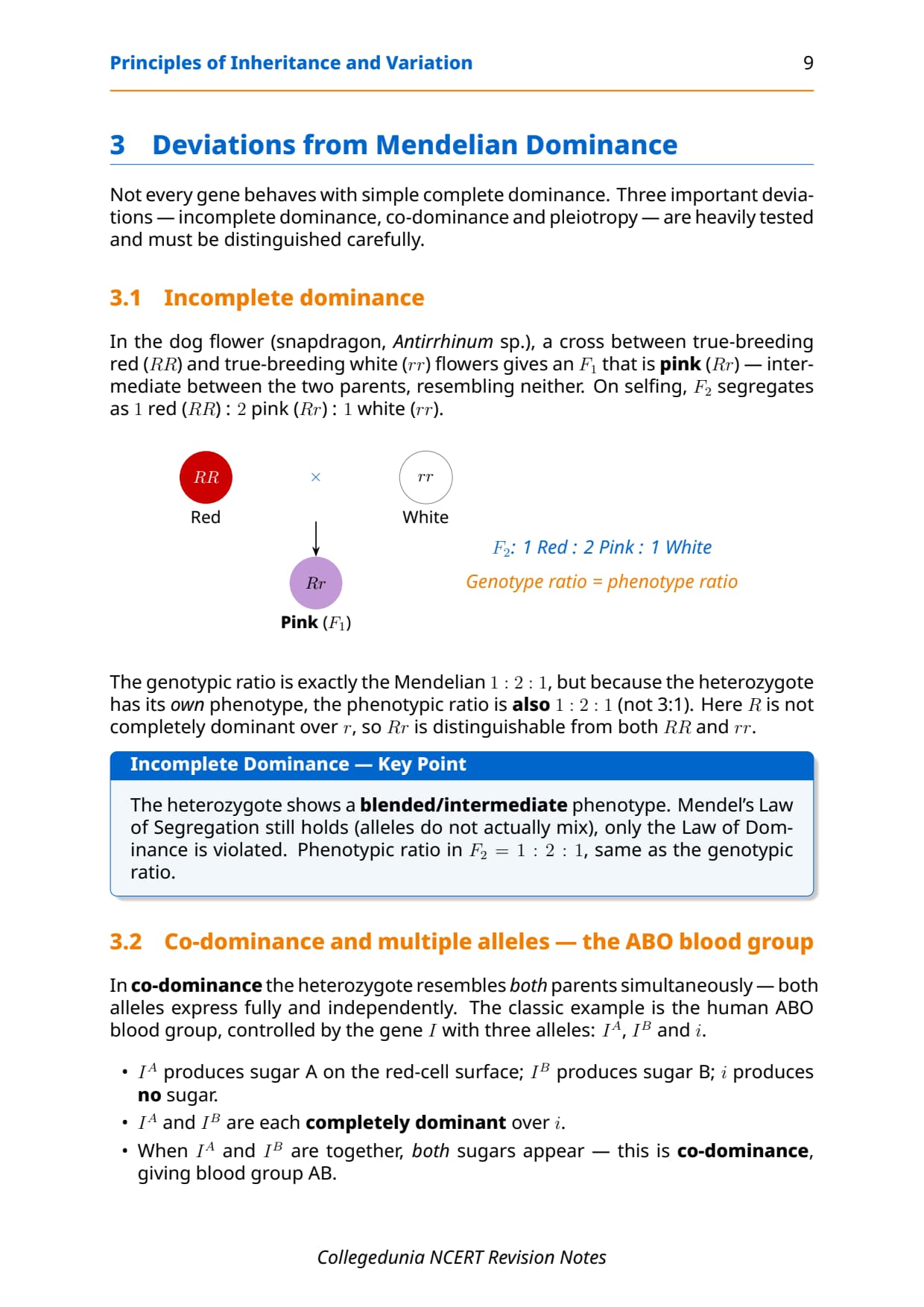
In incomplete dominance the heterozygote is a blended intermediate: Mirabilis jalapa red (RR) × white (rr) gives pink (Rr), F2 = 1 red : 2 pink : 1 white. In co-dominance both alleles show fully, as in the ABO blood group. ABO has three alleles (IA, IB, i) and four phenotypes.
Dihybrid Cross (Section 4.3)
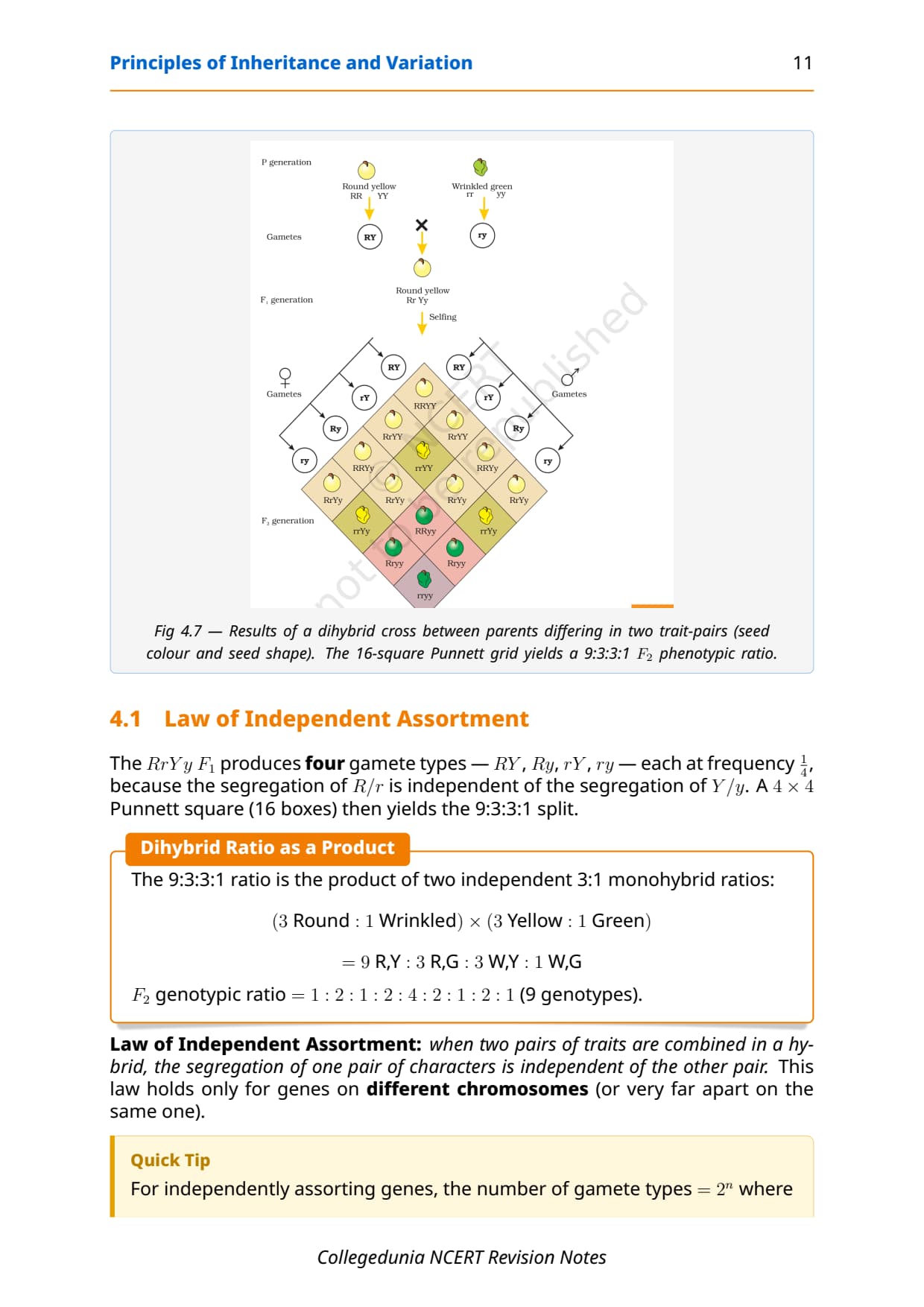
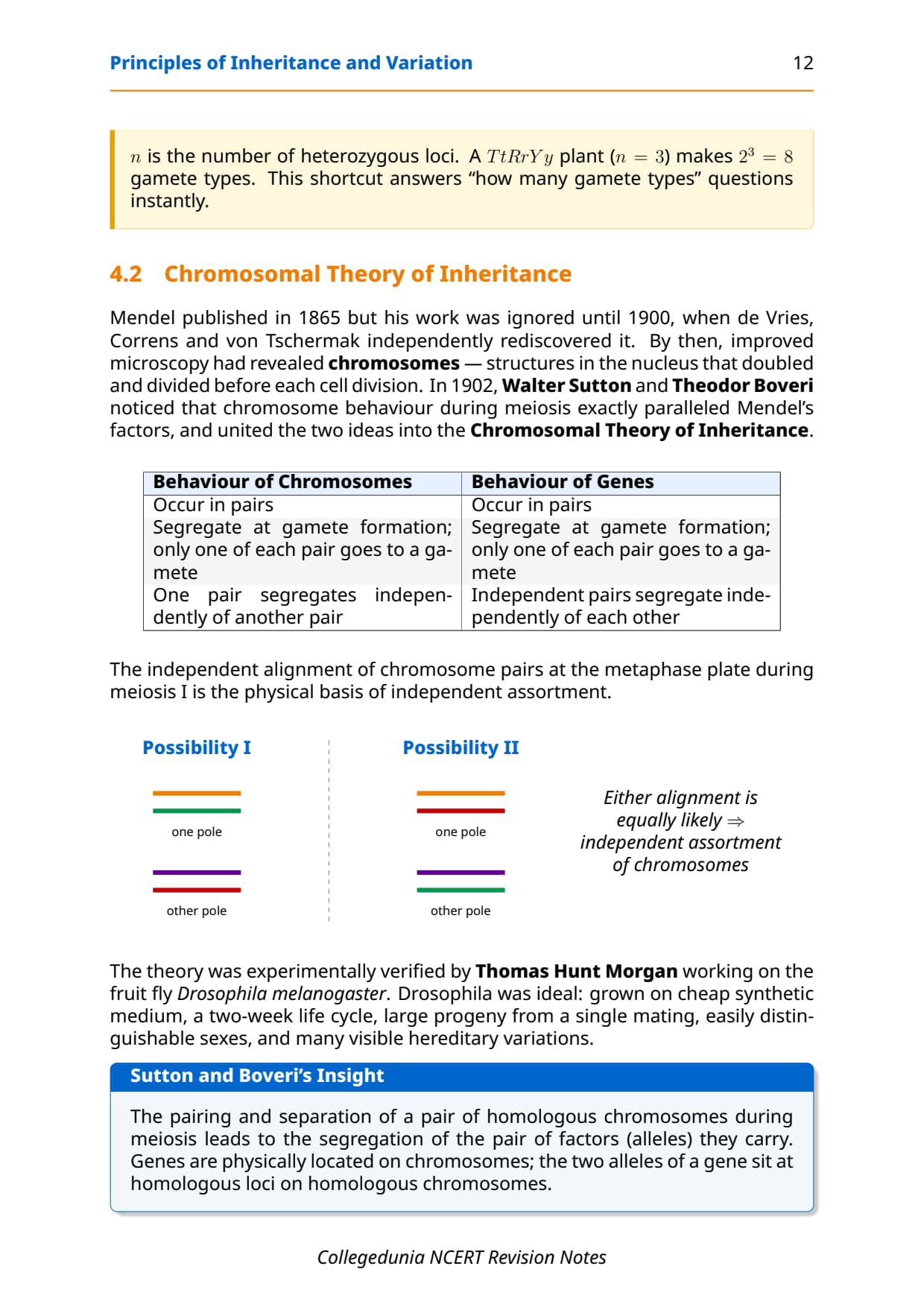
A dihybrid cross (RRYY × rryy) gives round yellow F1. Selfing gives F2 9 : 3 : 3 : 1, the basis of Independent Assortment. The Chromosomal Theory (Sutton and Boveri) placed Mendel's factors on chromosomes.
Linkage and Recombination (Section 4.3.3)
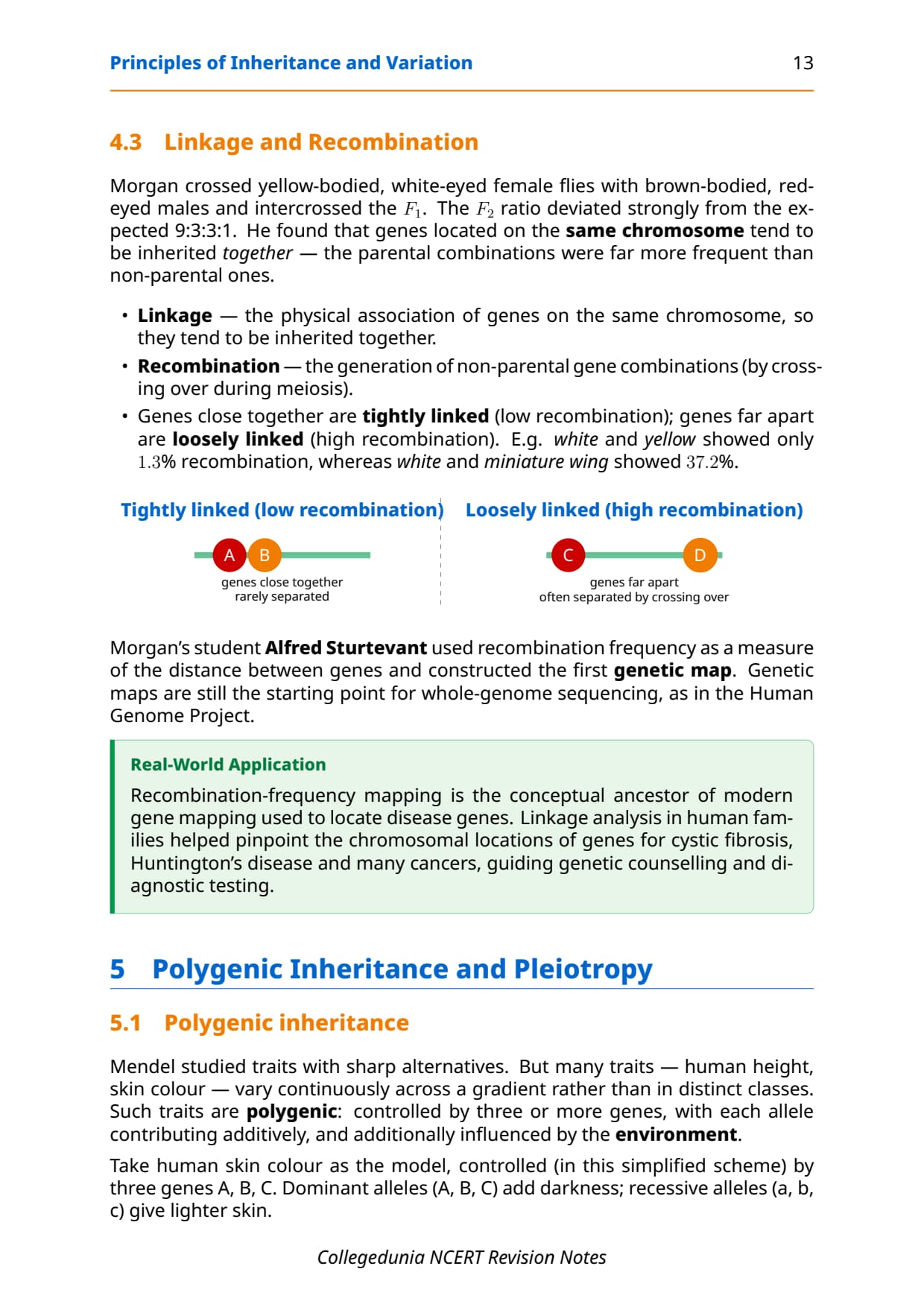
Morgan's Drosophila work showed genes on one chromosome are linked; tightly linked genes give fewer recombinants. Recombination frequency measures gene distance and underpins genetic mapping.
Polygenic Inheritance and Pleiotropy (Sections 4.4, 4.5)
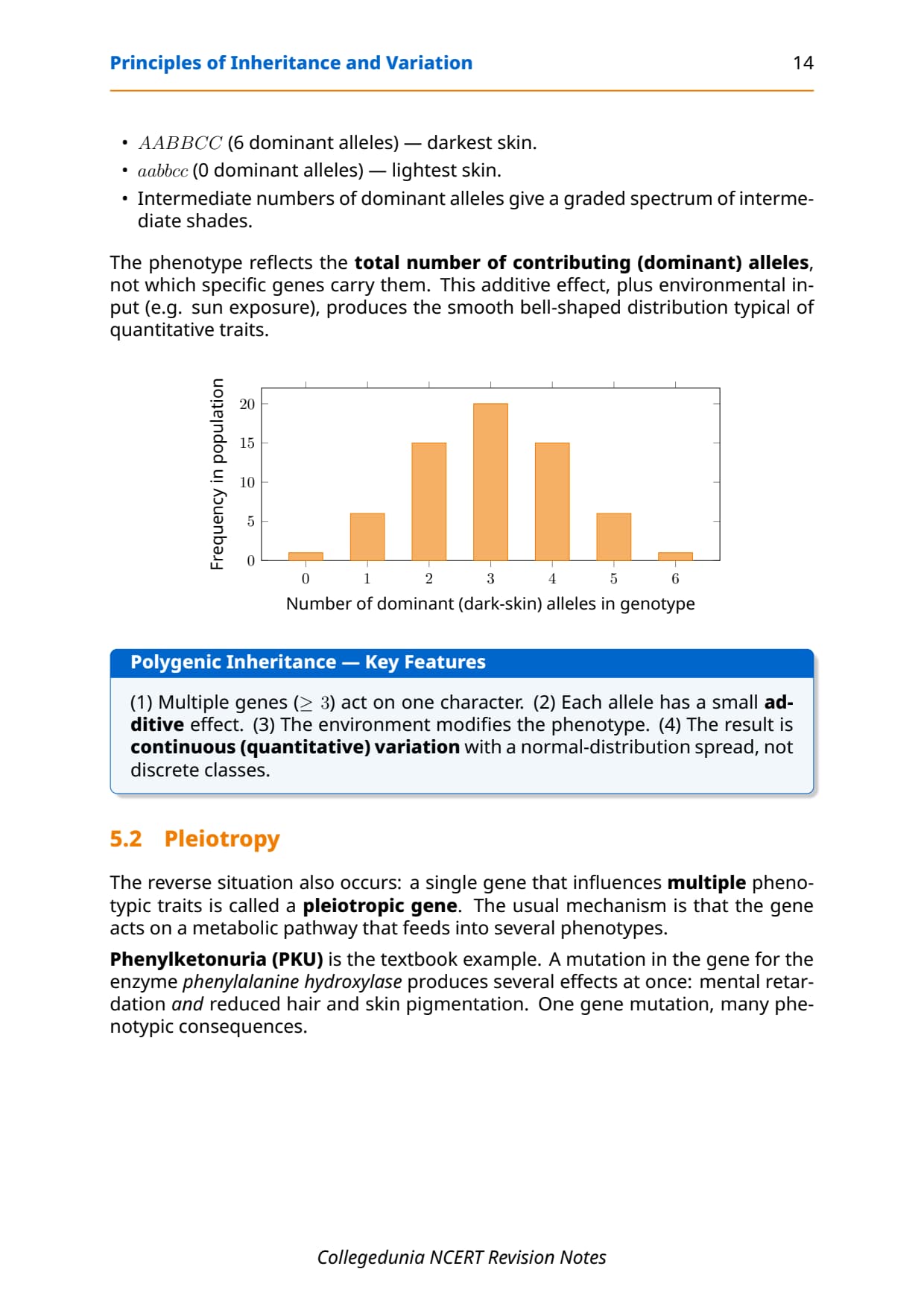
Polygenic inheritance: a trait from three or more additive genes, giving continuous variation (skin colour, height). Pleiotropy is the reverse, one gene affecting several traits, as in phenylketonuria.
Sex Determination (Section 4.6)
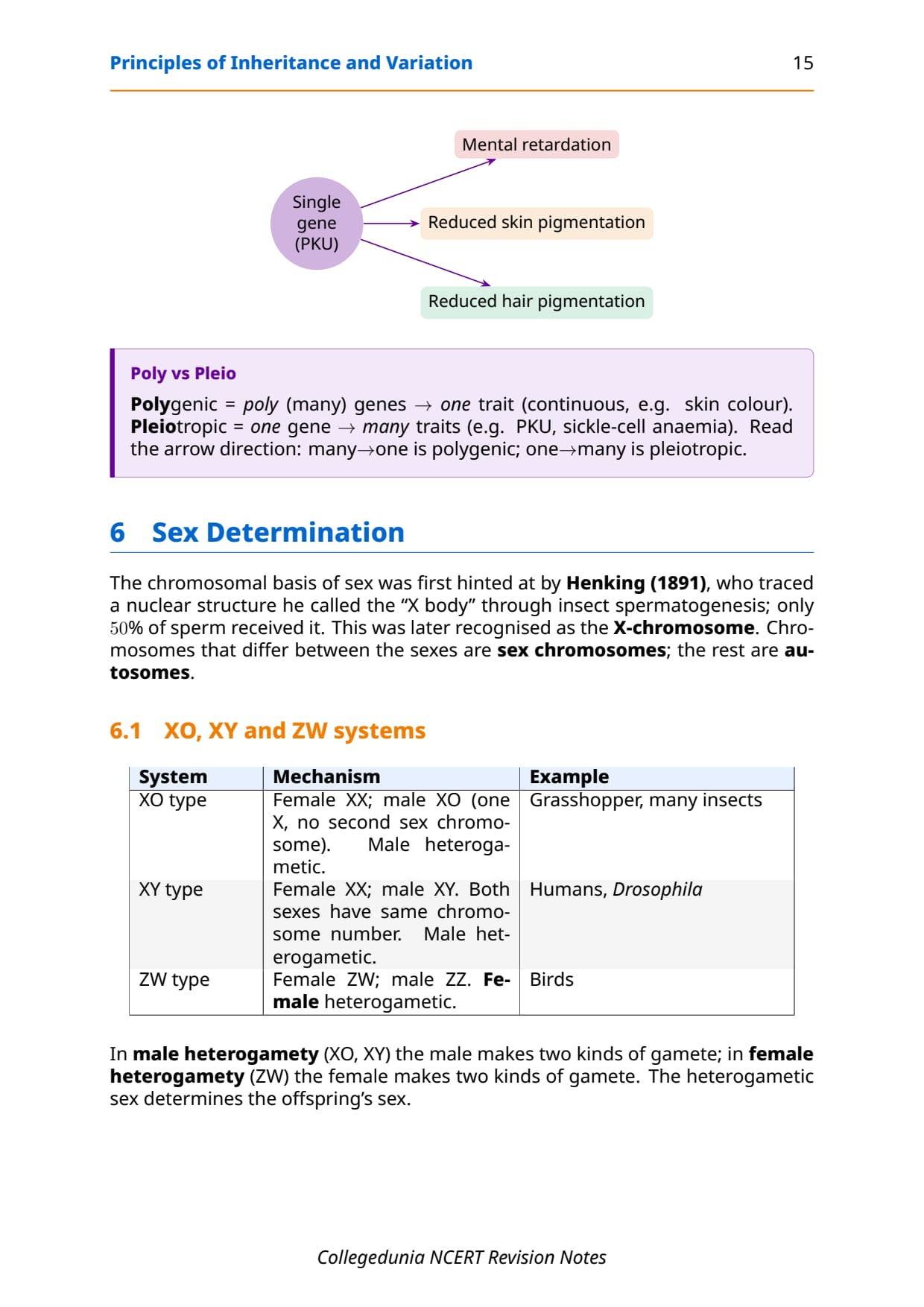
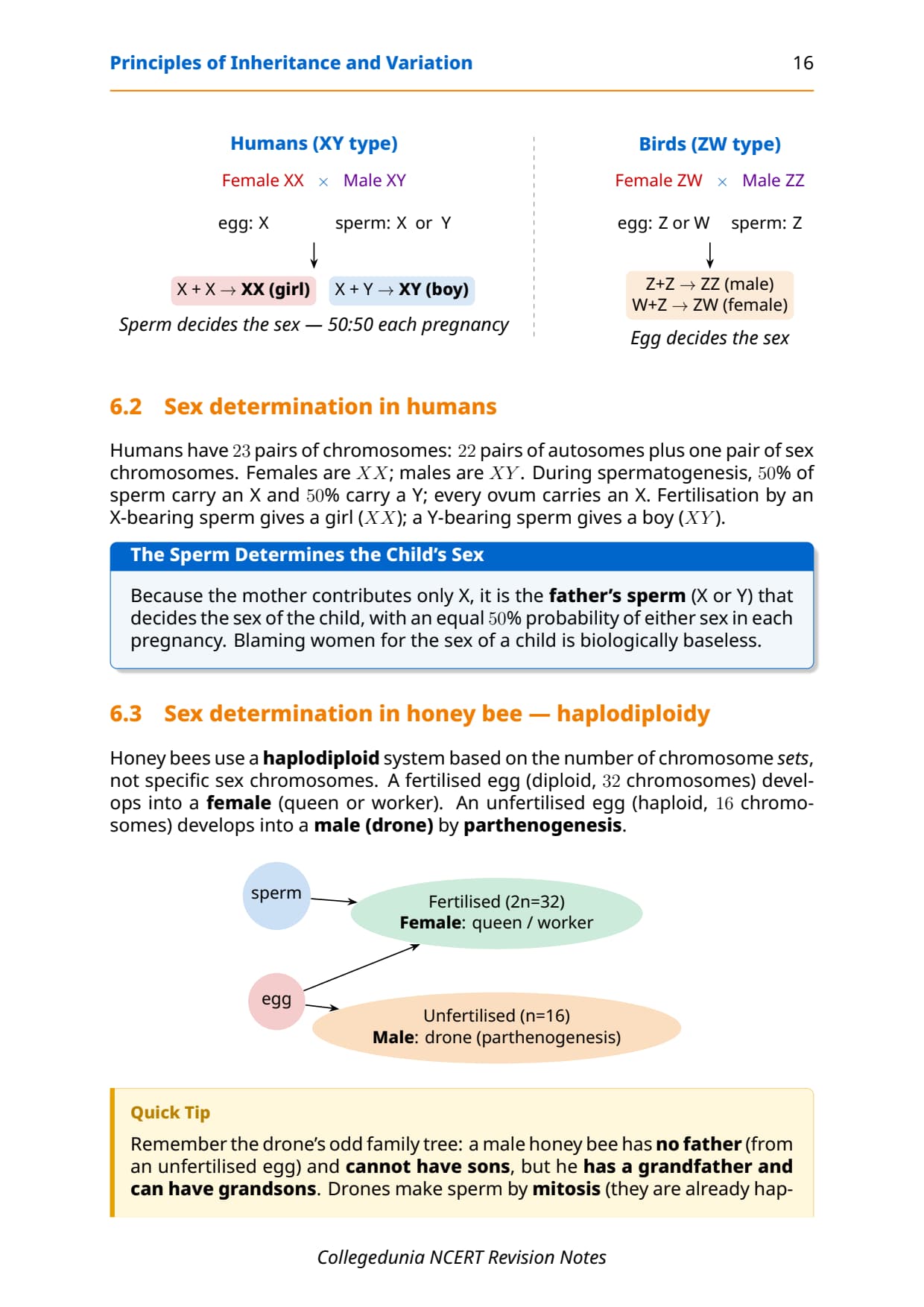
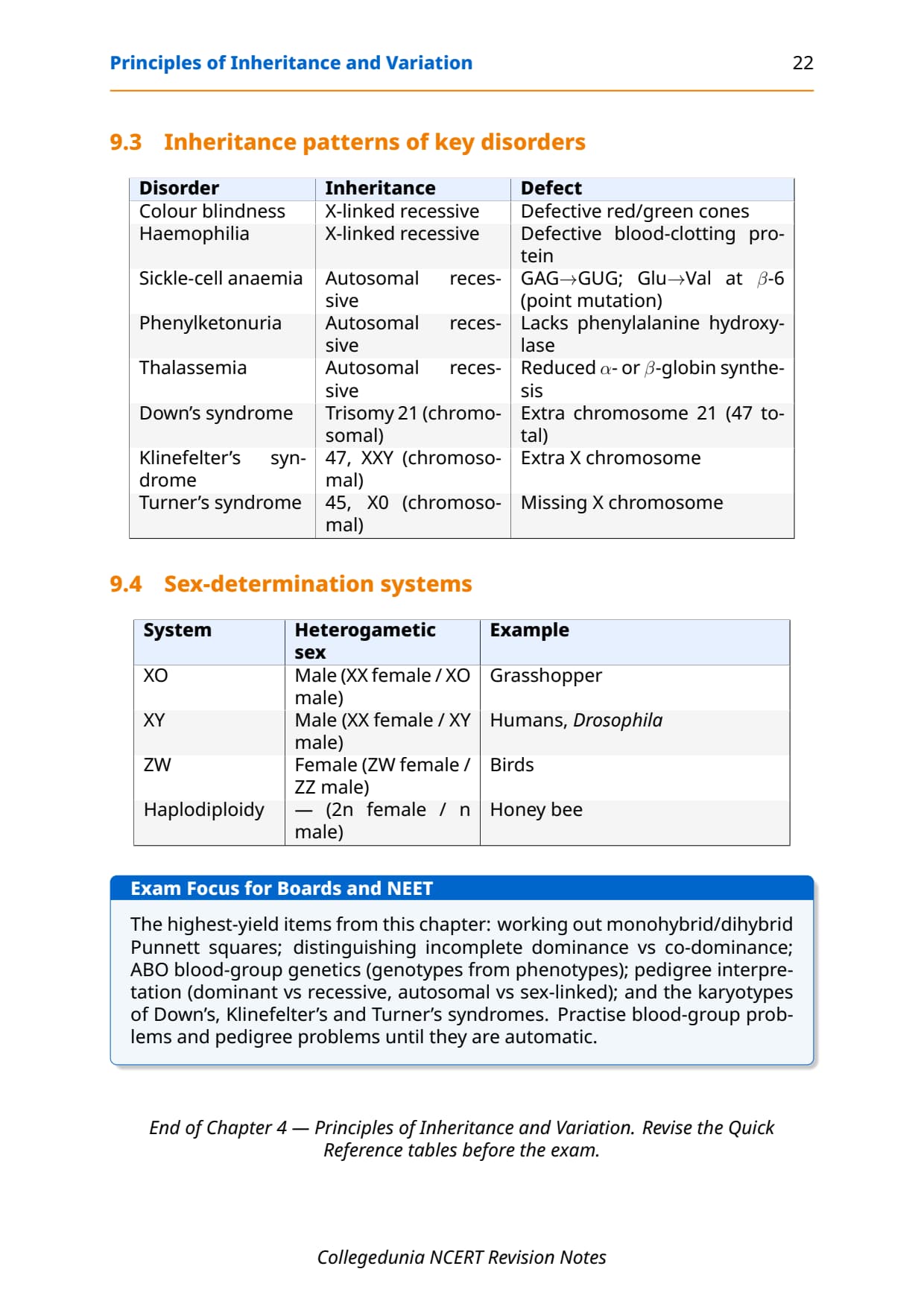
Humans follow XX-XY: females XX, males XY, and the sperm decides the sex. Birds follow ZZ-ZW (female heterogametic). In honey bees, diploid eggs give females and haploid eggs give males.
Mutation and Genetic Disorders (Sections 4.7, 4.8)
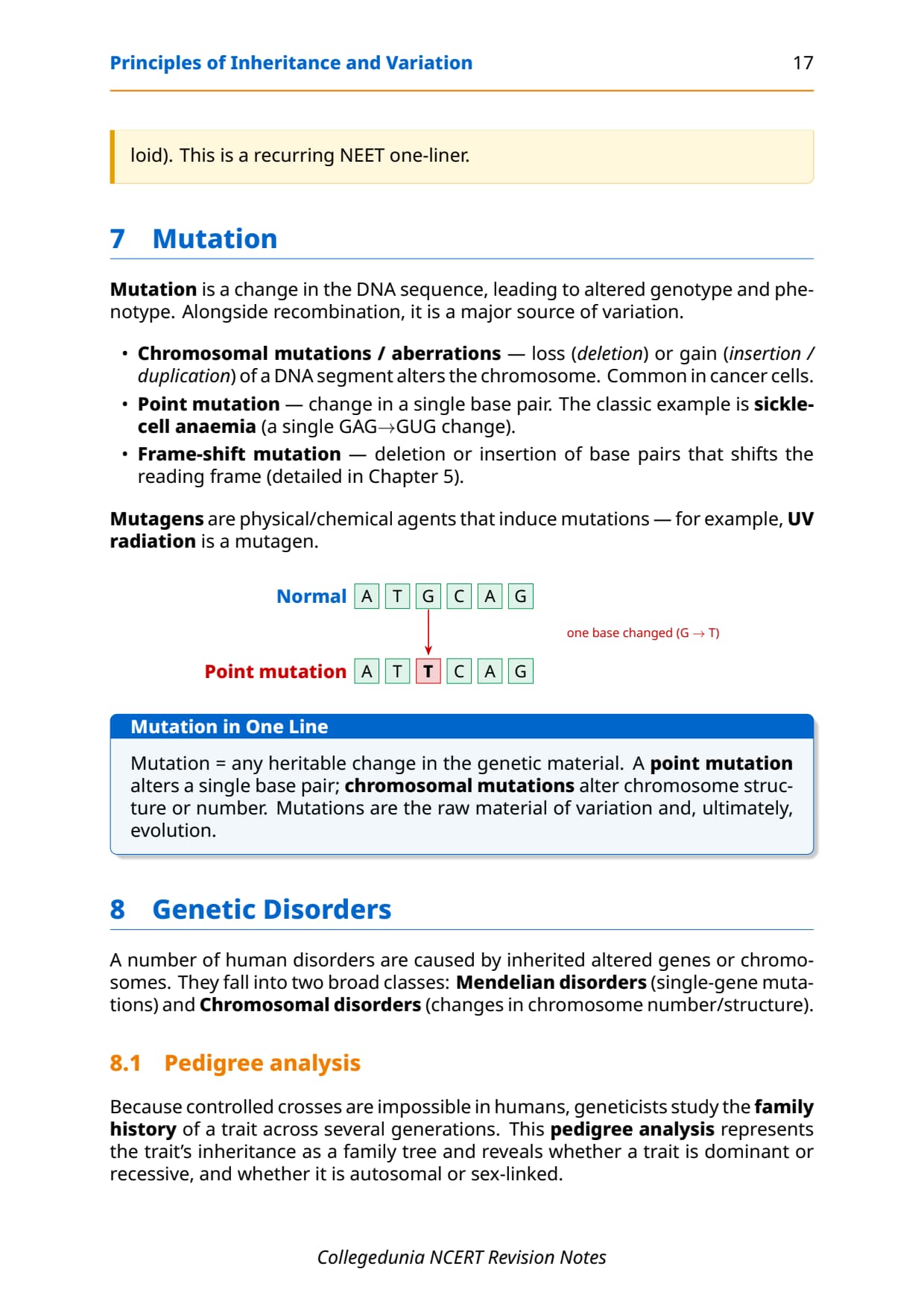
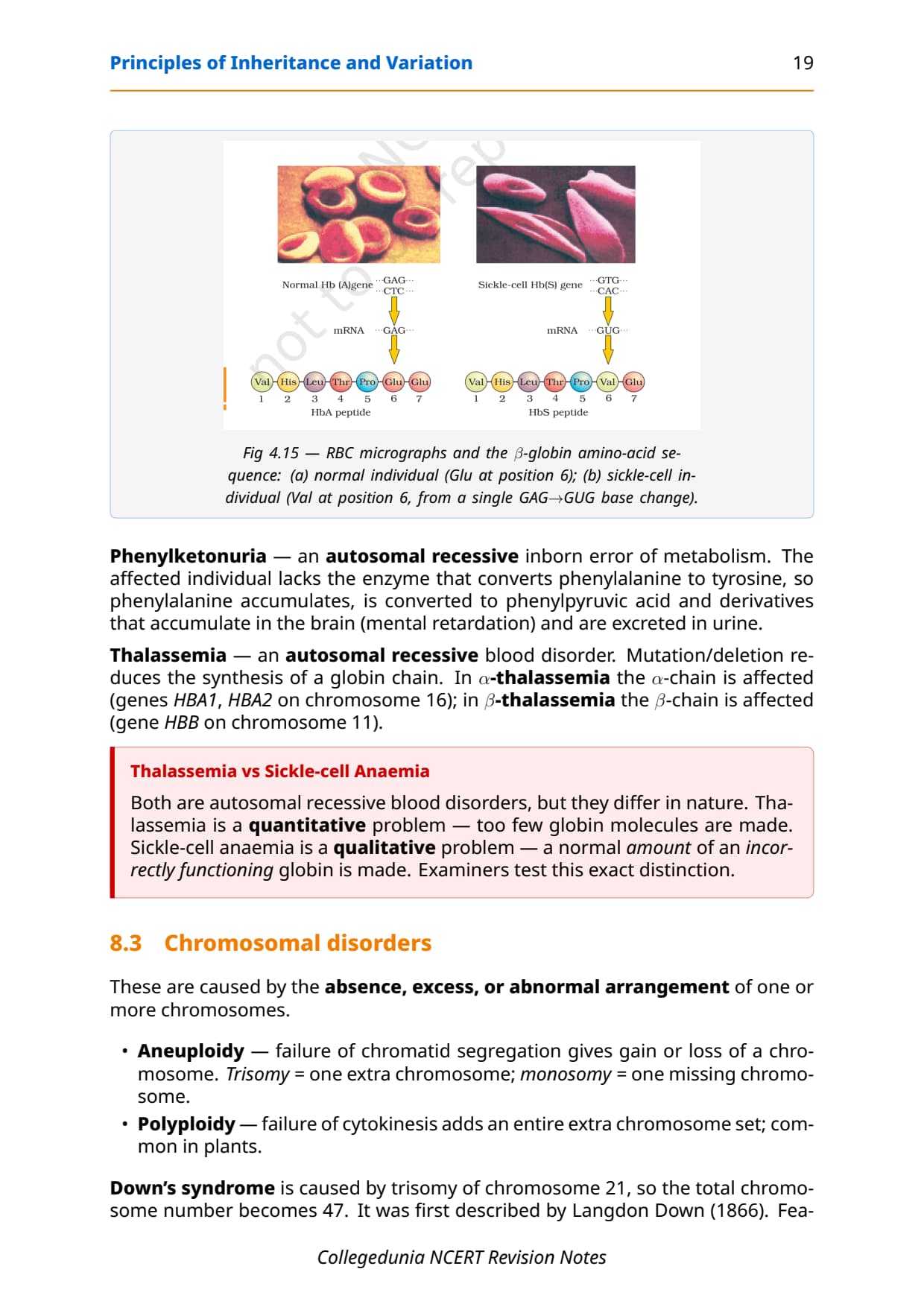
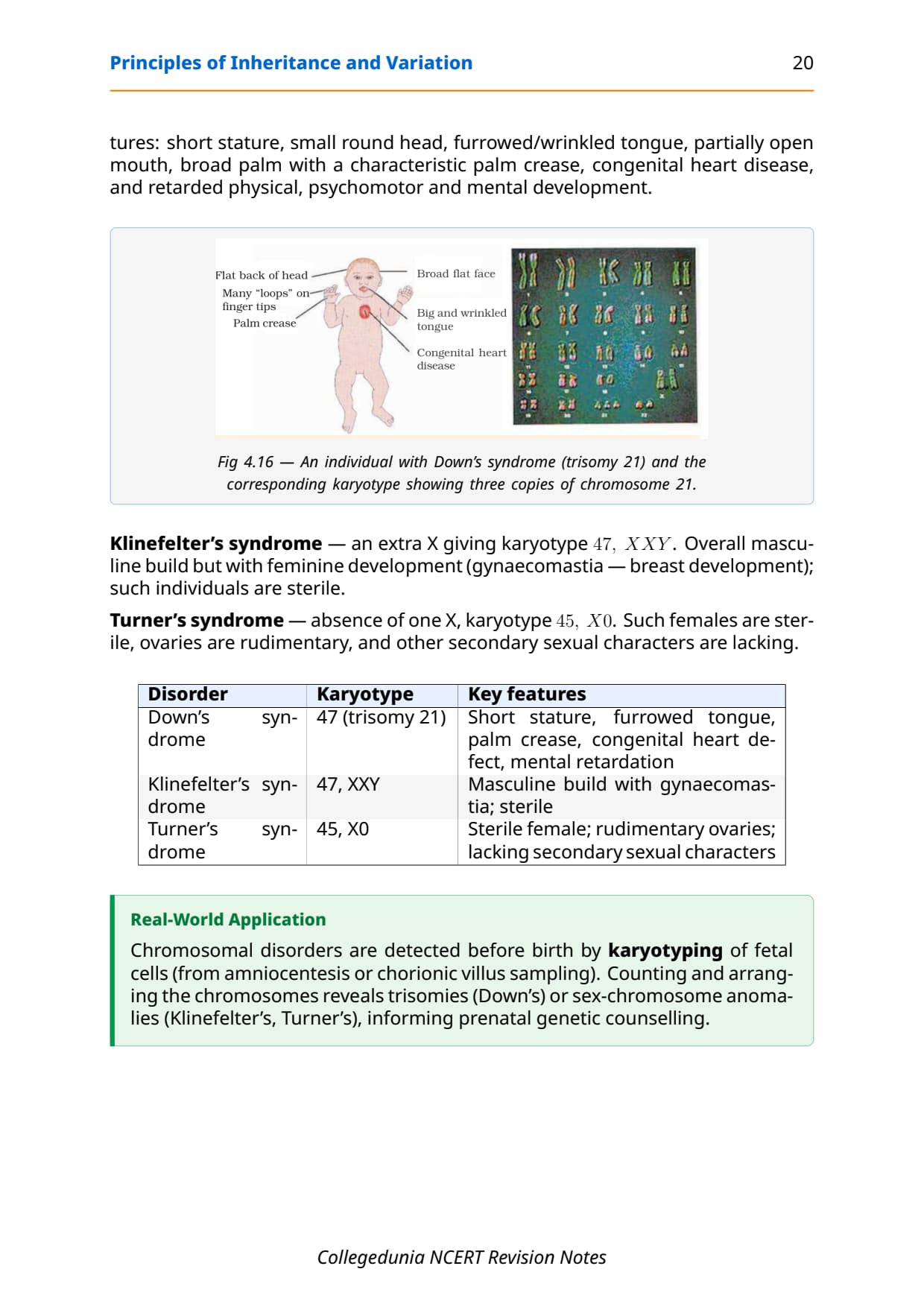
Mutation is a change in the DNA sequence, from point mutations (sickle-cell anaemia) to chromosomal aberrations. Mendelian disorders follow single genes: haemophilia and colour blindness are X-linked recessive; sickle-cell anaemia and thalassaemia are autosomal recessive. Chromosomal disorders come from aneuploidy: Down's (trisomy 21), Klinefelter's (XXY), Turner's (45, X0).
Sub-Topic Weightage Map: Principles of Inheritance and Variation Class 12 Biology
| Sub-topic | Weightage | Frequency |
|---|---|---|
| Monohybrid and dihybrid crosses (ratios) | High | CBSE 5 of last 5 |
| ABO blood group and co-dominance | High | NEET 5 of last 5 |
| Genetic disorders (Mendelian + chromosomal) | High | CBSE 4 of last 5 |
| Linkage and recombination | Medium | NEET 3 of last 5 |
| Sex determination | Medium | 3 of last 5 |
Principles of Inheritance and Variation Important Derivations and Crosses for Class 12 Boards
No algebra here, but these standard crosses must be built from memory.
- Monohybrid to F2: 3:1 phenotypic and 1:2:1 genotypic. CBSE 2023, 2021.
- Test cross (Tt × tt): 1:1, identifies an unknown genotype. CBSE 2022, NEET 2024.
- Dihybrid to F2: 9:3:3:1 and independent assortment. CBSE 2025, NEET 2023.
- Incomplete dominance (Mirabilis): 1:2:1 phenotypic in F2. CBSE 2024.
- ABO blood-group cross: multiple-allele co-dominance, four phenotypes. CBSE 2022, NEET 2025.
Common Misconceptions in Principles of Inheritance and Variation
Wrong beliefs examiners exploit every year.
- "Incomplete dominance and co-dominance are the same." Wrong. Incomplete dominance gives a blended intermediate (pink); co-dominance shows both alleles fully (AB blood).
- "9:3:3:1 is a genotypic ratio." Wrong. It is the F2 phenotypic ratio; the genotypic ratio has nine classes.
- "Down's syndrome is Mendelian." Wrong. It is a chromosomal disorder from trisomy 21.
Real-World Applications of Principles of Inheritance and Variation
NEET assertion-reason items often test these links.
- Genetic counselling: pedigree and carrier testing assess the risk of haemophilia, thalassaemia, and sickle-cell anaemia.
- Blood transfusion safety: ABO and Rh inheritance fixes donor compatibility.
- Breeding and forensics: test crosses combine desirable traits, and blood-group inheritance helps confirm parentage.
Principles of Inheritance and Variation Class 12: Prerequisite and Linked Chapters
This chapter sets up the genetics block. Revise meiosis from Chapter 2 first, then read Chapter 5 Molecular Basis of Inheritance and Chapter 6 Evolution, since variation and mutation feed Hardy-Weinberg and natural selection.
Student Feedback
From a survey of 15,800 Class 12 Biology students before the boards:
- 78% called dihybrid-cross Punnett-square problems the hardest sub-topic.
- 65% lost 1-2 marks on the incomplete dominance versus co-dominance distinction.
Other Resources for Principles of Inheritance and Variation Class 12 Biology
| Resource | Link |
|---|---|
| Notes (this page) | Principles of Inheritance and Variation Notes |
| NCERT Solutions | Principles of Inheritance and Variation NCERT Solutions |
| Handwritten Notes | Principles of Inheritance and Variation Handwritten Notes |
| Formula Sheet | Principles of Inheritance and Variation Formula Sheet |
| NCERT Book PDF | Principles of Inheritance and Variation NCERT Book PDF |
| Exemplar Solutions | Principles of Inheritance and Variation Exemplar Solutions |
| Exemplar Book PDF | Principles of Inheritance and Variation Exemplar Book PDF |
NCERT Notes for Class 12 Biology: All Chapters
Quick links to the rest of the Class 12 Biology notes set, useful for sequencing your full-syllabus revision.
| Chapter No. | Chapter Notes |
|---|---|
| Chapter 1 | Sexual Reproduction in Flowering Plants Notes |
| Chapter 2 | Human Reproduction Notes |
| Chapter 3 | Reproductive Health Notes |
| Chapter 4 | Principles of Inheritance and Variation Notes |
| Chapter 5 | Molecular Basis of Inheritance Notes |
| Chapter 6 | Evolution Notes |
| Chapter 7 | Human Health and Disease Notes |
| Chapter 8 | Microbes in Human Welfare Notes |
| Chapter 9 | Biotechnology Principles and Processes Notes |
| Chapter 10 | Biotechnology and Its Applications Notes |
| Chapter 11 | Organisms and Populations Notes |
| Chapter 12 | Ecosystem Notes |
| Chapter 13 | Biodiversity and Conservation Notes |
Principles of Inheritance and Variation Class 12 Biology Notes FAQs
Ques. Where can I download the Principles of Inheritance and Variation Class 12 Biology Notes PDF?
Ans. You can download the principles of inheritance and variation class 12 notes PDF directly from this page. Both the Normal and HD versions are available, and both are free.
Ques. Are these principles of inheritance and variation class 12 notes aligned with the 2026-27 NCERT?
Ans. Yes. These notes reflect the current 2026-27 NCERT for Class 12 Biology Chapter 4. Mendel's laws, incomplete dominance, co-dominance, linkage and recombination, polygenic inheritance, pleiotropy, sex determination, mutation, and genetic disorders are all retained in the new edition.
Ques. How many pages is the Class 12th Biology Principles of Inheritance and Variation Notes PDF?
Ans. The Notes PDF runs about 26 pages and covers Mendel's two laws, monohybrid and dihybrid crosses with Punnett squares, incomplete dominance and co-dominance, ABO blood grouping, linkage and recombination, sex determination, mutation, and Mendelian and chromosomal disorders, plus a quick-revision strip.
Ques. What are Mendel's laws of inheritance?
Ans. Mendel proposed two laws from his pea-plant experiments. The Law of Dominance states that characters are controlled by paired factors (alleles), and in a heterozygote the dominant allele expresses while the recessive one is masked. The Law of Segregation states that the two alleles of a pair separate during gamete formation so each gamete receives only one allele, which is why the recessive trait reappears unchanged in the F2 generation. The Law of Independent Assortment, drawn from the dihybrid cross, adds that alleles of different gene pairs assort independently of one another.
Ques. What is the difference between incomplete dominance and co-dominance?
Ans. In incomplete dominance the heterozygote shows a blended, intermediate phenotype, as in the pink flowers of Mirabilis jalapa from red and white parents, and the F2 phenotypic ratio is 1:2:1. In co-dominance both alleles express fully and separately in the heterozygote without blending; the human AB blood group is the standard example, where the IA and IB alleles both produce their antigens. Incomplete dominance gives a new intermediate phenotype, while co-dominance shows both parental phenotypes together.
Ques. Why is haemophilia more common in males than in females?
Ans. Haemophilia is an X-linked recessive disorder. A male has only one X chromosome, so a single recessive allele on it expresses the disease. A female has two X chromosomes, so she needs the recessive allele on both X chromosomes to be affected; with one normal allele she is only a carrier. This is why X-linked recessive disorders such as haemophilia and colour blindness appear far more frequently in males.
Ques. What is the difference between a Mendelian disorder and a chromosomal disorder?
Ans. A Mendelian disorder is caused by an alteration or mutation in a single gene and is inherited in a predictable Mendelian pattern; examples include haemophilia and colour blindness (X-linked recessive), sickle-cell anaemia and thalassaemia (autosomal recessive). A chromosomal disorder is caused by the absence, excess, or abnormal arrangement of one or more chromosomes (aneuploidy); examples include Down's syndrome (trisomy 21), Klinefelter's syndrome (XXY), and Turner's syndrome (45, X0).
Ques. Are these notes enough for NEET preparation in Principles of Inheritance and Variation?
Ans. Yes. The notes cover the full NCERT plus the NEET-only extensions (multiple-allele depth on ABO, lethal-gene ratio shifts, two-point recombination-frequency mapping, and a complete Mendelian versus chromosomal disorder table). Combined with the chapter glossary, the standard-cross checklist, and the year-wise PYQ map on the Solutions page, the notes match the depth NEET tests on this chapter, which is one of the highest-yield Biology chapters in the exam.



Comments